EP2730089B1 - System and method for encoding and decoding a bitstream for a 3d model having repetitive structure - Google Patents
System and method for encoding and decoding a bitstream for a 3d model having repetitive structure Download PDFInfo
- Publication number
- EP2730089B1 EP2730089B1 EP12810750.5A EP12810750A EP2730089B1 EP 2730089 B1 EP2730089 B1 EP 2730089B1 EP 12810750 A EP12810750 A EP 12810750A EP 2730089 B1 EP2730089 B1 EP 2730089B1
- Authority
- EP
- European Patent Office
- Prior art keywords
- instance
- bitstream
- information
- mode
- model
- Prior art date
- Legal status (The legal status is an assumption and is not a legal conclusion. Google has not performed a legal analysis and makes no representation as to the accuracy of the status listed.)
- Active
Links
Images

Classifications
-
- H—ELECTRICITY
- H04—ELECTRIC COMMUNICATION TECHNIQUE
- H04N—PICTORIAL COMMUNICATION, e.g. TELEVISION
- H04N19/00—Methods or arrangements for coding, decoding, compressing or decompressing digital video signals
-
- H—ELECTRICITY
- H04—ELECTRIC COMMUNICATION TECHNIQUE
- H04N—PICTORIAL COMMUNICATION, e.g. TELEVISION
- H04N13/00—Stereoscopic video systems; Multi-view video systems; Details thereof
- H04N13/10—Processing, recording or transmission of stereoscopic or multi-view image signals
- H04N13/106—Processing image signals
- H04N13/161—Encoding, multiplexing or demultiplexing different image signal components
-
- G—PHYSICS
- G06—COMPUTING OR CALCULATING; COUNTING
- G06T—IMAGE DATA PROCESSING OR GENERATION, IN GENERAL
- G06T9/00—Image coding
- G06T9/001—Model-based coding, e.g. wire frame
-
- G—PHYSICS
- G06—COMPUTING OR CALCULATING; COUNTING
- G06T—IMAGE DATA PROCESSING OR GENERATION, IN GENERAL
- G06T9/00—Image coding
- G06T9/004—Predictors, e.g. intraframe, interframe coding
-
- H—ELECTRICITY
- H04—ELECTRIC COMMUNICATION TECHNIQUE
- H04L—TRANSMISSION OF DIGITAL INFORMATION, e.g. TELEGRAPHIC COMMUNICATION
- H04L65/00—Network arrangements, protocols or services for supporting real-time applications in data packet communication
- H04L65/60—Network streaming of media packets
- H04L65/70—Media network packetisation
-
- H—ELECTRICITY
- H04—ELECTRIC COMMUNICATION TECHNIQUE
- H04N—PICTORIAL COMMUNICATION, e.g. TELEVISION
- H04N19/00—Methods or arrangements for coding, decoding, compressing or decompressing digital video signals
- H04N19/20—Methods or arrangements for coding, decoding, compressing or decompressing digital video signals using video object coding
-
- H—ELECTRICITY
- H04—ELECTRIC COMMUNICATION TECHNIQUE
- H04N—PICTORIAL COMMUNICATION, e.g. TELEVISION
- H04N19/00—Methods or arrangements for coding, decoding, compressing or decompressing digital video signals
- H04N19/65—Methods or arrangements for coding, decoding, compressing or decompressing digital video signals using error resilience
- H04N19/66—Methods or arrangements for coding, decoding, compressing or decompressing digital video signals using error resilience involving data partitioning, i.e. separation of data into packets or partitions according to importance
Definitions
- This invention relates to a bitstream syntax and semantics of repetitive structure discovery based 3D model compression algorithm, a method and an apparatus for encoding the same, and a method and an apparatus for decoding the same.
- a pattern is the representative geometry of the corresponding repetitive structure.
- the connected components belonging to a repetitive structure are called instances of the corresponding pattern and are represented by their transformation, i.e. the positions, orientations and possible scaling factors, regarding to the pattern.
- the orientation of an instance is represented by two orthogonal axes represented by (x0, y0, z0) and (x1, y1, z1) in a Cartesian coordinate system, or (alpha, beta, gamma) in a spherical coordinate system.
- a compressed bitstream syntax and semantics is disclosed that relates to a repetitive structure discovery based compression algorithm, which has been proven to be more efficient than the static 3D model compression algorithms provided by MPEG-3DGC.
- the disclosed compressed bitstream syntax and semantics of our repetitive structure discovery based compression algorithm is applicable, for example, to MPEG.
- the present invention is about the compressed bitstream syntax and semantics.
- the present invention also provides a system and a method for encoding and decoding a bitstream for a 3D model having repetitive structures.
- the present invention also provides a computer readable medium having executable instructions to cause a computer to perform a method comprising corresponding steps for encoding or decoding a bitstream for a 3D model having repetitive structures.
- 3D meshes are widely used in various applications for representing 3D objects, such as video games, engineering design, e-commerce, virtual reality, and architectural and scientific visualization. Usually their raw representation requires a huge amount of data. However, most applications prefer compact 3D mesh representation for storage or transmission.
- 3D meshes are represented by three types of data: connectivity data, geometry data and property data. Connectivity data describe the adjacency relationship between vertices, geometry data specify vertex locations, and property data specify attributes such as the normal vector, material reflectance and texture coordinates.
- Most 3D compression algorithms compress connectivity data and geometry data separately. The coding order of geometry data is determined by the underlying connectivity coding. Geometry data is usually compressed by three main steps: quantization, prediction and statistical encoding. 3D mesh property data are usually compressed in a similar manner.
- the present invention is related to an efficient compression method for large 3D engineering models. Such models are often composed of several partitions, so-called "connected components". The redundancy in the representation of repeating geometric feature patterns can be reduced by regarding all the connected components that are equivalent (e.g. after normalization of position, size) as instances of one geometry pattern. Equivalent components can be clustered. A cluster may refer to only some, or to all components of a 3D model. Then each connected component can be represented by an identifier, such as an alphanumeric identifier, of the corresponding geometry pattern (or clustering class) and the transformation information which can reconstruct the component from the geometry pattern. This transformation information may exemplarily comprise one or more of scale factors, mean (or center), orientation axes (or and rotation information, respectively), or shift information. In principle, also others are possible.
- the encoded model can be represented, transmitted and/or stored as a bitstream.
- Option (A) is called grouped instance transformation mode: Using this mode, the position, orientation and possible scaling factor of one instance are packed together in the bitstream.
- Option (B) is called separate instance transformation mode: The positions, orientations or possible scaling factors of all instances are packed together in the bitstream. In other words, the position, orientation and possible scaling factor of one instance are packed separately in the bitstream.
- a decoder that uses option (B) has also the following features.
- Our bitstream definition includes both the above two options (A) and (B). Then the user, or an automatic control, can choose the one which fits their one or more applications better.
- A3DMC The general structure of the compressed bitstream of our repetitive structure discovery based compression algorithm, A3DMC, is as shown in Fig.2 .
- the bitstream starts with the header buffer (A3DMC_stream_header), which contains all the necessary information for decoding the compressed stream: whether there is any repetitive structure in the original model, the 3D model compression method used for compressing patterns and other parts if necessary, whether the "grouped instance transformation mode” or “separate instance transformation mode” is used in this bitstream, whether there are some parts of the original model which are not included in any repetitive structure ( unique part ), etc.
- A3DMC_stream_header contains all the necessary information for decoding the compressed stream: whether there is any repetitive structure in the original model, the 3D model compression method used for compressing patterns and other parts if necessary, whether the "grouped instance transformation mode” or “separate instance transformation mode” is used in this bitstream, whether there are some parts of the original model which are not included in any repetitive structure ( unique part ), etc.
- the left part (e.g. the beginning) of the bitstream is the compressed input 3D model using the 3D model compression method indicated in A3DMC_stream_header. Otherwise, the next part in the bitstream is the compressed result of all patterns. Depending on which instance transformation packing mode is chosen in this bitstream, either compr_insta_grouped_data or compr_insta_separate_data is the next part in the bitstream. If there is unique part in the original 3D model, compr_uni_part_data is attached. Otherwise, the bitstream ends.
- 3d_model_compr_mode a 2-bit unsigned integer indicating the 3D model compression method used to compress patterns, unique part and the original 3D model itself if it includes no repetitive structures.
- pattern_num a 8-bit unsigned integer indicating the number of all patterns if it is less than 255. The minimum value of pattern_num is 1.
- pattern_num_2 a 16-bit unsigned integer indicating the number of all patterns if it is not less than 255.
- the total pattern number is (pattern_num_2 + 255) instance_num: a 16-bit unsigned integer indicating the number of all instances if it is less than 65535.
- the minimum value of instance_num is 1.
- instance_num_2 a 32-bit unsigned integer indicating the number of all instances if it is not less than 65535.
- the total instance number is (instance_num_2 + 65535)
- insta_trans_group_bit a 1-bit unsigned integer indicating whether "grouped instance transformation mode" or "separate instance transformation mode” is used in this bitstream. 0 for "separate instance transformation mode" and 1 for "grouped instance transformation mode”.
- insta_orient_mode_bit a 1-bit unsigned integer indicating the encoding mode of instance orientation. 0 means spherical mode and 1 Cartesian mode.
- use_scaling_bit a 1-bit unsigned integer indicating whether instance transformation include scaling factors. 0 for scaling factors being included in instance transformation and 1 for not.
- uni_part_bit a 1-bit unsigned integer indicates whether there is unique part in the original 3D model. 0 means there is no unique part and 1 means there is unique part.
- reserved_bits a 4-bit unsigned integer which is always 0000 and used for byte alignment.
- compr_pattern_data contains the compressed pattern data of all patterns, which is encoded by the compression method indicated by 3d_model_compr_mode.
- compr_insta_grouped_data contains the compressed instance transformation data using the "grouped instance transformation mode”.
- compr_insta_separate_data contains the compressed instance transformation data using the "separate instance transformation mode”.
- compr_uni_part_data contains the compressed unique part data, which is encoded by the compression method indicated by 3d_model_compr_mode.
- compr_ith_insta_orient_x0 contains the compressed x0 of i th instance's orientation.
- compr_ith_insta_orient_y0 contains the compressed y0 of i th instance's orientation.
- compr_ith_insta_orient_z0_sgn a 1-bit unsigned integer indicating the sign of z0 needed for calculating z0 using x0 and y0. 0 for "-" and 1 for "+”.
- compr_ith_insta_orient_z0_res contains the compressed residual of z0 which is calculated by (z0 - computer_z0()).
- compr_ith_insta_orient_z1 contains the compressed z1 of i th instance's orientation.
- ith_insta_orient_x1_sgn a 1-bit unsigned integer indicating the sign of x1 needed for calculating x1 using x0, y0. 0 for "-" and 1 for "+”.
- ith_insta_orient_y1_sgn a 1-bit unsigned integer indicating the sign of y1 needed for calculating y1 using x0, y0. 0 for "-” and 1 for "+”.
- compr_ith_insta_orient_x1 contains the compressed x1 of i th instance's orientation.
- compr_ith_insta_orient_y1 contains the compressed y1 of i th instance's orientation.
- ith_insta_orient_delta_sgn a 1-bit unsigned integer indicating the sign needed for calculating x1 or y1 using x0, y0, z0 and y1 or x1. 0 for "-" and 1 for "+”.
- compr_ith_insta_orient_z1_res contains the compressed residual of z1 which is calculated by (z1 - computer_z1()) threshold : a threshold widely accepted in compression field.
- compute_z0() compute z0 of the ith instance using x0, y0 and z0 sign.
- bit_num_orient_cartesian() compute the number of bits for each orientation value in cartesian coordinate system based on QP.
- bit_num_orient_res_cartesian() compute the number of bits for each orientation residual value in cartesian coordinate system based on QP.
- compute_z1() compute z1 of the ith instance using x0, y0, z0, x1 and y1.
- compr_ith_insta_orient_alpha bit_num_orient_alpha f(bit_num_orient_alpha()) compr_ith_insta_orient_beta bit_num_orient_beta() f(bit_num_orient_beta()) compr_ith_insta_orient_gamma bit_num_orient_gamma() f(bit_num_orient_gamma() if (need_correction()) ⁇ compr_ith_insta_orient_res 6*bit_num_orient_ res_cartesian() f(6*bit_num_orient_ res_cartesian()) ⁇ ⁇
- compr_ith_insta_orient_alpha contains the compressed alpha of ith instance's orientation.
- compr_ith_insta_orient_beta contains the compressed beta of ith instance's orientation.
- compr_ith_insta_orient_gamma contains the compressed gamma of ith instance's orientation.
- compr_ith_insta_orient_res contains the compressed residual in Cartesian coordinate system of ith instance's orientation.
- bit_num_orient_alpha() compute the number of bits for each alpha value based on QP bit_num_orient_beta(): compute the number of bits for each beta value based on QP bit_num_orient_gamma(): compute the number of bits for each gamma value based on QP need_correction() : check the orientation, if it is in the edge condition which probably results in a large error, return true; otherwise, return false.
- compr_insta_patternID_length 32 compr_insta_patternID_data ec(v) compr_insta_position_length 32 compr_insta_position_data compr_insta_orient_length 32 compr_insta_orient_data if (use_scaling_bit) ⁇ compr_insta scaling_length 32 compr_insta_scaling_data ec(v) ⁇ ⁇ compr_insta_patternID_length : contains a 32-bit unsigned integer indicating the length of the compressed pattern ID of all instances.
- compr_insta_patternID_data contains the compressed pattern IDs of all instances.
- compr_insta_position_length contains a 32-bit unsigned integer indicating the length of the compressed position of all instances.
- compr_insta_position_data contains the compressed positions of all instances.
- compr_insta_orient_length contains a 32-bit unsigned integer indicating the length of the compressed orientation of all instances.
- compr_insta_orient_data contains the compressed orientation of all instances.
- compr_insta_scaling_length contains a 32-bit unsigned integer indicating the length of the compressed scaling factors of all instances.
- compr_insta_scaling_data contains the compressed scaling factors of all instances.
- insta_position_bbox contains the bounding box of all instance positions.
- config_n0_symbols contains n0 ordinary octree configuration symbols.
- config_n1_symbols contains n1 ordinary octree configuration symbols.
- config_n2_symbols contains n2 ordinary octree configuration symbols.
- bitstream described above may also be embedded in other bitstreams such as the SC3DMC bitstream defined by MPEG-3DGC [W11455].
- the invention relates to
- FIG. 3 depicts a block diagram of an exemplary 3D model encoder 300.
- the input of apparatus 300 may include a 3D model, quality parameter for encoding the 3D model and other metadata.
- the 3D model first goes through the repetitive structure discovery module 310, which outputs the 3D model in terms of patterns, instances and unique components.
- a pattern encoder 320 is employed to compress the patterns and a unique component encoder 350 is employed to encode the unique components.
- the instance component information is encoded based on a user-selected mode. If instance information group mode is selected, the instance information is encoded using grouped instance information encoder 340; otherwise, it is encoded using an elementary instance information encoder 330.
- the encoded components are further verified in the repetitive structure verifier 360. If an encoded component does not meet its quality requirement, it will be encoded using unique component encoder 350.
- Bitstreams for patterns, instances, and unique components are assembled at bitstream assembler 370.
- FIG. 4 depicts a block diagram of an exemplary 3D model decoder 400.
- the input of apparatus 400 may include a bitstream of a 3D model, for example, a bitstream generated by encoder 300.
- the information related to patterns in the compressed bitstream is decoded by pattern decoder 420.
- Information related to unique components is decoded by unique component decoder 450.
- the decoding of the instance information also depends on the user-selected mode. If instance information group mode is selected, the instance information is decoded using a grouped instance information decoder 440; otherwise, it is decoded using an elementary instance information decoder 430.
- the decoded patterns, instance information and unique components are reconstructed to generate an output 3D model at model reconstruction module 460.
- the implementations described herein may be implemented in, for example, a method or a process, an apparatus, a software program, a data stream, or a signal. Even if only discussed in the context of a single form of implementation (for example, discussed only as a method), the implementation of features discussed may also be implemented in other forms (for example, an apparatus or program).
- An apparatus may be implemented in, for example, appropriate hardware, software, and firmware.
- the methods may be implemented in, for example, an apparatus such as, for example, a processor, which refers to processing devices in general, including, for example, a computer, a microprocessor, an integrated circuit, or a programmable logic device. Processors also include communication devices, such as, for example, computers, cell phones, portable/personal digital assistants ("PDAs”), and other devices that facilitate communication of information between end-users.
- PDAs portable/personal digital assistants
- implementations may produce a variety of signals formatted to carry information that may be, for example, stored or transmitted.
- the information may include, for example, instructions for performing a method, or data produced by one of the described implementations.
- a signal may be formatted to carry the bitstream of a described embodiment.
- Such a signal may be formatted, for example, as an electromagnetic wave (for example, using a radio frequency portion of spectrum) or as a baseband signal.
- the formatting may include, for example, encoding a data stream and modulating a carrier with the encoded data stream.
- the information that the signal carries may be, for example, analog or digital information.
- the signal may be transmitted over a variety of different wired or wireless links, as is known.
- the signal may be stored on a processor-readable medium.
- the disclosed invention can also be applied to other data compression areas.
- the invention results in a unique bitstream format.
- bitstream embeds all the transformation data
- it is efficient and may address several applications, where sometimes either bitstream size or decoding efficiency or error resilience matters the most. Therefore, two mode options are disclosed for how to put the transformation data of one instance, i.e. its position, orientation and scaling factor, in the bitstream.
- the first mode the position, orientation and possible scaling factor of one instance are packed together in the bitstream.
- the second mode the positions, orientations or possible scaling factors of all instances are packed together in the bitstream.
Landscapes
- Engineering & Computer Science (AREA)
- Multimedia (AREA)
- Signal Processing (AREA)
- Physics & Mathematics (AREA)
- General Physics & Mathematics (AREA)
- Theoretical Computer Science (AREA)
- Computer Networks & Wireless Communication (AREA)
- Compression Or Coding Systems Of Tv Signals (AREA)
- Image Generation (AREA)
Description
- This invention relates to a bitstream syntax and semantics of repetitive structure discovery based 3D model compression algorithm, a method and an apparatus for encoding the same, and a method and an apparatus for decoding the same.
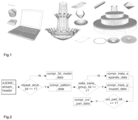
- In practical applications, many 3D models consist of a large number of connected components. And these multi-connected 3D models usually contain lots of repetitive structures in various transformations, as shown in
Fig.1 . Efficient compression methods for this kind of 3D models should be able to extract the redundancy existing in the repetitive structures. - An efficient compression algorithm for multi-connected 3D models, by taking advantage of discovering repetitive structures in the input models, was proposed in "Efficient Compression Scheme for Large 3D Engineering Models,"
WO 2010149492, filed June 9, 2010 , and assigned to Thomson Licensing. - It discovers the structures repeating in various positions, orientations and scaling factors. Then the 3D model is organized into a "pattern-instance" representation. A pattern is the representative geometry of the corresponding repetitive structure. The connected components belonging to a repetitive structure are called instances of the corresponding pattern and are represented by their transformation, i.e. the positions, orientations and possible scaling factors, regarding to the pattern. The orientation of an instance is represented by two orthogonal axes represented by (x0, y0, z0) and (x1, y1, z1) in a Cartesian coordinate system, or (alpha, beta, gamma) in a spherical coordinate system.
- A compressed bitstream syntax and semantics is disclosed that relates to a repetitive structure discovery based compression algorithm, which has been proven to be more efficient than the static 3D model compression algorithms provided by MPEG-3DGC. The disclosed compressed bitstream syntax and semantics of our repetitive structure discovery based compression algorithm is applicable, for example, to MPEG.
- The present invention is about the compressed bitstream syntax and semantics.
- The present invention also provides a system and a method for encoding and decoding a bitstream for a 3D model having repetitive structures.
- An apparatus that utilizes the method is disclosed below.
- The present invention also provides a computer readable medium having executable instructions to cause a computer to perform a method comprising corresponding steps for encoding or decoding a bitstream for a 3D model having repetitive structures.
-
Fig.1 shows exemplary 3D models with a large number of connected components and repetitive structures; -
Fig.2 shows a method for processing a structure of a 3DMC compressed bitstream according to the invention; -
Fig. 3 shows an exemplary encoder of 3D models according to the present principles; and -
Fig. 4 shows an exemplary decoder of 3D models according to the present principles. - Three-dimensional (3D) meshes are widely used in various applications for representing 3D objects, such as video games, engineering design, e-commerce, virtual reality, and architectural and scientific visualization. Usually their raw representation requires a huge amount of data. However, most applications prefer compact 3D mesh representation for storage or transmission. Typically, 3D meshes are represented by three types of data: connectivity data, geometry data and property data. Connectivity data describe the adjacency relationship between vertices, geometry data specify vertex locations, and property data specify attributes such as the normal vector, material reflectance and texture coordinates. Most 3D compression algorithms compress connectivity data and geometry data separately. The coding order of geometry data is determined by the underlying connectivity coding. Geometry data is usually compressed by three main steps: quantization, prediction and statistical encoding. 3D mesh property data are usually compressed in a similar manner.
- The present invention is related to an efficient compression method for large 3D engineering models. Such models are often composed of several partitions, so-called "connected components". The redundancy in the representation of repeating geometric feature patterns can be reduced by regarding all the connected components that are equivalent (e.g. after normalization of position, size) as instances of one geometry pattern. Equivalent components can be clustered. A cluster may refer to only some, or to all components of a 3D model. Then each connected component can be represented by an identifier, such as an alphanumeric identifier, of the corresponding geometry pattern (or clustering class) and the transformation information which can reconstruct the component from the geometry pattern. This transformation information may exemplarily comprise one or more of scale factors, mean (or center), orientation axes (or and rotation information, respectively), or shift information. In principle, also others are possible.
- The encoded model can be represented, transmitted and/or stored as a bitstream.
- While we want the bitstream to embed all the transformation data, we also want it to be efficient and to address several applications, where sometimes either bitstream size or decoding efficiency or error resilience matters the most.
- Therefore, two options are disclosed for how to put the transformation data of one instance, i.e. its position, orientation and scaling factor, in the bitstream. Both of them have their own advantages. An adaptive combination of both is particularly advantageous.
- Option (A) is called grouped instance transformation mode: Using this mode, the position, orientation and possible scaling factor of one instance are packed together in the bitstream.
- Advantages of option (A) are
- It is error resilient. The decoder can be recovered from losing the transformation of some instances.
- On-line decoding. That means the instances can be decoded one by one during reading the compressed bitstream. There is no need to wait for finishing reading of the whole compressed bitstream.
- Higher codec speed.
- The codec needs no (or only a very small) buffer.
- Option (B) is called separate instance transformation mode: The positions, orientations or possible scaling factors of all instances are packed together in the bitstream. In other words, the position, orientation and possible scaling factor of one instance are packed separately in the bitstream.
- Advantages of option (B) are
- smaller compressed 3D model size relative to option (A).
- A decoder that uses option (B) has also the following features.
- The decoder is not error resilient.
- Off-line decoding. That means the decoder can only start decoding after reading the whole compressed bitstream.
- Lower codec speed.
- Buffer is necessary.
- Our bitstream definition includes both the above two options (A) and (B). Then the user, or an automatic control, can choose the one which fits their one or more applications better.
- The general structure of the compressed bitstream of our repetitive structure discovery based compression algorithm, A3DMC, is as shown in
Fig.2 . - The bitstream starts with the header buffer (A3DMC_stream_header), which contains all the necessary information for decoding the compressed stream: whether there is any repetitive structure in the original model, the 3D model compression method used for compressing patterns and other parts if necessary, whether the "grouped instance transformation mode" or "separate instance transformation mode" is used in this bitstream, whether there are some parts of the original model which are not included in any repetitive structure (unique part), etc.
- If there is no repetitive structure in the original model (repeat_struc_bit != 1), the left part (e.g. the beginning) of the bitstream is the compressed input 3D model using the 3D model compression method indicated in A3DMC_stream_header. Otherwise, the next part in the bitstream is the compressed result of all patterns. Depending on which instance transformation packing mode is chosen in this bitstream, either compr_insta_grouped_data or compr_insta_separate_data is the next part in the bitstream. If there is unique part in the original 3D model, compr_uni_part_data is attached. Otherwise, the bitstream ends.
- The compressed bitstream syntax and semantics of A3DMC, will be explained in details as follows.
- Specification of syntax functions, categories, and descriptors
- f(n): fixed-pattern bit string using n bits written (from left to right).n depends on the code length for each symbol
- ec(v) : entropy-coded (e.g., arithmetic coded) syntax element, including possibly configuration symbols.
-
Tab.1 class A3DMC_stream{ Num. of Bits Descriptor A3DMC_stream_header A3DMC_steam_data }
A3DMC_stream_header: contains the header buffer.
A3DMC_steam_data: contains the data buffer.
A3DMC_stream_header classTab.2 class A3DMC_stream_header{ Num. of Bits Descriptor repeat_struc_bit 1 3d_model_compr_mode 2 QP 5 If(repeat_struc_bit == 1){ pattern_num 8 If(pattern_num == 255){ pattern_num_2 16 } instance_num 16 If(instance_num == 65535){ instance_num_2 32 } insta_trans_group_bit 1 insta_orient_mode_bit 1 cartesian / spherical coordinate use_scaling_bit 1 uni_part_bit 1 reserved_bits 4 } }
repeat_struc_bit : a 1-bit unsigned integer indicating whether there are repetitive structures in the 3D model. 0 means no repetitive structure and 1 means repetitive structure.
3d_model_compr_mode : a 2-bit unsigned integer indicating the 3D model compression method used to compress patterns, unique part and the original 3D model itself if it includes no repetitive structures.Tab.3 3d_model_compr_mode Meaning 00 SC3DMC 01 3DMC Extension 10 & 11 ISO reserved
QP: a 5-bit unsigned integer indicating the quantization parameter. E.g., the minimum value of QP is 3 and the maximum is 31.
pattern_num: a 8-bit unsigned integer indicating the number of all patterns if it is less than 255. The minimum value of pattern_num is 1.
pattern_num_2: a 16-bit unsigned integer indicating the number of all patterns if it is not less than 255. In this case, the total pattern number is (pattern_num_2 + 255)
instance_num: a 16-bit unsigned integer indicating the number of all instances if it is less than 65535. The minimum value of instance_num is 1.
instance_num_2: a 32-bit unsigned integer indicating the number of all instances if it is not less than 65535. In this case, the total instance number is (instance_num_2 + 65535)
insta_trans_group_bit : a 1-bit unsigned integer indicating whether "grouped instance transformation mode" or "separate instance transformation mode" is used in this bitstream. 0 for "separate instance transformation mode" and 1 for "grouped instance transformation mode".
insta_orient_mode_bit : a 1-bit unsigned integer indicating the encoding mode of instance orientation. 0 means spherical mode and 1 Cartesian mode.
use_scaling_bit : a 1-bit unsigned integer indicating whether instance transformation include scaling factors. 0 for scaling factors being included in instance transformation and 1 for not.
uni_part_bit : a 1-bit unsigned integer indicates whether there is unique part in the original 3D model. 0 means there is no unique part and 1 means there is unique part.
reserved_bits : a 4-bit unsigned integer which is always 0000 and used for byte alignment. -
Tab.4 class A3DMC_stream_data{ Num. of bits Descriptor if (repeat_struc_bit == 1) { compr_repeat_struc_data } else{ compr_3d_model_data } }
compr_repeat_struc_data: contains the compressed 3d model, which includes repetitive structures.
compr_3d_model_data: contains the compressed 3d model, which has no repetitive structures and is encoded by the compression method indicated by 3d_model_compr_mode.
compr_repeat_struc_data classTab.5 class compr_repeat_struc_data{ Num. of bits Descriptor compr_pattern_data if(insta_trans_group_bit == 1){ compr_insta_grouped_data } else{ compr_insta_separate_data } if (uni_part_bit == 1){ compr_uni_part_data } }
compr_pattern_data: contains the compressed pattern data of all patterns, which is encoded by the compression method indicated by 3d_model_compr_mode.
compr_insta_grouped_data : contains the compressed instance transformation data using the "grouped instance transformation mode".
compr_insta_separate_data: contains the compressed instance transformation data using the "separate instance transformation mode".
compr_uni_part_data: contains the compressed unique part data, which is encoded by the compression method indicated by 3d_model_compr_mode. -
Tab.6 class compr_insta_grouped_data{ Num. of bits Descriptor for (i = 0; i < numofInstance; i ++) { compr_ith_insta_patternID ec(v) compr_ith_insta_position bit_num_insta_position() f(bit_num_ insta_position()) If (insta_orient_mode_bit == 1){ compr_ith_insta_orient_cartesian } else{ compr_ith_insta_orient_spherical } if (use_scaling_bit){ compr_ith_insta_scaling ec(v) } } } - compr_ith_insta_patternID: contains the compressed pattern ID of ith instance.
- compr_ith_insta_position: contains the compressed position of ith instance.
- compr_ith_insta_orient_cartesian: contains the compressed orientation of ith instance in Cartesian mode.
- compr_ith_insta_orient_spherical: contains the compressed orientation of ith instance in spherical mode.
- compr_ith_insta_scaling: contains the compressed scaling factor of ith instance.
- bit_num_insta_position(): compute the number of bits for each instance position value based on QP.
-
Tab.7 class compr_ith_insta_orient_cartesian { Num. of bits Descriptor compr_ith_insta_orient_x0 bit_num_orient_cartesian() f(bit_num_orient_ cartesian()) compr_ith_insta_orient_y0 bit_num_orient_cartesian() f(bit_num_orient_ cartesian()) ith_insta_orient_z0_sgn 1 if (compute_z0() < threshold) { compr_ith_insta_orient_z0_res bit_num_orient_ res_cartesian() f(bit_num_orient_ res_cartesian()) } if (compute_z0() ≈ 0) { compr_ith_insta_orient_z1 bit_num_orient_cartesian() f(bit_num_orient_ cartesian()) if (abs(ith_x0) < abs(ith_y0)){ ith_insta_orient_x1_sgn 1 }else{ ith_insta_orient_y1_sgn 1 } }else { if (abs(ith_x0) < abs(ith_y0)){ compr_ith_insta_orient_x1 bit_num_orient_cartesian() f(bit_num_orient_ cartesian()) }else { compr_ith_insta_orient_y1 bit_num_orient_cartesian() f(bit_num_orient_ cartesian()) } ith_insta_orient_delta_sgn 1 if (compute_z1() < threshold) { compr_ith_insta_orient_z1_res bit_num_orient_res_cartesi an() f(bit_num_orient_ res_cartesian()) } } } - The orientation of ith instance in Cartesian mode is represented by 2 orthogonal axes (x0, y0, z0) and (x1, y1, z1).
compr_ith_insta_orient_x0: contains the compressed x0 of ith instance's orientation.
compr_ith_insta_orient_y0: contains the compressed y0 of ith instance's orientation.
compr_ith_insta_orient_z0_sgn: a 1-bit unsigned integer indicating the sign of z0 needed for calculating z0 using x0 and y0. 0 for "-" and 1 for "+".
compr_ith_insta_orient_z0_res: contains the compressed residual of z0 which is calculated by (z0 - computer_z0()).
compr_ith_insta_orient_z1: contains the compressed z1 of ith instance's orientation.
ith_insta_orient_x1_sgn: a 1-bit unsigned integer indicating the sign of x1 needed for calculating x1 using x0, y0. 0 for "-" and 1 for "+".
ith_insta_orient_y1_sgn: a 1-bit unsigned integer indicating the sign of y1 needed for calculating y1 using x0, y0. 0 for "-" and 1 for "+".
compr_ith_insta_orient_x1: contains the compressed x1 of ith instance's orientation.
compr_ith_insta_orient_y1: contains the compressed y1 of ith instance's orientation.
ith_insta_orient_delta_sgn: a 1-bit unsigned integer indicating the sign needed for calculating x1 or y1 using x0, y0, z0 and y1 or x1. 0 for "-" and 1 for "+".
compr_ith_insta_orient_z1_res: contains the compressed residual of z1 which is calculated by (z1 - computer_z1())
threshold: a threshold widely accepted in compression field.
compute_z0(): compute z0 of the ith instance using x0, y0 and z0 sign.
bit_num_orient_cartesian(): compute the number of bits for each orientation value in cartesian coordinate system based on QP.
bit_num_orient_res_cartesian() : compute the number of bits for each orientation residual value in cartesian coordinate system based on QP.
compute_z1() : compute z1 of the ith instance using x0, y0, z0, x1 and y1.
compr_ith_insta_orient_spherical classTab.8 class compr_ith_insta_orient_spherical { Num. of bits Descriptor compr_ith_insta_orient_alpha bit_num_orient_alpha() f(bit_num_orient_alpha()) compr_ith_insta_orient_beta bit_num_orient_beta() f(bit_num_orient_beta()) compr_ith_insta_orient_gamma bit_num_orient_gamma() f(bit_num_orient_gamma() if (need_correction()) { compr_ith_insta_orient_res 6*bit_num_orient_ res_cartesian() f(6*bit_num_orient_ res_cartesian()) } } - The orientation of ith instance in spherical mode is represented by 3 angles, alpha, beta & gamma.
compr_ith_insta_orient_alpha: contains the compressed alpha of ith instance's orientation.
compr_ith_insta_orient_beta: contains the compressed beta of ith instance's orientation.
compr_ith_insta_orient_gamma: contains the compressed gamma of ith instance's orientation.
compr_ith_insta_orient_res : contains the compressed residual in Cartesian coordinate system of ith instance's orientation.
bit_num_orient_alpha(): compute the number of bits for each alpha value based on QP
bit_num_orient_beta(): compute the number of bits for each beta value based on QP
bit_num_orient_gamma(): compute the number of bits for each gamma value based on QP
need_correction() : check the orientation, if it is in the edge condition which probably results in a large error, return true; otherwise, return false.
compr_insta_separate_data classTab.9 class compr_insta_data_separate{ Num. of bits Descriptor compr_insta_patternID_length 32 compr_insta_patternID_data ec(v) compr_insta_position_length 32 compr_insta_position_data compr_insta_orient_length 32 compr_insta_orient_data if (use_scaling_bit){ compr_insta scaling_length 32 compr_insta_scaling_data ec(v) } }
compr_insta_patternID_length : contains a 32-bit unsigned integer indicating the length of the compressed pattern ID of all instances.
compr_insta_patternID_data: contains the compressed pattern IDs of all instances.
compr_insta_position_length : contains a 32-bit unsigned integer indicating the length of the compressed position of all instances.
compr_insta_position_data: contains the compressed positions of all instances.
compr_insta_orient_length : contains a 32-bit unsigned integer indicating the length of the compressed orientation of all instances.
compr_insta_orient_data: contains the compressed orientation of all instances.
compr_insta_scaling_length : contains a 32-bit unsigned integer indicating the length of the compressed scaling factors of all instances.
compr_insta_scaling_data: contains the compressed scaling factors of all instances.
compr_ins_position_data classTab. 10 class compr_insta_position_data{ Num. of bits Descriptor insta_position_bbox 6*32 config_n0_symbols ec(v_n0) config_n1_symbols ec(v_n1) config_n2_symbols ec(v_n2) }
insta_position_bbox: contains the bounding box of all instance positions.
config_n0_symbols : contains n0 ordinary octree configuration symbols.
config_n1_symbols : contains n1 ordinary octree configuration symbols.
config_n2_symbols : contains n2 ordinary octree configuration symbols.
compr_insta_orient_data classTab.11 class compr_insta_orient_data { Num. of bits Descriptor If (insta_orient_mod_ bit == 1){ for (i = 0; i < numofInstance; i ++) { compr_ith_insta_orient_cartesian } } else{ for (i = 0; i < numofInstance; i ++) { compr_ith_insta_orient_spherical } } } - Additionally, the bitstream described above may also be embedded in other bitstreams such as the SC3DMC bitstream defined by MPEG-3DGC [W11455].
- We use the ISO reserved value 3 of encodingMode of SC3DMCStreamHeader as follows (Ref. to the original Table 53 of [w11455]).
-
Tab. 12 encodingMode Method 0 QBCR 1 SVA 2 TFAN → 3 A3DMC 4-255 ISO reserved - We revise SC3DMCStream defined in [w11455] as follows.
Tab. 13 Class SC3DMCStream{ Num. of bits Descriptor SC3DMCStreamHeader; If(header.encodingMode == 3){ A3DMC_stream_header_SC3DMC; compr_repeat_struc_data } else{ SC3DMCStreamData data; } } -
Tab. 14 class A3DMC_stream_header{ Num. of Bits Descriptor 3d_model_compr_mode 2 QP 5 reserved_bits_first 1 pattern_num 8 If(pattern_num == 255){ pattern_num_2 16 } instance_num 16 If(instance_num == 65535){ instance_num_2 32 } insta_trans_separate_bit 1 insta_orient_mode_bit 1 cartesian / spherical coordinate use_scaling_bit 1 uni_part_bit 1 reserved_bits 4 } - In particular, the invention relates to
- 1. The compressed bitstream syntax and semantics of our repetitive structure discovery based compression algorithm
- 2. The solution to have separate instance or grouped instance transformation data options both possible in the bitstream.
- 3. Possible embodiment of our current bitstream proposal in existing SC3DMC bitstream.
-
FIG. 3 depicts a block diagram of an exemplary3D model encoder 300. The input ofapparatus 300 may include a 3D model, quality parameter for encoding the 3D model and other metadata. The 3D model first goes through the repetitivestructure discovery module 310, which outputs the 3D model in terms of patterns, instances and unique components. Apattern encoder 320 is employed to compress the patterns and aunique component encoder 350 is employed to encode the unique components. For the instances, the instance component information is encoded based on a user-selected mode. If instance information group mode is selected, the instance information is encoded using groupedinstance information encoder 340; otherwise, it is encoded using an elementaryinstance information encoder 330. The encoded components are further verified in therepetitive structure verifier 360. If an encoded component does not meet its quality requirement, it will be encoded usingunique component encoder 350. Bitstreams for patterns, instances, and unique components are assembled atbitstream assembler 370. -
FIG. 4 depicts a block diagram of an exemplary3D model decoder 400. The input ofapparatus 400 may include a bitstream of a 3D model, for example, a bitstream generated byencoder 300. The information related to patterns in the compressed bitstream is decoded bypattern decoder 420. Information related to unique components is decoded byunique component decoder 450. The decoding of the instance information also depends on the user-selected mode. If instance information group mode is selected, the instance information is decoded using a groupedinstance information decoder 440; otherwise, it is decoded using an elementaryinstance information decoder 430. The decoded patterns, instance information and unique components are reconstructed to generate an output 3D model atmodel reconstruction module 460. - The implementations described herein may be implemented in, for example, a method or a process, an apparatus, a software program, a data stream, or a signal. Even if only discussed in the context of a single form of implementation (for example, discussed only as a method), the implementation of features discussed may also be implemented in other forms (for example, an apparatus or program). An apparatus may be implemented in, for example, appropriate hardware, software, and firmware. The methods may be implemented in, for example, an apparatus such as, for example, a processor, which refers to processing devices in general, including, for example, a computer, a microprocessor, an integrated circuit, or a programmable logic device. Processors also include communication devices, such as, for example, computers, cell phones, portable/personal digital assistants ("PDAs"), and other devices that facilitate communication of information between end-users.
- As will be evident to one of skill in the art, implementations may produce a variety of signals formatted to carry information that may be, for example, stored or transmitted. The information may include, for example, instructions for performing a method, or data produced by one of the described implementations. For example, a signal may be formatted to carry the bitstream of a described embodiment. Such a signal may be formatted, for example, as an electromagnetic wave (for example, using a radio frequency portion of spectrum) or as a baseband signal. The formatting may include, for example, encoding a data stream and modulating a carrier with the encoded data stream. The information that the signal carries may be, for example, analog or digital information. The signal may be transmitted over a variety of different wired or wireless links, as is known. The signal may be stored on a processor-readable medium.
- In principle, the disclosed invention can also be applied to other data compression areas. The invention results in a unique bitstream format.
- While the bitstream embeds all the transformation data, it is efficient and may address several applications, where sometimes either bitstream size or decoding efficiency or error resilience matters the most. Therefore, two mode options are disclosed for how to put the transformation data of one instance, i.e. its position, orientation and scaling factor, in the bitstream. In the first mode (Option A), the position, orientation and possible scaling factor of one instance are packed together in the bitstream. In the second mode (Option B), the positions, orientations or possible scaling factors of all instances are packed together in the bitstream.
- It will be understood that the present invention has been described purely by way of example, and modifications of detail can be made without departing from the scope of the invention.
- Features may, where appropriate be implemented in hardware, software, or a combination of the two. Connections may, where applicable, be implemented as wireless connections or wired, not necessarily direct or dedicated, connections. Reference numerals appearing in the claims are by way of illustration only and shall have no limiting effect on the scope of the claims.
-
- [PA090039]
Kangying Cai, J. Yu and Z.B. Chen, "EFFICIENT COMPRESSION SCHEME FOR LARGE 3D ENGINEERING MODELS", International Patent Application No. PCT/EP2010/058048 published as WO2010/149492A1 (internal reference PA090039) - [CAI2009] Kangying Cai, Wencheng Wang, Zhibo Chen, Quqing Chen and Jun Teng, "Exploiting Repeated Patterns for Efficient Compression of Massive Models", VRCAI2009.
- [w11455] Final text of ISO/IEC 14496-16 4th Edition, MPEG-3DGC, 93th MPEG meeting
Claims (11)
- A method for encoding or decoding a bitstream representing a 3D model, comprising:accessing a plurality of instance information associated with the 3D model, each instance being associated with a corresponding pattern and transformation data; the method being characterized byencoding, or decoding, the plurality of instance information for transmission in a bitstream in one of first and second modes, wherein the bitstream comprises a header buffer, and wherein in the first mode, the transformation information associated with each respective instance is grouped in the bitstream with the respective instance on an instance by instance basis, and in the second mode, the transformation information is grouped in the bitstream on a transformation information type by transformation type basis;wherein the header buffer comprises information indicating whether the instance information is grouped in the first mode or in the second mode;determining whether there is a part of the 3D model not included in any repetitive structure; andin response to determining that there is a part of the 3D model not included in any repetitive structure, encoding, or decoding, the part of the 3D model not included in any repetitive structure in the bitstream, wherein information in the header buffer is used to indicate whether there is a part of the 3D model not included in any repetitive structure.
- The method of claim 1, wherein the type of transformation data includes one or more of position, orientation and scaling factor data.
- The method of claim 2, wherein the bitstream is encoded, or decoded, using an adaptive combination of the first and second modes, wherein selected ones of the instance information are encoded, or decoded, using the first mode, and selected others of the instance information are encoded, or decoded, using the second mode.
- An encoder for encoding a bitstream representing a 3D model, comprising:module for discovering repetitive structure in the 3D model including patterns, and instances associated with respective patterns and transformation data; the encoder being characterized bymodule for encoding instance information in a bitstream in one of first and second modes, wherein the bitstream comprises a header buffer, and wherein in the first mode, the transformation information associated with each respective instance is grouped in the bitstream with the respective instance on an instance by instance basis, and in the second mode, the transformation information is grouped in the bitstream on a transformation information type by transformation information type basis, and wherein information in the header buffer is used to indicate whether the instance information is grouped in the first mode or in the second mode;the module for encoding further being for determining whether there is a part of the 3D model not included in any repetitive structure;the module for encoding further being for, in response to determining that there is a part of the 3D model not included in any repetitive structure, encoding the part of the 3D model not included in any repetitive structure in the bitstream, wherein information in the header buffer is used to indicate whether there is a part of the 3D model not included in any repetitive structure.
- The encoder of claim 4, wherein the type of transformation data includes one or more of position, orientation and scaling factor data.
- The encoder of claim 4, wherein the module for encoding encodes the bitstream using an adaptive combination of the first and second modes, wherein selected ones of the instance information are encoded, or decoded, using the first mode, and selected others of the instance information are encoded, or decoded, using the second mode.
- A decoder for decoding a bitstream representing a 3D model, comprising:module for accessing a bitstream including instance information associated with corresponding patterns and transformation data; the decoder being characterized bymodule for decoding the instance information in a bitstream in one of first and second modes, wherein the bitstream comprises a header buffer, and wherein in the first mode, the transformation information associated with each respective instance is grouped in the bitstream with the respective instance on an instance by instance basis, and in the second mode, the transformation information is grouped in the bitstream on a transformation information type by transformation information type basis, and wherein information in the header buffer is used to determine whether the instance information is grouped in the first mode or in the second mode;the module for decoding further being for determining, based on information in the header buffer, whether there is a part of the 3D model not included in any repetitive structure;the module for decoding further being for, in response to determining that there is a part of the 3D model not included in any repetitive structure, decoding the part of the 3D model not included in any repetitive structure in the bitstream.
- The decoder of claim 7, wherein the type of transformation data includes position, orientation and scaling factor data.
- The decoder of claim 7, wherein the module for decoding decodes the bitstream using an adaptive combination of the first and second modes, wherein selected ones of the instance information are encoded, or decoded, using the first mode, and selected others of the instance information are encoded, or decoded, using the second mode.
- A bitstream representing a 3D model stored in a tangible medium, comprising:instance information associated with corresponding patterns and transformation data; the bitstream being characterized bythe instance information being included with the bitstream in one of first and second modes, wherein in the first mode, the transformation information associated with each respective instance is grouped in the bitstream with the respective instance on an instance by instance basis, and in the second mode, the transformation information is grouped in the bitstream on a transformation information type by transformation information type basis,a header buffer, wherein the header buffer comprises information that indicates whether the instance information is grouped in the first mode or in the second mode and information that indicates whether there is a part of the 3D model not included in any repetitive structure; andwhere the information in the header buffer indicates that there is a part of the 3D model not included in any repetitive structure, the part of the 3D model not included in any repetitive structure.
- The bitstream of claim 10, wherein the type of transformation data includes position, orientation and scaling factor data.
Applications Claiming Priority (2)
| Application Number | Priority Date | Filing Date | Title |
|---|---|---|---|
| CN2011076991 | 2011-07-08 | ||
| PCT/CN2012/078301 WO2013007171A1 (en) | 2011-07-08 | 2012-07-06 | System and method for encoding and decoding a bitstream for a 3d model having repetitive structure |
Publications (3)
| Publication Number | Publication Date |
|---|---|
| EP2730089A1 EP2730089A1 (en) | 2014-05-14 |
| EP2730089A4 EP2730089A4 (en) | 2015-06-17 |
| EP2730089B1 true EP2730089B1 (en) | 2024-11-06 |
Family
ID=47505518
Family Applications (1)
| Application Number | Title | Priority Date | Filing Date |
|---|---|---|---|
| EP12810750.5A Active EP2730089B1 (en) | 2011-07-08 | 2012-07-06 | System and method for encoding and decoding a bitstream for a 3d model having repetitive structure |
Country Status (7)
| Country | Link |
|---|---|
| US (1) | US20140160241A1 (en) |
| EP (1) | EP2730089B1 (en) |
| JP (1) | JP6085597B2 (en) |
| KR (1) | KR102002654B1 (en) |
| CN (1) | CN103688548A (en) |
| AU (1) | AU2012283580B2 (en) |
| WO (1) | WO2013007171A1 (en) |
Families Citing this family (8)
| Publication number | Priority date | Publication date | Assignee | Title |
|---|---|---|---|---|
| US9438891B2 (en) * | 2014-03-13 | 2016-09-06 | Seiko Epson Corporation | Holocam systems and methods |
| US10264286B2 (en) * | 2014-06-26 | 2019-04-16 | Qualcomm Incorporated | Bitstream conformance constraints in scalable video coding |
| US10055857B2 (en) * | 2014-08-29 | 2018-08-21 | Ati Technologies Ulc | Extension of the MPEG/SC3DMC standard to polygon meshes |
| US10726521B2 (en) * | 2018-04-17 | 2020-07-28 | Google Llc | Dynamic adaptation of device interfaces in a voice-based system |
| WO2020027317A1 (en) * | 2018-08-03 | 2020-02-06 | パナソニック インテレクチュアル プロパティ コーポレーション オブ アメリカ | Three-dimensional data encoding method, three-dimensional data decoding method, three-dimensional data encoding device, and three-dimensional data decoding device |
| EP3836087A4 (en) * | 2018-08-06 | 2021-09-29 | Panasonic Intellectual Property Corporation of America | THREE-DIMENSIONAL DATA STORAGE PROCESS, THREE-DIMENSIONAL DATA ACQUISITION PROCESS, THREE-DIMENSIONAL DATA STORAGE DEVICE AND THREE-DIMENSIONAL DATA ACQUISITION DEVICE |
| CN109801367B (en) * | 2019-02-25 | 2023-01-13 | 广西大学 | Grid model characteristic editing method based on compressed manifold mode |
| US11225028B2 (en) | 2019-11-14 | 2022-01-18 | NEXA3D Inc. | Methods of representing three dimensional articles to be produced using additive manufacturing processes in digital file formats |
Family Cites Families (9)
| Publication number | Priority date | Publication date | Assignee | Title |
|---|---|---|---|---|
| US6668091B1 (en) * | 1998-10-02 | 2003-12-23 | Samsung Electronics Co., Ltd. | 3D mesh coding/decoding method |
| KR100294926B1 (en) * | 1998-08-29 | 2001-07-12 | 윤종용 | A progressive 3-D mesh coding/decoding method and apparatus thereof |
| KR100519780B1 (en) * | 2004-02-17 | 2005-10-07 | 삼성전자주식회사 | Method and apparatus for encoding and decoding 3D volume data |
| CA2557533A1 (en) * | 2004-02-27 | 2005-09-09 | Td Vision Corporation S.A. De C.V. | Method and system for digital coding 3d stereoscopic video images |
| EP1968017A1 (en) * | 2005-12-27 | 2008-09-10 | NEC Corporation | Data compression method and device, data decompression method and device and program |
| CN1946180B (en) * | 2006-10-27 | 2010-05-12 | 北京航空航天大学 | A 3D Model Compression Coding Method Based on Octree |
| JP5232799B2 (en) * | 2007-01-11 | 2013-07-10 | 韓國電子通信研究院 | Method and apparatus for encoding / decoding 3D mesh information including stitching information |
| EP2446419B1 (en) * | 2009-06-23 | 2021-04-07 | InterDigital VC Holdings, Inc. | Compression of 3d meshes with repeated patterns |
| CN102577442B (en) * | 2009-10-15 | 2015-06-03 | 汤姆森特许公司 | Method and apparatus for encoding a mesh model, encoded mesh model, and method and apparatus for decoding a mesh model |
-
2012
- 2012-07-06 KR KR1020137035136A patent/KR102002654B1/en active Active
- 2012-07-06 AU AU2012283580A patent/AU2012283580B2/en active Active
- 2012-07-06 US US14/131,325 patent/US20140160241A1/en not_active Abandoned
- 2012-07-06 CN CN201280033913.2A patent/CN103688548A/en active Pending
- 2012-07-06 WO PCT/CN2012/078301 patent/WO2013007171A1/en not_active Ceased
- 2012-07-06 JP JP2014517433A patent/JP6085597B2/en active Active
- 2012-07-06 EP EP12810750.5A patent/EP2730089B1/en active Active
Non-Patent Citations (1)
| Title |
|---|
| CAI KANGYING ET AL: "MPEG98_Proposal_A3DMC_Bitstream", 98. MPEG MEETING; 28-11-2011 - 2-12-2011; GENEVA; (MOTION PICTURE EXPERT GROUP OR ISO/IEC JTC1/SC29/WG11),, no. m22771, 24 November 2011 (2011-11-24), XP030051334 * |
Also Published As
| Publication number | Publication date |
|---|---|
| EP2730089A1 (en) | 2014-05-14 |
| JP6085597B2 (en) | 2017-02-22 |
| KR102002654B1 (en) | 2019-07-23 |
| BR112013031367A2 (en) | 2017-03-01 |
| EP2730089A4 (en) | 2015-06-17 |
| AU2012283580B2 (en) | 2017-05-04 |
| KR20140037897A (en) | 2014-03-27 |
| WO2013007171A1 (en) | 2013-01-17 |
| US20140160241A1 (en) | 2014-06-12 |
| JP2014518421A (en) | 2014-07-28 |
| CN103688548A (en) | 2014-03-26 |
Similar Documents
| Publication | Publication Date | Title |
|---|---|---|
| AU2012283580B2 (en) | System and method for encoding and decoding a bitstream for a 3D model having repetitive structure | |
| AU2012283580A1 (en) | System and method for encoding and decoding a bitstream for a 3D model having repetitive structure | |
| EP2805307B1 (en) | Method and apparatus for compressing texture information of three-dimensional (3d) models | |
| JP6093847B2 (en) | Method and apparatus for 3D model compression based on iterative structure discovery | |
| AU2013372617B2 (en) | Method and apparatus for vertex error correction | |
| JP2015504545A (en) | Predictive position coding | |
| JP2025536880A (en) | Bit-wise deep octree coding based on sparse tensors | |
| EP2783509B1 (en) | Method and apparatus for generating a bitstream of repetitive structure discovery based 3d model compression | |
| CN106663328B (en) | Extension of MPEG/SC3DMC standard for polygonal meshes | |
| WO2014005415A1 (en) | System and method for multi-level repetitive structure based 3d model compression | |
| CN103517022A (en) | Image data compression and decompression method and device | |
| HK1197780A (en) | System and method for encoding and decoding a bitstream for a 3d model having repetitive structure | |
| HK1197780B (en) | System and method for encoding and decoding a bitstream for a 3d model having repetitive structure | |
| US20140146043A1 (en) | Method and device for encoding an orientation vector of a connected component, corresponding decoding method and device and storage medium carrying such encoded data | |
| BR112013031367B1 (en) | A process for encoding or decoding a bit stream representing a 3D model, an encoder for encoding a bit stream representing a 3D model, a decoder for decoding a bit stream representing a 3D model, and a bit stream representing a 3D model stored in a tangible medium. | |
| CN120852697A (en) | Three-dimensional grid encoding method, three-dimensional grid decoding method and related equipment | |
| HK1217560B (en) | Method and apparatus for vertex error correction |
Legal Events
| Date | Code | Title | Description |
|---|---|---|---|
| PUAI | Public reference made under article 153(3) epc to a published international application that has entered the european phase |
Free format text: ORIGINAL CODE: 0009012 |
|
| 17P | Request for examination filed |
Effective date: 20140124 |
|
| AK | Designated contracting states |
Kind code of ref document: A1 Designated state(s): AL AT BE BG CH CY CZ DE DK EE ES FI FR GB GR HR HU IE IS IT LI LT LU LV MC MK MT NL NO PL PT RO RS SE SI SK SM TR |
|
| DAX | Request for extension of the european patent (deleted) | ||
| REG | Reference to a national code |
Ref country code: HK Ref legal event code: DE Ref document number: 1197780 Country of ref document: HK |
|
| RA4 | Supplementary search report drawn up and despatched (corrected) |
Effective date: 20150520 |
|
| RIC1 | Information provided on ipc code assigned before grant |
Ipc: H04N 19/66 20140101AFI20150706BHEP |
|
| STAA | Information on the status of an ep patent application or granted ep patent |
Free format text: STATUS: EXAMINATION IS IN PROGRESS |
|
| 17Q | First examination report despatched |
Effective date: 20180413 |
|
| RAP1 | Party data changed (applicant data changed or rights of an application transferred) |
Owner name: INTERDIGITAL VC HOLDINGS, INC. |
|
| APBK | Appeal reference recorded |
Free format text: ORIGINAL CODE: EPIDOSNREFNE |
|
| APBN | Date of receipt of notice of appeal recorded |
Free format text: ORIGINAL CODE: EPIDOSNNOA2E |
|
| APBR | Date of receipt of statement of grounds of appeal recorded |
Free format text: ORIGINAL CODE: EPIDOSNNOA3E |
|
| APAF | Appeal reference modified |
Free format text: ORIGINAL CODE: EPIDOSCREFNE |
|
| RAP1 | Party data changed (applicant data changed or rights of an application transferred) |
Owner name: INTERDIGITAL VC HOLDINGS, INC. |
|
| APBT | Appeal procedure closed |
Free format text: ORIGINAL CODE: EPIDOSNNOA9E |
|
| GRAP | Despatch of communication of intention to grant a patent |
Free format text: ORIGINAL CODE: EPIDOSNIGR1 |
|
| STAA | Information on the status of an ep patent application or granted ep patent |
Free format text: STATUS: GRANT OF PATENT IS INTENDED |
|
| INTG | Intention to grant announced |
Effective date: 20240531 |
|
| GRAS | Grant fee paid |
Free format text: ORIGINAL CODE: EPIDOSNIGR3 |
|
| GRAA | (expected) grant |
Free format text: ORIGINAL CODE: 0009210 |
|
| STAA | Information on the status of an ep patent application or granted ep patent |
Free format text: STATUS: THE PATENT HAS BEEN GRANTED |
|
| AK | Designated contracting states |
Kind code of ref document: B1 Designated state(s): AL AT BE BG CH CY CZ DE DK EE ES FI FR GB GR HR HU IE IS IT LI LT LU LV MC MK MT NL NO PL PT RO RS SE SI SK SM TR |
|
| REG | Reference to a national code |
Ref country code: GB Ref legal event code: FG4D |
|
| P01 | Opt-out of the competence of the unified patent court (upc) registered |
Free format text: CASE NUMBER: APP_55430/2024 Effective date: 20241009 |
|
| REG | Reference to a national code |
Ref country code: CH Ref legal event code: EP |
|
| REG | Reference to a national code |
Ref country code: DE Ref legal event code: R096 Ref document number: 602012081190 Country of ref document: DE |
|
| REG | Reference to a national code |
Ref country code: IE Ref legal event code: FG4D Ref country code: NL Ref legal event code: FP |
|
| REG | Reference to a national code |
Ref country code: LT Ref legal event code: MG9D |
|
| PG25 | Lapsed in a contracting state [announced via postgrant information from national office to epo] |
Ref country code: PT Free format text: LAPSE BECAUSE OF FAILURE TO SUBMIT A TRANSLATION OF THE DESCRIPTION OR TO PAY THE FEE WITHIN THE PRESCRIBED TIME-LIMIT Effective date: 20250306 Ref country code: HR Free format text: LAPSE BECAUSE OF FAILURE TO SUBMIT A TRANSLATION OF THE DESCRIPTION OR TO PAY THE FEE WITHIN THE PRESCRIBED TIME-LIMIT Effective date: 20241106 Ref country code: IS Free format text: LAPSE BECAUSE OF FAILURE TO SUBMIT A TRANSLATION OF THE DESCRIPTION OR TO PAY THE FEE WITHIN THE PRESCRIBED TIME-LIMIT Effective date: 20250306 |
|
| PG25 | Lapsed in a contracting state [announced via postgrant information from national office to epo] |
Ref country code: FI Free format text: LAPSE BECAUSE OF FAILURE TO SUBMIT A TRANSLATION OF THE DESCRIPTION OR TO PAY THE FEE WITHIN THE PRESCRIBED TIME-LIMIT Effective date: 20241106 |
|
| REG | Reference to a national code |
Ref country code: AT Ref legal event code: MK05 Ref document number: 1740680 Country of ref document: AT Kind code of ref document: T Effective date: 20241106 |
|
| PG25 | Lapsed in a contracting state [announced via postgrant information from national office to epo] |
Ref country code: BG Free format text: LAPSE BECAUSE OF FAILURE TO SUBMIT A TRANSLATION OF THE DESCRIPTION OR TO PAY THE FEE WITHIN THE PRESCRIBED TIME-LIMIT Effective date: 20241106 |
|
| PG25 | Lapsed in a contracting state [announced via postgrant information from national office to epo] |
Ref country code: ES Free format text: LAPSE BECAUSE OF FAILURE TO SUBMIT A TRANSLATION OF THE DESCRIPTION OR TO PAY THE FEE WITHIN THE PRESCRIBED TIME-LIMIT Effective date: 20241106 |
|
| PG25 | Lapsed in a contracting state [announced via postgrant information from national office to epo] |
Ref country code: NO Free format text: LAPSE BECAUSE OF FAILURE TO SUBMIT A TRANSLATION OF THE DESCRIPTION OR TO PAY THE FEE WITHIN THE PRESCRIBED TIME-LIMIT Effective date: 20250206 |
|
| PG25 | Lapsed in a contracting state [announced via postgrant information from national office to epo] |
Ref country code: AT Free format text: LAPSE BECAUSE OF FAILURE TO SUBMIT A TRANSLATION OF THE DESCRIPTION OR TO PAY THE FEE WITHIN THE PRESCRIBED TIME-LIMIT Effective date: 20241106 Ref country code: LV Free format text: LAPSE BECAUSE OF FAILURE TO SUBMIT A TRANSLATION OF THE DESCRIPTION OR TO PAY THE FEE WITHIN THE PRESCRIBED TIME-LIMIT Effective date: 20241106 Ref country code: GR Free format text: LAPSE BECAUSE OF FAILURE TO SUBMIT A TRANSLATION OF THE DESCRIPTION OR TO PAY THE FEE WITHIN THE PRESCRIBED TIME-LIMIT Effective date: 20250207 |
|
| PG25 | Lapsed in a contracting state [announced via postgrant information from national office to epo] |
Ref country code: PL Free format text: LAPSE BECAUSE OF FAILURE TO SUBMIT A TRANSLATION OF THE DESCRIPTION OR TO PAY THE FEE WITHIN THE PRESCRIBED TIME-LIMIT Effective date: 20241106 |
|
| PG25 | Lapsed in a contracting state [announced via postgrant information from national office to epo] |
Ref country code: RS Free format text: LAPSE BECAUSE OF FAILURE TO SUBMIT A TRANSLATION OF THE DESCRIPTION OR TO PAY THE FEE WITHIN THE PRESCRIBED TIME-LIMIT Effective date: 20250206 |
|
| PG25 | Lapsed in a contracting state [announced via postgrant information from national office to epo] |
Ref country code: SM Free format text: LAPSE BECAUSE OF FAILURE TO SUBMIT A TRANSLATION OF THE DESCRIPTION OR TO PAY THE FEE WITHIN THE PRESCRIBED TIME-LIMIT Effective date: 20241106 |
|
| PG25 | Lapsed in a contracting state [announced via postgrant information from national office to epo] |
Ref country code: DK Free format text: LAPSE BECAUSE OF FAILURE TO SUBMIT A TRANSLATION OF THE DESCRIPTION OR TO PAY THE FEE WITHIN THE PRESCRIBED TIME-LIMIT Effective date: 20241106 |
|
| PG25 | Lapsed in a contracting state [announced via postgrant information from national office to epo] |
Ref country code: EE Free format text: LAPSE BECAUSE OF FAILURE TO SUBMIT A TRANSLATION OF THE DESCRIPTION OR TO PAY THE FEE WITHIN THE PRESCRIBED TIME-LIMIT Effective date: 20241106 |
|
| PG25 | Lapsed in a contracting state [announced via postgrant information from national office to epo] |
Ref country code: RO Free format text: LAPSE BECAUSE OF FAILURE TO SUBMIT A TRANSLATION OF THE DESCRIPTION OR TO PAY THE FEE WITHIN THE PRESCRIBED TIME-LIMIT Effective date: 20241106 |
|
| PG25 | Lapsed in a contracting state [announced via postgrant information from national office to epo] |
Ref country code: SK Free format text: LAPSE BECAUSE OF FAILURE TO SUBMIT A TRANSLATION OF THE DESCRIPTION OR TO PAY THE FEE WITHIN THE PRESCRIBED TIME-LIMIT Effective date: 20241106 |
|
| PG25 | Lapsed in a contracting state [announced via postgrant information from national office to epo] |
Ref country code: CZ Free format text: LAPSE BECAUSE OF FAILURE TO SUBMIT A TRANSLATION OF THE DESCRIPTION OR TO PAY THE FEE WITHIN THE PRESCRIBED TIME-LIMIT Effective date: 20241106 |
|
| PG25 | Lapsed in a contracting state [announced via postgrant information from national office to epo] |
Ref country code: IT Free format text: LAPSE BECAUSE OF FAILURE TO SUBMIT A TRANSLATION OF THE DESCRIPTION OR TO PAY THE FEE WITHIN THE PRESCRIBED TIME-LIMIT Effective date: 20241106 |
|
| REG | Reference to a national code |
Ref country code: DE Ref legal event code: R097 Ref document number: 602012081190 Country of ref document: DE |
|
| PGFP | Annual fee paid to national office [announced via postgrant information from national office to epo] |
Ref country code: NL Payment date: 20250724 Year of fee payment: 14 |
|
| PG25 | Lapsed in a contracting state [announced via postgrant information from national office to epo] |
Ref country code: SE Free format text: LAPSE BECAUSE OF FAILURE TO SUBMIT A TRANSLATION OF THE DESCRIPTION OR TO PAY THE FEE WITHIN THE PRESCRIBED TIME-LIMIT Effective date: 20241106 |
|
| PLBE | No opposition filed within time limit |
Free format text: ORIGINAL CODE: 0009261 |
|
| STAA | Information on the status of an ep patent application or granted ep patent |
Free format text: STATUS: NO OPPOSITION FILED WITHIN TIME LIMIT |
|
| PGFP | Annual fee paid to national office [announced via postgrant information from national office to epo] |
Ref country code: DE Payment date: 20250728 Year of fee payment: 14 |
|
| 26N | No opposition filed |
Effective date: 20250807 |
|
| PGFP | Annual fee paid to national office [announced via postgrant information from national office to epo] |
Ref country code: GB Payment date: 20250722 Year of fee payment: 14 |
|
| PGFP | Annual fee paid to national office [announced via postgrant information from national office to epo] |
Ref country code: FR Payment date: 20250725 Year of fee payment: 14 |
|
| REG | Reference to a national code |
Ref country code: CH Ref legal event code: H13 Free format text: ST27 STATUS EVENT CODE: U-0-0-H10-H13 (AS PROVIDED BY THE NATIONAL OFFICE) Effective date: 20260224 |
|
| PG25 | Lapsed in a contracting state [announced via postgrant information from national office to epo] |
Ref country code: LU Free format text: LAPSE BECAUSE OF NON-PAYMENT OF DUE FEES Effective date: 20250706 |
|
| REG | Reference to a national code |
Ref country code: BE Ref legal event code: MM Effective date: 20250731 |
|
| PG25 | Lapsed in a contracting state [announced via postgrant information from national office to epo] |
Ref country code: BE Free format text: LAPSE BECAUSE OF NON-PAYMENT OF DUE FEES Effective date: 20250731 |
|
| PG25 | Lapsed in a contracting state [announced via postgrant information from national office to epo] |
Ref country code: CH Free format text: LAPSE BECAUSE OF NON-PAYMENT OF DUE FEES Effective date: 20250731 |
|
| PG25 | Lapsed in a contracting state [announced via postgrant information from national office to epo] |
Ref country code: LT Free format text: LAPSE BECAUSE OF FAILURE TO SUBMIT A TRANSLATION OF THE DESCRIPTION OR TO PAY THE FEE WITHIN THE PRESCRIBED TIME-LIMIT Effective date: 20241106 |
|
| PG25 | Lapsed in a contracting state [announced via postgrant information from national office to epo] |
Ref country code: IE Free format text: LAPSE BECAUSE OF NON-PAYMENT OF DUE FEES Effective date: 20250706 |
|
| PG25 | Lapsed in a contracting state [announced via postgrant information from national office to epo] |
Ref country code: MC Free format text: LAPSE BECAUSE OF FAILURE TO SUBMIT A TRANSLATION OF THE DESCRIPTION OR TO PAY THE FEE WITHIN THE PRESCRIBED TIME-LIMIT Effective date: 20241106 |
|
| PG25 | Lapsed in a contracting state [announced via postgrant information from national office to epo] |
Ref country code: CY Free format text: LAPSE BECAUSE OF FAILURE TO SUBMIT A TRANSLATION OF THE DESCRIPTION OR TO PAY THE FEE WITHIN THE PRESCRIBED TIME-LIMIT Effective date: 20241106 |