EP2729147B1 - Nk-1 receptor antagonists for treating corneal neovascularisation - Google Patents
Nk-1 receptor antagonists for treating corneal neovascularisation Download PDFInfo
- Publication number
- EP2729147B1 EP2729147B1 EP12741268.2A EP12741268A EP2729147B1 EP 2729147 B1 EP2729147 B1 EP 2729147B1 EP 12741268 A EP12741268 A EP 12741268A EP 2729147 B1 EP2729147 B1 EP 2729147B1
- Authority
- EP
- European Patent Office
- Prior art keywords
- methyl
- phenyl
- fluoro
- trifluoromethyl
- eye
- Prior art date
- Legal status (The legal status is an assumption and is not a legal conclusion. Google has not performed a legal analysis and makes no representation as to the accuracy of the status listed.)
- Not-in-force
Links
- 0 CC1(C)*=ICCC1 Chemical compound CC1(C)*=ICCC1 0.000 description 2
- RNZDOZXUIITRML-UHFFFAOYSA-N CCC(CN)C(C)CCC1CCCC1 Chemical compound CCC(CN)C(C)CCC1CCCC1 RNZDOZXUIITRML-UHFFFAOYSA-N 0.000 description 1
Images


Classifications
-
- A—HUMAN NECESSITIES
- A61—MEDICAL OR VETERINARY SCIENCE; HYGIENE
- A61K—PREPARATIONS FOR MEDICAL, DENTAL OR TOILETRY PURPOSES
- A61K31/00—Medicinal preparations containing organic active ingredients
- A61K31/33—Heterocyclic compounds
- A61K31/395—Heterocyclic compounds having nitrogen as a ring hetero atom, e.g. guanethidine or rifamycins
- A61K31/435—Heterocyclic compounds having nitrogen as a ring hetero atom, e.g. guanethidine or rifamycins having six-membered rings with one nitrogen as the only ring hetero atom
- A61K31/44—Non condensed pyridines; Hydrogenated derivatives thereof
- A61K31/445—Non condensed piperidines, e.g. piperocaine
- A61K31/4523—Non condensed piperidines, e.g. piperocaine containing further heterocyclic ring systems
- A61K31/4545—Non condensed piperidines, e.g. piperocaine containing further heterocyclic ring systems containing a six-membered ring with nitrogen as a ring hetero atom, e.g. pipamperone, anabasine
-
- A—HUMAN NECESSITIES
- A61—MEDICAL OR VETERINARY SCIENCE; HYGIENE
- A61K—PREPARATIONS FOR MEDICAL, DENTAL OR TOILETRY PURPOSES
- A61K31/00—Medicinal preparations containing organic active ingredients
- A61K31/33—Heterocyclic compounds
- A61K31/395—Heterocyclic compounds having nitrogen as a ring hetero atom, e.g. guanethidine or rifamycins
- A61K31/435—Heterocyclic compounds having nitrogen as a ring hetero atom, e.g. guanethidine or rifamycins having six-membered rings with one nitrogen as the only ring hetero atom
- A61K31/44—Non condensed pyridines; Hydrogenated derivatives thereof
- A61K31/445—Non condensed piperidines, e.g. piperocaine
- A61K31/4523—Non condensed piperidines, e.g. piperocaine containing further heterocyclic ring systems
- A61K31/453—Non condensed piperidines, e.g. piperocaine containing further heterocyclic ring systems containing a six-membered ring with oxygen as a ring hetero atom
-
- A—HUMAN NECESSITIES
- A61—MEDICAL OR VETERINARY SCIENCE; HYGIENE
- A61K—PREPARATIONS FOR MEDICAL, DENTAL OR TOILETRY PURPOSES
- A61K31/00—Medicinal preparations containing organic active ingredients
- A61K31/33—Heterocyclic compounds
- A61K31/395—Heterocyclic compounds having nitrogen as a ring hetero atom, e.g. guanethidine or rifamycins
- A61K31/535—Heterocyclic compounds having nitrogen as a ring hetero atom, e.g. guanethidine or rifamycins having six-membered rings with at least one nitrogen and one oxygen as the ring hetero atoms, e.g. 1,2-oxazines
- A61K31/5375—1,4-Oxazines, e.g. morpholine
- A61K31/5377—1,4-Oxazines, e.g. morpholine not condensed and containing further heterocyclic rings, e.g. timolol
-
- A—HUMAN NECESSITIES
- A61—MEDICAL OR VETERINARY SCIENCE; HYGIENE
- A61K—PREPARATIONS FOR MEDICAL, DENTAL OR TOILETRY PURPOSES
- A61K45/00—Medicinal preparations containing active ingredients not provided for in groups A61K31/00 - A61K41/00
- A61K45/06—Mixtures of active ingredients without chemical characterisation, e.g. antiphlogistics and cardiaca
-
- A—HUMAN NECESSITIES
- A61—MEDICAL OR VETERINARY SCIENCE; HYGIENE
- A61P—SPECIFIC THERAPEUTIC ACTIVITY OF CHEMICAL COMPOUNDS OR MEDICINAL PREPARATIONS
- A61P27/00—Drugs for disorders of the senses
- A61P27/02—Ophthalmic agents
Definitions
- This invention relates to new uses of NK-1 antagonists in therapy, in particular to their use in the treatment of corneal neovascularisation.
- the cornea is a transparent avascular tissue of the eye, whose transparency is essential for clarity of vision.
- Corneal neovascularization is a pathology characterized by the excessive growth of blood vessels from the limbus into adjacent corneal tissues in which the new blood vessels can extend into superficial and deep corneal stroma.
- CNV Corneal neovascularization
- CNV is characterized by angiogenesis which, by definition, is the formation of new blood vessels.
- angiogenesis which, by definition, is the formation of new blood vessels.
- CNV can be viewed as being a pathology of complex origin.
- CNV is commonly associated with extended wearing of hydrogel contact lenses, presumably as a consequence of oxygen deprivation to the eye.
- CNV can develop following trachoma ( Chlamydia trachomatis infection), infectious keratitis including herpes simplex keratitis, viral interstitial keratitis, infections caused by staphylococcus , streptococcus , Pseudomonas or microbial keratoconjunctivitis.
- CNV as a consequence of ocular Pseudomonas aeruginosa infection is discussed in Xue et al (2002) Immunology and Cell Biology 80, 323-327 .
- CNV is also a sequela of several inflammatory diseases of the anterior segment, such as those resulting from chemical or physical insult of the eye, degenerative and traumatic disorders, dry eye with or without filamentary keratitis, progressive corneal vascularization caused by graft-versus-host disease, limbal stem cell deficiency (including idiopathic, traumatic, aniridia, autoimmune polyendocrinopathy), Stevens-Johnson syndrome, ocular pemphigoid and recurrent pterygium following surgery.
- inflammatory diseases of the anterior segment such as those resulting from chemical or physical insult of the eye, degenerative and traumatic disorders, dry eye with or without filamentary keratitis, progressive corneal vascularization caused by graft-versus-host disease, limbal stem cell deficiency (including idiopathic, traumatic, aniridia, autoimmune polyendocrinopathy), Stevens-Johnson syndrome, ocular pemphigoid and recurrent pterygium following surgery.
- CNV corneal scarring
- edema shallowing
- lipid deposits lipid deposits
- inflammation may result in vision loss.
- it can lead to loss of immune privilege of the eye which can affect the outcome of corneal transplantation, and worsens the prognosis of penetrating keratoplasty.
- corneal transplant is a treatment that many patients with severe corneal disease may ultimately need.
- Surgical methods include diathermy, for example fine needle diathermy i.e. the destruction of newly formed bold vessels in the cornea ( Thatte S Nepal J Ophthalmol. 2011 ;3(5):23-6 ) and laser photocoagulation, which seems to be effective in a subset of CNV. In the latter case a high recurrence rate has been observed. Complications also include increased inflammation which is obviously undesirable.
- Photodynamic therapy has been proposed; this involves the administration of a photosensitizing compound, selectively absorbed by neovascular tissue. Activation of this compound with low energy laser light generates cytotoxic mediators, which cause selective thrombosis and destruction of newly formed vessels.
- Corticosteroids have been a standard treatment for CNV. with variable and limited success. Ocular side effects commonly observed include cataract induction, glaucoma, and increased risk of infection ( Jones R, 3rd, et al, Curr Opin Ophthalmol 2006;17:163-7 ; McGhee CN, et al, Drug Saf 2002;25:33-55 , James ER. J Ocul Pharmacol Ther 2007;23:403-20 .)
- New generation corticosteroids with broad angiostatic activities have been developed and constitute a potential therapy for CNV.
- anecortave acetate has been shown to be effective in animal models of CNV, as reported by Shakiba et al (2009) Recent Patents on Inflammation and Allergy Drug Discovery 3, 221-231
- the anti-VEGF monoclonal antibody bevacizumab has been tested in humans showing some effect following topical administration in inhibiting CNV ( Kim SW, et al. Ophthalmology 2008;115:e33-8 ; Dastjerdi et al (2009) Arch Ophthalmol 127(4) 381-389 .)
- anti-VEGF monoclonal antibody bevacizumab has been tested in humans showing some effect following topical administration in inhibiting CNV ( Dastjerdi et al (2009) Arch Ophthalmol 127(4) 381-389 ). More generally the role of anti-VEGF agents as potential treatments for CNV is discussed in Shakiba et al (2009) supra ).
- Cyclosporin A an immunosuppressive drug, is widely used to prevent rejection in corneal transplants. There have been reports of its effective topical use in treatment of CNV following penetrating keratoplasty to treat a fungal corneal ulcer ( Sonmez B et al (2009) Int Ophthalmol. 29(2), 123-5 ). Topical cyclosporin A has been shown to inhibit CNV following xenografts or chemical cautery in rats ( Benelli et al (1997) Invest Ophthalmol Vis Sci 38(2) 274-282 ).
- cyclosporin A is reported to be an NK-1 receptor antagonist (Gitter et al (1995)289(3), 439-46) and it is reported that cyclosporin A has selectivity for both NK-1 and NK-2 ( Munoz et al (2010) Peptides 31, 1643-8 ).
- Substance P is a C-amidated decapeptide that belongs, along with neurokinin-A, neurokinin-B, and neuropeptide-K, to the tachykinin family.
- the tachykinin receptor system belongs to the GPCR superfamily and comprises three subtypes of receptors, namely NK1, NK2, NK3.
- the principal receptor for substance P is NK-1.
- Substance P is abundantly expressed in central, peripheral, and enteric nervous systems. It is also present in the peripheral sensory nerves of the cornea ( Muller and Tervo (2003) Exp Eye Res, 76, 521-542 ).
- Corneal vascularization has traditionally been studied in animal models in the field of neovascular research to test angiogenic and anti-angiogenic substances.
- the visibility, accessibility and avascularity of the cornea are highly advantageous and facilitate the biomicroscopic grading of the neovascular response upon topical application of test substances ( Kenyon BM et al, Invest. Ophthalmol. Vis. Sci. 1996, 37; (8) 1625-1632 ).
- Ziche et al ( Ziche and Maggi (1990) Microvascular Research 40, 264-278 ) investigated the role of Substance P on the growth of capillary vessels in vivo and on the proliferation of cultured endothelial cells. They implanted slow release pellets containing substance P into the avascular cornea of rabbits and monitored vessel growth observing that Substance P induced a marked neovascularization and a selective NK-1 agonist also induced neovascularisation. The authors also showed that Substance P increased proliferation of endothelial cells in vitro. Moreover, a selective NK-1 agonist increased proliferation of endothelial cells in vitro whereas a selective NK-2 agonist and a selective NK-3 agonist had no significant effect.
- the inventors have now invented a novel treatment which is efficacious in treating and preventing CNV.
- a compound which is an NK-1 antagonist for use in the treatment or prevention of CNV there is also provided a method of treatment or prevention of CNV which comprises administering to a subject in need thereof, for example an animal subject and especially a human subject, a therapeutically effective amount of an NK-1 antagonist.
- a method of treatment or prevention of CNV which comprises administering to a subject in need thereof, for example an animal subject and especially a human subject, a therapeutically effective amount of an NK-1 antagonist.
- an NK-1 antagonist in the manufacture of a medicament for the treatment or prevention of CNV.
- a compound which is an NK-1 antagonist for use in the treatment of chemical burns of the eye particularly alkali burns of the eye is also provided.
- a method of treatment of chemical burns of the eye particularly alkali burns of the eye which comprises administering to a subject in need thereof, for example an animal subject and especially a human subject, a therapeutically effective amount of an NK-1 antagonist.
- an NK-1 antagonist in the manufacture of a medicament for the treatment of chemical burns of the eye particularly alkali burns of the eye. Treatment of acid burns of the eye is also contemplated.
- the NK-1 receptor antagonist is selected from aprepitant, fosaprepitant, befetupitant and lanepitant and pharmaceutically acceptable salts thereof.
- the treatment or prevention of CNV includes the treatment, amelioration or prevention of medical conditions of the eye characterized by the presence of neovascularization of the cornea.
- corneal neovascularization is a sequel of several inflammatory and infectious diseases of the eye inter alia.
- the NK-1 antagonist may be used for treatment or prevention of CNV associated with or consequential to inflammatory disorders such as ocular pemphigoid, atopic conjunctivitis, rosacea, graft rejection, Lyell's syndrome, Stevens-Johnson syndrome, graft versus host disease; Infectious keratitis including viral keratitis such as keratitis caused by infection with herpes simplex or herpes zoster, bacterial kerattis such as keratitis caused by infection with Pseudomonas (e.g.
- Pseudomonas Aeruginosa Chlamydia trachomatis, Treponema pallidum
- fungal keratitis such as keratitis caused by Candida, Fusarium and Aspergillus spp and parasitic keratitis such as keratits caused by Onchocerciasi
- degenerative disorders including congenital disorders such as pterygium, Terrien's marginal degeneration and aniridia
- traumatic disorders such as ulcerations, acid burns, alkali burns
- trauma associated with medical or surgical procedures disorders associated with extended contact lens wear
- stem cell deficiency e.g. of limbus
- the treatment scheme may be prophylactic, thus the treatment may be administered to individuals at risk of acquiring the conditions described herein.
- the invention provides a method for preventing corneal neovascularization in a subject in need thereof, including the steps of: (a) identifying the subject at risk of neovascularization; and (b) administering to the cornea of the subject an NK-1 antagonist thereby preventing neovascularization of the cornea.
- An aspect of the invention provides a compound which is an NK-1 antagonist for use in the treatment of chemical burns of the eye e.g. alkali or acid burns particularly alkali burns of the eye, especially of the cornea.
- an NK-1 antagonist having one or more of the following specific benefits following or associated with chemical burns of the eye particularly alkali burns of the eye: reduction in scarring of the eye, reduction in inflammation of the eye, reduction in corneal perforation and preservation of or improvement in anatomical integrity of adnexa of the eye (e.g. eyelids) (including reduction in incidence of symblepharon and ankyloblepharon) following chemical burns of the eye e.g. alkali or acid burns particularly alkali burns of the eye.
- Neurokinin-1 antagonists are :
- NK-1 antagonists may, for example, have an inhibitory concentration (IC50) against the human NK-1 receptor in competition with substance P of less than 100 ⁇ M eg less than 10 ⁇ M eg less than 1 ⁇ M eg less than 100 nM eg less than 10 nM, as measured by Radiolabeled ligand binding assay on human cells transfected with NK-1 receptor (see for instance Walpole et al, British Journal of Pharmacology (1998); 124:83-92 )
- IC50 inhibitory concentration
- NK-1 antagonists are suitably selective antagonists, NK-1 antagonists are suitably selective for NK-1 over other receptors, especially NK-2 and NK-3.
- NK-1 antagonists may, for example, have an inhibitory concentration (IC50) against the human NK-2 receptor in competition with Neurokinin A which is at least 10 times greater than the inhibitory concentration (IC50) against the human NK-1 receptor in competition with substance P (i.e. it is at least 10 fold selective for NK1 over NK-2), eg at least 50 fold eg at least 100 times selective for NK-1 over NK-2.
- NK-1 antagonists may, for example, have an inhibitory concentration (IC50) against the human NK-3 receptor in competition with Neurokinin B which is at least 10 times greater than the inhibitory concentration (IC50) against the human NK-1 receptor in competition with substance P (i.e. it is at least 10 fold selective for NK1 over NK-3), eg at least 50 times eg at least 100 fold selective for NK-1 over NK-3.
- IC50 inhibitory concentration
- IC50 inhibitory concentration against the human NK-3 receptor in competition with Neurokinin B
- substance P i.e. it is at least 10 fold selective for NK1 over NK-3
- substance P i.e. it is at least 10 fold selective for NK1 over NK-3
- IC50 values against NK-1, NK-2 and NK-3 receptors may be determined as shown in Walpole et al, supra , by radiolabelled ligand binding assay of human cells transfected with NK1, NK2 or NK3 receptors.
- NK-1 antagonists are for instance:
- An NK-1 Antagonist may optionally be provided in the form of a prodrug i.e. a precursor of a NK1 antagonist that is converted in vivo into an active or more active form ("the parent compound") by metabolic processes or other chemical breakdown event (e.g. hydrolysis).
- Prodrugs may conveniently be employed in compositions, methods and uses when they are more soluble than the parent compound.
- Some prodrugs of NK-1 antagonists contain one or more phosphate groups not possessed by the parent compound which aid water solubility
- the NK-1 antagonist according to the present invention can be administered by any convenient route, however the defined route of administration is topically to the cornea.
- the invention provides the use of NK-1 antagonists for the production of an ophthalmic preparation to be administered topically to the eye for the therapy and/or prophylaxis of corneal neovascularization.
- the invention provides a method for preventing and treating corneal neovascularization by local administration (e.g. of an ophthalmic composition) to the cornea of an NK-1 antagonist.
- the present invention provides a composition formulated for topical application on a local, superficial and restricted area in the eye and/or the adnexa of the eye comprising an NK-1 antagonist optionally together with one or more one pharmaceutically acceptable additives (such as diluents or carriers).
- an NK-1 antagonist optionally together with one or more one pharmaceutically acceptable additives (such as diluents or carriers).
- ophthalmic compositions of the invention are in the form of solution, emulsion or suspension (collyrium), ointment, gel, aerosol, mist or liniment together with a pharmaceutically acceptable, eye tolerated and compatible with active principle ophthalmic carrier.
- routes for ophthalmic administration for delayed release e.g. as ocular erodible inserts or polymeric membrane "reservoir” systems to be located in the conjunctiva sac or in contact lenses.
- compositions of the invention are administered topically, e.g., the composition is delivered and directly contacts the eye and/or the adnexa of the eye.
- composition and pharmaceutical compositions containing at least an NK-1 antagonist of the present invention may be prepared by any conventional technique, e.g. as described in Remington: The Science and Practice of Pharmacy 1995, edited by E. W. Martin, Mack Publishing Company, 19th edition, Easton, Pa .
- the composition is formulated so it is a liquid comprising a least an NK-1 antagonist in solution or in suspension.
- the composition may be formulated in any liquid form suitable for topical application such as eye-drops, artificial tears, eye washes, or contact lens adsorbents comprising a liquid carrier such as a cellulose ether (e.g. methylcellulose).
- the liquid may be any useful liquid, however it is frequently preferred that the liquid is an aqueous liquid. It is furthermore preferred that the liquid is sterile. Sterility may be conferred by any conventional method, for example filtration, irradiation or heating or by conducting the manufacturing process under aseptic conditions.
- the liquid may comprise one or more lipophile vehicles.
- the composition is formulated as an ointment.
- Any ointment components known to a person skilled in the art, which has no detrimental effect on the area being treated, and is applicable in the formulation of compositions and pharmaceutical compositions for topical administration to the eye can be used.
- one carrier may be a petrolatum carrier.
- the pharmaceutical acceptable additives may in general be any conventionally used pharmaceutical acceptable additive, which should be selected according to the specific formulation, intended administration route etc.
- the pharmaceutical acceptable additives may be any of the additives mentioned in Nema et al, 1997.
- the pharmaceutical acceptable additive may be any accepted additive from FDAs "inactive ingredients list", which for example is available on the internet address http://www.fda.gov/cder/drug/iig/default.htm.
- At least one pharmaceutically acceptable diluents or carrier may be a buffer.
- the composition comprises a buffer, which is capable of buffering a solution to a pH in the range of 5 to 9, for example pH 5 to 6, pH 6 to 8 or pH 7 to 7.5.
- the pharmaceutical composition may comprise no buffer at all or only micromolar amounts of buffer.
- the buffer may for example be selected from the group consisting of TRIS, acetate, glutamate, lactate, maleate, tartrate, phosphate, citrate, borate, carbonate, glycinate, histidine, glycine, succinate and triethanolamine buffer.
- the buffer may be K 2 HPO 4 , Na 2 HPO 4 or sodium citrate.
- the buffer is a TRIS buffer.
- TRIS buffer is known under various other names for example tromethamine including tromethamine USP, THAM, Trizma, Trisamine, Tris amino and trometamol.
- the designation TRIS covers all the aforementioned designations.
- the buffer may furthermore for example be selected from USP compatible buffers for parenteral use, in particular, when the pharmaceutical formulation is for parenteral use.
- the buffer may be selected from the group consisting of monobasic acids such as acetic, benzoic, gluconic, glyceric and lactic, dibasic acids such as aconitic, adipic, ascorbic, carbonic, glutamic, malic, succinic and tartaric, polybasic acids such as citric and phosphoric and bases such as ammonia, diethanolamine, glycine, triethanolamine, and TRIS.
- monobasic acids such as acetic, benzoic, gluconic, glyceric and lactic
- dibasic acids such as aconitic, adipic, ascorbic, carbonic, glutamic, malic, succinic and tartaric
- polybasic acids such as citric and phosphoric and bases such as ammonia, diethanolamine, glycine, triethanol
- the pharmaceutically acceptable additives comprise a stabiliser.
- the stabiliser may for example be a detergent, an amino acid, a fatty acid, a polymer, a polyhydric alcohol, a metal ion, a reducing agent, a chelating agent or an antioxidant, however any other suitable stabiliser may also be used with the present invention.
- the stabiliser may be selected from the group consisting of poloxamers, Tween-20, Tween-40, Tween-60, Tween-80, Brij, metal ions, amino acids, polyethylene glucol, Triton, and ascorbic acid.
- the stabiliser may be selected from the group consisting of amino acids such as glycine, alanine, arginine, leucine, glutamic acid and aspartic acid, surfactants such as polysorbate 20, polysorbate 80 and poloxamer 407, fatty acids such as phosphotidyl choline ethanolamine and acethyltryptophanate, polymers such as polyethylene glycol and polyvinylpyrrolidone, polyhydric alcohol such as sorbitol, mannitol, glycerin, sucrose, glucose, propylene glycol, ethylene glycol, lactose and trehalose, antioxidants such as ascorbic acid, cysteine HCL, thioglycerol, thioglycolic acid, thiosorbitol and glutathione, reducing agents such as several thiols, chelating agents such as EDTA salts, gluthamic acid and aspartic acid.
- amino acids such as glycine
- the pharmaceutically acceptable additives may comprise one or more selected from the group consisting of isotonic salts, hypertonic salts, hypotonic salts, buffers and stabilisers.
- other pharmaceutically excipients such as preservatives are present.
- said preservative is a parabene, such as but not limited to methyl parahydroxybenzoate or propyl parahydroxybenzoate.
- the pharmaceutically acceptable additives comprise mucolytic agents (for example N-acetyl cysteine), hyaluronic acid, cyclodextrin, petroleum.
- mucolytic agents for example N-acetyl cysteine
- hyaluronic acid for example N-acetyl cysteine
- cyclodextrin for example N-acetyl cysteine
- exemplary compounds incorporated to facilitate and expedite transdermal delivery of topical compositions into ocular or adnexal tissues include, but are not limited to, alcohol (ethanol, propanol, and nonanol), fatty alcohol (lauryl alcohol), fatty acid (valeric acid, caproic acid and capric acid), fatty acid ester (isopropyl myristate and isopropyl n-hexanoate), alkyl ester (ethyl acetate and butyl acetate), polyol (propylene glycol, propanedione and hexanet
- a drug-delivery device consisting of at least an NK-1 antagonist and a pharmaceutically compatible polymer.
- the composition is incorporated into or coated onto said polymer.
- the composition is either chemically bound or physically entrapped by the polymer.
- the polymer is either hydrophobic or hydrophilic.
- the polymer device comprises multiple physical arrangements.
- Exemplary physical forms of the polymer device include, but are not limited to, a film, a scaffold, a chamber, a sphere, a microsphere, a stent, or other structure.
- the polymer device has internal and external surfaces.
- the device has one or more internal chambers. These chambers contain one or more compositions.
- the device contains polymers of one or more chemically-differentiable monomers. The subunits or monomers of the device polymerize in vitro or in vivo.
- the disclosure comprises a device comprising a polymer and a bioactive composition incorporated into or onto said polymer, wherein said composition includes an NK-1 Antagonist, and wherein said device is implanted or injected into an ocular surface tissue, an adnexal tissue in contact with an ocular surface tissue, a fluid-filled ocular or adnexal cavity, or an ocular or adnexal cavity.
- Exemplary mucoadhesive polyanionic natural or semi-synthethic polymers from which the device is formed include, but are not limited to, polygalacturonic acid, hyaluronic acid, carboxymethylamylose, carboxymethylchitin, chondroitin sulfate, heparin sulfate, and mesoglycan.
- the device comprises a biocompatible polymer matrix that may optionally be biodegradable in whole or in part.
- a hydrogel is one example of a suitable polymer matrix material.
- Examples of materials which can form hydrogels include polylactic acid, polyglycolic acid, PLGA polymers, alginates and alginate derivatives, gelatin, collagen, agarose, natural and synthetic polysaccharides, polyamino acids such as polypeptides particularly poly(lysine), polyesters such as polyhydroxybutyrate and poly-.epsilon.- caprolactone, polyanhydrides; polyphosphazines, poly(vinyl alcohols), poly(alkylene oxides) particularly poly(ethylene oxides), poly(allylamines)(PAM), poly(acrylates), modified styrene polymers such as poly(4-aminomethylstyrene), pluronic polyols, polyoxamers, poly(uronic acids), poly(vinylpyrrolidone) and copolymers of the above, including graft copolymers.
- the scaffolds may be fabricated from a variety of synthetic polymers and naturally-occurring polymers such as, but not
- alginate or modified alginate material is alginate or modified alginate material.
- Alginate molecules are comprised of (I -4)-linked ⁇ -D-mannuronic acid (M units) and ⁇ L- guluronic acid (G units) monomers which vary in proportion and sequential distribution along the polymer chain.
- Alginate polysaccharides are polyelectrolyte systems which have a strong affinity for divalent cations (e.g. Ca +2 , Mg +2 , Ba +2 ) and form stable hydrogels when exposed to these molecules. See Martinsen A., et al., Biotech. & Bioeng., 33 (1989) 79-89 .
- the device is administered topically, subconjunctively, or in the episcleral space, subcutaneously, or intraductally. Specifically, the device is placed on or just below the surface of an ocular tissue. Alternatively, the device is placed inside a tear duct or gland. The composition incorporated into or onto the polymer is released or diffuses from the device.
- the composition is incorporated into or coated onto a contact lens or drug delivery device, from which one or more molecules diffuse away from the lens or device or are released in a temporally-controlled manner.
- the contact lens composition either remains on the ocular surface, e.g. if the lens is required for vision correction, or the contact lens dissolves as a function of time simultaneously releasing the composition into closely juxtaposed tissues.
- the drug delivery device is optionally biodegradable or permanent in various embodiments.
- the composition is incorporated into or coated onto said lens.
- the composition is chemically bound or physically entrapped by the contact lens polymer.
- a color additive is chemically bound or physically entrapped by the polymer composition that is released at the same rate as the therapeutic drug composition, such that changes in the intensity of the color additive indicate changes in the amount or dose of therapeutic drug composition remaining bound or entrapped within the polymer.
- an ultraviolet (UV) absorber is chemically bound or physically entrapped within the contact lens polymer.
- the contact lens is either hydrophobic or hydrophilic.
- Exemplary materials used to fabricate a hydrophobic lens with means to deliver the compositions of the invention include, but are not limited to, amefocon A, amsilfocon A, aquilafocon A, arfocon A, cabufocon A, cabufocon B, carbosilfocon A, crilfocon A, crilfocon B, dimefocon A, enflufocon A, enflofocon B, erifocon A, flurofocon A, flusilfocon A, flusilfocon B, flusilfocon C, flusilfocon D, flusilfocon E, hexafocon A, hofocon A, hybufocon A, itabisfluorofocon A, itafluorofocon A, itafocon A, itafocon B, kolfocon A, kolfocon B, kolfocon
- Exemplary materials used to fabricate a hydrophilic lens with means to deliver the compositions of the invention include, but are not limited to, abafilcon A, acofilcon A, acofilcon B, acquafilcon A, alofilcon A, alphafilcon A, amfilcon A, astifilcon A, atlafilcon A, balafilcon A, bisfilcon A, bufilcon A, comfilcon A, crofilcon A, cyclofilcon A,balilcon A, deltafilcon A, deltafilcon B, dimefilcon A, droxfilcon A, elastofilcon A, epsilfilcon A, esterifilcon A, etafilcon A, focofilcon A, galyfilcon A, genfilcon A, govafilcon A, hefilcon A, hefilcon B, hefilcon C, hilafilcon A, hilafilcon B, hioxifilcon A, hioxifilcon B, hioxi
- Simulgel such as Simulgel 600, Simulgel EG, and simulgel NS
- Capigel Colafax
- plasdones and the like and mixtures thereof.
- a gel or gel-like substance according to the present invention comprises for example less than 10% w/w water, for example less than 20% w/w water, for example at least 20 % w/w water, such as at least 30% w/w water, for example at least 40% w/w water, such as at least 50% w/w water, for example at least 75% w/w water, such as at least 90% w/w water, for example at least 95% w/w water.
- said water is deionised water.
- Gel-like substances of the invention include a hydrogel, a colloidal gel formed as a dispersion in water or other aqueous medium.
- a hydrogel is formed upon formation of a colloid in which a dispersed phase (the colloid) has combined with a continuous phase (i.e. water) to produce a viscous jellylike product; for example, coagulated silicic acid.
- a hydrogel is a three-dimensional network of hydrophilic polymer chains that are crosslinked through either chemical or physical bonding. Because of the hydrophilic nature of the polymer chains, hydrogels absorb water and swell. The swelling process is the same as the dissolution of non-crosslinked hydrophilic polymers.
- water constitutes at least 10% of the total weight (or volume) of a hydrogel.
- hydrogels include synthetic polymers such as polyhydroxy ethyl methacrylate, and chemically or physically crosslinked polyvinyl alcohol, polyacrylamide, poly(N-vinyl pyrrolidone), polyethylene oxide, and hydrolyzed polyacrylonithle.
- hydrogels which are organic polymers include covalent or ionically crosslinked polysacchahde-based hydrogels such as the polyvalent metal salts of alginate, pectin, carboxymethyl cellulose, heparin, hyaluronate and hydrogels from chitin, chitosan, pullulan, gellan and xanthan.
- the particular hydrogels used in our experiment were a cellulose compound (i.e. hydroxypropylmethylcellulose [HPMC]) and a high molecular weight hyaluronic acid (HA).
- Hyaluronic acid is a polysaccharide made by various body tissues.
- U.S. patent 5,166,331 discusses purification of different fractions of hyaluronic acid for use as a substitute for intraocular fluids and as a topical ophthalmic drug carrier.
- Other U.S. patent applications which discuss ocular uses of hyaluronic acid include serial numbers 11/859,627 ; 11 /952,927 ; 10/966,764 ; 11/741 ,366 ; and 11/039,192
- Formulations of macromolecules for intraocular use are known, See eg U.S. patent applications serial numbers 11/370,301 ; 11/364,687 ; 60/721 ,600 ; 11/116,698 and 60/567,423 ; 11 /695,527 .
- Use of various active agents is a high viscosity hyaluronic acid is known. See eg U.S. patent applications serial numbers 10/966,764 ; 11/091 ,977 ; 11/354,415 ; 60/519,237 ; 60/530,062 , and; 1 1/695,527 .
- compositions and pharmaceutical compositions according to the present invention comprise at least one NK-1 antagonist as an active ingredient.
- concentration of NK-1 antagonist in said compositions may vary according to the type of administration they are formulated for.
- the compositions may comprise 0.1 ng/ml to 10 mg/ml, preferably 100 ng/ml to 10 mg/ml, such as 100 ⁇ g/ml to 10 mg/ml, preferably 1 mg/ml to 10 mg/ml NK-1 antagonist.
- the total dose per day of active principle may comprise 10 ng to 100 mg, preferably 100 ng to 10 mg, preferably 10 ⁇ g to 10mg, preferably 200 ⁇ g to 1 mg, preferably 200 ⁇ g, of NK-1 antagonist, preferably .
- Compositions and pharmaceutical compositions for topical delivery to the eye, according to the present invention comprise at least one NK-1 Antagonist as an active ingredient.
- compositions may comprise 0,01 to 50 % (weight/volume) of NK-1 Antagonist, preferably 0,05 to 5 % (weight/volume), more preferably 0,05 to 1 wt% (weight/volume), or most preferably 0,1 to 2% (weight/volume) of the NK-1 Antagonist, for example the composition may comprise 0,05% (weight/volume), 0,075%(weight/volume), 0,1%(weight/volume), 1%, (weight/volume), 2%(weight/volume, 40%(weight/volume), 5%(weight/volume), of NK-1 antagonist.
- a therapeutically effective amount of the composition refers to the amount necessary to induce the desired biological effect on the subject in need of treatment.
- compositions and pharmaceutical compositions according to the present invention may be administered once or several times per day, for example they may be administered in the range of 2 to 10 times a day, such as e.g. 2 to 8 times, for example 2 to 6 times, such as 2 to 4 times, such as 2 to 3 times a day.
- compositions according to the present invention may be administrated to the subject for a period of treatment of one or more than one week such as two weeks, three weeks, four weeks, five weeks, six weeks, seven weeks, eight weeks or more than eight weeks.
- the treatment may be repeated on subjects who relapse.
- a further aspect of the present invention relates to a method of treating or ameliorating a medical condition of the eye characterized by the presence of neovascularization of the cornea comprising administration to an animal subject including a human being in need thereof an effective dosage of a composition or a pharmaceutical composition as defined herein above.
- the treatment or prevention of CNV consists of use of an NK-1 antagonist as sole pharmaceutically active agent.
- the invention further encompasses the administration of an NK-1 antagonist concurrently with one or more further therapeutically active agents that are administered to the same patient, each active agent being administered according to a regimen suitable for that medicament.
- the one or more therapeutically active agents may be administered by the same route as the NK-1 antagonist or by a different route (or by one or more different routes).
- At least one of the one or more further therapeutically active agents may, for example. administered topically to the eye.
- active agents include but are not limited to antivirals, antibacterial agents (such as antibiotics), analgesics, antagonists of inflammatory cytokines, corticosteroids, non-steroidal anti-inflammatory agents, immunosuppressants and antifungal agents.
- the invention encompasses a method of treating or preventing CNV by administering an NK-1 antagonist concurrently with an antibiotic agent.
- a pharmaceutical composition suitable for topical administration to the eye comprising an NK-1 antagonist and an antibiotic agent.
- compositions will comprise one or more diluents or carriers which are pharmaceutically acceptable for topical administration to the eye.
- the one or more further therapeutically active agents are selected from VEGF inhibitors, IL1-R inhibitors, immunosuppressants and TNF inhibitors.
- one of the one or more further therapeutically active agents is an antibiotic such as amikacin, gentamicin, kanamycin, neomycin, netilmicin, streptomycin, tobramycin, teicoplanin, vancomycin, azithromycin, clarithromycin, clarithromycin, dirithromycin, erythromycin, roxithromycin, troleandomycin, amoxicillin, ampicillin, azlocillin, carbenicillin, clozacillin, dicloxacillin, flucozacillin, mezlocillin, nafcillin, penicillin, piperacillin, ticarcillin, bacitracin, colistin, polymyxin B, ciprofloxacin, enoxacin, gatifloxacin, levofloxacin, lomefloxacin, moxifloxacin, norfloxacin, oflazacin, trovafloxacin, mafen
- an antibiotic such as
- one of the one or more further therapeutically active agents is an immunosuppressive agent such as cyclosporin A.
- one of the one or more further therapeutically active agents is an antagonist of inflammatory cytokines such as antagonist of tumor necrosis factor alpha (TNF ⁇ ).
- TNF ⁇ tumor necrosis factor alpha
- exemplary functional blockers of TNF ⁇ include, but are not limited to, recombinant and/or soluble TNF ⁇ receptors, monoclonal antibodies, and small molecule antagonists and/or inverse agonists.
- TNF- ⁇ blocking agents are reformulated for topical administration in this embodiment.
- Exemplary commercial TNF- ⁇ blocking agents used for reformulation include, but are not limited to, etanerept/Embrel, infliximab/Remicade, and adalimumab/Humira.
- one of the one or more further therapeutically active agents is an antagonist of an inflammatory cytokine selected from IL-1, IL-2, IL-4, IL-5, IL-6, IL-8, IL-12, IL-17, IL-18 and IL-23.
- one of the one or more further therapeutically active agents is an antagonist of one or more member(s) of the vascular epithelial growth factor (VEGF) family.
- VEGF vascular epithelial growth factor
- Exemplary members include, but are not limited to, VEGF- A, VEGF-C, VEGFR-2, and VEGFR-3.
- Anti-VEGF agents which inhibit either VEGF itself or the VEGF receptor present in the eye in order to thereby prevent angiogenesis, include but are not limited to monoclonal antibodies such as ranibizumab (LUCENTIS ® ; rhuFab V2) and bevacizumab (AVASTIN ® ; rhuMab-VEGF), nucleic acids (aptamers such as MACUGEN ® , (pegaptanib) a PEGylated RNA aptamer, and siRNAs directed to VEGF RNA).
- Bevacizumab is a full-length anti-VEGF antibody approved for use in metastatic colon cancer.
- Ranibizumab is a humanized anti-VEGF monoclonal antibody fragment that inhibits all isotypes of VEGF and pegaptanib is a VEGF-neutralizing aptamer that specifically inhibits one isoform of VEGF (VEGF-165).
- antibody fragments e.g. Ranibizumab
- small interfering RNA's decreasing expression of VEGFR or VEGF ligand e.g., adenosine kinase inhibitors
- post-VEGFR blockade with tyrosine kinase inhibitors e.g., adenosine kinase inhibitors
- Small molecule RTK inhibitors targeting VEGF receptors including PTK787 can also be used
- one of the one or more further therapeutically active agents is an antagonist of interferon-gamma.
- one of the one or more further therapeutically active agents is an antagonist of one or more chemokines and their receptors.
- chemokines and receptors that may be antagonized by a further active agent include chemokine (C-C motif) receptor 1 (CCRI), chemokine (C-C motif) receptor 2 (CCR2), chemokine (C-C motif) receptor 5 (CCR5), chemokine (C-C motif) receptor 7 (CCR7), and chemokine (C-X-C motif) receptor 3 (CXCR3).
- mice Male 6- to 8-week-old C57BI/6 mice (Taconic Farms, Germantown, NY) were used in experiments for Examples 1 to 3. Male 6- to 8-week-old C57BI/6 mice (Charles River Lab, Calco, Milan, Italy) were used in experiments for Examples 4-6. Prior to pellet implantation or caustication, animals were anesthetized by intraperitoneal injection of ketamine (120 mg/kg) and xylazine (20mg/kg) before any surgery.
- ketamine 120 mg/kg
- xylazine 20mg/kg
- This model was employed to assess the effect of pharmaceutically active substances on the angiogenesis component of CNV.
- Sustained release b-FGF micropellets (40 ng/pellet) were prepared as described in Azar DT, Am Ophthalmol Soc 2006;104:264-302 .
- the pellets were implanted through half thickness linear incisions at the center of cornea using a disposable 30 degrees microknife (F.S.T., Foster City, CA, USA). Lamellar pocket incisions were then made parallel to the corneal plane using a Von Graefe knife (F.S.T., Foster City, CA, USA) and advanced to the temporal limbus at lateral canthal area.
- the pellets were positioned into the pocket 1.0 mm apart from the limbal vascular arcade in temporal side, and tetracycline ophthalmic ointment was applied to the eye after pellet implantation to prevent post surgical infections.
- Alkali burn model is considered an inflammation-driven model of neovascularisation, whereby a reduction in inflammatory cell influx is associated with clinical improvement.
- mice were anesthetized by intraperitoneal injection of ketamine (120 mg/kg) and xylazine (20mg/kg) before any surgery.
- a 2-mm disc of filter paper saturated with 1 N NaOH was placed onto the right cornea of each mouse for 40 seconds, followed by rinsing extensively with phosphate-buffered saline (PBS) for 2 minutes.
- PBS phosphate-buffered saline
- Tetracycline ophthalmic ointment was applied topically to the eye after the procedure in Example 2; Tobramicin 0.3% was applied topically to the eye after the procedure in Examples 4-6
- mice per group were sacrificed 7 days after b-FGF micropellet implantation or caustication, and freshly enucleated eyes were prepared into corneal flat mounts. Immunohistochemical staining was performed with FITC-conjugated CD31/PECAM-1 (rat-anti- mouse antibody; 1:100; Santa Cruz Biotechnology, Santa Cruz, CA). Images were taken at 40X, 400X and 600X magnification. To quantify the blood vessels, corneal whole-mounts were covered with mounting medium (Vector, Burlingame, CA) and examined by an epifluorescent microscope. For toxicity studies, mice were examined at the slit lamp daily. Animals were sacrificed seven days later and eye bulbs were removed, fixed in 4% paraformaldehyde, cross-sectioned and stained with standard hematoxylin-eosin. At least three to five different corneas were examined; representative data are presented.
- Example 1 Inhibition of corneal neovascularisation in a pellet angiogenesis model
- FGF Fibroblast Growth Factor
- each group received one of the following topical treatments: (1) fosaprepitant (purchased from Universal Drug Store, Canada and diliuted as per technical sheet instructions with 0.9% NaCl solution to reach a final concentration of 1 mg/ml) at the concentration of 1mg/ml (one drop, 50 ⁇ l, per instillation, for a total amount of 0,05mg of active principle per instillation) in the conjunctival sac 4 times per day for 1 week; or (2) phosphate buffered saline PBS as placebo. 5 mice per group were used. After taking photographs at the slit lamp, mice were sacrificed. Immunohistochemical staining was performed with FITC-conjugated CD31/PECAM-1 to reveal corneal neovessels.
- neovessels are expected to grow from the limbal vessels (i.e. from the periphery of the cornea), towards the pellet, which is placed in the avascular cornea. The extent of neovascularisation is then evaluated.
- Figure 1 upper panel. Slit-lamp in-vivo biomicroscopy, note the reduced neovascularization in the treated eye. Middle panel. Cornea whole mounts stained for PECAM to reveal neovessels (magnification 100x). White arrows indicate the pellet. Note the denser neovascular network in the placebo treated eyes. Lower panel. Reduced density of corneal neovascular network following fosaprepitant administration. Magnification 600X.
- Example 2- Inhibition of Corneal neovascularization in a Caustication neovascularization model
- mice Male 6- to 8-week-old C57BI/6 mice were treated to induce neovascularization using sodium hydroxide caustication (see Experimental Methods)
- each group received one of the following topical treatments: (1) fosaprepitant (purchased from Universal Drug Store, Canada and diliuted as per technical sheet instructions with 0.9% NaCl solution to reach a final concentration of 1 mg/ml) at the concentration of 1mg/ml (one drop, 50 ⁇ l, per instillation, for a total amount of 0,05mg of active principle per instillation) in the conjunctival sac 4 times per day for 1 week; or (2) phosphate buffered saline PBS as placebo. 5 mice per group were used. After taking photographs at the slit lamp, mice were sacrificed. Immunohistochemical staining was performed with FITC-conjugated CD31/PECAM-1 to reveal corneal neovessels.
- Neovascularization was evident in the cornea at 360 degrees 7 days after caustication in placebo treated eyes, both at the slit lamp and with epifluorescent microscopy ( Fig. 2 ).
- Fig. 2 In eyes treated with fosaprepitant, neovascularization was remarkably reduced.
- the area of normally avascular cornea invaded by neovessels was smaller in fosaprepitant treated eyes as opposed to placebo.
- the density of vascular ramifications was reduced (i.e. the number of vascular branches per surface unit was reduced).
- Fosaprepitant toxicity was tested on the healthy cornea by administering to 3 healthy C57BI/6 mice fosaprepitant (purchased from Universal Drug Store, Canada and diliuted as per technical sheet instructions with 0.9% NaCl solution to reach a final concentration of 1 mg/ml) at the concentration of 1mg/ml in the conjunctival sac 4 times per day for 1 week.
- In vivo corneal biomicroscopy imaging and hematoxylin eosin ocular cross sections were checked as markers for toxicity.
- Figure 3A slit-lamp examination revealed a normal eye.
- FIG. 3B Hematoxylin eosin corneal cross sections showed normal epithelium, stroma and endothelium, magnification 200X.
- the NK-1 antagonist fosaprepitant- when administered topically to the eye- was effective at preventing/treating CNV in experimental mice models of CNV induced by FGF pellet implantation or sodium hydroxide cauterization. These models were employed, to assess the effect of the drug on the angiogenesis component of CNV, respectively, in the absence and presence of a strong inflammatory stimulus.
- the NK-1 antagonist treatment led to reduced neovascularisation and improved corneal transparency.
- Lanepitant ( WO9907681 ) was dissolved in PBS. It was administered topically to the eye with the following dose regimen after alkali burn induced neovascularization of the cornea:
- mice for a total of 6 eyes were treated in each experimental group.
- mice were sacrificed. Immunohistochemical staining was performed with FITC-conjugated CD31/PECAM-1 to reveal corneal neovessels ( Figure 4A ). Following alkali burn, neovessels are expected to grow from the periphery towards the center of the cornea. The extent of the neovascularization is then evaluated. Briefly, corneas were excised, fixed and stained with FITC-conjugated CD31/PECAM-1 to reveal corneal neovessels.
- neovascular area was then calculated by measuring the Neovascular Area Index (NV Index). This was obtained by calculating the ratio of the neovascular area-obtained by joining together the inner tip of the neovessels- and the total surface of the cornea (i.e. the total area of the cornea).
- NV Index Neovascular Area Index
- Example 5- Topical administration to the eye of befetupitant following alkali burn induced neovascularization
- Topical befetupitant_ was administered to the eye with the following dose regimen after alkali burn induced neovascularization of the cornea:
- DMSO control 3 times a day for 9 days, starting on the day of the tissue injury.
- mice for a total of 6 eyes were treated in each experimental group.
- Example 6- Topical administration to the eye of lanepitant to prevent and treat alkali burn induced neovascularization of the cornea.
- Topical lanepitant was administered to the eye with the following dose regimen in alkali burn induced neovascularization of the cornea:
- mice for a total of 6 eyes were treated in each experimental group.
- mice were sacrificed. Immunohistochemical staining was performed with FITC-conjugated CD31/PECAM-1 to reveal corneal neovessels ( Figure 5A ) Image analysis was performed as detailed in Example 4. When compared with vehicle treated eyes, corneal neovascularization appeared reduced with lanepitant pre-treatment ( Figure 5A , Panel 2, 4). Interestingly, lanepitant pre-treatment achieved a statistically significant reduction in the Cornea Neovascular Index ( Figure 5B ), showing an increased effect on neovascularization compared to the same dose administered after the tissue injury. This demonstrates that NK1 antagonists are efficacious in preventing as well as treating corneal neovascularization.
- the NK-1 antagonists lanepitant and befetupitant - when administered topically to the eye - were effective at preventing/treating CNV in experimental mice models of CNV induced sodium hydroxide (alkali burn) caustication. This model was employed to assess the effect of the drug on the angiogenesis component of CNV.
Landscapes
- Health & Medical Sciences (AREA)
- Veterinary Medicine (AREA)
- Chemical & Material Sciences (AREA)
- Medicinal Chemistry (AREA)
- Pharmacology & Pharmacy (AREA)
- Life Sciences & Earth Sciences (AREA)
- Animal Behavior & Ethology (AREA)
- General Health & Medical Sciences (AREA)
- Public Health (AREA)
- Epidemiology (AREA)
- Ophthalmology & Optometry (AREA)
- Engineering & Computer Science (AREA)
- Bioinformatics & Cheminformatics (AREA)
- Chemical Kinetics & Catalysis (AREA)
- General Chemical & Material Sciences (AREA)
- Nuclear Medicine, Radiotherapy & Molecular Imaging (AREA)
- Organic Chemistry (AREA)
- Pharmaceuticals Containing Other Organic And Inorganic Compounds (AREA)
- Medicines That Contain Protein Lipid Enzymes And Other Medicines (AREA)
Description
- This invention relates to new uses of NK-1 antagonists in therapy, in particular to their use in the treatment of corneal neovascularisation.
- The cornea is a transparent avascular tissue of the eye, whose transparency is essential for clarity of vision. Corneal neovascularization (CNV) is a pathology characterized by the excessive growth of blood vessels from the limbus into adjacent corneal tissues in which the new blood vessels can extend into superficial and deep corneal stroma. As well as having adverse impact on the transparency of the tissue due to the existence of the blood vessels themselves, the infiltrative growth of new blood vessels can disrupt or destroy ocular tissue resulting in widespread adverse effects.
- Thus, CNV is characterized by angiogenesis which, by definition, is the formation of new blood vessels. However, CNV can be viewed as being a pathology of complex origin.
- CNV is commonly associated with extended wearing of hydrogel contact lenses, presumably as a consequence of oxygen deprivation to the eye.
- CNV can develop following trachoma (Chlamydia trachomatis infection), infectious keratitis including herpes simplex keratitis, viral interstitial keratitis, infections caused by staphylococcus, streptococcus, Pseudomonas or microbial keratoconjunctivitis. CNV as a consequence of ocular Pseudomonas aeruginosa infection is discussed in Xue et al (2002) Immunology and Cell Biology 80, 323-327.
- CNV is also a sequela of several inflammatory diseases of the anterior segment, such as those resulting from chemical or physical insult of the eye, degenerative and traumatic disorders, dry eye with or without filamentary keratitis, progressive corneal vascularization caused by graft-versus-host disease, limbal stem cell deficiency (including idiopathic, traumatic, aniridia, autoimmune polyendocrinopathy), Stevens-Johnson syndrome, ocular pemphigoid and recurrent pterygium following surgery.
- CNV has been associated with allergic conjunctivitis.
- It follows from the above discussion that a suitable therapeutic approach to prevention or treatment of CNV will require addressing not only the role of angiogenesis in the condition but also the role of these other factors too, especially inflammation.
- The sequelae of CNV are numerous. Thus, CNV can lead to corneal scarring, edema (swelling), lipid deposits, and inflammation that may result in vision loss. In addition, it can lead to loss of immune privilege of the eye which can affect the outcome of corneal transplantation, and worsens the prognosis of penetrating keratoplasty. In turn, corneal transplant is a treatment that many patients with severe corneal disease may ultimately need.
- To date, several surgical methods have been adopted for controlling CNV. Surgical methods include diathermy, for example fine needle diathermy i.e. the destruction of newly formed bold vessels in the cornea (Thatte S Nepal J Ophthalmol. 2011 ;3(5):23-6) and laser photocoagulation, which seems to be effective in a subset of CNV. In the latter case a high recurrence rate has been observed. Complications also include increased inflammation which is obviously undesirable.
- Photodynamic therapy has been proposed; this involves the administration of a photosensitizing compound, selectively absorbed by neovascular tissue. Activation of this compound with low energy laser light generates cytotoxic mediators, which cause selective thrombosis and destruction of newly formed vessels.
- Corticosteroids have been a standard treatment for CNV. with variable and limited success. Ocular side effects commonly observed include cataract induction, glaucoma, and increased risk of infection (Jones R, 3rd, et al, Curr Opin Ophthalmol 2006;17:163-7; McGhee CN, et al, Drug Saf 2002;25:33-55, James ER. J Ocul Pharmacol Ther 2007;23:403-20.)
- New generation corticosteroids with broad angiostatic activities have been developed and constitute a potential therapy for CNV. One example, anecortave acetate, has been shown to be effective in animal models of CNV, as reported by Shakiba et al (2009) Recent Patents on Inflammation and Allergy Drug Discovery 3, 221-231
- The anti-VEGF monoclonal antibody bevacizumab has been tested in humans showing some effect following topical administration in inhibiting CNV (Kim SW, et al. Ophthalmology 2008;115:e33-8; Dastjerdi et al (2009) Arch Ophthalmol 127(4) 381-389.)
- The anti-VEGF monoclonal antibody bevacizumab has been tested in humans showing some effect following topical administration in inhibiting CNV (Dastjerdi et al (2009) Arch Ophthalmol 127(4) 381-389). More generally the role of anti-VEGF agents as potential treatments for CNV is discussed in Shakiba et al (2009) supra).
- Cyclosporin A, an immunosuppressive drug, is widely used to prevent rejection in corneal transplants. There have been reports of its effective topical use in treatment of CNV following penetrating keratoplasty to treat a fungal corneal ulcer (Sonmez B et al (2009) Int Ophthalmol. 29(2), 123-5). Topical cyclosporin A has been shown to inhibit CNV following xenografts or chemical cautery in rats (Benelli et al (1997) Invest Ophthalmol Vis Sci 38(2) 274-282). Confusingly there are also reports of cyclosporine A stimulating neovascularization in resolving sterile rheumatoid central corneal ulcers (Gottsch and Akpek (2000) Trans Am Ophthalmol Soc. 98, 81-90). Another immunosuppressive drug, rapamycin, has been shown to be effective in inhibition of CNV in a murine corneal alkaline burn model of the disease (Kwon YS et al (2005) Invest Ophthalmol Vis Sci. 46(2), 454-60).
- In unconnected disclosures, cyclosporin A, is reported to be an NK-1 receptor antagonist (Gitter et al (1995)289(3), 439-46) and it is reported that cyclosporin A has selectivity for both NK-1 and NK-2 (Munoz et al (2010) ).
- Bearing in mind the complex pharmacology exhibited by cyclosporin A, it has never been suggested that the potential efficacy of cyclosporin A in treating CNV is in any way connected with its NK-1 antagonist activity.
- Substance P is a C-amidated decapeptide that belongs, along with neurokinin-A, neurokinin-B, and neuropeptide-K, to the tachykinin family. The tachykinin receptor system belongs to the GPCR superfamily and comprises three subtypes of receptors, namely NK1, NK2, NK3. The principal receptor for substance P is NK-1.
- Substance P is abundantly expressed in central, peripheral, and enteric nervous systems. It is also present in the peripheral sensory nerves of the cornea (Muller and Tervo (2003) Exp Eye Res, 76, 521-542).
- Corneal vascularization has traditionally been studied in animal models in the field of neovascular research to test angiogenic and anti-angiogenic substances. The visibility, accessibility and avascularity of the cornea are highly advantageous and facilitate the biomicroscopic grading of the neovascular response upon topical application of test substances (Kenyon BM et al, Invest. Ophthalmol. Vis. Sci. 1996, 37; (8) 1625-1632).
- In this context, Ziche et al (Ziche and Maggi (1990) Microvascular Research 40, 264-278) investigated the role of Substance P on the growth of capillary vessels in vivo and on the proliferation of cultured endothelial cells. They implanted slow release pellets containing substance P into the avascular cornea of rabbits and monitored vessel growth observing that Substance P induced a marked neovascularization and a selective NK-1 agonist also induced neovascularisation. The authors also showed that Substance P increased proliferation of endothelial cells in vitro. Moreover, a selective NK-1 agonist increased proliferation of endothelial cells in vitro whereas a selective NK-2 agonist and a selective NK-3 agonist had no significant effect.
- While Ziche et al assert a direct role of Substance P in the process of neovascularization as a proangiogenic factor, their perspective was to look at neovascularization of the cornea as a convenient model of angiogenesis and they were not concerned with a physiological role of Substance P in the cornea. For example, on page 276 they state that "Further studies are needed to assess whether under in vivo conditions SP [Substance P] or other tachykinins acting on NK1 receptors can gain access to endothelial cells in concentrations relevant to exert a proliferative effect on them in such a way as to stimulate new vessel formation". Furthermore, their experimental settings were such as to avoid the presence of inflammatory stimuli which are a well known underlying cause of the pathology of CNV in humans (see for instance page 268: "The present experiments were performed with doses of peptides which did not produce overt signs of inflammation"). Hence at no point is it suggested by Ziche et al that antagonizing the action of Substance P might be of therapeutic use in the prevention or treatment of CNV.
- Over 300 patents have been filed in the past two decades in the NK1 antagonist field (Huan et al (2010) Expert Opinion therapeutic patents 20(8): 1019-1045), with compounds under investigation and development for various diseases, from depression to cancer. The only compound approved thus far for use in therapy is aprepitant and its water soluble injectable form, fosaprepitant dimeglumine, a phosphorylated prodrug which is rapidly converted to aprepitant in vivo following intravenous administration for the prevention of acute and delayed nausea and vomiting associated with cancer chemotherapy
- The inventors have now invented a novel treatment which is efficacious in treating and preventing CNV.
- According to the invention there is provided a compound which is an NK-1 antagonist for use in the treatment or prevention of CNV. There is also provided a method of treatment or prevention of CNV which comprises administering to a subject in need thereof, for example an animal subject and especially a human subject, a therapeutically effective amount of an NK-1 antagonist. There is also provided use of an NK-1 antagonist in the manufacture of a medicament for the treatment or prevention of CNV.
- In another aspect the invention there is provided a compound which is an NK-1 antagonist for use in the treatment of chemical burns of the eye particularly alkali burns of the eye. There is also provided a method of treatment of chemical burns of the eye particularly alkali burns of the eye which comprises administering to a subject in need thereof, for example an animal subject and especially a human subject, a therapeutically effective amount of an NK-1 antagonist. There is also provided use of an NK-1 antagonist in the manufacture of a medicament for the treatment of chemical burns of the eye particularly alkali burns of the eye. Treatment of acid burns of the eye is also contemplated. The NK-1 receptor antagonist is selected from aprepitant, fosaprepitant, befetupitant and lanepitant and pharmaceutically acceptable salts thereof.
-
-
Figure 1 . Topical application of fosaprepitant reduces corneal neovascularization in a mouse micropocket angiogenesis assay. -
Figure 2 . Topical application of fosaprepitant reduces corneal neovascularization in a mouse caustication angiogenesis assay. -
Figure 3 .Topical application of fosaprepitant is not toxic to the cornea. -
Figure 4 . Topical application of lanepitant reduces corneal neovascularization in a mouse caustication angiogenesis assay. -
Figure 5 . Topical application of lanepitant reduces corneal neovascularization in a mouse caustication angiogenesis assay when administered before the chemical insult. -
Figure 6 . Topical application of befetupitant reduces corneal neovascularization in a mouse caustication angiogenesis assay. - According to the present invention the treatment or prevention of CNV includes the treatment, amelioration or prevention of medical conditions of the eye characterized by the presence of neovascularization of the cornea.
- As noted above, corneal neovascularization is a sequel of several inflammatory and infectious diseases of the eye inter alia.
- Hence in an embodiment, the NK-1 antagonist may be used for treatment or prevention of CNV associated with or consequential to inflammatory disorders such as ocular pemphigoid, atopic conjunctivitis, rosacea, graft rejection, Lyell's syndrome, Stevens-Johnson syndrome, graft versus host disease; Infectious keratitis including viral keratitis such as keratitis caused by infection with herpes simplex or herpes zoster, bacterial kerattis such as keratitis caused by infection with Pseudomonas (e.g. Pseudomonas Aeruginosa), Chlamydia trachomatis, Treponema pallidum), fungal keratitis such as keratitis caused by Candida, Fusarium and Aspergillus spp and parasitic keratitis such as keratits caused by Onchocerciasi; degenerative disorders including congenital disorders such as pterygium, Terrien's marginal degeneration and aniridia; traumatic disorders such as ulcerations, acid burns, alkali burns; trauma associated with medical or surgical procedures; disorders associated with extended contact lens wear; and stem cell deficiency (e.g. of limbus).
- The treatment scheme may be prophylactic, thus the treatment may be administered to individuals at risk of acquiring the conditions described herein.
- Accordingly, in a preferred embodiment, the invention provides a method for preventing corneal neovascularization in a subject in need thereof, including the steps of: (a) identifying the subject at risk of neovascularization; and (b) administering to the cornea of the subject an NK-1 antagonist thereby preventing neovascularization of the cornea.
- An aspect of the invention provides a compound which is an NK-1 antagonist for use in the treatment of chemical burns of the eye e.g. alkali or acid burns particularly alkali burns of the eye, especially of the cornea. In particular, it provides an NK-1 antagonist having one or more of the following specific benefits following or associated with chemical burns of the eye particularly alkali burns of the eye: reduction in scarring of the eye, reduction in inflammation of the eye, reduction in corneal perforation and preservation of or improvement in anatomical integrity of adnexa of the eye (e.g. eyelids) (including reduction in incidence of symblepharon and ankyloblepharon) following chemical burns of the eye e.g. alkali or acid burns particularly alkali burns of the eye.
- NK-1 antagonists may, for example, have an inhibitory concentration (IC50) against the human NK-1 receptor in competition with substance P of less than 100 µM eg less than 10 µM eg less than 1 µM eg less than 100 nM eg less than 10 nM, as measured by Radiolabeled ligand binding assay on human cells transfected with NK-1 receptor (see for instance Walpole et al, British Journal of Pharmacology (1998); 124:83-92)
- NK-1 antagonists are suitably selective antagonists, NK-1 antagonists are suitably selective for NK-1 over other receptors, especially NK-2 and NK-3. Thus NK-1 antagonists may, for example, have an inhibitory concentration (IC50) against the human NK-2 receptor in competition with Neurokinin A which is at least 10 times greater than the inhibitory concentration (IC50) against the human NK-1 receptor in competition with substance P (i.e. it is at least 10 fold selective for NK1 over NK-2), eg at least 50 fold eg at least 100 times selective for NK-1 over NK-2. NK-1 antagonists may, for example, have an inhibitory concentration (IC50) against the human NK-3 receptor in competition with Neurokinin B which is at least 10 times greater than the inhibitory concentration (IC50) against the human NK-1 receptor in competition with substance P (i.e. it is at least 10 fold selective for NK1 over NK-3), eg at least 50 times eg at least 100 fold selective for NK-1 over NK-3.
- IC50 values against NK-1, NK-2 and NK-3 receptors may be determined as shown in Walpole et al, supra, by radiolabelled ligand binding assay of human cells transfected with NK1, NK2 or NK3 receptors. NK-1 antagonists are for instance:
- a. Aprepitant (MK-0869L-754,030), IUPAC name 5-([(2R,3S)-2-((R)-1-[3,5-bis(trifluoromethyl)phenyl]ethoxy)-3-(4-fluorophenyl)morpholino]methyl)-1H-1,2,4-triazol-3(2H)-one,

US patents: US5,719,147 ,US 5,538,982 ,US 6,048,859 ,US 6,096,742 andUS 6,235,735 , the contents of which are herein specifically referred to. Also described in: Hale JJ et al, J Med Chem 1998; 41 (23) 4607-14; as well as pro-drugs thereof, such as:- Fosaprepitant (L-758,298, Emend) IUPAC name [3-{[(2R,3S)-2-[(1R)-1-[3,5-bis(trifluoromethyl)phenyl]ethoxy]-3-(4-fluorophenyl)morpholin-4-yl]methyl}-5-oxo-2H-1,2,4-triazol-1-yl]phosphonic acid

US 5,691,336 , the contents of which are herein specifically referred to;
- Fosaprepitant (L-758,298, Emend) IUPAC name [3-{[(2R,3S)-2-[(1R)-1-[3,5-bis(trifluoromethyl)phenyl]ethoxy]-3-(4-fluorophenyl)morpholin-4-yl]methyl}-5-oxo-2H-1,2,4-triazol-1-yl]phosphonic acid
- b. ZD4974 as described in
WO02026724 WO01077089 
- c. The following compound, described in
WO01077069 WO00059873 
- d. The following compound described in
DE19519245 ,
- e. The following compound described in
WO9732865 
- f. The following compound described in
EP1295599 ,
- g. CGP49823 described in
WO9626183 WO9610562 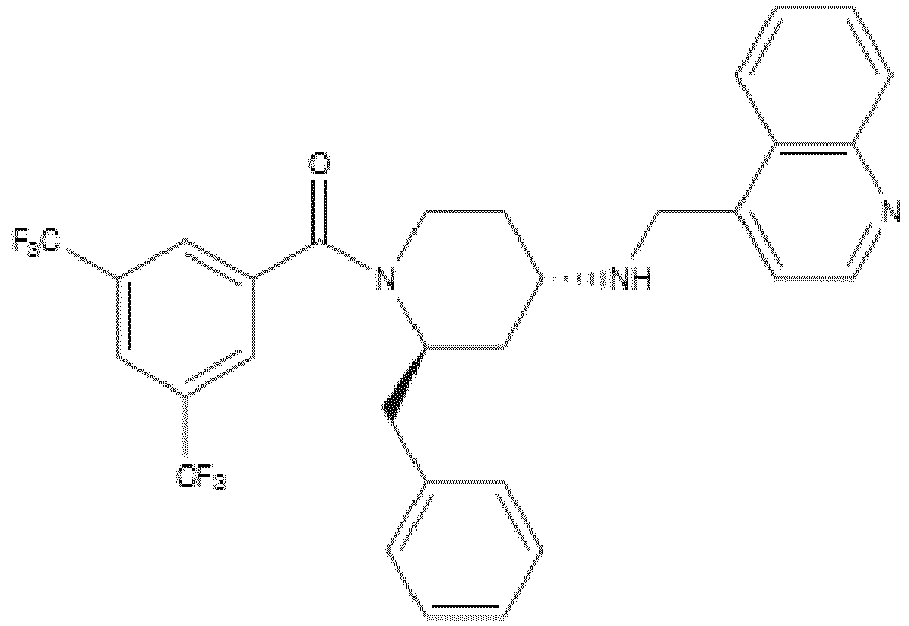
- h. The following compound as described in
WO9514017 
- i. LY303870, Lanepitant, described in
WO9907681 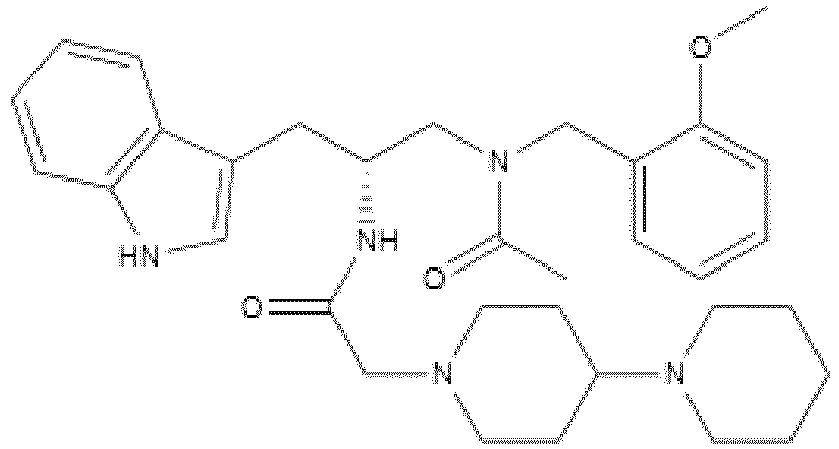
- j. LI 686017, described in
WO03091226 
- k. FK888, as described in Hagiwara D et al, J Med Chem 1994; 37: 2090-9 and
WO9222569 WO9314113 WO9321215 EP655442 WO9637488 
- l. The following compound, described in
WO9222569 WO9314113 WO9321215 EP655442 WO9637488 
- m. The following compound, described in
WO9222569 WO9314113 WO9321215 EP655442 WO9637488 
- n. The following compound, described in
WO00053572 
- o. Netupitant, described in
WO020008232 
- p. Befetupitant, described in
WO020008232 
- q. The following compound, described in
WO202062784 WO020008232 
- r. R116031, described in
WO9724356 WO0716440 
- s. The following compound, described in
EP522808 
- t. The following compound:

- u. L733,060

- v. L736,281

- w. TKA731, described in
WO9831704 
- x. NKP608, described in
WO04024714 
- y. CP96,345 described in Lowe JA et al. 1992; 35:2591-600, and in
WO92021677 
- z. The following compound, described in Lowe JA et al. J Med Chem 1994; 37:2831-40, and in
WO92021677 
- aa.CP99,994, described in Desai MC et al. J Med Chem 1992; 35:4911-3,

- bb.CP-122,721 described in Rosen TJ et al. Bioorg Med Chem Lett 1998; 8:281-4,

- cc. CJ-17,493, described in
WO9925714 
- dd. Ezlopitant, CJ-11,974 described in
WO1992021677 
- ee.Maropitant, CJ-11,972, described in
WO1992021677 ,US 6,222,038 andUS 6,255,230 ,
- ff. RP77580 described in
EP429366 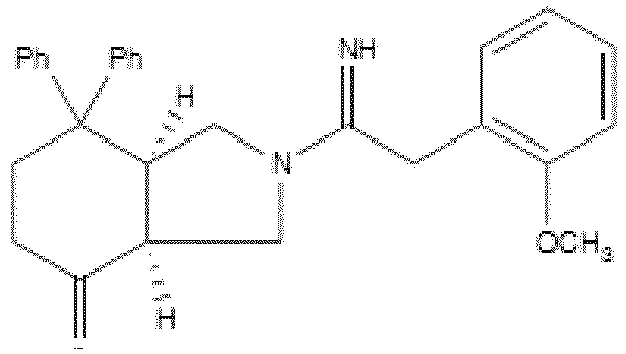
- gg.Dapitant, RPR100893, described in
WO9321154 
- hh.The following compound, described in
EP512901 
- ii. Nolpitantium, SR140333 described in
EP512901 
- jj. The following compound, described in
WO9526338 
- kk. SSR240600, described in
WO00068292 
- ll. SCH388714 described in
WO06065654 
- mm. The following compound described in Paliwal S et al, Bioorg Med Chem Lett 2008; 18:4168-71,

- nn.Rolapitant, described in
WO03051840 
- oo.The following compound, dexcribed in
EP566069 
- pp.TAK-637, described in
JP10259184 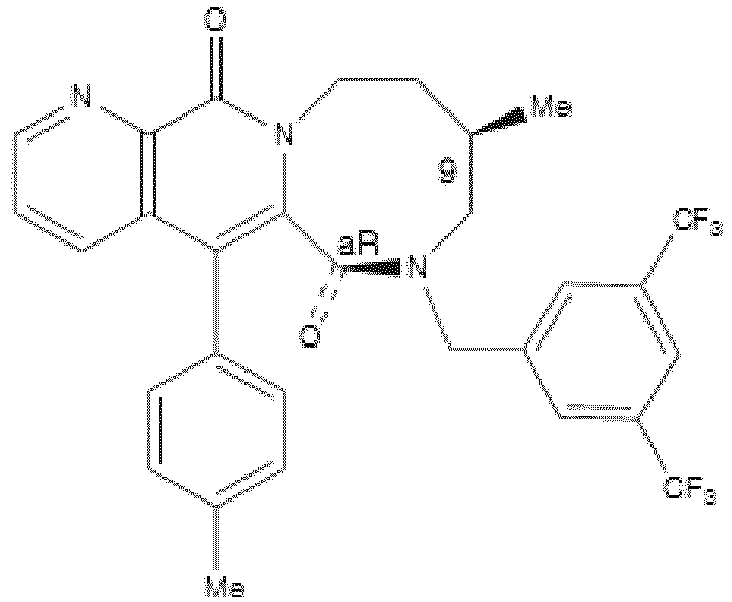
- qq.The following compound described in
JP2004002334 
- rr. The following compound described in
JP2007277231 JP2008239618 
- ss. The following compound described in
JP2007277231 JP2008239618 
- tt. The following compound described in
WO9317032 WO9511686 
- uu.The following compound described in
WO9630367 WO01025233 
- vv. HSP117 described in
WO9630367 WO01025233 
- ww. The following compound, described in Set S, et al. Bioorg Med Chem ILKett 2005; 15:1479-84 and
WO03062245 
- xx. The following compound, described in Seto S, et al. Bioorg Med Chem Lett 2005; 15:1479-84 and
WO03062245 
- yy. The following compound, KRP-103, described in
WO03062245 WO05019225 
- zz. The following compound described in
WO06106727 
- aaa. The following compound, described in
WO07074491 
- bbb. SLV317, described in
US20020065276 ,
- ccc. Compounds of formula I described in
WO9508549 
- wherein R1 is a C1-4_alkoxy group;
- R2 is

- R3 is a hydrogen or halogen atom;
- R4 and R5 may each independently represent a hydrogen or halogen atom, or a C1-4alkoxy or trifluoromethyl group;
- R6 is a hydrogen atom, a phenyl, NR7R8, CH2C(0)CF3 or trifluoromethyl group;
- R7 and R8 may each independently represent a hydrogen atom, or a or acyl group;
- x represents zero or 1 ;
- n represents zero, 1 or 2;
- m represents zero or 1.
- ddd. Compounds of formula II described in
WO9629326 
- wherein R1 is a C2-4alkoxy group;
- R2 is

- R3 is a hydrogen or halogen atom;
- R4 and R5 may each independently represent a hydrogen or halogen atom, or a or trifluoromethyl group;
WO9629326 
- eee. Compounds of formula III as described in
WO01025219 
- R represents a halogen atom or a C1-4 alkyl group;
- R1 represents hydrogen or a C1-4 alkyl group;
- R2 represents hydrogen, a C-.4a!ky!,C-ga!keny!or a
C3 7 cycloalkyl group; or R1 and R2 together with nitrogen and carbon atom to which they are attached respectively represent a 5-6 membered heterocyclic group; - R3 represents a trifluoromethyl, a
C1 4 alkyl, aC1 4 alkoxy, a trifluoromethoxy or a halogen group; - R4 represents hydrogen, a (CH2) qR7 or a (CH2) rCO (CH2) pR7 group;
- R5 represents hydrogen, a C1-4 alkyl or a COR6 group;
- R6 represents hydrogen, hydroxy, amino, methylamino, dimethylamino a 5 membered heteroaryl group containing 1 to 3 heteroatoms selected from oxygen, sulphur and nitrogen or a 6 membered heteroaryl group containing 1 to 3 nitrogen atoms;
- R7 represents hydrogen, hydroxy or NR8R9 wherein R8 and R9 represent independently hydrogen or C1-4 alkyl optionally substituted by hydroxy, or by amino;
- R10 represents hydrogen;
- m is zero or an integer from 1 to 3; n is zero or an integer from 1 to 3;
WO01025219 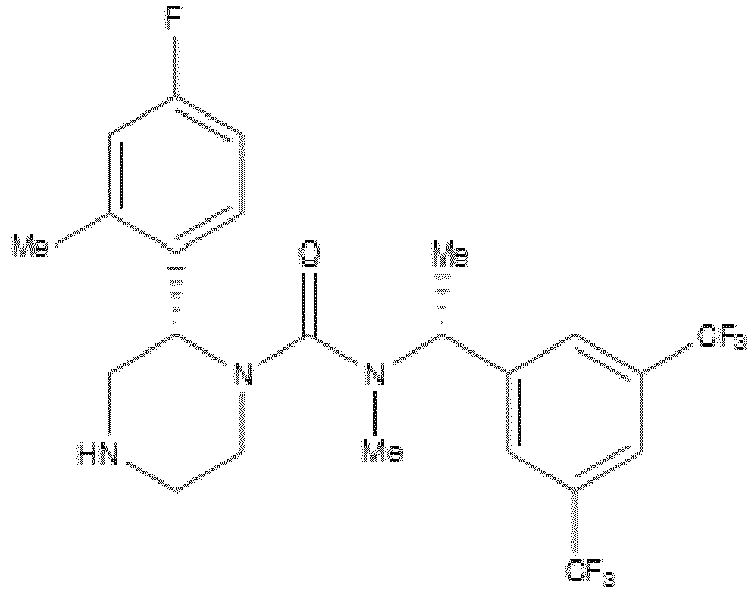
- fff. Compounds of formula IV described in
WO03066635 
R represents halogen or C1-4 alkyl ; R1 representsC1 4 alkyl ; R2 or R3 independently represent hydrogen orC 1 4 alkyl ; R4 represents trifluoromethyl, C1-4 Alkyl,C1 4 alkoxy, trifluoromethoxy or halogen; Rs represents hydrogen, C1-4 alkyl orC3 7 cycloalkyl ; R6 is hydrogen and R7 is a radical of formula (W): or R6 is a radical of formula (W) and R7 is hydrogen; X represents CH2, NRs or O ; Y represents Nitrogen and Z is CH or Y represents CH and Z is Nitrogen; A represents C (O) or S (O) q, provided that when Y is nitrogen and Z is CH, A is not S (O) q; m is zero or an integer from 1 to 3; n is an integer from 1 to 3; p and q are independently an integer from 1 to 2;
Including the following named compounds:- Orvepitant (GW823296): (2R,4S)-N-{(1R)-1-[3,5-bis(trifluoromethyl)phenyl]ethyl}-2-(4-fluoro-2-methylphenyl)-N-methyl-4-[(8aS)-6-oxohexahydro-1H-pyrrolo-[1,2-a]pyrazin-2-yl]piperidine-1-carboxamide; alternatively identified as 2-(R)-(4-Fluoro-2methyl-phenyl)-4-(S)-((8aS)-6-oxo-hexahydro-pyrrolo[1- ,2-a]-pyrazin-2-yl)-piperidine-1-carboxylic acid [1-(R)-(3,5-bis-trifluoromethyl-phenyl)-ethyl]-methylamide maleate
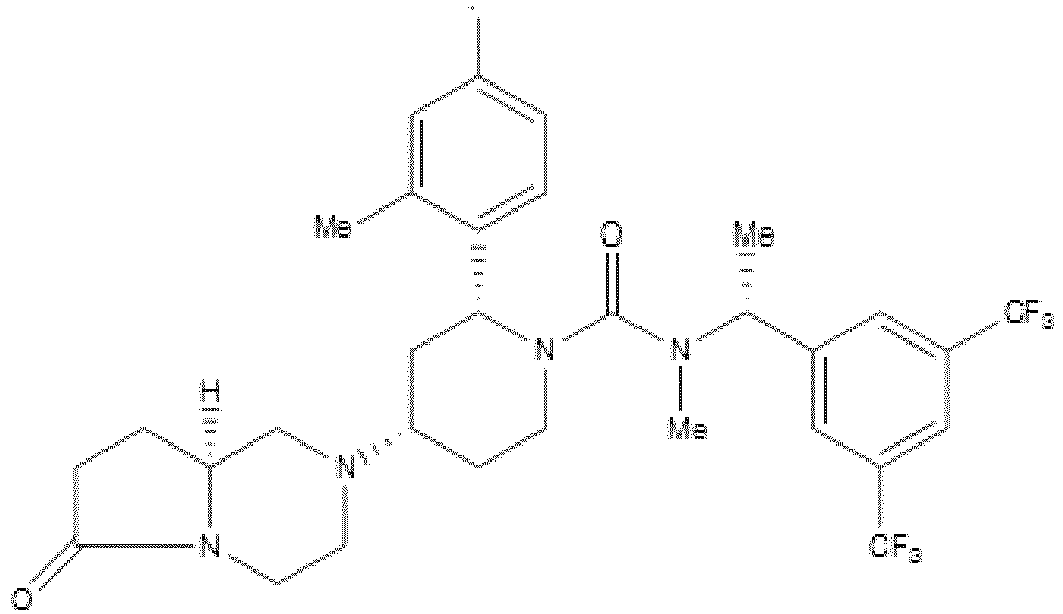
- 2- (R)-(4-Fluoro-2-methyl-phenyl)-4-(S)-(6-oxo-hexahydro-pyrrolo[1, 2-a]-pyrazin-2-yl)-piperidine-1-carboxylic acid (3,5-bis-trifluoromethyl-benzyl)-methylamide;
- 2- (R)-(4-Fluoro-2-methyl-phenyl)-4-(S)-(6-oxo-hexahydro-pyrrolo[1, 2-a]-pyrazin-2-yl)-piperidine-1-carboxylic acid [1- (R)- (3, 5-bis-trifluoromethyl-phenyl)-ethyl]-methylamide;
- 1- (4-Fluoro-2-methyl-phenyl)-4-(6-oxo-hexahydro-pyrrolo[1, 2-a] pyrazin-2-yl)-piperidine-2- carboxylic acid (3,5-bis-trifluoromethyl-benzyl)-methyl-amide;
- 2- (R)-(4-Fluoro-2-methyl-phenyl)-4-(S)-((8aS)-6-oxo-hexahydro-pyrrolo[1, 2-a]-pyrazin-2- yl)-piperidine-1-carboxylic acid [1-(R)-(3, 5-bis-trifluoromethyl-phenyl)-ethyl]-methylamide;
- 2- (R)-(4-Fluoro-2-methyl-phenyl)-4-(S)-((8aR)-6-oxo-hexahydro-pyrrolo[1, 2-a]-pyrazin-2- yl)-piperidine-1-carboxylic acid [1-(R)-(3, 5-bis-trifluoromethyl-phenyl)-ethyl]-methylamide;
- Orvepitant (GW823296): (2R,4S)-N-{(1R)-1-[3,5-bis(trifluoromethyl)phenyl]ethyl}-2-(4-fluoro-2-methylphenyl)-N-methyl-4-[(8aS)-6-oxohexahydro-1H-pyrrolo-[1,2-a]pyrazin-2-yl]piperidine-1-carboxamide; alternatively identified as 2-(R)-(4-Fluoro-2methyl-phenyl)-4-(S)-((8aS)-6-oxo-hexahydro-pyrrolo[1- ,2-a]-pyrazin-2-yl)-piperidine-1-carboxylic acid [1-(R)-(3,5-bis-trifluoromethyl-phenyl)-ethyl]-methylamide maleate
- ggg. Compounds of formula V as described in

- wherein R represents a halogen atom or a C1-4 alkyl group;
- R1 represents a Cul-4 alkyl group;
- R2 represents hydrogen or a C1-4 alkyl group;
- R3 represents hydrogen or C1-4 alkyl group;
R4 represents a trifluoromethyl group; - R5 represents hydrogen, a C1-4 alkyl group or C (O) R6 ;
R6 represents C1-4 alkyl, C3-7 cycloalkyl, NH (C1-4 alkyl) or N (C1-4alkyl) 2; - m is zero or an integer from 1 to 3; n is an integer from 1 to 3;
- Casopitant, (2S,4S)-4-(4-Acetyl-1-piperazinyl)-N-[(1R)-1-[3,5-bis(trifluoromethyl)phenyl]ethyl]-2-(4-fluoro-2-methylphenyl)-N-methyl-1-piperidinecarboxamide,

- 4-(S)-(4-acetyl-piperazin-1-yl)-2-(R)-(4-fluoro-2-methyl-phenyl)-piperidine-1-carboxylic acid, [1-(R)-(3,5-bis-trifluoromethyl-phenyl)-ethyl]-methylamide;
- 4-(R)-(4-Acetyl-piperazin-1-yl)-2-(R)-(4-fluoro-2-methyl-phenyl)-piperidine-1-carboxylic acid, [1-(R)-(3, 5-bis-trifluoromethyl-phenyl)-ethyl]-methylamide;
- 4-(S)-(4-Acetyl-piperazin-1-yl)-2-(R)-(4-fluoro-2-methyl-phenyl)-piperidine-1-carboxylic acid, [1-(R)- (3, 5-bis-trifluoromethyl-phenyl)-ethyl]-methylamide;
- 4-(S)-(4-Acetyl-piperazin-1-yl)-2-(R)-(4-fluoro-2-methyl-phenyl)-piperidine-1-carboxylic acid, (3,5-bis-trifluoromethyl-benzyl)-methylamide;
- 4-(R)-(4-Acetyl-piperazin-1-yl)-2-(R)-(4-fluoro-2-methyl-phenyl)-piperidine-1-carboxylic acid, (3,5-bis-trifluoromethyl-benzyl)-methylamide;
- 2-(R)-(4-Fluoro-2-methyl-phenyl)-4-(R, S)-(4-methyl-piperazin-1-yl)-piperidine-1-carboxylic acid, [1-(R)-(3, 5-bis-trifluoromethyl-phenyl)-ethyl]-methylamide ;
- 2-(R)-(4-Fluoro-2-methyl-phenyl)-4-(S)-piperazin-1-yl-piperidine-1-carboxylic acid, [1-(R)- (3, 5-bis-trifluoromethyl-phenyl)-ethyl]-methylamide;
- 2-(R)-(4-Fluoro-2-methyl-phenyl)-4-(R, S)-(4-methyl-piperazin-1-yl)-piperidine-1-carboxylic acid, (3,5-bis-trifluoromethyl-benzyl)-methylamide;
- 4-(S)-(4-Cyclopropanoyl-piperazin-1-yl)-2-(R)-(4-fluoro-2-methyl-phenyl)-piperidine-1-carboxylic acid, [1-(R)-(3, 5-bis-trifluoromethyl-phenyl)-ethyljmethylamide;
- 4-(R)-(4-Cyclopropanoyi-piperazin-1-yi)-2-(R)-(4-fluoro-2-methyl-phenyl)-piperidine-1-carboxylic acid, [1-(R)-(3, 5-bis-trifluoromethyl-phenyl)-ethyl]-methylamide;
- 4-(S)-[4-(2-Methyl-propanoyl)-piperazin-1-yl]-2-(R)-(4-fluoro-2-methyl-phenyl)-piperidine-1-carboxylic acid, [1-(R)-(3, 5-bis-trifluoromethyl-phenyl)-ethyl]-methylamide;
- 4-(R)-[4-(2-Methyl-propanoyl)-piperazin-1-yl]-2-(R)-(4-fluoro-2-methyl-phenyl)-piperidine-1-carboxylic acid, [1-(R)-(3, 5-bis-trifluoromethyl-phenyl)-ethyl]-methylamide;
- 4-(S)-[1-[(3, 5-Bis-trifluoromethyl-benzyl)-methyl-carbamoyl]-2-(R)-(4-fluoro-2-methylphenyl)-piperidin-4-yl]-piperazine-1-carboxylic acid, dimethylamide;
- 4-(S)-[1-[(3, 5-Bis-trifluoromethyl-benzyl)-methyl-carbamoyl]-2-(R)-(4-fluoro-2-methylphenyl)-piperidin-4-yl]-1-carboxylic acid, methylamide;
- 4-(S)-[1-[(3, 5-Bis-trifluoromethyl-benzyl)-methyl-carbamoyl]-2-(R)-(4-fluoro-2-methylphenyl)-piperidin-4-yl]-piperazine;
- 4-(S)-(4-Acetyl-piperazin-1-yl)-2-(R)-(4-fluoro-phenyl)-piperidine-1-carboxylic acid, [1-(R)-(3, 5-bis-trifluoromethyl-phenyl)-ethyl]-methylamide;
- 4-(R)-(4-Acetyl-piperazin-1-yl)-2-(R)-(4-fluoro-phenyl)-piperidine-1-carboxylic acid, [1-(R)-(3, 5-bis-trifluoromethyl-phenyl)-ethyl]-methylamide;
- hhh. Compounds of formula VI as described in
WO03015784 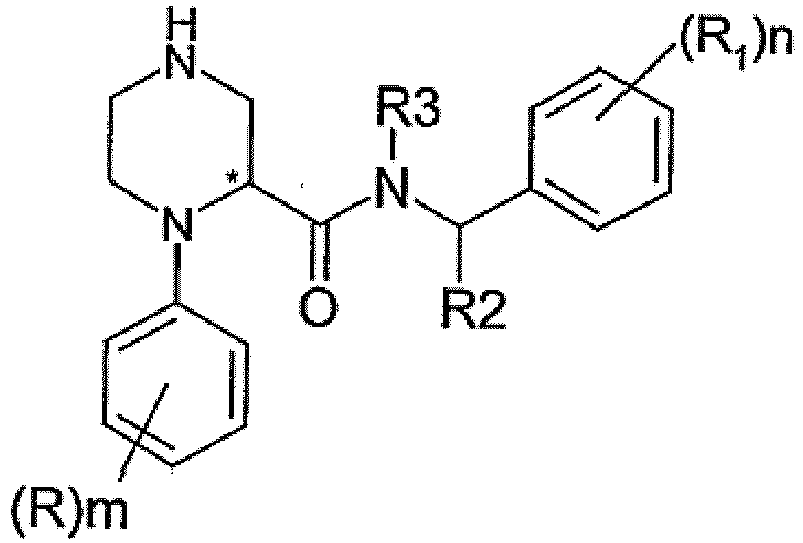
- wherein R represents halogen, C 1-4 alkyl, trifluoromethoxy or trifluoromethyl ;
- R1 is trifluoromethyl, C1-4 alkyl, C1-4 alkoxy, halogen or trifluoromethoxy ;
- R2 is hydrogen, C1-4 alkyl or C2-6 alkenyl;
- R3 represents hydrogen or
C1 4 alkyl ; - n and m are independently 0 or an integer from 1 to 3
- (+/-) 1- (4-Fluoro-2-methyl-phenyl)-piperazine-2-carboxylic acid, (3,5-bis-trifluoromethyl-benzyl)-methylamide;
- (+/-) 1- (4-Fluoro-2-methyl-phenyl)-piperazine-2-carboxylic acid (3, 5-dichloro-benzyl)-methylamide;
- (+/-)I-(4-Fluoro-2-methyl-phenyl)-piperazine-2-carboxylic acid [1-(3, 5-dichloro-phenyl)-ethyl]-methylamide;
- (+/-) 1-(4-Fluoro-2-methyl-phenyl)-piperazine-2-carboxylic acid (3, 5-dichloro-benzyl)- (+/-methylamide;
- (+/-)I-(4-Fluoro-2-methyl-phenyl)-piperazine-2-carboxylic acid (3, 5-bis-trifluoromethyl-benzyl)-methylamide;
- (+/-) 1-(4-Fluoro-2-methyl-phenyl)-piperazine-2-carboxylic acid (3,4-dibromo-benzyl)-methylamide;
- (+/-)I-(4-Trifluoromethyl-phenyl)-piperazine-2-carboxylic acid (3,5-bis-trifluoromethyl-benzyl)-methylamide;
- (+/-) 1-(4-Fluoro-2-methyl-phenyl)-piperazine-2-carboxylic acid (3, 5-dichloro-benzyl)-methylamide ;
- (+) 1-(4-Fluoro-2-methyl-phenyl)-piperazine-2-carboxylic acid (3,5-dichloro-benzyl)-methylamide;
- (-) 1-(4-Fluoro-2-methyl-phenyl)-piperazine-2-carboxylic acid (3,5-dichloro-benzyl)-methylamide;
- iii. Compounds of formula VII as described in
WO2005121122 ,
- R represents a group selected from:

- R1 represents hydrogen, halogen, cyano, C2-4 alkenyl, C1.4 alkyl optionally substituted by halogen, cyano or C1-4 alkoxy;
- R2 represents hydrogen or (CH2)qR7;
- R3 and R4 each independently are hydrogen or C 1.4 alkyl;
- R5 represents :
- phenyl substituted by 1 to 3 groups independently selected from trifluoromethyl, C1-4 alkyl, cyano, C1-4 alkoxy, trifluoromethoxy, halogen, S(O)rC1-4 alkyl or a phenyl substituted by a 5 or 6 membered heteroaryl group optionally substituted by 1 to 3 groups independently selected from trifluoromethyl, C1-4 alkyl, cyano, C1-4 alkoxy, trifluoromethoxy, halogen or S(O)r C1-4 alkyl;
- naphthyl substituted by 1 to 3 groups independently selected from trifluoromethyl, C1-4 alkyl, cyano, C1-4 alkoxy, trifluoromethoxy, halogen or S(O)r C1-4 alkyl; a 9 to 10 membered fused bicyclic heterocyclic group substituted by 1 to 3 groups independently selected from trifluoromethyl, C1-4 alkyl, cyano, C1-4 alkoxy, trifluoromethoxy, halogen or S(O)r C1-4 alkyl or
- R5 is a 5 or 6 membered heteroaryl group substituted by 1 to 3 groups independently selected from trifluoromethyl, C1-4 alkyl, cyano, C-1.4 alkoxy,
- trifluoromethoxy, halogen or S(O)r C1-4 alkyl;
R8 and R9 each independently represent hydrogen, C1-4 alkyl or C3-7 cycloalkyl;
•A-B is a bivalent radical of formula (v), (vi) or (vii)
(v) -CH=C(R1 1)-
(vi) -C (R10)=CH- or
(vii) -C(R^)(R1O)-C(Ri I)(R-Ia)-
wherein R10, R11, R12 and R13 each independently are hydrogen or C1-4 alkyl; •
n is 1 or 2;
q is an integer from 1 to 4;
r is 1 or 2
including the following named compounds:- 1-[(3,5-dichlorophenyl) methyl]-3-[4-(4-fluorophenyl)-1-methyl-4-piperidinyl]-1,3-dihydro-2H-imidazol-2-one;
- 1-[(3,5-dichlorophenyl)methyl]-3-[4-(4-fluorophenyl)-1-methyl-4-piperidinyl]-1,3-dihydro-2H imidazol-2-one;
- 1-[(3,5-Dichlorophenyl) methyl]-3-[4-(4-fluorophenyl)-4-piperidinyl]-1,3-dibydro-2H-imidazol-2 one;
- 1-[1-(3,5-Dichlorophenyl)ethyl]-3-[4-(4-fluorophenyl)-1-methyl-4-piperidinyl]-1,3-dihydro-
2H 1 5 imidazol-2-one; - 1-[1-(3-Chloro-1-naphthalenyl)ethyl]-3-[4-(4-fluorophenyl)-1-methyl-4-piperidinyl]-1,3 dihydro-2H-imidazol-2-one;
- 1-[1-(3,5-Dichlorophenyl)ethyl]-3-[4-(4-fluorophenyl)-1-methyl-4-piperidinyl]-1,3-dihydro-2H imidazol-2-one;
- 1-[1-(3-Chloro-1-napUthalenyl)ethyl]-3-[4-(4-fluorophenyl)-1-methyl-4-piperidinyl]-1,3 dihydro-2H-imidazol-2-one;
- 1-[(3,5-dichlorophenyl) methyl]-3-[4-(4-fluorophenyl)-1-methyl-4-piperidinyl]-2 imidazolidinone;
- 4-({3-[4-(4-fluorophenyl)-1-methyl-4-piperidinyl]-2-oxo-1-imidazolidinyl}methyl)-2 naptthalenecarbonitrile; 7-fluoro-4-({3-[4-(4-fluorophenyl)-1-methyl-4-piperidinyl]-2-oxo-1-imidazolidinyl}methyl)-2 naphthalenecarbonitrile;
- 6-fluoro-4-({3-[4-(4-fluorophenyl)-1-methyl-4-piperidinyl]-2-oxo-1-imidazolidinyl}methyl)-2 naphthalenecarbonitrile;
- 1-[(3-chloro-1-naphthalenyl)methyl]-3-[4-(4-fluorophenyl)-1-methyl-4-piperidinyl]-1,3-dihydro 2H-imidazol-2-one;
- R represents a group selected from:
- jjj. A compound of Formula VIII as described in
WO2004/005256 .
- R represents halogen, C1-4 alkyl, cyano, C1-4 alkoxy, trifluoromethyl or trifluoromethoxy ;
- R1 represents hydrogen, halogen, C3-7cycloalkyl, hydroxy, nitro, cyano or C1-4 alkyl optionally substituted by halogen, cyano or C1-4 alkoxy ;
- R2 represents hydrogen or C1-4 alkyl ;
- R3 and R4 independently represent hydrogen, cyano, C1-4 alkyl or R3 together with R4 represents C3-7 cycloalkyl ;
R5 represents trifluoromethyl, S(O)tC1-4 alkyl, C1-4 alkyl, C1-4 alkoxy, trifluormethoxy, halogen or cyano ; R6 represents hydrogen or (CH2) rR7 ;
R7 represents hydrogen, C3-7 cycloalkyl, NH (C1-4alkylOC1-4alkoxy), NH(C1-4alkyl), NH(C1-4alkyl)2, OC(O) NR9R8, NRBC(0)5R9 or C(O) NR8R9 ;
R8 and R9 independently represent hydrogen, C1-4 alkyl or C37 cycloalkyl ; - m represents zero or an integer from 1 to 4;
- n represents 1 or 2;
- p is zero or an integer from 1 to 3;
- q is an integer from 1 to 3;
r is an integer from 1 to 4; tis0, 1 or2 ; provided that when m is 0, p is 2, q, r and n represent 1, R1, R2, R3, R4, R5 and R7 are hydrogen and R is chlorine, R5 is not iodine including the following named compounds:- N-(3,5-Dichlorobenzyl)-2-[3-fluoro-4-(4-fluorophenyl)-piperidin-4-yl]-N-methyl-acetamide;
- 4-(4-Fluorophenyl)-piperidine-4-carboxylic acid, (3, 5-bis-trifluoromethyl-benzyl)-methylamide;
- 4-(4-Chlorophenyl)-piperidine-4-carboxylic acid, (3, 5-bis-trifluoromethyl-benzyl)-methylamide;
- 4-(4-Fluorophenyl)-piperidine-4-carboxylic acid (3, 5-dichloro-benzyl)-methylamide;
- N-(3, 5-Bis-trifluoromethyl)-benzyl-2-[(4-fluoro-2-methyl-phenyl)-piperidin-4-yl]-N-methyl-acetamide;
- N-(3, 5-Dichlorobenzyl)-2-[4-(4-fluoro-2-methyl-phenyl)-piperidin-4-yl]-N-methyl-acetamide;
- N-(3, 5-Bis-trifluoromethyl-benzyl)-2-[4-(4-fluorophenyl)-azepin-4-yi]-N-methyl-acetamide;
- N-(3,5-Bis-trifluuoromethyl-benzyl)-2-[4-(4-fluoro-2-methyl-phenyl)-azepin-4-yl]-N-methyl-acetamide;
- N-(3, 5-Dichlorobenzyl)-2-[4-(4-fluoro-2-methyl-phenyl)-azepin-4-y]-N-methyl-acetamide
- N-(3, 5-Bis-trifluoromethyl-benzyl)-2-[3-fluoro-4-(4-fluoro-2-methyl-phenyl)-azepin-4-yl]-N-methyl-acetamide;
- N-(3, 5-Dichlorobenzyl)-2-[3-fluoro-4-(4-fluoro-2-methyl-phenyl)-azepin-4-yi]-N-methyl-acetamide;
- N-(3, 5-Dichlorobenzyl)-2-[3-fluoro-4-(4-fluoro-2-methyl-phenyl)-azepin-4-yl]-N-methyt-acetamide;
- N-(3, 5-Bis-trifluoromethyl-benzyl)-2-[3-fluoro-4-(4-fluoro-2-methyl-phenyl)-azepin-4-yl]-N-methyl-acetamide;
- N-(3,5-Dibromobenzyl)-2-[4-(4-fluorophenyl)-piperidin-4-yl]-N-methyl-acetamide ;
- N-(3, 5-Dibromo-benzyl)-2-[4-(4-fluoro-phenyl)-1-methyl-piperidin-4-yl]-N-methyl-acetamide;
- N-(3, 5-Dibromobenzyl)-2-(4-phenyl-piperidin-4-yl)-N-methyl-acetamide;
- N-(3, 5-Dibromo-benzyl)-2-(4-phenyl-1-methyl-piperidin-4-yl)-N-methyl-acetamide;
- N-[1- (3, 5-Dichloro-phenyl)-ethyl]-2-[4-(4-fluoro-phenyl)-piperidin-4-yl]-N-methyl-acetamide;
- N-[1-(3,5-Dichloro-phenyl)-ethyl]-2-[4-(4-fluoro-phenyl)-1-methyl-piperidin-4-yl]-N-methyl-acetamide;
- N-[1-(3, 5-Bis-trifluoromethyl-phenyl)-ethyl]-2-[4-(4-fluoro-phenyl)-piperidin-4-yl]-N-methyl-acetamide;
- N-[1-(3, 5-Bis-trifluoromethyl-phenyl)-ethyl]-2-[4-(4-fluoro-phenyl)-1-methyl-piperidin-4-yl]-N-methyl-acetamide;
- N-[1-(3, 5-Dibromo-phenyl)-ethyl]-2-[4-(4-fluoro-phenyl)-piperidin-4-yl]-N-methyl-acetamide; N-[1-(3, 5-Dibromo-phenyl)-ethyl]-2-[4-(4-fluoro-phenyl)-1-methyl-piperidin-4-yl]-N-methyl-acetamide;
- N-[1-(3, 5-Bis-trifluoromethyl-phenyl)-ethyl]-2-(4-phenyl-piperidin-4-yl)-N-methyl-acetamide;
- N-[1-(3, 5-Bis-trifluoromethyl-phenyl)-ethyl]-2-(4-phenyl-1-methyl-piperidin-4-yl)-N-methyl-acetamide;
- N-[1-(3, 5-Dibromo-phenyl)-ethyl]-2-(4-phenyl-piperidin-4-yl)-N-methyl-acetamide;
- N-[I' (3, 5-Dibromo-phenyl)-ethyl]-2-(4-phenyl-1-methyl-piperidin-4-yi)-N-methyl-acetamide;
- N-[1-(3, 5-Dibromo-phenyl)-ethyl]-2-[4-(4-fluoro-phenyl)-piperidin-4-yl]-N-methyl-acetamide;
- N-[1-(3,5-Dibromo-phenyl)-ethyl]-2-[4-(4-fluoro-phenyl)-1-methyl-piperidin-4-yl]-N-methyl-acetamide;
- N [(3, 5-Dichlorophenyl)methyl]-2-{4-(4-fluoro-2-methylphenyl)-1-[2-(methyloxy)ethyl]-4-piperidinyl}-N-methylacetamide;
- N-{1- [3, 5-Bis(trifluoromethyl)phenyl]ethyl}-2-[4-(4-fluoro-2-methylphenyl)-4-piperidinyl]-N-methylacetamide;
- N-[(3, 5-Dibromophenyl)methyl]-2-[4-(4-fluoro-2-methylphenyl)-4-piperidinyl]-N-methylacetamide;
- N-{[3, 5-Bis(trifluoromethyl)phenyl]methyl}-2-[4-(4-fluoro-2-methylphenyl)-1-methyl-4-piperidinyl]-N-methylacetamide;
- N-[(3, 5-Dichlorophenyl)methyl]-2-[4-(4-fluoro-2-methylphenyl)-1-methyl-4-piperidinyl]-N-methylacetamide;
- N-{[3, 5-Bis(trifluoromethyl)phenyl]methyl)-2-[4-(4-fluoro-2-methylphenyl)-4-piperidinyl]acetamide;
- N-{[3, 5-Bis(trifluoromethyl)phenyl]methyl}-2-[4-(4-fluoro-2-methylphenyl)-1-methyl-4-piperidinyl]acetamide;
- N-[(3, 5-Dibromophenyl)methyl]-2-[4-(4-fluoro-2-methylphenyl)-1-methyl-4-piperidinyl]-N-methylacetamide;
- N-[(3, 5-Dibromophenyl)methyl]-N-methyl-2-[4-(2-methylphenyl)-4-piperidinyl] acetamide;
- N-[(3, 5-Dibromophenyl)methyl]-N-methyl-2-[1-methyl-4-(2-methylphenyl)-4-piperidinyl] acetamide;
- N [(3, 5-Dichlorophenyl)methyl]-2-[4-(4-fluorophenyl)-1-methyl-4-piperidinyl]-N-methylacetamide;
- N-{[3, 5-Bis(trifluoromethyl)phenyl]methyl}-2-[4-(4-fluorophenyl)-1-methyl-4-piperidinyl]-N-methylacetamide;
- N-[1-(3, 5-Dibromophenyl)-1-methylethyl]-2-[4-(4-fluorophenyl)-4-piperidinyl]-N-methylacetamide;
- N-[1-(3, 5-Dibromophenyl)-1-methylethyl]-2-[4-(4-fluorophenyl)-1-methyl-4-piperidinyl]-N-methylacetamide;
- N-[1-(3, 5-Bis-trifluoromethyl-phenyl)-ethyl]-2-[4-(4-fluoro-phenyl)-piperidin-4-yl]-N-methyl-acetamide;
- N-[1-(3, 5-Bis-trifluoromethyl-phenyl)-ethyl]-2-[4-(4-fluoro-phenyl)-1-methyl-piperidin-4-yl]-N-methyl-acetamide;
- 2-[1-(Cyclopropylmethyl)-4-(4-fluorophenyl)-4-piperidinyl]-N-[(3, 5-dibromophenyl) methyl]-N-methylacetamide;
- 2-[4-{2-[[(3,5-Dibromophenyl)methyl](methyl)amino]-2-oxoethyl}-4-(4-fluorophenyl)-1-piperidinyl]-N, N-dimethylacetamide;
- N-[(3,5-Dibromophenyl)methyl]-2-[1-ethyl-4-(4-fluorophenyl)-4-piperidinyl]-N-methylacetamide;
- N-{1-[3,5-Bis(trifluoromethyl)phenyl]ethyl}-2-[4-(4-fluorophenyl)hexahydro-1H-azepin-4-yl]-N-methylacetamide;
- N {1- [3, 5-Bis (trifluoromethyl)phenyl]ethyl}-2-[4-(4-flurophenyl)-1-methylhexahydro-1H-azepin-4-yl]-N-methylacetamide;
- N-[(3,5-Dibromophenyl)methyl]-2-[4-(4-fluorophenyl)hexahydro-1H-azepin-4-yl]-N-methylacetamide;
- N[(3,5-Dibromophenyl)methyl]-2-[4-(4-fluorophenyl)-1-methylhexahydro-1H-azepin-4-yl]-N-methylacetamide;
- N[(3-Bromo-5-cyanophenyl)methyl]-2-[4-(4-fluorophenyl)-4-piperidinyl]-N-methylacetamide;
- N[(3-Bromo-5-cyanophenyl)methyl]-2-[4-(4-fluorophenyl)-1-methyl-4-piperidinyl]-N-methylacetamide;
- N-[(3,5-Dibromophenyl)methyl]-N-methyl-2-{4-[3-(trifluoromethyl)-phenyl]-4-piperidinyl} acetamide;
- N-[(3,5-Dibromophenyl)methyl]-N-methyl-2-{1-methyl-4-[3-(trifluoromethyl)phenyl]-4-piperidinyl}acetamide;
- N-[(3,5-Dibromophenyl)methyl]-2-[4-(3,4-dimethylphenyl)-4-piperidinyl]-Nmethylacetamide
- N[1-(3,5-Dibromophenyl)ethyl]-2-[4-(3-fluorophenyl)-1-methyl-4-piperidinyl]-N-methylacetamide;
- N-[1-(3,5-Dibromophenyl)ethyl]-2-[4-(4-fluoro-3-methy(phenyl)-4-piperidinyl]-N-methylacetamide;
- N[1-(3,5-Dibromophenyl)ethyl]-2-[4-(4-fluoro-3-methylphenyl)-1-methyl-4-piperidinyl]-N-methylacetamide;
- 2-[4-(3-Chlorophenyl0-4-piperidinyl]-N-[1-(3,5-dibromophenyl)ethyl]-N-methylacetamide;
- N-[1-(3,5-Dibromophenyl)ethyl]-2-[4-(3,4-difluroophenyl)-4-piperidinyl]-N-methylacetamide;
- N[1-(3,5-Dibromophenyl)ethyl]-2-[4-(3,4-difluorophenyl)-1-methyl-4-piperidinyl]-N-methylacetamide;
- N[1-(3,5-Dibromophenyl)ethyl]-2-[4-(3-fluorophenyl)-4-piperidinyl]-N-methylacetamide;
- N[1-(3,5-Dibromophenyl)ethyl]-2-[4-(3-fluorophenyl)-1-methyl-4-piperidinyl]-N-methylacetamide;
- N[1-(3,5-Dibromophenyl)ethyl]-2-[4-(4-fluoro-3-methylphenyl)-4-piperidinyl]-N-methylacetamide;
- N[1-(3,5-Dibromophenyl)ethyl]-2-[4-(4-fluoro-3-methylphenyl)-1-methyl-4-piperidinyl]-N-methylacetamide;
- 2-[4-(3-Chlorophenyl)-4-piperidinyl]-N[1-(3,5-dibromophenyl)ethyl]-N-methylacetamide;
- 2-[4-(3-Chlorophenyl)-1-methyl-4-piperidinyl]-N[1-(3,5-dibromophenyl)ethyl]-N-methylacetamide;
- 2- [4- (3-Chlorophenyl)-4-piperidinyl]-N-[1- (3, 5-dichlorophenyl) ethyl]-N-methylacetamide;
- 2- [4- (3-Chlorophenyl)-1-methyl-4-piperidinyl]-N [1- (3, 5-dichlorophenyl) ethyl]-N-methylacetamide;
- 2-[4-(3-Chlorophenyl)-4-piperidinyl]-N-[(3,5-dibromophenyl)methyl]-N-methylacetamide ; N-[1-(3,5-Dichlorophenyl)ethyl]-2-[4-(4-fluroo-3-methylphenyl)-4-piperidinyl]-N-m ethylacetamide;
- N-[(3,5-Dibromophenyl)methyl]-2-[4-(4-fluoro-3-methylphenyl)-4-piperidinyl]-N-methylacetamide;
- N-[(3,5-Dibromophenyl)methyl]-2-[4-(4-fluoro-3-methylphenyl)-1-methyl-4-piperidinyl]-N- methylacetamide;
- N-[(3,5-Dibromophenyl)methyl]-2-[4-(3-fluorophenyl)-4-piperidinyl]-N-methylacetamide;
- N-[(3,5-Dibromophenyl)methyl]-2-[4-(3-fluorophenyl)-l-methyl-4-piperidinyl]-N-methylacetamide;
- N-[(3,5-Dibromophenyl)methyl]-2-[4-(3,4-difluorophenyl)-4-piperidinyl]-N-methylacetamide;
- N-[(3,5-Dibromophenyl)methyl]-2-[4-(3,4-difluorophenyl)-1-methyl-4-piperidinyl]-N-methylacetamide;
- 2-[4-(4-Cyanophenyl)-4-piperidinyl]-N-[l-(3,5-dibromophenyl)ethyl]-N-methylacetamide;
- [N-(3,5-Dibromo-benzyl)-2-[4-(4-fluoro-phenyl)-1-methyl-piperidin-4-yl]-N-methylacetamide;
- N-[1-(S)-1-(3,5-Bis-trifluoromethyl-phenyl)-ethyl]-2-[4-(4-fluoro-phenyl)-1-methyl-piperidin-4-yl]-N-methyl-acetamide;
- N- [1- (3, 5-Dibromo-phenyl)-ethyl]-2- [4- (4-fluoro-phenyl)-1-methyl-piperidin-4-yl]-N-methyl- acetamide (enantiomer 1);
- N- [1- (3, 5-Dibromo-phenyl)-ethyl]-2- (1-methyl-4-phenyl-piperidin-4-yl)-N-methylacetamide (enantiomer 1);
- N- [1- (3, 5-Dichloro-phenyl)-ethyl]-2- [4- (4-fluoro-phenyl)-1-methyl-piperidin-4-yl]-N-methyl- acetamide (enantiomer 1);
- kkk. Compounds of Formula IX as described in
WO2003066589 ,
- R represents halogen or C1-4 alkyl ;
- R1 represents hydrogen or C1-4 alkyl ;
- R2 represents hydrogen, C 1-4 alkyl or R2 together with R3 represents C3-7 cycloalkyl ;
- R3 represents hydrogen, C1-4 alkyl, C3-7 cycloalkyl or C3-6 alkenyl; or R1 and R3 together with nitrogen and carbon atom to which they are attached respectively represent a 5 to 6 membered heterocyclic group;
R4 represents trifluoromethyl, C 1-4 alkyl, C 1-4 alkoxy, trifluoromethoxy or halogen; Rs is hydrogen and R6 is NR7R8 or R5 is NR8R9 and R6 is hydrogen ;
R7 represents hydrogen or C1-4 alkyl or R7 and R8 together with nitrogen to which they are attached are a saturated 5 to 7 membered heterocyclic group containing oxygen;
R8 represents hydrogen, phenyl, C3-7 cycloalkyl, (CH2)pC(O)NR10R11, a saturated 5 to 7 membered heterocyclic group containing 1 to 3 heteroatoms selected from oxygen, sulphur and nitrogen and optionally substituted by C1-4 alkyl, S(O)2C1-4 alkyl or C(O)C1-4 alkyl, a 5 membered heteroaryl group containing 1 to 3 heteroatoms selected from oxygen, sulphur and nitrogen and optionally substituted by C1-4 alkyl S O)2C1-4 alkyl or C(O)C1-4 alkyl or R8 represents a 6 membered heteroaryl group containing 1 to 3 nitrogen atoms and optionally substituted by C1-4 alkyl, S(O)2C1-4 alkyl or C(O)C1-4 alkyl ; or R8 is a C1-6 alkyl group optionally substituted by one or two groups selected from fluorine, phenyl (optionally su-bstituted by C1-4 alkyl, C(O)C1-4 alkyl or halogen), =O, C3-7 cycloalkyl, hydroxy, amino, dimethylamino, aminocarbonyl, C1-4 alkoxy or trifluoromethyl; R9 is hydrogen, C1-4 alkyl or R9 and R8 together with nitrogen to which they are attached are a 5 to 7 membered heterocyclic group optionally containing another heroatom selected from oxygen, sulphur and nitrogen and optionally substituted by one or two groups selected from 1I-4 alkyl, =0, S (O)2C1-4 alkyl C(O) C3-7 cycloalkyl or C(O)C1-4 alkyl ; R10 and R11 are independently hydrogen or C1-4 alkyl group; - X represents a nitrogen atom and Y is CH or X represents CH and Y is nitrogen;
- m is zero or an integer from 1 to 3;
- n is an integer from 1 to 3; p is zero, 1 or 2;.
- 4- (S)-Dimethylamino-2- (R)- (4-fluoro-2-methyl-phenyl)-piperidine-1-carboxylic acid [1-(R)- (3, 5-bis-trifluoromethyl-phenyl)-ethyl]-methylamide hydrochloride ;
- 4-(S)-Dimethylamino-2-(R)-(4-fluoro-2-methyl-phenyl)-piperidine-1-carboxylic acid (3,5-bis-trifluoromethyl-benzyl)-methylamide hydrochloride ;
- 4- (S)- (2-Fluoroethyl)-amino-2- (R)- (4-fluoro-2-methyl-phenyl)-piperidine-1-carboxylic acid [1- (R)- (3, 5-bis)-trifluoromethyl-phenyl)-ethyl]-methylamide hydrochloride ;
- 4- (S)- (2-Fluoro-ethylamino)-2- (R)- (4-fluoro-2-methyl-phenyl)-piperidine-1-carboxylic acid (3,5-bis-trifluoromethyl-benzyl)-methylamide hydrochloride.
- III. Compounds of Formula X as described in
WO2003/066621 ,
- R represents halogen or C1-4 alkyl ;
- R1 represents hydrogen or C1-4 alkyl ;
- R2 represents hydrogen, C 1-4 alkyl ;
- R3 represents hydrogen, C 1-4 alkyl ;
- R4 represents trifluoromethyl, C 1-4 alkyl, C 1-4 alkoxy, trifluoromethoxy or halogen;
- R5 represents hydrogen, C1-4 alkyl, C3-7 cycloalkyl, C(O)R6 or S(O)2R6 ;
R6 represents C 1-4 alkyl or C3-7 cycloalkyl ; - m is zero or an integer from 1 to 3;
- n is an integer from 1 to 3;
- p is an integer from 1 to 2; X and Y are independently C(O) or CH2 ; provided that i) X and Y are not both C(O) and ii) when X and Y are both CH2 and p is 1, R5 is not hydrogen, C1-4 alkyl or C(O)R6;
- 2- (R)- (4-Fluoro-2-methyl-phenyl)-4- (R)- (3-oxo-piperazin-1-yl-)-piperidine-1-carboxylic acid, (3,5-bis-trifluoromethyl-benzyl)-methylamide;
- 2-(R)-(4-Fluoro-2-methyl-phenyl)-4-(S)-(3-oxo-piperazin-1-yl-)-piperidine-1-carboxylic acid, (3, 5-bis-trifluoromethyl-benzyl)-methylamide;
- 2- (R)- (4-Fluoro-2-methyl-phenyl)-4- (R)- (4-methyl-3-oxo-piperazin-1-yl-)-piperidine-1-carboxylic acid, 1- (3, 5-bis-trifluoromethyl-benzyl) -methylamide;
- 2- (R)- (4-Fluoro-2-methyl-phenyl)-4- (S)- (4-methyl-3-oxo-piperazin-1-yl-)-piperidine-1-carboxylic acid, 1- (3, 5-bis-trifluoromethyl-benzyl) -methylamide;
- 2-(R)-(4-Fluoro-2-methyl-phenyl)-4-(S)-(4-methyl-3-oxo-piperazin-1-yl)-piperidine-1-carboxylic acid, [1- (R)- (3, 5-bis-trifluoromethyl-phenyl) -ethyl]-methylamide;
- 2- luoro-2-methyl-phenyl)-4-(R)-(2-oxo-piperazin-1-yl)-piperidine-1-carboxylic acid (3,5-bis-trifluoromethyl-benzyl)-methylamide;
- 2- (4-Fluoro-2-methyl-phenyl)-4- (S)- (2-oxo-piperazin-1-yl)-piperidine-1-carboxylic acid, (3,5-bis-trifluoromethyl-benzyl)-methylamide;
- 2- (4-Fluoro-2-methyl-phenyl)-4- (S)- (2-oxo-piperazin-1-yl)-piperidine-1-carboxylic acid, (3,5-bis-trifluoromethyl-benzyl)-methylamide;
- 2- (R)- (4-Fluoro-2-methyl-phenyl)-4- (S)-(2-oxo-4-methyl-piperazin-1-yl)-piperidine-1-carboxylic acid, (3,5-bis-trifluoromethyl-benzyl)-methylamide; 2-(R)-(4-Fluoro-2-methyl-phenyl)-4-(S)-(4-methyl-2-oxo-piperazin-1-yl)-piperidine-1-carboxylic acid, [1- (R)- (3, 5-bis-trifluoromethyl-phenyl)-etliyl]-methylamide;
- 2- (R)- (4-Fluoro-2-methyl-phenyl)-4- (S)- (4-methyl-2-oxo-piperazin-1-yl)-piperidine-1-carboxilic acid, [1- (R)- (3, 5-bis-trifluorometliyl-phenyl)-ethyl]-methylamide; 2-(R)-(4-Fluoro-2-methyl-phenyl)-4-(R)-(4-cyclopropyl-3-oXo-piperazin-1-yl-)-piperidine-1-carboxylic acid, 1- (3, 5-bis-trifluoromethyl-benzyl) -methylamide;
- 2- (R)- (4-Fluoro-2-methyl-phenyl)-4- (S)- (4-cyclopropyl-3-oxo-piperazin-1-yl-)-piperidine-l-carboxylic acid, 1- (3, 5-bis-trifluoromethyl-benzyl) -methylamide; 2-(R)-(4-Fluoro-2-methyl-phenyl)-4-(S)-(1-methanesulfonyl-piperazin-1-yl)-piperidine-1-carboxylic acid, 1- (3, 5-bis-trifluoromethyl-benzyl) -methylamide;
- 2- (R)- (4-Fluoro-2-methyl-phenyl)-4- (S)- (1-methanesulfonyl-piperazin-1-yl)-piperidine-1-carboxylic acid, 1-[(R)-(3, 5-bis-trifluoromethyl-phenyl)-ethyl]-methylamide;
- mmm. Compounds of Formula XI as described in
WO2004/099143 ,
- wherein R represents a radical selected from

- R1 represents hydrogen, halogen, cyano, C2-4 alkenyl, C1-4 alkyl optionally substituted by halogen, cyano or C1-4 alkoxy ;
- R2 represents hydrogen or C1-4 alkyl ;
- R3 and R4 independently represent hydrogen, C1-4 alkyl or R3 together with R4 represent
C3 7 cycloalkyl; - R5 represents: phenyl substituted by 1 to 3 groups independently selected from trifluoromethyl, C1-4 alkyl, cyano, C1-4 alkoxy, trifluoromethoxy, halogen or (SO) rCI-4 alkyl, naphthyl substituted by 1 to 3 groups independently selected from trifluoromethyl, C1-4 alkyl, cyano, C1-4 alkoxy, trifluoromethoxy, halogen or (SO)rC1-4 alkyl, a 9 to 10 membered fused bicyclic heterocyclic group substituted by 1 to 3 groups independently selected from trifluoromethyl,
C1 4 alkyl, cyano, C1-4 alkoxy, trifluoromethoxy, halogen or (SO)rC1 4 aikyl or R5 is a 5 or 6 membered heteroaryl group substituted by 1 to 3 groups independently selected from trifluoromethyl, C1-4 alkyl, cyano, C1-4 alkyl, trifluoromethoxy, halogen or (SO) rC1 4 alkyl; - R6 represents hydrogen or (CH2)qR8 ;
R8 represents hydrogen, C3-7 cyaloalkyl, C1-4 alkoxy, amine, C1-4 alkylamine, (C1-4 alkyl)2amine, OC(O)NR9R10 or C(O)NR9R10 ;
R9 and R10 independently represent hydrogen, C1-4 alkyl or C3-7 cycloalkyl; - m represents zero or 1;
- n is 1 or 2 ;
q is an integer from 1 to 4;
r is 1 or 2; provided that when R5 is phenyl substituted by 1 to 3 groups independently selected from trifluoromethyl, C1-4 alkyl, cyano, C1-4 alkoxy, trifluoromethoxy, halogen or (SO) rC1-4 alkyl, R is not the radical i)
- N-[1-(3-chloro-1-naphthalenyl)ethyl]-2-[4-(4-fluorophenyl)-1-methyl-4-piperidinyl]-N-methylacetamide(Enantiomer 1);
- N-[I-(3-chloro-1-naphthalenyl)ethyl]-N-methyl-2-(I-methyl-4-phenyl-4-piperidinyl) acetamide (Enantiomer 1);
- N-[1-(3-chloro-1-naphthalenyl)ethyl]-N-methyl-2-(1-methyl-4-phenyl-4-piperidinyl) acetamide (Enantiomer 2) ;
- 2- [4-(1-benzofuran-5-yl)-1-methyl-4-piperidinyl]-N-[1-(3-chloro-1-naphthalenyl)ethyl]-N-methylacetamide (Enantiomer 1); N- [1-(3-chloro-1-naphthalenyl)ethyl]-N-methyl-2-{1-methyl-4-[4-(methyloxy)phenyl]-4-piperidinyl}acetamide (Enantiomer 1);
- N-[I-(3-chloro-1-naphthalenyl)ethyl]-2-[4-(4-fluorophenyl)-1, 2-dimethyl-4-piperidinyl]-N-methylacetamide (
Syn isomer 2, chain enantiomer 1); - N- [1-(3-chloro-1-naphthalenyl)ethyl]-2-(1,2-dimethyl-4-phenyl-4-piperidinyl)-N-methylacetamide (
Syn isomer 2, chain enantiomer 1);
- wherein R represents a radical selected from
- nnn. Compounds of Formula XII as described in
WO2002/081457 ,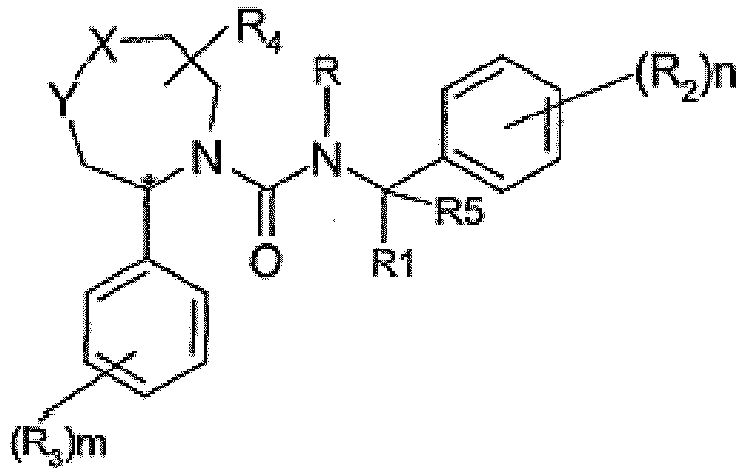
- R represents hydrogen or C1-4alkyl ;
- R1 represents hydrogen or C1-4 alkyl ;
- R2 represents trifluoromethyl, C1-4 alkyl, C1-4 alkoxy, trifluoromethoxy or halogen;
- R3 represents halogen or C1-4 alkyl ;
- R4 represents hydrogen, halogen, C1-4 alkyl or C(O)R6 ;
- R5 represents hydrogen, C1-4 alkyl or R5 together within the R1 represents C3-7 cycloalkyl ;
R6 represents hydroxy, amino, methylamino, dimethylamino, 5 membered heteroaryl group containing 1 to 3 heteroatoms selected independently from oxygen, sulphur and nitrogen or a 6 membered heteroaryl group containing 1 to 3 nitrogen atoms; - m or n are independently zero or an integer from 1 to 3;
- X and Y are independently NR7 or methylene;
R7 represents hydrogen, C 1-4 alkyl or C3-7 cycloalkyl ; provided that when X is NR7, Y is methylene and when X is methylene, Y is NR7;
- 2- (S)- (4-Fluoro-2-methyl-phenyl)- [1, 4]-diazepane-1-carboxylic acid, (3,5-bis-trifluoromethyl-benzyl)-methylamide;
- 7- (R)- (4-Fluoro-2-methyl-phenyl)- [1, 4]-diazepane-I-carboxylic acid, (3,5-bis-trifluoromethyl-benzyl)-methylamide;
- 2- (S)- (4-Fluoro-2-methyl-phenyl)- [1, 4]-diazepane-1-carboxylic acid, [1- (R)- (3, 5-bis-trifluoromethyl-phenyl)-ethyl]-methylamide;
- 7- (R)- (4-Fluoro-2-methyl-phenyl)- [1, 4]-diazepane-1-carboxylic acid, [1- (R)- (3, 5-bis-trifluoromethyl-phenyl)-ethyl]-methylamide;
- 2- (S)- (4-Fluoro-2-methyl-phenyl)- [1, 4]-diazepane-1-carboxylic acid, (3,5-dichlorobenzyl)- methylamide;
- 7- (R)- (4-Fluoro-2-methyl-phenyl)- [1, 4]-diazepane-1-carboxylic acid, (3,5-dichlorobenzyl)- methylamide;
- 2- (S)- (4-Fluoro-2-methyl-phenyl)- [I, 4]-diazepane-1-carboxylic acid, [I- (S)- (3, 5-bis-trifluoromethyl-phenyl)-ethylJ-methylamide;
- 7- (R)- (4-Fluoro-2-methyl-phenyl)- [1, 4]-diazepane-1-carboxylic acid, [1- (S)- (3, 5-bis-trifluoromethyl-phenyl)-ethyl]-methylamide;
- 2- (S)- (4-Fluoro-2-methyl-phenyl)- [1, 4]-diazepane-1-carboxylic acid, (3-chloro-4-fluorobenzyl)-methylamide;
- 7- (R)- (4-Fluoro-2-methyl-phenyl)- [1, 4]-diazepane-I-carboxylic acid, (2,5-dichlorobenzyl)-methylamide;
- 2- (S)-(4-Fluoro-phenyl)-[1, 4]-diazepane-I-carboxylic acid, (3,5-bis-trifluoromethyl-benzyl)-methylamide;
- 7- (R)-(4-Fluoro-phenyl)-[1,4]-diazepane-I-carboxylic acid, (3,5-bis-trifluoromethyl-benzyl)-methylamide;
- 7- (R)-(4-Fluoro-2-methyl-phenyl)-I-methyl-[1, 4]-diazepane-I-carboxylic acid, (3,5-dichloro-benzyl)-methylamide;
- 7- (R)- (4-Fluoro-2-methyl-phenyl)-1-methyl- [1, 4]-diazepane-1-carboxylic acid, (3,5-dichloro-benzyl)-methylamide;
- 7-(R)-(4-Fluoro-2-methyl-phenyl)-1-methyl-[1,4]-diazepane-1-carboxylic acid, [1- (R)- (3, 5-bis-trifluoromethyl-phenyl)-ethyl]-methylamide;
- ooo. Compounds of Formula XIII as described in
WO2004/005255 ,
- R represents halogen, C1-4 alkyl, cyano, C1-4 alkoxy, trifluoromethyl or trifluoromethoxy ;
- R1 represents a 5 or 6 membered heteroaryl group, in which the 5-membered heteroaryl group contains at least one heteroatom selected from oxygen, sulphur or nitrogen and the 6-membered heteroaryl group contains from 1 to 3 nitrogen atoms, or R1 represents a 4,5 or 6 membered heterocyclic group, wherein said 5 or 6 membered heteroaryl or the 4,5 or 6 membered heterocyclic group may optionally be substituted by one to three substituents, which may be the same or different, selected from (CH2)pR6, wherein p is zero or an integer from 1 to 4 and R6 is selected from: halogen, C1-4alkoxy, C1-4alkyl, C3-7cycloalkyl, C1-4 alkyl optionally substituted by halogen, cyano or C1-4 alkoxy, hydroxy, cyano, nitro, trifluoromethyl, carboxy, NH(C1-4 alkyl), N(C1-4 alkYl) 2 NH(C3-7 cycloalkyl), N (C1-4 alkyl) (C3-7 cycloalkyl) ; NH(C1-4alkylOC1-4alkoxy), OC(O)NR7R8, NR8C(O)R7 or C (O)NR7R8 ;
- R2 represents hydrogen, or C1-4 alkyl ;
- R3 and R4 independently represent hydrogen, C1-4 alkyl or R3 together with R4 represents C3-7 cycloalkyl ;
R5 represents trifluoromethyl, S(O)qC1-4 alkyl, C1-4 alkyl, C1-4 alkoxy, trifluoromethoxy, halogen or cyano;
R7 and R8 independently represent hydrogen, C1-4 alkyl or C3-7 cycloalkyl ; - L is a single or a double bond; n is an integer from 1 to 3; m is zero or an integer from 1 to 3; q is zero or an integer from 1 to 2; provided that a) when L is a double bond, R1 is not an optionally substituted 5 or 6 membered heteroaryl group, in which the 5-membered heteroaryl group contains at least one heteroatom selected from oxygen, sulphur or nitrogen and the 6-membered heteroaryl group contains from 1 to 3 nitrogen atoms; b) the group R1 is linked to the carbon atom shown as * via a carbon atom; and c) when the heteroatom contained in the group R1 is substituted, p is not zero;
- N- (3, 5-Bis-trifluoromethyl-benzyl)-3-(4-fluoro-phenyl)-N-methyl-3-piperidin-4-yl-propionamide;
- N- (3, 5-Dichloro-benzyl)-3-(4-fluoro-phenyl)-N-methyl-3-piperidin-4-yi-propionamide;
- N- [1- (3, 5-Dichloro-phenyl)-ethyl]-3-(4-fluoro-phenyl)-N-methyl-3-piperidin-4-yl-propionamide;
- N- [1- (3, 5-Dichloro-phenyl)-ethyl]-3-(4-fluoro-phenyl)-N-methyl-3-[1-(2-methoxyethyl)-piperidin-4-yl]-propionamide;
- N- (3, 5-Dichloro-benzyl)-3-(4-fluoro-phenyl)-3-(4-fluoro-piperidin-4-yl)-N-methyl-proprionamide;
- N-{(3, 5-bis(trifluoromethyl)phenyl]methyll-3-(4-fluorophenyl)-N-methyl-3-(I-[2-(methyloxy)ethyl]-4-piperidinyl}propionamide
- N-{-1-[3, 5-bis(trifluoromethyl)phenyl]ethyl}-3-(4-fluorophenyl)-N-methyl-3-(4-piperidinyl) propanamide;
- N-{1-[3, 5-bis(trifluoromethyl)phenyl]-1-methylethyl}-3-(4-fluorophenyl)-3-(4-piperidinyl) propionamide;
- N-{[3-bromo-4-(methyloxy)phenyl]methyl)-3-(4-fluorophenyl)-N-methyl-3-(4-piperidinyl)propionamide;
- N-[(3, 5-dimethylphenyl)methyl]-3-(4-fluorophenyl)-N-methyl-3-(4-piperidinyl) propionamide; N-[(3,4-dibromophenyl)methyl]-3-(4-fluorophenyl)-N-methyl-3-(4-piperidinyl)propionamide; N-[(3-fluoro-2-methylphenyl)methyl]-3-(4-fluorophenyl)-N-methyl-3-(4-piperidinyl)propionamide;
- N-{[2-chloro-3-(trifluoromethyl)phenyl]methyl}-3-(4-fluorophenyl)-N-methyl-3-(4-piperidinyl) propionamide;
- N-{-1-[3, 5-bis(Trifluoromethyl)phenyl]ethyl}-3-(4-fluorophenyl)-3-(4-fluoro-4-piperidinyl)-N-methylpropionamide;
- N-[(3, 5-dibromophenyl)methyl]-3-(4-fluorophenyl)-3-(4-fluoro-4-piperidinyl)-N-methylpropionamide;
- N- {-1- [3, 5-bis(trifluoromethyl)phenyl]ethyl)-3-(2, 4-dichlorophenyl)-3-(4-fluoro-4-piperidinyl)-N-methylpropionamide;
- N- {-1- [3, 5-bis(trifluoromethyl)phenyl]ethyl}-3-(4-fluoro-2-methylphenyl)-3-(4-fluoro-4-piperidinyl)-N-methylpropionamide;
- N-[(3,5-dibromophenyl)methyl]-3-(4-fluoro-2-methylphenyl)-3-(4-fluoro-4-piperidinyl)-N-methylpropionamide;
- N-[(3,5-dibromophenyl)methyl]-3-(3,4-dichlorophenyl)-3-(4-fluoro-4-piperidinyl)-N-methylpropionamide;
- N-{[3,5-bis(trifluoromethyl)phenyl]methyl}-3-(4-fluorophenyl)-3-(4-fluoro-4-pieridinyl)-N-methylpropionamide;
- 3-(4-chlorophenyl)-N-[(3,5-dibromophenyl)methyl]-3-(4-fluoro-4-piperidinyl)-N-methylpropionamide;
- N-{[3, 5-bis(trifluoromethyl)phenyl]methyl}-3-(4-fluorophenyl)-N-methyl-3-(3-piperidinylidene)propionamide;
- N[(3,5-dibromophenyl)methyl]-3-(4-fluorophenyl)-N-methyl-3-(4-piperidinylidene) propionamide;
- N-{[3,5-bis(trifluoromethyl)phenyl]methyl}-3-(4-fluoro-2-methylphenyl)-N-methyl-3-(1, 2,3, 6-tetrahydro-4-pyridinyl)propionamide;
- N-{(1R)-1-[3,5-bis(trifluoromethyl)phenyl]ethyl}-3-(4-fluoro-2-methylphenyl)-N-methyl-3- (1,2, 3, 6-tetrahydro-4-pyridinyl)propionamide;
- N-{[3, 5-bis(trifluoromethyl)phenylmethyl}-3-(4-fluorophenyl)-N-methyl-3-(3-pyrrolidinyl) propionamide;
- N-([3,5-bis(trifluoromethyl)phenyl]methyl}-3-(4-fluorophenyl)-3-(3-fluoro-3-piperidinyl)-N-methylpropionamide;
- N-{-1-[3, 5-bis(trifluoromethyl)phenyl]ethyl}-3-(4-fluorophenyl)-N-methyl-3-(2-morpholinyl)propionamide;
- N-{[3,5-bis(trifluoromethyl)phenyl]methyl}-3-(4-fluorophenyl)-N-methyl-3-(3-piperidinyl)propionamide;
- N-{[3, 5-bis(trifluoromethyl)phenyl]methyl}-3-(4-fluorophenyl)-N-methyl-3-(4-pyridinyl) propionamide;
- N-{(1R)-1- [3, 5-bis(trifluoromethyl)phenyl]ethyl}-3-(4-fluorophenyl)-N-methyl-3-(4-piperidinyl)propionamide (diastereoisomer 1);
- N-{(1S)-1- [3, 5-bis(trifluoromethyl)phenyl]ethyl}-3-(4-fluorophenyl)-N-methyl-3-(4-piperidinyl)propionamide (diastereoisomer 2);
- N{(1R)-1-[3, 5-bis(trifluoromethyl)phenyl]ethyl}-3-(4-fluorophenyl)-3-(4-fluoro-4-piperidinyl)-N-methylpropionamide(
diastereoisomer 1; - N[(3,5-dibromophenyl)methyl]-3-(4-fluorophenyl)-3-(4-fluoro-4-piperidinyl)-N-methylpropionamide(enantiomer 2);
- N-{[3, 5-bis(trifluoromethyl)phenyl]methyl}-3-(4-fluorophenyl)-3-(3-fluoro-3-piperidinyl)-N-methylpropionamide (diastereoisomer A);
- and NK-1 antagonist compounds disclosed in the following
patent applications WO9817660 US5929094 ,US5877191 ,WO00056727 WO04009573 WO00051984 WO01087838 WO02102372 WO02024629 US20050165083 ,WO06060346 WO06065711 WO07075528 WO06060390 WO07136570 WO09002770
- An NK-1 Antagonist may optionally be provided in the form of a prodrug i.e. a precursor of a NK1 antagonist that is converted in vivo into an active or more active form ("the parent compound") by metabolic processes or other chemical breakdown event (e.g. hydrolysis). Prodrugs may conveniently be employed in compositions, methods and uses when they are more soluble than the parent compound. Some prodrugs of NK-1 antagonists contain one or more phosphate groups not possessed by the parent compound which aid water solubility
- The NK-1 antagonist according to the present invention can be administered by any convenient route, however the defined route of administration is topically to the cornea. The invention provides the use of NK-1 antagonists for the production of an ophthalmic preparation to be administered topically to the eye for the therapy and/or prophylaxis of corneal neovascularization. The invention provides a method for preventing and treating corneal neovascularization by local administration (e.g. of an ophthalmic composition) to the cornea of an NK-1 antagonist. The present invention provides a composition formulated for topical application on a local, superficial and restricted area in the eye and/or the adnexa of the eye comprising an NK-1 antagonist optionally together with one or more one pharmaceutically acceptable additives (such as diluents or carriers).
- The ophthalmic compositions of the invention are in the form of solution, emulsion or suspension (collyrium), ointment, gel, aerosol, mist or liniment together with a pharmaceutically acceptable, eye tolerated and compatible with active principle ophthalmic carrier. Also within the scope of the present invention are particular routes for ophthalmic administration for delayed release, e.g. as ocular erodible inserts or polymeric membrane "reservoir" systems to be located in the conjunctiva sac or in contact lenses.
- The ophthalmic compositions of the invention are administered topically, e.g., the composition is delivered and directly contacts the eye and/or the adnexa of the eye.
- The composition and pharmaceutical compositions containing at least an NK-1 antagonist of the present invention may be prepared by any conventional technique, e.g. as described in Remington: The Science and Practice of Pharmacy 1995, edited by E. W. Martin, Mack Publishing Company, 19th edition, Easton, Pa.
- In one embodiment the composition is formulated so it is a liquid comprising a least an NK-1 antagonist in solution or in suspension. The composition may be formulated in any liquid form suitable for topical application such as eye-drops, artificial tears, eye washes, or contact lens adsorbents comprising a liquid carrier such as a cellulose ether (e.g. methylcellulose).
- The liquid may be any useful liquid, however it is frequently preferred that the liquid is an aqueous liquid. It is furthermore preferred that the liquid is sterile. Sterility may be conferred by any conventional method, for example filtration, irradiation or heating or by conducting the manufacturing process under aseptic conditions.
- The liquid may comprise one or more lipophile vehicles.
- In one embodiment of the present invention, the composition is formulated as an ointment. Any ointment components known to a person skilled in the art, which has no detrimental effect on the area being treated, and is applicable in the formulation of compositions and pharmaceutical compositions for topical administration to the eye can be used. For example, one carrier may be a petrolatum carrier.
- The pharmaceutical acceptable additives may in general be any conventionally used pharmaceutical acceptable additive, which should be selected according to the specific formulation, intended administration route etc. For example the pharmaceutical acceptable additives may be any of the additives mentioned in Nema et al, 1997. Furthermore, the pharmaceutical acceptable additive may be any accepted additive from FDAs "inactive ingredients list", which for example is available on the internet address http://www.fda.gov/cder/drug/iig/default.htm.
- At least one pharmaceutically acceptable diluents or carrier may be a buffer. For some purposes it is often desirable that the composition comprises a buffer, which is capable of buffering a solution to a pH in the range of 5 to 9, for
example pH 5 to 6,pH 6 to 8 orpH 7 to 7.5. - However, in other embodiments of the invention the pharmaceutical composition may comprise no buffer at all or only micromolar amounts of buffer.
- The buffer may for example be selected from the group consisting of TRIS, acetate, glutamate, lactate, maleate, tartrate, phosphate, citrate, borate, carbonate, glycinate, histidine, glycine, succinate and triethanolamine buffer. Hence, the buffer may be K2HPO4, Na2HPO4 or sodium citrate.
- In a preferred embodiment the buffer is a TRIS buffer. TRIS buffer is known under various other names for example tromethamine including tromethamine USP, THAM, Trizma, Trisamine, Tris amino and trometamol. The designation TRIS covers all the aforementioned designations.
- The buffer may furthermore for example be selected from USP compatible buffers for parenteral use, in particular, when the pharmaceutical formulation is for parenteral use. For example the buffer may be selected from the group consisting of monobasic acids such as acetic, benzoic, gluconic, glyceric and lactic, dibasic acids such as aconitic, adipic, ascorbic, carbonic, glutamic, malic, succinic and tartaric, polybasic acids such as citric and phosphoric and bases such as ammonia, diethanolamine, glycine, triethanolamine, and TRIS.
- In some embodiments of the invention the pharmaceutically acceptable additives comprise a stabiliser. The stabiliser may for example be a detergent, an amino acid, a fatty acid, a polymer, a polyhydric alcohol, a metal ion, a reducing agent, a chelating agent or an antioxidant, however any other suitable stabiliser may also be used with the present invention.
- For example the stabiliser may be selected from the group consisting of poloxamers, Tween-20, Tween-40, Tween-60, Tween-80, Brij, metal ions, amino acids, polyethylene glucol, Triton, and ascorbic acid.
- Furthermore, the stabiliser may be selected from the group consisting of amino acids such as glycine, alanine, arginine, leucine, glutamic acid and aspartic acid, surfactants such as polysorbate 20, polysorbate 80 and poloxamer 407, fatty acids such as phosphotidyl choline ethanolamine and acethyltryptophanate, polymers such as polyethylene glycol and polyvinylpyrrolidone, polyhydric alcohol such as sorbitol, mannitol, glycerin, sucrose, glucose, propylene glycol, ethylene glycol, lactose and trehalose, antioxidants such as ascorbic acid, cysteine HCL, thioglycerol, thioglycolic acid, thiosorbitol and glutathione, reducing agents such as several thiols, chelating agents such as EDTA salts, gluthamic acid and aspartic acid.
- The pharmaceutically acceptable additives may comprise one or more selected from the group consisting of isotonic salts, hypertonic salts, hypotonic salts, buffers and stabilisers. In preferred embodiments other pharmaceutically excipients such as preservatives are present. In one embodiment said preservative is a parabene, such as but not limited to methyl parahydroxybenzoate or propyl parahydroxybenzoate.
- In some embodiments of the invention the pharmaceutically acceptable additives comprise mucolytic agents (for example N-acetyl cysteine), hyaluronic acid, cyclodextrin, petroleum. Exemplary compounds incorporated to facilitate and expedite transdermal delivery of topical compositions into ocular or adnexal tissues include, but are not limited to, alcohol (ethanol, propanol, and nonanol), fatty alcohol (lauryl alcohol), fatty acid (valeric acid, caproic acid and capric acid), fatty acid ester (isopropyl myristate and isopropyl n-hexanoate), alkyl ester (ethyl acetate and butyl acetate), polyol (propylene glycol, propanedione and hexanetriol), sulfoxide (dimethylsulfoxide and decylmethylsulfoxide), amide (urea, dimethylacetamide and pyrrolidone derivatives), surfactant (sodium lauryl sulfate, cetyltrimethylammonium bromide, polaxamers, spans, tweens, bile salts and lecithin), terpene (d-limonene, alpha-terpeneol, 1,8-cineole and menthone), and alkanone (N-heptane and N-nonane). Moreover, topically-administered compositions comprise surface adhesion molecule modulating agents including, but not limited to, a cadherin antagonist, a selectin antagonist, and an integrin antagonist.
- Disclosed is also a drug-delivery device consisting of at least an NK-1 antagonist and a pharmaceutically compatible polymer. For example, the composition is incorporated into or coated onto said polymer. The composition is either chemically bound or physically entrapped by the polymer. The polymer is either hydrophobic or hydrophilic. The polymer device comprises multiple physical arrangements.
- Exemplary physical forms of the polymer device include, but are not limited to, a film, a scaffold, a chamber, a sphere, a microsphere, a stent, or other structure. The polymer device has internal and external surfaces. The device has one or more internal chambers. These chambers contain one or more compositions. The device contains polymers of one or more chemically-differentiable monomers. The subunits or monomers of the device polymerize in vitro or in vivo.
- In a preferred embodiment, the disclosure comprises a device comprising a polymer and a bioactive composition incorporated into or onto said polymer, wherein said composition includes an NK-1 Antagonist, and wherein said device is implanted or injected into an ocular surface tissue, an adnexal tissue in contact with an ocular surface tissue, a fluid-filled ocular or adnexal cavity, or an ocular or adnexal cavity.
- Exemplary mucoadhesive polyanionic natural or semi-synthethic polymers from which the device is formed include, but are not limited to, polygalacturonic acid, hyaluronic acid, carboxymethylamylose, carboxymethylchitin, chondroitin sulfate, heparin sulfate, and mesoglycan. In one embodiment, the device comprises a biocompatible polymer matrix that may optionally be biodegradable in whole or in part. A hydrogel is one example of a suitable polymer matrix material. Examples of materials which can form hydrogels include polylactic acid, polyglycolic acid, PLGA polymers, alginates and alginate derivatives, gelatin, collagen, agarose, natural and synthetic polysaccharides, polyamino acids such as polypeptides particularly poly(lysine), polyesters such as polyhydroxybutyrate and poly-.epsilon.- caprolactone, polyanhydrides; polyphosphazines, poly(vinyl alcohols), poly(alkylene oxides) particularly poly(ethylene oxides), poly(allylamines)(PAM), poly(acrylates), modified styrene polymers such as poly(4-aminomethylstyrene), pluronic polyols, polyoxamers, poly(uronic acids), poly(vinylpyrrolidone) and copolymers of the above, including graft copolymers. In another embodiment, the scaffolds may be fabricated from a variety of synthetic polymers and naturally-occurring polymers such as, but not limited to, collagen, fibrin, hyaluronic acid, agarose, and laminin-rich gels.
- One preferred material for the hydrogel is alginate or modified alginate material. Alginate molecules are comprised of (I -4)-linked β-D-mannuronic acid (M units) and α L- guluronic acid (G units) monomers which vary in proportion and sequential distribution along the polymer chain. Alginate polysaccharides are polyelectrolyte systems which have a strong affinity for divalent cations (e.g. Ca+2, Mg+2, Ba+2) and form stable hydrogels when exposed to these molecules. See Martinsen A., et al., Biotech. & Bioeng., 33 (1989) 79-89.
- The device is administered topically, subconjunctively, or in the episcleral space, subcutaneously, or intraductally. Specifically, the device is placed on or just below the surface of an ocular tissue. Alternatively, the device is placed inside a tear duct or gland. The composition incorporated into or onto the polymer is released or diffuses from the device.
- In one embodiment the composition is incorporated into or coated onto a contact lens or drug delivery device, from which one or more molecules diffuse away from the lens or device or are released in a temporally-controlled manner. In this embodiment, the contact lens composition either remains on the ocular surface, e.g. if the lens is required for vision correction, or the contact lens dissolves as a function of time simultaneously releasing the composition into closely juxtaposed tissues. Similarly, the drug delivery device is optionally biodegradable or permanent in various embodiments.
- For example, the composition is incorporated into or coated onto said lens. The composition is chemically bound or physically entrapped by the contact lens polymer. Alternatively, a color additive is chemically bound or physically entrapped by the polymer composition that is released at the same rate as the therapeutic drug composition, such that changes in the intensity of the color additive indicate changes in the amount or dose of therapeutic drug composition remaining bound or entrapped within the polymer. Alternatively, or in addition, an ultraviolet (UV) absorber is chemically bound or physically entrapped within the contact lens polymer. The contact lens is either hydrophobic or hydrophilic.
- Exemplary materials used to fabricate a hydrophobic lens with means to deliver the compositions of the invention include, but are not limited to, amefocon A, amsilfocon A, aquilafocon A, arfocon A, cabufocon A, cabufocon B, carbosilfocon A, crilfocon A, crilfocon B, dimefocon A, enflufocon A, enflofocon B, erifocon A, flurofocon A, flusilfocon A, flusilfocon B, flusilfocon C, flusilfocon D, flusilfocon E, hexafocon A, hofocon A, hybufocon A, itabisfluorofocon A, itafluorofocon A, itafocon A, itafocon B, kolfocon A, kolfocon B, kolfocon C, kolfocon D, lotifocon A, lotifocon B, lotifocon C, melafocon A, migafocon A, nefocon A, nefocon B, nefocon C, onsifocon A, oprifocon A, oxyfluflocon A, paflufocon B, paflufocon C, paflufocon D, paflufocon E, paflufocon F, pasifocon A, pasifocon B, pasifocon C, pasifocon D, pasifocon E, pemufocon A, porofocon A, porofocon B, roflufocon A, roflufocon B, roflufocon C, roflufocon D, roflufocon E, rosilfocon A, satafocon A, siflufocon A, silafocon A, sterafocon A, sulfocon A, sulfocon B, telafocon A, tisilfocon A, tolofocon A, trifocon A, unifocon A, vinafocon A, and wilofocon A. [144] Exemplary materials used to fabricate a hydrophilic lens with means to deliver the compositions of the invention include, but are not limited to, abafilcon A, acofilcon A, acofilcon B, acquafilcon A, alofilcon A, alphafilcon A, amfilcon A, astifilcon A, atlafilcon A, balafilcon A, bisfilcon A, bufilcon A, comfilcon A, crofilcon A, cyclofilcon A, darfilcon A, deltafilcon A, deltafilcon B, dimefilcon A, droxfilcon A, elastofilcon A, epsilfilcon A, esterifilcon A, etafilcon A, focofilcon A, galyfilcon A, genfilcon A, govafilcon A, hefilcon A, hefilcon B, hefilcon C, hilafilcon A, hilafilcon B, hioxifilcon A, hioxifilcon B, hioxifilcon C, hydrofilcon A, lenefilcon A, licryfilcon A, licryfilcon B, lidofilcon A, lidofilcon B, lotrafilcon A, lotrafilcon B, mafilcon A, mesafilcon A, methafilcon B, mipafilcon A, nelfilcon A, netrafilcon A, ocufilcon A, ocufilcon B, C, ocufilcon D, ocufilcon E, ofilcon A,
- omafilcon A, oxyfilcon A, pentafilcon A, perfilcon A, pevafilcon A, phemfilcon A, polymacon, senofilcon A, silafilcon A, siloxyfilcon A, surfilcon A, tefilcon A, tetrafilcon A, trilfilcon A, vifilcon A, vifilcon B, and xylofilcon A. Antibody Compositions:
- Within the scope of the invention are compositions formulated as a gel or gel- like substance, creme or viscous emulsions. It is preferred that said compositions comprise at least one gelling component, polymer or other suitable agent to enhance the viscosity of the composition. Any gelling component known to a person skilled in the art, which has no detrimental effect on the area being treated, and is applicable in the formulation of compositions and pharmaceutical compositions for topical administration to the skin, eye or mucous can be used. For example, the gelling component may be selected from the group of: acrylic acids, carbomer, carboxypolymethylene, such materials sold by B. F. Goodrich under the trademark Carbopol (e.g. Carbopol 940), polyethylene-polypropyleneglycols, such materials sold by BASF under the trademark Poloxamer (e.g. Poloxamer 188), a cellulose derivative, for example hydroxypropyl cellulose, hydroxyethyl cellulose, hydroxyethylene cellulose, methyl cellulose, carboxymethyl cellulose, alginic acid-propylene glycol ester, polyvinylpyrrolidone, veegum (magnesium aluminum silicate),
- Pemulen, Simulgel (such as Simulgel 600, Simulgel EG, and simulgel NS), Capigel, Colafax, plasdones and the like and mixtures thereof.
- A gel or gel-like substance according to the present invention comprises for example less than 10% w/w water, for example less than 20% w/w water, for example at least 20 % w/w water, such as at least 30% w/w water, for example at least 40% w/w water, such as at least 50% w/w water, for example at least 75% w/w water, such as at least 90% w/w water, for example at least 95% w/w water. Preferably said water is deionised water.
- Gel-like substances of the invention include a hydrogel, a colloidal gel formed as a dispersion in water or other aqueous medium. Thus a hydrogel is formed upon formation of a colloid in which a dispersed phase (the colloid) has combined with a continuous phase (i.e. water) to produce a viscous jellylike product; for example, coagulated silicic acid. A hydrogel is a three-dimensional network of hydrophilic polymer chains that are crosslinked through either chemical or physical bonding. Because of the hydrophilic nature of the polymer chains, hydrogels absorb water and swell. The swelling process is the same as the dissolution of non-crosslinked hydrophilic polymers. By definition, water constitutes at least 10% of the total weight (or volume) of a hydrogel.
- Examples of hydrogels include synthetic polymers such as polyhydroxy ethyl methacrylate, and chemically or physically crosslinked polyvinyl alcohol, polyacrylamide, poly(N-vinyl pyrrolidone), polyethylene oxide, and hydrolyzed polyacrylonithle. Examples of hydrogels which are organic polymers include covalent or ionically crosslinked polysacchahde-based hydrogels such as the polyvalent metal salts of alginate, pectin, carboxymethyl cellulose, heparin, hyaluronate and hydrogels from chitin, chitosan, pullulan, gellan and xanthan. The particular hydrogels used in our experiment were a cellulose compound (i.e. hydroxypropylmethylcellulose [HPMC]) and a high molecular weight hyaluronic acid (HA)..
- Hyaluronic acid is a polysaccharide made by various body tissues. U.S. patent
5,166,331 discusses purification of different fractions of hyaluronic acid for use as a substitute for intraocular fluids and as a topical ophthalmic drug carrier. Other U.S. patent applications which discuss ocular uses of hyaluronic acid include serial numbers11/859,627 11 /952,927 10/966,764 11/741 ,366 11/039,192 - Formulations of macromolecules for intraocular use are known, See eg U.S. patent applications serial numbers
11/370,301 11/364,687 60/721 ,600 11/116,698 60/567,423 11 /695,527 U.S. patent applications serial numbers 10/966,764 ;11/091 ,977 11/354,415 60/519,237 60/530,062 1 1/695,527 - Sustained release formulations to treat corneal neovascularization as described in
WO2010048086 are within the scope if the invention. - Compositions and pharmaceutical compositions according to the present invention, comprise at least one NK-1 antagonist as an active ingredient. The concentration of NK-1 antagonist in said compositions may vary according to the type of administration they are formulated for. The compositions may comprise 0.1 ng/ml to 10 mg/ml, preferably 100 ng/ml to 10 mg/ml, such as 100 µg/ml to 10 mg/ml, preferably 1 mg/ml to 10 mg/ml NK-1 antagonist.
- Accordingly, the total dose per day of active principle may comprise 10 ng to 100 mg, preferably 100 ng to 10 mg, preferably 10µg to 10mg, preferably 200µg to 1 mg, preferably 200µg, of NK-1 antagonist, preferably . Compositions and pharmaceutical compositions for topical delivery to the eye, according to the present invention, comprise at least one NK-1 Antagonist as an active ingredient. The compositions may comprise 0,01 to 50 % (weight/volume) of NK-1 Antagonist, preferably 0,05 to 5 % (weight/volume), more preferably 0,05 to 1 wt% (weight/volume), or most preferably 0,1 to 2% (weight/volume) of the NK-1 Antagonist, for example the composition may comprise 0,05% (weight/volume), 0,075%(weight/volume), 0,1%(weight/volume), 1%, (weight/volume), 2%(weight/volume, 40%(weight/volume), 5%(weight/volume), of NK-1 antagonist.
- According to the present invention "a therapeutically effective amount" of the composition refers to the amount necessary to induce the desired biological effect on the subject in need of treatment.
- The compositions and pharmaceutical compositions according to the present invention may be administered once or several times per day, for example they may be administered in the range of 2 to 10 times a day, such as e.g. 2 to 8 times, for example 2 to 6 times, such as 2 to 4 times, such as 2 to 3 times a day.
- The compositions according to the present invention may be administrated to the subject for a period of treatment of one or more than one week such as two weeks, three weeks, four weeks, five weeks, six weeks, seven weeks, eight weeks or more than eight weeks. The treatment may be repeated on subjects who relapse.
- A further aspect of the present invention relates to a method of treating or ameliorating a medical condition of the eye characterized by the presence of neovascularization of the cornea comprising administration to an animal subject including a human being in need thereof an effective dosage of a composition or a pharmaceutical composition as defined herein above.
- In one embodiment the treatment or prevention of CNV consists of use of an NK-1 antagonist as sole pharmaceutically active agent.
- However in certain embodiments the invention further encompasses the administration of an NK-1 antagonist concurrently with one or more further therapeutically active agents that are administered to the same patient, each active agent being administered according to a regimen suitable for that medicament. This encompasses pre-treatment, simultaneous treatment, sequential treatment, and alternating regimens.
- The one or more therapeutically active agents may be administered by the same route as the NK-1 antagonist or by a different route (or by one or more different routes).
- At least one of the one or more further therapeutically active agents may, for example. administered topically to the eye.
- Examples of such active agents include but are not limited to antivirals, antibacterial agents (such as antibiotics), analgesics, antagonists of inflammatory cytokines, corticosteroids, non-steroidal anti-inflammatory agents, immunosuppressants and antifungal agents.
- In one specific embodiment, the invention encompasses a method of treating or preventing CNV by administering an NK-1 antagonist concurrently with an antibiotic agent.
- In one specific embodiment there is provided a pharmaceutical composition suitable for topical administration to the eye comprising an NK-1 antagonist and an antibiotic agent.
- Typically such a composition will comprise one or more diluents or carriers which are pharmaceutically acceptable for topical administration to the eye.
- In another embodiment, the one or more further therapeutically active agents are selected from VEGF inhibitors, IL1-R inhibitors, immunosuppressants and TNF inhibitors.
- In one embodiment of the invention, one of the one or more further therapeutically active agents is an antibiotic such as amikacin, gentamicin, kanamycin, neomycin, netilmicin, streptomycin, tobramycin, teicoplanin, vancomycin, azithromycin, clarithromycin, clarithromycin, dirithromycin, erythromycin, roxithromycin, troleandomycin, amoxicillin, ampicillin, azlocillin, carbenicillin, clozacillin, dicloxacillin, flucozacillin, mezlocillin, nafcillin, penicillin, piperacillin, ticarcillin, bacitracin, colistin, polymyxin B, ciprofloxacin, enoxacin, gatifloxacin, levofloxacin, lomefloxacin, moxifloxacin, norfloxacin, oflazacin, trovafloxacin, mafenide, sulfacetamide, sulfamethizole, sulfasalazine, sulffsoxazole, tetracycline, trimethoprim, cotrimoxazole, demeclocycline, soxycycline, minocycline, doxycycline, oxytetracycline or tetracycline.
- In a further embodiment of the invention, one of the one or more further therapeutically active agents is an immunosuppressive agent such as cyclosporin A.
- In a further embodiment of the invention, one of the one or more further therapeutically active agents is an antagonist of inflammatory cytokines such as antagonist of tumor necrosis factor alpha (TNFα). Exemplary functional blockers of TNFα include, but are not limited to, recombinant and/or soluble TNFα receptors, monoclonal antibodies, and small molecule antagonists and/or inverse agonists. One or more commercially-available TNF-α blocking agents are reformulated for topical administration in this embodiment. Exemplary commercial TNF-α blocking agents used for reformulation include, but are not limited to, etanerept/Embrel, infliximab/Remicade, and adalimumab/Humira.
- Alternatively, one of the one or more further therapeutically active agents is an antagonist of an inflammatory cytokine selected from IL-1, IL-2, IL-4, IL-5, IL-6, IL-8, IL-12, IL-17, IL-18 and IL-23.
- In a further embodiment of the invention, one of the one or more further therapeutically active agents is an antagonist of one or more member(s) of the vascular epithelial growth factor (VEGF) family. Exemplary members include, but are not limited to, VEGF- A, VEGF-C, VEGFR-2, and VEGFR-3.
- Anti-VEGF agents which inhibit either VEGF itself or the VEGF receptor present in the eye in order to thereby prevent angiogenesis, include but are not limited to monoclonal antibodies such as ranibizumab (LUCENTIS®; rhuFab V2) and bevacizumab (AVASTIN®; rhuMab-VEGF), nucleic acids (aptamers such as MACUGEN®, (pegaptanib) a PEGylated RNA aptamer, and siRNAs directed to VEGF RNA). Bevacizumab is a full-length anti-VEGF antibody approved for use in metastatic colon cancer. Ranibizumab is a humanized anti-VEGF monoclonal antibody fragment that inhibits all isotypes of VEGF and pegaptanib is a VEGF-neutralizing aptamer that specifically inhibits one isoform of VEGF (VEGF-165).
- Further examples include antibody fragments (e.g. Ranibizumab), small interfering RNA's decreasing expression of VEGFR or VEGF ligand, post-VEGFR blockade with tyrosine kinase inhibitors, Small molecule RTK inhibitors targeting VEGF receptors including PTK787 can also be used
- In a further embodiment of the invention, one of the one or more further therapeutically active agents is an antagonist of interferon-gamma.
- In a further embodiment of the invention, one of the one or more further therapeutically active agents is an antagonist of one or more chemokines and their receptors. Exemplary chemokines and receptors that may be antagonized by a further active agent include chemokine (C-C motif) receptor 1 (CCRI), chemokine (C-C motif) receptor 2 (CCR2), chemokine (C-C motif) receptor 5 (CCR5), chemokine (C-C motif) receptor 7 (CCR7), and chemokine (C-X-C motif) receptor 3 (CXCR3).
- Male 6- to 8-week-old C57BI/6 mice (Taconic Farms, Germantown, NY) were used in experiments for Examples 1 to 3. Male 6- to 8-week-old C57BI/6 mice (Charles River Lab, Calco, Milan, Italy) were used in experiments for Examples 4-6. Prior to pellet implantation or caustication, animals were anesthetized by intraperitoneal injection of ketamine (120 mg/kg) and xylazine (20mg/kg) before any surgery.
- This model was employed to assess the effect of pharmaceutically active substances on the angiogenesis component of CNV.
- Sustained release b-FGF micropellets (40 ng/pellet) were prepared as described in Azar DT, Am Ophthalmol Soc 2006;104:264-302.
- Briefly, the pellets were implanted through half thickness linear incisions at the center of cornea using a disposable 30 degrees microknife (F.S.T., Foster City, CA, USA). Lamellar pocket incisions were then made parallel to the corneal plane using a Von Graefe knife (F.S.T., Foster City, CA, USA) and advanced to the temporal limbus at lateral canthal area. The pellets were positioned into the pocket 1.0 mm apart from the limbal vascular arcade in temporal side, and tetracycline ophthalmic ointment was applied to the eye after pellet implantation to prevent post surgical infections.
- This model was employed to assess the effect of pharmaceutically active substances on the angiogenesis component of CNV in the presence of a strong inflammatory stimulus (Lu P et al, Cornea. 2007 Feb;26(2):199-206.)
- In fact, the Alkali burn model is considered an inflammation-driven model of neovascularisation, whereby a reduction in inflammatory cell influx is associated with clinical improvement. (Ueno et al. Invest Ophthalmol Vis Sci. 2005 Nov;46(11):4097-106.)
- Mice were anesthetized by intraperitoneal injection of ketamine (120 mg/kg) and xylazine (20mg/kg) before any surgery. A 2-mm disc of filter paper saturated with 1 N NaOH was placed onto the right cornea of each mouse for 40 seconds, followed by rinsing extensively with phosphate-buffered saline (PBS) for 2 minutes.
- Tetracycline ophthalmic ointment was applied topically to the eye after the procedure in Example 2; Tobramicin 0.3% was applied topically to the eye after the procedure in Examples 4-6
- After taking photographs under the slit lamp, five mice per group were sacrificed 7 days after b-FGF micropellet implantation or caustication, and freshly enucleated eyes were prepared into corneal flat mounts. Immunohistochemical staining was performed with FITC-conjugated CD31/PECAM-1 (rat-anti- mouse antibody; 1:100; Santa Cruz Biotechnology, Santa Cruz, CA). Images were taken at 40X, 400X and 600X magnification. To quantify the blood vessels, corneal whole-mounts were covered with mounting medium (Vector, Burlingame, CA) and examined by an epifluorescent microscope. For toxicity studies, mice were examined at the slit lamp daily. Animals were sacrificed seven days later and eye bulbs were removed, fixed in 4% paraformaldehyde, cross-sectioned and stained with standard hematoxylin-eosin. At least three to five different corneas were examined; representative data are presented.
- Both slit-lamp and fluorescence microscopy pictures were qualitatively compared for the amount of corneal neovascularization. Gross anatomical alterations such as disruption of epithelial layer, inflammatory cell infiltration, or endothelial cell loss were searched in hematoxylin-eosin cross sections.
- Male 6- to 8-week-old C57BI/6 mice were treated to induce neovascularization using Fibroblast Growth Factor (FGF) 80ng pellet implantation, a non-inflammatory model of corneal neovascularization (see Experimental Methods).
- Immediately after pellet implantation, on Day 0, each group received one of the following topical treatments: (1) fosaprepitant (purchased from Universal Drug Store, Canada and diliuted as per technical sheet instructions with 0.9% NaCl solution to reach a final concentration of 1 mg/ml) at the concentration of 1mg/ml (one drop, 50 µl, per instillation, for a total amount of 0,05mg of active principle per instillation) in the
conjunctival sac 4 times per day for 1 week; or (2) phosphate buffered saline PBS as placebo. 5 mice per group were used. After taking photographs at the slit lamp, mice were sacrificed. Immunohistochemical staining was performed with FITC-conjugated CD31/PECAM-1 to reveal corneal neovessels. - Following b-FGF pellet implantation, neovessels are expected to grow from the limbal vessels (i.e. from the periphery of the cornea), towards the pellet, which is placed in the avascular cornea. The extent of neovascularisation is then evaluated.
- We observed an obvious difference in corneal neovascularization in fosaprepitant versus placebo treated eyes The area of normally avascular cornea invaded by neovessels was smaller in fosaprepitant treated eyes as opposed to placebo. The density of vascular ramifications was reduced (i.e. the number of vascular branches per surface unit was reduced). At the slit-lamp, florid neovascularization reaching the pellet was present 7 days after implantation in Placebo-treated eyes. In fosaprepitant-treated eyes, less neovascularization was observed. More specifically, the length of the vessels appeared reduced (i.e. vessels did not reach the pellet) and the density of vascular ramification was reduced (i.e. the number of vascular branches per surface unit was reduced).
Figure 1 : upper panel. Slit-lamp in-vivo biomicroscopy, note the reduced neovascularization in the treated eye. Middle panel. Cornea whole mounts stained for PECAM to reveal neovessels (magnification 100x). White arrows indicate the pellet. Note the denser neovascular network in the placebo treated eyes. Lower panel. Reduced density of corneal neovascular network following fosaprepitant administration. Magnification 600X. - Male 6- to 8-week-old C57BI/6 mice were treated to induce neovascularization using sodium hydroxide caustication (see Experimental Methods)
- Immediately after sodium hydroxide caustication, on Day 0, each group received one of the following topical treatments: (1) fosaprepitant (purchased from Universal Drug Store, Canada and diliuted as per technical sheet instructions with 0.9% NaCl solution to reach a final concentration of 1 mg/ml) at the concentration of 1mg/ml (one drop, 50 µl, per instillation, for a total amount of 0,05mg of active principle per instillation) in the
conjunctival sac 4 times per day for 1 week; or (2) phosphate buffered saline PBS as placebo. 5 mice per group were used. After taking photographs at the slit lamp, mice were sacrificed. Immunohistochemical staining was performed with FITC-conjugated CD31/PECAM-1 to reveal corneal neovessels. - Neovascularization was evident in the cornea at 360
degrees 7 days after caustication in placebo treated eyes, both at the slit lamp and with epifluorescent microscopy (Fig. 2 ). In eyes treated with fosaprepitant, neovascularization was remarkably reduced. The area of normally avascular cornea invaded by neovessels was smaller in fosaprepitant treated eyes as opposed to placebo. The density of vascular ramifications was reduced (i.e. the number of vascular branches per surface unit was reduced). - Interestingly, we also found that corneal transparency was much improved after fosaprepitant application (i.e. iris was visible), as opposed to placebo-treated corneas, which appeared cloudy (
Figure 2 ) - Fosaprepitant toxicity was tested on the healthy cornea by administering
to 3 healthy C57BI/6 mice fosaprepitant (purchased from Universal Drug Store, Canada and diliuted as per technical sheet instructions with 0.9% NaCl solution to reach a final concentration of 1 mg/ml) at the concentration of 1mg/ml in theconjunctival sac 4 times per day for 1 week. In vivo corneal biomicroscopy imaging and hematoxylin eosin ocular cross sections were checked as markers for toxicity. - No alteration of the corneal epithelium, stroma, or endothelium could be found at the slit lamp observation of healthy corneas upon topical fosaprepitant administration for up to 7 days (
Fig. 3A ). Hematoxylin-eosin staining of eyeball cross-sections appeared normal 7 days after daily administration of fosaprepitant, no anatomical alteration was detected in the epithelium, stroma, or endothelium (Fig. 3B ). -
Figure 3A : slit-lamp examination revealed a normal eye. -
Figure 3B : Hematoxylin eosin corneal cross sections showed normal epithelium, stroma and endothelium, magnification 200X. - The NK-1 antagonist fosaprepitant- when administered topically to the eye- was effective at preventing/treating CNV in experimental mice models of CNV induced by FGF pellet implantation or sodium hydroxide cauterization. These models were employed, to assess the effect of the drug on the angiogenesis component of CNV, respectively, in the absence and presence of a strong inflammatory stimulus.
- Surprisingly, upon observation of corneas in which neovascularization was induced by b-FGF as well as by a proinflammatory stimulus such as sodium hydroxide cauterisation, the NK-1 antagonist treatment led to reduced neovascularisation and improved corneal transparency.
- Finally, the drug treatment did not lead to ocular toxicity.
- Lanepitant (
WO9907681 - 0.4 mg/ml, 6 times a day for 4 days, starting on the day of the tissue injury ("Day 0" to "
Day 3"). - 1.6 mg/ml, 6 times a day for 4 days, starting on the day of the tissue injury ("Day 0" to "
Day 3"). - 6.4 mg/ml, 6 times a day for 4 days, starting on the day of the tissue injury ("Day 0" to "
Day 3"). - PBS Control, 6 times a day for 4 days, starting on the day of the tissue injury ("Day 0" to "
Day 3"). - Three mice (for a total of 6 eyes) were treated in each experimental group.
- On
Day 4, After taking photographs at the slit lamp, mice were sacrificed. Immunohistochemical staining was performed with FITC-conjugated CD31/PECAM-1 to reveal corneal neovessels (Figure 4A ). Following alkali burn, neovessels are expected to grow from the periphery towards the center of the cornea. The extent of the neovascularization is then evaluated. Briefly, corneas were excised, fixed and stained with FITC-conjugated CD31/PECAM-1 to reveal corneal neovessels. Micro-photographs were taken with the aid of an epifluorescent microscope and mounted to re-create the entire cornea, and skeletonized to form a black and white image as shown inFigure 4A , right column. The neovascular area was then calculated by measuring the Neovascular Area Index (NV Index). This was obtained by calculating the ratio of the neovascular area-obtained by joining together the inner tip of the neovessels- and the total surface of the cornea (i.e. the total area of the cornea). - As shown in
Figure 4A , treatment with vehicle resulted in corneal perforation, loss of transparence and gross damage to the eyelid (Figure 4A , Panel 1). However, topical application of an increasing dose of lanepitant resulted in increased corneal transparence; moreover, the anatomy of the eyelids appeared better preserved (Figure 4A ,panels - Furthermore, the neovessels progressively reduced with increasing the dose of lanepitant (
Figure 4A ,panel Figure 4B ); in particular, a dose of 6.4mg/ml induced a statistically significant reduction compared to vehicle treatment. - Befetupitant (
WO020008232 - 0.4 mg/ml, 3 times a day for 9 days, starting on the day of the tissue injury.
- 1.6 mg/ml, 3 times a day for 9 days, starting on the day of the tissue injury.
- DMSO control, 3 times a day for 9 days, starting on the day of the tissue injury.
- Three mice (for a total of 6 eyes) were treated in each experimental group.
- On day 9, after taking photographs at the slit lamp, mice were sacrificed. Immunohistochemical staining was performed with FITC-conjugated CD31/PECAM-1 to reveal corneal neovessels (
Figure 6A ). Image analysis was performed as detailed in Example 4. We observed that corneal neovessels were reduced following increasing doses of befetupitant. (Figure 6A ,panels Figure 6B ). - Topical lanepitant was administered to the eye with the following dose regimen in alkali burn induced neovascularization of the cornea:
- 1.6 mg/
ml lanepitant 6 times a day two days before the injury ("day -3"), two days before the injury ("Day -2"), one day before the procedure ("Day-1 "), the day of the procedure ("Day 0"), and 4 days after the injury ("Day 1" through "Day 3") for a total of 8 days of treatment. - Three mice (for a total of 6 eyes) were treated in each experimental group.
- On
day 4, after taking photographs at the slit lamp, mice were sacrificed. Immunohistochemical staining was performed with FITC-conjugated CD31/PECAM-1 to reveal corneal neovessels (Figure 5A ) Image analysis was performed as detailed in Example 4. When compared with vehicle treated eyes, corneal neovascularization appeared reduced with lanepitant pre-treatment (Figure 5A ,Panel 2, 4). Interestingly, lanepitant pre-treatment achieved a statistically significant reduction in the Cornea Neovascular Index (Figure 5B ), showing an increased effect on neovascularization compared to the same dose administered after the tissue injury. This demonstrates that NK1 antagonists are efficacious in preventing as well as treating corneal neovascularization. - The NK-1 antagonists lanepitant and befetupitant - when administered topically to the eye - were effective at preventing/treating CNV in experimental mice models of CNV induced sodium hydroxide (alkali burn) caustication. This model was employed to assess the effect of the drug on the angiogenesis component of CNV.
- Surprisingly, upon observation of corneas in which neovascularization was induced by sodium hydroxide caustication, the NK-1 antagonist treatment led to reduced neovascularization.
- Furthermore, while treating the ocular burns resulting from the alkali burn model, interesting novel findings were revealed: corneal perforation was reduced and corneal transparency increased in the eyes treated with NK1 receptor antagonists lanepitant and befetupitant. Furthermore, lid anatomy appeared better preserved, incidence of symblepharon and ankyloblepharon was reduced by treatment with said compounds. (
Figure 4A ,panel Figure 5A , panel 3). - Throughout the specification and the claims which follow, unless the context requires otherwise, the word 'comprise', and variations such as 'comprises' and 'comprising', will be understood to imply the inclusion of a stated integer, step, group of integers or group of steps but not to the exclusion of any other integer, step, group of integers or group of steps.
Claims (13)
- A compound which is an NK-1 receptor antagonist for use in the treatment or prevention of corneal neovascularisation (CNV) wherein the NK-1 receptor antagonist is administered topically to the cornea and wherein the compound is selected from aprepitant, fosaprepitant, befetupitant and lanepitant and pharmaceutically acceptable salts of any one thereof.
- A compound for use according to claim 1 wherein CNV is concurrent or consequential to an inflammatory condition.
- A compound for use according to claims 1 or 2 wherein CNV is caused by one of the following conditions: bacterial infection, viral infection, Chlamydia trachomatis infection, infectious keratitis including herpes simplex keratitis, viral interstitial keratitis, infections caused by staphylococcus, streptococcus, Pseudomonas or microbial keratoconjunctivitis , Pseudomonas aeruginosa infection, chemical or physical insult of the eye, degenerative and traumatic disorders, dry eye, progressive corneal vascularization caused by graft-versus-host disease, limbal stem cell deficiency (including idiopathic, traumatic, aniridia, autoimmune polyendocrinopathy), Stevens-Johnson syndrome, ocular pemphigoid, recurrent pterygium following surgery, extended wearing of hydrogel contact lenses.
- A compound which is an NK-1 antagonist for use in the treatment of chemical burns of the eye wherein the NK-1 receptor antagonist is administered topically to the cornea and wherein the compound is selected from aprepitant, fosaprepitant, befetupitant and lanepitant and pharmaceutically acceptable salts of any one thereof.
- A compound for use according to claim 4 wherein the chemical burns of the eye are alkali burns of the eye.
- A compound for use according to claim 4 or claim 5 wherein the NK-1 antagonist treatment leads to one or more of the following specific benefits following or associated with chemical burns of the eye particularly alkali burns of the eye:reduction in scarring of the eye, reduction in inflammation of the eye, reduction in corneal perforation and preservation of or improvement in anatomical integrity of adnexa of the eye following chemical burns particularly alkali burns.
- A compound for use according to any one of claims 1 to 6 wherein the NK-1 antagonist is aprepitant or a pharmaceutically acceptable salt thereof.
- A compound for use according to any one of claims 1 to 6 wherein the NK-1 antagonist is fosaprepitant or a pharmaceutically acceptable salt thereof.
- A compound for use according to any one of claims 1 to 6 wherein the NK-1 antagonist is befetupitant or a pharmaceutically acceptable salt thereof.
- A compound for use according to any one of claims 1 to 6 wherein the NK-1 antagonist is lanepitant or a pharmaceutically acceptable salt thereof.
- A compound for use according to any one of claims 1 to 10 wherein the NK-1 antagonist is administered in combination, by the same or a different route, with one or more further therapeutically active agents.
- A compound for use according to claim 11 wherein the one or more further therapeutically active agents includes an anti-bacterial agent such as an antibiotic.
- A compound for use according to claim 11 wherein the one or more further therapeutically active agents includes an anti-viral agent.
Applications Claiming Priority (2)
| Application Number | Priority Date | Filing Date | Title |
|---|---|---|---|
| US201161504265P | 2011-07-04 | 2011-07-04 | |
| PCT/EP2012/063067 WO2013004766A1 (en) | 2011-07-04 | 2012-07-04 | Nk-1 receptor antagonists for treating corneal neovascularisation |
Publications (2)
| Publication Number | Publication Date |
|---|---|
| EP2729147A1 EP2729147A1 (en) | 2014-05-14 |
| EP2729147B1 true EP2729147B1 (en) | 2017-09-06 |
Family
ID=46601758
Family Applications (1)
| Application Number | Title | Priority Date | Filing Date |
|---|---|---|---|
| EP12741268.2A Not-in-force EP2729147B1 (en) | 2011-07-04 | 2012-07-04 | Nk-1 receptor antagonists for treating corneal neovascularisation |
Country Status (6)
| Country | Link |
|---|---|
| US (2) | US9782397B2 (en) |
| EP (1) | EP2729147B1 (en) |
| DK (1) | DK2729147T3 (en) |
| ES (1) | ES2672099T3 (en) |
| NO (1) | NO2729147T3 (en) |
| WO (1) | WO2013004766A1 (en) |
Families Citing this family (7)
| Publication number | Priority date | Publication date | Assignee | Title |
|---|---|---|---|---|
| CN108135737B (en) | 2015-06-06 | 2021-11-05 | 拨云生物医药科技(广州)有限公司 | Compositions and methods for treating pterygium |
| BR112018074450A2 (en) | 2016-06-02 | 2019-03-19 | Cloudbreak Therapeutics, Llc | compositions and methods for using nintedanib to improve the success of glaucoma surgery |
| EP3589369A4 (en) | 2017-01-09 | 2020-03-18 | DAS-MG, Inc. | USE AND COMPOSITION FOR TREATING SEVERE MYASTHENIA AND OTHER MYASTHENIC SYNDROMES |
| WO2019023175A1 (en) * | 2017-07-25 | 2019-01-31 | Gt Biopharma, Inc. | Pharmaceutical compositions and methods utilizing neostigmine and a nk-1 antagonist for treating myasthenia gravis |
| RU2020131446A (en) * | 2018-02-26 | 2022-03-28 | Оспедале Сан Раффаэле С.Р.Л. | NK-1 ANTAGONISTS FOR USE IN THE TREATMENT OF EYE PAIN |
| WO2019191391A1 (en) * | 2018-03-28 | 2019-10-03 | The Regents Of The University Of Colorado, A Body Corporate | Treatment and prevention of alpha herpes virus infection |
| EP4117673A1 (en) | 2020-03-11 | 2023-01-18 | Ospedale San Raffaele S.r.l. | Treatment of stem cell deficiency |
Family Cites Families (91)
| Publication number | Priority date | Publication date | Assignee | Title |
|---|---|---|---|---|
| US3919205A (en) | 1972-07-17 | 1975-11-11 | Squibb & Sons Inc | Dithiocarbonylthioacetyl cephalosporin derivatives |
| US5166331A (en) | 1983-10-10 | 1992-11-24 | Fidia, S.P.A. | Hyaluronics acid fractions, methods for the preparation thereof, and pharmaceutical compositions containing same |
| FR2654725B1 (en) | 1989-11-23 | 1992-02-14 | Rhone Poulenc Sante | NEW ISOINDOLONE DERIVATIVES, THEIR PREPARATION AND THE PHARMACEUTICAL COMPOSITIONS CONTAINING THEM. |
| US5420297A (en) | 1990-10-24 | 1995-05-30 | Fujisawa Pharmaceutical Co., Ltd. | Peptides having substance P antagonistic activity |
| FR2676055B1 (en) | 1991-05-03 | 1993-09-03 | Sanofi Elf | AMINO POLYCYCLIC COMPOUNDS AND THEIR ENANTIOMERS, PROCESS FOR THEIR PREPARATION AND PHARMACEUTICAL COMPOSITIONS CONTAINING THEM. |
| BR9206073A (en) | 1991-05-31 | 1994-12-06 | Pfizer | Quinuclidine derivatives |
| GB9113219D0 (en) | 1991-06-19 | 1991-08-07 | Fujisawa Pharmaceutical Co | Peptide compound,processes for preparation thereof and pharmaceutical composition comprising the same |
| AU664188B2 (en) | 1991-07-05 | 1995-11-09 | Merck Sharp & Dohme Limited | Aromatic compounds, pharmaceutical compositions containing them and their use in therapy |
| US5552534A (en) | 1991-08-22 | 1996-09-03 | The Trustees Of The University Of Pennsylvania | Non-Peptide peptidomimetics |
| ES2149767T5 (en) | 1991-09-20 | 2005-06-16 | Glaxo Group Limited | NEW MEDICAL USE FOR TAQUIQUININE ANTAGONISTS. |
| GB9200535D0 (en) | 1992-01-10 | 1992-02-26 | Fujisawa Pharmaceutical Co | New compound |
| WO1993017032A1 (en) | 1992-02-24 | 1993-09-02 | The Trustees Of The University Of Pennsylvania | Techniques and intermediates for preparing non-peptide peptidomimetics |
| FR2689889B1 (en) | 1992-04-10 | 1994-06-10 | Rhone Poulenc Rorer Sa | NOVEL PERHYDROISOINDOLE DERIVATIVES AND THEIR PREPARATION. |
| TW241258B (en) | 1992-04-15 | 1995-02-21 | Takeda Pharm Industry Co Ltd | |
| US6048859A (en) | 1992-06-29 | 2000-04-11 | Merck & Co., Inc. | Morpholine and thiomorpholine tachykinin receptor antagonists |
| US5719147A (en) | 1992-06-29 | 1998-02-17 | Merck & Co., Inc. | Morpholine and thiomorpholine tachykinin receptor antagonists |
| IS4208A (en) | 1993-09-22 | 1995-03-23 | Glaxo Group Limited | 3- (tetrazolyl-benzyl) amino-piperadidine derivatives |
| US6403577B1 (en) | 1993-11-17 | 2002-06-11 | Eli Lilly And Company | Hexamethyleneiminyl tachykinin receptor antagonists |
| IL111730A (en) | 1993-11-29 | 1998-12-06 | Fujisawa Pharmaceutical Co | Piperazine derivatives processes for the preparation thereof and pharmaceutical compositions containing the same |
| IL112778A0 (en) | 1994-03-04 | 1995-05-26 | Merck & Co Inc | Substituted heterocycles, their preparation and pharmaceutical compositions containing them |
| FR2718136B1 (en) | 1994-03-29 | 1996-06-21 | Sanofi Sa | Amino aromatic compounds, process for their preparation and pharmaceutical compositions containing them. |
| CA2198382A1 (en) | 1994-09-30 | 1996-04-11 | Novartis Ag | 1-acyl-4-aliphatylaminopiperidine compounds |
| DE69602087T2 (en) | 1995-02-22 | 1999-09-09 | Novartis Ag | 1-ARYL-2-ACYLAMINO-ETHAN COMPOUNDS AND THEIR USE AS A NEUROKININE, IN PARTICULAR AS A NEUROKININ-1 ANTAGONIST |
| GB9505692D0 (en) | 1995-03-21 | 1995-05-10 | Glaxo Group Ltd | Chemical compounds |
| DE69617226T2 (en) | 1995-03-27 | 2002-07-25 | Hisamitsu Pharmaceutical Co., Inc. | Piperidine. |
| DE19519245C2 (en) | 1995-04-14 | 2003-04-30 | Boehringer Ingelheim Kg | Novel arylglycine amide derivatives, processes for their preparation and pharmaceutical compositions containing them |
| GB9510600D0 (en) | 1995-05-25 | 1995-07-19 | Fujisawa Pharmaceutical Co | Piperazine derivatives |
| TW382017B (en) | 1995-12-27 | 2000-02-11 | Janssen Pharmaceutica Nv | 1-(1,2-disubstituted piperidinyl)-4-(fused imidazole)-piperidine derivatives |
| DE19608665A1 (en) | 1996-03-06 | 1997-09-11 | Boehringer Ingelheim Kg | Novel arylglycine amide derivatives, processes for their preparation and pharmaceutical compositions containing them |
| GB9625843D0 (en) | 1996-12-12 | 1997-01-29 | Merck & Co Inc | Phenyl spiroethercycloalkyl tachykinn receptor antagonists |
| US5929094A (en) | 1996-10-25 | 1999-07-27 | Merck & Co., Inc. | Heteroaryl spiroethercycloalkyl tachykinin receptor antagonists |
| AU5239898A (en) | 1996-10-25 | 1998-05-15 | Merck & Co., Inc. | Phenyl spiroethercycloalkyl tachykinin receptor antagonists |
| GB9700597D0 (en) | 1997-01-14 | 1997-03-05 | Sandoz Pharma Uk | Organic compounds |
| JPH10259184A (en) | 1997-03-18 | 1998-09-29 | Takeda Chem Ind Ltd | Production of tricyclic heterocyclic compound |
| ZA985765B (en) | 1997-07-02 | 1999-08-04 | Merck & Co Inc | Polymorphic form of a tachykinin receptor antagonist. |
| CA2298702A1 (en) | 1997-08-06 | 1999-02-18 | Eli Lilly And Company | 2-acylaminopropanamines as tachykinin receptor antagonists |
| TW426667B (en) | 1997-11-19 | 2001-03-21 | Pfizer | Piperidinylaminomethyl trifluoromethyl cyclic ether compounds as substance P antagonists |
| GB9905010D0 (en) | 1999-03-04 | 1999-04-28 | Merck Sharp & Dohme | Therapeutic agents |
| US6291465B1 (en) | 1999-03-09 | 2001-09-18 | Hoffmann-La Roche Inc. | Biphenyl derivatives |
| CO5150225A1 (en) | 1999-03-19 | 2002-04-29 | Merck Sharp & Dohme | DERIVATIVES OF TETRAHYDROPIRANE AND ITS USE AS THERAPEUTIC AGENTS |
| GB9907571D0 (en) | 1999-04-06 | 1999-05-26 | Zeneca Ltd | Compounds |
| WO2000068292A1 (en) | 1999-05-10 | 2000-11-16 | Acordis Industrial Fibers Gmbh | Thread-forming polyesters and copolyesters and method for producing the same |
| JP3229294B2 (en) | 1999-06-04 | 2001-11-19 | キヤノン販売株式会社 | Method for modifying surface on which film is formed and method for manufacturing semiconductor device |
| AU7557000A (en) | 1999-10-07 | 2001-05-10 | Hisamitsu Pharmaceutical Co. Inc. | Piperidine derivatives |
| GB9923748D0 (en) | 1999-10-07 | 1999-12-08 | Glaxo Group Ltd | Chemical compounds |
| ATE308513T1 (en) | 2000-04-06 | 2005-11-15 | NAPHTHAMIDE NEUROKININ ANTAGONISTS FOR USE AS MEDICATIONS | |
| ES2307605T3 (en) | 2000-04-06 | 2008-12-01 | Astrazeneca Ab | NEW NEUROQUININE ANTAGONISTS FOR USE AS MEDICATIONS. |
| GB0012240D0 (en) | 2000-05-19 | 2000-07-12 | Merck Sharp & Dohme | Therapeutic agents |
| CN1327997A (en) | 2000-06-12 | 2001-12-26 | 上海博德基因开发有限公司 | Polypeptide-RasGTP enzyme activated protein 9.57 and polynucleotide for coding it |
| DE10036818A1 (en) | 2000-07-28 | 2002-02-07 | Solvay Pharm Gmbh | New N-Triazolylmethyl-Piperazine Derivatives as Neurokinin Receptor Antagonists |
| PE20020444A1 (en) | 2000-09-22 | 2002-06-14 | Merck & Co Inc | ANTAGONISTS OF ZWITTERIONIC TACHYQUININ RECEPTORS |
| SE0003476D0 (en) | 2000-09-28 | 2000-09-28 | Astrazeneca Ab | Compounds |
| GB0025354D0 (en) | 2000-10-17 | 2000-11-29 | Glaxo Group Ltd | Chemical compounds |
| US6642226B2 (en) | 2001-02-06 | 2003-11-04 | Hoffman-La Roche Inc. | Substituted phenyl-piperidine methanone compounds |
| GB0108595D0 (en) | 2001-04-05 | 2001-05-23 | Glaxo Group Ltd | Chemical compounds |
| GB0114867D0 (en) | 2001-06-18 | 2001-08-08 | Merck Sharp & Dohme | Therapeutic agents |
| GB0119797D0 (en) | 2001-08-14 | 2001-10-03 | Glaxo Group Ltd | Chemical compounds |
| EP1295599A1 (en) | 2001-09-21 | 2003-03-26 | Boehringer Ingelheim International GmbH | Method for the treatment of prevention of atopic dermatitis |
| PE20030762A1 (en) | 2001-12-18 | 2003-09-05 | Schering Corp | HETEROCYCLIC COMPOUNDS AS NK1 ANTAGONISTS |
| KR100887471B1 (en) | 2002-01-18 | 2009-03-10 | 교린 세이야꾸 가부시키 가이샤 | Condensed Bicyclic Pyrimidine Derivatives |
| JP2005522436A (en) | 2002-02-08 | 2005-07-28 | グラクソ グループ リミテッド | Piperidylcarboxamide derivatives or their use in the treatment of tachykinin-mediated diseases |
| GB0203020D0 (en) | 2002-02-08 | 2002-03-27 | Glaxo Group Ltd | Chemical compounds |
| GB0203022D0 (en) | 2002-02-08 | 2002-03-27 | Glaxo Group Ltd | Chemical compounds |
| JP2004002334A (en) | 2002-03-25 | 2004-01-08 | Tanabe Seiyaku Co Ltd | Pharmaceutical composition |
| AU2003230829B8 (en) | 2002-04-26 | 2008-12-11 | Eli Lilly And Company | Triazole derivatives as tachykinin receptor antagonists |
| GB0215392D0 (en) | 2002-07-03 | 2002-08-14 | Glaxo Group Ltd | Chemical compounds |
| US20060128752A1 (en) | 2002-07-03 | 2006-06-15 | Giuseppe Alvaro | Chemical compounds |
| GB0217068D0 (en) | 2002-07-23 | 2002-08-28 | Merck Sharp & Dohme | Therapeutic agents |
| GB0220953D0 (en) | 2002-09-10 | 2002-10-23 | Novartis Ag | Organic compounds |
| GB0310724D0 (en) | 2003-05-09 | 2003-06-11 | Glaxo Group Ltd | Chemical compounds |
| WO2005019225A1 (en) | 2003-08-21 | 2005-03-03 | Kyorin Pharmaceutical Co., Ltd. | Process for producing compound having nk1 receptor antagonism and production intermediate thereof |
| TWI341198B (en) | 2004-01-27 | 2011-05-01 | Merck Sharp & Dohme | Hydroisoindoline tachykinin receptor antagonists |
| US8108430B2 (en) | 2004-04-30 | 2012-01-31 | Microsoft Corporation | Carousel control for metadata navigation and assignment |
| GB0412865D0 (en) | 2004-06-09 | 2004-07-14 | Glaxo Group Ltd | Chemical compounds |
| EP1819342A4 (en) | 2004-12-03 | 2008-12-17 | Merck & Co Inc | QUINOLINE TACHYKININ RECEPTOR ANTAGONISTS |
| CN101068787A (en) | 2004-12-03 | 2007-11-07 | 默克公司 | 8-Phenyl-5,6,7,8-hydroquinoline tachykinin receptor antagonist |
| US7354922B2 (en) | 2004-12-14 | 2008-04-08 | Schering Corporation | Bridged ring NK1 antagonists |
| US7652058B2 (en) | 2004-12-14 | 2010-01-26 | Merck Sharp & Dohme Corp. | Octahydropyrano[3,4-C]pyrrole tachykinin receptor antagonists |
| CA2603030C (en) | 2005-03-31 | 2013-11-19 | Nippon Zoki Pharmaceutical Co., Ltd. | Benzyloxypropylamine derivative |
| WO2007075528A2 (en) | 2005-12-22 | 2007-07-05 | Merck & Co., Inc. | Octahydropyrano[3,4-c]pyrrole tachykinin receptor antagonists |
| WO2007074491A1 (en) | 2005-12-28 | 2007-07-05 | Universita Degli Studi Di Siena | HETEROTRICYCLIC AMIDE DERIVATIVES AS NEUROKININ-l (NKl) RECEPTOR LIGANDS |
| JP2007277231A (en) | 2006-03-16 | 2007-10-25 | Tanabe Seiyaku Co Ltd | Pharmaceutical composition |
| WO2007136570A2 (en) | 2006-05-15 | 2007-11-29 | Merck & Co., Inc. | 5,6-fused pyrrolidine compounds useful as tachykinin receptor antagonists |
| CA2667543A1 (en) | 2006-10-26 | 2008-05-02 | Boehringer Ingelheim International Gmbh | New pharmaceutical combinations for treatment of respiratory and gastrointestinal disorders |
| JP2008239618A (en) | 2007-02-28 | 2008-10-09 | Mitsubishi Tanabe Pharma Corp | Pharmaceutical composition |
| JP2010530874A (en) | 2007-06-22 | 2010-09-16 | メルク・シャープ・エンド・ドーム・コーポレイション | 6,5-pyrrolopiperidine tachykinin receptor antagonist |
| SI2260029T1 (en) * | 2008-02-26 | 2015-01-30 | Sandoz Ag | Preparation of morpholine derivatives |
| US20100098772A1 (en) | 2008-10-21 | 2010-04-22 | Allergan, Inc. | Drug delivery systems and methods for treating neovascularization |
| PE20121483A1 (en) * | 2009-11-18 | 2012-12-02 | Helsinn Healthcare Sa | COMPOSITIONS TO TREAT NAUSEA AND VOMITING CENTRALLY MIDDLE |
| US9197705B2 (en) | 2013-04-12 | 2015-11-24 | Samsung Electronics Co., Ltd. | Method and apparatus for supporting driving using wireless communication network and system thereof |
| US11669805B2 (en) | 2019-05-23 | 2023-06-06 | Capital One Services, Llc | Single sign-on through customer authentication systems |
-
2012
- 2012-07-04 WO PCT/EP2012/063067 patent/WO2013004766A1/en not_active Ceased
- 2012-07-04 US US14/130,042 patent/US9782397B2/en not_active Expired - Fee Related
- 2012-07-04 NO NO12741268A patent/NO2729147T3/no unknown
- 2012-07-04 EP EP12741268.2A patent/EP2729147B1/en not_active Not-in-force
- 2012-07-04 DK DK12741268.2T patent/DK2729147T3/en active
- 2012-07-04 ES ES12741268.2T patent/ES2672099T3/en active Active
-
2017
- 2017-08-09 US US15/672,982 patent/US20180021327A1/en not_active Abandoned
Non-Patent Citations (2)
| Title |
|---|
| FAN T-P D ET AL: "STIMULATION OF ANGIOGENESIS BY SUBSTANCE P AND INTERLEUKIN-1 IN THERAT AND ITS INHIBITION BY NK1 OR INTERLEUKIN-1 RECEPTOR ANTAGONISTS", BRITISH JOURNAL OF PHARMACOLOGY, NATURE PUBLISHING GROUP, BASINGSTOKE, HANTS; GB, vol. 110, no. 1, 1 September 1993 (1993-09-01), pages 43 - 49, XP000942329, ISSN: 0007-1188 * |
| LINDA D. HAZLETT ET AL: "Spantide I Decreases Type I Cytokines, Enhances IL-10, and Reduces Corneal Perforation in Susceptible Mice after Pseudomonas aeruginosa Infection", INVESTIGATIVE OPTHALMOLOGY & VISUAL SCIENCE, vol. 48, no. 2, 1 February 2007 (2007-02-01), US, pages 797, XP055266996, ISSN: 1552-5783, DOI: 10.1167/iovs.06-0882 * |
Also Published As
| Publication number | Publication date |
|---|---|
| DK2729147T3 (en) | 2017-12-18 |
| US20140128395A1 (en) | 2014-05-08 |
| NO2729147T3 (en) | 2018-02-03 |
| EP2729147A1 (en) | 2014-05-14 |
| US9782397B2 (en) | 2017-10-10 |
| US20180021327A1 (en) | 2018-01-25 |
| ES2672099T3 (en) | 2018-06-12 |
| WO2013004766A1 (en) | 2013-01-10 |
Similar Documents
| Publication | Publication Date | Title |
|---|---|---|
| US20180021327A1 (en) | Treatment of corneal neovascularization | |
| US10925889B2 (en) | Method of treating, reducing, or alleviating a medical condition in a patient | |
| KR20170094794A (en) | Sunitinib formulations and methods for use thereof in treatment of ocular disorders | |
| TWI832920B (en) | Ophthalmic composition for preventing deterioration of soft contact lenses | |
| BRPI0608978A2 (en) | eye therapy using alpha-2 adrenergic receptor agonists having enhanced anterior clearance rates | |
| EP3768296A1 (en) | Sap and peptidomimetics for treatment of eye disease | |
| JP2024079810A (en) | Formulation for treating ophthalmic diseases comprising a chelating agent, a penetration enhancer and hydroxyethylcellulose | |
| TW201639569A (en) | Xu Fangzhi pharmaceutical composition | |
| WO2018056269A1 (en) | Eye drops containing jak inhibitor | |
| ES2980110T3 (en) | NK-1 antagonists for use in the treatment of ocular pain | |
| CN113332233B (en) | Thermal gelling artificial tears | |
| JP2018048133A (en) | Agent for the treatment and/or prevention of inflammatory eye disease | |
| Hopes et al. | Preservative-free treatment in glaucoma is a sensible and realistic aim for the future | |
| US20230134843A1 (en) | Treatment of stem cell deficiency | |
| JP2016034936A (en) | Combination of corneal epithelium disorder therapeutic agent | |
| Hwang et al. | Corneal Epithelial Wound Healing After Treatment with Gatifloxacin with or Without Benzalkonium Chloride in Rabbits | |
| BR112019005594B1 (en) | COMPOSITION OF INTRACAMERAL DEPOSIT AND ITS USE FOR TREATMENT OF AN EYE CONDITION | |
| BR122024018825B1 (en) | DEPOSIT COMPOSITION AND ITS USE FOR THE TREATMENT OF AN EYE CONDITION | |
| BR122024018825A2 (en) | COMPOSITION OF DEPOSIT AND ITS USE FOR TREATMENT OF AN EYE CONDITION | |
| BR112019005594A2 (en) | intracameral drug release deposits | |
| HK1246167B (en) | Depot preparation containing citric acid ester |
Legal Events
| Date | Code | Title | Description |
|---|---|---|---|
| PUAI | Public reference made under article 153(3) epc to a published international application that has entered the european phase |
Free format text: ORIGINAL CODE: 0009012 |
|
| 17P | Request for examination filed |
Effective date: 20140123 |
|
| AK | Designated contracting states |
Kind code of ref document: A1 Designated state(s): AL AT BE BG CH CY CZ DE DK EE ES FI FR GB GR HR HU IE IS IT LI LT LU LV MC MK MT NL NO PL PT RO RS SE SI SK SM TR |
|
| DAX | Request for extension of the european patent (deleted) | ||
| 17Q | First examination report despatched |
Effective date: 20160503 |
|
| GRAP | Despatch of communication of intention to grant a patent |
Free format text: ORIGINAL CODE: EPIDOSNIGR1 |
|
| INTG | Intention to grant announced |
Effective date: 20170221 |
|
| RAP1 | Party data changed (applicant data changed or rights of an application transferred) |
Owner name: IRBM - SCIENCE PARK S.P.A. |
|
| RIN1 | Information on inventor provided before grant (corrected) |
Inventor name: IRBM - SCIENCE PARK S.P.A. |
|
| GRAS | Grant fee paid |
Free format text: ORIGINAL CODE: EPIDOSNIGR3 |
|
| GRAA | (expected) grant |
Free format text: ORIGINAL CODE: 0009210 |
|
| AK | Designated contracting states |
Kind code of ref document: B1 Designated state(s): AL AT BE BG CH CY CZ DE DK EE ES FI FR GB GR HR HU IE IS IT LI LT LU LV MC MK MT NL NO PL PT RO RS SE SI SK SM TR |
|
| REG | Reference to a national code |
Ref country code: GB Ref legal event code: FG4D |
|
| RIN1 | Information on inventor provided before grant (corrected) |
Inventor name: FERRARI, GIULIO |
|
| REG | Reference to a national code |
Ref country code: CH Ref legal event code: EP Ref country code: AT Ref legal event code: REF Ref document number: 925128 Country of ref document: AT Kind code of ref document: T Effective date: 20170915 |
|
| REG | Reference to a national code |
Ref country code: IE Ref legal event code: FG4D |
|
| REG | Reference to a national code |
Ref country code: DE Ref legal event code: R096 Ref document number: 602012036948 Country of ref document: DE |
|
| REG | Reference to a national code |
Ref country code: CH Ref legal event code: NV Representative=s name: STOLMAR AND PARTNER INTELLECTUAL PROPERTY S.A., CH |
|
| REG | Reference to a national code |
Ref country code: DK Ref legal event code: T3 Effective date: 20171212 |
|
| REG | Reference to a national code |
Ref country code: SE Ref legal event code: TRGR |
|
| REG | Reference to a national code |
Ref country code: NL Ref legal event code: FP |
|
| REG | Reference to a national code |
Ref country code: LT Ref legal event code: MG4D |
|
| PG25 | Lapsed in a contracting state [announced via postgrant information from national office to epo] |
Ref country code: HR Free format text: LAPSE BECAUSE OF FAILURE TO SUBMIT A TRANSLATION OF THE DESCRIPTION OR TO PAY THE FEE WITHIN THE PRESCRIBED TIME-LIMIT Effective date: 20170906 Ref country code: LT Free format text: LAPSE BECAUSE OF FAILURE TO SUBMIT A TRANSLATION OF THE DESCRIPTION OR TO PAY THE FEE WITHIN THE PRESCRIBED TIME-LIMIT Effective date: 20170906 |
|
| REG | Reference to a national code |
Ref country code: NO Ref legal event code: T2 Effective date: 20170906 |
|
| PG25 | Lapsed in a contracting state [announced via postgrant information from national office to epo] |
Ref country code: GR Free format text: LAPSE BECAUSE OF FAILURE TO SUBMIT A TRANSLATION OF THE DESCRIPTION OR TO PAY THE FEE WITHIN THE PRESCRIBED TIME-LIMIT Effective date: 20171207 Ref country code: RS Free format text: LAPSE BECAUSE OF FAILURE TO SUBMIT A TRANSLATION OF THE DESCRIPTION OR TO PAY THE FEE WITHIN THE PRESCRIBED TIME-LIMIT Effective date: 20170906 Ref country code: LV Free format text: LAPSE BECAUSE OF FAILURE TO SUBMIT A TRANSLATION OF THE DESCRIPTION OR TO PAY THE FEE WITHIN THE PRESCRIBED TIME-LIMIT Effective date: 20170906 Ref country code: BG Free format text: LAPSE BECAUSE OF FAILURE TO SUBMIT A TRANSLATION OF THE DESCRIPTION OR TO PAY THE FEE WITHIN THE PRESCRIBED TIME-LIMIT Effective date: 20171206 |
|
| PG25 | Lapsed in a contracting state [announced via postgrant information from national office to epo] |
Ref country code: PL Free format text: LAPSE BECAUSE OF FAILURE TO SUBMIT A TRANSLATION OF THE DESCRIPTION OR TO PAY THE FEE WITHIN THE PRESCRIBED TIME-LIMIT Effective date: 20170906 Ref country code: CZ Free format text: LAPSE BECAUSE OF FAILURE TO SUBMIT A TRANSLATION OF THE DESCRIPTION OR TO PAY THE FEE WITHIN THE PRESCRIBED TIME-LIMIT Effective date: 20170906 Ref country code: RO Free format text: LAPSE BECAUSE OF FAILURE TO SUBMIT A TRANSLATION OF THE DESCRIPTION OR TO PAY THE FEE WITHIN THE PRESCRIBED TIME-LIMIT Effective date: 20170906 |
|
| PG25 | Lapsed in a contracting state [announced via postgrant information from national office to epo] |
Ref country code: SK Free format text: LAPSE BECAUSE OF FAILURE TO SUBMIT A TRANSLATION OF THE DESCRIPTION OR TO PAY THE FEE WITHIN THE PRESCRIBED TIME-LIMIT Effective date: 20170906 Ref country code: SM Free format text: LAPSE BECAUSE OF FAILURE TO SUBMIT A TRANSLATION OF THE DESCRIPTION OR TO PAY THE FEE WITHIN THE PRESCRIBED TIME-LIMIT Effective date: 20170906 Ref country code: EE Free format text: LAPSE BECAUSE OF FAILURE TO SUBMIT A TRANSLATION OF THE DESCRIPTION OR TO PAY THE FEE WITHIN THE PRESCRIBED TIME-LIMIT Effective date: 20170906 |
|
| REG | Reference to a national code |
Ref country code: DE Ref legal event code: R097 Ref document number: 602012036948 Country of ref document: DE |
|
| REG | Reference to a national code |
Ref country code: ES Ref legal event code: FG2A Ref document number: 2672099 Country of ref document: ES Kind code of ref document: T3 Effective date: 20180612 |
|
| PLBE | No opposition filed within time limit |
Free format text: ORIGINAL CODE: 0009261 |
|
| STAA | Information on the status of an ep patent application or granted ep patent |
Free format text: STATUS: NO OPPOSITION FILED WITHIN TIME LIMIT |
|
| 26N | No opposition filed |
Effective date: 20180607 |
|
| PG25 | Lapsed in a contracting state [announced via postgrant information from national office to epo] |
Ref country code: SI Free format text: LAPSE BECAUSE OF FAILURE TO SUBMIT A TRANSLATION OF THE DESCRIPTION OR TO PAY THE FEE WITHIN THE PRESCRIBED TIME-LIMIT Effective date: 20170906 |
|
| REG | Reference to a national code |
Ref country code: DE Ref legal event code: R119 Ref document number: 602012036948 Country of ref document: DE |
|
| REG | Reference to a national code |
Ref country code: DK Ref legal event code: EBP Effective date: 20180731 Ref country code: NO Ref legal event code: MMEP |
|
| REG | Reference to a national code |
Ref country code: CH Ref legal event code: PL |
|
| REG | Reference to a national code |
Ref country code: NL Ref legal event code: MM Effective date: 20180801 |
|
| GBPC | Gb: european patent ceased through non-payment of renewal fee |
Effective date: 20180704 |
|
| PG25 | Lapsed in a contracting state [announced via postgrant information from national office to epo] |
Ref country code: LU Free format text: LAPSE BECAUSE OF NON-PAYMENT OF DUE FEES Effective date: 20180704 Ref country code: MC Free format text: LAPSE BECAUSE OF FAILURE TO SUBMIT A TRANSLATION OF THE DESCRIPTION OR TO PAY THE FEE WITHIN THE PRESCRIBED TIME-LIMIT Effective date: 20170906 |
|
| REG | Reference to a national code |
Ref country code: BE Ref legal event code: MM Effective date: 20180731 |
|
| REG | Reference to a national code |
Ref country code: IE Ref legal event code: MM4A |
|
| PG25 | Lapsed in a contracting state [announced via postgrant information from national office to epo] |
Ref country code: FI Free format text: LAPSE BECAUSE OF NON-PAYMENT OF DUE FEES Effective date: 20180704 Ref country code: LI Free format text: LAPSE BECAUSE OF NON-PAYMENT OF DUE FEES Effective date: 20180731 Ref country code: DE Free format text: LAPSE BECAUSE OF NON-PAYMENT OF DUE FEES Effective date: 20190201 Ref country code: IE Free format text: LAPSE BECAUSE OF NON-PAYMENT OF DUE FEES Effective date: 20180704 Ref country code: NO Free format text: LAPSE BECAUSE OF NON-PAYMENT OF DUE FEES Effective date: 20180731 Ref country code: GB Free format text: LAPSE BECAUSE OF NON-PAYMENT OF DUE FEES Effective date: 20180704 Ref country code: FR Free format text: LAPSE BECAUSE OF NON-PAYMENT OF DUE FEES Effective date: 20180731 Ref country code: CH Free format text: LAPSE BECAUSE OF NON-PAYMENT OF DUE FEES Effective date: 20180731 Ref country code: IS Free format text: LAPSE BECAUSE OF FAILURE TO SUBMIT A TRANSLATION OF THE DESCRIPTION OR TO PAY THE FEE WITHIN THE PRESCRIBED TIME-LIMIT Effective date: 20190201 |
|
| PG25 | Lapsed in a contracting state [announced via postgrant information from national office to epo] |
Ref country code: BE Free format text: LAPSE BECAUSE OF NON-PAYMENT OF DUE FEES Effective date: 20180731 Ref country code: NL Free format text: LAPSE BECAUSE OF NON-PAYMENT OF DUE FEES Effective date: 20180801 Ref country code: SE Free format text: LAPSE BECAUSE OF NON-PAYMENT OF DUE FEES Effective date: 20180705 |
|
| PG25 | Lapsed in a contracting state [announced via postgrant information from national office to epo] |
Ref country code: DK Free format text: LAPSE BECAUSE OF NON-PAYMENT OF DUE FEES Effective date: 20180731 Ref country code: IT Free format text: LAPSE BECAUSE OF NON-PAYMENT OF DUE FEES Effective date: 20180704 |
|
| REG | Reference to a national code |
Ref country code: AT Ref legal event code: MM01 Ref document number: 925128 Country of ref document: AT Kind code of ref document: T Effective date: 20180704 |
|
| REG | Reference to a national code |
Ref country code: ES Ref legal event code: FD2A Effective date: 20190917 |
|
| PG25 | Lapsed in a contracting state [announced via postgrant information from national office to epo] |
Ref country code: ES Free format text: LAPSE BECAUSE OF NON-PAYMENT OF DUE FEES Effective date: 20180705 |
|
| PG25 | Lapsed in a contracting state [announced via postgrant information from national office to epo] |
Ref country code: AT Free format text: LAPSE BECAUSE OF NON-PAYMENT OF DUE FEES Effective date: 20180704 |
|
| PG25 | Lapsed in a contracting state [announced via postgrant information from national office to epo] |
Ref country code: MT Free format text: LAPSE BECAUSE OF NON-PAYMENT OF DUE FEES Effective date: 20180704 |
|
| PG25 | Lapsed in a contracting state [announced via postgrant information from national office to epo] |
Ref country code: TR Free format text: LAPSE BECAUSE OF FAILURE TO SUBMIT A TRANSLATION OF THE DESCRIPTION OR TO PAY THE FEE WITHIN THE PRESCRIBED TIME-LIMIT Effective date: 20170906 |
|
| PG25 | Lapsed in a contracting state [announced via postgrant information from national office to epo] |
Ref country code: PT Free format text: LAPSE BECAUSE OF FAILURE TO SUBMIT A TRANSLATION OF THE DESCRIPTION OR TO PAY THE FEE WITHIN THE PRESCRIBED TIME-LIMIT Effective date: 20170906 Ref country code: HU Free format text: LAPSE BECAUSE OF FAILURE TO SUBMIT A TRANSLATION OF THE DESCRIPTION OR TO PAY THE FEE WITHIN THE PRESCRIBED TIME-LIMIT; INVALID AB INITIO Effective date: 20120704 |
|
| PG25 | Lapsed in a contracting state [announced via postgrant information from national office to epo] |
Ref country code: CY Free format text: LAPSE BECAUSE OF FAILURE TO SUBMIT A TRANSLATION OF THE DESCRIPTION OR TO PAY THE FEE WITHIN THE PRESCRIBED TIME-LIMIT Effective date: 20170906 Ref country code: MK Free format text: LAPSE BECAUSE OF NON-PAYMENT OF DUE FEES Effective date: 20170906 |
|
| PG25 | Lapsed in a contracting state [announced via postgrant information from national office to epo] |
Ref country code: AL Free format text: LAPSE BECAUSE OF FAILURE TO SUBMIT A TRANSLATION OF THE DESCRIPTION OR TO PAY THE FEE WITHIN THE PRESCRIBED TIME-LIMIT Effective date: 20170906 |
|
| REG | Reference to a national code |
Ref country code: AT Ref legal event code: UEP Ref document number: 925128 Country of ref document: AT Kind code of ref document: T Effective date: 20170906 |