EP2726472B1 - Method for preparing a fatty acid derivative - Google Patents
Method for preparing a fatty acid derivative Download PDFInfo
- Publication number
- EP2726472B1 EP2726472B1 EP12806937.4A EP12806937A EP2726472B1 EP 2726472 B1 EP2726472 B1 EP 2726472B1 EP 12806937 A EP12806937 A EP 12806937A EP 2726472 B1 EP2726472 B1 EP 2726472B1
- Authority
- EP
- European Patent Office
- Prior art keywords
- azaadamantane
- group
- oxyl
- substituted
- methyl
- Prior art date
- Legal status (The legal status is an assumption and is not a legal conclusion. Google has not performed a legal analysis and makes no representation as to the accuracy of the status listed.)
- Not-in-force
Links
- 238000000034 method Methods 0.000 title claims description 17
- 235000014113 dietary fatty acids Nutrition 0.000 title claims description 9
- 239000000194 fatty acid Substances 0.000 title claims description 9
- 229930195729 fatty acid Natural products 0.000 title claims description 9
- 150000004665 fatty acids Chemical class 0.000 title claims description 9
- -1 1-ethoxyethyl Chemical group 0.000 claims description 78
- BCJCJALHNXSXKE-UHFFFAOYSA-N azado Chemical group C1C(C2)CC3CC1N([O])C2C3 BCJCJALHNXSXKE-UHFFFAOYSA-N 0.000 claims description 25
- 125000004432 carbon atom Chemical group C* 0.000 claims description 16
- 125000002887 hydroxy group Chemical group [H]O* 0.000 claims description 16
- 150000003839 salts Chemical class 0.000 claims description 14
- 229920006395 saturated elastomer Polymers 0.000 claims description 12
- 125000003118 aryl group Chemical group 0.000 claims description 11
- 150000001875 compounds Chemical class 0.000 claims description 9
- 229910052736 halogen Inorganic materials 0.000 claims description 9
- 125000000623 heterocyclic group Chemical group 0.000 claims description 9
- 125000002496 methyl group Chemical group [H]C([H])([H])* 0.000 claims description 9
- IJGRMHOSHXDMSA-UHFFFAOYSA-N Atomic nitrogen Chemical group N#N IJGRMHOSHXDMSA-UHFFFAOYSA-N 0.000 claims description 8
- RTZKZFJDLAIYFH-UHFFFAOYSA-N Diethyl ether Chemical compound CCOCC RTZKZFJDLAIYFH-UHFFFAOYSA-N 0.000 claims description 8
- 125000003545 alkoxy group Chemical group 0.000 claims description 8
- 150000001408 amides Chemical class 0.000 claims description 8
- 125000003178 carboxy group Chemical group [H]OC(*)=O 0.000 claims description 8
- 150000002367 halogens Chemical class 0.000 claims description 8
- 238000004519 manufacturing process Methods 0.000 claims description 8
- 239000007800 oxidant agent Substances 0.000 claims description 8
- 125000002777 acetyl group Chemical group [H]C([H])([H])C(*)=O 0.000 claims description 7
- 125000001931 aliphatic group Chemical group 0.000 claims description 7
- 125000001797 benzyl group Chemical group [H]C1=C([H])C([H])=C(C([H])=C1[H])C([H])([H])* 0.000 claims description 7
- 150000002148 esters Chemical class 0.000 claims description 7
- 125000003236 benzoyl group Chemical group [H]C1=C([H])C([H])=C(C([H])=C1[H])C(*)=O 0.000 claims description 6
- 125000006239 protecting group Chemical group 0.000 claims description 6
- 125000004104 aryloxy group Chemical group 0.000 claims description 5
- 125000005843 halogen group Chemical group 0.000 claims description 5
- 125000004191 (C1-C6) alkoxy group Chemical group 0.000 claims description 4
- 125000006529 (C3-C6) alkyl group Chemical group 0.000 claims description 4
- 125000001495 ethyl group Chemical group [H]C([H])([H])C([H])([H])* 0.000 claims description 4
- 125000004435 hydrogen atom Chemical group [H]* 0.000 claims description 4
- 229910052757 nitrogen Inorganic materials 0.000 claims description 4
- 125000004043 oxo group Chemical group O=* 0.000 claims description 4
- 229910052760 oxygen Inorganic materials 0.000 claims description 4
- 239000001301 oxygen Substances 0.000 claims description 4
- 229910052705 radium Inorganic materials 0.000 claims description 4
- 229910052701 rubidium Inorganic materials 0.000 claims description 4
- 125000004434 sulfur atom Chemical group 0.000 claims description 4
- 125000003903 2-propenyl group Chemical group [H]C([*])([H])C([H])=C([H])[H] 0.000 claims description 3
- 125000004423 acyloxy group Chemical group 0.000 claims description 3
- SFXINVPZIZMFHM-UHFFFAOYSA-N azadol(r) Chemical group C1C(C2)CC3CC1N(O)C2C3 SFXINVPZIZMFHM-UHFFFAOYSA-N 0.000 claims description 3
- 125000001584 benzyloxycarbonyl group Chemical group C(=O)(OCC1=CC=CC=C1)* 0.000 claims description 3
- 125000002485 formyl group Chemical group [H]C(*)=O 0.000 claims description 3
- 125000004184 methoxymethyl group Chemical group [H]C([H])([H])OC([H])([H])* 0.000 claims description 3
- 125000004430 oxygen atom Chemical group O* 0.000 claims description 3
- UYWQUFXKFGHYNT-UHFFFAOYSA-N phenylmethyl ester of formic acid Natural products O=COCC1=CC=CC=C1 UYWQUFXKFGHYNT-UHFFFAOYSA-N 0.000 claims description 3
- 229910052717 sulfur Chemical group 0.000 claims description 3
- ILMRJRBKQSSXGY-UHFFFAOYSA-N tert-butyl(dimethyl)silicon Chemical group C[Si](C)C(C)(C)C ILMRJRBKQSSXGY-UHFFFAOYSA-N 0.000 claims description 3
- 125000000025 triisopropylsilyl group Chemical group C(C)(C)[Si](C(C)C)(C(C)C)* 0.000 claims description 3
- 125000004169 (C1-C6) alkyl group Chemical group 0.000 claims description 2
- ORWXHNXGXZJPKA-UHFFFAOYSA-N C1C(C2)CC3CC2N(O)C1(C)C3 Chemical group C1C(C2)CC3CC2N(O)C1(C)C3 ORWXHNXGXZJPKA-UHFFFAOYSA-N 0.000 claims description 2
- 229910052796 boron Inorganic materials 0.000 claims description 2
- YXFVVABEGXRONW-UHFFFAOYSA-N Toluene Chemical compound CC1=CC=CC=C1 YXFVVABEGXRONW-UHFFFAOYSA-N 0.000 description 42
- XEKOWRVHYACXOJ-UHFFFAOYSA-N Ethyl acetate Chemical compound CCOC(C)=O XEKOWRVHYACXOJ-UHFFFAOYSA-N 0.000 description 36
- 239000000203 mixture Substances 0.000 description 22
- 238000006243 chemical reaction Methods 0.000 description 21
- HEDRZPFGACZZDS-MICDWDOJSA-N Trichloro(2H)methane Chemical compound [2H]C(Cl)(Cl)Cl HEDRZPFGACZZDS-MICDWDOJSA-N 0.000 description 16
- YMWUJEATGCHHMB-UHFFFAOYSA-N Dichloromethane Chemical compound ClCCl YMWUJEATGCHHMB-UHFFFAOYSA-N 0.000 description 15
- VLKZOEOYAKHREP-UHFFFAOYSA-N n-Hexane Chemical compound CCCCCC VLKZOEOYAKHREP-UHFFFAOYSA-N 0.000 description 15
- 238000007254 oxidation reaction Methods 0.000 description 14
- IOLCXVTUBQKXJR-UHFFFAOYSA-M potassium bromide Chemical compound [K+].[Br-] IOLCXVTUBQKXJR-UHFFFAOYSA-M 0.000 description 14
- 230000003647 oxidation Effects 0.000 description 13
- 239000011541 reaction mixture Substances 0.000 description 13
- UIIMBOGNXHQVGW-UHFFFAOYSA-M Sodium bicarbonate Chemical compound [Na+].OC([O-])=O UIIMBOGNXHQVGW-UHFFFAOYSA-M 0.000 description 12
- FAPWRFPIFSIZLT-UHFFFAOYSA-M Sodium chloride Chemical compound [Na+].[Cl-] FAPWRFPIFSIZLT-UHFFFAOYSA-M 0.000 description 12
- 239000000243 solution Substances 0.000 description 11
- 238000006859 Swern oxidation reaction Methods 0.000 description 9
- 125000000217 alkyl group Chemical group 0.000 description 9
- 239000012230 colorless oil Substances 0.000 description 9
- 238000005160 1H NMR spectroscopy Methods 0.000 description 8
- DUHLRGISOMMJPA-ZSAXNNEISA-N benzyl 7-[(1r,2r,3r,5s)-2-(4,4-difluoro-3-hydroxyoctyl)-5-hydroxy-3-(oxan-2-yloxy)cyclopentyl]heptanoate Chemical compound C([C@H]1[C@@H](O)C[C@H]([C@@H]1CCC(O)C(F)(F)CCCC)OC1OCCCC1)CCCCCC(=O)OCC1=CC=CC=C1 DUHLRGISOMMJPA-ZSAXNNEISA-N 0.000 description 8
- 230000001590 oxidative effect Effects 0.000 description 8
- 239000006227 byproduct Substances 0.000 description 7
- GDOPTJXRTPNYNR-UHFFFAOYSA-N methyl-cyclopentane Natural products CC1CCCC1 GDOPTJXRTPNYNR-UHFFFAOYSA-N 0.000 description 7
- XLYOFNOQVPJJNP-UHFFFAOYSA-N water Substances O XLYOFNOQVPJJNP-UHFFFAOYSA-N 0.000 description 7
- IAZDPXIOMUYVGZ-UHFFFAOYSA-N Dimethylsulphoxide Chemical compound CS(C)=O IAZDPXIOMUYVGZ-UHFFFAOYSA-N 0.000 description 6
- CSNNHWWHGAXBCP-UHFFFAOYSA-L Magnesium sulfate Chemical compound [Mg+2].[O-][S+2]([O-])([O-])[O-] CSNNHWWHGAXBCP-UHFFFAOYSA-L 0.000 description 6
- OKKJLVBELUTLKV-UHFFFAOYSA-N Methanol Chemical compound OC OKKJLVBELUTLKV-UHFFFAOYSA-N 0.000 description 6
- 239000005708 Sodium hypochlorite Substances 0.000 description 6
- 150000005215 alkyl ethers Chemical class 0.000 description 6
- JPPOBLSEMNRBEN-RAFKJBNVSA-N benzyl 7-[(1r,2r,3r,5s)-2-[(6s)-4,4-difluoro-3-hydroxy-6-methyloctyl]-5-hydroxy-3-(oxan-2-yloxy)cyclopentyl]heptanoate Chemical compound C([C@H]1[C@@H](O)C[C@H]([C@@H]1CCC(O)C(F)(F)C[C@@H](C)CC)OC1OCCCC1)CCCCCC(=O)OCC1=CC=CC=C1 JPPOBLSEMNRBEN-RAFKJBNVSA-N 0.000 description 6
- 239000012535 impurity Substances 0.000 description 6
- 239000000047 product Substances 0.000 description 6
- 235000017557 sodium bicarbonate Nutrition 0.000 description 6
- 229910000030 sodium bicarbonate Inorganic materials 0.000 description 6
- 239000011780 sodium chloride Substances 0.000 description 6
- SUKJFIGYRHOWBL-UHFFFAOYSA-N sodium hypochlorite Chemical compound [Na+].Cl[O-] SUKJFIGYRHOWBL-UHFFFAOYSA-N 0.000 description 6
- VEXZGXHMUGYJMC-UHFFFAOYSA-N Hydrochloric acid Chemical compound Cl VEXZGXHMUGYJMC-UHFFFAOYSA-N 0.000 description 5
- 150000002430 hydrocarbons Chemical class 0.000 description 5
- 238000010898 silica gel chromatography Methods 0.000 description 5
- 235000010724 Wisteria floribunda Nutrition 0.000 description 4
- 239000002253 acid Substances 0.000 description 4
- VVQPDURDSUBIGJ-UFORDYGWSA-N benzyl 7-[(1r,2r,3r)-2-[(6s)-4,4-difluoro-6-methyl-3-oxooctyl]-3-(oxan-2-yloxy)-5-oxocyclopentyl]heptanoate Chemical compound C([C@H]1C(=O)C[C@H]([C@@H]1CCC(=O)C(F)(F)C[C@@H](C)CC)OC1OCCCC1)CCCCCC(=O)OCC1=CC=CC=C1 VVQPDURDSUBIGJ-UFORDYGWSA-N 0.000 description 4
- 239000003153 chemical reaction reagent Substances 0.000 description 4
- 230000000052 comparative effect Effects 0.000 description 4
- 239000010410 layer Substances 0.000 description 4
- 239000012044 organic layer Substances 0.000 description 4
- CTSLXHKWHWQRSH-UHFFFAOYSA-N oxalyl chloride Chemical compound ClC(=O)C(Cl)=O CTSLXHKWHWQRSH-UHFFFAOYSA-N 0.000 description 4
- JHJLBTNAGRQEKS-UHFFFAOYSA-M sodium bromide Chemical compound [Na+].[Br-] JHJLBTNAGRQEKS-UHFFFAOYSA-M 0.000 description 4
- 239000002904 solvent Substances 0.000 description 4
- 241000894007 species Species 0.000 description 4
- NHGXDBSUJJNIRV-UHFFFAOYSA-M tetrabutylammonium chloride Chemical compound [Cl-].CCCC[N+](CCCC)(CCCC)CCCC NHGXDBSUJJNIRV-UHFFFAOYSA-M 0.000 description 4
- QTBSBXVTEAMEQO-UHFFFAOYSA-N Acetic acid Chemical compound CC(O)=O QTBSBXVTEAMEQO-UHFFFAOYSA-N 0.000 description 3
- CSCPPACGZOOCGX-UHFFFAOYSA-N Acetone Chemical compound CC(C)=O CSCPPACGZOOCGX-UHFFFAOYSA-N 0.000 description 3
- WEVYAHXRMPXWCK-UHFFFAOYSA-N Acetonitrile Chemical compound CC#N WEVYAHXRMPXWCK-UHFFFAOYSA-N 0.000 description 3
- 239000004215 Carbon black (E152) Substances 0.000 description 3
- QMMFVYPAHWMCMS-UHFFFAOYSA-N Dimethyl sulfide Chemical compound CSC QMMFVYPAHWMCMS-UHFFFAOYSA-N 0.000 description 3
- LFQSCWFLJHTTHZ-UHFFFAOYSA-N Ethanol Chemical compound CCO LFQSCWFLJHTTHZ-UHFFFAOYSA-N 0.000 description 3
- BZLVMXJERCGZMT-UHFFFAOYSA-N Methyl tert-butyl ether Chemical compound COC(C)(C)C BZLVMXJERCGZMT-UHFFFAOYSA-N 0.000 description 3
- HEMHJVSKTPXQMS-UHFFFAOYSA-M Sodium hydroxide Chemical compound [OH-].[Na+] HEMHJVSKTPXQMS-UHFFFAOYSA-M 0.000 description 3
- ZMANZCXQSJIPKH-UHFFFAOYSA-N Triethylamine Chemical compound CCN(CC)CC ZMANZCXQSJIPKH-UHFFFAOYSA-N 0.000 description 3
- 239000003125 aqueous solvent Substances 0.000 description 3
- 239000003814 drug Substances 0.000 description 3
- 150000002170 ethers Chemical class 0.000 description 3
- 229930195733 hydrocarbon Natural products 0.000 description 3
- 150000002576 ketones Chemical group 0.000 description 3
- 238000003756 stirring Methods 0.000 description 3
- 239000000126 substance Substances 0.000 description 3
- SZNYYWIUQFZLLT-UHFFFAOYSA-N 2-methyl-1-(2-methylpropoxy)propane Chemical compound CC(C)COCC(C)C SZNYYWIUQFZLLT-UHFFFAOYSA-N 0.000 description 2
- ROQWTIKWJHIVNZ-LPYWJYLQSA-N 7-[(1r,2r,3r,5s)-2-[(6s)-4,4-difluoro-3-hydroxy-6-methyloctyl]-5-hydroxy-3-(oxan-2-yloxy)cyclopentyl]heptanoic acid Chemical compound C1[C@H](O)[C@H](CCCCCCC(O)=O)[C@@H](CCC(O)C(F)(F)C[C@@H](C)CC)[C@@H]1OC1OCCCC1 ROQWTIKWJHIVNZ-LPYWJYLQSA-N 0.000 description 2
- ZCYVEMRRCGMTRW-UHFFFAOYSA-N 7553-56-2 Chemical group [I] ZCYVEMRRCGMTRW-UHFFFAOYSA-N 0.000 description 2
- NLXLAEXVIDQMFP-UHFFFAOYSA-N Ammonia chloride Chemical compound [NH4+].[Cl-] NLXLAEXVIDQMFP-UHFFFAOYSA-N 0.000 description 2
- OKTJSMMVPCPJKN-UHFFFAOYSA-N Carbon Chemical compound [C] OKTJSMMVPCPJKN-UHFFFAOYSA-N 0.000 description 2
- 238000006646 Dess-Martin oxidation reaction Methods 0.000 description 2
- PXGOKWXKJXAPGV-UHFFFAOYSA-N Fluorine Chemical compound FF PXGOKWXKJXAPGV-UHFFFAOYSA-N 0.000 description 2
- JGFZNNIVVJXRND-UHFFFAOYSA-N N,N-Diisopropylethylamine (DIPEA) Chemical compound CCN(C(C)C)C(C)C JGFZNNIVVJXRND-UHFFFAOYSA-N 0.000 description 2
- JRNVZBWKYDBUCA-UHFFFAOYSA-N N-chlorosuccinimide Chemical compound ClN1C(=O)CCC1=O JRNVZBWKYDBUCA-UHFFFAOYSA-N 0.000 description 2
- 150000001338 aliphatic hydrocarbons Chemical class 0.000 description 2
- 125000003342 alkenyl group Chemical group 0.000 description 2
- 125000004390 alkyl sulfonyl group Chemical group 0.000 description 2
- 125000000304 alkynyl group Chemical group 0.000 description 2
- 229940053200 antiepileptics fatty acid derivative Drugs 0.000 description 2
- 150000004945 aromatic hydrocarbons Chemical group 0.000 description 2
- 229910052799 carbon Inorganic materials 0.000 description 2
- 239000003054 catalyst Substances 0.000 description 2
- 239000000460 chlorine Substances 0.000 description 2
- 229910052801 chlorine Inorganic materials 0.000 description 2
- 125000001309 chloro group Chemical group Cl* 0.000 description 2
- 238000002425 crystallisation Methods 0.000 description 2
- 230000008025 crystallization Effects 0.000 description 2
- 125000000753 cycloalkyl group Chemical group 0.000 description 2
- 125000001511 cyclopentyl group Chemical group [H]C1([H])C([H])([H])C([H])([H])C([H])(*)C1([H])[H] 0.000 description 2
- 238000001035 drying Methods 0.000 description 2
- OAYLNYINCPYISS-UHFFFAOYSA-N ethyl acetate;hexane Chemical compound CCCCCC.CCOC(C)=O OAYLNYINCPYISS-UHFFFAOYSA-N 0.000 description 2
- 239000000706 filtrate Substances 0.000 description 2
- 239000012467 final product Substances 0.000 description 2
- 229910052731 fluorine Inorganic materials 0.000 description 2
- 239000011737 fluorine Substances 0.000 description 2
- 239000007789 gas Substances 0.000 description 2
- 229910001385 heavy metal Inorganic materials 0.000 description 2
- PGZKOCYUWBPGLO-ZCWOIPJZSA-N methyl 7-[(1r,2r,3r,5s)-5-acetyloxy-2-[(6s)-4,4-difluoro-3-hydroxy-6-methyloctyl]-3-(oxan-2-yloxy)cyclopentyl]heptanoate Chemical compound C1[C@H](OC(C)=O)[C@H](CCCCCCC(=O)OC)[C@@H](CCC(O)C(F)(F)C[C@@H](C)CC)[C@@H]1OC1OCCCC1 PGZKOCYUWBPGLO-ZCWOIPJZSA-N 0.000 description 2
- INUWCSJLBSVGLN-VVWHJYIISA-N methyl 7-[(1r,2r,3r,5s)-5-acetyloxy-2-[(6s)-4,4-difluoro-6-methyl-3-oxooctyl]-3-(oxan-2-yloxy)cyclopentyl]heptanoate Chemical compound C1[C@H](OC(C)=O)[C@H](CCCCCCC(=O)OC)[C@@H](CCC(=O)C(F)(F)C[C@@H](C)CC)[C@@H]1OC1OCCCC1 INUWCSJLBSVGLN-VVWHJYIISA-N 0.000 description 2
- JQEOJEMZIUVYJL-OUQRDGPXSA-N methyl 7-[(1r,2r,3r,5s)-5-acetyloxy-2-[(e,6s)-4,4-difluoro-6-methyl-3-oxooct-1-enyl]-3-(oxan-2-yloxy)cyclopentyl]heptanoate Chemical compound C1[C@H](OC(C)=O)[C@H](CCCCCCC(=O)OC)[C@@H](/C=C/C(=O)C(F)(F)C[C@@H](C)CC)[C@@H]1OC1OCCCC1 JQEOJEMZIUVYJL-OUQRDGPXSA-N 0.000 description 2
- 125000002816 methylsulfanyl group Chemical group [H]C([H])([H])S[*] 0.000 description 2
- 239000003960 organic solvent Substances 0.000 description 2
- 150000003180 prostaglandins Chemical class 0.000 description 2
- WGJJROVFWIXTPA-OALUTQOASA-N prostanoic acid Chemical compound CCCCCCCC[C@H]1CCC[C@@H]1CCCCCCC(O)=O WGJJROVFWIXTPA-OALUTQOASA-N 0.000 description 2
- 238000000746 purification Methods 0.000 description 2
- XHFLOLLMZOTPSM-UHFFFAOYSA-M sodium;hydrogen carbonate;hydrate Chemical class [OH-].[Na+].OC(O)=O XHFLOLLMZOTPSM-UHFFFAOYSA-M 0.000 description 2
- 125000001424 substituent group Chemical group 0.000 description 2
- 125000003107 substituted aryl group Chemical group 0.000 description 2
- 238000003786 synthesis reaction Methods 0.000 description 2
- 125000000999 tert-butyl group Chemical group [H]C([H])([H])C(*)(C([H])([H])[H])C([H])([H])[H] 0.000 description 2
- JRMUNVKIHCOMHV-UHFFFAOYSA-M tetrabutylammonium bromide Chemical compound [Br-].CCCC[N+](CCCC)(CCCC)CCCC JRMUNVKIHCOMHV-UHFFFAOYSA-M 0.000 description 2
- PNKZBZPLRKCVLI-UHFFFAOYSA-N (2-methylpropan-2-yl)oxybenzene Chemical compound CC(C)(C)OC1=CC=CC=C1 PNKZBZPLRKCVLI-UHFFFAOYSA-N 0.000 description 1
- YQMJGZXLSUVQPL-QMMMGPOBSA-N (5s)-1-dimethoxyphosphoryl-3,3-difluoro-5-methylheptan-2-one Chemical compound CC[C@H](C)CC(F)(F)C(=O)CP(=O)(OC)OC YQMJGZXLSUVQPL-QMMMGPOBSA-N 0.000 description 1
- FFJCNSLCJOQHKM-CLFAGFIQSA-N (z)-1-[(z)-octadec-9-enoxy]octadec-9-ene Chemical compound CCCCCCCC\C=C/CCCCCCCCOCCCCCCCC\C=C/CCCCCCCC FFJCNSLCJOQHKM-CLFAGFIQSA-N 0.000 description 1
- NKJOXAZJBOMXID-UHFFFAOYSA-N 1,1'-Oxybisoctane Chemical compound CCCCCCCCOCCCCCCCC NKJOXAZJBOMXID-UHFFFAOYSA-N 0.000 description 1
- HXKKHQJGJAFBHI-UHFFFAOYSA-N 1-aminopropan-2-ol Chemical class CC(O)CN HXKKHQJGJAFBHI-UHFFFAOYSA-N 0.000 description 1
- WENISBCJPGSITQ-UHFFFAOYSA-N 1-azatricyclo[3.3.1.13,7]decane Chemical class C1C(C2)CC3CC1CN2C3 WENISBCJPGSITQ-UHFFFAOYSA-N 0.000 description 1
- DURPTKYDGMDSBL-UHFFFAOYSA-N 1-butoxybutane Chemical compound CCCCOCCCC DURPTKYDGMDSBL-UHFFFAOYSA-N 0.000 description 1
- POEDHWVTLBLWDA-UHFFFAOYSA-N 1-butylindole-2,3-dione Chemical compound C1=CC=C2N(CCCC)C(=O)C(=O)C2=C1 POEDHWVTLBLWDA-UHFFFAOYSA-N 0.000 description 1
- CMCBDXRRFKYBDG-UHFFFAOYSA-N 1-dodecoxydodecane Chemical compound CCCCCCCCCCCCOCCCCCCCCCCCC CMCBDXRRFKYBDG-UHFFFAOYSA-N 0.000 description 1
- FDCJDKXCCYFOCV-UHFFFAOYSA-N 1-hexadecoxyhexadecane Chemical compound CCCCCCCCCCCCCCCCOCCCCCCCCCCCCCCCC FDCJDKXCCYFOCV-UHFFFAOYSA-N 0.000 description 1
- DEBGMRXCXCOKTA-UHFFFAOYSA-N 1-methoxy-1-(1-methoxyethoxy)ethane Chemical compound COC(C)OC(C)OC DEBGMRXCXCOKTA-UHFFFAOYSA-N 0.000 description 1
- UXPPDBVMSPAPCL-UHFFFAOYSA-N 1-prop-1-ynoxyprop-1-yne Chemical compound CC#COC#CC UXPPDBVMSPAPCL-UHFFFAOYSA-N 0.000 description 1
- MEKOFIRRDATTAG-UHFFFAOYSA-N 2,2,5,8-tetramethyl-3,4-dihydrochromen-6-ol Chemical compound C1CC(C)(C)OC2=C1C(C)=C(O)C=C2C MEKOFIRRDATTAG-UHFFFAOYSA-N 0.000 description 1
- PRHCBRXAHBBRKA-UHFFFAOYSA-N 2-(2-hydroxypropan-2-yloxy)propan-2-ol Chemical compound CC(C)(O)OC(C)(C)O PRHCBRXAHBBRKA-UHFFFAOYSA-N 0.000 description 1
- PLNNBRYFKARCEV-UHFFFAOYSA-N 2-[(2-hydroxyphenyl)methoxymethyl]phenol Chemical compound OC1=CC=CC=C1COCC1=CC=CC=C1O PLNNBRYFKARCEV-UHFFFAOYSA-N 0.000 description 1
- QCHPKSFMDHPSNR-UHFFFAOYSA-N 3-aminoisobutyric acid Chemical compound NCC(C)C(O)=O QCHPKSFMDHPSNR-UHFFFAOYSA-N 0.000 description 1
- SAWMBRUFQYQNLJ-UHFFFAOYSA-N 3-ethyl-3-(3-ethyloctan-3-yloxy)octane Chemical compound CCCCCC(CC)(CC)OC(CC)(CC)CCCCC SAWMBRUFQYQNLJ-UHFFFAOYSA-N 0.000 description 1
- ATVJXMYDOSMEPO-UHFFFAOYSA-N 3-prop-2-enoxyprop-1-ene Chemical compound C=CCOCC=C ATVJXMYDOSMEPO-UHFFFAOYSA-N 0.000 description 1
- XHWSCQCJAPLELI-UHFFFAOYSA-N 4-(3,4-dimethoxyphenoxy)-1,2-dimethoxybenzene Chemical compound C1=C(OC)C(OC)=CC=C1OC1=CC=C(OC)C(OC)=C1 XHWSCQCJAPLELI-UHFFFAOYSA-N 0.000 description 1
- JLLYLQLDYORLBB-UHFFFAOYSA-N 5-bromo-n-methylthiophene-2-sulfonamide Chemical compound CNS(=O)(=O)C1=CC=C(Br)S1 JLLYLQLDYORLBB-UHFFFAOYSA-N 0.000 description 1
- WKBOTKDWSSQWDR-UHFFFAOYSA-N Bromine atom Chemical compound [Br] WKBOTKDWSSQWDR-UHFFFAOYSA-N 0.000 description 1
- CURLTUGMZLYLDI-UHFFFAOYSA-N Carbon dioxide Chemical compound O=C=O CURLTUGMZLYLDI-UHFFFAOYSA-N 0.000 description 1
- VEXZGXHMUGYJMC-UHFFFAOYSA-M Chloride anion Chemical compound [Cl-] VEXZGXHMUGYJMC-UHFFFAOYSA-M 0.000 description 1
- ZAMOUSCENKQFHK-UHFFFAOYSA-N Chlorine atom Chemical compound [Cl] ZAMOUSCENKQFHK-UHFFFAOYSA-N 0.000 description 1
- ZAFNJMIOTHYJRJ-UHFFFAOYSA-N Diisopropyl ether Chemical compound CC(C)OC(C)C ZAFNJMIOTHYJRJ-UHFFFAOYSA-N 0.000 description 1
- LCGLNKUTAGEVQW-UHFFFAOYSA-N Dimethyl ether Chemical compound COC LCGLNKUTAGEVQW-UHFFFAOYSA-N 0.000 description 1
- PIICEJLVQHRZGT-UHFFFAOYSA-N Ethylenediamine Chemical class NCCN PIICEJLVQHRZGT-UHFFFAOYSA-N 0.000 description 1
- LPHGQDQBBGAPDZ-UHFFFAOYSA-N Isocaffeine Natural products CN1C(=O)N(C)C(=O)C2=C1N(C)C=N2 LPHGQDQBBGAPDZ-UHFFFAOYSA-N 0.000 description 1
- KDXKERNSBIXSRK-YFKPBYRVSA-N L-lysine Chemical class NCCCC[C@H](N)C(O)=O KDXKERNSBIXSRK-YFKPBYRVSA-N 0.000 description 1
- 239000004472 Lysine Substances 0.000 description 1
- KDXKERNSBIXSRK-UHFFFAOYSA-N Lysine Natural products NCCCCC(N)C(O)=O KDXKERNSBIXSRK-UHFFFAOYSA-N 0.000 description 1
- 241000124008 Mammalia Species 0.000 description 1
- 229910019142 PO4 Inorganic materials 0.000 description 1
- KDLHZDBZIXYQEI-UHFFFAOYSA-N Palladium on carbon Substances [Pd] KDLHZDBZIXYQEI-UHFFFAOYSA-N 0.000 description 1
- QOSMNYMQXIVWKY-UHFFFAOYSA-N Propyl levulinate Chemical compound CCCOC(=O)CCC(C)=O QOSMNYMQXIVWKY-UHFFFAOYSA-N 0.000 description 1
- VYPSYNLAJGMNEJ-UHFFFAOYSA-N Silicium dioxide Chemical compound O=[Si]=O VYPSYNLAJGMNEJ-UHFFFAOYSA-N 0.000 description 1
- GSEJCLTVZPLZKY-UHFFFAOYSA-N Triethanolamine Chemical class OCCN(CCO)CCO GSEJCLTVZPLZKY-UHFFFAOYSA-N 0.000 description 1
- QYKIQEUNHZKYBP-UHFFFAOYSA-N Vinyl ether Chemical compound C=COC=C QYKIQEUNHZKYBP-UHFFFAOYSA-N 0.000 description 1
- QUXMPZUVBXHUII-UHFFFAOYSA-N [1,1-bis(hydroxymethylamino)ethylamino]methanol Chemical class OCNC(C)(NCO)NCO QUXMPZUVBXHUII-UHFFFAOYSA-N 0.000 description 1
- ZBIKORITPGTTGI-UHFFFAOYSA-N [acetyloxy(phenyl)-$l^{3}-iodanyl] acetate Chemical compound CC(=O)OI(OC(C)=O)C1=CC=CC=C1 ZBIKORITPGTTGI-UHFFFAOYSA-N 0.000 description 1
- PVQATPQSBYNMGE-UHFFFAOYSA-N [benzhydryloxy(phenyl)methyl]benzene Chemical compound C=1C=CC=CC=1C(C=1C=CC=CC=1)OC(C=1C=CC=CC=1)C1=CC=CC=C1 PVQATPQSBYNMGE-UHFFFAOYSA-N 0.000 description 1
- XXFXTBNFFMQVKJ-UHFFFAOYSA-N [diphenyl(trityloxy)methyl]benzene Chemical compound C=1C=CC=CC=1C(C=1C=CC=CC=1)(C=1C=CC=CC=1)OC(C=1C=CC=CC=1)(C=1C=CC=CC=1)C1=CC=CC=C1 XXFXTBNFFMQVKJ-UHFFFAOYSA-N 0.000 description 1
- DORMTBIPKNPJPY-UHFFFAOYSA-N acetic acid;iodobenzene Chemical compound CC(O)=O.IC1=CC=CC=C1 DORMTBIPKNPJPY-UHFFFAOYSA-N 0.000 description 1
- 150000007513 acids Chemical class 0.000 description 1
- 125000000641 acridinyl group Chemical group C1(=CC=CC2=NC3=CC=CC=C3C=C12)* 0.000 description 1
- 125000002252 acyl group Chemical group 0.000 description 1
- 150000001298 alcohols Chemical class 0.000 description 1
- 229910052783 alkali metal Inorganic materials 0.000 description 1
- 229910052784 alkaline earth metal Inorganic materials 0.000 description 1
- 125000005907 alkyl ester group Chemical group 0.000 description 1
- HSFWRNGVRCDJHI-UHFFFAOYSA-N alpha-acetylene Natural products C#C HSFWRNGVRCDJHI-UHFFFAOYSA-N 0.000 description 1
- 235000019270 ammonium chloride Nutrition 0.000 description 1
- 150000003863 ammonium salts Chemical class 0.000 description 1
- 150000003931 anilides Chemical class 0.000 description 1
- 239000008346 aqueous phase Substances 0.000 description 1
- 239000007864 aqueous solution Substances 0.000 description 1
- 125000000637 arginyl group Chemical class N[C@@H](CCCNC(N)=N)C(=O)* 0.000 description 1
- 125000004391 aryl sulfonyl group Chemical group 0.000 description 1
- QVGXLLKOCUKJST-UHFFFAOYSA-N atomic oxygen Chemical compound [O] QVGXLLKOCUKJST-UHFFFAOYSA-N 0.000 description 1
- 239000002585 base Substances 0.000 description 1
- 125000003785 benzimidazolyl group Chemical group N1=C(NC2=C1C=CC=C2)* 0.000 description 1
- 125000001164 benzothiazolyl group Chemical group S1C(=NC2=C1C=CC=C2)* 0.000 description 1
- 125000004196 benzothienyl group Chemical group S1C(=CC2=C1C=CC=C2)* 0.000 description 1
- AGEZXYOZHKGVCM-UHFFFAOYSA-N benzyl bromide Chemical compound BrCC1=CC=CC=C1 AGEZXYOZHKGVCM-UHFFFAOYSA-N 0.000 description 1
- 150000003939 benzylamines Chemical class 0.000 description 1
- 230000004071 biological effect Effects 0.000 description 1
- 230000015572 biosynthetic process Effects 0.000 description 1
- 239000012267 brine Substances 0.000 description 1
- GDTBXPJZTBHREO-UHFFFAOYSA-N bromine Substances BrBr GDTBXPJZTBHREO-UHFFFAOYSA-N 0.000 description 1
- 229910052794 bromium Inorganic materials 0.000 description 1
- 150000001649 bromium compounds Chemical class 0.000 description 1
- DKSMCEUSSQTGBK-UHFFFAOYSA-N bromous acid Chemical compound OBr=O DKSMCEUSSQTGBK-UHFFFAOYSA-N 0.000 description 1
- 239000008366 buffered solution Substances 0.000 description 1
- 125000000484 butyl group Chemical group [H]C([*])([H])C([H])([H])C([H])([H])C([H])([H])[H] 0.000 description 1
- 229960001948 caffeine Drugs 0.000 description 1
- VJEONQKOZGKCAK-UHFFFAOYSA-N caffeine Natural products CN1C(=O)N(C)C(=O)C2=C1C=CN2C VJEONQKOZGKCAK-UHFFFAOYSA-N 0.000 description 1
- 159000000007 calcium salts Chemical class 0.000 description 1
- 125000000609 carbazolyl group Chemical group C1(=CC=CC=2C3=CC=CC=C3NC12)* 0.000 description 1
- 229960004424 carbon dioxide Drugs 0.000 description 1
- 235000011089 carbon dioxide Nutrition 0.000 description 1
- 150000001735 carboxylic acids Chemical class 0.000 description 1
- 230000003197 catalytic effect Effects 0.000 description 1
- 238000009903 catalytic hydrogenation reaction Methods 0.000 description 1
- 239000013626 chemical specie Substances 0.000 description 1
- KRVSOGSZCMJSLX-UHFFFAOYSA-L chromic acid Substances O[Cr](O)(=O)=O KRVSOGSZCMJSLX-UHFFFAOYSA-L 0.000 description 1
- 238000004440 column chromatography Methods 0.000 description 1
- 238000001816 cooling Methods 0.000 description 1
- 125000001995 cyclobutyl group Chemical group [H]C1([H])C([H])([H])C([H])(*)C1([H])[H] 0.000 description 1
- 125000000113 cyclohexyl group Chemical group [H]C1([H])C([H])([H])C([H])([H])C([H])(*)C([H])([H])C1([H])[H] 0.000 description 1
- 150000003946 cyclohexylamines Chemical class 0.000 description 1
- 125000001559 cyclopropyl group Chemical group [H]C1([H])C([H])([H])C1([H])* 0.000 description 1
- AQEFLFZSWDEAIP-UHFFFAOYSA-N di-tert-butyl ether Chemical compound CC(C)(C)OC(C)(C)C AQEFLFZSWDEAIP-UHFFFAOYSA-N 0.000 description 1
- MHDVGSVTJDSBDK-UHFFFAOYSA-N dibenzyl ether Chemical compound C=1C=CC=CC=1COCC1=CC=CC=C1 MHDVGSVTJDSBDK-UHFFFAOYSA-N 0.000 description 1
- XHZRPPNEHOAVLL-UHFFFAOYSA-N dichloro(dimethyl)-$l^{4}-sulfane Chemical compound CS(C)(Cl)Cl XHZRPPNEHOAVLL-UHFFFAOYSA-N 0.000 description 1
- ZBCBWPMODOFKDW-UHFFFAOYSA-N diethanolamine Chemical class OCCNCCO ZBCBWPMODOFKDW-UHFFFAOYSA-N 0.000 description 1
- MTHSVFCYNBDYFN-UHFFFAOYSA-N diethylene glycol Chemical compound OCCOCCO MTHSVFCYNBDYFN-UHFFFAOYSA-N 0.000 description 1
- 150000004656 dimethylamines Chemical class 0.000 description 1
- QKIUAMUSENSFQQ-UHFFFAOYSA-N dimethylazanide Chemical compound C[N-]C QKIUAMUSENSFQQ-UHFFFAOYSA-N 0.000 description 1
- USIUVYZYUHIAEV-UHFFFAOYSA-N diphenyl ether Chemical compound C=1C=CC=CC=1OC1=CC=CC=C1 USIUVYZYUHIAEV-UHFFFAOYSA-N 0.000 description 1
- POLCUAVZOMRGSN-UHFFFAOYSA-N dipropyl ether Chemical compound CCCOCCC POLCUAVZOMRGSN-UHFFFAOYSA-N 0.000 description 1
- ZCRZCMUDOWDGOB-UHFFFAOYSA-N ethanesulfonimidic acid Chemical compound CCS(N)(=O)=O ZCRZCMUDOWDGOB-UHFFFAOYSA-N 0.000 description 1
- 150000002169 ethanolamines Chemical class 0.000 description 1
- LZTCEQQSARXBHE-UHFFFAOYSA-N ethoxycyclopropane Chemical compound CCOC1CC1 LZTCEQQSARXBHE-UHFFFAOYSA-N 0.000 description 1
- 125000004494 ethyl ester group Chemical group 0.000 description 1
- PQVSTLUFSYVLTO-UHFFFAOYSA-N ethyl n-ethoxycarbonylcarbamate Chemical compound CCOC(=O)NC(=O)OCC PQVSTLUFSYVLTO-UHFFFAOYSA-N 0.000 description 1
- CQYBANOHCYKAEE-UHFFFAOYSA-N ethynoxyethyne Chemical compound C#COC#C CQYBANOHCYKAEE-UHFFFAOYSA-N 0.000 description 1
- 238000003818 flash chromatography Methods 0.000 description 1
- 125000000524 functional group Chemical group 0.000 description 1
- 125000003838 furazanyl group Chemical group 0.000 description 1
- AWJWCTOOIBYHON-UHFFFAOYSA-N furo[3,4-b]pyrazine-5,7-dione Chemical compound C1=CN=C2C(=O)OC(=O)C2=N1 AWJWCTOOIBYHON-UHFFFAOYSA-N 0.000 description 1
- 125000002541 furyl group Chemical group 0.000 description 1
- 125000005842 heteroatom Chemical group 0.000 description 1
- 125000004051 hexyl group Chemical group [H]C([H])([H])C([H])([H])C([H])([H])C([H])([H])C([H])([H])C([H])([H])* 0.000 description 1
- 238000007327 hydrogenolysis reaction Methods 0.000 description 1
- QWPPOHNGKGFGJK-UHFFFAOYSA-N hypochlorous acid Chemical compound ClO QWPPOHNGKGFGJK-UHFFFAOYSA-N 0.000 description 1
- 125000002632 imidazolidinyl group Chemical group 0.000 description 1
- 125000002883 imidazolyl group Chemical group 0.000 description 1
- 238000009776 industrial production Methods 0.000 description 1
- 150000007529 inorganic bases Chemical class 0.000 description 1
- 239000002198 insoluble material Substances 0.000 description 1
- 229910052740 iodine Inorganic materials 0.000 description 1
- 239000011630 iodine Substances 0.000 description 1
- 125000000959 isobutyl group Chemical group [H]C([H])([H])C([H])(C([H])([H])[H])C([H])([H])* 0.000 description 1
- 125000001449 isopropyl group Chemical group [H]C([H])([H])C([H])(*)C([H])([H])[H] 0.000 description 1
- 125000005956 isoquinolyl group Chemical group 0.000 description 1
- 125000001786 isothiazolyl group Chemical group 0.000 description 1
- 125000000842 isoxazolyl group Chemical group 0.000 description 1
- GLXDVVHUTZTUQK-UHFFFAOYSA-M lithium hydroxide monohydrate Substances [Li+].O.[OH-] GLXDVVHUTZTUQK-UHFFFAOYSA-M 0.000 description 1
- 229940040692 lithium hydroxide monohydrate Drugs 0.000 description 1
- 159000000003 magnesium salts Chemical class 0.000 description 1
- HNQIVZYLYMDVSB-UHFFFAOYSA-N methanesulfonimidic acid Chemical compound CS(N)(=O)=O HNQIVZYLYMDVSB-UHFFFAOYSA-N 0.000 description 1
- NSPJNIDYTSSIIY-UHFFFAOYSA-N methoxy(methoxymethoxy)methane Chemical compound COCOCOC NSPJNIDYTSSIIY-UHFFFAOYSA-N 0.000 description 1
- HMEIVWIWTZUKAC-AVPDHNOJSA-N methyl 7-[(1r,2r,3r,5s)-5-acetyloxy-2-formyl-3-(oxan-2-yloxy)cyclopentyl]heptanoate Chemical compound O=C[C@@H]1[C@@H](CCCCCCC(=O)OC)[C@@H](OC(C)=O)C[C@H]1OC1OCCCC1 HMEIVWIWTZUKAC-AVPDHNOJSA-N 0.000 description 1
- 150000004702 methyl esters Chemical class 0.000 description 1
- 150000003956 methylamines Chemical class 0.000 description 1
- MGJXBDMLVWIYOQ-UHFFFAOYSA-N methylazanide Chemical compound [NH-]C MGJXBDMLVWIYOQ-UHFFFAOYSA-N 0.000 description 1
- 239000011259 mixed solution Substances 0.000 description 1
- 239000012046 mixed solvent Substances 0.000 description 1
- 125000002950 monocyclic group Chemical group 0.000 description 1
- 125000002911 monocyclic heterocycle group Chemical group 0.000 description 1
- 229910000402 monopotassium phosphate Inorganic materials 0.000 description 1
- 235000019796 monopotassium phosphate Nutrition 0.000 description 1
- 229910000403 monosodium phosphate Inorganic materials 0.000 description 1
- 235000019799 monosodium phosphate Nutrition 0.000 description 1
- AIAKLPAJNLBVEA-UHFFFAOYSA-N n-[2-(2-benzamidophenoxy)phenyl]benzamide Chemical compound C=1C=CC=CC=1C(=O)NC1=CC=CC=C1OC1=CC=CC=C1NC(=O)C1=CC=CC=C1 AIAKLPAJNLBVEA-UHFFFAOYSA-N 0.000 description 1
- 230000007935 neutral effect Effects 0.000 description 1
- 231100000252 nontoxic Toxicity 0.000 description 1
- 230000003000 nontoxic effect Effects 0.000 description 1
- 239000003921 oil Substances 0.000 description 1
- 210000000056 organ Anatomy 0.000 description 1
- 150000007530 organic bases Chemical class 0.000 description 1
- 239000012074 organic phase Substances 0.000 description 1
- 125000002971 oxazolyl group Chemical group 0.000 description 1
- 239000003002 pH adjusting agent Substances 0.000 description 1
- 239000006174 pH buffer Substances 0.000 description 1
- 125000001147 pentyl group Chemical group C(CCCC)* 0.000 description 1
- 150000002978 peroxides Chemical class 0.000 description 1
- 239000012071 phase Substances 0.000 description 1
- 125000004934 phenanthridinyl group Chemical group C1(=CC=CC2=NC=C3C=CC=CC3=C12)* 0.000 description 1
- 125000001484 phenothiazinyl group Chemical group C1(=CC=CC=2SC3=CC=CC=C3NC12)* 0.000 description 1
- 125000001997 phenyl group Chemical group [H]C1=C([H])C([H])=C(*)C([H])=C1[H] 0.000 description 1
- NBIIXXVUZAFLBC-UHFFFAOYSA-K phosphate Chemical compound [O-]P([O-])([O-])=O NBIIXXVUZAFLBC-UHFFFAOYSA-K 0.000 description 1
- 239000010452 phosphate Substances 0.000 description 1
- PJNZPQUBCPKICU-UHFFFAOYSA-N phosphoric acid;potassium Chemical compound [K].OP(O)(O)=O PJNZPQUBCPKICU-UHFFFAOYSA-N 0.000 description 1
- 150000003053 piperidines Chemical class 0.000 description 1
- XAEFZNCEHLXOMS-UHFFFAOYSA-M potassium benzoate Chemical compound [K+].[O-]C(=O)C1=CC=CC=C1 XAEFZNCEHLXOMS-UHFFFAOYSA-M 0.000 description 1
- 230000002265 prevention Effects 0.000 description 1
- MFDFERRIHVXMIY-UHFFFAOYSA-N procaine Chemical class CCN(CC)CCOC(=O)C1=CC=C(N)C=C1 MFDFERRIHVXMIY-UHFFFAOYSA-N 0.000 description 1
- 125000001436 propyl group Chemical group [H]C([*])([H])C([H])([H])C([H])([H])[H] 0.000 description 1
- 125000000561 purinyl group Chemical group N1=C(N=C2N=CNC2=C1)* 0.000 description 1
- 125000004309 pyranyl group Chemical group O1C(C=CC=C1)* 0.000 description 1
- 125000003373 pyrazinyl group Chemical group 0.000 description 1
- 125000003072 pyrazolidinyl group Chemical group 0.000 description 1
- 125000003226 pyrazolyl group Chemical group 0.000 description 1
- 125000005495 pyridazyl group Chemical group 0.000 description 1
- 125000004076 pyridyl group Chemical group 0.000 description 1
- 125000000714 pyrimidinyl group Chemical group 0.000 description 1
- 125000000719 pyrrolidinyl group Chemical group 0.000 description 1
- 125000000168 pyrrolyl group Chemical group 0.000 description 1
- 125000002294 quinazolinyl group Chemical group N1=C(N=CC2=CC=CC=C12)* 0.000 description 1
- 125000005493 quinolyl group Chemical group 0.000 description 1
- 239000002994 raw material Substances 0.000 description 1
- 230000009257 reactivity Effects 0.000 description 1
- 238000007363 ring formation reaction Methods 0.000 description 1
- 229930195734 saturated hydrocarbon Natural products 0.000 description 1
- DCKVNWZUADLDEH-UHFFFAOYSA-N sec-butyl acetate Chemical compound CCC(C)OC(C)=O DCKVNWZUADLDEH-UHFFFAOYSA-N 0.000 description 1
- 238000007086 side reaction Methods 0.000 description 1
- 239000000741 silica gel Substances 0.000 description 1
- 229910002027 silica gel Inorganic materials 0.000 description 1
- 239000012279 sodium borohydride Substances 0.000 description 1
- 229910000033 sodium borohydride Inorganic materials 0.000 description 1
- AJPJDKMHJJGVTQ-UHFFFAOYSA-M sodium dihydrogen phosphate Chemical compound [Na+].OP(O)([O-])=O AJPJDKMHJJGVTQ-UHFFFAOYSA-M 0.000 description 1
- 159000000000 sodium salts Chemical class 0.000 description 1
- AKHNMLFCWUSKQB-UHFFFAOYSA-L sodium thiosulfate Chemical compound [Na+].[Na+].[O-]S([O-])(=O)=S AKHNMLFCWUSKQB-UHFFFAOYSA-L 0.000 description 1
- 235000019345 sodium thiosulphate Nutrition 0.000 description 1
- HPALAKNZSZLMCH-UHFFFAOYSA-M sodium;chloride;hydrate Chemical compound O.[Na+].[Cl-] HPALAKNZSZLMCH-UHFFFAOYSA-M 0.000 description 1
- 239000007787 solid Substances 0.000 description 1
- 238000001179 sorption measurement Methods 0.000 description 1
- 239000007858 starting material Substances 0.000 description 1
- 239000000758 substrate Substances 0.000 description 1
- KZNICNPSHKQLFF-UHFFFAOYSA-N succinimide Chemical class O=C1CCC(=O)N1 KZNICNPSHKQLFF-UHFFFAOYSA-N 0.000 description 1
- 150000005621 tetraalkylammonium salts Chemical class 0.000 description 1
- 125000000335 thiazolyl group Chemical group 0.000 description 1
- 125000001544 thienyl group Chemical group 0.000 description 1
- 125000003944 tolyl group Chemical group 0.000 description 1
- 231100000331 toxic Toxicity 0.000 description 1
- 230000002588 toxic effect Effects 0.000 description 1
- RYYVLZVUVIJVGH-UHFFFAOYSA-N trimethylxanthine Natural products CN1C(=O)N(C)C(=O)C2=C1N=CN2C RYYVLZVUVIJVGH-UHFFFAOYSA-N 0.000 description 1
- 229920001567 vinyl ester resin Polymers 0.000 description 1
- 125000005023 xylyl group Chemical group 0.000 description 1
Classifications
-
- C—CHEMISTRY; METALLURGY
- C07—ORGANIC CHEMISTRY
- C07D—HETEROCYCLIC COMPOUNDS
- C07D309/00—Heterocyclic compounds containing six-membered rings having one oxygen atom as the only ring hetero atom, not condensed with other rings
- C07D309/02—Heterocyclic compounds containing six-membered rings having one oxygen atom as the only ring hetero atom, not condensed with other rings having no double bonds between ring members or between ring members and non-ring members
- C07D309/08—Heterocyclic compounds containing six-membered rings having one oxygen atom as the only ring hetero atom, not condensed with other rings having no double bonds between ring members or between ring members and non-ring members with hetero atoms or with carbon atoms having three bonds to hetero atoms with at the most one bond to halogen, e.g. ester or nitrile radicals, directly attached to ring carbon atoms
- C07D309/10—Oxygen atoms
- C07D309/12—Oxygen atoms only hydrogen atoms and one oxygen atom directly attached to ring carbon atoms, e.g. tetrahydropyranyl ethers
-
- C—CHEMISTRY; METALLURGY
- C07—ORGANIC CHEMISTRY
- C07D—HETEROCYCLIC COMPOUNDS
- C07D307/00—Heterocyclic compounds containing five-membered rings having one oxygen atom as the only ring hetero atom
- C07D307/02—Heterocyclic compounds containing five-membered rings having one oxygen atom as the only ring hetero atom not condensed with other rings
- C07D307/26—Heterocyclic compounds containing five-membered rings having one oxygen atom as the only ring hetero atom not condensed with other rings having one double bond between ring members or between a ring member and a non-ring member
- C07D307/30—Heterocyclic compounds containing five-membered rings having one oxygen atom as the only ring hetero atom not condensed with other rings having one double bond between ring members or between a ring member and a non-ring member with hetero atoms or with carbon atoms having three bonds to hetero atoms with at the most one bond to halogen, e.g. ester or nitrile radicals, directly attached to ring carbon atoms
-
- Y—GENERAL TAGGING OF NEW TECHNOLOGICAL DEVELOPMENTS; GENERAL TAGGING OF CROSS-SECTIONAL TECHNOLOGIES SPANNING OVER SEVERAL SECTIONS OF THE IPC; TECHNICAL SUBJECTS COVERED BY FORMER USPC CROSS-REFERENCE ART COLLECTIONS [XRACs] AND DIGESTS
- Y02—TECHNOLOGIES OR APPLICATIONS FOR MITIGATION OR ADAPTATION AGAINST CLIMATE CHANGE
- Y02P—CLIMATE CHANGE MITIGATION TECHNOLOGIES IN THE PRODUCTION OR PROCESSING OF GOODS
- Y02P20/00—Technologies relating to chemical industry
- Y02P20/50—Improvements relating to the production of bulk chemicals
- Y02P20/55—Design of synthesis routes, e.g. reducing the use of auxiliary or protecting groups
Definitions
- the present invention relates to a novel method for manufacturing a fatty acid derivative that is useful as a medicament or a synthetic intermediate for a medicament.
- Fatty acid derivatives are organic carboxylic acids existing in tissues and organs of human and the other mammals and have a wide variety of biological activity.
- Some fatty acid derivatives found in nature include those having, as a general structure thereof, a prostanoic acid skeleton as shown in the formula (A):
- oxidation of a hydroxy group is one of important reaction steps. Many methods to oxidize a hydroxy group have been known.
- Swern oxidation that has been conventionally used for prostaglandin syntheses requires special manufacturing equipment that can operate at a very low reaction temperature (-70 to -40°C).
- a reaction temperature -70 to -40°C
- undesired by-product could be a major product due to side reactions (See, for example, US2006-0036108A , especially comparative example 1).
- protection of the carboxyl group before Swern oxidation and de-protection of the protecting group after the oxidation are needed, as a result, the manufacturing process become long and redundant by these additional steps.
- the ⁇ position of the ketone obtained by the Swern oxidation could be substituted with chlorine and/or methylthio group by chloride and dimethylsulfonium ions generated from chloro dimethylsulfonium chloride, an active oxidative species, or reaction reagents (dimethylsulfoxide and oxalyl chloride) for Swern oxidation.
- Dess-Martin oxidation also can be used to oxidize compounds having carboxyl group, however, the heat- and shock-sensitivity of this oxidizing reagent is reported ( Chem. Eng. News, July 16, 3, 1990 ). In addition, this oxidizing reagent is not easily available as an industrial raw material from the market. Accordingly, Dess-Martin oxidation is not suitable for industrial manufacture.
- TEMPO oxidation is also used for the oxidation of hydroxy groups. This reaction can be easily carried out under relatively mild conditions and therefore, without using equipment such as ultralow temperature reactor and exhaust gas scrubber. It has been known as a method that can produce the product with high purity and high production efficiency ( US 2006-0036108A , this document is herein incorporated by references).
- some problems of TEMPO oxidation have been known to the art.
- the oxidized form of TEMPO i.e. the active form of TEMPO, is structurally instable and therefore, the reaction needs a relatively large amount of the catalyst.
- a bulky substrate is oxidized using TEMPO, enough reactivity can hardly be achieved.
- halide salt such as sodium bromide, potassium bromide, tetrabutylammonium bromide or tetrabutylammonium chloride per one molar equivalent of the hydroxy group is usually added to the reaction.
- halide salts may, however, cause the generation of by-products such as a bromide analogue.
- An object of the present invention is to provide a new method for manufacturing a fatty acid derivative, which can be easily carried out under relatively mild conditions.
- a fatty acid derivative can be effectively produced by oxidizing a synthetic intermediate using co-oxidizer in the presence of an azaadamantane-N-oxyl derivative.
- the desired fatty acid derivative can be synthesized without special equipment, by using an easy-available inexpensive co-oxidizer and generation of the undesired by-product is suppressed.
- the present invention provides a method for manufacturing a fatty acid derivative represented by formula (I):
- Ra and Rb the term "unsaturated" in the definitions for Ra and Rb is intended to include at least one or more double bonds and/or triple bonds that are isolatedly, separately or serially present between carbon atoms of the main and/or side chains. According to the usual nomenclature, an unsaturated bond between two serial positions is represented by denoting the lower number of the two positions, and an unsaturated bond between two distal positions is represented by denoting both of the positions.
- lower-medium aliphatic hydrocarbon means a hydrocarbon having a straight or branched chain of 1 to 14 carbon atoms, wherein the side chain has preferably 1 to 3 carbon atoms.
- the preferred Ra has 1 to 10, more preferably, 6 to 10 carbon atoms, and the preferred Rb has 1 to 10, more preferably, 1 to 8 carbon atoms.
- halogen includes fluorine, chlorine, bromine, and iodine atoms.
- lower means a group having 1 to 6 carbon atoms unless otherwise specified.
- lower alkyl means a straight- or branched-chain saturated hydrocarbon group having 1 to 6 carbon atoms, for example, methyl, ethyl, propyl, isopropyl, butyl, isobutyl, t-butyl, pentyl, and hexyl.
- lower alkoxy means a lower alkyl-O-wherein the lower alkyl is as described above.
- lower alkanoyloxy means a group represented by the formula RCO-O-, wherein RCO- is an acyl formed by oxidation of a lower alkyl as described above, for example, acetyl.
- lower cycloalkyl means a group formed by cyclization of a lower alkyl group containing 3 or more carbon atoms as described above, for example, cyclopropyl, cyclobutyl, cyclopentyl, and cyclohexyl.
- cyclo(lower)alkyloxy means a group represented by the formula cycloalkyl-O-, wherein cycloalkyl is described above.
- aryl includes aromatic hydrocarbon rings (preferably monocyclic groups), which may be substituted, for example, phenyl, tolyl and xylyl.
- substituents in this case include halogen, and halogen substituted lower alkyl group, wherein halogen atom and lower alkyl group are as described above.
- aryloxy means a group represented by the formula ArO-, wherein Ar is an aryl group as described above.
- heterocyclic includes mono- to tricyclic, preferably monocyclic heterocyclic group which is 5 to 14, preferably 5 to 10 membered ring having optionally substituted carbon atom and 1 to 4, preferably 1 to 3 of 1 or 2 type of hetero atoms selected from nitrogen, oxygen and sulfur atoms.
- heterocyclic group examples include furyl, thienyl, pyrrolyl, oxazolyl, isoxazolyl, thiazolyl, isothiazolyl, imidazolyl, pyrazolyl, furazanyl, pyranyl, pyridyl, pyridazyl, pyrimidyl, pyrazinyl, 2-pyrrolinyl, pyrrolidinyl, 2-imidazolinyl, imidazolidinyl, 2-pyrazolinyl, pyrazolidinyl, piperidino, piperazinyl, morpholino, indolyl, benzothienyl, quinolyl, isoquinolyl, purinyl, quinazolinyl, carbazolyl, acridinyl, phenanthridinyl, benzimidazolyl, benzimidazolonyl, benzothiazolyl, phenothiazin
- heterocyclic-oxy means a group represented by the formula HcO-, wherein Hc is a heterocyclic group as described above.
- the term "functional derivative" of A includes salts, preferably pharmaceutically acceptable salts, ethers, esters, and amides.
- Suitable "pharmaceutically acceptable salts” include nontoxic salts which are commonly used, and salts with inorganic bases, for example, alkali metal salts (sodium salt, potassium salt and the like); alkaline earth metal salts (calcium salt, magnesium salt and the like); ammonium salts; salts with organic bases, for example, amine salts (such as methylamine salt, dimethylamine salt, cyclohexylamine salt, benzylamine salt, piperidine salt, ethylenediamine salt, ethanolamine salt, diethanolamine salt, triethanolamine salt, tris(hydroxymethylamino)ethane salt, monomethyl-monoethanolamine salt, lysine salt, procaine salt, and caffeine salt); basic amino acid salts (such as arginine salt, and lysine salt); tetraalkyl ammonium salts and the like. These salts may be manufactured from, for example, corresponding acids and bases in accordance with a conventional manner or salt exchange.
- ethers examples include alkyl ethers, for example, lower alkyl ethers such as methyl ether, ethyl ether, propyl ether, isopropyl ether, butyl ether, isobutyl ether, t-butyl ether, pentyl ether and 1-cyclopropyl ethyl ether; and medium or higher alkyl ethers such as octyl ether, diethylhexyl ether, lauryl ether and cetyl ether; unsaturated ethers such as oleyl ether and linolenyl ether; lower alkenyl ethers such as vinyl ether, allyl ether; lower alkynyl ethers such as ethynyl ether and propynyl ether; hydroxy(lower)alkyl ethers such as hydroxyethyl ether and hydroxyisopropyl ether; lower alkoxy (lower
- esters examples include aliphatic esters, for example, lower alkyl esters such as methyl ester, ethyl ester, propyl ester, isopropyl ester, butyl ester, isobutyl ester, t-butyl ester, pentyl ester, and 1-cyclopropylethyl ester; lower alkenyl esters such as vinyl ester, and allyl ester; lower alkynyl esters such as ethynyl ester, and propynyl ester; hydroxy(lower)alkyl esters such as hydroxyethyl ester; and lower alkoxy(lower)alkyl esters such as methoxymethyl ester, and 1-methoxyethyl ester as well as, for example, optionally substituted aryl esters such as phenyl ester, tosyl ester, t-butylphenyl ester, salicyl ester, 3,4-dimethy
- An amide for A is a group represented by formula: -CONR'R", wherein R' and R" independently represent hydrogen atom, lower alkyl, aryl, alkyl- or aryl- sulfonyl, lower alkenyl or lower alkynyl.
- Examples of amides include mono- or di-lower alkyl amides such as methylamide, ethylamide, and dimethylamide; aryl amides such as anilide, and toluidide; and alkyl- or aryl-sulfonyl amides such as methylsulfonyl amide, ethylsulfonyl amide, and tolylsulfonyl amide.
- A examples include -COOH, and a pharmaceutically acceptable salt, an ester and an amide thereof.
- Preferred B is -CH 2 -CH 2 - which provides the structure of so-called, 13,14-dihydro type derivative.
- Preferred Ra is a hydrocarbon having 1-10 carbon atoms, more preferably, 6-10 carbon atoms.
- One or more carbon atom of the hydrocarbon group may optionally be replaced with oxygen, nitrogen or sulfur atom.
- Ra examples include, for example, the following groups:
- Preferred Rb is a hydrogen atom or a hydrocarbon containing 1-10 carbon atoms, more preferably, 1-8 carbon atoms that is substituted by halogen atom such as fluorine.
- protecting group for hydroxy group means a functional group which is introduced to protect the hydroxy group from oxidation.
- the protecting group may be any group as long as it can act as such.
- the protecting groups may include methyl, methoxymethyl, ethyl, 1-ethoxyethyl, benzyl, substituted benzyl, allyl, tetrapyranyl, t-butyldimethylsilyl, triethylsilyl, triisopropylsilyl, diphenylmethylsilyl, formyl, acetyl, substituted acetyl, benzoyl, substituted benzoyl, methyloxycarbonyl, benzyloxycarbonyl, t-buthloxycarbonyl and allyloxycarbonyl groups.
- azaadamantane-N-oxyl derivatives examples include, but are not limited to, 2-azaadamantane-N-oxyl (AZADO) and 1-methyl-2-azaadamantane-N-oxyl (1-Me-AZADO).
- the azaadamantane-N-oxyl derivative also includes chemical substances generating the same chemical species as an active oxidative species obtained from 2-azaadamantane-N-oxyl (AZADO), 1-methyl-2-azaadamantane-N-oxyl (1-Me-AZADO), or the like, by use of a co-oxidizer in a reaction system.
- Examples thereof include, but are not limited to, 2-hydroxy-2-azaadamantane (AZADOL [registered trademark of Nissan Chemical Industries, Ltd.]), 2-hydroxy-1-methyl-2-azaadamantane (1-Me-AZADOL), and the like.
- AZADOL 2-hydroxy-2-azaadamantane
- 2-Me-AZADOL 2-hydroxy-1-methyl-2-azaadamantane
- the amount of the azaadamantane-N-oxyl derivative used in the reaction may be about 0.0005-1.0 mole, preferably about 0.001-0.1 mole per one mole of the starting compound to be oxidized or a compound of formula (II).
- the co-oxidizer used in the present invention is one which can convert (i) the azaadamantane-N-oxyl derivative into an active oxidative species thereof; (ii) a reduced form of azaadamantane derivative (for example, 2-hydroxy-2-azaadamantane), which is generated upon oxidation of a, into the active oxidative species, as shown in the following scheme.
- co-oxidizers may include hypohalogenous acid such as hypochlorous acid or a salt thereof, halogenous acid such as bromous acid or a salt thereof, compounds having polyvalent iodine such as iodobenzene acetate, peroxides such as 3-chloro-perbenzoidc acid, N-halogen substituted succinimides such as N-chloro succinimide.
- hypohalogenous acid such as hypochlorous acid or a salt thereof
- halogenous acid such as bromous acid or a salt thereof
- compounds having polyvalent iodine such as iodobenzene acetate
- peroxides such as 3-chloro-perbenzoidc acid
- N-halogen substituted succinimides such as N-chloro succinimide.
- Co-oxidizer for example, sodium hypochlorite
- the amount of the co-oxidizer in the reaction may be 1.0-3 molar equivalents, preferably 1.1-2 molar equivalents and more preferably 1.1-1.5 molar equivalents per one molar equivalent of the hydroxy group to be oxidized.
- the reaction may be conducted in an organic solvent, an aqueous solvent, a mixture thereof, or a two-phase solvent system consisting of an organic and an aqueous solvents.
- organic solvents used in the present invention may be aromatic hydrocarbon solvent such as toluene, aliphatic hydrocarbon solvent such as hexane, halogen-containing solvent such as dichloromethane, ketones such as acetone, esters such as ethyl acetate.
- aromatic hydrocarbon solvent such as toluene
- aliphatic hydrocarbon solvent such as hexane
- halogen-containing solvent such as dichloromethane
- ketones such as acetone
- esters such as ethyl acetate.
- the aqueous solvent may contain a pH adjusting agent such as sodium hydrogen carbonate, pH buffer such as potassium dihydrogen phosphate and sodium dihydrogen phosphate.
- a pH adjusting agent such as sodium hydrogen carbonate
- pH buffer such as potassium dihydrogen phosphate and sodium dihydrogen phosphate.
- a halide salt such as sodium bromide, potassium bromide, tetrabutylammonium bromide, and tetrabutylammonium chloride may be added to the reaction in order to facilitate the reaction.
- the amount of the halide salt to be added is not limited and may be about 0.05-0.5 molar equivalents per one molar equivalent of the hydroxy group to be oxidized.
- TEMPO tetramethylpiperidine-1-oxyl
- 1.0-2.0 molar equivalents of TEMPO per one molar equivalent of the hydroxy group to be oxidized are required.
- the reaction may be carried out at a temperature of -10 to 50°C, preferably, about 0 to 20°C.
- reaction mixture was then added with saturated aqueous sodium thiosulfate, and the mixture was extracted three times with ethyl acetate.
- the extract was washed with dilute hydrochloric acid, saturated aqueous sodium hydrogen carbonate and then, brine, dried with anhydrous magnesium sulfate, filtered and concentrated under reduced pressure.
- the residue was purified with silica gel flash chromatography (column: BW-300SP 60g, ethyl acetate-hexane 1:2) to give compound (2) as colorless oil. Yield 0.2006g (96.2%).
- the reaction mixture was concentrated under reduced pressure, ethyl acetate (369ml) and water (283ml) were added to the residue and the mixture was stirred, let to stand and then separated into two layers.
- the aqueous layer was extracted twice with ethyl acetate (226ml).
- the organic layers were combined and washed with 1M-hydrochloric acid (339ml), saturated sodium bicarbonate water (339ml) and saturated aqueous sodium chloride (339ml). After drying with anhydrous magnesium sulfate (50g), the solution was concentrated under reduced pressure.
- Example 1 The impurities in the products obtained in Example 1 and Comparative Example 1 were examined. 14-methylthio and 14-chloro analogues of the ketone compound (2) are generated by Swern oxidation. The amount of those impurities were determined. The results are shown in the table 1 below: oxidation desired product 14-methyl thio analogue 14-chloro analogue the other impurities AZADO oxidization (Ex. 1) 99.1% ND ND 0.86% Swern oxidation (Con Ex. 1) 88.0% 3.10% 0.74% 8.16% ND: Not detected
- Swern oxidation introduces the generation of 14-methylthio and 14- chloro compounds.
- Those impurities are difficult to be removed by silica gel column chromatography and may decrease the purity of the final product.
- those impurities are not generated by AZADO oxidation. That is, products with high purity can be obtained.
Landscapes
- Chemical & Material Sciences (AREA)
- Organic Chemistry (AREA)
- Organic Low-Molecular-Weight Compounds And Preparation Thereof (AREA)
- Pyrane Compounds (AREA)
- Low-Molecular Organic Synthesis Reactions Using Catalysts (AREA)
- Nitrogen Condensed Heterocyclic Rings (AREA)
- Pharmaceuticals Containing Other Organic And Inorganic Compounds (AREA)
Description
- The present invention relates to a novel method for manufacturing a fatty acid derivative that is useful as a medicament or a synthetic intermediate for a medicament.
- Fatty acid derivatives are organic carboxylic acids existing in tissues and organs of human and the other mammals and have a wide variety of biological activity. Some fatty acid derivatives found in nature include those having, as a general structure thereof, a prostanoic acid skeleton as shown in the formula (A):

- In preparing the fatty acid derivative such as prostaglandin derivatives having the above prostanoic acid skeleton, oxidation of a hydroxy group is one of important reaction steps. Many methods to oxidize a hydroxy group have been known.
- Swern oxidation that has been conventionally used for prostaglandin syntheses requires special manufacturing equipment that can operate at a very low reaction temperature (-70 to -40°C). In addition, when the fatty acid derivative has a carboxyl group in the molecular, undesired by-product could be a major product due to side reactions (See, for example,
US2006-0036108A , especially comparative example 1). In order to avoid this problem, protection of the carboxyl group before Swern oxidation and de-protection of the protecting group after the oxidation are needed, as a result, the manufacturing process become long and redundant by these additional steps. - The α position of the ketone obtained by the Swern oxidation could be substituted with chlorine and/or methylthio group by chloride and dimethylsulfonium ions generated from chloro dimethylsulfonium chloride, an active oxidative species, or reaction reagents (dimethylsulfoxide and oxalyl chloride) for Swern oxidation.
- Especially, when the α position of the obtained ketone has high acidity, or the keto-structure tends to convert into enol-form, by-products like α-chloro derivative are easily generated.
- Sometimes it is very difficult to remove the by-products like chloro or methylthio derivatives from the desired product by using a column chromatography. When/if the purification by crystallization is not very effective, crystallization has to be repeated. In addition, those by-products occasionally inhibit the reaction, especially catalytic hydrogenation and hydrogenolysis, in the following process steps to the final product. Furthermore, Swern oxidation co-generates dimethylsulfide that is strongly malodorous and therefore, equipment such as exhaust gas scrubber, activated carbon adsorption tower and the like are required for the malodor prevention.
- Traditional oxidation method using heavy metal reagents such as chromic acid can be used for oxidation of compounds having carboxyl group. However, most of heavy metals are toxic and occasionally not suitable as an industrial production method for medicaments.
- Dess-Martin oxidation also can be used to oxidize compounds having carboxyl group, however, the heat- and shock-sensitivity of this oxidizing reagent is reported (Chem. Eng. News, July 16, 3, 1990). In addition, this oxidizing reagent is not easily available as an industrial raw material from the market. Accordingly, Dess-Martin oxidation is not suitable for industrial manufacture.
- TEMPO oxidation is also used for the oxidation of hydroxy groups. This reaction can be easily carried out under relatively mild conditions and therefore, without using equipment such as ultralow temperature reactor and exhaust gas scrubber. It has been known as a method that can produce the product with high purity and high production efficiency (
US 2006-0036108A , this document is herein incorporated by references). However, some problems of TEMPO oxidation have been known to the art. For example, the oxidized form of TEMPO, i.e. the active form of TEMPO, is structurally instable and therefore, the reaction needs a relatively large amount of the catalyst. In addition, when a bulky substrate is oxidized using TEMPO, enough reactivity can hardly be achieved. In order to promote the reaction, 1.0-2.0 molar equivalent of halide salt such as sodium bromide, potassium bromide, tetrabutylammonium bromide or tetrabutylammonium chloride per one molar equivalent of the hydroxy group is usually added to the reaction. Those halide salts may, however, cause the generation of by-products such as a bromide analogue. - Among further prior art, described is the use of 2-Azaadamantane N-Oxyl (AZADO) catalysts for oxidation of alcohols (see Shibuya et al., J. Am. Chem. Soc. 2006, 128, 8412, as well as
EP 1 775 296 A1 ). - Under the above discussed circumstances, an industrially applicable method for oxidizing a hydroxy group that can suppress the generation of by-product has been desired.
- An object of the present invention is to provide a new method for manufacturing a fatty acid derivative, which can be easily carried out under relatively mild conditions.
- The instant inventors have intensively studied and found that a fatty acid derivative can be effectively produced by oxidizing a synthetic intermediate using co-oxidizer in the presence of an azaadamantane-N-oxyl derivative. According to the method of the present invention, the desired fatty acid derivative can be synthesized without special equipment, by using an easy-available inexpensive co-oxidizer and generation of the undesired by-product is suppressed.
- Accordingly, the present invention provides a method for manufacturing a fatty acid derivative represented by formula (I):
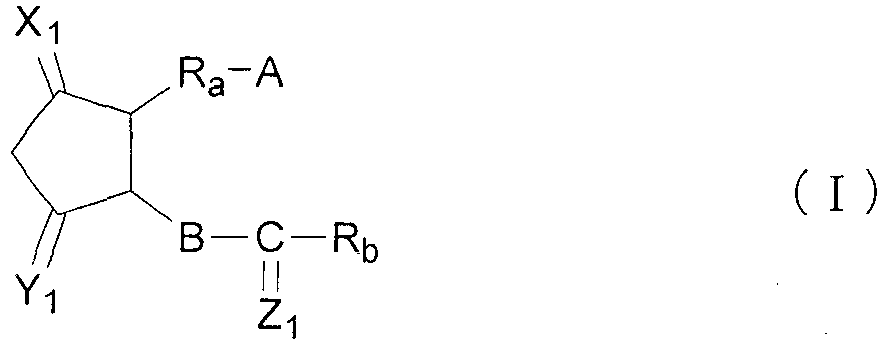
- wherein X1 is

- Y1 is

- Z1 is

- provided that at least one of X1, Y1 and Z1 is

- A is -CH3, -CH2OH, -COCH2OH, -COOH or a salt, ether, ester, or amide thereof;
- B is a single bond, -CH2-, -CH2-CH2-, -CH=CH- or -C≡C-, -CH2-CH2-CH2-, -CH=CH-CH2-, -CH2-CH=CH-, -C≡C-CH2- or -CH2-C ≡C-;
- Ra is bivalent saturated or unsaturated C1-C14 aliphatic hydrocarbon group, which is unsubstituted or substituted by halogen atom, C1-C6 alkyl, C1-C6 alkoxy, oxo, aryl or heterocyclic group, provided that one or more carbon atoms of the aliphatic hydrocarbon group may optionally be replaced with oxygen, nitrogen or sulfur atom; and
- Rb is hydrogen atom; saturated or unsaturated C1-C14 aliphatic hydrocarbon group which is unsubstituted or substituted by a halogen, oxo, hydroxy, C1-C6 alkoxy, C1-C6 alkanoyloxy, cyclo(C3-C6)alkyl, cyclo(C3-C6)alkyloxy, aryl, aryloxy, heterocyclic or heterocyclic oxy; cyclo(C3-C6)alkyl; cyclo(C3-C6)alkyloxy; aryl; aryloxy; heterocyclic; or heterocyclic oxy,
- wherein, X2 is the same as X1 except for when X1 is


- Y2 is the same as Y1 except for when Y1 is


- Z2 is the same as Z1 except for when Z1 is


- provided that at least one of X2, Y2 and Z2 is

- In the definition of above Ra and Rb, the term "unsaturated" in the definitions for Ra and Rb is intended to include at least one or more double bonds and/or triple bonds that are isolatedly, separately or serially present between carbon atoms of the main and/or side chains. According to the usual nomenclature, an unsaturated bond between two serial positions is represented by denoting the lower number of the two positions, and an unsaturated bond between two distal positions is represented by denoting both of the positions.
- The term "lower-medium aliphatic hydrocarbon" means a hydrocarbon having a straight or branched chain of 1 to 14 carbon atoms, wherein the side chain has preferably 1 to 3 carbon atoms. The preferred Ra has 1 to 10, more preferably, 6 to 10 carbon atoms, and the preferred Rb has 1 to 10, more preferably, 1 to 8 carbon atoms.
- The term "halogen" includes fluorine, chlorine, bromine, and iodine atoms.
- The term "lower" means a group having 1 to 6 carbon atoms unless otherwise specified.
- The term "lower alkyl" means a straight- or branched-chain saturated hydrocarbon group having 1 to 6 carbon atoms, for example, methyl, ethyl, propyl, isopropyl, butyl, isobutyl, t-butyl, pentyl, and hexyl.
- The term "lower alkoxy" means a lower alkyl-O-wherein the lower alkyl is as described above.
- The term "lower alkanoyloxy" means a group represented by the formula RCO-O-, wherein RCO- is an acyl formed by oxidation of a lower alkyl as described above, for example, acetyl.
- The term "lower cycloalkyl" means a group formed by cyclization of a lower alkyl group containing 3 or more carbon atoms as described above, for example, cyclopropyl, cyclobutyl, cyclopentyl, and cyclohexyl.
- The term "cyclo(lower)alkyloxy" means a group represented by the formula cycloalkyl-O-, wherein cycloalkyl is described above.
- The term "aryl" includes aromatic hydrocarbon rings (preferably monocyclic groups), which may be substituted, for example, phenyl, tolyl and xylyl. Examples of the substituents in this case include halogen, and halogen substituted lower alkyl group, wherein halogen atom and lower alkyl group are as described above.
- The term "aryloxy" means a group represented by the formula ArO-, wherein Ar is an aryl group as described above.
- The term "heterocyclic" includes mono- to tricyclic, preferably monocyclic heterocyclic group which is 5 to 14, preferably 5 to 10 membered ring having optionally substituted carbon atom and 1 to 4, preferably 1 to 3 of 1 or 2 type of hetero atoms selected from nitrogen, oxygen and sulfur atoms. Examples of the heterocyclic group include furyl, thienyl, pyrrolyl, oxazolyl, isoxazolyl, thiazolyl, isothiazolyl, imidazolyl, pyrazolyl, furazanyl, pyranyl, pyridyl, pyridazyl, pyrimidyl, pyrazinyl, 2-pyrrolinyl, pyrrolidinyl, 2-imidazolinyl, imidazolidinyl, 2-pyrazolinyl, pyrazolidinyl, piperidino, piperazinyl, morpholino, indolyl, benzothienyl, quinolyl, isoquinolyl, purinyl, quinazolinyl, carbazolyl, acridinyl, phenanthridinyl, benzimidazolyl, benzimidazolonyl, benzothiazolyl, phenothiazinyl. Examples of the substituent in this case include halogen, and halogen substituted lower alkyl group, wherein halogen atom and lower alkyl group are as described above.
- The term "heterocyclic-oxy" means a group represented by the formula HcO-, wherein Hc is a heterocyclic group as described above.
- The term "functional derivative" of A includes salts, preferably pharmaceutically acceptable salts, ethers, esters, and amides.
- Examples of suitable "pharmaceutically acceptable salts" include nontoxic salts which are commonly used, and salts with inorganic bases, for example, alkali metal salts (sodium salt, potassium salt and the like); alkaline earth metal salts (calcium salt, magnesium salt and the like); ammonium salts; salts with organic bases, for example, amine salts (such as methylamine salt, dimethylamine salt, cyclohexylamine salt, benzylamine salt, piperidine salt, ethylenediamine salt, ethanolamine salt, diethanolamine salt, triethanolamine salt, tris(hydroxymethylamino)ethane salt, monomethyl-monoethanolamine salt, lysine salt, procaine salt, and caffeine salt); basic amino acid salts (such as arginine salt, and lysine salt); tetraalkyl ammonium salts and the like. These salts may be manufactured from, for example, corresponding acids and bases in accordance with a conventional manner or salt exchange.
- Examples of the ethers include alkyl ethers, for example, lower alkyl ethers such as methyl ether, ethyl ether, propyl ether, isopropyl ether, butyl ether, isobutyl ether, t-butyl ether, pentyl ether and 1-cyclopropyl ethyl ether; and medium or higher alkyl ethers such as octyl ether, diethylhexyl ether, lauryl ether and cetyl ether; unsaturated ethers such as oleyl ether and linolenyl ether; lower alkenyl ethers such as vinyl ether, allyl ether; lower alkynyl ethers such as ethynyl ether and propynyl ether; hydroxy(lower)alkyl ethers such as hydroxyethyl ether and hydroxyisopropyl ether; lower alkoxy (lower)alkyl ethers such as methoxymethyl ether and 1-methoxyethyl ether; optionally substituted aryl ethers such as phenyl ether, tosyl ether, t-butylphenyl ether, salicyl ether, 3,4-di-methoxyphenyl ether and benzamidophenyl ether; and aryl(lower)alkyl ethers such as benzyl ether, trityl ether and benzhydryl ether.
- Examples of the esters include aliphatic esters, for example, lower alkyl esters such as methyl ester, ethyl ester, propyl ester, isopropyl ester, butyl ester, isobutyl ester, t-butyl ester, pentyl ester, and 1-cyclopropylethyl ester; lower alkenyl esters such as vinyl ester, and allyl ester; lower alkynyl esters such as ethynyl ester, and propynyl ester; hydroxy(lower)alkyl esters such as hydroxyethyl ester; and lower alkoxy(lower)alkyl esters such as methoxymethyl ester, and 1-methoxyethyl ester as well as, for example, optionally substituted aryl esters such as phenyl ester, tosyl ester, t-butylphenyl ester, salicyl ester, 3,4-dimethoxyphenyl ester, and benzamidophenyl ester; and aryl(lower)alkyl esters such as benzyl ester, trityl ester, and benzhydryl ester.
- An amide for A is a group represented by formula: -CONR'R", wherein R' and R" independently represent hydrogen atom, lower alkyl, aryl, alkyl- or aryl- sulfonyl, lower alkenyl or lower alkynyl. Examples of amides include mono- or di-lower alkyl amides such as methylamide, ethylamide, and dimethylamide; aryl amides such as anilide, and toluidide; and alkyl- or aryl-sulfonyl amides such as methylsulfonyl amide, ethylsulfonyl amide, and tolylsulfonyl amide.
- Preferred examples of A include -COOH, and a pharmaceutically acceptable salt, an ester and an amide thereof.
- Preferred B is -CH2-CH2- which provides the structure of so-called, 13,14-dihydro type derivative.
- Preferred Ra is a hydrocarbon having 1-10 carbon atoms, more preferably, 6-10 carbon atoms. One or more carbon atom of the hydrocarbon group may optionally be replaced with oxygen, nitrogen or sulfur atom.
- Examples of Ra include, for example, the following groups:
- CH2-CH2-CH2-CH2-CH2-CH2-,
- CH2-CH=CH-CH2-CH2-CH2-,
- CH2-CH2-CH2-CH2-CH=CH-,
- CH2-C≡C-CH2-CH2-CH2-,
- CH2-CH2-CH2-CH2-CH (CH3) -CH2-,
- CH2-CH2-CH2-CH2-O-CH2-,
- CH2-CH=CH-CH2-O-CH2-,
- CH2-C≡C-CH2-O-CH2-,
- CH2-CH2-CH2-CH2-CH2-CH2-CH2-,
- CH2-CH=CH-CH2-CH2-CH2-CH2-,
- CH2-CH2-CH2-CH2-CH2-CH=CH-,
- CH2-C≡C-CH2-CH2-CH2-CH2-,
- CH2-CH2-CH2-CH2-CH2-CH (CH3) -CH2-,
- CH2-CH2-CH2-CH2-CH2-CH2-CH2-CH2-,
- CH2-CH=CH-CH2-CH2-CH2-CH2-CH2-,
- CH2-CH2-CH2-CH2-CH2-CH2-CH=CH-,
- CH2-C≡C-CH2-CH2-CH2-CH2-CH2-,
- CH2-CH2-CH2-CH2-CH2-CH2-CH(CH3) -CH2-,
- Preferred Rb is a hydrogen atom or a hydrocarbon containing 1-10 carbon atoms, more preferably, 1-8 carbon atoms that is substituted by halogen atom such as fluorine.
- In the specification and claims, the term "protecting group for hydroxy group" means a functional group which is introduced to protect the hydroxy group from oxidation. In the present invention, the protecting group may be any group as long as it can act as such. Examples of the protecting groups may include methyl, methoxymethyl, ethyl, 1-ethoxyethyl, benzyl, substituted benzyl, allyl, tetrapyranyl, t-butyldimethylsilyl, triethylsilyl, triisopropylsilyl, diphenylmethylsilyl, formyl, acetyl, substituted acetyl, benzoyl, substituted benzoyl, methyloxycarbonyl, benzyloxycarbonyl, t-buthloxycarbonyl and allyloxycarbonyl groups.
- Examples of azaadamantane-N-oxyl derivatives that can be used in the present invention include, but are not limited to, 2-azaadamantane-N-oxyl (AZADO) and 1-methyl-2-azaadamantane-N-oxyl (1-Me-AZADO). The azaadamantane-N-oxyl derivative also includes chemical substances generating the same chemical species as an active oxidative species obtained from 2-azaadamantane-N-oxyl (AZADO), 1-methyl-2-azaadamantane-N-oxyl (1-Me-AZADO), or the like, by use of a co-oxidizer in a reaction system. Examples thereof include, but are not limited to, 2-hydroxy-2-azaadamantane (AZADOL [registered trademark of Nissan Chemical Industries, Ltd.]), 2-hydroxy-1-methyl-2-azaadamantane (1-Me-AZADOL), and the like.
- The amount of the azaadamantane-N-oxyl derivative used in the reaction may be about 0.0005-1.0 mole, preferably about 0.001-0.1 mole per one mole of the starting compound to be oxidized or a compound of formula (II).
- The co-oxidizer used in the present invention is one which can convert (i) the azaadamantane-N-oxyl derivative into an active oxidative species thereof; (ii) a reduced form of azaadamantane derivative (for example, 2-hydroxy-2-azaadamantane), which is generated upon oxidation of a, into the active oxidative species, as shown in the following scheme. Examples of co-oxidizers may include hypohalogenous acid such as hypochlorous acid or a salt thereof, halogenous acid such as bromous acid or a salt thereof, compounds having polyvalent iodine such as iodobenzene acetate, peroxides such as 3-chloro-perbenzoidc acid, N-halogen substituted succinimides such as N-chloro succinimide.

- The amount of the co-oxidizer in the reaction may be 1.0-3 molar equivalents, preferably 1.1-2 molar equivalents and more preferably 1.1-1.5 molar equivalents per one molar equivalent of the hydroxy group to be oxidized.
- The reaction may be conducted in an organic solvent, an aqueous solvent, a mixture thereof, or a two-phase solvent system consisting of an organic and an aqueous solvents.
- Examples of organic solvents used in the present invention may be aromatic hydrocarbon solvent such as toluene, aliphatic hydrocarbon solvent such as hexane, halogen-containing solvent such as dichloromethane, ketones such as acetone, esters such as ethyl acetate.
- The aqueous solvent may contain a pH adjusting agent such as sodium hydrogen carbonate, pH buffer such as potassium dihydrogen phosphate and sodium dihydrogen phosphate.
- According to the present invention, a halide salt such as sodium bromide, potassium bromide, tetrabutylammonium bromide, and tetrabutylammonium chloride may be added to the reaction in order to facilitate the reaction.
- The amount of the halide salt to be added is not limited and may be about 0.05-0.5 molar equivalents per one molar equivalent of the hydroxy group to be oxidized. In contrast, when TEMPO (tetramethylpiperidine-1-oxyl) is used instead of azaadamantane-N-oxyl derivative, 1.0-2.0 molar equivalents of TEMPO per one molar equivalent of the hydroxy group to be oxidized are required.
- According to the present invention, the reaction may be carried out at a temperature of -10 to 50°C, preferably, about 0 to 20°C.
- The present invention will be illustrated in more detail by way of the following examples. These examples should not be used as any limitation of the present invention.
-

- An alcohol compound (1) 0.210g (0.37mmol) was dissolved in toluene 1.5ml, and AZADO (2mg/ml in toluene 0.3ml, 0.0037mmol) was added thereto. The mixture was cooled in an ice bath to 0°C. Three percent aqueous sodium hydrogen carbonate 2.19ml(0.74mmol) and potassium bromide 4.4mg (0.037mmol) were added thereto. Then, about 1.9M aqueous sodium hypochlorite 0.47ml (0.89mmol) was added dropwise to the reaction, and the mixture was stirred for 2 hours. The reaction mixture was then added with saturated aqueous sodium thiosulfate, and the mixture was extracted three times with ethyl acetate. The extract was washed with dilute hydrochloric acid, saturated aqueous sodium hydrogen carbonate and then, brine, dried with anhydrous magnesium sulfate, filtered and concentrated under reduced pressure. The residue was purified with silica gel flash chromatography (column: BW-300SP 60g, ethyl acetate-hexane 1:2) to give compound (2) as colorless oil. Yield 0.2006g (96.2%).
1H-NMR (400MHz in CDCl3, TMS=0ppm) 5: 0.92(3H, t, J=7.1Hz), 1.20-2.38(27H, m), 2.35(2H, t, J=7.5Hz), 2.68-3.05(3H, m), 3.47-3.55(1H, m), 3.78-3.91(1.5H, m), 4.15(0.5H, q, J=7.4Hz), 4.58-4.59(0.5H, m), 4.67-4.69(0.5H, m), 5.11(2H, s), 7.29-7.39(5H, m). -

- An alcohol compound (1) 0.210g (0.37mmol) was dissolved in toluene 1.5ml, and 1-Me-AZADO (2mg/ml in toluene 0.3ml, 0.0037mmol) was added thereto. The mixture was cooled in an ice bath to 0°C. Three percent aqueous sodium hydrogen carbonate 2.19ml(0.74mmol) and potassium bromide 4.4mg (0.037mmol) were added thereto. Then, about 1.9M aqueous sodium hypochlorite 0.47ml (0.89mmol) was added dropwise to the reaction, and the mixture was stirred for 20 hours. The reaction mixture was treated and purified in the similar manner as Example 1 to give compound (2) as colorless oil. Yield 0.2036g (97.6%). 1H-NMR (400MHz in CDCl3, TMS=0ppm) δ: 0.92 (3H, t, J=7.2Hz), 1.20-2.38 (27H, m), 2.35(2H, t, J=7.5Hz), 2.68-3.05(3H, m), 3.47-3.54(1H, m), 3.78-3.91(1.5H, m), 4.15(0.5H, q, J=7.4Hz), 4.58-4.59(0.5H, m), 4.67-4.69(0.5H, m), 5.11(2H, s), 7.30-7.39(5H, m)
-

- An alcohol compound (3) 0.200g (0.34mmol) was dissolved in toluene 1.4ml, and AZADO (2mg/ml in toluene 0.25ml, 0.0034mmol) was added thereto. The mixture was cooled in an ice bath to 0°C. Three percent aqueous sodium hydrogen carbonate 2.04ml(0.69mmol) and potassium bromide 4.1mg (0.034mmol) were added thereto. Then, about 1.9M aqueous sodium hypochlorite 0.43ml (0.82mmol) was added dropwise to the reaction, and the mixture was stirred for 6 hours. The reaction mixture was treated and purified in the similar manner as Example 1 to give benzyl 7-[(1R,2R,3R)-2-((6S)-4,4-difluoro-6-methyl-3-oxooctyl)-5-oxo-3-(tetrahydro-2H-pyran-2-yloxy)cyclopentyl]heptanoate. (4) as colorless oil. Yield 0.1919g (96.6%).
1H-NMR (400MHz in CDCl3, TMS=0ppm) δ: 0.88(3H, t, J=7.4Hz), 0.97(3H, d, J=6.5Hz), 1.20-2.38(26H, m), 2.35(2H, t, J=7.5Hz), 2.68-3.05(3H, m), 3.47-3.54(1H, m), 3.78-3.91(1.5H, m), 4.15(0.5H, q, J=7.4Hz), 4.58-4.59(0.5H, m), 4.67-4.69(0.5H, m), 5.11 (2H, s), 7.30-7.39(5H, m) -

- An alcohol compound (3) 0.200g (0.34mmol) was dissolved in toluene 1.4ml, and 1-Me-AZADO (2mg/ml in toluene 0.25ml, 0.0034mmol) was added thereto. The mixture was cooled in an ice bath to 0°C. Three percent aqueous sodium hydrogen carbonate 2.04ml(0.69mmol) and potassium bromide 4.1mg (0.034mmol) were added thereto. Then, about 1.9M aqueous sodium hypochlorite 0.43ml (0.82mmol) was added dropwise to the reaction, and the mixture was stirred for 15 hours. The reaction mixture was treated and purified in the similar manner as Example 1 to give benzyl 7-[(1R,2R,3R)-2-((6S)-4,4-difluoro-6-methyl-3-oxooctyl)-5-oxo-3-(tetrahydro-2H-pyran-2-yloxy)cyclopentyl]heptanoate (4) as colorless oil. Yield 0.1973g (99.3%).
1H-NMR (400MHz in CDCl3, TMS=0ppm) δ: 0.88 (3H, t, J=7.4Hz), 0.97(3H, d, J=6.1Hz), 1.20-2.38(26H, m), 2.35(2H, t, J=7.5Hz), 2.68-3.05(3H, m), 3.47-3.54(1H, m), 3.78-3.91(1.5H, m), 4.15(0.5H, q, J=7.4Hz), 4.58-4.59(0.5H, m), 4.67-4.69(0.5H, m), 5.11(2H, s), 7.29-7.39 (5H, m) -

- To a solution of dimethyl ((5S)-3,3-difluoro-5-methyl-2-oxoheptyl)phosphonate (A) (74.7g, 274mmol) in t-butyl methyl ether (1120ml), lithium hydroxide monohydrate (11.5g, 273mmol) was added and the mixture was stirred for one hour at room temperature. A solution of methyl 7-[(1R,2R,3R,5S)-5-acetoxy-2-formyl-3-(2-tetrahydropyranyl-oxy)cyclopentyl]heptanate (B) (64.02g, 160.6mmol) in t-butyl methyl ether (278ml) and water (21.7ml) were added thereto, and the mixed solution was heat refluxed for approximately 31 hours (internal temperature: approximately 53°C). After cooling to room temperature, water (351ml) was added to the solution and the mixture was stirred, let to stand and then separated into two layers. The aqueous layer was extracted twice with ethyl acetate (234ml). The organic layers were combined, washed twice with saturated aqueous sodium chloride (351ml), and dried with anhydrous magnesium sulfate (55g). After concentration under reduced pressure, the residue was purified by silica gel column chromatography (Fuji Silysia BW-300: 2110g; ethyl acetate:hexane=1:4 to 1:2). The fractions containing impurities were re-purified by silica gel column chromatography (Fuji Silysia BW-300: 850g; ethyl acetate:hexane=1:4 to 1:2) to give methyl 7-[(1R,2R,3R,5S)-5-acetoxy-2-((E)-(6S)-4,4-difluoro-6-methyl-3-oxo-1-octenyl)-3-(2-tetrahydropyranyloxy)cyclopentyl]heptanate (C) (75.03g;.137.8mmol; yield: 85.8%) as a pale yellow oil.
1H-NMR (200 MHz, CDCl3) : δ (ppm) : 0.88 (3H, t, J =7.3Hz), 0.97 (3H, t, J=6.4Hz), 2.07 (3H, s), 2.15-1.03 (23H, m), 2.28 (2H, t, J=7.5Hz), 2.87-2.36 (2H, m), 3.50-3.31 (1H, m), 3.66 (3H, s), 3.88-3.60 (1H, m), 4.19-3.93 (1H, m), 4.61-4.46 (1H, m), 5.19-5.09 (1H, m), 6.63 (0.5H, d, J=15.6Hz), 6.68 (0.5H, d, J=15.6Hz), 7.05 (0.5H, dd, J=15.6, 7.0Hz), 7.10 (0.5H, dd, J=15.6, 6.5Hz).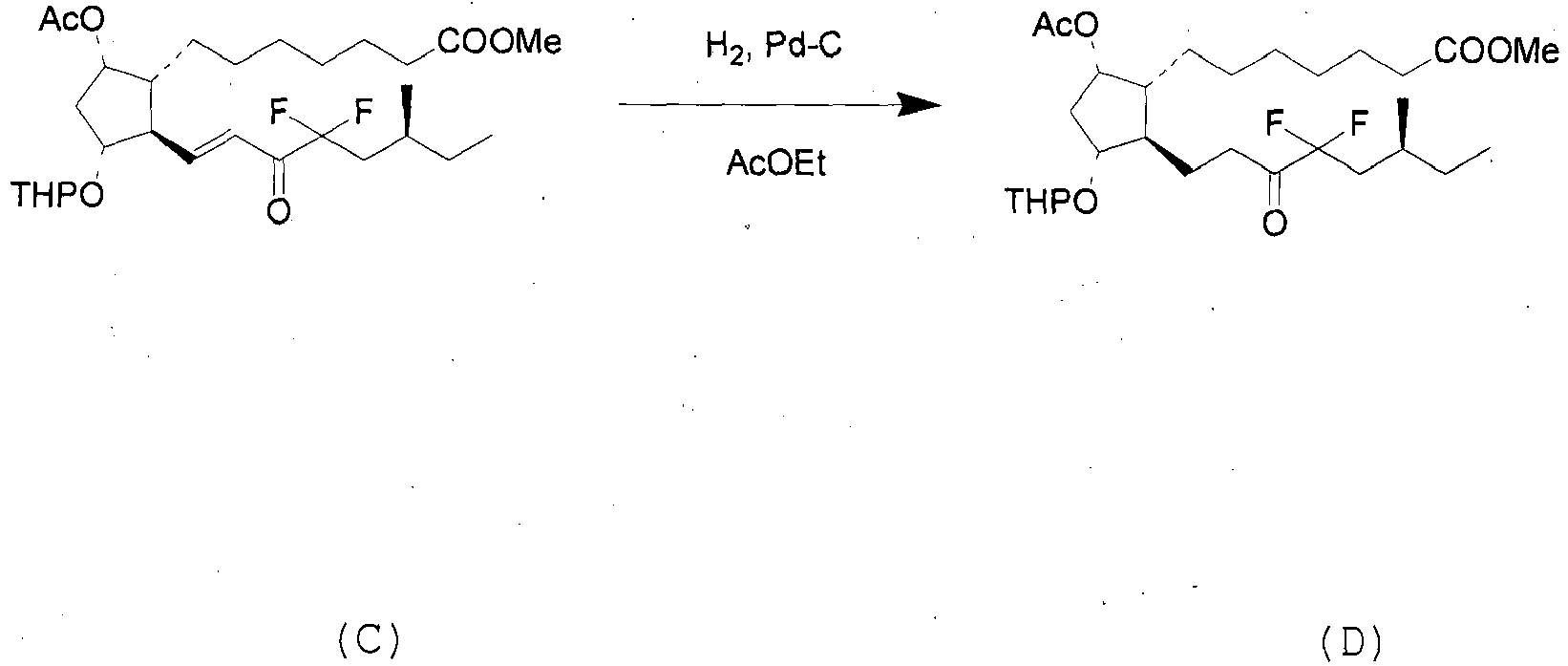
- To a solution of methyl 7-[(1R,2R,3R,5S)-5-acetoxy-2-((E)-(6S)-4,4-difluoro-6-methyl-3-oxo-1-octenyl)-3-(2-tetrahydropyranyloxy)cyclopentyl]heptanate (C) (76.78g, 141.0mmol) in ethyl acetate (357ml), 5%-palladium on carbon (7.30g) was added and the solution was hydrogenated at room temperature and the ambient pressure. The reaction mixture was filtered, the filtrate was concentrated under reduced pressure to give methyl 7-[(1R,2R,3R,5S)-5-acetoxy-2-((6S)-4,4-difluoro-6-methyl-3-oxooctyl)-3-(2-tetrahydropyranyloxy)cyclopentyl] heptanate (D) (72.69g; 133.0mmol; yield: 94.3%) as a colorless oil.

- A solution of methyl 7-[(1R,2R,3R,5S)-5-acetoxy-2-((6S)-4,4-difluoro-6-methyl-3-oxooctyl)-3-(2-tetrahydro pyranyloxy)cyclopentyl]heptanate (D) (72.56g, 132.7mmol) in methanol (290ml) was cooled to approximately -20°C, and sodium borohydride (5.00g, 132.2mmol) was added thereto. After stirring for approximately 35 minutes, acetic acid (7.5ml, 131mmol) was added dropwise, and the reaction mixture was concentrated under reduced pressure. The residue was supplemented with water (326ml) and extracted three times with ethyl acetate (226ml). The organic layers were combined, washed with 3% aqueous sodium chloride (323ml) and saturated aqueous sodium chloride (323ml), and dried with anhydrous magnesium sulfate (40.6g). The solution was concentrated under reduced pressure to give methyl 7-[(1R,2R,3R,5S)-5-acetoxy-2-((6S)-4,4-difluoro-6-methyl-3-hydroxyoctyl)-3-(2-tetrahydropyranyloxy)cyclopentyl]heptanate (E) (73.01g; quantitative yield) as a colorless oil.
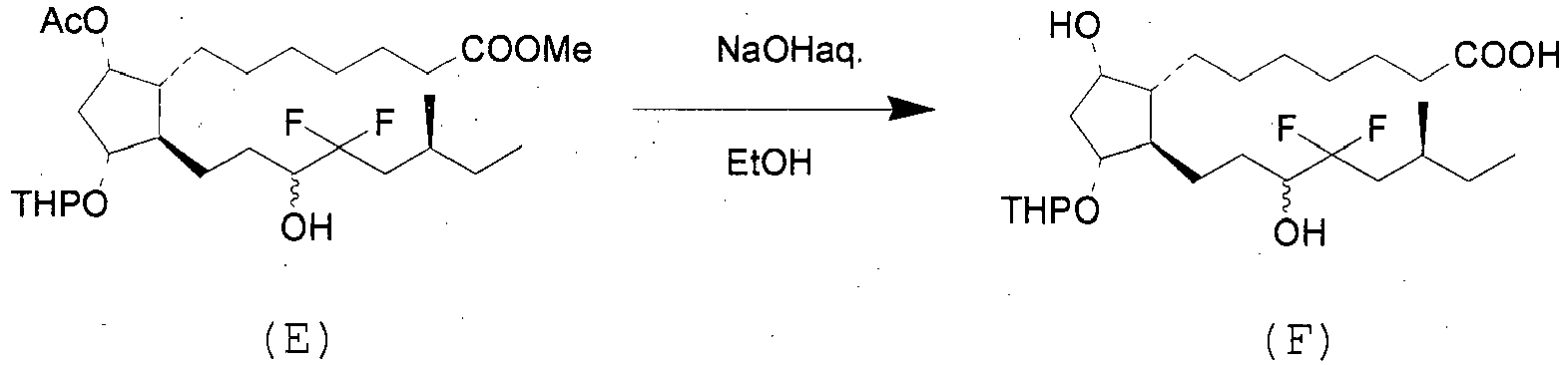
- A solution of methyl 7-[(1R,2R,3R,5S)-5-acetoxy-2-((6S)-4,4-difluoro-6-methyl-3-hydroxyoctyl)-3-(2-tetrahydropyranyloxy) cyclopentyl]heptanate (E) (132.5mmol) in ethanol (213ml) was cooled on ice, and an 24% sodium hydroxide aqueous solution (135ml, 1029mmol) was added thereto dropwise. After stirring at room temperature for approximately 3.5 hours, the reaction mixture was concentrated under reduced pressure. The residue was mixed with water (281ml) and t-butyl methyl ether (141ml), and cooled on ice. After 6M-hydrochloric acid was added dropwise to adjust to pH 3 to 4, the solution was extracted three times with ethyl acetate (281ml). The organic layers were combined and sequentially washed with water (281ml) twice and saturated aqueous sodium chloride (338ml). After drying with anhydrous magnesium sulfate (50g), the solution was concentrated under reduced pressure to give crude 7-[(1R,2R,3R,5S)-2-((6S)-4,4-difluoro-6-methyl-3-hydroxyoctyl)-5-hydroxy-3-(2-tetrahydropyranyloxy)cyclopentyl]heptanoic acid (F) as white solid. The entire amount was used in the following step without purification.

- To the crude 7-[(1R,2R,3R,5S)-2-((6S)-4,4-difluoro-6-methyl-3-hydroxyoctyl)-5-hydroxy-3-(2-tetrahydropyranyloxy) cyclopentyl]heptanoic acid (F) in acetonitrile (319ml), diisopropyl ethylamine (68.9ml, 368mmol) and benzyl bromide (46.7ml, 366mmol) were added and the mixture was stirred for about 13.5 hours at room temperature. The reaction mixture was concentrated under reduced pressure, ethyl acetate (369ml) and water (283ml) were added to the residue and the mixture was stirred, let to stand and then separated into two layers. The aqueous layer was extracted twice with ethyl acetate (226ml). The organic layers were combined and washed with 1M-hydrochloric acid (339ml), saturated sodium bicarbonate water (339ml) and saturated aqueous sodium chloride (339ml). After drying with anhydrous magnesium sulfate (50g), the solution was concentrated under reduced pressure. The concentration residue was purified by silica gel column chromatography (Fuji Silysia BW-300: 2400g; ethyl acetate:hexane=1:2) to give benzyl 7-[(1R,2R,3R,5S)-2-((6S)-4,4-difluoro-3-hydroxy-6-methyloctyl)-5-hydroxy-3-(tetrahydro-2H-pyran-2-yloxy)cyclopentyl]heptanoate (3) (76.16g; 130.7mmol; yield: 98.7%) as a colorless oil. 1H-NMR (200 MHz, CDCl3) : δ (ppm) : 0.88 (3H, t, J=7.5Hz), 0.98(3H, d, J=6.2Hz), 1.21-2.47(30.5H, m), 2.35(2H, t, J=7.5Hz), 2.81(0.5H, d, J=6.4Hz), 3.46-4.14(5H, m), 4.61-4.66(1H, m), 5.11 (2H, s), 7.30-7.39(5H, m).
-

- An alcohol compound (5) 0.233g (0.49mmol) was dissolved in toluene 1.6ml, and AZADO in toluene (2mg/ml in toluene 0.35ml, 0.0049mmol) was added thereto. The mixture was cooled in an ice bath to 0°C. Neutral phosphate buffered solution (2.0ml), potassium bromide 5.8mg (0.049mmol) were added thereto. Then, about 1.9M aqueous sodium hypochlorite 0.62ml (1.17mmol) was added dropwise to the reaction, and the mixture was stirred for 1 hour at 0°C. The reaction mixture was treated and purified in the similar manner as Example 1 to give compound (6) as colorless oil. Yield 0.2089g (90.3%).
1H-NMR (400MHz in CDCl3, TMS=0ppm) δ: 0.93(3H, t, J=7.2Hz), 1.22-2.38(28H, m), 2.34(2H, t, J=7.6Hz), 2.69-3.05(3H, m), 3.48-3.56(1H, m), 3.79-3.92(1.5H, m), 4.15(0.5H, q, J=7.3Hz), 4.59-4.60(0.5H, m), 4.68-4.70(0.5H, m). -

- An alcohol compound (7) 0.200g (0.50mmol) was dissolved in dichloromethane 1.4ml, AZADO in toluene (2mg/ml in toluene, 0.2ml, 0.0025mmol) and then, [bis(acetoxy)iodo]benzene (BAIB) 0.1769g (0.549mmol) were added to the mixture. The mixture was stirred for 5 hours at room temperature. The reaction mixture was treated and purified in the similar manner as Example 1 to give compound (8) as colorless oil. Yield 0.1900g (95.5%).
1H-NMR (400MHz in CDCl3, TMS=0ppm δ: 1.19-2.18 (18H, m), 2.07(3H, s), 2.29(2H, t, J=7.5Hz), 2.32-2.43(1H, m), 2.81-3.01(1H, m), 3.41-3.50(1H, m), 3.66(3H, s), 3.76-3.83(1H, m), 4.36-4.46(1H, m), 4.54-4.60(1H, m), 5.11-5.17(1H, m), 9.78(1H, dd, J=3.1, 20.9Hz) -

- Oxalyl chloride 56.9ml (652mmol) in dichloromethane (634ml) was cooled in a dry-ice/methanol bath. dimethyl sulfoxide (DMSO) 92.5ml (1303 mmol) was added dropwise thereto and the mixture was stirred for 30 minutes. Benzyl 7-[(1R,2R,3R,5S)-2-(4,4-difluoro-3-hydroxyoctyl)-5-hydroxy-3-(2-tetrahydropyranyloxy)cyclopentyl]heptanate (1) (74.21g, 130.5mmol) in dichloromethane(198ml) was added dropwise to the mixture and the mixture was stirred for 1.5 hours. After that, triethylamine 273ml(1959mmol) was added dropwise to the reaction mixture with stirring and the reaction mixture was warmed to 0°C. Saturated aqueous ammonium chloride (594ml) was then added to the reaction. The reaction mixture was stirred and then, stood still and separated. The aqueous phase was extracted twice with dichloromethane. The combined organic phase was washed successively with 0.1N hydrochloric acid (594ml), water (594ml), saturated sodium bicarbonate water (594ml) and then, saturated aqueous sodium chloride (594ml). The mixture was dried over anhydrous magnesium sulfate (48mg), and concentrated under reduced pressure. The residue was dissolved in an appropriate amount of ethyl acetate/hexane (1:10) mixed solvent and the insoluble material was filtered out. The filtrate was evaporated and purified with silica gel column chromatography (BW-300 Fuji Silysia Chemical Ltd, 2260g, ethyl acetate-hexane 1:4) to give Benzyl 7-[(1R,2R,3R)-2-(4,4-difluoro-3-oxyoctyl)-5-oxy-3-(2-tetrahydropyranyloxy)cyclopentyl]heptanate (2). Yield 69.22g, 122.6mmol, 95.3%.
- The impurities in the products obtained in Example 1 and Comparative Example 1 were examined. 14-methylthio and 14-chloro analogues of the ketone compound (2) are generated by Swern oxidation. The amount of those impurities were determined. The results are shown in the table 1 below:
oxidation desired product 14-methyl thio analogue 14-chloro analogue the other impurities AZADO oxidization (Ex. 1) 99.1% ND ND 0.86% Swern oxidation (Con Ex. 1) 88.0% 3.10% 0.74% 8.16% ND: Not detected - As shown in the above result, Swern oxidation introduces the generation of 14-methylthio and 14- chloro compounds. Those impurities are difficult to be removed by silica gel column chromatography and may decrease the purity of the final product. In contrast, those impurities are not generated by AZADO oxidation. That is, products with high purity can be obtained.


Claims (6)
- A method for manufacturing a fatty acid derivative represented by formula (I):
 wherein X1 is
 Y1 is
Y1 is Z1 is
Z1 is provided that at least one of X1, Y1 and Z1 is
 A is -CH3, -CH2OH, -COCH2OH, -COOH or a salt, ether, ester, or amide thereof;B is a single bond, -CH2-, -CH2-CH2-, -CH=CH- or -C≡C-, -CH2-CH2-CH2-, -CH=CH-CH2-, -CH2-CH=CH-, -C≡C-CH2- or -CH2-C ≡C-;Ra is bivalent saturated or unsaturated C1-C14 aliphatic hydrocarbon group, which is unsubstituted or substituted by halogen atom, C1-C6 alkyl, C1-C6 alkoxy, oxo, aryl or heterocyclic group, provided that one or more carbon atoms of the aliphatic hydrocarbon group may optionally be replaced with oxygen, nitrogen or sulfur atom; andRb is hydrogen atom; saturated or unsaturated C1-C14 aliphatic hydrocarbon group which is unsubstituted or substituted by a halogen, oxo, hydroxy, C1-C6 alkoxy, C1-C6 alkanoyloxy, cyclo(C3-C6)alkyl, cyclo(C3-C6)alkyloxy, aryl, aryloxy, heterocyclic or heterocyclic oxy; cyclo(C3-C6)alkyl; cyclo(C3-C6)alkyloxy; aryl; aryloxy; heterocyclic; or heterocyclic oxy,which comprises the step of, reacting a compound of formula (II):
 wherein, X2 is the same as X1 except for when X1 is
 Y2 is the same as Y1 except for when Y1 is

 Z2 is the same as Z1 except for when Z1 is

 provided that at least one of X2, Y2 and Z2 iswith a co-oxidizer under the presence of an azaadamantane-N-oxyl derivative.
- The method of Claim 1, wherein A is -COOH or a salt, ester or amide thereof.
- The method of Claim 1, wherein the azaadamantane-N-oxyl derivative is 2-azaadamantane-N-oxyl.
- The method of claim 1, wherein the azaadamantane-N-oxyl derivative is 1-methyl-2-azaadamantane-N-oxyl.
- The method of Claim 1, wherein the azaadamantane-N-oxyl derivative is 2-hydroxy-2-azaadamantane.
- The method of claim 1, wherein the azaadamantane-N-oxyl derivative is 2-hydroxy-1-methyl-2-azaadamantane.
Applications Claiming Priority (2)
| Application Number | Priority Date | Filing Date | Title |
|---|---|---|---|
| US201161503742P | 2011-07-01 | 2011-07-01 | |
| PCT/JP2012/067253 WO2013005817A1 (en) | 2011-07-01 | 2012-06-29 | Method for preparing a fatty acid derivative |
Publications (3)
| Publication Number | Publication Date |
|---|---|
| EP2726472A1 EP2726472A1 (en) | 2014-05-07 |
| EP2726472A4 EP2726472A4 (en) | 2015-01-21 |
| EP2726472B1 true EP2726472B1 (en) | 2016-12-21 |
Family
ID=47391294
Family Applications (1)
| Application Number | Title | Priority Date | Filing Date |
|---|---|---|---|
| EP12806937.4A Not-in-force EP2726472B1 (en) | 2011-07-01 | 2012-06-29 | Method for preparing a fatty acid derivative |
Country Status (7)
| Country | Link |
|---|---|
| US (1) | US9242950B2 (en) |
| EP (1) | EP2726472B1 (en) |
| JP (2) | JP2014522805A (en) |
| CN (1) | CN103764639B (en) |
| IL (2) | IL229939B (en) |
| TW (1) | TWI540125B (en) |
| WO (1) | WO2013005817A1 (en) |
Families Citing this family (2)
| Publication number | Priority date | Publication date | Assignee | Title |
|---|---|---|---|---|
| WO2014159679A1 (en) | 2013-03-12 | 2014-10-02 | The United States Of America, As Represented By The Secretary, Department Of Health & Human Services | Methods for using lubiprostone to absorb fluid from the subretinal space |
| CN114957005A (en) * | 2022-07-11 | 2022-08-30 | 湖南工程学院 | Method for preparing aromatic ester compounds by oxidation and cracking of aromatic ketone C (CO) -C under metal-free catalysis |
Family Cites Families (7)
| Publication number | Priority date | Publication date | Assignee | Title |
|---|---|---|---|---|
| CA2150287C (en) * | 1994-06-03 | 2004-08-10 | Ryuji Ueno | Agent for treating hepato-biliary diseases |
| EP1775296A4 (en) | 2004-06-25 | 2009-06-03 | Nissan Chemical Ind Ltd | Alcohol oxidation catalyst and method of synthesizing the same |
| JP4690814B2 (en) * | 2004-08-02 | 2011-06-01 | 株式会社アールテック・ウエノ | Method for producing prostaglandin derivatives |
| CA2637797C (en) * | 2006-02-07 | 2015-03-17 | R-Tech Ueno, Ltd. | Method for preparing prostaglandin derivative |
| JP4648340B2 (en) * | 2006-02-07 | 2011-03-09 | 株式会社アールテック・ウエノ | Method for producing 15-keto prostaglandin E derivative |
| JP4803074B2 (en) * | 2007-03-06 | 2011-10-26 | 日産化学工業株式会社 | Alcohol oxidation catalyst and synthesis method thereof |
| JP2009114143A (en) * | 2007-11-08 | 2009-05-28 | Nissan Chem Ind Ltd | Process for producing carboxylic acid from primary alcohol |
-
2012
- 2012-06-29 EP EP12806937.4A patent/EP2726472B1/en not_active Not-in-force
- 2012-06-29 WO PCT/JP2012/067253 patent/WO2013005817A1/en not_active Ceased
- 2012-06-29 US US13/538,189 patent/US9242950B2/en active Active
- 2012-06-29 CN CN201280042257.2A patent/CN103764639B/en active Active
- 2012-06-29 TW TW101123405A patent/TWI540125B/en active
- 2012-06-29 JP JP2013558842A patent/JP2014522805A/en not_active Withdrawn
-
2013
- 2013-12-17 IL IL229939A patent/IL229939B/en active IP Right Grant
-
2017
- 2017-06-09 JP JP2017114416A patent/JP6809987B2/en active Active
-
2018
- 2018-01-08 IL IL256784A patent/IL256784A/en unknown
Non-Patent Citations (1)
| Title |
|---|
| None * |
Also Published As
| Publication number | Publication date |
|---|---|
| US20130005995A1 (en) | 2013-01-03 |
| WO2013005817A1 (en) | 2013-01-10 |
| EP2726472A1 (en) | 2014-05-07 |
| TWI540125B (en) | 2016-07-01 |
| JP6809987B2 (en) | 2021-01-06 |
| US9242950B2 (en) | 2016-01-26 |
| IL229939B (en) | 2018-06-28 |
| CN103764639A (en) | 2014-04-30 |
| TW201309660A (en) | 2013-03-01 |
| JP2017200932A (en) | 2017-11-09 |
| CN103764639B (en) | 2016-04-13 |
| EP2726472A4 (en) | 2015-01-21 |
| IL256784A (en) | 2018-03-29 |
| JP2014522805A (en) | 2014-09-08 |
Similar Documents
| Publication | Publication Date | Title |
|---|---|---|
| US8389748B2 (en) | Method for preparing prostaglandin derivative | |
| JP2012519163A (en) | Method for producing prostaglandin derivative | |
| JP4648340B2 (en) | Method for producing 15-keto prostaglandin E derivative | |
| JP6809987B2 (en) | Production method of fatty acid derivative | |
| CA2324343C (en) | C11 oxymyl and hydroxylamino prostaglandins useful as medicaments | |
| US7321057B2 (en) | Method for manufacturing prostaglandin analogue | |
| US9212158B2 (en) | Method for preparing a fatty acid derivative | |
| JP4345311B2 (en) | Antioxidant | |
| JP7205482B2 (en) | Method for producing prostaglandin derivative | |
| JPH0586020A (en) | Alpha,beta-dihydroxy-gamma,delta-unsaturated carboxylic acid thiol ester derivative and its production |
Legal Events
| Date | Code | Title | Description |
|---|---|---|---|
| PUAI | Public reference made under article 153(3) epc to a published international application that has entered the european phase |
Free format text: ORIGINAL CODE: 0009012 |
|
| 17P | Request for examination filed |
Effective date: 20131220 |
|
| AK | Designated contracting states |
Kind code of ref document: A1 Designated state(s): AL AT BE BG CH CY CZ DE DK EE ES FI FR GB GR HR HU IE IS IT LI LT LU LV MC MK MT NL NO PL PT RO RS SE SI SK SM TR |
|
| DAX | Request for extension of the european patent (deleted) | ||
| A4 | Supplementary search report drawn up and despatched |
Effective date: 20150105 |
|
| RIC1 | Information provided on ipc code assigned before grant |
Ipc: C07D 309/12 20060101AFI20141218BHEP |
|
| 17Q | First examination report despatched |
Effective date: 20151217 |
|
| GRAP | Despatch of communication of intention to grant a patent |
Free format text: ORIGINAL CODE: EPIDOSNIGR1 |
|
| INTG | Intention to grant announced |
Effective date: 20160523 |
|
| GRAP | Despatch of communication of intention to grant a patent |
Free format text: ORIGINAL CODE: EPIDOSNIGR1 |
|
| INTG | Intention to grant announced |
Effective date: 20160708 |
|
| GRAS | Grant fee paid |
Free format text: ORIGINAL CODE: EPIDOSNIGR3 |
|
| GRAA | (expected) grant |
Free format text: ORIGINAL CODE: 0009210 |
|
| AK | Designated contracting states |
Kind code of ref document: B1 Designated state(s): AL AT BE BG CH CY CZ DE DK EE ES FI FR GB GR HR HU IE IS IT LI LT LU LV MC MK MT NL NO PL PT RO RS SE SI SK SM TR |
|
| REG | Reference to a national code |
Ref country code: GB Ref legal event code: FG4D |
|
| REG | Reference to a national code |
Ref country code: CH Ref legal event code: EP |
|
| REG | Reference to a national code |
Ref country code: IE Ref legal event code: FG4D |
|
| REG | Reference to a national code |
Ref country code: AT Ref legal event code: REF Ref document number: 855351 Country of ref document: AT Kind code of ref document: T Effective date: 20170115 |
|
| REG | Reference to a national code |
Ref country code: DE Ref legal event code: R096 Ref document number: 602012026925 Country of ref document: DE |
|
| PG25 | Lapsed in a contracting state [announced via postgrant information from national office to epo] |
Ref country code: LV Free format text: LAPSE BECAUSE OF FAILURE TO SUBMIT A TRANSLATION OF THE DESCRIPTION OR TO PAY THE FEE WITHIN THE PRESCRIBED TIME-LIMIT Effective date: 20161221 |
|
| REG | Reference to a national code |
Ref country code: LT Ref legal event code: MG4D |
|
| REG | Reference to a national code |
Ref country code: NL Ref legal event code: MP Effective date: 20161221 |
|
| PG25 | Lapsed in a contracting state [announced via postgrant information from national office to epo] |
Ref country code: NO Free format text: LAPSE BECAUSE OF FAILURE TO SUBMIT A TRANSLATION OF THE DESCRIPTION OR TO PAY THE FEE WITHIN THE PRESCRIBED TIME-LIMIT Effective date: 20170321 Ref country code: LT Free format text: LAPSE BECAUSE OF FAILURE TO SUBMIT A TRANSLATION OF THE DESCRIPTION OR TO PAY THE FEE WITHIN THE PRESCRIBED TIME-LIMIT Effective date: 20161221 Ref country code: SE Free format text: LAPSE BECAUSE OF FAILURE TO SUBMIT A TRANSLATION OF THE DESCRIPTION OR TO PAY THE FEE WITHIN THE PRESCRIBED TIME-LIMIT Effective date: 20161221 Ref country code: GR Free format text: LAPSE BECAUSE OF FAILURE TO SUBMIT A TRANSLATION OF THE DESCRIPTION OR TO PAY THE FEE WITHIN THE PRESCRIBED TIME-LIMIT Effective date: 20170322 |
|
| REG | Reference to a national code |
Ref country code: AT Ref legal event code: MK05 Ref document number: 855351 Country of ref document: AT Kind code of ref document: T Effective date: 20161221 |
|
| REG | Reference to a national code |
Ref country code: FR Ref legal event code: PLFP Year of fee payment: 6 |
|
| PG25 | Lapsed in a contracting state [announced via postgrant information from national office to epo] |
Ref country code: HR Free format text: LAPSE BECAUSE OF FAILURE TO SUBMIT A TRANSLATION OF THE DESCRIPTION OR TO PAY THE FEE WITHIN THE PRESCRIBED TIME-LIMIT Effective date: 20161221 Ref country code: RS Free format text: LAPSE BECAUSE OF FAILURE TO SUBMIT A TRANSLATION OF THE DESCRIPTION OR TO PAY THE FEE WITHIN THE PRESCRIBED TIME-LIMIT Effective date: 20161221 Ref country code: FI Free format text: LAPSE BECAUSE OF FAILURE TO SUBMIT A TRANSLATION OF THE DESCRIPTION OR TO PAY THE FEE WITHIN THE PRESCRIBED TIME-LIMIT Effective date: 20161221 |
|
| PG25 | Lapsed in a contracting state [announced via postgrant information from national office to epo] |
Ref country code: NL Free format text: LAPSE BECAUSE OF FAILURE TO SUBMIT A TRANSLATION OF THE DESCRIPTION OR TO PAY THE FEE WITHIN THE PRESCRIBED TIME-LIMIT Effective date: 20161221 |
|
| PG25 | Lapsed in a contracting state [announced via postgrant information from national office to epo] |
Ref country code: SK Free format text: LAPSE BECAUSE OF FAILURE TO SUBMIT A TRANSLATION OF THE DESCRIPTION OR TO PAY THE FEE WITHIN THE PRESCRIBED TIME-LIMIT Effective date: 20161221 Ref country code: EE Free format text: LAPSE BECAUSE OF FAILURE TO SUBMIT A TRANSLATION OF THE DESCRIPTION OR TO PAY THE FEE WITHIN THE PRESCRIBED TIME-LIMIT Effective date: 20161221 Ref country code: IS Free format text: LAPSE BECAUSE OF FAILURE TO SUBMIT A TRANSLATION OF THE DESCRIPTION OR TO PAY THE FEE WITHIN THE PRESCRIBED TIME-LIMIT Effective date: 20170421 Ref country code: RO Free format text: LAPSE BECAUSE OF FAILURE TO SUBMIT A TRANSLATION OF THE DESCRIPTION OR TO PAY THE FEE WITHIN THE PRESCRIBED TIME-LIMIT Effective date: 20161221 Ref country code: CZ Free format text: LAPSE BECAUSE OF FAILURE TO SUBMIT A TRANSLATION OF THE DESCRIPTION OR TO PAY THE FEE WITHIN THE PRESCRIBED TIME-LIMIT Effective date: 20161221 |
|
| PG25 | Lapsed in a contracting state [announced via postgrant information from national office to epo] |
Ref country code: BE Free format text: LAPSE BECAUSE OF FAILURE TO SUBMIT A TRANSLATION OF THE DESCRIPTION OR TO PAY THE FEE WITHIN THE PRESCRIBED TIME-LIMIT Effective date: 20161221 Ref country code: AT Free format text: LAPSE BECAUSE OF FAILURE TO SUBMIT A TRANSLATION OF THE DESCRIPTION OR TO PAY THE FEE WITHIN THE PRESCRIBED TIME-LIMIT Effective date: 20161221 Ref country code: PL Free format text: LAPSE BECAUSE OF FAILURE TO SUBMIT A TRANSLATION OF THE DESCRIPTION OR TO PAY THE FEE WITHIN THE PRESCRIBED TIME-LIMIT Effective date: 20161221 Ref country code: SM Free format text: LAPSE BECAUSE OF FAILURE TO SUBMIT A TRANSLATION OF THE DESCRIPTION OR TO PAY THE FEE WITHIN THE PRESCRIBED TIME-LIMIT Effective date: 20161221 Ref country code: PT Free format text: LAPSE BECAUSE OF FAILURE TO SUBMIT A TRANSLATION OF THE DESCRIPTION OR TO PAY THE FEE WITHIN THE PRESCRIBED TIME-LIMIT Effective date: 20170421 Ref country code: BG Free format text: LAPSE BECAUSE OF FAILURE TO SUBMIT A TRANSLATION OF THE DESCRIPTION OR TO PAY THE FEE WITHIN THE PRESCRIBED TIME-LIMIT Effective date: 20170321 Ref country code: ES Free format text: LAPSE BECAUSE OF FAILURE TO SUBMIT A TRANSLATION OF THE DESCRIPTION OR TO PAY THE FEE WITHIN THE PRESCRIBED TIME-LIMIT Effective date: 20161221 |
|
| REG | Reference to a national code |
Ref country code: DE Ref legal event code: R097 Ref document number: 602012026925 Country of ref document: DE |
|
| RAP2 | Party data changed (patent owner data changed or rights of a patent transferred) |
Owner name: SUCAMPO PHARMA, LLC Owner name: SUCAMPO AG |
|
| PLBE | No opposition filed within time limit |
Free format text: ORIGINAL CODE: 0009261 |
|
| STAA | Information on the status of an ep patent application or granted ep patent |
Free format text: STATUS: NO OPPOSITION FILED WITHIN TIME LIMIT |
|
| 26N | No opposition filed |
Effective date: 20170922 |
|
| PG25 | Lapsed in a contracting state [announced via postgrant information from national office to epo] |
Ref country code: DK Free format text: LAPSE BECAUSE OF FAILURE TO SUBMIT A TRANSLATION OF THE DESCRIPTION OR TO PAY THE FEE WITHIN THE PRESCRIBED TIME-LIMIT Effective date: 20161221 |
|
| PG25 | Lapsed in a contracting state [announced via postgrant information from national office to epo] |
Ref country code: MC Free format text: LAPSE BECAUSE OF FAILURE TO SUBMIT A TRANSLATION OF THE DESCRIPTION OR TO PAY THE FEE WITHIN THE PRESCRIBED TIME-LIMIT Effective date: 20161221 |
|
| PG25 | Lapsed in a contracting state [announced via postgrant information from national office to epo] |
Ref country code: SI Free format text: LAPSE BECAUSE OF FAILURE TO SUBMIT A TRANSLATION OF THE DESCRIPTION OR TO PAY THE FEE WITHIN THE PRESCRIBED TIME-LIMIT Effective date: 20161221 |
|
| REG | Reference to a national code |
Ref country code: IE Ref legal event code: MM4A |
|
| PG25 | Lapsed in a contracting state [announced via postgrant information from national office to epo] |
Ref country code: IE Free format text: LAPSE BECAUSE OF NON-PAYMENT OF DUE FEES Effective date: 20170629 Ref country code: LU Free format text: LAPSE BECAUSE OF NON-PAYMENT OF DUE FEES Effective date: 20170629 |
|
| REG | Reference to a national code |
Ref country code: FR Ref legal event code: PLFP Year of fee payment: 7 |
|
| PGFP | Annual fee paid to national office [announced via postgrant information from national office to epo] |
Ref country code: FR Payment date: 20180528 Year of fee payment: 7 |
|
| PG25 | Lapsed in a contracting state [announced via postgrant information from national office to epo] |
Ref country code: MT Free format text: LAPSE BECAUSE OF NON-PAYMENT OF DUE FEES Effective date: 20170629 |
|
| PGFP | Annual fee paid to national office [announced via postgrant information from national office to epo] |
Ref country code: GB Payment date: 20180627 Year of fee payment: 7 Ref country code: IT Payment date: 20180621 Year of fee payment: 7 Ref country code: DE Payment date: 20180627 Year of fee payment: 7 |
|
| PG25 | Lapsed in a contracting state [announced via postgrant information from national office to epo] |
Ref country code: HU Free format text: LAPSE BECAUSE OF FAILURE TO SUBMIT A TRANSLATION OF THE DESCRIPTION OR TO PAY THE FEE WITHIN THE PRESCRIBED TIME-LIMIT; INVALID AB INITIO Effective date: 20120629 |
|
| PG25 | Lapsed in a contracting state [announced via postgrant information from national office to epo] |
Ref country code: CY Free format text: LAPSE BECAUSE OF NON-PAYMENT OF DUE FEES Effective date: 20161221 |
|
| PG25 | Lapsed in a contracting state [announced via postgrant information from national office to epo] |
Ref country code: MK Free format text: LAPSE BECAUSE OF FAILURE TO SUBMIT A TRANSLATION OF THE DESCRIPTION OR TO PAY THE FEE WITHIN THE PRESCRIBED TIME-LIMIT Effective date: 20161221 |
|
| REG | Reference to a national code |
Ref country code: DE Ref legal event code: R119 Ref document number: 602012026925 Country of ref document: DE |
|
| PGFP | Annual fee paid to national office [announced via postgrant information from national office to epo] |
Ref country code: CH Payment date: 20190702 Year of fee payment: 8 |
|
| GBPC | Gb: european patent ceased through non-payment of renewal fee |
Effective date: 20190629 |
|
| PG25 | Lapsed in a contracting state [announced via postgrant information from national office to epo] |
Ref country code: TR Free format text: LAPSE BECAUSE OF FAILURE TO SUBMIT A TRANSLATION OF THE DESCRIPTION OR TO PAY THE FEE WITHIN THE PRESCRIBED TIME-LIMIT Effective date: 20161221 |
|
| PG25 | Lapsed in a contracting state [announced via postgrant information from national office to epo] |
Ref country code: DE Free format text: LAPSE BECAUSE OF NON-PAYMENT OF DUE FEES Effective date: 20200101 Ref country code: IT Free format text: LAPSE BECAUSE OF NON-PAYMENT OF DUE FEES Effective date: 20190629 Ref country code: GB Free format text: LAPSE BECAUSE OF NON-PAYMENT OF DUE FEES Effective date: 20190629 |
|
| PG25 | Lapsed in a contracting state [announced via postgrant information from national office to epo] |
Ref country code: FR Free format text: LAPSE BECAUSE OF NON-PAYMENT OF DUE FEES Effective date: 20190630 |
|
| PG25 | Lapsed in a contracting state [announced via postgrant information from national office to epo] |
Ref country code: AL Free format text: LAPSE BECAUSE OF FAILURE TO SUBMIT A TRANSLATION OF THE DESCRIPTION OR TO PAY THE FEE WITHIN THE PRESCRIBED TIME-LIMIT Effective date: 20161221 |
|
| REG | Reference to a national code |
Ref country code: CH Ref legal event code: PL |
|
| PG25 | Lapsed in a contracting state [announced via postgrant information from national office to epo] |
Ref country code: LI Free format text: LAPSE BECAUSE OF NON-PAYMENT OF DUE FEES Effective date: 20200630 Ref country code: CH Free format text: LAPSE BECAUSE OF NON-PAYMENT OF DUE FEES Effective date: 20200630 |