EP2726445B9 - Method and catalyst for the alkylation of aromatic compounds with alkanes - Google Patents
Method and catalyst for the alkylation of aromatic compounds with alkanes Download PDFInfo
- Publication number
- EP2726445B9 EP2726445B9 EP12737905.5A EP12737905A EP2726445B9 EP 2726445 B9 EP2726445 B9 EP 2726445B9 EP 12737905 A EP12737905 A EP 12737905A EP 2726445 B9 EP2726445 B9 EP 2726445B9
- Authority
- EP
- European Patent Office
- Prior art keywords
- alkanes
- alkylation
- bar
- process according
- catalyst
- Prior art date
- Legal status (The legal status is an assumption and is not a legal conclusion. Google has not performed a legal analysis and makes no representation as to the accuracy of the status listed.)
- Active
Links
Images
Classifications
-
- C—CHEMISTRY; METALLURGY
- C07—ORGANIC CHEMISTRY
- C07C—ACYCLIC OR CARBOCYCLIC COMPOUNDS
- C07C2/00—Preparation of hydrocarbons from hydrocarbons containing a smaller number of carbon atoms
- C07C2/76—Preparation of hydrocarbons from hydrocarbons containing a smaller number of carbon atoms by condensation of hydrocarbons with partial elimination of hydrogen
-
- C—CHEMISTRY; METALLURGY
- C07—ORGANIC CHEMISTRY
- C07C—ACYCLIC OR CARBOCYCLIC COMPOUNDS
- C07C2/00—Preparation of hydrocarbons from hydrocarbons containing a smaller number of carbon atoms
- C07C2/54—Preparation of hydrocarbons from hydrocarbons containing a smaller number of carbon atoms by addition of unsaturated hydrocarbons to saturated hydrocarbons or to hydrocarbons containing a six-membered aromatic ring with no unsaturation outside the aromatic ring
- C07C2/64—Addition to a carbon atom of a six-membered aromatic ring
- C07C2/66—Catalytic processes
-
- B—PERFORMING OPERATIONS; TRANSPORTING
- B01—PHYSICAL OR CHEMICAL PROCESSES OR APPARATUS IN GENERAL
- B01J—CHEMICAL OR PHYSICAL PROCESSES, e.g. CATALYSIS OR COLLOID CHEMISTRY; THEIR RELEVANT APPARATUS
- B01J29/00—Catalysts comprising molecular sieves
- B01J29/04—Catalysts comprising molecular sieves having base-exchange properties, e.g. crystalline zeolites
- B01J29/06—Crystalline aluminosilicate zeolites; Isomorphous compounds thereof
- B01J29/064—Crystalline aluminosilicate zeolites; Isomorphous compounds thereof containing iron group metals, noble metals or copper
- B01J29/068—Noble metals
-
- B—PERFORMING OPERATIONS; TRANSPORTING
- B01—PHYSICAL OR CHEMICAL PROCESSES OR APPARATUS IN GENERAL
- B01J—CHEMICAL OR PHYSICAL PROCESSES, e.g. CATALYSIS OR COLLOID CHEMISTRY; THEIR RELEVANT APPARATUS
- B01J29/00—Catalysts comprising molecular sieves
- B01J29/04—Catalysts comprising molecular sieves having base-exchange properties, e.g. crystalline zeolites
- B01J29/06—Crystalline aluminosilicate zeolites; Isomorphous compounds thereof
- B01J29/40—Crystalline aluminosilicate zeolites; Isomorphous compounds thereof of the pentasil type, e.g. types ZSM-5, ZSM-8 or ZSM-11, as exemplified by patent documents US3702886, GB1334243 and US3709979, respectively
- B01J29/42—Crystalline aluminosilicate zeolites; Isomorphous compounds thereof of the pentasil type, e.g. types ZSM-5, ZSM-8 or ZSM-11, as exemplified by patent documents US3702886, GB1334243 and US3709979, respectively containing iron group metals, noble metals or copper
- B01J29/44—Noble metals
-
- B—PERFORMING OPERATIONS; TRANSPORTING
- B01—PHYSICAL OR CHEMICAL PROCESSES OR APPARATUS IN GENERAL
- B01J—CHEMICAL OR PHYSICAL PROCESSES, e.g. CATALYSIS OR COLLOID CHEMISTRY; THEIR RELEVANT APPARATUS
- B01J37/00—Processes, in general, for preparing catalysts; Processes, in general, for activation of catalysts
- B01J37/08—Heat treatment
-
- B—PERFORMING OPERATIONS; TRANSPORTING
- B01—PHYSICAL OR CHEMICAL PROCESSES OR APPARATUS IN GENERAL
- B01J—CHEMICAL OR PHYSICAL PROCESSES, e.g. CATALYSIS OR COLLOID CHEMISTRY; THEIR RELEVANT APPARATUS
- B01J37/00—Processes, in general, for preparing catalysts; Processes, in general, for activation of catalysts
- B01J37/16—Reducing
- B01J37/18—Reducing with gases containing free hydrogen
-
- B—PERFORMING OPERATIONS; TRANSPORTING
- B01—PHYSICAL OR CHEMICAL PROCESSES OR APPARATUS IN GENERAL
- B01J—CHEMICAL OR PHYSICAL PROCESSES, e.g. CATALYSIS OR COLLOID CHEMISTRY; THEIR RELEVANT APPARATUS
- B01J2229/00—Aspects of molecular sieve catalysts not covered by B01J29/00
- B01J2229/10—After treatment, characterised by the effect to be obtained
- B01J2229/18—After treatment, characterised by the effect to be obtained to introduce other elements into or onto the molecular sieve itself
- B01J2229/186—After treatment, characterised by the effect to be obtained to introduce other elements into or onto the molecular sieve itself not in framework positions
-
- C—CHEMISTRY; METALLURGY
- C07—ORGANIC CHEMISTRY
- C07C—ACYCLIC OR CARBOCYCLIC COMPOUNDS
- C07C2529/00—Catalysts comprising molecular sieves
- C07C2529/04—Catalysts comprising molecular sieves having base-exchange properties, e.g. crystalline zeolites, pillared clays
- C07C2529/06—Crystalline aluminosilicate zeolites; Isomorphous compounds thereof
-
- C—CHEMISTRY; METALLURGY
- C07—ORGANIC CHEMISTRY
- C07C—ACYCLIC OR CARBOCYCLIC COMPOUNDS
- C07C2529/00—Catalysts comprising molecular sieves
- C07C2529/04—Catalysts comprising molecular sieves having base-exchange properties, e.g. crystalline zeolites, pillared clays
- C07C2529/06—Crystalline aluminosilicate zeolites; Isomorphous compounds thereof
- C07C2529/40—Crystalline aluminosilicate zeolites; Isomorphous compounds thereof of the pentasil type, e.g. types ZSM-5, ZSM-8 or ZSM-11
-
- C—CHEMISTRY; METALLURGY
- C07—ORGANIC CHEMISTRY
- C07C—ACYCLIC OR CARBOCYCLIC COMPOUNDS
- C07C2529/00—Catalysts comprising molecular sieves
- C07C2529/04—Catalysts comprising molecular sieves having base-exchange properties, e.g. crystalline zeolites, pillared clays
- C07C2529/06—Crystalline aluminosilicate zeolites; Isomorphous compounds thereof
- C07C2529/40—Crystalline aluminosilicate zeolites; Isomorphous compounds thereof of the pentasil type, e.g. types ZSM-5, ZSM-8 or ZSM-11
- C07C2529/42—Crystalline aluminosilicate zeolites; Isomorphous compounds thereof of the pentasil type, e.g. types ZSM-5, ZSM-8 or ZSM-11 containing iron group metals, noble metals or copper
- C07C2529/44—Noble metals
-
- C—CHEMISTRY; METALLURGY
- C07—ORGANIC CHEMISTRY
- C07C—ACYCLIC OR CARBOCYCLIC COMPOUNDS
- C07C2529/00—Catalysts comprising molecular sieves
- C07C2529/04—Catalysts comprising molecular sieves having base-exchange properties, e.g. crystalline zeolites, pillared clays
- C07C2529/06—Crystalline aluminosilicate zeolites; Isomorphous compounds thereof
- C07C2529/40—Crystalline aluminosilicate zeolites; Isomorphous compounds thereof of the pentasil type, e.g. types ZSM-5, ZSM-8 or ZSM-11
- C07C2529/48—Crystalline aluminosilicate zeolites; Isomorphous compounds thereof of the pentasil type, e.g. types ZSM-5, ZSM-8 or ZSM-11 containing arsenic, antimony, bismuth, vanadium, niobium, tantalum, polonium, chromium, molybdenum, tungsten, manganese, technetium or rhenium
-
- C—CHEMISTRY; METALLURGY
- C07—ORGANIC CHEMISTRY
- C07C—ACYCLIC OR CARBOCYCLIC COMPOUNDS
- C07C2529/00—Catalysts comprising molecular sieves
- C07C2529/04—Catalysts comprising molecular sieves having base-exchange properties, e.g. crystalline zeolites, pillared clays
- C07C2529/06—Crystalline aluminosilicate zeolites; Isomorphous compounds thereof
- C07C2529/65—Crystalline aluminosilicate zeolites; Isomorphous compounds thereof of the ferrierite type, e.g. types ZSM-21, ZSM-35 or ZSM-38
-
- C—CHEMISTRY; METALLURGY
- C07—ORGANIC CHEMISTRY
- C07C—ACYCLIC OR CARBOCYCLIC COMPOUNDS
- C07C2529/00—Catalysts comprising molecular sieves
- C07C2529/04—Catalysts comprising molecular sieves having base-exchange properties, e.g. crystalline zeolites, pillared clays
- C07C2529/06—Crystalline aluminosilicate zeolites; Isomorphous compounds thereof
- C07C2529/65—Crystalline aluminosilicate zeolites; Isomorphous compounds thereof of the ferrierite type, e.g. types ZSM-21, ZSM-35 or ZSM-38
- C07C2529/66—Crystalline aluminosilicate zeolites; Isomorphous compounds thereof of the ferrierite type, e.g. types ZSM-21, ZSM-35 or ZSM-38 containing iron group metals, noble metals or copper
- C07C2529/67—Noble metals
-
- C—CHEMISTRY; METALLURGY
- C07—ORGANIC CHEMISTRY
- C07C—ACYCLIC OR CARBOCYCLIC COMPOUNDS
- C07C2529/00—Catalysts comprising molecular sieves
- C07C2529/04—Catalysts comprising molecular sieves having base-exchange properties, e.g. crystalline zeolites, pillared clays
- C07C2529/06—Crystalline aluminosilicate zeolites; Isomorphous compounds thereof
- C07C2529/65—Crystalline aluminosilicate zeolites; Isomorphous compounds thereof of the ferrierite type, e.g. types ZSM-21, ZSM-35 or ZSM-38
- C07C2529/69—Crystalline aluminosilicate zeolites; Isomorphous compounds thereof of the ferrierite type, e.g. types ZSM-21, ZSM-35 or ZSM-38 containing arsenic, antimony, bismuth, vanadium, niobium, tantalum, polonium, chromium, molybdenum, tungsten, manganese, technetium or rhenium
-
- C—CHEMISTRY; METALLURGY
- C07—ORGANIC CHEMISTRY
- C07C—ACYCLIC OR CARBOCYCLIC COMPOUNDS
- C07C2529/00—Catalysts comprising molecular sieves
- C07C2529/82—Phosphates
- C07C2529/84—Aluminophosphates containing other elements, e.g. metals, boron
- C07C2529/85—Silicoaluminophosphates (SAPO compounds)
-
- C—CHEMISTRY; METALLURGY
- C07—ORGANIC CHEMISTRY
- C07C—ACYCLIC OR CARBOCYCLIC COMPOUNDS
- C07C2531/00—Catalysts comprising hydrides, coordination complexes or organic compounds
- C07C2531/16—Catalysts comprising hydrides, coordination complexes or organic compounds containing coordination complexes
- C07C2531/22—Organic complexes
Definitions
- the invention pertains to a method for the alkylation of aromatic compounds with alkanes.
- the invention relates to the direct alkylation of aromatic hydrocarbons with short-chain alkanes, having a chain length of from 1 to 12 carbon atoms.
- Alkylated aromatics e.g. ethylbenzene and ethyltoluene
- an aromatic hydrocarbon is alkylated with a reactive agent such as olefin, alkyl halide or alkyl alcohol.
- a reactive agent such as olefin, alkyl halide or alkyl alcohol.
- Processes for the direct alkylation of aromatics with alkanes are virtually non-existent. Yet, this would be desired since regular alkylation agents, such as alkenes, are expensive.
- alkylation of aromatics to be possible with alkanes instead of alkenes because alkanes directly occur in nature in the form of natural gas, whereas alkenes have to be made from alkanes.
- alkanes are cheaper than alkenes, and a process step can be saved.
- a very active and selective catalyst is needed since the reaction is severely limited by thermodynamics.
- a reference on the direct alkylation of aromatics with alkanes is WO 99/59942 .
- the reaction is catalyzed by a molecular sieve catalyst comprising incorporated metal.
- a hydrocarbon feed containing an aromatic hydrocarbon is contacted with an alkane of at least 15 carbon atoms
- DE102006059800 discloses a process for the alkylation of benzene with dodecane using a catalyst containing platinum and zinc supported on beta zeolite.
- Reactions conditions for the conversion of such longer alkanes are not normally suitable for light alkanes.
- the problem with longer alkanes is their high reactivity, particularly towards cracking.
- the problem with light alkanes, such as those having chain lengths of from 1 to 12 carbon atoms, and more particularly from 1 to 8 carbon atoms, is that they are difficult to activate.
- the invention presents, in one aspect, a process for the alkylation of an aromatic compound, comprising contacting the aromatic compound with an alkane under elevated temperature, in the presence of a catalyst composition comprising a catalytically active metal and a promoter metal on ZSM-5 zeolite wherein the catalytically active metal is palladium, and the promoter is zinc.
- the invention provides the use of a catalyst composition as defined above, for the activation of an alkane towards the direct alkylation of an aromatic compound.
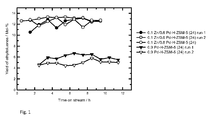
- Fig. 1 is a graph representing the yield of ethyltoluenes over time, upon direct alkylation of toluene with ethane. Depicted is the result of a process under the influence of three catalyst compositions of the invention. The measurement points hereof are represented by black, white and gray bullets. The graph includes a comparison with a catalyst composition not according to the invention. The measurement points hereof are indicated with black and white triangles.
- the invention is based on the judicious insight that a palladium catalyst in combination with zinc as a promoter, is able to achieve the activation of alkanes towards the direct alkylation of aromatic compounds.
- the combination of the catalyst and the promoter is presented on a porous support, which is ZSM-5 zeolite.
- the zeolite-type support is desired for the presence of acidic sites.
- known zeolites ZSM-5 and the like are suitable to prevent coking and to suppress thermodynamically favored reactions.
- the spaciousness index and the modified constraint index are known methods to characterize zeolites and zeolite-type materials. These terms are well-defined in the art. Reference can be made, inter alia, to the " Handbook of Porous Solids", F. Schüth, K.S.W. Sing, J. Weitkamp (eds.), Wiley-VCH, 2002 . Particularly for zeolites, see, e.g., pages 699, for SAPOs, e.g., pp. 815, for MOFs, e.g., pp. 1190, and for spaciousness index and modified constraint index e.g., pp. 1015.
- the support material desirably has acidic sites. On this basis, good results can be obtained with medium Si/Al molar ratios. However, for the optimal working of the promoter, it is believed that reasonable ion exchange capacities are desired, which would imply reasonably low Si/Al molar ratios. All in all, it is preferred for the zeolites to have Si/Al molar ratios between 2 and 100, preferably between 5 and 50, more preferably between 10 and 35, most preferably between 15 and 30.
- the molar ratio of zinc to palladium generally is between 0.01 and 5, preferably between 0.1 and 1.5, most preferably between 0.1 and 0.5.
- the catalyst composition of the invention generally comprise 0.1 wt.% to 5 wt.% of palladium, preferably 0.2 wt.% to 1 wt. %, most preferably between 0.4 wt.% and 0.9 wt.%.
- the content of the mainly active metal can be reduced.
- the catalyst composition of the invention serves to activate alkanes towards the direct alkylation of aromatic compounds.
- Light alkanes are aliphatic hydrocarbons having chain lengths of 1 to 12 carbon atoms, preferably and more particularly from 1 to 8 carbon atoms, more preferably from 1 to 6 carbon atoms. These alkanes can be linear or branched, with n-alkanes being preferred. Still more preferred alkanes have chain lengths of 2 to 4 carbon atoms. Ethane and propane are the most preferred. With light alkanes, and particularly with ethane and propane, a particular challenge has been overcome by presenting a catalyst composition that is actually suitable to support a direct alkylation reaction of aromatic compounds.
- the source of the alkanes used in the alkylation reaction is not of particular relevance.
- the process of the invention can also be carried out using light alkanes that are formed from prior cracking of higher alkanes.
- the catalyst comprising palladium and zinc not only presents the aforementioned advantages in the alkylation of aromatic with light alkanes, but also is advantageous for use in the alkylation of aromatics with higher alkanes, i.e. of more than 12 carbon atoms, particularly 15 or more.
- These alkanes may range from a linear or very slightly branched paraffin having from 15 to 22 carbon atoms, to light, medium or heavy slack wax, paraffinic FCC bottoms, deasphalted hydrocracked bottoms, Fischer-Tropsch synthetic distillate and wax, deoiled wax or polyethylene wax, light or heavy cycle oil.
- Other sources include waxy shale oil, tar sands and synthetic fuels.
- Aromatic compounds to be alkylated by the process of the present invention preferably comprise one to three phenyl rings. Other rings, such as five-membered or seven-membered rings fused into an aromatic ring system are conceivably also alkylated by the process of the invention.
- the aromatic compounds can comprise full carbon rings, but also heterocyclic aromatic compounds are included.
- Preferred aromatic compounds are selected from the group consisting of benzene, toluene, other alkyl aromatics, phenol, anthracene, phenanthrene, and pyridine..
- temperature and preferably also pressure, will be elevated as compared to room temperature.
- the reaction is conducted at a temperature of 200°C to 500 °C, more preferably 320°C to 400°C.
- the pressure employed will generally depend on the type of reactor used. Preferred pressures are within a range of from 1 bar to 200 bar, more preferably 5 bar to 50 bar, and most preferably 7 bar to 20 bar.
- zinc serves to dilute the palladium, and thus modifies the activity and selectivity of the catalyst into the direction desired for the direct alkylation of aromatic compounds.
- Palladium ion exchange was carried out by adding drop wise under stirring an aqueous solution of 0.304 g Pd(NH 3 ) 4 Cl 2 (40.62 wt.-% Pd, ChemPur) in 250 ml demineralized water to a suspension of 9.446 g (dry mass) zeolite (Si/Al molar ratio of the zeolite is between 10 and 35) in 250 ml demineralized water. The mixture was stirred at room temperature for 24 hours, filtered and dried at 353 K for another 24 h.
- the catalyst was then calcined at 823 K in nitrogen for another 24 h and cooled to room temperature. 2.613 g (dry mass) zeolite were suspended in 25 ml demineralized water and 0.013 g of zinc acetate (C 4 H 6 O 4 Zn ⁇ 2H 2 O, Fluka 99.0%) were added. Then the water was carefully removed in a rotary evaporator, thereby impregnating the catalyst with the zinc salt. Afterwards, the catalyst was dried again at 353 K for 24 h.
- the zeolite powder was pressed without a binder, crushed and sieved to get a particle size between 0.2 and 0.3 mm.
- the catalyst was activated in situ, prior to starting the experiment.
- 0.5 g of the catalyst were first heated in flowing synthetic air (150 cm 3 min -1 ) at a rate of 0.25 K min -1 to a final temperature of 573 K, then it was switched to nitrogen (150 cm 3 min -1 ) and heated with a rate of 1.7 K min -1 to a final temperature of 623 K. Afterwards the catalyst was reduced under a constant stream of hydrogen (150 cm 3 min -1 ) at 623 K for 4 h.
- the WHSV toluene and ethane
- Product analysis was achieved using an on-line sampling system, a capillary gas chromatograph and a CP-PoraPLOT Q column (length: 30 m, inner diameter: 0.32 mm, film thickness: 20 ⁇ m, Chrompack).
- Two detectors in series were employed, namely, a thermal conductivity detector followed by a flame ionization detector. Correction factors for the two detectors were determined separately.
- ethane as tie substance, the results from both detectors were combined. From the mass and molar flows, the selectivities of all products were calculated in mol%. The yields were determined from the selectivities and the toluene conversion.
- Fig. 1 a graphic representation is given of the yield of ethyltoluenes during the alkylation of toluene with ethane on zeolite catalysts in a fixed-bed reactor (pressure: 24 bar; reaction temperature: 350 °C).
Landscapes
- Chemical & Material Sciences (AREA)
- Organic Chemistry (AREA)
- Chemical Kinetics & Catalysis (AREA)
- Engineering & Computer Science (AREA)
- Materials Engineering (AREA)
- Crystallography & Structural Chemistry (AREA)
- Physics & Mathematics (AREA)
- Thermal Sciences (AREA)
- Organic Low-Molecular-Weight Compounds And Preparation Thereof (AREA)
- Catalysts (AREA)
Description
- The invention pertains to a method for the alkylation of aromatic compounds with alkanes. Particularly, the invention relates to the direct alkylation of aromatic hydrocarbons with short-chain alkanes, having a chain length of from 1 to 12 carbon atoms.
- Alkylated aromatics, e.g. ethylbenzene and ethyltoluene, find widespread usage. In conventional processes to produce such alkyl aromatics, an aromatic hydrocarbon is alkylated with a reactive agent such as olefin, alkyl halide or alkyl alcohol. Processes for the direct alkylation of aromatics with alkanes are virtually non-existent. Yet, this would be desired since regular alkylation agents, such as alkenes, are expensive. It would be desired for the alkylation of aromatics to be possible with alkanes instead of alkenes because alkanes directly occur in nature in the form of natural gas, whereas alkenes have to be made from alkanes. Thus, alkanes are cheaper than alkenes, and a process step can be saved. However, to be able to use alkanes as alkylating agents, a very active and selective catalyst is needed since the reaction is severely limited by thermodynamics.
- An existing process is the "M-Forming" process. This starts with longer alkanes, cracks them and uses then the olefinic fragments again as alkylating agents for aromatics alkylation. Similarly,
US 4,899,008 refers to a direct catalytic alkylation of mononuclear aromatics with lower alkanes. Therein an acid H-ZSM-5 catalyst is used. The main alkylation products are not direct alkylation products but products formed from cracked propane. Since cracking of propane produces methane and ethene, it is likely that ethene acted as alkylating agent. - A reference on the direct alkylation of aromatics with alkanes is
WO 99/59942 - Sealy S., Applied Catalysis A, 294(2005), 273-278 as well Bressel A, Microporous and Mesoporous Materials, 109(2008), 278-286 disclose a process for the alkylation of toluene with ethane in presence of a catalyst containing palladium supported on ZSM-5 zeolite.
-
DE102006059800 discloses a process for the alkylation of benzene with dodecane using a catalyst containing platinum and zinc supported on beta zeolite. - Reactions conditions for the conversion of such longer alkanes, however, are not normally suitable for light alkanes. The problem with longer alkanes is their high reactivity, particularly towards cracking. The problem with light alkanes, such as those having chain lengths of from 1 to 12 carbon atoms, and more particularly from 1 to 8 carbon atoms, is that they are difficult to activate.
- Hence, a demand exists in the art to provide a more versatile process for the direct alkylation of aromatic compounds, which would enable both light and heavy alkanes to be employed. Also, it is desired to improve yield.
- In order to better address one or more of the foregoing desires, the invention presents, in one aspect, a process for the alkylation of an aromatic compound, comprising contacting the aromatic compound with an alkane under elevated temperature, in the presence of a catalyst composition comprising a catalytically active metal and a promoter metal on ZSM-5 zeolite wherein the catalytically active metal is palladium, and the promoter is zinc.
- In another aspect, the invention provides the use of a catalyst composition as defined above, for the activation of an alkane towards the direct alkylation of an aromatic compound.
-
Fig. 1 is a graph representing the yield of ethyltoluenes over time, upon direct alkylation of toluene with ethane. Depicted is the result of a process under the influence of three catalyst compositions of the invention. The measurement points hereof are represented by black, white and gray bullets. The graph includes a comparison with a catalyst composition not according to the invention. The measurement points hereof are indicated with black and white triangles. - In a broad sense, the invention is based on the judicious insight that a palladium catalyst in combination with zinc as a promoter, is able to achieve the activation of alkanes towards the direct alkylation of aromatic compounds. The combination of the catalyst and the promoter is presented on a porous support, which is ZSM-5 zeolite.
- The zeolite-type support is desired for the presence of acidic sites. Amongst known zeolites, ZSM-5 and the like are suitable to prevent coking and to suppress thermodynamically favored reactions. The spaciousness index and the modified constraint index are known methods to characterize zeolites and zeolite-type materials. These terms are well-defined in the art. Reference can be made, inter alia, to the "Handbook of Porous Solids", F. Schüth, K.S.W. Sing, J. Weitkamp (eds.), Wiley-VCH, 2002. Particularly for zeolites, see, e.g., pages 699, for SAPOs, e.g., pp. 815, for MOFs, e.g., pp. 1190, and for spaciousness index and modified constraint index e.g., pp. 1015.
- The support material desirably has acidic sites. On this basis, good results can be obtained with medium Si/Al molar ratios. However, for the optimal working of the promoter, it is believed that reasonable ion exchange capacities are desired, which would imply reasonably low Si/Al molar ratios. All in all, it is preferred for the zeolites to have Si/Al molar ratios between 2 and 100, preferably between 5 and 50, more preferably between 10 and 35, most preferably between 15 and 30.
- The molar ratio of zinc to palladium generally is between 0.01 and 5, preferably between 0.1 and 1.5, most preferably between 0.1 and 0.5.
- The catalyst composition of the invention generally comprise 0.1 wt.% to 5 wt.% of palladium, preferably 0.2 wt.% to 1 wt. %, most preferably between 0.4 wt.% and 0.9 wt.%. With the addition of zinc as a promoter, the content of the mainly active metal can be reduced.
- The catalyst composition of the invention serves to activate alkanes towards the direct alkylation of aromatic compounds.
- Light alkanes, as used in the present invention, are aliphatic hydrocarbons having chain lengths of 1 to 12 carbon atoms, preferably and more particularly from 1 to 8 carbon atoms, more preferably from 1 to 6 carbon atoms. These alkanes can be linear or branched, with n-alkanes being preferred. Still more preferred alkanes have chain lengths of 2 to 4 carbon atoms. Ethane and propane are the most preferred. With light alkanes, and particularly with ethane and propane, a particular challenge has been overcome by presenting a catalyst composition that is actually suitable to support a direct alkylation reaction of aromatic compounds.
- The source of the alkanes used in the alkylation reaction is not of particular relevance. E.g., the process of the invention can also be carried out using light alkanes that are formed from prior cracking of higher alkanes. However, it will be understood that in order to fully enjoy the benefits of the invention, it is preferred to employ light alkanes provided from direct, existing sources of such alkanes.
- The catalyst comprising palladium and zinc not only presents the aforementioned advantages in the alkylation of aromatic with light alkanes, but also is advantageous for use in the alkylation of aromatics with higher alkanes, i.e. of more than 12 carbon atoms, particularly 15 or more. These alkanes may range from a linear or very slightly branched paraffin having from 15 to 22 carbon atoms, to light, medium or heavy slack wax, paraffinic FCC bottoms, deasphalted hydrocracked bottoms, Fischer-Tropsch synthetic distillate and wax, deoiled wax or polyethylene wax, light or heavy cycle oil. Other sources include waxy shale oil, tar sands and synthetic fuels.
- Aromatic compounds to be alkylated by the process of the present invention preferably comprise one to three phenyl rings. Other rings, such as five-membered or seven-membered rings fused into an aromatic ring system are conceivably also alkylated by the process of the invention. The aromatic compounds can comprise full carbon rings, but also heterocyclic aromatic compounds are included. Preferred aromatic compounds are selected from the group consisting of benzene, toluene, other alkyl aromatics, phenol, anthracene, phenanthrene, and pyridine..
- In the process of the invention, as in largely any catalytic alkylation process, temperature, and preferably also pressure, will be elevated as compared to room temperature. Preferably, the reaction is conducted at a temperature of 200°C to 500 °C, more preferably 320°C to 400°C.
- The pressure employed will generally depend on the type of reactor used. Preferred pressures are within a range of from 1 bar to 200 bar, more preferably 5 bar to 50 bar, and most preferably 7 bar to 20 bar.
- In the preferred embodiment of a combination of palladium and zinc, it is believed that zinc serves to dilute the palladium, and thus modifies the activity and selectivity of the catalyst into the direction desired for the direct alkylation of aromatic compounds.
- Whilst similar catalysts may already have been used for other applications, e.g., the dehydrogenation of alkanes, this is not the case for the alkylation of aromatics with alkanes, particularly with light alkanes. The use of zinc allows considerably higher yields of the desired alkyl aromatics, i.e., about 12% instead of 5% during the alkylation of toluene with ethane in a fixed-bed reactor at 24 bar and 350°C (see
Fig. 1 ). - The invention will further be described with respect to non-limiting examples and with reference to a figure. The invention is not limited thereto but only by the claims. Where the term "comprising" is used in the present description and claims, it does not exclude other elements or steps. Where an indefinite or definite article is used when referring to a singular noun, e.g., "a" or "an", "the", this includes a plural of that noun unless something else is specifically stated.
- Palladium ion exchange was carried out by adding drop wise under stirring an aqueous solution of 0.304 g Pd(NH3)4Cl2 (40.62 wt.-% Pd, ChemPur) in 250 ml demineralized water to a suspension of 9.446 g (dry mass) zeolite (Si/Al molar ratio of the zeolite is between 10 and 35) in 250 ml demineralized water. The mixture was stirred at room temperature for 24 hours, filtered and dried at 353 K for another 24 h.
- It will be understood that the amounts of Pd salt, water and zeolite can be varied. It is also possible to save Pd salt by not filtering the solution but carefully evaporating the water.
- The catalyst was then calcined at 823 K in nitrogen for another 24 h and cooled to room temperature. 2.613 g (dry mass) zeolite were suspended in 25 ml demineralized water and 0.013 g of zinc acetate (C4H6O4Zn·2H2O, Fluka 99.0%) were added. Then the water was carefully removed in a rotary evaporator, thereby impregnating the catalyst with the zinc salt. Afterwards, the catalyst was dried again at 353 K for 24 h.
- For the catalytic experiments, the zeolite powder was pressed without a binder, crushed and sieved to get a particle size between 0.2 and 0.3 mm. The catalyst was activated in situ, prior to starting the experiment. To achieve a high dispersion of the noble metal, 0.5 g of the catalyst were first heated in flowing synthetic air (150 cm3 min-1) at a rate of 0.25 K min-1 to a final temperature of 573 K, then it was switched to nitrogen (150 cm3 min-1) and heated with a rate of 1.7 K min-1 to a final temperature of 623 K. Afterwards the catalyst was reduced under a constant stream of hydrogen (150 cm3 min-1) at 623 K for 4 h.
- Catalytic experiments were performed in a flow-type apparatus with a fixed-bed reactor from stainless steel. Ethane (99.95 vol.-%, Westfalen AG) and nitrogen (99.999 vol.-%, Westfalen AG) were fed with an ṅ nitrogen /ṅ ethane ratio of approximately 4 through a toluene (> 99.9 %, Merck) saturator containing Chromosorb P-NAW (Macherey-Nagel). Nitrogen was used as an internal standard but also to ensure that a relatively low ṅ ethane/ṅ toluene feed ratio of 5±1 could be achieved at the high pressure applied. The reaction was carried out at a total pressure of 24 bar and a reaction temperature of (350±2) °C. The WHSV (toluene and ethane) was 1.0 h-1. Product analysis was achieved using an on-line sampling system, a capillary gas chromatograph and a CP-PoraPLOT Q column (length: 30 m, inner diameter: 0.32 mm, film thickness: 20 µm, Chrompack). Two detectors in series were employed, namely, a thermal conductivity detector followed by a flame ionization detector. Correction factors for the two detectors were determined separately. With ethane as tie substance, the results from both detectors were combined. From the mass and molar flows, the selectivities of all products were calculated in mol%. The yields were determined from the selectivities and the toluene conversion.
- In
Fig. 1 a graphic representation is given of the yield of ethyltoluenes during the alkylation of toluene with ethane on zeolite catalysts in a fixed-bed reactor (pressure: 24 bar; reaction temperature: 350 °C).
Claims (10)
- A process for the alkylation of an aromatic compound, comprising contacting the aromatic compound with an alkane under elevated temperature, in the presence of a catalyst composition comprising a catalytically active metal and a promoter metal on a ZSM-5 zeolite support, wherein the catalytically active metal is palladium, and the promoter is zinc.
- A process according to claim 1, wherein the catalyst composition comprises 0.1 wt.% to 5 wt.% of palladium.
- A process according to claim 2, wherein the catalyst composition comprises 0.2 wt.% to 1 wt.% of palladium, preferably between 0.4 wt.% and 0.9 wt.%.
- A process according to any one of the preceding claims, wherein the alkane is a light alkane having 1 to 12 carbon atoms, preferably 2 to 4 carbon atoms.
- A process according to any one of the claims 1-4, wherein the alkane has more than 15 carbon atoms, preferably more than 22 carbon atoms.
- A process according to any one of the preceding claims, wherein the aromatic compound is selected from the group consisting of benzene, toluene, phenol, anthracene, phenanthrene, and pyridine.
- A process according to any one of the preceding claims, wherein the reaction is conducted at a temperature of 200°C to 500 °C, preferably 320°C to 400°C.
- A process according to any one of the preceding claims, wherein the reaction is conducted under a pressure within a range of from 1 bar to 200 bar.
- A process according to claim 8, wherein the pressure is 5 bar to 50 bar, preferably 7 bar to 20 bar.
- The use of a catalyst composition as defined in any one of the claims 1 to 3, for the activation of an alkane towards the direct alkylation of an aromatic compound.
Priority Applications (1)
| Application Number | Priority Date | Filing Date | Title |
|---|---|---|---|
| EP12737905.5A EP2726445B9 (en) | 2011-06-29 | 2012-06-28 | Method and catalyst for the alkylation of aromatic compounds with alkanes |
Applications Claiming Priority (3)
| Application Number | Priority Date | Filing Date | Title |
|---|---|---|---|
| EP11171909 | 2011-06-29 | ||
| EP12737905.5A EP2726445B9 (en) | 2011-06-29 | 2012-06-28 | Method and catalyst for the alkylation of aromatic compounds with alkanes |
| PCT/NL2012/050455 WO2013002638A1 (en) | 2011-06-29 | 2012-06-28 | Method and catalyst for the alkylation of aromatic compounds with alkanes |
Publications (3)
| Publication Number | Publication Date |
|---|---|
| EP2726445A1 EP2726445A1 (en) | 2014-05-07 |
| EP2726445B1 EP2726445B1 (en) | 2019-05-22 |
| EP2726445B9 true EP2726445B9 (en) | 2019-11-20 |
Family
ID=44839445
Family Applications (1)
| Application Number | Title | Priority Date | Filing Date |
|---|---|---|---|
| EP12737905.5A Active EP2726445B9 (en) | 2011-06-29 | 2012-06-28 | Method and catalyst for the alkylation of aromatic compounds with alkanes |
Country Status (6)
| Country | Link |
|---|---|
| US (1) | US20140249343A1 (en) |
| EP (1) | EP2726445B9 (en) |
| CN (1) | CN103732564B (en) |
| CA (1) | CA2836998C (en) |
| DK (1) | DK2726445T3 (en) |
| WO (1) | WO2013002638A1 (en) |
Families Citing this family (1)
| Publication number | Priority date | Publication date | Assignee | Title |
|---|---|---|---|---|
| CN107649170B (en) * | 2017-09-30 | 2020-02-21 | 宝鸡文理学院 | A kind of supported molecular sieve catalyst for synthesizing 4-methyl-2,6-di-tert-butylphenol and its application |
Family Cites Families (8)
| Publication number | Priority date | Publication date | Assignee | Title |
|---|---|---|---|---|
| US4061592A (en) * | 1972-03-09 | 1977-12-06 | Chevron Research Company | Hydrocarbon conversion catalyst |
| US4899008A (en) | 1986-06-27 | 1990-02-06 | Mobil Oil Corporation | Direct catalytic alkylation of mononuclear aromatics with lower alkanes |
| CA1281746C (en) * | 1986-06-27 | 1991-03-19 | Rene Bernard Lapierre | Direct catalytic alkylation of mononuclear aromatics with lower alkanes |
| US4774379A (en) * | 1987-06-09 | 1988-09-27 | Cosden Technology, Inc. | Aromatic alkylation process |
| WO1999059942A1 (en) | 1998-05-18 | 1999-11-25 | Mobil Oil Corporation | Direct paraffin and aromatic alkylation and paraffin isomerization |
| DE102006059800A1 (en) * | 2006-02-02 | 2007-11-22 | Basf Ag | Preparing alkyl-aromatic compound comprises reacting aromatic compound with alkane in presence of activated catalyst, which is crystalline solid containing silicon, and catalytic active metal contains platinum and element, e.g. zinc |
| CN101623636B (en) * | 2009-08-11 | 2011-11-16 | 沙隆达集团公司 | Catalyst for synthesizing pyridine and alkyl pyridine and preparation method thereof |
| CN102030605B (en) * | 2009-09-28 | 2013-07-24 | 中国石油化工股份有限公司 | Low carbon hydrocarbon aromatization method |
-
2012
- 2012-06-28 EP EP12737905.5A patent/EP2726445B9/en active Active
- 2012-06-28 CA CA2836998A patent/CA2836998C/en active Active
- 2012-06-28 WO PCT/NL2012/050455 patent/WO2013002638A1/en not_active Ceased
- 2012-06-28 CN CN201280026407.0A patent/CN103732564B/en active Active
- 2012-06-28 US US14/118,214 patent/US20140249343A1/en not_active Abandoned
- 2012-06-28 DK DK12737905.5T patent/DK2726445T3/en active
Also Published As
| Publication number | Publication date |
|---|---|
| EP2726445A1 (en) | 2014-05-07 |
| WO2013002638A1 (en) | 2013-01-03 |
| CN103732564A (en) | 2014-04-16 |
| US20140249343A1 (en) | 2014-09-04 |
| EP2726445B1 (en) | 2019-05-22 |
| CA2836998A1 (en) | 2013-01-03 |
| DK2726445T3 (en) | 2019-07-29 |
| CN103732564B (en) | 2016-01-20 |
| CA2836998C (en) | 2017-07-25 |
Similar Documents
| Publication | Publication Date | Title |
|---|---|---|
| Catizzone et al. | From 1-D to 3-D zeolite structures: Performance assessment in catalysis of vapour-phase methanol dehydration to DME | |
| US11559795B2 (en) | Bimetallic catalysts supported on zeolites for selective conversion of n-butane to ethane | |
| US20130261365A1 (en) | Process for the Production of Xylenes and Light Olefins from Heavy Aromatics | |
| EP2834004A1 (en) | Multimetal zeolites based catalyst for transalkylation of heavy reformate to produce xylenes and petrochemical feedstocks | |
| KR20110082600A (en) | Stable form-selective catalysts for aromatic alkylation and methods of using and preparing the same | |
| Ou et al. | Structured ZSM-5/SiC foam catalysts for bio-oils upgrading | |
| Villegas et al. | Isomerization of n-butane to isobutane over Pt-modified Beta and ZSM-5 zeolite catalysts: Catalyst deactivation and regeneration | |
| CA2620480C (en) | Process for production of aromatic compound | |
| US20120253093A1 (en) | Method of alkylation using catalyst on ceramic foam support | |
| EP2540691A1 (en) | Method and catalyst for the alkylation of aromatic compounds with light alkanes | |
| Aboul-Gheit et al. | Catalytic para-xylene maximization II–alkylation of toluene with methanol on platinum loaded H-ZSM-5 zeolite catalysts prepared via different routes | |
| Lukyanov et al. | Highly selective and stable alkylation of benzene with ethane into ethylbenzene over bifunctional PtH-MFI catalysts | |
| KR20160131377A (en) | Catalysts for ethanol dehydration and production method of ethylene using same | |
| EP2726445B1 (en) | Method and catalyst for the alkylation of aromatic compounds with alkanes | |
| CN112920006A (en) | Method for preparing aromatic hydrocarbon compound from ethanol | |
| WO2012066012A1 (en) | Isomerisation catalyst preparation process | |
| JP2003534300A (en) | Process for producing propylene from an olefin stream | |
| CN104870089A (en) | Dehydroaromatization catalyst and its preparation method and use | |
| AU606062B2 (en) | Direct catalytic alkylation of mononuclear aromatics with lower alkanes | |
| Geiß et al. | The Ensemble Effect in Bifunctional Catalysis: Influence of Zinc as Promoter for Pd‐H‐ZSM‐5 Catalysts during the Dehydroalkylation of Toluene with Ethane | |
| WO2019177957A1 (en) | Method of heavy reformate conversion into btx over metal-impregnated zsm-5+ssz-33 zeolite composite catalyst | |
| KR20190032876A (en) | Dissimilar metal supported catalyst for preparation of aromatic compounds by the co-dehydroaromatization of methane and C2-C4 alkane compounds, and Method for preparing aromatic compounds using the same | |
| WO2016187249A1 (en) | A process for the aromatization of a methane-containing gas stream using scandium hydrogen acceptor particles | |
| CA3044683C (en) | Upgrading ethane-containing light paraffins streams | |
| WO2012066013A1 (en) | Isomerisation catalyst preparation process |
Legal Events
| Date | Code | Title | Description |
|---|---|---|---|
| PUAI | Public reference made under article 153(3) epc to a published international application that has entered the european phase |
Free format text: ORIGINAL CODE: 0009012 |
|
| 17P | Request for examination filed |
Effective date: 20131230 |
|
| AK | Designated contracting states |
Kind code of ref document: A1 Designated state(s): AL AT BE BG CH CY CZ DE DK EE ES FI FR GB GR HR HU IE IS IT LI LT LU LV MC MK MT NL NO PL PT RO RS SE SI SK SM TR |
|
| DAX | Request for extension of the european patent (deleted) | ||
| STAA | Information on the status of an ep patent application or granted ep patent |
Free format text: STATUS: EXAMINATION IS IN PROGRESS |
|
| 17Q | First examination report despatched |
Effective date: 20180105 |
|
| RIC1 | Information provided on ipc code assigned before grant |
Ipc: B01J 37/18 20060101ALI20181012BHEP Ipc: B01J 29/44 20060101ALI20181012BHEP Ipc: B01J 29/068 20060101ALI20181012BHEP Ipc: C07C 2/76 20060101AFI20181012BHEP Ipc: C07C 15/27 20060101ALI20181012BHEP Ipc: B01J 37/08 20060101ALI20181012BHEP Ipc: C07C 15/02 20060101ALI20181012BHEP |
|
| GRAP | Despatch of communication of intention to grant a patent |
Free format text: ORIGINAL CODE: EPIDOSNIGR1 |
|
| STAA | Information on the status of an ep patent application or granted ep patent |
Free format text: STATUS: GRANT OF PATENT IS INTENDED |
|
| INTG | Intention to grant announced |
Effective date: 20181206 |
|
| GRAS | Grant fee paid |
Free format text: ORIGINAL CODE: EPIDOSNIGR3 |
|
| GRAA | (expected) grant |
Free format text: ORIGINAL CODE: 0009210 |
|
| STAA | Information on the status of an ep patent application or granted ep patent |
Free format text: STATUS: THE PATENT HAS BEEN GRANTED |
|
| AK | Designated contracting states |
Kind code of ref document: B1 Designated state(s): AL AT BE BG CH CY CZ DE DK EE ES FI FR GB GR HR HU IE IS IT LI LT LU LV MC MK MT NL NO PL PT RO RS SE SI SK SM TR |
|
| REG | Reference to a national code |
Ref country code: GB Ref legal event code: FG4D |
|
| REG | Reference to a national code |
Ref country code: CH Ref legal event code: EP |
|
| REG | Reference to a national code |
Ref country code: IE Ref legal event code: FG4D |
|
| REG | Reference to a national code |
Ref country code: DE Ref legal event code: R096 Ref document number: 602012060362 Country of ref document: DE |
|
| REG | Reference to a national code |
Ref country code: AT Ref legal event code: REF Ref document number: 1135923 Country of ref document: AT Kind code of ref document: T Effective date: 20190615 |
|
| REG | Reference to a national code |
Ref country code: DK Ref legal event code: T3 Effective date: 20190726 |
|
| REG | Reference to a national code |
Ref country code: NL Ref legal event code: FP |
|
| REG | Reference to a national code |
Ref country code: LT Ref legal event code: MG4D |
|
| PG25 | Lapsed in a contracting state [announced via postgrant information from national office to epo] |
Ref country code: AL Free format text: LAPSE BECAUSE OF FAILURE TO SUBMIT A TRANSLATION OF THE DESCRIPTION OR TO PAY THE FEE WITHIN THE PRESCRIBED TIME-LIMIT Effective date: 20190522 Ref country code: PT Free format text: LAPSE BECAUSE OF FAILURE TO SUBMIT A TRANSLATION OF THE DESCRIPTION OR TO PAY THE FEE WITHIN THE PRESCRIBED TIME-LIMIT Effective date: 20190922 Ref country code: SE Free format text: LAPSE BECAUSE OF FAILURE TO SUBMIT A TRANSLATION OF THE DESCRIPTION OR TO PAY THE FEE WITHIN THE PRESCRIBED TIME-LIMIT Effective date: 20190522 Ref country code: FI Free format text: LAPSE BECAUSE OF FAILURE TO SUBMIT A TRANSLATION OF THE DESCRIPTION OR TO PAY THE FEE WITHIN THE PRESCRIBED TIME-LIMIT Effective date: 20190522 Ref country code: NO Free format text: LAPSE BECAUSE OF FAILURE TO SUBMIT A TRANSLATION OF THE DESCRIPTION OR TO PAY THE FEE WITHIN THE PRESCRIBED TIME-LIMIT Effective date: 20190822 Ref country code: LT Free format text: LAPSE BECAUSE OF FAILURE TO SUBMIT A TRANSLATION OF THE DESCRIPTION OR TO PAY THE FEE WITHIN THE PRESCRIBED TIME-LIMIT Effective date: 20190522 Ref country code: HR Free format text: LAPSE BECAUSE OF FAILURE TO SUBMIT A TRANSLATION OF THE DESCRIPTION OR TO PAY THE FEE WITHIN THE PRESCRIBED TIME-LIMIT Effective date: 20190522 Ref country code: ES Free format text: LAPSE BECAUSE OF FAILURE TO SUBMIT A TRANSLATION OF THE DESCRIPTION OR TO PAY THE FEE WITHIN THE PRESCRIBED TIME-LIMIT Effective date: 20190522 |
|
| REG | Reference to a national code |
Ref country code: CH Ref legal event code: PK Free format text: BERICHTIGUNG B9 |
|
| PG25 | Lapsed in a contracting state [announced via postgrant information from national office to epo] |
Ref country code: RS Free format text: LAPSE BECAUSE OF FAILURE TO SUBMIT A TRANSLATION OF THE DESCRIPTION OR TO PAY THE FEE WITHIN THE PRESCRIBED TIME-LIMIT Effective date: 20190522 Ref country code: BG Free format text: LAPSE BECAUSE OF FAILURE TO SUBMIT A TRANSLATION OF THE DESCRIPTION OR TO PAY THE FEE WITHIN THE PRESCRIBED TIME-LIMIT Effective date: 20190822 Ref country code: LV Free format text: LAPSE BECAUSE OF FAILURE TO SUBMIT A TRANSLATION OF THE DESCRIPTION OR TO PAY THE FEE WITHIN THE PRESCRIBED TIME-LIMIT Effective date: 20190522 Ref country code: GR Free format text: LAPSE BECAUSE OF FAILURE TO SUBMIT A TRANSLATION OF THE DESCRIPTION OR TO PAY THE FEE WITHIN THE PRESCRIBED TIME-LIMIT Effective date: 20190823 |
|
| REG | Reference to a national code |
Ref country code: AT Ref legal event code: MK05 Ref document number: 1135923 Country of ref document: AT Kind code of ref document: T Effective date: 20190522 |
|
| PG25 | Lapsed in a contracting state [announced via postgrant information from national office to epo] |
Ref country code: AT Free format text: LAPSE BECAUSE OF FAILURE TO SUBMIT A TRANSLATION OF THE DESCRIPTION OR TO PAY THE FEE WITHIN THE PRESCRIBED TIME-LIMIT Effective date: 20190522 Ref country code: EE Free format text: LAPSE BECAUSE OF FAILURE TO SUBMIT A TRANSLATION OF THE DESCRIPTION OR TO PAY THE FEE WITHIN THE PRESCRIBED TIME-LIMIT Effective date: 20190522 Ref country code: RO Free format text: LAPSE BECAUSE OF FAILURE TO SUBMIT A TRANSLATION OF THE DESCRIPTION OR TO PAY THE FEE WITHIN THE PRESCRIBED TIME-LIMIT Effective date: 20190522 Ref country code: SK Free format text: LAPSE BECAUSE OF FAILURE TO SUBMIT A TRANSLATION OF THE DESCRIPTION OR TO PAY THE FEE WITHIN THE PRESCRIBED TIME-LIMIT Effective date: 20190522 Ref country code: CZ Free format text: LAPSE BECAUSE OF FAILURE TO SUBMIT A TRANSLATION OF THE DESCRIPTION OR TO PAY THE FEE WITHIN THE PRESCRIBED TIME-LIMIT Effective date: 20190522 |
|
| REG | Reference to a national code |
Ref country code: CH Ref legal event code: PL |
|
| REG | Reference to a national code |
Ref country code: DE Ref legal event code: R097 Ref document number: 602012060362 Country of ref document: DE |
|
| PG25 | Lapsed in a contracting state [announced via postgrant information from national office to epo] |
Ref country code: MC Free format text: LAPSE BECAUSE OF FAILURE TO SUBMIT A TRANSLATION OF THE DESCRIPTION OR TO PAY THE FEE WITHIN THE PRESCRIBED TIME-LIMIT Effective date: 20190522 Ref country code: SM Free format text: LAPSE BECAUSE OF FAILURE TO SUBMIT A TRANSLATION OF THE DESCRIPTION OR TO PAY THE FEE WITHIN THE PRESCRIBED TIME-LIMIT Effective date: 20190522 |
|
| PLBE | No opposition filed within time limit |
Free format text: ORIGINAL CODE: 0009261 |
|
| REG | Reference to a national code |
Ref country code: BE Ref legal event code: MM Effective date: 20190630 |
|
| STAA | Information on the status of an ep patent application or granted ep patent |
Free format text: STATUS: NO OPPOSITION FILED WITHIN TIME LIMIT |
|
| PG25 | Lapsed in a contracting state [announced via postgrant information from national office to epo] |
Ref country code: TR Free format text: LAPSE BECAUSE OF FAILURE TO SUBMIT A TRANSLATION OF THE DESCRIPTION OR TO PAY THE FEE WITHIN THE PRESCRIBED TIME-LIMIT Effective date: 20190522 |
|
| 26N | No opposition filed |
Effective date: 20200225 |
|
| PG25 | Lapsed in a contracting state [announced via postgrant information from national office to epo] |
Ref country code: IE Free format text: LAPSE BECAUSE OF NON-PAYMENT OF DUE FEES Effective date: 20190628 Ref country code: PL Free format text: LAPSE BECAUSE OF FAILURE TO SUBMIT A TRANSLATION OF THE DESCRIPTION OR TO PAY THE FEE WITHIN THE PRESCRIBED TIME-LIMIT Effective date: 20190522 |
|
| PG25 | Lapsed in a contracting state [announced via postgrant information from national office to epo] |
Ref country code: BE Free format text: LAPSE BECAUSE OF NON-PAYMENT OF DUE FEES Effective date: 20190630 Ref country code: SI Free format text: LAPSE BECAUSE OF FAILURE TO SUBMIT A TRANSLATION OF THE DESCRIPTION OR TO PAY THE FEE WITHIN THE PRESCRIBED TIME-LIMIT Effective date: 20190522 Ref country code: LU Free format text: LAPSE BECAUSE OF NON-PAYMENT OF DUE FEES Effective date: 20190628 Ref country code: LI Free format text: LAPSE BECAUSE OF NON-PAYMENT OF DUE FEES Effective date: 20190630 Ref country code: CH Free format text: LAPSE BECAUSE OF NON-PAYMENT OF DUE FEES Effective date: 20190630 |
|
| PG25 | Lapsed in a contracting state [announced via postgrant information from national office to epo] |
Ref country code: CY Free format text: LAPSE BECAUSE OF FAILURE TO SUBMIT A TRANSLATION OF THE DESCRIPTION OR TO PAY THE FEE WITHIN THE PRESCRIBED TIME-LIMIT Effective date: 20190522 |
|
| PG25 | Lapsed in a contracting state [announced via postgrant information from national office to epo] |
Ref country code: IS Free format text: LAPSE BECAUSE OF FAILURE TO SUBMIT A TRANSLATION OF THE DESCRIPTION OR TO PAY THE FEE WITHIN THE PRESCRIBED TIME-LIMIT Effective date: 20190922 |
|
| PG25 | Lapsed in a contracting state [announced via postgrant information from national office to epo] |
Ref country code: MT Free format text: LAPSE BECAUSE OF FAILURE TO SUBMIT A TRANSLATION OF THE DESCRIPTION OR TO PAY THE FEE WITHIN THE PRESCRIBED TIME-LIMIT Effective date: 20190522 Ref country code: HU Free format text: LAPSE BECAUSE OF FAILURE TO SUBMIT A TRANSLATION OF THE DESCRIPTION OR TO PAY THE FEE WITHIN THE PRESCRIBED TIME-LIMIT; INVALID AB INITIO Effective date: 20120628 |
|
| PG25 | Lapsed in a contracting state [announced via postgrant information from national office to epo] |
Ref country code: MK Free format text: LAPSE BECAUSE OF FAILURE TO SUBMIT A TRANSLATION OF THE DESCRIPTION OR TO PAY THE FEE WITHIN THE PRESCRIBED TIME-LIMIT Effective date: 20190522 |
|
| PGFP | Annual fee paid to national office [announced via postgrant information from national office to epo] |
Ref country code: GB Payment date: 20260625 Year of fee payment: 15 Ref country code: DK Payment date: 20260624 Year of fee payment: 15 |
|
| PGFP | Annual fee paid to national office [announced via postgrant information from national office to epo] |
Ref country code: IT Payment date: 20260623 Year of fee payment: 15 |
|
| PGFP | Annual fee paid to national office [announced via postgrant information from national office to epo] |
Ref country code: DE Payment date: 20260622 Year of fee payment: 15 |
|
| PGFP | Annual fee paid to national office [announced via postgrant information from national office to epo] |
Ref country code: NL Payment date: 20260618 Year of fee payment: 15 |
|
| PGFP | Annual fee paid to national office [announced via postgrant information from national office to epo] |
Ref country code: FR Payment date: 20260626 Year of fee payment: 15 |