EP2725595A1 - MEMS fixed capacitor comprising a gas-containing gap and process for manufacturing said capacitor - Google Patents
MEMS fixed capacitor comprising a gas-containing gap and process for manufacturing said capacitor Download PDFInfo
- Publication number
- EP2725595A1 EP2725595A1 EP12306326.5A EP12306326A EP2725595A1 EP 2725595 A1 EP2725595 A1 EP 2725595A1 EP 12306326 A EP12306326 A EP 12306326A EP 2725595 A1 EP2725595 A1 EP 2725595A1
- Authority
- EP
- European Patent Office
- Prior art keywords
- metal
- fixed capacitor
- mems fixed
- layer
- electrode
- Prior art date
- Legal status (The legal status is an assumption and is not a legal conclusion. Google has not performed a legal analysis and makes no representation as to the accuracy of the status listed.)
- Pending
Links
Images


Classifications
-
- H—ELECTRICITY
- H10—SEMICONDUCTOR DEVICES; ELECTRIC SOLID-STATE DEVICES NOT OTHERWISE PROVIDED FOR
- H10D—INORGANIC ELECTRIC SEMICONDUCTOR DEVICES
- H10D1/00—Resistors, capacitors or inductors
- H10D1/60—Capacitors
- H10D1/68—Capacitors having no potential barriers
- H10D1/692—Electrodes
- H10D1/694—Electrodes comprising noble metals or noble metal oxides
-
- H—ELECTRICITY
- H01—ELECTRIC ELEMENTS
- H01G—CAPACITORS; CAPACITORS, RECTIFIERS, DETECTORS, SWITCHING DEVICES, LIGHT-SENSITIVE OR TEMPERATURE-SENSITIVE DEVICES OF THE ELECTROLYTIC TYPE
- H01G5/00—Capacitors in which the capacitance is varied by mechanical means, e.g. by turning a shaft; Processes of their manufacture
- H01G5/16—Capacitors in which the capacitance is varied by mechanical means, e.g. by turning a shaft; Processes of their manufacture using variation of distance between electrodes
-
- H—ELECTRICITY
- H10—SEMICONDUCTOR DEVICES; ELECTRIC SOLID-STATE DEVICES NOT OTHERWISE PROVIDED FOR
- H10W—GENERIC PACKAGES, INTERCONNECTIONS, CONNECTORS OR OTHER CONSTRUCTIONAL DETAILS OF DEVICES COVERED BY CLASS H10
- H10W20/00—Interconnections in chips, wafers or substrates
- H10W20/40—Interconnections external to wafers or substrates, e.g. back-end-of-line [BEOL] metallisations or vias connecting to gate electrodes
- H10W20/495—Capacitive arrangements or effects of, or between wiring layers
- H10W20/496—Capacitor integral with wiring layers
-
- H—ELECTRICITY
- H01—ELECTRIC ELEMENTS
- H01G—CAPACITORS; CAPACITORS, RECTIFIERS, DETECTORS, SWITCHING DEVICES, LIGHT-SENSITIVE OR TEMPERATURE-SENSITIVE DEVICES OF THE ELECTROLYTIC TYPE
- H01G5/00—Capacitors in which the capacitance is varied by mechanical means, e.g. by turning a shaft; Processes of their manufacture
- H01G2005/02—Capacitors in which the capacitance is varied by mechanical means, e.g. by turning a shaft; Processes of their manufacture having air, gas, or vacuum as the dielectric
Definitions
- the present invention relates to a novel MEMS fixed capacitor with a gas-containing gap forming a dielectric layer, to an Integrated Circuit (IC) comprising at least one electric interconnection line embedding such a novel MEMS fixed capacitor, and to a process for manufacturing said MEMS fixed capacitor.
- IC Integrated Circuit
- Capacitors are well known in the art and are implemented by inserting a dielectric insulator material between two metal electrodes.
- the quality of the dielectric material has a very strong impact on the quality factor (Q) of the capacitor. It is usual to find discrete capacitor products suitable for microwave operations with high quality factors as high as 100 or more. Such high values require however the use of very high quality dielectric films, which requires special and well controlled manufacturing process.
- MEMS capacitors are also well known and described for example in PCT application WO 2006/063257 and in US patent n° 6,437,965 .
- MEMS fixed capacitor having a fixed capacitance value, and referred therein as " MEMS fixed capacitor " is disclosed in PCT application WO 2006/063257 .
- Said MEMS fixed capacitor (see notably figure 8A) comprises three metallic electrodes: a top electrode (capacitive plate CP1), a bottom electrode (capacitive plate CP2), and an intermediate electrode (capacitive CP3) interposed between said top and bottom electrodes.
- the top electrode CP1 is electrically connected to the bottom electrode CP2.
- the bottom electrode CP2 is formed onto a dielectric layer (DE), which has been deposited onto a substrate (S).
- DE dielectric layer
- the intermediate electrode CP3 is formed above the bottom electrode CP2 with an air gap of small thickness (typically about 0.5 ⁇ m) between the intermediate CP3 and bottom electrodes CP2. Said air gap forms a dielectric insulator layer and is obtained by etching a sacrificial layer that has been previously formed between the two electrodes CP2, CP3.
- the top electrode CP1 is formed onto a thick beam oxide layer BOL that is interposed between the top electrode CP1 and the intermediate electrode CP3. This thick beam oxide layer BOL has typically a thickness about 2 ⁇ m, and gives to these electrodes CP1, CP3 the required mechanical strength.
- the thick beam oxide layer BOL is a structural layer that is necessary for maintaining the gap between the two capacitive plates CP2 and CP3.
- This thick beam oxide layer BOL however complicates the manufacturing process.
- this thick beam oxide layer BOL can involve dielectric losses that reduce the quality factor of the capacitor, jeopardize the benefit of the air capacitor formed between the bottom electrode CP2 and the intermediate electrode CP3, and detrimentally limit the use of said MEMS fixed capacitor at high frequencies.
- MEMS capacitor having a variable capacitance value are also known and disclosed for example in American patent US 6,437,965 .
- the capacitor disclosed in US 6,437,965 comprises a bottom capacitive electrode on a substrate and a movable bridge forming a top capacitive electrode suspended above the bottom capacitive electrode. Said bridge is deformable and movable between a lower position and an upper position under electric actuation forces, in order to provide high and low selectable capacitive values.
- Such a MEMS capacitor having a variable capacitance value involves a thick air gap between the bottom and top capacitive electrodes at rest, and an upper capacitive electrode of small thickness in order to be easily bendable under electric actuation forces.
- MEMS capacitors having a variable capacitance value have inherently the following drawbacks:
- An objective of the invention is to propose novel MEMS fixed capacitor, i.e. a MEMS capacitor having a fixed capacitance value, which can have a high capacitance density and a high quality factor.
- Another objective of the invention is to propose a novel MEMS fixed capacitor that can be manufactured with a MEMS process making use of sacrificial layer(s).
- the MEMS fixed capacitor of claim 1 which comprises a bottom metal electrode formed onto a substrate, a top metal electrode supported by metal pillars above the bottom metal electrode, and a gas-containing gap forming a non-solid dielectric layer between said top and bottom metal electrodes, wherein the distance (D) between the top and bottom metal electrodes (i.e. the thickness of the gas-containing gap) is not more than 1 ⁇ m and the thickness (E) of the top metal electrode is not less than 1 ⁇ m.
- the applicant has demonstrated that an increase of the distance between the top and bottom electrodes is detrimentally decreasing the capacitance density, but that a smaller distance between the top and bottom electrodes also detrimentally increases the deformability of the top electrode.
- the thickness of the top electrode does not substantially affect the capacitance density of the capacitor, and that a thicker top electrode is better for reducing the deformability of the top electrode.
- the use of a thicker top metal electrode (not less than 1 ⁇ m) combined with a smaller distance between the top and bottom metal electrodes (i.e. not more than 1 ⁇ m) enables to achieve a MEMS fixed capacitor which can advantageously have a high capacitance density, and whose top metal electrode is advantageously less easily deformable under electrostatic force attraction.
- a gas-containing gap between the top and bottom electrodes instead of a solid dielectric layer, and the use of a thicker top metal electrode, enable to achieve more easily, and at lower manufacturing costs, a capacitor having a high quality factor within a broad frequency range, and typically for low-frequency applications to multi-gigahertz frequency applications.
- deformability of the top electrode of the MEMS fixed capacitor of the invention can be defined by the following deformability parameter DEF:
- the MEMS fixed capacitor is characterized by a deformability parameter DEF that is not more than 10 -4 (i.e. ⁇ C/(V 2 .C 0 ) ⁇ 10 -4 ) for a voltage V ranging at least up to 45V, and more preferably at least up to 100V.
- DEF deformability parameter
- the invention also relates to an Integrated Circuit (IC) comprising at least one electric interconnection line embedding at least one MEMS fixed capacitor as defined above.
- IC Integrated Circuit
- the invention further relates to a novel process for manufacturing a MEMS fixed capacitor, comprising the following steps:
- aforesaid steps (e) and (f) are performed separately and successively.
- aforesaid steps (e) and (f) are performed simultaneously by depositing the at least one top metal layer onto the sacrificial layer, in such a way to also fill the wells previously formed in the sacrificial layer.
- a final drying step (i) which is already known per se, can be also performed after the etching step (h), by blowing a drying gas, such as for example supercritical CO 2 , or by practicing a marangoni effect, or by alcohol sublimation.
- a drying gas such as for example supercritical CO 2
- a marangoni effect or by alcohol sublimation.
- the MEMS fixed capacitor 1 is made of three metal layers L1, L2 and L3 deposited onto a substrate S, namely: a bottom layer L1 deposited directly onto the substrate S, an intermediate metal layer L2 deposited directly onto the bottom metal layer L2, and a top metal layer L3.
- the substrate S can be for example made of silicon, silicon-on-insulator, silicon-on-sapphire, gallium-arsenide, gallium-nitride, glass, fused-silica, fused-quartz, alumina or any other substrate material used for the manufacturing of semiconductor and microelectronics devices.
- the MEMS fixed capacitor 1 comprises a top metal electrode 2 of constant thickness E, formed in the top metal layer L3, and a bottom metal electrode 3 formed in the bottom metal layer L1.
- the top electrode 2 is supported above the bottom electrode 3 only by metal pillars 5 that are not in contact with the bottom metal electrode 3.
- the metal pillars 5 are formed in the intermediate metal layer L2.
- An air gap 4 is provided between the top electrode 2 and bottom electrode 3.
- the distance D between the top electrode 2 and bottom electrode 3 i.e. thickness of the air gap 4 is constant over the whole surface of the electrodes.
- interruptions 7 are made in the bottom metal layer L1 in order to isolate the bottom electrode 3 from the metal supporting pillars 5.
- the bottom electrode 3 is connected to a metallic connection 8 made of two parts 8a and 8b of the intermediate metal layer L2 and top metal layer L3 respectively.
- An interruption 9 is provided in the top metal layer L3 in order to isolate the top electrode 3 from this metallic connection 8.
- the metallic layer L1, L2 and L3 can be made of any metal having high electric conductivity, like for example gold, aluminium, copper, or any electrically conductive alloy.
- the MEMS fixed capacitor comprises additional cylindrical pillars 5' for supporting the top electrode 2.
- These additional pillars 5' are useful for top electrodes having a large surface.
- the transverse cross section of the additional pillars 5' is circular.
- This transverse cross section of additional pillar 5' can be however of any other different shape, and notably can have any polygonal shape (rectangular, square, ).
- each pillar 5' forms an equilateral triangle with two next pillars 5'.
- the pillars 5' could be positioned differently.
- Capacitance_Density Capacitance_Density
- DEF deformability
- Capacitance_Density C / S tot , wherein : wherein :
- the distance D of the air gap 4 was set to 200nm, and the distance d between pillars 5 was set to 35 ⁇ m; for the graphs of figures 19 and 22 , the thickness of the top electrode 2 was set to 2 ⁇ m and the distance d between pillars 5 was set to 35 ⁇ m; for the graphs of figures 20 and 23 , the distance D of the air gap 4 was set to 200nm, and the thickness of the top electrode 2 was set to 2 ⁇ m.
- Figures 19 and 22 show that an increase of the distance D between the top and bottom electrodes 2, 3 is detrimentally decreasing the capacitance density, but that a higher distance between the top and bottom electrodes 2, 3 also detrimentally decreases the deformability of the top electrode.
- figure 18 shows that the thickness E of the top electrode 2 does not really affect the capacitance density of the capacitor, and figure 21 shows that a thicker top electrode 2 is better for reducing the deformability of the top electrode.
- the parameter DEF is preferably not more than 10 -4 for voltage at least up to 45V, and even more preferably for voltage at least up to 100V.
- the thickness E of the top electrode 2 is not less than 1 ⁇ m, and is preferably not less than 1.5 ⁇ m, and even more preferably not less than 2 ⁇ m; the distance D between the top and bottom electrodes 2, 3 is preferably not more than 1 ⁇ m, even more preferably not more than 0.4 ⁇ m, and is also preferably not less than 0.15 ⁇ m.
- Figures 20 and 23 show that that an increase of the distance d between the pillars 5' in the variant of figure 12 increases the capacitance density ( figure 20 ) but in return also more strongly increases the deformability of the top electrode 2 ( figure 23 ).
- the distance d between additional pillars 5 will be set to a value between 25 ⁇ m and 50 ⁇ m.
- the use of a gas-containing gap 4 between the top and bottom electrodes instead of a solid dielectric layer, enables to achieve more easily, and at lower manufacturing costs, a capacitor having a high quality factor within a broad frequency range, and typically for low-frequency applications to multi-gigahertz frequency applications.
- a capacitor having a high quality factor within a broad frequency range, and typically for low-frequency applications to multi-gigahertz frequency applications.
- said gas-containing gap 4 can be gap containing a dielectric gas.
- dielectric gas air is preferred as dielectric gas for ease of manufacture, the invention is however not limited to an air gap, and gap 4 can be filled with any other dielectric gas, including for example nitrogen, argon.
- the gap 4 can also contain a gas, and notably air, under partial vacuum.
- the MEMS fixed capacitor 1 or 1' of the invention can be manufactured easily and at low cost by performing the successive manufacturing steps that are going now to be described in reference to figures 4 to 11 .
- a first layer (bottom layer) L1 of metal is deposited on a substrate S.
- the metal of layer L1 is for example gold and the substrate S is for example made of silicon.
- the layer L1 is patterned in such a way to create interruptions 7 and at least one bottom electrode 3 in the bottom layer L1.
- a sacrificial layer SL is deposited onto the bottom layer L1 and substrate S.
- This sacrificial layer SL can be for a monolayer, or can be a multilayer, and notably a bi-layer made of two superposed layers for example made of chrome ad silicon dioxide (SiO 2 ) respectively.
- the sacrificial SL layer can also be made of metal such as for example copper, chrome,...
- the sacrificial SL layer can also be made of any photosensitive resin used in microelectronics, such as for example PMGI (Polydimethylglutarimide), AZ1518,...
- the sacrificial layer SL is patterned in such a way to create wells through the whole thickness of the sacrificial layer SL. Said wells will be used afterwards for the building of the pillars 5 (and also for the building of the additional pillars 5' in the variant of figure 12 ).
- a second metal deposition step (intermediate layer L2) is performed by electroplating, in order to fill the well W with a metal, like for example gold.
- a third metal layer (for example a gold layer) is deposited onto the sacrificial layer SL, in order to form the top metal layer L3 covering the top surface of the sacrificial layer SL.
- the top metal layer L3 is patterned in order to form the interruption 9 and the top metal electrode 2
- a final releasing step is performed by etching the sacrificial layer SL in order to remove the whole sacrificial layer SL and create notably the air gap 4 between the top electrodes 2 and the bottom electrode 3.
- a final drying step which is already well known per se, can be also performed after the etching step 8/8, by blowing a drying gas, such as for example supercritical CO 2 , or by practicing a marangoni effect, or by alcohol sublimation.
- a drying gas such as for example supercritical CO 2
- a marangoni effect or by alcohol sublimation.
- the top electrode is made of two distinct metal layers L3a and L3b.
- the top layer L3b may cover all or part of the lower layer L3a, depending on the mechanical characteristics.
- a bushing step has been performed in the top layer L3 in order to reduce the thickness D of the air gap between the top electrode 2 and the bottom electrode 3.
- Standard Integrated Circuit always comprises electric interconnection lines for connecting for example two electric functional circuits or elements, including for example capacitive or ohmic switches, inductances, ohmic resistances.
- Said interconnection lines can be for example a simple metal strip, a microstrip, a CoPlanar Waveguide (CPW), a stripline.
- Advantageously MEMS fixed capacitors 1 or 1' of the invention can be easily embedded in the electric interconnection lines of a standard Integrated Circuit (IC) without increasing the IC's area.
- This smart use of the interconnection lines of an IC for a monolithic integration of MEMS fixed capacitors in the IC can be useful for example for making capacitor banks embedded in a standard IC or for adding capacitive functionalities to an IC.
- Figures 24 and 25 show an example of an integrated circuit (IC) embedding several MEMS fixed capacitors of the invention in the interconnection lines of the integrated circuit (IC).
- references G are identifying the ground of the IC.
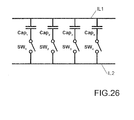
- the Integrated Circuit is in this particular case a digital capacitor bank comprising four MEMS switches (or MEMS relays) SW1, SW2, SW3, SW4 that are connected in parallel ( figure 26 ) by electrical interconnection lines IL1 and IL2 (signal lines).
- the interconnection line IL1 is embedding MEMS fixed capacitors Cap1, Cap2, Cap3, Cap4 of the invention for each switch SW1, SW2, SW3, SW4.
Landscapes
- Engineering & Computer Science (AREA)
- Power Engineering (AREA)
- Microelectronics & Electronic Packaging (AREA)
- Micromachines (AREA)
- Semiconductor Integrated Circuits (AREA)
- Mechanical Engineering (AREA)
- Computer Hardware Design (AREA)
Abstract
Description
- The present invention relates to a novel MEMS fixed capacitor with a gas-containing gap forming a dielectric layer, to an Integrated Circuit (IC) comprising at least one electric interconnection line embedding such a novel MEMS fixed capacitor, and to a process for manufacturing said MEMS fixed capacitor.
- Capacitors are well known in the art and are implemented by inserting a dielectric insulator material between two metal electrodes. The quality of the dielectric material has a very strong impact on the quality factor (Q) of the capacitor. It is usual to find discrete capacitor products suitable for microwave operations with high quality factors as high as 100 or more. Such high values require however the use of very high quality dielectric films, which requires special and well controlled manufacturing process.
- Micro-Elecro-Mechanical Systems (MEMS) capacitors are also well known and described for example in
PCT application WO 2006/063257 and inUS patent n° 6,437,965 . - In particular, a MEMS capacitor having a fixed capacitance value, and referred therein as "MEMS fixed capacitor" is disclosed in
PCT application WO 2006/063257 . Said MEMS fixed capacitor (see notably figure 8A) comprises three metallic electrodes: a top electrode (capacitive plate CP1), a bottom electrode (capacitive plate CP2), and an intermediate electrode (capacitive CP3) interposed between said top and bottom electrodes. The top electrode CP1 is electrically connected to the bottom electrode CP2. The bottom electrode CP2 is formed onto a dielectric layer (DE), which has been deposited onto a substrate (S). The intermediate electrode CP3 is formed above the bottom electrode CP2 with an air gap of small thickness (typically about 0.5µm) between the intermediate CP3 and bottom electrodes CP2. Said air gap forms a dielectric insulator layer and is obtained by etching a sacrificial layer that has been previously formed between the two electrodes CP2, CP3. The top electrode CP1 is formed onto a thick beam oxide layer BOL that is interposed between the top electrode CP1 and the intermediate electrode CP3. This thick beam oxide layer BOL has typically a thickness about 2µm, and gives to these electrodes CP1, CP3 the required mechanical strength. In this variant ofPCT application WO 2006/063257 , the thick beam oxide layer BOL is a structural layer that is necessary for maintaining the gap between the two capacitive plates CP2 and CP3. This thick beam oxide layer BOL however complicates the manufacturing process. Furthermore this thick beam oxide layer BOL can involve dielectric losses that reduce the quality factor of the capacitor, jeopardize the benefit of the air capacitor formed between the bottom electrode CP2 and the intermediate electrode CP3, and detrimentally limit the use of said MEMS fixed capacitor at high frequencies. - MEMS capacitor having a variable capacitance value are also known and disclosed for example in American patent
US 6,437,965 . The capacitor disclosed inUS 6,437,965 comprises a bottom capacitive electrode on a substrate and a movable bridge forming a top capacitive electrode suspended above the bottom capacitive electrode. Said bridge is deformable and movable between a lower position and an upper position under electric actuation forces, in order to provide high and low selectable capacitive values. Such a MEMS capacitor having a variable capacitance value involves a thick air gap between the bottom and top capacitive electrodes at rest, and an upper capacitive electrode of small thickness in order to be easily bendable under electric actuation forces. MEMS capacitors having a variable capacitance value have inherently the following drawbacks: - dielectric stiction,
- dielectric charging modifying the mechanical behavior of the MEMS,
- mechanical fatigue,
- self-actuation (or self-biasing) and self-maintaining (or latching),
- low Con/Coff ratio (typically between 3 to 10),
- low accuracy on the Con value due to the surface roughness,
- large contact area.
- An objective of the invention is to propose novel MEMS fixed capacitor, i.e. a MEMS capacitor having a fixed capacitance value, which can have a high capacitance density and a high quality factor.
- Another objective of the invention is to propose a novel MEMS fixed capacitor that can be manufactured with a MEMS process making use of sacrificial layer(s).
- This objective is achieved by the MEMS fixed capacitor of
claim 1, which comprises a bottom metal electrode formed onto a substrate, a top metal electrode supported by metal pillars above the bottom metal electrode, and a gas-containing gap forming a non-solid dielectric layer between said top and bottom metal electrodes, wherein the distance (D) between the top and bottom metal electrodes (i.e. the thickness of the gas-containing gap) is not more than 1µm and the thickness (E) of the top metal electrode is not less than 1µm. - When a strong potential difference exists between the top and bottom electrodes, there is a risk that the top electrode can bend under the large electrostatic force attraction, thereby detrimentally modifying the capacitance value of the MEMS capacitor. This phenomenon increases obviously when the surface of the electrodes is enlarged, and also when the distance between the top and bottom electrodes is decreased.
- The applicant has demonstrated that an increase of the distance between the top and bottom electrodes is detrimentally decreasing the capacitance density, but that a smaller distance between the top and bottom electrodes also detrimentally increases the deformability of the top electrode. In return, the applicant has demonstrated that the thickness of the top electrode does not substantially affect the capacitance density of the capacitor, and that a thicker top electrode is better for reducing the deformability of the top electrode. Within the scope of the invention, the use of a thicker top metal electrode (not less than 1µm) combined with a smaller distance between the top and bottom metal electrodes (i.e. not more than 1µm) enables to achieve a MEMS fixed capacitor which can advantageously have a high capacitance density, and whose top metal electrode is advantageously less easily deformable under electrostatic force attraction.
- Furthermore the use in the invention of a gas-containing gap between the top and bottom electrodes, instead of a solid dielectric layer, and the use of a thicker top metal electrode, enable to achieve more easily, and at lower manufacturing costs, a capacitor having a high quality factor within a broad frequency range, and typically for low-frequency applications to multi-gigahertz frequency applications.
- The deformability of the top electrode of the MEMS fixed capacitor of the invention can be defined by the following deformability parameter DEF:
- DEF = ΔC/(V2.C0), wherein:
- V is the value of a voltage applied between the top and bottom metal electrodes;
- C0 is the capacitance value of the MEMS fixed capacitor with no voltage applied between the top and bottom metal electrodes;
- ΔC is the variation of the capacitance value when a voltage V is applied between the top and bottom metal electrodes; ΔC = C1 - C0, C1, being the capacitance value of the MEMS fixed capacitor when a voltage V is applied between the top and bottom metal electrodes.
- In a preferred embodiment of the invention, the MEMS fixed capacitor is characterized by a deformability parameter DEF that is not more than 10-4 (i.e. ΔC/(V2.C0) ≤10-4 ) for a voltage V ranging at least up to 45V, and more preferably at least up to 100V.
- The invention also relates to an Integrated Circuit (IC) comprising at least one electric interconnection line embedding at least one MEMS fixed capacitor as defined above.
- The invention further relates to a novel process for manufacturing a MEMS fixed capacitor, comprising the following steps:
- (a) depositing a bottom metal layer onto a substrate;
- (b) patterning the bottom metal layer in such a way to create at least one bottom metal electrode in the bottom layer;
- (c) depositing a sacrificial layer onto the bottom layer and the substrate;
- (d) patterning the sacrificial layer in such a way to create wells through the whole thickness of the sacrificial layer;
- (e) filling the wells in the sacrificial layer with a metal in order to form supporting pillars;
- (f) depositing at least one top metal layer onto the sacrificial layer;
- (g) patterning the top metal layer(s) in order to form at least one top metal electrode;
- (h) etching the sacrificial layer in order to remove the whole sacrificial layer and create the air gap between the top metal electrode and the bottom metal electrode.
- In a first variant, aforesaid steps (e) and (f) are performed separately and successively. In another variant, aforesaid steps (e) and (f) are performed simultaneously by depositing the at least one top metal layer onto the sacrificial layer, in such a way to also fill the wells previously formed in the sacrificial layer.
- A final drying step (i) which is already known per se, can be also performed after the etching step (h), by blowing a drying gas, such as for example supercritical CO2, or by practicing a marangoni effect, or by alcohol sublimation.
- The characteristics and advantages of the invention will appear more clearly on reading the following detailed description which is made by way of non-exhaustive and non limiting examples, and with reference to the accompanying drawing on which:
-
Figure 1 is a top view of a MEMS fixed capacitor of the invention (1st variant); -
Figure 2 is a view in vertical cross section of the MEMS fixed capacitor offigure 1 in plane II-II; -
Figure 3 is a view in vertical cross section of the MEMS fixed capacitor offigure 1 in plane III-III; -
Figures 4 to 11 are views in vertical cross section showing the main different successive steps for manufacturing a MEMS fixed capacitor; -
Figure 12 is a top view of a 2nd variant of a MEMS fixed capacitor of the invention; -
Figure 13 is a view in vertical cross section of the MEMS fixed capacitor offigure 12 in plane XIII-XIII; -
Figure 14 is a view in vertical cross section of the MEMS fixed capacitor offigure 1 in plane XIV-XIV; -
Figure 15 is a view in vertical cross section of third variant of a MEMS fixed capacitor of the invention; -
Figure 16 is a view in vertical cross section of fourth variant of a MEMS fixed capacitor of the invention; -
Figure 17 is a view in vertical cross section of fifth variant of a MEMS fixed capacitor of the invention; -
Figure 18 is graph showing the capacitance density of a MEMS fixed capacitor as a function of the top electrode thickness; -
Figure 19 is graph showing the capacitance density of a MEMS fixed capacitor as a function of the distance between the top and bottom metal electrodes; -
Figure 20 is graph showing the capacitance density of a MEMS fixed capacitor as a function of the distance between supporting metal pillars; -
Figure 21 is a graph showing the deformability (DEF) of a MEMS fixed capacitor as a function of the top electrode thickness; -
Figure 22 is a graph showing the deformability (DEF) of a MEMS fixed capacitor as a function of the distance between the top and bottom metal electrodes; -
Figure 23 is a graph showing the deformability (DEF) of a MEMS fixed capacitor as a function of the distance between supporting metal pillars; -
Figure 24 is a top view of a digital capacitor bank comprising several MEMS fixed capacitors of the invention; -
Figure 25 is a view in vertical cross section of the digital capacitor bank offigure 24 in plane XXV-XXV; -
Figure 26 is the electrical equivalent schematic of the digital capacitor bank offigure 24 . - In reference to the variant of
figures 1 to 3 , the MEMS fixedcapacitor 1 is made of three metal layers L1, L2 and L3 deposited onto a substrate S, namely: a bottom layer L1 deposited directly onto the substrate S, an intermediate metal layer L2 deposited directly onto the bottom metal layer L2, and a top metal layer L3. The substrate S can be for example made of silicon, silicon-on-insulator, silicon-on-sapphire, gallium-arsenide, gallium-nitride, glass, fused-silica, fused-quartz, alumina or any other substrate material used for the manufacturing of semiconductor and microelectronics devices. - The MEMS fixed
capacitor 1 comprises atop metal electrode 2 of constant thickness E, formed in the top metal layer L3, and abottom metal electrode 3 formed in the bottom metal layer L1. Thetop electrode 2 is supported above thebottom electrode 3 only bymetal pillars 5 that are not in contact with thebottom metal electrode 3. In this particular variant, themetal pillars 5 are formed in the intermediate metal layer L2. - An
air gap 4 is provided between thetop electrode 2 andbottom electrode 3. In this particular variant, the distance D between thetop electrode 2 and bottom electrode 3 (i.e. thickness of the air gap 4) is constant over the whole surface of the electrodes. - In reference to
figures 2 and 3 ,interruptions 7 are made in the bottom metal layer L1 in order to isolate thebottom electrode 3 from themetal supporting pillars 5. - In reference to
figure 3 , thebottom electrode 3 is connected to a metallic connection 8 made of twoparts interruption 9 is provided in the top metal layer L3 in order to isolate thetop electrode 3 from this metallic connection 8. - The metallic layer L1, L2 and L3 can be made of any metal having high electric conductivity, like for example gold, aluminium, copper, or any electrically conductive alloy.
- In the variant of
figure 12 to 14 , the MEMS fixed capacitor comprises additional cylindrical pillars 5' for supporting thetop electrode 2. These additional pillars 5' are useful for top electrodes having a large surface. In the particular variant offigure 12 , the transverse cross section of the additional pillars 5' is circular. This transverse cross section of additional pillar 5' can be however of any other different shape, and notably can have any polygonal shape (rectangular, square, ...).In this variant, each pillar 5' forms an equilateral triangle with two next pillars 5'. In another variant, the pillars 5' could be positioned differently. - Simulations of the capacitance density (Capacitance_Density) and deformability (DEF) have been performed on different structures of MEMS fixed capacitor of the invention made of gold layers L1, L2, L3.
- The parameter DEF for characterizing the deformability of the
top electrode 2 has already been previously defined. The capacitance density (Capacitance_Density) is given by the following formula :
wherein : - C is the capacitance of the capacitor;
- Stot is the total surface of the capacitor, including notably the pillars.
- For sake of clarity, in reference to
figure 1 or tofigure 12 , the total surface of the capacitor Stot is given by the formula: Stot = a x b. - In particular, the results of the simulations performed on the structure of
figures 12 to 14 are shown onfigures 18 to 23 . -
Figures 18 and21 : the thickness E of thetop electrode 2 is varied from 1µm to 5µm; -
Figures 19 and22 : the thickness D of theair gap 4 betweentop electrode 2 andbottom electrode 3 is varied from 0.1µm to 0.4µm; -
Figures 20 and23 : the distance d between additional pillars 5' is varied from 25µm to 50µm. - For each set of parameter the capacitance density (
figures 18 to 20 ) and the deformability of the top electrode (figures 21 to 23 ) are calculated for a voltage V equal to 15V. - For the graphs of
figures 18 and21 , the distance D of theair gap 4 was set to 200nm, and the distance d betweenpillars 5 was set to 35µm; for the graphs offigures 19 and22 , the thickness of thetop electrode 2 was set to 2µm and the distance d betweenpillars 5 was set to 35µm; for the graphs offigures 20 and23 , the distance D of theair gap 4 was set to 200nm, and the thickness of thetop electrode 2 was set to 2µm. -
Figures 19 and22 show that an increase of the distance D between the top andbottom electrodes bottom electrodes figure 18 shows that the thickness E of thetop electrode 2 does not really affect the capacitance density of the capacitor, andfigure 21 shows that a thickertop electrode 2 is better for reducing the deformability of the top electrode. - Within the scope of the invention, in order to achieve a MEMS fixed capacitor having a
top electrode 2 that is advantageously substantially not deformable under electrostatic force attraction, the parameter DEF is preferably not more than 10-4 for voltage at least up to 45V, and even more preferably for voltage at least up to 100V. - More particularly, in order to achieve a MEMS fixed capacitor of high capacitance density and having a
top electrode 2 that is advantageously substantially not deformable under electrostatic force attraction, the thickness E of thetop electrode 2 is not less than 1µm, and is preferably not less than 1.5µm, and even more preferably not less than 2µm; the distance D between the top andbottom electrodes -
Figures 20 and23 show that that an increase of the distance d between the pillars 5' in the variant offigure 12 increases the capacitance density (figure 20 ) but in return also more strongly increases the deformability of the top electrode 2 (figure 23 ). Preferably, in the variant offigure 12 with additional pillars 5', the distance d betweenadditional pillars 5 will be set to a value between 25µm and 50µm. - In the invention, the use of a gas-containing
gap 4 between the top and bottom electrodes, instead of a solid dielectric layer, enables to achieve more easily, and at lower manufacturing costs, a capacitor having a high quality factor within a broad frequency range, and typically for low-frequency applications to multi-gigahertz frequency applications. In particular, with the invention it is for example possible to make fixed MEMS capacitor having a quality factor higher than 100, and even more higher than 1000, at very high frequencies, and typically at frequencies higher than 700MHz, and even more preferably at frequencies higher than 2GHz. - Within the scope of the invention, said gas-containing
gap 4 can be gap containing a dielectric gas. Although air is preferred as dielectric gas for ease of manufacture, the invention is however not limited to an air gap, andgap 4 can be filled with any other dielectric gas, including for example nitrogen, argon. In a variant, thegap 4 can also contain a gas, and notably air, under partial vacuum. - The MEMS fixed
capacitor 1 or 1' of the invention can be manufactured easily and at low cost by performing the successive manufacturing steps that are going now to be described in reference tofigures 4 to 11 . - A first layer (bottom layer) L1 of metal is deposited on a substrate S. The metal of layer L1 is for example gold and the substrate S is for example made of silicon.
- The layer L1 is patterned in such a way to create
interruptions 7 and at least onebottom electrode 3 in the bottom layer L1. - A sacrificial layer SL is deposited onto the bottom layer L1 and substrate S. This sacrificial layer SL can be for a monolayer, or can be a multilayer, and notably a bi-layer made of two superposed layers for example made of chrome ad silicon dioxide (SiO2) respectively. The sacrificial SL layer can also be made of metal such as for example copper, chrome,... The sacrificial SL layer can also be made of any photosensitive resin used in microelectronics, such as for example PMGI (Polydimethylglutarimide), AZ1518,...
- The sacrificial layer SL is patterned in such a way to create wells through the whole thickness of the sacrificial layer SL. Said wells will be used afterwards for the building of the pillars 5 (and also for the building of the additional pillars 5' in the variant of
figure 12 ). - A second metal deposition step (intermediate layer L2) is performed by electroplating, in order to fill the well W with a metal, like for example gold.
- A third metal layer (for example a gold layer) is deposited onto the sacrificial layer SL, in order to form the top metal layer L3 covering the top surface of the sacrificial layer SL.
- The top metal layer L3 is patterned in order to form the
interruption 9 and thetop metal electrode 2 - A final releasing step is performed by etching the sacrificial layer SL in order to remove the whole sacrificial layer SL and create notably the
air gap 4 between thetop electrodes 2 and thebottom electrode 3. - A final drying step, which is already well known per se, can be also performed after the etching step 8/8, by blowing a drying gas, such as for example supercritical CO2, or by practicing a marangoni effect, or by alcohol sublimation.
- In the variant of
figure 15 , the top electrode is made of two distinct metal layers L3a and L3b. The top layer L3b may cover all or part of the lower layer L3a, depending on the mechanical characteristics. - In the variant of
figure 16 , a bushing step has been performed in the top layer L3 in order to reduce the thickness D of the air gap between thetop electrode 2 and thebottom electrode 3. - In this variant, only two metal layers L1 and L3 are used and the
pillars 5 are processed and formed simultaneously with thetop electrode 2 and from the same metal layer L1. - Standard Integrated Circuit (IC) always comprises electric interconnection lines for connecting for example two electric functional circuits or elements, including for example capacitive or ohmic switches, inductances, ohmic resistances. Said interconnection lines can be for example a simple metal strip, a microstrip, a CoPlanar Waveguide (CPW), a stripline. Advantageously MEMS fixed
capacitors 1 or 1' of the invention can be easily embedded in the electric interconnection lines of a standard Integrated Circuit (IC) without increasing the IC's area. This smart use of the interconnection lines of an IC for a monolithic integration of MEMS fixed capacitors in the IC can be useful for example for making capacitor banks embedded in a standard IC or for adding capacitive functionalities to an IC. -
Figures 24 and 25 show an example of an integrated circuit (IC) embedding several MEMS fixed capacitors of the invention in the interconnection lines of the integrated circuit (IC). Onfigures 24 and 25 , references G are identifying the ground of the IC. - In reference to
figure 24 , the Integrated Circuit (IC) is in this particular case a digital capacitor bank comprising four MEMS switches (or MEMS relays) SW1, SW2, SW3, SW4 that are connected in parallel (figure 26 ) by electrical interconnection lines IL1 and IL2 (signal lines). In this example, the interconnection line IL1 is embedding MEMS fixed capacitors Cap1, Cap2, Cap3, Cap4 of the invention for each switch SW1, SW2, SW3, SW4.
Claims (19)
- A MEMS fixed capacitor (1 ; 1') comprising a bottom metal electrode (3) formed onto a substrate (S), a top metal electrode (2) supported by metal pillars (5 ; 5') above the bottom metal electrode, and a gas-containing gap (4) forming a non-solid dielectric layer between said top (2) and bottom (3) metal electrodes, wherein the distance (D) between the top (2) and bottom (3) metal electrodes is not more than 1µm and the thickness (E) of the top metal electrode (2) is not less than 1µm.
- The MEMS fixed capacitor of claim 1, wherein the thickness (E) of the top metal electrode (2) is not less than 1.5µm.
- The MEMS fixed capacitor of claim 1, wherein the thickness (E) of the top metal electrode (2) is not less than 2µm.
- The MEMS fixed capacitor of any one of claims 1 to 3, wherein the distance (D) between the top (2) and bottom (3) metal electrodes is not more than 0.4µm.
- The MEMS fixed capacitor of any one of claims 1 to 4, wherein the distance (D) between the top (2) and bottom (3) metal electrodes is not less than 0.15µm.
- The MEMS fixed capacitor of any one of claims 1 to 5, characterized by a deformability parameter DEF of not more than 10-4 for a voltage V at least up to 45V, and more preferably at least up to 100V, the deformability parameter DEF being defined by the following equation:

wherein:- V is the value of a voltage applied between the top and bottom metal electrodes;- C0 is the capacitance value of the MEMS fixed capacitor with no voltage applied between the top (2) and bottom (3) metal electrodes;- ΔC is the variation of the capacitance value when a voltage V is applied between the top (2) and bottom (3) metal electrodes. - The MEMS fixed capacitor of any one of claims 1 to 6, wherein the top (2) and bottom (3) metal electrodes are made of the same metal.
- The MEMS fixed capacitor of any one of claims 1 to 6, wherein the top (2) and bottom (3) metal electrodes are made of different metals.
- The MEMS fixed capacitor of any one of claims 1 to 8, wherein the top electrode (2) is in gold.
- The MEMS fixed capacitor of any one of claims 1 to 9, wherein said gas-containing gap (4) is a gap containing a dielectric gas.
- The MEMS fixed capacitor of any one of claims 1 to 9, wherein said gas-containing gap (4) is a gap containing air.
- The MEMS fixed capacitor of any one of claims 1 to 9, wherein said gas-containing gap (4) is a gap containing a gas under partial vacuum.
- An Integrated Circuit (IC) comprising at least one electric interconnection line (IL1) embedding at least one MEMS fixed capacitor of any one of the previous claims.
- A process of manufacturing a MEMS fixed capacitor, and in particular a MEMS fixed capacitor (1 ; 1') of any one of claims 1 to 12, said process comprising the following steps:(a) depositing a bottom metal layer (L1) onto a substrate (S);(b) patterning the bottom metal layer (L1) in such a way to create at least one bottom metal electrode (3) in the bottom layer (L1);(c) depositing a sacrificial layer (SL) onto the bottom layer (L1) and the substrate (S);(d) patterning the sacrificial layer (SL) in such a way to create wells (W) through the whole thickness of the sacrificial layer (SL);(e) filling the wells (W) in the sacrificial layer (SL) with a metal in order to form supporting pillars (5 ; 5');(f) depositing at least one top metal layer (L3/ L3a, L3b) onto the sacrificial layer (SL);(g) patterning the top metal layer(s) (L3/ L3a, L3b) in order to form at least one top metal electrode (2);(h) etching the sacrificial layer (SL) in order to remove the whole sacrificial layer (SL) and create the air gap (4) between the top metal electrode (2) and the bottom metal electrode (3).
- The process of claim 14, wherein steps (e) and (f) are performed separately and successively.
- The process of claim 14, wherein steps (e) and (f) are performed simultaneously by depositing the at least one top metal layer (L3/ L3a, L3b) onto the sacrificial layer (SL), in such a way to also fill the wells (W) previously formed in the sacrificial layer (SL).
- The process of any one of claims 14 to 16, wherein the thickness (E) of the top electrode (2) is not less than 1.5µm, and preferably is not less than 2µm.
- The process of any one of claims 14 to 17, wherein the distance (D) between the top (2) and bottom (3) electrodes is not more than 0.4µm.
- The process of any one of claims 14 to 18, wherein the distance (D) between the top (2) and bottom (3) electrodes is not less than 0.15µm.
Priority Applications (7)
| Application Number | Priority Date | Filing Date | Title |
|---|---|---|---|
| EP12306326.5A EP2725595A1 (en) | 2012-10-25 | 2012-10-25 | MEMS fixed capacitor comprising a gas-containing gap and process for manufacturing said capacitor |
| CN201380056250.0A CN104756212A (en) | 2012-10-25 | 2013-10-24 | Mems fixed capacitor comprising a gas-containing gap and process for manufacturing said capacitor |
| KR1020157005199A KR20150073946A (en) | 2012-10-25 | 2013-10-24 | Mems fixed capacitor comprising a gas-containing gap and process for manufacturing said capacitor |
| TW102138420A TW201426829A (en) | 2012-10-25 | 2013-10-24 | a MEMS fixed capacitor including a gap containing a gas and a process for manufacturing the capacitor |
| PCT/EP2013/072252 WO2014064185A1 (en) | 2012-10-25 | 2013-10-24 | Mems fixed capacitor comprising a gas-containing gap and process for manufacturing said capacitor |
| JP2015538439A JP2015535393A (en) | 2012-10-25 | 2013-10-24 | MEMS fixed capacitor with gas-containing gap and method for manufacturing said capacitor |
| US14/436,274 US20150243729A1 (en) | 2012-10-25 | 2013-10-24 | Mems fixed capacitor comprising a gas-containing gap and process for manufacturing said capacitor |
Applications Claiming Priority (1)
| Application Number | Priority Date | Filing Date | Title |
|---|---|---|---|
| EP12306326.5A EP2725595A1 (en) | 2012-10-25 | 2012-10-25 | MEMS fixed capacitor comprising a gas-containing gap and process for manufacturing said capacitor |
Publications (1)
| Publication Number | Publication Date |
|---|---|
| EP2725595A1 true EP2725595A1 (en) | 2014-04-30 |
Family
ID=47088772
Family Applications (1)
| Application Number | Title | Priority Date | Filing Date |
|---|---|---|---|
| EP12306326.5A Pending EP2725595A1 (en) | 2012-10-25 | 2012-10-25 | MEMS fixed capacitor comprising a gas-containing gap and process for manufacturing said capacitor |
Country Status (7)
| Country | Link |
|---|---|
| US (1) | US20150243729A1 (en) |
| EP (1) | EP2725595A1 (en) |
| JP (1) | JP2015535393A (en) |
| KR (1) | KR20150073946A (en) |
| CN (1) | CN104756212A (en) |
| TW (1) | TW201426829A (en) |
| WO (1) | WO2014064185A1 (en) |
Cited By (1)
| Publication number | Priority date | Publication date | Assignee | Title |
|---|---|---|---|---|
| TWI654793B (en) | 2015-08-28 | 2019-03-21 | 美商通用電機股份有限公司 | Radio frequency micro electro mechanical system with inverted microstrip transmission line and manufacturing method thereof |
Families Citing this family (2)
| Publication number | Priority date | Publication date | Assignee | Title |
|---|---|---|---|---|
| DE102015111425B4 (en) * | 2014-07-18 | 2016-06-30 | Klaus Kürschner | Method and device for electrical force measurement by means of insulating thin film |
| DE102018101389A1 (en) * | 2018-01-23 | 2019-07-25 | Osram Opto Semiconductors Gmbh | RADIATION-EMITTING SEMICONDUCTOR CHIP AND METHOD FOR PRODUCING A RADIATION-EMITTING SEMICONDUCTOR CHIP |
Citations (7)
| Publication number | Priority date | Publication date | Assignee | Title |
|---|---|---|---|---|
| US6437965B1 (en) | 2000-11-28 | 2002-08-20 | Harris Corporation | Electronic device including multiple capacitance value MEMS capacitor and associated methods |
| US20050248423A1 (en) * | 2004-03-12 | 2005-11-10 | The Regents Of The University Of California | High isolation tunable MEMS capacitive switch |
| WO2006063257A2 (en) | 2004-12-09 | 2006-06-15 | Wispry, Inc. | Micro-electro-mechanical system (mems) capacitors, inductors, and related systems and methods |
| US20070278075A1 (en) * | 2004-07-29 | 2007-12-06 | Akihisa Terano | Capacitance Type Mems Device, Manufacturing Method Thereof, And High Frequency Device |
| WO2009057988A2 (en) * | 2007-10-31 | 2009-05-07 | Mimos Berhad | Radio frequency mems switch |
| US20090207549A1 (en) * | 2008-02-20 | 2009-08-20 | Fujitsu Limited | Variable capacitor, matching circuit element, and mobile terminal apparatus |
| US20110128083A1 (en) * | 2009-11-27 | 2011-06-02 | Stmicroelectronics S.R.L. | Microelectromechanical resonant structure having improved electrical characteristics |
Family Cites Families (1)
| Publication number | Priority date | Publication date | Assignee | Title |
|---|---|---|---|---|
| US7657242B2 (en) * | 2004-09-27 | 2010-02-02 | Qualcomm Mems Technologies, Inc. | Selectable capacitance circuit |
-
2012
- 2012-10-25 EP EP12306326.5A patent/EP2725595A1/en active Pending
-
2013
- 2013-10-24 KR KR1020157005199A patent/KR20150073946A/en not_active Withdrawn
- 2013-10-24 WO PCT/EP2013/072252 patent/WO2014064185A1/en not_active Ceased
- 2013-10-24 CN CN201380056250.0A patent/CN104756212A/en active Pending
- 2013-10-24 TW TW102138420A patent/TW201426829A/en unknown
- 2013-10-24 US US14/436,274 patent/US20150243729A1/en not_active Abandoned
- 2013-10-24 JP JP2015538439A patent/JP2015535393A/en active Pending
Patent Citations (7)
| Publication number | Priority date | Publication date | Assignee | Title |
|---|---|---|---|---|
| US6437965B1 (en) | 2000-11-28 | 2002-08-20 | Harris Corporation | Electronic device including multiple capacitance value MEMS capacitor and associated methods |
| US20050248423A1 (en) * | 2004-03-12 | 2005-11-10 | The Regents Of The University Of California | High isolation tunable MEMS capacitive switch |
| US20070278075A1 (en) * | 2004-07-29 | 2007-12-06 | Akihisa Terano | Capacitance Type Mems Device, Manufacturing Method Thereof, And High Frequency Device |
| WO2006063257A2 (en) | 2004-12-09 | 2006-06-15 | Wispry, Inc. | Micro-electro-mechanical system (mems) capacitors, inductors, and related systems and methods |
| WO2009057988A2 (en) * | 2007-10-31 | 2009-05-07 | Mimos Berhad | Radio frequency mems switch |
| US20090207549A1 (en) * | 2008-02-20 | 2009-08-20 | Fujitsu Limited | Variable capacitor, matching circuit element, and mobile terminal apparatus |
| US20110128083A1 (en) * | 2009-11-27 | 2011-06-02 | Stmicroelectronics S.R.L. | Microelectromechanical resonant structure having improved electrical characteristics |
Cited By (1)
| Publication number | Priority date | Publication date | Assignee | Title |
|---|---|---|---|---|
| TWI654793B (en) | 2015-08-28 | 2019-03-21 | 美商通用電機股份有限公司 | Radio frequency micro electro mechanical system with inverted microstrip transmission line and manufacturing method thereof |
Also Published As
| Publication number | Publication date |
|---|---|
| US20150243729A1 (en) | 2015-08-27 |
| JP2015535393A (en) | 2015-12-10 |
| WO2014064185A1 (en) | 2014-05-01 |
| TW201426829A (en) | 2014-07-01 |
| CN104756212A (en) | 2015-07-01 |
| KR20150073946A (en) | 2015-07-01 |
Similar Documents
| Publication | Publication Date | Title |
|---|---|---|
| KR101268208B1 (en) | Systems and methods for providing high-capacitance rf mems switches | |
| DE112011102124T9 (en) | Microelectromechanical system | |
| US8503157B2 (en) | MEMS device | |
| US8022599B2 (en) | Actuator | |
| US7141989B1 (en) | Methods and apparatus for a MEMS varactor | |
| US7489004B2 (en) | Micro-electro-mechanical variable capacitor for radio frequency applications with reduced influence of a surface roughness | |
| WO2001061848A1 (en) | A micromechanical tunable capacitor and an integrated tunable resonator | |
| EP3723148A1 (en) | Three-dimensional capacitive structures and their manufacturing methods | |
| US7297571B2 (en) | Electrostatically actuated low response time power commutation micro-switches | |
| EP3796351B1 (en) | Low defect high capacitance thin solid electrolyte capacitor and method of fabrication thereof | |
| US20150243729A1 (en) | Mems fixed capacitor comprising a gas-containing gap and process for manufacturing said capacitor | |
| HK1194198A (en) | Mems fixed capacitor comprising a gas-containing gap and process for manufacturing said capacitor | |
| CN102422373B (en) | RF mems switch with a grating as middle electrode | |
| CN100521030C (en) | Micro-electromechanical device and module and driving method thereof | |
| WO2009057988A2 (en) | Radio frequency mems switch | |
| McFeetors et al. | Performance and operation of stressed dual-gap RF MEMS varactors | |
| Choi et al. | Increasing Capacitance and Self-Resonant Frequency of the MEMS Switched Capacitor Using High-$\kappa $ TiO 2 and SU-8 Bridged Beam Structure | |
| US6421224B1 (en) | Micro-structure capacitor | |
| US8059385B2 (en) | Substrates with slotted metals and related methods | |
| Pu et al. | Stable zipping RF MEMS varactors | |
| US7218191B2 (en) | Micro-electro mechanical switch designs | |
| Ramli et al. | Design and modelling of a digital MEMS varactor for wireless applications | |
| CN121399711A (en) | MEMS bridge | |
| CN120221282A (en) | Multilayer electronic components | |
| Bakri-Kassem et al. | A parallel-plate MEMS variable capacitor with vertical thin-film comb actuators |
Legal Events
| Date | Code | Title | Description |
|---|---|---|---|
| PUAI | Public reference made under article 153(3) epc to a published international application that has entered the european phase |
Free format text: ORIGINAL CODE: 0009012 |
|
| 17P | Request for examination filed |
Effective date: 20121025 |
|
| AK | Designated contracting states |
Kind code of ref document: A1 Designated state(s): AL AT BE BG CH CY CZ DE DK EE ES FI FR GB GR HR HU IE IS IT LI LT LU LV MC MK MT NL NO PL PT RO RS SE SI SK SM TR |
|
| AX | Request for extension of the european patent |
Extension state: BA ME |
|
| REG | Reference to a national code |
Ref country code: HK Ref legal event code: DE Ref document number: 1194198 Country of ref document: HK |
|
| 17P | Request for examination filed |
Effective date: 20141014 |
|
| RBV | Designated contracting states (corrected) |
Designated state(s): AL AT BE BG CH CY CZ DE DK EE ES FI FR GB GR HR HU IE IS IT LI LT LU LV MC MK MT NL NO PL PT RO RS SE SI SK SM TR |
|
| 17Q | First examination report despatched |
Effective date: 20150209 |
|
| GRAP | Despatch of communication of intention to grant a patent |
Free format text: ORIGINAL CODE: EPIDOSNIGR1 |
|
| INTG | Intention to grant announced |
Effective date: 20151008 |
|
| 19U | Interruption of proceedings before grant |
Effective date: 20160203 |
|
| REG | Reference to a national code |
Ref country code: HK Ref legal event code: WD Ref document number: 1194198 Country of ref document: HK |
|
| 19W | Proceedings resumed before grant after interruption of proceedings |
Effective date: 20211001 |
|
| PUAJ | Public notification under rule 129 epc |
Free format text: ORIGINAL CODE: 0009425 |
|
| 32PN | Public notification |
Free format text: COMMUNICATION PURSUANT TO RULE 142 EPC (RESUMPTION OF PROCEEDINGS UNDER RULE 142(2) EPC DATED 16.04.2021) |
|
| STAA | Information on the status of an ep patent application or granted ep patent |
Free format text: STATUS: GRANT OF PATENT IS INTENDED |
|
| STAA | Information on the status of an ep patent application or granted ep patent |
Free format text: STATUS: THE APPLICATION IS DEEMED TO BE WITHDRAWN |
|
| PUAJ | Public notification under rule 129 epc |
Free format text: ORIGINAL CODE: 0009425 |
|
| STAA | Information on the status of an ep patent application or granted ep patent |
Free format text: STATUS: GRANT OF PATENT IS INTENDED |
|
| 18D | Application deemed to be withdrawn |
Effective date: 20220201 |
|
| 32PN | Public notification |
Free format text: NOTING OF LOSS OF RIGHTS PURSUANT TO RULE 112(1) EPC (EPO FORM 2015C DATED 22.04.2024) |
|
| D18D | Application deemed to be withdrawn (deleted) | ||
| STAA | Information on the status of an ep patent application or granted ep patent |
Free format text: STATUS: THE APPLICATION IS DEEMED TO BE WITHDRAWN |
|
| R18D | Application deemed to be withdrawn (corrected) |
Effective date: 20220201 |