EP2725540A1 - Techniques to maximize retail traffic - Google Patents
Techniques to maximize retail traffic Download PDFInfo
- Publication number
- EP2725540A1 EP2725540A1 EP13180750.5A EP13180750A EP2725540A1 EP 2725540 A1 EP2725540 A1 EP 2725540A1 EP 13180750 A EP13180750 A EP 13180750A EP 2725540 A1 EP2725540 A1 EP 2725540A1
- Authority
- EP
- European Patent Office
- Prior art keywords
- promotion
- dynamically
- retailer
- server
- traffic
- Prior art date
- Legal status (The legal status is an assumption and is not a legal conclusion. Google has not performed a legal analysis and makes no representation as to the accuracy of the status listed.)
- Withdrawn
Links
Images

Classifications
-
- G—PHYSICS
- G06—COMPUTING OR CALCULATING; COUNTING
- G06Q—INFORMATION AND COMMUNICATION TECHNOLOGY [ICT] SPECIALLY ADAPTED FOR ADMINISTRATIVE, COMMERCIAL, FINANCIAL, MANAGERIAL OR SUPERVISORY PURPOSES; SYSTEMS OR METHODS SPECIALLY ADAPTED FOR ADMINISTRATIVE, COMMERCIAL, FINANCIAL, MANAGERIAL OR SUPERVISORY PURPOSES, NOT OTHERWISE PROVIDED FOR
- G06Q30/00—Commerce
- G06Q30/02—Marketing; Price estimation or determination; Fundraising
- G06Q30/0207—Discounts or incentives, e.g. coupons or rebates
- G06Q30/0238—Discounts or incentives, e.g. coupons or rebates at point-of-sale [POS]
Definitions
- the kiosks come in a variety of sizes and are used for a variety of purposes. Some kiosks are drive through, such as fast food establishments, pharmacies, banks, and the like. Other kiosks are stationary located in gas stations, airlines, grocery stores, department stores, and the like.
- Enterprises are also seeking to reach consumers on their devices in a variety of manners, such as through promotions offered electronically on consumer phones.
- One popular service providing these promotions on behalf of enterprises is Groupon (trade mark).
- Groupon also causes a variety of issues with enterprises because the deals offered can overwhelm an enterprise and the enterprise has little control over the deals, such as number accepted, time issued, and fees paid to Groupon.
- Groupon has proved to be a good third-party service for an enterprise to reach consumers with deals, the lack of control of those deals and the excessive control exerted by Groupon has proved problematic for many enterprises.
- techniques for maximizing retail traffic are presented. According to an embodiment, a method for maximizing retail traffic is provided.
- a promotion is defined for increasing traffic at a retailer. Dynamically causing the promotion to be dynamically pushed to specific consumers deemed most likely to use the promotion. Finally, a progress for the promotion is managed as well as its effect on increasing the traffic.
- a processor-implemented method programmed in a non-transitory processor-readable medium and to execute on one or more processors of a machine configured to execute the method, comprising: defining, at the machine, a promotion to increase traffic at a retailer; dynamically, at the machine, causing the promotion to be dynamically pushed to specific consumers deemed most likely to use the promotion; and managing, at the machine, a progress for the promotion and its effect on increasing the traffic.
- Defining optionally further includes interactively receiving the promotion from a retail manager via an interface.
- Defining optionally further includes dynamically receiving the promotion from an automated service that is initiated based on a detected present traffic at the retailer.
- Defining optionally further includes identifying criteria with the promotion for selecting the specific consumers.
- Identifying optionally further includes recognizing at least one criterion for selecting the specific consumers as a geographic proximity of registered mobile devices with respect to a geographical location of the retailer.
- Defining optionally further includes identifying conditions with the promotion for dynamically terminating the promotion when a present traffic within the retailer is deemed sufficient for a defined success of the promotion.
- Dynamically causing optionally further includes sending the promotion to a third-party promotion service for delivery to the specific consumers.
- Dynamically causing optionally further includes directly sending the promotion to the specific consumers.
- Dynamically causing optionally further includes delivering the promotion as text messages to mobile devices registered to the specific consumers.
- Dynamically causing optionally further includes delivering the promotion as data to apps processing on mobile devices registered to the specific consumers.
- Managing optionally further includes defining the progress as a table occupancy rate for tables within the retailer.
- Managing optionally further includes dynamically terminating or modifying the promotion based on the progress.
- a processor-implemented method programmed in a non-transitory processor-readable medium and to execute on one or more processors of a mobile device configured to execute the method, comprising: receiving, at the mobile device, a real time promotion defined by a server retail traffic manager and custom defined by a retailer to dynamically increase traffic at the retailer; and redeeming, from the machine, the real time promotion at the retailer associated with the promotion.
- Receiving optionally further includes receiving the real time promotion as a text message.
- Receiving optionally further includes receiving the real time promotion as interactive data on the mobile device.
- Receiving optionally further includes receiving the real time promotion based on a present geographical location of the mobile device relative to a geographical location of the retailer.
- Redeeming optionally further includes pre-ordering and pre-paying for the real time promotion.
- Redeeming optionally further includes scanning a Quick Response (QR) tag or barcode when entering the retailer to automatically redeem the real time promotion.
- QR Quick Response
- a system comprising: a server having memory configured with a server retail traffic manager that executes on the server; and a distributing device configured to distribute a mobile app to a mobile device of a consumer, the mobile device having memory configured with the mobile app that executes on the mobile device; wherein the server retail traffic manager is configured to custom define a promotion for a retailer to increase traffic for the retailer and configured to cause the promotion to be dynamically delivered to consumer via the mobile device, the mobile app configured to dynamically redeem the promotion at the retailer.
- the server retail manager is optionally configured to dynamically communicate the promotion to each Point-Of-Sale (POS) device or terminal within the retailer.
- POS Point-Of-Sale
- FIG. 1 is a diagram of a method for maximizing retail traffic, according to an example embodiment
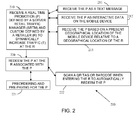
- FIG. 2 is a diagram of another method for maximizing retail traffic, according to an example embodiment.
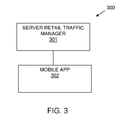
- FIG. 3 is a diagram of a retail traffic control system, according to an example embodiment.
- FIG. 1 is a diagram of a method 100 for maximizing retail traffic, according to an example embodiment.
- the method 100 (hereinafter “server retail traffic manager") is implemented as instructions programmed and residing on a non-transitory computer-readable (processor-readable) storage medium and executed by one or more processors, server, web-based Internet portal, cloud, virtual machine (VM), etc.) over a network connection.
- the processors are specifically configured and programmed to process the server retail traffic manager.
- the server retail traffic manager also operates over a network.
- the network is wired, wireless, or a combination of wired and wireless.
- the server retail traffic manager executes as a retail server service, which is accessible over a network, such as the Internet.
- the server retail traffic manager is a third-party cloud-based service that a retail establishment subscribes to and is accessible to other services of the retail establishment via a cloud processing environment.
- the manager also wants to stop the promotion once the establishment is full. So, the problem that the manager of the retailer wants to solve is how to get the promotion out to people most likely to take it up (redeem the promotion).
- a manager uses an interface to create a custom-defined promotion.
- the promotion is then dynamically sent to a third-party promotion distributor, such as Groupon, which uses location data to send the promotion to its users.
- a third-party promotion distributor such as Groupon
- the retailer can send out the promotion to all users of the retailer's goods or services; here, a mobile app runs on Android (trade mark) and Apple (trade mark) smart phones and other devices to receive the promotion.
- the third-party service can receive a monthly subscription fee from the restaurants using the techniques provided herein.
- Groupon is but one example of a third-party distribution company and others are possible as well including new third-party distributing services.
- the promotion is automatically added to all terminals at the establishment (retailer) associated with the manager.
- the manager can configure the technique to automatically send out a promotion when floor traffic falls below a certain "trigger level.” This may be ascertained by activity levels at a Point of Sale (POS) terminal in the retail establishment falling below a defined level for a defined period of time.
- POS Point of Sale
- the techniques can also be used to vet recipient (consumer) suitability for deals using criteria beyond just their current location; for example, whether the recipient has opted in to receive promotions, preferences of the consumer, previous promotions that the consumer has used, and the like.
- the server retail traffic manager runs on a POS terminal or on a server (or cloud) with POS terminals having access to the server retail traffic manager.
- the server retail traffic manager allows the manager to create and manage the promotion. This automatically adds the promotion to the restaurant front-of-house interfaces and a server controller piece of the server retail traffic manager receives deals from food service establishments and dynamically sends those deals (custom promotions) to daily deal sites. Each food service establishment can also be authenticated and its subscription with the server controller validated.
- the deals are presented on consumers' smart phones/tablets having mobile apps (described below with reference to the FIG. 2 ). These mobile apps obtain location data and provide to the controller where deals are then sent to the consumers who meet deal criteria, including location data limitations.
- server retail traffic manager is now discussed with reference to the FIG. 1 .
- the server retail traffic manager defines a promotion to increase traffic at a retailer.
- a "promotion” is a multifaceted data structure that can include a variety of information beyond just a specific deal. Some of this information is described herein and below.
- traffic refers to revenue or a retailer or a metric that is used to gauge what revenue is likely to be, such as table occupancy at a restaurant.
- the server retail traffic manager interactively receives the promotion from a retail manager via an interface.
- the interface can guide the manager in defining the promotion and any other limitations (as discussed below, the limitations may relate to enforcement, delivery, and management of the promotion).
- the server retail traffic manager dynamically receives the promotion from an automated service that is initiated based on a detected present traffic at the retailer.
- dynamic custom policy enforcement can be done to detect events that trigger the automated service into action to define the promotion and send the custom-defined promotion to the server retail traffic manager.
- the server retail traffic manager identifies criteria with the promotion for selecting specific consumers.
- the server retail traffic manager recognizes at least one criterion for selecting the specific consumers as a geographic proximity of registered mobile devices with respect to a geographical location of the retailer. So, one criterion is location based and a distance range is compared with respect to the physical location of the retailer.
- the server retail traffic manager identifies conditions with the promotion for dynamically terminating the promotion when a present traffic within the retailer is deemed sufficient (such as based on policy or threshold comparison) for a defined success of the promotion.
- the server retail traffic manager dynamically causes the promotion to be dynamically pushed to specific consumers deemed most likely to use the promotion.
- the server retail traffic manager sends the promotion to a third-party promotion service for delivery to the specific consumers.
- the server retail traffic manager directly sends the promotion to the specific consumers.
- the server retail traffic manager delivers the promotion as text messages to mobile devices registered to the specific consumers.
- the server retail traffic manager delivers the promotion as data to apps processing on mobile device registered to the specific consumers.
- the server retail traffic manager manages a progress for the promotion and its effect on increasing the traffic.
- the server retail traffic manager defines the progress as a table occupancy rate for tables within the retailer.
- the server retail traffic manager dynamically terminates or modifies the promotion based on the progress of the promotion. So, if full occupancy is approaching, the promotion can be scaled back to reduce traffic or if full occupancy has occurred the promotion can be terminated entirely.
- server retail traffic manager can be a powerful retail tool to proactively manage and control retail traffic in real time.
- FIG. 2 is a diagram of another method 200 for maximizing retail traffic, according to an example embodiment.
- the method 200 (hereinafter “mobile device agent”) is implemented as instructions and programmed within a non-transitory computer-readable (processor-readable) storage medium that executes on one or more processors of a portable and mobile device; the processors of the device are specifically configured to execute the mobile device agent.
- the mobile device agent is also operational over a network; the network is wireless.
- the processing of the mobile device agent reflects processing associated with a consumer's mobile device (such as tablet or smart phone) that receives an offer or promotion generated by the server retail traffic manager of FIG. 1 .
- the promotion may be generated by the server retail traffic manager but may be received by the mobile device agent from a third-party service, such as Groupon, Aloha Deals (trade mark), and others. Although, in some cases the promotion can be received by the mobile device agent directly from the server retail manager.
- the mobile device agent receives a real time promotion defined by a server retail traffic manager (such as the one discussed above with reference to FIG. 1 ) and custom defined by a retailer to dynamically increase traffic at that retailer.
- a server retail traffic manager such as the one discussed above with reference to FIG. 1
- custom defined by a retailer to dynamically increase traffic at that retailer.
- the mobile device agent receives the real time promotion as a text message.
- the mobile device agent receives the real time promotion as interactive data on the mobile device. This can be received within an email received by the mobile device or within the mobile device agent that processes as an app on the mobile device.
- the mobile device agent receives the real time promotion based on a present geographical location of the mobile device relative to a geographic location of the retailer.
- the mobile device agent redeems the real time promotion at a retailer with the promotion.
- the mobile device agent pre-orders and pre-pays for the real time promotion. This can be achieved via an interface on the mobile device that the consumer uses. This also ensures that the retailer can be assured the promotion is taken.
- the mobile device agent includes scanning a Quick Response (QR) (trade mark) tag or barcode when entering the retailer to automatically redeem the real time promotion.
- QR Quick Response
- FIG. 3 is a diagram of a retail traffic control system 300, according to an example embodiment.
- the components of the retail traffic control system 300 are implemented as executable instructions and programmed within a non-transitory computer-readable (processor-readable) storage medium that execute on one or more processors of a network-based server (cloud, proxy, Virtual Machine (VM), etc.) or a mobile device (smart phone, tablet, etc.); the processors are specifically configured to execute the components of the retail traffic control system 300.
- the retail traffic control system 300 is also operational over a network; the network is wired, wireless, or a combination of wired and wireless.
- the retail traffic control system 300 includes a server retail traffic manager 301 and a mobile device app 302. Each of these components and the interactions of each component are now discussed in turn.
- the retail traffic control system 300 includes one or more processors configured with the server retail traffic manager 301, which resides and is implemented in memory or non-transitory computer-readable storage media; the server retail traffic manager 301 executes on the one or more processors.
- Example processing associated with the server retail traffic manager 301 was presented in detail above with reference to the method 100 of FIG. 1 .
- the server retail traffic manager 301 is configured to custom define a promotion for a retailer to increase traffic for the retailer and configured to cause the promotion to be dynamically delivered to consumer via the mobile device.
- the server retail manager 301 is configured to dynamically communicate the promotion to each Point-Of-Sale (POS) device or terminal within the retailer. So, all employees are fully aware of the promotion and its details. Moreover, if the server retail manager 301 determines that the promotion is to be dynamically modified or terminated all such real time communication is provided to each of the POS devices or terminals within the retailer.
- POS Point-Of-Sale
- the retail traffic control system 300 also includes an app distributing device, which is configured to distribute a mobile app 302 to a mobile device of a consumer; the mobile app 302 once distributed resides and is implemented in memory or non-transitory computer-readable storage media of the mobile device; mobile app 302 executes on the one or more processors of the mobile device.
- Example processing associated with the mobile app 302 was presented in detail above with reference to the method 200 of FIG. 2 .
- the mobile app 302 is configured on the mobile device to dynamically redeem the promotion at the retailer.
- the mobile device is one of: a phone, a laptop, and a tablet.
Landscapes
- Business, Economics & Management (AREA)
- Strategic Management (AREA)
- Engineering & Computer Science (AREA)
- Accounting & Taxation (AREA)
- Development Economics (AREA)
- Finance (AREA)
- Economics (AREA)
- Game Theory and Decision Science (AREA)
- Entrepreneurship & Innovation (AREA)
- Marketing (AREA)
- Physics & Mathematics (AREA)
- General Business, Economics & Management (AREA)
- General Physics & Mathematics (AREA)
- Theoretical Computer Science (AREA)
- Cash Registers Or Receiving Machines (AREA)
- Management, Administration, Business Operations System, And Electronic Commerce (AREA)
Abstract
Description
- Consumers are increasingly using kiosks to conduct business with enterprises. The kiosks come in a variety of sizes and are used for a variety of purposes. Some kiosks are drive through, such as fast food establishments, pharmacies, banks, and the like. Other kiosks are stationary located in gas stations, airlines, grocery stores, department stores, and the like.
- In addition, what is considered a kiosk is evolving with today's technology. For example, digital signs now provide advertisements and mechanisms for users to interact with the displays to perform transactions. Such mechanisms include blue tooth communication, Near Field Communication (NFC), Quick Response (QR) code scanning, Wi-Fi communication, and the like. In fact, even a consumer's mobile device can be used as a kiosk these days.
- Enterprises are also seeking to reach consumers on their devices in a variety of manners, such as through promotions offered electronically on consumer phones. One popular service providing these promotions on behalf of enterprises is Groupon (trade mark). However, Groupon also causes a variety of issues with enterprises because the deals offered can overwhelm an enterprise and the enterprise has little control over the deals, such as number accepted, time issued, and fees paid to Groupon. As a result, although Groupon has proved to be a good third-party service for an enterprise to reach consumers with deals, the lack of control of those deals and the excessive control exerted by Groupon has proved problematic for many enterprises.
- Moreover, the decision to offer a promotion may need to be in real time, which is not really available with Groupon and those promotions may also need to be just as quickly turned off, which is not so straightforward in Groupon. Still further, who receives the promotions is often of utmost concern because blanketing an area with promotions may cause more problems than the benefits of promotions in the first place.
- In various embodiments, techniques for maximizing retail traffic are presented. According to an embodiment, a method for maximizing retail traffic is provided.
- Specifically, a promotion is defined for increasing traffic at a retailer. Dynamically causing the promotion to be dynamically pushed to specific consumers deemed most likely to use the promotion. Finally, a progress for the promotion is managed as well as its effect on increasing the traffic.
- According to a first aspect of the present invention there is provided a processor-implemented method programmed in a non-transitory processor-readable medium and to execute on one or more processors of a machine configured to execute the method, comprising: defining, at the machine, a promotion to increase traffic at a retailer; dynamically, at the machine, causing the promotion to be dynamically pushed to specific consumers deemed most likely to use the promotion; and managing, at the machine, a progress for the promotion and its effect on increasing the traffic.
- Defining optionally further includes interactively receiving the promotion from a retail manager via an interface.
- Defining optionally further includes dynamically receiving the promotion from an automated service that is initiated based on a detected present traffic at the retailer.
- Defining optionally further includes identifying criteria with the promotion for selecting the specific consumers.
- Identifying optionally further includes recognizing at least one criterion for selecting the specific consumers as a geographic proximity of registered mobile devices with respect to a geographical location of the retailer.
- Defining optionally further includes identifying conditions with the promotion for dynamically terminating the promotion when a present traffic within the retailer is deemed sufficient for a defined success of the promotion.
- Dynamically causing optionally further includes sending the promotion to a third-party promotion service for delivery to the specific consumers.
- Dynamically causing optionally further includes directly sending the promotion to the specific consumers.
- Dynamically causing optionally further includes delivering the promotion as text messages to mobile devices registered to the specific consumers.
- Dynamically causing optionally further includes delivering the promotion as data to apps processing on mobile devices registered to the specific consumers.
- Managing optionally further includes defining the progress as a table occupancy rate for tables within the retailer.
- Managing optionally further includes dynamically terminating or modifying the promotion based on the progress.
- According to a second aspect of the present invention there is provided a processor-implemented method programmed in a non-transitory processor-readable medium and to execute on one or more processors of a mobile device configured to execute the method, comprising: receiving, at the mobile device, a real time promotion defined by a server retail traffic manager and custom defined by a retailer to dynamically increase traffic at the retailer; and redeeming, from the machine, the real time promotion at the retailer associated with the promotion.
- Receiving optionally further includes receiving the real time promotion as a text message.
- Receiving optionally further includes receiving the real time promotion as interactive data on the mobile device.
- Receiving optionally further includes receiving the real time promotion based on a present geographical location of the mobile device relative to a geographical location of the retailer.
- Redeeming optionally further includes pre-ordering and pre-paying for the real time promotion.
- Redeeming optionally further includes scanning a Quick Response (QR) tag or barcode when entering the retailer to automatically redeem the real time promotion.
- According to a third aspect of the present invention there is provided a system comprising: a server having memory configured with a server retail traffic manager that executes on the server; and a distributing device configured to distribute a mobile app to a mobile device of a consumer, the mobile device having memory configured with the mobile app that executes on the mobile device; wherein the server retail traffic manager is configured to custom define a promotion for a retailer to increase traffic for the retailer and configured to cause the promotion to be dynamically delivered to consumer via the mobile device, the mobile app configured to dynamically redeem the promotion at the retailer.
- The server retail manager is optionally configured to dynamically communicate the promotion to each Point-Of-Sale (POS) device or terminal within the retailer.
- These and other aspects of the present invention will be apparent from the following specific description, given by way of example, with reference to the accompanying drawings, in which:
-
FIG. 1 is a diagram of a method for maximizing retail traffic, according to an example embodiment; -
FIG. 2 is a diagram of another method for maximizing retail traffic, according to an example embodiment; and -
FIG. 3 is a diagram of a retail traffic control system, according to an example embodiment. -
FIG. 1 is a diagram of amethod 100 for maximizing retail traffic, according to an example embodiment. The method 100 (hereinafter "server retail traffic manager") is implemented as instructions programmed and residing on a non-transitory computer-readable (processor-readable) storage medium and executed by one or more processors, server, web-based Internet portal, cloud, virtual machine (VM), etc.) over a network connection. The processors are specifically configured and programmed to process the server retail traffic manager. The server retail traffic manager also operates over a network. The network is wired, wireless, or a combination of wired and wireless. - In an embodiment, the server retail traffic manager executes as a retail server service, which is accessible over a network, such as the Internet. In other instances, the server retail traffic manager is a third-party cloud-based service that a retail establishment subscribes to and is accessible to other services of the retail establishment via a cloud processing environment.
- The techniques provided herein and below solve a variety of business needs. Consider the following situation, when business is slow at a food service establishment (retailer), the manager wants to run a promotion to create traffic (increase business or table occupancy). For example: just after the midweek lunchtime rush and/or Monday evenings.
- The manager also wants to stop the promotion once the establishment is full. So, the problem that the manager of the retailer wants to solve is how to get the promotion out to people most likely to take it up (redeem the promotion).
- As will be more completely described herein, a manager uses an interface to create a custom-defined promotion. In an embodiment, the promotion is then dynamically sent to a third-party promotion distributor, such as Groupon, which uses location data to send the promotion to its users. In another case, the retailer can send out the promotion to all users of the retailer's goods or services; here, a mobile app runs on Android (trade mark) and Apple (trade mark) smart phones and other devices to receive the promotion. In some cases, the third-party service can receive a monthly subscription fee from the restaurants using the techniques provided herein.
- It is noted that Groupon is but one example of a third-party distribution company and others are possible as well including new third-party distributing services.
- Moreover, in an embodiment, when a manager creates a promotion and activates it, the promotion is automatically added to all terminals at the establishment (retailer) associated with the manager.
- In some embodiments, the manager can configure the technique to automatically send out a promotion when floor traffic falls below a certain "trigger level." This may be ascertained by activity levels at a Point of Sale (POS) terminal in the retail establishment falling below a defined level for a defined period of time.
- In some embodiments, the techniques can also be used to vet recipient (consumer) suitability for deals using criteria beyond just their current location; for example, whether the recipient has opted in to receive promotions, preferences of the consumer, previous promotions that the consumer has used, and the like.
- Consider the following process flow, the server retail traffic manager runs on a POS terminal or on a server (or cloud) with POS terminals having access to the server retail traffic manager. The server retail traffic manager allows the manager to create and manage the promotion. This automatically adds the promotion to the restaurant front-of-house interfaces and a server controller piece of the server retail traffic manager receives deals from food service establishments and dynamically sends those deals (custom promotions) to daily deal sites. Each food service establishment can also be authenticated and its subscription with the server controller validated. The deals are presented on consumers' smart phones/tablets having mobile apps (described below with reference to the
FIG. 2 ). These mobile apps obtain location data and provide to the controller where deals are then sent to the consumers who meet deal criteria, including location data limitations. - It is within this context that the server retail traffic manager is now discussed with reference to the
FIG. 1 . - At 110, the server retail traffic manager defines a promotion to increase traffic at a retailer. A "promotion" is a multifaceted data structure that can include a variety of information beyond just a specific deal. Some of this information is described herein and below. Moreover, "traffic" refers to revenue or a retailer or a metric that is used to gauge what revenue is likely to be, such as table occupancy at a restaurant.
- According to an embodiment, at 111, the server retail traffic manager interactively receives the promotion from a retail manager via an interface. The interface can guide the manager in defining the promotion and any other limitations (as discussed below, the limitations may relate to enforcement, delivery, and management of the promotion).
- In another case, at 112, the server retail traffic manager dynamically receives the promotion from an automated service that is initiated based on a detected present traffic at the retailer. In other words, dynamic custom policy enforcement can be done to detect events that trigger the automated service into action to define the promotion and send the custom-defined promotion to the server retail traffic manager.
- In an embodiment, at 113, the server retail traffic manager identifies criteria with the promotion for selecting specific consumers.
- Continuing with the embodiment of 113 and at 114, the server retail traffic manager recognizes at least one criterion for selecting the specific consumers as a geographic proximity of registered mobile devices with respect to a geographical location of the retailer. So, one criterion is location based and a distance range is compared with respect to the physical location of the retailer.
- According to an embodiment, at 115, the server retail traffic manager identifies conditions with the promotion for dynamically terminating the promotion when a present traffic within the retailer is deemed sufficient (such as based on policy or threshold comparison) for a defined success of the promotion.
- At 120, the server retail traffic manager dynamically causes the promotion to be dynamically pushed to specific consumers deemed most likely to use the promotion.
- In an embodiment, at 121, the server retail traffic manager sends the promotion to a third-party promotion service for delivery to the specific consumers.
- In another case, at 122, the server retail traffic manager directly sends the promotion to the specific consumers.
- In one situation, at 123, the server retail traffic manager delivers the promotion as text messages to mobile devices registered to the specific consumers.
- Alternatively, at 124, the server retail traffic manager delivers the promotion as data to apps processing on mobile device registered to the specific consumers.
- At 130, the server retail traffic manager manages a progress for the promotion and its effect on increasing the traffic.
- According to an embodiment, at 131, the server retail traffic manager defines the progress as a table occupancy rate for tables within the retailer.
- In another case, at 132, the server retail traffic manager dynamically terminates or modifies the promotion based on the progress of the promotion. So, if full occupancy is approaching, the promotion can be scaled back to reduce traffic or if full occupancy has occurred the promotion can be terminated entirely.
- One now appreciates how the server retail traffic manager can be a powerful retail tool to proactively manage and control retail traffic in real time.
-
FIG. 2 is a diagram of anothermethod 200 for maximizing retail traffic, according to an example embodiment. The method 200 (hereinafter "mobile device agent") is implemented as instructions and programmed within a non-transitory computer-readable (processor-readable) storage medium that executes on one or more processors of a portable and mobile device; the processors of the device are specifically configured to execute the mobile device agent. The mobile device agent is also operational over a network; the network is wireless. - The processing of the mobile device agent reflects processing associated with a consumer's mobile device (such as tablet or smart phone) that receives an offer or promotion generated by the server retail traffic manager of
FIG. 1 . It is noted that the promotion may be generated by the server retail traffic manager but may be received by the mobile device agent from a third-party service, such as Groupon, Aloha Deals (trade mark), and others. Although, in some cases the promotion can be received by the mobile device agent directly from the server retail manager. - At 210, the mobile device agent receives a real time promotion defined by a server retail traffic manager (such as the one discussed above with reference to
FIG. 1 ) and custom defined by a retailer to dynamically increase traffic at that retailer. - According to an embodiment, at 211, the mobile device agent receives the real time promotion as a text message.
- In another case, at 212, the mobile device agent receives the real time promotion as interactive data on the mobile device. This can be received within an email received by the mobile device or within the mobile device agent that processes as an app on the mobile device.
- In another case, at 213, the mobile device agent receives the real time promotion based on a present geographical location of the mobile device relative to a geographic location of the retailer.
- At 220, the mobile device agent redeems the real time promotion at a retailer with the promotion.
- According to an embodiment, at 221, the mobile device agent pre-orders and pre-pays for the real time promotion. This can be achieved via an interface on the mobile device that the consumer uses. This also ensures that the retailer can be assured the promotion is taken.
- In another situation, at 222, the mobile device agent includes scanning a Quick Response (QR) (trade mark) tag or barcode when entering the retailer to automatically redeem the real time promotion. This can be achieved via a display monitor that displays the tag or code until the promotion is ended or via a print out of the tag or code that is removed by staff when the promotion is ended.
-
FIG. 3 is a diagram of a retailtraffic control system 300, according to an example embodiment. The components of the retailtraffic control system 300 are implemented as executable instructions and programmed within a non-transitory computer-readable (processor-readable) storage medium that execute on one or more processors of a network-based server (cloud, proxy, Virtual Machine (VM), etc.) or a mobile device (smart phone, tablet, etc.); the processors are specifically configured to execute the components of the retailtraffic control system 300. The retailtraffic control system 300 is also operational over a network; the network is wired, wireless, or a combination of wired and wireless. - The retail
traffic control system 300 includes a serverretail traffic manager 301 and amobile device app 302. Each of these components and the interactions of each component are now discussed in turn. - The retail
traffic control system 300 includes one or more processors configured with the serverretail traffic manager 301, which resides and is implemented in memory or non-transitory computer-readable storage media; the serverretail traffic manager 301 executes on the one or more processors. Example processing associated with the serverretail traffic manager 301 was presented in detail above with reference to themethod 100 ofFIG. 1 . - The server
retail traffic manager 301 is configured to custom define a promotion for a retailer to increase traffic for the retailer and configured to cause the promotion to be dynamically delivered to consumer via the mobile device. - According to an embodiment, the server
retail manager 301 is configured to dynamically communicate the promotion to each Point-Of-Sale (POS) device or terminal within the retailer. So, all employees are fully aware of the promotion and its details. Moreover, if the serverretail manager 301 determines that the promotion is to be dynamically modified or terminated all such real time communication is provided to each of the POS devices or terminals within the retailer. - The retail
traffic control system 300 also includes an app distributing device, which is configured to distribute amobile app 302 to a mobile device of a consumer; themobile app 302 once distributed resides and is implemented in memory or non-transitory computer-readable storage media of the mobile device;mobile app 302 executes on the one or more processors of the mobile device. Example processing associated with themobile app 302 was presented in detail above with reference to themethod 200 ofFIG. 2 . - The
mobile app 302 is configured on the mobile device to dynamically redeem the promotion at the retailer. - In an embodiment, the mobile device is one of: a phone, a laptop, and a tablet.
- The above description is illustrative, and not restrictive. Many other embodiments will be apparent to those of skill in the art upon reviewing the above description. The scope of embodiments should therefore be determined with reference to the appended claims.
- In the foregoing description of the embodiments, various features are grouped together in a single embodiment for the purpose of streamlining the disclosure. This method of disclosure is not to be interpreted as reflecting that the claimed embodiments have more features than are expressly recited in each claim. Rather, as the following claims reflect, inventive subject matter lies in less than all features of a single disclosed embodiment.
Claims (14)
- A processor-implemented method programmed in a non-transitory processor-readable medium and to execute on one or more processors of a machine configured to execute the method, comprising:defining, at the machine, a promotion to increase traffic at a retailer (step 110);dynamically, at the machine, causing the promotion to be dynamically pushed to specific consumers deemed most likely to use the promotion (step 120); andmanaging, at the machine, a progress for the promotion and its effect on increasing the traffic (step 130).
- The method of claim 1, wherein defining further includes interactively receiving the promotion from a retail manager via an interface (step 111).
- The method of claim 1, wherein defining further includes dynamically receiving the promotion from an automated service that is initiated based on a detected present traffic at the retailer (step 112).
- The method of claim 1, wherein defining further includes identifying criteria with the promotion for selecting the specific consumers (step 113).
- The method of claim 4, wherein identifying further includes recognizing at least one criterion for selecting the specific consumers as a geographic proximity of registered mobile devices with respect to a geographical location of the retailer (step 114).
- The method of any preceding claim, wherein defining further includes identifying conditions with the promotion for dynamically terminating the promotion when a present traffic within the retailer is deemed sufficient for a defined success of the promotion (step 115).
- The method of any preceding claim, wherein dynamically causing further includes sending the promotion to a third-party promotion service for delivery to the specific consumers (step 121).
- The method of any preceding claim, wherein dynamically causing further includes directly sending the promotion to the specific consumers (step 122).
- The method of any preceding claim, wherein dynamically causing further includes delivering the promotion as text messages to mobile devices registered to the specific consumers (step 123).
- The method of any preceding claim, wherein dynamically causing further includes delivering the promotion as data to apps processing on mobile devices registered to the specific consumers (step 124).
- The method of any preceding claim, wherein managing further includes defining the progress as a table occupancy rate for tables within the retailer (step 131).
- The method of any preceding claim, wherein managing further includes dynamically terminating or modifying the promotion based on the progress (step 132).
- A system (300) comprising:a server having memory configured with a server retail traffic manager (301) that executes on the server; anda distributing device configured to distribute a mobile app (302) to a mobile device of a consumer;wherein the server retail traffic manager (301) is configured to custom define a promotion for a retailer to increase traffic for the retailer and is configured to cause the promotion to be dynamically delivered to consumer via the mobile device, and the mobile app is configured to dynamically redeem the promotion at the retailer.
- The system of claim 13, wherein the server retail traffic manager (301) is configured to dynamically communicate the promotion to each Point-Of-Sale (POS) device or terminal within the retailer.
Applications Claiming Priority (1)
| Application Number | Priority Date | Filing Date | Title |
|---|---|---|---|
| US13/661,477 US20140122215A1 (en) | 2012-10-26 | 2012-10-26 | Techniques to maximize retail traffic |
Publications (1)
| Publication Number | Publication Date |
|---|---|
| EP2725540A1 true EP2725540A1 (en) | 2014-04-30 |
Family
ID=48986022
Family Applications (1)
| Application Number | Title | Priority Date | Filing Date |
|---|---|---|---|
| EP13180750.5A Withdrawn EP2725540A1 (en) | 2012-10-26 | 2013-08-16 | Techniques to maximize retail traffic |
Country Status (3)
| Country | Link |
|---|---|
| US (1) | US20140122215A1 (en) |
| EP (1) | EP2725540A1 (en) |
| CN (1) | CN103793836A (en) |
Families Citing this family (3)
| Publication number | Priority date | Publication date | Assignee | Title |
|---|---|---|---|---|
| CN107798587A (en) * | 2016-08-29 | 2018-03-13 | 阿里巴巴集团控股有限公司 | Data object information processing method and processing device |
| US20180137536A1 (en) * | 2016-11-14 | 2018-05-17 | Adobe Systems Incorporated | Marketing Campaign Selection Using Local Environmental Sensors |
| CN110351662B (en) * | 2018-04-04 | 2021-08-20 | 华为技术有限公司 | A method, platform and device for device-cloud collaboration |
Citations (2)
| Publication number | Priority date | Publication date | Assignee | Title |
|---|---|---|---|---|
| US20090076911A1 (en) * | 2007-06-20 | 2009-03-19 | Dang Minh Vo | Mobile coupons utilizing peer to peer ranging |
| US20120089471A1 (en) * | 2010-10-06 | 2012-04-12 | Rt7 Incorporated | System and method of capturing point-of-sale data and providing real-time advertising content |
Family Cites Families (7)
| Publication number | Priority date | Publication date | Assignee | Title |
|---|---|---|---|---|
| US6405174B1 (en) * | 1998-10-05 | 2002-06-11 | Walker Ditial, Llc | Method and apparatus for defining routing of customers between merchants |
| CN101021927A (en) * | 2007-03-20 | 2007-08-22 | 中国移动通信集团江苏有限公司 | Unified marketing supporting system based on analysis of user behaviour and habit and method thereof |
| US8489112B2 (en) * | 2009-07-29 | 2013-07-16 | Shopkick, Inc. | Method and system for location-triggered rewards |
| US20110238476A1 (en) * | 2010-03-23 | 2011-09-29 | Michael Carr | Location-based Coupons and Mobile Devices |
| US20120220277A1 (en) * | 2011-02-27 | 2012-08-30 | David Gonynor | Promotion management system and smartphone application |
| US20120316992A1 (en) * | 2011-06-07 | 2012-12-13 | Oborne Timothy W | Payment privacy tokenization apparatuses, methods and systems |
| US20130097001A1 (en) * | 2011-10-14 | 2013-04-18 | Microsoft Corporation | Dynamic loyalty service |
-
2012
- 2012-10-26 US US13/661,477 patent/US20140122215A1/en not_active Abandoned
-
2013
- 2013-08-16 EP EP13180750.5A patent/EP2725540A1/en not_active Withdrawn
- 2013-10-11 CN CN201310473660.7A patent/CN103793836A/en active Pending
Patent Citations (2)
| Publication number | Priority date | Publication date | Assignee | Title |
|---|---|---|---|---|
| US20090076911A1 (en) * | 2007-06-20 | 2009-03-19 | Dang Minh Vo | Mobile coupons utilizing peer to peer ranging |
| US20120089471A1 (en) * | 2010-10-06 | 2012-04-12 | Rt7 Incorporated | System and method of capturing point-of-sale data and providing real-time advertising content |
Also Published As
| Publication number | Publication date |
|---|---|
| CN103793836A (en) | 2014-05-14 |
| US20140122215A1 (en) | 2014-05-01 |
Similar Documents
| Publication | Publication Date | Title |
|---|---|---|
| US11954730B2 (en) | Managing merchant communications | |
| US7657463B1 (en) | Systems and methods for delivering item price notifications to a mobile device | |
| US20210233109A1 (en) | Automatic after call survey and campaign-based customer feedback collection platform | |
| US8718684B2 (en) | Text message paging and ordering system | |
| US11488202B2 (en) | Unified channel management | |
| US20120054001A1 (en) | Geo-fenced Virtual Scratchcard | |
| US20150242086A1 (en) | Drag and drop event system and method | |
| US20140172179A1 (en) | System and method for dispensing fuel | |
| CN105279631A (en) | Article distribution method and apparatus | |
| US20140066029A1 (en) | System for customer relationship management using wireless communication | |
| US11159681B2 (en) | Wireless account management application for a wireless device | |
| US10366416B2 (en) | Beacon based campaign management | |
| WO2015076683A1 (en) | A versatile queuing management system and method | |
| KR101286027B1 (en) | A method for taking order information and a system thereof | |
| US20140122215A1 (en) | Techniques to maximize retail traffic | |
| US20140378071A1 (en) | Cellular phone message delivery testing system and method | |
| US20220012801A1 (en) | Multimedia point-of-sale network system and method therefor | |
| US20150095143A1 (en) | Subscription sign-up device | |
| US20150142572A1 (en) | Serving content based on online registration and offline messages | |
| CA2848638C (en) | System and method for targeting customers who invite other customers to a business | |
| EP2833309A1 (en) | Techniques for retail location-aware services | |
| US11042901B1 (en) | Multi-channel distribution of digital items | |
| US11640623B2 (en) | Optimizing utilization and marketing of car washes | |
| US20160292741A1 (en) | Group monitoring and communication system | |
| KR101458723B1 (en) | Method for Processing Order Information and Apparatus Thereof |
Legal Events
| Date | Code | Title | Description |
|---|---|---|---|
| PUAI | Public reference made under article 153(3) epc to a published international application that has entered the european phase |
Free format text: ORIGINAL CODE: 0009012 |
|
| 17P | Request for examination filed |
Effective date: 20130816 |
|
| AK | Designated contracting states |
Kind code of ref document: A1 Designated state(s): AL AT BE BG CH CY CZ DE DK EE ES FI FR GB GR HR HU IE IS IT LI LT LU LV MC MK MT NL NO PL PT RO RS SE SI SK SM TR |
|
| AX | Request for extension of the european patent |
Extension state: BA ME |
|
| 17P | Request for examination filed |
Effective date: 20141030 |
|
| RBV | Designated contracting states (corrected) |
Designated state(s): AL AT BE BG CH CY CZ DE DK EE ES FI FR GB GR HR HU IE IS IT LI LT LU LV MC MK MT NL NO PL PT RO RS SE SI SK SM TR |
|
| 17Q | First examination report despatched |
Effective date: 20150224 |
|
| STAA | Information on the status of an ep patent application or granted ep patent |
Free format text: STATUS: THE APPLICATION HAS BEEN WITHDRAWN |
|
| 18W | Application withdrawn |
Effective date: 20150520 |