EP2725486A1 - System and method for accessing a restricted object - Google Patents
System and method for accessing a restricted object Download PDFInfo
- Publication number
- EP2725486A1 EP2725486A1 EP12191707.4A EP12191707A EP2725486A1 EP 2725486 A1 EP2725486 A1 EP 2725486A1 EP 12191707 A EP12191707 A EP 12191707A EP 2725486 A1 EP2725486 A1 EP 2725486A1
- Authority
- EP
- European Patent Office
- Prior art keywords
- privileges
- intermediary
- source
- restricted object
- destination
- Prior art date
- Legal status (The legal status is an assumption and is not a legal conclusion. Google has not performed a legal analysis and makes no representation as to the accuracy of the status listed.)
- Ceased
Links
Images

Classifications
-
- G—PHYSICS
- G06—COMPUTING OR CALCULATING; COUNTING
- G06F—ELECTRIC DIGITAL DATA PROCESSING
- G06F9/00—Arrangements for program control, e.g. control units
- G06F9/06—Arrangements for program control, e.g. control units using stored programs, i.e. using an internal store of processing equipment to receive or retain programs
- G06F9/46—Multiprogramming arrangements
- G06F9/468—Specific access rights for resources, e.g. using capability register
-
- G—PHYSICS
- G06—COMPUTING OR CALCULATING; COUNTING
- G06F—ELECTRIC DIGITAL DATA PROCESSING
- G06F21/00—Security arrangements for protecting computers, components thereof, programs or data against unauthorised activity
- G06F21/60—Protecting data
- G06F21/62—Protecting access to data via a platform, e.g. using keys or access control rules
- G06F21/6218—Protecting access to data via a platform, e.g. using keys or access control rules to a system of files or objects, e.g. local or distributed file system or database
- G06F21/6281—Protecting access to data via a platform, e.g. using keys or access control rules to a system of files or objects, e.g. local or distributed file system or database at program execution time, where the protection is within the operating system
Definitions
- the present disclosure relates to the field of computer executable processes and their ability to interact with restricted objects.
- the present disclosure relates to a system and method for accessing a restricted object.
- Computing platform operating systems may include mechanisms to enable or to restrict particular actions being taken by processes executing on a computing platform. These mechanisms may take the form of one or more abilities that can be assigned or denied to individual processes. The collection of abilities assigned to a process may be referred to as a set of privileges.
- one or more privileges may be associated with each user (a.k.a. user-id).
- Each executing process may be given one or more privileges that are associated with the owner (e.g. user-id) of the process.
- a process owned by a particular user-id may create a restricted object that is inaccessible to processes owned by other user-ids. Creating the restricted object that is inaccessible to processes owned by other user-ids may be utilized to enhance security on the computing platform. Some applications may require other processes associated with different user-ids to access the restricted object. Granting another process the one or more privileges required to access the restricted object may compromise security.
- a computer implemented method for an intermediary process to provide access to a restricted object associated with a source process on behalf of a destination process comprising: modifying one or more privileges associated with the intermediary process to match one or more privileges associated with the source process; obtaining a reference to the restricted object associated with the source process; modifying one or more privileges associated with the intermediary process to match one or more privileges associated with the destination process; and creating an output object.
- a system for accessing a restricted object where an intermediary process provides access to the restricted object associated with a source process on behalf of a destination process comprising: a processor; a memory coupled to the processor containing instructions, executable by the processor, for performing: modifying one or more privileges associated with the intermediary process to match one or more privileges associated with the source process; obtaining a reference to the restricted object associated with the source process; modifying one or more privileges associated with the intermediary process to match one or more privileges associated with the destination process; and creating an output object.
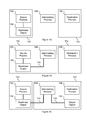
- Figure 1A, 1B and 1C are schematic representations of processes, objects and their relationships
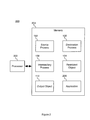
- Figure 2 is a schematic representation of components of a system for accessing a restricted object.
- Figure 3 is a flow diagram representing the logic in a method for accessing a restricted object.
- a privilege is a permission to perform an action (a.k.a. an ability).
- a set of privileges may be associated with each user identity (user-id) on the system; the set of privileges containing one or more abilities that are assigned to the user-id.
- a set of privileges may be associated with each of one or more group identities (group-id) and in turn with each user-id that is a member of each group-id.
- Some systems may include one or more user-ids that are designated as system administrator users (a.k.a. root user, root, or sys admin) that may be given all possible privileges.
- Each process executing on the computing platform may be assigned one or more privileges.
- the one or more privileges assigned to a process may be based on the set of privileges associated with the user-id of the owner of the process.
- the process may be assigned the set of privileges associated with the owner of the process at the time the process is created.
- the process may create an object, or restricted object, that is assigned one or more permissions that correspond to the privileges associated with the process.
- a source process may create a file in a file system that has permissions for reading the file only by the source process.
- Processes that execute the core functions (a.k.a. kernel) of the operating systems or that are created during the start-up phase (a.k.a. boot sequence) of operation may be owned by a system administrator user-id that in LTNIX®-like (UNIX is a registered trademark of The Open Group of San Francisco, California) operating systems is referred to as 'root'. Processes that are owned by root can be said to run as root. Processes that run as root may be omnipotent (e.g. have all possible privileges). While using processes that are omnipotent facilitates the execution of the core operating system and start-up functions, it may also leave the system vulnerable to forms of attack that exploit the omnipotence of these processes.
- an intermediary process provides access to the restricted object associated with the source process on behalf of a destination process.
- the intermediary process may be a trusted process that is available as a service to other processes on the computing platform.
- the intermediary process may assume one or more privileges associated with the source process whereby the restricted object may be accessed by the intermediary process on behalf of the destination process. Secure access to the restricted object and the risk of malicious exploitation are mitigated since the intermediary process is a trusted service that is known to provide specific functionality. Neither the source process nor the destination process needs to have system administration privileges.
- An example source process and destination process may include an application, a service, an agent and a device driver.
- Example restricted objects may include a file, a stream and a pipe that may be part of a UNIX®-like operating system.
- there is a source process with an associated file, or restricted object and it is desired to provide a destination process with a copy of the file, or a portion of the file, associated with the source process.
- the destination process may utilize the intermediary process to access the file.
- Figure 1A, 1B and 1C are schematic representations of processes, objects and their relationships that can be operated on by a system for accessing a restricted object.
- Figure 1A illustrates a source process 102, a destination process 106 and an intermediary process 108.
- the source process 102 may create a restricted object 104 that may have one or more permissions that correspond to privileges associated with the source process 102.
- the source process 102 and the restricted object 104 may belong to a common domain 110 as a result of having one or more source privileges or corresponding permissions in common.
- the destination process 106 may have associated one or more different privileges and belong to another domain 112.
- the destination process 106 may utilized the intermediary process 108 to access the restricted object 104.
- Figure 1B illustrates modifying one or more privileges associated with the intermediary process 108 to match one or more privileges associated with the source process 102.
- the intermediary process 108, the source process 102 and the restricted object 104 may share one or more source privileges, or corresponding permissions, and belong to a common domain 110.
- one or more privileges associated with the source process 102 may be discovered and used to set one or more privileges associated with the intermediary process 108 to be the same as the discovered one or more privileges.
- Privileges associated with a source process 102 or restricted object 104 may, for example, be discovered with UNIX®-like commands including ls and ps.
- the intermediary process 108 may obtain a reference 116 to the restricted object 104 provided that the one or more privileges allow access in order to obtain the reference 116.
- the intermediary process 108 opens the file and obtains a reference 116 where the reference 116 may be a file identifier commonly referred to as a FD.
- a UNIX®-like operating system may check the privileges of the intermediary process 108 when executing the file open operation to verify that the privileges correspond to permissions associated with the file.
- a process with the proper privileges to open the file may be provided a valid file identifier.
- Figure 1C illustrates modifying one or more privileges associated with the intermediary process 108 to match one or more privileges associated with the destination process 106.
- the intermediary process 108 and the destination process 106 may share one or more privileges and belong to a common domain 112.
- one or more privileges associated with the destination process 106 may be discovered and used to set one or more privileges associated with the intermediary process 108 to be the same as the discovered one or more privileges. Discovery of the privileges associated with the destination process 106 may be determined in the same way as described above with reference to the source process 102.
- the intermediary process 108 may create an output object 114 that may share one or more destination permissions that correspond to the privileges of the intermediary process 108 and the destination process 106.
- the destination process 106 may access the output object 114 created by the intermediary process 108.
- the intermediary process 108 may have references, 118 and 116, to the output object 114 and the restricted object 104 respectively.
- the output object 114 has been created by another process, for example the destination process 106, and the intermediary process 108 may obtain a reference 118 to the output object 114.
- the intermediary process 108 may have a valid file identifier that references 116 the restricted object 104.
- a UNIX®-like operating system may allow the intermediary process 108 to access the file, or restricted object 104, using the file identifier even though the intermediary process 108 may have subsequently modified one or more privileges to match one or more privileges associated with the destination process 106.
- the intermediary process 108 may obtain a file identifier for the output object 114.
- the intermediary process 108 may perform a file copy of all, or a portion, of the contents of the restricted object 104 and write the contents to the output object 114.
- the source process 102 and the destination process 106 may not have system administration privileges.
- a controller process (not illustrated) may have one or more privileges that match both the source process 102 and the destination process 106 where the controller process may control the intermediary process 108.
- the controller process may provide the one or more privileges to the intermediary process 108 to access both the restricted object 104 and the output object 114.
- the controller process may have system administration privileges.
- the intermediary process 108 provides access to the restricted object 104 and the output object 114 on behalf of the controller process without itself having to have system administration privileges.
- Figure 3 is a flow diagram representing the logic in a method for accessing a restricted object.
- the computer executable intermediary process 108 provides access to the restricted object 104 associated with the source process on behalf of the destination process 106.
- One or more privileges associated with the intermediary process may be modified to match one or more privileges associated with the source process 302.
- the intermediary process may have one or more privileges that match the source process and corresponding permissions of the restricted object.
- the intermediary process may obtain a reference 116 to the restricted object associated with the source process 304.
- One or more privileges associated with the intermediary process may be modified to match one or more privileges associated with the destination process 306.
- the intermediary process may create the output object 308.
- Creating the output object 308 may include copying the contents, or a portion of the contents of the restricted object 104 to the output object 114.
- the output object 114 may be created by another process and the contents, or a portion of the contents, of the restricted object 104 may be copied to the output object 114 by the intermediary process 108.
- FIG. 2 is a schematic representation of components of a system for accessing a restricted object.
- the system 200 may comprise a processor 202 and memory 204.
- the processor 202 may comprise a single processor or multiple processors that may be disposed on a single chip, on multiple devices or distributed over more that one system.
- the processor 202 may be hardware that executes computer executable instructions or computer code embodied in the memory 204 or in other memory to perform one or more features of the system.
- the processor 202 may include a general processor, a central processing unit, a graphics processing unit, an application specific integrated circuit (ASIC), a digital signal processor, a field programmable gate array (FPGA), a digital circuit, an analog circuit, a microcontroller, any other type of processor, or any combination thereof.
- ASIC application specific integrated circuit
- FPGA field programmable gate array
- the memory 204 may comprise a device for storing and retrieving data or any combination thereof.
- the memory 204 may include non-volatile and/or volatile memory, such as a random access memory (RAM), a read-only memory (ROM), an erasable programmable read-only memory (EPROM), or a flash memory.
- RAM random access memory
- ROM read-only memory
- EPROM erasable programmable read-only memory
- flash memory a flash memory.
- the memory 204 may comprise a single device or multiple devices that may be disposed on one or more dedicated memory devices or on a processor or other similar device.
- the memory 204 may include an optical, magnetic (hard-drive) or any other form of data storage device.
- the memory 204 may store computer code, such as the source process 102, the destination process 104, the intermediary process 108, the restricted object 104, the output object 114 and/or any other application 206.
- the computer code may include instructions executable with the processor 202.
- the computer code may be written in any computer language, such as C, C++, assembly language, channel program code, and/or any combination of computer languages.
- the memory 204 may store information in data structures.
- the system 200 may include more, fewer, or different components than illustrated in Figure 2 . Furthermore, each one of the components of system 200 may include more, fewer, or different elements than is illustrated in Figure 2 .
- Flags, data, databases, tables, entities, and other data structures may be separately stored and managed, may be incorporated into a single memory or database, may be distributed, or may be logically and physically organized in many different ways.
- the components may operate independently or be part of a same program or hardware.
- the components may be resident on separate hardware, such as separate removable circuit boards, or share common hardware, such as a same memory and processor for implementing instructions from the memory. Programs may be parts of a single program, separate programs, or distributed across several memories and processors.
- the functions, acts or tasks illustrated in the figures or described may be executed in response to one or more sets of logic or instructions stored in or on computer readable media.
- the functions, acts or tasks are independent of the particular type of instructions set, storage media, processor or processing strategy and may be performed by software, hardware, integrated circuits, firmware, micro code and the like, operating alone or in combination.
- processing strategies may include multiprocessing, multitasking, parallel processing, distributed processing, and/or any other type of processing.
- the instructions are stored on a removable media device for reading by local or remote systems.
- the logic or instructions are stored in a remote location for transfer through a computer network or over telephone lines.
- the logic or instructions may be stored within a given computer such as, for example, a central processing unit ("CPU").
- CPU central processing unit
- a default set of privileges may be associated with each of one or more user-ids.
- the operating system may comprise a processor creator that is part of the kernel.
- the kernel may create one or more processes over time. Each created process may be owned by a user-id and may be assigned a default set of privileges associated with the user-id.
- the operating system may provided a means for receiving a request to modify the privileges of a process via, for example, a procedure call (a.k.a. a system call) that may be embodied in a linking library such as, for example, a 'C' library.
- the procedure call may be invoke by a process with the object of the call being the process itself.
- the procedure call invoked by a process other than the process that is the object of the call may be identified by, for example, including in the request to modify a process identifier (pid) of the process.
- the kernel may modify the set of privileges assigned to the process.
- the process creator may further create one or more child processes on behalf of the process. Each child process may be assigned the set of privileges assigned to its parent process at the time of the child process' creation.
Landscapes
- Engineering & Computer Science (AREA)
- Theoretical Computer Science (AREA)
- Software Systems (AREA)
- Physics & Mathematics (AREA)
- General Engineering & Computer Science (AREA)
- General Physics & Mathematics (AREA)
- Databases & Information Systems (AREA)
- Health & Medical Sciences (AREA)
- Bioethics (AREA)
- General Health & Medical Sciences (AREA)
- Computer Hardware Design (AREA)
- Computer Security & Cryptography (AREA)
- Storage Device Security (AREA)
- Stored Programmes (AREA)
Abstract
Description
- The present disclosure relates to the field of computer executable processes and their ability to interact with restricted objects. In particular, to a system and method for accessing a restricted object.
- Computing platform operating systems may include mechanisms to enable or to restrict particular actions being taken by processes executing on a computing platform. These mechanisms may take the form of one or more abilities that can be assigned or denied to individual processes. The collection of abilities assigned to a process may be referred to as a set of privileges.
- In multi-user operating systems, one or more privileges may be associated with each user (a.k.a. user-id). Each executing process may be given one or more privileges that are associated with the owner (e.g. user-id) of the process. A process owned by a particular user-id may create a restricted object that is inaccessible to processes owned by other user-ids. Creating the restricted object that is inaccessible to processes owned by other user-ids may be utilized to enhance security on the computing platform. Some applications may require other processes associated with different user-ids to access the restricted object. Granting another process the one or more privileges required to access the restricted object may compromise security.
- In accordance with an aspect of the present disclosure there is provided a computer implemented method for an intermediary process to provide access to a restricted object associated with a source process on behalf of a destination process comprising: modifying one or more privileges associated with the intermediary process to match one or more privileges associated with the source process; obtaining a reference to the restricted object associated with the source process; modifying one or more privileges associated with the intermediary process to match one or more privileges associated with the destination process; and creating an output object.
- In accordance with an aspect of the present disclosure there is provided a system for accessing a restricted object where an intermediary process provides access to the restricted object associated with a source process on behalf of a destination process, the system comprising: a processor; a memory coupled to the processor containing instructions, executable by the processor, for performing: modifying one or more privileges associated with the intermediary process to match one or more privileges associated with the source process; obtaining a reference to the restricted object associated with the source process; modifying one or more privileges associated with the intermediary process to match one or more privileges associated with the destination process; and creating an output object.
- The disclosure may be better understood with reference to the following drawings and description. The components in the figures are not necessarily to scale, emphasis instead being placed upon illustrating the principles of the disclosure. Moreover, in the figures, like referenced numerals designate corresponding parts throughout the different views.
-
Figure 1A, 1B and 1C are schematic representations of processes, objects and their relationships; -
Figure 2 is a schematic representation of components of a system for accessing a restricted object; and -
Figure 3 is a flow diagram representing the logic in a method for accessing a restricted object. - On a computing platform a privilege is a permission to perform an action (a.k.a. an ability). In multi-user operating systems a set of privileges may be associated with each user identity (user-id) on the system; the set of privileges containing one or more abilities that are assigned to the user-id. Alternatively or in addition, a set of privileges may be associated with each of one or more group identities (group-id) and in turn with each user-id that is a member of each group-id. Some systems may include one or more user-ids that are designated as system administrator users (a.k.a. root user, root, or sys admin) that may be given all possible privileges.
- Each process executing on the computing platform may be assigned one or more privileges. The one or more privileges assigned to a process may be based on the set of privileges associated with the user-id of the owner of the process. The process may be assigned the set of privileges associated with the owner of the process at the time the process is created. The process may create an object, or restricted object, that is assigned one or more permissions that correspond to the privileges associated with the process. For example, a source process may create a file in a file system that has permissions for reading the file only by the source process.
- Processes that execute the core functions (a.k.a. kernel) of the operating systems or that are created during the start-up phase (a.k.a. boot sequence) of operation may be owned by a system administrator user-id that in LTNIX®-like (UNIX is a registered trademark of The Open Group of San Francisco, California) operating systems is referred to as 'root'. Processes that are owned by root can be said to run as root. Processes that run as root may be omnipotent (e.g. have all possible privileges). While using processes that are omnipotent facilitates the execution of the core operating system and start-up functions, it may also leave the system vulnerable to forms of attack that exploit the omnipotence of these processes.
- Herein are described systems and methods wherein an intermediary process provides access to the restricted object associated with the source process on behalf of a destination process. The intermediary process may be a trusted process that is available as a service to other processes on the computing platform. The intermediary process may assume one or more privileges associated with the source process whereby the restricted object may be accessed by the intermediary process on behalf of the destination process. Secure access to the restricted object and the risk of malicious exploitation are mitigated since the intermediary process is a trusted service that is known to provide specific functionality. Neither the source process nor the destination process needs to have system administration privileges.
- An example source process and destination process may include an application, a service, an agent and a device driver. Example restricted objects may include a file, a stream and a pipe that may be part of a UNIX®-like operating system. In an illustrative example, there is a source process with an associated file, or restricted object, and it is desired to provide a destination process with a copy of the file, or a portion of the file, associated with the source process. The destination process may utilize the intermediary process to access the file.
-
Figure 1A, 1B and 1C are schematic representations of processes, objects and their relationships that can be operated on by a system for accessing a restricted object.Figure 1A illustrates asource process 102, adestination process 106 and anintermediary process 108. Thesource process 102 may create arestricted object 104 that may have one or more permissions that correspond to privileges associated with thesource process 102. Thesource process 102 and the restrictedobject 104 may belong to acommon domain 110 as a result of having one or more source privileges or corresponding permissions in common. Thedestination process 106 may have associated one or more different privileges and belong to anotherdomain 112. Thedestination process 106 may utilized theintermediary process 108 to access the restrictedobject 104. -
Figure 1B illustrates modifying one or more privileges associated with theintermediary process 108 to match one or more privileges associated with thesource process 102. Theintermediary process 108, thesource process 102 and the restrictedobject 104 may share one or more source privileges, or corresponding permissions, and belong to acommon domain 110. In one embodiment, one or more privileges associated with thesource process 102 may be discovered and used to set one or more privileges associated with theintermediary process 108 to be the same as the discovered one or more privileges. Privileges associated with asource process 102 or restrictedobject 104 may, for example, be discovered with UNIX®-like commands including ls and ps. Theintermediary process 108 may obtain areference 116 to the restrictedobject 104 provided that the one or more privileges allow access in order to obtain thereference 116. - When the
restricted object 104 is a file, theintermediary process 108 opens the file and obtains areference 116 where thereference 116 may be a file identifier commonly referred to as a FD. A UNIX®-like operating system may check the privileges of theintermediary process 108 when executing the file open operation to verify that the privileges correspond to permissions associated with the file. A process with the proper privileges to open the file may be provided a valid file identifier. -
Figure 1C illustrates modifying one or more privileges associated with theintermediary process 108 to match one or more privileges associated with thedestination process 106. Theintermediary process 108 and thedestination process 106 may share one or more privileges and belong to acommon domain 112. In one embodiment, one or more privileges associated with thedestination process 106 may be discovered and used to set one or more privileges associated with theintermediary process 108 to be the same as the discovered one or more privileges. Discovery of the privileges associated with thedestination process 106 may be determined in the same way as described above with reference to thesource process 102. Theintermediary process 108 may create anoutput object 114 that may share one or more destination permissions that correspond to the privileges of theintermediary process 108 and thedestination process 106. Thedestination process 106 may access theoutput object 114 created by theintermediary process 108. Theintermediary process 108 may have references, 118 and 116, to theoutput object 114 and the restrictedobject 104 respectively. In an alternative embodiment, theoutput object 114 has been created by another process, for example thedestination process 106, and theintermediary process 108 may obtain areference 118 to theoutput object 114. - When the restricted
object 104 is a file, theintermediary process 108 may have a valid file identifier that references 116 the restrictedobject 104. A UNIX®-like operating system may allow theintermediary process 108 to access the file, or restrictedobject 104, using the file identifier even though theintermediary process 108 may have subsequently modified one or more privileges to match one or more privileges associated with thedestination process 106. When theoutput object 114 is a file, theintermediary process 108 may obtain a file identifier for theoutput object 114. Theintermediary process 108 may perform a file copy of all, or a portion, of the contents of the restrictedobject 104 and write the contents to theoutput object 114. - The
source process 102 and thedestination process 106 may not have system administration privileges. A controller process (not illustrated) may have one or more privileges that match both thesource process 102 and thedestination process 106 where the controller process may control theintermediary process 108. The controller process may provide the one or more privileges to theintermediary process 108 to access both the restrictedobject 104 and theoutput object 114. The controller process may have system administration privileges. Theintermediary process 108 provides access to the restrictedobject 104 and theoutput object 114 on behalf of the controller process without itself having to have system administration privileges. -
Figure 3 is a flow diagram representing the logic in a method for accessing a restricted object. The computer executableintermediary process 108 provides access to the restrictedobject 104 associated with the source process on behalf of thedestination process 106. One or more privileges associated with the intermediary process may be modified to match one or more privileges associated with thesource process 302. The intermediary process may have one or more privileges that match the source process and corresponding permissions of the restricted object. The intermediary process may obtain areference 116 to the restricted object associated with thesource process 304. One or more privileges associated with the intermediary process may be modified to match one or more privileges associated with thedestination process 306. The intermediary process may create theoutput object 308. Creating theoutput object 308 may include copying the contents, or a portion of the contents of the restrictedobject 104 to theoutput object 114. Alternatively, theoutput object 114 may be created by another process and the contents, or a portion of the contents, of the restrictedobject 104 may be copied to theoutput object 114 by theintermediary process 108. -
Figure 2 is a schematic representation of components of a system for accessing a restricted object. Thesystem 200 may comprise aprocessor 202 andmemory 204. Theprocessor 202 may comprise a single processor or multiple processors that may be disposed on a single chip, on multiple devices or distributed over more that one system. Theprocessor 202 may be hardware that executes computer executable instructions or computer code embodied in thememory 204 or in other memory to perform one or more features of the system. Theprocessor 202 may include a general processor, a central processing unit, a graphics processing unit, an application specific integrated circuit (ASIC), a digital signal processor, a field programmable gate array (FPGA), a digital circuit, an analog circuit, a microcontroller, any other type of processor, or any combination thereof. - The
memory 204 may comprise a device for storing and retrieving data or any combination thereof. Thememory 204 may include non-volatile and/or volatile memory, such as a random access memory (RAM), a read-only memory (ROM), an erasable programmable read-only memory (EPROM), or a flash memory. Thememory 204 may comprise a single device or multiple devices that may be disposed on one or more dedicated memory devices or on a processor or other similar device. Alternatively or in addition, thememory 204 may include an optical, magnetic (hard-drive) or any other form of data storage device. - The
memory 204 may store computer code, such as thesource process 102, thedestination process 104, theintermediary process 108, the restrictedobject 104, theoutput object 114 and/or anyother application 206. The computer code may include instructions executable with theprocessor 202. The computer code may be written in any computer language, such as C, C++, assembly language, channel program code, and/or any combination of computer languages. Thememory 204 may store information in data structures. - All of the disclosure, regardless of the particular implementation described, is exemplary in nature, rather than limiting. The
system 200 may include more, fewer, or different components than illustrated inFigure 2 . Furthermore, each one of the components ofsystem 200 may include more, fewer, or different elements than is illustrated inFigure 2 . Flags, data, databases, tables, entities, and other data structures may be separately stored and managed, may be incorporated into a single memory or database, may be distributed, or may be logically and physically organized in many different ways. The components may operate independently or be part of a same program or hardware. The components may be resident on separate hardware, such as separate removable circuit boards, or share common hardware, such as a same memory and processor for implementing instructions from the memory. Programs may be parts of a single program, separate programs, or distributed across several memories and processors. - The functions, acts or tasks illustrated in the figures or described may be executed in response to one or more sets of logic or instructions stored in or on computer readable media. The functions, acts or tasks are independent of the particular type of instructions set, storage media, processor or processing strategy and may be performed by software, hardware, integrated circuits, firmware, micro code and the like, operating alone or in combination. Likewise, processing strategies may include multiprocessing, multitasking, parallel processing, distributed processing, and/or any other type of processing. In one embodiment, the instructions are stored on a removable media device for reading by local or remote systems. In other embodiments, the logic or instructions are stored in a remote location for transfer through a computer network or over telephone lines. In yet other embodiments, the logic or instructions may be stored within a given computer such as, for example, a central processing unit ("CPU").
- A default set of privileges may be associated with each of one or more user-ids. The operating system may comprise a processor creator that is part of the kernel. The kernel may create one or more processes over time. Each created process may be owned by a user-id and may be assigned a default set of privileges associated with the user-id. The operating system may provided a means for receiving a request to modify the privileges of a process via, for example, a procedure call (a.k.a. a system call) that may be embodied in a linking library such as, for example, a 'C' library. The procedure call may be invoke by a process with the object of the call being the process itself. Alternatively or in addition, the procedure call invoked by a process other than the process that is the object of the call. The process that is the object of the request to modify may be identified by, for example, including in the request to modify a process identifier (pid) of the process. When the request to modify is received, the kernel may modify the set of privileges assigned to the process. The process creator may further create one or more child processes on behalf of the process. Each child process may be assigned the set of privileges assigned to its parent process at the time of the child process' creation.
- While various embodiments of the invention have been described, it will be apparent to those of ordinary skill in the art that many more embodiments and implementations are possible within the scope of the present invention. Accordingly, the invention is not to be restricted except in light of the attached claims and their equivalents.
Claims (11)
- A computer implemented method for an intermediary process (108) to provide access to a restricted object (104) associated with a source process (102) on behalf of a destination process (106) comprising:modifying one or more privileges associated with the intermediary process (108) to match one or more privileges associated with the source process (102);obtaining a reference (116) to the restricted object (104) associated with the source process (102);modifying one or more privileges associated with the intermediary process (108) to match one or more privileges associated with the destination process (106); andcreating an output object (114).
- The computer implemented method of claim 1, where creating an output object (114) comprises copying at least a portion of the contents of the restricted object (104).
- The computer implemented method of claim 1 or 2, where the restricted object (104) is only accessible to a process that has one or more privileges that match one or more privileges of the source process (102) with which the restricted object (104) is associated.
- The computer implemented method of claims 1 to 3, where the restricted object (104) and the output object (114) are each files in a file system.
- The computer implemented method of claims 1 to 4, where neither the source process (102) nor the destination process (106) has system administration privileges.
- The computer implemented method of claims 1 to 5, where each of the source process (102) and the destination process (106) comprise any one of an application, a service, an agent, and a device driver.
- The computer implemented method of claims 1 to 6, where the one or more privileges associated with the intermediary process (108) include any one or more of a user identifier and a group identifier.
- The computer implemented method of claim 4, where the reference (116) to the restricted object (104) is a file identifier.
- The computer implemented method of claims 1 to 8, where modifying the one or more privileges associated with the intermediary process (108) to match one or more privileges associated with the source process (102) further comprising:discovering one or more privileges associated with the source process (102); andsetting one or more privileges associated with the intermediary process (108) to be the same as the discovered one or more privileges.
- The computer implemented method of claims 1 to 9, where modifying the one or more privileges associated with the intermediary process (108) to match one or more privileges associated with the destination process (106) further comprising:discovering one or more privileges associated with the destination process (106); andsetting one or more privileges associated with the intermediary process (108) to be the same as the discovered one or more privileges.
- A system for accessing a restricted object where an intermediary process (108) provides access to the restricted object (104) associated with a source process (102) on behalf of a destination process (106), the system comprising:a processor;a memory coupled to the processor containing instructions, executable by the processor, for performing the steps of any of method claims 1 to 10.
Applications Claiming Priority (1)
| Application Number | Priority Date | Filing Date | Title |
|---|---|---|---|
| US13/660,359 US8959616B2 (en) | 2012-10-25 | 2012-10-25 | System and method for accessing a restricted object |
Publications (1)
| Publication Number | Publication Date |
|---|---|
| EP2725486A1 true EP2725486A1 (en) | 2014-04-30 |
Family
ID=47191565
Family Applications (1)
| Application Number | Title | Priority Date | Filing Date |
|---|---|---|---|
| EP12191707.4A Ceased EP2725486A1 (en) | 2012-10-25 | 2012-11-07 | System and method for accessing a restricted object |
Country Status (2)
| Country | Link |
|---|---|
| US (1) | US8959616B2 (en) |
| EP (1) | EP2725486A1 (en) |
Families Citing this family (2)
| Publication number | Priority date | Publication date | Assignee | Title |
|---|---|---|---|---|
| US9967283B2 (en) * | 2014-09-14 | 2018-05-08 | Sophos Limited | Normalized indications of compromise |
| EP3651057B1 (en) * | 2018-11-09 | 2023-06-14 | Tissot S.A. | Procedure for facial authentication of a wearer of a watch |
Family Cites Families (9)
| Publication number | Priority date | Publication date | Assignee | Title |
|---|---|---|---|---|
| US7925693B2 (en) * | 2000-01-24 | 2011-04-12 | Microsoft Corporation | NAT access control with IPSec |
| US7644086B2 (en) * | 2005-03-29 | 2010-01-05 | Sas Institute Inc. | Computer-implemented authorization systems and methods using associations |
| US7665143B2 (en) * | 2005-05-16 | 2010-02-16 | Microsoft Corporation | Creating secure process objects |
| US8006088B2 (en) * | 2005-08-18 | 2011-08-23 | Beyondtrust Corporation | Methods and systems for network-based management of application security |
| US8341723B2 (en) * | 2007-06-28 | 2012-12-25 | Microsoft Corporation | Filtering kernel-mode network communications |
| JP4952600B2 (en) * | 2008-02-01 | 2012-06-13 | 富士通株式会社 | Management device and management program |
| US8225372B2 (en) * | 2008-06-25 | 2012-07-17 | International Business Machines Corporation | Customizing policies for process privilege inheritance |
| US8850549B2 (en) * | 2009-05-01 | 2014-09-30 | Beyondtrust Software, Inc. | Methods and systems for controlling access to resources and privileges per process |
| US9886590B2 (en) * | 2009-07-23 | 2018-02-06 | Oracle International Corporation | Techniques for enforcing application environment based security policies using role based access control |
-
2012
- 2012-10-25 US US13/660,359 patent/US8959616B2/en active Active
- 2012-11-07 EP EP12191707.4A patent/EP2725486A1/en not_active Ceased
Non-Patent Citations (1)
| Title |
|---|
| SILBERSCHATZ, GALVIN: "Operating System Concepts", 1994, ADDISON-WESLEY PUBLISHING COMPANY, USA, ISBN: 0-201-59292-4, article CHAPTER 13: "Protection", pages: 431 - 457, XP002690833 * |
Also Published As
| Publication number | Publication date |
|---|---|
| US20140123272A1 (en) | 2014-05-01 |
| US8959616B2 (en) | 2015-02-17 |
Similar Documents
| Publication | Publication Date | Title |
|---|---|---|
| US9213571B2 (en) | System and method for changing abilities of a process | |
| CN111684440B (en) | Secure data sharing in multi-tenant database systems | |
| JP6248153B2 (en) | Activate trust level | |
| US8516486B2 (en) | Loading applications in non-designated environments | |
| Singh | An overview of android operating system and its security | |
| US9465955B1 (en) | System for and methods of controlling user access to applications and/or programs of a computer | |
| RU2640300C2 (en) | Memory introspection engine for protecting integrity of virtual machines | |
| US7149832B2 (en) | System and method for interrupt handling | |
| JPH08241207A (en) | Method and system for setting of security level | |
| JP2005129066A5 (en) | ||
| US20140282465A1 (en) | Methods for Dynamic Mobile Application Behavior Modification Subject to a Behavior Policy | |
| JP2016517120A5 (en) | ||
| US9934404B2 (en) | Inter-process access control | |
| US11886605B2 (en) | Differentiated file permissions for container users | |
| US20200342008A1 (en) | System for lightweight objects | |
| EP3367291B1 (en) | Label transition for mandatory access controls | |
| US8635664B2 (en) | Method and system for securing application program interfaces in unified extensible firmware interface | |
| US10198280B2 (en) | Method and apparatus for hypervisor based monitoring of system interactions | |
| JP5511874B2 (en) | Systems and methods implemented in security services | |
| US20180107463A1 (en) | Safe loading of dynamic user-defined code | |
| US20190095617A1 (en) | Systems and methods for intrinsic runtime security | |
| WO2019237864A1 (en) | Security user architecture and authority control method | |
| US8959616B2 (en) | System and method for accessing a restricted object | |
| US9542207B2 (en) | Plurality of interface files usable for access to BIOS | |
| Pankov et al. | Analysis of the security of uefi bios embedded software in modern intel-based computers |
Legal Events
| Date | Code | Title | Description |
|---|---|---|---|
| PUAI | Public reference made under article 153(3) epc to a published international application that has entered the european phase |
Free format text: ORIGINAL CODE: 0009012 |
|
| 17P | Request for examination filed |
Effective date: 20121107 |
|
| AK | Designated contracting states |
Kind code of ref document: A1 Designated state(s): AL AT BE BG CH CY CZ DE DK EE ES FI FR GB GR HR HU IE IS IT LI LT LU LV MC MK MT NL NO PL PT RO RS SE SI SK SM TR |
|
| AX | Request for extension of the european patent |
Extension state: BA ME |
|
| RAP1 | Party data changed (applicant data changed or rights of an application transferred) |
Owner name: 2236008 ONTARIO INC. |
|
| STAA | Information on the status of an ep patent application or granted ep patent |
Free format text: STATUS: EXAMINATION IS IN PROGRESS |
|
| 17Q | First examination report despatched |
Effective date: 20161116 |
|
| RAP1 | Party data changed (applicant data changed or rights of an application transferred) |
Owner name: BLACKBERRY LIMITED |
|
| STAA | Information on the status of an ep patent application or granted ep patent |
Free format text: STATUS: THE APPLICATION HAS BEEN REFUSED |
|
| 18R | Application refused |
Effective date: 20211024 |