EP2724839A1 - Method for protecting vehicle surfaces - Google Patents
Method for protecting vehicle surfaces Download PDFInfo
- Publication number
- EP2724839A1 EP2724839A1 EP12007411.7A EP12007411A EP2724839A1 EP 2724839 A1 EP2724839 A1 EP 2724839A1 EP 12007411 A EP12007411 A EP 12007411A EP 2724839 A1 EP2724839 A1 EP 2724839A1
- Authority
- EP
- European Patent Office
- Prior art keywords
- fibres
- sheet
- fibre
- flocking
- dtex
- Prior art date
- Legal status (The legal status is an assumption and is not a legal conclusion. Google has not performed a legal analysis and makes no representation as to the accuracy of the status listed.)
- Withdrawn
Links
- 238000000034 method Methods 0.000 title claims abstract description 16
- 239000000853 adhesive Substances 0.000 claims abstract description 17
- 239000000835 fiber Substances 0.000 claims description 9
- 230000002209 hydrophobic effect Effects 0.000 claims description 4
- 239000000203 mixture Substances 0.000 claims description 4
- 230000001070 adhesive effect Effects 0.000 description 10
- 239000004800 polyvinyl chloride Substances 0.000 description 8
- 229920000915 polyvinyl chloride Polymers 0.000 description 6
- 244000144992 flock Species 0.000 description 5
- 239000004820 Pressure-sensitive adhesive Substances 0.000 description 4
- 230000003115 biocidal effect Effects 0.000 description 3
- 239000003139 biocide Substances 0.000 description 3
- 239000000975 dye Substances 0.000 description 3
- 239000000463 material Substances 0.000 description 3
- 239000004014 plasticizer Substances 0.000 description 3
- 229920000642 polymer Polymers 0.000 description 3
- 229920002972 Acrylic fiber Polymers 0.000 description 2
- KAKZBPTYRLMSJV-UHFFFAOYSA-N Butadiene Chemical compound C=CC=C KAKZBPTYRLMSJV-UHFFFAOYSA-N 0.000 description 2
- RRHGJUQNOFWUDK-UHFFFAOYSA-N Isoprene Chemical compound CC(=C)C=C RRHGJUQNOFWUDK-UHFFFAOYSA-N 0.000 description 2
- 239000004952 Polyamide Substances 0.000 description 2
- 239000004698 Polyethylene Substances 0.000 description 2
- 239000004743 Polypropylene Substances 0.000 description 2
- 238000004140 cleaning Methods 0.000 description 2
- 239000011248 coating agent Substances 0.000 description 2
- 238000000576 coating method Methods 0.000 description 2
- 239000003086 colorant Substances 0.000 description 2
- 239000005038 ethylene vinyl acetate Substances 0.000 description 2
- 239000000049 pigment Substances 0.000 description 2
- 229920002647 polyamide Polymers 0.000 description 2
- 229920000728 polyester Polymers 0.000 description 2
- -1 polyethylene Polymers 0.000 description 2
- 229920000573 polyethylene Polymers 0.000 description 2
- 229920001155 polypropylene Polymers 0.000 description 2
- 229920002635 polyurethane Polymers 0.000 description 2
- 239000004814 polyurethane Substances 0.000 description 2
- 230000001681 protective effect Effects 0.000 description 2
- 239000003381 stabilizer Substances 0.000 description 2
- XLYOFNOQVPJJNP-UHFFFAOYSA-N water Substances O XLYOFNOQVPJJNP-UHFFFAOYSA-N 0.000 description 2
- 108010053481 Antifreeze Proteins Proteins 0.000 description 1
- 229920000742 Cotton Polymers 0.000 description 1
- 229920001944 Plastisol Polymers 0.000 description 1
- 229920000297 Rayon Polymers 0.000 description 1
- HCHKCACWOHOZIP-UHFFFAOYSA-N Zinc Chemical compound [Zn] HCHKCACWOHOZIP-UHFFFAOYSA-N 0.000 description 1
- 238000005299 abrasion Methods 0.000 description 1
- 150000001252 acrylic acid derivatives Chemical class 0.000 description 1
- 239000004480 active ingredient Substances 0.000 description 1
- 239000000654 additive Substances 0.000 description 1
- 238000004026 adhesive bonding Methods 0.000 description 1
- 238000004873 anchoring Methods 0.000 description 1
- 230000002528 anti-freeze Effects 0.000 description 1
- 229910052788 barium Inorganic materials 0.000 description 1
- DSAJWYNOEDNPEQ-UHFFFAOYSA-N barium atom Chemical compound [Ba] DSAJWYNOEDNPEQ-UHFFFAOYSA-N 0.000 description 1
- DQXBYHZEEUGOBF-UHFFFAOYSA-N but-3-enoic acid;ethene Chemical compound C=C.OC(=O)CC=C DQXBYHZEEUGOBF-UHFFFAOYSA-N 0.000 description 1
- 238000005034 decoration Methods 0.000 description 1
- 230000006866 deterioration Effects 0.000 description 1
- 230000000694 effects Effects 0.000 description 1
- 238000001125 extrusion Methods 0.000 description 1
- 210000003608 fece Anatomy 0.000 description 1
- 239000000945 filler Substances 0.000 description 1
- 238000001914 filtration Methods 0.000 description 1
- 238000009472 formulation Methods 0.000 description 1
- 230000014509 gene expression Effects 0.000 description 1
- 239000003292 glue Substances 0.000 description 1
- SWQJXJOGLNCZEY-UHFFFAOYSA-N helium atom Chemical compound [He] SWQJXJOGLNCZEY-UHFFFAOYSA-N 0.000 description 1
- 238000003475 lamination Methods 0.000 description 1
- 239000004611 light stabiliser Substances 0.000 description 1
- 238000004519 manufacturing process Methods 0.000 description 1
- 239000002184 metal Substances 0.000 description 1
- 229910052751 metal Inorganic materials 0.000 description 1
- 239000003607 modifier Substances 0.000 description 1
- 239000000178 monomer Substances 0.000 description 1
- 239000003973 paint Substances 0.000 description 1
- 229920003023 plastic Polymers 0.000 description 1
- 239000004033 plastic Substances 0.000 description 1
- 239000004999 plastisol Substances 0.000 description 1
- 229920001200 poly(ethylene-vinyl acetate) Polymers 0.000 description 1
- 238000006116 polymerization reaction Methods 0.000 description 1
- 229920000098 polyolefin Polymers 0.000 description 1
- 239000002904 solvent Substances 0.000 description 1
- 239000000126 substance Substances 0.000 description 1
- 239000000725 suspension Substances 0.000 description 1
- 239000004753 textile Substances 0.000 description 1
- 125000000391 vinyl group Chemical group [H]C([*])=C([H])[H] 0.000 description 1
- 229920002554 vinyl polymer Polymers 0.000 description 1
- 239000002023 wood Substances 0.000 description 1
- 229910052725 zinc Inorganic materials 0.000 description 1
- 239000011701 zinc Substances 0.000 description 1
Images



Classifications
-
- B—PERFORMING OPERATIONS; TRANSPORTING
- B29—WORKING OF PLASTICS; WORKING OF SUBSTANCES IN A PLASTIC STATE IN GENERAL
- B29C—SHAPING OR JOINING OF PLASTICS; SHAPING OF MATERIAL IN A PLASTIC STATE, NOT OTHERWISE PROVIDED FOR; AFTER-TREATMENT OF THE SHAPED PRODUCTS, e.g. REPAIRING
- B29C63/00—Lining or sheathing, i.e. applying preformed layers or sheathings of plastics; Apparatus therefor
- B29C63/0017—Lining or sheathing, i.e. applying preformed layers or sheathings of plastics; Apparatus therefor characterised by the choice of the material
-
- B—PERFORMING OPERATIONS; TRANSPORTING
- B29—WORKING OF PLASTICS; WORKING OF SUBSTANCES IN A PLASTIC STATE IN GENERAL
- B29C—SHAPING OR JOINING OF PLASTICS; SHAPING OF MATERIAL IN A PLASTIC STATE, NOT OTHERWISE PROVIDED FOR; AFTER-TREATMENT OF THE SHAPED PRODUCTS, e.g. REPAIRING
- B29C63/00—Lining or sheathing, i.e. applying preformed layers or sheathings of plastics; Apparatus therefor
- B29C63/02—Lining or sheathing, i.e. applying preformed layers or sheathings of plastics; Apparatus therefor using sheet or web-like material
-
- B—PERFORMING OPERATIONS; TRANSPORTING
- B29—WORKING OF PLASTICS; WORKING OF SUBSTANCES IN A PLASTIC STATE IN GENERAL
- B29L—INDEXING SCHEME ASSOCIATED WITH SUBCLASS B29C, RELATING TO PARTICULAR ARTICLES
- B29L2031/00—Other particular articles
- B29L2031/30—Vehicles, e.g. ships or aircraft, or body parts thereof
Definitions
- the present invention relates to a method for protecting vehicle surfaces.
- the surface of cars and other vehicles e.g. motorcycles, scooters, minivans, trucks, trains and the like, is exposed to weathering and to dirt, which can deteriorate the surface. Especially anti-freeze and bird droppings are considered harmful even for modern car finish.
- the self adhesive sheets are suitable to protect the surface of vehicles while providing an interesting design at the same time.
- the present invention relates to the protection of vehicle surfaces comprising the steps providing a conformable, self-adhesive sheet, flocking it with fibres and adhering it to the surface.
- the vehicle surface obtained by the method of the invention eases cleaning, although one would expect that dirt is more diffcult to remove from the rough flocked surface and/or adheres more easily to it. But it was found that the flock is cleaned by rain and also slightly wiping over the surface is able to remove dirt adhering to it.
- the protective effect is enhanced by the fibres, they contribute to filtering UV light and provide additional protection against mechanical impact.
- the sheet Since the sheet is deformable, it can also be adhered in an accurately fitting manner to curved surfaces, such as vehicle surfaces.
- Deformable, self-adhesive sheets for protecting or decorating vehicle surfaces are known per se. According to the prior art, however, these are provided with the smoothest possible surface so as to prevent the adhesion of dirt and to ensure low drag resistance.
- All sufficiently abrasion-resistant, saltwater-resistant and UV-stable plastics are suitable material for the sheet used according to the invention.
- Preferred materials for the sheets according to the invention include polyvinyl chloride (PVC), polyurethanes (PUs), butadiene-based and isoprene-based polymers, and polyolefins such as polyethylene (PE) and polypropylene (PP).
- PVC polyvinyl chloride
- PUs polyurethanes
- PE polyethylene
- PP polypropylene
- Polymers based on vinyl monomers, in particular polyvinyl chloride (PVC) are particularly preferred.
- Films based on PVC and/or ethylene vinyl acetate (EVA) are likewise well suited.
- the sheet may have additives and added substances, which are used in the normal amounts.
- plasticisers, stabilisers and, if desired, pigments and/or dyes are contained in the case of PVC sheets.
- PVC sheets 60 to 70 % by weight PVC; 5 to 10 % by weight EVA; 15 to 25 % by weight polymer plasticiser; 2.0 to 3.0 % by weight barium/zinc stabiliser; 5 to 10 % by weight modifier and 0.5 to 10 % by weight light stabiliser are typical in the case of a suspension PVC (S-PVC).
- S-PVC suspension PVC
- the amount of pigments/dyes depends on the desired colour. It is possible to provide biocide active ingredients in the sheet material.
- deformable means that the sheet has an elongation at break of at least 100 %, perferably at least 200 %.
- the 2 % module is from 15 to 25 N/15 mm.
- the tensile stength is at least 15 N/15 mm and preferably lies in the range of 25 to 40 N/15 mm.
- the elongation at break, 2 % module and tensile strength are measured in accordance with DIN EN 527 3/2/200.
- the sheets according to the invention are produced in a manner known per se, for example on calenders.
- Multi-layer sheets which may have two, three or even more layers, are obtained by coextrusion, direct extrusion or lamination. These methods are known to a person skilled in the art.
- the sheet is coated with a pressure-sensitive adhesive so that it can be adhered directly to the surface to be protected.
- a pressure-sensitive adhesive In principle, all adhesives that demonstrate sufficient resistance to weathering and good adhesion, both to the sheet and to surfaces made of metal, wood, paint, etc., are especially suitable.
- a pressure-sensitive adhesive based on acrylates is preferably used.
- Adhesives and fibres that are suitable for the relatively long contact with water are used for flocking.
- polyamide fibres and polyester fibres are well-suited fibres.
- the selected fibres also have to be weather resistant. The exposure to UV is severe for sheets used to protect and decorate vehicles.
- the fibres are chosen for tactile, technical and aesthetic purposes. Suitable fibres are cotton fibres, viscose fibres, polyamide fibres, polyester fibres, acrylic fibres etc., particularly acrylic fibres.
- fibre mixtures are used so as to obtain a fibre web containing both hydrophobic and hydrophilic fibres.
- the surface tension (measured in accordance with DIN 53364) should be > 50 dyn, preferably > 60 dyn, for the hydrophilic fibres and ⁇ 30 dyn, preferably ⁇ 20 dyn, for the hydrophobic fibres.
- the fibre length can vary from 0.3 mm to 2 mm, and for vehicle wrapping, a length between 0.5 mm and 1 mm is particularly preferred.
- the fibre size can vary from 0.9 dtex up to 5.6 dtex and preferably is about 2.2 dtex.
- the fibres can be either "random cut” or preferably "precision cut”.
- Flocking is carried out with fibre densities in the range of 30 to 160 g/m 2 and more preferably from 60 to 120 g/m 2 and especially preferred from 80 to 100 g/m 2 .
- Water-resistant adhesives that are matched to the sheet are selected as an adhesive for anchoring the fibres.
- plastisols which are conventional for the production of flocked T-shirts, are suitable for PVC films.
- a typical formulation comprises PVC, plasticiser, filler and adhesive strength promoter.
- the deformable sheet is first provided with a self-adhesive coating by means of the pressure-sensitive adhesive.
- the adhesive can be applied e.g. dissolved in a solvent.
- the pressure-sensitive adhesive is/will be covered preferably by a release liner, for example siliconised paper.
- the self-adhesive sheet is then coated with the adhesive to anchor the fibres and is then flocked in a manner known per se.
- the sheet is then normally wound onto rolls, where it is stored.
- the surface is cleaned, if necessary, so as to remove adhering dirt.
- the surface should be clean, greasefree and dry.
- the sheet is placed over the surface and pressed on, where necessary after having been cut to size and/or after detachment of the release liner.
- the sheet is preferably stuck down edge-to-edge. Gaps between adjacent sheetstripes can be closed easily and quickly by pieces of sheet cut to size accordingly. A coating with adhesive is not necessary for this purpose, and there is therefore also no risk of gluing, with the adhesive, of the fibres in the flocked sheets already attached. It is also possible to form an edge of the sheet in a narrow strip without fibres and to glue the sheet in an overlapping manner. In a further variant, it is conceivable, once adhered, for the fibres to be removed in a strip bridging the joint and for the joint to be covered by a strip of flocked sheet. In this case, the strip may have the same structure as the sheet, or, for example with use of a biocide, may have a higher concentration thereof or may comprise a biocide.
- the sheet is especially suited to protect and decorate the surface of vehicles.
- the decorative possibilites are plentiful.
- the fibres can be coloured, whereby colours of the fibres are obtained by normal bath dyed or spun dyed or other dye processes. Preferred are spun dyed fibres which are dyed into their core. There can also be patterns of fibres, wherein the fibres can be applied continuously (full flocking) or partially (selective flocking) on rolls or sheets.
- the surface is totally covered with fibres which provides a velvet or suede texture.
- the sheet can also be printed prior to flocking by screen print, offset, numeric, digital, helio etc. to give it a background colour or a motif with one or several colours.
- the flocked motives can be registered or non-registered on the print, on all the width of the roll or the sheets size.
- transparent sheets flocked with transparent fibres allow a print of the vehicle surface to remain visible. It is also possible to combine transparent and opaque areas on the flocked sheet to combine a decorative design of the sheet with a design already present on the vehicle surface.
- An over flocking is also possible, meaning that the sheet is fully flocked on the surface and then a second flocking layer is applied on that layer, usually as selective flocking.
- the sheet for vehicle wrapping can also be embossed by heat, which marks a motif and/or design on the surface of the flocked film (lace, flowers, logo, textile patterns etc).
- the flock fibres can also be mixed to obtain a shiny, glitter, metallic, fluorescent and/or phosphorescent aspect.
- the use of specific fibres, especially trilobal fibres, mixed with conventional fibres allows to obtain a more or less shiny aspect depending on percentage used, which can range from 1 to 100%.
- the invention relates to all combinations of preferred embodiments, unless these are mutually exclusive.
- the expressions "about” or “approximately” in conjunction with a number means that at least values 10 % higher or lower, or values 5 % higher or lower, and in any case values 1 % higher or lower, are also included.
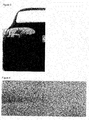
- Figures 1 to 3 show details of a car with a surface protected by a flocked sheet according to the invention. It can be seen that the sheet smoothly adheres to the surface, also at contours and edges.
- Figure 4 shows a uni coloured sheet and flock providing a velvet look and feel.
- Figure 5 shows a suede look obtained by a mechanical movement of objects coming on the surface of the flocked sheet before the polymerization to give a non uniform look of velvet.
- Figure 6 shows a printed sheet with transparent flock. The print can be seen through the flock.
- Figure 7 shows a selective flocking (black parts).
- Figure 8 shows a full flocking with a selective flocking with differently coloured fibres on top.
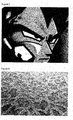
- Figures 9 and 10 show embossed flocking, that provides yet another interesting design.
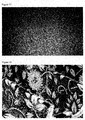
- Figure 11 shows a flocking with 30 % of trilobal fibres providing a glitter or metallic design.
- Figure 12 shows another selective flocking on a printed sheet.
Landscapes
- Engineering & Computer Science (AREA)
- Manufacturing & Machinery (AREA)
- Laminated Bodies (AREA)
Abstract
The present invention relates to a method for protecting vehicle surfaces comprising the steps of providing a deformable, self-adhesive sheet, flocking the sheet with fibres, and attaching the flocked sheet to the surface.
Description
- The present invention relates to a method for protecting vehicle surfaces.
- The surface of cars and other vehicles, e.g. motorcycles, scooters, minivans, trucks, trains and the like, is exposed to weathering and to dirt, which can deteriorate the surface. Especially anti-freeze and bird droppings are considered harmful even for modern car finish.
- Further, it is known to decorate or mark vehicles by applying stickers. A full or partial change of colour can be achieved by adhering a sheet to the surface. Besides the decorative effect such a sheet also provides protection to the surface. Protection is the main objective of transparent sheets applied to areas where typically mechanical stress occurs like the running boards and the loading or trunk sill. However, cleaning of such decorative applications or protective sheets is usually more difficult than for the original surface.
- There remains the problem of protecting vehicle surfaces from deterioration and furthermore the object to allow for individual decoration.
- It has surprisingly been found that it is possible to achieve these objects with deformable, self-adhesive sheets with flocking.
- The self adhesive sheets are suitable to protect the surface of vehicles while providing an interesting design at the same time. Thus, the present invention relates to the protection of vehicle surfaces comprising the steps providing a conformable, self-adhesive sheet, flocking it with fibres and adhering it to the surface.
- Surprisingly the vehicle surface obtained by the method of the invention eases cleaning, although one would expect that dirt is more diffcult to remove from the rough flocked surface and/or adheres more easily to it. But it was found that the flock is cleaned by rain and also slightly wiping over the surface is able to remove dirt adhering to it. The protective effect is enhanced by the fibres, they contribute to filtering UV light and provide additional protection against mechanical impact.
- Since the sheet is deformable, it can also be adhered in an accurately fitting manner to curved surfaces, such as vehicle surfaces.
- Deformable, self-adhesive sheets for protecting or decorating vehicle surfaces are known per se. According to the prior art, however, these are provided with the smoothest possible surface so as to prevent the adhesion of dirt and to ensure low drag resistance.
- All sufficiently abrasion-resistant, saltwater-resistant and UV-stable plastics are suitable material for the sheet used according to the invention. Preferred materials for the sheets according to the invention include polyvinyl chloride (PVC), polyurethanes (PUs), butadiene-based and isoprene-based polymers, and polyolefins such as polyethylene (PE) and polypropylene (PP). Polymers based on vinyl monomers, in particular polyvinyl chloride (PVC), are particularly preferred. Films based on PVC and/or ethylene vinyl acetate (EVA) are likewise well suited.
- In a manner known per se, the sheet may have additives and added substances, which are used in the normal amounts. For example, plasticisers, stabilisers and, if desired, pigments and/or dyes are contained in the case of PVC sheets. For example, 60 to 70 % by weight PVC; 5 to 10 % by weight EVA; 15 to 25 % by weight polymer plasticiser; 2.0 to 3.0 % by weight barium/zinc stabiliser; 5 to 10 % by weight modifier and 0.5 to 10 % by weight light stabiliser are typical in the case of a suspension PVC (S-PVC). The amount of pigments/dyes depends on the desired colour. It is possible to provide biocide active ingredients in the sheet material.
- Within the scope of the present invention, "deformable" means that the sheet has an elongation at break of at least 100 %, perferably at least 200 %. The 2 % module is from 15 to 25 N/15 mm. The tensile stength is at least 15 N/15 mm and preferably lies in the range of 25 to 40 N/15 mm. The elongation at break, 2 % module and tensile strength are measured in accordance with DIN EN 527 3/2/200.
- The sheets according to the invention are produced in a manner known per se, for example on calenders. Multi-layer sheets, which may have two, three or even more layers, are obtained by coextrusion, direct extrusion or lamination. These methods are known to a person skilled in the art.
- The sheet is coated with a pressure-sensitive adhesive so that it can be adhered directly to the surface to be protected. In principle, all adhesives that demonstrate sufficient resistance to weathering and good adhesion, both to the sheet and to surfaces made of metal, wood, paint, etc., are especially suitable. A pressure-sensitive adhesive based on acrylates is preferably used.
- Adhesives and fibres that are suitable for the relatively long contact with water are used for flocking. For example, polyamide fibres and polyester fibres are well-suited fibres. The selected fibres also have to be weather resistant. The exposure to UV is severe for sheets used to protect and decorate vehicles. The fibres are chosen for tactile, technical and aesthetic purposes. Suitable fibres are cotton fibres, viscose fibres, polyamide fibres, polyester fibres, acrylic fibres etc., particularly acrylic fibres.
- In a variant, fibre mixtures are used so as to obtain a fibre web containing both hydrophobic and hydrophilic fibres. In this case, the surface tension (measured in accordance with DIN 53364) should be > 50 dyn, preferably > 60 dyn, for the hydrophilic fibres and < 30 dyn, preferably < 20 dyn, for the hydrophobic fibres.
- The fibre length can vary from 0.3 mm to 2 mm, and for vehicle wrapping, a length between 0.5 mm and 1 mm is particularly preferred. The fibre size can vary from 0.9 dtex up to 5.6 dtex and preferably is about 2.2 dtex. The fibres can be either "random cut" or preferably "precision cut".
- Flocking is carried out with fibre densities in the range of 30 to 160 g/m2 and more preferably from 60 to 120 g/m2 and especially preferred from 80 to 100 g/m2.
- Water-resistant adhesives that are matched to the sheet are selected as an adhesive for anchoring the fibres. For example, plastisols, which are conventional for the production of flocked T-shirts, are suitable for PVC films. A typical formulation comprises PVC, plasticiser, filler and adhesive strength promoter.
- To produce the sheets used in accordance with the invention for protection, the deformable sheet is first provided with a self-adhesive coating by means of the pressure-sensitive adhesive. The adhesive can be applied e.g. dissolved in a solvent. The pressure-sensitive adhesive is/will be covered preferably by a release liner, for example siliconised paper. The self-adhesive sheet is then coated with the adhesive to anchor the fibres and is then flocked in a manner known per se. The sheet is then normally wound onto rolls, where it is stored.
- For application to the surface to be protected, the surface is cleaned, if necessary, so as to remove adhering dirt. The surface should be clean, greasefree and dry. The sheet is placed over the surface and pressed on, where necessary after having been cut to size and/or after detachment of the release liner.
- The sheet is preferably stuck down edge-to-edge. Gaps between adjacent sheetstripes can be closed easily and quickly by pieces of sheet cut to size accordingly. A coating with adhesive is not necessary for this purpose, and there is therefore also no risk of gluing, with the adhesive, of the fibres in the flocked sheets already attached. It is also possible to form an edge of the sheet in a narrow strip without fibres and to glue the sheet in an overlapping manner. In a further variant, it is conceivable, once adhered, for the fibres to be removed in a strip bridging the joint and for the joint to be covered by a strip of flocked sheet. In this case, the strip may have the same structure as the sheet, or, for example with use of a biocide, may have a higher concentration thereof or may comprise a biocide.
- The sheet is especially suited to protect and decorate the surface of vehicles. The decorative possibilites are plentiful. The fibres can be coloured, whereby colours of the fibres are obtained by normal bath dyed or spun dyed or other dye processes. Preferred are spun dyed fibres which are dyed into their core. There can also be patterns of fibres, wherein the fibres can be applied continuously (full flocking) or partially (selective flocking) on rolls or sheets.
- For full flocking the surface is totally covered with fibres which provides a velvet or suede texture. The sheet can also be printed prior to flocking by screen print, offset, numeric, digital, helio etc. to give it a background colour or a motif with one or several colours. A full flocking, preferably with transparent fibres, then provides a soft texture on the printing. With selective flocking motifs either flocked or in reverse are possible. When the sheet is previously printed the flocked motives can be registered or non-registered on the print, on all the width of the roll or the sheets size. Likewise, transparent sheets flocked with transparent fibres allow a print of the vehicle surface to remain visible. It is also possible to combine transparent and opaque areas on the flocked sheet to combine a decorative design of the sheet with a design already present on the vehicle surface.
- An over flocking is also possible, meaning that the sheet is fully flocked on the surface and then a second flocking layer is applied on that layer, usually as selective flocking.
- The sheet for vehicle wrapping can also be embossed by heat, which marks a motif and/or design on the surface of the flocked film (lace, flowers, logo, textile patterns etc...).
- The flock fibres can also be mixed to obtain a shiny, glitter, metallic, fluorescent and/or phosphorescent aspect. The use of specific fibres, especially trilobal fibres, mixed with conventional fibres allows to obtain a more or less shiny aspect depending on percentage used, which can range from 1 to 100%.
- The invention will be explained on the basis of the following examples, although it is not limited to the embodiments described specifically. Unless indicated otherwise and unless otherwise imperatively clear from the context, percentages relate to weight, and where in doubt to the total weight of the mixture.
- The invention relates to all combinations of preferred embodiments, unless these are mutually exclusive. The expressions "about" or "approximately" in conjunction with a number means that at least values 10 % higher or lower, or values 5 % higher or lower, and in any case values 1 % higher or lower, are also included.
- A variety of car surfaces protected and/or decorated according to the invention and sheets for this are shown in the attached
figures 1 to 12 . -
Figures 1 to 3 show details of a car with a surface protected by a flocked sheet according to the invention. It can be seen that the sheet smoothly adheres to the surface, also at contours and edges. -
Figure 4 shows a uni coloured sheet and flock providing a velvet look and feel. -
Figure 5 shows a suede look obtained by a mechanical movement of objects coming on the surface of the flocked sheet before the polymerization to give a non uniform look of velvet. -
Figure 6 shows a printed sheet with transparent flock. The print can be seen through the flock. -
Figure 7 shows a selective flocking (black parts). -
Figure 8 shows a full flocking with a selective flocking with differently coloured fibres on top. -
Figures 9 and 10 show embossed flocking, that provides yet another interesting design. -
Figure 11 shows a flocking with 30 % of trilobal fibres providing a glitter or metallic design. -
Figure 12 shows another selective flocking on a printed sheet.
Claims (10)
- Method for protecting vehicle surfaces comprising the steps of providing a deformable, self-adhesive sheet
flocking the sheet with fibres
attaching the flocked sheet to the surface. - Method according to claim 2, wherein the surface is the surface of a car, motorcycle, mini-van, truck, bus, or train, especially a car surface.
- Method according to claim 1 or 2, wherein the fibre length ranges from 0.3 mm to 2 mm, preferably from 0.5 mm to 1 mm.
- Method according to claim 1, 2 or 3, wherein the fibre size ranges from 0.9 dtex to 5.6 dtex and preferably is about 2.2 dtex.
- Method according to at least one of claims 1 to 4, wherein the density of applied fibres can vary from 30 to 160 g/m2 and more specifically from 60 to 120 g/m2, and especially preferred from 80 to 100 g/m2.
- Method according to at least one of claims 1 to 5, wherein the sheet has an elongation at break of at least 100 % and a tensile strength of at least 15 N/15mm.
- The method according to at least one of claims 1 to 6, characterised in that fibre mixtures are used so as to obtain a fibre web containing both hydrophobic and hydrophilic fibres, wherein the surface tension (measured in accordance with DIN 53364) is > 50 dyn for the hydrophilic fibres and < 30 dyn for the hydrophobic fibres.
- The method according to at least one of claims 1 to 7, characterised in that the sheet is glued edge-to-edge.
- The method according to claim 8, characterised in that the fibres are removed or are not applied in the region of the joint, and the joint is masked by a strip.
- The method according to at least one of claims 1 to 7, characterised in that the sheet is formed with a fibre-free edge region and is glued in an overlapping manner.
Priority Applications (1)
| Application Number | Priority Date | Filing Date | Title |
|---|---|---|---|
| EP12007411.7A EP2724839A1 (en) | 2012-10-29 | 2012-10-29 | Method for protecting vehicle surfaces |
Applications Claiming Priority (1)
| Application Number | Priority Date | Filing Date | Title |
|---|---|---|---|
| EP12007411.7A EP2724839A1 (en) | 2012-10-29 | 2012-10-29 | Method for protecting vehicle surfaces |
Publications (1)
| Publication Number | Publication Date |
|---|---|
| EP2724839A1 true EP2724839A1 (en) | 2014-04-30 |
Family
ID=47115187
Family Applications (1)
| Application Number | Title | Priority Date | Filing Date |
|---|---|---|---|
| EP12007411.7A Withdrawn EP2724839A1 (en) | 2012-10-29 | 2012-10-29 | Method for protecting vehicle surfaces |
Country Status (1)
| Country | Link |
|---|---|
| EP (1) | EP2724839A1 (en) |
Citations (2)
| Publication number | Priority date | Publication date | Assignee | Title |
|---|---|---|---|---|
| WO2004054727A1 (en) * | 2002-12-18 | 2004-07-01 | Stema Gmbh | Method for coating a surface with a film and corresponding release agent |
| CN201268284Y (en) * | 2008-07-17 | 2009-07-08 | 宁波信泰机械有限公司 | Flocking adhesive tape for vehicle decorative strip |
-
2012
- 2012-10-29 EP EP12007411.7A patent/EP2724839A1/en not_active Withdrawn
Patent Citations (2)
| Publication number | Priority date | Publication date | Assignee | Title |
|---|---|---|---|---|
| WO2004054727A1 (en) * | 2002-12-18 | 2004-07-01 | Stema Gmbh | Method for coating a surface with a film and corresponding release agent |
| CN201268284Y (en) * | 2008-07-17 | 2009-07-08 | 宁波信泰机械有限公司 | Flocking adhesive tape for vehicle decorative strip |
Non-Patent Citations (1)
| Title |
|---|
| DATABASE WPI Week 200950, Derwent World Patents Index; AN 2009-L70034, XP002694458 * |
Similar Documents
| Publication | Publication Date | Title |
|---|---|---|
| KR102504518B1 (en) | Paint film appliques with reduced defects, articles, and methods | |
| CN104968499B (en) | graphic article | |
| CA2344271C (en) | Adhesive tape for painting | |
| CA2843641C (en) | Graphic article | |
| US20040213944A1 (en) | Multilayered thermoplastic film and sign cutting method using the same | |
| EP0595706B1 (en) | Laminates of a compatibilised polyamide/polyolefin blend and a tie layer, and articles therefrom | |
| KR20090091280A (en) | Articles and methods for applying color on surfaces | |
| CN103717405A (en) | Graphic article | |
| WO2019099411A1 (en) | Pvc compositions, films, laminates and related methods | |
| EP0602403B1 (en) | Masking tape | |
| US20130048211A1 (en) | Method for protecting surfaces | |
| US7005183B2 (en) | Application sheet used for pressure-sensitive adhesive sheet for painting | |
| JP2005205787A (en) | Decorative film and its production method | |
| ITMI20120002A1 (en) | ADHESIVE MULTILAYER FILM AND ITS USE FOR SURFACE COATING | |
| US8268427B2 (en) | Display sheet | |
| JP2000167992A (en) | Decorative sheet | |
| CN101594990A (en) | Article and method for applying color to a surface | |
| EP3749519A1 (en) | Surface impression resistant film constructions and methods | |
| CN207793138U (en) | A kind of protecting film convenient for winding | |
| KR101209194B1 (en) | Release film for automobile paint protection film | |
| JP4428191B2 (en) | Manufacturing method of decorative sheet | |
| WO2018177917A1 (en) | Multilayered polyolefin films | |
| WO2021200500A1 (en) | Decorative sheet for recoating, and decorative sheet coloring method using same | |
| JP2003291278A (en) | Decorative sheet | |
| JP2003053877A (en) | Colored film, coloring process paper and method for producing colored film |
Legal Events
| Date | Code | Title | Description |
|---|---|---|---|
| PUAI | Public reference made under article 153(3) epc to a published international application that has entered the european phase |
Free format text: ORIGINAL CODE: 0009012 |
|
| 17P | Request for examination filed |
Effective date: 20121029 |
|
| AK | Designated contracting states |
Kind code of ref document: A1 Designated state(s): AL AT BE BG CH CY CZ DE DK EE ES FI FR GB GR HR HU IE IS IT LI LT LU LV MC MK MT NL NO PL PT RO RS SE SI SK SM TR |
|
| AX | Request for extension of the european patent |
Extension state: BA ME |
|
| STAA | Information on the status of an ep patent application or granted ep patent |
Free format text: STATUS: THE APPLICATION IS DEEMED TO BE WITHDRAWN |
|
| 18D | Application deemed to be withdrawn |
Effective date: 20141031 |