EP2723195B1 - Method for reducing the occurrence of infection in young children - Google Patents
Method for reducing the occurrence of infection in young children Download PDFInfo
- Publication number
- EP2723195B1 EP2723195B1 EP12732726.0A EP12732726A EP2723195B1 EP 2723195 B1 EP2723195 B1 EP 2723195B1 EP 12732726 A EP12732726 A EP 12732726A EP 2723195 B1 EP2723195 B1 EP 2723195B1
- Authority
- EP
- European Patent Office
- Prior art keywords
- gram
- per
- composition
- fatty acids
- acid
- Prior art date
- Legal status (The legal status is an assumption and is not a legal conclusion. Google has not performed a legal analysis and makes no representation as to the accuracy of the status listed.)
- Active
Links
Images

Classifications
-
- A—HUMAN NECESSITIES
- A61—MEDICAL OR VETERINARY SCIENCE; HYGIENE
- A61K—PREPARATIONS FOR MEDICAL, DENTAL OR TOILETRY PURPOSES
- A61K31/00—Medicinal preparations containing organic active ingredients
- A61K31/70—Carbohydrates; Sugars; Derivatives thereof
- A61K31/702—Oligosaccharides, i.e. having three to five saccharide radicals attached to each other by glycosidic linkages
-
- A—HUMAN NECESSITIES
- A23—FOODS OR FOODSTUFFS; TREATMENT THEREOF, NOT COVERED BY OTHER CLASSES
- A23L—FOODS, FOODSTUFFS OR NON-ALCOHOLIC BEVERAGES, NOT OTHERWISE PROVIDED FOR; PREPARATION OR TREATMENT THEREOF
- A23L13/00—Meat products; Meat meal; Preparation or treatment thereof
- A23L13/70—Tenderised or flavoured meat pieces; Macerating or marinating solutions specially adapted therefor
- A23L13/72—Tenderised or flavoured meat pieces; Macerating or marinating solutions specially adapted therefor using additives, e.g. by injection of solutions
-
- A—HUMAN NECESSITIES
- A23—FOODS OR FOODSTUFFS; TREATMENT THEREOF, NOT COVERED BY OTHER CLASSES
- A23L—FOODS, FOODSTUFFS OR NON-ALCOHOLIC BEVERAGES, NOT OTHERWISE PROVIDED FOR; PREPARATION OR TREATMENT THEREOF
- A23L33/00—Modifying nutritive qualities of foods; Dietetic products; Preparation or treatment thereof
- A23L33/10—Modifying nutritive qualities of foods; Dietetic products; Preparation or treatment thereof using additives
-
- A—HUMAN NECESSITIES
- A23—FOODS OR FOODSTUFFS; TREATMENT THEREOF, NOT COVERED BY OTHER CLASSES
- A23L—FOODS, FOODSTUFFS OR NON-ALCOHOLIC BEVERAGES, NOT OTHERWISE PROVIDED FOR; PREPARATION OR TREATMENT THEREOF
- A23L33/00—Modifying nutritive qualities of foods; Dietetic products; Preparation or treatment thereof
- A23L33/10—Modifying nutritive qualities of foods; Dietetic products; Preparation or treatment thereof using additives
- A23L33/115—Fatty acids or derivatives thereof; Fats or oils
- A23L33/12—Fatty acids or derivatives thereof
-
- A—HUMAN NECESSITIES
- A23—FOODS OR FOODSTUFFS; TREATMENT THEREOF, NOT COVERED BY OTHER CLASSES
- A23L—FOODS, FOODSTUFFS OR NON-ALCOHOLIC BEVERAGES, NOT OTHERWISE PROVIDED FOR; PREPARATION OR TREATMENT THEREOF
- A23L33/00—Modifying nutritive qualities of foods; Dietetic products; Preparation or treatment thereof
- A23L33/10—Modifying nutritive qualities of foods; Dietetic products; Preparation or treatment thereof using additives
- A23L33/125—Modifying nutritive qualities of foods; Dietetic products; Preparation or treatment thereof using additives containing carbohydrate syrups; containing sugars; containing sugar alcohols; containing starch hydrolysates
-
- A—HUMAN NECESSITIES
- A23—FOODS OR FOODSTUFFS; TREATMENT THEREOF, NOT COVERED BY OTHER CLASSES
- A23L—FOODS, FOODSTUFFS OR NON-ALCOHOLIC BEVERAGES, NOT OTHERWISE PROVIDED FOR; PREPARATION OR TREATMENT THEREOF
- A23L33/00—Modifying nutritive qualities of foods; Dietetic products; Preparation or treatment thereof
- A23L33/20—Reducing nutritive value; Dietetic products with reduced nutritive value
- A23L33/21—Addition of substantially indigestible substances, e.g. dietary fibres
- A23L33/22—Comminuted fibrous parts of plants, e.g. bagasse or pulp
-
- A—HUMAN NECESSITIES
- A23—FOODS OR FOODSTUFFS; TREATMENT THEREOF, NOT COVERED BY OTHER CLASSES
- A23L—FOODS, FOODSTUFFS OR NON-ALCOHOLIC BEVERAGES, NOT OTHERWISE PROVIDED FOR; PREPARATION OR TREATMENT THEREOF
- A23L33/00—Modifying nutritive qualities of foods; Dietetic products; Preparation or treatment thereof
- A23L33/40—Complete food formulations for specific consumer groups or specific purposes, e.g. infant formula
-
- A—HUMAN NECESSITIES
- A61—MEDICAL OR VETERINARY SCIENCE; HYGIENE
- A61K—PREPARATIONS FOR MEDICAL, DENTAL OR TOILETRY PURPOSES
- A61K31/00—Medicinal preparations containing organic active ingredients
- A61K31/185—Acids; Anhydrides, halides or salts thereof, e.g. sulfur acids, imidic, hydrazonic or hydroximic acids
- A61K31/19—Carboxylic acids, e.g. valproic acid
- A61K31/20—Carboxylic acids, e.g. valproic acid having a carboxyl group bound to a chain of seven or more carbon atoms, e.g. stearic, palmitic, arachidic acids
-
- A—HUMAN NECESSITIES
- A61—MEDICAL OR VETERINARY SCIENCE; HYGIENE
- A61K—PREPARATIONS FOR MEDICAL, DENTAL OR TOILETRY PURPOSES
- A61K31/00—Medicinal preparations containing organic active ingredients
- A61K31/185—Acids; Anhydrides, halides or salts thereof, e.g. sulfur acids, imidic, hydrazonic or hydroximic acids
- A61K31/19—Carboxylic acids, e.g. valproic acid
- A61K31/20—Carboxylic acids, e.g. valproic acid having a carboxyl group bound to a chain of seven or more carbon atoms, e.g. stearic, palmitic, arachidic acids
- A61K31/202—Carboxylic acids, e.g. valproic acid having a carboxyl group bound to a chain of seven or more carbon atoms, e.g. stearic, palmitic, arachidic acids having three or more double bonds, e.g. linolenic
-
- A—HUMAN NECESSITIES
- A61—MEDICAL OR VETERINARY SCIENCE; HYGIENE
- A61K—PREPARATIONS FOR MEDICAL, DENTAL OR TOILETRY PURPOSES
- A61K31/00—Medicinal preparations containing organic active ingredients
- A61K31/59—Compounds containing 9, 10- seco- cyclopenta[a]hydrophenanthrene ring systems
- A61K31/592—9,10-Secoergostane derivatives, e.g. ergocalciferol, i.e. vitamin D2
-
- A—HUMAN NECESSITIES
- A61—MEDICAL OR VETERINARY SCIENCE; HYGIENE
- A61K—PREPARATIONS FOR MEDICAL, DENTAL OR TOILETRY PURPOSES
- A61K31/00—Medicinal preparations containing organic active ingredients
- A61K31/59—Compounds containing 9, 10- seco- cyclopenta[a]hydrophenanthrene ring systems
- A61K31/593—9,10-Secocholestane derivatives, e.g. cholecalciferol, i.e. vitamin D3
-
- A—HUMAN NECESSITIES
- A61—MEDICAL OR VETERINARY SCIENCE; HYGIENE
- A61K—PREPARATIONS FOR MEDICAL, DENTAL OR TOILETRY PURPOSES
- A61K31/00—Medicinal preparations containing organic active ingredients
- A61K31/70—Carbohydrates; Sugars; Derivatives thereof
- A61K31/715—Polysaccharides, i.e. having more than five saccharide radicals attached to each other by glycosidic linkages; Derivatives thereof, e.g. ethers, esters
-
- A—HUMAN NECESSITIES
- A61—MEDICAL OR VETERINARY SCIENCE; HYGIENE
- A61K—PREPARATIONS FOR MEDICAL, DENTAL OR TOILETRY PURPOSES
- A61K31/00—Medicinal preparations containing organic active ingredients
- A61K31/70—Carbohydrates; Sugars; Derivatives thereof
- A61K31/715—Polysaccharides, i.e. having more than five saccharide radicals attached to each other by glycosidic linkages; Derivatives thereof, e.g. ethers, esters
- A61K31/733—Fructosans, e.g. inulin
-
- A—HUMAN NECESSITIES
- A61—MEDICAL OR VETERINARY SCIENCE; HYGIENE
- A61K—PREPARATIONS FOR MEDICAL, DENTAL OR TOILETRY PURPOSES
- A61K9/00—Medicinal preparations characterised by special physical form
- A61K9/0087—Galenical forms not covered by A61K9/02 - A61K9/7023
- A61K9/0095—Drinks; Beverages; Syrups; Compositions for reconstitution thereof, e.g. powders or tablets to be dispersed in a glass of water; Veterinary drenches
-
- A—HUMAN NECESSITIES
- A61—MEDICAL OR VETERINARY SCIENCE; HYGIENE
- A61P—SPECIFIC THERAPEUTIC ACTIVITY OF CHEMICAL COMPOUNDS OR MEDICINAL PREPARATIONS
- A61P11/00—Drugs for disorders of the respiratory system
-
- A—HUMAN NECESSITIES
- A61—MEDICAL OR VETERINARY SCIENCE; HYGIENE
- A61P—SPECIFIC THERAPEUTIC ACTIVITY OF CHEMICAL COMPOUNDS OR MEDICINAL PREPARATIONS
- A61P31/00—Antiinfectives, i.e. antibiotics, antiseptics, chemotherapeutics
-
- C—CHEMISTRY; METALLURGY
- C12—BIOCHEMISTRY; BEER; SPIRITS; WINE; VINEGAR; MICROBIOLOGY; ENZYMOLOGY; MUTATION OR GENETIC ENGINEERING
- C12H—PASTEURISATION, STERILISATION, PRESERVATION, PURIFICATION, CLARIFICATION OR AGEING OF ALCOHOLIC BEVERAGES; METHODS FOR ALTERING THE ALCOHOL CONTENT OF FERMENTED SOLUTIONS OR ALCOHOLIC BEVERAGES
- C12H1/00—Pasteurisation, sterilisation, preservation, purification, clarification, or ageing of alcoholic beverages
- C12H1/22—Ageing or ripening by storing, e.g. lagering of beer
-
- A—HUMAN NECESSITIES
- A23—FOODS OR FOODSTUFFS; TREATMENT THEREOF, NOT COVERED BY OTHER CLASSES
- A23V—INDEXING SCHEME RELATING TO FOODS, FOODSTUFFS OR NON-ALCOHOLIC BEVERAGES AND LACTIC OR PROPIONIC ACID BACTERIA USED IN FOODSTUFFS OR FOOD PREPARATION
- A23V2002/00—Food compositions, function of food ingredients or processes for food or foodstuffs
Definitions
- the invention is in the field of reducing the occurrence of infection in young children and/or reducing the number of infectious episodes in young children.
- DHA docosahexaenoic acid
- ARA arachidonic acid
- WO 2005/122790 discloses a composition comprising oligosaccharides and long-chain polyunsaturated fatty acids (LC-PUFAs) for improving intestinal barrier integrity.
- the LC-PUFAs involve a combination of DHA, eicosapentaenoic acid (EPA) and ARA, wherein ARA was found to be particularly effective in reducing tight junction permeability, and its thus favored in relatively high amounts, preferably at least 0.1 wt% ARA of the total fat.
- WO 2006/022543 discloses a combination of oligosaccharides and immunoglobulins to treat infections.
- the combination may be incorporated into an infant formula further comprising LC-PUFAs, wherein it is believed that ARA, DHA and EPA act synergistically with the oligosaccharides. High amounts of ARA are advocated.
- WO 2006/115412 teaches similarly.
- EP 1.71.564 and WO 2008/054192 relate to dust mite induced respiratory insufficiency and dust mite allergy, and visceral adiposity, respectively.
- both generally describe 0.1 - 5 wt% LC-PUFAs with 20 and 22 carbon atoms, based on total fat content, but their actual disclosures involve studies in which a treatment group received significant amounts of ARA, and infant nutrition recipes with only 0.25 - 0.27 wt%, based on lipid content, of DHA and EPA.
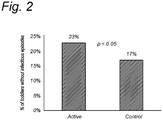
- Example 1 A summary of the study is set out in Example 1 (including Figures 1 and 2 ).
- the percentage of young children that suffered from infectious episodes decreased significantly when administered a formula enriched with specific oligosaccharides and a LCPUFA composition comprising insignificant amounts of ARA.
- a second clinical study with infants as described in Example 2 confirmed that these lower ARA levels do not compromise the n3 LCPUFA (e.g., DHA and EPA) serum levels. In fact, it was found that excellent DHA and EPA serum values were yielded when administering the infants with low amounts of ARA but significant amounts of DHA and EPA. Details are provided further below.
- compositions comprising ARA in the art.
- the present composition has a low ARA content.
- n3 LCPUFAs e.g., DHA and EPA
- the present invention relates to a pharmaceutical or nutritional composition for use in the treatment and/or prevention of infections in young children; reducing the occurrence of infection in young children and/or reducing the number of infectious episodes in young children, said composition comprising:
- the present invention provides a method for the treatment and/or prevention of infections; reducing the occurrence of infection; and/or reducing the number of infectious episodes, by administering the composition as characterized herein to a young child.
- the invention also pertains to the use of a composition characterized herein in the manufacture of a (pharmaceutical or nutritional) composition for the treatment and/or prevention of infections in young children; reducing the occurrence of infection; and/or reducing the number of infectious episodes in young children.
- n3-LCPUFAs particularly eicosapentaenoic acid (EPA, 20:5 n-3) and docosahexaenoic acid (DHA, 22:6 n-3), most particularly DHA, in the absence/significantly low/very limited amount of ARA, and in combination with the specified oligosaccharides effectively aids in reducing the occurrence and severity of infections and the number of infectious episodes.
- EPA eicosapentaenoic acid
- DHA docosahexaenoic acid
- the present inventors found that lower concentrations of LC-PUFAs were effective in reducing the occurrence and severity of infections.
- the content of LC-PUFA with 20 and 22 carbon atoms in the present composition preferably does not exceed 2.0 wt% of the total fat content, more preferably does not exceed 1.5 wt%, even more preferably does not exceed 1.4 wt%, most preferably does not exceed 1.2 wt% of the total fat content.
- LCPUFA as used in the present invention refers to polyunsaturated fatty acids with a 20 or 22 carbon chain.
- the present composition comprises at least 0.50 wt%, preferably at least 0.60 wt%, more preferably at least 0.70 wt% LC-PUFAs with 20 and 22 carbon atoms of the total fat content.
- the EPA content preferably ranges between 0.25 and 0.35 wt% of the fatty acids, more preferably does not exceed 0.30 wt% of the fatty acids.
- the DHA content preferably ranges between 0.35 and 0.55 wt%, more preferably does not exceed 0.50 wt% of the fatty acids.
- At least 80 wt%, more preferably at least 85 wt%, most preferably 85 - 100 wt% of the LCPUFAs with 20 and 22 carbon atoms is provided by the combination of EPA and DHA.
- the composition comprises relatively low amounts, preferably less than 0.04 wt% of the total fat.
- the amount of ARA is preferably between 0 and 0.05 wt.%, more preferably between 0.01 and 0.05 wt.%.
- the weight ratio ARA:DHA preferably is below 0.2, more preferably below 0.15, most preferably below 0.10. If ARA is present, the weight ratio ARA:EPA is preferably less than 0.8, more preferably less than 0.5, most preferably less than 0.2.
- the weight ratio DHA:EPA is preferably in the range of 1:1 to 2:1, preferably about 3:2. It is noted that this is merely an approximate limit.
- the docosapentaenoic acid (DPA) content preferably ranges between 0.01 and 0.20 wt% of the total fatty acids.
- the present composition comprises 0.01- 0.15 gram docosapentaenoic acid (DPA, 22:5 n-3) per 100 g fatty acids.
- omega-6 LC-PUFA : omega-3 LC-PUFA weight ratio is between 1:1 and 7:1, more preferably between 2:1 and 6:1, most preferably between 3:1 and 5:1, most preferably less than 5:1, in particular less than 4.8:1.
- the present composition preferably comprises between 5 and 75 wt% polyunsaturated fatty acids based on total fat, preferably between 10 and 50 wt%, most preferably between 10 and 25 wt%.
- the LC-PUFAs with 20 and 22 carbon atoms may be provided as free fatty acids, in triglyceride form, in phospholipid form, or as a mixture of one of more of the above.
- the present composition preferably comprises at least one of EPA and DHA, more preferably at least DHA, in triglyceride form.
- the present composition contains fish oil.
- the present nutritional composition preferably also provides omega-9 (n-9) fatty acid (preferably oleic acid, 18:1), to provide sufficient nutrition.
- omega-9 (n-9) fatty acid preferably oleic acid, 18:1
- the present composition provides at least 15 wt% n-9 fatty acid based on the weight of the total fatty acids, more preferably at least 25 wt%.
- the content of n-9 fatty acids is preferably below 80 wt%.
- composition preferably comprises between 1.5 and 2.5 gram indigestible oligosaccharides per 100 kcal, comprising:
- the composition preferably comprises a daily amount between 4 and 8 gram, preferably 5-7 gram indigestible oligosaccharides per daily amount, comprising, per day:
- fructans and inulin and hydrolyzates thereof, and is regarded interchangeably with the term “fructooligosaccharides”.
- the preferred galactooligosaccharides are transgalactooligosaccharides. It is preferred that at least 95 wt%, preferably 95 - 100 wt% of the indigestible oligosaccharides is provided by galactooligosaccharides and fructopolysaccharides.
- the present composition comprises transgalacto-oligosaccharide.
- Transgalacto-oligosaccharide can be defined as [galactose] n -glucose and/or [galactose] n -glucose-[galactose] wherein n is an integer from 1 up to and including 7.
- the present composition comprises [galactose] n -glucose wherein n is an integer from 1 up to and including 6. This type of galactooligosaccharides is sometimes referred to as scGOS.
- fructo-polysaccharide as used herein preferably refers to a non-digestible polysaccharide carbohydrate comprising a chain of at least 2 ⁇ -linked fructose units, with a degree of polymerization (DP) of 2 to 250, preferably 7 to 100, more preferably 20 to 60.
- DP degree of polymerization
- inulin is used.
- Inulin is available under the tradename "Raftilin HP®" (Orafti).
- the average DP of the present fructopolysaccharide is preferably at least 7, more preferably at least 10, preferably below 100, most preferably between 10 and 30, most preferably between 20 and 23.
- Fructopolysaccharide with an average DP between 10 and 30 is sometimes referred to as lcFOS.
- the fructopolysaccharide used preferably has the (majority of) fructose units linked with a ⁇ (2 ⁇ 1) linkage.
- Other terms for fructopolysaccharides include inulin, fructooligosaccharide, polyfructose, fructans and oligofructose.
- the present composition preferably comprises fructopoly/oligosaccharides with a DP of 2 to 100.
- composition is preferably administered orally.
- the present composition preferably includes protein, carbohydrate and fat. It is preferably administered in liquid form.
- liquid food as used in the present invention includes dry food (e.g. powders) which are accompanied with instructions as to admix said dry food mixture with a suitable liquid (e.g. water).
- the present composition is preferably provided as a packaged powder or packaged ready-to-feed formula.
- packaging size of ready-to-feed formula preferably does not exceed one serving, e.g. preferably does not exceed 1500 ml; and packaging size of the present composition in powder form preferably does not exceed 250 servings.
- Suitable packaging sizes for the powder are 2000 grams or less, preferably per 1000 grams or less.
- the present composition preferably comprises at least 35 wt% lactose based on weight of total digestible carbohydrate, more preferably at least 50 wt%, most preferably at least 75 wt%.
- the composition comprises at least 1 g lactose/100 ml, more preferably at least 2 g/100ml, even more preferably at least 5 g per 100 ml.
- the present composition preferably comprises 4 g to 18 g, more preferably 4 to 14 g digestible carbohydrates per 100 ml composition.
- the composition comprises 4 to 20 en% protein, 20 to 50 en% fat, and 25 to 85 en% carbohydrates. More preferably, the composition comprises 8 to 10 en% protein, 35 to 45 en% fat, and 45 to 55 en% carbohydrates.
- “En%” is short for energy percentage and represents the relative amount each constituent contributes to the total caloric value of the preparation.
- the caloric value is provided by digestible carbohydrates, protein and fat.
- the protein may comprise a member selected form the group consisting of hydrolyzed milk protein, vegetable protein and/or amino acids.
- the composition comprises vitamin D.
- Vitamin D is a group of fat-soluble secosteroids. There are two major physiologically relevant forms which are vitamin D2 (ergocalciferol) and vitamin D3 (cholecalciferol). These are known collectively as calciferol.
- the term 'vitamin D' refers to all forms of vitamin D, either D1, D2, D3, or D4, in particular D2 and D3, or any mixture thereof. Excellent results are obtained with inclusion of vitamin D for immunity and infection, Vitamin D may be provided in an active (1,25(OH) 2 D) or inactive (Vit D3 or D2) form.
- the packaged products preferably provided with labels that explicitly or implicitly direct the consumer towards the use of said product in accordance with one or more of the above or below purposes, are encompassed by the present invention.
- labels may for example make reference to the present method by including wording like "reduced infection”, “reduced infectious episodes”, protects your child”, “defense against bacteria and viruses”, or similar wording, in accordance with the findings of the clinical study.
- the composition is preferably a nutritional or dietary supplement suited for the targeted infant population, thus disclaiming infant (milk) nutrition.
- the present composition is preferably prepared by admixing a powdered composition comprising with water.
- the present invention thus also relates to a packaged power composition wherein said package is provided with instructions to admix the powder with a suitable amount of liquid.
- the present composition is administered to a young child, wherein the above-mentioned oligosaccharides are administered in a dosage of 0.8 - 1.6 g/100 ml, preferably 1.0 - 1.4 g/100 ml, and wherein said n-3 LCPUFAs are administered in a dosage of 15 - 25 mg/100 ml, preferably 18 - 22 mg/100 ml.
- the present composition is administered to a young child, wherein the above-mentioned oligosaccharides are administered in a daily dosage of 4 - 8 g, preferably 4.5 - 7.5 g, more preferably 5 - 7 g, and wherein said n-3 LCPUFAs are administered in a daily dosage of 60 - 130 mg, preferably 70 - 120 mg, more preferably 80 - 110 mg.
- the present composition is administered in liquid form to a young child in a daily amount of 250 - 750 ml, more preferably 400 - 750 ml per day, more preferably 400 - 600 ml per day, optimally about 500 ml per day.
- the daily dosage of the indigestible oligosaccharides is at least 3.5 gram and the daily dosage of n-3 LCPUFAs is at least 55 mg. It is however preferred that the oligosaccharides and the n-3 LCPUFAs are administered in a daily dosage of about 5.0 - 7.0 g and 80 - 110 mg, respectively.
- the recommended daily amounts are about 6.0 and 100 mg for the oligosaccharides and the n-3 LCPUFAs, respectively. It is noted that these recommended values are merely approximate limits.
- the oligosaccharides is to be understood as the combination of (i) short-chain galactooligosaccharides and (ii) long-chain fructopolysaccharides here above.
- n-3 LCPUFAs in this paragraph refers to the combination of DHA and EPA.
- vitamin D is administered in an amount of 200 - 800 ⁇ g per daily dosage, preferably 300 - 700 ⁇ g, more preferably 400 - 600 ⁇ g per daily dosage. According to one embodiment, vitamin D is used in an amount of 40 - 160 ⁇ g per 100 ml, preferably 60 - 140 ⁇ g, more preferably 80 - 120 ⁇ g per 100 ml. The above numbers can be converted into IU if deemed appropriate.
- the present composition is administered to the young child at least twice per week, more preferably at least 5 times per week, more preferably daily .
- the composition is administered for at least 10 consecutive weeks, preferably at least 26 consecutive weeks, more preferably at least 50 consecutive weeks.
- the present invention relates to the use of the present composition in young children with the age between 10 and 48 months, preferably between 10 and 36 months, more preferably with the age between 11 and 40 months, more preferably from 1 year to 3 years.
- the young children are healthy children, preferably young children not diagnosed with an illness or disease.
- the present invention preferably relates to intestinal and/or respiratory tract infections. Both the respiratory and intestinal tract are common sites for infection by pathogens. In one embodiment, the invention preferably relates to reducing the incidence of respiratory tract infections. In another embodiment, the invention preferably relates to reducing the incidence of intestinal infections.
- the present composition is preferably administered to young children attending daycare centers. These children are exposed to a plurality of microorganisms that can cause infections.
- the present invention also provides for a packaged liquid or powder composition suited for children with the age between 10 and 48 months, said composition providing per 100 ml liquid composition or 100 ml in water reconstituted powder composition:
- the present invention also provides for a packaged liquid or powder composition for use in reducing the occurrence of infection in young children, reducing the number of infectious episodes in young children and/or the treatment and/or prevention of infections in young children, said composition providing per daily dosage:
- the composition preferably comprises 4 to 20 en% protein, 20 to 50 en% fat, and 25 to 85 en% carbohydrates. More preferably, the composition comprises 8 to 10 en% protein, 35 to 45 en% fat, and 45 to 55 en% carbohydrates.
- the packaged liquid or powder composition further comprises vitamin D, preferably in the forms and amounts indicated above.
- the study objective was to investigate the effect of the composition of the invention on the occurrence of infections in children attending daycare centers, age 1-3 years.
- the study design is shown in Figure 1 , the statistics given in Table 1.
- compositions of the control and the 'invention diet' are listed in Table 2 (Table 2A showing the fatty acid compositions).
- the invention diet had a total saturated fatty acids content of 25.2 % (of all fatty acids); an omega-6:omega-3 weight ratio of 4.1:1; and a LA:ALA weight ratio of 5.4:1.
- the numbers for the control diet were 24.9 %, 5.5:1 and 5.4:1, respectively.
- Table 1 The compositions of the control and the 'invention diet' are listed in Table 2 (Table 2A showing the fatty acid compositions).
- the invention diet had a total saturated fatty acids content of 25.2 % (of all fatty acids); an omega-6:omega-3 weight ratio of 4.1:1; and a LA:ALA weight ratio of 5.4:1.
- the numbers for the control diet were 24.9 %, 5.5:1 and 5.4:1, respectively.
- Table 1 The numbers for the control diet were 24.9 %, 5.5:1 and 5.4:1, respectively.
- the aimed daily intake was at least 6.0g of scGOS/lcFOS and 100 mg of n-3 LCPUFA (DHA and EPA) in 500 ml.
- the composition included 1.2g/100 ml of scGOS/lcFOS (about 9:1 weight ratio) and 19.2 mg/100 ml of n-3 LCPUFA (DHA and EPA).
- the aim of this study was to measure the effect of a supplement with scGOS/lcFOS (about 9:1 weight ratio) and n-3 LCPUFA in healthy children.
- Table 3 shows the fatty acid content of the compositions.
- ARA and n-3 LC-PUFA concentrations in the Group 1 supplement were about 0.04 g and 0.84 g per 100 g fatty acids, respectively, in accordance with those reported for the intervention diet of example 1 (i.e. 0.034 g and 0.73 g per 100 g, respectively).
- ARA and n-3 LC-PUFA concentrations in the Group 2 and 3 supplements were about 0.108 g and 0.065 g per 100 g fatty acids.
- scGOS/lcFOS levels were similar to those in example 1, i.e. aimed daily intake of at least 6.0g of scGOS/lcFOS.
- n-3 LCPUFA The decrease of serum DHA and EPA observed in Group 2 and Group 3 (with 1.3mg/100mL DHA+EPA) over the 12 weeks period indicates that depletion of n-3 LCPUFA may occur. Therefore, infant nutrition with adequately high n-3 LCPUFA levels (including low amounts of ARA) can help to improve the n-3 LCPUFA status in young children aged 1-3.
Landscapes
- Health & Medical Sciences (AREA)
- Life Sciences & Earth Sciences (AREA)
- Chemical & Material Sciences (AREA)
- General Health & Medical Sciences (AREA)
- Medicinal Chemistry (AREA)
- Pharmacology & Pharmacy (AREA)
- Animal Behavior & Ethology (AREA)
- Public Health (AREA)
- Veterinary Medicine (AREA)
- Epidemiology (AREA)
- Engineering & Computer Science (AREA)
- Food Science & Technology (AREA)
- Nutrition Science (AREA)
- Polymers & Plastics (AREA)
- Mycology (AREA)
- Molecular Biology (AREA)
- Organic Chemistry (AREA)
- Oil, Petroleum & Natural Gas (AREA)
- Botany (AREA)
- Pediatric Medicine (AREA)
- General Chemical & Material Sciences (AREA)
- Nuclear Medicine, Radiotherapy & Molecular Imaging (AREA)
- Bioinformatics & Cheminformatics (AREA)
- Chemical Kinetics & Catalysis (AREA)
- Oncology (AREA)
- Pulmonology (AREA)
- Zoology (AREA)
- Genetics & Genomics (AREA)
- Communicable Diseases (AREA)
- General Engineering & Computer Science (AREA)
- Biochemistry (AREA)
- Wood Science & Technology (AREA)
- Acyclic And Carbocyclic Compounds In Medicinal Compositions (AREA)
- Coloring Foods And Improving Nutritive Qualities (AREA)
Description
- The invention is in the field of reducing the occurrence of infection in young children and/or reducing the number of infectious episodes in young children.
- Blood levels of docosahexaenoic acid (DHA) and arachidonic acid (ARA) are typically higher in breast-fed infants than in infants fed formulas not containing these fatty acids. For these reasons, infant formula manufacturers and consumers are interested in providing DHA and ARA directly to infants. According to standing recommendations, infant formula should be supplemented with ARA in amounts at least equal to the amounts of DHA.
-
WO 2005/122790 discloses a composition comprising oligosaccharides and long-chain polyunsaturated fatty acids (LC-PUFAs) for improving intestinal barrier integrity. The LC-PUFAs involve a combination of DHA, eicosapentaenoic acid (EPA) and ARA, wherein ARA was found to be particularly effective in reducing tight junction permeability, and its thus favored in relatively high amounts, preferably at least 0.1 wt% ARA of the total fat. -
WO 2006/022543 discloses a combination of oligosaccharides and immunoglobulins to treat infections. The combination may be incorporated into an infant formula further comprising LC-PUFAs, wherein it is believed that ARA, DHA and EPA act synergistically with the oligosaccharides. High amounts of ARA are advocated.WO 2006/115412 teaches similarly. - Outside the field,
EP 1.71.564 WO 2008/054192 relate to dust mite induced respiratory insufficiency and dust mite allergy, and visceral adiposity, respectively. To that end, both generally describe 0.1 - 5 wt% LC-PUFAs with 20 and 22 carbon atoms, based on total fat content, but their actual disclosures involve studies in which a treatment group received significant amounts of ARA, and infant nutrition recipes with only 0.25 - 0.27 wt%, based on lipid content, of DHA and EPA. - The inventors have observed in a clinical study with young children that by administering a specific formula the number of infections episodes and the occurrence of infections in young children are significantly reduced. A summary of the study is set out in Example 1 (including
Figures 1 and2 ). The percentage of young children that suffered from infectious episodes decreased significantly when administered a formula enriched with specific oligosaccharides and a LCPUFA composition comprising insignificant amounts of ARA. A second clinical study with infants as described in Example 2 confirmed that these lower ARA levels do not compromise the n3 LCPUFA (e.g., DHA and EPA) serum levels. In fact, it was found that excellent DHA and EPA serum values were yielded when administering the infants with low amounts of ARA but significant amounts of DHA and EPA. Details are provided further below. - In view of the art in the field, it is surprising that these results are obtained in young children. For example, many benefits have been ascribed to compositions comprising ARA in the art. However, the present composition has a low ARA content. The studies also evidence that significant amounts of n3 LCPUFAs (e.g., DHA and EPA) are required, in order to reduce the occurrence of infections and achieve satisfactory serum LCPUFA levels.
- Additionally, it is surprising that the benefits were observed in a subpopulation which already consumes a variety of foodstuff, and only a relatively small part of the diets being provided by the described compositions (growing up milks) with present constitutes and amounts. It is particularly difficult to predict the effect of mixture of ingredients in young children.
- The invention is best described by the claims. The present invention relates to a pharmaceutical or nutritional composition for use in the treatment and/or prevention of infections in young children; reducing the occurrence of infection in young children and/or reducing the number of infectious episodes in young children, said composition comprising:
- a) long chain polyunsaturated fatty acids (LC-PUFAs) with 20 and 22 carbon atoms, wherein the amount of arachidonic acid (ARA) is less than 0.06 gram per 100 gram fatty acid; and comprising:
- (i) 0.3-0.6 gram docosahexaenoic acid (DHA, n-3) per 100 g fatty acids; and
- (ii) 0.2-0.4 gram eicosapentaenoic acid (EPA, n-3) per 100 g fatty acids;
- b1) between 1.5 and 2.5 gram indigestible oligosaccharides per 100 kcal, comprising:
- (i) 1.4-2 gram galactooligosaccharides with a degree of polymerization of 2 - 7; and
- (ii) 0.1 - 0.5 gram fructopolysaccharides with degree of polymerization of 2 - 150; or
- b2) between 4 and 8 gram indigestible oligosaccharides per daily amount, comprising, per day:
- i) 3.7 - 6.4 gram galactooligosaccharides with a degree of polymerization of 2 - 7; and
- ii) 0.3 - 1.6 gram fructopolysaccharides with degree of polymerization of 2 -150.
- Worded differently, the present invention provides a method for the treatment and/or prevention of infections; reducing the occurrence of infection; and/or reducing the number of infectious episodes, by administering the composition as characterized herein to a young child.
- The invention also pertains to the use of a composition characterized herein in the manufacture of a (pharmaceutical or nutritional) composition for the treatment and/or prevention of infections in young children; reducing the occurrence of infection; and/or reducing the number of infectious episodes in young children.
- The present inventors surprisingly found that n3-LCPUFAs, particularly eicosapentaenoic acid (EPA, 20:5 n-3) and docosahexaenoic acid (DHA, 22:6 n-3), most particularly DHA, in the absence/significantly low/very limited amount of ARA, and in combination with the specified oligosaccharides effectively aids in reducing the occurrence and severity of infections and the number of infectious episodes.
- The present inventors found that lower concentrations of LC-PUFAs were effective in reducing the occurrence and severity of infections. Hence, the content of LC-PUFA with 20 and 22 carbon atoms in the present composition, preferably does not exceed 2.0 wt% of the total fat content, more preferably does not exceed 1.5 wt%, even more preferably does not exceed 1.4 wt%, most preferably does not exceed 1.2 wt% of the total fat content. LCPUFA as used in the present invention refers to polyunsaturated fatty acids with a 20 or 22 carbon chain. Preferably the present composition comprises at least 0.50 wt%, preferably at least 0.60 wt%, more preferably at least 0.70 wt% LC-PUFAs with 20 and 22 carbon atoms of the total fat content.
- The EPA content preferably ranges between 0.25 and 0.35 wt% of the fatty acids, more preferably does not exceed 0.30 wt% of the fatty acids. The DHA content preferably ranges between 0.35 and 0.55 wt%, more preferably does not exceed 0.50 wt% of the fatty acids.
- It is preferred that at least 80 wt%, more preferably at least 85 wt%, most preferably 85 - 100 wt% of the LCPUFAs with 20 and 22 carbon atoms is provided by the combination of EPA and DHA.
- However, while the art promotes the use of significant amounts of ARA in infant formulae, it was found by the present inventors that excellent results are obtained when ARA levels are in fact low, preferably lower than 0.05 wt% of total fat. It is preferred that the composition comprises relatively low amounts, preferably less than 0.04 wt% of the total fat. The amount of ARA is preferably between 0 and 0.05 wt.%, more preferably between 0.01 and 0.05 wt.%.
- If ARA is present, the weight ratio ARA:DHA preferably is below 0.2, more preferably below 0.15, most preferably below 0.10. If ARA is present, the weight ratio ARA:EPA is preferably less than 0.8, more preferably less than 0.5, most preferably less than 0.2. The weight ratio DHA:EPA is preferably in the range of 1:1 to 2:1, preferably about 3:2. It is noted that this is merely an approximate limit.
- The docosapentaenoic acid (DPA) content preferably ranges between 0.01 and 0.20 wt% of the total fatty acids. Preferably, the present composition comprises 0.01- 0.15 gram docosapentaenoic acid (DPA, 22:5 n-3) per 100 g fatty acids.
- It is preferred that the omega-6 LC-PUFA : omega-3 LC-PUFA weight ratio is between 1:1 and 7:1, more preferably between 2:1 and 6:1, most preferably between 3:1 and 5:1, most preferably less than 5:1, in particular less than 4.8:1.
- The present composition preferably comprises between 5 and 75 wt% polyunsaturated fatty acids based on total fat, preferably between 10 and 50 wt%, most preferably between 10 and 25 wt%.
- The LC-PUFAs with 20 and 22 carbon atoms may be provided as free fatty acids, in triglyceride form, in phospholipid form, or as a mixture of one of more of the above. The present composition preferably comprises at least one of EPA and DHA, more preferably at least DHA, in triglyceride form. Preferably the present composition contains fish oil.
- The present nutritional composition preferably also provides omega-9 (n-9) fatty acid (preferably oleic acid, 18:1), to provide sufficient nutrition. Preferably the present composition provides at least 15 wt% n-9 fatty acid based on the weight of the total fatty acids, more preferably at least 25 wt%. The content of n-9 fatty acids is preferably below 80 wt%.
- It is preferred to maintain weight ratios of stearidonic acid (18:4) to DHA and to EPA below 0.1.
- The composition preferably comprises between 1.5 and 2.5 gram indigestible oligosaccharides per 100 kcal, comprising:
- i) 1.4-2 gram galactooligosaccharides with a degree of polymerization of 2 - 7; and
- ii) 0.1 - 0.5 gram fructopolysaccharides with degree of polymerization of 2 -150.
- In one embodiment, the composition preferably comprises a daily amount between 4 and 8 gram, preferably 5-7 gram indigestible oligosaccharides per daily amount, comprising, per day:
- i) 3.7 - 6.4 gram, preferably 4.5 - 5.6 gram galactooligosaccharides with a degree of polymerization of 2 - 7; and
- ii) 0.3 - 1.6 gram, preferably 0.5 - 1.4 gram fructopolysaccharides with degree of polymerization of 2 -150.
- The term "fructopolysaccharides" comprises fructans and inulin, and hydrolyzates thereof, and is regarded interchangeably with the term "fructooligosaccharides". The preferred galactooligosaccharides are transgalactooligosaccharides.
It is preferred that at least 95 wt%, preferably 95 - 100 wt% of the indigestible oligosaccharides is provided by galactooligosaccharides and fructopolysaccharides. - In a particularly preferred embodiment the present composition comprises transgalacto-oligosaccharide. Transgalacto-oligosaccharide can be defined as [galactose]n-glucose and/or [galactose]n-glucose-[galactose] wherein n is an integer from 1 up to and including 7. Preferably the present composition comprises [galactose]n-glucose wherein n is an integer from 1 up to and including 6. This type of galactooligosaccharides is sometimes referred to as scGOS.
- The term "fructo-polysaccharide" as used herein preferably refers to a non-digestible polysaccharide carbohydrate comprising a chain of at least 2 β-linked fructose units, with a degree of polymerization (DP) of 2 to 250, preferably 7 to 100, more preferably 20 to 60. Preferably inulin is used. Inulin is available under the tradename "Raftilin HP®" (Orafti). The average DP of the present fructopolysaccharide is preferably at least 7, more preferably at least 10, preferably below 100, most preferably between 10 and 30, most preferably between 20 and 23. Fructopolysaccharide with an average DP between 10 and 30 is sometimes referred to as lcFOS. The fructopolysaccharide used preferably has the (majority of) fructose units linked with a β(2→1) linkage. Other terms for fructopolysaccharides include inulin, fructooligosaccharide, polyfructose, fructans and oligofructose. The present composition preferably comprises fructopoly/oligosaccharides with a DP of 2 to 100.
- The composition is preferably administered orally.
- The present composition preferably includes protein, carbohydrate and fat. It is preferably administered in liquid form. The term "liquid food" as used in the present invention includes dry food (e.g. powders) which are accompanied with instructions as to admix said dry food mixture with a suitable liquid (e.g. water).
- The present composition is preferably provided as a packaged powder or packaged ready-to-feed formula. To prevent spoilage of the product, packaging size of ready-to-feed formula preferably does not exceed one serving, e.g. preferably does not exceed 1500 ml; and packaging size of the present composition in powder form preferably does not exceed 250 servings. Suitable packaging sizes for the powder are 2000 grams or less, preferably per 1000 grams or less.
- Because lactose is an important carbohydrate source for young children, the present composition preferably comprises at least 35 wt% lactose based on weight of total digestible carbohydrate, more preferably at least 50 wt%, most preferably at least 75 wt%. Preferably, the composition comprises at least 1 g lactose/100 ml, more preferably at least 2 g/100ml, even more preferably at least 5 g per 100 ml. The present composition preferably comprises 4 g to 18 g, more preferably 4 to 14 g digestible carbohydrates per 100 ml composition.
- Preferably, the composition comprises 4 to 20 en% protein, 20 to 50 en% fat, and 25 to 85 en% carbohydrates. More preferably, the composition comprises 8 to 10 en% protein, 35 to 45 en% fat, and 45 to 55 en% carbohydrates. "En%" is short for energy percentage and represents the relative amount each constituent contributes to the total caloric value of the preparation. The caloric value is provided by digestible carbohydrates, protein and fat. The protein may comprise a member selected form the group consisting of hydrolyzed milk protein, vegetable protein and/or amino acids.
- In a preferred embodiment, the composition comprises vitamin D. Vitamin D is a group of fat-soluble secosteroids. There are two major physiologically relevant forms which are vitamin D2 (ergocalciferol) and vitamin D3 (cholecalciferol). These are known collectively as calciferol. In the context of the invention, the term 'vitamin D' refers to all forms of vitamin D, either D1, D2, D3, or D4, in particular D2 and D3, or any mixture thereof. Excellent results are obtained with inclusion of vitamin D for immunity and infection, Vitamin D may be provided in an active (1,25(OH)2D) or inactive (Vit D3 or D2) form.
- The packaged products preferably provided with labels that explicitly or implicitly direct the consumer towards the use of said product in accordance with one or more of the above or below purposes, are encompassed by the present invention. Such labels may for example make reference to the present method by including wording like "reduced infection", "reduced infectious episodes", protects your child", "defense against bacteria and viruses", or similar wording, in accordance with the findings of the clinical study.
- In one embodiment, the composition is preferably a nutritional or dietary supplement suited for the targeted infant population, thus disclaiming infant (milk) nutrition.
- The present composition is preferably prepared by admixing a powdered composition comprising with water. The present invention thus also relates to a packaged power composition wherein said package is provided with instructions to admix the powder with a suitable amount of liquid.
- In one preferred embodiment, the present composition is administered to a young child, wherein the above-mentioned oligosaccharides are administered in a dosage of 0.8 - 1.6 g/100 ml, preferably 1.0 - 1.4 g/100 ml, and wherein said n-3 LCPUFAs are administered in a dosage of 15 - 25 mg/100 ml, preferably 18 - 22 mg/100 ml.
- In one preferred embodiment, the present composition is administered to a young child, wherein the above-mentioned oligosaccharides are administered in a daily dosage of 4 - 8 g, preferably 4.5 - 7.5 g, more preferably 5 - 7 g, and wherein said n-3 LCPUFAs are administered in a daily dosage of 60 - 130 mg, preferably 70 - 120 mg, more preferably 80 - 110 mg.
- Preferably the present composition is administered in liquid form to a young child in a daily amount of 250 - 750 ml, more preferably 400 - 750 ml per day, more preferably 400 - 600 ml per day, optimally about 500 ml per day. It is preferred that the daily dosage of the indigestible oligosaccharides (preferably GOS and fructopolysaccharides) is at least 3.5 gram and the daily dosage of n-3 LCPUFAs is at least 55 mg. It is however preferred that the oligosaccharides and the n-3 LCPUFAs are administered in a daily dosage of about 5.0 - 7.0 g and 80 - 110 mg, respectively. The recommended daily amounts are about 6.0 and 100 mg for the oligosaccharides and the n-3 LCPUFAs, respectively. It is noted that these recommended values are merely approximate limits. In this paragraph, "the oligosaccharides" is to be understood as the combination of (i) short-chain galactooligosaccharides and (ii) long-chain fructopolysaccharides here above. The term "n-3 LCPUFAs" in this paragraph refers to the combination of DHA and EPA.
- According to one embodiment, vitamin D is administered in an amount of 200 - 800 µg per daily dosage, preferably 300 - 700 µg, more preferably 400 - 600 µg per daily dosage. According to one embodiment, vitamin D is used in an amount of 40 - 160 µg per 100 ml, preferably 60 - 140 µg, more preferably 80 - 120 µg per 100 ml. The above numbers can be converted into IU if deemed appropriate.
- Preferably the present composition is administered to the young child at least twice per week, more preferably at least 5 times per week, more preferably daily . Preferably the composition is administered for at least 10 consecutive weeks, preferably at least 26 consecutive weeks, more preferably at least 50 consecutive weeks.
- The present invention relates to the use of the present composition in young children with the age between 10 and 48 months, preferably between 10 and 36 months, more preferably with the age between 11 and 40 months, more preferably from 1 year to 3 years. Preferably the young children are healthy children, preferably young children not diagnosed with an illness or disease.
- The present invention preferably relates to intestinal and/or respiratory tract infections. Both the respiratory and intestinal tract are common sites for infection by pathogens. In one embodiment, the invention preferably relates to reducing the incidence of respiratory tract infections. In another embodiment, the invention preferably relates to reducing the incidence of intestinal infections. The present composition is preferably administered to young children attending daycare centers. These children are exposed to a plurality of microorganisms that can cause infections.
- The present invention also provides for a packaged liquid or powder composition suited for children with the age between 10 and 48 months, said composition providing per 100 ml liquid composition or 100 ml in water reconstituted powder composition:
- a. 15 - 25 mg long chain polyunsaturated fatty acids (LC-PUFAs) with 20 and 22 carbon atoms, wherein the amount of arachidonic acid (ARA) is less than 0.06 gram per 100 gram fatty acids; and comprising:
- (i) 0.3-0.6 gram docosahexaenoic acid (DHA, n-3) per 100 g fatty acids; and
- (ii) 0.2-0.4 gram eicosapentaenoic acid (EPA, n-3) per 100 g fatty acids; and
- b. 1 - 1.5 gram indigestible oligosaccharides per 100 ml, and between 1.5 and 2.5 gram indigestible oligosaccharides per 100 kcal, comprising:
- (i) 1.4-2 gram per 100 kcal galactooligosaccharides with a degree of polymerization of 2 - 7; and
- (ii) 0.1 - 0.5 gram per 100 kcal fructopolysaccharides with degree of polymerization of 2 -150, and an average degree of polymerization between 10 and 30;
- c. 8 to 10 en% protein, 35 to 45 en% fat, and 45 to 55 en% carbohydrates.
- In one embodiment, the present invention also provides for a packaged liquid or powder composition for use in reducing the occurrence of infection in young children, reducing the number of infectious episodes in young children and/or the treatment and/or prevention of infections in young children, said composition providing per daily dosage:
- a) 60 - 130, preferably 70 - 120 mg, more preferably 80 - 110 mg long chain polyunsaturated fatty acids (LC-PUFAs) with 20 and 22 carbon atoms, wherein the amount of arachidonic acid (ARA) is less than 0.06 gram per 100 gram fatty acids; and comprising:
- (i) 0.3-0.6 gram docosahexaenoic acid (DHA, n-3) per 100 g fatty acids; and
- (ii) 0.2-0.4 gram eicosapentaenoic acid (EPA, n-3) per 100 g fatty acids; and
- b) 4 - 8 gram, preferably 5-7 gram indigestible oligosaccharides per day, comprising, per day:
- (i) 3.7 - 6.4 gram, preferably 4.5 - 5.6 gram galactooligosaccharides with a degree of polymerization of 2 - 7; and
- (ii) 0.3 - 1.6 gram, 0.5 - 1.4 gram fructopolysaccharides with degree of polymerization of 2 -150, and an average degree of polymerization between 10 and 30.
- The composition preferably comprises 4 to 20 en% protein, 20 to 50 en% fat, and 25 to 85 en% carbohydrates. More preferably, the composition comprises 8 to 10 en% protein, 35 to 45 en% fat, and 45 to 55 en% carbohydrates.
- In one embodiment, the packaged liquid or powder composition further comprises vitamin D, preferably in the forms and amounts indicated above.
- The study objective was to investigate the effect of the composition of the invention on the occurrence of infections in children attending daycare centers, age 1-3 years.
The study design is shown inFigure 1 , the statistics given in Table 1. - The compositions of the control and the 'invention diet' are listed in Table 2 (Table 2A showing the fatty acid compositions). The invention diet had a total saturated fatty acids content of 25.2 % (of all fatty acids); an omega-6:omega-3 weight ratio of 4.1:1; and a LA:ALA weight ratio of 5.4:1. The numbers for the control diet were 24.9 %, 5.5:1 and 5.4:1, respectively.
Table 1. Number of participants in study Screened 907 Randomized 768 Reference group 37 SF at V2 103 Drop out after V2 73 Completed 731 Table 2: Ingredients [per 100 kg powder] INGREDIENTS CONTROL Invention diet Demineralized whey [kg] 21.0 19.4 Vegetable oils [kg] 21.2 19.1 Skimmed milk [kg] 17.7 16.3 Maltodextrin [kg] 17.3 13.5 Dietary fibers [kg]: - 12.7 - galactooligosaccharides [kg] - 11.9 - fructopolysaccharides [kg] - 0.798 Lactose [kg] 16.6 12.6 Whey protein concentrate [kg] 3.97 3.58 Tricalcium phosphate [kg] 0.460 0.398 Fish oil [kg] - 0.384 Calcium carbonate [kg] 0.366 0.356 Tri potassium citrate [kg] 0.288 0.257 Tri sodium citrate [kg] 0.125 0.140 L-ascorbic acid [g] 95.1 87.4 Magnesium chloride[g] 79.7 66.8 Soy lecithin[g] 37.8 59.5 Taurine[g] 36.7 34.1 Choline chloride[g] 34.2 30.1 Vanillin[g] 32.5 30.0 Sodium L-ascorbate[g] 32.5 29.9 Ferrous sulphate[g] 25.9 23.8 Potassium chloride[g] 21.5 23.0 Zinc sulphate[g] 15.4 13.9 DL-alpha tocopheryl acetate[g] 3.89 3.62 Nicotinamide[g] 3.13 2.87 Folic acid[g] 1.32 1.21 Cholecalciferol[g] 1.30 1.19 Calcium D-pantothenate[g] 1.24 1.08 Cupric sulphate[g] 1.16 1.07 Retinyl palmitate[g] 0.959 0.879 DL-alpha tocopherol[g] 0.913 0.836 D-biotin[g] 0.694 0.638 Retinyl acetate[g] 0.661 0.627 Thiamin hydrochloride[g] 0.436 0.402 Cyanocobalamin[g] 0.251 0.325 Pyridoxine hydrochloride[g] 0.246 0.245 Riboflavin[g] 0.206 0.226 Potassium iodide[mg] 87.4 67.0 Manganese sulphate[mg] 75.6 54.6 Phytomenadione[mg] 29.9 27.4 Sodium selenite[mg] 21.9 20.3 Table 2A - Fatty acid composition for Example 1* CONTROL Invention diet Per 100 g fatty acids Per 100 g powder Per 100 g fatty acids Per 100 g powder C16:0 palmitic acid 19.2 3.96 19.2 3.62 C18:0 stearic acid 3.48 0.72 3.50 0.66 C18:1 oleic acid 57.3 11.8 56.3 10.7 C18:2 linoleic acid 14.2 2.93 14.0 2.65 C18:3 alpha-linolenic acid 2.64 0.542 2.60 0.492 C20:0 arachidic acid 0.42 0.09 0.42 0.08 C20:1 eicosaenoic acid 0.55 0.11 0.268 0.051 C20:4 arachidonic acid - - 0.034 0.006 C20:5 eicosapentaenoic acid - - 0.268 0.051 C22:0 behenic acid 0.44 0.09 0.44 0.08 C22:1 erucic acid 0.11 0.02 0.11 0.02 C22:5 docosapentaenoic acid - - 0.06 0.01 C22:6 docosahexaenoic acid - - 0.402 0.076 - *The list of fatty acids is not exhaustive. Listed are those present in significant amounts and considered relevant for the purpose of the study.
- In a randomized, double-blind, controlled, parallel, multi-country intervention trial, 767 healthy children, aged 11-29 months, received the 'invention diet' with scGOS/lcFOS/LCPUFA, or 'control diet' (without scGOS/lcFOS/LCPUFA) for 52 weeks.
- For the invention diet, the aimed daily intake was at least 6.0g of scGOS/lcFOS and 100 mg of n-3 LCPUFA (DHA and EPA) in 500 ml. The composition included 1.2g/100 ml of scGOS/lcFOS (about 9:1 weight ratio) and 19.2 mg/100 ml of n-3 LCPUFA (DHA and EPA).
- Parents completed a daily diary on occurring illness symptoms (not distinguishing between upper respiratory tract infections and gastrointestinal infections).
A Zero-inflated Negative - Binomial regression Model was used that combines two separate parts: a binomial part (a subject would get an infection: yes/no) and a negative-binomial part fitting the counts for infections for the subjects. - Children in the 'invention diet' group compared with the control group had a decreased risk of having at least one infection (299/388 (77%) vs. 313/379 (83%), respectively, RR = 0.93, 95% CI 0.87-1; chi-square p=0.057; logistic regression p=0.0259).
- In other words, the results show a trend toward a significant effect on number of infectious episodes (p=0.0743). This trend is driven by a significant increased chance of having no infectious episode, as shown in
Figure 2 , in terms of the percentage of young children that were not reported to have suffered from infectious episodes (p<0.05). - The aim of this study was to measure the effect of a supplement with scGOS/lcFOS (about 9:1 weight ratio) and n-3 LCPUFA in healthy children.
- In this double-blind, placebo-controlled study, 195 children aged 1-3 years were randomized to receive a composition with scGOS/lcFOS and 16.9 mg/100mL n-3 LCPUFA (Group 1), a composition with scGOS/lcFOS and 1.3mg/100mL n-3 LCPUFA (Group 2) or a composition with no scGOS/lcFOS and 1.3mg/100mL n-3 LCPUFA (Group 3) for 12 weeks. Mean daily intake was about 540 ml of said compositions.
- Table 3 shows the fatty acid content of the compositions.
Table 3 - Fatty acid composition for Example 2 * Groups 2 and 3 Group 1 Per 100 g fatty acids Per 100 g powder Per 100 g fatty acids Per 100 g powder C16:0 palmitic acid 19.5 2.09 19.4 2.01 C18:0 stearic acid 3.43 0.37 3.44 0.36 C18:1 oleic acid 54.9 5.88 54.0 5.58 C18:2 linoleic acid 14.4 1.54 14.1 1.46 C18:3 alpha-linolenic acid 2.53 0.271 2.49 0.258 C20:0 arachidic acid 0.41 0.04 0.41 0.04 C20:1 eicosaenoic acid 0.51 0.11 0.53 0.06 C20:4 arachidonic acid 0.108 0.012 0.04 0.004 C20:5 eicosapentaenoic acid 0.011 0.001 0.305 0.032 C22:0 behenic acid 0.44 0.05 0.43 0.04 C22:1 erucic acid 0.11 0.01 0.11 0.01 C22:5 docosapentaenoic acid - - 0.06 0.01 C22:6 docosahexaenoic acid 0.054 0.006 0.475 0.049 *The list of fatty acids is not exhaustive. Listed are those present in significant amounts and considered relevant for the purpose of the study. - Serum samples were obtained in 128 children at baseline and at week 12.
- As shown in Table 3, ARA and n-3 LC-PUFA concentrations in the Group 1 supplement were about 0.04 g and 0.84 g per 100 g fatty acids, respectively, in accordance with those reported for the intervention diet of example 1 (i.e. 0.034 g and 0.73 g per 100 g, respectively). ARA and n-3 LC-PUFA concentrations in the
Group 2 and 3 supplements were about 0.108 g and 0.065 g per 100 g fatty acids. In groups 1 and 3, scGOS/lcFOS levels were similar to those in example 1, i.e. aimed daily intake of at least 6.0g of scGOS/lcFOS. - There were no differences in the baseline characteristics between study groups. Mean intake of the composition was similar in all groups during the study (range 530-542 mL/day). Between baseline and week 12, there was a significant increase in serum DHA (46.0 - 53.7 mg/L, p<0.001) and EPA (7.0 - 8.6mg/L, p=0.001) in Group 1, while significant decrease in serum DHA and EPA in both Group 2 (45.6 - 40.0mg/L and 7.2 - 4.6mg/L, respectively, both p<0.001) and Group 3 (45.4 - 39.0mg/L, p<0.001 and 7.1 - 5.4mg/L, p=0.007, respectively). These changes were significantly different in Group 1 compared to Group 3, and to Group 2 (both p<0.001) but not different when compared
Group 2 to Group 3 (p=0.858). - The decrease of serum DHA and EPA observed in
Group 2 and Group 3 (with 1.3mg/100mL DHA+EPA) over the 12 weeks period indicates that depletion of n-3 LCPUFA may occur. Therefore, infant nutrition with adequately high n-3 LCPUFA levels (including low amounts of ARA) can help to improve the n-3 LCPUFA status in young children aged 1-3.
Claims (14)
- A composition for use in reducing the occurrence of infection in young children, reducing the number of infectious episodes in young children and/or the treatment and/or prevention of infections in young children, said composition comprising:a) long chain polyunsaturated fatty acids (LC-PUFAs) with 20 and 22 carbon atoms, wherein the amount of arachidonic acid (ARA) is less than 0.06 gram per 100 gram fatty acid; and comprising:and one of b1) or b2):(i) 0.3-0.6 gram docosahexaenoic acid (DHA, n-3) per 100 g fatty acids; and(ii) 0.2-0.4 gram eicosapentaenoic acid (EPA, n-3) per 100 g fatty acids;b1) between 1.5 and 2.5 gram indigestible oligosaccharides per 100 kcal, comprising:(i) 1.4-2 gram galactooligosaccharides with a degree of polymerization of 2-7; and(ii) 0.1 - 0.5 gram fructopolysaccharides with degree of polymerization of 2 - 150; orb2) between 4 and 8 gram indigestible oligosaccharides per daily amount, comprising, per day:i) 3.7 - 6.4 gram galactooligosaccharides with a degree of polymerization of 2 - 7; andii) 0.3 - 1.6 gram fructopolysaccharides with degree of polymerization of 2-150.
- The composition for use according to claim 1, wherein at least 80 wt% of said LCPUFAs are provided by the combination of EPA and DHA.
- The composition for use according to any one of the preceding claims, comprising 0.01- 0.2 gram docosapentaenoic acid (DPA, n-3) per 100 g fatty acids.
- The composition for use according to any one of the preceding claims, comprising 0.25 - 0.35 g EPA and 0.35 - 0.55 g DHA per 100 g fatty acids.
- The composition for use according to any one of the preceding claims, wherein at least 95 wt% of the indigestible oligosaccharides are provided by galactooligosaccharides and fructopolysaccharides.
- The composition for use according to any one of the preceding claims, comprising 8-10 en% protein, 45-55 en% carbohydrates and 35-45 en% fat; and 0.5-0.75 kcal per 100 ml.
- The composition for use according to any one of the preceding claims, wherein said infections comprise respiratory tract infections and intestinal infections.
- The composition for use according to any one of the preceding claims, having a weight ratio of ARA:DHA below 0.2.
- The composition for use according to any one of the preceding claims, having a weight ratio of ARA:EPA below 0.8.
- The composition for use according to any one of the preceding claims, having an omega-6 LC-PUFA : omega-3 LC-PUFA weight ratio between 1:1 and 7:1.
- The composition for use according to any one of the preceding claims, having a weight ratio of DHA:EPA in the range of 1:1 to 2:1.
- The composition for use according to any one of the preceding claims, further comprising vitamin D, preferably in a daily dosage of 200 - 800 µg.
- A packaged liquid or powder composition suited for children with the age between 10 and 48 months, said composition providing per 100 ml liquid composition or 100 ml in water reconstituted powder composition:a. 15 - 25 mg long chain polyunsaturated fatty acids (LC-PUFAs) with 20 and 22 carbon atoms, wherein the amount of arachidonic acid (ARA) is less than 0.06 gram per 100 gram fatty acid; and comprising:(i) 0.3-0.6 gram docosahexaenoic acid (DHA, n-3) per 100 g fatty acids; and(ii) 0.2-0.4 gram eicosapentaenoic acid (EPA, n-3) per 100 g fatty acids; andb. 1 - 1.5 gram indigestible oligosaccharides per 100 ml, and between 1.5 and 2.5 gram indigestible oligosaccharides per 100 kcal, comprising:(i) 1.4-2 gram per 100 kcal galactooligosaccharides with a degree of polymerization of 2 - 7; and(ii) 0.1 - 0.5 gram per 100 kcal fructopolysaccharides with degree of polymerization of 2 - 150, and an average degree of polymerization between 10 and 30;c. 8 to 10 en% protein, 35 to 45 en% fat, and 45 to 55 en% carbohydrates.
- A packaged liquid or powder composition for use in reducing the occurrence of infection in young children, reducing the number of infectious episodes in young children and/or the treatment and/or prevention of infections in young children, said composition providing per daily dosage:a) 60 - 130, preferably 70 - 120 mg, more preferably 80 - 110 mg long chain polyunsaturated fatty acids (LC-PUFAs) with 20 and 22 carbon atoms, wherein the amount of arachidonic acid (ARA) is less than 0.06 gram per 100 gram fatty acids; and comprising:(i) 0.3-0.6 gram docosahexaenoic acid (DHA, n-3) per 100 g fatty acids; and(ii) 0.2-0.4 gram eicosapentaenoic acid (EPA, n-3) per 100 g fatty acids; andb) 4 - 8 gram, preferably 5-7 gram indigestible oligosaccharides per day, comprising, per day:(i) 3.7 - 6.4 gram, preferably 4.5 - 5.6 gram galactooligosaccharides with a degree of polymerization of 2 - 7; and(ii) 0.3 - 1.6 gram, preferably 0.5 - 1.4 gram fructopolysaccharides with degree of polymerization of 2 -150, and an average degree of polymerization between 10 and 30; and optionallyc. 8 to 10 en% protein, 35 to 45 en% fat, and 45 to 55 en% carbohydrates.
Priority Applications (2)
| Application Number | Priority Date | Filing Date | Title |
|---|---|---|---|
| PL12732726T PL2723195T3 (en) | 2011-06-22 | 2012-06-22 | Method for reducing the occurrence of infection in young children |
| EP18196919.7A EP3469921A1 (en) | 2011-06-22 | 2012-06-22 | Method for reducing the occurrence of infection in young children |
Applications Claiming Priority (2)
| Application Number | Priority Date | Filing Date | Title |
|---|---|---|---|
| PCT/NL2011/050449 WO2012177118A1 (en) | 2011-06-22 | 2011-06-22 | Method for reducing the occurrence of infection in young children |
| PCT/NL2012/050442 WO2012177135A1 (en) | 2011-06-22 | 2012-06-22 | Method for reducing the occurrence of infection in young children |
Related Child Applications (1)
| Application Number | Title | Priority Date | Filing Date |
|---|---|---|---|
| EP18196919.7A Division EP3469921A1 (en) | 2011-06-22 | 2012-06-22 | Method for reducing the occurrence of infection in young children |
Publications (2)
| Publication Number | Publication Date |
|---|---|
| EP2723195A1 EP2723195A1 (en) | 2014-04-30 |
| EP2723195B1 true EP2723195B1 (en) | 2018-10-24 |
Family
ID=46458585
Family Applications (2)
| Application Number | Title | Priority Date | Filing Date |
|---|---|---|---|
| EP12732726.0A Active EP2723195B1 (en) | 2011-06-22 | 2012-06-22 | Method for reducing the occurrence of infection in young children |
| EP18196919.7A Pending EP3469921A1 (en) | 2011-06-22 | 2012-06-22 | Method for reducing the occurrence of infection in young children |
Family Applications After (1)
| Application Number | Title | Priority Date | Filing Date |
|---|---|---|---|
| EP18196919.7A Pending EP3469921A1 (en) | 2011-06-22 | 2012-06-22 | Method for reducing the occurrence of infection in young children |
Country Status (14)
| Country | Link |
|---|---|
| US (1) | US9427445B2 (en) |
| EP (2) | EP2723195B1 (en) |
| CN (2) | CN103732080A (en) |
| BR (1) | BR112013033003A2 (en) |
| DK (1) | DK2723195T3 (en) |
| ES (1) | ES2704957T3 (en) |
| HU (1) | HUE041825T2 (en) |
| MY (1) | MY169310A (en) |
| PH (1) | PH12013502639B1 (en) |
| PL (1) | PL2723195T3 (en) |
| PT (1) | PT2723195T (en) |
| RU (1) | RU2605198C2 (en) |
| TR (1) | TR201900870T4 (en) |
| WO (2) | WO2012177118A1 (en) |
Families Citing this family (1)
| Publication number | Priority date | Publication date | Assignee | Title |
|---|---|---|---|---|
| US9241923B2 (en) * | 2013-07-16 | 2016-01-26 | Mead Johnson Nutrition Company | Methods for promoting neuronal development and/or health |
Citations (8)
| Publication number | Priority date | Publication date | Assignee | Title |
|---|---|---|---|---|
| US5827526A (en) | 1995-07-11 | 1998-10-27 | Abbott Laboratories | Use of indigestible oligosaccharides to prevent gastrointestinal infections and reduce duration of diarrhea in humans |
| WO2005122791A2 (en) | 2004-06-22 | 2005-12-29 | N.V. Nutricia | Improvement of barrier integrity in hiv patients with fatty acids |
| WO2006018314A2 (en) | 2004-08-20 | 2006-02-23 | N.V. Nutricia | Immune stimulatory infant nutrition |
| WO2006022542A1 (en) | 2004-08-24 | 2006-03-02 | N.V. Nutricia | Nutricional composition comprising indigestible oligosaccharides |
| EP1714564A1 (en) | 2005-04-21 | 2006-10-25 | N.V. Nutricia | Method for treatment and prevention of respiratory insufficiency |
| WO2007105945A2 (en) | 2006-03-10 | 2007-09-20 | N.V. Nutricia | Use of non-digestable sacharides for giving an infant the best start after birth |
| WO2009157767A1 (en) | 2008-06-23 | 2009-12-30 | N.V. Nutricia | Nutritional composition for improving the mammalian immune system |
| US20100278781A1 (en) | 2007-06-15 | 2010-11-04 | Sander Hougee | Nutrition with non-viable bifidobacterium and non-digestible oligosaccharide |
Family Cites Families (6)
| Publication number | Priority date | Publication date | Assignee | Title |
|---|---|---|---|---|
| DE8422267U1 (en) | 1984-07-26 | 1984-11-08 | Wilhelm Link GmbH & Co KG Stahlrohrmöbel, 7475 Meßstetten | FOOTSTAR FOR OFFICE CHAIRS |
| US8252769B2 (en) | 2004-06-22 | 2012-08-28 | N. V. Nutricia | Intestinal barrier integrity |
| EP1721611A1 (en) * | 2005-04-21 | 2006-11-15 | N.V. Nutricia | Nutritional supplement with oligosaccharides for a category of HIV patients |
| ATE471665T1 (en) * | 2005-04-21 | 2010-07-15 | Nutricia Nv | DIETARY SUPPLEMENTS FOR HIV PATIENTS |
| CA2604383C (en) | 2005-04-27 | 2014-09-09 | N.V. Nutricia | Nutrition with lipids and non-digestible saccharides |
| WO2008054192A1 (en) * | 2006-11-02 | 2008-05-08 | N.V. Nutricia | Use of nutritional compositions for preventing disorders |
-
2011
- 2011-06-22 WO PCT/NL2011/050449 patent/WO2012177118A1/en not_active Ceased
-
2012
- 2012-06-22 TR TR2019/00870T patent/TR201900870T4/en unknown
- 2012-06-22 HU HUE12732726A patent/HUE041825T2/en unknown
- 2012-06-22 PT PT12732726T patent/PT2723195T/en unknown
- 2012-06-22 WO PCT/NL2012/050442 patent/WO2012177135A1/en not_active Ceased
- 2012-06-22 PH PH1/2013/502639A patent/PH12013502639B1/en unknown
- 2012-06-22 EP EP12732726.0A patent/EP2723195B1/en active Active
- 2012-06-22 US US14/127,897 patent/US9427445B2/en active Active
- 2012-06-22 PL PL12732726T patent/PL2723195T3/en unknown
- 2012-06-22 DK DK12732726.0T patent/DK2723195T3/en active
- 2012-06-22 MY MYPI2013702488A patent/MY169310A/en unknown
- 2012-06-22 BR BR112013033003A patent/BR112013033003A2/en not_active Application Discontinuation
- 2012-06-22 RU RU2014101714/13A patent/RU2605198C2/en active
- 2012-06-22 EP EP18196919.7A patent/EP3469921A1/en active Pending
- 2012-06-22 CN CN201280040319.6A patent/CN103732080A/en active Pending
- 2012-06-22 CN CN201811563689.3A patent/CN109645485A/en active Pending
- 2012-06-22 ES ES12732726T patent/ES2704957T3/en active Active
Patent Citations (8)
| Publication number | Priority date | Publication date | Assignee | Title |
|---|---|---|---|---|
| US5827526A (en) | 1995-07-11 | 1998-10-27 | Abbott Laboratories | Use of indigestible oligosaccharides to prevent gastrointestinal infections and reduce duration of diarrhea in humans |
| WO2005122791A2 (en) | 2004-06-22 | 2005-12-29 | N.V. Nutricia | Improvement of barrier integrity in hiv patients with fatty acids |
| WO2006018314A2 (en) | 2004-08-20 | 2006-02-23 | N.V. Nutricia | Immune stimulatory infant nutrition |
| WO2006022542A1 (en) | 2004-08-24 | 2006-03-02 | N.V. Nutricia | Nutricional composition comprising indigestible oligosaccharides |
| EP1714564A1 (en) | 2005-04-21 | 2006-10-25 | N.V. Nutricia | Method for treatment and prevention of respiratory insufficiency |
| WO2007105945A2 (en) | 2006-03-10 | 2007-09-20 | N.V. Nutricia | Use of non-digestable sacharides for giving an infant the best start after birth |
| US20100278781A1 (en) | 2007-06-15 | 2010-11-04 | Sander Hougee | Nutrition with non-viable bifidobacterium and non-digestible oligosaccharide |
| WO2009157767A1 (en) | 2008-06-23 | 2009-12-30 | N.V. Nutricia | Nutritional composition for improving the mammalian immune system |
Non-Patent Citations (20)
| Title |
|---|
| "Clinical Paediatric Dietetics second edition", 2002, article V. SHAW ET AL.: "Clinical Paediatric Dietetics second edition", pages: 10 - 11, XP055626228 |
| ANONYMOUS: "Feeding the non-breastfed child 6-24 months of age", WHO/FCH/CAH/04.13 MEETING REPORT, 2004, pages iii-iv, 1 - 6, XP055624734 |
| ANONYMOUS: "Interim Summary of Conclusions and Dietary Recommendations on Total Fat & Fatty Acids", JOINT FAO/WHO EXPERT CONSULTATION ON FATS AND FATTY ACIDS IN HUMAN NUTRITION, November 2008 (2008-11-01), pages 1 - 14, XP055624725 |
| ARSLANOGLU ET AL.: "Early dietary intervention with a mixture of prebiotic oligosaccharides reduces the incidence of allergic manifestations and infections during the first two years of life", THE JOURNAL OF NUTRITION, vol. 138, 2008, pages 1091 - 1095, XP055031734 |
| ARSLANOGLU ET AL.: "Early supplementation of prebiotic oligosaccharides protects formula-fed infants against infections during the first 6 months of life", THE JOURNAL OF NUTRITION, vol. 137, 2007, pages 2420 - 2424, XP002683144 |
| BRUZZESE E; VOLPICELLI M; SQUEGLIA V; BRUZZESE D; SALVINI F; BISCEGLIA M; LIONETTI P; CINQUETTI M; IACONO G; AMARRI S; GUARINO A: "A formula containing galacto- and fructo-oligosaccharides prevents intestinal and extra-intestinal infections: An observational study", CLINICAL NUTRITION,, vol. 28, 2009, pages 156 - 161, XP026069003 |
| BRUZZESE ET AL.: "PN2-18 : Early Administration of GOS/FOS Prevents Intestinal and Respiratory Infections in Infants", J. PEDIATR GASTROENTEROL NUTR, vol. 42, no. 5, 2006, pages E95, XP055624730 |
| ELEANOR NOSS WHITNEY, SHARON RADY ROLFES: "UNDERSTANDING NUTRITION, Seventh Edition", 1996, WEST PUBLISHING COMPANY, article "Table 5-3 sources of Omega Fatty Acids", pages: 163, XP055624738 |
| FABER ET AL.: "Beneficial immune modulatory effects of a specific nutritional combination in a murine model for cancer cachexia", BRITISH JOURNAL OF CANCER, vol. 99, 2008, pages 2029 - 2036, XP055346869 |
| FDA: "Generally recognized as safe '' (GRAS) Exemption Claim for Galacto-oligosaccharides (GOS)", FDA, 18 October 2007 (2007-10-18), pages 1 - 161, XP055626234, Retrieved from the Internet <URL:http://wayback.archiveit.org/7993/20171031055401/https://www.fda.gov/downloads/Food/IngredientsPackagingLabeline/GRAS/NoticeInventory/UCM264094.pdf> |
| GOTTRAND: "Long-Chain Polyunsaturated Fatty Acids Influence the Immune System of Infants 1-3", THE JOURNAL OF NUTRITION, vol. 138, 2008, pages 1807S - 1812S, XP055624723 |
| KEMP, S.: "Improving the nutrition of patients using Entera Fibre Plus", BRITISH JOURNAL OF NURSING, vol. 8, no. 15, 1999, XP055626921 |
| PIERRE ET AL.: "Omega-3 polyunsaturated fatty acids improve host response in chronic Pseudomonas aeruginosa lung infection in mice", AM J PHYSIOL LUNG CELL MOL PHYSIOL, vol. 292, no. 6, 2007, pages L1422 - L1431, XP055347345 |
| SANGWAN, V. ET AL.: "Galactooligosaccharides: Novel Components of Designer Food", JOURNAL OF FOOD SCIENCE, vol. 76, no. 4, 13 April 2011 (2011-04-13), pages R103 - R111, XP002682759, DOI: 10.1111/j.1750-3841.2011.02131.x |
| SHERMAN ET AL.: "Potential Roles and Clinical Utility of Prebiotics in Newborns, Infants, and Children: Proceedings from a Global Prebiotic Summit Meeting, New York City, June 27-28, 2008", JOURNAL OF PEDIATRICS, vol. 155, no. 5, 2009, pages S61 - S70, XP026696411 |
| SRIDHAR GANAPATHY: "Long Chain Polyunsaturated Fatty Acids and Immunity Infants", INDIAN PEDIATRICS, vol. 46, 17 September 2009 (2009-09-17), pages 785 - 790, XP055624724 |
| UNDURTI N DAS: "Do unsaturated fatty acids function as endogenous antibacterial and antiviral molecules?", AM J CLIN NUTR, vol. 83, no. 2, 2006, pages 390 - 391, XP055624720 |
| VEEREMAN-WAUTERS GIGI: "Application of prebiotics in infant foods", BRITISH JOURNAL OF NUTRITION,, vol. 93, no. Suppl. 1, 2005, pages S57 - S60, XP009096016 |
| VOS ET AL.: "A specific prebiotic oligosaccharide mixture stimulates delayed-type hypersensitivity in a murine influenza vaccination model", INT IMMUNOPHARMACOL, vol. 6, no. 8, 2006, pages 1277 - 1286, XP005507118 |
| WILLIAM C, SHIEL JR.: "Medical Definition of Infection", 12 November 2018 (2018-11-12), Retrieved from the Internet <URL:https://www.medicinenet.com/script/main/art.asp?articlekey=12923> |
Also Published As
| Publication number | Publication date |
|---|---|
| WO2012177118A1 (en) | 2012-12-27 |
| DK2723195T3 (en) | 2019-01-28 |
| US9427445B2 (en) | 2016-08-30 |
| EP3469921A1 (en) | 2019-04-17 |
| RU2605198C2 (en) | 2016-12-20 |
| EP2723195A1 (en) | 2014-04-30 |
| PL2723195T3 (en) | 2019-04-30 |
| TR201900870T4 (en) | 2019-02-21 |
| PT2723195T (en) | 2019-01-24 |
| RU2014101714A (en) | 2015-07-27 |
| ES2704957T3 (en) | 2019-03-20 |
| MY169310A (en) | 2019-03-21 |
| US20140200195A1 (en) | 2014-07-17 |
| WO2012177135A1 (en) | 2012-12-27 |
| PH12013502639B1 (en) | 2018-04-20 |
| BR112013033003A2 (en) | 2016-08-16 |
| PH12013502639A1 (en) | 2014-02-10 |
| CN103732080A (en) | 2014-04-16 |
| HUE041825T2 (en) | 2019-05-28 |
| CN109645485A (en) | 2019-04-19 |
Similar Documents
| Publication | Publication Date | Title |
|---|---|---|
| CN101766228B (en) | Immunity Stimulating Baby Nutrition | |
| EP1996031B1 (en) | Preterm formula | |
| US8241659B2 (en) | Nutrition with lipids and non-digestible saccharides | |
| CN1997290A (en) | Improvement of intestinal barrier integrity | |
| TW201208583A (en) | Nutritional compositions | |
| EP2723195B1 (en) | Method for reducing the occurrence of infection in young children | |
| CN117715540A (en) | Infant formula for feeding infants receiving infant formula and human breast milk |
Legal Events
| Date | Code | Title | Description |
|---|---|---|---|
| PUAI | Public reference made under article 153(3) epc to a published international application that has entered the european phase |
Free format text: ORIGINAL CODE: 0009012 |
|
| 17P | Request for examination filed |
Effective date: 20131220 |
|
| AK | Designated contracting states |
Kind code of ref document: A1 Designated state(s): AL AT BE BG CH CY CZ DE DK EE ES FI FR GB GR HR HU IE IS IT LI LT LU LV MC MK MT NL NO PL PT RO RS SE SI SK SM TR |
|
| DAX | Request for extension of the european patent (deleted) | ||
| STAA | Information on the status of an ep patent application or granted ep patent |
Free format text: STATUS: EXAMINATION IS IN PROGRESS |
|
| 17Q | First examination report despatched |
Effective date: 20170421 |
|
| REG | Reference to a national code |
Ref country code: DE Ref legal event code: R079 Ref document number: 602012052575 Country of ref document: DE Free format text: PREVIOUS MAIN CLASS: A23L0001290000 Ipc: A23L0033120000 |
|
| GRAP | Despatch of communication of intention to grant a patent |
Free format text: ORIGINAL CODE: EPIDOSNIGR1 |
|
| STAA | Information on the status of an ep patent application or granted ep patent |
Free format text: STATUS: GRANT OF PATENT IS INTENDED |
|
| RIC1 | Information provided on ipc code assigned before grant |
Ipc: A61K 31/593 20060101ALI20171222BHEP Ipc: A61K 31/702 20060101ALI20171222BHEP Ipc: A61K 31/733 20060101ALI20171222BHEP Ipc: A23L 33/125 20160101ALI20171222BHEP Ipc: A61K 31/202 20060101ALI20171222BHEP Ipc: A23L 33/12 20160101AFI20171222BHEP Ipc: A61K 31/592 20060101ALI20171222BHEP Ipc: A23L 33/22 20160101ALI20171222BHEP Ipc: A61K 31/715 20060101ALI20171222BHEP |
|
| INTG | Intention to grant announced |
Effective date: 20180125 |
|
| GRAJ | Information related to disapproval of communication of intention to grant by the applicant or resumption of examination proceedings by the epo deleted |
Free format text: ORIGINAL CODE: EPIDOSDIGR1 |
|
| STAA | Information on the status of an ep patent application or granted ep patent |
Free format text: STATUS: EXAMINATION IS IN PROGRESS |
|
| GRAS | Grant fee paid |
Free format text: ORIGINAL CODE: EPIDOSNIGR3 |
|
| STAA | Information on the status of an ep patent application or granted ep patent |
Free format text: STATUS: GRANT OF PATENT IS INTENDED |
|
| GRAP | Despatch of communication of intention to grant a patent |
Free format text: ORIGINAL CODE: EPIDOSNIGR1 |
|
| INTC | Intention to grant announced (deleted) | ||
| INTG | Intention to grant announced |
Effective date: 20180518 |
|
| GRAA | (expected) grant |
Free format text: ORIGINAL CODE: 0009210 |
|
| STAA | Information on the status of an ep patent application or granted ep patent |
Free format text: STATUS: THE PATENT HAS BEEN GRANTED |
|
| AK | Designated contracting states |
Kind code of ref document: B1 Designated state(s): AL AT BE BG CH CY CZ DE DK EE ES FI FR GB GR HR HU IE IS IT LI LT LU LV MC MK MT NL NO PL PT RO RS SE SI SK SM TR |
|
| REG | Reference to a national code |
Ref country code: GB Ref legal event code: FG4D |
|
| REG | Reference to a national code |
Ref country code: CH Ref legal event code: EP |
|
| REG | Reference to a national code |
Ref country code: IE Ref legal event code: FG4D |
|
| REG | Reference to a national code |
Ref country code: AT Ref legal event code: REF Ref document number: 1055615 Country of ref document: AT Kind code of ref document: T Effective date: 20181115 |
|
| REG | Reference to a national code |
Ref country code: DE Ref legal event code: R096 Ref document number: 602012052575 Country of ref document: DE |
|
| REG | Reference to a national code |
Ref country code: RO Ref legal event code: EPE |
|
| REG | Reference to a national code |
Ref country code: PT Ref legal event code: SC4A Ref document number: 2723195 Country of ref document: PT Date of ref document: 20190124 Kind code of ref document: T Free format text: AVAILABILITY OF NATIONAL TRANSLATION Effective date: 20190115 |
|
| REG | Reference to a national code |
Ref country code: DK Ref legal event code: T3 Effective date: 20190122 |
|
| REG | Reference to a national code |
Ref country code: CH Ref legal event code: PK Free format text: BERICHTIGUNGEN |
|
| REG | Reference to a national code |
Ref country code: SE Ref legal event code: TRGR |
|
| REG | Reference to a national code |
Ref country code: NL Ref legal event code: FP |
|
| RIC2 | Information provided on ipc code assigned after grant |
Ipc: A23L 33/125 20160101ALI20171222BHEP Ipc: A61K 31/702 20060101ALI20171222BHEP Ipc: A23L 33/22 20160101ALI20171222BHEP Ipc: A23L 33/12 20160101AFI20171222BHEP Ipc: A61K 31/592 20060101ALI20171222BHEP Ipc: A61K 31/733 20060101ALI20171222BHEP Ipc: A61K 31/715 20060101ALI20171222BHEP Ipc: A61K 31/593 20060101ALI20171222BHEP Ipc: A61K 31/202 20060101ALI20171222BHEP |
|
| REG | Reference to a national code |
Ref country code: NO Ref legal event code: T2 Effective date: 20181024 |
|
| REG | Reference to a national code |
Ref country code: LT Ref legal event code: MG4D |
|
| REG | Reference to a national code |
Ref country code: ES Ref legal event code: FG2A Ref document number: 2704957 Country of ref document: ES Kind code of ref document: T3 Effective date: 20190320 |
|
| REG | Reference to a national code |
Ref country code: GR Ref legal event code: EP Ref document number: 20190400208 Country of ref document: GR Effective date: 20190422 |
|
| PG25 | Lapsed in a contracting state [announced via postgrant information from national office to epo] |
Ref country code: IS Free format text: LAPSE BECAUSE OF FAILURE TO SUBMIT A TRANSLATION OF THE DESCRIPTION OR TO PAY THE FEE WITHIN THE PRESCRIBED TIME-LIMIT Effective date: 20190224 Ref country code: LV Free format text: LAPSE BECAUSE OF FAILURE TO SUBMIT A TRANSLATION OF THE DESCRIPTION OR TO PAY THE FEE WITHIN THE PRESCRIBED TIME-LIMIT Effective date: 20181024 Ref country code: LT Free format text: LAPSE BECAUSE OF FAILURE TO SUBMIT A TRANSLATION OF THE DESCRIPTION OR TO PAY THE FEE WITHIN THE PRESCRIBED TIME-LIMIT Effective date: 20181024 Ref country code: HR Free format text: LAPSE BECAUSE OF FAILURE TO SUBMIT A TRANSLATION OF THE DESCRIPTION OR TO PAY THE FEE WITHIN THE PRESCRIBED TIME-LIMIT Effective date: 20181024 |
|
| REG | Reference to a national code |
Ref country code: HU Ref legal event code: AG4A Ref document number: E041825 Country of ref document: HU |
|
| PG25 | Lapsed in a contracting state [announced via postgrant information from national office to epo] |
Ref country code: AL Free format text: LAPSE BECAUSE OF FAILURE TO SUBMIT A TRANSLATION OF THE DESCRIPTION OR TO PAY THE FEE WITHIN THE PRESCRIBED TIME-LIMIT Effective date: 20181024 Ref country code: RS Free format text: LAPSE BECAUSE OF FAILURE TO SUBMIT A TRANSLATION OF THE DESCRIPTION OR TO PAY THE FEE WITHIN THE PRESCRIBED TIME-LIMIT Effective date: 20181024 |
|
| REG | Reference to a national code |
Ref country code: DE Ref legal event code: R026 Ref document number: 602012052575 Country of ref document: DE |
|
| PLBI | Opposition filed |
Free format text: ORIGINAL CODE: 0009260 |
|
| PLBI | Opposition filed |
Free format text: ORIGINAL CODE: 0009260 |
|
| PLAX | Notice of opposition and request to file observation + time limit sent |
Free format text: ORIGINAL CODE: EPIDOSNOBS2 |
|
| 26 | Opposition filed |
Opponent name: SOCIETE DES PRODUITS NESTLE S.A. Effective date: 20190710 |
|
| 26 | Opposition filed |
Opponent name: FRESENIUS KABI DEUTSCHLAND GMBH Effective date: 20190715 |
|
| PG25 | Lapsed in a contracting state [announced via postgrant information from national office to epo] |
Ref country code: SM Free format text: LAPSE BECAUSE OF FAILURE TO SUBMIT A TRANSLATION OF THE DESCRIPTION OR TO PAY THE FEE WITHIN THE PRESCRIBED TIME-LIMIT Effective date: 20181024 Ref country code: EE Free format text: LAPSE BECAUSE OF FAILURE TO SUBMIT A TRANSLATION OF THE DESCRIPTION OR TO PAY THE FEE WITHIN THE PRESCRIBED TIME-LIMIT Effective date: 20181024 Ref country code: SK Free format text: LAPSE BECAUSE OF FAILURE TO SUBMIT A TRANSLATION OF THE DESCRIPTION OR TO PAY THE FEE WITHIN THE PRESCRIBED TIME-LIMIT Effective date: 20181024 |
|
| PG25 | Lapsed in a contracting state [announced via postgrant information from national office to epo] |
Ref country code: SI Free format text: LAPSE BECAUSE OF FAILURE TO SUBMIT A TRANSLATION OF THE DESCRIPTION OR TO PAY THE FEE WITHIN THE PRESCRIBED TIME-LIMIT Effective date: 20181024 |
|
| PLBB | Reply of patent proprietor to notice(s) of opposition received |
Free format text: ORIGINAL CODE: EPIDOSNOBS3 |
|
| PG25 | Lapsed in a contracting state [announced via postgrant information from national office to epo] |
Ref country code: MC Free format text: LAPSE BECAUSE OF FAILURE TO SUBMIT A TRANSLATION OF THE DESCRIPTION OR TO PAY THE FEE WITHIN THE PRESCRIBED TIME-LIMIT Effective date: 20181024 |
|
| REG | Reference to a national code |
Ref country code: AT Ref legal event code: UEP Ref document number: 1055615 Country of ref document: AT Kind code of ref document: T Effective date: 20181024 |
|
| PG25 | Lapsed in a contracting state [announced via postgrant information from national office to epo] |
Ref country code: LU Free format text: LAPSE BECAUSE OF NON-PAYMENT OF DUE FEES Effective date: 20190622 |
|
| PG25 | Lapsed in a contracting state [announced via postgrant information from national office to epo] |
Ref country code: CY Free format text: LAPSE BECAUSE OF FAILURE TO SUBMIT A TRANSLATION OF THE DESCRIPTION OR TO PAY THE FEE WITHIN THE PRESCRIBED TIME-LIMIT Effective date: 20181024 |
|
| PLCK | Communication despatched that opposition was rejected |
Free format text: ORIGINAL CODE: EPIDOSNREJ1 |
|
| PG25 | Lapsed in a contracting state [announced via postgrant information from national office to epo] |
Ref country code: MT Free format text: LAPSE BECAUSE OF FAILURE TO SUBMIT A TRANSLATION OF THE DESCRIPTION OR TO PAY THE FEE WITHIN THE PRESCRIBED TIME-LIMIT Effective date: 20181024 |
|
| APBM | Appeal reference recorded |
Free format text: ORIGINAL CODE: EPIDOSNREFNO |
|
| APBP | Date of receipt of notice of appeal recorded |
Free format text: ORIGINAL CODE: EPIDOSNNOA2O |
|
| APAH | Appeal reference modified |
Free format text: ORIGINAL CODE: EPIDOSCREFNO |
|
| APAW | Appeal reference deleted |
Free format text: ORIGINAL CODE: EPIDOSDREFNO |
|
| APBM | Appeal reference recorded |
Free format text: ORIGINAL CODE: EPIDOSNREFNO |
|
| APBP | Date of receipt of notice of appeal recorded |
Free format text: ORIGINAL CODE: EPIDOSNNOA2O |
|
| APBQ | Date of receipt of statement of grounds of appeal recorded |
Free format text: ORIGINAL CODE: EPIDOSNNOA3O |
|
| APBQ | Date of receipt of statement of grounds of appeal recorded |
Free format text: ORIGINAL CODE: EPIDOSNNOA3O |
|
| PG25 | Lapsed in a contracting state [announced via postgrant information from national office to epo] |
Ref country code: MK Free format text: LAPSE BECAUSE OF FAILURE TO SUBMIT A TRANSLATION OF THE DESCRIPTION OR TO PAY THE FEE WITHIN THE PRESCRIBED TIME-LIMIT Effective date: 20181024 |
|
| P01 | Opt-out of the competence of the unified patent court (upc) registered |
Effective date: 20230510 |
|
| REG | Reference to a national code |
Ref country code: DE Ref legal event code: R100 Ref document number: 602012052575 Country of ref document: DE |
|
| APBU | Appeal procedure closed |
Free format text: ORIGINAL CODE: EPIDOSNNOA9O |
|
| PLBN | Opposition rejected |
Free format text: ORIGINAL CODE: 0009273 |
|
| STAA | Information on the status of an ep patent application or granted ep patent |
Free format text: STATUS: OPPOSITION REJECTED |
|
| 27O | Opposition rejected |
Effective date: 20231116 |
|
| REG | Reference to a national code |
Ref country code: FI Ref legal event code: FGE |
|
| PGFP | Annual fee paid to national office [announced via postgrant information from national office to epo] |
Ref country code: FI Payment date: 20250624 Year of fee payment: 14 |
|
| PGFP | Annual fee paid to national office [announced via postgrant information from national office to epo] |
Ref country code: PL Payment date: 20250605 Year of fee payment: 14 Ref country code: DE Payment date: 20250626 Year of fee payment: 14 |
|
| PGFP | Annual fee paid to national office [announced via postgrant information from national office to epo] |
Ref country code: GB Payment date: 20250617 Year of fee payment: 14 Ref country code: DK Payment date: 20250619 Year of fee payment: 14 |
|
| PGFP | Annual fee paid to national office [announced via postgrant information from national office to epo] |
Ref country code: NO Payment date: 20250617 Year of fee payment: 14 |
|
| PGFP | Annual fee paid to national office [announced via postgrant information from national office to epo] |
Ref country code: NL Payment date: 20250610 Year of fee payment: 14 Ref country code: BE Payment date: 20250624 Year of fee payment: 14 |
|
| PGFP | Annual fee paid to national office [announced via postgrant information from national office to epo] |
Ref country code: PT Payment date: 20250603 Year of fee payment: 14 |
|
| PGFP | Annual fee paid to national office [announced via postgrant information from national office to epo] |
Ref country code: HU Payment date: 20250612 Year of fee payment: 14 Ref country code: FR Payment date: 20250624 Year of fee payment: 14 |
|
| PGFP | Annual fee paid to national office [announced via postgrant information from national office to epo] |
Ref country code: BG Payment date: 20250625 Year of fee payment: 14 Ref country code: GR Payment date: 20250619 Year of fee payment: 14 |
|
| PGFP | Annual fee paid to national office [announced via postgrant information from national office to epo] |
Ref country code: AT Payment date: 20250617 Year of fee payment: 14 Ref country code: RO Payment date: 20250610 Year of fee payment: 14 |
|
| PGFP | Annual fee paid to national office [announced via postgrant information from national office to epo] |
Ref country code: TR Payment date: 20250604 Year of fee payment: 14 |
|
| PGFP | Annual fee paid to national office [announced via postgrant information from national office to epo] |
Ref country code: CZ Payment date: 20250609 Year of fee payment: 14 |
|
| PGFP | Annual fee paid to national office [announced via postgrant information from national office to epo] |
Ref country code: IE Payment date: 20250617 Year of fee payment: 14 |
|
| PGFP | Annual fee paid to national office [announced via postgrant information from national office to epo] |
Ref country code: SE Payment date: 20250619 Year of fee payment: 14 |
|
| PGFP | Annual fee paid to national office [announced via postgrant information from national office to epo] |
Ref country code: ES Payment date: 20250710 Year of fee payment: 14 |
|
| PGFP | Annual fee paid to national office [announced via postgrant information from national office to epo] |
Ref country code: IT Payment date: 20250623 Year of fee payment: 14 |
|
| PGFP | Annual fee paid to national office [announced via postgrant information from national office to epo] |
Ref country code: CH Payment date: 20250701 Year of fee payment: 14 |