EP2722378A1 - Method for fracturing or fraccing a well - Google Patents
Method for fracturing or fraccing a well Download PDFInfo
- Publication number
- EP2722378A1 EP2722378A1 EP13171326.5A EP13171326A EP2722378A1 EP 2722378 A1 EP2722378 A1 EP 2722378A1 EP 13171326 A EP13171326 A EP 13171326A EP 2722378 A1 EP2722378 A1 EP 2722378A1
- Authority
- EP
- European Patent Office
- Prior art keywords
- proppant
- gas
- frac
- turing
- group
- Prior art date
- Legal status (The legal status is an assumption and is not a legal conclusion. Google has not performed a legal analysis and makes no representation as to the accuracy of the status listed.)
- Granted
Links
- 238000000034 method Methods 0.000 title claims abstract description 34
- CURLTUGMZLYLDI-UHFFFAOYSA-N Carbon dioxide Chemical compound O=C=O CURLTUGMZLYLDI-UHFFFAOYSA-N 0.000 claims abstract description 41
- 239000002245 particle Substances 0.000 claims abstract description 40
- 239000002101 nanobubble Substances 0.000 claims abstract description 31
- 239000001569 carbon dioxide Substances 0.000 claims abstract description 24
- 229910002092 carbon dioxide Inorganic materials 0.000 claims abstract description 24
- 239000006260 foam Substances 0.000 claims abstract description 24
- 239000000839 emulsion Substances 0.000 claims abstract description 22
- 239000004094 surface-active agent Substances 0.000 claims abstract description 19
- XLYOFNOQVPJJNP-UHFFFAOYSA-N water Substances O XLYOFNOQVPJJNP-UHFFFAOYSA-N 0.000 claims abstract description 9
- 238000002156 mixing Methods 0.000 claims abstract description 4
- 239000007789 gas Substances 0.000 claims description 32
- 239000012530 fluid Substances 0.000 claims description 18
- IJGRMHOSHXDMSA-UHFFFAOYSA-N Atomic nitrogen Chemical compound N#N IJGRMHOSHXDMSA-UHFFFAOYSA-N 0.000 claims description 14
- 239000003795 chemical substances by application Substances 0.000 claims description 13
- 239000000203 mixture Substances 0.000 claims description 13
- VYPSYNLAJGMNEJ-UHFFFAOYSA-N Silicium dioxide Chemical compound O=[Si]=O VYPSYNLAJGMNEJ-UHFFFAOYSA-N 0.000 claims description 9
- VNWKTOKETHGBQD-UHFFFAOYSA-N methane Chemical compound C VNWKTOKETHGBQD-UHFFFAOYSA-N 0.000 claims description 8
- XKRFYHLGVUSROY-UHFFFAOYSA-N Argon Chemical compound [Ar] XKRFYHLGVUSROY-UHFFFAOYSA-N 0.000 claims description 6
- 239000007864 aqueous solution Substances 0.000 claims description 6
- 230000015572 biosynthetic process Effects 0.000 claims description 5
- 238000009792 diffusion process Methods 0.000 claims description 5
- 239000004576 sand Substances 0.000 claims description 5
- SMZOUWXMTYCWNB-UHFFFAOYSA-N 2-(2-methoxy-5-methylphenyl)ethanamine Chemical compound COC1=CC=C(C)C=C1CCN SMZOUWXMTYCWNB-UHFFFAOYSA-N 0.000 claims description 4
- NIXOWILDQLNWCW-UHFFFAOYSA-N 2-Propenoic acid Natural products OC(=O)C=C NIXOWILDQLNWCW-UHFFFAOYSA-N 0.000 claims description 4
- OFOBLEOULBTSOW-UHFFFAOYSA-N Propanedioic acid Natural products OC(=O)CC(O)=O OFOBLEOULBTSOW-UHFFFAOYSA-N 0.000 claims description 4
- 125000005396 acrylic acid ester group Chemical group 0.000 claims description 4
- 229920001577 copolymer Polymers 0.000 claims description 4
- 239000003915 liquefied petroleum gas Substances 0.000 claims description 4
- VZCYOOQTPOCHFL-UPHRSURJSA-N maleic acid Chemical compound OC(=O)\C=C/C(O)=O VZCYOOQTPOCHFL-UPHRSURJSA-N 0.000 claims description 4
- 239000011976 maleic acid Substances 0.000 claims description 4
- 230000006911 nucleation Effects 0.000 claims description 4
- 238000010899 nucleation Methods 0.000 claims description 4
- 229920000642 polymer Polymers 0.000 claims description 4
- VZCYOOQTPOCHFL-UHFFFAOYSA-N trans-butenedioic acid Natural products OC(=O)C=CC(O)=O VZCYOOQTPOCHFL-UHFFFAOYSA-N 0.000 claims description 4
- 239000004711 α-olefin Substances 0.000 claims description 4
- UFHFLCQGNIYNRP-UHFFFAOYSA-N Hydrogen Chemical compound [H][H] UFHFLCQGNIYNRP-UHFFFAOYSA-N 0.000 claims description 3
- 229920006318 anionic polymer Polymers 0.000 claims description 3
- 229910052786 argon Inorganic materials 0.000 claims description 3
- 239000000919 ceramic Substances 0.000 claims description 3
- 239000001307 helium Substances 0.000 claims description 3
- 229910052734 helium Inorganic materials 0.000 claims description 3
- SWQJXJOGLNCZEY-UHFFFAOYSA-N helium atom Chemical compound [He] SWQJXJOGLNCZEY-UHFFFAOYSA-N 0.000 claims description 3
- 239000001257 hydrogen Substances 0.000 claims description 3
- 229910052739 hydrogen Inorganic materials 0.000 claims description 3
- 239000003949 liquefied natural gas Substances 0.000 claims description 3
- 238000001179 sorption measurement Methods 0.000 claims description 3
- HRPVXLWXLXDGHG-UHFFFAOYSA-N Acrylamide Chemical compound NC(=O)C=C HRPVXLWXLXDGHG-UHFFFAOYSA-N 0.000 claims description 2
- 150000003926 acrylamides Chemical class 0.000 claims description 2
- 229920006317 cationic polymer Polymers 0.000 claims description 2
- 229910052681 coesite Inorganic materials 0.000 claims description 2
- 239000007859 condensation product Substances 0.000 claims description 2
- 229910052906 cristobalite Inorganic materials 0.000 claims description 2
- 150000002689 maleic acids Chemical class 0.000 claims description 2
- PSZYNBSKGUBXEH-UHFFFAOYSA-N naphthalene-1-sulfonic acid Chemical compound C1=CC=C2C(S(=O)(=O)O)=CC=CC2=C1 PSZYNBSKGUBXEH-UHFFFAOYSA-N 0.000 claims description 2
- 239000000377 silicon dioxide Substances 0.000 claims description 2
- 229910052682 stishovite Inorganic materials 0.000 claims description 2
- 150000003871 sulfonates Chemical class 0.000 claims description 2
- 150000003467 sulfuric acid derivatives Chemical class 0.000 claims description 2
- 229910052905 tridymite Inorganic materials 0.000 claims description 2
- 206010017076 Fracture Diseases 0.000 description 10
- 208000010392 Bone Fractures Diseases 0.000 description 5
- 229910052757 nitrogen Inorganic materials 0.000 description 5
- 238000005755 formation reaction Methods 0.000 description 4
- JEGUKCSWCFPDGT-UHFFFAOYSA-N h2o hydrate Chemical compound O.O JEGUKCSWCFPDGT-UHFFFAOYSA-N 0.000 description 4
- 238000004519 manufacturing process Methods 0.000 description 4
- 238000009826 distribution Methods 0.000 description 3
- 230000005484 gravity Effects 0.000 description 3
- 239000003093 cationic surfactant Substances 0.000 description 2
- 230000001419 dependent effect Effects 0.000 description 2
- 239000007788 liquid Substances 0.000 description 2
- 239000000463 material Substances 0.000 description 2
- 239000002105 nanoparticle Substances 0.000 description 2
- 239000011435 rock Substances 0.000 description 2
- 239000000243 solution Substances 0.000 description 2
- 238000009827 uniform distribution Methods 0.000 description 2
- 239000004215 Carbon black (E152) Substances 0.000 description 1
- 239000003945 anionic surfactant Substances 0.000 description 1
- 229940026110 carbon dioxide / nitrogen Drugs 0.000 description 1
- 229910001873 dinitrogen Inorganic materials 0.000 description 1
- 238000005553 drilling Methods 0.000 description 1
- 238000001914 filtration Methods 0.000 description 1
- 229930195733 hydrocarbon Natural products 0.000 description 1
- 150000002430 hydrocarbons Chemical class 0.000 description 1
- 238000010952 in-situ formation Methods 0.000 description 1
- 230000007794 irritation Effects 0.000 description 1
- 239000003345 natural gas Substances 0.000 description 1
- 238000009828 non-uniform distribution Methods 0.000 description 1
- 230000000135 prohibitive effect Effects 0.000 description 1
- 238000005086 pumping Methods 0.000 description 1
- 239000011347 resin Substances 0.000 description 1
- 229920005989 resin Polymers 0.000 description 1
- 229920006395 saturated elastomer Polymers 0.000 description 1
- 239000002356 single layer Substances 0.000 description 1
- 239000007787 solid Substances 0.000 description 1
- 239000000725 suspension Substances 0.000 description 1
Images
Classifications
-
- C—CHEMISTRY; METALLURGY
- C09—DYES; PAINTS; POLISHES; NATURAL RESINS; ADHESIVES; COMPOSITIONS NOT OTHERWISE PROVIDED FOR; APPLICATIONS OF MATERIALS NOT OTHERWISE PROVIDED FOR
- C09K—MATERIALS FOR MISCELLANEOUS APPLICATIONS, NOT PROVIDED FOR ELSEWHERE
- C09K8/00—Compositions for drilling of boreholes or wells; Compositions for treating boreholes or wells, e.g. for completion or for remedial operations
- C09K8/60—Compositions for stimulating production by acting on the underground formation
- C09K8/62—Compositions for forming crevices or fractures
- C09K8/70—Compositions for forming crevices or fractures characterised by their form or by the form of their components, e.g. foams
- C09K8/703—Foams
-
- C—CHEMISTRY; METALLURGY
- C09—DYES; PAINTS; POLISHES; NATURAL RESINS; ADHESIVES; COMPOSITIONS NOT OTHERWISE PROVIDED FOR; APPLICATIONS OF MATERIALS NOT OTHERWISE PROVIDED FOR
- C09K—MATERIALS FOR MISCELLANEOUS APPLICATIONS, NOT PROVIDED FOR ELSEWHERE
- C09K8/00—Compositions for drilling of boreholes or wells; Compositions for treating boreholes or wells, e.g. for completion or for remedial operations
- C09K8/60—Compositions for stimulating production by acting on the underground formation
- C09K8/62—Compositions for forming crevices or fractures
- C09K8/66—Compositions based on water or polar solvents
- C09K8/665—Compositions based on water or polar solvents containing inorganic compounds
-
- C—CHEMISTRY; METALLURGY
- C09—DYES; PAINTS; POLISHES; NATURAL RESINS; ADHESIVES; COMPOSITIONS NOT OTHERWISE PROVIDED FOR; APPLICATIONS OF MATERIALS NOT OTHERWISE PROVIDED FOR
- C09K—MATERIALS FOR MISCELLANEOUS APPLICATIONS, NOT PROVIDED FOR ELSEWHERE
- C09K8/00—Compositions for drilling of boreholes or wells; Compositions for treating boreholes or wells, e.g. for completion or for remedial operations
- C09K8/60—Compositions for stimulating production by acting on the underground formation
- C09K8/80—Compositions for reinforcing fractures, e.g. compositions of proppants used to keep the fractures open
-
- B—PERFORMING OPERATIONS; TRANSPORTING
- B03—SEPARATION OF SOLID MATERIALS USING LIQUIDS OR USING PNEUMATIC TABLES OR JIGS; MAGNETIC OR ELECTROSTATIC SEPARATION OF SOLID MATERIALS FROM SOLID MATERIALS OR FLUIDS; SEPARATION BY HIGH-VOLTAGE ELECTRIC FIELDS
- B03D—FLOTATION; DIFFERENTIAL SEDIMENTATION
- B03D1/00—Flotation
- B03D1/02—Froth-flotation processes
- B03D1/04—Froth-flotation processes by varying ambient atmospheric pressure
-
- C—CHEMISTRY; METALLURGY
- C09—DYES; PAINTS; POLISHES; NATURAL RESINS; ADHESIVES; COMPOSITIONS NOT OTHERWISE PROVIDED FOR; APPLICATIONS OF MATERIALS NOT OTHERWISE PROVIDED FOR
- C09K—MATERIALS FOR MISCELLANEOUS APPLICATIONS, NOT PROVIDED FOR ELSEWHERE
- C09K8/00—Compositions for drilling of boreholes or wells; Compositions for treating boreholes or wells, e.g. for completion or for remedial operations
- C09K8/60—Compositions for stimulating production by acting on the underground formation
- C09K8/80—Compositions for reinforcing fractures, e.g. compositions of proppants used to keep the fractures open
- C09K8/805—Coated proppants
-
- E—FIXED CONSTRUCTIONS
- E21—EARTH OR ROCK DRILLING; MINING
- E21B—EARTH OR ROCK DRILLING; OBTAINING OIL, GAS, WATER, SOLUBLE OR MELTABLE MATERIALS OR A SLURRY OF MINERALS FROM WELLS
- E21B43/00—Methods or apparatus for obtaining oil, gas, water, soluble or meltable materials or a slurry of minerals from wells
- E21B43/25—Methods for stimulating production
- E21B43/26—Methods for stimulating production by forming crevices or fractures
- E21B43/267—Methods for stimulating production by forming crevices or fractures reinforcing fractures by propping
Definitions
- the present invention relates to a method for forming gas-filled nanobubbles on the surface of proppant particles.
- the present invention further relates to a method for fracturing or fraccing a well producing gas and/or oil.
- gas-filled nanobubbles on solid surfaces has been accomplished in a variety of manners. For example, physical irritation is applied to microbbubbles contained in a liquid so that the microbubbles are abruptly contracted to form nanobubbles.
- nanobubbles have been produced by a nanobubble-generating nozzle capable of generating nanobubbles by allowing gas to flow in flowing liquid without a separate device for mixing bubbles.
- Nanobubbles have also been created employing filtering through a porous media.
- hydraulic fracturing In the production of natural gas from shale or other "tight-gas" formations, hydraulic fracturing (or “frac") is used to break up the rock around the well bore and to reduce the resistance to gas flow.
- the frac technique generally requires injecting into the well large amounts of fluids that are compressible like nitrogen (N 2 ) or carbon dioxide (CO 2 ) or incompressible like water or liquefied petroleum gas.
- the fluids are pumped to high pressure to create large compressive forces around the well bore.
- the fluids can be pumped to depths of 10,000 feet to 20,000 feet below the surface of the earth using conventional (vertical) and unconventional (horizontal) drilling techniques. These forces break the rock and create tiny fissures for gas and/or oil to flow to the surface.
- One of the parameters affecting oil and gas production from the well is the conductivity of proppant arrangement once it is settled within the fissures. This is directly related to proppant load and distribution within the frac(turing) agent or frac(turing) fluid, as well as the ability of such mixture to penetrate small-size fractures and specifically, secondary fracture networks characterized by sub-millimeter widths and heights and often quite significant lengths.
- Enabling access to such secondary fracture networks may result in up to a fifteen percent increase in hydrocarbon production.
- the non-uniform distribution of the proppant results in uncontrolled proppant placement which may simply block the passages.
- An ideal fluid/proppant mixture would contain reduced amounts of a uniformly distributed proppant to enable the uniform placement thereof within fractures.
- a single layer of proppant particles may be enough to keep the fracture open while providing optimal conductivity. This would require low specific gravity to enable uniform distribution, delivery and/or placement and high strength/crush resistance to withstand high formation pressures/closure stresses.
- an object of the present invention is to overcome problems that earlier methods have experienced.
- This object may be realized by a method comprising the features of claim 1 as well as by a method comprising the features of claim 9, in particular by providing for nanobubble-enhanced proppant for well fracturing or well fraccing.
- Advantageous embodiments and expedient improvements of the present invention are disclosed in the respective dependent claims.
- the present invention comprises a method for forming stable, gas-filled nanobubbles on the surface of a proppant particle, comprising the steps of
- the pressurizing for the set time period is realized by means of at least one gas, favourably selected from the group consisting of nitrogen, argon, methane, carbon dioxide, helium and hydrogen.
- the set time period is about two gas-diffusion time scales to about three gas-diffusion time scales.
- the present invention further comprises a method for fracturing or fraccing a well producing gas and/or oil, comprising the steps of
- the forming the gas-filled nanobubbles on the surface of the proppant particles is selected from the group consisting of
- the combining the nanobubble-surrounded proppant particles with the at least one frac(turing) medium is provided by suspending the nanobubble-surrounded proppant particles within the at least one frac(turing) medium, favourably selected from the group consisting of carbon dioxide emulsions and/or foams, nitrogen emulsions and/or foams, liquefied natural gas, liquid petroleum gas, slick water, and/or mixtures thereof.
- the formed foam or emulsion is added as a frac(turing) agent or frac(turing) fluid.
- the formed foam or emulsion is added to at least one bore of the well.
- the formed foam or emulsion is added to the well under pressure.
- the method further enhances
- a cationic surfactant such as a low molecular weight polymer, which can be hydrophobically modified, can be employed.
- a low molecular weight anionic polymer can be used, which can be hydrophobically modified.
- cationic surfactants can be employed selected from the group consisting of polymer having molecular weights less than 30,000 grams/mole, which can be hydrophobically modified.
- These low molecular weight cationic polymers can be selected from the group consisting of copolymers of acrylic acid, acrylamide, maleic acid and maleic acid esters, alpha olefins, acrylic acid esters, and partially hydrolyzed or cationically modified acrylamide derivatives.
- anionic surfactants can be employed selected from the group consisting of polymer having molecular weights less than 30,000 grams/mole, which can be hydrophobically modified.
- These low molecular weight anionic polymers can be selected from the group consisting of sulfonates, sulfates, and carboxylic based surfactants, in particular from the group consisting of copolymers based on acrylic acid, maleic acid, alpha olefins, acrylic acid esters and condensation products of naphthalenesulphonic acid.
- the surfactant is sodium metabisulfate, sodium metabisulfite, sodium metabisulfite, sodium metabisulfite, sodium metabisulfite, sodium metabisulfite, sodium metabisulfite, sodium metabisulfite, sodium metabisulfite, sodium metabisulfite, sodium metabisulfite, sodium metabisulfite, sodium metabisulfite, sodium metabisulfite, sodium metabisulfite, sodium metabisulfite, sodium metabisulfite, sodium metabisulfite, sodium metabisulfite, sodium metabisulfite, sodium metabisulfite, sodium metabisulfite, sodium metabisulfite, sodium metabisulfite, sodium metabisulfite, sodium metabisulfite, sodium metabisulfite, sodium metabisulfite, sodium metabisulfite, sodium metabisulfite, sodium metabisulfite, sodium metabisulfite, sodium metabisulfite, sodium metabisulfite, sodium metabisulfite
- the present invention is a method for the production of an enhanced proppant and its suspension within a frac(turing) agent or frac(turing) fluid.
- Stable gas-filled nanobubbles attach to the surface of proppant particles and these modified proppant particles can be used
- the gas-filled nanobubbles can reduce specific gravity of the proppant particles and enable
- the present invention provides for an enhanced proppant PR for use in a frac(turing) operation or fraccing operation.
- the proppant PR By creating gas-filled nanobubbles NB on the surface of the particles of the proppant PR, the proppant PR itself is not altered and a better distribution of the proppant PR within the frac(turing) agent or frac(turing) fluid, better delivery and/or more uniform placement of the proppant PR in the fractures to enable high conductivity are achieved.
- a conventional, low-cost proppant can then be employed by creating the nanobubbles NB on the surface of the proppant PR rather than using a more expensive proppant material, or altering the proppant material outright.
- the present invention provides for a reduction in the specific gravity of the proppant PR used in a frac(turing) operation.
- water H 2 O is mixed with an appropriate surfactant SF and supplied to a container filed with a proppant PR.
- This container is pressurized with nitrogen gas N 2 for the duration of the process which is typically equal to about two to three gas diffusion time scales.
- the resulting nanobubble-surrounded proppant NBSPR is thus suspended within an aqueous carbon dioxide foam/emulsion FE.
- the carbon dioxide foam FE may also be stabilized with nano-particles to enable smaller bubble size and lower carbon dioxide content for viscosity control purposes.
- the carbon dioxide foam/emulsion FE with nanobubble-enhanced proppant NBSPR is then fed to a bore of a well WE under suitable pressure. This process may be facilitated to enable in-situ formation of the nanobubble-surrounded proppant NBSPR in the frac(turing) agent or frac(turing) fluid.
- the nanobubbles NB can be generated by other methods such as adsorption of gas molecules from aqueous solutions, ultrasonic formation, electrolytic generation, surface nucleation from gas-enriched aqueous solutions.
- gases that can be employed are selected from the group consisting of nitrogen, argon, methane, carbon dioxide, helium and hydrogen.
- Frac(turing) agents or frac(turing) fluids are conventional types such as slick water, carbon dioxide and/or nitrogen emulsions/foams, including nano-particle stabilized foams as well as gelled/foamed liquid petroleum gas/liquefied natural gas mixtures.
- the nanobubble-surrounded proppant-frac(turing) fluid mixture uses carbon dioxide CO 2 as an example but may comprise two or more different gases.
Landscapes
- Chemical & Material Sciences (AREA)
- Life Sciences & Earth Sciences (AREA)
- General Life Sciences & Earth Sciences (AREA)
- Engineering & Computer Science (AREA)
- Materials Engineering (AREA)
- Organic Chemistry (AREA)
- Colloid Chemistry (AREA)
- Manufacture Of Porous Articles, And Recovery And Treatment Of Waste Products (AREA)
- Emulsifying, Dispersing, Foam-Producing Or Wetting Agents (AREA)
Abstract
Description
- The present invention relates to a method for forming gas-filled nanobubbles on the surface of proppant particles.
- The present invention further relates to a method for fracturing or fraccing a well producing gas and/or oil.
- The generation of gas-filled nanobubbles on solid surfaces has been accomplished in a variety of manners. For example, physical irritation is applied to microbbubbles contained in a liquid so that the microbubbles are abruptly contracted to form nanobubbles.
- Alternatively, nanobubbles have been produced by a nanobubble-generating nozzle capable of generating nanobubbles by allowing gas to flow in flowing liquid without a separate device for mixing bubbles.
- Nanobubbles have also been created employing filtering through a porous media.
- In the production of natural gas from shale or other "tight-gas" formations, hydraulic fracturing (or "frac") is used to break up the rock around the well bore and to reduce the resistance to gas flow. The frac technique generally requires injecting into the well large amounts of fluids that are compressible like nitrogen (N2) or carbon dioxide (CO2) or incompressible like water or liquefied petroleum gas.
- The fluids are pumped to high pressure to create large compressive forces around the well bore. The fluids can be pumped to depths of 10,000 feet to 20,000 feet below the surface of the earth using conventional (vertical) and unconventional (horizontal) drilling techniques. These forces break the rock and create tiny fissures for gas and/or oil to flow to the surface.
- One of the parameters affecting oil and gas production from the well is the conductivity of proppant arrangement once it is settled within the fissures. This is directly related to proppant load and distribution within the frac(turing) agent or frac(turing) fluid, as well as the ability of such mixture to penetrate small-size fractures and specifically, secondary fracture networks characterized by sub-millimeter widths and heights and often quite significant lengths.
- Enabling access to such secondary fracture networks may result in up to a fifteen percent increase in hydrocarbon production. The non-uniform distribution of the proppant results in uncontrolled proppant placement which may simply block the passages.
- An ideal fluid/proppant mixture, for example, would contain reduced amounts of a uniformly distributed proppant to enable the uniform placement thereof within fractures. A single layer of proppant particles may be enough to keep the fracture open while providing optimal conductivity. This would require low specific gravity to enable uniform distribution, delivery and/or placement and high strength/crush resistance to withstand high formation pressures/closure stresses.
- Currently, the proppant market worldwide is approximately seventeen billions pounds per year, 99 percent of which consists of sand, resin-coated sand and ceramic proppants. Despite a number of efforts to develop light and ultra-light weight strong proppants, the majority of them have limited application and remain cost prohibitive. The smaller diameter, spherical sand particles thus remain a cost-effective solution.
- Starting from the disadvantages and shortcomings as described above and taking the prior art as discussed into account, an object of the present invention is to overcome problems that earlier methods have experienced.
- This object may be realized by a method comprising the features of claim 1 as well as by a method comprising the features of claim 9, in particular by providing for nanobubble-enhanced proppant for well fracturing or well fraccing. Advantageous embodiments and expedient improvements of the present invention are disclosed in the respective dependent claims.
- The present invention comprises a method for forming stable, gas-filled nanobubbles on the surface of a proppant particle, comprising the steps of
- mixing water with a surfactant;
- adding the mixture to the proppant; and
- pressurizing for a set time period.
- According to an advantageous embodiment of the present invention,
- the mixture of water and surfactant is added to the proppant by supplying the mixture to a container filed with the proppant, and
- the container is pressurized for the set time period.
- According to an expedient embodiment of the present invention, the pressurizing for the set time period is realized by means of at least one gas, favourably selected from the group consisting of nitrogen, argon, methane, carbon dioxide, helium and hydrogen.
- According to a preferred embodiment of the present invention, the set time period is about two gas-diffusion time scales to about three gas-diffusion time scales.
- The present invention further comprises a method for fracturing or fraccing a well producing gas and/or oil, comprising the steps of
- forming nanobubbles on the surface of a proppant particle and combining the nanobubble-surrounded proppant particle with at least one frac(turing) medium to form foam or an emulsion; and
- adding the formed foam or emulsion to the well.
- According to an advantageous embodiment of the present invention, the forming the gas-filled nanobubbles on the surface of the proppant particles is selected from the group consisting of
- the above-described method for forming stable, gas-filled nanobubbles on the surface of a proppant particle,
- adsorption of gas molecules from at least one aqueous solution,
- ultrasonic formation,
- electrolytic generation, and/or
- surface nucleation from gas-enriched aqueous solutions.
- According to an expedient embodiment of the present invention, the combining the nanobubble-surrounded proppant particles with the at least one frac(turing) medium is provided by suspending the nanobubble-surrounded proppant particles within the at least one frac(turing) medium, favourably selected from the group consisting of carbon dioxide emulsions and/or foams, nitrogen emulsions and/or foams, liquefied natural gas, liquid petroleum gas, slick water, and/or mixtures thereof.
- According to a preferred embodiment of the present invention, the formed foam or emulsion is added as a frac(turing) agent or frac(turing) fluid.
- According to an advantageous embodiment of the present invention, the formed foam or emulsion is added to at least one bore of the well.
- According to an expedient embodiment of the present invention, the formed foam or emulsion is added to the well under pressure.
- According to a favoured embodiment of the present invention, the method further enhances
- the distribution of the proppant particles within the frac(turing) agent or frac(turing) fluid,
- the delivery and/or placement of the proppant particles into small-size fractures, in particular secondary fracture networks,
- Depending on the proppant employed, a cationic surfactant, such as a low molecular weight polymer, which can be hydrophobically modified, can be employed. Alternatively, a low molecular weight anionic polymer can be used, which can be hydrophobically modified.
- More particularly, when the proppant employed is sand (SiO2), cationic surfactants can be employed selected from the group consisting of polymer having molecular weights less than 30,000 grams/mole, which can be hydrophobically modified.
- These low molecular weight cationic polymers can be selected from the group consisting of copolymers of acrylic acid, acrylamide, maleic acid and maleic acid esters, alpha olefins, acrylic acid esters, and partially hydrolyzed or cationically modified acrylamide derivatives.
- When the proppant employed is a ceramic, anionic surfactants can be employed selected from the group consisting of polymer having molecular weights less than 30,000 grams/mole, which can be hydrophobically modified.
- These low molecular weight anionic polymers can be selected from the group consisting of sulfonates, sulfates, and carboxylic based surfactants, in particular from the group consisting of copolymers based on acrylic acid, maleic acid, alpha olefins, acrylic acid esters and condensation products of naphthalenesulphonic acid.
- According to a preferred embodiment of the present invention, the surfactant
- increases the slipperiness of the frac(turing) agent or frac(turing) fluid, in particular for ease of pumping, and/or
- helps used frac(turing) agent or frac(turing) fluid to return to the surface of the well.
- The present invention is a method for the production of an enhanced proppant and its suspension within a frac(turing) agent or frac(turing) fluid. Stable gas-filled nanobubbles attach to the surface of proppant particles and these modified proppant particles can be used
- with conventional frac(turing) agents or frac(turing) fluids, in particular with slick water, and/or
- with unconventional and/or energized frac(turing) agents or frac(turing) fluids, in particular with carbon dioxide/nitrogen emulsions and/or foams respectively.
- The gas-filled nanobubbles can reduce specific gravity of the proppant particles and enable
- a more uniform distribution of reduced loads of proppant within the conventional and/or unconventional and/or energized frac(turing) agent or frac(turing) fluid as well as
- delivery and/or placement into small-size fractures, in particular secondary fracture networks.
- For a more complete understanding of the present inventive embodiment disclosures and as already discussed above, there are several options to embody as well as to improve the teaching of the present invention in an advantageous manner. To this aim, reference may be made to the claims dependent on claim 1 and on claim 9; further improvements, features and advantages of the present invention are explained below in more detail with reference to preferred embodiments by way of nonlimiting example and to the appended drawing figure taken in conjunction with the following description of the embodiments, of which:
-
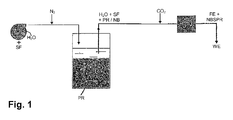
Fig. 1 is a schematic of an embodiment according to the present invention, namely of a method for forming nanobubbles on the surface of a proppant and combining the treated proppant with at least carbon dioxide for addition to a gas and/or oil producing well. - The present invention provides for an enhanced proppant PR for use in a frac(turing) operation or fraccing operation.
- By creating gas-filled nanobubbles NB on the surface of the particles of the proppant PR, the proppant PR itself is not altered and a better distribution of the proppant PR within the frac(turing) agent or frac(turing) fluid, better delivery and/or more uniform placement of the proppant PR in the fractures to enable high conductivity are achieved.
- A conventional, low-cost proppant can then be employed by creating the nanobubbles NB on the surface of the proppant PR rather than using a more expensive proppant material, or altering the proppant material outright. The present invention provides for a reduction in the specific gravity of the proppant PR used in a frac(turing) operation.
- Turning to
Fig. 1 , water H2O is mixed with an appropriate surfactant SF and supplied to a container filed with a proppant PR. This container is pressurized with nitrogen gas N2 for the duration of the process which is typically equal to about two to three gas diffusion time scales. - Once the water H2O is saturated with gas N2, nucleation of nanobubbles NB on the surface of the particles of the proppant PR begins. The mixture of the water H2O and nanobubble-surrounded proppant particles NBSPR is then mixed with carbon dioxide CO2 at approximately forty percent to seventy percent to form foam or an emulsion FE.
- The resulting nanobubble-surrounded proppant NBSPR is thus suspended within an aqueous carbon dioxide foam/emulsion FE. The carbon dioxide foam FE may also be stabilized with nano-particles to enable smaller bubble size and lower carbon dioxide content for viscosity control purposes.
- The carbon dioxide foam/emulsion FE with nanobubble-enhanced proppant NBSPR is then fed to a bore of a well WE under suitable pressure. This process may be facilitated to enable in-situ formation of the nanobubble-surrounded proppant NBSPR in the frac(turing) agent or frac(turing) fluid.
- While the present invention describes one means for generating nanobubbles NB on the surface of proppant particles PR, the nanobubbles NB can be generated by other methods such as adsorption of gas molecules from aqueous solutions, ultrasonic formation, electrolytic generation, surface nucleation from gas-enriched aqueous solutions.
- The gases that can be employed are selected from the group consisting of nitrogen, argon, methane, carbon dioxide, helium and hydrogen.
- Frac(turing) agents or frac(turing) fluids are conventional types such as slick water, carbon dioxide and/or nitrogen emulsions/foams, including nano-particle stabilized foams as well as gelled/foamed liquid petroleum gas/liquefied natural gas mixtures.
- The nanobubble-surrounded proppant-frac(turing) fluid mixture uses carbon dioxide CO2 as an example but may comprise two or more different gases.
List of reference numerals CO2 carbon dioxide FE foam or emulsion, in particular carbon dioxide foam/emulsion H2O water NB nanobubble(s) NBSPR nanobubble-enhanced proppant or nanobubble-surrounded proppant, in particular nanobubble-enhanced proppant particle or nanobubble-surrounded proppant particle N2 nitrogen PR proppant, in particular proppant particle SF surfactant WE well
Claims (15)
- A method for forming gas-filled nanobubbles (NB) on the surface of proppant particles (PR), comprising the steps of- mixing water (H2O) with a surfactant (SF);- adding the mixture to the proppant (PR); and- pressurizing for a set time period.
- The method according to claim 1, wherein the surfactant (SF)- is selected from the group consisting of polymers having a molecular weight less than 30,000 grams/mole, and/or- is hydrophobically modified.
- The method according to claim 1 or 2, wherein- the proppant (PR) is sand (SiO2), and- the surfactant (SF) is at least one cationic polymer selected from the group consisting of copolymers based on acrylic acid, acrylamide, maleic acid and maleic acid esters, alpha olefins, acrylic acid esters, and partially hydrolyzed or cationically modified acrylamide derivatives.
- The method according to claim 1 or 2, wherein- the proppant (PR) is at least one ceramic, and- the surfactant (SF) is at least one anionic polymer selected from the group consisting of sulfonates, sulfates, and carboxylic based surfactants.
- The method according to claim 4, wherein the surfactant (SF) is selected from the group consisting of copolymers based on acrylic acid, maleic acid, alpha olefins, acrylic acid esters and condensation products of naphthalenesulphonic acid.
- The method according to at least one of claims 1 to 5, wherein- the mixture is added to the proppant (PR) by supplying the mixture to a container filed with the proppant (PR), and- the container is pressurized.
- The method according to at least one of claims 1 to 6, wherein the pressurizing is realized by means of at least one gas selected from the group consisting of nitrogen (N2), argon, methane, carbon dioxide (CO2), helium and hydrogen.
- The method according to at least one of claims 1 to 7, wherein time period is about two gas-diffusion time scales to about three gas-diffusion time scales.
- A method for fracturing or fraccing a well (WE) producing gas and/or oil, comprising the steps of- forming gas-filled nanobubbles (NB) on the surface of proppant particles (PR);- combining the nanobubble-surrounded proppant particles (NBSPR) with at least one frac(turing) medium to form foam or an emulsion (FE); and- adding the formed foam or emulsion (FE) to the well (WE).
- The method according to claim 9, wherein the forming the gas-filled nanobubbles (NB) on the surface of the proppant particles (PR) is selected from the group consisting of- the method according to at least one of claims 1 to 8,- adsorption of gas molecules from at least one aqueous solution,- ultrasonic formation,- electrolytic generation, and/or- surface nucleation from gas-enriched aqueous solutions.
- The method according to claim 9 or 10, wherein the combining the nanobubble-surrounded proppant particles (NBSPR) with the at least one frac(turing) medium is provided by suspending the nanobubble-surrounded proppant particles (NBSPR) within the at least one frac(turing) medium.
- The method according to at least one of claims 9 to 11, wherein the frac(turing) medium is selected from the group consisting of carbon dioxide (CO2) emulsions and/or foams, nitrogen (N2) emulsions and/or foams, liquefied natural gas, liquid petroleum gas, slick water, and/or mixtures thereof.
- The method according to at least one of claims 9 to 12, wherein the formed foam or emulsion (FE) is added as a frac(turing) agent or frac(turing) fluid.
- The method according to at least one of claims 9 to 13, wherein the formed foam or emulsion (FE) is added to at least one bore of the well (WE).
- The method according to at least one of claims 9 to 14, wherein the formed foam or emulsion (FE) is added to the well (WE) under pressure.
Priority Applications (1)
| Application Number | Priority Date | Filing Date | Title |
|---|---|---|---|
| PL13171326T PL2722378T3 (en) | 2012-10-18 | 2013-06-10 | Method for fracturing or fraccing a well |
Applications Claiming Priority (1)
| Application Number | Priority Date | Filing Date | Title |
|---|---|---|---|
| US201261715351P | 2012-10-18 | 2012-10-18 |
Publications (2)
| Publication Number | Publication Date |
|---|---|
| EP2722378A1 true EP2722378A1 (en) | 2014-04-23 |
| EP2722378B1 EP2722378B1 (en) | 2015-05-27 |
Family
ID=48576894
Family Applications (1)
| Application Number | Title | Priority Date | Filing Date |
|---|---|---|---|
| EP13171326.5A Not-in-force EP2722378B1 (en) | 2012-10-18 | 2013-06-10 | Method for fracturing or fraccing a well |
Country Status (10)
| Country | Link |
|---|---|
| US (1) | US20140113841A1 (en) |
| EP (1) | EP2722378B1 (en) |
| CN (1) | CN105051150A (en) |
| CA (1) | CA2888368A1 (en) |
| DK (1) | DK2722378T3 (en) |
| ES (1) | ES2545664T3 (en) |
| MX (1) | MX2015004731A (en) |
| PL (1) | PL2722378T3 (en) |
| RU (1) | RU2640614C2 (en) |
| WO (1) | WO2014062988A1 (en) |
Cited By (4)
| Publication number | Priority date | Publication date | Assignee | Title |
|---|---|---|---|---|
| EP2966255A3 (en) * | 2014-07-08 | 2016-06-01 | Linde Aktiengesellschaft | Methods for conveying oil and/or natural gas, in particular by means of fraccing or eor |
| CN113578081A (en) * | 2021-07-27 | 2021-11-02 | 浙江大学 | Surfactant stabilization-based nanobubble and preparation method thereof |
| CN115926260A (en) * | 2022-12-28 | 2023-04-07 | 湖北格霖威新材料科技有限公司 | Preparation method of a degradable high-strength closed-cell polylactic acid foam material |
| CN115977604A (en) * | 2023-02-24 | 2023-04-18 | 陕西中立合创能源科技有限责任公司 | Shale oil nano-imbibition energizing fracturing method |
Families Citing this family (15)
| Publication number | Priority date | Publication date | Assignee | Title |
|---|---|---|---|---|
| CA2849755C (en) | 2011-09-30 | 2017-04-11 | Momentive Specialty Chemicals Inc. | Proppant materials and methods of tailoring proppant material surface wettability |
| US20150345268A1 (en) * | 2014-05-27 | 2015-12-03 | Statoil Gulf Services LLC | Applications of ultra-low viscosity fluids to stimulate ultra-tight hydrocarbon-bearing formations |
| US10017688B1 (en) | 2014-07-25 | 2018-07-10 | Hexion Inc. | Resin coated proppants for water-reducing application |
| CN105696998A (en) * | 2016-04-05 | 2016-06-22 | 成都理工大学 | Shale gas reservoir fracturing modification method |
| MX2018014005A (en) | 2016-05-17 | 2019-08-22 | Nano Gas Tech Inc | Methods of affecting separation. |
| US11193359B1 (en) | 2017-09-12 | 2021-12-07 | NanoGas Technologies Inc. | Treatment of subterranean formations |
| CN107583937A (en) * | 2017-09-28 | 2018-01-16 | 中国石油集团渤海钻探工程有限公司 | A kind of oil fracturing returns row's solid waste decomposing process |
| US20190161673A1 (en) * | 2017-11-30 | 2019-05-30 | Pfp Technology, Llc | Proppant Transport With Low Polymer Concentration Slurry |
| CN111088027B (en) * | 2018-10-23 | 2022-04-05 | 中国石油化工股份有限公司 | Proppant with high migration capacity and preparation method and application thereof |
| CN112708413B (en) * | 2020-12-25 | 2022-05-20 | 成都理工大学 | A kind of airbag shell inflatable suspension proppant and preparation method thereof |
| CN113431548A (en) * | 2021-08-09 | 2021-09-24 | 杨平英 | Multi-stage proppant feeding device with anti-overflow function for oil exploitation |
| US20230112608A1 (en) | 2021-10-13 | 2023-04-13 | Disruptive Oil And Gas Technologies Corp | Nanobubble dispersions generated in electrochemically activated solutions |
| CN113901664B (en) * | 2021-10-20 | 2022-06-28 | 成都理工大学 | Optimization method and suspension method of proppant suspension parameters based on bubble bridge effect |
| WO2025239885A1 (en) * | 2024-05-14 | 2025-11-20 | Halliburton Energy Services, Inc. | Nanobubble enhanced stimulation fluids |
| WO2025239881A1 (en) * | 2024-05-14 | 2025-11-20 | Halliburton Energy Services, Inc. | Nanobubble enhanced permeability modifier fluids |
Citations (5)
| Publication number | Priority date | Publication date | Assignee | Title |
|---|---|---|---|---|
| US20080237141A1 (en) * | 2007-03-28 | 2008-10-02 | Kerfoot Technologies, Inc. | Treatment for Recycling Fracture Water Gas and Oil Recovery in Shale Deposits |
| US20100065271A1 (en) * | 2007-03-22 | 2010-03-18 | Mccrary Avis Lloyd | Low temperature coated particles for use as proppants or in gravel packs, methods for making and using the same |
| US20100256024A1 (en) * | 2007-07-18 | 2010-10-07 | Trican Well Service Ltd. | Resin coated proppant slurry compositions and methods of making and using same |
| US20100252262A1 (en) * | 2009-04-02 | 2010-10-07 | Clearwater International, Llc | Low concentrations of gas bubbles to hinder proppant settling |
| US20120071371A1 (en) * | 2007-04-13 | 2012-03-22 | Trican Well Service, Ltd. | Aqueous particulate slurry compositions and methods of making same |
Family Cites Families (5)
| Publication number | Priority date | Publication date | Assignee | Title |
|---|---|---|---|---|
| US4665982A (en) * | 1986-06-26 | 1987-05-19 | Brown Billy R | Formation fracturing technique using liquid proppant carrier followed by foam |
| US7090017B2 (en) * | 2003-07-09 | 2006-08-15 | Halliburton Energy Services, Inc. | Low cost method and apparatus for fracturing a subterranean formation with a sand suspension |
| US8276659B2 (en) * | 2006-03-03 | 2012-10-02 | Gasfrac Energy Services Inc. | Proppant addition system and method |
| CA2649203C (en) * | 2008-12-24 | 2017-05-23 | Gasfrac Energy Services Inc. | Proppant addition system and method |
| CA2561539C (en) * | 2006-09-28 | 2016-11-08 | Hydro Processing & Mining Ltd. | Apparatus and method for efficient particle to gas bubble attachment in a slurry |
-
2013
- 2013-06-10 EP EP13171326.5A patent/EP2722378B1/en not_active Not-in-force
- 2013-06-10 ES ES13171326.5T patent/ES2545664T3/en active Active
- 2013-06-10 DK DK13171326.5T patent/DK2722378T3/en active
- 2013-06-10 PL PL13171326T patent/PL2722378T3/en unknown
- 2013-10-18 CN CN201380054609.0A patent/CN105051150A/en active Pending
- 2013-10-18 WO PCT/US2013/065560 patent/WO2014062988A1/en not_active Ceased
- 2013-10-18 MX MX2015004731A patent/MX2015004731A/en unknown
- 2013-10-18 RU RU2015118154A patent/RU2640614C2/en not_active IP Right Cessation
- 2013-10-18 US US14/056,997 patent/US20140113841A1/en not_active Abandoned
- 2013-10-18 CA CA2888368A patent/CA2888368A1/en not_active Abandoned
Patent Citations (5)
| Publication number | Priority date | Publication date | Assignee | Title |
|---|---|---|---|---|
| US20100065271A1 (en) * | 2007-03-22 | 2010-03-18 | Mccrary Avis Lloyd | Low temperature coated particles for use as proppants or in gravel packs, methods for making and using the same |
| US20080237141A1 (en) * | 2007-03-28 | 2008-10-02 | Kerfoot Technologies, Inc. | Treatment for Recycling Fracture Water Gas and Oil Recovery in Shale Deposits |
| US20120071371A1 (en) * | 2007-04-13 | 2012-03-22 | Trican Well Service, Ltd. | Aqueous particulate slurry compositions and methods of making same |
| US20100256024A1 (en) * | 2007-07-18 | 2010-10-07 | Trican Well Service Ltd. | Resin coated proppant slurry compositions and methods of making and using same |
| US20100252262A1 (en) * | 2009-04-02 | 2010-10-07 | Clearwater International, Llc | Low concentrations of gas bubbles to hinder proppant settling |
Cited By (5)
| Publication number | Priority date | Publication date | Assignee | Title |
|---|---|---|---|---|
| EP2966255A3 (en) * | 2014-07-08 | 2016-06-01 | Linde Aktiengesellschaft | Methods for conveying oil and/or natural gas, in particular by means of fraccing or eor |
| CN113578081A (en) * | 2021-07-27 | 2021-11-02 | 浙江大学 | Surfactant stabilization-based nanobubble and preparation method thereof |
| CN115926260A (en) * | 2022-12-28 | 2023-04-07 | 湖北格霖威新材料科技有限公司 | Preparation method of a degradable high-strength closed-cell polylactic acid foam material |
| CN115926260B (en) * | 2022-12-28 | 2024-01-26 | 湖北格霖威新材料科技有限公司 | Preparation method of degradable high-strength closed-cell polylactic acid foam material |
| CN115977604A (en) * | 2023-02-24 | 2023-04-18 | 陕西中立合创能源科技有限责任公司 | Shale oil nano-imbibition energizing fracturing method |
Also Published As
| Publication number | Publication date |
|---|---|
| ES2545664T3 (en) | 2015-09-14 |
| PL2722378T3 (en) | 2015-11-30 |
| CN105051150A (en) | 2015-11-11 |
| MX2015004731A (en) | 2015-07-23 |
| RU2015118154A (en) | 2016-12-10 |
| DK2722378T3 (en) | 2015-08-31 |
| US20140113841A1 (en) | 2014-04-24 |
| WO2014062988A1 (en) | 2014-04-24 |
| RU2640614C2 (en) | 2018-01-10 |
| EP2722378B1 (en) | 2015-05-27 |
| CA2888368A1 (en) | 2014-04-24 |
Similar Documents
| Publication | Publication Date | Title |
|---|---|---|
| EP2722378B1 (en) | Method for fracturing or fraccing a well | |
| US8100178B2 (en) | Method of oil recovery using a foamy oil-external emulsion | |
| US4780243A (en) | Dry sand foam generator | |
| Agi et al. | Comparative study of ultrasound assisted water and surfactant flooding | |
| US20160040518A1 (en) | Well treatment fluids | |
| US20150021022A1 (en) | Energized slurries and methods | |
| US7399732B2 (en) | Fracturing fluid containing amphoteric glycinate surfactant | |
| JP2020534460A (en) | Pulse injection hydraulic fracturing with nanosilica carrier fluid | |
| US20160319185A1 (en) | Shear thickening fluid method and system to deliver materials downhole | |
| US20150369029A1 (en) | Compound cluster placement in fractures | |
| WO2017095253A1 (en) | Method of treating a well with the formation of proppant structures (variants) | |
| US9752072B2 (en) | Propping compositions for enhancing fracture conductivity | |
| CA2681646A1 (en) | A method of hydraulic fracturing | |
| EP2812410B1 (en) | Method of fracturing using ultra lightweight proppant suspensions and gaseous streams | |
| US20150211343A1 (en) | Gas fracturing method and system | |
| EP0247754B1 (en) | Apparatus and method for making particle-containing foams | |
| Carpenter | Gelled emulsions of CO2, water, and nanoparticles | |
| US10570709B2 (en) | Remedial treatment of wells with voids behind casing | |
| RU2753318C1 (en) | Method for developing petroleum deposits | |
| Daryasafar et al. | CO 2-FOAM INJECTION FOR ENHANCING OIL RECOVERY: A BRIEF REVIEW | |
| CN110500080B (en) | High-permeability bottoming water coning shut-in well plugging dredging production control comprehensive treatment method | |
| CN113563863A (en) | Gas-solid-liquid three-phase fracturing fluid system and using method thereof | |
| RU2507389C1 (en) | Method of formation hydraulic fracturing | |
| Fu | Investigation of the Stability of Nanoparticles under Different Conditions and Rheology of Nanoparticle-Stabilized CO2 Foam | |
| CN118440685A (en) | Acidizing fracturing fluid and preparation method and application thereof |
Legal Events
| Date | Code | Title | Description |
|---|---|---|---|
| PUAI | Public reference made under article 153(3) epc to a published international application that has entered the european phase |
Free format text: ORIGINAL CODE: 0009012 |
|
| AK | Designated contracting states |
Kind code of ref document: A1 Designated state(s): AL AT BE BG CH CY CZ DE DK EE ES FI FR GB GR HR HU IE IS IT LI LT LU LV MC MK MT NL NO PL PT RO RS SE SI SK SM TR |
|
| AX | Request for extension of the european patent |
Extension state: BA ME |
|
| REG | Reference to a national code |
Ref country code: DE Ref legal event code: R079 Ref document number: 602013001835 Country of ref document: DE Free format text: PREVIOUS MAIN CLASS: C09K0008700000 Ipc: C09K0008600000 |
|
| 17P | Request for examination filed |
Effective date: 20141022 |
|
| RBV | Designated contracting states (corrected) |
Designated state(s): AL AT BE BG CH CY CZ DE DK EE ES FI FR GB GR HR HU IE IS IT LI LT LU LV MC MK MT NL NO PL PT RO RS SE SI SK SM TR |
|
| GRAP | Despatch of communication of intention to grant a patent |
Free format text: ORIGINAL CODE: EPIDOSNIGR1 |
|
| RIC1 | Information provided on ipc code assigned before grant |
Ipc: C09K 8/66 20060101ALI20141127BHEP Ipc: C09K 8/80 20060101ALI20141127BHEP Ipc: C09K 8/60 20060101AFI20141127BHEP Ipc: C09K 8/70 20060101ALI20141127BHEP |
|
| INTG | Intention to grant announced |
Effective date: 20141223 |
|
| GRAS | Grant fee paid |
Free format text: ORIGINAL CODE: EPIDOSNIGR3 |
|
| GRAA | (expected) grant |
Free format text: ORIGINAL CODE: 0009210 |
|
| AK | Designated contracting states |
Kind code of ref document: B1 Designated state(s): AL AT BE BG CH CY CZ DE DK EE ES FI FR GB GR HR HU IE IS IT LI LT LU LV MC MK MT NL NO PL PT RO RS SE SI SK SM TR |
|
| REG | Reference to a national code |
Ref country code: GB Ref legal event code: FG4D |
|
| REG | Reference to a national code |
Ref country code: CH Ref legal event code: EP |
|
| REG | Reference to a national code |
Ref country code: AT Ref legal event code: REF Ref document number: 728855 Country of ref document: AT Kind code of ref document: T Effective date: 20150615 |
|
| REG | Reference to a national code |
Ref country code: IE Ref legal event code: FG4D |
|
| REG | Reference to a national code |
Ref country code: DE Ref legal event code: R096 Ref document number: 602013001835 Country of ref document: DE |
|
| REG | Reference to a national code |
Ref country code: RO Ref legal event code: EPE |
|
| REG | Reference to a national code |
Ref country code: DK Ref legal event code: T3 Effective date: 20150824 |
|
| REG | Reference to a national code |
Ref country code: NL Ref legal event code: T3 |
|
| REG | Reference to a national code |
Ref country code: ES Ref legal event code: FG2A Ref document number: 2545664 Country of ref document: ES Kind code of ref document: T3 Effective date: 20150914 |
|
| REG | Reference to a national code |
Ref country code: SE Ref legal event code: TRGR |
|
| REG | Reference to a national code |
Ref country code: LT Ref legal event code: MG4D |
|
| PG25 | Lapsed in a contracting state [announced via postgrant information from national office to epo] |
Ref country code: PT Free format text: LAPSE BECAUSE OF FAILURE TO SUBMIT A TRANSLATION OF THE DESCRIPTION OR TO PAY THE FEE WITHIN THE PRESCRIBED TIME-LIMIT Effective date: 20150928 Ref country code: HR Free format text: LAPSE BECAUSE OF FAILURE TO SUBMIT A TRANSLATION OF THE DESCRIPTION OR TO PAY THE FEE WITHIN THE PRESCRIBED TIME-LIMIT Effective date: 20150527 Ref country code: FI Free format text: LAPSE BECAUSE OF FAILURE TO SUBMIT A TRANSLATION OF THE DESCRIPTION OR TO PAY THE FEE WITHIN THE PRESCRIBED TIME-LIMIT Effective date: 20150527 Ref country code: LT Free format text: LAPSE BECAUSE OF FAILURE TO SUBMIT A TRANSLATION OF THE DESCRIPTION OR TO PAY THE FEE WITHIN THE PRESCRIBED TIME-LIMIT Effective date: 20150527 |
|
| REG | Reference to a national code |
Ref country code: NO Ref legal event code: T2 Effective date: 20150527 |
|
| PG25 | Lapsed in a contracting state [announced via postgrant information from national office to epo] |
Ref country code: RS Free format text: LAPSE BECAUSE OF FAILURE TO SUBMIT A TRANSLATION OF THE DESCRIPTION OR TO PAY THE FEE WITHIN THE PRESCRIBED TIME-LIMIT Effective date: 20150527 Ref country code: GR Free format text: LAPSE BECAUSE OF FAILURE TO SUBMIT A TRANSLATION OF THE DESCRIPTION OR TO PAY THE FEE WITHIN THE PRESCRIBED TIME-LIMIT Effective date: 20150828 Ref country code: IS Free format text: LAPSE BECAUSE OF FAILURE TO SUBMIT A TRANSLATION OF THE DESCRIPTION OR TO PAY THE FEE WITHIN THE PRESCRIBED TIME-LIMIT Effective date: 20150927 Ref country code: LV Free format text: LAPSE BECAUSE OF FAILURE TO SUBMIT A TRANSLATION OF THE DESCRIPTION OR TO PAY THE FEE WITHIN THE PRESCRIBED TIME-LIMIT Effective date: 20150527 |
|
| REG | Reference to a national code |
Ref country code: PL Ref legal event code: T3 |
|
| PG25 | Lapsed in a contracting state [announced via postgrant information from national office to epo] |
Ref country code: IT Free format text: LAPSE BECAUSE OF FAILURE TO SUBMIT A TRANSLATION OF THE DESCRIPTION OR TO PAY THE FEE WITHIN THE PRESCRIBED TIME-LIMIT Effective date: 20150527 Ref country code: EE Free format text: LAPSE BECAUSE OF FAILURE TO SUBMIT A TRANSLATION OF THE DESCRIPTION OR TO PAY THE FEE WITHIN THE PRESCRIBED TIME-LIMIT Effective date: 20150527 |
|
| REG | Reference to a national code |
Ref country code: AT Ref legal event code: UEP Ref document number: 728855 Country of ref document: AT Kind code of ref document: T Effective date: 20150527 |
|
| PG25 | Lapsed in a contracting state [announced via postgrant information from national office to epo] |
Ref country code: SK Free format text: LAPSE BECAUSE OF FAILURE TO SUBMIT A TRANSLATION OF THE DESCRIPTION OR TO PAY THE FEE WITHIN THE PRESCRIBED TIME-LIMIT Effective date: 20150527 Ref country code: CZ Free format text: LAPSE BECAUSE OF FAILURE TO SUBMIT A TRANSLATION OF THE DESCRIPTION OR TO PAY THE FEE WITHIN THE PRESCRIBED TIME-LIMIT Effective date: 20150527 Ref country code: MC Free format text: LAPSE BECAUSE OF FAILURE TO SUBMIT A TRANSLATION OF THE DESCRIPTION OR TO PAY THE FEE WITHIN THE PRESCRIBED TIME-LIMIT Effective date: 20150527 |
|
| REG | Reference to a national code |
Ref country code: DE Ref legal event code: R097 Ref document number: 602013001835 Country of ref document: DE |
|
| REG | Reference to a national code |
Ref country code: IE Ref legal event code: MM4A |
|
| PLBE | No opposition filed within time limit |
Free format text: ORIGINAL CODE: 0009261 |
|
| STAA | Information on the status of an ep patent application or granted ep patent |
Free format text: STATUS: NO OPPOSITION FILED WITHIN TIME LIMIT |
|
| PG25 | Lapsed in a contracting state [announced via postgrant information from national office to epo] |
Ref country code: IE Free format text: LAPSE BECAUSE OF NON-PAYMENT OF DUE FEES Effective date: 20150610 |
|
| 26N | No opposition filed |
Effective date: 20160301 |
|
| REG | Reference to a national code |
Ref country code: FR Ref legal event code: PLFP Year of fee payment: 4 |
|
| PG25 | Lapsed in a contracting state [announced via postgrant information from national office to epo] |
Ref country code: SI Free format text: LAPSE BECAUSE OF FAILURE TO SUBMIT A TRANSLATION OF THE DESCRIPTION OR TO PAY THE FEE WITHIN THE PRESCRIBED TIME-LIMIT Effective date: 20150527 |
|
| PG25 | Lapsed in a contracting state [announced via postgrant information from national office to epo] |
Ref country code: BE Free format text: LAPSE BECAUSE OF FAILURE TO SUBMIT A TRANSLATION OF THE DESCRIPTION OR TO PAY THE FEE WITHIN THE PRESCRIBED TIME-LIMIT Effective date: 20150527 |
|
| PG25 | Lapsed in a contracting state [announced via postgrant information from national office to epo] |
Ref country code: MT Free format text: LAPSE BECAUSE OF FAILURE TO SUBMIT A TRANSLATION OF THE DESCRIPTION OR TO PAY THE FEE WITHIN THE PRESCRIBED TIME-LIMIT Effective date: 20150527 |
|
| REG | Reference to a national code |
Ref country code: CH Ref legal event code: PL |
|
| PG25 | Lapsed in a contracting state [announced via postgrant information from national office to epo] |
Ref country code: CH Free format text: LAPSE BECAUSE OF NON-PAYMENT OF DUE FEES Effective date: 20160630 Ref country code: LI Free format text: LAPSE BECAUSE OF NON-PAYMENT OF DUE FEES Effective date: 20160630 |
|
| REG | Reference to a national code |
Ref country code: FR Ref legal event code: PLFP Year of fee payment: 5 |
|
| PG25 | Lapsed in a contracting state [announced via postgrant information from national office to epo] |
Ref country code: HU Free format text: LAPSE BECAUSE OF FAILURE TO SUBMIT A TRANSLATION OF THE DESCRIPTION OR TO PAY THE FEE WITHIN THE PRESCRIBED TIME-LIMIT; INVALID AB INITIO Effective date: 20130610 |
|
| PG25 | Lapsed in a contracting state [announced via postgrant information from national office to epo] |
Ref country code: CY Free format text: LAPSE BECAUSE OF FAILURE TO SUBMIT A TRANSLATION OF THE DESCRIPTION OR TO PAY THE FEE WITHIN THE PRESCRIBED TIME-LIMIT Effective date: 20150527 |
|
| PG25 | Lapsed in a contracting state [announced via postgrant information from national office to epo] |
Ref country code: TR Free format text: LAPSE BECAUSE OF FAILURE TO SUBMIT A TRANSLATION OF THE DESCRIPTION OR TO PAY THE FEE WITHIN THE PRESCRIBED TIME-LIMIT Effective date: 20150527 |
|
| PG25 | Lapsed in a contracting state [announced via postgrant information from national office to epo] |
Ref country code: LU Free format text: LAPSE BECAUSE OF NON-PAYMENT OF DUE FEES Effective date: 20150610 |
|
| REG | Reference to a national code |
Ref country code: FR Ref legal event code: PLFP Year of fee payment: 6 |
|
| PG25 | Lapsed in a contracting state [announced via postgrant information from national office to epo] |
Ref country code: SM Free format text: LAPSE BECAUSE OF FAILURE TO SUBMIT A TRANSLATION OF THE DESCRIPTION OR TO PAY THE FEE WITHIN THE PRESCRIBED TIME-LIMIT Effective date: 20150527 |
|
| PG25 | Lapsed in a contracting state [announced via postgrant information from national office to epo] |
Ref country code: MK Free format text: LAPSE BECAUSE OF FAILURE TO SUBMIT A TRANSLATION OF THE DESCRIPTION OR TO PAY THE FEE WITHIN THE PRESCRIBED TIME-LIMIT Effective date: 20150527 |
|
| PG25 | Lapsed in a contracting state [announced via postgrant information from national office to epo] |
Ref country code: AL Free format text: LAPSE BECAUSE OF FAILURE TO SUBMIT A TRANSLATION OF THE DESCRIPTION OR TO PAY THE FEE WITHIN THE PRESCRIBED TIME-LIMIT Effective date: 20150527 |
|
| PGFP | Annual fee paid to national office [announced via postgrant information from national office to epo] |
Ref country code: NO Payment date: 20190612 Year of fee payment: 7 Ref country code: DK Payment date: 20190613 Year of fee payment: 7 Ref country code: NL Payment date: 20190612 Year of fee payment: 7 Ref country code: PL Payment date: 20190402 Year of fee payment: 7 Ref country code: DE Payment date: 20190528 Year of fee payment: 7 |
|
| PGFP | Annual fee paid to national office [announced via postgrant information from national office to epo] |
Ref country code: RO Payment date: 20190509 Year of fee payment: 7 Ref country code: BG Payment date: 20190416 Year of fee payment: 7 Ref country code: FR Payment date: 20190510 Year of fee payment: 7 Ref country code: SE Payment date: 20190611 Year of fee payment: 7 |
|
| PGFP | Annual fee paid to national office [announced via postgrant information from national office to epo] |
Ref country code: AT Payment date: 20190528 Year of fee payment: 7 Ref country code: GB Payment date: 20190605 Year of fee payment: 7 Ref country code: ES Payment date: 20190701 Year of fee payment: 7 |
|
| REG | Reference to a national code |
Ref country code: DE Ref legal event code: R081 Ref document number: 602013001835 Country of ref document: DE Owner name: LINDE GMBH, DE Free format text: FORMER OWNER: LINDE AKTIENGESELLSCHAFT, 80331 MUENCHEN, DE |
|
| REG | Reference to a national code |
Ref country code: DE Ref legal event code: R119 Ref document number: 602013001835 Country of ref document: DE |
|
| REG | Reference to a national code |
Ref country code: DK Ref legal event code: EBP Effective date: 20200630 Ref country code: NO Ref legal event code: MMEP |
|
| PG25 | Lapsed in a contracting state [announced via postgrant information from national office to epo] |
Ref country code: RO Free format text: LAPSE BECAUSE OF NON-PAYMENT OF DUE FEES Effective date: 20200610 |
|
| REG | Reference to a national code |
Ref country code: NL Ref legal event code: MM Effective date: 20200701 |
|
| REG | Reference to a national code |
Ref country code: AT Ref legal event code: MM01 Ref document number: 728855 Country of ref document: AT Kind code of ref document: T Effective date: 20200610 |
|
| GBPC | Gb: european patent ceased through non-payment of renewal fee |
Effective date: 20200610 |
|
| PG25 | Lapsed in a contracting state [announced via postgrant information from national office to epo] |
Ref country code: NO Free format text: LAPSE BECAUSE OF NON-PAYMENT OF DUE FEES Effective date: 20200630 Ref country code: NL Free format text: LAPSE BECAUSE OF NON-PAYMENT OF DUE FEES Effective date: 20200701 Ref country code: GB Free format text: LAPSE BECAUSE OF NON-PAYMENT OF DUE FEES Effective date: 20200610 Ref country code: FR Free format text: LAPSE BECAUSE OF NON-PAYMENT OF DUE FEES Effective date: 20200630 |
|
| PG25 | Lapsed in a contracting state [announced via postgrant information from national office to epo] |
Ref country code: SE Free format text: LAPSE BECAUSE OF NON-PAYMENT OF DUE FEES Effective date: 20200611 Ref country code: BG Free format text: LAPSE BECAUSE OF NON-PAYMENT OF DUE FEES Effective date: 20201231 Ref country code: AT Free format text: LAPSE BECAUSE OF NON-PAYMENT OF DUE FEES Effective date: 20200610 Ref country code: DE Free format text: LAPSE BECAUSE OF NON-PAYMENT OF DUE FEES Effective date: 20210101 |
|
| PG25 | Lapsed in a contracting state [announced via postgrant information from national office to epo] |
Ref country code: DK Free format text: LAPSE BECAUSE OF NON-PAYMENT OF DUE FEES Effective date: 20200630 |
|
| REG | Reference to a national code |
Ref country code: SE Ref legal event code: EUG |
|
| REG | Reference to a national code |
Ref country code: ES Ref legal event code: FD2A Effective date: 20211026 |
|
| PG25 | Lapsed in a contracting state [announced via postgrant information from national office to epo] |
Ref country code: ES Free format text: LAPSE BECAUSE OF NON-PAYMENT OF DUE FEES Effective date: 20200611 |
|
| PG25 | Lapsed in a contracting state [announced via postgrant information from national office to epo] |
Ref country code: PL Free format text: LAPSE BECAUSE OF NON-PAYMENT OF DUE FEES Effective date: 20200610 |