EP2720457A1 - Video processing system, video processing method, method of creating video processing database, video processing database, video processing apparatus, and control method and control program therefor - Google Patents
Video processing system, video processing method, method of creating video processing database, video processing database, video processing apparatus, and control method and control program therefor Download PDFInfo
- Publication number
- EP2720457A1 EP2720457A1 EP12800413.2A EP12800413A EP2720457A1 EP 2720457 A1 EP2720457 A1 EP 2720457A1 EP 12800413 A EP12800413 A EP 12800413A EP 2720457 A1 EP2720457 A1 EP 2720457A1
- Authority
- EP
- European Patent Office
- Prior art keywords
- scene
- derived
- characteristic amount
- group
- scenes
- Prior art date
- Legal status (The legal status is an assumption and is not a legal conclusion. Google has not performed a legal analysis and makes no representation as to the accuracy of the status listed.)
- Withdrawn
Links
Images











Classifications
-
- H—ELECTRICITY
- H04—ELECTRIC COMMUNICATION TECHNIQUE
- H04N—PICTORIAL COMMUNICATION, e.g. TELEVISION
- H04N5/00—Details of television systems
- H04N5/76—Television signal recording
- H04N5/91—Television signal processing therefor
-
- G—PHYSICS
- G06—COMPUTING OR CALCULATING; COUNTING
- G06F—ELECTRIC DIGITAL DATA PROCESSING
- G06F16/00—Information retrieval; Database structures therefor; File system structures therefor
- G06F16/70—Information retrieval; Database structures therefor; File system structures therefor of video data
- G06F16/71—Indexing; Data structures therefor; Storage structures
-
- G—PHYSICS
- G06—COMPUTING OR CALCULATING; COUNTING
- G06F—ELECTRIC DIGITAL DATA PROCESSING
- G06F16/00—Information retrieval; Database structures therefor; File system structures therefor
- G06F16/70—Information retrieval; Database structures therefor; File system structures therefor of video data
- G06F16/74—Browsing; Visualisation therefor
- G06F16/743—Browsing; Visualisation therefor a collection of video files or sequences
-
- G—PHYSICS
- G06—COMPUTING OR CALCULATING; COUNTING
- G06V—IMAGE OR VIDEO RECOGNITION OR UNDERSTANDING
- G06V20/00—Scenes; Scene-specific elements
- G06V20/40—Scenes; Scene-specific elements in video content
- G06V20/48—Matching video sequences
-
- G—PHYSICS
- G11—INFORMATION STORAGE
- G11B—INFORMATION STORAGE BASED ON RELATIVE MOVEMENT BETWEEN RECORD CARRIER AND TRANSDUCER
- G11B27/00—Editing; Indexing; Addressing; Timing or synchronising; Monitoring; Measuring tape travel
- G11B27/10—Indexing; Addressing; Timing or synchronising; Measuring tape travel
- G11B27/19—Indexing; Addressing; Timing or synchronising; Measuring tape travel by using information detectable on the record carrier
- G11B27/28—Indexing; Addressing; Timing or synchronising; Measuring tape travel by using information detectable on the record carrier by using information signals recorded by the same method as the main recording
-
- G—PHYSICS
- G11—INFORMATION STORAGE
- G11B—INFORMATION STORAGE BASED ON RELATIVE MOVEMENT BETWEEN RECORD CARRIER AND TRANSDUCER
- G11B27/00—Editing; Indexing; Addressing; Timing or synchronising; Monitoring; Measuring tape travel
- G11B27/10—Indexing; Addressing; Timing or synchronising; Measuring tape travel
- G11B27/19—Indexing; Addressing; Timing or synchronising; Measuring tape travel by using information detectable on the record carrier
- G11B27/28—Indexing; Addressing; Timing or synchronising; Measuring tape travel by using information detectable on the record carrier by using information signals recorded by the same method as the main recording
- G11B27/32—Indexing; Addressing; Timing or synchronising; Measuring tape travel by using information detectable on the record carrier by using information signals recorded by the same method as the main recording on separate auxiliary tracks of the same or an auxiliary record carrier
- G11B27/327—Table of contents
- G11B27/329—Table of contents on a disc [VTOC]
-
- H—ELECTRICITY
- H04—ELECTRIC COMMUNICATION TECHNIQUE
- H04N—PICTORIAL COMMUNICATION, e.g. TELEVISION
- H04N21/00—Selective content distribution, e.g. interactive television or video on demand [VOD]
- H04N21/20—Servers specifically adapted for the distribution of content, e.g. VOD servers; Operations thereof
- H04N21/23—Processing of content or additional data; Elementary server operations; Server middleware
- H04N21/234—Processing of video elementary streams, e.g. splicing of video streams or manipulating encoded video stream scene graphs
- H04N21/23418—Processing of video elementary streams, e.g. splicing of video streams or manipulating encoded video stream scene graphs involving operations for analysing video streams, e.g. detecting features or characteristics
-
- H—ELECTRICITY
- H04—ELECTRIC COMMUNICATION TECHNIQUE
- H04N—PICTORIAL COMMUNICATION, e.g. TELEVISION
- H04N21/00—Selective content distribution, e.g. interactive television or video on demand [VOD]
- H04N21/20—Servers specifically adapted for the distribution of content, e.g. VOD servers; Operations thereof
- H04N21/25—Management operations performed by the server for facilitating the content distribution or administrating data related to end-users or client devices, e.g. end-user or client device authentication, learning user preferences for recommending movies
- H04N21/254—Management at additional data server, e.g. shopping server, rights management server
- H04N21/2541—Rights Management
-
- H—ELECTRICITY
- H04—ELECTRIC COMMUNICATION TECHNIQUE
- H04N—PICTORIAL COMMUNICATION, e.g. TELEVISION
- H04N21/00—Selective content distribution, e.g. interactive television or video on demand [VOD]
- H04N21/20—Servers specifically adapted for the distribution of content, e.g. VOD servers; Operations thereof
- H04N21/27—Server based end-user applications
- H04N21/274—Storing end-user multimedia data in response to end-user request, e.g. network recorder
- H04N21/2743—Video hosting of uploaded data from client
-
- H—ELECTRICITY
- H04—ELECTRIC COMMUNICATION TECHNIQUE
- H04N—PICTORIAL COMMUNICATION, e.g. TELEVISION
- H04N5/00—Details of television systems
- H04N5/76—Television signal recording
- H04N5/78—Television signal recording using magnetic recording
- H04N5/782—Television signal recording using magnetic recording on tape
- H04N5/783—Adaptations for reproducing at a rate different from the recording rate
Definitions
- the present invention relates to technology for verifying video data.
- a patent literature 1 discloses technology, wherein, when a client requests to upload video data for browsing on a site, a verifying server verifies the video data with video data already registered by a registrant to determine whether the video data should be uploaded or not (refer to [ Fig. 1 ]). Moreover, the patent literature 1 discloses that it is possible to realize high speed verifying process by use of thumbnail images in verifying by the verifying server and furthermore by use of a group of still pictures which are extracted optionally or randomly in verifying (refer to paragraphs [0045] and [0046]).
- Patent literature 1 International Publication WO/2009/035032
- the database for verifying the video data (hereinafter, referred to as DB) with the thumbnail images is used.
- DB database for verifying the video data
- a reference server refers to all of the thumbnail images.
- the technology has a limit in reduction of a time required for the reference.
- An object of the present invention is to provide technology for solving the above-mentioned problem.
- a video processing apparatus includes: a storage means for storing a plurality of scenes included in a scene group and characteristic amounts which are extracted from a series of plural frames included in the respective scenes in the scene group, in association with each other, defining one scene out of the plurality of scenes included in the scene group as a typical scene and the other scenes as a derived scene, the scene group being a group of a plurality of scenes derived from a common scene; an input means for inputting a characteristic amount which is extracted from a new scene; and a determining means for determining whether the new scene represented by the inputted characteristic amount is the derived scene of the scene group or not by verifying the inputted characteristic amount with the characteristic amount of the typical scene of the scene group stored in the storage means.
- a method for controlling a video processing apparatus includes: storing a plurality of scenes included in a scene group and characteristic amounts which are extracted from a series of plural frames included in the respective scenes in the scene group, in association with each other, defining one scene out of the plurality of scenes included in the scene group as a typical scene and the other scenes as a derived scene, the scene group being a group of a plurality of scenes derived from a common scene; inputting a characteristic amount which is extracted from a new scene; and determining whether the new scene represented by the inputted characteristic amount is the derived scene of the scene group or not by verifying the inputted characteristic amount with the characteristic amount of the typical scene of the scene group.
- a computer readable storage medium records thereon a program, causing a computer to perform a method including: storing a plurality of scenes included in a scene group and characteristic amounts which are extracted from a series of plural frames included in the respective scenes in the scene group, in association with each other, defining one scene out of the plurality of scenes included in the scene group as a typical scene and the other scenes as a derived scene, the scene group being a group of a plurality of scenes derived from a common scene; inputting a characteristic amount which is extracted from a new scene; and determining whether the new scene represented by the inputted characteristic amount is the derived scene of the scene group or not by verifying the inputted characteristic amount with the characteristic amount of the typical scene of the scene group.
- a database stores a plurality of scenes included in a scene group and characteristic amounts which are extracted from a series of plural frames included in the respective scenes in the scene group, in association with each other, defining one scene out of the plurality of scenes included in the scene group as a typical scene and the other scenes as a derived scene, the scene group being a group of a plurality of scenes derived from a common scene, wherein as a result of a verification of an inputted characteristic amount with the characteristic amount of the typical scene of the scene group stored in the database, in case it is determined that a new scene represented by the inputted characteristic amount is the derived scene of the scene group, the database stores the new scene represented by the inputted characteristic amount as the derived scene of the scene group, and in case it is determined that the new scene represented by the inputted characteristic amount is not the derived scene of the scene group, the database stores the new scene represented by the inputted characteristic amount as a new typical scene.
- a method for generating a database for storing a plurality of scenes included in a scene, group and characteristic amounts which are extracted from a series of plural frames included in the respective scenes in the scene group, in association with each other, defining one scene out of the plurality of scenes included in the scene group as a typical scene and the other scenes as a derived scene, the scene group being a group of a plurality of scenes derived from a common scene, according to an exemplary aspect of the invention includes: extracting a characteristic amount from a new scene; determining whether the new scene represented by the extracted characteristic amount is the derived scene of the scene group or not by verifying the extracted characteristic amount with the characteristic amount of the typical scene of the scene group stored in the database; and in case it is determined that the new scene represented by the extracted characteristic amount is the derived scene of the scene group, setting the scene represented by the extracted characteristic amount as the derived scene of the scene group, and in case it is determined that the new scene represented by the extracted characteristic amount is not the derived scene of the scene group, setting the new scene represented
- a video processing system includes: a storage means for storing a plurality of scenes included in a scene group and characteristic amounts which are extracted from a series of plural frames included in the respective scenes in the scene group, in association with each other, defining one scene out of the plurality of scenes included in the scene group as a typical scene and the other scenes as a derived scene, the scene group being a group of a plurality of scenes derived from a common scene; a characteristic amount extract means for extracting a characteristic amount from a new scene; and a determining means for determining whether the new scene represented by the extracted characteristic amount is the derived scene of the scene group or not by verifying the extracted characteristic amount with the characteristic amount of the typical scene of the scene group stored in the storage means.
- a video processing method includes: storing a plurality of scenes included in a scene group and characteristic amounts which are extracted from a series of plural frames included in the respective scenes in the scene group, in association with each other, defining one scene out of the plurality of scenes included in the scene group as a typical scene and the other scenes as a derived scene, the scene group being a group of a plurality of scenes derived from a common scene; extracting a characteristic amount from a new scene; and determining whether the new scene represented by the extracted characteristic amount is the derived scene of the scene group or not by verifying the extracted characteristic amount with the characteristic amount of the typical scene of the scene group.
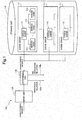
- a video processing apparatus 100 verifies a plurality of pieces of video data by determining whether scenes, each of which includes a series of plural frames, agree or not.
- the video processing apparatus 100 includes a storage unit 110, an input unit 120 and a determining unit 130.
- the storage unit 110 stores a plurality of scenes and characteristic amounts which are extracted from a series of plural frames included in the respective scenes in a scene group 111, in association with each other, defining one scene of the scene group 111 as a typical scene 112 and the other scenes as a derived scene 113, respectively.
- the plurality of scenes derived from a common scene are defined as the scene group 111.
- the input unit 120 inputs a characteristic amount extracted from each frame of a new scene.
- the determining unit 130 determines whether the new scene represented by the inputted characteristic amount is the derived scene of the scene group 111 (130a) or not (130b) by verifying the inputted characteristic amount with the characteristic amount of the typical scene 112 of the scene group 111 stored in the storage unit 110.
- a frame characteristic amount of video data sent from various servers and video viewing terminals which include a frame characteristic amount extracting unit, is stored in a database of a video processing apparatus, which has a configuration able to be searched, with a structured derivation relation between scenes.
- a video processing database used for verifying at a high speed with less resources, on the basis of video data sent from various servers and video viewing terminals. Accordingly, it is possible to verify video data at a high speed with less resources.
- the characteristic amount to be used is not limited to the frame characteristic amounts, and another characteristic amount is also applicable.
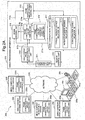
- Fig. 2A is a block diagram showing a configuration of the video processing system according to the exemplary embodiment. Note that, Fig. 2A shows a functional unit related to a function of the exemplary embodiment, and a functional unit for realizing another function is omitted from the figure in order to avoid complexity.
- a reference sign 210 in Fig. 2A indicates a video processing apparatus.
- the video processing apparatus 210 includes a frame characteristic amount DB 217 which stores a frame characteristic amount charactering each frame of a video content, in association with a relation between scenes each of which includes a series of frames.
- the frame characteristic amount DB 217 includes a typical-derived scenes relation DB 217-1 which stores a relation between a typical scene and a derived scene with a structure for permitting search of the relation (refer to Fig. 5A , Fig. 7 and Fig. 8 ).
- the frame characteristic amount DB 217 includes an anteroposterior scenes relation DB 217-2 which stores connection between a preceding scene and the following scene (refer to Fig. 5B ).
- the frame characteristic amount DB 217 includes a concatenation scenes relation DB 217-3 which stores an order of concatenation among the plurality of scenes, in association with a division of one scene into the plurality of scenes (refer to Fig. 5C ).
- the concatenation scenes relation DB 217-3 keeps the concatenation relation among the scenes in one video content.
- the frame characteristic amount DB 217 stores the frame characteristic amount of each scene which has been already inputted with the structure associated with the relation between scenes.
- scenes among which a difference of characteristic amounts is equal to or smaller than a predetermined threshold value are defined as a member of a scene group.
- the scene group includes one typical scene and derived scenes which are other than the typical scene.
- the typical scene is a scene inputted first in the scene group.
- the scene group is restructured considering a generated date of each scene or a distance between frame characteristic amounts of scenes.
- the video processing apparatus 210 includes a communication control unit 211 which communicates with each server and each video viewing terminal through a network 270. Note that, wire communication or wireless communication may be applied.
- a video content frame characteristic amount storing unit 212 stores a series of frame characteristic amounts of a video content received by the communication control unit 211.
- a frame characteristic amount agreement condition storing unit 213 stores a verifying condition which is used by a frame characteristic amount verifying unit 214.
- the frame characteristic amount verifying unit 214 verifies a frame characteristic amount 217a of each scene, which have been already stored with the structure in the frame characteristic amount DB 217, with a frame characteristic amount 212a which is stored in the video content frame characteristic amount storing unit 212, by use of the verifying condition stored in the characteristic amount agreement condition storing unit 213. Then, the frame characteristic amount verifying unit 214 outputs a verifying result 214a, which indicates agreement or no agreement, to a frame characteristic amount storing control unit 216. Moreover, the frame characteristic amount verifying unit 214 outputs a verifying result 214b, which indicates an agreement with a portion of the typical scene, to a scene dividing unit 215.
- a part indicated by a dotted line 219 which has the frame characteristic amount agreement condition storing unit 213 and the frame characteristic amount verifying unit 214, includes a first portion which determines whether there is an agreed scene group or not and a second portion which determines whether to be added to the scene group or not (refer to Fig. 2B ), by verifying with the typical scene.
- the scene dividing unit 215 divides an agreed portion from the existing typical scene as a new scene. Then, the scene dividing unit 215 outputs a division result 215a to the frame characteristic amount storing control unit 216 for restructuring of the frame characteristic amount DB 217 based on the scene division. A portion excluding the new scene from the frame characteristic amount of the existing typical scene is also stored in the frame characteristic amount DB 217 as a new scene.
- the scene structure of the frame characteristic amount DB 217 is also restructured according to the division of one scene to a plurality of scenes, which is carried out by the scene dividing unit 215.
- the frame characteristic amount storing control unit 216 receives the verifying result outputted from the frame characteristic amount verifying unit 214 and the division result outputted from the scene dividing unit 215, and carries out storage control on the frame characteristic amount DB 217 to update or restructure the structure (refer to Fig. 2C ).
- a search control unit 218 searches for a scene which agrees with received frame characteristic amounts, a derivation relation regarding the scene, and a relation regarding the video content from the frame characteristic amount DB 217 which is structured with frame characteristic amounts of scenes, and sends the search result to a search requestor.
- a reference sign 220 in Fig. 2A indicates a video contents storing server which stores video contents.
- the video contents storing server 220 includes a frame characteristic amount extracting unit 220a, and sends frame characteristic amounts in case of sending a video content to the video processing apparatus 210.
- a reference sign 230 in Fig. 2A indicates a video content providing server which provides the video content to video viewing terminals 260 to 26n.
- the video content providing server 230 includes a frame characteristic amount extracting unit 230a, and sends frame characteristic amounts in case of sending the video content to the video processing apparatus 210.
- a reference sign 240 in Fig. 2A indicates a video content generating server which generates the video content.
- the video content generating server 240 includes a frame characteristic amount extracting unit 240a, and sends frame characteristic amounts in case of sending the video content to the video processing apparatus 210.
- a reference sign 250 in Fig. 2A indicates a video contents crawling server which crawls video contents.
- the video contents crawling server 250 includes a frame characteristic amount extracting unit 250a, and sends frame characteristic amounts in case of sending a video content to the video processing apparatus 210.
- Each of the reference signs 260 to 26n in Fig. 2A indicates the video viewing terminal for viewing the video content.
- the video viewing terminals 260 to 260n include frame characteristic amount extracting units 260a to 26na respectively.
- the video viewing terminals 260 to 260n make the frame characteristic amount extracting units 260a to 26na generate frame characteristic amounts and send the frame characteristic amounts to the video processing apparatus 210.
- a video viewing apparatus for playing a video content and recording and playing a broadcasted program also includes a frame characteristic amount extracting unit, and sends frame characteristic amounts to the video processing apparatus 210 when playing the video content.
- the video content whose frame characteristic amounts are received by the video processing apparatus 210 is not limited to the above and may be a video content delivered through any media in the world.
- the frame characteristic amount extracting units 260a to 26na may be manufactured on one chip IC circuit, and mounted on each terminal or each apparatus. Or, if being configured in such a way that a program for extracting frame characteristic amounts is downloaded to each terminal or each apparatus, it is possible to carry out a common process which uses a standardized frame characteristic amount.
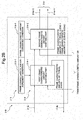
- Fig. 2B is a block diagram showing an internal configuration of the frame characteristic amount verifying unit 214 according to the exemplary embodiment. Note that, as indicated by the dotted line 219, the frame characteristic amount agreement condition storing unit 213 is also associated with the frame characteristic amount verifying unit 214.
- the frame characteristic amount verifying unit 214 includes a first frame characteristic amount verifying part 214-1 which verifies received frame characteristic amounts with a typical scene in the frame characteristic amount DB 217, and a second frame characteristic amount verifying part 214-2 which verifies the received frame characteristic amounts with a frame characteristic amount of each scene in a scene group including an agreed typical scene and the derived scene thereof.
- the first frame characteristic amount verifying part 214-1 performs the verification on the basis of a frame characteristic amount agreement condition 213-1.
- the second frame characteristic amount verifying part 214-2 performs the verification on the basis a frame characteristic amount coincidence condition 213-2.
- the frame characteristic amount agreement condition 213-1 is used as a determining condition whether there is an agreed frame characteristic amount of a scene in a scene group
- the frame characteristic amount agreement condition 213-1 is more lax than the frame characteristic amount coincidence condition 213-2 which is used as a determining condition whether there is a coincident frame characteristic amount of a scene in a scene group.
- the received frame characteristic amounts of a video content are firstly verified with typical scenes in turn by the frame characteristic amount verifying part 214-1 on the basis of the frame characteristic amount agreement condition 213-1.
- a typical scene addition 214a-1 is outputted and stored in the frame characteristic amount DB 217 as a new typical scene, then the process is ended.
- the received frame characteristic amounts of the video content are verified with frame characteristic amounts of each scene in the scene group including the agreed typical scene in turn by the frame characteristic amount verifying part 214-2 on the basis of the frame characteristic amount agreement condition 213-3.
- the received frame characteristic amounts of the video content are verified firstly with the frame characteristic amounts of typical scenes. Then, registration as a new typical scene, or incorporation into a scene group is selected. For this reason, a large number of processes, which are required in case of the verification with frame characteristic amounts of every scene, is decreased.
- Fig. 2C is a block diagram showing an internal configuration of the scene dividing unit 215 according to the exemplary embodiment.
- the scene dividing unit 215 includes a video content frame characteristic amount storing part 215-1 which stores frame characteristic amounts of a video content 212a received from the video content frame characteristic amount storing unit 212. Moreover, the scene dividing unit 215 includes a typical scene frame characteristic amount storing part 215-2 which stores frame characteristic amounts of a typical scene 217a which is received from the frame characteristic amount DB 217. The scene dividing unit 215 receives the division instruction 214b, which indicates an agreement with only a portion of the received frame characteristic amounts of the video content, from the frame characteristic amount verifying unit 214.
- the scene dividing unit 215 generates four scenes according to the division instruction 214b.
- Scenes 215a-1 and 215a-2 are divided from the frame characteristic amounts of the typical scene.
- Scenes 215a-3 and 215a-4 are divided from the frame characteristic amounts of the video content.
- the scenes 215a-1 to 215a-4 are corresponding to the division result 215a in Fig. 2A .
- the scene 215a-1 and the scene 215a-3 agree each other, and the scene 215a-2 and the scene 215a-4 do not agree each other. In this case, if the scene 215a-1 and the scene 215a-3 are coincident each other, the scene 215a-1 and the scene 215a-3 are registered as one new typical scene.
- the scene 215a-1 and the scene 215a-3 are registered as the typical scene and the derived scene in the same scene group. While either the scene 215a-1 or the scene 215a-3 may be registered as a typical scene, in the exemplary embodiment, the scene divided from the existing typical scene is registered as the typical scene.
- the scene 215a-2 and scene 215a-4 are registered as a new typical scene. Note that, the scene 215a-2 and the scene 215a-4 may be verified again with frame characteristic amounts of each scene in the frame characteristic amount DB 217, and restructuring for collecting scenes which belong to the same scene group may be carried out.
- Fig. 2C exemplifies that one typical scene is divided into two typical scenes, that is, a preceding scene and a following scene
- one typical scene may be divided into three typical scenes if an agreed portion of the frame characteristic amounts is located at a middle of the typical scene.
- number of the divided scenes may be increased.
- a number of the typical scenes and a length of the typical scene may be adjusted by changing the agreement condition.
- Fig. 2D is a block diagram showing an internal configuration of the frame characteristic amount storing control unit 216 according to the exemplary embodiment.
- the verifying result 214a is inputted to the frame characteristic amount storing control unit 216 from the frame characteristic amount verifying unit 214.
- the division result 215a is inputted to the frame characteristic amount storing control unit 216 from the scene dividing unit 215.
- the frame characteristic amount storing control unit 216 which includes the following functional units, sends control information used for carrying out each process to the frame characteristic amount DB 217 on the basis of the verifying result 214a and the division result 215a.
- a typical scene adding part 216-1 adds a structured new typical scene to the typical-derived scenes relation DB 217-1 of the frame characteristic amount DB 217, on the basis of the output of the typical scene addition 214a-1 from the frame characteristic amount verifying unit 214 and the output of the division result 215a from the scene dividing unit 215.
- a derived scene adding part 216-2 adds a structured new derived scene to the typical-derived scenes relation DB 217-1 of the frame characteristic amount DB 217, on the basis of the output of the derived scene addition 214a-2 from the frame characteristic amount verifying unit 214 and the output of the division result 215a from the scene dividing unit 215.
- a typical-derived scenes relation generating part 216-3 when adding a new typical scene and a new derived scene, generates a relation between a typical scene and a derived scene, and updates the typical-derived scenes relation DB 217-1 (refer to Fig. 5A ).
- An anteroposterior scenes relation generating part 216-4 when adding a new typical scene and a new derived scene, generates a new relation between preceding and following scenes, and updates the anteroposterior scenes relation DB 217-2 (refer to Fig. 5B ).
- a concatenation scenes relation generating part 216-5 when adding a new typical scene and a new derived scene, generates a new relation between concatenated scenes, and updates the concatenation scenes relation DB 217-3 (refer to Fig. 5C ).
- Fig. 3A is a block diagram showing a configuration of the frame characteristic amount extracting units 220a to 26na according to the exemplary embodiment.
- the characteristic amount extracting units 220a to 26na applied in the exemplary embodiment are functional units each of which extracts a video signature adopted in the standardization of MPEG 7.
- an outputted frame characteristic amount 350 is obtained by arranging many pairs of areas, whose sizes and shapes are different each other, in each frame image of a recorded video data, quantizing (actually, three values quantization) a difference of average brightness values which are a kind of an area characteristic amount between these areas, and coding the quantized difference.
- a dimension determining unit 310 determines number of pairs of areas. One dimension corresponds to one pair of areas.
- An extracted area acquiring unit 320 acquires pairs of areas of each dimension, whose frame characteristic amounts will be calculated, according to the determination of the dimension determining unit 310.
- An area characteristic amount calculating unit 330 includes a first area characteristic amount calculating part 331 and a second area characteristic amount calculating part 332.
- the first area characteristic amount calculating part 331 calculates average brightness of one area included in a pair of areas of each dimension
- the second area characteristic amount calculating part 332 calculates average brightness of the other area included in the pair of areas.
- An area characteristic amount differential coding unit 340 calculates a difference between the average brightness values of the pair of areas, and carries out the quantum coding to the difference according to a threshold value and outputs a frame characteristic amount 350.
- the area characteristic amount is not limited to the average brightness of the area.
- the area characteristic amount a value obtained by other processing of brightness or a frame characteristic amount other than brightness may be applied.
- Fig. 3B is a diagram showing a process carried out by the frame characteristic amount extracting units 220a to 26na according to the exemplary embodiment.
- a reference sign 320a in Fig. 3B exemplifies a pair of areas acquired by the extracted area acquiring unit 320 shown in Fig. 3A .
- an outer rectangle indicates a frame
- each inner rectangle indicates an area.
- a reference sign 330a in Fig. 3B indicates a pair of areas acquired by the extracted area acquiring unit 320 and a relation between the areas for which a difference is calculated.
- An arrow connecting centers of each of the areas indicates calculating a difference of average brightness values of pixels of individual areas, between two areas extracted in the frame image.
- a reference sign 340a in Fig. 3B indicates a result of the quantum coding of the calculated difference.
- 340a if a difference obtained by subtracting a characteristic amount of the second area from a characteristic amount of the first area is within the threshold value, which is a range having '0' as a center value (corresponding to a case that average brightness values are equal) indicated by dotted lines, '0' is set to an output value of the quantum coding. If the difference is a positive (+) value and is greater than a value of the right side dotted line, '+1' is set to the output value of the quantum coding.
- the output value of the quantum coding is not limited to the above-mentioned example using the three values.
- the threshold value indicated by the dotted line is determined on the basis of a ratio of number of the differential values quantized to '0', to number of the distributed differential values of all dimensions which are used. As an example, the threshold value is determined in such a way that the ratio of the number of the differential values quantized to '0' is 50%.
- a reference sign 350a in Fig. 3B indicates an example of the frame characteristic amount which is generated by collecting the results of the quantum coding of the difference.
- values obtained by the quantum coding of the difference are arranged in one dimensional direction in an order of the dimension.
- the frame characteristic amount is not limited to the example that the values obtained by the quantum coding of the difference are arranged simply in one dimensional direction in the order of the dimension.
- the values may be arranged in multiple dimensional directions, and furthermore an additional calculation may be carried out.
- Fig. 3C is a diagram showing extracted areas which are extracted by the frame characteristic amount extracting units 220a to 26na according to the exemplary embodiment.
- a pair of areas of each dimension is indicated by two rectangular areas.
- a shape other than the rectangle may be preferable in some cases.
- the extracted area shown in Fig. 3C exemplifies a pair of areas each of which is not the rectangular area.
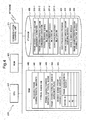
- Fig. 4 is a block diagram showing a configuration of the video processing apparatus 210 according to the exemplary embodiment.
- CPU Central Processing Unit
- ROM Read Only Memory
- the communication control unit 211 communicates with the video viewing terminals 260 to 26n or the servers 220 to 250. Here, wireless or wired communication may be applied.
- RAM (Random Access Memory) 440 is a random access memory used by CPU 410 as a work area for temporary storage. An area to store data required for realization of the exemplary embodiment is reserved in RAM 440.
- a reference sign 441 indicates received frame characteristic amounts which are received from a sender and has been converted into the frame characteristic amounts.
- a reference sign 442 indicates a typical scene ID identifying a typical scene which is read from the frame characteristic amount DB 217, and is verified with the received frame characteristic amounts 441.
- a reference sign 443 indicates frame characteristic amounts related to the typical scene ID 442.
- a reference sign 444 indicates a frame characteristic amount agreement flag which indicates whether the received frame characteristic amounts and the frame characteristic amounts of the typical scene agree each other or not. Note that, the following is not shown in Fig. 4 since it becomes complicated.
- the frame characteristic amount agreement flag 444 indicates whether the received frame characteristic amount agrees with the frame characteristic amount of the typical scene or not, and whether the received frame characteristic amount is coincident with the frame characteristic amount of a scene included in the scene group.
- a reference sign 445 indicates divided scene-frame characteristic amounts which stores frame characteristic amounts of divided scenes in association with the divided scenes.
- the divided scene-frame characteristic amounts 445 is a table which stores, in case that a scene 'A' is divided into 'A1' and 'A2', for example, respective frame characteristic amounts and scene IDs in association with each other.
- a storage 450 stores database contents, various parameters, or following data and program which are necessary to realize the present exemplary embodiment.
- the reference sign 213-1 indicates the frame characteristic amount agreement condition shown in Fig. 2B .
- the reference sign 213-2 indicates the frame characteristic amount coincidence condition.
- the reference sign 217-1 indicates the typical scene-derived scene relation DB in the frame characteristic amount DB 217 (refer to Fig. 5A ).
- the reference sign 217-2 indicates the anteroposterior scenes relation DB in the frame characteristic amount DB 217 (refer to Fig. 5B ).
- the reference sign 217-3 indicates the concatenation scenes relation DB in the frame characteristic amount DB 217 (refer to Fig. 5C ).
- the following programs are stored.
- a reference sign 451 indicates a video processing program which makes a whole of processes executed.
- a reference sign 452 indicates a frame characteristic amount verifying module which verifies frame characteristic amounts in the video processing program 451.
- a reference sign 453 indicates a scene dividing module which divides a scene.
- a reference sign 454 indicates a frame characteristic amount storing control module which controls storing the frame characteristic amount in the frame characteristic amount DB 217 in the video processing program 451.
- Fig. 4 shows only data and programs which are essential in the exemplary embodiment, and does not show general-purpose data and programs such as OS.
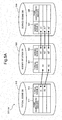
- Fig. 5A is a diagram showing a first configuration 217-1A of the typical-derived scenes relation DB 217-1 according to the exemplary embodiment.
- the first configuration 217-1A shown in Fig. 5A includes a typical scene DB 510, a scenes relation DB 520 and a derived scene DB 530.
- the typical scene DB 510 stores a series of frame characteristic amounts 511 and a typical scene ID 512 which identifies a scene in association with each other.
- the scenes relation DB 520 stores, in association with a typical scene ID 521 corresponding to the typical scene ID 512 in the typical scene DB 510, derived scene IDs 522 included in the scene group.
- the derived scene DB 530 stores a derived scene ID 531 corresponding to the derived scene ID 522 in the scenes relation DB 520 and a series of frame characteristic amounts 532 in association with each other.
- Fig. 5B is a diagram showing the anteroposterior scenes relation DB 217-2 according to the exemplary embodiment.
- the anteroposterior scenes relation DB 217-2 in Fig. 5B stores a connection relation corresponding to a relation between a preceding scene and a following scene, with a preceding scene ID 541 and a following scene ID 542 in association with each other.
- the anteroposterior scenes relation DB 217-2 is applied, in case finding out the next typical scene after finding out the first typical scene out of successive scenes, to searching from a typical scene associated by the successive scene IDs preferentially in order to find the next typical scene in a short time.
- the anteroposterior scenes relation DB contributes toward high speed search.
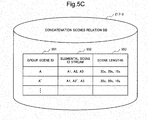
- Fig. 5C is a diagram showing the concatenation scenes relation DB 217-3 according to the exemplary embodiment.
- the concatenation scenes relation DB 217-3 shown in Fig. 5C stores an order of a successive series of group scenes by use of an elemental scene ID stream 552 and scene lengths 553 of the respective scenes in association with a group scene ID 551.
- a character's' used in the scene lengths means a second. It is obvious to reach to one video content finally by concatenating the group scene IDs furthermore as one elemental scene ID.
- Fig. 6A is a flowchart showing a process carried out by the video processing apparatus according to the exemplary embodiment.
- the flowchart is carried out by CPU 410 using RAM 440 to realize each functional unit shown in Figs. 2A to 2D .
- the flowchart shown in Fig. 6A includes the process carried out by each module shown in Fig. 4 .
- Step S601 frame characteristic amounts of a video content are inputted.
- the frame characteristic amount verifying unit 214 verifies a scene included in the video content with all typical scenes, in turn.
- Step S605 the frame characteristic amount verifying unit 214 determines whether the scene included in the video content agrees with a typical scene, on the basis of the frame characteristic amount agreement condition 213-1. In case that there is no portion which agrees with the typical scene, in Step S607, the frame characteristic amount storing control unit 216 registers the scene included in the video content as a new typical scene to the structure of the frame characteristic amount DB 217.
- Step S609 the scene dividing unit 215 carries out a detailed scene classifying process (refer to Fig. 6 ).
- Step S611 the scene dividing unit 215 divides scenes into portions which agree, and portions which do not agree to generate new typical scenes.
- Step S613 the frame characteristic amount storing control unit 216 restructures the frame characteristic amount DB 217 on the basis of the new typical scenes generated by dividing.
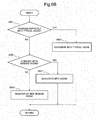
- Fig. 6B is a flowchart showing a process Step 609-1 which is corresponding to the detailed scene classifying process Step S609, according to the exemplary embodiment.
- Step S621 the frame characteristic amount verifying unit 214 determines whether a series of frame characteristic amounts of the video content is perfectly coincident with the frame characteristic amounts of the typical scene, on the basis of the frame characteristic amount coincidence condition 213-2.
- the frame characteristic amount storing control unit 216 associates the scene of the video content with the typical scene.
- the typical-derived scenes relation DB 217-1 in the frame characteristic amount DB 217 is not updated since there is no change.
- the new relation is added to the anteroposterior scenes relation DB 217-2 or the concatenation scenes relation DB 217-3. In case of not being perfectly coincident with the frame characteristic amounts of the typical scene, proceeded to Step S625.
- Step S625 the frame characteristic amount verifying unit 214 determines whether there is a derived scene having the frame characteristic amounts which are perfectly coincident with a series of frame characteristic amounts of the video content in the scene group or not. In case that there is a derived scene having the frame characteristic amounts which are perfectly coincident, in Step S627, the frame characteristic amount storing control unit 216 associates the scene of the video content with the derived scene.
- the typical-derived scenes relation DB 217-1 in the frame characteristic amount DB 217 is not updated since there is no change. However, if there is a new relation, the new relation is added to the anteroposterior scenes relation DB 217-2 or the concatenation scenes relation DB 217-3. In case that there is not a derived scene having the frame characteristic amounts which are perfectly coincident, proceeded to Step S629.
- Step S629 the frame characteristic amount storing control unit 216 registers the scene of the video content to the scene group as a new derived scene.
- the new relation is added to the anteroposterior scenes relation DB 217-2 or the concatenation scenes relation DB 217-3. Then, the process is ended and returns.
- Fig. 7A is a diagram showing a second configuration 217-1B of the typical-derived scenes relation DB 217-1 according to the exemplary embodiment.
- a derivation verify DB 720 associates a typical scene and derived scenes.
- a typical scene ID 721 corresponding to the typical scene ID 512 of the typical scene DB 510 and a derived scene ID 723 are associated by frame characteristic amount difference information 722.
- Fig. 7B is a diagram showing an example 700 of using the second configuration 217-1B of the typical-derived scenes relation DB according to the exemplary embodiment.
- pieces of the frame characteristic amount difference information 722 are sorted in an order of largeness or in an order of smallness in advance.
- the pieces of the frame characteristic amount difference information 722 are sorted in the order of smallness such as an order of '30', '48', '61', '80' and '91'.
- the values are set in order to explain the example of using the difference information. The values are not limited to the above-mentioned value.
- a range of the coincidence verification 703 is restricted to a predetermined range above and below the difference information '61' (' ⁇ 20' in Fig. 7B ). As a result, it is not required to carry out the coincidence verification with all derived scenes.
- the coincidence verifications with the derived scenes whose difference information is '48', '61', and '80', only, are carried out.
- the coincidence verifications are carried out in an order of closeness of the difference information to the difference information '61' of the agreement verification.
- the coincidence is determined more quickly.
- Step S625 it is possible to simplify identification of the coincident derived scene shown in Step S625, by calculating difference information between inputted frame characteristic amounts and frame characteristic amounts of the typical scene, and comparing the calculated difference information with the frame characteristic amount difference information registered in the derivation verification DB.
- the difference information used here may be one of a vector data like a result of calculating a difference between frame characteristic amounts vectors, a scalar value like a result of calculating a distance between the vectors, or a matrix of results of calculating a distance per a frame.
- Fig. 7C is a diagram showing another example 750 of the difference information in the second configuration of the typical-derived scenes relation DB according to the exemplary embodiment.
- a frame 751 which is included in each inputted scene, and a frame 752 which is included in a typical scene are divided into 16 pieces respectively.
- Fig. 7C shows a case equally divided into 4 ⁇ 4 pieces, number, a size and a shape of the divided area have no restriction. An appropriate divided area may be selected on the basis of a tendency in a change of the video or the like.
- a comparison unit 753 compares corresponding divided areas, and a determining unit 754 determines whether each change is equal to or greater than a threshold value or not. The determination result is expressed by one bit whose value is '1' in case that the change is equal to or greater than the threshold value and '0' in case that the change is smaller than the threshold value.
- a bit stream 755 corresponding to the result of the process expresses a degree of change by use of 16 bits per one frame in case of 16 division
- a degree of change of one scene can be expressed by use of 16 bits ⁇ (number of frames of one scene). It is possible to use the value as the difference information in place of or in addition to the difference information of the second configuration 217-1B of the typical-derived scenes relation DB 217-1.
- a state that changes are added to a band of four areas at a lower part of frame, for example, like a bit stream of a first frame shown in Fig. 7C can be estimated on the basis of the bit stream. Accordingly, it is advantageous for realizing a high speed process also to arrange a specific-derived scenes DB storing a specific scene and its derived scene which are associated each other by such a difference indicated by a bit stream, and to use the specific-derived scenes DB in order to search for the derived scene generated by the change of adding the subtitle or the like.
- Fig. 8 is a diagram showing a third configuration 217-1C of the typical-derived scenes relation DB 217-1 according to the exemplary embodiment.
- a typical-derived frames characteristic relation DB 820 associates frame characteristic amounts of a typical scene and frame characteristic amounts of a derived scene. Then, frame characteristic amounts are associated with scene IDs in a scene ID list table 810, respectively. With the third configuration 217-1C, storage capacity of the typical-derived scenes relation DB 217-1 is reduced furthermore.
- a scene which appears first is registered as a typical scene, and a scene which appears later and agrees with the typical scene is registered as a derived scene.
- the scene which appears first may not be always the first scene which is an origin of the derivation.
- a scene which should be the derived scene may be arranged as the typical scene, and a scene which should be the origin of the derived scene may be arranged as the derived scene in some times. In this situation, it is caused that, on the basis of the agreement condition to identify the derived scene, a scene which should be the derived scene originally is excluded from the scene group, and a scene which is not the derived scene becomes a member of the scene group.
- periodical restructuring of the frame characteristic amount DB 217 is carried out in such a way that a typical scene or a scene group becomes close to the actual derivation relation. According to the exemplary embodiment, it is possible to realize the structured frame characteristic amount DB 217 which becomes closer to the actual derivation relation.
- Fig. 9A is a diagram showing a concept of a first restructuring 910 of the typical-derived scenes relation DB 217-1.
- difference information expressed by a scalar value like a result of calculating a distance between vectors of characteristic amounts, which include a matrix of a series of video frames of a typical scene and a derived scene, is used as difference information is assumed.
- a scene group 911 which is generated in the second exemplary embodiment, is shown.
- a scene which appears first is defined as a typical scene, and scenes whose difference information regarding frame characteristic amount is within a predetermined threshold value from the typical scene are defined as a derived scene.
- many scenes which have almost equal difference information exist collectively.
- below the typical scene in the figure only small numbers of derived scenes exist and scenes having the almost equal difference information do not exist collectively around the boundary. In this case, it is very doubtful that the typical scene is the true origin of the derived scenes.
- the scenes having the almost equal difference information regarding the frame characteristic amount exist separately outside and inside the scene group.
- a center position (center of gravity) of the scenes included the scene group is calculated according to the first restructuring 910 as shown on the left side of Fig. 9A . That is, a central scene which makes a summation of pieces of the difference information the smallest is detected. For example, in case that the second derived scene above the typical scene is around the center, the second derived scene is set as a new typical scene. Then scenes whose difference information regarding frame characteristic amounts is within the predetermined threshold from the new typical scene is set as a new derived scene, as shown on the right side of Fig. 9A . In Fig. 9A , two scenes on the upper side are set as a derived scene, and one scene on a lower side is excluded from derived scenes, and the scene group 911 is reorganized as a scene group 912.
- Fig. 9B is a diagram showing a concept of a second restructuring 920 of the typical-derived scenes relation DB 217-1 according to the exemplary embodiment.
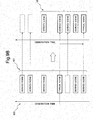
- a generation time of the scene is set from a bottom (old) to a top (new).
- the typical scene is the third scene from the oldest out of the scenes having the almost equal difference information regarding frame characteristic amounts.
- three derived scenes newer than the typical scene, and two derived scenes older than the typical scene are included in the scene group 921.
- the oldest scene among the derived scenes is determined as an origin of derived scenes, and is set as a typical scene.
- the oldest scene is set as a typical scene, and scenes whose difference information regarding frame characteristic amount is within the threshold from the typical scene is set as a derived scene.
- four new scenes are included in a scene group 922 as a derived scene.
- the third scene from the oldest is added to the scene group 922 as a derived scene. It is conceivable that the derived scene is far from the typical scene on the left side of the figure, but close to the typical scene on the right side. Two new scenes are excluded from derived scenes.
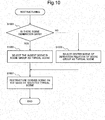
- Fig. 10 is a flowchart showing a process of restructuring the typical-derived scenes relation DB 217-1 according to the exemplary embodiment. This flowchart is carried out by CPU 410 using RAM 440.
- Step S1001 the frame characteristic amount storing control unit 216 determines whether a generation date of each scene is recorded. In case that the generation date is recorded, in Step S1003, the frame characteristic amount storing control unit 216 sets the oldest scene in the scene group as a typical scene. On the other hand, in case that the generation date is not recorded, in Step S1005, the frame characteristic amount storing control unit 216 selects, as a center scene of the derivation relations of the scene group, a scene which makes a summation of the difference information regarding the frame characteristic amount the smallest, and sets the center scene as a typical scene.
- Step S1007 the frame characteristic amount storing control unit 216 selects derived scenes on the basis of the newly selected typical scene to restructure a whole of the frame characteristic amount DB 217.
- a case that one derived scene is included in a plurality of derivation areas is not assumed.
- a situation that one derived scene is included in a plurality of scene groups also occurs. In this case, a database becomes complicated and the grouping also becomes meaningless.
- one derived scene is controlled to be included in one scene group.
- periodical restructuring of the frame characteristic amount DB 217 is carried out in such a way that a typical scene or a scene group may be close to the actual derivation relation. According to the exemplary embodiment, even if one derived scene is included in a plurality of derivation areas, it is possible to realize the structured frame characteristic amount DB 217 which becomes closer to the actual derivation relation.
- Fig. 11 is a diagram showing an initial state 1100 of a typical-derived scenes relation DB according to the exemplary embodiment.
- a phrase of 'initial state' indicates only a state before the group determination or the restructuring, and does not indicate the first:
- the derivation areas 1101 and 1102 include typical scenes 1101a and 1102a respectively.
- the derivation area is expressed by a distance, from the typical scene, corresponding to an agreement determination condition. While the derivation area is actually expressed in a multi-dimensional space, for clear explanation, the deviation area is shown by a circle having a predetermined radius in a two-dimension space in Fig. 11 . In case that frame characteristic amounts of a new scene is inputted in this state, which scene group the new scene is incorporated into or how to carry out the restructuring will be described in the exemplary embodiment.
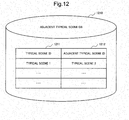
- Fig. 12 is a diagram showing a configuration of an adjacent typical scene DB 1210 according to the exemplary embodiment. Note that, the adjacent typical scene DB 1210 may be included in the storage 450 shown in Fig. 4 .
- the adjacent typical scene DB 1210 stores a typical scene ID 1211 and an adjacent typical scene ID 1212 in association with each other.
- the adjacent typical scene ID1212 is stored in case that a value of distance between the typical scenes is smaller than a value which is twice the threshold value of the agreement condition.
- it is efficient that the storage of the adjacent typical scene ID 1212 is carried out not by adding new process to decide the distance between the typical scenes but with carrying out the agreement detection of an inputted scene.
- the typical scene IDs are stored in the adjacent typical scene DB 1210 in association with each other as typical scene IDs of scene groups having a possibility to become the adjacent scenes.
- Fig. 13 is a flowchart showing a process Step 609-2 which is corresponding to the detailed scene classifying process Step S609, according to the exemplary embodiment.
- a program based on the flowchart is stored in the storage 450 shown in Fig. 4 , and is executed by CPU 410 using RAM 440 to realize a function of grouping to a scene group in the exemplary embodiment.
- Step S621 to S627 are similar to Steps S621 to S627 shown in Fig. 6B , description on the steps is omitted.
- Fig. 13 in case that the inputted scene is not perfectly coincident with a typical scene (NO in Step S621), and simultaneously is not coincident with a derived scene (NO in Step S625), proceeded to Step S1321.
- Step S1321 when the characteristic amount verifying unit 214 determines that there is an adjacent typical scene with reference to the adj acent typical scene DB 1210, the frame characteristic amount verifying unit 214 verifies whether the inputted scene agrees with an adjacent typical scene. In case that the inputted scene agrees with the adjacent typical scene, in Step S 1323, the frame characteristic amount verifying unit 214 verifies whether the inputted scene is coincident with a derived scene included in the scene group including the adj acent typical scene. In case that there is a derived scene which is coincident, in Step S1325, the frame characteristic amount storing control unit 216 associates the inputted scene with the derived scene which is coincident to make the inputted scene incorporated into the scene group including the adjacent typical scene.
- Step S327 the frame characteristic amount storing control unit 216 registers the inputted scene to the scene group including the typical scene, which has the closer distance to the inputted scene out of two adj acent typical scenes, as a new derived scene.
- the frame characteristic amount storing control unit 216 may register the inputted scene as a new derived scene of the typical scene which agrees first, when the inputted scene is not coincident with a derived scene of the adjacent typical scene in case of carrying out the verification with a method which can determine an unique order of verifying with typical scenes.
- the adjacent typical scene DB 1210 stores typical scenes which are adjacent each other with one to one correspondence
- the adj acent typical scene DB 1210 may store all of typical scenes whose value of distance is within twice the value of the agreement condition.
- Fig. 14 is a diagram showing a concept of restructuring 1400 of the typical-derived scenes relation DB according to the exemplary embodiment. While the initial state shown in Fig. 12 is exemplified as a premise of the restructuring shown in Fig. 14 , the premise is not limited to the initial state.
- a derivation area 1401 is fixed in such a way as to include the surrounding derived scenes as many as possible. Then, one derived scene, whose total of distances from other derived scenes becomes the shortest, is sets as a new typical scene 1401a. Or, one scene, which can make the surrounding derived scenes incorporated and whose total of distances from other derived scenes is the shortest, is set as a new typical scene 1401a. Then, the derivation area 1401 is determined on the basis of a distance from the new typical scene 1401 a, and scene existing in the area is set as a derived scene. Note that, while the derivation area is shown in a two-dimension space for clear description in Fig. 14 , the deviation area is actually expressed in a multi-dimension space.
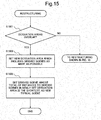
- Fig. 15 is a flowchart showing a process of restructuring the typical-derived scenes relation DB according to the exemplary embodiment. This flowchart is carried out by CPU 410 using RAM 440.
- Step S1501 the frame characteristic amount storing control unit 216 determines whether the derivation areas of the plural typical scenes, which are targets of the restructuring, overlap each other or not. In case that there is no overlap, proceeded to steps shown in Fig. 10 of the second exemplary embodiment.
- Step S1503 the frame characteristic amount storing control unit 216 sets a derivation area which can include the surrounding derived scenes as many as possible. Then, in Step S1505, the frame characteristic amount storing control unit 216 sets a derived scene, whose total of distances from other derived scenes in the newly set derivation area is the shortest, as a new typical scene.
- the step to select a derived scene which can make the surrounding derived scenes incorporated as many as possible and whose total of distances from other derived scenes is the shortest, as a typical scene as shown in Fig. 14 is also clear from Fig. 15 .
- the above-mentioned second to fourth exemplary embodiments are described focusing on the configuration and the process of making the structured frame characteristic amount DB. According to the exemplary embodiment, an example of using the frame characteristic amount DB will be described.
- the video processing system 200 shown in Fig. 2A when each of the video viewing terminals 260 to 26n sends the frame characteristic amounts of the video content being viewed to the video processing apparatus 210, information on a video content which has a derivation relation with each scene of the video content being viewed, or metadata of a scene which has a derivation relation with each scene are provided to each of the video viewing terminals 260 to 26n.
- a viewer viewing the video content on the video viewing terminals 260 to 26n can obtain or view information on the derived video content, the derived video content, or information on the metadata added to the derived scene.
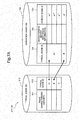
- Fig. 16 is a diagram showing a configuration of a video content-metadata DB 1600 according to the exemplary embodiment.
- the video content-metadata DB 1600 may be included in the video processing apparatus 210 shown in Fig. 2A or may be included in a server connected via a network.
- the video content-metadata DB 1600 stores, in association-with each scene ID of a scene ID stream 1610 included in the same scene group, a video content ID of video content including the scene, and a metadata ID of metadata included in the scene.
- a scene ID 1611 in association with a scene ID 1611, a video content ID 1621 of the video content including the scene, and a metadata ID 1631 of the metadata included in the scene are stored.
- a scene ID 1612 in association with a scene ID 1612, a video content ID 1622 of the video content including the scene, and a metadata ID 1632 of the metadata included in the scene are stored.
- Fig. 17 is a flowchart showing a process of acquiring the video content or the metadata according to the exemplary embodiment. This flowchart is carried out by CPU 410 using RAM 440.
- Step S1701 the search control unit 218 acquires frame characteristic amounts of a video content being viewed from the video viewing terminals 260 to 26n.
- Step S 1703 the search control unit 218 acquires a derived scene from the frame characteristic amount DB 217 on the basis of the acquired frame characteristic amounts.
- Step S1705 the search control unit 218 acquires a video content ID of a video content including the acquired derived scene.
- Step S1707 the search control unit 218 acquires a metadata ID of metadata included in or added to the acquired derived scene.
- Step S1709 the search control unit 218 acquires the required video content or required metadata on the basis of the video content ID or the metadata ID.
- Step S1711 the search control unit 218 provides the acquired video content or metadata to the sender who has sent the frame characteristic amounts or the video viewing terminals 260 to 26n designated by the sender.
- the present invention may be applied to a system including a plurality of pieces of equipment or may be applied to a stand-alone apparatus.
- the present invention is applicable to a case that a control program, which realizes the functions defined in the exemplary embodiment, is provided directly or remotely to a system or an apparatus. Accordingly, a control program which is installed in a computer to realize the functions of the present invention, a medium which stores the control program or a WWW (World Wide Web) server which makes the control program downloaded is also included in the scope of the present invention.
- a control program which is installed in a computer to realize the functions of the present invention
- a medium which stores the control program or a WWW (World Wide Web) server which makes the control program downloaded is also included in the scope of the present invention.
Landscapes
- Engineering & Computer Science (AREA)
- Multimedia (AREA)
- Signal Processing (AREA)
- Theoretical Computer Science (AREA)
- Databases & Information Systems (AREA)
- Physics & Mathematics (AREA)
- General Physics & Mathematics (AREA)
- Data Mining & Analysis (AREA)
- General Engineering & Computer Science (AREA)
- Computer Security & Cryptography (AREA)
- Human Computer Interaction (AREA)
- Software Systems (AREA)
- Television Signal Processing For Recording (AREA)
- Information Retrieval, Db Structures And Fs Structures Therefor (AREA)
- Two-Way Televisions, Distribution Of Moving Picture Or The Like (AREA)
Abstract
Description
- The present invention relates to technology for verifying video data.
- In the above-mentioned technical field, a
patent literature 1 discloses technology, wherein, when a client requests to upload video data for browsing on a site, a verifying server verifies the video data with video data already registered by a registrant to determine whether the video data should be uploaded or not (refer to [Fig. 1 ]). Moreover, thepatent literature 1 discloses that it is possible to realize high speed verifying process by use of thumbnail images in verifying by the verifying server and furthermore by use of a group of still pictures which are extracted optionally or randomly in verifying (refer to paragraphs [0045] and [0046]). - [Patent literature 1] International Publication
WO/2009/035032 - According to the technology disclosed in the above-mentioned
patent literature 1, the database for verifying the video data (hereinafter, referred to as DB) with the thumbnail images is used. However, it is necessary that a reference server refers to all of the thumbnail images. As a result, the technology has a limit in reduction of a time required for the reference. - An object of the present invention is to provide technology for solving the above-mentioned problem.
- A video processing apparatus according to an exemplary aspect of the invention includes: a storage means for storing a plurality of scenes included in a scene group and characteristic amounts which are extracted from a series of plural frames included in the respective scenes in the scene group, in association with each other, defining one scene out of the plurality of scenes included in the scene group as a typical scene and the other scenes as a derived scene, the scene group being a group of a plurality of scenes derived from a common scene; an input means for inputting a characteristic amount which is extracted from a new scene; and a determining means for determining whether the new scene represented by the inputted characteristic amount is the derived scene of the scene group or not by verifying the inputted characteristic amount with the characteristic amount of the typical scene of the scene group stored in the storage means.
- A method for controlling a video processing apparatus according to an exemplary aspect of the invention includes: storing a plurality of scenes included in a scene group and characteristic amounts which are extracted from a series of plural frames included in the respective scenes in the scene group, in association with each other, defining one scene out of the plurality of scenes included in the scene group as a typical scene and the other scenes as a derived scene, the scene group being a group of a plurality of scenes derived from a common scene; inputting a characteristic amount which is extracted from a new scene; and determining whether the new scene represented by the inputted characteristic amount is the derived scene of the scene group or not by verifying the inputted characteristic amount with the characteristic amount of the typical scene of the scene group.
- A computer readable storage medium according to an exemplary aspect of the invention records thereon a program, causing a computer to perform a method including: storing a plurality of scenes included in a scene group and characteristic amounts which are extracted from a series of plural frames included in the respective scenes in the scene group, in association with each other, defining one scene out of the plurality of scenes included in the scene group as a typical scene and the other scenes as a derived scene, the scene group being a group of a plurality of scenes derived from a common scene; inputting a characteristic amount which is extracted from a new scene; and determining whether the new scene represented by the inputted characteristic amount is the derived scene of the scene group or not by verifying the inputted characteristic amount with the characteristic amount of the typical scene of the scene group.
- A database according to an exemplary aspect of the invention stores a plurality of scenes included in a scene group and characteristic amounts which are extracted from a series of plural frames included in the respective scenes in the scene group, in association with each other, defining one scene out of the plurality of scenes included in the scene group as a typical scene and the other scenes as a derived scene, the scene group being a group of a plurality of scenes derived from a common scene, wherein as a result of a verification of an inputted characteristic amount with the characteristic amount of the typical scene of the scene group stored in the database, in case it is determined that a new scene represented by the inputted characteristic amount is the derived scene of the scene group, the database stores the new scene represented by the inputted characteristic amount as the derived scene of the scene group, and in case it is determined that the new scene represented by the inputted characteristic amount is not the derived scene of the scene group, the database stores the new scene represented by the inputted characteristic amount as a new typical scene.
- A method for generating a database for storing a plurality of scenes included in a scene, group and characteristic amounts which are extracted from a series of plural frames included in the respective scenes in the scene group, in association with each other, defining one scene out of the plurality of scenes included in the scene group as a typical scene and the other scenes as a derived scene, the scene group being a group of a plurality of scenes derived from a common scene, according to an exemplary aspect of the invention includes: extracting a characteristic amount from a new scene; determining whether the new scene represented by the extracted characteristic amount is the derived scene of the scene group or not by verifying the extracted characteristic amount with the characteristic amount of the typical scene of the scene group stored in the database; and in case it is determined that the new scene represented by the extracted characteristic amount is the derived scene of the scene group, setting the scene represented by the extracted characteristic amount as the derived scene of the scene group, and in case it is determined that the new scene represented by the extracted characteristic amount is not the derived scene of the scene group, setting the new scene represented by the extracted characteristic amount as a new typical scene.
- A video processing system according to an exemplary aspect of the invention includes: a storage means for storing a plurality of scenes included in a scene group and characteristic amounts which are extracted from a series of plural frames included in the respective scenes in the scene group, in association with each other, defining one scene out of the plurality of scenes included in the scene group as a typical scene and the other scenes as a derived scene, the scene group being a group of a plurality of scenes derived from a common scene; a characteristic amount extract means for extracting a characteristic amount from a new scene; and a determining means for determining whether the new scene represented by the extracted characteristic amount is the derived scene of the scene group or not by verifying the extracted characteristic amount with the characteristic amount of the typical scene of the scene group stored in the storage means.
- A video processing method according to an exemplary aspect of the invention includes: storing a plurality of scenes included in a scene group and characteristic amounts which are extracted from a series of plural frames included in the respective scenes in the scene group, in association with each other, defining one scene out of the plurality of scenes included in the scene group as a typical scene and the other scenes as a derived scene, the scene group being a group of a plurality of scenes derived from a common scene; extracting a characteristic amount from a new scene; and determining whether the new scene represented by the extracted characteristic amount is the derived scene of the scene group or not by verifying the extracted characteristic amount with the characteristic amount of the typical scene of the scene group.
- According to the present invention, it is possible to verify video data at a high speed with less resources.
-
-
Fig. 1 is a block diagram showing a configuration of a video processing apparatus according to a first exemplary embodiment of the present invention. -
Fig. 2A is a block diagram showing a configuration of a video processing system according to a second exemplary embodiment of the present invention. -
Fig. 2B is a block diagram showing an internal configuration of a frame characteristic amount verifying unit according to the second exemplary embodiment of the present invention. -
Fig. 2C is a block diagram showing an internal configuration of a scene dividing unit according to the second exemplary embodiment of the present invention. -
Fig. 2D is a block diagram showing an internal configuration of a frame characteristic amount storing control unit according to the second exemplary embodiment of the present invention. -
Fig. 3A is a block diagram showing a configuration of a frame characteristic amount extracting unit according to the second exemplary embodiment of the present invention. -
Fig. 3B is a block diagram showing a process which is carried out by the frame characteristic amount extracting unit according to the second exemplary embodiment of the present invention. -
Fig. 3C is a diagram showing extracted areas in the frame characteristic amount extracting unit according to the second exemplary embodiment of the present invention. -
Fig. 4 is a block diagram showing a configuration of a video processing apparatus according to the second exemplary embodiment of the present invention. -
Fig. 5A is a diagram showing a first configuration of a typical-derived scenes relation DB according to the second exemplary embodiment of the present invention. -
Fig. 5B is a diagram showing an anteroposterior scenes relation DB according to the second exemplary embodiment of the present invention. -
Fig. 5C is a diagram showing a concatenation scenes relation DB according to the second exemplary embodiment of the present invention. -
Fig. 6A is a flowchart showing a process carried out by the video processing apparatus according to the second exemplary embodiment of the present invention. -
Fig. 6B is a flowchart showing a procedure of a detailed scene classifying process according to the second exemplary embodiment of the present invention. -
Fig. 7A is a diagram showing a second configuration of the typical-derived scenes relation DB according to the second exemplary embodiment of the present invention. -
Fig. 7B is a diagram showing an example of using the second configuration of the typical-derived scenes relation DB according to the second exemplary embodiment of the present invention. -
Fig. 7C is a diagram showing another example of difference information in the second configuration of the typical-derived scenes relation DB according to the second exemplary embodiment of the present invention. -
Fig. 8 is a diagram showing a third configuration of the typical-derived scenes relation DB according to the second exemplary embodiment of the present invention. -
Fig. 9A is a diagram showing a concept of a first restructuring of the typical-derived scenes relation DB according to a third exemplary embodiment of the present invention. -
Fig. 9B is a diagram showing a concept of a second restructuring of the typical-derived scenes relation DB according to the third exemplary embodiment of the present invention. -
Fig. 10 is a flowchart showing a process for restructuring the typical-derived scenes relation DB according to the third exemplary embodiment of the present invention. -
Fig. 11 is a diagram showing an initial state of a typical-derived scenes relation DB according to a fourth exemplary embodiment of the present invention. -
Fig. 12 is a diagram showing a configuration of an adjacent typical scene DB according to the fourth exemplary embodiment of the present invention. -
Fig. 13 is a flowchart showing the detailed scene classifying process according to the fourth exemplary embodiment of the present invention. -
Fig. 14 is a diagram showing a concept of restructuring of the typical-derived scenes relation DB according to the fourth exemplary embodiment of the present invention. -
Fig. 15 is a flowchart showing a process of restructuring the typical-derived scenes relation DB according to the fourth exemplary embodiment of the present invention. -
Fig. 16 is a diagram showing a configuration of a content-metadata DB according to a fifth exemplary embodiment of the present invention. -
Fig. 17 is a flowchart showing a process of acquiring a content and metadata according to the fifth exemplary embodiment of the present invention. - Hereinafter, an exemplary embodiment of the present invention will be described in detail with reference to drawings. However, components in the following exemplary embodiment are shown for illustrative purpose only and there is no intention that a technological scope of the present invention is limited to only the components. Here, in this specification, a word of 'agreement' is used as being approximately identical, and a word of 'coincidence' is used as being exactly identical.
- A
video processing apparatus 100 according to a first exemplary embodiment of the present invention will be described with reference toFig. 1 . Thevideo processing apparatus 100 verifies a plurality of pieces of video data by determining whether scenes, each of which includes a series of plural frames, agree or not. - As shown in
Fig. 1 , thevideo processing apparatus 100 includes astorage unit 110, aninput unit 120 and a determiningunit 130. Thestorage unit 110 stores a plurality of scenes and characteristic amounts which are extracted from a series of plural frames included in the respective scenes in ascene group 111, in association with each other, defining one scene of thescene group 111 as atypical scene 112 and the other scenes as a derivedscene 113, respectively. Here, the plurality of scenes derived from a common scene are defined as thescene group 111. Theinput unit 120 inputs a characteristic amount extracted from each frame of a new scene. The determiningunit 130 determines whether the new scene represented by the inputted characteristic amount is the derived scene of the scene group 111 (130a) or not (130b) by verifying the inputted characteristic amount with the characteristic amount of thetypical scene 112 of thescene group 111 stored in thestorage unit 110. - According to the exemplary embodiment, it is possible to verify the video data at a high speed with less resources.
- In a second exemplary embodiment, a frame characteristic amount of video data sent from various servers and video viewing terminals, which include a frame characteristic amount extracting unit, is stored in a database of a video processing apparatus, which has a configuration able to be searched, with a structured derivation relation between scenes. According to the exemplary embodiment, it is possible to generate a video processing database used for verifying at a high speed with less resources, on the basis of video data sent from various servers and video viewing terminals. Accordingly, it is possible to verify video data at a high speed with less resources.
- In the following exemplary embodiment, a case that frame characteristic amounts are used as a characteristic amount of a scene including a series of the frames will be described. However, the characteristic amount to be used is not limited to the frame characteristic amounts, and another characteristic amount is also applicable.
-
Fig. 2A is a block diagram showing a configuration of the video processing system according to the exemplary embodiment. Note that,Fig. 2A shows a functional unit related to a function of the exemplary embodiment, and a functional unit for realizing another function is omitted from the figure in order to avoid complexity. - A
reference sign 210 inFig. 2A indicates a video processing apparatus. Thevideo processing apparatus 210 includes a framecharacteristic amount DB 217 which stores a frame characteristic amount charactering each frame of a video content, in association with a relation between scenes each of which includes a series of frames. The framecharacteristic amount DB 217 includes a typical-derived scenes relation DB 217-1 which stores a relation between a typical scene and a derived scene with a structure for permitting search of the relation (refer toFig. 5A ,Fig. 7 andFig. 8 ). Moreover, the framecharacteristic amount DB 217 includes an anteroposterior scenes relation DB 217-2 which stores connection between a preceding scene and the following scene (refer toFig. 5B ). Moreover, the framecharacteristic amount DB 217 includes a concatenation scenes relation DB 217-3 which stores an order of concatenation among the plurality of scenes, in association with a division of one scene into the plurality of scenes (refer toFig. 5C ). The concatenation scenes relation DB 217-3 keeps the concatenation relation among the scenes in one video content. - The frame
characteristic amount DB 217 stores the frame characteristic amount of each scene which has been already inputted with the structure associated with the relation between scenes. In the framecharacteristic amount DB 217, scenes among which a difference of characteristic amounts is equal to or smaller than a predetermined threshold value are defined as a member of a scene group. The scene group includes one typical scene and derived scenes which are other than the typical scene. Here, the typical scene is a scene inputted first in the scene group. Note that, as will be described in a third exemplary embodiment, the scene group is restructured considering a generated date of each scene or a distance between frame characteristic amounts of scenes. - The
video processing apparatus 210 includes acommunication control unit 211 which communicates with each server and each video viewing terminal through anetwork 270. Note that, wire communication or wireless communication may be applied. A video content frame characteristicamount storing unit 212 stores a series of frame characteristic amounts of a video content received by thecommunication control unit 211. A frame characteristic amount agreementcondition storing unit 213 stores a verifying condition which is used by a frame characteristicamount verifying unit 214. The frame characteristicamount verifying unit 214 verifies a framecharacteristic amount 217a of each scene, which have been already stored with the structure in the framecharacteristic amount DB 217, with a framecharacteristic amount 212a which is stored in the video content frame characteristicamount storing unit 212, by use of the verifying condition stored in the characteristic amount agreementcondition storing unit 213. Then, the frame characteristicamount verifying unit 214 outputs a verifyingresult 214a, which indicates agreement or no agreement, to a frame characteristic amount storingcontrol unit 216. Moreover, the frame characteristicamount verifying unit 214 outputs a verifyingresult 214b, which indicates an agreement with a portion of the typical scene, to ascene dividing unit 215. Note that, a part indicated by a dottedline 219, which has the frame characteristic amount agreementcondition storing unit 213 and the frame characteristicamount verifying unit 214, includes a first portion which determines whether there is an agreed scene group or not and a second portion which determines whether to be added to the scene group or not (refer toFig. 2B ), by verifying with the typical scene. - In case that the frame characteristic
amount verifying unit 214 determines that a series of received frame characteristic amounts agrees with a portion of the frame characteristic amounts of the typical scene which have been already stored with the structure in the framecharacteristic amount DB 217, thescene dividing unit 215 divides an agreed portion from the existing typical scene as a new scene. Then, thescene dividing unit 215 outputs adivision result 215a to the frame characteristic amount storingcontrol unit 216 for restructuring of the framecharacteristic amount DB 217 based on the scene division. A portion excluding the new scene from the frame characteristic amount of the existing typical scene is also stored in the framecharacteristic amount DB 217 as a new scene. Furthermore, a portion, which does not agree with the frame characteristic amounts of the existing typical scene, out of the series of received frame characteristic amounts, is also registered as a new typical scene. Accordingly, the scene structure of the framecharacteristic amount DB 217 is also restructured according to the division of one scene to a plurality of scenes, which is carried out by thescene dividing unit 215. The frame characteristic amount storingcontrol unit 216 receives the verifying result outputted from the frame characteristicamount verifying unit 214 and the division result outputted from thescene dividing unit 215, and carries out storage control on the framecharacteristic amount DB 217 to update or restructure the structure (refer toFig. 2C ). Asearch control unit 218 searches for a scene which agrees with received frame characteristic amounts, a derivation relation regarding the scene, and a relation regarding the video content from the framecharacteristic amount DB 217 which is structured with frame characteristic amounts of scenes, and sends the search result to a search requestor. - A
reference sign 220 inFig. 2A indicates a video contents storing server which stores video contents. The videocontents storing server 220 includes a frame characteristicamount extracting unit 220a, and sends frame characteristic amounts in case of sending a video content to thevideo processing apparatus 210. Areference sign 230 inFig. 2A indicates a video content providing server which provides the video content tovideo viewing terminals 260 to 26n. The videocontent providing server 230 includes a frame characteristicamount extracting unit 230a, and sends frame characteristic amounts in case of sending the video content to thevideo processing apparatus 210. Areference sign 240 inFig. 2A indicates a video content generating server which generates the video content. The videocontent generating server 240 includes a frame characteristicamount extracting unit 240a, and sends frame characteristic amounts in case of sending the video content to thevideo processing apparatus 210. Areference sign 250 inFig. 2A indicates a video contents crawling server which crawls video contents. The videocontents crawling server 250 includes a frame characteristic amount extracting unit 250a, and sends frame characteristic amounts in case of sending a video content to thevideo processing apparatus 210. - Each of the
reference signs 260 to 26n inFig. 2A indicates the video viewing terminal for viewing the video content. Thevideo viewing terminals 260 to 260n include frame characteristicamount extracting units 260a to 26na respectively. In case of downloading the video content from the above-mentioned videocontents storing server 220, the videocontent providing server 230, and the videocontent generating server 240 to view the video content, thevideo viewing terminals 260 to 260n make the frame characteristicamount extracting units 260a to 26na generate frame characteristic amounts and send the frame characteristic amounts to thevideo processing apparatus 210. Moreover, a video viewing apparatus for playing a video content and recording and playing a broadcasted program, also includes a frame characteristic amount extracting unit, and sends frame characteristic amounts to thevideo processing apparatus 210 when playing the video content. - Note that, the video content whose frame characteristic amounts are received by the
video processing apparatus 210 is not limited to the above and may be a video content delivered through any media in the world. Moreover, the frame characteristicamount extracting units 260a to 26na may be manufactured on one chip IC circuit, and mounted on each terminal or each apparatus. Or, if being configured in such a way that a program for extracting frame characteristic amounts is downloaded to each terminal or each apparatus, it is possible to carry out a common process which uses a standardized frame characteristic amount. - Hereinafter, functional units which realize main functions in the exemplary embodiment will be described in more detail.
-
Fig. 2B is a block diagram showing an internal configuration of the frame characteristicamount verifying unit 214 according to the exemplary embodiment. Note that, as indicated by the dottedline 219, the frame characteristic amount agreementcondition storing unit 213 is also associated with the frame characteristicamount verifying unit 214. - The frame characteristic
amount verifying unit 214 includes a first frame characteristic amount verifying part 214-1 which verifies received frame characteristic amounts with a typical scene in the framecharacteristic amount DB 217, and a second frame characteristic amount verifying part 214-2 which verifies the received frame characteristic amounts with a frame characteristic amount of each scene in a scene group including an agreed typical scene and the derived scene thereof. The first frame characteristic amount verifying part 214-1 performs the verification on the basis of a frame characteristic amount agreement condition 213-1. Meanwhile, the second frame characteristic amount verifying part 214-2 performs the verification on the basis a frame characteristic amount coincidence condition 213-2. Here, since the frame characteristic amount agreement condition 213-1 is used as a determining condition whether there is an agreed frame characteristic amount of a scene in a scene group, the frame characteristic amount agreement condition 213-1 is more lax than the frame characteristic amount coincidence condition 213-2 which is used as a determining condition whether there is a coincident frame characteristic amount of a scene in a scene group. - The received frame characteristic amounts of a video content are firstly verified with typical scenes in turn by the frame characteristic amount verifying part 214-1 on the basis of the frame characteristic amount agreement condition 213-1. In case that there is not an agreed typical scene in the verification with typical scenes, a
typical scene addition 214a-1 is outputted and stored in the framecharacteristic amount DB 217 as a new typical scene, then the process is ended. On the other hand, in case that there is an agreed typical scene, next, the received frame characteristic amounts of the video content are verified with frame characteristic amounts of each scene in the scene group including the agreed typical scene in turn by the frame characteristic amount verifying part 214-2 on the basis of the frame characteristic amount agreement condition 213-3. In case that there is a coincident scene, as a result of the verification, new registration to the framecharacteristic amount DB 217 is not carried out. On the other hand, in case that there is not a coincident scene, an derivedscene addition 214a-2 is outputted and registered to a corresponding scene group in the framecharacteristic amount DB 217, as a new derived scene, in association with the typical scene. Furthermore, in case of agreeing with only a portion of the frame characteristic amounts of a typical scene, adivision instruction 214b is outputted to thescene dividing unit 215 so that thescene dividing unit 215 divides the scene into an agreed portion and the other portion. - As mentioned above, the received frame characteristic amounts of the video content are verified firstly with the frame characteristic amounts of typical scenes. Then, registration as a new typical scene, or incorporation into a scene group is selected. For this reason, a large number of processes, which are required in case of the verification with frame characteristic amounts of every scene, is decreased.
-
Fig. 2C is a block diagram showing an internal configuration of thescene dividing unit 215 according to the exemplary embodiment. - In
Fig. 2C , thescene dividing unit 215 includes a video content frame characteristic amount storing part 215-1 which stores frame characteristic amounts of avideo content 212a received from the video content frame characteristicamount storing unit 212. Moreover, thescene dividing unit 215 includes a typical scene frame characteristic amount storing part 215-2 which stores frame characteristic amounts of atypical scene 217a which is received from the framecharacteristic amount DB 217. Thescene dividing unit 215 receives thedivision instruction 214b, which indicates an agreement with only a portion of the received frame characteristic amounts of the video content, from the frame characteristicamount verifying unit 214. - The
scene dividing unit 215 generates four scenes according to thedivision instruction 214b.Scenes 215a-1 and 215a-2 are divided from the frame characteristic amounts of the typical scene.Scenes 215a-3 and 215a-4 are divided from the frame characteristic amounts of the video content. Thescenes 215a-1 to 215a-4 are corresponding to thedivision result 215a inFig. 2A . Here, it is assumed that thescene 215a-1 and thescene 215a-3 agree each other, and thescene 215a-2 and thescene 215a-4 do not agree each other. In this case, if thescene 215a-1 and thescene 215a-3 are coincident each other, thescene 215a-1 and thescene 215a-3 are registered as one new typical scene. If thescene 215a-1 and thescene 215a-3 are not coincident each other, thescene 215a-1 and thescene 215a-3 are registered as the typical scene and the derived scene in the same scene group. While either thescene 215a-1 or thescene 215a-3 may be registered as a typical scene, in the exemplary embodiment, the scene divided from the existing typical scene is registered as the typical scene. Thescene 215a-2 andscene 215a-4 are registered as a new typical scene. Note that, thescene 215a-2 and thescene 215a-4 may be verified again with frame characteristic amounts of each scene in the framecharacteristic amount DB 217, and restructuring for collecting scenes which belong to the same scene group may be carried out. - While
Fig. 2C exemplifies that one typical scene is divided into two typical scenes, that is, a preceding scene and a following scene, one typical scene may be divided into three typical scenes if an agreed portion of the frame characteristic amounts is located at a middle of the typical scene. Furthermore, if there are a plurality of agreed portions of the frame characteristic amount, number of the divided scenes may be increased. However, since quite a large number of short typical scenes are generated if the typical scene is divided on the basis of a slight difference, a number of the typical scenes and a length of the typical scene may be adjusted by changing the agreement condition. In case of changing the agreement condition, even if there is a non-coincident portion in a part of the series of scenes, it may be determined that the series of scenes agrees as a whole by adjusting a threshold value which is used for determining the agreement. Moreover, it may be determined that the series of scenes agrees as a whole by adjusting a parameter which indicates a permissible period of time in second against mingle of a short scene which is not coincident. Or, both of adjusting the threshold value and adjusting the parameter may be applied. -
Fig. 2D is a block diagram showing an internal configuration of the frame characteristic amount storingcontrol unit 216 according to the exemplary embodiment. - The verifying
result 214a is inputted to the frame characteristic amount storingcontrol unit 216 from the frame characteristicamount verifying unit 214. Moreover, thedivision result 215a is inputted to the frame characteristic amount storingcontrol unit 216 from thescene dividing unit 215. The frame characteristic amount storingcontrol unit 216, which includes the following functional units, sends control information used for carrying out each process to the framecharacteristic amount DB 217 on the basis of the verifyingresult 214a and thedivision result 215a. - A typical scene adding part 216-1 adds a structured new typical scene to the typical-derived scenes relation DB 217-1 of the frame
characteristic amount DB 217, on the basis of the output of thetypical scene addition 214a-1 from the frame characteristicamount verifying unit 214 and the output of thedivision result 215a from thescene dividing unit 215. A derived scene adding part 216-2 adds a structured new derived scene to the typical-derived scenes relation DB 217-1 of the framecharacteristic amount DB 217, on the basis of the output of the derivedscene addition 214a-2 from the frame characteristicamount verifying unit 214 and the output of thedivision result 215a from thescene dividing unit 215. A typical-derived scenes relation generating part 216-3, when adding a new typical scene and a new derived scene, generates a relation between a typical scene and a derived scene, and updates the typical-derived scenes relation DB 217-1 (refer toFig. 5A ). An anteroposterior scenes relation generating part 216-4, when adding a new typical scene and a new derived scene, generates a new relation between preceding and following scenes, and updates the anteroposterior scenes relation DB 217-2 (refer toFig. 5B ). A concatenation scenes relation generating part 216-5, when adding a new typical scene and a new derived scene, generates a new relation between concatenated scenes, and updates the concatenation scenes relation DB 217-3 (refer toFig. 5C ). -
Fig. 3A is a block diagram showing a configuration of the frame characteristicamount extracting units 220a to 26na according to the exemplary embodiment. The characteristicamount extracting units 220a to 26na applied in the exemplary embodiment are functional units each of which extracts a video signature adopted in the standardization of MPEG 7. - In
Fig. 3A , an outputted framecharacteristic amount 350 is obtained by arranging many pairs of areas, whose sizes and shapes are different each other, in each frame image of a recorded video data, quantizing (actually, three values quantization) a difference of average brightness values which are a kind of an area characteristic amount between these areas, and coding the quantized difference. Adimension determining unit 310 determines number of pairs of areas. One dimension corresponds to one pair of areas. An extractedarea acquiring unit 320 acquires pairs of areas of each dimension, whose frame characteristic amounts will be calculated, according to the determination of thedimension determining unit 310. An area characteristicamount calculating unit 330 includes a first area characteristicamount calculating part 331 and a second area characteristicamount calculating part 332. The first area characteristicamount calculating part 331 calculates average brightness of one area included in a pair of areas of each dimension, and the second area characteristicamount calculating part 332 calculates average brightness of the other area included in the pair of areas. An area characteristic amountdifferential coding unit 340 calculates a difference between the average brightness values of the pair of areas, and carries out the quantum coding to the difference according to a threshold value and outputs a framecharacteristic amount 350. - Note that, while the exemplary embodiment will be described hereinafter by use of average brightness as an area characteristic amount, the area characteristic amount is not limited to the average brightness of the area. As the area characteristic amount, a value obtained by other processing of brightness or a frame characteristic amount other than brightness may be applied.
-
Fig. 3B is a diagram showing a process carried out by the frame characteristicamount extracting units 220a to 26na according to the exemplary embodiment. - A
reference sign 320a inFig. 3B exemplifies a pair of areas acquired by the extractedarea acquiring unit 320 shown inFig. 3A . In 320a, an outer rectangle indicates a frame, and each inner rectangle indicates an area. - A
reference sign 330a inFig. 3B indicates a pair of areas acquired by the extractedarea acquiring unit 320 and a relation between the areas for which a difference is calculated. An arrow connecting centers of each of the areas indicates calculating a difference of average brightness values of pixels of individual areas, between two areas extracted in the frame image. - A
reference sign 340a inFig. 3B indicates a result of the quantum coding of the calculated difference. According to 340a, if a difference obtained by subtracting a characteristic amount of the second area from a characteristic amount of the first area is within the threshold value, which is a range having '0' as a center value (corresponding to a case that average brightness values are equal) indicated by dotted lines, '0' is set to an output value of the quantum coding. If the difference is a positive (+) value and is greater than a value of the right side dotted line, '+1' is set to the output value of the quantum coding. If the difference is a negative (-) value and is smaller than a value of the left side dotted line, '-1' is set to the output value of the quantum coding. An object to adopt the three values ('-1', '0' and '+1') coding is to make it easy to separate the frame characteristic amount, and to reduce number of calculations for verifying the frame characteristic amount, by making the dimensions as much as possible. Accordingly, the output value of the quantum coding is not limited to the above-mentioned example using the three values. Here, the threshold value indicated by the dotted line is determined on the basis of a ratio of number of the differential values quantized to '0', to number of the distributed differential values of all dimensions which are used. As an example, the threshold value is determined in such a way that the ratio of the number of the differential values quantized to '0' is 50%. - A
reference sign 350a inFig. 3B indicates an example of the frame characteristic amount which is generated by collecting the results of the quantum coding of the difference. As a simple example of the frame characteristic amount, values obtained by the quantum coding of the difference are arranged in one dimensional direction in an order of the dimension. Note that, the frame characteristic amount is not limited to the example that the values obtained by the quantum coding of the difference are arranged simply in one dimensional direction in the order of the dimension. The values may be arranged in multiple dimensional directions, and furthermore an additional calculation may be carried out. -
Fig. 3C is a diagram showing extracted areas which are extracted by the frame characteristicamount extracting units 220a to 26na according to the exemplary embodiment. - According to 320a in
Fig. 3B , a pair of areas of each dimension is indicated by two rectangular areas. However, in order to calculate the frame characteristic amount which expresses the frame appropriately, a shape other than the rectangle may be preferable in some cases. The extracted area shown inFig. 3C exemplifies a pair of areas each of which is not the rectangular area. By making each dimension quantized to three values as indicated with thereference sign 350a inFig. 3B , it is possible to set several hundred dimensions even in case of realizing a real-time verification of frame characteristic amounts, and a verification of a group of frame characteristic amounts of a video content which is a set of the frame characteristic amounts. -
Fig. 4 is a block diagram showing a configuration of thevideo processing apparatus 210 according to the exemplary embodiment. - In
Fig. 4 , CPU (Central Processing Unit) 410, which is a processor for controlling a calculation, realizes each functional unit shown inFig. 2 by executing a program. ROM, (Read Only Memory) 420 stores fixed data such as initial data and an initialize program, and a program. Thecommunication control unit 211 communicates with thevideo viewing terminals 260 to 26n or theservers 220 to 250. Here, wireless or wired communication may be applied. - RAM (Random Access Memory) 440 is a random access memory used by
CPU 410 as a work area for temporary storage. An area to store data required for realization of the exemplary embodiment is reserved inRAM 440. Areference sign 441 indicates received frame characteristic amounts which are received from a sender and has been converted into the frame characteristic amounts. Areference sign 442 indicates a typical scene ID identifying a typical scene which is read from the framecharacteristic amount DB 217, and is verified with the received frame characteristic amounts 441. Areference sign 443 indicates frame characteristic amounts related to thetypical scene ID 442. Areference sign 444 indicates a frame characteristic amount agreement flag which indicates whether the received frame characteristic amounts and the frame characteristic amounts of the typical scene agree each other or not. Note that, the following is not shown inFig. 4 since it becomes complicated. That is, the frame characteristicamount agreement flag 444 indicates whether the received frame characteristic amount agrees with the frame characteristic amount of the typical scene or not, and whether the received frame characteristic amount is coincident with the frame characteristic amount of a scene included in the scene group. Areference sign 445 indicates divided scene-frame characteristic amounts which stores frame characteristic amounts of divided scenes in association with the divided scenes. The divided scene-frame characteristic amounts 445 is a table which stores, in case that a scene 'A' is divided into 'A1' and 'A2', for example, respective frame characteristic amounts and scene IDs in association with each other. - A
storage 450 stores database contents, various parameters, or following data and program which are necessary to realize the present exemplary embodiment. The reference sign 213-1 indicates the frame characteristic amount agreement condition shown inFig. 2B . The reference sign 213-2 indicates the frame characteristic amount coincidence condition. The reference sign 217-1 indicates the typical scene-derived scene relation DB in the frame characteristic amount DB 217 (refer toFig. 5A ). The reference sign 217-2 indicates the anteroposterior scenes relation DB in the frame characteristic amount DB 217 (refer toFig. 5B ). The reference sign 217-3 indicates the concatenation scenes relation DB in the frame characteristic amount DB 217 (refer toFig. 5C ). In thestorage 450, the following programs are stored. Areference sign 451 indicates a video processing program which makes a whole of processes executed. Areference sign 452 indicates a frame characteristic amount verifying module which verifies frame characteristic amounts in thevideo processing program 451. Areference sign 453 indicates a scene dividing module which divides a scene. Areference sign 454 indicates a frame characteristic amount storing control module which controls storing the frame characteristic amount in the framecharacteristic amount DB 217 in thevideo processing program 451. - Note that,
Fig. 4 shows only data and programs which are essential in the exemplary embodiment, and does not show general-purpose data and programs such as OS. -
Fig. 5A is a diagram showing a first configuration 217-1A of the typical-derived scenes relation DB 217-1 according to the exemplary embodiment. - The first configuration 217-1A shown in
Fig. 5A includes atypical scene DB 510, ascenes relation DB 520 and a derivedscene DB 530. Thetypical scene DB 510 stores a series of framecharacteristic amounts 511 and atypical scene ID 512 which identifies a scene in association with each other. Thescenes relation DB 520 stores, in association with atypical scene ID 521 corresponding to thetypical scene ID 512 in thetypical scene DB 510, derivedscene IDs 522 included in the scene group. The derivedscene DB 530 stores a derivedscene ID 531 corresponding to the derivedscene ID 522 in thescenes relation DB 520 and a series of framecharacteristic amounts 532 in association with each other. By the above-mentioned configuration, the frame characteristic amounts related to the typical scene ID and the frame characteristic amounts related to the derived scene ID are associated. -
Fig. 5B is a diagram showing the anteroposterior scenes relation DB 217-2 according to the exemplary embodiment. - The anteroposterior scenes relation DB 217-2 in
Fig. 5B stores a connection relation corresponding to a relation between a preceding scene and a following scene, with apreceding scene ID 541 and a followingscene ID 542 in association with each other. Note that, the anteroposterior scenes relation DB 217-2 is applied, in case finding out the next typical scene after finding out the first typical scene out of successive scenes, to searching from a typical scene associated by the successive scene IDs preferentially in order to find the next typical scene in a short time. As a result, the anteroposterior scenes relation DB contributes toward high speed search. -
Fig. 5C is a diagram showing the concatenation scenes relation DB 217-3 according to the exemplary embodiment. - The concatenation scenes relation DB 217-3 shown in
Fig. 5C stores an order of a successive series of group scenes by use of an elementalscene ID stream 552 andscene lengths 553 of the respective scenes in association with agroup scene ID 551. Note that, a character's' used in the scene lengths means a second. It is obvious to reach to one video content finally by concatenating the group scene IDs furthermore as one elemental scene ID. -
Fig. 6A is a flowchart showing a process carried out by the video processing apparatus according to the exemplary embodiment. The flowchart is carried out byCPU 410 usingRAM 440 to realize each functional unit shown inFigs. 2A to 2D . Note that, while there is no clear one to one correspondence between the flowchart and each functional unit, the flowchart shown inFig. 6A includes the process carried out by each module shown inFig. 4 . - In Step S601, frame characteristic amounts of a video content are inputted. In Step S603, the frame characteristic
amount verifying unit 214 verifies a scene included in the video content with all typical scenes, in turn. In Step S605, the frame characteristicamount verifying unit 214 determines whether the scene included in the video content agrees with a typical scene, on the basis of the frame characteristic amount agreement condition 213-1. In case that there is no portion which agrees with the typical scene, in Step S607, the frame characteristic amount storingcontrol unit 216 registers the scene included in the video content as a new typical scene to the structure of the framecharacteristic amount DB 217. In case that a typical scene and the scene included in the video content agrees entirely, in Step S609, thescene dividing unit 215 carries out a detailed scene classifying process (refer toFig. 6 ). In case that a typical scene and a portion of the scene included in the video content agrees, in Step S611, thescene dividing unit 215 divides scenes into portions which agree, and portions which do not agree to generate new typical scenes. In Step S613, the frame characteristic amount storingcontrol unit 216 restructures the framecharacteristic amount DB 217 on the basis of the new typical scenes generated by dividing. -
Fig. 6B is a flowchart showing a process Step 609-1 which is corresponding to the detailed scene classifying process Step S609, according to the exemplary embodiment. - In Step S621, the frame characteristic
amount verifying unit 214 determines whether a series of frame characteristic amounts of the video content is perfectly coincident with the frame characteristic amounts of the typical scene, on the basis of the frame characteristic amount coincidence condition 213-2. In case of perfectly coincident, in Step S623, the frame characteristic amount storingcontrol unit 216 associates the scene of the video content with the typical scene. Here, the typical-derived scenes relation DB 217-1 in the framecharacteristic amount DB 217 is not updated since there is no change. However, if there is a new relation, the new relation is added to the anteroposterior scenes relation DB 217-2 or the concatenation scenes relation DB 217-3. In case of not being perfectly coincident with the frame characteristic amounts of the typical scene, proceeded to Step S625. - In Step S625, the frame characteristic
amount verifying unit 214 determines whether there is a derived scene having the frame characteristic amounts which are perfectly coincident with a series of frame characteristic amounts of the video content in the scene group or not. In case that there is a derived scene having the frame characteristic amounts which are perfectly coincident, in Step S627, the frame characteristic amount storingcontrol unit 216 associates the scene of the video content with the derived scene. Here, the typical-derived scenes relation DB 217-1 in the framecharacteristic amount DB 217 is not updated since there is no change. However, if there is a new relation, the new relation is added to the anteroposterior scenes relation DB 217-2 or the concatenation scenes relation DB 217-3. In case that there is not a derived scene having the frame characteristic amounts which are perfectly coincident, proceeded to Step S629. - In Step S629, the frame characteristic amount storing
control unit 216 registers the scene of the video content to the scene group as a new derived scene. Here, if there is a new relation, the new relation is added to the anteroposterior scenes relation DB 217-2 or the concatenation scenes relation DB 217-3. Then, the process is ended and returns. -
Fig. 7A is a diagram showing a second configuration 217-1B of the typical-derived scenes relation DB 217-1 according to the exemplary embodiment. - In the second configuration 217-1B, a derivation verify
DB 720 associates a typical scene and derived scenes. In the derivation verifyDB 720, atypical scene ID 721 corresponding to thetypical scene ID 512 of thetypical scene DB 510 and a derivedscene ID 723 are associated by frame characteristicamount difference information 722. -
Fig. 7B is a diagram showing an example 700 of using the second configuration 217-1B of the typical-derived scenes relation DB according to the exemplary embodiment. - In
Fig. 7B , as a preparation before use, pieces of the frame characteristicamount difference information 722 are sorted in an order of largeness or in an order of smallness in advance. InFig. 7B , the pieces of the frame characteristicamount difference information 722 are sorted in the order of smallness such as an order of '30', '48', '61', '80' and '91'. Note that, the values are set in order to explain the example of using the difference information. The values are not limited to the above-mentioned value. - In this state, it is assumed that the
agreement verification 702 of inputted frame characteristic amounts 701 with the frame characteristic amounts of thetypical scene 511 is carried out, and the inputted frame characteristic amounts 701 agree at the difference information '61'. In thecoincidence verification 703 following theagreement verification 702, it is possible to realize a high speed process of the coincidence verification by use of the frame characteristicamount difference information 722 as follows. - First, a range of the
coincidence verification 703 is restricted to a predetermined range above and below the difference information '61' ('± 20' inFig. 7B ). As a result, it is not required to carry out the coincidence verification with all derived scenes. InFig. 7B , the coincidence verifications with the derived scenes whose difference information is '48', '61', and '80', only, are carried out. - Moreover, the coincidence verifications are carried out in an order of closeness of the difference information to the difference information '61' of the agreement verification. In case that there is a derived scene which is coincident, it is expected that both scenes have near difference information. As a result, if there is the derived scene which is coincident, the coincidence is determined more quickly.
- According to the second configuration 217-1B, it is possible to simplify identification of the coincident derived scene shown in Step S625, by calculating difference information between inputted frame characteristic amounts and frame characteristic amounts of the typical scene, and comparing the calculated difference information with the frame characteristic amount difference information registered in the derivation verification DB.
- The difference information used here may be one of a vector data like a result of calculating a difference between frame characteristic amounts vectors, a scalar value like a result of calculating a distance between the vectors, or a matrix of results of calculating a distance per a frame.
- In case of using a result of calculating a difference between frame characteristic amount vectors between the typical scene and the derived scene as the difference information, it is possible to find out the frame characteristic amounts of the derived scene, on the basis of the frame characteristic amounts of the typical scene and the difference information. Accordingly, association of the typical scene and the derived scene can be realized using less storage capacity. Furthermore, since it is possible to evaluate directly the quantitative relation between the typical scene and each derived scene, it is possible to reduce number of calculations which are necessary, for example, for reconsideration of the typical scene, and to make it possible to process at a high speed.
- In case of using a result of calculating a distance between characteristic amount vectors, which include a matrix of a series of video frames of the typical scene and the derived scene, as the difference information, it is possible to make the verification carried out at a high speed by holding the distance value as the difference information and verifying the scene in an order of smallness of the distance value of the derived scene.
-
Fig. 7C is a diagram showing another example 750 of the difference information in the second configuration of the typical-derived scenes relation DB according to the exemplary embodiment. - As shown in
Fig. 7C , aframe 751 which is included in each inputted scene, and aframe 752 which is included in a typical scene are divided into 16 pieces respectively. Here, whileFig. 7C shows a case equally divided into 4 × 4 pieces, number, a size and a shape of the divided area have no restriction. An appropriate divided area may be selected on the basis of a tendency in a change of the video or the like. Next, acomparison unit 753 compares corresponding divided areas, and a determiningunit 754 determines whether each change is equal to or greater than a threshold value or not. The determination result is expressed by one bit whose value is '1' in case that the change is equal to or greater than the threshold value and '0' in case that the change is smaller than the threshold value. - Since a
bit stream 755 corresponding to the result of the process expresses a degree of change by use of 16 bits per one frame in case of 16 division, a degree of change of one scene can be expressed by use of 16 bits × (number of frames of one scene). It is possible to use the value as the difference information in place of or in addition to the difference information of the second configuration 217-1B of the typical-derived scenes relation DB 217-1. - By using the difference information, in case that subtitles are added to the video, a state that changes are added to a band of four areas at a lower part of frame, for example, like a bit stream of a first frame shown in
Fig. 7C can be estimated on the basis of the bit stream. Accordingly, it is advantageous for realizing a high speed process also to arrange a specific-derived scenes DB storing a specific scene and its derived scene which are associated each other by such a difference indicated by a bit stream, and to use the specific-derived scenes DB in order to search for the derived scene generated by the change of adding the subtitle or the like. -
Fig. 8 is a diagram showing a third configuration 217-1C of the typical-derived scenes relation DB 217-1 according to the exemplary embodiment. - In the third configuration 217-1C, a typical-derived frames
characteristic relation DB 820 associates frame characteristic amounts of a typical scene and frame characteristic amounts of a derived scene. Then, frame characteristic amounts are associated with scene IDs in a scene ID list table 810, respectively. With the third configuration 217-1C, storage capacity of the typical-derived scenes relation DB 217-1 is reduced furthermore. - In the second exemplary embodiment, a scene which appears first is registered as a typical scene, and a scene which appears later and agrees with the typical scene is registered as a derived scene. However, the scene which appears first may not be always the first scene which is an origin of the derivation. Accordingly, in the structured scene group, a scene which should be the derived scene may be arranged as the typical scene, and a scene which should be the origin of the derived scene may be arranged as the derived scene in some times. In this situation, it is caused that, on the basis of the agreement condition to identify the derived scene, a scene which should be the derived scene originally is excluded from the scene group, and a scene which is not the derived scene becomes a member of the scene group. In this exemplary embodiment, periodical restructuring of the frame
characteristic amount DB 217 is carried out in such a way that a typical scene or a scene group becomes close to the actual derivation relation. According to the exemplary embodiment, it is possible to realize the structured framecharacteristic amount DB 217 which becomes closer to the actual derivation relation. - Note that, since configurations and operations of a video processing system and a video processing apparatus according to the exemplary embodiment are the same as ones according to the second exemplary embodiment, the description of the configurations and the operations are omitted. In the following, restructuring of the frame
characteristic amount DB 217, which is added in the exemplary embodiment, will be explained. - In the exemplary embodiment, a configuration to carry out two types of restructuring selectively will be described. However, neither a method of the restructuring nor a procedure of the restructuring is limited to ones according to the exemplary embodiment. It is possible to apply various processes to make the typical scene close to the origin of the derived scene.
-
Fig. 9A is a diagram showing a concept of afirst restructuring 910 of the typical-derived scenes relation DB 217-1. In the following, a case that difference information expressed by a scalar value like a result of calculating a distance between vectors of characteristic amounts, which include a matrix of a series of video frames of a typical scene and a derived scene, is used as difference information is assumed. - On the left side of
Fig. 9A , an example of ascene group 911, which is generated in the second exemplary embodiment, is shown. In thescene group 911, a scene which appears first is defined as a typical scene, and scenes whose difference information regarding frame characteristic amount is within a predetermined threshold value from the typical scene are defined as a derived scene. However, around a boundary of thescene group 911 above the typical scene in the figure, many scenes which have almost equal difference information exist collectively. On the other hand, below the typical scene in the figure, only small numbers of derived scenes exist and scenes having the almost equal difference information do not exist collectively around the boundary. In this case, it is very doubtful that the typical scene is the true origin of the derived scenes. Around the boundary of thescene group 911 on an upper side of the figure, the scenes having the almost equal difference information regarding the frame characteristic amount exist separately outside and inside the scene group. - In order to improve this situation, a center position (center of gravity) of the scenes included the scene group is calculated according to the
first restructuring 910 as shown on the left side ofFig. 9A . That is, a central scene which makes a summation of pieces of the difference information the smallest is detected. For example, in case that the second derived scene above the typical scene is around the center, the second derived scene is set as a new typical scene. Then scenes whose difference information regarding frame characteristic amounts is within the predetermined threshold from the new typical scene is set as a new derived scene, as shown on the right side ofFig. 9A . InFig. 9A , two scenes on the upper side are set as a derived scene, and one scene on a lower side is excluded from derived scenes, and thescene group 911 is reorganized as ascene group 912. -
Fig. 9B is a diagram showing a concept of asecond restructuring 920 of the typical-derived scenes relation DB 217-1 according to the exemplary embodiment. - On the left side of
Fig. 9B , an example of ascene group 921 generated in the second exemplary embodiment is shown. On the vertical axis, a generation time of the scene is set from a bottom (old) to a top (new). The typical scene is the third scene from the oldest out of the scenes having the almost equal difference information regarding frame characteristic amounts. In the figure, three derived scenes newer than the typical scene, and two derived scenes older than the typical scene are included in thescene group 921. - In the
second restructuring 920, the oldest scene among the derived scenes is determined as an origin of derived scenes, and is set as a typical scene. As shown on the right side ofFig. 9B , the oldest scene is set as a typical scene, and scenes whose difference information regarding frame characteristic amount is within the threshold from the typical scene is set as a derived scene. As a result, four new scenes are included in a scene group 922 as a derived scene. According to the example ofFig. 2B , the third scene from the oldest is added to the scene group 922 as a derived scene. It is conceivable that the derived scene is far from the typical scene on the left side of the figure, but close to the typical scene on the right side. Two new scenes are excluded from derived scenes. -
Fig. 10 is a flowchart showing a process of restructuring the typical-derived scenes relation DB 217-1 according to the exemplary embodiment. This flowchart is carried out byCPU 410 usingRAM 440. - In Step S1001, the frame characteristic amount storing
control unit 216 determines whether a generation date of each scene is recorded. In case that the generation date is recorded, in Step S1003, the frame characteristic amount storingcontrol unit 216 sets the oldest scene in the scene group as a typical scene. On the other hand, in case that the generation date is not recorded, in Step S1005, the frame characteristic amount storingcontrol unit 216 selects, as a center scene of the derivation relations of the scene group, a scene which makes a summation of the difference information regarding the frame characteristic amount the smallest, and sets the center scene as a typical scene. - In Step S1007, the frame characteristic amount storing
control unit 216 selects derived scenes on the basis of the newly selected typical scene to restructure a whole of the framecharacteristic amount DB 217. - In the second and the third exemplary embodiments, a case that one derived scene is included in a plurality of derivation areas (an area in which distance from a typical scene is within a predetermined distance in comparing frame characteristic amounts) is not assumed. However, in case that one derived scene is included in a plurality of derivation areas, it is necessary to consider which scene group of the derivation area the derived scene should be included in or whether the scene group in which the derived scene is currently included is appropriate or not. Moreover, if taking only the derivation area into consideration, a situation that one derived scene is included in a plurality of scene groups also occurs. In this case, a database becomes complicated and the grouping also becomes meaningless. In the exemplary embodiment, one derived scene is controlled to be included in one scene group. Moreover, periodical restructuring of the frame
characteristic amount DB 217 is carried out in such a way that a typical scene or a scene group may be close to the actual derivation relation. According to the exemplary embodiment, even if one derived scene is included in a plurality of derivation areas, it is possible to realize the structured framecharacteristic amount DB 217 which becomes closer to the actual derivation relation. - First, an incorporation of a new scene into a scene group in a case that derivation areas overlap each other in the exemplary embodiment will be described.
-
Fig. 11 is a diagram showing aninitial state 1100 of a typical-derived scenes relation DB according to the exemplary embodiment. Here, a phrase of 'initial state' indicates only a state before the group determination or the restructuring, and does not indicate the first: - In the
initial state 1100 of the typical-derived scenes relation DB shown inFig. 11 , there is an overlappingarea 1103 where aderivation area 1101 and aderivation area 1102 overlap each other. Thederivation areas typical scenes Fig. 11 . In case that frame characteristic amounts of a new scene is inputted in this state, which scene group the new scene is incorporated into or how to carry out the restructuring will be described in the exemplary embodiment. -
Fig. 12 is a diagram showing a configuration of an adjacenttypical scene DB 1210 according to the exemplary embodiment. Note that, the adjacenttypical scene DB 1210 may be included in thestorage 450 shown inFig. 4 . - The adjacent
typical scene DB 1210 stores atypical scene ID 1211 and an adjacenttypical scene ID 1212 in association with each other. Here, the adjacent typical scene ID1212 is stored in case that a value of distance between the typical scenes is smaller than a value which is twice the threshold value of the agreement condition. However, it is efficient that the storage of the adjacenttypical scene ID 1212 is carried out not by adding new process to decide the distance between the typical scenes but with carrying out the agreement detection of an inputted scene. That is, in case of carrying out the agreement detection for the inputted scene, when typical scenes, between which the distance is smaller than the value which is twice the threshold value, are detected, the typical scene IDs are stored in the adjacenttypical scene DB 1210 in association with each other as typical scene IDs of scene groups having a possibility to become the adjacent scenes. -
Fig. 13 is a flowchart showing a process Step 609-2 which is corresponding to the detailed scene classifying process Step S609, according to the exemplary embodiment. A program based on the flowchart is stored in thestorage 450 shown inFig. 4 , and is executed byCPU 410 usingRAM 440 to realize a function of grouping to a scene group in the exemplary embodiment. - The flowchart replaces the flowchart shown in
Fig. 6B corresponding to Step S609 shown inFig. 6A . Here, since Steps S621 to S627 are similar to Steps S621 to S627 shown inFig. 6B , description on the steps is omitted. InFig. 13 , in case that the inputted scene is not perfectly coincident with a typical scene (NO in Step S621), and simultaneously is not coincident with a derived scene (NO in Step S625), proceeded to Step S1321. - In Step S1321, when the characteristic
amount verifying unit 214 determines that there is an adjacent typical scene with reference to the adj acenttypical scene DB 1210, the frame characteristicamount verifying unit 214 verifies whether the inputted scene agrees with an adjacent typical scene. In case that the inputted scene agrees with the adjacent typical scene, in Step S 1323, the frame characteristicamount verifying unit 214 verifies whether the inputted scene is coincident with a derived scene included in the scene group including the adj acent typical scene. In case that there is a derived scene which is coincident, in Step S1325, the frame characteristic amount storingcontrol unit 216 associates the inputted scene with the derived scene which is coincident to make the inputted scene incorporated into the scene group including the adjacent typical scene. - On the other hand, in case that the inputted scene does not agree with the adjacent typical scene (NO in Step S1321), or in case that the inputted scene is not coincident with the derived scene (NO of Step S1323), proceeded to Step S 1327. In Step S327, the frame characteristic amount storing
control unit 216 registers the inputted scene to the scene group including the typical scene, which has the closer distance to the inputted scene out of two adj acent typical scenes, as a new derived scene. - Note that, while the frame characteristic amount storing
control unit 216 selects the scene group which includes the typical scene having closer distance in Step S 1327, the frame characteristic amount storingcontrol unit 216 may register the inputted scene as a new derived scene of the typical scene which agrees first, when the inputted scene is not coincident with a derived scene of the adjacent typical scene in case of carrying out the verification with a method which can determine an unique order of verifying with typical scenes. Moreover, while the adjacenttypical scene DB 1210 stores typical scenes which are adjacent each other with one to one correspondence, the adj acenttypical scene DB 1210 may store all of typical scenes whose value of distance is within twice the value of the agreement condition. By this, it is possible that the same derived scene is not included in a plurality of scene groups, and it is possible to avoid waste of generating a new scene group in which a scene assumed as a derived scene is set as a typical scene. - Next, restructuring of the typical-derived scenes relation DB in case that derivation areas overlap each other according to the exemplary embodiment will be described.
-
Fig. 14 is a diagram showing a concept of restructuring 1400 of the typical-derived scenes relation DB according to the exemplary embodiment. While the initial state shown inFig. 12 is exemplified as a premise of the restructuring shown inFig. 14 , the premise is not limited to the initial state. - In
Fig. 14 , aderivation area 1401 is fixed in such a way as to include the surrounding derived scenes as many as possible. Then, one derived scene, whose total of distances from other derived scenes becomes the shortest, is sets as a newtypical scene 1401a. Or, one scene, which can make the surrounding derived scenes incorporated and whose total of distances from other derived scenes is the shortest, is set as a newtypical scene 1401a. Then, thederivation area 1401 is determined on the basis of a distance from the newtypical scene 1401 a, and scene existing in the area is set as a derived scene. Note that, while the derivation area is shown in a two-dimension space for clear description inFig. 14 , the deviation area is actually expressed in a multi-dimension space. -
Fig. 15 is a flowchart showing a process of restructuring the typical-derived scenes relation DB according to the exemplary embodiment. This flowchart is carried out byCPU 410 usingRAM 440. - In Step S1501, the frame characteristic amount storing
control unit 216 determines whether the derivation areas of the plural typical scenes, which are targets of the restructuring, overlap each other or not. In case that there is no overlap, proceeded to steps shown inFig. 10 of the second exemplary embodiment. - In case that the derivation areas overlap each other, in Step S1503, the frame characteristic amount storing
control unit 216 sets a derivation area which can include the surrounding derived scenes as many as possible. Then, in Step S1505, the frame characteristic amount storingcontrol unit 216 sets a derived scene, whose total of distances from other derived scenes in the newly set derivation area is the shortest, as a new typical scene. - Note that, the step to select a derived scene, which can make the surrounding derived scenes incorporated as many as possible and whose total of distances from other derived scenes is the shortest, as a typical scene as shown in
Fig. 14 is also clear fromFig. 15 . - When carrying out the above-mentioned restructuring, there is a possibility that a derived scene which is not included in the derivation area of the new typical scene may be caused in any case. In this case, to generate a new scene group, in which the derived scene excluded from the new scene group is set as the typical scene, results in making the typical-derived scenes relation DB subdivided excessively and complicated. Therefore, to generate the new scene group on the basis of the excluded derived scene has an effect reverse to the effect of simplification and high speed processing obtained by using the typical-derived scenes relation DB.
- Then, by carrying out the detailed classification process shown in
Fig. 13 , which is carried out to the inputted scene, to the derived scene which is excluded from the new scene group, it is possible to incorporate the excluded derived scene into any one of the existing scene groups, and consequently it is possible to prevent the typical-derived scenes relation DB from being subdivided excessively and complicated. - The above-mentioned second to fourth exemplary embodiments are described focusing on the configuration and the process of making the structured frame characteristic amount DB. According to the exemplary embodiment, an example of using the frame characteristic amount DB will be described. According to the exemplary embodiment, in the
video processing system 200 shown inFig. 2A , when each of thevideo viewing terminals 260 to 26n sends the frame characteristic amounts of the video content being viewed to thevideo processing apparatus 210, information on a video content which has a derivation relation with each scene of the video content being viewed, or metadata of a scene which has a derivation relation with each scene are provided to each of thevideo viewing terminals 260 to 26n. According to the exemplary embodiment, a viewer viewing the video content on thevideo viewing terminals 260 to 26n can obtain or view information on the derived video content, the derived video content, or information on the metadata added to the derived scene. - Note that, since configurations and operations of a video processing system and a video processing apparatus according to the exemplary embodiment are the same as ones according to the second exemplary embodiment, description on ones according to the exemplary embodiment is omitted, and configuration of a video content-
metadata DB 1600 which is added and a procedure of processing the video content-metadata 1600 will be described. -
Fig. 16 is a diagram showing a configuration of a video content-metadata DB 1600 according to the exemplary embodiment. The video content-metadata DB 1600 may be included in thevideo processing apparatus 210 shown inFig. 2A or may be included in a server connected via a network. - The video content-
metadata DB 1600 stores, in association-with each scene ID of ascene ID stream 1610 included in the same scene group, a video content ID of video content including the scene, and a metadata ID of metadata included in the scene. According toFig. 16 , in association with a scene ID 1611, avideo content ID 1621 of the video content including the scene, and ametadata ID 1631 of the metadata included in the scene are stored. Moreover, in association with ascene ID 1612, avideo content ID 1622 of the video content including the scene, and ametadata ID 1632 of the metadata included in the scene are stored. -
Fig. 17 is a flowchart showing a process of acquiring the video content or the metadata according to the exemplary embodiment. This flowchart is carried out byCPU 410 usingRAM 440. - In Step S1701, the
search control unit 218 acquires frame characteristic amounts of a video content being viewed from thevideo viewing terminals 260 to 26n. In Step S 1703, thesearch control unit 218 acquires a derived scene from the framecharacteristic amount DB 217 on the basis of the acquired frame characteristic amounts. In Step S1705, thesearch control unit 218 acquires a video content ID of a video content including the acquired derived scene. In Step S1707, thesearch control unit 218 acquires a metadata ID of metadata included in or added to the acquired derived scene. In Step S1709, thesearch control unit 218 acquires the required video content or required metadata on the basis of the video content ID or the metadata ID. In Step S1711, thesearch control unit 218 provides the acquired video content or metadata to the sender who has sent the frame characteristic amounts or thevideo viewing terminals 260 to 26n designated by the sender. - While the exemplary embodiment according to the present invention has been described in detail as mentioned above, also a system or an apparatus, which is realized by any combination of the different features included in the different exemplary embodiments respectively, is included in the scope of the present invention.
- Moreover, the present invention may be applied to a system including a plurality of pieces of equipment or may be applied to a stand-alone apparatus. Moreover, the present invention is applicable to a case that a control program, which realizes the functions defined in the exemplary embodiment, is provided directly or remotely to a system or an apparatus. Accordingly, a control program which is installed in a computer to realize the functions of the present invention, a medium which stores the control program or a WWW (World Wide Web) server which makes the control program downloaded is also included in the scope of the present invention.
- While the invention has been particularly shown and described with reference to exemplary embodiments thereof, the invention is not limited to these embodiments. It will be understood by those of ordinary skill in the art that various changes in form and details may be made therein without departing from the spirit and scope of the present invention as defined by the claims,
- This application is based upon and claims the benefit of priority from Japanese Patent Application No.
2011-131332, filed on June 13, 2011
Claims (31)
- A video processing apparatus, comprising:a storage means for storing a plurality of scenes included in a scene group and characteristic amounts which are extracted from a series of plural frames included in the respective scenes in the scene group, in association with each other, defining one scene out of the plurality of scenes included in the scene group as a typical scene and the other scenes as a derived scene, the scene group being a group of a plurality of scenes derived from a common scene;an input means for inputting a characteristic amount which is extracted from a new scene; anda determining means for determining whether the new scene represented by the inputted characteristic amount is the derived scene of the scene group or not by verifying the inputted characteristic amount with the characteristic amount of the typical scene of the scene group stored in the storage means.
- The video processing apparatus according to claim 1, further comprising a storage control means for setting the new scene represented by the inputted characteristic amount as the derived scene of the scene group in case the determining means determines as the derived scene of the scene group, and setting the new scene represented by the inputted characteristic amount as a new typical scene in case the determining means determines not as the derived scene of the scene group.
- The video processing apparatus according to claim 2, wherein
in case the determining means determines as the derived scene of each of the plurality of the scene groups stored in the storage means,
the storage control means verifies the inputted characteristic amount with the characteristic amount of the derived scene of each of the plurality of the scene groups, if there is a coincident derived frame, sets the new scene represented by the inputted characteristic amount as the derived scene of the scene group including the coincident derived frame, and if there is not the coincident derived scene, sets the new scene represented by the inputted characteristic amount as the derived scene of the scene group selected on the basis of a result of verifying with the typical scene of each of the plurality of the scene groups. - The video processing apparatus according to any one of claims 1 to 3, wherein
the storage means includes:a first storage means for storing the typical scene and the characteristic amount of the typical scene in association with each other;a second storage means for storing the derived scene and the characteristic amount of the derived scene in association with each other; anda third storage means for storing the typical scene and the derived scene in association with each other. - The video processing apparatus according to claim 4, wherein
the third storage means further stores a difference between the characteristic amount of the typical scene and the characteristic amount of the derived scene. - The video processing apparatus according to claim 5, wherein
the difference includes a bit stream indicating a difference of each of divided areas with one bit on the basis of a threshold value, the bit stream being obtained by verifying on each of the divided areas generated by dividing a frame included in a scene. - The video processing apparatus according to any one of claims 1 to 3, wherein
the storage means stores the characteristic amount of the typical scene and the characteristic amount of the derived scene in association with each other. - The video processing apparatus according to any one of claims 4 to 7, wherein
the storage means further includes a fourth storage means for storing a connection relation of a preceding scene and the following scene. - The video processing apparatus according to any one of claims 4 to 8, wherein
the storage means further includes a fifth storage means for storing a concatenation relation of the series of scenes. - The video processing apparatus according to any one of claims 4 to 9, wherein
the storage means further includes a sixth storage means for storing respective typical scenes of a plurality of scene groups whose derivation areas overlap each other in association with each other,
the derivation area being an area, which is used to determine that the new scene represented by the inputted characteristic amount is the derived scene of the scene group and in which a distance from the characteristic amount of the typical scene of the scene group is equal to or small than a predetermined value. - The video processing apparatus according to any one of claims 1 to 10, further comprising a dividing means for, in case that the inputted characteristic amount and the characteristic amount of the typical scene partially agree each other, dividing the typical scene into a scene of a portion which agrees with the inputted characteristic amount and a scene of the other portion, wherein
the storage control means sets the scene divided by the divide means as a new typical scene or a new derived scene. - The video processing apparatus according to any one of claims 1 to 11, wherein
the storage control means restructures the scene group in the storage means. - The video processing apparatus according to claim 12, wherein
the storage control means sets the derived scene, whose total of distances from the typical scene of the scene group is the shortest, as a new typical scene. - The video processing apparatus according to claim 12, wherein
the storage control means sets an oldest derived scene out of derived scenes of the scene group as a new typical scene. - The video processing apparatus according to claim 12, wherein
the storage control means, when derivation areas of a plurality of scene groups overlap each other, generates a new scene group by setting a derived area which includes derived scenes as many as possible out of derived scenes included in the derived areas of the plurality of scene groups and setting the derived scene whose total of distances from other derived scenes is the shortest as a new typical scene in the set derived area,
the derivation area being an area, which is used to determine that the new scene represented by the inputted characteristic amount is the derived scene of the scene group and in which a distance from the characteristic amount of the typical scene of the scene group is equal to or small than a predetermined value. - The video processing apparatus according to any one of claims 1 to 15, wherein
the characteristic amount is data obtained by combining differences between amounts of characteristics of areas, the differences being calculated for a plurality of pairs of areas respectively, the pairs of areas being set in each frame, each of the pairs of areas including areas having different sizes. - The video processing apparatus according to claim 16, wherein
the characteristic amount of area is indicated by brightness. - A method for controlling a video processing apparatus comprising:storing a plurality of scenes included in a scene group and characteristic amounts which are extracted from a series of plural frames included in the respective scenes in the scene group, in association with each other, defining one scene out of the plurality of scenes included in the scene group as a typical scene and the other scenes as a derived scene, the scene group being a group of a plurality of scenes derived from a common scene;inputting a characteristic amount which is extracted from a new scene; anddetermining whether the new scene represented by the inputted characteristic amount is the derived scene of the scene group or not by verifying the inputted characteristic amount with the characteristic amount of the typical scene of the scene group.
- A computer readable storage medium recording thereon a program, causing a computer to perform a method comprising:storing a plurality of scenes included in a scene group and characteristic amounts which are extracted from a series of plural frames included in the respective scenes in the scene group, in association with each other, defining one scene out of the plurality of scenes included in the scene, group as a typical scene and the other scenes as a derived scene, the scene group being a group of a plurality of scenes derived from a common scene;inputting a characteristic amount which is extracted from a new scene; anddetermining whether the new scene represented by the inputted characteristic amount is the derived scene of the scene group or not by verifying the inputted characteristic amount with the characteristic amount of the typical scene of the scene group.
- A database for storing a plurality of scenes included in a scene group and characteristic amounts which are extracted from a series of plural frames included in the respective scenes in the scene group, in association with each other, defining one scene out of the plurality of scenes included in the scene group as a typical scene and the other scenes as a derived scene, the scene group being a group of a plurality of scenes derived from a common scene, wherein
as a result of a verification of an inputted characteristic amount with the characteristic amount of the typical scene of the scene group stored in the database, in case it is determined that a new scene represented by the inputted characteristic amount is the derived scene of the scene group, the database stores the new scene represented by the inputted characteristic amount as the derived scene of the scene group, and in case it is determined that the new scene represented by the inputted characteristic amount is not the derived scene of the scene group, the database stores the new scene represented by the inputted characteristic amount as a new typical scene. - The database according to claim 20, wherein
in case it is determined as the derived scene of each of the plurality of the scene groups,
as a result of the verification of the inputted characteristic amount with the characteristic amount of the derived scene of each of the plurality of the scene groups, if there is a coincident derived frame, the database stores the new scene represented by the inputted characteristic amount as the derived scene of the scene group including the coincident derived frame, and if there is not the coincident derived scene, the database stores the new scene represented by the inputted characteristic amount as the derived scene of the scene group selected on the basis of a result of verifying with the typical scene of each of the plurality of the scene groups. - The database according to claim 20 or claim 21, further includes:a first storage means for storing the typical scene and the characteristic amount of the typical scene in association with each other;a second storage means for storing the derived scene and the characteristic amount of the derived scene in association with each other; anda third storage means for storing the typical scene and the derived scene in association with each other.
- The database according to claim 22, wherein
the third storage means further stores a difference between the characteristic amount of the typical scene and the characteristic amount of the derived scene. - The database according to claim 23, wherein
the difference includes a bit stream indicating a difference of each of divided areas with one bit on the basis of a threshold value, the bit stream being obtained by verifying on each of the divided areas generated by dividing a frame included in a scene. - The database according to claim 20 or 21, wherein
the database stores the characteristic amount of the typical scene and the characteristic amount of the derived scene in association with each other. - The database according to any one of claims 23 to 25, further includes a fourth storage means for storing a connection relation of a preceding scene and the following scene.
- The database according to any one of claims 23 to 26, further includes a fifth storage means for storing a concatenation relation of the series of scenes.
- The database according to any one of claims 23 to 27, further includes a sixth storage means for storing respective typical scenes of a plurality of scene groups whose derivation areas overlap each other in association with each other,
the derivation area being an area, which is used to determine that the new scene represented by the inputted characteristic amount is the derived scene of the scene group and in which a distance from the characteristic amount of the typical scene of the scene group is equal to or small than a predetermined value. - A method for generating a database for storing a plurality of scenes included in a scene group and characteristic amounts which are extracted from a series of plural frames included in the respective scenes in the scene group, in association with each other, defining one scene out of the plurality of scenes included in the scene group as a typical scene and the other scenes as a derived scene, the scene group being a group of a plurality of scenes derived from a common scene, comprising:extracting a characteristic amount from a new scene;determining whether the new scene represented by the extracted characteristic amount is the derived scene of the scene group or not by verifying the extracted characteristic amount with the characteristic amount of the typical scene of the scene group stored in the database; andin case it is determined that the new scene represented by the extracted characteristic amount is the derived scene of the scene group, setting the new scene represented by the extracted characteristic amount as the derived scene of the scene group, and in case it is determined that the new scene represented by the extracted characteristic amount is not the derived scene of the scene group, setting the new scene represented by the extracted characteristic amount as a new typical scene.
- A video processing system comprising:a storage means for storing a plurality of scenes included in a scene group and characteristic amounts which are extracted from a series of plural frames included in the respective scenes in the scene group, in association with each other, defining one scene out of the plurality of scenes included in the scene group as a typical scene and the other scenes as a derived scene, the scene group being a group of a plurality of scenes derived from a common scene;a characteristic amount extract means for extracting a characteristic amount from a new scene; anda determining means for determining whether the new scene represented by the extracted characteristic amount is the derived scene of the scene group or not by verifying the extracted characteristic amount with the characteristic amount of the typical scene of the scene group stored in the storage means.
- A video processing method comprising:storing a plurality of scenes included in a scene group and characteristic amounts which are extracted from a series of plural frames included in the respective scenes in the scene group, in association with each other, defining one scene out of the plurality of scenes included in the scene group as a typical scene and the other scenes as a derived scene, the scene group being a group of a plurality of scenes derived from a common scene;extracting a characteristic amount from a new scene; anddetermining whether the new scene represented by the extracted characteristic amount is the derived scene of the scene group or not by verifying the extracted characteristic amount with the characteristic amount of the typical scene of the scene group.
Applications Claiming Priority (2)
| Application Number | Priority Date | Filing Date | Title |
|---|---|---|---|
| JP2011131332 | 2011-06-13 | ||
| PCT/JP2012/065445 WO2012173267A1 (en) | 2011-06-13 | 2012-06-12 | Video processing system, video processing method, method of creating video processing database, video processing database, video processing apparatus, and control method and control program therefor |
Publications (2)
| Publication Number | Publication Date |
|---|---|
| EP2720457A1 true EP2720457A1 (en) | 2014-04-16 |
| EP2720457A4 EP2720457A4 (en) | 2015-03-25 |
Family
ID=47357244
Family Applications (1)
| Application Number | Title | Priority Date | Filing Date |
|---|---|---|---|
| EP12800413.2A Withdrawn EP2720457A4 (en) | 2011-06-13 | 2012-06-12 | Video processing system, video processing method, method of creating video processing database, video processing database, video processing apparatus, and control method and control program therefor |
Country Status (4)
| Country | Link |
|---|---|
| US (1) | US8964126B2 (en) |
| EP (1) | EP2720457A4 (en) |
| JP (1) | JP5633647B2 (en) |
| WO (1) | WO2012173267A1 (en) |
Cited By (1)
| Publication number | Priority date | Publication date | Assignee | Title |
|---|---|---|---|---|
| EP2988513A1 (en) * | 2014-08-20 | 2016-02-24 | Xiaomi Inc. | Method for providing real-time video and device thereof as well as server and terminal device |
Families Citing this family (7)
| Publication number | Priority date | Publication date | Assignee | Title |
|---|---|---|---|---|
| CN104469086B (en) * | 2014-12-19 | 2017-06-20 | 北京奇艺世纪科技有限公司 | A kind of video stabilization method and device |
| US9924222B2 (en) | 2016-02-29 | 2018-03-20 | Gracenote, Inc. | Media channel identification with multi-match detection and disambiguation based on location |
| US9930406B2 (en) | 2016-02-29 | 2018-03-27 | Gracenote, Inc. | Media channel identification with video multi-match detection and disambiguation based on audio fingerprint |
| US10063918B2 (en) | 2016-02-29 | 2018-08-28 | Gracenote, Inc. | Media channel identification with multi-match detection and disambiguation based on single-match |
| JP6530002B2 (en) * | 2017-04-12 | 2019-06-12 | 日本電信電話株式会社 | CONTENT SEARCH DEVICE, CONTENT SEARCH METHOD, PROGRAM |
| US10623744B2 (en) * | 2017-10-04 | 2020-04-14 | Apple Inc. | Scene based rate control for video compression and video streaming |
| US12149788B2 (en) * | 2022-05-18 | 2024-11-19 | Lemon Inc. | Automatic identification of video series |
Family Cites Families (12)
| Publication number | Priority date | Publication date | Assignee | Title |
|---|---|---|---|---|
| JP3340532B2 (en) * | 1993-10-20 | 2002-11-05 | 株式会社日立製作所 | Video search method and apparatus |
| US6002438A (en) * | 1996-10-25 | 1999-12-14 | Texas Instruments Incorporated | Method and apparatus for storing decoded video information |
| US6307588B1 (en) * | 1997-12-30 | 2001-10-23 | Cognex Corporation | Method and apparatus for address expansion in a parallel image processing memory |
| WO2000008844A1 (en) * | 1998-08-06 | 2000-02-17 | Infineon Technologies Ag | Random access method for blocks of video images |
| US7809154B2 (en) * | 2003-03-07 | 2010-10-05 | Technology, Patents & Licensing, Inc. | Video entity recognition in compressed digital video streams |
| US8015590B2 (en) * | 2004-12-30 | 2011-09-06 | Mondo Systems, Inc. | Integrated multimedia signal processing system using centralized processing of signals |
| JP4281097B2 (en) | 2007-09-12 | 2009-06-17 | 香椎子 小舘 | Video data verification system |
| KR101319780B1 (en) * | 2009-01-23 | 2013-10-17 | 닛본 덴끼 가부시끼가이샤 | Image signature extraction device |
| KR101290023B1 (en) * | 2009-01-29 | 2013-07-30 | 닛본 덴끼 가부시끼가이샤 | Video signature generation device |
| US8422755B2 (en) * | 2010-06-11 | 2013-04-16 | Given Imaging Ltd. | System and method for synchronizing image sequences captured in-vivo for automatic comparison |
| JP5569830B2 (en) * | 2011-03-25 | 2014-08-13 | 日本電気株式会社 | Video processing system, video processing method, video processing apparatus, control method thereof, and control program |
| JP5590427B2 (en) * | 2011-03-25 | 2014-09-17 | 日本電気株式会社 | Video processing system, video content monitoring method, video processing apparatus, control method thereof, and control program |
-
2012
- 2012-06-12 JP JP2013520617A patent/JP5633647B2/en active Active
- 2012-06-12 EP EP12800413.2A patent/EP2720457A4/en not_active Withdrawn
- 2012-06-12 WO PCT/JP2012/065445 patent/WO2012173267A1/en not_active Ceased
- 2012-06-12 US US14/123,416 patent/US8964126B2/en active Active
Cited By (2)
| Publication number | Priority date | Publication date | Assignee | Title |
|---|---|---|---|---|
| EP2988513A1 (en) * | 2014-08-20 | 2016-02-24 | Xiaomi Inc. | Method for providing real-time video and device thereof as well as server and terminal device |
| US9788065B2 (en) | 2014-08-20 | 2017-10-10 | Xiaomi Inc. | Methods and devices for providing a video |
Also Published As
| Publication number | Publication date |
|---|---|
| US8964126B2 (en) | 2015-02-24 |
| JPWO2012173267A1 (en) | 2015-02-23 |
| EP2720457A4 (en) | 2015-03-25 |
| JP5633647B2 (en) | 2014-12-03 |
| WO2012173267A1 (en) | 2012-12-20 |
| US20140092313A1 (en) | 2014-04-03 |
Similar Documents
| Publication | Publication Date | Title |
|---|---|---|
| EP2720457A1 (en) | Video processing system, video processing method, method of creating video processing database, video processing database, video processing apparatus, and control method and control program therefor | |
| US11075744B2 (en) | Blockchain-based media content authentication methods and systems | |
| KR102870363B1 (en) | Optimizing media fingerprint retention to improve system resource utilization | |
| JP6973876B2 (en) | Face recognition methods, face recognition devices and computer programs that execute face recognition methods | |
| EP3284017B1 (en) | Systems and methods for reducing data density in large datasets | |
| US8755603B2 (en) | Information processing apparatus performing character recognition and correction and information processing method thereof | |
| AU2016291690B2 (en) | Prediction of future views of video segments to optimize system resource utilization | |
| CN104620284B (en) | Method and system for determining image similarity | |
| US8706711B2 (en) | Descriptor storage and searches of k-dimensional trees | |
| KR20190022662A (en) | System and method for identifying matching content | |
| CN114390368B (en) | Live video data processing method and device, equipment and readable medium | |
| US9020863B2 (en) | Information processing device, information processing method, and program | |
| CN113762040B (en) | Video identification method, device, storage medium and computer equipment | |
| CN107426610B (en) | Video information synchronization method and device | |
| WO2017032245A1 (en) | Method and device for generating video file index information | |
| Phan et al. | Identifying image provenance: An analysis of mobile instant messaging apps | |
| KR101475148B1 (en) | The method and apparatus of key frame extraction using skyline operation based on the characteristics of two or more multi-dimensional space | |
| CN113297617A (en) | Authority data acquisition method and device, computer equipment and storage medium | |
| CN113095291B (en) | Video processing method, device, computer equipment and storage medium | |
| CN111737091B (en) | Log processing method and device and readable medium | |
| EP2696578A1 (en) | Video processing system, video processing method, video processing device, method for controlling same, and recording medium storing control program | |
| CN110019874B (en) | Method, device and system for generating index file | |
| KR100981125B1 (en) | Video processing method and device | |
| CN113204706A (en) | Data screening and extracting method and system based on MapReduce | |
| KR20160120861A (en) | Method, apparatus and system for searching video |
Legal Events
| Date | Code | Title | Description |
|---|---|---|---|
| PUAI | Public reference made under article 153(3) epc to a published international application that has entered the european phase |
Free format text: ORIGINAL CODE: 0009012 |
|
| 17P | Request for examination filed |
Effective date: 20131220 |
|
| AK | Designated contracting states |
Kind code of ref document: A1 Designated state(s): AL AT BE BG CH CY CZ DE DK EE ES FI FR GB GR HR HU IE IS IT LI LT LU LV MC MK MT NL NO PL PT RO RS SE SI SK SM TR |
|
| DAX | Request for extension of the european patent (deleted) | ||
| A4 | Supplementary search report drawn up and despatched |
Effective date: 20150225 |
|
| RIC1 | Information provided on ipc code assigned before grant |
Ipc: G06F 17/30 20060101ALI20150302BHEP Ipc: H04N 5/76 20060101ALI20150302BHEP Ipc: H04N 7/173 20110101AFI20150302BHEP |
|
| 17Q | First examination report despatched |
Effective date: 20160802 |
|
| STAA | Information on the status of an ep patent application or granted ep patent |
Free format text: STATUS: THE APPLICATION HAS BEEN WITHDRAWN |
|
| 18W | Application withdrawn |
Effective date: 20190131 |