EP2720237A1 - Electrochemical and optoelectronic devices and dye-sensitizers comprised therein - Google Patents
Electrochemical and optoelectronic devices and dye-sensitizers comprised therein Download PDFInfo
- Publication number
- EP2720237A1 EP2720237A1 EP12188024.9A EP12188024A EP2720237A1 EP 2720237 A1 EP2720237 A1 EP 2720237A1 EP 12188024 A EP12188024 A EP 12188024A EP 2720237 A1 EP2720237 A1 EP 2720237A1
- Authority
- EP
- European Patent Office
- Prior art keywords
- optionally substituted
- group
- electrochemical
- independently
- phenyl
- Prior art date
- Legal status (The legal status is an assumption and is not a legal conclusion. Google has not performed a legal analysis and makes no representation as to the accuracy of the status listed.)
- Ceased
Links
- 230000005693 optoelectronics Effects 0.000 title claims abstract description 22
- 150000004700 cobalt complex Chemical class 0.000 claims abstract description 11
- 125000003118 aryl group Chemical group 0.000 claims description 19
- -1 substituted Chemical class 0.000 claims description 19
- 150000001875 compounds Chemical class 0.000 claims description 18
- 125000001997 phenyl group Chemical group [H]C1=C([H])C([H])=C(*)C([H])=C1[H] 0.000 claims description 18
- 239000004065 semiconductor Substances 0.000 claims description 16
- 125000004432 carbon atom Chemical group C* 0.000 claims description 14
- 125000005842 heteroatom Chemical group 0.000 claims description 12
- 239000003446 ligand Substances 0.000 claims description 12
- 125000003178 carboxy group Chemical group [H]OC(*)=O 0.000 claims description 11
- RAXXELZNTBOGNW-UHFFFAOYSA-N imidazole Natural products C1=CNC=N1 RAXXELZNTBOGNW-UHFFFAOYSA-N 0.000 claims description 11
- 229910010273 TiOF2 Inorganic materials 0.000 claims description 9
- 239000000463 material Substances 0.000 claims description 9
- 239000000203 mixture Substances 0.000 claims description 9
- 229910018828 PO3H2 Inorganic materials 0.000 claims description 8
- 229910006069 SO3H Inorganic materials 0.000 claims description 8
- 229910052736 halogen Inorganic materials 0.000 claims description 8
- 150000002367 halogens Chemical class 0.000 claims description 8
- GWEVSGVZZGPLCZ-UHFFFAOYSA-N Titan oxide Chemical compound O=[Ti]=O GWEVSGVZZGPLCZ-UHFFFAOYSA-N 0.000 claims description 7
- 125000002947 alkylene group Chemical group 0.000 claims description 6
- 230000015572 biosynthetic process Effects 0.000 claims description 5
- XLJKHNWPARRRJB-UHFFFAOYSA-N cobalt(2+) Chemical compound [Co+2] XLJKHNWPARRRJB-UHFFFAOYSA-N 0.000 claims description 5
- 150000004696 coordination complex Chemical class 0.000 claims description 5
- 125000000623 heterocyclic group Chemical group 0.000 claims description 5
- 229910021645 metal ion Inorganic materials 0.000 claims description 5
- JGRMXPSUZIYDRR-UHFFFAOYSA-N 2-(4-oxo-2-sulfanylidene-1,3-thiazolidin-3-yl)acetic acid Chemical compound OC(=O)CN1C(=O)CSC1=S JGRMXPSUZIYDRR-UHFFFAOYSA-N 0.000 claims description 4
- NOIXNOMHHWGUTG-UHFFFAOYSA-N 2-[[4-[4-pyridin-4-yl-1-(2,2,2-trifluoroethyl)pyrazol-3-yl]phenoxy]methyl]quinoline Chemical compound C=1C=C(OCC=2N=C3C=CC=CC3=CC=2)C=CC=1C1=NN(CC(F)(F)F)C=C1C1=CC=NC=C1 NOIXNOMHHWGUTG-UHFFFAOYSA-N 0.000 claims description 4
- PCNDJXKNXGMECE-UHFFFAOYSA-N Phenazine Natural products C1=CC=CC2=NC3=CC=CC=C3N=C21 PCNDJXKNXGMECE-UHFFFAOYSA-N 0.000 claims description 4
- KYQCOXFCLRTKLS-UHFFFAOYSA-N Pyrazine Natural products C1=CN=CC=N1 KYQCOXFCLRTKLS-UHFFFAOYSA-N 0.000 claims description 4
- 125000002009 alkene group Chemical group 0.000 claims description 4
- 150000001336 alkenes Chemical class 0.000 claims description 4
- 150000001345 alkine derivatives Chemical class 0.000 claims description 4
- 125000001072 heteroaryl group Chemical group 0.000 claims description 4
- 150000002460 imidazoles Chemical class 0.000 claims description 4
- 150000003216 pyrazines Chemical class 0.000 claims description 4
- 150000004892 pyridazines Chemical class 0.000 claims description 4
- JUJWROOIHBZHMG-UHFFFAOYSA-N pyridine Substances C1=CC=NC=C1 JUJWROOIHBZHMG-UHFFFAOYSA-N 0.000 claims description 4
- UMJSCPRVCHMLSP-UHFFFAOYSA-N pyridine Natural products COC1=CC=CN=C1 UMJSCPRVCHMLSP-UHFFFAOYSA-N 0.000 claims description 4
- 150000003222 pyridines Chemical class 0.000 claims description 4
- 125000001424 substituent group Chemical group 0.000 claims description 4
- 150000003852 triazoles Chemical class 0.000 claims description 4
- ATJFFYVFTNAWJD-UHFFFAOYSA-N Tin Chemical class [Sn] ATJFFYVFTNAWJD-UHFFFAOYSA-N 0.000 claims description 3
- 229910052739 hydrogen Inorganic materials 0.000 claims description 3
- 239000001257 hydrogen Substances 0.000 claims description 3
- 125000001624 naphthyl group Chemical group 0.000 claims description 3
- XOLBLPGZBRYERU-UHFFFAOYSA-N tin dioxide Chemical compound O=[Sn]=O XOLBLPGZBRYERU-UHFFFAOYSA-N 0.000 claims description 3
- 125000006702 (C1-C18) alkyl group Chemical group 0.000 claims description 2
- 229910017052 cobalt Inorganic materials 0.000 claims description 2
- 239000010941 cobalt Substances 0.000 claims description 2
- GUTLYIVDDKVIGB-UHFFFAOYSA-N cobalt atom Chemical compound [Co] GUTLYIVDDKVIGB-UHFFFAOYSA-N 0.000 claims description 2
- 229930195733 hydrocarbon Natural products 0.000 claims description 2
- 150000002430 hydrocarbons Chemical class 0.000 claims description 2
- 125000004435 hydrogen atom Chemical group [H]* 0.000 claims description 2
- 150000003608 titanium Chemical class 0.000 claims description 2
- 125000000896 monocarboxylic acid group Chemical group 0.000 claims 3
- 150000002894 organic compounds Chemical class 0.000 claims 1
- 238000000034 method Methods 0.000 abstract description 4
- YTPLMLYBLZKORZ-UHFFFAOYSA-N Thiophene Chemical group C=1C=CSC=1 YTPLMLYBLZKORZ-UHFFFAOYSA-N 0.000 abstract description 3
- YMWUJEATGCHHMB-UHFFFAOYSA-N Dichloromethane Chemical compound ClCCl YMWUJEATGCHHMB-UHFFFAOYSA-N 0.000 description 22
- HEDRZPFGACZZDS-UHFFFAOYSA-N Chloroform Chemical compound ClC(Cl)Cl HEDRZPFGACZZDS-UHFFFAOYSA-N 0.000 description 14
- VLKZOEOYAKHREP-UHFFFAOYSA-N n-Hexane Chemical class CCCCCC VLKZOEOYAKHREP-UHFFFAOYSA-N 0.000 description 14
- YMWUJEATGCHHMB-DICFDUPASA-N dichloromethane-d2 Chemical compound [2H]C([2H])(Cl)Cl YMWUJEATGCHHMB-DICFDUPASA-N 0.000 description 11
- CSNNHWWHGAXBCP-UHFFFAOYSA-L Magnesium sulfate Chemical compound [Mg+2].[O-][S+2]([O-])([O-])[O-] CSNNHWWHGAXBCP-UHFFFAOYSA-L 0.000 description 10
- 238000006243 chemical reaction Methods 0.000 description 8
- 239000011541 reaction mixture Substances 0.000 description 7
- 239000000243 solution Substances 0.000 description 7
- 238000005160 1H NMR spectroscopy Methods 0.000 description 6
- OKKJLVBELUTLKV-UHFFFAOYSA-N Methanol Chemical compound OC OKKJLVBELUTLKV-UHFFFAOYSA-N 0.000 description 6
- HEDRZPFGACZZDS-MICDWDOJSA-N Trichloro(2H)methane Chemical compound [2H]C(Cl)(Cl)Cl HEDRZPFGACZZDS-MICDWDOJSA-N 0.000 description 6
- XLYOFNOQVPJJNP-UHFFFAOYSA-N water Substances O XLYOFNOQVPJJNP-UHFFFAOYSA-N 0.000 description 6
- 125000000217 alkyl group Chemical group 0.000 description 5
- 229910052943 magnesium sulfate Inorganic materials 0.000 description 5
- 229910052710 silicon Inorganic materials 0.000 description 5
- NQRYJNQNLNOLGT-UHFFFAOYSA-N Piperidine Chemical compound C1CCNCC1 NQRYJNQNLNOLGT-UHFFFAOYSA-N 0.000 description 4
- XUIMIQQOPSSXEZ-UHFFFAOYSA-N Silicon Chemical compound [Si] XUIMIQQOPSSXEZ-UHFFFAOYSA-N 0.000 description 4
- WYURNTSHIVDZCO-UHFFFAOYSA-N Tetrahydrofuran Chemical compound C1CCOC1 WYURNTSHIVDZCO-UHFFFAOYSA-N 0.000 description 4
- 230000001268 conjugating effect Effects 0.000 description 4
- 125000000753 cycloalkyl group Chemical group 0.000 description 4
- 239000007788 liquid Substances 0.000 description 4
- 239000003921 oil Substances 0.000 description 4
- 239000010703 silicon Substances 0.000 description 4
- CYPYTURSJDMMMP-WVCUSYJESA-N (1e,4e)-1,5-diphenylpenta-1,4-dien-3-one;palladium Chemical compound [Pd].[Pd].C=1C=CC=CC=1\C=C\C(=O)\C=C\C1=CC=CC=C1.C=1C=CC=CC=1\C=C\C(=O)\C=C\C1=CC=CC=C1.C=1C=CC=CC=1\C=C\C(=O)\C=C\C1=CC=CC=C1 CYPYTURSJDMMMP-WVCUSYJESA-N 0.000 description 3
- 238000001644 13C nuclear magnetic resonance spectroscopy Methods 0.000 description 3
- 0 CN(c(cc1)ccc1-c(c(O*)cc(O*)c1)c1O*)c(cc1)ccc1-c(c(O*)cc(O*)c1)c1O* Chemical compound CN(c(cc1)ccc1-c(c(O*)cc(O*)c1)c1O*)c(cc1)ccc1-c(c(O*)cc(O*)c1)c1O* 0.000 description 3
- RWRDLPDLKQPQOW-UHFFFAOYSA-N Pyrrolidine Chemical compound C1CCNC1 RWRDLPDLKQPQOW-UHFFFAOYSA-N 0.000 description 3
- YXFVVABEGXRONW-UHFFFAOYSA-N Toluene Chemical compound CC1=CC=CC=C1 YXFVVABEGXRONW-UHFFFAOYSA-N 0.000 description 3
- 239000007864 aqueous solution Substances 0.000 description 3
- 239000012043 crude product Substances 0.000 description 3
- 239000003792 electrolyte Substances 0.000 description 3
- 239000003480 eluent Substances 0.000 description 3
- 239000010410 layer Substances 0.000 description 3
- 239000012044 organic layer Substances 0.000 description 3
- 229910052760 oxygen Inorganic materials 0.000 description 3
- 230000027756 respiratory electron transport chain Effects 0.000 description 3
- 239000002904 solvent Substances 0.000 description 3
- 229910052717 sulfur Inorganic materials 0.000 description 3
- YLQBMQCUIZJEEH-UHFFFAOYSA-N tetrahydrofuran Natural products C=1C=COC=1 YLQBMQCUIZJEEH-UHFFFAOYSA-N 0.000 description 3
- UWYZHKAOTLEWKK-UHFFFAOYSA-N 1,2,3,4-tetrahydroisoquinoline Chemical compound C1=CC=C2CNCCC2=C1 UWYZHKAOTLEWKK-UHFFFAOYSA-N 0.000 description 2
- LBUJPTNKIBCYBY-UHFFFAOYSA-N 1,2,3,4-tetrahydroquinoline Chemical compound C1=CC=C2CCCNC2=C1 LBUJPTNKIBCYBY-UHFFFAOYSA-N 0.000 description 2
- RYHBNJHYFVUHQT-UHFFFAOYSA-N 1,4-Dioxane Chemical compound C1COCCO1 RYHBNJHYFVUHQT-UHFFFAOYSA-N 0.000 description 2
- GKPMLFIBHIAXIG-UHFFFAOYSA-N 2-(2,4-dihexoxyphenyl)-4,4,5,5-tetramethyl-1,3,2-dioxaborolane Chemical compound CCCCCCOC1=CC(OCCCCCC)=CC=C1B1OC(C)(C)C(C)(C)O1 GKPMLFIBHIAXIG-UHFFFAOYSA-N 0.000 description 2
- LAAAYKPNXQSQQL-UHFFFAOYSA-N 4-bromo-n,n-bis(4-iodophenyl)aniline Chemical compound C1=CC(Br)=CC=C1N(C=1C=CC(I)=CC=1)C1=CC=C(I)C=C1 LAAAYKPNXQSQQL-UHFFFAOYSA-N 0.000 description 2
- KDANXJZSZPFRQM-UHFFFAOYSA-N 5-[7-[4-[4-(2,4-dihexoxyphenyl)-n-[4-(2,4-dihexoxyphenyl)phenyl]anilino]phenyl]-2,3-dihydrothieno[3,4-b][1,4]dioxin-5-yl]-2,3-dihydrothieno[3,4-b][1,4]dioxine-7-carbaldehyde Chemical compound CCCCCCOC1=CC(OCCCCCC)=CC=C1C1=CC=C(N(C=2C=CC(=CC=2)C2=C3OCCOC3=C(S2)C2=C3OCCOC3=C(C=O)S2)C=2C=CC(=CC=2)C=2C(=CC(OCCCCCC)=CC=2)OCCCCCC)C=C1 KDANXJZSZPFRQM-UHFFFAOYSA-N 0.000 description 2
- XKRFYHLGVUSROY-UHFFFAOYSA-N Argon Chemical compound [Ar] XKRFYHLGVUSROY-UHFFFAOYSA-N 0.000 description 2
- VEXZGXHMUGYJMC-UHFFFAOYSA-N Hydrochloric acid Chemical compound Cl VEXZGXHMUGYJMC-UHFFFAOYSA-N 0.000 description 2
- YNAVUWVOSKDBBP-UHFFFAOYSA-N Morpholine Chemical compound C1COCCN1 YNAVUWVOSKDBBP-UHFFFAOYSA-N 0.000 description 2
- NFHFRUOZVGFOOS-UHFFFAOYSA-N Pd(PPh3)4 Substances [Pd].C1=CC=CC=C1P(C=1C=CC=CC=1)C1=CC=CC=C1.C1=CC=CC=C1P(C=1C=CC=CC=1)C1=CC=CC=C1.C1=CC=CC=C1P(C=1C=CC=CC=1)C1=CC=CC=C1.C1=CC=CC=C1P(C=1C=CC=CC=1)C1=CC=CC=C1 NFHFRUOZVGFOOS-UHFFFAOYSA-N 0.000 description 2
- VYPSYNLAJGMNEJ-UHFFFAOYSA-N Silicium dioxide Chemical compound O=[Si]=O VYPSYNLAJGMNEJ-UHFFFAOYSA-N 0.000 description 2
- UIIMBOGNXHQVGW-UHFFFAOYSA-M Sodium bicarbonate Chemical compound [Na+].OC([O-])=O UIIMBOGNXHQVGW-UHFFFAOYSA-M 0.000 description 2
- 125000003342 alkenyl group Chemical group 0.000 description 2
- 125000000304 alkynyl group Chemical group 0.000 description 2
- 125000004429 atom Chemical group 0.000 description 2
- 230000008033 biological extinction Effects 0.000 description 2
- 229910001429 cobalt ion Inorganic materials 0.000 description 2
- 238000004440 column chromatography Methods 0.000 description 2
- MLIREBYILWEBDM-UHFFFAOYSA-N cyanoacetic acid Chemical compound OC(=O)CC#N MLIREBYILWEBDM-UHFFFAOYSA-N 0.000 description 2
- 125000004122 cyclic group Chemical group 0.000 description 2
- 238000004128 high performance liquid chromatography Methods 0.000 description 2
- 230000007774 longterm Effects 0.000 description 2
- 238000012986 modification Methods 0.000 description 2
- 230000004048 modification Effects 0.000 description 2
- 239000002105 nanoparticle Substances 0.000 description 2
- 229910052757 nitrogen Inorganic materials 0.000 description 2
- 239000012074 organic phase Substances 0.000 description 2
- XHXFXVLFKHQFAL-UHFFFAOYSA-N phosphoryl trichloride Chemical compound ClP(Cl)(Cl)=O XHXFXVLFKHQFAL-UHFFFAOYSA-N 0.000 description 2
- SCVFZCLFOSHCOH-UHFFFAOYSA-M potassium acetate Chemical compound [K+].CC([O-])=O SCVFZCLFOSHCOH-UHFFFAOYSA-M 0.000 description 2
- BWHMMNNQKKPAPP-UHFFFAOYSA-L potassium carbonate Chemical compound [K+].[K+].[O-]C([O-])=O BWHMMNNQKKPAPP-UHFFFAOYSA-L 0.000 description 2
- 238000012545 processing Methods 0.000 description 2
- 238000000746 purification Methods 0.000 description 2
- KIWUVOGUEXMXSV-UHFFFAOYSA-N rhodanine Chemical compound O=C1CSC(=S)N1 KIWUVOGUEXMXSV-UHFFFAOYSA-N 0.000 description 2
- 229920006395 saturated elastomer Polymers 0.000 description 2
- 239000000741 silica gel Substances 0.000 description 2
- 229910002027 silica gel Inorganic materials 0.000 description 2
- 239000007787 solid Substances 0.000 description 2
- 238000001228 spectrum Methods 0.000 description 2
- 239000000126 substance Substances 0.000 description 2
- XPGMYMMDZNWGQT-UHFFFAOYSA-N tributyl-[7-(2,3-dihydrothieno[3,4-b][1,4]dioxin-5-yl)-2,3-dihydrothieno[3,4-b][1,4]dioxin-5-yl]stannane Chemical compound S1C=C2OCCOC2=C1C1=C(OCCO2)C2=C([Sn](CCCC)(CCCC)CCCC)S1 XPGMYMMDZNWGQT-UHFFFAOYSA-N 0.000 description 2
- UGOMMVLRQDMAQQ-UHFFFAOYSA-N xphos Chemical compound CC(C)C1=CC(C(C)C)=CC(C(C)C)=C1C1=CC=CC=C1P(C1CCCCC1)C1CCCCC1 UGOMMVLRQDMAQQ-UHFFFAOYSA-N 0.000 description 2
- VQULVGRHQQUDIL-NTPVXQSTSA-N (e)-2-cyano-3-[5-[7-[4-[4-(2,4-dihexoxyphenyl)-n-[4-(2,4-dihexoxyphenyl)phenyl]anilino]phenyl]-2,3-dihydrothieno[3,4-b][1,4]dioxin-5-yl]-2,3-dihydrothieno[3,4-b][1,4]dioxin-7-yl]prop-2-enoic acid Chemical compound CCCCCCOC1=CC(OCCCCCC)=CC=C1C1=CC=C(N(C=2C=CC(=CC=2)C2=C3OCCOC3=C(S2)C2=C3OCCOC3=C(\C=C(/C#N)C(O)=O)S2)C=2C=CC(=CC=2)C=2C(=CC(OCCCCCC)=CC=2)OCCCCCC)C=C1 VQULVGRHQQUDIL-NTPVXQSTSA-N 0.000 description 1
- NENLYAQPNATJSU-UHFFFAOYSA-N 1,2,3,4,4a,5,6,7,8,8a-decahydroisoquinoline Chemical compound C1NCCC2CCCCC21 NENLYAQPNATJSU-UHFFFAOYSA-N 0.000 description 1
- WSLDOOZREJYCGB-UHFFFAOYSA-N 1,2-Dichloroethane Chemical compound ClCCCl WSLDOOZREJYCGB-UHFFFAOYSA-N 0.000 description 1
- CIISBYKBBMFLEZ-UHFFFAOYSA-N 1,2-oxazolidine Chemical compound C1CNOC1 CIISBYKBBMFLEZ-UHFFFAOYSA-N 0.000 description 1
- 125000001637 1-naphthyl group Chemical group [H]C1=C([H])C([H])=C2C(*)=C([H])C([H])=C([H])C2=C1[H] 0.000 description 1
- HGUFODBRKLSHSI-UHFFFAOYSA-N 2,3,7,8-tetrachloro-dibenzo-p-dioxin Chemical compound O1C2=CC(Cl)=C(Cl)C=C2OC2=C1C=C(Cl)C(Cl)=C2 HGUFODBRKLSHSI-UHFFFAOYSA-N 0.000 description 1
- 125000001622 2-naphthyl group Chemical group [H]C1=C([H])C([H])=C2C([H])=C(*)C([H])=C([H])C2=C1[H] 0.000 description 1
- MGADZUXDNSDTHW-UHFFFAOYSA-N 2H-pyran Chemical compound C1OC=CC=C1 MGADZUXDNSDTHW-UHFFFAOYSA-N 0.000 description 1
- LSVSNYWXEHWJCT-UHFFFAOYSA-N 4-(2,4-dihexoxyphenyl)-n-[4-(2,4-dihexoxyphenyl)phenyl]-n-[4-[5-(2,3-dihydrothieno[3,4-b][1,4]dioxin-5-yl)-2,3-dihydrothieno[3,4-b][1,4]dioxin-7-yl]phenyl]aniline Chemical compound CCCCCCOC1=CC(OCCCCCC)=CC=C1C1=CC=C(N(C=2C=CC(=CC=2)C2=C3OCCOC3=C(S2)C2=C3OCCOC3=CS2)C=2C=CC(=CC=2)C=2C(=CC(OCCCCCC)=CC=2)OCCCCCC)C=C1 LSVSNYWXEHWJCT-UHFFFAOYSA-N 0.000 description 1
- SQTLUXJWUCHKMT-UHFFFAOYSA-N 4-bromo-n,n-diphenylaniline Chemical compound C1=CC(Br)=CC=C1N(C=1C=CC=CC=1)C1=CC=CC=C1 SQTLUXJWUCHKMT-UHFFFAOYSA-N 0.000 description 1
- QTBSBXVTEAMEQO-UHFFFAOYSA-N Acetic acid Chemical compound CC(O)=O QTBSBXVTEAMEQO-UHFFFAOYSA-N 0.000 description 1
- NOWKCMXCCJGMRR-UHFFFAOYSA-N Aziridine Chemical compound C1CN1 NOWKCMXCCJGMRR-UHFFFAOYSA-N 0.000 description 1
- CPELXLSAUQHCOX-UHFFFAOYSA-M Bromide Chemical compound [Br-] CPELXLSAUQHCOX-UHFFFAOYSA-M 0.000 description 1
- ZLSCNRSCIARWDL-KYKIGVTOSA-N CCCCCCOc(cc1)cc(OCCCCCC)c1-c(cc1)ccc1N(c1c2OCCOc2c(-c2c3OCCOc3c(-c3c4OCCOc4c(/C=C(/C(O)=O)\C#N)[s]3)[s]2)[s]1)c(cc1)ccc1-c(ccc(OCCCCCC)c1)c1OCCCCCC Chemical compound CCCCCCOc(cc1)cc(OCCCCCC)c1-c(cc1)ccc1N(c1c2OCCOc2c(-c2c3OCCOc3c(-c3c4OCCOc4c(/C=C(/C(O)=O)\C#N)[s]3)[s]2)[s]1)c(cc1)ccc1-c(ccc(OCCCCCC)c1)c1OCCCCCC ZLSCNRSCIARWDL-KYKIGVTOSA-N 0.000 description 1
- OCIYFNYGJSOEMZ-ZDNCSJAVSA-N CCCCCCOc(cc1)ccc1N(c(cc1)ccc1-c1c2OCCOc2c(-c2c3OCCOc3c(/C=C(/C(N3CC(O)=O)=O)\SC3=S)[s]2)[s]1)c(cc1)ccc1OCCCCCC Chemical compound CCCCCCOc(cc1)ccc1N(c(cc1)ccc1-c1c2OCCOc2c(-c2c3OCCOc3c(/C=C(/C(N3CC(O)=O)=O)\SC3=S)[s]2)[s]1)c(cc1)ccc1OCCCCCC OCIYFNYGJSOEMZ-ZDNCSJAVSA-N 0.000 description 1
- VEXZGXHMUGYJMC-UHFFFAOYSA-M Chloride anion Chemical compound [Cl-] VEXZGXHMUGYJMC-UHFFFAOYSA-M 0.000 description 1
- KRHYYFGTRYWZRS-UHFFFAOYSA-M Fluoride anion Chemical compound [F-] KRHYYFGTRYWZRS-UHFFFAOYSA-M 0.000 description 1
- 229910004373 HOAc Inorganic materials 0.000 description 1
- 238000006000 Knoevenagel condensation reaction Methods 0.000 description 1
- 229910019213 POCl3 Inorganic materials 0.000 description 1
- WTKZEGDFNFYCGP-UHFFFAOYSA-N Pyrazole Chemical compound C=1C=NNC=1 WTKZEGDFNFYCGP-UHFFFAOYSA-N 0.000 description 1
- PMZURENOXWZQFD-UHFFFAOYSA-L Sodium Sulfate Chemical compound [Na+].[Na+].[O-]S([O-])(=O)=O PMZURENOXWZQFD-UHFFFAOYSA-L 0.000 description 1
- VMHLLURERBWHNL-UHFFFAOYSA-M Sodium acetate Chemical compound [Na+].CC([O-])=O VMHLLURERBWHNL-UHFFFAOYSA-M 0.000 description 1
- DWAQJAXMDSEUJJ-UHFFFAOYSA-M Sodium bisulfite Chemical compound [Na+].OS([O-])=O DWAQJAXMDSEUJJ-UHFFFAOYSA-M 0.000 description 1
- 238000006619 Stille reaction Methods 0.000 description 1
- DHXVGJBLRPWPCS-UHFFFAOYSA-N Tetrahydropyran Chemical compound C1CCOCC1 DHXVGJBLRPWPCS-UHFFFAOYSA-N 0.000 description 1
- GCTFWCDSFPMHHS-UHFFFAOYSA-M Tributyltin chloride Chemical compound CCCC[Sn](Cl)(CCCC)CCCC GCTFWCDSFPMHHS-UHFFFAOYSA-M 0.000 description 1
- 238000005874 Vilsmeier-Haack formylation reaction Methods 0.000 description 1
- 238000000862 absorption spectrum Methods 0.000 description 1
- 239000008346 aqueous phase Substances 0.000 description 1
- 229910052786 argon Inorganic materials 0.000 description 1
- HONIICLYMWZJFZ-UHFFFAOYSA-N azetidine Chemical compound C1CNC1 HONIICLYMWZJFZ-UHFFFAOYSA-N 0.000 description 1
- 125000001797 benzyl group Chemical group [H]C1=C([H])C([H])=C(C([H])=C1[H])C([H])([H])* 0.000 description 1
- 230000002051 biphasic effect Effects 0.000 description 1
- 239000004305 biphenyl Substances 0.000 description 1
- IPWKHHSGDUIRAH-UHFFFAOYSA-N bis(pinacolato)diboron Chemical compound O1C(C)(C)C(C)(C)OB1B1OC(C)(C)C(C)(C)O1 IPWKHHSGDUIRAH-UHFFFAOYSA-N 0.000 description 1
- 229910052796 boron Inorganic materials 0.000 description 1
- DRGAZIDRYFYHIJ-UHFFFAOYSA-N c1ccnc(-c2nc(-c3ncccc3)ccc2)c1 Chemical compound c1ccnc(-c2nc(-c3ncccc3)ccc2)c1 DRGAZIDRYFYHIJ-UHFFFAOYSA-N 0.000 description 1
- ROFVEXUMMXZLPA-UHFFFAOYSA-N c1ccnc(-c2ncccc2)c1 Chemical compound c1ccnc(-c2ncccc2)c1 ROFVEXUMMXZLPA-UHFFFAOYSA-N 0.000 description 1
- 229910052799 carbon Inorganic materials 0.000 description 1
- 239000002800 charge carrier Substances 0.000 description 1
- 238000004587 chromatography analysis Methods 0.000 description 1
- 150000001868 cobalt Chemical class 0.000 description 1
- 238000004891 communication Methods 0.000 description 1
- 238000001816 cooling Methods 0.000 description 1
- 238000006880 cross-coupling reaction Methods 0.000 description 1
- 125000000392 cycloalkenyl group Chemical group 0.000 description 1
- 125000001995 cyclobutyl group Chemical group [H]C1([H])C([H])([H])C([H])(*)C1([H])[H] 0.000 description 1
- 125000000582 cycloheptyl group Chemical group [H]C1([H])C([H])([H])C([H])([H])C([H])([H])C([H])(*)C([H])([H])C1([H])[H] 0.000 description 1
- 125000000596 cyclohexenyl group Chemical group C1(=CCCCC1)* 0.000 description 1
- 125000000113 cyclohexyl group Chemical group [H]C1([H])C([H])([H])C([H])([H])C([H])(*)C([H])([H])C1([H])[H] 0.000 description 1
- 125000002433 cyclopentenyl group Chemical group C1(=CCCC1)* 0.000 description 1
- 125000001511 cyclopentyl group Chemical group [H]C1([H])C([H])([H])C([H])([H])C([H])(*)C1([H])[H] 0.000 description 1
- 125000001559 cyclopropyl group Chemical group [H]C1([H])C([H])([H])C1([H])* 0.000 description 1
- DEZRYPDIMOWBDS-UHFFFAOYSA-N dcm dichloromethane Chemical compound ClCCl.ClCCl DEZRYPDIMOWBDS-UHFFFAOYSA-N 0.000 description 1
- 238000010908 decantation Methods 0.000 description 1
- 230000000694 effects Effects 0.000 description 1
- 230000005611 electricity Effects 0.000 description 1
- 238000005516 engineering process Methods 0.000 description 1
- 230000007613 environmental effect Effects 0.000 description 1
- 125000002573 ethenylidene group Chemical group [*]=C=C([H])[H] 0.000 description 1
- 125000001495 ethyl group Chemical group [H]C([H])([H])C([H])([H])* 0.000 description 1
- 125000002534 ethynyl group Chemical group [H]C#C* 0.000 description 1
- 230000001747 exhibiting effect Effects 0.000 description 1
- 238000003818 flash chromatography Methods 0.000 description 1
- 239000011521 glass Substances 0.000 description 1
- 125000003707 hexyloxy group Chemical group [H]C([H])([H])C([H])([H])C([H])([H])C([H])([H])C([H])([H])C([H])([H])O* 0.000 description 1
- 238000004896 high resolution mass spectrometry Methods 0.000 description 1
- XMBWDFGMSWQBCA-UHFFFAOYSA-N hydrogen iodide Chemical compound I XMBWDFGMSWQBCA-UHFFFAOYSA-N 0.000 description 1
- MTNDZQHUAFNZQY-UHFFFAOYSA-N imidazoline Chemical compound C1CN=CN1 MTNDZQHUAFNZQY-UHFFFAOYSA-N 0.000 description 1
- 230000006872 improvement Effects 0.000 description 1
- 238000002347 injection Methods 0.000 description 1
- 239000007924 injection Substances 0.000 description 1
- 230000003993 interaction Effects 0.000 description 1
- 150000002500 ions Chemical class 0.000 description 1
- 125000000959 isobutyl group Chemical group [H]C([H])([H])C([H])(C([H])([H])[H])C([H])([H])* 0.000 description 1
- 125000001972 isopentyl group Chemical group [H]C([H])([H])C([H])(C([H])([H])[H])C([H])([H])C([H])([H])* 0.000 description 1
- 125000001449 isopropyl group Chemical group [H]C([H])([H])C([H])(*)C([H])([H])[H] 0.000 description 1
- 238000011031 large-scale manufacturing process Methods 0.000 description 1
- DLEDOFVPSDKWEF-UHFFFAOYSA-N lithium butane Chemical compound [Li+].CCC[CH2-] DLEDOFVPSDKWEF-UHFFFAOYSA-N 0.000 description 1
- 125000000040 m-tolyl group Chemical group [H]C1=C([H])C(*)=C([H])C(=C1[H])C([H])([H])[H] 0.000 description 1
- 238000004519 manufacturing process Methods 0.000 description 1
- 230000001404 mediated effect Effects 0.000 description 1
- 125000002496 methyl group Chemical group [H]C([H])([H])* 0.000 description 1
- MZRVEZGGRBJDDB-UHFFFAOYSA-N n-Butyllithium Substances [Li]CCCC MZRVEZGGRBJDDB-UHFFFAOYSA-N 0.000 description 1
- 125000004108 n-butyl group Chemical group [H]C([H])([H])C([H])([H])C([H])([H])C([H])([H])* 0.000 description 1
- 125000003136 n-heptyl group Chemical group [H]C([H])([H])C([H])([H])C([H])([H])C([H])([H])C([H])([H])C([H])([H])C([H])([H])* 0.000 description 1
- 125000001280 n-hexyl group Chemical group C(CCCCC)* 0.000 description 1
- 125000000740 n-pentyl group Chemical group [H]C([H])([H])C([H])([H])C([H])([H])C([H])([H])C([H])([H])* 0.000 description 1
- 125000004123 n-propyl group Chemical group [H]C([H])([H])C([H])([H])C([H])([H])* 0.000 description 1
- 239000012299 nitrogen atmosphere Substances 0.000 description 1
- 125000003261 o-tolyl group Chemical group [H]C1=C([H])C(*)=C(C([H])=C1[H])C([H])([H])[H] 0.000 description 1
- 239000002245 particle Substances 0.000 description 1
- 229910052698 phosphorus Inorganic materials 0.000 description 1
- 229920000642 polymer Polymers 0.000 description 1
- 235000011056 potassium acetate Nutrition 0.000 description 1
- 229910000027 potassium carbonate Inorganic materials 0.000 description 1
- 239000000843 powder Substances 0.000 description 1
- 238000002953 preparative HPLC Methods 0.000 description 1
- 239000011164 primary particle Substances 0.000 description 1
- 239000000047 product Substances 0.000 description 1
- DNXIASIHZYFFRO-UHFFFAOYSA-N pyrazoline Chemical compound C1CN=NC1 DNXIASIHZYFFRO-UHFFFAOYSA-N 0.000 description 1
- 238000001953 recrystallisation Methods 0.000 description 1
- 238000010898 silica gel chromatography Methods 0.000 description 1
- 150000003384 small molecules Chemical class 0.000 description 1
- 239000001632 sodium acetate Substances 0.000 description 1
- 235000017281 sodium acetate Nutrition 0.000 description 1
- 229910000030 sodium bicarbonate Inorganic materials 0.000 description 1
- 125000005504 styryl group Chemical group 0.000 description 1
- 125000000999 tert-butyl group Chemical group [H]C([H])([H])C(*)(C([H])([H])[H])C([H])([H])[H] 0.000 description 1
- RAOIDOHSFRTOEL-UHFFFAOYSA-N tetrahydrothiophene Chemical compound C1CCSC1 RAOIDOHSFRTOEL-UHFFFAOYSA-N 0.000 description 1
- CBDKQYKMCICBOF-UHFFFAOYSA-N thiazoline Chemical compound C1CN=CS1 CBDKQYKMCICBOF-UHFFFAOYSA-N 0.000 description 1
- 229930192474 thiophene Natural products 0.000 description 1
- 229910052723 transition metal Inorganic materials 0.000 description 1
- 150000003624 transition metals Chemical class 0.000 description 1
- 125000000391 vinyl group Chemical group [H]C([*])=C([H])[H] 0.000 description 1
- 229920002554 vinyl polymer Polymers 0.000 description 1
- 125000005023 xylyl group Chemical group 0.000 description 1
Classifications
-
- H—ELECTRICITY
- H01—ELECTRIC ELEMENTS
- H01G—CAPACITORS; CAPACITORS, RECTIFIERS, DETECTORS, SWITCHING DEVICES, LIGHT-SENSITIVE OR TEMPERATURE-SENSITIVE DEVICES OF THE ELECTROLYTIC TYPE
- H01G9/00—Electrolytic capacitors, rectifiers, detectors, switching devices, light-sensitive or temperature-sensitive devices; Processes of their manufacture
- H01G9/20—Light-sensitive devices
- H01G9/2004—Light-sensitive devices characterised by the electrolyte, e.g. comprising an organic electrolyte
- H01G9/2018—Light-sensitive devices characterised by the electrolyte, e.g. comprising an organic electrolyte characterised by the ionic charge transport species, e.g. redox shuttles
-
- C—CHEMISTRY; METALLURGY
- C09—DYES; PAINTS; POLISHES; NATURAL RESINS; ADHESIVES; COMPOSITIONS NOT OTHERWISE PROVIDED FOR; APPLICATIONS OF MATERIALS NOT OTHERWISE PROVIDED FOR
- C09B—ORGANIC DYES OR CLOSELY-RELATED COMPOUNDS FOR PRODUCING DYES, e.g. PIGMENTS; MORDANTS; LAKES
- C09B23/00—Methine or polymethine dyes, e.g. cyanine dyes
- C09B23/0008—Methine or polymethine dyes, e.g. cyanine dyes substituted on the polymethine chain
- C09B23/005—Methine or polymethine dyes, e.g. cyanine dyes substituted on the polymethine chain the substituent being a COOH and/or a functional derivative thereof
-
- C—CHEMISTRY; METALLURGY
- C09—DYES; PAINTS; POLISHES; NATURAL RESINS; ADHESIVES; COMPOSITIONS NOT OTHERWISE PROVIDED FOR; APPLICATIONS OF MATERIALS NOT OTHERWISE PROVIDED FOR
- C09B—ORGANIC DYES OR CLOSELY-RELATED COMPOUNDS FOR PRODUCING DYES, e.g. PIGMENTS; MORDANTS; LAKES
- C09B23/00—Methine or polymethine dyes, e.g. cyanine dyes
- C09B23/0008—Methine or polymethine dyes, e.g. cyanine dyes substituted on the polymethine chain
- C09B23/005—Methine or polymethine dyes, e.g. cyanine dyes substituted on the polymethine chain the substituent being a COOH and/or a functional derivative thereof
- C09B23/0058—Methine or polymethine dyes, e.g. cyanine dyes substituted on the polymethine chain the substituent being a COOH and/or a functional derivative thereof the substituent being CN
-
- C—CHEMISTRY; METALLURGY
- C09—DYES; PAINTS; POLISHES; NATURAL RESINS; ADHESIVES; COMPOSITIONS NOT OTHERWISE PROVIDED FOR; APPLICATIONS OF MATERIALS NOT OTHERWISE PROVIDED FOR
- C09B—ORGANIC DYES OR CLOSELY-RELATED COMPOUNDS FOR PRODUCING DYES, e.g. PIGMENTS; MORDANTS; LAKES
- C09B23/00—Methine or polymethine dyes, e.g. cyanine dyes
- C09B23/10—The polymethine chain containing an even number of >CH- groups
- C09B23/105—The polymethine chain containing an even number of >CH- groups two >CH- groups
-
- C—CHEMISTRY; METALLURGY
- C09—DYES; PAINTS; POLISHES; NATURAL RESINS; ADHESIVES; COMPOSITIONS NOT OTHERWISE PROVIDED FOR; APPLICATIONS OF MATERIALS NOT OTHERWISE PROVIDED FOR
- C09B—ORGANIC DYES OR CLOSELY-RELATED COMPOUNDS FOR PRODUCING DYES, e.g. PIGMENTS; MORDANTS; LAKES
- C09B57/00—Other synthetic dyes of known constitution
- C09B57/008—Triarylamine dyes containing no other chromophores
-
- H—ELECTRICITY
- H01—ELECTRIC ELEMENTS
- H01G—CAPACITORS; CAPACITORS, RECTIFIERS, DETECTORS, SWITCHING DEVICES, LIGHT-SENSITIVE OR TEMPERATURE-SENSITIVE DEVICES OF THE ELECTROLYTIC TYPE
- H01G9/00—Electrolytic capacitors, rectifiers, detectors, switching devices, light-sensitive or temperature-sensitive devices; Processes of their manufacture
- H01G9/20—Light-sensitive devices
- H01G9/2059—Light-sensitive devices comprising an organic dye as the active light absorbing material, e.g. adsorbed on an electrode or dissolved in solution
-
- H—ELECTRICITY
- H10—SEMICONDUCTOR DEVICES; ELECTRIC SOLID-STATE DEVICES NOT OTHERWISE PROVIDED FOR
- H10K—ORGANIC ELECTRIC SOLID-STATE DEVICES
- H10K85/00—Organic materials used in the body or electrodes of devices covered by this subclass
- H10K85/60—Organic compounds having low molecular weight
- H10K85/631—Amine compounds having at least two aryl rest on at least one amine-nitrogen atom, e.g. triphenylamine
- H10K85/636—Amine compounds having at least two aryl rest on at least one amine-nitrogen atom, e.g. triphenylamine comprising heteroaromatic hydrocarbons as substituents on the nitrogen atom
-
- H—ELECTRICITY
- H10—SEMICONDUCTOR DEVICES; ELECTRIC SOLID-STATE DEVICES NOT OTHERWISE PROVIDED FOR
- H10K—ORGANIC ELECTRIC SOLID-STATE DEVICES
- H10K85/00—Organic materials used in the body or electrodes of devices covered by this subclass
- H10K85/60—Organic compounds having low molecular weight
- H10K85/649—Aromatic compounds comprising a hetero atom
- H10K85/655—Aromatic compounds comprising a hetero atom comprising only sulfur as heteroatom
-
- H—ELECTRICITY
- H01—ELECTRIC ELEMENTS
- H01G—CAPACITORS; CAPACITORS, RECTIFIERS, DETECTORS, SWITCHING DEVICES, LIGHT-SENSITIVE OR TEMPERATURE-SENSITIVE DEVICES OF THE ELECTROLYTIC TYPE
- H01G9/00—Electrolytic capacitors, rectifiers, detectors, switching devices, light-sensitive or temperature-sensitive devices; Processes of their manufacture
- H01G9/20—Light-sensitive devices
- H01G9/2027—Light-sensitive devices comprising an oxide semiconductor electrode
- H01G9/2031—Light-sensitive devices comprising an oxide semiconductor electrode comprising titanium oxide, e.g. TiO2
-
- H—ELECTRICITY
- H10—SEMICONDUCTOR DEVICES; ELECTRIC SOLID-STATE DEVICES NOT OTHERWISE PROVIDED FOR
- H10K—ORGANIC ELECTRIC SOLID-STATE DEVICES
- H10K85/00—Organic materials used in the body or electrodes of devices covered by this subclass
- H10K85/10—Organic polymers or oligomers
- H10K85/111—Organic polymers or oligomers comprising aromatic, heteroaromatic, or aryl chains, e.g. polyaniline, polyphenylene or polyphenylene vinylene
- H10K85/113—Heteroaromatic compounds comprising sulfur or selene, e.g. polythiophene
- H10K85/1135—Polyethylene dioxythiophene [PEDOT]; Derivatives thereof
-
- H—ELECTRICITY
- H10—SEMICONDUCTOR DEVICES; ELECTRIC SOLID-STATE DEVICES NOT OTHERWISE PROVIDED FOR
- H10K—ORGANIC ELECTRIC SOLID-STATE DEVICES
- H10K85/00—Organic materials used in the body or electrodes of devices covered by this subclass
- H10K85/30—Coordination compounds
- H10K85/331—Metal complexes comprising an iron-series metal, e.g. Fe, Co, Ni
-
- Y—GENERAL TAGGING OF NEW TECHNOLOGICAL DEVELOPMENTS; GENERAL TAGGING OF CROSS-SECTIONAL TECHNOLOGIES SPANNING OVER SEVERAL SECTIONS OF THE IPC; TECHNICAL SUBJECTS COVERED BY FORMER USPC CROSS-REFERENCE ART COLLECTIONS [XRACs] AND DIGESTS
- Y02—TECHNOLOGIES OR APPLICATIONS FOR MITIGATION OR ADAPTATION AGAINST CLIMATE CHANGE
- Y02E—REDUCTION OF GREENHOUSE GAS [GHG] EMISSIONS, RELATED TO ENERGY GENERATION, TRANSMISSION OR DISTRIBUTION
- Y02E10/00—Energy generation through renewable energy sources
- Y02E10/50—Photovoltaic [PV] energy
- Y02E10/542—Dye sensitized solar cells
Definitions
- the present invention relates to electrochemical and optoelectronic devices comprising cobalt complexes operatively connected to a dye-sensitizer as well as to compounds useful as dye-sensitizers, methods of making the same and their use in electrochemical and optoelectronic devices.
- the main commercial solar cells are silicon-based solar cells.
- silicon-based solar cell there are shortcomings in that high energy costs for material processing is required and many problems are to be addressed such as environmental burdens and material supply limitations.
- DSSC dye-sensitized solar cell
- DSSC dye-sensitized solar cell
- the dye-sensitizers are molecules sensible to the visible light and are anchored to the semiconductor. The light creates and excites a highly energetic electron in the dye-sensitizer. The electron is rapidly injected into the semiconductor. The oxidized dye-sensitizer formed after the injection of the electron is regenerated by the electron-transfer mediator, which is contained in the electrolyte. The electrolyte is in contact with the semiconductor/dye-sensitizer arrangement.
- the DSSC offers the prospect of a cheap and versatile technology for large scale production of solar cells as it has advantages over silicon-based solar cells in terms of simplified processing steps and low fabrication cost.
- the dye-sensitized solar cells generally have lower photoelectric conversion efficiency (PCE) over that of the silicon-based solar cells. Additionally, problems with stability of the dye-sensitizer and other components have been described. In an attempt to address these problems, DSSCs have been reported containing a dye-sensitizer and a cobalt complex ( Journal of the American Chemical Society 2010, 132, 16714-724 ).
- anchored to is intended to denote a chemical or physicochemical interaction between the dye-sensitizer and the semiconductor material, e.g. by means of a covalent bond, an ionic bond or a hydrogen bond.
- the structure of the dye-sensitizer may optionally contain an additional bridge group ⁇ 1 between the donor group D and the bridge group B and/or an additional bridge group ⁇ 2 between the bridge group B and the acceptor group A. Both bridges ⁇ 1 and ⁇ 2 may be absent. "Absent" as used herein is intended to mean that ⁇ 1 and/or ⁇ 2 refer to a covalent bond. Thus, (D) is directly connected with (B) and (B) is directly connected with (A). Alternatively, bridge ⁇ 1 may be absent and bridge ⁇ 2 electronically conjugating (B) with (A) may be present.
- both bridges ⁇ 1 and ⁇ 2 are present.
- bridge ⁇ 1 electronically conjugating (D) with (B) is present and bridge ⁇ 2 is absent.
- the dye-sensitizer refers to a formula wherein ⁇ 1 and ⁇ 2 are selected, independently of each other, from a covalent bond, an aromatic ring system, an alkene, an alkyne or a heteroatom-containing variant of such systems wherein one or more carbon atoms are replaced by a heteroatom.
- ⁇ 1 and ⁇ 2 are selected from an alkene group and a phenyl moiety.
- ⁇ 1 is phenyl and ⁇ 2 is a covalent bond.
- the ligand may comprise 1, 2, 3, 4, or 5 aromatic rings or heterocyclic rings or mixtures thereof which are linked together by means of a covalent bond, by a chain comprising 1, 2, 3, or 4 atoms selected from C, O, N or S, or the rings are annulated or a mixture thereof.
- the cobalt complex refers to formula Co 2+/3+ -L q , wherein q is 1, 2, 3, 4, 5, or 6, and refers to the appropriate number of ligands present on the cobalt, L is independently selected from fluoride, chloride, bromide, iodide, optionally substituted pyridine, optionally substituted pyrazole, optionally substituted pyrazine, optionally substituted triazole, optionally substituted pyridazine, and optionally substituted imidazole or L is independently selected from a bidentate or a tridentate ligand comprising 1, 2, 3, 4, or 5 linked aromatic rings or linked heterocyclic rings or mixtures thereof independently selected from optionally substituted phenyl, optionally substituted naphthyl, optionally substituted pyridine, optionally substituted pyrazole, optionally substituted pyrazine, optionally substituted triazole, optionally substituted pyridazine, and optionally substituted imidazole
- a second aspect of the invention relates to a compound of formula D- ⁇ 1 -B- ⁇ 2 -A, wherein D is a ⁇ -electron donor group of the general formula wherein R3 and R4 independently are selected from optionally branched -O-C6-C12-alkyl and optionally substituted C6 aryl, A is a ⁇ -electron acceptor group, ⁇ 1 and ⁇ 2 are optional bridge groups, and B is a ⁇ -electron bridge group of the formula wherein n is 2, 3, 4, or 5; R1 and R2 independently are -(O) m -alkyl, -(O) m -alkenyl, -(O) m -alkynyl, -(O) m -aryl or -(O) m -heteroaryl, or R1 and R2 together form an optionally substituted -(O) m -alkylene-(O) m - or an optionally substituted
- R3 and R4 are independently selected from linear C6-C12 alkyl groups and substituted phenyl groups. In a more preferred embodiment R3 and R4 are independently selected from -O-n-hexyl or 2,4-di-(n-hexyloxy)phenyl.
- the compound may optionally contain an additional bridge group ⁇ 1 between the donor group D and the bridge group B and/or an additional bridge group ⁇ 2 between the bridge group B and the acceptor group A. Both bridges ⁇ 1 and ⁇ 2 may be absent. "Absent" as used herein is intended to mean that ⁇ 1 and/or ⁇ 2 refer to a covalent bond. Thus, (D) is directly connected with (B) and (B) is directly connected with (A). Alternatively, bridge ⁇ 1 may be absent and bridge ⁇ 2 electronically conjugating (B) with (A) may be present.
- both bridges ⁇ 1 and ⁇ 2 are present.
Landscapes
- Chemical & Material Sciences (AREA)
- Engineering & Computer Science (AREA)
- Organic Chemistry (AREA)
- Power Engineering (AREA)
- Materials Engineering (AREA)
- Microelectronics & Electronic Packaging (AREA)
- Physics & Mathematics (AREA)
- Spectroscopy & Molecular Physics (AREA)
- Chemical Kinetics & Catalysis (AREA)
- Electrochemistry (AREA)
- Hybrid Cells (AREA)
Abstract
The present invention relates to electrochemical and optoelectronic devices comprising a cobalt complex operatively connected to a dye-sensitizer comprising at least one thiophene moiety. Also, novel dye-sensitizers, methods of making the same and their use in electrochemical and optoelectronic devices are disclosed.
Description
- The present invention relates to electrochemical and optoelectronic devices comprising cobalt complexes operatively connected to a dye-sensitizer as well as to compounds useful as dye-sensitizers, methods of making the same and their use in electrochemical and optoelectronic devices.
- Conventional solar cells convert light into electricity by exploiting the photovoltaic effect that exists at semiconductor junctions. In other words, the commercial solar cells absorb energy from visible light and converts excited charge carriers thereof to electric energy. At present, the main commercial solar cells are silicon-based solar cells. For a silicon-based solar cell, there are shortcomings in that high energy costs for material processing is required and many problems are to be addressed such as environmental burdens and material supply limitations.
- Recently, attempts have been undertaken to develop novel low-cost organic solar cells. Examples are the small-molecule solar cell and the polymer solar cell.
- Another example is the dye-sensitized solar cell (DSSC), which is a class of photovoltaic cells based on a photoanode comprising a semiconductor and a dye-sensitizer, an electrolyte comprising an electron-transfer mediator, and a counter electrode. The dye-sensitizers are molecules sensible to the visible light and are anchored to the semiconductor. The light creates and excites a highly energetic electron in the dye-sensitizer. The electron is rapidly injected into the semiconductor. The oxidized dye-sensitizer formed after the injection of the electron is regenerated by the electron-transfer mediator, which is contained in the electrolyte. The electrolyte is in contact with the semiconductor/dye-sensitizer arrangement.
- The DSSC offers the prospect of a cheap and versatile technology for large scale production of solar cells as it has advantages over silicon-based solar cells in terms of simplified processing steps and low fabrication cost.
- The dye-sensitized solar cells generally have lower photoelectric conversion efficiency (PCE) over that of the silicon-based solar cells. Additionally, problems with stability of the dye-sensitizer and other components have been described. In an attempt to address these problems, DSSCs have been reported containing a dye-sensitizer and a cobalt complex (Journal of the American Chemical Society 2010, 132, 16714-724).
- However, there is still a need for new electrochemical and optoelectronic devices, new combinations of dye-sensitizers with redox couples as well as new dye-sensitizers that could lead to an improvement in the photoelectric conversion efficiency as well as in the stability of the devices. For example, there is still a need for dye-sensitizers exhibiting a broad spectrum of adsorbed light (i.e. absorbing as much of the solar spectrum as possible), a high molar extinction coefficient, contributing to the long-term stability of the device and/or allowing an improved photoelectric conversion efficiency.
- Accordingly, it is an object of the present invention, amongst other objects to provide new electrochemical and/or optoelectronic devices showing particularly advantageous properties like for example an improved photoelectric conversion efficiency and/or an improved short-circuit current density (Jsc).
- Additionally, it is an object of the invention to provide new electrochemical and/or optoelectronic devices showing an improved electron transport to the dye-sensitizer and/or an improved mass transport in the semiconductor.
- Furthermore, it is an object of the invention to provide new electrochemical and/or optoelectronic devices showing an improved stability.
- It is another object of the invention to provide new dye-sensitizers having a broad absorption spectrum, particularly in the visible and near-IR regions, i.e. absorbing as much of the solar spectrum as possible. The new dye-sensitizers of the present invention also advantageously exhibit a high molar extinction coefficient. Furthermore, the dye-sensitizer could also advantageously have an improved communication and directionality of the electrons when being transferred from the sensitizer to the semiconductor electrode. Such dye-sensitizers could also advantageously contribute to the long-term stability of the devices containing them, for example, by an improved resistance to compounds contained in trace amounts in the devices such as for example water.
- Consequently, a first aspect of the present invention relates to an electrochemical and/or optoelectronic device comprising a cobalt complex operatively connected to a dye-sensitizer of formula
D-π1-B-π2-A wherein D is a π-electron donor group, A is a π-electron acceptor group, π1 and π2 are optional bridge groups, and B is a π-electron bridge group of the formula

are -(O)m-alkyl, -(O)m-cycloalkyl, -(O)m-alkenyl, -(O)m-alkynyl, -(O)m-aryl, or -(O)m-heteroaryl and m is 0 or 1; or R1 and R2 together form an optionally substituted alkylene, an optionally substituted -O-alkylene-O- or an optionally substituted annulated aryl or an optionally substituted annulated heteroaryl. - The term "alkyl" is intended to denote in particular a linear or branched alkyl group comprising from 1 to 20 carbon atoms, preferably 1, 2, 3, 4, 5, 6, 7, 8, 9 or 10 carbon atoms. Specific examples of such substituents are methyl, ethyl, n-propyl, isopropyl, n-butyl, isobutyl, tert-butyl, n-pentyl, isopentyl, n-hexyl, 2-hexyl, n-heptyl, n-octyl and benzyl. The alkyl group can optionally be substituted, e.g. by halogen.
- The term "alkenyl" is intended to denote a linear or branched alkenyl group or a cycloalkenyl group comprising 2 to 20 carbon atoms and at least one C=C double bond. The stereochemistry at the double bond(s) may be (E) or (Z). Specific examples of such groups are vinyl, 1-allyl, 2-allyl, n-but-2-enyl, isobutenyl, 1,3-butadienyl, cyclopentenyl, cyclohexenyl and styryl. The akenyl group can optionally be substituted, e.g. by halogen.
- The term "alkynyl" is intended to denote a linear or branched alkynyl group comprising 2 to 20 carbon atoms and at least one C≡C triple bond. Specific examples of such groups are ethinyl, 1-propinyl, 2-propinyl, n-but-2-inyl and 2-phenylethinyl. The akynyl group can optionally be substituted, e.g. by halogen.
- The term "cycloalkyl" is intended to denote in particular a group comprising at least one saturated carbocycle containing 3 to 10 carbon atoms, preferably 5, 6 or 7 carbon atoms. Specific examples of such substituents are cyclopropyl, cyclobutyl, cyclopentyl, cyclohexyl and cycloheptyl. The cycloalkyl group can optionally be substituted, e.g. by halogen.
- The term "aryl" is intended to denote a group which derives from an aromatic nucleus such as, in particular, a C6-C10 aromatic nucleus. Specific examples of such groups are phenyl, 1-tolyl, 2-tolyl, 3-tolyl, xylyl, 1-naphthyl and 2-naphthyl, in particular phenyl or naphthyl. The aryl group can optionally be substituted, e.g. by halogen, alkyl, or cycloalkyl.
- The term "heterocycle" is intended to denote in particular a cyclic group comprising at least one saturated or unsaturated ring made up of 3, 4, 5, 6, 7 or 8 atoms, at least one of which is a hetero atom. The hetero atom is often chosen from B, N, O, Si, P and S. It is more often chosen from N, O and S. Specific examples of such heterocycles are aziridine, azetidine, pyrrolidine, piperidine, morpholine, 1,2,3,4-tetrahydroquinoline, 1,2,3,4-tetrahydroisoquinoline, perhydroquino line, perhydroisoquino line, isoxazolidine, pyrazoline, imidazoline, pyrazole, imidazole, thiazoline, tetrahydrofuran, furan, tetrahydrothiophene, thiophene, pyran, tetrahydropyran and dioxane.
- The term "alkylene" is intended to denote in particular a C2 to C7 alkylene group, including a vinylidene group, wherein the alkylene group preferably comprises a bridge of 2, 3, 4, 5, or 6 carbon atoms, more preferably 2 carbon atoms. The alkylene group can optionally be substituted, e.g. by halogen, alkyl, or cycloalkyl.
- The term "annulated" is intended to denote two cyclic groups in a molecule that are condensed side-on and that share at least one bond.
- In a preferred embodiment, R1 and R2 together form an optionally substituted -O-alkylene-O-. In a more preferred embodiment R1 and R2 together form -O-ethylene-O-.
- In another preferred embodiment of this aspect of the invention A is X, -(CH=)pCHXY, -(CH=)pCX2Y, -(CX=)CHXY, or rhodanine-3-CH2-X, wherein X and Y are suitably chosen to allow the formation of a coordination complex of acceptor group A with a metal ion; more preferably X is -COOH, -PO3H2, -PO4H2, -SO3H, -CONHOH, -NO2, -CN, -NHOH or -(CF2)rCF3, and Y is -COOH, -PO3H2, -PO4H2, -SO3H, -CONHOH, -NO2, -CN, -NHOH, -(CF2)rCF3 or H; and p and r are independently 0, 1, 2, 3, 4, or 5. In an even more preferred embodiment A is -CH=CH(CN)COOH or rhodanine-3-acetic acid. The term "rhodanine" is intended to denote 2-sulfanylidene-1,3-thiazolidin-4-one.
- In another preferred embodiment the π-electron donor group D is selected from:


- The present invention also relates to electrochemical and optoelectronic devices comprising a semiconductor material. Preferably, the semiconductor material is selected from the group of titanium salts and tin salts, more preferably the semiconductor material is selected from the group of Ti02, Sn02 and TiOF2, most preferably the dye-sensitizer is anchored to TiOF2, for example in form of nanoparticles well connected to their neighbors.
- The TiOF2 is preferably used in the form of TiOF2 nanoparticles, in particular TiOF2 particles having a mean primary particle size from 15 to 50 nm. The layer thickness is typically from 500 nm to 20 µm. The TiOF2 may be used as the sole semiconductor or may be combined with any other suitable semiconductor compound, for instance TiO2. Another possibility is to have at first a dense TiO2 layer on the conducting glass followed by a nanoporous TiOF2 layer.
- The term "anchored to" is intended to denote a chemical or physicochemical interaction between the dye-sensitizer and the semiconductor material, e.g. by means of a covalent bond, an ionic bond or a hydrogen bond.
- The structure of the dye-sensitizer may optionally contain an additional bridge group π1 between the donor group D and the bridge group B and/or an additional bridge group π2 between the bridge group B and the acceptor group A. Both bridges π1 and π2 may be absent. "Absent" as used herein is intended to mean that π1 and/or π2 refer to a covalent bond. Thus, (D) is directly connected with (B) and (B) is directly connected with (A). Alternatively, bridge π1 may be absent and bridge π2 electronically conjugating (B) with (A) may be present.
- Preferably, both bridges π1 and π2 are present.
- Also preferably, bridge π1 electronically conjugating (D) with (B) is present and bridge π2 is absent.
- Thus, in another preferred embodiment the dye-sensitizer refers to a formula wherein π1 and π2 are selected, independently of each other, from a covalent bond, an aromatic ring system, an alkene, an alkyne or a heteroatom-containing variant of such systems wherein one or more carbon atoms are replaced by a heteroatom. In a more preferred embodiment, π1 and π2 are selected from an alkene group and a phenyl moiety. Most preferably, π1 and π2 are independently selected from -(CH=CH)n-, wherein n is 1, 2, 3, 4, 5, 6, 7, 8, 9, or 10, or a phenyl group. In a most preferred embodiment, π1 is phenyl and π2 is a covalent bond.
- In another preferred embodiment the dye-sensitizer is selected from the group consisting of:


- The cobalt complex comprised in the electrochemical and optoelectronic devices of the present invention comprises the ions Co2+ and Co3+. Without being bound to a theory it is believed that the cobalt complex can serve as a electron-transfer mediator and is present as a redox couple. The ligands in coordination with the cobalt ions in the cobalt complex may be monodentate, bidentate or tridentate or a mixture thereof. The number of ligands in coordination with the cobalt ion depends on the nature of the ligand. For example, the cobalt complex may comprise six monodentate ligands, or three bidentate ligands or two tridentate ligands. In case a bidentate or a tridentate ligand is present the ligand may comprise 1, 2, 3, 4, or 5 aromatic rings or heterocyclic rings or mixtures thereof which are linked together by means of a covalent bond, by a chain comprising 1, 2, 3, or 4 atoms selected from C, O, N or S, or the rings are annulated or a mixture thereof.
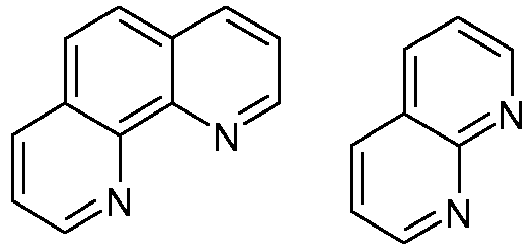
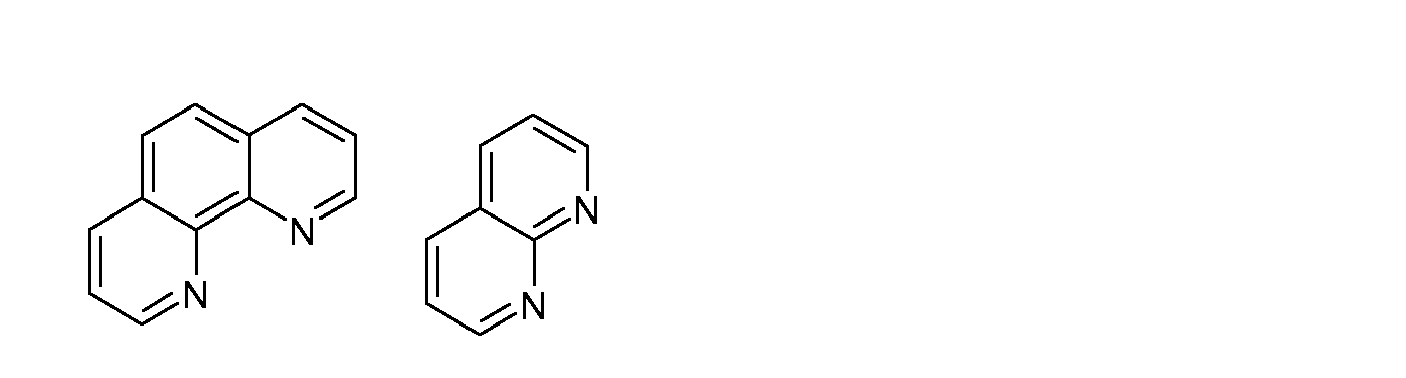
- Thus, in another preferred embodiment the cobalt complex refers to formula Co2+/3+-Lq, wherein q is 1, 2, 3, 4, 5, or 6, and refers to the appropriate number of ligands present on the cobalt, L is independently selected from fluoride, chloride, bromide, iodide, optionally substituted pyridine, optionally substituted pyrazole, optionally substituted pyrazine, optionally substituted triazole, optionally substituted pyridazine, and optionally substituted imidazole or L is independently selected from a bidentate or a tridentate ligand comprising 1, 2, 3, 4, or 5 linked aromatic rings or linked heterocyclic rings or mixtures thereof independently selected from optionally substituted phenyl, optionally substituted naphthyl, optionally substituted pyridine, optionally substituted pyrazole, optionally substituted pyrazine, optionally substituted triazole, optionally substituted pyridazine, and optionally substituted imidazole ; wherein the substituents are independently selected from hydrocarbons comprising 1 to 40 carbon atoms and 0 to 20 heteroatoms, halogen, (-F, -Cl, -Br, -I), -NO2, -NH2 and -OH. In a more preferred embodiment L is independently selected from:


- A second aspect of the invention relates to a compound of formula D-π1-B-π2-A, wherein D is a π-electron donor group of the general formula


are -(O)m-alkyl, -(O)m-alkenyl, -(O)m-alkynyl, -(O)m-aryl or -(O)m-heteroaryl, or R1 and R2 together form an optionally substituted -(O)m-alkylene-(O)m- or an optionally substituted annulated aryl or an optionally substituted annulated heteroaryl; wherein m is 0 or 1. In a preferred embodiment of this aspect of the invention n is 2. - In another preferred embodiment of this aspect R3 and R4 are independently selected from linear C6-C12 alkyl groups and substituted phenyl groups. In a more preferred embodiment R3 and R4 are independently selected from -O-n-hexyl or 2,4-di-(n-hexyloxy)phenyl.
- In another preferred embodiment of this aspect R1 and R2 together form -O-ethylene-O-.
- The compound may optionally contain an additional bridge group π1 between the donor group D and the bridge group B and/or an additional bridge group π2 between the bridge group B and the acceptor group A. Both bridges π1 and π2 may be absent. "Absent" as used herein is intended to mean that π1 and/or π2 refer to a covalent bond. Thus, (D) is directly connected with (B) and (B) is directly connected with (A). Alternatively, bridge π1 may be absent and bridge π2 electronically conjugating (B) with (A) may be present.
- Preferably, both bridges π1 and π2 are present.
- Also preferably, bridge π1 electronically conjugating (D) with (B) is present and bridge π2 is absent.
- Thus, in another preferred embodiment π1 and π2 are selected, independently of each other, from an a covalent bond, an aromatic ring system, an alkene, an alkyne or a heteroatom-containing variant of such systems wherein one or more carbon atoms are replaced by a heteroatom. In a more preferred embodiment, π1 and π2 are selected from an alkene group and a phenyl moiety. Most preferably, π1 and π2 are independently selected from -(CH=CH)n-, wherein n is 1, 2, 3, 4, 5, 6, 7, 8, 9, or 10, or a phenyl group. In a most preferred embodiment, π1 is phenyl and π2 is a covalent bond.
- In yet another preferred embodiment of this aspect of the invention A is X, -(CH=)pCHXY, -(CH=)pCX2Y, -(CX=)CHXY, or rhodanine-3-CH2-X, wherein X and Y are suitably chosen to allow the formation of a coordination complex of acceptor group A with a metal ion; more preferably X is -COOH, -PO3H2, -PO4H2, -SO3H, -CONHOH, -NO2, -CN, -NHOH or -(CF2)rCF3, and Y is -COOH, -PO3H2, -PO4H2, -SO3H, -CONHOH, -NO2, - CN, -NHOH, -(CF2)rCF3 or H; and p and r are independently 0, 1, 2, 3, 4, or 5. In an even more preferred embodiment A is -CH=CH(CN)COOH or rhodanine-3-acetic acid. Specifically, A is -CH=CH(CN)COOH.
- In a further preferred embodiment of this aspect of the invention the compound is selected from:


- In a third aspect the present invention relates to an electrochemical and/or optoelectronic device, preferably a dye-sensitized solar cell, comprising any of the compounds of the invention as described above. The compound of the present invention is used as a dye-sensitizer in such device or cell.
- The present invention further relates to a method for making the above-mentioned compounds of the invention, in particular by transition-metal catalyzed cross-coupling reaction, preferably by tin-mediated Stille coupling, a Vilsmeier-Haack reaction, and a Knoevenagel condensation reaction.
- The compound of the present invention may be further isolated, for instance by column chromatography, preferably by high pressure liquid chromatography (HPLC).
- While preferred embodiments of this invention have been shown and described, modifications thereof can be made by one skilled in the art without departing from the spirit or teaching of this invention. The embodiments described herein are exemplary only and are not limiting. Many variations and modifications of systems and methods are possible and are within the scope of the invention. Accordingly, the scope of protection is not limited to the embodiments described herein, but is only limited by the claims that follow, the scope of which shall include all equivalents of the subject matter of the claims.
- List of abbreviations:
- RT - room temperature
- Pd2dba3 - tris(dibenzylideneacetone)dipalladium(0)
- X-Phos - 2-Dicyclohexylphosphino-2',4',6'-triisopropylbiphenyl
- DCM - dichloromethane
- In a 100 mL single-neck round-bottom flask, 8.56 grams of bishexyloxy-4-chloro-resorcinol (27.36 mmol), 10.42 grams of bis(pinacolato)diboron (41.03 mmol), and 8.06 grams potassium acetate (82.12 mmol) were dissolved in 60 mL of dioxane. This solution was degassed for 20 minutes with a stream of N2, after which time 10 mg of Pd2dba3 and 20 mg of X-Phos were added simultaneously, in one batch. The reaction was then brought to 95 °C for 10 hours. The reaction was then cooled to RT, and plugged through a thin pad of MgSO4 with DCM. The crude product was purified with gradient silica gel chromatography: 100% hexanes to 20:80 Hexane:DCM. 6.23 grams (70% yield) of a pure clear oil was obtained. 1H NMR (400 MHz, Methylene Chloride-d2) δ 7.54 (d, J = 8.2 Hz, 1H), 6.46 (dd, J = 8.2, 2.2 Hz, 1H), 6.40 (d, J = 2.2 Hz, 1H), 3.96 (dt, J = 14.4, 6.4 Hz, 4H), 1.85 - 1.72 (m, 4H), 1.61 - 1.42 (m, 4H), 1.41 - 1.34 (m, 8H), 1.32 (s, 12H), 0.99 - 0.86 (m, 6H) ppm. 13C NMR (100 MHz, CD2Cl2) δ = 165.58, 163.11, 137.71, 129.65, 105.10, 99.20, 83.17, 82.81, 68.20, 67.88, 31.66, 31.58, 29.32, 29.20, 25.68, 25.67, 24.83, 24.64, 22.71, 22.60, 13.88, 13.80 ppm.
- A mixture of compound 4-bromo-N,N-diphenylaniline (3.2 g, 9.87 mmol), KI (2.23 g, 13.42 mmol), and KIO3 (1.415 g, 6.6 mol) was stirred at 85 °C in 50 ml HOAc for 12 h. After cooling to RT, aq. NaHSO3 (50 mL) was added and the reaction mixture was stirred for 20 min. The solution was extracted with CH2Cl2 (3 x 50 mL), and the organic layer was dried with MgSO4. After removal of the solvent, the crude product was purified by recrystallization (CH2Cl2/MeOH) to afford the target product as a white solid (5.57g, 96 %). 1H NMR (400 MHz, CDCl3) δ 7.47 (m, 4 H), 7.28 (m, 2 H), 6.86 (m, 2 H), 6.74 (m, 4 H) ppm. 13C NMR (101 MHz, CDCl3) δ 146.7, 145.9, 138.5, 132.6, 126.0, 116.3, 86.5 ppm.
- 2-(2,4-bis(hexyloxy)phenyl)-4,4,5,5-tetramethyl-1,3,2-dioxaborolane (1 g, 2.473 mmol), N-(4-Bromophenyl)-4-iodo-N-(4-iodophenyl)benzenamine (647 mg, 1.124 mmol) were dissolved in toluene (30 ml). A K2CO3 solution (2M) (2.764 g in 10 ml H2O) was also added. The biphasic system was bubbled with N2 for 20 min. Then Pd(PPh3)4 (40 mg) was added and the system was heated to 85 °C and kept at that temperature for 24 hours. Purification using hexane/DCM (3:1 v/v) as eluent yielded 818 mg, 83% as a light yellow oil. 1H NMR (400 MHz, CD2Cl2) δ 7.50 (m, 4 H), 7.40 (m, 2 H), 7.28 (d, 2 H, J= 8.4 Hz), 7.16 (m, 4 H), 7.08 (m, 2 H), 4.01 (m, 8 H), 1.82 (m, 8 H), 1.44 (m, 28 H), 0.97 (m, 14 H) ppm. 13C NMR (101 MHz, CD2Cl2) δ 159.8, 157.0, 147.2, 145.5, 133.6, 132.0, 130.7, 130.3, 125.0, 123.8, 122.6, 114.3, 105.4, 100.2, 99.8, 68.0, 31.6, 29.2, 25.6, 22.7, 13.9.
- 2,2',3,3'-tetrahydro-[5,5'-bithieno[3,4-b][1,4]dioxin (1.5 g, 5.3 mmol) was dissolved in dry THF (30 mL) under Ar. The solution was cooled to -60 °C using a liquid N2/CHCl3 bath. The hexane solution of n-BuLi (2.0 mL, 5.5 mmol) was added dropwise with a gas-tight syringe. The reaction mixture was stirred in the dark. The reaction temperature was gradually raised to -15 °C using an ice bath. After 1 h, the reaction mixture was cooled to -60 °C again using a liquid N2/CHCl3 bath. Tri-n-butyltin chloride (ClSn(n-Bu)3, 1.4 mL, 5.2 mmol) was added dropwise to the reaction mixture. The reaction temperature was gradually raised to room temperature by removing the liquid N2/CHCl3 bath. After 1 h, CH2Cl2 (200 mL) was added to the reaction mixture and washed with 1 N NaHCO3 (200 mL) aqueous solution. The organic layer was dried (MgSO4), filtered, and evaporated. The residue was purified by preparative HPLC to give a dark green oil. Yield: 1.5 g (49%). 1H NMR (CDCl3, 400 MHz): δ = 0.90 (t, J=7.3 Hz, 9H), 1.12 (t, J=7.8 Hz, 6H), 1.34 (m, 6H), 1.56 (m, 6H), 4.18 (m, 2H), 4.24 (m, 2H), 4.27 (m, 2H), 4.33 (m, 2H), 6.24 (s, 1H).
- A mixture of tributyl(2,2',3,3'-tetrahydro-[5,5'-bithieno[3,4-b][1,4]dioxin]-7-yl) stannane (686 mg, 1.2 mmol), Hagfelt donor (0.965 g, 1.1 mmol), Pd(PPh3)4 (50 mg, 0.042 mmol), and anhydrous DMF was heated to 90 °C under N2 for 18 h. The reaction mixture was poured into water (300 mL) and extracted with dichloromethane (3 × 30 mL). The organic layer was separated and washed 3 times with water, dried over anhydrous MgSO4, and filtered. After removing the solvent, the resulting viscous liquid was purified by column chromatography on silica gel (hexane : dichloromethane = 4 : 1 as eluent) as a thick yellow oil (0.771 g, 65%). 1H NMR (400 MHz, CD2Cl2) δ 7.68 (m, 2 H), 7.48 (m, 4 H), 7.31 (m, 2 H), 7.18 (m, 6 H), 6.58 (m, 4 H), 6.31 (m, 4 H), 4.33 (m, 32 H), 4.02 (m, 8 H), 1.80 (m, 8 H), 1.42 (m, 31 H), 0.95 (m, 16 H).
- To a solution of N-(2',4'-bis(hexyloxy)-[1,1'-biphenyl]-4-yl)-2',4'-bis(hexyloxy)-N-(4-(2,2',3,3'-tetra hydro-[5,5'-bithieno[3,4-b][1,4]dioxin]-7-yl)phenyl)-[1,1'-biphenyl]-4-amine (0.573 g, 0.532 mmol) and anhydrous DMF (0.45 mL, 5.58 mmol) in anhydrous 1,2-dichloroethane (60 mL) at 0 °C under a N2 atmosphere was added POCl3 (0.52 mL, 5.58 mmol) dropwise, and the mixture was refluxed for 18 h. After being cooled to room temperature, the mixture was poured into an aqueous solution of sodium acetate (1 M, 200 mL) and then stirred for 2 h. The organic phase was separated by decantation and the aqueous phase was extracted with CH2Cl2 (2 x 150 mL). The organic phases were collected, dried over MgSO4 and evaporated in vacuo. A purification by chromatography on silica gel (eluent: CH2Cl2) gave a orange solid (366 mg, 60% yield). 1H NMR (400 MHz, CD2Cl2) δ 9.92 (m, 1 H), 7.71 (m, 2 H), 7.52 (m, 4 H), 7.32 (m, 2 H), 7.19 (m, 6 H), 6.60 (m, 4 H), 4.45 (m, 12 H), 4.03 (m, 8 H), 1.81 (m, 8 H), 1.42 (m, 24 H), 0.95 (m, 12 H).
- To a stirred solution of 7'-(4-(bis(2',4'-bis(hexyloxy)-[1,1'-biphenyl]-4-yl)amino)phenyl)-2,2',3,3'-tetrahydro-[5,5'-bithieno[3,4-b][1,4]dioxine]-7-carbaldehyde (570 mg, 0.515 mmol) and cyanoacetic acid (0.13 g, 1.545 mmol) in chloroform (30 mL) was added piperidine (0.305 g, 3.6 mmol). The reaction mixture was refluxed under argon for 12 h and then acidified with 2 M hydrochloric acid aqueous solution (40 mL). The crude product was extracted into chloroform, washed with water, and dried over anhydrous sodium sulfate. After removing solvent under reduced pressure, the residue was purified by flash chromatography with chloroform and subsequently with methanol/chloroform (1/10, v/v) to yield a purple powder (89%). HR-MS (Q-Tof) m/z: 553.0721 [M-H]; calculated for C70H80N2O10S2 (M-H): 3974.5105.
Claims (15)
- An electrochemical and/or optoelectronic device comprising a cobalt complex operatively connected to a dye-sensitizer of formula
D-π1-B-π2-A
whereinD is a π-electron donor group,A is a π-electron acceptor group,π1 and π2 are optional bridge groups, andB is a π-electron bridge group of the formulawherein n is 1, 2, 3, 4, or 5;R1 and R2 independently are -(O)m-alkyl, -(O)m-cycloalkyl, -(O)m-alkenyl, - (O)m-alkynyl, -(O)m-aryl, or -(O)m-heteroaryl and m is 0 or 1; or R1 and R2 together form an optionally substituted alkylene, an optionally substituted -O-alkylene-O- or an optionally substituted annulated aryl or an optionally substituted annulated heteroaryl.
 - The electrochemical and/or optoelectronic device of claim 1 wherein R1 and R2 together form an optionally substituted -O-alkylene-O-, preferably R1 and R2 together form -O-ethylene-O-.
- The electrochemical and/or optoelectronic device of claim 1 or 2 wherein A is X and Y are suitably chosen to allow the formation of a coordination complex of acceptor group A with a metal ion, preferably A is X, - (CH=)pCHXY, -(CH=)pCX2Y, -(CX=)CHXY, or rhodanine-3-CH2-X, wherein X and Y are suitably chosen to allow the formation of a coordination complex of acceptor group A with a metal ion, preferably X is -COOH, -PO3H2, -PO4H2, -SO3H, -CONHOH, -NO2, -CN, -NHOH or -(CF2)rCF3, and Y is -COOH, -PO3H2, -PO4H2, -SO3H, -CONHOH, -NO2, - CN, -NHOH, -(CF2)rCF3 or H; and p and r are independently 0, 1, 2, 3, 4, or 5; more preferably A is -CH=CH(CN)COOH or rhodanine-3-acetic acid.
- The electrochemical and/or optoelectronic device of any of claims 1 to 3, wherein the π-electron donor group D is selected from:


- The electrochemical and/or optoelectronic device of any one of claims 1 to 4, wherein the dye-sensitizer is provided anchored to a semiconductor material, preferably the semiconductor material is selected from the group of titanium salts and tin salts, more preferably the semiconductor material is selected from the group of TiO2, SnO2 and TiOF2, most preferably the dye-sensitizer is anchored to TiOF2.
- The electrochemical and/or optoelectronic device of any one of claims 1 to 5, wherein π1 and π2 are selected, independently of each other, from a covalent bond, an aromatic ring system, an alkene, an alkyne or a heteroatom-containing variant of such systems wherein one or more carbon atoms are replaced by a heteroatom, particularly from an alkene group and a phenyl moiety, more particularly from -(CH=CH)n-, wherein n is 1, 2, 3, 4, 5, 6, 7, 8, 9, or 10, or a phenyl group; most preferably π1 is phenyl and π2 is a covalent bond.
- The electrochemical and/or optoelectronic device of any one of claims 1 to 6, wherein the dye-sensitizer is selected from the group consisting of :


- The electrochemical and/or optoelectronic device of any one of claims 1 to 7 wherein the cobalt complex is of formula Co2+/3+-Lq, wherein
q is 1, 2, 3, 4, 5, or 6, and refers to the appropriate number of ligands present on the cobalt,
L is independently selected from optionally substituted pyridine, optionally substituted pyrazole, optionally substituted pyrazine, optionally substituted triazole, optionally substituted pyridazine, and optionally substituted imidazole or L is independently selected from a bidentate or a tridentate ligand comprising 1, 2, 3, 4, or 5 linked aromatic rings or linked heterocyclic rings or mixtures thereof independently selected from optionally substituted phenyl, optionally substituted naphthyl, optionally substituted pyridine, optionally substituted pyrazole, optionally substituted pyrazine, optionally substituted triazole, optionally substituted pyridazine, and optionally substituted imidazole ; wherein the substituents are independently selected from hydrocarbons comprising 1 to 40 carbon atoms and 0 to 20 heteroatoms, halogen, (-F, -Cl, -Br, -I), -NO2, -NH2 and -OH; preferably the cobalt complex is independently selected from: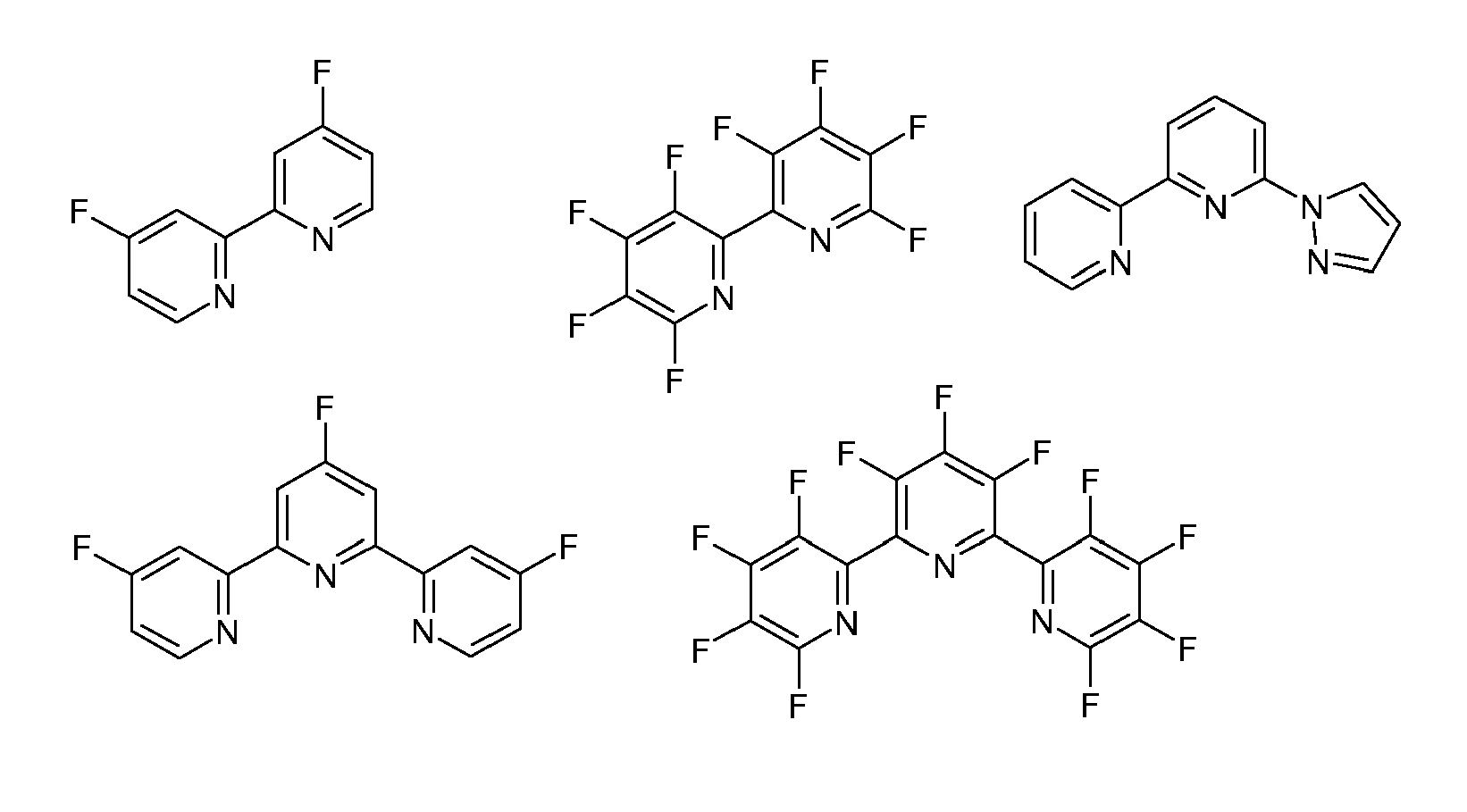

- A compound of formula
D-π1-B-π2-A
whereinD is a π-electron donor group of the general formula wherein R3 and R4 are independently selected from optionally branched -(O)m-C6-C12-alkyl and optionally substituted C6 aryl,A is a π-electron acceptor group,π1 and π2 are optional bridge groups, andB is a π-electron bridge group of the formulawherein
 n is 2, 3, 4, or 5, preferably n is 2;R1 and R2 independently are -(O)m-alkyl, -(O)m-alkenyl, -(O)m-alkynyl, -(O)m-aryl or -(O)m-heteroaryl, or R1 and R2 together form an optionally substituted -(O)m-alkylene-(O)m or an optionally substituted annulated aryl or an optionally substituted annulated heteroaryl, wherein m is 0 or 1.
 - The compound of claim 9 wherein R3 and R3 independently are selected from linear -O-C6-C12-alkyl and substituted phenyl groups, preferably R3 and R4 independently are selected from -O-n-hexyl or 2,4-di-(n-hexyloxy)phenyl.
- The compound of claim 9 or 10 wherein R1 and R2 together form -O-ethylene-O-.
- The compound of any one of claims 9 to 11 wherein π1 and/or π2 are selected, independently of each other, from a covalent bond, an aromatic ring system, an alkene, an alkyne or a heteroatom-containing variant of such systems wherein one or more carbon atoms are replaced by a heteroatom, particularly from an alkene group and a phenyl moiety, more particularly from -(CH=CH)n-, wherein n is 1, 2, 3, 4, 5, 6, 7, 8, 9, or 10, or a phenyl group; most preferably phenyl.
- The compound of any one of claims 9 to 12 wherein A is X, - (CH=)pCHXY, -(CH=)pCX2Y or rhodanine-3-CH2-X, wherein X and Y are suitably chosen to allow the formation of a coordination complex of acceptor group A with a metal ion; preferably
Xis -COOH, -PO3H2, -PO4H2, -SO3H, -CONHOH, -NO2, -CN, -NHOH or -CF3 and Y is -COOH, -PO3H2, -PO4H2, -SO3H, -CONHOH, -NO2, -CN, -NHOH, - CF3 or H; p is 0, 1, 2, 3, 4, or 5; more preferably A is -CH=CH(CN)COOH or rhodanine-3-acetic acid, most preferably A is -CH=CH(CN)COOH. - The compound of any one of claims 9 to 13, wherein the organic compound is selected from the group consisting of :


- An electrochemical and/or optoelectronic device comprising a compound of any one of claims 9 to 14.
Priority Applications (3)
| Application Number | Priority Date | Filing Date | Title |
|---|---|---|---|
| EP12188024.9A EP2720237A1 (en) | 2012-10-10 | 2012-10-10 | Electrochemical and optoelectronic devices and dye-sensitizers comprised therein |
| PCT/EP2013/070904 WO2014056886A1 (en) | 2012-10-10 | 2013-10-08 | Electrochemical and optoelectronic devices and dye-sensitizers comprised therein |
| TW102136541A TW201428795A (en) | 2012-10-10 | 2013-10-09 | Electrochemical and optoelectronic devices and dye-sensitizers comprised therein |
Applications Claiming Priority (1)
| Application Number | Priority Date | Filing Date | Title |
|---|---|---|---|
| EP12188024.9A EP2720237A1 (en) | 2012-10-10 | 2012-10-10 | Electrochemical and optoelectronic devices and dye-sensitizers comprised therein |
Publications (1)
| Publication Number | Publication Date |
|---|---|
| EP2720237A1 true EP2720237A1 (en) | 2014-04-16 |
Family
ID=47022537
Family Applications (1)
| Application Number | Title | Priority Date | Filing Date |
|---|---|---|---|
| EP12188024.9A Ceased EP2720237A1 (en) | 2012-10-10 | 2012-10-10 | Electrochemical and optoelectronic devices and dye-sensitizers comprised therein |
Country Status (1)
| Country | Link |
|---|---|
| EP (1) | EP2720237A1 (en) |
Cited By (1)
| Publication number | Priority date | Publication date | Assignee | Title |
|---|---|---|---|---|
| CN104658761A (en) * | 2015-02-26 | 2015-05-27 | 江汉大学 | Method for preparing dye-sensitized solar cell nano-TiO2 membrane photo-anode with membrane reaction method |
Citations (1)
| Publication number | Priority date | Publication date | Assignee | Title |
|---|---|---|---|---|
| CN101429346A (en) * | 2008-11-04 | 2009-05-13 | 中国科学院长春应用化学研究所 | Organic dyes with polyheterocyclic derivatives as conjugated units and dye-sensitized solar cells prepared therefrom |
-
2012
- 2012-10-10 EP EP12188024.9A patent/EP2720237A1/en not_active Ceased
Patent Citations (1)
| Publication number | Priority date | Publication date | Assignee | Title |
|---|---|---|---|---|
| CN101429346A (en) * | 2008-11-04 | 2009-05-13 | 中国科学院长春应用化学研究所 | Organic dyes with polyheterocyclic derivatives as conjugated units and dye-sensitized solar cells prepared therefrom |
Non-Patent Citations (5)
| Title |
|---|
| HOI NOK TSAO? ET AL: "Cyclopentadithiophene Bridged Donor-Acceptor Dyes Achieve High Power Conversion Efficiencies in Dye-Sensitized Solar Cells Based on the tris-Cobalt Bipyridine Redox Couple", CHEMSUSCHEM, vol. 4, no. 5, 23 May 2011 (2011-05-23), pages 591 - 594, XP055056161, ISSN: 1864-5631, DOI: 10.1002/cssc.201100120 * |
| JOURNAL OF THE AMERICAN CHEMICAL SOCIETY, vol. 132, 2010, pages 16714 - 724 |
| M. PLANELLS, ET AL.: "Energy levels, charge injection, charge recombination and dye rgeneration dynamics for donor-acceptor pi-conjugated organic dyes in mesoporic tiO2 sensitized solar cells", ENERGY & ENVIRONMENTAL SCIENCE, vol. 4, 2011, pages 1820 - 1829, XP002693659 * |
| MUHAMMAD K. KASHIF ET AL: "A New Direction in Dye-Sensitized Solar Cells Redox Mediator Development: In Situ Fine-Tuning of the Cobalt(II)/(III) Redox Potential through Lewis Base Interactions", JOURNAL OF THE AMERICAN CHEMICAL SOCIETY, vol. 134, no. 40, 11 September 2012 (2012-09-11), pages 16646 - 16653, XP055056158, ISSN: 0002-7863, DOI: 10.1021/ja305897k * |
| STEFAN HAID ET AL: "Significant Improvement of Dye-Sensitized Solar Cell Performance by Small Structural Modification in -Conjugated Donor Acceptor Dyes", ADVANCED FUNCTIONAL MATERIALS, WILEY - V C H VERLAG GMBH & CO. KGAA, DE, vol. 22, no. 6, 21 March 2012 (2012-03-21), pages 1291 - 1302, XP001573649, ISSN: 1616-301X, [retrieved on 20120126], DOI: 10.1002/ADFM.201102519 * |
Cited By (2)
| Publication number | Priority date | Publication date | Assignee | Title |
|---|---|---|---|---|
| CN104658761A (en) * | 2015-02-26 | 2015-05-27 | 江汉大学 | Method for preparing dye-sensitized solar cell nano-TiO2 membrane photo-anode with membrane reaction method |
| CN104658761B (en) * | 2015-02-26 | 2017-07-25 | 江汉大学 | A method for preparing dye-sensitized solar cell nano-titanium dioxide thin film photoanode by membrane reaction method |
Similar Documents
| Publication | Publication Date | Title |
|---|---|---|
| Lee et al. | Organic dyes incorporating low-band-gap chromophores based on π-extended benzothiadiazole for dye-sensitized solar cells | |
| RU2490746C2 (en) | Dye containing binding group in molecular structure | |
| Seo et al. | Novel D-π-A system based on zinc porphyrin dyes for dye-sensitized solar cells: synthesis, electrochemical, and photovoltaic properties | |
| Lin et al. | High‐performance aqueous/organic dye‐sensitized solar cells based on sensitizers containing triethylene oxide methyl ether | |
| Marszalek et al. | Tuning spectral properties of phenothiazine based donor–π–acceptor dyes for efficient dye-sensitized solar cells | |
| Gao et al. | Facile synthesis of a bulky BPTPA donor group suitable for cobalt electrolyte based dye sensitized solar cells | |
| Lu et al. | X-shaped organic dyes with a quinoxaline bridge for use in dye-sensitized solar cells | |
| Song et al. | Porphyrin sensitizers containing an auxiliary benzotriazole acceptor for dye-sensitized solar cells: Effects of steric hindrance and cosensitization | |
| Qin et al. | Incorporating a stable fluorenone unit into D–A–π–A organic dyes for dye-sensitized solar cells | |
| Stengel et al. | Click‐Functionalized Ru (II) Complexes for Dye‐Sensitized Solar Cells | |
| Ramkumar et al. | Bibridged bianchoring metal-free dyes based on phenoxazine and triphenyl amine as donors for dye-sensitized solar cell applications | |
| Cao et al. | New D–π–A organic dyes containing a tert-butyl-capped indolo [3, 2, 1-jk] carbazole donor with bithiophene unit as π-linker for dye-sensitized solar cells | |
| Qian et al. | Biindole-based double D–π–A branched organic dyes for efficient dye-sensitized solar cells | |
| Fang et al. | Novel diyne-bridged dyes for efficient dye-sensitized solar cells | |
| EP3168848B1 (en) | Photoelectric conversion element, dye-sensitized solar cell, metal complex dye, dye solution, and terpyridine compound or esterification product thereof | |
| Yang et al. | Structure–property relationship of naphthalene based donor–π–acceptor organic dyes for dye-sensitized solar cells: remarkable improvement of open-circuit photovoltage | |
| Tamilavan et al. | Synthesis of triphenylamine-based thiophene-(N-aryl) pyrrole-thiophene dyes for dye-sensitized solar cell applications | |
| EP3168847B1 (en) | Photoelectric conversion element, dye-sensitized solar cell, metal complex dye, dye solution, and terpyridine compound or esterification product thereof | |
| Wang et al. | Influence of the donor size in panchromatic D–π-A–π-A dyes bearing 5-phenyl-5H-dibenzo-[b, f] azepine units for dye-sensitized solar cells | |
| Qian et al. | Phenothiazine-functionalized push–pull Zn porphyrin photosensitizers for efficient dye-sensitized solar cells | |
| JP5794589B2 (en) | Dye-sensitized solar cell and sensitizing dye | |
| WO2014056886A1 (en) | Electrochemical and optoelectronic devices and dye-sensitizers comprised therein | |
| Sorohhov et al. | A hybrid electron donor comprising cyclopentadithiophene and dithiafulvenyl for dye-sensitized solar cells | |
| KR101808982B1 (en) | Photoelectric conversion element, dye-sensitized solar cell, metal-complex pigment, pigment solution, and terpyridine compound or esterified terpyridine compound | |
| KR20140134288A (en) | Rylene monoimide derivates and the use thereof as photosensitizers in solar cells and photodetectors |
Legal Events
| Date | Code | Title | Description |
|---|---|---|---|
| PUAI | Public reference made under article 153(3) epc to a published international application that has entered the european phase |
Free format text: ORIGINAL CODE: 0009012 |
|
| AK | Designated contracting states |
Kind code of ref document: A1 Designated state(s): AL AT BE BG CH CY CZ DE DK EE ES FI FR GB GR HR HU IE IS IT LI LT LU LV MC MK MT NL NO PL PT RO RS SE SI SK SM TR |
|
| AX | Request for extension of the european patent |
Extension state: BA ME |
|
| STAA | Information on the status of an ep patent application or granted ep patent |
Free format text: STATUS: THE APPLICATION HAS BEEN REFUSED |
|
| 18R | Application refused |
Effective date: 20140505 |