EP2719764B1 - Expression vector for animal cells including csp-b 5'-sar factor and method for producing recombinant proteins using same - Google Patents
Expression vector for animal cells including csp-b 5'-sar factor and method for producing recombinant proteins using same Download PDFInfo
- Publication number
- EP2719764B1 EP2719764B1 EP12800088.2A EP12800088A EP2719764B1 EP 2719764 B1 EP2719764 B1 EP 2719764B1 EP 12800088 A EP12800088 A EP 12800088A EP 2719764 B1 EP2719764 B1 EP 2719764B1
- Authority
- EP
- European Patent Office
- Prior art keywords
- vector
- sar
- promoter
- cells
- primer
- Prior art date
- Legal status (The legal status is an assumption and is not a legal conclusion. Google has not performed a legal analysis and makes no representation as to the accuracy of the status listed.)
- Not-in-force
Links
- 239000013604 expression vector Substances 0.000 title claims description 51
- 210000004102 animal cell Anatomy 0.000 title claims description 49
- 102000007056 Recombinant Fusion Proteins Human genes 0.000 title claims description 25
- 108010008281 Recombinant Fusion Proteins Proteins 0.000 title claims description 25
- 238000004519 manufacturing process Methods 0.000 title description 12
- 239000013598 vector Substances 0.000 claims description 254
- 102000001398 Granzyme Human genes 0.000 claims description 109
- 108060005986 Granzyme Proteins 0.000 claims description 109
- 108090000623 proteins and genes Proteins 0.000 claims description 96
- 210000004027 cell Anatomy 0.000 claims description 62
- 102000004169 proteins and genes Human genes 0.000 claims description 31
- OXCMYAYHXIHQOA-UHFFFAOYSA-N potassium;[2-butyl-5-chloro-3-[[4-[2-(1,2,4-triaza-3-azanidacyclopenta-1,4-dien-5-yl)phenyl]phenyl]methyl]imidazol-4-yl]methanol Chemical compound [K+].CCCCC1=NC(Cl)=C(CO)N1CC1=CC=C(C=2C(=CC=CC=2)C2=N[N-]N=N2)C=C1 OXCMYAYHXIHQOA-UHFFFAOYSA-N 0.000 claims description 21
- 241000701022 Cytomegalovirus Species 0.000 claims description 14
- 108090000394 Erythropoietin Proteins 0.000 claims description 14
- 230000008488 polyadenylation Effects 0.000 claims description 14
- 241000829100 Macaca mulatta polyomavirus 1 Species 0.000 claims description 12
- 108010006025 bovine growth hormone Proteins 0.000 claims description 12
- 108020004440 Thymidine kinase Proteins 0.000 claims description 9
- 239000002773 nucleotide Substances 0.000 claims description 9
- 125000003729 nucleotide group Chemical group 0.000 claims description 9
- 102000003951 Erythropoietin Human genes 0.000 claims description 8
- 241000700584 Simplexvirus Species 0.000 claims description 8
- 102000006601 Thymidine Kinase Human genes 0.000 claims description 8
- 229940105423 erythropoietin Drugs 0.000 claims description 8
- 238000000034 method Methods 0.000 claims description 8
- 239000011159 matrix material Substances 0.000 claims description 6
- 102000014150 Interferons Human genes 0.000 claims description 4
- 108010050904 Interferons Proteins 0.000 claims description 4
- 241000725643 Respiratory syncytial virus Species 0.000 claims description 4
- 229940079322 interferon Drugs 0.000 claims description 4
- 210000003734 kidney Anatomy 0.000 claims description 4
- DIGQNXIGRZPYDK-WKSCXVIASA-N (2R)-6-amino-2-[[2-[[(2S)-2-[[2-[[(2R)-2-[[(2S)-2-[[(2R,3S)-2-[[2-[[(2S)-2-[[2-[[(2S)-2-[[(2S)-2-[[(2R)-2-[[(2S,3S)-2-[[(2R)-2-[[(2S)-2-[[(2S)-2-[[(2S)-2-[[2-[[(2S)-2-[[(2R)-2-[[2-[[2-[[2-[(2-amino-1-hydroxyethylidene)amino]-3-carboxy-1-hydroxypropylidene]amino]-1-hydroxy-3-sulfanylpropylidene]amino]-1-hydroxyethylidene]amino]-1-hydroxy-3-sulfanylpropylidene]amino]-1,3-dihydroxypropylidene]amino]-1-hydroxyethylidene]amino]-1-hydroxypropylidene]amino]-1,3-dihydroxypropylidene]amino]-1,3-dihydroxypropylidene]amino]-1-hydroxy-3-sulfanylpropylidene]amino]-1,3-dihydroxybutylidene]amino]-1-hydroxy-3-sulfanylpropylidene]amino]-1-hydroxypropylidene]amino]-1,3-dihydroxypropylidene]amino]-1-hydroxyethylidene]amino]-1,5-dihydroxy-5-iminopentylidene]amino]-1-hydroxy-3-sulfanylpropylidene]amino]-1,3-dihydroxybutylidene]amino]-1-hydroxy-3-sulfanylpropylidene]amino]-1,3-dihydroxypropylidene]amino]-1-hydroxyethylidene]amino]-1-hydroxy-3-sulfanylpropylidene]amino]-1-hydroxyethylidene]amino]hexanoic acid Chemical compound C[C@@H]([C@@H](C(=N[C@@H](CS)C(=N[C@@H](C)C(=N[C@@H](CO)C(=NCC(=N[C@@H](CCC(=N)O)C(=NC(CS)C(=N[C@H]([C@H](C)O)C(=N[C@H](CS)C(=N[C@H](CO)C(=NCC(=N[C@H](CS)C(=NCC(=N[C@H](CCCCN)C(=O)O)O)O)O)O)O)O)O)O)O)O)O)O)O)N=C([C@H](CS)N=C([C@H](CO)N=C([C@H](CO)N=C([C@H](C)N=C(CN=C([C@H](CO)N=C([C@H](CS)N=C(CN=C(C(CS)N=C(C(CC(=O)O)N=C(CN)O)O)O)O)O)O)O)O)O)O)O)O DIGQNXIGRZPYDK-WKSCXVIASA-N 0.000 claims description 3
- 102000007469 Actins Human genes 0.000 claims description 3
- 108010085238 Actins Proteins 0.000 claims description 3
- 241000699802 Cricetulus griseus Species 0.000 claims description 3
- 102000003792 Metallothionein Human genes 0.000 claims description 3
- 108090000157 Metallothionein Proteins 0.000 claims description 3
- 102000010292 Peptide Elongation Factor 1 Human genes 0.000 claims description 3
- 108010077524 Peptide Elongation Factor 1 Proteins 0.000 claims description 3
- 210000001672 ovary Anatomy 0.000 claims description 3
- 210000003501 vero cell Anatomy 0.000 claims description 3
- 241000699800 Cricetinae Species 0.000 claims description 2
- 102000004127 Cytokines Human genes 0.000 claims description 2
- 108090000695 Cytokines Proteins 0.000 claims description 2
- 102000001301 EGF receptor Human genes 0.000 claims description 2
- 108060006698 EGF receptor Proteins 0.000 claims description 2
- 108010017213 Granulocyte-Macrophage Colony-Stimulating Factor Proteins 0.000 claims description 2
- 102100039620 Granulocyte-macrophage colony-stimulating factor Human genes 0.000 claims description 2
- 101000746373 Homo sapiens Granulocyte-macrophage colony-stimulating factor Proteins 0.000 claims description 2
- 101100232919 Homo sapiens IL4 gene Proteins 0.000 claims description 2
- 101001002657 Homo sapiens Interleukin-2 Proteins 0.000 claims description 2
- 101100321817 Human parvovirus B19 (strain HV) 7.5K gene Proteins 0.000 claims description 2
- 102000000588 Interleukin-2 Human genes 0.000 claims description 2
- 108010002350 Interleukin-2 Proteins 0.000 claims description 2
- 108090000542 Lymphotoxin-alpha Proteins 0.000 claims description 2
- 108010079855 Peptide Aptamers Proteins 0.000 claims description 2
- 108091023040 Transcription factor Proteins 0.000 claims description 2
- 241000700618 Vaccinia virus Species 0.000 claims description 2
- 229940088597 hormone Drugs 0.000 claims description 2
- 239000005556 hormone Substances 0.000 claims description 2
- 102000055277 human IL2 Human genes 0.000 claims description 2
- 229940116978 human epidermal growth factor Drugs 0.000 claims description 2
- 241000701161 unidentified adenovirus Species 0.000 claims description 2
- 241000282465 Canis Species 0.000 claims 1
- 238000003752 polymerase chain reaction Methods 0.000 description 106
- 108020004414 DNA Proteins 0.000 description 84
- 230000014509 gene expression Effects 0.000 description 67
- 238000002360 preparation method Methods 0.000 description 66
- 108010019673 Darbepoetin alfa Proteins 0.000 description 37
- 108010005774 beta-Galactosidase Proteins 0.000 description 34
- 102000005936 beta-Galactosidase Human genes 0.000 description 33
- 230000000694 effects Effects 0.000 description 30
- 238000002474 experimental method Methods 0.000 description 30
- BRZYSWJRSDMWLG-CAXSIQPQSA-N geneticin Chemical compound O1C[C@@](O)(C)[C@H](NC)[C@@H](O)[C@H]1O[C@@H]1[C@@H](O)[C@H](O[C@@H]2[C@@H]([C@@H](O)[C@H](O)[C@@H](C(C)O)O2)N)[C@@H](N)C[C@H]1N BRZYSWJRSDMWLG-CAXSIQPQSA-N 0.000 description 13
- 239000002609 medium Substances 0.000 description 12
- 235000018102 proteins Nutrition 0.000 description 10
- 108091008146 restriction endonucleases Proteins 0.000 description 9
- 108091005904 Hemoglobin subunit beta Proteins 0.000 description 8
- 102100021519 Hemoglobin subunit beta Human genes 0.000 description 8
- 238000001890 transfection Methods 0.000 description 8
- 238000012795 verification Methods 0.000 description 7
- 101000899111 Homo sapiens Hemoglobin subunit beta Proteins 0.000 description 6
- 108010076504 Protein Sorting Signals Proteins 0.000 description 6
- 239000012634 fragment Substances 0.000 description 6
- 230000001629 suppression Effects 0.000 description 6
- 108010077544 Chromatin Proteins 0.000 description 5
- 210000004978 chinese hamster ovary cell Anatomy 0.000 description 5
- 210000003483 chromatin Anatomy 0.000 description 5
- 230000013595 glycosylation Effects 0.000 description 5
- 238000006206 glycosylation reaction Methods 0.000 description 5
- 210000000822 natural killer cell Anatomy 0.000 description 5
- 239000000126 substance Substances 0.000 description 5
- 238000002965 ELISA Methods 0.000 description 4
- 101000987586 Homo sapiens Eosinophil peroxidase Proteins 0.000 description 4
- 108010022394 Threonine synthase Proteins 0.000 description 4
- 230000005757 colony formation Effects 0.000 description 4
- 102000004419 dihydrofolate reductase Human genes 0.000 description 4
- 102000044890 human EPO Human genes 0.000 description 4
- 102220147056 rs150475750 Human genes 0.000 description 4
- 101150074155 DHFR gene Proteins 0.000 description 3
- 102100032610 Guanine nucleotide-binding protein G(s) subunit alpha isoforms XLas Human genes 0.000 description 3
- 101001012157 Homo sapiens Receptor tyrosine-protein kinase erbB-2 Proteins 0.000 description 3
- 108060001084 Luciferase Proteins 0.000 description 3
- 239000005089 Luciferase Substances 0.000 description 3
- 102000016943 Muramidase Human genes 0.000 description 3
- 108010014251 Muramidase Proteins 0.000 description 3
- 108010062010 N-Acetylmuramoyl-L-alanine Amidase Proteins 0.000 description 3
- 229930193140 Neomycin Natural products 0.000 description 3
- 102100030086 Receptor tyrosine-protein kinase erbB-2 Human genes 0.000 description 3
- 230000015572 biosynthetic process Effects 0.000 description 3
- 201000011510 cancer Diseases 0.000 description 3
- 229940079593 drug Drugs 0.000 description 3
- 239000003814 drug Substances 0.000 description 3
- 239000007788 liquid Substances 0.000 description 3
- 229960000274 lysozyme Drugs 0.000 description 3
- 239000004325 lysozyme Substances 0.000 description 3
- 235000010335 lysozyme Nutrition 0.000 description 3
- 239000007758 minimum essential medium Substances 0.000 description 3
- 229960004927 neomycin Drugs 0.000 description 3
- 238000007399 DNA isolation Methods 0.000 description 2
- 239000006144 Dulbecco’s modified Eagle's medium Substances 0.000 description 2
- 101001054334 Homo sapiens Interferon beta Proteins 0.000 description 2
- 206010028980 Neoplasm Diseases 0.000 description 2
- 108091028043 Nucleic acid sequence Proteins 0.000 description 2
- 239000012124 Opti-MEM Substances 0.000 description 2
- 108091081024 Start codon Proteins 0.000 description 2
- 150000001413 amino acids Chemical class 0.000 description 2
- 229960000723 ampicillin Drugs 0.000 description 2
- AVKUERGKIZMTKX-NJBDSQKTSA-N ampicillin Chemical compound C1([C@@H](N)C(=O)N[C@H]2[C@H]3SC([C@@H](N3C2=O)C(O)=O)(C)C)=CC=CC=C1 AVKUERGKIZMTKX-NJBDSQKTSA-N 0.000 description 2
- 230000003321 amplification Effects 0.000 description 2
- 210000004369 blood Anatomy 0.000 description 2
- 239000008280 blood Substances 0.000 description 2
- 238000010367 cloning Methods 0.000 description 2
- 239000003623 enhancer Substances 0.000 description 2
- 210000003743 erythrocyte Anatomy 0.000 description 2
- 210000003917 human chromosome Anatomy 0.000 description 2
- 210000004185 liver Anatomy 0.000 description 2
- 210000004962 mammalian cell Anatomy 0.000 description 2
- 239000003550 marker Substances 0.000 description 2
- 239000000203 mixture Substances 0.000 description 2
- 230000004048 modification Effects 0.000 description 2
- 238000012986 modification Methods 0.000 description 2
- 238000003199 nucleic acid amplification method Methods 0.000 description 2
- 230000005026 transcription initiation Effects 0.000 description 2
- 229960000575 trastuzumab Drugs 0.000 description 2
- 238000011144 upstream manufacturing Methods 0.000 description 2
- 101150058502 Acaca gene Proteins 0.000 description 1
- DCXYFEDJOCDNAF-UHFFFAOYSA-N Asparagine Natural products OC(=O)C(N)CC(N)=O DCXYFEDJOCDNAF-UHFFFAOYSA-N 0.000 description 1
- 241000271566 Aves Species 0.000 description 1
- 206010006187 Breast cancer Diseases 0.000 description 1
- 108091026890 Coding region Proteins 0.000 description 1
- 235000006481 Colocasia esculenta Nutrition 0.000 description 1
- 240000004270 Colocasia esculenta var. antiquorum Species 0.000 description 1
- 229920002307 Dextran Polymers 0.000 description 1
- 239000006145 Eagle's minimal essential medium Substances 0.000 description 1
- 241000287828 Gallus gallus Species 0.000 description 1
- 241000238631 Hexapoda Species 0.000 description 1
- 101000920686 Homo sapiens Erythropoietin Proteins 0.000 description 1
- 238000012404 In vitro experiment Methods 0.000 description 1
- 102000003996 Interferon-beta Human genes 0.000 description 1
- 108090000467 Interferon-beta Proteins 0.000 description 1
- 239000012097 Lipofectamine 2000 Substances 0.000 description 1
- 241001465754 Metazoa Species 0.000 description 1
- 230000004988 N-glycosylation Effects 0.000 description 1
- 102000008297 Nuclear Matrix-Associated Proteins Human genes 0.000 description 1
- 108010035916 Nuclear Matrix-Associated Proteins Proteins 0.000 description 1
- 230000004989 O-glycosylation Effects 0.000 description 1
- 238000012408 PCR amplification Methods 0.000 description 1
- 239000012980 RPMI-1640 medium Substances 0.000 description 1
- 108020004511 Recombinant DNA Proteins 0.000 description 1
- 241000283984 Rodentia Species 0.000 description 1
- 101150050559 SOAT1 gene Proteins 0.000 description 1
- 102000012479 Serine Proteases Human genes 0.000 description 1
- 108010022999 Serine Proteases Proteins 0.000 description 1
- 108020005038 Terminator Codon Proteins 0.000 description 1
- 238000007792 addition Methods 0.000 description 1
- 229940024606 amino acid Drugs 0.000 description 1
- 235000001014 amino acid Nutrition 0.000 description 1
- 125000000539 amino acid group Chemical class 0.000 description 1
- 238000004458 analytical method Methods 0.000 description 1
- 208000007502 anemia Diseases 0.000 description 1
- 239000003242 anti bacterial agent Substances 0.000 description 1
- 229940088710 antibiotic agent Drugs 0.000 description 1
- 230000009876 antimalignant effect Effects 0.000 description 1
- 229960001230 asparagine Drugs 0.000 description 1
- 235000009582 asparagine Nutrition 0.000 description 1
- 125000000613 asparagine group Chemical group N[C@@H](CC(N)=O)C(=O)* 0.000 description 1
- SQVRNKJHWKZAKO-UHFFFAOYSA-N beta-N-Acetyl-D-neuraminic acid Natural products CC(=O)NC1C(O)CC(O)(C(O)=O)OC1C(O)C(O)CO SQVRNKJHWKZAKO-UHFFFAOYSA-N 0.000 description 1
- 230000004071 biological effect Effects 0.000 description 1
- 229910000389 calcium phosphate Inorganic materials 0.000 description 1
- 239000001506 calcium phosphate Substances 0.000 description 1
- 235000011010 calcium phosphates Nutrition 0.000 description 1
- 125000000837 carbohydrate group Chemical group 0.000 description 1
- 230000001413 cellular effect Effects 0.000 description 1
- 239000003153 chemical reaction reagent Substances 0.000 description 1
- 239000003795 chemical substances by application Substances 0.000 description 1
- 210000000349 chromosome Anatomy 0.000 description 1
- 208000020832 chronic kidney disease Diseases 0.000 description 1
- 230000001332 colony forming effect Effects 0.000 description 1
- 239000002299 complementary DNA Substances 0.000 description 1
- 229960005029 darbepoetin alfa Drugs 0.000 description 1
- 230000003247 decreasing effect Effects 0.000 description 1
- 238000012217 deletion Methods 0.000 description 1
- 230000037430 deletion Effects 0.000 description 1
- 238000011161 development Methods 0.000 description 1
- 230000004069 differentiation Effects 0.000 description 1
- 238000007876 drug discovery Methods 0.000 description 1
- 238000004520 electroporation Methods 0.000 description 1
- 238000005516 engineering process Methods 0.000 description 1
- 210000003527 eukaryotic cell Anatomy 0.000 description 1
- 230000001747 exhibiting effect Effects 0.000 description 1
- 230000001605 fetal effect Effects 0.000 description 1
- 108091008053 gene clusters Proteins 0.000 description 1
- 238000012239 gene modification Methods 0.000 description 1
- 230000005017 genetic modification Effects 0.000 description 1
- 235000013617 genetically modified food Nutrition 0.000 description 1
- 230000003394 haemopoietic effect Effects 0.000 description 1
- 210000003958 hematopoietic stem cell Anatomy 0.000 description 1
- 238000000338 in vitro Methods 0.000 description 1
- 238000011534 incubation Methods 0.000 description 1
- 238000003780 insertion Methods 0.000 description 1
- 230000037431 insertion Effects 0.000 description 1
- 229960001388 interferon-beta Drugs 0.000 description 1
- 238000002955 isolation Methods 0.000 description 1
- 229960000318 kanamycin Drugs 0.000 description 1
- 229930027917 kanamycin Natural products 0.000 description 1
- SBUJHOSQTJFQJX-NOAMYHISSA-N kanamycin Chemical compound O[C@@H]1[C@@H](O)[C@H](O)[C@@H](CN)O[C@@H]1O[C@H]1[C@H](O)[C@@H](O[C@@H]2[C@@H]([C@@H](N)[C@H](O)[C@@H](CO)O2)O)[C@H](N)C[C@@H]1N SBUJHOSQTJFQJX-NOAMYHISSA-N 0.000 description 1
- 229930182823 kanamycin A Natural products 0.000 description 1
- 125000001909 leucine group Chemical group [H]N(*)C(C(*)=O)C([H])([H])C(C([H])([H])[H])C([H])([H])[H] 0.000 description 1
- 239000002502 liposome Substances 0.000 description 1
- 230000001404 mediated effect Effects 0.000 description 1
- 108020004999 messenger RNA Proteins 0.000 description 1
- 238000000520 microinjection Methods 0.000 description 1
- 238000002156 mixing Methods 0.000 description 1
- 238000002703 mutagenesis Methods 0.000 description 1
- 231100000350 mutagenesis Toxicity 0.000 description 1
- 230000035772 mutation Effects 0.000 description 1
- 210000000299 nuclear matrix Anatomy 0.000 description 1
- 108020004707 nucleic acids Proteins 0.000 description 1
- 102000039446 nucleic acids Human genes 0.000 description 1
- 150000007523 nucleic acids Chemical class 0.000 description 1
- 210000004940 nucleus Anatomy 0.000 description 1
- 230000002018 overexpression Effects 0.000 description 1
- 238000001556 precipitation Methods 0.000 description 1
- 230000035755 proliferation Effects 0.000 description 1
- 210000002966 serum Anatomy 0.000 description 1
- SQVRNKJHWKZAKO-OQPLDHBCSA-N sialic acid Chemical compound CC(=O)N[C@@H]1[C@@H](O)C[C@@](O)(C(O)=O)OC1[C@H](O)[C@H](O)CO SQVRNKJHWKZAKO-OQPLDHBCSA-N 0.000 description 1
- 230000004936 stimulating effect Effects 0.000 description 1
- 238000006467 substitution reaction Methods 0.000 description 1
- 230000001225 therapeutic effect Effects 0.000 description 1
- 210000001519 tissue Anatomy 0.000 description 1
- 230000005030 transcription termination Effects 0.000 description 1
- 238000012546 transfer Methods 0.000 description 1
- QORWJWZARLRLPR-UHFFFAOYSA-H tricalcium bis(phosphate) Chemical compound [Ca+2].[Ca+2].[Ca+2].[O-]P([O-])([O-])=O.[O-]P([O-])([O-])=O QORWJWZARLRLPR-UHFFFAOYSA-H 0.000 description 1
- 210000004881 tumor cell Anatomy 0.000 description 1
- 108700026220 vif Genes Proteins 0.000 description 1
Images










Classifications
-
- C—CHEMISTRY; METALLURGY
- C12—BIOCHEMISTRY; BEER; SPIRITS; WINE; VINEGAR; MICROBIOLOGY; ENZYMOLOGY; MUTATION OR GENETIC ENGINEERING
- C12P—FERMENTATION OR ENZYME-USING PROCESSES TO SYNTHESISE A DESIRED CHEMICAL COMPOUND OR COMPOSITION OR TO SEPARATE OPTICAL ISOMERS FROM A RACEMIC MIXTURE
- C12P21/00—Preparation of peptides or proteins
-
- C—CHEMISTRY; METALLURGY
- C12—BIOCHEMISTRY; BEER; SPIRITS; WINE; VINEGAR; MICROBIOLOGY; ENZYMOLOGY; MUTATION OR GENETIC ENGINEERING
- C12N—MICROORGANISMS OR ENZYMES; COMPOSITIONS THEREOF; PROPAGATING, PRESERVING, OR MAINTAINING MICROORGANISMS; MUTATION OR GENETIC ENGINEERING; CULTURE MEDIA
- C12N15/00—Mutation or genetic engineering; DNA or RNA concerning genetic engineering, vectors, e.g. plasmids, or their isolation, preparation or purification; Use of hosts therefor
- C12N15/09—Recombinant DNA-technology
- C12N15/63—Introduction of foreign genetic material using vectors; Vectors; Use of hosts therefor; Regulation of expression
- C12N15/79—Vectors or expression systems specially adapted for eukaryotic hosts
-
- C—CHEMISTRY; METALLURGY
- C12—BIOCHEMISTRY; BEER; SPIRITS; WINE; VINEGAR; MICROBIOLOGY; ENZYMOLOGY; MUTATION OR GENETIC ENGINEERING
- C12N—MICROORGANISMS OR ENZYMES; COMPOSITIONS THEREOF; PROPAGATING, PRESERVING, OR MAINTAINING MICROORGANISMS; MUTATION OR GENETIC ENGINEERING; CULTURE MEDIA
- C12N15/00—Mutation or genetic engineering; DNA or RNA concerning genetic engineering, vectors, e.g. plasmids, or their isolation, preparation or purification; Use of hosts therefor
- C12N15/09—Recombinant DNA-technology
- C12N15/11—DNA or RNA fragments; Modified forms thereof; Non-coding nucleic acids having a biological activity
-
- C—CHEMISTRY; METALLURGY
- C12—BIOCHEMISTRY; BEER; SPIRITS; WINE; VINEGAR; MICROBIOLOGY; ENZYMOLOGY; MUTATION OR GENETIC ENGINEERING
- C12N—MICROORGANISMS OR ENZYMES; COMPOSITIONS THEREOF; PROPAGATING, PRESERVING, OR MAINTAINING MICROORGANISMS; MUTATION OR GENETIC ENGINEERING; CULTURE MEDIA
- C12N15/00—Mutation or genetic engineering; DNA or RNA concerning genetic engineering, vectors, e.g. plasmids, or their isolation, preparation or purification; Use of hosts therefor
- C12N15/09—Recombinant DNA-technology
- C12N15/63—Introduction of foreign genetic material using vectors; Vectors; Use of hosts therefor; Regulation of expression
- C12N15/79—Vectors or expression systems specially adapted for eukaryotic hosts
- C12N15/85—Vectors or expression systems specially adapted for eukaryotic hosts for animal cells
-
- C—CHEMISTRY; METALLURGY
- C12—BIOCHEMISTRY; BEER; SPIRITS; WINE; VINEGAR; MICROBIOLOGY; ENZYMOLOGY; MUTATION OR GENETIC ENGINEERING
- C12N—MICROORGANISMS OR ENZYMES; COMPOSITIONS THEREOF; PROPAGATING, PRESERVING, OR MAINTAINING MICROORGANISMS; MUTATION OR GENETIC ENGINEERING; CULTURE MEDIA
- C12N5/00—Undifferentiated human, animal or plant cells, e.g. cell lines; Tissues; Cultivation or maintenance thereof; Culture media therefor
- C12N5/10—Cells modified by introduction of foreign genetic material
-
- C—CHEMISTRY; METALLURGY
- C12—BIOCHEMISTRY; BEER; SPIRITS; WINE; VINEGAR; MICROBIOLOGY; ENZYMOLOGY; MUTATION OR GENETIC ENGINEERING
- C12N—MICROORGANISMS OR ENZYMES; COMPOSITIONS THEREOF; PROPAGATING, PRESERVING, OR MAINTAINING MICROORGANISMS; MUTATION OR GENETIC ENGINEERING; CULTURE MEDIA
- C12N9/00—Enzymes; Proenzymes; Compositions thereof; Processes for preparing, activating, inhibiting, separating or purifying enzymes
- C12N9/14—Hydrolases (3)
- C12N9/48—Hydrolases (3) acting on peptide bonds (3.4)
- C12N9/50—Proteinases, e.g. Endopeptidases (3.4.21-3.4.25)
- C12N9/64—Proteinases, e.g. Endopeptidases (3.4.21-3.4.25) derived from animal tissue
- C12N9/6402—Proteinases, e.g. Endopeptidases (3.4.21-3.4.25) derived from animal tissue from non-mammals
- C12N9/6405—Proteinases, e.g. Endopeptidases (3.4.21-3.4.25) derived from animal tissue from non-mammals not being snakes
- C12N9/6408—Serine endopeptidases (3.4.21)
-
- C—CHEMISTRY; METALLURGY
- C12—BIOCHEMISTRY; BEER; SPIRITS; WINE; VINEGAR; MICROBIOLOGY; ENZYMOLOGY; MUTATION OR GENETIC ENGINEERING
- C12N—MICROORGANISMS OR ENZYMES; COMPOSITIONS THEREOF; PROPAGATING, PRESERVING, OR MAINTAINING MICROORGANISMS; MUTATION OR GENETIC ENGINEERING; CULTURE MEDIA
- C12N2830/00—Vector systems having a special element relevant for transcription
- C12N2830/46—Vector systems having a special element relevant for transcription elements influencing chromatin structure, e.g. scaffold/matrix attachment region, methylation free island
-
- C—CHEMISTRY; METALLURGY
- C12—BIOCHEMISTRY; BEER; SPIRITS; WINE; VINEGAR; MICROBIOLOGY; ENZYMOLOGY; MUTATION OR GENETIC ENGINEERING
- C12N—MICROORGANISMS OR ENZYMES; COMPOSITIONS THEREOF; PROPAGATING, PRESERVING, OR MAINTAINING MICROORGANISMS; MUTATION OR GENETIC ENGINEERING; CULTURE MEDIA
- C12N2830/00—Vector systems having a special element relevant for transcription
- C12N2830/80—Vector systems having a special element relevant for transcription from vertebrates
- C12N2830/85—Vector systems having a special element relevant for transcription from vertebrates mammalian
Definitions
- the present invention relates to an expression vector for animal cells, including a 5'-scaffold or matrix attachment region (5'-SAR) of cytotoxic serine protease-B (CSP-B), and methods for producing recombinant proteins using the expression vectors.
- 5'-SAR 5'-scaffold or matrix attachment region
- CSP-B cytotoxic serine protease-B
- a novel erythropoiesis stimulating protein which is an erythropoiesis-stimulating factor, is also called Darbepoetin alfa, and is a protein drug obtained by adding two N-linked sugar chains to naturally occurring erythropoietin through genetic modification ( Egrie and Browne, Br. J. Cancer, 84 Suppl. 1:3-10 (2001 )).
- NESP promotes red blood cell production by stimulating hematopoietic stem cells and facilitating their differentiation into erythrocytes. Since the serum half-life of NESP is three times longer than that of the existing recombinant erythropoietin, equivalent therapeutic effect can be expected with fewer administrations when treating anemia of patients with chronic kidney disease.
- Trastuzumab as an anti-malignant tumor agent is a humanized monoclonal antibody prepared using recombinant DNA technology, and selectively acts on human epidermal growth factor receptor 2 (HER2) on cell surfaces.
- HER2 overexpression is confirmed in 25 ⁇ 30% of primary breast cancers and trastuzumab suppresses the proliferation of HER2-overexpressed human tumor cells.
- Expression levels of foreign genes may be varied depending on their insertion sites in the animal cell chromosomes since foreign gene expression is influenced by surrounding regulator elements or the chromatin structure ( Zahn-Zabal et al., J. Biotechnol, 87, 29-42 (2001 )) .
- chromatin factors that prevent surrounding chromatins from influencing foreign gene expression When chromatin factors that prevent surrounding chromatins from influencing foreign gene expression are used, the suppression of gene expression depending on the position (position effect) can be overcome and the possibility of isolation of animal cell clones that highly express recombinant proteins can be increased, thereby decreasing the preparation time of cell lines for producing drugs. Attempts to produce stable cell lines by using chromatin factors that can overcome the suppression of gene expression depending on the position have been made.
- the factors therefor are boundary element (BE), scaffold or matrix attachment region (SAR/MAR), locus control region (LCR), and the like.
- SAR also called MAR is 300 ⁇ 3000-bp DNA element. It has been known that SAR allows the chromatin to attach to proteins of the nuclear matrix and controls gene expression ( Makrides (Ed.), Gene Transfer and Expression in Mammalian Cells. Elsevier. Chapter 10 (2003 )). In addition, SAR can improve expression of foreign genes in transfected cell lines ( Poljak et al., Nucleic Acids Res, 22, 4386-4394 (1994 ); Kalos and Fournier, Mol. Cell. Biol, 15, 198-207 (2005 )).
- Korean Patent Application KR20020010327 and its family member WO0214525 disclose that the animal cell expression vector includes human ⁇ -globin MAR so that gene expression suppression occurring when foreign genes are introduced into animal cells can be overcome.
- This patent describes that, besides the human ⁇ -globin MAR, human interferon- ⁇ MAR (GenBank Accession # M83137) and CSP-B 3'-SAR (GenBank Accession # M62716) are used, and these three SARs/MARs can improve the expression level of ⁇ -galactosidase, which is a target protein. Further, this patent discloses that the ⁇ -globin MAR had excellent effects as compared with the interferon- ⁇ MAR or the CSP-B 3'-SAR.
- Korean Patent Application No. KR20020047006 discloses that the introduction of human interferon- ⁇ MAR into the animal cell expression vector can improve foreign gene expression and lead to efficient expression of recombinant proteins.
- Korean Patent Application No. KR20070118563 discloses that the animal cell expression vector including two copies of human ⁇ -globin MAR can further improve the target protein expression level as compared with the vector including one copy of human ⁇ -globin MAR. This patent describes comparison results between one copy and two copies of MAR factors, but not comparison results between two copies and three copies of MAR factors.
- CSP-B 5'-SAR and CSP-B 3'-SAR from approximately 70 kb of the human chromosome 14q11.2 hematopoietic serine protease gene cluster and obtained their nucleotide sequences, and verified that these SARs bind to scaffolds derived from the cellular nucleus through in vitro experiment ( Hanson and Ley, Blood, 79, 610-618 (1992 )).
- the CSP-B 5'-SAR and CSP-B 3'-SAR are registered as GenBank Accession # M62717 and GenBank Accession # M62716, respectively. They are 2429-bp long and 1233-bp long, respectively, and thus the CSP-B 5'-SAR is two folds longer than the 3'-SAR.
- Human chromosome 14 DNA sequence is registered as GenBank Accession # AL136018. In this sequence, the length between a transcription initiation codon for a gene coding the CSP-B protein and the 5'-SAR located upstream thereof is 1195 bp, and the length between a transcription termination codon of the gene for coding the CSP-B protein and the 3'-SAR located downstream thereof is 4543 bp.
- an aspect of the present invention is to provide expression vectors for animal cells.
- Another aspect of the present invention is to provide animal cells transfected with the expression vectors.
- Still another aspect of the present invention is to provide a method for producing recombinant proteins.
- an expression vector for animal cells including: (a) a 5'-scaffold or matrix attachment region (5'-SAR) of cytotoxic serine protease-B (CSP-B); (b) a promoter operable in animal cells; and (c) a polyadenylation sequence.
- the present inventors have made efforts to develop vectors capable of efficiently producing recombinant proteins in animal cells. As a result, the present inventors have established that recombinant proteins can be produced at excellent production efficiency when the 5'-scaffold or matrix attachment region (5'-SAR) of cytotoxic serine protease-B (CSP-B) is incorporated in the vector.
- 5'-SAR 5'-scaffold or matrix attachment region
- CSP-B cytotoxic serine protease-B
- the expression vector for animal cells of the present invention includes CSP-B 5'-SAR; a promoter operable in animal cells; and a polyadenylation sequence.
- CSP-B 5'-SAR significantly increases the efficiency in production of recombinant proteins in the expression vector.
- two copies of the 5'-SAR are continuously present on the vector.
- CSP-B 5'-SAR further improves the target protein expression level in animal cells as compared with CSP-B 3'-SAR and ⁇ -globin MAR of the related art.
- CSP-B 5'-SAR, CSP-B 3'-SAR, and ⁇ -globin MAR were respectively introduced into vectors expressing ⁇ galactosidase as a target protein in CHO animal cells
- the ⁇ galactosidase activities for the respective cases were measured to be 10.0-fold, 2.2-fold, and 8.7-fold higher as compared with when the SAR factor was not introduced ( FIG. 7 ). That is, CSP-B 5'-SAR exhibits a relatively higher target protein expression level than other factors.
- CSP-B 5'-SAR were verified by using an anti-HER2 antibody as a target protein.
- the anti-HER2 antibody expression level was measured to be relatively higher than as compared with when the SAR factor was not introduced (Table 6 and FIG. 13 ).
- the introduction of SAR into vectors increased the anti-HER2 antibody expression level of randomly selected clones ( FIGS. 14 and 15 ).
- multiple copies of CSP-B 5'-SAR may be present in the expression vector.
- the production efficiency of recombinant proteins are further increased when multiple copies of CSP-B 5'-SAR are present in the expression vector than when one copy of CSP-B 5'-SAR is present in the expression vector. More preferably, two copies of CSP-B 5'-SAR may be present in the expression vector. As proved in the following examples, the production efficiency of recombinant proteins was more excellent when two copies of CSP-B 5'-SAR are present in the expression vector than when three copies of CSP-B 5'-SAR are present in the expression vector.
- the multiple copies of CSP-B 5'-SAR may be located in a continuous or non-continuous manner.
- the multiple copies of SAR factors may be continuously present, and more preferably, may be continuously present downstream of a nucleotide sequence coding a protein to be expressed.
- the promoter operable in the animal cells may be a cytomegalovirus (CMV) promoter, an adenovirus late promoter, a vaccinia virus 7.5K promoter, a Simian virus 40 (SV40) promoter, an SV40E1 promoter, a herpes simplex virus (HSV) tk promoter, a respiratory syncytial virus (RSV) promoter, an elongation factor 1- ⁇ (EF1- ⁇ ) promoter, a metallothionein promoter, a ⁇ -actin promoter, a human interleukin-2 (IL-2) gene promoter, a human interferon (IFN) gene promoter, a human IL-4 gene promoter, a human lymphotoxin gene promoter, or human granulocyte-macrophage colony-stimulating factor (GM-CSF) gene promoter.
- CMV cytomegalovirus
- SV40E1 promoter a herpes simplex virus (HS
- the protein to be expressed by using the vector of the present invention may be erythropoietin (EPO), EPO analogs, or anti-human epidermal growth factor receptor 2 (anti-HER2) antibodies.
- EPO erythropoietin
- anti-HER2 anti-human epidermal growth factor receptor 2
- EPO novel erythropoiesis stimulating proteins (NESPs; A30N, H32T, P87V, W88N, and P90T) as EPO analogs, or anti-HER2 antibodies may be most preferable.
- the EPO analogs include mutants having modification of one or more amino acids from the human EPO amino acid sequence.
- the EPO analogs may be prepared by the mutagenesis through addition, deletion, or substitution of amino acid residues, whereby the glycosylation sites may be increased or may be changed.
- the EPO analogs have more carbohydrate chains than the human EPO, and include at least one additional glycosylation site.
- the EPO analogs exhibit a higher sialic acid level than the naturally occurring human EPO due to the additional glycosylation site.
- the protein secondary or tertiary structure, which is important in biological activity is not changed by the additional glycosylation site.
- the EPO analogs may have one, two, or three additional sites for N-cosylation or O-glycosylation. For example, the leucine residue at position 69 is substituted with asparagine, which serves as a fourth site for N-glycosylation.
- Examples of the EPO analogs to be expressed in the vectors of the present invention may be ones in which an additional site for glycosylation is introduced to at least one of positions 30, 51, 57, 69, 88, 89, 136, and 138 in the EPO sequence (e.g., sequence of GenBank Accession # M11319). More preferably, the EPO analogs may be NESPs including A30N, H32T, P87V, W88N, and P90T mutations.
- a preferable construct of the vector of the present invention may be, in a 5' to 3' direction, a promoter operable in animal cells - an expression protein gene - a polyadenylation sequence - CSP-B 5'-SAR, and a more preferable construct is a promoter operable in animal cells - an expression protein gene - a polyadenylation sequence - CSP-B 5'-SAR - CSP-B 5'-SAR.
- the vector of the present invention may further include a selection marker.
- the selection marker include resistance genes against antibiotics acting on eukaryotic cells, and preferably include resistance genes against neomycin, geneticin (G418), and kanamycin.
- the present invention provides a method for producing recombinant proteins, the method including incubating the foregoing transfected animal cells of the present invention.
- the method for producing recombinant proteins includes: (i) incubating the transfected animal cells of the present invention; and (ii) collecting recombinant proteins produced in the incubating.
- the transfected animal cells may be incubated by various methods known in the art using protocols.
- any medium that can be generally used to incubate animal cells may be employed.
- Eagle's minimum essential medium Eagles's MEM, Eagle, H. Science 130:432 (1959 )
- ⁇ -MEM Stanner, C.P. et al., Nat. New Biol. 230:52 (1971 )
- Iscove's MEM Iscove, N. et al., J. Exp. Med. 147:923 (1978 )
- 199 medium Morgan et al., Proc. Soc. Exp. Bio.
- genomic DNA of human natural killer cells was prepared.
- the genomic DNA was prepared from the NK cells using a DNA isolation kit (Dneasy Blood & Tissue Kit, Qiagen, Cat. No. 69504), and was used as a template for 5'-SAR DNA PCR.
- the PCR product was cloned into the pGEM-T vector (Promega, Cat. No. A3600) to prepare the pGEMT-CS5S.3.0k vector.
- PCR was performed using the 2kCspSF primer (tggtt ccttc attgg aaaag gaaaa cac; SEQ ID NO: 7) and the 2kCspSR primer (tccgc tgagg ctgtg cccac agcca cc; SEQ ID NO: 8) while using the genomic DNA of the NK cells as a template.
- PCR was performed using the CspSF primer (ggatc ccatt ctcct tgatg tacta at; SEQ ID NO: 9) and the CspSR primer (gaatt caaac aactc aatag caaga aac; SEQ ID NO: 10) while using the primary PCR product as a template.
- the PCRs were performed under the conditions of 30 cycles of 10 seconds at 98 ⁇ , 30 seconds at 60 ⁇ , and 5 minutes at 72 ⁇ .
- the secondary PCR product was cloned into the pGEM-T vector to prepare the pGEMT-CS3S.1.2k vector.
- genomic DNA of human G-2 cells was prepared.
- the genomic DNA was prepared from the G-2 cells using a DNA isolation kit, and was used as a template for 5' MAR DNA PCR.
- PCR was performed using the Bg5MF-100F-NheI primer (aattg ctagc ttgta ttctg tttcg tgagg caagg ttt; SEQ ID NO: 11) and the Bg5MR-100R-XhoI primer (aattc tcgag ttcct ctcta tgttg gctca aatgt cct; SEQ ID NO: 12) while using the genomic DNA of the G-2 cells as a template.
- the PCR was performed under the conditions of 30 cycles of 10 seconds at 98 ⁇ , 30 seconds at 60 ⁇ , and 3 minutes and 30 seconds at 72 ⁇ . Then, the PCR product was cloned into the pcDNA3.3-TOPO vector (Invitrogen, Cat. No. K8300-01) to prepare the pcDNA3.3-Bg5M vector.
- PCR was performed using the V6_F primer (aagct tggat ccgaa ttcat cgatg gccgg ccggt accct cgagc tgtgc cttct agttg ccagc; SEQ ID NO: 13) and the V6_R primer (gctag ctaga gcccc agctg gttct tccg; SEQ ID NO: 14) while using the pcDNA3.1(-) vector (Invitrogen, Cat.
- V6_F primer aagct tggat ccgaa ttcat cgatg gccgg cggt accct cgagc tgtgc cttct agttg ccagc
- V6_R primer gctag ctaga gcccc agctg gtt
- PCR was performed using the PsvApaDraF primer (aaaat tgggc cccac tacgt gctgt ggaat gtgtg tcagt taggg t; SEQ ID NO: 15) and the PsvKzDHR primer (tggtc gaacc atgat ggcgc gaaac gatcc tcatc ctgtc tct; SEQ ID NO: 16) while using the pcDNA3.3 vector as a template.
- PCR was performed using the DHKzPsvF primer (ggatc gtttc gcgcc atcat ggttc gacca ttgaa ctgca tcg; SEQ ID NO: 17) and the TKNheNdeR primer (tgtgt gcata tggct agcga taaca atttc acaca ggaaa cag; SEQ ID NO: 18) while using the pOptiVEC-TOPO vector as a template.
- the PCRs were performed under the conditions of 30 cycles of 10 seconds at 98 ⁇ , 30 seconds at 60 ⁇ , and 1 minute at 72 ⁇ . Then, these two PCR products were ligated through overlapping PCR, and cloned between the ApaI and NdeI restriction sites of the pGEM-T vector, to prepare the pC04' vector.
- the following experiment was conducted. First, the pC04' vector was digested with the restriction enzyme Sphl, and then the thus obtained large DNA fragment was self-ligated, to prepare the pC04 vector.
- the following experiment was conducted.
- PCR was performed using the PsvApaDraF primer and the TKNheNdeR primer while using the pC04 vector as a template.
- the PCR was performed under the conditions of 30 cycles of 10 seconds at 98 ⁇ , 30 seconds at 60 ⁇ , and 1 minute and 20 seconds at 72 ⁇ .
- this PCR product and the pC06 vector were digested with the restriction enzymes Dralll and Nhel, respectively, and the thus obtained two large DNA fragments are ligated to prepare the pCLS07 vector.
- PCR was conducted using the NhAsE1F primer (aattg ctagc atata gcgat cgcgc aggac agctt ccgac agcag ggcca gg; SEQ ID NO: 20) and the BbPsSbNhE1R primer (aattg ctagc atata cctgc aggta tatgg gccca tatag ctgag gttga atgag aatat cactg tccca gacac; SEQ ID NO: 21) while using the erythropoietin gene cloned into the pGEM-T vector as a template, to prepare MCS.
- NhAsE1F primer aattg ctagc atata gcgat cgcgc aggac agctt ccgac agcag ggcca gg
- the PCR was performed under the conditions of 30 cycles of 10 seconds at 98 ⁇ , 30 seconds at 60 ⁇ , and 15 seconds at 72 ⁇ . Then, this PCR product was cloned into the Nhel restriction site of the pCLS07 vector to prepare the pCLS08 vector.
- PCR was performed using the galHinF primer (aatta agctt ctcgc gcaac ctatt ttccc ctcga ac; SEQ ID NO: 22) and the galXhoR primer (aattc tcgag ccgag tttgt cagaa agcag accaa ac; SEQ ID NO: 23) while using the pSV- ⁇ -galactosidase vector (Promega, Cat.
- PCR was performed using the NhSbE1F primer (aattg ctagc atata cctgc aggtt gaatg agaat atcac tgtcc cagac a; SEQ ID NO: 24) and the NhAsSfPsE1R primer (aattg ctagc atata gcgat cgcta tatgg ccatg atggc catat agggc ccagg acagc ttccg acagc caggc ; SEQ ID NO: 25) while using the erythropoietin gene cloned into the pGEM-T vector as a template, to prepare new MCS.
- the PCR was performed under the conditions of 30 cycles of 10 seconds at 98 ⁇ , 30 seconds at 60 ⁇ , and 15 seconds at 72 ⁇ . Then, the existing MCS between the two Nhel restriction sites of the pCLS80G1 vector was removed, and the new MCS generated through the PCR was cloned thereinto, to prepare pCLS09G1 vector.
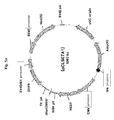
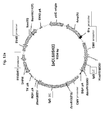
- the map of the pCLS09G1 vector was shown in FIG. 1 .
- Example 3 Preparation of ⁇ -galactosidase expression vector including SAR/MAR factor
- PCR was conducted using the cs3sSbf1F primer (aattc ctgca gggga tccca ttctc cttga tgtac taat ; SEQ ID NO: 26) and the cs3sPsp1R primer (aattg ggccc gaatt caaac aactc aatag caaga aac; SEQ ID NO: 27) while using the pGEMT-CS3S.1.2k vector as a template, to amplify CSP-B 3'-SAR.
- PCR was conducted using the cs5sSbf1F primer (aattc ctgca gggaa ttcct aaaca gagca attag gtaag; SEQ ID NO: 28) and the cs5sPsp1R primer (aattg ggccc gaatt ccagt gtaaa cgtct tcctt gt; SEQ ID NO: 29) while using the pGEMT-CS5S.3.0k vector as a template, to amplify CSP-B 5'-SAR.
- the PCR was performed under the conditions of 30 cycles of 10 seconds at 98 ⁇ , 30 seconds at 60 ⁇ , and 2 minutes and 30 seconds at 72 ⁇ . Then, this PCR product was cloned between the SbfI and PspOMI restriction sites of the pCLS09G1 vector to prepare the pCLS09G1f1 vector.
- the PCR was performed under the conditions of 30 cycles of 10 seconds at 98 ⁇ , 30 seconds at 60 ⁇ , and 3 minutes and 20 seconds at 72 ⁇ . Then, this PCR product was cloned between the SbfI and PspOMI restriction sites of the pCLS09G1 vector to prepare the pCLS09G1g1 vector.
- PCR was performed using the cs3sPsp2F primer (aattg ggccc ggatc ccatt ctcct tgatg tacta at; SEQ ID NO: 32) and the cs3sSfi2R primer (aattg gccat gatgg ccgaa ttcaa acaac tcaat agcaa gaaac; SEQ ID NO: 33) while using the pGEMT-CS3S.1.2k vector as a template, to amplify CSP-B 3'-SAR.
- the PCR was performed under the conditions of 30 cycles of 10 seconds at 98 ⁇ , 30 seconds at 60 ⁇ , and 2 minutes and 30 seconds at 72 ⁇ . Then, this PCR product was cloned between the PspOMI and SfiI restriction sites of the pCLS09G1t1 vector to prepare the pCLS09G1t2 vector.
- PCR was performed using the cs5sPsp2F primer (aattg ggccc gaatt cctaa acaga gcaat taggt aag; SEQ ID NO: 34) and the cs5sSfi2R primer (aattg gccat gatgg ccgaa ttcca gtgta aacgt cttcc ttgt; SEQ ID NO: 35) while using the pGEMT-CS5S.3.0k vector as a template, to amplify CSP-B 5'-SAR.
- the PCR was performed under the conditions of 30 cycles of 10 seconds at 98 ⁇ , 30 seconds at 60 ⁇ , and 2 minutes and 30 seconds at 72 ⁇ . Then, this PCR product was cloned between the PspOMI and SfiI restriction sites of the pCLS09G1f1 vector to prepare the pCLS09G1f2 vector.
- PCR was performed using the cs5sPsp2F primer (aattg ggccc gaatt cctaa acaga gcaat taggt aag; SEQ ID NO: 34) and the cs5sSfi2R primer (aattg gccat gatgg ccgaa ttcca gtgta aacgt cttcc ttgt; SEQ ID NO: 35) while using the pGEMT-CS5S.3.0k vector as a template, to amplify CSP-B 5'-SAR.
- the PCR was performed under the conditions of 30 cycles of 10 seconds at 98 ⁇ , 30 seconds at 60 ⁇ , and 2 minutes and 30 seconds at 72 ⁇ . Then, this PCR product was cloned between the PspOMI and SfiI restriction sites of the pCLS09G1t1 vector to prepare the pCLS09G1tf vector.
- PCR was performed using the cs5sBg13F primer (aatta gatct gaatt cctaa acaga gcaat taggt aag; SEQ ID NO: 36) and the cs5sBgl3R primer (aatta gatct gaatt ccagt gtaaa cgtct tcctt gt; SEQ ID NO: 37) while using the pGEMT-CS5S.3.0k vector as a template, to amplify CSP-B 5'-SAR.
- the PCR was performed under the conditions of 30 cycles of 10 seconds at 98 ⁇ , 30 seconds at 60 ⁇ , and 2 minutes and 30 seconds at 72 ⁇ . Then, this PCR product was cloned into the BglII restriction site of the pCLS09G1f2 vector to prepare the pCLS09G1f3 vector.
- Example 4 ⁇ -galactosidase expression using SAR/MAR factor-introduced vector
- CHO DG44 cells Invitrogen, Cat. No. 12609 were transfected as follows.
- Adhesion culture type DG44 cells were dispensed in a 6-well plate at 4X10 5 cells per well. After 24 hours, it was confirmed that cells completely adhered to the plate bottom.
- 500 ⁇ l of the Opti-MEM medium (Gibco, Cat. No. 31985-070) was dispensed into each of three sterilized tubes, and then 2 ⁇ g of the prepared pCLS09G1, pCLS09G1f1, pCLS09G1t1, or pCLS09G1g1 vectors were mixed therewith, followed by mild pipetting. 500 ⁇ l of the Opti-MEM medium was dispensed into each of three sterilized tubes. 10 ⁇ l of Lipofectamine 2000 (Invitrogen, Cat. No.
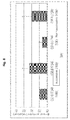
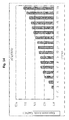
- a ⁇ -galactosidase analysis kit (Stratagen, Cat. No. 200383) was used to verify ⁇ -galactosidase activity on the stable cells transfected, and then obtain ⁇ -galactosidase activities according to vectors and relative ⁇ -galactosidase activities based on the pCLS09G1 vector. As shown in Table 1 and FIG. 7 , the ⁇ -galactosidase activity was increased for the SAR/MAR factor-introduced vectors as compared with the SAR/MAR factor-not-introduced vector.
- the pCLS09G1f1 vector including CSP-B 5'-SAR exhibited higher ⁇ -galactosidase activity than pCLS09G1g1 including ⁇ -globin MAR. Therefore, it is preferable to introduce the CSP-B 5'-SAR into vectors to increase the target protein expression level.
- DG44 cells were transfected with the pCLS09G1f1, pCLS09G1f2, pCLS09G1f3, or pCLS09G1f4 vector and then selected with the Geneticin-containing medium, thereby obtaining cell pools.
- the ⁇ -galactosidase activity on the stable cells transfected was verified.
- the ⁇ -galactosidase activities depending on the vectors were obtained. As shown in Table 2 and FIG.
- PCR was performed using the IE1ATGF primer (atggg ggtgc acgaa tgtcc tgcct; SEQ ID NO: 38) and the IE1TGAR primer (tcatc tgtcc cctgt cctgc aggcc t; SEQ ID NO: 39) while using the Human liver Marathon-Ready cDNA library (BD, Cat. No. 7407-1) as a template.
- the PCR was performed under the conditions of 40 cycles of 10 seconds at 98 ⁇ , 30 seconds at 58 ⁇ , and 1 minute at 72 ⁇ . Then, this PCR product was cloned into the pGEM-T vector.
- NESPs (A30N, H32T, P87V, W88N, and P90T), as described in claim 3 of Korean Patent Application No. 1995-0701453, the following experiment was conducted.
- PCR was performed using the M13R primer (gaaac agcta tgacc atg; SEQ ID NO: 40) and the IAlglR primer (ctcat tcaag ctgca tgttt catta cagcc cgtcg tgat; SEQ ID NO: 41) and PCR was performed using the M13F primer (caggg ttttc ccagt cacga; SEQ ID NO: 42) and the IAlglF primer (atcac gacgg gctgt aatga aacat gcagc ttgaa tgag; SEQ ID NO: 43), while using the erythropoietin gene cloned into the pGEM-T vector as a template.
- the PCRs were performed under the conditions of 30 cycles of 10 seconds at 98 ⁇ , 30 seconds at 60 ⁇ , and 40 seconds at 72 ⁇ . Then, these two PCR products were ligated through overlapping PCR, and then cloned between the Ndel and Sphl restriction sites of the pGEM-T vector.
- PCR was performed using the M13R primer and the IA1G2R primer (cacat gcagc tgcag tgtct cattc acctg ggaag agttg ac; SEQ ID NO: 44) and PCR was performed using the M13F primer and the IA1G2F primer (gtcaa ctctt cccag gtgaa tgaga cactg cagct gcatg tg; SEQ ID NO: 45), while using the genes of the analogs, A30N and H32T, cloned into the pGEM-T vector as a template.
- PCR was performed using the NhAsf1F primer (aattg ctagc atata ggcgc gccaa cttga ttagg gtgat ggttc acgta g; SEQ ID NO: 48) and the NhClaPsf1R primer (aattg ctagc atata atcga ttata tttaa ttaaa tatag ggccc ttgag tgttg ttcca gtttg gaaca aga; SEQ ID NO: 49) while the pcDNA3.1(-) vector as a template, to obtain MCS.
- PCR was performed using the cs3sAsc1F primer (aattg gcgcg ccgga tccca ttctc cttga tgtac taat; SEQ ID NO: 50) and the cs3sPsp1R primer (aattg ggccc gaatt caaac aactc aatag caaga aac; SEQ ID NO: 51) while using the pGEMT-CS3S.1.2k vector as a template, to amplify CSP-B 3'-SAR.
- the PCR was performed under the conditions of 30 cycles of 10 seconds at 98 ⁇ , 30 seconds at 60 ⁇ , and 2 minutes and 30 seconds at 72 ⁇ . Then, this PCR product was cloned between the AscI and PspOMI restriction sites of the pCLS10A1 vector to prepare the pCLS10Alt1 vector.
- PCR was performed using the cs5sAsc1F primer (aattg gcgcg ccgaa ttcct aaaca gagca attag gtaag; SEQ ID NO: 52) and the cs5sPsp1R primer (aattg ggccc gaatt ccagt gtaaa cgtct tcctt gt; SEQ ID NO: 53) while using the pGEMT-CS5S.3.0k vector as a template, to amplify the CSP-B 5'-SAR.
- the PCR was performed under the conditions of 30 cycles of 10 seconds at 98 ⁇ , 30 seconds at 60 ⁇ , and 2 minutes and 30 seconds at 72 ⁇ . Then, this PCR product was cloned between the AscI and PspOMI restriction sites of the pCLS10A1 vector to prepare the pCLS10A1f1 vector.
- DG44 cells were transfected with the pCLS07A1, pCLS10A1f1, or pCLS10Alt1 vector including the target protein NESP and the SAR factor, and selected with the Geneticin-containing medium, thereby obtaining a cell pool.
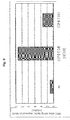
- the NESP expression level was verified by enzyme-linked immunosorbent assay (ELISA). As shown in Table 3 and FIG. 9 , it was verified that the introduction of the SAR factor increased the expression level.
- NESP expression level was increased by 11.2 fold when CSP-B 5'-SAR was introduced downstream of the NESP gene than when CSP-B 5'-SAR was not introduced.
- Table 3 Vector used for transfection Introduced SAR/MAR NESP expression level ( ⁇ g / ml) Relative NESP expression level pCLS07A1 None 0.7 1.0 pCLS10A1f1 CSP-B 5'-SAR 7.9 11.2 pCLS10Alt1 CSP-B 3'-SAR 2.3 3.2
- DG44 cells were transfected with the pCLS07A1, pCLS10A1t1, or pCLS10A1f1 vector, and single colonies were created by using a 96-well plate. The colony formation frequency for each vector was confirmed through microscopic observation. The culture liquid was taken up and the expression level of NESP was measured, thereby obtaining the frequency of formation of positive clones expressing NESP for each vector.
- PCR was performed using the V1_F primer (aagct tcctc agcat cgatg gccgg ccgga tccct gtgcc ctcta gttga cagcc agctg t; SEQ ID NO: 54) and the V1_R primer (tagag cccca gctgg ttctt tccgc ctcag; SEQ ID NO: 55) while using the pcDNA3.1(-) vector as a template.
- the PCR was performed under the conditions of 30 cycles of 10 seconds at 98 ⁇ , 30 seconds at 60 ⁇ , and 1 minute at 72 ⁇ . Then, this PCR product was cloned into the pcDNA3.3-TOPO vector to prepare the pC01 vector.
- PCR was performed using the V2_F primer (gaatt ctgta caggt acccc tgcag gctcg agctg tgcct tctag ttgcc agcca tctgt; SEQ ID NO: 56) and the V2_R primer (tagag cccca gctgg ttctt tccgctcag; SEQ ID NO: 57) while using the pcDNA3.1(-) vector as a template.
- the PCR was performed under the conditions of 30 cycles of 10 seconds at 98 ⁇ , 30 seconds at 60 ⁇ , and 1 minute at 72 ⁇ . Then, this PCR product was cloned into the pcDNA3.3-TOPO vector to prepare the pC02 vector.
- the following experiment was conducted.
- the pC01 vector was digested with restriction enzymes DraIII and AgeI, thereby obtaining a large DNA fragment.
- PCR was performed using the PcmvAgeF primer (aatct gaccg gtgtt aggcg ttttg cgctg cttcg cg; SEQ ID NO: 58) and the BGHNheDraR primer (ttact acact acgtg gatcg agcta gctag agccc cagct ggttc tttcc g; SEQ ID NO: 59) while using the pC02 vector as a template.
- This PCR product was digested with restriction enzymes DraIII and AgeI.
- the PCR was performed under the conditions of 30 cycles of 10 seconds at 98 ⁇ , 30 seconds at 60 ⁇ , and 1 minute at 72 ⁇ . Last, this PCR product was ligated to the DNA fragment obtained by digesting the pC01 vector with restriction enzymes DraIII and AgeI, thereby preparing the pC03 vector.
- the following experiment was conducted.
- PCR was performed using the PsvApaDraF primer and the TKNheNdeR primer while using the pC04 vector as a template.
- the PCR was performed under the conditions of 30 cycles of 10 seconds at 98 ⁇ , 30 seconds at 60 ⁇ , and 1 minute and 30 seconds at 72 ⁇ .
- this PCR product and the pC03 vector were digested with restriction enzymes Dralll and Nhel, and the thus obtained two large DNA fragments are ligated to prepare the pCLS05 vector.
- PCR was performed using the H1ssF primer (ctctt cttgg tagca acagc tacag gtgtc cactc cgagg tccaa ctggt cgaaa gcggt gga; SEQ ID NO: 60) and the H1TGAXhoR primer (aattc tcgag tcatt taccc ggaga caggg agagg ctctt; SEQ ID NO: 61) while using the synthesized anti-HER2 antibody gene as a template, to amplify a heavy chain gene having a part of the signal sequence.
- PCR was performed using the H1ssEcoF primer (aattg aattc gccac catgg gatgg agctg tatca tcctc ttctt ggtag caaca gctac agg; SEQ ID NO: 62) and the H1TGAXhoR primer (SEQ ID NO: 61) while using this PCR product as a template, to amplify a heavy chain gene having the Kozak sequence and the signal sequence.
- the PCR was performed under the conditions of 30 cycles of 10 seconds at 98 ⁇ , 30 seconds at 60 ⁇ , and 1 minute and 30 seconds at 72 ⁇ .
- this PCR product was cloned into the pGEM-T vector and then digested with restriction enzymes EcoRI and XhoI, to obtain the heavy chain gene having the Kozak sequence and the signal sequence, which was then cloned between the EcoRI and XhoI restriction sites of the pCLS05 vector, thereby preparing the pCLS05H1 vector.
- PCR was performed using the H2ssHinF primer (aatta agctt gccac catgg gatgg agctg tatca tcctc ttctt ggtag caaca gctac agg; SEQ ID NO: 65) and the H2TGABamR primer (SEQ ID NO: 64) while using this PCR product as a template, to amplify a light chain gene having the Kozak sequence and the signal sequence.
- the PCR was performed under the conditions of 30 cycles of 10 seconds at 98 ⁇ , 30 seconds at 60 ⁇ , and 1 minute at 72 ⁇ .
- this PCR product was cloned into the pGEM-T vector and then digested with restriction enzymes HindIII and BamHI, to obtain a light chain gene having the Kozak sequence and the signal sequence, which was then cloned between the HindIII and BamHI restriction sites of the pCLS05H1 vector, thereby preparing the pCLS05H2 vector.
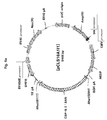
- the map of the pCLS05H2 vector is shown in FIG. 12a .
- the pCLS05H2 vector and the pCLS09G1f2 vector were digested with restriction enzymes XhoI and BssHII, and the thus obtained two large DNA fragments were ligated to prepare the pCLS05H2f2 vector.
- the map of the pCLS05H2f2 vector is shown in FIG. 12b .
- DG44 cells were transfected with the pCLS05H2 vector including a gene of the target protein anti-HER2 antibody and the pCLS05H2f2 vector including the antibody gene and the SAR factor, respectively, and then selected with Geneticin-containing medium, to obtain cell pools.
- the anti-HER2 antibody expression levels for the respective vectors were verified by enzyme-linked immunosorbent assay (ELISA). As shown in Table 6 and FIG. 13 , it was confirmed that the anti-HER2 antibody expression level was 30-fold higher when two copies of SAR factors were introduced than when the SAR factor was not introduced.
- the Geneticin resistance was exhibited and the surviving cells were relatively more numerous when the pCLS05H2f2 vector including the SAR factor was used.
Landscapes
- Health & Medical Sciences (AREA)
- Life Sciences & Earth Sciences (AREA)
- Engineering & Computer Science (AREA)
- Genetics & Genomics (AREA)
- Chemical & Material Sciences (AREA)
- Organic Chemistry (AREA)
- Zoology (AREA)
- Wood Science & Technology (AREA)
- Bioinformatics & Cheminformatics (AREA)
- Biomedical Technology (AREA)
- Biotechnology (AREA)
- General Engineering & Computer Science (AREA)
- Microbiology (AREA)
- Molecular Biology (AREA)
- Biochemistry (AREA)
- General Health & Medical Sciences (AREA)
- Plant Pathology (AREA)
- Biophysics (AREA)
- Physics & Mathematics (AREA)
- Medicinal Chemistry (AREA)
- Chemical Kinetics & Catalysis (AREA)
- General Chemical & Material Sciences (AREA)
- Cell Biology (AREA)
- Preparation Of Compounds By Using Micro-Organisms (AREA)
- Micro-Organisms Or Cultivation Processes Thereof (AREA)
Description
- The present invention relates to an expression vector for animal cells, including a 5'-scaffold or matrix attachment region (5'-SAR) of cytotoxic serine protease-B (CSP-B), and methods for producing recombinant proteins using the expression vectors.
- The introduction of foreign genes coding recombinant proteins into animal cells such as Chinese hamster ovary (CHO) cells can produce protein drugs for clinical treatment.
- A novel erythropoiesis stimulating protein (NESP), which is an erythropoiesis-stimulating factor, is also called Darbepoetin alfa, and is a protein drug obtained by adding two N-linked sugar chains to naturally occurring erythropoietin through genetic modification (Egrie and Browne, Br. J. Cancer, 84 Suppl. 1:3-10 (2001)). NESP promotes red blood cell production by stimulating hematopoietic stem cells and facilitating their differentiation into erythrocytes. Since the serum half-life of NESP is three times longer than that of the existing recombinant erythropoietin, equivalent therapeutic effect can be expected with fewer administrations when treating anemia of patients with chronic kidney disease.
- Trastuzumab as an anti-malignant tumor agent is a humanized monoclonal antibody prepared using recombinant DNA technology, and selectively acts on human epidermal growth factor receptor 2 (HER2) on cell surfaces. HER2 overexpression is confirmed in 25∼30% of primary breast cancers and trastuzumab suppresses the proliferation of HER2-overexpressed human tumor cells.
- Expression levels of foreign genes may be varied depending on their insertion sites in the animal cell chromosomes since foreign gene expression is influenced by surrounding regulator elements or the chromatin structure (Zahn-Zabal et al., J. Biotechnol, 87, 29-42 (2001)) .
- When chromatin factors that prevent surrounding chromatins from influencing foreign gene expression are used, the suppression of gene expression depending on the position (position effect) can be overcome and the possibility of isolation of animal cell clones that highly express recombinant proteins can be increased, thereby decreasing the preparation time of cell lines for producing drugs. Attempts to produce stable cell lines by using chromatin factors that can overcome the suppression of gene expression depending on the position have been made. The factors therefor are boundary element (BE), scaffold or matrix attachment region (SAR/MAR), locus control region (LCR), and the like.
- SAR also called MAR is 300∼3000-bp DNA element. It has been known that SAR allows the chromatin to attach to proteins of the nuclear matrix and controls gene expression (Makrides (Ed.), Gene Transfer and Expression in Mammalian Cells. Elsevier. Chapter 10 (2003)). In addition, SAR can improve expression of foreign genes in transfected cell lines (Poljak et al., Nucleic Acids Res, 22, 4386-4394 (1994); Kalos and Fournier, Mol. Cell. Biol, 15, 198-207 (2005)).
- Zahn-Zabal et al. had produced stable cells by introducing a chicken lysozyme 5'-MAR into a luciferase expression vector and transfecting CHO cells with the vector (Zahn-Zabal et al., J. Biotechnol, 87, 29-42 (2001)). The stable cells transfected with a vector containing lysozyme 5'-MAR exhibited a higher luciferase expression level as compared with stable cells transfected with a vector not containing MAR. In addition, the vector containing two copies of MAR exhibited a higher luciferase expression level than the vector containing one copy of lysozyme 5'-MAR. This result shows that the introduction of MAR into the animal cell expression vector can increase the target protein expression level.
- Korean Patent Application
KR20020010327 WO0214525 - Korean Patent Application No.
KR20020047006 KR20070118563 - Hanson and Ley found CSP-B 5'-SAR and CSP-B 3'-SAR from approximately 70 kb of the human chromosome 14q11.2 hematopoietic serine protease gene cluster and obtained their nucleotide sequences, and verified that these SARs bind to scaffolds derived from the cellular nucleus through in vitro experiment (Hanson and Ley, Blood, 79, 610-618 (1992)).
- The CSP-B 5'-SAR and CSP-B 3'-SAR are registered as GenBank Accession # M62717 and GenBank Accession # M62716, respectively. They are 2429-bp long and 1233-bp long, respectively, and thus the CSP-B 5'-SAR is two folds longer than the 3'-SAR.
Human chromosome 14 DNA sequence is registered as GenBank Accession # AL136018. In this sequence, the length between a transcription initiation codon for a gene coding the CSP-B protein and the 5'-SAR located upstream thereof is 1195 bp, and the length between a transcription termination codon of the gene for coding the CSP-B protein and the 3'-SAR located downstream thereof is 4543 bp. - The invention in its broadest sense is as defined in the independent claims.
- The present inventors have made efforts to develop vectors capable of efficiently producing recombinant proteins in animal cells. As a result, the present inventors have established that recombinant proteins can be produced at excellent production efficiency when cytotoxic serine protease-B (CSP-B) 5'-scaffold or matrix attachment region (SAR) is incorporated in the vector, and then completed the present invention.
- Therefore, an aspect of the present invention is to provide expression vectors for animal cells.
- Another aspect of the present invention is to provide animal cells transfected with the expression vectors.
- Still another aspect of the present invention is to provide a method for producing recombinant proteins.
- Other purposes and advantages of the present invention will become clarified by the following detailed description of invention, claims, and drawings.
- In accordance with an aspect of the present invention, there is provided an expression vector for animal cells, the expression vector including: (a) a 5'-scaffold or matrix attachment region (5'-SAR) of cytotoxic serine protease-B (CSP-B); (b) a promoter operable in animal cells; and (c) a polyadenylation sequence.
- The present inventors have made efforts to develop vectors capable of efficiently producing recombinant proteins in animal cells. As a result, the present inventors have established that recombinant proteins can be produced at excellent production efficiency when the 5'-scaffold or matrix attachment region (5'-SAR) of cytotoxic serine protease-B (CSP-B) is incorporated in the vector.
- The expression vector for animal cells of the present invention includes CSP-B 5'-SAR; a promoter operable in animal cells; and a polyadenylation sequence.
- The present invention is mainly characterized by using a vector including CSP-B 5'-SAR. CSP-B 5'-SAR used herein preferably includes a nucleotide sequence registered as GenBank accession # M62717, and its exemplary nucleotide sequence is described in SEQ ID NO: 1.
- CSP-B 5'-SAR significantly increases the efficiency in production of recombinant proteins in the expression vector.
- CSP-B 5'-SAR may be located upstream or downstream of the nucleotide sequence coding a protein to be expressed, and is preferably located downstream of the nucleotide sequence.
- According to a preferable embodiment of the present invention, two copies of the 5'-SAR are continuously present on the vector.
- According to a preferable embodiment of the present invention, the two copies of the 5'-SAR are continuously present downstream of a protein-coding nucleotide sequence to be expressed.
- As proved in the following examples, CSP-B 5'-SAR further improves the target protein expression level in animal cells as compared with CSP-B 3'-SAR and β-globin MAR of the related art. For example, when one copy of CSP-B 5'-SAR, CSP-B 3'-SAR, and β-globin MAR were respectively introduced into vectors expressing β galactosidase as a target protein in CHO animal cells, the β galactosidase activities for the respective cases were measured to be 10.0-fold, 2.2-fold, and 8.7-fold higher as compared with when the SAR factor was not introduced (
FIG. 7 ). That is, CSP-B 5'-SAR exhibits a relatively higher target protein expression level than other factors. - Further, similar results were obtained when effects of the SAR factor were verified by using NESP as a target protein. When CSP-B 5'-SAR and CSP-B 3'-SAR were introduced into vectors and then CHO cells were transfected with the vectors, the NESP expression levels for the respective cases were measured to be 11.2-fold and 3.2-fold higher as compared with when the SAR factor was not introduced (Table 3 and
FIG. 9 ). The introduction of CSP-B 5'-SAR into vectors increased the frequency of formation of positive clones expressing NESP in the transfected cells, and also increased the NESP expression levels of randomly selected clones (Tables 4 and 5 andFIGS. 10 and11 ). - Meanwhile, the effects of CSP-B 5'-SAR were verified by using an anti-HER2 antibody as a target protein. When two copies of CSP-B 5'-SAR were introduced into the vector and then CHO cells were transfected with the vector, the anti-HER2 antibody expression level was measured to be relatively higher than as compared with when the SAR factor was not introduced (Table 6 and
FIG. 13 ). The introduction of SAR into vectors increased the anti-HER2 antibody expression level of randomly selected clones (FIGS. 14 and15 ). - According to a preferable embodiment of the present invention, multiple copies of CSP-B 5'-SAR may be present in the expression vector. The production efficiency of recombinant proteins are further increased when multiple copies of CSP-B 5'-SAR are present in the expression vector than when one copy of CSP-B 5'-SAR is present in the expression vector. More preferably, two copies of CSP-B 5'-SAR may be present in the expression vector. As proved in the following examples, the production efficiency of recombinant proteins was more excellent when two copies of CSP-B 5'-SAR are present in the expression vector than when three copies of CSP-B 5'-SAR are present in the expression vector.
- As proved in the following examples, as a result of verifying effects of CSP-B 5'-SAR according to the copy number of CSP-B 5'-SAR by introducing one, two, and three copies of CSP-B 5'-SAR into vectors, the continuous location of two copies of the SAR factor was measured to exhibit the highest β-galactosidase activity (
FIG. 8 ). That is, the copy number of SAR factor in the vector influences the target protein expression level, and two copies of the SAR factor may be the most desirable. - In the case where multiple copies of CSP-B 5'-SAR are present in the expression vector, the multiple copies of CSP-B 5'-SAR may be located in a continuous or non-continuous manner. Preferably, the multiple copies of SAR factors may be continuously present, and more preferably, may be continuously present downstream of a nucleotide sequence coding a protein to be expressed.
- According to a preferable embodiment of the present invention, the promoter operable in the animal cells may be a cytomegalovirus (CMV) promoter, an adenovirus late promoter, a vaccinia virus 7.5K promoter, a Simian virus 40 (SV40) promoter, an SV40E1 promoter, a herpes simplex virus (HSV) tk promoter, a respiratory syncytial virus (RSV) promoter, an elongation factor 1-α (EF1-α) promoter, a metallothionein promoter, a β-actin promoter, a human interleukin-2 (IL-2) gene promoter, a human interferon (IFN) gene promoter, a human IL-4 gene promoter, a human lymphotoxin gene promoter, or human granulocyte-macrophage colony-stimulating factor (GM-CSF) gene promoter. The CMV promoter, SV40 promoter, SV40E1 promoter, EF1-α promoter, metallothionein promoter, or β-actin promoter is more preferable, and the CMV promoter is most preferable.
- According to a preferable embodiment of the present invention, the vector of the present invention may be a nucleotide sequence coding a protein to be expressed. Preferable examples of the protein may include hormone, cytokine, antibody, peptide aptamer, Adnectin, affibody (USP No.
5,831,012 ,831,012 ), avimer ('Silverman, J. et al, Nature Biotechnology 23(12):1556 (2005)), or a Kunitz domain (Kunitz domain, Arnoux B et al., Acta Crystallogr. D Biol. Crystallogr. 58(Pt 7):12524 (2002)), and (Nixon, AE, Current opinion in drug discovery & development 9(2):2618 (2006). More preferably, the protein to be expressed by using the vector of the present invention may be erythropoietin (EPO), EPO analogs, or anti-human epidermal growth factor receptor 2 (anti-HER2) antibodies. EPO, novel erythropoiesis stimulating proteins (NESPs; A30N, H32T, P87V, W88N, and P90T) as EPO analogs, or anti-HER2 antibodies may be most preferable. - The EPO analogs include mutants having modification of one or more amino acids from the human EPO amino acid sequence. The EPO analogs may be prepared by the mutagenesis through addition, deletion, or substitution of amino acid residues, whereby the glycosylation sites may be increased or may be changed. The EPO analogs have more carbohydrate chains than the human EPO, and include at least one additional glycosylation site. In addition, the EPO analogs exhibit a higher sialic acid level than the naturally occurring human EPO due to the additional glycosylation site. However, the protein secondary or tertiary structure, which is important in biological activity, is not changed by the additional glycosylation site. The EPO analogs may have one, two, or three additional sites for N-cosylation or O-glycosylation. For example, the leucine residue at position 69 is substituted with asparagine, which serves as a fourth site for N-glycosylation.
- Examples of the EPO analogs to be expressed in the vectors of the present invention may be ones in which an additional site for glycosylation is introduced to at least one of
positions - According to a preferable embodiment of the present invention, the polyadenylation sequence includes a bovine growth hormone terminator, herpes simplex virus (HSV)-derived thymidine kinase (TK), or SV40-derived polyadenylation sequence.
- A preferable construct of the vector of the present invention may be, in a 5' to 3' direction, a promoter operable in animal cells - an expression protein gene - a polyadenylation sequence - CSP-B 5'-SAR, and a more preferable construct is a promoter operable in animal cells - an expression protein gene - a polyadenylation sequence - CSP-B 5'-SAR - CSP-B 5'-SAR.
- The vector of the present invention may further include a selection marker. Examples of the selection marker include resistance genes against antibiotics acting on eukaryotic cells, and preferably include resistance genes against neomycin, geneticin (G418), and kanamycin.
- According to a preferable embodiment of the present invention, the vector of the present invention is used in expressing a target protein in animal cells. The animal cells include mammalian cells, rodent cells, avian cells, and insect cells. The animal cells more preferably include Chinese hamster ovary (CHO) cells, VERO cells, HeLa cells, WI38 cells, baby hamster kidney (BHK) cells, COS cells, and Madin-Darby Canine Kidney (MDCK) cells. The CHO cells, VERO cells, HeLa cells, or MDCK cells are still more preferable, and the CHO cells are most preferable.
- According to a preferable embodiment of the present invention, the vector of the present invention includes a dihydrofolate reductase (DHFR) coding sequence. The sequence is useful in vector amplification.
- According to another aspect of the present invention, the present invention provides animal cells transfected with the foregoing expression vectors of the present invention.
- According to still another aspect of the present invention, the present invention provides a method for producing recombinant proteins, the method including incubating the foregoing transfected animal cells of the present invention.
- According to a preferable embodiment of the present invention, the method for producing recombinant proteins includes: (i) incubating the transfected animal cells of the present invention; and (ii) collecting recombinant proteins produced in the incubating.
- In the related art, CSP-B 5'-SAR used herein was not used in an attempt to be introduced into expression vectors for animal cells to improve productivity in recombinant proteins for medical substances. As can be seen from the following examples, the introduction of CSP-B 5'-SAR into vectors can improve the target protein expression level in animal cells. By developing the method in which CSP-B 5'-SAR, a new factor that was not previously used, is introduced into vectors to produce recombinant proteins, the target protein expression efficiency can be further improved and the industrial productivity of protein medical substances can be increased.
- According to reports in the related art, there were no attempts to introduce CSP-B 5'-SAR into expression vectors for animal cells to improve productivity of recombinant proteins for medical substances. Moreover, studies were not conducted that, in the case where one, two, and three copies of SAR factors are introduced in the vectors and then animal cells are transfected with the vectors, how many copies of SAR factors are included in the vector in order to achieve the highest productivity of recombinant proteins. Moreover, detailed preceding study results about the increase effect in the target gene expression level depending on the position of the SAR factor have not been disclosed.
- When the expression vectors of the present invention are introduced into cells to produce transfected animal cells, the vectors may be introduced into cells by various methods. The vectors may be injected into animal cells by, for example, microinjection (Capecchi, M.R., Cell, 22:479 (1980)), calcium phosphate precipitation (Graham, F.L. et al., Virology, 52:456 (1973)), electroporation (Neumann, E. et al., EMBO J., 1:841 (1982)), liposome-mediated transfection (Wong, T.K. et al., Gene, 10:87 (1980)), DEAE-dextran treatment (Gopal, Mol. Cell Biol. 5:1188-1190 (1985)), gene bombardment (Yang et al., Proc. Natl. Acad. Sci., 87:9568-9572 (1990)), or the like.
- The transfected animal cells may be incubated by various methods known in the art using protocols. As a medium usable herein, any medium that can be generally used to incubate animal cells may be employed. For example, Eagle's minimum essential medium (Eagles's MEM, Eagle, H. Science 130:432 (1959)), α-MEM (Stanner, C.P. et al., Nat. New Biol. 230:52 (1971)), Iscove's MEM (Iscove, N. et al., J. Exp. Med. 147:923 (1978)), 199 medium (Morgan et al., Proc. Soc. Exp. Bio. Med., 73:1 (1950)), CMRL 1066, RPMI 1640 (Moore et al., J. Amer. Med. Assoc. 199:519 (1967)), F12(Ham, Proc. Natl. Acad. Sci. USA 53:288 (1965)), F10 (Ham, R.G. Exp. Cell Res. 29:515 (1963)), Dulbecco's modification of Eagle's medium (DMEM, Dulbecco, R. et al., Virology 8:396 (1959)), a mixture of DMEM and F12 (Barnes, D. et al., Anal. Biochem. 102:255 (1980)), Way-mouth's MB752/1 (Waymouth, C. J. Natl. Cancer Inst. 22:1003 (1959)), McCoy's 5A (McCoy, T.A., et al., Proc. Soc. Exp. Biol. Med. 100:115 (1959)), MCDB series (Ham, R.G. et al., In Vitro 14:11 (1978)), and the like may be used. Detailed descriptions of incubations and media of animal cells are disclosed in R. Ian Freshney, Culture of Animal Cells, A Manual of Basic Technique, Alan R Liss, Inc., New York, which is incorporated by reference into the present specification.
- Features and advantages of the present invention are summarized as follows:
- (a) The vectors of the present invention include CSP-B 5'-SAR, and can have effects of overcoming gene expression suppression depending on positions of foreign genes introduced into animal cells and significantly improve the target protein expression level.
- (b) The vectors of the present invention can effectively express recombinant proteins for medical substances (e.g., EPO) or antibodies (e.g., anti-HER2 antibody) in animal cells.
- (c) The vectors of the present invention and the method for producing recombinant proteins using the vectors can be very usefully employed in industrial mass production of medical substances.
-
-
FIG. 1 schematically shows a structure of a β-galactosidase expression vector. Here, lac Z represents a β-galactosidase gene; BGH pA represents a polyadenylation sequence of a bovine growth hormone gene; and TK pA represents a polyadenylation sequence of a thymidine kinase gene. -
FIG. 2 schematically shows structures of β-galactosidase expression vectors including one copy of SAR/MAR factor. -
FIG. 3 schematically shows structures of β-galactosidase expression vectors including two copies of SAR factors. -
FIG. 4 schematically shows a structure of a β-galactosidase expression vector including three copies of CSP-B 5'-SAR. -
FIG. 5 schematically shows structures of NESP expression vectors. -
FIG. 6 schematically shows structures of NESP expression vectors including SAR/MAR factors. -
FIG. 7 is a graph showing the β-galactosidase activity (relative) of cells transfected with each of vectors including one copy of SAR/MAR factor introduced thereinto. -
FIG. 8 is a graph showing the β-galactosidase activity (relative) of cells transfected with each of vectors including one copy, two copies, and three copies of SAR factors introduced thereinto. -
FIG. 9 is a graph showing the NESP (erythropoiesis-stimulating factor) expression level (relative) of cells transfected with each of vectors including SAR factors introduced thereinto. -
FIG. 10 is a graph showing NESP expression levels of 24 clones randomly selected from cells transfected with the SAR factor-not-introduced pCLS07A1 vector. -
FIG. 11 is a graph showing NESP expression levels of 24 clones randomly selected from cells transfected with the pCLS10A1f1 vector including CSP-B 5'-SAR introduced thereinto. -
FIG. 12 schematically shows structures of anti-HER2 antibody expression vectors. -
FIG. 13 is a graph showing the anti-HER2 antibody expression level (relative) of cells transfected with the vector including two copies of SAR factors introduced thereinto. -
FIG. 14 is a graph showing anti-HER2 antibody expression levels of 19 clones randomly selected from cells transfected with the SAR factor-not-introduced pCLS05H2 vector. -
FIG. 15 is a graph showing anti-HER2 antibody expression levels of 19 clones randomly selected from cells transfected with the pCLS05H2f2 vector including two copies of CSP-B 5'-SAR introduced thereinto. - Hereinafter, the present invention will be described in detail with reference to examples. These examples are only for illustrating the present invention more specifically, and it will be apparent to those skilled in the art that the scope of the present invention is not limited by these examples.
- For polymerase chain reaction (PCR) amplification of human CSP-B 5'-SAR DNA registered as GenBank Accession # M62717 and # AL136018, genomic DNA of human natural killer cells (NK cells, ATCC CRL-2407) was prepared. The genomic DNA was prepared from the NK cells using a DNA isolation kit (Dneasy Blood & Tissue Kit, Qiagen, Cat. No. 69504), and was used as a template for 5'-SAR DNA PCR.
- PCR was performed using the Cs5S300F primer (attct tcagc acctc cttaa ttttt ctccc; SEQ ID NO: 5) and the Cs5S300R primer (ccagg cagcc aaaga tcagt agttg tgttg; SEQ ID NO: 6) while using the genomic DNA of the NK cells as a template. The PCR was performed under the conditions of 35 cycles of 10 seconds at 98□, 30 seconds at 60□, and 2 minutes and 30 seconds at 72□.
- Then, the PCR product was cloned into the pGEM-T vector (Promega, Cat. No. A3600) to prepare the pGEMT-CS5S.3.0k vector.
- For preparation of human CSP-B 3'-SAR DNA registered as GenBank Accession # M62716 and # AL136018, PCR was performed using the 2kCspSF primer (tggtt ccttc attgg aaaag gaaaa cac; SEQ ID NO: 7) and the 2kCspSR primer (tccgc tgagg ctgtg cccac agcca cc; SEQ ID NO: 8) while using the genomic DNA of the NK cells as a template. Then, PCR was performed using the CspSF primer (ggatc ccatt ctcct tgatg tacta at; SEQ ID NO: 9) and the CspSR primer (gaatt caaac aactc aatag caaga aac; SEQ ID NO: 10) while using the primary PCR product as a template. The PCRs were performed under the conditions of 30 cycles of 10 seconds at 98□, 30 seconds at 60□, and 5 minutes at 72□. The secondary PCR product was cloned into the pGEM-T vector to prepare the pGEMT-CS3S.1.2k vector.
- For PCR amplification of human β-globin MAR DNA registered as GenBank Accession # L22754 and # NW_001838021, genomic DNA of human G-2 cells was prepared. The genomic DNA was prepared from the G-2 cells using a DNA isolation kit, and was used as a template for 5' MAR DNA PCR. PCR was performed using the Bg5MF-100F-NheI primer (aattg ctagc ttgta ttctg tttcg tgagg caagg ttt; SEQ ID NO: 11) and the Bg5MR-100R-XhoI primer (aattc tcgag ttcct ctcta tgttg gctca aatgt cct; SEQ ID NO: 12) while using the genomic DNA of the G-2 cells as a template. The PCR was performed under the conditions of 30 cycles of 10 seconds at 98□, 30 seconds at 60□, and 3 minutes and 30 seconds at 72□. Then, the PCR product was cloned into the pcDNA3.3-TOPO vector (Invitrogen, Cat. No. K8300-01) to prepare the pcDNA3.3-Bg5M vector.
- For preparation of the pC06 vector sequentially including the cytomegalovirus (CMV) promoter, multiple cloning sites (MCS), and the bovine growth hormone (BGH) polyadenylation sequence (pA), the following experiment was conducted. First, PCR was performed using the V6_F primer (aagct tggat ccgaa ttcat cgatg gccgg ccggt accct cgagc tgtgc cttct agttg ccagc; SEQ ID NO: 13) and the V6_R primer (gctag ctaga gcccc agctg gttct ttccg; SEQ ID NO: 14) while using the pcDNA3.1(-) vector (Invitrogen, Cat. No. V795-20) as a template. The PCR was performed under the conditions of 30 cycles of 10 seconds at 98□, 30 seconds at 60□, and 1 minute at 72□. Then, the PCR product was cloned into the pcDNA3.3-TOPO vector (Invitrogen) to prepare the pC06 vector.
- For preparation of the pC04' sequentially including the Simian virus 40 (SV40) promoter, the Kozak sequence (gccatc), the dihydrofolate reductase (dhfr) gene, the herpes simplex virus thymidine kinase (HSV-TK) pA, the following experiment was conducted. First, PCR was performed using the PsvApaDraF primer (aaaat tgggc cccac tacgt gctgt ggaat gtgtg tcagt taggg t; SEQ ID NO: 15) and the PsvKzDHR primer (tggtc gaacc atgat ggcgc gaaac gatcc tcatc ctgtc tct; SEQ ID NO: 16) while using the pcDNA3.3 vector as a template. Then, PCR was performed using the DHKzPsvF primer (ggatc gtttc gcgcc atcat ggttc gacca ttgaa ctgca tcg; SEQ ID NO: 17) and the TKNheNdeR primer (tgtgt gcata tggct agcga taaca atttc acaca ggaaa cag; SEQ ID NO: 18) while using the pOptiVEC-TOPO vector as a template. The PCRs were performed under the conditions of 30 cycles of 10 seconds at 98□, 30 seconds at 60□, and 1 minute at 72□. Then, these two PCR products were ligated through overlapping PCR, and cloned between the ApaI and NdeI restriction sites of the pGEM-T vector, to prepare the pC04' vector.
- For preparation of the pC04 vector in which one 72-bp enhancer (ggtgt ggaaa gtccc caggc tcccc agcag gcaga agtat gcaaa gcatg catct caatt agtca gcaac ca; SEQ ID NO: 19) was removed from the SV40 promoter included in the pC04' vector (SV40dEI promoter), the following experiment was conducted. First, the pC04' vector was digested with the restriction enzyme Sphl, and then the thus obtained large DNA fragment was self-ligated, to prepare the pC04 vector.
- For preparation of the pCLS07 vector including the SV40dE1 promoter, the Kozak sequence, the dhfr gene, and TK pA, which were inserted between the BGH pA and the SV40 promoter of the pC06 vector, the following experiment was conducted. First, PCR was performed using the PsvApaDraF primer and the TKNheNdeR primer while using the pC04 vector as a template. The PCR was performed under the conditions of 30 cycles of 10 seconds at 98□, 30 seconds at 60□, and 1 minute and 20 seconds at 72□. Then, this PCR product and the pC06 vector were digested with the restriction enzymes Dralll and Nhel, respectively, and the thus obtained two large DNA fragments are ligated to prepare the pCLS07 vector.
- For preparation of the pCLS08 vector by inserting MCS into the Nhel restriction site of the pCLS07 vector, the following experiment was conducted. First, PCR was conducted using the NhAsE1F primer (aattg ctagc atata gcgat cgcgc aggac agctt ccgac agcag ggcca gg; SEQ ID NO: 20) and the BbPsSbNhE1R primer (aattg ctagc atata cctgc aggta tatgg gccca tatag ctgag gttga atgag aatat cactg tccca gacac; SEQ ID NO: 21) while using the erythropoietin gene cloned into the pGEM-T vector as a template, to prepare MCS. The PCR was performed under the conditions of 30 cycles of 10 seconds at 98□, 30 seconds at 60□, and 15 seconds at 72□. Then, this PCR product was cloned into the Nhel restriction site of the pCLS07 vector to prepare the pCLS08 vector.
- For preparation of the pCLS08G1 vector by inserting the lac Z and lac Y genes between the Hindlll and Xhol restriction sites of the pCLS08 vector, the following experiment was conducted. First, PCR was performed using the galHinF primer (aatta agctt ctcgc gcaac ctatt ttccc ctcga ac; SEQ ID NO: 22) and the galXhoR primer (aattc tcgag ccgag tttgt cagaa agcag accaa ac; SEQ ID NO: 23) while using the pSV-β-galactosidase vector (Promega, Cat. No.TB094) as a template, to amplify the lac Z and lac Y genes. The PCR was performed under the conditions of 30 cycles of 10 seconds at 98□, 30 seconds at 60□, and 3 minutes and 30 seconds at 72□. Then, this PCR product was cloned between Hindlll and Xhol restriction sites of the pCLS08 vector to prepare the pCLS08G1 vector.
- For preparation of the pCLS09G1 vector by exchanging the MCS between two Nhel restriction sites of the pCLS08G1 vector with another MCS, the following experiment was conducted. First, PCR was performed using the NhSbE1F primer (aattg ctagc atata cctgc aggtt gaatg agaat atcac tgtcc cagac a; SEQ ID NO: 24) and the NhAsSfPsE1R primer (aattg ctagc atata gcgat cgcta tatgg ccatg atggc catat agggc ccagg acagc ttccg acagc agggc caggc ; SEQ ID NO: 25) while using the erythropoietin gene cloned into the pGEM-T vector as a template, to prepare new MCS. The PCR was performed under the conditions of 30 cycles of 10 seconds at 98□, 30 seconds at 60□, and 15 seconds at 72□. Then, the existing MCS between the two Nhel restriction sites of the pCLS80G1 vector was removed, and the new MCS generated through the PCR was cloned thereinto, to prepare pCLS09G1 vector. The map of the pCLS09G1 vector was shown in
FIG. 1 . - For preparation of the pCLS09G1t1 vector by inserting the CSP-B 3'-SAR between the Sbfl and PspOMI restriction sites of the pCLS09G1 vector, the following experiment was conducted. First, PCR was conducted using the cs3sSbf1F primer (aattc ctgca gggga tccca ttctc cttga tgtac taat ; SEQ ID NO: 26) and the cs3sPsp1R primer (aattg ggccc gaatt caaac aactc aatag caaga aac; SEQ ID NO: 27) while using the pGEMT-CS3S.1.2k vector as a template, to amplify CSP-B 3'-SAR. The PCR was performed under the conditions of 30 cycles of 10 seconds at 98□, 30 seconds at 60□, and 2 minutes and 30 seconds at 72□. Then, this PCR product was cloned between the SbfI and PspOMI restriction sites of the pCLS09G1 vector to prepare the pCLS09G1t1 vector.
- For preparation of the pCLS09G1f1 vector by inserting the CSP-B 5'-SAR between the Sbfl and PspOMI restriction sites of the pCLS09G1 vector, the following experiment was conducted. First, PCR was conducted using the cs5sSbf1F primer (aattc ctgca gggaa ttcct aaaca gagca attag gtaag; SEQ ID NO: 28) and the cs5sPsp1R primer (aattg ggccc gaatt ccagt gtaaa cgtct tcctt gt; SEQ ID NO: 29) while using the pGEMT-CS5S.3.0k vector as a template, to amplify CSP-B 5'-SAR. The PCR was performed under the conditions of 30 cycles of 10 seconds at 98□, 30 seconds at 60□, and 2 minutes and 30 seconds at 72□. Then, this PCR product was cloned between the SbfI and PspOMI restriction sites of the pCLS09G1 vector to prepare the pCLS09G1f1 vector.
- For preparation of the pCLS09G1g1 vector by inserting the β-globin MAR between the Sbfl and PspOMI restriction sites of the pCLS09G1 vector, the following experiment was conducted. First, PCR was performed using the glmSbflF primer (aattc ctgca ggttg tattc tgttt cgtga ggcaa ggttt; SEQ ID NO: 30) and the glmPsp1R primer (aattg ggccc ttcct ctcta tgttg gctca aatgt cct; SEQ ID NO: 31) while using the pcDNA3.3-Bg5M vector as a template, to amplify the β-globin MAR. The PCR was performed under the conditions of 30 cycles of 10 seconds at 98□, 30 seconds at 60□, and 3 minutes and 20 seconds at 72□. Then, this PCR product was cloned between the SbfI and PspOMI restriction sites of the pCLS09G1 vector to prepare the pCLS09G1g1 vector.
- For preparation of the pCLS09G1t2 vector by inserting CSP-B 3'-SAR between the PspOMI and SfiI restriction sites of the pCLS09G1t1 vector, the following experiment was conducted. First, PCR was performed using the cs3sPsp2F primer (aattg ggccc ggatc ccatt ctcct tgatg tacta at; SEQ ID NO: 32) and the cs3sSfi2R primer (aattg gccat gatgg ccgaa ttcaa acaac tcaat agcaa gaaac; SEQ ID NO: 33) while using the pGEMT-CS3S.1.2k vector as a template, to amplify CSP-B 3'-SAR. The PCR was performed under the conditions of 30 cycles of 10 seconds at 98□, 30 seconds at 60□, and 2 minutes and 30 seconds at 72□. Then, this PCR product was cloned between the PspOMI and SfiI restriction sites of the pCLS09G1t1 vector to prepare the pCLS09G1t2 vector.
- For preparation of the pCLS09G1f2 vector by inserting CSP-B 5'-SAR between the PspOMI and SfiI restriction sites of the pCLS09G1f1 vector, the following experiment was conducted. First, PCR was performed using the cs5sPsp2F primer (aattg ggccc gaatt cctaa acaga gcaat taggt aag; SEQ ID NO: 34) and the cs5sSfi2R primer (aattg gccat gatgg ccgaa ttcca gtgta aacgt cttcc ttgt; SEQ ID NO: 35) while using the pGEMT-CS5S.3.0k vector as a template, to amplify CSP-B 5'-SAR. The PCR was performed under the conditions of 30 cycles of 10 seconds at 98□, 30 seconds at 60□, and 2 minutes and 30 seconds at 72□. Then, this PCR product was cloned between the PspOMI and SfiI restriction sites of the pCLS09G1f1 vector to prepare the pCLS09G1f2 vector.
- For preparation of the pCLS09G1tf vector by inserting CSP-B 5'-SAR between the PspOMI and SfiI restriction sites of the pCLS09G1t1 vector, the following experiment was conducted. First, PCR was performed using the cs5sPsp2F primer (aattg ggccc gaatt cctaa acaga gcaat taggt aag; SEQ ID NO: 34) and the cs5sSfi2R primer (aattg gccat gatgg ccgaa ttcca gtgta aacgt cttcc ttgt; SEQ ID NO: 35) while using the pGEMT-CS5S.3.0k vector as a template, to amplify CSP-B 5'-SAR. The PCR was performed under the conditions of 30 cycles of 10 seconds at 98□, 30 seconds at 60□, and 2 minutes and 30 seconds at 72□. Then, this PCR product was cloned between the PspOMI and SfiI restriction sites of the pCLS09G1t1 vector to prepare the pCLS09G1tf vector.
- For preparation of the pCLS09G1f3 vector by inserting the CSP-B 5'-SAR into the BglII restriction site between the CMV promoter and the bla promoter of the pCLS09G1f2 vector, the following experiment was conducted. First, PCR was performed using the cs5sBg13F primer (aatta gatct gaatt cctaa acaga gcaat taggt aag; SEQ ID NO: 36) and the cs5sBgl3R primer (aatta gatct gaatt ccagt gtaaa cgtct tcctt gt; SEQ ID NO: 37) while using the pGEMT-CS5S.3.0k vector as a template, to amplify CSP-B 5'-SAR. The PCR was performed under the conditions of 30 cycles of 10 seconds at 98□, 30 seconds at 60□, and 2 minutes and 30 seconds at 72□. Then, this PCR product was cloned into the BglII restriction site of the pCLS09G1f2 vector to prepare the pCLS09G1f3 vector.
- For preparation of the pCLS09G1f4 vector, in which the SAR factors are located at both sides of the lac Z and lac Y genes, by inserting CSP-B 5'-SAR into the BglII restriction site between the CMV promoter and the bla promoter of the pCLS09G1f1 vector, the following experiment was conducted. First, PCR was performed using the cs5sBg13Fprimer (aatta gatct gaatt cctaa acaga gcaat taggt aag; SEQ ID NO: 36) and the cs5sBgl3R primer (aatta gatct gaatt ccagt gtaaa cgtct tcctt gt; SEQ ID NO: 37) while using the pGEMT-CS5S.3.0k vector as a template, to amplify CSP-B 5'-SAR. The PCR was performed under the conditions of 30 cycles of 10 seconds at 98□, 30 seconds at 60□, and 2 minutes and 30 seconds at 72□. Then, this PCR product was cloned into the BglII restriction site of the pCLS09G1f1 vector to prepare the pCLS09G1f4 vector.
- In order to verify the effect due to the respective introduction of one copy of CSP-B 5'-SAR, CSP-B 3'-SAR, and β-globin MAR into the vectors, CHO DG44 cells (Invitrogen, Cat. No. 12609) were transfected as follows.
- Adhesion culture type DG44 cells were dispensed in a 6-well plate at 4X10⁵ cells per well. After 24 hours, it was confirmed that cells completely adhered to the plate bottom. 500 µℓ of the Opti-MEM medium (Gibco, Cat. No. 31985-070) was dispensed into each of three sterilized tubes, and then 2 µg of the prepared pCLS09G1, pCLS09G1f1, pCLS09G1t1, or pCLS09G1g1 vectors were mixed therewith, followed by mild pipetting. 500 µℓ of the Opti-MEM medium was dispensed into each of three sterilized tubes. 10 µℓ of Lipofectamine 2000 (Invitrogen, Cat. No. 11668-027) was mixed therewith, followed by mild pipetting, and then left for 5 minutes at room temperature. DNA and a reagent solution were mixed, and then left at room temperature for 20 minutes. This mixture was put into wells of a 6-well plate prepared for each DNA, followed by well mixing.
- DG44 cells were transfected with the pCLS09G1, pCLS09G1f1, pCLS09G1t1, or pCLS09G1g1 vector. After 24 hours, the medium was exchanged with a medium containing 10% FBS and 500 µg/mℓ of Geneticin. Medium exchange was performed every three or four days, and the cells were cultured under the conditions of 37□ and 5% CO2 for three weeks, thereby preparing a stable cell pool.
- A β-galactosidase analysis kit (Stratagen, Cat. No. 200383) was used to verify β-galactosidase activity on the stable cells transfected, and then obtain β-galactosidase activities according to vectors and relative β-galactosidase activities based on the pCLS09G1 vector. As shown in Table 1 and
FIG. 7 , the β-galactosidase activity was increased for the SAR/MAR factor-introduced vectors as compared with the SAR/MAR factor-not-introduced vector. In addition, the pCLS09G1f1 vector including CSP-B 5'-SAR exhibited higher β-galactosidase activity than pCLS09G1g1 including β-globin MAR. Therefore, it is preferable to introduce the CSP-B 5'-SAR into vectors to increase the target protein expression level.[Table 1] Vector used for transfection Introduced SAR/MAR β-galactosidase activity (units/mg) Relative β-galactosidase activity pCLS09G1 None 3.4 1.0 pCLS09G1f1 CSP-B 5'-SAR 34.3 10.0 pCLS09G1t1 CSP-B 3'-SAR 7.4 2.2 pCLS09G1g1 β-globin MAR 29.8 8.7 - The following experiment was conducted to verify that the CSP-B 5'-SAR increased the target protein expression levels and investigate the change in the target protein expression level depending on the copy number of SAR factors introduced into the vector. DG44 cells were transfected with the pCLS09G1f1, pCLS09G1f2, pCLS09G1f3, or pCLS09G1f4 vector and then selected with the Geneticin-containing medium, thereby obtaining cell pools. The β-galactosidase activity on the stable cells transfected was verified. The β-galactosidase activities depending on the vectors were obtained. As shown in Table 2 and
FIG. 8 , the vector including two copies of SAR factors introduced thereinto exhibited higher β-galactosidase activity than the vectors including one copy or three copies of SAR factors introduced thereinto. That is, the increase in the target protein expression levels due to the SAR factor is varied depends on the copy number of SAR factor, and it was verified that the introduction of two copies of SAR factor into vectors can lead to the maximum increase in the target protein expression level.[Table 2] Vector used for transfection Introduced SAR β-galactosidase activity (units/mg) Relative β- galactosidase activity Set 1 Set 2Set 3Mean Set 1 Set 2Set 3Mean pCLS09G1f1 One copy of CSP-B 5'-SAR 116 30 50 65 1.0 1.0 1.0 1.0 pCLS09G1f2 Continuous two copies of CSP-B 5'-SAR 147 103 107 119 1.3 3.4 2.1 2.3 pCLS09G1f3 Three copies of CSP-B 5'- SAR 12 36 19 22 0.1 1.2 0.4 0.6 pCLS09G1f4 Non-continuous two copies of CSP-B 5'-SAR 112 112 66 97 1.0 3.7 1.3 2.0 - For the cloning of the 582-bp erythropoietin gene registered as GenBank Accession # M11319 (human fetal liver genomic erythropoietin gene) and GenBank Accession # NM000799 (human erythropoietin mRNA), the following experiment was conducted. First, PCR was performed using the IE1ATGF primer (atggg ggtgc acgaa tgtcc tgcct; SEQ ID NO: 38) and the IE1TGAR primer (tcatc tgtcc cctgt cctgc aggcc t; SEQ ID NO: 39) while using the Human liver Marathon-Ready cDNA library (BD, Cat. No. 7407-1) as a template. The PCR was performed under the conditions of 40 cycles of 10 seconds at 98□, 30 seconds at 58□, and 1 minute at 72□. Then, this PCR product was cloned into the pGEM-T vector.
- For preparation of genes of erythropoietin analogs, NESPs (A30N, H32T, P87V, W88N, and P90T), as described in
claim 3 of Korean Patent Application No. 1995-0701453, the following experiment was conducted. First, for preparation of genes of erythropoietin analogs A30N and H32T, PCR was performed using the M13R primer (gaaac agcta tgacc atg; SEQ ID NO: 40) and the IAlglR primer (ctcat tcaag ctgca tgttt catta cagcc cgtcg tgat; SEQ ID NO: 41) and PCR was performed using the M13F primer (caggg ttttc ccagt cacga; SEQ ID NO: 42) and the IAlglF primer (atcac gacgg gctgt aatga aacat gcagc ttgaa tgag; SEQ ID NO: 43), while using the erythropoietin gene cloned into the pGEM-T vector as a template. The PCRs were performed under the conditions of 30 cycles of 10 seconds at 98□, 30 seconds at 60□, and 40 seconds at 72□. Then, these two PCR products were ligated through overlapping PCR, and then cloned between the Ndel and Sphl restriction sites of the pGEM-T vector. - In order to mutate the genes of the analogs A30N and H32T into genes of the analogs A30N, H32T, P87V, W88N, and P90T and attach the Kozak sequence (gccacc) before the transcription initiation codon, PCR was performed using the M13R primer and the IA1G2R primer (cacat gcagc tgcag tgtct cattc acctg ggaag agttg ac; SEQ ID NO: 44) and PCR was performed using the M13F primer and the IA1G2F primer (gtcaa ctctt cccag gtgaa tgaga cactg cagct gcatg tg; SEQ ID NO: 45), while using the genes of the analogs, A30N and H32T, cloned into the pGEM-T vector as a template. The PCRs were performed under the conditions of 30 cycles of 10 seconds at 98□, 30 seconds at 60□, and 40 seconds at 72□. Then, overlapping PCR was performed using the IE1KzATGHinF primer (aatta agctt gccac catgg gggtg cacga atgtc ctgcc t; SEQ ID NO: 46) and the IE1TGAXhoR primer (aattc tcgag tcctc tgtcc cctgt cctgc aggcc t; SEQ ID NO: 47) while using these two PCR products as a template. The PCR was performed under the conditions of 30 cycles of 10 seconds at 98□, 30 seconds at 60□, and 50 seconds at 72□.
- The PCR product of the NESP genes were cloned between the HindIII and XhoI restriction sites of the MSC of the pCLS07 vector, to prepare the pCLS07A1 vector.
- For preparation of the pCLS10A1 vector by inserting MCS for the SAR or MAR factor introduction into the Nhel restriction site of the pCLS07A1 vector capable of exhibiting NESP in animal cells, the following experiment was conducted. First, PCR was performed using the NhAsf1F primer (aattg ctagc atata ggcgc gccaa cttga ttagg gtgat ggttc acgta g; SEQ ID NO: 48) and the NhClaPsf1R primer (aattg ctagc atata atcga ttata tttaa ttaaa tatag ggccc ttgag tgttg ttcca gtttg gaaca aga; SEQ ID NO: 49) while the pcDNA3.1(-) vector as a template, to obtain MCS. The PCR was performed under the conditions of 30 cycles of 10 seconds at 98□, 30 seconds at 60□, and 15 seconds at 72□. This PCR product was cloned into the NheI restriction site of the pCLS07A1 vector to prepare the pCLS10A1.
- For preparation of the pCLS10Alt1 vector by inserting the CSP-B 3'-SAR between the AscI and PspOMI restriction sites of the pCLS10A1 vector, the following experiment was conducted. First, PCR was performed using the cs3sAsc1F primer (aattg gcgcg ccgga tccca ttctc cttga tgtac taat; SEQ ID NO: 50) and the cs3sPsp1R primer (aattg ggccc gaatt caaac aactc aatag caaga aac; SEQ ID NO: 51) while using the pGEMT-CS3S.1.2k vector as a template, to amplify CSP-B 3'-SAR. The PCR was performed under the conditions of 30 cycles of 10 seconds at 98□, 30 seconds at 60□, and 2 minutes and 30 seconds at 72□. Then, this PCR product was cloned between the AscI and PspOMI restriction sites of the pCLS10A1 vector to prepare the pCLS10Alt1 vector.
- For preparation of the pCLS10A1f1 vector by inserting the CSP-B 5'-SAR between the AscI and PspOMI restriction sites of the pCLS10A1 vector, the following experiment was conducted. First, PCR was performed using the cs5sAsc1F primer (aattg gcgcg ccgaa ttcct aaaca gagca attag gtaag; SEQ ID NO: 52) and the cs5sPsp1R primer (aattg ggccc gaatt ccagt gtaaa cgtct tcctt gt; SEQ ID NO: 53) while using the pGEMT-CS5S.3.0k vector as a template, to amplify the CSP-B 5'-SAR. The PCR was performed under the conditions of 30 cycles of 10 seconds at 98□, 30 seconds at 60□, and 2 minutes and 30 seconds at 72□. Then, this PCR product was cloned between the AscI and PspOMI restriction sites of the pCLS10A1 vector to prepare the pCLS10A1f1 vector.
- In order to verify whether the effect of the SAR factor, which was confirmed through the β-galactosidase activity experiment, is also applied to expressions of other recombinant proteins, the following experiment was conducted. DG44 cells were transfected with the pCLS07A1, pCLS10A1f1, or pCLS10Alt1 vector including the target protein NESP and the SAR factor, and selected with the Geneticin-containing medium, thereby obtaining a cell pool. The NESP expression level was verified by enzyme-linked immunosorbent assay (ELISA). As shown in Table 3 and
FIG. 9 , it was verified that the introduction of the SAR factor increased the expression level. In particular, the NESP expression level was increased by 11.2 fold when CSP-B 5'-SAR was introduced downstream of the NESP gene than when CSP-B 5'-SAR was not introduced.[Table 3] Vector used for transfection Introduced SAR/MAR NESP expression level (µg/mℓ) Relative NESP expression level pCLS07A1 None 0.7 1.0 pCLS10A1f1 CSP-B 5'-SAR 7.9 11.2 pCLS10Alt1 CSP-B 3'-SAR 2.3 3.2 - In order to verify effects of the SAR factor of overcoming gene expression suppression depending on positions of foreign genes, DG44 cells were transfected with the pCLS07A1, pCLS10A1t1, or pCLS10A1f1 vector, and single colonies were created by using a 96-well plate. The colony formation frequency for each vector was confirmed through microscopic observation. The culture liquid was taken up and the expression level of NESP was measured, thereby obtaining the frequency of formation of positive clones expressing NESP for each vector. As shown in Tables 4 and 5, 82% of colony formation frequency was shown when the SAR factor was not introduced, and 90% and 50% of wells showed colony formation for the introductions of CSP-B 5'-SAR and CSP-B 3'-SAR, respectively. Further, the frequency of positive clones was approximately 40% for non-introduction of SAR factors and the introduction of CSP-B 3'-SAR, and increased to 59% for the introduction of CSP-B 5'-SAR. That is, it can be verified that the introduction of CSP-B 5'-SAR overcome gene expression suppression depending on positions of foreign genes and thus more clones expressing the target protein NESP were formed.
[Table 4] Vector used for transfection Introduced SAR/MAR Total number of wells Number of colony-forming wells Colony formation frequency (%) pCLS07A1 None 240 197 82 pCLS10A1f1 CSP-B 5'-SAR 240 217 90 pCLS10Alt1 CSP-B 3'-SAR 240 119 50 [Table 5] Vector used for transfection Introduced SAR/MAR Total number of colonies Number of Positive clones Frequency of positive clones (%) pCLS07A1 None 197 89 45 pCLS10A1f1 CSP-B 5'-SAR 217 127 59 pCLS10Alt1 CSP-B 3'-SAR 119 51 43 - Among positive clones on the 96-well plate, of which NESP expression was confirmed, 24 positive clones were arbitrarily selected for each vector and subcultured in a 24-well plate. The culture liquid was taken up and the expression level was measured. As shown in
FIGS. 10 and11 , the number of high-expression clones that exhibited an expression level of 10 µg/mℓ or higher among 24 arbitrarily selected positive clones was 13 for the CSP-B 5'-SAR-introudced vector and 5 for the SAR factor-not introduced vector. That is, it was verified that the frequency of high-expression clones increased when CSP-B 5'-SAR was introduced into the vector. - For preparation of the pC01 vector sequentially including a neomycin-resistant gene, an ampicillin-resistant gene, a CMV promoter, MCS, and BGH pA, the following experiment was conducted. First, PCR was performed using the V1_F primer (aagct tcctc agcat cgatg gccgg ccgga tccct gtgcc ctcta gttga cagcc agctg t; SEQ ID NO: 54) and the V1_R primer (tagag cccca gctgg ttctt tccgc ctcag; SEQ ID NO: 55) while using the pcDNA3.1(-) vector as a template. The PCR was performed under the conditions of 30 cycles of 10 seconds at 98□, 30 seconds at 60□, and 1 minute at 72□. Then, this PCR product was cloned into the pcDNA3.3-TOPO vector to prepare the pC01 vector.
- For preparation of the pC02 vector sequentially including a CMV promoter, the MCS of the pC01 vector and another MCS, and BGH pA, the following experiment was conducted. First, PCR was performed using the V2_F primer (gaatt ctgta caggt acccc tgcag gctcg agctg tgcct tctag ttgcc agcca tctgt; SEQ ID NO: 56) and the V2_R primer (tagag cccca gctgg ttctt tccgc ctcag; SEQ ID NO: 57) while using the pcDNA3.1(-) vector as a template. The PCR was performed under the conditions of 30 cycles of 10 seconds at 98□, 30 seconds at 60□, and 1 minute at 72□. Then, this PCR product was cloned into the pcDNA3.3-TOPO vector to prepare the pC02 vector.
- For preparation of the pC03 vector sequentially including the neomycin-resistant gene, the ampicillin-resistant gene, the CMV promoter, the first MCS, and the BGH pA of the pC01 vector and the CMV promoter, the second MCS, and the BGH pA of the pC02 vector, the following experiment was conducted. First, the pC01 vector was digested with restriction enzymes DraIII and AgeI, thereby obtaining a large DNA fragment. Then, PCR was performed using the PcmvAgeF primer (aatct gaccg gtgtt aggcg ttttg cgctg cttcg cg; SEQ ID NO: 58) and the BGHNheDraR primer (ttact acact acgtg gatcg agcta gctag agccc cagct ggttc tttcc g; SEQ ID NO: 59) while using the pC02 vector as a template. This PCR product was digested with restriction enzymes DraIII and AgeI. The PCR was performed under the conditions of 30 cycles of 10 seconds at 98□, 30 seconds at 60□, and 1 minute at 72□. Last, this PCR product was ligated to the DNA fragment obtained by digesting the pC01 vector with restriction enzymes DraIII and AgeI, thereby preparing the pC03 vector.
- For preparation of the pCLS05 vector including the SV40dE1 promoter, the Kozak sequence, the DHFR sequence, and TK pA inserted between the BGH pA and the SV40 promoter of the 140pC03 vector, the following experiment was conducted. First, PCR was performed using the PsvApaDraF primer and the TKNheNdeR primer while using the pC04 vector as a template. The PCR was performed under the conditions of 30 cycles of 10 seconds at 98□, 30 seconds at 60□, and 1 minute and 30 seconds at 72□. Then, this PCR product and the pC03 vector were digested with restriction enzymes Dralll and Nhel, and the thus obtained two large DNA fragments are ligated to prepare the pCLS05 vector.
- For preparation of the pCLS05H1 vector by inserting the anti-HER2 antibody heavy chain gene between EcoRI and XhoI restriction sites of the pCLS05 vector, the following experiment was conducted. First, PCR was performed using the H1ssF primer (ctctt cttgg tagca acagc tacag gtgtc cactc cgagg tccaa ctggt cgaaa gcggt gga; SEQ ID NO: 60) and the H1TGAXhoR primer (aattc tcgag tcatt taccc ggaga caggg agagg ctctt; SEQ ID NO: 61) while using the synthesized anti-HER2 antibody gene as a template, to amplify a heavy chain gene having a part of the signal sequence. PCR was performed using the H1ssEcoF primer (aattg aattc gccac catgg gatgg agctg tatca tcctc ttctt ggtag caaca gctac agg; SEQ ID NO: 62) and the H1TGAXhoR primer (SEQ ID NO: 61) while using this PCR product as a template, to amplify a heavy chain gene having the Kozak sequence and the signal sequence. The PCR was performed under the conditions of 30 cycles of 10 seconds at 98□, 30 seconds at 60□, and 1 minute and 30 seconds at 72□. Then, this PCR product was cloned into the pGEM-T vector and then digested with restriction enzymes EcoRI and XhoI, to obtain the heavy chain gene having the Kozak sequence and the signal sequence, which was then cloned between the EcoRI and XhoI restriction sites of the pCLS05 vector, thereby preparing the pCLS05H1 vector.
- For preparation of the pCLS05H2 vector by inserting the anti-HER2 antibody light chain gene between HindIII and BamHI restriction sites of the pCLS05H1 vector, the following experiment was conducted. First, PCR was performed using H2ssF primer (ctctt cttgg tagca acagc tacag gtgtc cactc cgata tccag atgac ccaga gtccc tct; SEQ ID NO: 63) and the H2TGABamR primer (aattg gatcc tcaac actct cccct gttga agctc tttgt; SEQ ID NO: 64) while using the synthesized anti-HER2 gene as a template, to amplify a light chain gene having a part of the signal sequence. PCR was performed using the H2ssHinF primer (aatta agctt gccac catgg gatgg agctg tatca tcctc ttctt ggtag caaca gctac agg; SEQ ID NO: 65) and the H2TGABamR primer (SEQ ID NO: 64) while using this PCR product as a template, to amplify a light chain gene having the Kozak sequence and the signal sequence. The PCR was performed under the conditions of 30 cycles of 10 seconds at 98□, 30 seconds at 60□, and 1 minute at 72□. Then, this PCR product was cloned into the pGEM-T vector and then digested with restriction enzymes HindIII and BamHI, to obtain a light chain gene having the Kozak sequence and the signal sequence, which was then cloned between the HindIII and BamHI restriction sites of the pCLS05H1 vector, thereby preparing the pCLS05H2 vector. The map of the pCLS05H2 vector is shown in
FIG. 12a . - For preparation of the pCLS05H2f2 vector by introducing two copies of CSP-B 5'-SAR between the heavy chain gene and the DHFR gene of the pCLS05H2 vector that can express the anti-HER2 antibody in animal cells, the following experiment was conducted. The pCLS05H2 vector and the pCLS09G1f2 vector were digested with restriction enzymes XhoI and BssHII, and the thus obtained two large DNA fragments were ligated to prepare the pCLS05H2f2 vector. The map of the pCLS05H2f2 vector is shown in
FIG. 12b . - DG44 cells were transfected with the pCLS05H2 vector including a gene of the target protein anti-HER2 antibody and the pCLS05H2f2 vector including the antibody gene and the SAR factor, respectively, and then selected with Geneticin-containing medium, to obtain cell pools. The anti-HER2 antibody expression levels for the respective vectors were verified by enzyme-linked immunosorbent assay (ELISA). As shown in Table 6 and
FIG. 13 , it was confirmed that the anti-HER2 antibody expression level was 30-fold higher when two copies of SAR factors were introduced than when the SAR factor was not introduced. The Geneticin resistance was exhibited and the surviving cells were relatively more numerous when the pCLS05H2f2 vector including the SAR factor was used.[Table 6] Vector used for transfection Introduced SAR Anti-HER2 antibody expression level (µg/mℓ) Relative anti-HER2 antibody expression level Set 1 Set 2Set 3Mean Set 1 Set 2Set 3Mean pCLS05H2 None 0.29 0.50 0.26 0.35 1.0 1.0 1.0 1.0 pCLS05H2f2 CSP-B Continuous two copies of 5'- SAR 6.74 8.22 13.6 9.54 22.7 16.2 52.6 30.5 - Positive clones on the 96-well plate, of which anti-HER2 antibody expression was confirmed, were arbitrarily selected, and subcultured in a 24-well plate. The culture liquid was taken up and the expression level was measured. As shown in
FIGS. 14 and15 , the number of high-expression clones that exhibited an expression level of 5 µg/mℓ or higher among 19 arbitrarily selected positive clones was 10 for the vector to which two copies of CSP-B 5'-SAR were introduced and 6 for the vector to which the SAR factor was not introduced. That is, it was verified that the frequency of high-expression clones relatively increased when CSP-B 5'-SAR factor was introduced into the vector. - Although the present invention has been described in detail with reference to the specific features, it will be apparent to those skilled in the art that this description is only for a preferred embodiment and does not limit the scope of the present invention. Thus, the substantial scope of the present invention will be defined by the appended claims.
- <110> Chongkundang
- <120> Animal Expression Vectors Carrying CSP-B 5'-SAR Factor and Methods for Preparing Recombinant Proteins Using the Same
- <130> PP120046
- <150>
KR10-2011-0056685
<151> 2011-06-13 - <160> 65
- <170> KopatentIn 2.0
- <210> 1
<211> 12452
<212> DNA
<213> Artificial Sequence - <220>
<223> pCS09G1f1 vector - <220>
<221> promoter
<222> (4140)..(4834) - <220>
<221> gene
<222> (4937)..(8164) - <220>
<221> gene
<222> (8216)..(8418) - <220>
<221> gene
<222> (8711)..(11139) - <400> 1


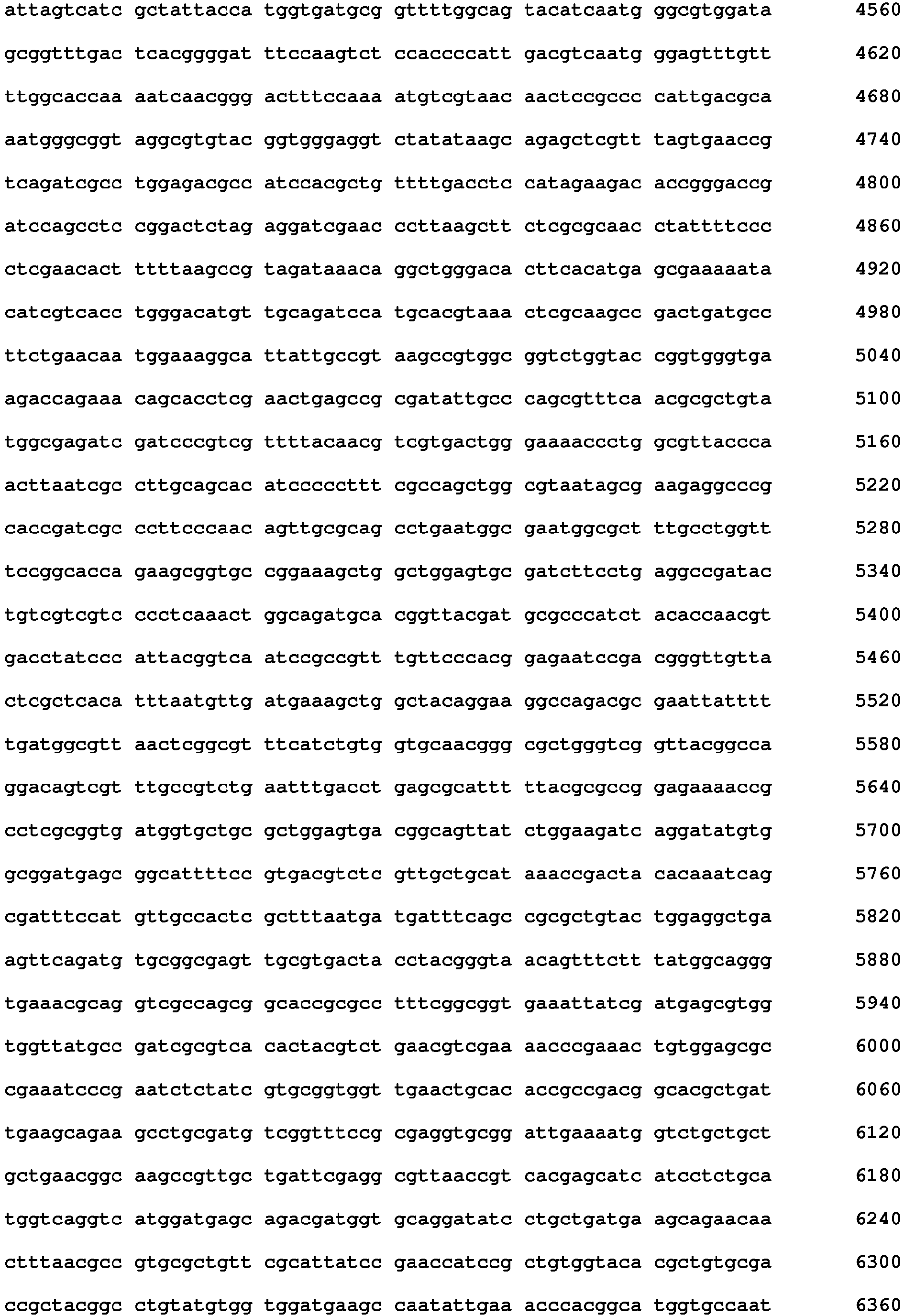


- <210> 2
<211> 14876
<212> DNA
<213> Artificial Sequence - <220>
<223> pCLS09G1f2 vector - <220>
<221> promoter
<222> (4140)..(4834) - <220>
<221> gene
<222> (4937)..(8164) - <220>
<221> gene
<222> (8216)..(8418) - <220>
<221> gene
<222> (8711)..(11139) - <220>
<221> gene
<222> (11146)..(13574) - <400> 2
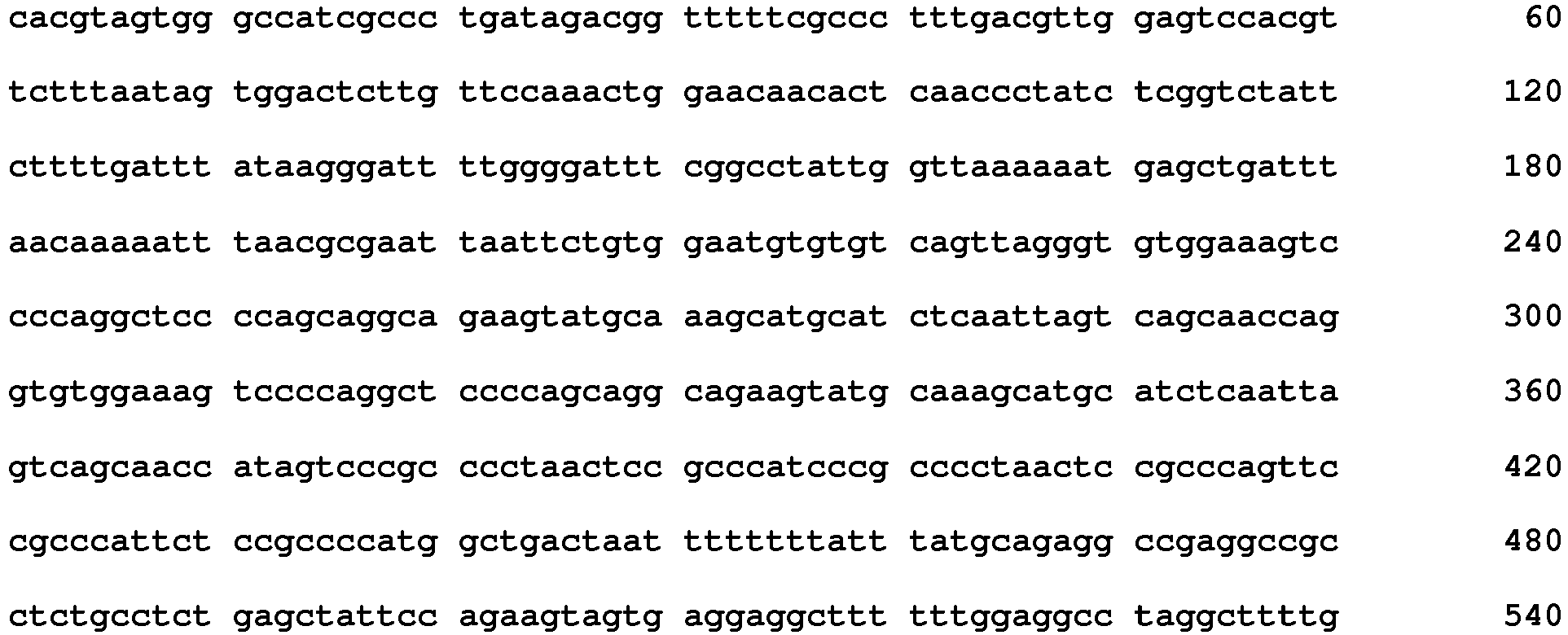


- <210> 3
<211> 17311
<212> DNA
<213> Artificial Sequence - <220>
<223> pCLS09G1f3 vector - <220>
<221> gene
<222> (3926)..(6354) - <220>
<221> promoter
<222> (6575)..(7269) - <220>
<221> gene
<222> (7372)..(10599) - <220>
<221> gene
<222> (10651)..(10853) - <220>
<221> gene
<222> (11146)..(13574) - <220>
<221> gene
<222> (13581)..(16009) - <400> 3


- <210> 4
<211> 14887
<212> DNA
<213> Artificial Sequence - <220>
<223> pCLS09G1f4 vector - <220>
<221> gene
<222> (3926)..(6354) - <220>
<221> promoter
<222> (6575)..(7269) - <220>
<221> gene
<222> (7372)..(10599) - <220>
<221> gene
<222> (10651)..(10853) - <220>
<221> gene
<222> (11146)..(13574) - <400> 4


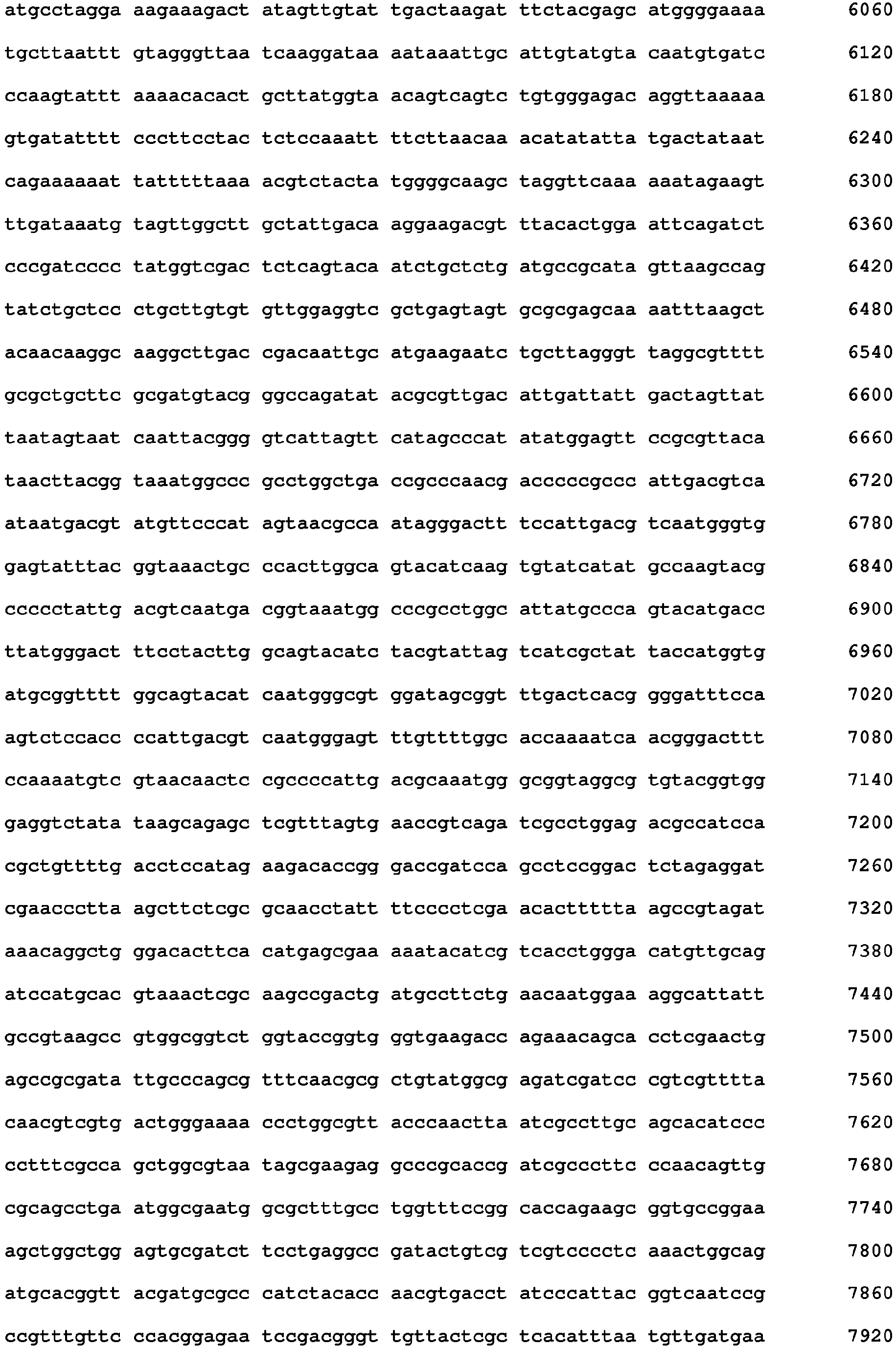


- <210> 5
<211> 30
<212> DNA
<213> Artificial Sequence - <220>
<223> Cs5S300F primer - <400> 5
attcttcagc acctccttaa tttttctccc 30 - <210> 6
<211> 30
<212> DNA
<213> Artificial Sequence - <220>
<223> Cs5S300R primer - <400> 6
ccaggcagcc aaagatcagt agttgtgttg 30 - <210> 7
<211> 28
<212> DNA
<213> Artificial Sequence - <220>
<223> 2kCspSF primer - <400> 7
tggttccttc attggaaaag gaaaacac 28 - <210> 8
<211> 27
<212> DNA
<213> Artificial Sequence - <220>
<223> 2kCspSR primer - <400> 8
tccgctgagg ctgtgcccac agccacc 27 - <210> 9
<211> 27
<212> DNA
<213> Artificial Sequence - <220>
<223> CspSF primer - <400> 9
ggatcccatt ctccttgatg tactaat 27 - <210> 10
<211> 28
<212> DNA
<213> Artificial Sequence - <220>
<223> CspSR primer - <400> 10
gaattcaaac aactcaatag caagaaac 28 - <210> 11
<211> 38
<212> DNA
<213> Artificial Sequence - <220>
<223> Bg5MF-100F-NheI primer - <400> 11
aattgctagc ttgtattctg tttcgtgagg caaggttt 38 - <210> 12
<211> 38
<212> DNA
<213> Artificial Sequence - <220>
<223> Bg5MR-100R-XhoI primer - <400> 12
aattctcgag ttcctctcta tgttggctca aatgtcct 38 - <210> 13
<211> 65
<212> DNA
<213> Artificial Sequence - <220>
<223> V6_F primer - <400> 13

- <210> 14
<211> 30
<212> DNA
<213> Artificial Sequence - <220>
<223> V6_R primer - <400> 14
gctagctaga gccccagctg gttctttccg 30 - <210> 15
<211> 46
<212> DNA
<213> Artificial Sequence - <220>
<223> PsvApaDraF primer - <400> 15
aaaattgggc cccactacgt gctgtggaat gtgtgtcagt tagggt 46 - <210> 16
<211> 43
<212> DNA
<213> Artificial Sequence - <220>
<223> PsvKzDHR primer - <400> 16
tggtcgaacc atgatggcgc gaaacgatcc tcatcctgtc tct 43 - <210> 17
<211> 43
<212> DNA
<213> Artificial Sequence - <220>
<223> DHKzPsvF primer - <400> 17
ggatcgtttc gcgccatcat ggttcgacca ttgaactgca tcg 43 - <210> 18
<211> 43
<212> DNA
<213> Artificial Sequence - <220>
<223> TKNheNdeR primer - <400> 18
tgtgtgcata tggctagcga taacaatttc acacaggaaa cag 43 - <210> 19
<211> 72
<212> DNA
<213> Artificial Sequence - <220>
<223> enhancer - <400> 19

- <210> 20
<211> 52
<212> DNA
<213> Artificial Sequence - <220>
<223> NhAsE1F primer - <400> 20
aattgctagc atatagcgat cgcgcaggac agcttccgac agcagggcca gg 52 - <210> 21
<211> 75
<212> DNA
<213> Artificial Sequence - <220>
<223> BbPsSbNhE1R primer - <400> 21

- <210> 22
<211> 37
<212> DNA
<213> Artificial Sequence - <220>
<223> galHinF primer - <400> 22
aattaagctt ctcgcgcaac ctattttccc ctcgaac 37 - <210> 23
<211> 37
<212> DNA
<213> Artificial Sequence - <220>
<223> galXhoR primer - <400> 23
aattctcgag ccgagtttgt cagaaagcag accaaac 37 - <210> 24
<211> 51
<212> DNA
<213> Artificial Sequence - <220>
<223> NhSbE1F primer - <400> 24
aattgctagc atatacctgc aggttgaatg agaatatcac tgtcccagac a 51 - <210> 25
<211> 80
<212> DNA
<213> Artificial Sequence - <220>
<223> NhAsSfPsE1R primer - <400> 25

- <210> 26
<211> 39
<212> DNA
<213> Artificial Sequence - <220>
<223> cs3sSbf1F primer - <400> 26
aattcctgca ggggatccca ttctccttga tgtactaat 39 - <210> 27
<211> 38
<212> DNA
<213> Artificial Sequence - <220>
<223> cs3sPsp1R primer - <400> 27
aattgggccc gaattcaaac aactcaatag caagaaac 38 - <210> 28
<211> 40
<212> DNA
<213> Artificial Sequence - <220>
<223> cs5sSbf1F primer - <400> 28
aattcctgca gggaattcct aaacagagca attaggtaag 40 - <210> 29
<211> 37
<212> DNA
<213> Artificial Sequence - <220>
<223> cs5sPsp1R primer - <400> 29
aattgggccc gaattccagt gtaaacgtct tccttgt 37 - <210> 30
<211> 40
<212> DNA
<213> Artificial Sequence - <220>
<223> glmSbf1F primer - <400> 30
aattcctgca ggttgtattc tgtttcgtga ggcaaggttt 40 - <210> 31
<211> 38
<212> DNA
<213> Artificial Sequence - <220>
<223> glmPsp1R primer - <400> 31
aattgggccc ttcctctcta tgttggctca aatgtcct 38 - <210> 32
<211> 37
<212> DNA
<213> Artificial Sequence - <220>
<223> cs3sPsp2F primer - <400> 32
aattgggccc ggatcccatt ctccttgatg tactaat 37 - <210> 33
<211> 45
<212> DNA
<213> Artificial Sequence - <220>
<223> cs3sSfi2R primer - <400> 33
aattggccat gatggccgaa ttcaaacaac tcaatagcaa gaaac 45 - <210> 34
<211> 38
<212> DNA
<213> Artificial Sequence - <220>
<223> cs5sPsp2F primer - <400> 34
aattgggccc gaattcctaa acagagcaat taggtaag 38 - <210> 35
<211> 44
<212> DNA
<213> Artificial Sequence - <220>
<223> cs5sSfi2R primer - <400> 35
aattggccat gatggccgaa ttccagtgta aacgtcttcc ttgt 44 - <210> 36
<211> 38
<212> DNA
<213> Artificial Sequence - <220>
<223> cs5sBg13Fprimer - <400> 36
aattagatct gaattcctaa acagagcaat taggtaag 38 - <210> 37
<211> 37
<212> DNA
<213> Artificial Sequence - <220>
<223> cs5sBgl3R primer - <400> 37
aattagatct gaattccagt gtaaacgtct tccttgt 37 - <210> 38
<211> 25
<212> DNA
<213> Artificial Sequence - <220>
<223> IE1ATGF primer - <400> 38
atgggggtgc acgaatgtcc tgcct 25 - <210> 39
<211> 26
<212> DNA
<213> Artificial Sequence - <220>
<223> IE1TGAR primer - <400> 39
tcatctgtcc cctgtcctgc aggcct 26 - <210> 40
<211> 18
<212> DNA
<213> Artificial Sequence - <220>
<223> M13R primer - <400> 40
gaaacagcta tgaccatg 18 - <210> 41
<211> 39
<212> DNA
<213> Artificial Sequence - <220>
<223> IA1g1R primer - <400> 41
ctcattcaag ctgcatgttt cattacagcc cgtcgtgat 39 - <210> 42
<211> 20
<212> DNA
<213> Artificial Sequence - <220>
<223> M13F primer - <400> 42
cagggttttc ccagtcacga 20 - <210> 43
<211> 39
<212> DNA
<213> Artificial Sequence - <220>
<223> IA1g1F primer - <400> 43
atcacgacgg gctgtaatga aacatgcagc ttgaatgag 39 - <210> 44
<211> 42
<212> DNA
<213> Artificial Sequence - <220>
<223> IA1G2R primer - <400> 44
cacatgcagc tgcagtgtct cattcacctg ggaagagttg ac 42 - <210> 45
<211> 42
<212> DNA
<213> Artificial Sequence - <220>
<223> IA1G2F primer - <400> 45
gtcaactctt cccaggtgaa tgagacactg cagctgcatg tg 42 - <210> 46
<211> 41
<212> DNA
<213> Artificial Sequence - <220>
<223> IElKzATGHinF primer - <400> 46
aattaagctt gccaccatgg gggtgcacga atgtcctgcc t 41 - <210> 47
<211> 36
<212> DNA
<213> Artificial Sequence - <220>
<223> IE1TGAXhoR primer - <400> 47
aattctcgag tcatctgtcc cctgtcctgc aggcct 36 - <210> 48
<211> 51
<212> DNA
<213> Artificial Sequence - <220>
<223> NhAsflF primer - <400> 48
aattgctagc atataggcgc gccaacttga ttagggtgat ggttcacgta g 51 - <210> 49
<211> 73
<212> DNA
<213> Artificial Sequence - <220>
<223> NhClPaPsf1R primer - <400> 49

- <210> 50
<211> 39
<212> DNA
<213> Artificial Sequence - <220>
<223> cs3sAsc1F primer - <400> 50
aattggcgcg ccggatccca ttctccttga tgtactaat 39 - <210> 51
<211> 38
<212> DNA
<213> Artificial Sequence - <220>
<223> cs3sPsp1R primer - <400> 51
aattgggccc gaattcaaac aactcaatag caagaaac 38 - <210> 52
<211> 40
<212> DNA
<213> Artificial Sequence - <220>
<223> cs5sAsc1F primer - <400> 52
aattggcgcg ccgaattcct aaacagagca attaggtaag 40 - <210> 53
<211> 37
<212> DNA
<213> Artificial Sequence - <220>
<223> cs5sPsp1R primer - <400> 53
aattgggccc gaattccagt gtaaacgtct tccttgt 37 - <210> 54
<211> 61
<212> DNA
<213> Artificial Sequence - <220>
<223> V1_F primer - <400> 54

- <210> 55
<211> 30
<212> DNA
<213> Artificial Sequence - <220>
<223> V1_R primer - <400> 55
tagagcccca gctggttctt tccgcctcag 30 - <210> 56
<211> 60
<212> DNA
<213> Artificial Sequence - <220>
<223> V2_F primer - <400> 56

- <210> 57
<211> 30
<212> DNA
<213> Artificial Sequence - <220>
<223> V2_R primer - <400> 57
tagagcccca gctggttctt tccgcctcag 30 - <210> 58
<211> 37
<212> DNA
<213> Artificial Sequence - <220>
<223> PcmvAgeF primer - <400> 58
aatctgaccg gtgttaggcg ttttgcgctg cttcgcg 37 - <210> 59
<211> 51
<212> DNA
<213> Artificial Sequence - <220>
<223> BGHNheDraR primer - <400> 59
ttactacact acgtggatcg agctagctag agccccagct ggttctttcc g 51 - <210> 60
<211> 63
<212> DNA
<213> Artificial Sequence - <220>
<223> HlssF primer - <400> 60

- <210> 61
<211> 40
<212> DNA
<213> Artificial Sequence - <220>
<223> H1TGAXhoR primer - <400> 61
aattctcgag tcatttaccc ggagacaggg agaggctctt 40 - <210> 62
<211> 63
<212> DNA
<213> Artificial Sequence - <220>
<223> H1ssEcoF primer - <400> 62

- <210> 63
<211> 63
<212> DNA
<213> Artificial Sequence - <220>
<223> H2ssF primer - <400> 63

- <210> 64
<211> 40
<212> DNA
<213> Artificial Sequence - <220>
<223> H2TGABamR primer - <400> 64
aattggatcc tcaacactct cccctgttga agctctttgt 40 - <210> 65
<211> 63
<212> DNA
<213> Artificial Sequence - <220>
<223> H2ssHinF primer - <400> 65

Claims (12)
- An expression vector for animal cells, comprising:(a) a 5'-scaffold or matrix attachment region (5'-SAR) of the cytotoxic serine protease-B (CSP-B) gene;(b) a promoter operable in animal cells; and(c) a polyadenylation sequence.
- The expression vector according to claim 1, wherein the expression vector further comprises a protein-coding nucleotide sequence to be expressed.
- The expression vector according to claim 1, wherein the 5'-SAR is present in two copies.
- The expression vector according to claim 1, wherein the promoter operable in the animal cells is a cytomegalovirus (CMV) promoter, an adenovirus late promoter, a vaccinia virus 7.5K promoter, a Simian virus 40 (SV40) promoter, an SV40E1 promoter, a herpes simplex virus (HSV) tk promoter, a respiratory syncytial virus (RSV) promoter, an elongation factor 1-α (EF1-a) promoter, a metallothionein promoter, a β-actin promoter, a human interleukin-2 (IL-2) gene promoter, a human interferon (IFN) gene promoter, a human IL-4 gene promoter, a human lymphotoxin gene promoter, or human granulocyte-macrophage colony-stimulating factor (GM-CSF) gene promoter.
- The expression vector according to claim 1, wherein the polyadenylation sequence is a bovine growth hormone polyadenylation sequence, an HSV-derived thymidine kinase (TK) polyadenylation sequence, or an SV40-derived polyadenylation sequence.
- The expression vector according to claim 1, wherein the animal cells are Chinese hamster ovary (CHO) cells, VERO cells, HeLa cells, WI38 cells, baby hamster kidney (BHK) cells, COS cells, or Madin-Darby canine kidney (MDCK) cells.
- The expression vector according to claim 2, wherein the protein is hormone, cytokine, antibody, peptide aptamer, Adnectin, affibody, avimer, or a Kunitz domain.
- The expression vector according to claim 7, wherein the protein is erythropoietin (EPO), an EPO analog, or an anti-human epidermal growth factor receptor 2 (anti-HER2) antibody.
- An animal cell transfected with the expression vector according to any one of claims 1 to 8.
- A method for preparing a recombinant protein, comprising incubating the transfected animal cell of claim 9.
- The expression vector according to claim 3, wherein the two copies of the 5'-SAR are consecutively present on the vector.
- The expression vector according to claim 11, wherein the two copies of the 5'-SAR are consecutively present downstream of the protein-coding nucleotide sequence to be expressed.
Applications Claiming Priority (2)
| Application Number | Priority Date | Filing Date | Title |
|---|---|---|---|
| KR1020110056685A KR101420274B1 (en) | 2011-06-13 | 2011-06-13 | Animal Expression Vectors Carrying CSP-B 5' SAR Factor and Methods for Preparing Recombinant Proteins Using the Same |
| PCT/KR2012/003995 WO2012173344A2 (en) | 2011-06-13 | 2012-05-21 | Expression vector for animal cells including csp-b 5'-sar factor and method for producing recombinant proteins using same |
Publications (3)
| Publication Number | Publication Date |
|---|---|
| EP2719764A2 EP2719764A2 (en) | 2014-04-16 |
| EP2719764A4 EP2719764A4 (en) | 2014-12-24 |
| EP2719764B1 true EP2719764B1 (en) | 2016-10-26 |
Family
ID=47357566
Family Applications (1)
| Application Number | Title | Priority Date | Filing Date |
|---|---|---|---|
| EP12800088.2A Not-in-force EP2719764B1 (en) | 2011-06-13 | 2012-05-21 | Expression vector for animal cells including csp-b 5'-sar factor and method for producing recombinant proteins using same |
Country Status (7)
| Country | Link |
|---|---|
| US (1) | US9228218B2 (en) |
| EP (1) | EP2719764B1 (en) |
| JP (1) | JP5795434B2 (en) |
| KR (1) | KR101420274B1 (en) |
| CN (1) | CN103797123B (en) |
| ES (1) | ES2611402T3 (en) |
| WO (1) | WO2012173344A2 (en) |
Families Citing this family (6)
| Publication number | Priority date | Publication date | Assignee | Title |
|---|---|---|---|---|
| ES2617217T3 (en) * | 2011-03-30 | 2017-06-15 | Pangen Biotech Inc. | Expression vector for animal cells |
| BR112015027373A2 (en) * | 2013-05-03 | 2017-08-29 | Fujifilm Diosynth Biotechnologies Uk Ltd | EXPRESSION PROCESS |
| KR101599138B1 (en) | 2014-06-17 | 2016-03-03 | 한국생명공학연구원 | Gene element enhancing expression of recombinant proteins in mammalian cells and uses thereof |
| KR101757346B1 (en) | 2017-03-27 | 2017-07-26 | 아주대학교산학협력단 | Anti-EMAP II Antibody and Use thereof |
| AU2018278730B2 (en) | 2017-05-30 | 2021-02-04 | Chong Kun Dang Pharmaceutical Corp. | A novel anti-c-Met antibody and use thereof |
| KR20250126954A (en) | 2024-02-16 | 2025-08-26 | 인천대학교 산학협력단 | EXPRESSION CASSETTE AND VECTOR FOR PROTEIN OF INTEREST CONTAINING A DELETED iMAR GENE AND TRANSFORMED CELLS CONTAINING THE SAME |
Family Cites Families (5)
| Publication number | Priority date | Publication date | Assignee | Title |
|---|---|---|---|---|
| KR100408844B1 (en) * | 2000-07-29 | 2003-12-06 | 한국산업기술평가원 | Expression vector using for animal cell |
| KR100529281B1 (en) * | 2000-12-15 | 2005-11-17 | 주식회사 팬젠 | Expression vector for animal cell containing nuclear matrix attachment region of interferon beta |
| WO2002048379A1 (en) * | 2000-12-15 | 2002-06-20 | Pangen Biotech Inc. | Expression vector for animal cell containing nuclear matrix attachment region fo interferon beta |
| US8772021B2 (en) * | 2005-03-04 | 2014-07-08 | Celltrion, Inc. | Expression vector for animal cell comprising at least one copy of MAR DNA sequences at the 3′ terminal of transcription termination region of a gene and method for the expression of foreign gene using the vector |
| US20090018031A1 (en) * | 2006-12-07 | 2009-01-15 | Switchgear Genomics | Transcriptional regulatory elements of biological pathways tools, and methods |
-
2011
- 2011-06-13 KR KR1020110056685A patent/KR101420274B1/en not_active Expired - Fee Related
-
2012
- 2012-05-21 WO PCT/KR2012/003995 patent/WO2012173344A2/en not_active Ceased
- 2012-05-21 US US14/125,705 patent/US9228218B2/en not_active Expired - Fee Related
- 2012-05-21 JP JP2014515713A patent/JP5795434B2/en not_active Expired - Fee Related
- 2012-05-21 ES ES12800088.2T patent/ES2611402T3/en active Active
- 2012-05-21 EP EP12800088.2A patent/EP2719764B1/en not_active Not-in-force
- 2012-05-21 CN CN201280029037.6A patent/CN103797123B/en not_active Expired - Fee Related
Also Published As
| Publication number | Publication date |
|---|---|
| ES2611402T3 (en) | 2017-05-08 |
| JP2014516580A (en) | 2014-07-17 |
| WO2012173344A2 (en) | 2012-12-20 |
| WO2012173344A3 (en) | 2013-03-28 |
| CN103797123A (en) | 2014-05-14 |
| KR101420274B1 (en) | 2014-07-21 |
| EP2719764A2 (en) | 2014-04-16 |
| EP2719764A4 (en) | 2014-12-24 |
| JP5795434B2 (en) | 2015-10-14 |
| US9228218B2 (en) | 2016-01-05 |
| US20140093914A1 (en) | 2014-04-03 |
| CN103797123B (en) | 2016-04-20 |
| KR20120137683A (en) | 2012-12-24 |
Similar Documents
| Publication | Publication Date | Title |
|---|---|---|
| AU2022204298B2 (en) | Nucleobase editors and uses thereof | |
| US9228218B2 (en) | Expression vector for animal cells including CSP-B 5′-SAR factor and method for producing recombinant proteins using same | |
| RU2745528C2 (en) | Production of alkaline phosphatases | |
| US12570691B2 (en) | Purification of chimeric FVIII molecules | |
| CN108473969B9 (en) | Modification of RNA-associated enzymes for enhanced production | |
| US10030063B2 (en) | Production of therapeutic proteins in genetically modified mammalian cells | |
| JP2014524241A (en) | Collagen 7 and related methods | |
| KR20100028044A (en) | Method for manufacturing active recombinant blood coagulation factor ix | |
| KR20080002949A (en) | Host cell containing a vector for protein production requiring gamma carboxylation | |
| WO2016003368A1 (en) | Optimized vectors for the production of recombinant proteins | |
| WO2010128032A1 (en) | Cho / cert cell lines | |
| JP6131074B2 (en) | Secretory signal sequence | |
| AU2006317944A1 (en) | Method for producing proteins comprising non-natural amino acids incorporated therein | |
| EP2653541B1 (en) | Method for producing proteins | |
| WO2020157274A1 (en) | Methods for optimizing heterologous gene expression | |
| Lee et al. | Heterologous expression and purification of a CRISPR-cas9-based adenine base editor | |
| RU2801121C2 (en) | Production of alkaline phosphatases | |
| US20250304997A1 (en) | Polynucleotides with selection markers | |
| KR20190117624A (en) | Methods of Production of Biological Product Variants | |
| US20180094258A1 (en) | Method for recombinant protein production in mammalian cells | |
| Lee | CHO cell engineering to develop new chassis for enhanced difficult to express recombinant protein production | |
| Gómez Aquino et al. | Computationally inspired glycoengineering to maximise mAb β4-galactosylation | |
| Xie | Heterologous Protein Expression: Production of Tissue Plasminogen Activator in Pichia Pastoris and Probing Intein Activity on Elastin-Like Polypeptide Aggregates | |
| JP5548932B2 (en) | Protein high production method using ATF4 and / or GADD34 |
Legal Events
| Date | Code | Title | Description |
|---|---|---|---|
| PUAI | Public reference made under article 153(3) epc to a published international application that has entered the european phase |
Free format text: ORIGINAL CODE: 0009012 |
|
| 17P | Request for examination filed |
Effective date: 20131213 |
|
| AK | Designated contracting states |
Kind code of ref document: A2 Designated state(s): AL AT BE BG CH CY CZ DE DK EE ES FI FR GB GR HR HU IE IS IT LI LT LU LV MC MK MT NL NO PL PT RO RS SE SI SK SM TR |
|
| RAP1 | Party data changed (applicant data changed or rights of an application transferred) |
Owner name: CHONG KUN DANG HOLDINGS CORP. |
|
| RAP1 | Party data changed (applicant data changed or rights of an application transferred) |
Owner name: CHONG KUN DANG PHARMACEUTICAL CORP. |
|
| DAX | Request for extension of the european patent (deleted) | ||
| RIC1 | Information provided on ipc code assigned before grant |
Ipc: C12N 5/10 20060101ALI20141112BHEP Ipc: C12N 15/12 20060101ALI20141112BHEP Ipc: C12N 15/85 20060101AFI20141112BHEP Ipc: C12N 9/64 20060101ALI20141112BHEP |
|
| A4 | Supplementary search report drawn up and despatched |
Effective date: 20141121 |
|
| GRAP | Despatch of communication of intention to grant a patent |
Free format text: ORIGINAL CODE: EPIDOSNIGR1 |
|
| RIC1 | Information provided on ipc code assigned before grant |
Ipc: C12N 9/64 20060101ALI20160329BHEP Ipc: C12N 15/85 20060101AFI20160329BHEP Ipc: C12N 5/10 20060101ALI20160329BHEP Ipc: C12N 15/12 20060101ALI20160329BHEP |
|
| INTG | Intention to grant announced |
Effective date: 20160504 |
|
| GRAS | Grant fee paid |
Free format text: ORIGINAL CODE: EPIDOSNIGR3 |
|
| GRAA | (expected) grant |
Free format text: ORIGINAL CODE: 0009210 |
|
| AK | Designated contracting states |
Kind code of ref document: B1 Designated state(s): AL AT BE BG CH CY CZ DE DK EE ES FI FR GB GR HR HU IE IS IT LI LT LU LV MC MK MT NL NO PL PT RO RS SE SI SK SM TR |
|
| REG | Reference to a national code |
Ref country code: GB Ref legal event code: FG4D |
|
| REG | Reference to a national code |
Ref country code: CH Ref legal event code: EP |
|
| REG | Reference to a national code |
Ref country code: AT Ref legal event code: REF Ref document number: 840072 Country of ref document: AT Kind code of ref document: T Effective date: 20161115 |
|
| REG | Reference to a national code |
Ref country code: IE Ref legal event code: FG4D |
|
| REG | Reference to a national code |
Ref country code: DE Ref legal event code: R096 Ref document number: 602012024635 Country of ref document: DE |
|
| REG | Reference to a national code |
Ref country code: CH Ref legal event code: NV Representative=s name: FIAMMENGHI-FIAMMENGHI, CH |
|
| REG | Reference to a national code |
Ref country code: LT Ref legal event code: MG4D |
|
| PG25 | Lapsed in a contracting state [announced via postgrant information from national office to epo] |
Ref country code: LV Free format text: LAPSE BECAUSE OF FAILURE TO SUBMIT A TRANSLATION OF THE DESCRIPTION OR TO PAY THE FEE WITHIN THE PRESCRIBED TIME-LIMIT Effective date: 20161026 |
|
| REG | Reference to a national code |
Ref country code: NL Ref legal event code: MP Effective date: 20161026 |
|
| REG | Reference to a national code |
Ref country code: AT Ref legal event code: MK05 Ref document number: 840072 Country of ref document: AT Kind code of ref document: T Effective date: 20161026 |
|
| PG25 | Lapsed in a contracting state [announced via postgrant information from national office to epo] |
Ref country code: NO Free format text: LAPSE BECAUSE OF FAILURE TO SUBMIT A TRANSLATION OF THE DESCRIPTION OR TO PAY THE FEE WITHIN THE PRESCRIBED TIME-LIMIT Effective date: 20170126 Ref country code: LT Free format text: LAPSE BECAUSE OF FAILURE TO SUBMIT A TRANSLATION OF THE DESCRIPTION OR TO PAY THE FEE WITHIN THE PRESCRIBED TIME-LIMIT Effective date: 20161026 Ref country code: SE Free format text: LAPSE BECAUSE OF FAILURE TO SUBMIT A TRANSLATION OF THE DESCRIPTION OR TO PAY THE FEE WITHIN THE PRESCRIBED TIME-LIMIT Effective date: 20161026 Ref country code: GR Free format text: LAPSE BECAUSE OF FAILURE TO SUBMIT A TRANSLATION OF THE DESCRIPTION OR TO PAY THE FEE WITHIN THE PRESCRIBED TIME-LIMIT Effective date: 20170127 |
|
| REG | Reference to a national code |
Ref country code: ES Ref legal event code: FG2A Ref document number: 2611402 Country of ref document: ES Kind code of ref document: T3 Effective date: 20170508 |
|
| REG | Reference to a national code |
Ref country code: FR Ref legal event code: PLFP Year of fee payment: 6 |
|
| PG25 | Lapsed in a contracting state [announced via postgrant information from national office to epo] |
Ref country code: NL Free format text: LAPSE BECAUSE OF FAILURE TO SUBMIT A TRANSLATION OF THE DESCRIPTION OR TO PAY THE FEE WITHIN THE PRESCRIBED TIME-LIMIT Effective date: 20161026 Ref country code: PL Free format text: LAPSE BECAUSE OF FAILURE TO SUBMIT A TRANSLATION OF THE DESCRIPTION OR TO PAY THE FEE WITHIN THE PRESCRIBED TIME-LIMIT Effective date: 20161026 Ref country code: BE Free format text: LAPSE BECAUSE OF FAILURE TO SUBMIT A TRANSLATION OF THE DESCRIPTION OR TO PAY THE FEE WITHIN THE PRESCRIBED TIME-LIMIT Effective date: 20161026 Ref country code: AT Free format text: LAPSE BECAUSE OF FAILURE TO SUBMIT A TRANSLATION OF THE DESCRIPTION OR TO PAY THE FEE WITHIN THE PRESCRIBED TIME-LIMIT Effective date: 20161026 Ref country code: FI Free format text: LAPSE BECAUSE OF FAILURE TO SUBMIT A TRANSLATION OF THE DESCRIPTION OR TO PAY THE FEE WITHIN THE PRESCRIBED TIME-LIMIT Effective date: 20161026 Ref country code: PT Free format text: LAPSE BECAUSE OF FAILURE TO SUBMIT A TRANSLATION OF THE DESCRIPTION OR TO PAY THE FEE WITHIN THE PRESCRIBED TIME-LIMIT Effective date: 20170227 Ref country code: IS Free format text: LAPSE BECAUSE OF FAILURE TO SUBMIT A TRANSLATION OF THE DESCRIPTION OR TO PAY THE FEE WITHIN THE PRESCRIBED TIME-LIMIT Effective date: 20170226 Ref country code: RS Free format text: LAPSE BECAUSE OF FAILURE TO SUBMIT A TRANSLATION OF THE DESCRIPTION OR TO PAY THE FEE WITHIN THE PRESCRIBED TIME-LIMIT Effective date: 20161026 Ref country code: HR Free format text: LAPSE BECAUSE OF FAILURE TO SUBMIT A TRANSLATION OF THE DESCRIPTION OR TO PAY THE FEE WITHIN THE PRESCRIBED TIME-LIMIT Effective date: 20161026 |
|
| REG | Reference to a national code |
Ref country code: DE Ref legal event code: R097 Ref document number: 602012024635 Country of ref document: DE |
|
| PG25 | Lapsed in a contracting state [announced via postgrant information from national office to epo] |
Ref country code: EE Free format text: LAPSE BECAUSE OF FAILURE TO SUBMIT A TRANSLATION OF THE DESCRIPTION OR TO PAY THE FEE WITHIN THE PRESCRIBED TIME-LIMIT Effective date: 20161026 Ref country code: DK Free format text: LAPSE BECAUSE OF FAILURE TO SUBMIT A TRANSLATION OF THE DESCRIPTION OR TO PAY THE FEE WITHIN THE PRESCRIBED TIME-LIMIT Effective date: 20161026 Ref country code: RO Free format text: LAPSE BECAUSE OF FAILURE TO SUBMIT A TRANSLATION OF THE DESCRIPTION OR TO PAY THE FEE WITHIN THE PRESCRIBED TIME-LIMIT Effective date: 20161026 Ref country code: CZ Free format text: LAPSE BECAUSE OF FAILURE TO SUBMIT A TRANSLATION OF THE DESCRIPTION OR TO PAY THE FEE WITHIN THE PRESCRIBED TIME-LIMIT Effective date: 20161026 Ref country code: SK Free format text: LAPSE BECAUSE OF FAILURE TO SUBMIT A TRANSLATION OF THE DESCRIPTION OR TO PAY THE FEE WITHIN THE PRESCRIBED TIME-LIMIT Effective date: 20161026 |
|
| PG25 | Lapsed in a contracting state [announced via postgrant information from national office to epo] |
Ref country code: BG Free format text: LAPSE BECAUSE OF FAILURE TO SUBMIT A TRANSLATION OF THE DESCRIPTION OR TO PAY THE FEE WITHIN THE PRESCRIBED TIME-LIMIT Effective date: 20170126 Ref country code: SM Free format text: LAPSE BECAUSE OF FAILURE TO SUBMIT A TRANSLATION OF THE DESCRIPTION OR TO PAY THE FEE WITHIN THE PRESCRIBED TIME-LIMIT Effective date: 20161026 Ref country code: LU Free format text: LAPSE BECAUSE OF NON-PAYMENT OF DUE FEES Effective date: 20170531 |
|
| PLBE | No opposition filed within time limit |
Free format text: ORIGINAL CODE: 0009261 |
|
| STAA | Information on the status of an ep patent application or granted ep patent |
Free format text: STATUS: NO OPPOSITION FILED WITHIN TIME LIMIT |
|
| 26N | No opposition filed |
Effective date: 20170727 |
|
| PG25 | Lapsed in a contracting state [announced via postgrant information from national office to epo] |
Ref country code: SI Free format text: LAPSE BECAUSE OF FAILURE TO SUBMIT A TRANSLATION OF THE DESCRIPTION OR TO PAY THE FEE WITHIN THE PRESCRIBED TIME-LIMIT Effective date: 20161026 |
|
| PG25 | Lapsed in a contracting state [announced via postgrant information from national office to epo] |
Ref country code: MC Free format text: LAPSE BECAUSE OF FAILURE TO SUBMIT A TRANSLATION OF THE DESCRIPTION OR TO PAY THE FEE WITHIN THE PRESCRIBED TIME-LIMIT Effective date: 20161026 |
|
| REG | Reference to a national code |
Ref country code: IE Ref legal event code: MM4A |
|
| PG25 | Lapsed in a contracting state [announced via postgrant information from national office to epo] |
Ref country code: LU Free format text: LAPSE BECAUSE OF NON-PAYMENT OF DUE FEES Effective date: 20170521 |
|
| PG25 | Lapsed in a contracting state [announced via postgrant information from national office to epo] |
Ref country code: IE Free format text: LAPSE BECAUSE OF NON-PAYMENT OF DUE FEES Effective date: 20170521 |
|
| REG | Reference to a national code |
Ref country code: FR Ref legal event code: PLFP Year of fee payment: 7 |
|
| PG25 | Lapsed in a contracting state [announced via postgrant information from national office to epo] |
Ref country code: MT Free format text: LAPSE BECAUSE OF NON-PAYMENT OF DUE FEES Effective date: 20170521 |
|
| PG25 | Lapsed in a contracting state [announced via postgrant information from national office to epo] |
Ref country code: HU Free format text: LAPSE BECAUSE OF FAILURE TO SUBMIT A TRANSLATION OF THE DESCRIPTION OR TO PAY THE FEE WITHIN THE PRESCRIBED TIME-LIMIT; INVALID AB INITIO Effective date: 20120521 |
|
| PG25 | Lapsed in a contracting state [announced via postgrant information from national office to epo] |
Ref country code: CY Free format text: LAPSE BECAUSE OF NON-PAYMENT OF DUE FEES Effective date: 20161026 |
|
| PG25 | Lapsed in a contracting state [announced via postgrant information from national office to epo] |
Ref country code: MK Free format text: LAPSE BECAUSE OF FAILURE TO SUBMIT A TRANSLATION OF THE DESCRIPTION OR TO PAY THE FEE WITHIN THE PRESCRIBED TIME-LIMIT Effective date: 20161026 |
|
| PG25 | Lapsed in a contracting state [announced via postgrant information from national office to epo] |
Ref country code: TR Free format text: LAPSE BECAUSE OF FAILURE TO SUBMIT A TRANSLATION OF THE DESCRIPTION OR TO PAY THE FEE WITHIN THE PRESCRIBED TIME-LIMIT Effective date: 20161026 |
|
| PG25 | Lapsed in a contracting state [announced via postgrant information from national office to epo] |
Ref country code: AL Free format text: LAPSE BECAUSE OF FAILURE TO SUBMIT A TRANSLATION OF THE DESCRIPTION OR TO PAY THE FEE WITHIN THE PRESCRIBED TIME-LIMIT Effective date: 20161026 |
|
| PGFP | Annual fee paid to national office [announced via postgrant information from national office to epo] |
Ref country code: GB Payment date: 20220321 Year of fee payment: 11 |
|
| PGFP | Annual fee paid to national office [announced via postgrant information from national office to epo] |
Ref country code: IT Payment date: 20220322 Year of fee payment: 11 Ref country code: FR Payment date: 20220325 Year of fee payment: 11 |
|
| PGFP | Annual fee paid to national office [announced via postgrant information from national office to epo] |
Ref country code: ES Payment date: 20220613 Year of fee payment: 11 Ref country code: DE Payment date: 20220321 Year of fee payment: 11 |
|
| PGFP | Annual fee paid to national office [announced via postgrant information from national office to epo] |
Ref country code: CH Payment date: 20220405 Year of fee payment: 11 |
|
| REG | Reference to a national code |
Ref country code: DE Ref legal event code: R119 Ref document number: 602012024635 Country of ref document: DE |
|
| REG | Reference to a national code |
Ref country code: CH Ref legal event code: PL |
|
| GBPC | Gb: european patent ceased through non-payment of renewal fee |
Effective date: 20230521 |
|
| PG25 | Lapsed in a contracting state [announced via postgrant information from national office to epo] |
Ref country code: LI Free format text: LAPSE BECAUSE OF NON-PAYMENT OF DUE FEES Effective date: 20230531 Ref country code: CH Free format text: LAPSE BECAUSE OF NON-PAYMENT OF DUE FEES Effective date: 20230531 |
|
| PG25 | Lapsed in a contracting state [announced via postgrant information from national office to epo] |
Ref country code: IT Free format text: LAPSE BECAUSE OF NON-PAYMENT OF DUE FEES Effective date: 20230521 Ref country code: DE Free format text: LAPSE BECAUSE OF NON-PAYMENT OF DUE FEES Effective date: 20231201 Ref country code: GB Free format text: LAPSE BECAUSE OF NON-PAYMENT OF DUE FEES Effective date: 20230521 |
|
| PG25 | Lapsed in a contracting state [announced via postgrant information from national office to epo] |
Ref country code: FR Free format text: LAPSE BECAUSE OF NON-PAYMENT OF DUE FEES Effective date: 20230531 |
|
| REG | Reference to a national code |
Ref country code: ES Ref legal event code: FD2A Effective date: 20240701 |
|
| PG25 | Lapsed in a contracting state [announced via postgrant information from national office to epo] |
Ref country code: ES Free format text: LAPSE BECAUSE OF NON-PAYMENT OF DUE FEES Effective date: 20230522 |
|
| PG25 | Lapsed in a contracting state [announced via postgrant information from national office to epo] |
Ref country code: ES Free format text: LAPSE BECAUSE OF NON-PAYMENT OF DUE FEES Effective date: 20230522 |