EP2719666A1 - New goethite-calcite composite, its preparation process and its use for the separations of ions - Google Patents
New goethite-calcite composite, its preparation process and its use for the separations of ions Download PDFInfo
- Publication number
- EP2719666A1 EP2719666A1 EP12306266.3A EP12306266A EP2719666A1 EP 2719666 A1 EP2719666 A1 EP 2719666A1 EP 12306266 A EP12306266 A EP 12306266A EP 2719666 A1 EP2719666 A1 EP 2719666A1
- Authority
- EP
- European Patent Office
- Prior art keywords
- goethite
- calcite
- comprised
- composite
- pure
- Prior art date
- Legal status (The legal status is an assumption and is not a legal conclusion. Google has not performed a legal analysis and makes no representation as to the accuracy of the status listed.)
- Withdrawn
Links
- 229910021532 Calcite Inorganic materials 0.000 title claims abstract description 162
- 239000002131 composite material Substances 0.000 title claims abstract description 146
- 150000002500 ions Chemical class 0.000 title claims abstract description 46
- 238000002360 preparation method Methods 0.000 title claims abstract description 19
- 238000000926 separation method Methods 0.000 title abstract description 4
- AEIXRCIKZIZYPM-UHFFFAOYSA-M hydroxy(oxo)iron Chemical compound [O][Fe]O AEIXRCIKZIZYPM-UHFFFAOYSA-M 0.000 claims description 191
- 229910052598 goethite Inorganic materials 0.000 claims description 184
- HEMHJVSKTPXQMS-UHFFFAOYSA-M Sodium hydroxide Chemical compound [OH-].[Na+] HEMHJVSKTPXQMS-UHFFFAOYSA-M 0.000 claims description 103
- 239000002245 particle Substances 0.000 claims description 84
- 239000000920 calcium hydroxide Substances 0.000 claims description 63
- XLYOFNOQVPJJNP-UHFFFAOYSA-N water Substances O XLYOFNOQVPJJNP-UHFFFAOYSA-N 0.000 claims description 51
- 235000011116 calcium hydroxide Nutrition 0.000 claims description 39
- VTYYLEPIZMXCLO-UHFFFAOYSA-L Calcium carbonate Chemical compound [Ca+2].[O-]C([O-])=O VTYYLEPIZMXCLO-UHFFFAOYSA-L 0.000 claims description 37
- 238000000034 method Methods 0.000 claims description 37
- 239000000725 suspension Substances 0.000 claims description 37
- 230000008569 process Effects 0.000 claims description 31
- 231100000331 toxic Toxicity 0.000 claims description 23
- 230000002588 toxic effect Effects 0.000 claims description 23
- 239000001110 calcium chloride Substances 0.000 claims description 20
- 229910001628 calcium chloride Inorganic materials 0.000 claims description 20
- UXVMQQNJUSDDNG-UHFFFAOYSA-L Calcium chloride Chemical compound [Cl-].[Cl-].[Ca+2] UXVMQQNJUSDDNG-UHFFFAOYSA-L 0.000 claims description 19
- 238000001179 sorption measurement Methods 0.000 claims description 19
- 229910021578 Iron(III) chloride Inorganic materials 0.000 claims description 18
- 229910000019 calcium carbonate Inorganic materials 0.000 claims description 18
- RBTARNINKXHZNM-UHFFFAOYSA-K iron trichloride Chemical compound Cl[Fe](Cl)Cl RBTARNINKXHZNM-UHFFFAOYSA-K 0.000 claims description 18
- AXCZMVOFGPJBDE-UHFFFAOYSA-L calcium dihydroxide Chemical compound [OH-].[OH-].[Ca+2] AXCZMVOFGPJBDE-UHFFFAOYSA-L 0.000 claims description 17
- 229910001861 calcium hydroxide Inorganic materials 0.000 claims description 16
- 235000002639 sodium chloride Nutrition 0.000 claims description 14
- 229910052802 copper Inorganic materials 0.000 claims description 13
- 239000000463 material Substances 0.000 claims description 12
- 229910052793 cadmium Inorganic materials 0.000 claims description 11
- OBOHBYQXGJEPFW-UHFFFAOYSA-M O.[Cl-].[O-2].[Fe+2].[Ca+2] Chemical compound O.[Cl-].[O-2].[Fe+2].[Ca+2] OBOHBYQXGJEPFW-UHFFFAOYSA-M 0.000 claims description 10
- 239000010442 halite Substances 0.000 claims description 10
- 239000011019 hematite Substances 0.000 claims description 10
- 229910052595 hematite Inorganic materials 0.000 claims description 10
- LIKBJVNGSGBSGK-UHFFFAOYSA-N iron(3+);oxygen(2-) Chemical compound [O-2].[O-2].[O-2].[Fe+3].[Fe+3] LIKBJVNGSGBSGK-UHFFFAOYSA-N 0.000 claims description 10
- 229910052785 arsenic Inorganic materials 0.000 claims description 7
- 239000000203 mixture Substances 0.000 claims description 7
- 229910052711 selenium Inorganic materials 0.000 claims description 7
- KWYUFKZDYYNOTN-UHFFFAOYSA-M Potassium hydroxide Chemical compound [OH-].[K+] KWYUFKZDYYNOTN-UHFFFAOYSA-M 0.000 claims description 6
- 239000013078 crystal Substances 0.000 claims description 6
- WMFOQBRAJBCJND-UHFFFAOYSA-M Lithium hydroxide Chemical compound [Li+].[OH-] WMFOQBRAJBCJND-UHFFFAOYSA-M 0.000 claims description 4
- CPRMKOQKXYSDML-UHFFFAOYSA-M rubidium hydroxide Chemical compound [OH-].[Rb+] CPRMKOQKXYSDML-UHFFFAOYSA-M 0.000 claims description 4
- 239000007900 aqueous suspension Substances 0.000 claims description 3
- 239000011669 selenium Substances 0.000 description 33
- 238000006243 chemical reaction Methods 0.000 description 28
- 239000002585 base Substances 0.000 description 20
- 230000015572 biosynthetic process Effects 0.000 description 19
- 239000010949 copper Substances 0.000 description 17
- 238000001556 precipitation Methods 0.000 description 16
- 239000002609 medium Substances 0.000 description 15
- 238000003786 synthesis reaction Methods 0.000 description 13
- 238000011065 in-situ storage Methods 0.000 description 12
- 238000002411 thermogravimetry Methods 0.000 description 12
- FAPWRFPIFSIZLT-UHFFFAOYSA-M Sodium chloride Chemical compound [Na+].[Cl-] FAPWRFPIFSIZLT-UHFFFAOYSA-M 0.000 description 11
- 150000008044 alkali metal hydroxides Chemical class 0.000 description 11
- 229910052500 inorganic mineral Inorganic materials 0.000 description 11
- 235000010755 mineral Nutrition 0.000 description 11
- 239000011707 mineral Substances 0.000 description 11
- 229910021519 iron(III) oxide-hydroxide Inorganic materials 0.000 description 10
- 239000007789 gas Substances 0.000 description 8
- 238000002441 X-ray diffraction Methods 0.000 description 7
- 238000005755 formation reaction Methods 0.000 description 7
- LFQSCWFLJHTTHZ-UHFFFAOYSA-N Ethanol Chemical compound CCO LFQSCWFLJHTTHZ-UHFFFAOYSA-N 0.000 description 6
- 238000002474 experimental method Methods 0.000 description 6
- 239000011780 sodium chloride Substances 0.000 description 6
- 239000000243 solution Substances 0.000 description 6
- 230000002776 aggregation Effects 0.000 description 5
- 238000004220 aggregation Methods 0.000 description 5
- 239000011575 calcium Substances 0.000 description 5
- -1 e.g. Substances 0.000 description 5
- MSNWSDPPULHLDL-UHFFFAOYSA-K ferric hydroxide Chemical compound [OH-].[OH-].[OH-].[Fe+3] MSNWSDPPULHLDL-UHFFFAOYSA-K 0.000 description 5
- 239000012530 fluid Substances 0.000 description 5
- 238000002429 nitrogen sorption measurement Methods 0.000 description 5
- XKRFYHLGVUSROY-UHFFFAOYSA-N Argon Chemical compound [Ar] XKRFYHLGVUSROY-UHFFFAOYSA-N 0.000 description 4
- 239000003463 adsorbent Substances 0.000 description 4
- 238000013019 agitation Methods 0.000 description 4
- 239000012736 aqueous medium Substances 0.000 description 4
- 230000008901 benefit Effects 0.000 description 4
- 238000005906 dihydroxylation reaction Methods 0.000 description 4
- 238000004090 dissolution Methods 0.000 description 4
- 238000000349 field-emission scanning electron micrograph Methods 0.000 description 4
- 238000010438 heat treatment Methods 0.000 description 4
- JEIPFZHSYJVQDO-UHFFFAOYSA-N iron(III) oxide Inorganic materials O=[Fe]O[Fe]=O JEIPFZHSYJVQDO-UHFFFAOYSA-N 0.000 description 4
- 238000005259 measurement Methods 0.000 description 4
- 230000006911 nucleation Effects 0.000 description 4
- 238000010899 nucleation Methods 0.000 description 4
- 239000000049 pigment Substances 0.000 description 4
- 239000007787 solid Substances 0.000 description 4
- 239000012265 solid product Substances 0.000 description 4
- 229910006540 α-FeOOH Inorganic materials 0.000 description 4
- RYGMFSIKBFXOCR-UHFFFAOYSA-N Copper Chemical compound [Cu] RYGMFSIKBFXOCR-UHFFFAOYSA-N 0.000 description 3
- BUGBHKTXTAQXES-UHFFFAOYSA-N Selenium Chemical compound [Se] BUGBHKTXTAQXES-UHFFFAOYSA-N 0.000 description 3
- AQLMHYSWFMLWBS-UHFFFAOYSA-N arsenite(1-) Chemical compound O[As](O)[O-] AQLMHYSWFMLWBS-UHFFFAOYSA-N 0.000 description 3
- 238000009835 boiling Methods 0.000 description 3
- 238000005119 centrifugation Methods 0.000 description 3
- 238000002354 inductively-coupled plasma atomic emission spectroscopy Methods 0.000 description 3
- XEEYBQQBJWHFJM-UHFFFAOYSA-N iron Substances [Fe] XEEYBQQBJWHFJM-UHFFFAOYSA-N 0.000 description 3
- 239000002114 nanocomposite Substances 0.000 description 3
- 239000004033 plastic Substances 0.000 description 3
- 229920003023 plastic Polymers 0.000 description 3
- 239000011148 porous material Substances 0.000 description 3
- 229940082569 selenite Drugs 0.000 description 3
- MCAHWIHFGHIESP-UHFFFAOYSA-L selenite(2-) Chemical compound [O-][Se]([O-])=O MCAHWIHFGHIESP-UHFFFAOYSA-L 0.000 description 3
- 239000000126 substance Substances 0.000 description 3
- 239000002351 wastewater Substances 0.000 description 3
- IJGRMHOSHXDMSA-UHFFFAOYSA-N Atomic nitrogen Chemical compound N#N IJGRMHOSHXDMSA-UHFFFAOYSA-N 0.000 description 2
- JPVYNHNXODAKFH-UHFFFAOYSA-N Cu2+ Chemical compound [Cu+2] JPVYNHNXODAKFH-UHFFFAOYSA-N 0.000 description 2
- 208000005156 Dehydration Diseases 0.000 description 2
- RTAQQCXQSZGOHL-UHFFFAOYSA-N Titanium Chemical compound [Ti] RTAQQCXQSZGOHL-UHFFFAOYSA-N 0.000 description 2
- 238000010521 absorption reaction Methods 0.000 description 2
- 230000002378 acidificating effect Effects 0.000 description 2
- 239000004411 aluminium Substances 0.000 description 2
- 229910052782 aluminium Inorganic materials 0.000 description 2
- XAGFODPZIPBFFR-UHFFFAOYSA-N aluminium Chemical compound [Al] XAGFODPZIPBFFR-UHFFFAOYSA-N 0.000 description 2
- 238000004458 analytical method Methods 0.000 description 2
- 229910052786 argon Inorganic materials 0.000 description 2
- 239000006227 byproduct Substances 0.000 description 2
- BDOSMKKIYDKNTQ-UHFFFAOYSA-N cadmium atom Chemical compound [Cd] BDOSMKKIYDKNTQ-UHFFFAOYSA-N 0.000 description 2
- 238000012512 characterization method Methods 0.000 description 2
- 229910052804 chromium Inorganic materials 0.000 description 2
- 150000001875 compounds Chemical class 0.000 description 2
- 230000007423 decrease Effects 0.000 description 2
- 230000018044 dehydration Effects 0.000 description 2
- 238000006297 dehydration reaction Methods 0.000 description 2
- 239000006185 dispersion Substances 0.000 description 2
- 239000000975 dye Substances 0.000 description 2
- 230000000694 effects Effects 0.000 description 2
- 229910001385 heavy metal Inorganic materials 0.000 description 2
- 230000006872 improvement Effects 0.000 description 2
- 239000004922 lacquer Substances 0.000 description 2
- 229910052745 lead Inorganic materials 0.000 description 2
- 238000004519 manufacturing process Methods 0.000 description 2
- 229910052753 mercury Inorganic materials 0.000 description 2
- BASFCYQUMIYNBI-UHFFFAOYSA-N platinum Chemical compound [Pt] BASFCYQUMIYNBI-UHFFFAOYSA-N 0.000 description 2
- 239000000047 product Substances 0.000 description 2
- 239000002994 raw material Substances 0.000 description 2
- 238000005070 sampling Methods 0.000 description 2
- 239000002594 sorbent Substances 0.000 description 2
- 230000002269 spontaneous effect Effects 0.000 description 2
- 229910052714 tellurium Inorganic materials 0.000 description 2
- 238000009210 therapy by ultrasound Methods 0.000 description 2
- 229910052718 tin Inorganic materials 0.000 description 2
- 239000010936 titanium Substances 0.000 description 2
- 229910052719 titanium Inorganic materials 0.000 description 2
- 239000011573 trace mineral Substances 0.000 description 2
- 235000013619 trace mineral Nutrition 0.000 description 2
- 229910052725 zinc Inorganic materials 0.000 description 2
- DJHGAFSJWGLOIV-UHFFFAOYSA-K Arsenate3- Chemical compound [O-][As]([O-])([O-])=O DJHGAFSJWGLOIV-UHFFFAOYSA-K 0.000 description 1
- OKTJSMMVPCPJKN-UHFFFAOYSA-N Carbon Chemical compound [C] OKTJSMMVPCPJKN-UHFFFAOYSA-N 0.000 description 1
- UGFAIRIUMAVXCW-UHFFFAOYSA-N Carbon monoxide Chemical compound [O+]#[C-] UGFAIRIUMAVXCW-UHFFFAOYSA-N 0.000 description 1
- 241000196324 Embryophyta Species 0.000 description 1
- 229910016874 Fe(NO3) Inorganic materials 0.000 description 1
- NBVNZVSUHYDFIF-UHFFFAOYSA-N O[As](O)O.O[Se](O)=O Chemical compound O[As](O)O.O[Se](O)=O NBVNZVSUHYDFIF-UHFFFAOYSA-N 0.000 description 1
- 238000003917 TEM image Methods 0.000 description 1
- 239000004809 Teflon Substances 0.000 description 1
- 229920006362 Teflon® Polymers 0.000 description 1
- 238000005411 Van der Waals force Methods 0.000 description 1
- 238000002056 X-ray absorption spectroscopy Methods 0.000 description 1
- 239000002253 acid Substances 0.000 description 1
- 239000004480 active ingredient Substances 0.000 description 1
- 239000000443 aerosol Substances 0.000 description 1
- 239000003570 air Substances 0.000 description 1
- 229910052783 alkali metal Inorganic materials 0.000 description 1
- 150000001340 alkali metals Chemical class 0.000 description 1
- PNEYBMLMFCGWSK-UHFFFAOYSA-N aluminium oxide Inorganic materials [O-2].[O-2].[O-2].[Al+3].[Al+3] PNEYBMLMFCGWSK-UHFFFAOYSA-N 0.000 description 1
- 229940069428 antacid Drugs 0.000 description 1
- 239000003159 antacid agent Substances 0.000 description 1
- 230000001458 anti-acid effect Effects 0.000 description 1
- 229940000489 arsenate Drugs 0.000 description 1
- FIUICDGJKOVUSE-UHFFFAOYSA-N arsoric acid selenic acid Chemical compound [Se](=O)(=O)(O)O.[As](O)(O)(O)=O FIUICDGJKOVUSE-UHFFFAOYSA-N 0.000 description 1
- 230000005540 biological transmission Effects 0.000 description 1
- 238000001354 calcination Methods 0.000 description 1
- QXDMQSPYEZFLGF-UHFFFAOYSA-L calcium oxalate Chemical compound [Ca+2].[O-]C(=O)C([O-])=O QXDMQSPYEZFLGF-UHFFFAOYSA-L 0.000 description 1
- 229910052799 carbon Inorganic materials 0.000 description 1
- 229910001748 carbonate mineral Inorganic materials 0.000 description 1
- 239000003795 chemical substances by application Substances 0.000 description 1
- ZCDOYSPFYFSLEW-UHFFFAOYSA-N chromate(2-) Chemical compound [O-][Cr]([O-])(=O)=O ZCDOYSPFYFSLEW-UHFFFAOYSA-N 0.000 description 1
- 238000000975 co-precipitation Methods 0.000 description 1
- 239000000084 colloidal system Substances 0.000 description 1
- 230000000295 complement effect Effects 0.000 description 1
- 238000001816 cooling Methods 0.000 description 1
- 230000002596 correlated effect Effects 0.000 description 1
- 230000001419 dependent effect Effects 0.000 description 1
- 238000003795 desorption Methods 0.000 description 1
- 238000010586 diagram Methods 0.000 description 1
- 239000002270 dispersing agent Substances 0.000 description 1
- 230000002708 enhancing effect Effects 0.000 description 1
- 238000001914 filtration Methods 0.000 description 1
- 239000003546 flue gas Substances 0.000 description 1
- 238000010348 incorporation Methods 0.000 description 1
- 229910052738 indium Inorganic materials 0.000 description 1
- APFVFJFRJDLVQX-UHFFFAOYSA-N indium atom Chemical compound [In] APFVFJFRJDLVQX-UHFFFAOYSA-N 0.000 description 1
- 239000011261 inert gas Substances 0.000 description 1
- 238000002347 injection Methods 0.000 description 1
- 239000007924 injection Substances 0.000 description 1
- 150000002484 inorganic compounds Chemical class 0.000 description 1
- 229910010272 inorganic material Inorganic materials 0.000 description 1
- 230000003993 interaction Effects 0.000 description 1
- 235000014413 iron hydroxide Nutrition 0.000 description 1
- UQSXHKLRYXJYBZ-UHFFFAOYSA-N iron oxide Inorganic materials [Fe]=O UQSXHKLRYXJYBZ-UHFFFAOYSA-N 0.000 description 1
- 235000013980 iron oxide Nutrition 0.000 description 1
- NQXWGWZJXJUMQB-UHFFFAOYSA-K iron trichloride hexahydrate Chemical compound O.O.O.O.O.O.[Cl-].Cl[Fe+]Cl NQXWGWZJXJUMQB-UHFFFAOYSA-K 0.000 description 1
- VBMVTYDPPZVILR-UHFFFAOYSA-N iron(2+);oxygen(2-) Chemical class [O-2].[Fe+2] VBMVTYDPPZVILR-UHFFFAOYSA-N 0.000 description 1
- SZVJSHCCFOBDDC-UHFFFAOYSA-N iron(II,III) oxide Inorganic materials O=[Fe]O[Fe]O[Fe]=O SZVJSHCCFOBDDC-UHFFFAOYSA-N 0.000 description 1
- NCNCGGDMXMBVIA-UHFFFAOYSA-L iron(ii) hydroxide Chemical compound [OH-].[OH-].[Fe+2] NCNCGGDMXMBVIA-UHFFFAOYSA-L 0.000 description 1
- 238000012417 linear regression Methods 0.000 description 1
- 239000007788 liquid Substances 0.000 description 1
- 230000007246 mechanism Effects 0.000 description 1
- 238000002844 melting Methods 0.000 description 1
- 230000008018 melting Effects 0.000 description 1
- 229910052751 metal Inorganic materials 0.000 description 1
- 239000002184 metal Substances 0.000 description 1
- 229910021645 metal ion Inorganic materials 0.000 description 1
- 229910052752 metalloid Inorganic materials 0.000 description 1
- 150000002738 metalloids Chemical class 0.000 description 1
- 230000000877 morphologic effect Effects 0.000 description 1
- 239000002105 nanoparticle Substances 0.000 description 1
- 239000002071 nanotube Substances 0.000 description 1
- 238000006386 neutralization reaction Methods 0.000 description 1
- 229910052759 nickel Inorganic materials 0.000 description 1
- 229910052757 nitrogen Inorganic materials 0.000 description 1
- 239000012299 nitrogen atmosphere Substances 0.000 description 1
- 229910052697 platinum Inorganic materials 0.000 description 1
- 239000000843 powder Substances 0.000 description 1
- 238000000634 powder X-ray diffraction Methods 0.000 description 1
- 239000002244 precipitate Substances 0.000 description 1
- 239000002243 precursor Substances 0.000 description 1
- 230000005855 radiation Effects 0.000 description 1
- 239000000376 reactant Substances 0.000 description 1
- 239000012429 reaction media Substances 0.000 description 1
- 230000035484 reaction time Effects 0.000 description 1
- 238000011160 research Methods 0.000 description 1
- 239000002002 slurry Substances 0.000 description 1
- 239000011734 sodium Substances 0.000 description 1
- 239000002689 soil Substances 0.000 description 1
- 239000006104 solid solution Substances 0.000 description 1
- 239000010414 supernatant solution Substances 0.000 description 1
- 239000012498 ultrapure water Substances 0.000 description 1
- 238000001132 ultrasonic dispersion Methods 0.000 description 1
- 239000003643 water by type Substances 0.000 description 1
- 230000004580 weight loss Effects 0.000 description 1
Images







Classifications
-
- B—PERFORMING OPERATIONS; TRANSPORTING
- B82—NANOTECHNOLOGY
- B82Y—SPECIFIC USES OR APPLICATIONS OF NANOSTRUCTURES; MEASUREMENT OR ANALYSIS OF NANOSTRUCTURES; MANUFACTURE OR TREATMENT OF NANOSTRUCTURES
- B82Y30/00—Nanotechnology for materials or surface science, e.g. nanocomposites
-
- C—CHEMISTRY; METALLURGY
- C01—INORGANIC CHEMISTRY
- C01G—COMPOUNDS CONTAINING METALS NOT COVERED BY SUBCLASSES C01D OR C01F
- C01G49/00—Compounds of iron
- C01G49/02—Oxides; Hydroxides
-
- C—CHEMISTRY; METALLURGY
- C02—TREATMENT OF WATER, WASTE WATER, SEWAGE, OR SLUDGE
- C02F—TREATMENT OF WATER, WASTE WATER, SEWAGE, OR SLUDGE
- C02F1/00—Treatment of water, waste water, or sewage
- C02F1/28—Treatment of water, waste water, or sewage by sorption
- C02F1/281—Treatment of water, waste water, or sewage by sorption using inorganic sorbents
-
- C—CHEMISTRY; METALLURGY
- C01—INORGANIC CHEMISTRY
- C01P—INDEXING SCHEME RELATING TO STRUCTURAL AND PHYSICAL ASPECTS OF SOLID INORGANIC COMPOUNDS
- C01P2002/00—Crystal-structural characteristics
- C01P2002/70—Crystal-structural characteristics defined by measured X-ray, neutron or electron diffraction data
-
- C—CHEMISTRY; METALLURGY
- C01—INORGANIC CHEMISTRY
- C01P—INDEXING SCHEME RELATING TO STRUCTURAL AND PHYSICAL ASPECTS OF SOLID INORGANIC COMPOUNDS
- C01P2002/00—Crystal-structural characteristics
- C01P2002/80—Crystal-structural characteristics defined by measured data other than those specified in group C01P2002/70
- C01P2002/88—Crystal-structural characteristics defined by measured data other than those specified in group C01P2002/70 by thermal analysis data, e.g. TGA, DTA, DSC
-
- C—CHEMISTRY; METALLURGY
- C01—INORGANIC CHEMISTRY
- C01P—INDEXING SCHEME RELATING TO STRUCTURAL AND PHYSICAL ASPECTS OF SOLID INORGANIC COMPOUNDS
- C01P2004/00—Particle morphology
- C01P2004/01—Particle morphology depicted by an image
- C01P2004/04—Particle morphology depicted by an image obtained by TEM, STEM, STM or AFM
-
- C—CHEMISTRY; METALLURGY
- C01—INORGANIC CHEMISTRY
- C01P—INDEXING SCHEME RELATING TO STRUCTURAL AND PHYSICAL ASPECTS OF SOLID INORGANIC COMPOUNDS
- C01P2004/00—Particle morphology
- C01P2004/10—Particle morphology extending in one dimension, e.g. needle-like
-
- C—CHEMISTRY; METALLURGY
- C01—INORGANIC CHEMISTRY
- C01P—INDEXING SCHEME RELATING TO STRUCTURAL AND PHYSICAL ASPECTS OF SOLID INORGANIC COMPOUNDS
- C01P2004/00—Particle morphology
- C01P2004/60—Particles characterised by their size
- C01P2004/62—Submicrometer sized, i.e. from 0.1-1 micrometer
-
- C—CHEMISTRY; METALLURGY
- C01—INORGANIC CHEMISTRY
- C01P—INDEXING SCHEME RELATING TO STRUCTURAL AND PHYSICAL ASPECTS OF SOLID INORGANIC COMPOUNDS
- C01P2006/00—Physical properties of inorganic compounds
- C01P2006/12—Surface area
Definitions
- the present invention relates to new goethite-calcite composite, its preparation process and its use for the separations of ions.
- Goethite and calcite are two inorganic compounds that are widely studied due to their abundance in nature as minerals (abiotic origin) and biominerals (biotic origin). Both minerals can co-exist in several terrestrial environments such as deep geological formations, water aquifers, soils and aerosols, playing an important role on the fate and transport of several metalloids and heavy metals trace elements and organic molecules at the mineral-fluid interfaces ( M. Wolthers, L. Charlet, P. Van Cappeln, The surface chemistry of divalent metal carbonate minerals. Am. J. Sci. 308 (2008) 905-941 ; J. Paquette, R. J. Reeder, Relationship between surface structure, growth mechanism, and trace element incorporation in calcite. Geochem. Cosmochem.
- calcite has been recently discovered in Martian soils by Phoenix Mars exploration mission ( W. V. Boynton, D. W. Ming, S. P. Kounaves, S. M. M. Young, R. E. Arvidson, M. H. Hecht, J. Hoffman, P. B; Niles, D. K. Hamara, R. C. Quinn, P. H. Smith, B. Sutter, D. C. Catling, R. V. Morris, Evidences for calcium carbonate at the Mars Phoenix landing site. Science 325 (2009) 61-64 ) and goethite has been suspected as a constituent of the Martian dusts and dark asteroids ( R. V.
- One of the aims of the present invention is to provide a new goethite-calcite composite.
- Another aim of the present invention is to provide a preparation process of a goethite-calcite composite.
- Still another aim is the use of a goethite-calcite composite to remove toxic ions from water.
- the present invention relates to a pure goethite calcite composite under crystal form comprising nanosized goethite particles and sub-micrometric calcite particles, substantially free of amorphous materials such as amorphous calcium carbonate, and free of goethite and calcite particles the size of which is higher than 1 ⁇ m, the goethite/calcite particles weight ratio being comprised from 0.7 to 0.9, in particular 0.8.
- goethite calcite composite refers to goethite particles aggregated with calcite particles and/or (probably) included (or incorporated) in the calcite particles, that is intimate goethite calcite adhesion.
- Said composite has an orange-brown color, is homogeneous, i.e. goethite particles and calcite particles are uniformly distributed, and said goethite particles and calcite particles are inseparable or indivisible after about 5 to 10 minutes of ultrasonic dispersion in a dispersant agent such as alcohol.
- said expression does not mean that said composite is composed of calcite particles and goethite particles simply mixed together.
- pure goethite calcite composite means that the purity of said composite is equal or higher than 96%, in particular 98%.
- nanosized means particles having a size on the order of a nanometer up to a hundred of nanometers.
- sub-micrometric means particles having a size of less than one micrometer. Nevertheless, it must be noted that nanosized particles are smaller than sub-micrometric particles.
- substantially free of amorphous materials means that amorphous materials can be present or not in the composite. Nevertheless, if amorphous materials are present, the total weight of amorphous materials is lower than 4% of the weight of the composite.
- Amorphous materials can be for example amorphous calcium carbonate.
- Calcite corresponds to calcium carbonate but is a crystalline mineral in contrast to amorphous calcium carbonate.
- said calcite goethite composite does not correspond to a calcite goethite mineral such as found in the nature and said calcite goethite composite does not comprise particles of calcite-goethite mineral such as found in the nature.
- calcite goethite composite which is different from a simple mixture of calcite particles and goethite particles could be obtained and which is different from a calcite goethite mineral such as found in the nature and having adsorption properties, in particular for removal toxic ions from waters, higher than calcite or goethite taken individually or higher than a mere mixture of calcite and goethite.
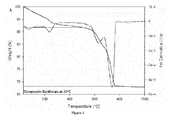
- Said composite is predominantly composed of calcite and the weight ratio comprised from 0.7 to 0.9, in particular 0.8 can be determined by methods well known from a man skilled in the art, for example by thermogravimetric analyses (TGA).
- TGA thermogravimetric analyses
- the present invention relates to a pure goethite calcite composite as defined above, wherein said composite is substantially free of hematite, portlandite, halite or calcium iron oxide chloride hydrate.
- Hematite corresponds to Fe 2 O 3
- portlandite corresponds to Ca(OH) 2
- halite corresponds to NaCl
- calcium iron oxide chloride hydrate corresponds to Ca 2 FeO 3 Cl,5H 2 O.
- Said hematite, portlandite, halite or calcium iron oxide chloride hydrate are raw materials or side products of the composite process and therefore can be present in said composite.
- substantially free of hematite, portlandite, halite or calcium iron oxide chloride hydrate means that they are present or not in said composite.
- the total weight of hematite, portlandite, halite or calcium iron oxide chloride hydrate is lower than 4% of the total composite weight, including the amorphous materials above defined which is possibly present.
- the present invention relates to a pure goethite calcite composite as defined above, wherein said composite has a specific surface area comprised from about 10 m 2 /g to about 200 m 2 /g, preferably from about 40 m 2 /g to about 200 m 2 /g, in particular from about 40 m 2 /g to about 100 m 2 /g, as determined by N 2 adsorption isotherms.
- Specific surface area is meant the total surface area of a material per unit of mass.
- the specific surface area can be determined by methods well known from a man skilled in the art, for example by using the conventional Brunauer-Emmet-Teller method on N 2 sorption isotherms.
- One of the advantages of the present invention is to provide composite presenting a high specific surface area providing.
- the present invention relates to a pure goethite calcite composite as defined above, wherein said specific surface area is about 92 m 2 /g, as determined by N 2 adsorption isotherms.
- Said specific surface area corresponds to the one obtained for a composite synthesized at a temperature process of 30°C for all the steps of said process.
- the present invention relates to a pure goethite calcite composite as defined above, wherein said composite has a specific surface area comprised from about 10 m 2 /g to about 200 m 2 /g, preferably from about 40 m 2 /g to about 200 m 2 /g, in particular from about 40 m 2 /g to about 100 m 2 /g, preferably about 92 m 2 /g, wherein:
- the average particle size (length and width for goethite and diagonal for calcite) has been measured manually on isolated particles using a Zeiss Ultra 55 field emission gun scanning electron microscope (FESEM).
- the present invention relates to a pure goethite calcite composite as defined above, wherein said composite has a specific surface area of about 92 m 2 /g, with an average length of said goethite particles comprised from about 200 nm to about 280 nm, in particular about 240 nm, an average width of said goethite particles comprised from about 32 nm to about 48 nm, in particular about 40 nm, and an average diagonal of calcite particles comprised from about 160 nm to about 220 nm, in particular about 190 nm, as determined by field emission gun scanning electron microscope, wherein the removal capacity of toxic ions from water, such as Cu, Cd, As, Se, with the proviso that Se(VI) is excluded, is comprised from 0.5 to 0.1 after at least 20 hours of contacting said toxic ions with pure goethite calcite composite at a pH of said water comprised form 6 to 9.4.
- Water containing toxic ions can be for example polluted water.
- the removal capacity corresponds to the ratio C/C 0 , wherein C corresponds to the ion concentration to remove remaining in water after contacting said composite with said water containing said toxic ions and C 0 is the ion concentration present initially in water before contacting said composite with said water containing said toxic ions.
- the specific surface area determines the removal capacity of said composite.
- the present invention relates to a pure goethite calcite composite as defined above, wherein said specific surface area is about 45 m 2 /g, as determined by N 2 adsorption isotherms.
- Said specific surface area corresponds to the one obtained for a composite synthesized at a temperature process of 70°C for all the steps of said process.
- the present invention relates to a pure goethite calcite composite as defined above, wherein said composite has a specific surface area comprised from about 10 m 2 /g to about 200 m 2 /g, preferably from about 40 m 2 /g to about 200 m 2 /g, in particular from about 40 m 2 /g to about 100 m 2 /g, preferably about 92 m 2 /g, wherein:
- the present invention relates to a process of preparation of a pure goethite calcite composite such as defined above, comprising a step of contacting a goethite particles-portlandite aqueous suspension with a CO 2 source in a medium having a pH higher than 12, in particular 12.2, at a T3 temperature comprised from about 25°C to about 100°C, during a t 3 time comprised from about 1h to about 24h, in particular 8h.
- Goethite particles can be from commercial origin provided they are nanosized goethite particles, or goethite can be synthesized in situ by reaction, for instance of FeCl 3 with an alkali metal hydroxide such as NaOH.
- Portlandite can be commercial portlandite or in situ synthesized portlandite by reaction of calcium chloride with a alkali metal hydroxide such as NaOH in water leading to an instantaneous precipitation of portlandite (Ca(OH) 2 ), in particular nanosized portlandite, according to the following reaction : 2NaOH + CaCl 2 ⁇ Ca(OH) 2 + 2NaCl.
- the aqueous medium is water and preferably said water contains only the compounds introduced or synthesized, i.e. goethite particles, portlandite, NaOH and CO 2 .
- the temperature is 30°c or 70°C depending on the composite to prepare, in particular on the specific surface area that is wanted.
- 100°C corresponds to the boiling point of water.
- the goethite particles present in said suspension have an average length comprised from about 200 nm to about 280 nm, in particular about 240 nm, and an average width comprised from about 32 nm to about 48 nm, in particular about 40 nm.
- the present invention relates to a process of preparation of a pure goethite calcite composite, defined above, wherein the CO 2 source in the medium is at an initial pressure comprised from about 10 bar to about 30 bar, in particular 20 bar.
- the CO 2 source can be pure or concentrated CO 2 gas, i.e. CO 2 gas containing a small proportion of SO x or NO x , or a stream containing a low concentration of CO 2 gas such as flue gas or industrial off-gas or a mixture of CO 2 gas with an inert gas such as, for example, nitrogen, argon or air.
- initial pressure is meant the pressure of the CO 2 source when it is introduced into the alkaline medium.
- the pressure used for the carbonation reaction is an anisobaric pressure that means that the pressure is not constant during the carbonation reaction, i.e. variable between the beginning and the end of the process. As the CO 2 source is consumed, CO 2 pressure drops in the system, i.e. the apparatus containing the reaction medium.
- an isobaric pressure can be used, i.e. at a constant CO 2 pressure during the reaction, by introducing CO 2 as soon as it is consumed.
- the present invention relates to a process of preparation of a pure goethite calcite composite, defined above, comprising further before the step of contacting said goethite particles-portlandite suspension with a CO 2 source, a step of contacting a goethite particle suspension with CaCl 2 in a medium having a pH higher than 12, in particular 13.5 and containing a base, in particular NaOH, at a T2 temperature comprised from about 25°C to about 100°C, during a t 2 time comprised from about 30 minutes to about 2h, in particular 1h.
- Said base is an alkali metal hydroxide base and in particular NaOH.
- the portlandite is synthesized in situ by reaction of an alkali metal hydroxide base, in particular NaOH with a CaCl 2 that has been introduced in an alkaline medium containing goethite particles suspension.
- the medium is an aqueous medium, in particular water in which goethite particles are in suspension, i.e. goethite particles are not soluble in the medium used, and containing an alkali metal hydroxide base, in particular NaOH.
- Goethite particles can be from commercial origin provided they are nanosized goethite particles, or goethite can be synthesized in situ by reaction, for instance, of FeCl 3 with an alkali metal hydroxide such as NaOH.
- the temperature is 30°c or 70°C depending on the composite to prepare, in particular on the specific surface area that is wanted.
- T2 temperature is equal to T3 temperature above defined.
- the time t 2 is very short, about 1h, because once CaCl 2 is introduced in the suspension of goethite particle in a medium containing an alkali metal hydroxide, said alkali metal hydroxide reacts with CaCl 2 to form portlandite, in particular nanosized portlandite, to give goethite particles-portlandite suspension.
- the present invention relates to a process of preparation of a pure goethite calcite composite, defined above, comprising further before the step of contacting goethite particle suspension with CaCl 2 , a step of introducing FeCl 3 in a medium having a pH higher than 12, in particular 13.5 and containing a base, at a T1 temperature comprised from about 25°C to about 100°C, during a t 1 time comprised from about 1h to about 30h, in particular 24h.
- the medium is an aqueous medium, in particular water, and containing an alkali metal hydroxide base, in particular NaOH.
- goethite articles are synthesized in situ by reaction of FeCl 3 with said alkali metal hydroxide base, in particular NaOH to give goethite that precipitates in said medium to give a suspension of nanosized particles.
- the temperature is 30°c or 70°C depending on the composite to prepare, in particular on the specific surface area that is wanted.
- T1 temperature is equal to T2 and/or T3 temperature above defined.
- the present invention relates to a process of preparation of a pure goethite calcite composite, comprising further before the step of contacting goethite particle suspension with CaCl 2 , a step of introducing FeCl 3 in a medium having a pH higher than 12, in particular 13.5 and containing a base, at a T1 temperature comprised from about 25°C to about 100°C, during a t 1 time comprised from about 1h to about 30h, in particular 24h, defined above, wherein said base is selected from the group consisting of NaOH, KOH, LiOH, Ca(OH) 2 and RbOH, or a mixture thereof, preferentially NaOH, preferably at a molar ratio NaOH/FeCl 3 comprised from 3 to 10, in particular 5.
- the base is an alkali metal hydroxide base, in particular NaOH and preferably the molar ratio NaOH/FeCl 3 is in particular 5.
- the overall reaction of synthesis of said goethite calcite composite starting, for example, from FeCl 3 is the following: FeCl 3 + CaCl 2 + 5 NaOH + CO 2 ⁇ FeO(OH) + CaCO 3 + 5 NaCl + 2 H 2 O
- goethite as well as portlandite as well as calcite are in situ synthesized.
- goethite used is from a commercial source and thus, a necessary molar ratio base/FeO(OH), in particular NaOH/FeO(OH), is 2,.
- portlandite as well as calcite are in situ synthesized and goethite is from a commercial source.
- portlandite used is from a commercial source and thus, a necessary molar ratio base/FeCl 3 , in particular NaOH/ FeCl 3 is 3.
- goethite as well as calcite are in situ synthesized and portlandite is from a commercial source.
- goethite and portlandite used are from a commercial source and thus, the base is portlandite, and thus, a necessary molar ratio base (Ca(OH) 2 /FeO(OH) is 1.
- calcite is in situ synthesized and goethite as well as portlandite are from a commercial source.
- the present invention relates to a process of preparation of a pure goethite calcite composite, defined above, comprising the following steps:
- goethite as well as portlandite as well as calcite are in situ synthesized.
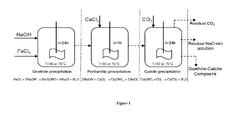
- Figure 1 displays a schematic representation of goethite-calcite synthesis, summarizing the three sequential precipitation reactions. These three steps are detailed below.
- the goethite formation is characterized by the presence of three successive pH domains, that are specifically associated to (I) the formation of ferric hydroxide gel (FeHgel), leading to acid conditions (pH ⁇ 2.5); (II) the spontaneous nucleation of goethite from FeHgel, leading to alkaline conditions (pH>11) and; (III) the growth of goethite in alkaline conditions (11 ⁇ pH ⁇ 13.5).
- These three steps or pH domains during goethite formation are well correlated with colour evolution and the global reaction implying the three above steps can be written as: FeCl 3 + 3 NaOH ⁇ FeO(OH) + 3 NaCl + H 2 O (1)
- Calcite precipitation or portlandite carbonation is the last step in the synthesis of goethite-calcite nanocomposite.
- the gas CO 2 was directly injected into the portlandite-goethite alkaline suspension.
- the CO 2 dissolution in alkaline conditions CO 2 + H 2 O ⁇ + CO 3 2+ + 2 H + ) produces a simultaneous consumption/dissolution of calcium hydroxide ( Ca ( OH ) 2 ⁇ Ca 2+ + 2 OH - ), leading to the precipitation of sub-micrometric calcite until then a thermodynamic equilibrium calcite-solution-CO 2 is obtained.
- the global aqueous carbonation reaction of calcium hydroxide or calcite precipitation can be expressed as: Ca(OH) 2 + CO 2 ⁇ CaCO 3 + H 2 O (3)
- This neutralization reaction implies a decrease of pH from 12.2 to 6.5 into the solution; which does not promote dissolution of pre-existent goethite because this mineral is stable in a broad range ofpH (3-13.5).
- the base is an alkali metal base, in particular NaOH and the molar ratio base/FeCl 3 , in particular NaOH/FeCl 3 is 5.
- Each step a, b, c can be carried out at three different temperatures T1, T2 and T3 comprised from 25°C to 100°C.
- the present invention relates to a process of preparation of a pure goethite calcite composite, comprising the three steps defined above:
- the present invention relates to one of the processes of preparation of a pure goethite calcite composite, defined above, wherein said composite is substantially free of hematite, portlandite, halite or calcium iron oxide chloride hydrate.
- Said hematite, portlandite, halite or calcium iron oxide chloride hydrate are raw materials or side products of the composite process and therefore can be present in said composite.
- substantially free of hematite, portlandite, halite or calcium iron oxide chloride hydrate means that they are present or not in said composite.
- the total weight of hematite, portlandite, halite or calcium iron oxide chloride hydrate is lower than 4% of the total composite weight, including the amorphous materials above defined eventually present.
- the present invention relates to the use of a pure goethite calcite composite defined above, for the removal of toxic ions from water.
- metal ions for example but without being limited to them, Pb, Cd, Zn, Cr, Cu, Hg, Se, Sb, As, Sn, Te, T1, and Ni
- Water containing said ions can be for example polluted water, or waste water from a plant.
- the present invention relates to the use defined above, wherein said toxic ions are selected from the group consisting of Cu, Cd, As, Se, with the proviso that Se(VI) is excluded.
- Another advantage of the invention is that the removal capacity (defined above as C/C 0 ) for goethite-calcite composite is better or equivalent compared with pure goethite, with a further main improvement that the composite is easier to separate from fluid because of the aggregation of goethite with calcite particles.
- Se (VI) is excluded because said composite, as well as goethite, are not liable to remove said ion.
- the present invention relates to the use wherein said toxic ions are selected from the group consisting of Cu, Cd, As, Se, with the proviso that Se(VI) is excluded, defined above, wherein said removal is a simultaneous removal of at least two toxic ions, in particular Cu(II)-Cd (II) or As(III)-Se(IV).
- Another advantage of the invention is that said composite is liable to remove more than one ion at the same time.
- said removal is a simultaneous removal of two toxic ions selected from the group consisting of Cu(II)-Cd (II), or As(III)-Se(IV).
- the present invention relates to the use defined above, wherein said removal is liable to separate at least one ion from the Se(VI) ion, in particular at least one ion selected from the group consisting ofCu(II)-Cd (II), As(III), Se(IV).
- said composite cannot remove Se(VI) from water, said composite can therefore be used to selectively remove at least one ion from Se(VI) contained in the same water.
- the present invention relates to the use defined above, wherein the specific surface area of said pure goethite calcite composite is comprised from about 10 m 2 /g to about 200 m 2 /g, preferably from about 40 m 2 /g to about 200 m 2 /g, in particular from about 40 m 2 /g to about 100 m 2 /g, in particular about 92 m 2 /g.
- the removal capacity is function of the specific surface area.
- the present invention relates to the use wherein the specific surface area of said pure goethite calcite composite is about 92 m 2 /g, defined above, wherein the removal capacity is comprised from 0.5 to 0.1 after at least 20 hours of contacting said toxic ions with pure goethite calcite composite at a pH of said polluted water comprised form 6 to 9.4.
- the present invention relates to the one of the use defined above, wherein the concentration of said composite in said water is comprised from about 1 g/L to about 100g/L, preferably from about 1 g/L to about 50g/L, more preferably from about 1 g/L to about 10g/L, in particular about 3g/L and the concentration of each ion present in water is comprised from about 25 to about 100 mg atom/L, in particular about 50 mg atom/L.
- the present invention relates to a process of removal of at least one toxic ion form water, with the proviso that Se(VI) is excluded, comprising the following steps :
- the present invention relates to a process defined above wherein:
- the present invention relates to a process defined above wherein said ions are selected from the group consisting of: Pb, Cd, Zn, Cr, Cu, Hg, Se, Sb, As, Sn, Te, T1, and Ni, in particular Cu, Cd, As, Se, more particularly Cu(II)-Cd (II) or As(III)-Se(IV).
- the present invention relates to the use of a pure goethite calcite composite defined above, as components in various industrial products, e.g., pigments in the building industry; inorganic dyes; pigments and adsorbents in the paper industry, lacquers or plastics).
- the autoclave was disassembled after 24h and 30g of CaCl 2 salt were added into the goethite alkaline suspension.
- the autoclave was rapidly assembled and; heating and agitation systems were re-started.
- the calcium chloride reacted instantaneously with residual NaOH into goethite suspension, leading to formation of portlandite or calcium hydroxide particles (2NaOH + CaCl 2 ⁇ Ca(OH) 2 + 2NaCl).
- the reaction temperature was stabilized at 30°C or 70°C, 20 bar of CO 2 were injected into goethite-portlandite suspension.
- the autoclave was removed from heating system and immersed into cold water when experiment was carried out at 70°C. After water cooling at 30°C (about 10 minutes) the autoclave was disassembled, and the solid product was carefully recovered and separated by centrifugation (30 minutes at 12,000 rpm), decanting the supernatant solutions. The solid product from both syntheses (i.e. at 30 and 70°C) was washed twice by redispersion/centrifugation processes in order to remove the halite (NaCl) co-precipitated during the synthesis. Finally, the solid product was dried directly in the centrifugation flasks at 60°C for 48 h. The dry solid product was manually recovered, weighed and stored in plastic flasks for further characterizations (FESEM, TEM, XRD, TGA and N 2 sorption isotherms).
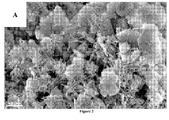
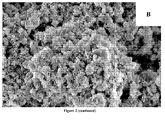
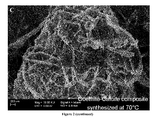
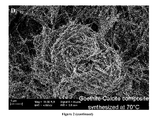
- Figures 2A to 2D present the FESEM images of composites synthesized at 30°C and 70°C.
- X-Ray Powder Diffraction (XRD) analyses were performed using a D5000, SIEMENS diffractometer in Bragg-Brentano geometry; equipped with a goniometer theta-theta with a rotating sample holder.
- TGA for goethite-calcite composites were performed with a TGA/SDTA 851 e Mettler Toledo instrument under the following conditions: sample mass of about 10 mg, alumina crucible of 150 ⁇ 1 with a pinhole, heating rate of 10 °C min -1 , and inert N 2 atmosphere of 50 ml min -1 . Sample mass loss and associated thermal effects were obtained by TGA/SDTA. In order to identify the different mass loss steps, the TGA first derivative (rate of mass loss) was used. TGA apparatus was calibrated in terms of mass and temperature. Calcium oxalate was used for the sample mass calibration. The melting points of three compounds (indium, aluminium and copper) obtained from the DTA signals were used for the sample temperature calibration.
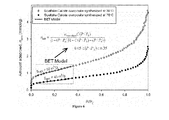
- N 2 sorption isotherms for goethite-calcite composites were performed by using a sorptomatic system (Thermo Electron Corporation). The specific surface area of powdered samples was estimated by applying the Brunauer-Emmet-Teller (BET) equation in the 0.05 ⁇ P/P 0 ⁇ 0.35 interval of relative pressure and by using 16.2 ⁇ 2 for cross-sectional area of molecular N 2 . A non-linear regression by the least-squares method was performed to fit the interval data ( n ads vs. P / P 0 ) in the experimental isotherms.
- BET Brunauer-Emmet-Teller
- the average particle size (length and width for goethite and diagonal for calcite) measured on 50 isolated particles are summarized in Table 1 below.
- This mineral mixture forms a homogeneous orange-brown nanocomposite with high specific surface area equal to 92 and 45 m 2 /g for composite synthesized at 30 and 70°C, respectively ( Figure 6 ). Both values were determined by using the conventional Brunauer-Emmet-Teller method on N 2 sorption isotherms.
- Table 1 Average size of single goethite and calcite crystals measured manually on the 50 isolated particles from FESEM images; and specific surface area of goethite-calcite composites determined from N 2 adsorption isotherms.
- Example 3 Adsorption experiments in a semi-continuous mixed reactor
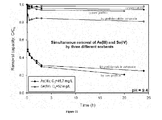
- FIGS 9A to 9C summarize the simultaneous removal of three different binary-element systems using goethite-calcite composite as adsorbent.
- an adsorption competition and a different chemical affinity for the six toxic ions were clearly observed at the investigated physicochemical conditions.
- goethite-calcite composite can neutralise the acidic wastewaters by slight calcite dissolution, enhancing the removal of heavy metals (e.g. Cu and Cd) at the solid-solution interfaces, with a preferential chemical affinity onto calcite surfaces as clearly observed in Fig. 12A to 12B for cadmium and copper.
- heavy metals e.g. Cu and Cd
Landscapes
- Chemical & Material Sciences (AREA)
- Engineering & Computer Science (AREA)
- Organic Chemistry (AREA)
- Nanotechnology (AREA)
- Inorganic Chemistry (AREA)
- Condensed Matter Physics & Semiconductors (AREA)
- Materials Engineering (AREA)
- Crystallography & Structural Chemistry (AREA)
- General Physics & Mathematics (AREA)
- Physics & Mathematics (AREA)
- Life Sciences & Earth Sciences (AREA)
- Hydrology & Water Resources (AREA)
- Environmental & Geological Engineering (AREA)
- Water Supply & Treatment (AREA)
- Composite Materials (AREA)
- Solid-Sorbent Or Filter-Aiding Compositions (AREA)
Abstract
The present invention relates to new goethite-calcite composite, its preparation process and its use for the separations of ions.
Description
- The present invention relates to new goethite-calcite composite, its preparation process and its use for the separations of ions.
- Goethite and calcite are two inorganic compounds that are widely studied due to their abundance in nature as minerals (abiotic origin) and biominerals (biotic origin). Both minerals can co-exist in several terrestrial environments such as deep geological formations, water aquifers, soils and aerosols, playing an important role on the fate and transport of several metalloids and heavy metals trace elements and organic molecules at the mineral-fluid interfaces (M. Wolthers, L. Charlet, P. Van Cappellen, The surface chemistry of divalent metal carbonate minerals. Am. J. Sci. 308 (2008) 905-941; J. Paquette, R. J. Reeder, Relationship between surface structure, growth mechanism, and trace element incorporation in calcite. Geochem. Cosmochem. Acta 59 (1995) 735-749; A. J. A. Aquino, D. Tunega, G. Haberhauer, M. H. Gerzabek, H. Lischka, Acid-base properties of a goethite surface model. A Theoretical view. Geochem. Cosmochem. Acta 72 (2008) 3587-3602; R. M. Cornell, U. Schwertmann, The Iron Oxides; VCH: Weinheim, Germany, 1996; O. Ozdemir, D. J. Dunlop, Intermediate formation of magnetite during dehydration of goethite. Earth Planet. Sci. Lett.177 (2000) 59-67).
- Goethite and calcite minerals have also been identified in several extraterrestrial environments. For example, calcite has been recently discovered in Martian soils by Phoenix Mars exploration mission (W. V. Boynton, D. W. Ming, S. P. Kounaves, S. M. M. Young, R. E. Arvidson, M. H. Hecht, J. Hoffman, P. B; Niles, D. K. Hamara, R. C. Quinn, P. H. Smith, B. Sutter, D. C. Catling, R. V. Morris, Evidences for calcium carbonate at the Mars Phoenix landing site. Science 325 (2009) 61-64) and goethite has been suspected as a constituent of the Martian dusts and dark asteroids (R. V. Morris, G. Klingelhofer, C. Schroder, D. S. Radianor, A. Yen, D. W. Ming, P. A. De Souza, I. Fleischer, T. Wdowiak, R. Gellert, B. Bernhardt, E. N. Evlanov, B. Zubkov, J. Foh, U. Bonnes, E. Kankeleit, P. Gutlich, F. Renz, S. W. Squyres, R. E. Arvidson, Mösbauer mineralogy of rock, soil and dust at Gusev Crater, Mars. J. Geophys. Res. 111 (2006) E02S13; P. Beck, E. Quirico, D. Sevestre, G. Montes-Hernandez, A. Pommerol, B. Schmitt, Goethite as an alternative origin for the 3.1 micro-m band on dark asteroids. Astronomy & Astrophysics (2010) DOI: 10.1051/0004-6361/201015851). Moreover, the goethite and calcite minerals are technologically important materials and widely applied as components in various industrial products, e.g., pigments in the building industry; inorganic dyes; pigments and adsorbents in the paper industry, lacquers or plastics; sorbents in removal of toxic ions and molecules from polluted water; active ingredient in antacid tablets.
- In the last decades, several synthesis routes have been proposed to produce independently goethite or calcite at laboratory or industrial scale, focusing on specific or multiple applications or simply to carry out basic research on the crystal growth processes (C. Domingo, E. Loste, J. Gomez-Morales, J. Garcia-Carmona, J. Fraile, Calcite precipitation by a high-pressure CO2 carbonation route. J. Supercrit. Fluids. 36 (2006) 202-215; H. S. Lee, T. H. Ha, K. Kim, Fabrication of unusually stable amorphous calcium carbonate in an ethanol medium. Mater. Chem. Phys. 93 (2005) 376-382; A. Abou-Hassan, O. Sandre, S. Neveu, V. Cabuil, Synthesis of goethite by separation of the nucleation and growth process of ferrihydrite nanoparticles using microfluidics. Angew. Chem. 121(2009) 2378-2381; T. Yu, J. Park, J. Moon, K. An, Y. Piao, T. Hyeon, Synthesis of uniform goethite nanotubes with parallelogram cross section. J. Am. Chem. Soc.129, (2007) 14558-14559; Schwertmann, P. Cambier, E. Murad, Properties of goethite of variying crystallinity. Clays Clay Miner.33 (1985) 369-378; M. Mohapatra, S. K. Gupta, B. Satpati, S. Anand, B. K. Mishra, pH and temperature dependent facile precipitation of nano-goethite particles in Fe(NO3)3-NaOH-NH3NH2HSO4-H2O medium. Colloids and Surfaces A: Physicochem. Eng. Aspects.355 (2010) 53-60; K. F. Hayes, A. L. Roe, G. E. Brown Jr., K. O. Hodgson J. O; Leckie, G. A. Parks, In situ x-ray absorption study of surface complexes: Selenium oxyanions on α-FeOOH. Science 238 (1987) 783-786; G. Montes-Hernandez, F. Renard, N. Geoffroy, L. Charlet, J. Pironon, Calcite precipitation from CO2-H2O-Ca(OH)2 slurry under high pressure of CO2. J. Crystal Growth. 308 (2007) 228-236; G. Montes-Hernandez, D. Daval, R. Chiriac, F. Renard, Growth of nanosized calcite through gas-solid carbonation of nanosized portlandite particles under anisobaric conditions. Cryst. Growth Des. 10 (2010) 4823-4830; L. A. Gower, D. A. Tirrell, Calcium carbonate films and helices growth in solutions of poly(aspartate). J. Crystal Growth.191 (1998) 153-160; E. J. Elzingan Y. J. Lee, R. J. Reeder, Coprecipitation of chromate with calcite: Batch experiments and X-ray absorption spectroscopy. Geochem. Cosmochem. Acta. 71 (2007) 1480-1493).
- The studies to improve the existing methods and/or to develop innovative routes to obtain well-controlled shapes and sizes of nanometer-to-submicrometer goethite or calcite particles continue. Moreover, the nucleation and growth processes of goethite and calcite are still open subjects (K. F. Hayes, A. L. Roe, G. E. Brown Jr., K. O. Hodgson J. O; Leckie, G. A. Parks, In situ x-ray absorption study of surface complexes: Selenium oxyanions on α-FeOOH. Science 238 (1987) 783-786,) In a previous study (G. Montes-Hernandez, P. Beck, F. Renard, E. Quirico, B. Lanson, R. Chiriac, N. Findling, Fast precipitation of acicular goethite from ferric hydroxide gel under moderate temperature (30 and 70 C degrees). Cryst. Growth Des. 11 (2011) 2264-2272), it has been demonstrated that acicular goethite (α-FeOOH) can be precipitated when a high initial OH/Fe molar ratio (=5) and moderate temperature (30 and 70°C) are used, without the need to synthesize ferrihydrite and/or amorphous iron hydroxide precursors.
- Nevertheless, the synthesis of goethite-calcite composite has not been reported in the literature.
- One of the aims of the present invention is to provide a new goethite-calcite composite.
- Another aim of the present invention is to provide a preparation process of a goethite-calcite composite.
- Still another aim is the use of a goethite-calcite composite to remove toxic ions from water.
- The present invention relates to a pure goethite calcite composite under crystal form comprising nanosized goethite particles and sub-micrometric calcite particles, substantially free of amorphous materials such as amorphous calcium carbonate, and free of goethite and calcite particles the size of which is higher than 1µm, the goethite/calcite particles weight ratio being comprised from 0.7 to 0.9, in particular 0.8.
- The expression "goethite calcite composite" refers to goethite particles aggregated with calcite particles and/or (probably) included (or incorporated) in the calcite particles, that is intimate goethite calcite adhesion.
- Said composite has an orange-brown color, is homogeneous, i.e. goethite particles and calcite particles are uniformly distributed, and said goethite particles and calcite particles are inseparable or indivisible after about 5 to 10 minutes of ultrasonic dispersion in a dispersant agent such as alcohol.
- Thus said expression does not mean that said composite is composed of calcite particles and goethite particles simply mixed together.
- The expression "pure goethite calcite composite" means that the purity of said composite is equal or higher than 96%, in particular 98%.
- The expression "under a crystal form" means that said each particles of said composite is crystalline.
- The term "nanosized" means particles having a size on the order of a nanometer up to a hundred of nanometers.
- The term "sub-micrometric" means particles having a size of less than one micrometer. Nevertheless, it must be noted that nanosized particles are smaller than sub-micrometric particles.
- The expression "substantially free of amorphous materials" means that amorphous materials can be present or not in the composite. Nevertheless, if amorphous materials are present, the total weight of amorphous materials is lower than 4% of the weight of the composite.
- Amorphous materials can be for example amorphous calcium carbonate. Calcite corresponds to calcium carbonate but is a crystalline mineral in contrast to amorphous calcium carbonate.
- The expression "free of goethite and calcite particles the size of which is higher than 1µm" means that there are neither goethite particles nor calcite particles on the order of micrometer or higher such as naturally existing.
- Therefore, said calcite goethite composite does not correspond to a calcite goethite mineral such as found in the nature and said calcite goethite composite does not comprise particles of calcite-goethite mineral such as found in the nature.
- The inventors have unexpectedly found that a calcite goethite composite which is different from a simple mixture of calcite particles and goethite particles could be obtained and which is different from a calcite goethite mineral such as found in the nature and having adsorption properties, in particular for removal toxic ions from waters, higher than calcite or goethite taken individually or higher than a mere mixture of calcite and goethite.
- Said composite is predominantly composed of calcite and the weight ratio comprised from 0.7 to 0.9, in particular 0.8 can be determined by methods well known from a man skilled in the art, for example by thermogravimetric analyses (TGA).
- In an advantageous embodiment, the present invention relates to a pure goethite calcite composite as defined above, wherein said composite is substantially free of hematite, portlandite, halite or calcium iron oxide chloride hydrate.
- Hematite corresponds to Fe2O3, portlandite corresponds to Ca(OH)2, halite corresponds to NaCl and calcium iron oxide chloride hydrate corresponds to Ca2FeO3Cl,5H2O.
- Said hematite, portlandite, halite or calcium iron oxide chloride hydrate are raw materials or side products of the composite process and therefore can be present in said composite.
- The expression "substantially free of hematite, portlandite, halite or calcium iron oxide chloride hydrate" means that they are present or not in said composite.
- The total weight of hematite, portlandite, halite or calcium iron oxide chloride hydrate is lower than 4% of the total composite weight, including the amorphous materials above defined which is possibly present.
- In an advantageous embodiment, the present invention relates to a pure goethite calcite composite as defined above, wherein said composite has a specific surface area comprised from about 10 m2/g to about 200 m2/g, preferably from about 40 m2/g to about 200 m2/g, in particular from about 40 m2/g to about 100 m2/g, as determined by N2 adsorption isotherms.
- By "specific surface area" is meant the total surface area of a material per unit of mass.
- The specific surface area can be determined by methods well known from a man skilled in the art, for example by using the conventional Brunauer-Emmet-Teller method on N2 sorption isotherms.
- One of the advantages of the present invention is to provide composite presenting a high specific surface area providing.
- In function of the temperature of the preparation process of the composite, the specific surface area obtained is variable.
- The higher the temperature is, the lower the specific surface area is.
- In an advantageous embodiment, the present invention relates to a pure goethite calcite composite as defined above, wherein said specific surface area is about 92 m2/g, as determined by N2 adsorption isotherms.
- Said specific surface area corresponds to the one obtained for a composite synthesized at a temperature process of 30°C for all the steps of said process.
- In an advantageous embodiment, the present invention relates to a pure goethite calcite composite as defined above, wherein said composite has a specific surface area comprised from about 10 m2/g to about 200 m2/g, preferably from about 40 m2/g to about 200 m2/g, in particular from about 40 m2/g to about 100 m2/g, preferably about 92 m2/g, wherein:
- the average length of said goethite particles is comprised from about 200 nm to about 280 nm, in particular about 240 nm,
- the average width of said goethite particles is comprised from about 32 nm to about 48 nm, in particular about 40 nm, and
- the average diagonal of calcite particles is comprised from about 160 nm to about 220 nm, in particular about 190 nm,
- as determined by field emission gun scanning electron microscope.
- The average particle size (length and width for goethite and diagonal for calcite) has been measured manually on isolated particles using a Zeiss Ultra 55 field emission gun scanning electron microscope (FESEM).
- In an advantageous embodiment, the present invention relates to a pure goethite calcite composite as defined above, wherein said composite has a specific surface area of about 92 m2/g, with an average length of said goethite particles comprised from about 200 nm to about 280 nm, in particular about 240 nm, an average width of said goethite particles comprised from about 32 nm to about 48 nm, in particular about 40 nm, and an average diagonal of calcite particles comprised from about 160 nm to about 220 nm, in particular about 190 nm, as determined by field emission gun scanning electron microscope,
wherein the removal capacity of toxic ions from water, such as Cu, Cd, As, Se, with the proviso that Se(VI) is excluded, is comprised from 0.5 to 0.1 after at least 20 hours of contacting said toxic ions with pure goethite calcite composite at a pH of said water comprisedform 6 to 9.4. - Water containing toxic ions can be for example polluted water.
- The removal capacity corresponds to the ratio C/C0, wherein C corresponds to the ion concentration to remove remaining in water after contacting said composite with said water containing said toxic ions and C0 is the ion concentration present initially in water before contacting said composite with said water containing said toxic ions.
- The specific surface area determines the removal capacity of said composite.
- The higher the specific surface area, the higher the removal capacity is.
- In an advantageous embodiment, the present invention relates to a pure goethite calcite composite as defined above, wherein said specific surface area is about 45 m2/g, as determined by N2 adsorption isotherms.
- Said specific surface area corresponds to the one obtained for a composite synthesized at a temperature process of 70°C for all the steps of said process.
- In an advantageous embodiment, the present invention relates to a pure goethite calcite composite as defined above, wherein said composite has a specific surface area comprised from about 10 m2/g to about 200 m2/g, preferably from about 40 m2/g to about 200 m2/g, in particular from about 40 m2/g to about 100 m2/g, preferably about 92 m2/g, wherein:
- the average length of said goethite particles is comprised from about 650 nm to about 750 nm, in particular about 700 nm,
- the average width of said goethite particles is comprised from about 55 nm to about 95 nm, in particular about 75 nm, and
- the average diagonal of calcite particles is comprised from about 160 nm to about 220 nm, in particular about 190 nm,
- as determined by field emission gun scanning electron microscope.
- In another aspect, the present invention relates to a process of preparation of a pure goethite calcite composite such as defined above, comprising a step of contacting a goethite particles-portlandite aqueous suspension with a CO2 source in a medium having a pH higher than 12, in particular 12.2, at a T3 temperature comprised from about 25°C to about 100°C, during a t3 time comprised from about 1h to about 24h, in particular 8h.
- The expression "goethite particles-portlandite aqueous suspension" refers to a suspension containing:
- crystal goethite particles composed of nanosize particles substantially free of amorphous materials such as amorphous calcium carbonate, and free of goethite and calcite particles the size of which is higher than 1 µm, and
- portlandite,
- in an aqueous medium.
- Goethite particles can be from commercial origin provided they are nanosized goethite particles, or goethite can be synthesized in situ by reaction, for instance of FeCl3 with an alkali metal hydroxide such as NaOH.
- Portlandite can be commercial portlandite or in situ synthesized portlandite by reaction of calcium chloride with a alkali metal hydroxide such as NaOH in water leading to an instantaneous precipitation of portlandite (Ca(OH)2), in particular nanosized portlandite, according to the following reaction :
2NaOH + CaCl2→Ca(OH)2+ 2NaCl.
- Preferably, the aqueous medium is water and preferably said water contains only the compounds introduced or synthesized, i.e. goethite particles, portlandite, NaOH and CO2.
- Preferably the temperature is 30°c or 70°C depending on the composite to prepare, in particular on the specific surface area that is wanted.
- Below 25°C, the reaction is too slow.
- 100°C corresponds to the boiling point of water.
- In an advantageous embodiment, the goethite particles present in said suspension have an average length comprised from about 200 nm to about 280 nm, in particular about 240 nm, and an average width comprised from about 32 nm to about 48 nm, in particular about 40 nm.
- In an advantageous embodiment, the present invention relates to a process of preparation of a pure goethite calcite composite, defined above, wherein the CO2 source in the medium is at an initial pressure comprised from about 10 bar to about 30 bar, in particular 20 bar.
- The CO2 source can be pure or concentrated CO2 gas, i.e. CO2 gas containing a small proportion of SOx or NOx, or a stream containing a low concentration of CO2 gas such as flue gas or industrial off-gas or a mixture of CO2 gas with an inert gas such as, for example, nitrogen, argon or air.
- By "initial pressure" is meant the pressure of the CO2 source when it is introduced into the alkaline medium.
- The pressure used for the carbonation reaction is an anisobaric pressure that means that the pressure is not constant during the carbonation reaction, i.e. variable between the beginning and the end of the process. As the CO2 source is consumed, CO2 pressure drops in the system, i.e. the apparatus containing the reaction medium.
- Alternatively, an isobaric pressure can be used, i.e. at a constant CO2 pressure during the reaction, by introducing CO2 as soon as it is consumed.
- Below 10bar, the pressure is too low to obtain a good rate of carbonation reaction.
- Above 30bar, the pressure becomes too high to be interesting in view of the cost for a production at industrial scale.
- In an advantageous embodiment, the present invention relates to a process of preparation of a pure goethite calcite composite, defined above, comprising further before the step of contacting said goethite particles-portlandite suspension with a CO2 source, a step of contacting a goethite particle suspension with CaCl2 in a medium having a pH higher than 12, in particular 13.5 and containing a base, in particular NaOH, at a T2 temperature comprised from about 25°C to about 100°C, during a t2 time comprised from about 30 minutes to about 2h, in particular 1h.
- Said base is an alkali metal hydroxide base and in particular NaOH.
- In this embodiment, the portlandite is synthesized in situ by reaction of an alkali metal hydroxide base, in particular NaOH with a CaCl2 that has been introduced in an alkaline medium containing goethite particles suspension.
- The medium is an aqueous medium, in particular water in which goethite particles are in suspension, i.e. goethite particles are not soluble in the medium used, and containing an alkali metal hydroxide base, in particular NaOH.
- Goethite particles can be from commercial origin provided they are nanosized goethite particles, or goethite can be synthesized in situ by reaction, for instance, of FeCl3 with an alkali metal hydroxide such as NaOH.
- Preferably the temperature is 30°c or 70°C depending on the composite to prepare, in particular on the specific surface area that is wanted.
- Preferably, T2 temperature is equal to T3 temperature above defined.
- Below 25°C, the reaction is too slow.
- 100°C corresponds to the boiling point of water
- The time t2 is very short, about 1h, because once CaCl2 is introduced in the suspension of goethite particle in a medium containing an alkali metal hydroxide, said alkali metal hydroxide reacts with CaCl2 to form portlandite, in particular nanosized portlandite, to give goethite particles-portlandite suspension.
- In an advantageous embodiment, the present invention relates to a process of preparation of a pure goethite calcite composite, defined above, comprising further before the step of contacting goethite particle suspension with CaCl2, a step of introducing FeCl3 in a medium having a pH higher than 12, in particular 13.5 and containing a base, at a T1 temperature comprised from about 25°C to about 100°C, during a t1 time comprised from about 1h to about 30h, in particular 24h.
- The medium is an aqueous medium, in particular water, and containing an alkali metal hydroxide base, in particular NaOH.
- In this embodiment, goethite articles are synthesized in situ by reaction of FeCl3 with said alkali metal hydroxide base, in particular NaOH to give goethite that precipitates in said medium to give a suspension of nanosized particles.
- Preferably the temperature is 30°c or 70°C depending on the composite to prepare, in particular on the specific surface area that is wanted.
- Preferably, T1 temperature is equal to T2 and/or T3 temperature above defined.
- Below 25°C, the reaction is too slow.
- 100°C corresponds to the boiling point of water
- In an advantageous embodiment, the present invention relates to a process of preparation of a pure goethite calcite composite, comprising further before the step of contacting goethite particle suspension with CaCl2, a step of introducing FeCl3 in a medium having a pH higher than 12, in particular 13.5 and containing a base, at a T1 temperature comprised from about 25°C to about 100°C, during a t1 time comprised from about 1h to about 30h, in particular 24h, defined above,
wherein said base is selected from the group consisting of NaOH, KOH, LiOH, Ca(OH)2 and RbOH, or a mixture thereof, preferentially NaOH, preferably at a molar ratio NaOH/FeCl3 comprised from 3 to 10, in particular 5. - Preferentially, the base is an alkali metal hydroxide base, in particular NaOH and preferably the molar ratio NaOH/FeCl3 is in particular 5.
The overall reaction of synthesis of said goethite calcite composite starting, for example, from FeCl3 is the following:
FeCl3 + CaCl2 + 5 NaOH + CO2 → FeO(OH) + CaCO3 + 5 NaCl + 2 H2O
- In this embodiment, goethite as well as portlandite as well as calcite are in situ synthesized.
- In another embodiment, goethite used is from a commercial source and thus, a necessary molar ratio base/FeO(OH), in particular NaOH/FeO(OH), is 2,.
- The overall reaction is then:
FeO(OH) + CaCl2 + 2 NaOH + CO2 → FeO(OH) + CaCO3 + 5 NaCl + 2 H2O
- In this embodiment, portlandite as well as calcite are in situ synthesized and goethite is from a commercial source.
- In another embodiment, portlandite used is from a commercial source and thus, a necessary molar ratio base/FeCl3, in particular NaOH/ FeCl3 is 3.
- The overall reaction is then:
FeCl3 + Ca(OH)2 + 3 NaOH + CO2→FeO(OH) + CaCO3 + 3 NaCl + 2 H2O
- In this embodiment, goethite as well as calcite are in situ synthesized and portlandite is from a commercial source.
- In another embodiment, goethite and portlandite used are from a commercial source and thus, the base is portlandite, and thus, a necessary molar ratio base (Ca(OH)2/FeO(OH) is 1.
- The overall reaction is then:
FeO(OH) + Ca(OH)2 + CO2 →FeO(OH) + CaCO3 + H2O
- In this embodiment, only calcite is in situ synthesized and goethite as well as portlandite are from a commercial source.
- In an advantageous embodiment, the present invention relates to a process of preparation of a pure goethite calcite composite, defined above, comprising the following steps:
- a. introducing FeCl3 in a medium having a pH higher than 12, in particular 13.5 and containing a base, in particular NaOH, at a T1 temperature comprised from about 25°C to about 100°C, during a t1 time comprised from about 1h to about 30h, in particular 24h, to obtain a goethite particle suspension;
- b. contacting said goethite particle suspension with CaCl2 to obtain a goethite particle-CaCl2 suspension and heat said goethite particle-CaCl2 suspension at a T2 temperature comprised from about 25°C to about 100°C, during a t2 time comprised from about 30 minutes to about 2h, in particular 1h, to obtain said goethite particles-portlandite suspension;
- c. contacting said goethite particles-portlandite suspension with a CO2 source at a T3 temperature comprised from about 25°C to about 100°C, during a t3 time comprised from about 1h to about 30h, in particular 24h to obtain said goethite calcite composite.
- In this embodiment, goethite as well as portlandite as well as calcite are in situ synthesized.
- The goethite-calcite composite synthesis is summarized by three sequential precipitation reactions:
- (1) Fast precipitation of nanosized acicular goethite (α-FeOOH) using high OH/Fe molar ratio (=5);
- (2) Instantaneous precipitation of nanosized portlandite (Ca(OH)2) by adding CaCl2 salt into goethite alkaline suspension, and;
- (3) Sub-micrometric calcite precipitation by injection of CO2 into goethite-portlandite alkaline suspension.
-
Figure 1 displays a schematic representation of goethite-calcite synthesis, summarizing the three sequential precipitation reactions. These three steps are detailed below. - Herein, the goethite formation is characterized by the presence of three successive pH domains, that are specifically associated to (I) the formation of ferric hydroxide gel (FeHgel), leading to acid conditions (pH<2.5); (II) the spontaneous nucleation of goethite from FeHgel, leading to alkaline conditions (pH>11) and; (III) the growth of goethite in alkaline conditions (11<pH<13.5). These three steps or pH domains during goethite formation are well correlated with colour evolution and the global reaction implying the three above steps can be written as:
FeCl 3 + 3NaOH →FeO(OH) + 3NaCl + H 2 O (1)
- In this system, the growth of goethite takes place in alkaline conditions after the spontaneous nucleation from ferric hydroxide gel because an excess of sodium hydroxide (NaOH) was initially imposed in the system. The residual NaOH during goethite formation was used to produce instantaneously nanosized portlandite by adding the calcium chloride (CaCl2) into the goethite alkaline suspension that allows the fast precipitation of portlandite (calcium hydroxide) and then the pH is stabilized to 12.2. The global reaction of portlandite precipitation (Ca(OH)2), well known in the laboratory and at industrial scales, can be expressed as:
2NaOH + CaCl 2 → Ca(OH) 2 + 2NaCl (2)
- Calcite precipitation or portlandite carbonation is the last step in the synthesis of goethite-calcite nanocomposite. For this case, the gas CO2 was directly injected into the portlandite-goethite alkaline suspension. The CO2 dissolution in alkaline conditions (CO 2 + H 2 O → + CO3 2+ + 2H +) produces a simultaneous consumption/dissolution of calcium hydroxide (Ca(OH)2 → Ca 2+ + 2OH -), leading to the precipitation of sub-micrometric calcite until then a thermodynamic equilibrium calcite-solution-CO2 is obtained. The global aqueous carbonation reaction of calcium hydroxide or calcite precipitation can be expressed as:
Ca(OH) 2+CO 2 → CaCO 3 + H 2O (3)
- This neutralization reaction implies a decrease of pH from 12.2 to 6.5 into the solution; which does not promote dissolution of pre-existent goethite because this mineral is stable in a broad range ofpH (3-13.5).
- In step a. the base is an alkali metal base, in particular NaOH and the molar ratio base/FeCl3, in particular NaOH/FeCl3 is 5.
- Each step a, b, c can be carried out at three different temperatures T1, T2 and T3 comprised from 25°C to 100°C.
- In an advantageous embodiment, the present invention relates to a process of preparation of a pure goethite calcite composite, comprising the three steps defined above:
- wherein said T1, T2 and T3 temperatures are all about 70°C and the specific surface area of said pure goethite calcite composite is about 92 m2/g, as determined by N2 adsorption isotherms, or said T1, T2 and T3 temperatures are all about 30°C and the specific surface area of said pure goethite calcite composite is about 45 m2/g, as determined by N2 adsorption isotherms.
- Thus, depending on the temperature, composites with various specific surface area can be obtained.
- In an advantageous embodiment, the present invention relates to one of the processes of preparation of a pure goethite calcite composite, defined above, wherein said composite is substantially free of hematite, portlandite, halite or calcium iron oxide chloride hydrate.
- Said hematite, portlandite, halite or calcium iron oxide chloride hydrate are raw materials or side products of the composite process and therefore can be present in said composite.
- The expression "substantially free of hematite, portlandite, halite or calcium iron oxide chloride hydrate" means that they are present or not in said composite.
- The total weight of hematite, portlandite, halite or calcium iron oxide chloride hydrate is lower than 4% of the total composite weight, including the amorphous materials above defined eventually present.
- In another aspect, the present invention relates to the use of a pure goethite calcite composite defined above, for the removal of toxic ions from water.
- By toxic ions, it must be understood metal ions, for example but without being limited to them, Pb, Cd, Zn, Cr, Cu, Hg, Se, Sb, As, Sn, Te, T1, and Ni
- Water containing said ions can be for example polluted water, or waste water from a plant.
- In an advantageous embodiment, the present invention relates to the use defined above, wherein said toxic ions are selected from the group consisting of Cu, Cd, As, Se, with the proviso that Se(VI) is excluded.
- Another advantage of the invention is that the removal capacity (defined above as C/C0) for goethite-calcite composite is better or equivalent compared with pure goethite, with a further main improvement that the composite is easier to separate from fluid because of the aggregation of goethite with calcite particles.
- Se (VI) is excluded because said composite, as well as goethite, are not liable to remove said ion.
- In an advantageous embodiment, the present invention relates to the use wherein said toxic ions are selected from the group consisting of Cu, Cd, As, Se, with the proviso that Se(VI) is excluded, defined above,
wherein said removal is a simultaneous removal of at least two toxic ions, in particular Cu(II)-Cd (II) or As(III)-Se(IV). - Another advantage of the invention is that said composite is liable to remove more than one ion at the same time.
- In an advantageous embodiment, said removal is a simultaneous removal of two toxic ions selected from the group consisting of Cu(II)-Cd (II), or As(III)-Se(IV).
- In an advantageous embodiment, the present invention relates to the use defined above, wherein said removal is liable to separate at least one ion from the Se(VI) ion, in particular at least one ion selected from the group consisting ofCu(II)-Cd (II), As(III), Se(IV).
- As said composite cannot remove Se(VI) from water, said composite can therefore be used to selectively remove at least one ion from Se(VI) contained in the same water.
- In an advantageous embodiment, the present invention relates to the use defined above, wherein the specific surface area of said pure goethite calcite composite is comprised from about 10 m2/g to about 200 m2/g, preferably from about 40 m2/g to about 200 m2/g, in particular from about 40 m2/g to about 100 m2/g, in particular about 92 m2/g.
- The removal capacity is function of the specific surface area.
- The highest the specific surface area is, the highest the removal capacity is.
- In an advantageous embodiment, the present invention relates to the use wherein the specific surface area of said pure goethite calcite composite is about 92 m2/g, defined above, wherein the removal capacity is comprised from 0.5 to 0.1 after at least 20 hours of contacting said toxic ions with pure goethite calcite composite at a pH of said polluted water comprised
form 6 to 9.4. - In an advantageous embodiment, the present invention relates to the one of the use defined above, wherein the concentration of said composite in said water is comprised from about 1 g/L to about 100g/L, preferably from about 1 g/L to about 50g/L, more preferably from about 1 g/L to about 10g/L, in particular about 3g/L and the concentration of each ion present in water is comprised from about 25 to about 100 mg atom/L, in particular about 50 mg atom/L.
- In another aspect, the present invention relates to a process of removal of at least one toxic ion form water, with the proviso that Se(VI) is excluded, comprising the following steps :
- a. contacting water introduced in a reactor and containing at least one toxic ion, in particular two toxic ions, with a goethite calcite composite defined in
claims 1 to 7, during 10 to 30 hours, in particular 20 hours, at room temperature, to obtain said ions adsorbed on said composite, - b. filtering said composite with adsorbed ions to remove said ions from water.
- In an advantageous embodiment, the present invention relates to a process defined above wherein:
- the quantity of water in said reactor is from 100 ml to 2L, in particular 1L of water,
- each ion is at a concentration comprised from about 25 to about 100 mg atom/L, in particular about 50 mg atom/L,
- goethite calcite composite is at a concentration comprised from about 1 g/L to about 100g/L, preferably from about 1 g/L to about 50g/L, more preferably from about 1 g/L to about 10g/L, in particular about 3g/L.
- In an advantageous embodiment, the present invention relates to a process defined above wherein said ions are selected from the group consisting of: Pb, Cd, Zn, Cr, Cu, Hg, Se, Sb, As, Sn, Te, T1, and Ni, in particular Cu, Cd, As, Se, more particularly Cu(II)-Cd (II) or As(III)-Se(IV).
- In another aspect, the present invention relates to the use of a pure goethite calcite composite defined above, as components in various industrial products, e.g., pigments in the building industry; inorganic dyes; pigments and adsorbents in the paper industry, lacquers or plastics).
-
-
Figure 1 presents the schematic diagram of sequential precipitation reactions for synthesis of goethite-calcite composite. -
Figure 2A to 2D present two FESEM images of goethite-calcite composite synthesized according to the invention at 30°C and 70°C -
Figure 2A and2B : composite 30°C at two different magnifications (figure 2A : 200 nm andfigure 2B : 400 nm). -
Figure 2C and2D composite 70°C at two different magnifications (figure 2C : 200 nm andfigure 2D :1 µm). -
Figure 3 presents the X-ray diffraction (XRD) patterns of pure goethite, pure calcite and goethite-calcite composite according to the invention synthesized at 30°C. Pure calcite and goethite were indexed from XRD patterns 00-005-0586 and 01-081-0464, respectively.
G: goethite and C: calcite. -
Figure 4A and4B present the thermogravimetric analyses for goethite-calcite composites synthesized at 30°C (figure 4A ) and at 70°C (figure 4B ); including in both cases the first derivative curve (or differential themogravimetric analysis). -
Figure 4A :
x-axis: temperature (°C)
y-axis: (left: weight (%), right: first derivative (1/s))
Area between 100 and 96 (weight %): Removal of molecular water (adsorbed and/or confined in pores).
Area between 96 and 92 (weight %): Dehydroxylation of goethite
(2FeO(OH) → Fe2O3 + H2O
Area between 92 and 68 (weight %): Decarbonation of calcite
CaCO3 → CaO + CO2
-
Figure 4B :
x-axis: temperature (°C)
y-axis: (left: weight (%), right: first derivative (1/s))
Area between 100 and 98 (weight %): Removal of molecular water (adsorbed and/or confined in pores).
Area between 98 and 93 (weight %): Dehydroxylation of goethite:
(2FeO(OH) → Fe2O3 + H2O
Area between 92 and 68,5 (weight %): Decarbonation of calcite:
CaCO3 → CaO + CO2
-
Figure 5 presents the first derivative TG curves (DTG) for pure calcite and goethite-calcite composites synthesized at 30°C according to the invention (composite 30°C) and synthesized at 70°C according to the invention (composite 70°C) showing a complex decarbonation of calcite contained in composites.
Area I: Removal of molecular water (adsorbed and/or confined in pores).
Area II: Dehydroxylation of goethite: (2FeO(OH) → Fe2O3 + H2O
Area III: Decarbonation of calcite: CaCO3 → CaO + CO2 -
Figure 6 presents the N2 experimental sorption isotherms for goethite-calcite composites synthesized at 30 and 70°C and BET model fitting the experimental data between 0.05 and 0.35 of relative pressure.
x-axis: P/Po
y-axis: amount adsorbed, n ads (mmol/g)
White circles: composite synthesized at 30°C
Black circles: composite synthesized at 70°C
Line between circles: BET model. -
Figure 7 presents the FESEM image showing intimate cohesion/aggregation between goethite and calcite particles in the composite synthesized at 70°C. -
Figure 8A to 8C presents the TEM images showing intimate cohesion/aggregation between goethite and calcite particles in the composite synthesized at 70°C. -
Figure 9A to 9C present the simultaneous removal of two toxic ions (i.e. binary-element systems) from synthetic wastewater via sorption process onto goethite-calcite composite synthesized at 30°C. Three different binary-ions systems are reported. -
Figure 9A : removal of Cu2+ (C0 = 52.5 mg/L)-Cd2+(C0 = 54 mg/L) atpH 6.
x-axis: Time (hours)
y-axis Removal capacity C/Co -
Figure 9B : removal of arsenite-selenite (As(III), C0 = 45.7 mg/L)-Se(IV), (C0 = 52 mg/L) at pH 9.4.
x-axis: Time (hours)
y-axis Removal capacity C/Co -
Figure 9C : removal of arsenate-selenate (As(V), C0 = 49.8 mg/L)-Se(VI), C0 = 50.7 mg/L) at pH 9.2.
x-axis: Time (hours)
y-axis Removal capacity C/Co -
Figure 10 presents the pH effect on the simultaneous removal of arsenite (As(III), C0 = 45.7 mg/L) and selenite (Se(IV), C0 = 52 mg/L) from water by using goethite-calcite composite synthesized at 30°C as sorbent.
x-axis: Time (hours)
y-axis Removal capacity C/Co
From top to bottom: line with white circles: Se(IV), pH9.4; line with black circles: As(III),pH 6; line with white circles: Se(IV),pH 6; line with black circles As(III), pH9.4.
For Se(IV), removal capacity decreases with pH
For As(III), removal capacity increases with pH -
Figure 11 presents the simultaneous removal of arsenite (As(III)) and selenite (Se(IV)) from water by using goethite-calcite composite synthesized at 30°C, pure goethite and pure calcite (pH 9.4).
x-axis: Time (hours).
y-axis Removal capacity C/Co.
From top to bottom:- White circles and black circles: pure calcite; white circle: pure goethite; white circle: composite 30°C; black circle: composite 30°C, black circle: pure goethite.
-
Figure 12A and B present the removal of Cd(II) and Cu(II) from solutions by pure goethite and goethite-calcite composite. Note that Cd and Cu are almost completely removed from solutions when goethite-calcite composite synthesized at 30°C was used. -
Figure 12A : (Cd(II), pH = 6 and C0 = 59 mg/L).
Black circles: goethite.
White circles: composite. -
Figure 12B : (Cd(II), pH = 6 and C0 = 55 mg/L).
Black circles: goethite.
White circles: composite. - One litre of high-purity water with electrical resistivity of 18.2 MΩ·cm, 1 mol of NaOH and 0.2 mol of FeCl3.6H2O were placed in a titanium reactor (autoclave with internal volume of two litres). This aqueous reactive system was immediately stirred using constant mechanical agitation (400 rpm) during the reaction. The aqueous system was then heated at 30 or 70°C for 24h by using a heating jacket adapted to the reactor. After this reaction time, goethite particles with specific textural properties at each temperature were formed as recently reported in Montes-Hernandez et al. [29]. Based on this previous knowledge, the autoclave was disassembled after 24h and 30g of CaCl2 salt were added into the goethite alkaline suspension. The autoclave was rapidly assembled and; heating and agitation systems were re-started. For this case, the calcium chloride reacted instantaneously with residual NaOH into goethite suspension, leading to formation of portlandite or calcium hydroxide particles (2NaOH + CaCl2→Ca(OH)2 + 2NaCl). When the reaction temperature was stabilized at 30°C or 70°C, 20 bar of CO2 were injected into goethite-portlandite suspension. Immediately, a carbonation process of portlandite took place (Ca(OH)2 + CO2→CaCO3+H2O). In the last five years, this triphasic gas-liquid-solid carbonation reaction has been specifically studied by Montes-Hernandez et al. [24-25, 30] using systematically commercial portlandite as solid reactant. The equilibrium of carbonation (monitored by a pressure drop of CO2) was reached after about 8h but the reaction was stopped after 24h for both cases (i.e. at 30 and 70°C).
- At the end of the experiment, the autoclave was removed from heating system and immersed into cold water when experiment was carried out at 70°C. After water cooling at 30°C (about 10 minutes) the autoclave was disassembled, and the solid product was carefully recovered and separated by centrifugation (30 minutes at 12,000 rpm), decanting the supernatant solutions. The solid product from both syntheses (i.e. at 30 and 70°C) was washed twice by redispersion/centrifugation processes in order to remove the halite (NaCl) co-precipitated during the synthesis. Finally, the solid product was dried directly in the centrifugation flasks at 60°C for 48 h. The dry solid product was manually recovered, weighed and stored in plastic flasks for further characterizations (FESEM, TEM, XRD, TGA and N2 sorption isotherms).
- Pure goethite and goethite-calcite composites were dispersed by ultrasonic treatment in absolute ethanol for five to ten minutes. One or two drops of suspension were then deposited directly on an aluminium support for SEM observations, and coated with platinum. Morphological observations of various selected powders were performed using a Zeiss Ultra 55 field emission gun scanning electron microscope (FESEM) that has a maximum spatial resolution of approximately 1nm at 15kV. Composite also dispersed by ultrasonic treatment in ethanol and oriented on carbon Ni grids were imaged using a JEOL 3010 Transmission Electron Microscope (TEM) equipped with an energy dispersive X-ray analyzer (EDS).
-
Figures 2A to 2D present the FESEM images of composites synthesized at 30°C and 70°C. - X-Ray Powder Diffraction (XRD) analyses were performed using a D5000, SIEMENS diffractometer in Bragg-Brentano geometry; equipped with a goniometer theta-theta with a rotating sample holder. The XRD patterns were collected using Cu kα1 (λkα1=1.5406Ǻ) and kα2 (λkα2=1.5444 Ǻ) radiation in the
range 20 = 10 - 70° with a step size of 0.04° and a counting time of 6 seconds per step. - TGA for goethite-calcite composites were performed with a TGA/SDTA 851e Mettler Toledo instrument under the following conditions: sample mass of about 10 mg, alumina crucible of 150 µ1 with a pinhole, heating rate of 10 °C min-1, and inert N2 atmosphere of 50 ml min-1. Sample mass loss and associated thermal effects were obtained by TGA/SDTA. In order to identify the different mass loss steps, the TGA first derivative (rate of mass loss) was used. TGA apparatus was calibrated in terms of mass and temperature. Calcium oxalate was used for the sample mass calibration. The melting points of three compounds (indium, aluminium and copper) obtained from the DTA signals were used for the sample temperature calibration.
- N2 sorption isotherms: N2 sorption isotherms for goethite-calcite composites were performed by using a sorptomatic system (Thermo Electron Corporation). The specific surface area of powdered samples was estimated by applying the Brunauer-Emmet-Teller (BET) equation in the 0.05≤P/P0≤0.35 interval of relative pressure and by using 16.2 Å2 for cross-sectional area of molecular N2. A non-linear regression by the least-squares method was performed to fit the interval data (nads vs. P/P0 ) in the experimental isotherms.
- The XRD patterns have confirmed the goethite and calcite mineral composition in composite precipitated at 30 and 70°C (see for example
Figure 3 ). These results were also evidenced by TGA. For this case, the 1st derivative curve, which corresponds to the rate of weight loss, clearly shows two major dehydration episodes, the desorption of molecular water and the dehydroxylation processes peaking between 55-70°C and between 225-280°C, respectively. The calcination or de-carbonation of calcite (CaCO 3 → CaO + CO 2 ) takes place at higher temperature and two or three decarbonation episodes were identified between 570 and 770°C (Figure 4A and4B ). Conversely, pure calcite synthesized via reaction (2) and (3) was characterized by a single decarbonation episode peaking at a temperature close to 800°C (seeFigure 5 ). This disagreement can be explained by smaller calcite particles in composite and by the presence of amorphous calcium carbonate with lower thermal stability. Finally, based on TGA, a goethite/calcite weight ratio equal to 0.8 was determined in the composite. Complementary FESEM observations/measurements have revealed nanosized goethite particles well dispersed and/or aggregated with sub-micrometric calcite particles and poorly-crystallized particles (possibly amorphous calcium carbonate). The average particle size (length and width for goethite and diagonal for calcite) measured on 50 isolated particles are summarized in Table 1 below. This mineral mixture forms a homogeneous orange-brown nanocomposite with high specific surface area equal to 92 and 45 m2/g for composite synthesized at 30 and 70°C, respectively (Figure 6 ). Both values were determined by using the conventional Brunauer-Emmet-Teller method on N2 sorption isotherms.Table 1. Average size of single goethite and calcite crystals measured manually on the 50 isolated particles from FESEM images; and specific surface area of goethite-calcite composites determined from N2 adsorption isotherms. FESEM Synthesis Temperature Goethite Calcite SBET Length (nm) Width (nm) Diagonal (nm) G- C30C 30°C 240±40 40±8 190±30 92 m2/g G- C70C 70°C 700±0 75±20 500±40 45 m2/g - One litre of solution containing simultaneously high concentration of two ions (As(III)-Se(IV), As(V)-Se(VI) or Cd(II)-Cu(II): about 50mg atom/L for each ion) and 3g of goethite-calcite composite were placed in a titanium reactor (autoclave with internal volume of two litres). This suspension was immediately stirred using constant mechanical agitation (400 rpm) during adsorption process at room temperature (≈20°C). About 15 ml of dispersion were sampled into the reactor as a function of time (0.16, 0.5, 1, 2, 3 and 24h). We note that Argon gas was injected (10bar) in each dispersion sampling. In fact, this gas pressure and the constant agitation allow a constant liquid/solid ratio in each sampling. The pH was measured into the suspensions at room temperature. Then, the suspensions were filtered through a 0.2 µm Teflon filter. 10 ml of resultant filtered solutions were acidified for measurement of [Ca], [Fe], [Na], [As], [Se], [Cd] and [Cu] by inductively coupled plasma optical emission spectrometry (ICP-OES). In these adsorption experiments only the goethite-calcite composite synthesized at 30°C was used because it has higher specific surface (92 m2/g).
- Adsorption experiments in a semi-continuous reactor and ICP-OES measurements have revealed that goethite-calcite composite has a good removal capacity for Cu>Cd>As(III)>Se(IV)>As(V) in the pH range from 6 to 10.
- Conversely, Se(VI) did not present any chemical affinity with goethite-calcite composite at the studied physicochemical conditions. Pure goethite and calcite were also inefficient adsorbents to remove the Se(VI) from water at the same physicochemical conditions.
Figures 9A to 9C summarize the simultaneous removal of three different binary-element systems using goethite-calcite composite as adsorbent. Herein, an adsorption competition and a different chemical affinity for the six toxic ions (selenite, selenate, arsenite, arsenate, cadmium and copper) were clearly observed at the investigated physicochemical conditions. - In this study, it was observed that removal of the As(III) was favoured with respect to Se(IV) at alkaline pH (pH=9.4). Conversely, the removal of Se(IV) was favoured with respect to As(III) at slight acidic pH (pH=6) (see
Figure 10 ). Finally, it has been demonstrated that the removal capacity for goethite-calcite composite was better or equivalent compared with pure goethite (seeFigure 11 ), with a main improvement that the nanocomposite is easier to separate from fluid because of the aggregation of goethite with calcite particles. This aggregation process is determined by the balance of electrostatic forces, van der Waals forces and steric interactions at the nanoparticles-fluid interfaces. - Another important advantage is that the goethite-calcite composite can neutralise the acidic wastewaters by slight calcite dissolution, enhancing the removal of heavy metals (e.g. Cu and Cd) at the solid-solution interfaces, with a preferential chemical affinity onto calcite surfaces as clearly observed in
Fig. 12A to 12B for cadmium and copper.
Claims (16)
- Pure goethite calcite composite under crystal form comprising nanosized goethite particles and sub-micrometric calcite particles, substantially free of amorphous materials such as amorphous calcium carbonate and free of goethite and calcite particles the size of which is higher than 1µm, the goethite/calcite particles weight ratio being comprised from 0.7 to 0.9, in particular 0.8.
- Pure goethite calcite composite according to claim 1, wherein said composite is substantially free of hematite, portlandite, halite or calcium iron oxide chloride hydrate.
- Pure goethite calcite composite according to claim 1 or 2, wherein said composite has a specific surface area comprised from about 10 m2/g to about 200 m2/g, preferably from about 40 m2/g to about 200 m2/g, in particular from about 40 m2/g to about 100 m2/g, as determined by N2 adsorption isotherms.
- Pure goethite calcite composite according to claim 3, wherein said specific surface area is about 92 m2/g, as determined by N2 adsorption isotherms.
- Pure goethite calcite composite according to claim 3 or 4, wherein:the average length of said goethite particles is comprised from about 200 nm to about 280 nm, in particular about 240 nm,the average width of said goethite particles is comprised from about 32 nm to about 48 nm, in particular about 40 nm, andthe average diagonal of calcite particles is comprised from about 160 nm to about 220 nm, in particular about 190 nm,as determined by field emission gun scanning electron microscope.
- Pure goethite calcite composite according to claim 3, wherein said specific surface area is about 45 m2/g, as determined by N2 adsorption isotherms.
- Pure goethite calcite composite according to claim 3 or 6, wherein:the average length of said goethite particles is comprised from about 650 nm to about 750 nm, in particular about 700 nm,the average width of said goethite particles is comprised from about 55 nm to about 95 nm, in particular about 75 nm, andthe average diagonal of calcite particles is comprised from about 160 nm to about 220 nm, in particular about 190 nm,as determined by field emission gun scanning electron microscope.
- Process of preparation of a pure goethite calcite composite as defined in claims 1 to 7, comprising a step of contacting a goethite particles-portlandite aqueous suspension with a CO2 source in a medium having a pH higher than 12, in particular 12.2 at a T3 temperature comprised from about 25°C to about 100°C, during a t3 time comprised from about 1h to about 24h, in particular 8h,
- Process of preparation of a pure goethite calcite composite according to claim 8, wherein the CO2 source in the medium is at an initial pressure comprised from about 10 bar to about 30 bar, in particular 20 bar.
- Process of preparation of a pure goethite calcite composite according to claim 8 or 9, comprising further before the step of contacting said goethite particles-portlandite suspension with a CO2 source, a step of contacting a goethite particle suspension with CaCl2 in a medium having a pH higher than 12, in particular 13.5 and containing a base, in particular NaOH, at a T2 temperature comprised from about 25°C to about 100°C, during a t2 time comprised from about 30 minutes to about 2h, in particular 1h.
- Process of preparation of a pure goethite calcite composite according to claim 10, comprising further before the step of contacting goethite particle suspension with CaCl2, a step of introducing FeCl3 in a medium having a pH higher than 12, in particular 13.5 and containing a base, at a T1 temperature comprised from about 25°C to about 100°C, during a t1 time comprised from about 1h to about 30h, in particular 24h, said base being in particular selected from the group consisting of NaOH, KOH, LiOH, Ca(OH)2 and RbOH, or a mixture thereof, preferentially NaOH, preferably at a molar ratio NaOH/FeCl3 comprised from 3 to 10, in particular 5.
- Process of preparation of a pure goethite calcite composite according to anyone of claim 8 to 11, comprising the following steps:a. introducing FeCl3 in a medium having a pH higher than 12, in particular 13.5 and containing a base, in particular NaOH, at a T1 temperature comprised from about 25°C to about 100°C, during a t1 time comprised from about 1h to about 30h, in particular 24h, to obtain a goethite particle suspension;b. contacting said goethite particle suspension with CaCl2 to obtain a goethite particle-CaCl2 suspension and heat said goethite particle-CaCl2 suspension at a T2 temperature comprised from about 25°C to about 100°C, during a t2 time comprised from about 30 minutes to about 2h, in particular 1h, to obtain said goethite particles-portlandite suspension;c. contacting said goethite particles-portlandite suspension with a CO2 source at a T3 temperature comprised from about 25°C to about 100°C, during a t3 time comprised from about 1h to about 30h, in particular 24h to obtain said goethite calcite composite.
- Process of preparation of a pure goethite calcite composite according claim 12, wherein said T1, T2 and T3 temperatures are all about 70°C and the specific surface area of said pure goethite calcite composite is about 92 m2/g, as determined by N2 adsorption isotherms, or said T1, T2 and T3 temperatures are all about 30°C and the specific surface area of said pure goethite calcite composite is about 45 m2/g, as determined by N2 adsorption isotherms.
- Use of a pure goethite calcite composite as defined in claims 1 to 7, for the removal of toxic ions from water, in particular selected from the group consisting of Cu, Cd, As, Se, with the proviso that Se(VI) is excluded,
said removal being in particular a simultaneous removal of at least two toxic ions, in particular Cu(II)-Cd (II) or As(III)-Se(IV), or
said removal is in particular liable to separate at least one ion from the Se(VI) ion, in particular at least one ion selected from the group consisting ofCu(II)-Cd (II), As(III), Se(IV). - Use according to anyone of claims 14, wherein the specific surface area of said pure goethite calcite composite is comprised from about 10 m2/g to about 200 m2/g, preferably from about 40 m2/g to about 200 m2/g, in particular from about 40 m2/g to about 100 m2/g, in particular about 92 m2/g.
- Use according to anyone of claim 15, wherein the specific surface area of said pure goethite calcite composite is about 92 m2/g and the removal capacity is comprised from 0.5 to 0.1 after at least 20 hours of contacting said toxic ions with pure goethite calcite composite at a pH of said polluted water comprised from 6 to 9.4.
Priority Applications (1)
| Application Number | Priority Date | Filing Date | Title |
|---|---|---|---|
| EP12306266.3A EP2719666A1 (en) | 2012-10-12 | 2012-10-12 | New goethite-calcite composite, its preparation process and its use for the separations of ions |
Applications Claiming Priority (1)
| Application Number | Priority Date | Filing Date | Title |
|---|---|---|---|
| EP12306266.3A EP2719666A1 (en) | 2012-10-12 | 2012-10-12 | New goethite-calcite composite, its preparation process and its use for the separations of ions |
Publications (1)
| Publication Number | Publication Date |
|---|---|
| EP2719666A1 true EP2719666A1 (en) | 2014-04-16 |
Family
ID=47146303
Family Applications (1)
| Application Number | Title | Priority Date | Filing Date |
|---|---|---|---|
| EP12306266.3A Withdrawn EP2719666A1 (en) | 2012-10-12 | 2012-10-12 | New goethite-calcite composite, its preparation process and its use for the separations of ions |
Country Status (1)
| Country | Link |
|---|---|
| EP (1) | EP2719666A1 (en) |
Cited By (2)
| Publication number | Priority date | Publication date | Assignee | Title |
|---|---|---|---|---|
| CN115340120A (en) * | 2022-07-08 | 2022-11-15 | 桂林理工大学 | Preparation method and application of calcite-calamine mixed crystal solid solution |
| CN116813357A (en) * | 2023-06-28 | 2023-09-29 | 哈尔滨工业大学 | Carbon dioxide atmosphere sintering molding method for simulating Mars soil |
Citations (2)
| Publication number | Priority date | Publication date | Assignee | Title |
|---|---|---|---|---|
| WO2012010753A1 (en) * | 2010-07-22 | 2012-01-26 | Universite De Nice Sophia-Antipolis | Stabilization of harbour sediments polluted by mineral additives |
| KR20120093648A (en) * | 2011-02-15 | 2012-08-23 | 주식회사 해천이티에스 | Composition for stabilization of heavy metal or arsenic contaminated soils and wastewater using calcined oyster shell and sludge |
-
2012
- 2012-10-12 EP EP12306266.3A patent/EP2719666A1/en not_active Withdrawn
Patent Citations (2)
| Publication number | Priority date | Publication date | Assignee | Title |
|---|---|---|---|---|
| WO2012010753A1 (en) * | 2010-07-22 | 2012-01-26 | Universite De Nice Sophia-Antipolis | Stabilization of harbour sediments polluted by mineral additives |
| KR20120093648A (en) * | 2011-02-15 | 2012-08-23 | 주식회사 해천이티에스 | Composition for stabilization of heavy metal or arsenic contaminated soils and wastewater using calcined oyster shell and sludge |
Non-Patent Citations (22)
| Title |
|---|
| A. ABOU-HASSAN; O. SANDRE; S. NEVEU; V. CABUIL: "Synthesis of goethite by separation of the nucleation and growth process of ferrihydrite nanoparticles using microfluidics", ANGEW. CHEM., vol. 121, 2009, pages 2378 - 2381 |
| A. J. A. AQUINO; D. TUNEGA; G. HABERHAUER; M. H. GERZABEK; H. LISCHKA: "Acid-base properties of a goethite surface model.", A THEORETICAL VIEW. GEOCHEM. COSMOCHEM. ACTA, vol. 72, 2008, pages 3587 - 3602, XP022853405, DOI: doi:10.1016/j.gca.2008.04.037 |
| C. DOMINGO; E. LOSTE; J. GOMEZ-MORALES; J. GARCIA-CARMONA; J. FRAILE: "Calcite precipitation by a high-pressure C02 carbonation route", J. SUPERCRIT. FLUIDS, vol. 36, 2006, pages 202 - 215, XP024910140, DOI: doi:10.1016/j.supflu.2005.06.006 |
| DATABASE WPI Week 201263, Derwent World Patents Index; AN 2012-L40965, XP002693085 * |
| E. J. ELZINGAN; Y. J. LEE; R. J. REEDER: "Coprecipitation of chromate with calcite: Batch experiments and X-ray absorption spectroscopy. Geochem", COSMOCHEM. ACTA., vol. 71, 2007, pages 1480 - 1493, XP005918349, DOI: doi:10.1016/j.gca.2006.12.010 |
| G. MONTES-HEMANDEZ; F. RENARD; N. GEOFFROY; L. CHARLET; J. PIRONON: "Calcite precipitation from C02-H20-Ca(OH)2 slurry under high pressure of C02", J. CRYSTAL GROWTH, vol. 308, 2007, pages 228 - 236, XP022283212, DOI: doi:10.1016/j.jcrysgro.2007.08.005 |
| G. MONTES-HEMANDEZ; P. BECK; F. RENARD; E. QUIRICO; B. LANSON; R. CHIRIAC; N. FINDLING: "Fast precipitation of acicular goethite from ferric hydroxide gel under moderate temperature (30 and 70 C degrees", CRYST. GROWTH DES., vol. 11, 2011, pages 2264 - 2272, XP008160515, DOI: doi:10.1021/cg1016802 |
| G. MONTES-HERNANDEZ; D. DAVAL; R. CHIRIAC; F. RENARD: "Growth of nanosized calcite through gas-solid carbonation of nanosized portlandite particles under anisobaric conditions", CRYST. GROWTH DES., vol. 10, 2010, pages 4823 - 4830 |
| H. S. LEE; T. H. HA; K. KIM: "Fabrication of unusually stable amorphous calcium carbonate in an ethanol medium", MATER. CHEM. PHYS., vol. 93, 2005, pages 376 - 382, XP027858256 |
| J. PAQUETTE; R. J. REEDER: "Relationship between surface structure, growth mechanism, and trace element incorporation in calcite", GEOCHEM. COSMOCHEM. ACTA, vol. 59, 1995, pages 735 - 749 |
| K. F. HAYES; A. L. ROE; G. E. BROWN JR.; K. O. HODGSON J. O; LECKIE, G. A. PARKS: "In situ x-ray absorption study of surface complexes: Selenium oxyanions on a-FeOOH", SCIENCE, vol. 238, 1987, pages 783 - 786 |
| L. A. GOWER; D. A. TIRRELL: "Calcium carbonate films and helices growth in solutions of poly(aspartate", J. CRYSTAL GROWTH, vol. 191, 1998, pages 153 - 160 |
| M. MOHAPATRA; S. K. GUPTA; B. SATPATI; S. ANAND; B. K. MISHRA: "pH and temperature dependent facile precipitation of nano- goethite particles in Fe(N03)3-NaOH-NH3NH2HS04-H20 medium", COLLOIDS AND SURFACES A: PHYSICOCHEM. ENG. ASPECTS, vol. 355, 2010, pages 53 - 60, XP026861956 |
| M. WOLTHERS; L. CHARLET; P. VAN CAPPELLEN: "The surface chemistry of divalent metal carbonate minerals", AM. J. SCI., vol. 308, 2008, pages 905 - 941 |
| MONTES-HERNANDEZ ET AL: "Fast Precipitation of Acicular Goethite from Ferric Hydroxide Gel under Moderate Temperature (30 and 70 °C)", CRYST. GROWTH DES, vol. 11, 25 April 2011 (2011-04-25), pages 2264 - 2272, XP008160515, DOI: dx.doi.org/10.1021/cg1016802 * |
| O. OZDEMIR; D. J. DUNLOP: "Intermediate formation of magnetite during dehydration of goethite", EARTH PLANET. SCI. LETT., vol. 177, 2000, pages 59 - 67 |
| P. BECK; E. QUIRICO; D. SEVESTRE; G. MONTES-HEMANDEZ; A. POMMEROL; B. SCHMITT: "Goethite as an alternative origin for the 3.1 micro-m band on dark asteroids", ASTRONOMY & ASTROPHYSICS, 2010 |
| R. M. CORNELL; U. SCHWERTMANN: "The Iron Oxides", 1996, VCH |
| R. V. MORRIS; G. KLINGELHOFER; C. SCHRODER; D. S. RADIANOR; A. YEN; D. W. MING; P. A. DE SOUZA; 1. FLEISCHER; T. WDOWIAK; R. GELLE: "Mosbauer mineralogy of rock, soil and dust at Gusev Crater", MARS. J. GEOPHYS. RES. ILL, 2006, pages E02S13 |
| SCHWERTMANN, P. CAMBIER; E. MURAD: "Properties of goethite of variying crystallinity", CLAYS CLAY MINER, vol. 33, 1985, pages 369 - 378 |
| T. YU; J. PARK; J. MOON; K. AN; Y. PIAO; T. HYEON: "Synthesis of uniform goethite nanotubes with parallelogram cross section", J. AM. CHEM. SOC., vol. 129, 2007, pages 14558 - 14559 |
| W. V. BOYNTON; D. W. MING; S. P. KOUNAVES; S. M. M. YOUNG; R. E. ARVIDSON; M. H. HECHT; J. HOFFMAN, P. B; NILES, D.; K. HAMARA; R.: "Evidences for calcium carbonate at the Mars Phoenix landing site", SCIENCE, vol. 325, 2009, pages 61 - 64 |
Cited By (3)
| Publication number | Priority date | Publication date | Assignee | Title |
|---|---|---|---|---|
| CN115340120A (en) * | 2022-07-08 | 2022-11-15 | 桂林理工大学 | Preparation method and application of calcite-calamine mixed crystal solid solution |
| CN116813357A (en) * | 2023-06-28 | 2023-09-29 | 哈尔滨工业大学 | Carbon dioxide atmosphere sintering molding method for simulating Mars soil |
| CN116813357B (en) * | 2023-06-28 | 2024-04-12 | 哈尔滨工业大学 | Carbon dioxide atmosphere sintering molding method for simulating Mars soil |
Similar Documents
| Publication | Publication Date | Title |
|---|---|---|
| Montes-Hernandez et al. | Sequential precipitation of a new goethite–calcite nanocomposite and its possible application in the removal of toxic ions from polluted water | |
| Liang et al. | Sorption of lead ion by layered double hydroxide intercalated with diethylenetriaminepentaacetic acid | |
| Kuang et al. | FeOOH-graphene oxide nanocomposites for fluoride removal from water: Acetate mediated nano FeOOH growth and adsorption mechanism | |
| Akin et al. | Arsenic (V) removal from underground water by magnetic nanoparticles synthesized from waste red mud | |
| Feng et al. | Metal–organic frameworks HKUST-1 for liquid-phase adsorption of uranium | |
| Syczewski et al. | Phosphogypsum and clay mineral/phosphogypsum ceramic composites as useful adsorbents for uranium uptake | |
| Nilchi et al. | Kinetics, isotherm and thermodynamics for uranium and thorium ions adsorption from aqueous solutions by crystalline tin oxide nanoparticles | |
| Li et al. | In situ grown of nano-hydroxyapatite on magnetic CaAl-layered double hydroxides and its application in uranium removal | |
| Luo et al. | Improve the durability of lithium adsorbent Li/Al-LDHs by Fe3+ substitution and nanocomposite of FeOOH | |
| EP1452229A1 (en) | Nanometer sized metal oxide particules for ambient temperature adsorption of toxic chemicals | |
| Srivastava et al. | Synthesis, characterization and application of Lagerstroemia speciosa embedded magnetic nanoparticle for Cr (VI) adsorption from aqueous solution | |
| Dinh et al. | High iodine adsorption performances under off-gas conditions by bismuth-modified ZnAl-LDH layered double hydroxide | |
| Lu et al. | Enhanced removal of antimony by acid birnessite with doped iron ions: Companied by the structural transformation | |
| Feng et al. | Nonaqueous precipitation combined with intermolecular polycondensation synthesis of novel HAp porous skeleton material and its Pb2+ ions removal performance | |
| Singh et al. | Copper adsorption onto synthesized nitrilotriacetic acid functionalized Fe3O4 nanoparticles: kinetic, equilibrium and thermodynamic studies | |
| Wei et al. | Interaction between low molecular weight organic acids and hydroxyapatite with different degrees of crystallinity | |
| Phiri et al. | Simultaneous removal of cationic, anionic and organic pollutants in highly acidic water using magnetic nanocomposite alginate beads | |
| Maziarz et al. | Toward highly effective and easily separable halloysite-containing adsorbents: The effect of iron oxide particles impregnation and new insight into As (V) removal mechanisms | |
| Ianăşi et al. | Removal of cadmium from aqueous solutions using inorganic porous nanocomposites | |
| Bobik et al. | The effect of magnetite nanoparticles synthesis conditions on their ability to separate heavy metal ions | |
| Zhang et al. | Synthesis of novel hierarchical rod-like Mg–Al bimetallic oxides for enhanced removal of uranium (VI) from wastewater | |
| Hameed et al. | Simultaneous removal of the toxic tungsten ions and rhodamine B dye by graphene nanosheets from model and real water | |
| Green-Pedersen et al. | Preparation, characterization, and sorption properties for Ni (II) of iron oxyhydroxide–montmorillonite | |
| Bansal et al. | Aluminium terephthalate (Al-BDC) based metal organic framework decorated carboxymethylated filter cloth for defluoridation application | |
| Mureseanu et al. | Different routes of MgAl–LDH synthesis for tailoring the adsorption of Pb (II) pollutant from water |
Legal Events
| Date | Code | Title | Description |
|---|---|---|---|
| PUAI | Public reference made under article 153(3) epc to a published international application that has entered the european phase |
Free format text: ORIGINAL CODE: 0009012 |
|
| AK | Designated contracting states |
Kind code of ref document: A1 Designated state(s): AL AT BE BG CH CY CZ DE DK EE ES FI FR GB GR HR HU IE IS IT LI LT LU LV MC MK MT NL NO PL PT RO RS SE SI SK SM TR |
|
| AX | Request for extension of the european patent |
Extension state: BA ME |
|
| STAA | Information on the status of an ep patent application or granted ep patent |
Free format text: STATUS: THE APPLICATION IS DEEMED TO BE WITHDRAWN |
|
| 18D | Application deemed to be withdrawn |
Effective date: 20141017 |