EP2716589A1 - Displaying information using escalator steps - Google Patents
Displaying information using escalator steps Download PDFInfo
- Publication number
- EP2716589A1 EP2716589A1 EP12186996.0A EP12186996A EP2716589A1 EP 2716589 A1 EP2716589 A1 EP 2716589A1 EP 12186996 A EP12186996 A EP 12186996A EP 2716589 A1 EP2716589 A1 EP 2716589A1
- Authority
- EP
- European Patent Office
- Prior art keywords
- escalator
- information
- steps
- indicating
- elements
- Prior art date
- Legal status (The legal status is an assumption and is not a legal conclusion. Google has not performed a legal analysis and makes no representation as to the accuracy of the status listed.)
- Withdrawn
Links
- 238000000034 method Methods 0.000 claims description 34
- 238000009434 installation Methods 0.000 description 15
- 238000010586 diagram Methods 0.000 description 9
- 238000005516 engineering process Methods 0.000 description 7
- 238000013459 approach Methods 0.000 description 2
- 230000005540 biological transmission Effects 0.000 description 2
- 230000006399 behavior Effects 0.000 description 1
- 239000003086 colorant Substances 0.000 description 1
- 230000014509 gene expression Effects 0.000 description 1
- 230000001939 inductive effect Effects 0.000 description 1
- 239000000463 material Substances 0.000 description 1
- 230000003287 optical effect Effects 0.000 description 1
- 230000000007 visual effect Effects 0.000 description 1
Images




Classifications
-
- B—PERFORMING OPERATIONS; TRANSPORTING
- B66—HOISTING; LIFTING; HAULING
- B66B—ELEVATORS; ESCALATORS OR MOVING WALKWAYS
- B66B23/00—Component parts of escalators or moving walkways
- B66B23/08—Carrying surfaces
- B66B23/12—Steps
Definitions
- the disclosure relates to escalator installations.
- a current operating direction of the installation can be communicated to the user.
- US20060191177A1 describes a display device for use with a passenger conveyor that provides a traffic flow direction indicator.
- Escalator steps can comprise indicator elements that communicate escalator information to escalator passengers.
- the escalator information can indicate, for example, a current operating direction of an escalator, a future operating direction of the escalator, proper standing and walking positions for escalator passengers, and/or other information.
- an escalator step comprise: a standing surface for supporting a passenger while the passenger is transported by an escalator between a lower floor and an upper floor; and an indicating element, the indicating element being configured to show escalator information toward the lower floor.
- the step can further comprise a riser coupled to the standing surface, the indicating element being coupled to the riser.
- the riser can comprise a translucent or transparent surface, the indicating element being at least partially covered by the translucent or transparent surface.
- the translucent surface can comprise a white plastic.
- the indicating element can comprise a light bulb, a light-emitting diode, an organic light-emitting diode, and/or an electromechanical display.
- the indicating element is a first indicating element
- the escalator step further comprises a second indicating element configured to show the escalator information toward the lower floor.
- an escalator method comprise: receiving escalator information for an escalator; and displaying the escalator information using indicating elements on steps of the escalator.
- the method can further comprise: determining a future operating direction for the escalator; and based on the future operating direction, causing additional escalator information to be displayed using the indicating elements on the steps of the escalator.
- the escalator information can indicate a current operating direction for the escalator.
- the escalator information can also indicate a walking side of the steps and a standing side of the steps.
- the displaying of the escalator information can comprise displaying an animated indicator using the indicating elements on two or more of the steps.
- the animated indicator can comprise an image that appears to move up or down the steps of the escalator.
- Embodiments of an escalator can comprise: a plurality of escalator steps, the escalator steps comprising respective standing surfaces and respective indicating elements, the escalator steps extending between an upper floor and a lower floor; and an escalator control computer coupled to the respective indicating elements, the escalator control computer being programmed to cause at least some of the respective indicating elements to display escalator information for the escalator.
- the escalator can further comprise additional escalator steps without respective indicating elements.
- At least some embodiments of the disclosed methods can be implemented using a computer or computer-based device that performs one or more method acts, the computer or computer-based device having read instructions for performing the method acts from one or more computer-readable storage media.
- the computer-readable storage media can comprise, for example, one or more optical disks, volatile memory components (such as DRAM or SRAM), and/or nonvolatile memory components (such as hard drives, Flash RAM or ROM).
- volatile memory components such as DRAM or SRAM
- nonvolatile memory components such as hard drives, Flash RAM or ROM.
- the computer-readable storage media do not cover pure transitory signals. The methods disclosed herein are not performed solely in the human mind.
- escalators can include straight escalators and spiral escalators.
- the disclosed technologies can be applied to installations having a single escalator or multiple escalators (of the same type or of various types).
- FIG. 1 shows a block diagram of an exemplary embodiment of an escalator installation 100.
- the installation 100 comprises an escalator 110 configured to convey passengers between two floors 112, 114.
- the escalator 110 can run in an upward direction (for moving passengers from floor 112 to floor 114) or in a downward direction (for moving passengers from floor 114 to floor 112).
- the escalator 110 is coupled to and controlled by a control unit 120.
- the control unit 120 is, for example, a computer-based device that reads software instructions and performs one or more of the method acts disclosed herein.
- the escalator 110 comprises a plurality of movable steps, such as the step 130. (In the depicted embodiment, and in the particular view of FIG.
- the steps 130 are obscured by a side wall of the escalator 110 and are thus shown in dashed lines.) Exemplary embodiments of such steps are described herein. For clarity, many of the possible additional components of the escalator 110 are not shown, for example, motors and handrails.
- control unit 120 is depicted as being a single, computer-based device, in some cases the unit 120 comprises a plurality of computer-based units that are communicatively coupled to each other.
- a first computer-based unit is coupled to and controls the escalator 110, while a second computer-based unit (coupled to the first) is coupled to and exchanges information with one or more indicator elements on the steps 130, as described below.
- the control unit 120 can also comprise a computer-based device that is coupled to a non-computer-based device (not shown) that directly controls the operations of one or more parts of the escalator 110.
- a "passenger” is a person, an animal and/or a machine that travels, intends to soon travel, or recently traveled with an escalator.
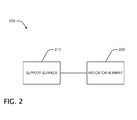
- FIG. 2 shows a block diagram of an exemplary embodiment of an escalator step 200.
- the step comprises a support surface 210.
- the support surface 210 supports the passenger while the passenger is being transported by the escalator.
- the support surface 210 can comprise a standing surface.
- the support surface 210 can also couple the step 200 to one or more other components of the escalator installation (e.g., another step).
- the step 200 further comprises an indicator element 220, which is coupled to the support surface 210.
- the indicator element 220 comprises a device for visually communicating information.
- the indicator element 220 comprises one or more of the following: a light bulb; an LED (light-emitting diode); an OLED (organic light-emitting diode); and an electromechanical display (e.g., split-flap or flip-dot displays). Additional devices for visually communicating information can also be used. Further embodiments can use other technologies.
- the indicator element 220 is coupled to and controlled by a control unit, such as the control unit 120 of FIG. 1 .
- the indicator element 220 is configured to display escalator information when viewed from the lower end of the escalator.
- the indicator element of a step 130 is at least partially visible from at least a portion of the floor 112.
- a track running along at least a portion of an elevator installation could provide power and/or control signals to the element 220. This transmission could occur through electrical contact. It could also occur contactlessly (e.g., by inductive energy transmission, or using another technique). Power could also be provided by a battery or other independent power supply.
- escalator information refers to information that can aid a passenger in using the escalator.
- escalator information can include one or more of the following: information indicating a current operating direction of the escalator; information indicating a future operating direction of the escalator (e.g., indicating that the escalator will change operating directions shortly); information indicating where a passenger should stand if the passenger intends to remain on a step (e.g., which side of a step); and information indicating which side of the steps a passenger should use to walk up or down the escalator.
- FIG. 3 shows a perspective view of an exemplary embodiment of an escalator step 300.
- the step 300 comprises a support surface 310, which is coupled to a riser 330.
- An indicator element 320 is coupled to the riser 330.
- the step 300 further comprises a support member 340, which can aid the structural integrity of the step 300.
- the riser 330 and the indicator element 320 are at least partially exposed for at least some of the time that the step 300 is moving between the upper and lower floors served by the escalator.
- the indicator element 320 is at least partially visible from the lower floor for a portion of the time that the step is travelling between the upper and lower floors.
- the step further comprises a translucent or transparent element 350 that covers at least part of the indicator element 320.
- the element 350 can be integrated into the riser 330, possibly such that the element 350 is not clearly distinct from the riser 330.
- the element 350 is a "milky-white" plastic that obscures the presence of the indicator element 320 if the indicator element 320 is not lit.
- Any component of the step 300 can be made of materials designed to withstand abuse (e.g., vandalism).
- the element 350 could be made of impact-resistant plastic.
- the indicator element 320 is located on a portion of the step 300 other than and/or in addition to the riser 330.
- the support surface 310 can feature the indicator element 320 (e.g., an LED, OLED, or another device). In some cases, part or all of the support surface 310 is formed by the indicator element 320. In further cases, the support surface 310 is at least partially translucent and/or transparent (e.g., it is made of translucent and/or clear plastic). The indicator element 320 can then be positioned beneath the surface 310.
- FIG. 4 shows a plurality of steps arranged in the escalator 110, as seen from the view indicated in FIG. 1 .
- Each of the steps comprises an indicator element.
- the step 130 comprises an indicator element 410.
- a passenger standing at the foot of the escalator or riding up the escalator can see at least some of the indicator elements on the steps.
- FIG. 5 shows a block diagram of an exemplary embodiment of a method 500 for communicating information to a passenger using one or more escalator steps, such as the steps 200, 300 described above.
- escalator information is received.
- the escalator information can indicate that the escalator is moving upward, or that the escalator is moving downward.
- the escalator information can be received by a control unit, for example.
- the escalator information is displayed on one or more steps of the escalator. For example, information indicating the current direction of the escalator can be displayed on the one or more steps.
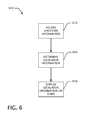
- FIG. 6 shows a block diagram of an exemplary embodiment of a method 600 for communicating information to a passenger using one or more escalator steps, such as the steps 200, 300 described above.
- direction information for the escalator is received.
- the direction information is received from, for example, an escalator control unit.
- the direction information can comprise an indication that, for example, the escalator is moving upwards, moving downwards and/or will soon change directions.
- the escalator information is determined based on the direction information.
- the escalator information can comprise an indicator corresponding to the direction information.
- the escalator information is displayed using one or more of the escalator steps.
- FIG. 7A shows an exemplary embodiment of an indicator element 710 showing escalator information.
- the indicator element 710 shows an image 712.
- the image 712 can indicate, for example, a current or future operating direction of the escalator relative to the point from which the indicator element 710 is viewed. For example, in the context of the system 100 of FIG. 1 , if the image 712 on the indicator element 710 is visible to passengers standing on the floor 112, then the passengers can discern the current or future operating direction of the escalator 110. If the image 712 is green, then passengers on the floor 112 can know that the escalator 110 is currently moving in an upward direction between the floors 112, 114.
- the image 712 is red, then passengers on the floor 112 can know that the escalator 110 is currently moving in a downward direction between the floors 112, 114. If the image 712 is yellow, the passengers on the floor 112 can know that the escalator 110 will soon change operating directions.
- FIG. 7B shows another exemplary embodiment of an indicator element 720 showing escalator information.
- an indicator 722 in the depicted embodiment, the word "WALK” appears, telling passengers that the corresponding side of the escalator is reserved for passengers who wish to walk up the escalator.
- an indicator 724 in the depicted embodiment, the word "STAND" appears, telling passengers that the corresponding side of the escalator is reserved for passengers who wish to stand on the escalator steps (e.g., instead of walking up the steps).
- FIG. 7C shows another exemplary embodiment of an indicator element 730 showing escalator information.
- an arrow image 732 is used to show passengers which side of the escalator is reserved for walking
- a stop sign image 734 is used to show passengers which side of the escalator is used for standing.
- Colored blocks or other shapes can also be used to indicate a walking side and a standing side (e.g., a green block indicates a walking side, and a red block indicates a standing side).
- every step of an escalator installation comprises an indicator element.
- only selected steps comprise an indicator element. For example, only every second step, every third step, every fourth step, every fifth step, or another fraction of steps comprises an indicator element.
- At least some of the disclosed embodiments can allow for more efficient use of escalators by passengers.
- one or more of the escalator steps described herein can communicate to passengers approaching and/or riding an escalator information about the escalator's operation. Such information can aid the passengers in using the escalator more effectively.
- a passenger can recognize which of several escalators is operating in a given direction. In some cases, the information can be noticed by passengers when they are relatively far from the escalator installation.
- a passenger approaches an escalator installation from a lower floor.
- the installation comprises three escalators leading from the lower floor to an upper floor. Due to fluctuations in traffic, one or more of the escalators changes operating directions over the course of the day.
- the passenger can see indicator elements on at least some of the steps of the different escalators.
- the indicator elements on steps of two of the escalators appear red, indicating that these escalators are moving in a downward direction (i.e., in the "wrong" direction for someone approaching the escalators from the lower floor).
- the indicator elements on steps of the third escalator appear green, indicating that this escalator is moving in an upward direction (i.e., in the "right" direction for someone approaching the escalators from the lower floor). Accordingly, the passenger can identify the proper escalator for an upward journey, even at some distance from the escalator installation and even if one or more passengers disembarking from an escalator and/or waiting to board an escalator are obscuring directional signs at the foot of an escalator.
- a passenger boarding or riding on an escalator sees indicator elements on one or more escalator steps.
- the word "WALK” appears on the left side of the indicator elements.
- the word "STAND” appears on the right side of the indicator elements. Accordingly, the passenger knows that the left side of the escalator is reserved for passengers who wish to walk up the escalator, while the right side of the escalator is reserved for passengers who wish to stand on the steps. The passenger is thus informed of the expected behavior for that particular escalator, which may be different from what the passenger is used to.
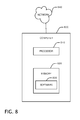
- FIG. 8 shows a block diagram of an exemplary embodiment of a computer 800 (e.g., part of a control computer) that can be used with one or more technologies disclosed herein.
- the computer 800 comprises one or more processors 810.
- the processor 810 is coupled to a memory 820, which comprises one or more computer-readable storage media storing software instructions 830. When executed by the processor 810, the software instructions 830 cause the processor 810 to perform one or more method acts disclosed herein.
- Further embodiments of the computer 800 can comprise one or more additional components.
- the computer 800 can be connected to one or more other computers or electronic devices through an input/output component (not shown). In at least some embodiments, the computer 800 can connect to other computers or electronic devices through a network 840.
- the computer 800 works with one or more other computers, which are located locally and/or remotely. One or more of the disclosed methods can thus be performed using a distributed computing system.
Landscapes
- Escalators And Moving Walkways (AREA)
Abstract
Escalator steps (130) can include indicator elements (320) that communicate escalator information to escalator passengers. The escalator information can indicate, for example, a current operating direction of an escalator (100), a future operating direction of the escalator (100), proper standing and walking positions for escalator passengers, and/or other information.
Description
- The disclosure relates to escalator installations.
- It is sometimes useful to communicate information about an escalator installation to an escalator passenger. For example, a current operating direction of the installation can be communicated to the user.
-
US20060191177A1 describes a display device for use with a passenger conveyor that provides a traffic flow direction indicator. - Further options for communicating information to passengers could be useful. This is addressed herein by at least some embodiments covered by the claims.
- Escalator steps can comprise indicator elements that communicate escalator information to escalator passengers. The escalator information can indicate, for example, a current operating direction of an escalator, a future operating direction of the escalator, proper standing and walking positions for escalator passengers, and/or other information.
- Some embodiments of an escalator step comprise: a standing surface for supporting a passenger while the passenger is transported by an escalator between a lower floor and an upper floor; and an indicating element, the indicating element being configured to show escalator information toward the lower floor. The step can further comprise a riser coupled to the standing surface, the indicating element being coupled to the riser. The riser can comprise a translucent or transparent surface, the indicating element being at least partially covered by the translucent or transparent surface. The translucent surface can comprise a white plastic. The indicating element can comprise a light bulb, a light-emitting diode, an organic light-emitting diode, and/or an electromechanical display. In some cases, the indicating element is a first indicating element, and the escalator step further comprises a second indicating element configured to show the escalator information toward the lower floor.
- Some embodiments of an escalator method comprise: receiving escalator information for an escalator; and displaying the escalator information using indicating elements on steps of the escalator. The method can further comprise: determining a future operating direction for the escalator; and based on the future operating direction, causing additional escalator information to be displayed using the indicating elements on the steps of the escalator. The escalator information can indicate a current operating direction for the escalator. The escalator information can also indicate a walking side of the steps and a standing side of the steps. The displaying of the escalator information can comprise displaying an animated indicator using the indicating elements on two or more of the steps. The animated indicator can comprise an image that appears to move up or down the steps of the escalator.
- Embodiments of an escalator can comprise: a plurality of escalator steps, the escalator steps comprising respective standing surfaces and respective indicating elements, the escalator steps extending between an upper floor and a lower floor; and an escalator control computer coupled to the respective indicating elements, the escalator control computer being programmed to cause at least some of the respective indicating elements to display escalator information for the escalator. The escalator can further comprise additional escalator steps without respective indicating elements.
- Further embodiments comprise a computer-based device configured to perform one or more of the disclosed methods.
- At least some embodiments of the disclosed methods can be implemented using a computer or computer-based device that performs one or more method acts, the computer or computer-based device having read instructions for performing the method acts from one or more computer-readable storage media. The computer-readable storage media can comprise, for example, one or more optical disks, volatile memory components (such as DRAM or SRAM), and/or nonvolatile memory components (such as hard drives, Flash RAM or ROM). The computer-readable storage media do not cover pure transitory signals. The methods disclosed herein are not performed solely in the human mind.
- The disclosure refers to the following figures, in which:
-
FIG. 1 shows an exemplary embodiment of an escalator installation. -
FIG. 2 shows a block diagram of an exemplary embodiment of an escalator step. -
FIG. 3 shows an additional exemplary embodiment of an escalator step. -
FIG. 4 shows an exemplary embodiment of a set of escalator steps. -
FIG. 5 shows a block diagram of an exemplary embodiment of a method for communicating information to a passenger. -
FIG. 6 shows a block diagram of another exemplary embodiment of a method for communicating information to a passenger. -
FIGS. 7A-7C show exemplary embodiments of information displayed on an indicator element. -
FIG. 8 shows a block diagram of an exemplary embodiment of a computer. - Disclosed herein are various exemplary embodiments of systems, methods and apparatus for use with escalators. Examples of escalators can include straight escalators and spiral escalators. Unless explicitly stated otherwise, the disclosed technologies can be applied to installations having a single escalator or multiple escalators (of the same type or of various types).
-
FIG. 1 shows a block diagram of an exemplary embodiment of anescalator installation 100. Theinstallation 100 comprises anescalator 110 configured to convey passengers between twofloors escalator 110 can run in an upward direction (for moving passengers fromfloor 112 to floor 114) or in a downward direction (for moving passengers fromfloor 114 to floor 112). Theescalator 110 is coupled to and controlled by acontrol unit 120. Thecontrol unit 120 is, for example, a computer-based device that reads software instructions and performs one or more of the method acts disclosed herein. Theescalator 110 comprises a plurality of movable steps, such as thestep 130. (In the depicted embodiment, and in the particular view ofFIG. 1 , thesteps 130 are obscured by a side wall of theescalator 110 and are thus shown in dashed lines.) Exemplary embodiments of such steps are described herein. For clarity, many of the possible additional components of theescalator 110 are not shown, for example, motors and handrails. - Although the
control unit 120 is depicted as being a single, computer-based device, in some cases theunit 120 comprises a plurality of computer-based units that are communicatively coupled to each other. In particular embodiments, a first computer-based unit is coupled to and controls theescalator 110, while a second computer-based unit (coupled to the first) is coupled to and exchanges information with one or more indicator elements on thesteps 130, as described below. Thecontrol unit 120 can also comprise a computer-based device that is coupled to a non-computer-based device (not shown) that directly controls the operations of one or more parts of theescalator 110. - In the context of this application, a "passenger" is a person, an animal and/or a machine that travels, intends to soon travel, or recently traveled with an escalator.
-
FIG. 2 shows a block diagram of an exemplary embodiment of anescalator step 200. In some embodiments, one or more of theescalator steps 130 are similar to thestep 200, while other steps are different. The step comprises asupport surface 210. Thesupport surface 210 supports the passenger while the passenger is being transported by the escalator. For example, thesupport surface 210 can comprise a standing surface. In some embodiments, thesupport surface 210 can also couple thestep 200 to one or more other components of the escalator installation (e.g., another step). Thestep 200 further comprises anindicator element 220, which is coupled to thesupport surface 210. Theindicator element 220 comprises a device for visually communicating information. In various embodiments, theindicator element 220 comprises one or more of the following: a light bulb; an LED (light-emitting diode); an OLED (organic light-emitting diode); and an electromechanical display (e.g., split-flap or flip-dot displays). Additional devices for visually communicating information can also be used. Further embodiments can use other technologies. Theindicator element 220 is coupled to and controlled by a control unit, such as thecontrol unit 120 ofFIG. 1 . Theindicator element 220 is configured to display escalator information when viewed from the lower end of the escalator. For example, in the context of the embodiment ofFIG. 1 , the indicator element of astep 130 is at least partially visible from at least a portion of thefloor 112. - In various embodiments, different technologies can be used to deliver power and/or control signals to the
indicator element 220. For example, a track running along at least a portion of an elevator installation could provide power and/or control signals to theelement 220. This transmission could occur through electrical contact. It could also occur contactlessly (e.g., by inductive energy transmission, or using another technique). Power could also be provided by a battery or other independent power supply. - In the context of this application and the claims, "escalator information" refers to information that can aid a passenger in using the escalator. For example, escalator information can include one or more of the following: information indicating a current operating direction of the escalator; information indicating a future operating direction of the escalator (e.g., indicating that the escalator will change operating directions shortly); information indicating where a passenger should stand if the passenger intends to remain on a step (e.g., which side of a step); and information indicating which side of the steps a passenger should use to walk up or down the escalator.
-
FIG. 3 shows a perspective view of an exemplary embodiment of anescalator step 300. Thestep 300 comprises asupport surface 310, which is coupled to ariser 330. Anindicator element 320 is coupled to theriser 330. In particular embodiments, thestep 300 further comprises asupport member 340, which can aid the structural integrity of thestep 300. When the embodiment ofFIG. 3 is used in an escalator installation, theriser 330 and theindicator element 320 are at least partially exposed for at least some of the time that thestep 300 is moving between the upper and lower floors served by the escalator. Accordingly, theindicator element 320 is at least partially visible from the lower floor for a portion of the time that the step is travelling between the upper and lower floors. In some embodiments, the step further comprises a translucent ortransparent element 350 that covers at least part of theindicator element 320. Theelement 350 can be integrated into theriser 330, possibly such that theelement 350 is not clearly distinct from theriser 330. In some cases, theelement 350 is a "milky-white" plastic that obscures the presence of theindicator element 320 if theindicator element 320 is not lit. Any component of thestep 300 can be made of materials designed to withstand abuse (e.g., vandalism). For example, theelement 350 could be made of impact-resistant plastic. - In other embodiments, the
indicator element 320 is located on a portion of thestep 300 other than and/or in addition to theriser 330. For example, thesupport surface 310 can feature the indicator element 320 (e.g., an LED, OLED, or another device). In some cases, part or all of thesupport surface 310 is formed by theindicator element 320. In further cases, thesupport surface 310 is at least partially translucent and/or transparent (e.g., it is made of translucent and/or clear plastic). Theindicator element 320 can then be positioned beneath thesurface 310. -
FIG. 4 shows a plurality of steps arranged in theescalator 110, as seen from the view indicated inFIG. 1 . (For clarity, escalator components other than the steps are omitted from this view.) Each of the steps comprises an indicator element. For example, thestep 130 comprises anindicator element 410. Thus, a passenger standing at the foot of the escalator or riding up the escalator can see at least some of the indicator elements on the steps. -
FIG. 5 shows a block diagram of an exemplary embodiment of amethod 500 for communicating information to a passenger using one or more escalator steps, such as thesteps method act 510, escalator information is received. For example, the escalator information can indicate that the escalator is moving upward, or that the escalator is moving downward. The escalator information can be received by a control unit, for example. In amethod act 520, the escalator information is displayed on one or more steps of the escalator. For example, information indicating the current direction of the escalator can be displayed on the one or more steps. -
FIG. 6 shows a block diagram of an exemplary embodiment of amethod 600 for communicating information to a passenger using one or more escalator steps, such as thesteps method act 610, direction information for the escalator is received. The direction information is received from, for example, an escalator control unit. The direction information can comprise an indication that, for example, the escalator is moving upwards, moving downwards and/or will soon change directions. In amethod act 620, the escalator information is determined based on the direction information. For example, the escalator information can comprise an indicator corresponding to the direction information. In amethod act 630, the escalator information is displayed using one or more of the escalator steps. -
FIG. 7A shows an exemplary embodiment of anindicator element 710 showing escalator information. Theindicator element 710 shows animage 712. Theimage 712 can indicate, for example, a current or future operating direction of the escalator relative to the point from which theindicator element 710 is viewed. For example, in the context of thesystem 100 ofFIG. 1 , if theimage 712 on theindicator element 710 is visible to passengers standing on thefloor 112, then the passengers can discern the current or future operating direction of theescalator 110. If theimage 712 is green, then passengers on thefloor 112 can know that theescalator 110 is currently moving in an upward direction between thefloors image 712 is red, then passengers on thefloor 112 can know that theescalator 110 is currently moving in a downward direction between thefloors image 712 is yellow, the passengers on thefloor 112 can know that theescalator 110 will soon change operating directions. -
FIG. 7B shows another exemplary embodiment of anindicator element 720 showing escalator information. On one side of theindicator element 720, an indicator 722 (in the depicted embodiment, the word "WALK") appears, telling passengers that the corresponding side of the escalator is reserved for passengers who wish to walk up the escalator. On the other side of theindicator element 720, an indicator 724 (in the depicted embodiment, the word "STAND") appears, telling passengers that the corresponding side of the escalator is reserved for passengers who wish to stand on the escalator steps (e.g., instead of walking up the steps). -
FIG. 7C shows another exemplary embodiment of anindicator element 730 showing escalator information. In this embodiment, anarrow image 732 is used to show passengers which side of the escalator is reserved for walking, and astop sign image 734 is used to show passengers which side of the escalator is used for standing. Colored blocks or other shapes can also be used to indicate a walking side and a standing side (e.g., a green block indicates a walking side, and a red block indicates a standing side). - In various embodiments, different colors, graphics, words, icons, animations and/or other visual expressions of information can be used, in addition to or in combination with those described herein.
- In some embodiments, every step of an escalator installation comprises an indicator element. In further embodiments, only selected steps comprise an indicator element. For example, only every second step, every third step, every fourth step, every fifth step, or another fraction of steps comprises an indicator element.
- At least some of the disclosed embodiments can allow for more efficient use of escalators by passengers. For example, one or more of the escalator steps described herein can communicate to passengers approaching and/or riding an escalator information about the escalator's operation. Such information can aid the passengers in using the escalator more effectively. For example, a passenger can recognize which of several escalators is operating in a given direction. In some cases, the information can be noticed by passengers when they are relatively far from the escalator installation.
- In one non-limiting example, a passenger approaches an escalator installation from a lower floor. The installation comprises three escalators leading from the lower floor to an upper floor. Due to fluctuations in traffic, one or more of the escalators changes operating directions over the course of the day. As the passenger approaches the escalators, the passenger can see indicator elements on at least some of the steps of the different escalators. The indicator elements on steps of two of the escalators appear red, indicating that these escalators are moving in a downward direction (i.e., in the "wrong" direction for someone approaching the escalators from the lower floor). The indicator elements on steps of the third escalator appear green, indicating that this escalator is moving in an upward direction (i.e., in the "right" direction for someone approaching the escalators from the lower floor). Accordingly, the passenger can identify the proper escalator for an upward journey, even at some distance from the escalator installation and even if one or more passengers disembarking from an escalator and/or waiting to board an escalator are obscuring directional signs at the foot of an escalator.
- In another non-limiting example, a passenger boarding or riding on an escalator sees indicator elements on one or more escalator steps. On the left side of the indicator elements, the word "WALK" appears. On the right side of the indicator elements, the word "STAND" appears. Accordingly, the passenger knows that the left side of the escalator is reserved for passengers who wish to walk up the escalator, while the right side of the escalator is reserved for passengers who wish to stand on the steps. The passenger is thus informed of the expected behavior for that particular escalator, which may be different from what the passenger is used to.
-
FIG. 8 shows a block diagram of an exemplary embodiment of a computer 800 (e.g., part of a control computer) that can be used with one or more technologies disclosed herein. Thecomputer 800 comprises one ormore processors 810. Theprocessor 810 is coupled to amemory 820, which comprises one or more computer-readable storage mediastoring software instructions 830. When executed by theprocessor 810, thesoftware instructions 830 cause theprocessor 810 to perform one or more method acts disclosed herein. Further embodiments of thecomputer 800 can comprise one or more additional components. Thecomputer 800 can be connected to one or more other computers or electronic devices through an input/output component (not shown). In at least some embodiments, thecomputer 800 can connect to other computers or electronic devices through anetwork 840. In particular embodiments, thecomputer 800 works with one or more other computers, which are located locally and/or remotely. One or more of the disclosed methods can thus be performed using a distributed computing system. - Although some embodiments of the various methods disclosed herein are described as comprising a certain number of method acts, further embodiments of a given method can comprise more or fewer method acts than are explicitly disclosed herein. In additional embodiments, method acts are performed in an order other than as disclosed herein. Having illustrated and described the principles of the disclosed technologies, it will be apparent to those skilled in the art that the disclosed embodiments can be modified in arrangement and detail without departing from such principles. In view of the many possible embodiments to which the principles of the disclosed technologies can be applied, it should be recognized that the illustrated embodiments are only examples of the technologies and should not be taken as limiting the scope of the invention. Rather, the scope of the invention is defined by the following claims and their equivalents. I therefore claim as my invention all that comes within the scope of these claims.
Claims (15)
- An escalator step (130), comprising:a standing surface (310) for supporting a passenger while the passenger is transported by an escalator (100) between a lower floor (112) and an upper floor (114); andan indicating element (320), the indicating element (320) being configured to show, toward the lower floor (112), escalator information sent to the step (130) by a control unit (120).
- The escalator step (130) of claim 1, further comprising a riser (330) coupled to the standing surface (310), the indicating element (320) being coupled to the riser (330).
- The escalator step (130) of claim 2, the riser (330) comprising a translucent or transparent surface (350), the indicating element (320) being at least partially covered by the translucent or transparent surface (350).
- The escalator step (130) of claim 3, the riser (330) comprising the translucent surface (350), the translucent surface (350) comprising a white plastic.
- The escalator step (130) of any of the preceding claims, the indicating element (320) comprising a light bulb, a light-emitting diode, an organic light-emitting diode, and/or an electromechanical display.
- The escalator step (130) of any of the preceding claims, the indicating element (320) being a first indicating element, the escalator step (130) further comprising a second indicating element (320) configured to show the escalator information toward the lower floor (112).
- An escalator method, comprising:receiving escalator information for an escalator (100); anddisplaying the escalator information using indicating elements (320) on steps (130) of the escalator (100).
- The escalator method of claim 7, further comprising:determining a future operating direction for the escalator (100); andbased on the future operating direction, causing additional escalator information to be displayed using the indicating elements (320) on the steps (130) of the escalator (100).
- The escalator method of claim 7 or 8, the escalator information indicating a current operating direction for the escalator (100).
- The escalator method of claim 7 or 8, the escalator information indicating a walking side of the steps (130) and a standing side of the steps (130).
- The escalator method of any of claims 7-10, the displaying the escalator information comprising displaying an animated indicator using the indicating elements (320) on two or more of the steps (130).
- The escalator method of claim 11, the animated indicator comprising an image that appears to move up or down the steps (130) of the escalator (100).
- One or more computer-readable storage media (820) having encoded thereon instructions (830) that, when executed by a processor (810), cause the processor (810) to perform a method, the method comprising:receiving escalator information for an escalator (100); anddisplaying the escalator information using indicating elements (320) on steps (130) of the escalator (100).
- An escalator (100), comprising:a plurality of escalator steps (130), the escalator steps (130) comprising respective standing surfaces (310) and respective indicating elements (320), the escalator steps (130) extending between an upper floor (114) and a lower floor (112); andan escalator control computer (120) coupled to the respective indicating elements (320), the escalator control computer (120) being programmed to cause at least some of the respective indicating elements (320) to display escalator information for the escalator (100).
- The escalator of claim 14, further comprising additional escalator steps (130) without respective indicating elements (320).
Priority Applications (1)
| Application Number | Priority Date | Filing Date | Title |
|---|---|---|---|
| EP12186996.0A EP2716589A1 (en) | 2012-10-02 | 2012-10-02 | Displaying information using escalator steps |
Applications Claiming Priority (1)
| Application Number | Priority Date | Filing Date | Title |
|---|---|---|---|
| EP12186996.0A EP2716589A1 (en) | 2012-10-02 | 2012-10-02 | Displaying information using escalator steps |
Publications (1)
| Publication Number | Publication Date |
|---|---|
| EP2716589A1 true EP2716589A1 (en) | 2014-04-09 |
Family
ID=47296916
Family Applications (1)
| Application Number | Title | Priority Date | Filing Date |
|---|---|---|---|
| EP12186996.0A Withdrawn EP2716589A1 (en) | 2012-10-02 | 2012-10-02 | Displaying information using escalator steps |
Country Status (1)
| Country | Link |
|---|---|
| EP (1) | EP2716589A1 (en) |
Cited By (3)
| Publication number | Priority date | Publication date | Assignee | Title |
|---|---|---|---|---|
| WO2015183927A1 (en) * | 2014-05-29 | 2015-12-03 | Goldstein Harold A | Regenerative power capture system for endless track escalators and moving walkways |
| US10954102B2 (en) | 2017-01-26 | 2021-03-23 | Otis Elevator Company | Diagnostic step for a passenger conveyor |
| JP2025122011A (en) * | 2019-06-03 | 2025-08-20 | 株式会社ワークス・ワン | Steps and escalators |
Citations (6)
| Publication number | Priority date | Publication date | Assignee | Title |
|---|---|---|---|---|
| JPH0986847A (en) * | 1995-09-27 | 1997-03-31 | Hitachi Ltd | Passenger conveyor |
| JP2005047639A (en) * | 2003-07-30 | 2005-02-24 | Toshiba Elevator Co Ltd | Passenger conveyer device |
| US20060191177A1 (en) | 2002-09-20 | 2006-08-31 | Engel Gabriel D | Multi-view display |
| JP2007254061A (en) * | 2006-03-22 | 2007-10-04 | Mitsubishi Electric Corp | Man conveyor display device |
| JP2011105423A (en) * | 2009-11-16 | 2011-06-02 | Mitsubishi Electric Building Techno Service Co Ltd | Escalator system |
| JP2012166865A (en) * | 2011-02-10 | 2012-09-06 | Mitsubishi Electric Building Techno Service Co Ltd | Step for escalator and escalator display system |
-
2012
- 2012-10-02 EP EP12186996.0A patent/EP2716589A1/en not_active Withdrawn
Patent Citations (6)
| Publication number | Priority date | Publication date | Assignee | Title |
|---|---|---|---|---|
| JPH0986847A (en) * | 1995-09-27 | 1997-03-31 | Hitachi Ltd | Passenger conveyor |
| US20060191177A1 (en) | 2002-09-20 | 2006-08-31 | Engel Gabriel D | Multi-view display |
| JP2005047639A (en) * | 2003-07-30 | 2005-02-24 | Toshiba Elevator Co Ltd | Passenger conveyer device |
| JP2007254061A (en) * | 2006-03-22 | 2007-10-04 | Mitsubishi Electric Corp | Man conveyor display device |
| JP2011105423A (en) * | 2009-11-16 | 2011-06-02 | Mitsubishi Electric Building Techno Service Co Ltd | Escalator system |
| JP2012166865A (en) * | 2011-02-10 | 2012-09-06 | Mitsubishi Electric Building Techno Service Co Ltd | Step for escalator and escalator display system |
Cited By (6)
| Publication number | Priority date | Publication date | Assignee | Title |
|---|---|---|---|---|
| WO2015183927A1 (en) * | 2014-05-29 | 2015-12-03 | Goldstein Harold A | Regenerative power capture system for endless track escalators and moving walkways |
| US9346654B2 (en) | 2014-05-29 | 2016-05-24 | Goldstein Biomedical Consultants Llc | Regenerative power capture system for endless track escalators and moving walkways |
| JP2017526594A (en) * | 2014-05-29 | 2017-09-14 | ゴールドスタイン バイオメディカル コンサルタンツ リミテッド ライアビリティ カンパニー | Regenerative power capture system for endless truck escalators and moving walkways |
| US10752468B2 (en) | 2014-05-29 | 2020-08-25 | Goldstein Biomedical Consultants Llc | Regenerative power capture system for endless track escalators and moving walkways |
| US10954102B2 (en) | 2017-01-26 | 2021-03-23 | Otis Elevator Company | Diagnostic step for a passenger conveyor |
| JP2025122011A (en) * | 2019-06-03 | 2025-08-20 | 株式会社ワークス・ワン | Steps and escalators |
Similar Documents
| Publication | Publication Date | Title |
|---|---|---|
| FI121421B (en) | A system for controlling lifts in an elevator system | |
| EP3309102B1 (en) | Elevator notice system | |
| CN103010913A (en) | Passenger conveying equipment and operation display device of the passenger conveying equipment | |
| CN101356107B (en) | Information display in elevator car | |
| US7249667B2 (en) | Traffic flow indicator for a passenger conveyor | |
| CN103502130B (en) | Floor call registration device for elevator | |
| KR20160049815A (en) | Bus Stop Having Safeguard Line for Passenger, and Passenger Safeguard System Having the Same | |
| CN111108057B (en) | Continuous-transport pedal-able people mover with charging of the mover | |
| JP2012025524A (en) | Elevator display apparatus | |
| JP6151118B2 (en) | Departure guidance system and departure guidance light emitting device | |
| JPS63310483A (en) | Platform display unit for elevator | |
| JP2022148104A (en) | elevator hall display | |
| JP6112875B2 (en) | Elevator operation display device | |
| JP2005067801A (en) | Moving handrail for escalator or man conveyor and escalator or man conveyor equipped with moving handrails | |
| KR20260011442A (en) | Guide System in Train Station Using Floor Lamp and Floor Panel | |
| JP4892210B2 (en) | Stair lighting equipment | |
| HK1090902B (en) | Traffic flow indicator for a passenger conveyor | |
| RU2428369C2 (en) | Passenger conveyor travel direction indicator and passenger conveyor | |
| KR200464778Y1 (en) | Lighting guide apparatus of escalator floor plate | |
| JP2012007340A (en) | Guide block for the visually impaired and guide path using the same | |
| JP7791560B2 (en) | Steps and escalators | |
| KR200405180Y1 (en) | Parking status indicator | |
| CN120603777A (en) | Driving path device with electronic playback device | |
| KR20230091595A (en) | Raised block with a led light | |
| JP3155264U (en) | Vehicle proximity equipment guide map |
Legal Events
| Date | Code | Title | Description |
|---|---|---|---|
| PUAI | Public reference made under article 153(3) epc to a published international application that has entered the european phase |
Free format text: ORIGINAL CODE: 0009012 |
|
| AK | Designated contracting states |
Kind code of ref document: A1 Designated state(s): AL AT BE BG CH CY CZ DE DK EE ES FI FR GB GR HR HU IE IS IT LI LT LU LV MC MK MT NL NO PL PT RO RS SE SI SK SM TR |
|
| AX | Request for extension of the european patent |
Extension state: BA ME |
|
| STAA | Information on the status of an ep patent application or granted ep patent |
Free format text: STATUS: THE APPLICATION HAS BEEN WITHDRAWN |
|
| 18W | Application withdrawn |
Effective date: 20140527 |