EP2715747B1 - Magnetoplumbite-type ferrite magnetic material and segment-type permanent magnet derived therefrom - Google Patents
Magnetoplumbite-type ferrite magnetic material and segment-type permanent magnet derived therefrom Download PDFInfo
- Publication number
- EP2715747B1 EP2715747B1 EP12793259.8A EP12793259A EP2715747B1 EP 2715747 B1 EP2715747 B1 EP 2715747B1 EP 12793259 A EP12793259 A EP 12793259A EP 2715747 B1 EP2715747 B1 EP 2715747B1
- Authority
- EP
- European Patent Office
- Prior art keywords
- ferrite
- ihc
- magnetic material
- type
- segment
- Prior art date
- Legal status (The legal status is an assumption and is not a legal conclusion. Google has not performed a legal analysis and makes no representation as to the accuracy of the status listed.)
- Active
Links
Images


Classifications
-
- H—ELECTRICITY
- H01—ELECTRIC ELEMENTS
- H01F—MAGNETS; INDUCTANCES; TRANSFORMERS; SELECTION OF MATERIALS FOR THEIR MAGNETIC PROPERTIES
- H01F1/00—Magnets or magnetic bodies characterised by the magnetic materials therefor; Selection of materials for their magnetic properties
- H01F1/01—Magnets or magnetic bodies characterised by the magnetic materials therefor; Selection of materials for their magnetic properties of inorganic materials
- H01F1/03—Magnets or magnetic bodies characterised by the magnetic materials therefor; Selection of materials for their magnetic properties of inorganic materials characterised by their coercivity
- H01F1/032—Magnets or magnetic bodies characterised by the magnetic materials therefor; Selection of materials for their magnetic properties of inorganic materials characterised by their coercivity of hard-magnetic materials
- H01F1/10—Magnets or magnetic bodies characterised by the magnetic materials therefor; Selection of materials for their magnetic properties of inorganic materials characterised by their coercivity of hard-magnetic materials non-metallic substances, e.g. ferrites, e.g. [(Ba,Sr)O(Fe2O3)6] ferrites with hexagonal structure
- H01F1/11—Magnets or magnetic bodies characterised by the magnetic materials therefor; Selection of materials for their magnetic properties of inorganic materials characterised by their coercivity of hard-magnetic materials non-metallic substances, e.g. ferrites, e.g. [(Ba,Sr)O(Fe2O3)6] ferrites with hexagonal structure in the form of particles
-
- C—CHEMISTRY; METALLURGY
- C01—INORGANIC CHEMISTRY
- C01G—COMPOUNDS CONTAINING METALS NOT COVERED BY SUBCLASSES C01D OR C01F
- C01G51/00—Compounds of cobalt
- C01G51/80—Compounds containing cobalt, with or without oxygen or hydrogen, and containing one or more other elements
- C01G51/82—Compounds containing cobalt, with or without oxygen or hydrogen, and containing two or more other elements
-
- C—CHEMISTRY; METALLURGY
- C04—CEMENTS; CONCRETE; ARTIFICIAL STONE; CERAMICS; REFRACTORIES
- C04B—LIME, MAGNESIA; SLAG; CEMENTS; COMPOSITIONS THEREOF, e.g. MORTARS, CONCRETE OR LIKE BUILDING MATERIALS; ARTIFICIAL STONE; CERAMICS; REFRACTORIES; TREATMENT OF NATURAL STONE
- C04B35/00—Shaped ceramic products characterised by their composition; Ceramics compositions; Processing powders of inorganic compounds preparatory to the manufacturing of ceramic products
- C04B35/01—Shaped ceramic products characterised by their composition; Ceramics compositions; Processing powders of inorganic compounds preparatory to the manufacturing of ceramic products based on oxide ceramics
- C04B35/26—Shaped ceramic products characterised by their composition; Ceramics compositions; Processing powders of inorganic compounds preparatory to the manufacturing of ceramic products based on oxide ceramics based on ferrites
-
- C—CHEMISTRY; METALLURGY
- C04—CEMENTS; CONCRETE; ARTIFICIAL STONE; CERAMICS; REFRACTORIES
- C04B—LIME, MAGNESIA; SLAG; CEMENTS; COMPOSITIONS THEREOF, e.g. MORTARS, CONCRETE OR LIKE BUILDING MATERIALS; ARTIFICIAL STONE; CERAMICS; REFRACTORIES; TREATMENT OF NATURAL STONE
- C04B35/00—Shaped ceramic products characterised by their composition; Ceramics compositions; Processing powders of inorganic compounds preparatory to the manufacturing of ceramic products
- C04B35/622—Forming processes; Processing powders of inorganic compounds preparatory to the manufacturing of ceramic products
- C04B35/626—Preparing or treating the powders individually or as batches ; preparing or treating macroscopic reinforcing agents for ceramic products, e.g. fibres; mechanical aspects section B
- C04B35/62605—Treating the starting powders individually or as mixtures
- C04B35/6261—Milling
-
- C—CHEMISTRY; METALLURGY
- C04—CEMENTS; CONCRETE; ARTIFICIAL STONE; CERAMICS; REFRACTORIES
- C04B—LIME, MAGNESIA; SLAG; CEMENTS; COMPOSITIONS THEREOF, e.g. MORTARS, CONCRETE OR LIKE BUILDING MATERIALS; ARTIFICIAL STONE; CERAMICS; REFRACTORIES; TREATMENT OF NATURAL STONE
- C04B35/00—Shaped ceramic products characterised by their composition; Ceramics compositions; Processing powders of inorganic compounds preparatory to the manufacturing of ceramic products
- C04B35/622—Forming processes; Processing powders of inorganic compounds preparatory to the manufacturing of ceramic products
- C04B35/626—Preparing or treating the powders individually or as batches ; preparing or treating macroscopic reinforcing agents for ceramic products, e.g. fibres; mechanical aspects section B
- C04B35/62605—Treating the starting powders individually or as mixtures
- C04B35/6261—Milling
- C04B35/6262—Milling of calcined, sintered clinker or ceramics
-
- C—CHEMISTRY; METALLURGY
- C04—CEMENTS; CONCRETE; ARTIFICIAL STONE; CERAMICS; REFRACTORIES
- C04B—LIME, MAGNESIA; SLAG; CEMENTS; COMPOSITIONS THEREOF, e.g. MORTARS, CONCRETE OR LIKE BUILDING MATERIALS; ARTIFICIAL STONE; CERAMICS; REFRACTORIES; TREATMENT OF NATURAL STONE
- C04B35/00—Shaped ceramic products characterised by their composition; Ceramics compositions; Processing powders of inorganic compounds preparatory to the manufacturing of ceramic products
- C04B35/622—Forming processes; Processing powders of inorganic compounds preparatory to the manufacturing of ceramic products
- C04B35/626—Preparing or treating the powders individually or as batches ; preparing or treating macroscopic reinforcing agents for ceramic products, e.g. fibres; mechanical aspects section B
- C04B35/62605—Treating the starting powders individually or as mixtures
- C04B35/62625—Wet mixtures
-
- C—CHEMISTRY; METALLURGY
- C04—CEMENTS; CONCRETE; ARTIFICIAL STONE; CERAMICS; REFRACTORIES
- C04B—LIME, MAGNESIA; SLAG; CEMENTS; COMPOSITIONS THEREOF, e.g. MORTARS, CONCRETE OR LIKE BUILDING MATERIALS; ARTIFICIAL STONE; CERAMICS; REFRACTORIES; TREATMENT OF NATURAL STONE
- C04B35/00—Shaped ceramic products characterised by their composition; Ceramics compositions; Processing powders of inorganic compounds preparatory to the manufacturing of ceramic products
- C04B35/622—Forming processes; Processing powders of inorganic compounds preparatory to the manufacturing of ceramic products
- C04B35/626—Preparing or treating the powders individually or as batches ; preparing or treating macroscopic reinforcing agents for ceramic products, e.g. fibres; mechanical aspects section B
- C04B35/62605—Treating the starting powders individually or as mixtures
- C04B35/62645—Thermal treatment of powders or mixtures thereof other than sintering
-
- C—CHEMISTRY; METALLURGY
- C04—CEMENTS; CONCRETE; ARTIFICIAL STONE; CERAMICS; REFRACTORIES
- C04B—LIME, MAGNESIA; SLAG; CEMENTS; COMPOSITIONS THEREOF, e.g. MORTARS, CONCRETE OR LIKE BUILDING MATERIALS; ARTIFICIAL STONE; CERAMICS; REFRACTORIES; TREATMENT OF NATURAL STONE
- C04B35/00—Shaped ceramic products characterised by their composition; Ceramics compositions; Processing powders of inorganic compounds preparatory to the manufacturing of ceramic products
- C04B35/622—Forming processes; Processing powders of inorganic compounds preparatory to the manufacturing of ceramic products
- C04B35/626—Preparing or treating the powders individually or as batches ; preparing or treating macroscopic reinforcing agents for ceramic products, e.g. fibres; mechanical aspects section B
- C04B35/62605—Treating the starting powders individually or as mixtures
- C04B35/62685—Treating the starting powders individually or as mixtures characterised by the order of addition of constituents or additives
-
- C—CHEMISTRY; METALLURGY
- C04—CEMENTS; CONCRETE; ARTIFICIAL STONE; CERAMICS; REFRACTORIES
- C04B—LIME, MAGNESIA; SLAG; CEMENTS; COMPOSITIONS THEREOF, e.g. MORTARS, CONCRETE OR LIKE BUILDING MATERIALS; ARTIFICIAL STONE; CERAMICS; REFRACTORIES; TREATMENT OF NATURAL STONE
- C04B35/00—Shaped ceramic products characterised by their composition; Ceramics compositions; Processing powders of inorganic compounds preparatory to the manufacturing of ceramic products
- C04B35/622—Forming processes; Processing powders of inorganic compounds preparatory to the manufacturing of ceramic products
- C04B35/64—Burning or sintering processes
-
- H—ELECTRICITY
- H01—ELECTRIC ELEMENTS
- H01F—MAGNETS; INDUCTANCES; TRANSFORMERS; SELECTION OF MATERIALS FOR THEIR MAGNETIC PROPERTIES
- H01F7/00—Magnets
- H01F7/02—Permanent magnets [PM]
-
- C—CHEMISTRY; METALLURGY
- C01—INORGANIC CHEMISTRY
- C01P—INDEXING SCHEME RELATING TO STRUCTURAL AND PHYSICAL ASPECTS OF SOLID INORGANIC COMPOUNDS
- C01P2004/00—Particle morphology
- C01P2004/60—Particles characterised by their size
- C01P2004/61—Micrometer sized, i.e. from 1-100 micrometer
-
- C—CHEMISTRY; METALLURGY
- C01—INORGANIC CHEMISTRY
- C01P—INDEXING SCHEME RELATING TO STRUCTURAL AND PHYSICAL ASPECTS OF SOLID INORGANIC COMPOUNDS
- C01P2006/00—Physical properties of inorganic compounds
- C01P2006/42—Magnetic properties
-
- C—CHEMISTRY; METALLURGY
- C04—CEMENTS; CONCRETE; ARTIFICIAL STONE; CERAMICS; REFRACTORIES
- C04B—LIME, MAGNESIA; SLAG; CEMENTS; COMPOSITIONS THEREOF, e.g. MORTARS, CONCRETE OR LIKE BUILDING MATERIALS; ARTIFICIAL STONE; CERAMICS; REFRACTORIES; TREATMENT OF NATURAL STONE
- C04B2235/00—Aspects relating to ceramic starting mixtures or sintered ceramic products
- C04B2235/02—Composition of constituents of the starting material or of secondary phases of the final product
- C04B2235/30—Constituents and secondary phases not being of a fibrous nature
- C04B2235/32—Metal oxides, mixed metal oxides, or oxide-forming salts thereof, e.g. carbonates, nitrates, (oxy)hydroxides, chlorides
- C04B2235/3205—Alkaline earth oxides or oxide forming salts thereof, e.g. beryllium oxide
- C04B2235/3208—Calcium oxide or oxide-forming salts thereof, e.g. lime
-
- C—CHEMISTRY; METALLURGY
- C04—CEMENTS; CONCRETE; ARTIFICIAL STONE; CERAMICS; REFRACTORIES
- C04B—LIME, MAGNESIA; SLAG; CEMENTS; COMPOSITIONS THEREOF, e.g. MORTARS, CONCRETE OR LIKE BUILDING MATERIALS; ARTIFICIAL STONE; CERAMICS; REFRACTORIES; TREATMENT OF NATURAL STONE
- C04B2235/00—Aspects relating to ceramic starting mixtures or sintered ceramic products
- C04B2235/02—Composition of constituents of the starting material or of secondary phases of the final product
- C04B2235/30—Constituents and secondary phases not being of a fibrous nature
- C04B2235/32—Metal oxides, mixed metal oxides, or oxide-forming salts thereof, e.g. carbonates, nitrates, (oxy)hydroxides, chlorides
- C04B2235/3205—Alkaline earth oxides or oxide forming salts thereof, e.g. beryllium oxide
- C04B2235/3213—Strontium oxides or oxide-forming salts thereof
-
- C—CHEMISTRY; METALLURGY
- C04—CEMENTS; CONCRETE; ARTIFICIAL STONE; CERAMICS; REFRACTORIES
- C04B—LIME, MAGNESIA; SLAG; CEMENTS; COMPOSITIONS THEREOF, e.g. MORTARS, CONCRETE OR LIKE BUILDING MATERIALS; ARTIFICIAL STONE; CERAMICS; REFRACTORIES; TREATMENT OF NATURAL STONE
- C04B2235/00—Aspects relating to ceramic starting mixtures or sintered ceramic products
- C04B2235/02—Composition of constituents of the starting material or of secondary phases of the final product
- C04B2235/30—Constituents and secondary phases not being of a fibrous nature
- C04B2235/32—Metal oxides, mixed metal oxides, or oxide-forming salts thereof, e.g. carbonates, nitrates, (oxy)hydroxides, chlorides
- C04B2235/3205—Alkaline earth oxides or oxide forming salts thereof, e.g. beryllium oxide
- C04B2235/3215—Barium oxides or oxide-forming salts thereof
-
- C—CHEMISTRY; METALLURGY
- C04—CEMENTS; CONCRETE; ARTIFICIAL STONE; CERAMICS; REFRACTORIES
- C04B—LIME, MAGNESIA; SLAG; CEMENTS; COMPOSITIONS THEREOF, e.g. MORTARS, CONCRETE OR LIKE BUILDING MATERIALS; ARTIFICIAL STONE; CERAMICS; REFRACTORIES; TREATMENT OF NATURAL STONE
- C04B2235/00—Aspects relating to ceramic starting mixtures or sintered ceramic products
- C04B2235/02—Composition of constituents of the starting material or of secondary phases of the final product
- C04B2235/30—Constituents and secondary phases not being of a fibrous nature
- C04B2235/32—Metal oxides, mixed metal oxides, or oxide-forming salts thereof, e.g. carbonates, nitrates, (oxy)hydroxides, chlorides
- C04B2235/3217—Aluminum oxide or oxide forming salts thereof, e.g. bauxite, alpha-alumina
-
- C—CHEMISTRY; METALLURGY
- C04—CEMENTS; CONCRETE; ARTIFICIAL STONE; CERAMICS; REFRACTORIES
- C04B—LIME, MAGNESIA; SLAG; CEMENTS; COMPOSITIONS THEREOF, e.g. MORTARS, CONCRETE OR LIKE BUILDING MATERIALS; ARTIFICIAL STONE; CERAMICS; REFRACTORIES; TREATMENT OF NATURAL STONE
- C04B2235/00—Aspects relating to ceramic starting mixtures or sintered ceramic products
- C04B2235/02—Composition of constituents of the starting material or of secondary phases of the final product
- C04B2235/30—Constituents and secondary phases not being of a fibrous nature
- C04B2235/32—Metal oxides, mixed metal oxides, or oxide-forming salts thereof, e.g. carbonates, nitrates, (oxy)hydroxides, chlorides
- C04B2235/3224—Rare earth oxide or oxide forming salts thereof, e.g. scandium oxide
-
- C—CHEMISTRY; METALLURGY
- C04—CEMENTS; CONCRETE; ARTIFICIAL STONE; CERAMICS; REFRACTORIES
- C04B—LIME, MAGNESIA; SLAG; CEMENTS; COMPOSITIONS THEREOF, e.g. MORTARS, CONCRETE OR LIKE BUILDING MATERIALS; ARTIFICIAL STONE; CERAMICS; REFRACTORIES; TREATMENT OF NATURAL STONE
- C04B2235/00—Aspects relating to ceramic starting mixtures or sintered ceramic products
- C04B2235/02—Composition of constituents of the starting material or of secondary phases of the final product
- C04B2235/30—Constituents and secondary phases not being of a fibrous nature
- C04B2235/32—Metal oxides, mixed metal oxides, or oxide-forming salts thereof, e.g. carbonates, nitrates, (oxy)hydroxides, chlorides
- C04B2235/3231—Refractory metal oxides, their mixed metal oxides, or oxide-forming salts thereof
- C04B2235/3241—Chromium oxides, chromates, or oxide-forming salts thereof
-
- C—CHEMISTRY; METALLURGY
- C04—CEMENTS; CONCRETE; ARTIFICIAL STONE; CERAMICS; REFRACTORIES
- C04B—LIME, MAGNESIA; SLAG; CEMENTS; COMPOSITIONS THEREOF, e.g. MORTARS, CONCRETE OR LIKE BUILDING MATERIALS; ARTIFICIAL STONE; CERAMICS; REFRACTORIES; TREATMENT OF NATURAL STONE
- C04B2235/00—Aspects relating to ceramic starting mixtures or sintered ceramic products
- C04B2235/02—Composition of constituents of the starting material or of secondary phases of the final product
- C04B2235/30—Constituents and secondary phases not being of a fibrous nature
- C04B2235/32—Metal oxides, mixed metal oxides, or oxide-forming salts thereof, e.g. carbonates, nitrates, (oxy)hydroxides, chlorides
- C04B2235/3262—Manganese oxides, manganates, rhenium oxides or oxide-forming salts thereof, e.g. MnO
-
- C—CHEMISTRY; METALLURGY
- C04—CEMENTS; CONCRETE; ARTIFICIAL STONE; CERAMICS; REFRACTORIES
- C04B—LIME, MAGNESIA; SLAG; CEMENTS; COMPOSITIONS THEREOF, e.g. MORTARS, CONCRETE OR LIKE BUILDING MATERIALS; ARTIFICIAL STONE; CERAMICS; REFRACTORIES; TREATMENT OF NATURAL STONE
- C04B2235/00—Aspects relating to ceramic starting mixtures or sintered ceramic products
- C04B2235/02—Composition of constituents of the starting material or of secondary phases of the final product
- C04B2235/30—Constituents and secondary phases not being of a fibrous nature
- C04B2235/32—Metal oxides, mixed metal oxides, or oxide-forming salts thereof, e.g. carbonates, nitrates, (oxy)hydroxides, chlorides
- C04B2235/327—Iron group oxides, their mixed metal oxides, or oxide-forming salts thereof
- C04B2235/3275—Cobalt oxides, cobaltates or cobaltites or oxide forming salts thereof, e.g. bismuth cobaltate, zinc cobaltite
-
- C—CHEMISTRY; METALLURGY
- C04—CEMENTS; CONCRETE; ARTIFICIAL STONE; CERAMICS; REFRACTORIES
- C04B—LIME, MAGNESIA; SLAG; CEMENTS; COMPOSITIONS THEREOF, e.g. MORTARS, CONCRETE OR LIKE BUILDING MATERIALS; ARTIFICIAL STONE; CERAMICS; REFRACTORIES; TREATMENT OF NATURAL STONE
- C04B2235/00—Aspects relating to ceramic starting mixtures or sintered ceramic products
- C04B2235/02—Composition of constituents of the starting material or of secondary phases of the final product
- C04B2235/30—Constituents and secondary phases not being of a fibrous nature
- C04B2235/32—Metal oxides, mixed metal oxides, or oxide-forming salts thereof, e.g. carbonates, nitrates, (oxy)hydroxides, chlorides
- C04B2235/327—Iron group oxides, their mixed metal oxides, or oxide-forming salts thereof
- C04B2235/3279—Nickel oxides, nickalates, or oxide-forming salts thereof
-
- C—CHEMISTRY; METALLURGY
- C04—CEMENTS; CONCRETE; ARTIFICIAL STONE; CERAMICS; REFRACTORIES
- C04B—LIME, MAGNESIA; SLAG; CEMENTS; COMPOSITIONS THEREOF, e.g. MORTARS, CONCRETE OR LIKE BUILDING MATERIALS; ARTIFICIAL STONE; CERAMICS; REFRACTORIES; TREATMENT OF NATURAL STONE
- C04B2235/00—Aspects relating to ceramic starting mixtures or sintered ceramic products
- C04B2235/02—Composition of constituents of the starting material or of secondary phases of the final product
- C04B2235/30—Constituents and secondary phases not being of a fibrous nature
- C04B2235/32—Metal oxides, mixed metal oxides, or oxide-forming salts thereof, e.g. carbonates, nitrates, (oxy)hydroxides, chlorides
- C04B2235/3284—Zinc oxides, zincates, cadmium oxides, cadmiates, mercury oxides, mercurates or oxide forming salts thereof
-
- C—CHEMISTRY; METALLURGY
- C04—CEMENTS; CONCRETE; ARTIFICIAL STONE; CERAMICS; REFRACTORIES
- C04B—LIME, MAGNESIA; SLAG; CEMENTS; COMPOSITIONS THEREOF, e.g. MORTARS, CONCRETE OR LIKE BUILDING MATERIALS; ARTIFICIAL STONE; CERAMICS; REFRACTORIES; TREATMENT OF NATURAL STONE
- C04B2235/00—Aspects relating to ceramic starting mixtures or sintered ceramic products
- C04B2235/02—Composition of constituents of the starting material or of secondary phases of the final product
- C04B2235/30—Constituents and secondary phases not being of a fibrous nature
- C04B2235/32—Metal oxides, mixed metal oxides, or oxide-forming salts thereof, e.g. carbonates, nitrates, (oxy)hydroxides, chlorides
- C04B2235/3298—Bismuth oxides, bismuthates or oxide forming salts thereof, e.g. zinc bismuthate
-
- C—CHEMISTRY; METALLURGY
- C04—CEMENTS; CONCRETE; ARTIFICIAL STONE; CERAMICS; REFRACTORIES
- C04B—LIME, MAGNESIA; SLAG; CEMENTS; COMPOSITIONS THEREOF, e.g. MORTARS, CONCRETE OR LIKE BUILDING MATERIALS; ARTIFICIAL STONE; CERAMICS; REFRACTORIES; TREATMENT OF NATURAL STONE
- C04B2235/00—Aspects relating to ceramic starting mixtures or sintered ceramic products
- C04B2235/02—Composition of constituents of the starting material or of secondary phases of the final product
- C04B2235/50—Constituents or additives of the starting mixture chosen for their shape or used because of their shape or their physical appearance
- C04B2235/54—Particle size related information
- C04B2235/5418—Particle size related information expressed by the size of the particles or aggregates thereof
- C04B2235/5436—Particle size related information expressed by the size of the particles or aggregates thereof micrometer sized, i.e. from 1 to 100 micron
-
- C—CHEMISTRY; METALLURGY
- C04—CEMENTS; CONCRETE; ARTIFICIAL STONE; CERAMICS; REFRACTORIES
- C04B—LIME, MAGNESIA; SLAG; CEMENTS; COMPOSITIONS THEREOF, e.g. MORTARS, CONCRETE OR LIKE BUILDING MATERIALS; ARTIFICIAL STONE; CERAMICS; REFRACTORIES; TREATMENT OF NATURAL STONE
- C04B2235/00—Aspects relating to ceramic starting mixtures or sintered ceramic products
- C04B2235/02—Composition of constituents of the starting material or of secondary phases of the final product
- C04B2235/50—Constituents or additives of the starting mixture chosen for their shape or used because of their shape or their physical appearance
- C04B2235/54—Particle size related information
- C04B2235/5418—Particle size related information expressed by the size of the particles or aggregates thereof
- C04B2235/5445—Particle size related information expressed by the size of the particles or aggregates thereof submicron sized, i.e. from 0,1 to 1 micron
-
- C—CHEMISTRY; METALLURGY
- C04—CEMENTS; CONCRETE; ARTIFICIAL STONE; CERAMICS; REFRACTORIES
- C04B—LIME, MAGNESIA; SLAG; CEMENTS; COMPOSITIONS THEREOF, e.g. MORTARS, CONCRETE OR LIKE BUILDING MATERIALS; ARTIFICIAL STONE; CERAMICS; REFRACTORIES; TREATMENT OF NATURAL STONE
- C04B2235/00—Aspects relating to ceramic starting mixtures or sintered ceramic products
- C04B2235/60—Aspects relating to the preparation, properties or mechanical treatment of green bodies or pre-forms
- C04B2235/604—Pressing at temperatures other than sintering temperatures
-
- C—CHEMISTRY; METALLURGY
- C04—CEMENTS; CONCRETE; ARTIFICIAL STONE; CERAMICS; REFRACTORIES
- C04B—LIME, MAGNESIA; SLAG; CEMENTS; COMPOSITIONS THEREOF, e.g. MORTARS, CONCRETE OR LIKE BUILDING MATERIALS; ARTIFICIAL STONE; CERAMICS; REFRACTORIES; TREATMENT OF NATURAL STONE
- C04B2235/00—Aspects relating to ceramic starting mixtures or sintered ceramic products
- C04B2235/60—Aspects relating to the preparation, properties or mechanical treatment of green bodies or pre-forms
- C04B2235/606—Drying
-
- C—CHEMISTRY; METALLURGY
- C04—CEMENTS; CONCRETE; ARTIFICIAL STONE; CERAMICS; REFRACTORIES
- C04B—LIME, MAGNESIA; SLAG; CEMENTS; COMPOSITIONS THEREOF, e.g. MORTARS, CONCRETE OR LIKE BUILDING MATERIALS; ARTIFICIAL STONE; CERAMICS; REFRACTORIES; TREATMENT OF NATURAL STONE
- C04B2235/00—Aspects relating to ceramic starting mixtures or sintered ceramic products
- C04B2235/65—Aspects relating to heat treatments of ceramic bodies such as green ceramics or pre-sintered ceramics, e.g. burning, sintering or melting processes
- C04B2235/66—Specific sintering techniques, e.g. centrifugal sintering
- C04B2235/661—Multi-step sintering
-
- C—CHEMISTRY; METALLURGY
- C04—CEMENTS; CONCRETE; ARTIFICIAL STONE; CERAMICS; REFRACTORIES
- C04B—LIME, MAGNESIA; SLAG; CEMENTS; COMPOSITIONS THEREOF, e.g. MORTARS, CONCRETE OR LIKE BUILDING MATERIALS; ARTIFICIAL STONE; CERAMICS; REFRACTORIES; TREATMENT OF NATURAL STONE
- C04B2235/00—Aspects relating to ceramic starting mixtures or sintered ceramic products
- C04B2235/70—Aspects relating to sintered or melt-casted ceramic products
- C04B2235/74—Physical characteristics
- C04B2235/76—Crystal structural characteristics, e.g. symmetry
- C04B2235/767—Hexagonal symmetry, e.g. beta-Si3N4, beta-Sialon, alpha-SiC or hexa-ferrites
Definitions
- the content of Fe the basic element of the oxide ferrite magnetic material
- undesirable non-magnetic phases such as ⁇ -Fe 2 O 3
- the A site corresponding to the site of Fe ion having a magnetic moment becomes excessive, which leads to an increase of undesirable non-magnetic particle components, thereby significantly decreasing the magnetic properties.
- the magnetic properties of sintered M-type ferrite oxide magnets are based on the magnetic moment of Fe ions, which have the magnetic structure of a ferri-magnetic material arranged in the antiparallel direction.
- starting materials are weighed according to the weight percentage values calculated from a desirable composition, and they are generally wet mixed using a wet-type ball mill or a wet-type attritor for 1 to 24 hours to achieve uniform mixing.
- the resulting coarse powder possesses defects such as inconsistency, distortion, and crack due to the physical stress applied during the previous pulverization process. Such defects can be removed by heat-treating the coarse powder at a temperature ranging from 900°C to 1000°C.
- a dispersant may be further added during the fine pulverization process so as to enhance the alignment effects and to improve the liquidity of the slurry by lowering its viscosity, in the subsequent pressing process conducted in a magnetic field.
- Either aqueous or non-aqueous dispersant may be used, but considering the environmental aspect, the use of an aqueous dispersant is preferred.
- Suitable for use as the aqueous dispersant are organic compounds containing hydroxyl and carboxyl groups, sorbitol, calcium gluconate, and the like.
- the dispersant may be preferably used in an amount ranging from 0.05 to 1.0 part by weight based on 100 parts by weight of the coarse powder.
- the sintering may be performed by way of treating the ferrite substrate in air at a temperature ranging from 25°C to 500°C for 1 hour, from 500°C to 1000°C for 5 hours, from 1000°C to T max (1180°C to 1210°C) for 3 hours, at T max (1180°C to 1210°C) for 1 ⁇ 2 hours, from T max (1180°C to 1210°C) to 1000°C for 2 hours, and from 1000°C to room temperature for 5 hours.
- the inventive sintered ferrite magnet can satisfy the required characteristics such as high performance, high efficiency, miniaturization and weight reduction, and therefore, it can be used in the manufacture of small type motors for automobiles, motors for electric equipments as well as for home appliances, and other devices.
Landscapes
- Engineering & Computer Science (AREA)
- Chemical & Material Sciences (AREA)
- Ceramic Engineering (AREA)
- Manufacturing & Machinery (AREA)
- Organic Chemistry (AREA)
- Materials Engineering (AREA)
- Structural Engineering (AREA)
- Inorganic Chemistry (AREA)
- Power Engineering (AREA)
- Physics & Mathematics (AREA)
- Thermal Sciences (AREA)
- Electromagnetism (AREA)
- Hard Magnetic Materials (AREA)
- Magnetic Ceramics (AREA)
Description
- The present invention relates to a magnetoplumbite-type (hexagonal) ferrite magnetic material having improved magnetic properties, and a segment-type permanent magnet derived therefrom which is used in the manufacture of small type motors for automobiles, motors for electric equipments as well as for home appliances, and other devices.
- Sintered ferrite magnets having a magnetoplumbite-type (M-type) crystal structure are employed as permanent magnets which are the core components of small type motors for automobiles, and motors for electric equipments/home appliances.
- Conventional M-type Sr- or Ba-based sintered ferrite magnets are generally prepared by the following procedures; First, an iron oxide is mixed with a carbonate of Sr or Ba, and the mixture is subjected to a reaction to form SrO·nFe2O3 or BaO·nFe2O3 by calcination. The resulting calcined material is pulverized to obtain a coarse powder. The coarse powder is mixed with a sintering aid such as SiO2, SrCO3, and CaCO3, and then wet pulverized to obtain a slurry of a fine powder having a uniform particle size. For the purpose of enhancing the magnetic properties such as the intrinsic coercive force (iHc) of the final product, Cr2O3 or Al2O3 is added to the fine powder slurry together with the sintering aid. The resulting fine powder slurry is molded using a pressing apparatus under a magnetic field, dried, sintered and processed to prepare a magnet with a desired shape.
- Recently, improved performance characteristics and higher efficiency are required of automobiles, electric apparatus, and home appliances. To meet such demand, there have recently been conducted many studies to develop a permanent magnet having improved magnetic properties in terms of the residual magnetic flux density (Br), intrinsic coercive force (iHc), squareness (Hk/iHc), and maximum energy product (B.Hmax).
- For example, European Patent Laid-Open Publication No.
0905718 discloses a sintered magnet comprising a primary phase of a hexagonal ferrite containing A, R, Fe, and M, which is represented by A1-xRxFe12-yMyO19, wherein A is at least one element selected from the group consisting of strontium, barium, calcium, and lead, with strontium being essentially contained in A; R is at least one element selected from rare earth elements including lanthanum, bismuth, and yttrium, with lanthanum being essentially contained in R; M is cobalt or a mixture of cobalt and zinc (the proportion of cobalt in M is at least 10 atomic %); and the proportions of A, R, Fe and M elements with respect to the total amount of the metallic elements are in ranges of 3 to 9 atomic %, 0.5 to 4.0 atomic %, 86 to 93 atomic %, and 0.5 to 3.0 atomic %, respectively. - European Patent No.
0940823 B1 (corresponding to Japanese Patent No.3,181,559 6,402,980 ) discloses a sintered magnet comprising a primary phase of a hexagonal ferrite containing Ca, R, Fe, and M, which is represented by Ca1-xRx(Fe12-yMy)zO19, wherein M is at least one element selected from the group consisting of Co, Ni, and Zn, with Co being essentially contained in M (the proportion of cobalt in M is at least 10 atomic %); R is at least one element selected from rare earth elements including La, Y, and Bi, with La being essentially contained in R; and the proportions of Ca, R, Fe and M elements with respect to the total amount of the metallic elements are in ranges of 1 to 13 atomic %, 0.05 to 10 atomic %, 80 to 95 atomic %, and 1.0 to 7.0 atomic %, respectively. -
US Patent No. 6,139,766 discloses a sintered ferrite magnet having the composition of A1-xRx(Fe12-yMy)zO19, wherein A is at least one element selected from the group consisting of Sr, Ba, and Pb, with Sr being essentially contained in A; R is at least one element selected from rare earth elements including La and Y, with La being essentially contained in R; M is cobalt or a mixture of cobalt and zinc; and x, y and z satisfy the conditions of 0.04≤x≤0.9, 0.04≤y≤0.5, and 0.7≤z≤1.2, respectively. - Korean Patent No.
10-0839206 -
EP2043112A1 discloses a sintered ferrite magnet having a ferrite phase with hexagonal structure and the composition of metal elements RxCamA1-x-m(Fe12-yMy)z (0.2≤x≤0.5; 0.13≤m≤0.41; 0.7x-m≤0.15; 0.18≤yz≤0.31, 9.6≤12z≤11.8) with R being essentially La, A representing Sr and/or Ba and M being essentially Co. Co can be partially substituted by other elements like Cr, Al, Mn and Zn. - Such conventional ferrite magnetic materials, however, still show unsatisfactory magnetic characteristics. Accordingly, efforts are continuing to develop magnetic materials having improved magnetic properties to meet the recent requirements, i.e., high performance, high efficiency, miniaturization, and weight reduction of motors for automobiles and motors for electric equipments as well as for home appliances.
- Accordingly, it is a primary object of the present invention to provide a ferrite magnetic material which can provide improved magnetic properties in terms of the residual magnetic flux density (Br), intrinsic coercive force (iHc), squareness (Hk/iHc), and maximum energy product (B.Hmax), and a segment-type permanent magnet derived therefrom.
- In accordance with one aspect of the present invention, there is provided a ferrite magnetic material comprising a primary phase of a magnetoplumbite-type hexagonal ferrite, the primary phase having a composition represented by formula (I):
Ca(1-x-y-z)SrxBayAzFe(2n-m1-m2)Mm1M'm2O19 (I)
wherein, - A is at least one element selected from rare earth elements including La, Nd, Pr and Sm, and Bi, with La being essentially contained in A;
- M is at least one element selected from the group consisting of Co, Mn, Ni, and Zn, with Co being essentially contained in M;
- M' is Cr,


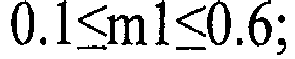


- In accordance with another aspect of the present invention, there is provided a method for producing a sintered ferrite magnet; a segment-type permanent magnet derived from the ferrite magnetic material; and a product comprising the segment-type permanent magnet.
- The above and other objects and features of the present invention will become apparent from the following description of the invention taken in conjunction with the following accompanying drawings, which respectively show:
-
FIGs. 1 to 4 : the magnetic properties, Br(G), iHc(Oe), Hk/iHc(%) and SFC(synthetic evaluation index, {Br+(1/3)iHc} x (Hk/iHc)) of the respective sintered magnets (sintering temperature 1190°C) prepared in Example 1, and Comparative Examples 1 to 3, respectively; -
FIGs. 5 to 8 : variations in the magnetic properties, Br(G), iHc(Oe), Hk/iHc(%) and SFC, as function of the sintering temperature of the sintered magnet prepared in Example 1, respectively; -
FIGs. 9 and 10 : the magnetic properties, ΦR - ΦRG and HGF(80) of the segment-type permanent magnets prepared in Example 2 and Comparative Example 4, respectively; -
FIGs. 11 and 12 : the right side/three-dimensional views and front/cross-sectional views of the molding used for the manufacture of the segment-type (33.4R×21.9W×6.16T×45L) ferrite permanent magnet in Example 2 and Comparative Example 4, respectively; -
FIGs. 13 to 16 : the lower punch structure, die structure, upper punch structure and assembly drawings of the molding used for the manufacture of the segment-type (33.4R×21.9W×6.16T×45L) ferrite permanent magnet in Example 2 and Comparative Example 4, respectively; and -
FIGs. 17 to 19 : variations in SFC as function of Ba/(Sr+Ba)(i.e., the value of y/x+y), Ba+Cr(i.e., the value of y+m2) and Cr(i.e., the value of m2) of the sintered magnets prepared in Examples 3 to 21 and Comparative Examples 5 to 15, respectively. - The inventive ferrite magnetic material (calcined material) is characterized by comprising a primary phase of a magnetoplumbite-type hexagonal ferrite, wherein elements constituting the primary phase have a composition represented by formula (I).
- Generally, when the content of Fe, the basic element of the oxide ferrite magnetic material, becomes larger, undesirable non-magnetic phases such as α-Fe2O3 are generated, lowering the magnetic properties. In contrast, when the content of Fe becomes smaller, the A site corresponding to the site of Fe ion having a magnetic moment becomes excessive, which leads to an increase of undesirable non-magnetic particle components, thereby significantly decreasing the magnetic properties. The magnetic properties of sintered M-type ferrite oxide magnets are based on the magnetic moment of Fe ions, which have the magnetic structure of a ferri-magnetic material arranged in the antiparallel direction. In order to enhance the magnetic properties such as saturation magnetization and a magnetic anisotropic coefficient, such Fe ions in the sites having the magnetic moment oriented in the antiparallel direction may be substituted with other elements having a smaller magnetic moment or non-magnetism; the Fe ions in the sites corresponding to the magnetic moment oriented in the parallel direction may be substituted with other elements having a larger magnetic moment; and Fe ions may be substituted with other elements having a larger crystal lattice and stronger interaction.
- With respect to the composition of constituent elements of the inventive ferrite magnetic material, the value corresponding to the content of A, z is in the range of 0.35 and 0.5. When the content of A is low, i.e. less than 0.1, sufficient substitution of A to enhance the magnetic properties becomes difficult; whereas when the content of A is high, i.e. more than 0.5, the amount of unreacted A oxide increases, which also results in poor magnetic properties.
- M such as Co substitutes a part of Fe, acting to enhance the saturation magnetization and the crystal magnetic anisotropic coefficient of the M-type oxide ferrite magnetic material. The value of the content of M, m1 is in the range of 0.1 and 0.6, preferably of 0.2 and 0.4. When the content of M is less than 0.1, its substitution rate with Fe decreases, which makes it difficult to enhance the magnetic properties. When the content of M is more than 0.6, the ion valence with the A site element becomes disrupted, which causes the formation of undesirable foreign phases, resulting in sharp degradation of the magnetic properties.
- M' such as Cr substitutes a part of Fe, which inhibits particle growth and increases the critical particle radius, leading to an increase in the magnetic anisotropic coefficient, and ultimately, iHc of the M-type oxide ferrite magnetic material.
- Preferably, the values of x, y, z, m1 and m2 satisfy the conditions of 0.1 ≤ x+y < 0.3, 0.03 ≤ y+m2 ≤ 0.16, 0.09 ≤ y/(x+y) ≤ 0.5, 0.3 ≤ (x+y)/(m1+m2) ≤ 0.8, and 1.2 ≤ (1-z)/(m1+m2) ≤ 2.0, wherein the formula (1-z)/(m1+m2) represents the atomic content ratio of (Sr+Ba+Ca)/(M+M') and it may more preferably fall within the range of 1.4 and 1.6.
- In formula (I), the atomic content ratio (Fe+M+M')/(Ca+A+Sr+Ba) corresponds to 2n.
- Hereinafter, exemplary preparation methods of the ferrite magnetic material and sintered magnet as an embodiment of the invention are explained in details.
- First, starting materials are weighed according to the weight percentage values calculated from a desirable composition, and they are generally wet mixed using a wet-type ball mill or a wet-type attritor for 1 to 24 hours to achieve uniform mixing.
- SrCO3, BaCO3, CaCO3, La2O3, Fe2O3, Cr2O3, Co3O4, Pr6O11, Nd2O3, Sm2O3, etc. may be used as the starting materials, whose preferable mean particle diameter may fall within the range of 0.2 and 1.0 µm.
- If necessary, SiO2, H3BO3, etc. may be further added in the mixing process so as to promote the ferrite forming reaction as well as uniform growth of particles during the subsequent calcination process.
- During the calcination process, the mixture of the starting materials undergoes a solid phase ferrite reaction to form a calcined material having a magnetoplumbite-type crystal structure. The calcination may be generally performed in an oxidizing atmosphere, e.g. air, at a temperature of 1080°C to 1350°C preferably for a period of 1 to 5 hours. The particle size of the calcined material is preferably in the range of 0.3µm and 2µm.
- The resulting calcined material is of a clinker or a granule form, and hence need to be coarse pulverized. The coarse pulverization may be conducted using a dry vibratory mill or a dry ball mill, preferably a dry vibratory mill. The average particle size of the coarse powder after the coarse pulverization is preferably 2µm∼4µm.
- The resulting coarse powder possesses defects such as inconsistency, distortion, and crack due to the physical stress applied during the previous pulverization process. Such defects can be removed by heat-treating the coarse powder at a temperature ranging from 900°C to 1000°C.
- When the powder with a mean particle diameter of 1.0µm or more is subjected to a sintering process, the proportion of coarse crystal grains becomes high due to particle growth, resulting in drastic decline of iHc. Therefore, the heat-treated powder is subjected to fine pulverization to obtain a fine powder having a mean particle diameter ranging from 0.3µm to 0.8µm. The fine pulverization can be carried out using a wet-type ball mill or a wet-type attritor. In case of using a wet-type ball mill, the pulverization time may be controlled within 5∼40 hours, and in case of using a wet-type attritor, within 2∼20 hours, depending on the predetermined desirable mean particle diameter.
- In order to control the growth of particles as well as its diameter in a subsequent sintering process, an additive such as SiO2, CaO or a mixture thereof may be added during the fine pulverization process. Also, La2O3, SrO, CaO, Cr2O3, Al2O3, CoO or a mixture thereof can be added to facilitate the substitution effects and to control the particle growth in the subsequent sintering process. When the amount of additives employed is too small or too large, undesirable effects occur. Thus, each of the additives may be used in an amount ranging from 0.1 to 0.6 parts by weight based on 100 parts by weight of the pulverized powder.
- A dispersant may be further added during the fine pulverization process so as to enhance the alignment effects and to improve the liquidity of the slurry by lowering its viscosity, in the subsequent pressing process conducted in a magnetic field. Either aqueous or non-aqueous dispersant may be used, but considering the environmental aspect, the use of an aqueous dispersant is preferred. Suitable for use as the aqueous dispersant are organic compounds containing hydroxyl and carboxyl groups, sorbitol, calcium gluconate, and the like. The dispersant may be preferably used in an amount ranging from 0.05 to 1.0 part by weight based on 100 parts by weight of the coarse powder.
- A pressing process may be performed by a wet-type or dry-type method, wherein each method may be deposited in either isotropic or anisotropic arrangement. In order to attain high magnetic properties, a wet anisotropic pressing is preferred. In this process, the slurry after the fine pulverization is pressed under pressure in an applied magnetic field and then green body for an anisotropic sintered magnet is thus obtained.
- In one embodiment of the wet anisotropic pressing, the slurry after the fine pulverization is subjected to dehydration and concentration, and then to pressing under 300kgf/cm2∼500kgf/cm2 pressure in a magnetic field of 10∼20kOe at a fixed concentration. The dehydration and concentration can be carried out by using a centrifugal separator or filter press.
- Preferably, for the purpose of preventing the generation of cracks, prior to a subsequent sintering process, the green body thus formed which contains residual water in an amount ranging from 10 to 15% may be allowed to be dried. If the green body having residual water goes through a sintering process, cracks may occur during the dehydration process when the temperature rises. Thus, it is preferred to dry the green body at room temperature or at a low temperature, i.e. 50°C∼100°C in the atmosphere.
- A sintered ferrite magnet is obtained by continuously drying and sintering the resulting green body in an oxidizing atmosphere. For elimination of residual water and dispersants remaining in the green body, dehydration and degreasing is conducted at 50°C∼300°C.
- Magnetic properties of the sintered ferrite magnet can be optimized by regulating sintering conditions, e.g. a sintering time, a heating rate, a maximum temperature, a staying time at a predetermined temperature, etc. In other words, regulation of the sintering conditions (sintering time, heating rate, maximum temperature, staying time) can affect concentrations of substitution elements, grain growth, a particle size, a density of the sintered magnet, thereby determining magnetic properties of the sintered ferrite magnet, i.e. Br, bHc, iHc, B.Hmax, squareness, etc.
- In a preferred embodiment, the sintering may be performed by way of treating the ferrite substrate in air at a temperature ranging from 25°C to 500°C for 1 hour, from 500°C to 1000°C for 5 hours, from 1000°C to Tmax (1180°C to 1210°C) for 3 hours, at Tmax(1180°C to 1210°C) for 1∼2 hours, from Tmax (1180°C to 1210°C) to 1000°C for 2 hours, and from 1000°C to room temperature for 5 hours.
- The magnetoplumbite-type sintered ferrite magnet according to the present invention features excellent magnetic properties including: a residual magnetic flux density (Br) of 4550 G or greater; an intrinsic coercive force (iHc) of 4700 Oe or greater; a squareness (Hk/iHc) of 92% or greater; and a synthetic evaluation index (SFC={Br+(1/3)iHc} x (Hk/iHc)) of 5800 or greater.
- Also, the segment-type permanent magnet derived from the inventive magnetoplumbite-type ferrite magnetic material and preformed to have an outer radius of 33.4R, a width of 21.9W, a thickness of 6.16T, and a length of 45L exhibits good magnetic properties of ΦR ≥ 0.330(mVs), ΦRG ≥ 0.320(mVs), and HGF(80) ≥ 310(kA/m) when tested with a magnetic property measurement system, Robograph 2(ECKEL). As shown in the result, the inventive sintered ferrite magnet can satisfy the required characteristics such as high performance, high efficiency, miniaturization and weight reduction, and therefore, it can be used in the manufacture of small type motors for automobiles, motors for electric equipments as well as for home appliances, and other devices.
- Hereinafter, the present invention is described more specifically by the following examples, but these are provided only for illustration purposes, and the present invention is not limited thereto.
- Strontium carbonate (SrCO3), barium carbonate (BaCO3), calcium carbonate (CaCO3), lanthanum oxide (La2O3), lanthanum hydroxide (La(OH)3), iron oxide (Fe2O3), chromium oxide (Cr2O3), and cobalt oxide (CoO) were used as starting materials. These raw materials were weighed according to the composition shown in Table 2, and blended so as to obtain the sintered ferrite magnet of Ca(1-x-y-z)SrxBayLazFe(2n-m1-m2)Com1Crm2O19 as shown in Table 3. Prior to the blending, all of the raw materials were previously pulverized and disintegrated to have a particle diameter of 0.6∼1.0µm.
- The mixture was diluted to have a concentration of 40%, and wet and circulating stirred for 20 hours. Then, the resulting mixture was dried at 200°C for 24 hours and calcined at 1120°C for 2 hours, in sequence. The resulting calcined material was pulverized using a dry vibratory mill to obtain a coarse powder with an average diameter of 3µm. The coarse powder was heat-treated at 1000°C for 2 hours and put into a wet-type attritor with water to give a concentration of 43%. La2O3 (0.5 parts by weight), CaO (0.45 parts by weight), SiO2 (0.4 parts by weight), and dispersant calcium gluconate (0.3 parts by weight) were added thereto based on 100 parts by weight of the coarse powder, and comminuted for 8 hours to give a slurry having an average particle diameter of 0.65 µm.
- The slurry thus prepared was placed into a cylindrical shape of a molding having a diameter of 40mm and a height of 10mm, and it was subjected to pressing in a magnetic field of 15kOe with a compacting pressure of 0.4Ton/cm2 to form a green body.
- The green body thus formed was dried at 200°C for 10 hours, sintered in air according to the condition specified in Table 1, and then the sintered product was processed to have a diameter of 35mm and a thickness of 10mm. The maximum temperature at sintering (Tmax) was set-up as 1180, 1190, 1200, 1210 and 1220°C, respectively.
[Table 1] Temp. 25∼ 500°C 500∼ 1000°C 1000°C∼ Tmax Tmax Tmax∼ 1000°C 1000°C∼ room temp. Oxygen partial pressure Time 1hr 5hrs 3hrs 2hrs 2hrs 5hrs 0.1atm - Magnetic characteristics of the prepared M-type sintered ferrite magnet were measured by using a B-H curve tracer and the results thereof are shown in Tables 4a to 4e according to the value Tmax. The composition of the sintered magnet is recorded in Table 3.
- The procedures of the above Example 1 were repeated to prepare the M-type sintered ferrite magnets, except that starting materials were weighed according to the composition described in Table 2 without employing barium carbonate (BaCO3) and chromium oxide (Cr2O3) so as to meet the final composition as specified in Table 3.
- The compositions of the sintered magnets and the results of magnetic characteristics according to the value Tmax are shown in Table 3 and Tables 4a to 4e, respectively.
- The results of the magnetic properties, Br, iHc, Hk/iHc and SFC of the respective sintered magnets (sintering temperature 1190°C) prepared in Example 1, and Comparative Examples 1 to 3 are shown in
FIGs. 1 to 4 , respectively. Also, variations in the magnetic properties, Br, iHc, Hk/iHc and SFC, as function of the sintering temperature of the sintered magnet prepared in Example 1 are shown inFIGs. 5 to 8 , respectively.[Table 2] Ca(1-x-y-z)SrxRyAzFe(2n-m1-m2)Mm1M'm2O19 (mix composition) n Sr (x) Ba (y) La (z) Ca (1-x-y-z) Fe (2n-m1-m2) Co (m1) Cr (m2) Fe+Co+Cr (2n) (Sr+Ba+Ca)/(Co+Cr) (1-z)/(m1+m2) Ex. 1 5.4 0.10 0.05 0.45 0.40 10.46 0.31 0.04 10.80 1.571 C.E. 1 5.7 0.10 - 0.50 0.40 11.10 0.30 - 11.40 1.667 C.E. 2 5.7 0.10 - 0.40 0.50 11.10 0.30 - 11.40 2.00 C.E. 3 5.7 0.10 - 0.55 0.35 11.10 0.30 - 11.40 1.50 [Table 3] Ca(1-x-y-z)SrxRyAzFe(2n-m1-m2)Mm1M'm2O19 (sintered magnet composition) n Sr (x) Ba (y) La (z) Ca (1-x-y-z) Fe (2n-m1-m2) Co (m1) Cr (m2) Fe+Co+Cr (2n) (Sr+Ba+Ca)/(Co+Cr) (1-z)/(m1+m2) (Ba+Sr)/ (Co+Cr) (x+y)/ (m1+m2) Ex. 1 4.89 0.091 0.045 0.408 0.457 9.465 0.281 0.036 9.78 1.868 0.429 C.E. 1 5.10 0.127 - 0.475 0.398 9.923 0.268 - 10.191 1.959 0.474 C.E. 2 5.10 0.126 - 0.386 0.488 9.934 0.268 - 10.202 2.291 0.470 C.E. 3 5.09 0.127 - 0.520 0.354 9.918 0.268 - 10.186 1.795 0.474 [Table 4a] magnetic properties of sintered magnet (1180°C) Sintering temp.(°C) Br (G) bHc (Oe) iHc (Oe) Hk (Oe) B.Hmax (M.GOe) Hk/iHc (Br+1/3iHc)* (Hk/iHc) Ex. 1 1180 4583 4392 5027 4742 5.18 94.3 5904 C.E. 1 1180 4546 4233 4425 4244 4.98 95.9 5775 C.E. 2 1180 4572 4205 5009 4316 5.09 86.2 5378 C.E. 3 1180 4504 3693 3847 3432 4.95 89.2 5162 [Table 4b] magnetic properties of sintered magnet (1190°C) Sintering temp.(°C) Br (G) bHc (Oe) iHc (Oe) Hk (Oe) B.Hmax (M.GOe) Hk/iHc (Br+1/3iHc)* (Hk/iHc) Ex. 1 1190 4605 4371 4955 4694 5.22 94.7 5927 C.E. 1 1190 4558 4231 4442 4143 5.07 93.3 5632 C.E. 2 1190 4582 4155 4885 4157 4.99 85.1 5285 C.E. 3 1190 4497 3788 3880 3613 4.94 93.1 5392 [Table 4c] magnetic properties of sintered magnet (1200°C) Sintering temp.(°C) Br (G) bHc (Oe) iHc (Oe) Hk (Oe) B.Hmax (M.GOe) Hk/iHc (Br+1/3iHc)* (Hk/iHc) Ex. 1 1200 4612 4335 4863 4615 5.24 94.9 5915 C.E. 1 1200 4561 4157 4293 4142 5.04 96.5 5781 C.E. 2 1200 4599 3995 4763 3666 4.92 77.0 4762 C.E. 3 1200 4473 3826 4002 3638 4.85 90.9 5279 [Table 4d] magnetic properties of sintered magnet (1210°C) Sintering temp.(°C) Br (G) bHc (Oe) iHc (Oe) Hk (Oe) B.Hmax (M.GOe) Hk/iHc (Br+1/3iHc)* (Hk/iHc) Ex. 1 1210 4633 4260 4736 4524 5.28 95.5 5934 C.E. 1 1210 4575 4187 4376 4184 5.05 95.6 5769 C.E. 2 1210 4602 3666 4779 2479 4.46 51.9 3214 C.E. 3 1210 4512 3838 3933 3760 4.97 95.6 5567 [Table 4e] magnetic properties of sintered magnet (1220°C) Sintering temp.(°C) Br (G) bHc (Oe) iHc (Oe) Hk (Oe) B.Hmax (M.GOe) Hk/iHc (Br+1/3iHc)* (Hk/iHc) Ex. 1 1220 4664 4145 4654 4290 5.21 92.2 5729 C.E. 1 1220 4587 4188 4426 4190 5.00 94.7 5739 C.E. 2 1220 4634 3132 4488 1264 3.70 28.2 1726 C.E. 3 1220 4523 3897 3998 3853 4.92 96.4 5643 - As shown in Tables 4a to 4e and
FIGs. 1 to 4 , the sintered magnet prepared in Example 1 exhibited significantly improved magnetic properties including Br, iHc, and SFC at all of the maximum sintering temperature, as compared to those prepared in Comparative Examples 1 to 3. Particularly,FIGs. 5 to 8 showed that the sintered magnet of Example 1 sintered at the maximum temperature of 1190°C has the SFC of 5927, which suggests that it is of an optimal condition. Also, it is confirmed that Hk/iHc at the maximum sintering temperature of 1210°C shows the highest level of 95.5%, and SFC={Br+(1/3)iHc} x (Hk/iHc) represents values ranging from 5904 to 5934 at the maximum sintering temperature of 1180°C∼1210°C. - Meanwhile, the value of Br increases as the sintering temperature increases, whereas the value of iHc gradually decreases and rapidly drops at the maximum sintering temperature of 1220°C. It is expected that the occurrence of this phenomenon is caused by the overgrowth of particles owing to the rise of the maximum sintering temperature.
- The procedures of Example 1 were repeated to prepare the segment-type ferrite permanent magnet 33.4R×21.9W×6.16T×45L, except that a segment-type molding (33.4R(outer radius)×21.9W(width)×6.16T(thickness)×45L(length)) was employed instead of the cylindrical-type molding (diameter 40mm× height 10mm); the maximum sintering temperature was set-up as 1180°C; and the resulting sintered product was processed by using a segment-type grind machine.
- Magnetic properties of the segment-type permanent magnet thus prepared was measured using a magnetic property measurement system, Robograph 2(ECKEL), and the results of its magnetic properties of ΦR, ΦRG and HGF(80) are shown in Table 5, wherein the "ΦRG" value was at least 0.94 × ΦRmin (measurement system was set as ΦRmin≤ΦR≤ΦRmax), which was used for evaluating the squareness of the hysteresis loop. Also, "HGF(80)" represents a value where 80% of ΦR intersects 2nd quadrant demagnetization curve, which was used for evaluating the squareness and iHc of the hysteresis loop.
[Table 5] Sample No. Size(mm) Unit weight(gr) Magnetic properties Outer radius Width Length Thickness ΦR (mVs) ΦRG (mVs) HGF(80)(kA/m) 2-1 33.36 21.90 44.85 6.17 29.56 0.334 0.320 342 2-2 33.37 21.89 45.13 6.16 29.74 0.335 0.323 344 2-3 33.37 21.88 44.95 6.16 29.62 0.333 0.322 342 2-4 33.38 21.87 45.04 6.16 29.69 0.335 0.320 339 2-5 33.37 21.87 45.03 6.17 29.71 0.335 0.322 340 2-6 33.38 21.86 44.98 6.17 29.59 0.334 0.321 343 2-7 33.36 21.87 45.14 6.15 29.62 0.333 0.321 343 2-8 33.37 21.86 44.92 6.17 29.54 0.333 0.321 342 2-9 33.36 21.87 44.93 6.17 29.57 0.334 0.321 341 2-10 33.38 21.88 45.01 6.16 29.69 0.333 0.320 343 Average 33.37 21.88 45.0 6.16 29.63 0.334 0.321 342 - As shown in Table 5, the permanent magnet prepared in Example 2 satisfied the conditions of ΦR ≥ 0.333(mVs), ΦRG ≥ 0.320(mVs), and HGF(80) ≥ 339(kA/m).
- The procedures of Comparative Example 2 were repeated to prepare the segment-type permanent magnet 33.4R×21.9W×6.16T×45L, except for using Sr(1-x-y)CaxLayFe(2n-z)CozO19 (n=5.85, x=0, y=0.25, z=0.2) as a composition of the calcined material.
- The magnetic properties of permanent magnets thus prepared with sample sizes are shown in Table 6.
- Also, the magnetic properties, ΦR - ΦRG and HGF(80), of the segment-type permanent magnets prepared in Example 2 and Comparative Example 4 are shown in
FIGs. 9 and 10 , respectively.[Table 6] Sample No. Size(mm) Unit weight(gr) Magnetic properties Outer radius Width Length Thickness ΦR (mVs) ΦRG (mVs) HGF(80)(kA/m) 4-1 33.37 21.90 44.94 6.18 28.92 0.298 0.287 314 4-2 33.38 21.91 45.31 6.15 29.08 0.299 0.289 315 4-3 33.36 21.90 45.13 6.17 29.10 0.301 0.291 316 4-4 33.37 21.89 45.10 6.17 29.11 0.298 0.288 317 4-5 33.36 21.90 45.14 6.17 29.02 0.299 0.289 315 4-6 33.37 21.91 45.19 6.17 29.26 0.299 0.290 316 4-7 33.38 21.90 45.18 6.17 29.33 0.301 0.292 318 4-8 33.36 21.90 45.16 6.17 29.25 0.301 0.292 315 4-9 33.37 21.89 45.08 6.14 28.98 0.297 0.289 313 4-10 33.38 21.91 45.15 6.17 29.11 0.299 0.289 317 Average 33.37 21.90 45.14 6.17 29.12 0.299 0.290 316 - As shown in Tables 5-6 and
FIGs. 9-10 , ΦR, ΦRG, and HGF(80) of the permanent magnet prepared in Example 2 were 11.7%, 10.7% and 8.2% higher than its counterparts from Comparative Example 4, respectively. - The procedures of Example 1 were repeated to prepare the M-type sintered ferrite magnets, except that starting materials were weighed according to the composition described in Table 7 with employing CaCO3(0.8 parts by weight) instead of CaO(0.45 parts by weight) as a fine pulverizing aid so as to meet the final composition as specified in Table 8; and the maximum sintering temperature was set-up as 1180°C.
- The compositions and magnetic properties of the sintered magnets thus prepared were recorded in Tables 8 and 9, respectively.
- Also, variations in SFC as a function of Ba/(Sr+Ba)(i.e., the value of y/x+y), Ba+Cr, (i.e., the value of y+m2), and Cr(i.e., the value of m2) of the sintered magnets prepared in Examples 3 to 21 and Comparative Examples 5 to 15, were measured and recorded in
FIGs. 17 to 19 , respectively.[Table 7] Ca(1-x-y-z)SrxRyAzFe(2n-m1-m2)Mm1M'm2O19 (mix composition) n Sr (x) Ba (y) La (z) Ca (1-x-y-z) Fe (2n-m1-m2) Co (m1) Cr (m2) Sr+Ba (x+y) Co+Cr (m1+m2) Ba/(Sr+Ba){y/(x+y)} (Sr+Ba)/(Co+Cr){(x+y)/(m1+m2)} Ex.3 5.4 0.180 0.020 0.400 0.400 10.430 0.350 0.020 0.20 0.37 0.10 0.54 Ex.4 5.4 0.140 0.030 0.440 0.390 10.395 0.380 0.025 0.17 0.41 0.18 0.42 Ex.5 5.4 0.100 0.050 0.450 0.400 10.459 0.310 0.030 0.15 0.34 0.33 0.44 Ex.6 5.4 0.110 0.070 0.420 0.400 10.455 0.310 0.035 0.18 0.35 0.39 0.52 Ex.7 5.4 0.115 0.060 0.435 0.390 10.410 0.350 0.040 0.18 0.39 0.34 0.45 Ex.8 5.4 0.100 0.070 0.430 0.400 10.505 0.250 0.045 0.17 0.30 0.41 0.58 Ex.9 5.4 0.130 0.080 0.400 0.390 10.400 0.350 0.050 0.21 0.40 0.38 0.53 Ex.10 5.4 0.105 0.085 0.420 0.390 10.395 0.350 0.055 0.19 0.41 0.45 0.47 Ex.11 5.4 0.155 0.050 0.420 0.375 10.465 0.275 0.060 0.21 0.34 0.24 0.61 Ex.12 5.4 0.150 0.050 0.400 0.400 10.430 0.350 0.020 0.20 0.37 0.25 0.54 Ex.13 5.4 0.115 0.080 0.430 0.375 10.475 0.300 0.025 0.20 0.33 0.41 0.60 Ex.14 5.4 0.130 0.050 0.430 0.390 10.420 0.350 0.030 0.18 0.38 0.28 0.47 Ex.15 5.4 0.165 0.060 0.400 0.375 10.445 0.320 0.035 0.23 0.36 0.27 0.63 Ex.16 5.4 0.140 0.050 0.410 0.400 10.480 0.280 0.040 0.19 0.32 0.26 0.59 Ex.17 5.4 0.180 0.020 0.410 0.390 10.455 0.300 0.045 0.20 0.35 0.10 0.58 Ex.18 5.4 0.140 0.040 0.430 0.390 10.420 0.330 0.050 0.18 0.38 0.22 0.47 Ex.19 5.4 0.150 0.070 0.400 0.380 10.395 0.350 0.055 0.22 0.41 0.32 0.54 Ex.20 5.4 0.140 0.050 0.400 0.410 10.490 0.250 0.060 0.19 0.31 0.26 0.61 Ex.21 5.4 0.145 0.080 0.400 0.375 10.383 0.350 0.067 0.23 0.42 0.36 0.54 C.E.5 5.4 0.085 0.140 0.400 0.375 10.330 0.330 0.140 0.23 0.47 0.62 0.48 C.E.6 5.4 0.095 0.130 0.400 0.375 10.340 0.330 0.130 0.23 0.46 0.58 0.49 C.E.7 5.4 0.105 0.120 0.400 0.375 10.350 0.330 0.120 0.23 0.45 0.53 0.50 C.E.8 5.4 0.115 0.110 0.400 0.375 10.370 0.330 0.100 0.23 0.43 0.49 0.52 C.E.9 5.4 0.125 0.100 0.400 0.375 10.380 0.330 0.090 0.23 0.42 0.44 0.54 C.E.10 5.4 0.130 0.095 0.400 0.375 10.385 0.330 0.085 0.23 0.42 0.42 0.54 C.E.11 5.4 0.085 0.140 0.400 0.375 10.380 0.330 0.090 0.23 0.42 0.62 0.54 C.E.12 5.4 0.095 0.130 0.400 0.375 10.370 0.330 0.100 0.23 0.43 0.58 0.52 C.E.13 5.4 0.105 0.120 0.400 0.375 10.360 0.330 0.110 0.23 0.44 0.53 0.51 C.E.14 5.4 0.115 0.110 0.400 0.375 10.350 0.330 0.120 0.23 0.45 0.49 0.50 C.E.15 5.4 0.135 0.090 0.400 0.375 10.340 0.330 0.130 0.23 0.46 0.40 0.49 [Table 8] Ca(1-x-y-z)SrxRyAzFe(2n-m1-m2)Mm1M'm2O19 (sintered magnet composition) n Sr (x) Ba (y) La (z) Ca (1-x-y-z) Fe (2n-m1-m2) Co (m1) Cr (m2) Sr+Ba (x+y) Co+Cr (m1+m2) Ba/(Sr+Ba){y/(x+y)} (Sr+Ba)/(Co+Cr){(x+y)/(m1+m2) Ex.3 4.88 0.163 0.018 0.388 0.431 9.420 0.316 0.018 0.18 0.33 0.10 0.54 Ex.4 4.88 0.126 0.027 0.424 0.422 9.385 0.343 0.023 0.15 0.37 0.18 0.42 Ex.5 4.87 0.090 0.045 0.433 0.431 9.442 0.280 0.028 0.14 0.31 0.33 0.44 Ex.6 4.88 0.099 0.063 0.406 0.431 9.439 0.280 0.032 0.16 0.31 0.39 0.52 Ex.7 4.87 0.104 0.054 0.420 0.422 9.398 0.316 0.036 0.16 0.35 0.34 0.45 Ex.8 4.87 0.090 0.063 0.415 0.431 9.483 0.226 0.041 0.15 0.27 0.41 0.58 Ex.9 4.88 0.117 0.072 0.388 0.422 9.390 0.316 0.045 0.19 0.36 0.38 0.53 Ex.10 4.87 0.095 0.077 0.406 0.422 9.384 0.316 0.050 0.17 0.37 0.45 0.47 Ex.11 4.87 0.140 0.045 0.406 0.409 9.448 0.248 0.054 0.19 0.30 0.24 0.61 Ex.12 4.88 0.135 0.045 0.388 0.431 9.418 0.316 0.018 0.18 0.33 0.25 0.54 Ex.13 4.87 0.104 0.072 0.415 0.409 9.455 0.271 0.023 0.18 0.29 0.41 0.60 Ex.14 4.88 0.117 0.045 0.415 0.422 9.407 0.316 0.027 0.16 0.34 0.28 0.47 Ex.15 4.88 0.149 0.054 0.388 0.409 9.430 0.289 0.032 0.20 0.32 0.27 0.63 Ex.16 4.88 0.126 0.045 0.397 0.431 9.463 0.253 0.036 0.17 0.29 0.26 0.59 Ex.17 4.88 0.163 0.018 0.397 0.422 9.441 0.271 0.041 0.18 0.31 0.10 0.58 Ex.18 4.88 0.126 0.036 0.415 0.422 9.408 0.298 0.045 0.16 0.34 0.22 0.47 Ex.19 4.88 0.135 0.063 0.388 0.413 9.385 0.316 0.050 0.20 0.37 0.32 0.54 Ex.20 4.88 0.126 0.045 0.388 0.440 9.473 0.226 0.054 0.17 0.28 0.26 0.61 Ex.21 4.88 0.131 0.072 0.388 0.409 9.374 0.316 0.060 0.20 0.38 0.36 0.54 C.E.5 4.87 0.077 0.126 0.388 0.409 9.323 0.298 0.126 0.20 0.42 0.62 0.48 C.E.6 4.87 0.086 0.117 0.388 0.409 9.333 0.298 0.117 0.20 0.42 0.58 0.49 C.E.7 4.87 0.095 0.108 0.388 0.409 9.342 0.298 0.108 0.20 0.41 0.53 0.50 C.E.8 4.87 0.104 0.099 0.388 0.409 9.360 0.298 0.090 0.20 0.39 0.49 0.52 C.E.9 4.87 0.113 0.090 0.388 0.409 9.370 0.298 0.081 0.20 0.38 0.44 0.54 C.E.10 4.87 0.117 0.086 0.388 0.409 9.375 0.298 0.077 0.20 0.37 0.42 0.54 C.E.11 4.87 0.077 0.126 0.388 0.409 9.368 0.298 0.081 0.20 0.38 0.62 0.54 C.E.12 4.87 0.086 0.117 0.388 0.409 9.360 0.298 0.090 0.20 0.39 0.58 0.52 C.E.13 4.87 0.095 0.108 0.388 0.409 9.351 0.298 0.099 0.20 0.40 0.53 0.51 C.E.14 4.87 0.104 0.099 0.388 0.409 9.343 0.298 0.108 0.20 0.41 0.49 0.50 C.E.15 4.87 0.122 0.081 0.388 0.409 9.334 0.298 0.117 0.20 0.42 0.40 0.49 - As shown in Table 9 and
FIGs. 17 to 19 , the sintered magnets prepared in Examples 3 to 21 exhibited significantly improved magnetic properties as compared to those prepared in Comparative Examples 5 to 15.Br(G) bHc(Oe) iHc(Oe) Hk(Oe) B.Hmax (MGOe) Hk/iHc (%) Br+1/3(iHc)*(Hk/iHc) Ex.3 4615 4285 4860 4626 5.22 95.2 5,936 Ex.4 4633 4298 4987 4752 5.25 94.8 5,968 Ex.5 4620 4313 5072 4792 5.24 94.5 5,964 Ex.6 4618 4284 4877 4618 5.23 94.7 5,913 Ex.7 4597 4280 4792 4605 5.23 96.1 5,953 Ex.8 4591 4263 4904 4676 5.19 95.4 5,939 Ex.9 4587 4254 4736 4517 5.20 96.2 5,931 Ex.10 4585 4245 4709 4434 5.21 95.4 5872 Ex.11 4578 4238 4952 4683 5.20 94.8 5,905 Ex.12 4618 4262 4733 4514 5.22 95.4 5,911 Ex.13 4616 4235 4713 4438 5.23 95.3 5896 Ex.14 4625 4286 4725 4503 5.29 96.3 5,971 Ex.15 4608 4218 4827 4592 5.22 95.1 5,912 Ex.16 4585 4260 4806 4585 5.26 95.3 5,896 Ex.17 4615 4258 4825 4587 5.23 95.4 5,937 Ex.18 4606 4284 4947 4726 5.20 94.3 5,900 Ex.19 4575 4301 5174 4834 5.20 94.4 5,947 Ex.20 4587 4306 5134 4805 5.18 93.6 5,895 Ex.21 4590 4290 5288 4878 5.20 92.9 5,902 C.E.5 4375 4030 4870 4023 4.55 82.6 4,955 C.E.6 4416 4077 4820 4165 4.81 86.4 5,204 C.E.7 4450 4155 4754 4203 5.05 88.4 5,335 C.E.8 4493 4191 4850 4263 5.10 87.9 5,370 C.E.9 4550 4255 4955 4499 5.11 90.8 5,631 C.E.10 4562 4268 4965 4543 5.12 91.5 5,689 C.E.1 1 4425 4086 4785 4168 4.82 87.1 5,243 C.E.12 4457 4120 4965 4339 5.02 87.4 5,342 C.E.13 4496 4186 4884 4342 5.05 88.9 5,444 C.E.14 4520 4212 4737 4320 5.09 91.2 5,562 C.E.15 4546 4245 4870 4407 5.11 90.5 5,583 - While the embodiments of the subject invention have been described and illustrated, it is obvious that various changes and modifications can be made therein without departing from the invention as defined by the appended claims.
Claims (10)
- A ferrite magnetic material comprising a primary phase of a magnetoplumbite-type hexagonal ferrite, the primary phase having a composition represented by formula (I):
Ca(1-x-y-z)SrxBayAzFe(2n-m1-m2)Mm1M'm2O19 (I)
wherein,A is at least one element selected from rare earth elements including La, Nd, Pr and Sm, and Bi, with La being essentially contained in A;M is at least one element selected from the group consisting of Co, Mn, Ni, and Zn, with Co being essentially contained in M;M' is Cr;



- The ferrite magnetic material of claim 1, wherein m1 is in the range of 0.2 and 0.4.
- The ferrite magnetic material of claim 1, wherein the values of x, y, z, m1 and m2 satisfy the conditions of 0.09 ≤ yl(x+y) ≤ 0.5, 0.3 ≤ (x+y)/(m1+m2) ≤ 0.8, and 1.2 ≤ (1-z)/(m1+m2) ≤ 2.0.
- The ferrite magnetic material of claim 3, wherein the value of (1-z)/(m1+m2) is in the range of 1.4 and 1.6.
- A method for producing a sintered ferrite magnet by sintering the ferrite magnetic material comprising a primary phase of a magnetoplumbite-type hexagonal ferrite, the primary phase having a composition represented by formula (I):
Ca(1-x-y-z)SrxBayAzFe(2n-m1-m2)Mm1M'm2O19 (I)
wherein,A is at least one element selected from rare earth elements including La, Nd, Pr and Sm, and Bi, with La being essentially contained in A;M is at least one element selected from the group consisting of Co, Mn, Ni, and Zn, with Co being essentially contained in M;M' is Cr;




- The method of claim 5, wherein the sintering of the ferrite magnetic material is performed by way of treating the ferrite substrate at a temperature ranging from 25°C to 500°C for 1 hour, from 500°C to 1000°C for 5 hours, from 1000°C to a maximum temperature for 3 hours, at the maximum temperature for 1-2 hours, from the maximum temperature to 1000°C for 2 hours, and from 1000°C to room temperature for 5 hours, the maximum temperature being in the range of 1180°C and 1210°C.
- The method of claim 5, wherein the sintered ferrite magnet has a residual magnetic flux density (Br) of 455mT (4550 G) or greater, an intrinsic coercive force (iHc) of 374014 A/m (4700 Oe) or greater, a squareness (Hk/iHc) of 92% or greater, and a synthetic evaluation index (SFC={Br+(1/3)iHc} × (Hk/iHc)) of 5800 or greater.
- A segment-type permanent magnet derived from the ferrite magnetic material of any one of claims 1 to 4.
- The segment-type permanent magnet of claim 8, which satisfies the conditions of ΦR ≥ 0.333(mVs), ΦRG ≥ 0.320(mVs), and HGF(80) ≥ 339(kA/m) when tested with a magnetic property measurement system, Robograph 2(ECKEL).
- A product comprising the segment-type permanent magnet of claim 8.
Priority Applications (1)
| Application Number | Priority Date | Filing Date | Title |
|---|---|---|---|
| PL12793259T PL2715747T3 (en) | 2011-05-31 | 2012-05-16 | A magneto-type magnetic material based on ferrite and a permanent segment-type magnet derived therefrom |
Applications Claiming Priority (2)
| Application Number | Priority Date | Filing Date | Title |
|---|---|---|---|
| KR1020110052109A KR101082389B1 (en) | 2011-05-31 | 2011-05-31 | MagnetoPlumbite type ferrite magnetic material and segment type permanent magnet derived therefrom |
| PCT/KR2012/003853 WO2012165780A1 (en) | 2011-05-31 | 2012-05-16 | Magnetoplumbite-type ferrite magnetic material and segment-type permanent magnet derived therefrom |
Publications (3)
| Publication Number | Publication Date |
|---|---|
| EP2715747A1 EP2715747A1 (en) | 2014-04-09 |
| EP2715747A4 EP2715747A4 (en) | 2014-12-24 |
| EP2715747B1 true EP2715747B1 (en) | 2018-08-15 |
Family
ID=45397532
Family Applications (1)
| Application Number | Title | Priority Date | Filing Date |
|---|---|---|---|
| EP12793259.8A Active EP2715747B1 (en) | 2011-05-31 | 2012-05-16 | Magnetoplumbite-type ferrite magnetic material and segment-type permanent magnet derived therefrom |
Country Status (9)
| Country | Link |
|---|---|
| US (1) | US10141091B2 (en) |
| EP (1) | EP2715747B1 (en) |
| KR (1) | KR101082389B1 (en) |
| CN (1) | CN103548101B (en) |
| BR (1) | BR112013029810B1 (en) |
| HU (1) | HUE039686T2 (en) |
| MX (1) | MX361918B (en) |
| PL (1) | PL2715747T3 (en) |
| WO (1) | WO2012165780A1 (en) |
Families Citing this family (9)
| Publication number | Priority date | Publication date | Assignee | Title |
|---|---|---|---|---|
| CN106278231B (en) * | 2015-06-03 | 2019-02-19 | 自贡市江阳磁材有限责任公司 | M type rare-earth permanent magnet ferrite and its production technology |
| KR102277414B1 (en) | 2015-10-16 | 2021-07-14 | 유니온머티리얼 주식회사 | Ferrite magnetic material and ferrite sintered magnet |
| KR102407046B1 (en) | 2016-06-20 | 2022-06-10 | 유니온머티리얼 주식회사 | Ferrite magnetic material and ferrite sintered magnet |
| KR102588231B1 (en) * | 2016-06-20 | 2023-10-13 | 유니온머티리얼 주식회사 | Ferrite magnetic material and ferrite sintered magnet |
| KR102588230B1 (en) | 2016-06-20 | 2023-10-13 | 유니온머티리얼 주식회사 | Ferrite magnetic material and ferrite sintered magnet |
| KR102258552B1 (en) | 2017-03-31 | 2021-06-01 | 유니온머티리얼 주식회사 | Ferrite magnetic material and sintered ferrite magnet |
| JP7338361B2 (en) * | 2019-09-25 | 2023-09-05 | Tdk株式会社 | ferrite sintered magnet |
| WO2022038531A1 (en) * | 2020-08-19 | 2022-02-24 | Mahindra Cie Automotive Ltd. | A permanent magnetic material and a method for its preparation |
| CN112159218A (en) * | 2020-09-23 | 2021-01-01 | 横店集团东磁股份有限公司 | Preparation method of low-cost high-performance permanent magnetic ferrite material |
Citations (1)
| Publication number | Priority date | Publication date | Assignee | Title |
|---|---|---|---|---|
| EP2043112A1 (en) * | 2007-03-01 | 2009-04-01 | TDK Corporation | Ferrite sintered magnet |
Family Cites Families (10)
| Publication number | Priority date | Publication date | Assignee | Title |
|---|---|---|---|---|
| US5378384A (en) | 1991-09-19 | 1995-01-03 | Minnesota Mining And Manufacturing Company | Process of making hexagonal magnetic ferrite pigment for high density magnetic recording applications |
| WO1998038654A1 (en) * | 1997-02-25 | 1998-09-03 | Tdk Corporation | Oxide magnetic material, ferrite particle, sintered magnet, bonded magnet, magnetic recording medium and motor |
| CN1147883C (en) * | 1998-01-23 | 2004-04-28 | 日立金属株式会社 | Bonded magnet, magnetic roller and method for producing ferrite powder used therein |
| FR2824178B1 (en) | 2001-04-25 | 2003-05-30 | Ugimag Sa | FERRITE TYPE MAGNETS PROCESS |
| FR2831317B1 (en) | 2001-10-19 | 2004-10-15 | Ugimag Sa | ECONOMICAL FERRITE MAGNETS WITH IMPROVED PROPERTIES |
| KR100359547B1 (en) | 2001-12-27 | 2002-10-31 | Ssangyong Materials Corp | Magnetoplumbite type ferrite magnet and fabricating method thereof |
| JP4367649B2 (en) * | 2003-09-12 | 2009-11-18 | 日立金属株式会社 | Ferrite sintered magnet |
| BRPI0620713B1 (en) | 2005-12-28 | 2018-07-03 | Hitachi Metals, Ltd. | “Magnetic oxide material, its magnetic recording medium, its combined magnet, its rotary machine and sintered magnetic magnet” |
| JP4952957B2 (en) * | 2006-03-10 | 2012-06-13 | 日立金属株式会社 | Rotating machine, bonded magnet, magnet roll, and method for producing sintered ferrite magnet |
| KR20120041744A (en) * | 2009-07-08 | 2012-05-02 | 티디케이가부시기가이샤 | Ferrite magnetic material |
-
2011
- 2011-05-31 KR KR1020110052109A patent/KR101082389B1/en not_active Ceased
-
2012
- 2012-05-16 MX MX2013014054A patent/MX361918B/en active IP Right Grant
- 2012-05-16 BR BR112013029810-3A patent/BR112013029810B1/en not_active IP Right Cessation
- 2012-05-16 US US13/983,799 patent/US10141091B2/en active Active
- 2012-05-16 WO PCT/KR2012/003853 patent/WO2012165780A1/en not_active Ceased
- 2012-05-16 EP EP12793259.8A patent/EP2715747B1/en active Active
- 2012-05-16 CN CN201280024984.6A patent/CN103548101B/en active Active
- 2012-05-16 HU HUE12793259A patent/HUE039686T2/en unknown
- 2012-05-16 PL PL12793259T patent/PL2715747T3/en unknown
Patent Citations (1)
| Publication number | Priority date | Publication date | Assignee | Title |
|---|---|---|---|---|
| EP2043112A1 (en) * | 2007-03-01 | 2009-04-01 | TDK Corporation | Ferrite sintered magnet |
Also Published As
| Publication number | Publication date |
|---|---|
| KR101082389B1 (en) | 2011-11-11 |
| WO2012165780A1 (en) | 2012-12-06 |
| US10141091B2 (en) | 2018-11-27 |
| CN103548101B (en) | 2016-12-07 |
| BR112013029810B1 (en) | 2021-12-14 |
| CN103548101A (en) | 2014-01-29 |
| US20130307653A1 (en) | 2013-11-21 |
| PL2715747T3 (en) | 2019-01-31 |
| MX361918B (en) | 2018-12-19 |
| MX2013014054A (en) | 2014-02-27 |
| EP2715747A1 (en) | 2014-04-09 |
| BR112013029810A2 (en) | 2017-07-18 |
| HUE039686T2 (en) | 2019-01-28 |
| EP2715747A4 (en) | 2014-12-24 |
Similar Documents
| Publication | Publication Date | Title |
|---|---|---|
| US10141091B2 (en) | Magnetoplumbite-type ferrite magnetic material and segment-type permanent magnet derived therefrom | |
| EP3364426B1 (en) | Ferrite magnetic material and ferrite sintered magnet | |
| KR101649242B1 (en) | Method for producing sintered ferrite magnet, and sintered ferrite magnet | |
| EP2660830B1 (en) | Ferrite sintered magnet and method for producing same | |
| EP2892058B1 (en) | Ferrite calcined body, method for producing ferrite sintered magnet, and ferrite sintered magnet | |
| EP1808422B1 (en) | Oxide magnetic material and sintered magnet | |
| JP2009188420A (en) | Method of manufacturing sintered ferrite magnet | |
| EP3473606B1 (en) | Ferrite sintered magnet | |
| US20190304642A1 (en) | Ferrite sintered magnet and method for manufacturing the same | |
| US20190304643A1 (en) | Ferrite sintered magnet | |
| CN112562950B (en) | Ferrite sintered magnet | |
| CN103172360A (en) | Plumbite type yttrium permanent magnetic ferrite material and preparation method thereof | |
| US11440848B2 (en) | Ferrite sintered magnet | |
| JP7000954B2 (en) | Ferrite sintered magnet | |
| JP2019172502A (en) | Ferrite sintered magnet | |
| JP3506174B2 (en) | Method for producing ferrite magnet and powder thereof | |
| JP7155573B2 (en) | ferrite sintered magnet | |
| JP3835729B2 (en) | Ferrite sintered magnet and manufacturing method thereof | |
| US20230197322A1 (en) | Ferrite sintered magnet | |
| US11476023B2 (en) | Ferrite sintered magnet | |
| JP2001068320A (en) | Ferrite magnet | |
| JP2006203260A (en) | Ferrite magnet | |
| JPWO1999034376A1 (en) | Ferrite magnet and its manufacturing method |
Legal Events
| Date | Code | Title | Description |
|---|---|---|---|
| PUAI | Public reference made under article 153(3) epc to a published international application that has entered the european phase |
Free format text: ORIGINAL CODE: 0009012 |
|
| 17P | Request for examination filed |
Effective date: 20131223 |
|
| AK | Designated contracting states |
Kind code of ref document: A1 Designated state(s): AL AT BE BG CH CY CZ DE DK EE ES FI FR GB GR HR HU IE IS IT LI LT LU LV MC MK MT NL NO PL PT RO RS SE SI SK SM TR |
|
| DAX | Request for extension of the european patent (deleted) | ||
| A4 | Supplementary search report drawn up and despatched |
Effective date: 20141126 |
|
| RIC1 | Information provided on ipc code assigned before grant |
Ipc: H01F 41/02 20060101ALI20141120BHEP Ipc: C01G 49/00 20060101ALI20141120BHEP Ipc: C04B 35/26 20060101ALI20141120BHEP Ipc: H01F 7/02 20060101ALI20141120BHEP Ipc: H01F 1/11 20060101AFI20141120BHEP |
|
| TPAC | Observations filed by third parties |
Free format text: ORIGINAL CODE: EPIDOSNTIPA |
|
| 17Q | First examination report despatched |
Effective date: 20151023 |
|
| RAP1 | Party data changed (applicant data changed or rights of an application transferred) |
Owner name: UNION MATERIALS CORPORATION |
|
| GRAP | Despatch of communication of intention to grant a patent |
Free format text: ORIGINAL CODE: EPIDOSNIGR1 |
|
| STAA | Information on the status of an ep patent application or granted ep patent |
Free format text: STATUS: GRANT OF PATENT IS INTENDED |
|
| INTG | Intention to grant announced |
Effective date: 20180227 |
|
| RIN1 | Information on inventor provided before grant (corrected) |
Inventor name: LEE, DONGYOUNG Inventor name: KIM, MINHO Inventor name: PARK, KILSOO |
|
| GRAS | Grant fee paid |
Free format text: ORIGINAL CODE: EPIDOSNIGR3 |
|
| GRAA | (expected) grant |
Free format text: ORIGINAL CODE: 0009210 |
|
| STAA | Information on the status of an ep patent application or granted ep patent |
Free format text: STATUS: THE PATENT HAS BEEN GRANTED |
|
| AK | Designated contracting states |
Kind code of ref document: B1 Designated state(s): AL AT BE BG CH CY CZ DE DK EE ES FI FR GB GR HR HU IE IS IT LI LT LU LV MC MK MT NL NO PL PT RO RS SE SI SK SM TR |
|
| REG | Reference to a national code |
Ref country code: CH Ref legal event code: EP Ref country code: GB Ref legal event code: FG4D Ref country code: AT Ref legal event code: REF Ref document number: 1030698 Country of ref document: AT Kind code of ref document: T Effective date: 20180815 |
|
| REG | Reference to a national code |
Ref country code: IE Ref legal event code: FG4D |
|
| REG | Reference to a national code |
Ref country code: DE Ref legal event code: R096 Ref document number: 602012049870 Country of ref document: DE |
|
| REG | Reference to a national code |
Ref country code: NL Ref legal event code: MP Effective date: 20180815 |
|
| REG | Reference to a national code |
Ref country code: LT Ref legal event code: MG4D |
|
| REG | Reference to a national code |
Ref country code: AT Ref legal event code: MK05 Ref document number: 1030698 Country of ref document: AT Kind code of ref document: T Effective date: 20180815 |
|
| REG | Reference to a national code |
Ref country code: HU Ref legal event code: AG4A Ref document number: E039686 Country of ref document: HU |
|
| PG25 | Lapsed in a contracting state [announced via postgrant information from national office to epo] |
Ref country code: LT Free format text: LAPSE BECAUSE OF FAILURE TO SUBMIT A TRANSLATION OF THE DESCRIPTION OR TO PAY THE FEE WITHIN THE PRESCRIBED TIME-LIMIT Effective date: 20180815 Ref country code: FI Free format text: LAPSE BECAUSE OF FAILURE TO SUBMIT A TRANSLATION OF THE DESCRIPTION OR TO PAY THE FEE WITHIN THE PRESCRIBED TIME-LIMIT Effective date: 20180815 Ref country code: RS Free format text: LAPSE BECAUSE OF FAILURE TO SUBMIT A TRANSLATION OF THE DESCRIPTION OR TO PAY THE FEE WITHIN THE PRESCRIBED TIME-LIMIT Effective date: 20180815 Ref country code: SE Free format text: LAPSE BECAUSE OF FAILURE TO SUBMIT A TRANSLATION OF THE DESCRIPTION OR TO PAY THE FEE WITHIN THE PRESCRIBED TIME-LIMIT Effective date: 20180815 Ref country code: NO Free format text: LAPSE BECAUSE OF FAILURE TO SUBMIT A TRANSLATION OF THE DESCRIPTION OR TO PAY THE FEE WITHIN THE PRESCRIBED TIME-LIMIT Effective date: 20181115 Ref country code: GR Free format text: LAPSE BECAUSE OF FAILURE TO SUBMIT A TRANSLATION OF THE DESCRIPTION OR TO PAY THE FEE WITHIN THE PRESCRIBED TIME-LIMIT Effective date: 20181116 Ref country code: AT Free format text: LAPSE BECAUSE OF FAILURE TO SUBMIT A TRANSLATION OF THE DESCRIPTION OR TO PAY THE FEE WITHIN THE PRESCRIBED TIME-LIMIT Effective date: 20180815 Ref country code: BG Free format text: LAPSE BECAUSE OF FAILURE TO SUBMIT A TRANSLATION OF THE DESCRIPTION OR TO PAY THE FEE WITHIN THE PRESCRIBED TIME-LIMIT Effective date: 20181115 Ref country code: NL Free format text: LAPSE BECAUSE OF FAILURE TO SUBMIT A TRANSLATION OF THE DESCRIPTION OR TO PAY THE FEE WITHIN THE PRESCRIBED TIME-LIMIT Effective date: 20180815 Ref country code: IS Free format text: LAPSE BECAUSE OF FAILURE TO SUBMIT A TRANSLATION OF THE DESCRIPTION OR TO PAY THE FEE WITHIN THE PRESCRIBED TIME-LIMIT Effective date: 20181215 |
|
| PG25 | Lapsed in a contracting state [announced via postgrant information from national office to epo] |
Ref country code: LV Free format text: LAPSE BECAUSE OF FAILURE TO SUBMIT A TRANSLATION OF THE DESCRIPTION OR TO PAY THE FEE WITHIN THE PRESCRIBED TIME-LIMIT Effective date: 20180815 Ref country code: HR Free format text: LAPSE BECAUSE OF FAILURE TO SUBMIT A TRANSLATION OF THE DESCRIPTION OR TO PAY THE FEE WITHIN THE PRESCRIBED TIME-LIMIT Effective date: 20180815 Ref country code: AL Free format text: LAPSE BECAUSE OF FAILURE TO SUBMIT A TRANSLATION OF THE DESCRIPTION OR TO PAY THE FEE WITHIN THE PRESCRIBED TIME-LIMIT Effective date: 20180815 |
|
| PG25 | Lapsed in a contracting state [announced via postgrant information from national office to epo] |
Ref country code: IT Free format text: LAPSE BECAUSE OF FAILURE TO SUBMIT A TRANSLATION OF THE DESCRIPTION OR TO PAY THE FEE WITHIN THE PRESCRIBED TIME-LIMIT Effective date: 20180815 Ref country code: ES Free format text: LAPSE BECAUSE OF FAILURE TO SUBMIT A TRANSLATION OF THE DESCRIPTION OR TO PAY THE FEE WITHIN THE PRESCRIBED TIME-LIMIT Effective date: 20180815 Ref country code: RO Free format text: LAPSE BECAUSE OF FAILURE TO SUBMIT A TRANSLATION OF THE DESCRIPTION OR TO PAY THE FEE WITHIN THE PRESCRIBED TIME-LIMIT Effective date: 20180815 Ref country code: EE Free format text: LAPSE BECAUSE OF FAILURE TO SUBMIT A TRANSLATION OF THE DESCRIPTION OR TO PAY THE FEE WITHIN THE PRESCRIBED TIME-LIMIT Effective date: 20180815 |
|
| REG | Reference to a national code |
Ref country code: DE Ref legal event code: R097 Ref document number: 602012049870 Country of ref document: DE |
|
| PG25 | Lapsed in a contracting state [announced via postgrant information from national office to epo] |
Ref country code: DK Free format text: LAPSE BECAUSE OF FAILURE TO SUBMIT A TRANSLATION OF THE DESCRIPTION OR TO PAY THE FEE WITHIN THE PRESCRIBED TIME-LIMIT Effective date: 20180815 Ref country code: SK Free format text: LAPSE BECAUSE OF FAILURE TO SUBMIT A TRANSLATION OF THE DESCRIPTION OR TO PAY THE FEE WITHIN THE PRESCRIBED TIME-LIMIT Effective date: 20180815 Ref country code: SM Free format text: LAPSE BECAUSE OF FAILURE TO SUBMIT A TRANSLATION OF THE DESCRIPTION OR TO PAY THE FEE WITHIN THE PRESCRIBED TIME-LIMIT Effective date: 20180815 |
|
| PLBE | No opposition filed within time limit |
Free format text: ORIGINAL CODE: 0009261 |
|
| STAA | Information on the status of an ep patent application or granted ep patent |
Free format text: STATUS: NO OPPOSITION FILED WITHIN TIME LIMIT |
|
| 26N | No opposition filed |
Effective date: 20190516 |
|
| PG25 | Lapsed in a contracting state [announced via postgrant information from national office to epo] |
Ref country code: SI Free format text: LAPSE BECAUSE OF FAILURE TO SUBMIT A TRANSLATION OF THE DESCRIPTION OR TO PAY THE FEE WITHIN THE PRESCRIBED TIME-LIMIT Effective date: 20180815 |
|
| REG | Reference to a national code |
Ref country code: CH Ref legal event code: PL |
|
| GBPC | Gb: european patent ceased through non-payment of renewal fee |
Effective date: 20190516 |
|
| PG25 | Lapsed in a contracting state [announced via postgrant information from national office to epo] |
Ref country code: LI Free format text: LAPSE BECAUSE OF NON-PAYMENT OF DUE FEES Effective date: 20190531 Ref country code: CH Free format text: LAPSE BECAUSE OF NON-PAYMENT OF DUE FEES Effective date: 20190531 Ref country code: MC Free format text: LAPSE BECAUSE OF FAILURE TO SUBMIT A TRANSLATION OF THE DESCRIPTION OR TO PAY THE FEE WITHIN THE PRESCRIBED TIME-LIMIT Effective date: 20180815 |
|
| REG | Reference to a national code |
Ref country code: BE Ref legal event code: MM Effective date: 20190531 |
|
| PG25 | Lapsed in a contracting state [announced via postgrant information from national office to epo] |
Ref country code: LU Free format text: LAPSE BECAUSE OF NON-PAYMENT OF DUE FEES Effective date: 20190516 |
|
| PG25 | Lapsed in a contracting state [announced via postgrant information from national office to epo] |
Ref country code: TR Free format text: LAPSE BECAUSE OF FAILURE TO SUBMIT A TRANSLATION OF THE DESCRIPTION OR TO PAY THE FEE WITHIN THE PRESCRIBED TIME-LIMIT Effective date: 20180815 |
|
| PG25 | Lapsed in a contracting state [announced via postgrant information from national office to epo] |
Ref country code: GB Free format text: LAPSE BECAUSE OF NON-PAYMENT OF DUE FEES Effective date: 20190516 Ref country code: IE Free format text: LAPSE BECAUSE OF NON-PAYMENT OF DUE FEES Effective date: 20190516 |
|
| PG25 | Lapsed in a contracting state [announced via postgrant information from national office to epo] |
Ref country code: BE Free format text: LAPSE BECAUSE OF NON-PAYMENT OF DUE FEES Effective date: 20190531 |
|
| PG25 | Lapsed in a contracting state [announced via postgrant information from national office to epo] |
Ref country code: PT Free format text: LAPSE BECAUSE OF FAILURE TO SUBMIT A TRANSLATION OF THE DESCRIPTION OR TO PAY THE FEE WITHIN THE PRESCRIBED TIME-LIMIT Effective date: 20181215 |
|
| PG25 | Lapsed in a contracting state [announced via postgrant information from national office to epo] |
Ref country code: CY Free format text: LAPSE BECAUSE OF FAILURE TO SUBMIT A TRANSLATION OF THE DESCRIPTION OR TO PAY THE FEE WITHIN THE PRESCRIBED TIME-LIMIT Effective date: 20180815 |
|
| PG25 | Lapsed in a contracting state [announced via postgrant information from national office to epo] |
Ref country code: MT Free format text: LAPSE BECAUSE OF FAILURE TO SUBMIT A TRANSLATION OF THE DESCRIPTION OR TO PAY THE FEE WITHIN THE PRESCRIBED TIME-LIMIT Effective date: 20180815 |
|
| PG25 | Lapsed in a contracting state [announced via postgrant information from national office to epo] |
Ref country code: MK Free format text: LAPSE BECAUSE OF FAILURE TO SUBMIT A TRANSLATION OF THE DESCRIPTION OR TO PAY THE FEE WITHIN THE PRESCRIBED TIME-LIMIT Effective date: 20180815 |
|
| P01 | Opt-out of the competence of the unified patent court (upc) registered |
Effective date: 20230503 |
|
| PGFP | Annual fee paid to national office [announced via postgrant information from national office to epo] |
Ref country code: DE Payment date: 20250530 Year of fee payment: 14 Ref country code: PL Payment date: 20250509 Year of fee payment: 14 |
|
| PGFP | Annual fee paid to national office [announced via postgrant information from national office to epo] |
Ref country code: HU Payment date: 20250514 Year of fee payment: 14 |
|
| PGFP | Annual fee paid to national office [announced via postgrant information from national office to epo] |
Ref country code: FR Payment date: 20250527 Year of fee payment: 14 |
|
| PGFP | Annual fee paid to national office [announced via postgrant information from national office to epo] |
Ref country code: CZ Payment date: 20250513 Year of fee payment: 14 |