EP2714682B1 - Novel tetrahydroisoquinoline compounds for use in the diagnosis and treatment of neurodegenerative diseases - Google Patents
Novel tetrahydroisoquinoline compounds for use in the diagnosis and treatment of neurodegenerative diseases Download PDFInfo
- Publication number
- EP2714682B1 EP2714682B1 EP11722049.1A EP11722049A EP2714682B1 EP 2714682 B1 EP2714682 B1 EP 2714682B1 EP 11722049 A EP11722049 A EP 11722049A EP 2714682 B1 EP2714682 B1 EP 2714682B1
- Authority
- EP
- European Patent Office
- Prior art keywords
- compound
- compounds
- glycoprotein
- compound according
- disease
- Prior art date
- Legal status (The legal status is an assumption and is not a legal conclusion. Google has not performed a legal analysis and makes no representation as to the accuracy of the status listed.)
- Not-in-force
Links
- 208000015122 neurodegenerative disease Diseases 0.000 title claims description 19
- 230000004770 neurodegeneration Effects 0.000 title claims description 18
- 238000003745 diagnosis Methods 0.000 title claims description 14
- 125000003039 tetrahydroisoquinolinyl group Chemical class C1(NCCC2=CC=CC=C12)* 0.000 title 1
- 150000001875 compounds Chemical class 0.000 claims description 66
- 102100033350 ATP-dependent translocase ABCB1 Human genes 0.000 claims description 46
- 239000000203 mixture Substances 0.000 claims description 25
- 238000000034 method Methods 0.000 claims description 22
- 238000001727 in vivo Methods 0.000 claims description 16
- 108010047230 Member 1 Subfamily B ATP Binding Cassette Transporter Proteins 0.000 claims description 14
- 238000003384 imaging method Methods 0.000 claims description 12
- 125000000956 methoxy group Chemical group [H]C([H])([H])O* 0.000 claims description 12
- 208000024827 Alzheimer disease Diseases 0.000 claims description 9
- 238000002059 diagnostic imaging Methods 0.000 claims description 8
- 239000003112 inhibitor Substances 0.000 claims description 8
- 208000018737 Parkinson disease Diseases 0.000 claims description 7
- 229910052794 bromium Inorganic materials 0.000 claims description 6
- 229910052731 fluorine Inorganic materials 0.000 claims description 6
- 230000007170 pathology Effects 0.000 claims description 6
- 239000003085 diluting agent Substances 0.000 claims description 5
- 239000003814 drug Substances 0.000 claims description 5
- 239000008194 pharmaceutical composition Substances 0.000 claims description 5
- NINIDFKCEFEMDL-UHFFFAOYSA-N Sulfur Chemical group [S] NINIDFKCEFEMDL-UHFFFAOYSA-N 0.000 claims description 4
- 238000004458 analytical method Methods 0.000 claims description 4
- QVGXLLKOCUKJST-UHFFFAOYSA-N atomic oxygen Chemical group [O] QVGXLLKOCUKJST-UHFFFAOYSA-N 0.000 claims description 4
- 229910052739 hydrogen Inorganic materials 0.000 claims description 4
- 239000012216 imaging agent Substances 0.000 claims description 4
- 229910052760 oxygen Inorganic materials 0.000 claims description 4
- 239000001301 oxygen Substances 0.000 claims description 4
- 230000002265 prevention Effects 0.000 claims description 4
- 238000002603 single-photon emission computed tomography Methods 0.000 claims description 4
- 229910052717 sulfur Chemical group 0.000 claims description 4
- 239000011593 sulfur Chemical group 0.000 claims description 4
- 239000000546 pharmaceutical excipient Substances 0.000 claims description 3
- 125000000217 alkyl group Chemical group 0.000 claims description 2
- 229910052801 chlorine Inorganic materials 0.000 claims description 2
- 125000001495 ethyl group Chemical group [H]C([H])([H])C([H])([H])* 0.000 claims description 2
- 125000005843 halogen group Chemical group 0.000 claims description 2
- 229940102223 injectable solution Drugs 0.000 claims description 2
- 229910052740 iodine Inorganic materials 0.000 claims description 2
- 125000000959 isobutyl group Chemical group [H]C([H])([H])C([H])(C([H])([H])[H])C([H])([H])* 0.000 claims description 2
- 125000001449 isopropyl group Chemical group [H]C([H])([H])C([H])(*)C([H])([H])[H] 0.000 claims description 2
- 125000002496 methyl group Chemical group [H]C([H])([H])* 0.000 claims description 2
- 125000004108 n-butyl group Chemical group [H]C([H])([H])C([H])([H])C([H])([H])C([H])([H])* 0.000 claims description 2
- 125000004123 n-propyl group Chemical group [H]C([H])([H])C([H])([H])C([H])([H])* 0.000 claims description 2
- FKLJPTJMIBLJAV-UHFFFAOYSA-N Compound IV Chemical compound O1N=C(C)C=C1CCCCCCCOC1=CC=C(C=2OCCN=2)C=C1 FKLJPTJMIBLJAV-UHFFFAOYSA-N 0.000 claims 2
- LMBFAGIMSUYTBN-MPZNNTNKSA-N teixobactin Chemical compound C([C@H](C(=O)N[C@@H]([C@@H](C)CC)C(=O)N[C@@H](CO)C(=O)N[C@H](CCC(N)=O)C(=O)N[C@H]([C@@H](C)CC)C(=O)N[C@@H]([C@@H](C)CC)C(=O)N[C@@H](CO)C(=O)N[C@H]1C(N[C@@H](C)C(=O)N[C@@H](C[C@@H]2NC(=N)NC2)C(=O)N[C@H](C(=O)O[C@H]1C)[C@@H](C)CC)=O)NC)C1=CC=CC=C1 LMBFAGIMSUYTBN-MPZNNTNKSA-N 0.000 claims 1
- 101001017818 Homo sapiens ATP-dependent translocase ABCB1 Proteins 0.000 description 32
- YMWUJEATGCHHMB-UHFFFAOYSA-N Dichloromethane Chemical compound ClCCl YMWUJEATGCHHMB-UHFFFAOYSA-N 0.000 description 22
- 230000000694 effects Effects 0.000 description 17
- 239000007787 solid Substances 0.000 description 15
- HEDRZPFGACZZDS-UHFFFAOYSA-N Chloroform Chemical compound ClC(Cl)Cl HEDRZPFGACZZDS-UHFFFAOYSA-N 0.000 description 12
- 150000001408 amides Chemical class 0.000 description 11
- 238000005160 1H NMR spectroscopy Methods 0.000 description 10
- 102000004855 Multi drug resistance-associated proteins Human genes 0.000 description 10
- 108090001099 Multi drug resistance-associated proteins Proteins 0.000 description 10
- 210000004027 cell Anatomy 0.000 description 10
- 125000003118 aryl group Chemical group 0.000 description 9
- 238000002290 gas chromatography-mass spectrometry Methods 0.000 description 9
- 230000015572 biosynthetic process Effects 0.000 description 7
- 238000003786 synthesis reaction Methods 0.000 description 7
- LFQSCWFLJHTTHZ-UHFFFAOYSA-N Ethanol Chemical compound CCO LFQSCWFLJHTTHZ-UHFFFAOYSA-N 0.000 description 6
- OKKJLVBELUTLKV-UHFFFAOYSA-N Methanol Chemical compound OC OKKJLVBELUTLKV-UHFFFAOYSA-N 0.000 description 6
- 239000004480 active ingredient Substances 0.000 description 6
- 238000003556 assay Methods 0.000 description 6
- 238000004885 tandem mass spectrometry Methods 0.000 description 6
- RTZKZFJDLAIYFH-UHFFFAOYSA-N Diethyl ether Chemical compound CCOCC RTZKZFJDLAIYFH-UHFFFAOYSA-N 0.000 description 5
- XEKOWRVHYACXOJ-UHFFFAOYSA-N Ethyl acetate Chemical compound CCOC(C)=O XEKOWRVHYACXOJ-UHFFFAOYSA-N 0.000 description 5
- 210000003169 central nervous system Anatomy 0.000 description 5
- 238000006243 chemical reaction Methods 0.000 description 5
- 239000010410 layer Substances 0.000 description 5
- 239000003446 ligand Substances 0.000 description 5
- 239000000243 solution Substances 0.000 description 5
- 239000000758 substrate Substances 0.000 description 5
- 239000003826 tablet Substances 0.000 description 5
- SUNMBRGCANLOEG-UHFFFAOYSA-N 1,3-dichloroacetone Chemical compound ClCC(=O)CCl SUNMBRGCANLOEG-UHFFFAOYSA-N 0.000 description 4
- CEIXWJHURKEBMQ-UHFFFAOYSA-N Heliamine Chemical compound C1CNCC2=C1C=C(OC)C(OC)=C2 CEIXWJHURKEBMQ-UHFFFAOYSA-N 0.000 description 4
- ZMXDDKWLCZADIW-UHFFFAOYSA-N N,N-Dimethylformamide Chemical compound CN(C)C=O ZMXDDKWLCZADIW-UHFFFAOYSA-N 0.000 description 4
- 239000007832 Na2SO4 Substances 0.000 description 4
- CDBYLPFSWZWCQE-UHFFFAOYSA-L Sodium Carbonate Chemical compound [Na+].[Na+].[O-]C([O-])=O CDBYLPFSWZWCQE-UHFFFAOYSA-L 0.000 description 4
- PMZURENOXWZQFD-UHFFFAOYSA-L Sodium Sulfate Chemical compound [Na+].[Na+].[O-]S([O-])(=O)=O PMZURENOXWZQFD-UHFFFAOYSA-L 0.000 description 4
- ZMANZCXQSJIPKH-UHFFFAOYSA-N Triethylamine Chemical compound CCN(CC)CC ZMANZCXQSJIPKH-UHFFFAOYSA-N 0.000 description 4
- 210000004556 brain Anatomy 0.000 description 4
- 239000012044 organic layer Substances 0.000 description 4
- 239000006187 pill Substances 0.000 description 4
- 238000002600 positron emission tomography Methods 0.000 description 4
- 238000000163 radioactive labelling Methods 0.000 description 4
- 150000003839 salts Chemical class 0.000 description 4
- 229910052938 sodium sulfate Inorganic materials 0.000 description 4
- FYSNRJHAOHDILO-UHFFFAOYSA-N thionyl chloride Chemical compound ClS(Cl)=O FYSNRJHAOHDILO-UHFFFAOYSA-N 0.000 description 4
- WEVYAHXRMPXWCK-UHFFFAOYSA-N Acetonitrile Chemical compound CC#N WEVYAHXRMPXWCK-UHFFFAOYSA-N 0.000 description 3
- IAZDPXIOMUYVGZ-UHFFFAOYSA-N Dimethylsulphoxide Chemical compound CS(C)=O IAZDPXIOMUYVGZ-UHFFFAOYSA-N 0.000 description 3
- HEMHJVSKTPXQMS-UHFFFAOYSA-M Sodium hydroxide Chemical compound [OH-].[Na+] HEMHJVSKTPXQMS-UHFFFAOYSA-M 0.000 description 3
- 239000002253 acid Substances 0.000 description 3
- 150000007513 acids Chemical class 0.000 description 3
- 238000004166 bioassay Methods 0.000 description 3
- BQRGNLJZBFXNCZ-UHFFFAOYSA-N calcein am Chemical compound O1C(=O)C2=CC=CC=C2C21C1=CC(CN(CC(=O)OCOC(C)=O)CC(=O)OCOC(C)=O)=C(OC(C)=O)C=C1OC1=C2C=C(CN(CC(=O)OCOC(C)=O)CC(=O)OCOC(=O)C)C(OC(C)=O)=C1 BQRGNLJZBFXNCZ-UHFFFAOYSA-N 0.000 description 3
- 238000004440 column chromatography Methods 0.000 description 3
- 239000002552 dosage form Substances 0.000 description 3
- 239000003937 drug carrier Substances 0.000 description 3
- 230000005764 inhibitory process Effects 0.000 description 3
- 239000007788 liquid Substances 0.000 description 3
- 239000000463 material Substances 0.000 description 3
- 230000035699 permeability Effects 0.000 description 3
- 230000008569 process Effects 0.000 description 3
- 230000032258 transport Effects 0.000 description 3
- OFXATVLPMVZUOA-UHFFFAOYSA-N 4-[(6,7-dimethoxy-3,4-dihydro-1h-isoquinolin-2-yl)methyl]-2-(6-fluoronaphthalen-2-yl)-1,3-oxazole Chemical compound C1=C(F)C=CC2=CC(C=3OC=C(N=3)CN3CCC=4C=C(C(=CC=4C3)OC)OC)=CC=C21 OFXATVLPMVZUOA-UHFFFAOYSA-N 0.000 description 2
- OGLKJXIUGJVUHN-UHFFFAOYSA-N 4-[(6,7-dimethoxy-3,4-dihydro-1h-isoquinolin-2-yl)methyl]-2-(6-methoxynaphthalen-2-yl)-1,3-thiazole Chemical compound C1CC2=CC(OC)=C(OC)C=C2CN1CC1=CSC(C2=CC3=CC=C(C=C3C=C2)OC)=N1 OGLKJXIUGJVUHN-UHFFFAOYSA-N 0.000 description 2
- IQVWYCBUDUURHF-UHFFFAOYSA-N 4-[(6,7-dimethoxy-3,4-dihydro-1h-isoquinolin-2-yl)methyl]-2-naphthalen-2-yl-1,3-oxazole Chemical compound C1=CC=CC2=CC(C=3OC=C(N=3)CN3CCC=4C=C(C(=CC=4C3)OC)OC)=CC=C21 IQVWYCBUDUURHF-UHFFFAOYSA-N 0.000 description 2
- YYROPELSRYBVMQ-UHFFFAOYSA-N 4-toluenesulfonyl chloride Chemical compound CC1=CC=C(S(Cl)(=O)=O)C=C1 YYROPELSRYBVMQ-UHFFFAOYSA-N 0.000 description 2
- MHTLPFVHBVOGMZ-UHFFFAOYSA-N 7-methoxy-1,2,3,4-tetrahydroisoquinolin-6-ol Chemical compound C1NCCC2=C1C=C(OC)C(O)=C2 MHTLPFVHBVOGMZ-UHFFFAOYSA-N 0.000 description 2
- 102000005416 ATP-Binding Cassette Transporters Human genes 0.000 description 2
- 108010006533 ATP-Binding Cassette Transporters Proteins 0.000 description 2
- VHUUQVKOLVNVRT-UHFFFAOYSA-N Ammonium hydroxide Chemical compound [NH4+].[OH-] VHUUQVKOLVNVRT-UHFFFAOYSA-N 0.000 description 2
- 208000037259 Amyloid Plaque Diseases 0.000 description 2
- 102000013455 Amyloid beta-Peptides Human genes 0.000 description 2
- 108010090849 Amyloid beta-Peptides Proteins 0.000 description 2
- 102100022595 Broad substrate specificity ATP-binding cassette transporter ABCG2 Human genes 0.000 description 2
- 108010078791 Carrier Proteins Proteins 0.000 description 2
- 101000823298 Homo sapiens Broad substrate specificity ATP-binding cassette transporter ABCG2 Proteins 0.000 description 2
- JUJWROOIHBZHMG-UHFFFAOYSA-N Pyridine Chemical compound C1=CC=NC=C1 JUJWROOIHBZHMG-UHFFFAOYSA-N 0.000 description 2
- 229910006124 SOCl2 Inorganic materials 0.000 description 2
- 238000009825 accumulation Methods 0.000 description 2
- 150000001412 amines Chemical class 0.000 description 2
- 239000007900 aqueous suspension Substances 0.000 description 2
- 230000008499 blood brain barrier function Effects 0.000 description 2
- 210000001218 blood-brain barrier Anatomy 0.000 description 2
- 239000002775 capsule Substances 0.000 description 2
- CJGJIULVHOUJMW-UHFFFAOYSA-N chembl2338111 Chemical compound C1=C(O)C=CC2=CC(C=3OC=C(N=3)CN3CCC=4C=C(C(=CC=4C3)OC)OC)=CC=C21 CJGJIULVHOUJMW-UHFFFAOYSA-N 0.000 description 2
- 238000004587 chromatography analysis Methods 0.000 description 2
- 230000002596 correlated effect Effects 0.000 description 2
- 238000011161 development Methods 0.000 description 2
- 239000012055 enteric layer Substances 0.000 description 2
- 239000000543 intermediate Substances 0.000 description 2
- INQOMBQAUSQDDS-BJUDXGSMSA-N iodomethane Chemical compound I[11CH3] INQOMBQAUSQDDS-BJUDXGSMSA-N 0.000 description 2
- CFHGBZLNZZVTAY-UHFFFAOYSA-N lawesson's reagent Chemical compound C1=CC(OC)=CC=C1P1(=S)SP(=S)(C=2C=CC(OC)=CC=2)S1 CFHGBZLNZZVTAY-UHFFFAOYSA-N 0.000 description 2
- HQKMJHAJHXVSDF-UHFFFAOYSA-L magnesium stearate Chemical compound [Mg+2].CCCCCCCCCCCCCCCCCC([O-])=O.CCCCCCCCCCCCCCCCCC([O-])=O HQKMJHAJHXVSDF-UHFFFAOYSA-L 0.000 description 2
- 238000004519 manufacturing process Methods 0.000 description 2
- 239000002207 metabolite Substances 0.000 description 2
- VNWKTOKETHGBQD-UHFFFAOYSA-N methane Natural products C VNWKTOKETHGBQD-UHFFFAOYSA-N 0.000 description 2
- 150000002790 naphthalenes Chemical class 0.000 description 2
- 210000000056 organ Anatomy 0.000 description 2
- 150000007978 oxazole derivatives Chemical class 0.000 description 2
- 239000003208 petroleum Substances 0.000 description 2
- BWHMMNNQKKPAPP-UHFFFAOYSA-L potassium carbonate Chemical compound [K+].[K+].[O-]C([O-])=O BWHMMNNQKKPAPP-UHFFFAOYSA-L 0.000 description 2
- 239000002243 precursor Substances 0.000 description 2
- 238000002360 preparation method Methods 0.000 description 2
- 238000002953 preparative HPLC Methods 0.000 description 2
- 239000000651 prodrug Substances 0.000 description 2
- 229940002612 prodrug Drugs 0.000 description 2
- 108090000623 proteins and genes Proteins 0.000 description 2
- 102000004169 proteins and genes Human genes 0.000 description 2
- 238000003908 quality control method Methods 0.000 description 2
- 239000002287 radioligand Substances 0.000 description 2
- 238000004366 reverse phase liquid chromatography Methods 0.000 description 2
- MYFATKRONKHHQL-UHFFFAOYSA-N rhodamine 123 Chemical compound [Cl-].COC(=O)C1=CC=CC=C1C1=C2C=CC(=[NH2+])C=C2OC2=CC(N)=CC=C21 MYFATKRONKHHQL-UHFFFAOYSA-N 0.000 description 2
- 229910000029 sodium carbonate Inorganic materials 0.000 description 2
- AJPJDKMHJJGVTQ-UHFFFAOYSA-M sodium dihydrogen phosphate Chemical compound [Na+].OP(O)([O-])=O AJPJDKMHJJGVTQ-UHFFFAOYSA-M 0.000 description 2
- 229910000162 sodium phosphate Inorganic materials 0.000 description 2
- 150000003557 thiazoles Chemical class 0.000 description 2
- LNAZSHAWQACDHT-XIYTZBAFSA-N (2r,3r,4s,5r,6s)-4,5-dimethoxy-2-(methoxymethyl)-3-[(2s,3r,4s,5r,6r)-3,4,5-trimethoxy-6-(methoxymethyl)oxan-2-yl]oxy-6-[(2r,3r,4s,5r,6r)-4,5,6-trimethoxy-2-(methoxymethyl)oxan-3-yl]oxyoxane Chemical compound CO[C@@H]1[C@@H](OC)[C@H](OC)[C@@H](COC)O[C@H]1O[C@H]1[C@H](OC)[C@@H](OC)[C@H](O[C@H]2[C@@H]([C@@H](OC)[C@H](OC)O[C@@H]2COC)OC)O[C@@H]1COC LNAZSHAWQACDHT-XIYTZBAFSA-N 0.000 description 1
- SGTNSNPWRIOYBX-KTXUZGJCSA-N 2-(3,4-dimethoxyphenyl)-5-[2-(3,4-dimethoxyphenyl)ethyl-methylamino]-2-propan-2-ylpentanenitrile Chemical compound C1=C(OC)C(OC)=CC=C1CCN([11CH3])CCCC(C#N)(C(C)C)C1=CC=C(OC)C(OC)=C1 SGTNSNPWRIOYBX-KTXUZGJCSA-N 0.000 description 1
- UCBLJZIORQCOAN-UHFFFAOYSA-N 2-(6-bromonaphthalen-2-yl)-4-(chloromethyl)-1,3-thiazole Chemical compound ClCC1=CSC(C=2C=C3C=CC(Br)=CC3=CC=2)=N1 UCBLJZIORQCOAN-UHFFFAOYSA-N 0.000 description 1
- IAQAUYLFEIXKBM-UHFFFAOYSA-N 4-(chloromethyl)-2-(6-fluoronaphthalen-2-yl)-1,3-oxazole Chemical compound C1=CC2=CC(F)=CC=C2C=C1C1=NC(CCl)=CO1 IAQAUYLFEIXKBM-UHFFFAOYSA-N 0.000 description 1
- UYLIXERBDAPKGO-UHFFFAOYSA-N 4-(chloromethyl)-2-(6-methoxynaphthalen-2-yl)-1,3-thiazole Chemical compound C1=CC2=CC(OC)=CC=C2C=C1C1=NC(CCl)=CS1 UYLIXERBDAPKGO-UHFFFAOYSA-N 0.000 description 1
- SJAKXYWFTJZNHQ-UHFFFAOYSA-N 4-(chloromethyl)-2-naphthalen-2-yl-1,3-oxazole Chemical compound ClCC1=COC(C=2C=C3C=CC=CC3=CC=2)=N1 SJAKXYWFTJZNHQ-UHFFFAOYSA-N 0.000 description 1
- RDOIQAHITMMDAJ-BJUDXGSMSA-N 4-[4-(4-chlorophenyl)-4-hydroxypiperidin-1-yl]-n,n-di(methyl)-2,2-diphenylbutanamide Chemical compound C=1C=CC=CC=1C(C=1C=CC=CC=1)(C(=O)N([11CH3])C)CCN(CC1)CCC1(O)C1=CC=C(Cl)C=C1 RDOIQAHITMMDAJ-BJUDXGSMSA-N 0.000 description 1
- NLUWNGZCLMEGJK-UHFFFAOYSA-N 6-[4-(chloromethyl)-1,3-oxazol-2-yl]naphthalen-2-ol Chemical compound C1=CC2=CC(O)=CC=C2C=C1C1=NC(CCl)=CO1 NLUWNGZCLMEGJK-UHFFFAOYSA-N 0.000 description 1
- MPWQCOSRUPVNAA-UHFFFAOYSA-N 6-bromonaphthalene-2-carbothioamide Chemical compound C1=C(Br)C=CC2=CC(C(=S)N)=CC=C21 MPWQCOSRUPVNAA-UHFFFAOYSA-N 0.000 description 1
- YXNVATIHLHJHOI-UHFFFAOYSA-N 6-fluoronaphthalene-2-carboxamide Chemical compound C1=C(F)C=CC2=CC(C(=O)N)=CC=C21 YXNVATIHLHJHOI-UHFFFAOYSA-N 0.000 description 1
- AHOQHQUHLVKLNU-UHFFFAOYSA-N 6-hydroxynaphthalene-2-carboxamide Chemical compound C1=C(O)C=CC2=CC(C(=O)N)=CC=C21 AHOQHQUHLVKLNU-UHFFFAOYSA-N 0.000 description 1
- SZNBNJFTZHUGPB-UHFFFAOYSA-N 6-methoxynaphthalene-2-carbothioamide Chemical compound C1=C(C(N)=S)C=CC2=CC(OC)=CC=C21 SZNBNJFTZHUGPB-UHFFFAOYSA-N 0.000 description 1
- FHVDTGUDJYJELY-UHFFFAOYSA-N 6-{[2-carboxy-4,5-dihydroxy-6-(phosphanyloxy)oxan-3-yl]oxy}-4,5-dihydroxy-3-phosphanyloxane-2-carboxylic acid Chemical compound O1C(C(O)=O)C(P)C(O)C(O)C1OC1C(C(O)=O)OC(OP)C(O)C1O FHVDTGUDJYJELY-UHFFFAOYSA-N 0.000 description 1
- RZCZVRPYTPYYCC-UHFFFAOYSA-N 7-methoxy-6-[2-(4-methylphenyl)sulfonylethoxy]-1,2,3,4-tetrahydroisoquinoline Chemical class COC1=CC=2CNCCC=2C=C1OCCS(=O)(=O)C1=CC=C(C)C=C1 RZCZVRPYTPYYCC-UHFFFAOYSA-N 0.000 description 1
- QTBSBXVTEAMEQO-UHFFFAOYSA-N Acetic acid Chemical compound CC(O)=O QTBSBXVTEAMEQO-UHFFFAOYSA-N 0.000 description 1
- GUBGYTABKSRVRQ-XLOQQCSPSA-N Alpha-Lactose Chemical compound O[C@@H]1[C@@H](O)[C@@H](O)[C@@H](CO)O[C@H]1O[C@@H]1[C@@H](CO)O[C@H](O)[C@H](O)[C@H]1O GUBGYTABKSRVRQ-XLOQQCSPSA-N 0.000 description 1
- 241000416162 Astragalus gummifer Species 0.000 description 1
- 230000007082 Aβ accumulation Effects 0.000 description 1
- COVZYZSDYWQREU-UHFFFAOYSA-N Busulfan Chemical compound CS(=O)(=O)OCCCCOS(C)(=O)=O COVZYZSDYWQREU-UHFFFAOYSA-N 0.000 description 1
- JONSRLYNGMHURJ-UHFFFAOYSA-O ClCc1c[o]c(C2=CC3=CC=CCC3C=C2)[nH+]1 Chemical compound ClCc1c[o]c(C2=CC3=CC=CCC3C=C2)[nH+]1 JONSRLYNGMHURJ-UHFFFAOYSA-O 0.000 description 1
- 229920002261 Corn starch Polymers 0.000 description 1
- FBPFZTCFMRRESA-FSIIMWSLSA-N D-Glucitol Natural products OC[C@H](O)[C@H](O)[C@@H](O)[C@H](O)CO FBPFZTCFMRRESA-FSIIMWSLSA-N 0.000 description 1
- IGXWBGJHJZYPQS-SSDOTTSWSA-N D-Luciferin Chemical compound OC(=O)[C@H]1CSC(C=2SC3=CC=C(O)C=C3N=2)=N1 IGXWBGJHJZYPQS-SSDOTTSWSA-N 0.000 description 1
- FBPFZTCFMRRESA-JGWLITMVSA-N D-glucitol Chemical compound OC[C@H](O)[C@@H](O)[C@H](O)[C@H](O)CO FBPFZTCFMRRESA-JGWLITMVSA-N 0.000 description 1
- CYCGRDQQIOGCKX-UHFFFAOYSA-N Dehydro-luciferin Natural products OC(=O)C1=CSC(C=2SC3=CC(O)=CC=C3N=2)=N1 CYCGRDQQIOGCKX-UHFFFAOYSA-N 0.000 description 1
- 229920002307 Dextran Polymers 0.000 description 1
- 235000019739 Dicalciumphosphate Nutrition 0.000 description 1
- 108090000371 Esterases Proteins 0.000 description 1
- KMTRUDSVKNLOMY-UHFFFAOYSA-N Ethylene carbonate Chemical compound O=C1OCCO1 KMTRUDSVKNLOMY-UHFFFAOYSA-N 0.000 description 1
- BJGNCJDXODQBOB-UHFFFAOYSA-N Fivefly Luciferin Natural products OC(=O)C1CSC(C=2SC3=CC(O)=CC=C3N=2)=N1 BJGNCJDXODQBOB-UHFFFAOYSA-N 0.000 description 1
- 108010010803 Gelatin Proteins 0.000 description 1
- GUBGYTABKSRVRQ-QKKXKWKRSA-N Lactose Natural products OC[C@H]1O[C@@H](O[C@H]2[C@H](O)[C@@H](O)C(O)O[C@@H]2CO)[C@H](O)[C@@H](O)[C@H]1O GUBGYTABKSRVRQ-QKKXKWKRSA-N 0.000 description 1
- 235000010643 Leucaena leucocephala Nutrition 0.000 description 1
- 240000007472 Leucaena leucocephala Species 0.000 description 1
- 108060001084 Luciferase Proteins 0.000 description 1
- 239000005089 Luciferase Substances 0.000 description 1
- DDWFXDSYGUXRAY-UHFFFAOYSA-N Luciferin Natural products CCc1c(C)c(CC2NC(=O)C(=C2C=C)C)[nH]c1Cc3[nH]c4C(=C5/NC(CC(=O)O)C(C)C5CC(=O)O)CC(=O)c4c3C DDWFXDSYGUXRAY-UHFFFAOYSA-N 0.000 description 1
- 241000124008 Mammalia Species 0.000 description 1
- 102000003939 Membrane transport proteins Human genes 0.000 description 1
- 108090000301 Membrane transport proteins Proteins 0.000 description 1
- 229910004068 NO2Cl Inorganic materials 0.000 description 1
- 108010087367 P-glycoprotein 2 Proteins 0.000 description 1
- 235000019483 Peanut oil Nutrition 0.000 description 1
- 229920001800 Shellac Polymers 0.000 description 1
- FAPWRFPIFSIZLT-UHFFFAOYSA-M Sodium chloride Chemical compound [Na+].[Cl-] FAPWRFPIFSIZLT-UHFFFAOYSA-M 0.000 description 1
- 235000021355 Stearic acid Nutrition 0.000 description 1
- CZMRCDWAGMRECN-UGDNZRGBSA-N Sucrose Chemical compound O[C@H]1[C@H](O)[C@@H](CO)O[C@@]1(CO)O[C@@H]1[C@H](O)[C@@H](O)[C@H](O)[C@@H](CO)O1 CZMRCDWAGMRECN-UGDNZRGBSA-N 0.000 description 1
- 229930006000 Sucrose Natural products 0.000 description 1
- 229920001615 Tragacanth Polymers 0.000 description 1
- AHOQHQUHLVKLNU-UHFFFAOYSA-O [NH3+]C(c(ccc1c2)cc1ccc2O)=O Chemical compound [NH3+]C(c(ccc1c2)cc1ccc2O)=O AHOQHQUHLVKLNU-UHFFFAOYSA-O 0.000 description 1
- JVXXKQIRGQDWOJ-UHFFFAOYSA-O [NH3+]C(c1cc2ccccc2cc1)=O Chemical compound [NH3+]C(c1cc2ccccc2cc1)=O JVXXKQIRGQDWOJ-UHFFFAOYSA-O 0.000 description 1
- 238000010521 absorption reaction Methods 0.000 description 1
- DPXJVFZANSGRMM-UHFFFAOYSA-N acetic acid;2,3,4,5,6-pentahydroxyhexanal;sodium Chemical compound [Na].CC(O)=O.OCC(O)C(O)C(O)C(O)C=O DPXJVFZANSGRMM-UHFFFAOYSA-N 0.000 description 1
- 230000009471 action Effects 0.000 description 1
- 230000009056 active transport Effects 0.000 description 1
- 150000001263 acyl chlorides Chemical class 0.000 description 1
- 239000000443 aerosol Substances 0.000 description 1
- 229940072056 alginate Drugs 0.000 description 1
- 235000010443 alginic acid Nutrition 0.000 description 1
- 229920000615 alginic acid Polymers 0.000 description 1
- 230000004075 alteration Effects 0.000 description 1
- 235000011114 ammonium hydroxide Nutrition 0.000 description 1
- 238000013459 approach Methods 0.000 description 1
- 239000007864 aqueous solution Substances 0.000 description 1
- 229940090047 auto-injector Drugs 0.000 description 1
- 230000008901 benefit Effects 0.000 description 1
- WPYMKLBDIGXBTP-UHFFFAOYSA-N benzoic acid group Chemical group C(C1=CC=CC=C1)(=O)O WPYMKLBDIGXBTP-UHFFFAOYSA-N 0.000 description 1
- 230000037396 body weight Effects 0.000 description 1
- DEGAKNSWVGKMLS-UHFFFAOYSA-N calcein Chemical compound O1C(=O)C2=CC=CC=C2C21C1=CC(CN(CC(O)=O)CC(O)=O)=C(O)C=C1OC1=C2C=C(CN(CC(O)=O)CC(=O)O)C(O)=C1 DEGAKNSWVGKMLS-UHFFFAOYSA-N 0.000 description 1
- 239000001506 calcium phosphate Substances 0.000 description 1
- 239000001768 carboxy methyl cellulose Substances 0.000 description 1
- 239000000969 carrier Substances 0.000 description 1
- 210000000170 cell membrane Anatomy 0.000 description 1
- 229920002301 cellulose acetate Polymers 0.000 description 1
- 239000003153 chemical reaction reagent Substances 0.000 description 1
- 150000001805 chlorine compounds Chemical class 0.000 description 1
- 125000001309 chloro group Chemical group Cl* 0.000 description 1
- 238000000576 coating method Methods 0.000 description 1
- 239000003240 coconut oil Substances 0.000 description 1
- 235000019864 coconut oil Nutrition 0.000 description 1
- 201000010897 colon adenocarcinoma Diseases 0.000 description 1
- 208000029742 colonic neoplasm Diseases 0.000 description 1
- 238000007796 conventional method Methods 0.000 description 1
- 239000008120 corn starch Substances 0.000 description 1
- 235000012343 cottonseed oil Nutrition 0.000 description 1
- 239000002385 cottonseed oil Substances 0.000 description 1
- WZHCOOQXZCIUNC-UHFFFAOYSA-N cyclandelate Chemical compound C1C(C)(C)CC(C)CC1OC(=O)C(O)C1=CC=CC=C1 WZHCOOQXZCIUNC-UHFFFAOYSA-N 0.000 description 1
- 230000003111 delayed effect Effects 0.000 description 1
- ZMOPTLXEYOVARP-UHFFFAOYSA-N desmethyl loperamide Chemical compound C=1C=CC=CC=1C(C=1C=CC=CC=1)(C(=O)NC)CCN(CC1)CCC1(O)C1=CC=C(Cl)C=C1 ZMOPTLXEYOVARP-UHFFFAOYSA-N 0.000 description 1
- 238000001514 detection method Methods 0.000 description 1
- 238000001784 detoxification Methods 0.000 description 1
- 239000000032 diagnostic agent Substances 0.000 description 1
- 229940039227 diagnostic agent Drugs 0.000 description 1
- NEFBYIFKOOEVPA-UHFFFAOYSA-K dicalcium phosphate Chemical compound [Ca+2].[Ca+2].[O-]P([O-])([O-])=O NEFBYIFKOOEVPA-UHFFFAOYSA-K 0.000 description 1
- 229940038472 dicalcium phosphate Drugs 0.000 description 1
- 229910000390 dicalcium phosphate Inorganic materials 0.000 description 1
- 239000002270 dispersing agent Substances 0.000 description 1
- 231100000673 dose–response relationship Toxicity 0.000 description 1
- 229940079593 drug Drugs 0.000 description 1
- 210000001198 duodenum Anatomy 0.000 description 1
- 239000008157 edible vegetable oil Substances 0.000 description 1
- 238000010828 elution Methods 0.000 description 1
- 239000000839 emulsion Substances 0.000 description 1
- 239000002702 enteric coating Substances 0.000 description 1
- 238000006911 enzymatic reaction Methods 0.000 description 1
- 238000011156 evaluation Methods 0.000 description 1
- 238000002474 experimental method Methods 0.000 description 1
- 238000001914 filtration Methods 0.000 description 1
- 235000020375 flavoured syrup Nutrition 0.000 description 1
- -1 for example Chemical class 0.000 description 1
- 238000009472 formulation Methods 0.000 description 1
- 229920000159 gelatin Polymers 0.000 description 1
- 239000008273 gelatin Substances 0.000 description 1
- 235000019322 gelatine Nutrition 0.000 description 1
- 235000011852 gelatine desserts Nutrition 0.000 description 1
- 239000008187 granular material Substances 0.000 description 1
- 239000008240 homogeneous mixture Substances 0.000 description 1
- 150000004677 hydrates Chemical class 0.000 description 1
- 239000000411 inducer Substances 0.000 description 1
- 239000004615 ingredient Substances 0.000 description 1
- 230000002401 inhibitory effect Effects 0.000 description 1
- 238000002347 injection Methods 0.000 description 1
- 239000007924 injection Substances 0.000 description 1
- 210000000936 intestine Anatomy 0.000 description 1
- 238000001990 intravenous administration Methods 0.000 description 1
- FZWBNHMXJMCXLU-BLAUPYHCSA-N isomaltotriose Chemical compound O[C@@H]1[C@@H](O)[C@H](O)[C@@H](CO)O[C@@H]1OC[C@@H]1[C@@H](O)[C@H](O)[C@@H](O)[C@@H](OC[C@@H](O)[C@@H](O)[C@H](O)[C@@H](O)C=O)O1 FZWBNHMXJMCXLU-BLAUPYHCSA-N 0.000 description 1
- 210000003734 kidney Anatomy 0.000 description 1
- 238000002372 labelling Methods 0.000 description 1
- 239000008101 lactose Substances 0.000 description 1
- 210000004185 liver Anatomy 0.000 description 1
- 230000007762 localization of cell Effects 0.000 description 1
- 210000004072 lung Anatomy 0.000 description 1
- 235000019359 magnesium stearate Nutrition 0.000 description 1
- 230000001404 mediated effect Effects 0.000 description 1
- TULGGJGJQXESOO-BJUDXGSMSA-N methyl 11-[1-[2-[4-(quinolin-2-ylmethoxy)phenyl]ethyl]piperidin-4-ylidene]-5,6-dihydroimidazo[2,1-b][3]benzazepine-3-carboxylate Chemical compound C12=CC=CC=C2CCN2C(C(=O)O[11CH3])=CN=C2C1=C1CCN(CCC=2C=CC(OCC=3N=C4C=CC=CC4=CC=3)=CC=2)CC1 TULGGJGJQXESOO-BJUDXGSMSA-N 0.000 description 1
- 229920000609 methyl cellulose Polymers 0.000 description 1
- 239000001923 methylcellulose Substances 0.000 description 1
- 235000010981 methylcellulose Nutrition 0.000 description 1
- 150000007522 mineralic acids Chemical class 0.000 description 1
- LGGHDPFKSSRQNS-KTXUZGJCSA-N n-[2-[[4-[2-(6,7-dimethoxy-3,4-dihydro-1h-isoquinolin-2-yl)ethyl]phenyl]carbamoyl]-4,5-di(methoxy)phenyl]quinoline-3-carboxamide Chemical compound C1=CC=CC2=CC(C(=O)NC3=CC(OC)=C(O[11CH3])C=C3C(=O)NC3=CC=C(C=C3)CCN3CCC=4C=C(C(=CC=4C3)OC)OC)=CN=C21 LGGHDPFKSSRQNS-KTXUZGJCSA-N 0.000 description 1
- OSFCMRGOZNQUSW-BJUDXGSMSA-N n-[4-[2-(6,7-dimethoxy-3,4-dihydro-1h-isoquinolin-2-yl)ethyl]phenyl]-5-methoxy-9-oxo-10h-acridine-4-carboxamide Chemical compound N1C2=C(O[11CH3])C=CC=C2C(=O)C2=C1C(C(=O)NC1=CC=C(C=C1)CCN1CCC=3C=C(C(=CC=3C1)OC)OC)=CC=C2 OSFCMRGOZNQUSW-BJUDXGSMSA-N 0.000 description 1
- JVXXKQIRGQDWOJ-UHFFFAOYSA-N naphthalene-2-carboxamide Chemical compound C1=CC=CC2=CC(C(=O)N)=CC=C21 JVXXKQIRGQDWOJ-UHFFFAOYSA-N 0.000 description 1
- 125000001624 naphthyl group Chemical group 0.000 description 1
- 229920001206 natural gum Polymers 0.000 description 1
- 210000002682 neurofibrillary tangle Anatomy 0.000 description 1
- 238000009206 nuclear medicine Methods 0.000 description 1
- QIQXTHQIDYTFRH-UHFFFAOYSA-N octadecanoic acid Chemical compound CCCCCCCCCCCCCCCCCC(O)=O QIQXTHQIDYTFRH-UHFFFAOYSA-N 0.000 description 1
- OQCDKBAXFALNLD-UHFFFAOYSA-N octadecanoic acid Natural products CCCCCCCC(C)CCCCCCCCC(O)=O OQCDKBAXFALNLD-UHFFFAOYSA-N 0.000 description 1
- 229960002378 oftasceine Drugs 0.000 description 1
- 239000003921 oil Substances 0.000 description 1
- 239000012053 oil suspension Substances 0.000 description 1
- 235000019198 oils Nutrition 0.000 description 1
- 150000007524 organic acids Chemical class 0.000 description 1
- 150000002916 oxazoles Chemical class 0.000 description 1
- 239000003182 parenteral nutrition solution Substances 0.000 description 1
- 239000000312 peanut oil Substances 0.000 description 1
- 239000008024 pharmaceutical diluent Substances 0.000 description 1
- 230000003285 pharmacodynamic effect Effects 0.000 description 1
- 230000002974 pharmacogenomic effect Effects 0.000 description 1
- 230000000144 pharmacologic effect Effects 0.000 description 1
- 239000001267 polyvinylpyrrolidone Substances 0.000 description 1
- 235000013855 polyvinylpyrrolidone Nutrition 0.000 description 1
- 229920000036 polyvinylpyrrolidone Polymers 0.000 description 1
- 229910000027 potassium carbonate Inorganic materials 0.000 description 1
- 230000003389 potentiating effect Effects 0.000 description 1
- 239000000843 powder Substances 0.000 description 1
- 230000002035 prolonged effect Effects 0.000 description 1
- UMJSCPRVCHMLSP-UHFFFAOYSA-N pyridine Natural products COC1=CC=CN=C1 UMJSCPRVCHMLSP-UHFFFAOYSA-N 0.000 description 1
- 239000000700 radioactive tracer Substances 0.000 description 1
- 238000000926 separation method Methods 0.000 description 1
- 239000008159 sesame oil Substances 0.000 description 1
- 235000011803 sesame oil Nutrition 0.000 description 1
- ZLGIYFNHBLSMPS-ATJNOEHPSA-N shellac Chemical compound OCCCCCC(O)C(O)CCCCCCCC(O)=O.C1C23[C@H](C(O)=O)CCC2[C@](C)(CO)[C@@H]1C(C(O)=O)=C[C@@H]3O ZLGIYFNHBLSMPS-ATJNOEHPSA-N 0.000 description 1
- 239000004208 shellac Substances 0.000 description 1
- 229940113147 shellac Drugs 0.000 description 1
- 235000013874 shellac Nutrition 0.000 description 1
- 235000019812 sodium carboxymethyl cellulose Nutrition 0.000 description 1
- 229920001027 sodium carboxymethylcellulose Polymers 0.000 description 1
- 239000008247 solid mixture Substances 0.000 description 1
- 239000012453 solvate Substances 0.000 description 1
- 239000002904 solvent Substances 0.000 description 1
- 239000000600 sorbitol Substances 0.000 description 1
- 235000010356 sorbitol Nutrition 0.000 description 1
- 239000007921 spray Substances 0.000 description 1
- 239000008117 stearic acid Substances 0.000 description 1
- 210000002784 stomach Anatomy 0.000 description 1
- 239000005720 sucrose Substances 0.000 description 1
- 239000000829 suppository Substances 0.000 description 1
- 239000000375 suspending agent Substances 0.000 description 1
- 239000000725 suspension Substances 0.000 description 1
- 239000000454 talc Substances 0.000 description 1
- 229910052623 talc Inorganic materials 0.000 description 1
- 235000012222 talc Nutrition 0.000 description 1
- 238000012360 testing method Methods 0.000 description 1
- JRMUNVKIHCOMHV-UHFFFAOYSA-M tetrabutylammonium bromide Chemical compound [Br-].CCCC[N+](CCCC)(CCCC)CCCC JRMUNVKIHCOMHV-UHFFFAOYSA-M 0.000 description 1
- 230000001225 therapeutic effect Effects 0.000 description 1
- 238000003325 tomography Methods 0.000 description 1
- 125000002088 tosyl group Chemical group [H]C1=C([H])C(=C([H])C([H])=C1C([H])([H])[H])S(*)(=O)=O 0.000 description 1
- 239000000196 tragacanth Substances 0.000 description 1
- 235000010487 tragacanth Nutrition 0.000 description 1
- 229940116362 tragacanth Drugs 0.000 description 1
- XLYOFNOQVPJJNP-UHFFFAOYSA-N water Substances O XLYOFNOQVPJJNP-UHFFFAOYSA-N 0.000 description 1
- 239000002676 xenobiotic agent Substances 0.000 description 1
Classifications
-
- A—HUMAN NECESSITIES
- A61—MEDICAL OR VETERINARY SCIENCE; HYGIENE
- A61K—PREPARATIONS FOR MEDICAL, DENTAL OR TOILETRY PURPOSES
- A61K51/00—Preparations containing radioactive substances for use in therapy or testing in vivo
- A61K51/02—Preparations containing radioactive substances for use in therapy or testing in vivo characterised by the carrier, i.e. characterised by the agent or material covalently linked or complexing the radioactive nucleus
- A61K51/04—Organic compounds
- A61K51/041—Heterocyclic compounds
- A61K51/044—Heterocyclic compounds having nitrogen as a ring hetero atom, e.g. guanethidine, rifamycins
- A61K51/0455—Heterocyclic compounds having nitrogen as a ring hetero atom, e.g. guanethidine, rifamycins having six-membered rings with one nitrogen as the only ring hetero atom
-
- C—CHEMISTRY; METALLURGY
- C07—ORGANIC CHEMISTRY
- C07D—HETEROCYCLIC COMPOUNDS
- C07D413/00—Heterocyclic compounds containing two or more hetero rings, at least one ring having nitrogen and oxygen atoms as the only ring hetero atoms
- C07D413/02—Heterocyclic compounds containing two or more hetero rings, at least one ring having nitrogen and oxygen atoms as the only ring hetero atoms containing two hetero rings
- C07D413/04—Heterocyclic compounds containing two or more hetero rings, at least one ring having nitrogen and oxygen atoms as the only ring hetero atoms containing two hetero rings directly linked by a ring-member-to-ring-member bond
-
- C—CHEMISTRY; METALLURGY
- C07—ORGANIC CHEMISTRY
- C07B—GENERAL METHODS OF ORGANIC CHEMISTRY; APPARATUS THEREFOR
- C07B59/00—Introduction of isotopes of elements into organic compounds ; Labelled organic compounds per se
- C07B59/002—Heterocyclic compounds
-
- C—CHEMISTRY; METALLURGY
- C07—ORGANIC CHEMISTRY
- C07D—HETEROCYCLIC COMPOUNDS
- C07D413/00—Heterocyclic compounds containing two or more hetero rings, at least one ring having nitrogen and oxygen atoms as the only ring hetero atoms
- C07D413/02—Heterocyclic compounds containing two or more hetero rings, at least one ring having nitrogen and oxygen atoms as the only ring hetero atoms containing two hetero rings
- C07D413/06—Heterocyclic compounds containing two or more hetero rings, at least one ring having nitrogen and oxygen atoms as the only ring hetero atoms containing two hetero rings linked by a carbon chain containing only aliphatic carbon atoms
-
- C—CHEMISTRY; METALLURGY
- C07—ORGANIC CHEMISTRY
- C07D—HETEROCYCLIC COMPOUNDS
- C07D417/00—Heterocyclic compounds containing two or more hetero rings, at least one ring having nitrogen and sulfur atoms as the only ring hetero atoms, not provided for by group C07D415/00
- C07D417/02—Heterocyclic compounds containing two or more hetero rings, at least one ring having nitrogen and sulfur atoms as the only ring hetero atoms, not provided for by group C07D415/00 containing two hetero rings
- C07D417/04—Heterocyclic compounds containing two or more hetero rings, at least one ring having nitrogen and sulfur atoms as the only ring hetero atoms, not provided for by group C07D415/00 containing two hetero rings directly linked by a ring-member-to-ring-member bond
-
- C—CHEMISTRY; METALLURGY
- C07—ORGANIC CHEMISTRY
- C07D—HETEROCYCLIC COMPOUNDS
- C07D417/00—Heterocyclic compounds containing two or more hetero rings, at least one ring having nitrogen and sulfur atoms as the only ring hetero atoms, not provided for by group C07D415/00
- C07D417/02—Heterocyclic compounds containing two or more hetero rings, at least one ring having nitrogen and sulfur atoms as the only ring hetero atoms, not provided for by group C07D415/00 containing two hetero rings
- C07D417/06—Heterocyclic compounds containing two or more hetero rings, at least one ring having nitrogen and sulfur atoms as the only ring hetero atoms, not provided for by group C07D415/00 containing two hetero rings linked by a carbon chain containing only aliphatic carbon atoms
Definitions
- the invention relates to a new class of compounds with high affinity and selectivity towards P-glycoprotein.
- the invention also relates to compounds for use in the in vivo diagnosis of neurodegenerative diseases and as medicaments for use in the prevention and treatment of neurodegenerative diseases involving P-glycoprotein.
- P-gp P-glycoprotein
- ABC ATP Binding Cassette
- CNS central nervous system
- Alzheimer's disease is characterized by the presence of plaques of insoluble ⁇ -amyloid (A ⁇ ) and neurofibrillary tangles.
- a ⁇ insoluble ⁇ -amyloid
- P-gp activity has been detected in the brain of AD patients. This finding led to assign to P-gp a critical role in A ⁇ efflux from the brain.
- P-gp is important not only as a target for the prevention and treatment of the neurodegenerative disorders, but also for the development of radiotracers for use in imaging method such as PET and SPECT analyses to detect the activity of this protein, and therefore the onset of neurodegenerative disease.
- P-gp substrates such as [ 11 C] verapamil, [ 11 C] loperamide and [ 11 C] N-desmethyl-loperamide were used to visualize the activity of P-gp, but they showed a low basal uptake at the blood brain barrier (BBB) and the production of radio metabolites alterating the analysis.
- BBB blood brain barrier
- P-gp inhibitors such as [ 11 C] elacridar, [ 11 C] laniquidar and [ 11 C] tariquidar were tested for the detection of P-gp expression.
- BCRP ABC transporters
- Scope of the present invention is to provide novel compounds for use as radiotracers in vivo diagnosis of neurodegenerative diseases involving P-glycoprotein activity without the disadvantages of prior art's compounds.
- the present invention is based on the identification of a novel family of compounds able to interfere with P-gp activity as inhibitors or as modulators thereof, but with poor or no activity towards the Multidrug Resistance associated Protein (MRP1), another transporter belonging to the ABC superfamily.
- MRP1 Multidrug Resistance associated Protein
- the compounds developed by the inventors present different points of radiolabelling. This property together with the properties described above makes such compounds high specific radiotracers useful for in vivo diagnosis of neurodegenerative diseases involving P-gp activity.
- P-gp inducers should be employed in neurodegenerative diseases to clean CNS areas from beta amyloid plaques.
- object of the present invention is a family of compounds having the general formula as indicated in claim 1.
- a second object of the invention are compounds selected from the above-indicated family isotopically radio labeled for use in vivo diagnosis of a neurodegenerative disease involving P-gp activity.
- a third object of the invention are compounds selected from the above-indicated family for use as medicaments, in particular as inhibitor or as modulator of the P-glycoprotein function in the prevention or treatment of pathologies involving P-glycoprotein, in particular wherein said pathology is Alzheimer's or Parkinson's disease.
- a fourth object of the invention is a diagnostic imaging composition
- a diagnostic imaging composition comprising as imaging agent a compound selected from the above-indicated family isotopically radio labeled and a carrier.
- a fifth object of the invention is a pharmaceutical composition comprising the compounds selected from the above-indicated family and a pharmacologically acceptable excipient and/or diluent.
- a further object of the invention is a pharmaceutical kit formed by a first element containing a compound selected from the above-indicated family and a second element containing radionuclide suitable for imaging.
- a further object of the invention is a method of preparing the compounds selected from the above-indicated family.
- the invention relates to a family of novel compounds having the following general formula: wherein:
- Preferred subgroups are those wherein R 2 is H.
- a specific subgroup of the general formula indicated above comprises molecules wherein X is oxygen, R 2 is H and R 1 is H, F, Br, OCH 3 or OH.
- a second specific subgroup comprises molecules wherein X is sulfur R 2 is H and R 1 is H, F, Br, OCH 3 or OH.
- compounds of the invention are: 1,2,3,4-tetrahydro-6,7-dimethoxy-2-((2-(naphthalen-6-yl)oxazol-4-yl)methyl)isoquinoline, (2-((2-(2-Bromonaftalen-6-il)thiazol-4-il)metil)-1,2,3,4-tetraidro-6,7-dimetossiisochinolina, 2-((2-(2-fluoronaphthalen-6-yl)oxazol-4-yl)methyl)-1,2,3,4-tetrahydro-6,7-dimethoxyisoquinoline, 2-((2-(2-hydroxynaphthalen-6-yl)oxazol-4-yl)methyl)-1,2,3,4-tetrahydro-6,7-dimethoxyisoquinoline, 1,2,3,4-tetrahydro-6,7-dimethoxy-2-((2-(2 methoxynaphthalen-6-yl)thio
- the compounds selected from the above-indicated family may be radiolabelling for use in vivo diagnosis of a neurodegenerative disease involving P-glycoprotein function.
- radio isotopes and methods known in the art suitable for labelling the compounds of the invention, may be used.
- isotopes such as 1 H, 11 C, 14 C, 11 N, 15 O, 18 F 19 F, 75 Br, 76 Br, 79 Br, 123 I, 124 I, 127 I, 131 I or 34m Cl may be used.
- the compounds may be advantageously radio labeled in the last synthetic step. This is advantageous because radio synthesis will be done in nuclear medicine centers where the radioligand will be injected for in vivo evaluation. Radiolabelling in the last step is also advantageous for the short decay time of radioisotopes (for example 2 h for 18 F and 20 minutes for 11 C).
- a further object of the invention is a pharmaceutical composition
- a pharmaceutical composition comprising the compounds selected from the above-indicated family and a pharmacologically acceptable excipient and/or diluent.
- these compositions are in unit dosage forms such as tablets, pills, capsules, powders, granules, sterile parenteral solutions or suspensions, metered aerosol or liquid sprays, drops, ampoules, auto-injector devices or suppositories; for oral, parenteral, intranasal, sublingual or rectal administration, or for administration by inhalation or insufflation.
- a pharmaceutical carrier e.g.
- a solid preformulation composition containing a homogeneous mixture of a compound of the present invention, or a pharmaceutically acceptable salt thereof.
- preformulation compositions as homogeneous, it is meant that the active ingredient is dispersed evenly throughout the composition so that the composition may be readily subdivided into equally effective unit dosage forms such as tablets, pills and capsules.
- This solid preformulation composition is then subdivided into unit dose of the type described above containing from 0.1 to about 500 mg of the active ingredient of the present invention.
- Typical unit dose contain from 1 to 50 mg, of the active ingredient.
- the tablets or pills of the novel composition can be coated or otherwise compounded to provide a dosage form affording the advantage of prolonged action.
- the tablet or pill can comprise an inner dosage and an outer dosage component, the latter being in the form of an envelope over the former.
- the two components can be separated by an enteric layer which serves to resist disintegration in the stomach and permits the inner component to pass intact into the duodenum or to be delayed in release.
- enteric layers or coatings such materials including a number of polymeric acids and mixtures of polymeric acids with such materials as shellac, acetyl alcohol and cellulose acetate.
- liquid forms in which the novel compositions of the present invention may be incorporated for administration orally or by injection include aqueous solutions, suitably flavoured syrups, aqueous or oil suspensions, and flavoured emulsions with edible oils such as cottonseed oil, sesame oil, coconut oil or peanut oil, as well as elixirs and similar pharmaceutical vehicles.
- Suitable dispersing or suspending agents for aqueous suspensions include synthetic and natural gums such as tragacanth, acacia, alginate, dextran, sodium carboxymethylcellulose, methylcellulose, polyvinylpyrrolidone or gelatin.
- salts refers to salts derived from treating a compound of formula 1 with an organic or inorganic acid such as, for example, acetic, lactic, citric, cinnamic, tartaric, succinic, fumaric, maleic, malonic, mandelic, malic, oxalic, propionic, hydrochloric, hydrobromic, phosphoric, nitric, sulfuric, glycolic, pyruvic,methanesulfonic, ethanesulfonic, toluenesulfonic, salicylic, benzoic, or similar.
- an organic or inorganic acid such as, for example, acetic, lactic, citric, cinnamic, tartaric, succinic, fumaric, maleic, malonic, mandelic, malic, oxalic, propionic, hydrochloric, hydrobromic, phosphoric, nitric, sulfuric, glycolic, pyruvic,methanesulfonic,
- compositions comprising compounds of Formula I and a pharmaceutical acceptable carrier or diluent may advantageously be used in the treatment of pathologies involving P-glycoprotein, in particular pathologies such as Alzheimer's and Parkinson's disease.
- the present invention includes all of the salts, hydrates, solvates, complexes, and prodrugs of the compounds of the invention.
- Prodrugs are any covalently bonded compounds, which releases the active parent pharmaceutical according to formula I.
- a further object of the invention is a diagnostic imaging composition
- a diagnostic imaging composition comprising as imaging agent the compounds selected from the above-indicated families isotopically radio labeled and a carrier.
- the radio labelled compounds according to Formula I may be administered in a single unit injectable dose.
- Such techniques include the step of bringing into association the active ingredient and the pharmaceutical carrier(s) or diluent(s).
- the formulations are prepared by uniformly and intimately bringing into association the active ingredient with the liquid carrier.
- the unit dosage to be administered for a diagnostic agent has a radioactivity of about 10 MBq to about 15 MBq.
- the solution to be injected at unit dose is from about 4 mg/mL to about 7.5 mg/ml.
- imaging of the organ in vivo can take place in a matter of a few minutes. However, imaging takes place, if desired, in hours or even longer, after injecting into patients. In most instances, a sufficient amount of the administered dose will accumulate in the area to be imaged for example within about 1 hour to permit the taking of diagnostic images.
- Any conventional method of imaging for diagnostic purposes can be utilized in accordance with this invention as positron emission tomography (PET) or Single photon emission computed tomography (SPECT).
- PET positron emission tomography
- SPECT Single photon emission computed tomography
- the diagnostic imaging compositions of the invention are useful for use in vivo diagnosis of a neurodegenerative disease involving P-gp activity such as Alzheimer's or Parkinson's disease.
- the pharmaceutical kit of the present invention is formed by a first element containing a compound of the family described above and a second element containing radionuclide suitable for imaging.
- the kit will allow user to obtain compound of Formula I ready to use for imaging.
- the imaging technique may be for example Positron emission tomography (PET) or Single positron emission computerized tomography (SPECT).
- PET Positron emission tomography
- SPECT Single positron emission computerized tomography
- the effective amount administered of the isotopically labelled compounds of the present invention will depend on the particular condition to be diagnosed, the age, weight and the overall physical condition of the particular patient as it is well known to the experts in the field.
- a neurodegenerative disease by modulating P-glycoprotein activity
- administering comprising administering to a patient an effective amount of a compound of the families described above.
- the Alzheimer's or Parkinson's disease In particular, the Alzheimer's or Parkinson's disease.
- the effective amount administered and frequency of administration of the compounds of the present invention will depend on the particular condition to be treated, the severity of the condition, age, weight and the overall physical condition of the particular patient as well as on other medicaments the patient is taking, as it is well known to the experts in the field.
- Effective dosages that can be administered are from 2 mg/Kg to 10 mg/Kg body weight.
- Reagents SOCl 2 , Et 3 N (A); NH 4 OH, CH 2 Cl 2 (B) ; Lawesson's Reagent, THF (C) ; ClCH 2 COCH 2 Cl, (D) ; Na 2 CO 3 , DMF, 6,7-dimethoxy-1,2,3,4-tetrahydroisoquinoline(E).
- Amides 2 were prepared by reaction of naphtoic acids 1 (1mmol) commercially available with 2 mL of SOCl 2 and 0.5 mL of Et 3 N. The mixture was refluxed for 30 minutes and acyl chloride was dissolved in CH 2 Cl 2 and was added to a solution of NH4OH. The mixture was shaken at room temperature for 4-24 h. The alkaline layer was extracted with CH 2 Cl 2 and organic layers were combined and dried over Na 2 SO 4 and concentrated. In some cases, the amide precipitated before separation of the two layers and was isolated by filtration. The amides were purified by column chromatography in the elution conditions reported in the experimental data for each example reported.
- Example 2 End compounds IV preparation Some example of amides 2
- [ 11 C]-Methyl iodide is trapped in a solution of desmethyl derivative (for example 0.5 mg in 0.5 mL anhydrous DMSO). Shortly before the arrival of [ 11 C]-methyl iodide, 7 ⁇ L of NaOH (5 M) was added to the precursor solution. The reaction was heated for 4 min at 80° C. After addition of H 2 O (2 mL) 11 C-radiolabelled compound was purified on reverse phase chromatography column with 100 mM NaH 2 PO 4 : EtOH 1:1 (v / v) as mobile phase. The quality control of the product is then carried out on preparative HPLC before use in vivo.
- desmethyl derivative for example 0.5 mg in 0.5 mL anhydrous DMSO.
- Precursor for 18 F radiosynthesis was 6-tosylethoxy-7-methoxy-1,2,3,4-tetrahydroisoquinoline derivative that was prepared starting from 6-hydroxy-7-methoxy-1,2,3,4-tetrahydroisoquinoline by reaction with ethylene carbonate and tetrabutylammonium bromide in THF dry and then by reaction with TsCl and pyridine. Tosyl derivative was treated with [ 18 F]K-(Kriptofix 2.2.2)F, potassium carbonate and acetonitrile for 4 min a 80°C.
- This assay is carried out on colon adenocarcinoma cell line (Caco-2) overexpressing P-gp, a cell model usually employed for the permeability study.
- Apparent Permeability Papp is determined both in basolateral/apical direction (Papp-BA) and in apical/basolateral direction (Papp-AB).
- the BA/AB ratio allow to discriminate if a ligand is transported by P-gp (BA/AB ratio between 18 and 20), or not (BA/AB ratio between 1 and 2).
- BA/AB ratio between 2 and 18 compounds can be classified as modulators (see Polli, J. V et al., 2001, J. Pharmacol. Exp. Ther. 299, 620-628 ).
- This assay is useful to detect the ATP cell level in cells after treatment with MDR ligands. Therefore, if ligand is transported by P-gp, it will be ATP cell depletion whereas if there is not ATP depletion, the ligand is not transported by P-gp.
- This assay is a bioluminescent assay that use the enzymatic reaction of conversion of luciferin to oxiluciferin mediated by luciferase (see Kangas, L. et al., 1984; Med. Biol., 62, 338-343 ).
- the fluorescent signal due to the accumulation of Rhodamine-123 in cells is inversely correlated to the efflux pump activity.
- Calcein-AM entering the cell membrane is idolized by citosolic esterase to fluorescent calcein (that is not a P-gp substrate) leading to a fluorescent signal. Therefore, the inhibition of the efflux pump will be directly correlated to the fluorescent signal due to the cell accumulation of Calcein-AM (see Feng, B., et al., 2008; Drug Metab. Dispos. 36, 268-275 ).
- the other compounds tested have shown modulating activity towards P-gp and were inactive towards MRP1.
- MRP1 pump is another ABC transport displaying high homology with P-gp, but these transporters differ from cell localization; P-gp is localized at apical level, whereas MRP1 at basolateral compartment.
Landscapes
- Chemical & Material Sciences (AREA)
- Organic Chemistry (AREA)
- Health & Medical Sciences (AREA)
- Life Sciences & Earth Sciences (AREA)
- Pharmacology & Pharmacy (AREA)
- Physics & Mathematics (AREA)
- Medicinal Chemistry (AREA)
- Optics & Photonics (AREA)
- Proteomics, Peptides & Aminoacids (AREA)
- Epidemiology (AREA)
- Animal Behavior & Ethology (AREA)
- General Health & Medical Sciences (AREA)
- Public Health (AREA)
- Veterinary Medicine (AREA)
- Pharmaceuticals Containing Other Organic And Inorganic Compounds (AREA)
- Plural Heterocyclic Compounds (AREA)
Description
- The invention relates to a new class of compounds with high affinity and selectivity towards P-glycoprotein. The invention also relates to compounds for use in the in vivo diagnosis of neurodegenerative diseases and as medicaments for use in the prevention and treatment of neurodegenerative diseases involving P-glycoprotein.
- P-gp (P-glycoprotein) is a membrane transporter belonging to the ABC (ATP Binding Cassette) family and is expressed in several organs such as kidney, liver, lung, intestine and central nervous system (CNS). This protein is involved in active transport of xenobiotics and therefore plays a key role in absorption and detoxification processes. P-gp is encoded by MDR1 and MDR2 genes in humans.
- Recently, a correlation between the alteration of P-gp activity and/or expression in the CNS and the onset of neurodegenerative diseases such as Parkinson's and Alzheimer's has been demonstrated (Vogelgesang, S. et al.2002, Pharmacogenetics, 12, 535-541; Rapposelli et al., 2009, Curr. Top. Med. Chem., 9, 209-217).
- In particular, Alzheimer's disease is characterized by the presence of plaques of insoluble β-amyloid (Aβ) and neurofibrillary tangles. Recently, in the brain of AD patients an inverse correlation between Aβ accumulation in CNS and P-gp activity has been detected (Kuhnke, D. et al., 2007, Brain pathol., 17, 347-353). This finding led to assign to P-gp a critical role in Aβ efflux from the brain.
- Therefore, P-gp is important not only as a target for the prevention and treatment of the neurodegenerative disorders, but also for the development of radiotracers for use in imaging method such as PET and SPECT analyses to detect the activity of this protein, and therefore the onset of neurodegenerative disease.
- In the last years, some radiotracers were developed, even if their diagnostic use was limited by their low basal uptake, the production of radio metabolites falsifying the analysis and their poor selectivity towards other ABC transporters.
- P-gp substrates such as [11C] verapamil, [11C] loperamide and [11C] N-desmethyl-loperamide were used to visualize the activity of P-gp, but they showed a low basal uptake at the blood brain barrier (BBB) and the production of radio metabolites alterating the analysis. (Bart, J. et al., 2003, Neuroimage, 20, 1775-1782, Liow, J. S. et al., 2009, J. Med. Chem., 49, 1328-1335).
- P-gp inhibitors such as [11C] elacridar, [11C] laniquidar and [11C] tariquidar were tested for the detection of P-gp expression. (Dörner, B. et al. 2009, J. Med. Chem, 52, 6073-6082, Luurtsema, G. et al., 2009, Nucl. Med. Biol., 36, 6073-6082; Bankstahl, J. P. et al., 2008, J. Nucl. Med. Chem.,49, 1328-1335) but the absence of selectivity towards other ABC transporters, such as BCRP, the low brain uptake and a different dose-dependent behavior has limited their diagnostic use.
- In Kannan et al.(Kannan, P. et al., 2009, Clin. Pharmacol. Ther., 86, 368-377 and Kannan, P. et al., 2010, ACS Chem. Neurosci) the pharmacokinetic and pharmacodynamic limits in the development of P-gp PET tracer are shown.
- Other compounds for use in the in vivo diagnosis of Alzheimer disease are shown in the following international patent
WO0071101 - Scope of the present invention is to provide novel compounds for use as radiotracers in vivo diagnosis of neurodegenerative diseases involving P-glycoprotein activity without the disadvantages of prior art's compounds.
- The present invention is based on the identification of a novel family of compounds able to interfere with P-gp activity as inhibitors or as modulators thereof, but with poor or no activity towards the Multidrug Resistance associated Protein (MRP1), another transporter belonging to the ABC superfamily.
- The compounds developed by the inventors present different points of radiolabelling. This property together with the properties described above makes such compounds high specific radiotracers useful for in vivo diagnosis of neurodegenerative diseases involving P-gp activity.
- Moreover the pharmacological activity of these compounds is highly advantageous in terms of new therapeutic approach to neurodegenerative diseases involving P-gp activity. Indeed, P-gp inducers should be employed in neurodegenerative diseases to clean CNS areas from beta amyloid plaques.
- Hence, object of the present invention is a family of compounds having the general formula as indicated in claim 1.
- A second object of the invention are compounds selected from the above-indicated family isotopically radio labeled for use in vivo diagnosis of a neurodegenerative disease involving P-gp activity.
- A third object of the invention are compounds selected from the above-indicated family for use as medicaments, in particular as inhibitor or as modulator of the P-glycoprotein function in the prevention or treatment of pathologies involving P-glycoprotein, in particular wherein said pathology is Alzheimer's or Parkinson's disease.
- A fourth object of the invention is a diagnostic imaging composition comprising as imaging agent a compound selected from the above-indicated family isotopically radio labeled and a carrier.
- A fifth object of the invention is a pharmaceutical composition comprising the compounds selected from the above-indicated family and a pharmacologically acceptable excipient and/or diluent.
- A further object of the invention is a pharmaceutical kit formed by a first element containing a compound selected from the above-indicated family and a second element containing radionuclide suitable for imaging.
- A further object of the invention is a method of preparing the compounds selected from the above-indicated family.
- Other objects will be made evident in the light of the following detailed description.
- The invention relates to a family of novel compounds having the following general formula:

- X is oxygen or sulfur;
- R1 and R2 may be respectively on position 5, 6, 7 or 8 of the naphthalene core and are selected independently of each other from: H, OH, OCH3, NH2, NO2 or a halogen atom selected from: F, Cl, Br, I or an alkyl group selected from: methyl, ethyl, n-propyl, iso-propyl, n-butyl, iso-butyl or terbutyl.
- Preferred subgroups are those wherein R2 is H.
- A specific subgroup of the general formula indicated above comprises molecules wherein X is oxygen, R2 is H and R1 is H, F, Br, OCH3 or OH.
- A second specific subgroup comprises molecules wherein X is sulfur R2 is H and R1 is H, F, Br, OCH3 or OH.
- Specific examples of compounds of the invention are: 1,2,3,4-tetrahydro-6,7-dimethoxy-2-((2-(naphthalen-6-yl)oxazol-4-yl)methyl)isoquinoline, (2-((2-(2-Bromonaftalen-6-il)thiazol-4-il)metil)-1,2,3,4-tetraidro-6,7-dimetossiisochinolina, 2-((2-(2-fluoronaphthalen-6-yl)oxazol-4-yl)methyl)-1,2,3,4-tetrahydro-6,7-dimethoxyisoquinoline, 2-((2-(2-hydroxynaphthalen-6-yl)oxazol-4-yl)methyl)-1,2,3,4-tetrahydro-6,7-dimethoxyisoquinoline, 1,2,3,4-tetrahydro-6,7-dimethoxy-2-((2-(2 methoxynaphthalen-6-yl)thiazol-4-yl)methyl)isoquinoline.
- The compounds of general formula I were produced as reported in Scheme I by reacting the appropriately substituted derivative of naphthalene (II) with the 1,3-dichloroacetone (C) and then reacting the product (III) with the 6,7-dimethoxy-1,2,3,4-tetrahydroisoquinoline (IV).

- The compounds selected from the above-indicated family may be radiolabelling for use in vivo diagnosis of a neurodegenerative disease involving P-glycoprotein function.
- All the radio isotopes and methods known in the art, suitable for labelling the compounds of the invention, may be used. For example isotopes such as 1H, 11C, 14C, 11N, 15O, 18F 19F, 75Br, 76Br, 79Br, 123I, 124I, 127I, 131I or 34mCl may be used.
- The compounds may be advantageously radio labeled in the last synthetic step. This is advantageous because radio synthesis will be done in nuclear medicine centers where the radioligand will be injected for in vivo evaluation. Radiolabelling in the last step is also advantageous for the short decay time of radioisotopes (for example 2 h for 18F and 20 minutes for 11C).
- A further object of the invention is a pharmaceutical composition comprising the compounds selected from the above-indicated family and a pharmacologically acceptable excipient and/or diluent. Preferably these compositions are in unit dosage forms such as tablets, pills, capsules, powders, granules, sterile parenteral solutions or suspensions, metered aerosol or liquid sprays, drops, ampoules, auto-injector devices or suppositories; for oral, parenteral, intranasal, sublingual or rectal administration, or for administration by inhalation or insufflation. For preparing solid compositions such as tablets, the principal active ingredient is mixed with a pharmaceutical carrier, e.g. conventional tableting ingredients such as corn starch, lactose, sucrose, sorbitol, talc, stearic acid, magnesium stearate, dicalcium phosphate or gums, and other pharmaceutical diluents, e.g. water, to form a solid preformulation composition containing a homogeneous mixture of a compound of the present invention, or a pharmaceutically acceptable salt thereof. When referring to these preformulation compositions as homogeneous, it is meant that the active ingredient is dispersed evenly throughout the composition so that the composition may be readily subdivided into equally effective unit dosage forms such as tablets, pills and capsules. This solid preformulation composition is then subdivided into unit dose of the type described above containing from 0.1 to about 500 mg of the active ingredient of the present invention. Typical unit dose contain from 1 to 50 mg, of the active ingredient. The tablets or pills of the novel composition can be coated or otherwise compounded to provide a dosage form affording the advantage of prolonged action. For example, the tablet or pill can comprise an inner dosage and an outer dosage component, the latter being in the form of an envelope over the former. The two components can be separated by an enteric layer which serves to resist disintegration in the stomach and permits the inner component to pass intact into the duodenum or to be delayed in release. A variety of materials can be used for such enteric layers or coatings, such materials including a number of polymeric acids and mixtures of polymeric acids with such materials as shellac, acetyl alcohol and cellulose acetate.
- The liquid forms in which the novel compositions of the present invention may be incorporated for administration orally or by injection include aqueous solutions, suitably flavoured syrups, aqueous or oil suspensions, and flavoured emulsions with edible oils such as cottonseed oil, sesame oil, coconut oil or peanut oil, as well as elixirs and similar pharmaceutical vehicles. Suitable dispersing or suspending agents for aqueous suspensions include synthetic and natural gums such as tragacanth, acacia, alginate, dextran, sodium carboxymethylcellulose, methylcellulose, polyvinylpyrrolidone or gelatin. Thus, based on the above, a variety of pharmaceutically acceptable doses are provided.
- Also, it is noted that the term "pharmaceutically acceptable salt(s)" refers to salts derived from treating a compound of formula 1 with an organic or inorganic acid such as, for example, acetic, lactic, citric, cinnamic, tartaric, succinic, fumaric, maleic, malonic, mandelic, malic, oxalic, propionic, hydrochloric, hydrobromic, phosphoric, nitric, sulfuric, glycolic, pyruvic,methanesulfonic, ethanesulfonic, toluenesulfonic, salicylic, benzoic, or similar.
- Compositions comprising compounds of Formula I and a pharmaceutical acceptable carrier or diluent may advantageously be used in the treatment of pathologies involving P-glycoprotein, in particular pathologies such as Alzheimer's and Parkinson's disease.
- Unless otherwise specified, when referring, to the compounds of formula I per se, to any pharmaceutical composition thereof, the present invention includes all of the salts, hydrates, solvates, complexes, and prodrugs of the compounds of the invention. Prodrugs are any covalently bonded compounds, which releases the active parent pharmaceutical according to formula I.
- A further object of the invention is a diagnostic imaging composition comprising as imaging agent the compounds selected from the above-indicated families isotopically radio labeled and a carrier. In accordance with the invention, the radio labelled compounds according to Formula I may be administered in a single unit injectable dose. Any of the common carriers known to those with skill in the art, such as sterile saline solution or plasma, can be utilized after radio labelling for preparing the injectable solution to diagnostically imaging in accordance with the invention. Such techniques include the step of bringing into association the active ingredient and the pharmaceutical carrier(s) or diluent(s). In general the formulations are prepared by uniformly and intimately bringing into association the active ingredient with the liquid carrier.
- Generally, the unit dosage to be administered for a diagnostic agent has a radioactivity of about 10 MBq to about 15 MBq. The solution to be injected at unit dose is from about 4 mg/mL to about 7.5 mg/ml. For diagnostic purposes after intravenous administration, imaging of the organ in vivo can take place in a matter of a few minutes. However, imaging takes place, if desired, in hours or even longer, after injecting into patients. In most instances, a sufficient amount of the administered dose will accumulate in the area to be imaged for example within about 1 hour to permit the taking of diagnostic images. Any conventional method of imaging for diagnostic purposes can be utilized in accordance with this invention as positron emission tomography (PET) or Single photon emission computed tomography (SPECT).
- The diagnostic imaging compositions of the invention are useful for use in vivo diagnosis of a neurodegenerative disease involving P-gp activity such as Alzheimer's or Parkinson's disease.
- The pharmaceutical kit of the present invention is formed by a first element containing a compound of the family described above and a second element containing radionuclide suitable for imaging.
- The kit will allow user to obtain compound of Formula I ready to use for imaging.
- It is further disclosed a method for diagnosis of neurodegenerative disease involving P-gp activity comprising:
- administering to a mammal, preferably a human, an effective amount of a isotopically radio labelled compound of the family described above;
- imaging the in vivo P-gp.
- The imaging technique may be for example Positron emission tomography (PET) or Single positron emission computerized tomography (SPECT).
- In the disclosed method of in vivo diagnosis the effective amount administered of the isotopically labelled compounds of the present invention will depend on the particular condition to be diagnosed, the age, weight and the overall physical condition of the particular patient as it is well known to the experts in the field.
- It is a further object of the invention to provide compounds for use in a method for treating of a neurodegenerative disease by modulating P-glycoprotein activity, comprising administering to a patient an effective amount of a compound of the families described above. In particular, the Alzheimer's or Parkinson's disease.
- In the method of treatment the effective amount administered and frequency of administration of the compounds of the present invention will depend on the particular condition to be treated, the severity of the condition, age, weight and the overall physical condition of the particular patient as well as on other medicaments the patient is taking, as it is well known to the experts in the field.
- Effective dosages that can be administered are from 2 mg/Kg to 10 mg/Kg body weight.
- The invention is detailed hereinafter via the following examples of preparation and through the following biological testing. By the methods described above the following intermediates and final compounds have been obtained.
-

- Reagents: SOCl2, Et3N (A); NH4OH, CH2Cl2 (B) ; Lawesson's Reagent, THF (C) ; ClCH2COCH2Cl, (D) ; Na2CO3, DMF, 6,7-dimethoxy-1,2,3,4-tetrahydroisoquinoline(E).
- Amides 2 were prepared by reaction of naphtoic acids 1 (1mmol) commercially available with 2 mL of SOCl2 and 0.5 mL of Et3N. The mixture was refluxed for 30 minutes and acyl chloride was dissolved in CH2Cl2 and was added to a solution of NH4OH. The mixture was shaken at room temperature for 4-24 h. The alkaline layer was extracted with CH2Cl2 and organic layers were combined and dried over Na2SO4 and concentrated. In some cases, the amide precipitated before separation of the two layers and was isolated by filtration. The amides were purified by column chromatography in the elution conditions reported in the experimental data for each example reported.
- Naphthylamide 2 (2 mmol) and Lawesson's Reagent (2.2 mmol) was refluxed in THF dry (25 mL) for 3-12 h. The mixture was cooled and H2O was added, the aqueous layer was extracted with CH2Cl2 (25 mL x 3).The organic layers were combined, dried on Na2SO4 and evaporated. Tioamides were purified by column chromatography in the experimental conditions following reported.
- A mixture of amide 2 (1 mmol) and 1,3-dichloroacetone (1.2 mmol) was warmed at T = 200 °C in homogeneous for 4-10 h. In case of tioamides 3 the mixture was dissolved in EtOH (50 mL) with the same stoichiometric values. Aqueous layer was extracted with CH2Cl2 (25 mL x 3). The organic layers were combined and dried on Na2SO4. Ossazoles and thiazoles derivatives were purified by column chromatography in the experimental conditions reported for each compound.
- A solution of chloro intermediate 4 (1 mmol), 6,7-dimethoxy-1,2,3,4-tethraydroisoquinoline (2 mmol), Na2CO3 (2 mmol) in DMF was refluxed overnight. DMF was removed in vacuo and H2O was added. The layer was extracted with CH2Cl2 (25 mL x 3). Organic layers were dried on Na2SO4 and the solvent was removed under pressure. Compounds were purified by chromatography in the eluition condition reported below. All amines were salified by HCl (g) and recrystallized by Et2O.
-

- 2-Naphthamide
- Formula: C11H9NO
- Physical State: white solid.
- Yield: 87 %.
- Pf: 195-197 °C.
- GC-MS m/z: 171 (M+, 86), 155 (100), 127 (97).
- 6-Fluoronaphthalene-2-carboxamide
- Formula: C11H8NOF
- Physical State: white solid.
- Yield: quantitative.
- Pf: 211-214°C dec.
- 1H-NMR (δ): 6.05 (s broad, 2H, NH2), 7.30-8.35 (m, 6H, aromatic).
- GC-MS m/z: 189 (M+, 77), 173 (100), 145 (86).
-

- Formula: C11H9NO2
- Physical State: yellow solid.
- Yield: 28%.
- Chromatography: CHCl3/AcOEt 7:3
- Pf: 186-190°C.
- 1H-NMR δ: 6.63 (s broad, NH2), 7.03-8.35 (m, 6H, aromatic), 9.52 (s broad, OH).
- GC-MS m/z: 187 (M+, 86), 171 (100), 143 (45).
-
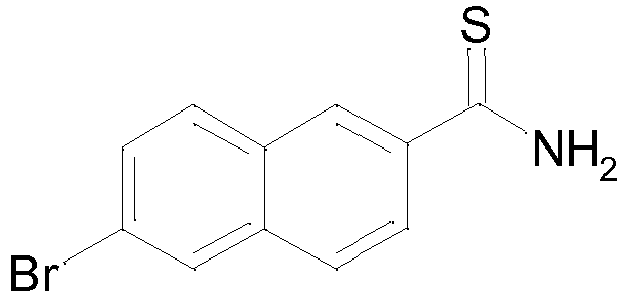
- Formula: C11H8NSBr
- Physical State: yellow solid.
- Yield: quantitative.
- Cromatography: CHCl3/AcOEt 8:2
- GC-MS: m/z: 265 (M+, 95), 267 (M+2, 100), 232 (77).
-

- Formula: C12H11NOS
- Physical State: yellow solid.
- Yield: 57%.
- Cromatography: CH2Cl2/AcOEt 9:1
- 1H-NMR ... δ : 3.94 (s, 3H, OCH3), 7.13-8.34 (m, 6H, aromatic), 7.45 (s broad, 2H, NH2). ESI+/MS m/z: 218 [M+H]+. ESI+ /MS/MS m/z: 201 (100), 159 (39).
-

- Formula: C14H10NOCl
- Physical State: yellow solid.
- Yield: 77%.
- Cromatography: petroleum ether /AcOEt 8:2.
- GC-MS m/z: 243 (M+, 32), 245(M+2, 9), 139 (100).
- ESI+/MS m/z: 400 [M+H]+. ESI+ /MS/MS m/z : 208 (56), 153 (100).
- 4-(Chloromethyl)-2-(2-fluoronaphthalen-6-yl)oxazole
- Formula: C14H10NOFCl
- Physical State: white solid
- Yield: 54 %.
- Cromatography: petroleum ether/AcOEt 9:1.
- Pf: 109-111 °C.
- 1H-NMR δ: 4.62 (s, 2H, CH2), 7.28-8.54 (m, 7H, aromatic). GC-MS m/z: 261 (M+, 50), 263 (M+2, 18), 171 (100).
-
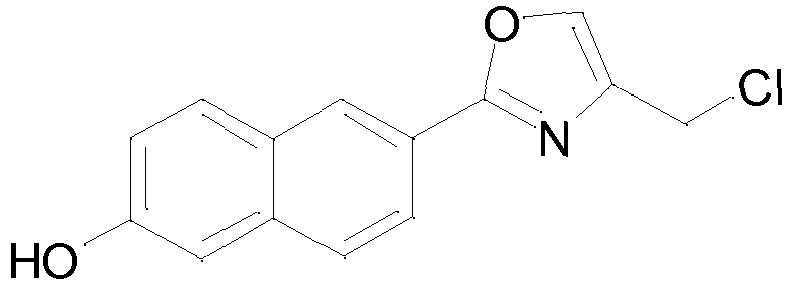
- Formula: C13H10NO2Cl
- Physical State: white solid
- Yield: 47 %.
- Cromatography: CHCl3
- 1H-NMR δ: 4.53 (s, 2H, CH2), 7.06-8.33 (m, 7H, aromatic), 9.30 (s broad, OH).
- GC-MS m/z: 259 (M+, 72), 261 (M+2, 23), 169 ( 100).
-

- Formula: C14H9NSBrCl
- Physical State: white solid
- Yield: 61%.
- Cromatography: CH2Cl2
- Pf: 103-105 °C.
- 1H-NMR δ: 4.80 (s, 2H, CH2), 7.36-8.40 (m, 7H, aromatic). GC-MS m/z: 339 (M+, 100), 341 (M+2, 27), 304 (45).
-

- Formula: C15H12NOSCl
- Physical State: white solid
- Yield: 89%.
- Cromatography: CHCl3
- ESI+/MS m/z: 290 [M+H]+. ESI+ /MS/MS m/z : 254 (100), 256 (6).
-

- Formula: C25H24N2O3
- Physical State: red solid
- Yield: 64 %.
- Cromatography: CHCl3
- Pf: 232-235 °C.
- 1H-NMR (δ): 2.94 (s, 4H, CH 2NCH 2), 3.75-3.79 (d, 4H, NCH 2CH 2), 3.82-3.88 (m, 6H, 2 di OCH3), 6.52-8.57 (m, 10H, aromatic).
- ESI+/MS m/z: 400 [M+H]+. ESI+ /MS/MS m/z : 208 (56), 153 (100).
-

- Formula: C25H23N2O2SBr
- Physical State: olio scuro
- Resa: 30%.
- Cromatografia: (CH2Cl2)
- Pf: 221-224 °C.
- 1H-NMR (δ: 2.88 (s, 4H, CH 2 NCH 2 ), 3.72-3.96 (d, 4H, NCH2CH2 ), 3.82-3.884 (s, 6H, 2 di OCH3), 6.51-8.42 (m, 9H, aromatici).
- ESI+/MS m/z: 497 [M+H]+. ESI+ /MS/MS m/z : 304 (84), 192 (100).
-
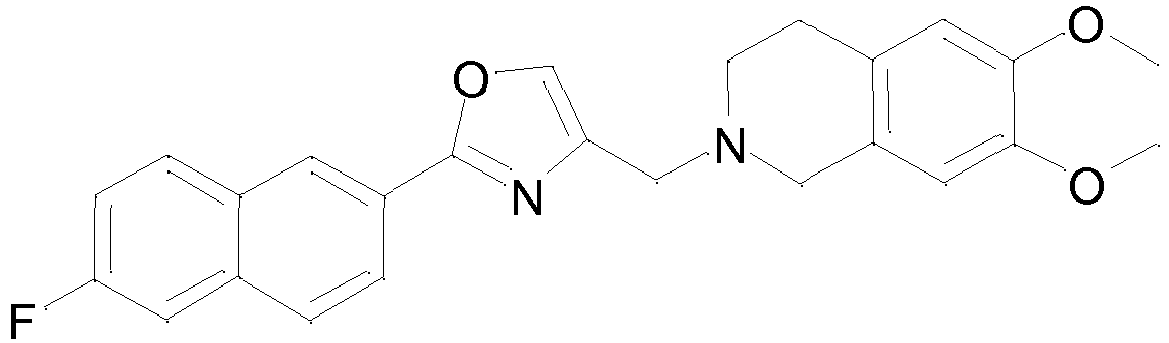
- Formula: C25H23N2O3F
- Physical State: white solid
- Yield: 56%
- Cromatography: CH2Cl2 / MeOH 98:2
- Pf: 231-234 °C.
- 1H-NMR δ: 2.87 (s, 4H, CH2NCH2), 3.70-3.75 (d, 4H, NCH2CH2), 3.81-3.84 (m, 6H, 2 di OCH3), 6.51-8.56 (m, 9H, aromatic).
- GC-MS m/z: 418 (M+, 0.86), 192 (100), 171 (18).
-

- Formula: C25H24N2O4
- Physical State: yellow oil.
- Cromatography: CH2Cl2 / MeOH 99:1
- Pf: 249-252 °C dec.
- ESI+/MS m/z: 417 [M+H]+. ESI+ /MS/MS m/z : 224 (97), 169 (100).
-

- Formula: C26H26N2O3S
- Physical State: yellow solid
- Resa: 55%.
- Cromatography: CHCl3
- Pf: >250 °C dec.
- 1H-NMR δ: 2.88 (s, 4HH 2 NCH 2 ), 3.75-3.95 (d, 4H, NCH 2 CH 2 ), 3.81-3.93 (m, 9H, 3 di OCH 3 ), 6.52-8.37 (m, 9H, aromatic).
- ESI+/MS m/z : 447 [M+H]+.
- [11C]-Methyl iodide is trapped in a solution of desmethyl derivative (for example 0.5 mg in 0.5 mL anhydrous DMSO). Shortly before the arrival of [11C]-methyl iodide, 7 µL of NaOH (5 M) was added to the precursor solution. The reaction was heated for 4 min at 80° C. After addition of H2O (2 mL) 11C-radiolabelled compound was purified on reverse phase chromatography column with 100 mM NaH2PO4: EtOH 1:1 (v / v) as mobile phase. The quality control of the product is then carried out on preparative HPLC before use in vivo.
- Precursor for 18F radiosynthesis was 6-tosylethoxy-7-methoxy-1,2,3,4-tetrahydroisoquinoline derivative that was prepared starting from 6-hydroxy-7-methoxy-1,2,3,4-tetrahydroisoquinoline by reaction with ethylene carbonate and tetrabutylammonium bromide in THF dry and then by reaction with TsCl and pyridine. Tosyl derivative was treated with [18F]K-(Kriptofix 2.2.2)F, potassium carbonate and acetonitrile for 4 min a 80°C. After addition of H2O (2 mL), 18F radioligand was purified on reverse phase chromatography column with 100 mM NaH2PO4: EtOH 1:1 (v/v) as mobile phase. The quality control of the product is then carried out on preparative HPLC before use in vivo.
- This assay is carried out on colon adenocarcinoma cell line (Caco-2) overexpressing P-gp, a cell model usually employed for the permeability study. In this experiment Apparent Permeability (Papp) is determined both in basolateral/apical direction (Papp-BA) and in apical/basolateral direction (Papp-AB). The BA/AB ratio allow to discriminate if a ligand is transported by P-gp (BA/AB ratio between 18 and 20), or not (BA/AB ratio between 1 and 2). For BA/AB ratio between 2 and 18 compounds can be classified as modulators (see Polli, J. V et al., 2001, J. Pharmacol. Exp. Ther. 299, 620-628).
- This assay is useful to detect the ATP cell level in cells after treatment with MDR ligands. Therefore, if ligand is transported by P-gp, it will be ATP cell depletion whereas if there is not ATP depletion, the ligand is not transported by P-gp. This assay is a bioluminescent assay that use the enzymatic reaction of conversion of luciferin to oxiluciferin mediated by luciferase (see Kangas, L. et al., 1984; Med. Biol., 62, 338-343).
- In this assay the inhibition of the transport of a BCRP fluorescent substrate, Rhodamina-123, or of a P-gp or MRP1 profluorescent substrate, Calcein-AM, is determined.
- The fluorescent signal due to the accumulation of Rhodamine-123 in cells is inversely correlated to the efflux pump activity.
- Calcein-AM, entering the cell membrane is idolized by citosolic esterase to fluorescent calcein (that is not a P-gp substrate) leading to a fluorescent signal. Therefore, the inhibition of the efflux pump will be directly correlated to the fluorescent signal due to the cell accumulation of Calcein-AM (see Feng, B., et al., 2008; Drug Metab. Dispos. 36, 268-275).
- From the combination of these three biological assays it is possible to classify the tested ligands as substrates, modulators or inhibitors.
- The results obtained in the above-described assays with some representative compounds are reported in the Table 1. The results highlighted that the molecules of the invention are able to interfere with P-gp activity as inhibitors or as modulators thereof, but they show poor or no activity towards MRP1.
- More in details the oxazole derivative (R = OH) was a potent P-gp inhibitor (EC50 = 2.8 µM) and was inactive towards MRP1 whereas other oxazole derivatives (R = H and R = F) were P-gp inhibitors (EC50 = 2.7 µM and 5.2 µM, respectively) moderately active towards MRP1 (EC50 > 30 µM). The other compounds tested have shown modulating activity towards P-gp and were inactive towards MRP1.
- MRP1 pump is another ABC transport displaying high homology with P-gp, but these transporters differ from cell localization; P-gp is localized at apical level, whereas MRP1 at basolateral compartment.
Table 1 compound EC50 P-gp (µM) EC50 MRP1 (µM) Papp BA/AB R2=H, R1=Br, X=O 1.8 > 100 3.2 R2=H, R1=OH, X=O 2.80 > 100 1.6 R2=H, R1=OCH3, X=O 0.60 14.7 3.8 R2=H, R1=F, X=O 5.20 31.8 0.80 R2=H, R1=H, X=O 2.70 33.2 0.40 R2=H, R1=Br, X=S 3.70 > 100 6.0 R2=H, R1=OCH3, X=S 1.00 > 100 6.0 -
- 1. Vogelgesang, S. et al.2002, Pharmacogenetics, 12, 535-541
- 2. Rapposelli et al., 2009, Curr. Top. Med. Chem., 9, 209-217
- 3. Kuhnke, D. et al., 2007, Brain pathol., 17, 347-353
- 4. Bart, J. et al., 2003, Neuroimage, 20, 1775-1782
- 5. Liow, J. S. et al., 2009, J. Med. Chem., 49, 1328-1335
- 6. Dörner, B. et al. 2009, J. Med. Chem, 52, 6073-6082
- 7. Luurtsema, G. et al., 2009, Nucl. Med. Biol., 36, 6073-6082;
- 8. Bankstahl, J. P. et al., 2008, J. Nucl. Med. Chem., 49, 1328-1335
- 9. Kannan, P. et al., 2009, Clin. Pharmacol. Ther., 86, 368-377;
- 10. Kannan, P. et al., 2010, ACS Chem. Neurosci.
- 11. PCT Int. Appl. (2000)
WO0071101


Claims (19)
- A compound having formula I:
 X is oxygen or sulfur;R1 and R2 are selected independently of each other from: H, OH, OCH3, NH2, NO2 or a halogen atom selected from: F, Cl, Br, I or an alkyl group selected from: methyl, ethyl, n-propyl, iso-propyl, n-butyl, iso-butyl or terbutyl.
 - A compound according to claim 1 wherein R2 is H or wherein X is oxygen, R2 is H and R1 is H, F, Br, OCH3 or OH or wherein X is sulfur, R2 is H and R1 is H, F, Br, OCH3 or OH.
- A compound according to claim 1, selected from


- A compound according to any one of the claims 1 to 3 isotopically radio labeled.
- The compound according to claim 4 labeled with an isotope selected from 3H, 11C, 14C, 11N, 15O, 18F, 19F, 75Br, 76Br, 79Br, 123I, 124I, 127I, 131I.
- The compound according to claim 4 or 5 for use in in vivo diagnosis of a neurodegenerative disease involving P-glycoprotein.
- The compound for use according to claim 6 wherein the neurodegenerative disease is the Alzheimer's or Parkinson's disease.
- A compound for use according to claim 6 or 7 wherein the diagnosis is performed by PET or SPECT analysis.
- A diagnostic imaging composition comprising as imaging agent a compound according to the claim 4 or 5 and a carrier.
- The diagnostic imaging composition according to claim 9 for use in in vivo diagnosis of a neurodegenerative disease involving P-glycoprotein.
- The diagnostic imaging composition for use according to claim 10 wherein the neurodegenerative disease is the Alzheimer's or Parkinson's disease.
- The diagnostic imaging composition according to claim 9 or the diagnostic imaging composition for use according to claims 10 or 11 in the form of an injectable solution wherein the imaging agent is from 4 mg/ml to 7.5 mg/ml.
- A compound according to any one of the claims 1 to 3 for use as medicament.
- A compound for use according to claim 13 for use as inhibitor or as modulator of the P-glycoprotein function in the prevention or treatment of pathologies involving P-glycoprotein.
- A compound for use according to claim 14 wherein said pathology is Alzheimer's or Parkinson's disease.
- A pharmaceutical composition comprising a compound according to any one of the claims 1 to 3 and a pharmacologically acceptable excipient and/or diluent.
- A pharmaceutical kit formed by a first element containing a compound according to any one of the claims 1 to 3 and a second element containing a radionuclide suitable for imaging.
- A method of preparing the compounds according to any one of the claims 1 to 3, comprising the following steps: compound of formula II is transformed into the end compound IV via the intermediate III according to the following scheme (Scheme I):

- A method according to claim 18, further comprising the step of reacting with a radioisotope.
Applications Claiming Priority (1)
| Application Number | Priority Date | Filing Date | Title |
|---|---|---|---|
| PCT/EP2011/058469 WO2012159666A1 (en) | 2011-05-24 | 2011-05-24 | Novel tetrahydroisoquinoline compounds for use in the diagnosis and treatment of neurodegenerative diseases |
Publications (2)
| Publication Number | Publication Date |
|---|---|
| EP2714682A1 EP2714682A1 (en) | 2014-04-09 |
| EP2714682B1 true EP2714682B1 (en) | 2016-03-16 |
Family
ID=44119229
Family Applications (1)
| Application Number | Title | Priority Date | Filing Date |
|---|---|---|---|
| EP11722049.1A Not-in-force EP2714682B1 (en) | 2011-05-24 | 2011-05-24 | Novel tetrahydroisoquinoline compounds for use in the diagnosis and treatment of neurodegenerative diseases |
Country Status (3)
| Country | Link |
|---|---|
| US (1) | US9095631B2 (en) |
| EP (1) | EP2714682B1 (en) |
| WO (1) | WO2012159666A1 (en) |
Families Citing this family (9)
| Publication number | Priority date | Publication date | Assignee | Title |
|---|---|---|---|---|
| CN108586178B (en) * | 2013-10-10 | 2022-02-11 | 中国石油化工股份有限公司 | Process for the manufacture of nitriles and their corresponding amines |
| CN108530243B (en) * | 2014-04-16 | 2022-05-27 | 中国石化扬子石油化工有限公司 | Process for the manufacture of nitriles and their corresponding amines |
| CN105001032B (en) * | 2014-04-16 | 2018-03-16 | 中国石化扬子石油化工有限公司 | Process for the manufacture of nitriles and their corresponding amines |
| CN108558589B (en) * | 2014-04-16 | 2022-02-08 | 中国石化扬子石油化工有限公司 | Process for the manufacture of nitriles and their corresponding amines |
| CN105016940B (en) * | 2014-04-16 | 2018-03-16 | 中国石化扬子石油化工有限公司 | Process for the manufacture of nitriles and their corresponding amines |
| CN108546224B (en) * | 2014-04-16 | 2022-05-27 | 中国石化扬子石油化工有限公司 | Process for the manufacture of nitriles and their corresponding amines |
| CN108530244B (en) * | 2014-04-16 | 2022-02-11 | 中国石化扬子石油化工有限公司 | Process for the manufacture of nitriles and their corresponding amines |
| WO2016174496A1 (en) * | 2015-04-27 | 2016-11-03 | Biofordrug S.R.L. | P-gp radiotracers for imaging as biomarker involved in onset of neurodegenerative diseases |
| US11430144B2 (en) * | 2017-09-26 | 2022-08-30 | Universita' Degli Studi Di Bari Aldo Moro | Device and process for the contemporary capture of standard images and plenoptic images via correlation plenoptic imaging |
Family Cites Families (2)
| Publication number | Priority date | Publication date | Assignee | Title |
|---|---|---|---|---|
| US6562836B1 (en) | 1999-05-24 | 2003-05-13 | Queen's University Of Kingston | Methods and compounds for inhibiting amyloid deposits |
| US7989630B2 (en) * | 2008-04-30 | 2011-08-02 | National Institutes Of Health Represented By The Secretary Of The Department Of Health And Human Services, National Institutes Of Health | Radiotracers for imaging P-glycoprotein function |
-
2011
- 2011-05-24 EP EP11722049.1A patent/EP2714682B1/en not_active Not-in-force
- 2011-05-24 US US14/119,539 patent/US9095631B2/en not_active Expired - Fee Related
- 2011-05-24 WO PCT/EP2011/058469 patent/WO2012159666A1/en not_active Ceased
Non-Patent Citations (1)
| Title |
|---|
| DIANA KUHNKE ET AL: "MDR1-P-Glycoprotein (ABCB1) Mediates Transport of Alzheimer's Amyloid-[beta] Peptides-Implications for the Mechanisms of A[beta] Clearance at the Blood-Brain Barrier", BRAIN PATHOLOGY, vol. 17, no. 4, 1 October 2007 (2007-10-01), pages 347 - 353, XP055019126, ISSN: 1015-6305, DOI: 10.1111/j.1750-3639.2007.00075.x * |
Also Published As
| Publication number | Publication date |
|---|---|
| EP2714682A1 (en) | 2014-04-09 |
| US20140112868A1 (en) | 2014-04-24 |
| US9095631B2 (en) | 2015-08-04 |
| WO2012159666A1 (en) | 2012-11-29 |
Similar Documents
| Publication | Publication Date | Title |
|---|---|---|
| US9095631B2 (en) | Tetrahydroisoquinoline compounds for use in the diagnosis and treatment of neurodegenerative diseases | |
| EP2264018B1 (en) | Thioflavin derivatives for use in the diagnosis of Alzheimer's disease | |
| EP2411057B1 (en) | Imaging agents for detecting neurological disorders | |
| AU2001286702A1 (en) | Thioflavin derivatives and their use in diagnosis and theraphy of alzheimer's disease | |
| TW201018678A (en) | Novel heteroaryl substituted benzothiazoles | |
| JP6840666B2 (en) | New anthranilic acid derivative | |
| US7989630B2 (en) | Radiotracers for imaging P-glycoprotein function | |
| Wang et al. | Synthesis and biological evaluation of 18F labeled fluoro-oligo-ethoxylated 4-benzylpiperazine derivatives for sigma-1 receptor imaging | |
| JP2012523388A (en) | Imaging of central nervous system using purinergic P2X7 receptor binding agent | |
| WO2016174496A1 (en) | P-gp radiotracers for imaging as biomarker involved in onset of neurodegenerative diseases | |
| EP2247316B1 (en) | Imaging the central nervous system | |
| US7354935B2 (en) | Radiolabeled neurokinin-1 receptor antagonists | |
| JP2021102593A (en) | New compound imaging tau | |
| HK1146725B (en) | Thioflavin derivatives for use in the diagnosis of alzheimer's disease | |
| HK1058041B (en) | Thioflavin derivatives and their use in diagnosis and therapy of alzheimer's disease |
Legal Events
| Date | Code | Title | Description |
|---|---|---|---|
| PUAI | Public reference made under article 153(3) epc to a published international application that has entered the european phase |
Free format text: ORIGINAL CODE: 0009012 |
|
| 17P | Request for examination filed |
Effective date: 20131223 |
|
| AK | Designated contracting states |
Kind code of ref document: A1 Designated state(s): AL AT BE BG CH CY CZ DE DK EE ES FI FR GB GR HR HU IE IS IT LI LT LU LV MC MK MT NL NO PL PT RO RS SE SI SK SM TR |
|
| DAX | Request for extension of the european patent (deleted) | ||
| GRAP | Despatch of communication of intention to grant a patent |
Free format text: ORIGINAL CODE: EPIDOSNIGR1 |
|
| INTG | Intention to grant announced |
Effective date: 20150708 |
|
| GRAS | Grant fee paid |
Free format text: ORIGINAL CODE: EPIDOSNIGR3 |
|
| INTG | Intention to grant announced |
Effective date: 20151221 |
|
| GRAA | (expected) grant |
Free format text: ORIGINAL CODE: 0009210 |
|
| AK | Designated contracting states |
Kind code of ref document: B1 Designated state(s): AL AT BE BG CH CY CZ DE DK EE ES FI FR GB GR HR HU IE IS IT LI LT LU LV MC MK MT NL NO PL PT RO RS SE SI SK SM TR |
|
| REG | Reference to a national code |
Ref country code: GB Ref legal event code: FG4D |
|
| REG | Reference to a national code |
Ref country code: CH Ref legal event code: EP |
|
| REG | Reference to a national code |
Ref country code: IE Ref legal event code: FG4D |
|
| REG | Reference to a national code |
Ref country code: AT Ref legal event code: REF Ref document number: 781114 Country of ref document: AT Kind code of ref document: T Effective date: 20160415 |
|
| REG | Reference to a national code |
Ref country code: DE Ref legal event code: R096 Ref document number: 602011024047 Country of ref document: DE |
|
| REG | Reference to a national code |
Ref country code: NL Ref legal event code: MP Effective date: 20160316 |
|
| REG | Reference to a national code |
Ref country code: LT Ref legal event code: MG4D |
|
| PG25 | Lapsed in a contracting state [announced via postgrant information from national office to epo] |
Ref country code: GR Free format text: LAPSE BECAUSE OF FAILURE TO SUBMIT A TRANSLATION OF THE DESCRIPTION OR TO PAY THE FEE WITHIN THE PRESCRIBED TIME-LIMIT Effective date: 20160617 Ref country code: HR Free format text: LAPSE BECAUSE OF FAILURE TO SUBMIT A TRANSLATION OF THE DESCRIPTION OR TO PAY THE FEE WITHIN THE PRESCRIBED TIME-LIMIT Effective date: 20160316 Ref country code: NO Free format text: LAPSE BECAUSE OF FAILURE TO SUBMIT A TRANSLATION OF THE DESCRIPTION OR TO PAY THE FEE WITHIN THE PRESCRIBED TIME-LIMIT Effective date: 20160616 Ref country code: FI Free format text: LAPSE BECAUSE OF FAILURE TO SUBMIT A TRANSLATION OF THE DESCRIPTION OR TO PAY THE FEE WITHIN THE PRESCRIBED TIME-LIMIT Effective date: 20160316 |
|
| PGFP | Annual fee paid to national office [announced via postgrant information from national office to epo] |
Ref country code: DE Payment date: 20160520 Year of fee payment: 6 Ref country code: GB Payment date: 20160520 Year of fee payment: 6 |
|
| REG | Reference to a national code |
Ref country code: AT Ref legal event code: MK05 Ref document number: 781114 Country of ref document: AT Kind code of ref document: T Effective date: 20160316 |
|
| PG25 | Lapsed in a contracting state [announced via postgrant information from national office to epo] |
Ref country code: BE Free format text: LAPSE BECAUSE OF NON-PAYMENT OF DUE FEES Effective date: 20160531 Ref country code: LV Free format text: LAPSE BECAUSE OF FAILURE TO SUBMIT A TRANSLATION OF THE DESCRIPTION OR TO PAY THE FEE WITHIN THE PRESCRIBED TIME-LIMIT Effective date: 20160316 Ref country code: NL Free format text: LAPSE BECAUSE OF FAILURE TO SUBMIT A TRANSLATION OF THE DESCRIPTION OR TO PAY THE FEE WITHIN THE PRESCRIBED TIME-LIMIT Effective date: 20160316 Ref country code: RS Free format text: LAPSE BECAUSE OF FAILURE TO SUBMIT A TRANSLATION OF THE DESCRIPTION OR TO PAY THE FEE WITHIN THE PRESCRIBED TIME-LIMIT Effective date: 20160316 Ref country code: LT Free format text: LAPSE BECAUSE OF FAILURE TO SUBMIT A TRANSLATION OF THE DESCRIPTION OR TO PAY THE FEE WITHIN THE PRESCRIBED TIME-LIMIT Effective date: 20160316 Ref country code: SE Free format text: LAPSE BECAUSE OF FAILURE TO SUBMIT A TRANSLATION OF THE DESCRIPTION OR TO PAY THE FEE WITHIN THE PRESCRIBED TIME-LIMIT Effective date: 20160316 |
|
| PG25 | Lapsed in a contracting state [announced via postgrant information from national office to epo] |
Ref country code: EE Free format text: LAPSE BECAUSE OF FAILURE TO SUBMIT A TRANSLATION OF THE DESCRIPTION OR TO PAY THE FEE WITHIN THE PRESCRIBED TIME-LIMIT Effective date: 20160316 Ref country code: IS Free format text: LAPSE BECAUSE OF FAILURE TO SUBMIT A TRANSLATION OF THE DESCRIPTION OR TO PAY THE FEE WITHIN THE PRESCRIBED TIME-LIMIT Effective date: 20160716 Ref country code: PL Free format text: LAPSE BECAUSE OF FAILURE TO SUBMIT A TRANSLATION OF THE DESCRIPTION OR TO PAY THE FEE WITHIN THE PRESCRIBED TIME-LIMIT Effective date: 20160316 |
|
| PG25 | Lapsed in a contracting state [announced via postgrant information from national office to epo] |
Ref country code: CZ Free format text: LAPSE BECAUSE OF FAILURE TO SUBMIT A TRANSLATION OF THE DESCRIPTION OR TO PAY THE FEE WITHIN THE PRESCRIBED TIME-LIMIT Effective date: 20160316 Ref country code: PT Free format text: LAPSE BECAUSE OF FAILURE TO SUBMIT A TRANSLATION OF THE DESCRIPTION OR TO PAY THE FEE WITHIN THE PRESCRIBED TIME-LIMIT Effective date: 20160718 Ref country code: ES Free format text: LAPSE BECAUSE OF FAILURE TO SUBMIT A TRANSLATION OF THE DESCRIPTION OR TO PAY THE FEE WITHIN THE PRESCRIBED TIME-LIMIT Effective date: 20160316 Ref country code: RO Free format text: LAPSE BECAUSE OF FAILURE TO SUBMIT A TRANSLATION OF THE DESCRIPTION OR TO PAY THE FEE WITHIN THE PRESCRIBED TIME-LIMIT Effective date: 20160316 Ref country code: AT Free format text: LAPSE BECAUSE OF FAILURE TO SUBMIT A TRANSLATION OF THE DESCRIPTION OR TO PAY THE FEE WITHIN THE PRESCRIBED TIME-LIMIT Effective date: 20160316 Ref country code: SM Free format text: LAPSE BECAUSE OF FAILURE TO SUBMIT A TRANSLATION OF THE DESCRIPTION OR TO PAY THE FEE WITHIN THE PRESCRIBED TIME-LIMIT Effective date: 20160316 Ref country code: SK Free format text: LAPSE BECAUSE OF FAILURE TO SUBMIT A TRANSLATION OF THE DESCRIPTION OR TO PAY THE FEE WITHIN THE PRESCRIBED TIME-LIMIT Effective date: 20160316 |
|
| REG | Reference to a national code |
Ref country code: DE Ref legal event code: R097 Ref document number: 602011024047 Country of ref document: DE |
|
| PG25 | Lapsed in a contracting state [announced via postgrant information from national office to epo] |
Ref country code: LU Free format text: LAPSE BECAUSE OF FAILURE TO SUBMIT A TRANSLATION OF THE DESCRIPTION OR TO PAY THE FEE WITHIN THE PRESCRIBED TIME-LIMIT Effective date: 20160524 Ref country code: BE Free format text: LAPSE BECAUSE OF FAILURE TO SUBMIT A TRANSLATION OF THE DESCRIPTION OR TO PAY THE FEE WITHIN THE PRESCRIBED TIME-LIMIT Effective date: 20160316 Ref country code: IT Free format text: LAPSE BECAUSE OF FAILURE TO SUBMIT A TRANSLATION OF THE DESCRIPTION OR TO PAY THE FEE WITHIN THE PRESCRIBED TIME-LIMIT Effective date: 20160316 |
|
| REG | Reference to a national code |
Ref country code: CH Ref legal event code: PL |
|
| PLBE | No opposition filed within time limit |
Free format text: ORIGINAL CODE: 0009261 |
|
| STAA | Information on the status of an ep patent application or granted ep patent |
Free format text: STATUS: NO OPPOSITION FILED WITHIN TIME LIMIT |
|
| PG25 | Lapsed in a contracting state [announced via postgrant information from national office to epo] |
Ref country code: CH Free format text: LAPSE BECAUSE OF NON-PAYMENT OF DUE FEES Effective date: 20160531 Ref country code: DK Free format text: LAPSE BECAUSE OF FAILURE TO SUBMIT A TRANSLATION OF THE DESCRIPTION OR TO PAY THE FEE WITHIN THE PRESCRIBED TIME-LIMIT Effective date: 20160316 Ref country code: LI Free format text: LAPSE BECAUSE OF NON-PAYMENT OF DUE FEES Effective date: 20160531 |
|
| 26N | No opposition filed |
Effective date: 20161219 |
|
| REG | Reference to a national code |
Ref country code: IE Ref legal event code: MM4A |
|
| PG25 | Lapsed in a contracting state [announced via postgrant information from national office to epo] |
Ref country code: BG Free format text: LAPSE BECAUSE OF FAILURE TO SUBMIT A TRANSLATION OF THE DESCRIPTION OR TO PAY THE FEE WITHIN THE PRESCRIBED TIME-LIMIT Effective date: 20160616 |
|
| REG | Reference to a national code |
Ref country code: FR Ref legal event code: ST Effective date: 20170131 |
|
| PG25 | Lapsed in a contracting state [announced via postgrant information from national office to epo] |
Ref country code: FR Free format text: LAPSE BECAUSE OF NON-PAYMENT OF DUE FEES Effective date: 20160531 |
|
| PG25 | Lapsed in a contracting state [announced via postgrant information from national office to epo] |
Ref country code: SI Free format text: LAPSE BECAUSE OF FAILURE TO SUBMIT A TRANSLATION OF THE DESCRIPTION OR TO PAY THE FEE WITHIN THE PRESCRIBED TIME-LIMIT Effective date: 20160316 Ref country code: IE Free format text: LAPSE BECAUSE OF NON-PAYMENT OF DUE FEES Effective date: 20160524 |
|
| REG | Reference to a national code |
Ref country code: DE Ref legal event code: R119 Ref document number: 602011024047 Country of ref document: DE |
|
| GBPC | Gb: european patent ceased through non-payment of renewal fee |
Effective date: 20170524 |
|
| PG25 | Lapsed in a contracting state [announced via postgrant information from national office to epo] |
Ref country code: DE Free format text: LAPSE BECAUSE OF NON-PAYMENT OF DUE FEES Effective date: 20171201 Ref country code: GB Free format text: LAPSE BECAUSE OF NON-PAYMENT OF DUE FEES Effective date: 20170524 |
|
| PG25 | Lapsed in a contracting state [announced via postgrant information from national office to epo] |
Ref country code: HU Free format text: LAPSE BECAUSE OF FAILURE TO SUBMIT A TRANSLATION OF THE DESCRIPTION OR TO PAY THE FEE WITHIN THE PRESCRIBED TIME-LIMIT; INVALID AB INITIO Effective date: 20110524 Ref country code: CY Free format text: LAPSE BECAUSE OF FAILURE TO SUBMIT A TRANSLATION OF THE DESCRIPTION OR TO PAY THE FEE WITHIN THE PRESCRIBED TIME-LIMIT Effective date: 20160316 |
|
| PG25 | Lapsed in a contracting state [announced via postgrant information from national office to epo] |
Ref country code: MC Free format text: LAPSE BECAUSE OF FAILURE TO SUBMIT A TRANSLATION OF THE DESCRIPTION OR TO PAY THE FEE WITHIN THE PRESCRIBED TIME-LIMIT Effective date: 20160316 Ref country code: MT Free format text: LAPSE BECAUSE OF NON-PAYMENT OF DUE FEES Effective date: 20160531 Ref country code: TR Free format text: LAPSE BECAUSE OF FAILURE TO SUBMIT A TRANSLATION OF THE DESCRIPTION OR TO PAY THE FEE WITHIN THE PRESCRIBED TIME-LIMIT Effective date: 20160316 Ref country code: MK Free format text: LAPSE BECAUSE OF FAILURE TO SUBMIT A TRANSLATION OF THE DESCRIPTION OR TO PAY THE FEE WITHIN THE PRESCRIBED TIME-LIMIT Effective date: 20160316 |
|
| PG25 | Lapsed in a contracting state [announced via postgrant information from national office to epo] |
Ref country code: AL Free format text: LAPSE BECAUSE OF FAILURE TO SUBMIT A TRANSLATION OF THE DESCRIPTION OR TO PAY THE FEE WITHIN THE PRESCRIBED TIME-LIMIT Effective date: 20160316 |