EP2714109B1 - Crosslinked gelatin hydrogels - Google Patents
Crosslinked gelatin hydrogels Download PDFInfo
- Publication number
- EP2714109B1 EP2714109B1 EP12727813.3A EP12727813A EP2714109B1 EP 2714109 B1 EP2714109 B1 EP 2714109B1 EP 12727813 A EP12727813 A EP 12727813A EP 2714109 B1 EP2714109 B1 EP 2714109B1
- Authority
- EP
- European Patent Office
- Prior art keywords
- gelatin
- hydrogel
- bisacrylamide
- hydrogel according
- mba
- Prior art date
- Legal status (The legal status is an assumption and is not a legal conclusion. Google has not performed a legal analysis and makes no representation as to the accuracy of the status listed.)
- Not-in-force
Links
- 239000000017 hydrogel Substances 0.000 title claims description 75
- 229920000159 gelatin Polymers 0.000 title claims description 60
- 235000019322 gelatine Nutrition 0.000 title claims description 60
- 108010010803 Gelatin Proteins 0.000 title claims description 57
- 239000008273 gelatin Substances 0.000 title claims description 57
- 235000011852 gelatine desserts Nutrition 0.000 title claims description 57
- ZIUHHBKFKCYYJD-UHFFFAOYSA-N n,n'-methylenebisacrylamide Chemical compound C=CC(=O)NCNC(=O)C=C ZIUHHBKFKCYYJD-UHFFFAOYSA-N 0.000 claims description 40
- 210000004027 cell Anatomy 0.000 claims description 18
- 239000000203 mixture Substances 0.000 claims description 17
- ZMANZCXQSJIPKH-UHFFFAOYSA-N Triethylamine Chemical group CCN(CC)CC ZMANZCXQSJIPKH-UHFFFAOYSA-N 0.000 claims description 14
- 238000006243 chemical reaction Methods 0.000 claims description 13
- XLYOFNOQVPJJNP-UHFFFAOYSA-N water Substances O XLYOFNOQVPJJNP-UHFFFAOYSA-N 0.000 claims description 12
- 238000000034 method Methods 0.000 claims description 11
- 210000000577 adipose tissue Anatomy 0.000 claims description 9
- LFQSCWFLJHTTHZ-UHFFFAOYSA-N Ethanol Chemical compound CCO LFQSCWFLJHTTHZ-UHFFFAOYSA-N 0.000 claims description 8
- -1 tertiary amine compound Chemical class 0.000 claims description 8
- 239000007864 aqueous solution Substances 0.000 claims description 7
- 238000000338 in vitro Methods 0.000 claims description 7
- 125000003277 amino group Chemical group 0.000 claims description 6
- 210000004872 soft tissue Anatomy 0.000 claims description 6
- 238000013270 controlled release Methods 0.000 claims description 5
- 230000004069 differentiation Effects 0.000 claims description 5
- 239000003814 drug Substances 0.000 claims description 5
- 150000003141 primary amines Chemical class 0.000 claims description 5
- 230000008569 process Effects 0.000 claims description 5
- 230000008929 regeneration Effects 0.000 claims description 5
- 238000011069 regeneration method Methods 0.000 claims description 5
- 239000000243 solution Substances 0.000 claims description 5
- 210000001519 tissue Anatomy 0.000 claims description 5
- 210000004504 adult stem cell Anatomy 0.000 claims description 4
- 125000002915 carbonyl group Chemical group [*:2]C([*:1])=O 0.000 claims description 4
- 210000002889 endothelial cell Anatomy 0.000 claims description 4
- 239000002609 medium Substances 0.000 claims description 4
- 230000035755 proliferation Effects 0.000 claims description 4
- 238000000746 purification Methods 0.000 claims description 4
- KDXKERNSBIXSRK-UHFFFAOYSA-N Lysine Natural products NCCCCC(N)C(O)=O KDXKERNSBIXSRK-UHFFFAOYSA-N 0.000 claims description 3
- 239000004472 Lysine Substances 0.000 claims description 3
- 238000001035 drying Methods 0.000 claims description 3
- 238000004108 freeze drying Methods 0.000 claims description 3
- 150000007529 inorganic bases Chemical class 0.000 claims description 3
- 238000005935 nucleophilic addition reaction Methods 0.000 claims description 3
- 229920001184 polypeptide Polymers 0.000 claims description 3
- 102000004196 processed proteins & peptides Human genes 0.000 claims description 3
- 108090000765 processed proteins & peptides Proteins 0.000 claims description 3
- 230000002792 vascular Effects 0.000 claims description 3
- 238000005406 washing Methods 0.000 claims description 3
- LFYMIRQGCLQTGU-UHFFFAOYSA-N 1-(1-prop-2-enoylpiperazin-2-yl)prop-2-en-1-one Chemical compound C=CC(=O)C1CNCCN1C(=O)C=C LFYMIRQGCLQTGU-UHFFFAOYSA-N 0.000 claims description 2
- 238000007259 addition reaction Methods 0.000 claims description 2
- 239000012736 aqueous medium Substances 0.000 claims description 2
- 229940088623 biologically active substance Drugs 0.000 claims description 2
- 239000003102 growth factor Substances 0.000 claims description 2
- 238000010438 heat treatment Methods 0.000 claims description 2
- AYGYHGXUJBFUJU-UHFFFAOYSA-N n-[2-(prop-2-enoylamino)ethyl]prop-2-enamide Chemical compound C=CC(=O)NCCNC(=O)C=C AYGYHGXUJBFUJU-UHFFFAOYSA-N 0.000 claims description 2
- 150000003512 tertiary amines Chemical class 0.000 claims description 2
- HRPVXLWXLXDGHG-UHFFFAOYSA-N Acrylamide Chemical group NC(=O)C=C HRPVXLWXLXDGHG-UHFFFAOYSA-N 0.000 claims 1
- 229940079593 drug Drugs 0.000 claims 1
- 239000007943 implant Substances 0.000 claims 1
- 238000012606 in vitro cell culture Methods 0.000 claims 1
- 150000003335 secondary amines Chemical class 0.000 claims 1
- 210000003954 umbilical cord Anatomy 0.000 claims 1
- 238000012360 testing method Methods 0.000 description 23
- 239000000463 material Substances 0.000 description 21
- NAQMVNRVTILPCV-UHFFFAOYSA-N hexane-1,6-diamine Chemical compound NCCCCCCN NAQMVNRVTILPCV-UHFFFAOYSA-N 0.000 description 16
- 230000015572 biosynthetic process Effects 0.000 description 10
- 230000008961 swelling Effects 0.000 description 9
- 238000004132 cross linking Methods 0.000 description 8
- 239000012153 distilled water Substances 0.000 description 8
- 239000003431 cross linking reagent Substances 0.000 description 7
- 238000007654 immersion Methods 0.000 description 6
- 238000004113 cell culture Methods 0.000 description 5
- 125000000467 secondary amino group Chemical class [H]N([*:1])[*:2] 0.000 description 5
- 239000000126 substance Substances 0.000 description 5
- 238000003786 synthesis reaction Methods 0.000 description 5
- 238000005033 Fourier transform infrared spectroscopy Methods 0.000 description 4
- 238000012512 characterization method Methods 0.000 description 4
- 238000012669 compression test Methods 0.000 description 4
- 238000009472 formulation Methods 0.000 description 4
- 239000001963 growth medium Substances 0.000 description 4
- 239000011159 matrix material Substances 0.000 description 4
- 229920000642 polymer Polymers 0.000 description 4
- 238000011084 recovery Methods 0.000 description 4
- 238000003756 stirring Methods 0.000 description 4
- 239000004971 Cross linker Substances 0.000 description 3
- 239000006144 Dulbecco’s modified Eagle's medium Substances 0.000 description 3
- 239000001828 Gelatine Substances 0.000 description 3
- WMFOQBRAJBCJND-UHFFFAOYSA-M Lithium hydroxide Chemical compound [Li+].[OH-] WMFOQBRAJBCJND-UHFFFAOYSA-M 0.000 description 3
- HEMHJVSKTPXQMS-UHFFFAOYSA-M Sodium hydroxide Chemical compound [OH-].[Na+] HEMHJVSKTPXQMS-UHFFFAOYSA-M 0.000 description 3
- 210000001789 adipocyte Anatomy 0.000 description 3
- 239000012620 biological material Substances 0.000 description 3
- 230000015556 catabolic process Effects 0.000 description 3
- 239000003153 chemical reaction reagent Substances 0.000 description 3
- 238000007906 compression Methods 0.000 description 3
- 230000006835 compression Effects 0.000 description 3
- 238000006731 degradation reaction Methods 0.000 description 3
- 238000001727 in vivo Methods 0.000 description 3
- 230000003993 interaction Effects 0.000 description 3
- 238000010899 nucleation Methods 0.000 description 3
- 230000004962 physiological condition Effects 0.000 description 3
- 239000011541 reaction mixture Substances 0.000 description 3
- 238000010186 staining Methods 0.000 description 3
- 208000016261 weight loss Diseases 0.000 description 3
- WSFSSNUMVMOOMR-UHFFFAOYSA-N Formaldehyde Chemical compound O=C WSFSSNUMVMOOMR-UHFFFAOYSA-N 0.000 description 2
- 102000008100 Human Serum Albumin Human genes 0.000 description 2
- 108091006905 Human Serum Albumin Proteins 0.000 description 2
- 238000006845 Michael addition reaction Methods 0.000 description 2
- NPGIHFRTRXVWOY-UHFFFAOYSA-N Oil red O Chemical compound Cc1ccc(C)c(c1)N=Nc1cc(C)c(cc1C)N=Nc1c(O)ccc2ccccc12 NPGIHFRTRXVWOY-UHFFFAOYSA-N 0.000 description 2
- 238000004458 analytical method Methods 0.000 description 2
- 230000000975 bioactive effect Effects 0.000 description 2
- 229910052799 carbon Inorganic materials 0.000 description 2
- 230000021164 cell adhesion Effects 0.000 description 2
- 230000010261 cell growth Effects 0.000 description 2
- 239000013043 chemical agent Substances 0.000 description 2
- 239000000499 gel Substances 0.000 description 2
- 230000012010 growth Effects 0.000 description 2
- 238000002513 implantation Methods 0.000 description 2
- 230000007246 mechanism Effects 0.000 description 2
- 239000002953 phosphate buffered saline Substances 0.000 description 2
- 210000000130 stem cell Anatomy 0.000 description 2
- 239000000758 substrate Substances 0.000 description 2
- 230000017423 tissue regeneration Effects 0.000 description 2
- 229950003937 tolonium Drugs 0.000 description 2
- HNONEKILPDHFOL-UHFFFAOYSA-M tolonium chloride Chemical compound [Cl-].C1=C(C)C(N)=CC2=[S+]C3=CC(N(C)C)=CC=C3N=C21 HNONEKILPDHFOL-UHFFFAOYSA-M 0.000 description 2
- 231100000331 toxic Toxicity 0.000 description 2
- 230000002588 toxic effect Effects 0.000 description 2
- IMNIMPAHZVJRPE-UHFFFAOYSA-N triethylenediamine Chemical compound C1CN2CCN1CC2 IMNIMPAHZVJRPE-UHFFFAOYSA-N 0.000 description 2
- 210000003606 umbilical vein Anatomy 0.000 description 2
- 230000035899 viability Effects 0.000 description 2
- 230000004580 weight loss Effects 0.000 description 2
- 102000008186 Collagen Human genes 0.000 description 1
- 108010035532 Collagen Proteins 0.000 description 1
- 102000016942 Elastin Human genes 0.000 description 1
- 108010014258 Elastin Proteins 0.000 description 1
- 238000001157 Fourier transform infrared spectrum Methods 0.000 description 1
- 101000851054 Homo sapiens Elastin Proteins 0.000 description 1
- 238000004566 IR spectroscopy Methods 0.000 description 1
- 241001529936 Murinae Species 0.000 description 1
- FAPWRFPIFSIZLT-UHFFFAOYSA-M Sodium chloride Chemical compound [Na+].[Cl-] FAPWRFPIFSIZLT-UHFFFAOYSA-M 0.000 description 1
- GSEJCLTVZPLZKY-UHFFFAOYSA-N Triethanolamine Chemical compound OCCN(CCO)CCO GSEJCLTVZPLZKY-UHFFFAOYSA-N 0.000 description 1
- 230000004913 activation Effects 0.000 description 1
- 230000009815 adipogenic differentiation Effects 0.000 description 1
- 230000002293 adipogenic effect Effects 0.000 description 1
- 150000001299 aldehydes Chemical class 0.000 description 1
- 125000003368 amide group Chemical group 0.000 description 1
- 238000013459 approach Methods 0.000 description 1
- 239000003125 aqueous solvent Substances 0.000 description 1
- 238000005102 attenuated total reflection Methods 0.000 description 1
- 239000007640 basal medium Substances 0.000 description 1
- 230000008901 benefit Effects 0.000 description 1
- 239000013060 biological fluid Substances 0.000 description 1
- 210000004204 blood vessel Anatomy 0.000 description 1
- 239000007975 buffered saline Substances 0.000 description 1
- 150000001718 carbodiimides Chemical class 0.000 description 1
- CREMABGTGYGIQB-UHFFFAOYSA-N carbon carbon Chemical compound C.C CREMABGTGYGIQB-UHFFFAOYSA-N 0.000 description 1
- 239000011203 carbon fibre reinforced carbon Substances 0.000 description 1
- 210000000748 cardiovascular system Anatomy 0.000 description 1
- 239000000969 carrier Substances 0.000 description 1
- 230000030833 cell death Effects 0.000 description 1
- 230000008614 cellular interaction Effects 0.000 description 1
- 238000005119 centrifugation Methods 0.000 description 1
- 238000010382 chemical cross-linking Methods 0.000 description 1
- 239000007810 chemical reaction solvent Substances 0.000 description 1
- 229920001436 collagen Polymers 0.000 description 1
- 238000007398 colorimetric assay Methods 0.000 description 1
- 150000001875 compounds Chemical class 0.000 description 1
- 238000006482 condensation reaction Methods 0.000 description 1
- 230000001143 conditioned effect Effects 0.000 description 1
- 239000000470 constituent Substances 0.000 description 1
- 230000002596 correlated effect Effects 0.000 description 1
- 239000013078 crystal Substances 0.000 description 1
- 231100000433 cytotoxic Toxicity 0.000 description 1
- 230000001472 cytotoxic effect Effects 0.000 description 1
- 231100000135 cytotoxicity Toxicity 0.000 description 1
- 230000003013 cytotoxicity Effects 0.000 description 1
- 231100000263 cytotoxicity test Toxicity 0.000 description 1
- 230000005595 deprotonation Effects 0.000 description 1
- 238000010537 deprotonation reaction Methods 0.000 description 1
- 238000010790 dilution Methods 0.000 description 1
- 239000012895 dilution Substances 0.000 description 1
- LOKCTEFSRHRXRJ-UHFFFAOYSA-I dipotassium trisodium dihydrogen phosphate hydrogen phosphate dichloride Chemical compound P(=O)(O)(O)[O-].[K+].P(=O)(O)([O-])[O-].[Na+].[Na+].[Cl-].[K+].[Cl-].[Na+] LOKCTEFSRHRXRJ-UHFFFAOYSA-I 0.000 description 1
- 230000000694 effects Effects 0.000 description 1
- 229920002549 elastin Polymers 0.000 description 1
- 230000006862 enzymatic digestion Effects 0.000 description 1
- 150000002118 epoxides Chemical class 0.000 description 1
- 238000002474 experimental method Methods 0.000 description 1
- 210000002950 fibroblast Anatomy 0.000 description 1
- 125000000524 functional group Chemical group 0.000 description 1
- 230000035876 healing Effects 0.000 description 1
- 102000054289 human ELN Human genes 0.000 description 1
- 230000007062 hydrolysis Effects 0.000 description 1
- 238000006460 hydrolysis reaction Methods 0.000 description 1
- 230000005847 immunogenicity Effects 0.000 description 1
- 238000011534 incubation Methods 0.000 description 1
- 230000006698 induction Effects 0.000 description 1
- 238000002329 infrared spectrum Methods 0.000 description 1
- 239000012948 isocyanate Substances 0.000 description 1
- 150000002513 isocyanates Chemical class 0.000 description 1
- 150000002632 lipids Chemical class 0.000 description 1
- 239000002502 liposome Substances 0.000 description 1
- 238000007443 liposuction Methods 0.000 description 1
- 125000003588 lysine group Chemical group [H]N([H])C([H])([H])C([H])([H])C([H])([H])C([H])([H])C([H])(N([H])[H])C(*)=O 0.000 description 1
- 238000012423 maintenance Methods 0.000 description 1
- 230000001404 mediated effect Effects 0.000 description 1
- DCUFMVPCXCSVNP-UHFFFAOYSA-N methacrylic anhydride Chemical compound CC(=C)C(=O)OC(=O)C(C)=C DCUFMVPCXCSVNP-UHFFFAOYSA-N 0.000 description 1
- 210000001616 monocyte Anatomy 0.000 description 1
- DIHKMUNUGQVFES-UHFFFAOYSA-N n,n,n',n'-tetraethylethane-1,2-diamine Chemical compound CCN(CC)CCN(CC)CC DIHKMUNUGQVFES-UHFFFAOYSA-N 0.000 description 1
- HFGVZFZKVOBHAQ-UHFFFAOYSA-N n-[2-(2-aminoethyldisulfanyl)ethyl]-n-prop-2-enoylprop-2-enamide Chemical compound NCCSSCCN(C(=O)C=C)C(=O)C=C HFGVZFZKVOBHAQ-UHFFFAOYSA-N 0.000 description 1
- 239000003960 organic solvent Substances 0.000 description 1
- 239000002861 polymer material Substances 0.000 description 1
- 238000002360 preparation method Methods 0.000 description 1
- 238000001959 radiotherapy Methods 0.000 description 1
- 230000001172 regenerating effect Effects 0.000 description 1
- SBIBMFFZSBJNJF-UHFFFAOYSA-N selenium;zinc Chemical compound [Se]=[Zn] SBIBMFFZSBJNJF-UHFFFAOYSA-N 0.000 description 1
- 239000002356 single layer Substances 0.000 description 1
- 230000003595 spectral effect Effects 0.000 description 1
- 238000001228 spectrum Methods 0.000 description 1
- 238000013112 stability test Methods 0.000 description 1
- 238000001308 synthesis method Methods 0.000 description 1
- 230000000451 tissue damage Effects 0.000 description 1
- 231100000827 tissue damage Toxicity 0.000 description 1
- 238000004448 titration Methods 0.000 description 1
- 238000012384 transportation and delivery Methods 0.000 description 1
- 238000009281 ultraviolet germicidal irradiation Methods 0.000 description 1
- 231100000747 viability assay Toxicity 0.000 description 1
- 238000003026 viability measurement method Methods 0.000 description 1
- 125000000391 vinyl group Chemical group [H]C([*])=C([H])[H] 0.000 description 1
Images




Classifications
-
- A—HUMAN NECESSITIES
- A61—MEDICAL OR VETERINARY SCIENCE; HYGIENE
- A61K—PREPARATIONS FOR MEDICAL, DENTAL OR TOILETRY PURPOSES
- A61K47/00—Medicinal preparations characterised by the non-active ingredients used, e.g. carriers or inert additives; Targeting or modifying agents chemically bound to the active ingredient
- A61K47/30—Macromolecular organic or inorganic compounds, e.g. inorganic polyphosphates
- A61K47/42—Proteins; Polypeptides; Degradation products thereof; Derivatives thereof, e.g. albumin, gelatin or zein
-
- A—HUMAN NECESSITIES
- A61—MEDICAL OR VETERINARY SCIENCE; HYGIENE
- A61L—METHODS OR APPARATUS FOR STERILISING MATERIALS OR OBJECTS IN GENERAL; DISINFECTION, STERILISATION OR DEODORISATION OF AIR; CHEMICAL ASPECTS OF BANDAGES, DRESSINGS, ABSORBENT PADS OR SURGICAL ARTICLES; MATERIALS FOR BANDAGES, DRESSINGS, ABSORBENT PADS OR SURGICAL ARTICLES
- A61L27/00—Materials for grafts or prostheses or for coating grafts or prostheses
- A61L27/14—Macromolecular materials
- A61L27/22—Polypeptides or derivatives thereof, e.g. degradation products
- A61L27/222—Gelatin
-
- A—HUMAN NECESSITIES
- A61—MEDICAL OR VETERINARY SCIENCE; HYGIENE
- A61L—METHODS OR APPARATUS FOR STERILISING MATERIALS OR OBJECTS IN GENERAL; DISINFECTION, STERILISATION OR DEODORISATION OF AIR; CHEMICAL ASPECTS OF BANDAGES, DRESSINGS, ABSORBENT PADS OR SURGICAL ARTICLES; MATERIALS FOR BANDAGES, DRESSINGS, ABSORBENT PADS OR SURGICAL ARTICLES
- A61L27/00—Materials for grafts or prostheses or for coating grafts or prostheses
- A61L27/36—Materials for grafts or prostheses or for coating grafts or prostheses containing ingredients of undetermined constitution or reaction products thereof, e.g. transplant tissue, natural bone, extracellular matrix
- A61L27/38—Materials for grafts or prostheses or for coating grafts or prostheses containing ingredients of undetermined constitution or reaction products thereof, e.g. transplant tissue, natural bone, extracellular matrix containing added animal cells
- A61L27/3804—Materials for grafts or prostheses or for coating grafts or prostheses containing ingredients of undetermined constitution or reaction products thereof, e.g. transplant tissue, natural bone, extracellular matrix containing added animal cells characterised by specific cells or progenitors thereof, e.g. fibroblasts, connective tissue cells, kidney cells
- A61L27/3834—Cells able to produce different cell types, e.g. hematopoietic stem cells, mesenchymal stem cells, marrow stromal cells, embryonic stem cells
-
- A—HUMAN NECESSITIES
- A61—MEDICAL OR VETERINARY SCIENCE; HYGIENE
- A61L—METHODS OR APPARATUS FOR STERILISING MATERIALS OR OBJECTS IN GENERAL; DISINFECTION, STERILISATION OR DEODORISATION OF AIR; CHEMICAL ASPECTS OF BANDAGES, DRESSINGS, ABSORBENT PADS OR SURGICAL ARTICLES; MATERIALS FOR BANDAGES, DRESSINGS, ABSORBENT PADS OR SURGICAL ARTICLES
- A61L27/00—Materials for grafts or prostheses or for coating grafts or prostheses
- A61L27/50—Materials characterised by their function or physical properties, e.g. injectable or lubricating compositions, shape-memory materials, surface modified materials
- A61L27/52—Hydrogels or hydrocolloids
-
- A—HUMAN NECESSITIES
- A61—MEDICAL OR VETERINARY SCIENCE; HYGIENE
- A61L—METHODS OR APPARATUS FOR STERILISING MATERIALS OR OBJECTS IN GENERAL; DISINFECTION, STERILISATION OR DEODORISATION OF AIR; CHEMICAL ASPECTS OF BANDAGES, DRESSINGS, ABSORBENT PADS OR SURGICAL ARTICLES; MATERIALS FOR BANDAGES, DRESSINGS, ABSORBENT PADS OR SURGICAL ARTICLES
- A61L27/00—Materials for grafts or prostheses or for coating grafts or prostheses
- A61L27/50—Materials characterised by their function or physical properties, e.g. injectable or lubricating compositions, shape-memory materials, surface modified materials
- A61L27/54—Biologically active materials, e.g. therapeutic substances
-
- A—HUMAN NECESSITIES
- A61—MEDICAL OR VETERINARY SCIENCE; HYGIENE
- A61L—METHODS OR APPARATUS FOR STERILISING MATERIALS OR OBJECTS IN GENERAL; DISINFECTION, STERILISATION OR DEODORISATION OF AIR; CHEMICAL ASPECTS OF BANDAGES, DRESSINGS, ABSORBENT PADS OR SURGICAL ARTICLES; MATERIALS FOR BANDAGES, DRESSINGS, ABSORBENT PADS OR SURGICAL ARTICLES
- A61L2300/00—Biologically active materials used in bandages, wound dressings, absorbent pads or medical devices
- A61L2300/40—Biologically active materials used in bandages, wound dressings, absorbent pads or medical devices characterised by a specific therapeutic activity or mode of action
- A61L2300/412—Tissue-regenerating or healing or proliferative agents
- A61L2300/414—Growth factors
Definitions
- the present invention is situated in the field of regenerative medicine, and in particular relates to the regeneration of soft tissues. More specifically, the invention relates to hydrogel matrices and their biomedical applications as systems for the controlled release of medicaments or for cell culture, delivery and implantation.
- Hydrogels are polymer materials suitable for use as substrates for the regeneration of soft tissues due to their low mechanical characteristics and high hydrophilicity. They are three-dimensional macromolecular polymer networks, able to absorb a large quantity of aqueous solutions or biological fluids, without being subject to solubilisation.
- Gelatin is a product of natural origin, derived from collagen, which aids cell adhesion but does not present immunogenicity under physiological conditions, is highly biocompatible, completely resorbable in vivo, inexpensive and readily available.
- the main drawback associated with gelatin is its low mechanical properties, which limit its possible uses as a biomaterial in the non-crosslinked state.
- gelatin can spontaneously form a gel in aqueous solution at low temperature ( ⁇ 5-10°C), it presents thermoreversible behaviour, ie. it liquefies again at temperatures exceeding 30°C. Consequently, in order for it to be used as a biomaterial in the biomedical field, it is necessary to increase its stability and mechanical properties under physiological conditions.
- the formation of inter- and intra-molecular covalent bonds (crosslinking) is therefore important to improve some properties, such as density and solubility, to facilitate control of its degradation and the possible release of substances in vivo, and in general to improve its thermal, mechanical and chemical stability in a biological environment.
- Chemical crosslinking includes the use of chemical agents, which are divided into two classes: non-zero length (such as aldehydes, epoxides and isocyanates) and zero length (such as acyl azides and carbodiimides), and involves the formation of covalent bonds through a condensation reaction, as described by Kuijpers A.J., et al., Journal of Biomaterials Science, Polymer Edition 11 (3) 225-243, 2000 .
- non-zero length such as aldehydes, epoxides and isocyanates
- zero length such as acyl azides and carbodiimides
- MSA methylenebisacrylamide
- WO 2010/060104 A2 discloses semisolid implantable matrices comprising a hydrogel, which are useful for carrying liposomes containing bioactive materials to sites or tissues of interest.
- the matrix can consist of various biodegradable materials, among which gelatin is mentioned, and can also contain a crosslinker able to form a semisolid matrix with the hydrogel.
- the various crosslinking agents mentioned include N,N'-methylenebisacrylamide (MBA).
- MMBA N,N'-methylenebisacrylamide
- the document does not describe a gelatin hydrogel crosslinked with N,N'-methylenebisacrylamide.
- WO 2008/121422 A2 discloses semisolid implantable matrices containing monocyte cells and comprising a material with the characteristics of a hydrogel. Gelatin is mentioned among the various possible hydrogels.
- the matrix can also contain a crosslinker, selected from a list that includes MBA. Once again, the document does not disclose a gelatin hydrogel crosslinked with N,N'-methylenebisacrylamide.
- Van Vlierberghe S et al Biomacromolecules vol. 8 no. 2 (2007), p. 331-337 , disclose the reaction between gelatine B and methacrylic anhydride, wherein the cross-linking takes place on the gelatine carbon-chain without involving lisine moieties.
- the invention provides gelatin hydrogels crosslinked with bisacrylamides obtained by functionalisation of primary or secondary amines, which possess advantageous mechanical and stability properties in a physiological environment and are particularly advantageous for use in cell culture, growth and proliferation, for the controlled release of bioactive molecules, and to promote tissue regeneration.
- subject of the present invention is gelatin hydrogels crosslinked with bisacrylamides of primary or secondary amines, obtainable by a Michael-type addition reaction process via the nucleophilic addition of free amino groups in gelatin (lateral lysine groups and the few terminal amine groups) and the ⁇ , ⁇ unsaturated carbonyl group in the selected bisacrylamide, said process comprising the following steps:
- MBA N,N'-methylenebisacrylamide
- MSA N,N'-ethylenebisacrylamide
- crosslinking agents obtainable by functionalisation of homobifunctional oligomers such as polyoxyalkylenediamine using the Schotten-Bauman reaction
- N,N'-polyoxyalkylene bisacrylamide can also be used.
- the gelatin used to prepare the hydrogels according to the invention can be of different origin.
- Type A gelatin is preferably used.
- the reaction is conducted in the presence of a tertiary amine compound with low molecular weight or an inorganic base to obtain a pH suitable for deprotonation of the primary amine groups of the gelatin, and their activation in the presence of the crosslinking agent.
- the reaction is conducted in aqueous solution, using gelatin concentrations ranging between 5 and 40% w/v, with a molar ratio of between 0.5 and 2.5 between the amine-equivalent groups present in the gelatin (mM (NH 2 ) lysine) and the acrylamide-equivalent groups present in the crosslinking agent.
- the operations are performed at a temperature between 30 and 70°C, preferably between 40 and 50°C, in the presence of triethylamine (0.1-0.3 ml/g of gelatin), or a similar tertiary amine compound with a low molecular weight such as triethanolamine, triethylenediamine or N,N,N', N'-tetraethylenediamine (TEMED), or an inorganic base, such as NaOH or LiOH, preferably LiOH monohydrate.
- the crosslinking agent is added last to the reaction mixture, under stirring.
- the reaction mixture is then transferred to a stove thermostated at a temperature between 30 and 70°C, preferably between 40 and 50°C, and left to react for between 4 and 24 hours, preferably 12 hours.
- hydrogels thus obtained are subjected to a washing process specifically designed to eliminate any excess of the crosslinking agent and other unreacted constituents, consisting of successive washes with pure ethanol, 0.1M HCl solution, and finally with distilled water.
- the hydrogels according to the invention can be stored in an aqueous environment until use, or more preferably under anhydrous conditions, after stove-drying to a constant weight or freeze-drying.
- a further subject of the invention is therefore a composition containing, in an aqueous medium or in dried form, a gelatin hydrogel crosslinked with a bisacrylamide as defined above.
- the hydrogels according to the invention are obtained under mild conditions, thus avoiding high temperatures, organic solvents, or the use of complex chemical reactions or compounds which can release potentially toxic residues.
- the Michael addition reaction used to prepare the hydrogels according to the invention is particularly advantageous because it can be conducted at ambient temperature or just above, in a short time and in aqueous solution.
- the hydrogels of the invention can be hydrolysed in physiological conditions and with a degradation kinetics suitable for tissue regeneration.
- the degradation of the amide groups occurs by hydrolysis in physiologic conditions and it is induced by M+ mesomeric electron delocalization from the secondary amino groups to the carbonyl groups in beta position.
- the hydrogels according to the invention are insoluble in aqueous solvents and are able to increase their volume and weight by up to 3 orders of magnitude. They were characterised by stability tests in aqueous solutions and in a physiological environment at 37°C (swelling and weight loss), and by dynamic-mechanical characterisation.
- the synthesis methodology used to prepare the hydrogels according to the invention produces bio- and haemo-compatible matrices with much higher stability in a physiological environment (over 35 days) than similar substances already present on the market or undergoing trials.
- the hydrogels according to the invention have advantageous characteristics in terms of cytotoxicity and cytocompatibility in vitro which makes them suitable for use as cell culture, growth and proliferation media.
- the hydrogels according to the invention guarantee a micro-environment suitable for cell adhesion and subsequent maintenance of the ideal conditions for the cell culture, including adult stem cells isolated from adipose tissue.
- a further subject of the invention is therefore the use of a crosslinked gelatin hydrogel as defined herein, or of a composition containing it, for cell culture, differentiation or proliferation.
- hydrogels and compositions according to the invention can be used as substrates to promote in vivo or in vitro regeneration of soft tissues, such as adipose tissue, vascular tissue and skin. They are also useful in the field of controlled release of medicaments, in particular polypeptides and active biomolecules, such as growth factors. They are also suitable for use as cell carriers.
- a crosslinked gelatin hydrogel as defined herein containing a biologically active substance or cells
- a crosslinked gelatin hydrogel as defined herein or of a composition containing it, for in vitro regeneration of soft tissues, controlled release of medicaments, polypeptides and active biomolecules, and as a cell carrier.
- a further aspect of the invention relates to implantation or grafting of tissues or cells, in particular adult stem cells isolated from adipose tissue, wherein said cells are contained in a hydrogel as defined herein.
- HEX hexamethylenediamine
- the product of reaction underwent three successive washes: immersion for 12 hours in pure ethanol, replaced with fresh ethanol every two hours; immersion in 0.1M HCl for one hour; immersion in distilled water for 12 hours, with replacement every two hours, followed by immersion in distilled water overnight.
- Table 1 Codes and quantities of reagents used to synthesise the different hydrogel samples hydrogel GELATIN type A MBA HEX TEA mg mM (NH 2 lysine) mg mM mg mM ml MBA/HEX - - 1000 6,490 367,52 3,24 0,1 15MBA47 1000 0,31 47,8 0,310 - - 0,1 25MBA47 1000 0,31 47,8 0,310 - - 0,1 15MBA23 1000 0,31 23,9 0,155 - - 0,1
- the estimate of the amine groups present in the gelatin was determined experimentally by titration, according to the method described by Cayot P. et al, Analytical Biochemistry 249, 184-200, 1997 .
- ⁇ Weight % W timepoint ⁇ W dry W dry ⁇ 10 0 where W timepoint is the swollen weight of the sample at the timepoint considered and W dry is the dry weight.
- the weight variation of each type of hydrogel analysed was expressed as the mean and standard deviation of the values obtained for the three specimens of the same type.
- Figure 1 shows the weight variation values measured in PBS. All the hydrogels based on gelatin/MBA proved stable in a physiological environment in vitro for up to 35 days, presenting rapid swelling kinetics in the first few hours of the test, reaching a plateau between 50 and 100 hours after immersion, with no weight reductions for up to 35 days. The swelling value at plateau was the greatest (approx. 800%) for the hydrogels synthesised under the highest dilution conditions, whereas in the case of synthesis at higher concentrations, the maximum swelling value remained around 550%. No differences were observed between hydrogels synthesised with different quantities of MBA, the concentration of the reaction mixture being equal. Conversely, the comparison material (MBA-HEX) proved stable at the test times considered, but the swelling values were very low (not exceeding 50%).
- the IR spectra of the hydrogels obtained in example 1 are shown in Figure 2 .
- the hydrogels according to the invention presented conservative and dissipative modulus values that varied according to their chemical composition.
- the conservative modulus (E') was between 4 and 21 kPa.
- Table 2 - Conservative modulus values (E') for gelatin-based hydrogels according to the invention and for the control material (MBA-HEX) f [Hz] cycle #1 cycle #5 cycle #10 f [Hz] cycle #1 cycle #5 cycle #10 MBA-HEX 0.5 9.97 ⁇ 7.41 9.33 ⁇ 7.50 9.10 ⁇ 7.42 15MBA47 0.5 13.68 ⁇ 3.49 13.32 ⁇ 3.53 13.09 ⁇ 3.52 1 10.17 ⁇ 7.50 9.47 ⁇ 7.63 9.23 ⁇ 7.56 1 14.24 ⁇ 3.60 13.77 ⁇ 3.63 13.56 ⁇ 3.58 2 10.40 ⁇ 7.64 9.67 ⁇ 7.75 9.44 ⁇ 7.67 2 14.76 ⁇ 3.64 14.36 ⁇ 3.70 14.02 ⁇ 3.76 3 10.80 ⁇ 7.75 9.96 ⁇ 7.88 9.73 ⁇ 7.83 3 15.12 ⁇ 3.8
- the dynamic mechanical test results indicate that the hydrogels based on gelatin present the best overall properties compared with the comparison material not containing gelatin. Synthesis conditions such that gelatin-based hydrogels present a behaviour wherein the elastic component prevails over the viscous component can also be selected.
- hydrogels proved not to be cytotoxic; in fact, cells cultured in the presence of eluates obtained for up to 7 days' immersion presented viability levels not significantly different from those obtained for cells cultured in clean culture medium (control), as shown in Figure 5 .
- Example 6 Tests of interaction with adipose tissue stem cells (ASC)
- Tests of interaction in vitro with stem cells isolated from adipose tissue obtained by liposuction from patients who underwent mastectomy were performed.
- the ASC cells were isolated according to the protocol described by Rigotti et al, Clinical treatment of radiotherapy tissue damage by lipoaspirate transplant: a healing process mediated by adipose derived adult stem cells, Plast Reconstr Surg. 2007; 119(5):1409-1422 , by enzymatic digestion of fatty tissue and centrifugation cycles.
- the cells were cultured on the hydrogels, differentiation being induced by Adipogenic Induction Medium (AIM) in Dulbecco's Modified Eagle's Medium DMEM (Ham's F12 + 1% Human Serum Albumin) and the cells subsequently being cultured in Adipogenic Differentiation Medium (ADM) in DMEM (Ham's F12 + 1% Human Serum Albumin).
- AIM Adipogenic Induction Medium
- DM Ade.g., Dulbecco's Modified Eagle's Medium
- ADM Adipogenic Differentiation Medium
- Differentiation into adipocytes was studied by evaluating the presence of the lipid drops produced and detected by Oil Red O staining (Sigma-Aldrich).
- Oil Red O staining confirmed the differentiation with adipocyte formation, as shown in Figure 6 .
- Example 7 Tests of interaction with human umbilical vein endothelial cells (HUVEC)
- HELP recombinant elastin
- HUVEC cells human umbilical vein endothelial cells
- Endothelial Cell Growth Medium MV 2 basic medium; Promocell, Heidelberg, Germany
Landscapes
- Health & Medical Sciences (AREA)
- Life Sciences & Earth Sciences (AREA)
- Chemical & Material Sciences (AREA)
- Medicinal Chemistry (AREA)
- General Health & Medical Sciences (AREA)
- Veterinary Medicine (AREA)
- Public Health (AREA)
- Epidemiology (AREA)
- Animal Behavior & Ethology (AREA)
- Oral & Maxillofacial Surgery (AREA)
- Transplantation (AREA)
- Dermatology (AREA)
- Biomedical Technology (AREA)
- Engineering & Computer Science (AREA)
- Cell Biology (AREA)
- Dispersion Chemistry (AREA)
- Urology & Nephrology (AREA)
- Botany (AREA)
- Hematology (AREA)
- Molecular Biology (AREA)
- Developmental Biology & Embryology (AREA)
- Chemical Kinetics & Catalysis (AREA)
- Zoology (AREA)
- Inorganic Chemistry (AREA)
- Proteomics, Peptides & Aminoacids (AREA)
- Pharmacology & Pharmacy (AREA)
- Materials For Medical Uses (AREA)
- Medicinal Preparation (AREA)
- Cosmetics (AREA)
- Radiation-Therapy Devices (AREA)
- Colloid Chemistry (AREA)
Description
- The present invention is situated in the field of regenerative medicine, and in particular relates to the regeneration of soft tissues. More specifically, the invention relates to hydrogel matrices and their biomedical applications as systems for the controlled release of medicaments or for cell culture, delivery and implantation.
- Hydrogels are polymer materials suitable for use as substrates for the regeneration of soft tissues due to their low mechanical characteristics and high hydrophilicity. They are three-dimensional macromolecular polymer networks, able to absorb a large quantity of aqueous solutions or biological fluids, without being subject to solubilisation.
- Among the various types of hydrogels, those containing gelatin have proved to be very promising materials in the biomedical sector. Gelatin is a product of natural origin, derived from collagen, which aids cell adhesion but does not present immunogenicity under physiological conditions, is highly biocompatible, completely resorbable in vivo, inexpensive and readily available. The main drawback associated with gelatin is its low mechanical properties, which limit its possible uses as a biomaterial in the non-crosslinked state.
- In fact, although gelatin can spontaneously form a gel in aqueous solution at low temperature (< 5-10°C), it presents thermoreversible behaviour, ie. it liquefies again at temperatures exceeding 30°C. Consequently, in order for it to be used as a biomaterial in the biomedical field, it is necessary to increase its stability and mechanical properties under physiological conditions. The formation of inter- and intra-molecular covalent bonds (crosslinking) is therefore important to improve some properties, such as density and solubility, to facilitate control of its degradation and the possible release of substances in vivo, and in general to improve its thermal, mechanical and chemical stability in a biological environment.
- The scientific literature describes a number of methodologies for crosslinking gelatin, using two different crosslinking methods, physical and chemical.
- Physical crosslinking, by UV irradiation or heat treatment, presents the advantage of not introducing external chemical agents which are potentially toxic for the body, but is not very effective, and makes it difficult to control the crosslinking stability and density in the final matrix.
- Chemical crosslinking includes the use of chemical agents, which are divided into two classes: non-zero length (such as aldehydes, epoxides and isocyanates) and zero length (such as acyl azides and carbodiimides), and involves the formation of covalent bonds through a condensation reaction, as described by Kuijpers A.J., et al., Journal of Biomaterials Science, Polymer Edition 11 (3) 225-243, 2000.
- The literature describes products based on crosslinked gelatin and the use of methylenebisacrylamide (MBA) as crosslinker. See for example A.J. Kuijpers et al, J Biomater Sci Polymer Edn, 2000, 11(3):225-24; P. Dubruel et al, Biomacromolecules 2007, 8:338-344; S. Van Vlierberghe et al, Biomacromolecules 2007, 8:331-337.
-
WO 2010/060104 A2 discloses semisolid implantable matrices comprising a hydrogel, which are useful for carrying liposomes containing bioactive materials to sites or tissues of interest. The matrix can consist of various biodegradable materials, among which gelatin is mentioned, and can also contain a crosslinker able to form a semisolid matrix with the hydrogel. The various crosslinking agents mentioned include N,N'-methylenebisacrylamide (MBA). However, the document does not describe a gelatin hydrogel crosslinked with N,N'-methylenebisacrylamide. -
WO 2008/121422 A2 discloses semisolid implantable matrices containing monocyte cells and comprising a material with the characteristics of a hydrogel. Gelatin is mentioned among the various possible hydrogels. The matrix can also contain a crosslinker, selected from a list that includes MBA. Once again, the document does not disclose a gelatin hydrogel crosslinked with N,N'-methylenebisacrylamide. - Sadeghi M et al, Materials vol. 4, no. 3 (p. 543-552) and Kumari M et al, Journal of Applied Polymer Science, vol. 119 no. 1 (p. 363-370) report the preparation of gelatin-based hydrogel crosslinked with MBA. In both cases, the cross-linking reaction between gelatine and N,N'-methylenebisacrylamide involves a radical mechanism and generates carbon-carbon non hydrolysable bonds. In contrast, the Michael-type reaction according to the present invention proceeds via a nucleophilic addition of free amino groups present in the gelatin and the α,β unsaturated carbonyl group in the bisacrylamide.
- Van Vlierberghe S et al, Biomacromolecules vol. 8 no. 2 (2007), p. 331-337, disclose the reaction between gelatine B and methacrylic anhydride, wherein the cross-linking takes place on the gelatine carbon-chain without involving lisine moieties.
- The invention provides gelatin hydrogels crosslinked with bisacrylamides obtained by functionalisation of primary or secondary amines, which possess advantageous mechanical and stability properties in a physiological environment and are particularly advantageous for use in cell culture, growth and proliferation, for the controlled release of bioactive molecules, and to promote tissue regeneration.
- Specifically, subject of the present invention is gelatin hydrogels crosslinked with bisacrylamides of primary or secondary amines, obtainable by a Michael-type addition reaction process via the nucleophilic addition of free amino groups in gelatin (lateral lysine groups and the few terminal amine groups) and the α,β unsaturated carbonyl group in the selected bisacrylamide, said process comprising the following steps:
- (a) reaction of gelatin with bisacrylamide in a water medium;
- (b) purification of the product obtained at step (a);
- (c) optional drying or lyophilization.
- The bisacrylamides of primary or secondary amines are preferably selected from N,N'-methylenebisacrylamide (MBA), N,N'-ethylenebisacrylamide, bis-acryloylpiperazine and bis-acryloylcystamine (CH2=CH- (C=O)-NH-S-S-NH-(C=O)-CH=CH2) (crosslinking agents). Water-soluble bisacrylamides obtainable by functionalisation of homobifunctional oligomers such as polyoxyalkylenediamine using the Schotten-Bauman reaction (N,N'-polyoxyalkylene bisacrylamide) can also be used. The crosslinking agent N,N'-methylenebisacrylamide (MBA) is most preferred.
- The gelatin used to prepare the hydrogels according to the invention can be of different origin. Type A gelatin is preferably used.
- The reaction is conducted in the presence of a tertiary amine compound with low molecular weight or an inorganic base to obtain a pH suitable for deprotonation of the primary amine groups of the gelatin, and their activation in the presence of the crosslinking agent.
- The reaction is conducted in aqueous solution, using gelatin concentrations ranging between 5 and 40% w/v, with a molar ratio of between 0.5 and 2.5 between the amine-equivalent groups present in the gelatin (mM (NH2) lysine) and the acrylamide-equivalent groups present in the crosslinking agent. The operations are performed at a temperature between 30 and 70°C, preferably between 40 and 50°C, in the presence of triethylamine (0.1-0.3 ml/g of gelatin), or a similar tertiary amine compound with a low molecular weight such as triethanolamine, triethylenediamine or N,N,N', N'-tetraethylenediamine (TEMED), or an inorganic base, such as NaOH or LiOH, preferably LiOH monohydrate. The crosslinking agent is added last to the reaction mixture, under stirring. The reaction mixture is then transferred to a stove thermostated at a temperature between 30 and 70°C, preferably between 40 and 50°C, and left to react for between 4 and 24 hours, preferably 12 hours.
- The hydrogels thus obtained are subjected to a washing process specifically designed to eliminate any excess of the crosslinking agent and other unreacted constituents, consisting of successive washes with pure ethanol, 0.1M HCl solution, and finally with distilled water.
- The hydrogels according to the invention can be stored in an aqueous environment until use, or more preferably under anhydrous conditions, after stove-drying to a constant weight or freeze-drying.
- A further subject of the invention is therefore a composition containing, in an aqueous medium or in dried form, a gelatin hydrogel crosslinked with a bisacrylamide as defined above.
- The hydrogels according to the invention are obtained under mild conditions, thus avoiding high temperatures, organic solvents, or the use of complex chemical reactions or compounds which can release potentially toxic residues. The Michael addition reaction used to prepare the hydrogels according to the invention is particularly advantageous because it can be conducted at ambient temperature or just above, in a short time and in aqueous solution.
- In addition, the hydrogels of the invention can be hydrolysed in physiological conditions and with a degradation kinetics suitable for tissue regeneration. The degradation of the amide groups occurs by hydrolysis in physiologic conditions and it is induced by M+ mesomeric electron delocalization from the secondary amino groups to the carbonyl groups in beta position.
- None of the gelatin crosslinking mechanisms previously reported in the literature take place by the Michael addition procedure described in the present invention.
- The hydrogels according to the invention are insoluble in aqueous solvents and are able to increase their volume and weight by up to 3 orders of magnitude. They were characterised by stability tests in aqueous solutions and in a physiological environment at 37°C (swelling and weight loss), and by dynamic-mechanical characterisation.
- The results of the dynamic-mechanical tests demonstrate that hydrogels based on the gelatin according to the invention have better properties than the comparison materials not containing gelatin.
- The synthesis methodology used to prepare the hydrogels according to the invention produces bio- and haemo-compatible matrices with much higher stability in a physiological environment (over 35 days) than similar substances already present on the market or undergoing trials.
- The hydrogels according to the invention have advantageous characteristics in terms of cytotoxicity and cytocompatibility in vitro which makes them suitable for use as cell culture, growth and proliferation media. In particular, the hydrogels according to the invention guarantee a micro-environment suitable for cell adhesion and subsequent maintenance of the ideal conditions for the cell culture, including adult stem cells isolated from adipose tissue.
- A further subject of the invention is therefore the use of a crosslinked gelatin hydrogel as defined herein, or of a composition containing it, for cell culture, differentiation or proliferation.
- The hydrogels and compositions according to the invention can be used as substrates to promote in vivo or in vitro regeneration of soft tissues, such as adipose tissue, vascular tissue and skin. They are also useful in the field of controlled release of medicaments, in particular polypeptides and active biomolecules, such as growth factors. They are also suitable for use as cell carriers.
- Further subjects of the invention are therefore a crosslinked gelatin hydrogel as defined herein, containing a biologically active substance or cells, and the use of a crosslinked gelatin hydrogel as defined herein, or of a composition containing it, for in vitro regeneration of soft tissues, controlled release of medicaments, polypeptides and active biomolecules, and as a cell carrier.
- A further aspect of the invention relates to implantation or grafting of tissues or cells, in particular adult stem cells isolated from adipose tissue, wherein said cells are contained in a hydrogel as defined herein.
- The invention will now be illustrated in greater detail by the following examples.
- All the reagents used were obtained from Sigma Aldrich: MBA, code 146072, type A porcine gelatin, code G2500-100G, hexamethylenediamine, code HI 1696, and triethylamine, code T0886. The reaction solvent is distilled water (Idrochimica Srl, Milan).
- A material synthesised by substituting gelatin with an aliphatic diamine, hexamethylenediamine (HEX), was used as comparison material; said material is indicated by the code MBA/HEX.
- Different hydrogels were synthesised by varying the quantity of the reagents. For example, Table 1 shows three different synthesis methods. The comparison product, not containing gelatin, is indicated by the code MBA/HEX.
- The experimental procedure was as follows:
- A 15% solution (15MBA47, 15MBA23) or a 25% solution (25MBA47) w/v of gelatin A in distilled water was poured into a Petri dish (ø=5 cm), selected as reaction vessel, and heated to 50°C on a thermostated plate; 0.1 ml of triethylamine was then added under stirring. MBA in the quantities reported in Table 1 was added after 30 minutes, again under stirring at 50°C. After a few minutes' stirring, the synthesis mixture was transferred to a stove thermostated at 50°C and left overnight. At the end, the product of reaction underwent three successive washes: immersion for 12 hours in pure ethanol, replaced with fresh ethanol every two hours; immersion in 0.1M HCl for one hour; immersion in distilled water for 12 hours, with replacement every two hours, followed by immersion in distilled water overnight.
- When the washing process was finished, a manual punch of a diameter suitable to obtain specimens of appropriate dimensions for the subsequent characterisation tests was used.
Table 1: Codes and quantities of reagents used to synthesise the different hydrogel samples hydrogel GELATIN type A MBA HEX TEA mg mM (NH2 lysine) mg mM mg mM ml MBA/HEX - - 1000 6,490 367,52 3,24 0,1 15MBA47 1000 0,31 47,8 0,310 - - 0,1 25MBA47 1000 0,31 47,8 0,310 - - 0,1 15MBA23 1000 0,31 23,9 0,155 - - 0,1 - The estimate of the amine groups present in the gelatin was determined experimentally by titration, according to the method described by Cayot P. et al, Analytical Biochemistry 249, 184-200, 1997.
- The tests were conducted on specimens with initial dimensions ø=12 mm and h=5 mm, stove-dried at 30°C to constant weight. Three specimens were used for each type of hydrogel synthesised. The dry weight of each one was measured before beginning the test. Each specimen was immersed in distilled water and placed in a stove thermostated at 37°C throughout the duration of the test. The time points considered were between 5 and 840 hours (35 days). At each time point the specimens were weighed, and the weight values in the dry and swollen states were used to calculate the weight variation according to the following formula:

- The weight variation of each type of hydrogel analysed was expressed as the mean and standard deviation of the values obtained for the three specimens of the same type.
- The swelling process was conducted in distilled water and in buffered saline solution (Phosphate Buffered Saline, PBS, pH=7.4, Sigma, P4417), to establish the stability at physiological pH.
-
Figure 1 shows the weight variation values measured in PBS. All the hydrogels based on gelatin/MBA proved stable in a physiological environment in vitro for up to 35 days, presenting rapid swelling kinetics in the first few hours of the test, reaching a plateau between 50 and 100 hours after immersion, with no weight reductions for up to 35 days. The swelling value at plateau was the greatest (approx. 800%) for the hydrogels synthesised under the highest dilution conditions, whereas in the case of synthesis at higher concentrations, the maximum swelling value remained around 550%. No differences were observed between hydrogels synthesised with different quantities of MBA, the concentration of the reaction mixture being equal. Conversely, the comparison material (MBA-HEX) proved stable at the test times considered, but the swelling values were very low (not exceeding 50%). - The spectroscopic characterisation of the gelatin/MBA hydrogels was performed by Fourier transform infrared spectroscopy (FTIR), using the Nicolet 6700 spectrometer (Thermo Electron Corporation). The analysis was conducted with the Single Bounce-ATR (Attenuated Total Reflectance) accessory, which allows the study of small surfaces. The samples analysed by FTIR were previously stove-dried under vacuum at 37°C for 72 hours, in such a way as to eliminate from the spectrum the contribution made by the water present in the specimens. The FTIR analyses were conducted with the following experimental parameters: spectral window = 4000-600 cm-1, number of scans = 64, crystal = ZnSe.
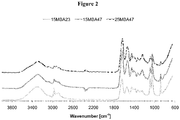
- IR spectroscopy allowed the presence of the bands relating to the functional groups characteristic of formation of amide-amine bonds to be verified (stretching of N-C bond of the secondary amines at 1220- 1047 cm-1 and tertiary amines at 1111-1087 cm-1; stretching of the C=O of the amide bond at 1548 cm-1; angle deformation of the N-H amide bond at 1642 cm-1). The IR spectra of the hydrogels obtained in example 1 are shown in
Figure 2 . - The mechanical properties of the gelatin/MBA hydrogels were studied with a dynamic mechanical analyser (DMA mod. 2980, TA Instruments), using mechanical compression tests in frequency sweep and stress relaxation tests with subsequent strain recovery. All the mechanical tests were conducted on cylindrical specimens (ø = 5 mm, h = 3 mm) previously brought to a swelling plateau in distilled water. Three specimens were characterised for each formulation of the gelatin and MBA hydrogels and for the MBA/HEX formulation used as comparator.
- Compression tests were performed in frequency sweep (f = 0.5 - 10 Hz, T = 37°C, n = 10 cycles) at a constant temperature (37°C) to obtain the complex modulus trend on variation of frequency. In particular, information can be obtained about the real component of the complex modulus, known as the conservative modulus (E'), which represents the energy accumulated in the material and consequently correlated with its elastic behaviour, and the imaginary component, called the dissipative modulus (E"), which represents the dissipated energy linked to the viscous component of the material. The E"/E' ratio, called tan delta, allows the contribution made by the two components to be evaluated on variation of the test parameters.
- In the dynamic mechanical compression tests, the hydrogels according to the invention presented conservative and dissipative modulus values that varied according to their chemical composition. As shown in Table 2, the conservative modulus (E') was between 4 and 21 kPa.
Table 2 - Conservative modulus values (E') for gelatin-based hydrogels according to the invention and for the control material (MBA-HEX) f [Hz] cycle #1 cycle #5 cycle #10 f [Hz] cycle #1 cycle #5 cycle #10 MBA-HEX 0.5 9.97±7.41 9.33±7.50 9.10±7.42 15MBA47 0.5 13.68±3.49 13.32±3.53 13.09±3.52 1 10.17±7.50 9.47±7.63 9.23±7.56 1 14.24±3.60 13.77±3.63 13.56±3.58 2 10.40±7.64 9.67±7.75 9.44±7.67 2 14.76±3.64 14.36±3.70 14.02±3.76 3 10.80±7.75 9.96±7.88 9.73±7.83 3 15.12±3.82 14.72±3.83 14.42±3.91 4 11.19±8.02 10.31±8.17 10.08±8.05 4 15.46±3.93 15.01±3.98 14.71±3.99 5 11.59±8.27 10.72±8.43 10.38±8.35 5 15.78±4.17 15.32±4.15 15.01±4.19 6 12.09±8.50 11.09±8.64 10.80±8.53 6 16.17±4.10 15.65±4.18 15.23±4.24 7 12.56±8.82 11.43±9.02 10.98±9.05 7 16.23±4.27 15.57±4.48 15.47±4.38 8 13.03±8.99 11.73±9.38 11.60±9.20 8 16.44±4.33 15.93±4.41 15.70±4.41 9 12.94±8.51 12.20±9.41 12.01±9.54 9 16.84±4.45 16.21±4.64 15.86±4.50 10 13.70±9.44 12.45±9.48 12.33±9.34 10 16.87±4.23 16.14±4.23 15.96±4.62 15MBA23 0.5 17.91±0.66 17.91±0.33 17.91±0.12 25MBA47 0.5 4.65±0.09 4.33±0.08 4.00±0.20 1 18.18±0.83 18.11±0.54 18.11±0.18 1 4.83±0.13 4.54±0.04 4.18±0.15 2 18.45±0.76 18.45±0.51 18.42±0.27 2 4.99±0.17 4.67±0.03 4.33±0.14 3 18.75±1.06 18.72±0.79 18.72±0.50 3 5.13±0.28 4.78±0.05 4.45±0.08 4 19.09±1.14 19.04±0.79 19.10±0.58 4 5.11±0.29 4.90±0.10 4.49±0.12 5 19.34±1.23 19.28±0.94 19.34±0.71 5 5.25±0.37 4.99±0.13 4.65±0.13 6 19.44±1.07 19.40±0.98 19.49±0.58 6 5.45±0.21 5.04±0.22 4.72±0.13 7 19.54±1.26 19.48±0.92 19.62±0.68 7 5.50±0.28 5.15±0.15 4.76±0.06 8 19.84±1.25 19.70±1.00 19.87±0.48 8 5.37±0.60 5.31±0.30 4.85±0.04 9 20.09±1.34 19.69±1.16 20.21±0.59 9 5.72±0.05 5.79±0.60 5.26±0.35 10 20.08±1.41 20.53±0.40 20.45±0.64 10 5.75±0.67 5.71±0.23 5.10±0.42 - For all the gelatin-based hydrogels according to the invention, a prevalence of the elastic component was observed as the stress frequency and the number of test cycles increased, whereas for the control material, the viscous component prevailed as frequency increased. This behaviour is clearly shown in the graphs in
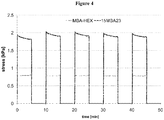
Figure 3 , which show the tan delta trend in three different test cycles, on variation of the stress frequency for the comparison material (MBA-HEX) and for hydrogel 15MBA23. - Stress relaxation tests were conducted followed by recovery of deformation in compression at 37°C. Constant deformation (5%) was applied to the samples, and the trend over time of the stress required to maintain the deformation value imposed was studied; when the deformation was removed, the ability to recover the original size was studied. Five stress relaxation cycles were performed, each followed by deformation recovery, to obtain the stress and deformation trends over time.
- Slight stress relaxation was observed for all the gelatin-based hydrogels according to the invention, which remained constant for the 5 test cycles; moreover, although residual deformation remained after the first cycle, it was completely eliminated in the subsequent cycles. This behaviour indicates that the elastic component prevails under cyclical or repeated stress conditions. Conversely, the comparison material did not show a viscous component, but appeared much weaker. For example,
Figure 4 shows the trend of stress relaxation in compression for the comparison material (MBA-HEX) and for hydrogel 15MBA23. - The dynamic mechanical test results indicate that the hydrogels based on gelatin present the best overall properties compared with the comparison material not containing gelatin. Synthesis conditions such that gelatin-based hydrogels present a behaviour wherein the elastic component prevails over the viscous component can also be selected.
- In vitro cytotoxicity tests were performed to verify that no products with low molecular weight and/or reaction residues were released. These products, if present, can be released into the cell growth environment and influence cell activity, even causing cell death.
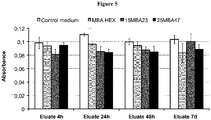
- The viability of murine fibroblasts in the L929 line cultured for 24 hours in contact with culture medium wherein the hydrogels were immersed for different times (eluted at 4-168h) was evaluated by MTT colorimetric assay (M5655, Sigma).
- The hydrogels proved not to be cytotoxic; in fact, cells cultured in the presence of eluates obtained for up to 7 days' immersion presented viability levels not significantly different from those obtained for cells cultured in clean culture medium (control), as shown in
Figure 5 . - Tests of interaction in vitro with stem cells isolated from adipose tissue obtained by liposuction from patients who underwent mastectomy were performed. The ASC cells were isolated according to the protocol described by Rigotti et al, Clinical treatment of radiotherapy tissue damage by lipoaspirate transplant: a healing process mediated by adipose derived adult stem cells, Plast Reconstr Surg. 2007; 119(5):1409-1422, by enzymatic digestion of fatty tissue and centrifugation cycles. The cells were cultured on the hydrogels, differentiation being induced by Adipogenic Induction Medium (AIM) in Dulbecco's Modified Eagle's Medium DMEM (Ham's F12 + 1% Human Serum Albumin) and the cells subsequently being cultured in Adipogenic Differentiation Medium (ADM) in DMEM (Ham's F12 + 1% Human Serum Albumin). Differentiation into adipocytes was studied by evaluating the presence of the lipid drops produced and detected by Oil Red O staining (Sigma-Aldrich).
- 7 days after seeding, Oil Red O staining confirmed the differentiation with adipocyte formation, as shown in
Figure 6 . - In view of the findings reported in the literature (Tanzi MC et al, Adipose tissue engineering: state of the art, recent advances and innovative approaches. Expert Rev Med Devices. 2009; 6(5):533-51), this result can be considered very good.
- The purpose of these cell interaction tests was to establish the suitability of the hydrogels according to the invention to regenerate blood vessels and, in general, for applications in contact with the cardiovascular system.
- Two different hydrogels were prepared: gelatin/MBA 25MBA47 and 15MBA23.
- After a purification procedure conducted under laminar-flow hood, the samples (n = 3) were dried to constant weight and then swollen in an aqueous solution containing 0.02% w/v of a recombinant elastin (HELP) with a similar sequence to that of human elastin (Bandiera A, et al., Biotechnol Appl Biochem. 2005; 42(Pt 3): 247-56), thus obtaining interpenetrating gelatin/HELP lattices.
- These hydrogels were then seeded with HUVEC cells (human umbilical vein endothelial cells) cultured in Endothelial Cell Growth Medium MV2 (basal medium; Promocell, Heidelberg, Germany). 48 hours after seeding, the cultures were fixed with 4% v/v formalin and stained with toluidine blue.
- Once again the results were very good: for all samples analysed, the formation of a homogenous confluent single layer was observed (
Figure 7 ), indicating the suitability of these matrices for applications involving the reconstruction and treatment of vascular tissue. -
-
Figure 1 - Degree of swelling in a physiological environment at 37°C of gelatin/methylenebisacrylamide hydrogels obtained with various formulations, and of the comparison material MBA-HEX. -
Figure 2 - FTIR spectra of three gelatin/MBA hydrogels obtained with different formulations. -
Figure 3 - trend of the tan delta parameter in three different test cycles, on variation of stress frequency, for the comparison material (MBA-HEX) and hydrogel 15MBA23. -
Figure 4 - Curves representing the trend of stress relaxation in compression (5% constant deformation) for the comparison material (MBA-HEX) and hydrogel 15MBA23. -
Figure 5 - Results of MTT viability assay performed on L929 cells in contact with eluates obtained at different incubation times with the various types of hydrogels. The data relating to the culture medium only are shown in white. -
Figure 6 - Oil Red O staining of ASCs differentiated into adipocytes on a) 15MBA23, and b) 15MBA47. Enlargement: 500X. -
Figure 7 - HUVEC cultures on gel (A) 25MBA47 and (B) 15MBA23 conditioned with 0.02% w/v HELP 24 hours after seeding. Stain: toluidine blue. Enlargement: 100X.
Claims (15)
- Hydrogel of gelatin cross-linked with bisacrylamides of primary or secondary amines which are selected from N,N'-methylene-bisacrylamide (MBA), N,N'-ethylene-bisacrylamide, bisacryloylpiperazine, bisacryloylcystamine and N,N'-polyoxyalkylen-bisacrylamide, wherein said hydrogel is obtainable by a Michael-type addition reaction process via the nucleophilic addition of free amino groups in gelatin and the α,β unsaturated carbonyl group in the selected bisacrylamide, said process comprising the following steps:(a) reaction of gelatin with bisacrylamide in a water medium;(b) purification of the product obtained in step (a);(c) optional drying or lyophilisation.
- Hydrogel according to claim 1, wherein the reaction of step (a) comprises:(a') preparing an aqueous solution of gelatin at a temperature from 30 to 70°C in the presence of a tertiary amine compound or an inorganic base, wherein the gelatin concentration is between 5 and 40% wt/vol;(b') adding bisacrylamide to the solution obtained in (a') in such an amount that the molar ratio between the amino groups present in the gelatin (mM (NH2) lysine) and the acrylamide groups present in the bisacrylamide ranges from 0.5 to 2.5;(c') heating the solution obtained in (b') at a temperature of between 30 and 70°C for a time period of 4 to 24 hrs.
- Hydrogel according to claim 1-2, wherein the purification of step (b) comprises consecutive washings with ethanol followed by HCl 0.1 M and by water.
- Hydrogel according to claim 1-3, wherein said bisacrylamide is N,N'-methylene-bisacrylamide (MBA);
- Hydrogel according to claims 1-4 wherein said tertiary amine is triethylamine in amounts ranging from 0.1 to 0.3 ml per gram of gelatin.
- Hydrogel according to any preceding claim, containing a biologically-active substance or cells.
- Composition containing a hydrogel according to claims 1-6 in an aqueous medium or in dry form.
- Hydrogel according to claims 1-6 or a composition according to claim 7 for use in the controlled release of drugs, polypeptides or active biomolecules.
- Hydrogel or composition according to claim 8, wherein said active biomolecules are growth factors.
- Use of a hydrogel according to claims 1-6 or a composition according to claim 8 for in vitro cell culture, differentiation or proliferation.
- Use according to claim 10, wherein said cells are adult stem cells isolated from adipose tissue and from human umbilical cord endothelial cells (HUVEC).
- Use of a hydrogel according to claims 1-6 or a composition according to claim 7_for in vitro regeneration of a soft tissue.
- Use according to claim 12, wherein said soft tissue is adipose tissue, vascular tissue or skin.
- Carrier of cells containing a hydrogel according to claims 1-6 or a composition according to claim 7.
- Implant or grafting of a cell-containing an hydrogel according to claims 1-6 or a composition according to claim 7.
Applications Claiming Priority (2)
| Application Number | Priority Date | Filing Date | Title |
|---|---|---|---|
| IT001009A ITMI20111009A1 (en) | 2011-06-01 | 2011-06-01 | FROSTED JELLY HYDROGELS |
| PCT/EP2012/060277 WO2012164032A1 (en) | 2011-06-01 | 2012-05-31 | Crosslinked gelatin hydrogels |
Publications (2)
| Publication Number | Publication Date |
|---|---|
| EP2714109A1 EP2714109A1 (en) | 2014-04-09 |
| EP2714109B1 true EP2714109B1 (en) | 2018-01-24 |
Family
ID=44554929
Family Applications (1)
| Application Number | Title | Priority Date | Filing Date |
|---|---|---|---|
| EP12727813.3A Not-in-force EP2714109B1 (en) | 2011-06-01 | 2012-05-31 | Crosslinked gelatin hydrogels |
Country Status (5)
| Country | Link |
|---|---|
| US (1) | US20140154212A1 (en) |
| EP (1) | EP2714109B1 (en) |
| ES (1) | ES2663820T3 (en) |
| IT (1) | ITMI20111009A1 (en) |
| WO (1) | WO2012164032A1 (en) |
Families Citing this family (9)
| Publication number | Priority date | Publication date | Assignee | Title |
|---|---|---|---|---|
| RU2645200C1 (en) * | 2016-12-30 | 2018-02-16 | Федеральное государственное бюджетное образовательное учреждение высшего образования "Московский государственный университет имени М.В. Ломоносова" (МГУ) | Method for formation of bioresorbable fibroin films using metacrylated gelatine |
| CA3111444A1 (en) * | 2018-09-04 | 2020-03-12 | Massachusetts Eye And Ear Infirmary | Light activated adhesive scaffold |
| ES2984966T3 (en) * | 2018-12-10 | 2024-10-31 | Krusic Melina Kalagasidis | Dye remover and dye remover production method |
| CN111763333A (en) * | 2019-04-02 | 2020-10-13 | 安徽中医药大学 | A kind of preparation method of self-healing high-strength hydrogel |
| CN115996706A (en) * | 2020-06-19 | 2023-04-21 | 根特大学 | Swellable gelatin composition |
| CN112999425B (en) * | 2021-03-01 | 2022-03-25 | 浙江大学 | Double-layer hydrogel tubular tissue engineering scaffold and preparation method thereof |
| CN113461877B (en) * | 2021-07-27 | 2022-05-27 | 陕西科技大学 | Preparation method of anisotropic hydrogel |
| CN116265531A (en) * | 2023-03-02 | 2023-06-20 | 上海瑞凝生物科技有限公司 | Polyamino modified gelatin-based hydrogel and application thereof |
| CN119842101A (en) * | 2025-03-20 | 2025-04-18 | 安徽建筑大学 | Preparation method and application of injectable and adhesive reversible administration type physically-reinforced gelatin hydrogel |
Family Cites Families (3)
| Publication number | Priority date | Publication date | Assignee | Title |
|---|---|---|---|---|
| WO2008121422A2 (en) | 2007-04-01 | 2008-10-09 | Moma Therapeutics | Implantable cell matrix composition for delivery of bioactive compounds |
| WO2010060104A2 (en) | 2008-11-24 | 2010-05-27 | Moma Therapeutics | Implantable liposome embedded matrix composition, uses thereof, and polycaprolactone praticles as scaffolds for tissue regeneration |
| US20120231072A1 (en) * | 2011-03-11 | 2012-09-13 | Chemisches Institut Schaefer Ag | Thermo-responsive hydrogel compositions |
-
2011
- 2011-06-01 IT IT001009A patent/ITMI20111009A1/en unknown
-
2012
- 2012-05-31 EP EP12727813.3A patent/EP2714109B1/en not_active Not-in-force
- 2012-05-31 US US14/122,317 patent/US20140154212A1/en not_active Abandoned
- 2012-05-31 WO PCT/EP2012/060277 patent/WO2012164032A1/en not_active Ceased
- 2012-05-31 ES ES12727813.3T patent/ES2663820T3/en active Active
Also Published As
| Publication number | Publication date |
|---|---|
| ES2663820T3 (en) | 2018-04-17 |
| US20140154212A1 (en) | 2014-06-05 |
| ITMI20111009A1 (en) | 2012-12-02 |
| EP2714109A1 (en) | 2014-04-09 |
| WO2012164032A1 (en) | 2012-12-06 |
Similar Documents
| Publication | Publication Date | Title |
|---|---|---|
| US20140154212A1 (en) | Crosslinked gelatin hydrogels | |
| Zhu et al. | Covalent immobilization of chitosan/heparin complex with a photosensitive hetero-bifunctional crosslinking reagent on PLA surface | |
| Macdougall et al. | Efficient in situ nucleophilic thiol-yne click chemistry for the synthesis of strong hydrogel materials with tunable properties | |
| JP4340067B2 (en) | Bifunctional modified hydrogel | |
| Kweon et al. | Preparation of water-soluble chitosan/heparin complex and its application as wound healing accelerator | |
| Suvarnapathaki et al. | Synthesis and characterization of photocrosslinkable hydrogels from bovine skin gelatin | |
| US20150274805A1 (en) | Elastic Hydrogel | |
| Casadio et al. | Biodegradation of Poly (2-hydroxyethyl methacrylate)(PHEMA) and Poly {(2-hydroxyethyl methacrylate)-co-[poly (ethylene glycol) methyl ether methacrylate]} Hydrogels Containing Peptide-Based Cross-Linking Agents | |
| US20160243275A1 (en) | Polymer hydrogel adhesives formed with multiple crosslinking mechanisms at physiologic ph | |
| US12465668B2 (en) | Organic solvent free compositions comprising protein-polymer conjugates and uses thereof | |
| Strehin et al. | Hydrogels formed by oxo-ester mediated native chemical ligation | |
| Priddy‐Arrington et al. | Characterization and Optimization of Injectable In Situ Crosslinked Chitosan‐Genipin Hydrogels | |
| CN111569148A (en) | Composite hydrogel for promoting bone repair and preparation method and application thereof | |
| Peng et al. | Multi-responsive, injectable, and self-healing hydrogels based on benzoxaborole–tannic acid complexation | |
| Liu et al. | Multifunctional antibiotics-free hydrogel dressings with self-regulated nitric oxide-releasing kinetics for improving open wound healing | |
| KR20170110882A (en) | Hydrogel for preventing surgical adhesions and hydrogel film using the same | |
| Chen et al. | Bioinspired and self-restorable alginate-tyramine hydrogels with plasma reinforcement for arthritis treatment | |
| Pang et al. | In vitro degradation analysis of 3d-architectured gelatin-based hydrogels | |
| Meneses et al. | Development of enzymatically crosslinked natural deep eutectogels: versatile gels for enhanced drug delivery | |
| Wang et al. | A highly biocompatible CE-crosslinked collagen implant with exceptional anti-calcification and collagen regeneration capabilities for aging skin rejuvenation | |
| EP4172190B1 (en) | Modified gelatins | |
| CN120204115A (en) | A drug-loaded multi-stimulus responsive hydrogel microneedle and preparation method thereof | |
| Lee et al. | Preparation of injectable forms of immobilized protein drugs using UV-curable gelatin derivatives | |
| KR101974745B1 (en) | Hyaluronic acid hydrogel cross-linked with geatin and graft-polymer and method for preparing the same | |
| Janićijević et al. | Composite poly (DL-lactide-co-glycolide)/poly (acrylic acid) hydrogels synthesized using UV and gamma irradiation: comparison of material properties |
Legal Events
| Date | Code | Title | Description |
|---|---|---|---|
| PUAI | Public reference made under article 153(3) epc to a published international application that has entered the european phase |
Free format text: ORIGINAL CODE: 0009012 |
|
| 17P | Request for examination filed |
Effective date: 20131126 |
|
| AK | Designated contracting states |
Kind code of ref document: A1 Designated state(s): AL AT BE BG CH CY CZ DE DK EE ES FI FR GB GR HR HU IE IS IT LI LT LU LV MC MK MT NL NO PL PT RO RS SE SI SK SM TR |
|
| DAX | Request for extension of the european patent (deleted) | ||
| GRAP | Despatch of communication of intention to grant a patent |
Free format text: ORIGINAL CODE: EPIDOSNIGR1 |
|
| STAA | Information on the status of an ep patent application or granted ep patent |
Free format text: STATUS: GRANT OF PATENT IS INTENDED |
|
| INTG | Intention to grant announced |
Effective date: 20171006 |
|
| GRAS | Grant fee paid |
Free format text: ORIGINAL CODE: EPIDOSNIGR3 |
|
| GRAA | (expected) grant |
Free format text: ORIGINAL CODE: 0009210 |
|
| STAA | Information on the status of an ep patent application or granted ep patent |
Free format text: STATUS: THE PATENT HAS BEEN GRANTED |
|
| AK | Designated contracting states |
Kind code of ref document: B1 Designated state(s): AL AT BE BG CH CY CZ DE DK EE ES FI FR GB GR HR HU IE IS IT LI LT LU LV MC MK MT NL NO PL PT RO RS SE SI SK SM TR |
|
| REG | Reference to a national code |
Ref country code: GB Ref legal event code: FG4D |
|
| REG | Reference to a national code |
Ref country code: CH Ref legal event code: EP |
|
| REG | Reference to a national code |
Ref country code: AT Ref legal event code: REF Ref document number: 965407 Country of ref document: AT Kind code of ref document: T Effective date: 20180215 |
|
| REG | Reference to a national code |
Ref country code: IE Ref legal event code: FG4D |
|
| REG | Reference to a national code |
Ref country code: DE Ref legal event code: R096 Ref document number: 602012042328 Country of ref document: DE |
|
| REG | Reference to a national code |
Ref country code: ES Ref legal event code: FG2A Ref document number: 2663820 Country of ref document: ES Kind code of ref document: T3 Effective date: 20180417 |
|
| REG | Reference to a national code |
Ref country code: NL Ref legal event code: MP Effective date: 20180124 |
|
| REG | Reference to a national code |
Ref country code: LT Ref legal event code: MG4D |
|
| REG | Reference to a national code |
Ref country code: AT Ref legal event code: MK05 Ref document number: 965407 Country of ref document: AT Kind code of ref document: T Effective date: 20180124 |
|
| PG25 | Lapsed in a contracting state [announced via postgrant information from national office to epo] |
Ref country code: NL Free format text: LAPSE BECAUSE OF FAILURE TO SUBMIT A TRANSLATION OF THE DESCRIPTION OR TO PAY THE FEE WITHIN THE PRESCRIBED TIME-LIMIT Effective date: 20180124 |
|
| PG25 | Lapsed in a contracting state [announced via postgrant information from national office to epo] |
Ref country code: CY Free format text: LAPSE BECAUSE OF FAILURE TO SUBMIT A TRANSLATION OF THE DESCRIPTION OR TO PAY THE FEE WITHIN THE PRESCRIBED TIME-LIMIT Effective date: 20180124 Ref country code: HR Free format text: LAPSE BECAUSE OF FAILURE TO SUBMIT A TRANSLATION OF THE DESCRIPTION OR TO PAY THE FEE WITHIN THE PRESCRIBED TIME-LIMIT Effective date: 20180124 Ref country code: LT Free format text: LAPSE BECAUSE OF FAILURE TO SUBMIT A TRANSLATION OF THE DESCRIPTION OR TO PAY THE FEE WITHIN THE PRESCRIBED TIME-LIMIT Effective date: 20180124 Ref country code: NO Free format text: LAPSE BECAUSE OF FAILURE TO SUBMIT A TRANSLATION OF THE DESCRIPTION OR TO PAY THE FEE WITHIN THE PRESCRIBED TIME-LIMIT Effective date: 20180424 Ref country code: FI Free format text: LAPSE BECAUSE OF FAILURE TO SUBMIT A TRANSLATION OF THE DESCRIPTION OR TO PAY THE FEE WITHIN THE PRESCRIBED TIME-LIMIT Effective date: 20180124 |
|
| PG25 | Lapsed in a contracting state [announced via postgrant information from national office to epo] |
Ref country code: BG Free format text: LAPSE BECAUSE OF FAILURE TO SUBMIT A TRANSLATION OF THE DESCRIPTION OR TO PAY THE FEE WITHIN THE PRESCRIBED TIME-LIMIT Effective date: 20180424 Ref country code: GR Free format text: LAPSE BECAUSE OF FAILURE TO SUBMIT A TRANSLATION OF THE DESCRIPTION OR TO PAY THE FEE WITHIN THE PRESCRIBED TIME-LIMIT Effective date: 20180425 Ref country code: LV Free format text: LAPSE BECAUSE OF FAILURE TO SUBMIT A TRANSLATION OF THE DESCRIPTION OR TO PAY THE FEE WITHIN THE PRESCRIBED TIME-LIMIT Effective date: 20180124 Ref country code: RS Free format text: LAPSE BECAUSE OF FAILURE TO SUBMIT A TRANSLATION OF THE DESCRIPTION OR TO PAY THE FEE WITHIN THE PRESCRIBED TIME-LIMIT Effective date: 20180124 Ref country code: AT Free format text: LAPSE BECAUSE OF FAILURE TO SUBMIT A TRANSLATION OF THE DESCRIPTION OR TO PAY THE FEE WITHIN THE PRESCRIBED TIME-LIMIT Effective date: 20180124 Ref country code: PL Free format text: LAPSE BECAUSE OF FAILURE TO SUBMIT A TRANSLATION OF THE DESCRIPTION OR TO PAY THE FEE WITHIN THE PRESCRIBED TIME-LIMIT Effective date: 20180124 Ref country code: IS Free format text: LAPSE BECAUSE OF FAILURE TO SUBMIT A TRANSLATION OF THE DESCRIPTION OR TO PAY THE FEE WITHIN THE PRESCRIBED TIME-LIMIT Effective date: 20180524 Ref country code: SE Free format text: LAPSE BECAUSE OF FAILURE TO SUBMIT A TRANSLATION OF THE DESCRIPTION OR TO PAY THE FEE WITHIN THE PRESCRIBED TIME-LIMIT Effective date: 20180124 |
|
| REG | Reference to a national code |
Ref country code: DE Ref legal event code: R097 Ref document number: 602012042328 Country of ref document: DE |
|
| PG25 | Lapsed in a contracting state [announced via postgrant information from national office to epo] |
Ref country code: EE Free format text: LAPSE BECAUSE OF FAILURE TO SUBMIT A TRANSLATION OF THE DESCRIPTION OR TO PAY THE FEE WITHIN THE PRESCRIBED TIME-LIMIT Effective date: 20180124 Ref country code: RO Free format text: LAPSE BECAUSE OF FAILURE TO SUBMIT A TRANSLATION OF THE DESCRIPTION OR TO PAY THE FEE WITHIN THE PRESCRIBED TIME-LIMIT Effective date: 20180124 Ref country code: AL Free format text: LAPSE BECAUSE OF FAILURE TO SUBMIT A TRANSLATION OF THE DESCRIPTION OR TO PAY THE FEE WITHIN THE PRESCRIBED TIME-LIMIT Effective date: 20180124 Ref country code: IT Free format text: LAPSE BECAUSE OF FAILURE TO SUBMIT A TRANSLATION OF THE DESCRIPTION OR TO PAY THE FEE WITHIN THE PRESCRIBED TIME-LIMIT Effective date: 20180124 |
|
| PG25 | Lapsed in a contracting state [announced via postgrant information from national office to epo] |
Ref country code: CZ Free format text: LAPSE BECAUSE OF FAILURE TO SUBMIT A TRANSLATION OF THE DESCRIPTION OR TO PAY THE FEE WITHIN THE PRESCRIBED TIME-LIMIT Effective date: 20180124 Ref country code: DK Free format text: LAPSE BECAUSE OF FAILURE TO SUBMIT A TRANSLATION OF THE DESCRIPTION OR TO PAY THE FEE WITHIN THE PRESCRIBED TIME-LIMIT Effective date: 20180124 Ref country code: SM Free format text: LAPSE BECAUSE OF FAILURE TO SUBMIT A TRANSLATION OF THE DESCRIPTION OR TO PAY THE FEE WITHIN THE PRESCRIBED TIME-LIMIT Effective date: 20180124 Ref country code: SK Free format text: LAPSE BECAUSE OF FAILURE TO SUBMIT A TRANSLATION OF THE DESCRIPTION OR TO PAY THE FEE WITHIN THE PRESCRIBED TIME-LIMIT Effective date: 20180124 |
|
| PLBE | No opposition filed within time limit |
Free format text: ORIGINAL CODE: 0009261 |
|
| STAA | Information on the status of an ep patent application or granted ep patent |
Free format text: STATUS: NO OPPOSITION FILED WITHIN TIME LIMIT |
|
| REG | Reference to a national code |
Ref country code: CH Ref legal event code: PL |
|
| 26N | No opposition filed |
Effective date: 20181025 |
|
| REG | Reference to a national code |
Ref country code: BE Ref legal event code: MM Effective date: 20180531 |
|
| PG25 | Lapsed in a contracting state [announced via postgrant information from national office to epo] |
Ref country code: MC Free format text: LAPSE BECAUSE OF FAILURE TO SUBMIT A TRANSLATION OF THE DESCRIPTION OR TO PAY THE FEE WITHIN THE PRESCRIBED TIME-LIMIT Effective date: 20180124 |
|
| PG25 | Lapsed in a contracting state [announced via postgrant information from national office to epo] |
Ref country code: CH Free format text: LAPSE BECAUSE OF NON-PAYMENT OF DUE FEES Effective date: 20180531 Ref country code: SI Free format text: LAPSE BECAUSE OF FAILURE TO SUBMIT A TRANSLATION OF THE DESCRIPTION OR TO PAY THE FEE WITHIN THE PRESCRIBED TIME-LIMIT Effective date: 20180124 Ref country code: LI Free format text: LAPSE BECAUSE OF NON-PAYMENT OF DUE FEES Effective date: 20180531 |
|
| REG | Reference to a national code |
Ref country code: IE Ref legal event code: MM4A |
|
| PG25 | Lapsed in a contracting state [announced via postgrant information from national office to epo] |
Ref country code: LU Free format text: LAPSE BECAUSE OF NON-PAYMENT OF DUE FEES Effective date: 20180531 |
|
| PG25 | Lapsed in a contracting state [announced via postgrant information from national office to epo] |
Ref country code: FR Free format text: LAPSE BECAUSE OF NON-PAYMENT OF DUE FEES Effective date: 20180531 Ref country code: IE Free format text: LAPSE BECAUSE OF NON-PAYMENT OF DUE FEES Effective date: 20180531 |
|
| PG25 | Lapsed in a contracting state [announced via postgrant information from national office to epo] |
Ref country code: BE Free format text: LAPSE BECAUSE OF NON-PAYMENT OF DUE FEES Effective date: 20180531 |
|
| PGFP | Annual fee paid to national office [announced via postgrant information from national office to epo] |
Ref country code: ES Payment date: 20190605 Year of fee payment: 8 Ref country code: DE Payment date: 20190516 Year of fee payment: 8 |
|
| PGFP | Annual fee paid to national office [announced via postgrant information from national office to epo] |
Ref country code: GB Payment date: 20190529 Year of fee payment: 8 |
|
| PG25 | Lapsed in a contracting state [announced via postgrant information from national office to epo] |
Ref country code: MT Free format text: LAPSE BECAUSE OF NON-PAYMENT OF DUE FEES Effective date: 20180531 |
|
| PG25 | Lapsed in a contracting state [announced via postgrant information from national office to epo] |
Ref country code: TR Free format text: LAPSE BECAUSE OF FAILURE TO SUBMIT A TRANSLATION OF THE DESCRIPTION OR TO PAY THE FEE WITHIN THE PRESCRIBED TIME-LIMIT Effective date: 20180124 |
|
| PG25 | Lapsed in a contracting state [announced via postgrant information from national office to epo] |
Ref country code: HU Free format text: LAPSE BECAUSE OF FAILURE TO SUBMIT A TRANSLATION OF THE DESCRIPTION OR TO PAY THE FEE WITHIN THE PRESCRIBED TIME-LIMIT; INVALID AB INITIO Effective date: 20120531 Ref country code: PT Free format text: LAPSE BECAUSE OF FAILURE TO SUBMIT A TRANSLATION OF THE DESCRIPTION OR TO PAY THE FEE WITHIN THE PRESCRIBED TIME-LIMIT Effective date: 20180124 |
|
| PG25 | Lapsed in a contracting state [announced via postgrant information from national office to epo] |
Ref country code: MK Free format text: LAPSE BECAUSE OF NON-PAYMENT OF DUE FEES Effective date: 20180124 |
|
| REG | Reference to a national code |
Ref country code: DE Ref legal event code: R119 Ref document number: 602012042328 Country of ref document: DE |
|
| GBPC | Gb: european patent ceased through non-payment of renewal fee |
Effective date: 20200531 |
|
| PG25 | Lapsed in a contracting state [announced via postgrant information from national office to epo] |
Ref country code: GB Free format text: LAPSE BECAUSE OF NON-PAYMENT OF DUE FEES Effective date: 20200531 |
|
| PG25 | Lapsed in a contracting state [announced via postgrant information from national office to epo] |
Ref country code: DE Free format text: LAPSE BECAUSE OF NON-PAYMENT OF DUE FEES Effective date: 20201201 |
|
| REG | Reference to a national code |
Ref country code: ES Ref legal event code: FD2A Effective date: 20211006 |
|
| PG25 | Lapsed in a contracting state [announced via postgrant information from national office to epo] |
Ref country code: ES Free format text: LAPSE BECAUSE OF NON-PAYMENT OF DUE FEES Effective date: 20200601 |