EP2713607A1 - Method and device for photographic processing and mobile apparatus - Google Patents
Method and device for photographic processing and mobile apparatus Download PDFInfo
- Publication number
- EP2713607A1 EP2713607A1 EP13738383.2A EP13738383A EP2713607A1 EP 2713607 A1 EP2713607 A1 EP 2713607A1 EP 13738383 A EP13738383 A EP 13738383A EP 2713607 A1 EP2713607 A1 EP 2713607A1
- Authority
- EP
- European Patent Office
- Prior art keywords
- mobile device
- current reference
- reference moment
- stability
- moment
- Prior art date
- Legal status (The legal status is an assumption and is not a legal conclusion. Google has not performed a legal analysis and makes no representation as to the accuracy of the status listed.)
- Withdrawn
Links
Images


Classifications
-
- H—ELECTRICITY
- H04—ELECTRIC COMMUNICATION TECHNIQUE
- H04N—PICTORIAL COMMUNICATION, e.g. TELEVISION
- H04N5/00—Details of television systems
- H04N5/14—Picture signal circuitry for video frequency region
- H04N5/144—Movement detection
-
- H—ELECTRICITY
- H04—ELECTRIC COMMUNICATION TECHNIQUE
- H04N—PICTORIAL COMMUNICATION, e.g. TELEVISION
- H04N23/00—Cameras or camera modules comprising electronic image sensors; Control thereof
- H04N23/60—Control of cameras or camera modules
- H04N23/68—Control of cameras or camera modules for stable pick-up of the scene, e.g. compensating for camera body vibrations
-
- H—ELECTRICITY
- H04—ELECTRIC COMMUNICATION TECHNIQUE
- H04N—PICTORIAL COMMUNICATION, e.g. TELEVISION
- H04N23/00—Cameras or camera modules comprising electronic image sensors; Control thereof
- H04N23/60—Control of cameras or camera modules
- H04N23/68—Control of cameras or camera modules for stable pick-up of the scene, e.g. compensating for camera body vibrations
- H04N23/681—Motion detection
- H04N23/6812—Motion detection based on additional sensors, e.g. acceleration sensors
Definitions
- the present invention relates to the field of communications technologies, and in particular, to a method, an apparatus, and a mobile device for photographing processing.
- handheld mobile devices such as smart phones and tablet computers as multifunctional products are not only mobile terminals for communication, work and transaction processing, but also good tools for entertainment and relaxation.
- Entertainment and relaxation functions of handheld mobile devices are increasingly valued by people.
- image quality of video making and photographing with handheld mobile terminals is always unsatisfactory, and especially when a photo taker is in a relatively unstable environment, the problem becomes particularly prominent.
- whether a photo taken with a camera is clear directly depends on whether the body of the camera remains stable when a photo is being taken. Therefore, how to prevent undesirable influences caused by vibration when a photo is being taken becomes a focus of attention from camera manufacturers, and certainly handheld mobile device manufacturers also pay equal attention to the anti-vibration technique.
- an "anti-vibration (anti-vibration)" mode provided against vibration may be adopted for photographing.
- a camera determines whether a photographing condition is optimal according to a current moving speed of the device, and when the device is in the optimal photographing condition, the device automatically takes a photo.
- the prior art cannot accurately obtain the moving speed of the device, so the device takes a photo in a non-optimal photographing condition, and therefore, resolution of the photo is not good.
- Embodiments of the present invention provide a method, an apparatus, and a mobile device for photographing processing, which can accurately obtain a photographing condition of a mobile device, so as to improve resolution of a taken photo.
- an embodiment of the present invention provides a method for photographing processing, which includes:
- an embodiment of the present invention provides an apparatus for photographing processing, which includes:
- an embodiment of the present invention provides a mobile device, which includes a gravity sensor and the apparatus for photographing processing described in the foregoing.
- a technical effect of the embodiments of the present invention is: collecting the spatial position parameter of the mobile device in real time through the gravity sensor; separately computing, according to the spatial position parameter of the mobile device, the stability degrees of the mobile device at the multiple reference moments before the current reference moment and the stability degree of the mobile device at the current reference moment; and performing the photographing processing according to the stability degrees of the mobile device at the multiple reference moments before the current reference moment and the stability degree of the mobile device at the current reference moment. Because the gravity sensor on a bottom layer of the mobile terminal has high sensitivity, relatively high spatial position parameters can be obtained, so that the optimal photographing condition may be accurately obtained. In this way, blurred photographing caused by vibration may be prevented, and resolution of the taken photo is improved.
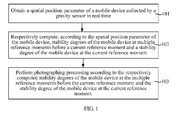
- FIG. 1 is a flow chart of Embodiment 1 of a method for photographing processing according to the present invention. As shown in FIG. 1 , this embodiment provides a method for photographing processing, which may specifically include the following steps:
- Step 101 Obtain a spatial position parameter of a mobile device collected by a gravity sensor in real time.
- the mobile device After a photographing key of the mobile device is pressed, the mobile device does not instantly generate a screenshot of a currently taken image and then display the screenshot. Instead, the mobile device enters an image-forming stage, and at this time, a user interface (User Interface, UI for short) may still display the image currently taken by a camera of the mobile device.
- a user interface User Interface, UI for short
- This embodiment is specifically an improvement of a method for photographing processing in the image-forming stage. This step is that the mobile device obtains the spatial position parameter of the mobile device collected by the gravity sensor in real time, and the step is specifically that a photographing system of the mobile device obtains the spatial position parameter.
- the gravity sensor is a functional module integrated in the mobile device, and is configured to collect the spatial position parameter of the mobile device in real time, where the spatial position parameter may specifically be a three-dimensional coordinate value or spatial coordinate value, namely, (x,y,z), of a certain position where the mobile device is located.
- the gravity sensor may collect a spatial position parameter of the mobile device at each collecting moment in real time after the photographing key is pressed.
- the collecting moment is specifically determined according to a collecting frequency, and the collecting frequency may be specifically set according to a practical situation, for example, setting the collecting frequency as collecting every 1ms.
- the gravity sensor may send the collected spatial position parameter to the mobile device in real time, or may send multiple groups of spatial position parameters at preset intervals, for example, sending 50 groups of spatial position parameters every 50ms.
- Step 102 Separately compute, according to the spatial position parameter of the mobile device, stability degrees of the mobile device at multiple reference moments before a current reference moment and a stability degree of the mobile device at the current reference moment.
- the mobile device may separately obtain, by performing computing, stability degrees of the mobile device at multiple different reference moments according to the spatial position parameter of the mobile device.
- the stability degrees at the multiple different reference moments include the stability degrees at the multiple reference moments before the current reference moment and the stability degree at the current reference moment.
- the gravity sensor constantly collects the spatial position parameters of the mobile device in real time, and therefore constantly computes a stability degree at every reference moment accordingly, so as to generate the stability degrees at the multiple reference moments.
- the current reference moment is the moment when the mobile device is currently working, or may also be the moment when a currently taken image is displayed for a user.
- the reference moments may be moments when the stability degrees are computed at intervals.
- the reference moments may be preset, for example, computing a stability degree every 50ms, so the 50 th millisecond and the 100 th millisecond are the reference moments.
- the reference moments may be set by using another method, for example, setting the reference moments through an arithmetic progression or a geometric progression, or choosing the reference moments according to actual requirements. In this embodiment, the choosing of the reference moments is not limited.
- a method for computing the stability degree of the mobile device at every reference moment before the current reference moment is the same as a method for computing the stability degree of the mobile device at the current reference moment. This may be construed as replacing a value at the current reference moment with a value at every reference moment before the current reference moment.
- the stability degrees of the mobile device at the multiple reference moments may be separately computed according to the spatial position parameters of the mobile device at the different collecting moments. Because a frequency of computing the stability degrees is different from a frequency of collecting the parameters, the reference moments in this step are different from the collecting moments mentioned in the foregoing step. For example, an interval between two collecting moments may be set to 1ms, whereas an interval between two reference moments may be set to 50ms, so in this step, 50 groups of spatial position parameters collected within 50ms may be used to compute a stability degree at a reference moment.
- This step is separately computing, according to the multiple groups of spatial position parameters of the mobile device at the different collecting moments sent by the gravity sensor, the stability degrees of the mobile device at the multiple reference moments.
- Step 103 Perform photographing processing according to the separately computed stability degrees of the mobile device at the multiple reference moments before the current reference moment and the stability degree of the mobile device at the current reference moment.
- the stability degree of the mobile device at the current reference moment may first be obtained according to the spatial position parameter, and the stability degrees of the mobile device at the multiple reference moments before the current reference moment are then compared with the stability degree of the mobile device at the current reference moment, so as to determine whether the mobile device is in a preset photographing condition at the current reference moment.
- a current photographing condition may be determined, and specifically, whether the stability degrees of the mobile device tend to be stable may be determined.
- the stability degrees of the mobile device tend to a stable value, it indicates that the current photographing condition is optimal, so the mobile device may automatically take a photo or prompt the user to perform photographing confirmation, that is, the user needs to press the photographing key again to take a photo.
- the photographing key does not need to be pressed again to take a photo; however, for the latter manner, after prompting used for that the photo may be taken, the user needs to press the virtual photographing button to take a photo.
- This embodiment of the present invention provides a method for photographing processing.
- the spatial position parameter of the mobile device in real time is collected through the gravity sensor, separately according to the spatial position parameter of the mobile device, the stability degrees of the mobile device at multiple reference moments before the current reference moment and the stability degree of the mobile device at the current reference moment are separately computed, and the photographing processing according to the stability degrees of the mobile device at the multiple reference moments before the current reference moment and the stability degree of the mobile device at the current reference moment is performed.
- the gravity sensor on a bottom layer of the mobile terminal has high sensitivity, relatively high spatial position parameters can be obtained, so that the optimal photographing condition may be accurately obtained. In this way, blurred photographing caused by vibration may be prevented, and resolution of the taken photo is improved.
- FIG. 2 is a flow chart of Embodiment 2 of a method for photographing processing according to the present invention. As shown in FIG. 2 , this embodiment provides a method for photographing processing, which may specifically include the following steps:
- Step 201 After a photographing key of a mobile device is pressed, the mobile device obtains a spatial position parameter of the mobile device collected by a gravity sensor in real time.
- This step is specifically that, after the photographing key of the mobile device is pressed, the mobile device obtains the spatial position parameter of the mobile device collected by the gravity sensor in real time.
- the gravity sensor may specifically be the SensorEventListener-like software provided by an Android system, and is configured to collect the spatial position parameter of the mobile device in real time, where the spatial position parameter may specifically be a coordinate value, namely, (x,y,z), of a certain position where the mobile device is located.
- the gravity sensor may obtain a spatial position parameter, which is collected by the gravity sensor in real time, of the mobile device at each collecting moment.
- the collecting moment is specifically determined according to a collecting frequency, and the collecting frequency may be specifically set according to a practical situation, for example, setting the collecting frequency as collecting a spatial position parameter every 1ms.
- the mobile device may obtain every group of spatial position parameters collected by the gravity sensor in real time, or may obtain multiple groups of spatial position parameters at preset intervals, for example, obtaining 50 groups of spatial position parameters every 50ms.
- Step 202 The mobile device obtains, according to the spatial position parameter, stability degrees of the mobile device at multiple reference moments before a current reference moment and a stability degree of the mobile device at the current reference moment.
- the mobile device may obtain, according to the spatial position parameter, the stability degrees of the mobile device at the multiple reference moments before the current reference moment and the stability degree of the mobile device at the current reference moment. Because the stability degrees in this embodiment are computed in real time, the current reference moment is the moment when the stability degree is computed.
- a stability degree is computed every 50ms, and the solution in this embodiment is performed from the 0 th ms, a current reference moment when a stability degree is computed for the first time is the 50 th ms moment, a current reference moment when a stability degree is computed for the second time is the 100 th ms moment, and so on, and a current reference moment when a stability degree is computed for the n th time is the 50*n th ms moment.
- the gravity sensor collects one group of spatial position parameters of the mobile device every 1ms and computes a stability degree every 50ms.
- the mobile device may compute, according to multiple groups of spatial position parameters of the mobile device within a preset period before the current reference moment, an expected value of the spatial position parameter at the current reference moment, and use the expected value of the spatial position parameter at the current reference moment as the stability degree of the mobile device at the current reference moment. That is, this embodiment may use expected values of the spatial position parameter to indicate the stability degrees of the mobile device, and specifically may use the multiple groups of spatial position parameters collected by the gravity sensor to compute the expected values.
- 50 groups of spatial position parameters obtained from the gravity sensor are used within 50ms before the current reference moment, that is, the 50 groups of spatial position parameters are used to compute an expected value of the spatial position parameter.
- the spatial position parameter may be three coordinates x, y, and z
- expected values of the coordinates x, y, and z may be separately obtained herein through computing, and then n processing, such as an averaging processing, is performed on the expected values of the x, y, and z, so as to obtain a value of the stability degree of the mobile device at the current reference moment.
- the gravity sensor constantly collects the spatial position parameters of the mobile device in real time, and therefore constantly computes a stability degree at every reference moment accordingly, so as to generate the stability degrees at the multiple reference moments.
- the current reference moment is a moment when the mobile device is currently working, or may also be the moment when a currently taken image is displayed for a user.
- Step 203 Determine whether the mobile device is in a preset photographing condition at the current reference moment, according to the stability degrees of the mobile device at the multiple reference moments before the current reference moment and the stability degree of the mobile device at the current reference moment; if yes, execute step 204; if not, return to step 202.
- the stability degree of the mobile device at the current reference moment is obtained by performing computing, it is determined whether the mobile device is in a preset photographing condition at the current reference moment, according to the stability degrees of the mobile device at the multiple reference moments before the current reference moment and the stability degree of the mobile device at the current reference moment. If yes, execute step 204; if not, execute step 202 again, so as to compute a stability degree at a next reference moment after the current reference moment for determination, until a stability degree which meets the condition is obtained.
- the preset photographing condition in this embodiment may be a preset optimal photographing condition, and stability degrees of the mobile device are herein used as a standard for determining whether the mobile device is in the preset photographing condition, that is, a standard for determining whether a photographing condition of the mobile device is the optimal.
- the stability degree of the mobile device at the current reference moment may be compared with the stability degrees of the mobile device at the multiple reference moments before the current reference moment to determine whether the stability degrees of the mobile device at the current reference moment and at the multiple reference moments before the current reference moment tend to be stable. That is, according to the comparison between the stability degree of the mobile device at the current reference moment and the stability degrees at the several reference moments before the current reference moment, it is determined whether the stability degrees of the mobile device tend to be stable, for example, whether the stability degrees of the mobile device tend to a stable value, for example, the stable value is 1. If yes, it indicates that the mobile device is currently in the preset photographing condition, so step 204 is executed; if not, it is required to continue to compute a stability degree at a next reference moment after the current reference moment.
- Step 204 The mobile device automatically takes a photo.
- the mobile device learns that the stability degrees of the mobile device at the recent several reference moments tend to be stable by comparing the stability degree at the current reference moment and the stability degrees at the previous several reference moments, it indicates that the mobile device is currently in the preset photographing condition, so the mobile device automatically take a photo to obtain the clearest photo.
- This embodiment of the present invention provides a method for photographing processing.
- the spatial position parameter of the mobile device in real time is collected through the gravity sensor, separately according to the spatial position parameter of the mobile device, the stability degrees of the mobile device at the multiple reference moments before the current reference moment and the stability degree of the mobile device at the current reference moment are separately computed, and the photographing processing according to the stability degrees of the mobile device at the multiple reference moments before the current reference moment and the stability degree of the mobile device at the current reference moment is performed.
- the gravity sensor on a bottom layer of the mobile terminal has high sensitivity, relatively high spatial position parameters can be obtained, so that the optimal photographing condition may be accurately obtained. In this way, blurred photographing caused by vibration may be prevented, and resolution of the taken photo is improved.
- FIG. 3 is a flow chart of Embodiment 3 of a method for photographing processing according to the present invention. As shown in FIG. 3 , this embodiment provides a method for photographing processing, which may specifically include the following steps:
- Step 301 After a photographing key of a mobile device is pressed, the mobile device obtains a spatial position parameter of a mobile device collected by a gravity sensor in real time. This step is similar to step 201, and is therefore not repeated herein.
- Step 302 The mobile device obtains, according to the spatial position parameter, stability degrees of the mobile device at multiple reference moments before a current reference moment and a stability degree of the mobile device at the current reference moment. This step is similar to step 202, and is therefore not repeated herein.
- Step 303 The mobile device generates photographing prompt information at the current reference moment according to the stability degrees of the mobile device at the multiple reference moments before the current reference moment and the stability degree of the mobile device at the current reference moment.
- the mobile device After obtaining the stability degrees of the mobile device at the multiple reference moments before the current reference moment and the stability degree of the mobile device at the current reference moment through computing, the mobile device generates the photographing prompt information at the current reference moment according to values of these stability degrees. That is, the mobile device may analyze the values of the stability degrees at the recent several reference moments, and when the values of the stability degrees at the recent several reference moments tend to a stable value, the correspondingly generated photographing prompt information is "suited for photographing"; or the generated photographing prompt information is "unsuited for photographing", which is used to prompt a user to perform a further operation.
- Step 304 Display the photographing prompt information of the mobile device at the current reference moment on a photographing interface, so that a user takes a photo according to the photographing prompt information at the current reference moment.
- the photographing prompt information of the mobile device may be displayed at the current reference moment on the photographing interface, so that the user may decide, according to the photographing prompt information at the current reference moment, whether to take a photo.
- the photographing prompt information is "suited for photographing”
- the user may press a virtual photographing button to capture a clear picture displayed on the current photographing interface; when the photographing prompt information is "unsuited for photographing", the user may wait without taking a photo at the moment.
- This embodiment of the present invention provides a method for photographing processing.
- the spatial position parameter of the mobile device in real time is collected through the gravity sensor, separately according to the spatial position parameter of the mobile device, the stability degrees of the mobile device at the multiple reference moments before the current reference moment and the stability degree of the mobile device at the current reference moment are separately computed, and the photographing processing according to the stability degrees of the mobile device at the multiple reference moments before the current reference moment and the stability degree of the mobile device at the current reference moment is performed.
- the gravity sensor on a bottom layer of the mobile terminal has high sensitivity, relatively high spatial position parameter can be obtained, so that the optimal photographing condition may be accurately obtained. In this way, blurred photographing caused by vibration may be prevented, and resolution of the taken photo is improved.
- FIG. 4 is a flow chart of Embodiment 4 of a method for photographing processing according to the present invention. As shown in FIG. 4 , this embodiment provides a method for photographing processing, which may specifically include the following steps:
- Step 401 After a photographing key of a mobile device is pressed, the mobile device obtains a spatial position parameter of a mobile device collected by a gravity sensor in real time. This step is similar to step 201, and is therefore not repeated herein.
- Step 402 The mobile device obtains, according to the spatial position parameter, stability degrees of the mobile device at multiple reference moments before a current reference moment and a stability degree of the mobile device at the current reference moment. This step is similar to step 202, and is therefore not repeated herein.
- Step 403 The mobile device generates a waveform graph of stability degrees according to the stability degrees of the mobile device at the multiple reference moments before the current reference moment and the stability degree of the mobile device at the current reference moment.
- the mobile device After obtaining the stability degrees of the mobile device at the multiple reference moments before the current reference moment and the stability degree of the mobile device at the current reference moment through computing, the mobile device generates, according to values of these stability degrees, a waveform graph of the stability degrees, which is specifically a time-waveform graph, so as to reflect changes of the values of the stability degrees at the different reference moments in a form of wave forms.
- Step 404 The mobile device displays the waveform graph of stability degrees on a photographing interface, so that a user takes a photo according to the waveform graph of stability degrees.
- the waveform graph is displayed on the photographing interface.
- the waveform graph may specifically be displayed on the upper part of the photographing interface rather than the center of the interface, so that the user may decide whether to take a photo according to the waveform graph.
- the waveform graph of the stability degrees tends to be level, it indicates that the changes in the stability degrees at the recent reference moments are relatively small, so the user may further press a virtual photographing button to capture a clear picture displayed on the current photographing interface; when the change in the waveform graph of the stability degrees is relatively large, the user may further wait without taking a photo at the moment.
- This embodiment of the present invention provides a method for photographing processing.
- the spatial position parameter of the mobile device in real time is collected through the gravity sensor, separately according to the spatial position parameter of the mobile device, the stability degrees of the mobile device at the multiple reference moments before the current reference moment and the stability degree of the mobile device at the current reference moment are separately computed, and the photographing processing according to the stability degrees of the mobile device at the multiple reference moments before the current reference moment and the stability degree of the mobile device at the current reference moment is performed.
- the gravity sensor on a bottom layer of the mobile terminal has high sensitivity, relatively high spatial position parameter can be obtained, so that the optimal photographing condition may be accurately obtained. In this way, blurred photographing caused by vibration may be prevented, and resolution of the taken photo is improved.
- the foregoing program may be stored in a computer readable storage medium. When the program runs, the steps of the foregoing embodiments of the method are performed.
- the foregoing storage medium may include any mediums capable of storing program codes, such as a ROM, a RAM, a magnetic disk, or an optical disc.
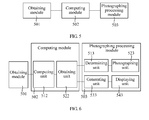
- FIG. 5 is a schematic structural diagram of Embodiment 1 of an apparatus for photographing processing according to the present invention.
- this embodiment provides an apparatus for photographing processing.
- the apparatus may specifically perform the steps in the method embodiment 1, which are not repeated herein.
- the apparatus for photographing processing provided by this embodiment may specifically include an obtaining module 501, a computing module 502, and a photographing processing module 503.
- the obtaining module 501 is configured to obtain a spatial position parameter of a mobile device collected by a gravity sensor in real time.
- the computing module 502 is configured to separately compute, according to the spatial position parameter of the mobile device, stability degrees of the mobile device at multiple reference moments before a current reference moment and a stability degree of the mobile device at the current reference moment.
- the computing module 502 separately computes stability degrees of the mobile device at the multiple reference moments before the current reference moment and a stability degree of the mobile device at the current reference moment.
- the photographing processing module 503 is configured to perform photographing processing according to the stability degrees of the mobile device at the multiple reference moments before the current reference moment and the stability degree of the mobile device at the current reference moment.
- FIG. 6 is a schematic structural diagram of Embodiment 2 of the apparatus for photographing processing according to the present invention. As shown in FIG. 6 , this embodiment provides an apparatus for photographing processing. The apparatus may specifically perform the steps in Embodiment 2, Embodiment 3, or Embodiment 4 of the method, which are not repeated herein. In the apparatus for photographing processing provided by this embodiment, on the basis of FIG. 5 , the computing module 502 may specifically include a computing unit 512 and an obtaining unit 522.
- the computing unit 512 is configured to compute, according to multiple groups of spatial position parameters of the mobile device within a preset period before the current reference moment, an expected value of the spatial position parameter at the current reference moment, and use the expected value of the spatial position parameter at the current reference moment as the stability degree of the mobile device at the current reference moment.
- the obtaining unit 522 is configured to repeat the computing step of the computing unit to separately obtain the stability degrees of the mobile device at the multiple reference moments before the current reference moment.
- the photographing processing module 503 in this embodiment may specifically include a determining unit 513 and a photographing unit 523.
- the determining unit 513 is configured to determine whether the mobile device is in a preset photographing condition at the current reference moment according to the stability degrees of the mobile device at the multiple reference moments before the current reference moment and the stability degree of the mobile device at the current reference moment.
- the photographing unit 523 is configured to automatically take a photo if the mobile device is in the preset photographing condition at the current reference moment.
- the determining unit 513 is further configured to: if the mobile device is not in the preset photographing condition at the current reference moment, determine whether the mobile device is in the preset photographing condition at a next reference moment after the current reference moment.
- the determining unit 513 is specifically configured to compare the stability degree of the mobile device at the current reference moment with the stability degrees of the mobile device at the multiple reference moments before the current reference moment, and determine whether the stability degrees of the mobile device at the current reference moment and at the multiple reference moments before the current reference moment tend to be stable.
- the photographing processing module 503 in this embodiment may further include a generating unit 533 and a displaying unit 543.
- the photographing processing module 533 is configured to separately generate photographing prompt information according to the stability degrees of the mobile device at the multiple reference moments before the current reference moment and the stability degree of the mobile device at the current reference moment.
- the generating unit 533 may generate photographing prompt information at the current reference moment according to the stability degrees of the mobile device at the multiple reference moments before the current reference moment and the stability degree of the mobile device at the current reference moment.
- the displaying unit 543 is configured to display the photographing prompt information of the mobile device at the current reference moment on a photographing interface, so that a user takes a photo according to the photographing prompt information.
- the displaying unit 543 in this embodiment may be specifically configured to display, on the photographing interface, values of the stability degrees at the multiple reference moments before the current reference moment and the stability degree at the current reference moment, so that the user takes a photo according to the values of the stability degrees of the mobile device at the multiple reference moments before the current reference moment and the stability degree of the mobile device at the current reference moment; or configured to display a waveform graph of stability degrees of the mobile device at the multiple reference moments before the current reference moment and the stability degree of the mobile device at the current reference moment on the photographing interface, so that the user takes a photo according to the waveform graph.
- This embodiment of the present invention provides an apparatus for photographing processing.
- the spatial position parameter of the mobile device in real time is collected through the gravity sensor, separately according to the spatial position parameter of the mobile device, the stability degrees of the mobile device at the multiple reference moments before the current reference moment and the stability degree of the mobile device at the current reference moment are separately computed, and the photographing processing according to the stability degrees of the mobile device at the multiple reference moments before the current reference moment and the stability degree of the mobile device at the current reference moment is performed.
- the gravity sensor on a bottom layer of the mobile terminal has high sensitivity, relatively high spatial position parameter can be obtained, so that the optimal photographing condition may be accurately obtained. In this way, blurred photographing caused by vibration may be prevented, and resolution of the taken photo is improved.
- This embodiment provides a mobile device, which may specifically include a gravity sensor and the apparatus for photographing processing shown in FIG. 5 or FIG. 6 .
- the program may be stored in a computer readable storage medium. When the program runs, the processes of the methods in the embodiments are performed.
- the storage medium may be a magnetic disk, an optical disc, a read-only memory (Read-Only Memory, ROM), or a random access memory (Random Access Memory, RAM).
Landscapes
- Engineering & Computer Science (AREA)
- Multimedia (AREA)
- Signal Processing (AREA)
- Studio Devices (AREA)
- Image Analysis (AREA)
- Image Processing (AREA)
Abstract
Description
- The present invention relates to the field of communications technologies, and in particular, to a method, an apparatus, and a mobile device for photographing processing.
- With the continuous development and advancement of science and technology, functions of digital products are becoming more and more diverse. For example, handheld mobile devices such as smart phones and tablet computers as multifunctional products are not only mobile terminals for communication, work and transaction processing, but also good tools for entertainment and relaxation. Entertainment and relaxation functions of handheld mobile devices are increasingly valued by people. However, image quality of video making and photographing with handheld mobile terminals is always unsatisfactory, and especially when a photo taker is in a relatively unstable environment, the problem becomes particularly prominent. As is known to all, whether a photo taken with a camera is clear directly depends on whether the body of the camera remains stable when a photo is being taken. Therefore, how to prevent undesirable influences caused by vibration when a photo is being taken becomes a focus of attention from camera manufacturers, and certainly handheld mobile device manufacturers also pay equal attention to the anti-vibration technique.
- In the prior art, an "anti-vibration (anti-vibration)" mode provided against vibration may be adopted for photographing. When a photo taker chooses this mode, a camera determines whether a photographing condition is optimal according to a current moving speed of the device, and when the device is in the optimal photographing condition, the device automatically takes a photo.
- However, the prior art cannot accurately obtain the moving speed of the device, so the device takes a photo in a non-optimal photographing condition, and therefore, resolution of the photo is not good.
- Embodiments of the present invention provide a method, an apparatus, and a mobile device for photographing processing, which can accurately obtain a photographing condition of a mobile device, so as to improve resolution of a taken photo.
- According to the first aspect, an embodiment of the present invention provides a method for photographing processing, which includes:
- obtaining a spatial position parameter of a mobile device collected by a gravity sensor in real time;
- separately computing, according to the spatial position parameter of the mobile device, stability degrees of the mobile device at multiple reference moments before a current reference moment and a stability degree of the mobile device at the current reference moment; and
- performing photographing processing according to the stability degrees of the mobile device at the multiple reference moments before the current reference moment and the stability degree of the mobile device at the current reference moment.
- According to another aspect, an embodiment of the present invention provides an apparatus for photographing processing, which includes:
- an obtaining module, configured to obtain a spatial position parameter of a mobile device collected by a gravity sensor in real time;
- a computing module, configured to separately compute, according to the spatial position parameter of the mobile device, stability degrees of the mobile device at multiple reference moments before a current reference moment and a stability degree of the mobile device at the current reference moment; and
- a photographing processing module, configured to perform photographing processing according to the stability degrees of the mobile device at the multiple reference moments before the current reference moment and the stability degree of the mobile device at the current reference moment.
- According to still another aspect, an embodiment of the present invention provides a mobile device, which includes a gravity sensor and the apparatus for photographing processing described in the foregoing.
- A technical effect of the embodiments of the present invention is: collecting the spatial position parameter of the mobile device in real time through the gravity sensor; separately computing, according to the spatial position parameter of the mobile device, the stability degrees of the mobile device at the multiple reference moments before the current reference moment and the stability degree of the mobile device at the current reference moment; and performing the photographing processing according to the stability degrees of the mobile device at the multiple reference moments before the current reference moment and the stability degree of the mobile device at the current reference moment. Because the gravity sensor on a bottom layer of the mobile terminal has high sensitivity, relatively high spatial position parameters can be obtained, so that the optimal photographing condition may be accurately obtained. In this way, blurred photographing caused by vibration may be prevented, and resolution of the taken photo is improved.
- To describe the technical solutions in the embodiments of the present invention more clearly, the following briefly introduces the accompanying drawings required for describing the embodiments. Apparently, the accompanying drawings in the following description show merely some embodiments of the present invention, and a person of ordinary skill in the art may still derive other drawings from these accompanying drawings without creative efforts.
-
FIG. 1 is a flow chart of Embodiment 1 of a method for photographing processing according to the present invention; -
FIG. 2 is a flow chart of Embodiment 2 of a method for photographing processing according to the present invention; -
FIG. 3 is a flow chart of Embodiment 3 of a method for photographing processing according to the present invention; -
FIG. 4 is a flow chart of Embodiment 4 of a method for photographing processing according to the present invention; -
FIG. 5 is a schematic structural diagram of Embodiment 1 of an apparatus for photographing processing according to the present invention; and -
FIG. 6 is a schematic structural diagram of Embodiment 2 of an apparatus for photographing processing according to the present invention. - The following clearly and completely describes the technical solutions in the embodiments of the present invention with reference to the accompanying drawings in the embodiments of the present invention. Apparently, the described embodiments are merely a part rather than all of the embodiments of the present invention. All other embodiments obtained by a person of ordinary skill in the art based on the embodiments of the present invention without creative efforts shall fall within the protection scope of the present invention.
-
FIG. 1 is a flow chart of Embodiment 1 of a method for photographing processing according to the present invention. As shown inFIG. 1 , this embodiment provides a method for photographing processing, which may specifically include the following steps: - Step 101: Obtain a spatial position parameter of a mobile device collected by a gravity sensor in real time.
- After a photographing key of the mobile device is pressed, the mobile device does not instantly generate a screenshot of a currently taken image and then display the screenshot. Instead, the mobile device enters an image-forming stage, and at this time, a user interface (User Interface, UI for short) may still display the image currently taken by a camera of the mobile device. This embodiment is specifically an improvement of a method for photographing processing in the image-forming stage. This step is that the mobile device obtains the spatial position parameter of the mobile device collected by the gravity sensor in real time, and the step is specifically that a photographing system of the mobile device obtains the spatial position parameter. The gravity sensor is a functional module integrated in the mobile device, and is configured to collect the spatial position parameter of the mobile device in real time, where the spatial position parameter may specifically be a three-dimensional coordinate value or spatial coordinate value, namely, (x,y,z), of a certain position where the mobile device is located. In this embodiment, the gravity sensor may collect a spatial position parameter of the mobile device at each collecting moment in real time after the photographing key is pressed. The collecting moment is specifically determined according to a collecting frequency, and the collecting frequency may be specifically set according to a practical situation, for example, setting the collecting frequency as collecting every 1ms. After the photographing key of the mobile device is pressed, the gravity sensor may send the collected spatial position parameter to the mobile device in real time, or may send multiple groups of spatial position parameters at preset intervals, for example, sending 50 groups of spatial position parameters every 50ms.
- Step 102: Separately compute, according to the spatial position parameter of the mobile device, stability degrees of the mobile device at multiple reference moments before a current reference moment and a stability degree of the mobile device at the current reference moment.
- After obtaining the spatial position parameter of the mobile device, the mobile device may separately obtain, by performing computing, stability degrees of the mobile device at multiple different reference moments according to the spatial position parameter of the mobile device. In this embodiment, the stability degrees at the multiple different reference moments include the stability degrees at the multiple reference moments before the current reference moment and the stability degree at the current reference moment.
- In this embodiment, after the photographing key of the mobile device is pressed, the gravity sensor constantly collects the spatial position parameters of the mobile device in real time, and therefore constantly computes a stability degree at every reference moment accordingly, so as to generate the stability degrees at the multiple reference moments. The current reference moment is the moment when the mobile device is currently working, or may also be the moment when a currently taken image is displayed for a user.
- In this embodiment, the reference moments may be moments when the stability degrees are computed at intervals. In this embodiment, the reference moments may be preset, for example, computing a stability degree every 50ms, so the 50th millisecond and the 100th millisecond are the reference moments. Certainly, the reference moments may be set by using another method, for example, setting the reference moments through an arithmetic progression or a geometric progression, or choosing the reference moments according to actual requirements. In this embodiment, the choosing of the reference moments is not limited.
- In this embodiment, a method for computing the stability degree of the mobile device at every reference moment before the current reference moment is the same as a method for computing the stability degree of the mobile device at the current reference moment. This may be construed as replacing a value at the current reference moment with a value at every reference moment before the current reference moment.
- In this step, the stability degrees of the mobile device at the multiple reference moments may be separately computed according to the spatial position parameters of the mobile device at the different collecting moments. Because a frequency of computing the stability degrees is different from a frequency of collecting the parameters, the reference moments in this step are different from the collecting moments mentioned in the foregoing step. For example, an interval between two collecting moments may be set to 1ms, whereas an interval between two reference moments may be set to 50ms, so in this step, 50 groups of spatial position parameters collected within 50ms may be used to compute a stability degree at a reference moment. This step is separately computing, according to the multiple groups of spatial position parameters of the mobile device at the different collecting moments sent by the gravity sensor, the stability degrees of the mobile device at the multiple reference moments. For example, use 50 groups of spatial position parameters collected from the 1st ms to the 50th ms to compute a stability degree of the mobile device at the reference moment of the 50th ms, and use 50 groups of spatial position parameters collected from the 51st ms to the 100th ms to compute a stability degree of the mobile device at the reference moment of the 100th ms.
- Step 103: Perform photographing processing according to the separately computed stability degrees of the mobile device at the multiple reference moments before the current reference moment and the stability degree of the mobile device at the current reference moment.
- Through the foregoing step, the stability degree of the mobile device at the current reference moment may first be obtained according to the spatial position parameter, and the stability degrees of the mobile device at the multiple reference moments before the current reference moment are then compared with the stability degree of the mobile device at the current reference moment, so as to determine whether the mobile device is in a preset photographing condition at the current reference moment.
- Specifically, every time after a stability degree at a reference moment is obtained by performing computing, the previously obtained stability degrees at different reference moments and the stability degree at the current reference moment are analyzed, so as to perform photographing processing, that is, determining whether to take a photo at present. In this step, according to the stability degrees of the mobile device, a current photographing condition may be determined, and specifically, whether the stability degrees of the mobile device tend to be stable may be determined. When the stability degrees of the mobile device tend to a stable value, it indicates that the current photographing condition is optimal, so the mobile device may automatically take a photo or prompt the user to perform photographing confirmation, that is, the user needs to press the photographing key again to take a photo. For the automatically photographing manner, the photographing key does not need to be pressed again to take a photo; however, for the latter manner, after prompting used for that the photo may be taken, the user needs to press the virtual photographing button to take a photo.
- This embodiment of the present invention provides a method for photographing processing. With the method, the spatial position parameter of the mobile device in real time is collected through the gravity sensor, separately according to the spatial position parameter of the mobile device, the stability degrees of the mobile device at multiple reference moments before the current reference moment and the stability degree of the mobile device at the current reference moment are separately computed, and the photographing processing according to the stability degrees of the mobile device at the multiple reference moments before the current reference moment and the stability degree of the mobile device at the current reference moment is performed. Because the gravity sensor on a bottom layer of the mobile terminal has high sensitivity, relatively high spatial position parameters can be obtained, so that the optimal photographing condition may be accurately obtained. In this way, blurred photographing caused by vibration may be prevented, and resolution of the taken photo is improved.
-
FIG. 2 is a flow chart of Embodiment 2 of a method for photographing processing according to the present invention. As shown inFIG. 2 , this embodiment provides a method for photographing processing, which may specifically include the following steps: - Step 201: After a photographing key of a mobile device is pressed, the mobile device obtains a spatial position parameter of the mobile device collected by a gravity sensor in real time.
- This step is specifically that, after the photographing key of the mobile device is pressed, the mobile device obtains the spatial position parameter of the mobile device collected by the gravity sensor in real time. The gravity sensor may specifically be the SensorEventListener-like software provided by an Android system, and is configured to collect the spatial position parameter of the mobile device in real time, where the spatial position parameter may specifically be a coordinate value, namely, (x,y,z), of a certain position where the mobile device is located. In this embodiment, after the photographing key of the mobile device is pressed, the gravity sensor may obtain a spatial position parameter, which is collected by the gravity sensor in real time, of the mobile device at each collecting moment. The collecting moment is specifically determined according to a collecting frequency, and the collecting frequency may be specifically set according to a practical situation, for example, setting the collecting frequency as collecting a spatial position parameter every 1ms. Specifically, the mobile device may obtain every group of spatial position parameters collected by the gravity sensor in real time, or may obtain multiple groups of spatial position parameters at preset intervals, for example, obtaining 50 groups of spatial position parameters every 50ms.
- Step 202: The mobile device obtains, according to the spatial position parameter, stability degrees of the mobile device at multiple reference moments before a current reference moment and a stability degree of the mobile device at the current reference moment.
- In this embodiment, after obtaining the spatial position parameter of the mobile device, the mobile device may obtain, according to the spatial position parameter, the stability degrees of the mobile device at the multiple reference moments before the current reference moment and the stability degree of the mobile device at the current reference moment. Because the stability degrees in this embodiment are computed in real time, the current reference moment is the moment when the stability degree is computed. For example, if a stability degree is computed every 50ms, and the solution in this embodiment is performed from the 0th ms, a current reference moment when a stability degree is computed for the first time is the 50th ms moment, a current reference moment when a stability degree is computed for the second time is the 100th ms moment, and so on, and a current reference moment when a stability degree is computed for the nth time is the 50*nth ms moment. In this embodiment, it is supposed that the gravity sensor collects one group of spatial position parameters of the mobile device every 1ms and computes a stability degree every 50ms.
- Specifically, in this embodiment, the mobile device may compute, according to multiple groups of spatial position parameters of the mobile device within a preset period before the current reference moment, an expected value of the spatial position parameter at the current reference moment, and use the expected value of the spatial position parameter at the current reference moment as the stability degree of the mobile device at the current reference moment. That is, this embodiment may use expected values of the spatial position parameter to indicate the stability degrees of the mobile device, and specifically may use the multiple groups of spatial position parameters collected by the gravity sensor to compute the expected values. When computing the stability degree of the mobile device at the current reference moment, specifically 50 groups of spatial position parameters obtained from the gravity sensor are used within 50ms before the current reference moment, that is, the 50 groups of spatial position parameters are used to compute an expected value of the spatial position parameter. Because the spatial position parameter may be three coordinates x, y, and z, expected values of the coordinates x, y, and z may be separately obtained herein through computing, and then n processing, such as an averaging processing, is performed on the expected values of the x, y, and z, so as to obtain a value of the stability degree of the mobile device at the current reference moment. A method of obtaining the expected values of coordinates x, y, and z may be: according to the collected 50 groups of values xi, yi, and zi of coordinates x, y, and z, obtaining a probability value pi of each value by performing computing; and using an expected formula Ex=s1*p1+s2*p2+...+s50*p50 to separately obtain the expected values of the coordinates x, y, and z through computing.
- In this embodiment, after the photographing key of the mobile device is pressed, the gravity sensor constantly collects the spatial position parameters of the mobile device in real time, and therefore constantly computes a stability degree at every reference moment accordingly, so as to generate the stability degrees at the multiple reference moments. The current reference moment is a moment when the mobile device is currently working, or may also be the moment when a currently taken image is displayed for a user.
- Step 203: Determine whether the mobile device is in a preset photographing condition at the current reference moment, according to the stability degrees of the mobile device at the multiple reference moments before the current reference moment and the stability degree of the mobile device at the current reference moment; if yes, execute
step 204; if not, return to step 202. - After the stability degree of the mobile device at the current reference moment is obtained by performing computing, it is determined whether the mobile device is in a preset photographing condition at the current reference moment, according to the stability degrees of the mobile device at the multiple reference moments before the current reference moment and the stability degree of the mobile device at the current reference moment. If yes, execute
step 204; if not, executestep 202 again, so as to compute a stability degree at a next reference moment after the current reference moment for determination, until a stability degree which meets the condition is obtained. The preset photographing condition in this embodiment may be a preset optimal photographing condition, and stability degrees of the mobile device are herein used as a standard for determining whether the mobile device is in the preset photographing condition, that is, a standard for determining whether a photographing condition of the mobile device is the optimal. - Specifically, the stability degree of the mobile device at the current reference moment may be compared with the stability degrees of the mobile device at the multiple reference moments before the current reference moment to determine whether the stability degrees of the mobile device at the current reference moment and at the multiple reference moments before the current reference moment tend to be stable. That is, according to the comparison between the stability degree of the mobile device at the current reference moment and the stability degrees at the several reference moments before the current reference moment, it is determined whether the stability degrees of the mobile device tend to be stable, for example, whether the stability degrees of the mobile device tend to a stable value, for example, the stable value is 1. If yes, it indicates that the mobile device is currently in the preset photographing condition, so step 204 is executed; if not, it is required to continue to compute a stability degree at a next reference moment after the current reference moment.
- Step 204: The mobile device automatically takes a photo.
- When the mobile device learns that the stability degrees of the mobile device at the recent several reference moments tend to be stable by comparing the stability degree at the current reference moment and the stability degrees at the previous several reference moments, it indicates that the mobile device is currently in the preset photographing condition, so the mobile device automatically take a photo to obtain the clearest photo.
- This embodiment of the present invention provides a method for photographing processing. With the method the spatial position parameter of the mobile device in real time is collected through the gravity sensor, separately according to the spatial position parameter of the mobile device, the stability degrees of the mobile device at the multiple reference moments before the current reference moment and the stability degree of the mobile device at the current reference moment are separately computed, and the photographing processing according to the stability degrees of the mobile device at the multiple reference moments before the current reference moment and the stability degree of the mobile device at the current reference moment is performed. Because the gravity sensor on a bottom layer of the mobile terminal has high sensitivity, relatively high spatial position parameters can be obtained, so that the optimal photographing condition may be accurately obtained. In this way, blurred photographing caused by vibration may be prevented, and resolution of the taken photo is improved.
-
FIG. 3 is a flow chart of Embodiment 3 of a method for photographing processing according to the present invention. As shown inFIG. 3 , this embodiment provides a method for photographing processing, which may specifically include the following steps: - Step 301: After a photographing key of a mobile device is pressed, the mobile device obtains a spatial position parameter of a mobile device collected by a gravity sensor in real time. This step is similar to step 201, and is therefore not repeated herein.
- Step 302: The mobile device obtains, according to the spatial position parameter, stability degrees of the mobile device at multiple reference moments before a current reference moment and a stability degree of the mobile device at the current reference moment. This step is similar to step 202, and is therefore not repeated herein.
- Step 303: The mobile device generates photographing prompt information at the current reference moment according to the stability degrees of the mobile device at the multiple reference moments before the current reference moment and the stability degree of the mobile device at the current reference moment.
- In this step, after obtaining the stability degrees of the mobile device at the multiple reference moments before the current reference moment and the stability degree of the mobile device at the current reference moment through computing, the mobile device generates the photographing prompt information at the current reference moment according to values of these stability degrees. That is, the mobile device may analyze the values of the stability degrees at the recent several reference moments, and when the values of the stability degrees at the recent several reference moments tend to a stable value, the correspondingly generated photographing prompt information is "suited for photographing"; or the generated photographing prompt information is "unsuited for photographing", which is used to prompt a user to perform a further operation.
- Step 304: Display the photographing prompt information of the mobile device at the current reference moment on a photographing interface, so that a user takes a photo according to the photographing prompt information at the current reference moment.
- After the mobile device generates the photographing prompt information, the photographing prompt information of the mobile device may be displayed at the current reference moment on the photographing interface, so that the user may decide, according to the photographing prompt information at the current reference moment, whether to take a photo. When the photographing prompt information is "suited for photographing", the user may press a virtual photographing button to capture a clear picture displayed on the current photographing interface; when the photographing prompt information is "unsuited for photographing", the user may wait without taking a photo at the moment.
- This embodiment of the present invention provides a method for photographing processing. With the method, the spatial position parameter of the mobile device in real time is collected through the gravity sensor, separately according to the spatial position parameter of the mobile device, the stability degrees of the mobile device at the multiple reference moments before the current reference moment and the stability degree of the mobile device at the current reference moment are separately computed, and the photographing processing according to the stability degrees of the mobile device at the multiple reference moments before the current reference moment and the stability degree of the mobile device at the current reference moment is performed. Because the gravity sensor on a bottom layer of the mobile terminal has high sensitivity, relatively high spatial position parameter can be obtained, so that the optimal photographing condition may be accurately obtained. In this way, blurred photographing caused by vibration may be prevented, and resolution of the taken photo is improved.
-
FIG. 4 is a flow chart of Embodiment 4 of a method for photographing processing according to the present invention. As shown inFIG. 4 , this embodiment provides a method for photographing processing, which may specifically include the following steps: - Step 401: After a photographing key of a mobile device is pressed, the mobile device obtains a spatial position parameter of a mobile device collected by a gravity sensor in real time. This step is similar to step 201, and is therefore not repeated herein.
- Step 402: The mobile device obtains, according to the spatial position parameter, stability degrees of the mobile device at multiple reference moments before a current reference moment and a stability degree of the mobile device at the current reference moment. This step is similar to step 202, and is therefore not repeated herein.
- Step 403: The mobile device generates a waveform graph of stability degrees according to the stability degrees of the mobile device at the multiple reference moments before the current reference moment and the stability degree of the mobile device at the current reference moment.
- In this step, after obtaining the stability degrees of the mobile device at the multiple reference moments before the current reference moment and the stability degree of the mobile device at the current reference moment through computing, the mobile device generates, according to values of these stability degrees, a waveform graph of the stability degrees, which is specifically a time-waveform graph, so as to reflect changes of the values of the stability degrees at the different reference moments in a form of wave forms.
- Step 404: The mobile device displays the waveform graph of stability degrees on a photographing interface, so that a user takes a photo according to the waveform graph of stability degrees.
- After the mobile device generates the waveform graph of the stability degrees, the waveform graph is displayed on the photographing interface. The waveform graph may specifically be displayed on the upper part of the photographing interface rather than the center of the interface, so that the user may decide whether to take a photo according to the waveform graph. When the waveform graph of the stability degrees tends to be level, it indicates that the changes in the stability degrees at the recent reference moments are relatively small, so the user may further press a virtual photographing button to capture a clear picture displayed on the current photographing interface; when the change in the waveform graph of the stability degrees is relatively large, the user may further wait without taking a photo at the moment.
- This embodiment of the present invention provides a method for photographing processing. With the method, the spatial position parameter of the mobile device in real time is collected through the gravity sensor, separately according to the spatial position parameter of the mobile device, the stability degrees of the mobile device at the multiple reference moments before the current reference moment and the stability degree of the mobile device at the current reference moment are separately computed, and the photographing processing according to the stability degrees of the mobile device at the multiple reference moments before the current reference moment and the stability degree of the mobile device at the current reference moment is performed. Because the gravity sensor on a bottom layer of the mobile terminal has high sensitivity, relatively high spatial position parameter can be obtained, so that the optimal photographing condition may be accurately obtained. In this way, blurred photographing caused by vibration may be prevented, and resolution of the taken photo is improved.
- A person of ordinary skill in the art may understand that, all or a part of steps according to the foregoing method embodiments may be implemented by a program instructing related hardware. The foregoing program may be stored in a computer readable storage medium. When the program runs, the steps of the foregoing embodiments of the method are performed. The foregoing storage medium may include any mediums capable of storing program codes, such as a ROM, a RAM, a magnetic disk, or an optical disc.
-
FIG. 5 is a schematic structural diagram of Embodiment 1 of an apparatus for photographing processing according to the present invention. As shown inFIG. 5 , this embodiment provides an apparatus for photographing processing. The apparatus may specifically perform the steps in the method embodiment 1, which are not repeated herein. The apparatus for photographing processing provided by this embodiment may specifically include an obtainingmodule 501, acomputing module 502, and a photographingprocessing module 503. The obtainingmodule 501 is configured to obtain a spatial position parameter of a mobile device collected by a gravity sensor in real time. Thecomputing module 502 is configured to separately compute, according to the spatial position parameter of the mobile device, stability degrees of the mobile device at multiple reference moments before a current reference moment and a stability degree of the mobile device at the current reference moment. In this embodiment, specifically, thecomputing module 502 separately computes stability degrees of the mobile device at the multiple reference moments before the current reference moment and a stability degree of the mobile device at the current reference moment. The photographingprocessing module 503 is configured to perform photographing processing according to the stability degrees of the mobile device at the multiple reference moments before the current reference moment and the stability degree of the mobile device at the current reference moment. -
FIG. 6 is a schematic structural diagram of Embodiment 2 of the apparatus for photographing processing according to the present invention. As shown inFIG. 6 , this embodiment provides an apparatus for photographing processing. The apparatus may specifically perform the steps in Embodiment 2, Embodiment 3, or Embodiment 4 of the method, which are not repeated herein. In the apparatus for photographing processing provided by this embodiment, on the basis ofFIG. 5 , thecomputing module 502 may specifically include acomputing unit 512 and an obtainingunit 522. Thecomputing unit 512 is configured to compute, according to multiple groups of spatial position parameters of the mobile device within a preset period before the current reference moment, an expected value of the spatial position parameter at the current reference moment, and use the expected value of the spatial position parameter at the current reference moment as the stability degree of the mobile device at the current reference moment. The obtainingunit 522 is configured to repeat the computing step of the computing unit to separately obtain the stability degrees of the mobile device at the multiple reference moments before the current reference moment. - Specifically, the photographing
processing module 503 in this embodiment may specifically include a determiningunit 513 and a photographingunit 523. The determiningunit 513 is configured to determine whether the mobile device is in a preset photographing condition at the current reference moment according to the stability degrees of the mobile device at the multiple reference moments before the current reference moment and the stability degree of the mobile device at the current reference moment. The photographingunit 523 is configured to automatically take a photo if the mobile device is in the preset photographing condition at the current reference moment. The determiningunit 513 is further configured to: if the mobile device is not in the preset photographing condition at the current reference moment, determine whether the mobile device is in the preset photographing condition at a next reference moment after the current reference moment. - Specifically, the determining
unit 513 is specifically configured to compare the stability degree of the mobile device at the current reference moment with the stability degrees of the mobile device at the multiple reference moments before the current reference moment, and determine whether the stability degrees of the mobile device at the current reference moment and at the multiple reference moments before the current reference moment tend to be stable. - Specifically, the photographing
processing module 503 in this embodiment may further include agenerating unit 533 and a displayingunit 543. The photographingprocessing module 533 is configured to separately generate photographing prompt information according to the stability degrees of the mobile device at the multiple reference moments before the current reference moment and the stability degree of the mobile device at the current reference moment. In this embodiment, the generatingunit 533 may generate photographing prompt information at the current reference moment according to the stability degrees of the mobile device at the multiple reference moments before the current reference moment and the stability degree of the mobile device at the current reference moment. The displayingunit 543 is configured to display the photographing prompt information of the mobile device at the current reference moment on a photographing interface, so that a user takes a photo according to the photographing prompt information. - Further, the displaying
unit 543 in this embodiment may be specifically configured to display, on the photographing interface, values of the stability degrees at the multiple reference moments before the current reference moment and the stability degree at the current reference moment, so that the user takes a photo according to the values of the stability degrees of the mobile device at the multiple reference moments before the current reference moment and the stability degree of the mobile device at the current reference moment; or configured to display a waveform graph of stability degrees of the mobile device at the multiple reference moments before the current reference moment and the stability degree of the mobile device at the current reference moment on the photographing interface, so that the user takes a photo according to the waveform graph. - This embodiment of the present invention provides an apparatus for photographing processing. With the method, the spatial position parameter of the mobile device in real time is collected through the gravity sensor, separately according to the spatial position parameter of the mobile device, the stability degrees of the mobile device at the multiple reference moments before the current reference moment and the stability degree of the mobile device at the current reference moment are separately computed, and the photographing processing according to the stability degrees of the mobile device at the multiple reference moments before the current reference moment and the stability degree of the mobile device at the current reference moment is performed. Because the gravity sensor on a bottom layer of the mobile terminal has high sensitivity, relatively high spatial position parameter can be obtained, so that the optimal photographing condition may be accurately obtained. In this way, blurred photographing caused by vibration may be prevented, and resolution of the taken photo is improved.
- This embodiment provides a mobile device, which may specifically include a gravity sensor and the apparatus for photographing processing shown in
FIG. 5 or FIG. 6 . - A person of ordinary skill in the art may understand that all or a part of processes of the methods in the embodiments may be implemented by a computer program instructing relevant hardware. The program may be stored in a computer readable storage medium. When the program runs, the processes of the methods in the embodiments are performed. The storage medium may be a magnetic disk, an optical disc, a read-only memory (Read-Only Memory, ROM), or a random access memory (Random Access Memory, RAM).
- The foregoing descriptions are merely specific embodiments of the present invention, but are not intended to limit the protection scope of the present invention. Any variation or replacement readily figured out by a person skilled in the art within the technical scope disclosed in the present invention shall fall within the protection scope of the present invention. Therefore, the protection scope of the present invention shall be subject to the protection scope of the claims.
Claims (13)
- A method for photographing processing, comprising:obtaining a spatial position parameter of a mobile device collected by a gravity sensor in real time;separately computing, according to the spatial position parameter of the mobile device, stability degrees of the mobile device at multiple reference moments before a current reference moment and a stability degree of the mobile device at the current reference moment; andperforming photographing processing according to the stability degrees of the mobile device at the multiple reference moments before the current reference moment and the stability degree of the mobile device at the current reference moment.
- The method according to claim 1, wherein the separately computing, according to the spatial position parameter of the mobile device, stability degrees of the mobile device at multiple reference moments before a current reference moment and a stability degree of the mobile device at the current reference moment comprises:computing, according to multiple groups of spatial position parameters of the mobile device within a preset period before the current reference moment, an expected value of the spatial position parameter at the current reference moment, and using the expected value of the spatial position parameter at the current reference moment as the stability degree of the mobile device at the current reference moment; andrepeating the computing step to separately obtain the stability degrees of the mobile device at the multiple reference moments before the current reference moment.
- The method according to claim 1 or 2, wherein the performing photographing processing according to the stability degrees of the mobile device at the multiple reference moments before the current reference moment and the stability degree of the mobile device at the current reference moment comprises:determining whether the mobile device is in a preset photographing condition at the current reference moment according to the stability degrees of the mobile device at the multiple reference moments before the current reference moment and the stability degree of the mobile device at the current reference moment;automatically taking a photo if the mobile device is in the preset photographing condition at the current reference moment; anddetermining whether the mobile device is in the preset photographing condition at a next reference moment after the current reference moment if the mobile device is not in the preset photographing condition at the current reference moment.
- The method according to claim 3, wherein the determining whether the mobile device is in a preset photographing condition at the current reference moment according to the stability degrees of the mobile device at the multiple reference moments before the current reference moment and the stability degree of the mobile device at the current reference moment is specifically:comparing the stability degree of the mobile device at the current reference moment with the stability degrees of the mobile device at the multiple reference moments before the current reference moment, and determining whether the stability degrees of the mobile device at the current reference moment and at the multiple reference moments before the current reference moment tend to be stable.
- The method according to claim 1 or 2, wherein the performing photographing processing according to the stability degrees of the mobile device at the multiple reference moments before the current reference moment and the stability degree of the mobile device at the current reference moment further comprises:generating photographing prompt information at the current reference moment according to the stability degrees of the mobile device at the multiple reference moments before the current reference moment and the stability degree of the mobile device at the current reference moment; anddisplaying the photographing prompt information of the mobile device at the current reference moment on a photographing interface, so that a user takes a photo according to the photographing prompt information.
- The method according to claim 5, wherein the displaying the photographing prompt information of the mobile device at the current reference moment on a photographing interface, so that a user takes a photo according to the photographing prompt information further comprises:displaying values of the stability degrees of the mobile device at the multiple reference moments before the current reference moment and the stability degree of the mobile device at the current reference moment on the photographing interface, so that the user takes a photo according to the values of the stability degrees of the mobile device at the multiple reference moments before the current reference moment and the stability degree of the mobile device at the current reference moment; ordisplaying a waveform graph of the stability degrees of the mobile device at the multiple reference moments before the current reference moment and the stability degree of the mobile device at the current reference moment on the photographing interface, so that the user takes a photo according to the waveform graph.
- An apparatus for photographing processing, comprising:an obtaining module, configured to obtain a spatial position parameter of a mobile device collected by a gravity sensor in real time;a computing module, configured to separately compute, according to the spatial position parameter of the mobile device, stability degrees of the mobile device at multiple reference moments before a current reference moment and a stability degree of the mobile device at the current reference moment; anda photographing processing module, configured to perform photographing processing according to the stability degrees of the mobile device at the multiple reference moments before the current reference moment and the stability degree of the mobile device at the current reference moment.
- The apparatus according to claim 7, wherein the computing module comprises:a computing unit, configured to compute, according to multiple groups of spatial position parameters of the mobile device within a preset period before the current reference moment, an expected value of the spatial position parameter at the current reference moment, and use the expected value of the spatial position parameter at the current reference moment as the stability degree of the mobile device at the current reference moment; andan obtaining unit, configured to repeat the computing step of the computing unit to separately obtain the stability degrees of the mobile device at the multiple reference moments before the current reference moment.
- The apparatus according to claim 7 or 8, wherein the photographing processing module comprises:a determining unit, configured to determine whether the mobile device is in a preset photographing condition at the current reference moment according to the stability degrees of the mobile device at the multiple reference moments before the current reference moment and the stability degree of the mobile device at the current reference moment; anda photographing unit, configured to automatically take a photo if the mobile device is in the preset photographing condition at the current reference moment, whereinthe determining unit is further configured to: if the mobile device is not in the preset photographing condition at the current reference moment, determine whether the mobile device is in the preset photographing condition at a next reference moment after the current reference moment.
- The apparatus according to claim 9, wherein the determining unit is specifically configured to compare the stability degree of the mobile device at the current reference moment with the stability degrees of the mobile device at the multiple reference moments before the current reference moment, and determine whether the stability degrees of the mobile device at the current reference moment and at the multiple reference moments before the current reference moment tend to be stable.
- The apparatus according to claim 7 or 8, wherein the photographing processing module further comprises:a generating unit, configured to generate photographing prompt information at the current reference moment according to the stability degrees of the mobile device at the multiple reference moments before the current reference moment and the stability degree of the mobile device at the current reference moment; anda displaying unit, configured to display the photographing prompt information of the mobile device at the current reference moment on a photographing interface, so that a user takes a photo according to the photographing prompt information.
- The apparatus according to claim 11, wherein the displaying unit is further configured to display values of the stability degrees at the multiple reference moments before the current reference moment and the stability degree at the current reference moment on the photographing interface, so that the user takes a photo according to the values of the stability degrees of the mobile device at the multiple reference moments before the current reference moment and the stability degree of the mobile device at the current reference moment; or configured to display a waveform graph of the stability degrees of the mobile device at the multiple reference moments before the current reference moment and the stability degree of the mobile device at the current reference moment on the photographing interface, so that the user takes a photo according to the waveform graph.
- A mobile device, comprising a gravity sensor and the apparatus for photographing processing according to any one of claims 7 to 12.
Applications Claiming Priority (2)
| Application Number | Priority Date | Filing Date | Title |
|---|---|---|---|
| CN201210013637.5A CN102547124B (en) | 2012-01-16 | 2012-01-16 | Method and device for photographic processing and mobile equipment |
| PCT/CN2013/070043 WO2013107294A1 (en) | 2012-01-16 | 2013-01-05 | Method and device for photographic processing and mobile apparatus |
Publications (2)
| Publication Number | Publication Date |
|---|---|
| EP2713607A1 true EP2713607A1 (en) | 2014-04-02 |
| EP2713607A4 EP2713607A4 (en) | 2015-01-07 |
Family
ID=46352968
Family Applications (1)
| Application Number | Title | Priority Date | Filing Date |
|---|---|---|---|
| EP13738383.2A Withdrawn EP2713607A4 (en) | 2012-01-16 | 2013-01-05 | Method and device for photographic processing and mobile apparatus |
Country Status (4)
| Country | Link |
|---|---|
| US (1) | US20140111660A1 (en) |
| EP (1) | EP2713607A4 (en) |
| CN (1) | CN102547124B (en) |
| WO (1) | WO2013107294A1 (en) |
Cited By (1)
| Publication number | Priority date | Publication date | Assignee | Title |
|---|---|---|---|---|
| CN105205429A (en) * | 2015-09-16 | 2015-12-30 | 北京慧眼智行科技有限公司 | Decoding control method and device for two-dimension code |
Families Citing this family (15)
| Publication number | Priority date | Publication date | Assignee | Title |
|---|---|---|---|---|
| CN102547124B (en) * | 2012-01-16 | 2014-07-09 | 华为终端有限公司 | Method and device for photographic processing and mobile equipment |
| CN103581528B (en) * | 2012-07-19 | 2017-08-18 | 百度在线网络技术(北京)有限公司 | For the method and mobile terminal pre-processed during being taken pictures in mobile terminal |
| CN103209292A (en) * | 2012-09-26 | 2013-07-17 | 顾红波 | Intelligent photographing system and method for obtaining stable imaging |
| CN103870257A (en) * | 2012-12-13 | 2014-06-18 | 腾讯科技(深圳)有限公司 | Continuous focusing method and device |
| CN104184885A (en) * | 2013-05-28 | 2014-12-03 | 中兴通讯股份有限公司 | Photographing method and device with photographing function |
| CN104427114A (en) * | 2013-09-03 | 2015-03-18 | 中兴通讯股份有限公司 | Shooting method, shooting device and mobile terminal |
| US9495017B2 (en) * | 2013-11-20 | 2016-11-15 | Intel Corporation | Computing systems for peripheral control |
| CN103813103B (en) * | 2014-03-10 | 2017-06-13 | 厦门美图之家科技有限公司 | The stabilization photographic method and device of a kind of mobile terminal |
| CN105357429A (en) * | 2014-08-18 | 2016-02-24 | 中兴通讯股份有限公司 | Focusing control method and device |
| CN104135622B (en) * | 2014-08-25 | 2018-05-01 | 广东欧珀移动通信有限公司 | A kind of method, device and mobile terminal of combination gyroscope optimization snap |
| CN105469015B (en) * | 2014-09-11 | 2018-02-02 | 北京慧眼智行科技有限公司 | A kind of fast positioning claps the method and system of code distance |
| CN105208378B (en) * | 2015-09-22 | 2017-12-12 | 小米科技有限责任公司 | Camera head protecting method, apparatus and terminal |
| CN106569685A (en) * | 2015-10-12 | 2017-04-19 | 中兴通讯股份有限公司 | Terminal photographing method and device |
| CN105898141B (en) * | 2016-04-01 | 2017-09-19 | 广东欧珀移动通信有限公司 | Control method, control device and electronic device |
| WO2019071623A1 (en) * | 2017-10-14 | 2019-04-18 | 华为技术有限公司 | Method for capturing images and electronic device |
Family Cites Families (12)
| Publication number | Priority date | Publication date | Assignee | Title |
|---|---|---|---|---|
| JP2005077886A (en) * | 2003-09-02 | 2005-03-24 | Canon Inc | Imaging device |
| JP2005283965A (en) * | 2004-03-30 | 2005-10-13 | Pentax Corp | Blur amount display device |
| US7688352B2 (en) * | 2005-11-25 | 2010-03-30 | Seiko Epson Corporation | Shake correction device, filming device, moving image display device, shake correction method and recording medium |
| CN200969608Y (en) * | 2006-11-13 | 2007-10-31 | 中兴通讯股份有限公司 | Photographic or camera handset with shakeproof function |
| US7734161B2 (en) * | 2007-04-19 | 2010-06-08 | Avago Technologies Ecbu Ip (Singapore) Pte. Ltd. | Image stabilization with adaptive shutter control |
| JP2009017030A (en) * | 2007-07-02 | 2009-01-22 | Sony Corp | Image imaging apparatus and imaging control method |
| JP2010154070A (en) * | 2008-12-24 | 2010-07-08 | Olympus Imaging Corp | Camera |
| US8624998B2 (en) * | 2009-06-05 | 2014-01-07 | Apple Inc. | Camera image selection based on detected device movement |
| CN201541302U (en) * | 2009-11-30 | 2010-08-04 | 天津三星光电子有限公司 | Digital camera with self-balancing function |
| CN101729665B (en) * | 2009-12-11 | 2013-10-02 | 惠州Tcl移动通信有限公司 | Camera cellphone with tremble prevention function and tremble prevention method in photographing process thereof |
| US9357118B2 (en) * | 2010-02-15 | 2016-05-31 | Sony Corporation | Photograph prediction including automatic photograph recording with autofocus and method |
| CN102547124B (en) * | 2012-01-16 | 2014-07-09 | 华为终端有限公司 | Method and device for photographic processing and mobile equipment |
-
2012
- 2012-01-16 CN CN201210013637.5A patent/CN102547124B/en not_active Expired - Fee Related
-
2013
- 2013-01-05 WO PCT/CN2013/070043 patent/WO2013107294A1/en not_active Ceased
- 2013-01-05 EP EP13738383.2A patent/EP2713607A4/en not_active Withdrawn
- 2013-12-30 US US14/143,661 patent/US20140111660A1/en not_active Abandoned
Cited By (2)
| Publication number | Priority date | Publication date | Assignee | Title |
|---|---|---|---|---|
| CN105205429A (en) * | 2015-09-16 | 2015-12-30 | 北京慧眼智行科技有限公司 | Decoding control method and device for two-dimension code |
| CN105205429B (en) * | 2015-09-16 | 2019-01-25 | 北京慧眼智行科技有限公司 | A kind of decoding control method and device of two dimensional code |
Also Published As
| Publication number | Publication date |
|---|---|
| WO2013107294A1 (en) | 2013-07-25 |
| CN102547124A (en) | 2012-07-04 |
| US20140111660A1 (en) | 2014-04-24 |
| EP2713607A4 (en) | 2015-01-07 |
| CN102547124B (en) | 2014-07-09 |
Similar Documents
| Publication | Publication Date | Title |
|---|---|---|
| US20140111660A1 (en) | Method, Apparatus, and Mobile Device for Photographing Processing | |
| EP2998848B1 (en) | Method, device, and apparatus for controlling screen rotation | |
| JP6560740B2 (en) | Method, apparatus, program, and recording medium for testing virtual reality head mounted display device software | |
| JP2021518087A (en) | Image correction methods, image correction devices, and electronic devices | |
| US20150109507A1 (en) | Image Presentation Method and Apparatus, and Terminal | |
| EP3163404A1 (en) | Method and device for preventing accidental touch of terminal with touch screen | |
| CN109040524B (en) | Artifact removal method, device, storage medium and terminal | |
| US9706101B2 (en) | Image processing terminal, imaging machine, information processing method, program, and remote imaging system to remotely operate the imaging machine | |
| CN108427630B (en) | Performance information acquisition method, device, terminal and computer readable storage medium | |
| CN112163406B (en) | Interactive message display method, device, computer equipment and storage medium | |
| CN110087121B (en) | Avatar display method, avatar display apparatus, electronic device, and storage medium | |
| CN110782532B (en) | Image generation method, image generation device, electronic device, and storage medium | |
| CN113052919A (en) | Calibration method and device of visual sensor, electronic equipment and storage medium | |
| CN111061550A (en) | Task processing method, device, equipment and storage medium | |
| CN106774849B (en) | Virtual reality equipment control method and device | |
| CN111221410B (en) | Method for transmitting eyeball tracking information, head-mounted display and computer device | |
| CN104093061B (en) | Content sharing method and device | |
| CN114217754A (en) | Screen projection control method and device, electronic equipment and storage medium | |
| EP2996325B1 (en) | Mobile terminal and method of controlling the same | |
| CN113538700A (en) | Calibration method and device for augmented reality device, electronic device and storage medium | |
| CN109561255B (en) | Terminal photographing method and device and storage medium | |
| CN109302563B (en) | Anti-shake processing method and device, storage medium and mobile terminal | |
| CN108550182B (en) | Three-dimensional modeling method and terminal | |
| CN113891002B (en) | Shooting method and device | |
| Nishiyama et al. | Cognitive support by smart phone-Human judgment on cosmetic skin analysis support |
Legal Events
| Date | Code | Title | Description |
|---|---|---|---|
| PUAI | Public reference made under article 153(3) epc to a published international application that has entered the european phase |
Free format text: ORIGINAL CODE: 0009012 |
|
| 17P | Request for examination filed |
Effective date: 20131223 |
|
| AK | Designated contracting states |
Kind code of ref document: A1 Designated state(s): AL AT BE BG CH CY CZ DE DK EE ES FI FR GB GR HR HU IE IS IT LI LT LU LV MC MK MT NL NO PL PT RO RS SE SI SK SM TR |
|
| A4 | Supplementary search report drawn up and despatched |
Effective date: 20141210 |
|
| RIC1 | Information provided on ipc code assigned before grant |
Ipc: H04N 5/232 20060101AFI20141204BHEP Ipc: H04N 5/14 20060101ALI20141204BHEP |
|
| DAX | Request for extension of the european patent (deleted) | ||
| 17Q | First examination report despatched |
Effective date: 20170912 |
|
| RAP1 | Party data changed (applicant data changed or rights of an application transferred) |
Owner name: HUAWEI DEVICE (DONGGUAN) CO., LTD. |
|
| STAA | Information on the status of an ep patent application or granted ep patent |
Free format text: STATUS: THE APPLICATION HAS BEEN WITHDRAWN |
|
| 18W | Application withdrawn |
Effective date: 20180103 |