EP2713469A2 - Paralleling module for a generator system - Google Patents
Paralleling module for a generator system Download PDFInfo
- Publication number
- EP2713469A2 EP2713469A2 EP20130184361 EP13184361A EP2713469A2 EP 2713469 A2 EP2713469 A2 EP 2713469A2 EP 20130184361 EP20130184361 EP 20130184361 EP 13184361 A EP13184361 A EP 13184361A EP 2713469 A2 EP2713469 A2 EP 2713469A2
- Authority
- EP
- European Patent Office
- Prior art keywords
- generator
- paralleling
- enclosure
- additional
- module
- Prior art date
- Legal status (The legal status is an assumption and is not a legal conclusion. Google has not performed a legal analysis and makes no representation as to the accuracy of the status listed.)
- Withdrawn
Links
Images

Classifications
-
- H—ELECTRICITY
- H02—GENERATION; CONVERSION OR DISTRIBUTION OF ELECTRIC POWER
- H02J—ELECTRIC POWER NETWORKS; CIRCUIT ARRANGEMENTS OR SYSTEMS FOR SUPPLYING OR DISTRIBUTING ELECTRIC POWER; SYSTEMS FOR STORING ELECTRIC ENERGY
- H02J3/00—Circuit arrangements for AC mains or AC distribution networks
- H02J3/38—Arrangements for feeding a single network from two or more generators or sources in parallel; Arrangements for feeding already energised networks from additional generators or sources in parallel
- H02J3/381—Dispersed generators
-
- H—ELECTRICITY
- H02—GENERATION; CONVERSION OR DISTRIBUTION OF ELECTRIC POWER
- H02J—ELECTRIC POWER NETWORKS; CIRCUIT ARRANGEMENTS OR SYSTEMS FOR SUPPLYING OR DISTRIBUTING ELECTRIC POWER; SYSTEMS FOR STORING ELECTRIC ENERGY
- H02J4/00—Circuit arrangements for mains or distribution networks not specified as AC or DC; Circuit arrangements for mains or distribution networks combining AC and DC sections or sub-networks
-
- H—ELECTRICITY
- H02—GENERATION; CONVERSION OR DISTRIBUTION OF ELECTRIC POWER
- H02J—ELECTRIC POWER NETWORKS; CIRCUIT ARRANGEMENTS OR SYSTEMS FOR SUPPLYING OR DISTRIBUTING ELECTRIC POWER; SYSTEMS FOR STORING ELECTRIC ENERGY
- H02J2101/00—Supply or distribution of decentralised, dispersed or local electric power generation
- H02J2101/10—Dispersed power generation using fossil fuels, e.g. diesel generators
-
- H—ELECTRICITY
- H02—GENERATION; CONVERSION OR DISTRIBUTION OF ELECTRIC POWER
- H02J—ELECTRIC POWER NETWORKS; CIRCUIT ARRANGEMENTS OR SYSTEMS FOR SUPPLYING OR DISTRIBUTING ELECTRIC POWER; SYSTEMS FOR STORING ELECTRIC ENERGY
- H02J2105/00—Networks for supplying or distributing electric power characterised by their spatial reach or by the load
- H02J2105/10—Local stationary networks having a local or delimited stationary reach
- H02J2105/12—Local stationary networks having a local or delimited stationary reach supplying households or buildings
Definitions
- the present invention relates to a power generation system, and more particularly to a paralleling module for a power generation system.
- Standby generators are often used to provide electrical power when power is unavailable from an electric utility company (e.g. during weather disturbances). In addition, standby generators are often used to provide electrical power at a remote location where utility company power is not available.
- standby electric generator comprises an internal combustion engine driving an electrical alternator that produces alternating electricity.
- Other types of standby electric generators include photovoltaic arrays and wind turbine generators.
- the single generator system can be readily turned into a multi-generator system by adding another generator. Adding a generator may be more desirable than bearing the cost of replacing a single generator with an even larger generator.
- generator paralleling systems have been quite complex and often require several additional pieces of equipment to achieve satisfactory generator paralleling.
- existing systems may include separate synchronizers, load managers, and/or switch gear.
- traditional systems are not well suited to address mechanical and electrical load differences.
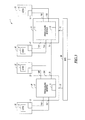
- FIG. 1 is a schematic diagram showing an example paralleling module for a generator system.
- FIG. 2 is a schematic diagram showing the generator system of FIG.1 where the generator system includes additional parallel generators.
- FIG. 3 is a schematic diagram showing the generator system of FIG.1 where the generator system includes additional parallel generators and an additional paralleling module.
- FIG. 1 illustrates an example power management system 1.
- the power management system 1 includes a first enclosure 10 and a second enclosure 20.
- a first generator 11 is inside the first enclosure and a second generator 21 is inside the second enclosure 20.
- the power management system 1 further includes a paralleling enclosure 30 and a paralleling module 31 inside the paralleling enclosure 30.
- the paralleling module 31 includes at least one switching device 32 within the paralleling enclosure 30 to electrically connect the first generator 11 to the second generator 21.
- the paralleling enclosure 30 further includes a plurality of connectors 33A, 33B, 35 that permit electrical connection between the paralleling module 31 and the first generator 11 (connector 33A), the second generator 21 (connector 33B) and an output (connector 35) without opening the paralleling enclosure 30.
- the first generator 11 includes a first generator controller 12 inside the first enclosure 10 and the second generator 21 includes a second generator controller 22 inside the second enclosure 20.
- the paralleling module 31 allows the first generator controller 11 and the second generator controller 21 to exchange signals.
- FIG. 2 shows an example embodiment of the power management system 1 where the power management system 1 further includes a plurality of additional enclosures 40, 50, 60 and a plurality of additional generators 41, 51, 61 where each of the additional generators 41, 51, 61 is inside one of the additional enclosures 40, 50, 60.
- the at least one switching device 32 in the paralleling module 31 within the paralleling enclosure 30 may electrically connect the plurality of additional generators 41, 51, 61 with the first generator 11 and the second generator 12.
- the plurality of connectors 33C, 33D, 33E on the paralleling enclosure 30 may further permit electrical connection of the plurality of additional generators 41, 51, 61 with the first generator 11, the second generator 21 and the output without opening the paralleling enclosure 30.
- each of the additional generators 41, 51, 61 includes a generator controller 42, 52, 62 located inside one of the respective additional enclosures 40, 50, 60. At least some plurality of connectors 34C, 34D, 34E on the paralleling enclosure 30 permit electrical connection between each of the generator controllers 12, 22, 42, 52, 62 without opening the paralleling enclosure 30.
- the paralleling module 31 may allow each of the generator controllers 12, 22, 42, 52, 62 to exchange signals.
- the power management system 1 further includes a third enclosure 40 and a fourth enclosure 50.
- a third generator 41 is inside the third enclosure 40 and a fourth generator 51 inside the fourth enclosure 50.
- the power management system 1 further includes an additional paralleling enclosure 70 and an additional paralleling module 71 inside the additional paralleling enclosure 70.
- the additional paralleling module 71 includes at least one switching device 72 within the additional paralleling enclosure 70 to electrically connect the third generator 41 to the fourth generator 51.
- the paralleling enclosure 70 further includes a plurality of connectors 73A, 73B, 75 that permit electrical connection between the paralleling module 71 and the third generator 41 (connector 73A), the fourth generator 51 (connector 73B) and an output (connector 75) without opening the additional paralleling enclosure 71.
- a bus 80 is electrically connected to the output of the paralleling module 31 and the output of the additional paralleling module 71.
- the bus 80 may selectively receive current from the paralleling module 31 and/or the additional paralleling module 71.
- the third generator 41 may include a third generator controller 42 inside the third enclosure 40 and the fourth generator 51 may include a fourth generator controller 52 inside the fourth enclosure 50.
- At least some of the plurality of connectors 74A, 74B on the additional paralleling enclosure 70 may permit electrical connection between the third generator controller 42 and the fourth generator controller 52 without opening the additional paralleling enclosure 70.
- the additional paralleling module 71 may allow the third generator controller 42 and the fourth generator controller 52 to exchange signals.
- At least one of the plurality of connectors 36 on the paralleling enclosure and at least one of the plurality of connectors 76 on the additional paralleling enclosure 70 permit electrical connection between the paralleling module 31 and the additional paralleling module 71.
- the power management system 1 includes additional connectors on the paralleling enclosure 30 and additional connectors on the additional paralleling enclosure 70 in order to pennit a variety of electrical connections between the generators, generator controllers and/or paralleling modules.
- the size, type, number and location of the generators, generator controllers, paralleling modules and connectors may vary depending on the application where the power management system 1 is to be used (among other factors).
- the need for the paralleling modules to pass communications (i.e., signals) to one another will depend in part on the application where the power management system 1 is to be used (among other factors).
- One example type of generator that may be utilized in the power management system 1 includes an internal combustion engine that drives an electrical alternator to produce alternating electricity.
- the internal combustion engine and the electrical alternator are housed inside an enclosure that protects the internal combustion engine and the electrical alternator from the environment where the generator is located.
- the power management system 1 described herein may be able to readily parallel multiple generators.
- the power management system 1 may also be able to parallel multiple generators without requiring an extensive amount of additional equipment (and cost) in order to parallel multiple generators.
Landscapes
- Engineering & Computer Science (AREA)
- Power Engineering (AREA)
- Supply And Distribution Of Alternating Current (AREA)
Abstract
Description
- The present invention relates to a power generation system, and more particularly to a paralleling module for a power generation system.
- Standby generators are often used to provide electrical power when power is unavailable from an electric utility company (e.g. during weather disturbances). In addition, standby generators are often used to provide electrical power at a remote location where utility company power is not available.
- One type of standby electric generator comprises an internal combustion engine driving an electrical alternator that produces alternating electricity. Other types of standby electric generators include photovoltaic arrays and wind turbine generators.
- When a situation may require large amounts of standby power, there can be advantages to employing multiple small generators rather than a single large generator. One of the advantages is that, if one generator fails or requires maintenance, a multi-generator system is still able to supply some power, which would not be with a single generator system.
- In addition, if a situation requires greater capacity than what can be provided by an existing single generator system, then the single generator system can be readily turned into a multi-generator system by adding another generator. Adding a generator may be more desirable than bearing the cost of replacing a single generator with an even larger generator.
- It should be noted that relatively larger generators often present difficulties in shipping and installation complexity. Therefore, by using several smaller generators the overall generator weight may be distributed over a broader area potentially avoiding the need for special strengthening of the supporting area (e.g. of a roof).
- Traditionally, generator paralleling systems have been quite complex and often require several additional pieces of equipment to achieve satisfactory generator paralleling. As examples, existing systems may include separate synchronizers, load managers, and/or switch gear. In addition, traditional systems are not well suited to address mechanical and electrical load differences.
- Therefore, a need exists for a power management system that is able to readily parallel multiple generators. In addition, these multi-generator systems that provide standby power should not require an extensive amount of additional equipment (and cost) in order to parallel multiple generators.
-
FIG. 1 is a schematic diagram showing an example paralleling module for a generator system. -
FIG. 2 is a schematic diagram showing the generator system ofFIG.1 where the generator system includes additional parallel generators. -
FIG. 3 is a schematic diagram showing the generator system ofFIG.1 where the generator system includes additional parallel generators and an additional paralleling module. - The following description and the drawings sufficiently illustrate specific embodiments to enable those skilled in the art to practice them. Other embodiments may incorporate structural, logical, electrical, process, and other changes. Portions and features of some embodiments may be included in, or substituted for, those of other embodiments. Embodiments set forth in the claims encompass all available equivalents of those claims.
-
FIG. 1 illustrates an example power management system 1. The power management system 1 includes afirst enclosure 10 and asecond enclosure 20. Afirst generator 11 is inside the first enclosure and asecond generator 21 is inside thesecond enclosure 20. - The power management system 1 further includes a
paralleling enclosure 30 and aparalleling module 31 inside theparalleling enclosure 30. Theparalleling module 31 includes at least oneswitching device 32 within theparalleling enclosure 30 to electrically connect thefirst generator 11 to thesecond generator 21. Theparalleling enclosure 30 further includes a plurality ofconnectors paralleling module 31 and the first generator 11 (connector 33A), the second generator 21 (connector 33B) and an output (connector 35) without opening theparalleling enclosure 30. - In some embodiments, the
first generator 11 includes afirst generator controller 12 inside thefirst enclosure 10 and thesecond generator 21 includes asecond generator controller 22 inside thesecond enclosure 20. As shown inFIG. 1 , at least some plurality ofconnectors 34A, 34B on theparalleling enclosure 30 permit electrical connection between theparalleling module 31 and the first generator controller 12 (connector 34A) and the second generator controller 12 (connector 34B) without opening theparalleling enclosure 30. Embodiments are contemplated where theparalleling module 31 allows thefirst generator controller 11 and thesecond generator controller 21 to exchange signals. -
FIG. 2 shows an example embodiment of the power management system 1 where the power management system 1 further includes a plurality ofadditional enclosures additional generators additional generators additional enclosures switching device 32 in theparalleling module 31 within theparalleling enclosure 30 may electrically connect the plurality ofadditional generators first generator 11 and thesecond generator 12. In addition, the plurality ofconnectors paralleling enclosure 30 may further permit electrical connection of the plurality ofadditional generators first generator 11, thesecond generator 21 and the output without opening theparalleling enclosure 30. - In some embodiments, each of the
additional generators generator controller additional enclosures connectors enclosure 30 permit electrical connection between each of thegenerator controllers paralleling enclosure 30. As an example, theparalleling module 31 may allow each of thegenerator controllers - In the example embodiment that is shown in
FIG. 3 , the power management system 1 further includes athird enclosure 40 and afourth enclosure 50. Athird generator 41 is inside thethird enclosure 40 and afourth generator 51 inside thefourth enclosure 50. The power management system 1 further includes anadditional paralleling enclosure 70 and anadditional paralleling module 71 inside theadditional paralleling enclosure 70. - The
additional paralleling module 71 includes at least oneswitching device 72 within theadditional paralleling enclosure 70 to electrically connect thethird generator 41 to thefourth generator 51. Theparalleling enclosure 70 further includes a plurality ofconnectors paralleling module 71 and the third generator 41 (connector 73A), the fourth generator 51 (connector 73B) and an output (connector 75) without opening theadditional paralleling enclosure 71. - In some embodiments, a
bus 80 is electrically connected to the output of theparalleling module 31 and the output of theadditional paralleling module 71. As an example, thebus 80 may selectively receive current from theparalleling module 31 and/or theadditional paralleling module 71. - As shown in
FIG. 3 , thethird generator 41 may include athird generator controller 42 inside thethird enclosure 40 and thefourth generator 51 may include afourth generator controller 52 inside thefourth enclosure 50. At least some of the plurality ofconnectors paralleling enclosure 70 may permit electrical connection between thethird generator controller 42 and thefourth generator controller 52 without opening theadditional paralleling enclosure 70. As an example, theadditional paralleling module 71 may allow thethird generator controller 42 and thefourth generator controller 52 to exchange signals. - In some embodiments, at least one of the plurality of
connectors 36 on the paralleling enclosure and at least one of the plurality ofconnectors 76 on theadditional paralleling enclosure 70 permit electrical connection between theparalleling module 31 and theadditional paralleling module 71. Embodiments are contemplated where the power management system 1 includes additional connectors on theparalleling enclosure 30 and additional connectors on theadditional paralleling enclosure 70 in order to pennit a variety of electrical connections between the generators, generator controllers and/or paralleling modules. - It should be noted that the size, type, number and location of the generators, generator controllers, paralleling modules and connectors may vary depending on the application where the power management system 1 is to be used (among other factors). In addition, the need for the paralleling modules to pass communications (i.e., signals) to one another will depend in part on the application where the power management system 1 is to be used (among other factors).
- One example type of generator that may be utilized in the power management system 1 includes an internal combustion engine that drives an electrical alternator to produce alternating electricity. The internal combustion engine and the electrical alternator are housed inside an enclosure that protects the internal combustion engine and the electrical alternator from the environment where the generator is located.
- The power management system 1 described herein may be able to readily parallel multiple generators. The power management system 1 may also be able to parallel multiple generators without requiring an extensive amount of additional equipment (and cost) in order to parallel multiple generators.
- The Abstract is provided to comply with 37 C.F.R. Section 1.72(b) requiring an abstract that will allow the reader to ascertain the nature and gist of the technical disclosure. It is submitted with the understanding that it will not be used to limit or interpret the scope or meaning of the claims. The following claims are hereby incorporated into the detailed description, with each claim standing on its own as a separate embodiment.
The present invention can also be described by means of the following clauses: - 1. A power management system comprising:
- a first enclosure;
- a first generator inside the first enclosure;
- a second enclosure;
- a second generator inside the second enclosure;
- a paralleling enclosure;
- a paralleling enclosure; and
- a paralleling module inside the paralleling enclosure, wherein the paralleling module includes at least one switching device within the paralleling enclosure to electrically connect the first generator to the second generator, wherein the paralleling enclosure further includes a plurality of connectors that permit electrical connection between the paralleling module and the first generator, the second generator and an output without opening the paralleling enclosure.
- 2. The power management system of clause 1, wherein the first generator includes a first generator controller inside the first enclosure and the second generator includes a second generator controller inside the second enclosure, wherein at least some plurality of connectors on the paralleling enclosure permit electrical connection between the paralleling module and the first generator controller and the second generator controller without opening the paralleling enclosure.
- 3. The power management system of clause 2, wherein the paralleling module allows the first generator controller and the second generator controller to exchange signals.
- 4. The power management system of clause 1 further comprising:
- a plurality of additional enclosures;
- a plurality of additional generators, wherein each of the additional generators is inside one of the additional enclosures; and
- wherein the at least one switching device in the paralleling module within the paralleling enclosure electrically connects the plurality of additional generators with the first generator and the second generator, wherein the plurality of connectors on the paralleling enclosure further permits electrical connection of the plurality of additional generators with the first generator, the second generator and the output without opening the paralleling enclosure.
- 5. The power management system of clause 4, wherein each of the additional generators includes a generator controller located inside one of the respective additional enclosures, and wherein at least some plurality of connectors on the paralleling enclosure permit electrical connection between each of the generator controllers without opening the paralleling enclosure.
- 6. The power management system of clause 5, wherein the paralleling module allows each of the generator controllers to exchange signals.
- 7. The power management system of clause 1 further comprising:
- a third enclosure;
- a third generator inside the third enclosure;
- a fourth enclosure;
- a fourth generator inside the fourth enclosure;
- an additional paralleling enclosure; and
- an additional paralleling module inside the additional paralleling enclosure, wherein the additional paralleling module includes at least one switching device within the additional paralleling enclosure to electrically connect the third generator to the fourth generator, wherein the paralleling enclosure further includes a plurality of connectors that pennit electrical connection between the paralleling module and the third generator, the fourth generator and an output without opening the paralleling enclosure.
- 8. The power management system of clause 7 further comprising a bus that is electrically connected to the output of the paralleling module and the output of the additional paralleling module such that the bus selectively receives current from the paralleling module and the additional paralleling module.
- 9. The power management system of clause 7, wherein the third generator includes a third generator controller inside the third enclosure and the fourth generator includes a fourth generator controller inside the fourth enclosure, wherein at least some plurality of connectors on the additional paralleling module permit electrical connection between the third generator controller and the fourth generator controller without opening the additional paralleling enclosure.
- 10. The power management system of clause 9, wherein the additional paralleling module allows the third generator controller and the fourth generator controller to exchange signals.
- 11. The power generation system of clause 1, wherein the first generator includes an internal combustion engine that drives an alternator and the second generator includes an internal combustion engine that drives an alternator.
- 12. The power generation system of clause 7, wherein at least one of the plurality of connectors on the paralleling module and at least one of the plurality of connectors on the additional paralleling module permit electrical connection between the paralleling module the additional paralleling module.
- 13. A generator paralleling system comprising:
- an enclosure; and
- a paralleling module inside the enclosure, wherein the paralleling module includes at least one switching device within the enclosure to electrically connect a first generator to a second generator, wherein the enclosure further includes a plurality of connectors that permit electrical connection with the first generator, the second generator and an output without opening the enclosure.
- 14. The power management system of clause 13, wherein at least some plurality of connectors on the paralleling enclosure permit electrical connection with a first generator controller that operates the first generator and a second generator controller that operates the second generator without opening the enclosure, wherein the paralleling module allows the first generator controller and the second generator controller to exchange signals.
- 15. The power management system of clause 13, wherein the at least one switching device in the paralleling module within the paralleling enclosure electrically connects a plurality of additional generators with the first generator and the second generator, wherein the plurality of connectors on the enclosure further permit electrical connection of the plurality of additional generators with the first generator, the second generator and an output without opening the enclosure.
- 16. The power management system of clause 15, wherein at least some plurality of connectors on the enclosure permit electrical connection with generator controllers that operate each of the respective additional generators without opening the enclosure.
- 17. The power management system of clause 16, wherein the paralleling module allows each of the generator controllers to exchange signals.
- 18. The power management system of
clause 12 further comprising:- an additional enclosure; and
- an additional paralleling module inside the additional enclosure, wherein the additional paralleling module includes at least one switching device within the additional enclosure to electrically connect a third generator to a fourth generator, wherein the additional enclosure further includes a plurality of connectors that permit electrical connection with the third generator, fourth generator and an output without opening the additional enclosure.
- 19. The power management system of clause 18 further comprising a bus that is electrically connected to the at least one switching device in the paralleling module and the at least one switching device in the additional paralleling module such that bus selectively receives current from the paralleling module and the additional paralleling module.
- 20. The power management system of clause 18, wherein at least some plurality of connectors on the additional enclosure permit electrical connection with a third generator controller that operates the third additional generator and a fourth generator controller that operates the fourth additional generator without opening the additional enclosure, and wherein the additional paralleling module allows the third generator controller and the fourth generator controller to exchange signals.
Claims (13)
- A generator paralleling system comprising:a paralleling module enclosure; anda paralleling module inside the paralleling module enclosure, wherein the paralleling module includes at least one switching device within the paralleling module enclosure to electrically connect a first generator to a second generator, wherein the paralleling module enclosure further includes a plurality of connectors that permit electrical connection with the first generator, the second generator and an output without opening the paralleling module enclosure.
- The generator paralleling system of claim 1, further comprising:a first generator enclosure;the first generator inside the first generator enclosure;a second generator enclosure;the second generator inside the second enclosure.
- The generator paralleling system of claim 1 or 2, wherein at least some plurality of connectors on the paralleling module enclosure permit electrical connection with a first generator controller that operates the first generator and a second generator controller that operates the second generator without opening the paralleling module enclosure, wherein the paralleling module allows the first generator controller and the second generator controller to exchange signals.
- The generator paralleling system of any of claims 1-3, wherein the at least one switching device in the paralleling module within the paralleling module enclosure electrically connects a plurality of additional generators with the first generator and the second generator, wherein the plurality of connectors on the paralleling module enclosure further permit electrical connection of the plurality of additional generators with the first generator, the second generator and an output without opening the paralleling module enclosure.
- The generator paralleling system of claim 4, wherein at least some plurality of connectors on the paralleling module enclosure pennit electrical connection with generator controllers that operate each of the respective additional generators without opening the paralleling module enclosure.
- The generator paralleling system of claim 5, wherein the paralleling module allows each of the generator controllers to exchange signals.
- The generator paralleling system of any of claims 1-6 further comprising:an additional enclosure; andan additional paralleling module inside the additional enclosure, wherein the additional paralleling module includes at least one additional switching device within the additional enclosure to electrically connect a third generator to a fourth generator, wherein the additional enclosure further includes a plurality of additional connectors that permit electrical connection with the third generator, fourth generator and an output without opening the additional enclosure.
- The generator paralleling system of claim 7 further comprising a bus that is electrically connected to the at least one switching device in the paralleling module and the at least one additional switching device in the additional paralleling module such that bus selectively receives current from the paralleling module and the additional paralleling module.
- The generator paralleling system of claim 8, wherein at least some additional plurality of connectors on the additional enclosure permit electrical connection with a third generator controller that operates the third additional generator and a fourth generator controller that operates the fourth additional generator without opening the additional enclosure, and wherein the additional paralleling module allows the third generator controller and the fourth generator controller to exchange signals.
- The generator paralleling system of claim 2, wherein the first generator includes a first generator controller inside the first enclosure and the second generator includes a second generator controller inside the second enclosure, wherein at least some plurality of connectors on the paralleling module enclosure permit electrical connection between the paralleling module and the first generator controller and the second generator controller without opening the paralleling module enclosure.
- The generator paralleling system of claim 2 further comprising:a plurality of additional enclosures;a plurality of additional generators, wherein each of the additional generators is inside one of the additional enclosures; andwherein the at least one switching device in the paralleling module within the paralleling module enclosure electrically connects the plurality of additional generators with the first generator and the second generator, wherein the plurality of connectors on the paralleling enclosure further permits electrical connection of the plurality of additional generators with the first generator, the second generator and the output without opening the paralleling enclosure.
- The generator paralleling system of claim 11, wherein each of the additional generators includes a generator controller located inside one of the respective additional enclosures, and wherein at least some plurality of connectors on the paralleling enclosure permit electrical connection between each of the generator controllers without opening the paralleling enclosure.
- The generator paralleling system of any of claims 1-12, wherein the first generator includes an internal combustion engine that drives an alternator and the second generator includes an internal combustion engine that drives an alternator.
Applications Claiming Priority (1)
| Application Number | Priority Date | Filing Date | Title |
|---|---|---|---|
| US13/630,367 US9548612B2 (en) | 2012-09-28 | 2012-09-28 | Paralleling module for a generator system |
Publications (2)
| Publication Number | Publication Date |
|---|---|
| EP2713469A2 true EP2713469A2 (en) | 2014-04-02 |
| EP2713469A3 EP2713469A3 (en) | 2014-10-01 |
Family
ID=49231251
Family Applications (1)
| Application Number | Title | Priority Date | Filing Date |
|---|---|---|---|
| EP20130184361 Withdrawn EP2713469A3 (en) | 2012-09-28 | 2013-09-13 | Paralleling module for a generator system |
Country Status (2)
| Country | Link |
|---|---|
| US (1) | US9548612B2 (en) |
| EP (1) | EP2713469A3 (en) |
Cited By (1)
| Publication number | Priority date | Publication date | Assignee | Title |
|---|---|---|---|---|
| EP2937967A1 (en) * | 2014-04-25 | 2015-10-28 | Kohler Co. | Redundant generator control |
Families Citing this family (4)
| Publication number | Priority date | Publication date | Assignee | Title |
|---|---|---|---|---|
| US9871378B2 (en) | 2012-09-28 | 2018-01-16 | Kohler Co. | Paralleling module for a generator system |
| JP6621975B2 (en) * | 2014-06-02 | 2019-12-18 | 株式会社Ksf | Power stable supply system |
| US9467080B2 (en) | 2014-08-13 | 2016-10-11 | Kohler, Co. | Protective functions for parallel generators |
| CN111456877A (en) * | 2020-05-07 | 2020-07-28 | 河南柴油机重工有限责任公司 | Method and system for automatic start control of main and standby generator sets |
Family Cites Families (31)
| Publication number | Priority date | Publication date | Assignee | Title |
|---|---|---|---|---|
| US4233555A (en) | 1979-04-05 | 1980-11-11 | Dyna Technology, Inc. | Alternating current generator for providing three phase and single phase power at different respective voltages |
| US4405892A (en) | 1979-07-19 | 1983-09-20 | Brunswick Corporation | Regulator for a generator energized battery |
| US4631455A (en) | 1983-11-15 | 1986-12-23 | Taishoff Howard A | Method and apparatus for converting a conventional internal combustion engine into a high speed electric motor and generator |
| US5252905A (en) | 1985-12-23 | 1993-10-12 | York International Corporation | Driving system for single phase A-C induction motor |
| DE4332995C1 (en) | 1993-09-28 | 1994-10-20 | Siemens Ag | Method for driving relays which are arranged in parallel |
| US5625276A (en) | 1994-09-14 | 1997-04-29 | Coleman Powermate, Inc. | Controller for permanent magnet generator |
| JP3489106B2 (en) | 1994-12-08 | 2004-01-19 | 株式会社サタケ | Brushless three-phase synchronous generator |
| DE69738593T2 (en) | 1996-06-24 | 2009-04-23 | Sanyo Electric Co., Ltd., Moriguchi | Power supply system with system connection |
| US6191500B1 (en) | 1998-11-06 | 2001-02-20 | Kling Lindquist Partnership, Inc. | System and method for providing an uninterruptible power supply to a critical load |
| DE10119668A1 (en) | 2001-04-20 | 2002-10-24 | Walter Holzer | Voltage stabilization of AC current generator with alternating rotor revolution rate involves contactlessly transferring control pulses of high frequency pulse generator to rotating electronics |
| US6657416B2 (en) * | 2001-06-15 | 2003-12-02 | Generac Power Systems, Inc. | Control system for stand-by electrical generator |
| US6877581B2 (en) * | 2001-09-28 | 2005-04-12 | Radian, Inc. | Deployable power generation and distribution system |
| CN1332500C (en) | 2005-02-04 | 2007-08-15 | 艾纯 | Small-sized dipolar single-phase generator |
| JP4570982B2 (en) | 2005-02-25 | 2010-10-27 | 日立オートモティブシステムズ株式会社 | Power generation control device and power generation device |
| US7151332B2 (en) | 2005-04-27 | 2006-12-19 | Stephen Kundel | Motor having reciprocating and rotating permanent magnets |
| DE102006001984A1 (en) * | 2006-01-16 | 2007-07-19 | Robert Bosch Gmbh | Method and device for providing a supply voltage by means of parallel-connected generator units |
| FR2898871B1 (en) * | 2006-03-24 | 2009-02-06 | Airbus France Sas | SYSTEM AND METHOD FOR POWER SUPPLYING USER SYSTEMS ABOARD AN AIRCRAFT |
| US7550953B2 (en) | 2006-06-29 | 2009-06-23 | Hamilton Sundstrand Corporation | Coarse voltage regulation of a permanent magnet generator (PMG) |
| US7816813B2 (en) | 2006-09-28 | 2010-10-19 | Asco Power Technologies, L.P. | Method and apparatus for parallel engine generators |
| US7492051B1 (en) | 2008-04-16 | 2009-02-17 | Yuang-Cheng Chung | Energy-saving generator set |
| US7554303B1 (en) | 2008-05-15 | 2009-06-30 | Hideo Kawamura | Controller of permanent magnet generator |
| JP5117296B2 (en) * | 2008-06-24 | 2013-01-16 | 本田技研工業株式会社 | Generator parallel operation connection device |
| JP5282731B2 (en) | 2009-12-22 | 2013-09-04 | 株式会社安川電機 | Power converter |
| US9006930B2 (en) | 2010-07-08 | 2015-04-14 | Delta Electronics Inc. | Power supply having converters with serially connected inputs and parallel connected outputs |
| JP4913234B2 (en) | 2010-07-12 | 2012-04-11 | 英男 河村 | Control device for voltage stabilization of permanent magnet generator |
| US20120205986A1 (en) * | 2010-09-01 | 2012-08-16 | Kohler Co. | Multiple single phase generator configuration |
| CN102307036B (en) | 2011-03-15 | 2013-06-19 | 隆鑫通用动力股份有限公司 | Control method and device for parallel running of internal combustion engine-driven generating sets |
| US8823208B2 (en) | 2011-11-16 | 2014-09-02 | C. E. Niehoff & Co. | Self-energizing voltage regulator with improved transient recovery |
| JP5710516B2 (en) | 2012-02-08 | 2015-04-30 | オムロンオートモーティブエレクトロニクス株式会社 | Power supply |
| US9190848B2 (en) * | 2012-04-30 | 2015-11-17 | Champion Power Equipment, Inc. | Parallel linkage for generators |
| US9871378B2 (en) | 2012-09-28 | 2018-01-16 | Kohler Co. | Paralleling module for a generator system |
-
2012
- 2012-09-28 US US13/630,367 patent/US9548612B2/en active Active
-
2013
- 2013-09-13 EP EP20130184361 patent/EP2713469A3/en not_active Withdrawn
Non-Patent Citations (1)
| Title |
|---|
| None |
Cited By (3)
| Publication number | Priority date | Publication date | Assignee | Title |
|---|---|---|---|---|
| EP2937967A1 (en) * | 2014-04-25 | 2015-10-28 | Kohler Co. | Redundant generator control |
| US9685819B2 (en) | 2014-04-25 | 2017-06-20 | Kohler, Co. | Redundant generator control |
| US10447076B2 (en) | 2014-04-25 | 2019-10-15 | Kohler Co. | Redundant generator control |
Also Published As
| Publication number | Publication date |
|---|---|
| US20140091632A1 (en) | 2014-04-03 |
| EP2713469A3 (en) | 2014-10-01 |
| US9548612B2 (en) | 2017-01-17 |
Similar Documents
| Publication | Publication Date | Title |
|---|---|---|
| Anand et al. | Optimal voltage level for DC microgrids | |
| EP4138261A1 (en) | Charging method, charging apparatus, and charging system | |
| US8970176B2 (en) | DC micro-grid | |
| US10873099B1 (en) | Storage system controller | |
| CA2906590C (en) | Interface for renewable energy system | |
| US6738692B2 (en) | Modular, integrated power conversion and energy management system | |
| US10720775B2 (en) | Converter module for converting electrical power and inverter for a photovoltaic system having at least two converter modules | |
| EP2713469A2 (en) | Paralleling module for a generator system | |
| US20200389043A1 (en) | Fuel cell system for information technology loads | |
| MX2010007636A (en) | System and method for combining the outputs of multiple, disparate types of power sources. | |
| EP3771065A1 (en) | Photovoltaic power generation inverter system | |
| US20120217800A1 (en) | Solar power systems optimized for use in communications networks | |
| JP2006320149A (en) | Distributed power system | |
| CN110140275A (en) | The UPS device that rack for data center is installed | |
| EP2423103A1 (en) | Electric propulsion of a ship incorporating an energy storage system | |
| US20140077609A1 (en) | Serially connected micro-inverter system with trunk and drop cabling | |
| EP2683078A2 (en) | Generator management system that selectively activates generators based on an operating parameter | |
| EP3319195A1 (en) | Photovoltaic inverter system | |
| US20200259330A1 (en) | Energy storage system with string balance function | |
| US9871378B2 (en) | Paralleling module for a generator system | |
| US11888440B2 (en) | Apparatus and method of a universal module junction box | |
| US20200136383A1 (en) | Inverter with at least two direct converters | |
| CN106026179A (en) | Anti-enterprise-intranet-interference low-voltage grid-connected distributed photovoltaic power station and installation method thereof | |
| Langstone et al. | Waveform-level time-domain simulation comparison study of three shipboard power system architectures | |
| Rakhra et al. | Modelling and simulation of a mea twin generator uav electrical power system |
Legal Events
| Date | Code | Title | Description |
|---|---|---|---|
| PUAI | Public reference made under article 153(3) epc to a published international application that has entered the european phase |
Free format text: ORIGINAL CODE: 0009012 |
|
| AK | Designated contracting states |
Kind code of ref document: A2 Designated state(s): AL AT BE BG CH CY CZ DE DK EE ES FI FR GB GR HR HU IE IS IT LI LT LU LV MC MK MT NL NO PL PT RO RS SE SI SK SM TR |
|
| AX | Request for extension of the european patent |
Extension state: BA ME |
|
| PUAL | Search report despatched |
Free format text: ORIGINAL CODE: 0009013 |
|
| AK | Designated contracting states |
Kind code of ref document: A3 Designated state(s): AL AT BE BG CH CY CZ DE DK EE ES FI FR GB GR HR HU IE IS IT LI LT LU LV MC MK MT NL NO PL PT RO RS SE SI SK SM TR |
|
| AX | Request for extension of the european patent |
Extension state: BA ME |
|
| RIC1 | Information provided on ipc code assigned before grant |
Ipc: H05K 5/02 20060101ALN20140827BHEP Ipc: H02J 3/38 20060101AFI20140827BHEP |
|
| 17P | Request for examination filed |
Effective date: 20150401 |
|
| RBV | Designated contracting states (corrected) |
Designated state(s): AL AT BE BG CH CY CZ DE DK EE ES FI FR GB GR HR HU IE IS IT LI LT LU LV MC MK MT NL NO PL PT RO RS SE SI SK SM TR |
|
| 17Q | First examination report despatched |
Effective date: 20151106 |
|
| STAA | Information on the status of an ep patent application or granted ep patent |
Free format text: STATUS: EXAMINATION IS IN PROGRESS |
|
| STAA | Information on the status of an ep patent application or granted ep patent |
Free format text: STATUS: THE APPLICATION IS DEEMED TO BE WITHDRAWN |
|
| 18D | Application deemed to be withdrawn |
Effective date: 20161129 |