EP2713278B1 - Method and system for controlling quality of service of storage system, and storage system - Google Patents
Method and system for controlling quality of service of storage system, and storage system Download PDFInfo
- Publication number
- EP2713278B1 EP2713278B1 EP12851880.0A EP12851880A EP2713278B1 EP 2713278 B1 EP2713278 B1 EP 2713278B1 EP 12851880 A EP12851880 A EP 12851880A EP 2713278 B1 EP2713278 B1 EP 2713278B1
- Authority
- EP
- European Patent Office
- Prior art keywords
- cache
- tier
- service
- information
- storage system
- Prior art date
- Legal status (The legal status is an assumption and is not a legal conclusion. Google has not performed a legal analysis and makes no representation as to the accuracy of the status listed.)
- Active
Links
Images



Classifications
-
- G—PHYSICS
- G06—COMPUTING OR CALCULATING; COUNTING
- G06F—ELECTRIC DIGITAL DATA PROCESSING
- G06F3/00—Input arrangements for transferring data to be processed into a form capable of being handled by the computer; Output arrangements for transferring data from processing unit to output unit, e.g. interface arrangements
- G06F3/06—Digital input from, or digital output to, record carriers, e.g. RAID, emulated record carriers or networked record carriers
- G06F3/0601—Interfaces specially adapted for storage systems
- G06F3/0602—Interfaces specially adapted for storage systems specifically adapted to achieve a particular effect
- G06F3/061—Improving I/O performance
-
- G—PHYSICS
- G06—COMPUTING OR CALCULATING; COUNTING
- G06F—ELECTRIC DIGITAL DATA PROCESSING
- G06F12/00—Accessing, addressing or allocating within memory systems or architectures
- G06F12/02—Addressing or allocation; Relocation
- G06F12/08—Addressing or allocation; Relocation in hierarchically structured memory systems, e.g. virtual memory systems
- G06F12/0802—Addressing of a memory level in which the access to the desired data or data block requires associative addressing means, e.g. caches
- G06F12/0866—Addressing of a memory level in which the access to the desired data or data block requires associative addressing means, e.g. caches for peripheral storage systems, e.g. disk cache
- G06F12/0871—Allocation or management of cache space
-
- G—PHYSICS
- G06—COMPUTING OR CALCULATING; COUNTING
- G06F—ELECTRIC DIGITAL DATA PROCESSING
- G06F11/00—Error detection; Error correction; Monitoring
- G06F11/30—Monitoring
- G06F11/34—Recording or statistical evaluation of computer activity, e.g. of down time, of input/output operation ; Recording or statistical evaluation of user activity, e.g. usability assessment
- G06F11/3409—Recording or statistical evaluation of computer activity, e.g. of down time, of input/output operation ; Recording or statistical evaluation of user activity, e.g. usability assessment for performance assessment
-
- G—PHYSICS
- G06—COMPUTING OR CALCULATING; COUNTING
- G06F—ELECTRIC DIGITAL DATA PROCESSING
- G06F11/00—Error detection; Error correction; Monitoring
- G06F11/30—Monitoring
- G06F11/34—Recording or statistical evaluation of computer activity, e.g. of down time, of input/output operation ; Recording or statistical evaluation of user activity, e.g. usability assessment
- G06F11/3442—Recording or statistical evaluation of computer activity, e.g. of down time, of input/output operation ; Recording or statistical evaluation of user activity, e.g. usability assessment for planning or managing the needed capacity
-
- G—PHYSICS
- G06—COMPUTING OR CALCULATING; COUNTING
- G06F—ELECTRIC DIGITAL DATA PROCESSING
- G06F12/00—Accessing, addressing or allocating within memory systems or architectures
- G06F12/02—Addressing or allocation; Relocation
- G06F12/08—Addressing or allocation; Relocation in hierarchically structured memory systems, e.g. virtual memory systems
- G06F12/0802—Addressing of a memory level in which the access to the desired data or data block requires associative addressing means, e.g. caches
- G06F12/0806—Multiuser, multiprocessor or multiprocessing cache systems
- G06F12/084—Multiuser, multiprocessor or multiprocessing cache systems with a shared cache
-
- G—PHYSICS
- G06—COMPUTING OR CALCULATING; COUNTING
- G06F—ELECTRIC DIGITAL DATA PROCESSING
- G06F12/00—Accessing, addressing or allocating within memory systems or architectures
- G06F12/02—Addressing or allocation; Relocation
- G06F12/08—Addressing or allocation; Relocation in hierarchically structured memory systems, e.g. virtual memory systems
- G06F12/0802—Addressing of a memory level in which the access to the desired data or data block requires associative addressing means, e.g. caches
- G06F12/0866—Addressing of a memory level in which the access to the desired data or data block requires associative addressing means, e.g. caches for peripheral storage systems, e.g. disk cache
- G06F12/0873—Mapping of cache memory to specific storage devices or parts thereof
-
- G—PHYSICS
- G06—COMPUTING OR CALCULATING; COUNTING
- G06F—ELECTRIC DIGITAL DATA PROCESSING
- G06F12/00—Accessing, addressing or allocating within memory systems or architectures
- G06F12/02—Addressing or allocation; Relocation
- G06F12/08—Addressing or allocation; Relocation in hierarchically structured memory systems, e.g. virtual memory systems
- G06F12/0802—Addressing of a memory level in which the access to the desired data or data block requires associative addressing means, e.g. caches
- G06F12/0893—Caches characterised by their organisation or structure
- G06F12/0897—Caches characterised by their organisation or structure with two or more cache hierarchy levels
-
- G—PHYSICS
- G06—COMPUTING OR CALCULATING; COUNTING
- G06F—ELECTRIC DIGITAL DATA PROCESSING
- G06F3/00—Input arrangements for transferring data to be processed into a form capable of being handled by the computer; Output arrangements for transferring data from processing unit to output unit, e.g. interface arrangements
- G06F3/06—Digital input from, or digital output to, record carriers, e.g. RAID, emulated record carriers or networked record carriers
- G06F3/0601—Interfaces specially adapted for storage systems
- G06F3/0628—Interfaces specially adapted for storage systems making use of a particular technique
- G06F3/0655—Vertical data movement, i.e. input-output transfer; data movement between one or more hosts and one or more storage devices
-
- G—PHYSICS
- G06—COMPUTING OR CALCULATING; COUNTING
- G06F—ELECTRIC DIGITAL DATA PROCESSING
- G06F3/00—Input arrangements for transferring data to be processed into a form capable of being handled by the computer; Output arrangements for transferring data from processing unit to output unit, e.g. interface arrangements
- G06F3/06—Digital input from, or digital output to, record carriers, e.g. RAID, emulated record carriers or networked record carriers
- G06F3/0601—Interfaces specially adapted for storage systems
- G06F3/0668—Interfaces specially adapted for storage systems adopting a particular infrastructure
- G06F3/0671—In-line storage system
- G06F3/0683—Plurality of storage devices
- G06F3/0689—Disk arrays, e.g. RAID, JBOD
-
- G—PHYSICS
- G06—COMPUTING OR CALCULATING; COUNTING
- G06F—ELECTRIC DIGITAL DATA PROCESSING
- G06F9/00—Arrangements for program control, e.g. control units
- G06F9/06—Arrangements for program control, e.g. control units using stored programs, i.e. using an internal store of processing equipment to receive or retain programs
- G06F9/46—Multiprogramming arrangements
- G06F9/50—Allocation of resources, e.g. of the central processing unit [CPU]
- G06F9/5005—Allocation of resources, e.g. of the central processing unit [CPU] to service a request
- G06F9/5011—Allocation of resources, e.g. of the central processing unit [CPU] to service a request the resources being hardware resources other than CPUs, Servers and Terminals
- G06F9/5016—Allocation of resources, e.g. of the central processing unit [CPU] to service a request the resources being hardware resources other than CPUs, Servers and Terminals the resource being the memory
-
- G—PHYSICS
- G06—COMPUTING OR CALCULATING; COUNTING
- G06F—ELECTRIC DIGITAL DATA PROCESSING
- G06F2201/00—Indexing scheme relating to error detection, to error correction, and to monitoring
- G06F2201/885—Monitoring specific for caches
-
- G—PHYSICS
- G06—COMPUTING OR CALCULATING; COUNTING
- G06F—ELECTRIC DIGITAL DATA PROCESSING
- G06F2212/00—Indexing scheme relating to accessing, addressing or allocation within memory systems or architectures
- G06F2212/28—Using a specific disk cache architecture
- G06F2212/282—Partitioned cache
Definitions
- the present invention relates to the field of computer technologies, and in particular, to a method and a system for controlling quality of service of a storage system, and a storage system.
- a cache is a component introduced to improve performance of a storage system and is mainly configured to improve input/output (Input/Output, I/O for short) performance of the entire system. Some temporary data is stored in this cache, thereby accelerating an I/O response of a host.
- the system For a read operation of the host, the system temporarily stores read data in the cache and the cache can be hit directly during the read operation of the host, thereby omitting the operation of accessing a hard disk.
- the system directly caches write data of the host into the cache, thereby omitting the operation of writing data into a hard disk.
- the data can be prefetched from a hard disk into the cache according to a certain policy, where the data is likely to be read by the host next time.
- This operation can raise a cache hit ratio.
- the data written into the cache can be combined based on a certain combination policy before writing the data into the hard disk, thereby reducing the time of implementing the write operation.
- the cache hit ratio can be raised by optimizing a prefetch algorithm or increasing the size of the cache, thereby improving the read performance of the entire storage system.
- a performance improvement of the read operation and an increase in the size of the cache are disproportionate.
- Quality of service is a quality convention on information transmission and sharing between a network and a user and between users that communicate with each other on the network.
- the quality of service may include a transmission bandwidth, a transmission delay, a packet loss rate of data, and the like.
- the quality of service can be improved by taking measures such as ensuring the transmission bandwidth and reducing the transmission delay, the packet loss rate, and delay variation.
- a current storage system supports mixed insertion of various types of hard disks.
- rotational speeds and throughput of different types of disks are different. This always leads to a processing performance difference during destage.
- a processing capability difference may also be caused due to manufacturers or an aging problem.
- data written into a cache cannot be released in time because of a processing capability difference of back-end disks.
- a slow-processing disk occupies more and more page resources, and a processing speed of a fast-processing disk is affected because no cache page is allocated to the fast-processing disk.
- the cask effect occurs.
- FIG. 1 is a schematic diagram of an application scenario of a cache partition technology in the prior art.
- the cache partition technology is used to divide cache resources into multiple cache partitions according to services on a host, each cache partition corresponds to one or more hosts, and the cache partitions are independent of each other and do not affect each other.
- a page resource preemption phenomenon still occurs in each cache partition.
- the performance (such as a transmission delay and a packet loss rate) of a service corresponding to a cache partition is affected by the slowest back-end disk, and the quality of service of the storage system is reduced.
- the present invention provides a method and a system for controlling quality of service of a storage system according to the claims.
- FIG. 2 is a flowchart of Embodiment 1 of a method for controlling quality of service of a storage system according to the present invention. As shown in FIG. 2 , this embodiment provides a method for controlling quality of service of a storage system. The method may specifically include the following steps:
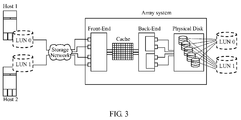
- FIG. 3 is a schematic diagram of network architecture of the storage system in Embodiment 1 of the method for controlling quality of service of a storage system according to the present invention.
- a cache is a large memory arranged between a front-end (Front-End) device and a back-end (Back-End) device of an array system.
- Data read/write performed on a physical disk is implemented by using the cache to cache data when a host sends a data read/write operation, thereby omitting the operation of accessing the physical disks.
- This step is collecting statistics about the processing capability information about the hard disks in the storage system.
- the hard disks herein may specifically be physical disks as shown in FIG. 3 .
- the types of the hard disks may include but are not limited to a solid state disk (Solid State Disk, SSD for short), a serial attached SCSI (Serial Attached SCSI, SAS for short), and a serial advanced technology attachment (Serial Advanced Technology Attachment, SATA for short), where SCSI is short for small computer system interface (Small Computer System Interface).
- this step is collecting the processing capability information about the hard disks included in the current storage system.
- the processing capabilities of the hard disks may be embodied by their types, aging degrees, performance, and the like. Therefore, the processing capability information herein at least includes one of the following: types, the number, and performance of the hard disks, and the processing capabilities of the hard disks are obtained according to the processing capability information.
- Step 202 Divide a cache into multiple tiers according to the processing capabilities of the hard disks, where a cache of each tier separately corresponds to one or more hard disks in the storage system, and a page quota in the cache of each tier is separately pre-allocated according to processing capability information about the one or more hard disks corresponding to the cache of each tier.
- page resources of the cache are divided according to the processing capabilities of the hard disks.
- the cache is divided into multiple tiers, and the cache of each tier separately corresponds to the one or more hard disks in the storage system.
- the page quota in the cache of each tier is separately obtained according to the processing capability information about the one or more hard disks corresponding to the cache of each tier.
- correspondence exists between each tier after the division and the hard disks in the storage system, that is, the cache of each tier corresponds to one or more hard disks.
- the correspondence between the tier and the hard disk is determined according to processing capability information about each hard disk.
- a cache is divided into multiple tiers according to processing capabilities of the hard disks, and when dirty data in a cache of a certain tier reaches a preset proportion, data in the cache of the tier is written into a hard disk corresponding to the cache of the tier.
- the cache is divided into multiple tiers, processing capabilities of hard disks corresponding to each tier are different, and a hard disk with a weak processing capability cannot preempt page resources in a cache corresponding to a hard disk with a strong processing capability.
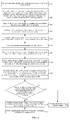
- FIG. 4 is a flowchart of Embodiment 2 of a method for controlling quality of service of a storage system according to the present invention. As shown in FIG. 4 , this embodiment provides a method for controlling quality of service of a storage system. The method may specifically include the following steps:
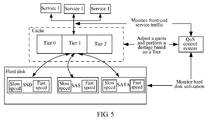
- FIG. 5 is a schematic diagram of an application scenario of Embodiment 2 of the method for controlling quality of service of a storage system according to the present invention. As shown in FIG. 5 , this embodiment is specifically applied to a case where no cache partition mechanism exists and overall cache resources are divided into multiple tiers according to the processing capabilities of the hard disks.
- the core of this embodiment is a QoS control system in FIG. 5 .
- the QoS control system may be deployed inside the storage system or may be deployed outside the storage system for out-of-band management.
- the QoS control system monitors service traffic and other information of the storage system and a utilization rate and other information of a hard disk, so as to divide and adjust the cache.
- the processing capability information at least includes one of the following: the types, the number, and the performance of the hard disks, and the processing capabilities of the hard disks are obtained according to the processing capability information.
- This step is collecting, by the QoS control system, statistics about the types and the number of the hard disks in the storage system.
- the hard disks herein may specifically be the physical disks as shown in FIG. 3 .
- the types of the hard disks may include but are not limited to SSD, SAS, and SATA.
- Step 402 Divide a cache into multiple tiers according to the processing capabilities of the hard disks.
- the QoS control system divides the cache into multiple tiers according to the processing capabilities of the hard disks.
- the processing capabilities of the hard disks are specifically obtained according to a proportion of the number of different types of hard disks
- a page quota in a cache of each tier is separately obtained according to the number of one or more hard disks corresponding to the cache of each tier. Dividing the entire cache into three tiers, that is, tier0, tier1, and tier2, is used as an example for description herein.
- the three tiers separately correspond to a high-speed disk, a medium-speed disk, and a low-speed disk in the hard disks.
- the high-speed, medium-speed, and low-speed disks herein are obtained according to the types of the hard disks.
- the storage system includes three types of hard disks, that is, SSD, SAS, and SATA and the number of the hard disks of each type is four, two, and six. Therefore, the cache may be divided into three tiers, a cache of each tier separately corresponds to a type of hard disks, and page quotas in the three tiers are divided according to the proportion 2:1:3.
- each tier of the cache is separately written, with each tier after the division as a unit, into a hard disk corresponding to the cache of each tier, that is, each tier separately corresponds to one type or more similar types of the hard disks.
- the processing capabilities of the hard disks may be specifically obtained and obtained according to the performance of the hard disks.
- the performance of each hard disk changes due to an impact brought by hard disk aging and the like.
- the performance of the hard disks herein may be current hard disk performance resulting from factors such as swapping, a mechanical failure, and aging in a process of using the hard disks.
- the cache is divided according to the processing capabilities of the hard disks, so that a tier after the division relates to an actual processing capability of each hard disk.
- Step 403 Periodically collect performance statistics information and resource utilization information of the storage system.
- the status of each hard disk is changeable.
- the page quota in the cache of each tier needs to be adjusted periodically to adapt to a status change of the hard disks, so as to improve QoS of the storage system.
- This step is periodically collecting, by the QoS control system, the performance statistics information and the resource utilization information of the storage system.
- the performance statistics information herein includes but is not limited to an average utilization rate of the hard disks and traffic of host services
- the resource utilization information includes but is not limited to utilization information about the page resources in the cache, utilization information about the page quota in the cache of each tier, and utilization information about computing resources.
- the average utilization rate of the hard disks is an average utilization rate of different types of the hard disks
- the traffic of the host services is historical traffic generated by the host services in caches of different tiers
- the utilization information about the page resources in the cache is the utilization of the page resources in the cache
- the utilization information about the page quota of each tier in the cache is the utilization of page resources in different tiers
- the utilization information about the computing resources may be the utilization of computing resources such as a CPU.
- the QoS control system may periodically collect the preceding information according to a preset collection period.
- Step 404 Periodically adjust a page quota in the cache of each tier according to the performance statistics information and the resource utilization information.
- the QoS control system analyzes the average utilization rate of the hard disks, the traffic of the host services, the utilization information about the page resources in the cache, the utilization information about the page quota in the cache of each tier, and the utilization information about the computing resources, decides through the analysis whether to adjust the page quota in the cache of each tier, and performs a specific adjustment according to the collected information.
- the page quota in the cache of each tier herein is a proportion of page resources divided for the cache of each tier in the total page resources in the cache. In the running process of the storage system, the preceding information is different at different time.
- the page quota in the cache of each tier is adjusted according to the collected different information, so that each tier after the division can adapt to a current storage environment more accurately.
- the overall adjustment process is a negative feedback process, and adjusted page quota information becomes a basis for a next adjustment.
- the page quota is being adjusted continuously according to the periodically collected information until the system reaches a steady state.
- the overall adjustment process may be analyzed and decided based on an adaptive intelligent algorithm such as fuzzy control.
- the cache is divided into multiple tiers.
- the division of the cache is adjusted. That is to say, in a process of adjusting the page quota in the cache of the tier after the division, the page quota in the cache of each tier after the division is greater than a preset minimum value of page quotas. That is to say, a minimum quota value exists in each tier after the division and is used for a minimum guarantee to avoid a resource starvation phenomenon in a certain tier.
- Step 405 Collect statistics about utilization information about the cache of each tier.
- a cache destage operation is also controlled according to high and low watermarks.
- the destage operation herein is writing data in the cache into a physical hard disk.
- the destage operation is performed with a tier as a unit. Different from a control manner executed according to the high and low watermarks in the prior art, during specific execution of the destage operation, the control manner with the high and low watermarks is separately applied to the cache of each tier.
- a destage control is separately performed for the cache of each tier and a specific destage policy is determined according to high and low watermarks in each tier.
- This step is collecting, by the QoS control system, statistics about the utilization information about the cache of each tier.
- the utilization information about the cache of each tier herein may include but is not limited to page utilization information of the cache of each tier, an average utilization rate of the hard disk corresponding to the cache of each tier, and service traffic in the cache of each tier.
- the page utilization information of the cache of each tier is the utilization of the page resources in the cache of each tier
- the average utilization rate of the hard disk corresponding to the cache of each tier is an average value of utilization rates of all hard disks corresponding to the cache of each tier
- the service traffic in the cache of each tier is service traffic currently being processed and saved service traffic processed in historical time in the cache of each tier.
- the QoS control system determines, according to the page utilization information of the cache of each tier, the average utilization rate of the hard disk corresponding to the cache of each tier, and the service traffic in the cache of each tier, the tier in which the destage operation is to be executed, that is, decides which tier in which the destage operation is to be executed currently.
- Step 407 Collect statistics about the number of concurrent services that is capable of being currently supported by a hard disk corresponding to the cache of the tier in which the destage operation is to be executed.
- the QoS control system continues to collect statistics about the number of concurrent services that is capable of being currently supported by the hard disk corresponding to the cache of the tier in which the destage operation is to be executed and perform, according to the number of concurrent services, destage processing for the tier in which the destage operation is to be executed.
- Step 408 When dirty data in the cache of each tier reaches a preset proportion, write, with the cache of each tier as a unit and according to the page quota in the cache of each tier and the number of concurrent services that is obtained through statistics, data in the cache of the tier in which the destage operation is to be executed into the corresponding hard disk.
- whether to execute the destage operation and the data amount generated by performing the destage operation are decided by collecting statistics about the page utilization of the cache of the tier in combination with a concurrent status of the hard disk corresponding to the cache of the tier.
- the dirty data in the cache reaches the preset proportion
- the data in the cache of the tier in which the destage operation is to be executed is written, with the cache of each tier as a unit and according to the page quota in the cache of each tier and the number of concurrent services that is obtained through statistics, into the corresponding hard disk.
- the processing capabilities of the hard disks not only relate to the number of the hard disks, but also relate to a service type.
- the number of concurrent services can be dynamically adjusted according the processing capabilities of the hard disks, so that the destage can be more accurately controlled by combining the service traffic, the performance of the hard disks, and the page utilization. This avoids a defect that the hard disk is too busy because of continuous disk brushing in the prior art and increases the life of the hard disk.
- data in the cache of each tier is separately written, with the cache of each tier after the division as a unit, into the hard disk corresponding to the cache of each tier, that is, each tier separately corresponds to a type of hard disks with similar processing capabilities, and the tiers are independent of each other and do not affect each other. Therefore, a phenomenon that a slow-speed disk affects a fast-speed disk does not occur.
- the processing is implemented by using a queuing mechanism based on a page priority of the tier and may specifically include the following steps:
- Step 410 Calculate a request priority of the service resource request according to a service priority of the service and a weighted value corresponding to the cache of the tier.
- the QoS control system calculates the request priority of the service resource request according to the service priority of the service and the weighted value corresponding to the cache of the tier.
- the service priority may be set by the host according to a requirement of a user on a service and the nature of the service, and the weighted value corresponding to the cache of the tier may be set by the QoS control system.
- a request priority of each service resource request can be calculated and obtained according to a service priority of each service and a weighted value in a cache of a tier to which the service belongs.
- Step 411 Perform queuing processing for the service resource request according to the request priority.
- the QoS control system When the page quota in the cache of the tier is insufficient, the QoS control system performs queuing processing for the service resource request in the cache of the tier according to the request priority, arranges a service resource request with a high request priority ahead for prior processing, and arranges a service resource request with a low request priority back for non-prior processing.
- Step 412 Directly process the service resource request.
- the QoS control system does not need to perform queuing processing for the service resource request and may directly process the service resource request to apply for a corresponding page quota.
- Steps 409-412 may be executed before step 408 or they are executed at the same time. Specifically, this is adjusted according to an actual situation.
- a cache is divided into multiple tiers according to the processing capability information about the hard disks, and when dirty data in the cache reaches a preset proportion, data in each tier of the cache is separately written, with a cache of each tier as a unit and according to a page quota in the cache of each tier, into a hard disk corresponding to the cache of each tier.
- cache resources are dynamically divided based on processing capabilities of the hard disks in the storage system, page resources in the entire cache are logically divided into multiple tiers, and quota management and application control are performed.
- the page quota in the cache of each tier is dynamically adjusted according to performance statistics information and resource utilization information of the current storage system, thereby ensuring reasonable utilization of resources.
- destage is performed in a range of a tier. This avoids a problem that a cache page is not released in time due to the hysteresis of a global destage policy adopted in the prior art. In addition, this embodiment avoids a phenomenon of preempting page resources in the cache in the prior art.
- FIG. 6 is a flowchart of Embodiment 3 of a method for controlling quality of service of a storage system according to the present invention. As shown in FIG. 6 , this embodiment provides a method for controlling quality of service of a storage system. The method may specifically include the following steps:
- FIG. 7 is a schematic diagram of an application scenario of Embodiment 3 of the method for controlling quality of service of a storage system according to the present invention. As shown in FIG. 7 , this embodiment is specifically applied to a case where a cache partition mechanism exists and resources in each cache partition are separately divided into multiple tiers according to processing capabilities of hard disks. This step is first dividing the cache into multiple cache partitions according to the service types of the host services. Dividing the cache into cache partition 1, cache partition 2, and cache partition 3 is used as an example for description herein.
- Step 603 Separately divide each cache partition into multiple tiers according to the processing capabilities of the hard disks.
- a QoS control system divides each cache partition into multiple tiers according to the processing capabilities of the hard disks.
- page resources in each cache partition are separately divided according to the processing capabilities of the hard disks.
- each cache partition is separately divided into multiple tiers. Dividing each cache partition into three tiers, that is, tier0, tier1, and tier2, is used as an example for description herein. The three tiers separately correspond to a high-speed disk, a medium-speed disk, and a low-speed disk in the hard disks.
- each tier separately corresponds to one type or more similar types of the hard disks.
- Step 604 Periodically collect performance statistics information and resource utilization information inside the storage system. This step may be similar to step 403, and therefore, no further details are provided herein.
- Step 605 Periodically adjust a page quota in the cache of each tier according to the performance statistics information and the resource utilization information. This step may be similar to step 404, and therefore, no further details are provided herein.
- Step 606 Collect statistics about utilization information about the cache of each tier. This step may be similar to step 405, and therefore, no further details are provided herein.
- Step 607 Determine, according to the utilization information about the cache of each tier, a cache of a tier in which a destage operation is to be executed. This step may be similar to step 406, and therefore, no further details are provided herein.
- Step 608 Collect statistics about the number of concurrent services that is capable of being currently supported by a hard disk corresponding to the cache of the tier. This step may be similar to step 407, and therefore, no further details are provided herein.
- Step 609 When dirty data in the cache of each tier reaches a preset proportion, write, with the cache of each tier as a unit and according to the page quota in the cache of each tier and the number of concurrent services that is obtained through statistics, data in the cache of the tier in which the destage operation is to be executed into the corresponding hard disk.
- This step may be similar to step 408, and therefore, no further details are provided herein.
- Step 610 When a service resource request corresponding to a service is received, where the service resource request carries tier information, determine whether a current page quota in a cache of a tier represented by the tier information is less than a preset quota threshold; and if yes, execute step 611; otherwise, execute step 613.
- This step may be similar to step 409, and therefore, no further details are provided herein.
- Step 611 Calculate a request priority of the service resource request according to a service priority of the service and a weighted value corresponding to the cache of the tier. This step may be similar to step 410, and therefore, no further details are provided herein.
- Step 612 Perform queuing processing for the service resource request according to the request priority. This step may be similar to step 411, and therefore, no further details are provided herein.
- Step 613 Directly process the service resource request. This step may be similar to step 412, and therefore, no further details are provided herein.
- a cache is divided into multiple tiers according to processing capabilities of the hard disks, and when dirty data in a cache of a certain tier reaches a preset proportion, data in the cache of the tier is written into a hard disk corresponding to the cache of the tier.
- the cache is divided into multiple tiers, processing capabilities of hard disks corresponding to each tier are different, and a hard disk with a weak processing capability cannot preempt page resources in a cache corresponding to a hard disk with a strong processing capability.
- the program may be stored in a computer readable storage medium.
- the storage medium may be any medium that is capable of storing program codes, such as a ROM, a RAM, a magnetic disk, or an optical disk.
- FIG. 8 is a schematic structural diagram of Embodiment 1 of a system for controlling quality of service of a storage system according to the present invention.
- this embodiment provides a system for controlling quality of service of a storage system, which is specifically capable of executing the steps in Embodiment 1 of the method. Therefore, no further details are provided herein.
- the system for controlling quality of service of a storage system may specifically include a first statistics module 801, a first dividing module 802, and a destage module 803.
- the first statistics module 801 is configured to collect statistics about processing capability information about hard disks in the storage system, where the processing capability information at least includes one of the following: types, the number, and performance of the hard disks, and obtain processing capabilities of the hard disks according to the processing capability information.
- the first dividing module 802 is configured to divide a cache into multiple tiers according to the processing capabilities of the hard disks, where a cache of each tier separately corresponds to one or more hard disks in the storage system, and a page quota in the cache of each tier is separately pre-allocated according to processing capability information about the one or more hard disks corresponding to the cache of each tier.
- the destage module 803 is configured to write, for a cache of a tier in which dirty data reaches a preset proportion, data in the cache of the tier into a hard disk corresponding to the cache of the tier.
- FIG. 9 is a schematic structural diagram of Embodiment 2 of a system for controlling quality of service of a storage system according to the present invention.
- this embodiment provides a system for controlling quality of service of a storage system, which is specifically capable of executing the steps in Embodiment 2 or Embodiment 3 of the method. Therefore, no further details are provided herein.
- the system for controlling quality of service of a storage system that is provided in this embodiment further includes a second dividing module 901.
- the second dividing module 901 is configured to divide the cache into multiple cache partitions according to service types of host services.
- the first dividing module 802 is specifically configured to separately divide each cache partition into multiple tiers according to the processing capabilities of the hard disks.
- the system for controlling quality of service of a storage system that is provided in this embodiment further includes a collecting module 902 and a page quota adjusting module 903.
- the collecting module 902 is configured to periodically collect performance statistics information and resource utilization information about the storage system, where the performance statistics information includes an average utilization rate of the hard disks and traffic of the host services, and the resource utilization information includes utilization information about page resources in the cache, utilization information about the page quota in the cache of each tier, and utilization information about computing resources.
- the page quota adjusting module 903 is configured to periodically adjust the page quota in the cache of each tier according to the performance statistics information and the resource utilization information. The adjusted page quota in the cache of each tier is greater than a preset minimum value of page quotas.
- the system for controlling quality of service of a storage system that is provided in this embodiment further includes a second statistics module 904, a deciding module 905, and a third statistics module 906.
- the second statistics module 904 is configured to collect statistics about utilization information about the cache of each tier, where the utilization information about the cache of each tier includes page utilization information of the cache of each tier, an average utilization rate of a hard disk corresponding to the cache of each tier, and service traffic in the cache of each tier.
- the deciding module 905 is configured to determine, according to the utilization information about the cache of each tier, a tier in which a destage operation is to be executed.
- the third statistics module 906 is configured to collect statistics about the number of concurrent services that is capable of being currently supported by a hard disk corresponding to the cache of the tier.
- the destage module 803 is specifically configured to write, for the cache of the tier in which the dirty data reaches the preset proportion, according to the number of concurrent services that is obtained through statistics, data in the cache of the tier in which the destage operation is to be executed into the corresponding hard disk.
- the system for controlling quality of service of a storage system that is provided in this embodiment further includes a calculating module 907 and a request controlling module 908.
- the calculating module 907 is configured to: when a service resource request corresponding to a service is received, where the service resource request carries tier information, and if a current page quota in a cache of a tier represented by the tier information is less than a preset quota threshold, calculate a request priority of the service resource request according to a service priority of the service and a weighted value corresponding to the cache of the tier.
- the request controlling module 908 is configured to perform queuing processing for the service resource request according to the request priority.
- the system for controlling quality of service of a storage system in this embodiment may be formed of four modules, namely, a system performance data monitoring module, a cache page dividing and quota adjusting module, a performance data analyzing and deciding module, and an algorithm and rule supporting module.
- the preceding modules may be separately integrated into these four large modules.
- the system performance data monitoring module is mainly responsible for collecting performance information data inside the entire storage system. The data includes but is not limited to the traffic of the host services, the average utilization rate of the hard disks, cache page utilization, utilization of a cache page quota, and utilization of computing resources such as a CPU.
- the algorithm and rule supporting module is mainly responsible for providing various adaptive artificial intelligence algorithms, which include a fuzzy control algorithm, and static rules to assist a performance data analysis in deciding a control point and a control granularity.
- the performance data analyzing and deciding module is mainly responsible for analyzing, with the support of the adaptive algorithms and the static rules, collected performance data to generate a control point and a control granularity for QoS control.
- the cache page dividing and quota adjusting module is mainly responsible for logically dividing a cache page according to hard disk performance and dynamically adjust a page quota of each divided part according to a performance analysis result.
- the first statistics module 801, the collecting module 902, the second statistics module 904, and the third statistics module 906 may be integrated into the system performance data monitoring module; the first dividing module 802, the second dividing module 901, and the page quota adjusting module 903 may be integrated into the cache page dividing and quota adjusting module; the deciding module 905, the destage module 803, and the request controlling module 908 may be integrated into the performance data analyzing and deciding module; and the calculating module 907 may be integrated into the algorithm and rule supporting module.
- a cache is divided into multiple tiers according to processing capabilities of the hard disks, and when dirty data in a cache of a certain tier reaches a preset proportion, data in the cache of the tier is written into a hard disk corresponding to the cache of the tier.
- the cache is divided into multiple tiers, processing capabilities of hard disks corresponding to each tier are different, and a hard disk with a weak processing capability cannot preempt page resources in a cache corresponding to a hard disk with a strong processing capability.
- a cache space corresponding to the hard disk with the strong processing capability can be released in advance. To some extent, this avoids a phenomenon of preempting page resources in the cache in the prior art and avoids an impact of a slow-speed disk on performance of a high-speed disk.
- a page quota in a cache of each tier is dynamically adjusted according to performance statistics information and resource utilization information of the current storage system, thereby ensuring reasonable utilization of resources.
- destage is performed in a range of a tier. This avoids a problem that a cache page is not released in time due to the hysteresis of a global destage policy adopted in the prior art.
- one cache partition is also logically divided into multiple tiers. This solves a page resource preemption problem caused by a fast-speed disk and a slow-speed disk in the same cache partition.
- This embodiment further provides a storage system, which may specifically includes a host, a cache, and the system for controlling quality of service of a storage system as shown in FIG. 8 or FIG. 9 .
Landscapes
- Engineering & Computer Science (AREA)
- Theoretical Computer Science (AREA)
- General Engineering & Computer Science (AREA)
- Physics & Mathematics (AREA)
- General Physics & Mathematics (AREA)
- Computer Hardware Design (AREA)
- Quality & Reliability (AREA)
- Software Systems (AREA)
- Human Computer Interaction (AREA)
- Memory System Of A Hierarchy Structure (AREA)
Description
- The present invention relates to the field of computer technologies, and in particular, to a method and a system for controlling quality of service of a storage system, and a storage system.
- A cache is a component introduced to improve performance of a storage system and is mainly configured to improve input/output (Input/Output, I/O for short) performance of the entire system. Some temporary data is stored in this cache, thereby accelerating an I/O response of a host. For a read operation of the host, the system temporarily stores read data in the cache and the cache can be hit directly during the read operation of the host, thereby omitting the operation of accessing a hard disk. For a write operation of the host, the system directly caches write data of the host into the cache, thereby omitting the operation of writing data into a hard disk. In order to perform the read or write operation smoothly, the data can be prefetched from a hard disk into the cache according to a certain policy, where the data is likely to be read by the host next time. This operation can raise a cache hit ratio. In addition, the data written into the cache can be combined based on a certain combination policy before writing the data into the hard disk, thereby reducing the time of implementing the write operation. As can be seen from the above, for the read operation, the cache hit ratio can be raised by optimizing a prefetch algorithm or increasing the size of the cache, thereby improving the read performance of the entire storage system. However, when the cache is enlarged to a certain extent, a performance improvement of the read operation and an increase in the size of the cache are disproportionate. Quality of service (Quality of Service, QoS for short) is a quality convention on information transmission and sharing between a network and a user and between users that communicate with each other on the network. The quality of service may include a transmission bandwidth, a transmission delay, a packet loss rate of data, and the like. On the network, the quality of service can be improved by taking measures such as ensuring the transmission bandwidth and reducing the transmission delay, the packet loss rate, and delay variation.
- A current storage system supports mixed insertion of various types of hard disks. However, rotational speeds and throughput of different types of disks are different. This always leads to a processing performance difference during destage. In addition, even for disks of a same type, a processing capability difference may also be caused due to manufacturers or an aging problem. In this scenario, data written into a cache cannot be released in time because of a processing capability difference of back-end disks. As a result, a slow-processing disk occupies more and more page resources, and a processing speed of a fast-processing disk is affected because no cache page is allocated to the fast-processing disk. In addition, even the processing performance of the entire system levels off to that of the slowest disk on the system, that is, the cask effect occurs.
- In the prior art, the preceding problem is solved by using a cache partition technology.
FIG. 1 is a schematic diagram of an application scenario of a cache partition technology in the prior art. In the prior art, the cache partition technology is used to divide cache resources into multiple cache partitions according to services on a host, each cache partition corresponds to one or more hosts, and the cache partitions are independent of each other and do not affect each other. However, in the prior art, a page resource preemption phenomenon still occurs in each cache partition. As a result, the performance (such as a transmission delay and a packet loss rate) of a service corresponding to a cache partition is affected by the slowest back-end disk, and the quality of service of the storage system is reduced. - Document
US2005/071599 discloses a method and system for controlling the quality of service of a storage system wherein a cache is divided into multiple tiers according to the processing capabilities of the hard discs of the storage system. - The present invention provides a method and a system for controlling quality of service of a storage system according to the claims.
- To illustrate the technical solutions of the present invention more clearly, the following briefly introduces the accompanying drawings describing embodiments of the present invention or the prior art. Apparently, the accompanying drawings in the following description show merely some embodiments of the present invention.
-
FIG. 1 is a schematic diagram of an application scenario of a cache partition technology in the prior art; -
FIG. 2 is a flowchart ofEmbodiment 1 of a method for controlling quality of service of a storage system according to the present invention; -
FIG. 3 is a schematic diagram of network architecture of the storage system inEmbodiment 1 of the method for controlling quality of service of a storage system according to the present invention; -
FIG. 4 is a flowchart ofEmbodiment 2 of a method for controlling quality of service of a storage system according to the present invention; -
FIG. 5 is a schematic diagram of an application scenario ofEmbodiment 2 of the method for controlling quality of service of a storage system according to the present invention; -
FIG. 6 is a flowchart ofEmbodiment 3 of a method for controlling quality of service of a storage system according to the present invention; -
FIG. 7 is a schematic diagram of an application scenario ofEmbodiment 3 of the method for controlling quality of service of a storage system according to the present invention; -
FIG. 8 is a schematic structural diagram ofEmbodiment 1 of a system for controlling quality of service of a storage system according to the present invention; and -
FIG. 9 is a schematic structural diagram ofEmbodiment 2 of a system for controlling quality of service of a storage system according to the present invention. - To make the objectives, technical solutions, and advantages of the present invention more comprehensible, the following clearly and completely describes the technical solutions of the present invention with reference to the accompanying drawings of embodiments of the present invention. Apparently, the described embodiments are merely a part rather than all of the embodiments of the present invention.
-
FIG. 2 is a flowchart ofEmbodiment 1 of a method for controlling quality of service of a storage system according to the present invention. As shown inFIG. 2 , this embodiment provides a method for controlling quality of service of a storage system. The method may specifically include the following steps: - Step 201: Collect statistics about processing capability information about hard disks in the storage system, where the processing capability information at least includes one of the following: types, the number, and performance of the hard disks, and obtain processing capabilities of the hard disks according to the processing capability information.
-
FIG. 3 is a schematic diagram of network architecture of the storage system inEmbodiment 1 of the method for controlling quality of service of a storage system according to the present invention. As shown inFIG. 3 , a cache is a large memory arranged between a front-end (Front-End) device and a back-end (Back-End) device of an array system. Data read/write performed on a physical disk (Physical Disk) is implemented by using the cache to cache data when a host sends a data read/write operation, thereby omitting the operation of accessing the physical disks. This step is collecting statistics about the processing capability information about the hard disks in the storage system. The hard disks herein may specifically be physical disks as shown inFIG. 3 . The types of the hard disks may include but are not limited to a solid state disk (Solid State Disk, SSD for short), a serial attached SCSI (Serial Attached SCSI, SAS for short), and a serial advanced technology attachment (Serial Advanced Technology Attachment, SATA for short), where SCSI is short for small computer system interface (Small Computer System Interface). Specifically, this step is collecting the processing capability information about the hard disks included in the current storage system. The processing capabilities of the hard disks may be embodied by their types, aging degrees, performance, and the like. Therefore, the processing capability information herein at least includes one of the following: types, the number, and performance of the hard disks, and the processing capabilities of the hard disks are obtained according to the processing capability information. - Step 202: Divide a cache into multiple tiers according to the processing capabilities of the hard disks, where a cache of each tier separately corresponds to one or more hard disks in the storage system, and a page quota in the cache of each tier is separately pre-allocated according to processing capability information about the one or more hard disks corresponding to the cache of each tier.
- After the processing capabilities of the hard disks are obtained, page resources of the cache (cache) are divided according to the processing capabilities of the hard disks. Specifically, the cache is divided into multiple tiers, and the cache of each tier separately corresponds to the one or more hard disks in the storage system. The page quota in the cache of each tier is separately obtained according to the processing capability information about the one or more hard disks corresponding to the cache of each tier. In this embodiment, correspondence exists between each tier after the division and the hard disks in the storage system, that is, the cache of each tier corresponds to one or more hard disks. Specifically, the correspondence between the tier and the hard disk is determined according to processing capability information about each hard disk. For example, if one or more high-speed disks with high processing speeds correspond to one tier, a hard disk corresponding to a cache of the tier is a high-speed disk; if one or more medium-speed disks with medium processing speeds correspond to another tier, a hard disk corresponding to a cache of the tier is a medium-speed disk; and if one or more low-speed disks with low processing speeds correspond to still another tier, a hard disk corresponding to a cache of the tier is a low-speed disk. Step 203: Write, for a cache of a tier in which dirty data reaches a preset proportion, data in the cache of the tier into a hard disk corresponding to the cache of the tier.
- After the cache is divided into multiple tiers in
step 202, this step is as follows: when the dirty data in the cache reaches the preset proportion, for the cache of the tier in which the dirty data reaches the preset proportion, the data in the cache of the tier is written, with a cache of each tier after the division as a unit, into the hard disk corresponding to the cache of the tier. The dirty data refers to data that is cached in the cache and has been modified but not written into the hard disk. The present invention is different from the manner of taking a cache as a unit in the prior art. Therefore, data storage processes of the tiers are independent of each other, and the cache is divided according to the processing capabilities of the hard disks, thereby effectively controlling QoS of the storage system. For example, when the processing capability information is about the types and the number of the hard disks and it is assumed that the storage system includes three types of hard disks, that is, SSD, SAS, and SATA and the number of the hard disks of each type is four, two, and six, the cache can be divided into three tiers, a cache of each tier separately corresponds to a type of hard disks, and page quotas in the three tiers are divided according to the proportion 2:1:3. In this embodiment, after the page resources of the cache are divided into multiple tiers, data in the hard disk corresponding to the cache of each tier is stored separately with the cache of each tier after the division as a unit. That is to say, each tier separately corresponds to a type of hard disks with similar processing capabilities, and the tiers are independent of each other and do not affect each other. Therefore, a phenomenon that a slow-speed disk affects a fast-speed disk does not occur. - According to the method for controlling quality of service of a storage system that is provided in this embodiment, statistics about processing capability information about hard disks in the storage system are collected, a cache is divided into multiple tiers according to processing capabilities of the hard disks, and when dirty data in a cache of a certain tier reaches a preset proportion, data in the cache of the tier is written into a hard disk corresponding to the cache of the tier. In this embodiment of the present invention, the cache is divided into multiple tiers, processing capabilities of hard disks corresponding to each tier are different, and a hard disk with a weak processing capability cannot preempt page resources in a cache corresponding to a hard disk with a strong processing capability. Therefore, a cache space corresponding to the hard disk with the strong processing capability can be released in advance. To some extent, this avoids a phenomenon of preempting page resources in the cache in the prior art and avoids an impact of a slow-speed disk on performance of a high-speed disk.
-
FIG. 4 is a flowchart ofEmbodiment 2 of a method for controlling quality of service of a storage system according to the present invention. As shown inFIG. 4 , this embodiment provides a method for controlling quality of service of a storage system. The method may specifically include the following steps: - Step 401: Collect statistics about processing capability information about hard disks in the storage system, where the processing capability information at least includes one of the following: types, the number, and performance of the hard disks, and obtain processing capabilities of the hard disks according to the processing capability information.
-
FIG. 5 is a schematic diagram of an application scenario ofEmbodiment 2 of the method for controlling quality of service of a storage system according to the present invention. As shown inFIG. 5 , this embodiment is specifically applied to a case where no cache partition mechanism exists and overall cache resources are divided into multiple tiers according to the processing capabilities of the hard disks. The core of this embodiment is a QoS control system inFIG. 5 . The QoS control system may be deployed inside the storage system or may be deployed outside the storage system for out-of-band management. The QoS control system monitors service traffic and other information of the storage system and a utilization rate and other information of a hard disk, so as to divide and adjust the cache. At an initialization stage of the storage system, statistics about the processing capability information about the hard disks in the storage system are collected, where the processing capability information at least includes one of the following: the types, the number, and the performance of the hard disks, and the processing capabilities of the hard disks are obtained according to the processing capability information. This step is collecting, by the QoS control system, statistics about the types and the number of the hard disks in the storage system. The hard disks herein may specifically be the physical disks as shown inFIG. 3 . The types of the hard disks may include but are not limited to SSD, SAS, and SATA. - Step 402: Divide a cache into multiple tiers according to the processing capabilities of the hard disks.
- After the processing capabilities of the hard disks in the storage system are obtained, the QoS control system divides the cache into multiple tiers according to the processing capabilities of the hard disks. When the processing capabilities of the hard disks are specifically obtained according to a proportion of the number of different types of hard disks, after page resources in the cache are divided according to the processing capabilities of the hard disks, a page quota in a cache of each tier is separately obtained according to the number of one or more hard disks corresponding to the cache of each tier. Dividing the entire cache into three tiers, that is, tier0, tier1, and tier2, is used as an example for description herein. The three tiers separately correspond to a high-speed disk, a medium-speed disk, and a low-speed disk in the hard disks. The high-speed, medium-speed, and low-speed disks herein are obtained according to the types of the hard disks. For example, it is assumed that the storage system includes three types of hard disks, that is, SSD, SAS, and SATA and the number of the hard disks of each type is four, two, and six. Therefore, the cache may be divided into three tiers, a cache of each tier separately corresponds to a type of hard disks, and page quotas in the three tiers are divided according to the proportion 2:1:3. In this embodiment, after the page resources in the cache are divided into multiple tiers, data in each tier of the cache is separately written, with each tier after the division as a unit, into a hard disk corresponding to the cache of each tier, that is, each tier separately corresponds to one type or more similar types of the hard disks. In addition, the processing capabilities of the hard disks may be specifically obtained and obtained according to the performance of the hard disks. The performance of each hard disk changes due to an impact brought by hard disk aging and the like. The performance of the hard disks herein may be current hard disk performance resulting from factors such as swapping, a mechanical failure, and aging in a process of using the hard disks. In this embodiment, the cache is divided according to the processing capabilities of the hard disks, so that a tier after the division relates to an actual processing capability of each hard disk.
- Step 403: Periodically collect performance statistics information and resource utilization information of the storage system.
- In a running process of the storage system, the status of each hard disk is changeable. In this embodiment, the page quota in the cache of each tier needs to be adjusted periodically to adapt to a status change of the hard disks, so as to improve QoS of the storage system. This step is periodically collecting, by the QoS control system, the performance statistics information and the resource utilization information of the storage system. The performance statistics information herein includes but is not limited to an average utilization rate of the hard disks and traffic of host services, and the resource utilization information includes but is not limited to utilization information about the page resources in the cache, utilization information about the page quota in the cache of each tier, and utilization information about computing resources. The average utilization rate of the hard disks is an average utilization rate of different types of the hard disks, the traffic of the host services is historical traffic generated by the host services in caches of different tiers, the utilization information about the page resources in the cache is the utilization of the page resources in the cache, the utilization information about the page quota of each tier in the cache is the utilization of page resources in different tiers, and the utilization information about the computing resources may be the utilization of computing resources such as a CPU. In this embodiment, the QoS control system may periodically collect the preceding information according to a preset collection period. Step 404: Periodically adjust a page quota in the cache of each tier according to the performance statistics information and the resource utilization information.
- After the performance statistics information and the resource utilization information inside the storage system are collected, the QoS control system analyzes the average utilization rate of the hard disks, the traffic of the host services, the utilization information about the page resources in the cache, the utilization information about the page quota in the cache of each tier, and the utilization information about the computing resources, decides through the analysis whether to adjust the page quota in the cache of each tier, and performs a specific adjustment according to the collected information. The page quota in the cache of each tier herein is a proportion of page resources divided for the cache of each tier in the total page resources in the cache. In the running process of the storage system, the preceding information is different at different time. Therefore, herein, the page quota in the cache of each tier is adjusted according to the collected different information, so that each tier after the division can adapt to a current storage environment more accurately. In this embodiment, the overall adjustment process is a negative feedback process, and adjusted page quota information becomes a basis for a next adjustment. The page quota is being adjusted continuously according to the periodically collected information until the system reaches a steady state. The overall adjustment process may be analyzed and decided based on an adaptive intelligent algorithm such as fuzzy control.
- Specifically, in this embodiment, at the initialization stage, the cache is divided into multiple tiers. In the running process, the division of the cache is adjusted. That is to say, in a process of adjusting the page quota in the cache of the tier after the division, the page quota in the cache of each tier after the division is greater than a preset minimum value of page quotas. That is to say, a minimum quota value exists in each tier after the division and is used for a minimum guarantee to avoid a resource starvation phenomenon in a certain tier.
- Step 405: Collect statistics about utilization information about the cache of each tier.
- In a destage process of the cache, generally, in a cache in the prior art, high and low watermarks are preset in the entire cache to control a destage operation executed by the cache, and in an existing cache partition technology, for a cache partition, a cache destage operation is also controlled according to high and low watermarks. Specifically, the destage operation herein is writing data in the cache into a physical hard disk. In this embodiment, the destage operation is performed with a tier as a unit. Different from a control manner executed according to the high and low watermarks in the prior art, during specific execution of the destage operation, the control manner with the high and low watermarks is separately applied to the cache of each tier. That is to say, a destage control is separately performed for the cache of each tier and a specific destage policy is determined according to high and low watermarks in each tier. This step is collecting, by the QoS control system, statistics about the utilization information about the cache of each tier. The utilization information about the cache of each tier herein may include but is not limited to page utilization information of the cache of each tier, an average utilization rate of the hard disk corresponding to the cache of each tier, and service traffic in the cache of each tier. The page utilization information of the cache of each tier is the utilization of the page resources in the cache of each tier, the average utilization rate of the hard disk corresponding to the cache of each tier is an average value of utilization rates of all hard disks corresponding to the cache of each tier, and the service traffic in the cache of each tier is service traffic currently being processed and saved service traffic processed in historical time in the cache of each tier.
- Step 406: Determine, according to the utilization information about the cache of each tier, a cache of a tier in which a destage operation is to be executed.
- After the utilization information about the cache of each tier is obtained, the QoS control system determines, according to the page utilization information of the cache of each tier, the average utilization rate of the hard disk corresponding to the cache of each tier, and the service traffic in the cache of each tier, the tier in which the destage operation is to be executed, that is, decides which tier in which the destage operation is to be executed currently.
- Step 407: Collect statistics about the number of concurrent services that is capable of being currently supported by a hard disk corresponding to the cache of the tier in which the destage operation is to be executed.
- After the tier in which the destage operation is to be executed is decided, the QoS control system continues to collect statistics about the number of concurrent services that is capable of being currently supported by the hard disk corresponding to the cache of the tier in which the destage operation is to be executed and perform, according to the number of concurrent services, destage processing for the tier in which the destage operation is to be executed.
- Step 408: When dirty data in the cache of each tier reaches a preset proportion, write, with the cache of each tier as a unit and according to the page quota in the cache of each tier and the number of concurrent services that is obtained through statistics, data in the cache of the tier in which the destage operation is to be executed into the corresponding hard disk.
- In this embodiment, whether to execute the destage operation and the data amount generated by performing the destage operation are decided by collecting statistics about the page utilization of the cache of the tier in combination with a concurrent status of the hard disk corresponding to the cache of the tier. When the dirty data in the cache reaches the preset proportion, the data in the cache of the tier in which the destage operation is to be executed is written, with the cache of each tier as a unit and according to the page quota in the cache of each tier and the number of concurrent services that is obtained through statistics, into the corresponding hard disk. The processing capabilities of the hard disks not only relate to the number of the hard disks, but also relate to a service type.
- Therefore, the number of concurrent services can be dynamically adjusted according the processing capabilities of the hard disks, so that the destage can be more accurately controlled by combining the service traffic, the performance of the hard disks, and the page utilization. This avoids a defect that the hard disk is too busy because of continuous disk brushing in the prior art and increases the life of the hard disk. In this embodiment, after the page resources in the cache are divided into multiple tiers, data in the cache of each tier is separately written, with the cache of each tier after the division as a unit, into the hard disk corresponding to the cache of each tier, that is, each tier separately corresponds to a type of hard disks with similar processing capabilities, and the tiers are independent of each other and do not affect each other. Therefore, a phenomenon that a slow-speed disk affects a fast-speed disk does not occur.
- Further, in this embodiment, when a service of a host is processed based on the tier, the processing is implemented by using a queuing mechanism based on a page priority of the tier and may specifically include the following steps:
- Step 409: When a service resource request corresponding to a service is received, where the service resource request carries tier information, determine whether a current page quota in a cache of a tier represented by the tier information is less than a preset quota threshold; and if yes, execute
step 410; otherwise, execute step 412. - When a certain tier receives a service resource request corresponding to a certain service, where the service resource request carries tier information and the tier information is used to indicate a tier requested by the service resource request, the QoS control system determines whether a current page quota in a cache of the tier is less than the preset quota threshold, where the quota threshold is a preset value that represents whether a page quota in a cache of a tier is insufficient. When the current page quota in the cache of the tier is less than the quota threshold, it indicates that the page quota in the cache of the tier is insufficient and steps 410 and 411 are executed. Otherwise, step 412 is executed.
- Step 410: Calculate a request priority of the service resource request according to a service priority of the service and a weighted value corresponding to the cache of the tier.
- When the current page quota in the cache of the tier is less than the quota threshold, it indicates that the page quota in the cache of the tier is insufficient, and queuing processing needs to be performed for the service resource request. The QoS control system calculates the request priority of the service resource request according to the service priority of the service and the weighted value corresponding to the cache of the tier. The service priority may be set by the host according to a requirement of a user on a service and the nature of the service, and the weighted value corresponding to the cache of the tier may be set by the QoS control system. A request priority of each service resource request can be calculated and obtained according to a service priority of each service and a weighted value in a cache of a tier to which the service belongs.
- Step 411: Perform queuing processing for the service resource request according to the request priority.
- When the page quota in the cache of the tier is insufficient, the QoS control system performs queuing processing for the service resource request in the cache of the tier according to the request priority, arranges a service resource request with a high request priority ahead for prior processing, and arranges a service resource request with a low request priority back for non-prior processing.
- Step 412: Directly process the service resource request.
- When the page quota in the cache of the tier is sufficient, the QoS control system does not need to perform queuing processing for the service resource request and may directly process the service resource request to apply for a corresponding page quota.
- It should be noted that, in this embodiment, there is no sequential limit between steps 409-412 and
step 408. Steps 409-412 may be executed beforestep 408 or they are executed at the same time. Specifically, this is adjusted according to an actual situation. - According to the method for controlling quality of service of a storage system that is provided in this embodiment, statistics about processing capability information about hard disks in the storage system are collected, a cache is divided into multiple tiers according to the processing capability information about the hard disks, and when dirty data in the cache reaches a preset proportion, data in each tier of the cache is separately written, with a cache of each tier as a unit and according to a page quota in the cache of each tier, into a hard disk corresponding to the cache of each tier. In this embodiment, cache resources are dynamically divided based on processing capabilities of the hard disks in the storage system, page resources in the entire cache are logically divided into multiple tiers, and quota management and application control are performed. This avoids an impact of a slow-speed disk on performance of a high-speed disk. In addition, the page quota in the cache of each tier is dynamically adjusted according to performance statistics information and resource utilization information of the current storage system, thereby ensuring reasonable utilization of resources. In this embodiment, destage is performed in a range of a tier. This avoids a problem that a cache page is not released in time due to the hysteresis of a global destage policy adopted in the prior art. In addition, this embodiment avoids a phenomenon of preempting page resources in the cache in the prior art.
-
FIG. 6 is a flowchart ofEmbodiment 3 of a method for controlling quality of service of a storage system according to the present invention. As shown inFIG. 6 , this embodiment provides a method for controlling quality of service of a storage system. The method may specifically include the following steps: - Step 601: Divide a cache into multiple cache partitions according to service types of host services.
-
FIG. 7 is a schematic diagram of an application scenario ofEmbodiment 3 of the method for controlling quality of service of a storage system according to the present invention. As shown inFIG. 7 , this embodiment is specifically applied to a case where a cache partition mechanism exists and resources in each cache partition are separately divided into multiple tiers according to processing capabilities of hard disks. This step is first dividing the cache into multiple cache partitions according to the service types of the host services. Dividing the cache intocache partition 1,cache partition 2, andcache partition 3 is used as an example for description herein. - Step 602: Collect statistics about processing capability information about hard disks in the storage system, where the processing capability information at least includes one of the following: types, the number, and performance of the hard disks, and obtain processing capabilities of the hard disks according to the processing capability information. This step may be similar to step 401 and therefore, no further details are provided herein.
- Step 603: Separately divide each cache partition into multiple tiers according to the processing capabilities of the hard disks.
- After the processing capabilities of the hard disks in the storage system are obtained, a QoS control system divides each cache partition into multiple tiers according to the processing capabilities of the hard disks. When the processing capabilities of the hard disks are specifically obtained according to a proportion of the number of different types of hard disks, page resources in each cache partition are separately divided according to the processing capabilities of the hard disks. Specifically, each cache partition is separately divided into multiple tiers. Dividing each cache partition into three tiers, that is, tier0, tier1, and tier2, is used as an example for description herein. The three tiers separately correspond to a high-speed disk, a medium-speed disk, and a low-speed disk in the hard disks. In this embodiment, after the page resources in the cache partition are divided into multiple tiers, data in a hard disk corresponding to a cache of each tier is separately stored with the cache of each tier after the division as a unit, that is, each tier separately corresponds to one type or more similar types of the hard disks.
- Step 604: Periodically collect performance statistics information and resource utilization information inside the storage system. This step may be similar to step 403, and therefore, no further details are provided herein.
- Step 605: Periodically adjust a page quota in the cache of each tier according to the performance statistics information and the resource utilization information. This step may be similar to step 404, and therefore, no further details are provided herein.
- Step 606: Collect statistics about utilization information about the cache of each tier. This step may be similar to step 405, and therefore, no further details are provided herein.
- Step 607: Determine, according to the utilization information about the cache of each tier, a cache of a tier in which a destage operation is to be executed. This step may be similar to step 406, and therefore, no further details are provided herein.
- Step 608: Collect statistics about the number of concurrent services that is capable of being currently supported by a hard disk corresponding to the cache of the tier. This step may be similar to step 407, and therefore, no further details are provided herein.
- Step 609: When dirty data in the cache of each tier reaches a preset proportion, write, with the cache of each tier as a unit and according to the page quota in the cache of each tier and the number of concurrent services that is obtained through statistics, data in the cache of the tier in which the destage operation is to be executed into the corresponding hard disk. This step may be similar to step 408, and therefore, no further details are provided herein.
- Step 610: When a service resource request corresponding to a service is received, where the service resource request carries tier information, determine whether a current page quota in a cache of a tier represented by the tier information is less than a preset quota threshold; and if yes, execute
step 611; otherwise, executestep 613. This step may be similar to step 409, and therefore, no further details are provided herein. - Step 611: Calculate a request priority of the service resource request according to a service priority of the service and a weighted value corresponding to the cache of the tier. This step may be similar to step 410, and therefore, no further details are provided herein.
- Step 612: Perform queuing processing for the service resource request according to the request priority. This step may be similar to step 411, and therefore, no further details are provided herein. Step 613: Directly process the service resource request. This step may be similar to step 412, and therefore, no further details are provided herein.
- According to the method for controlling quality of service of a storage system that is provided in this embodiment, statistics about processing capability information about hard disks in the storage system are collected, a cache is divided into multiple tiers according to processing capabilities of the hard disks, and when dirty data in a cache of a certain tier reaches a preset proportion, data in the cache of the tier is written into a hard disk corresponding to the cache of the tier. In this embodiment of the present invention, the cache is divided into multiple tiers, processing capabilities of hard disks corresponding to each tier are different, and a hard disk with a weak processing capability cannot preempt page resources in a cache corresponding to a hard disk with a strong processing capability. Therefore, a cache space corresponding to the hard disk with the strong processing capability can be released in advance. To some extent, this avoids a phenomenon of preempting page resources in the cache in the prior art and avoids an impact of a slow-speed disk on performance of a high-speed disk. In addition, a page quota in a cache of each tier is dynamically adjusted according to performance statistics information and resource utilization information of the current storage system, thereby ensuring reasonable utilization of resources. In this embodiment, destage is performed in a range of a tier. This avoids a problem that a cache page is not released in time due to the hysteresis of a global destage policy adopted in the prior art. In addition to cache partitioning in this embodiment, one cache partition is also logically divided into multiple tiers. This solves a page resource preemption problem caused by a fast-speed disk and a slow-speed disk in the same cache partition.
- Persons of ordinary skill in the art should understand that, all or part of the steps of the methods in the embodiments may be implemented by a program instructing relevant hardware. The program may be stored in a computer readable storage medium. When the program is run, the steps of the methods in the embodiments are performed. The storage medium may be any medium that is capable of storing program codes, such as a ROM, a RAM, a magnetic disk, or an optical disk.
-
FIG. 8 is a schematic structural diagram ofEmbodiment 1 of a system for controlling quality of service of a storage system according to the present invention. As shown inFIG. 8 , this embodiment provides a system for controlling quality of service of a storage system, which is specifically capable of executing the steps inEmbodiment 1 of the method. Therefore, no further details are provided herein. The system for controlling quality of service of a storage system that is provided in this embodiment may specifically include afirst statistics module 801, afirst dividing module 802, and adestage module 803. Thefirst statistics module 801 is configured to collect statistics about processing capability information about hard disks in the storage system, where the processing capability information at least includes one of the following: types, the number, and performance of the hard disks, and obtain processing capabilities of the hard disks according to the processing capability information. Thefirst dividing module 802 is configured to divide a cache into multiple tiers according to the processing capabilities of the hard disks, where a cache of each tier separately corresponds to one or more hard disks in the storage system, and a page quota in the cache of each tier is separately pre-allocated according to processing capability information about the one or more hard disks corresponding to the cache of each tier. Thedestage module 803 is configured to write, for a cache of a tier in which dirty data reaches a preset proportion, data in the cache of the tier into a hard disk corresponding to the cache of the tier. -
FIG. 9 is a schematic structural diagram ofEmbodiment 2 of a system for controlling quality of service of a storage system according to the present invention. As shown inFIG. 9 , this embodiment provides a system for controlling quality of service of a storage system, which is specifically capable of executing the steps inEmbodiment 2 orEmbodiment 3 of the method. Therefore, no further details are provided herein. Based on what is shown inFIG. 8 , the system for controlling quality of service of a storage system that is provided in this embodiment further includes asecond dividing module 901. Thesecond dividing module 901 is configured to divide the cache into multiple cache partitions according to service types of host services. Thefirst dividing module 802 is specifically configured to separately divide each cache partition into multiple tiers according to the processing capabilities of the hard disks. - Further, the system for controlling quality of service of a storage system that is provided in this embodiment further includes a
collecting module 902 and a pagequota adjusting module 903. The collectingmodule 902 is configured to periodically collect performance statistics information and resource utilization information about the storage system, where the performance statistics information includes an average utilization rate of the hard disks and traffic of the host services, and the resource utilization information includes utilization information about page resources in the cache, utilization information about the page quota in the cache of each tier, and utilization information about computing resources. The pagequota adjusting module 903 is configured to periodically adjust the page quota in the cache of each tier according to the performance statistics information and the resource utilization information. The adjusted page quota in the cache of each tier is greater than a preset minimum value of page quotas. - Further, the system for controlling quality of service of a storage system that is provided in this embodiment further includes a
second statistics module 904, a decidingmodule 905, and athird statistics module 906. Thesecond statistics module 904 is configured to collect statistics about utilization information about the cache of each tier, where the utilization information about the cache of each tier includes page utilization information of the cache of each tier, an average utilization rate of a hard disk corresponding to the cache of each tier, and service traffic in the cache of each tier. The decidingmodule 905 is configured to determine, according to the utilization information about the cache of each tier, a tier in which a destage operation is to be executed. Thethird statistics module 906 is configured to collect statistics about the number of concurrent services that is capable of being currently supported by a hard disk corresponding to the cache of the tier. - The
destage module 803 is specifically configured to write, for the cache of the tier in which the dirty data reaches the preset proportion, according to the number of concurrent services that is obtained through statistics, data in the cache of the tier in which the destage operation is to be executed into the corresponding hard disk. - Further, the system for controlling quality of service of a storage system that is provided in this embodiment further includes a calculating
module 907 and arequest controlling module 908. The calculatingmodule 907 is configured to: when a service resource request corresponding to a service is received, where the service resource request carries tier information, and if a current page quota in a cache of a tier represented by the tier information is less than a preset quota threshold, calculate a request priority of the service resource request according to a service priority of the service and a weighted value corresponding to the cache of the tier. Therequest controlling module 908 is configured to perform queuing processing for the service resource request according to the request priority. - In a practical application, the system for controlling quality of service of a storage system in this embodiment may be formed of four modules, namely, a system performance data monitoring module, a cache page dividing and quota adjusting module, a performance data analyzing and deciding module, and an algorithm and rule supporting module. The preceding modules may be separately integrated into these four large modules. The system performance data monitoring module is mainly responsible for collecting performance information data inside the entire storage system. The data includes but is not limited to the traffic of the host services, the average utilization rate of the hard disks, cache page utilization, utilization of a cache page quota, and utilization of computing resources such as a CPU. The algorithm and rule supporting module is mainly responsible for providing various adaptive artificial intelligence algorithms, which include a fuzzy control algorithm, and static rules to assist a performance data analysis in deciding a control point and a control granularity. The performance data analyzing and deciding module is mainly responsible for analyzing, with the support of the adaptive algorithms and the static rules, collected performance data to generate a control point and a control granularity for QoS control. The cache page dividing and quota adjusting module is mainly responsible for logically dividing a cache page according to hard disk performance and dynamically adjust a page quota of each divided part according to a performance analysis result. The
first statistics module 801, the collectingmodule 902, thesecond statistics module 904, and thethird statistics module 906 may be integrated into the system performance data monitoring module; thefirst dividing module 802, thesecond dividing module 901, and the pagequota adjusting module 903 may be integrated into the cache page dividing and quota adjusting module; the decidingmodule 905, thedestage module 803, and therequest controlling module 908 may be integrated into the performance data analyzing and deciding module; and the calculatingmodule 907 may be integrated into the algorithm and rule supporting module. - According to the system for controlling quality of service of a storage system that is provided in this embodiment, statistics about processing capability information about hard disks in the storage system are collected, a cache is divided into multiple tiers according to processing capabilities of the hard disks, and when dirty data in a cache of a certain tier reaches a preset proportion, data in the cache of the tier is written into a hard disk corresponding to the cache of the tier. In this embodiment of the present invention, the cache is divided into multiple tiers, processing capabilities of hard disks corresponding to each tier are different, and a hard disk with a weak processing capability cannot preempt page resources in a cache corresponding to a hard disk with a strong processing capability. Therefore, a cache space corresponding to the hard disk with the strong processing capability can be released in advance. To some extent, this avoids a phenomenon of preempting page resources in the cache in the prior art and avoids an impact of a slow-speed disk on performance of a high-speed disk. In addition, a page quota in a cache of each tier is dynamically adjusted according to performance statistics information and resource utilization information of the current storage system, thereby ensuring reasonable utilization of resources. In this embodiment, destage is performed in a range of a tier. This avoids a problem that a cache page is not released in time due to the hysteresis of a global destage policy adopted in the prior art. In addition to cache partitioning in this embodiment, one cache partition is also logically divided into multiple tiers. This solves a page resource preemption problem caused by a fast-speed disk and a slow-speed disk in the same cache partition.
- This embodiment further provides a storage system, which may specifically includes a host, a cache, and the system for controlling quality of service of a storage system as shown in
FIG. 8 or FIG. 9 . - Finally, it should be noted that, the foregoing embodiments are merely intended for describing the technical solutions of the present invention rather than limiting the present invention.
Claims (9)
- A method for controlling quality of service of a storage system, comprising:collecting (201) statistics about processing capability information about hard disks in the storage system, wherein the processing capability information at least comprises one of the following: types, the number, and performance of the hard disks;obtaining (201) processing capabilities of the hard disks according to the processing capability information;characterised by:dividing (601) a cache into multiple cache partitions according to service types of host services;dividing (202) separately each cache partition into multiple tiers according to the processing capabilities of the hard disks, wherein a cache of each tier separately corresponds to one or more hard disks in the storage system, and a page quota in the cache of each tier is separately pre-allocated according to processing capability information about the one or more hard disks corresponding to the cache of each tier; andwriting (203), for a cache of a tier in which dirty data reaches a preset proportion, data in the cache of the tier into a hard disk corresponding to the cache of the tier.
- The method according to claim 1, further comprising:periodically collecting performance statistics information and resource utilization information about the storage system, wherein the performance statistics information comprises an average utilization rate of the hard disks and traffic of the host services, and the resource utilization information comprises utilization information about page resources in the cache, utilization information about the page quota in the cache of each tier, and utilization information about computing resources; andperiodically adjusting (404) the page quota in the cache of each tier according to the performance statistics information and the resource utilization information, wherein:the adjusted page quota in the cache of each tier is greater than a preset minimum value of page quotas.
- The method according to claim 1, further comprising:collecting (405) statistics about utilization information about the cache of each tier, wherein the utilization information about the cache of each tier comprises page utilization information of the cache of each tier, an average utilization rate of a hard disk corresponding to the cache of each tier, and service traffic in the cache of each tier;determining (406), according to the utilization information about the cache of each tier, a cache of a tier in which a destage operation is to be executed; andcollecting (407) statistics about the number of concurrent services that is capable of being currently supported by a hard disk corresponding to the cache of the tier in which the destage operation is to be executed, wherein:the step of writing data in the cache of the tier into a hard disk corresponding to the cache of the tier specifically is:writing, according to the number of concurrent services that is obtained through statistics, data in the cache of the tier in which the destage operation is to be executed into the corresponding hard disk.
- The method according to claim 1, further comprising:when a service resource request corresponding to a service is received, wherein the service resource request carries tier information, and if a current page quota in a cache of a tier represented by the tier information is less than a preset quota threshold, calculating a request priority of the service resource request according to a service priority of the service and a weighted value corresponding to the cache of the tier; andperforming (411) queuing processing for the service resource request according to the request priority.
- A system for controlling quality of service of a storage system, comprising: a first statistics module (801), configured to collect statistics about processing capability information about hard disks in the storage system, wherein the processing capability information at least comprises one of the following: types, the number, and performance of the hard disks, and obtain processing capabilities of the hard disks according to the processing capability information;
characterised in that:the system further comprises:dividing module (901), configured to divide a cache into multiple cache partitions according to service types of host services;a first dividing module (802), configured to separately divide each cache partition into multiple tiers according to the processing capabilities of the hard disks, wherein a cache of each tier separately corresponds to one or more hard disks in the storage system, and a page quota in the cache of each tier is separately pre-allocated according to processing capability information about the one or more hard disks corresponding to the cache of each tier; anda destage module (803), configured to write, for a cache of a tier in which dirty data reaches a preset proportion, data in the cache of the tier into a hard disk corresponding to the cache of the tier. - The system according to claim 5, further comprising:a collecting module (902), configured to periodically collect performance statistics information and resource utilization information about the storage system, wherein the performance statistics information comprises an average utilization rate of the hard disks and traffic of the host services, and the resource utilization information comprises utilization information about page resources in the cache, utilization information about the page quota in the cache of each tier, and utilization information about computing resources; anda page quota adjusting module (903), configured to periodically adjust the page quota in the cache of each tier according to the performance statistics information and the resource utilization information, wherein:the adjusted page quota in the cache of each tier is greater than a preset minimum value of page quotas.
- The system according to claim 5, further comprising:a second statistics module (904), configured to collect statistics about utilization information about the cache of each tier, wherein the utilization information about the cache of each tier comprises page utilization information of the cache of each tier, an average utilization rate of a hard disk corresponding to the cache of each tier, and service traffic in the cache of each tier;a deciding module (905), configured to determine, according to the utilization information about the cache of each tier, a tier in which a destage operation is to be executed; anda third statistics module (906), configured to collect statistics about the number of concurrent services that is capable of being currently supported by a hard disk corresponding to the cache of the tier in which the destage operation is to be executed, wherein:the destage module (803) is specifically configured to write, for the cache of the tier in which the dirty data reaches the preset proportion, according to the number of concurrent services that is obtained through statistics, data in the cache of the tier in which the destage operation is to be executed into the corresponding hard disk.
- The system according to claim 5, further comprising:a calculating module (907), configured to: when a service resource request corresponding to a service is received, wherein the service resource request carries tier information, and if a current page quota in a cache of a tier represented by the tier information is less than a preset quota threshold, calculate a request priority of the service resource request according to a service priority of the service and a weighted value corresponding to the cache of the tier; anda request controlling module (908), configured to perform queuing processing for the service resource request according to the request priority.
- A storage system for controlling quality of service of the storage system, characterized in that system for controlling quality of service of the storage system comprises the storage system according to any one of claims 5-8 and a host and a cache.
Applications Claiming Priority (2)
| Application Number | Priority Date | Filing Date | Title |
|---|---|---|---|
| CN201110370798.5A CN102508619B (en) | 2011-11-21 | 2011-11-21 | Memory system, and method and system for controlling service quality of memory system |
| PCT/CN2012/083171 WO2013075560A1 (en) | 2011-11-21 | 2012-10-19 | Method and system for controlling quality of service of storage system, and storage system |
Publications (3)
| Publication Number | Publication Date |
|---|---|
| EP2713278A1 EP2713278A1 (en) | 2014-04-02 |
| EP2713278A4 EP2713278A4 (en) | 2014-06-25 |
| EP2713278B1 true EP2713278B1 (en) | 2016-09-21 |
Family
ID=46220714
Family Applications (1)
| Application Number | Title | Priority Date | Filing Date |
|---|---|---|---|
| EP12851880.0A Active EP2713278B1 (en) | 2011-11-21 | 2012-10-19 | Method and system for controlling quality of service of storage system, and storage system |
Country Status (4)
| Country | Link |
|---|---|
| US (1) | US8909868B2 (en) |
| EP (1) | EP2713278B1 (en) |
| CN (1) | CN102508619B (en) |
| WO (1) | WO2013075560A1 (en) |
Families Citing this family (63)
| Publication number | Priority date | Publication date | Assignee | Title |
|---|---|---|---|---|
| CN102508619B (en) * | 2011-11-21 | 2014-09-17 | 华为数字技术(成都)有限公司 | Memory system, and method and system for controlling service quality of memory system |
| JP6131170B2 (en) * | 2013-10-29 | 2017-05-17 | 株式会社日立製作所 | Computer system and data arrangement control method |
| JP6273773B2 (en) * | 2013-10-30 | 2018-02-07 | 富士ゼロックス株式会社 | Information processing apparatus, information processing system, and program |
| CN103577349B (en) * | 2013-11-06 | 2016-11-23 | 华为技术有限公司 | Select the method and apparatus that data carry out brush in the caches |
| CN104679589A (en) * | 2013-11-27 | 2015-06-03 | 中兴通讯股份有限公司 | System resource balance adjustment method and device |
| US10459892B2 (en) | 2014-04-23 | 2019-10-29 | Qumulo, Inc. | Filesystem hierarchical aggregate metrics |
| US9671959B2 (en) * | 2014-12-02 | 2017-06-06 | Western Digital Technologies, Inc. | Tiered sub-unit throughputs in mass storage assemblies |
| US9946465B1 (en) * | 2014-12-31 | 2018-04-17 | EMC IP Holding Company LLC | Adaptive learning techniques for determining expected service levels |
| US9836480B2 (en) | 2015-01-12 | 2017-12-05 | Qumulo, Inc. | Filesystem capacity and performance metrics and visualizations |
| US11132336B2 (en) | 2015-01-12 | 2021-09-28 | Qumulo, Inc. | Filesystem hierarchical capacity quantity and aggregate metrics |
| CN106484310B (en) * | 2015-08-31 | 2020-01-10 | 华为数字技术(成都)有限公司 | Storage array operation method and device |
| CN106502592A (en) * | 2016-10-26 | 2017-03-15 | 郑州云海信息技术有限公司 | Solid state hard disc caching block recovery method and system |
| US10095729B2 (en) | 2016-12-09 | 2018-10-09 | Qumulo, Inc. | Managing storage quotas in a shared storage system |
| CN107196866B (en) * | 2017-06-19 | 2020-09-01 | 阿里巴巴集团控股有限公司 | Flow control method and device |
| US10073856B1 (en) | 2018-04-30 | 2018-09-11 | Qumulo, Inc. | Continuous replication for secure distributed filesystems |
| US11360936B2 (en) | 2018-06-08 | 2022-06-14 | Qumulo, Inc. | Managing per object snapshot coverage in filesystems |
| CN109271111A (en) * | 2018-09-26 | 2019-01-25 | 郑州云海信息技术有限公司 | A kind of method for refreshing data, device and computer readable storage medium |
| US10621147B1 (en) | 2018-12-19 | 2020-04-14 | Qumulo, Inc. | Replicating file system objects in distributed file systems |
| CN109669796B (en) * | 2018-12-20 | 2022-02-11 | 湖南快乐阳光互动娱乐传媒有限公司 | Disk fault prediction method and device |
| US10534758B1 (en) | 2018-12-20 | 2020-01-14 | Qumulo, Inc. | File system cache tiers |
| US10474635B1 (en) * | 2018-12-21 | 2019-11-12 | Qumulo, Inc. | Dynamic evaluation and selection of file system pre-fetch policy |
| US10614033B1 (en) | 2019-01-30 | 2020-04-07 | Qumulo, Inc. | Client aware pre-fetch policy scoring system |
| US11151092B2 (en) | 2019-01-30 | 2021-10-19 | Qumulo, Inc. | Data replication in distributed file systems |
| CN110362275B (en) * | 2019-07-10 | 2021-09-07 | 深圳大普微电子科技有限公司 | Method for improving service quality of solid-state hard disk and solid-state hard disk |
| CN110620818B (en) * | 2019-09-18 | 2022-04-05 | 东软集团股份有限公司 | Method, device and related equipment for realizing node distribution |
| US10725977B1 (en) | 2019-10-21 | 2020-07-28 | Qumulo, Inc. | Managing file system state during replication jobs |
| CN111198786B (en) * | 2019-12-30 | 2023-08-22 | 深圳创新科技术有限公司 | Method and device for cache disk supporting hot swap |
| US10860372B1 (en) | 2020-01-24 | 2020-12-08 | Qumulo, Inc. | Managing throughput fairness and quality of service in file systems |
| US10795796B1 (en) | 2020-01-24 | 2020-10-06 | Qumulo, Inc. | Predictive performance analysis for file systems |
| US11151001B2 (en) | 2020-01-28 | 2021-10-19 | Qumulo, Inc. | Recovery checkpoints for distributed file systems |
| US10860414B1 (en) | 2020-01-31 | 2020-12-08 | Qumulo, Inc. | Change notification in distributed file systems |
| CN111352589B (en) * | 2020-02-24 | 2021-12-10 | 苏州浪潮智能科技有限公司 | Distributed storage method, device, equipment and readable medium |
| US10936551B1 (en) | 2020-03-30 | 2021-03-02 | Qumulo, Inc. | Aggregating alternate data stream metrics for file systems |
| US10936538B1 (en) | 2020-03-30 | 2021-03-02 | Qumulo, Inc. | Fair sampling of alternate data stream metrics for file systems |
| CN111555791B (en) * | 2020-03-31 | 2022-04-08 | 北京控制工程研究所 | A high-reliability and high-frequency satellite wireless data acquisition system and method |
| CN111694635B (en) * | 2020-04-17 | 2025-11-07 | 新华三大数据技术有限公司 | Service quality control method and device |
| US11775481B2 (en) | 2020-09-30 | 2023-10-03 | Qumulo, Inc. | User interfaces for managing distributed file systems |
| CN112306901B (en) * | 2020-11-16 | 2022-07-29 | 新华三大数据技术有限公司 | Disk refreshing method and device based on layered storage system, electronic equipment and medium |
| US11157458B1 (en) | 2021-01-28 | 2021-10-26 | Qumulo, Inc. | Replicating files in distributed file systems using object-based data storage |
| CN113031858B (en) * | 2021-02-10 | 2022-09-20 | 山东英信计算机技术有限公司 | A data processing method, system and medium based on multiple active-active storage |
| US11461241B2 (en) | 2021-03-03 | 2022-10-04 | Qumulo, Inc. | Storage tier management for file systems |
| US11132126B1 (en) | 2021-03-16 | 2021-09-28 | Qumulo, Inc. | Backup services for distributed file systems in cloud computing environments |
| US11567660B2 (en) | 2021-03-16 | 2023-01-31 | Qumulo, Inc. | Managing cloud storage for distributed file systems |
| US11669255B2 (en) | 2021-06-30 | 2023-06-06 | Qumulo, Inc. | Distributed resource caching by reallocation of storage caching using tokens and agents with non-depleted cache allocations |
| CN115981548A (en) | 2021-10-14 | 2023-04-18 | 华为技术有限公司 | A flow control method and device |
| US11294604B1 (en) | 2021-10-22 | 2022-04-05 | Qumulo, Inc. | Serverless disk drives based on cloud storage |
| US11354273B1 (en) | 2021-11-18 | 2022-06-07 | Qumulo, Inc. | Managing usable storage space in distributed file systems |
| US11599508B1 (en) | 2022-01-31 | 2023-03-07 | Qumulo, Inc. | Integrating distributed file systems with object stores |
| US12346290B2 (en) | 2022-07-13 | 2025-07-01 | Qumulo, Inc. | Workload allocation for file system maintenance |
| US11722150B1 (en) | 2022-09-28 | 2023-08-08 | Qumulo, Inc. | Error resistant write-ahead log |
| US11729269B1 (en) | 2022-10-26 | 2023-08-15 | Qumulo, Inc. | Bandwidth management in distributed file systems |
| CN115469817A (en) * | 2022-11-03 | 2022-12-13 | 广东睿江云计算股份有限公司 | Method and device for improving quality of service (QoS) of disk, computer equipment and storage medium |
| US11966592B1 (en) | 2022-11-29 | 2024-04-23 | Qumulo, Inc. | In-place erasure code transcoding for distributed file systems |
| US12292853B1 (en) | 2023-11-06 | 2025-05-06 | Qumulo, Inc. | Object-based storage with garbage collection and data consolidation |
| US11934660B1 (en) | 2023-11-07 | 2024-03-19 | Qumulo, Inc. | Tiered data storage with ephemeral and persistent tiers |
| US11921677B1 (en) | 2023-11-07 | 2024-03-05 | Qumulo, Inc. | Sharing namespaces across file system clusters |
| US12222903B1 (en) | 2024-08-09 | 2025-02-11 | Qumulo, Inc. | Global namespaces for distributed file systems |
| CN119476331A (en) * | 2024-10-25 | 2025-02-18 | 常州宝捷冲片有限公司 | Intelligent identification and tracing system and working method |
| US12443568B1 (en) | 2024-11-12 | 2025-10-14 | Qumulo, Inc. | Verifying performance characteristics of network infrastructure for file systems |
| US12481625B1 (en) | 2024-11-12 | 2025-11-25 | Qumulo, Inc. | Integrating file system operations with network infrastructure |
| CN119987685B (en) * | 2025-04-14 | 2025-10-24 | 深圳市多美达数码科技有限公司 | A multi-layer data cache dynamic management method and system |
| US12585563B1 (en) | 2025-12-01 | 2026-03-24 | Qumulo, Inc. | Caching for object stores |
| US12619582B1 (en) | 2025-12-02 | 2026-05-05 | Qumulo, Inc. | Managing file system transaction dependencies |
Family Cites Families (10)
| Publication number | Priority date | Publication date | Assignee | Title |
|---|---|---|---|---|
| US6324621B2 (en) * | 1998-06-10 | 2001-11-27 | International Business Machines Corporation | Data caching with a partially compressed cache |
| US7107403B2 (en) * | 2003-09-30 | 2006-09-12 | International Business Machines Corporation | System and method for dynamically allocating cache space among different workload classes that can have different quality of service (QoS) requirements where the system and method may maintain a history of recently evicted pages for each class and may determine a future cache size for the class based on the history and the QoS requirements |
| JP4819369B2 (en) * | 2005-02-15 | 2011-11-24 | 株式会社日立製作所 | Storage system |
| JP4813843B2 (en) * | 2005-08-04 | 2011-11-09 | 株式会社日立製作所 | Storage device, disk cache control method, and disk cache capacity allocation method |
| JP2008181243A (en) * | 2007-01-23 | 2008-08-07 | Hitachi Ltd | A database management system that controls the setting of the cache partition area of the storage system |
| US8074028B2 (en) * | 2007-03-12 | 2011-12-06 | Citrix Systems, Inc. | Systems and methods of providing a multi-tier cache |
| CN101135994B (en) * | 2007-09-07 | 2010-06-23 | 杭州华三通信技术有限公司 | Method and apparatus for dividing buffer memory space and buffer memory controller thereof |
| CN101373445B (en) * | 2008-09-09 | 2011-10-26 | 创新科存储技术(深圳)有限公司 | Method and apparatus for scheduling memory |
| CN101609432B (en) * | 2009-07-13 | 2011-04-13 | 中国科学院计算技术研究所 | Shared cache management system and method thereof |
| CN102508619B (en) * | 2011-11-21 | 2014-09-17 | 华为数字技术(成都)有限公司 | Memory system, and method and system for controlling service quality of memory system |
-
2011
- 2011-11-21 CN CN201110370798.5A patent/CN102508619B/en active Active
-
2012
- 2012-10-19 WO PCT/CN2012/083171 patent/WO2013075560A1/en not_active Ceased
- 2012-10-19 EP EP12851880.0A patent/EP2713278B1/en active Active
-
2014
- 2014-05-21 US US14/283,783 patent/US8909868B2/en active Active
Also Published As
| Publication number | Publication date |
|---|---|
| WO2013075560A1 (en) | 2013-05-30 |
| US20140258609A1 (en) | 2014-09-11 |
| EP2713278A1 (en) | 2014-04-02 |
| US8909868B2 (en) | 2014-12-09 |
| CN102508619A (en) | 2012-06-20 |
| CN102508619B (en) | 2014-09-17 |
| EP2713278A4 (en) | 2014-06-25 |
Similar Documents
| Publication | Publication Date | Title |
|---|---|---|
| US8909868B2 (en) | Quality of service control method for storage system | |
| JP3933027B2 (en) | Cache memory partition management method in disk array system | |
| US10185592B2 (en) | Network storage device using dynamic weights based on resource utilization | |
| US10387202B2 (en) | Quality of service implementation in a networked storage system with hierarchical schedulers | |
| US9342245B2 (en) | Method and system for allocating a resource of a storage device to a storage optimization operation | |
| US20130166727A1 (en) | Management of Storage System Access Based on Client Performance and Cluser Health | |
| US9658959B2 (en) | Cache resource manager | |
| CN118672520B (en) | Hierarchical storage method and device for file data, medium and electronic equipment | |
| CN110674064B (en) | A data transmission method, apparatus, device and computer-readable storage medium | |
| US9734048B2 (en) | Storage management device, performance adjustment method, and computer-readable recording medium | |
| CN114115702B (en) | Storage control method, storage control device, storage system and storage medium | |
| CN106569728B (en) | Multi-disk array RAID shared write cache processing method and device | |
| US10761726B2 (en) | Resource fairness control in distributed storage systems using congestion data | |
| US7930481B1 (en) | Controlling cached write operations to storage arrays | |
| CN120428922B (en) | A disk scheduling method | |
| CN119473139B (en) | Command management methods, storage controller chips, and flash memory devices | |
| US11055218B2 (en) | Apparatus and methods for accelerating tasks during storage caching/tiering in a computing environment | |
| CN117891416A (en) | SCSI protocol-based unmapping operation optimization method, device and readable medium | |
| CN106484310B (en) | Storage array operation method and device | |
| CN112463075B (en) | Data reading and writing method and system of solid state disk | |
| CN121364834B (en) | Self-adaptive hybrid storage system | |
| CN117093150B (en) | Storage system, and configuration method and device of storage system | |
| CN121996420A (en) | Data processing method, electronic device, storage medium, and computer program product | |
| CN120540600A (en) | Data deduplication method, device, equipment and medium | |
| CN121858027A (en) | NVMe storage array virtualization device based on FPGA |
Legal Events
| Date | Code | Title | Description |
|---|---|---|---|
| PUAI | Public reference made under article 153(3) epc to a published international application that has entered the european phase |
Free format text: ORIGINAL CODE: 0009012 |
|
| 17P | Request for examination filed |
Effective date: 20131130 |
|
| AK | Designated contracting states |
Kind code of ref document: A1 Designated state(s): AL AT BE BG CH CY CZ DE DK EE ES FI FR GB GR HR HU IE IS IT LI LT LU LV MC MK MT NL NO PL PT RO RS SE SI SK SM TR |
|
| A4 | Supplementary search report drawn up and despatched |
Effective date: 20140528 |
|
| RIC1 | Information provided on ipc code assigned before grant |
Ipc: G06F 3/06 20060101ALI20140522BHEP Ipc: G06F 12/08 20060101AFI20140522BHEP |
|
| DAX | Request for extension of the european patent (deleted) | ||
| GRAP | Despatch of communication of intention to grant a patent |
Free format text: ORIGINAL CODE: EPIDOSNIGR1 |
|
| RIC1 | Information provided on ipc code assigned before grant |
Ipc: G06F 12/08 20060101AFI20160218BHEP Ipc: G06F 3/06 20060101ALI20160218BHEP |
|
| INTG | Intention to grant announced |
Effective date: 20160318 |
|
| GRAS | Grant fee paid |
Free format text: ORIGINAL CODE: EPIDOSNIGR3 |
|
| GRAA | (expected) grant |
Free format text: ORIGINAL CODE: 0009210 |
|
| AK | Designated contracting states |
Kind code of ref document: B1 Designated state(s): AL AT BE BG CH CY CZ DE DK EE ES FI FR GB GR HR HU IE IS IT LI LT LU LV MC MK MT NL NO PL PT RO RS SE SI SK SM TR |
|
| REG | Reference to a national code |
Ref country code: GB Ref legal event code: FG4D |
|
| REG | Reference to a national code |
Ref country code: CH Ref legal event code: EP |
|
| REG | Reference to a national code |
Ref country code: AT Ref legal event code: REF Ref document number: 831567 Country of ref document: AT Kind code of ref document: T Effective date: 20161015 |
|
| REG | Reference to a national code |
Ref country code: IE Ref legal event code: FG4D |
|
| REG | Reference to a national code |
Ref country code: DE Ref legal event code: R096 Ref document number: 602012023392 Country of ref document: DE |
|
| REG | Reference to a national code |
Ref country code: FR Ref legal event code: PLFP Year of fee payment: 5 |
|
| REG | Reference to a national code |
Ref country code: LT Ref legal event code: MG4D Ref country code: NL Ref legal event code: MP Effective date: 20160921 |
|
| PG25 | Lapsed in a contracting state [announced via postgrant information from national office to epo] |
Ref country code: RS Free format text: LAPSE BECAUSE OF FAILURE TO SUBMIT A TRANSLATION OF THE DESCRIPTION OR TO PAY THE FEE WITHIN THE PRESCRIBED TIME-LIMIT Effective date: 20160921 Ref country code: LT Free format text: LAPSE BECAUSE OF FAILURE TO SUBMIT A TRANSLATION OF THE DESCRIPTION OR TO PAY THE FEE WITHIN THE PRESCRIBED TIME-LIMIT Effective date: 20160921 Ref country code: FI Free format text: LAPSE BECAUSE OF FAILURE TO SUBMIT A TRANSLATION OF THE DESCRIPTION OR TO PAY THE FEE WITHIN THE PRESCRIBED TIME-LIMIT Effective date: 20160921 Ref country code: NO Free format text: LAPSE BECAUSE OF FAILURE TO SUBMIT A TRANSLATION OF THE DESCRIPTION OR TO PAY THE FEE WITHIN THE PRESCRIBED TIME-LIMIT Effective date: 20161221 |
|
| REG | Reference to a national code |
Ref country code: AT Ref legal event code: MK05 Ref document number: 831567 Country of ref document: AT Kind code of ref document: T Effective date: 20160921 |
|
| PG25 | Lapsed in a contracting state [announced via postgrant information from national office to epo] |
Ref country code: NL Free format text: LAPSE BECAUSE OF FAILURE TO SUBMIT A TRANSLATION OF THE DESCRIPTION OR TO PAY THE FEE WITHIN THE PRESCRIBED TIME-LIMIT Effective date: 20160921 Ref country code: LV Free format text: LAPSE BECAUSE OF FAILURE TO SUBMIT A TRANSLATION OF THE DESCRIPTION OR TO PAY THE FEE WITHIN THE PRESCRIBED TIME-LIMIT Effective date: 20160921 Ref country code: GR Free format text: LAPSE BECAUSE OF FAILURE TO SUBMIT A TRANSLATION OF THE DESCRIPTION OR TO PAY THE FEE WITHIN THE PRESCRIBED TIME-LIMIT Effective date: 20161222 Ref country code: SE Free format text: LAPSE BECAUSE OF FAILURE TO SUBMIT A TRANSLATION OF THE DESCRIPTION OR TO PAY THE FEE WITHIN THE PRESCRIBED TIME-LIMIT Effective date: 20160921 Ref country code: BE Free format text: LAPSE BECAUSE OF NON-PAYMENT OF DUE FEES Effective date: 20161031 |
|
| PG25 | Lapsed in a contracting state [announced via postgrant information from national office to epo] |
Ref country code: RO Free format text: LAPSE BECAUSE OF FAILURE TO SUBMIT A TRANSLATION OF THE DESCRIPTION OR TO PAY THE FEE WITHIN THE PRESCRIBED TIME-LIMIT Effective date: 20160921 Ref country code: EE Free format text: LAPSE BECAUSE OF FAILURE TO SUBMIT A TRANSLATION OF THE DESCRIPTION OR TO PAY THE FEE WITHIN THE PRESCRIBED TIME-LIMIT Effective date: 20160921 |
|
| PG25 | Lapsed in a contracting state [announced via postgrant information from national office to epo] |
Ref country code: BG Free format text: LAPSE BECAUSE OF FAILURE TO SUBMIT A TRANSLATION OF THE DESCRIPTION OR TO PAY THE FEE WITHIN THE PRESCRIBED TIME-LIMIT Effective date: 20161221 Ref country code: SK Free format text: LAPSE BECAUSE OF FAILURE TO SUBMIT A TRANSLATION OF THE DESCRIPTION OR TO PAY THE FEE WITHIN THE PRESCRIBED TIME-LIMIT Effective date: 20160921 Ref country code: BE Free format text: LAPSE BECAUSE OF FAILURE TO SUBMIT A TRANSLATION OF THE DESCRIPTION OR TO PAY THE FEE WITHIN THE PRESCRIBED TIME-LIMIT Effective date: 20160921 Ref country code: CZ Free format text: LAPSE BECAUSE OF FAILURE TO SUBMIT A TRANSLATION OF THE DESCRIPTION OR TO PAY THE FEE WITHIN THE PRESCRIBED TIME-LIMIT Effective date: 20160921 Ref country code: ES Free format text: LAPSE BECAUSE OF FAILURE TO SUBMIT A TRANSLATION OF THE DESCRIPTION OR TO PAY THE FEE WITHIN THE PRESCRIBED TIME-LIMIT Effective date: 20160921 Ref country code: IS Free format text: LAPSE BECAUSE OF FAILURE TO SUBMIT A TRANSLATION OF THE DESCRIPTION OR TO PAY THE FEE WITHIN THE PRESCRIBED TIME-LIMIT Effective date: 20170121 Ref country code: PL Free format text: LAPSE BECAUSE OF FAILURE TO SUBMIT A TRANSLATION OF THE DESCRIPTION OR TO PAY THE FEE WITHIN THE PRESCRIBED TIME-LIMIT Effective date: 20160921 Ref country code: SM Free format text: LAPSE BECAUSE OF FAILURE TO SUBMIT A TRANSLATION OF THE DESCRIPTION OR TO PAY THE FEE WITHIN THE PRESCRIBED TIME-LIMIT Effective date: 20160921 Ref country code: PT Free format text: LAPSE BECAUSE OF FAILURE TO SUBMIT A TRANSLATION OF THE DESCRIPTION OR TO PAY THE FEE WITHIN THE PRESCRIBED TIME-LIMIT Effective date: 20170123 Ref country code: AT Free format text: LAPSE BECAUSE OF FAILURE TO SUBMIT A TRANSLATION OF THE DESCRIPTION OR TO PAY THE FEE WITHIN THE PRESCRIBED TIME-LIMIT Effective date: 20160921 |
|
| REG | Reference to a national code |
Ref country code: CH Ref legal event code: PL |
|
| REG | Reference to a national code |
Ref country code: DE Ref legal event code: R097 Ref document number: 602012023392 Country of ref document: DE |
|
| PG25 | Lapsed in a contracting state [announced via postgrant information from national office to epo] |
Ref country code: IT Free format text: LAPSE BECAUSE OF FAILURE TO SUBMIT A TRANSLATION OF THE DESCRIPTION OR TO PAY THE FEE WITHIN THE PRESCRIBED TIME-LIMIT Effective date: 20160921 |
|
| REG | Reference to a national code |
Ref country code: IE Ref legal event code: MM4A |
|
| PLBE | No opposition filed within time limit |
Free format text: ORIGINAL CODE: 0009261 |
|
| STAA | Information on the status of an ep patent application or granted ep patent |
Free format text: STATUS: NO OPPOSITION FILED WITHIN TIME LIMIT |
|
| PG25 | Lapsed in a contracting state [announced via postgrant information from national office to epo] |
Ref country code: LI Free format text: LAPSE BECAUSE OF NON-PAYMENT OF DUE FEES Effective date: 20161031 Ref country code: DK Free format text: LAPSE BECAUSE OF FAILURE TO SUBMIT A TRANSLATION OF THE DESCRIPTION OR TO PAY THE FEE WITHIN THE PRESCRIBED TIME-LIMIT Effective date: 20160921 Ref country code: CH Free format text: LAPSE BECAUSE OF NON-PAYMENT OF DUE FEES Effective date: 20161031 |
|
| 26N | No opposition filed |
Effective date: 20170622 |
|
| PG25 | Lapsed in a contracting state [announced via postgrant information from national office to epo] |
Ref country code: LU Free format text: LAPSE BECAUSE OF NON-PAYMENT OF DUE FEES Effective date: 20161019 |
|
| REG | Reference to a national code |
Ref country code: FR Ref legal event code: PLFP Year of fee payment: 6 |
|
| PG25 | Lapsed in a contracting state [announced via postgrant information from national office to epo] |
Ref country code: SI Free format text: LAPSE BECAUSE OF FAILURE TO SUBMIT A TRANSLATION OF THE DESCRIPTION OR TO PAY THE FEE WITHIN THE PRESCRIBED TIME-LIMIT Effective date: 20160921 Ref country code: IE Free format text: LAPSE BECAUSE OF NON-PAYMENT OF DUE FEES Effective date: 20161019 |
|
| PG25 | Lapsed in a contracting state [announced via postgrant information from national office to epo] |
Ref country code: HU Free format text: LAPSE BECAUSE OF FAILURE TO SUBMIT A TRANSLATION OF THE DESCRIPTION OR TO PAY THE FEE WITHIN THE PRESCRIBED TIME-LIMIT; INVALID AB INITIO Effective date: 20121019 Ref country code: CY Free format text: LAPSE BECAUSE OF FAILURE TO SUBMIT A TRANSLATION OF THE DESCRIPTION OR TO PAY THE FEE WITHIN THE PRESCRIBED TIME-LIMIT Effective date: 20160921 |
|
| PG25 | Lapsed in a contracting state [announced via postgrant information from national office to epo] |
Ref country code: HR Free format text: LAPSE BECAUSE OF FAILURE TO SUBMIT A TRANSLATION OF THE DESCRIPTION OR TO PAY THE FEE WITHIN THE PRESCRIBED TIME-LIMIT Effective date: 20160921 Ref country code: MC Free format text: LAPSE BECAUSE OF FAILURE TO SUBMIT A TRANSLATION OF THE DESCRIPTION OR TO PAY THE FEE WITHIN THE PRESCRIBED TIME-LIMIT Effective date: 20160921 Ref country code: MK Free format text: LAPSE BECAUSE OF FAILURE TO SUBMIT A TRANSLATION OF THE DESCRIPTION OR TO PAY THE FEE WITHIN THE PRESCRIBED TIME-LIMIT Effective date: 20160921 Ref country code: MT Free format text: LAPSE BECAUSE OF NON-PAYMENT OF DUE FEES Effective date: 20161031 |
|
| REG | Reference to a national code |
Ref country code: FR Ref legal event code: PLFP Year of fee payment: 7 |
|
| PG25 | Lapsed in a contracting state [announced via postgrant information from national office to epo] |
Ref country code: TR Free format text: LAPSE BECAUSE OF FAILURE TO SUBMIT A TRANSLATION OF THE DESCRIPTION OR TO PAY THE FEE WITHIN THE PRESCRIBED TIME-LIMIT Effective date: 20160921 Ref country code: AL Free format text: LAPSE BECAUSE OF FAILURE TO SUBMIT A TRANSLATION OF THE DESCRIPTION OR TO PAY THE FEE WITHIN THE PRESCRIBED TIME-LIMIT Effective date: 20160921 |
|
| PGFP | Annual fee paid to national office [announced via postgrant information from national office to epo] |
Ref country code: GB Payment date: 20250904 Year of fee payment: 14 |
|
| PGFP | Annual fee paid to national office [announced via postgrant information from national office to epo] |
Ref country code: FR Payment date: 20250908 Year of fee payment: 14 |
|
| PGFP | Annual fee paid to national office [announced via postgrant information from national office to epo] |
Ref country code: DE Payment date: 20250902 Year of fee payment: 14 |