EP2713241A2 - Generating Haptic Effects for Dynamic Events - Google Patents
Generating Haptic Effects for Dynamic Events Download PDFInfo
- Publication number
- EP2713241A2 EP2713241A2 EP13176551.3A EP13176551A EP2713241A2 EP 2713241 A2 EP2713241 A2 EP 2713241A2 EP 13176551 A EP13176551 A EP 13176551A EP 2713241 A2 EP2713241 A2 EP 2713241A2
- Authority
- EP
- European Patent Office
- Prior art keywords
- dynamic
- haptic effect
- value
- endpoint
- haptic
- Prior art date
- Legal status (The legal status is an assumption and is not a legal conclusion. Google has not performed a legal analysis and makes no representation as to the accuracy of the status listed.)
- Granted
Links
Images

Classifications
-
- G—PHYSICS
- G06—COMPUTING OR CALCULATING; COUNTING
- G06F—ELECTRIC DIGITAL DATA PROCESSING
- G06F3/00—Input arrangements for transferring data to be processed into a form capable of being handled by the computer; Output arrangements for transferring data from processing unit to output unit, e.g. interface arrangements
- G06F3/01—Input arrangements or combined input and output arrangements for interaction between user and computer
- G06F3/016—Input arrangements with force or tactile feedback as computer generated output to the user
-
- G—PHYSICS
- G06—COMPUTING OR CALCULATING; COUNTING
- G06F—ELECTRIC DIGITAL DATA PROCESSING
- G06F9/00—Arrangements for program control, e.g. control units
- G06F9/06—Arrangements for program control, e.g. control units using stored programs, i.e. using an internal store of processing equipment to receive or retain programs
Definitions
- One embodiment is directed generally to haptic effects, and in particular to generating haptic effects in response to a dynamic event.
- kinesthetic feedback such as active and resistive force feedback
- tactile feedback such as vibration, texture, and heat
- Haptic feedback can provide cues that enhance and simplify the user interface.
- vibration effects, or vibrotactile haptic effects may be useful in providing cues to users of electronic devices to alert the user to specific events, or provide realistic feedback to create greater sensory immersion within a simulated or virtual environment.
- Haptic feedback has also been increasingly incorporated in portable electronic devices, referred to as "handheld devices” or “portable devices”, such as cellular telephones, personal digital assistants (“PDA”s), smartphones, and portable gaming devices.
- portable gaming applications are capable of vibrating in a manner similar to control devices (e.g., joysticks, etc.) used with larger-scale gaming systems that are configured to provide haptic feedback.
- devices such as cellular telephones and smartphones are capable of providing various alerts to users by way of vibrations.
- a cellular telephone can alert a user to an incoming telephone call by vibrating.
- a smartphone can alert a user to a scheduled calendar item or provide a user with a reminder for a "to do” list item or calendar appointment.
- haptic effects can be used to simulate "real world" dynamic events, such as the feel of a bouncing ball in a video game.
- One embodiment is a system that generates a dynamic haptic effect for a dynamic event.
- the system receives a first endpoint and a second endpoint for dynamic events.
- the first endpoint includes a first endpoint value and a corresponding first haptic effect
- the second endpoint includes a second endpoint value and a corresponding second haptic effect.
- the system receives a dynamic value for the dynamic event.
- the dynamic value is between the first endpoint value and the second endpoint value.
- the system determines the dynamic haptic effect from the dynamic value by interpolating the dynamic haptic effect from the first haptic effect and the second haptic effect.
- One embodiment is a system that generates haptic effects for "dynamic events" such as a simulated bouncing ball.
- the system receives the desired haptic effects for the "endpoints" of the dynamic event, such as the minimal and maximum force when the ball contacts a wall.
- the system then uses interpolation to automatically generate haptic effects for dynamic events that fall between the endpoints.
- haptic effects generally are developed with the cooperation of both haptic effect designers, who determine what the haptic effects should "feel” like, and haptic effect programmers that develop software code to implement the designed haptic effects.
- an application programming interface (“API") separates the work of the designer from the programmer so that a designer can call a desired haptic effect by name, and the API retrieves the corresponding code or routine to implement the desired haptic effect.
- API application programming interface
- One example of an API for haptic effects is the "VibeTonz" API from Immersion Corp.
- Haptic effects are frequently used to simulate "dynamic" real world events.
- a video game may feature a ball bouncing off of a wall.
- a haptic effect that simulates the collision of a bounce must to be varied to reflect the force that would have been generated by the collision in the real world.
- the haptic effect can be varied by changing parameters.
- a smartphone may display a scrolling list of contacts. As the list scrolls, a haptic effect may generate a "tick" haptic effect feel between contacts. As the speed of the scrolling increases, the tick should get stronger to reflect the increased speed, and vice versa.
- the haptic effect when a haptic effect is vibratory and is generated by an actuator, the haptic effect can be varied to simulate dynamic haptic events by varying any combination of magnitude, frequency and duration of the vibration parameters.
- Other examples of dynamic events that can generate corresponding haptic effects include the force of a boxing glove hitting a person, the force of a bat hitting a ball, the force of a car colliding with another object, etc.
- the number of dynamic events for which a corresponding haptic effect is generated can be fairly large.
- a video game may specify ten or more different forces generated by the ball against the wall depending on the speed of the ball.
- Most designers, in designing haptic effects for these forces will merely specify the parameters for the endpoints (i.e., the smallest force and the largest force).
- the programmer then must program all parameters in between the endpoints using linear mapping or some other method. Depending on the number of intermediate points, this may require a large effort on behalf of the programmer.
- embodiments of the present invention automatically generate intermediate stage haptic effects based on the endpoints using interpolation.
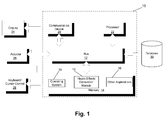
- Fig. 1 illustrates a block diagram of a haptically enabled system 10 in accordance with one embodiment of the invention.
- system 10 is part of a mobile device, and system 10 provides haptic effect generation for the mobile device.
- the functionality of system 10 can be implemented as a distributed system, and can generate the haptic effects on system 10 itself, or send haptic effects signals or data to another device which then generates the haptic effects.
- System 10 includes a bus 12 or other communication mechanism for communicating information, and a processor 22 coupled to bus 12 for processing information.
- Processor 22 may be any type of general or specific purpose processor.
- System 10 further includes a memory 14 for storing information and instructions to be executed by processor 22.
- Memory 14 can be comprised of any combination of random access memory (“RAM”), read only memory (“ROM”), static storage such as a magnetic or optical disk, or any other type of computer-readable medium.
- a computer-readable medium may be any available medium that can be accessed by processor 22 and may include both a volatile and nonvolatile medium, a removable and non-removable medium, a communication medium, and a storage medium.
- a communication medium may include computer readable instructions, data structures, program modules or other data in a modulated data signal such as a carrier wave or other transport mechanism, and may include any other form of an information delivery medium known in the art.
- a storage medium may include RAM, flash memory, ROM, erasable programmable read-only memory (“EPROM”), electrically erasable programmable read-only memory (“EEPROM”), registers, hard disk, a removable disk, a compact disk read-only memory (“CD-ROM”), or any other form of a storage medium known in the art.
- memory 14 stores software modules that provide functionality when executed by processor 22.
- the modules include an operating system 15 that provides operating system functionality for system 10, as well as the rest of a mobile device in one embodiment.
- the modules further include a haptic effects generation module 16 that generates haptic effects using interpolation, as disclosed in more detail below.
- System 10 will typically include one or more additional application modules 18 to include additional functionality, such as smartphone related applications (if system 10 is a smartphone), APIs, a physics system, etc.
- System 10 may further be coupled to a database 30 for storing data used by modules 16 and 18.
- System 10 in embodiments that transmit and/or receive data from remote sources, further includes a communication device 20, such as a network interface card, to provide mobile wireless network communication, such as infrared, radio, Wi-Fi, or cellular network communication.
- communication device 20 provides a wired network connection, such as an Ethernet connection or a modem.
- Processor 22 is further coupled via bus 12 to a display 24, such as a Liquid Crystal Display (“LCD”), for displaying a graphical representation or user interface to a user.
- the display 24 may be a touch-sensitive input device, such as a touchscreen, configured to send and receive signals from processor 22, and may be a multi-touch touch screen.
- Processor 22 is further coupled to a keyboard or cursor control 28, such as a mouse, that allows a user to interact with system 10.
- System 10 further includes an actuator 26.
- Processor 22 may transmit a haptic signal associated with a generated haptic effect to actuator 26, which in turn outputs haptic effects such a vibrotactile haptic effects.
- Actuator 26 includes an actuator drive circuit.
- Actuator 26 may be, for example, an electric motor, an electro-magnetic actuator, a voice coil, a shape memory alloy, an electro-active polymer, a solenoid, an eccentric rotating mass motor (“ERM”), a linear resonant actuator (“LRA”), a piezoelectric actuator, a high bandwidth actuator, an electroactive polymer (“EAP”) actuator, an electrostatic friction display, or an ultrasonic vibration generator.
- a separate device from system 10 includes an actuator that generates the haptic effects, and system 10 sends generated haptic effect signals to that device through communication device 20.
- Fig. 2 illustrates an example of a dynamic event that generates a force for which a haptic effect is generated.
- a ball hits one of four walls. Each collision with a wall generates a "force” that varies depending on the speed of the ball.
- the "ball” and “walls” of Fig. 2 can be part of a video game shown on display 24 of system 10 of Fig. 1 in one example.
- a "physics system” is part of the dynamic event and determines a real world equivalent force, velocity, etc. associated with the dynamic event.
- the physics system can be computer software that provides an approximate simulation of certain physical systems, such as rigid body dynamics (including collision detection), soft body dynamics, and fluid dynamics.
- the input may be, for example, time in an animation where the force changes as a function of time.
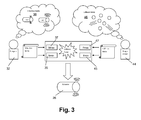
- Fig. 3 illustrates the typical interaction between a haptic effect designer 32 and a haptic effect programmer 44 when creating haptic effects that reflect a collision of the ball against the wall of Fig. 2 , or other dynamic events, in accordance with one embodiment.
- Designer 32 designs the "feel" of the haptic effect that corresponds to each collision.
- Designer 32 specifies the endpoint range of vibration parameters (e.g., minimum and maximum values Vmin 35 and Vmax 37 for strength and periodicity) based on knowledge of the feeling of the target device.
- the vibration limits 36 reflect the endpoints of the range and specify signals for actuator 26 to generate haptic effects for the smallest force, and haptic effects for the largest force.
- the endpoints may not be the "absolute" endpoints of a range. Instead, the "endpoints" may be intermediate endpoints between two additional values that may also be considered endpoints. For example, for a range of 1-10, the endpoints chosen may be 3 and 7.
- Programmer 44 programs processor 22 of Fig. 1 so that the haptic effect signals are generated.
- Programmer 44 specifies a range of force inputs (e.g., minimum and maximum values Fmin 45 and Fmax 47) based on knowledge of the range of typical values from the physics system or simulation.
- the collision limits 46 reflect the minimum and maximum force that would be generated by the ball hitting a wall.
- embodiments calculate the collision force of a particular dynamic event that may fall between the endpoints (i.e., not the smallest force and not the largest force).
- the output to actuator 26 is interpolated from the programmer's collision limits 46 to the designer's vibration limits 36.
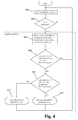
- Fig. 4 is a flow diagram of the functionality of haptic effects generation module 16 of Fig. 1 when using interpolation to automatically generate haptic effects for dynamic events in accordance with one embodiment.
- the functionality of the flow diagram of Fig. 4 is implemented by software stored in memory or other computer readable or tangible medium, and executed by a processor.
- the functionality may be performed by hardware (e.g., through the use of an application specific integrated circuit ("ASIC"), a programmable gate array (“PGA”), a field programmable gate array (“FPGA”), etc.), or any combination of hardware and software.
- ASIC application specific integrated circuit
- PGA programmable gate array
- FPGA field programmable gate array
- Fig. 4 The functionality of Fig. 4 is executed as a continuous loop so a dynamic event is always detected.
- the dynamic event e.g., a collision of a ball into a wall
- the functionality continues at 402.
- the physic systems provides a dynamic event value.
- the event is the collision
- the dynamic event value is the collision force (e.g., 8 on a scale of 1-10).
- the dynamic event value is passed to a routine in one embodiment called "playDynamicEffect.”
- the dynamic event value is passed to the routine as follows:
- the set of effect definitions closest to the dynamic event value are retrieved from the effects file.
- a linear interpolation in one embodiment requires at least two definitions. In the above example, these effects are found by their common name "collision", and include “collision 1" and "collision 10". More than two effects can be defined and retrieved from the effects files. For example, the following three effects may be defined in an effects file:
- module 16 determines that "8" is between the “1” and “10” encoded in the names of the definition values.
- t is used in the following linear interpolation function: 1 - t * A + t * B to calculate each interpolated haptic effect parameter, where "A" is the parameter value for the lowest value dynamic event, and "B" is the parameter value for the highest value dynamic event.
- the interpolated haptic parameter values (i.e., 41 ms duration, 7778 magnitude, 5 ms period) are output to actuator 26 of Fig. 1 , or another actuator, either indirectly or directly, to cause the haptic effect to be generated.
- the functionally then returns to 402 to wait for another dynamic event to happen.
- haptic effect definitions instead of two haptic effect definitions (i.e., the two endpoints), three haptic effect definitions are used as described above.
- the following quadratic equation is used for the interpolation: 1 - t ⁇ ⁇ 2 * A + 2 * 1 - t * t * B + t ⁇ ⁇ 2 * C , where C is the third definition.
- embodiments allow a haptic effect designer to more easily implement rich haptic effects by specifying the desired haptic effect endpoints. Embodiments then automatically generate intermediate stage haptic effects through interpolation.
Landscapes
- Engineering & Computer Science (AREA)
- General Engineering & Computer Science (AREA)
- Theoretical Computer Science (AREA)
- Physics & Mathematics (AREA)
- General Physics & Mathematics (AREA)
- Human Computer Interaction (AREA)
- Software Systems (AREA)
- User Interface Of Digital Computer (AREA)
Abstract
Description
- One embodiment is directed generally to haptic effects, and in particular to generating haptic effects in response to a dynamic event.
- Electronic device manufacturers strive to produce a rich interface for users. Conventional devices use visual and auditory cues to provide feedback to a user. In some interface devices, kinesthetic feedback (such as active and resistive force feedback) and/or tactile feedback (such as vibration, texture, and heat) is also provided to the user, more generally known collectively as "haptic feedback" or "haptic effects". Haptic feedback can provide cues that enhance and simplify the user interface. Specifically, vibration effects, or vibrotactile haptic effects, may be useful in providing cues to users of electronic devices to alert the user to specific events, or provide realistic feedback to create greater sensory immersion within a simulated or virtual environment.
- Haptic feedback has also been increasingly incorporated in portable electronic devices, referred to as "handheld devices" or "portable devices", such as cellular telephones, personal digital assistants ("PDA"s), smartphones, and portable gaming devices. For example, some portable gaming applications are capable of vibrating in a manner similar to control devices (e.g., joysticks, etc.) used with larger-scale gaming systems that are configured to provide haptic feedback. Additionally, devices such as cellular telephones and smartphones are capable of providing various alerts to users by way of vibrations. For example, a cellular telephone can alert a user to an incoming telephone call by vibrating. Similarly, a smartphone can alert a user to a scheduled calendar item or provide a user with a reminder for a "to do" list item or calendar appointment. Further, haptic effects can be used to simulate "real world" dynamic events, such as the feel of a bouncing ball in a video game.
- One embodiment is a system that generates a dynamic haptic effect for a dynamic event. The system receives a first endpoint and a second endpoint for dynamic events. The first endpoint includes a first endpoint value and a corresponding first haptic effect, and the second endpoint includes a second endpoint value and a corresponding second haptic effect. The system receives a dynamic value for the dynamic event. The dynamic value is between the first endpoint value and the second endpoint value. The system then determines the dynamic haptic effect from the dynamic value by interpolating the dynamic haptic effect from the first haptic effect and the second haptic effect.
-
-
Fig. 1 illustrates a block diagram of a haptically enabled system in accordance with one embodiment of the invention. -
Fig. 2 illustrates an example of a dynamic event that generates a force for which a haptic effect is generated. -
Fig. 3 illustrates the typical interaction between a haptic effect designer and a haptic effect programmer when creating haptic effects that reflect a collision of the ball against the wall ofFig. 2 , or other dynamic events, in accordance with one embodiment. -
Fig. 4 is a flow diagram of the functionality of the haptic effects generation module ofFig. 1 when using interpolation to automatically generate haptic effects for dynamic events in accordance with one embodiment. - One embodiment is a system that generates haptic effects for "dynamic events" such as a simulated bouncing ball. The system receives the desired haptic effects for the "endpoints" of the dynamic event, such as the minimal and maximum force when the ball contacts a wall. The system then uses interpolation to automatically generate haptic effects for dynamic events that fall between the endpoints.
- Devices that incorporate haptic effects generally are developed with the cooperation of both haptic effect designers, who determine what the haptic effects should "feel" like, and haptic effect programmers that develop software code to implement the designed haptic effects. In many systems, an application programming interface ("API") separates the work of the designer from the programmer so that a designer can call a desired haptic effect by name, and the API retrieves the corresponding code or routine to implement the desired haptic effect. One example of an API for haptic effects is the "VibeTonz" API from Immersion Corp.
- Haptic effects are frequently used to simulate "dynamic" real world events. For example, a video game may feature a ball bouncing off of a wall. Depending on the speed/force of the ball against the wall, a haptic effect that simulates the collision of a bounce must to be varied to reflect the force that would have been generated by the collision in the real world. The haptic effect can be varied by changing parameters. As another example, a smartphone may display a scrolling list of contacts. As the list scrolls, a haptic effect may generate a "tick" haptic effect feel between contacts. As the speed of the scrolling increases, the tick should get stronger to reflect the increased speed, and vice versa. In one embodiment, when a haptic effect is vibratory and is generated by an actuator, the haptic effect can be varied to simulate dynamic haptic events by varying any combination of magnitude, frequency and duration of the vibration parameters. Other examples of dynamic events that can generate corresponding haptic effects include the force of a boxing glove hitting a person, the force of a bat hitting a ball, the force of a car colliding with another object, etc.
- For many simulations, the number of dynamic events for which a corresponding haptic effect is generated can be fairly large. For example, for the ball bouncing against the wall, a video game may specify ten or more different forces generated by the ball against the wall depending on the speed of the ball. Most designers, in designing haptic effects for these forces, will merely specify the parameters for the endpoints (i.e., the smallest force and the largest force). The programmer then must program all parameters in between the endpoints using linear mapping or some other method. Depending on the number of intermediate points, this may require a large effort on behalf of the programmer. In contrast, embodiments of the present invention automatically generate intermediate stage haptic effects based on the endpoints using interpolation.
-
Fig. 1 illustrates a block diagram of a haptically enabledsystem 10 in accordance with one embodiment of the invention. In one embodiment,system 10 is part of a mobile device, andsystem 10 provides haptic effect generation for the mobile device. Although shown as a single system, the functionality ofsystem 10 can be implemented as a distributed system, and can generate the haptic effects onsystem 10 itself, or send haptic effects signals or data to another device which then generates the haptic effects. -
System 10 includes a bus 12 or other communication mechanism for communicating information, and aprocessor 22 coupled to bus 12 for processing information.Processor 22 may be any type of general or specific purpose processor.System 10 further includes amemory 14 for storing information and instructions to be executed byprocessor 22.Memory 14 can be comprised of any combination of random access memory ("RAM"), read only memory ("ROM"), static storage such as a magnetic or optical disk, or any other type of computer-readable medium. - A computer-readable medium may be any available medium that can be accessed by
processor 22 and may include both a volatile and nonvolatile medium, a removable and non-removable medium, a communication medium, and a storage medium. A communication medium may include computer readable instructions, data structures, program modules or other data in a modulated data signal such as a carrier wave or other transport mechanism, and may include any other form of an information delivery medium known in the art. A storage medium may include RAM, flash memory, ROM, erasable programmable read-only memory ("EPROM"), electrically erasable programmable read-only memory ("EEPROM"), registers, hard disk, a removable disk, a compact disk read-only memory ("CD-ROM"), or any other form of a storage medium known in the art. - In one embodiment,
memory 14 stores software modules that provide functionality when executed byprocessor 22. The modules include anoperating system 15 that provides operating system functionality forsystem 10, as well as the rest of a mobile device in one embodiment. The modules further include a hapticeffects generation module 16 that generates haptic effects using interpolation, as disclosed in more detail below.System 10 will typically include one or moreadditional application modules 18 to include additional functionality, such as smartphone related applications (ifsystem 10 is a smartphone), APIs, a physics system, etc.System 10 may further be coupled to adatabase 30 for storing data used bymodules -
System 10, in embodiments that transmit and/or receive data from remote sources, further includes acommunication device 20, such as a network interface card, to provide mobile wireless network communication, such as infrared, radio, Wi-Fi, or cellular network communication. In other embodiments,communication device 20 provides a wired network connection, such as an Ethernet connection or a modem. -
Processor 22 is further coupled via bus 12 to adisplay 24, such as a Liquid Crystal Display ("LCD"), for displaying a graphical representation or user interface to a user. Thedisplay 24 may be a touch-sensitive input device, such as a touchscreen, configured to send and receive signals fromprocessor 22, and may be a multi-touch touch screen.Processor 22 is further coupled to a keyboard orcursor control 28, such as a mouse, that allows a user to interact withsystem 10. -
System 10, in one embodiment, further includes anactuator 26.Processor 22 may transmit a haptic signal associated with a generated haptic effect toactuator 26, which in turn outputs haptic effects such a vibrotactile haptic effects.Actuator 26 includes an actuator drive circuit.Actuator 26 may be, for example, an electric motor, an electro-magnetic actuator, a voice coil, a shape memory alloy, an electro-active polymer, a solenoid, an eccentric rotating mass motor ("ERM"), a linear resonant actuator ("LRA"), a piezoelectric actuator, a high bandwidth actuator, an electroactive polymer ("EAP") actuator, an electrostatic friction display, or an ultrasonic vibration generator. In other embodiments, a separate device fromsystem 10 includes an actuator that generates the haptic effects, andsystem 10 sends generated haptic effect signals to that device throughcommunication device 20. -
Fig. 2 illustrates an example of a dynamic event that generates a force for which a haptic effect is generated. InFig. 2 , a ball hits one of four walls. Each collision with a wall generates a "force" that varies depending on the speed of the ball. The "ball" and "walls" ofFig. 2 can be part of a video game shown ondisplay 24 ofsystem 10 ofFig. 1 in one example. A "physics system" is part of the dynamic event and determines a real world equivalent force, velocity, etc. associated with the dynamic event. The physics system can be computer software that provides an approximate simulation of certain physical systems, such as rigid body dynamics (including collision detection), soft body dynamics, and fluid dynamics. In other embodiments, rather than generating a physics system based dynamic event, the input may be, for example, time in an animation where the force changes as a function of time. -
Fig. 3 illustrates the typical interaction between ahaptic effect designer 32 and ahaptic effect programmer 44 when creating haptic effects that reflect a collision of the ball against the wall ofFig. 2 , or other dynamic events, in accordance with one embodiment.Designer 32 designs the "feel" of the haptic effect that corresponds to each collision.Designer 32 specifies the endpoint range of vibration parameters (e.g., minimum and maximum values Vmin 35 andVmax 37 for strength and periodicity) based on knowledge of the feeling of the target device. The vibration limits 36 reflect the endpoints of the range and specify signals foractuator 26 to generate haptic effects for the smallest force, and haptic effects for the largest force. The endpoints may not be the "absolute" endpoints of a range. Instead, the "endpoints" may be intermediate endpoints between two additional values that may also be considered endpoints. For example, for a range of 1-10, the endpoints chosen may be 3 and 7. -
Programmer 44programs processor 22 ofFig. 1 so that the haptic effect signals are generated.Programmer 44 specifies a range of force inputs (e.g., minimum and maximum values Fmin 45 and Fmax 47) based on knowledge of the range of typical values from the physics system or simulation. The collision limits 46 reflect the minimum and maximum force that would be generated by the ball hitting a wall. - In operation, embodiments calculate the collision force of a particular dynamic event that may fall between the endpoints (i.e., not the smallest force and not the largest force). The output to
actuator 26 is interpolated from the programmer's collision limits 46 to the designer's vibration limits 36. -
Fig. 4 is a flow diagram of the functionality of hapticeffects generation module 16 ofFig. 1 when using interpolation to automatically generate haptic effects for dynamic events in accordance with one embodiment. In one embodiment, the functionality of the flow diagram ofFig. 4 is implemented by software stored in memory or other computer readable or tangible medium, and executed by a processor. In other embodiments, the functionality may be performed by hardware (e.g., through the use of an application specific integrated circuit ("ASIC"), a programmable gate array ("PGA"), a field programmable gate array ("FPGA"), etc.), or any combination of hardware and software. - At 402, the next dynamic event is detected. The functionality of
Fig. 4 is executed as a continuous loop so a dynamic event is always detected. - At 404, it is determined if the dynamic event (e.g., a collision of a ball into a wall) happened. If No at 404, the functionality continues at 402. If Yes at 404, the physic systems provides a dynamic event value. In the example of
Fig. 2 , the event is the collision, and the dynamic event value is the collision force (e.g., 8 on a scale of 1-10). The dynamic event value is passed to a routine in one embodiment called "playDynamicEffect." In one embodiment, the dynamic event value is passed to the routine as follows: - playDynamicEffect("collision", force); where 'collision" is the name of the haptic event, and the force is the value of the haptic event.
- For example, assume the following effects are defined in an effects file:
- Name="collision 1", Duration=10 ms, Magnitude=0, Period=5 ms;
- Name="
collision 10", Duration=50 ms, Magnitude=10000, Period=5 ms. - At 406, the set of effect definitions closest to the dynamic event value are retrieved from the effects file. A linear interpolation in one embodiment requires at least two definitions. In the above example, these effects are found by their common name "collision", and include "collision 1" and "
collision 10". More than two effects can be defined and retrieved from the effects files. For example, the following three effects may be defined in an effects file: - Name="collision 0.25", Duration=10 ms, Magnitude=0, Period=5 ms;
- Name="collision 1", Duration=10 ms, Magnitude=0, Period=5 ms;
- Name="
collision 10", Duration=50 ms, Magnitude=10000, Period=5 ms. - At 408 and 410, a determination is made as to whether the dynamic event value falls between the two definition values. For example,
module 16 determines that "8" is between the "1" and "10" encoded in the names of the definition values. - If the dynamic event value is greater than the lowest set definition value at 408, in one embodiment no effect is played and the functionality continues to 410. This provides for a "deadband" where input forces are ignored. In another embodiment, the smallest effect definition in the set may be used and the functionality then returns to 402.
- If No at 408, if the dynamic event value is less than the greatest set definition value at 410, the highest effect definition in the set is used at 412 (e.g., 10) and the functionality returns to 402.
- If Yes at 410, at 414 the haptic effect definition is determined by interpolation at 414 and the functionality returns to 402.
- In order to determine the haptic effect by interpolation at 414, in one embodiment an interpolation variable "t" is determined using the following:

For the above example,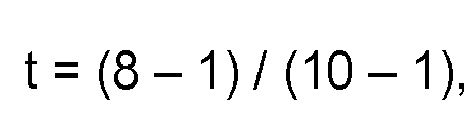
so t is approximately equal to 0.78.
In a special case when the highest value dynamic event equals the lowest value dynamic event, t=1 to avoid division by zero. - In one embodiment, t is used in the following linear interpolation function:

to calculate each interpolated haptic effect parameter, where "A" is the parameter value for the lowest value dynamic event, and "B" is the parameter value for the highest value dynamic event. For the above two effects example, the parameters are determined as follows:


Therefore, after 414, the interpolated haptic parameter values (i.e., 41 ms duration, 7778 magnitude, 5 ms period) are output to actuator 26 ofFig. 1 , or another actuator, either indirectly or directly, to cause the haptic effect to be generated. The functionally then returns to 402 to wait for another dynamic event to happen. - In another embodiment, instead of two haptic effect definitions (i.e., the two endpoints), three haptic effect definitions are used as described above. In this embodiment, the following quadratic equation is used for the interpolation:

where C is the third definition. - As disclosed, embodiments allow a haptic effect designer to more easily implement rich haptic effects by specifying the desired haptic effect endpoints. Embodiments then automatically generate intermediate stage haptic effects through interpolation.
- Several embodiments are specifically illustrated and/or described herein. However, it will be appreciated that modifications and variations of the disclosed embodiments are covered by the above teachings and within the purview of the appended claims without departing from the spirit and intended scope of the invention.
Claims (15)
- A computer-implemented method for generating a dynamic haptic effect for a dynamic event, the method comprising:receiving a first endpoint and a second endpoint for dynamic events, wherein the first endpoint comprises a first endpoint value and a corresponding first haptic effect, and the second endpoint comprises a second endpoint value and a corresponding second haptic effect;receiving a dynamic value for the dynamic event, wherein the dynamic value is between the first endpoint value and the second endpoint value; anddetermining the dynamic haptic effect from the dynamic value, wherein the determining comprises interpolating the dynamic haptic effect from the first haptic effect and the second haptic effect.
- The method of claim 1, wherein the dynamic haptic effect is a vibratory haptic effect and comprises a plurality of parameters.
- The method of claim 1, wherein the plurality of parameters comprise duration, magnitude and period.
- The method of claim 1, wherein the vibratory haptic effect is generated by an actuator.
- The method of claim 1, wherein the dynamic event comprises a force.
- The method of claim 1, wherein the force comprises a simulated object contacting another simulated object.
- The method of claim 5, wherein the force is generated by a physics system.
- The method of claim 1, wherein the interpolating comprises generating an interpolation value (t) comprising: (dynamic event value - first endpoint value)/( second endpoint value - first endpoint value);
wherein the first endpoint value is a lowest endpoint value, and the second endpoint value is a highest endpoint value. - The method of claim 8, wherein the first haptic effect comprises a plurality of first parameters and the second haptic effect comprises a plurality of second parameters;
wherein the interpolating comprises, for each parameter of the dynamic haptic effect, (1 - t) * A + t * B, wherein A comprises a corresponding first haptic effect parameter and B comprises a corresponding second haptic effect parameter. - A computer readable medium having instructions stored thereon that, when executed by a processor, cause the processor to generate a dynamic haptic effect for a dynamic event, the generating the dynamic haptic effect comprising any of the methods of claims 1-9.
- A system that generates a dynamic haptic effect for a dynamic event, the system comprising:a processor;a memory coupled to the processor and storing a haptic effects generation module;receiving by the haptic effects generation module a first endpoint and a second endpoint for dynamic events, wherein the first endpoint comprises a first endpoint value and a corresponding first haptic effect, and the second endpoint comprises a second endpoint value and a corresponding second haptic effect;receiving by the haptic effects generation module a dynamic value for the dynamic event, wherein the dynamic value is between the first endpoint value and the second endpoint value; anddetermining by the haptic effects generation module the dynamic haptic effect from the dynamic value, wherein the determining comprises interpolating the dynamic haptic effect from the first haptic effect and the second haptic effect.
- The system of claim 11, further comprising an actuator coupled to the processor, wherein the actuator outputs haptic effects in response to receiving the dynamic haptic effect.
- The system of claim 12, wherein the haptic effects are vibratory haptic effects.
- The system of claim 11, wherein the interpolating comprises generating an interpolation value (t) comprising: (dynamic event value - first endpoint value)/(second endpoint value - first endpoint value);
wherein the first endpoint value is a lowest endpoint value, and the second endpoint value is a highest endpoint value. - The system of claim 14, wherein the first haptic effect comprises a plurality of first parameters and the second haptic effect comprises a plurality of second parameters;
wherein the interpolating comprises, for each parameter of the dynamic haptic effect, (1 - t) * A + t * B, wherein A comprises a corresponding first haptic effect parameter and B comprises a corresponding second haptic effect parameter.
Applications Claiming Priority (1)
| Application Number | Priority Date | Filing Date | Title |
|---|---|---|---|
| US13/546,351 US9030428B2 (en) | 2012-07-11 | 2012-07-11 | Generating haptic effects for dynamic events |
Publications (3)
| Publication Number | Publication Date |
|---|---|
| EP2713241A2 true EP2713241A2 (en) | 2014-04-02 |
| EP2713241A3 EP2713241A3 (en) | 2016-04-06 |
| EP2713241B1 EP2713241B1 (en) | 2020-01-01 |
Family
ID=48803401
Family Applications (1)
| Application Number | Title | Priority Date | Filing Date |
|---|---|---|---|
| EP13176551.3A Active EP2713241B1 (en) | 2012-07-11 | 2013-07-15 | Generating Haptic Effects for Dynamic Events |
Country Status (5)
| Country | Link |
|---|---|
| US (1) | US9030428B2 (en) |
| EP (1) | EP2713241B1 (en) |
| JP (1) | JP6342619B2 (en) |
| KR (1) | KR20140008256A (en) |
| CN (1) | CN103544002B (en) |
Families Citing this family (41)
| Publication number | Priority date | Publication date | Assignee | Title |
|---|---|---|---|---|
| US7765333B2 (en) | 2004-07-15 | 2010-07-27 | Immersion Corporation | System and method for ordering haptic effects |
| US8947216B2 (en) | 2012-11-02 | 2015-02-03 | Immersion Corporation | Encoding dynamic haptic effects |
| US9898084B2 (en) | 2012-12-10 | 2018-02-20 | Immersion Corporation | Enhanced dynamic haptic effects |
| JP6300604B2 (en) * | 2014-04-01 | 2018-03-28 | キヤノン株式会社 | Touch control device, touch control method, and program |
| US20180011538A1 (en) | 2016-07-08 | 2018-01-11 | Immersion Corporation | Multimodal haptic effects |
| US10296091B2 (en) | 2016-10-13 | 2019-05-21 | Immersion Corporation | Contextual pressure sensing haptic responses |
| US10427039B2 (en) * | 2016-12-08 | 2019-10-01 | Immersion Corporation | Haptic surround functionality |
| US10732714B2 (en) | 2017-05-08 | 2020-08-04 | Cirrus Logic, Inc. | Integrated haptic system |
| US11259121B2 (en) | 2017-07-21 | 2022-02-22 | Cirrus Logic, Inc. | Surface speaker |
| US10620704B2 (en) | 2018-01-19 | 2020-04-14 | Cirrus Logic, Inc. | Haptic output systems |
| US10455339B2 (en) | 2018-01-19 | 2019-10-22 | Cirrus Logic, Inc. | Always-on detection systems |
| US11139767B2 (en) | 2018-03-22 | 2021-10-05 | Cirrus Logic, Inc. | Methods and apparatus for driving a transducer |
| US10795443B2 (en) | 2018-03-23 | 2020-10-06 | Cirrus Logic, Inc. | Methods and apparatus for driving a transducer |
| US10820100B2 (en) | 2018-03-26 | 2020-10-27 | Cirrus Logic, Inc. | Methods and apparatus for limiting the excursion of a transducer |
| US10667051B2 (en) | 2018-03-26 | 2020-05-26 | Cirrus Logic, Inc. | Methods and apparatus for limiting the excursion of a transducer |
| US10832537B2 (en) | 2018-04-04 | 2020-11-10 | Cirrus Logic, Inc. | Methods and apparatus for outputting a haptic signal to a haptic transducer |
| US11069206B2 (en) | 2018-05-04 | 2021-07-20 | Cirrus Logic, Inc. | Methods and apparatus for outputting a haptic signal to a haptic transducer |
| US11269415B2 (en) | 2018-08-14 | 2022-03-08 | Cirrus Logic, Inc. | Haptic output systems |
| GB201817495D0 (en) | 2018-10-26 | 2018-12-12 | Cirrus Logic Int Semiconductor Ltd | A force sensing system and method |
| US10992297B2 (en) | 2019-03-29 | 2021-04-27 | Cirrus Logic, Inc. | Device comprising force sensors |
| US11509292B2 (en) | 2019-03-29 | 2022-11-22 | Cirrus Logic, Inc. | Identifying mechanical impedance of an electromagnetic load using least-mean-squares filter |
| US10726683B1 (en) | 2019-03-29 | 2020-07-28 | Cirrus Logic, Inc. | Identifying mechanical impedance of an electromagnetic load using a two-tone stimulus |
| US10955955B2 (en) | 2019-03-29 | 2021-03-23 | Cirrus Logic, Inc. | Controller for use in a device comprising force sensors |
| US12035445B2 (en) | 2019-03-29 | 2024-07-09 | Cirrus Logic Inc. | Resonant tracking of an electromagnetic load |
| US10828672B2 (en) | 2019-03-29 | 2020-11-10 | Cirrus Logic, Inc. | Driver circuitry |
| US11283337B2 (en) | 2019-03-29 | 2022-03-22 | Cirrus Logic, Inc. | Methods and systems for improving transducer dynamics |
| US11644370B2 (en) | 2019-03-29 | 2023-05-09 | Cirrus Logic, Inc. | Force sensing with an electromagnetic load |
| US11150733B2 (en) | 2019-06-07 | 2021-10-19 | Cirrus Logic, Inc. | Methods and apparatuses for providing a haptic output signal to a haptic actuator |
| US10976825B2 (en) | 2019-06-07 | 2021-04-13 | Cirrus Logic, Inc. | Methods and apparatuses for controlling operation of a vibrational output system and/or operation of an input sensor system |
| WO2020254788A1 (en) | 2019-06-21 | 2020-12-24 | Cirrus Logic International Semiconductor Limited | A method and apparatus for configuring a plurality of virtual buttons on a device |
| US11408787B2 (en) | 2019-10-15 | 2022-08-09 | Cirrus Logic, Inc. | Control methods for a force sensor system |
| US11380175B2 (en) | 2019-10-24 | 2022-07-05 | Cirrus Logic, Inc. | Reproducibility of haptic waveform |
| US12276687B2 (en) | 2019-12-05 | 2025-04-15 | Cirrus Logic Inc. | Methods and systems for estimating coil impedance of an electromagnetic transducer |
| US11545951B2 (en) | 2019-12-06 | 2023-01-03 | Cirrus Logic, Inc. | Methods and systems for detecting and managing amplifier instability |
| US12244253B2 (en) | 2020-04-16 | 2025-03-04 | Cirrus Logic Inc. | Restricting undesired movement of a haptic actuator |
| US11662821B2 (en) | 2020-04-16 | 2023-05-30 | Cirrus Logic, Inc. | In-situ monitoring, calibration, and testing of a haptic actuator |
| CN112631426A (en) * | 2020-12-21 | 2021-04-09 | 瑞声新能源发展(常州)有限公司科教城分公司 | Dynamic tactile effect generation method, device, equipment and storage medium |
| US11933822B2 (en) | 2021-06-16 | 2024-03-19 | Cirrus Logic Inc. | Methods and systems for in-system estimation of actuator parameters |
| US11908310B2 (en) | 2021-06-22 | 2024-02-20 | Cirrus Logic Inc. | Methods and systems for detecting and managing unexpected spectral content in an amplifier system |
| US11765499B2 (en) | 2021-06-22 | 2023-09-19 | Cirrus Logic Inc. | Methods and systems for managing mixed mode electromechanical actuator drive |
| US11552649B1 (en) | 2021-12-03 | 2023-01-10 | Cirrus Logic, Inc. | Analog-to-digital converter-embedded fixed-phase variable gain amplifier stages for dual monitoring paths |
Family Cites Families (17)
| Publication number | Priority date | Publication date | Assignee | Title |
|---|---|---|---|---|
| JPH0816820A (en) | 1994-04-25 | 1996-01-19 | Fujitsu Ltd | 3D animation creation device |
| JP4131278B2 (en) * | 1996-10-18 | 2008-08-13 | ヤマハ株式会社 | Force control device for keyboard instruments |
| JPH11316646A (en) * | 1998-05-01 | 1999-11-16 | Nippon Telegr & Teleph Corp <Ntt> | Virtual reality experience method and system device |
| US6449019B1 (en) | 2000-04-07 | 2002-09-10 | Avid Technology, Inc. | Real-time key frame effects using tracking information |
| US7623114B2 (en) * | 2001-10-09 | 2009-11-24 | Immersion Corporation | Haptic feedback sensations based on audio output from computer devices |
| US7199805B1 (en) | 2002-05-28 | 2007-04-03 | Apple Computer, Inc. | Method and apparatus for titling |
| KR20050054731A (en) * | 2003-12-05 | 2005-06-10 | 한국전자통신연구원 | Haptic simulation system and method for providing real-time haptic interaction in virtual simulation |
| US7765333B2 (en) | 2004-07-15 | 2010-07-27 | Immersion Corporation | System and method for ordering haptic effects |
| US8098234B2 (en) | 2007-02-20 | 2012-01-17 | Immersion Corporation | Haptic feedback system with stored effects |
| US8621348B2 (en) | 2007-05-25 | 2013-12-31 | Immersion Corporation | Customizing haptic effects on an end user device |
| CN101355746B (en) | 2007-07-27 | 2012-05-16 | 深圳富泰宏精密工业有限公司 | Radio communication device |
| KR100927009B1 (en) * | 2008-02-04 | 2009-11-16 | 광주과학기술원 | Haptic interaction method and system in augmented reality |
| US9513704B2 (en) | 2008-03-12 | 2016-12-06 | Immersion Corporation | Haptically enabled user interface |
| US10019061B2 (en) * | 2008-07-15 | 2018-07-10 | Immersion Corporation | Systems and methods for haptic message transmission |
| JP5360499B2 (en) * | 2010-02-01 | 2013-12-04 | 国立大学法人東北大学 | Haptic presentation method and haptic presentation device |
| US20120081337A1 (en) * | 2010-10-04 | 2012-04-05 | Sony Ericsson Mobile Communications Ab | Active Acoustic Multi-Touch and Swipe Detection for Electronic Devices |
| US8711118B2 (en) | 2012-02-15 | 2014-04-29 | Immersion Corporation | Interactivity model for shared feedback on mobile devices |
-
2012
- 2012-07-11 US US13/546,351 patent/US9030428B2/en not_active Expired - Fee Related
-
2013
- 2013-07-03 JP JP2013139530A patent/JP6342619B2/en not_active Expired - Fee Related
- 2013-07-09 KR KR1020130080302A patent/KR20140008256A/en not_active Abandoned
- 2013-07-11 CN CN201310289773.1A patent/CN103544002B/en not_active Expired - Fee Related
- 2013-07-15 EP EP13176551.3A patent/EP2713241B1/en active Active
Non-Patent Citations (1)
| Title |
|---|
| None |
Also Published As
| Publication number | Publication date |
|---|---|
| JP6342619B2 (en) | 2018-06-13 |
| EP2713241A3 (en) | 2016-04-06 |
| KR20140008256A (en) | 2014-01-21 |
| US9030428B2 (en) | 2015-05-12 |
| CN103544002A (en) | 2014-01-29 |
| JP2014016991A (en) | 2014-01-30 |
| US20140015761A1 (en) | 2014-01-16 |
| CN103544002B (en) | 2018-02-09 |
| EP2713241B1 (en) | 2020-01-01 |
Similar Documents
| Publication | Publication Date | Title |
|---|---|---|
| US9030428B2 (en) | Generating haptic effects for dynamic events | |
| US10318006B2 (en) | High definition haptic effects generation using primitives | |
| US9507423B2 (en) | Generating haptic effects while minimizing cascading | |
| JP6498863B2 (en) | Haptic system with increased LRA bandwidth | |
| US8963882B2 (en) | Multi-touch device having dynamic haptic effects | |
| US10359851B2 (en) | Enhanced dynamic haptic effects | |
| US20090313542A1 (en) | User Interface Impact Actuator | |
| US20160320845A1 (en) | Encoding dynamic haptic effects | |
| JP2018125021A (en) | Context-dependent haptic confirmation system | |
| CN104049743A (en) | Systems and methods for syncing haptic feedback calls | |
| EP2942699A1 (en) | Dynamic haptic effect modification | |
| US10684689B2 (en) | Cross-platform dynamic haptic effect design tool for augmented or virtual reality environments | |
| US12450991B2 (en) | Haptics mixing for concurrent haptic events |
Legal Events
| Date | Code | Title | Description |
|---|---|---|---|
| PUAI | Public reference made under article 153(3) epc to a published international application that has entered the european phase |
Free format text: ORIGINAL CODE: 0009012 |
|
| AK | Designated contracting states |
Kind code of ref document: A2 Designated state(s): AL AT BE BG CH CY CZ DE DK EE ES FI FR GB GR HR HU IE IS IT LI LT LU LV MC MK MT NL NO PL PT RO RS SE SI SK SM TR |
|
| AX | Request for extension of the european patent |
Extension state: BA ME |
|
| RAP1 | Party data changed (applicant data changed or rights of an application transferred) |
Owner name: IMMERSION CORPORATION |
|
| PUAL | Search report despatched |
Free format text: ORIGINAL CODE: 0009013 |
|
| AK | Designated contracting states |
Kind code of ref document: A3 Designated state(s): AL AT BE BG CH CY CZ DE DK EE ES FI FR GB GR HR HU IE IS IT LI LT LU LV MC MK MT NL NO PL PT RO RS SE SI SK SM TR |
|
| AX | Request for extension of the european patent |
Extension state: BA ME |
|
| RIC1 | Information provided on ipc code assigned before grant |
Ipc: G06F 3/01 20060101AFI20160302BHEP |
|
| 17P | Request for examination filed |
Effective date: 20161006 |
|
| RBV | Designated contracting states (corrected) |
Designated state(s): AL AT BE BG CH CY CZ DE DK EE ES FI FR GB GR HR HU IE IS IT LI LT LU LV MC MK MT NL NO PL PT RO RS SE SI SK SM TR |
|
| STAA | Information on the status of an ep patent application or granted ep patent |
Free format text: STATUS: EXAMINATION IS IN PROGRESS |
|
| 17Q | First examination report despatched |
Effective date: 20180608 |
|
| GRAP | Despatch of communication of intention to grant a patent |
Free format text: ORIGINAL CODE: EPIDOSNIGR1 |
|
| STAA | Information on the status of an ep patent application or granted ep patent |
Free format text: STATUS: GRANT OF PATENT IS INTENDED |
|
| INTG | Intention to grant announced |
Effective date: 20190218 |
|
| GRAJ | Information related to disapproval of communication of intention to grant by the applicant or resumption of examination proceedings by the epo deleted |
Free format text: ORIGINAL CODE: EPIDOSDIGR1 |
|
| STAA | Information on the status of an ep patent application or granted ep patent |
Free format text: STATUS: EXAMINATION IS IN PROGRESS |
|
| GRAS | Grant fee paid |
Free format text: ORIGINAL CODE: EPIDOSNIGR3 |
|
| STAA | Information on the status of an ep patent application or granted ep patent |
Free format text: STATUS: GRANT OF PATENT IS INTENDED |
|
| GRAP | Despatch of communication of intention to grant a patent |
Free format text: ORIGINAL CODE: EPIDOSNIGR1 |
|
| INTC | Intention to grant announced (deleted) | ||
| INTG | Intention to grant announced |
Effective date: 20190729 |
|
| GRAA | (expected) grant |
Free format text: ORIGINAL CODE: 0009210 |
|
| STAA | Information on the status of an ep patent application or granted ep patent |
Free format text: STATUS: THE PATENT HAS BEEN GRANTED |
|
| AK | Designated contracting states |
Kind code of ref document: B1 Designated state(s): AL AT BE BG CH CY CZ DE DK EE ES FI FR GB GR HR HU IE IS IT LI LT LU LV MC MK MT NL NO PL PT RO RS SE SI SK SM TR |
|
| REG | Reference to a national code |
Ref country code: GB Ref legal event code: FG4D |
|
| REG | Reference to a national code |
Ref country code: CH Ref legal event code: EP Ref country code: AT Ref legal event code: REF Ref document number: 1220598 Country of ref document: AT Kind code of ref document: T Effective date: 20200115 |
|
| REG | Reference to a national code |
Ref country code: IE Ref legal event code: FG4D |
|
| REG | Reference to a national code |
Ref country code: DE Ref legal event code: R096 Ref document number: 602013064534 Country of ref document: DE |
|
| REG | Reference to a national code |
Ref country code: NL Ref legal event code: MP Effective date: 20200101 |
|
| REG | Reference to a national code |
Ref country code: LT Ref legal event code: MG4D |
|
| PG25 | Lapsed in a contracting state [announced via postgrant information from national office to epo] |
Ref country code: CZ Free format text: LAPSE BECAUSE OF FAILURE TO SUBMIT A TRANSLATION OF THE DESCRIPTION OR TO PAY THE FEE WITHIN THE PRESCRIBED TIME-LIMIT Effective date: 20200101 Ref country code: FI Free format text: LAPSE BECAUSE OF FAILURE TO SUBMIT A TRANSLATION OF THE DESCRIPTION OR TO PAY THE FEE WITHIN THE PRESCRIBED TIME-LIMIT Effective date: 20200101 Ref country code: PT Free format text: LAPSE BECAUSE OF FAILURE TO SUBMIT A TRANSLATION OF THE DESCRIPTION OR TO PAY THE FEE WITHIN THE PRESCRIBED TIME-LIMIT Effective date: 20200527 Ref country code: LT Free format text: LAPSE BECAUSE OF FAILURE TO SUBMIT A TRANSLATION OF THE DESCRIPTION OR TO PAY THE FEE WITHIN THE PRESCRIBED TIME-LIMIT Effective date: 20200101 Ref country code: NO Free format text: LAPSE BECAUSE OF FAILURE TO SUBMIT A TRANSLATION OF THE DESCRIPTION OR TO PAY THE FEE WITHIN THE PRESCRIBED TIME-LIMIT Effective date: 20200401 Ref country code: RS Free format text: LAPSE BECAUSE OF FAILURE TO SUBMIT A TRANSLATION OF THE DESCRIPTION OR TO PAY THE FEE WITHIN THE PRESCRIBED TIME-LIMIT Effective date: 20200101 Ref country code: NL Free format text: LAPSE BECAUSE OF FAILURE TO SUBMIT A TRANSLATION OF THE DESCRIPTION OR TO PAY THE FEE WITHIN THE PRESCRIBED TIME-LIMIT Effective date: 20200101 |
|
| PG25 | Lapsed in a contracting state [announced via postgrant information from national office to epo] |
Ref country code: GR Free format text: LAPSE BECAUSE OF FAILURE TO SUBMIT A TRANSLATION OF THE DESCRIPTION OR TO PAY THE FEE WITHIN THE PRESCRIBED TIME-LIMIT Effective date: 20200402 Ref country code: BG Free format text: LAPSE BECAUSE OF FAILURE TO SUBMIT A TRANSLATION OF THE DESCRIPTION OR TO PAY THE FEE WITHIN THE PRESCRIBED TIME-LIMIT Effective date: 20200401 Ref country code: HR Free format text: LAPSE BECAUSE OF FAILURE TO SUBMIT A TRANSLATION OF THE DESCRIPTION OR TO PAY THE FEE WITHIN THE PRESCRIBED TIME-LIMIT Effective date: 20200101 Ref country code: SE Free format text: LAPSE BECAUSE OF FAILURE TO SUBMIT A TRANSLATION OF THE DESCRIPTION OR TO PAY THE FEE WITHIN THE PRESCRIBED TIME-LIMIT Effective date: 20200101 Ref country code: IS Free format text: LAPSE BECAUSE OF FAILURE TO SUBMIT A TRANSLATION OF THE DESCRIPTION OR TO PAY THE FEE WITHIN THE PRESCRIBED TIME-LIMIT Effective date: 20200501 Ref country code: LV Free format text: LAPSE BECAUSE OF FAILURE TO SUBMIT A TRANSLATION OF THE DESCRIPTION OR TO PAY THE FEE WITHIN THE PRESCRIBED TIME-LIMIT Effective date: 20200101 |
|
| REG | Reference to a national code |
Ref country code: DE Ref legal event code: R097 Ref document number: 602013064534 Country of ref document: DE |
|
| PG25 | Lapsed in a contracting state [announced via postgrant information from national office to epo] |
Ref country code: RO Free format text: LAPSE BECAUSE OF FAILURE TO SUBMIT A TRANSLATION OF THE DESCRIPTION OR TO PAY THE FEE WITHIN THE PRESCRIBED TIME-LIMIT Effective date: 20200101 Ref country code: ES Free format text: LAPSE BECAUSE OF FAILURE TO SUBMIT A TRANSLATION OF THE DESCRIPTION OR TO PAY THE FEE WITHIN THE PRESCRIBED TIME-LIMIT Effective date: 20200101 Ref country code: SM Free format text: LAPSE BECAUSE OF FAILURE TO SUBMIT A TRANSLATION OF THE DESCRIPTION OR TO PAY THE FEE WITHIN THE PRESCRIBED TIME-LIMIT Effective date: 20200101 Ref country code: SK Free format text: LAPSE BECAUSE OF FAILURE TO SUBMIT A TRANSLATION OF THE DESCRIPTION OR TO PAY THE FEE WITHIN THE PRESCRIBED TIME-LIMIT Effective date: 20200101 Ref country code: EE Free format text: LAPSE BECAUSE OF FAILURE TO SUBMIT A TRANSLATION OF THE DESCRIPTION OR TO PAY THE FEE WITHIN THE PRESCRIBED TIME-LIMIT Effective date: 20200101 Ref country code: DK Free format text: LAPSE BECAUSE OF FAILURE TO SUBMIT A TRANSLATION OF THE DESCRIPTION OR TO PAY THE FEE WITHIN THE PRESCRIBED TIME-LIMIT Effective date: 20200101 |
|
| PLBE | No opposition filed within time limit |
Free format text: ORIGINAL CODE: 0009261 |
|
| STAA | Information on the status of an ep patent application or granted ep patent |
Free format text: STATUS: NO OPPOSITION FILED WITHIN TIME LIMIT |
|
| REG | Reference to a national code |
Ref country code: AT Ref legal event code: MK05 Ref document number: 1220598 Country of ref document: AT Kind code of ref document: T Effective date: 20200101 |
|
| 26N | No opposition filed |
Effective date: 20201002 |
|
| PG25 | Lapsed in a contracting state [announced via postgrant information from national office to epo] |
Ref country code: IT Free format text: LAPSE BECAUSE OF FAILURE TO SUBMIT A TRANSLATION OF THE DESCRIPTION OR TO PAY THE FEE WITHIN THE PRESCRIBED TIME-LIMIT Effective date: 20200101 Ref country code: AT Free format text: LAPSE BECAUSE OF FAILURE TO SUBMIT A TRANSLATION OF THE DESCRIPTION OR TO PAY THE FEE WITHIN THE PRESCRIBED TIME-LIMIT Effective date: 20200101 |
|
| REG | Reference to a national code |
Ref country code: DE Ref legal event code: R119 Ref document number: 602013064534 Country of ref document: DE |
|
| PG25 | Lapsed in a contracting state [announced via postgrant information from national office to epo] |
Ref country code: SI Free format text: LAPSE BECAUSE OF FAILURE TO SUBMIT A TRANSLATION OF THE DESCRIPTION OR TO PAY THE FEE WITHIN THE PRESCRIBED TIME-LIMIT Effective date: 20200101 Ref country code: MC Free format text: LAPSE BECAUSE OF FAILURE TO SUBMIT A TRANSLATION OF THE DESCRIPTION OR TO PAY THE FEE WITHIN THE PRESCRIBED TIME-LIMIT Effective date: 20200101 Ref country code: PL Free format text: LAPSE BECAUSE OF FAILURE TO SUBMIT A TRANSLATION OF THE DESCRIPTION OR TO PAY THE FEE WITHIN THE PRESCRIBED TIME-LIMIT Effective date: 20200101 |
|
| REG | Reference to a national code |
Ref country code: CH Ref legal event code: PL |
|
| GBPC | Gb: european patent ceased through non-payment of renewal fee |
Effective date: 20200715 |
|
| REG | Reference to a national code |
Ref country code: BE Ref legal event code: MM Effective date: 20200731 |
|
| PG25 | Lapsed in a contracting state [announced via postgrant information from national office to epo] |
Ref country code: LI Free format text: LAPSE BECAUSE OF NON-PAYMENT OF DUE FEES Effective date: 20200731 Ref country code: CH Free format text: LAPSE BECAUSE OF NON-PAYMENT OF DUE FEES Effective date: 20200731 Ref country code: LU Free format text: LAPSE BECAUSE OF NON-PAYMENT OF DUE FEES Effective date: 20200715 Ref country code: FR Free format text: LAPSE BECAUSE OF NON-PAYMENT OF DUE FEES Effective date: 20200731 Ref country code: GB Free format text: LAPSE BECAUSE OF NON-PAYMENT OF DUE FEES Effective date: 20200715 |
|
| PG25 | Lapsed in a contracting state [announced via postgrant information from national office to epo] |
Ref country code: DE Free format text: LAPSE BECAUSE OF NON-PAYMENT OF DUE FEES Effective date: 20210202 Ref country code: BE Free format text: LAPSE BECAUSE OF NON-PAYMENT OF DUE FEES Effective date: 20200731 |
|
| PG25 | Lapsed in a contracting state [announced via postgrant information from national office to epo] |
Ref country code: IE Free format text: LAPSE BECAUSE OF NON-PAYMENT OF DUE FEES Effective date: 20200715 |
|
| PG25 | Lapsed in a contracting state [announced via postgrant information from national office to epo] |
Ref country code: TR Free format text: LAPSE BECAUSE OF FAILURE TO SUBMIT A TRANSLATION OF THE DESCRIPTION OR TO PAY THE FEE WITHIN THE PRESCRIBED TIME-LIMIT Effective date: 20200101 Ref country code: MT Free format text: LAPSE BECAUSE OF FAILURE TO SUBMIT A TRANSLATION OF THE DESCRIPTION OR TO PAY THE FEE WITHIN THE PRESCRIBED TIME-LIMIT Effective date: 20200101 Ref country code: CY Free format text: LAPSE BECAUSE OF FAILURE TO SUBMIT A TRANSLATION OF THE DESCRIPTION OR TO PAY THE FEE WITHIN THE PRESCRIBED TIME-LIMIT Effective date: 20200101 |
|
| PG25 | Lapsed in a contracting state [announced via postgrant information from national office to epo] |
Ref country code: MK Free format text: LAPSE BECAUSE OF FAILURE TO SUBMIT A TRANSLATION OF THE DESCRIPTION OR TO PAY THE FEE WITHIN THE PRESCRIBED TIME-LIMIT Effective date: 20200101 Ref country code: AL Free format text: LAPSE BECAUSE OF FAILURE TO SUBMIT A TRANSLATION OF THE DESCRIPTION OR TO PAY THE FEE WITHIN THE PRESCRIBED TIME-LIMIT Effective date: 20200101 |