EP2712895A1 - Rheologically stable aqueous mineral material suspensions comprising organic polymers having reduced volatile organic compound (VOC) content - Google Patents
Rheologically stable aqueous mineral material suspensions comprising organic polymers having reduced volatile organic compound (VOC) content Download PDFInfo
- Publication number
- EP2712895A1 EP2712895A1 EP12186131.4A EP12186131A EP2712895A1 EP 2712895 A1 EP2712895 A1 EP 2712895A1 EP 12186131 A EP12186131 A EP 12186131A EP 2712895 A1 EP2712895 A1 EP 2712895A1
- Authority
- EP
- European Patent Office
- Prior art keywords
- calcium carbonate
- mineral material
- acrylic
- aqueous suspension
- methacrylic acid
- Prior art date
- Legal status (The legal status is an assumption and is not a legal conclusion. Google has not performed a legal analysis and makes no representation as to the accuracy of the status listed.)
- Granted
Links
- 0 *C(NC(NC(*)O)=N)O Chemical compound *C(NC(NC(*)O)=N)O 0.000 description 1
Images
Classifications
-
- C—CHEMISTRY; METALLURGY
- C08—ORGANIC MACROMOLECULAR COMPOUNDS; THEIR PREPARATION OR CHEMICAL WORKING-UP; COMPOSITIONS BASED THEREON
- C08K—Use of inorganic or non-macromolecular organic substances as compounding ingredients
- C08K3/00—Use of inorganic substances as compounding ingredients
- C08K3/18—Oxygen-containing compounds, e.g. metal carbonyls
- C08K3/24—Acids; Salts thereof
- C08K3/26—Carbonates; Bicarbonates
-
- C—CHEMISTRY; METALLURGY
- C09—DYES; PAINTS; POLISHES; NATURAL RESINS; ADHESIVES; COMPOSITIONS NOT OTHERWISE PROVIDED FOR; APPLICATIONS OF MATERIALS NOT OTHERWISE PROVIDED FOR
- C09C—TREATMENT OF INORGANIC MATERIALS, OTHER THAN FIBROUS FILLERS, TO ENHANCE THEIR PIGMENTING OR FILLING PROPERTIES ; PREPARATION OF CARBON BLACK ; PREPARATION OF INORGANIC MATERIALS WHICH ARE NO SINGLE CHEMICAL COMPOUNDS AND WHICH ARE MAINLY USED AS PIGMENTS OR FILLERS
- C09C1/00—Treatment of specific inorganic materials other than fibrous fillers; Preparation of carbon black
- C09C1/02—Compounds of alkaline earth metals or magnesium
- C09C1/021—Calcium carbonates
-
- A—HUMAN NECESSITIES
- A01—AGRICULTURE; FORESTRY; ANIMAL HUSBANDRY; HUNTING; TRAPPING; FISHING
- A01N—PRESERVATION OF BODIES OF HUMANS OR ANIMALS OR PLANTS OR PARTS THEREOF; BIOCIDES, e.g. AS DISINFECTANTS, AS PESTICIDES OR AS HERBICIDES; PEST REPELLANTS OR ATTRACTANTS; PLANT GROWTH REGULATORS
- A01N59/00—Biocides, pest repellants or attractants, or plant growth regulators containing elements or inorganic compounds
- A01N59/06—Aluminium; Calcium; Magnesium; Compounds thereof
-
- C—CHEMISTRY; METALLURGY
- C04—CEMENTS; CONCRETE; ARTIFICIAL STONE; CERAMICS; REFRACTORIES
- C04B—LIME, MAGNESIA; SLAG; CEMENTS; COMPOSITIONS THEREOF, e.g. MORTARS, CONCRETE OR LIKE BUILDING MATERIALS; ARTIFICIAL STONE; CERAMICS; REFRACTORIES; TREATMENT OF NATURAL STONE
- C04B14/00—Use of inorganic materials as fillers, e.g. pigments, for mortars, concrete or artificial stone; Treatment of inorganic materials specially adapted to enhance their filling properties in mortars, concrete or artificial stone
- C04B14/02—Granular materials, e.g. microballoons
- C04B14/26—Carbonates
- C04B14/28—Carbonates of calcium
-
- C—CHEMISTRY; METALLURGY
- C09—DYES; PAINTS; POLISHES; NATURAL RESINS; ADHESIVES; COMPOSITIONS NOT OTHERWISE PROVIDED FOR; APPLICATIONS OF MATERIALS NOT OTHERWISE PROVIDED FOR
- C09C—TREATMENT OF INORGANIC MATERIALS, OTHER THAN FIBROUS FILLERS, TO ENHANCE THEIR PIGMENTING OR FILLING PROPERTIES ; PREPARATION OF CARBON BLACK ; PREPARATION OF INORGANIC MATERIALS WHICH ARE NO SINGLE CHEMICAL COMPOUNDS AND WHICH ARE MAINLY USED AS PIGMENTS OR FILLERS
- C09C3/00—Treatment in general of inorganic materials, other than fibrous fillers, to enhance their pigmenting or filling properties
- C09C3/10—Treatment with macromolecular organic compounds
-
- D—TEXTILES; PAPER
- D21—PAPER-MAKING; PRODUCTION OF CELLULOSE
- D21H—PULP COMPOSITIONS; PREPARATION THEREOF NOT COVERED BY SUBCLASSES D21C OR D21D; IMPREGNATING OR COATING OF PAPER; TREATMENT OF FINISHED PAPER NOT COVERED BY CLASS B31 OR SUBCLASS D21G; PAPER NOT OTHERWISE PROVIDED FOR
- D21H17/00—Non-fibrous material added to the pulp, characterised by its constitution; Paper-impregnating material characterised by its constitution
-
- D—TEXTILES; PAPER
- D21—PAPER-MAKING; PRODUCTION OF CELLULOSE
- D21H—PULP COMPOSITIONS; PREPARATION THEREOF NOT COVERED BY SUBCLASSES D21C OR D21D; IMPREGNATING OR COATING OF PAPER; TREATMENT OF FINISHED PAPER NOT COVERED BY CLASS B31 OR SUBCLASS D21G; PAPER NOT OTHERWISE PROVIDED FOR
- D21H17/00—Non-fibrous material added to the pulp, characterised by its constitution; Paper-impregnating material characterised by its constitution
- D21H17/63—Inorganic compounds
-
- D—TEXTILES; PAPER
- D21—PAPER-MAKING; PRODUCTION OF CELLULOSE
- D21H—PULP COMPOSITIONS; PREPARATION THEREOF NOT COVERED BY SUBCLASSES D21C OR D21D; IMPREGNATING OR COATING OF PAPER; TREATMENT OF FINISHED PAPER NOT COVERED BY CLASS B31 OR SUBCLASS D21G; PAPER NOT OTHERWISE PROVIDED FOR
- D21H17/00—Non-fibrous material added to the pulp, characterised by its constitution; Paper-impregnating material characterised by its constitution
- D21H17/63—Inorganic compounds
- D21H17/67—Water-insoluble compounds, e.g. fillers, pigments
-
- D—TEXTILES; PAPER
- D21—PAPER-MAKING; PRODUCTION OF CELLULOSE
- D21H—PULP COMPOSITIONS; PREPARATION THEREOF NOT COVERED BY SUBCLASSES D21C OR D21D; IMPREGNATING OR COATING OF PAPER; TREATMENT OF FINISHED PAPER NOT COVERED BY CLASS B31 OR SUBCLASS D21G; PAPER NOT OTHERWISE PROVIDED FOR
- D21H19/00—Coated paper; Coating material
- D21H19/36—Coatings with pigments
- D21H19/38—Coatings with pigments characterised by the pigments
-
- C—CHEMISTRY; METALLURGY
- C01—INORGANIC CHEMISTRY
- C01P—INDEXING SCHEME RELATING TO STRUCTURAL AND PHYSICAL ASPECTS OF SOLID INORGANIC COMPOUNDS
- C01P2004/00—Particle morphology
- C01P2004/60—Particles characterised by their size
- C01P2004/62—Submicrometer sized, i.e. from 0.1-1 micrometer
-
- C—CHEMISTRY; METALLURGY
- C01—INORGANIC CHEMISTRY
- C01P—INDEXING SCHEME RELATING TO STRUCTURAL AND PHYSICAL ASPECTS OF SOLID INORGANIC COMPOUNDS
- C01P2006/00—Physical properties of inorganic compounds
- C01P2006/22—Rheological behaviour as dispersion, e.g. viscosity, sedimentation stability
-
- C—CHEMISTRY; METALLURGY
- C08—ORGANIC MACROMOLECULAR COMPOUNDS; THEIR PREPARATION OR CHEMICAL WORKING-UP; COMPOSITIONS BASED THEREON
- C08K—Use of inorganic or non-macromolecular organic substances as compounding ingredients
- C08K3/00—Use of inorganic substances as compounding ingredients
- C08K3/18—Oxygen-containing compounds, e.g. metal carbonyls
- C08K3/24—Acids; Salts thereof
- C08K3/26—Carbonates; Bicarbonates
- C08K2003/265—Calcium, strontium or barium carbonate
Definitions
- the present invention relates to aqueous suspensions of mineral materials, and more specifically to aqueous suspensions with rheological stability comprising a mineral material and at least one organic polymer having reduced VOC (Volatile Organic Compound) content.
- VOC Volatile Organic Compound
- Mineral material with which one skilled in the art is well familiar comprises, for example natural calcium carbonate such as marble, calcite, limestone and/or chalk, and/or synthetic calcium carbonate such as scalenohedral and/or aragonitic and/or calcitic crystal forms and miscellaneous analogous fillers containing calcium carbonates such as dolomite or mixed carbonate based fillers of various metals such as, in particular, calcium associated with magnesium and analogues, various matter such as talc or analogues, and mixtures of these fillers, such as, for example talc-calcium carbonate or calcium carbonate-kaolin mixtures, or mixtures of natural calcium carbonate with aluminium hydroxide, mica or with synthetic or natural fibres or co-structures of minerals such as talc-calcium carbonate or talc-titanium dioxide co-structures.
- natural calcium carbonate such as marble, calcite, limestone and/or chalk
- synthetic calcium carbonate such as scalenohedral and/or aragonitic
- water soluble polymers based on partially or totally neutralised polyacrylic acid or its derivatives EP 0 046 573 , EP 0 100 947 , EP 0 100 948 , EP 0 129 329 , EP 0 261 039 , EP 0 516 656 , EP 0 542 643 , EP 0 542 644 ) to provide aqueous mineral suspensions that meet the required refinement and viscosity criteria, but these grinding aid agents are mostly polymerized in presence of organic solvents like isopropanol or in presence of large quantity of catalysts which are harmful for the environment and may be dangerous for the user while environmental regulations are requiring more and more low VOC levels and low content of polluting and/or toxic sub-products.
- none of the known solutions provides the skilled man with a solution to the problem of achieving rheologically stable aqueous suspensions of refined mineral material allowing the use of water-soluble organic polymers with reduced VOC level, with a dry matter concentration that can be high, while having at once a low BrookfieldTM viscosity that remains stable over time, a reduced dispersant and/or grinding aid agent content and/or thermally and/or mechanically increased solids content.
- the Applicant has found surprisingly that polymers of acrylic and/or methacrylic acid having a weight molecular weight M w in the range from 800 to 8000 g/mol, a polydispersity index I p in the range of from 2 to 3 and prepared by polymerization in water using a compound of the formula (I) wherein
- a rheologically stable aqueous mineral material suspension comprising organic polymers having a reduced content of VOC is provided, comprising
- a method for producing an aqueous mineral material suspension with rheological stability comprising organic polymers having reduced VOC comprising the steps of
- the water of step b) is preheated before it is mixed with the mineral material in step d).
- the mixing step may be carried out under mixing and/or homogenizing and/or particle dividing conditions at room temperature, i.e. at 20 °C ⁇ 2 °C.
- the mixing is carried out at a temperature of from 5 to 140 °C, preferably from 10 to 110 °C and most preferably from 20 °C to 105 °C.
- the mixing is carried out at high temperatures of from 70 °C to 105 °C. Heat may be introduced by internal shear or by an external source or a combination thereof.
- the mixing and homogenizing may take place by means of a ploughshare mixer.
- Ploughshare mixers function by the principle of a fluidized bed produced mechanically.
- Ploughshare blades rotate close to the inside wall of a horizontal cylindrical drum and convey the components of the mixture out of the product bed and into the open mixing space.
- the fluidized bed produced mechanically ensures intense mixing of even large batches in a very short time.
- Choppers and/or dispersers are used to disperse lumps in a dry operation.
- Equipment that may be used in the inventive process is available, for example, from Gebrüder Lödige Maschinenbau GmbH, Germany.
- mixing is carried out using a fluidized bed mixer or ploughshare mixer.
- mixing may be carried out for at least 1 s, preferably for at least 1 min, e.g. for at least 15 min, 30 min, 1 hour, 2 hours, 4 hours, 6 hours, 8 hours, or 10 hours.
- the method comprises the additional step of heating the mixture of step d) and/or e) between 50 °C and 120 °C, preferably between 60 °C and 110 °C, and most preferably between 70 °C and 105 °C during and/or after step d) and/or e), e.g., by use of internal shear or by an external source or a combination thereof.
- the aqueous solution of at least one polymer of step c) is, in a first step, mixed with the calcium carbonate containing material of step a), and then, in a second step with the water of step b).
- the aqueous solution of at least one polymer of step c) is mixed with the mineral material of step d).
- the aqueous solution of at least one polymer of step c) is, in a first step, mixed with the water of step b), and then, the obtained solution is mixed with the mineral material of step a).
- the aqueous solution of at least one polymer of step c) and the mineral material of step a) are mixed in one step with the water of step b).
- the method for producing an aqueous mineral material suspension with improved rheological stability comprising organic polymers with reduced VOC content comprises a grinding step f), wherein step e) can be performed before, during and/or after step f).
- the mineral material of step a) contains a ground calcium carbonate which is obtained by wet grinding a calcium carbonate containing material and step e) is carried out before and/or during and/or after wet grinding the calcium carbonate containing material.
- the grinding step can be carried out with any conventional grinding device, for example, under conditions such that refinement predominantly results from impacts with a secondary body, i.e. in one or more of: a ball mill, a rod mill, a vibrating mill, a roll crusher, a centrifugal impact mill, a vertical bead mill, an attrition mill, a pin mill, a hammer mill, a pulveriser, a shredder, a de-clumper, a knife cutter, or other such equipment known to the skilled man.
- any other device that is able to divide the calcium carbonate containing composite particles formed during method steps d) and/or e) of this exemplary embodiment into smaller particles may be used.
- grinding step f) is carried out preferably in a ball mill, preferably in combination with a cyclone device that re-circulates agglomerates and/or aggregates formed during mixing back to the inlet of the milling device.
- a cyclone device enables the separation of particulate material such as particles, agglomerates or aggregates, into fractions of smaller and larger particulate material based on gravity.
- the grinding step may be performed under conditions such that autogenous grinding takes place and/or by horizontal ball milling, and/or other such processes known to the skilled man.
- the wet processed ground calcium carbonate containing mineral material thus obtained may be washed and dewatered by well-known processes, e.g. by flocculation, filtration or forced evaporation prior to drying.
- aqueous mineral material suspension obtained from the step e) or f) is screened and/or concentrated in a further step g).
- Screening in the context of the present invention is implemented by the well-known devices for “screening” like sieves, grit centrifuges, cyclones, classifiers, etc..
- Screening it has to be understood a beneficiation by removing coarse particles having a particle size of more than 45 ⁇ m.
- Up-concentration is conducted, e.g. by a thermal up-concentration or a mechanical up-concentration such as by means of a centrifuge, filter-press, tube-press or thermal separation or a mixture thereof.
- the method comprises the additional step of heating the mixture of step d) and/or e) between 50 °C and 120 °C, preferably between 60 °C and 110 °C and most preferably between 70 °C and 105 °C during and/or after step d) and/or e), and furthermore, the mixture of step d) and/or e) is concentrated and/or ground during the heating. Heating can be carried out by use of internal shear or by an external source or a combination thereof.
- a method for producing composite particles comprising the steps a) to e) and/or f) and/or g) of the inventive method for producing an aqueous suspension with improved rheological stability comprising a polymer of acrylic and/or methacrylic acid with reduced VOC content and a further step h) of drying the obtained suspension.
- Drying in the context of the present invention is implemented by the well-known devices for "drying” like jet-driers, spray-driers, etc.
- the subsequent step of drying may be carried out in a single step such as spray drying, or in at least two steps.
- Such a mineral material undergoes a beneficiation step (such as a flotation, bleaching or magnetic separation step to remove impurities.
- a beneficiation step such as a flotation, bleaching or magnetic separation step to remove impurities.
- composite particles obtainable by the inventive method for their production are provided.
- Still another aspect of the present invention is the use of the inventive aqueous mineral material suspension or mineral material composite particles in paper, plastics, paint, coatings, concrete and/or agriculture applications and/or life science applications like water treatment, detergent, cosmetic, food and feed is provided, wherein preferably the aqueous suspension is used in wet end process of a paper machine, in cigarette paper, board, and/or coating applications, or as a support for rotogravure and/or offset and/or ink j et printing and/or continuous ink j et printing and/or flexography and/or electrophotography and/or decoration surfaces, or the aqueous suspension is used to reduce sun light and UV exposure of plant leaves.
- aqueous solution of a polymer of acrylic acid or methacrylic acid means a solution of a polymer of acrylic acid and/or methacrylic acid in which water is the solvent.
- VOC content means the content of any organic compound having an initial boiling point less than or equal to 250 °C measured at a standard atmospheric pressure of 101.3 kPa.
- Reduced VOC content means that the VOC content is lower than the conventional content of a polymer of acrylic and/or methacrylic acid, and is preferably ⁇ 20 mg/kg, preferably ⁇ 5 mg/kg, more preferably ⁇ 1 mg/kg, most preferably ⁇ 0.2 mg/kg of the aqueous mineral material suspension.
- the at least one polymer of acrylic and/or methacrylic acid has a reduced content of free polluting sulphur atom-containing sub-products.
- the content of sulphur atom-containing sub-products which are free to be present in a solution of the polymer is lower than the conventional content of a polymer of acrylic and/or methacrylic acid, and is preferably less than 0.1 mol.-% relating to the total amount of polymer as measured by diffusion nuclear magnetic resonance spectroscopy.
- Sub-products means products resulting from the degradation of any transfer agents and/or of the compounds of formula (I) present during the polymerization process.
- Weight molecular weight M w means the average by weight of molecular weights determined using the size exclusion chromatography (SEC) method described in the experimental section.
- Polydispersity index I p means the weight average molecular weight M w divided by the number average molecular weight M n so that it corresponds to the molecular weight distribution of the different macromolecules within the polymer.
- the aqueous mineral material suspensions according to the invention are high solids suspensions.
- the term "high solids aqueous mineral material suspension” means suspensions having a solids content of at least 10 wt.-%, preferably at least 45 wt.-%, based on the total weight of the aqueous suspension.
- the aqueous suspension according to the present invention has a solids content from 45 to 82 wt.-%, preferably from 60 to 78 wt.-%, and more preferably from 70 to 78 wt.-%, based on the total weight of the aqueous suspension.
- the aqueous mineral material suspensions according to the invention are low viscous aqueous suspensions.
- Low viscous aqueous suspension means that the Brookfield viscosity of the aqueous suspension is between 25 and 4000 mPa ⁇ s, preferably between 25 and 2000 mPa ⁇ s, very preferably between 25 and 1000 mPa ⁇ s measured at 20 °C.
- “Rheological stability” or “rheologically stable” means that the initial BrookfieldTM viscosity of the aqueous mineral material suspension after 1 hour of production is below 4000 mPa ⁇ s, preferably below 2000 mPa ⁇ s, more preferably below 1000 mPa ⁇ s measured after 1 minute of stirring by the use of a RVT model BrookfieldTM viscosimeter at room temperature and a rotation speed of 100 rpm (revolutions per minute) with the appropriate spindle, and that the BrookfieldTM viscosity of the aqueous mineral material suspension after 8 days of unstirred storage is below 4000 mPa ⁇ s, preferably below 2000 mPa ⁇ s, more preferably below 1 000 mPa ⁇ s measured after 1 minute of stirring by the use of a RVT model BrookfieldTM viscosimeter at room temperature and a rotation speed of 100 rpm with the appropriate spindle.
- the mineral material is selected from calcium carbonate-containing mineral like natural calcium carbonate, synthetic calcium carbonate, surface modified calcium carbonate and miscellaneous analogous fillers containing calcium carbonates such as dolomite or mixed carbonate based fillers of various matter such as clay or talc or analogues or mixtures with synthetic or natural fibers; various matter such as talc or analogues; mica, clay, titanium dioxide, etc.
- GCC natural calcium carbonate
- PCC precipitated calcium carbonate
- surface modified calcium carbonate dolomite; talc; bentonite; clay; magnesite; satin white; sepiolite, huntite, diatomite; silicates; and mixtures thereof.
- Ground (or natural) calcium carbonate is understood to be a naturally occurring form of calcium carbonate, mined from sedimentary rocks such as limestone or chalk, or from metamorphic marble rocks.
- Calcium carbonate is known to exist as three types of crystal polymorphs: calcite, aragonite and vaterite.
- Calcite the most common crystal polymorph, is considered to be the most stable crystal form of calcium carbonate.
- Less common is aragonite, which has a discrete or clustered needle orthorhombic crystal structure.
- Vaterite is the rarest calcium carbonate polymorph and is generally unstable.
- Ground calcium carbonate is almost exclusively of the calcitic polymorph, which is said to be trigonal-rhombohedral and represents the most stable of the calcium carbonate polymorphs.
- source of the calcium carbonate in the meaning of the present application refers to the naturally occurring mineral material from which the calcium carbonate is obtained.
- the source of the calcium carbonate may comprise further naturally occurring components such as magnesium carbonate, alumino-silicate etc.
- the calcium carbonate containing material comprises one ground calcium carbonate.
- the calcium carbonate-containing material comprises a mixture of two or more ground calcium carbonates selected from different sources of ground calcium carbonate.
- the at least one ground calcium carbonate may comprise one GCC selected from dolomite and one GCC selected from marble.
- the calcium carbonate-containing material consists of only one ground calcium carbonate. According to another embodiment of the present invention, the calcium carbonate-containing material consists of a mixture of two or more ground calcium carbonates selected from different sources of ground calcium carbonate.
- Precipitated calcium carbonate in the meaning of the present invention is a synthesized material, generally obtained by precipitation following a reaction of carbon dioxide and calcium hydroxide (hydrated lime) in an aqueous environment or by precipitation of a calcium- and a carbonate ions source in water, for example CaCl 2 and Na 2 CO 3 , out of solution. Additionally, precipitated calcium carbonate can also be the product of introducing calcium and carbonate salts, calcium chloride and sodium carbonate for example, in an aqueous environment. Further possible ways of producing PCC are the lime soda process, or the Solvay process in which PCC is a by-product of ammonia production.
- Calcite has a trigonal structure with typical crystal habits such as scalenohedral (S-PCC), rhombohedral (R-PCC), hexagonal prismatic, pinacoidal, colloidal (C-PCC), cubic, and prismatic (P-PCC).
- S-PCC scalenohedral
- R-PCC rhombohedral
- C-PCC colloidal
- P-PCC prismatic
- Aragonite is an orthorhombic structure with typical crystal habits of twinned hexagonal prismatic crystals, as well as a diverse assortment of thin elongated prismatic, curved bladed, steep pyramidal, chisel shaped crystals, branching tree, and coral or worm-like form.
- Vaterite belongs to the hexagonal crystal system.
- the obtained PCC slurry can be mechanically dewatered and dried.
- PCC may be vaterite, calcite or aragonite.
- the calcium carbonate containing material comprises one precipitated calcium carbonate.
- the calcium carbonate containing material comprises a mixture of two or more precipitated calcium carbonates selected from different crystalline forms and different polymorphs of precipitated calcium carbonate.
- the at least one precipitated calcium carbonate may comprise one PCC selected from S-PCC and one PCC selected from R-PCC.
- the calcium carbonate containing material consists of only one precipitated calcium carbonate.
- the calcium carbonate containing material is a mixture of ground calcium carbonate and precipitated calcium carbonate.
- the calcium carbonate containing material may comprise further particles of calcium associated with magnesium and analogues or derivatives, various silicates such as clay, for example kaolin clay and/or talc and/or mica and/or analogues or derivatives, and mixtures of these fillers, such as, for example, talc-calcium carbonate or calcium carbonate-kaolin mixtures, or may additionally comprise metal oxides such as titanium dioxide and/or aluminium trioxide, metal hydroxides such as aluminium tri-hydroxide, metal salts such as sulfates carbonates such as magnesium carbonate and/or gypsum, satin white and mixtures thereof.
- various silicates such as clay, for example kaolin clay and/or talc and/or mica and/or analogues or derivatives
- these fillers such as, for example, talc-calcium carbonate or calcium carbonate-kaolin mixtures
- metal oxides such as titanium dioxide and/or aluminium trioxide
- metal hydroxides such as aluminium tri-hydroxid
- GCC chosen among marble, chalk, calcite or limestone or a PCC chosen among aragonitic PCC or calcitic PCC like rhombohedral PCC or scalenohedral PCC, or mixtures thereof.
- the amount of calcium carbonate in the calcium carbonate containing material is at least 80 wt.-%, preferably at least 95 wt.-%, more preferably between 97 and 100 wt.-%, and most preferably between 98.5 and 99.95 wt.-%, based on the total weight of the calcium carbonate containing material.
- the mineral material has a weight median particle size d 50 from 0.1 to 100 ⁇ m, preferably from 0.25 to 50 ⁇ m, more preferably from 0.3 to 5 ⁇ m, and most preferably from 0.4 to 3.0 ⁇ m determined as mentioned in the experimental section.
- the solids content of the aqueous suspension obtained by the inventive method can be adjusted by the methods known to the skilled person.
- the suspension may be partially or fully dewatered by a filtration, centrifugation or thermal separation process.
- the suspension may be partially or fully dewatered by a filtration process such as nanofiltration or a thermal separation process such as an evaporation process.
- water may be added to the solid mineral material until the desired solids content is obtained.
- a suspension having an appropriate lower content of solid particles may be added to the particulate material of the mixed suspension until the desired solid content is obtained.
- the aqueous suspension has a solids content from 10 to 82 wt.-%, preferably from 45 to 82 wt.-%, more preferably from 60 to 78 wt.-%, and most preferably from 70 to 78 wt.-%, based on the total weight of the aqueous suspension.
- the aqueous suspension has a pH from 7 to 12, preferably from 7.5 to 11, and more preferably from 8.5 to 10 determined as mentioned in the experimental section.
- the at least one organic polymer with reduced VOC is a polymer of acrylic and/or methacrylic acid having a weight molecular weight M w in the range from 800 to 8000 g/mol, and a polydispersity index I p in the range from 2 to 3, and is prepared by polymerization in water in presence of a compound of the formula (I) wherein
- the polymerisation may be carried out in the presence of a polymerization initiator.
- the polymer of acrylic and/or methacrylic acid preferably contains not more than 0.1 mol.-% of sub-product CS 2 , preferably less than 0.05 mol.-%, very preferably less than 0.01 mol.-%.
- said polymer may be totally or partially neutralised by neutralization agents having a monovalent neutralizing function or a polyvalent neutralizing function such as, for the monovalent function, those selected from among the group consisting of the alkaline cations, in particular lithium, sodium, potassium, ammonium or the primary, secondary or tertiary aliphatic and/or cyclic amines such as stearylamine, the ethanolamines (mono-, di-, triethanolamine), mono and diethylamine, cyclohexylamine, methylcyclohexylamine, aminomethylpropanol, morpholine or, for the polyvalent function, those selected from among the group consisting of alkaline earth divalent cations, in particular magnesium and calcium, or zinc or strontium, and of the trivalent cations, as in particular aluminium, or of certain cations of higher valency, and mixtures thereof.
- neutralization agents having a monovalent neutralizing function or a polyvalent neutralizing function such as, for the monovalent
- the at least one organic polymer with reduced VOC content is present in an amount from 0.01 to 10 wt.-%, based on the total weight of the solids in the suspension, preferably from 0.05 to 5 wt.-%, more preferably from 0.1 to 3.0 wt.-%, even more preferably from 0.2 to 2.0 wt.-%, and most preferably from 0.25 to 1.5 wt.-% or from 0.5 to 1.25 wt.-%.
- the at least one organic polymer with reduced VOC content is present in an amount such that the obtained aqueous suspension has a BrookfieldTM viscosity between 25 and 4000 mPa ⁇ s measured at 20 °C, preferably between 30 to 2000 mPa ⁇ s measured at 20 °C, and most preferably between 35 to 1000 mPa ⁇ s measured at 20 °C.
- a “suspension” or “slurry” in the meaning of the present invention comprises insoluble solids and water, and optionally further additives, and usually contains large amounts of solids and, thus, is more viscous and can be of higher density than the liquid from which it is formed.
- the "particle size" of a calcium carbonate containing material is described by its distribution of particle sizes.
- the value d x represents the diameter relative to which x % by weight of the particles have diameters less than d x .
- the d 20 value is the particle size at which 20 wt.-% of all particles are smaller
- the d 75 value is the particle size at which 75 wt.-% of all particles are smaller.
- the d 50 value is thus the weight median particle size, i.e. 50 wt.-% of all grains are bigger or smaller than this particle size.
- the particle size is specified as weight median particle size d 50 unless indicated otherwise.
- a Sedigraph 5120 device from the company Micromeritics, USA, can be used.
- BrookfieldTM viscosity is defined as the viscosity measured by a Brookfield viscosimeter at 20 °C ⁇ 2 °C at 100 rpm and is specified in mPa ⁇ s.
- the "absolute value” or "modulus" of a real number is the numerical value of the real number without regards to its sign.
- the pH was measured at 25 °C using a Mettler Toledo Seven Easy pH meter and a Mettler Toledo InLab ® Expert Pro pH electrode.
- a three point calibration (according to the segment method) of the instrument was first made using commercially available buffer solutions having pH values of 4, 7 and 10 at 20 °C (from Aldrich). The reported pH values were the endpoint values detected by the instrument (the endpoint was when the measured signal differs by less than 0.1 mV from the average over the last 6 seconds).
- Weight median grain diameter and grain diameter mass distribution of a particulate material were determined via the sedimentation method, i.e. an analysis of sedimentation behaviour in a gravimetric field. The measurement was made with a SedigraphTM 5120.
- the method and the instrument are known to the skilled person and are commonly used to determine grain size of fillers and pigments.
- the measurement was carried out in an aqueous solution of 0.1 % by weight of Na 4 P 2 O 7 .
- the samples were dispersed using a high speed stirrer and ultrasonic.
- the weight solids were determined by dividing the weight of the solid material by the total weight of the aqueous suspension.
- the weight solids content was determined using a Moisture Analyser MJ 33, Mettler Toledo.
- the specific surface area (in m 2 /g) of the mineral filler was determined using nitrogen and the BET method, which is well known to the skilled man (ISO 9277:1995).
- the total surface area (in m 2 ) of the mineral filler was then obtained by multiplication of the specific surface area and the mass (in g) of the mineral filler.
- the method and the instrument are known to the skilled person and are commonly used to determine specific surface of fillers and pigments.
- the Brookfield viscosity was measured after 1 minute of stirring by the use of a RVT model BrookfieldTM viscometer at a temperature of 20 °C ( ⁇ 2 °C), and a rotation speed of 100 rpm (revolutions per minute) with the appropriate disc spindle from N° 1 to 5.
- the Brookfield viscosity was measured during and after the addition of the polymer to the aqueous slurries to determine the amount of polymer actually needed to obtain a Brookfield viscosity within a defined range.
- a test portion of the polymer solution corresponding to 90 mg of dry matter is introduced into a 10 ml flask.
- Mobile phase with an additional 0.04 wt.% of dimethylformamide, is added, until a total mass of 10 g is reached.
- the composition of this mobile phase at pH 9 is as follows: NaHCO 3 : 0.05 mol/l, NaNO 3 : 0.1 mol/l, triethanolamine: 0.02 mol/l, 0.03 wt.% of NaN 3 .
- the SEC equipment is consisting of an isocratic pump of the WatersTM 515 type, the flow rate of which is set at 0.8 ml/min., a WatersTM 717+ sample changer, a kiln containing a precolumn of the "Guard Column Ultrahydrogel WatersTM” type which is 6 cm in length and has an internal diameter of 40 mm, followed by a linear column of the "Ultrahydrogel WatersTM” type which is 30 cm in length and has an internal diameter of 7.8 mm.
- Detection is accomplished by means of a WatersTM 410 type differential refractometer.
- the kiln is heated to a temperature of 60°C and the refractometer is heated to a temperature of 45°C.
- the SEC is calibrated with a series of sodium polyacrylate standards supplied by Polymer Standard Service having maximum molecular weight of between 2000 and 1 ⁇ 10 6 g/mol and a polydispersity index of between 1.4 and 1.7 and also with a sodium polyacrylate of average weight molecular weight of 5600 g/mol and polydispersity index equal to 2.4.
- the calibration graph is of the linear type and takes account of the correction obtained using the flow rate marker (dimethylformamide).
- VOC measurement (expressed as isopropanol/acetone content)
- the volatiles in the suspension were measured by GC/MS measurements using the following equipment and parameters.
- the NMR analysis was carried out by diffusion NMR spectroscopy.
- the molar percentage of free sulphur atom-containing polymer of acrylic and/or methacrylic acid is determined by the diffusion NMR method, which is well known to the skilled man as DOSY (diffusion ordered spectroscopy) method using a spectrometer Bruker AV 500 equipped with a 5 mm catheter TXI ( 1 H, 13 C, 31 P).
- the samples to be analysed are solubilized in heavy water before examination by NMR 1 H with pre-saturation of the signal of the water and by NMR 13 C: experiences 1D and 2D (correlations 1 H/ 13 C simple and long distance).
- a natural calcium carbonate of Italian origin was obtained by first autogenously dry grinding by a hammer mill 10 to 300 mm calcium carbonate rocks to a fineness corresponding to a d 50 value of between 42 to 48 ⁇ m, and subsequently wet grinding this dry-ground product at 55 to 60 °C in water in a 1.4-litre vertical attritor mill (Dynomill) at a weight solids content of between 75 and 76 wt.-%, based on the total weight of the suspension, until 60% had a diameter below 1 ⁇ m and d 50 equals 0.75 ⁇ m.
- a natural calcium carbonate of Italian origin was obtained by first autogenously dry grinding by a hammer mill 10 to 300 mm calcium carbonate rocks to a fineness corresponding to a d 50 value of between 42 to 48 ⁇ m, and subsequently wet grinding this dry-ground product at 55 to 60 °C in water in a 1.4-litre vertical attritor mill (Dynomill) at a weight solids content of between 75 and 76 wt.-%, based on the total weight of the suspension 60% had a diameter below 1 ⁇ m and d 50 equals 0.75 ⁇ m
- Particle size distribution after grinding is shown in Table 1: Particle size after grinding [ ⁇ m] PA 1 [wt.%] IN 2 [wt.%] ⁇ 3 97.2 98.0 ⁇ 2 89.8 91.0 ⁇ 1 60.5 62.6 ⁇ 0.5 36.5 38.4 ⁇ 0.2 18.0 16.5
- Table 1 and 2 demonstrate that the inventive dispersant performs equal in respect to grinding efficiency and suspension stability compared to the prior art.
- Table 3 demonstrates that the inventive dispersant performs equal to the prior art in respect to suspension stabilization.
- VOC reduction is shown in Table 4:
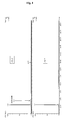
- Table 4 and figure 1 show the reduced VOC content as measured in the suspension for inventive example 2 vs. prior art example 1.
- IPA isopropanol
Landscapes
- Chemical & Material Sciences (AREA)
- Organic Chemistry (AREA)
- Inorganic Chemistry (AREA)
- Engineering & Computer Science (AREA)
- Health & Medical Sciences (AREA)
- Life Sciences & Earth Sciences (AREA)
- Polymers & Plastics (AREA)
- Chemical Kinetics & Catalysis (AREA)
- Medicinal Chemistry (AREA)
- Ceramic Engineering (AREA)
- General Health & Medical Sciences (AREA)
- Zoology (AREA)
- Materials Engineering (AREA)
- Agronomy & Crop Science (AREA)
- Pest Control & Pesticides (AREA)
- Plant Pathology (AREA)
- Dentistry (AREA)
- Civil Engineering (AREA)
- Wood Science & Technology (AREA)
- Structural Engineering (AREA)
- Environmental Sciences (AREA)
- Compositions Of Macromolecular Compounds (AREA)
- Paper (AREA)
- Addition Polymer Or Copolymer, Post-Treatments, Or Chemical Modifications (AREA)
- Pigments, Carbon Blacks, Or Wood Stains (AREA)
- Polymerisation Methods In General (AREA)
- Agricultural Chemicals And Associated Chemicals (AREA)
Abstract
Description
- The present invention relates to aqueous suspensions of mineral materials, and more specifically to aqueous suspensions with rheological stability comprising a mineral material and at least one organic polymer having reduced VOC (Volatile Organic Compound) content.
- Mineral material, with which one skilled in the art is well familiar comprises, for example natural calcium carbonate such as marble, calcite, limestone and/or chalk, and/or synthetic calcium carbonate such as scalenohedral and/or aragonitic and/or calcitic crystal forms and miscellaneous analogous fillers containing calcium carbonates such as dolomite or mixed carbonate based fillers of various metals such as, in particular, calcium associated with magnesium and analogues, various matter such as talc or analogues, and mixtures of these fillers, such as, for example talc-calcium carbonate or calcium carbonate-kaolin mixtures, or mixtures of natural calcium carbonate with aluminium hydroxide, mica or with synthetic or natural fibres or co-structures of minerals such as talc-calcium carbonate or talc-titanium dioxide co-structures.
- For a long time now, it has been quite common to use in a wet grinding process , as a grinding aid agent, water soluble polymers based on partially or totally neutralised polyacrylic acid or its derivatives (
EP 0 046 573 ,EP 0 100 947 ,EP 0 100 948 ,EP 0 129 329 ,EP 0 261 039 ,EP 0 516 656 ,EP 0 542 643 ,EP 0 542 644 ) to provide aqueous mineral suspensions that meet the required refinement and viscosity criteria, but these grinding aid agents are mostly polymerized in presence of organic solvents like isopropanol or in presence of large quantity of catalysts which are harmful for the environment and may be dangerous for the user while environmental regulations are requiring more and more low VOC levels and low content of polluting and/or toxic sub-products. - The skilled man knows another type of solution disclosed in
WO 02/49766 EP 0 850 685 ,WO 2008/010055 ,WO 2007/072168 to obtain aqueous suspensions of refined mineral material, with a dry matter concentration that can be high, while having a low Brookfield™ viscosity that remains stable over time. This known type of solution discloses the use of specific dispersants like copolymers of acrylic acid with maleic acid or like particular rate of neutralization or like the use of inorganic fluorine compound used to put into aqueous suspension of the mineral particles issuing from the mechanical and/or thermal up-concentration step following a step of wet grinding at a low solid content without the use of dispersing agent nor grinding aid. - Accordingly, there is a need for producing rheologically stable mineral material suspensions comprising organic polymers with reduced VOC content while keeping rheological stability.
- With respect to this problem of VOC content, the skilled man knows the solutions disclosed in
WO 2005/095466 and inWO 2006/024706 providing water soluble polymers made in water but by the technique of controlled radical polymerization RAFT (Reversible Addition Fragmentation Transfer) having the disadvantage of containing free sulfur atom-containing sub-products or CS2 or H2S which are toxic and dangerous for the end-users, in particular during producing aqueous mineral material suspensions. - Additionally, the skilled man in the art knows
US 3,006,779 , which discloses a completely different solution based on an inorganic dispersant consisting of a homogeneous mixture of sodium phosphate glass, zinc oxide and a potassium or lithium salt or hydroxide. - Finally, the dissertation entitled "Influence of polyelectrolyte adsorption on rheology of concentrated calcite dispersion" (Robert Petzenhauser-1993) which studies the influence of different polyacrylates with regard to the calcite suspension confirms that difficulties are existing in terms of the stability of viscosity of the resulting suspensions with all the studied polyacrylates, including lithium polyacrylates.
- Accordingly, none of the known solutions provides the skilled man with a solution to the problem of achieving rheologically stable aqueous suspensions of refined mineral material allowing the use of water-soluble organic polymers with reduced VOC level, with a dry matter concentration that can be high, while having at once a low Brookfield™ viscosity that remains stable over time, a reduced dispersant and/or grinding aid agent content and/or thermally and/or mechanically increased solids content.
- Faced with the above-mentioned problem of achieving aqueous mineral material suspensions with the required properties while minimizing the VOC content without impairing the properties of the final products like the optical properties of the paper, the Applicant has found surprisingly that polymers of acrylic and/or methacrylic acid having a weight molecular weight Mw in the range from 800 to 8000 g/mol, a polydispersity index Ip in the range of from 2 to 3 and prepared by polymerization in water using a compound of the formula (I)

- X represents Na, K or H, and
- R represents an alkyl chain comprising 1 to 5 carbon atoms and
- According to one aspect of the present invention, a rheologically stable aqueous mineral material suspension comprising organic polymers having a reduced content of VOC is provided, comprising
- a) at least one mineral material, and
- b) at least one polymer of acrylic and/or methacrylic acid,
- is obtained by polymerization of acrylic and/or methacrylic acid monomer(s) in water using a compound of formula (I)

- X represents Li, Na, K or H, and
- R represents an alkyl chain comprising 1 to 5 carbon atoms, and
wherein the compound of formula (I) is used in an amount of from 0.1 to 2.5 %, preferably from 0.15 to 1.5 wt.% based on the weight of said monomer(s);
- has a weight molecular weight Mw of from 800 to 8000 g/mol;
- has a polydispersity index Ip in the range from 2 to 3; and
wherein the aqueous mineral material suspension has a content of volatile organic compounds (VOC) of ≤ 20 mg/kg, preferably < 5 mg/kg, more preferably < 1 mg/kg, most preferably < 0.2 mg/kg. - According to another aspect of the present invention, a method for producing an aqueous mineral material suspension with rheological stability comprising organic polymers having reduced VOC is provided comprising the steps of
- a) providing at least one mineral material,
- b) providing water,
- c) providing an aqueous solution of at least one polymer of acrylic and/or methacrylic acid, which
- is obtained by polymerization of acrylic and/or methacrylic acid monomer(s) in water using a compound of formula (I)

- X represents Li, Na, K or H, and
- R represents an alkyl chain comprising 1 to 5 carbon atoms, and
wherein the compound of formula (I) is used in an amount of from 0.1 to 2.5 %, preferably from 0.15 to 1.5 wt.% based on the weight of said monomer(s);
- has a weight molecular weight Mw of from 800 to 8000 g/mol;
- has a polydispersity index Ip in the range from 2 to 3;
- is obtained by polymerization of acrylic and/or methacrylic acid monomer(s) in water using a compound of formula (I)
- d) mixing the mineral material of step a) with the water of step b),
- e) mixing the aqueous solution of at least one polymer of step c) with the mineral material before and/or during and/or after step d);
wherein the aqueous mineral material suspension has a content of volatile organic compounds (VOC) of ≤ 20 mg/kg, preferably < 5 mg/kg, more preferably < 1 mg/kg, most preferably < 0.2 mg/kg. - According to another embodiment of the invention, the water of step b) is preheated before it is mixed with the mineral material in step d).
- The mixing step may be carried out under mixing and/or homogenizing and/or particle dividing conditions at room temperature, i.e. at 20 °C ±2 °C. According to one preferred embodiment, the mixing is carried out at a temperature of from 5 to 140 °C, preferably from 10 to 110 °C and most preferably from 20 °C to 105 °C. According to another preferred embodiment of the invention the mixing is carried out at high temperatures of from 70 °C to 105 °C. Heat may be introduced by internal shear or by an external source or a combination thereof.
- The skilled person will adapt these mixing and/or homogenizing conditions such as the mixing speed and temperature according to his process equipment. For example, the mixing and homogenizing may take place by means of a ploughshare mixer. Ploughshare mixers function by the principle of a fluidized bed produced mechanically. Ploughshare blades rotate close to the inside wall of a horizontal cylindrical drum and convey the components of the mixture out of the product bed and into the open mixing space. The fluidized bed produced mechanically ensures intense mixing of even large batches in a very short time. Choppers and/or dispersers are used to disperse lumps in a dry operation. Equipment that may be used in the inventive process is available, for example, from Gebrüder Lödige Maschinenbau GmbH, Germany.
- According to one preferred embodiment of the present invention, mixing is carried out using a fluidized bed mixer or ploughshare mixer.
- According to one embodiment of the present invention, mixing may be carried out for at least 1 s, preferably for at least 1 min, e.g. for at least 15 min, 30 min, 1 hour, 2 hours, 4 hours, 6 hours, 8 hours, or 10 hours.
- According to an optional embodiment of the present invention, the method comprises the additional step of heating the mixture of step d) and/or e) between 50 °C and 120 °C, preferably between 60 °C and 110 °C, and most preferably between 70 °C and 105 °C during and/or after step d) and/or e), e.g., by use of internal shear or by an external source or a combination thereof.
- According to one embodiment of the present invention, the aqueous solution of at least one polymer of step c) is, in a first step, mixed with the calcium carbonate containing material of step a), and then, in a second step with the water of step b).
- According to one exemplary embodiment of the present invention, the aqueous solution of at least one polymer of step c) is mixed with the mineral material of step d).
- According to another embodiment of the present invention, the aqueous solution of at least one polymer of step c) is, in a first step, mixed with the water of step b), and then, the obtained solution is mixed with the mineral material of step a).
- According to another embodiment of the present invention, the aqueous solution of at least one polymer of step c) and the mineral material of step a) are mixed in one step with the water of step b).
- According to a preferred embodiment of the present invention, the method for producing an aqueous mineral material suspension with improved rheological stability comprising organic polymers with reduced VOC content comprises a grinding step f), wherein step e) can be performed before, during and/or after step f).
- As an exemplary embodiment, the mineral material of step a) contains a ground calcium carbonate which is obtained by wet grinding a calcium carbonate containing material and step e) is carried out before and/or during and/or after wet grinding the calcium carbonate containing material.
- In general, the grinding step can be carried out with any conventional grinding device, for example, under conditions such that refinement predominantly results from impacts with a secondary body, i.e. in one or more of: a ball mill, a rod mill, a vibrating mill, a roll crusher, a centrifugal impact mill, a vertical bead mill, an attrition mill, a pin mill, a hammer mill, a pulveriser, a shredder, a de-clumper, a knife cutter, or other such equipment known to the skilled man. However, any other device that is able to divide the calcium carbonate containing composite particles formed during method steps d) and/or e) of this exemplary embodiment into smaller particles may be used.
- Nevertheless, generally, grinding step f) is carried out preferably in a ball mill, preferably in combination with a cyclone device that re-circulates agglomerates and/or aggregates formed during mixing back to the inlet of the milling device. A cyclone device enables the separation of particulate material such as particles, agglomerates or aggregates, into fractions of smaller and larger particulate material based on gravity.
- In case, the mineral material is a calcium carbonate containing mineral powder and comprises a wet ground calcium carbonate containing mineral material, the grinding step may be performed under conditions such that autogenous grinding takes place and/or by horizontal ball milling, and/or other such processes known to the skilled man. The wet processed ground calcium carbonate containing mineral material thus obtained may be washed and dewatered by well-known processes, e.g. by flocculation, filtration or forced evaporation prior to drying.
- Furthermore, it can be advantageous that the aqueous mineral material suspension obtained from the step e) or f) is screened and/or concentrated in a further step g).
- "Screening" in the context of the present invention is implemented by the well-known devices for "screening" like sieves, grit centrifuges, cyclones, classifiers, etc.. By "screening", it has to be understood a beneficiation by removing coarse particles having a particle size of more than 45 µm.
- "Up-concentration" is conducted, e.g. by a thermal up-concentration or a mechanical up-concentration such as by means of a centrifuge, filter-press, tube-press or thermal separation or a mixture thereof.
- According to another optional embodiment of the present invention, the method comprises the additional step of heating the mixture of step d) and/or e) between 50 °C and 120 °C, preferably between 60 °C and 110 °C and most preferably between 70 °C and 105 °C during and/or after step d) and/or e), and furthermore, the mixture of step d) and/or e) is concentrated and/or ground during the heating. Heating can be carried out by use of internal shear or by an external source or a combination thereof.
- According to still another aspect of the present invention, a method for producing composite particles is provided comprising the steps a) to e) and/or f) and/or g) of the inventive method for producing an aqueous suspension with improved rheological stability comprising a polymer of acrylic and/or methacrylic acid with reduced VOC content and a further step h) of drying the obtained suspension.
- "Drying" in the context of the present invention is implemented by the well-known devices for "drying" like jet-driers, spray-driers, etc.
- The subsequent step of drying may be carried out in a single step such as spray drying, or in at least two steps.
- It is also common that such a mineral material undergoes a beneficiation step (such as a flotation, bleaching or magnetic separation step to remove impurities.
- According to still another aspect of the present invention, composite particles obtainable by the inventive method for their production are provided.
- Still another aspect of the present invention is the use of the inventive aqueous mineral material suspension or mineral material composite particles in paper, plastics, paint, coatings, concrete and/or agriculture applications and/or life science applications like water treatment, detergent, cosmetic, food and feed is provided, wherein preferably the aqueous suspension is used in wet end process of a paper machine, in cigarette paper, board, and/or coating applications, or as a support for rotogravure and/or offset and/or ink j et printing and/or continuous ink j et printing and/or flexography and/or electrophotography and/or decoration surfaces, or the aqueous suspension is used to reduce sun light and UV exposure of plant leaves.
- Advantageous embodiments of the present invention are defined in the corresponding sub-claims.
- In this respect "aqueous solution of a polymer of acrylic acid or methacrylic acid" means a solution of a polymer of acrylic acid and/or methacrylic acid in which water is the solvent.
- "VOC content" means the content of any organic compound having an initial boiling point less than or equal to 250 °C measured at a standard atmospheric pressure of 101.3 kPa.
- "Reduced VOC content" means that the VOC content is lower than the conventional content of a polymer of acrylic and/or methacrylic acid, and is preferably ≤ 20 mg/kg, preferably < 5 mg/kg, more preferably < 1 mg/kg, most preferably < 0.2 mg/kg of the aqueous mineral material suspension.
- In a preferred embodiment the at least one polymer of acrylic and/or methacrylic acid has a reduced content of free polluting sulphur atom-containing sub-products. This means that the content of sulphur atom-containing sub-products which are free to be present in a solution of the polymer is lower than the conventional content of a polymer of acrylic and/or methacrylic acid, and is preferably less than 0.1 mol.-% relating to the total amount of polymer as measured by diffusion nuclear magnetic resonance spectroscopy.
- "Sub-products" means products resulting from the degradation of any transfer agents and/or of the compounds of formula (I) present during the polymerization process.
- "Weight molecular weight Mw" means the average by weight of molecular weights determined using the size exclusion chromatography (SEC) method described in the experimental section.
- "Polydispersity index Ip " means the weight average molecular weight Mw divided by the number average molecular weight Mn so that it corresponds to the molecular weight distribution of the different macromolecules within the polymer.
- Preferably the aqueous mineral material suspensions according to the invention are high solids suspensions. The term "high solids aqueous mineral material suspension" means suspensions having a solids content of at least 10 wt.-%, preferably at least 45 wt.-%, based on the total weight of the aqueous suspension. According to a preferred embodiment the aqueous suspension according to the present invention has a solids content from 45 to 82 wt.-%, preferably from 60 to 78 wt.-%, and more preferably from 70 to 78 wt.-%, based on the total weight of the aqueous suspension.
- Preferably the aqueous mineral material suspensions according to the invention are low viscous aqueous suspensions. The term "Low viscous aqueous suspension" means that the Brookfield viscosity of the aqueous suspension is between 25 and 4000 mPa·s, preferably between 25 and 2000 mPa·s, very preferably between 25 and 1000 mPa·s measured at 20 °C.
- "Rheological stability" or "rheologically stable" means that the initial Brookfield™ viscosity of the aqueous mineral material suspension after 1 hour of production is below 4000 mPa·s, preferably below 2000 mPa·s, more preferably below 1000 mPa·s measured after 1 minute of stirring by the use of a RVT model Brookfield™ viscosimeter at room temperature and a rotation speed of 100 rpm (revolutions per minute) with the appropriate spindle, and that the Brookfield™ viscosity of the aqueous mineral material suspension after 8 days of unstirred storage is below 4000 mPa·s, preferably below 2000 mPa·s, more preferably below 1 000 mPa·s measured after 1 minute of stirring by the use of a RVT model Brookfield™ viscosimeter at room temperature and a rotation speed of 100 rpm with the appropriate spindle.
- According to a preferred embodiment, the mineral material is selected from calcium carbonate-containing mineral like natural calcium carbonate, synthetic calcium carbonate, surface modified calcium carbonate and miscellaneous analogous fillers containing calcium carbonates such as dolomite or mixed carbonate based fillers of various matter such as clay or talc or analogues or mixtures with synthetic or natural fibers; various matter such as talc or analogues; mica, clay, titanium dioxide, etc. and preferably selected from the group comprising natural calcium carbonate (GCC) such as marble, chalk, limestone and/or calcite; precipitated calcium carbonate (PCC) such as aragonitic PCC, vateritic PCC and/or calcitic PCC, especially prismatic, rhombohedral or scalenohedral PCC; surface modified calcium carbonate; dolomite; talc; bentonite; clay; magnesite; satin white; sepiolite, huntite, diatomite; silicates; and mixtures thereof.
- Ground (or natural) calcium carbonate (GCC) is understood to be a naturally occurring form of calcium carbonate, mined from sedimentary rocks such as limestone or chalk, or from metamorphic marble rocks. Calcium carbonate is known to exist as three types of crystal polymorphs: calcite, aragonite and vaterite. Calcite, the most common crystal polymorph, is considered to be the most stable crystal form of calcium carbonate. Less common is aragonite, which has a discrete or clustered needle orthorhombic crystal structure. Vaterite is the rarest calcium carbonate polymorph and is generally unstable. Ground calcium carbonate is almost exclusively of the calcitic polymorph, which is said to be trigonal-rhombohedral and represents the most stable of the calcium carbonate polymorphs. The term "source" of the calcium carbonate in the meaning of the present application refers to the naturally occurring mineral material from which the calcium carbonate is obtained. The source of the calcium carbonate may comprise further naturally occurring components such as magnesium carbonate, alumino-silicate etc.
- According to one embodiment, the calcium carbonate containing material comprises one ground calcium carbonate. According to another embodiment of the present invention, the calcium carbonate-containing material comprises a mixture of two or more ground calcium carbonates selected from different sources of ground calcium carbonate. For example, the at least one ground calcium carbonate may comprise one GCC selected from dolomite and one GCC selected from marble.
- According to another embodiment, the calcium carbonate-containing material consists of only one ground calcium carbonate. According to another embodiment of the present invention, the calcium carbonate-containing material consists of a mixture of two or more ground calcium carbonates selected from different sources of ground calcium carbonate.
- "Precipitated calcium carbonate" (PCC) in the meaning of the present invention is a synthesized material, generally obtained by precipitation following a reaction of carbon dioxide and calcium hydroxide (hydrated lime) in an aqueous environment or by precipitation of a calcium- and a carbonate ions source in water, for example CaCl2 and Na2CO3, out of solution. Additionally, precipitated calcium carbonate can also be the product of introducing calcium and carbonate salts, calcium chloride and sodium carbonate for example, in an aqueous environment. Further possible ways of producing PCC are the lime soda process, or the Solvay process in which PCC is a by-product of ammonia production. Precipitated calcium carbonate exists in three primary crystalline forms: calcite, aragonite and vaterite, and there are many different polymorphs (crystal habits) for each of these crystalline forms. Calcite has a trigonal structure with typical crystal habits such as scalenohedral (S-PCC), rhombohedral (R-PCC), hexagonal prismatic, pinacoidal, colloidal (C-PCC), cubic, and prismatic (P-PCC). Aragonite is an orthorhombic structure with typical crystal habits of twinned hexagonal prismatic crystals, as well as a diverse assortment of thin elongated prismatic, curved bladed, steep pyramidal, chisel shaped crystals, branching tree, and coral or worm-like form. Vaterite belongs to the hexagonal crystal system. The obtained PCC slurry can be mechanically dewatered and dried. PCC may be vaterite, calcite or aragonite.
- According to one embodiment of the present invention, the calcium carbonate containing material comprises one precipitated calcium carbonate. According to another embodiment of the present invention, the calcium carbonate containing material comprises a mixture of two or more precipitated calcium carbonates selected from different crystalline forms and different polymorphs of precipitated calcium carbonate. For example, the at least one precipitated calcium carbonate may comprise one PCC selected from S-PCC and one PCC selected from R-PCC.
- According to another embodiment, the calcium carbonate containing material consists of only one precipitated calcium carbonate.
- According to another embodiment the calcium carbonate containing material is a mixture of ground calcium carbonate and precipitated calcium carbonate.
- In addition to calcium carbonate, the calcium carbonate containing material may comprise further particles of calcium associated with magnesium and analogues or derivatives, various silicates such as clay, for example kaolin clay and/or talc and/or mica and/or analogues or derivatives, and mixtures of these fillers, such as, for example, talc-calcium carbonate or calcium carbonate-kaolin mixtures, or may additionally comprise metal oxides such as titanium dioxide and/or aluminium trioxide, metal hydroxides such as aluminium tri-hydroxide, metal salts such as sulfates carbonates such as magnesium carbonate and/or gypsum, satin white and mixtures thereof.
- Most preferably, it is a GCC chosen among marble, chalk, calcite or limestone or a PCC chosen among aragonitic PCC or calcitic PCC like rhombohedral PCC or scalenohedral PCC, or mixtures thereof.
- According to one embodiment the amount of calcium carbonate in the calcium carbonate containing material is at least 80 wt.-%, preferably at least 95 wt.-%, more preferably between 97 and 100 wt.-%, and most preferably between 98.5 and 99.95 wt.-%, based on the total weight of the calcium carbonate containing material.
- According to another embodiment the mineral material has a weight median particle size d50 from 0.1 to 100 µm, preferably from 0.25 to 50 µm, more preferably from 0.3 to 5 µm, and most preferably from 0.4 to 3.0 µm determined as mentioned in the experimental section.
- The solids content of the aqueous suspension obtained by the inventive method can be adjusted by the methods known to the skilled person. To adjust the solids content of an aqueous mineral material comprising suspension, the suspension may be partially or fully dewatered by a filtration, centrifugation or thermal separation process. For example, the suspension may be partially or fully dewatered by a filtration process such as nanofiltration or a thermal separation process such as an evaporation process. Alternatively, water may be added to the solid mineral material until the desired solids content is obtained. Additionally or alternatively, a suspension having an appropriate lower content of solid particles may be added to the particulate material of the mixed suspension until the desired solid content is obtained.
- According to another embodiment the aqueous suspension has a solids content from 10 to 82 wt.-%, preferably from 45 to 82 wt.-%, more preferably from 60 to 78 wt.-%, and most preferably from 70 to 78 wt.-%, based on the total weight of the aqueous suspension.
- According to another embodiment the aqueous suspension has a pH from 7 to 12, preferably from 7.5 to 11, and more preferably from 8.5 to 10 determined as mentioned in the experimental section.
- According to the invention, the at least one organic polymer with reduced VOC is a polymer of acrylic and/or methacrylic acid having a weight molecular weight Mw in the range from 800 to 8000 g/mol, and a polydispersity index Ip in the range from 2 to 3, and is prepared by polymerization in water in presence of a compound of the formula (I)

- X represents Li, Na, K or H, and
- R represents an alkyl chain comprising 1 to 5 carbon atoms and wherein the weight percentage (weight/weight) between the compound of formula (I) and the said monomer(s) is in the range from 0.1 to 2.5 %, preferably from 0.15 to 1.5 %.
- The polymerisation may be carried out in the presence of a polymerization initiator.
- The polymer of acrylic and/or methacrylic acid preferably contains not more than 0.1 mol.-% of sub-product CS2, preferably less than 0.05 mol.-%, very preferably less than 0.01 mol.-%.
- It has to be noted that said polymer may be totally or partially neutralised by neutralization agents having a monovalent neutralizing function or a polyvalent neutralizing function such as, for the monovalent function, those selected from among the group consisting of the alkaline cations, in particular lithium, sodium, potassium, ammonium or the primary, secondary or tertiary aliphatic and/or cyclic amines such as stearylamine, the ethanolamines (mono-, di-, triethanolamine), mono and diethylamine, cyclohexylamine, methylcyclohexylamine, aminomethylpropanol, morpholine or, for the polyvalent function, those selected from among the group consisting of alkaline earth divalent cations, in particular magnesium and calcium, or zinc or strontium, and of the trivalent cations, as in particular aluminium, or of certain cations of higher valency, and mixtures thereof.
- According to another embodiment the at least one organic polymer with reduced VOC content is present in an amount from 0.01 to 10 wt.-%, based on the total weight of the solids in the suspension, preferably from 0.05 to 5 wt.-%, more preferably from 0.1 to 3.0 wt.-%, even more preferably from 0.2 to 2.0 wt.-%, and most preferably from 0.25 to 1.5 wt.-% or from 0.5 to 1.25 wt.-%.
- According to another embodiment the at least one organic polymer with reduced VOC content is present in an amount such that the obtained aqueous suspension has a Brookfield™ viscosity between 25 and 4000 mPa·s measured at 20 °C, preferably between 30 to 2000 mPa·s measured at 20 °C, and most preferably between 35 to 1000 mPa·s measured at 20 °C.
- A "suspension" or "slurry" in the meaning of the present invention comprises insoluble solids and water, and optionally further additives, and usually contains large amounts of solids and, thus, is more viscous and can be of higher density than the liquid from which it is formed.
- Throughout the present document, the "particle size" of a calcium carbonate containing material is described by its distribution of particle sizes. The value dx represents the diameter relative to which x % by weight of the particles have diameters less than dx. This means that the d20 value is the particle size at which 20 wt.-% of all particles are smaller, and the d 75 value is the particle size at which 75 wt.-% of all particles are smaller. The d 50 value is thus the weight median particle size, i.e. 50 wt.-% of all grains are bigger or smaller than this particle size. For the purpose of the present invention the particle size is specified as weight median particle size d 50 unless indicated otherwise. For determining the weight median particle size d 50 value for particles having a d 50 value between 0.4 and 2 µm, a Sedigraph 5120 device from the company Micromeritics, USA, can be used.
- The Brookfield™ viscosity is defined as the viscosity measured by a Brookfield viscosimeter at 20 °C ±2 °C at 100 rpm and is specified in mPa·s.
- According to the present invention the "absolute value" or "modulus" of a real number is the numerical value of the real number without regards to its sign.
- Where the term "comprising" is used in the present description and claims, it does not exclude other elements. For the purposes of the present invention, the term "consisting of" is considered to be a preferred embodiment of the term "comprising of". If hereinafter a group is defined to comprise at least a certain number of embodiments, this is also to be understood to disclose a group, which preferably consists only of these embodiments.
- Where an indefinite or definite article is used when referring to a singular noun, e.g. "a", "an" or "the", this includes a plural of that noun unless something else is specifically stated.
- Terms like "obtainable" or "definable" and "obtained" or "defined" are used interchangeably. This e.g. means that, unless the context clearly dictates otherwise, the term "obtained" does not mean to indicate that e.g. an embodiment must be obtained by e.g. the sequence of steps following the term "obtained" though such a limited understanding is always included by the terms "obtained" or "defined" as a preferred embodiment.
- The scope and interest of the invention will be better understood based on the following examples and figures which are intended to illustrate certain embodiments of the invention and are non-limitative.
-
- Figure 1
- shows GC/MS spectra illustrating the VOC reduction in inventive example 2 compared with comparative example 1.
- The pH was measured at 25 °C using a Mettler Toledo Seven Easy pH meter and a Mettler Toledo InLab® Expert Pro pH electrode. A three point calibration (according to the segment method) of the instrument was first made using commercially available buffer solutions having pH values of 4, 7 and 10 at 20 °C (from Aldrich). The reported pH values were the endpoint values detected by the instrument (the endpoint was when the measured signal differs by less than 0.1 mV from the average over the last 6 seconds).
- Weight median grain diameter and grain diameter mass distribution of a particulate material were determined via the sedimentation method, i.e. an analysis of sedimentation behaviour in a gravimetric field. The measurement was made with a Sedigraph™ 5120.
- The method and the instrument are known to the skilled person and are commonly used to determine grain size of fillers and pigments. The measurement was carried out in an aqueous solution of 0.1 % by weight of Na4P2O7. The samples were dispersed using a high speed stirrer and ultrasonic.
- The weight solids were determined by dividing the weight of the solid material by the total weight of the aqueous suspension. The weight solids content was determined using a Moisture Analyser MJ 33, Mettler Toledo.
- The specific surface area (in m2/g) of the mineral filler was determined using nitrogen and the BET method, which is well known to the skilled man (ISO 9277:1995). The total surface area (in m2) of the mineral filler was then obtained by multiplication of the specific surface area and the mass (in g) of the mineral filler. The method and the instrument are known to the skilled person and are commonly used to determine specific surface of fillers and pigments.
- The Brookfield viscosity was measured after 1 minute of stirring by the use of a RVT model Brookfield™ viscometer at a temperature of 20 °C (±2 °C), and a rotation speed of 100 rpm (revolutions per minute) with the appropriate disc spindle from N° 1 to 5. In the following examples the Brookfield viscosity was measured during and after the addition of the polymer to the aqueous slurries to determine the amount of polymer actually needed to obtain a Brookfield viscosity within a defined range.
- A test portion of the polymer solution corresponding to 90 mg of dry matter is introduced into a 10 ml flask. Mobile phase, with an additional 0.04 wt.% of dimethylformamide, is added, until a total mass of 10 g is reached. The composition of this mobile phase at pH 9 is as follows: NaHCO3: 0.05 mol/l, NaNO3: 0.1 mol/l, triethanolamine: 0.02 mol/l, 0.03 wt.% of NaN3.
- The SEC equipment is consisting of an isocratic pump of the Waters™ 515 type, the flow rate of which is set at 0.8 ml/min., a Waters™ 717+ sample changer, a kiln containing a precolumn of the "Guard Column Ultrahydrogel Waters™" type which is 6 cm in length and has an internal diameter of 40 mm, followed by a linear column of the "Ultrahydrogel Waters™" type which is 30 cm in length and has an internal diameter of 7.8 mm.
- Detection is accomplished by means of a Waters™ 410 type differential refractometer. The kiln is heated to a temperature of 60°C and the refractometer is heated to a temperature of 45°C.
- The SEC is calibrated with a series of sodium polyacrylate standards supplied by Polymer Standard Service having maximum molecular weight of between 2000 and 1·106 g/mol and a polydispersity index of between 1.4 and 1.7 and also with a sodium polyacrylate of average weight molecular weight of 5600 g/mol and polydispersity index equal to 2.4.
- The calibration graph is of the linear type and takes account of the correction obtained using the flow rate marker (dimethylformamide).
- Acquisition and processing of the chromatogram are accomplished through use of the PSS WinGPC Scientific v. 4.02 application. The chromatogram obtained is incorporated in the area corresponding to molecular weights higher than 65 g/mol.
- The volatiles in the suspension were measured by GC/MS measurements using the following equipment and parameters.
- For this purpose, approximately 0.2 g of carbonate suspension was placed in a GC head space vial and mixed with approximately 50 mg of anhydrous sodium sulphate. After closing the vial the sample was analysed by head space GC/MS as described below.
-
- HS TurboMatrix 40 Trap Perkin Elmer
- Temp. Mode: Oven 90°C,
Needle 100°C, Transfer 110°C, Trap Low 40°C, Trap High 280°C - Timing: Thermo 20.0 min, Delay: 0.8 min, Pressurize 1.0 min, Dry Purge 5.0 min, Desorb 0.1 min,
- Trap Hold 5.0 min
- Column: 107 kPa, Vial: 107 kPa, Desorb: 107 kPa
- GC Method AutoSystem XL Perkin Elmer
- Column: Optima 5 MS 1.0 µm, 50m * 0.32 mm, Macherey-Nagel
- Injector 130°C, Split on
- Temp.: 50°C 3.0 min, 10°C/min to 220°C 5.0 min
- Pressure: 70 kPa
- MS Turbo Mass Perkin Elmer
- Solvent Delay 0.0 min
- Full Scan 25 to 300 (EI+)
- Weight sample: ca.0.2 g
- The NMR analysis was carried out by diffusion NMR spectroscopy.
- The molar percentage of free sulphur atom-containing polymer of acrylic and/or methacrylic acid is determined by the diffusion NMR method, which is well known to the skilled man as DOSY (diffusion ordered spectroscopy) method using a spectrometer Bruker AV 500 equipped with a 5 mm catheter TXI (1H, 13C, 31P).
- The samples to be analysed are solubilized in heavy water before examination by NMR 1H with pre-saturation of the signal of the water and by NMR 13C: experiences 1D and 2D (correlations 1H/13C simple and long distance).
- A natural calcium carbonate of Italian origin was obtained by first autogenously dry grinding by a hammer mill 10 to 300 mm calcium carbonate rocks to a fineness corresponding to a d50 value of between 42 to 48 µm, and subsequently wet grinding this dry-ground product at 55 to 60 °C in water in a 1.4-litre vertical attritor mill (Dynomill) at a weight solids content of between 75 and 76 wt.-%, based on the total weight of the suspension, until 60% had a diameter below 1 µm and d50 equals 0.75 µm. During the grinding processes, 1.5 dry wt.-%, based on the total weight of solids in the suspension of a 50 mol-% sodium - 50 mol% magnesium neutralized polyacrylate, Mw 5500, produced by radical polymerisation in water/isopropanol was added and mixed during grinding to obtain a Brookfield viscosity between 100 and 200 mPa·s.
- A natural calcium carbonate of Italian origin was obtained by first autogenously dry grinding by a hammer mill 10 to 300 mm calcium carbonate rocks to a fineness corresponding to a d50 value of between 42 to 48 µm, and subsequently wet grinding this dry-ground product at 55 to 60 °C in water in a 1.4-litre vertical attritor mill (Dynomill) at a weight solids content of between 75 and 76 wt.-%, based on the total weight of the suspension 60% had a diameter below 1 µm and d50 equals 0.75 µm During the grinding processes, 1.5 dry wt.-%, based on the total weight of solids in the suspension, of an aqueous solution of a 50 mol-% sodium - 50 mol-% magnesium neutralized polyacrylate, having a Mw equal to 5320 g/mol and an Ip of 2.5, produced by polymerisation in water using 0.28 wt % based on the weight of acrylic acid of the compound of formula (I) wherein X represents Na and R is the propyl group, was added and mixed during grinding to obtain a Brookfield viscosity between 150 and 250 mPa·s.
- Particle size distribution after grinding is shown in Table 1:
Particle size after grinding [µm] PA 1 [wt.%] IN 2 [wt.%] < 3 97.2 98.0 < 2 89.8 91.0 < 1 60.5 62.6 < 0.5 36.5 38.4 < 0.2 18.0 16.5 - Grinding efficiency is shown in Table 2:
Example Grinding time for 1.5 kg of dry calcium carbonate to reach fineness of 90 wt.-% < 2 µm Solids [weight %] PA 133 min 74.0 IN 2 30 min 74.5 - Table 1 and 2 demonstrate that the inventive dispersant performs equal in respect to grinding efficiency and suspension stability compared to the prior art.
- Dispersing properties are shown in Table 3:
Sample Brookfield viscosity at 100 rpm 1 hour after productionBrookfield viscosity at 100 rpm 24 hour after production PA 1 185 176 IN 2 165 172 - Table 3 demonstrates that the inventive dispersant performs equal to the prior art in respect to suspension stabilization.
- VOC reduction is shown in Table 4:
Example VOC expressed as acetone/ isopropanol content PA 1 big peak of 245'469 area units detected at 3.53 min by GC and identified as acetone/isopropanol blend by MS IN 2 very little peak of 885 area units detected between 3.5 and 3.6 min by GC and identified as acetone/isopropanol blend by MS corresponding to < 0.5 area % compared to PA 1 - Table 4 and
figure 1 show the reduced VOC content as measured in the suspension for inventive example 2 vs. prior art example 1. - A calibration curve for isopropanol (IPA) was made by using pure isopropanol in water, injecting different volumes into the vials:
Conc. of IPA in µg Area under the peak 0 0 1.031 33999 5.006 164726 10.35 320763 14.998 467117 - Using the calibration to calculate the absolute value corresponding to the 245'469 area units of "
PA 1" equals 7.9 µg isopropanol, which equals 39.6 mg/kg isopropanol/acetone in the suspension. - Using the calibration to calculate the absolute value corresponding to the 885 area units of "IN 2" equals 0.025 µg isopropanol, which equals 0.12 mg/kg isopropanol/acetone in the suspension.
Claims (25)
- A rheologically stable aqueous mineral material suspension comprisinga) at least one mineral material, andb) at least one polymer of acrylic and/or methacrylic acid,
wherein the at least one polymer of acrylic and/or methacrylic acid- is obtained by polymerization of acrylic and/or methacrylic acid monomer(s) in water using a compound of formula (I) - X represents Li, Na, K or H, and- R represents an alkyl chain comprising 1 to 5 carbon atoms, and
wherein the compound of formula (I) is used in an amount of from 0.1 to 2.5 wt%, based on the weight of said monomer(s);- has a weight molecular weight Mw of from 800 to 8000 g/mol;- has a polydispersity index Ip in the range from 2 to 3; andwherein the aqueous mineral material suspension has a content of volatile organic compounds (VOC) of ≤ 20 mg/kg. - The aqueous suspension according to claim 1, wherein the mineral material is selected from calcium carbonate-containing mineral such as natural calcium carbonate, synthetic calcium carbonate, surface modified calcium carbonate and fillers containing calcium carbonates such as dolomite or mixed carbonate based fillers of such as mixtures with clay or talc or mixtures with synthetic or natural fibers; and from talc, mica, clay, titanium dioxide, bentonite, magnesite satin white, sepiolite, huntite, diatomites, silicates and mixtures thereof.
- The aqueous suspension according to claim 2, wherein the amount of calcium carbonate in the calcium carbonate containing material is at least 80 wt.-%, preferably at least 95 wt.-%, more preferably between 97 and 100 wt.-%, and most preferably between 98.5 and 99.95 wt.-%, based on the total weight of the calcium carbonate containing material.
- The aqueous suspension according to any one of claims 1 to 3, wherein the mineral material is selected from the group comprising natural calcium carbonate (GCC) such as marble, chalk, limestone and/or calcite; precipitated calcium carbonate (PCC) such as aragonitic PCC, vateritic PCC and/or calcitic PCC, especially prismatic, rhombohedral or scalenohedral PCC and mixtures thereof.
- The aqueous suspension according to any one of claims 1 to 4, wherein the aqueous suspension has a solids content from 10 to 82 wt.-%, preferably 45 to 82 wt.-%, more preferably from 60 to 78 wt.-%, and most preferably from 70 to 78 wt.-%, based on the total weight of the aqueous suspension.
- The aqueous suspension according to any one of claims 1 or 5, wherein the mineral material has a weight median particle size d50 from 0.1 to 100 µm, preferably from 0.25 to 50 µm, more preferably from 0.3 to 5 µm, and most preferably from 0.4 to 3.0 µm.
- The aqueous suspension according to any one of claims 1 to 6, wherein the aqueous suspension has a pH from 7 to 12, preferably from 7.5 to 11, and more preferably from 8.5 to 10.
- The aqueous suspension according to any one of claims 1 to 7, wherein the at least one polymer of acrylic and/or methacrylic acid is obtained by polymerization of acrylic and/or methacrylic acid monomer(s) in water using a compound of formula (I) in an amount of from 0.15 to 1.5 wt.% based on the weight of said monomer(s).
- The aqueous suspension according to any one of claims 1 to 8, wherein the aqueous mineral material suspension has a content of volatile organic compounds (VOC) of < 5 mg/kg, preferably < 1 mg/kg, more preferably < 0.2 mg/kg.
- The aqueous suspension according to any one of claims 1 to 9, wherein the at least one polymer of acrylic and/or methacrylic acid has a content of free sulphur atom containing sub-products of not more than 0.1 mole-%.
- The aqueous suspension according to claim 10, wherein the at least one polymer of acrylic and/or methacrylic acid contains not more than 0.1 mole-% of sub-product CS2, preferably less than 0.05 mole-%, very preferably less than 0.01 mole-%.
- The aqueous suspension according to any one of claims 1 to 11, wherein the at least one polymer of acrylic and/or methacrylic acid is present in an amount from 0.01 to 3.0 wt.-%, more preferably from 0.2 to 2.0 wt.-%, and most preferably from 0.25 to 1.5 wt.-% or from 0.5 to 1.25 wt.-%.
- The aqueous suspension according to any one of claims 1 to 12, wherein the at least one polymer of acrylic and/or methacrylic acid is present in an amount such that the obtained aqueous suspension has a viscosity between 25 and 4000 mPa·s measured at 20 °C, preferably between 30 to 2000 mPa·s measured at 20 °C, and most preferably between 35 to 1000 mPa·s measured at 20 °C.
- A method for producing a rheologically stable aqueous mineral material suspension comprising the steps ofa) providing at least one mineral material,b) providing water,c) providing an aqueous solution of at least one polymer of acrylic and/or methacrylic acid, which- is obtained by polymerization of acrylic and/or methacrylic acid monomer(s) in water using a compound of the formula (I)
 - X represents Li, Na, K or H, and- R represents an alkyl chain comprising 1 to 5 carbon atoms, andwherein the compound of formula (I) is used in an amount of from 0.1 to 2.5 wt% based on the weight of said monomer(s);- has a weight molecular weight Mw of from 800 to 8000 g/mol;- has a polydispersity index Ip in the range from 2 to 3;d) mixing the mineral material of step a) with the water of step b),e) mixing the aqueous solution of at least one polymer of step c) with the mineral material before and/or during and/or after step d); wherein the final aqueous mineral material suspension has a content of volatile organic compounds (VOC) of ≤ 20 mg/kg.
 - The method according to claim 14, wherein the mineral material is selected from calcium carbonate-containing mineral such as natural calcium carbonate, synthetic calcium carbonate, surface modified calcium carbonate and fillers containing calcium carbonates such as dolomite or mixed carbonate based fillers of such as mixtures with clay or talc or mixtures with synthetic or natural fibers; and from talc, mica, clay, titanium dioxide, bentonite, magnesite satin white, sepiolite, huntite, diatomites, silicates and mixtures thereof.
- The method according to claim 15, wherein the amount of calcium carbonate in the calcium carbonate containing material is at least 80 wt.-%, preferably at least 95 wt.-%, more preferably between 97 and 100 wt.-%, and most preferably between 98.5 and 99.95 wt.-%, based on the total weight of the calcium carbonate containing material.
- The method according to any one of claims 14 to 16, wherein the mineral material is selected from the group comprising natural calcium carbonate (GCC) such as marble, chalk, limestone and/or calcite; precipitated calcium carbonate (PCC) such as aragonitic PCC, vateritic PCC and/or calcitic PCC, especially prismatic, rhombohedral or scalenohedral PCC and mixtures thereof.
- The method according to any one of claims 14 to 17, wherein the at least one polymer of acrylic and/or methacrylic acid is obtained by polymerization of acrylic and/or methacrylic acid monomer(s) in water using a compound of formula (I) in an amount of from 0.15 to 1.5 wt.% based on the weight of said monomer(s).
- The method according to any one of claims 14 to 18, wherein the aqueous mineral material suspension has a content of volatile organic compounds (VOC) of < 5 mg/kg, preferably < 1 mg/kg, more preferably < 0.2 mg/kg.
- The method according to any one of claims 14 to 19, wherein the water of step b) is preheated before it is mixed with the mineral material in step d).
- The method according to any one of claims 14 to 20, further comprising a grinding step f), wherein step e) is carried out before, during and/or after step f).
- The method according to claim 21, further comprising a screening and/or up-concentrating step g) performed after step e).
- A method according to any one of claims 14 to 22, further comprising a drying step h) of drying the obtained suspension.
- Mineral material composite particles obtained by the method according to claim 23.
- Use of an aqueous suspension according to any one of claims 1 to 13 or mineral material composite particles according to claim 24 in paper, plastics, paint, coatings, concrete and/or agriculture applications and/or life science applications like water treatment, detergent, cosmetic, food and feed, wherein preferably the aqueous suspension is used in wet end process of a paper machine, in cigarette paper, board, and/or coating applications, or as a support for rotogravure and/or offset and/or ink jet printing and/or continuous ink jet printing and/or flexography and/or electrophotography and/or decoration surfaces, or the aqueous suspension is used to reduce sun light and UV exposure of plant leaves.
Priority Applications (24)
| Application Number | Priority Date | Filing Date | Title |
|---|---|---|---|
| EP12186131.4A EP2712895B1 (en) | 2012-09-26 | 2012-09-26 | Rheologically stable aqueous mineral material suspensions comprising organic polymers having reduced volatile organic compound (voc) content |
| SI201230669A SI2712895T1 (en) | 2012-09-26 | 2012-09-26 | Rheologically stable aqueous mineral material suspensions comprising organic polymers having reduced volatile organic compound (voc) content |
| PT121861314T PT2712895T (en) | 2012-09-26 | 2012-09-26 | Rheologically stable aqueous mineral material suspensions comprising organic polymers having reduced volatile organic compound (voc) content |
| DK12186131.4T DK2712895T3 (en) | 2012-09-26 | 2012-09-26 | Rheologically stable aqueous MINERALMATERIALESUSPENSIONER comprising organic POLYMERS WITH REDUCED volatile organic compounds (VOC) |
| ES12186131.4T ES2587504T3 (en) | 2012-09-26 | 2012-09-26 | Aqueous suspensions of rheologically stable mineral material comprising organic polymers having reduced content of volatile organic compounds (VOCs) |
| PL12186131.4T PL2712895T3 (en) | 2012-09-26 | 2012-09-26 | Rheologically stable aqueous mineral material suspensions comprising organic polymers having reduced volatile organic compound (voc) content |
| TW102132117A TWI601779B (en) | 2012-09-26 | 2013-09-06 | Rheologically stable aqueous mineral material suspensions comprising organic polymers having reduced volatile organic compound (voc) content |
| NZ706642A NZ706642A (en) | 2012-09-26 | 2013-09-20 | Rheologically stable aqueous mineral material suspensions comprising organic polymers having reduced volatile organic compound (voc) content |
| CA2882929A CA2882929C (en) | 2012-09-26 | 2013-09-20 | Rheologically stable aqueous mineral material suspensions comprising organic polymers having reduced volatile organic compound (voc) content |
| AU2013322829A AU2013322829B2 (en) | 2012-09-26 | 2013-09-20 | Rheologically stable aqueous mineral material suspensions comprising organic polymers having reduced volatile organic compound (VOC) content |
| MX2015003486A MX353709B (en) | 2012-09-26 | 2013-09-20 | Rheologically stable aqueous mineral material suspensions comprising organic polymers having reduced volatile organic compound (voc) content. |
| RU2015115716/05A RU2605586C2 (en) | 2012-09-26 | 2013-09-20 | Rheologically stable aqueous suspensions of mineral material containing organic polymers with low content of volatile organic compounds (voc) |
| CN201380050002.5A CN104685005A (en) | 2012-09-26 | 2013-09-20 | Rheologically stable aqueous mineral material suspensions comprising organic polymers having reduced volatile organic compound (VOC) content |
| US14/425,081 US20150203653A1 (en) | 2012-09-26 | 2013-09-20 | Rheologically stable aqueous mineral material suspensions comprising organic polymers having reduced volatile organic compound (voc) content |
| SG11201502311SA SG11201502311SA (en) | 2012-09-26 | 2013-09-20 | Rheologically stable aqueous mineral material suspensions comprising organic polymers having reduced volatile organic compound (voc) content |
| JP2015533546A JP6170561B2 (en) | 2012-09-26 | 2013-09-20 | Rheologically stable aqueous mineral material suspension comprising an organic polymer having a reduced volatile organic compound (VOC) content |
| PCT/EP2013/069641 WO2014048856A1 (en) | 2012-09-26 | 2013-09-20 | Rheologically stable aqueous mineral material suspensions comprising organic polymers having reduced volatile organic compound (voc) content |
| BR112015006599-6A BR112015006599B1 (en) | 2012-09-26 | 2013-09-20 | Suspension of rheologically stable aqueous mineral material comprising organic polymers having reduced volatile organic compound (voc) content, method for producing said suspension and use thereof |
| EP13765744.1A EP2900760A1 (en) | 2012-09-26 | 2013-09-20 | Rheologically stable aqueous mineral material suspensions comprising organic polymers having reduced volatile organic compound (voc) content |
| KR1020157010639A KR101758540B1 (en) | 2012-09-26 | 2013-09-20 | Rheologically stable aqueous mineral material suspensions comprising organic polymers having reduced volatile organic compound (voc) content |
| ARP130103404A AR092653A1 (en) | 2012-09-26 | 2013-09-23 | WATER SUSPENSIONS OF REOLOGICALLY STABLE MINERAL MATERIALS THAT INCLUDE ORGANIC POLYMERS THAT HAVE REDUCED CONTENT OF VOLATILE ORGANIC COMPOUNDS (VOC) |
| UY0001035043A UY35043A (en) | 2012-09-26 | 2013-09-24 | WATERPROOFLY STABLE MINERAL MATERIAL SUSPENSION, METHOD FOR THEIR PRODUCTION, COMPOSITE MATERIAL PARTICLES AND USE OF THE SUSPENSION |
| CL2015000753A CL2015000753A1 (en) | 2012-09-26 | 2015-03-25 | Aqueous suspensions of rheologically stable mineral material comprising organic polymers having reduced content of volatile organic compounds (cov) |
| ZA2015/02702A ZA201502702B (en) | 2012-09-26 | 2015-04-21 | Rheologically stable aqueous mineral material suspensions comprising organic polymers having reduced volatile organic compound (voc) content |
Applications Claiming Priority (1)
| Application Number | Priority Date | Filing Date | Title |
|---|---|---|---|
| EP12186131.4A EP2712895B1 (en) | 2012-09-26 | 2012-09-26 | Rheologically stable aqueous mineral material suspensions comprising organic polymers having reduced volatile organic compound (voc) content |
Publications (2)
| Publication Number | Publication Date |
|---|---|
| EP2712895A1 true EP2712895A1 (en) | 2014-04-02 |
| EP2712895B1 EP2712895B1 (en) | 2016-05-18 |
Family
ID=47010277
Family Applications (2)
| Application Number | Title | Priority Date | Filing Date |
|---|---|---|---|
| EP12186131.4A Active EP2712895B1 (en) | 2012-09-26 | 2012-09-26 | Rheologically stable aqueous mineral material suspensions comprising organic polymers having reduced volatile organic compound (voc) content |
| EP13765744.1A Withdrawn EP2900760A1 (en) | 2012-09-26 | 2013-09-20 | Rheologically stable aqueous mineral material suspensions comprising organic polymers having reduced volatile organic compound (voc) content |
Family Applications After (1)
| Application Number | Title | Priority Date | Filing Date |
|---|---|---|---|
| EP13765744.1A Withdrawn EP2900760A1 (en) | 2012-09-26 | 2013-09-20 | Rheologically stable aqueous mineral material suspensions comprising organic polymers having reduced volatile organic compound (voc) content |
Country Status (23)
| Country | Link |
|---|---|
| US (1) | US20150203653A1 (en) |
| EP (2) | EP2712895B1 (en) |
| JP (1) | JP6170561B2 (en) |
| KR (1) | KR101758540B1 (en) |
| CN (1) | CN104685005A (en) |
| AR (1) | AR092653A1 (en) |
| AU (1) | AU2013322829B2 (en) |
| BR (1) | BR112015006599B1 (en) |
| CA (1) | CA2882929C (en) |
| CL (1) | CL2015000753A1 (en) |
| DK (1) | DK2712895T3 (en) |
| ES (1) | ES2587504T3 (en) |
| MX (1) | MX353709B (en) |
| NZ (1) | NZ706642A (en) |
| PL (1) | PL2712895T3 (en) |
| PT (1) | PT2712895T (en) |
| RU (1) | RU2605586C2 (en) |
| SG (1) | SG11201502311SA (en) |
| SI (1) | SI2712895T1 (en) |
| TW (1) | TWI601779B (en) |
| UY (1) | UY35043A (en) |
| WO (1) | WO2014048856A1 (en) |
| ZA (1) | ZA201502702B (en) |
Cited By (7)
| Publication number | Priority date | Publication date | Assignee | Title |
|---|---|---|---|---|
| CN104786682A (en) * | 2015-03-12 | 2015-07-22 | 云南中烟工业有限责任公司 | Offline embossed cigarette paper making method and offline embossed cigarette paper |
| EP2933375A1 (en) * | 2014-04-16 | 2015-10-21 | Omya International AG | Adsorbing and/or reduction of the amount of organic materials in an aqueous medium by using colloidal precipitated calcium carbonate |
| WO2015200787A1 (en) * | 2014-06-27 | 2015-12-30 | Tindall Corporation | Method and apparatus for erecting tower with hydraulic cylinders |
| CN105256549A (en) * | 2015-11-07 | 2016-01-20 | 浙江华江科技发展有限公司 | Preparation method of bamboo fibers with low releasing of organic volatile matters |
| WO2021228928A1 (en) * | 2020-05-13 | 2021-11-18 | Basf Se | Biocide free pigment dispersions and methods of preparing them |
| WO2022253869A1 (en) * | 2021-06-02 | 2022-12-08 | Omya International Ag | Aqueous coating composition |
| WO2022253868A1 (en) * | 2021-06-02 | 2022-12-08 | Omya International Ag | Aqueous coating composition |
Families Citing this family (5)
| Publication number | Priority date | Publication date | Assignee | Title |
|---|---|---|---|---|
| JP2018520994A (en) | 2015-05-08 | 2018-08-02 | ザ ルブリゾル コーポレイションThe Lubrizol Corporation | Water-soluble chain transfer agent |
| CN107698230B (en) * | 2016-08-09 | 2020-08-28 | 薛祥吉 | Composite multifunctional indoor wall material capable of humidifying, resisting bacteria, purifying air and releasing negative ions |
| CN110284370A (en) * | 2019-06-20 | 2019-09-27 | 云南中烟工业有限责任公司 | A kind of heat-resistant cigarette paper for heat-not-burn cigarette and its preparation method and use |
| CN110685180B (en) * | 2019-08-29 | 2021-11-19 | 牡丹江恒丰纸业股份有限公司 | Method for manufacturing tipping base paper suitable for environment-friendly ink and water satellite type flexographic printing technology |
| EP4519389A1 (en) * | 2022-05-03 | 2025-03-12 | Anellotech, Inc. | High efficiency process for separating fillers from catalyst and gases in a catalytic fluidized bed pyrolysis process of plastics |
Citations (15)
| Publication number | Priority date | Publication date | Assignee | Title |
|---|---|---|---|---|
| US3006779A (en) | 1959-01-09 | 1961-10-31 | Wyandotte Chemicals Corp | Continuous calcium carbonate slurry process |
| EP0046573A1 (en) | 1980-08-21 | 1982-03-03 | Société COATEX, Société Anonyme | Grinding medium for grinding coarse minerals in an aqueous solution |
| EP0100947A1 (en) | 1982-08-06 | 1984-02-22 | Société COATEX, Société Anonyme | Grinding aid based on neutralized polymers and/or copolymers for aqueous suspensions of coarse mineral materials in view of pigmenting applications |
| EP0100948A1 (en) | 1982-08-06 | 1984-02-22 | Société COATEX, Société Anonyme | Grinding aid based on acrylic polymers and/or copolymers for an aqueous suspension of coarse mineral materials in view of pigmenting applications |
| EP0129329A2 (en) | 1983-05-20 | 1984-12-27 | Ciba Specialty Chemicals Water Treatments Limited | Water soluble polymers and dispersions containing them |
| EP0261039A1 (en) | 1986-08-22 | 1988-03-23 | Société COATEX, Société Anonyme | Complex pigmentary compositions for coating paper |
| EP0516656A1 (en) | 1990-02-19 | 1992-12-09 | Stockhausen Chem Fab Gmbh | PROCESS FOR THE MANUFACTURE OF POLYACRYLIC ACIDS. |
| EP0542643A1 (en) | 1991-11-12 | 1993-05-19 | Coatex S.A. | Grinding and/or dispersion aid based on polymers and/or copolymers partially neutralised by magnesium for aqueous suspensions of mineral materials which are convenient for pigmentary applications |
| EP0542644A1 (en) | 1991-11-12 | 1993-05-19 | Coatex S.A. | Grinding and/or dispersion aid based on polymers and/or copolymers partially neutralised by magnesium for aqueous suspensions of mineral materials which are convenient for pigmentary applications |
| EP0850685A2 (en) | 1996-12-27 | 1998-07-01 | Ecc International Limited | Dispersed aqueous suspensions |
| WO2002049766A2 (en) | 2000-12-20 | 2002-06-27 | Coatex S.A.S. | Grinding aid of mineral materials in aqueous suspension, suspensions and uses thereof |
| WO2005095466A1 (en) | 2004-03-29 | 2005-10-13 | Coatex S.A.S. | Trithiocarbonate derivatives and the use thereof in the form of transfer agents for acrylic acid controlled radical polymerisation |
| WO2006024706A1 (en) | 2004-07-28 | 2006-03-09 | Coatex S.A.S. | Polymers produced by using sulphur compounds in the form of transfer agents for controlled radical polymerisation of acrylic acid and the use thereof |
| WO2007072168A1 (en) | 2005-12-20 | 2007-06-28 | Coatex S.A.S. | Use of dispersants to concentrate minerals in water, dispersions obtained and uses thereof |
| WO2008010055A1 (en) | 2006-07-12 | 2008-01-24 | Coatex S.A.S. | Dispersing and/ or grinding aid agent for dispersion and aqueous suspension of mineral materials, dispersion and suspension obtained and use thereof |
Family Cites Families (14)
| Publication number | Priority date | Publication date | Assignee | Title |
|---|---|---|---|---|
| FR2777289B1 (en) * | 1998-04-09 | 2006-08-11 | Pluss Stauffer Ag | COMPOSITE COMPOSITIONS OF CO-STRUCTURED OR CO-ADSORBED MINERAL OR ORGANIC PIGMENTS OR PIGMENTS AND USES THEREOF |
| FR2818166B1 (en) * | 2000-12-20 | 2003-10-31 | Coatex Sas | AGENT FOR GRINDING AND / OR DISPERSION OF AQUEOUS SUSPENSION MINERAL MATERIALS. AQUEOUS SUSPENSIONS OBTAINED AND USES THEREOF |
| FR2821620B1 (en) * | 2001-03-02 | 2003-06-27 | Coatex Sas | PROCESS FOR CONTROLLED RADICAL POLYMERIZATION OF ACRYLIC ACID AND ITS SALTS, THE LOW POLYDISPERSITY POLYMERS OBTAINED, AND THEIR APPLICATIONS |
| FR2842814B1 (en) * | 2002-07-26 | 2004-10-22 | Coatex Sas | PROCESS FOR CONTROLLED RADICAL POLYMERIZATION OF ACRYLIC ACID AND ITS SALTS, THE POLYMERS OBTAINED, AND THEIR APPLICATIONS. |
| DE10311617A1 (en) * | 2003-03-14 | 2004-09-23 | Basf Ag | Use of at least partly neutralised polyacrylic acid with a mol. wt. of 5000-30000 containing alkylthio end groups, as an auxiliary material for the wet-milling of calcium carbonate |
| FR2873127B1 (en) * | 2004-07-13 | 2008-08-29 | Omya Development Ag | PROCESS FOR THE PRODUCTION OF SELF-ADHESIVE, DRIED OR AQUEOUS SUSPENSION OR DISPERSION PIGMENT PARTICLES CONTAINING INORGANIC MATERIALS AND BINDERS |
| FR2873047B1 (en) * | 2004-07-13 | 2007-10-05 | Coatex Soc Par Actions Simplif | PROCESS FOR MILLING MINERAL MATERIALS IN THE PRESENCE OF BINDERS, AQUEOUS SUSPENSIONS OBTAINED AND USES THEREOF |
| US7851572B2 (en) * | 2004-07-28 | 2010-12-14 | Coatex S.A.S. | Polymers produced by using sulphur compounds in the form of transfer agents for controlled radical polymerisation of acrylic acid and the use thereof |
| EP1764345A1 (en) * | 2005-09-16 | 2007-03-21 | Omya Development AG | Process of manufacturing very fine co-ground calcium carbonate material of the GCC and PCC type, obtained products and their uses |
| FR2913427B1 (en) * | 2007-03-05 | 2011-10-07 | Omya Development Ag | DRY GRINDING PROCESS OF ONE OR MORE MATERIALS COMPRISING AT LEAST ONE CALCIUM CARBONATE |
| FR2933419B1 (en) * | 2008-07-07 | 2010-08-20 | Coatex Sas | USE OF (METH) ACRYLIC POLYMERS IN A PROCESS FOR THE PRODUCTION OF AQUEOUS CALCIUM CARBONATE SUSPENSION |
| FR2934861B1 (en) * | 2008-08-05 | 2012-12-28 | Arkema France | NEW MODIFIERS CHOCKS OF THE HEART-ECORCE TYPE FOR TRANSPARENT POLYMERIC MATRICES. |
| FR2934992B1 (en) * | 2008-08-13 | 2010-08-27 | Coatex Sas | USE OF A LOW IONIC ACRYLIC POLYMER IN THE SYNTHESIS OF PRECIPITATED CALCIUM CARBONATE |
| KR20180042467A (en) * | 2009-06-04 | 2018-04-25 | 게노마티카 인코포레이티드 | Process of separating components of a fermentation broth |
-
2012
- 2012-09-26 PL PL12186131.4T patent/PL2712895T3/en unknown
- 2012-09-26 SI SI201230669A patent/SI2712895T1/en unknown
- 2012-09-26 EP EP12186131.4A patent/EP2712895B1/en active Active
- 2012-09-26 ES ES12186131.4T patent/ES2587504T3/en active Active
- 2012-09-26 PT PT121861314T patent/PT2712895T/en unknown
- 2012-09-26 DK DK12186131.4T patent/DK2712895T3/en active
-
2013
- 2013-09-06 TW TW102132117A patent/TWI601779B/en not_active IP Right Cessation
- 2013-09-20 EP EP13765744.1A patent/EP2900760A1/en not_active Withdrawn
- 2013-09-20 CN CN201380050002.5A patent/CN104685005A/en active Pending
- 2013-09-20 BR BR112015006599-6A patent/BR112015006599B1/en active IP Right Grant
- 2013-09-20 MX MX2015003486A patent/MX353709B/en active IP Right Grant
- 2013-09-20 RU RU2015115716/05A patent/RU2605586C2/en active
- 2013-09-20 US US14/425,081 patent/US20150203653A1/en not_active Abandoned
- 2013-09-20 SG SG11201502311SA patent/SG11201502311SA/en unknown
- 2013-09-20 CA CA2882929A patent/CA2882929C/en active Active
- 2013-09-20 AU AU2013322829A patent/AU2013322829B2/en not_active Ceased
- 2013-09-20 NZ NZ706642A patent/NZ706642A/en unknown
- 2013-09-20 WO PCT/EP2013/069641 patent/WO2014048856A1/en not_active Ceased
- 2013-09-20 KR KR1020157010639A patent/KR101758540B1/en active Active
- 2013-09-20 JP JP2015533546A patent/JP6170561B2/en active Active
- 2013-09-23 AR ARP130103404A patent/AR092653A1/en not_active Application Discontinuation
- 2013-09-24 UY UY0001035043A patent/UY35043A/en not_active Application Discontinuation
-
2015
- 2015-03-25 CL CL2015000753A patent/CL2015000753A1/en unknown
- 2015-04-21 ZA ZA2015/02702A patent/ZA201502702B/en unknown
Patent Citations (17)
| Publication number | Priority date | Publication date | Assignee | Title |
|---|---|---|---|---|
| US3006779A (en) | 1959-01-09 | 1961-10-31 | Wyandotte Chemicals Corp | Continuous calcium carbonate slurry process |
| EP0046573A1 (en) | 1980-08-21 | 1982-03-03 | Société COATEX, Société Anonyme | Grinding medium for grinding coarse minerals in an aqueous solution |
| EP0100947A1 (en) | 1982-08-06 | 1984-02-22 | Société COATEX, Société Anonyme | Grinding aid based on neutralized polymers and/or copolymers for aqueous suspensions of coarse mineral materials in view of pigmenting applications |
| EP0100948A1 (en) | 1982-08-06 | 1984-02-22 | Société COATEX, Société Anonyme | Grinding aid based on acrylic polymers and/or copolymers for an aqueous suspension of coarse mineral materials in view of pigmenting applications |
| EP0129329A2 (en) | 1983-05-20 | 1984-12-27 | Ciba Specialty Chemicals Water Treatments Limited | Water soluble polymers and dispersions containing them |
| EP0261039A1 (en) | 1986-08-22 | 1988-03-23 | Société COATEX, Société Anonyme | Complex pigmentary compositions for coating paper |
| EP0516656A1 (en) | 1990-02-19 | 1992-12-09 | Stockhausen Chem Fab Gmbh | PROCESS FOR THE MANUFACTURE OF POLYACRYLIC ACIDS. |
| EP0542644A1 (en) | 1991-11-12 | 1993-05-19 | Coatex S.A. | Grinding and/or dispersion aid based on polymers and/or copolymers partially neutralised by magnesium for aqueous suspensions of mineral materials which are convenient for pigmentary applications |
| EP0542643A1 (en) | 1991-11-12 | 1993-05-19 | Coatex S.A. | Grinding and/or dispersion aid based on polymers and/or copolymers partially neutralised by magnesium for aqueous suspensions of mineral materials which are convenient for pigmentary applications |
| EP0850685A2 (en) | 1996-12-27 | 1998-07-01 | Ecc International Limited | Dispersed aqueous suspensions |
| WO2002049766A2 (en) | 2000-12-20 | 2002-06-27 | Coatex S.A.S. | Grinding aid of mineral materials in aqueous suspension, suspensions and uses thereof |
| WO2005095466A1 (en) | 2004-03-29 | 2005-10-13 | Coatex S.A.S. | Trithiocarbonate derivatives and the use thereof in the form of transfer agents for acrylic acid controlled radical polymerisation |
| US20110186773A1 (en) * | 2004-03-29 | 2011-08-04 | Coatex S.A.S. | Trithiocarbonate derivatives and the use thereof in the form of transfer agents for acrylic acid controlled radical polymerisation |
| WO2006024706A1 (en) | 2004-07-28 | 2006-03-09 | Coatex S.A.S. | Polymers produced by using sulphur compounds in the form of transfer agents for controlled radical polymerisation of acrylic acid and the use thereof |
| US20110033558A1 (en) * | 2004-07-28 | 2011-02-10 | Coatex S.A.S. | Polymers produced by using sulphur compounds in the form of transfer agents for controlled radical polymerisation of acrylic acid and the use thereof |
| WO2007072168A1 (en) | 2005-12-20 | 2007-06-28 | Coatex S.A.S. | Use of dispersants to concentrate minerals in water, dispersions obtained and uses thereof |
| WO2008010055A1 (en) | 2006-07-12 | 2008-01-24 | Coatex S.A.S. | Dispersing and/ or grinding aid agent for dispersion and aqueous suspension of mineral materials, dispersion and suspension obtained and use thereof |
Cited By (12)
| Publication number | Priority date | Publication date | Assignee | Title |
|---|---|---|---|---|
| EP2933375A1 (en) * | 2014-04-16 | 2015-10-21 | Omya International AG | Adsorbing and/or reduction of the amount of organic materials in an aqueous medium by using colloidal precipitated calcium carbonate |
| WO2015158657A1 (en) * | 2014-04-16 | 2015-10-22 | Omya International Ag | Adsorbing and/or reduction of the amount of organic materials in an aqueous medium by using colloidal precipitated calcium carbonate |
| CN106232527A (en) * | 2014-04-16 | 2016-12-14 | 欧米亚国际集团 | Use the organic substance in colloidal precipitation titanium pillaring solution aqueous medium and/or reduce the amount of organic substance in aqueous medium |
| US10046984B2 (en) | 2014-04-16 | 2018-08-14 | Omya International Ag | Adsorbing and/or reduction of the amount of organic materials in an aqueous medium by using colloidal precipitated calcium carbonate |
| CN106232527B (en) * | 2014-04-16 | 2020-03-06 | 欧米亚国际集团 | Use of colloidal precipitated calcium carbonate to adsorb and/or reduce the amount of organic matter in aqueous media |
| WO2015200787A1 (en) * | 2014-06-27 | 2015-12-30 | Tindall Corporation | Method and apparatus for erecting tower with hydraulic cylinders |
| CN104786682A (en) * | 2015-03-12 | 2015-07-22 | 云南中烟工业有限责任公司 | Offline embossed cigarette paper making method and offline embossed cigarette paper |
| CN105256549A (en) * | 2015-11-07 | 2016-01-20 | 浙江华江科技发展有限公司 | Preparation method of bamboo fibers with low releasing of organic volatile matters |
| CN105256549B (en) * | 2015-11-07 | 2018-01-23 | 浙江华江科技发展有限公司 | A kind of preparation method of low VOC release bamboo fibre |
| WO2021228928A1 (en) * | 2020-05-13 | 2021-11-18 | Basf Se | Biocide free pigment dispersions and methods of preparing them |
| WO2022253869A1 (en) * | 2021-06-02 | 2022-12-08 | Omya International Ag | Aqueous coating composition |
| WO2022253868A1 (en) * | 2021-06-02 | 2022-12-08 | Omya International Ag | Aqueous coating composition |
Also Published As
| Publication number | Publication date |
|---|---|
| TWI601779B (en) | 2017-10-11 |
| JP2015533896A (en) | 2015-11-26 |
| EP2712895B1 (en) | 2016-05-18 |
| WO2014048856A1 (en) | 2014-04-03 |
| UY35043A (en) | 2014-04-30 |
| PT2712895T (en) | 2016-08-25 |
| ZA201502702B (en) | 2016-08-31 |
| CL2015000753A1 (en) | 2015-07-10 |
| ES2587504T3 (en) | 2016-10-25 |
| CA2882929A1 (en) | 2014-04-03 |
| CN104685005A (en) | 2015-06-03 |
| RU2605586C2 (en) | 2016-12-20 |
| SI2712895T1 (en) | 2016-09-30 |
| SG11201502311SA (en) | 2015-04-29 |
| MX353709B (en) | 2018-01-25 |
| CA2882929C (en) | 2017-08-22 |
| AU2013322829A1 (en) | 2015-03-12 |
| BR112015006599A2 (en) | 2017-07-04 |
| AU2013322829B2 (en) | 2015-09-17 |
| JP6170561B2 (en) | 2017-07-26 |
| AR092653A1 (en) | 2015-04-29 |
| US20150203653A1 (en) | 2015-07-23 |
| BR112015006599B1 (en) | 2022-02-01 |
| KR101758540B1 (en) | 2017-07-14 |
| EP2900760A1 (en) | 2015-08-05 |
| PL2712895T3 (en) | 2016-11-30 |
| MX2015003486A (en) | 2015-06-22 |
| KR20150060898A (en) | 2015-06-03 |
| TW201434923A (en) | 2014-09-16 |
| RU2015115716A (en) | 2016-11-20 |
| DK2712895T3 (en) | 2016-08-29 |
| NZ706642A (en) | 2018-08-31 |
Similar Documents
| Publication | Publication Date | Title |
|---|---|---|
| EP2712895B1 (en) | Rheologically stable aqueous mineral material suspensions comprising organic polymers having reduced volatile organic compound (voc) content | |
| EP2868716B1 (en) | Process for producing a high solids pigment suspension comprising carboxymethylcellulose-based dispersant | |
| EP2679638B1 (en) | High solids aqueous mineral and/or filler and/or pigment suspension in acidic pH environment | |
| AU2015342031B2 (en) | Method for the manufacturing of a suspension comprising a calcium carbonate-comprising material | |
| JP6499764B2 (en) | Method for obtaining ultrafine GCC with high light scattering properties and high solids content | |
| AU2014343922A1 (en) | Process for producing a high solids pigment suspension comprising carboxymethylcellulose-based dispersant | |
| EP2684999A1 (en) | High solids and low viscous aqueous slurries of calcium carbonate-comprising materials with improved rheological stability under increased temperature | |
| KR102849861B1 (en) | Method for preparing an aqueous suspension comprising a crushed calcium carbonate-containing material | |
| US20240392134A1 (en) | Process for preparing a wet ground mineral material |
Legal Events
| Date | Code | Title | Description |
|---|---|---|---|
| PUAI | Public reference made under article 153(3) epc to a published international application that has entered the european phase |
Free format text: ORIGINAL CODE: 0009012 |
|
| 17P | Request for examination filed |
Effective date: 20120926 |
|
| AK | Designated contracting states |
Kind code of ref document: A1 Designated state(s): AL AT BE BG CH CY CZ DE DK EE ES FI FR GB GR HR HU IE IS IT LI LT LU LV MC MK MT NL NO PL PT RO RS SE SI SK SM TR |
|
| AX | Request for extension of the european patent |
Extension state: BA ME |
|
| 17Q | First examination report despatched |
Effective date: 20150119 |
|
| GRAP | Despatch of communication of intention to grant a patent |
Free format text: ORIGINAL CODE: EPIDOSNIGR1 |
|
| RIC1 | Information provided on ipc code assigned before grant |
Ipc: D21H 17/63 20060101ALI20151112BHEP Ipc: D21H 17/00 20060101ALI20151112BHEP Ipc: C09C 1/02 20060101AFI20151112BHEP Ipc: D21H 19/38 20060101ALI20151112BHEP Ipc: C08K 3/26 20060101ALI20151112BHEP |
|
| INTG | Intention to grant announced |
Effective date: 20151209 |
|
| GRAS | Grant fee paid |
Free format text: ORIGINAL CODE: EPIDOSNIGR3 |
|
| GRAA | (expected) grant |
Free format text: ORIGINAL CODE: 0009210 |
|
| AK | Designated contracting states |
Kind code of ref document: B1 Designated state(s): AL AT BE BG CH CY CZ DE DK EE ES FI FR GB GR HR HU IE IS IT LI LT LU LV MC MK MT NL NO PL PT RO RS SE SI SK SM TR |
|
| REG | Reference to a national code |
Ref country code: GB Ref legal event code: FG4D |
|
| REG | Reference to a national code |
Ref country code: CH Ref legal event code: EP |
|
| REG | Reference to a national code |
Ref country code: IE Ref legal event code: FG4D Ref country code: AT Ref legal event code: REF Ref document number: 800447 Country of ref document: AT Kind code of ref document: T Effective date: 20160615 |
|
| REG | Reference to a national code |
Ref country code: DE Ref legal event code: R096 Ref document number: 602012018451 Country of ref document: DE |
|
| REG | Reference to a national code |
Ref country code: PT Ref legal event code: SC4A Ref document number: 2712895 Country of ref document: PT Date of ref document: 20160825 Kind code of ref document: T Free format text: AVAILABILITY OF NATIONAL TRANSLATION Effective date: 20160818 |
|
| REG | Reference to a national code |
Ref country code: DK Ref legal event code: T3 Effective date: 20160823 |
|
| REG | Reference to a national code |
Ref country code: NL Ref legal event code: FP |
|
| REG | Reference to a national code |
Ref country code: SE Ref legal event code: TRGR |
|
| REG | Reference to a national code |
Ref country code: FR Ref legal event code: PLFP Year of fee payment: 5 |
|
| REG | Reference to a national code |
Ref country code: LT Ref legal event code: MG4D |
|
| REG | Reference to a national code |
Ref country code: NO Ref legal event code: T2 Effective date: 20160518 |
|
| REG | Reference to a national code |
Ref country code: ES Ref legal event code: FG2A Ref document number: 2587504 Country of ref document: ES Kind code of ref document: T3 Effective date: 20161025 |
|
| PG25 | Lapsed in a contracting state [announced via postgrant information from national office to epo] |
Ref country code: LT Free format text: LAPSE BECAUSE OF FAILURE TO SUBMIT A TRANSLATION OF THE DESCRIPTION OR TO PAY THE FEE WITHIN THE PRESCRIBED TIME-LIMIT Effective date: 20160518 |
|
| PG25 | Lapsed in a contracting state [announced via postgrant information from national office to epo] |
Ref country code: HR Free format text: LAPSE BECAUSE OF FAILURE TO SUBMIT A TRANSLATION OF THE DESCRIPTION OR TO PAY THE FEE WITHIN THE PRESCRIBED TIME-LIMIT Effective date: 20160518 Ref country code: RS Free format text: LAPSE BECAUSE OF FAILURE TO SUBMIT A TRANSLATION OF THE DESCRIPTION OR TO PAY THE FEE WITHIN THE PRESCRIBED TIME-LIMIT Effective date: 20160518 Ref country code: GR Free format text: LAPSE BECAUSE OF FAILURE TO SUBMIT A TRANSLATION OF THE DESCRIPTION OR TO PAY THE FEE WITHIN THE PRESCRIBED TIME-LIMIT Effective date: 20160819 Ref country code: LV Free format text: LAPSE BECAUSE OF FAILURE TO SUBMIT A TRANSLATION OF THE DESCRIPTION OR TO PAY THE FEE WITHIN THE PRESCRIBED TIME-LIMIT Effective date: 20160518 |
|
| RIN2 | Information on inventor provided after grant (corrected) |
Inventor name: BURI, MATTHIAS Inventor name: RENTSCH, SAMUEL Inventor name: GANE, PATRICK A.C. |
|
| PG25 | Lapsed in a contracting state [announced via postgrant information from national office to epo] |
Ref country code: EE Free format text: LAPSE BECAUSE OF FAILURE TO SUBMIT A TRANSLATION OF THE DESCRIPTION OR TO PAY THE FEE WITHIN THE PRESCRIBED TIME-LIMIT Effective date: 20160518 Ref country code: RO Free format text: LAPSE BECAUSE OF FAILURE TO SUBMIT A TRANSLATION OF THE DESCRIPTION OR TO PAY THE FEE WITHIN THE PRESCRIBED TIME-LIMIT Effective date: 20160518 |
|
| REG | Reference to a national code |
Ref country code: DE Ref legal event code: R097 Ref document number: 602012018451 Country of ref document: DE |
|
| PG25 | Lapsed in a contracting state [announced via postgrant information from national office to epo] |
Ref country code: SM Free format text: LAPSE BECAUSE OF FAILURE TO SUBMIT A TRANSLATION OF THE DESCRIPTION OR TO PAY THE FEE WITHIN THE PRESCRIBED TIME-LIMIT Effective date: 20160518 |
|
| PLBE | No opposition filed within time limit |
Free format text: ORIGINAL CODE: 0009261 |
|
| STAA | Information on the status of an ep patent application or granted ep patent |
Free format text: STATUS: NO OPPOSITION FILED WITHIN TIME LIMIT |
|
| 26N | No opposition filed |
Effective date: 20170221 |
|
| PG25 | Lapsed in a contracting state [announced via postgrant information from national office to epo] |
Ref country code: MC Free format text: LAPSE BECAUSE OF FAILURE TO SUBMIT A TRANSLATION OF THE DESCRIPTION OR TO PAY THE FEE WITHIN THE PRESCRIBED TIME-LIMIT Effective date: 20160518 |
|
| REG | Reference to a national code |
Ref country code: IE Ref legal event code: MM4A |
|
| PG25 | Lapsed in a contracting state [announced via postgrant information from national office to epo] |
Ref country code: IE Free format text: LAPSE BECAUSE OF NON-PAYMENT OF DUE FEES Effective date: 20160926 |
|
| PG25 | Lapsed in a contracting state [announced via postgrant information from national office to epo] |
Ref country code: LU Free format text: LAPSE BECAUSE OF NON-PAYMENT OF DUE FEES Effective date: 20160926 |
|
| REG | Reference to a national code |
Ref country code: FR Ref legal event code: PLFP Year of fee payment: 6 |
|
| PGFP | Annual fee paid to national office [announced via postgrant information from national office to epo] |
Ref country code: CH Payment date: 20170921 Year of fee payment: 6 Ref country code: FI Payment date: 20170922 Year of fee payment: 6 Ref country code: SK Payment date: 20170925 Year of fee payment: 6 Ref country code: NO Payment date: 20170925 Year of fee payment: 6 Ref country code: CZ Payment date: 20170925 Year of fee payment: 6 |
|
| PGFP | Annual fee paid to national office [announced via postgrant information from national office to epo] |
Ref country code: NL Payment date: 20170921 Year of fee payment: 6 Ref country code: BE Payment date: 20170921 Year of fee payment: 6 Ref country code: PL Payment date: 20170825 Year of fee payment: 6 Ref country code: DK Payment date: 20170921 Year of fee payment: 6 Ref country code: SE Payment date: 20170921 Year of fee payment: 6 Ref country code: SI Payment date: 20170828 Year of fee payment: 6 Ref country code: PT Payment date: 20170922 Year of fee payment: 6 |
|
| PG25 | Lapsed in a contracting state [announced via postgrant information from national office to epo] |
Ref country code: CY Free format text: LAPSE BECAUSE OF FAILURE TO SUBMIT A TRANSLATION OF THE DESCRIPTION OR TO PAY THE FEE WITHIN THE PRESCRIBED TIME-LIMIT Effective date: 20160518 Ref country code: HU Free format text: LAPSE BECAUSE OF FAILURE TO SUBMIT A TRANSLATION OF THE DESCRIPTION OR TO PAY THE FEE WITHIN THE PRESCRIBED TIME-LIMIT; INVALID AB INITIO Effective date: 20120926 |
|
| PG25 | Lapsed in a contracting state [announced via postgrant information from national office to epo] |
Ref country code: MK Free format text: LAPSE BECAUSE OF FAILURE TO SUBMIT A TRANSLATION OF THE DESCRIPTION OR TO PAY THE FEE WITHIN THE PRESCRIBED TIME-LIMIT Effective date: 20160518 Ref country code: IS Free format text: LAPSE BECAUSE OF FAILURE TO SUBMIT A TRANSLATION OF THE DESCRIPTION OR TO PAY THE FEE WITHIN THE PRESCRIBED TIME-LIMIT Effective date: 20160518 Ref country code: MT Free format text: LAPSE BECAUSE OF NON-PAYMENT OF DUE FEES Effective date: 20160930 |
|
| PG25 | Lapsed in a contracting state [announced via postgrant information from national office to epo] |
Ref country code: BG Free format text: LAPSE BECAUSE OF FAILURE TO SUBMIT A TRANSLATION OF THE DESCRIPTION OR TO PAY THE FEE WITHIN THE PRESCRIBED TIME-LIMIT Effective date: 20160518 |
|
| REG | Reference to a national code |
Ref country code: FR Ref legal event code: PLFP Year of fee payment: 7 |
|
| PG25 | Lapsed in a contracting state [announced via postgrant information from national office to epo] |
Ref country code: AL Free format text: LAPSE BECAUSE OF FAILURE TO SUBMIT A TRANSLATION OF THE DESCRIPTION OR TO PAY THE FEE WITHIN THE PRESCRIBED TIME-LIMIT Effective date: 20160518 |
|
| REG | Reference to a national code |
Ref country code: AT Ref legal event code: UEP Ref document number: 800447 Country of ref document: AT Kind code of ref document: T Effective date: 20160518 |
|
| REG | Reference to a national code |
Ref country code: NO Ref legal event code: MMEP |
|
| PG25 | Lapsed in a contracting state [announced via postgrant information from national office to epo] |
Ref country code: CZ Free format text: LAPSE BECAUSE OF NON-PAYMENT OF DUE FEES Effective date: 20180926 Ref country code: FI Free format text: LAPSE BECAUSE OF NON-PAYMENT OF DUE FEES Effective date: 20180926 |
|
| REG | Reference to a national code |
Ref country code: SE Ref legal event code: EUG Ref country code: CH Ref legal event code: PL |
|
| REG | Reference to a national code |
Ref country code: DK Ref legal event code: EBP Effective date: 20180930 |
|
| REG | Reference to a national code |
Ref country code: NL Ref legal event code: MM Effective date: 20181001 |
|
| PG25 | Lapsed in a contracting state [announced via postgrant information from national office to epo] |
Ref country code: PT Free format text: LAPSE BECAUSE OF NON-PAYMENT OF DUE FEES Effective date: 20190326 Ref country code: SE Free format text: LAPSE BECAUSE OF NON-PAYMENT OF DUE FEES Effective date: 20180927 |
|
| REG | Reference to a national code |
Ref country code: SK Ref legal event code: MM4A Ref document number: E 22016 Country of ref document: SK Effective date: 20180926 |
|
| REG | Reference to a national code |
Ref country code: BE Ref legal event code: FP Effective date: 20160818 Ref country code: BE Ref legal event code: MM Effective date: 20180930 |
|
| PG25 | Lapsed in a contracting state [announced via postgrant information from national office to epo] |
Ref country code: NL Free format text: LAPSE BECAUSE OF NON-PAYMENT OF DUE FEES Effective date: 20181001 |
|
| REG | Reference to a national code |
Ref country code: SI Ref legal event code: KO00 Effective date: 20190507 |
|
| PG25 | Lapsed in a contracting state [announced via postgrant information from national office to epo] |
Ref country code: NO Free format text: LAPSE BECAUSE OF NON-PAYMENT OF DUE FEES Effective date: 20180930 |
|
| PG25 | Lapsed in a contracting state [announced via postgrant information from national office to epo] |
Ref country code: LI Free format text: LAPSE BECAUSE OF NON-PAYMENT OF DUE FEES Effective date: 20180930 Ref country code: SK Free format text: LAPSE BECAUSE OF NON-PAYMENT OF DUE FEES Effective date: 20180926 Ref country code: BE Free format text: LAPSE BECAUSE OF NON-PAYMENT OF DUE FEES Effective date: 20180930 Ref country code: CH Free format text: LAPSE BECAUSE OF NON-PAYMENT OF DUE FEES Effective date: 20180930 Ref country code: SI Free format text: LAPSE BECAUSE OF NON-PAYMENT OF DUE FEES Effective date: 20180927 |
|
| PG25 | Lapsed in a contracting state [announced via postgrant information from national office to epo] |
Ref country code: DK Free format text: LAPSE BECAUSE OF NON-PAYMENT OF DUE FEES Effective date: 20180930 |
|
| PG25 | Lapsed in a contracting state [announced via postgrant information from national office to epo] |
Ref country code: PL Free format text: LAPSE BECAUSE OF NON-PAYMENT OF DUE FEES Effective date: 20180926 |
|
| P01 | Opt-out of the competence of the unified patent court (upc) registered |
Effective date: 20230517 |
|
| PGFP | Annual fee paid to national office [announced via postgrant information from national office to epo] |
Ref country code: DE Payment date: 20250919 Year of fee payment: 14 |
|
| PGFP | Annual fee paid to national office [announced via postgrant information from national office to epo] |
Ref country code: TR Payment date: 20250922 Year of fee payment: 14 Ref country code: IT Payment date: 20250923 Year of fee payment: 14 |
|
| PGFP | Annual fee paid to national office [announced via postgrant information from national office to epo] |
Ref country code: GB Payment date: 20250918 Year of fee payment: 14 |
|
| PGFP | Annual fee paid to national office [announced via postgrant information from national office to epo] |
Ref country code: FR Payment date: 20250922 Year of fee payment: 14 Ref country code: AT Payment date: 20250919 Year of fee payment: 14 |
|
| PGFP | Annual fee paid to national office [announced via postgrant information from national office to epo] |
Ref country code: ES Payment date: 20251028 Year of fee payment: 14 |