EP2711360A1 - Fluorinated cobalt redox mediator, method for producing the same, and its use in dye-sensitized solar cell - Google Patents
Fluorinated cobalt redox mediator, method for producing the same, and its use in dye-sensitized solar cell Download PDFInfo
- Publication number
- EP2711360A1 EP2711360A1 EP12185099.4A EP12185099A EP2711360A1 EP 2711360 A1 EP2711360 A1 EP 2711360A1 EP 12185099 A EP12185099 A EP 12185099A EP 2711360 A1 EP2711360 A1 EP 2711360A1
- Authority
- EP
- European Patent Office
- Prior art keywords
- dye
- metal complex
- solar cell
- sensitized solar
- redox mediator
- Prior art date
- Legal status (The legal status is an assumption and is not a legal conclusion. Google has not performed a legal analysis and makes no representation as to the accuracy of the status listed.)
- Withdrawn
Links
- 150000001868 cobalt Chemical class 0.000 title description 4
- 238000004519 manufacturing process Methods 0.000 title description 2
- 150000004696 coordination complex Chemical class 0.000 claims abstract description 20
- 239000003446 ligand Substances 0.000 claims abstract description 12
- 239000010941 cobalt Substances 0.000 claims abstract description 4
- 229910017052 cobalt Inorganic materials 0.000 claims abstract description 4
- GUTLYIVDDKVIGB-UHFFFAOYSA-N cobalt atom Chemical group [Co] GUTLYIVDDKVIGB-UHFFFAOYSA-N 0.000 claims abstract description 4
- 150000004700 cobalt complex Chemical class 0.000 claims abstract description 3
- 239000004065 semiconductor Substances 0.000 claims description 14
- 229910052731 fluorine Inorganic materials 0.000 claims description 10
- 229910010273 TiOF2 Inorganic materials 0.000 claims description 9
- 125000000217 alkyl group Chemical group 0.000 claims description 8
- 238000006243 chemical reaction Methods 0.000 claims description 8
- 239000003792 electrolyte Substances 0.000 claims description 8
- 125000001153 fluoro group Chemical group F* 0.000 claims description 8
- 125000004435 hydrogen atom Chemical class [H]* 0.000 claims description 5
- -1 [BF4]- Chemical class 0.000 claims description 4
- PXGOKWXKJXAPGV-UHFFFAOYSA-N Fluorine Chemical compound FF PXGOKWXKJXAPGV-UHFFFAOYSA-N 0.000 claims description 3
- 239000011737 fluorine Substances 0.000 claims description 3
- 229910052739 hydrogen Inorganic materials 0.000 claims description 3
- 239000001257 hydrogen Substances 0.000 claims description 3
- 238000000034 method Methods 0.000 claims description 3
- 125000003277 amino group Chemical group 0.000 claims description 2
- 150000001642 boronic acid derivatives Chemical class 0.000 claims description 2
- 125000001518 isoselenocyanato group Chemical group *N=C=[Se] 0.000 claims description 2
- KTQDYGVEEFGIIL-UHFFFAOYSA-N n-fluorosulfonylsulfamoyl fluoride Chemical compound FS(=O)(=O)NS(F)(=O)=O KTQDYGVEEFGIIL-UHFFFAOYSA-N 0.000 claims description 2
- 238000013086 organic photovoltaic Methods 0.000 claims description 2
- 125000002467 phosphate group Chemical group [H]OP(=O)(O[H])O[*] 0.000 claims description 2
- OKKJLVBELUTLKV-UHFFFAOYSA-N Methanol Chemical compound OC OKKJLVBELUTLKV-UHFFFAOYSA-N 0.000 description 18
- GWEVSGVZZGPLCZ-UHFFFAOYSA-N Titan oxide Chemical compound O=[Ti]=O GWEVSGVZZGPLCZ-UHFFFAOYSA-N 0.000 description 18
- 239000000975 dye Substances 0.000 description 16
- 229910052751 metal Inorganic materials 0.000 description 9
- 239000002184 metal Substances 0.000 description 9
- 125000002496 methyl group Chemical group [H]C([H])([H])* 0.000 description 9
- 239000000203 mixture Substances 0.000 description 7
- XMBWDFGMSWQBCA-UHFFFAOYSA-N hydrogen iodide Chemical compound I XMBWDFGMSWQBCA-UHFFFAOYSA-N 0.000 description 6
- WRTMQOHKMFDUKX-UHFFFAOYSA-N triiodide Chemical compound I[I-]I WRTMQOHKMFDUKX-UHFFFAOYSA-N 0.000 description 6
- XLYOFNOQVPJJNP-UHFFFAOYSA-N water Substances O XLYOFNOQVPJJNP-UHFFFAOYSA-N 0.000 description 6
- 239000000243 solution Substances 0.000 description 5
- CSCPPACGZOOCGX-UHFFFAOYSA-N Acetone Chemical compound CC(C)=O CSCPPACGZOOCGX-UHFFFAOYSA-N 0.000 description 4
- 125000001495 ethyl group Chemical group [H]C([H])([H])C([H])([H])* 0.000 description 4
- 125000000999 tert-butyl group Chemical group [H]C([H])([H])C(*)(C([H])([H])[H])C([H])([H])[H] 0.000 description 4
- 125000004432 carbon atom Chemical group C* 0.000 description 3
- XLJKHNWPARRRJB-UHFFFAOYSA-N cobalt(2+) Chemical compound [Co+2] XLJKHNWPARRRJB-UHFFFAOYSA-N 0.000 description 3
- 239000000463 material Substances 0.000 description 3
- 239000002105 nanoparticle Substances 0.000 description 3
- 238000002360 preparation method Methods 0.000 description 3
- 230000027756 respiratory electron transport chain Effects 0.000 description 3
- 125000001424 substituent group Chemical group 0.000 description 3
- 229910021580 Cobalt(II) chloride Inorganic materials 0.000 description 2
- XUIMIQQOPSSXEZ-UHFFFAOYSA-N Silicon Chemical compound [Si] XUIMIQQOPSSXEZ-UHFFFAOYSA-N 0.000 description 2
- 125000000484 butyl group Chemical group [H]C([*])([H])C([H])([H])C([H])([H])C([H])([H])[H] 0.000 description 2
- 239000002800 charge carrier Substances 0.000 description 2
- 125000003636 chemical group Chemical group 0.000 description 2
- 238000001914 filtration Methods 0.000 description 2
- 125000000959 isobutyl group Chemical group [H]C([H])([H])C([H])(C([H])([H])[H])C([H])([H])* 0.000 description 2
- 125000001449 isopropyl group Chemical group [H]C([H])([H])C([H])(*)C([H])([H])[H] 0.000 description 2
- 238000012986 modification Methods 0.000 description 2
- 230000004048 modification Effects 0.000 description 2
- 238000007254 oxidation reaction Methods 0.000 description 2
- 125000001997 phenyl group Chemical group [H]C1=C([H])C([H])=C(*)C([H])=C1[H] 0.000 description 2
- 239000002244 precipitate Substances 0.000 description 2
- 238000001556 precipitation Methods 0.000 description 2
- 125000001436 propyl group Chemical group [H]C([*])([H])C([H])([H])C([H])([H])[H] 0.000 description 2
- 125000002914 sec-butyl group Chemical group [H]C([H])([H])C([H])([H])C([H])(*)C([H])([H])[H] 0.000 description 2
- 230000001235 sensitizing effect Effects 0.000 description 2
- 229910052710 silicon Inorganic materials 0.000 description 2
- 239000010703 silicon Substances 0.000 description 2
- YLKTWKVVQDCJFL-UHFFFAOYSA-N sodium;bis(trifluoromethylsulfonyl)azanide Chemical compound [Na+].FC(F)(F)S(=O)(=O)[N-]S(=O)(=O)C(F)(F)F YLKTWKVVQDCJFL-UHFFFAOYSA-N 0.000 description 2
- 239000004408 titanium dioxide Substances 0.000 description 2
- 125000002023 trifluoromethyl group Chemical group FC(F)(F)* 0.000 description 2
- FKTXDTWDCPTPHK-UHFFFAOYSA-N 1,1,1,2,3,3,3-heptafluoropropane Chemical group FC(F)(F)[C](F)C(F)(F)F FKTXDTWDCPTPHK-UHFFFAOYSA-N 0.000 description 1
- ZXMGHDIOOHOAAE-UHFFFAOYSA-N 1,1,1-trifluoro-n-(trifluoromethylsulfonyl)methanesulfonamide Chemical compound FC(F)(F)S(=O)(=O)NS(=O)(=O)C(F)(F)F ZXMGHDIOOHOAAE-UHFFFAOYSA-N 0.000 description 1
- TXNLQUKVUJITMX-UHFFFAOYSA-N 4-tert-butyl-2-(4-tert-butylpyridin-2-yl)pyridine Chemical compound CC(C)(C)C1=CC=NC(C=2N=CC=C(C=2)C(C)(C)C)=C1 TXNLQUKVUJITMX-UHFFFAOYSA-N 0.000 description 1
- NNJAHCUGHIITQY-UHFFFAOYSA-N FC1C(c(nccc2)c2F)=NC=CC1 Chemical compound FC1C(c(nccc2)c2F)=NC=CC1 NNJAHCUGHIITQY-UHFFFAOYSA-N 0.000 description 1
- OJZJHZCJENFYAR-UHFFFAOYSA-N Fc(c(F)c1F)c(-c(c(F)c2F)nc(F)c2F)nc1F Chemical compound Fc(c(F)c1F)c(-c(c(F)c2F)nc(F)c2F)nc1F OJZJHZCJENFYAR-UHFFFAOYSA-N 0.000 description 1
- MKQUGHDXOCXHMY-UHFFFAOYSA-N Fc1cc(-c2cc(F)ccn2)ncc1 Chemical compound Fc1cc(-c2cc(F)ccn2)ncc1 MKQUGHDXOCXHMY-UHFFFAOYSA-N 0.000 description 1
- QGMACLFYKMYCNI-UHFFFAOYSA-N Fc1ccc(-c(nc2)ccc2F)nc1 Chemical compound Fc1ccc(-c(nc2)ccc2F)nc1 QGMACLFYKMYCNI-UHFFFAOYSA-N 0.000 description 1
- QDELAAUCBFBRCQ-UHFFFAOYSA-N Fc1ccc(-c(nc2F)ccc2F)nc1F Chemical compound Fc1ccc(-c(nc2F)ccc2F)nc1F QDELAAUCBFBRCQ-UHFFFAOYSA-N 0.000 description 1
- FFSAVYYXUGRNGE-UHFFFAOYSA-N Fc1nc(-c2cccc(F)n2)ccc1 Chemical compound Fc1nc(-c2cccc(F)n2)ccc1 FFSAVYYXUGRNGE-UHFFFAOYSA-N 0.000 description 1
- YNPNZTXNASCQKK-UHFFFAOYSA-N Phenanthrene Natural products C1=CC=C2C3=CC=CC=C3C=CC2=C1 YNPNZTXNASCQKK-UHFFFAOYSA-N 0.000 description 1
- DGEZNRSVGBDHLK-UHFFFAOYSA-N [1,10]phenanthroline Chemical compound C1=CN=C2C3=NC=CC=C3C=CC2=C1 DGEZNRSVGBDHLK-UHFFFAOYSA-N 0.000 description 1
- 229910021417 amorphous silicon Inorganic materials 0.000 description 1
- 239000007864 aqueous solution Substances 0.000 description 1
- 150000001875 compounds Chemical class 0.000 description 1
- 125000000753 cycloalkyl group Chemical group 0.000 description 1
- 125000001995 cyclobutyl group Chemical group [H]C1([H])C([H])([H])C([H])(*)C1([H])[H] 0.000 description 1
- 125000000113 cyclohexyl group Chemical group [H]C1([H])C([H])([H])C([H])([H])C([H])(*)C([H])([H])C1([H])[H] 0.000 description 1
- 125000001511 cyclopentyl group Chemical group [H]C1([H])C([H])([H])C([H])([H])C([H])(*)C1([H])[H] 0.000 description 1
- 125000001559 cyclopropyl group Chemical group [H]C1([H])C([H])([H])C1([H])* 0.000 description 1
- 230000007423 decrease Effects 0.000 description 1
- 230000006866 deterioration Effects 0.000 description 1
- 230000000694 effects Effects 0.000 description 1
- 230000005611 electricity Effects 0.000 description 1
- 230000007613 environmental effect Effects 0.000 description 1
- 150000002222 fluorine compounds Chemical group 0.000 description 1
- 239000011521 glass Substances 0.000 description 1
- 238000003306 harvesting Methods 0.000 description 1
- 125000006342 heptafluoro i-propyl group Chemical group FC(F)(F)C(F)(*)C(F)(F)F 0.000 description 1
- 125000004051 hexyl group Chemical group [H]C([H])([H])C([H])([H])C([H])([H])C([H])([H])C([H])([H])C([H])([H])* 0.000 description 1
- 238000004770 highest occupied molecular orbital Methods 0.000 description 1
- 125000001183 hydrocarbyl group Chemical group 0.000 description 1
- 150000002500 ions Chemical class 0.000 description 1
- 150000002739 metals Chemical class 0.000 description 1
- 125000001971 neopentyl group Chemical group [H]C([*])([H])C(C([H])([H])[H])(C([H])([H])[H])C([H])([H])[H] 0.000 description 1
- 125000001400 nonyl group Chemical group [H]C([*])([H])C([H])([H])C([H])([H])C([H])([H])C([H])([H])C([H])([H])C([H])([H])C([H])([H])C([H])([H])[H] 0.000 description 1
- 230000003647 oxidation Effects 0.000 description 1
- 239000002245 particle Substances 0.000 description 1
- 125000003538 pentan-3-yl group Chemical group [H]C([H])([H])C([H])([H])C([H])(*)C([H])([H])C([H])([H])[H] 0.000 description 1
- 125000001147 pentyl group Chemical group C(CCCC)* 0.000 description 1
- 239000001007 phthalocyanine dye Substances 0.000 description 1
- 150000004032 porphyrins Chemical class 0.000 description 1
- 239000011164 primary particle Substances 0.000 description 1
- 150000003303 ruthenium Chemical class 0.000 description 1
- 238000003756 stirring Methods 0.000 description 1
- 230000032258 transport Effects 0.000 description 1
Classifications
-
- C—CHEMISTRY; METALLURGY
- C07—ORGANIC CHEMISTRY
- C07D—HETEROCYCLIC COMPOUNDS
- C07D213/00—Heterocyclic compounds containing six-membered rings, not condensed with other rings, with one nitrogen atom as the only ring hetero atom and three or more double bonds between ring members or between ring members and non-ring members
- C07D213/02—Heterocyclic compounds containing six-membered rings, not condensed with other rings, with one nitrogen atom as the only ring hetero atom and three or more double bonds between ring members or between ring members and non-ring members having three double bonds between ring members or between ring members and non-ring members
- C07D213/04—Heterocyclic compounds containing six-membered rings, not condensed with other rings, with one nitrogen atom as the only ring hetero atom and three or more double bonds between ring members or between ring members and non-ring members having three double bonds between ring members or between ring members and non-ring members having no bond between the ring nitrogen atom and a non-ring member or having only hydrogen or carbon atoms directly attached to the ring nitrogen atom
- C07D213/06—Heterocyclic compounds containing six-membered rings, not condensed with other rings, with one nitrogen atom as the only ring hetero atom and three or more double bonds between ring members or between ring members and non-ring members having three double bonds between ring members or between ring members and non-ring members having no bond between the ring nitrogen atom and a non-ring member or having only hydrogen or carbon atoms directly attached to the ring nitrogen atom containing only hydrogen and carbon atoms in addition to the ring nitrogen atom
- C07D213/22—Heterocyclic compounds containing six-membered rings, not condensed with other rings, with one nitrogen atom as the only ring hetero atom and three or more double bonds between ring members or between ring members and non-ring members having three double bonds between ring members or between ring members and non-ring members having no bond between the ring nitrogen atom and a non-ring member or having only hydrogen or carbon atoms directly attached to the ring nitrogen atom containing only hydrogen and carbon atoms in addition to the ring nitrogen atom containing two or more pyridine rings directly linked together, e.g. bipyridyl
-
- H—ELECTRICITY
- H01—ELECTRIC ELEMENTS
- H01G—CAPACITORS; CAPACITORS, RECTIFIERS, DETECTORS, SWITCHING DEVICES, LIGHT-SENSITIVE OR TEMPERATURE-SENSITIVE DEVICES OF THE ELECTROLYTIC TYPE
- H01G9/00—Electrolytic capacitors, rectifiers, detectors, switching devices, light-sensitive or temperature-sensitive devices; Processes of their manufacture
- H01G9/20—Light-sensitive devices
- H01G9/2004—Light-sensitive devices characterised by the electrolyte, e.g. comprising an organic electrolyte
- H01G9/2018—Light-sensitive devices characterised by the electrolyte, e.g. comprising an organic electrolyte characterised by the ionic charge transport species, e.g. redox shuttles
-
- H—ELECTRICITY
- H10—SEMICONDUCTOR DEVICES; ELECTRIC SOLID-STATE DEVICES NOT OTHERWISE PROVIDED FOR
- H10K—ORGANIC ELECTRIC SOLID-STATE DEVICES
- H10K85/00—Organic materials used in the body or electrodes of devices covered by this subclass
- H10K85/30—Coordination compounds
- H10K85/331—Metal complexes comprising an iron-series metal, e.g. Fe, Co, Ni
-
- Y—GENERAL TAGGING OF NEW TECHNOLOGICAL DEVELOPMENTS; GENERAL TAGGING OF CROSS-SECTIONAL TECHNOLOGIES SPANNING OVER SEVERAL SECTIONS OF THE IPC; TECHNICAL SUBJECTS COVERED BY FORMER USPC CROSS-REFERENCE ART COLLECTIONS [XRACs] AND DIGESTS
- Y02—TECHNOLOGIES OR APPLICATIONS FOR MITIGATION OR ADAPTATION AGAINST CLIMATE CHANGE
- Y02E—REDUCTION OF GREENHOUSE GAS [GHG] EMISSIONS, RELATED TO ENERGY GENERATION, TRANSMISSION OR DISTRIBUTION
- Y02E10/00—Energy generation through renewable energy sources
- Y02E10/50—Photovoltaic [PV] energy
- Y02E10/542—Dye sensitized solar cells
-
- Y—GENERAL TAGGING OF NEW TECHNOLOGICAL DEVELOPMENTS; GENERAL TAGGING OF CROSS-SECTIONAL TECHNOLOGIES SPANNING OVER SEVERAL SECTIONS OF THE IPC; TECHNICAL SUBJECTS COVERED BY FORMER USPC CROSS-REFERENCE ART COLLECTIONS [XRACs] AND DIGESTS
- Y02—TECHNOLOGIES OR APPLICATIONS FOR MITIGATION OR ADAPTATION AGAINST CLIMATE CHANGE
- Y02E—REDUCTION OF GREENHOUSE GAS [GHG] EMISSIONS, RELATED TO ENERGY GENERATION, TRANSMISSION OR DISTRIBUTION
- Y02E10/00—Energy generation through renewable energy sources
- Y02E10/50—Photovoltaic [PV] energy
- Y02E10/549—Organic PV cells
Definitions
- the present invention relates to a metal complex comprising fluorinated polypyridine ligand, method for producing the same, its use as redox mediator in photoelectric conversion device, particularly in dye-sensitized solar cell, and the dye-sensitized solar cells comprising the same.
- the commercial solar cells convert light into electricity by exploiting the photovoltaic effect that exists at semiconductor junctions.
- the commercial solar cells absorb energy from visible light and convert excited charge carriers thereof to electric energy.
- the main commercial solar cells are silicon-based solar cells.
- the silicon-based solar cell there are shortcomings in that high energy costs for material processing is required and many problems to be addressed such as environmental burdens and cost and material supply limitations are involved.
- For an amorphous silicon solar cell there are also shortcomings in that energy conversion efficiency decreases when used for a long time, due to deterioration in a short period.
- One of the low-cost organic solar cells is a dye-sensitized solar cell (DSSC) which is formed based on a semiconductor sensitized by a dye to absorb incoming light to produce excited electrons, an electrode connected to the semiconductor, a counter electrode and an electrolyte usually comprising the triiodide/iodide (I 3 - /I - ) redox mediator.
- DSSC dye-sensitized solar cell
- the purpose of the present invention is to provide a metal complex having advantages when used as redox mediator in photoelectric conversion device, especially in dye-sensitized solar cell.
- the present invention therefore relates to a metal complex having the formula (I) below :
- the metal complex according to the present invention provides more positive redox potential without having bulky substituents on the ligand. This is particularly advantageous as the bulky substituents cause retardation of the mobility. The positive shift of redox potential leads to larger photovoltage. Also, the metal complex according to the present invention allows easy fine tuning of the redox potential in accordance to HOMO level of the dye to be used by changing number and position of fluorides or fluorinated substituents on the ligand. Additionally, the metal complex according to the present invention is advantageous from its hydrophobicity and stable characteristics.
- redox mediator is understood to denote in particular molecules or ions which mediate electron transfer from an electrode to an oxidized dye by their reduction-oxidation properties. More particularly, such redox mediators can be reversibly reduced at the electrode and reversibly oxidized by the oxidized dye.
- alkyl groups is understood to denote in particular a straight chain, branched chain, or cyclic hydrocarbon groups usually having from 1 to 20 carbon atoms, preferably having from 1 to 8 carbon atoms.
- alkyl groups include methyl, ethyl, propyl, isopropyl, butyl, isobutyl, sec-butyl, tert-butyl, pentyl, neopentyl, hexyl, cyclopropyl, cyclobutyl, cyclopentyl, and cyclohexyl.
- the straight chain hydrocarbon groups having small number of carbon atoms are especially preferred, such as methyl and ethyl, further particularly methyl.
- fluorinated is understood to denote in particular the fact that at least one of the hydrogen atoms of the respective chemical group has been replaced by a fluorine atom. If all of the hydrogen atoms have been replaced by fluorine atoms, the fluorinated chemical group is perfluorinated.
- fluorinated alkyl groups include (per)fluorinated alkyl groups such as (per)fluorinated methyl, ethyl, propyl, isopropyl, butyl, isobutyl, sec -butyl or tert- butyl; and for instance -CF 3 , -C 2 F 5 , heptafluoroisopropyl (-CF(CF 3 ) 2 ), hexafluoroisopropyl (-CH(CF 3 ) 2 ) or -CF 2 (CF 2 ) 4 CF 3 .
- La in the formula (I) is selected from polypyridines (for example, bi- and ter-pyridines) comprising at least one fluorine atom, preferably from the group consisting of the following ligands :
- La in formula (I) is selected from the group consisting of the following ligands :
- the metal complex further comprises at least one counter-anion (X).
- the counter-anion (X) is independently selected from monoanions.
- the number of the counter-anion can be two or three depending on the oxidation state of center metal, i.e. cobalt.
- the counter-anion (X) is selected from the group consisting of Cl-, Br-, I-, CN-, NCO-, NCS-, NCSe-, amino groups, phosphate groups, PF6 - , borates such as [BF 4 ] - , tetracyanoborate ([B(CN) 4 ] - ), [B(Ph) 4 ] - , [B(C 6 F 5 ) 4 ] - , bis(trifluoromethanesulfonyl)imide (TFSI - ), bis(fluorosulfonyl)imide (FSI - ), and any combination thereof, preferably TFSI - .
- borates such as [BF 4 ] - , tetracyanoborate ([B(CN) 4 ] - ), [B(Ph) 4 ] - , [B(C 6 F 5 ) 4 ] - , bis(trifluoromethane
- Especially preferred metal complexes according to the present invention are as follows :
- Co II is generally major portion.
- the metal complexes according to the present invention described herein are suitable for use in photoelectric conversion device, particularly in dye-sensitized solar cell. Therefore, the present invention also relates to a use of the metal complex according to the present invention as redox mediator in photoelectric conversion device, in particular in dye-sensitized solar cell or organic photovoltaic device.
- fluorinated metal complexes according to the present invention are their versatility in regards to the dyes.
- the better performance in combination with conventional dyes and semiconductors, such as TiO 2 than the triiodide/iodide redox mediator or even other cobalt complexes is achievable by using the metal complexes according to the present invention.
- the present invention also concerns a use of cobalt complex having polypyridine ligand comprising at least one fluorine atom, as redox mediator in photoelectric conversion device, in particular in dye-sensitized solar cell.
- the basic element of a DSSC is generally a TiO 2 (titanium dioxide) nanoparticulate structure sensitized with dye molecules to form the core of a DSSC.
- the dye molecules can be metal complexes, such as ruthenium complexes, organic dyes having D- ⁇ -A structure (wherein D is donor groups is bridge group and A is acceptor group), or macrocyclic dyes, such as porphyrin dyes, and phthalocyanine dyes.
- the assembly of titanium dioxide nanoparticles is well connected to their neighbors.
- TiO 2 is the preferred material for the nanoparticles since its surface is highly resistant to the continued electron transfer. However, TiO 2 only absorbs a small fraction of the solar photons (those in the UV).
- the dye molecules attached to the semiconductor surface are used to harvest a great portion of the solar light.
- Another key component of the DSSC is an electrolyte which transports positive charge carriers from the sensitizing dye to the back contact of the device. Electrolytes containing the iodide/triiodide redox system are most commonly used. However, the iodide/triiodide redox system suffers from the disadvantages, such as low redox potential, corrosive characteristic to metals, and competition with the sensitizing dye in absorbing light.
- the metal complexes according to the present invention work in DSSC as redox mediator having improved characteristics, as set forth above, compared to traditional iodide/triiodide redox system and to non-fluorinated cobalt complexes.
- the present invention further relates to a dye-sensitized solar cell (DSSC), which comprises the metal complex according to the present invention as redox mediator.
- DSSC dye-sensitized solar cell
- the DSSC according to the present invention further comprises TiOF 2 as semiconductor.
- TiOF 2 has the conduction band level at lower energy compared to TiO 2 which should improve the photo-induced electron transfer from the excited dye to the semiconductor.
- the TiOF 2 is preferably used in the form of TiOF 2 nanoparticles, in particular TiOF 2 particles having a mean primary particle size from 15 to 50 nm.
- the layer thickness is typically from 500 nm to 10 ⁇ m.
- the TiOF 2 may be used as the sole semiconductor in the DSSC semiconductor layer or may be combined in mixture with any other suitable semiconductor compound, for instance TiO 2 .
- Another possibility is to have at first a dense TiO 2 layer on the conducting glass followed by a nanoporous TiOF 2 layer.
- the fluorinated metal complexes according to the present invention can be used in combination with TiOF 2 used as semiconductor in dye sensitized solar cells.
- the present invention also concerns a method for preparing the dye-sensitized solar cell, comprising :
Landscapes
- Chemical & Material Sciences (AREA)
- Engineering & Computer Science (AREA)
- Organic Chemistry (AREA)
- Power Engineering (AREA)
- Chemical Kinetics & Catalysis (AREA)
- Electrochemistry (AREA)
- Microelectronics & Electronic Packaging (AREA)
- Inorganic Chemistry (AREA)
- Materials Engineering (AREA)
- Hybrid Cells (AREA)
- Pyridine Compounds (AREA)
Abstract
The present invention provides a metal complex having the formula : (La)n-M, wherein M is cobalt, La is fluorinated bidentate or fluorinated tridentate ligand, and n is 2 or 3. The fluorinated cobalt complex can be used as redox mediator in dye-sensitized solar cell.
Description
- The present invention relates to a metal complex comprising fluorinated polypyridine ligand, method for producing the same, its use as redox mediator in photoelectric conversion device, particularly in dye-sensitized solar cell, and the dye-sensitized solar cells comprising the same.
- Conventional solar cells convert light into electricity by exploiting the photovoltaic effect that exists at semiconductor junctions. In other words, the commercial solar cells absorb energy from visible light and convert excited charge carriers thereof to electric energy. At present, the main commercial solar cells are silicon-based solar cells. For the silicon-based solar cell, there are shortcomings in that high energy costs for material processing is required and many problems to be addressed such as environmental burdens and cost and material supply limitations are involved. For an amorphous silicon solar cell, there are also shortcomings in that energy conversion efficiency decreases when used for a long time, due to deterioration in a short period.
- One of the low-cost organic solar cells is a dye-sensitized solar cell (DSSC) which is formed based on a semiconductor sensitized by a dye to absorb incoming light to produce excited electrons, an electrode connected to the semiconductor, a counter electrode and an electrolyte usually comprising the triiodide/iodide (I3 -/I-) redox mediator.
- The triiodide/iodide redox mediator has several drawbacks from both scientific and commercial point of views.
US 7,019,138 B2 discloses certain cobalt complexes below as a candidate of alternative redox mediator.


R = ethyl (te-terpy) R' = t-butyl, R" = H (dtb-bpy) R = t-butyl (ttb-terpy) R' = COO-t-butyl, R" = H (dtb-est) R' = H, R" = H (bpy) R' = phenyl, R" = H (dp-bpy) R' = CH3, R" = H (4,4'-dmb) R' = 3-pentyl, R" = H (d3p-bpy) R' = H, R" = CH3 (5,5'-dmb) R' = nonyl, R" = H (dn-bpy) R' = CH3, R" = CH3 (tm-bpy) X = H (phen) 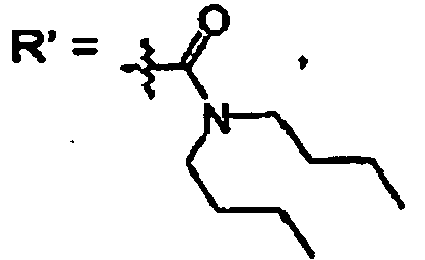
R' = H (bdb-amd) X = phenyl (phen-phen) - The purpose of the present invention is to provide a metal complex having advantages when used as redox mediator in photoelectric conversion device, especially in dye-sensitized solar cell.
- The present invention therefore relates to a metal complex having the formula (I) below :
- (La)n-M (I)
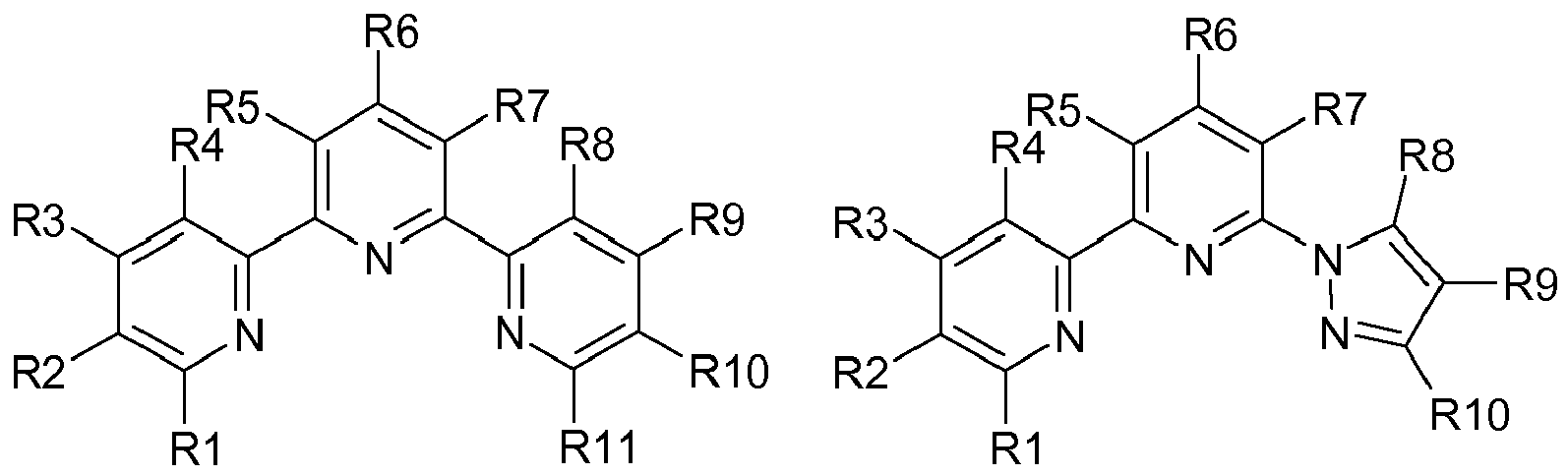
wherein M is cobalt, La is independently selected from the group consisting of the following bidentate and tridentate ligands, and n is 2 or 3 :
- It has been surprisingly found that the metal complex according to the present invention provides more positive redox potential without having bulky substituents on the ligand. This is particularly advantageous as the bulky substituents cause retardation of the mobility. The positive shift of redox potential leads to larger photovoltage. Also, the metal complex according to the present invention allows easy fine tuning of the redox potential in accordance to HOMO level of the dye to be used by changing number and position of fluorides or fluorinated substituents on the ligand. Additionally, the metal complex according to the present invention is advantageous from its hydrophobicity and stable characteristics.
- In the present invention, "redox mediator" is understood to denote in particular molecules or ions which mediate electron transfer from an electrode to an oxidized dye by their reduction-oxidation properties. More particularly, such redox mediators can be reversibly reduced at the electrode and reversibly oxidized by the oxidized dye.
- In the present invention, "alkyl groups" is understood to denote in particular a straight chain, branched chain, or cyclic hydrocarbon groups usually having from 1 to 20 carbon atoms, preferably having from 1 to 8 carbon atoms. Examples of alkyl groups include methyl, ethyl, propyl, isopropyl, butyl, isobutyl, sec-butyl, tert-butyl, pentyl, neopentyl, hexyl, cyclopropyl, cyclobutyl, cyclopentyl, and cyclohexyl. In sense of the present invention, the straight chain hydrocarbon groups having small number of carbon atoms are especially preferred, such as methyl and ethyl, further particularly methyl.
- In the present invention, "fluorinated" is understood to denote in particular the fact that at least one of the hydrogen atoms of the respective chemical group has been replaced by a fluorine atom. If all of the hydrogen atoms have been replaced by fluorine atoms, the fluorinated chemical group is perfluorinated. For instance, "fluorinated alkyl groups" include (per)fluorinated alkyl groups such as (per)fluorinated methyl, ethyl, propyl, isopropyl, butyl, isobutyl, sec-butyl or tert-butyl; and for instance -CF3, -C2F5, heptafluoroisopropyl (-CF(CF3)2), hexafluoroisopropyl (-CH(CF3)2) or -CF2(CF2)4CF3.
- In one embodiment, La in the formula (I) is selected from polypyridines (for example, bi- and ter-pyridines) comprising at least one fluorine atom, preferably from the group consisting of the following ligands :


- More preferably, La in formula (I) is selected from the group consisting of the following ligands :


- In another embodiment, the metal complex further comprises at least one counter-anion (X). Preferably, the counter-anion (X) is independently selected from monoanions. The number of the counter-anion can be two or three depending on the oxidation state of center metal, i.e. cobalt.
- In a further embodiment, the counter-anion (X) is selected from the group consisting of Cl-, Br-, I-, CN-, NCO-, NCS-, NCSe-, amino groups, phosphate groups, PF6-, borates such as [BF4]-, tetracyanoborate ([B(CN)4]-), [B(Ph)4]-, [B(C6F5)4]-, bis(trifluoromethanesulfonyl)imide (TFSI-), bis(fluorosulfonyl)imide (FSI-), and any combination thereof, preferably TFSI-.
- Especially preferred metal complexes according to the present invention are as follows :

- Usually the two complexes, each comprising CoII and Co III (= Co2+ and Co3+), are used as a mixture when an electrolyte comprising the metal complex according to the present invention as redox mediator is formulated. In the sense of the present invention, CoII is generally major portion.
- The metal complexes according to the present invention described herein are suitable for use in photoelectric conversion device, particularly in dye-sensitized solar cell. Therefore, the present invention also relates to a use of the metal complex according to the present invention as redox mediator in photoelectric conversion device, in particular in dye-sensitized solar cell or organic photovoltaic device.
- Another advantage of the fluorinated metal complexes according to the present invention is their versatility in regards to the dyes. The better performance in combination with conventional dyes and semiconductors, such as TiO2 than the triiodide/iodide redox mediator or even other cobalt complexes is achievable by using the metal complexes according to the present invention.
- Further, the present invention also concerns a use of cobalt complex having polypyridine ligand comprising at least one fluorine atom, as redox mediator in photoelectric conversion device, in particular in dye-sensitized solar cell.
- The basic element of a DSSC is generally a TiO2 (titanium dioxide) nanoparticulate structure sensitized with dye molecules to form the core of a DSSC. Generally, the dye molecules can be metal complexes, such as ruthenium complexes, organic dyes having D-π-A structure (wherein D is donor groups is bridge group and A is acceptor group), or macrocyclic dyes, such as porphyrin dyes, and phthalocyanine dyes. The assembly of titanium dioxide nanoparticles is well connected to their neighbors. TiO2 is the preferred material for the nanoparticles since its surface is highly resistant to the continued electron transfer. However, TiO2 only absorbs a small fraction of the solar photons (those in the UV). The dye molecules attached to the semiconductor surface are used to harvest a great portion of the solar light. Another key component of the DSSC is an electrolyte which transports positive charge carriers from the sensitizing dye to the back contact of the device. Electrolytes containing the iodide/triiodide redox system are most commonly used. However, the iodide/triiodide redox system suffers from the disadvantages, such as low redox potential, corrosive characteristic to metals, and competition with the sensitizing dye in absorbing light.
- In this context, it has been found that the metal complexes according to the present invention work in DSSC as redox mediator having improved characteristics, as set forth above, compared to traditional iodide/triiodide redox system and to non-fluorinated cobalt complexes.
- Accordingly, the present invention further relates to a dye-sensitized solar cell (DSSC), which comprises the metal complex according to the present invention as redox mediator.
- In a further specific embodiment, the DSSC according to the present invention further comprises TiOF2 as semiconductor. TiOF2 has the conduction band level at lower energy compared to TiO2 which should improve the photo-induced electron transfer from the excited dye to the semiconductor. The TiOF2 is preferably used in the form of TiOF2 nanoparticles, in particular TiOF2 particles having a mean primary particle size from 15 to 50 nm. The layer thickness is typically from 500 nm to 10 µm. The TiOF2 may be used as the sole semiconductor in the DSSC semiconductor layer or may be combined in mixture with any other suitable semiconductor compound, for instance TiO2. Another possibility is to have at first a dense TiO2 layer on the conducting glass followed by a nanoporous TiOF2 layer. The fluorinated metal complexes according to the present invention can be used in combination with TiOF2 used as semiconductor in dye sensitized solar cells.
- The present invention also concerns a method for preparing the dye-sensitized solar cell, comprising :
- a step of providing an electrode connected to dye-sensitized semiconductor and a counter electrode ; and
- a step of providing an electrolyte;
- While preferred embodiments of this invention have been shown and described, modifications thereof can be made by one skilled in the art without departing from the spirit or teaching of this invention. The embodiments and examples described herein are exemplary only and are not limiting. Many variations and modifications of systems and methods are possible and are within the scope of the invention. Accordingly, the scope of protection is not limited to the embodiments described herein, but is only limited by the claims that follow, the scope of which shall include all equivalents of the subject matter of the claims.
-

Preparation of [Co(L)3](TFSI)3. To a solution of CoCl2·6H2O in water /MeOH is added 3 equiv. L solution in acetone. After stirring for 10 minutes, an aqueous solution of H2O2 and HCl is added. The mixture is stirred at 50°C for 1 h, followed by addition of NaTFSI (excess) solution in water / MeOH. The mixture is stored overnight at 5°C to aid precipitation. The resulting precipitate is collected by filtration, washed with water and MeOH, and dried in vacuo.
Claims (10)
- A metal complex having the formula (I) below :
(La)n-M (I)
wherein M is cobalt, La is independently selected from the group consisting of the following bidentate and tridentate ligands, and n is 2 or 3 :
- The metal complex according to claim 1, wherein La is selected from the group consisting of the following ligands :


- The metal complex according to claim 1 or 2, wherein La is selected from the group consisting of the following ligands :


- The metal complex according to any one of claims 1 to 3, further comprising at least one counter-anion (X).
- The metal complex according to claim 4, wherein the counter-anion is selected from the group consisting of Cl-, Br-, I-, CN-, NCO-, NCS-, NCSe-, amino groups, phosphate groups, PF6-, borates such as [BF4]-, tetracyanoborate ([B(CN)4]-), [B(Ph)4]-, [B(C6F5)4]- bis(trifluoromethanesulfonyl)imide (TFSI-), bis(fluorosulfonyl)imide (FSI-), and any combination thereof, preferably TFSI-.
- Use of the metal complex according to any one of claims 1 to 5 as redox mediator in photoelectric conversion device, in particular in dye-sensitized solar cell or organic photovoltaic device.
- A dye-sensitized solar cell comprising the metal complex according to any one of claims 1 to 5 as redox mediator.
- The dye-sensitized solar cell according to claim 7, further comprising TiOF2 as semiconductor.
- A method for preparing the dye-sensitized solar cell according to claim 7 or 8, comprising :a step of providing an electrode connected to dye-sensitized semiconductor and a counter electrode ; anda step of providing an electrolyte;wherein said electrolyte comprises the metal complex according to any one of claims 1 to 5 as redox mediator.
- Use of cobalt complex having polypyridine ligand comprising at least one fluorine atom, as redox mediator in photoelectric conversion device, in particular in dye-sensitized solar cell.
Priority Applications (3)
| Application Number | Priority Date | Filing Date | Title |
|---|---|---|---|
| EP12185099.4A EP2711360A1 (en) | 2012-09-19 | 2012-09-19 | Fluorinated cobalt redox mediator, method for producing the same, and its use in dye-sensitized solar cell |
| PCT/EP2013/069300 WO2014044685A1 (en) | 2012-09-19 | 2013-09-17 | Fluorinated cobalt redox mediator, method for producing the same, and its use in dye-sensitized solar cell |
| TW102133882A TW201420568A (en) | 2012-09-19 | 2013-09-18 | Fluorinated cobalt redox mediator, method for producing the same, and its use in dye-sensitized solar cell |
Applications Claiming Priority (1)
| Application Number | Priority Date | Filing Date | Title |
|---|---|---|---|
| EP12185099.4A EP2711360A1 (en) | 2012-09-19 | 2012-09-19 | Fluorinated cobalt redox mediator, method for producing the same, and its use in dye-sensitized solar cell |
Publications (1)
| Publication Number | Publication Date |
|---|---|
| EP2711360A1 true EP2711360A1 (en) | 2014-03-26 |
Family
ID=47048969
Family Applications (1)
| Application Number | Title | Priority Date | Filing Date |
|---|---|---|---|
| EP12185099.4A Withdrawn EP2711360A1 (en) | 2012-09-19 | 2012-09-19 | Fluorinated cobalt redox mediator, method for producing the same, and its use in dye-sensitized solar cell |
Country Status (3)
| Country | Link |
|---|---|
| EP (1) | EP2711360A1 (en) |
| TW (1) | TW201420568A (en) |
| WO (1) | WO2014044685A1 (en) |
Citations (1)
| Publication number | Priority date | Publication date | Assignee | Title |
|---|---|---|---|---|
| WO2003038508A2 (en) * | 2001-10-30 | 2003-05-08 | Colorado State University Research Foundation | Metal complex-based electron-transfer mediators in dye-sensitized solar cells |
-
2012
- 2012-09-19 EP EP12185099.4A patent/EP2711360A1/en not_active Withdrawn
-
2013
- 2013-09-17 WO PCT/EP2013/069300 patent/WO2014044685A1/en not_active Ceased
- 2013-09-18 TW TW102133882A patent/TW201420568A/en unknown
Patent Citations (2)
| Publication number | Priority date | Publication date | Assignee | Title |
|---|---|---|---|---|
| WO2003038508A2 (en) * | 2001-10-30 | 2003-05-08 | Colorado State University Research Foundation | Metal complex-based electron-transfer mediators in dye-sensitized solar cells |
| US7019138B2 (en) | 2001-10-30 | 2006-03-28 | Colorado State University Research Foundation | Metal complex-based electron-transfer mediators in dye-sensitized solar cells |
Non-Patent Citations (1)
| Title |
|---|
| QU F ET AL: "4-Fluoro-2,2'-bipyridine (fbpy) complexes of cobalt(II/III) and iron(II/III) and electron transfer in the Co(bpy)3<2+>-Co(fbpy)3<3+> system", JOURNAL OF FLUORINE CHEMISTRY, ELSEVIER, NL, vol. 94, no. 1, 11 February 1999 (1999-02-11), pages 15 - 26, XP004159036, ISSN: 0022-1139, DOI: 10.1016/S0022-1139(98)00315-7 * |
Also Published As
| Publication number | Publication date |
|---|---|
| WO2014044685A1 (en) | 2014-03-27 |
| TW201420568A (en) | 2014-06-01 |
Similar Documents
| Publication | Publication Date | Title |
|---|---|---|
| Chen et al. | Cu (II) complexes as p-type dopants in efficient perovskite solar cells | |
| Yan et al. | Choline chloride-modified SnO2 achieving high output voltage in MAPbI3 perovskite solar cells | |
| Liu et al. | N-fused carbazole–zinc porphyrin–free-base porphyrin triad for efficient near-IR dye-sensitized solar cells | |
| Noh et al. | Nanostructured TiO 2/CH 3 NH 3 PbI 3 heterojunction solar cells employing spiro-OMeTAD/Co-complex as hole-transporting material | |
| Yen et al. | Recent developments in molecule-based organic materials for dye-sensitized solar cells | |
| US8859894B2 (en) | Binuclear ruthenium complex dye, ruthenium-osmium complex dye, photoelectric conversion element using any one of the complex dyes, and photochemical cell | |
| CN102712659B (en) | Ionogen preparaton | |
| KR20120087485A (en) | Novel organic dye and preparation thereof | |
| Cheng et al. | Efficient dye-sensitized solar cells based on an iodine-free electrolyte using L-cysteine/L-cystine as a redox couple | |
| Liu et al. | Axial anchoring designed silicon–porphyrin sensitizers for efficient dye-sensitized solar cells | |
| Krishna et al. | Recent advances on porphyrin dyes for dye-sensitized solar cells | |
| Nasr-Esfahani et al. | Fabrication and characterization of a new dye sensitized solar cell with a new Schiff base cobalt complex as a redox mediator | |
| WO2014081388A1 (en) | Dopants for solid-state dye-sensitive solar cells | |
| US20100006805A1 (en) | Process for production of binuclear metal complex | |
| Ye et al. | Bipyridine type Co-complexes as hole-transporting material dopants in perovskite solar cells | |
| EP2511924A1 (en) | Transition metal complexes as redox couples for electrochemical and optoelectronic devices | |
| KR101760492B1 (en) | Novel compounds, method of preparation thereof and organic solar cell comprising the same | |
| KR20130092689A (en) | Novel ruthenium dye and preparation thereof | |
| Vuong et al. | Fabrication of copper (I) bipyridyl complex based dye sensitized solar cells | |
| Ünlü et al. | Highly efficient novel unsymmetrical Zn and TiO naphthalenephthalocyanine and YD2 porphyrin dyes as co-sensitizers for DSSCs | |
| US8846905B2 (en) | Porphyrin complex and use thereof | |
| KR101596918B1 (en) | Solid State Polymeric Electrolytes Containing Hole Transporting Moieties for Low-Cost Dye-Sensitized Solar Cell Applications | |
| JP6738313B2 (en) | Electrolyte, solar cell and solar cell module | |
| JP5035502B2 (en) | Quinizaline bridged metal complex | |
| KR101760493B1 (en) | Benzobisoxazole derivatives, method of preparation thereof and organic solar cell comprising the same |
Legal Events
| Date | Code | Title | Description |
|---|---|---|---|
| PUAI | Public reference made under article 153(3) epc to a published international application that has entered the european phase |
Free format text: ORIGINAL CODE: 0009012 |
|
| AK | Designated contracting states |
Kind code of ref document: A1 Designated state(s): AL AT BE BG CH CY CZ DE DK EE ES FI FR GB GR HR HU IE IS IT LI LT LU LV MC MK MT NL NO PL PT RO RS SE SI SK SM TR |
|
| AX | Request for extension of the european patent |
Extension state: BA ME |
|
| STAA | Information on the status of an ep patent application or granted ep patent |
Free format text: STATUS: THE APPLICATION IS DEEMED TO BE WITHDRAWN |
|
| 18D | Application deemed to be withdrawn |
Effective date: 20140927 |