EP2709303B1 - Iterative receiver loop - Google Patents
Iterative receiver loop Download PDFInfo
- Publication number
- EP2709303B1 EP2709303B1 EP13184075.3A EP13184075A EP2709303B1 EP 2709303 B1 EP2709303 B1 EP 2709303B1 EP 13184075 A EP13184075 A EP 13184075A EP 2709303 B1 EP2709303 B1 EP 2709303B1
- Authority
- EP
- European Patent Office
- Prior art keywords
- metrics
- soft
- receiver loop
- decoder
- phase
- Prior art date
- Legal status (The legal status is an assumption and is not a legal conclusion. Google has not performed a legal analysis and makes no representation as to the accuracy of the status listed.)
- Active
Links
Images


Classifications
-
- H—ELECTRICITY
- H04—ELECTRIC COMMUNICATION TECHNIQUE
- H04L—TRANSMISSION OF DIGITAL INFORMATION, e.g. TELEGRAPHIC COMMUNICATION
- H04L1/00—Arrangements for detecting or preventing errors in the information received
- H04L1/004—Arrangements for detecting or preventing errors in the information received by using forward error control
- H04L1/0045—Arrangements at the receiver end
- H04L1/0047—Decoding adapted to other signal detection operation
- H04L1/005—Iterative decoding, including iteration between signal detection and decoding operation
-
- H—ELECTRICITY
- H04—ELECTRIC COMMUNICATION TECHNIQUE
- H04L—TRANSMISSION OF DIGITAL INFORMATION, e.g. TELEGRAPHIC COMMUNICATION
- H04L1/00—Arrangements for detecting or preventing errors in the information received
- H04L1/004—Arrangements for detecting or preventing errors in the information received by using forward error control
- H04L1/0045—Arrangements at the receiver end
- H04L1/0047—Decoding adapted to other signal detection operation
-
- H—ELECTRICITY
- H04—ELECTRIC COMMUNICATION TECHNIQUE
- H04L—TRANSMISSION OF DIGITAL INFORMATION, e.g. TELEGRAPHIC COMMUNICATION
- H04L27/00—Modulated-carrier systems
- H04L27/26—Systems using multi-frequency codes
- H04L27/2601—Multicarrier modulation systems
- H04L27/2647—Arrangements specific to the receiver only
- H04L27/2655—Synchronisation arrangements
- H04L27/2657—Carrier synchronisation
- H04L27/266—Fine or fractional frequency offset determination and synchronisation
-
- H—ELECTRICITY
- H04—ELECTRIC COMMUNICATION TECHNIQUE
- H04L—TRANSMISSION OF DIGITAL INFORMATION, e.g. TELEGRAPHIC COMMUNICATION
- H04L27/00—Modulated-carrier systems
- H04L27/26—Systems using multi-frequency codes
- H04L27/2601—Multicarrier modulation systems
- H04L27/2647—Arrangements specific to the receiver only
- H04L27/2655—Synchronisation arrangements
- H04L27/2662—Symbol synchronisation
- H04L27/2665—Fine synchronisation, e.g. by positioning the FFT window
-
- H—ELECTRICITY
- H04—ELECTRIC COMMUNICATION TECHNIQUE
- H04L—TRANSMISSION OF DIGITAL INFORMATION, e.g. TELEGRAPHIC COMMUNICATION
- H04L27/00—Modulated-carrier systems
- H04L27/26—Systems using multi-frequency codes
- H04L27/2601—Multicarrier modulation systems
- H04L27/2647—Arrangements specific to the receiver only
- H04L27/2655—Synchronisation arrangements
- H04L27/2668—Details of algorithms
- H04L27/2673—Details of algorithms characterised by synchronisation parameters
- H04L27/2676—Blind, i.e. without using known symbols
- H04L27/2679—Decision-aided
-
- H—ELECTRICITY
- H04—ELECTRIC COMMUNICATION TECHNIQUE
- H04L—TRANSMISSION OF DIGITAL INFORMATION, e.g. TELEGRAPHIC COMMUNICATION
- H04L27/00—Modulated-carrier systems
- H04L27/26—Systems using multi-frequency codes
- H04L27/2601—Multicarrier modulation systems
- H04L27/2647—Arrangements specific to the receiver only
- H04L27/2655—Synchronisation arrangements
- H04L27/2689—Link with other circuits, i.e. special connections between synchronisation arrangements and other circuits for achieving synchronisation
-
- H—ELECTRICITY
- H04—ELECTRIC COMMUNICATION TECHNIQUE
- H04L—TRANSMISSION OF DIGITAL INFORMATION, e.g. TELEGRAPHIC COMMUNICATION
- H04L1/00—Arrangements for detecting or preventing errors in the information received
- H04L1/004—Arrangements for detecting or preventing errors in the information received by using forward error control
- H04L1/0056—Systems characterized by the type of code used
- H04L1/0057—Block codes
-
- H—ELECTRICITY
- H04—ELECTRIC COMMUNICATION TECHNIQUE
- H04L—TRANSMISSION OF DIGITAL INFORMATION, e.g. TELEGRAPHIC COMMUNICATION
- H04L1/00—Arrangements for detecting or preventing errors in the information received
- H04L2001/0092—Error control systems characterised by the topology of the transmission link
- H04L2001/0093—Point-to-multipoint
-
- H—ELECTRICITY
- H04—ELECTRIC COMMUNICATION TECHNIQUE
- H04L—TRANSMISSION OF DIGITAL INFORMATION, e.g. TELEGRAPHIC COMMUNICATION
- H04L27/00—Modulated-carrier systems
- H04L27/0014—Carrier regulation
- H04L2027/0044—Control loops for carrier regulation
- H04L2027/0053—Closed loops
- H04L2027/0055—Closed loops single phase
-
- H—ELECTRICITY
- H04—ELECTRIC COMMUNICATION TECHNIQUE
- H04L—TRANSMISSION OF DIGITAL INFORMATION, e.g. TELEGRAPHIC COMMUNICATION
- H04L27/00—Modulated-carrier systems
- H04L27/0014—Carrier regulation
- H04L2027/0044—Control loops for carrier regulation
- H04L2027/0063—Elements of loops
- H04L2027/0067—Phase error detectors
-
- H—ELECTRICITY
- H04—ELECTRIC COMMUNICATION TECHNIQUE
- H04L—TRANSMISSION OF DIGITAL INFORMATION, e.g. TELEGRAPHIC COMMUNICATION
- H04L27/00—Modulated-carrier systems
- H04L27/26—Systems using multi-frequency codes
- H04L27/2601—Multicarrier modulation systems
- H04L27/2647—Arrangements specific to the receiver only
- H04L27/2655—Synchronisation arrangements
Definitions
- the present invention relates generally to wireless communication, and particularly to adaptive loops in communication receivers.
- Various communication receivers process received signal using different kinds of adaptive loops, e.g., phase tracking loops, automatic frequency correction loops, timing recovery loops, automatic gain control, channel equalization loops and others.
- adaptive loops e.g., phase tracking loops, automatic frequency correction loops, timing recovery loops, automatic gain control, channel equalization loops and others.
- U.S. Patent 7,593,490 describes a joint synchronizer and decoder that implements two decision aided processes, which are referred to as “decision aided candidate selection” and “decision aided synchronization and decoding.”
- Decision aided candidate selection may be used to select a carrier frequency offset by selecting among a number of candidates for this parameter based on an indication of decoding success.
- Decision aided synchronization and decoding may be used for phase tracking based on an indication of decoding success.
- these joint synchronizing and decoding techniques may be implemented together, they may also be implemented independently.
- the joint synchronizer and decoder may be implemented within a return channel receiver in a DVB-RCS system using turbo coding and quadrature phase shift key (QPSK) data modulation.
- QPSK quadrature phase shift key
- U.S. Patent 8,036,289 describes an iterative residual frequency and phase compensation apparatus for an OFDM system and a method thereof.
- the apparatus includes a first classifying unit for classifying symbol sequences by each subcarrier wave, a soft-decision calculating unit for calculating a soft-decision value of a data symbol using a soft-decision reliability obtained from iterative decoding performed by the iterative decoder, a classifying unit for classifying the soft-decision values by a carrier wave, a frequency estimating unit for estimating a residual frequency error of each carrier wave using the soft-decision value, a phase estimating unit for estimating an average residual phase error using the soft-decision value, a frequency and phase compensating unit for compensating frequencies and phases for input symbols of each carrier wave using the estimated frequency error and the estimated phase error, and a buffer for temporally storing the compensated symbols to provide it to the first classifying unit.
- PCT International Publication WO 2010/138206 describes methods for iterative timing recovery.
- the methods include processing an input signal using an FEC decoder, using some of the information from the FEC decoding process to estimate the phase of the symbol carrier, and correcting the phase for subsequent input signals.
- Another of the embodiments under the present principles provides for post-processing of the phase estimation prior to using the estimate for phase correction.
- Another embodiment is a post processor that comprises a filter, including a Kalman filter.
- Another embodiment includes using a priori information embedded in the input signal, such as a synchronization signal, to assist the phase estimation process.
- WO-A-2007112168 describes arrangements relating to an Orthogonal Frequency Division Multiplexing (OFDM) receiver that can include performing at least one Low-Density Parity Check (LDPC) decoding attempt on a received signal and evaluating at least one parity check for each LDPC decoding attempt.
- OFDM Orthogonal Frequency Division Multiplexing
- US-A-2009254797 describes a method, comprising receiving a signal that carries data encoded with an Error Correction Code (ECC); correcting one or more of a phase, a frequency, a timing, a gain, and a channel response of the received signal with an adaptive receiver loop; computing soft input metrics for the data are computed over the corrected signal; and decoding the ECC using a decoder, which estimates soft output metrics based on the soft input metrics, by operating the decoder in a pattern that alternates between external iterations that update one or more of the soft input metrics based on one or more of the soft output metrics, and internal iterations that update the soft output metrics but not the soft input metrics.
- ECC Error Correction Code
- US-A-2009254797 also describes an apparatus comprising a front end and circuitry.
- the front end is configured to receive a signal that carries data encoded with an Error Correction Code (ECC).
- ECC Error Correction Code
- the circuitry is configured to: correct one or more of a phase, a frequency, a timing, a gain, and a channel response of the received signal with an adaptive receiver loop; compute soft input metrics for the data over the corrected signal; and decode the ECC using a decoder, which estimates soft output metrics based on the soft input metrics, by operating the decoder in a pattern that alternates between external iterations that update one or more of the soft input metrics based on one or more of the soft output metrics, and internal iterations that update the soft output metrics but not the soft input metrics.
- ECC Error Correction Code
- a method as described in US-A-2009254797 characterized by providing the soft input metrics, and not the soft output metrics, as input to the adaptive receiver loop; and by adjusting the adaptive receiver loop based on the soft input metrics in a schedule that is defined relative to the pattern of the external and the internal iterations of the decoder.
- adjusting the adaptive receiver loop includes adapting the receiver loop in response to at least part of the external iterations, but not in response to the internal iterations. In an embodiment, adjusting the adaptive receiver loop includes adapting the receiver loop in response to at least some of the internal iterations. In another embodiment, the schedule varies over time. In yet another embodiment, the method includes setting the schedule adaptively based on measurements obtained from the decoder.
- receiving the signal includes receiving a frame of symbols and buffering the received frame in a memory
- adjusting the receiver loop includes applying the receiver loop successively to the symbols of the buffered frame.
- adjusting the receiver loop includes dividing the frame into at least first and second intervals, and adapting the receiver loop in the first interval separately from and concurrently with adapting the receiver loop in the second interval.
- the method may include compensating for a discontinuity in the adaptive receiver loop between the first and second intervals.
- the received frame includes a header, data symbols and one or more optional pilot symbols, and adjusting the receiver loop includes processing only the data symbols and not the header and the pilot symbols.
- the received frame includes a header, data symbols and one or more pilot symbols, and adjusting the receiver loop includes processing the data symbols, the header and the pilot symbols.
- an apparatus as described in US-A-2009254797 , characterized in that the circuitry is further configured to provide the soft input metrics, and not the soft output metrics, as input to the adaptive receiver loop; and to adjust the adaptive receiver loop based on the soft input metrics in a schedule that is defined relative to the pattern of the external and the internal iterations of the decoder.
- the front end is configured to receive a frame of symbols
- the circuitry is configured to buffer the received frame in a memory and to apply the receiver loop successively to the symbols of the buffered frame.
- circuitry is configured to divide the frame into at least first and second intervals, and to adapt the receiver loop in the first interval separately from and concurrently with adapting the receiver loop in the second interval.
- adaptive receiver loop comprises a phase tracking loop, and wherein the circuitry is configured to correct the signal by tracking a phase of the received signal.
- Embodiments of the present invention that are described herein provide improved methods and systems for demodulation and decoding of signals that carry data encoded with an Error Correction Code (ECC).
- ECC Error Correction Code
- a receiver comprises an iterative ECC decoder that operates on soft input metrics such as Log Likelihood Ratios (LLRs).
- the decoder is operated in an alternating pattern of internal and external iterations.
- the external iterations update the soft input metrics at the decoder input based on soft output metrics produced by the decoder.
- the internal iterations estimate the soft output metrics based on a given set of soft input metrics but do not update the soft input metrics.
- the received signal is processed by an adaptive receiver loop, for example a phase tracking loop that recovers and tracks the carrier phase of the signal.
- the adaptive loop is adjusted in accordance with a certain schedule relative to the pattern of internal and external iterations of the decoder. For example, the adaptive loop may be adjusted following each internal iteration, following each external iteration, or following a certain subset of the internal and/or external iterations in the pattern.
- the pattern of the internal and external decoder iterations, as well as the schedule of loop adaptations, may be fixed or variable according to some criteria.
- phase tracking is performed from one symbol to the next in a given received frame hat is buffered in memory.
- the frame is divided into multiple intervals and phase tracking is performed separately and concurrently over the different intervals.
- the disclosed techniques enable the receiver to operate at extremely low Carrier-to-Noise Ratio (CNR) for a given constellation and with modest coding redundancy overhead or no coding redundancy at all.
- CNR Carrier-to-Noise Ratio
- the disclosed techniques are also highly effective in preventing and correcting cycle-slip events in which the phase tracking process starts from or converges temporarily to local minima of an incorrect carrier phase. An event in which the phase tracking loop starts from an exceedingly large phase offset may happen, for example, if initial header and pilot-aided phase estimation is too high for the constellation in use.
- the embodiments described herein refer mainly to satellite Digital Video Broadcasting (DVB) applications that use Low Density Parity Check (LDPC) codes.
- DVD Digital Video Broadcasting
- LDPC Low Density Parity Check
- the disclosed techniques can be used in a variety of applications and with various types of ECC.
- Fig. 1 is a block diagram that schematically illustrates a receiver 20 that uses iterative demodulation and phase tracking, in accordance with an embodiment of the present invention.
- receiver 20 receives signals from a satellite, in accordance with a Digital Video Broadcasting (DVB) protocol.
- DVD Digital Video Broadcasting
- receiver 20 can be used in any other suitable communication system operating in accordance with any other suitable standard or protocol.
- Receiver 20 receives Radio Frequency (RF) signals that carry data.
- the signals have been encoded by a transmitter (not shown) with an Error Correction Code (ECC), and modulated with a digital modulation scheme that is defined by a symbol constellation.
- ECC Error Correction Code
- the data is first encoded with a Bose-Chaudhuri-Hocquenghem (BCH) code and then with a Low Density Parity Check (LDPC) code
- the modulation scheme comprises Phase Shift Keying (e.g. QPSK or 8-PSK) or Amplitude-Phase Shift Keying (e.g. 16-APSK, 32-APSK, 64-APSK etc.).
- ECC and modulation types in DVB systems is described, for example, in European Telecommunications Standards Institute (ETSI) standard EN 302 307 version 1.1.2, entitled “ Digital Video Broadcasting (DVB); Second Generation Framing Structure, Channel Coding and Modulation Systems for Broadcasting, Interactive Services, News Gathering and Other Broadband Satellite Applications," June, 2006 , and in DVB document A122, entitled “ Frame Structure Channel Coding and Modulation for a Second Generation Digital Terrestrial Television Broadcasting System (DVB-T2),” June, 2008 .
- ETSI European Telecommunications Standards Institute
- DVB-T2 Second Generation Framing Structure, Channel Coding and Modulation Systems for Broadcasting, Interactive Services, News Gathering and Other Broadband Satellite Applications
- DVB-T2 Second Generation Digital Terrestrial Television Broadcasting System
- any other suitable modulation and coding scheme can be used.
- Receiver 20 comprises an antenna 48, which receives the RF signals from the satellite.
- a front-end 52 typically down-converts the RF signals to baseband, and applies functions such as low-noise amplification, filtering, gain control, digitization, down-sampling, frame synchronization, carrier frequency and phase estimation, and timing recovery, among others.
- front-end 52 may comprise legacy carrier, frequency and phase recovery loops, as suggested in DVB-S2 User guidelines TR 102 376 V1.1.1.
- the digital signal at the output of front end 52 comprises a sequence of received symbols denoted y i .
- Signal y i is phase-rotated by a phase tracking loop that is described in detail below, to produce a phase-rotated sequence denoted y i rot .
- the phase tracking loop aims to track the carrier phase and carrier frequency of the received signal, so as to enable optimal demodulation and decoding.
- the rotated signal y i rot is demodulated and decoded by an iterative decoder that is described in the following paragraphs. Further aspects of such iterative decoders are addressed in U.S. Patent Application Publication 2012/0079341 , entitled “Iterative decoding of LDPC codes with iteration scheduling”.
- a metric calculation unit 76 computes a respective soft metric b ⁇ i j for each bit j in each received symbol i.
- the soft metrics comprise Log Likelihood Ratios (LLRs) of the received bits.
- unit 76 may compute any other suitable type of soft metric, which is indicative of the likelihood that the respective received bit corresponds to a certain transmitted bit.
- unit 76 comprises an adaptive equalizer (e.g., a maximum likelihood sequence equalizer) that outputs the soft metrics.
- unit 76 calculates the metrics but does not perform equalization.
- a de-interleaver 80 de-interleaves metrics b ⁇ i j to produce de-interleaved metrics denoted c ⁇ i j .
- a Bit-Interleaved Coded Modulation LDPC (BICM-LDPC) decoder 84 decodes the LDPC code words by operating on metrics c ⁇ i j .
- metrics c ⁇ i j are also referred to as soft input metrics or a-priori information.
- BICM-LDPC decoder 84 produces bit estimates denoted û i j , which estimate the values of transmitted bits u i j that were produced by the transmitter.
- BICM-LDPC decoder 84 produces soft output metrics denoted c ⁇ i j of the coded bits that were produced in the transmitter.
- Output metrics c ⁇ i j are also referred to as a-posteriori information.
- BICM-LDPC decoder 84 uses a Belief-Propagation (BP) algorithm, also referred to as a Sum-Product Algorithm (SPA).
- BP Belief-Propagation
- SPA Sum-Product Algorithm
- BICM-LDPC decoder 84 can be implemented using any suitable decoder configuration that accepts soft inputs, and produces soft outputs that can serve as a-posteriori information.
- BICM-LDPC decoder 84 comprises multiple bit nodes that are connected to multiple check nodes by a set of arcs. The decoding process performs one or more iterations that pass information between the bit nodes and check nodes.
- a non-iterative decoder is regarded herein as a decoder that carries iterations just between the bit nodes and the check nodes.
- a BCH decoder 96 decodes the BCH code that decodes bit estimates û i j , so as to produce estimates v ⁇ i j of input data bits v i j in the transmitter. Estimates v ⁇ i j are provided as output.
- the soft output metrics c ⁇ i j are fed back and used to improve the input metrics c ⁇ i j (the a-priori information).
- an adder 100 subtracts respective output metrics c ⁇ i j from input metrics c ⁇ i j of corresponding bits.
- the resulting metrics are interleaved by an interleaver 104, which reverses the operation of de-interleaver 80.
- the output of interleaver 104 denoted b ⁇ i j , is provided as extrinsic information to metric calculation unit 76.
- Unit 76 uses the extrinsic information b ⁇ i j to adjust the soft input metrics b ⁇ i j . .
- receiver 20 alternates between the internal and external iterations in an adaptive manner. In other words, the number of (one or more) internal iterations performed between any two external iterations can be modified adaptively.
- receiver 20 comprises a processor 108, which alternates between the internal and external iterations according to predefined conditions or criteria.
- Processor 108 controls BICM-LDPC decoder 84 and metric calculation unit 76 accordingly.
- processor 108 controls the phase tracking loop described below.
- the phase tracking loop operates on two inputs - the soft input metrics (e.g., LLRs) b ⁇ i j produced by metric calculation unit 76, and the phase-rotated symbols y i rot at the input of unit 76.
- receiver 20 comprises a symbol estimation unit 112, which finds, for each rotated symbol y i rot , , the hard constellation symbol X min with the highest probability given the received rotated symbol.
- y i rot argmax k log P y i rot
- unit 112 produces a sequence of hard symbols X min that are estimated using the soft input metrics b ⁇ i j .
- a phase error estimation unit 116 produces a sequence of phase error estimates denoted e.
- the phase error is computed once per each received symbol.
- the phase error is scaled by a phase scaling factor denoted k p .
- the scaled phase error is integrated by a second-order loop that tracks the carrier frequency offset relative to the receiver.
- the second-order loop comprises a multiplier that multiplies the phase error by a frequency scaling factor denoted kf , and the result is then integrated using a frequency offset accumulator 120 whose output is fed back and added to its input.
- the second-order frequency tracking loop is sometimes referred to as an Automatic Frequency Control (AFC) loop.
- AFC Automatic Frequency Control
- the output of the second-order frequency tracking loop is followed by a first-order phase tracking loop.
- the first order loop integrates the phase error using a phase accumulator 124 whose output is fed back and added to its input.
- the receiver performs only first-order phase tracking without second-order frequency tracking. In such embodiments, frequency offset accumulator 120 and its associated circuitry are omitted.
- the output of the phase tracking loop comprises digital values that estimate the carrier phase error, symbol by symbol. These digital values are used as indices to a Read Only Memory (ROM) 128 holding samples of the sinusoidal waveform e j ⁇ .
- ROM Read Only Memory
- the output of ROM 128 comprises a digital sinusoidal signal whose phase corresponds to the estimated phase error in the sequence of received symbols y i .
- ROM 128 The output of ROM 128 is thus multiplied by y i to produce y i rot , i.e., to cancel the estimated phase error from the received signal.
- the receiver configuration of Fig. 1 is an example configuration, which is chosen purely for the sake of conceptual clarity. In alternative embodiments, any other suitable configurations can also be used. For example, although the embodiments described herein refer mainly to LDPC codes, the disclosed technique can be used with any other suitable ECC that can be decoded using such an iterative decoding process.
- BCH decoder 96 may be omitted if no BCH code is used.
- Interleaver 104 and de-interleaver 80 may be omitted in some system configurations.
- circuitry that carries out the disclosed techniques.
- the circuitry comprises the various elements of receiver 20 with the exception of front end 52, decoder 84 and BCH decoder 96.
- receiver 20 can be implemented using digital hardware, such as in one or more Application-Specific Integrated Circuits (ASICs) or Field-Programmable Gate Arrays (FPGAs).
- ASICs Application-Specific Integrated Circuits
- FPGAs Field-Programmable Gate Arrays
- some elements of receiver 20 e.g., processor 108 may be implemented is software, or using a combination of hardware and software elements.
- processor 108 comprises a general-purpose processor, which is programmed in software to carry out the functions described herein.
- the software may be downloaded to the processor in electronic form, over a network, for example, or it may, alternatively or additionally, be provided and/or stored on non-transitory tangible media, such as magnetic, optical, or electronic memory.
- the iterative decoding process of the LDPC code in receiver 20 comprises a pattern of internal and external iterations of BICM-LDPC decoder 84.
- the external iterations update the soft input metrics at the input of decoder 84 based on the soft output metrics produced by the decoder.
- the internal iterations estimate the soft output metrics based on a given set of soft input metrics but do not update the soft input metrics.
- the pattern of the external and internal iterations may be fixed or adaptive, and may specify any desired number of internal iterations between successive external iterations.
- processor 108 applies the phase tracking loop in accordance with a certain schedule relative to the pattern of internal and external iterations of decoder 84. For example, processor 108 may invoke the phase tracking loop following each internal iteration, following each external iteration, or following only some of the internal and/or external iterations in accordance with some criterion. The criterion may depend, for example, on internal measurements in decoder 84, as discussed, for example, in in U.S. Patent Application Publication 2012/0079341 , cited above.
- the input to the phase tracking loop is the soft input metrics b ⁇ i j , , which are based on the extrinsic information b ⁇ i j . .
- the estimated hard symbols X min which are used by the phase tracking loop to estimate the phase error, are based on the soft output metrics c ⁇ i j produced by LDPC decoder 84.
- the estimated hard symbols X min are thus highly reliable, because they are derived from extrinsic information from the output of the LDPC decoder. This reliability makes the phase tracking loop of receiver 20 highly accurate.
- processor 108 adapts the phase tracking loop in response to at least some of the external iterations of the LDPC decoding process. In other words, upon completion of an external iteration (although not necessarily every external iteration), the receiver re-estimates the carrier phase based on the soft input metrics that were updated by the external iteration. In these embodiments, processor 108 does not invoke the phase tracking loop following internal iterations, because they do not modify the soft input metrics.
- the phase tracking loop is invoked following only some of the external iterations, e.g., every second external iteration or based on any other suitable criterion. In these embodiments, since the phase tracking loop is invoked only when the soft input metrics are updated, and not necessarily upon every update, computational complexity can be reduced.
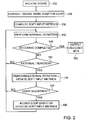
- Fig. 2 is a flow chart that schematically illustrates a method for iterative demodulation and phase tracking, in accordance with an embodiment of the present invention. The method begins with front end 52 of receiver 20 receiving and processing a satellite signal, at a reception step 130.
- Processor 108 of receiver 20 corrects the carrier phase of the received signal using the adaptive phase tracking loop, (in the present example rotates y i to produce y i rot ) at a phase correction step 134.
- Unit 76 computes soft input metrics b ⁇ i j based on y i rot , , at a soft metric computation step 138.
- Receiver 20 now begins the iterative LDPC decoding process, by carrying out a pattern of internal and external iterations of decoder 84.
- the receiver performs an internal iteration of decoder 84, at an internal iteration step 142.
- Processor 108 then checks whether decoding is completed successfully, at a completion checking step 146. If so, the receiver outputs the decoded bits, at an output step 150, and the method terminates.
- processor 108 checks whether an external iteration is to be performed, at an external iteration checking step 154.
- the processor may use any suitable criterion for this purpose, e.g., count a predefined fixed number of internal iterations before each external iteration, or apply some adaptive criterion.
- Example criteria are described in U.S. Patent Application Publication 2012/0079341 , cited above. As explained in this reference, the criterion may depend, for example, on internal measurements in decoder 84. If no external iteration is to be performed, the method loops back to step 142 above in which the receiver performs the next internal iteration.
- processor 108 causes the receiver to perform an external iteration, at an external iteration step 158.
- the external iteration ends with the receiver updating the soft input metrics at the input of decoder 84.
- processor 108 checks whether adjustment of the adaptive phase tracking loop is to be performed, at a loop checking step 162. As explained above, the receiver may adapt the phase tracking loop following every external iteration, or after a fixed or adaptive number of external iterations. If no loop adaptation is to be performed, the method loops back to step 142 above. If, on the other hand, the phase tracking loop is to be adapted, the receiver adjusts the loop based on the soft input metrics that were updated in the last external iteration, at a loop adjustment step 166.
- Fig. 2 illustrates an embodiment in which the phase tracking loop is adapted following some of the external iterations of decoder 84.
- processor 108 of receiver 20 may invoke the phase tracking loop in accordance with any suitable schedule relative to the alternating pattern of internal and external iterations of decoder 84.
- receiver 20 estimates and corrects the carrier phase from one symbol to the next within a given received frame.
- receiver 20 receives a frame of symbols, stores the frame in a memory buffer (not shown in the figures), and estimates and tracks the carrier phase from one symbol to the next in the frame.
- the performance improvement gained by the accurate phase tracking is achieved in the present frame, not in the next frame.
- this technique is especially suitable for highly dynamic communication channels whose response changes rapidly with time.
- Each frame typically comprises a header, optionally pilot symbols and data intervals comprising data symbols.
- the phase tracking loop operates on all symbols including the header, pilot and data symbols.
- the receiver typically takes into account the prior knowledge of the header and pilot symbols in order to improve tracking performance.
- the loop operates only on the data symbols.
- the receiver divides the frame into multiple intervals and applies the phase tracking loop separately to each interval.
- the receiver may estimate and track the carrier phase in the different intervals concurrently, advancing from one symbol to the next within each section. This mechanism is especially useful in real-time applications where the receiver is required to process each frame within a given latency constrain, e.g., before arrival of the next frame.
- Fig. 3 is a diagram that schematically illustrates a scheme for parallel iterative demodulation and phase tracking, in accordance with an embodiment of the present invention.
- receiver 20 receives a sequence of frames 170.
- Each frame 170 comprises a header 174, followed by K multiple data intervals 178 separated by pilot symbols 182.
- processor 108 divides each frame 170 into the K individual data intervals 178, and applies the iterative phase tracking loop in parallel to the data intervals.
- the data intervals may or may not be of the same length.
- the data intervals used for parallel phase tracking are not necessarily the same intervals that are separated by pilot symbols 182.
- a single data interval may be combined out of data symbols from both before and after a given pilot.
- receiver 20 may track the carrier phase over only data intervals 178, but track the carrier frequency over header 174 and pilot symbols 182.
- the receiver may advance phase offset accumulator 124 ( Fig. 1 ) L p ⁇ f times, wherein L p denotes the pilot length and f denotes the value of frequency offset accumulator 120.
- the recovered carrier phase may be discontinuous at the edges of these intervals. A discontinuity may also occur between successive frames.
- Receiver 20 may handle phase discontinuities of this sort in various ways. In one embodiment, the receiver may disregard the phase discontinuities and allow the phase tracking loop to overcome them. In other embodiments, the receiver may mitigate a phase discontinuity between two successive data intervals by forcing the phase to be continuous.
- processor 108 may keep the phase at the beginning of the second interval unchanged, and add a linearly-incrementing phase along the first interval.
- the processor sets the slope of the linearly-incrementing phase so as to force the phase at the end of the first interval to be equal to the phase at the beginning of the second interval.
- processor 108 may keep the phase at the end of the first interval unchanged, and add a linearly-incrementing phase along the second interval.
- the processor sets the slope of the linearly-incrementing phase so as to force the phase at the beginning of the second interval to be equal to the phase at the end of the first interval.
- processor 108 may calculate the average between the phases at the end of the first interval and at the beginning of the second interval. The processor may then add a respective linearly-incrementing phase to each of the two intervals, such that the phase at the end of the first interval and the phase at the beginning of the second interval both reach the above-calculated average. Further alternatively, processor 108 may mitigate phase discontinuities between intervals in any other suitable way. The output of this process is an estimated phase function over the frame.
- the phase tracking loop of Fig. 1 above is applied to the output of a preceding phase tracking loop (e.g., as part of the front end 52).
- a preceding phase tracking loop e.g., as part of the front end 52.
- the sequence y i of the received symbols in Fig. 1 is already phase-corrected and frequency-corrected by the preceding loop.
- the preceding phase tracking loop operates on the header and/or pilot symbols of the frame
- the phase tracking loop of Fig. 1 operates on the data of the frame. In this manner, the two loops complement one another and are able to jointly achieve high accuracy and robustness.
- the phase tracking loop of Fig. 1 operates on the raw received symbols without prior phase or frequency correction.
- CNR Carrier-to-Noise Ratio
- BER Bit Error Rate
- Fig. 4 is a graph showing simulated performance of the disclosed iterative demodulation and phase tracking, in accordance with an embodiment of the present invention.
- a plot 190 gives the theoretical Shannon limit on the spectral efficiency.
- a plot 194 gives the performance of DVB-S2 8-PSK modulation, and a plot 198 gives the performance of DVB-S2 16-APSK modulation.
- a plot 202 gives the performance of 16-APSK modulation with the disclosed iterative demodulation and decoding and iterative phase tracking. As can be seen in the figure, the disclosed techniques provide a considerable improvement in spectral efficiency.
- the disclosed technique is also highly effective in preventing and correcting cycle-slip events.
- the temporary phase tracking error is larger than half the angular difference between adjacent constellation symbols.
- a legacy (non-decoder aided) phase tracking loop may become stuck at a local minimum that is mistakenly taken to be the correct carrier phase, resulting in a burst of demodulation errors.
- Cycle-slip events are especially likely when operating at a relatively low CNR for a given constellation. Since the disclosed techniques operate with high phase tracking accuracy at a relatively low CNR for a given constellation, they enable considerable reduction in the probability of cycle-slip events. At the operating point shown in Fig. 4 , the probability of a frame with cycle-slip event is typically below 10 -7 .
- the adaptive loop may comprise, for example, a timing recovery loop that estimates and tracks the timing of the received signal, an Automatic Gain Control (AGC) loop that that estimates and tracks the gain of the received signal, an adaptive equalizer that estimates and tracks the channel response, and/or any other suitable loop.
- AGC Automatic Gain Control
- the embodiments described herein mainly address satellite communication applications, the methods and systems described herein can be used in any other communication applications, as well as in non-communication applications (e.g., memory storage applications) that involve coding with a phase and/or frequency estimation or other tracking loops.
- non-communication applications e.g., memory storage applications
Landscapes
- Engineering & Computer Science (AREA)
- Computer Networks & Wireless Communication (AREA)
- Signal Processing (AREA)
- Error Detection And Correction (AREA)
Description
- The present invention relates generally to wireless communication, and particularly to adaptive loops in communication receivers.
- Various communication receivers process received signal using different kinds of adaptive loops, e.g., phase tracking loops, automatic frequency correction loops, timing recovery loops, automatic gain control, channel equalization loops and others.
- For example,
U.S. Patent 7,593,490 describes a joint synchronizer and decoder that implements two decision aided processes, which are referred to as "decision aided candidate selection" and "decision aided synchronization and decoding." Decision aided candidate selection may be used to select a carrier frequency offset by selecting among a number of candidates for this parameter based on an indication of decoding success. Decision aided synchronization and decoding may be used for phase tracking based on an indication of decoding success. Although these joint synchronizing and decoding techniques may be implemented together, they may also be implemented independently. The joint synchronizer and decoder may be implemented within a return channel receiver in a DVB-RCS system using turbo coding and quadrature phase shift key (QPSK) data modulation. -
U.S. Patent 8,036,289 describes an iterative residual frequency and phase compensation apparatus for an OFDM system and a method thereof. The apparatus includes a first classifying unit for classifying symbol sequences by each subcarrier wave, a soft-decision calculating unit for calculating a soft-decision value of a data symbol using a soft-decision reliability obtained from iterative decoding performed by the iterative decoder, a classifying unit for classifying the soft-decision values by a carrier wave, a frequency estimating unit for estimating a residual frequency error of each carrier wave using the soft-decision value, a phase estimating unit for estimating an average residual phase error using the soft-decision value, a frequency and phase compensating unit for compensating frequencies and phases for input symbols of each carrier wave using the estimated frequency error and the estimated phase error, and a buffer for temporally storing the compensated symbols to provide it to the first classifying unit. - PCT International Publication
WO 2010/138206 -
WO-A-2007112168 describes arrangements relating to an Orthogonal Frequency Division Multiplexing (OFDM) receiver that can include performing at least one Low-Density Parity Check (LDPC) decoding attempt on a received signal and evaluating at least one parity check for each LDPC decoding attempt. -
US-A-2009254797 describes a method, comprising receiving a signal that carries data encoded with an Error Correction Code (ECC); correcting one or more of a phase, a frequency, a timing, a gain, and a channel response of the received signal with an adaptive receiver loop; computing soft input metrics for the data are computed over the corrected signal; and decoding the ECC using a decoder, which estimates soft output metrics based on the soft input metrics, by operating the decoder in a pattern that alternates between external iterations that update one or more of the soft input metrics based on one or more of the soft output metrics, and internal iterations that update the soft output metrics but not the soft input metrics.US-A-2009254797 also describes an apparatus comprising a front end and circuitry. The front end is configured to receive a signal that carries data encoded with an Error Correction Code (ECC). The circuitry is configured to: correct one or more of a phase, a frequency, a timing, a gain, and a channel response of the received signal with an adaptive receiver loop; compute soft input metrics for the data over the corrected signal; and decode the ECC using a decoder, which estimates soft output metrics based on the soft input metrics, by operating the decoder in a pattern that alternates between external iterations that update one or more of the soft input metrics based on one or more of the soft output metrics, and internal iterations that update the soft output metrics but not the soft input metrics. - According to the first aspect of the present invention, there is provided a method as described in
US-A-2009254797 ; characterized by providing the soft input metrics, and not the soft output metrics, as input to the adaptive receiver loop; and by adjusting the adaptive receiver loop based on the soft input metrics in a schedule that is defined relative to the pattern of the external and the internal iterations of the decoder. - In some embodiments, adjusting the adaptive receiver loop includes adapting the receiver loop in response to at least part of the external iterations, but not in response to the internal iterations. In an embodiment, adjusting the adaptive receiver loop includes adapting the receiver loop in response to at least some of the internal iterations. In another embodiment, the schedule varies over time. In yet another embodiment, the method includes setting the schedule adaptively based on measurements obtained from the decoder.
- In some embodiments, receiving the signal includes receiving a frame of symbols and buffering the received frame in a memory, and adjusting the receiver loop includes applying the receiver loop successively to the symbols of the buffered frame. In a disclosed embodiment, adjusting the receiver loop includes dividing the frame into at least first and second intervals, and adapting the receiver loop in the first interval separately from and concurrently with adapting the receiver loop in the second interval. The method may include compensating for a discontinuity in the adaptive receiver loop between the first and second intervals.
- In an embodiment, the received frame includes a header, data symbols and one or more optional pilot symbols, and adjusting the receiver loop includes processing only the data symbols and not the header and the pilot symbols. In another embodiment, the received frame includes a header, data symbols and one or more pilot symbols, and adjusting the receiver loop includes processing the data symbols, the header and the pilot symbols.
- According to the second aspect of the present invention, there is provided an apparatus as described in
US-A-2009254797 , characterized in that the circuitry is further configured to provide the soft input metrics, and not the soft output metrics, as input to the adaptive receiver loop; and to adjust the adaptive receiver loop based on the soft input metrics in a schedule that is defined relative to the pattern of the external and the internal iterations of the decoder. - In an embodiment the front end is configured to receive a frame of symbols, and wherein the circuitry is configured to buffer the received frame in a memory and to apply the receiver loop successively to the symbols of the buffered frame.
- In an embodiment the circuitry is configured to divide the frame into at least first and second intervals, and to adapt the receiver loop in the first interval separately from and concurrently with adapting the receiver loop in the second interval.
- In an embodiment adaptive receiver loop comprises a phase tracking loop, and wherein the circuitry is configured to correct the signal by tracking a phase of the received signal.
- The invention is defined by the appended claims. The embodiments not falling within the scope of the invention should be treated as examples suitable for understanding the invention.
- The present invention will be more fully understood from the following detailed description of the embodiments thereof, taken together with the drawings in which:
-
Fig. 1 is a block diagram that schematically illustrates a receiver that uses iterative demodulation and phase tracking, in accordance with an embodiment of the present invention; -
Fig. 2 is a flow chart that schematically illustrates a method for iterative demodulation and phase tracking, in accordance with an embodiment of the present invention; -
Fig. 3 is a diagram that schematically illustrates a scheme for parallel iterative demodulation and phase tracking, in accordance with an embodiment of the present invention; and -
Fig. 4 is a graph showing performance of iterative demodulation and phase tracking, in accordance with an embodiment of the present invention. - Embodiments of the present invention that are described herein provide improved methods and systems for demodulation and decoding of signals that carry data encoded with an Error Correction Code (ECC).
- In some embodiments, a receiver comprises an iterative ECC decoder that operates on soft input metrics such as Log Likelihood Ratios (LLRs). The decoder is operated in an alternating pattern of internal and external iterations. The external iterations update the soft input metrics at the decoder input based on soft output metrics produced by the decoder. The internal iterations, on the other hand, estimate the soft output metrics based on a given set of soft input metrics but do not update the soft input metrics.
- Additionally, the received signal is processed by an adaptive receiver loop, for example a phase tracking loop that recovers and tracks the carrier phase of the signal. In the disclosed embodiments, the adaptive loop is adjusted in accordance with a certain schedule relative to the pattern of internal and external iterations of the decoder. For example, the adaptive loop may be adjusted following each internal iteration, following each external iteration, or following a certain subset of the internal and/or external iterations in the pattern. The pattern of the internal and external decoder iterations, as well as the schedule of loop adaptations, may be fixed or variable according to some criteria.
- Several examples of adaptive loop implementations, and adaptation schedules and criteria, are described herein. In some embodiments, phase tracking is performed from one symbol to the next in a given received frame hat is buffered in memory. In some embodiments, the frame is divided into multiple intervals and phase tracking is performed separately and concurrently over the different intervals.
- As will be explained and demonstrated herein, the disclosed techniques enable the receiver to operate at extremely low Carrier-to-Noise Ratio (CNR) for a given constellation and with modest coding redundancy overhead or no coding redundancy at all. The disclosed techniques are also highly effective in preventing and correcting cycle-slip events in which the phase tracking process starts from or converges temporarily to local minima of an incorrect carrier phase. An event in which the phase tracking loop starts from an exceedingly large phase offset may happen, for example, if initial header and pilot-aided phase estimation is too high for the constellation in use.
- The embodiments described herein refer mainly to satellite Digital Video Broadcasting (DVB) applications that use Low Density Parity Check (LDPC) codes. The disclosed techniques, however, can be used in a variety of applications and with various types of ECC.
-
Fig. 1 is a block diagram that schematically illustrates areceiver 20 that uses iterative demodulation and phase tracking, in accordance with an embodiment of the present invention. In the present example,receiver 20 receives signals from a satellite, in accordance with a Digital Video Broadcasting (DVB) protocol. Alternatively, however,receiver 20 can be used in any other suitable communication system operating in accordance with any other suitable standard or protocol. -
Receiver 20 receives Radio Frequency (RF) signals that carry data. The signals have been encoded by a transmitter (not shown) with an Error Correction Code (ECC), and modulated with a digital modulation scheme that is defined by a symbol constellation. In the present example, the data is first encoded with a Bose-Chaudhuri-Hocquenghem (BCH) code and then with a Low Density Parity Check (LDPC) code, and the modulation scheme comprises Phase Shift Keying (e.g. QPSK or 8-PSK) or Amplitude-Phase Shift Keying (e.g. 16-APSK, 32-APSK, 64-APSK etc.). - The use of such ECC and modulation types in DVB systems is described, for example, in European Telecommunications Standards Institute (ETSI) standard EN 302 307 version 1.1.2, entitled "Digital Video Broadcasting (DVB); Second Generation Framing Structure, Channel Coding and Modulation Systems for Broadcasting, Interactive Services, News Gathering and Other Broadband Satellite Applications," June, 2006, and in DVB document A122, entitled "Frame Structure Channel Coding and Modulation for a Second Generation Digital Terrestrial Television Broadcasting System (DVB-T2)," June, 2008. Alternatively, however, any other suitable modulation and coding scheme can be used.
-
Receiver 20 comprises anantenna 48, which receives the RF signals from the satellite. A front-end 52 typically down-converts the RF signals to baseband, and applies functions such as low-noise amplification, filtering, gain control, digitization, down-sampling, frame synchronization, carrier frequency and phase estimation, and timing recovery, among others. As a specific example, front-end 52 may comprise legacy carrier, frequency and phase recovery loops, as suggested in DVB-S2 User guidelines TR 102 376 V1.1.1. The digital signal at the output offront end 52 comprises a sequence of received symbols denoted yi . Signal yi is phase-rotated by a phase tracking loop that is described in detail below, to produce a phase-rotated sequence denoted
- The rotated signal

U.S. Patent Application Publication 2012/0079341 , entitled "Iterative decoding of LDPC codes with iteration scheduling". - In the embodiment of
Fig. 1 , ametric calculation unit 76 computes a respective soft metric
unit 76 may compute any other suitable type of soft metric, which is indicative of the likelihood that the respective received bit corresponds to a certain transmitted bit. In some embodiments,unit 76 comprises an adaptive equalizer (e.g., a maximum likelihood sequence equalizer) that outputs the soft metrics. In alternative embodiments,unit 76 calculates the metrics but does not perform equalization. - A de-interleaver 80 de-interleaves metrics


decoder 84 decodes the LDPC code words by operating on metrics

LDPC decoder 84 produces bit estimates denoted

LDPC decoder 84 produces soft output metrics denoted

- Various types of BICM-LDPC decoders are known in the art. Some decoder configurations employ hard decisions, whereas other configurations use soft decisions. Some decoder configurations are iterative, whereas other configurations use a single decoding iteration. Some decoder configurations use message passing, whereas others may not. In some embodiments, BICM-
LDPC decoder 84 uses a Belief-Propagation (BP) algorithm, also referred to as a Sum-Product Algorithm (SPA). An example configuration of a BICM-LDPC decoder is described by Richardson and Urbanke in "The Capacity of Low-Density Parity-Check Codes Under Message-Passing Decoding," IEEE Transactions on Information Theory, volume 47, . - BICM-
LDPC decoder 84 can be implemented using any suitable decoder configuration that accepts soft inputs, and produces soft outputs that can serve as a-posteriori information. Typically although not necessarily, BICM-LDPC decoder 84 comprises multiple bit nodes that are connected to multiple check nodes by a set of arcs. The decoding process performs one or more iterations that pass information between the bit nodes and check nodes. In the present context, a non-iterative decoder is regarded herein as a decoder that carries iterations just between the bit nodes and the check nodes. - A
BCH decoder 96 decodes the BCH code that decodes bit estimates


- In some embodiments, the soft output metrics


adder 100 subtracts respective output metrics

interleaver 104, which reverses the operation ofde-interleaver 80. The output ofinterleaver 104, denoted
metric calculation unit 76.Unit 76 uses the extrinsic information

- The process of modifying the soft input metrics based on the soft output metrics is referred to herein as an external iteration, in the sense that it is external to BICM-
LDPC decoder 84. The external iterations are different and distinct from the internal decoding iterations performed inside BICM-LDPC decoder 84. In some embodiments,receiver 20 alternates between the internal and external iterations in an adaptive manner. In other words, the number of (one or more) internal iterations performed between any two external iterations can be modified adaptively. - In some embodiments,
receiver 20 comprises aprocessor 108, which alternates between the internal and external iterations according to predefined conditions or criteria.Processor 108 controls BICM-LDPC decoder 84 andmetric calculation unit 76 accordingly. In some embodiments,processor 108 controls the phase tracking loop described below. - The phase tracking loop operates on two inputs - the soft input metrics (e.g., LLRs)

metric calculation unit 76, and the phase-rotated symbols
unit 76. In the embodiment ofFig. 1 ,receiver 20 comprises asymbol estimation unit 112, which finds, for each rotated symbol
- Typically,
unit 112 finds Xmin by finding the constellation symbol having the maximum log likelihood based on the following formula:


unit 112 produces a sequence of hard symbols Xmin that are estimated using the soft input metrics
- A phase
error estimation unit 116 produces a sequence of phase error estimates denoted e. The phase error is computed once per each received symbol. As an example, the phase error may be given by:
- The phase error is scaled by a phase scaling factor denoted kp . In some embodiments, the scaled phase error is integrated by a second-order loop that tracks the carrier frequency offset relative to the receiver. In the example of
Fig. 1 , the second-order loop comprises a multiplier that multiplies the phase error by a frequency scaling factor denoted kf, and the result is then integrated using a frequency offsetaccumulator 120 whose output is fed back and added to its input. The second-order frequency tracking loop is sometimes referred to as an Automatic Frequency Control (AFC) loop. - In this embodiment, the output of the second-order frequency tracking loop is followed by a first-order phase tracking loop. The first order loop integrates the phase error using a
phase accumulator 124 whose output is fed back and added to its input. (In alternative embodiments, the receiver performs only first-order phase tracking without second-order frequency tracking. In such embodiments, frequency offsetaccumulator 120 and its associated circuitry are omitted.) - The output of the phase tracking loop comprises digital values that estimate the carrier phase error, symbol by symbol. These digital values are used as indices to a Read Only Memory (ROM) 128 holding samples of the sinusoidal waveform ejϕ .
- The output of
ROM 128 comprises a digital sinusoidal signal whose phase corresponds to the estimated phase error in the sequence of received symbols yi . - The output of
ROM 128 is thus multiplied by yi to produce
- The receiver configuration of
Fig. 1 is an example configuration, which is chosen purely for the sake of conceptual clarity. In alternative embodiments, any other suitable configurations can also be used. For example, although the embodiments described herein refer mainly to LDPC codes, the disclosed technique can be used with any other suitable ECC that can be decoded using such an iterative decoding process.BCH decoder 96 may be omitted if no BCH code is used.Interleaver 104 and de-interleaver 80 may be omitted in some system configurations. - The elements of
receiver 20 that carry out the iterative demodulation, decoding and phase tracking are referred to herein collectively as circuitry that carries out the disclosed techniques. In the example ofFig. 1 , the circuitry comprises the various elements ofreceiver 20 with the exception offront end 52,decoder 84 andBCH decoder 96. - The elements of
receiver 20 can be implemented using digital hardware, such as in one or more Application-Specific Integrated Circuits (ASICs) or Field-Programmable Gate Arrays (FPGAs). Alternatively, some elements of receiver 20 (e.g., processor 108) may be implemented is software, or using a combination of hardware and software elements. - In some embodiments,
processor 108 comprises a general-purpose processor, which is programmed in software to carry out the functions described herein. The software may be downloaded to the processor in electronic form, over a network, for example, or it may, alternatively or additionally, be provided and/or stored on non-transitory tangible media, such as magnetic, optical, or electronic memory. - As explained above, the iterative decoding process of the LDPC code in
receiver 20 comprises a pattern of internal and external iterations of BICM-LDPC decoder 84. The external iterations update the soft input metrics at the input ofdecoder 84 based on the soft output metrics produced by the decoder. The internal iterations, in contrast, estimate the soft output metrics based on a given set of soft input metrics but do not update the soft input metrics. The pattern of the external and internal iterations may be fixed or adaptive, and may specify any desired number of internal iterations between successive external iterations. - In some embodiments,
processor 108 applies the phase tracking loop in accordance with a certain schedule relative to the pattern of internal and external iterations ofdecoder 84. For example,processor 108 may invoke the phase tracking loop following each internal iteration, following each external iteration, or following only some of the internal and/or external iterations in accordance with some criterion. The criterion may depend, for example, on internal measurements indecoder 84, as discussed, for example, in inU.S. Patent Application Publication 2012/0079341 , cited above. - As explained above and seen in
Fig. 1 , the input to the phase tracking loop is the soft input metrics


LDPC decoder 84. The estimated hard symbols Xmin are thus highly reliable, because they are derived from extrinsic information from the output of the LDPC decoder. This reliability makes the phase tracking loop ofreceiver 20 highly accurate. - In an example embodiment,
processor 108 adapts the phase tracking loop in response to at least some of the external iterations of the LDPC decoding process. In other words, upon completion of an external iteration (although not necessarily every external iteration), the receiver re-estimates the carrier phase based on the soft input metrics that were updated by the external iteration. In these embodiments,processor 108 does not invoke the phase tracking loop following internal iterations, because they do not modify the soft input metrics. - In some embodiments, the phase tracking loop is invoked following only some of the external iterations, e.g., every second external iteration or based on any other suitable criterion. In these embodiments, since the phase tracking loop is invoked only when the soft input metrics are updated, and not necessarily upon every update, computational complexity can be reduced.
-
Fig. 2 is a flow chart that schematically illustrates a method for iterative demodulation and phase tracking, in accordance with an embodiment of the present invention. The method begins withfront end 52 ofreceiver 20 receiving and processing a satellite signal, at areception step 130. -
Processor 108 ofreceiver 20 corrects the carrier phase of the received signal using the adaptive phase tracking loop, (in the present example rotates yi to produce
Unit 76 computes soft input metrics

metric computation step 138. -
Receiver 20 now begins the iterative LDPC decoding process, by carrying out a pattern of internal and external iterations ofdecoder 84. The receiver performs an internal iteration ofdecoder 84, at aninternal iteration step 142.Processor 108 then checks whether decoding is completed successfully, at acompletion checking step 146. If so, the receiver outputs the decoded bits, at anoutput step 150, and the method terminates. - Otherwise,
processor 108 checks whether an external iteration is to be performed, at an externaliteration checking step 154. The processor may use any suitable criterion for this purpose, e.g., count a predefined fixed number of internal iterations before each external iteration, or apply some adaptive criterion. Example criteria are described inU.S. Patent Application Publication 2012/0079341 , cited above. As explained in this reference, the criterion may depend, for example, on internal measurements indecoder 84. If no external iteration is to be performed, the method loops back to step 142 above in which the receiver performs the next internal iteration. - Otherwise,
processor 108 causes the receiver to perform an external iteration, at anexternal iteration step 158. The external iteration ends with the receiver updating the soft input metrics at the input ofdecoder 84. - Following the external iteration,
processor 108 checks whether adjustment of the adaptive phase tracking loop is to be performed, at aloop checking step 162. As explained above, the receiver may adapt the phase tracking loop following every external iteration, or after a fixed or adaptive number of external iterations. If no loop adaptation is to be performed, the method loops back to step 142 above. If, on the other hand, the phase tracking loop is to be adapted, the receiver adjusts the loop based on the soft input metrics that were updated in the last external iteration, at aloop adjustment step 166. - The example of
Fig. 2 illustrates an embodiment in which the phase tracking loop is adapted following some of the external iterations ofdecoder 84. In alternative embodiments, however,processor 108 ofreceiver 20 may invoke the phase tracking loop in accordance with any suitable schedule relative to the alternating pattern of internal and external iterations ofdecoder 84. - Typically,
receiver 20 estimates and corrects the carrier phase from one symbol to the next within a given received frame. In these embodiments,receiver 20 receives a frame of symbols, stores the frame in a memory buffer (not shown in the figures), and estimates and tracks the carrier phase from one symbol to the next in the frame. In this mode of operation, the performance improvement gained by the accurate phase tracking is achieved in the present frame, not in the next frame. As such, this technique is especially suitable for highly dynamic communication channels whose response changes rapidly with time. - Each frame typically comprises a header, optionally pilot symbols and data intervals comprising data symbols. In some embodiments the phase tracking loop operates on all symbols including the header, pilot and data symbols. In these embodiments, the receiver typically takes into account the prior knowledge of the header and pilot symbols in order to improve tracking performance. In alternative embodiments the loop operates only on the data symbols.
- In some embodiments, the receiver divides the frame into multiple intervals and applies the phase tracking loop separately to each interval. The receiver may estimate and track the carrier phase in the different intervals concurrently, advancing from one symbol to the next within each section. This mechanism is especially useful in real-time applications where the receiver is required to process each frame within a given latency constrain, e.g., before arrival of the next frame.
-
Fig. 3 is a diagram that schematically illustrates a scheme for parallel iterative demodulation and phase tracking, in accordance with an embodiment of the present invention. In this embodiment,receiver 20 receives a sequence of frames 170. Each frame 170 comprises aheader 174, followed by Kmultiple data intervals 178 separated bypilot symbols 182. - In the example shown in
Fig. 3 ,processor 108 divides each frame 170 into the Kindividual data intervals 178, and applies the iterative phase tracking loop in parallel to the data intervals. The data intervals may or may not be of the same length. Generally, however, the data intervals used for parallel phase tracking are not necessarily the same intervals that are separated bypilot symbols 182. As an example, a single data interval may be combined out of data symbols from both before and after a given pilot. - In an alternative embodiment,
receiver 20 may track the carrier phase overonly data intervals 178, but track the carrier frequency overheader 174 andpilot symbols 182. For example, the receiver may advance phase offset accumulator 124 (Fig. 1 ) Lp·f times, wherein Lp denotes the pilot length and f denotes the value of frequency offsetaccumulator 120. - When the phase tracking loop operates on the
individual data intervals 178 of the frame, the recovered carrier phase may be discontinuous at the edges of these intervals. A discontinuity may also occur between successive frames. -
Receiver 20 may handle phase discontinuities of this sort in various ways. In one embodiment, the receiver may disregard the phase discontinuities and allow the phase tracking loop to overcome them. In other embodiments, the receiver may mitigate a phase discontinuity between two successive data intervals by forcing the phase to be continuous. - Consider, for example, two
successive data intervals 178 having a missing section between them due to segmentation or removal of pilot symbols. In an example embodiment,processor 108 may keep the phase at the beginning of the second interval unchanged, and add a linearly-incrementing phase along the first interval. The processor sets the slope of the linearly-incrementing phase so as to force the phase at the end of the first interval to be equal to the phase at the beginning of the second interval. - In an alternative embodiment,
processor 108 may keep the phase at the end of the first interval unchanged, and add a linearly-incrementing phase along the second interval. The processor sets the slope of the linearly-incrementing phase so as to force the phase at the beginning of the second interval to be equal to the phase at the end of the first interval. - As yet another example,
processor 108 may calculate the average between the phases at the end of the first interval and at the beginning of the second interval. The processor may then add a respective linearly-incrementing phase to each of the two intervals, such that the phase at the end of the first interval and the phase at the beginning of the second interval both reach the above-calculated average. Further alternatively,processor 108 may mitigate phase discontinuities between intervals in any other suitable way. The output of this process is an estimated phase function over the frame. - In some embodiments, the phase tracking loop of
Fig. 1 above is applied to the output of a preceding phase tracking loop (e.g., as part of the front end 52). In other words, the sequence yi of the received symbols inFig. 1 is already phase-corrected and frequency-corrected by the preceding loop. In an example embodiment, the preceding phase tracking loop operates on the header and/or pilot symbols of the frame, and the phase tracking loop ofFig. 1 operates on the data of the frame. In this manner, the two loops complement one another and are able to jointly achieve high accuracy and robustness. Alternatively, the phase tracking loop ofFig. 1 operates on the raw received symbols without prior phase or frequency correction. - The joint operation of iterative decoding and
demodulation using decoder 84, and phase tracking using the disclosed phase tracking loop, enablesreceiver 20 to use a given symbol constellation with modest coding redundancy overhead or no coding redundancy at all and extremely low Carrier-to-Noise Ratio (CNR) for a given constellation and a given Bit Error Rate (BER) (e.g., BER=10-10). Reducing the code redundancy for a given constellation means better spectral efficiency. -
Fig. 4 is a graph showing simulated performance of the disclosed iterative demodulation and phase tracking, in accordance with an embodiment of the present invention. The figure shows the spectral efficiency (denoted Ru ) as a function of CNR for BER=10-10. Aplot 190 gives the theoretical Shannon limit on the spectral efficiency. Aplot 194 gives the performance of DVB-S2 8-PSK modulation, and aplot 198 gives the performance of DVB-S2 16-APSK modulation. Aplot 202 gives the performance of 16-APSK modulation with the disclosed iterative demodulation and decoding and iterative phase tracking. As can be seen in the figure, the disclosed techniques provide a considerable improvement in spectral efficiency. - The disclosed technique is also highly effective in preventing and correcting cycle-slip events. In a cycle-slip event, the temporary phase tracking error is larger than half the angular difference between adjacent constellation symbols. Because of this large phase tracking error, a legacy (non-decoder aided) phase tracking loop may become stuck at a local minimum that is mistakenly taken to be the correct carrier phase, resulting in a burst of demodulation errors. Cycle-slip events are especially likely when operating at a relatively low CNR for a given constellation. Since the disclosed techniques operate with high phase tracking accuracy at a relatively low CNR for a given constellation, they enable considerable reduction in the probability of cycle-slip events. At the operating point shown in
Fig. 4 , the probability of a frame with cycle-slip event is typically below 10-7. - Although the embodiments described herein refer mainly to phase and frequency estimation and tracking, the methods and systems described herein can be used in various other kinds of adaptive receiver loops. In other words, various other signal properties can be tracked and corrected by invoking an adaptive receiver loop in response to external iterations of
iterative decoder 84. The adaptive loop may comprise, for example, a timing recovery loop that estimates and tracks the timing of the received signal, an Automatic Gain Control (AGC) loop that that estimates and tracks the gain of the received signal, an adaptive equalizer that estimates and tracks the channel response, and/or any other suitable loop. - Although the embodiments described herein mainly address satellite communication applications, the methods and systems described herein can be used in any other communication applications, as well as in non-communication applications (e.g., memory storage applications) that involve coding with a phase and/or frequency estimation or other tracking loops.
- It will thus be appreciated that the embodiments described above are cited by way of example, and that the present invention is not limited to what has been particularly shown and described hereinabove. Rather, the present invention is defined by the appending claims and includes both combinations and sub-combinations of the various features described hereinabove, as well as variations and modifications thereof which would occur to persons skilled in the art upon reading the foregoing description and which are not disclosed in the prior art.
Claims (10)
- A method, comprising:receiving (130) a signal, which carries data that is encoded with an Error Correction Code , ECC;correcting (134) one or more of a phase, a frequency, a timing, a gain, and a channel response of the received signal with an adaptive receiver loop;computing (138) soft input metrics
 decoding the ECC using a decoder, which estimates soft output metrics


 providing the soft input metrics
 adjusting (166) the adaptive receiver loop based on the soft input metrics
- The method according to claim 1, wherein adjusting the adaptive receiver loop comprises adapting the receiver loop in response to at least part of the external iterations, but not in response to the internal iterations.
- The method according to claim 1, wherein adjusting the adaptive receiver loop comprises adapting the receiver loop in response to at least some of the internal iterations.
- The method according to any of claims 1 to 3, wherein the schedule varies over time.
- The method according to any of claims 1 to 4, and comprising setting the schedule adaptively based on measurements obtained from the decoder.
- The method according to any of claims 1 to 5, wherein receiving the signal comprises receiving a frame (170) of symbols and buffering the received frame in a memory, and wherein adjusting the receiver loop comprises applying the receiver loop successively to the symbols of the buffered frame.
- The method according to claim 6, wherein adjusting the receiver loop comprises dividing the frame into at least first and second intervals (178), and adapting the receiver loop in the first interval separately from and concurrently with adapting the receiver loop in the second interval.
- The method according to claim 6 or 7, wherein the received frame comprises a header (174), data symbols and one or more optional pilot symbols (182), and wherein adjusting the receiver loop comprises processing only the data symbols and not the header and the pilot symbols.
- The method according to claim 6 or 7, wherein the received frame comprises a header, data symbols and one or more pilot symbols, and wherein adjusting the receiver loop comprises processing the data symbols, the header and the pilot symbols.
- An apparatus, comprising:a front end (52), which is configured to receive (130) a signal that carries data encoded with an Error Correction Code , ECC; andcircuitry, which is configured to:correct (134) one or more of a phase, a frequency, a timing, a gain, and a channel response of the received signal with an adaptive receiver loop;compute (138) soft input metrics
 decode the ECC using a decoder, which estimates soft output metrics


 wherein the circuitry is further configured to provide the soft input metrics
 to adjust (166) the adaptive receiver loop based on the soft input metrics
Applications Claiming Priority (1)
| Application Number | Priority Date | Filing Date | Title |
|---|---|---|---|
| US13/612,911 US9264182B2 (en) | 2012-09-13 | 2012-09-13 | Iterative receiver loop |
Publications (3)
| Publication Number | Publication Date |
|---|---|
| EP2709303A2 EP2709303A2 (en) | 2014-03-19 |
| EP2709303A3 EP2709303A3 (en) | 2017-12-27 |
| EP2709303B1 true EP2709303B1 (en) | 2020-09-09 |
Family
ID=49212584
Family Applications (1)
| Application Number | Title | Priority Date | Filing Date |
|---|---|---|---|
| EP13184075.3A Active EP2709303B1 (en) | 2012-09-13 | 2013-09-12 | Iterative receiver loop |
Country Status (2)
| Country | Link |
|---|---|
| US (1) | US9264182B2 (en) |
| EP (1) | EP2709303B1 (en) |
Families Citing this family (11)
| Publication number | Priority date | Publication date | Assignee | Title |
|---|---|---|---|---|
| US9112615B1 (en) * | 2013-01-23 | 2015-08-18 | Viasat, Inc. | Low cycle slip phase recovery for coherent receiver |
| US9094132B1 (en) | 2013-01-23 | 2015-07-28 | Viasat, Inc. | High data rate optical transport network using 8-PSK |
| KR101692608B1 (en) * | 2014-02-17 | 2017-01-03 | 연세대학교 원주산학협력단 | Method and device for determining toggling sequence and error pattern based on using soft decision |
| GB2525877B (en) * | 2014-05-07 | 2016-08-10 | Cisco Tech Inc | Forward error correction with turbo/non-turbo switching |
| US10367525B2 (en) | 2015-05-29 | 2019-07-30 | National Instruments Corporation | Incremental loop modification for LDPC encoding |
| US9768805B2 (en) | 2015-05-29 | 2017-09-19 | National Instruments Corporation | LPDC encoding techniques using a matrix representation |
| US9990250B2 (en) | 2015-05-29 | 2018-06-05 | National Instruments Corporation | Single-IC LDPC encoding and decoding implementations |
| CN107291920B (en) * | 2017-06-28 | 2021-02-02 | 南京途牛科技有限公司 | An Air Ticket Query Cache Method |
| CN108111216A (en) * | 2017-12-11 | 2018-06-01 | 北京无线电计量测试研究所 | A kind of tracks of device for New System satellite two-way equivalent bandwidth composite signal |
| CN113783602B (en) * | 2021-08-31 | 2023-07-11 | 西南电子技术研究所(中国电子科技集团公司第十研究所) | Satellite communication data quality improving device |
| CN114244663A (en) * | 2021-12-15 | 2022-03-25 | 大连海事大学 | Improved VDE-TER system carrier frequency offset synchronization method |
Family Cites Families (41)
| Publication number | Priority date | Publication date | Assignee | Title |
|---|---|---|---|---|
| JP2005520469A (en) | 2002-07-03 | 2005-07-07 | ヒューズ・エレクトロニクス・コーポレーション | Bit labeling for amplitude phase shift constellation used by low density parity check (LDPC) codes |
| US7020829B2 (en) | 2002-07-03 | 2006-03-28 | Hughes Electronics Corporation | Method and system for decoding low density parity check (LDPC) codes |
| US6829308B2 (en) | 2002-07-03 | 2004-12-07 | Hughes Electronics Corporation | Satellite communication system utilizing low density parity check codes |
| KR100543154B1 (en) | 2002-07-26 | 2006-01-20 | 휴우즈 일렉트로닉스 코오포레이션 | Method and system for generating low density parity check codes |
| US7409628B2 (en) | 2002-08-15 | 2008-08-05 | Broadcom Corporation | Efficient design to implement LDPC (Low Density Parity Check) decoder |
| US7216283B2 (en) | 2003-06-13 | 2007-05-08 | Broadcom Corporation | Iterative metric updating when decoding LDPC (low density parity check) coded signals and LDPC coded modulation signals |
| JP4244700B2 (en) | 2003-05-21 | 2009-03-25 | 日本電気株式会社 | Turbo decoder and dynamic decoding method used therefor |
| US7369633B2 (en) | 2003-06-13 | 2008-05-06 | The Directv Group, Inc. | Method and apparatus for providing carrier synchronization in digital broadcast and interactive systems |
| US7430396B2 (en) | 2003-07-03 | 2008-09-30 | The Directv Group, Inc. | Encoding low density parity check (LDPC) codes through an LDPC decoder |
| US7296208B2 (en) | 2003-07-03 | 2007-11-13 | The Directv Group, Inc. | Method and system for generating parallel decodable low density parity check (LDPC) codes |
| ATE476818T1 (en) | 2003-08-29 | 2010-08-15 | Dtvg Licensing Inc | TRANSMISSION USING SCROLLING |
| US7334181B2 (en) | 2003-09-04 | 2008-02-19 | The Directv Group, Inc. | Method and system for providing short block length low density parity check (LDPC) codes |
| US7237174B2 (en) | 2003-09-04 | 2007-06-26 | The Directv Group, Inc. | Method and system for providing short block length low density parity check (LDPC) codes in support of broadband satellite applications |
| US7590199B2 (en) | 2003-09-12 | 2009-09-15 | Advantech Advanced Microwave Technologies Inc. | Hybrid frequency offset estimator |
| US7907641B2 (en) | 2003-10-27 | 2011-03-15 | Dtvg Licensing, Inc. | Method and apparatus for providing signal acquisition and frame synchronization in a hierarchical modulation scheme |
| US7234098B2 (en) | 2003-10-27 | 2007-06-19 | The Directv Group, Inc. | Method and apparatus for providing reduced memory low density parity check (LDPC) codes |
| US7376883B2 (en) | 2003-10-27 | 2008-05-20 | The Directv Group, Inc. | Method and system for providing long and short block length low density parity check (LDPC) codes |
| US7237181B2 (en) | 2003-12-22 | 2007-06-26 | Qualcomm Incorporated | Methods and apparatus for reducing error floors in message passing decoders |
| US7383487B2 (en) * | 2004-01-10 | 2008-06-03 | Broadcom Corporation | IPHD (iterative parallel hybrid decoding) of various MLC (multi-level code) signals |
| US7673213B2 (en) | 2004-02-19 | 2010-03-02 | Trellisware Technologies, Inc. | Method and apparatus for communications using improved turbo like codes |
| US7421041B2 (en) | 2004-03-01 | 2008-09-02 | Qualcomm, Incorporated | Iterative channel and interference estimation and decoding |
| US8213553B2 (en) * | 2004-04-12 | 2012-07-03 | The Directv Group, Inc. | Method and apparatus for identifying co-channel interference |
| EP1717959A1 (en) | 2005-04-29 | 2006-11-02 | STMicroelectronics N.V. | Method and device for controlling the decoding of a LDPC encoded codeword, in particular for DVB-S2 LDPC encoded codewords |
| US8196025B2 (en) | 2005-08-03 | 2012-06-05 | Qualcomm Incorporated | Turbo LDPC decoding |
| US7398453B2 (en) | 2005-10-03 | 2008-07-08 | Motorola, Inc. | Method and apparatus for a low-density parity-check decoder |
| US7633377B2 (en) * | 2005-10-28 | 2009-12-15 | Mojix, Inc. | RFID receiver |
| KR100728221B1 (en) | 2005-12-08 | 2007-06-13 | 한국전자통신연구원 | Iterative Residual Frequency Phase Correction Apparatus and Method for Turbo Coded OPM System |
| US7590186B2 (en) * | 2006-03-23 | 2009-09-15 | Motorola, Inc. | Orthogonal frequency division multiplexing (OFDM) system receiver using low-density parity-check (LDPC) codes |
| US8225186B2 (en) | 2006-07-14 | 2012-07-17 | Qualcomm Incorporated | Ecoding and decoding methods and apparatus for use in a wireless communication system |
| US20080019336A1 (en) * | 2006-07-24 | 2008-01-24 | Provigent Ltd. | Point-to-point link using partial transmit time periods on separate transmit and receive frequencies |
| KR101492595B1 (en) | 2007-05-21 | 2015-02-11 | 라모트 앳 텔-아비브 유니버시티 리미티드 | Memory-efficient ldpc decoding |
| KR20090041224A (en) | 2007-10-23 | 2009-04-28 | 삼성전자주식회사 | Synchronous Decoder and Synchronous Decoding Method |
| US8312354B1 (en) | 2007-12-27 | 2012-11-13 | Marvell International Ltd. | Method and apparatus for improved performance of iterative decoders on channels with memory |
| TW200943757A (en) * | 2008-04-08 | 2009-10-16 | Ralink Technology Corp | Iterative signal receiving method and related iterative receiver |
| US8601338B2 (en) * | 2008-11-26 | 2013-12-03 | Broadcom Corporation | Modified error distance decoding of a plurality of signals |
| US8675693B2 (en) | 2009-04-27 | 2014-03-18 | Qualcomm Incorporated | Iterative decoding with configurable number of iterations |
| WO2010136930A2 (en) * | 2009-05-27 | 2010-12-02 | Novelsat Ltd. | Iterative decoding of ldpc codes with iteration scheduling |
| CN102439928A (en) | 2009-05-29 | 2012-05-02 | 汤姆森特许公司 | Fast cycle slip detection and correction |
| EP2330745A1 (en) | 2009-10-29 | 2011-06-08 | STMicroelectronics SA | Method and device for decoding a series of blocks encoded with an error-correction code, correlated by a transmission channel |
| US8854754B2 (en) | 2011-08-19 | 2014-10-07 | Lsi Corporation | Systems and methods for local iteration adjustment |
| US8856575B2 (en) | 2011-10-28 | 2014-10-07 | Lsi Corporation | Systems and methods for power measurement in a data processing system |
-
2012
- 2012-09-13 US US13/612,911 patent/US9264182B2/en active Active
-
2013
- 2013-09-12 EP EP13184075.3A patent/EP2709303B1/en active Active
Non-Patent Citations (1)
| Title |
|---|
| None * |
Also Published As
| Publication number | Publication date |
|---|---|
| US9264182B2 (en) | 2016-02-16 |
| EP2709303A2 (en) | 2014-03-19 |
| EP2709303A3 (en) | 2017-12-27 |
| US20140075258A1 (en) | 2014-03-13 |
Similar Documents
| Publication | Publication Date | Title |
|---|---|---|
| US9264182B2 (en) | Iterative receiver loop | |
| US10574390B2 (en) | Systems and methods for advanced iterative decoding and channel estimation of concatenated coding systems | |
| US9008094B2 (en) | Data transmission and reception method and apparatus robust against phase noise for high efficiency satellite transmission | |
| EP2436120B1 (en) | Adaptive scheduling of iterative demodulation and ldpc decoding | |
| KR20160109659A (en) | Data transmitting and receiving apparatus | |
| EP3361659B1 (en) | Dpsk receiver module | |
| KR20130037429A (en) | High order modulation demapping communication method for adaptive modulation scheme in marine communication | |
| Ebert et al. | The code-aided FEPE algorithm for joint frequency and phase estimation at low SNR | |
| KR101687243B1 (en) | Method and apparatus for providing data transmission and receiving | |
| Dou et al. | Code-aided turbo synchronisation using irregular low-density parity check codes | |
| US20080310560A1 (en) | Apparatus for Estimating Phase Offset of Multiple Survival Paths and Digital Wired/Wireless Communication System Using the Same |
Legal Events
| Date | Code | Title | Description |
|---|---|---|---|
| PUAI | Public reference made under article 153(3) epc to a published international application that has entered the european phase |
Free format text: ORIGINAL CODE: 0009012 |
|
| 17P | Request for examination filed |
Effective date: 20130912 |
|
| AK | Designated contracting states |
Kind code of ref document: A2 Designated state(s): AL AT BE BG CH CY CZ DE DK EE ES FI FR GB GR HR HU IE IS IT LI LT LU LV MC MK MT NL NO PL PT RO RS SE SI SK SM TR |
|
| AX | Request for extension of the european patent |
Extension state: BA ME |
|
| PUAL | Search report despatched |
Free format text: ORIGINAL CODE: 0009013 |
|
| AK | Designated contracting states |
Kind code of ref document: A3 Designated state(s): AL AT BE BG CH CY CZ DE DK EE ES FI FR GB GR HR HU IE IS IT LI LT LU LV MC MK MT NL NO PL PT RO RS SE SI SK SM TR |
|
| AX | Request for extension of the european patent |
Extension state: BA ME |
|
| RIC1 | Information provided on ipc code assigned before grant |
Ipc: H04L 1/00 20060101AFI20171123BHEP Ipc: H04L 27/26 20060101ALI20171123BHEP |
|
| REG | Reference to a national code |
Ref country code: DE Ref legal event code: R079 Ref document number: 602013072323 Country of ref document: DE Free format text: PREVIOUS MAIN CLASS: H04L0001000000 Ipc: H04L0027000000 |
|
| GRAJ | Information related to disapproval of communication of intention to grant by the applicant or resumption of examination proceedings by the epo deleted |
Free format text: ORIGINAL CODE: EPIDOSDIGR1 |
|
| GRAP | Despatch of communication of intention to grant a patent |
Free format text: ORIGINAL CODE: EPIDOSNIGR1 |
|
| STAA | Information on the status of an ep patent application or granted ep patent |
Free format text: STATUS: REQUEST FOR EXAMINATION WAS MADE |
|
| RIC1 | Information provided on ipc code assigned before grant |
Ipc: H04L 1/00 20060101ALI20200326BHEP Ipc: H04L 27/26 20060101ALI20200326BHEP Ipc: H04L 27/00 20060101AFI20200326BHEP |
|
| GRAJ | Information related to disapproval of communication of intention to grant by the applicant or resumption of examination proceedings by the epo deleted |
Free format text: ORIGINAL CODE: EPIDOSDIGR1 |
|
| GRAP | Despatch of communication of intention to grant a patent |
Free format text: ORIGINAL CODE: EPIDOSNIGR1 |
|
| GRAJ | Information related to disapproval of communication of intention to grant by the applicant or resumption of examination proceedings by the epo deleted |
Free format text: ORIGINAL CODE: EPIDOSDIGR1 |
|
| GRAP | Despatch of communication of intention to grant a patent |
Free format text: ORIGINAL CODE: EPIDOSNIGR1 |
|
| GRAP | Despatch of communication of intention to grant a patent |
Free format text: ORIGINAL CODE: EPIDOSNIGR1 |
|
| STAA | Information on the status of an ep patent application or granted ep patent |
Free format text: STATUS: GRANT OF PATENT IS INTENDED |
|
| INTG | Intention to grant announced |
Effective date: 20200511 |
|
| INTG | Intention to grant announced |
Effective date: 20200514 |
|
| INTG | Intention to grant announced |
Effective date: 20200526 |
|
| GRAS | Grant fee paid |
Free format text: ORIGINAL CODE: EPIDOSNIGR3 |
|
| GRAA | (expected) grant |
Free format text: ORIGINAL CODE: 0009210 |
|
| STAA | Information on the status of an ep patent application or granted ep patent |
Free format text: STATUS: THE PATENT HAS BEEN GRANTED |
|
| AK | Designated contracting states |
Kind code of ref document: B1 Designated state(s): AL AT BE BG CH CY CZ DE DK EE ES FI FR GB GR HR HU IE IS IT LI LT LU LV MC MK MT NL NO PL PT RO RS SE SI SK SM TR |
|
| REG | Reference to a national code |
Ref country code: GB Ref legal event code: FG4D |
|
| REG | Reference to a national code |
Ref country code: AT Ref legal event code: REF Ref document number: 1312961 Country of ref document: AT Kind code of ref document: T Effective date: 20200915 Ref country code: CH Ref legal event code: EP |
|
| REG | Reference to a national code |
Ref country code: IE Ref legal event code: FG4D |
|
| REG | Reference to a national code |
Ref country code: DE Ref legal event code: R096 Ref document number: 602013072323 Country of ref document: DE |
|
| REG | Reference to a national code |
Ref country code: LT Ref legal event code: MG4D |
|
| PG25 | Lapsed in a contracting state [announced via postgrant information from national office to epo] |
Ref country code: FI Free format text: LAPSE BECAUSE OF FAILURE TO SUBMIT A TRANSLATION OF THE DESCRIPTION OR TO PAY THE FEE WITHIN THE PRESCRIBED TIME-LIMIT Effective date: 20200909 Ref country code: GR Free format text: LAPSE BECAUSE OF FAILURE TO SUBMIT A TRANSLATION OF THE DESCRIPTION OR TO PAY THE FEE WITHIN THE PRESCRIBED TIME-LIMIT Effective date: 20201210 Ref country code: NO Free format text: LAPSE BECAUSE OF FAILURE TO SUBMIT A TRANSLATION OF THE DESCRIPTION OR TO PAY THE FEE WITHIN THE PRESCRIBED TIME-LIMIT Effective date: 20201209 Ref country code: SE Free format text: LAPSE BECAUSE OF FAILURE TO SUBMIT A TRANSLATION OF THE DESCRIPTION OR TO PAY THE FEE WITHIN THE PRESCRIBED TIME-LIMIT Effective date: 20200909 Ref country code: BG Free format text: LAPSE BECAUSE OF FAILURE TO SUBMIT A TRANSLATION OF THE DESCRIPTION OR TO PAY THE FEE WITHIN THE PRESCRIBED TIME-LIMIT Effective date: 20201209 Ref country code: LT Free format text: LAPSE BECAUSE OF FAILURE TO SUBMIT A TRANSLATION OF THE DESCRIPTION OR TO PAY THE FEE WITHIN THE PRESCRIBED TIME-LIMIT Effective date: 20200909 Ref country code: HR Free format text: LAPSE BECAUSE OF FAILURE TO SUBMIT A TRANSLATION OF THE DESCRIPTION OR TO PAY THE FEE WITHIN THE PRESCRIBED TIME-LIMIT Effective date: 20200909 |
|
| REG | Reference to a national code |
Ref country code: AT Ref legal event code: MK05 Ref document number: 1312961 Country of ref document: AT Kind code of ref document: T Effective date: 20200909 |
|
| REG | Reference to a national code |
Ref country code: NL Ref legal event code: MP Effective date: 20200909 |
|
| PG25 | Lapsed in a contracting state [announced via postgrant information from national office to epo] |
Ref country code: PL Free format text: LAPSE BECAUSE OF FAILURE TO SUBMIT A TRANSLATION OF THE DESCRIPTION OR TO PAY THE FEE WITHIN THE PRESCRIBED TIME-LIMIT Effective date: 20200909 Ref country code: RS Free format text: LAPSE BECAUSE OF FAILURE TO SUBMIT A TRANSLATION OF THE DESCRIPTION OR TO PAY THE FEE WITHIN THE PRESCRIBED TIME-LIMIT Effective date: 20200909 Ref country code: LV Free format text: LAPSE BECAUSE OF FAILURE TO SUBMIT A TRANSLATION OF THE DESCRIPTION OR TO PAY THE FEE WITHIN THE PRESCRIBED TIME-LIMIT Effective date: 20200909 |
|
| PG25 | Lapsed in a contracting state [announced via postgrant information from national office to epo] |
Ref country code: CZ Free format text: LAPSE BECAUSE OF FAILURE TO SUBMIT A TRANSLATION OF THE DESCRIPTION OR TO PAY THE FEE WITHIN THE PRESCRIBED TIME-LIMIT Effective date: 20200909 Ref country code: EE Free format text: LAPSE BECAUSE OF FAILURE TO SUBMIT A TRANSLATION OF THE DESCRIPTION OR TO PAY THE FEE WITHIN THE PRESCRIBED TIME-LIMIT Effective date: 20200909 Ref country code: NL Free format text: LAPSE BECAUSE OF FAILURE TO SUBMIT A TRANSLATION OF THE DESCRIPTION OR TO PAY THE FEE WITHIN THE PRESCRIBED TIME-LIMIT Effective date: 20200909 Ref country code: PT Free format text: LAPSE BECAUSE OF FAILURE TO SUBMIT A TRANSLATION OF THE DESCRIPTION OR TO PAY THE FEE WITHIN THE PRESCRIBED TIME-LIMIT Effective date: 20210111 Ref country code: RO Free format text: LAPSE BECAUSE OF FAILURE TO SUBMIT A TRANSLATION OF THE DESCRIPTION OR TO PAY THE FEE WITHIN THE PRESCRIBED TIME-LIMIT Effective date: 20200909 Ref country code: SM Free format text: LAPSE BECAUSE OF FAILURE TO SUBMIT A TRANSLATION OF THE DESCRIPTION OR TO PAY THE FEE WITHIN THE PRESCRIBED TIME-LIMIT Effective date: 20200909 |
|
| REG | Reference to a national code |
Ref country code: CH Ref legal event code: PL |
|
| PG25 | Lapsed in a contracting state [announced via postgrant information from national office to epo] |
Ref country code: ES Free format text: LAPSE BECAUSE OF FAILURE TO SUBMIT A TRANSLATION OF THE DESCRIPTION OR TO PAY THE FEE WITHIN THE PRESCRIBED TIME-LIMIT Effective date: 20200909 Ref country code: AL Free format text: LAPSE BECAUSE OF FAILURE TO SUBMIT A TRANSLATION OF THE DESCRIPTION OR TO PAY THE FEE WITHIN THE PRESCRIBED TIME-LIMIT Effective date: 20200909 Ref country code: AT Free format text: LAPSE BECAUSE OF FAILURE TO SUBMIT A TRANSLATION OF THE DESCRIPTION OR TO PAY THE FEE WITHIN THE PRESCRIBED TIME-LIMIT Effective date: 20200909 Ref country code: IS Free format text: LAPSE BECAUSE OF FAILURE TO SUBMIT A TRANSLATION OF THE DESCRIPTION OR TO PAY THE FEE WITHIN THE PRESCRIBED TIME-LIMIT Effective date: 20210109 |
|
| REG | Reference to a national code |
Ref country code: DE Ref legal event code: R097 Ref document number: 602013072323 Country of ref document: DE |
|
| PG25 | Lapsed in a contracting state [announced via postgrant information from national office to epo] |
Ref country code: LU Free format text: LAPSE BECAUSE OF NON-PAYMENT OF DUE FEES Effective date: 20200912 Ref country code: SK Free format text: LAPSE BECAUSE OF FAILURE TO SUBMIT A TRANSLATION OF THE DESCRIPTION OR TO PAY THE FEE WITHIN THE PRESCRIBED TIME-LIMIT Effective date: 20200909 Ref country code: MC Free format text: LAPSE BECAUSE OF FAILURE TO SUBMIT A TRANSLATION OF THE DESCRIPTION OR TO PAY THE FEE WITHIN THE PRESCRIBED TIME-LIMIT Effective date: 20200909 |
|
| PLBE | No opposition filed within time limit |
Free format text: ORIGINAL CODE: 0009261 |
|
| STAA | Information on the status of an ep patent application or granted ep patent |
Free format text: STATUS: NO OPPOSITION FILED WITHIN TIME LIMIT |
|
| 26N | No opposition filed |
Effective date: 20210610 |
|
| PG25 | Lapsed in a contracting state [announced via postgrant information from national office to epo] |
Ref country code: LI Free format text: LAPSE BECAUSE OF NON-PAYMENT OF DUE FEES Effective date: 20200930 Ref country code: IE Free format text: LAPSE BECAUSE OF NON-PAYMENT OF DUE FEES Effective date: 20200912 Ref country code: SI Free format text: LAPSE BECAUSE OF FAILURE TO SUBMIT A TRANSLATION OF THE DESCRIPTION OR TO PAY THE FEE WITHIN THE PRESCRIBED TIME-LIMIT Effective date: 20200909 Ref country code: DK Free format text: LAPSE BECAUSE OF FAILURE TO SUBMIT A TRANSLATION OF THE DESCRIPTION OR TO PAY THE FEE WITHIN THE PRESCRIBED TIME-LIMIT Effective date: 20200909 Ref country code: CH Free format text: LAPSE BECAUSE OF NON-PAYMENT OF DUE FEES Effective date: 20200930 |
|
| PG25 | Lapsed in a contracting state [announced via postgrant information from national office to epo] |
Ref country code: IT Free format text: LAPSE BECAUSE OF FAILURE TO SUBMIT A TRANSLATION OF THE DESCRIPTION OR TO PAY THE FEE WITHIN THE PRESCRIBED TIME-LIMIT Effective date: 20200909 |
|
| PG25 | Lapsed in a contracting state [announced via postgrant information from national office to epo] |
Ref country code: TR Free format text: LAPSE BECAUSE OF FAILURE TO SUBMIT A TRANSLATION OF THE DESCRIPTION OR TO PAY THE FEE WITHIN THE PRESCRIBED TIME-LIMIT Effective date: 20200909 Ref country code: MT Free format text: LAPSE BECAUSE OF FAILURE TO SUBMIT A TRANSLATION OF THE DESCRIPTION OR TO PAY THE FEE WITHIN THE PRESCRIBED TIME-LIMIT Effective date: 20200909 Ref country code: CY Free format text: LAPSE BECAUSE OF FAILURE TO SUBMIT A TRANSLATION OF THE DESCRIPTION OR TO PAY THE FEE WITHIN THE PRESCRIBED TIME-LIMIT Effective date: 20200909 |
|
| PG25 | Lapsed in a contracting state [announced via postgrant information from national office to epo] |
Ref country code: MK Free format text: LAPSE BECAUSE OF FAILURE TO SUBMIT A TRANSLATION OF THE DESCRIPTION OR TO PAY THE FEE WITHIN THE PRESCRIBED TIME-LIMIT Effective date: 20200909 |
|
| P01 | Opt-out of the competence of the unified patent court (upc) registered |
Effective date: 20230524 |
|
| PGFP | Annual fee paid to national office [announced via postgrant information from national office to epo] |
Ref country code: DE Payment date: 20250919 Year of fee payment: 13 |
|
| PGFP | Annual fee paid to national office [announced via postgrant information from national office to epo] |
Ref country code: BE Payment date: 20250918 Year of fee payment: 13 Ref country code: GB Payment date: 20250918 Year of fee payment: 13 |
|
| PGFP | Annual fee paid to national office [announced via postgrant information from national office to epo] |
Ref country code: FR Payment date: 20250922 Year of fee payment: 13 |