EP2708545A1 - Pentadienyl strontium-organic compounds and their use for thin films deposition - Google Patents
Pentadienyl strontium-organic compounds and their use for thin films deposition Download PDFInfo
- Publication number
- EP2708545A1 EP2708545A1 EP12306125.1A EP12306125A EP2708545A1 EP 2708545 A1 EP2708545 A1 EP 2708545A1 EP 12306125 A EP12306125 A EP 12306125A EP 2708545 A1 EP2708545 A1 EP 2708545A1
- Authority
- EP
- European Patent Office
- Prior art keywords
- sih
- strontium
- substrate
- deposition
- precursor
- Prior art date
- Legal status (The legal status is an assumption and is not a legal conclusion. Google has not performed a legal analysis and makes no representation as to the accuracy of the status listed.)
- Withdrawn
Links
- 230000008021 deposition Effects 0.000 title description 13
- 239000010409 thin film Substances 0.000 title description 8
- -1 Pentadienyl Chemical group 0.000 title description 4
- 229910052712 strontium Inorganic materials 0.000 claims abstract description 35
- CIOAGBVUUVVLOB-UHFFFAOYSA-N strontium atom Chemical group [Sr] CIOAGBVUUVVLOB-UHFFFAOYSA-N 0.000 claims abstract description 33
- 150000001875 compounds Chemical class 0.000 claims abstract description 9
- RTZKZFJDLAIYFH-UHFFFAOYSA-N Diethyl ether Chemical compound CCOCC RTZKZFJDLAIYFH-UHFFFAOYSA-N 0.000 claims abstract description 6
- 125000002015 acyclic group Chemical group 0.000 claims abstract description 6
- 125000004122 cyclic group Chemical group 0.000 claims abstract description 5
- 125000000217 alkyl group Chemical group 0.000 claims abstract description 4
- LFQSCWFLJHTTHZ-UHFFFAOYSA-N Ethanol Chemical compound CCO LFQSCWFLJHTTHZ-UHFFFAOYSA-N 0.000 claims abstract description 3
- 150000003973 alkyl amines Chemical class 0.000 claims abstract description 3
- 239000013110 organic ligand Substances 0.000 claims abstract description 3
- 239000002243 precursor Substances 0.000 claims description 44
- 239000000376 reactant Substances 0.000 claims description 30
- 229910052751 metal Inorganic materials 0.000 claims description 29
- 239000002184 metal Substances 0.000 claims description 29
- 238000000231 atomic layer deposition Methods 0.000 claims description 26
- 238000000034 method Methods 0.000 claims description 24
- 239000000758 substrate Substances 0.000 claims description 23
- 238000005229 chemical vapour deposition Methods 0.000 claims description 18
- 229910052760 oxygen Inorganic materials 0.000 claims description 17
- 239000001301 oxygen Substances 0.000 claims description 17
- 239000000203 mixture Substances 0.000 claims description 15
- QVGXLLKOCUKJST-UHFFFAOYSA-N atomic oxygen Chemical compound [O] QVGXLLKOCUKJST-UHFFFAOYSA-N 0.000 claims description 14
- PMJHHCWVYXUKFD-SNAWJCMRSA-N (E)-1,3-pentadiene Chemical compound C\C=C\C=C PMJHHCWVYXUKFD-SNAWJCMRSA-N 0.000 claims description 11
- 238000006243 chemical reaction Methods 0.000 claims description 11
- XMIJDTGORVPYLW-UHFFFAOYSA-N [SiH2] Chemical compound [SiH2] XMIJDTGORVPYLW-UHFFFAOYSA-N 0.000 claims description 10
- 238000000623 plasma-assisted chemical vapour deposition Methods 0.000 claims description 8
- 238000001947 vapour-phase growth Methods 0.000 claims description 6
- 239000004065 semiconductor Substances 0.000 claims description 5
- 229910003828 SiH3 Inorganic materials 0.000 claims description 4
- 229910004469 SiHx Inorganic materials 0.000 claims description 4
- VYPSYNLAJGMNEJ-UHFFFAOYSA-N Silicium dioxide Chemical compound O=[Si]=O VYPSYNLAJGMNEJ-UHFFFAOYSA-N 0.000 claims description 4
- VOSJXMPCFODQAR-UHFFFAOYSA-N ac1l3fa4 Chemical compound [SiH3]N([SiH3])[SiH3] VOSJXMPCFODQAR-UHFFFAOYSA-N 0.000 claims description 4
- 238000004519 manufacturing process Methods 0.000 claims description 4
- OLRJXMHANKMLTD-UHFFFAOYSA-N silyl Chemical compound [SiH3] OLRJXMHANKMLTD-UHFFFAOYSA-N 0.000 claims description 4
- CZDYPVPMEAXLPK-UHFFFAOYSA-N tetramethylsilane Chemical compound C[Si](C)(C)C CZDYPVPMEAXLPK-UHFFFAOYSA-N 0.000 claims description 4
- OKTJSMMVPCPJKN-UHFFFAOYSA-N Carbon Chemical group [C] OKTJSMMVPCPJKN-UHFFFAOYSA-N 0.000 claims description 3
- CBENFWSGALASAD-UHFFFAOYSA-N Ozone Chemical compound [O-][O+]=O CBENFWSGALASAD-UHFFFAOYSA-N 0.000 claims description 3
- 229910003074 TiCl4 Inorganic materials 0.000 claims description 3
- 229910052710 silicon Inorganic materials 0.000 claims description 3
- 229910052814 silicon oxide Inorganic materials 0.000 claims description 3
- XJDNKRIXUMDJCW-UHFFFAOYSA-J titanium tetrachloride Chemical compound Cl[Ti](Cl)(Cl)Cl XJDNKRIXUMDJCW-UHFFFAOYSA-J 0.000 claims description 3
- 101100243399 Caenorhabditis elegans pept-2 gene Proteins 0.000 claims description 2
- 229910002616 GeOx Inorganic materials 0.000 claims description 2
- 229910007217 Si(OH)x Inorganic materials 0.000 claims description 2
- 229910007264 Si2H6 Inorganic materials 0.000 claims description 2
- 229910005096 Si3H8 Inorganic materials 0.000 claims description 2
- 229910004205 SiNX Inorganic materials 0.000 claims description 2
- 229910020286 SiOxNy Inorganic materials 0.000 claims description 2
- BLRPTPMANUNPDV-UHFFFAOYSA-N Silane Chemical compound [SiH4] BLRPTPMANUNPDV-UHFFFAOYSA-N 0.000 claims description 2
- PZPGRFITIJYNEJ-UHFFFAOYSA-N disilane Chemical compound [SiH3][SiH3] PZPGRFITIJYNEJ-UHFFFAOYSA-N 0.000 claims description 2
- KPUWHANPEXNPJT-UHFFFAOYSA-N disiloxane Chemical compound [SiH3]O[SiH3] KPUWHANPEXNPJT-UHFFFAOYSA-N 0.000 claims description 2
- 150000002739 metals Chemical class 0.000 claims description 2
- OWKFQWAGPHVFRF-UHFFFAOYSA-N n-(diethylaminosilyl)-n-ethylethanamine Chemical compound CCN(CC)[SiH2]N(CC)CC OWKFQWAGPHVFRF-UHFFFAOYSA-N 0.000 claims description 2
- 238000005121 nitriding Methods 0.000 claims description 2
- 230000001590 oxidative effect Effects 0.000 claims description 2
- FZHAPNGMFPVSLP-UHFFFAOYSA-N silanamine Chemical compound [SiH3]N FZHAPNGMFPVSLP-UHFFFAOYSA-N 0.000 claims description 2
- SCPYDCQAZCOKTP-UHFFFAOYSA-N silanol Chemical compound [SiH3]O SCPYDCQAZCOKTP-UHFFFAOYSA-N 0.000 claims description 2
- 125000004213 tert-butoxy group Chemical group [H]C([H])([H])C(O*)(C([H])([H])[H])C([H])([H])[H] 0.000 claims description 2
- PQDJYEQOELDLCP-UHFFFAOYSA-N trimethylsilane Chemical compound C[SiH](C)C PQDJYEQOELDLCP-UHFFFAOYSA-N 0.000 claims description 2
- GIRKRMUMWJFNRI-UHFFFAOYSA-N tris(dimethylamino)silicon Chemical compound CN(C)[Si](N(C)C)N(C)C GIRKRMUMWJFNRI-UHFFFAOYSA-N 0.000 claims description 2
- 238000000151 deposition Methods 0.000 description 13
- 239000010408 film Substances 0.000 description 10
- 239000007789 gas Substances 0.000 description 8
- 239000002904 solvent Substances 0.000 description 8
- 239000000463 material Substances 0.000 description 6
- VLKZOEOYAKHREP-UHFFFAOYSA-N n-Hexane Chemical compound CCCCCC VLKZOEOYAKHREP-UHFFFAOYSA-N 0.000 description 6
- IJGRMHOSHXDMSA-UHFFFAOYSA-N Atomic nitrogen Chemical compound N#N IJGRMHOSHXDMSA-UHFFFAOYSA-N 0.000 description 5
- 230000008018 melting Effects 0.000 description 5
- 238000002844 melting Methods 0.000 description 5
- 238000009834 vaporization Methods 0.000 description 5
- 230000008016 vaporization Effects 0.000 description 5
- OFBQJSOFQDEBGM-UHFFFAOYSA-N Pentane Chemical compound CCCCC OFBQJSOFQDEBGM-UHFFFAOYSA-N 0.000 description 4
- 239000012071 phase Substances 0.000 description 4
- 238000010926 purge Methods 0.000 description 3
- 239000007787 solid Substances 0.000 description 3
- 239000006200 vaporizer Substances 0.000 description 3
- QGZKDVFQNNGYKY-UHFFFAOYSA-N Ammonia Chemical compound N QGZKDVFQNNGYKY-UHFFFAOYSA-N 0.000 description 2
- 230000015572 biosynthetic process Effects 0.000 description 2
- 229910052757 nitrogen Inorganic materials 0.000 description 2
- TVMXDCGIABBOFY-UHFFFAOYSA-N octane Chemical compound CCCCCCCC TVMXDCGIABBOFY-UHFFFAOYSA-N 0.000 description 2
- 150000003438 strontium compounds Chemical class 0.000 description 2
- 0 CC(*)N*(C)(C)C Chemical compound CC(*)N*(C)(C)C 0.000 description 1
- 229910004541 SiN Inorganic materials 0.000 description 1
- 229910010252 TiO3 Inorganic materials 0.000 description 1
- 125000003342 alkenyl group Chemical group 0.000 description 1
- 150000004703 alkoxides Chemical class 0.000 description 1
- 125000005103 alkyl silyl group Chemical group 0.000 description 1
- 229910021529 ammonia Inorganic materials 0.000 description 1
- 125000003118 aryl group Chemical group 0.000 description 1
- 238000009835 boiling Methods 0.000 description 1
- 229910052799 carbon Inorganic materials 0.000 description 1
- 239000012159 carrier gas Substances 0.000 description 1
- 229910052681 coesite Inorganic materials 0.000 description 1
- 229910052906 cristobalite Inorganic materials 0.000 description 1
- 238000000354 decomposition reaction Methods 0.000 description 1
- 238000009826 distribution Methods 0.000 description 1
- 238000005516 engineering process Methods 0.000 description 1
- 125000003709 fluoroalkyl group Chemical group 0.000 description 1
- 238000002347 injection Methods 0.000 description 1
- 239000007924 injection Substances 0.000 description 1
- 229910052747 lanthanoid Inorganic materials 0.000 description 1
- 150000002602 lanthanoids Chemical class 0.000 description 1
- 239000003446 ligand Substances 0.000 description 1
- 239000007788 liquid Substances 0.000 description 1
- 238000002488 metal-organic chemical vapour deposition Methods 0.000 description 1
- 150000002902 organometallic compounds Chemical class 0.000 description 1
- 239000002245 particle Substances 0.000 description 1
- IUGYQRQAERSCNH-UHFFFAOYSA-M pivalate Chemical compound CC(C)(C)C([O-])=O IUGYQRQAERSCNH-UHFFFAOYSA-M 0.000 description 1
- 229950010765 pivalate Drugs 0.000 description 1
- 229910052761 rare earth metal Inorganic materials 0.000 description 1
- 150000002910 rare earth metals Chemical class 0.000 description 1
- 239000000377 silicon dioxide Substances 0.000 description 1
- 239000003381 stabilizer Substances 0.000 description 1
- 229910052682 stishovite Inorganic materials 0.000 description 1
- 238000003860 storage Methods 0.000 description 1
- 150000003437 strontium Chemical class 0.000 description 1
- VEALVRVVWBQVSL-UHFFFAOYSA-N strontium titanate Chemical compound [Sr+2].[O-][Ti]([O-])=O VEALVRVVWBQVSL-UHFFFAOYSA-N 0.000 description 1
- 238000000859 sublimation Methods 0.000 description 1
- 230000008022 sublimation Effects 0.000 description 1
- 238000003786 synthesis reaction Methods 0.000 description 1
- VXUYXOFXAQZZMF-UHFFFAOYSA-N titanium(IV) isopropoxide Chemical compound CC(C)O[Ti](OC(C)C)(OC(C)C)OC(C)C VXUYXOFXAQZZMF-UHFFFAOYSA-N 0.000 description 1
- 229910052723 transition metal Inorganic materials 0.000 description 1
- 150000003624 transition metals Chemical class 0.000 description 1
- 229910052905 tridymite Inorganic materials 0.000 description 1
- 239000012808 vapor phase Substances 0.000 description 1
- XLYOFNOQVPJJNP-UHFFFAOYSA-N water Substances O XLYOFNOQVPJJNP-UHFFFAOYSA-N 0.000 description 1
Classifications
-
- C—CHEMISTRY; METALLURGY
- C23—COATING METALLIC MATERIAL; COATING MATERIAL WITH METALLIC MATERIAL; CHEMICAL SURFACE TREATMENT; DIFFUSION TREATMENT OF METALLIC MATERIAL; COATING BY VACUUM EVAPORATION, BY SPUTTERING, BY ION IMPLANTATION OR BY CHEMICAL VAPOUR DEPOSITION, IN GENERAL; INHIBITING CORROSION OF METALLIC MATERIAL OR INCRUSTATION IN GENERAL
- C23C—COATING METALLIC MATERIAL; COATING MATERIAL WITH METALLIC MATERIAL; SURFACE TREATMENT OF METALLIC MATERIAL BY DIFFUSION INTO THE SURFACE, BY CHEMICAL CONVERSION OR SUBSTITUTION; COATING BY VACUUM EVAPORATION, BY SPUTTERING, BY ION IMPLANTATION OR BY CHEMICAL VAPOUR DEPOSITION, IN GENERAL
- C23C16/00—Chemical coating by decomposition of gaseous compounds, without leaving reaction products of surface material in the coating, i.e. chemical vapour deposition [CVD] processes
- C23C16/44—Chemical coating by decomposition of gaseous compounds, without leaving reaction products of surface material in the coating, i.e. chemical vapour deposition [CVD] processes characterised by the method of coating
- C23C16/455—Chemical coating by decomposition of gaseous compounds, without leaving reaction products of surface material in the coating, i.e. chemical vapour deposition [CVD] processes characterised by the method of coating characterised by the method used for introducing gases into reaction chamber or for modifying gas flows in reaction chamber
- C23C16/45523—Pulsed gas flow or change of composition over time
- C23C16/45525—Atomic layer deposition [ALD]
- C23C16/45553—Atomic layer deposition [ALD] characterized by the use of precursors specially adapted for ALD
-
- C—CHEMISTRY; METALLURGY
- C07—ORGANIC CHEMISTRY
- C07F—ACYCLIC, CARBOCYCLIC OR HETEROCYCLIC COMPOUNDS CONTAINING ELEMENTS OTHER THAN CARBON, HYDROGEN, HALOGEN, OXYGEN, NITROGEN, SULFUR, SELENIUM OR TELLURIUM
- C07F3/00—Compounds containing elements of Groups 2 or 12 of the Periodic Table
-
- C—CHEMISTRY; METALLURGY
- C23—COATING METALLIC MATERIAL; COATING MATERIAL WITH METALLIC MATERIAL; CHEMICAL SURFACE TREATMENT; DIFFUSION TREATMENT OF METALLIC MATERIAL; COATING BY VACUUM EVAPORATION, BY SPUTTERING, BY ION IMPLANTATION OR BY CHEMICAL VAPOUR DEPOSITION, IN GENERAL; INHIBITING CORROSION OF METALLIC MATERIAL OR INCRUSTATION IN GENERAL
- C23C—COATING METALLIC MATERIAL; COATING MATERIAL WITH METALLIC MATERIAL; SURFACE TREATMENT OF METALLIC MATERIAL BY DIFFUSION INTO THE SURFACE, BY CHEMICAL CONVERSION OR SUBSTITUTION; COATING BY VACUUM EVAPORATION, BY SPUTTERING, BY ION IMPLANTATION OR BY CHEMICAL VAPOUR DEPOSITION, IN GENERAL
- C23C16/00—Chemical coating by decomposition of gaseous compounds, without leaving reaction products of surface material in the coating, i.e. chemical vapour deposition [CVD] processes
- C23C16/22—Chemical coating by decomposition of gaseous compounds, without leaving reaction products of surface material in the coating, i.e. chemical vapour deposition [CVD] processes characterised by the deposition of inorganic material, other than metallic material
- C23C16/30—Deposition of compounds, mixtures or solid solutions, e.g. borides, carbides, nitrides
- C23C16/40—Oxides
- C23C16/409—Oxides of the type ABO3 with A representing alkali, alkaline earth metal or lead and B representing a refractory metal, nickel, scandium or a lanthanide
Definitions
- the invention concerns new pentadienyl strontium-organic compounds and their use for thin films deposition.
- the present invention introduces a new class of low melting point thermally stable strontium metal-organic compounds and their use to deposit strontium containing thin films by either ALD or MOCVD processes.
- the invention concerns compounds of the general formula (I) [(R 1 R 2 R 3 R 4 R 5 )C 5 )] 2 M(A) x
- the invention concerns a method of forming a strontium-containing layer on a substrate surface, the method comprising at least the steps of:
- the invention concerns a method as defined above further comprising the step:
- the invention concerns a method as defined above, wherein the at least one reactant is selected in the group consisting of, oxygen (O 2 ), oxygen radicals (for instance O ⁇ or OH ⁇ ), for instance generated by a remote plasma, ozone (O 3 ), moisture (H 2 O) and H 2 O 2 .
- the invention concerns a method as defined above, wherein the at least one reactant is selected in the group consisting of SiH 4 , Si 2 H 6 , Si 3 H 8 , SAM 24 (SiH 2 (NEt 2 ) 2 Bis(diethylamino)silane), TriDMAS (SiH(NMe 2 ) 3 ), BDMAS (SiH 2 (NMe 2 ) 2 ), BDEAS (SiH 2 (NEt 2 ) 2 ), TDEAS (SiH(NEt 2 ) 3 ), TDMAS (SiH(NMe 2 ) 3 ), 3MS (trimethylsilane), 4MS (tetramethylsilane), TEMAS (SiH(NEtMe) 3 ), (SiH 3 ) 3 N, (SiH 3 ) 2 O, trisilylamine, disiloxane, trisilylamine, a alkoxysilane SiH x (OR 1 ) 4-x (where x
- the invention concerns a method as defined above, wherein the reactants can be introduced simultaneously (chemical vapor deposition), sequentially (atomic layer deposition) or different combinations such as introducing strontium source and the other precursor source together in one pulse and oxygen in a separate pulse (modified atomic layer deposition); or introducing oxygen continuously and to introduce metal source by pulse (pulsed-chemical vapor deposition).
- the invention concerns a method as defined above, wherein said another metal source is selected from any other element in the group II, III-A, III-B, transition metal, lanthanoids, or rare-earth metals.
- the invention concerns a method as defined above, wherein the temperature of the substrate is comprised between 300°C and 450°C.
- the invention concerns a method as defined above, wherein the substrate is selected in the group consisting of Si, SiO x , SiN x , SiO x N y , Cu, GeO x .
- the invention concerns a substrate coated with one or more film monolayers of one or more metals, obtained by a method selected from (MO)CVD (Metal-Organic Chemical Vapor Deposition), ALD (Atomic Layer Deposition), PEALD (Plasma Enhanced Atomic Layer Deposition), PECVD (Plasma Enhanced Chemical Vapor Deposition) and derivative vapor phase deposition methods, wherein at least one precursor is a metal source precursor as defined above.
- MO Metal-Organic Chemical Vapor Deposition
- ALD Atomic Layer Deposition
- PEALD Pasma Enhanced Atomic Layer Deposition
- PECVD Pasma Enhanced Chemical Vapor Deposition
- derivative vapor phase deposition methods wherein at least one precursor is a metal source precursor as defined above.
- the invention concerns a method of manufacturing a semiconductor device product comprising contacting a semiconductor device substrate with a strontium source precursor as defined above, to deposit strontium on the substrate.
- the invention concerns a method of manufacturing a photovoltaic device product comprising contacting a photovoltaic device substrate with a strontium source precursor as defined above, to deposit strontium on the substrate.
- the new metal-organic precursors of the invention have a melting point lower than 150°C, or easily to liquefy for easy handling.
- These new metal organic precursors exhibit a vapour pressure equal or higher than 1 mbar at 100°C.
- the deposition of a strontium containing film is performed in several steps:
- new strontium molecules disclosed in the present invention include:
- the new strontium compounds of the invention raise considerable interest in the shortterm for the semiconductor industry, in particular for compounds to depose ultra high-k material in replacement of precursors like Sr(tBu 3 Cp) 2 which is not sufficiently volatile and thermally stable.
Landscapes
- Chemical & Material Sciences (AREA)
- Organic Chemistry (AREA)
- General Chemical & Material Sciences (AREA)
- Chemical Kinetics & Catalysis (AREA)
- Engineering & Computer Science (AREA)
- Materials Engineering (AREA)
- Mechanical Engineering (AREA)
- Metallurgy (AREA)
- Inorganic Chemistry (AREA)
- Chemical Vapour Deposition (AREA)
- Formation Of Insulating Films (AREA)
Abstract
- M is strontium;
- R1, R2, R3, R4, R5 are an organic ligand independently selected in the group consisting of H, C1-C5 linear or branched alkyl;
- A is selected in the group consisting of alcohol, alkylamine, ether (acyclic, cyclic and poly-acyclic);
- 0 ≤ x ≤ 4;
Description
- The invention concerns new pentadienyl strontium-organic compounds and their use for thin films deposition.
- DRAM makers are challenged to keep adequate storage capacitance per cell even as the cell size is shrinking. This has to be achieved by moving to higher aspect ratio 3-D structures, and to ultra-high-k (UHK) materials such as perovskites (ABO3) materials like strontium titanate (SrTiO3) or combination such as (Sr,Ba)TiO3. Strontium can also be used for the deposition of RuSrOx for electrode applications.
- Various strontium complexes have been studied in the past for the deposition of thin layer films by (MO)CVD (Metal-Organic Chemical Vapor Deposition), ALD (Atomic Layer Deposition) or other vapor phase deposition methods. These complexes include:
- Sr(Me5Cp)2, has been used for the deposition of strontium thin films. These precursors are not volatile and sometimes thermally unstable. The temperature of vaporization of Sr(Me5Cp)2 is superior to 300°C. The vaporization of the same precursor leads to 20% of residue due to decomposition.
- Amidinate and Guanidinate were studied by ATMI (
WO2008/069821 by Tom CAMERON et al ). Sr2(iPr-iPr-iPr-GUA)4 is an example of this type of precursors. The main disadvantages of this family of precursor are their thermal instability and their lack of volatility. Amidinate and Guanidinate precursors are solid at room temperature with generally a high melting point. Moreover, they tend to form dimeric species. - β-diketonate ligands generally form solid and non-volatile complexes with Sr. Sr(thd)2 is a well-known member of the β-diketonate family. The melting point of this precursor is about 210°C and the boiling point is higher than 350°C under atmospheric pressure. Deposition of SrO2 using Sr(thd)2 with O3 results in the formation of SrO2 along with Sr2CO3. No deposition was observed with Sr(thd)2 and water. This precursor is not convenient for deposition due to difficulties of vaporization.
- Sr(pivalate)2 were studied by E. ILJINA et al (Materials science & engineering. B, Solid-state materials for advanced technology 1993, 18, 234-236). This precursor is solid and can be sublimed from 370°C. The vapour pressure at this temperature is only 1,33 Pa. The sublimation leads to nearly 60% of residues. This precursor can not be used for the deposition of thin films.
- The inventors have concluded from the background of the invention that there are no suitable strontium metal-organic compounds with the desired thermal behavior to enable the vapor phase deposition of strontium containing thin films.
- The present invention introduces a new class of low melting point thermally stable strontium metal-organic compounds and their use to deposit strontium containing thin films by either ALD or MOCVD processes.
- The invention concerns compounds of the general formula (I) [(R1R2R3R4R5)C5)]2M(A)x
- M is strontium;
- R1, R2, R3, R4, R5 are an organic ligand independently selected in the group consisting of H, C1-C5 linear or branched alkyl;
- A is selected in the group consisting of alcohol, alkylamine, ether (acyclic, cyclic and poly-acyclic);
- 0 ≤ x ≤ 4;

- According to other embodiments, R1, R2, R3, R4, R5 are selected from aryl, alkenyl, alkylsilyl, alkylamides, alkylsilylamides, alkoxide, fluoroalkyl.
- The inventors have found that this novel family of metal-organic compounds presents particularly attractive thermal properties. According to the inventors, the proposed new precursors present the advantages of:
- 1) Having a melting point lower than 150°C.
- 2) Being thermally stable enough to enable proper distribution (gas phase or direct liquid injection) without particles generation.
- 3) Being thermally stable enough to allow wide self-limited ALD window.
- 4) Allowing the deposition of a variety of strontium containing films, including ternary or quaternary materials, by using one co-reactant or a combination of co-reactants (selected among the group consisting of O2, Plasma O2, H2O, O3, TBTDET, TBTDMT, TBTDETCp, TiCl4, CpTi(OMe)3, Ta(OEt)4, Ta(OMe)5, Ti(OiPr)4, etc).
- According to another embodiment, the invention concerns a method of forming a strontium-containing layer on a substrate surface, the method comprising at least the steps of:
- a) providing a vapor comprising at least one precursor compound of the formula (I) as defined above;
- b) reacting the vapor comprising the at least one compound of formula (I) with the substrate, according to a method selected from (MO)CVD (Metal-Organic Chemical Vapor Deposition), ALD (Atomic Layer Deposition), PEALD (Plasma Enhanced Atomic Layer Deposition), PECVD (Plasma Enhanced Chemical Vapor Deposition) and derivative vapor phase deposition methods, to form a layer of a at least strontium-containing complex on at least one surface of said substrate.
- According to another embodiment, the invention concerns a method as defined above further comprising the step:
- c) reaction of the complex obtained in step b) with at least one reactant selected from another metal source, reducing reactants and/or nitriding reactants and/or oxidizing reactants.
- According to another embodiment, the invention concerns a method as defined above, wherein the at least one reactant is selected in the group consisting of, oxygen (O2), oxygen radicals (for instance O· or OH·), for instance generated by a remote plasma, ozone (O3), moisture (H2O) and H2O2.
- According to another embodiment, the invention concerns a method as defined above, wherein the at least one reactant is selected in the group consisting of SiH4, Si2H6, Si3H8, SAM 24 (SiH2(NEt2)2 Bis(diethylamino)silane), TriDMAS (SiH(NMe2)3), BDMAS (SiH2(NMe2)2), BDEAS (SiH2(NEt2)2), TDEAS (SiH(NEt2)3), TDMAS (SiH(NMe2)3), 3MS (trimethylsilane), 4MS (tetramethylsilane), TEMAS (SiH(NEtMe)3), (SiH3)3N, (SiH3)2O, trisilylamine, disiloxane, trisilylamine, a alkoxysilane SiHx(OR1)4-x (where x is comprised between 0 and 3), a silanol Si(OH)x(OR1)4-x (preferably Si(OH)(OR1)3; more preferably Si(OH)(OtBu)3 an aminosilane SiHx(NR1R2)4-x (where x is comprised between 0 and 3); R1 and R2 are independently from H or a C1-C6 carbon chain, either linear, branched or cyclic; preferably TriDMAS SiH(NMe2)3, BTBAS SiH2(NHtBu)2; BDEAS SiH2(NEt2)2 and mixtures thereof.
- According to another embodiment, the invention concerns a method as defined above, wherein the reactants can be introduced simultaneously (chemical vapor deposition), sequentially (atomic layer deposition) or different combinations such as introducing strontium source and the other precursor source together in one pulse and oxygen in a separate pulse (modified atomic layer deposition); or introducing oxygen continuously and to introduce metal source by pulse (pulsed-chemical vapor deposition).
- According to another embodiment, the invention concerns a method as defined above, wherein said another metal source is selected from any other element in the group II, III-A, III-B, transition metal, lanthanoids, or rare-earth metals.
- According to another embodiment, the invention concerns a method as defined above, wherein the temperature of the substrate is comprised between 300°C and 450°C.
- According to another embodiment, the invention concerns a method as defined above, wherein the substrate is selected in the group consisting of Si, SiOx, SiNx, SiOxNy, Cu, GeOx.
- According to another embodiment, the invention concerns a substrate coated with one or more film monolayers of one or more metals, obtained by a method selected from (MO)CVD (Metal-Organic Chemical Vapor Deposition), ALD (Atomic Layer Deposition), PEALD (Plasma Enhanced Atomic Layer Deposition), PECVD (Plasma Enhanced Chemical Vapor Deposition) and derivative vapor phase deposition methods, wherein at least one precursor is a metal source precursor as defined above.
- According to another embodiment, the invention concerns a method of manufacturing a semiconductor device product comprising contacting a semiconductor device substrate with a strontium source precursor as defined above, to deposit strontium on the substrate.
- According to another embodiment, the invention concerns a method of manufacturing a photovoltaic device product comprising contacting a photovoltaic device substrate with a strontium source precursor as defined above, to deposit strontium on the substrate.
- The new metal-organic precursors of the invention have a melting point lower than 150°C, or easily to liquefy for easy handling.
- These new metal organic precursors exhibit a vapour pressure equal or higher than 1 mbar at 100°C.
- The deposition of a strontium containing film is performed in several steps:
- a. Vaporization of a strontium precursor so as to form a gas phase strontium source.
- b. Introducing several precursors in vapor phase in a deposition device, wherein said precursors comprise of vaporized strontium source, and may comprise of another metal source, an oxygen source, a nitrogen source, a carbon source; to form a strontium containing film.
- 1. In one embodiment of the invention, the vaporization of the new precursor can be realized by introducing a gas in a canister containing the said new precursor. The canister is preferably heated at a temperature which allows a sufficient vapor pressure for the said new precursor. The carrier gas can be selected, from Ar, He, H2, N2 or mixtures of them. The canister can be heated for instance at temperatures in the range of 80 -170°C. The temperature can be adjusted to control the amount of precursor in the gas phase.
- 2. In another embodiment of the invention, the said new precursor source can be mixed to a solvent or a mixture of solvents, to another metal source or to a mixture of them. This mixture is contained in a canister which can be heated at temperature in the range of 80-170°C. The temperature can be adjusted to control the amount of precursor in the gas phase.
- 3. In another embodiment of the invention, the said new precursor source is fed to a vaporizer where it is vaporized. The said new precursor source can be mixed to another metal source. The said mixture can be mixed to a solvent or a mixture of solvents. The said metal source can be mixed to a stabilizer. The said mixture can be introduced in a vaporizer where it is vaporized. The said solvent can be selected from the group consisting of octane, hexane, pentane, tetramethylsilane, mesithylene, etc.
- 4. In another embodiment of the invention, the said new precursor source can be mixed to another precursor and the mixture is fed to a vaporizer where it is vaporized. The said mixture can be mixed to a solvent or a mixture of solvents. The said solvent can be selected from the group consisting of octane, hexane, pentane, tetramethylsilane, mesithylene, etc
- 5. In one embodiment of the invention, the pressure in the said canister is in the range from 1 Pa to 13300 Pa or higher.
- 6. The said vaporized metal source is introduced into a reaction chamber where it is in contact with a substrate. The substrate can be selected from the group consisting of Si, SiO2, SiN, SiON, and other metal containing films. The substrate can be heated to an adequate temperature so as to obtain the desired film with a sufficient growth rate and with desired physical state and composition. Typical temperature ranges from 150°C to 600°C. Preferably the temperature is lower or equal to 450°C. The pressure in the reaction chamber is controlled to obtain the desired metal containing film at sufficient growth rate. Typical pressure ranges from 1 Pa level to 13300 Pa or higher.
- 7. In one embodiment of the invention, the said new precursor source or the mixture described in 2, 3, 4 is mixed to one or more reactant species prior to the reaction chamber.
- 8. In one embodiment of the invention, the said new precursor source or the mixture described in 2, 3, 4 is mixed to one or more reactant species in the reaction chamber.
- 9. In another embodiment of the invention, the said new precursor and the reactant species are introduced sequentially in the reaction chamber. The said new precursor and the reactant species can be introduced simultaneously (chemical vapor deposition), sequentially (atomic layer deposition) or different combinations (one example is to introduce metal source and the other metal source together in one pulse and oxygen in a separate pulse (modified atomic layer deposition); another example is to introduce the reactant species (one example could be oxygen) continuously and to introduce metal source by pulse (pulsed-chemical vapor deposition)
- 10.In one embodiment of the invention, the reactant species are passed through a plasma system localized remotely from the reaction chamber, and decomposed to radicals.
- 11.In one embodiment of the invention where the targeted metal based film contains oxygen, such as for example SrTiO3 the said reactant species include an oxygen source which is selected from oxygen (O2), oxygen radicals (for instance O· or OH·), for instance generated by a remote plasma, ozone (O3), moisture (H2O) and H2O2.
- 12.In one embodiment of the invention one or more reactant species containing nitrogen can be use. The said reactant species are selected from nitrogen (N2), ammonia, and alkyl derivatives.
- 13.In one embodiment of the invention, the said metal sources are simultaneously introduced and mixed into the reaction chamber.
- 14.In another embodiment of the invention, the said metal sources are simultaneously introduced and mixed to reactant species into the reaction chamber.
- 15.In one embodiment of the invention, the said new precursor is used for atomic layer deposition of strontium containing films. The said strontium source, the possible said metal source and the reactant species are introduced sequentially in the reaction chamber (atomic layer deposition). The reactor pressure is selected in the range from 1 Pa to 13300 Pa. Preferably, the reactor pressure is comprised between 133 Pa and 1330 Pa. A purge gas is introduced between the metal source pulse and the reactant species pulse. The purge gas can be selected from the group consisting of N2, Ar, He. The metal source, purge gas and reactant species pulse duration is comprised between 0,1 and 100 s. Preferably the pulse duration is comprised between 0,5 and 10 s.
- 16.In one embodiment of the invention, the second metal source is selected in the group of TBTDET, TBTDMT, (Cp)Ti(OtBu)3, (Cp)Ti(OiPr)3, (Cp)Ti(OEt)3, (Me5Cp)Ti(OtBu)3, (Me5Cp)Ti(OiPr)3, (Me5Cp)Ti(OEt)3, TiCl4, Ti(OMe)4, Ta(OEt)4, Ta(OMe)5, CpTa(NEt2)N(tBu), Sr(iPr3Cp)2, Ba(iPr3Cp)2 etc.
- 17.In one embodiment, the reactants can be introduced simultaneously (chemical vapor deposition), sequentially (atomic layer deposition) or different combinations (one example is to introduce strontium source and the other precursor source together in one pulse and oxygen in a separate pulse (modified atomic layer deposition); another example is to introduce oxygen continuously and to introduce metal source by pulse (pulsed-chemical vapor deposition).
- 18. In another embodiment of the invention, the deposition of the strontium containing thin film is performed by a combination of the previous elements (point 1 to 17).
- Examples of new strontium molecules disclosed in the present invention include:
- Sr[1,3,5-(iPr)3 pentadiene]2;
- Sr [1,3,5-(nPr)3 pentadiene]2;
- Sr [1,3,5-(tBu)3 pentadiene]2;
- Sr [(Et)5(pentadiene)]2;
- Sr [(Me)5(pentadiene)]2.
-
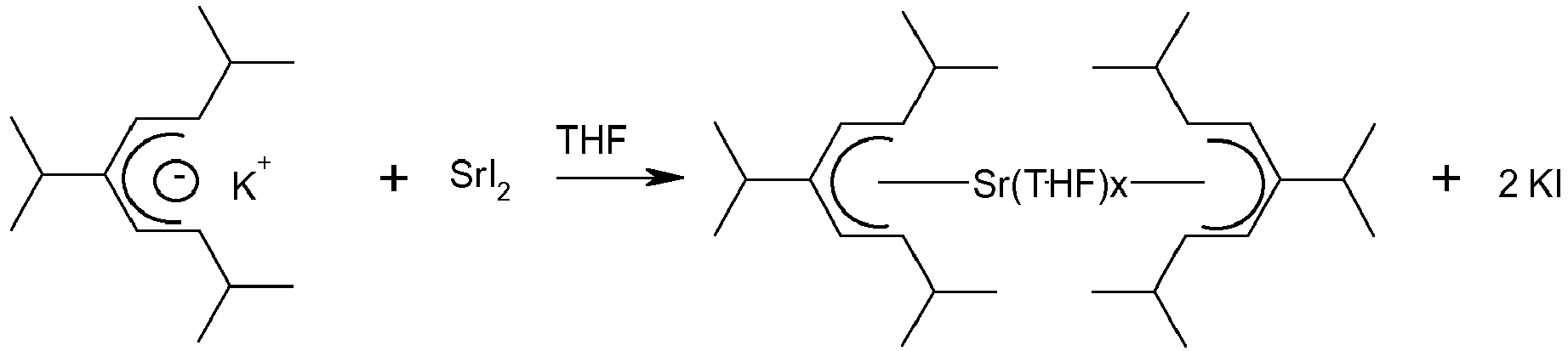
- The new strontium compounds of the invention raise considerable interest in the shortterm for the semiconductor industry, in particular for compounds to depose ultra high-k material in replacement of precursors like Sr(tBu3Cp)2 which is not sufficiently volatile and thermally stable.
Claims (13)
- Compounds of the general formula (I) : [(R1R2R3R4R5)C5)]2M(A)x- M is strontium;- R1, R2, R3, R4, R5 are an organic ligand independently selected in the group consisting of H, C1-C5 linear or branched alkyl;- A is selected in the group consisting of alcohol, alkylamine, ether (acyclic, cyclic and poly-acyclic);- 0 ≤ x ≤ 4;

- Compounds:Sr[1,3,5-(iPr)3 pentadiene]2;Sr[1,3,5-(nPr)3 pentadiene]2;Sr[1,3,5 -(tBu)3 pentadiene]2;Sr[(Et)5(pentadiene)]2;Sr[(Me)5(pentadiene)]2.
- Method of forming a strontium-containing layer on a substrate surface, the method comprising at least the steps of:a) providing a vapor comprising at least one precursor compound (I) as defined in claim 1 or 2;b) reacting the vapor comprising the at least one compound (I) with the substrate, according to a method selected from (MO)CVD (Metal-Organic Chemical Vapor Deposition), ALD (Atomic Layer Deposition), PEALD (Plasma Enhanced Atomic Layer Deposition), PECVD (Plasma Enhanced Chemical Vapor Deposition) and derivative vapor phase deposition methods, to form a layer of a at least strontium-containing complex on at least one surface of said substrate.
- Method of claim 3 further comprising the step:c) reaction of the complex formed obtained in step b) with at least one reactant selected from another metal source, reducing reactants and/or nitriding reactants and/or oxidizing reactants.
- Method of claim 4, wherein the at least one reactant is selected in the group consisting of, oxygen (O2), oxygen radicals (for instance O· or OH·), for instance generated by a remote plasma, ozone (O3), moisture (H2O) and H2O2.
- Method of claim 4, wherein the at least one reactant is selected in the group consisting of SiH4, Si2H6, Si3H8, SAM24 (SiH2(NEt2)2 Bis(diethylamino)silane), TriDMAS (SiH(NMe2)3), BDMAS (SiH2(NMe2)2), BDEAS (SiH2(NEt2)2), TDEAS (SiH(NEt2)3), TDMAS (SiH(NMe2)3), 3MS (trimethylsilane), 4MS (tetramethylsilane), TEMAS (SiH(NEtMe)3), (SiH3)3N, (SiH3)2O, trisilylamine, disiloxane, trisilylamine, a alkoxysilane SiHx(OR1)4-x (where x is comprised between 0 and 3), a silanol Si(OH)x(OR1)4-x (preferably Si(OH)(OR1)3 ; more preferably Si(OH)(OtBu)3 an aminosilane SiHx(NR1R2)4-x (where x is comprised between 0 and 3); R1 and R2 are independently from H or a C1-C6 carbon chain, either linear, branched or cyclic; preferably TriDMAS SiH(NMe2)3, BTBAS SiH2(NHtBu)2; BDEAS SiH2(NEt2)2 and mixtures thereof.
- Method of anyone of claims 4 to 6, wherein the reactants can be introduced simultaneously (chemical vapor deposition), sequentially (atomic layer deposition) or different combinations such as introducing strontium source (I) and the other precursor source together in one pulse and oxygen in a separate pulse (modified atomic layer deposition); or introducing oxygen continuously and to introduce metal source by pulse (pulsed-chemical vapor deposition).
- Method of anyone of claims 4 to 7, wherein said another metal source is selected in the group of TBTDET, TBTDMT, (Cp)Ti(OtBu)3, (Cp)Ti(OiPr)3, (Cp)Ti(OEt)3, (Me5Cp)Ti(OtBu)3, (Me5Cp)Ti(OiPr)3, (Me5Cp)Ti(OEt)3, TiCl4, Ti(OMe)4, Ta(OEt)4, Ta(OMe)5, CpTa(NEt2)N(tBu), Sr(iPr3Cp)2, Ba(iPr3Cp)2.
- Method of anyone of claims 3 to 8, wherein the temperature of the substrate is comprised between 300°C and 450°C.
- Method of anyone of claims 3 to 9, wherein the substrate is selected in the group consisting of Si, SiOx, SiNx, SiOxNy, Cu, GeOx.
- A substrate coated with one or more film monolayers of one or more metals, obtained by a method selected from (MO)CVD (Metal-Organic Chemical Vapor Deposition), ALD (Atomic Layer Deposition), PEALD (Plasma Enhanced Atomic Layer Deposition), PECVD (Plasma Enhanced Chemical Vapor Deposition) and derivative vapor phase deposition methods, wherein at least one precursor is a metal source precursor as defined in claim 1 or 2.
- Method of manufacturing a semiconductor device product comprising contacting a semiconductor device substrate with a strontium source precursor as defined in claim 1 or 2, to deposit strontium on the substrate.
- Method of manufacturing a photovoltaic device product comprising contacting a photovoltaic device substrate with a strontium source precursor as defined in claim 1 or 2, to deposit strontium on the substrate.
Priority Applications (1)
| Application Number | Priority Date | Filing Date | Title |
|---|---|---|---|
| EP12306125.1A EP2708545A1 (en) | 2012-09-18 | 2012-09-18 | Pentadienyl strontium-organic compounds and their use for thin films deposition |
Applications Claiming Priority (1)
| Application Number | Priority Date | Filing Date | Title |
|---|---|---|---|
| EP12306125.1A EP2708545A1 (en) | 2012-09-18 | 2012-09-18 | Pentadienyl strontium-organic compounds and their use for thin films deposition |
Publications (1)
| Publication Number | Publication Date |
|---|---|
| EP2708545A1 true EP2708545A1 (en) | 2014-03-19 |
Family
ID=46970168
Family Applications (1)
| Application Number | Title | Priority Date | Filing Date |
|---|---|---|---|
| EP12306125.1A Withdrawn EP2708545A1 (en) | 2012-09-18 | 2012-09-18 | Pentadienyl strontium-organic compounds and their use for thin films deposition |
Country Status (1)
| Country | Link |
|---|---|
| EP (1) | EP2708545A1 (en) |
Cited By (2)
| Publication number | Priority date | Publication date | Assignee | Title |
|---|---|---|---|---|
| CN109415398A (en) * | 2016-07-18 | 2019-03-01 | 巴斯夫欧洲公司 | Coordination -3- pentadienyl cobalt or nickel precursor and its purposes in membrane deposition method |
| KR20220069568A (en) * | 2020-11-20 | 2022-05-27 | 삼성에스디아이 주식회사 | Organic metal compound, composition for depositing thin film comprising the organic metal compound, manufacturing method for thin film using the composition, thin film manufactured from the composition, and semiconductor device including the thin film |
Citations (3)
| Publication number | Priority date | Publication date | Assignee | Title |
|---|---|---|---|---|
| DE19908079A1 (en) * | 1999-02-25 | 2000-08-31 | Basf Ag | Heteroleptic alkaline earth metal compounds and method for stereoselective anionic polymerization |
| US20010006705A1 (en) * | 1999-12-24 | 2001-07-05 | Murata Manufacturing Co., Ltd. | Method for forming a thin film and a thin film forming apparatus therefor |
| WO2008069821A1 (en) | 2006-12-05 | 2008-06-12 | Advanced Technology Materials, Inc. | Metal aminotroponiminates, bis-oxazolinates and guanidinates |
-
2012
- 2012-09-18 EP EP12306125.1A patent/EP2708545A1/en not_active Withdrawn
Patent Citations (3)
| Publication number | Priority date | Publication date | Assignee | Title |
|---|---|---|---|---|
| DE19908079A1 (en) * | 1999-02-25 | 2000-08-31 | Basf Ag | Heteroleptic alkaline earth metal compounds and method for stereoselective anionic polymerization |
| US20010006705A1 (en) * | 1999-12-24 | 2001-07-05 | Murata Manufacturing Co., Ltd. | Method for forming a thin film and a thin film forming apparatus therefor |
| WO2008069821A1 (en) | 2006-12-05 | 2008-06-12 | Advanced Technology Materials, Inc. | Metal aminotroponiminates, bis-oxazolinates and guanidinates |
Non-Patent Citations (5)
| Title |
|---|
| C. MATHIS ET AL.: "Solvation of ion pairs of barium and strontium salts of .alpha., .omega.-bis(9-fluorenyl)polymethylenes in tetrahydrofuran", J. ORGANOMET. CHEM., vol. 217, no. 3, 15 September 1981 (1981-09-15), pages 291 - 301, XP002688188 * |
| E. ILJINA ET AL., MATERIALS SCIENCE & ENGINEERING. B, SOLID-STATE MATERIALS FOR ADVANCED TECHNOLOGY, vol. 18, 1993, pages 234 - 236 |
| H. SCHUHMANN ET AL.: "Butenyl-Substituted Alkaline-Earth Metallocenes: A First Step towards Olefin Complexes of the Alkaline-Earth Metals", ANGEW. CHEM. INT. ED., vol. 43, no. 45, 17 November 2004 (2004-11-17), pages 6208 - 6211, XP002688189, DOI: 10.1002/anie.200460927 * |
| J. S. OVERBY, T. P. HANUSA: "Synthesis and Crystal Structure of the "Open" Calcocene [(tBu2C5H5)2Ca · thf]", ANGEW. CHEM. INT. ED. ENGL., vol. 33, no. 21, 22 December 2003 (2003-12-22), pages 2191 - 2193, XP002688190, DOI: 10.1002/anie.199421911 * |
| T. P. HOLME, F. B. PRINZ: "Atomic Layer Deposition and Chemical Vapor Deposition Precursor Selection Method Application to Strontium and Barium Precursors", J. PHYS. CHEM. A, vol. 111, no. 33, 27 July 2007 (2007-07-27), pages 8147 - 8151, XP002688194, DOI: 10.1021/jp062568l * |
Cited By (2)
| Publication number | Priority date | Publication date | Assignee | Title |
|---|---|---|---|---|
| CN109415398A (en) * | 2016-07-18 | 2019-03-01 | 巴斯夫欧洲公司 | Coordination -3- pentadienyl cobalt or nickel precursor and its purposes in membrane deposition method |
| KR20220069568A (en) * | 2020-11-20 | 2022-05-27 | 삼성에스디아이 주식회사 | Organic metal compound, composition for depositing thin film comprising the organic metal compound, manufacturing method for thin film using the composition, thin film manufactured from the composition, and semiconductor device including the thin film |
Similar Documents
| Publication | Publication Date | Title |
|---|---|---|
| US10217629B2 (en) | Method of forming dielectric films, new precursors and their use in semiconductor manufacturing | |
| EP2322530B1 (en) | Group 4 metal precursors for metal-containing films | |
| KR101138130B1 (en) | Metal compound, material for forming thin film and method for preparing thin film | |
| EP2460807A1 (en) | Metal-enolate precursors for depositing metal-containing films | |
| KR101151462B1 (en) | Methods for deposition of group 4 metal containing films | |
| EP2708545A1 (en) | Pentadienyl strontium-organic compounds and their use for thin films deposition | |
| EP2573096A1 (en) | Tantalum-organic compounds and their use for thin films deposition | |
| EP2708542B1 (en) | Salen-type barium precursors for vapor phase deposition of thin films | |
| EP2468755A1 (en) | Novel barium precursors for vapor phase deposition of thin films | |
| EP2708544A1 (en) | Pentadienyl barium-organic compounds and their use for thin films deposition | |
| EP2708543A1 (en) | Salen-type strontium precursors for vapor phase deposition of thin films | |
| EP2573094A1 (en) | Novel niobium-organic compounds and their use for thin films deposition | |
| EP2468754A1 (en) | Novel diazacrown barium and strontium precursors for vapor phase deposition of thin film | |
| EP2468757A1 (en) | Novel diazacrown barium precursors for vapor phase deposition of thin films | |
| EP2468756A1 (en) | Novel diazacrown strontium precursors for vapor phase deposition of thin films | |
| EP2468753A1 (en) | Strontium precursors for vapor phase deposition of thin films | |
| EP2573093A1 (en) | Novel tantalum-organic compounds and their use for thin films deposition | |
| EP2573095A1 (en) | Novel vanadium-organic compounds and their use for thin films deposition |
Legal Events
| Date | Code | Title | Description |
|---|---|---|---|
| PUAI | Public reference made under article 153(3) epc to a published international application that has entered the european phase |
Free format text: ORIGINAL CODE: 0009012 |
|
| AK | Designated contracting states |
Kind code of ref document: A1 Designated state(s): AL AT BE BG CH CY CZ DE DK EE ES FI FR GB GR HR HU IE IS IT LI LT LU LV MC MK MT NL NO PL PT RO RS SE SI SK SM TR |
|
| AX | Request for extension of the european patent |
Extension state: BA ME |
|
| 17P | Request for examination filed |
Effective date: 20140919 |
|
| RBV | Designated contracting states (corrected) |
Designated state(s): AL AT BE BG CH CY CZ DE DK EE ES FI FR GB GR HR HU IE IS IT LI LT LU LV MC MK MT NL NO PL PT RO RS SE SI SK SM TR |
|
| R17P | Request for examination filed (corrected) |
Effective date: 20120918 |
|
| STAA | Information on the status of an ep patent application or granted ep patent |
Free format text: STATUS: THE APPLICATION IS DEEMED TO BE WITHDRAWN |
|
| 18D | Application deemed to be withdrawn |
Effective date: 20140920 |