EP2706752A1 - Method to determine the global quality of a video stream delivered using adaptive streaming - Google Patents
Method to determine the global quality of a video stream delivered using adaptive streaming Download PDFInfo
- Publication number
- EP2706752A1 EP2706752A1 EP12306065.9A EP12306065A EP2706752A1 EP 2706752 A1 EP2706752 A1 EP 2706752A1 EP 12306065 A EP12306065 A EP 12306065A EP 2706752 A1 EP2706752 A1 EP 2706752A1
- Authority
- EP
- European Patent Office
- Prior art keywords
- quality
- successive
- video
- client
- audience
- Prior art date
- Legal status (The legal status is an assumption and is not a legal conclusion. Google has not performed a legal analysis and makes no representation as to the accuracy of the status listed.)
- Withdrawn
Links
- 238000000034 method Methods 0.000 title claims abstract description 54
- 230000003044 adaptive effect Effects 0.000 title description 8
- 238000012544 monitoring process Methods 0.000 claims abstract description 6
- 238000004364 calculation method Methods 0.000 claims description 15
- 238000002474 experimental method Methods 0.000 claims description 12
- 238000001303 quality assessment method Methods 0.000 claims description 6
- 238000012935 Averaging Methods 0.000 claims description 5
- 238000005259 measurement Methods 0.000 claims description 5
- 238000004590 computer program Methods 0.000 claims description 2
- 230000006870 function Effects 0.000 description 24
- 238000007430 reference method Methods 0.000 description 7
- 238000013459 approach Methods 0.000 description 5
- 230000008569 process Effects 0.000 description 4
- 238000012360 testing method Methods 0.000 description 4
- 230000005540 biological transmission Effects 0.000 description 3
- 230000015556 catabolic process Effects 0.000 description 3
- 238000006731 degradation reaction Methods 0.000 description 3
- 238000010586 diagram Methods 0.000 description 3
- 238000004422 calculation algorithm Methods 0.000 description 2
- 230000008447 perception Effects 0.000 description 2
- 238000013442 quality metrics Methods 0.000 description 2
- 238000004458 analytical method Methods 0.000 description 1
- 230000006399 behavior Effects 0.000 description 1
- 230000000903 blocking effect Effects 0.000 description 1
- 230000008859 change Effects 0.000 description 1
- 230000000295 complement effect Effects 0.000 description 1
- 238000012885 constant function Methods 0.000 description 1
- 238000002716 delivery method Methods 0.000 description 1
- 230000001419 dependent effect Effects 0.000 description 1
- 239000000796 flavoring agent Substances 0.000 description 1
- 235000019634 flavors Nutrition 0.000 description 1
- 239000012530 fluid Substances 0.000 description 1
- 238000003384 imaging method Methods 0.000 description 1
- 238000007689 inspection Methods 0.000 description 1
- 230000003993 interaction Effects 0.000 description 1
- 238000009533 lab test Methods 0.000 description 1
- 238000011176 pooling Methods 0.000 description 1
- 238000012545 processing Methods 0.000 description 1
- 230000007704 transition Effects 0.000 description 1
Images


Classifications
-
- H—ELECTRICITY
- H04—ELECTRIC COMMUNICATION TECHNIQUE
- H04N—PICTORIAL COMMUNICATION, e.g. TELEVISION
- H04N21/00—Selective content distribution, e.g. interactive television or video on demand [VOD]
- H04N21/40—Client devices specifically adapted for the reception of or interaction with content, e.g. set-top-box [STB]; Operations thereof
- H04N21/43—Processing of content or additional data, e.g. demultiplexing additional data from a digital video stream; Elementary client operations, e.g. monitoring of home network or synchronising decoder's clock; Client middleware
- H04N21/442—Monitoring of processes or resources, e.g. detecting the failure of a recording device, monitoring the downstream bandwidth, the number of times a movie has been viewed, the storage space available from the internal hard disk
- H04N21/44209—Monitoring of downstream path of the transmission network originating from a server, e.g. bandwidth variations of a wireless network
-
- H—ELECTRICITY
- H04—ELECTRIC COMMUNICATION TECHNIQUE
- H04N—PICTORIAL COMMUNICATION, e.g. TELEVISION
- H04N17/00—Diagnosis, testing or measuring for television systems or their details
- H04N17/004—Diagnosis, testing or measuring for television systems or their details for digital television systems
-
- H—ELECTRICITY
- H04—ELECTRIC COMMUNICATION TECHNIQUE
- H04N—PICTORIAL COMMUNICATION, e.g. TELEVISION
- H04N21/00—Selective content distribution, e.g. interactive television or video on demand [VOD]
- H04N21/60—Network structure or processes for video distribution between server and client or between remote clients; Control signalling between clients, server and network components; Transmission of management data between server and client, e.g. sending from server to client commands for recording incoming content stream; Communication details between server and client
- H04N21/63—Control signaling related to video distribution between client, server and network components; Network processes for video distribution between server and clients or between remote clients, e.g. transmitting basic layer and enhancement layers over different transmission paths, setting up a peer-to-peer communication via Internet between remote STB's; Communication protocols; Addressing
- H04N21/637—Control signals issued by the client directed to the server or network components
- H04N21/6377—Control signals issued by the client directed to the server or network components directed to server
-
- H—ELECTRICITY
- H04—ELECTRIC COMMUNICATION TECHNIQUE
- H04N—PICTORIAL COMMUNICATION, e.g. TELEVISION
- H04N21/00—Selective content distribution, e.g. interactive television or video on demand [VOD]
- H04N21/80—Generation or processing of content or additional data by content creator independently of the distribution process; Content per se
- H04N21/83—Generation or processing of protective or descriptive data associated with content; Content structuring
- H04N21/845—Structuring of content, e.g. decomposing content into time segments
- H04N21/8456—Structuring of content, e.g. decomposing content into time segments by decomposing the content in the time domain, e.g. in time segments
Definitions
- the present invention relates to a method to determine the quality of a video stream.
- reduced reference methods make use of a stream of features extracted from the original source or reference video signal, and assess the quality degradation of the decoded received video signal by comparing the stream of features with the equivalent stream of features extracted from the decoded received video signal.
- the reliability of these reduced reference methods depends on the amount of features that are extracted, i.e., the larger (in bit rate) the stream of features is the better the reliability.
- bit rate associated with the stream of features still needs to be considerable compared to the bit rate of the video signal itself such that these reduced reference methods suffer from the same drawbacks as the full reference methods.
- no-reference methods only rely on the received information (either the stream of packets or the decoded video signal) to assess the degradation caused by encoding and transmission, and hence such methods do not need to know the original signal.
- a further classification of no-reference methods depends on the type of information they use: they can be pixel based or bitstream based.
- the decoded sequence is required. These methods look for known artifacts associated with the video encoding and transmission process. Often the encoding process (e.g., compliant with the H.264 standard) introduces blocking artifacts (false borders are introduced at the borders of the blocks that are used as fundamental coding units) in the received and decoded video blocks. These methods are however quite complex.
- bitstream based methods make use of information of the bitstream e.g. average bitrate, type of packets lost (e.g. P/I/B frames)) and/or network parameters such as packet loss, latency ...
- information about the sequence can be considered.
- server-centric video delivery decides in which quality (i.e., at which bit rate) the video requested by the client is streamed to that client.
- client-centric video delivery of which HAS, which is the abbreviation of HTTP adaptive streaming, delivery is a prominent example, the client decides the quality (and hence the bit rate) of the requested video on an interval by interval basis.
- HTTP adaptive streaming delivery a client/server approach is used wherein at the server the video is segmented in short intervals, also denoted chunks, of length between 2sec and 10sec. Each of these intervals is encoded in a multiple of versions each with their own associated nominal bit rate. Each chunk can be decoded independently of other chunks.
- the client monitors the available throughput over the network and based on this then selects the appropriate bitrate version for the chunk it needs to download next. This selection is usually based on a so-called rate decision algorithm which tries to match the selected video bit rate to the (average) throughput between client and server.
- a play-out buffer is still needed in the client, for guaranteeing that the video play-out never stalls (as the buffer ideally never empties).
- HTTP hyper text transport protocol
- TCP transport control protocol
- the quality versions that the client can choose from on a chunk by chunk basis are described in a so-called manifest file in the server.
- This manifest file is downloaded by the client at the beginning of a video session, and it can be updated later, e.g., for live video, by a request from the client to the server.
- this object is achieved by the provision of a method for assessing the quality of a video stream provided from a server to a client in a client/centric delivery architecture, said method comprising the steps of monitoring successive requests for successive video portions from the client to the server, deriving from the successive requested bitrates extracted from the successive monitored requests a set of successive chunk quality values associated to said successive video portions during a predetermined timing interval, and to further calculate from said successive chunk quality values during said timing interval a final video quality score value.
- MOS model introduced here can operate with other client-centric approaches different from HTTP adaptive streaming, as long as the messages indicating which quality version the client requests can be intercepted.
- the calculation of said final video quality score value further depends on at least one audience related parameter.
- said at least one audience-related parameter is tuned such that the model used for calculating said final video quality score value maximally correlates with the outcome of subjective experiments earlier obtained during quality assessment measurements of a set of videos by a live audience.
- said at least one audience-related parameter is tuned by an operator when performing said method.
- a further fine tuning of the parameters may be based on customers' feedback, thus also increasing the correlation with subjective scores given by a public.
- said calculation involves a weighted averaging of said successive chunk quality values.
- Respective weights can be attributed to said successive chunk quality values with the respective weights taking into account at least one of said at least one audience-related parameter earlier obtained during quality assessment measurements of a video with a live audience.
- said calculation involves calculating a p-percentile of said successive chunk quality values.
- the method further comprises the steps of providing a set of associated quality profiles to a set of possible requested bitrates for said video stream, to said server, and to incorporate said set of associated quality profiles within a manifest file that describes the formats the client can choose from for said video stream, such that said set of successive chunk quality values is selected from said set of associated quality profiles.
- Embodiments of the present invention relate as well to a computer program comprising software to perform the steps of the method in accordance to any of the claims 1 to 8, and to an apparatus comprising means for carrying out the method in accordance to any of the claims 1 to 8.
- Embodiments of the present invention aim to find a mean opinion score, hereafter abbreviated by MOS, being a number indicating the quality associated with a video stream.
- MOS Mean Opinion Score
- Objective video quality models assess the quality of a video, i.e., they predict the Mean Opinion Score, abbreviated by MOS; an audience would give when appraising the video.
- the MOS associated with a video is the average (i.e., mean) of all individual scores that the members of the audience give.
- Subjective tests where audiences appraise videos
- objective video quality models which calculate a prediction for the MOS, are developed. They are faster and easier to use than subjective tests, but in order to be valuable their predictions should correlate well with these subjective tests.
- Embodiments of the invention aim to find a MOS value for a video stream which is itself delivered using a client-centric approach.
- client-centric approach a client/server architecture is meant, whereby the client is further adapted to take some decisions related to the version of the video which is requested by this client and subsequently downloaded.
- HTTP adaptive streaming hereafter abbreviated as HAS
- RTSP speed header as is for instance described in US patent application 20090089445 .
- Embodiments of the method used for calculating such a MOS score are of the bitstream-based model type, as for HAS video delivery and other client-centric video delivery methods the client behavior can be almost completely characterized by inspecting network packets, in particular, the messages the client issues in which it indicates which bitrate versions of the chunks it desires to receive.
- these messages are HTTP GET messages.
- HTTP GET message concerns a message transmitted from the client towards the server and already comprises information with respect to the requested bitrate for a requested chunk at a particular instance in time.
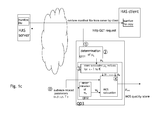
- Fig. 1a the method to assess the MOS of a video is performed by means of a separate Video Quality determination device QD0. It may be part of the client, of the server, or reside somewhere in the network, as is the situation depicted in Fig. 1 . In other embodiments it can be distributed over several physical processors too.
- HTTP adaptive streaming the client is continuously transmitting HTTP GET requests to the server. These are thus monitored by QD0, as schematically indicated in step 1, showing that these HTTP GET messages are also transmitted or intercepted by QD0.
- a module QD01 is adapted to intercept and receive these HTTP GET request messages, which indicate which chunks the client requests, to calculate for each requested and subsequently delivered video chunk k an associated chunk quality value ⁇ k , based on the individual HTTP GET request messages.
- a method for calculating such an individual chunk quality value ⁇ k for chunk k can rely on well known models that associate a MOS of a chunk to the nominal bit rate of that chunk. An example of such a model is described in " User-Oriented QoS Analysis in MPEG-2 Video Delivery", by O. Verscheure et. al., in Journal of Real-Time Imaging, October 1999, vol.5, no 5, pp.
- ⁇ k Q o + ⁇ Q ⁇ R k / ⁇ R - 1 / ⁇
- Q o , ⁇ Q , ⁇ R , and ⁇ are parameters that depend on the complexity of the video and the screen size on which the video is watched and R k is the bitrate in which the client requested chunk k.
- the value of the requested bit R k is embedded in the HTTP GET message.
- a set of chunk quality values ⁇ k will thus be obtained.
- a dedicated module QD01 for this calculation is provided, but in other embodiments such a separate module may not be present as in these other embodiments the process of how to associate a MOS value ⁇ k per chunk described above may reside outside QD0, or be part of one single processor implementing the whole functionality of QD0.
- ⁇ k values will then be further analyzed and combined according to a predetermined function.
- a second module QD02 is adapted to perform this, but again, in other embodiments all calculations can as well be performed by means of one processor.
- QD02 further comprises a module for storing successive values of ⁇ k calculated over a timing period of K successive delivered chunks. This storage is performed in step 3.
- step 4 the actual MOS value calculation over the timing interval of K delivered chunks is performed.
- the MOS quality score ⁇ seq is calculated as the average value of the K chunk quality values.
- ⁇ seq is obtained by determination of the median of these K values.
- an additional parameter p is used as an additional input, e.g.
- p may have the value of 20% indicating that out of the K chunk quality values, the p-th percentile value is to be selected for provision as MOS quality score over the interval comprising the K delivered chunks.
- This input parameter value may have a fixed value, or, alternatively, can be tuned based on audience feedback. This audience feedback can e.g. be based on complaints received by an operator.
- ⁇ seq will be obtained as a result of a function G( ⁇ k , parameters) which depends on ⁇ k and possibly one or more, audience-related parameters, obtained over the video sequence comprising K chunks.
- a typical value for K can be 20, but it can also be much larger e.g. 500 for a whole video of 50 minutes such that the whole video is covered based on the values of the individually determined ⁇ k values for the K chunks that make up the most recent part of the video sequence.
- the one or more input parameters of this function can be predetermined based on earlier determined audience experiments obtained during quality assessment measurements of a video with a live audience.
- this predetermined function G( ⁇ k ,parameters) involves a first attribution of K respective weights W k to the K respective quality values ⁇ k , for the K successive chunks.
- the weights themselves again can be tuned based upon the audience parameters.
- the predetermined function further combines the weighted values into one final quality metric, also taking into account these or other parameters which were also obtained during the set of experiments with a live audience.
- This predetermined function G ( ⁇ k , parameters) can e.g. be a weighted averaging function or a function calculating a p-percentile of the individual weighted ⁇ k values, whereby p is again tuned such as to maximize correlation with live audiences appraising video quality. Both variants will be further discussed in the next paragraphs.
- a method to associate a MOS value to the sequence may involve averaging the MOS values associated with individual chunks.
- ⁇ seq ⁇ ⁇ ⁇ ave - ⁇ ⁇ ⁇ - ⁇ ⁇ ⁇ with ⁇ ⁇ 0, ⁇ ⁇ 0, ⁇ ⁇ 0
- w k are the individual weights associated to the respective ⁇ k values. They determine the shape of the recency window.
- ⁇ seq which corresponds to the total video quality score, denoted ⁇ seq or MOS quality score in Fig. 1
- ⁇ ave is the average of the quality profiles ⁇ k
- ⁇ is its standard deviation
- ⁇ is the frequency of quality changes, all measured and weighted over the recency window.
- ⁇ can be considered, e.g., the height of the quality step can be taken into account.
- RMSE Root Mean Square Error
- SROCC Searman Rank Order Correlation Coefficient
- PCC Nearson Correlation Coefficient
- OR Outlier Ratio
- the audience-related parameters may have initially chosen values, which can be tuned afterwards, e.g. by an operator or any person using the method, based on feedback from customers to which the video files are transmitted upon their requests. This customer feedback will then result in the tuning of one or more audience-related parameters.
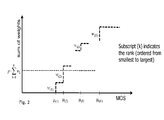
- Another method to associate a MOS value ⁇ seq. for the sequence from K consecutive ⁇ k values associated with individual chunks is referred to as pooling. It is an extension of the p-percentile parameter introduced earlier and based on the premise that users are most annoyed by, i.e., their attention is drawn most to, the worst parts in the global video sequence. Therefore, to obtain the MOS value for the global video sequence, the p -percentile (with p typically between 5% and 20%) of the individual values (associated with parts of the video) is calculated. In our context this translates to calculating the p-percentile of the K individual MOS values. This is illustrated in Figure 2 .
- the index (k) indicates the k-th smallest ⁇ k value.
- a piece-wise constant function is constructed where at each ⁇ ( k ) value the function steps up an amount w ( k ) . Finally it is determined at which value the fraction p of the total sum of weights is reached.
- the MOS value is than calculated as the average of the MOS values below the p-percentile.
- the median is a special case of a percentile.
- ⁇ seq is defined as the median of the ⁇ k values is an example of a function which solely depends on the ⁇ k values, as e.g. shown in Fig. 1a .
- a step function as used in Fig. 2
- another function could be used, e.g., the complementary error function (erfc(.)), which would model that the frames within a chunk have a variable quality as well.
- erfc(.) the complementary error function
- a third method also ranks the ⁇ k values, but rather than selecting one percentile, it weights the ⁇ k values as a function of the p-percentile with an additional weight F(p). Notice that these additional weights are different from and come on top of the weights w k associated with the chunks of the recency window.
- the function F(p) is chosen such that small percentiles (lower quality value) have more impact on the final MOS value. This function is again determined by optimizing the RMSE, SROCC, PCC or OR.
- the Dirac function ⁇ (p-p 0 ) can be used, in which the ⁇ seq is the p 0 -percentile of the ⁇ k values.
- the three models discussed in the previous paragraph thus make use of a few audience-related parameters that can either have some predetermined initial values, as given in the examples in a previous paragraph. Alternatively they can be determined based on ground truth e.g. by live experiments on live audience. This ground truth needs to be obtained in experiments with an audience of users.
- the fitting parameters ⁇ , ⁇ , ⁇ and T , p are chosen to maximize the correlation of the output of the model, being the final obtained quality metric with the perception of quality from the live audience.
- the three described models are based on combining the quality values of these individual chunks to derive the MOS value for the sequence.
- the proposed models are easy to compute, accurate, easier to train as only a few parameters need to be trained, and part of the dependencies (e.g. on scene complexity, bitrate parameters etc.%) are implicitly covered by making use of the MOS values of the individual chunks.
- they are independent of the TCP flavor (Reno, Vegas, Cubic, Fluid,%) used, independent on RDA (Rate Decision Algorithm) of the HAS client, not explicitly dependent on network parameters (e.g. latency, packet loss,...) of the medium and making use of easy to access information (HTTP GET request messages to know the chunks requested by the client).
- the calculation of the respective chunk quality values ⁇ k as a function of the requested bandwidth , as e.g. being announced in the HTTP GET request messages, for the video chunks which are to be viewed by the client may be performed beforehand in a separate module.
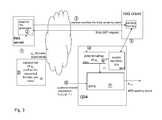
- This is shown in fig. 3 , where this separate module is denoted QC. It may be part of the HAS server, or also part of the quality determination module QD4, or even of the HAS client.
- the values of all possible chunk quality values for each possible client device can be calculated with a process similar to the aforementioned method in an initialization step 0, which can be performed during the generation of the video. This information is then provided to the module in the HAS server which takes care of the generation of the manifest file for this specific requested video.
- Step 1 The provision is denoted by the arrow from QC to this manifest file module in a step 1.
- the association between requested bitrate and associated chunk quality value ⁇ k is then further inserted within the manifest file in step 2.
- This adapted manifest file will be provided to the HAS Client in step 3, which will copy the manifest file in a client memory.
- Step 4 is similar to step 1 of Figs. 1a-c , and thus involves a monitoring of the successive HTTP GET request messages within a timing window of K chunks.
- the module QD41 is adapted to perform this monitoring, and to determine the successive ⁇ k , values from the HTTP GET messages.
- this manifest file will be accessed in step 5 .
- the manifest file is captured from the client.
- the manifest file may also be captured by the quality determination device during the exchange of the manifest file between server and client.
- the information of the ⁇ k value associated to a requested bitrate, will then be provided to QD41 during the determination of ⁇ k .
- a separate memory module QD43 is shown for storage of a copy of the accessed manifest file. In other embodiments however direct access from QD41 to the client for accessing the manifest file for obtaining the associated ⁇ k values is also possible.
- the association between the requested quality levels for all types of videos and the possible requested bitrates for these videos can be performed in an initialization step by the video quality module itself, and stored within this module.
- This embodiment then resembles that of Figs. 1a-c , with the exception that QD0,QD1, resp QD3 will contain an off-line calculation module for all possible values of ⁇ k , and a storage module for the storage of the association table. Modules QD01,QD11, resp QD31 then will just look-up the associated ⁇ k value from the requested bitrate extracted from the HTTP request.
- processors may be provided through the use of dedicated hardware as well as hardware capable of executing software in association with appropriate software.
- the functions may be provided by a single dedicated processor, by a single shared processor, or by a plurality of individual processors, some of which may be shared.
- processor or “controller” should not be construed to refer exclusively to hardware capable of executing software, and may implicitly include, without limitation, digital signal processor (DSP) hardware, network processor, application specific integrated circuit (ASIC), field programmable gate array (FPGA), read only memory (ROM) for storing software, random access memory (RAM), and non volatile storage.
- DSP digital signal processor
- ASIC application specific integrated circuit
- FPGA field programmable gate array
- ROM read only memory
- RAM random access memory
- non volatile storage Other hardware, conventional and/or custom, may also be included. Their function may be carried out through the operation of program logic, through dedicated logic, through the interaction of program control and dedicated logic, or even manually, the particular technique being selectable by the implementer as more specifically understood from the context.
- any block diagrams herein represent conceptual views of illustrative circuitry embodying the principles of the invention.
- any flow charts, flow diagrams, state transition diagrams, pseudo code, and the like represent various processes which may be substantially represented in computer readable medium and so executed by a computer or processor, whether or not such computer or processor is explicitly shown.
- Embodiments of the method can be performed by means of dedicated hardware and/of software or any combination of both.
Landscapes
- Engineering & Computer Science (AREA)
- Multimedia (AREA)
- Signal Processing (AREA)
- Computer Networks & Wireless Communication (AREA)
- Health & Medical Sciences (AREA)
- Biomedical Technology (AREA)
- General Health & Medical Sciences (AREA)
- Databases & Information Systems (AREA)
- Testing, Inspecting, Measuring Of Stereoscopic Televisions And Televisions (AREA)
Abstract
Description
- The present invention relates to a method to determine the quality of a video stream.
- Some known quality assessment techniques are full reference methods, implying that, at the receiver, besides the decoded received video signal also the original source or reference video signal is needed to assess the quality degradation in the decoded received video signal. This is however not feasible on real deployed networks and systems and hence, such methods are restricted to laboratory tests.
- Other techniques, referred to as reduced reference methods, make use of a stream of features extracted from the original source or reference video signal, and assess the quality degradation of the decoded received video signal by comparing the stream of features with the equivalent stream of features extracted from the decoded received video signal. The reliability of these reduced reference methods depends on the amount of features that are extracted, i.e., the larger (in bit rate) the stream of features is the better the reliability. In the current state of the art the bit rate associated with the stream of features still needs to be considerable compared to the bit rate of the video signal itself such that these reduced reference methods suffer from the same drawbacks as the full reference methods.
- Other existing methods, referred to as no-reference methods, only rely on the received information (either the stream of packets or the decoded video signal) to assess the degradation caused by encoding and transmission, and hence such methods do not need to know the original signal.
- A further classification of no-reference methods depends on the type of information they use: they can be pixel based or bitstream based.
- For the pixel based methods, the decoded sequence is required. These methods look for known artifacts associated with the video encoding and transmission process. Often the encoding process (e.g., compliant with the H.264 standard) introduces blocking artifacts (false borders are introduced at the borders of the blocks that are used as fundamental coding units) in the received and decoded video blocks. These methods are however quite complex.
- The bitstream based methods make use of information of the bitstream e.g. average bitrate, type of packets lost (e.g. P/I/B frames)) and/or network parameters such as packet loss, latency ... In addition information about the sequence (type of sequence) can be considered.
- Despite the fact that thus nowadays a multitude of methods for assessing the quality of a video stream are available, most of these existing methods are applicable in server-centric video delivery and are not suited for client-centric video delivery. In server-centric video delivery the server decides in which quality (i.e., at which bit rate) the video requested by the client is streamed to that client. In client-centric video delivery of which HAS, which is the abbreviation of HTTP adaptive streaming, delivery, is a prominent example, the client decides the quality (and hence the bit rate) of the requested video on an interval by interval basis.
- In HTTP adaptive streaming delivery a client/server approach is used wherein at the server the video is segmented in short intervals, also denoted chunks, of length between 2sec and 10sec. Each of these intervals is encoded in a multiple of versions each with their own associated nominal bit rate. Each chunk can be decoded independently of other chunks. The client monitors the available throughput over the network and based on this then selects the appropriate bitrate version for the chunk it needs to download next. This selection is usually based on a so-called rate decision algorithm which tries to match the selected video bit rate to the (average) throughput between client and server. Since it is difficult to obtain an exact match between the video bit rate and the throughput a play-out buffer is still needed in the client, for guaranteeing that the video play-out never stalls (as the buffer ideally never empties). In HAS the chunks are transported over HTTP (hyper text transport protocol) which runs over TCP (transport control protocol).
- The quality versions that the client can choose from on a chunk by chunk basis are described in a so-called manifest file in the server. This manifest file is downloaded by the client at the beginning of a video session, and it can be updated later, e.g., for live video, by a request from the client to the server.
- It is thus an object of embodiments of the present invention to propose a method which is especially suited to accurately assess the quality of a video delivered from a server to a client using client-centric video delivery with one particular embodiment HTTP adaptive streaming.
- According to embodiments of the present invention this object is achieved by the provision of a method for assessing the quality of a video stream provided from a server to a client in a client/centric delivery architecture, said method comprising the steps of monitoring successive requests for successive video portions from the client to the server, deriving from the successive requested bitrates extracted from the successive monitored requests a set of successive chunk quality values associated to said successive video portions during a predetermined timing interval, and to further calculate from said successive chunk quality values during said timing interval a final video quality score value.
- In this way a simple, yet effective method for assessing the quality of a video stream is provided, based on individual successive chunk quality values.
- It is to be remarked that the MOS model introduced here can operate with other client-centric approaches different from HTTP adaptive streaming, as long as the messages indicating which quality version the client requests can be intercepted.
- In an embodiment the calculation of said final video quality score value further depends on at least one audience related parameter.
- This enables to further take into account additional parameters which add to the accuracy of the obtained result.
- In a variant embodiment said at least one audience-related parameter is tuned such that the model used for calculating said final video quality score value maximally correlates with the outcome of subjective experiments earlier obtained during quality assessment measurements of a set of videos by a live audience.
- This further adds to increasing the correlation with subjective scores given by human video watchers.
- In another embodiment said at least one audience-related parameter is tuned by an operator when performing said method.
- In this case a further fine tuning of the parameters may be based on customers' feedback, thus also increasing the correlation with subjective scores given by a public.
- In a variant method said calculation involves a weighted averaging of said successive chunk quality values.
- Respective weights can be attributed to said successive chunk quality values with the respective weights taking into account at least one of said at least one audience-related parameter earlier obtained during quality assessment measurements of a video with a live audience.
- This provides a simple, yet very accurate method.
- In another variant said calculation involves calculating a p-percentile of said successive chunk quality values.
- This provides yet another simple alternative.
- In an embodiment the method further comprises the steps of providing a set of associated quality profiles to a set of possible requested bitrates for said video stream, to said server, and to incorporate said set of associated quality profiles within a manifest file that describes the formats the client can choose from for said video stream, such that said set of successive chunk quality values is selected from said set of associated quality profiles.
- This allows to further reduce the complexity of the real-time calculations as the associated quality profiles can be calculated off-line and provided within the manifest file, such that the chunk quality values can just be selected or retrieved from these manifest files.
- Embodiments of the present invention relate as well to a computer program comprising software to perform the steps of the method in accordance to any of the
claims 1 to 8, and to an apparatus comprising means for carrying out the method in accordance to any of theclaims 1 to 8. - The above and other objects and features of the invention will become more apparent and the invention itself will be best understood by referring to the following description of an embodiment taken in conjunction with the accompanying drawings wherein:
-
Figs. 1a-c all show a situation of a HTTP adaptive streaming video transmission between a server and a client, with a high level schematics of three embodiments of a video quality determination device, -
Fig. 2 illustrates another embodiment of the method for the MOS calculation, -
Fig. 3 illustrates a still variant method - Embodiments of the present invention aim to find a mean opinion score, hereafter abbreviated by MOS, being a number indicating the quality associated with a video stream. Objective video quality models assess the quality of a video, i.e., they predict the Mean Opinion Score, abbreviated by MOS; an audience would give when appraising the video. The MOS associated with a video is the average (i.e., mean) of all individual scores that the members of the audience give. Subjective tests (where audiences appraise videos) are cumbersome and time-consuming. Therefore objective video quality models, which calculate a prediction for the MOS, are developed. They are faster and easier to use than subjective tests, but in order to be valuable their predictions should correlate well with these subjective tests.
- Embodiments of the invention aim to find a MOS value for a video stream which is itself delivered using a client-centric approach. With client-centric approach a client/server architecture is meant, whereby the client is further adapted to take some decisions related to the version of the video which is requested by this client and subsequently downloaded. An example of such a client-centric approach is HTTP adaptive streaming, hereafter abbreviated as HAS, and RTSP speed header as is for instance described in
US patent application 20090089445 . Embodiments of the method used for calculating such a MOS score are of the bitstream-based model type, as for HAS video delivery and other client-centric video delivery methods the client behavior can be almost completely characterized by inspecting network packets, in particular, the messages the client issues in which it indicates which bitrate versions of the chunks it desires to receive. In HAS these messages are HTTP GET messages. Such a HTTP GET message concerns a message transmitted from the client towards the server and already comprises information with respect to the requested bitrate for a requested chunk at a particular instance in time. In the assumption that the HAS client receiver functions properly, meaning that the play-out buffer at the receiver is sufficiently large and operates such that there are no frame freezes due to the play-out buffer under-running, an inspection of the evolution of these HTTP GET messages transmitted by the client over time, provides sufficient input information for the method. InFig. 1a the method to assess the MOS of a video is performed by means of a separate Video Quality determination device QD0. It may be part of the client, of the server, or reside somewhere in the network, as is the situation depicted inFig. 1 . In other embodiments it can be distributed over several physical processors too. - During HTTP adaptive streaming the client is continuously transmitting HTTP GET requests to the server. These are thus monitored by QD0, as schematically indicated in
step 1, showing that these HTTP GET messages are also transmitted or intercepted by QD0. - Within QD0, a module QD01 is adapted to intercept and receive these HTTP GET request messages, which indicate which chunks the client requests, to calculate for each requested and subsequently delivered video chunk k an associated chunk quality value µk , based on the individual HTTP GET request messages. A method for calculating such an individual chunk quality value µk for chunk k can rely on well known models that associate a MOS of a chunk to the nominal bit rate of that chunk. An example of such a model is described in "User-Oriented QoS Analysis in MPEG-2 Video Delivery", by O. Verscheure et. al., in Journal of Real-Time Imaging, October 1999, vol.5, no 5, pp. 305-314, and can be expressed by the following formula :

- Rough values for these parameters Qo, χQ, χR, and ξ are given in the referenced paper. In the context of this application these are assumed to be known, as being comprised in the state of the art.
- For subsequent values of k, with values for the total number K being at least 10 and which can go up to even. 500 or more, of requested video chunks, a set of chunk quality values µk will thus be obtained. In the embodiment depicted in
Fig. 1a a dedicated module QD01 for this calculation is provided, but in other embodiments such a separate module may not be present as in these other embodiments the process of how to associate a MOS value µk per chunk described above may reside outside QD0, or be part of one single processor implementing the whole functionality of QD0. - In a next step, these subsequent µk values will then be further analyzed and combined according to a predetermined function. In the embodiment of
Fig. 1a , a second module QD02 is adapted to perform this, but again, in other embodiments all calculations can as well be performed by means of one processor. - In
Fig. 1a QD02 further comprises a module for storing successive values of µk calculated over a timing period of K successive delivered chunks. This storage is performed instep 3. Instep 4 the actual MOS value calculation over the timing interval of K delivered chunks is performed. In a very simple embodiment the MOS quality score µseq is calculated as the average value of the K chunk quality values. In an alternative embodiment µseq is obtained by determination of the median of these K values. In another embodiment, depicted inFig. 1b , an additional parameter p is used as an additional input, e.g. p may have the value of 20% indicating that out of the K chunk quality values, the p-th percentile value is to be selected for provision as MOS quality score over the interval comprising the K delivered chunks. This input parameter value may have a fixed value, or, alternatively, can be tuned based on audience feedback. This audience feedback can e.g. be based on complaints received by an operator. - In another embodiment µseq will be obtained as a result of a function G(µk, parameters) which depends on µk and possibly one or more, audience-related parameters, obtained over the video sequence comprising K chunks. A typical value for K can be 20, but it can also be much larger e.g. 500 for a whole video of 50 minutes such that the whole video is covered based on the values of the individually determined µk values for the K chunks that make up the most recent part of the video sequence. To have the highest possible reliability (i.e., to have a MOS model that correlates well with subjective appraisals) the one or more input parameters of this function can be predetermined based on earlier determined audience experiments obtained during quality assessment measurements of a video with a live audience.
- In an embodiment this predetermined function G(µk,parameters) involves a first attribution of K respective weights Wk to the K respective quality values µk, for the K successive chunks. The weights themselves again can be tuned based upon the audience parameters. In this embodiment the predetermined function further combines the weighted values into one final quality metric, also taking into account these or other parameters which were also obtained during the set of experiments with a live audience.
- This predetermined function G (µk, parameters) can e.g. be a weighted averaging function or a function calculating a p-percentile of the individual weighted µk values, whereby p is again tuned such as to maximize correlation with live audiences appraising video quality. Both variants will be further discussed in the next paragraphs.
- A method to associate a MOS value to the sequence may involve averaging the MOS values associated with individual chunks. We extend this to the following formula (2) :

where


- Here wk are the individual weights associated to the respective µk values. They determine the shape of the recency window. The recency window determines how many chunks requested in the past are weighted in the global appraisal of the video. A possibility for selection these weights can be that they are all the same, e,g, wk =1 for k=1, ...K. alternatively the weights can change in an exponential way, e.g.

- In the above mentioned formula (2) for µseq, which corresponds to the total video quality score, denoted µseq or MOS quality score in
Fig. 1 ,
µave is the average of the quality profiles µk,
σ is its standard deviation and
φ is the frequency of quality changes, all measured and weighted over the recency window. - Alternative ways to define φ can be considered, e.g., the height of the quality step can be taken into account.
- The parameters α, β, γ and T (in case the weights are calculated in accordance with formula (3) ) can be set to predetermined values (e.g., to α=1, β=0.5, γ=0 and T=30sec). Alternatively they may be determined by optimizing the typical performance metrics for MOS models, i.e., RMSE (Root Mean Square Error), SROCC (Spearman Rank Order Correlation Coefficient), PCC (Pearson Correlation Coefficient) or OR (Outlier Ratio) based on a ground truth obtained in a whole range of experiments. These experiments leading to the ground truth are usually performed off line with a large audience, and the outcome of these experiments are used to tune the parameters (e.g., α, β, γ and T) such that the fit between the quality perception of the live audience and the MOS score µseq is maximized. These experiments are thus performed off line, before the method actually starts, and the audience-related parameters α, β, γ and T can thus be considered as input parameters for the model. This is schematically denoted in
Figs. 1b-c where one or more of these audience-related parameters of function G(µk, parameters) are available from an initializing step 0. In the embodiment depicted inFig. 1c , some of these offline determined audience-related parameters (e.g. T in case formula (2) is used for the weights) are input for the determination of the weights wk; Other audience-related parameters (such as α, β, γ) are then used in the final calculation of µseq. - It may be remarked that in other embodiments the audience-related parameters may have initially chosen values, which can be tuned afterwards, e.g. by an operator or any person using the method, based on feedback from customers to which the video files are transmitted upon their requests. This customer feedback will then result in the tuning of one or more audience-related parameters.
- Another method to associate a MOS value µseq. for the sequence from K consecutive µk values associated with individual chunks is referred to as pooling. It is an extension of the p-percentile parameter introduced earlier and based on the premise that users are most annoyed by, i.e., their attention is drawn most to, the worst parts in the global video sequence. Therefore, to obtain the MOS value for the global video sequence, the p-percentile (with p typically between 5% and 20%) of the individual values (associated with parts of the video) is calculated. In our context this translates to calculating the p-percentile of the K individual MOS values. This is illustrated in
Figure 2 . First the k µk values, bound together with their associated weights (which can be determined in a same way as for the averaging model previously described) are ordered. The index (k) indicates the k-th smallest µk value. A piece-wise constant function is constructed where at each µ(k) value the function steps up an amount w (k). Finally it is determined at which value the fraction p of the total sum of weights is reached. The MOS value is than calculated as the average of the MOS values below the p-percentile. - Note that the median is a special case of a percentile. The special case where µseq is defined as the median of the µk values is an example of a function which solely depends on the µk values, as e.g. shown in
Fig. 1a . - Instead of a step function as used in
Fig. 2 , also another function could be used, e.g., the complementary error function (erfc(.)), which would model that the frames within a chunk have a variable quality as well. - Again the parameters of this model, i.e., p and T (if used the weights are defined as in (3)), can be either chosen initially by an operator, or have a default value (e.g., P=10% and T=30sec) or can be determined by optimizing the RMSE, SROCC, PCC or OR based on a ground truth obtained in a whole range of experiments.
- A third method also ranks the µk values, but rather than selecting one percentile, it weights the µk values as a function of the p-percentile with an additional weight F(p). Notice that these additional weights are different from and come on top of the weights wk associated with the chunks of the recency window. The function F(p) is chosen such that small percentiles (lower quality value) have more impact on the final MOS value. This function is again determined by optimizing the RMSE, SROCC, PCC or OR.
- An example of F(p) is where F(p)=AW1 for p<p0 and F(p)=AW2 for p>=p0, where AW1 >AW2 . Alternatively the Dirac function δ(p-p0) can be used, in which the µseq is the p0-percentile of the µk values.
- The three models discussed in the previous paragraph thus make use of a few audience-related parameters that can either have some predetermined initial values, as given in the examples in a previous paragraph. Alternatively they can be determined based on ground truth e.g. by live experiments on live audience. This ground truth needs to be obtained in experiments with an audience of users.
- These experiments consist of choosing a number L of quality levels (preferable equidistantly on the MOS scale). Refer to λ l as the l-th quality level. In order to determine the parameters of the function G (µk, parameters) first a set of videos is constructed, each video associated with a known quality profile (µ1, µ2, ...,µ k , ...,µ k ). The set of videos (i.e., the set of quality profiles) needs to be carefully selected: the set needs to encompass all possible quality profiles that are expected to occur on the network. In principle each value µ k can be chosen independently from the set (λ1, λ2, ...,λ l , ..., λ L ). This would lead to LK possible profiles. This set is too large to be tested. Therefore a number of unrealistic profiles (e.g., the ones that are randomly fluctuating) need to be pruned from this set. One possible way to collect a realistic set of quality profiles is to inspect log files of CDN nodes or using a client plug-in that collects the requested quality version for each chunk on the fly and sends this collected data to some monitoring site in the network.
- Such a set of quality profiles needs to be constructed for a few test sequences of various complexity.
- The fitting parameters α, β, γ and T, p are chosen to maximize the correlation of the output of the model, being the final obtained quality metric with the perception of quality from the live audience.
- The three described models are based on combining the quality values of these individual chunks to derive the MOS value for the sequence. The proposed models are easy to compute, accurate, easier to train as only a few parameters need to be trained, and part of the dependencies (e.g. on scene complexity, bitrate parameters etc....) are implicitly covered by making use of the MOS values of the individual chunks. Moreover they are independent of the TCP flavor (Reno, Vegas, Cubic, Fluid,...) used, independent on RDA (Rate Decision Algorithm) of the HAS client, not explicitly dependent on network parameters (e.g. latency, packet loss,...) of the medium and making use of easy to access information (HTTP GET request messages to know the chunks requested by the client).
- In an alternative embodiment the calculation of the respective chunk quality values µk as a function of the requested bandwidth , as e.g. being announced in the HTTP GET request messages, for the video chunks which are to be viewed by the client may be performed beforehand in a separate module. This is shown in
fig. 3 , where this separate module is denoted QC. It may be part of the HAS server, or also part of the quality determination module QD4, or even of the HAS client. The values of all possible chunk quality values for each possible client device can be calculated with a process similar to the aforementioned method in an initialization step 0, which can be performed during the generation of the video. This information is then provided to the module in the HAS server which takes care of the generation of the manifest file for this specific requested video. The provision is denoted by the arrow from QC to this manifest file module in astep 1. The association between requested bitrate and associated chunk quality value µ k is then further inserted within the manifest file instep 2. This adapted manifest file will be provided to the HAS Client instep 3, which will copy the manifest file in a client memory.Step 4 is similar to step 1 ofFigs. 1a-c , and thus involves a monitoring of the successive HTTP GET request messages within a timing window of K chunks. The module QD41 is adapted to perform this monitoring, and to determine the successive µ k , values from the HTTP GET messages. As the association between the requested bitrate and µ k values is already known from the adapted manifest file, this manifest file will be accessed instep 5 . In the embodiment depicted inFig. 3 the manifest file is captured from the client. In an alternative embodiment (not depicted), the manifest file may also be captured by the quality determination device during the exchange of the manifest file between server and client. The information of the µ k value associated to a requested bitrate, will then be provided to QD41 during the determination of µ k . InFig. 3 a separate memory module QD43 is shown for storage of a copy of the accessed manifest file. In other embodiments however direct access from QD41 to the client for accessing the manifest file for obtaining the associated µ k values is also possible. - Once the chunk quality levels µ k are known, the calculation of the total MOS quality score can be similar to what was described in an earlier paragraph. It is therefore denoted in a single step 7, denoting the combination of
steps Figs. 1b-c . - In a yet another embodiment, requiring more processing power and more storage capability, the association between the requested quality levels for all types of videos and the possible requested bitrates for these videos, can be performed in an initialization step by the video quality module itself, and stored within this module. This embodiment then resembles that of
Figs. 1a-c , with the exception that QD0,QD1, resp QD3 will contain an off-line calculation module for all possible values of µ k , and a storage module for the storage of the association table. Modules QD01,QD11, resp QD31 then will just look-up the associated µ k value from the requested bitrate extracted from the HTTP request. - It is to be remarked that the functions of the various elements shown in the figures, including any functional blocks labeled as "processors", may be provided through the use of dedicated hardware as well as hardware capable of executing software in association with appropriate software. When provided by a processor, the functions may be provided by a single dedicated processor, by a single shared processor, or by a plurality of individual processors, some of which may be shared. Moreover, explicit use of the term "processor" or "controller" should not be construed to refer exclusively to hardware capable of executing software, and may implicitly include, without limitation, digital signal processor (DSP) hardware, network processor, application specific integrated circuit (ASIC), field programmable gate array (FPGA), read only memory (ROM) for storing software, random access memory (RAM), and non volatile storage. Other hardware, conventional and/or custom, may also be included. Their function may be carried out through the operation of program logic, through dedicated logic, through the interaction of program control and dedicated logic, or even manually, the particular technique being selectable by the implementer as more specifically understood from the context.
- It should be further appreciated by those skilled in the art that any block diagrams herein represent conceptual views of illustrative circuitry embodying the principles of the invention. Similarly, it will be appreciated that any flow charts, flow diagrams, state transition diagrams, pseudo code, and the like represent various processes which may be substantially represented in computer readable medium and so executed by a computer or processor, whether or not such computer or processor is explicitly shown.
- Embodiments of the method can be performed by means of dedicated hardware and/of software or any combination of both.
- While the principles of the invention have been described above in connection with specific apparatus, it is to be clearly understood that this description is made only by way of example and not as a limitation on the scope of the invention, as defined in the appended claims.
Claims (10)
- Method for assessing the quality (µseq)of a video stream provided from a server to a client in a client/centric delivery architecture, said method comprising the steps of monitoring successive requests for successive video portions from the client to the server, deriving from the successive requested bitrates extracted from the successive monitored requests a set of successive chunk quality values (µk) associated to said successive video portions during a predetermined timing interval (1,...,K), and to further calculate from said successive chunk quality values (µk) during said timing interval (1,...,K) a final video quality score (µseq) value .
- Method according to claim 1 wherein the calculation of said final video quality score (µseq) value further depends on at least one audience related parameter (α,β,γ,p, T).
- Method according to claim to 2, wherein said at least one audience-related parameter ( T, α, β, γ, p ) is tuned such that the model used for calculating said final video quality score value (µseq) maximally correlates with the outcome of subjective experiments earlier obtained during quality assessment measurements of a set of videos by a live audience.
- Method according to claim 2 wherein said at least one audience-related parameter ( T, α, β, γ, p ) is tuned by an operator when performing said method.
- Method according to any of the claims 2-4 wherein said calculation involves a weighted averaging of said successive chunk quality values (µk).
- Method according to claim 5 wherein respective weights are attributed to said successive chunk quality values (µk) with the respective weights taking into account at least one of said at least one audience-related parameter earlier obtained during quality assessment measurements of a video with a live audience.
- Method according to any of the claims 2-4 wherein said calculation involves calculating a p-percentile of said successive chunk quality values (µk).
- Method according to any of the previous claims 1-7 further comprising the steps of providing a set of associated quality profiles to a set of possible requested bitrates for said video stream, to said server, and to incorporate said set of associated quality profiles within a manifest file that describes the formats the client can choose from for said video stream , such that said set of successive chunk quality values (µk) is selected from said set of associated quality profiles.
- Computer program comprising software to perform the steps of the method in accordance to any of the claims 1 to 8.
- Apparatus comprising means for carrying out the method in accordance to any of the claims 1 to 8.
Priority Applications (1)
| Application Number | Priority Date | Filing Date | Title |
|---|---|---|---|
| EP12306065.9A EP2706752A1 (en) | 2012-09-06 | 2012-09-06 | Method to determine the global quality of a video stream delivered using adaptive streaming |
Applications Claiming Priority (1)
| Application Number | Priority Date | Filing Date | Title |
|---|---|---|---|
| EP12306065.9A EP2706752A1 (en) | 2012-09-06 | 2012-09-06 | Method to determine the global quality of a video stream delivered using adaptive streaming |
Publications (1)
| Publication Number | Publication Date |
|---|---|
| EP2706752A1 true EP2706752A1 (en) | 2014-03-12 |
Family
ID=46851910
Family Applications (1)
| Application Number | Title | Priority Date | Filing Date |
|---|---|---|---|
| EP12306065.9A Withdrawn EP2706752A1 (en) | 2012-09-06 | 2012-09-06 | Method to determine the global quality of a video stream delivered using adaptive streaming |
Country Status (1)
| Country | Link |
|---|---|
| EP (1) | EP2706752A1 (en) |
Cited By (2)
| Publication number | Priority date | Publication date | Assignee | Title |
|---|---|---|---|---|
| EP3313073A1 (en) * | 2016-10-20 | 2018-04-25 | Netscout Systems, Inc. | Method for assessing the perceived quality of adaptive video streaming |
| CN115225936A (en) * | 2021-04-19 | 2022-10-21 | 中国移动通信集团河北有限公司 | A method, device, equipment and medium for determining the definition index of video resources |
Citations (2)
| Publication number | Priority date | Publication date | Assignee | Title |
|---|---|---|---|---|
| US20090089445A1 (en) | 2007-09-28 | 2009-04-02 | Deshpande Sachin G | Client-Controlled Adaptive Streaming |
| EP2400758A1 (en) * | 2010-06-24 | 2011-12-28 | Alcatel Lucent | Method to Determine The Global Quality of a Video Stream |
-
2012
- 2012-09-06 EP EP12306065.9A patent/EP2706752A1/en not_active Withdrawn
Patent Citations (2)
| Publication number | Priority date | Publication date | Assignee | Title |
|---|---|---|---|---|
| US20090089445A1 (en) | 2007-09-28 | 2009-04-02 | Deshpande Sachin G | Client-Controlled Adaptive Streaming |
| EP2400758A1 (en) * | 2010-06-24 | 2011-12-28 | Alcatel Lucent | Method to Determine The Global Quality of a Video Stream |
Non-Patent Citations (4)
| Title |
|---|
| O. VERSCHEURE: "User- Oriented QoS Analysis in MPEG-2 Video Delivery", JOURNAL OF REAL-TIME IMAGING, vol. 5, no. 5, October 1999 (1999-10-01), pages 305 - 314, XP004419539, DOI: doi:10.1006/rtim.1999.0175 |
| OZGUR OYMAN ET AL: "Quality of experience for HTTP adaptive streaming services", IEEE COMMUNICATIONS MAGAZINE, IEEE SERVICE CENTER, PISCATAWAY, US, vol. 50, no. 4, 1 April 2012 (2012-04-01), pages 20 - 27, XP011440704, ISSN: 0163-6804, DOI: 10.1109/MCOM.2012.6178830 * |
| RAF HUYSEGEMS ET AL: "Session reconstruction for HTTP adaptive streaming: Laying the foundation for network-based QoE monitoring", QUALITY OF SERVICE (IWQOS), 2012 IEEE 20TH INTERNATIONAL WORKSHOP ON, IEEE, 4 June 2012 (2012-06-04), pages 1 - 9, XP032207367, ISBN: 978-1-4673-1296-7, DOI: 10.1109/IWQOS.2012.6245987 * |
| RICKY K P MOK ET AL: "Measuring the quality of experience of HTTP video streaming", INTEGRATED NETWORK MANAGEMENT (IM), 2011 IFIP/IEEE INTERNATIONAL SYMPOSIUM ON, IEEE, 23 May 2011 (2011-05-23), pages 485 - 492, XP032035384, ISBN: 978-1-4244-9219-0, DOI: 10.1109/INM.2011.5990550 * |
Cited By (4)
| Publication number | Priority date | Publication date | Assignee | Title |
|---|---|---|---|---|
| EP3313073A1 (en) * | 2016-10-20 | 2018-04-25 | Netscout Systems, Inc. | Method for assessing the perceived quality of adaptive video streaming |
| US10541894B2 (en) | 2016-10-20 | 2020-01-21 | Netscout Systems, Inc. | Method for assessing the perceived quality of adaptive video streaming |
| CN115225936A (en) * | 2021-04-19 | 2022-10-21 | 中国移动通信集团河北有限公司 | A method, device, equipment and medium for determining the definition index of video resources |
| CN115225936B (en) * | 2021-04-19 | 2023-07-14 | 中国移动通信集团河北有限公司 | Method, device, equipment and medium for determining definition index of video resources |
Similar Documents
| Publication | Publication Date | Title |
|---|---|---|
| Bampis et al. | Towards perceptually optimized end-to-end adaptive video streaming | |
| Duanmu et al. | A quality-of-experience index for streaming video | |
| EP3829182B1 (en) | Method and system for automatic user quality-of-experience measurement of streaming video | |
| EP2761879B1 (en) | A method to measure quality of experience of a video service | |
| KR101789086B1 (en) | Concept for determining the quality of a media data stream with varying quality-to-bitrate | |
| EP2701397B1 (en) | Content-dependent video quality model for video streaming services | |
| CN103535047A (en) | Method for streaming video content, node in a network for monitoring video content streaming | |
| Venkataraman et al. | Evaluating quality of experience for streaming video in real time | |
| EP2413604B1 (en) | Assessing the quality of a video signal during encoding or compressing of the video signal | |
| EP2400758A1 (en) | Method to Determine The Global Quality of a Video Stream | |
| Nasrabadi et al. | Investigating the PSNR calculation methods for video sequences with source and channel distortions | |
| EP2706752A1 (en) | Method to determine the global quality of a video stream delivered using adaptive streaming | |
| Wang et al. | No-reference hybrid video quality assessment based on partial least squares regression | |
| CN114629797B (en) | Bandwidth prediction method, model generation method and device | |
| JP4308227B2 (en) | Video quality estimation device, video quality management device, video quality estimation method, video quality management method, and program | |
| WO2015132223A1 (en) | Method to determine the quality of a video stream | |
| WO2010103112A1 (en) | Method and apparatus for video quality measurement without reference | |
| Alreshoodi | Prediction of quality of experience for video streaming using raw QoS parameters | |
| Arsenović et al. | Quality of Experience Assessment for HTTP Based Adaptive Video Streaming. | |
| Matos et al. | Video Quality Loss Model on Communication Networks: An Approach Based on Frame Loss | |
| JP2007329778A (en) | User experience quality estimation apparatus, method, and program | |
| Battisti et al. | No reference quality assessment for MPEG video delivery over IP | |
| JP2007329774A (en) | User experience quality estimation apparatus, method, and program | |
| Zhao et al. | Research on Quality Assessment of Network Video Based Frame Freezing Duration | |
| Menkovski | Computational inference and control of quality in multimedia services |
Legal Events
| Date | Code | Title | Description |
|---|---|---|---|
| PUAI | Public reference made under article 153(3) epc to a published international application that has entered the european phase |
Free format text: ORIGINAL CODE: 0009012 |
|
| AK | Designated contracting states |
Kind code of ref document: A1 Designated state(s): AL AT BE BG CH CY CZ DE DK EE ES FI FR GB GR HR HU IE IS IT LI LT LU LV MC MK MT NL NO PL PT RO RS SE SI SK SM TR |
|
| AX | Request for extension of the european patent |
Extension state: BA ME |
|
| 111Z | Information provided on other rights and legal means of execution |
Free format text: AL AT BE BG CH CY CZ DE DK EE ES FI FR GB GR HR HU IE IS IT LI LT LU LV MC MK MT NL NO PL PT RO RS SE SI SK SM TR Effective date: 20140516 |
|
| RAP1 | Party data changed (applicant data changed or rights of an application transferred) |
Owner name: ALCATEL LUCENT |
|
| 17P | Request for examination filed |
Effective date: 20140912 |
|
| RBV | Designated contracting states (corrected) |
Designated state(s): AL AT BE BG CH CY CZ DE DK EE ES FI FR GB GR HR HU IE IS IT LI LT LU LV MC MK MT NL NO PL PT RO RS SE SI SK SM TR |
|
| D11X | Information provided on other rights and legal means of execution (deleted) | ||
| 17Q | First examination report despatched |
Effective date: 20150203 |
|
| GRAP | Despatch of communication of intention to grant a patent |
Free format text: ORIGINAL CODE: EPIDOSNIGR1 |
|
| INTG | Intention to grant announced |
Effective date: 20170216 |
|
| STAA | Information on the status of an ep patent application or granted ep patent |
Free format text: STATUS: THE APPLICATION IS DEEMED TO BE WITHDRAWN |
|
| 18D | Application deemed to be withdrawn |
Effective date: 20170627 |