EP2705400B1 - Electro-thermal antifog optical devices - Google Patents
Electro-thermal antifog optical devices Download PDFInfo
- Publication number
- EP2705400B1 EP2705400B1 EP12712745.4A EP12712745A EP2705400B1 EP 2705400 B1 EP2705400 B1 EP 2705400B1 EP 12712745 A EP12712745 A EP 12712745A EP 2705400 B1 EP2705400 B1 EP 2705400B1
- Authority
- EP
- European Patent Office
- Prior art keywords
- optical device
- poly
- transparent layer
- lens
- coating
- Prior art date
- Legal status (The legal status is an assumption and is not a legal conclusion. Google has not performed a legal analysis and makes no representation as to the accuracy of the status listed.)
- Not-in-force
Links
- 230000003287 optical effect Effects 0.000 title claims description 25
- -1 poly(3,4-ethylene-dioxythiophene) Polymers 0.000 claims description 133
- OKTJSMMVPCPJKN-UHFFFAOYSA-N Carbon Chemical compound [C] OKTJSMMVPCPJKN-UHFFFAOYSA-N 0.000 claims description 44
- 239000002086 nanomaterial Substances 0.000 claims description 44
- 239000000758 substrate Substances 0.000 claims description 41
- 229910052799 carbon Inorganic materials 0.000 claims description 29
- 229910052723 transition metal Inorganic materials 0.000 claims description 20
- YTPLMLYBLZKORZ-UHFFFAOYSA-N Thiophene Chemical compound C=1C=CSC=1 YTPLMLYBLZKORZ-UHFFFAOYSA-N 0.000 claims description 17
- 229920000123 polythiophene Polymers 0.000 claims description 17
- 150000003624 transition metals Chemical class 0.000 claims description 17
- 239000003431 cross linking reagent Substances 0.000 claims description 15
- 239000002041 carbon nanotube Substances 0.000 claims description 12
- 229910021393 carbon nanotube Inorganic materials 0.000 claims description 12
- 238000004891 communication Methods 0.000 claims description 12
- 239000011521 glass Substances 0.000 claims description 10
- 229920000642 polymer Polymers 0.000 claims description 10
- 229920000172 poly(styrenesulfonic acid) Polymers 0.000 claims description 9
- 229940005642 polystyrene sulfonic acid Drugs 0.000 claims description 9
- KPUWHANPEXNPJT-UHFFFAOYSA-N disiloxane Chemical class [SiH3]O[SiH3] KPUWHANPEXNPJT-UHFFFAOYSA-N 0.000 claims description 8
- 229930192474 thiophene Natural products 0.000 claims description 8
- XEEYBQQBJWHFJM-UHFFFAOYSA-N Iron Chemical compound [Fe] XEEYBQQBJWHFJM-UHFFFAOYSA-N 0.000 claims description 7
- PXHVJJICTQNCMI-UHFFFAOYSA-N Nickel Chemical compound [Ni] PXHVJJICTQNCMI-UHFFFAOYSA-N 0.000 claims description 6
- 229920002313 fluoropolymer Polymers 0.000 claims description 5
- 239000004811 fluoropolymer Substances 0.000 claims description 5
- KDLHZDBZIXYQEI-UHFFFAOYSA-N Palladium Chemical compound [Pd] KDLHZDBZIXYQEI-UHFFFAOYSA-N 0.000 claims description 4
- BASFCYQUMIYNBI-UHFFFAOYSA-N platinum Chemical compound [Pt] BASFCYQUMIYNBI-UHFFFAOYSA-N 0.000 claims description 4
- RYGMFSIKBFXOCR-UHFFFAOYSA-N Copper Chemical compound [Cu] RYGMFSIKBFXOCR-UHFFFAOYSA-N 0.000 claims description 3
- BQCADISMDOOEFD-UHFFFAOYSA-N Silver Chemical compound [Ag] BQCADISMDOOEFD-UHFFFAOYSA-N 0.000 claims description 3
- 229910017052 cobalt Inorganic materials 0.000 claims description 3
- 239000010941 cobalt Substances 0.000 claims description 3
- GUTLYIVDDKVIGB-UHFFFAOYSA-N cobalt atom Chemical compound [Co] GUTLYIVDDKVIGB-UHFFFAOYSA-N 0.000 claims description 3
- 229910052802 copper Inorganic materials 0.000 claims description 3
- 239000010949 copper Substances 0.000 claims description 3
- PCHJSUWPFVWCPO-UHFFFAOYSA-N gold Chemical compound [Au] PCHJSUWPFVWCPO-UHFFFAOYSA-N 0.000 claims description 3
- 229910052737 gold Inorganic materials 0.000 claims description 3
- 239000010931 gold Substances 0.000 claims description 3
- 229910052742 iron Inorganic materials 0.000 claims description 3
- 229910052759 nickel Inorganic materials 0.000 claims description 3
- 229910052709 silver Inorganic materials 0.000 claims description 3
- 239000004332 silver Substances 0.000 claims description 3
- QTBSBXVTEAMEQO-UHFFFAOYSA-M Acetate Chemical compound CC([O-])=O QTBSBXVTEAMEQO-UHFFFAOYSA-M 0.000 claims description 2
- QGZKDVFQNNGYKY-UHFFFAOYSA-O Ammonium Chemical compound [NH4+] QGZKDVFQNNGYKY-UHFFFAOYSA-O 0.000 claims description 2
- VEXZGXHMUGYJMC-UHFFFAOYSA-M Chloride anion Chemical compound [Cl-] VEXZGXHMUGYJMC-UHFFFAOYSA-M 0.000 claims description 2
- VYZAMTAEIAYCRO-UHFFFAOYSA-N Chromium Chemical compound [Cr] VYZAMTAEIAYCRO-UHFFFAOYSA-N 0.000 claims description 2
- QAOWNCQODCNURD-UHFFFAOYSA-L Sulfate Chemical compound [O-]S([O-])(=O)=O QAOWNCQODCNURD-UHFFFAOYSA-L 0.000 claims description 2
- 229910052804 chromium Inorganic materials 0.000 claims description 2
- 239000011651 chromium Substances 0.000 claims description 2
- 150000004820 halides Chemical class 0.000 claims description 2
- WPBNNNQJVZRUHP-UHFFFAOYSA-L manganese(2+);methyl n-[[2-(methoxycarbonylcarbamothioylamino)phenyl]carbamothioyl]carbamate;n-[2-(sulfidocarbothioylamino)ethyl]carbamodithioate Chemical compound [Mn+2].[S-]C(=S)NCCNC([S-])=S.COC(=O)NC(=S)NC1=CC=CC=C1NC(=S)NC(=O)OC WPBNNNQJVZRUHP-UHFFFAOYSA-L 0.000 claims description 2
- 150000002823 nitrates Chemical class 0.000 claims description 2
- 229910052763 palladium Inorganic materials 0.000 claims description 2
- 229910052697 platinum Inorganic materials 0.000 claims description 2
- 241000237519 Bivalvia Species 0.000 claims 1
- 235000020639 clam Nutrition 0.000 claims 1
- 239000000203 mixture Substances 0.000 description 62
- 239000010410 layer Substances 0.000 description 47
- 238000000576 coating method Methods 0.000 description 37
- 239000011248 coating agent Substances 0.000 description 33
- 239000000243 solution Substances 0.000 description 33
- 239000010408 film Substances 0.000 description 21
- 229920001609 Poly(3,4-ethylenedioxythiophene) Polymers 0.000 description 20
- 238000000034 method Methods 0.000 description 17
- XLYOFNOQVPJJNP-UHFFFAOYSA-N water Substances O XLYOFNOQVPJJNP-UHFFFAOYSA-N 0.000 description 15
- 230000015572 biosynthetic process Effects 0.000 description 13
- 239000000463 material Substances 0.000 description 12
- 229910001868 water Inorganic materials 0.000 description 12
- 239000008199 coating composition Substances 0.000 description 10
- QTBSBXVTEAMEQO-UHFFFAOYSA-N Acetic acid Chemical compound CC(O)=O QTBSBXVTEAMEQO-UHFFFAOYSA-N 0.000 description 9
- 229920001940 conductive polymer Polymers 0.000 description 8
- 239000002109 single walled nanotube Substances 0.000 description 7
- 239000011159 matrix material Substances 0.000 description 6
- 229920000867 polyelectrolyte Polymers 0.000 description 6
- 150000004756 silanes Chemical class 0.000 description 6
- ZMXDDKWLCZADIW-UHFFFAOYSA-N N,N-dimethylformamide Substances CN(C)C=O ZMXDDKWLCZADIW-UHFFFAOYSA-N 0.000 description 5
- 230000005540 biological transmission Effects 0.000 description 5
- 238000009833 condensation Methods 0.000 description 5
- 230000005494 condensation Effects 0.000 description 5
- 229910052751 metal Inorganic materials 0.000 description 5
- 239000002184 metal Substances 0.000 description 5
- 238000002156 mixing Methods 0.000 description 5
- 239000000178 monomer Substances 0.000 description 5
- 239000004417 polycarbonate Substances 0.000 description 5
- 229920000515 polycarbonate Polymers 0.000 description 5
- 239000000523 sample Substances 0.000 description 5
- 239000006120 scratch resistant coating Substances 0.000 description 5
- GKWLILHTTGWKLQ-UHFFFAOYSA-N 2,3-dihydrothieno[3,4-b][1,4]dioxine Chemical compound O1CCOC2=CSC=C21 GKWLILHTTGWKLQ-UHFFFAOYSA-N 0.000 description 4
- YCKRFDGAMUMZLT-UHFFFAOYSA-N Fluorine atom Chemical compound [F] YCKRFDGAMUMZLT-UHFFFAOYSA-N 0.000 description 4
- QAOWNCQODCNURD-UHFFFAOYSA-N Sulfuric acid Chemical compound OS(O)(=O)=O QAOWNCQODCNURD-UHFFFAOYSA-N 0.000 description 4
- 239000002253 acid Substances 0.000 description 4
- 239000006117 anti-reflective coating Substances 0.000 description 4
- 229910052731 fluorine Inorganic materials 0.000 description 4
- 239000011737 fluorine Substances 0.000 description 4
- 230000003647 oxidation Effects 0.000 description 4
- 238000007254 oxidation reaction Methods 0.000 description 4
- 238000002360 preparation method Methods 0.000 description 4
- 239000007787 solid Substances 0.000 description 4
- 239000002904 solvent Substances 0.000 description 4
- 239000011877 solvent mixture Substances 0.000 description 4
- 150000003577 thiophenes Chemical class 0.000 description 4
- UHOVQNZJYSORNB-UHFFFAOYSA-N Benzene Chemical compound C1=CC=CC=C1 UHOVQNZJYSORNB-UHFFFAOYSA-N 0.000 description 3
- IAZDPXIOMUYVGZ-UHFFFAOYSA-N Dimethylsulphoxide Chemical compound CS(C)=O IAZDPXIOMUYVGZ-UHFFFAOYSA-N 0.000 description 3
- KFZMGEQAYNKOFK-UHFFFAOYSA-N Isopropanol Chemical compound CC(C)O KFZMGEQAYNKOFK-UHFFFAOYSA-N 0.000 description 3
- OKKJLVBELUTLKV-UHFFFAOYSA-N Methanol Chemical compound OC OKKJLVBELUTLKV-UHFFFAOYSA-N 0.000 description 3
- VYPSYNLAJGMNEJ-UHFFFAOYSA-N Silicium dioxide Chemical compound O=[Si]=O VYPSYNLAJGMNEJ-UHFFFAOYSA-N 0.000 description 3
- NIXOWILDQLNWCW-UHFFFAOYSA-M acrylate group Chemical group C(C=C)(=O)[O-] NIXOWILDQLNWCW-UHFFFAOYSA-M 0.000 description 3
- 239000011230 binding agent Substances 0.000 description 3
- 229920001577 copolymer Polymers 0.000 description 3
- 238000005859 coupling reaction Methods 0.000 description 3
- 239000006185 dispersion Substances 0.000 description 3
- 230000006872 improvement Effects 0.000 description 3
- 229910021645 metal ion Inorganic materials 0.000 description 3
- 239000002048 multi walled nanotube Substances 0.000 description 3
- 230000000737 periodic effect Effects 0.000 description 3
- 229920000058 polyacrylate Polymers 0.000 description 3
- 239000000843 powder Substances 0.000 description 3
- 230000003678 scratch resistant effect Effects 0.000 description 3
- SQGYOTSLMSWVJD-UHFFFAOYSA-N silver(1+) nitrate Chemical compound [Ag+].[O-]N(=O)=O SQGYOTSLMSWVJD-UHFFFAOYSA-N 0.000 description 3
- 238000000527 sonication Methods 0.000 description 3
- GLQWRXYOTXRDNH-UHFFFAOYSA-N thiophen-2-amine Chemical compound NC1=CC=CS1 GLQWRXYOTXRDNH-UHFFFAOYSA-N 0.000 description 3
- 238000012800 visualization Methods 0.000 description 3
- CSCPPACGZOOCGX-UHFFFAOYSA-N Acetone Chemical compound CC(C)=O CSCPPACGZOOCGX-UHFFFAOYSA-N 0.000 description 2
- QOSSAOTZNIDXMA-UHFFFAOYSA-N Dicylcohexylcarbodiimide Chemical compound C1CCCCC1N=C=NC1CCCCC1 QOSSAOTZNIDXMA-UHFFFAOYSA-N 0.000 description 2
- VTLYFUHAOXGGBS-UHFFFAOYSA-N Fe3+ Chemical class [Fe+3] VTLYFUHAOXGGBS-UHFFFAOYSA-N 0.000 description 2
- MHAJPDPJQMAIIY-UHFFFAOYSA-N Hydrogen peroxide Chemical compound OO MHAJPDPJQMAIIY-UHFFFAOYSA-N 0.000 description 2
- 229910021578 Iron(III) chloride Inorganic materials 0.000 description 2
- HBBGRARXTFLTSG-UHFFFAOYSA-N Lithium ion Chemical compound [Li+] HBBGRARXTFLTSG-UHFFFAOYSA-N 0.000 description 2
- BAVYZALUXZFZLV-UHFFFAOYSA-N Methylamine Chemical compound NC BAVYZALUXZFZLV-UHFFFAOYSA-N 0.000 description 2
- BPQQTUXANYXVAA-UHFFFAOYSA-N Orthosilicate Chemical compound [O-][Si]([O-])([O-])[O-] BPQQTUXANYXVAA-UHFFFAOYSA-N 0.000 description 2
- 239000004793 Polystyrene Substances 0.000 description 2
- KAESVJOAVNADME-UHFFFAOYSA-N Pyrrole Chemical compound C=1C=CNC=1 KAESVJOAVNADME-UHFFFAOYSA-N 0.000 description 2
- BOTDANWDWHJENH-UHFFFAOYSA-N Tetraethyl orthosilicate Chemical compound CCO[Si](OCC)(OCC)OCC BOTDANWDWHJENH-UHFFFAOYSA-N 0.000 description 2
- 229910052783 alkali metal Inorganic materials 0.000 description 2
- 230000003667 anti-reflective effect Effects 0.000 description 2
- 238000013459 approach Methods 0.000 description 2
- 239000003054 catalyst Substances 0.000 description 2
- 238000006243 chemical reaction Methods 0.000 description 2
- 239000011247 coating layer Substances 0.000 description 2
- 238000001816 cooling Methods 0.000 description 2
- ORTQZVOHEJQUHG-UHFFFAOYSA-L copper(II) chloride Chemical compound Cl[Cu]Cl ORTQZVOHEJQUHG-UHFFFAOYSA-L 0.000 description 2
- 238000012937 correction Methods 0.000 description 2
- 230000008878 coupling Effects 0.000 description 2
- 238000010168 coupling process Methods 0.000 description 2
- 239000008367 deionised water Substances 0.000 description 2
- 229910021641 deionized water Inorganic materials 0.000 description 2
- 239000000539 dimer Substances 0.000 description 2
- 238000009826 distribution Methods 0.000 description 2
- 230000005684 electric field Effects 0.000 description 2
- 230000004438 eyesight Effects 0.000 description 2
- 238000001914 filtration Methods 0.000 description 2
- 238000009472 formulation Methods 0.000 description 2
- 238000010438 heat treatment Methods 0.000 description 2
- 230000001771 impaired effect Effects 0.000 description 2
- 238000010884 ion-beam technique Methods 0.000 description 2
- 150000002500 ions Chemical class 0.000 description 2
- RBTARNINKXHZNM-UHFFFAOYSA-K iron trichloride Chemical compound Cl[Fe](Cl)Cl RBTARNINKXHZNM-UHFFFAOYSA-K 0.000 description 2
- VCJMYUPGQJHHFU-UHFFFAOYSA-N iron(3+);trinitrate Chemical compound [Fe+3].[O-][N+]([O-])=O.[O-][N+]([O-])=O.[O-][N+]([O-])=O VCJMYUPGQJHHFU-UHFFFAOYSA-N 0.000 description 2
- 239000007788 liquid Substances 0.000 description 2
- PQXKHYXIUOZZFA-UHFFFAOYSA-M lithium fluoride Chemical compound [Li+].[F-] PQXKHYXIUOZZFA-UHFFFAOYSA-M 0.000 description 2
- 229910001416 lithium ion Inorganic materials 0.000 description 2
- 239000005304 optical glass Substances 0.000 description 2
- 239000007800 oxidant agent Substances 0.000 description 2
- RVTZCBVAJQQJTK-UHFFFAOYSA-N oxygen(2-);zirconium(4+) Chemical compound [O-2].[O-2].[Zr+4] RVTZCBVAJQQJTK-UHFFFAOYSA-N 0.000 description 2
- 229920003023 plastic Polymers 0.000 description 2
- 229920000728 polyester Polymers 0.000 description 2
- 229920000139 polyethylene terephthalate Polymers 0.000 description 2
- 239000005020 polyethylene terephthalate Substances 0.000 description 2
- 239000002952 polymeric resin Substances 0.000 description 2
- 238000006116 polymerization reaction Methods 0.000 description 2
- 229920000193 polymethacrylate Polymers 0.000 description 2
- 229920002223 polystyrene Polymers 0.000 description 2
- 229920000915 polyvinyl chloride Polymers 0.000 description 2
- 239000004800 polyvinyl chloride Substances 0.000 description 2
- 230000002265 prevention Effects 0.000 description 2
- 229920005989 resin Polymers 0.000 description 2
- 239000011347 resin Substances 0.000 description 2
- 239000002356 single layer Substances 0.000 description 2
- 238000005507 spraying Methods 0.000 description 2
- 239000000126 substance Substances 0.000 description 2
- 229910052717 sulfur Inorganic materials 0.000 description 2
- 125000004434 sulfur atom Chemical group 0.000 description 2
- 229920001187 thermosetting polymer Polymers 0.000 description 2
- 150000003623 transition metal compounds Chemical class 0.000 description 2
- 229910001428 transition metal ion Inorganic materials 0.000 description 2
- 239000013638 trimer Substances 0.000 description 2
- BPSIOYPQMFLKFR-UHFFFAOYSA-N trimethoxy-[3-(oxiran-2-ylmethoxy)propyl]silane Chemical compound CO[Si](OC)(OC)CCCOCC1CO1 BPSIOYPQMFLKFR-UHFFFAOYSA-N 0.000 description 2
- 238000001429 visible spectrum Methods 0.000 description 2
- 125000004400 (C1-C12) alkyl group Chemical group 0.000 description 1
- 125000004178 (C1-C4) alkyl group Chemical group 0.000 description 1
- VFYRSPPIXORPHO-UHFFFAOYSA-N 1-[dimethoxy(methyl)silyl]propan-2-yl 2-methylprop-2-enoate Chemical compound CO[Si](C)(OC)CC(C)OC(=O)C(C)=C VFYRSPPIXORPHO-UHFFFAOYSA-N 0.000 description 1
- UUSKQCWRSHRGNU-UHFFFAOYSA-N 1-triethoxysilylpropan-2-yl 2-methylprop-2-enoate Chemical compound CCO[Si](OCC)(OCC)CC(C)OC(=O)C(C)=C UUSKQCWRSHRGNU-UHFFFAOYSA-N 0.000 description 1
- XTVNGRMJOGNDOG-UHFFFAOYSA-N 1-trimethoxysilylpropan-2-yl 2-methylprop-2-enoate Chemical compound CO[Si](OC)(OC)CC(C)OC(=O)C(C)=C XTVNGRMJOGNDOG-UHFFFAOYSA-N 0.000 description 1
- VZSRBBMJRBPUNF-UHFFFAOYSA-N 2-(2,3-dihydro-1H-inden-2-ylamino)-N-[3-oxo-3-(2,4,6,7-tetrahydrotriazolo[4,5-c]pyridin-5-yl)propyl]pyrimidine-5-carboxamide Chemical compound C1C(CC2=CC=CC=C12)NC1=NC=C(C=N1)C(=O)NCCC(N1CC2=C(CC1)NN=N2)=O VZSRBBMJRBPUNF-UHFFFAOYSA-N 0.000 description 1
- XBIUWALDKXACEA-UHFFFAOYSA-N 3-[bis(2,4-dioxopentan-3-yl)alumanyl]pentane-2,4-dione Chemical compound CC(=O)C(C(C)=O)[Al](C(C(C)=O)C(C)=O)C(C(C)=O)C(C)=O XBIUWALDKXACEA-UHFFFAOYSA-N 0.000 description 1
- XDQWJFXZTAWJST-UHFFFAOYSA-N 3-triethoxysilylpropyl prop-2-enoate Chemical compound CCO[Si](OCC)(OCC)CCCOC(=O)C=C XDQWJFXZTAWJST-UHFFFAOYSA-N 0.000 description 1
- XDLMVUHYZWKMMD-UHFFFAOYSA-N 3-trimethoxysilylpropyl 2-methylprop-2-enoate Chemical compound CO[Si](OC)(OC)CCCOC(=O)C(C)=C XDLMVUHYZWKMMD-UHFFFAOYSA-N 0.000 description 1
- KBQVDAIIQCXKPI-UHFFFAOYSA-N 3-trimethoxysilylpropyl prop-2-enoate Chemical compound CO[Si](OC)(OC)CCCOC(=O)C=C KBQVDAIIQCXKPI-UHFFFAOYSA-N 0.000 description 1
- FERIUCNNQQJTOY-UHFFFAOYSA-M Butyrate Chemical compound CCCC([O-])=O FERIUCNNQQJTOY-UHFFFAOYSA-M 0.000 description 1
- FERIUCNNQQJTOY-UHFFFAOYSA-N Butyric acid Natural products CCCC(O)=O FERIUCNNQQJTOY-UHFFFAOYSA-N 0.000 description 1
- XMWRBQBLMFGWIX-UHFFFAOYSA-N C60 fullerene Chemical class C12=C3C(C4=C56)=C7C8=C5C5=C9C%10=C6C6=C4C1=C1C4=C6C6=C%10C%10=C9C9=C%11C5=C8C5=C8C7=C3C3=C7C2=C1C1=C2C4=C6C4=C%10C6=C9C9=C%11C5=C5C8=C3C3=C7C1=C1C2=C4C6=C2C9=C5C3=C12 XMWRBQBLMFGWIX-UHFFFAOYSA-N 0.000 description 1
- VGGSQFUCUMXWEO-UHFFFAOYSA-N Ethene Chemical compound C=C VGGSQFUCUMXWEO-UHFFFAOYSA-N 0.000 description 1
- 239000005977 Ethylene Substances 0.000 description 1
- VEXZGXHMUGYJMC-UHFFFAOYSA-N Hydrochloric acid Chemical compound Cl VEXZGXHMUGYJMC-UHFFFAOYSA-N 0.000 description 1
- RRHGJUQNOFWUDK-UHFFFAOYSA-N Isoprene Chemical compound CC(=C)C=C RRHGJUQNOFWUDK-UHFFFAOYSA-N 0.000 description 1
- FYYHWMGAXLPEAU-UHFFFAOYSA-N Magnesium Chemical compound [Mg] FYYHWMGAXLPEAU-UHFFFAOYSA-N 0.000 description 1
- GRYLNZFGIOXLOG-UHFFFAOYSA-N Nitric acid Chemical compound O[N+]([O-])=O GRYLNZFGIOXLOG-UHFFFAOYSA-N 0.000 description 1
- CBENFWSGALASAD-UHFFFAOYSA-N Ozone Chemical compound [O-][O+]=O CBENFWSGALASAD-UHFFFAOYSA-N 0.000 description 1
- 229920000280 Poly(3-octylthiophene) Polymers 0.000 description 1
- 239000005062 Polybutadiene Substances 0.000 description 1
- 229920001328 Polyvinylidene chloride Polymers 0.000 description 1
- XUIMIQQOPSSXEZ-UHFFFAOYSA-N Silicon Chemical compound [Si] XUIMIQQOPSSXEZ-UHFFFAOYSA-N 0.000 description 1
- 239000004433 Thermoplastic polyurethane Substances 0.000 description 1
- GWEVSGVZZGPLCZ-UHFFFAOYSA-N Titan oxide Chemical compound O=[Ti]=O GWEVSGVZZGPLCZ-UHFFFAOYSA-N 0.000 description 1
- XTXRWKRVRITETP-UHFFFAOYSA-N Vinyl acetate Chemical compound CC(=O)OC=C XTXRWKRVRITETP-UHFFFAOYSA-N 0.000 description 1
- 239000005083 Zinc sulfide Substances 0.000 description 1
- MCMNRKCIXSYSNV-UHFFFAOYSA-N ZrO2 Inorganic materials O=[Zr]=O MCMNRKCIXSYSNV-UHFFFAOYSA-N 0.000 description 1
- XRONLUQBGNMNPH-UHFFFAOYSA-N [S-2].[Sc+3].[Zn+2] Chemical compound [S-2].[Sc+3].[Zn+2] XRONLUQBGNMNPH-UHFFFAOYSA-N 0.000 description 1
- 238000005299 abrasion Methods 0.000 description 1
- 239000003377 acid catalyst Substances 0.000 description 1
- 150000001252 acrylic acid derivatives Chemical class 0.000 description 1
- 230000004913 activation Effects 0.000 description 1
- 239000000654 additive Substances 0.000 description 1
- 230000002411 adverse Effects 0.000 description 1
- 238000013019 agitation Methods 0.000 description 1
- 150000001298 alcohols Chemical class 0.000 description 1
- 150000001340 alkali metals Chemical class 0.000 description 1
- 150000003973 alkyl amines Chemical class 0.000 description 1
- 125000000217 alkyl group Chemical group 0.000 description 1
- 230000004075 alteration Effects 0.000 description 1
- 238000010976 amide bond formation reaction Methods 0.000 description 1
- 235000019395 ammonium persulphate Nutrition 0.000 description 1
- 239000012298 atmosphere Substances 0.000 description 1
- 239000002585 base Substances 0.000 description 1
- 230000009286 beneficial effect Effects 0.000 description 1
- SYFOAKAXGNMQAX-UHFFFAOYSA-N bis(prop-2-enyl) carbonate;2-(2-hydroxyethoxy)ethanol Chemical compound OCCOCCO.C=CCOC(=O)OCC=C SYFOAKAXGNMQAX-UHFFFAOYSA-N 0.000 description 1
- 229920001400 block copolymer Polymers 0.000 description 1
- 238000007664 blowing Methods 0.000 description 1
- 238000009529 body temperature measurement Methods 0.000 description 1
- 239000005388 borosilicate glass Substances 0.000 description 1
- WUKWITHWXAAZEY-UHFFFAOYSA-L calcium difluoride Chemical compound [F-].[F-].[Ca+2] WUKWITHWXAAZEY-UHFFFAOYSA-L 0.000 description 1
- 239000011203 carbon fibre reinforced carbon Substances 0.000 description 1
- 125000002843 carboxylic acid group Chemical group 0.000 description 1
- 238000005266 casting Methods 0.000 description 1
- 125000002091 cationic group Chemical group 0.000 description 1
- 229920006217 cellulose acetate butyrate Polymers 0.000 description 1
- 239000000919 ceramic Substances 0.000 description 1
- 229910000420 cerium oxide Inorganic materials 0.000 description 1
- QCCDYNYSHILRDG-UHFFFAOYSA-K cerium(3+);trifluoride Chemical compound [F-].[F-].[F-].[Ce+3] QCCDYNYSHILRDG-UHFFFAOYSA-K 0.000 description 1
- 238000005234 chemical deposition Methods 0.000 description 1
- 239000003638 chemical reducing agent Substances 0.000 description 1
- 239000003795 chemical substances by application Substances 0.000 description 1
- 238000005229 chemical vapour deposition Methods 0.000 description 1
- 229910001914 chlorine tetroxide Inorganic materials 0.000 description 1
- UUAGAQFQZIEFAH-UHFFFAOYSA-N chlorotrifluoroethylene Chemical group FC(F)=C(F)Cl UUAGAQFQZIEFAH-UHFFFAOYSA-N 0.000 description 1
- 239000002322 conducting polymer Substances 0.000 description 1
- 239000004020 conductor Substances 0.000 description 1
- 239000000470 constituent Substances 0.000 description 1
- ARUVKPQLZAKDPS-UHFFFAOYSA-L copper(II) sulfate Chemical compound [Cu+2].[O-][S+2]([O-])([O-])[O-] ARUVKPQLZAKDPS-UHFFFAOYSA-L 0.000 description 1
- 229910000366 copper(II) sulfate Inorganic materials 0.000 description 1
- 230000002596 correlated effect Effects 0.000 description 1
- 230000000875 corresponding effect Effects 0.000 description 1
- 238000004132 cross linking Methods 0.000 description 1
- 229910001610 cryolite Inorganic materials 0.000 description 1
- 229960003280 cupric chloride Drugs 0.000 description 1
- 230000001066 destructive effect Effects 0.000 description 1
- 238000003618 dip coating Methods 0.000 description 1
- 239000002019 doping agent Substances 0.000 description 1
- 239000002079 double walled nanotube Substances 0.000 description 1
- 230000000694 effects Effects 0.000 description 1
- 238000010891 electric arc Methods 0.000 description 1
- LYCAIKOWRPUZTN-UHFFFAOYSA-N ethylene glycol Natural products OCCO LYCAIKOWRPUZTN-UHFFFAOYSA-N 0.000 description 1
- 238000001704 evaporation Methods 0.000 description 1
- 230000008020 evaporation Effects 0.000 description 1
- 238000001125 extrusion Methods 0.000 description 1
- 239000000706 filtrate Substances 0.000 description 1
- 239000012467 final product Substances 0.000 description 1
- 239000010436 fluorite Substances 0.000 description 1
- 210000001061 forehead Anatomy 0.000 description 1
- 229910003472 fullerene Inorganic materials 0.000 description 1
- 238000007306 functionalization reaction Methods 0.000 description 1
- 239000007789 gas Substances 0.000 description 1
- 230000004313 glare Effects 0.000 description 1
- 229910021389 graphene Inorganic materials 0.000 description 1
- 229910002804 graphite Inorganic materials 0.000 description 1
- 239000010439 graphite Substances 0.000 description 1
- 229910000449 hafnium oxide Inorganic materials 0.000 description 1
- WIHZLLGSGQNAGK-UHFFFAOYSA-N hafnium(4+);oxygen(2-) Chemical compound [O-2].[O-2].[Hf+4] WIHZLLGSGQNAGK-UHFFFAOYSA-N 0.000 description 1
- 229910052736 halogen Inorganic materials 0.000 description 1
- 150000002367 halogens Chemical group 0.000 description 1
- 210000003128 head Anatomy 0.000 description 1
- 238000000981 high-pressure carbon monoxide method Methods 0.000 description 1
- 239000008240 homogeneous mixture Substances 0.000 description 1
- 239000012456 homogeneous solution Substances 0.000 description 1
- 150000002429 hydrazines Chemical class 0.000 description 1
- 229910052739 hydrogen Inorganic materials 0.000 description 1
- 150000002431 hydrogen Chemical group 0.000 description 1
- 239000001257 hydrogen Substances 0.000 description 1
- WGCNASOHLSPBMP-UHFFFAOYSA-N hydroxyacetaldehyde Natural products OCC=O WGCNASOHLSPBMP-UHFFFAOYSA-N 0.000 description 1
- 239000012535 impurity Substances 0.000 description 1
- 238000001746 injection moulding Methods 0.000 description 1
- RUTXIHLAWFEWGM-UHFFFAOYSA-H iron(3+) sulfate Chemical compound [Fe+3].[Fe+3].[O-]S([O-])(=O)=O.[O-]S([O-])(=O)=O.[O-]S([O-])(=O)=O RUTXIHLAWFEWGM-UHFFFAOYSA-H 0.000 description 1
- 229910000360 iron(III) sulfate Inorganic materials 0.000 description 1
- 238000000223 laser vaporisation method Methods 0.000 description 1
- YAFKGUAJYKXPDI-UHFFFAOYSA-J lead tetrafluoride Chemical compound F[Pb](F)(F)F YAFKGUAJYKXPDI-UHFFFAOYSA-J 0.000 description 1
- 229910052744 lithium Inorganic materials 0.000 description 1
- 239000011777 magnesium Substances 0.000 description 1
- 229910052749 magnesium Inorganic materials 0.000 description 1
- CPLXHLVBOLITMK-UHFFFAOYSA-N magnesium oxide Inorganic materials [Mg]=O CPLXHLVBOLITMK-UHFFFAOYSA-N 0.000 description 1
- 239000000395 magnesium oxide Substances 0.000 description 1
- AXZKOIWUVFPNLO-UHFFFAOYSA-N magnesium;oxygen(2-) Chemical compound [O-2].[Mg+2] AXZKOIWUVFPNLO-UHFFFAOYSA-N 0.000 description 1
- 238000005259 measurement Methods 0.000 description 1
- 230000007246 mechanism Effects 0.000 description 1
- HZVOZRGWRWCICA-UHFFFAOYSA-N methanediyl Chemical compound [CH2] HZVOZRGWRWCICA-UHFFFAOYSA-N 0.000 description 1
- 150000007522 mineralic acids Chemical class 0.000 description 1
- 238000012986 modification Methods 0.000 description 1
- 230000004048 modification Effects 0.000 description 1
- 238000012544 monitoring process Methods 0.000 description 1
- 239000002077 nanosphere Substances 0.000 description 1
- 239000002071 nanotube Substances 0.000 description 1
- 229910052605 nesosilicate Inorganic materials 0.000 description 1
- KBJMLQFLOWQJNF-UHFFFAOYSA-N nickel(II) nitrate Inorganic materials [Ni+2].[O-][N+]([O-])=O.[O-][N+]([O-])=O KBJMLQFLOWQJNF-UHFFFAOYSA-N 0.000 description 1
- 229910000484 niobium oxide Inorganic materials 0.000 description 1
- URLJKFSTXLNXLG-UHFFFAOYSA-N niobium(5+);oxygen(2-) Chemical compound [O-2].[O-2].[O-2].[O-2].[O-2].[Nb+5].[Nb+5] URLJKFSTXLNXLG-UHFFFAOYSA-N 0.000 description 1
- 229910017604 nitric acid Inorganic materials 0.000 description 1
- 239000012299 nitrogen atmosphere Substances 0.000 description 1
- 239000012038 nucleophile Substances 0.000 description 1
- 238000010534 nucleophilic substitution reaction Methods 0.000 description 1
- 150000007524 organic acids Chemical class 0.000 description 1
- 235000005985 organic acids Nutrition 0.000 description 1
- 150000004762 orthosilicates Chemical class 0.000 description 1
- 230000001590 oxidative effect Effects 0.000 description 1
- TWNQGVIAIRXVLR-UHFFFAOYSA-N oxo(oxoalumanyloxy)alumane Chemical compound O=[Al]O[Al]=O TWNQGVIAIRXVLR-UHFFFAOYSA-N 0.000 description 1
- BMMGVYCKOGBVEV-UHFFFAOYSA-N oxo(oxoceriooxy)cerium Chemical compound [Ce]=O.O=[Ce]=O BMMGVYCKOGBVEV-UHFFFAOYSA-N 0.000 description 1
- SIWVEOZUMHYXCS-UHFFFAOYSA-N oxo(oxoyttriooxy)yttrium Chemical compound O=[Y]O[Y]=O SIWVEOZUMHYXCS-UHFFFAOYSA-N 0.000 description 1
- BPUBBGLMJRNUCC-UHFFFAOYSA-N oxygen(2-);tantalum(5+) Chemical compound [O-2].[O-2].[O-2].[O-2].[O-2].[Ta+5].[Ta+5] BPUBBGLMJRNUCC-UHFFFAOYSA-N 0.000 description 1
- 239000002245 particle Substances 0.000 description 1
- VLTRZXGMWDSKGL-UHFFFAOYSA-M perchlorate Chemical compound [O-]Cl(=O)(=O)=O VLTRZXGMWDSKGL-UHFFFAOYSA-M 0.000 description 1
- 239000012071 phase Substances 0.000 description 1
- 125000001997 phenyl group Chemical group [H]C1=C([H])C([H])=C(*)C([H])=C1[H] 0.000 description 1
- 239000004033 plastic Substances 0.000 description 1
- 229920002849 poly(3-ethoxythiophene) polymer Polymers 0.000 description 1
- 229920000301 poly(3-hexylthiophene-2,5-diyl) polymer Polymers 0.000 description 1
- 229920002850 poly(3-methoxythiophene) polymer Polymers 0.000 description 1
- 229920003229 poly(methyl methacrylate) Polymers 0.000 description 1
- 229920002492 poly(sulfone) Polymers 0.000 description 1
- 229920002239 polyacrylonitrile Polymers 0.000 description 1
- 229920001707 polybutylene terephthalate Polymers 0.000 description 1
- 229920000647 polyepoxide Polymers 0.000 description 1
- 229920000570 polyether Polymers 0.000 description 1
- 229920006393 polyether sulfone Polymers 0.000 description 1
- 229920000307 polymer substrate Polymers 0.000 description 1
- 239000004926 polymethyl methacrylate Substances 0.000 description 1
- 229920001296 polysiloxane Polymers 0.000 description 1
- 229920002578 polythiourethane polymer Polymers 0.000 description 1
- 229920002635 polyurethane Polymers 0.000 description 1
- 239000004814 polyurethane Substances 0.000 description 1
- 229920002689 polyvinyl acetate Polymers 0.000 description 1
- 239000011118 polyvinyl acetate Substances 0.000 description 1
- 229920002451 polyvinyl alcohol Polymers 0.000 description 1
- 235000019422 polyvinyl alcohol Nutrition 0.000 description 1
- 239000005033 polyvinylidene chloride Substances 0.000 description 1
- KMUONIBRACKNSN-UHFFFAOYSA-N potassium dichromate Chemical compound [K+].[K+].[O-][Cr](=O)(=O)O[Cr]([O-])(=O)=O KMUONIBRACKNSN-UHFFFAOYSA-N 0.000 description 1
- 239000012286 potassium permanganate Substances 0.000 description 1
- 239000002244 precipitate Substances 0.000 description 1
- 239000002243 precursor Substances 0.000 description 1
- 238000007639 printing Methods 0.000 description 1
- 230000008569 process Effects 0.000 description 1
- 239000000047 product Substances 0.000 description 1
- 230000001681 protective effect Effects 0.000 description 1
- 238000000746 purification Methods 0.000 description 1
- HNJBEVLQSNELDL-UHFFFAOYSA-N pyrrolidin-2-one Chemical compound O=C1CCCN1 HNJBEVLQSNELDL-UHFFFAOYSA-N 0.000 description 1
- 239000002994 raw material Substances 0.000 description 1
- 238000006722 reduction reaction Methods 0.000 description 1
- 230000004044 response Effects 0.000 description 1
- 239000005336 safety glass Substances 0.000 description 1
- 150000003839 salts Chemical class 0.000 description 1
- HYXGAEYDKFCVMU-UHFFFAOYSA-N scandium oxide Chemical compound O=[Sc]O[Sc]=O HYXGAEYDKFCVMU-UHFFFAOYSA-N 0.000 description 1
- 229910052710 silicon Inorganic materials 0.000 description 1
- 239000010703 silicon Substances 0.000 description 1
- 239000000377 silicon dioxide Substances 0.000 description 1
- 235000012239 silicon dioxide Nutrition 0.000 description 1
- 229910052814 silicon oxide Inorganic materials 0.000 description 1
- WIJVUKXVPNVPAQ-UHFFFAOYSA-N silyl 2-methylprop-2-enoate Chemical class CC(=C)C(=O)O[SiH3] WIJVUKXVPNVPAQ-UHFFFAOYSA-N 0.000 description 1
- 238000007764 slot die coating Methods 0.000 description 1
- 230000003381 solubilizing effect Effects 0.000 description 1
- 239000004071 soot Substances 0.000 description 1
- 238000001228 spectrum Methods 0.000 description 1
- 238000004528 spin coating Methods 0.000 description 1
- 230000007480 spreading Effects 0.000 description 1
- 238000003892 spreading Methods 0.000 description 1
- 238000004544 sputter deposition Methods 0.000 description 1
- 239000003381 stabilizer Substances 0.000 description 1
- 238000003756 stirring Methods 0.000 description 1
- 150000003440 styrenes Polymers 0.000 description 1
- 125000003011 styrenyl group Polymers [H]\C(*)=C(/[H])C1=C([H])C([H])=C([H])C([H])=C1[H] 0.000 description 1
- 238000006467 substitution reaction Methods 0.000 description 1
- 239000004094 surface-active agent Substances 0.000 description 1
- 239000000725 suspension Substances 0.000 description 1
- 238000003786 synthesis reaction Methods 0.000 description 1
- 229920003002 synthetic resin Polymers 0.000 description 1
- 229910001936 tantalum oxide Inorganic materials 0.000 description 1
- 238000012360 testing method Methods 0.000 description 1
- UQMOLLPKNHFRAC-UHFFFAOYSA-N tetrabutyl silicate Chemical compound CCCCO[Si](OCCCC)(OCCCC)OCCCC UQMOLLPKNHFRAC-UHFFFAOYSA-N 0.000 description 1
- BFKJFAAPBSQJPD-UHFFFAOYSA-N tetrafluoroethene Chemical group FC(F)=C(F)F BFKJFAAPBSQJPD-UHFFFAOYSA-N 0.000 description 1
- 125000003698 tetramethyl group Chemical group [H]C([H])([H])* 0.000 description 1
- LFQCEHFDDXELDD-UHFFFAOYSA-N tetramethyl orthosilicate Chemical compound CO[Si](OC)(OC)OC LFQCEHFDDXELDD-UHFFFAOYSA-N 0.000 description 1
- 239000012815 thermoplastic material Substances 0.000 description 1
- 229920002803 thermoplastic polyurethane Polymers 0.000 description 1
- 239000010409 thin film Substances 0.000 description 1
- MZQZQKZKTGRQCG-UHFFFAOYSA-J thorium tetrafluoride Chemical compound F[Th](F)(F)F MZQZQKZKTGRQCG-UHFFFAOYSA-J 0.000 description 1
- OGIDPMRJRNCKJF-UHFFFAOYSA-N titanium oxide Inorganic materials [Ti]=O OGIDPMRJRNCKJF-UHFFFAOYSA-N 0.000 description 1
- 238000002834 transmittance Methods 0.000 description 1
- 239000012780 transparent material Substances 0.000 description 1
- CFUDQABJYSJIQY-UHFFFAOYSA-N triethoxy-[2-(oxiran-2-ylmethoxy)propyl]silane Chemical compound CCO[Si](OCC)(OCC)CC(C)OCC1CO1 CFUDQABJYSJIQY-UHFFFAOYSA-N 0.000 description 1
- JXUKBNICSRJFAP-UHFFFAOYSA-N triethoxy-[3-(oxiran-2-ylmethoxy)propyl]silane Chemical compound CCO[Si](OCC)(OCC)CCCOCC1CO1 JXUKBNICSRJFAP-UHFFFAOYSA-N 0.000 description 1
- DAVVOFDYOGMLNQ-UHFFFAOYSA-N trimethoxy-[1-(oxiran-2-ylmethoxy)ethyl]silane Chemical compound CO[Si](OC)(OC)C(C)OCC1CO1 DAVVOFDYOGMLNQ-UHFFFAOYSA-N 0.000 description 1
- ZQPNGHDNBNMPON-UHFFFAOYSA-N trimethoxy-[3-(oxiran-2-ylmethoxy)butyl]silane Chemical compound CO[Si](OC)(OC)CCC(C)OCC1CO1 ZQPNGHDNBNMPON-UHFFFAOYSA-N 0.000 description 1
- 238000001771 vacuum deposition Methods 0.000 description 1
- 229910052720 vanadium Inorganic materials 0.000 description 1
- GPPXJZIENCGNKB-UHFFFAOYSA-N vanadium Chemical compound [V]#[V] GPPXJZIENCGNKB-UHFFFAOYSA-N 0.000 description 1
- 239000012808 vapor phase Substances 0.000 description 1
- 229920002554 vinyl polymer Polymers 0.000 description 1
- 238000003466 welding Methods 0.000 description 1
- 238000009736 wetting Methods 0.000 description 1
- 239000000080 wetting agent Substances 0.000 description 1
- 229910052984 zinc sulfide Inorganic materials 0.000 description 1
- DRDVZXDWVBGGMH-UHFFFAOYSA-N zinc;sulfide Chemical compound [S-2].[Zn+2] DRDVZXDWVBGGMH-UHFFFAOYSA-N 0.000 description 1
- 229910001928 zirconium oxide Inorganic materials 0.000 description 1
Images

Classifications
-
- G—PHYSICS
- G02—OPTICS
- G02B—OPTICAL ELEMENTS, SYSTEMS OR APPARATUS
- G02B1/00—Optical elements characterised by the material of which they are made; Optical coatings for optical elements
- G02B1/10—Optical coatings produced by application to, or surface treatment of, optical elements
-
- G—PHYSICS
- G02—OPTICS
- G02B—OPTICAL ELEMENTS, SYSTEMS OR APPARATUS
- G02B1/00—Optical elements characterised by the material of which they are made; Optical coatings for optical elements
- G02B1/10—Optical coatings produced by application to, or surface treatment of, optical elements
- G02B1/18—Coatings for keeping optical surfaces clean, e.g. hydrophobic or photo-catalytic films
-
- G—PHYSICS
- G02—OPTICS
- G02B—OPTICAL ELEMENTS, SYSTEMS OR APPARATUS
- G02B27/00—Optical systems or apparatus not provided for by any of the groups G02B1/00 - G02B26/00, G02B30/00
- G02B27/0006—Optical systems or apparatus not provided for by any of the groups G02B1/00 - G02B26/00, G02B30/00 with means to keep optical surfaces clean, e.g. by preventing or removing dirt, stains, contamination, condensation
-
- G—PHYSICS
- G02—OPTICS
- G02C—SPECTACLES; SUNGLASSES OR GOGGLES INSOFAR AS THEY HAVE THE SAME FEATURES AS SPECTACLES; CONTACT LENSES
- G02C11/00—Non-optical adjuncts; Attachment thereof
- G02C11/08—Anti-misting means, e.g. ventilating, heating; Wipers
-
- G—PHYSICS
- G02—OPTICS
- G02C—SPECTACLES; SUNGLASSES OR GOGGLES INSOFAR AS THEY HAVE THE SAME FEATURES AS SPECTACLES; CONTACT LENSES
- G02C7/00—Optical parts
- G02C7/02—Lenses; Lens systems ; Methods of designing lenses
-
- B—PERFORMING OPERATIONS; TRANSPORTING
- B82—NANOTECHNOLOGY
- B82Y—SPECIFIC USES OR APPLICATIONS OF NANOSTRUCTURES; MEASUREMENT OR ANALYSIS OF NANOSTRUCTURES; MANUFACTURE OR TREATMENT OF NANOSTRUCTURES
- B82Y10/00—Nanotechnology for information processing, storage or transmission, e.g. quantum computing or single electron logic
-
- G—PHYSICS
- G02—OPTICS
- G02C—SPECTACLES; SUNGLASSES OR GOGGLES INSOFAR AS THEY HAVE THE SAME FEATURES AS SPECTACLES; CONTACT LENSES
- G02C7/00—Optical parts
- G02C7/02—Lenses; Lens systems ; Methods of designing lenses
- G02C7/06—Lenses; Lens systems ; Methods of designing lenses bifocal; multifocal ; progressive
- G02C7/061—Spectacle lenses with progressively varying focal power
Definitions
- the combination of two oxidized monomers will form a dimer with release of a proton. Further oxidation of dimers will lead to formation of trimers, etc., until long poly(3,4-ethylenedioxythiophene) chains are formed.
- the ionization potential of 3,4-ethylenedioxythiophene monomers and poly(3,4-ethylenedioxythiophene) dimers, trimers, and infinitely long chains are 1.1, 0.46, 0.16 and -0.25V (vs. Ag/Ag+), respectively. Consequently, once oligomers are formed, polymerization may accelerate rapidly.
- the average thickness of the resulting coating can be less than about 5 microns in thickness, or less than about 2 microns, in one embodiment.
- the average thickness of the layer can be between about 0.8 and about 1.2 microns.
- a scratch resistant coating may be formed on top of the conductive layer.
- the components of the conductive layer and the scratch resistant coating can be combined together to form a single coating composition. For instance, following cure of the conductive layer and any necessary connection formation for electrical communication to a power source (for example, electrode formation), a scratch resistant and/or chemical resistant coating may be formed on the conductive layer.
- a scratch resistant coating may include a crosslinked hydroxylated fluoropolymer formed in a separate layer, or any other scratch resistant coating as is known in the art.
- the lens 103 may be formed of a transparent substrate, such as a glass or a polycarbonate and may extend across the majority of the wearer's field of vision.
- a pair of goggles may be formed with two separate lenses that may function only for protective purposes or may also be corrective lenses.
Landscapes
- Physics & Mathematics (AREA)
- General Physics & Mathematics (AREA)
- Optics & Photonics (AREA)
- Health & Medical Sciences (AREA)
- Ophthalmology & Optometry (AREA)
- Chemical Kinetics & Catalysis (AREA)
- Chemical & Material Sciences (AREA)
- General Health & Medical Sciences (AREA)
- Laminated Bodies (AREA)
- Surface Treatment Of Optical Elements (AREA)
- Eyeglasses (AREA)
- Coating Of Shaped Articles Made Of Macromolecular Substances (AREA)
- Compositions Of Macromolecular Compounds (AREA)
- Electroluminescent Light Sources (AREA)
Description
- A continuing problem attendant with the use of optical glasses, goggles, face shields, and other optical devices in both medical and industrial applications is fogging of the viewing substrate. The warm, moist air exhaled by the wearer will condense on relatively cool surfaces that are in close proximity to the nose or mouth of the user. Condensate droplets will fog the viewing surfaces, which may seriously impair vision.
- Various approaches have been attempted to alleviate the problems due to fogging on goggles and glasses. For example, passive coatings for surfaces have been described that function by absorbing moisture and/or spreading the moisture across a surface to eliminate droplet formation that leads to fogging. Examples of passive coatings have been described in
U.S. Patent Nos. 4,767,671 and5,668,618 . More recently, active approaches have been suggested for use in preventing condensate that leads to misting or fogging of a surface. For example,U.S. Patent No. 6,470,696 describes a device including two thermal sensors, one in contact with a surface and the other in contact with a cooling device. The device also includes a humidity sensor. A circuit causes a condensation removal mechanism to be activated for removing liquid from the surface when the humidity sensor indicates the presence of condensation based upon the readings of the thermal sensors. In another example, German publicationDE 3323670 describes a visor that includes a strip of conductive material attached to the visor and terminals for electrical connection to a current source to heat the visor via the strip and prevent misting of the visor. -
US 2009/279050 discloses electro-optic lenses for correction of higher order aberrations. - Karim et al., Journal of Polymer Science Part A: Polymer Chemistry, vol. 44, no. 18, p5283-5290 discloses polythiophene/carbon nanotubes composites.
-
WO 2009/005822 discloses a multifocal lens with a diffractive optical power region. -
US 2007/246689 discloses transparent thin polythiophene films. - While the above describe improvement in the art, room for additional improvement exists. What are needed in the art are active coatings for prevention of condensation, for example, fog, on surfaces.
- According to one embodiment, disclosed is an optical device according to claim 1.
- Also disclosed is a substrate according to claim 14.
- A full and enabling disclosure of the subject matter, including the best mode thereof, directed to one of ordinary skill in the art, is set forth more particularly in the remainder of the specification, which makes reference to the appended figures in which:
-
Fig. 1 is a schematic illustration of a pair of goggles including a coating as described herein. -
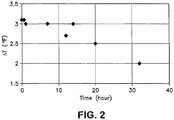
Fig. 2 graphically illustrates the temperature increase of a polycarbonate surface by use of a coating composition as described herein. - Reference now will be made in detail to various embodiments of the disclosed subject matter, one or more examples of which are set forth below. Each example is provided by way of explanation, not limitation.
- Thus, it is intended that the present disclosure covers such modifications and variations as come within the scope of the appended claims and their equivalents.
- The present invention is directed to optical devices including an active layer on a surface for the prevention of fogging of the surface. The layer is formed from a composition that includes a conductive polymer and functionalized carbon based nanostructures. The functionalized carbon based nanostructures may improve the electrical characteristics of the layer beyond what is capable of the conductive polymer alone. To provide further improvement, the composition includes a transition metal crosslinking agent that may form a complex with both the conductive polymer and the functionalized carbon based nanostructures. The layer formed of the composition is crosslinked with the transition metal compound. Accordingly, the crosslinked matrix includes the conductive polymer, the carbon based nanostructures, and the transition metal crosslinking agent, all of which may be in electrical communication with one another. As the carbon based nanostructures are complexed within the crosslinked network, and not merely blended with the polymer of the layer, improved electrical contact may be obtained. This may provide a layer with excellent electrical characteristics at low add-on levels of the carbon based nanostructures. In one embodiment, scratch resistant hard coat solution materials may be combined with the other components of the composition to improve the mar and abrasion resistance of the layer without adversely affecting the electrical characteristics of the layer.
- The crosslinked layer may be placed in electrical communication with a power source to complete a circuit. Current flow through the circuit may lead to an increase in the temperature of the surface, which may prevent fogging of the surface. Hence, a transparent substrate including the layer on a surface may be beneficially utilized in optical devices such as goggles, optical glasses, safety glasses, welding lenses (both fixed and variable shades), visors, face shields, and so forth.
- As utilized herein, the term 'fogging' refers to condensate on a surface such that visualization through the surface is impaired, as in a transparent lens, or such that the ability to visualize the surface itself is impaired. The condensate droplets cause the scattering of incident light and decrease in visualization, or fogging.
- The composition includes one or more conductive polymers suitable for use in forming a translucent or transparent layer. As utilized herein, the term 'translucent' refers to a material having a transmission of light in the visible spectrum (between about between about 300 nanometers and about 800 nanometers) of between about 30% and about 85%. As utilized herein, the term 'transparent' refers to material having a light transmission in the visible spectrum greater than about 85%. In one embodiment, a transparent film may have a light transmission of greater than about 90%, or greater than about 95%. A coated substrate may have a percent haze of less than about 5%, or less than about 3%. Haze is defined as the percentage of transmitted light, which, in passing through the specimen, deviates from the incident beam by more than an average of 25 degrees. Haze is commonly referred to as the "milkiness" of a specimen, or its loss in contrast. Translucency, transparency, and haze may be measured by a comparison of the intensity of the incident light to that of the light passing through the material according to standard protocols. For instance, by use of testing methods described in ASTM D1003 - 07e1 entitled "Haze and Luminous Transmittance of Transparent Plastics," (DOI: 10.1520/D1003-07).
- In general, the composition used to form the conductive layer may be aqueous, though small amounts of solvents may be present in the composition, as is known. For instance, small amounts of solvents, for instance less than about 5% by weight of the composition, may be included such as alcohols, benzene, pyrrolidone, formyl amines, glycol ethers, and so forth. The composition may contain, for instance, at least about 75 wt.% water, in some embodiments at least about 90 wt.% water, and in some embodiments, at least about 96 wt.% water.
- The conductive, transparent polymer of the coating composition may be a polythiophene, which encompasses polythiophene as well as any derivative thereof. In general, a coating composition can include less than about 3% by weight of a polythiophene, or less than about 1% by weight in another embodiment. For instance, the composition can include between about 0.01% by weight and about 1% by weight of a polythiophene. A polythiophene may have a structure of:

- In one preferred embodiment, the composition may include the polythiophene derivative poly(3,4-ethylenedioxythiophene) having the structure:

- Any suitable method may be utilized for forming a polythiophene. For example, poly(3,4-ethylenedioxythiophene) may be formed via the oxidation of a 3,4-ethylenedioxythiophene monomer leading to withdrawal of an electron from the 3,4-ethylenedioxythiophene heteroaromatic ring. Oxidants may include, without limitation, iron (III) salts, such as FeCl3, Fe(ClO4) and the iron (III) salts of organic acids and of inorganic acids containing organic radicals. Other suitable oxidants may include H2O2, K2Cr2O7, alkali metal persulphates, ammonium persulphates, alkali metal perborates and potassium permanganate. The combination of two oxidized monomers will form a dimer with release of a proton. Further oxidation of dimers will lead to formation of trimers, etc., until long poly(3,4-ethylenedioxythiophene) chains are formed. The ionization potential of 3,4-ethylenedioxythiophene monomers and poly(3,4-ethylenedioxythiophene) dimers, trimers, and infinitely long chains are 1.1, 0.46, 0.16 and -0.25V (vs. Ag/Ag+), respectively. Consequently, once oligomers are formed, polymerization may accelerate rapidly.
- It should be understood that the compositions are not limited to poly(3,4-ethylenedioxythiophene), and other polythiophenes as well as blends of two or more polythiophenes are encompassed herein including, without limitation, poly(3-methylthiophene), poly(3-ethylthiophene), poly(3-propylthiophene), poly(3-butylthiophene), poly(3-hexylthiophene), poly(3-heptylthiophene), poly(3-octylthiophene), poly(3-decylthiophene), poly(3-dodecylthiophene), poly(3-octadecylthiophene), poly(3-bromothiophene), poly(3-chlorothiophene), poly(3-iodothiophene), poly(3-cyanothiophene), poly(3-phenylthiophene), poly(3,4-dimethylthiophene), poly(3,4-dibutylthiophene), poly(3-hydroxythiophene), poly(3-methoxythiophene), poly(3-ethoxythiophene), poly(3-butoxythiophene), poly(3-hexyloxythiophene), poly(3-heptyloxythiophene), poly(3-octyloxythiophene), poly(3-decyloxythiophene), poly(3-dodecyloxythiophene), poly(3-octadecyloxythiophene), poly(3,4-dihydroxythiophene), poly(3,4-dimethoxythiophene), poly(3,4-diethoxythiophene), poly(3,4-dipropoxythiophene), poly(3,4-dibutoxythiophene), poly(3,4-dihexyloxythiophene), poly(3,4-diheptyloxythiophene), poly(3,4-dioctyloxythiophene), poly(3,4-didecyloxythiophene), poly(3,4-didodecyloxythiophene), poly(3,4-propylenedioxythiophene), poly(3,4-butenedioxythiophene), poly(3-methyl-4-methoxythiophene), poly(3-methyl-4-ethoxythiophene), poly(3-carboxythiophene), poly(3-methyl-4-carboxythiophene), poly(3-methyl-4-carboxyethylthiophene), and poly(3-methyl-4-carboxybutylthiophene).
- As polythiophenes tend to be insoluble, the composition may include a secondary component that may improve the solubility of the polymer. For example, a composition may include poly(3,4-ethylenedioxythiophene) in conjunction with the water soluble cationic polyelectrolyte polystyrene sulfonic acid having the structure:

- Poly(3,4-ethylenedioxythiophene)/ polystyrene sulfonic acid compositions may be formed according to known methodology (for example, using the polyelectrolyte polystyrene sulfonic acid as the charge-balancing dopant during the poly(3,4-ethylenedioxythiophene) polymerization process), or alternatively may be obtained commercially. For example, prepared PSS/PEDOT mixture may be purchased from Aldrich or other companies with a solids content of about 1.3-2.6%. In such a case, the solution may be adjusted as needed or may alternately be directly used in formulation. Poly(3,4-ethylenedioxythiophene)/ polyelectrolyte polystyrene sulfonic acid available under the Clevios™ brand is also available from Heraeus of Hanau, Germany. In general, the ratio of poly(3,4-ethylenedioxythiophene) to polyelectrolyte polystyrene sulfonic acid may be between about 1 and about 2.5 by weight, though this is not a requirement of a composition, and any suitable ratio of the two is encompassed herein.
- Any other method for solubilizing a polythiophene may be utilized in forming a composition. For instance, in one embodiment poly(3,4-ethylenedioxythiophene)-tetramethyl acrylate may be utilized. poly(3,4-ethylenedioxythiophene)- tetramethyl acrylate is an ABA block copolymer that includes branched end-capping tetramethyl acrylate groups that promote dispersibility.
- The total amount of polymer in a composition, for instance the total amount of polythiophene and polymeric solubilizer can be between about 1.5% and about 3% by weight of the composition.
- In addition to the conducting polymer and any stabilizer, the composition includes carbon based nanostructures. An amount of conductive and/or semiconductive carbon based nanostructures may be included in the formed matrix so as to enhance the electrical characteristics of the layer formed from the composition without sacrificing the transparency of the coating.
- The carbon based nanostructures may include any structure that has at least one dimension on a nanometer scale. In particular, while the nanostructures may, in certain embodiments, describe very high aspect ratios, for instance greater than 1000 nanometers, and may include a length dimension that is on a larger scale, they will define at least one dimension on a nanometer scale, for example, less than about 500 nanometers. The nanostructures may define any overall shape. For example, the nanostructures may be hollow or solid, may be spherical, fibrillar, or relatively flat, such as a flat platelet shape, for example, graphite or graphene nanostructures. In addition, the composition may incorporate a plurality of substantially identical nanostructures or optionally may incorporate a mixture of different nanostructures, including a combination of nanostructure formed of different shapes, formed to different lengths, or any combination thereof.
- In one embodiment, the carbon based nanostructures may be carbon nanotubes or carbon nanospheres (for example, buckyballs, nanoonions, or other fullerenes). Carbon nanotubes may be single-walled carbon nanotubes, multi-walled carbon nanotubes, or a mixture of different carbon nanotubes. For example, the nanostructures may include isolated single-walled carbon nanotubes and/or single-walled carbon nanotubes bundles. In general, a single-walled carbon nanotubes bundle may have an outer diameter between about 5 nanometers and about 200 nanometers, while an individual single-walled carbon nanotube may have an outer diameter of less than about 5 nanometers. In general, individual multi-walled carbon nanotubes may have an outer diameter between about 5 nanometers and about 100 nanometers.
- The carbon based nanostructures may be formed according to any known method or procedure. For instance, carbon nanotubes may be formed according to an electric arc method, a laser-vaporization method, a HiPco method, a chemical vapor deposition method, or any other method as is known in the art. Carbon nanotubes may be formed according to any known methodology or may be obtained on the commercial market. For example, multi-walled carbon nanotubes, single-walled carbon nanotubes, or double walled nanotubes are available from NanoLab, Inc. of Waltham, Massachusetts; Nano-C, Inc. of Westwood, Massachusetts; or Unidym of Sunnyvale, California.
- Depending upon the formation technique, the carbon-based nanostructures may be mixed with an amount of impurities such as soot, catalysts, nucleators, and so forth upon formation. The carbon based nanostructures may be purified following formation and prior to addition to the coating composition. For instance, the carbon based nanostructures may be provided to the composition at greater than about 90% purity.
- In one embodiment, an as-formed carbon based nanostructure composition may be purified by subjection to heating in an oxidizing atmosphere, treatment with a strong acid, often while being subjected to sonication, followed by a final wash. However, it should be understood that any purification process as is known in the art may optionally be utilized.
- The carbon based nanostructures are functionalized to facilitate distribution of the nanostructures throughout the composition as well as to facilitate crosslinking of the polymeric matrix during formation of the coating layer. More specifically, the carbon based nanostructures are functionalized with a thiophene derivative to encourage distribution of the nanostructures throughout the polythiophene-based coating composition.
- The preferred thiophene derivative for coupling with the carbon based nanostructures may vary, depending upon the functionalization scheme to be utilized. For instance, in one embodiment, the carbon based nanostructures may be activated through oxidation of the structures to introduce carboxylic acid groups on the structures, and an amine derivative of thiophene may be coupled to the nanostructures through formation of an amide bond. In one preferred embodiment, the carbon based nanostructures may be functionalized through coupling with 2-aminothiophene via amide bond formation.
- Other coupling reactions may alternatively be utilized, primarily depending upon the initial activation groups of the nanostructures and the corresponding thiophene derivative. For instance, carbon nanotubes may be activated through reaction of the carbon nanotubes with fluorine gas to provide fluorine derivatized nanotubes and then further derivatized via nucleophilic substitution with a desired nucleophile, for example, an alkyl lithium species, substituted hydrazines, or alkyl amines. The activated carbon nanostructures may then be reacted with an appropriate derivative of thiophene according to known chemistries to form the thiophene functionalized nanostructures.
- The composition may include an amount of thiophene functionalized carbon based nanostructures so as to enhance conductivity of a layer formed of the composition without sacrificing the transparency of the layer. For example, a coating composition may include less than about 5% by weight of the carbon based nanostructures, less than about 3% by weight or less than about 1% by weight.
- The thiophene functionalized carbon based nanostructures may be readily dispersed throughout an aqueous poly(3,4-ethylenedioxythiophene) solution. In one embodiment, dispersion may be enhanced by sonication that can be applied for a period of time of between about 5 minutes up to several hours. The various components may be combined in different ways, and the method of forming the composition is not critical. For instance, the thiophene functionalized nanostructures may be combined with a formed poly(3,4-ethylenedioxythiophene)/ polyelectrolyte polystyrene sulfonic acid dispersion, or alternatively, the thiophene functionalized nanostructures may first be combined with a polyelectrolyte polystyrene sulfonic acid solution via, for example, mixing in conjunction with sonication, and this solution may then be combined with a poly(3,4-ethylenedioxythiophene) dispersion.
- The composition also includes a crosslinking agent that may crosslink the polymer/nanostructure matrix following application to a surface. The crosslinking agents include transition metal ions and/or transition metal salts. While not wishing to be bound to any particular theory, it is believed that a transition metal crosslinking agent will complex with the sulfur atom of the thiophene groups of both the poly(3,4-ethylenedioxythiophene) and the functionalized carbon based nanostructures, forming a coating including a conductive crosslinked matrix including both polymeric components and the nanostructures.
- Transition metals encompassed herein include any element in the d-block of the periodic table, i.e., any element in
groups 3 through 12 of the periodic table. In another embodiment, transition metals encompassed herein include those elements having an incomplete d sub-shell, which would encompass any element ingroups 3 through 11 of the periodic table. In one embodiment, transition metals for use as a crosslinking agent may include manganese, iron, cobalt, nickel, copper, silver, gold, platinum, palladium, vanadium and chromium. For example, the transition metal may be iron, copper, silver, gold, cobalt or nickel. In general, the transition metal crosslinking agent may be a transition metal ion or a transition metal salt of the formula MXn, wherein M is a transition metal, X is a halogen negative ion, sulfur atom or a conjugate base negative ion of an acid, and n is an integral number of 1 to 6. Examples of suitable crosslinking agents include, without limitation, halide, chloride, sulfate, acetate, ammonium, or nitrate salts of transition metals such as ferric chloride, ferric sulfate, ferric nitrate, cupric chloride, as well as combinations of transition metal compounds. - The transition metal crosslinking agent may be dissolved or dispersed into the composition. In the case of a transition metal powder dispersed in the composition, a particle size of the metal powder may be below about 10 micrometers (µm). If desired, a surface of the metal powder may be oxidized with a diluted weak acid such as acetic acid. The composition may include the transition metal crosslinking agent in a concentration of between about 0.1 wt. % and about 2.0 wt. % of the coating composition. For instance, the metal ion concentration in the composition can be between about 0.1M and about .001M.
- The composition may include additional constituents, as desired. For example, in those embodiments in which the composition will form an antifog coating on a visualization surface such as a pair of goggles, the composition may include one or more additional materials that may impart scratch and/or chemical resistance, anti-reflective characteristics, and so forth. For instance, a coating composition may include an amount of a hydroxylated fluoropolymer or a siloxane based resin and a crosslinking agent therefore as is known in the art, which may provide scratch and weather resistance to the coating. For example, the composition may include between about 5 wt.% and about 20 wt.% of a scratch resistant hard coat resin such as a siloxane polymer resin, an acrylic polymer resin, or a hydroxylated polymer comprising fluorine-containing monomer units such as tetrafluoroethylene or chlorotrifluoroethylene, and optionally including fluorine-free, ethylenically unsaturated monomer units. A fluoropolymer may include more than about 20% by weight of fluorine. The composition may also include a crosslinking agent for the hydroxylated fluoropolymer such as, for example, methylamine and/or polysilicic acid.
- The composition may also include one or more binders that may improve the adhesion of the crosslinked matrix to a substrate. Examples of useful binders include, without limitation, polyvinyl acetate, polycarbonate, polyvinyl butyrate, polyacrylates, polymethacrylates, polystyrene, polysulfonated styrene, polyacrylonitrile, polyvinyl chloride, poly-butadiene, poly-isoprene, polyethers, polyesters, silicones, pyrrole/acrylate, vinyl acetate/acrylate, ethylene/vinyl acetate copolymers, polyvinyl alcohols, and any derivatives or mixtures thereof. Binders may be included in a composition in relatively small amounts, for instance less than about 10% by weight of the composition.
- Following formation, the composition may be coated onto a substrate. The composition may be used immediately upon formation, or alternatively may be stored for a period of time, for instance for several days, prior to use. A layer formed by the composition may completely cover a surface of a substrate or may partially cover a surface. For instance, a layer may be applied to a surface in a pattern. A pattern will be a continuous pattern, such that a current can flow through the formed layer, but need not completely cover a substrate surface.
- The substrate may be organic or inorganic, flexible or rigid, and of any suitable size and shape. For instance, a substrate may be polymeric or ceramic. In one preferred embodiment, the substrate may be a transparent material for use in an optical application such as lenses for glasses, goggles or other oculars, face shields or visors for helmets or face masks, and so forth. In one embodiment, a substrate may be a glass, for instance an optical-grade glass such as a borosilicate glass or a fluorite glass. In another embodiment, a substrate may be a polymeric material for use in an optical application including thermoplastic materials such as polycarbonates, polyesters such as polyethylene terephthalate or polybutylene terephthalate, polystyrenes, polysulfones, polyethersulfones, cellulose acetate butyrate and thermoplastic polyurethanes; or thermoset materials such as diethyleneglycol bis allylcarbonate polymers and copolymers, thermoset polyurethanes, polythiourethanes, polyepoxides, polyepisulfides, polyacrylates including poly(meth)acrylates such as polymethylmethacrylate, polythio(meth)acrylates, as well as copolymers and blends thereof.
- A substrate may be in the form of a single or multilayered film, sheet, panel or pane of material, and may be formed by any well-known process, such as blowing, casting, extrusion, injection molding, and so forth. In one embodiment, the composition may be coated between two layers of a multilayer substrate. For instance, a layer may be formed between glass or polymer substrates.
- The composition may be coated onto one or more surfaces of the substrate according to any suitable coating method or combinations of methods including, without limitation, dip coating, spin coating, spray coating, printing (for example, rotogravure), bar coating, solution coating, blade coating, slot-die coating, and so forth. In one embodiment, the composition may be coated on a single surface of a substrate, for example, an inner surface of a face shield. In other embodiments, however, the composition may be coated on both an inner and outer surface of a substrate or may envelope an entire substrate.
- To ensure uniform coating and/or wetting of the substrate, the substrate may be oxidized prior to coating using, for example, corona discharge, ozone, plasma, or flame treatment methods. In some embodiments, a substrate may also be applied with a pretreatment to facilitate uniform application of the coating composition thereto. For instance, a primer such as polyvinylidene chloride or polyvinyl chloride may be applied to a transparent substrate. Typically, the primer does not have a substantial affect on the optical properties of the transparent substrate.
- The average thickness of the resulting coating can be less than about 5 microns in thickness, or less than about 2 microns, in one embodiment. For example, the average thickness of the layer can be between about 0.8 and about 1.2 microns.
- According to one embodiment, the average thickness of the resulting coating may be selected to minimize glare. Specifically, a single-layer optical coating having a thickness equal to ¼ the wavelength of incident light will result in reflections from the air-coating boundary and coating-substrate boundary that are 180° out of phase with each other, thereby causing destructive interference and reducing total reflectance. Thus, in those embodiments in which the wavelength of incident light may range from about 200 nanometers to about 1000 nanometers, the average thickness of the coating may range from about 50 nanometers to about 250 nanometers. In addition, because 550 nanometers is the wavelength at which the human eye displays a peak photo-optic response, the average coating thickness may be about 140 nanometers in one embodiment. It should be understood, however, that the coating is not limited to a single layer, but may also contain multiple layers. For example, it is readily understood by those skilled in the art that two layers may be utilized, with each layer being optimized in thickness to minimize reflection of different wavelengths of light, thus providing anti-glare properties over a wide spectrum of light. In addition, while the average coating thickness may be uniform, the actual coating thickness may vary considerably from one particular point on the coating to another. Such variations in thickness, when correlated over a visibly distinct region, may be beneficial by contributing to broadband anti-reflective properties of the coating.
- The coating may be dried and cured in air and optionally with the addition of energy to increase the cure rate. For example, the coated substrate may be cured in an oven at a temperature of from about 20°C to about 150°C, in some embodiments from about 50°C to about 130°C, and in some embodiments, from about 100°C to about 120°C. Alternative cure methods as are known may be utilized, such as by subjecting the coated surface to irradiation, for example, microwave irradiation. Once dried and cured, the conductive polymer component of the layer may constitute at least about 50 wt.%, in some embodiments at least about 75 wt.%, and in some embodiments, at least about 90 wt.% of the cured layer.
- The sheet resistance (RS) of a layer is a function of the bulk resistivity of the layer and the layer thickness. It is a measure of electrical resistance in a thin film that is nominally uniform in thickness and capable of approximation as a two dimensional system. Sheet resistance may be described in units of ohms or optionally as ohms per square (Ohms/sq.), where "square" is dimensionless. Ohms per square is exclusively utilized when describing sheet resistance, and thus may be used to differentiate the two dimensional resistance from a three dimensional system. Sheet resistance may be measured using a four-point probe, in which a direct current is applied between two outer current electrodes and a voltage is measured between two inner electrodes located within the two outer electrodes, with the current flowing along the plane of the film. Four-point probes utilize a geometric correction factor based on the orientation and spacing of the electrodes in the probe to correct the voltage/current ratio measured by the probe. The resistivity of the film may be calculated from the sheet resistance by multiplying the sheet resistance by the thickness of the film. In one embodiment, a cured film formed of the conductive polymer composition may have a sheet resistance of between about 300 Ohms/square and about 900 Ohms/square, for instance between about 330 Ohms/square and about 890 Ohms/square. In another embodiment, the sheet resistance may be less than about 300 Ohms/square, less than about 175 Ohms/square, less than about 150 Ohms/square, or less than about 100 Ohms/square.
- The conductivity (σ) of a coating is the measure of the electrical conduction of the material. Conductivity may be measured by applying a differential electric field across the layer and monitoring the electrical current that results. The conductivity is then calculated by dividing the current density by the strength of the applied electric field. Conductivity is the reciprocal of electrical resistivity, thus conductivity may be calculated from sheet resistance by taking the reciprocal of the sheet resistance multiplied by the film thickness (σ=1/(RS x t). A film as described herein may have a conductivity of greater than about 100 siemens per centimeter, greater than about 450 siemens per centimeter, greater than about 600 siemens per centimeter, or greater than about 750 siemens per centimeter. In one preferred embodiment, a film may have a conductivity greater than about 400 siemens per centimeter, for instance between about 185 and about 485 siemens per centimeter, in one embodiment.
- Optionally, additional layers may be formed on the substrate, either beneath the conductive layer, above the conductive layer, or at a different location on the substrate as the conductive layer. For instance, an anti-reflective coating and/or a scratch resistant coating may be formed on top of the conductive layer or may be formed on the opposite side of a substrate.
- In one embodiment, a scratch resistant coating may be formed on top of the conductive layer. Alternatively, the components of the conductive layer and the scratch resistant coating can be combined together to form a single coating composition. For instance, following cure of the conductive layer and any necessary connection formation for electrical communication to a power source (for example, electrode formation), a scratch resistant and/or chemical resistant coating may be formed on the conductive layer. A scratch resistant coating may include a crosslinked hydroxylated fluoropolymer formed in a separate layer, or any other scratch resistant coating as is known in the art.
- In one embodiment, a siloxane-based hard coat may be formed on the substrate. For example, a siloxane-based coating may be prepared by adding polymerizable components such as tetraalkyl orthosilicate, epoxyalkylalkoxy silanes, and (meth)acryloxyalkylalkoxy silanes in a solvent mixture containing an acid catalyst and other additives as are known in the art. The polymerizable components can generally be included in the solvent mixture in an amount of between about 15% and about 55% by weight. For instance, the polymerizable mixture may contain between about 40% and about 60% by weight of tetraalkyl orthosilicates, between about 15% and about 45% by weight of epoxyalkylalkoxy silanes and between about 5% and about 15% by weight of (meth)acryloxyalkylalkoxy silanes. The total solvent mixture may contain between about 20% and about 60% by weight water, between about 10% and about 25% by weight of a solvent mixture, between about 0.05 % and about 0.5% by weight of 2M HCI and between about 0.4% and about 2.5% by weight of acetic acid together with between about 0.1% and about 1.2% by weight of wetting agents and between about 0.1% and about 0.5% by weight of other catalysts or curing agents as are known in the art.
- Examples of tetraalkyl orthosilicate include but are not limited to tetramethyl orthosilicate, tetraethyl orthosilicate, tetrapropyl orthhosilicate, and tetrabutyl orthosilicate.
- Examples of epoxysilanes used in the invention include but are not limited to 1-glycidoxyethyltrimethoxysilane, 2-glycidoxypropyltriethoxysilane, 3-glycidoxypropyltrimethoxysilane, 3-glycidoxypropyltriethoxysilane, 3-glycidoxybutyltrimethoxysilane, and other derivatives with different substitutions.
- Examples of methacryloxy silanes include but are not limited to 2-methacryloxypropyltrimethoxysilane, 2-methacryloxypropyltriethoxysilane, 2-methacryloxypropylmethyldimethoxysilane, 3-acryloxypropyltrimethoxysilane, 3-acryloxypropyltriethoxysilane and other derivatives.
- An anti-reflective coating may be included on a substrate, either on the same surface as the conductive layer or on a different surface, as desired. An anti-reflective coating acts to reduce the reflection at the surface, allowing a higher level of visible light transmission. Typically, anti-reflective coatings include several different sub-layers comprising many different materials such as, but not limited to, aluminum oxide, zirconium oxide, magnesium flouride, silicon dioxide, cryolite, lithium fluoride, thorium tetrafluoride, cerium fluoride, lead fluoride, zinc sulfide, zinc scandium sulfide, silicon, tellerium, magnesium oxide, yttrium oxide, scandium oxide, silicon oxide, hafnium oxide, zirconium dioxide, cerium oxide, niobium oxide, tantalum oxide, and titanium oxide.
- The thickness of each sublayer is often related to an even whole number division of the wavelength of light that is most preferred to be transmitted through the coated material. Typical sublayer thicknesses required to achieve a particular visible light transmission level are also known in the art.
- In one embodiment, an anti-reflecting coating may be applied by vacuum deposition according to one of the following techniques: by evaporation, optionally ion beam-assisted; by spraying using an ion beam; by cathode sputtering; or by plasma-assisted vapor-phase chemical deposition.
- Following formation, the conductive layer may be placed in electrical communication with a power source that may apply a voltage across the film and instigate a current flow. The current flow may heat the film and the surrounding area, causing a temperature increase at the surface and thereby preventing water vapor condensation as droplets on the surface.
- In one preferred embodiment, a coated transparent substrate may be a component of a pair of goggles. In this regard, one embodiment of a pair of goggles that may contain the coated transparent substrate will now be described in more detail. Referring to
Fig. 1 , a pair ofgoggles 100 is shown including aframe 102 and atransparent lens 103. Side bows 106, 107 are attached to the opposite sides of theframe 102 for securing the goggles during use. Though illustrated as side bows, the goggles may alternatively incorporate straps, bands, or any other device for securing thegoggles 100 to the wearer's head. Theframe 102 may include a shapedportion 110 on the top and bottom (not shown) that may fit snugly against the forehead and face of a wearer to further protect the eyes of the wearer. - The
lens 103 may be formed of a transparent substrate, such as a glass or a polycarbonate and may extend across the majority of the wearer's field of vision. In another embodiment, a pair of goggles may be formed with two separate lenses that may function only for protective purposes or may also be corrective lenses. - The cured film is formed on a surface of the
lens 103 and placed in electrical communication with apower supply 110, such as a battery. Any battery as is known in the art can be utilized including either rechargeable batteries or disposable batteries. For instance, alithium ion battery 110 may be in electrical communication with afirst electrode 111 by means of a first lead 112, for example a cathode lead at 7.5 volts. Thefirst electrode 111 may also be in electrical communication with the conductive layer. In addition, asecond lead 114, for example, an anode lead, may be in electrical communication with asecond electrode 115 that is on the opposite side of thelens 103. Thebattery 110 may be a component of apower pack 118. Thepower pack 118 may also include aswitch 116 that may be in electrical communication with the other electrical components of the system. The power pack may include one ormore loops 120 that may be used to connect the power pack to a convenient location such as the wearer's belt, jacket, or so forth. Theloops 120 may be replaced with any suitable connecting device such as hooks, clips, bands, etc. - In one embodiment, the battery may be within or on the goggles. For example, a battery may be attachable to the frame of the goggles, for instance in a battery casing that is accessible for battery replacement. In this embodiment, a switch may also be included on the frame for completion of a circuit.
- Upon closing the
switch 116, a circuit may be completed that passes through the conductive layer of thegoggles 100. Current flow through the coating layer may increase the temperature of the layer by an amount that is sufficient to prevent condensation forming on thelens 103 while not being uncomfortably warm for a wearer. For instance, upon completion of the circuit, the temperature of the surface oflens 103 may increase by less than about 5°C, or less than about 4°C in another embodiment. In one embodiment, the temperature of the surface of thelens 103 may increase between about 2°C and about 5°C. - In another embodiment, an active conductive layer may be formed on a facemask. For example, a facemask may include a visor attached to a filter body. The coating may be formed on the visor and placed in electrical communication with a power source, such as a power pack illustrated in
Fig. 1 . The visor is formed from a transparent substrate and is dimensioned to fit across the width of the filter body and extend over the eyes of the wearer. In one particular embodiment, the visor may be formed from polyethylene terephthalate. A facemask also includes a filter body attached to the visor. The filter body is designed to retard the flow of liquids to the nose and mouth of the wearer. The filter body may be formed in any manner known to those skilled in the art. As will be appreciated by those skilled in the art, the filter body may be constructed from any of a variety of different materials and contain any number of desired layers. - Although various configurations have been described above, it should be understood that the present disclosure is not limited to any particular substrate. For example, in one embodiment, a transparent conductive film may be formed on an optical device such as goggles, glasses, facemasks, etc., and in another embodiment, a transparent conductive film may be formed on a substrate for a different application, for instance in forming a window, a viewscreen, and so forth.
- The present disclosure may be further understood with reference to the Examples provided below.
- PSS/PEDOT semiconductive solution was prepared by mixing PSS and PEDOT solids (raw materials are commercially available from Aldrich) with deionized water in an amount of 1.5-3.0 % by weight of the solution at 55 °C for 6 hours. Following, the suspension was sonicated for 3 hours to insure a homogeneous mixture. During the reaction, the pH value (pH = 1-4) was adjusted by use of 2M H2SO4.
- Metal salts such as Ni(NO3)2, CuSO4, and AgNO3 were dissolved in deionized water individually to effect a metal ion concentration range from 10-1-10-3 M. The prepared metal solutions were added to 0.5% wt of DMSO to prevent electro-chemical reduction.
- Oxidation of Carbon Nanotubes: 0.5-2.5 wt % of single wall carbon nanotubes were first sonicated in mixed nitric acid/sulfuric acid (1/4 ratio in volume) for 4 hours. Upon cooling, the solution was diluted with D. I. Water. The oxidized CNT were collected by filtration and washed with water until the filtrate measured pH = 7. The black CNT were dispersed again in water and sonicated with mixed H2SO4 and H2O2 for 4 hours; the final product was filtered and washed with water, then dried under vacuum at room temperature.
- Thiothene functionalized CNT: Under N2 atmosphere, 5-10 wt % of oxidized CNT (compared to the amount of 2-aminothiophene) were stirred at room temperature with 10-20 wt % of DCC (dicyclohexylcarbodiimide) and dry DMF for 8 hours, and then the sealed flask was sonicated for 1 hour at room temperature. 2-aminothiophene was dissolved in dry DMF and added to above solution at room temperature, the mixture was then agitated for 4 hours at 80 °C with inert N2. The product was collected through filtration and washed with methanol, acetone, DMF, and water, respectively, and dried under vacuum for 8 hours at 60°C.
- 0.5-3.0 wt % of the thiophene functionalized carbon nanotubes were sonicated for 30 minutes with DMF/H2O, and then the solution was stirred at 90°C for 8 hours until a homogeneous solution was formed.
- The solution was used for blending quickly. If stored for 24 hours or more, a precipitate may form, requiring the solution to be sonicated again for 30 min before incorporating it into a formulation.
- In a round bottom flask, 95-99 wt. % of the PSS/PEDOT solution (prepared in step 1) was added to 1-5 wt. % of the CNT solution (prepared in step 3), and then the mixture was sonicated for 1 hour and stirred at room temperature for 4 more hours. The solution was used immediately.
- The PSS/PEDOT/CNT solution was added drop-wise to 1-10 wt. % of a solution of metal ions (prepared in step 2) under constant agitation at room temperature and stirred for 3 hours to ensure complete blending. Then, the solution was sonicated for 1.5 hours.
- A coating solution was prepared by mixing 208 g of tetraethyl orthosilicate, 90 g of glycidoxypropyltrimethoxy silane, 10 g of methacryloxypropyltrimethoxy silane, 238 g of isopropyl alcohol, 46 g of water, 0.8 g of 2M HCl and 6.4 g of 2M acetic acid in a flask. The solution was mixed at room temperature to partially hydrolyze the silanes and to achieve a clear solution. The solution was then heated at 70°C for 1-2 hours while stirring to completely hydrolyze the silanes. Following, the solution was cooled to room temperature followed by addition of 3.2 g of surfactant (BrijR98, available from Sigma-Aldrich, Inc.), and 2.4 g of aluminum acetylacetonate. The solution was stirred for more time to dissolve the solids and to achieve a homogeneous and clear siloxane hard coat solution.
- 90-95 wt % of the PSS/PEDOT/CNT/Metal solution was mixed with 5-10 wt % of the siloxane hard coat mixture under a mechanical stirrer for 2 hours at room temperature to give a homogeneous final conductive coating solution.
- Clean lenses were dipped into the conductive solution and pulled out at a speed of 1-2 inches per minute. Lenses were dried in air for few minutes and then cured in a heating oven at 100-120°C for 1-2 hours. Lenses were taken out of the oven and cooled at room temperature. The conductive film coated on the surface of the lens had a film thickness ranging from 0.8-1.2 micron thick.
- Film resistance was measured by a standard SYS-301 four point probe system (available from Signatone Corporation) at room temperature.
- Film sheet resistance was in the range of 330-890 Ω/square, film conductivity was in the range of 185-485 S/cm.
- Surface temperature increasing was measured with an electric circuit of semiconductive coated polycarbonate substrate with a cathode and anode attachment and a pair of lithium ion batteries. The applied voltage was in the range of 3.5-12.0 volts, and the current was in the range of 0.3-2.0 amperes. The increase in surface temperature was directly proportional to the applied voltage.
- Results are shown in
Fig. 2 . As can be seen, the measured surface temperature increase was in a range of 0.5-7.5 °C.
Claims (15)
- An optical device comprising:a transparent lens;a conductive transparent layer on a surface of the transparent lens, the conductive transparent layer comprising a crosslinked network including a polythiophene, thiophene functionalized carbon based nanostructures, and a transition metal crosslinking agent; anda power source in electrical communication with the conductive transparent layer.
- The optical device according to claim 1, wherein the polythiophene is poly(3,4-ethylene-dioxythiophene).
- The optical device according to claim 1 or claim 2, further comprising polystyrene sulfonic acid.
- The optical device according to any of the preceding clams, wherein the carbon based nanostructures are carbon nanotubes.
- The optical device according to any of the preceding claims, wherein the transition metal is selected from the group consisting of manganese, iron, cobalt, nickel, copper, silver, gold, platinum, palladium, and chromium.
- The optical device according to any of the preceding claims, wherein the transition metal crosslinking agent is a transition metal salt such as a halide, chloride, sulfate, acetate, ammonium, or nitrate salt.
- The optical device according to any of the preceding claims, the conductive transparent layer further comprising a fluoropolymer or a siloxane polymer.
- The optical device according to any of the preceding claims, wherein the optical device is a pair of goggles or a pair of glasses.
- The optical device according to any of the preceding claims, wherein the transparent lens is a glass lens or a polymeric lens and/or is a corrective lens.
- The optical device according to any of the preceding claims, wherein the power source is a battery.
- The optical device according to claim 10, further comprising a cathode lead between the battery and the film and an anode lead between the battery and the conductive transparent layer.
- The optical device according to any of the preceding claims, further comprising a switch, the switch being capable of completing a circuit comprising the power source and the conductive transparent layer.
- The optical device according to any of the preceding claims, the lens comprising one or more additional layers.
- A substrate defining a first surface and comprising a conductive transparent layer on the first surface, the conductive transparent layer comprising a crosslinked network including poly(3,4-ethylene-dioxythiophene), polystyrene sulfonic acid, thiophene derivatized carbon nanotubes, and a transition metal crosslinking agent.
- The substrate according to claim 14, wherein the substrate is transparent and wherein the conductive transparent layer is in electrical communication with a power source.
Applications Claiming Priority (2)
| Application Number | Priority Date | Filing Date | Title |
|---|---|---|---|
| US13/099,576 US8398234B2 (en) | 2011-05-03 | 2011-05-03 | Electro-thermal antifog optical devices |
| PCT/IB2012/051219 WO2012150509A1 (en) | 2011-05-03 | 2012-03-14 | Electro-thermal antifog optical devices |
Publications (2)
| Publication Number | Publication Date |
|---|---|
| EP2705400A1 EP2705400A1 (en) | 2014-03-12 |
| EP2705400B1 true EP2705400B1 (en) | 2018-12-12 |
Family
ID=45932456
Family Applications (1)
| Application Number | Title | Priority Date | Filing Date |
|---|---|---|---|
| EP12712745.4A Not-in-force EP2705400B1 (en) | 2011-05-03 | 2012-03-14 | Electro-thermal antifog optical devices |
Country Status (10)
| Country | Link |
|---|---|
| US (1) | US8398234B2 (en) |
| EP (1) | EP2705400B1 (en) |
| JP (1) | JP6030638B2 (en) |
| KR (1) | KR101894121B1 (en) |
| CN (1) | CN103502875B (en) |
| AU (1) | AU2012251427B2 (en) |
| CA (1) | CA2832863A1 (en) |
| MX (1) | MX2013012425A (en) |
| RU (1) | RU2603396C2 (en) |
| WO (1) | WO2012150509A1 (en) |
Families Citing this family (25)
| Publication number | Priority date | Publication date | Assignee | Title |
|---|---|---|---|---|
| KR20120099711A (en) * | 2009-12-03 | 2012-09-11 | 야마모토 고가쿠 가부시키가이샤 | glasses |
| US8770749B2 (en) | 2010-04-15 | 2014-07-08 | Oakley, Inc. | Eyewear with chroma enhancement |
| CA3090848A1 (en) | 2011-10-20 | 2013-05-16 | Oakley, Inc. | Eyewear with chroma enhancement |
| EP2852861B1 (en) * | 2012-04-25 | 2024-07-03 | Carl Zeiss Vision International GmbH | Electrically conductive lens connection and methods of making the same |
| WO2013169987A1 (en) | 2012-05-10 | 2013-11-14 | Oakley, Inc. | Eyewear with laminated functional layers |
| US9575335B1 (en) | 2014-01-10 | 2017-02-21 | Oakley, Inc. | Eyewear with chroma enhancement for specific activities |
| US10111581B2 (en) * | 2014-02-27 | 2018-10-30 | Align Technology, Inc. | Thermal defogging system and method |
| US20160044747A1 (en) * | 2014-08-08 | 2016-02-11 | Lincoln Dale Prins | Modular anti-fog devices |
| WO2016071484A1 (en) * | 2014-11-07 | 2016-05-12 | Solvay Sa | Composition for forming transparent conductive layer and method for preparing the same |
| CN207704150U (en) | 2014-11-13 | 2018-08-07 | 奥克利有限公司 | Variable light attenuating eyewear with color enhancement |
| CN104483762B (en) * | 2014-12-24 | 2016-02-24 | 曾鹏宇 | A kind of Anti-fog glasses and manufacture method thereof with graphene transparent conductive film |
| CN107405213A (en) * | 2015-01-27 | 2017-11-28 | 阿巴米纳博实验室有限责任公司 | Suitable for the goggles for the replaceable lens for preventing from hazing |
| US10548467B2 (en) * | 2015-06-02 | 2020-02-04 | GI Scientific, LLC | Conductive optical element |
| CN105223705B (en) * | 2015-10-30 | 2018-09-25 | 厦门美澜光电科技有限公司 | The manufacturing method of anti-electromagnetism eyeglass |
| US10295821B2 (en) | 2016-08-19 | 2019-05-21 | Oakley, Inc. | Laminated lenses with anti-fogging functionality |
| WO2018147935A2 (en) | 2016-12-16 | 2018-08-16 | 3M Innovative Properties Company | Infrared-reflecting optically transparent assembly and method of making the same |
| JP6593360B2 (en) * | 2017-01-30 | 2019-10-23 | トヨタ自動車株式会社 | Vehicle optical system |
| CN107577064B (en) * | 2017-09-29 | 2019-11-08 | 江苏康耐特光学有限公司 | Refractive index 1.50 dyed resin lens and preparation method thereof |
| US12124116B2 (en) | 2017-10-20 | 2024-10-22 | Luxottica S.R.L. | Eyewear with variable transmission lens |
| US11112622B2 (en) | 2018-02-01 | 2021-09-07 | Luxottica S.R.L. | Eyewear and lenses with multiple molded lens components |
| EP3802083A1 (en) | 2018-06-04 | 2021-04-14 | 3M Innovative Properties Company | Thermoformed abrasion-resistant multilayer optical film and method of making the same |
| US11384224B1 (en) * | 2018-10-05 | 2022-07-12 | Celanese International Corporation | Cellulose acetate film with optical properties |
| JP7041357B2 (en) * | 2018-11-20 | 2022-03-24 | 日本電信電話株式会社 | Zona pellucida |
| CN109557683A (en) * | 2019-01-30 | 2019-04-02 | 京东方科技集团股份有限公司 | A kind of glasses and preventing atomization method |
| US20250381744A1 (en) * | 2024-06-18 | 2025-12-18 | Honeywell Safety Products Usa, Inc. | Eyewear and a method for forming the eyewear |
Citations (1)
| Publication number | Priority date | Publication date | Assignee | Title |
|---|---|---|---|---|
| US20070246689A1 (en) * | 2006-04-11 | 2007-10-25 | Jiaxin Ge | Transparent thin polythiophene films having improved conduction through use of nanomaterials |
Family Cites Families (60)
| Publication number | Priority date | Publication date | Assignee | Title |
|---|---|---|---|---|
| US4209234A (en) * | 1978-06-02 | 1980-06-24 | Mccooeye Donald E | Defogging eye glasses |
| DE3306103C2 (en) | 1982-04-26 | 1985-09-12 | Yamamoto Kogaku Co., Ltd., Higashi-Osaka, Osaka | Device for heating the protective glass covering a viewing window of a protective helmet |
| US4500567A (en) | 1982-12-23 | 1985-02-19 | Nippon Sheet Glass Co., Ltd. | Method for forming tin oxide coating |
| DE3323670A1 (en) | 1983-07-01 | 1985-01-03 | Samuel 6080 Gross-Gerau Brustas | Visors for crash helmets or the like |
| ATE75709T1 (en) | 1985-08-20 | 1992-05-15 | Smith & Nephew | COATED OBJECTS AND PROCESS FOR THEIR MANUFACTURE. |
| US4682007A (en) | 1986-04-17 | 1987-07-21 | Hollander James M | Defogging and deicing shield structure |
| US4957358A (en) | 1988-01-19 | 1990-09-18 | Canon Kabushiki Kaisha | Antifogging film and optical element using the same |
| DE3843412A1 (en) | 1988-04-22 | 1990-06-28 | Bayer Ag | NEW POLYTHIOPHENES, METHOD FOR THEIR PRODUCTION AND THEIR USE |
| DE3814730A1 (en) | 1988-04-30 | 1989-11-09 | Bayer Ag | SOLID ELECTROLYTE AND ELECTROLYTE CONDENSERS CONTAINING THEM |
| US4868929A (en) | 1988-05-09 | 1989-09-26 | Curcio Philip L | Electrically heated ski goggles |
| DE3818389C1 (en) | 1988-05-30 | 1989-10-12 | Optyl Holding Gmbh & Co Verwaltungs-Kg, 8013 Haar, De | |
| JP2817178B2 (en) | 1989-04-07 | 1998-10-27 | 株式会社ニコン | Metal frame for glasses |
| US5471036A (en) | 1991-12-02 | 1995-11-28 | Sperbeck; Scott W. | Goggle defogging system with transparent indium-tin-oxide heating layer disposed on a lens |
| US5319397A (en) | 1992-09-21 | 1994-06-07 | Ryden William D | Defogging eyeglasses |
| IT230933Y1 (en) | 1993-07-20 | 1999-07-05 | Moda Solaris Spa | MULTI-LAYER LENS STRUCTURE, ESPECIALLY FOR SUNGLASSES |
| US5459533A (en) | 1993-11-12 | 1995-10-17 | See Clear Eyewear Inc. | Defogging eye wear |
| US6203814B1 (en) | 1994-12-08 | 2001-03-20 | Hyperion Catalysis International, Inc. | Method of making functionalized nanotubes |
| JP3211641B2 (en) | 1995-09-22 | 2001-09-25 | 株式会社村田製作所 | Conductive composition |
| US5576162A (en) | 1996-01-18 | 1996-11-19 | Eastman Kodak Company | Imaging element having an electrically-conductive layer |
| CA2251118C (en) | 1997-02-06 | 2002-04-16 | Bausch & Lomb, Incorporated | Electric connection configuration for electro-optical device |
| CA2213803C (en) | 1997-08-25 | 2000-10-10 | Korea Ogk Co., Ltd. | Face shield for helmet |
| JPH11130459A (en) | 1997-10-28 | 1999-05-18 | Murata Mfg Co Ltd | Electrically conductive composition for glass substrate and anti-fog window glass for automobile |
| JPH11167001A (en) | 1997-12-04 | 1999-06-22 | Canon Inc | Optical parts with anti-fog function |
| US6213125B1 (en) | 1998-04-30 | 2001-04-10 | Kimberly-Clark Worldwide, Inc. | Device for protecting the face of a wearer |
| JP2000048642A (en) | 1998-07-24 | 2000-02-18 | Murata Mfg Co Ltd | Conductive paste and glass circuit substrate |
| JP3484983B2 (en) | 1998-07-28 | 2004-01-06 | 株式会社村田製作所 | Conductive paste and glass circuit board |
| US7157023B2 (en) | 2001-04-09 | 2007-01-02 | E. I. Du Pont De Nemours And Company | Conductor compositions and the use thereof |
| US20040135126A1 (en) | 2001-06-26 | 2004-07-15 | Schwark Dwight W. | Coating composition containing polythiophene and solvent mixture |
| ATE370107T1 (en) | 2001-06-29 | 2007-09-15 | Crystal Syst | FOG-RESISTANT TRANSPARENT ARTICLES, MATERIALS THAT FORM A HYDROPHILIC INORGANIC LAYER OF HIGH HARDNESS AND METHOD FOR PRODUCING A LOW-FOG LENS |
| US6470696B1 (en) | 2001-09-18 | 2002-10-29 | Valerie Palfy | Devices and methods for sensing condensation conditions and for removing condensation from surfaces |
| DE10221010A1 (en) | 2002-05-11 | 2003-11-27 | Basf Coatings Ag | Aqueous dispersion of inorganic nanoparticles, process for their preparation and their use |
| JP4077675B2 (en) | 2002-07-26 | 2008-04-16 | ナガセケムテックス株式会社 | Aqueous dispersion of complex of poly (3,4-dialkoxythiophene) and polyanion and method for producing the same |
| WO2004020444A1 (en) | 2002-09-02 | 2004-03-11 | Agfa-Gevaert | New 3,4-alkylenedioxythiophenedioxide compounds and polymers comprising monomeric units thereof |
| US7321012B2 (en) * | 2003-02-28 | 2008-01-22 | The University Of Connecticut | Method of crosslinking intrinsically conductive polymers or intrinsically conductive polymer precursors and the articles obtained therefrom |
| US7153620B2 (en) * | 2003-09-23 | 2006-12-26 | Eastman Kodak Company | Transparent invisible conductive grid |
| US20050209392A1 (en) | 2003-12-17 | 2005-09-22 | Jiazhong Luo | Polymer binders for flexible and transparent conductive coatings containing carbon nanotubes |
| US7703456B2 (en) | 2003-12-18 | 2010-04-27 | Kimberly-Clark Worldwide, Inc. | Facemasks containing an anti-fog / anti-glare composition |
| US7338620B2 (en) * | 2004-03-17 | 2008-03-04 | E.I. Du Pont De Nemours And Company | Water dispersible polydioxythiophenes with polymeric acid colloids and a water-miscible organic liquid |
| KR100586659B1 (en) | 2004-04-01 | 2006-06-07 | 주식회사 디피아이 솔루션스 | Composition for organic electrode coating and method of manufacturing highly transparent organic electrode using same |
| US7238415B2 (en) | 2004-07-23 | 2007-07-03 | Catalytic Materials, Llc | Multi-component conductive polymer structures and a method for producing same |
| JP4807817B2 (en) * | 2004-08-05 | 2011-11-02 | 三菱レイヨン株式会社 | Method for producing conductive molded body and conductive molded body |
| KR100638615B1 (en) | 2004-09-14 | 2006-10-26 | 삼성전기주식회사 | Field emission emitter electrode manufacturing method |
| US7725948B2 (en) | 2004-12-22 | 2010-06-01 | Kimberly-Clark Woldwide, Inc. | Face mask with offset folding for improved fluid resistance |
| US7290545B2 (en) | 2004-12-23 | 2007-11-06 | Kimberly-Clark Worldwide, Inc. | Face mask with anti-fog folding |
| WO2007061428A2 (en) | 2004-12-27 | 2007-05-31 | The Regents Of The University Of California | Components and devices formed using nanoscale materials and methods of production |
| US7586663B1 (en) | 2005-03-01 | 2009-09-08 | Triton Systems, Inc. | Gel polymer electrolytes |
| US7645497B2 (en) * | 2005-06-02 | 2010-01-12 | Eastman Kodak Company | Multi-layer conductor with carbon nanotubes |
| US7495251B2 (en) | 2006-04-21 | 2009-02-24 | 3M Innovative Properties Company | Electronic devices containing acene-thiophene copolymers with silylethynyl groups |
| US7648234B2 (en) | 2006-04-28 | 2010-01-19 | Kimberly-Clark Worldwide, Inc. | Eyewear with heating elements |
| JP5161446B2 (en) * | 2006-08-22 | 2013-03-13 | 帝人デュポンフィルム株式会社 | Conductive film and touch panel using the film |
| TWI457424B (en) | 2006-09-28 | 2014-10-21 | Ind Science & Technology Network Inc | Nanoengineered composite defog coating |
| JP4771971B2 (en) * | 2007-02-09 | 2011-09-14 | 東海ゴム工業株式会社 | Flexible electrode and electronic device using the same |
| WO2008102746A1 (en) * | 2007-02-20 | 2008-08-28 | Toray Industries, Inc. | Carbon nanotube assembly and electrically conductive film |
| US8317321B2 (en) * | 2007-07-03 | 2012-11-27 | Pixeloptics, Inc. | Multifocal lens with a diffractive optical power region |
| US20090025125A1 (en) * | 2007-07-26 | 2009-01-29 | Wan-Chen Jou | Diving goggles with defogging device |
| CN101486836A (en) * | 2008-01-18 | 2009-07-22 | 郑州泰达电子材料科技有限公司 | Conductive macromolecular solution, preparation thereof, conductive polymer coated film and solid electrolyte capacitor |
| US8154804B2 (en) * | 2008-03-25 | 2012-04-10 | E-Vision Smart Optics, Inc. | Electro-optic lenses for correction of higher order aberrations |
| KR100988646B1 (en) * | 2008-05-22 | 2010-10-18 | 한국기계연구원 | Vision Aid with Conductive Transparent Thin Film |
| JP5088497B2 (en) | 2008-05-30 | 2012-12-05 | 山本光学株式会社 | Exothermic synthetic resin lens and ophthalmic lens article |
| JP2011031591A (en) * | 2009-08-06 | 2011-02-17 | Mitsubishi Rayon Co Ltd | Nano-material-containing molded article, and method for manufacturing the same |
-
2011
- 2011-05-03 US US13/099,576 patent/US8398234B2/en not_active Expired - Fee Related
-
2012
- 2012-03-14 AU AU2012251427A patent/AU2012251427B2/en not_active Ceased
- 2012-03-14 RU RU2013152158/05A patent/RU2603396C2/en not_active IP Right Cessation
- 2012-03-14 CA CA2832863A patent/CA2832863A1/en not_active Abandoned
- 2012-03-14 EP EP12712745.4A patent/EP2705400B1/en not_active Not-in-force
- 2012-03-14 MX MX2013012425A patent/MX2013012425A/en active IP Right Grant
- 2012-03-14 KR KR1020137028688A patent/KR101894121B1/en not_active Expired - Fee Related
- 2012-03-14 CN CN201280021074.2A patent/CN103502875B/en not_active Expired - Fee Related
- 2012-03-14 WO PCT/IB2012/051219 patent/WO2012150509A1/en not_active Ceased
- 2012-03-14 JP JP2014508888A patent/JP6030638B2/en not_active Expired - Fee Related
Patent Citations (1)
| Publication number | Priority date | Publication date | Assignee | Title |
|---|---|---|---|---|
| US20070246689A1 (en) * | 2006-04-11 | 2007-10-25 | Jiaxin Ge | Transparent thin polythiophene films having improved conduction through use of nanomaterials |
Also Published As
| Publication number | Publication date |
|---|---|
| JP2014513816A (en) | 2014-06-05 |
| US20120281179A1 (en) | 2012-11-08 |
| CN103502875B (en) | 2017-06-06 |
| CN103502875A (en) | 2014-01-08 |
| CA2832863A1 (en) | 2012-11-08 |
| RU2013152158A (en) | 2015-06-10 |
| RU2603396C2 (en) | 2016-11-27 |
| AU2012251427A1 (en) | 2013-10-17 |
| KR20140038398A (en) | 2014-03-28 |
| WO2012150509A1 (en) | 2012-11-08 |
| KR101894121B1 (en) | 2018-08-31 |
| EP2705400A1 (en) | 2014-03-12 |
| AU2012251427B2 (en) | 2015-04-09 |
| US8398234B2 (en) | 2013-03-19 |
| MX2013012425A (en) | 2013-12-06 |
| JP6030638B2 (en) | 2016-11-24 |
Similar Documents
| Publication | Publication Date | Title |
|---|---|---|
| US8398234B2 (en) | Electro-thermal antifog optical devices | |
| JP7120973B2 (en) | Metal nanowire inks for formation of transparent conductive films with fused networks | |
| EP2231792B1 (en) | Carbon nanotube-based curable coating composition providing antistatic abrasion-resistant coated articles | |
| US9310522B2 (en) | Optical layered body, method for producing optical layered body, polarizer and image display device | |
| JP3510845B2 (en) | Optical member having antireflection film | |
| TWI613683B (en) | Coating composition for transparent conductive film, transparent conductive film and method for fabricating the same | |
| US9535262B2 (en) | Optical member and method of manufacturing optical member | |
| CN102333825A (en) | Strengthen the additive of the antistatic property of electric conductive polymer base coating | |
| CN102460600A (en) | Reliable and durable conductive films comprising metal nanostructures | |
| KR20190010119A (en) | Electroconductive coating composition and transparent conductive film for flexible display comprising conductive layer prepared from the composition | |
| JP2020187240A (en) | Eyeglass lenses, compositions | |
| WO2017125999A1 (en) | Optical component | |
| US20220244432A1 (en) | Spectacle lens, composition | |
| CN107430212B (en) | Spectacle lens, method for manufacturing the same, and spectacles | |
| CN107614437A (en) | The tin oxide colloidal suspension and methods for making them of witch culture | |
| JP3959095B2 (en) | Plastic lens and method for manufacturing plastic lens | |
| CN105593313B (en) | Electric conductivity coating composition containing metal nanometer line and the forming method using its conductive film | |
| TWM602648U (en) | Anti-fog type composite electrochromic sheet | |
| JP2007188103A (en) | Plastic lens and method for manufacturing plastic lens | |
| US9881713B2 (en) | Coating composition for transparent electrode passivation layer and transparent electrode having passivation layer | |
| GB2643530A (en) | Apparatus | |
| CN116547599A (en) | Protective layer for transparent conductive oxide electrode in electrochromic device | |
| TW202538317A (en) | Transparent conductive film | |
| KR101691423B1 (en) | Method for producing fluorine doped tin oxide thin film | |
| JPH0229329A (en) | Low reflection transparent molding |
Legal Events
| Date | Code | Title | Description |
|---|---|---|---|
| PUAI | Public reference made under article 153(3) epc to a published international application that has entered the european phase |
Free format text: ORIGINAL CODE: 0009012 |
|
| 17P | Request for examination filed |
Effective date: 20131024 |
|
| AK | Designated contracting states |
Kind code of ref document: A1 Designated state(s): AL AT BE BG CH CY CZ DE DK EE ES FI FR GB GR HR HU IE IS IT LI LT LU LV MC MK MT NL NO PL PT RO RS SE SI SK SM TR |
|
| DAX | Request for extension of the european patent (deleted) | ||
| STAA | Information on the status of an ep patent application or granted ep patent |
Free format text: STATUS: EXAMINATION IS IN PROGRESS |
|
| 17Q | First examination report despatched |
Effective date: 20180308 |
|
| GRAP | Despatch of communication of intention to grant a patent |
Free format text: ORIGINAL CODE: EPIDOSNIGR1 |
|
| STAA | Information on the status of an ep patent application or granted ep patent |
Free format text: STATUS: GRANT OF PATENT IS INTENDED |
|
| RIC1 | Information provided on ipc code assigned before grant |
Ipc: G02C 11/08 20060101ALI20180524BHEP Ipc: G02B 27/00 20060101AFI20180524BHEP Ipc: G02B 1/18 20150101ALI20180524BHEP Ipc: G02C 7/02 20060101ALI20180524BHEP |
|
| INTG | Intention to grant announced |
Effective date: 20180626 |
|
| GRAS | Grant fee paid |
Free format text: ORIGINAL CODE: EPIDOSNIGR3 |
|
| GRAA | (expected) grant |
Free format text: ORIGINAL CODE: 0009210 |
|
| STAA | Information on the status of an ep patent application or granted ep patent |
Free format text: STATUS: THE PATENT HAS BEEN GRANTED |
|
| AK | Designated contracting states |
Kind code of ref document: B1 Designated state(s): AL AT BE BG CH CY CZ DE DK EE ES FI FR GB GR HR HU IE IS IT LI LT LU LV MC MK MT NL NO PL PT RO RS SE SI SK SM TR |
|
| REG | Reference to a national code |
Ref country code: GB Ref legal event code: FG4D |
|
| REG | Reference to a national code |
Ref country code: CH Ref legal event code: EP |
|
| REG | Reference to a national code |
Ref country code: AT Ref legal event code: REF Ref document number: 1076780 Country of ref document: AT Kind code of ref document: T Effective date: 20181215 |
|
| REG | Reference to a national code |
Ref country code: DE Ref legal event code: R096 Ref document number: 602012054608 Country of ref document: DE |
|
| REG | Reference to a national code |
Ref country code: IE Ref legal event code: FG4D |
|
| REG | Reference to a national code |
Ref country code: NL Ref legal event code: MP Effective date: 20181212 |
|
| REG | Reference to a national code |
Ref country code: LT Ref legal event code: MG4D |
|
| PG25 | Lapsed in a contracting state [announced via postgrant information from national office to epo] |
Ref country code: HR Free format text: LAPSE BECAUSE OF FAILURE TO SUBMIT A TRANSLATION OF THE DESCRIPTION OR TO PAY THE FEE WITHIN THE PRESCRIBED TIME-LIMIT Effective date: 20181212 Ref country code: LT Free format text: LAPSE BECAUSE OF FAILURE TO SUBMIT A TRANSLATION OF THE DESCRIPTION OR TO PAY THE FEE WITHIN THE PRESCRIBED TIME-LIMIT Effective date: 20181212 Ref country code: ES Free format text: LAPSE BECAUSE OF FAILURE TO SUBMIT A TRANSLATION OF THE DESCRIPTION OR TO PAY THE FEE WITHIN THE PRESCRIBED TIME-LIMIT Effective date: 20181212 Ref country code: NO Free format text: LAPSE BECAUSE OF FAILURE TO SUBMIT A TRANSLATION OF THE DESCRIPTION OR TO PAY THE FEE WITHIN THE PRESCRIBED TIME-LIMIT Effective date: 20190312 Ref country code: FI Free format text: LAPSE BECAUSE OF FAILURE TO SUBMIT A TRANSLATION OF THE DESCRIPTION OR TO PAY THE FEE WITHIN THE PRESCRIBED TIME-LIMIT Effective date: 20181212 Ref country code: BG Free format text: LAPSE BECAUSE OF FAILURE TO SUBMIT A TRANSLATION OF THE DESCRIPTION OR TO PAY THE FEE WITHIN THE PRESCRIBED TIME-LIMIT Effective date: 20190312 Ref country code: LV Free format text: LAPSE BECAUSE OF FAILURE TO SUBMIT A TRANSLATION OF THE DESCRIPTION OR TO PAY THE FEE WITHIN THE PRESCRIBED TIME-LIMIT Effective date: 20181212 |
|
| PGFP | Annual fee paid to national office [announced via postgrant information from national office to epo] |
Ref country code: DE Payment date: 20190327 Year of fee payment: 8 Ref country code: FR Payment date: 20190325 Year of fee payment: 8 |
|
| REG | Reference to a national code |
Ref country code: AT Ref legal event code: MK05 Ref document number: 1076780 Country of ref document: AT Kind code of ref document: T Effective date: 20181212 |
|
| PG25 | Lapsed in a contracting state [announced via postgrant information from national office to epo] |
Ref country code: RS Free format text: LAPSE BECAUSE OF FAILURE TO SUBMIT A TRANSLATION OF THE DESCRIPTION OR TO PAY THE FEE WITHIN THE PRESCRIBED TIME-LIMIT Effective date: 20181212 Ref country code: SE Free format text: LAPSE BECAUSE OF FAILURE TO SUBMIT A TRANSLATION OF THE DESCRIPTION OR TO PAY THE FEE WITHIN THE PRESCRIBED TIME-LIMIT Effective date: 20181212 Ref country code: AL Free format text: LAPSE BECAUSE OF FAILURE TO SUBMIT A TRANSLATION OF THE DESCRIPTION OR TO PAY THE FEE WITHIN THE PRESCRIBED TIME-LIMIT Effective date: 20181212 Ref country code: GR Free format text: LAPSE BECAUSE OF FAILURE TO SUBMIT A TRANSLATION OF THE DESCRIPTION OR TO PAY THE FEE WITHIN THE PRESCRIBED TIME-LIMIT Effective date: 20190313 |
|
| PG25 | Lapsed in a contracting state [announced via postgrant information from national office to epo] |
Ref country code: NL Free format text: LAPSE BECAUSE OF FAILURE TO SUBMIT A TRANSLATION OF THE DESCRIPTION OR TO PAY THE FEE WITHIN THE PRESCRIBED TIME-LIMIT Effective date: 20181212 |
|
| PG25 | Lapsed in a contracting state [announced via postgrant information from national office to epo] |
Ref country code: PL Free format text: LAPSE BECAUSE OF FAILURE TO SUBMIT A TRANSLATION OF THE DESCRIPTION OR TO PAY THE FEE WITHIN THE PRESCRIBED TIME-LIMIT Effective date: 20181212 Ref country code: CZ Free format text: LAPSE BECAUSE OF FAILURE TO SUBMIT A TRANSLATION OF THE DESCRIPTION OR TO PAY THE FEE WITHIN THE PRESCRIBED TIME-LIMIT Effective date: 20181212 Ref country code: IT Free format text: LAPSE BECAUSE OF FAILURE TO SUBMIT A TRANSLATION OF THE DESCRIPTION OR TO PAY THE FEE WITHIN THE PRESCRIBED TIME-LIMIT Effective date: 20181212 Ref country code: PT Free format text: LAPSE BECAUSE OF FAILURE TO SUBMIT A TRANSLATION OF THE DESCRIPTION OR TO PAY THE FEE WITHIN THE PRESCRIBED TIME-LIMIT Effective date: 20190412 |
|
| PG25 | Lapsed in a contracting state [announced via postgrant information from national office to epo] |
Ref country code: IS Free format text: LAPSE BECAUSE OF FAILURE TO SUBMIT A TRANSLATION OF THE DESCRIPTION OR TO PAY THE FEE WITHIN THE PRESCRIBED TIME-LIMIT Effective date: 20190412 Ref country code: RO Free format text: LAPSE BECAUSE OF FAILURE TO SUBMIT A TRANSLATION OF THE DESCRIPTION OR TO PAY THE FEE WITHIN THE PRESCRIBED TIME-LIMIT Effective date: 20181212 Ref country code: SM Free format text: LAPSE BECAUSE OF FAILURE TO SUBMIT A TRANSLATION OF THE DESCRIPTION OR TO PAY THE FEE WITHIN THE PRESCRIBED TIME-LIMIT Effective date: 20181212 Ref country code: EE Free format text: LAPSE BECAUSE OF FAILURE TO SUBMIT A TRANSLATION OF THE DESCRIPTION OR TO PAY THE FEE WITHIN THE PRESCRIBED TIME-LIMIT Effective date: 20181212 Ref country code: SK Free format text: LAPSE BECAUSE OF FAILURE TO SUBMIT A TRANSLATION OF THE DESCRIPTION OR TO PAY THE FEE WITHIN THE PRESCRIBED TIME-LIMIT Effective date: 20181212 |
|
| REG | Reference to a national code |
Ref country code: DE Ref legal event code: R097 Ref document number: 602012054608 Country of ref document: DE |
|
| PLBE | No opposition filed within time limit |
Free format text: ORIGINAL CODE: 0009261 |
|
| STAA | Information on the status of an ep patent application or granted ep patent |
Free format text: STATUS: NO OPPOSITION FILED WITHIN TIME LIMIT |
|
| PG25 | Lapsed in a contracting state [announced via postgrant information from national office to epo] |
Ref country code: MC Free format text: LAPSE BECAUSE OF FAILURE TO SUBMIT A TRANSLATION OF THE DESCRIPTION OR TO PAY THE FEE WITHIN THE PRESCRIBED TIME-LIMIT Effective date: 20181212 Ref country code: AT Free format text: LAPSE BECAUSE OF FAILURE TO SUBMIT A TRANSLATION OF THE DESCRIPTION OR TO PAY THE FEE WITHIN THE PRESCRIBED TIME-LIMIT Effective date: 20181212 Ref country code: DK Free format text: LAPSE BECAUSE OF FAILURE TO SUBMIT A TRANSLATION OF THE DESCRIPTION OR TO PAY THE FEE WITHIN THE PRESCRIBED TIME-LIMIT Effective date: 20181212 Ref country code: SI Free format text: LAPSE BECAUSE OF FAILURE TO SUBMIT A TRANSLATION OF THE DESCRIPTION OR TO PAY THE FEE WITHIN THE PRESCRIBED TIME-LIMIT Effective date: 20181212 |
|
| PGFP | Annual fee paid to national office [announced via postgrant information from national office to epo] |
Ref country code: GB Payment date: 20190404 Year of fee payment: 8 |
|
| REG | Reference to a national code |
Ref country code: CH Ref legal event code: PL |
|
| 26N | No opposition filed |
Effective date: 20190913 |
|
| PG25 | Lapsed in a contracting state [announced via postgrant information from national office to epo] |
Ref country code: LU Free format text: LAPSE BECAUSE OF NON-PAYMENT OF DUE FEES Effective date: 20190314 |
|
| REG | Reference to a national code |
Ref country code: BE Ref legal event code: MM Effective date: 20190331 |
|
| PG25 | Lapsed in a contracting state [announced via postgrant information from national office to epo] |
Ref country code: LI Free format text: LAPSE BECAUSE OF NON-PAYMENT OF DUE FEES Effective date: 20190331 Ref country code: IE Free format text: LAPSE BECAUSE OF NON-PAYMENT OF DUE FEES Effective date: 20190314 Ref country code: CH Free format text: LAPSE BECAUSE OF NON-PAYMENT OF DUE FEES Effective date: 20190331 |
|
| PG25 | Lapsed in a contracting state [announced via postgrant information from national office to epo] |
Ref country code: BE Free format text: LAPSE BECAUSE OF NON-PAYMENT OF DUE FEES Effective date: 20190331 |
|
| PG25 | Lapsed in a contracting state [announced via postgrant information from national office to epo] |
Ref country code: TR Free format text: LAPSE BECAUSE OF FAILURE TO SUBMIT A TRANSLATION OF THE DESCRIPTION OR TO PAY THE FEE WITHIN THE PRESCRIBED TIME-LIMIT Effective date: 20181212 |
|
| PG25 | Lapsed in a contracting state [announced via postgrant information from national office to epo] |
Ref country code: MT Free format text: LAPSE BECAUSE OF NON-PAYMENT OF DUE FEES Effective date: 20190314 |
|
| REG | Reference to a national code |
Ref country code: DE Ref legal event code: R119 Ref document number: 602012054608 Country of ref document: DE |
|
| PG25 | Lapsed in a contracting state [announced via postgrant information from national office to epo] |
Ref country code: FR Free format text: LAPSE BECAUSE OF NON-PAYMENT OF DUE FEES Effective date: 20200331 Ref country code: DE Free format text: LAPSE BECAUSE OF NON-PAYMENT OF DUE FEES Effective date: 20201001 |
|
| GBPC | Gb: european patent ceased through non-payment of renewal fee |
Effective date: 20200314 |
|
| PG25 | Lapsed in a contracting state [announced via postgrant information from national office to epo] |
Ref country code: GB Free format text: LAPSE BECAUSE OF NON-PAYMENT OF DUE FEES Effective date: 20200314 |
|
| PG25 | Lapsed in a contracting state [announced via postgrant information from national office to epo] |
Ref country code: CY Free format text: LAPSE BECAUSE OF FAILURE TO SUBMIT A TRANSLATION OF THE DESCRIPTION OR TO PAY THE FEE WITHIN THE PRESCRIBED TIME-LIMIT Effective date: 20181212 |
|
| PG25 | Lapsed in a contracting state [announced via postgrant information from national office to epo] |
Ref country code: HU Free format text: LAPSE BECAUSE OF FAILURE TO SUBMIT A TRANSLATION OF THE DESCRIPTION OR TO PAY THE FEE WITHIN THE PRESCRIBED TIME-LIMIT; INVALID AB INITIO Effective date: 20120314 |
|
| PG25 | Lapsed in a contracting state [announced via postgrant information from national office to epo] |
Ref country code: MK Free format text: LAPSE BECAUSE OF FAILURE TO SUBMIT A TRANSLATION OF THE DESCRIPTION OR TO PAY THE FEE WITHIN THE PRESCRIBED TIME-LIMIT Effective date: 20181212 |