EP2704452A1 - Binaural enhancement of tone language for hearing assistance devices - Google Patents
Binaural enhancement of tone language for hearing assistance devices Download PDFInfo
- Publication number
- EP2704452A1 EP2704452A1 EP13182498.9A EP13182498A EP2704452A1 EP 2704452 A1 EP2704452 A1 EP 2704452A1 EP 13182498 A EP13182498 A EP 13182498A EP 2704452 A1 EP2704452 A1 EP 2704452A1
- Authority
- EP
- European Patent Office
- Prior art keywords
- pitch
- hearing assistance
- assistance device
- value
- signal
- Prior art date
- Legal status (The legal status is an assumption and is not a legal conclusion. Google has not performed a legal analysis and makes no representation as to the accuracy of the status listed.)
- Granted
Links
Images


Classifications
-
- H—ELECTRICITY
- H04—ELECTRIC COMMUNICATION TECHNIQUE
- H04R—LOUDSPEAKERS, MICROPHONES, GRAMOPHONE PICK-UPS OR LIKE ACOUSTIC ELECTROMECHANICAL TRANSDUCERS; ELECTRIC HEARING AIDS; PUBLIC ADDRESS SYSTEMS
- H04R25/00—Electric hearing aids
- H04R25/50—Customised settings for obtaining desired overall acoustical characteristics
-
- H—ELECTRICITY
- H04—ELECTRIC COMMUNICATION TECHNIQUE
- H04R—LOUDSPEAKERS, MICROPHONES, GRAMOPHONE PICK-UPS OR LIKE ACOUSTIC ELECTROMECHANICAL TRANSDUCERS; ELECTRIC HEARING AIDS; PUBLIC ADDRESS SYSTEMS
- H04R25/00—Electric hearing aids
- H04R25/55—Electric hearing aids using an external connection, either wireless or wired
- H04R25/552—Binaural
-
- G—PHYSICS
- G10—MUSICAL INSTRUMENTS; ACOUSTICS
- G10L—SPEECH ANALYSIS TECHNIQUES OR SPEECH SYNTHESIS; SPEECH RECOGNITION; SPEECH OR VOICE PROCESSING TECHNIQUES; SPEECH OR AUDIO CODING OR DECODING
- G10L21/00—Speech or voice signal processing techniques to produce another audible or non-audible signal, e.g. visual or tactile, in order to modify its quality or its intelligibility
- G10L21/02—Speech enhancement, e.g. noise reduction or echo cancellation
- G10L21/0316—Speech enhancement, e.g. noise reduction or echo cancellation by changing the amplitude
- G10L21/0324—Details of processing therefor
- G10L21/0332—Details of processing therefor involving modification of waveforms
-
- G—PHYSICS
- G10—MUSICAL INSTRUMENTS; ACOUSTICS
- G10L—SPEECH ANALYSIS TECHNIQUES OR SPEECH SYNTHESIS; SPEECH RECOGNITION; SPEECH OR VOICE PROCESSING TECHNIQUES; SPEECH OR AUDIO CODING OR DECODING
- G10L21/00—Speech or voice signal processing techniques to produce another audible or non-audible signal, e.g. visual or tactile, in order to modify its quality or its intelligibility
- G10L21/02—Speech enhancement, e.g. noise reduction or echo cancellation
- G10L21/0316—Speech enhancement, e.g. noise reduction or echo cancellation by changing the amplitude
- G10L21/0364—Speech enhancement, e.g. noise reduction or echo cancellation by changing the amplitude for improving intelligibility
-
- G—PHYSICS
- G10—MUSICAL INSTRUMENTS; ACOUSTICS
- G10L—SPEECH ANALYSIS TECHNIQUES OR SPEECH SYNTHESIS; SPEECH RECOGNITION; SPEECH OR VOICE PROCESSING TECHNIQUES; SPEECH OR AUDIO CODING OR DECODING
- G10L25/00—Speech or voice analysis techniques not restricted to a single one of groups G10L15/00 - G10L21/00
- G10L25/90—Pitch determination of speech signals
Definitions
- the present subject matter relates generally to hearing assistance systems and more particularly to binaural enhancement of tone language for hearing assistance devices.
- Hearing assistance devices include a variety of devices such as assistive listening devices, cochlear implants and hearing aids. Hearing aids are useful in improving the hearing and speech comprehension of people who have hearing loss by selectively amplifying certain frequencies according to the hearing loss of the subject.
- a hearing aid typically has three basic parts; a microphone, an amplifier and a speaker.
- the microphone receives sound (acoustic signal) and converts it to an electrical signal and sends it to the amplifier.
- the amplifier increases the power of the signal, in proportion to the hearing loss, and then sends it to the ear through the speaker.
- Cochlear devices may employ electrodes to transmit sound to the patient.
- a tone language like Mandarin, Cantonese or Thai is unlike English, because tone language relies on pitch discrimination for speech intelligibility.
- Mandarin uses four tones to clarify the meanings of words: a first tone at a high level, a second rising tone, a third falling then rising tone, and a fourth falling tone.
- An example is shown in the table of FIG. 4 . Since many characters have the same sound, tones are used to differentiate words from each other. The tones are discriminated by the pitch changes which are often limited to a small range in the low frequency spectrum.
- the pitch detection rate could drop due to insufficient spectrum resolution and hearing loss in low frequencies. This leads to poor speech intelligibility of a tone language for a wearer of a hearing assistance device.
- One aspect of the present subject matter includes a method for enhancing pitch in a hearing assistance system having a first and second hearing assistance device.
- a signal is received using a microphone of the first hearing assistance device.
- Pitch detection is performed on the signal to obtain a pitch value.
- the pitch value is wirelessly transmitted from the first hearing assistance device to the second hearing assistance device.
- the pitch value of the first hearing assistance device is combined with a pitch value of the second hearing assistance device.
- the gain is adjusted based on the combined pitch value, in various embodiments.
- a method for enhancing pitch in a hearing assistance system having a first and second hearing assistance device includes a method for enhancing pitch in a hearing assistance system having a first and second hearing assistance device.
- a time domain signal is sensed using a microphone of the first hearing assistance device.
- the time domain signal is converted to a frequency domain signal and pitch detection is performed on the frequency domain signal to obtain a pitch contour value and a pitch detection confidence of the first hearing assistance.
- the pitch contour value and the pitch detection confidence are wirelessly transmitted from the first hearing assistance device to the second hearing assistance device.
- the pitch detection contour value of the first hearing assistance device is combined with a pitch detection contour value of the second hearing assistance device using the pitch detection confidence of the first hearing assistance device and a pitch detection confidence of the second hearing assistance device.
- the tone is classified based on the combined pitch contour value and gain is adjusted based on the tone classification, in various embodiments.
- a further aspect of the present subject matter includes a hearing assistance system.
- the system includes a first hearing assistance device in a first ear of a wearer and a second hearing assistance device in a second ear of the wearer.
- the first hearing assistance device is configured to receive a signal, perform pitch detection on the signal to obtain a pitch value, and wirelessly transmit the pitch value to the second hearing assistance device.
- the second hearing assistance device is configured to combine the pitch value of the first hearing assistance device with a pitch value of the second hearing assistance device, and adjust gain based on the combined pitch value, in various embodiments.
- FIG. 1 is a flow diagram illustrating a binaural pitch detection based system for hearing assistance devices, according to one embodiment of the present subject matter.
- FIG. 2 is a flow diagram illustrating a binaural pitch enhancement based system for hearing assistance devices, according to one embodiment of the present subject matter.
- FIG. 3 is a graphical diagram illustrating pitch detection confidence in a binaural pitch enhancement based system for hearing assistance devices, according to one embodiment of the present subject matter.
- FIG. 4 is a table illustrating the meaning of various tones in a tone language.
- Modern hearing assistance devices such as hearing aids typically include a processor, such as a digital signal processor in communication with a microphone and receiver. Such designs are adapted to perform a great deal of processing on sounds received by the microphone. These designs can be highly programmable and may use inputs from remote devices, such as wired and wireless devices.
- a tone language like Mandarin, Cantonese or Thai is unlike English, because tone language relies on pitch discrimination for speech intelligibility.
- Mandarin uses four tones to clarify the meanings of words: a first tone at a high level, a second rising tone, a third falling then rising tone, and a fourth falling tone.
- the pitch detection rate could drop due to insufficient spectrum resolution and hearing loss in low frequencies. This leads to poor speech intelligibility of a tone language for a wearer of a hearing assistance device.
- Previous solutions include focusing on detecting the fundamental frequency contour for each side (each ear) of the hearing devices and enhancing the signal for each side separately. Disadvantages of these previous solutions include that: (1) the processing of the two sides is independent of each other, which may lead to non-synchronization of the tone detection; (2) since the processing is done for each side separately, it does not take advantage of binaural pitch detection; and (3) for some adverse conditions, like noisy conditions, the monaural processing cannot benefit from the other ear if it has a stronger received target signal.
- the present subject matter uses binaural pitch detection, and provides robust pitch detection to improve speech understanding for tone language for hearing impaired listeners who wear binaural hearing devices.
- Information from both left and right sides is used to enhance the pitch detection for tone language.
- information from one hearing assistance device one side or ear
- information from a second hearing assistance device second side or ear
- pitch is detected from each side and transferred to the other side to get more accurate pitch contour information.
- One aspect of the present subject matter includes a method for enhancing pitch in a hearing assistance system having a first and second hearing assistance device.
- a signal is received using a microphone of the first hearing assistance device.
- Pitch detection is performed on the signal to obtain a pitch value.
- the pitch value is wirelessly transmitted from the first hearing assistance device to the second hearing assistance device.
- the pitch value of the first hearing assistance device is combined with a pitch value of the second hearing assistance device.
- the gain is adjusted based on the combined pitch value, in various embodiments.
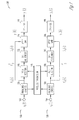
- FIG. 1 is a flow diagram illustrating a binaural pitch detection based system for hearing assistance devices, according to one embodiment of the present subject matter.
- the system includes a first hearing assistance device 102 in a left ear of a wearer and a second hearing assistance device 152 in a right ear of the wearer.
- the basic blocks in the depicted system 100 include frequency analysis 106, 156, wireless transmission 110, pitch detection 108, 158, gain adjustment 112, 162, gain application 114, 164, and synthesis 116, 166.
- the frequency analysis block 106, 156 converts the time-domain signal picked up by the microphones 104, 154 to a frequency domain signal, in various embodiments.
- the wireless transmission block 110 transfers the signal from one side (or ear) to the other side.
- the pitch detection block 108, 158 takes the signals from both sides to generate the pitch contour detection.
- time domain and/or frequency domain methods can be utilized for pitch detection. Examples of frequency domain methods include, but are not limited to, the harmonic product spectrum and cepstral analysis.
- the gain adjustment block 112, 162 first determines the tone based on the pitch contour.
- the gain estimation can be adjusted based on the tone category, in various embodiments. For certain tones, emphasizing the gain in the low frequencies can improve the speech understanding.
- the gain application block 114, 164 applies the adjusted gain in the frequency domain, in an embodiment.
- the synthesis block 116, 166 converts the signal back to time domain.
- Other blocks are included, in various embodiments. For example, for hearing aids, the compressor, the feedback canceller and noise reduction blocks are used and can affect gain. A relatively large data rate is used since the whole signal is needed for the implementation. To limit the bit rate, the wireless link can be activated as needed for the non-constant speech segment. In addition, instead of transferring the whole frequency range, an embodiment limits transfers to the low frequencies.
- FIG. 2 is a flow diagram illustrating a binaural pitch enhancement based system for hearing assistance devices, according to one embodiment of the present subject matter.
- the system of FIG. 2 improves on the system of FIG. 1 by reducing computation cost and decreasing sensitivity in noisy environments.
- the system includes a first hearing assistance device 202 in a left ear of a wearer and a second hearing assistance device 252 in a right ear of the wearer.
- the basic blocks in the depicted system 200 include frequency analysis 206, 256, wireless transmission 210, pitch detection 208, 258, pitch correction 211, 261, gain adjustment 212, 262, gain application 214, 264, and synthesis 216, 266.
- the frequency analysis block 206, 256 converts the time-domain signal picked up by the device microphones 204, 254 to a frequency domain signal. For example, it could be realized by Discrete Fourier Transform (DFT) or other frequency analysis methods.
- the wireless transmission block 210 transfers the pitch detection results from one side to the other side.
- the detection confidence is a function of signal-to-noise ratio (SNR).
- SNR signal-to-noise ratio
- T 1 and T 2 are used to limit the SNR value, and the value of c ( n ) is in the range 0 to 1, in various embodiments.
- the detection confidence is transferred to the other side (the device in the other ear of the user) with the pitch contour value, in various embodiments.
- FIG. 3 is a graphical diagram illustrating pitch detection confidence in a binaural pitch enhancement based system for hearing assistance devices, according to one embodiment of the present subject matter.
- the detection confidence can also be calculated using non-linear functions.
- the present subject matter provides pitch correction, in various embodiments.
- the pitch correction block 211, 261 combines pitch values from the two sides (from a device in a left ear and a device in a right ear) according to the determined pitch detection confidence.
- the gain adjustment block 212, 262 first determines the tone based on the pitch contour.
- the signal is classified into one of several groups of tones based on the slope of the pitch contour, in various embodiments.
- S f ⁇ ⁇ f 0 ⁇ ⁇ t (the slope of pitch contour, ⁇ t is the duration)
- the gain estimation is adjusted based on the tone category, in various embodiments. For certain tones, the gain in the low frequencies is emphasized to improve the speech understanding.
- the gain application block 214, 264 applies the adjusted gain in the frequency domain, in an embodiment.
- the synthesis block 216, 266 converts the signal back to time domain.
- Other blocks are included, in various embodiments. For example, for hearing aids, the compressor, the feedback canceller and noise reduction blocks are used and can affect gain.
- the system of FIG. 2 has several advantages.
- One advantage that a relatively low data rate can be used since only the pitch and the detection confidence are needed for the implementation.
- the bit rate can be further limited by activating the wireless link only for the non-constant speech segment.
- pitch changes slowly compared to the signal itself it can be decimated and coded efficiently before the transmission. Therefore, the present subject matter has a low computation cost comparing to the binaural pitch detection, and is robust to noisy environments in various embodiments.
- a detection score can be calculated using other methods as long as it represents the confidence score of how pitch is estimated.
- the pitch correction can be implemented other than combining of pitch for two sides in various embodiments, as long as it can benefit from the information of both sides, especially taking advantage of the better ear (high SNR side).
- a method for enhancing pitch in a hearing assistance system having a first and second hearing assistance device includes a method for enhancing pitch in a hearing assistance system having a first and second hearing assistance device.
- a time domain signal is sensed using a microphone of the first hearing assistance device.
- the time domain signal is converted to a frequency domain signal and pitch detection is performed on the frequency domain signal to obtain a pitch contour value and a pitch detection confidence of the first hearing assistance.
- the pitch contour value and the pitch detection confidence are wirelessly transmitted from the first hearing assistance device to the second hearing assistance device.
- the pitch detection contour value of the first hearing assistance device is combined with a pitch detection contour value of the second hearing assistance device using the pitch detection confidence of the first hearing assistance device and a pitch detection confidence of the second hearing assistance device.
- the tone is classified based on the combined pitch contour value and gain is adjusted based on the tone classification, in various embodiments.
- a further aspect of the present subject matter includes a hearing assistance system.
- the system includes a first hearing assistance device in a first ear of a wearer and a second hearing assistance device in a second ear of the wearer.
- the first hearing assistance device is configured to receive a signal, perform pitch detection on the signal to obtain a pitch value, and wirelessly transmit the pitch value to the second hearing assistance device.
- the second hearing assistance device is configured to combine the pitch value of the first hearing assistance device with a pitch value of the second hearing assistance device, and adjust gain based on the combined pitch value, in various embodiments.
- the wireless communications can include standard or nonstandard communications.
- standard wireless communications include link protocols including, but not limited to, BluetoothTM, IEEE 802.11(wireless LANs), 802.15 (WPANs), 802.16 (WiMAX), cellular protocols including, but not limited to CDMA and GSM, ZigBee, and ultra-wideband (UWB) technologies.
- Such protocols support radio frequency communications and some support infrared communications.
- the present system is demonstrated as a radio system, it is possible that other forms of wireless communications can be used such as ultrasonic, optical, and others.
- the standards which can be used include past and present standards. It is also contemplated that future versions of these standards and new future standards may be employed without departing from the scope of the present subject matter.
- the wireless communications support a connection from other devices.
- Such connections include, but are not limited to, one or more mono or stereo connections or digital connections having link protocols including, but not limited to 802.3 (Ethernet), 802.4, 802.5, USB, ATM, Fibre-channel, Firewire or 1394, InfiniBand, or a native streaming interface.
- link protocols including, but not limited to 802.3 (Ethernet), 802.4, 802.5, USB, ATM, Fibre-channel, Firewire or 1394, InfiniBand, or a native streaming interface.
- link protocols including, but not limited to 802.3 (Ethernet), 802.4, 802.5, USB, ATM, Fibre-channel, Firewire or 1394, InfiniBand, or a native streaming interface.
- such connections include all past and present link protocols. It is also contemplated that future versions of these protocols and new future standards may be employed without departing from the scope of the present subject matter.
- Hearing assistance devices typically include an enclosure or housing, a microphone, hearing assistance device electronics including processing electronics, and a speaker or receiver.
- Processing electronics include a controller or processor, such as a digital signal processor (DSP), in various embodiments. Other types of processors may be used without departing from the scope of this disclosure.
- DSP digital signal processor
- the microphone is optional.
- the receiver is optional.
- the hearing aids referenced in this patent application include a processor.
- the processor may be a digital signal processor (DSP), microprocessor, microcontroller, other digital logic, or combinations thereof.
- DSP digital signal processor
- the processing of signals referenced in this application can be performed using the processor. Processing may be done in the digital domain, the analog domain, or combinations thereof. Processing may be done using subband processing techniques. Processing may be done with frequency domain or time domain approaches. Some processing may involve both frequency and time domain aspects. For brevet, in some examples drawings may omit certain blocks that perform frequency synthesis, frequency analysis, analog-to-digital conversion, digital-to-analog conversion, amplification, and certain types of filtering and processing.
- the processor is adapted to perform instructions stored in memory which may or may not be explicitly shown.
- memory may be used, including volatile and nonvolatile forms of memory.
- instructions are performed by the processor to perform a number of signal processing tasks.
- analog components are in communication with the processor to perform signal tasks, such as microphone reception, or receiver sound embodiments (i.e., in applications where such transducers are used).
- signal tasks such as microphone reception, or receiver sound embodiments (i.e., in applications where such transducers are used).
- different realizations of the block diagrams, circuits, and processes set forth herein may occur without departing from the scope of the present subject matter.
- hearing assistance devices including hearing aids, including but not limited to, behind-the-ear (BTE), in-the-ear (ITE), in-the-canal (ITC), receiver-in-canal (RIC), or completely-in-the-canal (CIC) type hearing aids.
- BTE behind-the-ear
- ITE in-the-ear
- ITC in-the-canal
- RIC receiver-in-canal
- CIC completely-in-the-canal
- hearing assistance devices including but not limited to, behind-the-ear (BTE), in-the-ear (ITE), in-the-canal (ITC), receiver-in-canal (RIC), or completely-in-the-canal (CIC) type hearing aids.
- BTE behind-the-ear
- ITE in-the-ear
- ITC in-the-canal
- RIC receiver-in-canal
- CIC completely-in-the-canal
- hearing assistance devices including but not limited to, behind-the-ear (BTE), in
- the present subject matter can also be used in hearing assistance devices generally, such as cochlear implant type hearing devices and such as deep insertion devices having a transducer, such as a receiver or microphone, whether custom fitted, standard, open fitted or occlusive fitted. It is understood that other hearing assistance devices not expressly stated herein may be used in conjunction with the present subject matter.
Landscapes
- Engineering & Computer Science (AREA)
- Acoustics & Sound (AREA)
- Physics & Mathematics (AREA)
- Signal Processing (AREA)
- Health & Medical Sciences (AREA)
- Computational Linguistics (AREA)
- Human Computer Interaction (AREA)
- Quality & Reliability (AREA)
- Audiology, Speech & Language Pathology (AREA)
- Multimedia (AREA)
- General Health & Medical Sciences (AREA)
- Neurosurgery (AREA)
- Otolaryngology (AREA)
- Computer Networks & Wireless Communication (AREA)
- Stereophonic System (AREA)
- Circuit For Audible Band Transducer (AREA)
Abstract
Description
- The present subject matter relates generally to hearing assistance systems and more particularly to binaural enhancement of tone language for hearing assistance devices.
- Hearing assistance devices include a variety of devices such as assistive listening devices, cochlear implants and hearing aids. Hearing aids are useful in improving the hearing and speech comprehension of people who have hearing loss by selectively amplifying certain frequencies according to the hearing loss of the subject. A hearing aid typically has three basic parts; a microphone, an amplifier and a speaker. The microphone receives sound (acoustic signal) and converts it to an electrical signal and sends it to the amplifier. The amplifier increases the power of the signal, in proportion to the hearing loss, and then sends it to the ear through the speaker. Cochlear devices may employ electrodes to transmit sound to the patient.
- A tone language like Mandarin, Cantonese or Thai is unlike English, because tone language relies on pitch discrimination for speech intelligibility. For example, Mandarin uses four tones to clarify the meanings of words: a first tone at a high level, a second rising tone, a third falling then rising tone, and a fourth falling tone. An example is shown in the table of
FIG. 4 . Since many characters have the same sound, tones are used to differentiate words from each other. The tones are discriminated by the pitch changes which are often limited to a small range in the low frequency spectrum. - For hearing-impaired listeners, even with the aid of a hearing assistance device, the pitch detection rate could drop due to insufficient spectrum resolution and hearing loss in low frequencies. This leads to poor speech intelligibility of a tone language for a wearer of a hearing assistance device.
- Thus, there is a need in the art for an improved method and apparatus for enhancing tone language for hearing assistance devices.
- Disclosed herein, among other things, are methods and apparatus for binaural enhancement of tone language for hearing assistance devices. One aspect of the present subject matter includes a method for enhancing pitch in a hearing assistance system having a first and second hearing assistance device. A signal is received using a microphone of the first hearing assistance device. Pitch detection is performed on the signal to obtain a pitch value. The pitch value is wirelessly transmitted from the first hearing assistance device to the second hearing assistance device. In various embodiments, the pitch value of the first hearing assistance device is combined with a pitch value of the second hearing assistance device. The gain is adjusted based on the combined pitch value, in various embodiments.
- Another aspect of the present subject matter includes a method for enhancing pitch in a hearing assistance system having a first and second hearing assistance device. In various embodiments, a time domain signal is sensed using a microphone of the first hearing assistance device. The time domain signal is converted to a frequency domain signal and pitch detection is performed on the frequency domain signal to obtain a pitch contour value and a pitch detection confidence of the first hearing assistance. The pitch contour value and the pitch detection confidence are wirelessly transmitted from the first hearing assistance device to the second hearing assistance device. In various embodiments, the pitch detection contour value of the first hearing assistance device is combined with a pitch detection contour value of the second hearing assistance device using the pitch detection confidence of the first hearing assistance device and a pitch detection confidence of the second hearing assistance device. The tone is classified based on the combined pitch contour value and gain is adjusted based on the tone classification, in various embodiments.
- A further aspect of the present subject matter includes a hearing assistance system. The system includes a first hearing assistance device in a first ear of a wearer and a second hearing assistance device in a second ear of the wearer. In various embodiments, the first hearing assistance device is configured to receive a signal, perform pitch detection on the signal to obtain a pitch value, and wirelessly transmit the pitch value to the second hearing assistance device. The second hearing assistance device is configured to combine the pitch value of the first hearing assistance device with a pitch value of the second hearing assistance device, and adjust gain based on the combined pitch value, in various embodiments.
- This Summary is an overview of some of the teachings of the present application and not intended to be an exclusive or exhaustive treatment of the present subject matter. Further details about the present subject matter are found in the detailed description and appended claims. The scope of the present invention is defined by the appended claims and their legal equivalents.
-
FIG. 1 is a flow diagram illustrating a binaural pitch detection based system for hearing assistance devices, according to one embodiment of the present subject matter. -
FIG. 2 is a flow diagram illustrating a binaural pitch enhancement based system for hearing assistance devices, according to one embodiment of the present subject matter. -
FIG. 3 is a graphical diagram illustrating pitch detection confidence in a binaural pitch enhancement based system for hearing assistance devices, according to one embodiment of the present subject matter. -
FIG. 4 is a table illustrating the meaning of various tones in a tone language. - The following detailed description of the present subject matter refers to subject matter in the accompanying drawings which show, by way of illustration, specific aspects and embodiments in which the present subject matter may be practiced. These embodiments are described in sufficient detail to enable those skilled in the art to practice the present subject matter. References to "an", "one", or "various" embodiments in this disclosure are not necessarily to the same embodiment, and such references contemplate more than one embodiment. The following detailed description is demonstrative and not to be taken in a limiting sense. The scope of the present subject matter is defined by the appended claims, along with the full scope of legal equivalents to which such claims are entitled.
- Modern hearing assistance devices, such as hearing aids typically include a processor, such as a digital signal processor in communication with a microphone and receiver. Such designs are adapted to perform a great deal of processing on sounds received by the microphone. These designs can be highly programmable and may use inputs from remote devices, such as wired and wireless devices.
- A tone language like Mandarin, Cantonese or Thai is unlike English, because tone language relies on pitch discrimination for speech intelligibility. For example, Mandarin uses four tones to clarify the meanings of words: a first tone at a high level, a second rising tone, a third falling then rising tone, and a fourth falling tone. An example is shown in the table of
FIG. 4 . Since many characters have the same sound, tones are used to differentiate words from each other. The tones are discriminated by the pitch changes which are limited to a small range in the low frequency spectrum. In some cases the changes of fundamental frequency ( V(k,n) = On ) could be smaller than 100Hz. However, for hearing-impaired listeners, even with the aid of a hearing assistance device, the pitch detection rate could drop due to insufficient spectrum resolution and hearing loss in low frequencies. This leads to poor speech intelligibility of a tone language for a wearer of a hearing assistance device. - Previous solutions include focusing on detecting the fundamental frequency contour for each side (each ear) of the hearing devices and enhancing the signal for each side separately. Disadvantages of these previous solutions include that: (1) the processing of the two sides is independent of each other, which may lead to non-synchronization of the tone detection; (2) since the processing is done for each side separately, it does not take advantage of binaural pitch detection; and (3) for some adverse conditions, like noisy conditions, the monaural processing cannot benefit from the other ear if it has a stronger received target signal.
- The present subject matter uses binaural pitch detection, and provides robust pitch detection to improve speech understanding for tone language for hearing impaired listeners who wear binaural hearing devices. Information from both left and right sides is used to enhance the pitch detection for tone language. In one embodiment, information from one hearing assistance device (one side or ear) is combined with information from a second hearing assistance device (second side or ear) to detect pitch. In another embodiment, pitch is detected from each side and transferred to the other side to get more accurate pitch contour information.
- Disclosed herein, among other things, are methods and apparatus for binaural enhancement of tone language for hearing assistance devices. One aspect of the present subject matter includes a method for enhancing pitch in a hearing assistance system having a first and second hearing assistance device. A signal is received using a microphone of the first hearing assistance device. Pitch detection is performed on the signal to obtain a pitch value. The pitch value is wirelessly transmitted from the first hearing assistance device to the second hearing assistance device. In various embodiments, the pitch value of the first hearing assistance device is combined with a pitch value of the second hearing assistance device. The gain is adjusted based on the combined pitch value, in various embodiments.
-
FIG. 1 is a flow diagram illustrating a binaural pitch detection based system for hearing assistance devices, according to one embodiment of the present subject matter. The system includes a firsthearing assistance device 102 in a left ear of a wearer and a secondhearing assistance device 152 in a right ear of the wearer. The basic blocks in the depictedsystem 100 includefrequency analysis 106, 156,wireless transmission 110,pitch detection gain adjustment gain application synthesis frequency analysis block 106, 156 converts the time-domain signal picked up by themicrophones wireless transmission block 110 transfers the signal from one side (or ear) to the other side. Thepitch detection block gain adjustment block 
- In a tone language such as Mandarin for example (see
FIG. 4 ), Sf > 0 for the second tone while Sf < 0 for the fourth tone. For certain languages, it may also combine this information with the length of the syllables. After classifying the tone, the gain estimation can be adjusted based on the tone category, in various embodiments. For certain tones, emphasizing the gain in the low frequencies can improve the speech understanding. Thegain application block synthesis block -
FIG. 2 is a flow diagram illustrating a binaural pitch enhancement based system for hearing assistance devices, according to one embodiment of the present subject matter. In various embodiments, the system ofFIG. 2 improves on the system ofFIG. 1 by reducing computation cost and decreasing sensitivity in noisy environments. The system includes a firsthearing assistance device 202 in a left ear of a wearer and a secondhearing assistance device 252 in a right ear of the wearer. The basic blocks in the depictedsystem 200 includefrequency analysis wireless transmission 210,pitch detection pitch correction gain adjustment gain application synthesis frequency analysis block device microphones wireless transmission block 210 transfers the pitch detection results from one side to the other side. Thepitch detection block 
- The detection confidence is a function of signal-to-noise ratio (SNR). The higher the SNR, the more confident the detection result is, in various embodiments.


- T1 and T2 are used to limit the SNR value, and the value of c(n) is in the
range 0 to 1, in various embodiments. The detection confidence is transferred to the other side (the device in the other ear of the user) with the pitch contour value, in various embodiments. -
FIG. 3 is a graphical diagram illustrating pitch detection confidence in a binaural pitch enhancement based system for hearing assistance devices, according to one embodiment of the present subject matter. The diagram depicts pitch detection confidence versus SNR, using an example with T1 = -10dB and T2 = 20dB. The detection confidence can also be calculated using non-linear functions. - The present subject matter provides pitch correction, in various embodiments. The
pitch correction block 
- If both cl (n) = cr (n) = 0
- For the left side;

- For the right side:

- In various embodiments, the
gain adjustment block 
- In the example of the tone language Mandarin (
FIG. 4 ), Sf > 0 for the second tone while Sf < 0 is the fourth tone. For certain languages, it may also be combined with the length of the syllable. After classifying the tone, the gain estimation is adjusted based on the tone category, in various embodiments. For certain tones, the gain in the low frequencies is emphasized to improve the speech understanding. Thegain application block synthesis block - The system of
FIG. 2 has several advantages. One advantage that a relatively low data rate can be used since only the pitch and the detection confidence are needed for the implementation. In addition, the bit rate can be further limited by activating the wireless link only for the non-constant speech segment. Further, since pitch changes slowly compared to the signal itself, it can be decimated and coded efficiently before the transmission. Therefore, the present subject matter has a low computation cost comparing to the binaural pitch detection, and is robust to noisy environments in various embodiments. - The present subject matter is demonstrated for hearing aids, but can be used in any hearing assistance device. In various embodiments, a detection score can be calculated using other methods as long as it represents the confidence score of how pitch is estimated. The pitch correction can be implemented other than combining of pitch for two sides in various embodiments, as long as it can benefit from the information of both sides, especially taking advantage of the better ear (high SNR side).
- Another aspect of the present subject matter includes a method for enhancing pitch in a hearing assistance system having a first and second hearing assistance device. In various embodiments, a time domain signal is sensed using a microphone of the first hearing assistance device. The time domain signal is converted to a frequency domain signal and pitch detection is performed on the frequency domain signal to obtain a pitch contour value and a pitch detection confidence of the first hearing assistance. The pitch contour value and the pitch detection confidence are wirelessly transmitted from the first hearing assistance device to the second hearing assistance device. In various embodiments, the pitch detection contour value of the first hearing assistance device is combined with a pitch detection contour value of the second hearing assistance device using the pitch detection confidence of the first hearing assistance device and a pitch detection confidence of the second hearing assistance device. The tone is classified based on the combined pitch contour value and gain is adjusted based on the tone classification, in various embodiments.
- A further aspect of the present subject matter includes a hearing assistance system. The system includes a first hearing assistance device in a first ear of a wearer and a second hearing assistance device in a second ear of the wearer. In various embodiments, the first hearing assistance device is configured to receive a signal, perform pitch detection on the signal to obtain a pitch value, and wirelessly transmit the pitch value to the second hearing assistance device. The second hearing assistance device is configured to combine the pitch value of the first hearing assistance device with a pitch value of the second hearing assistance device, and adjust gain based on the combined pitch value, in various embodiments.
- Various embodiments of the present subject matter support wireless communications with a hearing assistance device. In various embodiments the wireless communications can include standard or nonstandard communications. Some examples of standard wireless communications include link protocols including, but not limited to, Bluetooth™, IEEE 802.11(wireless LANs), 802.15 (WPANs), 802.16 (WiMAX), cellular protocols including, but not limited to CDMA and GSM, ZigBee, and ultra-wideband (UWB) technologies. Such protocols support radio frequency communications and some support infrared communications. Although the present system is demonstrated as a radio system, it is possible that other forms of wireless communications can be used such as ultrasonic, optical, and others. It is understood that the standards which can be used include past and present standards. It is also contemplated that future versions of these standards and new future standards may be employed without departing from the scope of the present subject matter.
- The wireless communications support a connection from other devices. Such connections include, but are not limited to, one or more mono or stereo connections or digital connections having link protocols including, but not limited to 802.3 (Ethernet), 802.4, 802.5, USB, ATM, Fibre-channel, Firewire or 1394, InfiniBand, or a native streaming interface. In various embodiments, such connections include all past and present link protocols. It is also contemplated that future versions of these protocols and new future standards may be employed without departing from the scope of the present subject matter.
- It is understood that variations in communications standards, protocols, and combinations of components may be employed without departing from the scope of the present subject matter. Hearing assistance devices typically include an enclosure or housing, a microphone, hearing assistance device electronics including processing electronics, and a speaker or receiver. Processing electronics include a controller or processor, such as a digital signal processor (DSP), in various embodiments. Other types of processors may be used without departing from the scope of this disclosure. It is understood that in various embodiments the microphone is optional. It is understood that in various embodiments the receiver is optional. Thus, the examples set forth herein are intended to be demonstrative and not a limiting or exhaustive depiction of variations.
- It is understood that the hearing aids referenced in this patent application include a processor. The processor may be a digital signal processor (DSP), microprocessor, microcontroller, other digital logic, or combinations thereof. The processing of signals referenced in this application can be performed using the processor. Processing may be done in the digital domain, the analog domain, or combinations thereof. Processing may be done using subband processing techniques. Processing may be done with frequency domain or time domain approaches. Some processing may involve both frequency and time domain aspects. For brevet, in some examples drawings may omit certain blocks that perform frequency synthesis, frequency analysis, analog-to-digital conversion, digital-to-analog conversion, amplification, and certain types of filtering and processing. In various embodiments the processor is adapted to perform instructions stored in memory which may or may not be explicitly shown. Various types of memory may be used, including volatile and nonvolatile forms of memory. In various embodiments, instructions are performed by the processor to perform a number of signal processing tasks. In such embodiments, analog components are in communication with the processor to perform signal tasks, such as microphone reception, or receiver sound embodiments (i.e., in applications where such transducers are used). In various embodiments, different realizations of the block diagrams, circuits, and processes set forth herein may occur without departing from the scope of the present subject matter.
- The present subject matter is demonstrated for hearing assistance devices, including hearing aids, including but not limited to, behind-the-ear (BTE), in-the-ear (ITE), in-the-canal (ITC), receiver-in-canal (RIC), or completely-in-the-canal (CIC) type hearing aids. It is understood that behind-the-ear type hearing aids may include devices that reside substantially behind the ear or over the ear. Such devices may include hearing aids with receivers associated with the electronics portion of the behind-the-ear device, or hearing aids of the type having receivers in the ear canal of the user, including but not limited to receiver-in-canal (RIC) or receiver-in-the-ear (RITE) designs. The present subject matter can also be used in hearing assistance devices generally, such as cochlear implant type hearing devices and such as deep insertion devices having a transducer, such as a receiver or microphone, whether custom fitted, standard, open fitted or occlusive fitted. It is understood that other hearing assistance devices not expressly stated herein may be used in conjunction with the present subject matter.
- This application is intended to cover adaptations or variations of the present subject matter. It is to be understood that the above description is intended to be illustrative, and not restrictive. The scope of the present subject matter should be determined with reference to the appended claims, along with the full scope of legal equivalents to which such claims are entitled.
Claims (15)
- A method for enhancing pitch in a hearing assistance system having a first and second hearing assistance device, the method comprising:receiving a signal using a microphone of the first hearing assistance device;performing pitch detection on the signal to obtain a pitch value;wirelessly transmitting the pitch value from the first hearing assistance device to the second hearing assistance device;combining the pitch value of the first hearing assistance device with a pitch value of the second hearing assistance device; andadjusting gain based on the combined pitch value.
- The method of claim 1, wherein combining the pitch value of the first hearing assistance device with the pitch value of the second hearing assistance device includes using pitch correction.
- The method of claim 2, wherein using pitch correction includes combining pitch values from the first and second hearing assistance device using pitch detection confidence.
- The method of claim 3, wherein using pitch detection confidence includes determining a first hearing assistance device pitch detection confidence and a second hearing assistance device pitch detection confidence.
- The method of claim 4, further comprising:wirelessly transmitting the first hearing assistance device pitch detection confidence from the first hearing assistance device to the second hearing assistance device.
- The method of any of the preceding claims, wherein performing pitch detection on the signal to obtain a pitch value includes determining a pitch contour value.
- The method of any of claim 3 through claim 6, wherein the pitch detection confidence is a function of signal-to-noise ratio (SNR).
- The method of any of claim 3 through claim 6, wherein the pitch detection confidence is calculated using a non-linear function.
- The method of any of the preceding claims, further comprising:applying the adjusted gain to the signal to obtain an enhanced signal.
- The method of claim 9, further comprising:playing the enhanced signal using a receiver.
- A hearing assistance system, comprising:a first hearing assistance device in a first ear of a wearer; anda second hearing assistance device in a second ear of the wearer,wherein the first hearing assistance device is configured to:receive a signal;perform pitch detection on the signal to obtain a pitch value; andwirelessly transmit the pitch value to the second hearing assistance device, andwherein the second hearing assistance device is configured to:combine the pitch value of the first hearing assistance device with a pitch value of the second hearing assistance device; andadjust gain based on the combined pitch value.
- The system of claim 1 l, wherein wirelessly transmitting the pitch contour value and the pitch detection confidence includes using Bluetooth™.
- The system of claim 11, wherein wirelessly transmitting the pitch contour value and the pitch detection confidence includes using IEEE 802.11, 802.15 or 802.16.
- The system of claim 11, wherein wirelessly transmitting the pitch contour value and the pitch detection confidence includes using a cellular protocol such as CDMA or GSM.
- The system of claim 11, wherein wirelessly transmitting the pitch contour value and the pitch detection confidence includes using ultra-wideband (UWB) technology.
Applications Claiming Priority (1)
| Application Number | Priority Date | Filing Date | Title |
|---|---|---|---|
| US13/601,573 US9374646B2 (en) | 2012-08-31 | 2012-08-31 | Binaural enhancement of tone language for hearing assistance devices |
Publications (2)
| Publication Number | Publication Date |
|---|---|
| EP2704452A1 true EP2704452A1 (en) | 2014-03-05 |
| EP2704452B1 EP2704452B1 (en) | 2015-04-01 |
Family
ID=49080763
Family Applications (1)
| Application Number | Title | Priority Date | Filing Date |
|---|---|---|---|
| EP13182498.9A Active EP2704452B1 (en) | 2012-08-31 | 2013-08-30 | Binaural enhancement of tone language for hearing assistance devices |
Country Status (4)
| Country | Link |
|---|---|
| US (1) | US9374646B2 (en) |
| EP (1) | EP2704452B1 (en) |
| CN (1) | CN103686571B (en) |
| DK (1) | DK2704452T3 (en) |
Cited By (2)
| Publication number | Priority date | Publication date | Assignee | Title |
|---|---|---|---|---|
| EP3255902A1 (en) * | 2016-06-06 | 2017-12-13 | Starkey Laboratories, Inc. | Method and apparatus for improving speech intelligibility in hearing devices using remote microphone |
| EP3504887B1 (en) * | 2016-08-24 | 2023-05-31 | Advanced Bionics AG | Systems and methods for facilitating interaural level difference perception by preserving the interaural level difference |
Families Citing this family (8)
| Publication number | Priority date | Publication date | Assignee | Title |
|---|---|---|---|---|
| US9374646B2 (en) | 2012-08-31 | 2016-06-21 | Starkey Laboratories, Inc. | Binaural enhancement of tone language for hearing assistance devices |
| US9191755B2 (en) | 2012-12-14 | 2015-11-17 | Starkey Laboratories, Inc. | Spatial enhancement mode for hearing aids |
| TWI543634B (en) * | 2013-12-10 | 2016-07-21 | 元鼎音訊股份有限公司 | Method and computer program product of processing voice segment and hearing aid |
| CN104307100B (en) * | 2014-10-10 | 2017-01-04 | 深圳大学 | A kind of method and system improving artificial cochlea's pitch perception |
| CN110798789A (en) * | 2018-08-03 | 2020-02-14 | 张伟明 | Hearing aid and method of use |
| DK3823306T3 (en) * | 2019-11-15 | 2022-11-21 | Sivantos Pte Ltd | Hearing system, comprising a hearing aid and method of operating the hearing aid |
| US20250175749A1 (en) * | 2022-02-28 | 2025-05-29 | Cochlear Limited | Synchronized spectral analysis |
| WO2024235494A1 (en) * | 2023-05-15 | 2024-11-21 | Sivantos Pte. Ltd. | Language-dependent adaptation of the signal processing of hearing systems |
Citations (2)
| Publication number | Priority date | Publication date | Assignee | Title |
|---|---|---|---|---|
| WO1995008248A1 (en) * | 1993-09-17 | 1995-03-23 | Audiologic, Incorporated | Noise reduction system for binaural hearing aid |
| WO2007028250A2 (en) * | 2005-09-09 | 2007-03-15 | Mcmaster University | Method and device for binaural signal enhancement |
Family Cites Families (16)
| Publication number | Priority date | Publication date | Assignee | Title |
|---|---|---|---|---|
| US1705951A (en) | 1924-03-20 | 1929-03-19 | Frederick E Wright | Plotting board |
| GB9218874D0 (en) * | 1992-09-07 | 1992-10-21 | British Broadcasting Corp | Improvements relating to the transmission of frequency division multiplex signals |
| US7630507B2 (en) * | 2002-01-28 | 2009-12-08 | Gn Resound A/S | Binaural compression system |
| US7020581B2 (en) | 2002-10-18 | 2006-03-28 | Medacoustics Research & Technology | Medical hearing aid analysis system |
| WO2005009072A2 (en) * | 2003-11-24 | 2005-01-27 | Sonion A/S | Microphone comprising integral multi-level quantizer and single-bit conversion means |
| DE102005012983A1 (en) | 2005-03-21 | 2006-09-28 | Siemens Audiologische Technik Gmbh | Hearing aid with language-specific setting and corresponding procedure |
| US8041066B2 (en) * | 2007-01-03 | 2011-10-18 | Starkey Laboratories, Inc. | Wireless system for hearing communication devices providing wireless stereo reception modes |
| DE102005036851B3 (en) * | 2005-08-04 | 2006-11-23 | Siemens Audiologische Technik Gmbh | Synchronizing signal tones output by hearing aids for binaural hearing aid supply involves sending control signal with count value at which signal tone is to be output from first to second hearing aid, outputting tones when values reached |
| JP4376249B2 (en) * | 2006-06-16 | 2009-12-02 | リオン株式会社 | Hearing aid |
| EP2107556A1 (en) * | 2008-04-04 | 2009-10-07 | Fraunhofer-Gesellschaft zur Förderung der angewandten Forschung e.V. | Audio transform coding using pitch correction |
| US8792659B2 (en) * | 2008-11-04 | 2014-07-29 | Gn Resound A/S | Asymmetric adjustment |
| US20100183158A1 (en) * | 2008-12-12 | 2010-07-22 | Simon Haykin | Apparatus, systems and methods for binaural hearing enhancement in auditory processing systems |
| US8737653B2 (en) * | 2009-12-30 | 2014-05-27 | Starkey Laboratories, Inc. | Noise reduction system for hearing assistance devices |
| US8971557B2 (en) * | 2012-08-09 | 2015-03-03 | Starkey Laboratories, Inc. | Binaurally coordinated compression system |
| US9374646B2 (en) | 2012-08-31 | 2016-06-21 | Starkey Laboratories, Inc. | Binaural enhancement of tone language for hearing assistance devices |
| US9414170B2 (en) * | 2012-12-28 | 2016-08-09 | Gn Resound A/S | Hearing aid having an adaptive antenna matching mechanism and a method for adaptively matching a hearing aid antenna |
-
2012
- 2012-08-31 US US13/601,573 patent/US9374646B2/en active Active
-
2013
- 2013-08-30 CN CN201310388621.7A patent/CN103686571B/en active Active
- 2013-08-30 EP EP13182498.9A patent/EP2704452B1/en active Active
- 2013-08-30 DK DK13182498.9T patent/DK2704452T3/en active
Patent Citations (2)
| Publication number | Priority date | Publication date | Assignee | Title |
|---|---|---|---|---|
| WO1995008248A1 (en) * | 1993-09-17 | 1995-03-23 | Audiologic, Incorporated | Noise reduction system for binaural hearing aid |
| WO2007028250A2 (en) * | 2005-09-09 | 2007-03-15 | Mcmaster University | Method and device for binaural signal enhancement |
Cited By (3)
| Publication number | Priority date | Publication date | Assignee | Title |
|---|---|---|---|---|
| EP3255902A1 (en) * | 2016-06-06 | 2017-12-13 | Starkey Laboratories, Inc. | Method and apparatus for improving speech intelligibility in hearing devices using remote microphone |
| US10244333B2 (en) | 2016-06-06 | 2019-03-26 | Starkey Laboratories, Inc. | Method and apparatus for improving speech intelligibility in hearing devices using remote microphone |
| EP3504887B1 (en) * | 2016-08-24 | 2023-05-31 | Advanced Bionics AG | Systems and methods for facilitating interaural level difference perception by preserving the interaural level difference |
Also Published As
| Publication number | Publication date |
|---|---|
| US9374646B2 (en) | 2016-06-21 |
| EP2704452B1 (en) | 2015-04-01 |
| CN103686571A (en) | 2014-03-26 |
| CN103686571B (en) | 2017-07-04 |
| DK2704452T3 (en) | 2015-06-29 |
| US20140064496A1 (en) | 2014-03-06 |
Similar Documents
| Publication | Publication Date | Title |
|---|---|---|
| EP2704452B1 (en) | Binaural enhancement of tone language for hearing assistance devices | |
| US11553287B2 (en) | Hearing device with neural network-based microphone signal processing | |
| US9763016B2 (en) | Automatic directional switching algorithm for hearing aids | |
| US9699574B2 (en) | Method of superimposing spatial auditory cues on externally picked-up microphone signals | |
| US12041418B2 (en) | Method and apparatus for automatic correction of real ear measurements | |
| EP2942777B1 (en) | Method and apparatus for pre-processing speech to maintain speech intelligibility | |
| EP2670168A1 (en) | Adaptive hearing assistance device using plural environment detection and classification | |
| US12211503B2 (en) | Hearing device system and method for operating same | |
| EP2753103A1 (en) | Method and apparatus for tonal enhancement in hearing aid | |
| EP3823306A1 (en) | A hearing system comprising a hearing instrument and a method for operating the hearing instrument | |
| US20080175423A1 (en) | Adjusting a hearing apparatus to a speech signal | |
| EP2866472A1 (en) | Input stage headroom expansion for hearing assistance devices | |
| US9232326B2 (en) | Method for determining a compression characteristic, method for determining a knee point and method for adjusting a hearing aid | |
| US20120076331A1 (en) | Method for reconstructing a speech signal and hearing device | |
| US11070922B2 (en) | Method of operating a hearing aid system and a hearing aid system | |
| EP2688067B1 (en) | System for training and improvement of noise reduction in hearing assistance devices | |
| US8948429B2 (en) | Amplification of a speech signal in dependence on the input level | |
| US12212927B2 (en) | Method for operating a hearing device, and hearing device | |
| US10129661B2 (en) | Techniques for increasing processing capability in hear aids | |
| EP3099084B1 (en) | Hearing assistance device with dynamic computational resource allocation | |
| EP3041270B1 (en) | A method of superimposing spatial auditory cues on externally picked-up microphone signals | |
| US20180054681A1 (en) | Method and device for filtering signals to match preferred speech levels |
Legal Events
| Date | Code | Title | Description |
|---|---|---|---|
| 17P | Request for examination filed |
Effective date: 20130830 |
|
| AK | Designated contracting states |
Kind code of ref document: A1 Designated state(s): AL AT BE BG CH CY CZ DE DK EE ES FI FR GB GR HR HU IE IS IT LI LT LU LV MC MK MT NL NO PL PT RO RS SE SI SK SM TR |
|
| AX | Request for extension of the european patent |
Extension state: BA ME |
|
| PUAI | Public reference made under article 153(3) epc to a published international application that has entered the european phase |
Free format text: ORIGINAL CODE: 0009012 |
|
| GRAP | Despatch of communication of intention to grant a patent |
Free format text: ORIGINAL CODE: EPIDOSNIGR1 |
|
| INTG | Intention to grant announced |
Effective date: 20141017 |
|
| GRAS | Grant fee paid |
Free format text: ORIGINAL CODE: EPIDOSNIGR3 |
|
| GRAA | (expected) grant |
Free format text: ORIGINAL CODE: 0009210 |
|
| AK | Designated contracting states |
Kind code of ref document: B1 Designated state(s): AL AT BE BG CH CY CZ DE DK EE ES FI FR GB GR HR HU IE IS IT LI LT LU LV MC MK MT NL NO PL PT RO RS SE SI SK SM TR |
|
| REG | Reference to a national code |
Ref country code: GB Ref legal event code: FG4D |
|
| REG | Reference to a national code |
Ref country code: CH Ref legal event code: EP |
|
| REG | Reference to a national code |
Ref country code: IE Ref legal event code: FG4D |
|
| REG | Reference to a national code |
Ref country code: DE Ref legal event code: R096 Ref document number: 602013001362 Country of ref document: DE Effective date: 20150513 |
|
| REG | Reference to a national code |
Ref country code: AT Ref legal event code: REF Ref document number: 719714 Country of ref document: AT Kind code of ref document: T Effective date: 20150515 |
|
| REG | Reference to a national code |
Ref country code: CH Ref legal event code: NV Representative=s name: MARKS AND CLERK (LUXEMBOURG) LLP, CH |
|
| REG | Reference to a national code |
Ref country code: DK Ref legal event code: T3 Effective date: 20150623 |
|
| REG | Reference to a national code |
Ref country code: NL Ref legal event code: T3 |
|
| REG | Reference to a national code |
Ref country code: AT Ref legal event code: MK05 Ref document number: 719714 Country of ref document: AT Kind code of ref document: T Effective date: 20150401 |
|
| REG | Reference to a national code |
Ref country code: LT Ref legal event code: MG4D |
|
| PG25 | Lapsed in a contracting state [announced via postgrant information from national office to epo] |
Ref country code: FI Free format text: LAPSE BECAUSE OF FAILURE TO SUBMIT A TRANSLATION OF THE DESCRIPTION OR TO PAY THE FEE WITHIN THE PRESCRIBED TIME-LIMIT Effective date: 20150401 Ref country code: LT Free format text: LAPSE BECAUSE OF FAILURE TO SUBMIT A TRANSLATION OF THE DESCRIPTION OR TO PAY THE FEE WITHIN THE PRESCRIBED TIME-LIMIT Effective date: 20150401 Ref country code: PT Free format text: LAPSE BECAUSE OF FAILURE TO SUBMIT A TRANSLATION OF THE DESCRIPTION OR TO PAY THE FEE WITHIN THE PRESCRIBED TIME-LIMIT Effective date: 20150803 Ref country code: HR Free format text: LAPSE BECAUSE OF FAILURE TO SUBMIT A TRANSLATION OF THE DESCRIPTION OR TO PAY THE FEE WITHIN THE PRESCRIBED TIME-LIMIT Effective date: 20150401 Ref country code: CZ Free format text: LAPSE BECAUSE OF FAILURE TO SUBMIT A TRANSLATION OF THE DESCRIPTION OR TO PAY THE FEE WITHIN THE PRESCRIBED TIME-LIMIT Effective date: 20150401 Ref country code: ES Free format text: LAPSE BECAUSE OF FAILURE TO SUBMIT A TRANSLATION OF THE DESCRIPTION OR TO PAY THE FEE WITHIN THE PRESCRIBED TIME-LIMIT Effective date: 20150401 Ref country code: NO Free format text: LAPSE BECAUSE OF FAILURE TO SUBMIT A TRANSLATION OF THE DESCRIPTION OR TO PAY THE FEE WITHIN THE PRESCRIBED TIME-LIMIT Effective date: 20150701 |
|
| PG25 | Lapsed in a contracting state [announced via postgrant information from national office to epo] |
Ref country code: IS Free format text: LAPSE BECAUSE OF FAILURE TO SUBMIT A TRANSLATION OF THE DESCRIPTION OR TO PAY THE FEE WITHIN THE PRESCRIBED TIME-LIMIT Effective date: 20150801 Ref country code: LV Free format text: LAPSE BECAUSE OF FAILURE TO SUBMIT A TRANSLATION OF THE DESCRIPTION OR TO PAY THE FEE WITHIN THE PRESCRIBED TIME-LIMIT Effective date: 20150401 Ref country code: RS Free format text: LAPSE BECAUSE OF FAILURE TO SUBMIT A TRANSLATION OF THE DESCRIPTION OR TO PAY THE FEE WITHIN THE PRESCRIBED TIME-LIMIT Effective date: 20150401 Ref country code: GR Free format text: LAPSE BECAUSE OF FAILURE TO SUBMIT A TRANSLATION OF THE DESCRIPTION OR TO PAY THE FEE WITHIN THE PRESCRIBED TIME-LIMIT Effective date: 20150702 Ref country code: AT Free format text: LAPSE BECAUSE OF FAILURE TO SUBMIT A TRANSLATION OF THE DESCRIPTION OR TO PAY THE FEE WITHIN THE PRESCRIBED TIME-LIMIT Effective date: 20150401 |
|
| REG | Reference to a national code |
Ref country code: DE Ref legal event code: R097 Ref document number: 602013001362 Country of ref document: DE |
|
| PG25 | Lapsed in a contracting state [announced via postgrant information from national office to epo] |
Ref country code: EE Free format text: LAPSE BECAUSE OF FAILURE TO SUBMIT A TRANSLATION OF THE DESCRIPTION OR TO PAY THE FEE WITHIN THE PRESCRIBED TIME-LIMIT Effective date: 20150401 |
|
| PLBE | No opposition filed within time limit |
Free format text: ORIGINAL CODE: 0009261 |
|
| STAA | Information on the status of an ep patent application or granted ep patent |
Free format text: STATUS: NO OPPOSITION FILED WITHIN TIME LIMIT |
|
| PG25 | Lapsed in a contracting state [announced via postgrant information from national office to epo] |
Ref country code: RO Free format text: LAPSE BECAUSE OF NON-PAYMENT OF DUE FEES Effective date: 20150401 Ref country code: PL Free format text: LAPSE BECAUSE OF FAILURE TO SUBMIT A TRANSLATION OF THE DESCRIPTION OR TO PAY THE FEE WITHIN THE PRESCRIBED TIME-LIMIT Effective date: 20150401 Ref country code: SK Free format text: LAPSE BECAUSE OF FAILURE TO SUBMIT A TRANSLATION OF THE DESCRIPTION OR TO PAY THE FEE WITHIN THE PRESCRIBED TIME-LIMIT Effective date: 20150401 |
|
| 26N | No opposition filed |
Effective date: 20160105 |
|
| PG25 | Lapsed in a contracting state [announced via postgrant information from national office to epo] |
Ref country code: MC Free format text: LAPSE BECAUSE OF FAILURE TO SUBMIT A TRANSLATION OF THE DESCRIPTION OR TO PAY THE FEE WITHIN THE PRESCRIBED TIME-LIMIT Effective date: 20150401 Ref country code: LU Free format text: LAPSE BECAUSE OF FAILURE TO SUBMIT A TRANSLATION OF THE DESCRIPTION OR TO PAY THE FEE WITHIN THE PRESCRIBED TIME-LIMIT Effective date: 20150830 |
|
| PG25 | Lapsed in a contracting state [announced via postgrant information from national office to epo] |
Ref country code: IT Free format text: LAPSE BECAUSE OF FAILURE TO SUBMIT A TRANSLATION OF THE DESCRIPTION OR TO PAY THE FEE WITHIN THE PRESCRIBED TIME-LIMIT Effective date: 20150401 |
|
| PG25 | Lapsed in a contracting state [announced via postgrant information from national office to epo] |
Ref country code: SI Free format text: LAPSE BECAUSE OF FAILURE TO SUBMIT A TRANSLATION OF THE DESCRIPTION OR TO PAY THE FEE WITHIN THE PRESCRIBED TIME-LIMIT Effective date: 20150401 |
|
| REG | Reference to a national code |
Ref country code: IE Ref legal event code: MM4A |
|
| PG25 | Lapsed in a contracting state [announced via postgrant information from national office to epo] |
Ref country code: IE Free format text: LAPSE BECAUSE OF NON-PAYMENT OF DUE FEES Effective date: 20150830 |
|
| REG | Reference to a national code |
Ref country code: FR Ref legal event code: PLFP Year of fee payment: 4 |
|
| PG25 | Lapsed in a contracting state [announced via postgrant information from national office to epo] |
Ref country code: BE Free format text: LAPSE BECAUSE OF FAILURE TO SUBMIT A TRANSLATION OF THE DESCRIPTION OR TO PAY THE FEE WITHIN THE PRESCRIBED TIME-LIMIT Effective date: 20150401 |
|
| PG25 | Lapsed in a contracting state [announced via postgrant information from national office to epo] |
Ref country code: MT Free format text: LAPSE BECAUSE OF FAILURE TO SUBMIT A TRANSLATION OF THE DESCRIPTION OR TO PAY THE FEE WITHIN THE PRESCRIBED TIME-LIMIT Effective date: 20150401 |
|
| REG | Reference to a national code |
Ref country code: NL Ref legal event code: MM Effective date: 20160901 |
|
| PG25 | Lapsed in a contracting state [announced via postgrant information from national office to epo] |
Ref country code: HU Free format text: LAPSE BECAUSE OF FAILURE TO SUBMIT A TRANSLATION OF THE DESCRIPTION OR TO PAY THE FEE WITHIN THE PRESCRIBED TIME-LIMIT; INVALID AB INITIO Effective date: 20130830 Ref country code: BG Free format text: LAPSE BECAUSE OF FAILURE TO SUBMIT A TRANSLATION OF THE DESCRIPTION OR TO PAY THE FEE WITHIN THE PRESCRIBED TIME-LIMIT Effective date: 20150401 |
|
| PG25 | Lapsed in a contracting state [announced via postgrant information from national office to epo] |
Ref country code: CY Free format text: LAPSE BECAUSE OF FAILURE TO SUBMIT A TRANSLATION OF THE DESCRIPTION OR TO PAY THE FEE WITHIN THE PRESCRIBED TIME-LIMIT Effective date: 20150401 Ref country code: SE Free format text: LAPSE BECAUSE OF FAILURE TO SUBMIT A TRANSLATION OF THE DESCRIPTION OR TO PAY THE FEE WITHIN THE PRESCRIBED TIME-LIMIT Effective date: 20150401 Ref country code: NL Free format text: LAPSE BECAUSE OF NON-PAYMENT OF DUE FEES Effective date: 20160901 |
|
| REG | Reference to a national code |
Ref country code: FR Ref legal event code: PLFP Year of fee payment: 5 |
|
| PG25 | Lapsed in a contracting state [announced via postgrant information from national office to epo] |
Ref country code: SM Free format text: LAPSE BECAUSE OF FAILURE TO SUBMIT A TRANSLATION OF THE DESCRIPTION OR TO PAY THE FEE WITHIN THE PRESCRIBED TIME-LIMIT Effective date: 20150401 |
|
| PG25 | Lapsed in a contracting state [announced via postgrant information from national office to epo] |
Ref country code: MK Free format text: LAPSE BECAUSE OF FAILURE TO SUBMIT A TRANSLATION OF THE DESCRIPTION OR TO PAY THE FEE WITHIN THE PRESCRIBED TIME-LIMIT Effective date: 20150401 Ref country code: TR Free format text: LAPSE BECAUSE OF FAILURE TO SUBMIT A TRANSLATION OF THE DESCRIPTION OR TO PAY THE FEE WITHIN THE PRESCRIBED TIME-LIMIT Effective date: 20150401 |
|
| REG | Reference to a national code |
Ref country code: FR Ref legal event code: PLFP Year of fee payment: 6 |
|
| PG25 | Lapsed in a contracting state [announced via postgrant information from national office to epo] |
Ref country code: AL Free format text: LAPSE BECAUSE OF FAILURE TO SUBMIT A TRANSLATION OF THE DESCRIPTION OR TO PAY THE FEE WITHIN THE PRESCRIBED TIME-LIMIT Effective date: 20150401 |
|
| P01 | Opt-out of the competence of the unified patent court (upc) registered |
Effective date: 20230610 |
|
| PGFP | Annual fee paid to national office [announced via postgrant information from national office to epo] |
Ref country code: GB Payment date: 20230726 Year of fee payment: 11 Ref country code: CH Payment date: 20230902 Year of fee payment: 11 |
|
| REG | Reference to a national code |
Ref country code: CH Ref legal event code: PL |
|
| GBPC | Gb: european patent ceased through non-payment of renewal fee |
Effective date: 20240830 |
|
| PG25 | Lapsed in a contracting state [announced via postgrant information from national office to epo] |
Ref country code: CH Free format text: LAPSE BECAUSE OF NON-PAYMENT OF DUE FEES Effective date: 20240831 |
|
| PG25 | Lapsed in a contracting state [announced via postgrant information from national office to epo] |
Ref country code: GB Free format text: LAPSE BECAUSE OF NON-PAYMENT OF DUE FEES Effective date: 20240830 |
|
| PGFP | Annual fee paid to national office [announced via postgrant information from national office to epo] |
Ref country code: DK Payment date: 20250707 Year of fee payment: 13 Ref country code: DE Payment date: 20250708 Year of fee payment: 13 |
|
| PGFP | Annual fee paid to national office [announced via postgrant information from national office to epo] |
Ref country code: FR Payment date: 20250707 Year of fee payment: 13 |