EP2704232A1 - System for the storage of electrical energy for a vehicle with electric propulsion - Google Patents
System for the storage of electrical energy for a vehicle with electric propulsion Download PDFInfo
- Publication number
- EP2704232A1 EP2704232A1 EP20130183037 EP13183037A EP2704232A1 EP 2704232 A1 EP2704232 A1 EP 2704232A1 EP 20130183037 EP20130183037 EP 20130183037 EP 13183037 A EP13183037 A EP 13183037A EP 2704232 A1 EP2704232 A1 EP 2704232A1
- Authority
- EP
- European Patent Office
- Prior art keywords
- chemical batteries
- chemical
- storage system
- group
- batteries
- Prior art date
- Legal status (The legal status is an assumption and is not a legal conclusion. Google has not performed a legal analysis and makes no representation as to the accuracy of the status listed.)
- Granted
Links
Images


Classifications
-
- H—ELECTRICITY
- H01—ELECTRIC ELEMENTS
- H01M—PROCESSES OR MEANS, e.g. BATTERIES, FOR THE DIRECT CONVERSION OF CHEMICAL ENERGY INTO ELECTRICAL ENERGY
- H01M10/00—Secondary cells; Manufacture thereof
- H01M10/04—Construction or manufacture in general
- H01M10/0481—Compression means other than compression means for stacks of electrodes and separators
-
- H—ELECTRICITY
- H01—ELECTRIC ELEMENTS
- H01M—PROCESSES OR MEANS, e.g. BATTERIES, FOR THE DIRECT CONVERSION OF CHEMICAL ENERGY INTO ELECTRICAL ENERGY
- H01M10/00—Secondary cells; Manufacture thereof
- H01M10/60—Heating or cooling; Temperature control
- H01M10/61—Types of temperature control
- H01M10/613—Cooling or keeping cold
-
- H—ELECTRICITY
- H01—ELECTRIC ELEMENTS
- H01M—PROCESSES OR MEANS, e.g. BATTERIES, FOR THE DIRECT CONVERSION OF CHEMICAL ENERGY INTO ELECTRICAL ENERGY
- H01M10/00—Secondary cells; Manufacture thereof
- H01M10/60—Heating or cooling; Temperature control
- H01M10/65—Means for temperature control structurally associated with the cells
- H01M10/655—Solid structures for heat exchange or heat conduction
- H01M10/6554—Rods or plates
-
- H—ELECTRICITY
- H01—ELECTRIC ELEMENTS
- H01M—PROCESSES OR MEANS, e.g. BATTERIES, FOR THE DIRECT CONVERSION OF CHEMICAL ENERGY INTO ELECTRICAL ENERGY
- H01M50/00—Constructional details or processes of manufacture of the non-active parts of electrochemical cells other than fuel cells, e.g. hybrid cells
- H01M50/20—Mountings; Secondary casings or frames; Racks, modules or packs; Suspension devices; Shock absorbers; Transport or carrying devices; Holders
- H01M50/204—Racks, modules or packs for multiple batteries or multiple cells
- H01M50/207—Racks, modules or packs for multiple batteries or multiple cells characterised by their shape
- H01M50/209—Racks, modules or packs for multiple batteries or multiple cells characterised by their shape adapted for prismatic or rectangular cells
-
- H—ELECTRICITY
- H01—ELECTRIC ELEMENTS
- H01M—PROCESSES OR MEANS, e.g. BATTERIES, FOR THE DIRECT CONVERSION OF CHEMICAL ENERGY INTO ELECTRICAL ENERGY
- H01M50/00—Constructional details or processes of manufacture of the non-active parts of electrochemical cells other than fuel cells, e.g. hybrid cells
- H01M50/30—Arrangements for facilitating escape of gases
-
- H—ELECTRICITY
- H01—ELECTRIC ELEMENTS
- H01M—PROCESSES OR MEANS, e.g. BATTERIES, FOR THE DIRECT CONVERSION OF CHEMICAL ENERGY INTO ELECTRICAL ENERGY
- H01M50/00—Constructional details or processes of manufacture of the non-active parts of electrochemical cells other than fuel cells, e.g. hybrid cells
- H01M50/30—Arrangements for facilitating escape of gases
- H01M50/35—Gas exhaust passages comprising elongated, tortuous or labyrinth-shaped exhaust passages
- H01M50/358—External gas exhaust passages located on the battery cover or case
-
- H—ELECTRICITY
- H01—ELECTRIC ELEMENTS
- H01M—PROCESSES OR MEANS, e.g. BATTERIES, FOR THE DIRECT CONVERSION OF CHEMICAL ENERGY INTO ELECTRICAL ENERGY
- H01M50/00—Constructional details or processes of manufacture of the non-active parts of electrochemical cells other than fuel cells, e.g. hybrid cells
- H01M50/30—Arrangements for facilitating escape of gases
- H01M50/35—Gas exhaust passages comprising elongated, tortuous or labyrinth-shaped exhaust passages
- H01M50/367—Internal gas exhaust passages forming part of the battery cover or case; Double cover vent systems
-
- H—ELECTRICITY
- H01—ELECTRIC ELEMENTS
- H01M—PROCESSES OR MEANS, e.g. BATTERIES, FOR THE DIRECT CONVERSION OF CHEMICAL ENERGY INTO ELECTRICAL ENERGY
- H01M10/00—Secondary cells; Manufacture thereof
- H01M10/60—Heating or cooling; Temperature control
- H01M10/62—Heating or cooling; Temperature control specially adapted for specific applications
- H01M10/625—Vehicles
-
- H—ELECTRICITY
- H01—ELECTRIC ELEMENTS
- H01M—PROCESSES OR MEANS, e.g. BATTERIES, FOR THE DIRECT CONVERSION OF CHEMICAL ENERGY INTO ELECTRICAL ENERGY
- H01M10/00—Secondary cells; Manufacture thereof
- H01M10/60—Heating or cooling; Temperature control
- H01M10/64—Heating or cooling; Temperature control characterised by the shape of the cells
- H01M10/647—Prismatic or flat cells, e.g. pouch cells
-
- H—ELECTRICITY
- H01—ELECTRIC ELEMENTS
- H01M—PROCESSES OR MEANS, e.g. BATTERIES, FOR THE DIRECT CONVERSION OF CHEMICAL ENERGY INTO ELECTRICAL ENERGY
- H01M10/00—Secondary cells; Manufacture thereof
- H01M10/60—Heating or cooling; Temperature control
- H01M10/65—Means for temperature control structurally associated with the cells
- H01M10/653—Means for temperature control structurally associated with the cells characterised by electrically insulating or thermally conductive materials
-
- H—ELECTRICITY
- H01—ELECTRIC ELEMENTS
- H01M—PROCESSES OR MEANS, e.g. BATTERIES, FOR THE DIRECT CONVERSION OF CHEMICAL ENERGY INTO ELECTRICAL ENERGY
- H01M10/00—Secondary cells; Manufacture thereof
- H01M10/60—Heating or cooling; Temperature control
- H01M10/65—Means for temperature control structurally associated with the cells
- H01M10/656—Means for temperature control structurally associated with the cells characterised by the type of heat-exchange fluid
- H01M10/6567—Liquids
-
- Y—GENERAL TAGGING OF NEW TECHNOLOGICAL DEVELOPMENTS; GENERAL TAGGING OF CROSS-SECTIONAL TECHNOLOGIES SPANNING OVER SEVERAL SECTIONS OF THE IPC; TECHNICAL SUBJECTS COVERED BY FORMER USPC CROSS-REFERENCE ART COLLECTIONS [XRACs] AND DIGESTS
- Y02—TECHNOLOGIES OR APPLICATIONS FOR MITIGATION OR ADAPTATION AGAINST CLIMATE CHANGE
- Y02E—REDUCTION OF GREENHOUSE GAS [GHG] EMISSIONS, RELATED TO ENERGY GENERATION, TRANSMISSION OR DISTRIBUTION
- Y02E60/00—Enabling technologies; Technologies with a potential or indirect contribution to GHG emissions mitigation
- Y02E60/10—Energy storage using batteries
-
- Y—GENERAL TAGGING OF NEW TECHNOLOGICAL DEVELOPMENTS; GENERAL TAGGING OF CROSS-SECTIONAL TECHNOLOGIES SPANNING OVER SEVERAL SECTIONS OF THE IPC; TECHNICAL SUBJECTS COVERED BY FORMER USPC CROSS-REFERENCE ART COLLECTIONS [XRACs] AND DIGESTS
- Y02—TECHNOLOGIES OR APPLICATIONS FOR MITIGATION OR ADAPTATION AGAINST CLIMATE CHANGE
- Y02P—CLIMATE CHANGE MITIGATION TECHNOLOGIES IN THE PRODUCTION OR PROCESSING OF GOODS
- Y02P70/00—Climate change mitigation technologies in the production process for final industrial or consumer products
- Y02P70/50—Manufacturing or production processes characterised by the final manufactured product
Definitions
- the present invention relates to a system for the storage of electrical energy for a vehicle with electric propulsion.
- a system for the storage of electrical energy for a vehicle with electric propulsion comprises a plurality of chemical batteries which are arranged beside each other to form a pack, and are generally electrically connected to each other in parallel.
- Each chemical battery comprises at least one electrochemical cell and an outer shell, which houses the electrochemical cell by keeping the electrochemical cell compressed, and is made of a material with a high mechanical strength (typically a metal material such as steel or reinforced aluminium).
- a Li-Ion electrochemical cell which have one of the best power-weight ratios, no memory effect, and a slow loss of charge when not in use.
- a Li-Ion electrochemical cell is subject to a destructive phenomenon called thermal shift which is started by a short circuit caused by the decomposition of the individual components of the electrochemical cell (typically following production defects), and stands out for highly exothermic reactions which cause a sudden and high increase in temperature and pressure (in the case of thermal shift the temperature in the outer shell may quickly reach several hundreds of degrees).
- the storage system Obviously, there is a need for the storage system to be provided with relief ducts, which connect all the safety valves of the chemical batteries to (at least) one exhaust opening which opens outside the vehicle: thereby, the relief ducts collect the venting and channel the venting outside the vehicle to bring the venting far from the other chemical batteries which are therefore protected (it is indeed imperative to prevent a chain reaction in which the thermal shift of one chemical battery extends to the other adjacent chemical batteries which are struck by venting ).
- the functioning (both when charging and discharging) of the chemical batteries is exothermic, i.e. determines the generation of heat which is to be adequately expelled to prevent overheating of the chemical batteries.
- the storage system could comprise a cooling plate, which is kept pressed against a wall of the chemical batteries and is thermally connected to a cooling system to expel the heat generated by the chemical batteries.
- the storage system is relatively cumbersome and heavy and therefore housing it is more complex inside a vehicle with reduced spaces available for the storage system (particularly in a highly performing road vehicle in which an attempt is made to contain the dimensions to minimize aerodynamic resistance).
- Patent Application US2011293974A1 and Patent Application US2012021260A1 describe respective systems for the storage of electrical energy for a vehicle with electric propulsion. Each of these systems for the storage of electrical energy comprises:
- the object of the present invention is to provide a system for the storage of electrical energy for a vehicle with electric propulsion, which is free from the above-described drawbacks and at the same time is easy and affordable to embody.
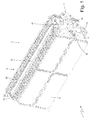
- Numeral 1 in figure 1 is a system 1 for the storage of electrical energy for a vehicle with electric propulsion.
- the storage system 1 comprises a tubular parallelepiped container 2 having two larger lateral walls 3 (only one of which is shown in figure 1 ), two smaller lateral walls 4 (only one of which is shown in figure 1 ), and two open ends (upper and lower, respectively).
- container 2 could be made of a thermally conductive and electrically insulating plastic material.
- Two groups 5 (only one of which is seen in figure 1 ) of chemical batteries 6 are housed inside container 2, each of which consists of a plurality of chemical batteries 6 arranged in a row.
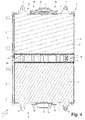
- the two groups 5 of chemical batteries 6 are arranged one above the other, that is they are overlapping; furthermore, the two groups of chemical batteries 6 present an inverted orientation (opposite), i.e. the upper group 5 of chemical batteries 6 presents an upwards orientation and the lower group 5 of chemical batteries 6 presents a downwards orientation.
- Each chemical battery 6 comprises at least one electrochemical cell, preferably Li-Ion, and an outer shell, which houses the electrochemical cell by keeping it compressed, and is made of a material with a high mechanical strength (typically a metal material such as steel or reinforced aluminium, but the use is not excluded of composite materials such as carbon fibre).
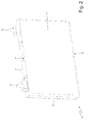
- each chemical battery 6 is substantially parallelepiped in shape and presents an upper wall 7 and a lower wall 8 (not seen in figure 2 ) which are parallel and opposite to each other, a pair of larger lateral walls 9 (only one of which is seen in figure 2 ) which are parallel and opposite to each other, and a pair of smaller lateral walls 10 (only one of which is seen in figure 2 ) which are parallel and opposite to each other.
- the upper walls 7 of the chemical batteries 6 in each group 5 of chemical batteries 6 are arranged at the open ends of container 2 so as to be seen.
- the larger lateral walls 9 of the chemical batteries 6 are parallel to the smaller lateral walls 4 of container 2, while the smaller lateral walls 10 of the chemical batteries 6 are parallel to the larger lateral walls 3 of container 2.
- the lower walls 8 of the chemical batteries 6 of the upper group 5 of chemical batteries 6 are arranged close to the lower walls 8 of the chemical batteries 6 of the lower group 5 of chemical batteries 6.
- Each chemical battery 6 presents a pair of electrical terminals 11 which project from the upper wall 7. Furthermore, each chemical battery 6 presents a safety valve 12 (i.e. a release or overpressure valve) which is arranged on the upper wall 7 between the two electrical terminals 11.
- Each safety valve 12 is calibrated to open when the pressure in the chemical battery 6 exceeds a predetermined safety pressure; in other words, each safety valve 12 is a mechanical maximum pressure valve which opens when the pressure in the chemical battery 6 is too high to prevent a violent explosion of the chemical battery 6.
- a Li-Ion electrochemical cell subject to a destructive phenomenon called thermal shift which is started by a short circuit caused by the decomposition of the individual components of the electrochemical cell (typically following production defects) and stands out for highly exothermic reactions which cause a sudden and high increase in temperature and pressure (in the case of thermal shift the temperature in the chemical battery 6 may quickly reach several hundreds of degrees).
- thermal shift of the chemical battery 6 there is a need to relieve the pressure/temperature by means of the safety valve 12 which opens autonomously, to prevent a violent explosion; once a safety valve 12 has opened autonomously due to the effect of the thrust of the pressure inside the chemical battery 6, so-called venting consisting of flames, high-temperature gas and melted lithium leaks out of the safety valve 12.
- the storage system 1 comprises a pair of relief ducts 13 which are coupled to the corresponding groups 5 of chemical batteries 6.
- Each relief duct 13 rests against the upper walls 7 of the chemical batteries 6 of the corresponding group 5 and for each safety valve 12 presents a corresponding opening 14 (clearly seen in figure 5 ) coupled to the safety valve 12.
- an annular gasket 15 arranged around each opening 14 of the relief duct 13 is an annular gasket 15 (clearly seen in figure 5 ) which rests, in a sealing manner, against the upper wall 7 of the corresponding chemical battery 6 and around the safety valve 12; the function of the annular gasket 15 is to seal the safety valve 12 to prevent blow-bys of the venting which leaks from the safety valve 12.
- each relief duct 13 is made of a rectilinear metal tube (or of another material with a high mechanical strength) which presents a closed end (blind) and an opposite open end which flows into a collecting chamber 15 (common to both relief ducts 13) through a coupling tube 16 (the relief duct 13 presents a constant cross section and is typically made by means of extrusion).
- the common collecting chamber 15 is connected to an exhaust opening which communicates with the outside environment (typically through the bottom of the vehicle) to expel any venting into the outside environment.
- each relief duct 13 The function of each relief duct 13 is to collect and channel the venting to bring the venting far from the other chemical batteries 6 which are therefore protected (it is indeed imperative to prevent a chain reaction in which the thermal shift of one chemical battery 6 extends to the other adjacent chemical batteries 6). Indeed, the venting generated by a chemical battery 6 which has gone into thermal shift is collected and conveyed by the relief duct 13 to be expelled outside the vehicle (and directly onto the surface of the road); thereby, the venting generated by a chemical battery 6 that has gone into thermal shift in no manner at all involves the adjacent chemical batteries 6.
- each relief duct 13 is rigidly connected (restrained) to container 2 and in particular, is fixed to the upper edges of the smaller lateral walls 4 of container 2.
- each relief duct 13 is screwed to the smaller lateral walls 4 of container 2 by means of the screws 17.
- storage system 1 comprises a parallelepiped cooling element 18 which is common to both groups 5 of chemical batteries 6 and is interposed between the groups 5.
- the cooling element 18 is interposed between the two groups 5 of chemical batteries 6 so as to be resting on one side against the lower walls 8 of the chemical batteries 6 of the upper group 5, and on the opposite side against the lower walls 8 of the chemical batteries 6 of the lower group 5.
- the cooling element 18 is parallel and opposite to each relief duct 13 and rests against the lower walls 8 of the chemical batteries 6, so as to be thermally coupled to the chemical batteries 6.
- the cooling element 18 is thermally connected to an external cooling system to expel the heat generated by the chemical batteries 6; according to what shown in figure 1 , the cooling element 18 comprises a pair of pipes 19 which come out of a smaller lateral wall 4 of container 2 and are used to circulate a coolant inside the cooling element 18.
- Each relief duct 13 rests against the upper walls 7 of the chemical batteries 6 of the corresponding group 5, is rigidly connected to container 2 and is shaped so as to press against the upper walls 7 of the chemical batteries 6 of the corresponding group 5 in order to apply a thrust to the chemical batteries 6, which is perpendicular to the upper walls 7 and keeps the chemical batteries 6 pressed against the cooling element 18.
- the two relief ducts 13 push the chemical batteries 6 of the corresponding groups 5 against the cooling element 18 so as to maximize the contact surface and therefore the heat exchange between the cooling element 18 and the lower walls 8 of the chemical batteries 6.
- the relief duct 13 comprises a plurality of pressing elements 20, each of which is elastically deformable in a vertical direction which is perpendicular to the upper walls 7 of the chemical batteries 6 and transmits the thrust from the relief duct 13 to the upper walls 7 of the chemical batteries 6.
- the pressing elements 20 are arranged on opposite sides of the relief duct 13 (in essence, the pressing elements 20 are shaped like lateral "legs" of the relief duct 13).
- each pressing element 20 presses against the upper wall 7 of a single corresponding chemical battery 6.
- each pressing element 20 projects from a lateral wall 21 of the relief duct 13, which is perpendicular to the upper walls 7 of the chemical batteries 6.
- Each pressing element 20 comprises an outer body 22, which is parallel and rests against the upper walls 7 of the chemical batteries 6, and a connecting body 23, which is inclined both with respect to the outer body 22, and with respect to the lateral wall 21 of the relief duct 13, and connects the outer body 22 to the lateral wall 21 of the relief duct 13.
- each pressing element 20 has a given vertically direct elasticity (i.e. perpendicular to the upper walls 7 of the chemical batteries 6) so as to elastically press (i.e. with a given "auto-adaptation" capacity) against the upper walls 7 of the chemical batteries 6.
- the vertical elasticity (i.e. perpendicular to the upper walls 7 of the chemical batteries 6) of the pressing elements 20 is important to uniformly distribute the thrust on all the corresponding chemical batteries 6 thus compensating for inevitable construction tolerances.
- an insulating layer 24 which is made of an electrically insulating material (preferably in Teflon), is interposed between the pressing elements 20 and the upper walls 7 of the chemical batteries 6 (i.e. between the outer bodies 22 of the pressing elements 20 and the upper walls 7 of the chemical batteries 6).
- an insulating layer 25 which is made of an electrically insulating and thermally conductive material, is interposed between the cooling element 18 and the lower walls 8 of the chemical batteries 6 of each group 5.
- system 1 for the storage of electrical energy described above is particularly lightweight and compact.
- one same component i.e. the relief duct 13
- carries out two functions (therefore with apparent savings): its main function of connecting the safety valves 12 to the collecting chamber 15 and further function of pushing against the upper walls 7 of the chemical batteries 6 of the corresponding group 5 to keep the chemical batteries 6 pressed against the cooling element 18.
- the thrust which is transmitted from the relief duct 13 to the upper walls 7 of the chemical batteries 6 is uniform (i.e. is equal for all the chemical batteries 6); thereby, all the chemical batteries 6 present the same heat exchange with the cooling element 18 and hence are all cooled in the same manner.
- the cooling of the chemical batteries 6 is uniform due to the presence of the pressing elements 20 and therefore certain chemical batteries 6 are prevented from cooling worse than others, thus determining a thermal overload which can also cause a premature death (i.e. a breakdown which occurs well in advance of reaching rated life) of the chemical batteries 6.
Landscapes
- Chemical & Material Sciences (AREA)
- Chemical Kinetics & Catalysis (AREA)
- Electrochemistry (AREA)
- General Chemical & Material Sciences (AREA)
- Engineering & Computer Science (AREA)
- Manufacturing & Machinery (AREA)
- Battery Mounting, Suspending (AREA)
- Secondary Cells (AREA)
- Automatic Cycles, And Cycles In General (AREA)
Abstract
Description
- The present invention relates to a system for the storage of electrical energy for a vehicle with electric propulsion.
- Currently, a system for the storage of electrical energy for a vehicle with electric propulsion comprises a plurality of chemical batteries which are arranged beside each other to form a pack, and are generally electrically connected to each other in parallel.
- Each chemical battery comprises at least one electrochemical cell and an outer shell, which houses the electrochemical cell by keeping the electrochemical cell compressed, and is made of a material with a high mechanical strength (typically a metal material such as steel or reinforced aluminium). The use was recently proposed of Li-Ion electrochemical cells which have one of the best power-weight ratios, no memory effect, and a slow loss of charge when not in use. However, a Li-Ion electrochemical cell is subject to a destructive phenomenon called thermal shift which is started by a short circuit caused by the decomposition of the individual components of the electrochemical cell (typically following production defects), and stands out for highly exothermic reactions which cause a sudden and high increase in temperature and pressure (in the case of thermal shift the temperature in the outer shell may quickly reach several hundreds of degrees). Hence, to prevent a violent explosion in the case of the thermal shift of a chemical battery, there is a need to relieve the pressure/temperature through a safety valve which is obtained in the outer shell of the chemical battery and opens autonomously; once the safety valve has opened autonomously due to the effect of the thrust of the pressure inside the outer shell, so-called venting consisting of flames, high-temperature gas and melted lithium leaks out of the safety valve. Obviously, there is a need for the storage system to be provided with relief ducts, which connect all the safety valves of the chemical batteries to (at least) one exhaust opening which opens outside the vehicle: thereby, the relief ducts collect the venting and channel the venting outside the vehicle to bring the venting far from the other chemical batteries which are therefore protected (it is indeed imperative to prevent a chain reaction in which the thermal shift of one chemical battery extends to the other adjacent chemical batteries which are struck by venting).
- Furthermore, the functioning (both when charging and discharging) of the chemical batteries is exothermic, i.e. determines the generation of heat which is to be adequately expelled to prevent overheating of the chemical batteries. Hence, there is a need for the storage system to be provided with a cooling system which may constantly remove part of the heat generated in the chemical batteries. For example, the cooling system could comprise a cooling plate, which is kept pressed against a wall of the chemical batteries and is thermally connected to a cooling system to expel the heat generated by the chemical batteries.
- As it is to comprise both the relief ducts and the cooling system (naturally, in addition to the electrical connections), the storage system is relatively cumbersome and heavy and therefore housing it is more complex inside a vehicle with reduced spaces available for the storage system (particularly in a highly performing road vehicle in which an attempt is made to contain the dimensions to minimize aerodynamic resistance).
- Patent Application
US2011293974A1 and Patent ApplicationUS2012021260A1 describe respective systems for the storage of electrical energy for a vehicle with electric propulsion. Each of these systems for the storage of electrical energy comprises: - a group of chemical batteries, which are arranged aligned with one another and each of which presents an upper wall, which is provided with electrical terminals and with a safety valve, and a lower wall, which is parallel and opposite to the upper wall;
- a container, which houses the group of chemical batteries;
- a rigid element, which rests against the upper walls of the chemical batteries at the safety valves and presents, for each safety valve, a corresponding opening, which is coupled to the safety valve; and
- a cooling element, which is parallel and opposite to the rigid element and rests against the lower walls of the chemical batteries, so as to be thermally coupled to the chemical batteries.
- However, in the systems for the storage of electrical energy described in Patent Applications
US2011293974A1 andUS2012021260A1 , a relatively frequent premature death (i.e. a breakdown which occurs well in advance of reaching rated life) can occur of certain chemical batteries. - The object of the present invention is to provide a system for the storage of electrical energy for a vehicle with electric propulsion, which is free from the above-described drawbacks and at the same time is easy and affordable to embody.
- According to the present invention, a system is provided for the storage of electrical energy for a vehicle with electric propulsion, according to what claimed by the accompanying claims.
- The present invention will now be described with reference to the accompanying drawings, which illustrate a non-limiting embodiment thereof, in which:
-
figure 1 is a perspective view of a system for the storage of electrical energy for a vehicle with electric propulsion provided in accordance with the present invention; -
figure 2 is a perspective view of the chemical battery of the storage system infigure 1 ; -
figure 3 is a view on enlarged scale, of a detail infigure 1 ; -
figure 4 is a cross-section view of the storage system infigure 1 ; and -
figure 5 is a view on enlarged scale, of a detail infigure 4 . - Numeral 1 in
figure 1 is asystem 1 for the storage of electrical energy for a vehicle with electric propulsion. - The
storage system 1 comprises a tubularparallelepiped container 2 having two larger lateral walls 3 (only one of which is shown infigure 1 ), two smaller lateral walls 4 (only one of which is shown infigure 1 ), and two open ends (upper and lower, respectively). By way of example,container 2 could be made of a thermally conductive and electrically insulating plastic material. Two groups 5 (only one of which is seen infigure 1 ) ofchemical batteries 6 are housed insidecontainer 2, each of which consists of a plurality ofchemical batteries 6 arranged in a row. As shown infigure 4 , the twogroups 5 ofchemical batteries 6 are arranged one above the other, that is they are overlapping; furthermore, the two groups ofchemical batteries 6 present an inverted orientation (opposite), i.e. theupper group 5 ofchemical batteries 6 presents an upwards orientation and thelower group 5 ofchemical batteries 6 presents a downwards orientation. - Each
chemical battery 6 comprises at least one electrochemical cell, preferably Li-Ion, and an outer shell, which houses the electrochemical cell by keeping it compressed, and is made of a material with a high mechanical strength (typically a metal material such as steel or reinforced aluminium, but the use is not excluded of composite materials such as carbon fibre). According to what shown infigure 2 , eachchemical battery 6 is substantially parallelepiped in shape and presents anupper wall 7 and a lower wall 8 (not seen infigure 2 ) which are parallel and opposite to each other, a pair of larger lateral walls 9 (only one of which is seen infigure 2 ) which are parallel and opposite to each other, and a pair of smaller lateral walls 10 (only one of which is seen infigure 2 ) which are parallel and opposite to each other. - According to what shown in
figure 4 , theupper walls 7 of thechemical batteries 6 in eachgroup 5 ofchemical batteries 6 are arranged at the open ends ofcontainer 2 so as to be seen. The largerlateral walls 9 of thechemical batteries 6 are parallel to the smallerlateral walls 4 ofcontainer 2, while the smallerlateral walls 10 of thechemical batteries 6 are parallel to the larger lateral walls 3 ofcontainer 2. Following the opposite orientation of the twogroups 5, thelower walls 8 of thechemical batteries 6 of theupper group 5 ofchemical batteries 6 are arranged close to thelower walls 8 of thechemical batteries 6 of thelower group 5 ofchemical batteries 6. - Each
chemical battery 6 presents a pair ofelectrical terminals 11 which project from theupper wall 7. Furthermore, eachchemical battery 6 presents a safety valve 12 (i.e. a release or overpressure valve) which is arranged on theupper wall 7 between the twoelectrical terminals 11. Eachsafety valve 12 is calibrated to open when the pressure in thechemical battery 6 exceeds a predetermined safety pressure; in other words, eachsafety valve 12 is a mechanical maximum pressure valve which opens when the pressure in thechemical battery 6 is too high to prevent a violent explosion of thechemical battery 6. A Li-Ion electrochemical cell subject to a destructive phenomenon called thermal shift which is started by a short circuit caused by the decomposition of the individual components of the electrochemical cell (typically following production defects) and stands out for highly exothermic reactions which cause a sudden and high increase in temperature and pressure (in the case of thermal shift the temperature in thechemical battery 6 may quickly reach several hundreds of degrees). Hence, in the case of the thermal shift of thechemical battery 6, there is a need to relieve the pressure/temperature by means of thesafety valve 12 which opens autonomously, to prevent a violent explosion; once asafety valve 12 has opened autonomously due to the effect of the thrust of the pressure inside thechemical battery 6, so-called venting consisting of flames, high-temperature gas and melted lithium leaks out of thesafety valve 12. - According to what shown in
figures 1 and3 to 5 , thestorage system 1 comprises a pair ofrelief ducts 13 which are coupled to thecorresponding groups 5 ofchemical batteries 6. Eachrelief duct 13 rests against theupper walls 7 of thechemical batteries 6 of thecorresponding group 5 and for eachsafety valve 12 presents a corresponding opening 14 (clearly seen infigure 5 ) coupled to thesafety valve 12. Preferably, arranged around eachopening 14 of therelief duct 13 is an annular gasket 15 (clearly seen infigure 5 ) which rests, in a sealing manner, against theupper wall 7 of the correspondingchemical battery 6 and around thesafety valve 12; the function of theannular gasket 15 is to seal thesafety valve 12 to prevent blow-bys of the venting which leaks from thesafety valve 12. According to what shown infigure 1 , eachrelief duct 13 is made of a rectilinear metal tube (or of another material with a high mechanical strength) which presents a closed end (blind) and an opposite open end which flows into a collecting chamber 15 (common to both relief ducts 13) through a coupling tube 16 (therelief duct 13 presents a constant cross section and is typically made by means of extrusion). When thestorage system 1 is mounted in a vehicle, thecommon collecting chamber 15 is connected to an exhaust opening which communicates with the outside environment (typically through the bottom of the vehicle) to expel any venting into the outside environment. - The function of each
relief duct 13 is to collect and channel the venting to bring the venting far from the otherchemical batteries 6 which are therefore protected (it is indeed imperative to prevent a chain reaction in which the thermal shift of onechemical battery 6 extends to the other adjacent chemical batteries 6). Indeed, the venting generated by achemical battery 6 which has gone into thermal shift is collected and conveyed by therelief duct 13 to be expelled outside the vehicle (and directly onto the surface of the road); thereby, the venting generated by achemical battery 6 that has gone into thermal shift in no manner at all involves the adjacentchemical batteries 6. - According to what shown in
figure 1 , eachrelief duct 13 is rigidly connected (restrained) tocontainer 2 and in particular, is fixed to the upper edges of the smallerlateral walls 4 ofcontainer 2. Preferably, eachrelief duct 13 is screwed to the smallerlateral walls 4 ofcontainer 2 by means of thescrews 17. - According to what shown in
figure 4 ,storage system 1 comprises aparallelepiped cooling element 18 which is common to bothgroups 5 ofchemical batteries 6 and is interposed between thegroups 5. In other words, thecooling element 18 is interposed between the twogroups 5 ofchemical batteries 6 so as to be resting on one side against thelower walls 8 of thechemical batteries 6 of theupper group 5, and on the opposite side against thelower walls 8 of thechemical batteries 6 of thelower group 5. Accordingly, thecooling element 18 is parallel and opposite to eachrelief duct 13 and rests against thelower walls 8 of thechemical batteries 6, so as to be thermally coupled to thechemical batteries 6. Thecooling element 18 is thermally connected to an external cooling system to expel the heat generated by thechemical batteries 6; according to what shown infigure 1 , thecooling element 18 comprises a pair ofpipes 19 which come out of a smallerlateral wall 4 ofcontainer 2 and are used to circulate a coolant inside thecooling element 18. - Each
relief duct 13 rests against theupper walls 7 of thechemical batteries 6 of thecorresponding group 5, is rigidly connected tocontainer 2 and is shaped so as to press against theupper walls 7 of thechemical batteries 6 of thecorresponding group 5 in order to apply a thrust to thechemical batteries 6, which is perpendicular to theupper walls 7 and keeps thechemical batteries 6 pressed against thecooling element 18. In other words, the tworelief ducts 13 push thechemical batteries 6 of thecorresponding groups 5 against thecooling element 18 so as to maximize the contact surface and therefore the heat exchange between thecooling element 18 and thelower walls 8 of thechemical batteries 6. - The
relief duct 13 comprises a plurality ofpressing elements 20, each of which is elastically deformable in a vertical direction which is perpendicular to theupper walls 7 of thechemical batteries 6 and transmits the thrust from therelief duct 13 to theupper walls 7 of thechemical batteries 6. In the embodiment shown in the accompanying figures, thepressing elements 20 are arranged on opposite sides of the relief duct 13 (in essence, thepressing elements 20 are shaped like lateral "legs" of the relief duct 13). Furthermore, in the embodiment shown in the accompanying figures, eachpressing element 20 presses against theupper wall 7 of a single correspondingchemical battery 6. According to what shown infigures 3 and5 , eachpressing element 20 projects from alateral wall 21 of therelief duct 13, which is perpendicular to theupper walls 7 of thechemical batteries 6. - Each
pressing element 20 comprises anouter body 22, which is parallel and rests against theupper walls 7 of thechemical batteries 6, and a connectingbody 23, which is inclined both with respect to theouter body 22, and with respect to thelateral wall 21 of therelief duct 13, and connects theouter body 22 to thelateral wall 21 of therelief duct 13. By projecting from alateral wall 21 of therelief duct 13, eachpressing element 20 has a given vertically direct elasticity (i.e. perpendicular to theupper walls 7 of the chemical batteries 6) so as to elastically press (i.e. with a given "auto-adaptation" capacity) against theupper walls 7 of thechemical batteries 6. The vertical elasticity (i.e. perpendicular to theupper walls 7 of the chemical batteries 6) of thepressing elements 20 is important to uniformly distribute the thrust on all the correspondingchemical batteries 6 thus compensating for inevitable construction tolerances. - According to a preferred embodiment shown in
figure 5 , an insulatinglayer 24, which is made of an electrically insulating material (preferably in Teflon), is interposed between thepressing elements 20 and theupper walls 7 of the chemical batteries 6 (i.e. between theouter bodies 22 of thepressing elements 20 and theupper walls 7 of the chemical batteries 6). - According to a preferred embodiment shown in
figure 4 , an insulatinglayer 25, which is made of an electrically insulating and thermally conductive material, is interposed between the coolingelement 18 and thelower walls 8 of thechemical batteries 6 of eachgroup 5. -
System 1 for the storage of electrical energy described above has several advantages. - Firstly,
system 1 for the storage of electrical energy described above is particularly lightweight and compact. Such a result is obtained due to the fact that one same component (i.e. the relief duct 13) carries out two functions (therefore with apparent savings): its main function of connecting thesafety valves 12 to the collectingchamber 15 and further function of pushing against theupper walls 7 of thechemical batteries 6 of thecorresponding group 5 to keep thechemical batteries 6 pressed against the coolingelement 18. - Furthermore, due to the presence of the
pressing elements 20, the thrust which is transmitted from therelief duct 13 to theupper walls 7 of thechemical batteries 6 is uniform (i.e. is equal for all the chemical batteries 6); thereby, all thechemical batteries 6 present the same heat exchange with thecooling element 18 and hence are all cooled in the same manner. In other words, the cooling of thechemical batteries 6 is uniform due to the presence of thepressing elements 20 and therefore certainchemical batteries 6 are prevented from cooling worse than others, thus determining a thermal overload which can also cause a premature death (i.e. a breakdown which occurs well in advance of reaching rated life) of thechemical batteries 6. - Finally, above-described
system 1 for the storage of electrical energy is simple and affordable to make, because therelief duct 13 is easy to make by means of extrusion and is easy to fasten tocontainer 2 by means of thescrews 17.
Claims (11)
- A system (1) for the storage of electrical energy for a vehicle with electric propulsion; the storage system (1) comprises:at least one group (5) of chemical batteries (6), which are arranged aligned with one another and each of which presents an upper wall (7), which is provided with a pair of electrical terminals (11) and of a safety valve (12), and a lower wall (8), which is parallel and opposite to the upper wall (7);a container (2), which houses the group (5) of chemical batteries (6);a relief duct (13), which rests against the upper walls (7) of the chemical batteries (6) and, for each safety valve (12), presents a corresponding opening (14), which is coupled to the safety valve (12); anda cooling element (18), which is parallel and opposite to the relief duct (13) and rests against the lower walls (8) of the chemical batteries (6), so as to be thermally coupled to the chemical batteries (6) themselves;in which the relief duct (13) is rigidly connected to the container (2) and is shaped so as to press against the upper walls (7) of the chemical batteries (6), in order to apply a thrust to the chemical batteries (6), which is perpendicular to the upper walls (7) and keeps the chemical batteries (6) pressed against the cooling element (18);the storage system (1) is characterized in that the relief duct (13) comprises a plurality of pressing elements (20), each of which is elastically deformable in a direction that is perpendicular to the upper walls (7) of the chemical batteries (6) and transmits the thrust from the relief duct (13) to the upper walls (7) of the chemical batteries (6).
- A storage system (1) according to claim 1, wherein each pressing element (20) presses against the upper wall (7) of a single corresponding chemical battery (6).
- A storage system (1) according to claim 1 or 2, wherein each pressing element (20) projects from a lateral wall (21) of the relief duct (13), which is perpendicular to the upper walls (7) of the chemical batteries (6).
- A storage system (1) according to claim 3, wherein the pressing elements (20) are arranged on opposite sides of the relief duct (13).
- A storage system (1) according to claim 3 or 4, wherein each pressing element (20) comprises an outer body (22), which rests against the upper walls (7) of the chemical batteries (6), and a connecting body (23), which is inclined and connects the outer body (22) to the lateral wall (21) of the relief duct (13).
- A storage system (1) according to any of the claims from 1 to 5, wherein a first insulating layer (24), which is made of an electrically insulating material, is interposed between the pressing elements (20) and the upper walls (7) of the chemical batteries (6).
- A storage system (1) according to claim 6, wherein the first insulating layer (24) is made of Teflon.
- A storage system (1) according to any of the claims from 1 to 7 and comprising:a first group (5) of chemical batteries (6);a second group (5) of chemical batteries (6), which is arranged under the first group (5) of chemical batteries (6) with an opposite orientation with respect to the first group (5) of chemical batteries (6), so that the lower walls (8) of the chemical batteries (6) of the first group (5) are arranged close to the lower walls (8) of the chemical batteries (6) of the second group (5);a single cooling element (18), which is interposed between the two groups (5) of chemical batteries (6), so as to rest, on one side, against the lower walls (8) of the chemical batteries (6) of the first group (5) and, on the opposite side, against the lower walls (8) of the chemical batteries (6) of the second group (5); anda pair of relief ducts (13), which are arranged on opposite sides of the container (2).
- A storage system (1) according to any of the claims from 1 to 8, wherein a second insulating layer (25), which is made of an electrically insulating and thermally conductive material, is interposed between the cooling element (18) and the lower walls (8) of the chemical batteries (6).
- A storage system according to any of the claims from 1 to 9, wherein an annular gasket (15) is arranged around each opening (14) of the relief duct (13) and rests, in a sealing manner, against the upper wall (7) of the corresponding chemical battery (6) and around the safety valve (12).
- A storage system (1) according to any of the claims from 1 to 10, wherein the cooling element (18) can be thermally connected to a cooling system, so as to expel the heat produced by the chemical batteries (6).
Applications Claiming Priority (1)
| Application Number | Priority Date | Filing Date | Title |
|---|---|---|---|
| IT000466A ITBO20120466A1 (en) | 2012-09-04 | 2012-09-04 | ELECTRICITY ACCUMULATION SYSTEM FOR A VEHICLE WITH ELECTRIC PROPULSION |
Publications (2)
| Publication Number | Publication Date |
|---|---|
| EP2704232A1 true EP2704232A1 (en) | 2014-03-05 |
| EP2704232B1 EP2704232B1 (en) | 2015-04-01 |
Family
ID=47074754
Family Applications (1)
| Application Number | Title | Priority Date | Filing Date |
|---|---|---|---|
| EP20130183037 Active EP2704232B1 (en) | 2012-09-04 | 2013-09-04 | System for the storage of electrical energy for a vehicle with electric propulsion |
Country Status (3)
| Country | Link |
|---|---|
| US (1) | US9397324B2 (en) |
| EP (1) | EP2704232B1 (en) |
| IT (1) | ITBO20120466A1 (en) |
Families Citing this family (2)
| Publication number | Priority date | Publication date | Assignee | Title |
|---|---|---|---|---|
| DE102017207188A1 (en) * | 2017-04-28 | 2018-10-31 | Robert Bosch Gmbh | Battery with a plurality of battery cells |
| DE102021109302B3 (en) * | 2021-04-14 | 2022-07-28 | Dr. Ing. H.C. F. Porsche Aktiengesellschaft | battery device |
Citations (5)
| Publication number | Priority date | Publication date | Assignee | Title |
|---|---|---|---|---|
| JP2009170258A (en) * | 2008-01-16 | 2009-07-30 | Sanyo Electric Co Ltd | Battery system |
| JP2010205509A (en) * | 2009-03-02 | 2010-09-16 | Sanyo Electric Co Ltd | Battery system |
| JP2010277735A (en) * | 2009-05-26 | 2010-12-09 | Sanyo Electric Co Ltd | Power supply device, and vehicle equipped with the same |
| US20110293974A1 (en) | 2010-06-01 | 2011-12-01 | Ji-Hyoung Yoon | Battery pack |
| US20120021260A1 (en) | 2010-01-29 | 2012-01-26 | Panasonic Corporation | Battery module |
Family Cites Families (5)
| Publication number | Priority date | Publication date | Assignee | Title |
|---|---|---|---|---|
| US4265984A (en) * | 1980-02-11 | 1981-05-05 | Duracell International Inc. | Battery housing |
| US20020028375A1 (en) * | 1995-11-22 | 2002-03-07 | Nobuyasu Morishita | Battery system |
| JP2011014321A (en) * | 2009-06-30 | 2011-01-20 | Sanyo Electric Co Ltd | Battery system |
| US8999557B2 (en) * | 2010-04-21 | 2015-04-07 | Samsung Sdi Co., Ltd. | Battery pack with elastic frame |
| WO2013038520A1 (en) * | 2011-09-14 | 2013-03-21 | 日立ビークルエナジー株式会社 | Battery |
-
2012
- 2012-09-04 IT IT000466A patent/ITBO20120466A1/en unknown
-
2013
- 2013-09-03 US US14/016,681 patent/US9397324B2/en active Active
- 2013-09-04 EP EP20130183037 patent/EP2704232B1/en active Active
Patent Citations (5)
| Publication number | Priority date | Publication date | Assignee | Title |
|---|---|---|---|---|
| JP2009170258A (en) * | 2008-01-16 | 2009-07-30 | Sanyo Electric Co Ltd | Battery system |
| JP2010205509A (en) * | 2009-03-02 | 2010-09-16 | Sanyo Electric Co Ltd | Battery system |
| JP2010277735A (en) * | 2009-05-26 | 2010-12-09 | Sanyo Electric Co Ltd | Power supply device, and vehicle equipped with the same |
| US20120021260A1 (en) | 2010-01-29 | 2012-01-26 | Panasonic Corporation | Battery module |
| US20110293974A1 (en) | 2010-06-01 | 2011-12-01 | Ji-Hyoung Yoon | Battery pack |
Also Published As
| Publication number | Publication date |
|---|---|
| EP2704232B1 (en) | 2015-04-01 |
| US20140072840A1 (en) | 2014-03-13 |
| ITBO20120466A1 (en) | 2014-03-05 |
| US9397324B2 (en) | 2016-07-19 |
Similar Documents
| Publication | Publication Date | Title |
|---|---|---|
| JP7354842B2 (en) | Partition members and assembled batteries | |
| KR102742476B1 (en) | Device for mitigating thermal event propagation to battery system | |
| US9741983B2 (en) | Battery unit comprising an accommodating device and a plurality of electrochemical cells and battery module comprising a plurality of such battery units | |
| US10276841B2 (en) | Module carrier for battery cells and method for producing the module carrier, and battery module, battery pack, battery and battery system | |
| US8007933B2 (en) | Vehicle power storage unit and vehicle | |
| US20170237111A1 (en) | Centrally located spacers for electrochemical cells | |
| JP5883132B2 (en) | Battery cell module, method for driving battery cell module, battery and vehicle | |
| US8518574B1 (en) | Heat control pouch for battery cell module and battery cell module having the same | |
| JP7200944B2 (en) | Partition member and assembled battery | |
| EP3509134B1 (en) | Safety-improved battery cell including thermal expansion tape and method of manufacturing same | |
| US11631913B2 (en) | Assembly of battery cells, and aircraft comprising such an assembly | |
| WO2014198445A1 (en) | Battery housing for receiving battery cells and battery system | |
| CN104868200A (en) | Temperature Adjusting Device And Method Used For Battery Cell And Battery Module, Battery Unit, Battery And Battery System | |
| EP3345243B1 (en) | Energy storage device with reduced temperature variability between cells | |
| EP4220820A1 (en) | Battery system with active cooling of venting channel | |
| US10044014B2 (en) | Battery unit comprising a plurality of electrochemical cells and battery module comprising a plurality of battery units | |
| EP2704232B1 (en) | System for the storage of electrical energy for a vehicle with electric propulsion | |
| JP2019102244A (en) | Partition member and battery pack | |
| US20250364663A1 (en) | Battery, and electrical device | |
| EP4525144A1 (en) | Battery pack | |
| EP4047730B1 (en) | Battery system and vehicle including the battery system | |
| US11522226B2 (en) | Solid-state battery | |
| WO2022137112A1 (en) | Battery pack comprising flat cells | |
| WO2026051170A1 (en) | Fixture, isostatic pressing apparatus, and battery production device |
Legal Events
| Date | Code | Title | Description |
|---|---|---|---|
| 17P | Request for examination filed |
Effective date: 20140117 |
|
| AK | Designated contracting states |
Kind code of ref document: A1 Designated state(s): AL AT BE BG CH CY CZ DE DK EE ES FI FR GB GR HR HU IE IS IT LI LT LU LV MC MK MT NL NO PL PT RO RS SE SI SK SM TR |
|
| AX | Request for extension of the european patent |
Extension state: BA ME |
|
| PUAI | Public reference made under article 153(3) epc to a published international application that has entered the european phase |
Free format text: ORIGINAL CODE: 0009012 |
|
| GRAP | Despatch of communication of intention to grant a patent |
Free format text: ORIGINAL CODE: EPIDOSNIGR1 |
|
| RIC1 | Information provided on ipc code assigned before grant |
Ipc: H01M 10/6567 20140101ALI20140925BHEP Ipc: H01M 2/10 20060101AFI20140925BHEP Ipc: H01M 10/625 20140101ALI20140925BHEP Ipc: H01M 2/12 20060101ALI20140925BHEP Ipc: H01M 10/613 20140101ALI20140925BHEP |
|
| INTG | Intention to grant announced |
Effective date: 20141015 |
|
| GRAS | Grant fee paid |
Free format text: ORIGINAL CODE: EPIDOSNIGR3 |
|
| GRAA | (expected) grant |
Free format text: ORIGINAL CODE: 0009210 |
|
| AK | Designated contracting states |
Kind code of ref document: B1 Designated state(s): AL AT BE BG CH CY CZ DE DK EE ES FI FR GB GR HR HU IE IS IT LI LT LU LV MC MK MT NL NO PL PT RO RS SE SI SK SM TR |
|
| REG | Reference to a national code |
Ref country code: GB Ref legal event code: FG4D |
|
| REG | Reference to a national code |
Ref country code: CH Ref legal event code: EP |
|
| REG | Reference to a national code |
Ref country code: IE Ref legal event code: FG4D |
|
| REG | Reference to a national code |
Ref country code: AT Ref legal event code: REF Ref document number: 719543 Country of ref document: AT Kind code of ref document: T Effective date: 20150515 |
|
| REG | Reference to a national code |
Ref country code: DE Ref legal event code: R096 Ref document number: 602013001365 Country of ref document: DE Effective date: 20150521 |
|
| REG | Reference to a national code |
Ref country code: NL Ref legal event code: VDEP Effective date: 20150401 |
|
| REG | Reference to a national code |
Ref country code: AT Ref legal event code: MK05 Ref document number: 719543 Country of ref document: AT Kind code of ref document: T Effective date: 20150401 |
|
| REG | Reference to a national code |
Ref country code: LT Ref legal event code: MG4D |
|
| PG25 | Lapsed in a contracting state [announced via postgrant information from national office to epo] |
Ref country code: NL Free format text: LAPSE BECAUSE OF FAILURE TO SUBMIT A TRANSLATION OF THE DESCRIPTION OR TO PAY THE FEE WITHIN THE PRESCRIBED TIME-LIMIT Effective date: 20150401 |
|
| PG25 | Lapsed in a contracting state [announced via postgrant information from national office to epo] |
Ref country code: LT Free format text: LAPSE BECAUSE OF FAILURE TO SUBMIT A TRANSLATION OF THE DESCRIPTION OR TO PAY THE FEE WITHIN THE PRESCRIBED TIME-LIMIT Effective date: 20150401 Ref country code: ES Free format text: LAPSE BECAUSE OF FAILURE TO SUBMIT A TRANSLATION OF THE DESCRIPTION OR TO PAY THE FEE WITHIN THE PRESCRIBED TIME-LIMIT Effective date: 20150401 Ref country code: HR Free format text: LAPSE BECAUSE OF FAILURE TO SUBMIT A TRANSLATION OF THE DESCRIPTION OR TO PAY THE FEE WITHIN THE PRESCRIBED TIME-LIMIT Effective date: 20150401 Ref country code: NO Free format text: LAPSE BECAUSE OF FAILURE TO SUBMIT A TRANSLATION OF THE DESCRIPTION OR TO PAY THE FEE WITHIN THE PRESCRIBED TIME-LIMIT Effective date: 20150701 Ref country code: PT Free format text: LAPSE BECAUSE OF FAILURE TO SUBMIT A TRANSLATION OF THE DESCRIPTION OR TO PAY THE FEE WITHIN THE PRESCRIBED TIME-LIMIT Effective date: 20150803 Ref country code: FI Free format text: LAPSE BECAUSE OF FAILURE TO SUBMIT A TRANSLATION OF THE DESCRIPTION OR TO PAY THE FEE WITHIN THE PRESCRIBED TIME-LIMIT Effective date: 20150401 Ref country code: CZ Free format text: LAPSE BECAUSE OF FAILURE TO SUBMIT A TRANSLATION OF THE DESCRIPTION OR TO PAY THE FEE WITHIN THE PRESCRIBED TIME-LIMIT Effective date: 20150401 |
|
| PG25 | Lapsed in a contracting state [announced via postgrant information from national office to epo] |
Ref country code: IS Free format text: LAPSE BECAUSE OF FAILURE TO SUBMIT A TRANSLATION OF THE DESCRIPTION OR TO PAY THE FEE WITHIN THE PRESCRIBED TIME-LIMIT Effective date: 20150801 Ref country code: AT Free format text: LAPSE BECAUSE OF FAILURE TO SUBMIT A TRANSLATION OF THE DESCRIPTION OR TO PAY THE FEE WITHIN THE PRESCRIBED TIME-LIMIT Effective date: 20150401 Ref country code: LV Free format text: LAPSE BECAUSE OF FAILURE TO SUBMIT A TRANSLATION OF THE DESCRIPTION OR TO PAY THE FEE WITHIN THE PRESCRIBED TIME-LIMIT Effective date: 20150401 Ref country code: RS Free format text: LAPSE BECAUSE OF FAILURE TO SUBMIT A TRANSLATION OF THE DESCRIPTION OR TO PAY THE FEE WITHIN THE PRESCRIBED TIME-LIMIT Effective date: 20150401 Ref country code: GR Free format text: LAPSE BECAUSE OF FAILURE TO SUBMIT A TRANSLATION OF THE DESCRIPTION OR TO PAY THE FEE WITHIN THE PRESCRIBED TIME-LIMIT Effective date: 20150702 |
|
| REG | Reference to a national code |
Ref country code: DE Ref legal event code: R097 Ref document number: 602013001365 Country of ref document: DE |
|
| PG25 | Lapsed in a contracting state [announced via postgrant information from national office to epo] |
Ref country code: DK Free format text: LAPSE BECAUSE OF FAILURE TO SUBMIT A TRANSLATION OF THE DESCRIPTION OR TO PAY THE FEE WITHIN THE PRESCRIBED TIME-LIMIT Effective date: 20150401 Ref country code: EE Free format text: LAPSE BECAUSE OF FAILURE TO SUBMIT A TRANSLATION OF THE DESCRIPTION OR TO PAY THE FEE WITHIN THE PRESCRIBED TIME-LIMIT Effective date: 20150401 |
|
| PLBE | No opposition filed within time limit |
Free format text: ORIGINAL CODE: 0009261 |
|
| STAA | Information on the status of an ep patent application or granted ep patent |
Free format text: STATUS: NO OPPOSITION FILED WITHIN TIME LIMIT |
|
| PG25 | Lapsed in a contracting state [announced via postgrant information from national office to epo] |
Ref country code: SK Free format text: LAPSE BECAUSE OF FAILURE TO SUBMIT A TRANSLATION OF THE DESCRIPTION OR TO PAY THE FEE WITHIN THE PRESCRIBED TIME-LIMIT Effective date: 20150401 Ref country code: PL Free format text: LAPSE BECAUSE OF FAILURE TO SUBMIT A TRANSLATION OF THE DESCRIPTION OR TO PAY THE FEE WITHIN THE PRESCRIBED TIME-LIMIT Effective date: 20150401 Ref country code: RO Free format text: LAPSE BECAUSE OF NON-PAYMENT OF DUE FEES Effective date: 20150401 |
|
| 26N | No opposition filed |
Effective date: 20160105 |
|
| PG25 | Lapsed in a contracting state [announced via postgrant information from national office to epo] |
Ref country code: MC Free format text: LAPSE BECAUSE OF FAILURE TO SUBMIT A TRANSLATION OF THE DESCRIPTION OR TO PAY THE FEE WITHIN THE PRESCRIBED TIME-LIMIT Effective date: 20150401 Ref country code: LU Free format text: LAPSE BECAUSE OF FAILURE TO SUBMIT A TRANSLATION OF THE DESCRIPTION OR TO PAY THE FEE WITHIN THE PRESCRIBED TIME-LIMIT Effective date: 20150904 |
|
| PG25 | Lapsed in a contracting state [announced via postgrant information from national office to epo] |
Ref country code: SI Free format text: LAPSE BECAUSE OF FAILURE TO SUBMIT A TRANSLATION OF THE DESCRIPTION OR TO PAY THE FEE WITHIN THE PRESCRIBED TIME-LIMIT Effective date: 20150401 |
|
| REG | Reference to a national code |
Ref country code: IE Ref legal event code: MM4A |
|
| REG | Reference to a national code |
Ref country code: FR Ref legal event code: ST Effective date: 20160531 |
|
| PG25 | Lapsed in a contracting state [announced via postgrant information from national office to epo] |
Ref country code: IE Free format text: LAPSE BECAUSE OF NON-PAYMENT OF DUE FEES Effective date: 20150904 |
|
| PG25 | Lapsed in a contracting state [announced via postgrant information from national office to epo] |
Ref country code: BE Free format text: LAPSE BECAUSE OF FAILURE TO SUBMIT A TRANSLATION OF THE DESCRIPTION OR TO PAY THE FEE WITHIN THE PRESCRIBED TIME-LIMIT Effective date: 20150401 Ref country code: FR Free format text: LAPSE BECAUSE OF NON-PAYMENT OF DUE FEES Effective date: 20150930 |
|
| PG25 | Lapsed in a contracting state [announced via postgrant information from national office to epo] |
Ref country code: MT Free format text: LAPSE BECAUSE OF FAILURE TO SUBMIT A TRANSLATION OF THE DESCRIPTION OR TO PAY THE FEE WITHIN THE PRESCRIBED TIME-LIMIT Effective date: 20150401 |
|
| REG | Reference to a national code |
Ref country code: CH Ref legal event code: PL |
|
| PG25 | Lapsed in a contracting state [announced via postgrant information from national office to epo] |
Ref country code: HU Free format text: LAPSE BECAUSE OF FAILURE TO SUBMIT A TRANSLATION OF THE DESCRIPTION OR TO PAY THE FEE WITHIN THE PRESCRIBED TIME-LIMIT; INVALID AB INITIO Effective date: 20130904 Ref country code: BG Free format text: LAPSE BECAUSE OF FAILURE TO SUBMIT A TRANSLATION OF THE DESCRIPTION OR TO PAY THE FEE WITHIN THE PRESCRIBED TIME-LIMIT Effective date: 20150401 |
|
| PG25 | Lapsed in a contracting state [announced via postgrant information from national office to epo] |
Ref country code: CY Free format text: LAPSE BECAUSE OF FAILURE TO SUBMIT A TRANSLATION OF THE DESCRIPTION OR TO PAY THE FEE WITHIN THE PRESCRIBED TIME-LIMIT Effective date: 20150401 Ref country code: SE Free format text: LAPSE BECAUSE OF FAILURE TO SUBMIT A TRANSLATION OF THE DESCRIPTION OR TO PAY THE FEE WITHIN THE PRESCRIBED TIME-LIMIT Effective date: 20150401 |
|
| PG25 | Lapsed in a contracting state [announced via postgrant information from national office to epo] |
Ref country code: CH Free format text: LAPSE BECAUSE OF NON-PAYMENT OF DUE FEES Effective date: 20160930 Ref country code: LI Free format text: LAPSE BECAUSE OF NON-PAYMENT OF DUE FEES Effective date: 20160930 |
|
| PG25 | Lapsed in a contracting state [announced via postgrant information from national office to epo] |
Ref country code: SM Free format text: LAPSE BECAUSE OF FAILURE TO SUBMIT A TRANSLATION OF THE DESCRIPTION OR TO PAY THE FEE WITHIN THE PRESCRIBED TIME-LIMIT Effective date: 20150401 |
|
| PG25 | Lapsed in a contracting state [announced via postgrant information from national office to epo] |
Ref country code: MK Free format text: LAPSE BECAUSE OF FAILURE TO SUBMIT A TRANSLATION OF THE DESCRIPTION OR TO PAY THE FEE WITHIN THE PRESCRIBED TIME-LIMIT Effective date: 20150401 Ref country code: TR Free format text: LAPSE BECAUSE OF FAILURE TO SUBMIT A TRANSLATION OF THE DESCRIPTION OR TO PAY THE FEE WITHIN THE PRESCRIBED TIME-LIMIT Effective date: 20150401 |
|
| PG25 | Lapsed in a contracting state [announced via postgrant information from national office to epo] |
Ref country code: AL Free format text: LAPSE BECAUSE OF FAILURE TO SUBMIT A TRANSLATION OF THE DESCRIPTION OR TO PAY THE FEE WITHIN THE PRESCRIBED TIME-LIMIT Effective date: 20150401 |
|
| REG | Reference to a national code |
Ref country code: DE Ref legal event code: R079 Ref document number: 602013001365 Country of ref document: DE Free format text: PREVIOUS MAIN CLASS: H01M0002100000 Ipc: H01M0050200000 |
|
| P01 | Opt-out of the competence of the unified patent court (upc) registered |
Effective date: 20230525 |
|
| PGFP | Annual fee paid to national office [announced via postgrant information from national office to epo] |
Ref country code: DE Payment date: 20250926 Year of fee payment: 13 |
|
| PGFP | Annual fee paid to national office [announced via postgrant information from national office to epo] |
Ref country code: IT Payment date: 20250908 Year of fee payment: 13 |
|
| PGFP | Annual fee paid to national office [announced via postgrant information from national office to epo] |
Ref country code: GB Payment date: 20250923 Year of fee payment: 13 |