EP2703398B1 - 1,4-dihydropyridine -3,5-dicarboxylate derivatives, preparation methods and uses thereof - Google Patents
1,4-dihydropyridine -3,5-dicarboxylate derivatives, preparation methods and uses thereof Download PDFInfo
- Publication number
- EP2703398B1 EP2703398B1 EP12776764.8A EP12776764A EP2703398B1 EP 2703398 B1 EP2703398 B1 EP 2703398B1 EP 12776764 A EP12776764 A EP 12776764A EP 2703398 B1 EP2703398 B1 EP 2703398B1
- Authority
- EP
- European Patent Office
- Prior art keywords
- methyl
- dihydropyridine
- dimethyl
- nitrophenyl
- dicarboxylate
- Prior art date
- Legal status (The legal status is an assumption and is not a legal conclusion. Google has not performed a legal analysis and makes no representation as to the accuracy of the status listed.)
- Not-in-force
Links
- 238000002360 preparation method Methods 0.000 title description 73
- COLPLFZHPXIFCQ-UHFFFAOYSA-N 1,4-dihydropyridine-3,5-dicarboxylic acid Chemical class OC(=O)C1=CNC=C(C(O)=O)C1 COLPLFZHPXIFCQ-UHFFFAOYSA-N 0.000 title description 2
- 238000006243 chemical reaction Methods 0.000 claims description 129
- 150000001875 compounds Chemical class 0.000 claims description 97
- -1 pyrrolidinylmethyl Chemical group 0.000 claims description 84
- 229910052739 hydrogen Inorganic materials 0.000 claims description 34
- 239000007858 starting material Substances 0.000 claims description 34
- 150000003839 salts Chemical class 0.000 claims description 31
- 239000003795 chemical substances by application Substances 0.000 claims description 23
- 125000001153 fluoro group Chemical group F* 0.000 claims description 21
- JPXPPUOCSLMCHK-UHFFFAOYSA-N 5-methoxycarbonyl-2,6-dimethyl-4-(3-nitrophenyl)-1,4-dihydropyridine-3-carboxylic acid Chemical compound COC(=O)C1=C(C)NC(C)=C(C(O)=O)C1C1=CC=CC([N+]([O-])=O)=C1 JPXPPUOCSLMCHK-UHFFFAOYSA-N 0.000 claims description 18
- 125000001495 ethyl group Chemical group [H]C([H])([H])C([H])([H])* 0.000 claims description 18
- 125000002496 methyl group Chemical group [H]C([H])([H])* 0.000 claims description 17
- 125000001424 substituent group Chemical group 0.000 claims description 14
- 239000001257 hydrogen Substances 0.000 claims description 12
- 239000003960 organic solvent Substances 0.000 claims description 12
- 125000001309 chloro group Chemical group Cl* 0.000 claims description 11
- 239000003112 inhibitor Substances 0.000 claims description 11
- 239000008194 pharmaceutical composition Substances 0.000 claims description 11
- 102000003729 Neprilysin Human genes 0.000 claims description 8
- 108090000028 Neprilysin Proteins 0.000 claims description 8
- 230000009977 dual effect Effects 0.000 claims description 8
- 125000000956 methoxy group Chemical group [H]C([H])([H])O* 0.000 claims description 8
- QVZRJEWWCPRJRQ-JUKUECOXSA-N 5-o-[(3s)-1-(3,3-diphenylpropyl)-3-methylpyrrolidin-3-yl] 3-o-methyl (4s)-2,6-dimethyl-4-(3-nitrophenyl)-1,4-dihydropyridine-3,5-dicarboxylate Chemical compound C1([C@@H]2C(=C(C)NC(C)=C2C(=O)OC)C(=O)O[C@]2(C)CN(CCC(C=3C=CC=CC=3)C=3C=CC=CC=3)CC2)=CC=CC([N+]([O-])=O)=C1 QVZRJEWWCPRJRQ-JUKUECOXSA-N 0.000 claims description 7
- 206010020772 Hypertension Diseases 0.000 claims description 7
- 238000004519 manufacturing process Methods 0.000 claims description 7
- 125000001997 phenyl group Chemical group [H]C1=C([H])C([H])=C(*)C([H])=C1[H] 0.000 claims description 7
- 238000010992 reflux Methods 0.000 claims description 7
- ZNQOCZIYVSMRCH-KDMOYCQDSA-N 3-o-methyl 5-o-[3-methyl-1-(1-phenylethyl)pyrrolidin-3-yl] (4s)-2,6-dimethyl-4-(3-nitrophenyl)-1,4-dihydropyridine-3,5-dicarboxylate Chemical compound C1([C@@H]2C(=C(C)NC(C)=C2C(=O)OC)C(=O)OC2(C)CN(CC2)C(C)C=2C=CC=CC=2)=CC=CC([N+]([O-])=O)=C1 ZNQOCZIYVSMRCH-KDMOYCQDSA-N 0.000 claims description 6
- MYRFVZIJWPJKQW-GYXLRUHFSA-N 5-o-[1-(2,2-diphenylethyl)-3-methylpyrrolidin-3-yl] 3-o-methyl (4s)-2,6-dimethyl-4-(3-nitrophenyl)-1,4-dihydropyridine-3,5-dicarboxylate Chemical compound C1([C@@H]2C(=C(C)NC(C)=C2C(=O)OC)C(=O)OC2(C)CN(CC(C=3C=CC=CC=3)C=3C=CC=CC=3)CC2)=CC=CC([N+]([O-])=O)=C1 MYRFVZIJWPJKQW-GYXLRUHFSA-N 0.000 claims description 6
- MYRFVZIJWPJKQW-UHFFFAOYSA-N 5-o-[1-(2,2-diphenylethyl)-3-methylpyrrolidin-3-yl] 3-o-methyl 2,6-dimethyl-4-(3-nitrophenyl)-1,4-dihydropyridine-3,5-dicarboxylate Chemical compound COC(=O)C1=C(C)NC(C)=C(C(=O)OC2(C)CN(CC(C=3C=CC=CC=3)C=3C=CC=CC=3)CC2)C1C1=CC=CC([N+]([O-])=O)=C1 MYRFVZIJWPJKQW-UHFFFAOYSA-N 0.000 claims description 6
- OEKTXYNZSNUVEG-UHFFFAOYSA-N 5-o-[1-(3,3-diphenylpropyl)-3-methylpyrrolidin-3-yl] 3-o-ethyl 2,6-dimethyl-4-(3-nitrophenyl)-1,4-dihydropyridine-3,5-dicarboxylate Chemical compound CCOC(=O)C1=C(C)NC(C)=C(C(=O)OC2(C)CN(CCC(C=3C=CC=CC=3)C=3C=CC=CC=3)CC2)C1C1=CC=CC([N+]([O-])=O)=C1 OEKTXYNZSNUVEG-UHFFFAOYSA-N 0.000 claims description 6
- QVZRJEWWCPRJRQ-LUEXLKCISA-N 5-o-[1-(3,3-diphenylpropyl)-3-methylpyrrolidin-3-yl] 3-o-methyl (4s)-2,6-dimethyl-4-(3-nitrophenyl)-1,4-dihydropyridine-3,5-dicarboxylate Chemical compound C1([C@@H]2C(=C(C)NC(C)=C2C(=O)OC)C(=O)OC2(C)CN(CCC(C=3C=CC=CC=3)C=3C=CC=CC=3)CC2)=CC=CC([N+]([O-])=O)=C1 QVZRJEWWCPRJRQ-LUEXLKCISA-N 0.000 claims description 6
- 208000024172 Cardiovascular disease Diseases 0.000 claims description 6
- 239000003814 drug Substances 0.000 claims description 6
- 125000001301 ethoxy group Chemical group [H]C([H])([H])C([H])([H])O* 0.000 claims description 6
- 239000000126 substance Substances 0.000 claims description 6
- 125000000229 (C1-C4)alkoxy group Chemical group 0.000 claims description 5
- OXUOMQOKQSYPQU-CEBUJLNPSA-N 3-o-methyl 5-o-[3-methyl-1-(3-phenylpropyl)pyrrolidin-3-yl] (4s)-2,6-dimethyl-4-(3-nitrophenyl)-1,4-dihydropyridine-3,5-dicarboxylate Chemical compound C1([C@@H]2C(=C(C)NC(C)=C2C(=O)OC)C(=O)OC2(C)CN(CCCC=3C=CC=CC=3)CC2)=CC=CC([N+]([O-])=O)=C1 OXUOMQOKQSYPQU-CEBUJLNPSA-N 0.000 claims description 5
- QVZRJEWWCPRJRQ-MSEJLTFDSA-N 5-o-[(3r)-1-(3,3-diphenylpropyl)-3-methylpyrrolidin-3-yl] 3-o-methyl (4s)-2,6-dimethyl-4-(3-nitrophenyl)-1,4-dihydropyridine-3,5-dicarboxylate Chemical compound C1([C@@H]2C(=C(C)NC(C)=C2C(=O)OC)C(=O)O[C@@]2(C)CN(CCC(C=3C=CC=CC=3)C=3C=CC=CC=3)CC2)=CC=CC([N+]([O-])=O)=C1 QVZRJEWWCPRJRQ-MSEJLTFDSA-N 0.000 claims description 5
- 206010061481 Renal injury Diseases 0.000 claims description 5
- 239000002253 acid Substances 0.000 claims description 5
- 208000030172 endocrine system disease Diseases 0.000 claims description 5
- 208000037806 kidney injury Diseases 0.000 claims description 5
- 208000010125 myocardial infarction Diseases 0.000 claims description 5
- 125000004575 3-pyrrolidinyl group Chemical group [H]N1C([H])([H])C([H])([H])C([H])(*)C1([H])[H] 0.000 claims description 4
- MYRFVZIJWPJKQW-HJIQQCSTSA-N 5-o-[(3r)-1-(2,2-diphenylethyl)-3-methylpyrrolidin-3-yl] 3-o-methyl (4s)-2,6-dimethyl-4-(3-nitrophenyl)-1,4-dihydropyridine-3,5-dicarboxylate Chemical compound C1([C@@H]2C(=C(C)NC(C)=C2C(=O)OC)C(=O)O[C@@]2(C)CN(CC(C=3C=CC=CC=3)C=3C=CC=CC=3)CC2)=CC=CC([N+]([O-])=O)=C1 MYRFVZIJWPJKQW-HJIQQCSTSA-N 0.000 claims description 4
- QVZRJEWWCPRJRQ-GHJZRCEGSA-N 5-o-[1-(3,3-diphenylpropyl)-3-methylpyrrolidin-3-yl] 3-o-methyl (4r)-2,6-dimethyl-4-(3-nitrophenyl)-1,4-dihydropyridine-3,5-dicarboxylate Chemical compound C1([C@H]2C(=C(C)NC(C)=C2C(=O)OC)C(=O)OC2(C)CN(CCC(C=3C=CC=CC=3)C=3C=CC=CC=3)CC2)=CC=CC([N+]([O-])=O)=C1 QVZRJEWWCPRJRQ-GHJZRCEGSA-N 0.000 claims description 4
- QVZRJEWWCPRJRQ-UHFFFAOYSA-N 5-o-[1-(3,3-diphenylpropyl)-3-methylpyrrolidin-3-yl] 3-o-methyl 2,6-dimethyl-4-(3-nitrophenyl)-1,4-dihydropyridine-3,5-dicarboxylate Chemical compound COC(=O)C1=C(C)NC(C)=C(C(=O)OC2(C)CN(CCC(C=3C=CC=CC=3)C=3C=CC=CC=3)CC2)C1C1=CC=CC([N+]([O-])=O)=C1 QVZRJEWWCPRJRQ-UHFFFAOYSA-N 0.000 claims description 4
- FXHQXNCKVSIWLS-LUEXLKCISA-N 5-o-[1-[3,3-bis(4-fluorophenyl)propyl]-3-methylpyrrolidin-3-yl] 3-o-methyl (4s)-2,6-dimethyl-4-(3-nitrophenyl)-1,4-dihydropyridine-3,5-dicarboxylate Chemical compound C1([C@@H]2C(=C(C)NC(C)=C2C(=O)OC)C(=O)OC2(C)CN(CCC(C=3C=CC(F)=CC=3)C=3C=CC(F)=CC=3)CC2)=CC=CC([N+]([O-])=O)=C1 FXHQXNCKVSIWLS-LUEXLKCISA-N 0.000 claims description 4
- 102100030988 Angiotensin-converting enzyme Human genes 0.000 claims description 4
- UFHFLCQGNIYNRP-UHFFFAOYSA-N Hydrogen Chemical compound [H][H] UFHFLCQGNIYNRP-UHFFFAOYSA-N 0.000 claims description 4
- 125000002393 azetidinyl group Chemical group 0.000 claims description 4
- 239000003638 chemical reducing agent Substances 0.000 claims description 4
- 239000003937 drug carrier Substances 0.000 claims description 4
- 125000002541 furyl group Chemical group 0.000 claims description 4
- 125000002757 morpholinyl group Chemical group 0.000 claims description 4
- 125000000449 nitro group Chemical group [O-][N+](*)=O 0.000 claims description 4
- 238000010534 nucleophilic substitution reaction Methods 0.000 claims description 4
- 125000005936 piperidyl group Chemical group 0.000 claims description 4
- 125000002924 primary amino group Chemical group [H]N([H])* 0.000 claims description 4
- 125000004076 pyridyl group Chemical group 0.000 claims description 4
- 125000000719 pyrrolidinyl group Chemical group 0.000 claims description 4
- 125000000168 pyrrolyl group Chemical group 0.000 claims description 4
- 230000001225 therapeutic effect Effects 0.000 claims description 4
- 125000000335 thiazolyl group Chemical group 0.000 claims description 4
- 125000001544 thienyl group Chemical group 0.000 claims description 4
- 125000002023 trifluoromethyl group Chemical group FC(F)(F)* 0.000 claims description 4
- 125000004178 (C1-C4) alkyl group Chemical group 0.000 claims description 3
- MYRFVZIJWPJKQW-SHUZPENHSA-N 5-o-[(3s)-1-(2,2-diphenylethyl)-3-methylpyrrolidin-3-yl] 3-o-methyl (4s)-2,6-dimethyl-4-(3-nitrophenyl)-1,4-dihydropyridine-3,5-dicarboxylate Chemical compound C1([C@@H]2C(=C(C)NC(C)=C2C(=O)OC)C(=O)O[C@]2(C)CN(CC(C=3C=CC=CC=3)C=3C=CC=CC=3)CC2)=CC=CC([N+]([O-])=O)=C1 MYRFVZIJWPJKQW-SHUZPENHSA-N 0.000 claims description 3
- PNPXUTBSRVCILU-LFGICVIVSA-N 5-o-[(3s)-1-(3,3-diphenylpropyl)-3-methylpyrrolidin-3-yl] 3-o-propan-2-yl (4s)-2,6-dimethyl-4-(3-nitrophenyl)-1,4-dihydropyridine-3,5-dicarboxylate Chemical compound C1([C@@H]2C(=C(C)NC(C)=C2C(=O)OC(C)C)C(=O)O[C@]2(C)CN(CCC(C=3C=CC=CC=3)C=3C=CC=CC=3)CC2)=CC=CC([N+]([O-])=O)=C1 PNPXUTBSRVCILU-LFGICVIVSA-N 0.000 claims description 3
- FXHQXNCKVSIWLS-UHFFFAOYSA-N 5-o-[1-[3,3-bis(4-fluorophenyl)propyl]-3-methylpyrrolidin-3-yl] 3-o-methyl 2,6-dimethyl-4-(3-nitrophenyl)-1,4-dihydropyridine-3,5-dicarboxylate Chemical compound COC(=O)C1=C(C)NC(C)=C(C(=O)OC2(C)CN(CCC(C=3C=CC(F)=CC=3)C=3C=CC(F)=CC=3)CC2)C1C1=CC=CC([N+]([O-])=O)=C1 FXHQXNCKVSIWLS-UHFFFAOYSA-N 0.000 claims description 3
- PCZOHLXUXFIOCF-UHFFFAOYSA-N Monacolin X Natural products C12C(OC(=O)C(C)CC)CC(C)C=C2C=CC(C)C1CCC1CC(O)CC(=O)O1 PCZOHLXUXFIOCF-UHFFFAOYSA-N 0.000 claims description 3
- 125000001559 cyclopropyl group Chemical group [H]C1([H])C([H])([H])C1([H])* 0.000 claims description 3
- 229940079593 drug Drugs 0.000 claims description 3
- 125000001449 isopropyl group Chemical group [H]C([H])([H])C([H])(*)C([H])([H])[H] 0.000 claims description 3
- 229960004844 lovastatin Drugs 0.000 claims description 3
- PCZOHLXUXFIOCF-BXMDZJJMSA-N lovastatin Chemical compound C([C@H]1[C@@H](C)C=CC2=C[C@H](C)C[C@@H]([C@H]12)OC(=O)[C@@H](C)CC)C[C@@H]1C[C@@H](O)CC(=O)O1 PCZOHLXUXFIOCF-BXMDZJJMSA-N 0.000 claims description 3
- QLJODMDSTUBWDW-UHFFFAOYSA-N lovastatin hydroxy acid Natural products C1=CC(C)C(CCC(O)CC(O)CC(O)=O)C2C(OC(=O)C(C)CC)CC(C)C=C21 QLJODMDSTUBWDW-UHFFFAOYSA-N 0.000 claims description 3
- 239000000463 material Substances 0.000 claims description 3
- BIDNLKIUORFRQP-XYGFDPSESA-N (2s,4s)-4-cyclohexyl-1-[2-[[(1s)-2-methyl-1-propanoyloxypropoxy]-(4-phenylbutyl)phosphoryl]acetyl]pyrrolidine-2-carboxylic acid Chemical compound C([P@@](=O)(O[C@H](OC(=O)CC)C(C)C)CC(=O)N1[C@@H](C[C@H](C1)C1CCCCC1)C(O)=O)CCCC1=CC=CC=C1 BIDNLKIUORFRQP-XYGFDPSESA-N 0.000 claims description 2
- ZGGHKIMDNBDHJB-NRFPMOEYSA-M (3R,5S)-fluvastatin sodium Chemical compound [Na+].C12=CC=CC=C2N(C(C)C)C(\C=C\[C@@H](O)C[C@@H](O)CC([O-])=O)=C1C1=CC=C(F)C=C1 ZGGHKIMDNBDHJB-NRFPMOEYSA-M 0.000 claims description 2
- BOVGTQGAOIONJV-BETUJISGSA-N 1-[(3ar,6as)-3,3a,4,5,6,6a-hexahydro-1h-cyclopenta[c]pyrrol-2-yl]-3-(4-methylphenyl)sulfonylurea Chemical compound C1=CC(C)=CC=C1S(=O)(=O)NC(=O)NN1C[C@H]2CCC[C@H]2C1 BOVGTQGAOIONJV-BETUJISGSA-N 0.000 claims description 2
- UUUHXMGGBIUAPW-UHFFFAOYSA-N 1-[1-[2-[[5-amino-2-[[1-[5-(diaminomethylideneamino)-2-[[1-[3-(1h-indol-3-yl)-2-[(5-oxopyrrolidine-2-carbonyl)amino]propanoyl]pyrrolidine-2-carbonyl]amino]pentanoyl]pyrrolidine-2-carbonyl]amino]-5-oxopentanoyl]amino]-3-methylpentanoyl]pyrrolidine-2-carbon Chemical compound C1CCC(C(=O)N2C(CCC2)C(O)=O)N1C(=O)C(C(C)CC)NC(=O)C(CCC(N)=O)NC(=O)C1CCCN1C(=O)C(CCCN=C(N)N)NC(=O)C1CCCN1C(=O)C(CC=1C2=CC=CC=C2NC=1)NC(=O)C1CCC(=O)N1 UUUHXMGGBIUAPW-UHFFFAOYSA-N 0.000 claims description 2
- LLJFMFZYVVLQKT-UHFFFAOYSA-N 1-cyclohexyl-3-[4-[2-(7-methoxy-4,4-dimethyl-1,3-dioxo-2-isoquinolinyl)ethyl]phenyl]sulfonylurea Chemical compound C=1C(OC)=CC=C(C(C2=O)(C)C)C=1C(=O)N2CCC(C=C1)=CC=C1S(=O)(=O)NC(=O)NC1CCCCC1 LLJFMFZYVVLQKT-UHFFFAOYSA-N 0.000 claims description 2
- IRYYBLVABSEZSR-WIOPSUGQSA-N 3-o-methyl 5-o-[(3r)-3-methyl-1-(1,3-thiazol-2-ylmethyl)pyrrolidin-3-yl] (4s)-2,6-dimethyl-4-(3-nitrophenyl)-1,4-dihydropyridine-3,5-dicarboxylate Chemical compound C1([C@@H]2C(=C(C)NC(C)=C2C(=O)OC)C(=O)O[C@@]2(C)CN(CC=3SC=CN=3)CC2)=CC=CC([N+]([O-])=O)=C1 IRYYBLVABSEZSR-WIOPSUGQSA-N 0.000 claims description 2
- IRYYBLVABSEZSR-UHFFFAOYSA-N 3-o-methyl 5-o-[3-methyl-1-(1,3-thiazol-2-ylmethyl)pyrrolidin-3-yl] 2,6-dimethyl-4-(3-nitrophenyl)-1,4-dihydropyridine-3,5-dicarboxylate Chemical compound COC(=O)C1=C(C)NC(C)=C(C(=O)OC2(C)CN(CC=3SC=CN=3)CC2)C1C1=CC=CC([N+]([O-])=O)=C1 IRYYBLVABSEZSR-UHFFFAOYSA-N 0.000 claims description 2
- CERYACIDCKYTFB-UHFFFAOYSA-N 3-o-methyl 5-o-[3-methyl-1-(pyridin-2-ylmethyl)pyrrolidin-3-yl] 2,6-dimethyl-4-(3-nitrophenyl)-1,4-dihydropyridine-3,5-dicarboxylate Chemical compound COC(=O)C1=C(C)NC(C)=C(C(=O)OC2(C)CN(CC=3N=CC=CC=3)CC2)C1C1=CC=CC([N+]([O-])=O)=C1 CERYACIDCKYTFB-UHFFFAOYSA-N 0.000 claims description 2
- CZXUXVNPKNBBGG-UHFFFAOYSA-N 3-o-methyl 5-o-[3-methyl-1-(pyridin-3-ylmethyl)pyrrolidin-3-yl] 2,6-dimethyl-4-(3-nitrophenyl)-1,4-dihydropyridine-3,5-dicarboxylate Chemical compound COC(=O)C1=C(C)NC(C)=C(C(=O)OC2(C)CN(CC=3C=NC=CC=3)CC2)C1C1=CC=CC([N+]([O-])=O)=C1 CZXUXVNPKNBBGG-UHFFFAOYSA-N 0.000 claims description 2
- UBXLFKZHTIOBHE-PIZIKKFZSA-N 5-o-[(3r)-1-(3,3-diphenylpropyl)-3-ethylpyrrolidin-3-yl] 3-o-methyl (4s)-2,6-dimethyl-4-(3-nitrophenyl)-1,4-dihydropyridine-3,5-dicarboxylate Chemical compound C([C@@](C1)(CC)OC(=O)C=2[C@H](C(=C(C)NC=2C)C(=O)OC)C=2C=C(C=CC=2)[N+]([O-])=O)CN1CCC(C=1C=CC=CC=1)C1=CC=CC=C1 UBXLFKZHTIOBHE-PIZIKKFZSA-N 0.000 claims description 2
- CWAMDIZPVRKLNK-FOYYQAIFSA-N 5-o-[(3r)-1-(3,3-diphenylpropyl)-3-methylpyrrolidin-3-yl] 3-o-(2-methoxyethyl) (4r)-2,6-dimethyl-4-(3-nitrophenyl)-1,4-dihydropyridine-3,5-dicarboxylate Chemical compound C1([C@H]2C(=C(C)NC(C)=C2C(=O)OCCOC)C(=O)O[C@@]2(C)CN(CCC(C=3C=CC=CC=3)C=3C=CC=CC=3)CC2)=CC=CC([N+]([O-])=O)=C1 CWAMDIZPVRKLNK-FOYYQAIFSA-N 0.000 claims description 2
- OEKTXYNZSNUVEG-PIZIKKFZSA-N 5-o-[(3r)-1-(3,3-diphenylpropyl)-3-methylpyrrolidin-3-yl] 3-o-ethyl (4s)-2,6-dimethyl-4-(3-nitrophenyl)-1,4-dihydropyridine-3,5-dicarboxylate Chemical compound C1([C@@H]2C(=C(C)NC(C)=C2C(=O)OCC)C(=O)O[C@@]2(C)CN(CCC(C=3C=CC=CC=3)C=3C=CC=CC=3)CC2)=CC=CC([N+]([O-])=O)=C1 OEKTXYNZSNUVEG-PIZIKKFZSA-N 0.000 claims description 2
- FXHQXNCKVSIWLS-MSEJLTFDSA-N 5-o-[(3r)-1-[3,3-bis(4-fluorophenyl)propyl]-3-methylpyrrolidin-3-yl] 3-o-methyl (4s)-2,6-dimethyl-4-(3-nitrophenyl)-1,4-dihydropyridine-3,5-dicarboxylate Chemical compound C1([C@@H]2C(=C(C)NC(C)=C2C(=O)OC)C(=O)O[C@@]2(C)CN(CCC(C=3C=CC(F)=CC=3)C=3C=CC(F)=CC=3)CC2)=CC=CC([N+]([O-])=O)=C1 FXHQXNCKVSIWLS-MSEJLTFDSA-N 0.000 claims description 2
- BZESTGIWGQGGFS-MSEJLTFDSA-N 5-o-[(3r)-3-(aminomethyl)-1-(3,3-diphenylpropyl)pyrrolidin-3-yl] 3-o-methyl (4s)-2,6-dimethyl-4-(3-nitrophenyl)-1,4-dihydropyridine-3,5-dicarboxylate Chemical compound C1([C@@H]2C(=C(C)NC(C)=C2C(=O)OC)C(=O)O[C@]2(CN)CN(CCC(C=3C=CC=CC=3)C=3C=CC=CC=3)CC2)=CC=CC([N+]([O-])=O)=C1 BZESTGIWGQGGFS-MSEJLTFDSA-N 0.000 claims description 2
- UVKULBMHLHSZTI-LBHUVFDKSA-N 5-o-[(3r)-3-(difluoromethyl)-1-(3,3-diphenylpropyl)pyrrolidin-3-yl] 3-o-methyl (4s)-2,6-dimethyl-4-(3-nitrophenyl)-1,4-dihydropyridine-3,5-dicarboxylate Chemical compound C1([C@@H]2C(=C(C)NC(C)=C2C(=O)OC)C(=O)O[C@]2(CN(CCC(C=3C=CC=CC=3)C=3C=CC=CC=3)CC2)C(F)F)=CC=CC([N+]([O-])=O)=C1 UVKULBMHLHSZTI-LBHUVFDKSA-N 0.000 claims description 2
- FXHQXNCKVSIWLS-JUKUECOXSA-N 5-o-[(3s)-1-[3,3-bis(4-fluorophenyl)propyl]-3-methylpyrrolidin-3-yl] 3-o-methyl (4s)-2,6-dimethyl-4-(3-nitrophenyl)-1,4-dihydropyridine-3,5-dicarboxylate Chemical compound C1([C@@H]2C(=C(C)NC(C)=C2C(=O)OC)C(=O)O[C@]2(C)CN(CCC(C=3C=CC(F)=CC=3)C=3C=CC(F)=CC=3)CC2)=CC=CC([N+]([O-])=O)=C1 FXHQXNCKVSIWLS-JUKUECOXSA-N 0.000 claims description 2
- UBXLFKZHTIOBHE-UHFFFAOYSA-N 5-o-[1-(3,3-diphenylpropyl)-3-ethylpyrrolidin-3-yl] 3-o-methyl 2,6-dimethyl-4-(3-nitrophenyl)-1,4-dihydropyridine-3,5-dicarboxylate Chemical compound C1C(CC)(OC(=O)C=2C(C(=C(C)NC=2C)C(=O)OC)C=2C=C(C=CC=2)[N+]([O-])=O)CCN1CCC(C=1C=CC=CC=1)C1=CC=CC=C1 UBXLFKZHTIOBHE-UHFFFAOYSA-N 0.000 claims description 2
- PNPXUTBSRVCILU-UHFFFAOYSA-N 5-o-[1-(3,3-diphenylpropyl)-3-methylpyrrolidin-3-yl] 3-o-propan-2-yl 2,6-dimethyl-4-(3-nitrophenyl)-1,4-dihydropyridine-3,5-dicarboxylate Chemical compound CC(C)OC(=O)C1=C(C)NC(C)=C(C(=O)OC2(C)CN(CCC(C=3C=CC=CC=3)C=3C=CC=CC=3)CC2)C1C1=CC=CC([N+]([O-])=O)=C1 PNPXUTBSRVCILU-UHFFFAOYSA-N 0.000 claims description 2
- UVKULBMHLHSZTI-UHFFFAOYSA-N 5-o-[3-(difluoromethyl)-1-(3,3-diphenylpropyl)pyrrolidin-3-yl] 3-o-methyl 2,6-dimethyl-4-(3-nitrophenyl)-1,4-dihydropyridine-3,5-dicarboxylate Chemical compound COC(=O)C1=C(C)NC(C)=C(C(=O)OC2(CN(CCC(C=3C=CC=CC=3)C=3C=CC=CC=3)CC2)C(F)F)C1C1=CC=CC([N+]([O-])=O)=C1 UVKULBMHLHSZTI-UHFFFAOYSA-N 0.000 claims description 2
- 208000026872 Addison Disease Diseases 0.000 claims description 2
- FHHHOYXPRDYHEZ-COXVUDFISA-N Alacepril Chemical compound CC(=O)SC[C@@H](C)C(=O)N1CCC[C@H]1C(=O)N[C@H](C(O)=O)CC1=CC=CC=C1 FHHHOYXPRDYHEZ-COXVUDFISA-N 0.000 claims description 2
- 206010002383 Angina Pectoris Diseases 0.000 claims description 2
- 229940123413 Angiotensin II antagonist Drugs 0.000 claims description 2
- XUKUURHRXDUEBC-KAYWLYCHSA-N Atorvastatin Chemical compound C=1C=CC=CC=1C1=C(C=2C=CC(F)=CC=2)N(CC[C@@H](O)C[C@@H](O)CC(O)=O)C(C(C)C)=C1C(=O)NC1=CC=CC=C1 XUKUURHRXDUEBC-KAYWLYCHSA-N 0.000 claims description 2
- XUKUURHRXDUEBC-UHFFFAOYSA-N Atorvastatin Natural products C=1C=CC=CC=1C1=C(C=2C=CC(F)=CC=2)N(CCC(O)CC(O)CC(O)=O)C(C(C)C)=C1C(=O)NC1=CC=CC=C1 XUKUURHRXDUEBC-UHFFFAOYSA-N 0.000 claims description 2
- 208000012904 Bartter disease Diseases 0.000 claims description 2
- 208000010062 Bartter syndrome Diseases 0.000 claims description 2
- XPCFTKFZXHTYIP-PMACEKPBSA-N Benazepril Chemical compound C([C@@H](C(=O)OCC)N[C@@H]1C(N(CC(O)=O)C2=CC=CC=C2CC1)=O)CC1=CC=CC=C1 XPCFTKFZXHTYIP-PMACEKPBSA-N 0.000 claims description 2
- 239000002083 C09CA01 - Losartan Substances 0.000 claims description 2
- 239000004072 C09CA03 - Valsartan Substances 0.000 claims description 2
- 239000002947 C09CA04 - Irbesartan Substances 0.000 claims description 2
- 239000002053 C09CA06 - Candesartan Substances 0.000 claims description 2
- 206010007572 Cardiac hypertrophy Diseases 0.000 claims description 2
- 208000006029 Cardiomegaly Diseases 0.000 claims description 2
- 208000016998 Conn syndrome Diseases 0.000 claims description 2
- 208000014311 Cushing syndrome Diseases 0.000 claims description 2
- 108010061435 Enalapril Proteins 0.000 claims description 2
- 102000010180 Endothelin receptor Human genes 0.000 claims description 2
- 108050001739 Endothelin receptor Proteins 0.000 claims description 2
- 206010016654 Fibrosis Diseases 0.000 claims description 2
- 206010016803 Fluid overload Diseases 0.000 claims description 2
- 206010019280 Heart failures Diseases 0.000 claims description 2
- LTXREWYXXSTFRX-QGZVFWFLSA-N Linagliptin Chemical compound N=1C=2N(C)C(=O)N(CC=3N=C4C=CC=CC4=C(C)N=3)C(=O)C=2N(CC#CC)C=1N1CCC[C@@H](N)C1 LTXREWYXXSTFRX-QGZVFWFLSA-N 0.000 claims description 2
- 108010007859 Lisinopril Proteins 0.000 claims description 2
- 102000003979 Mineralocorticoid Receptors Human genes 0.000 claims description 2
- 108090000375 Mineralocorticoid Receptors Proteins 0.000 claims description 2
- UWWDHYUMIORJTA-HSQYWUDLSA-N Moexipril Chemical compound C([C@@H](C(=O)OCC)N[C@@H](C)C(=O)N1[C@@H](CC2=CC(OC)=C(OC)C=C2C1)C(O)=O)CC1=CC=CC=C1 UWWDHYUMIORJTA-HSQYWUDLSA-N 0.000 claims description 2
- 208000009525 Myocarditis Diseases 0.000 claims description 2
- 239000005480 Olmesartan Substances 0.000 claims description 2
- 108090000882 Peptidyl-Dipeptidase A Proteins 0.000 claims description 2
- TUZYXOIXSAXUGO-UHFFFAOYSA-N Pravastatin Natural products C1=CC(C)C(CCC(O)CC(O)CC(O)=O)C2C(OC(=O)C(C)CC)CC(O)C=C21 TUZYXOIXSAXUGO-UHFFFAOYSA-N 0.000 claims description 2
- RYMZZMVNJRMUDD-UHFFFAOYSA-N SJ000286063 Natural products C12C(OC(=O)C(C)(C)CC)CC(C)C=C2C=CC(C)C1CCC1CC(O)CC(=O)O1 RYMZZMVNJRMUDD-UHFFFAOYSA-N 0.000 claims description 2
- AJLFOPYRIVGYMJ-UHFFFAOYSA-N SJ000287055 Natural products C12C(OC(=O)C(C)CC)CCC=C2C=CC(C)C1CCC1CC(O)CC(=O)O1 AJLFOPYRIVGYMJ-UHFFFAOYSA-N 0.000 claims description 2
- 206010039808 Secondary aldosteronism Diseases 0.000 claims description 2
- VXFJYXUZANRPDJ-WTNASJBWSA-N Trandopril Chemical compound C([C@@H](C(=O)OCC)N[C@@H](C)C(=O)N1[C@@H](C[C@H]2CCCC[C@@H]21)C(O)=O)CC1=CC=CC=C1 VXFJYXUZANRPDJ-WTNASJBWSA-N 0.000 claims description 2
- 150000001266 acyl halides Chemical class 0.000 claims description 2
- 229950007884 alacepril Drugs 0.000 claims description 2
- 229960000447 alogliptin benzoate Drugs 0.000 claims description 2
- KEJICOXJTRHYAK-XFULWGLBSA-N alogliptin benzoate Chemical compound OC(=O)C1=CC=CC=C1.C=1C=CC=C(C#N)C=1CN1C(=O)N(C)C(=O)C=C1N1CCC[C@@H](N)C1 KEJICOXJTRHYAK-XFULWGLBSA-N 0.000 claims description 2
- 102000004305 alpha Adrenergic Receptors Human genes 0.000 claims description 2
- 108090000861 alpha Adrenergic Receptors Proteins 0.000 claims description 2
- 239000002333 angiotensin II receptor antagonist Substances 0.000 claims description 2
- 230000003178 anti-diabetic effect Effects 0.000 claims description 2
- 229960005370 atorvastatin Drugs 0.000 claims description 2
- 108091008698 baroreceptors Proteins 0.000 claims description 2
- 229960004530 benazepril Drugs 0.000 claims description 2
- 125000001797 benzyl group Chemical group [H]C1=C([H])C([H])=C(C([H])=C1[H])C([H])([H])* 0.000 claims description 2
- 102000012740 beta Adrenergic Receptors Human genes 0.000 claims description 2
- 108010079452 beta Adrenergic Receptors Proteins 0.000 claims description 2
- GJPICJJJRGTNOD-UHFFFAOYSA-N bosentan Chemical compound COC1=CC=CC=C1OC(C(=NC(=N1)C=2N=CC=CN=2)OCCO)=C1NS(=O)(=O)C1=CC=C(C(C)(C)C)C=C1 GJPICJJJRGTNOD-UHFFFAOYSA-N 0.000 claims description 2
- 229960003065 bosentan Drugs 0.000 claims description 2
- 229960000932 candesartan Drugs 0.000 claims description 2
- SGZAIDDFHDDFJU-UHFFFAOYSA-N candesartan Chemical compound CCOC1=NC2=CC=CC(C(O)=O)=C2N1CC(C=C1)=CC=C1C1=CC=CC=C1C1=NN=N[N]1 SGZAIDDFHDDFJU-UHFFFAOYSA-N 0.000 claims description 2
- 229960000830 captopril Drugs 0.000 claims description 2
- FAKRSMQSSFJEIM-RQJHMYQMSA-N captopril Chemical compound SC[C@@H](C)C(=O)N1CCC[C@H]1C(O)=O FAKRSMQSSFJEIM-RQJHMYQMSA-N 0.000 claims description 2
- NPAKNKYSJIDKMW-UHFFFAOYSA-N carvedilol Chemical compound COC1=CC=CC=C1OCCNCC(O)COC1=CC=CC2=NC3=CC=C[CH]C3=C12 NPAKNKYSJIDKMW-UHFFFAOYSA-N 0.000 claims description 2
- 229960004195 carvedilol Drugs 0.000 claims description 2
- 229960005110 cerivastatin Drugs 0.000 claims description 2
- SEERZIQQUAZTOL-ANMDKAQQSA-N cerivastatin Chemical compound COCC1=C(C(C)C)N=C(C(C)C)C(\C=C\[C@@H](O)C[C@@H](O)CC(O)=O)=C1C1=CC=C(F)C=C1 SEERZIQQUAZTOL-ANMDKAQQSA-N 0.000 claims description 2
- 239000003354 cholesterol ester transfer protein inhibitor Substances 0.000 claims description 2
- 208000025302 chronic primary adrenal insufficiency Diseases 0.000 claims description 2
- 229960005025 cilazapril Drugs 0.000 claims description 2
- HHHKFGXWKKUNCY-FHWLQOOXSA-N cilazapril Chemical compound C([C@@H](C(=O)OCC)N[C@@H]1C(N2[C@@H](CCCN2CCC1)C(O)=O)=O)CC1=CC=CC=C1 HHHKFGXWKKUNCY-FHWLQOOXSA-N 0.000 claims description 2
- 238000006482 condensation reaction Methods 0.000 claims description 2
- 238000005859 coupling reaction Methods 0.000 claims description 2
- 125000004186 cyclopropylmethyl group Chemical group [H]C([H])(*)C1([H])C([H])([H])C1([H])[H] 0.000 claims description 2
- 229960005227 delapril Drugs 0.000 claims description 2
- WOUOLAUOZXOLJQ-MBSDFSHPSA-N delapril Chemical compound C([C@@H](C(=O)OCC)N[C@@H](C)C(=O)N(CC(O)=O)C1CC2=CC=CC=C2C1)CC1=CC=CC=C1 WOUOLAUOZXOLJQ-MBSDFSHPSA-N 0.000 claims description 2
- 125000001028 difluoromethyl group Chemical group [H]C(F)(F)* 0.000 claims description 2
- 229960001389 doxazosin Drugs 0.000 claims description 2
- RUZYUOTYCVRMRZ-UHFFFAOYSA-N doxazosin Chemical compound C1OC2=CC=CC=C2OC1C(=O)N(CC1)CCN1C1=NC(N)=C(C=C(C(OC)=C2)OC)C2=N1 RUZYUOTYCVRMRZ-UHFFFAOYSA-N 0.000 claims description 2
- 230000004064 dysfunction Effects 0.000 claims description 2
- 230000002526 effect on cardiovascular system Effects 0.000 claims description 2
- 229960000873 enalapril Drugs 0.000 claims description 2
- GBXSMTUPTTWBMN-XIRDDKMYSA-N enalapril Chemical compound C([C@@H](C(=O)OCC)N[C@@H](C)C(=O)N1[C@@H](CCC1)C(O)=O)CC1=CC=CC=C1 GBXSMTUPTTWBMN-XIRDDKMYSA-N 0.000 claims description 2
- 229960001208 eplerenone Drugs 0.000 claims description 2
- JUKPWJGBANNWMW-VWBFHTRKSA-N eplerenone Chemical compound C([C@@H]1[C@]2(C)C[C@H]3O[C@]33[C@@]4(C)CCC(=O)C=C4C[C@H]([C@@H]13)C(=O)OC)C[C@@]21CCC(=O)O1 JUKPWJGBANNWMW-VWBFHTRKSA-N 0.000 claims description 2
- 230000004761 fibrosis Effects 0.000 claims description 2
- 125000004216 fluoromethyl group Chemical group [H]C([H])(F)* 0.000 claims description 2
- 229960003765 fluvastatin Drugs 0.000 claims description 2
- 229960002490 fosinopril Drugs 0.000 claims description 2
- 229960004580 glibenclamide Drugs 0.000 claims description 2
- 229960001764 glibornuride Drugs 0.000 claims description 2
- RMTYNAPTNBJHQI-LLDVTBCESA-N glibornuride Chemical compound C1=CC(C)=CC=C1S(=O)(=O)NC(=O)N[C@H]1[C@H](C2(C)C)CC[C@@]2(C)[C@H]1O RMTYNAPTNBJHQI-LLDVTBCESA-N 0.000 claims description 2
- 229960000346 gliclazide Drugs 0.000 claims description 2
- 229960001381 glipizide Drugs 0.000 claims description 2
- ZJJXGWJIGJFDTL-UHFFFAOYSA-N glipizide Chemical compound C1=NC(C)=CN=C1C(=O)NCCC1=CC=C(S(=O)(=O)NC(=O)NC2CCCCC2)C=C1 ZJJXGWJIGJFDTL-UHFFFAOYSA-N 0.000 claims description 2
- 229960003468 gliquidone Drugs 0.000 claims description 2
- ZNNLBTZKUZBEKO-UHFFFAOYSA-N glyburide Chemical compound COC1=CC=C(Cl)C=C1C(=O)NCCC1=CC=C(S(=O)(=O)NC(=O)NC2CCCCC2)C=C1 ZNNLBTZKUZBEKO-UHFFFAOYSA-N 0.000 claims description 2
- 229960001195 imidapril Drugs 0.000 claims description 2
- KLZWOWYOHUKJIG-BPUTZDHNSA-N imidapril Chemical compound C([C@@H](C(=O)OCC)N[C@@H](C)C(=O)N1C(N(C)C[C@H]1C(O)=O)=O)CC1=CC=CC=C1 KLZWOWYOHUKJIG-BPUTZDHNSA-N 0.000 claims description 2
- 239000004041 inotropic agent Substances 0.000 claims description 2
- 229960002198 irbesartan Drugs 0.000 claims description 2
- YCPOHTHPUREGFM-UHFFFAOYSA-N irbesartan Chemical compound O=C1N(CC=2C=CC(=CC=2)C=2C(=CC=CC=2)C=2[N]N=NN=2)C(CCCC)=NC21CCCC2 YCPOHTHPUREGFM-UHFFFAOYSA-N 0.000 claims description 2
- 229960002397 linagliptin Drugs 0.000 claims description 2
- 229960002394 lisinopril Drugs 0.000 claims description 2
- RLAWWYSOJDYHDC-BZSNNMDCSA-N lisinopril Chemical compound C([C@H](N[C@@H](CCCCN)C(=O)N1[C@@H](CCC1)C(O)=O)C(O)=O)CC1=CC=CC=C1 RLAWWYSOJDYHDC-BZSNNMDCSA-N 0.000 claims description 2
- 229960004773 losartan Drugs 0.000 claims description 2
- KJJZZJSZUJXYEA-UHFFFAOYSA-N losartan Chemical compound CCCCC1=NC(Cl)=C(CO)N1CC1=CC=C(C=2C(=CC=CC=2)C=2[N]N=NN=2)C=C1 KJJZZJSZUJXYEA-UHFFFAOYSA-N 0.000 claims description 2
- 239000012528 membrane Substances 0.000 claims description 2
- 229960003105 metformin Drugs 0.000 claims description 2
- XZWYZXLIPXDOLR-UHFFFAOYSA-N metformin Chemical compound CN(C)C(=N)NC(N)=N XZWYZXLIPXDOLR-UHFFFAOYSA-N 0.000 claims description 2
- IUBSYMUCCVWXPE-UHFFFAOYSA-N metoprolol Chemical compound COCCC1=CC=C(OCC(O)CNC(C)C)C=C1 IUBSYMUCCVWXPE-UHFFFAOYSA-N 0.000 claims description 2
- 229960002237 metoprolol Drugs 0.000 claims description 2
- 229950009116 mevastatin Drugs 0.000 claims description 2
- AJLFOPYRIVGYMJ-INTXDZFKSA-N mevastatin Chemical compound C([C@H]1[C@@H](C)C=CC2=CCC[C@@H]([C@H]12)OC(=O)[C@@H](C)CC)C[C@@H]1C[C@@H](O)CC(=O)O1 AJLFOPYRIVGYMJ-INTXDZFKSA-N 0.000 claims description 2
- BOZILQFLQYBIIY-UHFFFAOYSA-N mevastatin hydroxy acid Natural products C1=CC(C)C(CCC(O)CC(O)CC(O)=O)C2C(OC(=O)C(C)CC)CCC=C21 BOZILQFLQYBIIY-UHFFFAOYSA-N 0.000 claims description 2
- 229960005170 moexipril Drugs 0.000 claims description 2
- 229960005117 olmesartan Drugs 0.000 claims description 2
- VTRAEEWXHOVJFV-UHFFFAOYSA-N olmesartan Chemical compound CCCC1=NC(C(C)(C)O)=C(C(O)=O)N1CC1=CC=C(C=2C(=CC=CC=2)C=2NN=NN=2)C=C1 VTRAEEWXHOVJFV-UHFFFAOYSA-N 0.000 claims description 2
- 229960002582 perindopril Drugs 0.000 claims description 2
- IPVQLZZIHOAWMC-QXKUPLGCSA-N perindopril Chemical compound C1CCC[C@H]2C[C@@H](C(O)=O)N(C(=O)[C@H](C)N[C@@H](CCC)C(=O)OCC)[C@H]21 IPVQLZZIHOAWMC-QXKUPLGCSA-N 0.000 claims description 2
- 229960002965 pravastatin Drugs 0.000 claims description 2
- TUZYXOIXSAXUGO-PZAWKZKUSA-N pravastatin Chemical compound C1=C[C@H](C)[C@H](CC[C@@H](O)C[C@@H](O)CC(O)=O)[C@H]2[C@@H](OC(=O)[C@@H](C)CC)C[C@H](O)C=C21 TUZYXOIXSAXUGO-PZAWKZKUSA-N 0.000 claims description 2
- 229960001289 prazosin Drugs 0.000 claims description 2
- IENZQIKPVFGBNW-UHFFFAOYSA-N prazosin Chemical compound N=1C(N)=C2C=C(OC)C(OC)=CC2=NC=1N(CC1)CCN1C(=O)C1=CC=CO1 IENZQIKPVFGBNW-UHFFFAOYSA-N 0.000 claims description 2
- 210000001774 pressoreceptor Anatomy 0.000 claims description 2
- 208000013846 primary aldosteronism Diseases 0.000 claims description 2
- 201000009395 primary hyperaldosteronism Diseases 0.000 claims description 2
- 125000001436 propyl group Chemical group [H]C([*])([H])C([H])([H])C([H])([H])[H] 0.000 claims description 2
- 229960001455 quinapril Drugs 0.000 claims description 2
- JSDRRTOADPPCHY-HSQYWUDLSA-N quinapril Chemical compound C([C@@H](C(=O)OCC)N[C@@H](C)C(=O)N1[C@@H](CC2=CC=CC=C2C1)C(O)=O)CC1=CC=CC=C1 JSDRRTOADPPCHY-HSQYWUDLSA-N 0.000 claims description 2
- 229960003401 ramipril Drugs 0.000 claims description 2
- HDACQVRGBOVJII-JBDAPHQKSA-N ramipril Chemical compound C([C@@H](C(=O)OCC)N[C@@H](C)C(=O)N1[C@@H](C[C@@H]2CCC[C@@H]21)C(O)=O)CC1=CC=CC=C1 HDACQVRGBOVJII-JBDAPHQKSA-N 0.000 claims description 2
- 239000002464 receptor antagonist Substances 0.000 claims description 2
- 229940044551 receptor antagonist Drugs 0.000 claims description 2
- 229960004937 saxagliptin Drugs 0.000 claims description 2
- 108010033693 saxagliptin Proteins 0.000 claims description 2
- QGJUIPDUBHWZPV-SGTAVMJGSA-N saxagliptin Chemical compound C1C(C2)CC(C3)CC2(O)CC13[C@H](N)C(=O)N1[C@H](C#N)C[C@@H]2C[C@@H]21 QGJUIPDUBHWZPV-SGTAVMJGSA-N 0.000 claims description 2
- 229960002855 simvastatin Drugs 0.000 claims description 2
- RYMZZMVNJRMUDD-HGQWONQESA-N simvastatin Chemical compound C([C@H]1[C@@H](C)C=CC2=C[C@H](C)C[C@@H]([C@H]12)OC(=O)C(C)(C)CC)C[C@@H]1C[C@@H](O)CC(=O)O1 RYMZZMVNJRMUDD-HGQWONQESA-N 0.000 claims description 2
- 229960004034 sitagliptin Drugs 0.000 claims description 2
- MFFMDFFZMYYVKS-SECBINFHSA-N sitagliptin Chemical compound C([C@H](CC(=O)N1CC=2N(C(=NN=2)C(F)(F)F)CC1)N)C1=CC(F)=C(F)C=C1F MFFMDFFZMYYVKS-SECBINFHSA-N 0.000 claims description 2
- 229960002909 spirapril Drugs 0.000 claims description 2
- HRWCVUIFMSZDJS-SZMVWBNQSA-N spirapril Chemical compound C([C@@H](C(=O)OCC)N[C@@H](C)C(=O)N1[C@@H](CC2(C1)SCCS2)C(O)=O)CC1=CC=CC=C1 HRWCVUIFMSZDJS-SZMVWBNQSA-N 0.000 claims description 2
- 108700035424 spirapril Proteins 0.000 claims description 2
- 229960002256 spironolactone Drugs 0.000 claims description 2
- LXMSZDCAJNLERA-ZHYRCANASA-N spironolactone Chemical compound C([C@@H]1[C@]2(C)CC[C@@H]3[C@@]4(C)CCC(=O)C=C4C[C@H]([C@@H]13)SC(=O)C)C[C@@]21CCC(=O)O1 LXMSZDCAJNLERA-ZHYRCANASA-N 0.000 claims description 2
- VCKUSRYTPJJLNI-UHFFFAOYSA-N terazosin Chemical compound N=1C(N)=C2C=C(OC)C(OC)=CC2=NC=1N(CC1)CCN1C(=O)C1CCCO1 VCKUSRYTPJJLNI-UHFFFAOYSA-N 0.000 claims description 2
- 229960001693 terazosin Drugs 0.000 claims description 2
- 229960002051 trandolapril Drugs 0.000 claims description 2
- 229960004699 valsartan Drugs 0.000 claims description 2
- SJSNUMAYCRRIOM-QFIPXVFZSA-N valsartan Chemical compound C1=CC(CN(C(=O)CCCC)[C@@H](C(C)C)C(O)=O)=CC=C1C1=CC=CC=C1C1=NN=N[N]1 SJSNUMAYCRRIOM-QFIPXVFZSA-N 0.000 claims description 2
- 229960001254 vildagliptin Drugs 0.000 claims description 2
- SYOKIDBDQMKNDQ-XWTIBIIYSA-N vildagliptin Chemical compound C1C(O)(C2)CC(C3)CC1CC32NCC(=O)N1CCC[C@H]1C#N SYOKIDBDQMKNDQ-XWTIBIIYSA-N 0.000 claims description 2
- 150000002431 hydrogen Chemical group 0.000 claims 4
- ZNQOCZIYVSMRCH-UHFFFAOYSA-N 3-o-methyl 5-o-[3-methyl-1-(1-phenylethyl)pyrrolidin-3-yl] 2,6-dimethyl-4-(3-nitrophenyl)-1,4-dihydropyridine-3,5-dicarboxylate Chemical compound COC(=O)C1=C(C)NC(C)=C(C(=O)OC2(C)CN(CC2)C(C)C=2C=CC=CC=2)C1C1=CC=CC([N+]([O-])=O)=C1 ZNQOCZIYVSMRCH-UHFFFAOYSA-N 0.000 claims 2
- TZDPJNSHSWMCPN-UHFFFAOYSA-N 2,6-dimethyl-4-(3-nitrophenyl)-1,4-dihydropyridine-3,5-dicarboxylic acid Chemical compound OC(=O)C1=C(C)NC(C)=C(C(O)=O)C1C1=CC=CC([N+]([O-])=O)=C1 TZDPJNSHSWMCPN-UHFFFAOYSA-N 0.000 claims 1
- UBXLFKZHTIOBHE-UNVMMQEESA-N 5-o-[(3s)-1-(3,3-diphenylpropyl)-3-ethylpyrrolidin-3-yl] 3-o-methyl (4s)-2,6-dimethyl-4-(3-nitrophenyl)-1,4-dihydropyridine-3,5-dicarboxylate Chemical compound C([C@](C1)(CC)OC(=O)C=2[C@H](C(=C(C)NC=2C)C(=O)OC)C=2C=C(C=CC=2)[N+]([O-])=O)CN1CCC(C=1C=CC=CC=1)C1=CC=CC=C1 UBXLFKZHTIOBHE-UNVMMQEESA-N 0.000 claims 1
- OEKTXYNZSNUVEG-UNVMMQEESA-N 5-o-[(3s)-1-(3,3-diphenylpropyl)-3-methylpyrrolidin-3-yl] 3-o-ethyl (4s)-2,6-dimethyl-4-(3-nitrophenyl)-1,4-dihydropyridine-3,5-dicarboxylate Chemical compound C1([C@@H]2C(=C(C)NC(C)=C2C(=O)OCC)C(=O)O[C@]2(C)CN(CCC(C=3C=CC=CC=3)C=3C=CC=CC=3)CC2)=CC=CC([N+]([O-])=O)=C1 OEKTXYNZSNUVEG-UNVMMQEESA-N 0.000 claims 1
- 201000010099 disease Diseases 0.000 claims 1
- 208000037265 diseases, disorders, signs and symptoms Diseases 0.000 claims 1
- 239000002552 dosage form Substances 0.000 claims 1
- 229960000672 rosuvastatin Drugs 0.000 claims 1
- BPRHUIZQVSMCRT-VEUZHWNKSA-N rosuvastatin Chemical compound CC(C)C1=NC(N(C)S(C)(=O)=O)=NC(C=2C=CC(F)=CC=2)=C1\C=C\[C@@H](O)C[C@@H](O)CC(O)=O BPRHUIZQVSMCRT-VEUZHWNKSA-N 0.000 claims 1
- 208000016261 weight loss Diseases 0.000 claims 1
- 230000004580 weight loss Effects 0.000 claims 1
- YMWUJEATGCHHMB-UHFFFAOYSA-N Dichloromethane Chemical compound ClCCl YMWUJEATGCHHMB-UHFFFAOYSA-N 0.000 description 125
- 239000000243 solution Substances 0.000 description 100
- 239000000203 mixture Substances 0.000 description 70
- WEVYAHXRMPXWCK-UHFFFAOYSA-N Acetonitrile Chemical compound CC#N WEVYAHXRMPXWCK-UHFFFAOYSA-N 0.000 description 66
- XEKOWRVHYACXOJ-UHFFFAOYSA-N Ethyl acetate Chemical compound CCOC(C)=O XEKOWRVHYACXOJ-UHFFFAOYSA-N 0.000 description 60
- IAZDPXIOMUYVGZ-UHFFFAOYSA-N Dimethylsulphoxide Chemical compound CS(C)=O IAZDPXIOMUYVGZ-UHFFFAOYSA-N 0.000 description 58
- RTZKZFJDLAIYFH-UHFFFAOYSA-N Diethyl ether Chemical compound CCOCC RTZKZFJDLAIYFH-UHFFFAOYSA-N 0.000 description 53
- XLYOFNOQVPJJNP-UHFFFAOYSA-N water Substances O XLYOFNOQVPJJNP-UHFFFAOYSA-N 0.000 description 50
- OKKJLVBELUTLKV-UHFFFAOYSA-N Methanol Chemical compound OC OKKJLVBELUTLKV-UHFFFAOYSA-N 0.000 description 48
- ZMXDDKWLCZADIW-UHFFFAOYSA-N N,N-Dimethylformamide Chemical compound CN(C)C=O ZMXDDKWLCZADIW-UHFFFAOYSA-N 0.000 description 40
- HEMHJVSKTPXQMS-UHFFFAOYSA-M Sodium hydroxide Chemical compound [OH-].[Na+] HEMHJVSKTPXQMS-UHFFFAOYSA-M 0.000 description 39
- 108090000312 Calcium Channels Proteins 0.000 description 37
- 102000003922 Calcium Channels Human genes 0.000 description 37
- 238000003756 stirring Methods 0.000 description 35
- CTSLXHKWHWQRSH-UHFFFAOYSA-N oxalyl chloride Chemical compound ClC(=O)C(Cl)=O CTSLXHKWHWQRSH-UHFFFAOYSA-N 0.000 description 32
- VEXZGXHMUGYJMC-UHFFFAOYSA-N Hydrochloric acid Chemical compound Cl VEXZGXHMUGYJMC-UHFFFAOYSA-N 0.000 description 29
- WYURNTSHIVDZCO-UHFFFAOYSA-N Tetrahydrofuran Chemical compound C1CCOC1 WYURNTSHIVDZCO-UHFFFAOYSA-N 0.000 description 29
- 229910001868 water Inorganic materials 0.000 description 28
- PMZURENOXWZQFD-UHFFFAOYSA-L Sodium Sulfate Chemical compound [Na+].[Na+].[O-]S([O-])(=O)=O PMZURENOXWZQFD-UHFFFAOYSA-L 0.000 description 24
- 230000001077 hypotensive effect Effects 0.000 description 24
- JPXPPUOCSLMCHK-CQSZACIVSA-N 76093-33-9 Chemical compound COC(=O)C1=C(C)NC(C)=C(C(O)=O)[C@H]1C1=CC=CC([N+]([O-])=O)=C1 JPXPPUOCSLMCHK-CQSZACIVSA-N 0.000 description 22
- 230000000694 effects Effects 0.000 description 22
- LFQSCWFLJHTTHZ-UHFFFAOYSA-N Ethanol Chemical compound CCO LFQSCWFLJHTTHZ-UHFFFAOYSA-N 0.000 description 21
- JGFZNNIVVJXRND-UHFFFAOYSA-N N,N-Diisopropylethylamine (DIPEA) Chemical compound CCN(C(C)C)C(C)C JGFZNNIVVJXRND-UHFFFAOYSA-N 0.000 description 21
- 239000012043 crude product Substances 0.000 description 21
- 239000012074 organic phase Substances 0.000 description 21
- 238000012360 testing method Methods 0.000 description 21
- 239000002904 solvent Substances 0.000 description 20
- 238000004440 column chromatography Methods 0.000 description 17
- ZDVCDFWGMDLBMU-UHFFFAOYSA-N 3-methylpyrrolidin-3-ol;hydrochloride Chemical compound Cl.CC1(O)CCNC1 ZDVCDFWGMDLBMU-UHFFFAOYSA-N 0.000 description 16
- KFZMGEQAYNKOFK-UHFFFAOYSA-N Isopropanol Chemical compound CC(C)O KFZMGEQAYNKOFK-UHFFFAOYSA-N 0.000 description 16
- VYPSYNLAJGMNEJ-UHFFFAOYSA-N Silicium dioxide Chemical compound O=[Si]=O VYPSYNLAJGMNEJ-UHFFFAOYSA-N 0.000 description 16
- FAPWRFPIFSIZLT-UHFFFAOYSA-M Sodium chloride Chemical compound [Na+].[Cl-] FAPWRFPIFSIZLT-UHFFFAOYSA-M 0.000 description 16
- 239000000706 filtrate Substances 0.000 description 16
- 239000003208 petroleum Substances 0.000 description 16
- 239000000741 silica gel Substances 0.000 description 16
- 229910002027 silica gel Inorganic materials 0.000 description 16
- 239000007787 solid Substances 0.000 description 16
- 238000001816 cooling Methods 0.000 description 14
- 239000000047 product Substances 0.000 description 14
- YLQBMQCUIZJEEH-UHFFFAOYSA-N tetrahydrofuran Natural products C=1C=COC=1 YLQBMQCUIZJEEH-UHFFFAOYSA-N 0.000 description 14
- 0 CC(NC(C)=C(C1c2cccc([N+]([O-])=O)c2)C(OC2(*)CN(Cc3ccccc3)CC2)=O)=C1C(OC)=O Chemical compound CC(NC(C)=C(C1c2cccc([N+]([O-])=O)c2)C(OC2(*)CN(Cc3ccccc3)CC2)=O)=C1C(OC)=O 0.000 description 13
- 238000002474 experimental method Methods 0.000 description 13
- 235000011121 sodium hydroxide Nutrition 0.000 description 13
- 229960000528 amlodipine Drugs 0.000 description 12
- HTIQEAQVCYTUBX-UHFFFAOYSA-N amlodipine Chemical compound CCOC(=O)C1=C(COCCN)NC(C)=C(C(=O)OC)C1C1=CC=CC=C1Cl HTIQEAQVCYTUBX-UHFFFAOYSA-N 0.000 description 12
- BWHMMNNQKKPAPP-UHFFFAOYSA-L potassium carbonate Chemical compound [K+].[K+].[O-]C([O-])=O BWHMMNNQKKPAPP-UHFFFAOYSA-L 0.000 description 12
- KUKBSCDLQYSNME-UHFFFAOYSA-N 1-(3,3-diphenylpropyl)-3-methylpyrrolidin-3-ol Chemical compound C1C(C)(O)CCN1CCC(C=1C=CC=CC=1)C1=CC=CC=C1 KUKBSCDLQYSNME-UHFFFAOYSA-N 0.000 description 11
- 229960002992 barnidipine Drugs 0.000 description 11
- VXMOONUMYLCFJD-DHLKQENFSA-N barnidipine Chemical compound C1([C@@H]2C(=C(C)NC(C)=C2C(=O)OC)C(=O)O[C@@H]2CN(CC=3C=CC=CC=3)CC2)=CC=CC([N+]([O-])=O)=C1 VXMOONUMYLCFJD-DHLKQENFSA-N 0.000 description 11
- 230000005764 inhibitory process Effects 0.000 description 11
- 230000003287 optical effect Effects 0.000 description 11
- ITOFPJRDSCGOSA-KZLRUDJFSA-N (2s)-2-[[(4r)-4-[(3r,5r,8r,9s,10s,13r,14s,17r)-3-hydroxy-10,13-dimethyl-2,3,4,5,6,7,8,9,11,12,14,15,16,17-tetradecahydro-1h-cyclopenta[a]phenanthren-17-yl]pentanoyl]amino]-3-(1h-indol-3-yl)propanoic acid Chemical compound C([C@H]1CC2)[C@H](O)CC[C@]1(C)[C@@H](CC[C@]13C)[C@@H]2[C@@H]3CC[C@@H]1[C@H](C)CCC(=O)N[C@H](C(O)=O)CC1=CNC2=CC=CC=C12 ITOFPJRDSCGOSA-KZLRUDJFSA-N 0.000 description 10
- IWZSHWBGHQBIML-ZGGLMWTQSA-N (3S,8S,10R,13S,14S,17S)-17-isoquinolin-7-yl-N,N,10,13-tetramethyl-2,3,4,7,8,9,11,12,14,15,16,17-dodecahydro-1H-cyclopenta[a]phenanthren-3-amine Chemical compound CN(C)[C@H]1CC[C@]2(C)C3CC[C@@]4(C)[C@@H](CC[C@@H]4c4ccc5ccncc5c4)[C@@H]3CC=C2C1 IWZSHWBGHQBIML-ZGGLMWTQSA-N 0.000 description 10
- 238000003556 assay Methods 0.000 description 10
- 229940125782 compound 2 Drugs 0.000 description 10
- 229940125810 compound 20 Drugs 0.000 description 10
- 238000004128 high performance liquid chromatography Methods 0.000 description 10
- 229960004294 lercanidipine Drugs 0.000 description 10
- ZDXUKAKRHYTAKV-UHFFFAOYSA-N lercanidipine Chemical compound COC(=O)C1=C(C)NC(C)=C(C(=O)OC(C)(C)CN(C)CCC(C=2C=CC=CC=2)C=2C=CC=CC=2)C1C1=CC=CC([N+]([O-])=O)=C1 ZDXUKAKRHYTAKV-UHFFFAOYSA-N 0.000 description 10
- 238000000034 method Methods 0.000 description 10
- 239000000376 reactant Substances 0.000 description 10
- ONBQEOIKXPHGMB-VBSBHUPXSA-N 1-[2-[(2s,3r,4s,5r)-3,4-dihydroxy-5-(hydroxymethyl)oxolan-2-yl]oxy-4,6-dihydroxyphenyl]-3-(4-hydroxyphenyl)propan-1-one Chemical compound O[C@@H]1[C@H](O)[C@@H](CO)O[C@H]1OC1=CC(O)=CC(O)=C1C(=O)CCC1=CC=C(O)C=C1 ONBQEOIKXPHGMB-VBSBHUPXSA-N 0.000 description 9
- ZKFQEACEUNWPMT-UHFFFAOYSA-N Azelnidipine Chemical compound CC(C)OC(=O)C1=C(C)NC(N)=C(C(=O)OC2CN(C2)C(C=2C=CC=CC=2)C=2C=CC=CC=2)C1C1=CC=CC([N+]([O-])=O)=C1 ZKFQEACEUNWPMT-UHFFFAOYSA-N 0.000 description 9
- LYCAIKOWRPUZTN-UHFFFAOYSA-N Ethylene glycol Chemical compound OCCO LYCAIKOWRPUZTN-UHFFFAOYSA-N 0.000 description 9
- YXFVVABEGXRONW-UHFFFAOYSA-N Toluene Chemical compound CC1=CC=CC=C1 YXFVVABEGXRONW-UHFFFAOYSA-N 0.000 description 9
- 229950004646 azelnidipine Drugs 0.000 description 9
- 230000036772 blood pressure Effects 0.000 description 9
- 229940126142 compound 16 Drugs 0.000 description 9
- TWRXJAOTZQYOKJ-UHFFFAOYSA-L Magnesium chloride Chemical compound [Mg+2].[Cl-].[Cl-] TWRXJAOTZQYOKJ-UHFFFAOYSA-L 0.000 description 8
- 230000001681 protective effect Effects 0.000 description 8
- LOUPRKONTZGTKE-LHHVKLHASA-N quinidine Chemical compound C([C@H]([C@H](C1)C=C)C2)C[N@@]1[C@H]2[C@@H](O)C1=CC=NC2=CC=C(OC)C=C21 LOUPRKONTZGTKE-LHHVKLHASA-N 0.000 description 8
- 239000011780 sodium chloride Substances 0.000 description 8
- FYSNRJHAOHDILO-UHFFFAOYSA-N thionyl chloride Chemical compound ClS(Cl)=O FYSNRJHAOHDILO-UHFFFAOYSA-N 0.000 description 8
- AOSZTAHDEDLTLQ-AZKQZHLXSA-N (1S,2S,4R,8S,9S,11S,12R,13S,19S)-6-[(3-chlorophenyl)methyl]-12,19-difluoro-11-hydroxy-8-(2-hydroxyacetyl)-9,13-dimethyl-6-azapentacyclo[10.8.0.02,9.04,8.013,18]icosa-14,17-dien-16-one Chemical compound C([C@@H]1C[C@H]2[C@H]3[C@]([C@]4(C=CC(=O)C=C4[C@@H](F)C3)C)(F)[C@@H](O)C[C@@]2([C@@]1(C1)C(=O)CO)C)N1CC1=CC=CC(Cl)=C1 AOSZTAHDEDLTLQ-AZKQZHLXSA-N 0.000 description 7
- RYHBNJHYFVUHQT-UHFFFAOYSA-N 1,4-Dioxane Chemical compound C1COCCO1 RYHBNJHYFVUHQT-UHFFFAOYSA-N 0.000 description 7
- 238000005160 1H NMR spectroscopy Methods 0.000 description 7
- JKMHFZQWWAIEOD-UHFFFAOYSA-N 2-[4-(2-hydroxyethyl)piperazin-1-yl]ethanesulfonic acid Chemical compound OCC[NH+]1CCN(CCS([O-])(=O)=O)CC1 JKMHFZQWWAIEOD-UHFFFAOYSA-N 0.000 description 7
- 229940126657 Compound 17 Drugs 0.000 description 7
- 125000004432 carbon atom Chemical group C* 0.000 description 7
- 210000004027 cell Anatomy 0.000 description 7
- 229940125904 compound 1 Drugs 0.000 description 7
- 238000000605 extraction Methods 0.000 description 7
- 229920006395 saturated elastomer Polymers 0.000 description 7
- 229910052938 sodium sulfate Inorganic materials 0.000 description 7
- FXYJNVGRFDRSKS-UHFFFAOYSA-N tert-butyl 3-hydroxy-3-methylpyrrolidine-1-carboxylate Chemical compound CC(C)(C)OC(=O)N1CCC(C)(O)C1 FXYJNVGRFDRSKS-UHFFFAOYSA-N 0.000 description 7
- GLGNXYJARSMNGJ-VKTIVEEGSA-N (1s,2s,3r,4r)-3-[[5-chloro-2-[(1-ethyl-6-methoxy-2-oxo-4,5-dihydro-3h-1-benzazepin-7-yl)amino]pyrimidin-4-yl]amino]bicyclo[2.2.1]hept-5-ene-2-carboxamide Chemical compound CCN1C(=O)CCCC2=C(OC)C(NC=3N=C(C(=CN=3)Cl)N[C@H]3[C@H]([C@@]4([H])C[C@@]3(C=C4)[H])C(N)=O)=CC=C21 GLGNXYJARSMNGJ-VKTIVEEGSA-N 0.000 description 6
- LRHPLDYGYMQRHN-UHFFFAOYSA-N N-Butanol Chemical compound CCCCO LRHPLDYGYMQRHN-UHFFFAOYSA-N 0.000 description 6
- ZMANZCXQSJIPKH-UHFFFAOYSA-N Triethylamine Chemical compound CCN(CC)CC ZMANZCXQSJIPKH-UHFFFAOYSA-N 0.000 description 6
- 230000000903 blocking effect Effects 0.000 description 6
- AIYUHDOJVYHVIT-UHFFFAOYSA-M caesium chloride Chemical compound [Cl-].[Cs+] AIYUHDOJVYHVIT-UHFFFAOYSA-M 0.000 description 6
- 229940125758 compound 15 Drugs 0.000 description 6
- 239000012065 filter cake Substances 0.000 description 6
- 210000003734 kidney Anatomy 0.000 description 6
- AHRVBVXGIXUOBR-UHFFFAOYSA-N methyl 5-carbonochloridoyl-2,6-dimethyl-4-(3-nitrophenyl)-1,4-dihydropyridine-3-carboxylate Chemical compound COC(=O)C1=C(C)NC(C)=C(C(Cl)=O)C1C1=CC=CC([N+]([O-])=O)=C1 AHRVBVXGIXUOBR-UHFFFAOYSA-N 0.000 description 6
- 239000011259 mixed solution Substances 0.000 description 6
- 229910000027 potassium carbonate Inorganic materials 0.000 description 6
- 235000011152 sodium sulphate Nutrition 0.000 description 6
- KUKBSCDLQYSNME-FQEVSTJZSA-N (3s)-1-(3,3-diphenylpropyl)-3-methylpyrrolidin-3-ol Chemical compound C1[C@@](C)(O)CCN1CCC(C=1C=CC=CC=1)C1=CC=CC=C1 KUKBSCDLQYSNME-FQEVSTJZSA-N 0.000 description 5
- NSVFSAJIGAJDMR-UHFFFAOYSA-N 2-[benzyl(phenyl)amino]ethyl 5-(5,5-dimethyl-2-oxido-1,3,2-dioxaphosphinan-2-yl)-2,6-dimethyl-4-(3-nitrophenyl)-1,4-dihydropyridine-3-carboxylate Chemical compound CC=1NC(C)=C(C(=O)OCCN(CC=2C=CC=CC=2)C=2C=CC=CC=2)C(C=2C=C(C=CC=2)[N+]([O-])=O)C=1P1(=O)OCC(C)(C)CO1 NSVFSAJIGAJDMR-UHFFFAOYSA-N 0.000 description 5
- BHPQYMZQTOCNFJ-UHFFFAOYSA-N Calcium cation Chemical compound [Ca+2] BHPQYMZQTOCNFJ-UHFFFAOYSA-N 0.000 description 5
- UXVMQQNJUSDDNG-UHFFFAOYSA-L Calcium chloride Chemical compound [Cl-].[Cl-].[Ca+2] UXVMQQNJUSDDNG-UHFFFAOYSA-L 0.000 description 5
- FEWJPZIEWOKRBE-JCYAYHJZSA-N Dextrotartaric acid Chemical compound OC(=O)[C@H](O)[C@@H](O)C(O)=O FEWJPZIEWOKRBE-JCYAYHJZSA-N 0.000 description 5
- 239000007995 HEPES buffer Substances 0.000 description 5
- 229920002565 Polyethylene Glycol 400 Polymers 0.000 description 5
- LNUFLCYMSVYYNW-ZPJMAFJPSA-N [(2r,3r,4s,5r,6r)-2-[(2r,3r,4s,5r,6r)-6-[(2r,3r,4s,5r,6r)-6-[(2r,3r,4s,5r,6r)-6-[[(3s,5s,8r,9s,10s,13r,14s,17r)-10,13-dimethyl-17-[(2r)-6-methylheptan-2-yl]-2,3,4,5,6,7,8,9,11,12,14,15,16,17-tetradecahydro-1h-cyclopenta[a]phenanthren-3-yl]oxy]-4,5-disulfo Chemical compound O([C@@H]1[C@@H](COS(O)(=O)=O)O[C@@H]([C@@H]([C@H]1OS(O)(=O)=O)OS(O)(=O)=O)O[C@@H]1[C@@H](COS(O)(=O)=O)O[C@@H]([C@@H]([C@H]1OS(O)(=O)=O)OS(O)(=O)=O)O[C@@H]1[C@@H](COS(O)(=O)=O)O[C@H]([C@@H]([C@H]1OS(O)(=O)=O)OS(O)(=O)=O)O[C@@H]1C[C@@H]2CC[C@H]3[C@@H]4CC[C@@H]([C@]4(CC[C@@H]3[C@@]2(C)CC1)C)[C@H](C)CCCC(C)C)[C@H]1O[C@H](COS(O)(=O)=O)[C@@H](OS(O)(=O)=O)[C@H](OS(O)(=O)=O)[C@H]1OS(O)(=O)=O LNUFLCYMSVYYNW-ZPJMAFJPSA-N 0.000 description 5
- 230000004872 arterial blood pressure Effects 0.000 description 5
- 239000001110 calcium chloride Substances 0.000 description 5
- 229910001628 calcium chloride Inorganic materials 0.000 description 5
- 229910001424 calcium ion Inorganic materials 0.000 description 5
- 229950003102 efonidipine Drugs 0.000 description 5
- 125000000623 heterocyclic group Chemical group 0.000 description 5
- 125000004435 hydrogen atom Chemical group [H]* 0.000 description 5
- 229960003963 manidipine Drugs 0.000 description 5
- ANEBWFXPVPTEET-UHFFFAOYSA-N manidipine Chemical compound COC(=O)C1=C(C)NC(C)=C(C(=O)OCCN2CCN(CC2)C(C=2C=CC=CC=2)C=2C=CC=CC=2)C1C1=CC=CC([N+]([O-])=O)=C1 ANEBWFXPVPTEET-UHFFFAOYSA-N 0.000 description 5
- JLFNLZLINWHATN-UHFFFAOYSA-N pentaethylene glycol Chemical compound OCCOCCOCCOCCOCCO JLFNLZLINWHATN-UHFFFAOYSA-N 0.000 description 5
- 230000000144 pharmacologic effect Effects 0.000 description 5
- WWTBZEKOSBFBEM-SPWPXUSOSA-N (2s)-2-[[2-benzyl-3-[hydroxy-[(1r)-2-phenyl-1-(phenylmethoxycarbonylamino)ethyl]phosphoryl]propanoyl]amino]-3-(1h-indol-3-yl)propanoic acid Chemical compound N([C@@H](CC=1C2=CC=CC=C2NC=1)C(=O)O)C(=O)C(CP(O)(=O)[C@H](CC=1C=CC=CC=1)NC(=O)OCC=1C=CC=CC=1)CC1=CC=CC=C1 WWTBZEKOSBFBEM-SPWPXUSOSA-N 0.000 description 4
- YSUIQYOGTINQIN-UZFYAQMZSA-N 2-amino-9-[(1S,6R,8R,9S,10R,15R,17R,18R)-8-(6-aminopurin-9-yl)-9,18-difluoro-3,12-dihydroxy-3,12-bis(sulfanylidene)-2,4,7,11,13,16-hexaoxa-3lambda5,12lambda5-diphosphatricyclo[13.2.1.06,10]octadecan-17-yl]-1H-purin-6-one Chemical compound NC1=NC2=C(N=CN2[C@@H]2O[C@@H]3COP(S)(=O)O[C@@H]4[C@@H](COP(S)(=O)O[C@@H]2[C@@H]3F)O[C@H]([C@H]4F)N2C=NC3=C2N=CN=C3N)C(=O)N1 YSUIQYOGTINQIN-UZFYAQMZSA-N 0.000 description 4
- SMFCZIMQMNZVEM-UHFFFAOYSA-N 3-o-[1-(3,3-diphenylpropyl)-3-methylpyrrolidin-3-yl] 5-o-methyl 2-(2-aminoethoxymethyl)-4-(2-chlorophenyl)-6-methyl-1,4-dihydropyridine-3,5-dicarboxylate Chemical compound COC(=O)C1=C(C)NC(COCCN)=C(C(=O)OC2(C)CN(CCC(C=3C=CC=CC=3)C=3C=CC=CC=3)CC2)C1C1=CC=CC=C1Cl SMFCZIMQMNZVEM-UHFFFAOYSA-N 0.000 description 4
- LJVMAEMBHOLTLJ-LUWJBUJKSA-N 5-o-(1-benzhydryl-3-methylpyrrolidin-3-yl) 3-o-methyl (4s)-2,6-dimethyl-4-(3-nitrophenyl)-1,4-dihydropyridine-3,5-dicarboxylate Chemical compound C1([C@@H]2C(=C(C)NC(C)=C2C(=O)OC)C(=O)OC2(C)CN(CC2)C(C=2C=CC=CC=2)C=2C=CC=CC=2)=CC=CC([N+]([O-])=O)=C1 LJVMAEMBHOLTLJ-LUWJBUJKSA-N 0.000 description 4
- WQZGKKKJIJFFOK-GASJEMHNSA-N Glucose Natural products OC[C@H]1OC(O)[C@H](O)[C@@H](O)[C@@H]1O WQZGKKKJIJFFOK-GASJEMHNSA-N 0.000 description 4
- AFVFQIVMOAPDHO-UHFFFAOYSA-N Methanesulfonic acid Chemical compound CS(O)(=O)=O AFVFQIVMOAPDHO-UHFFFAOYSA-N 0.000 description 4
- OPFJDXRVMFKJJO-ZHHKINOHSA-N N-{[3-(2-benzamido-4-methyl-1,3-thiazol-5-yl)-pyrazol-5-yl]carbonyl}-G-dR-G-dD-dD-dD-NH2 Chemical compound S1C(C=2NN=C(C=2)C(=O)NCC(=O)N[C@H](CCCN=C(N)N)C(=O)NCC(=O)N[C@H](CC(O)=O)C(=O)N[C@H](CC(O)=O)C(=O)N[C@H](CC(O)=O)C(N)=O)=C(C)N=C1NC(=O)C1=CC=CC=C1 OPFJDXRVMFKJJO-ZHHKINOHSA-N 0.000 description 4
- 206010030124 Oedema peripheral Diseases 0.000 description 4
- UIIMBOGNXHQVGW-UHFFFAOYSA-M Sodium bicarbonate Chemical compound [Na+].OC([O-])=O UIIMBOGNXHQVGW-UHFFFAOYSA-M 0.000 description 4
- FEWJPZIEWOKRBE-UHFFFAOYSA-N Tartaric acid Natural products [H+].[H+].[O-]C(=O)C(O)C(O)C([O-])=O FEWJPZIEWOKRBE-UHFFFAOYSA-N 0.000 description 4
- KGNDCEVUMONOKF-UGPLYTSKSA-N benzyl n-[(2r)-1-[(2s,4r)-2-[[(2s)-6-amino-1-(1,3-benzoxazol-2-yl)-1,1-dihydroxyhexan-2-yl]carbamoyl]-4-[(4-methylphenyl)methoxy]pyrrolidin-1-yl]-1-oxo-4-phenylbutan-2-yl]carbamate Chemical compound C1=CC(C)=CC=C1CO[C@H]1CN(C(=O)[C@@H](CCC=2C=CC=CC=2)NC(=O)OCC=2C=CC=CC=2)[C@H](C(=O)N[C@@H](CCCCN)C(O)(O)C=2OC3=CC=CC=C3N=2)C1 KGNDCEVUMONOKF-UGPLYTSKSA-N 0.000 description 4
- 239000000872 buffer Substances 0.000 description 4
- LOUPRKONTZGTKE-UHFFFAOYSA-N cinchonine Natural products C1C(C(C2)C=C)CCN2C1C(O)C1=CC=NC2=CC=C(OC)C=C21 LOUPRKONTZGTKE-UHFFFAOYSA-N 0.000 description 4
- 229940126086 compound 21 Drugs 0.000 description 4
- 229940126208 compound 22 Drugs 0.000 description 4
- 229940125833 compound 23 Drugs 0.000 description 4
- 238000001514 detection method Methods 0.000 description 4
- PYHXGXCGESYPCW-UHFFFAOYSA-N diphenylacetic acid Chemical group C=1C=CC=CC=1C(C(=O)O)C1=CC=CC=C1 PYHXGXCGESYPCW-UHFFFAOYSA-N 0.000 description 4
- 239000007789 gas Substances 0.000 description 4
- 230000001434 glomerular Effects 0.000 description 4
- 239000008103 glucose Substances 0.000 description 4
- 238000001727 in vivo Methods 0.000 description 4
- KWGKDLIKAYFUFQ-UHFFFAOYSA-M lithium chloride Chemical compound [Li+].[Cl-] KWGKDLIKAYFUFQ-UHFFFAOYSA-M 0.000 description 4
- 229910001629 magnesium chloride Inorganic materials 0.000 description 4
- 229960001597 nifedipine Drugs 0.000 description 4
- HYIMSNHJOBLJNT-UHFFFAOYSA-N nifedipine Chemical group COC(=O)C1=C(C)NC(C)=C(C(=O)OC)C1C1=CC=CC=C1[N+]([O-])=O HYIMSNHJOBLJNT-UHFFFAOYSA-N 0.000 description 4
- 239000013641 positive control Substances 0.000 description 4
- 229960001404 quinidine Drugs 0.000 description 4
- 239000011975 tartaric acid Substances 0.000 description 4
- 229960001367 tartaric acid Drugs 0.000 description 4
- 235000002906 tartaric acid Nutrition 0.000 description 4
- VZCYOOQTPOCHFL-UHFFFAOYSA-N trans-butenedioic acid Natural products OC(=O)C=CC(O)=O VZCYOOQTPOCHFL-UHFFFAOYSA-N 0.000 description 4
- 230000024883 vasodilation Effects 0.000 description 4
- SZUVGFMDDVSKSI-WIFOCOSTSA-N (1s,2s,3s,5r)-1-(carboxymethyl)-3,5-bis[(4-phenoxyphenyl)methyl-propylcarbamoyl]cyclopentane-1,2-dicarboxylic acid Chemical compound O=C([C@@H]1[C@@H]([C@](CC(O)=O)([C@H](C(=O)N(CCC)CC=2C=CC(OC=3C=CC=CC=3)=CC=2)C1)C(O)=O)C(O)=O)N(CCC)CC(C=C1)=CC=C1OC1=CC=CC=C1 SZUVGFMDDVSKSI-WIFOCOSTSA-N 0.000 description 3
- KUKBSCDLQYSNME-HXUWFJFHSA-N (3r)-1-(3,3-diphenylpropyl)-3-methylpyrrolidin-3-ol Chemical compound C1[C@](C)(O)CCN1CCC(C=1C=CC=CC=1)C1=CC=CC=C1 KUKBSCDLQYSNME-HXUWFJFHSA-N 0.000 description 3
- MKDKNFVGRSHTBF-UHFFFAOYSA-N 1-(2,2-diphenylethyl)-3-methylpyrrolidin-3-ol Chemical compound C1C(C)(O)CCN1CC(C=1C=CC=CC=1)C1=CC=CC=C1 MKDKNFVGRSHTBF-UHFFFAOYSA-N 0.000 description 3
- AEVWVABWNSWQCI-UHFFFAOYSA-N 1-[(3,5-difluorophenyl)methyl]-3-methylpyrrolidin-3-ol Chemical compound C1C(C)(O)CCN1CC1=CC(F)=CC(F)=C1 AEVWVABWNSWQCI-UHFFFAOYSA-N 0.000 description 3
- DHGMDHQNUNRMIN-UHFFFAOYSA-N 1-benzylpyrrolidin-3-one Chemical group C1C(=O)CCN1CC1=CC=CC=C1 DHGMDHQNUNRMIN-UHFFFAOYSA-N 0.000 description 3
- NYLOEXLAXYHOHH-UHFFFAOYSA-N 2,2-diphenylethanol Chemical compound C=1C=CC=CC=1C(CO)C1=CC=CC=C1 NYLOEXLAXYHOHH-UHFFFAOYSA-N 0.000 description 3
- ONZCDBIGGVLWOJ-UHFFFAOYSA-N 2,2-diphenylethyl methanesulfonate Chemical compound C=1C=CC=CC=1C(COS(=O)(=O)C)C1=CC=CC=C1 ONZCDBIGGVLWOJ-UHFFFAOYSA-N 0.000 description 3
- IDCXQMVSIIJUEH-UHFFFAOYSA-N 3,3-diphenylpropan-1-ol Chemical compound C=1C=CC=CC=1C(CCO)C1=CC=CC=C1 IDCXQMVSIIJUEH-UHFFFAOYSA-N 0.000 description 3
- AIKXLIHZPRMJFT-UHFFFAOYSA-N 3,3-diphenylpropyl methanesulfonate Chemical compound C=1C=CC=CC=1C(CCOS(=O)(=O)C)C1=CC=CC=C1 AIKXLIHZPRMJFT-UHFFFAOYSA-N 0.000 description 3
- BLTSCWBWPWOTEC-UHFFFAOYSA-N 3-methyl-1-(1-phenylethyl)pyrrolidin-3-ol Chemical compound C=1C=CC=CC=1C(C)N1CCC(C)(O)C1 BLTSCWBWPWOTEC-UHFFFAOYSA-N 0.000 description 3
- LAZAQJJLKMUPDS-UHFFFAOYSA-N 3-methyl-1-(3-phenylpropyl)pyrrolidin-3-ol Chemical compound C1C(C)(O)CCN1CCCC1=CC=CC=C1 LAZAQJJLKMUPDS-UHFFFAOYSA-N 0.000 description 3
- QXPLMRNBLZBDJD-UHFFFAOYSA-N 3-o-(1-benzyl-3-methylpyrrolidin-3-yl) 5-o-methyl 2-(2-aminoethoxymethyl)-4-(2-chlorophenyl)-6-methyl-1,4-dihydropyridine-3,5-dicarboxylate Chemical compound COC(=O)C1=C(C)NC(COCCN)=C(C(=O)OC2(C)CN(CC=3C=CC=CC=3)CC2)C1C1=CC=CC=C1Cl QXPLMRNBLZBDJD-UHFFFAOYSA-N 0.000 description 3
- FLIWGNZTNMBNLP-ALLRNTDFSA-N 5-o-[1-[(3,5-difluorophenyl)methyl]-3-methylpyrrolidin-3-yl] 3-o-methyl (4s)-2,6-dimethyl-4-(3-nitrophenyl)-1,4-dihydropyridine-3,5-dicarboxylate Chemical compound C1([C@@H]2C(=C(C)NC(C)=C2C(=O)OC)C(=O)OC2(C)CN(CC=3C=C(F)C=C(F)C=3)CC2)=CC=CC([N+]([O-])=O)=C1 FLIWGNZTNMBNLP-ALLRNTDFSA-N 0.000 description 3
- UZDMZLOOPHIXHX-UHFFFAOYSA-N 5-o-[1-[(4-fluorophenyl)methyl]-3-methylpyrrolidin-3-yl] 3-o-methyl 2,6-dimethyl-4-(3-nitrophenyl)-1,4-dihydropyridine-3,5-dicarboxylate Chemical compound COC(=O)C1=C(C)NC(C)=C(C(=O)OC2(C)CN(CC=3C=CC(F)=CC=3)CC2)C1C1=CC=CC([N+]([O-])=O)=C1 UZDMZLOOPHIXHX-UHFFFAOYSA-N 0.000 description 3
- JPXPPUOCSLMCHK-AWEZNQCLSA-N 76093-34-0 Chemical compound COC(=O)C1=C(C)NC(C)=C(C(O)=O)[C@@H]1C1=CC=CC([N+]([O-])=O)=C1 JPXPPUOCSLMCHK-AWEZNQCLSA-N 0.000 description 3
- QTBSBXVTEAMEQO-UHFFFAOYSA-N Acetic acid Chemical compound CC(O)=O QTBSBXVTEAMEQO-UHFFFAOYSA-N 0.000 description 3
- OYPRJOBELJOOCE-UHFFFAOYSA-N Calcium Chemical compound [Ca] OYPRJOBELJOOCE-UHFFFAOYSA-N 0.000 description 3
- VZCYOOQTPOCHFL-OWOJBTEDSA-N Fumaric acid Chemical compound OC(=O)\C=C\C(O)=O VZCYOOQTPOCHFL-OWOJBTEDSA-N 0.000 description 3
- 239000007821 HATU Substances 0.000 description 3
- 229910010084 LiAlH4 Inorganic materials 0.000 description 3
- HBNPJJILLOYFJU-VMPREFPWSA-N Mibefradil Chemical compound C1CC2=CC(F)=CC=C2[C@H](C(C)C)[C@@]1(OC(=O)COC)CCN(C)CCCC1=NC2=CC=CC=C2N1 HBNPJJILLOYFJU-VMPREFPWSA-N 0.000 description 3
- 206010030113 Oedema Diseases 0.000 description 3
- UIIMBOGNXHQVGW-DEQYMQKBSA-M Sodium bicarbonate-14C Chemical compound [Na+].O[14C]([O-])=O UIIMBOGNXHQVGW-DEQYMQKBSA-M 0.000 description 3
- 230000009471 action Effects 0.000 description 3
- 239000002220 antihypertensive agent Substances 0.000 description 3
- 210000002565 arteriole Anatomy 0.000 description 3
- 239000011575 calcium Substances 0.000 description 3
- 229910052791 calcium Inorganic materials 0.000 description 3
- 235000011148 calcium chloride Nutrition 0.000 description 3
- 229940126543 compound 14 Drugs 0.000 description 3
- MCTRZKAKODSRLQ-UHFFFAOYSA-N dimethyl 2,6-dimethyl-4-(3-nitrophenyl)-1,4-dihydropyridine-3,5-dicarboxylate Chemical compound COC(=O)C1=C(C)NC(C)=C(C(=O)OC)C1C1=CC=CC([N+]([O-])=O)=C1 MCTRZKAKODSRLQ-UHFFFAOYSA-N 0.000 description 3
- 238000005516 engineering process Methods 0.000 description 3
- 238000001914 filtration Methods 0.000 description 3
- 238000009472 formulation Methods 0.000 description 3
- 239000012280 lithium aluminium hydride Substances 0.000 description 3
- NXPHGHWWQRMDIA-UHFFFAOYSA-M magnesium;carbanide;bromide Chemical compound [CH3-].[Mg+2].[Br-] NXPHGHWWQRMDIA-UHFFFAOYSA-M 0.000 description 3
- QARBMVPHQWIHKH-UHFFFAOYSA-N methanesulfonyl chloride Chemical compound CS(Cl)(=O)=O QARBMVPHQWIHKH-UHFFFAOYSA-N 0.000 description 3
- AORIUCNKPVHMTN-UHFFFAOYSA-N methyl 2,2-diphenylacetate Chemical compound C=1C=CC=CC=1C(C(=O)OC)C1=CC=CC=C1 AORIUCNKPVHMTN-UHFFFAOYSA-N 0.000 description 3
- 229960004438 mibefradil Drugs 0.000 description 3
- 230000004089 microcirculation Effects 0.000 description 3
- 239000000843 powder Substances 0.000 description 3
- 238000010791 quenching Methods 0.000 description 3
- CMIBUZBMZCBCAT-HOTGVXAUSA-N (2s,3s)-2,3-bis[(4-methylbenzoyl)oxy]butanedioic acid Chemical compound C1=CC(C)=CC=C1C(=O)O[C@H](C(O)=O)[C@@H](C(O)=O)OC(=O)C1=CC=C(C)C=C1 CMIBUZBMZCBCAT-HOTGVXAUSA-N 0.000 description 2
- QFLWZFQWSBQYPS-AWRAUJHKSA-N (3S)-3-[[(2S)-2-[[(2S)-2-[5-[(3aS,6aR)-2-oxo-1,3,3a,4,6,6a-hexahydrothieno[3,4-d]imidazol-4-yl]pentanoylamino]-3-methylbutanoyl]amino]-3-(4-hydroxyphenyl)propanoyl]amino]-4-[1-bis(4-chlorophenoxy)phosphorylbutylamino]-4-oxobutanoic acid Chemical compound CCCC(NC(=O)[C@H](CC(O)=O)NC(=O)[C@H](Cc1ccc(O)cc1)NC(=O)[C@@H](NC(=O)CCCCC1SC[C@@H]2NC(=O)N[C@H]12)C(C)C)P(=O)(Oc1ccc(Cl)cc1)Oc1ccc(Cl)cc1 QFLWZFQWSBQYPS-AWRAUJHKSA-N 0.000 description 2
- 125000004169 (C1-C6) alkyl group Chemical group 0.000 description 2
- IGERFAHWSHDDHX-UHFFFAOYSA-N 1,3-dioxanyl Chemical group [CH]1OCCCO1 IGERFAHWSHDDHX-UHFFFAOYSA-N 0.000 description 2
- JPRPJUMQRZTTED-UHFFFAOYSA-N 1,3-dioxolanyl Chemical group [CH]1OCCO1 JPRPJUMQRZTTED-UHFFFAOYSA-N 0.000 description 2
- FLOJNXXFMHCMMR-UHFFFAOYSA-N 1,3-dithiolanyl Chemical group [CH]1SCCS1 FLOJNXXFMHCMMR-UHFFFAOYSA-N 0.000 description 2
- YNGDWRXWKFWCJY-UHFFFAOYSA-N 1,4-Dihydropyridine Chemical compound C1C=CNC=C1 YNGDWRXWKFWCJY-UHFFFAOYSA-N 0.000 description 2
- 125000005940 1,4-dioxanyl group Chemical group 0.000 description 2
- XYAZNOFXGLFVBY-UHFFFAOYSA-N 1-benzhydryl-3-methylpyrrolidin-3-ol Chemical compound C1C(C)(O)CCN1C(C=1C=CC=CC=1)C1=CC=CC=C1 XYAZNOFXGLFVBY-UHFFFAOYSA-N 0.000 description 2
- SSWHTEXLCLEUBQ-UHFFFAOYSA-N 1-benzyl-3-methylpyrrolidin-3-ol Chemical compound C1C(C)(O)CCN1CC1=CC=CC=C1 SSWHTEXLCLEUBQ-UHFFFAOYSA-N 0.000 description 2
- TVTJUIAKQFIXCE-HUKYDQBMSA-N 2-amino-9-[(2R,3S,4S,5R)-4-fluoro-3-hydroxy-5-(hydroxymethyl)oxolan-2-yl]-7-prop-2-ynyl-1H-purine-6,8-dione Chemical compound NC=1NC(C=2N(C(N(C=2N=1)[C@@H]1O[C@@H]([C@H]([C@H]1O)F)CO)=O)CC#C)=O TVTJUIAKQFIXCE-HUKYDQBMSA-N 0.000 description 2
- BZQGAPWJKAYCHR-UHFFFAOYSA-N 3,3-diphenylpropanoic acid Chemical compound C=1C=CC=CC=1C(CC(=O)O)C1=CC=CC=C1 BZQGAPWJKAYCHR-UHFFFAOYSA-N 0.000 description 2
- ZETIVVHRRQLWFW-UHFFFAOYSA-N 3-nitrobenzaldehyde Chemical compound [O-][N+](=O)C1=CC=CC(C=O)=C1 ZETIVVHRRQLWFW-UHFFFAOYSA-N 0.000 description 2
- KSCDSZSDDWNTTP-UHFFFAOYSA-N 5-o-(1-benzyl-3-methylpyrrolidin-3-yl) 3-o-(2-methoxyethyl) 2,6-dimethyl-4-(3-nitrophenyl)-1,4-dihydropyridine-3,5-dicarboxylate Chemical compound COCCOC(=O)C1=C(C)NC(C)=C(C(=O)OC2(C)CN(CC=3C=CC=CC=3)CC2)C1C1=CC=CC([N+]([O-])=O)=C1 KSCDSZSDDWNTTP-UHFFFAOYSA-N 0.000 description 2
- QJKNLEQHJJGWRX-BOZGLPNDSA-N 5-o-(1-benzyl-3-methylpyrrolidin-3-yl) 3-o-methyl (4r)-2,6-dimethyl-4-(3-nitrophenyl)-1,4-dihydropyridine-3,5-dicarboxylate;hydrochloride Chemical compound Cl.C1([C@H]2C(=C(C)NC(C)=C2C(=O)OC)C(=O)OC2(C)CN(CC=3C=CC=CC=3)CC2)=CC=CC([N+]([O-])=O)=C1 QJKNLEQHJJGWRX-BOZGLPNDSA-N 0.000 description 2
- ZVWDYZCPQVFPNL-ALLRNTDFSA-N 5-o-(1-benzyl-3-methylpyrrolidin-3-yl) 3-o-methyl (4s)-2,6-dimethyl-4-(3-nitrophenyl)-1,4-dihydropyridine-3,5-dicarboxylate Chemical compound C1([C@@H]2C(=C(C)NC(C)=C2C(=O)OC)C(=O)OC2(C)CN(CC=3C=CC=CC=3)CC2)=CC=CC([N+]([O-])=O)=C1 ZVWDYZCPQVFPNL-ALLRNTDFSA-N 0.000 description 2
- FRZUPQRJQUJWCL-LITSAYRRSA-N 5-o-[(3r)-1-benzyl-3-methylpyrrolidin-3-yl] 3-o-ethyl (4s)-2,6-dimethyl-4-(3-nitrophenyl)-1,4-dihydropyridine-3,5-dicarboxylate Chemical compound C1([C@@H]2C(=C(C)NC(C)=C2C(=O)OCC)C(=O)O[C@@]2(C)CN(CC=3C=CC=CC=3)CC2)=CC=CC([N+]([O-])=O)=C1 FRZUPQRJQUJWCL-LITSAYRRSA-N 0.000 description 2
- PXNSOVAHACFJAI-NAKRPHOHSA-N 5-o-[(3s)-1-[(4-aminophenyl)methyl]-3-methylpyrrolidin-3-yl] 3-o-methyl (4r)-2,6-dimethyl-4-(3-nitrophenyl)-1,4-dihydropyridine-3,5-dicarboxylate Chemical compound C1([C@H]2C(=C(C)NC(C)=C2C(=O)OC)C(=O)O[C@]2(C)CN(CC=3C=CC(N)=CC=3)CC2)=CC=CC([N+]([O-])=O)=C1 PXNSOVAHACFJAI-NAKRPHOHSA-N 0.000 description 2
- NLXLAEXVIDQMFP-UHFFFAOYSA-N Ammonia chloride Chemical class [NH4+].[Cl-] NLXLAEXVIDQMFP-UHFFFAOYSA-N 0.000 description 2
- ATRRKUHOCOJYRX-UHFFFAOYSA-N Ammonium bicarbonate Chemical compound [NH4+].OC([O-])=O ATRRKUHOCOJYRX-UHFFFAOYSA-N 0.000 description 2
- 229910000013 Ammonium bicarbonate Inorganic materials 0.000 description 2
- HFAJPSBLXMICBA-JUKUECOXSA-N C[C@]1(CN(CCC(c(cc2)ccc2O)c(cc2)ccc2O)CC1)OC(C([C@H]1c2cc([N+]([O-])=O)ccc2)=C(C)NC(C)=C1C(OC)=O)=O Chemical compound C[C@]1(CN(CCC(c(cc2)ccc2O)c(cc2)ccc2O)CC1)OC(C([C@H]1c2cc([N+]([O-])=O)ccc2)=C(C)NC(C)=C1C(OC)=O)=O HFAJPSBLXMICBA-JUKUECOXSA-N 0.000 description 2
- 239000007818 Grignard reagent Substances 0.000 description 2
- 101000932804 Homo sapiens Voltage-dependent T-type calcium channel subunit alpha-1H Proteins 0.000 description 2
- 241001465754 Metazoa Species 0.000 description 2
- BZLVMXJERCGZMT-UHFFFAOYSA-N Methyl tert-butyl ether Chemical compound COC(C)(C)C BZLVMXJERCGZMT-UHFFFAOYSA-N 0.000 description 2
- WRQNANDWMGAFTP-UHFFFAOYSA-N Methylacetoacetic acid Chemical compound COC(=O)CC(C)=O WRQNANDWMGAFTP-UHFFFAOYSA-N 0.000 description 2
- QAOWNCQODCNURD-UHFFFAOYSA-N Sulfuric acid Chemical compound OS(O)(=O)=O QAOWNCQODCNURD-UHFFFAOYSA-N 0.000 description 2
- 208000001871 Tachycardia Diseases 0.000 description 2
- HEDRZPFGACZZDS-MICDWDOJSA-N Trichloro(2H)methane Chemical compound [2H]C(Cl)(Cl)Cl HEDRZPFGACZZDS-MICDWDOJSA-N 0.000 description 2
- 230000001154 acute effect Effects 0.000 description 2
- 125000000217 alkyl group Chemical group 0.000 description 2
- 235000012538 ammonium bicarbonate Nutrition 0.000 description 2
- 239000001099 ammonium carbonate Substances 0.000 description 2
- 125000004069 aziridinyl group Chemical group 0.000 description 2
- 230000009286 beneficial effect Effects 0.000 description 2
- SIPUZPBQZHNSDW-UHFFFAOYSA-N bis(2-methylpropyl)aluminum Chemical compound CC(C)C[Al]CC(C)C SIPUZPBQZHNSDW-UHFFFAOYSA-N 0.000 description 2
- 210000004204 blood vessel Anatomy 0.000 description 2
- 230000037396 body weight Effects 0.000 description 2
- HUCVOHYBFXVBRW-UHFFFAOYSA-M caesium hydroxide Inorganic materials [OH-].[Cs+] HUCVOHYBFXVBRW-UHFFFAOYSA-M 0.000 description 2
- 229910052799 carbon Inorganic materials 0.000 description 2
- KMPWYEUPVWOPIM-KODHJQJWSA-N cinchonidine Chemical compound C1=CC=C2C([C@H]([C@H]3[N@]4CC[C@H]([C@H](C4)C=C)C3)O)=CC=NC2=C1 KMPWYEUPVWOPIM-KODHJQJWSA-N 0.000 description 2
- KMPWYEUPVWOPIM-UHFFFAOYSA-N cinchonidine Natural products C1=CC=C2C(C(C3N4CCC(C(C4)C=C)C3)O)=CC=NC2=C1 KMPWYEUPVWOPIM-UHFFFAOYSA-N 0.000 description 2
- 229940125773 compound 10 Drugs 0.000 description 2
- 229940125851 compound 27 Drugs 0.000 description 2
- 229940126214 compound 3 Drugs 0.000 description 2
- 229940125898 compound 5 Drugs 0.000 description 2
- 125000004122 cyclic group Chemical group 0.000 description 2
- 230000003247 decreasing effect Effects 0.000 description 2
- 239000008367 deionised water Substances 0.000 description 2
- 229910021641 deionized water Inorganic materials 0.000 description 2
- 125000004925 dihydropyridyl group Chemical group N1(CC=CC=C1)* 0.000 description 2
- 238000010790 dilution Methods 0.000 description 2
- 239000012895 dilution Substances 0.000 description 2
- 239000012154 double-distilled water Substances 0.000 description 2
- 238000003372 electrophysiological method Methods 0.000 description 2
- CCIVGXIOQKPBKL-UHFFFAOYSA-M ethanesulfonate Chemical compound CCS([O-])(=O)=O CCIVGXIOQKPBKL-UHFFFAOYSA-M 0.000 description 2
- XZXRDSROKCWSHE-UHFFFAOYSA-N ethyl 3,3-diphenylpropanoate Chemical compound C=1C=CC=CC=1C(CC(=O)OCC)C1=CC=CC=C1 XZXRDSROKCWSHE-UHFFFAOYSA-N 0.000 description 2
- 150000004795 grignard reagents Chemical class 0.000 description 2
- 125000002632 imidazolidinyl group Chemical group 0.000 description 2
- ZLVXBBHTMQJRSX-VMGNSXQWSA-N jdtic Chemical compound C1([C@]2(C)CCN(C[C@@H]2C)C[C@H](C(C)C)NC(=O)[C@@H]2NCC3=CC(O)=CC=C3C2)=CC=CC(O)=C1 ZLVXBBHTMQJRSX-VMGNSXQWSA-N 0.000 description 2
- 229940099584 lactobionate Drugs 0.000 description 2
- JYTUSYBCFIZPBE-AMTLMPIISA-N lactobionic acid Chemical compound OC(=O)[C@H](O)[C@@H](O)[C@@H]([C@H](O)CO)O[C@@H]1O[C@H](CO)[C@H](O)[C@H](O)[C@H]1O JYTUSYBCFIZPBE-AMTLMPIISA-N 0.000 description 2
- 239000007788 liquid Substances 0.000 description 2
- 230000007774 longterm Effects 0.000 description 2
- 230000014759 maintenance of location Effects 0.000 description 2
- VZCYOOQTPOCHFL-UPHRSURJSA-N maleic acid Chemical compound OC(=O)\C=C/C(O)=O VZCYOOQTPOCHFL-UPHRSURJSA-N 0.000 description 2
- 238000005259 measurement Methods 0.000 description 2
- BDAGIHXWWSANSR-UHFFFAOYSA-N methanoic acid Natural products OC=O BDAGIHXWWSANSR-UHFFFAOYSA-N 0.000 description 2
- 150000007522 mineralic acids Chemical class 0.000 description 2
- 230000002107 myocardial effect Effects 0.000 description 2
- 210000002569 neuron Anatomy 0.000 description 2
- 150000007524 organic acids Chemical class 0.000 description 2
- 239000012044 organic layer Substances 0.000 description 2
- 230000003204 osmotic effect Effects 0.000 description 2
- 125000002971 oxazolyl group Chemical group 0.000 description 2
- 125000000466 oxiranyl group Chemical group 0.000 description 2
- 238000012402 patch clamp technique Methods 0.000 description 2
- 239000012071 phase Substances 0.000 description 2
- 125000004193 piperazinyl group Chemical group 0.000 description 2
- 125000003072 pyrazolidinyl group Chemical group 0.000 description 2
- 238000011160 research Methods 0.000 description 2
- 238000000926 separation method Methods 0.000 description 2
- 229910000030 sodium bicarbonate Inorganic materials 0.000 description 2
- 239000003826 tablet Substances 0.000 description 2
- JSOMVCDXPUXKIC-UHFFFAOYSA-N tert-butyl 3-oxopyrrolidine-1-carboxylate Chemical compound CC(C)(C)OC(=O)N1CCC(=O)C1 JSOMVCDXPUXKIC-UHFFFAOYSA-N 0.000 description 2
- 125000003718 tetrahydrofuranyl group Chemical group 0.000 description 2
- 125000001412 tetrahydropyranyl group Chemical group 0.000 description 2
- 125000005958 tetrahydrothienyl group Chemical group 0.000 description 2
- 230000002792 vascular Effects 0.000 description 2
- 239000011592 zinc chloride Substances 0.000 description 2
- JIAARYAFYJHUJI-UHFFFAOYSA-L zinc dichloride Chemical compound [Cl-].[Cl-].[Zn+2] JIAARYAFYJHUJI-UHFFFAOYSA-L 0.000 description 2
- GHYOCDFICYLMRF-UTIIJYGPSA-N (2S,3R)-N-[(2S)-3-(cyclopenten-1-yl)-1-[(2R)-2-methyloxiran-2-yl]-1-oxopropan-2-yl]-3-hydroxy-3-(4-methoxyphenyl)-2-[[(2S)-2-[(2-morpholin-4-ylacetyl)amino]propanoyl]amino]propanamide Chemical compound C1(=CCCC1)C[C@@H](C(=O)[C@@]1(OC1)C)NC([C@H]([C@@H](C1=CC=C(C=C1)OC)O)NC([C@H](C)NC(CN1CCOCC1)=O)=O)=O GHYOCDFICYLMRF-UTIIJYGPSA-N 0.000 description 1
- 125000006273 (C1-C3) alkyl group Chemical group 0.000 description 1
- 125000006274 (C1-C3)alkoxy group Chemical group 0.000 description 1
- 125000004191 (C1-C6) alkoxy group Chemical group 0.000 description 1
- 125000005913 (C3-C6) cycloalkyl group Chemical group 0.000 description 1
- 125000006272 (C3-C7) cycloalkyl group Chemical group 0.000 description 1
- 125000006552 (C3-C8) cycloalkyl group Chemical group 0.000 description 1
- 125000006704 (C5-C6) cycloalkyl group Chemical group 0.000 description 1
- 125000006705 (C5-C7) cycloalkyl group Chemical group 0.000 description 1
- 125000004502 1,2,3-oxadiazolyl group Chemical group 0.000 description 1
- 125000004511 1,2,3-thiadiazolyl group Chemical group 0.000 description 1
- 125000004529 1,2,3-triazinyl group Chemical group N1=NN=C(C=C1)* 0.000 description 1
- 125000001399 1,2,3-triazolyl group Chemical group N1N=NC(=C1)* 0.000 description 1
- 125000004514 1,2,4-thiadiazolyl group Chemical group 0.000 description 1
- 125000004530 1,2,4-triazinyl group Chemical group N1=NC(=NC=C1)* 0.000 description 1
- 125000001376 1,2,4-triazolyl group Chemical group N1N=C(N=C1)* 0.000 description 1
- 125000004506 1,2,5-oxadiazolyl group Chemical group 0.000 description 1
- 125000003846 1,2-diazepinyl group Chemical group 0.000 description 1
- 125000005918 1,2-dimethylbutyl group Chemical group 0.000 description 1
- 125000004520 1,3,4-thiadiazolyl group Chemical group 0.000 description 1
- 125000003363 1,3,5-triazinyl group Chemical group N1=C(N=CN=C1)* 0.000 description 1
- 125000004160 1,3-diazepinyl group Chemical group 0.000 description 1
- VAYTZRYEBVHVLE-UHFFFAOYSA-N 1,3-dioxol-2-one Chemical group O=C1OC=CO1 VAYTZRYEBVHVLE-UHFFFAOYSA-N 0.000 description 1
- 125000004161 1,4-diazepinyl group Chemical group 0.000 description 1
- YSMRAFSHKXBOFO-UHFFFAOYSA-N 1,4-dihydropyridin-2-amine Chemical class NC1=CCC=CN1 YSMRAFSHKXBOFO-UHFFFAOYSA-N 0.000 description 1
- BZZUUBALEPRFAN-UHFFFAOYSA-N 1-(1-phenylethyl)pyrrolidin-3-one Chemical group C=1C=CC=CC=1C(C)N1CCC(=O)C1 BZZUUBALEPRFAN-UHFFFAOYSA-N 0.000 description 1
- KVSVNRFSKRFPIL-UHFFFAOYSA-N 1-(bromomethyl)-3,5-difluorobenzene Chemical compound FC1=CC(F)=CC(CBr)=C1 KVSVNRFSKRFPIL-UHFFFAOYSA-N 0.000 description 1
- XWOPVCDBVOWALX-UHFFFAOYSA-N 1-[(4-fluorophenyl)methyl]pyrrolidin-3-one Chemical group C1=CC(F)=CC=C1CN1CC(=O)CC1 XWOPVCDBVOWALX-UHFFFAOYSA-N 0.000 description 1
- GHKBYEQLHYEXFD-UHFFFAOYSA-N 1-[(4-methoxyphenyl)methyl]pyrrolidin-3-one Chemical group C1=CC(OC)=CC=C1CN1CC(=O)CC1 GHKBYEQLHYEXFD-UHFFFAOYSA-N 0.000 description 1
- UNILWMWFPHPYOR-KXEYIPSPSA-M 1-[6-[2-[3-[3-[3-[2-[2-[3-[[2-[2-[[(2r)-1-[[2-[[(2r)-1-[3-[2-[2-[3-[[2-(2-amino-2-oxoethoxy)acetyl]amino]propoxy]ethoxy]ethoxy]propylamino]-3-hydroxy-1-oxopropan-2-yl]amino]-2-oxoethyl]amino]-3-[(2r)-2,3-di(hexadecanoyloxy)propyl]sulfanyl-1-oxopropan-2-yl Chemical compound O=C1C(SCCC(=O)NCCCOCCOCCOCCCNC(=O)COCC(=O)N[C@@H](CSC[C@@H](COC(=O)CCCCCCCCCCCCCCC)OC(=O)CCCCCCCCCCCCCCC)C(=O)NCC(=O)N[C@H](CO)C(=O)NCCCOCCOCCOCCCNC(=O)COCC(N)=O)CC(=O)N1CCNC(=O)CCCCCN\1C2=CC=C(S([O-])(=O)=O)C=C2CC/1=C/C=C/C=C/C1=[N+](CC)C2=CC=C(S([O-])(=O)=O)C=C2C1 UNILWMWFPHPYOR-KXEYIPSPSA-M 0.000 description 1
- LVUQCTGSDJLWCE-UHFFFAOYSA-N 1-benzylpyrrolidin-2-one Chemical compound O=C1CCCN1CC1=CC=CC=C1 LVUQCTGSDJLWCE-UHFFFAOYSA-N 0.000 description 1
- 125000004973 1-butenyl group Chemical group C(=CCC)* 0.000 description 1
- 125000006039 1-hexenyl group Chemical group 0.000 description 1
- 125000006023 1-pentenyl group Chemical group 0.000 description 1
- 125000006017 1-propenyl group Chemical group 0.000 description 1
- QCYOIFVBYZNUNW-UHFFFAOYSA-N 2-(dimethylazaniumyl)propanoate Chemical compound CN(C)C(C)C(O)=O QCYOIFVBYZNUNW-UHFFFAOYSA-N 0.000 description 1
- LVDNWRBOKOPEGV-UHFFFAOYSA-N 2-[1-(3,4-dimethoxyphenyl)-8,9-dimethoxy-2-phenylpyrrolo[2,1-a]isoquinolin-3-yl]-n-[3-(dimethylamino)propyl]-2-oxoacetamide Chemical compound C1=C(OC)C(OC)=CC=C1C1=C2C3=CC(OC)=C(OC)C=C3C=CN2C(C(=O)C(=O)NCCCN(C)C)=C1C1=CC=CC=C1 LVDNWRBOKOPEGV-UHFFFAOYSA-N 0.000 description 1
- MFGOFGRYDNHJTA-UHFFFAOYSA-N 2-amino-1-(2-fluorophenyl)ethanol Chemical compound NCC(O)C1=CC=CC=C1F MFGOFGRYDNHJTA-UHFFFAOYSA-N 0.000 description 1
- 125000004974 2-butenyl group Chemical group C(C=CC)* 0.000 description 1
- 125000000069 2-butynyl group Chemical group [H]C([H])([H])C#CC([H])([H])* 0.000 description 1
- FPYUJUBAXZAQNL-UHFFFAOYSA-N 2-chlorobenzaldehyde Chemical group ClC1=CC=CC=C1C=O FPYUJUBAXZAQNL-UHFFFAOYSA-N 0.000 description 1
- 125000006176 2-ethylbutyl group Chemical group [H]C([H])([H])C([H])([H])C([H])(C([H])([H])*)C([H])([H])C([H])([H])[H] 0.000 description 1
- 125000006040 2-hexenyl group Chemical group 0.000 description 1
- 125000004493 2-methylbut-1-yl group Chemical group CC(C*)CC 0.000 description 1
- 125000005916 2-methylpentyl group Chemical group 0.000 description 1
- 125000006024 2-pentenyl group Chemical group 0.000 description 1
- WMPPDTMATNBGJN-UHFFFAOYSA-N 2-phenylethylbromide Chemical compound BrCCC1=CC=CC=C1 WMPPDTMATNBGJN-UHFFFAOYSA-N 0.000 description 1
- 125000003903 2-propenyl group Chemical group [H]C([*])([H])C([H])=C([H])[H] 0.000 description 1
- 125000000844 2H-pyran-2-onyl group Chemical group O1C(C(=CC=C1)*)=O 0.000 description 1
- 125000001698 2H-pyranyl group Chemical group O1C(C=CC=C1)* 0.000 description 1
- WSNKEJIFARPOSQ-UHFFFAOYSA-N 3-[4-(aminomethyl)-6-(trifluoromethyl)pyridin-2-yl]oxy-N-(1-benzothiophen-2-ylmethyl)benzamide Chemical compound NCC1=CC(=NC(=C1)C(F)(F)F)OC=1C=C(C(=O)NCC2=CC3=C(S2)C=CC=C3)C=CC=1 WSNKEJIFARPOSQ-UHFFFAOYSA-N 0.000 description 1
- XMZQWZJMTBCUFT-UHFFFAOYSA-N 3-bromopropylbenzene Chemical compound BrCCCC1=CC=CC=C1 XMZQWZJMTBCUFT-UHFFFAOYSA-N 0.000 description 1
- 125000006041 3-hexenyl group Chemical group 0.000 description 1
- 125000003542 3-methylbutan-2-yl group Chemical group [H]C([H])([H])C([H])(*)C([H])(C([H])([H])[H])C([H])([H])[H] 0.000 description 1
- 125000005917 3-methylpentyl group Chemical group 0.000 description 1
- IDQHLYBATDVCLC-UHFFFAOYSA-N 3-o-methyl 5-o-[3-methyl-1-(1-phenylpropyl)pyrrolidin-3-yl] 2,6-dimethyl-4-(3-nitrophenyl)-1,4-dihydropyridine-3,5-dicarboxylate Chemical compound C=1C=CC=CC=1C(CC)N(C1)CCC1(C)OC(=O)C1=C(C)NC(C)=C(C(=O)OC)C1C1=CC=CC([N+]([O-])=O)=C1 IDQHLYBATDVCLC-UHFFFAOYSA-N 0.000 description 1
- OSWFIVFLDKOXQC-UHFFFAOYSA-N 4-(3-methoxyphenyl)aniline Chemical compound COC1=CC=CC(C=2C=CC(N)=CC=2)=C1 OSWFIVFLDKOXQC-UHFFFAOYSA-N 0.000 description 1
- YYROPELSRYBVMQ-UHFFFAOYSA-N 4-toluenesulfonyl chloride Chemical compound CC1=CC=C(S(Cl)(=O)=O)C=C1 YYROPELSRYBVMQ-UHFFFAOYSA-N 0.000 description 1
- 125000001842 4H-pyran-4-onyl group Chemical group O1C(=CC(C=C1)=O)* 0.000 description 1
- 125000001826 4H-pyranyl group Chemical group O1C(=CCC=C1)* 0.000 description 1
- MPOOHAOWKYTUQT-UHFFFAOYSA-N 5-ethoxycarbonyl-2,6-dimethyl-4-(3-nitrophenyl)-1,4-dihydropyridine-3-carboxylic acid Chemical compound CCOC(=O)C1=C(C)NC(C)=C(C(O)=O)C1C1=CC=CC([N+]([O-])=O)=C1 MPOOHAOWKYTUQT-UHFFFAOYSA-N 0.000 description 1
- KKAUEPUXXNHUIG-UHFFFAOYSA-N 5-o-(1-benzyl-3-ethylpyrrolidin-3-yl) 3-o-methyl 2,6-dimethyl-4-(3-nitrophenyl)-1,4-dihydropyridine-3,5-dicarboxylate Chemical compound C1C(CC)(OC(=O)C=2C(C(=C(C)NC=2C)C(=O)OC)C=2C=C(C=CC=2)[N+]([O-])=O)CCN1CC1=CC=CC=C1 KKAUEPUXXNHUIG-UHFFFAOYSA-N 0.000 description 1
- FRZUPQRJQUJWCL-UHFFFAOYSA-N 5-o-(1-benzyl-3-methylpyrrolidin-3-yl) 3-o-ethyl 2,6-dimethyl-4-(3-nitrophenyl)-1,4-dihydropyridine-3,5-dicarboxylate Chemical compound CCOC(=O)C1=C(C)NC(C)=C(C(=O)OC2(C)CN(CC=3C=CC=CC=3)CC2)C1C1=CC=CC([N+]([O-])=O)=C1 FRZUPQRJQUJWCL-UHFFFAOYSA-N 0.000 description 1
- ZVWDYZCPQVFPNL-RXVAYIKUSA-N 5-o-(1-benzyl-3-methylpyrrolidin-3-yl) 3-o-methyl (4r)-2,6-dimethyl-4-(3-nitrophenyl)-1,4-dihydropyridine-3,5-dicarboxylate Chemical compound C1([C@H]2C(=C(C)NC(C)=C2C(=O)OC)C(=O)OC2(C)CN(CC=3C=CC=CC=3)CC2)=CC=CC([N+]([O-])=O)=C1 ZVWDYZCPQVFPNL-RXVAYIKUSA-N 0.000 description 1
- ZVWDYZCPQVFPNL-UHFFFAOYSA-N 5-o-(1-benzyl-3-methylpyrrolidin-3-yl) 3-o-methyl 2,6-dimethyl-4-(3-nitrophenyl)-1,4-dihydropyridine-3,5-dicarboxylate Chemical compound COC(=O)C1=C(C)NC(C)=C(C(=O)OC2(C)CN(CC=3C=CC=CC=3)CC2)C1C1=CC=CC([N+]([O-])=O)=C1 ZVWDYZCPQVFPNL-UHFFFAOYSA-N 0.000 description 1
- IYYOVIFBWYQYKL-UHFFFAOYSA-N 5-o-(1-benzyl-3-methylpyrrolidin-3-yl) 3-o-propan-2-yl 2,6-dimethyl-4-(3-nitrophenyl)-1,4-dihydropyridine-3,5-dicarboxylate Chemical compound CC(C)OC(=O)C1=C(C)NC(C)=C(C(=O)OC2(C)CN(CC=3C=CC=CC=3)CC2)C1C1=CC=CC([N+]([O-])=O)=C1 IYYOVIFBWYQYKL-UHFFFAOYSA-N 0.000 description 1
- CTJFOEKCKNBBCZ-LBNVMWSVSA-N 5-o-[(3r)-1-benzyl-3-(hydroxymethyl)pyrrolidin-3-yl] 3-o-methyl (4s)-2,6-dimethyl-4-(3-nitrophenyl)-1,4-dihydropyridine-3,5-dicarboxylate Chemical compound C1([C@@H]2C(=C(C)NC(C)=C2C(=O)OC)C(=O)O[C@@]2(CO)CN(CC=3C=CC=CC=3)CC2)=CC=CC([N+]([O-])=O)=C1 CTJFOEKCKNBBCZ-LBNVMWSVSA-N 0.000 description 1
- VUKOUKVCLIADGG-RPLLCQBOSA-N 5-o-[(3r)-1-benzyl-3-(trifluoromethyl)pyrrolidin-3-yl] 3-o-methyl (4s)-2,6-dimethyl-4-(3-nitrophenyl)-1,4-dihydropyridine-3,5-dicarboxylate Chemical compound C1([C@@H]2C(=C(C)NC(C)=C2C(=O)OC)C(=O)O[C@]2(CN(CC=3C=CC=CC=3)CC2)C(F)(F)F)=CC=CC([N+]([O-])=O)=C1 VUKOUKVCLIADGG-RPLLCQBOSA-N 0.000 description 1
- KKAUEPUXXNHUIG-LITSAYRRSA-N 5-o-[(3r)-1-benzyl-3-ethylpyrrolidin-3-yl] 3-o-methyl (4s)-2,6-dimethyl-4-(3-nitrophenyl)-1,4-dihydropyridine-3,5-dicarboxylate Chemical compound C([C@@](C1)(CC)OC(=O)C=2[C@H](C(=C(C)NC=2C)C(=O)OC)C=2C=C(C=CC=2)[N+]([O-])=O)CN1CC1=CC=CC=C1 KKAUEPUXXNHUIG-LITSAYRRSA-N 0.000 description 1
- IYYOVIFBWYQYKL-BHBYDHKZSA-N 5-o-[(3r)-1-benzyl-3-methylpyrrolidin-3-yl] 3-o-propan-2-yl (4s)-2,6-dimethyl-4-(3-nitrophenyl)-1,4-dihydropyridine-3,5-dicarboxylate Chemical compound C1([C@@H]2C(=C(C)NC(C)=C2C(=O)OC(C)C)C(=O)O[C@@]2(C)CN(CC=3C=CC=CC=3)CC2)=CC=CC([N+]([O-])=O)=C1 IYYOVIFBWYQYKL-BHBYDHKZSA-N 0.000 description 1
- FLIWGNZTNMBNLP-LSYYVWMOSA-N 5-o-[(3s)-1-[(3,5-difluorophenyl)methyl]-3-methylpyrrolidin-3-yl] 3-o-methyl (4s)-2,6-dimethyl-4-(3-nitrophenyl)-1,4-dihydropyridine-3,5-dicarboxylate Chemical compound C1([C@@H]2C(=C(C)NC(C)=C2C(=O)OC)C(=O)O[C@]2(C)CN(CC=3C=C(F)C=C(F)C=3)CC2)=CC=CC([N+]([O-])=O)=C1 FLIWGNZTNMBNLP-LSYYVWMOSA-N 0.000 description 1
- RIXWSXKIAPXTEU-LEAFIULHSA-N 5-o-[(3s)-1-benzyl-3-(fluoromethyl)pyrrolidin-3-yl] 3-o-methyl (4r)-2,6-dimethyl-4-(3-nitrophenyl)-1,4-dihydropyridine-3,5-dicarboxylate Chemical compound C1([C@H]2C(=C(C)NC(C)=C2C(=O)OC)C(=O)O[C@]2(CF)CN(CC=3C=CC=CC=3)CC2)=CC=CC([N+]([O-])=O)=C1 RIXWSXKIAPXTEU-LEAFIULHSA-N 0.000 description 1
- KKAUEPUXXNHUIG-WNJJXGMVSA-N 5-o-[(3s)-1-benzyl-3-ethylpyrrolidin-3-yl] 3-o-methyl (4s)-2,6-dimethyl-4-(3-nitrophenyl)-1,4-dihydropyridine-3,5-dicarboxylate Chemical compound C([C@](C1)(CC)OC(=O)C=2[C@H](C(=C(C)NC=2C)C(=O)OC)C=2C=C(C=CC=2)[N+]([O-])=O)CN1CC1=CC=CC=C1 KKAUEPUXXNHUIG-WNJJXGMVSA-N 0.000 description 1
- KSCDSZSDDWNTTP-OFSOJUDTSA-N 5-o-[(3s)-1-benzyl-3-methylpyrrolidin-3-yl] 3-o-(2-methoxyethyl) (4r)-2,6-dimethyl-4-(3-nitrophenyl)-1,4-dihydropyridine-3,5-dicarboxylate Chemical compound C1([C@H]2C(=C(C)NC(C)=C2C(=O)OCCOC)C(=O)O[C@]2(C)CN(CC=3C=CC=CC=3)CC2)=CC=CC([N+]([O-])=O)=C1 KSCDSZSDDWNTTP-OFSOJUDTSA-N 0.000 description 1
- CWAMDIZPVRKLNK-UHFFFAOYSA-N 5-o-[1-(3,3-diphenylpropyl)-3-methylpyrrolidin-3-yl] 3-o-(2-methoxyethyl) 2,6-dimethyl-4-(3-nitrophenyl)-1,4-dihydropyridine-3,5-dicarboxylate Chemical compound COCCOC(=O)C1=C(C)NC(C)=C(C(=O)OC2(C)CN(CCC(C=3C=CC=CC=3)C=3C=CC=CC=3)CC2)C1C1=CC=CC([N+]([O-])=O)=C1 CWAMDIZPVRKLNK-UHFFFAOYSA-N 0.000 description 1
- NOIVDQVAAUFLSO-UHFFFAOYSA-N 5-o-[1-[(4-methoxyphenyl)methyl]-3-methylpyrrolidin-3-yl] 3-o-methyl 2,6-dimethyl-4-(3-nitrophenyl)-1,4-dihydropyridine-3,5-dicarboxylate Chemical compound COC(=O)C1=C(C)NC(C)=C(C(=O)OC2(C)CN(CC=3C=CC(OC)=CC=3)CC2)C1C1=CC=CC([N+]([O-])=O)=C1 NOIVDQVAAUFLSO-UHFFFAOYSA-N 0.000 description 1
- RIXWSXKIAPXTEU-RXVAYIKUSA-N 5-o-[1-benzyl-3-(fluoromethyl)pyrrolidin-3-yl] 3-o-methyl (4r)-2,6-dimethyl-4-(3-nitrophenyl)-1,4-dihydropyridine-3,5-dicarboxylate Chemical compound C1([C@H]2C(=C(C)NC(C)=C2C(=O)OC)C(=O)OC2(CF)CN(CC=3C=CC=CC=3)CC2)=CC=CC([N+]([O-])=O)=C1 RIXWSXKIAPXTEU-RXVAYIKUSA-N 0.000 description 1
- RIXWSXKIAPXTEU-UHFFFAOYSA-N 5-o-[1-benzyl-3-(fluoromethyl)pyrrolidin-3-yl] 3-o-methyl 2,6-dimethyl-4-(3-nitrophenyl)-1,4-dihydropyridine-3,5-dicarboxylate Chemical compound COC(=O)C1=C(C)NC(C)=C(C(=O)OC2(CF)CN(CC=3C=CC=CC=3)CC2)C1C1=CC=CC([N+]([O-])=O)=C1 RIXWSXKIAPXTEU-UHFFFAOYSA-N 0.000 description 1
- VUKOUKVCLIADGG-UHFFFAOYSA-N 5-o-[1-benzyl-3-(trifluoromethyl)pyrrolidin-3-yl] 3-o-methyl 2,6-dimethyl-4-(3-nitrophenyl)-1,4-dihydropyridine-3,5-dicarboxylate Chemical compound COC(=O)C1=C(C)NC(C)=C(C(=O)OC2(CN(CC=3C=CC=CC=3)CC2)C(F)(F)F)C1C1=CC=CC([N+]([O-])=O)=C1 VUKOUKVCLIADGG-UHFFFAOYSA-N 0.000 description 1
- QTBSBXVTEAMEQO-UHFFFAOYSA-M Acetate Chemical compound CC([O-])=O QTBSBXVTEAMEQO-UHFFFAOYSA-M 0.000 description 1
- DHMQDGOQFOQNFH-UHFFFAOYSA-M Aminoacetate Chemical compound NCC([O-])=O DHMQDGOQFOQNFH-UHFFFAOYSA-M 0.000 description 1
- 125000000882 C2-C6 alkenyl group Chemical group 0.000 description 1
- 125000003601 C2-C6 alkynyl group Chemical group 0.000 description 1
- SVUKZULBTZQNJX-UHFFFAOYSA-N CC1(CN(CCC(c2ccccc2)c2ccccc2)CC1)OC(C(C1c2cccc([N+]([O-])=O)c2)=C(C)NC(C)=C1C(OCCO)=O)=O Chemical compound CC1(CN(CCC(c2ccccc2)c2ccccc2)CC1)OC(C(C1c2cccc([N+]([O-])=O)c2)=C(C)NC(C)=C1C(OCCO)=O)=O SVUKZULBTZQNJX-UHFFFAOYSA-N 0.000 description 1
- OKPIXKGGVUJJJC-UHFFFAOYSA-N CC1(CN(Cc2ccncc2)CC1)OC(C(C1c2cccc([N+]([O-])=O)c2)=C(C)NC(C)=C1C(OC)=O)=O Chemical compound CC1(CN(Cc2ccncc2)CC1)OC(C(C1c2cccc([N+]([O-])=O)c2)=C(C)NC(C)=C1C(OC)=O)=O OKPIXKGGVUJJJC-UHFFFAOYSA-N 0.000 description 1
- SVUKZULBTZQNJX-ZLHGTEGGSA-N C[C@@]1(CN(CCC(c2ccccc2)c2ccccc2)CC1)OC(C([C@@H]1c2cccc([N+]([O-])=O)c2)=C(C)NC(C)=C1C(OCCO)=O)=O Chemical compound C[C@@]1(CN(CCC(c2ccccc2)c2ccccc2)CC1)OC(C([C@@H]1c2cccc([N+]([O-])=O)c2)=C(C)NC(C)=C1C(OCCO)=O)=O SVUKZULBTZQNJX-ZLHGTEGGSA-N 0.000 description 1
- BVKZGUZCCUSVTD-UHFFFAOYSA-L Carbonate Chemical compound [O-]C([O-])=O BVKZGUZCCUSVTD-UHFFFAOYSA-L 0.000 description 1
- 241000700198 Cavia Species 0.000 description 1
- 108091006146 Channels Proteins 0.000 description 1
- KRKNYBCHXYNGOX-UHFFFAOYSA-K Citrate Chemical compound [O-]C(=O)CC(O)(CC([O-])=O)C([O-])=O KRKNYBCHXYNGOX-UHFFFAOYSA-K 0.000 description 1
- RGHNJXZEOKUKBD-SQOUGZDYSA-N D-gluconic acid Chemical compound OC[C@@H](O)[C@@H](O)[C@H](O)[C@@H](O)C(O)=O RGHNJXZEOKUKBD-SQOUGZDYSA-N 0.000 description 1
- 206010013710 Drug interaction Diseases 0.000 description 1
- KRHYYFGTRYWZRS-UHFFFAOYSA-N Fluorane Chemical compound F KRHYYFGTRYWZRS-UHFFFAOYSA-N 0.000 description 1
- 208000003098 Ganglion Cysts Diseases 0.000 description 1
- AEMRFAOFKBGASW-UHFFFAOYSA-M Glycolate Chemical compound OCC([O-])=O AEMRFAOFKBGASW-UHFFFAOYSA-M 0.000 description 1
- CPELXLSAUQHCOX-UHFFFAOYSA-N Hydrogen bromide Chemical compound Br CPELXLSAUQHCOX-UHFFFAOYSA-N 0.000 description 1
- 208000001953 Hypotension Diseases 0.000 description 1
- WHUUTDBJXJRKMK-VKHMYHEASA-N L-glutamic acid Chemical compound OC(=O)[C@@H](N)CCC(O)=O WHUUTDBJXJRKMK-VKHMYHEASA-N 0.000 description 1
- JVTAAEKCZFNVCJ-UHFFFAOYSA-M Lactate Chemical compound CC(O)C([O-])=O JVTAAEKCZFNVCJ-UHFFFAOYSA-M 0.000 description 1
- 241000124008 Mammalia Species 0.000 description 1
- 239000004909 Moisturizer Substances 0.000 description 1
- 241000699670 Mus sp. Species 0.000 description 1
- 229910002651 NO3 Inorganic materials 0.000 description 1
- 239000007832 Na2SO4 Substances 0.000 description 1
- NHNBFGGVMKEFGY-UHFFFAOYSA-N Nitrate Chemical compound [O-][N+]([O-])=O NHNBFGGVMKEFGY-UHFFFAOYSA-N 0.000 description 1
- GRYLNZFGIOXLOG-UHFFFAOYSA-N Nitric acid Chemical compound O[N+]([O-])=O GRYLNZFGIOXLOG-UHFFFAOYSA-N 0.000 description 1
- CTONOHMCHLDFJK-UHFFFAOYSA-N OC(=O)C1(C)C(C)NC(C)C(C2(C)CN(CC=3C=CC=CC=3)CC2)(C(O)=O)C1C1=CC=CC([N+]([O-])=O)=C1 Chemical compound OC(=O)C1(C)C(C)NC(C)C(C2(C)CN(CC=3C=CC=CC=3)CC2)(C(O)=O)C1C1=CC=CC([N+]([O-])=O)=C1 CTONOHMCHLDFJK-UHFFFAOYSA-N 0.000 description 1
- MUBZPKHOEPUJKR-UHFFFAOYSA-N Oxalic acid Chemical compound OC(=O)C(O)=O MUBZPKHOEPUJKR-UHFFFAOYSA-N 0.000 description 1
- 229910019142 PO4 Inorganic materials 0.000 description 1
- OFOBLEOULBTSOW-UHFFFAOYSA-N Propanedioic acid Natural products OC(=O)CC(O)=O OFOBLEOULBTSOW-UHFFFAOYSA-N 0.000 description 1
- 241000700159 Rattus Species 0.000 description 1
- QAOWNCQODCNURD-UHFFFAOYSA-L Sulfate Chemical compound [O-]S([O-])(=O)=O QAOWNCQODCNURD-UHFFFAOYSA-L 0.000 description 1
- 208000005400 Synovial Cyst Diseases 0.000 description 1
- DTQVDTLACAAQTR-UHFFFAOYSA-M Trifluoroacetate Chemical compound [O-]C(=O)C(F)(F)F DTQVDTLACAAQTR-UHFFFAOYSA-M 0.000 description 1
- 102100025482 Voltage-dependent T-type calcium channel subunit alpha-1H Human genes 0.000 description 1
- HFBMWMNUJJDEQZ-UHFFFAOYSA-N acryloyl chloride Chemical compound ClC(=O)C=C HFBMWMNUJJDEQZ-UHFFFAOYSA-N 0.000 description 1
- 150000001335 aliphatic alkanes Chemical group 0.000 description 1
- HSFWRNGVRCDJHI-UHFFFAOYSA-N alpha-acetylene Natural products C#C HSFWRNGVRCDJHI-UHFFFAOYSA-N 0.000 description 1
- 230000003276 anti-hypertensive effect Effects 0.000 description 1
- 230000002253 anti-ischaemic effect Effects 0.000 description 1
- 210000000702 aorta abdominal Anatomy 0.000 description 1
- ODKSFYDXXFIFQN-UHFFFAOYSA-M argininate Chemical compound [O-]C(=O)C(N)CCCNC(N)=N ODKSFYDXXFIFQN-UHFFFAOYSA-M 0.000 description 1
- 206010003119 arrhythmia Diseases 0.000 description 1
- 230000006793 arrhythmia Effects 0.000 description 1
- 210000001367 artery Anatomy 0.000 description 1
- 125000003118 aryl group Chemical group 0.000 description 1
- 125000002785 azepinyl group Chemical group 0.000 description 1
- 125000004931 azocinyl group Chemical group N1=C(C=CC=CC=C1)* 0.000 description 1
- SRSXLGNVWSONIS-UHFFFAOYSA-M benzenesulfonate Chemical compound [O-]S(=O)(=O)C1=CC=CC=C1 SRSXLGNVWSONIS-UHFFFAOYSA-M 0.000 description 1
- WPYMKLBDIGXBTP-UHFFFAOYSA-N benzoic acid Chemical compound OC(=O)C1=CC=CC=C1 WPYMKLBDIGXBTP-UHFFFAOYSA-N 0.000 description 1
- 239000011230 binding agent Substances 0.000 description 1
- 230000015572 biosynthetic process Effects 0.000 description 1
- 230000017531 blood circulation Effects 0.000 description 1
- 210000004556 brain Anatomy 0.000 description 1
- 125000001246 bromo group Chemical group Br* 0.000 description 1
- OQROAIRCEOBYJA-UHFFFAOYSA-N bromodiphenylmethane Chemical compound C=1C=CC=CC=1C(Br)C1=CC=CC=C1 OQROAIRCEOBYJA-UHFFFAOYSA-N 0.000 description 1
- 244000309464 bull Species 0.000 description 1
- 230000009460 calcium influx Effects 0.000 description 1
- IDRLDLQMHMFTIK-UHFFFAOYSA-N calcium;1,4-dihydropyridin-2-amine Chemical compound [Ca].NC1=CCC=CN1 IDRLDLQMHMFTIK-UHFFFAOYSA-N 0.000 description 1
- 239000002775 capsule Substances 0.000 description 1
- 239000002327 cardiovascular agent Substances 0.000 description 1
- 229940125692 cardiovascular agent Drugs 0.000 description 1
- 230000009084 cardiovascular function Effects 0.000 description 1
- 210000003710 cerebral cortex Anatomy 0.000 description 1
- 229940125797 compound 12 Drugs 0.000 description 1
- 229940127573 compound 38 Drugs 0.000 description 1
- 238000013270 controlled release Methods 0.000 description 1
- 238000007796 conventional method Methods 0.000 description 1
- 125000001995 cyclobutyl group Chemical group [H]C1([H])C([H])([H])C([H])(*)C1([H])[H] 0.000 description 1
- 125000000582 cycloheptyl group Chemical group [H]C1([H])C([H])([H])C([H])([H])C([H])([H])C([H])(*)C([H])([H])C1([H])[H] 0.000 description 1
- 125000000596 cyclohexenyl group Chemical group C1(=CCCCC1)* 0.000 description 1
- 125000000113 cyclohexyl group Chemical group [H]C1([H])C([H])([H])C([H])([H])C([H])(*)C([H])([H])C1([H])[H] 0.000 description 1
- 125000000640 cyclooctyl group Chemical group [H]C1([H])C([H])([H])C([H])([H])C([H])([H])C([H])(*)C([H])([H])C([H])([H])C1([H])[H] 0.000 description 1
- 125000002433 cyclopentenyl group Chemical group C1(=CCCC1)* 0.000 description 1
- 125000001511 cyclopentyl group Chemical group [H]C1([H])C([H])([H])C([H])([H])C([H])(*)C1([H])[H] 0.000 description 1
- 125000000298 cyclopropenyl group Chemical group [H]C1=C([H])C1([H])* 0.000 description 1
- 238000011161 development Methods 0.000 description 1
- 235000005911 diet Nutrition 0.000 description 1
- 230000037213 diet Effects 0.000 description 1
- 229940127292 dihydropyridine calcium channel blocker Drugs 0.000 description 1
- 125000005054 dihydropyrrolyl group Chemical group [H]C1=C([H])C([H])([H])C([H])([H])N1* 0.000 description 1
- 239000003085 diluting agent Substances 0.000 description 1
- YGXMYKTZDMYISM-IDIVVRGQSA-J dimagnesium;[[[(2r,3s,4r,5r)-5-(6-aminopurin-9-yl)-3,4-dihydroxyoxolan-2-yl]methoxy-oxidophosphoryl]oxy-oxidophosphoryl] phosphate Chemical compound [Mg+2].[Mg+2].C1=NC=2C(N)=NC=NC=2N1[C@@H]1O[C@H](COP([O-])(=O)OP([O-])(=O)OP([O-])([O-])=O)[C@@H](O)[C@H]1O YGXMYKTZDMYISM-IDIVVRGQSA-J 0.000 description 1
- 239000007884 disintegrant Substances 0.000 description 1
- CHEKPNCFRANZJS-UHFFFAOYSA-N ethyl 5-carbonochloridoyl-2,6-dimethyl-4-(3-nitrophenyl)-1,4-dihydropyridine-3-carboxylate Chemical group CCOC(=O)C1=C(C)NC(C)=C(C(Cl)=O)C1C1=CC=CC([N+]([O-])=O)=C1 CHEKPNCFRANZJS-UHFFFAOYSA-N 0.000 description 1
- XYIBRDXRRQCHLP-UHFFFAOYSA-N ethyl acetoacetate Chemical group CCOC(=O)CC(C)=O XYIBRDXRRQCHLP-UHFFFAOYSA-N 0.000 description 1
- DEFVIWRASFVYLL-UHFFFAOYSA-N ethylene glycol bis(2-aminoethyl)tetraacetic acid Chemical compound OC(=O)CN(CC(O)=O)CCOCCOCCN(CC(O)=O)CC(O)=O DEFVIWRASFVYLL-UHFFFAOYSA-N 0.000 description 1
- 125000002534 ethynyl group Chemical group [H]C#C* 0.000 description 1
- 230000005284 excitation Effects 0.000 description 1
- 230000001815 facial effect Effects 0.000 description 1
- 235000019253 formic acid Nutrition 0.000 description 1
- 239000001530 fumaric acid Substances 0.000 description 1
- 230000006870 function Effects 0.000 description 1
- 239000000499 gel Substances 0.000 description 1
- 230000024924 glomerular filtration Effects 0.000 description 1
- 229930195712 glutamate Natural products 0.000 description 1
- 239000008187 granular material Substances 0.000 description 1
- 229910052736 halogen Inorganic materials 0.000 description 1
- 150000002367 halogens Chemical class 0.000 description 1
- 230000004217 heart function Effects 0.000 description 1
- 125000005842 heteroatom Chemical group 0.000 description 1
- 102000054636 human CACNA1H Human genes 0.000 description 1
- XMBWDFGMSWQBCA-UHFFFAOYSA-N hydrogen iodide Chemical compound I XMBWDFGMSWQBCA-UHFFFAOYSA-N 0.000 description 1
- 230000002706 hydrostatic effect Effects 0.000 description 1
- 230000001631 hypertensive effect Effects 0.000 description 1
- 208000021822 hypotensive Diseases 0.000 description 1
- 239000005457 ice water Substances 0.000 description 1
- 125000002883 imidazolyl group Chemical group 0.000 description 1
- 239000007943 implant Substances 0.000 description 1
- 238000002513 implantation Methods 0.000 description 1
- 239000007924 injection Substances 0.000 description 1
- 238000002347 injection Methods 0.000 description 1
- 150000007529 inorganic bases Chemical class 0.000 description 1
- 230000003834 intracellular effect Effects 0.000 description 1
- 125000002346 iodo group Chemical group I* 0.000 description 1
- SUMDYPCJJOFFON-UHFFFAOYSA-N isethionic acid Chemical compound OCCS(O)(=O)=O SUMDYPCJJOFFON-UHFFFAOYSA-N 0.000 description 1
- 125000000959 isobutyl group Chemical group [H]C([H])([H])C([H])(C([H])([H])[H])C([H])([H])* 0.000 description 1
- 125000004491 isohexyl group Chemical group C(CCC(C)C)* 0.000 description 1
- 125000001972 isopentyl group Chemical group [H]C([H])([H])C([H])(C([H])([H])[H])C([H])([H])C([H])([H])* 0.000 description 1
- 125000001786 isothiazolyl group Chemical group 0.000 description 1
- 125000000842 isoxazolyl group Chemical group 0.000 description 1
- 229940001447 lactate Drugs 0.000 description 1
- 230000002045 lasting effect Effects 0.000 description 1
- 210000005240 left ventricle Anatomy 0.000 description 1
- 239000006210 lotion Substances 0.000 description 1
- VXWPONVCMVLXBW-UHFFFAOYSA-M magnesium;carbanide;iodide Chemical compound [CH3-].[Mg+2].[I-] VXWPONVCMVLXBW-UHFFFAOYSA-M 0.000 description 1
- 229940049920 malate Drugs 0.000 description 1
- 239000011976 maleic acid Substances 0.000 description 1
- BJEPYKJPYRNKOW-UHFFFAOYSA-N malic acid Chemical compound OC(=O)C(O)CC(O)=O BJEPYKJPYRNKOW-UHFFFAOYSA-N 0.000 description 1
- 229940098779 methanesulfonic acid Drugs 0.000 description 1
- YIDMSUYXPVVJDC-ZDUSSCGKSA-N methyl (4S)-2,6-dimethyl-4-(3-nitrophenyl)-1,4-dihydropyridine-3-carboxylate Chemical compound COC(=O)C1=C(C)NC(C)=C[C@H]1C1=CC=CC([N+]([O-])=O)=C1 YIDMSUYXPVVJDC-ZDUSSCGKSA-N 0.000 description 1
- YIDMSUYXPVVJDC-CYBMUJFWSA-N methyl (4r)-2,6-dimethyl-4-(3-nitrophenyl)-1,4-dihydropyridine-3-carboxylate Chemical compound COC(=O)C1=C(C)NC(C)=C[C@@H]1C1=CC=CC([N+]([O-])=O)=C1 YIDMSUYXPVVJDC-CYBMUJFWSA-N 0.000 description 1
- AHRVBVXGIXUOBR-AWEZNQCLSA-N methyl (4r)-5-carbonochloridoyl-2,6-dimethyl-4-(3-nitrophenyl)-1,4-dihydropyridine-3-carboxylate Chemical compound COC(=O)C1=C(C)NC(C)=C(C(Cl)=O)[C@@H]1C1=CC=CC([N+]([O-])=O)=C1 AHRVBVXGIXUOBR-AWEZNQCLSA-N 0.000 description 1
- BHYURZCRYOLEQN-UHFFFAOYSA-N methyl 5-carbonochloridoyl-4-(2-chlorophenyl)-2,6-dimethyl-1,4-dihydropyridine-3-carboxylate Chemical group COC(=O)C1=C(C)NC(C)=C(C(Cl)=O)C1C1=CC=CC=C1Cl BHYURZCRYOLEQN-UHFFFAOYSA-N 0.000 description 1
- 238000002156 mixing Methods 0.000 description 1
- 230000001333 moisturizer Effects 0.000 description 1
- 125000002950 monocyclic group Chemical group 0.000 description 1
- 210000000663 muscle cell Anatomy 0.000 description 1
- 210000002464 muscle smooth vascular Anatomy 0.000 description 1
- 125000004108 n-butyl group Chemical group [H]C([H])([H])C([H])([H])C([H])([H])C([H])([H])* 0.000 description 1
- 125000001280 n-hexyl group Chemical group C(CCCCC)* 0.000 description 1
- 125000000740 n-pentyl group Chemical group [H]C([H])([H])C([H])([H])C([H])([H])C([H])([H])C([H])([H])* 0.000 description 1
- 125000004123 n-propyl group Chemical group [H]C([H])([H])C([H])([H])C([H])([H])* 0.000 description 1
- 125000001624 naphthyl group Chemical group 0.000 description 1
- 239000007923 nasal drop Substances 0.000 description 1
- 125000001971 neopentyl group Chemical group [H]C([*])([H])C(C([H])([H])[H])(C([H])([H])[H])C([H])([H])[H] 0.000 description 1
- 229910017604 nitric acid Inorganic materials 0.000 description 1
- 239000002674 ointment Substances 0.000 description 1
- PIDFDZJZLOTZTM-KHVQSSSXSA-N ombitasvir Chemical compound COC(=O)N[C@@H](C(C)C)C(=O)N1CCC[C@H]1C(=O)NC1=CC=C([C@H]2N([C@@H](CC2)C=2C=CC(NC(=O)[C@H]3N(CCC3)C(=O)[C@@H](NC(=O)OC)C(C)C)=CC=2)C=2C=CC(=CC=2)C(C)(C)C)C=C1 PIDFDZJZLOTZTM-KHVQSSSXSA-N 0.000 description 1
- AHLPHDHHMVZTML-UHFFFAOYSA-M ornithinate Chemical compound NCCCC(N)C([O-])=O AHLPHDHHMVZTML-UHFFFAOYSA-M 0.000 description 1
- AICOOMRHRUFYCM-ZRRPKQBOSA-N oxazine, 1 Chemical compound C([C@@H]1[C@H](C(C[C@]2(C)[C@@H]([C@H](C)N(C)C)[C@H](O)C[C@]21C)=O)CC1=CC2)C[C@H]1[C@@]1(C)[C@H]2N=C(C(C)C)OC1 AICOOMRHRUFYCM-ZRRPKQBOSA-N 0.000 description 1
- 125000003585 oxepinyl group Chemical group 0.000 description 1
- 125000003566 oxetanyl group Chemical group 0.000 description 1
- 229910052760 oxygen Inorganic materials 0.000 description 1
- 125000004430 oxygen atom Chemical group O* 0.000 description 1
- 230000036284 oxygen consumption Effects 0.000 description 1
- 238000007911 parenteral administration Methods 0.000 description 1
- 125000003538 pentan-3-yl group Chemical group [H]C([H])([H])C([H])([H])C([H])(*)C([H])([H])C([H])([H])[H] 0.000 description 1
- 230000010412 perfusion Effects 0.000 description 1
- 230000002093 peripheral effect Effects 0.000 description 1
- 239000000546 pharmaceutical excipient Substances 0.000 description 1
- NBIIXXVUZAFLBC-UHFFFAOYSA-K phosphate Chemical compound [O-]P([O-])([O-])=O NBIIXXVUZAFLBC-UHFFFAOYSA-K 0.000 description 1
- 239000010452 phosphate Substances 0.000 description 1
- OJMIONKXNSYLSR-UHFFFAOYSA-N phosphorous acid Chemical compound OP(O)O OJMIONKXNSYLSR-UHFFFAOYSA-N 0.000 description 1
- 239000003495 polar organic solvent Substances 0.000 description 1
- 230000008569 process Effects 0.000 description 1
- 125000002568 propynyl group Chemical group [*]C#CC([H])([H])[H] 0.000 description 1
- 125000003373 pyrazinyl group Chemical group 0.000 description 1
- 125000003226 pyrazolyl group Chemical group 0.000 description 1
- 125000002098 pyridazinyl group Chemical group 0.000 description 1
- 125000000714 pyrimidinyl group Chemical group 0.000 description 1
- 108020003175 receptors Proteins 0.000 description 1
- 102000005962 receptors Human genes 0.000 description 1
- 238000011084 recovery Methods 0.000 description 1
- 238000012552 review Methods 0.000 description 1
- 125000002914 sec-butyl group Chemical group [H]C([H])([H])C([H])([H])C([H])(*)C([H])([H])[H] 0.000 description 1
- 235000017557 sodium bicarbonate Nutrition 0.000 description 1
- 239000012279 sodium borohydride Substances 0.000 description 1
- 229910000033 sodium borohydride Inorganic materials 0.000 description 1
- 230000002269 spontaneous effect Effects 0.000 description 1
- 239000007921 spray Substances 0.000 description 1
- KDYFGRWQOYBRFD-UHFFFAOYSA-L succinate(2-) Chemical compound [O-]C(=O)CCC([O-])=O KDYFGRWQOYBRFD-UHFFFAOYSA-L 0.000 description 1
- 229910052717 sulfur Inorganic materials 0.000 description 1
- 239000000829 suppository Substances 0.000 description 1
- 230000002459 sustained effect Effects 0.000 description 1
- 230000002889 sympathetic effect Effects 0.000 description 1
- 238000003786 synthesis reaction Methods 0.000 description 1
- 239000006188 syrup Substances 0.000 description 1
- 235000020357 syrup Nutrition 0.000 description 1
- 230000006794 tachycardia Effects 0.000 description 1
- 229940095064 tartrate Drugs 0.000 description 1
- VITCHCBWFMWPMS-UHFFFAOYSA-N tert-butyl 3-(oxomethylidene)pyrrolidine-1-carboxylate Chemical compound CC(C)(C)OC(=O)N1CCC(=C=O)C1 VITCHCBWFMWPMS-UHFFFAOYSA-N 0.000 description 1
- 125000000999 tert-butyl group Chemical group [H]C([H])([H])C(*)(C([H])([H])[H])C([H])([H])[H] 0.000 description 1
- 125000003831 tetrazolyl group Chemical group 0.000 description 1
- 125000001113 thiadiazolyl group Chemical group 0.000 description 1
- 239000002562 thickening agent Substances 0.000 description 1
- 125000003777 thiepinyl group Chemical group 0.000 description 1
- 125000002053 thietanyl group Chemical group 0.000 description 1
- 125000001730 thiiranyl group Chemical group 0.000 description 1
- ITMCEJHCFYSIIV-UHFFFAOYSA-N triflic acid Chemical compound OS(=O)(=O)C(F)(F)F ITMCEJHCFYSIIV-UHFFFAOYSA-N 0.000 description 1
- 210000003462 vein Anatomy 0.000 description 1
- 125000000391 vinyl group Chemical group [H]C([*])=C([H])[H] 0.000 description 1
Classifications
-
- A—HUMAN NECESSITIES
- A61—MEDICAL OR VETERINARY SCIENCE; HYGIENE
- A61K—PREPARATIONS FOR MEDICAL, DENTAL OR TOILETRY PURPOSES
- A61K31/00—Medicinal preparations containing organic active ingredients
- A61K31/33—Heterocyclic compounds
- A61K31/395—Heterocyclic compounds having nitrogen as a ring hetero atom, e.g. guanethidine or rifamycins
- A61K31/435—Heterocyclic compounds having nitrogen as a ring hetero atom, e.g. guanethidine or rifamycins having six-membered rings with one nitrogen as the only ring hetero atom
- A61K31/44—Non condensed pyridines; Hydrogenated derivatives thereof
- A61K31/4427—Non condensed pyridines; Hydrogenated derivatives thereof containing further heterocyclic ring systems
- A61K31/4439—Non condensed pyridines; Hydrogenated derivatives thereof containing further heterocyclic ring systems containing a five-membered ring with nitrogen as a ring hetero atom, e.g. omeprazole
-
- C—CHEMISTRY; METALLURGY
- C07—ORGANIC CHEMISTRY
- C07D—HETEROCYCLIC COMPOUNDS
- C07D401/00—Heterocyclic compounds containing two or more hetero rings, having nitrogen atoms as the only ring hetero atoms, at least one ring being a six-membered ring with only one nitrogen atom
- C07D401/02—Heterocyclic compounds containing two or more hetero rings, having nitrogen atoms as the only ring hetero atoms, at least one ring being a six-membered ring with only one nitrogen atom containing two hetero rings
- C07D401/12—Heterocyclic compounds containing two or more hetero rings, having nitrogen atoms as the only ring hetero atoms, at least one ring being a six-membered ring with only one nitrogen atom containing two hetero rings linked by a chain containing hetero atoms as chain links
-
- A—HUMAN NECESSITIES
- A61—MEDICAL OR VETERINARY SCIENCE; HYGIENE
- A61K—PREPARATIONS FOR MEDICAL, DENTAL OR TOILETRY PURPOSES
- A61K31/00—Medicinal preparations containing organic active ingredients
- A61K31/33—Heterocyclic compounds
- A61K31/395—Heterocyclic compounds having nitrogen as a ring hetero atom, e.g. guanethidine or rifamycins
- A61K31/435—Heterocyclic compounds having nitrogen as a ring hetero atom, e.g. guanethidine or rifamycins having six-membered rings with one nitrogen as the only ring hetero atom
- A61K31/44—Non condensed pyridines; Hydrogenated derivatives thereof
-
- A—HUMAN NECESSITIES
- A61—MEDICAL OR VETERINARY SCIENCE; HYGIENE
- A61K—PREPARATIONS FOR MEDICAL, DENTAL OR TOILETRY PURPOSES
- A61K31/00—Medicinal preparations containing organic active ingredients
- A61K31/33—Heterocyclic compounds
- A61K31/395—Heterocyclic compounds having nitrogen as a ring hetero atom, e.g. guanethidine or rifamycins
- A61K31/435—Heterocyclic compounds having nitrogen as a ring hetero atom, e.g. guanethidine or rifamycins having six-membered rings with one nitrogen as the only ring hetero atom
- A61K31/44—Non condensed pyridines; Hydrogenated derivatives thereof
- A61K31/4427—Non condensed pyridines; Hydrogenated derivatives thereof containing further heterocyclic ring systems
- A61K31/444—Non condensed pyridines; Hydrogenated derivatives thereof containing further heterocyclic ring systems containing a six-membered ring with nitrogen as a ring heteroatom, e.g. amrinone
-
- A—HUMAN NECESSITIES
- A61—MEDICAL OR VETERINARY SCIENCE; HYGIENE
- A61K—PREPARATIONS FOR MEDICAL, DENTAL OR TOILETRY PURPOSES
- A61K45/00—Medicinal preparations containing active ingredients not provided for in groups A61K31/00 - A61K41/00
- A61K45/06—Mixtures of active ingredients without chemical characterisation, e.g. antiphlogistics and cardiaca
-
- A—HUMAN NECESSITIES
- A61—MEDICAL OR VETERINARY SCIENCE; HYGIENE
- A61P—SPECIFIC THERAPEUTIC ACTIVITY OF CHEMICAL COMPOUNDS OR MEDICINAL PREPARATIONS
- A61P13/00—Drugs for disorders of the urinary system
- A61P13/12—Drugs for disorders of the urinary system of the kidneys
-
- A—HUMAN NECESSITIES
- A61—MEDICAL OR VETERINARY SCIENCE; HYGIENE
- A61P—SPECIFIC THERAPEUTIC ACTIVITY OF CHEMICAL COMPOUNDS OR MEDICINAL PREPARATIONS
- A61P43/00—Drugs for specific purposes, not provided for in groups A61P1/00-A61P41/00
-
- A—HUMAN NECESSITIES
- A61—MEDICAL OR VETERINARY SCIENCE; HYGIENE
- A61P—SPECIFIC THERAPEUTIC ACTIVITY OF CHEMICAL COMPOUNDS OR MEDICINAL PREPARATIONS
- A61P5/00—Drugs for disorders of the endocrine system
-
- A—HUMAN NECESSITIES
- A61—MEDICAL OR VETERINARY SCIENCE; HYGIENE
- A61P—SPECIFIC THERAPEUTIC ACTIVITY OF CHEMICAL COMPOUNDS OR MEDICINAL PREPARATIONS
- A61P5/00—Drugs for disorders of the endocrine system
- A61P5/38—Drugs for disorders of the endocrine system of the suprarenal hormones
-
- A—HUMAN NECESSITIES
- A61—MEDICAL OR VETERINARY SCIENCE; HYGIENE
- A61P—SPECIFIC THERAPEUTIC ACTIVITY OF CHEMICAL COMPOUNDS OR MEDICINAL PREPARATIONS
- A61P5/00—Drugs for disorders of the endocrine system
- A61P5/38—Drugs for disorders of the endocrine system of the suprarenal hormones
- A61P5/42—Drugs for disorders of the endocrine system of the suprarenal hormones for decreasing, blocking or antagonising the activity of mineralocorticosteroids
-
- A—HUMAN NECESSITIES
- A61—MEDICAL OR VETERINARY SCIENCE; HYGIENE
- A61P—SPECIFIC THERAPEUTIC ACTIVITY OF CHEMICAL COMPOUNDS OR MEDICINAL PREPARATIONS
- A61P7/00—Drugs for disorders of the blood or the extracellular fluid
-
- A—HUMAN NECESSITIES
- A61—MEDICAL OR VETERINARY SCIENCE; HYGIENE
- A61P—SPECIFIC THERAPEUTIC ACTIVITY OF CHEMICAL COMPOUNDS OR MEDICINAL PREPARATIONS
- A61P9/00—Drugs for disorders of the cardiovascular system
-
- A—HUMAN NECESSITIES
- A61—MEDICAL OR VETERINARY SCIENCE; HYGIENE
- A61P—SPECIFIC THERAPEUTIC ACTIVITY OF CHEMICAL COMPOUNDS OR MEDICINAL PREPARATIONS
- A61P9/00—Drugs for disorders of the cardiovascular system
- A61P9/04—Inotropic agents, i.e. stimulants of cardiac contraction; Drugs for heart failure
-
- A—HUMAN NECESSITIES
- A61—MEDICAL OR VETERINARY SCIENCE; HYGIENE
- A61P—SPECIFIC THERAPEUTIC ACTIVITY OF CHEMICAL COMPOUNDS OR MEDICINAL PREPARATIONS
- A61P9/00—Drugs for disorders of the cardiovascular system
- A61P9/06—Antiarrhythmics
-
- A—HUMAN NECESSITIES
- A61—MEDICAL OR VETERINARY SCIENCE; HYGIENE
- A61P—SPECIFIC THERAPEUTIC ACTIVITY OF CHEMICAL COMPOUNDS OR MEDICINAL PREPARATIONS
- A61P9/00—Drugs for disorders of the cardiovascular system
- A61P9/10—Drugs for disorders of the cardiovascular system for treating ischaemic or atherosclerotic diseases, e.g. antianginal drugs, coronary vasodilators, drugs for myocardial infarction, retinopathy, cerebrovascula insufficiency, renal arteriosclerosis
-
- A—HUMAN NECESSITIES
- A61—MEDICAL OR VETERINARY SCIENCE; HYGIENE
- A61P—SPECIFIC THERAPEUTIC ACTIVITY OF CHEMICAL COMPOUNDS OR MEDICINAL PREPARATIONS
- A61P9/00—Drugs for disorders of the cardiovascular system
- A61P9/12—Antihypertensives
-
- C—CHEMISTRY; METALLURGY
- C07—ORGANIC CHEMISTRY
- C07D—HETEROCYCLIC COMPOUNDS
- C07D401/00—Heterocyclic compounds containing two or more hetero rings, having nitrogen atoms as the only ring hetero atoms, at least one ring being a six-membered ring with only one nitrogen atom
- C07D401/14—Heterocyclic compounds containing two or more hetero rings, having nitrogen atoms as the only ring hetero atoms, at least one ring being a six-membered ring with only one nitrogen atom containing three or more hetero rings
-
- C—CHEMISTRY; METALLURGY
- C07—ORGANIC CHEMISTRY
- C07D—HETEROCYCLIC COMPOUNDS
- C07D417/00—Heterocyclic compounds containing two or more hetero rings, at least one ring having nitrogen and sulfur atoms as the only ring hetero atoms, not provided for by group C07D415/00
- C07D417/14—Heterocyclic compounds containing two or more hetero rings, at least one ring having nitrogen and sulfur atoms as the only ring hetero atoms, not provided for by group C07D415/00 containing three or more hetero rings
Definitions
- the present invention is in the field of pharmaceutical technology, in particular relates to a 1,4-dihydropyridine-3,5-dicarboxylate compound, a process for preparing the same, a use thereof for the manufacture of a medicament for treating and/or preventing kidney injury, cardiovascular diseases and/or endocrine diseases, as well as a pharmaceutical composition and a pharmaceutical formulation containing said compounds.
- Dihydropyridine calcium ion channel blockers are agents for treating cardiovascular diseases since 1970s. They selectively block the Ca 2+ influx in the L-type or/and T-type calcium ion channels and reduce the intracellular Ca 2+ concentration by binding to protein receptor(s) so as to alter the cardiovascular function and exert a protective effect on heart and brain blood vessels. Dihydropyridine calcium ion channel blockers have high blood vessel selectivity, remarkable hypotensive effect, and wide applicability, and are therefore widely used clinically and become the first choice for the hypotensive agents.
- Dihydropyridines are the most commonly used calcium ion channel blockers for treating high blood pressure. According to the duration of action and the pharmacological characteristics thereof, dihydropyridines can be divided into three generations ( Expert Opin. Drug Metab. Toxicol. (2009) 5(8): 981-987 ). The first generation is the traditional short-acting blockers; and the representive agent is nifedipine. This kind of agents has a short duration time and a strong peripheral vasodilation effect, and causes facial flush, reflex tachycardia and peripheral edema. This kind of calcium ion channel blockers can produce a fast and substaintial hypotensive effect, and cause a large fluctuation in the blood pressure.
- the second generation is the intermediate-acting blockers, which prolong the duration time of the blocking effect on the calcium ion channels and lower the acute vasodilation effect.
- One class is the sustained formulation of the first generation agents, and the representive agents include nifedipine controlled-release tablet (nifedipine GITS).
- Another class is the long-acting calcium ion channel blockers, and the representive agents include amlodipine.
- the side effects caused by the acute vasodilation are almost disappeared, and the hypotensive effect lasts for more than 24 hours.
- the main side effect of the second generation agents is the peripheral edema caused by the continous peripheric vasodilation.
- the aim for the calcium ion channel blockers of the third generation is to maintain the long-acting hypotensive effect, while further descrease the occurrence of peripheral edema.
- the representive agents include barnidipine, lercanidipine, manidipine and the like. In comparison with amlodipine, this kind of agents has a longer acting effect and an increase in tolerance.
- the T-type calcium ion channels are expressed in various arteries and veins. Being different from the L-type calcium ion channels, the T-type calcium ion channels participate in the adjust of the microcirculation, which has an important role in adjusting blood pressure, renal perfusion and coronary flow ( J Pharmacol Sci (2005) 99: 214-220 ). In the renal microcirculation, the L-type calcium ion channels are mainly located in afferent glomerular arteriole, and the inhibition on the activity of L-type calcium ion channels can easily cause the side effect of vascular dilated edema.
- the T-type calcium ion channels are located in both afferent glomerular arteriole and efferent glomerular arteriole, and the inhibition on the T-type calcium ion channels can improve the microcirculation through the balanced hydrostatics, increase the glomerular filtration rate and decrease the vascular dilated edema without an influence on the glomerular internal pressure, and therefore have a long-term protective effect on kidney.
- the T-type calcium ion channel blockers can also adjust heart beat and regulate blood flow rate, and therefore have a protective effect on heart.
- the L-type and T-type dual calcium ion channel blockers have the functions of decreasing the blood pressure, slowing down the tachycardia, and reducing the edema occurrence, and therefore have a protective effect on heart and kidney ( Hypertension. 2009; 53: 592-594 ). It is found in the clinical research that the L-type and T-type dual calcium ion channel blocker mibefradil is an effective hypotensive and antiischemic agent. It can reduce the side effects caused by the conventional calcium ion channel blockers, relax the vascular smooth muscle, reduce the heart rate without decreasing the myocardial contractile force, and improve the heart function ( Exp. Opin. Invest. Drugs (1997) 6(5): 569-582 ).
- EP0266922A1 (Publication Date: May. 11, 1988 ) discloses the compound 2-43 (compound reference numbers in the description below), EP0106276A2 (Publication Date: Apr. 25, 1984 ) discloses the compound 2, KOBAYASHI, Takashi, Novel 2-amino-1,4-dihydropyridine calcium antagonist Synthesis and antihypertensive effects of 2-amino-1,4-dihydropyridine derivatives having N,N-dialkylaminoalkoxycarbonyl groups at 3- and/or 5-position. Chem.Pharm.Bull.43(5) 797-817(1995 ) discloses the compound 38, these compounds could be used as hypotensive agents.
- the present inventors Based on the aim of developing superordinary agents having hypotensive effect and protective effect on heart and kidney, the present inventors have found a class of 1,4-dihydropyridine-3,5-dicarboxylate derivatives having remarkable hypotensive effect, being capable of maintaining the hypotensive effect for a long time, and having dual blocking effects on L-type and T-type calcium ion channels through extensive experiments, and therefore accomplished the present invention.
- the present invention provides a compound represented by the following general formula (I), and a pharmaceutically acceptable salt and a stereoisomer thereof: wherein:
- the present invention also provides a pharmaceutical composition and a pharmaceutical formulation containing the compound of general formula (I) or a pharmaceutically acceptable salt thereof or a stereoisomer thereof.
- the present invention also provides the compound of general formula (I) or a pharmaceutically acceptable salt thereof or a stereoisomer thereof, or a pharmaceutical composition containing the compound of general formula (I) or a pharmaceutically acceptable salt thereof or a stereoisomer thereof, as a medicament for treating and/or preventing kidney injury, cardiovascular diseases and/or endocrine diseases.
- the present invention also provides a compound of general formula (I) or a pharmaceutically acceptable salt thereof or a stereoisomer thereof, or a pharmaceutical composition containing the compound of general formula (I) or a pharmaceutically acceptable salt thereof or a stereoisomer thereof for use in treating and/or preventing kidney injury, cardiovascular diseases and/or endocrine diseases.
- Starting material 1 and starting material 2 are subjected to a nucleophilic substitution reaction at a low temperature such as from -30 to -10°C to produce intermediate 1.
- Starting material 1' and starting material 2' are subjected to a nucleophilic substitution reaction to produce intermediate 1-1, which is subjected to a salification reaction with HA (an acid, being a conventional inorganic or organic acid, such as hydrochloric acid, nitric acid, sulfuric acid, acetic acid, formic acid, maleic acid, tartaric acid, methanesulfonic acid or fumaric acid, and the like) to produce intermediate 1-2; the resulting intermediate 1-2 and starting material 3 are subjected to a coupling reaction to produce intermediate 1-3; and then intermediate 1-3 is reduced with a reductant (e.g. a hydride ion reductant such as LiAlH 4 and NaBH 4 , and the like) to produce intermediate 1.
- a reductant e.g. a hydride ion reductant such as LiAlH 4 and NaBH 4 , and the like
- Starting material 4 starting material 5 and starting material 6 are subjected to a condensation reaction under reflux in an organic solvent (e.g. an alcohol solvent such as ethanol, methanol, isopropanol, butanol, ethylene glycol, and the like) to produce intermediate 2-1, which is hydrolyzed in the presence of a base (e.g. NaOH, and NaHCO 3 , and the like) to produce intermediate 2.
- an organic solvent e.g. an alcohol solvent such as ethanol, methanol, isopropanol, butanol, ethylene glycol, and the like
- a base e.g. NaOH, and NaHCO 3 , and the like
- Intermediate 2 and an acyl halide agent e.g. thionyl chloride, acryloyl chloride, and the like
- a hydrolyzation reaction under a basic condition (e.g. in the presence of sodium bicarbonate, sodium hydroxide, and the like) at a low temperature such as from -40 to -10°C to produce the compound of formula (I).
- halogen means fluoro, chloro, bromo or iodo.
- C 1-6 alkyl means a straight-chain or branched chain alkyl containing 1-6 carbon atoms, preferably C 1-4 alkyl, such as C 2-4 alkyl, C 2-3 alkyl, C 1-3 alkyl; its example includes but is not limited to, e.g., methyl, ethyl, n-propyl, isopropyl, n-butyl, isobutyl, sec-butyl, tert-butyl, n-pentyl, isopentyl, 2-methylbutyl, neopentyl, 1-ethylpropyl, n-hexyl, 4-methylpentyl, 3-methylpentyl, 2-methylpentyl, 1-methylpentyl, 3,3-dimethylbutyl, 2,2-dimethylbutyl, 1,1-dimethylbutyl, 1,2-dimethylbutyl, 1,3-dimethylbutyl, 2,
- C 0-6 alkyl means a straight-chain or branched chain alkyl containing 0-6 carbon atoms, or means a bond when the carbon atom number is zero; preferably C 0-4 alkyl, e.g. C 0-3 alkyl, most preferably C 0-2 alkyl.
- C 3-8 cycloalkyl means a monovalent cyclic alkyl derived from an alkane moiety of 3-8 carbon atoms by removing one hydrogen atom, preferably C 3-7 cycloalkyl, e.g. C 5-7 cycloalkyl, C 3-6 cycloalkyl, C 5-6 cycloalkyl, and the like; its example includes but is not limited to, e.g., cyclopropyl, cyclobutyl, 1-methylcyclobutyl, cyclopentyl, cyclohexyl, cycloheptyl, cyclooctyl, and the like.
- C 1-6 alkoxy means a "C 1-6 alkyl” group attached to another structure via an oxygen atom, preferably C 1-4 alkoxy, such as C 1-3 alkoxy, C 1-2 alkoxy, and the like; its example includes but is not limited to, e.g., methoxy, ethoxy, propoxy, isopropoxy, butoxy, isobutoxy, tert-butoxy, sec-butoxy, pentoxy, neo-pentoxy, hexoxy, and the like.
- C 2-6 alkenyl means a straight-chain, brached chain or cyclic hydrocarbonyl containing 2-6 carbon atoms and double bond(s), e.g. ethenyl, 1-propenyl, 2-propenyl, 1-butenyl, 2-butenyl, 1-pentenyl, 2-pentenyl, 3-pentenyl, 1-hexenyl, 2-hexenyl, 3-hexenyl, cyclopropenyl, cyclopentenyl, cyclohexenyl, and the like.
- C 2-6 alkynyl means a straight-chain, brached chain or cyclic alkynyl containing 2-6 carbon atoms and triple bond(s), e.g., ethynyl, propynyl, 2-butynyl, 2-pentynyl, 3-pentynyl, 2-hexynyl, 3-hexynyl, cyclopropynyl, cyclobutynyl, cyclopentynyl, cyclohexynyl, and the like.
- C 1-6 alkylamido means a "C 1-6 alkyl-CO-NH-” group.
- aryl means a 6-10 membered monocyclic or bicyclic aromatic hydrocarbon cyclic radical, e.g. phenyl, naphthyl, and the like.
- the term "3-8 membered heterocyclyl” means a 3-8 membered saturated or unsaturated cyclic group containing one or more heteroatoms selected from N, O or S, e.g., 3-6 membered heterocyclyl, and the like, more preferably 5-6 membered heterocyclyl; its example includes but is not limited to, e.g., oxiranyl, dioxiranyl, thiiranyl, aziridinyl, 2H-aziridinyl, diaziridinyl, 3H-diazirinyl, oxaziridinyl, oxetanyl, 1,2-dioxetanyl, thietanyl, 1,2-dithietyl, azetidinyl, 1,2-diazetidinyl, azacyclobutadienyl, 1,2-diazacyclobutenyl, furyl, tetrahydrofuryl,
- the saturated heterocyclyl is preferably, for example, aziridinyl, azetidinyl, pyrrolidinyl, imidazolidinyl, pyrazolidinyl, hydropyridonyl, piperidyl, piperazinyl, oxiranyl, tetrahydrofuryl, tetrahydrothienyl, 1,3-dioxolanyl, 1,3-dithiolanyl, tetrahydropyranyl, 1,4-dioxanyl, 1,3-dioxanyl, 1,3-oxathianyl, oxaziridinyl, morpholinyl, and the like; and the unsaturated heterocyclyl is preferably, for example, pyridyl, furyl, thienyl, pyrrolyl, oxazolyl, thiazolyl, and thiadiazolyl, and the like.
- m is 1 or 2.
- R 1 and R 4 are each independently selected from methyl or ethyl;
- R 2 is selected from methyl or ethyl that are unsubstituted or substituted by 1-3 Q 2 substituents, Q 2 is selected from fluoro, chloro, methyl, methoxy, or methoxy and ethoxy that are substituted by 1-3 fluoro, chloro atoms;
- R 3 is selected from hydrogen, chloro or nitro;
- R 5 is selected from methyl or ethyl that is unsubstituted or substituted by 1-3 Q 3 substituents, Q 3 is selected from fluoro, chloro, hydroxy or amino;
- R 6 is selected from methyl that is unsubstituted or substituted by 1-3 Q 3 substituents, Q 3 is selected from fluoro, chloro, hydroxy or amino;
- R 7 and R 8 are each independently selected from hydrogen, and phenyl, benzyl, pyridyl, fu
- the specific preferable compounds of general formula (I) include the following compounds and pharmaceutically acceptable salts thereof and stereoisomers thereof: Compound Structure Chemical Name 1 3-(1-benzyl-3-methylpyrrolidin-3-yl) 5-methyl 2,6-dimethyl-4-(3-nitrophenyl)-1,4-dihydropyridine-3,5-dicarboxylate 2 3-[1-(3,3-diphenylpropyl)-3-methylpyrrolidin-3-yl] 5-methyl 2,6-dimethyl-4-(3-nitrophenyl)-1,4-dihydropyridine-3,5-dicarboxylate 3 3-(1-benzyl-3-methylpyrrolidin-3-yl) 5-ethyl 2,6-dimethyl-4-(3-nitrophenyl)-1,4-dihydropyridine-3,5-dicarboxylate 4 3-[1-(3,3-diphenylpropyl)-3-methylpyrrolidin-3-yl] 5-ethy
- the compound of general formula (I) of the present invention can be prepared, for example, by the following specific steps:
- Starting material 1 (1 equivalent) is dissolved in an organic solvent (e.g. THF (tetrahydrofuran), diethyl ether, 1,4-dioxane, DMF (dimethylformamide), DMSO (dimethyl sulfoxide) or acetonitrile, and the like) at a low temperature such as from -30 to -10°C, and the resulting solution is dropwisely added to a solution of starting material 2 (2 equivalents) in said organic solvent. The reaction is conducted under stirring to produce intermediate 1.
- organic solvent e.g. THF (tetrahydrofuran), diethyl ether, 1,4-dioxane, DMF (dimethylformamide), DMSO (dimethyl sulfoxide) or acetonitrile, and the like
- a solution of starting material 1' (1 equivalent) in an organic solvent e.g. THF, diethyl ether, 1,4-dioxane, DMF, DMSO or acetonitrile, and the like
- an organic solvent e.g. diethyl ether, 1,4-dioxane, acetonitrile, and the like
- the reaction is conducted under stirring at a low temperature (from -30 to -10°C, e.g. -20°C) to produce a crude product of intermediate 1-1.
- intermediate 1-2 (1 equivalent), starting material 3 (1.1 equivalents), DIEA (N,N-diisopropylethylamine, 2 equivalents) and an organic solvent such as DMF are stirred at 0°C.
- HATU (2-(7-azabenzotriazole)-N,N,N',N'-tetramethyluronium hexafluorophosphate, 1.1 equivalents) is further added. The reaction is conducted overnight under stirring to produce intermediate 1-3.
- a reductant such as LiAlH 4 (3 equivalents) and a solvent such as THF are stirred at a low temperature such as from -30 to -10°C.
- a solution of intermediate 1-3 (1 equivalent) in said organic solvent is further added dropwisely. The reaction is conducted under stirring to produce intermediate 1.
- Starting material 4 starting material 5 and starting material 6 are dissolved in an organic solvent (e.g. an alcohol solvent such as ethanol, methanol, isopropanol, butanol, ethylene glycol, and the like).
- An inorganic base such as ammonium bicarbonate, sodium bicarbonate, sodium hydroxide, and the like, is optionally added.
- the reaction is conducted under stirring and under reflux to produce intermediate 2-1.
- the intermediate 2-1 is dissolved in an organic solvent (e.g. an alcohol solvent such as methanol, ethanol, isopropanol, butanol or ethylene glycol, and the like).
- a base such as an aqueous NaOH solution is added under stirring.
- the reaction is conducted under stirring to produce intermediate 2.
- Thionyl chloride is slowly added to a solution of the intermediate 2 in an organic solvent (e.g. a low polar organic solvent such as dichloromethane, ethyl acetate, methyl tert-butyl ether or toluene, and the like) at a low temperature such as from -40 to -10°C.
- an organic solvent e.g. a low polar organic solvent such as dichloromethane, ethyl acetate, methyl tert-butyl ether or toluene, and the like
- the reaction is conducted until the solution becomes clear.
- the reaction solution is rotary evaporated to dryness to produce a crude product.
- the resulting crude product and intermediate 1 are reacted under stirring under a basic condition (e.g. in the presence of sodium bicarbonate, sodium hydroxide) at a low temperature such as from -40 to -10°C to produce a compound of formula (I).
- the compound of formula (I) or a stereoisomer thereof of the present invention can be used in a free form or in a form of its pharmaceutically acceptable salt.
- the compound of formula (I) of the present invention is alkaline and can form an acid addition salt with an inorganic acid or an organic acid, said acid addition salt including but not limited to, e.g., hydrochloride, hydrofluoride, hydrobromide, hydroiodide, sulfate, trifluoroacetate, benzenesulphonate, mesylate, trifluoromesylate, esylate, carbonate, nitrate, phosphate, phosphite, maleate, tartrate, citrate, acetate, benzoate, esylate, fumarate, oxalate, glyconate, glycolate, isethionate, lactate, lactobionate, lactobionate, malate, mesylate, succinate, p-tosylate, gly
- the compound of formula (I) or a pharmaceutically acceptable salt thereof of the present invention has an asymmetric carbon atom in its structure, and therefore can be present in optically active isomers. Therefore, the present invention further comprises these optically active isomers and a mixture thereof.
- the compound of general formula (I) and a pharmaceutically acceptable salt thereof and a stereoisomer thereof of the present invention can be administrated, for example, orally, parenterally (intravenously, intramuscularly, subcutaneously or rectally, and the like), pulmonarily, topically to a mammal e.g. human being.
- the daily dosage of the compound of the present invention can be in a range of about 0.05mg/kg body weight to about 0.5mg/kg body weight.
- the compound of formula (I) or a pharmaceutically acceptable salt thereof or a stereoisomer thereof of the present invention and one or more pharmaceutically acceptable carriers can be combined to form a pharmaceutical composition.
- Said composition can be prepared by mixing the compound of general formula (I) or a pharmaceutically acceptable salt thereof or a stereoisomer thereof of the present invention and one or more conventional pharmaceutically acceptable carriers and/or diluents.
- Said pharmaceutical composition can be formulated into conventional formulations that are clinically used or pharmaceutically acceptable, and administrated to a patient in need thereof by e.g.
- oral or parenteral administration including but not limited to, e.g., tablet, granule, capsule, powder, injection, inhalant, sublingual preparation, syrup, gel, salve, suppository, lotion, nasal drop, spray, transdermal preparation, and the like.
- suitable pharmaceutically acceptable carriers such as conventional excipients, binders, moisturizers, disintegrants, thickeners, and the like.
- the compound of formula (I) or a pharmaceutically acceptable salt thereof or a stereoisomer thereof of the present invention can be administrated in combination with other therapeutical agents.
- Said therapeutical agents include but is not limited to angiotensin II antagonists or a pharmaceutically acceptable salt thereof, including e.g. losartan, valsartan, irbesartan, olmesartan, candesartan, and the like; HMG-Co-A reductase inhibitors or a pharmaceutically acceptable salt thereof, including e.g.
- lovastatin simvastatin, pravastatin, mevastatin, fluvastatin, atorvastatin, cerivastatin, lovastatin, and the like; aldosterone receptor antagonists (MRA) or a pharmaceutically acceptable salt thereof, including e.g. spironolactone, eplerenone, and the like; angiotensin converting enzyme/neutral endopeptidase (ACE/NEP) dual inhibitors or a pharmaceutically acceptable salt thereof, including e.g.
- MRA aldosterone receptor antagonists
- ACE/NEP angiotensin converting enzyme/neutral endopeptidase
- captopril alacepril, enalapril, lisinopril, perindopril, ramipril, quinapril, delapril, cilazapril, benazepril, spirapril, trandolapril, moexipril, imidapril, fosinopril, and the like; antidiabetics, including e.g.
- NEP neutral endopeptidase
- the compound of the present invention has a remarkable hypotensive activity and can maintain a long acting hypotensive effect, and therefore is a good hypotensive drug. It also has a dual L-type and T-type calcium ion channel blocking effect. Therefore, the compound has a protective effect on heart and kidney, and has a low side effect of ankle edema.
- the compound of formula (I) and a pharmaceutically acceptable salt, and a stereoisomer thereof of the present invention can be used for treating and/or preventing kidney injury, cardiovascular diseases and/or endocrine diseases, including high blood pressure, heart failure, myocardial infarction, angina pectoris, cardiac hypertrophy, myocarditis, cardiovascular fibrosis, baroreceptor dysfunction, fluid overload and arhythmia, primary/secondary aldosteronism, Addison's disease, Cushing's syndrome, Bartter's syndrome, and the like.
- kidney injury including high blood pressure, heart failure, myocardial infarction, angina pectoris, cardiac hypertrophy, myocarditis, cardiovascular fibrosis, baroreceptor dysfunction, fluid overload and arhythmia, primary/secondary aldosteronism, Addison's disease, Cushing's syndrome, Bartter's syndrome, and the like.
- the compound of the present invention has the following advantages:
- the resulting Compound 1 was dissolved in dichloromethane. To the solution was introduced an HCl gas, and the resulting material was rotary evaporated to dryness to produce the hydrochloride of Compound 1 (0.4 g) in a yield of 25.9%.
- the filtrate was distilled to remove THF, and extracted with dichloromethane. The organic layer was washed successively with water and a saturated aqueous NaCl solution, dried over anhydrous sodium sulfate, and filtered. The filtrate was evaporated to dryness to give 100 mg product. To the filter cake was added dichloromethane. After stirring, the resulting mixture was filtered by suction. The filtrate was evaporated to dryness to give 550 mg product. The product was 650 mg in total in a yield of 68%.
- Example 2 The steps in Example 2 were repeated, except that the reactant in step (4) methyl 5-(chlorocarbonyl)-2,6-dimethyl-4-(3-nitrophenyl)-1,4-dihydropyridine-3-carboxylate was replaced with ethyl 5-(chlorocarbonyl) -2,6-dimethyl-4-(3-nitrophenyl)-1,4-dihydropyridine-3-carboxylate to obtain Compound 4.
- Example 1 The steps in Example 1 were repeated, except that the reactant in step (1) 1-benzylpyrrolidin-3-one was replaced with 1-phenylethylpyrrolidin -3-one to obtain Compound 5. MS (M+H): 520.3.
- Example 2 The steps in Example 2 were repeated, except that methyl 5-(chlorocarbonyl)-2,6-dimethyl-4-(3-nitrophenyl)-1,4-dihydropyridine-3-carboxylate in step (4) was replaced with methyl 5-(chlorocarbonyl)-2,6-dimethyl-4-(2-chlorophenyl)-1,4-dihydropyridine-3 -carboxylate to obtain Compound 8. MS (M+H): 658.2.
- Example 1 The steps in Example 1 were repeated, except that the reactant in step (1) 1-benzylpyrrolidin-3-one was replaced with 1-(4-methoxybenzyl)pyrrolidin-3-one to obtain Compound 10. MS (M+H): 536.3.
- Example 12 The steps in Example 12 were repeated, except that ( S )-5-methoxycarbonyl-2,6-dimethyl-4-(3-nitrophenyl)-1,4-dihydropyridin e-3-carboxylic acid in step (3) was replaced with ( R )-5-methoxycarbonyl-2,6-dimethyl-4-(3-nitrophenyl)-1,4-dihydropyridine-3-ca rboxylic acid.
- Example 15 The steps in Example 15 were repeated, except that ( R )-5-methoxycarbonyl-2,6-dimethyl-4-(3-nitrophenyl)-1,4-dihydropyridin e-3-carboxylic acid in step (5) was replaced with ( S )-5-methoxycarbonyl -2,6-dimethyl-4-(3-nitrophenyl)-1,4-dihydropyridine-3- carboxylic acid.
- reaction was extracted with ethyl acetate.
- organic phase was washed with a saturated aqueous NaCl solution, dried over anhydrous sodium sulfate, and evaporated to remove the solvent to produce tert-butyl 3-hydroxy-3-methylpyrrolidine-1-carboxylate as a pale yellow solid (1450 g) in a yield of 83.8 %.
- 3,3-diphenyl-1-propanol 1000g, 4.7mol was dissolved in 3L dichloromethane. To the mixture was added triethylamine (712g, 7.05mol). After stirring at 0°C for half an hour, to the resulting mixture was slowly added MsCl (645g, 5.64mol) dropwisely. The reaction was conducted at 25°C. After the completion of reaction monitored by TLC, the reaction solution was washed with water thrice. The organic phase was dried over anhydrous sodium sulfate, and evaporated to remove the solvent to produce an oily crude product. To the crude product was added isopropanol. The resulting mixture was filtered by suction to produce 3,3-diphenylpropyl methane sulfonate as a solid (1000g) in a yield of 73 % (two steps together).
- reaction solution was evaporated under reduced pressure to remove oxalyl chloride.
- dichloromethane 200mL
- ( S )-1-(3,3-diphenylpropyl)-3-methylpyrrolidin-3-ol 14.75g, 0.05mol
- DIPEA 12.9g, 0.1 mol
- test sample Compound 16 in the following pharmacological activity assay was the sample having an optical activity of +108.34°.
- Said compound was salified with L-bis(paramethylbenzoyl)tartaric acid, and then treated with NaOH to produce the product in R -configuration, i.e. ( R )-1-(3,3-diphenylpropyl)-3-methylpyrrolidin-3-ol.
- reaction solution was washed with a saturated aqueous NaCl solution.
- organic phase was dried over sodium sulfate, and filtered by suction.
- the filtrate was evaporated to dryness to produce methyl 2,2-diphenylacetate (21 g) in a yield of 98.7 %.
- 3-methylpyrrolidin-3-ol hydrochloride was synthesized.
- 3-methylpyrrolidin-3-ol hydrochloride 11.46g, 83mmol
- anhydrous potassium carbonate 28.75g, 208mmol
- acetonitrile 220mL
- a solution of 2,2-diphenylethyl methanesulfonate 23g, 83mmol
- the reaction was conducted for 12 hours. After the completion of reaction monitored by TLC, the resulting mixture was evaporated under reduced pressure to remove acetonitrile.
- 3-methylpyrrolidin-3-ol hydrochloride was synthesized.
- 3-methylpyrrolidin-3-ol hydrochloride (1g, 7.2mmol)
- anhydrous potassium carbonate 2.5g, 18mmol
- acetonitrile 15mL
- To the resulting mixture was slowly added a solution of 3-bromopropylbenzene (1.29g, 6.48mmol) in acetonitrile dropwisely at 85°C.
- the reaction was conducted for 12 hours. After the completion of reaction monitored by TLC, the resulting mixture was evaporated under reduced pressure to remove acetonitrile. To the residue was added a mixed solution of dichloromethane and water for extraction.
- the organic phase was dried over anhydrous sodium sulfate, and evaporated to remove the solvent to produce a crude product.
- 3-methylpyrrolidin-3-ol hydrochloride was synthesized.
- 3-methylpyrrolidin-3-ol hydrochloride (1g, 7.2mmol), anhydrous potassium carbonate (2.5g, 18mmol) and acetonitrile (15mL).
- 2-bromoethylbenzene 1.2g, 6.48mmol
- acetonitrile dropwisely at 85°C.
- the reaction was conducted for 12 hours. After the completion of reaction monitored by TLC, the resulting mixture was evaporated under reduced pressure to remove acetonitrile. To the residue was added a mixed solution of dichloromethane and water for extraction.
- the organic phase was dried over anhydrous sodium sulfate, and evaporated to remove the solvent to produce a crude product.
- 3-methylpyrrolidin-3-ol hydrochloride was synthesized.
- 3-methylpyrrolidin-3-ol hydrochloride (1g, 7.2mmol), anhydrous potassium carbonate (2.5g, 18mmol) and acetonitrile (15mL).
- acetonitrile 15mL
- To the resulting mixture was slowly added a solution of 3,5-difluorobenzyl bromide (1.64g, 7.9mmol) in acetonitrile dropwisely at 85°C.
- the reaction was conducted for 12 hours. After the completion of reaction monitored by TLC, the resulting mixture was evaporated under reduced pressure to remove acetonitrile.
- To the residue was added a mixed solution of dichloromethane and water for extraction.
- the reaction was extracted with ethyl acetate.
- the organic phase was washed with a saturated aqueous NaCl solution, dried over anhydrous sodium sulfate, and evaporated to remove the solvent to produce tert-butyl 3-hydroxy-3-methylpyrrolidine-1-carboxylate as a pale-yellow solid (1450g) in a yield of 83.8 %.
- Example 15 The steps in Example 15 were repeated, except that the reactant in step (4) ethyl 3,3-diphenyl-1-propanate was replaced with ethyl 3,3-bis(4-fluoro)phenyl-1-propanate to obtain Compound 27.
- Assay 1 Determination of the blocking acitivity of the compound of the present invention on L-type and T-type calcium ion channels
- Test sample Compound 1 hydrochloride, Compound 2 hydrochloride, Compound 14, Compound 15, Compound 16, Compound 17, Compound 19 and Compound 20, made in-house, the chemical names and structural formulae thereof are as mentioned above;
- Positive control lercanidipine, barnidipine, amlodipine and azelnidipine, commercially purchased.
- Test samples were weighed accurately and diluted in a 3-fold stepwise dilution so that the final concentrations were as follows:
- T-type test Cerebral cortex nerve cells were separated from suckling mice, and used in the experiment after 7 days of cultivation.
- the ionic current of a single cell was recorded by applying the whole cell patch-clamp technique at room temperature, wherein the clamp current was -90 mV, and the pulse interval was 10s.
- the inward current (the activiation was started from -20 mV) is the T-type calcium current (I Ca,T ).
- L-type test Left ventricle muscle cells were separated from guinea pigs. The cells were used in the experiment in eight hours. The ionic current of a single cell was recorded by applying the whole cell patch-clamp technique at room temperature, wherein the clamp current was -80 mV, and the pulse interval was 10s. The inward current (the activiation was started from 0 mV) is the L-type calcium current (I Ca,L ).
- TEA-Cl 165.70 mg
- cesium chloride 1010.16 mg
- calcium chloride 7.35 mg
- magnesium adenosine triphosphate 126.80 mg
- HEPES 119.15 mg
- EGTA 209.22 mg
- ddH 2 O 35 mL.
- the above components were thoroughly dissolved in deionized water.
- the pH value was adjusted to 7.25 with 1M cesium hydroxide.
- a suitable amount of deionized water was added to adjust the final volume to 50 mL; the osmotic pressure was adjusted to 280 mOsm; the solution was filtered with a 0.20 ⁇ m filter, split charged into 1mL EP tubes, and preserved at -20 °C for use.
- the above components were weighed and mixed into 850 mL dd H 2 O. The mixture was thoroughly dissolved by using a magnetic stirrer. The pH value was adjusted to 7.40 with 1M sodium hydroxide and the final volume was adjusted to 1000 mL. After the osmotic pressure was adjusted to 290 mOsm (milliosmole), the solution was placed in a clean bottle, and preserved in the refrigerator at 4 °C for use.
- T-type tests for Compound 19 and Compound 20 were assigned to Chan Test Corporation, and conducted according to the FLIPR experimental procedure as follows.
- Samples were weighed accurately and diluted in a 3-fold stepwise dilution so that the final concentrations were as follows: 100 ⁇ M, 30 ⁇ M, 10 ⁇ M, 3 ⁇ M, 1 ⁇ M, 0.3 ⁇ M, 0.1 ⁇ M, 0.03 ⁇ M, 0.01 ⁇ M, 0.003 ⁇ M.
- T-type test Human Cav3.2 was cloned in stable HEK-293 cells, and then the operation was conducted with FLIPR Calcium 4 No-Wash kit. The cell medium was removed. To an HEPES solution free of calcium ion was added 20 ⁇ L dye to dye for 30 minutes at a temperature of 37 °C. This buffer free of calcium ion included NaCl, 137mM; KCl, 0.5 mM; MgCl 2 mM, 1 mM; HEPES, 10 mM; glucose, 10 mM. The pH value was adjusted to 7.4 with NaOH. After 30 minutes, the buffer was placed at room temperature for 30 miuntes. Then 5 ⁇ L of compound to be tested, solvent or blank control were added.
- the compound was formulated with a buffer containing calcium ion, said buffer including KCl, 135 mM; CaCl 2 , 10.8 mM; MgCl 2 , 1 mM; HEPES, 10 mM; glucose, 10 mM.
- the collected fluorescence values were analyzed and the inhibition ratios were calculated. The results were shown in Table 3.
- Table 1 The inhibition activities of the compounds of the present invention on L-type calcium ion channels (electrophysiological method) Test sample IC 50 ( ⁇ M) L-type lercanidipine 0.84 barnidipine 0.58 amlodipine 1.11 azelnidipine 1.39 nifedipine 0.3 Compound 14 0.59 Compound 15 1.28 Compound 16 0.59 Compound 17 0.93
- Table 1 It could be seen from Table 1 that the compounds of the present invention have strong inhibition activities on L-type calcium ion channels, which were comparable with the inhibition effects of the control samples.
- Table 2 The inhibition activities of the compounds of the present invention on T-type calcium ion channels Test sample IC 50 ( ⁇ M) lercanidipine >10 barnidipine 8.15 amlodipine 15.63 azelnidipine 378.3 nifedipine 1140 Compound 1 hydrochloride 4.47 Compound 2 hydrochloride 3.20 Compound 16 2.28
- Table 3 The inhibition activities of the compounds of the present invention on T-type calcium ion channels (FLIPR method) Test sample IC 50 ( ⁇ M) T-type barnidipine 30.80 amlodipine >100 Compound 16 1.95 Compound 17 9.41 Compound 19 75.44 Compound 20 66.86
- the compounds of the present invention have inhibition activities on T-type calcium ion channels that are significantly superior over the inhibition activities of the positive control samples on T-type calcium ion channels, and therefore have a better hypotensive effect, a protective effect on kidney and heart, as well as a lower side effect.
- Assay 2 The in vivo hypotensive activity assay of the compounds of the present invention
- Test sample Compound 18, Compound 21, Compound 22, Compound 23, Compound 26, Compound 19 and Compound 20, made in-house, the chemical names and structural formulae thereof are as mentioned above;
- Positive control lercanidipine, barnidipine, amlodipine, azelnidipine, efonidipine and manidipine, commercially purchased.
- the in vivo hypotensive activity assay was conducted according to the tail-pinch method with reference to Folia pharmacol. Japon. 97, 115-126 (1991 ).
- the agents to be tested were accurately weighed respectively.
- Each agent was dissolved in DMSO.
- To the resulting solution was added 50% of the corresponding volume of PEG400 so that the final concentration of each agent was 1mg/ml, and the final concentration of DMSO was 3%.
- the compounds to be tested, Compound 18, Compound 21, Compound 22, Compound 23, and Compound 26, were accurately weighed respectively.
- Each compound was dissolved in DMSO.
- To the resulting solution was added 50% of the corresponding volume of PEG400 so that the final concentration of each compound was 1mg/ml, and the final concentration of DMSO was 3%.
- the test for hypotensive effect Male SHRs (spontaneous hypertensive rats) were randomly allocated into a control group and an administration group. The administration was an intragastric administration. One hour before the administration, the measured blood pressure was used as the pre-administration basic blood pressure value. After the administration, the contractive pressure, the heart rate and the mean arterial pressure of SHRs at six time points, i.e. 1, 2, 4, 6, 8 and 24 hours after the administration, were measured with a Softron BP-98A non-invasive blood pressure instrument respectively. The test results were shown in Table 4.
- Table 4 The hypotensive activities of the compounds of the present invention on SHRs Test sample Administration dosage (mg/kg, po) Animal number Max ⁇ MAP (mmHg ⁇ SEM) ⁇ MAP>20(mmHg) Duration time of action (h) lercanidipine 10 4 77 ⁇ 15 23 barnidipine 10 4 81 ⁇ 10 14 amlodipine 10 4 74 ⁇ 8 24 azelnidipine 10 4 79 ⁇ 13 24 efonidipine 10 4 69 ⁇ 5 10 manidipine 10 4 74 ⁇ 5 23 Compound 18 10 4 69 ⁇ 4 24 Compound 19 10 3 72 ⁇ 8 24 Compound 20 10 4 80 ⁇ 14 24 Compound 21 10 3 28 ⁇ 12 24 Compound 22 10 3 43 ⁇ 7 24 Compound 23 10 3 60 ⁇ 12 24 Compound 26 10 4 55 ⁇ 13 24 Note: ⁇ MAP is the difference between the average arterial pressure value after the administration and the average arterial pressure value before the administration.
- Assay 3 The in vivo hypotensive activity assay of the compounds of the present invention
- Test sample Compound 1, Compound 2, Compound 15, Compound 16 and Compound 17, made in-house, the chemical names and structural formulae thereof are as mentioned above;
- Positive control lercanidipine, barnidipine, amlodipine and azelnidipine, commercially purchased.
- the in vivo hypotensive activity assay was conducted according to DSI experimental procedure with reference to page 56 of WO 2009/056934 A1 .
- the agents to be tested were accurately weighed. Each agent was dissolved in DMSO. To the resulting solution was added 50% of the corresponding volume of PEG400 so that the final concentration of each agent was 1mg/ml, and the final concentration of DMSO was 3%.
- the compounds to be tested, Compound 1 and Compound 2 were accurately weighed. Each compound was dissolved in DMSO. To the resulting solution was added 50% of the corresponding volume of PEG400 so that the final concentration of each compound was 1mg/ml, and the final concentration of DMSO was 2%.
- the compound to be tested Compound 15, was accurately weighed. This compound was dissolved in DMSO. To the resulting solution was added 50% of the corresponding volume of PEG400 so that the final concentration of this compound was 1mg/ml, and the final concentration of DMSO was 3%.
- the test for hypotensive effect Male SHRs were subjected to an abdominal aorta implantation using an implant, and used in the test after 7-10 days of recovery. The administration was an intragastric administration. One hour before the administration, the measured blood pressure was used as the pre-administration basic blood pressure value. After the administration, SHRs, allowed free access to the diet, were continuously monitored with a DSI implant-type blood pressure remote measurement system for 24 hours. The test results were shown in Table 5.
- Table 5 The hypotensive activities of the compounds of the present invention on SHRs Test sample Administration dosage (mg/kg, po) Animal number Max ⁇ MAP (mmHg ⁇ SEM) ⁇ MAP>20(mmHg) Duration time of action (h) lercanidipine 10 4 54 ⁇ 7 14 barnidipine 10 4 60 ⁇ 6 9 amlodipine 10 4 48 ⁇ 13 16 azelnidipine 10 4 40 ⁇ 5 11 Compound 1 10 3 47 ⁇ 7 6 Compound 2 10 3 53 ⁇ 7 16 Compound 15 10 3 56 ⁇ 1 14 Compound 16 10 4 57 ⁇ 5 11 Compound 17 10 4 57 ⁇ 5 16 Note: ⁇ MAP is the difference between the average arterial pressure value after the administration and the average arterial pressure value before the administration.
Landscapes
- Health & Medical Sciences (AREA)
- Chemical & Material Sciences (AREA)
- Organic Chemistry (AREA)
- Veterinary Medicine (AREA)
- Public Health (AREA)
- General Health & Medical Sciences (AREA)
- Animal Behavior & Ethology (AREA)
- Life Sciences & Earth Sciences (AREA)
- Medicinal Chemistry (AREA)
- Pharmacology & Pharmacy (AREA)
- Bioinformatics & Cheminformatics (AREA)
- Engineering & Computer Science (AREA)
- General Chemical & Material Sciences (AREA)
- Chemical Kinetics & Catalysis (AREA)
- Nuclear Medicine, Radiotherapy & Molecular Imaging (AREA)
- Epidemiology (AREA)
- Cardiology (AREA)
- Heart & Thoracic Surgery (AREA)
- Diabetes (AREA)
- Endocrinology (AREA)
- Urology & Nephrology (AREA)
- Hematology (AREA)
- Hospice & Palliative Care (AREA)
- Vascular Medicine (AREA)
- Pharmaceuticals Containing Other Organic And Inorganic Compounds (AREA)
- Plural Heterocyclic Compounds (AREA)
Description
- The present invention is in the field of pharmaceutical technology, in particular relates to a 1,4-dihydropyridine-3,5-dicarboxylate compound, a process for preparing the same, a use thereof for the manufacture of a medicament for treating and/or preventing kidney injury, cardiovascular diseases and/or endocrine diseases, as well as a pharmaceutical composition and a pharmaceutical formulation containing said compounds.
- Dihydropyridine calcium ion channel blockers are agents for treating cardiovascular diseases since 1970s. They selectively block the Ca2+ influx in the L-type or/and T-type calcium ion channels and reduce the intracellular Ca2+ concentration by binding to protein receptor(s) so as to alter the cardiovascular function and exert a protective effect on heart and brain blood vessels. Dihydropyridine calcium ion channel blockers have high blood vessel selectivity, remarkable hypotensive effect, and wide applicability, and are therefore widely used clinically and become the first choice for the hypotensive agents.
- Dihydropyridines are the most commonly used calcium ion channel blockers for treating high blood pressure. According to the duration of action and the pharmacological characteristics thereof, dihydropyridines can be divided into three generations (Expert Opin. Drug Metab. Toxicol. (2009) 5(8): 981-987). The first generation is the traditional short-acting blockers; and the representive agent is nifedipine. This kind of agents has a short duration time and a strong peripheral vasodilation effect, and causes facial flush, reflex tachycardia and peripheral edema. This kind of calcium ion channel blockers can produce a fast and substaintial hypotensive effect, and cause a large fluctuation in the blood pressure. Sometimes, it may increase the risk of the heart complication (e.g. myocardial infarction), and therefore has a remarkable negative effect on heart and increases the risk of heart attack for the hypertension patient. In addition, it may also cause reflective sympathetic excitation, resulting in the increase in myocardial oxygen consumption, and may easily induce arrhythmia and myocardial infarction. The second generation is the intermediate-acting blockers, which prolong the duration time of the blocking effect on the calcium ion channels and lower the acute vasodilation effect. One class is the sustained formulation of the first generation agents, and the representive agents include nifedipine controlled-release tablet (nifedipine GITS). Another class is the long-acting calcium ion channel blockers, and the representive agents include amlodipine. For this class of agents, the side effects caused by the acute vasodilation are almost disappeared, and the hypotensive effect lasts for more than 24 hours. The main side effect of the second generation agents is the peripheral edema caused by the continous peripheric vasodilation. The aim for the calcium ion channel blockers of the third generation is to maintain the long-acting hypotensive effect, while further descrease the occurrence of peripheral edema. The representive agents include barnidipine, lercanidipine, manidipine and the like. In comparison with amlodipine, this kind of agents has a longer acting effect and an increase in tolerance.
- As the development in the L-type calcium ion channel blockers, both the pharmacological activity and the pharmacokinetic characterics of calcium ion channel blockers have been improved. However, the various side effects caused by the long term administration have not been overcome yet.
- It was found in research that the T-type calcium ion channels are expressed in various arteries and veins. Being different from the L-type calcium ion channels, the T-type calcium ion channels participate in the adjust of the microcirculation, which has an important role in adjusting blood pressure, renal perfusion and coronary flow (J Pharmacol Sci (2005) 99: 214-220). In the renal microcirculation, the L-type calcium ion channels are mainly located in afferent glomerular arteriole, and the inhibition on the activity of L-type calcium ion channels can easily cause the side effect of vascular dilated edema. However, the T-type calcium ion channels are located in both afferent glomerular arteriole and efferent glomerular arteriole, and the inhibition on the T-type calcium ion channels can improve the microcirculation through the balanced hydrostatics, increase the glomerular filtration rate and decrease the vascular dilated edema without an influence on the glomerular internal pressure, and therefore have a long-term protective effect on kidney. On the other hand, the T-type calcium ion channel blockers can also adjust heart beat and regulate blood flow rate, and therefore have a protective effect on heart.
- The L-type and T-type dual calcium ion channel blockers have the functions of decreasing the blood pressure, slowing down the tachycardia, and reducing the edema occurrence, and therefore have a protective effect on heart and kidney (Hypertension. 2009; 53: 592-594). It is found in the clinical research that the L-type and T-type dual calcium ion channel blocker mibefradil is an effective hypotensive and antiischemic agent. It can reduce the side effects caused by the conventional calcium ion channel blockers, relax the vascular smooth muscle, reduce the heart rate without decreasing the myocardial contractile force, and improve the heart function (Exp. Opin. Invest. Drugs (1997) 6(5): 569-582). The therapeutical effects of mibefradil and the L-type and T-type dual calcium ion channel blocker efonidipine further demonstrated the above inference (Cardiovascular Drug Reviews, 2002, 20(1):81-92). However, due to the drug interaction, mibefradil was withdrawn from the market less than one year after it was put into the market. Therefore, it is clinically urgent to develop compounds having better safety and dual blocking effects on L-type and T-type calcium ion channels. The blocking effect on both L-type calcium ion channels and T-type calcium ion channels can not only provide the utility of treating high blood pressure and solve the side effects that are insuperable for the L-type calcium ion channel blockers, but also exert the protective effect on heart and kidney.
-
EP0266922A1 (Publication Date: May. 11, 1988 ) discloses the compound 2-43 (compound reference numbers in the description below),EP0106276A2 (Publication Date: Apr. 25, 1984 ) discloses the compound 2, KOBAYASHI, Takashi, Novel 2-amino-1,4-dihydropyridine calcium antagonist Synthesis and antihypertensive effects of 2-amino-1,4-dihydropyridine derivatives having N,N-dialkylaminoalkoxycarbonyl groups at 3- and/or 5-position. Chem.Pharm.Bull.43(5) 797-817(1995) discloses the compound 38, these compounds could be used as hypotensive agents. - Based on the aim of developing superordinary agents having hypotensive effect and protective effect on heart and kidney, the present inventors have found a class of 1,4-dihydropyridine-3,5-dicarboxylate derivatives having remarkable hypotensive effect, being capable of maintaining the hypotensive effect for a long time, and having dual blocking effects on L-type and T-type calcium ion channels through extensive experiments, and therefore accomplished the present invention.
- Thus, the present invention provides a compound represented by the following general formula (I), and a pharmaceutically acceptable salt and a stereoisomer thereof:

- R1 and R4 are each independently selected from methyl or ethyl;
- R2 is selected from methyl, ethyl, isopropyl, cyclopropyl, cyclopropylmethyl, azetidinyl, pyrrolidinyl, piperidyl, morpholinyl, pyrrolidinylmethyl and morpholinylmethyl that are unsubstituted or substituted by 1-3 Q2 substituents, Q2 is selected from fluoro, chloro, hydroxy, amino, methyl, C1-4alkoxy, and C1-4alkyl and C1-4alkoxy that are substituted by 1-3 fluoro and/or chloro atoms;
- R3 is selected from hydrogen, fluoro, chloro and nitro;
- R5 and R6 are each independently selected from methyl or ethyl that is unsubstituted or substituted by 1-3 Q3 substituents, Q3 is selected from fluoro, chloro, hydroxy, amino, methoxy and ethoxy;
- R7 and R8 are each independently selected from hydrogen, methyl, ethyl, and phenylC0-2alkyl, pyridylC0-2alkyl, furylC0-2alkyl, thienylC0-2alkyl, pyrrolylC0-2alkyl, thiazolylC0-2alkyl and thiadiazolylC0-2alkyl that are unsubstituted or substituted by 1-3 Q4 substituents, and R7 and R8 are not both hydrogen at the same time, Q4 is selected from fluoro, chloro, hydroxy, amino, methyl, ethyl, fluoromethyl, difluoromethyl, trifluoromethyl, methoxy and ethoxy;
- m is selected from 1, 2 or 3, when m is 2 or 3, R3 can be identical or different;
- n1 is 2 and n2 is 1; and
- p and q are each independently selected from 0, 1, 2 or 3, when q is 0, R7 and R8 are not both phenyl at the same time.
- The present invention also provides a pharmaceutical composition and a pharmaceutical formulation containing the compound of general formula (I) or a pharmaceutically acceptable salt thereof or a stereoisomer thereof.
- The present invention also provides the compound of general formula (I) or a pharmaceutically acceptable salt thereof or a stereoisomer thereof, or a pharmaceutical composition containing the compound of general formula (I) or a pharmaceutically acceptable salt thereof or a stereoisomer thereof, as a medicament for treating and/or preventing kidney injury, cardiovascular diseases and/or endocrine diseases.
- The present invention also provides a compound of general formula (I) or a pharmaceutically acceptable salt thereof or a stereoisomer thereof, or a pharmaceutical composition containing the compound of general formula (I) or a pharmaceutically acceptable salt thereof or a stereoisomer thereof for use in treating and/or preventing kidney injury, cardiovascular diseases and/or endocrine diseases.
- The present invention also provides a process for preparing the compound of general formula (I), comprising the following steps:


- Starting material 1 and starting material 2 (Grignard reagent) are subjected to a nucleophilic substitution reaction at a low temperature such as from -30 to -10°C to produce intermediate 1.
- Starting material 1' and starting material 2' (Grignard reagent) are subjected to a nucleophilic substitution reaction to produce intermediate 1-1, which is subjected to a salification reaction with HA (an acid, being a conventional inorganic or organic acid, such as hydrochloric acid, nitric acid, sulfuric acid, acetic acid, formic acid, maleic acid, tartaric acid, methanesulfonic acid or fumaric acid, and the like) to produce intermediate 1-2; the resulting intermediate 1-2 and starting material 3 are subjected to a coupling reaction to produce intermediate 1-3; and then intermediate 1-3 is reduced with a reductant (e.g. a hydride ion reductant such as LiAlH4 and NaBH4, and the like) to produce intermediate 1.
- Starting material 4, starting material 5 and starting material 6 are subjected to a condensation reaction under reflux in an organic solvent (e.g. an alcohol solvent such as ethanol, methanol, isopropanol, butanol, ethylene glycol, and the like) to produce intermediate 2-1, which is hydrolyzed in the presence of a base (e.g. NaOH, and NaHCO3, and the like) to produce intermediate 2.
- Intermediate 2 and an acyl halide agent (e.g. thionyl chloride, acryloyl chloride, and the like) are reacted at a low temperature such as from -40 to -10°C. Then the resulting material and intermediate 1 are subject to a hydrolyzation reaction under a basic condition (e.g. in the presence of sodium bicarbonate, sodium hydroxide, and the like) at a low temperature such as from -40 to -10°C to produce the compound of formula (I).
- In the present invention, the term "halogen" means fluoro, chloro, bromo or iodo.
- In the present invention, the term "C1-6alkyl" means a straight-chain or branched chain alkyl containing 1-6 carbon atoms, preferably C1-4alkyl, such as C2-4alkyl, C2-3alkyl, C1-3alkyl; its example includes but is not limited to, e.g., methyl, ethyl, n-propyl, isopropyl, n-butyl, isobutyl, sec-butyl, tert-butyl, n-pentyl, isopentyl, 2-methylbutyl, neopentyl, 1-ethylpropyl, n-hexyl, 4-methylpentyl, 3-methylpentyl, 2-methylpentyl, 1-methylpentyl, 3,3-dimethylbutyl, 2,2-dimethylbutyl, 1,1-dimethylbutyl, 1,2-dimethylbutyl, 1,3-dimethylbutyl, 2,3-dimethylbutyl, 2-ethylbutyl, 1,2-dimethylpropyl, and the like.
- In the present invention, the term "C0-6alkyl" means a straight-chain or branched chain alkyl containing 0-6 carbon atoms, or means a bond when the carbon atom number is zero; preferably C0-4alkyl, e.g. C0-3alkyl, most preferably C0-2alkyl.
- In the present invention, the term "C3-8cycloalkyl" means a monovalent cyclic alkyl derived from an alkane moiety of 3-8 carbon atoms by removing one hydrogen atom, preferably C3-7cycloalkyl, e.g. C5-7cycloalkyl, C3-6cycloalkyl, C5-6cycloalkyl, and the like; its example includes but is not limited to, e.g., cyclopropyl, cyclobutyl, 1-methylcyclobutyl, cyclopentyl, cyclohexyl, cycloheptyl, cyclooctyl, and the like.
- In the present invention, the term "C1-6alkoxy" means a "C1-6alkyl" group attached to another structure via an oxygen atom, preferably C1-4alkoxy, such as C1-3alkoxy, C1-2alkoxy, and the like; its example includes but is not limited to, e.g., methoxy, ethoxy, propoxy, isopropoxy, butoxy, isobutoxy, tert-butoxy, sec-butoxy, pentoxy, neo-pentoxy, hexoxy, and the like.
- In the present invention, the term "C2-6alkenyl" means a straight-chain, brached chain or cyclic hydrocarbonyl containing 2-6 carbon atoms and double bond(s), e.g. ethenyl, 1-propenyl, 2-propenyl, 1-butenyl, 2-butenyl, 1-pentenyl, 2-pentenyl, 3-pentenyl, 1-hexenyl, 2-hexenyl, 3-hexenyl, cyclopropenyl, cyclopentenyl, cyclohexenyl, and the like.
- In the present invention, the term "C2-6alkynyl" means a straight-chain, brached chain or cyclic alkynyl containing 2-6 carbon atoms and triple bond(s), e.g., ethynyl, propynyl, 2-butynyl, 2-pentynyl, 3-pentynyl, 2-hexynyl, 3-hexynyl, cyclopropynyl, cyclobutynyl, cyclopentynyl, cyclohexynyl, and the like.
- In the present invention, the term "C1-6alkylamido" means a "C1-6alkyl-CO-NH-" group.
- In the present invention, the term "aryl" means a 6-10 membered monocyclic or bicyclic aromatic hydrocarbon cyclic radical, e.g. phenyl, naphthyl, and the like.
- In the present invention, the term "3-8 membered heterocyclyl" means a 3-8 membered saturated or unsaturated cyclic group containing one or more heteroatoms selected from N, O or S, e.g., 3-6 membered heterocyclyl, and the like, more preferably 5-6 membered heterocyclyl; its example includes but is not limited to, e.g., oxiranyl, dioxiranyl, thiiranyl, aziridinyl, 2H-aziridinyl, diaziridinyl, 3H-diazirinyl, oxaziridinyl, oxetanyl, 1,2-dioxetanyl, thietanyl, 1,2-dithietyl, azetidinyl, 1,2-diazetidinyl, azacyclobutadienyl, 1,2-diazacyclobutenyl, furyl, tetrahydrofuryl, thienyl, 2,5-dihydrothienyl, tetrahydrothienyl, pyrrolyl, dihydropyrrolyl, pyrrolidinyl, 1,3-dioxolanyl, 1,3-dioxole-2-one group, 1,2-dithiolenyl, 1,3-dithiolanyl, imidazolyl, 4,5-dihydroimidazolyl, imidazolidinyl, pyrazolyl, 4,5-dihydropyrazolyl, pyrazolidinyl, oxazolyl, 4,5-dihydrooxazolyl, isoxazolyl, 4,5-dihydroisoxazolyl, 2,3-dihydroisoxazolyl, 1,2,3-oxadiazolyl, 1,2,5-oxadiazolyl, thiazolyl, 4,5-dihydrothiazolyl, isothiazolyl, 1,2,3-thiadiazolyl, 1,2,4-thiadiazolyl, 1,3,4-thiadiazolyl, 1,2,3-triazolyl, 1,2,4-triazolyl, tetrazolyl, 2H-pyranyl, 2H-pyran-2-one group, 3,4-dihydro-2H-pyranyl, 4H-pyranyl, tetrahydropyranyl, 4H-pyran-4-one group, pyridyl, 2-pyridonyl, 4-pyridonyl, hydropyridonyl, piperidyl, 1,4-dioxinyl, 1,4-dithiinyl, 1,4-oxathiinyl, 1,4-dioxanyl, 1,3-dioxanyl, 1,3-oxathianyl, 2H-1,2-oxazinyl, 4H-1,2-oxazinyl, 6H-1,2-oxazinyl, 2H-1,3-oxazinyl, 4H-1,3-oxazinyl, 6H-1,3-oxazinyl, 2H-1,4-oxazinyl, 4H-1,4-oxazinyl, 5,6-dihydro-4H-1,3-oxazinyl, morpholinyl, 2H-1,3-thiazinyl, 4H-1,3-thiazinyl, 5,6-dihydro-4H-1,3-thiazinyl, 6H-1,3-thiazinyl, 2H-1,4-thiazinyl, 4H-1,4-thiazinyl, pyridazinyl, pyrimidinyl, pyrazinyl, piperazinyl, 1,2,3-triazinyl, 1,2,4-triazinyl, 1,3,5-triazinyl, 1,2,4,5-tetrazinyl, oxepinyl, thiepinyl, 1,4-dioxocinyl, azepinyl, 1,2-diazepinyl, 1,3-diazepinyl, 1,4-diazepinyl, azocinyl, 1,4-dihydro-1,4-diazocinyl, and the like. The saturated heterocyclyl is preferably, for example, aziridinyl, azetidinyl, pyrrolidinyl, imidazolidinyl, pyrazolidinyl, hydropyridonyl, piperidyl, piperazinyl, oxiranyl, tetrahydrofuryl, tetrahydrothienyl, 1,3-dioxolanyl, 1,3-dithiolanyl, tetrahydropyranyl, 1,4-dioxanyl, 1,3-dioxanyl, 1,3-oxathianyl, oxaziridinyl, morpholinyl, and the like; and the unsaturated heterocyclyl is preferably, for example, pyridyl, furyl, thienyl, pyrrolyl, oxazolyl, thiazolyl, and thiadiazolyl, and the like.
- In a preferable embodiment of the compound of general formula (I) of the present invention, m is 1 or 2.
- In a preferable embodiment of the compound of general formula (I) of the present invention,
R1 and R4 are each independently selected from methyl or ethyl;
R2 is selected from methyl or ethyl that are unsubstituted or substituted by 1-3 Q2 substituents, Q2 is selected from fluoro, chloro, methyl, methoxy, or methoxy and ethoxy that are substituted by 1-3 fluoro, chloro atoms;
R3 is selected from hydrogen, chloro or nitro;
R5 is selected from methyl or ethyl that is unsubstituted or substituted by 1-3 Q3 substituents, Q3 is selected from fluoro, chloro, hydroxy or amino;
R6 is selected from methyl that is unsubstituted or substituted by 1-3 Q3 substituents, Q3 is selected from fluoro, chloro, hydroxy or amino;
R7 and R8 are each independently selected from hydrogen, and phenyl, benzyl, pyridyl, furyl, thienyl, thiazolyl or pyrrolyl that are unsubstituted or substituted by 1-3 Q4 substituents, and R7 and R8 are not both hydrogen at the same time,
Q4 is selected from fluoro, chloro, hydroxy, amino, methyl, trifluoromethyl or methoxy;
m is 1;
n1 is 2, n2 is 1;
p and q is each independently selected from 0, 1 or 2, when q is 0, R7 and R8 are not both phenyl at the same time. - In the present invention, the specific preferable compounds of general formula (I) include the following compounds and pharmaceutically acceptable salts thereof and stereoisomers thereof:
Compound Structure Chemical Name 1 
3-(1-benzyl-3-methylpyrrolidin-3-yl) 5-methyl 2,6-dimethyl-4-(3-nitrophenyl)-1,4-dihydropyridine-3,5-dicarboxylate 2 
3-[1-(3,3-diphenylpropyl)-3-methylpyrrolidin-3-yl] 5-methyl 2,6-dimethyl-4-(3-nitrophenyl)-1,4-dihydropyridine-3,5-dicarboxylate 3 
3-(1-benzyl-3-methylpyrrolidin-3-yl) 5-ethyl 2,6-dimethyl-4-(3-nitrophenyl)-1,4-dihydropyridine-3,5-dicarboxylate 4 
3-[1-(3,3-diphenylpropyl)-3-methylpyrrolidin-3-yl] 5-ethyl 2,6-dimethyl-4-(3-nitrophenyl)-1,4-dihydropyridine-3,5-dicarboxylate 5 
3-(1-phenylethyl-3-methylpyrrolidin -3-yl) 5-methyl 2,6-dimethyl-4-(3-nitrophenyl)-1,4-dihydropyridine-3,5-dicarboxylate 6 
3-[1-(2,2-diphenylethyl)-3-methylpyrrolidin-3-yl] 5-methyl 2,6-dimethyl-4-(3-nitrophenyl)-1,4-dihydropyridine-3,5-dicarboxylate 9 
3-[1-(4-fluorobenzyl) -3-methylpyrrolidin-3-yl] 5-methyl 2,6-dimethyl-4-(3-nitrophenyl)-1,4-dihydropyridine-3,5-dicarboxylate 10 
3-[1-(4-methoxybenzyl)-3-methylpyrrolidin-3-yl] 5-methyl 2,6-dimethyl-4-(3-nitrophenyl)-1,4-dihydropyridine-3,5-dicarboxylate 11 
3-1-(3,3-bis(4-fluorophenyl)propyl) -3-methylpyrrolidin-3-yl] 5-methyl 2,6-dimethyl-4-(3-nitrophenyl)-1,4-dihydropyridine-3,5-dicarboxylate 12 
(4R)-3-(1-benzyl-3-methylpyrrolidin -3-yl) 5-methyl 2,6-dimethyl-4-(3-nitrophenyl)-1,4-dihydropyridine-3,5-dicarboxylate 13 
(4S)-3-(1-benzyl-3-methylpyrrolidin -3-yl) 5-methyl 2,6-dimethyl-4-(3-nitrophenyl)-1,4-dihydropyridine-3,5-dicarboxylate 14 
(4R)-3-[1-(3,3-diphenylpropyl)-3-methylpyrrolidin-3-yl] 5-methyl 2,6-dimethyl-4-(3-nitrophenyl)-1,4-dihydropyridine-3,5-dicarboxylate 15 
(4S)-3-[1-(3,3-diphenylpropyl)-3-methylpyrrolidin-3-yl] 5-methyl 2,6-dimethyl-4-(3-nitrophenyl)-1,4-dihydropyridine-3,5-dicarboxylate 16 
(S)-3-[(S)-1-(3,3-diphenylpropyl)-3-methylpyrrolidin-3-yl] 5-methyl 2,6-dimethyl-4-(3-nitrophenyl)-1,4-dihydropyridine-3,5-dicarboxylate 17 
(S)-3-[(R)-1-(3,3-diphenylpropyl)-3-methylpyrrolidin-3-yl] 5-methyl 2,6-dimethyl-4-(3-nitrophenyl)-1,4-dihydropyridine-3,5-dicarboxylate 18 
(4S)-3-[1-(2,2-diphenylethyl)-3-methylpyrrolidin-3-yl] 5-methyl 2,6-dimethyl-4-(3-nitrophenyl)-1,4-dihydropyridine-3,5-dicarboxylate 19 
(S)-3-[(R)-1-(2,2-diphenylethyl)-3-methylpyrrolidin-3-yl] 5-methyl 2,6-dimethyl-4-(3-nitrophenyl)-1,4-dihydropyridine-3,5-dicarboxylate 20 
(S)-3-[(S)-1-(2,2-diphenylethyl)-3-methylpyrrolidin-3-yl] 5-methyl 2,6-dimethyl-4-(3-nitrophenyl)-1,4-dihydropyridine-3,5-dicarboxylate 21 
(4S)-3-[3-methyl-l-(3-phenylpropyl) pyrrolidin-3-yl] 5-methyl 2,6-dimethyl-4-(3-nitrophenyl)-1,4-dihydropyridine-3,5-dicarboxylate 22 
(4S)-3-(3-methyl-1-phenylethylpyrrolidin -3-yl) 5-methyl 2,6-dimethyl-4-(3-nitrophenyl)-1,4-dihydropyridine-3,5-dicarboxylate 23 
(4S)-3-[1-(3,5-difluorobenzyl)-3-methylpyrrolidin-3-yl] 5-methyl 2,6-dimethyl-4-(3-nitrophenyl)-1,4-dihydropyridine-3,5-dicarboxylate 24 
(S)-3-[(S)-1-(3,5-difluorobenzyl)-3-methylpyrrolidin-3-yl] 5-methyl 2,6-dimethyl-4-(3-nitrophenyl)-1,4-dihydropyridine-3,5-dicarboxylate 25 
(S)-3-[(R)1-(3,5-difluorobenzyl)-3-methylpyrrolidin-3-yl] 5-methyl 2,6-dimethyl-4-(3-nitrophenyl)-1,4-dihydropyridine-3,5-dicarboxylate 26 
(4S)-3-[1-diphenylmethyl-3-methylpyrrolidin-3-yl] 5-methyl 2,6-dimethyl-4-(3-nitrophenyl)-1,4-dihydropyridine-3,5-dicarboxylate 27 
(4S)-3-[1-(3,3-bis(4-fluorophenyl) propyl)-3-methylpyrrolidin-3-yl] 5-methyl 2,6-dimethyl-4-(3-nitrophenyl)-1,4-dihydropyridine-3,5-dicarboxylate 28 
(S)-3-[(S)-1-(3,3-bis(4-fluorophenyl) propyl)-3-methylpyrrolidin-3-yl] 5-methyl 2,6-dimethyl-4-(3-nitrophenyl)-1,4-dihydropyridine-3,5-dicarboxylate 29 
(S)-3-[(R)-1-(3,3-bis(4-fluorophenyl) propyl)-3-methylpyrrolidin-3-yl] 5-methyl 2,6-dimethyl-4-(3-nitrophenyl)-1,4-dihydropyridine-3,5-dicarboxylate 30 
3-(1-benzyl-3-ethylpyrrolidin-3-yl) 5-methyl 2,6-dimethyl-4-(3-nitrophenyl)-1,4-dihydropyridine-3,5-dicarboxylate 31 
3-[1-(3,3-diphenylpropyl)-3-ethylpyrrolidin-3-yl] 5-methyl 2,6-dimethyl-4-(3-nitrophenyl)-1,4-dihydropyridine-3,5-dicarboxylate 32 
3-(1-benzyl-3-fluoromethylpyrrolidin -3-yl) 5-methyl 2,6-dimethyl-4-(3-nitrophenyl)-1,4-dihydropyridine-3,5-dicarboxylate 33 
3-(1-benzyl-3-trifluoromethylpyrrolidin -3-yl) 5-methyl 2,6-dimethyl-4-(3-nitrophenyl)-1,4-dihydropyridine-3,5-dicarboxylate 34 
3-[1-(4-aminobenzyl)-3-methylpyrrolidin-3-yl]5-methyl 2,6-dimethyl-4-(3-nitrophenyl)-1,4-dihydropyridine-3,5-dicarboxylate 35 
3-[3-difluoromethyl-1-(3,3-diphenylpropyl)pyrrolidin-3-yl] 5-methyl 2,6-dimethyl-4-(3-nitrophenyl)-1,4-dihydropyridine-3,5-dicarboxylate 36 
3-[1-(3,3-bis(4-hydroxyphenyl)propyl -3-methylpyrrolidin-3-yl] 5-methyl 2,6-dimethyl-4-(3-nitrophenyl)-1,4-dihydropyridine-3,5-dicarboxylate 37 
3-(1-benzyl-3-hydroxymethylpyrrolidin -3-yl) 5-methyl 2,6-dimethyl-4-(3-nitrophenyl)-1,4-dihydropyridine-3,5-dicarboxylate 38 
3-[3-aminomethyl-1-(3,3-diphenylpropyl) pyrrolidin-3-yl) 5-methyl 2,6-dimethyl-4-(3-nitrophenyl)-1,4-dihydropyridine-3,5-dicarboxylate 39 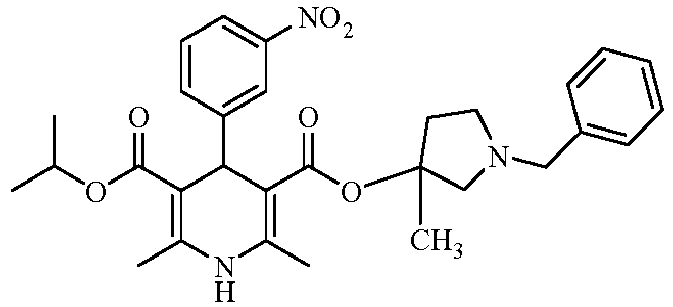
3-(1-benzyl-3-methylpyrrolidin-3-yl) 5-isopropyl 2,6-dimethyl-4-(3-nitrophenyl)-1,4-dihydropyridine-3,5-dicarboxylate 40 
3-[1-(3,3-diphenylpropyl)-3-methylpyrrolidin-3-yl] 5-isopropyl 2,6-dimethyl-4-(3-nitrophenyl)-1,4-dihydropyridine-3,5-dicarboxylate 41 
3-(1-benzyl-3-methylpyrrolidin-3-yl) 5-(2-methoxyethyl) 2,6-dimethyl-4-(3-nitrophenyl)-1,4-dihydropyridine-3,5-dicarboxylate 42 
3-[1-(3,3-diphenylpropyl)-3-methylpyrrolidin-3-yl] 5-(2-methoxyethyl) 2,6-dimethyl-4-(3-nitrophenyl)-1,4-dihydropyridine-3,5-dicarboxylate 43 
3-[3-methyl-1-(thiazol-2-ylmethyl) pyrrolidin-3-yl] 5-methyl 2,6-dimethyl-4-(3-nitrophenyl)-1,4-dihydropyridine-3,5-dicarboxylate 44 
3-[3-methyl-1-(pyrid-2-ylmethyl) pyrrolidin-3-yl] 5-methyl 2,6-dimethyl-4-(3-nitrophenyl)-1,4-dihydropyridine-3,5-dicarboxylate 45 
3-[3-methyl-1-(pyrid-3-ylmethyl) pyrrolidin-3-yl] 5-methyl 2,6-dimethyl-4-(3-nitrophenyl)-1,4-dihydropyridine-3,5-dicarboxylate 46 
3-[3-methyl-1-(pyrid-4-ylmethyl) pyrrolidin-3-yl]) 5-methyl 2,6-dimethyl-4-(3-nitrophenyl)-1,4-dihydropyridine-3,5-dicarboxylate 51 
(S)-3-[(R)-1-benzyl-3-methylpyrrolidin -3-yl] 5-ethyl 2,6-dimethyl-4-(3-nitrophenyl)-1,4-dihydropyridine-3,5-dicarboxylate 52 
(S)-3-[(R)-1-(3,3-diphenylpropyl)-3-methylpyrrolidin-3-yl] 5-ethyl 2,6-dimethyl-4-(3-nitrophenyl)-1,4-dihydropyridine-3,5-dicarboxylate 53 
(S)-3-[(S)-1-(3,3-diphenylpropyl)-3-methylpyrrolidin-3-yl] 5-ethyl 2,6-dimethyl-4-(3-nitrophenyl)-1,4-dihydropyridine-3,5-dicarboxylate 59 
(S)-3-[(R)-1-benzyl-3-ethylpyrrolidin -3-yl] 5-methyl 2,6-dimethyl-4-(3-nitrophenyl)-1,4-dihydropyridine-3,5-dicarboxylate 60 
(S)-3-[(S)-1-benzyl-3-ethylpyrrolidin -3-yl] 5-methyl 2,6-dimethyl-4-(3-nitrophenyl)-1,4-dihydropyridine-3,5-dicarboxylate 61 
(S)-3-[(R)-1-(3,3-diphenylpropyl)-3-ethylpyrrolidin-3-yl] 5-methyl 2,6-dimethyl-4-(3-nitrophenyl)-1,4-dihydropyridine-3,5-dicarboxylate 62 
(S)-3-[(S)-1-(3,3-diphenylpropyl)-3-ethylpyrrolidin-3-yl]5-methyl 2,6-dimethyl-4-(3-nitrophenyl)-1,4-dihydropyridine-3,5-dicarboxylate 63 
(4R)-3-(1-benzyl-3-fluoromethylpyrrolidin -3-yl) 5-methyl 2,6-dimethyl-4-(3-nitrophenyl)-1,4-dihydropyridine-3,5-dicarboxylate 64 
(R)-3-[(S)-1-benzyl-3-fluoromethylpyrrolidin-3-yl] 5-methyl 2,6-dimethyl-4-(3-nitrophenyl)-1,4-dihydropyridine-3,5-dicarboxylate 65 
(R)-3-[(R)-1-benzyl-3-fluoromethylpyrrolidin-3-yl]5-methyl 2,6-dimethyl-4-(3-nitrophenyl)-1,4-dihydropyridine-3,5-dicarboxylate 66 
(S)-3-[(R)-1-benzyl-3-trifluoromethylpyrrolidin-3-yl] 5-methyl 2,6-dimethyl-4-(3-nitrophenyl)-1,4-dihydropyridine-3,5-dicarboxylate 67 
(R)-3-[(S)-1-(4-aminobenzyl)-3-methylpyrrolidin-3-yl] 5-methyl 2,6-dimethyl-4-(3-nitrophenyl)-1,4-dihydropyridine-3,5-dicarboxylate 68 
(S)-3-[(R)-3-difluoromethyl-1-(3,3-diphenylpropyl)pyrrolidin-3-yl] 5-methyl 2,6-dimethyl-4-(3-nitrophenyl)-1,4-dihydropyridine-3,5-dicarboxylate 69 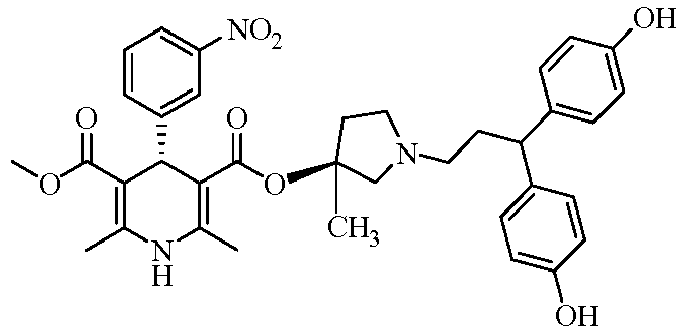
(S)-3-[(S)-1-(3,3-bis(4-hydroxyphenylpropyl)-3-methylpyrrolidin-3-yl] 5-methyl 2,6-dimethyl-4-(3-nitrophenyl)-1,4-dihydropyridine-3,5-dicarboxylate 70 
(S)-3-[(R)-1-benzyl-3-hydroxymethylpyrrolidin-3-yl] 5-methyl 2,6-dimethyl-4-(3-nitrophenyl)-1,4-dihydropyridine-3,5-dicarboxylate 71 
(S)-3-[(R)-3-aminomethyl-1-(3,3-diphenylpropyl)pyrrolidin-3-yl] 5-methyl 2,6-dimethyl-4-(3-nitrophenyl)-1,4-dihydropyridine-3,5-dicarboxylate 72 
(S)-3-[(R)-1-benzyl-3-methylpyrrolidin-3-yl] 5-isopropyl 2,6-dimethyl-4-(3-nitrophenyl)-1,4-dihydropyridine-3,5-dicarboxylate 73 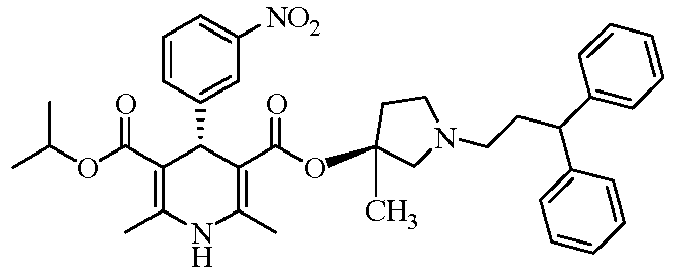
(S)-3-[(S)-1-(3,3-diphenylpropyl)-3-methylpyrrolidin-3-yl] 5-isopropyl 2,6-dimethyl-4-(3-nitrophenyl)-1,4-dihydropyridine-3,5-dicarboxylate 74 
(R)-3-[(S)-1-benzyl-3-methylpyrrolidin -3-yl] 5-(2-methoxyethyl) 2,6-dimethyl-4-(3-nitrophenyl)-1,4-dihydropyridine-3,5-dicarboxylate 75 
(R)-3-[(R)-1-(3,3-diphenylpropyl)-3-methylpyrrolidin-3-yl] 5-(2-methoxyethyl) 2,6-dimethyl-4-(3-nitrophenyl)-1,4-dihydropyridine-3,5-dicarboxylate 76 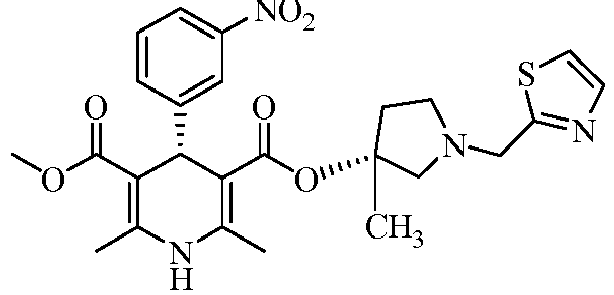
(S)-3-[(R)-3-methyl-1-(thiazol-2-ylmethyl)pyrrolidin-3-yl] 5-methyl 2,6-dimethyl-4-(3-nitrophenyl)-1,4-dihydropyridine-3,5-dicarboxylate - In an embodiment of the process for preparing a compound of general formula (I) of the present invention, the compound of general formula (I) of the present invention can be prepared, for example, by the following specific steps:


- wherein R1, R2, R3, R4, R5, R6, R7, R8, m, n1, n2, p and q are as defined above;
- starting material 2=R5MgX, wherein X is Br or I;
- starting material 2'=R5MgI,
- starting material 3=

- Starting material 1 (1 equivalent) is dissolved in an organic solvent (e.g. THF (tetrahydrofuran), diethyl ether, 1,4-dioxane, DMF (dimethylformamide), DMSO (dimethyl sulfoxide) or acetonitrile, and the like) at a low temperature such as from -30 to -10°C, and the resulting solution is dropwisely added to a solution of starting material 2 (2 equivalents) in said organic solvent. The reaction is conducted under stirring to produce intermediate 1.
- A solution of starting material 1' (1 equivalent) in an organic solvent (e.g. THF, diethyl ether, 1,4-dioxane, DMF, DMSO or acetonitrile, and the like) is slowly added to a solution of starting material 2' (2 equivalents) in an organic solvent (e.g. diethyl ether, 1,4-dioxane, acetonitrile, and the like). The reaction is conducted under stirring at a low temperature (from -30 to -10°C, e.g. -20°C) to produce a crude product of intermediate 1-1.
- Then the above crude product is dissolved in an organic solvent such as 1,4-dioxane (or diethyl ether, acetonitrile, and the like). Then a gaseous HCl is introduced. The reaction is conducted overnight under stirring to produce intermediate 1-2.
- The intermediate 1-2 (1 equivalent), starting material 3 (1.1 equivalents), DIEA (N,N-diisopropylethylamine, 2 equivalents) and an organic solvent such as DMF are stirred at 0°C. HATU (2-(7-azabenzotriazole)-N,N,N',N'-tetramethyluronium hexafluorophosphate, 1.1 equivalents) is further added. The reaction is conducted overnight under stirring to produce intermediate 1-3.
- A reductant such as LiAlH4 (3 equivalents) and a solvent such as THF are stirred at a low temperature such as from -30 to -10°C. A solution of intermediate 1-3 (1 equivalent) in said organic solvent is further added dropwisely. The reaction is conducted under stirring to produce intermediate 1.
- Starting material 4, starting material 5 and starting material 6 are dissolved in an organic solvent (e.g. an alcohol solvent such as ethanol, methanol, isopropanol, butanol, ethylene glycol, and the like). An inorganic base, such as ammonium bicarbonate, sodium bicarbonate, sodium hydroxide, and the like, is optionally added. The reaction is conducted under stirring and under reflux to produce intermediate 2-1. The intermediate 2-1 is dissolved in an organic solvent (e.g. an alcohol solvent such as methanol, ethanol, isopropanol, butanol or ethylene glycol, and the like). A base such as an aqueous NaOH solution is added under stirring. The reaction is conducted under stirring to produce intermediate 2.
- Thionyl chloride is slowly added to a solution of the intermediate 2 in an organic solvent (e.g. a low polar organic solvent such as dichloromethane, ethyl acetate, methyl tert-butyl ether or toluene, and the like) at a low temperature such as from -40 to -10°C. The reaction is conducted until the solution becomes clear. The reaction solution is rotary evaporated to dryness to produce a crude product. The resulting crude product and intermediate 1 are reacted under stirring under a basic condition (e.g. in the presence of sodium bicarbonate, sodium hydroxide) at a low temperature such as from -40 to -10°C to produce a compound of formula (I).
- The compound of formula (I) or a stereoisomer thereof of the present invention can be used in a free form or in a form of its pharmaceutically acceptable salt. The compound of formula (I) of the present invention is alkaline and can form an acid addition salt with an inorganic acid or an organic acid, said acid addition salt including but not limited to, e.g., hydrochloride, hydrofluoride, hydrobromide, hydroiodide, sulfate, trifluoroacetate, benzenesulphonate, mesylate, trifluoromesylate, esylate, carbonate, nitrate, phosphate, phosphite, maleate, tartrate, citrate, acetate, benzoate, esylate, fumarate, oxalate, glyconate, glycolate, isethionate, lactate, lactobionate, lactobionate, malate, mesylate, succinate, p-tosylate, glycinate, trimethylglycinate, argininate, ornithinate, glutamate, asprtate, and the like.
- The compound of formula (I) or a pharmaceutically acceptable salt thereof of the present invention has an asymmetric carbon atom in its structure, and therefore can be present in optically active isomers. Therefore, the present invention further comprises these optically active isomers and a mixture thereof.
- The compound of general formula (I) and a pharmaceutically acceptable salt thereof and a stereoisomer thereof of the present invention can be administrated, for example, orally, parenterally (intravenously, intramuscularly, subcutaneously or rectally, and the like), pulmonarily, topically to a mammal e.g. human being. The daily dosage of the compound of the present invention can be in a range of about 0.05mg/kg body weight to about 0.5mg/kg body weight.
- The compound of formula (I) or a pharmaceutically acceptable salt thereof or a stereoisomer thereof of the present invention and one or more pharmaceutically acceptable carriers can be combined to form a pharmaceutical composition. Said composition can be prepared by mixing the compound of general formula (I) or a pharmaceutically acceptable salt thereof or a stereoisomer thereof of the present invention and one or more conventional pharmaceutically acceptable carriers and/or diluents. Said pharmaceutical composition can be formulated into conventional formulations that are clinically used or pharmaceutically acceptable, and administrated to a patient in need thereof by e.g. oral or parenteral administration; including but not limited to, e.g., tablet, granule, capsule, powder, injection, inhalant, sublingual preparation, syrup, gel, salve, suppository, lotion, nasal drop, spray, transdermal preparation, and the like. These formulations can be prepared according to the conventional methods by the addition of suitable pharmaceutically acceptable carriers such as conventional excipients, binders, moisturizers, disintegrants, thickeners, and the like.
- The compound of formula (I) or a pharmaceutically acceptable salt thereof or a stereoisomer thereof of the present invention can be administrated in combination with other therapeutical agents. Said therapeutical agents include but is not limited to angiotensin II antagonists or a pharmaceutically acceptable salt thereof, including e.g. losartan, valsartan, irbesartan, olmesartan, candesartan, and the like; HMG-Co-A reductase inhibitors or a pharmaceutically acceptable salt thereof, including e.g. lovastatin, simvastatin, pravastatin, mevastatin, fluvastatin, atorvastatin, cerivastatin, lovastatin, and the like; aldosterone receptor antagonists (MRA) or a pharmaceutically acceptable salt thereof, including e.g. spironolactone, eplerenone, and the like; angiotensin converting enzyme/neutral endopeptidase (ACE/NEP) dual inhibitors or a pharmaceutically acceptable salt thereof, including e.g. captopril, alacepril, enalapril, lisinopril, perindopril, ramipril, quinapril, delapril, cilazapril, benazepril, spirapril, trandolapril, moexipril, imidapril, fosinopril, and the like; antidiabetics, including e.g. metformin, glibenclamide, glipizide, glibornuride, gliclazide, gliquidone, sitagliptin, vildagliptin, saxagliptin, alogliptin benzoate, linagliptin, and the like; antiobesics; endothelin receptor blockers, including e.g. bosentan, and the like; CETP inhibitors; Na-K-ATPase membrane pump inhibitors; β-adrenergic receptor inhibitors, including e.g. metoprolol, carvedilol, and the like; α-adrenergic receptor blockers, including e.g. prazosin, terazosin, doxazosin, and the like; neutral endopeptidase (NEP) inhibitors and inotropic agents, and the like.
- It is experimentally demonstrated that the compound of the present invention has a remarkable hypotensive activity and can maintain a long acting hypotensive effect, and therefore is a good hypotensive drug. It also has a dual L-type and T-type calcium ion channel blocking effect. Therefore, the compound has a protective effect on heart and kidney, and has a low side effect of ankle edema. Therefore, the compound of formula (I) and a pharmaceutically acceptable salt, and a stereoisomer thereof of the present invention can be used for treating and/or preventing kidney injury, cardiovascular diseases and/or endocrine diseases, including high blood pressure, heart failure, myocardial infarction, angina pectoris, cardiac hypertrophy, myocarditis, cardiovascular fibrosis, baroreceptor dysfunction,
fluid overload and arhythmia, primary/secondary aldosteronism, Addison's disease, Cushing's syndrome, Bartter's syndrome, and the like. - In comparison with the prior art, the compound of the present invention has the following advantages:
- (1) the compound of the present invention has a good hypotensive effect and a low side effect;
- (2) the compound of the present invention has a good inhibition activity on both L-type and T-type calcium ion channels;
- (3) the compound of the present invention shows a good biological stability, more lasting effect and a high biological availability;
- (4) the process for preparing the compound of the present invention is easy, can provide high purity product with high yield and stable quality, and is easy to be conducted on a large industrial scale.
- Hereinafter, the present invention will be further illustrated in details by the following specific examples. It should be understood that the scope of the present invention is not limited by the following examples, and any technology that can be achieved based on the above disclosures of the present invention falls within the scope of the present invention.
- In the examples, the abbreviations have the following meanings:
- THF represents tetrahydrofuran
- DMF represents dimethylformamide
- DIEA represents N,N-diisopropylethylamine
- HATU represents 2-(7-azabenzotriazole)-N,N,N',N'-tetramethyluronium hexafluorophosphate
- MsCl represents p-methyl benzene sulfonyl chloride
- DCM represents dichloromethane
-

-

- 1-benzylpyrrolidone (1.1g, 6.3mmol) was dissolved in 4mL THF under stirring at -20°C. The resulting solution was dropwisely added to a solution of methyl magnesium bromide (13.2mL, 12.2mmol) in THF. The stirring was continued for 3 hours. After the completion of reaction, the reaction solution was dropwisely added to an ice water. The resulting mixture was washed with a saturated aqueous NaCl solution, dried over Na2SO4, and purified by column chromatography (silica gel column, eluted with petroleum ether: ethyl acetate = 20:1 (volumetric ratio)) to produce the product of 1-benzyl-3-methylpyrrolidinyl-3-ol (0.7g) in a yield of 58.1%.
-

- 5g meta-nitrobenzaldehyde (0.033mol), 8mL methyl acetoacetate (0.072mol), 10mL ethanol, 4g ammonium bicarbonate (0.05mol) and 4mL water were mixed and stirred at 55-60 °C until no bubble formed (about 1 hour). The mixture was continued to react under reflux for 1-2 hours, cooled, and filtered by suction. The filter cake was dried in vacuum to produce the title product as a yellow solid (8.1g) in a yield of 70.9%.
-
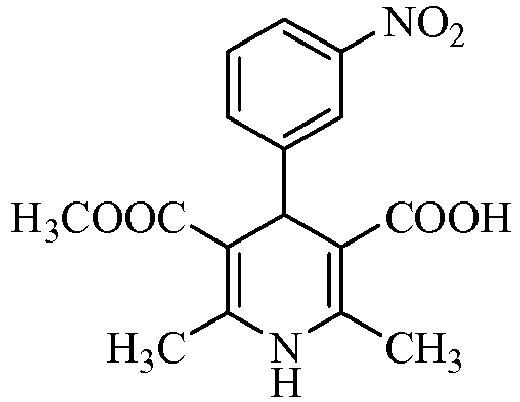
- 3.5g dimethyl 2,6-dimethyl-4-(3-nitrophenyl)-1,4-dihydropyridine-3,5-dicarboxylate (0.01mol) and 150mL methanol were mixed. To the mixture was added a saturated aqueous NaOH solution (9g, 0.225mol) under stirring. The reaction was conducted at 70 °C under violent stirring for 6 hours, and evaporated under reduced pressure to remove 80mL methanol. To the residue was added 200 mL water. The unreacted starting materials are removed by filtration. The filtrate was adjusted to a pH of about 2.5 with 1mol/L hydrochloric acid to separate a yellow solid, which was filtered and dried to produce a khaki powder. The resulting powder was treated with methanol to produce the title product as a yellow solid (1.9g) in a yield of 57.2%.
-

- Thionyl chloride (0.4g, 3.4mmol) was slowly added to a solution of 5-methoxycarbonyl-2,6-dimethyl-4-(3-nitrophenyl)-1,4-dihydropyridine-3-carboxylic acid (1.0g, 3mmol) in dichloromethane dropwisely at -25°C. After the completion of the dropwise addition, the reaction was continued under cooling in an ice bath until the solution became clear. After the completion of reaction, the reaction solution was rotary evaporated to dryness to produce a crude product, which was directly used in the next step.
-

- Methyl 5-chlorocarbonyl-2,6-dimethyl-4-(3-nitrophenyl)-1,4-dihydropyridine-3-carboxylate (1.0g, 2.85mmol) was added to a solution of 1-benzyl-3-methylpyrrolidinyl-3-ol (0.6g, 3mmol) in dichloromethane under stirring at -25°C. After the completion of addition, the solution was moved to room temperature and the stirring was continued for 12 hours. After the completion of reaction, the reaction solution was rotary evaporated to dryness, and purified by column chromatography (silica gel column, eluted with petroleum ether: ethyl acetate = 10:1 (volumetric ratio)) to produce Compound 1.
- The resulting Compound 1 was dissolved in dichloromethane. To the solution was introduced an HCl gas, and the resulting material was rotary evaporated to dryness to produce the hydrochloride of Compound 1 (0.4 g) in a yield of 25.9%.
MS (M +H): 506.1
1H-NMR (CDCl3, 400 MHz): δ 8.10 (1H, d); 8.02 (1H, d); 7.64 (1H, m); 7.40-7.34 (5H, m); 7.31-7.28 (1H, m); 5.65 (1H, s); 5.07 (1H, s); 3.66 (3H, d); 3.65-3.52 (2H, m); 2.82 (2H, s); 2.76-2.55 (2H, m), 2.38(3H, s), 2.35 (3H, d), 2.24-2.22 (1H, m), 2.06-1.98 (1H, m), 1.50-1.46 (3H, d). -

-

- A solution of tert-butyl 3-carbonylpyrrolidine-1-carboxylate (11.17g, 0.06mol) in THF (45mL) was slowly added to a solution of MeMgI (21.41g, 0.129mol) in diethyl ether. The reaction was conducted at -20°C under stirring for 3 hours. A small amount of water was added to the reaction solution. The resulting reaction solution was filtered by suction. The filtrate was extracted with dichloromethane. The organic layer was dried over anhydrous sodium sulfate and filtered. The filtrate was concentrated to produce a crude product of tert-butyl 3-hydroxy-3-methyl-pyrrolidine-1-carboxylate.
- The above crude product was dissolved in 20mL 1,4-dioxane. To the resulting solution was introduced an HCl gas. The resulting mixute was stirred overnight and filtered by suction to produce the title product as a red solid (1.67g) in a yield of 20% (two steps).
-

- To a 100mL eggplant-shaped flask were added 3-methylpyrrolidin-3-ol hydrochloride (1.6g, 11.6mmol), 3,3-diphenylpropanic acid (2.89g, 12.9mmol), DIEA (3.0g, 23.3mmol) and DMF (8 mL). The mixure was stirred at 0°C for 15 minutes, and then HATU (4.86g, 12.8mmol) was slowly added thereto. The resulting mixture was stirred for 10 minutes, then moved to room temperature and stirred overnight. The reaction solution was poured into water, adjusted with a diluted hydrochloric acid (10%) to a pH of about 6, and extracted with ethyl acetate. The organic phase was dried over anhydrous sodium sulfate, and filtered. The filtrate was evaporated to dryness, and purified by column chromatography (silica gel column, eluted with petroleum ether: ethyl acetate = 15:1(volumetric ratio)) to produce a light red oily product (1.0g) in a yield of 28%.
-

- To a 250mL eggplant-shaped flask were added LiAlH4 (0.36g, 9.49mmol) and THF (10 mL). The mixture was stirred at -20°C for 15 minutes. Then to the mixture was slowly added a solution of 1-(3-hydroxy-3-methylpyrrolidin-1-yl)-3,3-diphenylpropyl-1-one (1.0g, 3.24mmol) in THF (5 mL). After the completion of addition, the temperature was warmed up to 70 °C, and the stirring was continued for 4 hours. The mixture was cooled to room temperature. To the mixture were added 0.36g water, then 0.72g 10% sodium hydroxide solution, and finally 1.08g water. After filtering, the filtrate was distilled to remove THF, and extracted with dichloromethane. The organic layer was washed successively with water and a saturated aqueous NaCl solution, dried over anhydrous sodium sulfate, and filtered. The filtrate was evaporated to dryness to give 100 mg product. To the filter cake was added dichloromethane. After stirring, the resulting mixture was filtered by suction. The filtrate was evaporated to dryness to give 550 mg product. The product was 650 mg in total in a yield of 68%.
-

- To a 100mL eggplant-shaped flask were added 1-(3,3-diphenylpropyl)-3-methylpyrrolidin-3-ol (0.65g, 2.2mmol), sodium bicarbonate (0.37g, 4.4mmol) and dichloromethane (4mL). The resulting mixture was stirred at -25 °C for 15 minutes. Then to the mixture was slowly added methyl 5-(chlorocarbonyl)-2,6-dimethyl-4-(3-nitrophenyl)-1,4-dihydropyridine-3-carboxylate (0.93g, 2.64mmol). The resulting mixture was stirred for 10 minutes, then warmed up to 0°C, and stirred overnight. After filtering, the filtrate was evaporated to dryness, and purified by column chromatography to produce Compound 2.
- The resulting Compound 2 was dissolved in dichloromethane. To the resulting solution was introduced an HCl gas. After 10 minutes, the mixture was filtered. The filter cake was dried to produce 168mg of the hydrochloride of Compound 2 in a yield of 11.4%.
MS (M+H): 610.2. -

- The steps in Example 1 were repeated, except that the reactant in step (2) methyl acetoacetate was replaced with ethyl acetoacetate to obtain Compound 3.
MS (M+H): 520.3. -

- The steps in Example 2 were repeated, except that the reactant in step (4) methyl 5-(chlorocarbonyl)-2,6-dimethyl-4-(3-nitrophenyl)-1,4-dihydropyridine-3-carboxylate was replaced with ethyl 5-(chlorocarbonyl) -2,6-dimethyl-4-(3-nitrophenyl)-1,4-dihydropyridine-3-carboxylate to obtain Compound 4.
MS (M+H): 624.2. -

- The steps in Example 1 were repeated, except that the reactant in step (1) 1-benzylpyrrolidin-3-one was replaced with 1-phenylethylpyrrolidin -3-one to obtain Compound 5.
MS (M+H): 520.3. -

- The steps in Example 2 were repeated, except that the reactant in step (2) 3,3-diphenylpropanic acid was replaced with 2,2-diphenylacetic acid to obtain Compound 6.
MS (M+H): 596.2. -

- The steps in Example 1 were repeated, except that the reactant in step (2) meta-nitrobenzaldehyde was replaced with 2-chlorobenzaldehyde to obtain Compound 7.
MS (M+H): 554.3. -

- The steps in Example 2 were repeated, except that methyl 5-(chlorocarbonyl)-2,6-dimethyl-4-(3-nitrophenyl)-1,4-dihydropyridine-3-carboxylate in step (4) was replaced with methyl 5-(chlorocarbonyl)-2,6-dimethyl-4-(2-chlorophenyl)-1,4-dihydropyridine-3 -carboxylate to obtain Compound 8.
MS (M+H): 658.2. -

- The steps in Example 1 were repeated, except that the reactant in step (1) 1-benzylpyrrolidin-3-one was replaced with 1-(4-fluorobenzyl) pyrrolidin-3-one to obtain Compound 9.
MS (M+H): 524.2. -

- The steps in Example 1 were repeated, except that the reactant in step (1) 1-benzylpyrrolidin-3-one was replaced with 1-(4-methoxybenzyl)pyrrolidin-3-one to obtain Compound 10.
MS (M+H): 536.3. -

- The steps in Example 2 were repeated, except that the reactant in step (2) 1-(3-hydroxy-3-methylpyrrolidin-1-yl)-3,3-diphenylpropyl-1-one was replaced with 1-(3,3-bis(4-fluorophenyl)propyl)-3-methylpyrrolidin-3-one to obtain Compound 11.
MS (M+H): 646.2. -

-

- To a solution of 5-methoxycarbonyl-2,6-dimethyl-4-(3-nitrophenyl) -1,4-dihydropyridine-3-carboxylic acid (700g, 2.1mol) in methanol (14 L) was added cinchonidine (617g, 2.1mol). The mixture was stirred at 90°C under reflux until cinchonidine was completely dissolved. The stirring was continued for 3 hours. 4.5 L water was added. The stirring was continued for half an hour. The mixture was cooled down slowly. A solid was precipitated out and was filtered. The filter cake was treated with hydrochloric acid to produce (S)-5-(methoxycarbonyl)-2,6-dimethyl-4-(3-nitrophenyl)-1,4-dihydropyridine-3-carboxylic acid (130 g) in a yield of 18.6%.
-

- Thionyl chloride (0.4g, 3.4mmol) was slowly added to a solution of 5-methoxycarbonyl-2,6-dimethyl-4-(3-nitrophenyl)-1,4-dihydropyridine-3-carboxylic acid (1.0g, 3mmol) in dichloromethane dropwisely at -25°C. After the completion of the dropwise addition, the reaction was continued under cooling in an ice bath until the solution became clear. After the completion of reaction, the reaction solution was rotary evaporated to dryness. The product was directly used in the next step.
-

- Methyl 5-chlorocarbonyl-2,6-dimethyl-4-(3-nitrophenyl)-1,4-dihydropyridine -3-carboxylate (1.0g, 2.85mmol) was added dropwisely to a solution of 1-benzyl-3-methylpyrrolidin-3-ol (0.6g, 3mmol) in dichloromethane at -25°C. After the completion of the dropwise addition, the mixture was moved to room temperature. The stirring was continued for 12 hours. After the completion of reaction, the reaction solution was rotary evaporated to dryness, and purified by column chromatography (silica gel column, eluted with petroleum ether: ethyl acetate = 10:1 (volumetric ratio)) to obtain a solid. The resulting solid was dissolved in dichloromethane. To the resulting solution was introduced an HCl gas. The resulting mixture was rotary evaporated to dryness to produce the target product (0.4 g) in a yield of 27.8 %.
-

- The steps in Example 12 were repeated, except that (S)-5-methoxycarbonyl-2,6-dimethyl-4-(3-nitrophenyl)-1,4-dihydropyridin e-3-carboxylic acid in step (3) was replaced with (R)-5-methoxycarbonyl-2,6-dimethyl-4-(3-nitrophenyl)-1,4-dihydropyridine-3-ca rboxylic acid.
- (R)-5-methoxycarbonyl-2,6-dimethyl-4-(3-nitrophenyl)-1,4-dihydropyridine -3-carboxylic acid was prepared with referrecne to the step (1) of Example 15.
-

- The steps in Example 15 were repeated, except that (R)-5-methoxycarbonyl-2,6-dimethyl-4-(3-nitrophenyl)-1,4-dihydropyridin e-3-carboxylic acid in step (5) was replaced with (S)-5-methoxycarbonyl -2,6-dimethyl-4-(3-nitrophenyl)-1,4-dihydropyridine-3- carboxylic acid.
- (R)-5-methoxycarbonyl-2,6-dimethyl-4-(3-nitrophenyl)-1,4-dihydropyridine -3-carboxylic acid was prepared with referrecne to the step (1) of Example 12.
-

-

- To a solution of 5-(methoxycarbonyl)-2,6-dimethyl-4-(3-nitrophenyl) -1,4-dihydropyridine-3-carboxylic acid (700g, 2.1mol) in methanol (14 L) was added Quinidine (617g, 1.90mol). The mixture was stirred at 90°C under reflux until Quinidine was completely dissolved. The stirring was continued for 3 hours. 4.5 L water was added. The stirring was continued for half an hour. The mixture was cooled down slowly. A solid was precipitated out and was filtered. The filter cake was treated with hydrochloric acid to produce (R)-5-(methoxycarbonyl)-2,6-dimethyl -4-(3-nitrophenyl)-1,4-dihydropyridine-3-carboxylic acid (130 g) in a yield of 18.6 %.
-

- To a 30 L reaction kettle was added 4 L dry THF at -10°C. After stirring, to the mixture were added ZnCl2 (118g, 0.86mol) and LiCl (402g, 9.5mol). After half an hour, to the resulting mixture was slowly added a solution of MeMgBr (3mol/L) in diethyl ether (6.4 L, 19.2mol) dropwisely. The stirring was continued for half an hour. To the resulting mixture was slowly added a solution of tert-butyl 3-oxopyrrolidine-1-carboxylate (1600g, 8.6mol) in THF dropwisely. After the completion of reaction by HPLC detection, to the system was dropwisely added a saturated NH4Cl solution to quench off the reaction. The reaction was extracted with ethyl acetate. The organic phase was washed with a saturated aqueous NaCl solution, dried over anhydrous sodium sulfate, and evaporated to remove the solvent to produce tert-butyl 3-hydroxy-3-methylpyrrolidine-1-carboxylate as a pale yellow solid (1450 g) in a yield of 83.8 %.
-

- To a 10L three-opening flask were added 5L 1,4-dioxane and tert-butyl 3-hydroxy-3-methylpyrrolidine-1-carboxylate (1450g, 7.2mol) under cooling in an ice bath. After stirring, to the resulting mixture was slowly added 2.2L HCl/ethanol solution (30 %) dropwisely. After the completion of addition, the reaction was conducted at 25°C for 12 hours. After the completion of reaction monitored by TLC, the reaction was filtered by suction to produce 3-methylpyrrolidin-3-ol hydrochloride as a red-brown solid (750 g) in a yield of 75.6 %.
-

- To a 30L reaction kettle was slowly added a solution of diisobutylaluminum hydride in toluene (15 L, 1mol/L) at -20°C. After stirring, to the resulting mixture was slowly added a solution of ethyl 3,3-diphenyl-1-propanate (1200g, 4.7mol) in dichloromethane dropwisely. After the completion of dropwise addition, the reaction was conducted at 25 °C for 12 hours. After the completion of reaction monitored by TLC, the reaction solution was divided into three parts. 200mL methanol and 1000 mL water were slowly added respectively at -20°C to quench off the reaction. The reaction solutions were combined and extracted with dichloromethane. The organic phase was dried over anhydrous sodium sulfate, and evaporated to remove the solvent to produce an oily crude product of 3,3-diphenyl-1-propanol (1000 g), which was directly used in the next reaction.
-

- 3,3-diphenyl-1-propanol (1000g, 4.7mol) was dissolved in 3L dichloromethane. To the mixture was added triethylamine (712g, 7.05mol). After stirring at 0°C for half an hour, to the resulting mixture was slowly added MsCl (645g, 5.64mol) dropwisely. The reaction was conducted at 25°C. After the completion of reaction monitored by TLC, the reaction solution was washed with water thrice. The organic phase was dried over anhydrous sodium sulfate, and evaporated to remove the solvent to produce an oily crude product. To the crude product was added isopropanol. The resulting mixture was filtered by suction to produce 3,3-diphenylpropyl methane sulfonate as a solid (1000g) in a yield of 73 % (two steps together).
-

- To a 10L reaction flask were added 3-methylpyrrolidin-3-ol hydrochloride (616g, 4.48mol), anhydrous potassium carbonate (1186g, 8.6mol) and acetonitrile (5L). To the resulting mixture was slowly added a solution of 3,3-diphenylpropyl methane sulfonate (1000g, 3.45mol) in acetonitrile dropwisely at 85°C. The reaction was conducted for 12 hours. After the completion of reaction monitored by TLC, the reaction solution was evaporated under reduced pressure to remove acetonitrile. A mixed solution of dichloromethane and water was added for extraction. The organic phase was dried over anhydrous sodium sulfate, and evaporated to remove the solvent to produce a crude product, which was purified by column chromatography (silica gel column, eluted with petroleum ether: ethyl acetate = 50:1 (volumetric ratio)) to produce 1-(3,3-diphenylpropyl)-3-methylpyrrolidin-3-ol (580 g) in a yield of 57 %.
-

- To a solution of (R)-5-methoxycarbonyl-2,6-dimethyl-4-(3-nitrophenyl)-1,4-dihydropyridine-3-carboxylic acid (67.5g, 0.2mol) in dichloromethane was added 1.5mL DMF. To the mixture was slowly added oxalyl chloride (51g, 0.4mol) dropwisely in an ice bath. The reaction was conducted at 25°C. After the completion of reaction, the resulting mixture was evaporated under reduced pressure to remove oxalyl chloride. To the reaction flask were slowly added dichloromethane (300mL), 1-(3,3-diphenylpropyl)-3-methylpyrrolidin-3-ol (29.5g, 0.1mol) and DIPEA (25.8g, 0.2mol) dropwisely under cooling in an ice bath respectively and successively. The reaction was conducted at 25°C. After the completion of reaction monitored by HPLC, the reaction solution was washed with water thrice. The organic phase was dried over sodium sulfate, and filtered by suction. The filtrate was evaporated to dryness, and purified by column chromatography (silica gel column, eluted with petroleum ether: ethyl acetate = 80:1 (volumetric ratio)) to produce (4S)-3-[1-(3,3-diphenylpropyl)-3-methylpyrrolidin-3-yl] 5-methyl 2,6-dimethyl-4-(3-nitrophenyl)-1,4-dihydropyridine-3,5-dicarboxylate (34 g) in a yield of 56 %.
-

-

- According to Example 15, (R)-5-(methoxycarbonyl)-2,6-dimethyl-4-(3-nitrophenyl)-1,4-dihydropyridine-3-carboxylic acid and 1-(3,3-diphenylpropyl)-3-methylpyrrolidin-3-ol were synthesized. To a solution of D-bis(paramethylbenzoyl)tartaric acid ((+)-Di-1,4-toluoyl-D-tartaric acid) (280g, 0.7mol) in isopropanol (300 mL) was added a solution of 1-(3,3-diphenylpropyl)-3-methylpyrrolidin-3-ol (280g, 0.95mol) in isopropanol (300 mL) at 90°C. After the solution became clear, the solution was cooled down to 30 °C slowly, and filtered to produce a white solid, which was treated with sodium hydroxide to produce (S)-1-(3,3-diphenylpropyl)-3-methylpyrrolidin-3-ol (52 g) in a yield of 18.6%.
-
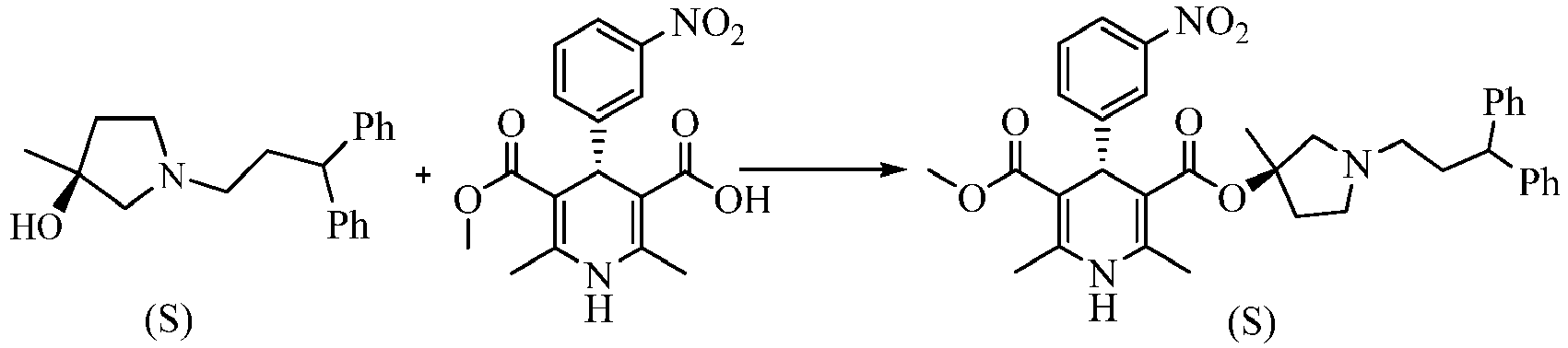
- According to Example 15, (R)-5-(methoxycarbonyl)-2,6-dimethyl-4-(3-nitrophenyl)-1,4-dihydropyridine-3-carboxylic acid and 1-(3,3-diphenylpropyl)-3-methylpyrrolidin-3-ol were synthesized. To a solution of D-bis(paramethylbenzoyl)tartaric acid ((+)-Di-1,4-toluoyl-D-tartaric acid) (280g, 0.7mol) in isopropanol (300 mL) was added a solution of 1-(3,3-diphenylpropyl)-3-methylpyrrolidin-3-ol (280g, 0.95mol) in isopropanol (300 mL) at 90°C. After the solution became clear, the solution was cooled down to 30 °C slowly, and filtered to produce a white solid, which was treated with sodium hydroxide to produce (S)-1-(3,3-diphenylpropyl)-3-methylpyrrolidin-3-ol (52 g) in a yield of 18.6%.
-

- According to Example 15, (R)-5-methoxycarbonyl-2,6-dimethyl-4-(3-nitrophenyl)-1,4-dihydropyridine-3-carboxylic acid was synthesized. To a solution of (R)-5-methoxycarbonyl-2,6-dimethyl-4-(3-nitrophenyl) -1,4-dihydropyridine-3-carboxylic acid (33.75g, 0.1mol) in dichloromethane was added 1mL DMF. To the resulting mixture was slowly added oxalyl chloride (25.5g, 0.2mol) dropwisely under cooling in an ice bath. The reaction was conducted at 25°C. After the completion of reaction, the reaction solution was evaporated under reduced pressure to remove oxalyl chloride. To the reaction flask were slowly added dichloromethane (200mL), (S)-1-(3,3-diphenylpropyl)-3-methylpyrrolidin-3-ol (14.75g, 0.05mol) and DIPEA (12.9g, 0.1 mol) dropwisely under cooling in an ice bath respectively and successively. The reaction was conducted at 25°C. After the completion of reaction monitored by HPLC, the reaction solution was washed with water thrice. The organic phase was dried over anhydrous sodium sulfate, and filtered by suction. The filtrate was evaporated to dryness, and purified by column chromatography (silica gel column, eluted with petroleum ether: ethyl acetate = 80:1 (volumetric ratio)) to produce the title product (S)-3-[(S)-1-(3,3-diphenylpropyl) -3-methyl-3-pyrrolidinyl] 5-methyl 2,6-dimethyl-4-(3-nitrophenyl)-1,4-dihydropyridine-3,5-dicarboxylate (17 g) in a yield of 56 %. Four batches of product samples were measured for the optical activities, which were in a range of from +98° to +118° (temperature: 20°C, concentration: 2 mg/mL, the solvent was MeOH), wherein one batch of samples had an optical activity of +108.34°. The test sample Compound 16 in the following pharmacological activity assay was the sample having an optical activity of +108.34°.
Molecular formula: C36H39N3O6 Mw: 609.2 MS (M+H): 610.3
1H-NMR(DMSO, 400 MHz) δ: 9.13-9.11 (1 H, d), 8.05-7.94 (2 H, m), 7.61-7.49 (2 H, m), 7.33-7.27 (8 H, m), 7.20-7.17 (2 H, m), 4.93-4.88 (1 H, d), 4.00-3.95 (1 H, m), 3.95-3.53 (1 H, m), 3.53-3.52 (3 H, d), 3.13 (2 H, m), 2.84-2.83 (4 H, m), 2.42-2.36 (3 H, m), 2.27-2.21 (6 H, m), 2.23-2.21 (1 H, m), 1.49-1.41 (3 H, d). -

-

- According to Example 15, (R)-5-(methoxycarbonyl)-2,6-dimethyl -4-(3-nitrophenyl)-1,4-dihydropyridine-3-carboxylic acid and 1-(3,3-diphenylpropyl)-3-methylpyrrolidin-3-ol were synthesized.
- Said compound was salified with L-bis(paramethylbenzoyl)tartaric acid, and then treated with NaOH to produce the product in R-configuration, i.e. (R)-1-(3,3-diphenylpropyl)-3-methylpyrrolidin-3-ol.
-

- According to Example 16, (S)-3-[(R)-1-(3,3-diphenylpropyl)-3-methylpyrrolidin-3-yl]5-methyl 2,6-dimethyl-4-(3-nitrophenyl)-1,4-dihydropyridine-3,5-dicarboxylate was synthesized, wherein the reactant (S)-1-(3,3-diphenylpropyl)-3-methylpyrrolidin-3-ol was replaced with (R)-1-(3,3-diphenylpropyl)-3-methylpyrrolidin-3-ol in a yield of 45 %, having an optical activity of +36.4° (temperature: 20°C, concentration: 2 mg/mL, the solvent was MeOH).
-

-

- To a 500mL three-opening flask were added 2,2-diphenylacetic acid (20g, 94mmol) and 200mL dichloromethane. After stirring, 1mL DMF was added. To the mixture was slowly added oxalyl chloride (13.16g, 104mmol) dropwisely in an ice bath. The reaction was conducted at 25°C. After the completion of reaction, the mixture was evaporated under reduced pressure to remove oxalyl chloride. To the reaction flask were slowly added dichloromethane (100mL) and anhydrous methanol (3.61g, 113mmol) dropwisely under cooling in an ice bath respectively. The reaction was conducted at 25°C. After the completion of reaction, the reaction solution was washed with a saturated aqueous NaCl solution. The organic phase was dried over sodium sulfate, and filtered by suction. The filtrate was evaporated to dryness to produce methyl 2,2-diphenylacetate (21 g) in a yield of 98.7 %.
-

- To a 500mL three-opening flask was slowly added a solution of diisobutylaluminum hydride in toluene (282mL, 1mol/L) at -30°C. After stirring, to the resulting mixture was slowly added a solution of methyl 2,2-diphenylacetate (21g, 92.8mmol) in dichloromethane dropwisely. After the completion of dropwise addition, the reaction was conducted at 25 °C for 12 hours. After the completion of reaction monitored by TLC, to the resulting mixture was slowly added methanol (10mL), dichloromethane (100mL) and an aqueous sodium hydroxide solution (100mL, 1mol/L) at -20°C. After the completion of reaction, to the reaction solution was added dichloromethane for extraction. The organic phase was washed with water, dried over anhydrous sodium sulfate, and evaporated to remove the solvent to produce 2,2-diphenyl ethanol (17 g) in a yield of 92.4 %.
-

- In a 500mL three-opening flask, 2,2-diphenyl ethanol (17g, 86mmol) was dissolved in 170mL dichloromethane. To the flask was added triethylamine (13.03g, 129mmol). The resulting mixture was stirred at 0°C for half an hour. To the resulting mixture was slowly added MsCl (11.92g, 104mmol) dropwisely. The reaction was conducted at 25°C. After the completion of reaction monitored by TLC, the reaction solution was washed with water thrice. The organic phase was dried over anhydrous sodium sulfate and evaporated to remove the solvent to produce 2,2-diphenylethyl methanesulfonate (23g) in a yield of 96.78 %.
-

- According to Example 15, 3-methylpyrrolidin-3-ol hydrochloride was synthesized. To a 500 mL reaction flask were added 3-methylpyrrolidin-3-ol hydrochloride (11.46g, 83mmol), anhydrous potassium carbonate (28.75g, 208mmol) and acetonitrile (220mL). To the resulting mixture was slowly added a solution of 2,2-diphenylethyl methanesulfonate (23g, 83mmol) in acetonitrile dropwisely at 85°C. The reaction was conducted for 12 hours. After the completion of reaction monitored by TLC, the resulting mixture was evaporated under reduced pressure to remove acetonitrile. A mixed solution of dichloromethane and water was added for extraction. The organic phase was dried over anhydrous sodium sulfate, and evaporated to remove the solvent to produce a crude product. The crude product was purified by column chromatography (silica gel column, eluted with petroleum ether: ethyl acetate = 30:1 (volumetric ratio)) to produce 1-(2,2-diphenylethyl)-3-methylpyrrolidin-3-ol (13.6 g) in a yield of 58.23 %.
-
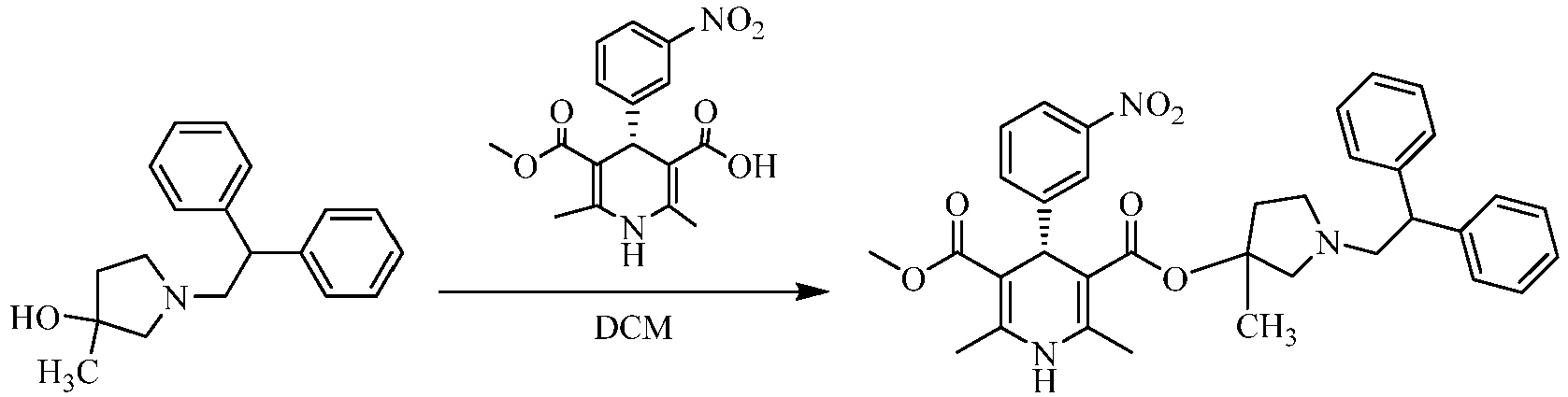
- According to Example 15, (R)-5-methoxycarbonyl-2,6-dimethyl-4-(3-nitrophenyl)-1,4-dihydropyridine-3-carboxylic acid was synthesized. To a solution of (R)-5-methoxycarbonyl-2,6-dimethyl-4-(3-nitrophenyl)-1,4-dihydropyridine-3-carboxylic acid (17.67g, 53mmol) in dichloromethane was added 1mL DMF. To the resulting mixture was slowly added oxalyl chloride (8.1g, 64mmol) dropwisely under cooling in an ice bath. The reaction was conducted at 25°C. After the completion of reaction, the resulting mixture was evaporated under reduced pressure to remove oxalyl chloride. To the reaction flask were slowly added dichloromethane (120mL), 1-(2,2-diphenylethyl)-3-methylpyrrolidin-3-ol (13.6g, 48mmol) and DIPEA (12.38g, 96mmol) dropwisely under cooling in an ice bath respectively and successively. The reaction was conducted at 25°C. After the completion of reaction monitored by HPLC, the reaction solution was washed with water thrice. The organic phase was dried over sodium sulfate, and filtered by suction. The filtrate was evaporated to dryness, and purified by column chromatography (silica gel column, eluted with petroleum ether: ethyl acetate = 70:1 (volumetric ratio)) to produce (4S)-3-[1-(2,2-diphenylethyl)-3-methylpyrrolidin-3-yl] 5-methyl 2,6-dimethyl-4-(3-nitrophenyl)-1,4-dihydropyridine-3,5-dicarboxylate (14.58 g) in a yield of 51 %.
Molecular formula: C35H37N3O6 Mw: 595.2 MS (M+H): 596.3
1H-NMR(DMSO, 400 MHz) δ: 9.16 (1 H, s), 7.99-7.91 (2 H, m), 7.57-7.51 (2 H, m), 7.49-7.34 (8 H, m), 7.32-7.23 (2 H, m), 4.89-4.83 (1 H, d), 4.52 (1 H, s), 3.96-3.53 (2 H, m), 3.52-3.33 (5H, m), 3.26-3.23 (2 H, m), 2.26-2.23 (7 H, m), 1.98-1.91 (1H, m), 1.42-1.26 (3 H, m). -
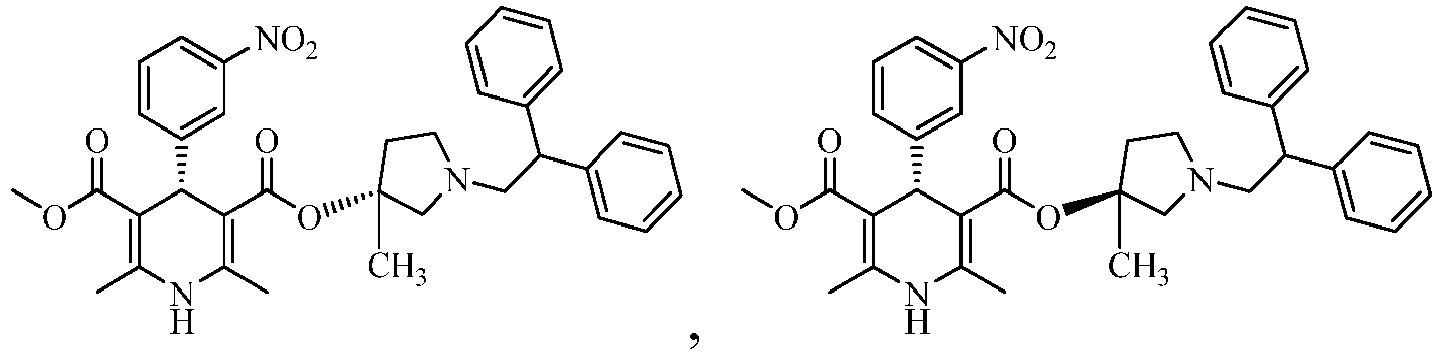
- Compound 18 was subjected to a chiral isomer separation with a Daicel chiral column according to the HPLC method, which was assigned to Daicel Chiral Technologies (China) Co., Ltd (Shanghai). The corresponding fractions were collected and rotary evaporated to remove the solvent to produce pure optical isomers: Compound 19 and Compound 20. The separation conditions were as follows:
- Compound 19:
- Chiral column type: CHIRALCEL OD-H
- Chiral column size: 0.46 cm I.D. × 15 cm L
- Mobile phase: CO2/MeOH / DEA= 80/20/ 0.1 (V / V /V)
- Wave length for detection: UV 220 nm
- Column temperature: 35 °C
- Retention time: 7.333 minutes;
- Compound 20:
- Chiral column type: CHIRALCEL OD-H
- Chiral column size: 0.46 cm I.D. × 15 cm L
- Mobile phase: CO2/MeOH / DEA= 80/20/ 0.1 (V / V /V)
- Wave length for detection: UV 220 nm
- Column temperature: 35 °C
- Retention time: 8.493 minutes.
- Optical activity measurement:
- Compound 19: dissolved in DMSO, at a concentration of 20mg/ml, at a temperature of 20°C, the measured optical activity was -3.7°;
- Compound 20: dissolved in DMSO, at a concentration of 20mg/ml, at a temperature of 20°C, the measured optical activity was +35.2°.
-

-

- According to Example 15, 3-methylpyrrolidin-3-ol hydrochloride was synthesized. To a 100mL reaction flask were added 3-methylpyrrolidin-3-ol hydrochloride (1g, 7.2mmol), anhydrous potassium carbonate (2.5g, 18mmol) and acetonitrile (15mL). To the resulting mixture was slowly added a solution of 3-bromopropylbenzene (1.29g, 6.48mmol) in acetonitrile dropwisely at 85°C. The reaction was conducted for 12 hours. After the completion of reaction monitored by TLC, the resulting mixture was evaporated under reduced pressure to remove acetonitrile. To the residue was added a mixed solution of dichloromethane and water for extraction. The organic phase was dried over anhydrous sodium sulfate, and evaporated to remove the solvent to produce a crude product. The crude product was purified by column chromatography (silica gel column, eluted with petroleum ether: ethyl acetate = 10:1 (volumetric ratio)) to produce 3-methyl-1-(3-phenylpropyl)pyrrolidin-3-ol (1 g) in a yield of 70.4 %.
-

- According to Example 15, (R)-5-methoxycarbonyl-2,6-dimethyl-4-(3-nitrophenyl)-1,4-dihydropyridine-3-carboxylic acid was synthesized. To a solution of (R)-5-methoxycarbonyl-2,6-dimethyl-4-(3-nitrophenyl)-1,4-dihydropyridine-3-carboxylic acid (2.72g, 8.18mmol) in dichloromethane was added 0.1mL DMF. To the resulting mixture was slowly added oxalyl chloride (2.08g, 16.39mmol) dropwisely under cooling in an ice bath. The reaction was conducted at 25°C. After the completion of reaction, the resulting mixture was evaporated under reduced pressure to remove oxalyl chloride. To the reaction flask were slowly added dichloromethane (20mL), 3-methyl-1-(3-phenylpropyl)pyrrolidin-3-ol (1g, 4.56mmol) and DIPEA (1.46g, 11.30mmol) dropwisely under cooling in an ice bath respectively and successively. The reaction was conducted at 25°C. After the completion of reaction monitored by HPLC, the reaction solution was washed with water thrice. The organic phase was dried over sodium sulfate, and filtered by suction. The filtrate was evaporated to dryness, and purified by column chromatography (silica gel column, eluted with petroleum ether: ethyl acetate = 87:1 (volumetric ratio)) to produce (4S)-3-[3-methyl-1-(3-phenylpropyl)pyrrolidinyl-3-yl] 5-methyl 2,6-dimethyl-4-(3-nitrophenyl) -1,4-dihydropyridine-3,5-dicarboxylate (1.15 g) in a yield of 47.3 %.
Molecular formula: C30H35N3O6 Mw: 533.2 MS (M+H): 534.3
1H-NMR(DMSO, 400 MHz) δ: 9.20-9.17 (1 H, d), 9.16-7.97 (2 H, m), 7.63-7.53 (2 H, m), 7.30-7.19 (5 H, m), 4.95-4.91 (1 H, m), 3.56-3.55 (1 H, m), 3.54-3.41 (4 H, m), 3.40-3.15 (1H, m), 3.12-3.07 (4 H, m), 2.61-2.49 (2 H, m), 2.29 (6 H, s), 1.96-1.90 (2H, m), 1.52-1.36 (3 H, dd), 1.10-1.03 (2 H, m). -
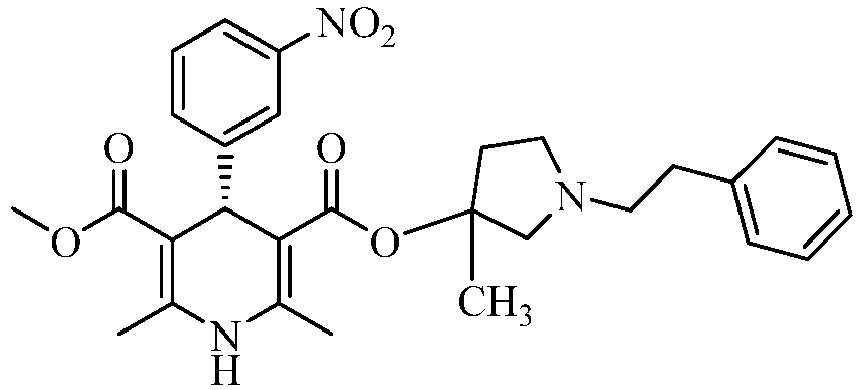
-

- According to Example 15, 3-methylpyrrolidin-3-ol hydrochloride was synthesized. To a 100mL reaction flask were added 3-methylpyrrolidin-3-ol hydrochloride (1g, 7.2mmol), anhydrous potassium carbonate (2.5g, 18mmol) and acetonitrile (15mL). To the resulting mixture was slowly added a solution of 2-bromoethylbenzene (1.2g, 6.48mmol) in acetonitrile dropwisely at 85°C. The reaction was conducted for 12 hours. After the completion of reaction monitored by TLC, the resulting mixture was evaporated under reduced pressure to remove acetonitrile. To the residue was added a mixed solution of dichloromethane and water for extraction. The organic phase was dried over anhydrous sodium sulfate, and evaporated to remove the solvent to produce a crude product. The crude product was purified by column chromatography (silica gel column, eluted with petroleum ether: ethyl acetate = 30:1 (volumetric ratio)) to produce 3-methyl-1-phenylethylpyrrolidin-3-ol (1 g) in a yield of 75.2 %.
-

- According to Example 15, (R)-5-methoxycarbonyl-2,6-dimethyl-4-(3-nitrophenyl)-1,4-dihydropyridine-3-carboxylic acid was synthesized. To a solution of (R)-5-methoxycarbonyl-2,6-dimethyl-4-(3-nitrophenyl)-1,4-dihydropyridine-3-carboxylic acid (2.9g, 8.73mmol) in dichloromethane was added 0.1mL DMF. To the mixture was slowly added oxalyl chloride (2.2g, 17.33mmol) dropwisely in an ice bath. The reaction was conducted at 25°C until the completion of reaction. The resulting mixture was evaporated under reduced pressure to remove oxalyl chloride. To the reaction flask were slowly added dichloromethane (20mL), 3-methyl-1-phenylethylpyrrolidin-3-ol (1g, 4.87mmol) and DIPEA (1.56g, 12.1mmol) dropwisely under cooling in an ice bath respectively and successively. The reaction was conducted at 25°C. After the completion of reaction monitored by HPLC, the reaction solution was washed with water thrice. The organic phase was dried over sodium sulfate, and filtered by suction. The filtrate was evaporated to dryness, and purified by column chromatography (silica gel column, eluted with petroleum ether: ethyl acetate = 78:1 (volumetric ratio)) to produce (4S)-3-(3-methyl-1-phenylethylpyrrolidin-3-yl) 5-methyl 2,6-dimethyl-4-(3-nitrophenyl)-1,4-dihydropyridine-3,5-dicarboxylate (1.21 g) in a yield of 48 %.
Molecular formula: C29H33N3O6 Mw: 519.2 MS (M+H): 520.3
1H-NMR(DMSO, 400 MHz) δ: 9.20-9.18 (1 H, d), 8.03-7.97 (2 H, m), 7.64-7.53 (2 H, m), 7.34-7.21 (5 H, m), 4.96-4.93 (1 H, d), 3.56-3.54 (2 H, m), 3.52-3.41 (3 H, m), 3.34-3.17 (1H, m), 3.07-2.93 (2 H, m), 2.50-2.49 (2 H, m), 2.31-2.29 (6 H, d), 2.26 (1H, m), 1.54-1.39 (3 H, dd), 1.1(1 H, s), 1.05(1 H, t). -

-

- According to Example 15, 3-methylpyrrolidin-3-ol hydrochloride was synthesized. To a 100mL reaction flask were added 3-methylpyrrolidin-3-ol hydrochloride (1g, 7.2mmol), anhydrous potassium carbonate (2.5g, 18mmol) and acetonitrile (15mL). To the resulting mixture was slowly added a solution of 3,5-difluorobenzyl bromide (1.64g, 7.9mmol) in acetonitrile dropwisely at 85°C. The reaction was conducted for 12 hours. After the completion of reaction monitored by TLC, the resulting mixture was evaporated under reduced pressure to remove acetonitrile. To the residue was added a mixed solution of dichloromethane and water for extraction. The organic phase was dried over anhydrous sodium sulfate, and evaporated to remove the solvent to produce a crude product of 1-(3,5-difluorobenzyl)-3-methylpyrrolidin-3-ol (1.8 g), which was directly used in the next step.
-

- According to Example 15, (R)-5-methoxycarbonyl-2,6-dimethyl-4-(3-nitrophenyl)-1,4-dihydropyridine-3-carboxylic acid was synthesized. To a solution of (R)-5-methoxycarbonyl-2,6-dimethyl-4-(3-nitrophenyl)-1,4-dihydropyridine-3-carboxylic acid (4.86g, 14.6mmol) in dichloromethane was added 0.1mL DMF. To the mixture was slowly added oxalyl chloride (3.68g, 29.0mmol) dropwisely in an ice bath. The reaction was conducted at 25°C until the completion of reaction. The resulting mixture was evaporated under reduced pressure to remove oxalyl chloride. To the reaction flask were slowly added dichloromethane (20mL), the crude product of 1-(3,5-difluorobenzyl)-3-methylpyrrolidin-3-ol (1.8g) and DIPEA (1.86g, 14.4mmol) dropwisely under cooling in an ice bath respectively and successively. The reaction was conducted at 25°C. After the completion of reaction monitored by HPLC, the reaction solution was washed with water thrice. The organic phase was dried over sodium sulfate, and filtered by suction. The filtrate was evaporated to dryness, and purified by column chromatography (silica gel column, eluted with petroleum ether: ethyl acetate = 85:1 (volumetric ratio)) to produce (4S)-3-[1-(3,5-difluorobenzyl)-3-methyl-3-pyrrolidin-3-yl] 5-methyl 2,6-dimethyl-4-(3-nitrophenyl)-1,4-dihydropyridine-3,5-dicarboxylate (1.78 g) in a yield of 45.6% (two steps together).
Molecular formula: C28H29F2N3O6 Mw: 541.2 MS (M+H): 543.3
1H-NMR(DMSO, 400 MHz) δ: 9.14 (1 H, t), 8.02-7.97 (2 H, m), 7.60-7.55 (2 H, m), 7.39-7.33 (2 H, m), 4.93-4.90 (1 H, d), 4.41-4.40 (2 H, m), 3.56-3.53 (6 H, m), 3.35 (1 H, s), 3.07 (1 H, s), 2.30-2.26 (6 H, m), 1.50-1.24 (3 H, dd), 1.10 (3 H, s). -

-

- To a solution of 5-(methoxycarbonyl)-2,6-dimethyl-4-(3-nitrophenyl) -1,4-dihydropyridine-3-carboxylic acid (700g, 2.1mol) in methanol (14 L) was added Quinidine (617g, 1.90mol). The mixture was placed at 90°C under reflux until Quinidine was completely dissolved. The stirring was continued for 3 hours. 4.5 L water was added. The stirring was continued for half an hour. The mixture was cooled down slowly. A solid was precipitated out and was filtered. The filter cake was treated with hydrochloric acid to produce (R)-5-(methoxycarbonyl)-2,6-dimethyl-4-(3-nitrophenyl)-1,4-dihydropyridine-3-carboxylic acid (130 g) in a yield of 18.6%.
-

- To a 30 L reaction kettle was added 4 L dry THF at -10°C. After stirring, to the mixture were added ZnCl2 (118g, 0.86mol) and LiCl (402g, 9.5mol). After half an hour, to the resulting mixture was slowly added dropwisely a solution of MeMgBr (3mol/L) in diethyl ether (6.4 L, 19.2mol). The stirring was continued for half an hour. To the resulting mixture was slowly added a solution of tert-butyl 3-oxopyrrolidine -1-carboxylate (1600g, 8.6mol) in THF dropwisely. After the completion of reaction by HPLC detection, to the system was dropwisely added a saturated NH4Cl solution to quench off the reaction. The reaction was extracted with ethyl acetate. The organic phase was washed with a saturated aqueous NaCl solution, dried over anhydrous sodium sulfate, and evaporated to remove the solvent to produce tert-butyl 3-hydroxy-3-methylpyrrolidine-1-carboxylate as a pale-yellow solid (1450g) in a yield of 83.8 %.
-

- To a 10L three-opening flask were added 1,4-dioxane (5L) and tert-butyl 3-hydroxy-3-methylpyrrolidine-1-carboxylate (1450g, 7.2mol) in an ice bath. After stirring, to the resulting mixture was slowly added an HCl/ethanol solution (30%, 2.2L) dropwisely. After the completion of addition, the reaction was conducted at 25°C for 12 hours. After the completion of reaction monitored by TLC, the resulting mixture was filtered by suction to produce 3-methylpyrrolidin-3-ol hydrochloride as a red-brown solid (750 g) in a yield of 75.6 %.
-

- To a reaction flask were added 3-methylpyrrolidin-3-ol hydrochloride (1g, 7.2mmol), anhydrous potassium carbonate (2.5g, 18mmol) and acetonitrile (50L). To the resulting mixture was slowly added a solution of diphenylbromomethane (1.78g, 7.2mmol) in acetonitrile dropwisely at 85°C. The reaction was conducted for 12 hours. After the completion of reaction monitored by TLC, the resulting mixture was evaporated under reduced pressure to remove acetonitrile. To the residue was added a mixed solution of dichloromethane and water for extraction. The organic phase was dried over anhydrous sodium sulfate and evaporated to remove the solvent to produce a crude product. The crude product was purified by column chromatography (silica gel column, eluted with petroleum ether: ethyl acetate = 30:1 (volumetric ratio)) to produce 1-(diphenylmethyl)-3-methylpyrrolidin-3-ol (1 g) in a yield of 52.0 %.
-

- To a solution of (R)-5-methoxycarbonyl-2,6-dimethyl-4-(3-nitrophenyl)-1,4-dihydropyridine-3-carboxylic acid (3.58g, 10.8mmol) in dichloromethane was added 1mL DMF. To the mixture was slowly added oxalyl chloride (2.74g, 21.6mmol) dropwisely in an ice bath. The reaction was conducted at 25°C until the completion of reaction. The resulting mixture was evaporated under reduced pressure to remove oxalyl chloride. To the reaction flask were slowly added 1-(3,3-diphenylpropyl) -3-methylpyrrolidin-3-ol (1g, 3.7mmol) and DIPEA (1.4g, 10.8mmol) dropwisely under cooling in an ice bath respectively and successively. The reaction was conducted at 25°C. After the completion of reaction monitored by HPLC, the reaction solution was washed with water thrice. The organic phase was dried over anhydrous sodium sulfate, and filtered by suction. The filtrate was evaporated to dryness, and purified by column chromatography (silica gel column, eluted with petroleum ether: ethyl acetate = 15:1 (volumetric ratio)) to produce (4S)-3-[1-diphenylmethyl -3-methylpyrrolidin-3-yl] 5-methyl 2,6-dimethyl-4-(3-nitrophenyl)-1,4-dihydropyridine-3,5-dicarboxylate (1.2 g) in a yield of 56 %.
Molecular formula: C34H35N3O6 Mw: 581.2
1H-NMR(DMSO, 400 MHz) δ: 9.19-9.13 (1 H, m), 8.01-7.89 (2 H, m), 7.73-7.68 (4 H, m), 7.58-7.53 (2 H, m), 7.41-7.34 (6 H, m), 4.93-4.89 (1 H, s), 3.77-3.69 (2 H, m), 3.62-3.42 (3 H, m), 3.37-3.22 (3H, m), 2.49-2.48 (1 H, s), 2.28-1.99 (6 H, d), 1.50-1.35 (3 H, dd). -

- The steps in Example 15 were repeated, except that the reactant in step (4) ethyl 3,3-diphenyl-1-propanate was replaced with ethyl 3,3-bis(4-fluoro)phenyl-1-propanate to obtain Compound 27.
MS (M+H): 646.3. - With reference to the above processes, the following compounds can also be prepared:
No. Structure No. Structure 24 
52 
25 
53 
28 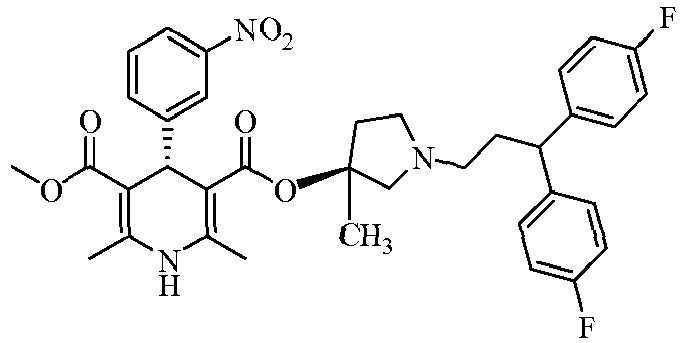
29 
30 
31 
32 
33 
59 
34 
60 
35 
61 
36 
62 
37 
63 
38 
64 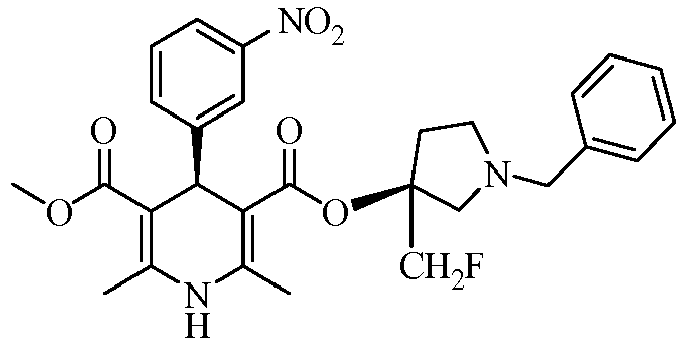
39 
65 
40 
66 
41 
67 
42 
68 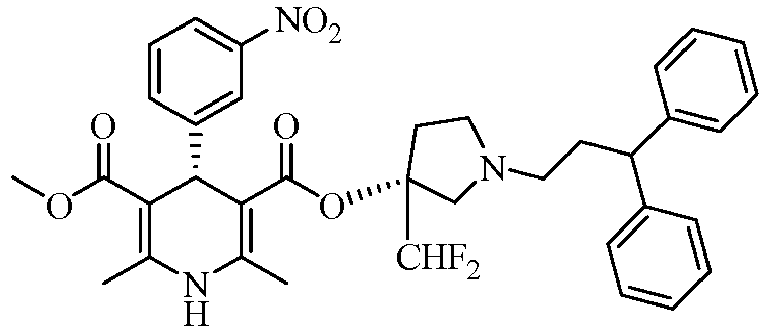
43 
69 
44 
70 
45 
71 
46 
72 
73 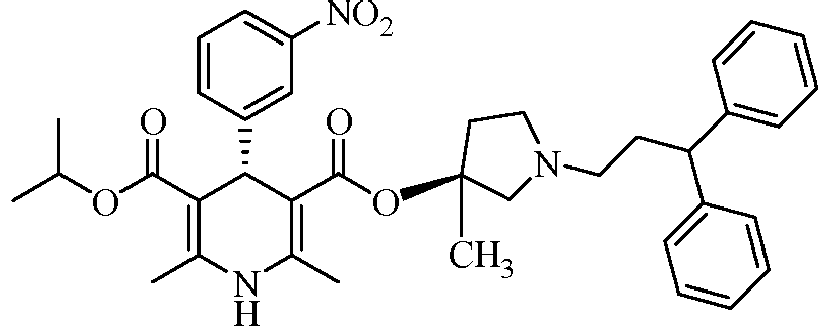
74 
75 
76 
51 
- The beneficial effects of the compound of the present invention will be further illustrated by the following pharmacological assays. But it should be understood that the beneficial effects of the compound of the present invention are not merely limited thereto.
- Positive control: lercanidipine, barnidipine, amlodipine and azelnidipine, commercially purchased.
- This experiment was assigned to HD Biosciences Corporation (Shanghai) and conducted with an electrophysiological method. The results are shown in Table 1 and Table 2.
- It was done with reference to the method as disclosed by Jung-Ha Lee, et. al., "Identification of T-Type α1H Ca2+ Channels (Cav3.2) in Major Pelvic Ganglion Neurons". J Neurophysiol 87:2844-2850, 2002.
- Test samples were weighed accurately and diluted in a 3-fold stepwise dilution so that the final concentrations were as follows:
- 10 µM, 3 µM, 1 µM, 0.3 µM, 0.1 µM, 0.03 µM.
- T-type test: Cerebral cortex nerve cells were separated from suckling mice, and used in the experiment after 7 days of cultivation. The ionic current of a single cell was recorded by applying the whole cell patch-clamp technique at room temperature, wherein the clamp current was -90 mV, and the pulse interval was 10s. The inward current (the activiation was started from -20 mV) is the T-type calcium current (ICa,T).
- L-type test: Left ventricle muscle cells were separated from guinea pigs. The cells were used in the experiment in eight hours. The ionic current of a single cell was recorded by applying the whole cell patch-clamp technique at room temperature, wherein the clamp current was -80 mV, and the pulse interval was 10s. The inward current (the activiation was started from 0 mV) is the L-type calcium current (ICa,L).
- The electrode inner liquid (mM): CsCl 120, TEA-Cl 20, CaCl2 1, EGTA-CsOH 11, Hepes 10, Mg-ATP 5, pH7.3;
- TEA-Cl: 165.70 mg, cesium chloride: 1010.16 mg, calcium chloride: 7.35 mg, magnesium adenosine triphosphate: 126.80 mg, HEPES: 119.15 mg, EGTA: 209.22 mg, ddH2O: 35 mL.
- The above components were thoroughly dissolved in deionized water. The pH value was adjusted to 7.25 with 1M cesium hydroxide. A suitable amount of deionized water was added to adjust the final volume to 50 mL; the osmotic pressure was adjusted to 280 mOsm; the solution was filtered with a 0.20 µm filter, split charged into 1mL EP tubes, and preserved at -20 °C for use.
- The electrode outer liquid (mM): NaCl 135, CsCl 5.4, CaCl2 1.8, MgCl2 1, Hepes 5, glucose 10, pH7.4.
- Sodium chloride: 7890.00 mg, cesium chloride: 909.14 mg, calcium chloride: 264.64 mg, magnesium chloride: 203.30 mg, HEPES: 1191.50 mg, glucose: 1981.70 mg, ddH2O: 980 mL.
- The above components were weighed and mixed into 850 mL dd H2O. The mixture was thoroughly dissolved by using a magnetic stirrer. The pH value was adjusted to 7.40 with 1M sodium hydroxide and the final volume was adjusted to 1000 mL. After the osmotic pressure was adjusted to 290 mOsm (milliosmole), the solution was placed in a clean bottle, and preserved in the refrigerator at 4 °C for use.
- T-type tests for Compound 19 and Compound 20 were assigned to Chan Test Corporation, and conducted according to the FLIPR experimental procedure as follows.
- It was done with reference to the method disclosed on page 48 of
WO 2009/056934 A1 . - Samples were weighed accurately and diluted in a 3-fold stepwise dilution so that the final concentrations were as follows: 100 µM, 30µM, 10µM, 3µM, 1µM, 0.3µM, 0.1µM, 0.03µM, 0.01µM, 0.003µM.
- T-type test: Human Cav3.2 was cloned in stable HEK-293 cells, and then the operation was conducted with FLIPR Calcium 4 No-Wash kit. The cell medium was removed. To an HEPES solution free of calcium ion was added 20µL dye to dye for 30 minutes at a temperature of 37 °C. This buffer free of calcium ion included NaCl, 137mM; KCl, 0.5 mM; MgCl2 mM, 1 mM; HEPES, 10 mM; glucose, 10 mM. The pH value was adjusted to 7.4 with NaOH. After 30 minutes, the buffer was placed at room temperature for 30 miuntes. Then 5 µL of compound to be tested, solvent or blank control were added. The compound was formulated with a buffer containing calcium ion, said buffer including KCl, 135 mM; CaCl2, 10.8 mM; MgCl2, 1 mM; HEPES, 10 mM; glucose, 10 mM. The collected fluorescence values were analyzed and the inhibition ratios were calculated. The results were shown in Table 3.
-
Table 1: The inhibition activities of the compounds of the present invention on L-type calcium ion channels (electrophysiological method) Test sample IC50(µM) L-type lercanidipine 0.84 barnidipine 0.58 amlodipine 1.11 azelnidipine 1.39 nifedipine 0.3 Compound 14 0.59 Compound 15 1.28 Compound 16 0.59 Compound 17 0.93 - It could be seen from Table 1 that the compounds of the present invention have strong inhibition activities on L-type calcium ion channels, which were comparable with the inhibition effects of the control samples.
Table 2: The inhibition activities of the compounds of the present invention on T-type calcium ion channels Test sample IC50(µM) lercanidipine >10 barnidipine 8.15 amlodipine 15.63 azelnidipine 378.3 nifedipine 1140 Compound 1 hydrochloride 4.47 Compound 2 hydrochloride 3.20 Compound 16 2.28 Table 3: The inhibition activities of the compounds of the present invention on T-type calcium ion channels (FLIPR method) Test sample IC50(µM) T-type barnidipine 30.80 amlodipine >100 Compound 16 1.95 Compound 17 9.41 Compound 19 75.44 Compound 20 66.86 - It could be seen from Table 2 and Table 3 that the compounds of the present invention have inhibition activities on T-type calcium ion channels that are significantly superior over the inhibition activities of the positive control samples on T-type calcium ion channels, and therefore have a better hypotensive effect, a protective effect on kidney and heart, as well as a lower side effect.
- Positive control: lercanidipine, barnidipine, amlodipine, azelnidipine, efonidipine and manidipine, commercially purchased.
- The in vivo hypotensive activity assay was conducted according to the tail-pinch method with reference to Folia pharmacol. Japon. 97, 115-126 (1991).
- The agents to be tested, lercanidipine, barnidipine, amlodipine, azelnidipine, efonidipine and manidipine, were accurately weighed respectively. Each agent was dissolved in DMSO. To the resulting solution was added 50% of the corresponding volume of PEG400 so that the final concentration of each agent was 1mg/ml, and the final concentration of DMSO was 3%.
- The compounds to be tested, Compound 18, Compound 21, Compound 22, Compound 23, and Compound 26, were accurately weighed respectively. Each compound was dissolved in DMSO. To the resulting solution was added 50% of the corresponding volume of PEG400 so that the final concentration of each compound was 1mg/ml, and the final concentration of DMSO was 3%.
- The compounds to be tested, Compound 19 and Compound 20, were accurately weighed respectively. Each compound was suspended in 0.5% MC so that the final concentration of each compound was 1mg/ml.
- The test for hypotensive effect: Male SHRs (spontaneous hypertensive rats) were randomly allocated into a control group and an administration group. The administration was an intragastric administration. One hour before the administration, the measured blood pressure was used as the pre-administration basic blood pressure value. After the administration, the contractive pressure, the heart rate and the mean arterial pressure of SHRs at six time points, i.e. 1, 2, 4, 6, 8 and 24 hours after the administration, were measured with a Softron BP-98A non-invasive blood pressure instrument respectively. The test results were shown in Table 4.
-
Table 4: The hypotensive activities of the compounds of the present invention on SHRs Test sample Administration dosage (mg/kg, po) Animal number Max ΔMAP (mmHg±SEM) ΔMAP>20(mmHg) Duration time of action (h) lercanidipine 10 4 77±15 23 barnidipine 10 4 81±10 14 amlodipine 10 4 74±8 24 azelnidipine 10 4 79±13 24 efonidipine 10 4 69±5 10 manidipine 10 4 74±5 23 Compound 18 10 4 69±4 24 Compound 19 10 3 72±8 24 Compound 20 10 4 80±14 24 Compound 21 10 3 28±12 24 Compound 22 10 3 43±7 24 Compound 23 10 3 60±12 24 Compound 26 10 4 55±13 24 Note: ΔMAP is the difference between the average arterial pressure value after the administration and the average arterial pressure value before the administration. - It could be seen from Table 4 that the compounds of the present invention have good hypotensive effect in SHRs, and maintained the hypotensive effect above 20mmHg for a longer duration time than control samples.
- Positive control: lercanidipine, barnidipine, amlodipine and azelnidipine, commercially purchased.
- The in vivo hypotensive activity assay was conducted according to DSI experimental procedure with reference to page 56 of
WO 2009/056934 A1 . - The agents to be tested, lercanidipine, barnidipine, amlodipine, azelnidipine, efonidipine and manidipine, were accurately weighed. Each agent was dissolved in DMSO. To the resulting solution was added 50% of the corresponding volume of PEG400 so that the final concentration of each agent was 1mg/ml, and the final concentration of DMSO was 3%.
- The compounds to be tested, Compound 1 and Compound 2, were accurately weighed. Each compound was dissolved in DMSO. To the resulting solution was added 50% of the corresponding volume of PEG400 so that the final concentration of each compound was 1mg/ml, and the final concentration of DMSO was 2%.
- The compound to be tested, Compound 15, was accurately weighed. This compound was dissolved in DMSO. To the resulting solution was added 50% of the corresponding volume of PEG400 so that the final concentration of this compound was 1mg/ml, and the final concentration of DMSO was 3%.
- The compound to be tested, Compound 16 (optical activity +108.34°) and Compound 17 (optical activity optical activity +36.4°), were accurately weighed. Each compound was suspended in 0.5% MC so that the final concentration of each compound was 1mg/ml.
- The test for hypotensive effect: Male SHRs were subjected to an abdominal aorta implantation using an implant, and used in the test after 7-10 days of recovery. The administration was an intragastric administration. One hour before the administration, the measured blood pressure was used as the pre-administration basic blood pressure value. After the administration, SHRs, allowed free access to the diet, were continuously monitored with a DSI implant-type blood pressure remote measurement system for 24 hours. The test results were shown in Table 5.
-
Table 5: The hypotensive activities of the compounds of the present invention on SHRs Test sample Administration dosage (mg/kg, po) Animal number Max ΔMAP (mmHg±SEM) ΔMAP>20(mmHg) Duration time of action (h) lercanidipine 10 4 54±7 14 barnidipine 10 4 60±6 9 amlodipine 10 4 48±13 16 azelnidipine 10 4 40±5 11 Compound 1 10 3 47±7 6 Compound 2 10 3 53±7 16 Compound 15 10 3 56±1 14 Compound 16 10 4 57±5 11 Compound 17 10 4 57±5 16 Note: ΔMAP is the difference between the average arterial pressure value after the administration and the average arterial pressure value before the administration. - It could be seen from Table 5 that the compounds of the present invention have good hypotensive effect in SHRs, and maintained the hypotensive effect above 20mmHg for a longer duration time than control samples.
Claims (10)
- A compound of general formula (I), a pharmaceutically acceptable salt or a stereoisomer thereof:
 R1 and R4 are each independently selected from methyl or ethyl;R2 is selected from methyl, ethyl, isopropyl, cyclopropyl, cyclopropylmethyl, azetidinyl, pyrrolidinyl, piperidyl, morpholinyl, pyrrolidinylmethyl and morpholinylmethyl that are unsubstituted or substituted by 1-3 Q2 substituents, Q2 is selected from fluoro, chloro, hydroxy, amino, methyl, C1-4alkoxy, and C1-4alkyl and C1-4alkoxy that are substituted by 1-3 fluoro and/or chloro atoms;R3 is selected from hydrogen, fluoro, chloro and nitro;R5 and R6 are each independently selected from methyl or ethyl that is unsubstituted or substituted by 1-3 Q3 substituents, Q3 is selected from fluoro, chloro, hydroxy, amino, methoxy and ethoxy;R7 and R8 are each independently selected from hydrogen, methyl, ethyl, and phenylC0-2alkyl, pyridylC0-2alkyl, furylC0-2alkyl, thienylC0-2alkyl, pyrrolylC0-2alkyl, thiazolylC0-2alkyl and thiadiazolylC0-2alkyl that are unsubstituted or substituted by 1-3 Q4 substituents, and R7 and R8 are not both hydrogen at the same time, Q4 is selected from fluoro, chloro, hydroxy, amino, methyl, ethyl, fluoromethyl, difluoromethyl, trifluoromethyl, methoxy and ethoxy;m is selected from 1, 2 or 3, when m is 2 or 3, R3 can be identical or different;n1 is 2, n2 is 1;p and q are each independently selected from 0, 1, 2 or 3, when q is 0, R7 and R8 are not both phenyl at the same time.
 - The compound of claim 1, a pharmaceutically acceptable salt or a stereoisomer thereof:wherein, R1 and R4 are each independently selected from methyl or ethyl;R2 is selected from methyl or ethyl that is unsubstituted or substituted by 1-3 Q2 substituents, Q2 is selected from fluoro, chloro, methyl, methoxy, or methoxy and ethoxy that are substituted by 1-3 fluoro, chloro atoms;R3 is selected from hydrogen, chloro or nitro;R5 is selected from methyl or ethyl that is unsubstituted or substituted by 1-3 Q3 substituents, Q3 is selected from fluoro, chloro, hydroxy or amino;R6 is selected from methyl that is unsubstituted or substituted by 1-3 Q3 substituents, Q3 is selected from fluoro, chloro, hydroxy or amino;R7 and R8 are each independently selected from hydrogen, and phenyl, benzyl, pyridyl, furyl, thienyl, thiazolyl or pyrrolyl that is unsubstituted or substituted by 1-3 Q4 substituents, and R7 and R8 are not both hydrogen at the same time,Q4 is selected from fluoro, chloro, hydroxy, amino, methyl, trifluoromethyl or methoxy;m is 1;n1 is 2, n2 is 1;p and q are each independently selected from 0, 1 or 2, when q is 0, R7 and R8 are not both phenyl at the same time.
- The compound of claim 1, a pharmaceutically acceptable salt or a stereoisomer thereof, wherein said compound is selected from:
Compound Structure Chemical Name 2 
3-[1-(3,3-diphenylpropyl)-3-methylpyrrolidin-3-yl]5-methyl 2,6-dimethyl-4-(3-nitrophenyl)-1,4-dihydropyridine-3,5-dicarboxylate 4 
3-[1-(3,3-diphenylpropyl)-3-methylpyrrolidin-3-yl] 5-ethyl 2,6-dimethyl-4-(3-nitrophenyl)-1,4-dihydropyridine-3,5-dicarboxylate 5 
3-(1-phenylethyl-3-methylpyrrolidin -3-yl) 5-methyl 2,6-dimethyl-4-(3-nitrophenyl)-1,4-dihydropyridine-3,5-dicarboxylate 6 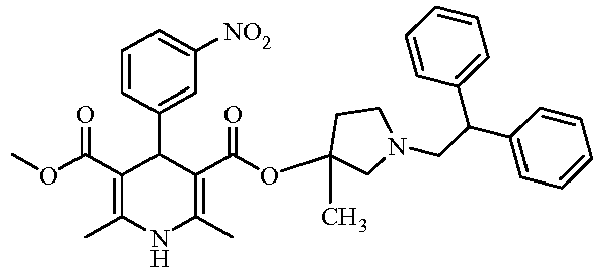
3-[1-(2,2-diphenylethyl)-3-methylpyrrolidin-3-yl] 5-methyl 2,6-dimethyl-4-(3-nitrophenyl)-1,4-dihydropyridine-3,5-dicarboxylate 11 
3-[1-(3,3-bis(4-fluorophenyl)propyl) -3-methylpyrrolidin-3-yl] 5-methyl 2,6-dimethyl-4-(3-nitrophenyl)-1,4-dihydropyridine-3,5-dicarboxylate 14 
(4R)-3-[1-(3,3-diphenylpropyl)-3-methylpyrrolidin-3-yl] 5-methyl 2,6-dimethyl-4-(3-nitrophenyl)-1,4-dihydropyridine-3,5-dicarboxylate 15 
(4S)-3-[1-(3,3-diphenylpropyl)-3-methylpyrrolidin-3-yl] 5-methyl 2,6-dimethyl-4-(3-nitrophenyl)-1,4-dihydropyridine-3,5-dicarboxylate 16 
(S)-3-[(S)-1-(3,3-diphenylpropyl)-3-methylpyrrolidin-3-yl] 5-methyl 2,6-dimethyl-4-(3-nitrophenyl)-1,4-dihydropyridine-3,5-dicarboxylate 17 
(S)-3-[(R)-1-(3,3-diphenylpropyl)-3-methylpyrrolidin-3-yl] 5-methyl 2,6-dimethyl-4-(3-nitrophenyl)-1,4-dihydropyridine-3,5-dicarboxylate 18 
(4S)-3-[1-(2,2-diphenylethyl)-3-methylpyrrolidin-3-yl] 5-methyl 2,6-dimethyl-4-(3-nitrophenyl)-1,4-dihydropyridine-3,5-dicarboxylate 19 
(S)-3-[(R)-1-(2,2-diphenylethyl)-3-methylpyrrolidin-3-yl] 5-methyl 2,6-dimethyl-4-(3-nitrophenyl)-1,4-dihydropyridine-3,5-dicarboxylate 20 
(S)-3-[(S)-1-(2,2-diphenylethyl)-3-methylpyrrolidin-3-yl] 5-methyl 2,6-dimethyl-4-(3-nitrophenyl)-1,4-dihydropyridine-3,5-dicarboxylate 21 
(4S)-3-[3-methyl-1-(3-phenylpropyl) pyrrolidin-3-yl] 5-methyl 2,6-dimethyl-4-(3-nitrophenyl)-1,4-dihydropyridine-3,5-dicarboxylate 22 
(4S)-3-(3-methyl-1-phenylethylpyrrolidin-3-yl) 5-methyl 2,6-dimethyl-4-(3-nitrophenyl)-1,4-dihydropyridine-3,5-dicarboxylate 27 
(4S)-3-[1-(3,3-bis(4-fluorophenyl) propyl)-3-methylpyrrolidin-3-yl] 5-methyl 2,6-dimethyl-4-(3-nitrophenyl)-1,4-dihydropyridine-3,5-dicarboxylate 28 
(S)-3-[(S)-1-(3,3-bis(4-fluorophenyl) propyl)-3-methylpyrrolidin-3-yl] 5-methyl 2,6-dimethyl-4-(3-nitrophenyl)-1,4-dihydropyridine-3,5-dicarboxylate 29 
(S)-3-[(R)-1-(3,3-bis(4-fluorophenyl) propyl)-3-methylpyrrolidin-3-yl] 5-methyl 2,6-dimethyl-4-(3-nitrophenyl)-1,4-dihydropyridine-3,5-dicarboxylate 31 
3-[1-(3,3-diphenylpropyl)-3-ethylpyrrolidin-3-yl] 5-methyl 2,6-dimethyl-4-(3-nitrophenyl)-1,4-dihydropyridine-3,5-dicarboxylate 35 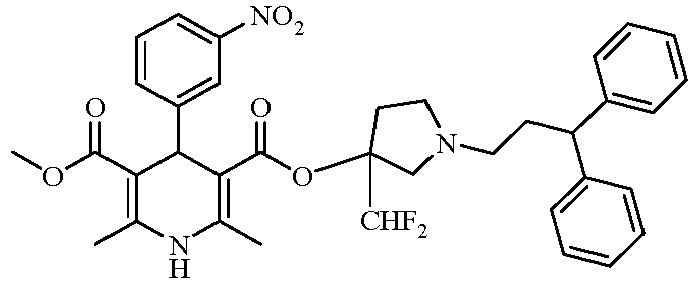
3-[3-difluoromethyl-1-(3,3-diphenylpropyl)pyrrolidin-3-yl] 5-methyl 2,6-dimethyl-4-(3-nitrophenyl)-1,4-dihydropyridine-3,5-dicarboxylate 36 
3-[1-(3,3-bis(4-hydroxyphenyl)propyl -3-methylpyrrolidin-3-yl] 5-methyl 2,6-dimethyl-4-(3-nitrophenyl)-1,4-dihydropyridine-3,5-dicarboxylate 38 
3-[3-aminomethyl-1-(3,3-diphenylpropyl)pyrrolidin-3-yl) 5-methyl 2,6-dimethyl-4-(3-nitrophenyl)-1,4-dihydropyridine-3,5-dicarboxylate 40 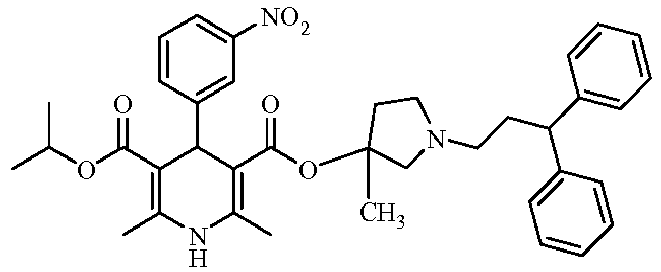
3-[1-(3,3-diphenylpropyl)-3-methylpyrrolidin-3-yl] 5-isopropyl 2,6-dimethyl-4-(3-nitrophenyl)-1,4-dihydropyridine-3,5-dicarboxylate 42 
3-[1-(3,3-diphenylpropyl)-3-methylpyrrolidin-3-yl] 5-(2-methoxyethyl) 2,6-dimethyl-4-(3-nitrophenyl)-1,4-dihydropyridine-3,5-dicarboxylate 43 
3-[3-methyl-1-(thiazol-2-ylmethyl) pyrrolidin-3-yl] 5-methyl 2,6-dimethyl-4-(3-nitrophenyl)-1,4-dihydropyridine-3,5-dicarboxylate 44 
3-[3-methyl-1-(pyrid-2-ylmethyl) pyrrolidin-3-yl] 5-methyl 2,6-dimethyl-4-(3-nitrophenyl)-1,4-dihydropyridine-3,5-dicarboxylate 45 
3-[3-methyl-1-(pyrid-3-ylmethyl) pyrrolidin-3-yl] 5-methyl 2,6-dimethyl-4-(3-nitrophenyl)-1,4-dihydropyridine-3,5-dicarboxylate 46 
3-[3-methyl-1-(pyrid-4-ylmethyl) pyrrolidin-3-yl]) 5-methyl 2,6-dimethyl-4-(3-nitrophenyl)-1,4-dihydropyridine-3,5-dicarboxylate 52 
(S)-3-[(R)-1-(3,3-diphenylpropyl)-3-methylpyrrolidin-3-yl] 5-ethyl 2,6-dimethyl-4-(3-nitrophenyl)-1,4-dihydropyridine-3,5-dicarboxylate 53 
(S)-3-[(S)-1-(3,3-diphenylpropyl)-3-methylpyrrolidin-3-yl] 5-ethyl 2,6-dimethyl-4-(3-nitrophenyl)-1,4-dihydropyridine-3,5-dicarboxylate 61 
(S)-3-[(R)-1-(3,3-diphenylpropyl)-3-ethylpyrrolidin-3-yl] 5-methyl 2,6-dimethyl-4-(3-nitrophenyl)-1,4-dihydropyridine-3,5-dicarboxylate 62 
(S)-3-[(S)-1-(3,3-diphenylpropyl)-3-ethylpyrrolidin-3-yl] 5-methyl 2,6-dimethyl-4-(3-nitrophenyl)-1,4-dihydropyridine-3,5-dicarboxylate 68 
(S)-3-[(R)-3-difluoromethyl-1-(3,3-diphenylpropyl)pyrrolidin-3-yl] 5-methyl 2,6-dimethyl-4-(3-nitrophenyl)-1,4-dihydropyridine-3,5-dicarboxylate 69 
(S)-3-[(S)-1-(3,3-bis(4-hydroxyphenylpropyl)-3-methylpyrrolidin-3-yl] 5-methyl 2,6-dimethyl-4-(3-nitrophenyl)-1,4-dihydropyridine-3,5-dicarboxylate 71 
(S)-3-[(R)-3-aminomethyl-1-(3,3-diphenylpropyl)pyrrolidin-3-yl] 5-methyl 2,6-dimethyl-4-(3-nitrophenyl)-1,4-dihydropyridine-3,5-dicarboxylate 73 
(S)-3-[(S)-1-(3,3-diphenylpropyl)-3-methylpyrrolidin-3-yl] 5-isopropyl 2,6-dimethyl-4-(3-nitrophenyl)-1,4-dihydropyridine-3,5-dicarboxylate 75 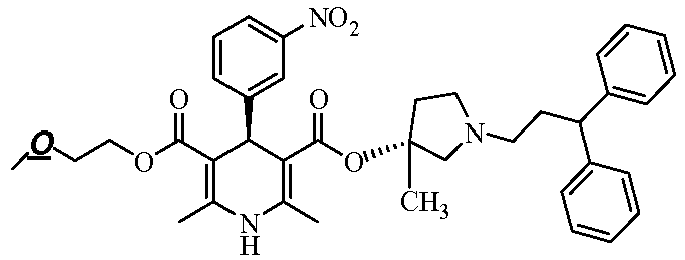
(R)-3-[(R)-1-(3,3-diphenylpropyl)-3-methylpyrrolidin-3-yl] 5-(2-methoxyethyl) 2,6-dimethyl-4-(3-nitrophenyl)-1,4-dihydropyridine-3,5-dicarboxylate 76 
(S)-3-[(R)-3-methyl-1-(thiazol-2-ylmethyl)pyrrolidin-3-yl] 5-methyl 2,6-dimethyl-4-(3-nitrophenyl)-1,4-dihydropyridine-3,5-dicarboxylate - The compound of claim 1, a pharmaceutically acceptable salt or a stereoisomer thereof, wherein said compound is selected from
Compound Structure Chemical Name 2 
3-[1-(3,3-diphenylpropyl)-3-methylpyrrolidin-3-yl] 5-methyl 2,6-dimethyl-4-(3-nitrophenyl)-1,4-dihydropyridine-3,5-dicarboxylate 4 
3-[1-(3,3-diphenylpropyl)-3-methylpyrrolidin-3-yl] 5-ethyl 2,6-dimethyl-4-(3-nitrophenyl)-1,4-dihydropyridine-3,5-dicarboxylate 5 
3-(1-phenylethyl-3-methylpyrrolidin-3- yl) 5-methyl 2,6-dimethyl-4-(3-nitrophenyl)-1,4-dihydropyridine-3,5-dicarboxylate 6 
3-[1-(2,2-diphenylethyl)-3-methylpyrrolidin-3-yl] 5-methyl 2,6-dimethyl-4-(3-nitrophenyl)-1,4-dihydropyridine-3,5-dicarboxylate 11 
3-[1-(3,3-bis(4-fluorophenyl)propyl) -3-methylpyrrolidin-3-yl] 5-methyl 2,6-dimethyl-4-(3-nitrophenyl)-1,4-dihydropyridine-3,5-dicarboxylate 14 
(4R)-3-[1-(3,3-diphenylpropyl)-3-methylpyrrolidin-3-yl] 5-methyl 2,6-dimethyl-4-(3-nitrophenyl)-1,4-dihydropyridine-3,5-dicarboxylate 15 
(4S)-3-[1-(3,3-diphenylpropyl)-3-methylpyrrolidin-3-yl] 5-methyl 2,6-dimethyl-4-(3-nitrophenyl)-1,4-dihydropyridine-3,5-dicarboxylate 16 
(S)-3-[(S)-1-(3,3-diphenylpropyl)-3-methylpyrrolidin-3-yl] 5-methyl 2,6-dimethyl-4-(3-nitrophenyl)-1,4-dihydropyridine-3,5-dicarboxylate 17 
(S)-3-[(R)-1-(3,3-diphenylpropyl)-3-methylpyrrolidin-3-yl] 5-methyl 2,6-dimethyl-4-(3-nitrophenyl)-1,4-dihydropyridine-3,5-dicarboxylate 18 
(4S)-3-[1-(2,2-diphenylethyl)-3-methylpyrrolidin-3-yl] 5-methyl 2,6-dimethyl-4-(3-nitrophenyl)-1,4-dihydropyridine-3,5-dicarboxylate 19 
(S)-3-[(R)-1-(2,2-diphenylethyl)-3-methylpyrrolidin-3-yl] 5-methyl 2,6-dimethyl-4-(3-nitrophenyl)-1,4-dihydropyridine-3,5-dicarboxylate 20 
(S)-3-[(S)-1-(2,2-diphenylethyl)-3-methylpyrrolidin-3-yl] 5-methyl 2,6-dimethyl-4-(3-nitrophenyl)-1,4-dihydropyridine-3,5-dicarboxylate 21 
(4S)-3-[3-methyl-1-(3-phenylpropyl) pyrrolidin-3-yl] 5-methyl 2,6-dimethyl-4-(3-nitrophenyl)-1,4-dihydropyridine-3,5-dicarboxylate 22 
(4S)-3-(3-methyl-1-phenylethylpyrrolidin-3-yl) 5-methyl 2,6-dimethyl-4-(3-nitrophenyl)-1,4-dihydropyridine-3,5-dicarboxylate 27 
(4S)-3-[1-(3,3-bis(4-fluorophenyl) propyl)-3-methylpyrrolidin-3-yl] 5-methyl 2,6-dimethyl-4-(3-nitrophenyl)-1,4-dihydropyridine-3,5-dicarboxylate - A process for preparing the compound of general forumla (I) of claim 1, comprising the following steps:

 wherein R1, R2, R3, R4, R5, R6, R7, R8, m, n1, n2, p and q are as defined in claim 1;starting material 2=R5MgX, wherein X is Br or I;starting material 2'=R5MgI,starting material 3=
 step 1:starting material 1 and starting material 2 are subjected to a nucleophilic substitution reaction at a low temperature to produce intermediate 1; orstarting material 1' and starting material 2' are subjected to a nucleophilic substitution reaction to produce intermediate 1-1, which is subjected to a salification reaction with an acid HA to produce intermediate 1-2; the resulting intermediate 1-2 and starting material 3 are subjected to a coupling reaction to produce intermediate 1-3; and then intermediate 1-3 is reduced with a reductant to produce intermediate 1;step 2:starting material 4, starting material 5 and starting material 6 are subjected to a condensation reaction under reflux in an organic solvent to produce intermediate 2-1, which is hydrolyzed in the presence of a base to produce intermediate 2; andstep 3:intermediate 2 and an acyl halide agent are reacted at a low temperature, and then the resulting material and intermediate 1 are subject to a hydrolyzation reaction under a basic condition at a low temperature to produce the compound of forumla (I).
 - A pharmaceutical composition containing a compound of any one of claims 1-4, a pharmaceutically acceptable salt or a stereoisomer thereof.
- The pharmaceutical composition according to claim 6, further comprising therapeutical agent(s) selected from: angiotensin II antagonists or a pharmaceutically acceptable salt thereof, including losartan, valsartan, irbesartan, olmesartan, candesartan; HMG-Co-A reductase inhibitors or a pharmaceutically acceptable salt thereof, including lovastatin, simvastatin, pravastatin, mevastatin, fluvastatin, atorvastatin, cerivastatin, Rosuvastatin; aldosterone receptor antagonists (MRA) or a pharmaceutically acceptable salt thereof, including spironolactone, eplerenone; angiotensin converting enzyme/neutral endopeptidase (ACE/NEP) dual inhibitors or a pharmaceutically acceptable salt thereof, including captopril, alacepril, enalapril, lisinopril, perindopril, ramipril, quinapril, delapril, cilazapril, benazepril, spirapril, trandolapril, moexipril, imidapril, fosinopril; antidiabetics, including metformin, glibenclamide, glipizide, glibornuride, gliclazide, gliquidone, sitagliptin, vildagliptin, saxagliptin, alogliptin benzoate, linagliptin; weight-loss drug; endothelin receptor blockers, including bosentan; CETP inhibitors; Na-K-ATPase membrane pump inhibitors; β-adrenergic receptor inhibitors, including metoprolol, carvedilol; α-adrenergic receptor blockers, including prazosin, terazosin, doxazosin; neutral endopeptidase (NEP) inhibitors and inotropic agents.
- A pharmaceutical formulation containing a compound of any one of claims 1-4, a pharmaceutically acceptable salt or a stereoisomer thereof and one or more pharmaceutically acceptable carriers, in any one of pharmaceutically acceptable dosage forms.
- A use of a compound of any one of claims 1-4, a pharmaceutically acceptable salt or a stereoisomer thereof in the manufacture of a medicament for treating and/or preventing kidney injury, cardiovascular diseases and/or endocrine diseases.
- The use according to claim 9, wherein said diseases are selected from high blood pressure, heart failure, myocardial infarction, angina pectoris, cardiac hypertrophy, myocarditis, cardiovascular fibrosis, baroreceptor dysfunction, fluid overload and arhythmia, primary/secondary aldosteronism, Addison's disease, Cushing's syndrome and Bartter's syndrome.
Applications Claiming Priority (2)
| Application Number | Priority Date | Filing Date | Title |
|---|---|---|---|
| CN201110109496 | 2011-04-29 | ||
| PCT/CN2012/000577 WO2012146067A1 (en) | 2011-04-29 | 2012-05-02 | 1,4-dihydropyridine -3,5-dicarboxylate derivatives, preparation methods and uses thereof |
Publications (3)
| Publication Number | Publication Date |
|---|---|
| EP2703398A1 EP2703398A1 (en) | 2014-03-05 |
| EP2703398A4 EP2703398A4 (en) | 2014-10-01 |
| EP2703398B1 true EP2703398B1 (en) | 2017-12-13 |
Family
ID=47071594
Family Applications (1)
| Application Number | Title | Priority Date | Filing Date |
|---|---|---|---|
| EP12776764.8A Not-in-force EP2703398B1 (en) | 2011-04-29 | 2012-05-02 | 1,4-dihydropyridine -3,5-dicarboxylate derivatives, preparation methods and uses thereof |
Country Status (5)
| Country | Link |
|---|---|
| US (1) | US9198902B2 (en) |
| EP (1) | EP2703398B1 (en) |
| JP (1) | JP5859115B2 (en) |
| CN (1) | CN103649075B (en) |
| WO (1) | WO2012146067A1 (en) |
Families Citing this family (5)
| Publication number | Priority date | Publication date | Assignee | Title |
|---|---|---|---|---|
| CN103588700B (en) * | 2013-10-16 | 2015-04-29 | 齐鲁工业大学 | Method for resolving barnidipine mother nucleus by using glucosamine as resolving agent |
| CN108430989B (en) * | 2015-10-13 | 2021-10-08 | 轩竹生物科技有限公司 | Preparation method and intermediate of 1,4-dihydropyridine-3,5-dicarboxylate derivative |
| CN108689904B (en) * | 2017-04-12 | 2022-06-17 | 轩竹生物科技股份有限公司 | Preparation method and application of chiral heterocyclic tertiary alcohol intermediate |
| CN109721596B (en) * | 2017-10-27 | 2020-12-18 | 广东东阳光药业有限公司 | Phenyl-substituted dihydropyridine compounds and their uses |
| CN117538462B (en) * | 2024-01-10 | 2024-03-26 | 地奥集团成都药业股份有限公司 | Method for detecting related substances of amlodipine benazepril capsules |
Family Cites Families (4)
| Publication number | Priority date | Publication date | Assignee | Title |
|---|---|---|---|---|
| JPS5970666A (en) * | 1982-10-15 | 1984-04-21 | Kyowa Hakko Kogyo Co Ltd | 1,4-dihydropyridine derivative |
| US4772596A (en) | 1986-10-09 | 1988-09-20 | Sankyo Company Limited | Dihydropyridine derivatives, their preparation and their use |
| JPH01139577A (en) | 1987-10-28 | 1989-06-01 | Sankyo Co Ltd | 1,4-dyhydropyridine derivative |
| WO2009056934A1 (en) | 2007-10-31 | 2009-05-07 | Pfizer Products Inc. | 1,4-dihydronaphthyridine derivatives |
-
2012
- 2012-05-02 JP JP2014506727A patent/JP5859115B2/en not_active Expired - Fee Related
- 2012-05-02 CN CN201280020936.XA patent/CN103649075B/en not_active Expired - Fee Related
- 2012-05-02 US US14/114,346 patent/US9198902B2/en active Active
- 2012-05-02 WO PCT/CN2012/000577 patent/WO2012146067A1/en not_active Ceased
- 2012-05-02 EP EP12776764.8A patent/EP2703398B1/en not_active Not-in-force
Non-Patent Citations (1)
| Title |
|---|
| None * |
Also Published As
| Publication number | Publication date |
|---|---|
| EP2703398A1 (en) | 2014-03-05 |
| US20140045896A1 (en) | 2014-02-13 |
| JP5859115B2 (en) | 2016-02-10 |
| JP2014512398A (en) | 2014-05-22 |
| EP2703398A4 (en) | 2014-10-01 |
| CN103649075A (en) | 2014-03-19 |
| WO2012146067A1 (en) | 2012-11-01 |
| CN103649075B (en) | 2016-05-25 |
| US9198902B2 (en) | 2015-12-01 |
Similar Documents
| Publication | Publication Date | Title |
|---|---|---|
| JP6805220B2 (en) | Therapeutically active compounds and how to use them | |
| EP2401265B1 (en) | Derivatives of 1-pyri(mid)in-2-yl-pyrazole-4-carboxylic acid which are useful for therapy or prophylaxis of cardiovascular diseases | |
| JP7035013B2 (en) | Aminopyrimidine SSAO inhibitor | |
| EP3423443B1 (en) | Cyano-substituted indole compounds and uses thereof as lsd1 inhibitors | |
| JP4629036B2 (en) | Arylalkylamine compound and process for producing the same | |
| CA2511970C (en) | Urea derivatives useful in the treatment of heart failure | |
| CN104822661B (en) | Carboxylic acid of 5 amino tetrahydroquinoline 2 and application thereof | |
| EP4259618B1 (en) | Substituted pyrazolyl piperidine carboxylic acids | |
| JP2000514801A (en) | Compounds with anti-hypertensive, cardioprotective, anti-ischemic and anti-lipolytic properties | |
| US9198902B2 (en) | 1,4-dihydropyridine-3,5-dicarboxylate derivatives and preparation and use thereof | |
| US20090270452A1 (en) | Use of soluble epoxide hydrolase inhibitors in the treatment of smooth muscle disorders | |
| TW202539631A (en) | Combination therapy using glucose-dependent insulinotropic polypeptide receptor antagonist compounds and glp-1 receptor agonist compounds | |
| WO2020151687A1 (en) | N-benzyl-n-arylsulfonamide derivative and preparation and use thereof | |
| TWI295290B (en) | Novel pyrrolidine-3,4-dicarboxamide derivatives | |
| HK1190144B (en) | 1,4-dihydropyridine -3,5-dicarboxylate derivatives, preparation methods and uses thereof | |
| KR20120018185A (en) | Piperidine Derivatives Useful for the Treatment of Diabetes | |
| HK1190144A (en) | 1,4-dihydropyridine -3,5-dicarboxylate derivatives, preparation methods and uses thereof | |
| TW200831463A (en) | Nitrate esters of aminoalcohols | |
| CN106420754A (en) | Use of benzo five-membered nitrogen-containing heterocyclic piperazine derivative | |
| AU778573B2 (en) | Sodium-hydrogen exchanger type 1 inhibitor crystals | |
| CN115991702B (en) | Aryl C-glucoside derivative, preparation method and application thereof | |
| CN103830238A (en) | Uses of Benzopentazazacyclylpiperidine Derivatives | |
| WO2025160220A2 (en) | Tead inhibitors and methods of use | |
| TW202606669A (en) | Arnt degrading compounds and uses thereof | |
| WO2023227721A1 (en) | Crystalline forms of sodium (5-(4-bromophenyl)-6-(2-((5-bromopyrimidin-2-yl)oxy)ethoxy)pyrimidin-4-yl)(sulfamoyl)amide |
Legal Events
| Date | Code | Title | Description |
|---|---|---|---|
| PUAI | Public reference made under article 153(3) epc to a published international application that has entered the european phase |
Free format text: ORIGINAL CODE: 0009012 |
|
| 17P | Request for examination filed |
Effective date: 20131127 |
|
| AK | Designated contracting states |
Kind code of ref document: A1 Designated state(s): AL AT BE BG CH CY CZ DE DK EE ES FI FR GB GR HR HU IE IS IT LI LT LU LV MC MK MT NL NO PL PT RO RS SE SI SK SM TR |
|
| REG | Reference to a national code |
Ref country code: HK Ref legal event code: DE Ref document number: 1190144 Country of ref document: HK |
|
| DAX | Request for extension of the european patent (deleted) | ||
| A4 | Supplementary search report drawn up and despatched |
Effective date: 20140901 |
|
| RIC1 | Information provided on ipc code assigned before grant |
Ipc: C07D 401/12 20060101AFI20140826BHEP Ipc: A61K 31/44 20060101ALI20140826BHEP |
|
| 17Q | First examination report despatched |
Effective date: 20150930 |
|
| GRAP | Despatch of communication of intention to grant a patent |
Free format text: ORIGINAL CODE: EPIDOSNIGR1 |
|
| INTG | Intention to grant announced |
Effective date: 20170906 |
|
| GRAS | Grant fee paid |
Free format text: ORIGINAL CODE: EPIDOSNIGR3 |
|
| GRAA | (expected) grant |
Free format text: ORIGINAL CODE: 0009210 |
|
| AK | Designated contracting states |
Kind code of ref document: B1 Designated state(s): AL AT BE BG CH CY CZ DE DK EE ES FI FR GB GR HR HU IE IS IT LI LT LU LV MC MK MT NL NO PL PT RO RS SE SI SK SM TR |
|
| REG | Reference to a national code |
Ref country code: GB Ref legal event code: FG4D |
|
| REG | Reference to a national code |
Ref country code: AT Ref legal event code: REF Ref document number: 954233 Country of ref document: AT Kind code of ref document: T Effective date: 20171215 Ref country code: CH Ref legal event code: EP |
|
| REG | Reference to a national code |
Ref country code: IE Ref legal event code: FG4D |
|
| REG | Reference to a national code |
Ref country code: DE Ref legal event code: R096 Ref document number: 602012040881 Country of ref document: DE |
|
| REG | Reference to a national code |
Ref country code: DE Ref legal event code: R081 Ref document number: 602012040881 Country of ref document: DE Owner name: HAINAN XUANZHU PHARMA CO., LTD., HAIKOU, CN Free format text: FORMER OWNER: XUANZHU PHARMA CO., LTD., JINAN, SHANDONG, CN Ref country code: DE Ref legal event code: R081 Ref document number: 602012040881 Country of ref document: DE Owner name: SIHUAN PHARMACEUTICALS HOLDINGS GROUP LTD., CN Free format text: FORMER OWNER: XUANZHU PHARMA CO., LTD., JINAN, SHANDONG, CN Ref country code: DE Ref legal event code: R081 Ref document number: 602012040881 Country of ref document: DE Owner name: XUANZHU PHARMA CO., LTD., JINAN, CN Free format text: FORMER OWNER: XUANZHU PHARMA CO., LTD., JINAN, SHANDONG, CN |
|
| RAP2 | Party data changed (patent owner data changed or rights of a patent transferred) |
Owner name: XUANZHU PHARMA CO., LTD. Owner name: SIHUAN PHARMACEUTICAL HOLDINGS GROUP LTD. |
|
| REG | Reference to a national code |
Ref country code: FR Ref legal event code: PLFP Year of fee payment: 7 |
|
| REG | Reference to a national code |
Ref country code: NL Ref legal event code: MP Effective date: 20171213 |
|
| REG | Reference to a national code |
Ref country code: LT Ref legal event code: MG4D |
|
| PG25 | Lapsed in a contracting state [announced via postgrant information from national office to epo] |
Ref country code: LT Free format text: LAPSE BECAUSE OF FAILURE TO SUBMIT A TRANSLATION OF THE DESCRIPTION OR TO PAY THE FEE WITHIN THE PRESCRIBED TIME-LIMIT Effective date: 20171213 Ref country code: SE Free format text: LAPSE BECAUSE OF FAILURE TO SUBMIT A TRANSLATION OF THE DESCRIPTION OR TO PAY THE FEE WITHIN THE PRESCRIBED TIME-LIMIT Effective date: 20171213 Ref country code: FI Free format text: LAPSE BECAUSE OF FAILURE TO SUBMIT A TRANSLATION OF THE DESCRIPTION OR TO PAY THE FEE WITHIN THE PRESCRIBED TIME-LIMIT Effective date: 20171213 Ref country code: NO Free format text: LAPSE BECAUSE OF FAILURE TO SUBMIT A TRANSLATION OF THE DESCRIPTION OR TO PAY THE FEE WITHIN THE PRESCRIBED TIME-LIMIT Effective date: 20180313 |
|
| REG | Reference to a national code |
Ref country code: AT Ref legal event code: MK05 Ref document number: 954233 Country of ref document: AT Kind code of ref document: T Effective date: 20171213 |
|
| PG25 | Lapsed in a contracting state [announced via postgrant information from national office to epo] |
Ref country code: BG Free format text: LAPSE BECAUSE OF FAILURE TO SUBMIT A TRANSLATION OF THE DESCRIPTION OR TO PAY THE FEE WITHIN THE PRESCRIBED TIME-LIMIT Effective date: 20180313 Ref country code: LV Free format text: LAPSE BECAUSE OF FAILURE TO SUBMIT A TRANSLATION OF THE DESCRIPTION OR TO PAY THE FEE WITHIN THE PRESCRIBED TIME-LIMIT Effective date: 20171213 Ref country code: HR Free format text: LAPSE BECAUSE OF FAILURE TO SUBMIT A TRANSLATION OF THE DESCRIPTION OR TO PAY THE FEE WITHIN THE PRESCRIBED TIME-LIMIT Effective date: 20171213 Ref country code: RS Free format text: LAPSE BECAUSE OF FAILURE TO SUBMIT A TRANSLATION OF THE DESCRIPTION OR TO PAY THE FEE WITHIN THE PRESCRIBED TIME-LIMIT Effective date: 20171213 Ref country code: GR Free format text: LAPSE BECAUSE OF FAILURE TO SUBMIT A TRANSLATION OF THE DESCRIPTION OR TO PAY THE FEE WITHIN THE PRESCRIBED TIME-LIMIT Effective date: 20180314 |
|
| REG | Reference to a national code |
Ref country code: HK Ref legal event code: GR Ref document number: 1190144 Country of ref document: HK |
|
| PG25 | Lapsed in a contracting state [announced via postgrant information from national office to epo] |
Ref country code: NL Free format text: LAPSE BECAUSE OF FAILURE TO SUBMIT A TRANSLATION OF THE DESCRIPTION OR TO PAY THE FEE WITHIN THE PRESCRIBED TIME-LIMIT Effective date: 20171213 |
|
| PG25 | Lapsed in a contracting state [announced via postgrant information from national office to epo] |
Ref country code: EE Free format text: LAPSE BECAUSE OF FAILURE TO SUBMIT A TRANSLATION OF THE DESCRIPTION OR TO PAY THE FEE WITHIN THE PRESCRIBED TIME-LIMIT Effective date: 20171213 Ref country code: CZ Free format text: LAPSE BECAUSE OF FAILURE TO SUBMIT A TRANSLATION OF THE DESCRIPTION OR TO PAY THE FEE WITHIN THE PRESCRIBED TIME-LIMIT Effective date: 20171213 Ref country code: CY Free format text: LAPSE BECAUSE OF FAILURE TO SUBMIT A TRANSLATION OF THE DESCRIPTION OR TO PAY THE FEE WITHIN THE PRESCRIBED TIME-LIMIT Effective date: 20171213 Ref country code: ES Free format text: LAPSE BECAUSE OF FAILURE TO SUBMIT A TRANSLATION OF THE DESCRIPTION OR TO PAY THE FEE WITHIN THE PRESCRIBED TIME-LIMIT Effective date: 20171213 Ref country code: SK Free format text: LAPSE BECAUSE OF FAILURE TO SUBMIT A TRANSLATION OF THE DESCRIPTION OR TO PAY THE FEE WITHIN THE PRESCRIBED TIME-LIMIT Effective date: 20171213 |
|
| PG25 | Lapsed in a contracting state [announced via postgrant information from national office to epo] |
Ref country code: SM Free format text: LAPSE BECAUSE OF FAILURE TO SUBMIT A TRANSLATION OF THE DESCRIPTION OR TO PAY THE FEE WITHIN THE PRESCRIBED TIME-LIMIT Effective date: 20171213 Ref country code: PL Free format text: LAPSE BECAUSE OF FAILURE TO SUBMIT A TRANSLATION OF THE DESCRIPTION OR TO PAY THE FEE WITHIN THE PRESCRIBED TIME-LIMIT Effective date: 20171213 Ref country code: AT Free format text: LAPSE BECAUSE OF FAILURE TO SUBMIT A TRANSLATION OF THE DESCRIPTION OR TO PAY THE FEE WITHIN THE PRESCRIBED TIME-LIMIT Effective date: 20171213 Ref country code: RO Free format text: LAPSE BECAUSE OF FAILURE TO SUBMIT A TRANSLATION OF THE DESCRIPTION OR TO PAY THE FEE WITHIN THE PRESCRIBED TIME-LIMIT Effective date: 20171213 Ref country code: IS Free format text: LAPSE BECAUSE OF FAILURE TO SUBMIT A TRANSLATION OF THE DESCRIPTION OR TO PAY THE FEE WITHIN THE PRESCRIBED TIME-LIMIT Effective date: 20180413 Ref country code: IT Free format text: LAPSE BECAUSE OF FAILURE TO SUBMIT A TRANSLATION OF THE DESCRIPTION OR TO PAY THE FEE WITHIN THE PRESCRIBED TIME-LIMIT Effective date: 20171213 |
|
| REG | Reference to a national code |
Ref country code: DE Ref legal event code: R097 Ref document number: 602012040881 Country of ref document: DE |
|
| PLBE | No opposition filed within time limit |
Free format text: ORIGINAL CODE: 0009261 |
|
| STAA | Information on the status of an ep patent application or granted ep patent |
Free format text: STATUS: NO OPPOSITION FILED WITHIN TIME LIMIT |
|
| 26N | No opposition filed |
Effective date: 20180914 |
|
| PG25 | Lapsed in a contracting state [announced via postgrant information from national office to epo] |
Ref country code: DK Free format text: LAPSE BECAUSE OF FAILURE TO SUBMIT A TRANSLATION OF THE DESCRIPTION OR TO PAY THE FEE WITHIN THE PRESCRIBED TIME-LIMIT Effective date: 20171213 |
|
| REG | Reference to a national code |
Ref country code: CH Ref legal event code: PL |
|
| REG | Reference to a national code |
Ref country code: BE Ref legal event code: MM Effective date: 20180531 |
|
| PG25 | Lapsed in a contracting state [announced via postgrant information from national office to epo] |
Ref country code: MC Free format text: LAPSE BECAUSE OF FAILURE TO SUBMIT A TRANSLATION OF THE DESCRIPTION OR TO PAY THE FEE WITHIN THE PRESCRIBED TIME-LIMIT Effective date: 20171213 |
|
| PG25 | Lapsed in a contracting state [announced via postgrant information from national office to epo] |
Ref country code: SI Free format text: LAPSE BECAUSE OF FAILURE TO SUBMIT A TRANSLATION OF THE DESCRIPTION OR TO PAY THE FEE WITHIN THE PRESCRIBED TIME-LIMIT Effective date: 20171213 Ref country code: CH Free format text: LAPSE BECAUSE OF NON-PAYMENT OF DUE FEES Effective date: 20180531 Ref country code: LI Free format text: LAPSE BECAUSE OF NON-PAYMENT OF DUE FEES Effective date: 20180531 |
|
| REG | Reference to a national code |
Ref country code: DE Ref legal event code: R081 Ref document number: 602012040881 Country of ref document: DE Owner name: HAINAN XUANZHU PHARMA CO., LTD., HAIKOU, CN Free format text: FORMER OWNERS: SIHUAN PHARMACEUTICALS HOLDINGS GROUP LTD., BEIJING, CN; XUANZHU PHARMA CO., LTD., JINAN, SHANDONG, CN |
|
| REG | Reference to a national code |
Ref country code: GB Ref legal event code: 732E Free format text: REGISTERED BETWEEN 20190214 AND 20190221 |
|
| PG25 | Lapsed in a contracting state [announced via postgrant information from national office to epo] |
Ref country code: LU Free format text: LAPSE BECAUSE OF NON-PAYMENT OF DUE FEES Effective date: 20180502 |
|
| PG25 | Lapsed in a contracting state [announced via postgrant information from national office to epo] |
Ref country code: IE Free format text: LAPSE BECAUSE OF NON-PAYMENT OF DUE FEES Effective date: 20180502 |
|
| PG25 | Lapsed in a contracting state [announced via postgrant information from national office to epo] |
Ref country code: BE Free format text: LAPSE BECAUSE OF NON-PAYMENT OF DUE FEES Effective date: 20180531 |
|
| PG25 | Lapsed in a contracting state [announced via postgrant information from national office to epo] |
Ref country code: MT Free format text: LAPSE BECAUSE OF NON-PAYMENT OF DUE FEES Effective date: 20180502 |
|
| PG25 | Lapsed in a contracting state [announced via postgrant information from national office to epo] |
Ref country code: TR Free format text: LAPSE BECAUSE OF FAILURE TO SUBMIT A TRANSLATION OF THE DESCRIPTION OR TO PAY THE FEE WITHIN THE PRESCRIBED TIME-LIMIT Effective date: 20171213 |
|
| PG25 | Lapsed in a contracting state [announced via postgrant information from national office to epo] |
Ref country code: HU Free format text: LAPSE BECAUSE OF FAILURE TO SUBMIT A TRANSLATION OF THE DESCRIPTION OR TO PAY THE FEE WITHIN THE PRESCRIBED TIME-LIMIT; INVALID AB INITIO Effective date: 20120502 Ref country code: PT Free format text: LAPSE BECAUSE OF FAILURE TO SUBMIT A TRANSLATION OF THE DESCRIPTION OR TO PAY THE FEE WITHIN THE PRESCRIBED TIME-LIMIT Effective date: 20171213 |
|
| PG25 | Lapsed in a contracting state [announced via postgrant information from national office to epo] |
Ref country code: MK Free format text: LAPSE BECAUSE OF NON-PAYMENT OF DUE FEES Effective date: 20171213 |
|
| PG25 | Lapsed in a contracting state [announced via postgrant information from national office to epo] |
Ref country code: AL Free format text: LAPSE BECAUSE OF FAILURE TO SUBMIT A TRANSLATION OF THE DESCRIPTION OR TO PAY THE FEE WITHIN THE PRESCRIBED TIME-LIMIT Effective date: 20171213 |
|
| REG | Reference to a national code |
Ref country code: FR Ref legal event code: PLFP Year of fee payment: 12 |
|
| PGFP | Annual fee paid to national office [announced via postgrant information from national office to epo] |
Ref country code: FR Payment date: 20230413 Year of fee payment: 12 Ref country code: DE Payment date: 20230403 Year of fee payment: 12 |
|
| PGFP | Annual fee paid to national office [announced via postgrant information from national office to epo] |
Ref country code: GB Payment date: 20230413 Year of fee payment: 12 |
|
| REG | Reference to a national code |
Ref country code: DE Ref legal event code: R119 Ref document number: 602012040881 Country of ref document: DE |
|
| GBPC | Gb: european patent ceased through non-payment of renewal fee |
Effective date: 20240502 |
|
| PG25 | Lapsed in a contracting state [announced via postgrant information from national office to epo] |
Ref country code: DE Free format text: LAPSE BECAUSE OF NON-PAYMENT OF DUE FEES Effective date: 20241203 |
|
| PG25 | Lapsed in a contracting state [announced via postgrant information from national office to epo] |
Ref country code: FR Free format text: LAPSE BECAUSE OF NON-PAYMENT OF DUE FEES Effective date: 20240531 |
|
| PG25 | Lapsed in a contracting state [announced via postgrant information from national office to epo] |
Ref country code: GB Free format text: LAPSE BECAUSE OF NON-PAYMENT OF DUE FEES Effective date: 20240502 |