EP2703357A1 - Layered complex oxide, oxidation catalyst and diesel particulate filter - Google Patents
Layered complex oxide, oxidation catalyst and diesel particulate filter Download PDFInfo
- Publication number
- EP2703357A1 EP2703357A1 EP12777129.3A EP12777129A EP2703357A1 EP 2703357 A1 EP2703357 A1 EP 2703357A1 EP 12777129 A EP12777129 A EP 12777129A EP 2703357 A1 EP2703357 A1 EP 2703357A1
- Authority
- EP
- European Patent Office
- Prior art keywords
- complex oxide
- layered
- layered complex
- oxidation catalyst
- oxidation
- Prior art date
- Legal status (The legal status is an assumption and is not a legal conclusion. Google has not performed a legal analysis and makes no representation as to the accuracy of the status listed.)
- Withdrawn
Links
- 239000003054 catalyst Substances 0.000 title claims abstract description 52
- 230000003647 oxidation Effects 0.000 title claims abstract description 38
- 238000007254 oxidation reaction Methods 0.000 title claims abstract description 38
- MWUXSHHQAYIFBG-UHFFFAOYSA-N nitrogen oxide Inorganic materials O=[N] MWUXSHHQAYIFBG-UHFFFAOYSA-N 0.000 claims abstract description 36
- 239000000203 mixture Substances 0.000 claims abstract description 25
- 230000007812 deficiency Effects 0.000 claims abstract description 20
- 230000009467 reduction Effects 0.000 claims abstract description 13
- 206010021143 Hypoxia Diseases 0.000 claims description 6
- 239000001301 oxygen Substances 0.000 abstract description 8
- 229910052760 oxygen Inorganic materials 0.000 abstract description 8
- QVGXLLKOCUKJST-UHFFFAOYSA-N atomic oxygen Chemical compound [O] QVGXLLKOCUKJST-UHFFFAOYSA-N 0.000 abstract description 5
- 230000006735 deficit Effects 0.000 abstract 1
- 239000013618 particulate matter Substances 0.000 description 22
- 230000000052 comparative effect Effects 0.000 description 18
- AMWRITDGCCNYAT-UHFFFAOYSA-L hydroxy(oxo)manganese;manganese Chemical compound [Mn].O[Mn]=O.O[Mn]=O AMWRITDGCCNYAT-UHFFFAOYSA-L 0.000 description 18
- BASFCYQUMIYNBI-UHFFFAOYSA-N platinum Chemical compound [Pt] BASFCYQUMIYNBI-UHFFFAOYSA-N 0.000 description 15
- 239000000463 material Substances 0.000 description 14
- 239000011572 manganese Substances 0.000 description 13
- 239000007789 gas Substances 0.000 description 12
- BDAGIHXWWSANSR-NJFSPNSNSA-N hydroxyformaldehyde Chemical compound O[14CH]=O BDAGIHXWWSANSR-NJFSPNSNSA-N 0.000 description 9
- 229910000018 strontium carbonate Inorganic materials 0.000 description 9
- MCMNRKCIXSYSNV-UHFFFAOYSA-N Zirconium dioxide Chemical compound O=[Zr]=O MCMNRKCIXSYSNV-UHFFFAOYSA-N 0.000 description 8
- 238000002485 combustion reaction Methods 0.000 description 8
- 238000004458 analytical method Methods 0.000 description 7
- 239000010970 precious metal Substances 0.000 description 7
- KDLHZDBZIXYQEI-UHFFFAOYSA-N Palladium Chemical compound [Pd] KDLHZDBZIXYQEI-UHFFFAOYSA-N 0.000 description 6
- MRELNEQAGSRDBK-UHFFFAOYSA-N lanthanum(3+);oxygen(2-) Chemical compound [O-2].[O-2].[O-2].[La+3].[La+3] MRELNEQAGSRDBK-UHFFFAOYSA-N 0.000 description 6
- 239000011575 calcium Substances 0.000 description 5
- 230000000694 effects Effects 0.000 description 5
- 239000004570 mortar (masonry) Substances 0.000 description 5
- 229910052697 platinum Inorganic materials 0.000 description 5
- 239000000843 powder Substances 0.000 description 5
- 239000000126 substance Substances 0.000 description 5
- VTYYLEPIZMXCLO-UHFFFAOYSA-L Calcium carbonate Chemical compound [Ca+2].[O-]C([O-])=O VTYYLEPIZMXCLO-UHFFFAOYSA-L 0.000 description 4
- UGFAIRIUMAVXCW-UHFFFAOYSA-N Carbon monoxide Chemical compound [O+]#[C-] UGFAIRIUMAVXCW-UHFFFAOYSA-N 0.000 description 4
- VYPSYNLAJGMNEJ-UHFFFAOYSA-N Silicium dioxide Chemical compound O=[Si]=O VYPSYNLAJGMNEJ-UHFFFAOYSA-N 0.000 description 4
- 229910002091 carbon monoxide Inorganic materials 0.000 description 4
- CETPSERCERDGAM-UHFFFAOYSA-N ceric oxide Chemical compound O=[Ce]=O CETPSERCERDGAM-UHFFFAOYSA-N 0.000 description 4
- 229910000422 cerium(IV) oxide Inorganic materials 0.000 description 4
- 239000000446 fuel Substances 0.000 description 4
- 239000004615 ingredient Substances 0.000 description 4
- 238000000034 method Methods 0.000 description 4
- 239000010948 rhodium Substances 0.000 description 4
- 238000002441 X-ray diffraction Methods 0.000 description 3
- 238000003795 desorption Methods 0.000 description 3
- -1 oxygen ion Chemical class 0.000 description 3
- 239000011941 photocatalyst Substances 0.000 description 3
- 230000008569 process Effects 0.000 description 3
- XKRFYHLGVUSROY-UHFFFAOYSA-N Argon Chemical compound [Ar] XKRFYHLGVUSROY-UHFFFAOYSA-N 0.000 description 2
- 229910002207 La0.8Sr0.2MnO3–δ Inorganic materials 0.000 description 2
- 229910002206 La0.8Sr0.2MnO3−δ Inorganic materials 0.000 description 2
- 229910021536 Zeolite Inorganic materials 0.000 description 2
- 238000010521 absorption reaction Methods 0.000 description 2
- PNEYBMLMFCGWSK-UHFFFAOYSA-N aluminium oxide Inorganic materials [O-2].[O-2].[O-2].[Al+3].[Al+3] PNEYBMLMFCGWSK-UHFFFAOYSA-N 0.000 description 2
- 238000001354 calcination Methods 0.000 description 2
- 229910000019 calcium carbonate Inorganic materials 0.000 description 2
- 230000015556 catabolic process Effects 0.000 description 2
- 230000003197 catalytic effect Effects 0.000 description 2
- 239000013078 crystal Substances 0.000 description 2
- 238000006731 degradation reaction Methods 0.000 description 2
- 238000004455 differential thermal analysis Methods 0.000 description 2
- HNPSIPDUKPIQMN-UHFFFAOYSA-N dioxosilane;oxo(oxoalumanyloxy)alumane Chemical compound O=[Si]=O.O=[Al]O[Al]=O HNPSIPDUKPIQMN-UHFFFAOYSA-N 0.000 description 2
- 229930195733 hydrocarbon Natural products 0.000 description 2
- 150000002430 hydrocarbons Chemical class 0.000 description 2
- 238000002156 mixing Methods 0.000 description 2
- 229910052763 palladium Inorganic materials 0.000 description 2
- 239000011148 porous material Substances 0.000 description 2
- 238000002360 preparation method Methods 0.000 description 2
- 229910052703 rhodium Inorganic materials 0.000 description 2
- MHOVAHRLVXNVSD-UHFFFAOYSA-N rhodium atom Chemical compound [Rh] MHOVAHRLVXNVSD-UHFFFAOYSA-N 0.000 description 2
- 239000010457 zeolite Substances 0.000 description 2
- HCUOEKSZWPGJIM-YBRHCDHNSA-N (e,2e)-2-hydroxyimino-6-methoxy-4-methyl-5-nitrohex-3-enamide Chemical compound COCC([N+]([O-])=O)\C(C)=C\C(=N/O)\C(N)=O HCUOEKSZWPGJIM-YBRHCDHNSA-N 0.000 description 1
- IJGRMHOSHXDMSA-UHFFFAOYSA-N Atomic nitrogen Chemical compound N#N IJGRMHOSHXDMSA-UHFFFAOYSA-N 0.000 description 1
- OYPRJOBELJOOCE-UHFFFAOYSA-N Calcium Chemical compound [Ca] OYPRJOBELJOOCE-UHFFFAOYSA-N 0.000 description 1
- 229910052779 Neodymium Inorganic materials 0.000 description 1
- 229910052786 argon Inorganic materials 0.000 description 1
- 229910052791 calcium Inorganic materials 0.000 description 1
- 239000000919 ceramic Substances 0.000 description 1
- 238000004140 cleaning Methods 0.000 description 1
- RKTYLMNFRDHKIL-UHFFFAOYSA-N copper;5,10,15,20-tetraphenylporphyrin-22,24-diide Chemical compound [Cu+2].C1=CC(C(=C2C=CC([N-]2)=C(C=2C=CC=CC=2)C=2C=CC(N=2)=C(C=2C=CC=CC=2)C2=CC=C3[N-]2)C=2C=CC=CC=2)=NC1=C3C1=CC=CC=C1 RKTYLMNFRDHKIL-UHFFFAOYSA-N 0.000 description 1
- 229910052878 cordierite Inorganic materials 0.000 description 1
- 230000003247 decreasing effect Effects 0.000 description 1
- 230000002950 deficient Effects 0.000 description 1
- JSKIRARMQDRGJZ-UHFFFAOYSA-N dimagnesium dioxido-bis[(1-oxido-3-oxo-2,4,6,8,9-pentaoxa-1,3-disila-5,7-dialuminabicyclo[3.3.1]nonan-7-yl)oxy]silane Chemical compound [Mg++].[Mg++].[O-][Si]([O-])(O[Al]1O[Al]2O[Si](=O)O[Si]([O-])(O1)O2)O[Al]1O[Al]2O[Si](=O)O[Si]([O-])(O1)O2 JSKIRARMQDRGJZ-UHFFFAOYSA-N 0.000 description 1
- 239000003792 electrolyte Substances 0.000 description 1
- 238000011156 evaluation Methods 0.000 description 1
- 230000002349 favourable effect Effects 0.000 description 1
- 230000006872 improvement Effects 0.000 description 1
- 230000000977 initiatory effect Effects 0.000 description 1
- 229910052746 lanthanum Inorganic materials 0.000 description 1
- FZLIPJUXYLNCLC-UHFFFAOYSA-N lanthanum atom Chemical compound [La] FZLIPJUXYLNCLC-UHFFFAOYSA-N 0.000 description 1
- 238000005259 measurement Methods 0.000 description 1
- 239000012528 membrane Substances 0.000 description 1
- 229910052751 metal Inorganic materials 0.000 description 1
- 239000002184 metal Substances 0.000 description 1
- 238000012986 modification Methods 0.000 description 1
- 230000004048 modification Effects 0.000 description 1
- QEFYFXOXNSNQGX-UHFFFAOYSA-N neodymium atom Chemical compound [Nd] QEFYFXOXNSNQGX-UHFFFAOYSA-N 0.000 description 1
- PLDDOISOJJCEMH-UHFFFAOYSA-N neodymium(3+);oxygen(2-) Chemical compound [O-2].[O-2].[O-2].[Nd+3].[Nd+3] PLDDOISOJJCEMH-UHFFFAOYSA-N 0.000 description 1
- 230000001590 oxidative effect Effects 0.000 description 1
- 125000004430 oxygen atom Chemical group O* 0.000 description 1
- 238000011160 research Methods 0.000 description 1
- HBMJWWWQQXIZIP-UHFFFAOYSA-N silicon carbide Chemical compound [Si+]#[C-] HBMJWWWQQXIZIP-UHFFFAOYSA-N 0.000 description 1
- 239000000779 smoke Substances 0.000 description 1
- 238000010532 solid phase synthesis reaction Methods 0.000 description 1
- 239000004071 soot Substances 0.000 description 1
- 229910001220 stainless steel Inorganic materials 0.000 description 1
- 239000010935 stainless steel Substances 0.000 description 1
- 229910052712 strontium Inorganic materials 0.000 description 1
- CIOAGBVUUVVLOB-UHFFFAOYSA-N strontium atom Chemical compound [Sr] CIOAGBVUUVVLOB-UHFFFAOYSA-N 0.000 description 1
- 229910052723 transition metal Inorganic materials 0.000 description 1
- 238000005303 weighing Methods 0.000 description 1
- 230000004580 weight loss Effects 0.000 description 1
Images

Classifications
-
- B—PERFORMING OPERATIONS; TRANSPORTING
- B01—PHYSICAL OR CHEMICAL PROCESSES OR APPARATUS IN GENERAL
- B01J—CHEMICAL OR PHYSICAL PROCESSES, e.g. CATALYSIS OR COLLOID CHEMISTRY; THEIR RELEVANT APPARATUS
- B01J23/00—Catalysts comprising metals or metal oxides or hydroxides, not provided for in group B01J21/00
- B01J23/16—Catalysts comprising metals or metal oxides or hydroxides, not provided for in group B01J21/00 of arsenic, antimony, bismuth, vanadium, niobium, tantalum, polonium, chromium, molybdenum, tungsten, manganese, technetium or rhenium
- B01J23/32—Manganese, technetium or rhenium
- B01J23/34—Manganese
-
- B—PERFORMING OPERATIONS; TRANSPORTING
- B01—PHYSICAL OR CHEMICAL PROCESSES OR APPARATUS IN GENERAL
- B01D—SEPARATION
- B01D53/00—Separation of gases or vapours; Recovering vapours of volatile solvents from gases; Chemical or biological purification of waste gases, e.g. engine exhaust gases, smoke, fumes, flue gases, aerosols
- B01D53/34—Chemical or biological purification of waste gases
- B01D53/92—Chemical or biological purification of waste gases of engine exhaust gases
- B01D53/94—Chemical or biological purification of waste gases of engine exhaust gases by catalytic processes
-
- B—PERFORMING OPERATIONS; TRANSPORTING
- B01—PHYSICAL OR CHEMICAL PROCESSES OR APPARATUS IN GENERAL
- B01D—SEPARATION
- B01D53/00—Separation of gases or vapours; Recovering vapours of volatile solvents from gases; Chemical or biological purification of waste gases, e.g. engine exhaust gases, smoke, fumes, flue gases, aerosols
- B01D53/34—Chemical or biological purification of waste gases
- B01D53/92—Chemical or biological purification of waste gases of engine exhaust gases
- B01D53/94—Chemical or biological purification of waste gases of engine exhaust gases by catalytic processes
- B01D53/9404—Removing only nitrogen compounds
- B01D53/9409—Nitrogen oxides
- B01D53/9413—Processes characterised by a specific catalyst
-
- B—PERFORMING OPERATIONS; TRANSPORTING
- B01—PHYSICAL OR CHEMICAL PROCESSES OR APPARATUS IN GENERAL
- B01D—SEPARATION
- B01D53/00—Separation of gases or vapours; Recovering vapours of volatile solvents from gases; Chemical or biological purification of waste gases, e.g. engine exhaust gases, smoke, fumes, flue gases, aerosols
- B01D53/34—Chemical or biological purification of waste gases
- B01D53/92—Chemical or biological purification of waste gases of engine exhaust gases
- B01D53/94—Chemical or biological purification of waste gases of engine exhaust gases by catalytic processes
- B01D53/944—Simultaneously removing carbon monoxide, hydrocarbons or carbon making use of oxidation catalysts
-
- B—PERFORMING OPERATIONS; TRANSPORTING
- B01—PHYSICAL OR CHEMICAL PROCESSES OR APPARATUS IN GENERAL
- B01D—SEPARATION
- B01D53/00—Separation of gases or vapours; Recovering vapours of volatile solvents from gases; Chemical or biological purification of waste gases, e.g. engine exhaust gases, smoke, fumes, flue gases, aerosols
- B01D53/34—Chemical or biological purification of waste gases
- B01D53/92—Chemical or biological purification of waste gases of engine exhaust gases
- B01D53/94—Chemical or biological purification of waste gases of engine exhaust gases by catalytic processes
- B01D53/9445—Simultaneously removing carbon monoxide, hydrocarbons or nitrogen oxides making use of three-way catalysts [TWC] or four-way-catalysts [FWC]
- B01D53/945—Simultaneously removing carbon monoxide, hydrocarbons or nitrogen oxides making use of three-way catalysts [TWC] or four-way-catalysts [FWC] characterised by a specific catalyst
-
- B—PERFORMING OPERATIONS; TRANSPORTING
- B01—PHYSICAL OR CHEMICAL PROCESSES OR APPARATUS IN GENERAL
- B01J—CHEMICAL OR PHYSICAL PROCESSES, e.g. CATALYSIS OR COLLOID CHEMISTRY; THEIR RELEVANT APPARATUS
- B01J23/00—Catalysts comprising metals or metal oxides or hydroxides, not provided for in group B01J21/00
- B01J23/002—Mixed oxides other than spinels, e.g. perovskite
-
- C—CHEMISTRY; METALLURGY
- C01—INORGANIC CHEMISTRY
- C01G—COMPOUNDS CONTAINING METALS NOT COVERED BY SUBCLASSES C01D OR C01F
- C01G45/00—Compounds of manganese
- C01G45/12—Complex oxides containing manganese and at least one other metal element
- C01G45/1221—Manganates or manganites with trivalent manganese, tetravalent manganese or mixtures thereof
- C01G45/1278—Manganates or manganites with trivalent manganese, tetravalent manganese or mixtures thereof of the type (Mn2O7)n-, e.g. (Sr2-xNdx)Mn2O7 or Tl2Mn2O7
-
- B—PERFORMING OPERATIONS; TRANSPORTING
- B01—PHYSICAL OR CHEMICAL PROCESSES OR APPARATUS IN GENERAL
- B01D—SEPARATION
- B01D2255/00—Catalysts
- B01D2255/20—Metals or compounds thereof
- B01D2255/204—Alkaline earth metals
-
- B—PERFORMING OPERATIONS; TRANSPORTING
- B01—PHYSICAL OR CHEMICAL PROCESSES OR APPARATUS IN GENERAL
- B01D—SEPARATION
- B01D2255/00—Catalysts
- B01D2255/20—Metals or compounds thereof
- B01D2255/204—Alkaline earth metals
- B01D2255/2045—Calcium
-
- B—PERFORMING OPERATIONS; TRANSPORTING
- B01—PHYSICAL OR CHEMICAL PROCESSES OR APPARATUS IN GENERAL
- B01D—SEPARATION
- B01D2255/00—Catalysts
- B01D2255/20—Metals or compounds thereof
- B01D2255/206—Rare earth metals
- B01D2255/2063—Lanthanum
-
- B—PERFORMING OPERATIONS; TRANSPORTING
- B01—PHYSICAL OR CHEMICAL PROCESSES OR APPARATUS IN GENERAL
- B01D—SEPARATION
- B01D2255/00—Catalysts
- B01D2255/40—Mixed oxides
- B01D2255/402—Perovskites
-
- B—PERFORMING OPERATIONS; TRANSPORTING
- B01—PHYSICAL OR CHEMICAL PROCESSES OR APPARATUS IN GENERAL
- B01D—SEPARATION
- B01D2255/00—Catalysts
- B01D2255/90—Physical characteristics of catalysts
- B01D2255/902—Multilayered catalyst
-
- B—PERFORMING OPERATIONS; TRANSPORTING
- B01—PHYSICAL OR CHEMICAL PROCESSES OR APPARATUS IN GENERAL
- B01J—CHEMICAL OR PHYSICAL PROCESSES, e.g. CATALYSIS OR COLLOID CHEMISTRY; THEIR RELEVANT APPARATUS
- B01J2523/00—Constitutive chemical elements of heterogeneous catalysts
-
- Y—GENERAL TAGGING OF NEW TECHNOLOGICAL DEVELOPMENTS; GENERAL TAGGING OF CROSS-SECTIONAL TECHNOLOGIES SPANNING OVER SEVERAL SECTIONS OF THE IPC; TECHNICAL SUBJECTS COVERED BY FORMER USPC CROSS-REFERENCE ART COLLECTIONS [XRACs] AND DIGESTS
- Y02—TECHNOLOGIES OR APPLICATIONS FOR MITIGATION OR ADAPTATION AGAINST CLIMATE CHANGE
- Y02T—CLIMATE CHANGE MITIGATION TECHNOLOGIES RELATED TO TRANSPORTATION
- Y02T10/00—Road transport of goods or passengers
- Y02T10/10—Internal combustion engine [ICE] based vehicles
- Y02T10/12—Improving ICE efficiencies
Definitions
- the present invention relates to a complex oxide having a layered perovskite structure, more particularly a layered complex oxide with A-site deficiency that is suitable for use in various catalysts and diesel particulate filters (DPFs) for reducing particulate matter (PM).
- DPFs diesel particulate filters
- Complex oxide materials having a perovskite structure are represented by the general formula ABO 3 , and are principally classified as cubic crystals, although they often have distorted structures that are classified as tetragonal, orthorhombic or hexagonal crystals.
- Perovskite materials are known to exhibit various properties due to such distortions, and have been attracting attention, for example, as electromagnetic materials and catalytic materials.
- LaGaO 3 -type perovskite materials represented by the general formula ABO 3 have been proposed (see, Patent Literature 1).
- This literature reported that a PM oxidation catalyst made of such a perovskite material as a support for platinum has a favorable PM oxidation temperature of 450°C.
- LaGaO 3 -type perovskite complex oxides do not have a sufficient effect for the above-described purposes.
- a PM oxidation catalyst in particular, it must be combined with a precious metal such as platinum, which leaves room for further improvement in terms of cost and the like.
- the present invention aims at solving the above-described problems with conventional perovskite complex oxides, and an object thereof is to provide a layered complex oxide that can lower PM oxidation temperature and improve the oxidation rate without the aid of a precious metal such as platinum (Pt), and also to provide an oxidation catalyst, a DPF, a three-way catalyst and a nitrogen oxides reduction catalyst, each of which includes the layered complex oxide.
- a precious metal such as platinum (Pt)
- the layered complex oxide of the present invention has an A-site deficient layered perovskite structure and has a composition represented by the following formula (1): (Ln 3-X A X ) 1- ⁇ Mn 2 O 7- ⁇ (1) wherein Ln is La and/or Nd, A is Sr and/or Ca, ⁇ is the degree of A-site deficiency, and ⁇ is the degree of oxygen deficiency.
- the present invention is an oxidation catalyst containing the above-described layered complex oxide of the present invention.
- the diesel particulate filter of the present invention is intended to remove particulate matter, and includes: the above-described oxidation catalyst of the present invention; and a monolithic support coated with the oxidation catalyst.
- the three-way catalyst or the nitrogen oxides reduction catalyst of the present invention contains the above-described layered complex oxide of the present invention.
- the layered perovskite has a partial A-site deficiency, i.e. the composition of the layered complex oxide is represented by (Ln 3-Y A X ) 1- ⁇ Mn 2 O 7- ⁇ (wherein Ln is La and/or Nd, A is Sr and/or Ca, ⁇ is the degree of A-site deficiency, and ⁇ is the degree of oxygen deficiency).
- Ln is La and/or Nd
- A is Sr and/or Ca
- ⁇ is the degree of A-site deficiency
- ⁇ is the degree of oxygen deficiency
- the PM oxidation temperature can be effectively decreased without the aid of a precious metal such as Pt.
- application of the layered complex oxide enables a DPF having good reduction performance, or an oxidation catalyst, a three-way catalyst or a nitrogen oxide reduction catalyst having good catalytic performance.
- a layered complex oxide of the present invention will be described in more detail, as well as the structures of an oxidation catalyst, a DPF, a three-way catalyst and a nitrogen oxides reduction catalyst, each of which includes the layered complex oxide.
- composition of the layered complex oxide of the present invention is represented by the following Formula (1): (Ln 3-X A X ) 1- ⁇ Mn 2 O 7- ⁇ (1) , wherein Ln is La and/or Nd, A is Sr and/or Ca, ⁇ is the degree of A-site deficiency, and ⁇ is the degree of oxygen deficiency.
- the layered complex oxide of the present invention is obtained by imparting deficiency at the so-called A-site to a layered perovskite complex oxide of the Ruddlesden-Popper type that is generally represented by the composition formula A 3 B 2 O 7 .
- Such A-site deficiency causes structural relaxation. That is, atomic-level vacancies that are introduced to the layered perovskite structure function in an effective way so as to help absorption/desorption of oxygen atoms on the material surface and in the lattice of the layered perovskite structure, which eventually decrease the combustion onset temperature.
- the layered complex oxide of the present invention can increase oxidation rate, improve oxidation performance and decrease oxidation temperature of substances, typically PM.
- Ln may be either or both of La (lanthanum) and Nd (neodymium).
- A may be either or both of Sr (strontium) and Ca (calcium).
- the degree of A-site deficiency ⁇ is not limited to a specific range, provided that it is neither 0 nor 1 or more, and is desirably in the range of 0.02 to 0.2 so as to further improve the above-described effects caused by the A-site deficiency.
- X may be any value in the range of more than 0 to less than 3, while it is particularly desirable that X is in the range of 0.5 to 1.8, more preferably in the range of 0.1 to 1.5, so as to improve the activity as a catalyst.
- the amount of oxygen in such complex oxides containing a transition metal element changes thermodynamically depending on the temperature and surrounding gas atmosphere, i.e. according to oxygen deficiency caused by oxygen desorption.
- the degree of oxygen deficiency ⁇ is preferably less than 1.4, more preferably 1 or less.
- the layered complex oxide of the present invention easily causes oxygen absorption/desorption on its surface and in its lattice and has high oxygen ion conductivity, which results in high oxidation performance, particularly PM oxidation performance.
- the layered complex oxide can therefore be used for various materials and catalysts that require such functions.
- PM oxidation catalysts due to the high PM oxidation performance
- three-way catalysts due to the high oxidation performance of hydrocarbons (HCs) and carbon monoxide (CO)
- NO X degradation catalysts due to having an NO X reduction property
- inventive oxide also has, and for electrode catalysts of fuel cells or photocatalysts due to the high oxygen ion conductivity.
- the layered complex oxide of the present invention can be prepared by a solid-phase method.
- preparation can be conducted by setting a desired composition that satisfies the above formula (1), weighing lanthanum oxide (La 2 O 3 ), neodymium oxide (Nd 2 O 3 ), strontium carbonate (SrCO 3 ), calcium carbonate (CaCO 3 ).
- manganese oxide (Mn 2 O 3 ) and the like so as to be of the desired composition, pre-calcining the mixture at approximately 1200°C for approximately 24 hours after mixing them, and calcining it at 1450°C for approximately 20 hours after mixing it again.
- the oxidation catalyst of the present invention contains the above-described layered complex oxide of the invention, and exhibits high oxidation performance.
- the oxidation catalyst of the present invention contains the layered complex oxide as an essential ingredient, it may also contain various other ingredients.
- inorganic refractory base materials such as alumina, ceria (CeO 2 ) and zirconia (ZrO 2 ), which can contribute to improving the specific surface area, and porous materials having uniform micropores such as zeolite may be included.
- platinum (Pt), palladium (Pd), rhodium (Rh) and other precious metals may be included.
- a monolithic support such as monolithic honeycomb support, is preferably coated with the oxidation catalyst of the present invention.
- This monolithic support may be cordierite, silicon carbide (SiC) or another ceramics support, or a metal support, such as stainless steel, any of which is equally preferred.
- the diesel particulate filter (DPF) of the present invention includes the oxidation catalyst of the present invention and a monolithic support coated with the oxidation catalyst.
- the oxidation catalyst of the DPF of the present invention is as described above.
- the monolithic support may be the above-described honeycomb monolithic support.
- the so-called checkered honeycomb supports are preferred, which have a plurality of cells that are alternately plugged at a given end so that open ends and closed ends of the cells are in a checkered pattern.
- the three-way catalyst and NO X reduction catalyst each contain the above-described layered complex oxide of the present invention as an essential ingredient, they may also contain various other ingredients.
- inorganic refractory base materials such as alumina, ceria (CeO 2 ) and zirconia (ZrO 2 ), which can contribute to improving the specific surface area, and porous materials having uniform micropores such as zeolite may be included.
- platinum (Pt), palladium (Pd), rhodium (Rh) and other precious metals may be included.
- a monolithic support such as monolithic honeycomb support may be used.
- La 1.5 Sr 1.5 Mn 2 O 7- ⁇ , lanthanum oxide, strontium carbonate and manganese oxide, each in powder form, were weighed and mixed in an agate mortar. The mixture was then pre-calcined at 900°C for 24 hours. The resulting substance was ground, mixed again, and then further pre-calcined at 1050°C for 24 hours. The resulting powder was ground and full-calcined at 1600°C. The resulting sintered body was ground, and a layered complex oxide of Comparative Example 1 was thus obtained.
- La 0.8 Sr 0.2 MnO 3- ⁇ lanthanum oxide (La 2 O 3 ), strontium carbonate (SrCO 3 ) and manganese oxide (Mn 2 O 3 ), each in powder form, were weighed and mixed in an agate mortar. The mixture was then pre-calcined at 900°C for 24 hours. The resulting substance was ground, mixed again, and full-calcined at 1600°C for 18 hours. The resulting sintered body was ground. A layered complex oxide of Comparative Example 2 was thus obtained.
- the layered complex oxides as prepared above were subjected to X-ray diffraction analysis with the following equipment and conditions. The results showed A-site deficiency in the layered complex oxides of Inventive Examples 1, 2 and Comparative Example 1. The results are shown in Fig. 1 .
- the layered complex oxide (50 mg) of each of the Inventive Examples and Comparative Examples, and the same amount of PM collected from an automobile engine were weighed in the mass proportion of 1:1, and physically mixed in a mortar. A 10 mg fraction was weighed out from the mixture to be subjected to each analysis.
- the sample of each example was subjected to TG-DTA (thermo gravimetry-differential thermal analysis) under the atmosphere where argon (Ar) gas or a mixed gas of 10%vol. oxygen (O 2 ) gas and valance nitrogen (N 2 ) gas was introduced.
- the analysis was carried out according to the following temperature schedule. The temperature was raised up to 240°C at 10°C/min and kept for 10 minutes under flowing Ar gas at 100 cc/min. Thereafter, the flowing gas was switched from Ar gas to the mixed gas of O 2 /balance N 2 , and the sample was kept at 240°C for 45 minutes under the flowing mixed gas at 100 cc/min.
- the same analyses were conducted with five more holding temperatures of 270°C, 300°C, 330°C, 360°C and 390°C.
- DP is an abbreviation of diesel particulate, i.e. represents the analysis result of the sample of pure PM with no layered complex oxide.
- Comparative Example 1 which has no deficiency
- Comparative Example 2 which is composed of the same elements but has a so-called ABO 3 structure
- Comparative Example 3 which is composed of the same elements but has a so-called ABO 3 structure with A-site deficiency
- the layered complex oxides of Inventive Examples 1 to 4 which have A-site deficiency, exhibit low PM combustion onset temperature and high catalyst activity, even though they do not contain any precious metal.
- the degree of deficiency ⁇ is preferably in the range of 0.02 to 0.2, more preferably in the range of 0.05 to 0.2.
- the layered complex oxide of the present invention also has three-way reduction property and NO X reduction property. Further, it is obvious that there will be good results in terms of DPF because of the PM combustion performance noted above.
- the layered complex oxide of the present invention is applicable to electrode catalysts of fuel cells and photocatalysts, as well as exhaust gas cleaning catalysts, which enables the provision of better fuel cells and photocatalysts.
Landscapes
- Chemical & Material Sciences (AREA)
- Engineering & Computer Science (AREA)
- Chemical Kinetics & Catalysis (AREA)
- Organic Chemistry (AREA)
- Health & Medical Sciences (AREA)
- Environmental & Geological Engineering (AREA)
- Analytical Chemistry (AREA)
- General Chemical & Material Sciences (AREA)
- Oil, Petroleum & Natural Gas (AREA)
- Biomedical Technology (AREA)
- Combustion & Propulsion (AREA)
- Materials Engineering (AREA)
- Inorganic Chemistry (AREA)
- Catalysts (AREA)
- Inorganic Compounds Of Heavy Metals (AREA)
Abstract
Description
- The present invention relates to a complex oxide having a layered perovskite structure, more particularly a layered complex oxide with A-site deficiency that is suitable for use in various catalysts and diesel particulate filters (DPFs) for reducing particulate matter (PM).
- Complex oxide materials having a perovskite structure are represented by the general formula ABO3, and are principally classified as cubic crystals, although they often have distorted structures that are classified as tetragonal, orthorhombic or hexagonal crystals.
- Perovskite materials are known to exhibit various properties due to such distortions, and have been attracting attention, for example, as electromagnetic materials and catalytic materials.
- In recent years, attempts have been made to synthesize layered perovskite complex oxides having outstanding properties by such methods as allowing various perovskite oxides to form a layered structure.
- For example, some of them have been attracting attention as CO (carbon monoxide) shift catalysts or electrolyte membrane materials for FCs (fuel cells). In terms of being used as exhaust gas catalysts, some papers have been published on the degradation of nitrogen oxides (NOX), although their working temperature is still far beyond the practical range.
- On the other hand, regarding catalysts for PM reduction for use in internal-combustion engines (diesel engines), LaGaO3-type perovskite materials represented by the general formula ABO3 have been proposed (see, Patent Literature 1). This literature reported that a PM oxidation catalyst made of such a perovskite material as a support for platinum has a favorable PM oxidation temperature of 450°C.
-
- Patent Literature 1:
JP 2006-341235A - However, such LaGaO3-type perovskite complex oxides do not have a sufficient effect for the above-described purposes. For use as a PM oxidation catalyst, in particular, it must be combined with a precious metal such as platinum, which leaves room for further improvement in terms of cost and the like.
- The present invention aims at solving the above-described problems with conventional perovskite complex oxides, and an object thereof is to provide a layered complex oxide that can lower PM oxidation temperature and improve the oxidation rate without the aid of a precious metal such as platinum (Pt), and also to provide an oxidation catalyst, a DPF, a three-way catalyst and a nitrogen oxides reduction catalyst, each of which includes the layered complex oxide.
- As a result of the inventors' diligent research toward accomplishing these objects, it was found that imparting A-site deficiency to a Ruddlesden-Popper-type layered perovskite represented by the general formula A3B2O7 enables the accomplishment of the objects. The present invention was thus completed.
- That is, according to the above-described knowledge, the layered complex oxide of the present invention has an A-site deficient layered perovskite structure and has a composition represented by the following formula (1):
(Ln3-XAX)1-αMn2O7-δ (1)
wherein Ln is La and/or Nd, A is Sr and/or Ca, α is the degree of A-site deficiency, and δ is the degree of oxygen deficiency. - Further, the present invention is an oxidation catalyst containing the above-described layered complex oxide of the present invention.
- Further, the diesel particulate filter of the present invention is intended to remove particulate matter, and includes: the above-described oxidation catalyst of the present invention; and a monolithic support coated with the oxidation catalyst.
- Furthermore, the three-way catalyst or the nitrogen oxides reduction catalyst of the present invention contains the above-described layered complex oxide of the present invention.
- According to the present invention, the layered perovskite has a partial A-site deficiency, i.e. the composition of the layered complex oxide is represented by (Ln3-YAX)1-αMn2O7-δ (wherein Ln is La and/or Nd, A is Sr and/or Ca, α is the degree of A-site deficiency, and δ is the degree of oxygen deficiency). As a result, the PM oxidation temperature can be effectively decreased without the aid of a precious metal such as Pt. Further, application of the layered complex oxide enables a DPF having good reduction performance, or an oxidation catalyst, a three-way catalyst or a nitrogen oxide reduction catalyst having good catalytic performance.
-
-
Fig. 1 is a graph illustrating the results of X-ray diffraction analyses on layered complex oxides of inventive and comparative examples. -
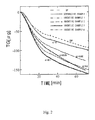
Fig. 2 is a graph illustrating the PM oxidation performances of the layered complex oxides of the inventive and comparative examples in a comparable manner, as measured by thermo gravimetry-differential thermal analysis. - Hereinafter, a layered complex oxide of the present invention will be described in more detail, as well as the structures of an oxidation catalyst, a DPF, a three-way catalyst and a nitrogen oxides reduction catalyst, each of which includes the layered complex oxide.
- As described above, the composition of the layered complex oxide of the present invention is represented by the following Formula (1):
(Ln3-XAX)1-αMn2O7-δ (1)
, wherein Ln is La and/or Nd, A is Sr and/or Ca, α is the degree of A-site deficiency, and δ is the degree of oxygen deficiency. - The layered complex oxide of the present invention is obtained by imparting deficiency at the so-called A-site to a layered perovskite complex oxide of the Ruddlesden-Popper type that is generally represented by the composition formula A3B2O7.
- Such A-site deficiency causes structural relaxation. That is, atomic-level vacancies that are introduced to the layered perovskite structure function in an effective way so as to help absorption/desorption of oxygen atoms on the material surface and in the lattice of the layered perovskite structure, which eventually decrease the combustion onset temperature.
- As a result, the layered complex oxide of the present invention can increase oxidation rate, improve oxidation performance and decrease oxidation temperature of substances, typically PM.
- In Formula (1), Ln may be either or both of La (lanthanum) and Nd (neodymium).
- Further, A may be either or both of Sr (strontium) and Ca (calcium).
- The degree of A-site deficiency α is not limited to a specific range, provided that it is neither 0 nor 1 or more, and is desirably in the range of 0.02 to 0.2 so as to further improve the above-described effects caused by the A-site deficiency.
- As used herein, the term deficiency means a gap from the stoichiometric composition A3B2O7 (α = 0), and the value α represents the degree of deficiency, i.e. the degree of the composition gap.
- X may be any value in the range of more than 0 to less than 3, while it is particularly desirable that X is in the range of 0.5 to 1.8, more preferably in the range of 0.1 to 1.5, so as to improve the activity as a catalyst.
- The amount of oxygen in such complex oxides containing a transition metal element changes thermodynamically depending on the temperature and surrounding gas atmosphere, i.e. according to oxygen deficiency caused by oxygen desorption. If such oxides are used as catalysts, the degree of oxygen deficiency δ is preferably less than 1.4, more preferably 1 or less.
- The layered complex oxide of the present invention easily causes oxygen absorption/desorption on its surface and in its lattice and has high oxygen ion conductivity, which results in high oxidation performance, particularly PM oxidation performance. The layered complex oxide can therefore be used for various materials and catalysts that require such functions.
- To be more specific, it can be used for PM oxidation catalysts due to the high PM oxidation performance, for three-way catalysts due to the high oxidation performance of hydrocarbons (HCs) and carbon monoxide (CO), for NOX degradation catalysts due to having an NOX reduction property, which the inventive oxide also has, and for electrode catalysts of fuel cells or photocatalysts due to the high oxygen ion conductivity.
- Normally, the layered complex oxide of the present invention can be prepared by a solid-phase method.
- Specifically, preparation can be conducted by setting a desired composition that satisfies the above formula (1), weighing lanthanum oxide (La2O3), neodymium oxide (Nd2O3), strontium carbonate (SrCO3), calcium carbonate (CaCO3). manganese oxide (Mn2O3) and the like so as to be of the desired composition, pre-calcining the mixture at approximately 1200°C for approximately 24 hours after mixing them, and calcining it at 1450°C for approximately 20 hours after mixing it again.
- The oxidation catalyst of the present invention contains the above-described layered complex oxide of the invention, and exhibits high oxidation performance.
- Specifically, it exhibits high oxidation performance of PM such as smoke and soot, and is capable of oxidizing and reducing PM at a temperature of typically 270°C or more without the aid of a precious metal such as Pt.
- While the oxidation catalyst of the present invention contains the layered complex oxide as an essential ingredient, it may also contain various other ingredients. For example, inorganic refractory base materials such as alumina, ceria (CeO2) and zirconia (ZrO2), which can contribute to improving the specific surface area, and porous materials having uniform micropores such as zeolite may be included. Also, platinum (Pt), palladium (Pd), rhodium (Rh) and other precious metals may be included.
- If the oxidation catalyst of the invention is used for internal-combustion engines, a monolithic support, such as monolithic honeycomb support, is preferably coated with the oxidation catalyst of the present invention.
- This monolithic support may be cordierite, silicon carbide (SiC) or another ceramics support, or a metal support, such as stainless steel, any of which is equally preferred.
- The diesel particulate filter (DPF) of the present invention includes the oxidation catalyst of the present invention and a monolithic support coated with the oxidation catalyst.
- The oxidation catalyst of the DPF of the present invention is as described above.
- The monolithic support may be the above-described honeycomb monolithic support. In particular, the so-called checkered honeycomb supports are preferred, which have a plurality of cells that are alternately plugged at a given end so that open ends and closed ends of the cells are in a checkered pattern.
- Next, the three-way catalyst and nitrogen oxides (NOX) reduction catalyst of the present invention will be described.
- While the three-way catalyst and NOX reduction catalyst each contain the above-described layered complex oxide of the present invention as an essential ingredient, they may also contain various other ingredients.
- As with the oxidation catalyst, inorganic refractory base materials such as alumina, ceria (CeO2) and zirconia (ZrO2), which can contribute to improving the specific surface area, and porous materials having uniform micropores such as zeolite may be included. Also, platinum (Pt), palladium (Pd), rhodium (Rh) and other precious metals may be included.
- Further, a monolithic support such as monolithic honeycomb support may be used.
- Hereinafter, the present invention will be described in more detail based on inventive examples and comparative examples. However, the present invention is not limited to those inventive examples.
- According to a charge composition (La1.5Sr1.5)0.95Mn2O7-δ (X= 1.5, α= 0.05), lanthanum oxide (La2O3), strontium carbonate (SrCO3) and manganese oxide (Mn2O3), each in a powder form, were weighed and mixed in an agate mortar. Subsequently, the mixture was pre-calcined at 1200°C for 24 hours. The resulting substance was ground, mixed again, and then full-calcined at 1450°C for 20 hours. The resulting sintered body was ground. The layered complex oxide of Inventive Example 1 was thus obtained.
- A layered complex oxide of Inventive Example 2 was obtained through the same process as in Inventive Example 1, except that the materials were weighed and mixed according to the charge composition (La1.5Sr1.5)0.9Mn2O7-δ (X= 1.5, α= 0.1).
- A layered complex oxide of Inventive Example 3 was obtained through the same process as in Inventive Example 1, except that the materials were weighed and mixed according to the charge composition (La1.5Sr1.5)0.98Mn2O7-δ (X= 1.5, α= 0.02).
- A layered complex oxide of Inventive Example 4 was obtained through the same process as in Inventive Example 1, except that the materials were weighed and mixed according to the charge composition (La1.5Sr1.5)0.8Mn2O7-δ (X= 1.5, α= 0.2).
- According to a charge composition La1.5Sr1.5Mn2O7-δ, lanthanum oxide, strontium carbonate and manganese oxide, each in powder form, were weighed and mixed in an agate mortar. The mixture was then pre-calcined at 900°C for 24 hours. The resulting substance was ground, mixed again, and then further pre-calcined at 1050°C for 24 hours. The resulting powder was ground and full-calcined at 1600°C. The resulting sintered body was ground, and a layered complex oxide of Comparative Example 1 was thus obtained.
- According to a charge composition La0.8Sr0.2MnO3-δ, lanthanum oxide (La2O3), strontium carbonate (SrCO3) and manganese oxide (Mn2O3), each in powder form, were weighed and mixed in an agate mortar. The mixture was then pre-calcined at 900°C for 24 hours. The resulting substance was ground, mixed again, and full-calcined at 1600°C for 18 hours. The resulting sintered body was ground. A layered complex oxide of Comparative Example 2 was thus obtained.
- According to a charge composition (La0.5Sr0.5)0.95MnO3-δ, lanthanum oxide (La2O3), strontium carbonate (SrCO3) and manganese oxide (Mn2O3), each in powder form, were weighed and mixed in an agate mortar. The mixture was then pre-calcined at 900°C for 24 hours. The resulting substance was ground, mixed again, and full-calcined at 1600°C for 18 hours. The resulting sintered body was ground. A layered complex oxide of Comparative Example 3 was thus obtained.
- The layered complex oxides as prepared above were subjected to X-ray diffraction analysis with the following equipment and conditions. The results showed A-site deficiency in the layered complex oxides of Inventive Examples 1, 2 and Comparative Example 1. The results are shown in
Fig. 1 .
Analysis equipment: X-ray diffractometer (MXP18VAHF, MAC Science Corp.)
Voltage and Current: 40 kV, 300 mA
X-ray wavelength: Cu-Kα - The layered complex oxide (50 mg) of each of the Inventive Examples and Comparative Examples, and the same amount of PM collected from an automobile engine were weighed in the mass proportion of 1:1, and physically mixed in a mortar. A 10 mg fraction was weighed out from the mixture to be subjected to each analysis.
- The sample of each example was subjected to TG-DTA (thermo gravimetry-differential thermal analysis) under the atmosphere where argon (Ar) gas or a mixed gas of 10%vol. oxygen (O2) gas and valance nitrogen (N2) gas was introduced. The analysis was carried out according to the following temperature schedule. The temperature was raised up to 240°C at 10°C/min and kept for 10 minutes under flowing Ar gas at 100 cc/min. Thereafter, the flowing gas was switched from Ar gas to the mixed gas of O2/balance N2, and the sample was kept at 240°C for 45 minutes under the flowing mixed gas at 100 cc/min. The same analyses were conducted with five more holding temperatures of 270°C, 300°C, 330°C, 360°C and 390°C.
- Using a sample of pure PM, i.e. diesel particulate, with no layered complex oxide as a reference, the temperatures of the inventive and comparative examples were measured by the TG-DTA at the exothermic peak and at the initiation of weight loss. These measurements were used to evaluate the combustion onset temperatures. The result is shown in table 1.
- Further, the analysis result of the TG-DTA at 240°C is show in
Fig. 2 . In the figure, "DP" is an abbreviation of diesel particulate, i.e. represents the analysis result of the sample of pure PM with no layered complex oxide.Table 1 Category Layered Complex Oxide Combustion Onset Temperature(°C) Composition Formula α Inventive Example 1 (La1.5Sr1.5)0.95Mn2O7-δ 0.05 240-270 Inventive Example 2 (La1.5Sr1.5)0.9Mn2O7-δ 0.1 240-270 Inventive Example 3 (La1.5Sr1.5)0.98Mn2O7-δ 0.02 240-270 Inventive Example 4 (La1.5Sr1.5)0.8Mn2O7-δ 0.2 240-270 Comparative Example 1 La1.5Sr1.5Mn2O7-δ 0 300-330 Comparative Example 2 La0.8Sr0.2MnO3-δ 0 330-360 Comparative Example 3 (La0.5Sr0.5)0.95MnO3-δ 0.05 300-330 - As seen in the results shown in table 1, in comparison to Comparative Example 1, which has no deficiency, Comparative Example 2, which is composed of the same elements but has a so-called ABO3 structure, and Comparative Example 3, which is composed of the same elements but has a so-called ABO3 structure with A-site deficiency, it was observed that the layered complex oxides of Inventive Examples 1 to 4, which have A-site deficiency, exhibit low PM combustion onset temperature and high catalyst activity, even though they do not contain any precious metal.
- Further, as seen in
Fig. 2 , within the composition of the Inventive Examples, the degree of deficiency α is preferably in the range of 0.02 to 0.2, more preferably in the range of 0.05 to 0.2. - While the present invention is described with some embodiments and examples, it is not limited thereto, and changes and modifications may be made without departing from the gist of the present invention.
- For example, in the above-described inventive examples, their PM combustion performances were evaluated. However, the layered complex oxide of the present invention also has three-way reduction property and NOX reduction property. Further, it is obvious that there will be good results in terms of DPF because of the PM combustion performance noted above.
- Because of its high oxygen ion conductivity, the layered complex oxide of the present invention is applicable to electrode catalysts of fuel cells and photocatalysts, as well as exhaust gas cleaning catalysts, which enables the provision of better fuel cells and photocatalysts.
Claims (6)
- A layered complex oxide having a layered perovskite structure and having a composition represented by the following formula (1):
(Ln3-XAX)1-αMn2O7-δ (1)
wherein Ln is La and/or Nd, A is Sr and/or Ca, α is a degree of A-site deficiency, δ is a degree of oxygen deficiency, and X, δ and α satisfy 0< X< 3, 0< α< 1 and δ< 1.4. - The layered complex oxide according to claim 1, wherein the degree of A-site deficiency α of formula (1) is 0.02 to 0.2.
- An oxidation catalyst containing the layered complex oxide according to claim 1 or 2.
- A diesel particulate filter, comprising: the oxidation catalyst according to claim 3, and a monolithic support coated with the oxidation catalyst.
- A three-way catalyst containing the layered complex oxide according to claim 1 or 2.
- A nitrogen oxides reduction catalyst containing the layered complex oxide according to claim 1 or 2.
Applications Claiming Priority (2)
| Application Number | Priority Date | Filing Date | Title |
|---|---|---|---|
| JP2011100714 | 2011-04-28 | ||
| PCT/JP2012/060455 WO2012147583A1 (en) | 2011-04-28 | 2012-04-18 | Layered complex oxide, oxidation catalyst and diesel particulate filter |
Publications (2)
| Publication Number | Publication Date |
|---|---|
| EP2703357A1 true EP2703357A1 (en) | 2014-03-05 |
| EP2703357A4 EP2703357A4 (en) | 2015-05-06 |
Family
ID=47072104
Family Applications (1)
| Application Number | Title | Priority Date | Filing Date |
|---|---|---|---|
| EP12777129.3A Withdrawn EP2703357A4 (en) | 2011-04-28 | 2012-04-18 | Layered complex oxide, oxidation catalyst and diesel particulate filter |
Country Status (5)
| Country | Link |
|---|---|
| US (1) | US20140050629A1 (en) |
| EP (1) | EP2703357A4 (en) |
| JP (1) | JP5773337B2 (en) |
| CN (1) | CN103687812A (en) |
| WO (1) | WO2012147583A1 (en) |
Families Citing this family (16)
| Publication number | Priority date | Publication date | Assignee | Title |
|---|---|---|---|---|
| EP2576046B1 (en) | 2010-05-24 | 2014-11-19 | Siluria Technologies, Inc. | Method for producing ethylene from methane using a polycrystalline nanowire catalyst |
| US8921256B2 (en) | 2011-05-24 | 2014-12-30 | Siluria Technologies, Inc. | Catalysts for petrochemical catalysis |
| BR112014012795B1 (en) | 2011-11-29 | 2022-04-12 | Siluria Technologies, Inc | Catalytic material in the form of a pressed, extruded or monolith microsphere and method for the oxidative coupling of methane |
| US9446397B2 (en) | 2012-02-03 | 2016-09-20 | Siluria Technologies, Inc. | Method for isolation of nanomaterials |
| JP6308998B2 (en) | 2012-05-24 | 2018-04-11 | シルリア テクノロジーズ, インコーポレイテッド | Catalysts containing catalytic nanowires and their use |
| US20160107143A1 (en) | 2013-03-15 | 2016-04-21 | Siluria Technologies, Inc. | Catalysts for petrochemical catalysis |
| US10335776B2 (en) | 2013-12-16 | 2019-07-02 | Basf Corporation | Manganese-containing diesel oxidation catalyst |
| US10864502B2 (en) | 2013-12-16 | 2020-12-15 | Basf Corporation | Manganese-containing diesel oxidation catalyst |
| CA2947483C (en) | 2014-05-02 | 2023-08-01 | Siluria Technologies, Inc. | Heterogeneous catalysts |
| EP3825001A1 (en) | 2014-09-17 | 2021-05-26 | Lummus Technology LLC | Catalysts for natural gas processes |
| KR101703624B1 (en) | 2015-09-30 | 2017-02-07 | 현대자동차 주식회사 | Exhaust gas processing system |
| US20170267605A1 (en) | 2016-03-16 | 2017-09-21 | Siluria Technologies, Inc. | Catalysts and methods for natural gas processes |
| CN108039495B (en) * | 2017-11-07 | 2020-04-14 | 暨南大学 | A layered perovskite oxide oxygen reduction electrode material modified by non-metal elements |
| CN108579751B (en) * | 2018-04-12 | 2021-06-11 | 南京工业大学 | Layered perovskite oxide, preparation method and application thereof in oxygen evolution reaction electrocatalysis |
| EP4403259A1 (en) | 2019-01-30 | 2024-07-24 | Lummus Technology LLC | Catalysts for oxidative coupling of methane |
| CN110002851A (en) * | 2019-04-04 | 2019-07-12 | 安阳师范学院 | A kind of laminated perovskite Ca3Mn2O7The preparation method of ceramic material |
Family Cites Families (13)
| Publication number | Priority date | Publication date | Assignee | Title |
|---|---|---|---|---|
| JPH05184929A (en) * | 1992-01-08 | 1993-07-27 | Riken Corp | Exhaust gas purifying material and method for purifying exhaust gas |
| JP3447384B2 (en) * | 1993-09-29 | 2003-09-16 | 本田技研工業株式会社 | Exhaust gas purification catalyst |
| JP2961149B2 (en) * | 1995-03-16 | 1999-10-12 | 工業技術院長 | Layered manganese oxide-based single crystal and method for producing the same |
| JP3293741B2 (en) * | 1996-06-06 | 2002-06-17 | 株式会社リケン | NOx sensor |
| JP3097667B2 (en) * | 1998-06-30 | 2000-10-10 | 日本電気株式会社 | Magnetic sensing element |
| JP2000348483A (en) * | 1999-06-04 | 2000-12-15 | Japan Science & Technology Corp | Magnetic bubble memory |
| JP3250558B2 (en) * | 2000-02-28 | 2002-01-28 | 株式会社豊田中央研究所 | Mechanical quantity sensor material |
| WO2002037073A1 (en) * | 2000-11-06 | 2002-05-10 | Toyoda Koki Kabushiki Kaisha | Mechanical quantity sensor element, load sensor element, acceleration sensor element, and pressure sensor element |
| JP4124413B2 (en) * | 2001-02-26 | 2008-07-23 | 株式会社豊田中央研究所 | Mechanical quantity sensor element |
| JP4591959B2 (en) | 2005-06-10 | 2010-12-01 | 国立大学法人九州大学 | Diesel particulate filter |
| JP2009131774A (en) * | 2007-11-30 | 2009-06-18 | Nissan Motor Co Ltd | PM oxidation catalyst and exhaust gas purification catalyst using the same |
| FR2942624B1 (en) * | 2009-03-02 | 2011-03-18 | Rhodia Operations | COMPOSITION COMPRISING LANTHAN PEROVSKITE ON AN ALUMINUM OR ALUMINUM OXYHYDROXIDE SUPPORT, PREPARATION METHOD AND USE IN CATALYSIS |
| JP5354352B2 (en) * | 2009-03-11 | 2013-11-27 | 日産自動車株式会社 | Oxidation catalyst and particulate filter |
-
2012
- 2012-04-18 JP JP2013512293A patent/JP5773337B2/en not_active Expired - Fee Related
- 2012-04-18 EP EP12777129.3A patent/EP2703357A4/en not_active Withdrawn
- 2012-04-18 WO PCT/JP2012/060455 patent/WO2012147583A1/en not_active Ceased
- 2012-04-18 CN CN201280024662.1A patent/CN103687812A/en active Pending
- 2012-04-18 US US14/114,064 patent/US20140050629A1/en not_active Abandoned
Also Published As
| Publication number | Publication date |
|---|---|
| JPWO2012147583A1 (en) | 2014-07-28 |
| WO2012147583A1 (en) | 2012-11-01 |
| US20140050629A1 (en) | 2014-02-20 |
| CN103687812A (en) | 2014-03-26 |
| EP2703357A4 (en) | 2015-05-06 |
| JP5773337B2 (en) | 2015-09-02 |
Similar Documents
| Publication | Publication Date | Title |
|---|---|---|
| US20140050629A1 (en) | Layered complex oxide, oxidation catalyst and diesel particulate filter | |
| US9511358B2 (en) | Spinel compositions and applications thereof | |
| US7498288B2 (en) | Exhaust gas-purifying catalyst and method of manufacturing the same | |
| EP1632288B1 (en) | Exhaust gas purification catalyst and oxygen storage component for the same | |
| WO2006095557A1 (en) | Catalyst composition | |
| EP2055365A1 (en) | Catalyst-supported particulate filter | |
| JP5558867B2 (en) | Exhaust purification catalyst | |
| JP5146943B2 (en) | Exhaust gas purification catalyst and method for producing the same | |
| JP2010069471A (en) | Compound oxide catalyst for burning pm, slurry prepared by using the same, and filter for cleaning exhaust gas | |
| JP2022029851A (en) | Monolith base material, production method of monolith base material, and exhaust gas purification catalyst using monolith base material | |
| US9091195B2 (en) | Layered composite oxide, oxidation catalyst, and diesel particulate filter | |
| EP2493594B1 (en) | Oxygen adsorbent based on lanthanoide oxysulfate, method for producing it, and exhaust gas purifying catalyst containing it | |
| EP1759763B1 (en) | Exhaust gas purification catalyst and catalyst-equipped diesel particulate filter | |
| WO2010110298A1 (en) | Exhaust gas purifying catalyst | |
| JP5278671B2 (en) | PM oxidation catalyst, diesel particulate filter using the same, and method for producing PM oxidation catalyst | |
| JP2010030823A (en) | Compound oxide and catalyst containing the compound oxide for cleaning exhaust gas | |
| EP3984634A2 (en) | HEAT-RESISTANT RUTHENIUM COMPOSITE AND USE THEREOF AS CATALYST FOR NOxSTORAGE AND REDUCTION | |
| EP1810739A1 (en) | Exhaust gas purification catalyst | |
| JP5354352B2 (en) | Oxidation catalyst and particulate filter | |
| JP5190797B2 (en) | Composite oxide catalyst, diesel particulate filter using the same, and method for producing composite oxide catalyst | |
| JP5551518B2 (en) | Exhaust gas purification catalyst and method for producing the same | |
| JP2005104799A (en) | Composite oxide and exhaust gas purification catalyst | |
| JP2018176106A (en) | Diesel oxidation catalyst for light oil combustion and exhaust gas purification device for diesel engine using the same | |
| JP5024794B2 (en) | Manufacturing method of oxidation catalyst device for exhaust gas purification | |
| JP4265276B2 (en) | Exhaust gas purification catalyst |
Legal Events
| Date | Code | Title | Description |
|---|---|---|---|
| PUAI | Public reference made under article 153(3) epc to a published international application that has entered the european phase |
Free format text: ORIGINAL CODE: 0009012 |
|
| 17P | Request for examination filed |
Effective date: 20131024 |
|
| AK | Designated contracting states |
Kind code of ref document: A1 Designated state(s): AL AT BE BG CH CY CZ DE DK EE ES FI FR GB GR HR HU IE IS IT LI LT LU LV MC MK MT NL NO PL PT RO RS SE SI SK SM TR |
|
| DAX | Request for extension of the european patent (deleted) | ||
| RA4 | Supplementary search report drawn up and despatched (corrected) |
Effective date: 20150410 |
|
| RIC1 | Information provided on ipc code assigned before grant |
Ipc: C01G 45/12 20060101ALI20150405BHEP Ipc: B01D 53/94 20060101ALI20150405BHEP Ipc: B01J 23/34 20060101ALI20150405BHEP Ipc: C01G 45/00 20060101AFI20150405BHEP Ipc: B01J 23/00 20060101ALI20150405BHEP |
|
| STAA | Information on the status of an ep patent application or granted ep patent |
Free format text: STATUS: THE APPLICATION HAS BEEN WITHDRAWN |
|
| 18W | Application withdrawn |
Effective date: 20160119 |