EP2701501B1 - Portable organ transportation system - Google Patents
Portable organ transportation system Download PDFInfo
- Publication number
- EP2701501B1 EP2701501B1 EP12715296.5A EP12715296A EP2701501B1 EP 2701501 B1 EP2701501 B1 EP 2701501B1 EP 12715296 A EP12715296 A EP 12715296A EP 2701501 B1 EP2701501 B1 EP 2701501B1
- Authority
- EP
- European Patent Office
- Prior art keywords
- organ
- handle
- transportation system
- mobile cart
- container
- Prior art date
- Legal status (The legal status is an assumption and is not a legal conclusion. Google has not performed a legal analysis and makes no representation as to the accuracy of the status listed.)
- Active
Links
Images



Classifications
-
- A—HUMAN NECESSITIES
- A01—AGRICULTURE; FORESTRY; ANIMAL HUSBANDRY; HUNTING; TRAPPING; FISHING
- A01N—PRESERVATION OF BODIES OF HUMANS OR ANIMALS OR PLANTS OR PARTS THEREOF; BIOCIDES, e.g. AS DISINFECTANTS, AS PESTICIDES OR AS HERBICIDES; PEST REPELLANTS OR ATTRACTANTS; PLANT GROWTH REGULATORS
- A01N1/00—Preservation of bodies of humans or animals, or parts thereof
- A01N1/10—Preservation of living parts
- A01N1/14—Mechanical aspects of preservation; Apparatus or containers therefor
-
- A—HUMAN NECESSITIES
- A01—AGRICULTURE; FORESTRY; ANIMAL HUSBANDRY; HUNTING; TRAPPING; FISHING
- A01N—PRESERVATION OF BODIES OF HUMANS OR ANIMALS OR PLANTS OR PARTS THEREOF; BIOCIDES, e.g. AS DISINFECTANTS, AS PESTICIDES OR AS HERBICIDES; PEST REPELLANTS OR ATTRACTANTS; PLANT GROWTH REGULATORS
- A01N1/00—Preservation of bodies of humans or animals, or parts thereof
- A01N1/10—Preservation of living parts
- A01N1/14—Mechanical aspects of preservation; Apparatus or containers therefor
- A01N1/142—Apparatus
- A01N1/143—Apparatus for organ perfusion
-
- B—PERFORMING OPERATIONS; TRANSPORTING
- B62—LAND VEHICLES FOR TRAVELLING OTHERWISE THAN ON RAILS
- B62B—HAND-PROPELLED VEHICLES, e.g. HAND CARTS OR PERAMBULATORS; SLEDGES
- B62B3/00—Hand carts having more than one axis carrying transport wheels; Steering devices therefor; Equipment therefor
- B62B3/02—Hand carts having more than one axis carrying transport wheels; Steering devices therefor; Equipment therefor involving parts being adjustable, collapsible, attachable, detachable or convertible
-
- B—PERFORMING OPERATIONS; TRANSPORTING
- B62—LAND VEHICLES FOR TRAVELLING OTHERWISE THAN ON RAILS
- B62B—HAND-PROPELLED VEHICLES, e.g. HAND CARTS OR PERAMBULATORS; SLEDGES
- B62B3/00—Hand carts having more than one axis carrying transport wheels; Steering devices therefor; Equipment therefor
- B62B3/10—Hand carts having more than one axis carrying transport wheels; Steering devices therefor; Equipment therefor characterised by supports specially adapted to objects of definite shape
-
- B—PERFORMING OPERATIONS; TRANSPORTING
- B62—LAND VEHICLES FOR TRAVELLING OTHERWISE THAN ON RAILS
- B62B—HAND-PROPELLED VEHICLES, e.g. HAND CARTS OR PERAMBULATORS; SLEDGES
- B62B2202/00—Indexing codes relating to type or characteristics of transported articles
- B62B2202/42—Persons or animals, dead or alive
-
- B—PERFORMING OPERATIONS; TRANSPORTING
- B62—LAND VEHICLES FOR TRAVELLING OTHERWISE THAN ON RAILS
- B62B—HAND-PROPELLED VEHICLES, e.g. HAND CARTS OR PERAMBULATORS; SLEDGES
- B62B2206/00—Adjustable or convertible hand-propelled vehicles or sledges
- B62B2206/06—Adjustable or convertible hand-propelled vehicles or sledges adjustable in height
-
- Y—GENERAL TAGGING OF NEW TECHNOLOGICAL DEVELOPMENTS; GENERAL TAGGING OF CROSS-SECTIONAL TECHNOLOGIES SPANNING OVER SEVERAL SECTIONS OF THE IPC; TECHNICAL SUBJECTS COVERED BY FORMER USPC CROSS-REFERENCE ART COLLECTIONS [XRACs] AND DIGESTS
- Y10—TECHNICAL SUBJECTS COVERED BY FORMER USPC
- Y10T—TECHNICAL SUBJECTS COVERED BY FORMER US CLASSIFICATION
- Y10T29/00—Metal working
- Y10T29/49—Method of mechanical manufacture
- Y10T29/49815—Disassembling
Definitions
- organ transportation systems and methods and more specifically, a mobile cart and/or organ container and associated methods for attaching and detaching the organ container from the mobile cart.
- organs Recent advances in organ transplantation and preservation allow for organs to be donated at a location that is far from the recipient of the organ. As such, donated organs must be preserved over an extended time or distance.
- Portable organ transportation and/or preservation devices such as disclosed in U.S. Patent No. 6,673,594 to Owen et al . are known. With such devices, the viability, and thus distance the organ can be transported, can be greatly extended.
- Such organ transportation devices are used in the surgical suite where the organ is donated, in transport, and in the surgical suite where the organ is transplanted.
- US 2008/0017194 A1 discloses a portable organ transportation system comprising a mobile cart and an organ container comprising a housing.
- the cart includes a platform and wheels for transporting the system.
- a latch secures the housing to the cart.
- the system further includes handles mounted to the housing.
- organs such as livers
- kidneys are relatively large and may require a larger organ transport device than smaller organs, such as kidneys.
- Such relatively larger organ transport devices may require a two person lift due to weight or size.
- a portable organ transportation system may be provided including a mobile cart and an organ container. At least one of the mobile cart and the organ container include a latch for releasably attaching the organ container to the mobile cart.
- the organ container is provided with a first handle and a second handle.
- the first handle is configured to facilitate pushing the mobile cart while the organ container is attached to the mobile cart.
- the second handle is configured to allow at least two people to lift and carry the organ container and attaching the organ container to, or detaching the organ container from, the mobile cart without having to let go of the container.
- an organ container is provided with a handle and at least two attachment units that are configured so that a user can separately actuate at least two of the attachment units while continuing to grip the handle with two hands. This is advantageous in that it allows a user to detach the organ container from the cart while safely and securely holding the organ container.
- FIG. 1 shows a top perspective view of a portable organ transportation system 100.
- the organ transportation system 100 includes a mobile cart 102 and an organ container 104.
- the organ container may be a portable preservation device or a portable organ perfusion apparatus as disclosed in U.S. Patent No. 6,673,594 .
- the organ container 104 is shown in a perspective view in FIG. 2 .
- the organ container may include a first handle 150 and a second handle 152. These two handles each provide different advantages.
- the first handle 150 is shown near a top portion of the organ container 104 and disposed on an end.
- One advantage of locating the first handle 150 in this manner is to facilitate pushing the organ transportation system 100 when the organ container 104 is on the mobile cart 102. A user readily grasps this location while pushing the organ transportation system 100.
- Other locations of the first handle may be chosen by one of ordinary skill.
- the second handle 152 is shown near the bottom of the organ container 104.
- the second handle is shown to wrap substantially continuously around most of the periphery the organ container 104, with a small section broken out to facilitate actuation of the hand crank 120 on the mobile cart (shown in FIG. 1 ). If the hand crank 120 is omitted, the second handle may wrap around the entire periphery of the organ container 104.
- the second handle can be any number of handles to facilitate the needs of a user. With a location as illustrated, the second handle 152 may be particularly suited for lifting the organ container 104 by two people.
- the second handle 152 as illustrated provides ample room for more than one person to grasp the handle with at least one hand per person, preferably two hands per person.
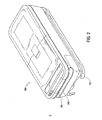
- FIG. 3 illustrates the organ container in a bottom perspective view.
- the protrusions 160 serve to locate and/or align the organ container 104 with the mobile cart 102 when the organ container 104 is on the mobile cart 102.
- the protrusions 160 may serve to keep the organ container 104 raised off of a surface when the organ container is placed on such a surface.
- the protrusions 160 and the second handle 152 are preferably disposed relative to one another such that a user's hand can fit under and grasp the second handle 152 when the organ container is removed from the mobile cart 102 and placed on a surface.
- the mobile cart 102 includes structure that is complementary to and accepts the protrusions 160 to locate the organ container 104 on the mobile cart 102.
- the complementary structure is illustrated as cut outs 166. Four of the cut outs 166 are illustrated, but any number can be chosen so long the cut outs 166 are chosen to cooperate with the protrusions 160 to locate the organ container 104.
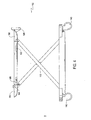
- FIG. 4 A side view of the mobile cart 102 is illustrated in FIG. 4 .
- the mobile cart 102 includes a height adjusting structure 110.
- the height adjusting structure 110 is shown in a partially expanded state, and is capable of being raised to a higher position, as well as being lowered into a collapsed position.
- the height is adjustable based upon the needs of a user. For example, in an operating suite, the mobile cart 102 may be raised to near its maximum height. In a transportation vehicle, the mobile cart 102 may be fully collapsed to reduce an overall size of the organ transportation system 100 and to lower the center of gravity to reduce the likelihood of tipping.
- the height adjusting structure 110 may include four bars in an X-shaped linkage similar to a scissor lift. In order to facilitate an X-shaped linkage raising or lowering the height of the mobile cart 102, a sliding channel 112 may be included in a bottom portion of the mobile cart. A similar structure may be provided in a top portion of the car.
- the broad inventive principles described herein contemplate other structures for adjusting a height of the mobile cart 102.
- the height adjusting structure could some sort of hydraulic lifting mechanism or other mechanism expandable by pressurized fluid.
- the height adjusting structure 110 may include screws that expand a height of the mobile cart 102.
- a hand crank 120 may be included to manually drive a lead screw and adjust a height of the height adjusting structure 110.
- an electric motor (not shown) may be included to adjust the height.
- the linkage may include a slider that disengages from the lead screw when a latch is released, which allows the height adjusting structure to be reduced to a minimum height or to collapse. The latch catches automatically when the cart is raised from a collapsed state and automatically rethreads the lead screw when the hand crank 120 or electric motor is rotated.
- FIG. 3 illustrates a location for a power connector 130 used to provide power to the electric motor.
- FIG. 5 illustrates a corresponding location when a pass through hole may be located for connecting an electrical cable to the power connector 130 or where a mating power connector may be located on the mobile cart.
- the mobile cart 102 may also include wheels 140.
- the wheels 140 may be removable or otherwise displaceable so that the wheels 140 can be placed in a location that requires less space. This is beneficial in applications where there is limited space for the organ transportation system 100.
- the wheels 140 are lockable to prevent the mobile cart from moving.
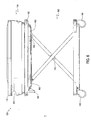
- FIGS. 5 and 6 illustrate additional features related to mounting the organ container 104 to the mobile cart 102.
- a latch 106 is located on either the mobile cart 102 or the organ container 104. Each latch 106 that is included may be configured to releasably attach the organ container to the mobile cart.
- FIG. 6 illustrates a latch 106 including a pin 164 as illustrated in FIG. 4 , both of which are illustrated as being located on the mobile cart 102.
- Various other locations for the latch on the organ container 104 are contemplated as well.
- the latch 106 may include a hole shaped to allow a user to insert a finger into that hole to actuate the latch 106 and release the pin 164, preferably by sliding, from a mating hole in the organ container (not shown).
- the hole in the organ container is located in one or more of the protrusions 160.
- the latch is located so the latch can be actuated by a user's hand while that hand is grasping the second handle 152.
- the figures illustrate one latch 106 on each side of the mobile cart 102 for a total of two latches 106, but any alternative number of latches 106, including one, three, or four, may be included based upon the needs of a user.
- the second handle 152 includes a corresponding portion to allow a user to grasp the second handle 152 near each latch 106 and actuate that latch.
- multiple users may simultaneously grip the second handle 152 and actuate at least one latch 106.
- the organ container 104 may be readily lifted and removed from the mobile cart 102. This way, the organ container 104 can be securely handled at all times, including during latching and unlatching from the mobile cart 102.
- the latch 106 as illustrated and described above is mechanically actuated.
- the latches may be electronically actuated. This may be advantageous in that it increases ease of use or the electronic actuation can provide lock out or tamper proof features so that only an authorized user may release the latch 106.
- the organ container may also include a pocket 200.
- the pocket 200 may be configured to contain documents related to the organ transporter. Such a pocket 200 is advantageous because important documentation may frequently be included with a donated organ.
- the pocket 200 allows for a secure location to keep the documentation with the organ at all times.
- the pocket 200 may also include a lid or cover (not shown) to prevent unwanted foreign objects, such as liquid or debris, from entering the pocket as well as retaining any document placed in the pocket.
Landscapes
- Engineering & Computer Science (AREA)
- Life Sciences & Earth Sciences (AREA)
- Mechanical Engineering (AREA)
- Chemical & Material Sciences (AREA)
- Transportation (AREA)
- Combustion & Propulsion (AREA)
- Dentistry (AREA)
- Environmental Sciences (AREA)
- Zoology (AREA)
- Wood Science & Technology (AREA)
- General Health & Medical Sciences (AREA)
- Health & Medical Sciences (AREA)
- Handcart (AREA)
- Agricultural Chemicals And Associated Chemicals (AREA)
Description
- Related technical fields include organ transportation systems and methods, and more specifically, a mobile cart and/or organ container and associated methods for attaching and detaching the organ container from the mobile cart.
- Recent advances in organ transplantation and preservation allow for organs to be donated at a location that is far from the recipient of the organ. As such, donated organs must be preserved over an extended time or distance. Portable organ transportation and/or preservation devices such as disclosed in
U.S. Patent No. 6,673,594 to Owen et al . are known. With such devices, the viability, and thus distance the organ can be transported, can be greatly extended. Such organ transportation devices are used in the surgical suite where the organ is donated, in transport, and in the surgical suite where the organ is transplanted. -
US 2008/0017194 A1 discloses a portable organ transportation system comprising a mobile cart and an organ container comprising a housing. The cart includes a platform and wheels for transporting the system. A latch secures the housing to the cart. To further aid in portability, the system further includes handles mounted to the housing. - In the surgical suites, space is at a premium. Space for every medical device, the surgical team, and the patient must be provided. When transporting an organ in an organ transporter, space must be available in the transporting vehicle, be it an automobile, aircraft, or the like. The organ transporter must also be readily and securely conveyed between the surgical suite and the transporting vehicle. Each of the locations where the organ transporter is used has specific needs. For example, it is undesirable for a table or bench to be required specifically for the organ transporter in the surgical suite because it uses valuable space and the transporter can be knocked off of the table or bench. Similarly, it is preferred for the organ transporter to be conveniently located by the donor or recipient of the organ. Space in the transporting vehicle can be even more precious because the vehicles can be relatively small, especially if the vehicle is an aircraft. Therefore, it is undesirable for an organ transportation device to take up too much precious space in these situations.
- Further, although there is a general trend toward smaller organ transport devices, certain organs, such as livers, are relatively large and may require a larger organ transport device than smaller organs, such as kidneys. Such relatively larger organ transport devices may require a two person lift due to weight or size.
- A portable organ transportation system may be provided including a mobile cart and an organ container. At least one of the mobile cart and the organ container include a latch for releasably attaching the organ container to the mobile cart. These principles provide a solution to the problems described above because the combination of a mobile cart and portable organ transportation system provides the flexibility to address the space constraints discussed above while maintaining mobility, convenience, and secure transport.
- The invention is defined in the appended claims.
- The organ container is provided with a first handle and a second handle. The first handle is configured to facilitate pushing the mobile cart while the organ container is attached to the mobile cart. The second handle is configured to allow at least two people to lift and carry the organ container and attaching the organ container to, or detaching the organ container from, the mobile cart without having to let go of the container. These principles facilitate the secure movement of the portable organ transportation system within the surgical suite, movement to or from the transportation vehicle, as well as loading or unloading the vehicle.
- In accordance with the invention an organ container is provided with a handle and at least two attachment units that are configured so that a user can separately actuate at least two of the attachment units while continuing to grip the handle with two hands. This is advantageous in that it allows a user to detach the organ container from the cart while safely and securely holding the organ container.
- Exemplary implementations can be described with reference to the following figures wherein:
-
FIG. 1 illustrates a perspective view of a portable organ transportation system; -
FIG. 2 illustrates a top perspective view of an organ container; -
FIG. 3 illustrates a bottom perspective view of an organ container; -
FIG. 4 illustrates a side view of a mobile cart; -
FIG. 5 illustrates a top perspective view of a mobile cart; and -
FIG. 6 illustrates a side view of a portable organ transportation system. -
FIG. 1 shows a top perspective view of a portableorgan transportation system 100. Theorgan transportation system 100 includes amobile cart 102 and anorgan container 104. The organ container may be a portable preservation device or a portable organ perfusion apparatus as disclosed inU.S. Patent No. 6,673,594 . - The
organ container 104 is shown in a perspective view inFIG. 2 . The organ container may include afirst handle 150 and asecond handle 152. These two handles each provide different advantages. - The
first handle 150 is shown near a top portion of theorgan container 104 and disposed on an end. One advantage of locating thefirst handle 150 in this manner is to facilitate pushing theorgan transportation system 100 when theorgan container 104 is on themobile cart 102. A user readily grasps this location while pushing theorgan transportation system 100. Other locations of the first handle may be chosen by one of ordinary skill. - The
second handle 152 is shown near the bottom of theorgan container 104. The second handle is shown to wrap substantially continuously around most of the periphery theorgan container 104, with a small section broken out to facilitate actuation of thehand crank 120 on the mobile cart (shown inFIG. 1 ). If thehand crank 120 is omitted, the second handle may wrap around the entire periphery of theorgan container 104. Alternatively, the second handle can be any number of handles to facilitate the needs of a user. With a location as illustrated, thesecond handle 152 may be particularly suited for lifting theorgan container 104 by two people. Thesecond handle 152 as illustrated provides ample room for more than one person to grasp the handle with at least one hand per person, preferably two hands per person. -
FIG. 3 illustrates the organ container in a bottom perspective view. Four of theprotrusions 160 are visible, with one being located generally at each corner of theorgan container 104. As shown, theprotrusions 160 serve to locate and/or align theorgan container 104 with themobile cart 102 when theorgan container 104 is on themobile cart 102. Also, theprotrusions 160 may serve to keep theorgan container 104 raised off of a surface when the organ container is placed on such a surface. Theprotrusions 160 and thesecond handle 152 are preferably disposed relative to one another such that a user's hand can fit under and grasp thesecond handle 152 when the organ container is removed from themobile cart 102 and placed on a surface. - The
mobile cart 102 includes structure that is complementary to and accepts theprotrusions 160 to locate theorgan container 104 on themobile cart 102. The complementary structure is illustrated ascut outs 166. Four of thecut outs 166 are illustrated, but any number can be chosen so long thecut outs 166 are chosen to cooperate with theprotrusions 160 to locate theorgan container 104. - A side view of the
mobile cart 102 is illustrated inFIG. 4 . Themobile cart 102 includes aheight adjusting structure 110. Theheight adjusting structure 110 is shown in a partially expanded state, and is capable of being raised to a higher position, as well as being lowered into a collapsed position. The height is adjustable based upon the needs of a user. For example, in an operating suite, themobile cart 102 may be raised to near its maximum height. In a transportation vehicle, themobile cart 102 may be fully collapsed to reduce an overall size of theorgan transportation system 100 and to lower the center of gravity to reduce the likelihood of tipping. - The
height adjusting structure 110 may include four bars in an X-shaped linkage similar to a scissor lift. In order to facilitate an X-shaped linkage raising or lowering the height of themobile cart 102, a slidingchannel 112 may be included in a bottom portion of the mobile cart. A similar structure may be provided in a top portion of the car. The broad inventive principles described herein contemplate other structures for adjusting a height of themobile cart 102. For example, the height adjusting structure could some sort of hydraulic lifting mechanism or other mechanism expandable by pressurized fluid. Alternatively, theheight adjusting structure 110 may include screws that expand a height of themobile cart 102. - A hand crank 120 may be included to manually drive a lead screw and adjust a height of the
height adjusting structure 110. Alternatively, an electric motor (not shown) may be included to adjust the height. In either scenario, the linkage may include a slider that disengages from the lead screw when a latch is released, which allows the height adjusting structure to be reduced to a minimum height or to collapse. The latch catches automatically when the cart is raised from a collapsed state and automatically rethreads the lead screw when the hand crank 120 or electric motor is rotated. -
FIG. 3 illustrates a location for apower connector 130 used to provide power to the electric motor.FIG. 5 illustrates a corresponding location when a pass through hole may be located for connecting an electrical cable to thepower connector 130 or where a mating power connector may be located on the mobile cart. - The
mobile cart 102 may also includewheels 140. Thewheels 140 may be removable or otherwise displaceable so that thewheels 140 can be placed in a location that requires less space. This is beneficial in applications where there is limited space for theorgan transportation system 100. Preferably, thewheels 140 are lockable to prevent the mobile cart from moving. -
FIGS. 5 and6 illustrate additional features related to mounting theorgan container 104 to themobile cart 102. Alatch 106 is located on either themobile cart 102 or theorgan container 104. Eachlatch 106 that is included may be configured to releasably attach the organ container to the mobile cart.FIG. 6 illustrates alatch 106 including apin 164 as illustrated inFIG. 4 , both of which are illustrated as being located on themobile cart 102. Various other locations for the latch on theorgan container 104 are contemplated as well. - The
latch 106 may include a hole shaped to allow a user to insert a finger into that hole to actuate thelatch 106 and release thepin 164, preferably by sliding, from a mating hole in the organ container (not shown). The hole in the organ container is located in one or more of theprotrusions 160. The latch is located so the latch can be actuated by a user's hand while that hand is grasping thesecond handle 152. The figures illustrate onelatch 106 on each side of themobile cart 102 for a total of twolatches 106, but any alternative number oflatches 106, including one, three, or four, may be included based upon the needs of a user. Preferably, for eachlatch 106, thesecond handle 152 includes a corresponding portion to allow a user to grasp thesecond handle 152 near eachlatch 106 and actuate that latch. As such, multiple users may simultaneously grip thesecond handle 152 and actuate at least onelatch 106. After thelatches 106 are actuated, theorgan container 104 may be readily lifted and removed from themobile cart 102. This way, theorgan container 104 can be securely handled at all times, including during latching and unlatching from themobile cart 102. - The
latch 106 as illustrated and described above is mechanically actuated. Alternatively, the latches may be electronically actuated. This may be advantageous in that it increases ease of use or the electronic actuation can provide lock out or tamper proof features so that only an authorized user may release thelatch 106. - The organ container may also include a
pocket 200. Thepocket 200 may be configured to contain documents related to the organ transporter. Such apocket 200 is advantageous because important documentation may frequently be included with a donated organ. Thepocket 200 allows for a secure location to keep the documentation with the organ at all times. Thepocket 200 may also include a lid or cover (not shown) to prevent unwanted foreign objects, such as liquid or debris, from entering the pocket as well as retaining any document placed in the pocket. - While various features have been described in conjunction with the examples outlined above, various modifications, variations, and/or improvements of those features and/or examples may be possible. Accordingly, the examples, as set forth above, are intended to be illustrative. Various changes may be made without departing from the scope of the invention as defined in the appended claims.
Claims (20)
- A portable organ transportation system (100), comprising:a mobile cart (102); andan organ container (104) comprising a handle (152);wherein at least one of the organ container and the mobile cart comprises at least two protrusions (160) and the other of the organ container and the mobile cart comprises at least two respectively corresponding attachment units (106) that each mate with one of the at least two protrusions to releasably attach the organ container to the mobile cart, andthe at least two attachment units are configured so that a user can actuate at least one of the attachment units with a hand that is gripping the handle.
- The portable organ transportation system according to claim 1, wherein the attachment unit is mechanically actuated, or
wherein the attachment unit is electronically actuated. - The portable organ transportation system according to any of claims 1 and 2, wherein the organ container is a portable organ preservation device, or wherein the organ container is a portable organ perfusion apparatus.
- The portable organ transportation system according to any of claims 1-3,
wherein the mobile cart includes a structure (110) that adjusts a height of the cart. - The portable organ transportation system according to claim 4, wherein the height is adjustable manually.
- The portable organ transportation system according to claim 4, wherein:the mobile cart comprises an electric motor;the organ container comprises a power source for the electric motor; andthe height is adjustable by activation of the electric motor.
- The portable organ transportation system according to any of claims 1-6,
wherein the mobile cart includes wheels (140). - The portable organ transportation system according to claim 7, wherein the wheels are configured to be detached from and attached to the mobile cart by a user.
- The portable organ transportation system according to either of claims 7 and 8, wherein the wheels are configured to be moveable to a position wherein the wheels do not support the cart.
- The portable organ transportation system according to any of claims 7-9, wherein the wheels are lockable to prevent the wheels from rolling.
- The portable organ transportation system according to any of claims 1-10, wherein:the organ container comprises a first handle (150) and a second handle (152);the first handle is configured to facilitate pushing the mobile cart while the organ container is attached to the mobile cart; andthe second handle is configured to allow at least two people to lift the organ container while attaching the organ container to, or detaching the organ container from, the mobile cart.
- The portable organ transportation system according to claim 11, wherein the first handle is at a top of the organ container, and wherein the second handle is near a bottom of the organ container.
- The portable organ transportation system according to any of claims 1-12, wherein the plurality of protrusions (160) is configured to align the organ container with the mobile cart.
- The portable organ transportation system according to claim 1, wherein each attachment unit (106) includes a pin (164), the pin being slidable to insert into a corresponding hole in a corresponding one of the at least two protrusions (160).
- The portable organ transportation system according to claim 1, wherein:the at least two attachment units are configured so that a user can separately actuate at least two of the attachment units while gripping the handle with two hands.
- The portable organ transportation system according to claim 1, wherein:the at least two attachment units are configured so that:a first one of the two attachment units is configured to be actuated by a hand of a first user while that first user hand is gripping the handle; anda second one of the two attachment units is configured to be actuated by a hand of a second user while that second user hand is gripping the handle.
- The portable organ transportation system according to claim 1, wherein the plurality of protrusions (160) is located on the organ container and configured to keep the handle separated from a surface when the organ container is placed on the surface.
- A method of separating an organ container from a mobile cart, comprising:grasping a handle of the organ container with a first hand;actuating a mechanism with the first hand to release a latch attaching the organ container to the mobile cart while continuing to grasp the handle with the first hand; andremoving the organ container from the mobile cart.
- The method according to claim 18, further comprising:grasping the handle with a second hand; andactuating a second mechanism with the second hand to release a latch attaching the organ container to the mobile cart while continuing to grasp the handle with the second hand.
- The method according to claim 19, wherein the first hand and the second hand are hands of different users, or
wherein the first hand and the second hand are hands of a single user.
Applications Claiming Priority (2)
| Application Number | Priority Date | Filing Date | Title |
|---|---|---|---|
| US13/097,809 US9955682B2 (en) | 2011-04-29 | 2011-04-29 | Portable organ transportation system |
| PCT/US2012/033254 WO2012148690A1 (en) | 2011-04-29 | 2012-04-12 | Portable organ transportation system |
Publications (2)
| Publication Number | Publication Date |
|---|---|
| EP2701501A1 EP2701501A1 (en) | 2014-03-05 |
| EP2701501B1 true EP2701501B1 (en) | 2015-07-15 |
Family
ID=45976557
Family Applications (1)
| Application Number | Title | Priority Date | Filing Date |
|---|---|---|---|
| EP12715296.5A Active EP2701501B1 (en) | 2011-04-29 | 2012-04-12 | Portable organ transportation system |
Country Status (5)
| Country | Link |
|---|---|
| US (1) | US9955682B2 (en) |
| EP (1) | EP2701501B1 (en) |
| CN (1) | CN103596427B (en) |
| BR (1) | BR112013027826B1 (en) |
| WO (1) | WO2012148690A1 (en) |
Families Citing this family (12)
| Publication number | Priority date | Publication date | Assignee | Title |
|---|---|---|---|---|
| WO2012158942A2 (en) * | 2011-05-18 | 2012-11-22 | The Cooper Health System | Drug treatment of overactive bladder |
| US9402389B2 (en) | 2012-07-10 | 2016-08-02 | Lifeline Scientific, Inc. | Organ transport apparatus with sample compartments |
| US9357766B2 (en) * | 2012-07-10 | 2016-06-07 | Lifeline Scientific, Inc. | Organ transport apparatus with a document compartment and a tamper evident seal |
| USD691734S1 (en) * | 2012-07-10 | 2013-10-15 | Lifeline Scientific, Inc. | Coolant container |
| USD733906S1 (en) * | 2013-12-13 | 2015-07-07 | Hitachi High-Technologies Corporation | Sample transporting apparatus |
| USD733905S1 (en) * | 2013-12-13 | 2015-07-07 | Hitachi High-Technologies Corporation | Sample transporting apparatus |
| USD750271S1 (en) * | 2013-12-13 | 2016-02-23 | Hitachi High-Technologies Corporation | Sample transporting apparatus |
| USD733907S1 (en) * | 2013-12-13 | 2015-07-07 | Hitachi High-Technologies Corporation | Sample transporting apparatus |
| US9387869B1 (en) | 2015-04-16 | 2016-07-12 | Aviad Berger | Luggage with mechanically integrated trolley |
| USD822992S1 (en) | 2016-12-21 | 2018-07-17 | Aviad Berger | Luggage with integrated trolley |
| US10543863B2 (en) * | 2017-09-28 | 2020-01-28 | Lifeline Scientific, Inc. | Mobile cart for an organ container |
| USD1021129S1 (en) * | 2022-10-28 | 2024-04-02 | Ruben Oganesyan | Organ chamber |
Family Cites Families (17)
| Publication number | Priority date | Publication date | Assignee | Title |
|---|---|---|---|---|
| US4186565A (en) * | 1978-05-19 | 1980-02-05 | Henry Ford Hospital | Perfusion system for organ preservation |
| US5215210A (en) * | 1992-04-16 | 1993-06-01 | Liberty Diversified Industries | Molded plastic pail with integrally formed bail |
| US5586438A (en) * | 1995-03-27 | 1996-12-24 | Organ, Inc. | Portable device for preserving organs by static storage or perfusion |
| US6012729A (en) * | 1996-01-04 | 2000-01-11 | Lin; Shiou Chang | Luggage system and folding dolly therefor |
| US6100082A (en) | 1997-09-23 | 2000-08-08 | Hassanein; Waleed H. | Perfusion apparatus and method including chemical compositions for maintaining an organ |
| US5967362A (en) * | 1998-05-14 | 1999-10-19 | Corbin; Donald E. | Garbage can with lifting supports |
| US6116461A (en) * | 1998-05-29 | 2000-09-12 | Pyxis Corporation | Method and apparatus for the dispensing of drugs |
| US6673594B1 (en) | 1998-09-29 | 2004-01-06 | Organ Recovery Systems | Apparatus and method for maintaining and/or restoring viability of organs |
| US6431319B1 (en) | 2000-02-29 | 2002-08-13 | Ferno-Washington, Inc. | Height-adjustable equipment cart with detachable table |
| US8079559B1 (en) * | 2002-02-28 | 2011-12-20 | Sscor, Inc. | Aspirator bracket |
| WO2004089235A2 (en) * | 2003-04-04 | 2004-10-21 | Organ Recovery Systems, Inc. | Methods and apparatus for perfusion, diagnosis, storage and/or transport of an organ or tissue |
| NL1024022C2 (en) * | 2003-07-30 | 2005-02-01 | Technologiestichting Stw | Portable preservation device for a donor organ. |
| NZ591524A (en) * | 2004-10-07 | 2012-09-28 | Transmedics Inc | Method for timing pulsatile flow of normothermic perfusate to the heart in ex-vivo organ care |
| EP3677118A1 (en) | 2006-04-19 | 2020-07-08 | Transmedics, Inc. | Systems for ex vivo organ care |
| US8132819B2 (en) * | 2009-05-15 | 2012-03-13 | The Stanley Works Israel Ltd. | Rolling container assembly with mount structure |
| US8567796B2 (en) * | 2009-09-01 | 2013-10-29 | The Stanley Works Israel Ltd. | Rolling container assembly with adjustable storage units |
| CA2715583A1 (en) * | 2009-09-25 | 2011-03-25 | Ipl Inc. | Container with a retractable handle |
-
2011
- 2011-04-29 US US13/097,809 patent/US9955682B2/en active Active
-
2012
- 2012-04-12 BR BR112013027826-9A patent/BR112013027826B1/en active IP Right Grant
- 2012-04-12 WO PCT/US2012/033254 patent/WO2012148690A1/en not_active Ceased
- 2012-04-12 EP EP12715296.5A patent/EP2701501B1/en active Active
- 2012-04-12 CN CN201280029336.XA patent/CN103596427B/en active Active
Also Published As
| Publication number | Publication date |
|---|---|
| US9955682B2 (en) | 2018-05-01 |
| WO2012148690A1 (en) | 2012-11-01 |
| BR112013027826B1 (en) | 2021-04-13 |
| US20120276620A1 (en) | 2012-11-01 |
| EP2701501A1 (en) | 2014-03-05 |
| CN103596427A (en) | 2014-02-19 |
| BR112013027826A2 (en) | 2016-07-26 |
| CN103596427B (en) | 2016-03-02 |
Similar Documents
| Publication | Publication Date | Title |
|---|---|---|
| US9955682B2 (en) | Portable organ transportation system | |
| US7789611B2 (en) | Compact system for lifting and moving a pressurized tank | |
| US7032910B2 (en) | Adaptable blood processing platforms | |
| US10543863B2 (en) | Mobile cart for an organ container | |
| US9616908B2 (en) | Mobile cart convertible among a plurality of operational modes | |
| US10023214B2 (en) | Device for moving a load | |
| US20250312205A1 (en) | Mounting apparatus for securing equipment to a patient transport system | |
| US12310901B2 (en) | Coupling systems for releasably coupling equipment to a patient transport systems | |
| US20180242702A1 (en) | Suitcase with Retractable Wheels | |
| US6817623B1 (en) | Case system for articles and method of use | |
| US8689412B2 (en) | Memorial carrier | |
| US11471236B1 (en) | Portable electroneurodiagnostic cart | |
| CN209678688U (en) | A field care box for placing monitors | |
| US9107785B2 (en) | Gurney attachment for use in helicopter transport and method therefor | |
| CN220572324U (en) | Multifunctional first-aid management box | |
| CN223593767U (en) | Liftable tool bogie of ascending a height | |
| EP3542620A1 (en) | Cart for storing and transporting a pet and articles | |
| CN107934159A (en) | A kind of portable medical medical pharmacy storage box | |
| JP2026037692A (en) | Vehicle ramp device | |
| HK40031071A (en) | Mobile cart for an organ container | |
| HK40031071B (en) | Mobile cart for an organ container | |
| HK1133561A1 (en) | Galley unit including container handling mechanism |
Legal Events
| Date | Code | Title | Description |
|---|---|---|---|
| PUAI | Public reference made under article 153(3) epc to a published international application that has entered the european phase |
Free format text: ORIGINAL CODE: 0009012 |
|
| 17P | Request for examination filed |
Effective date: 20131122 |
|
| AK | Designated contracting states |
Kind code of ref document: A1 Designated state(s): AL AT BE BG CH CY CZ DE DK EE ES FI FR GB GR HR HU IE IS IT LI LT LU LV MC MK MT NL NO PL PT RO RS SE SI SK SM TR |
|
| DAX | Request for extension of the european patent (deleted) | ||
| GRAP | Despatch of communication of intention to grant a patent |
Free format text: ORIGINAL CODE: EPIDOSNIGR1 |
|
| INTG | Intention to grant announced |
Effective date: 20150311 |
|
| GRAS | Grant fee paid |
Free format text: ORIGINAL CODE: EPIDOSNIGR3 |
|
| GRAA | (expected) grant |
Free format text: ORIGINAL CODE: 0009210 |
|
| AK | Designated contracting states |
Kind code of ref document: B1 Designated state(s): AL AT BE BG CH CY CZ DE DK EE ES FI FR GB GR HR HU IE IS IT LI LT LU LV MC MK MT NL NO PL PT RO RS SE SI SK SM TR |
|
| REG | Reference to a national code |
Ref country code: CH Ref legal event code: EP Ref country code: GB Ref legal event code: FG4D |
|
| REG | Reference to a national code |
Ref country code: IE Ref legal event code: FG4D |
|
| REG | Reference to a national code |
Ref country code: AT Ref legal event code: REF Ref document number: 736264 Country of ref document: AT Kind code of ref document: T Effective date: 20150815 |
|
| REG | Reference to a national code |
Ref country code: DE Ref legal event code: R096 Ref document number: 602012008799 Country of ref document: DE |
|
| REG | Reference to a national code |
Ref country code: CH Ref legal event code: NV Representative=s name: CABINET GERMAIN AND MAUREAU, CH |
|
| REG | Reference to a national code |
Ref country code: AT Ref legal event code: MK05 Ref document number: 736264 Country of ref document: AT Kind code of ref document: T Effective date: 20150715 |
|
| REG | Reference to a national code |
Ref country code: NL Ref legal event code: MP Effective date: 20150715 |
|
| REG | Reference to a national code |
Ref country code: LT Ref legal event code: MG4D |
|
| PG25 | Lapsed in a contracting state [announced via postgrant information from national office to epo] |
Ref country code: LT Free format text: LAPSE BECAUSE OF FAILURE TO SUBMIT A TRANSLATION OF THE DESCRIPTION OR TO PAY THE FEE WITHIN THE PRESCRIBED TIME-LIMIT Effective date: 20150715 Ref country code: NO Free format text: LAPSE BECAUSE OF FAILURE TO SUBMIT A TRANSLATION OF THE DESCRIPTION OR TO PAY THE FEE WITHIN THE PRESCRIBED TIME-LIMIT Effective date: 20151015 Ref country code: FI Free format text: LAPSE BECAUSE OF FAILURE TO SUBMIT A TRANSLATION OF THE DESCRIPTION OR TO PAY THE FEE WITHIN THE PRESCRIBED TIME-LIMIT Effective date: 20150715 Ref country code: GR Free format text: LAPSE BECAUSE OF FAILURE TO SUBMIT A TRANSLATION OF THE DESCRIPTION OR TO PAY THE FEE WITHIN THE PRESCRIBED TIME-LIMIT Effective date: 20151016 Ref country code: LV Free format text: LAPSE BECAUSE OF FAILURE TO SUBMIT A TRANSLATION OF THE DESCRIPTION OR TO PAY THE FEE WITHIN THE PRESCRIBED TIME-LIMIT Effective date: 20150715 |
|
| PG25 | Lapsed in a contracting state [announced via postgrant information from national office to epo] |
Ref country code: PT Free format text: LAPSE BECAUSE OF FAILURE TO SUBMIT A TRANSLATION OF THE DESCRIPTION OR TO PAY THE FEE WITHIN THE PRESCRIBED TIME-LIMIT Effective date: 20151116 Ref country code: ES Free format text: LAPSE BECAUSE OF FAILURE TO SUBMIT A TRANSLATION OF THE DESCRIPTION OR TO PAY THE FEE WITHIN THE PRESCRIBED TIME-LIMIT Effective date: 20150715 Ref country code: AT Free format text: LAPSE BECAUSE OF FAILURE TO SUBMIT A TRANSLATION OF THE DESCRIPTION OR TO PAY THE FEE WITHIN THE PRESCRIBED TIME-LIMIT Effective date: 20150715 Ref country code: RS Free format text: LAPSE BECAUSE OF FAILURE TO SUBMIT A TRANSLATION OF THE DESCRIPTION OR TO PAY THE FEE WITHIN THE PRESCRIBED TIME-LIMIT Effective date: 20150715 Ref country code: HR Free format text: LAPSE BECAUSE OF FAILURE TO SUBMIT A TRANSLATION OF THE DESCRIPTION OR TO PAY THE FEE WITHIN THE PRESCRIBED TIME-LIMIT Effective date: 20150715 Ref country code: SE Free format text: LAPSE BECAUSE OF FAILURE TO SUBMIT A TRANSLATION OF THE DESCRIPTION OR TO PAY THE FEE WITHIN THE PRESCRIBED TIME-LIMIT Effective date: 20150715 Ref country code: PL Free format text: LAPSE BECAUSE OF FAILURE TO SUBMIT A TRANSLATION OF THE DESCRIPTION OR TO PAY THE FEE WITHIN THE PRESCRIBED TIME-LIMIT Effective date: 20150715 |
|
| REG | Reference to a national code |
Ref country code: FR Ref legal event code: PLFP Year of fee payment: 5 |
|
| REG | Reference to a national code |
Ref country code: DE Ref legal event code: R097 Ref document number: 602012008799 Country of ref document: DE |
|
| PG25 | Lapsed in a contracting state [announced via postgrant information from national office to epo] |
Ref country code: CZ Free format text: LAPSE BECAUSE OF FAILURE TO SUBMIT A TRANSLATION OF THE DESCRIPTION OR TO PAY THE FEE WITHIN THE PRESCRIBED TIME-LIMIT Effective date: 20150715 Ref country code: DK Free format text: LAPSE BECAUSE OF FAILURE TO SUBMIT A TRANSLATION OF THE DESCRIPTION OR TO PAY THE FEE WITHIN THE PRESCRIBED TIME-LIMIT Effective date: 20150715 Ref country code: EE Free format text: LAPSE BECAUSE OF FAILURE TO SUBMIT A TRANSLATION OF THE DESCRIPTION OR TO PAY THE FEE WITHIN THE PRESCRIBED TIME-LIMIT Effective date: 20150715 Ref country code: SK Free format text: LAPSE BECAUSE OF FAILURE TO SUBMIT A TRANSLATION OF THE DESCRIPTION OR TO PAY THE FEE WITHIN THE PRESCRIBED TIME-LIMIT Effective date: 20150715 Ref country code: IT Free format text: LAPSE BECAUSE OF FAILURE TO SUBMIT A TRANSLATION OF THE DESCRIPTION OR TO PAY THE FEE WITHIN THE PRESCRIBED TIME-LIMIT Effective date: 20150715 |
|
| PLBE | No opposition filed within time limit |
Free format text: ORIGINAL CODE: 0009261 |
|
| STAA | Information on the status of an ep patent application or granted ep patent |
Free format text: STATUS: NO OPPOSITION FILED WITHIN TIME LIMIT |
|
| PG25 | Lapsed in a contracting state [announced via postgrant information from national office to epo] |
Ref country code: RO Free format text: LAPSE BECAUSE OF FAILURE TO SUBMIT A TRANSLATION OF THE DESCRIPTION OR TO PAY THE FEE WITHIN THE PRESCRIBED TIME-LIMIT Effective date: 20150715 |
|
| 26N | No opposition filed |
Effective date: 20160418 |
|
| PG25 | Lapsed in a contracting state [announced via postgrant information from national office to epo] |
Ref country code: IS Free format text: LAPSE BECAUSE OF FAILURE TO SUBMIT A TRANSLATION OF THE DESCRIPTION OR TO PAY THE FEE WITHIN THE PRESCRIBED TIME-LIMIT Effective date: 20150715 |
|
| PG25 | Lapsed in a contracting state [announced via postgrant information from national office to epo] |
Ref country code: SI Free format text: LAPSE BECAUSE OF FAILURE TO SUBMIT A TRANSLATION OF THE DESCRIPTION OR TO PAY THE FEE WITHIN THE PRESCRIBED TIME-LIMIT Effective date: 20150715 Ref country code: BE Free format text: LAPSE BECAUSE OF NON-PAYMENT OF DUE FEES Effective date: 20160430 |
|
| PG25 | Lapsed in a contracting state [announced via postgrant information from national office to epo] |
Ref country code: LU Free format text: LAPSE BECAUSE OF FAILURE TO SUBMIT A TRANSLATION OF THE DESCRIPTION OR TO PAY THE FEE WITHIN THE PRESCRIBED TIME-LIMIT Effective date: 20160412 Ref country code: BE Free format text: LAPSE BECAUSE OF FAILURE TO SUBMIT A TRANSLATION OF THE DESCRIPTION OR TO PAY THE FEE WITHIN THE PRESCRIBED TIME-LIMIT Effective date: 20150715 |
|
| REG | Reference to a national code |
Ref country code: IE Ref legal event code: MM4A |
|
| REG | Reference to a national code |
Ref country code: FR Ref legal event code: PLFP Year of fee payment: 6 |
|
| PG25 | Lapsed in a contracting state [announced via postgrant information from national office to epo] |
Ref country code: IE Free format text: LAPSE BECAUSE OF NON-PAYMENT OF DUE FEES Effective date: 20160412 |
|
| PG25 | Lapsed in a contracting state [announced via postgrant information from national office to epo] |
Ref country code: NL Free format text: LAPSE BECAUSE OF FAILURE TO SUBMIT A TRANSLATION OF THE DESCRIPTION OR TO PAY THE FEE WITHIN THE PRESCRIBED TIME-LIMIT Effective date: 20150715 |
|
| REG | Reference to a national code |
Ref country code: FR Ref legal event code: PLFP Year of fee payment: 7 |
|
| PG25 | Lapsed in a contracting state [announced via postgrant information from national office to epo] |
Ref country code: SM Free format text: LAPSE BECAUSE OF FAILURE TO SUBMIT A TRANSLATION OF THE DESCRIPTION OR TO PAY THE FEE WITHIN THE PRESCRIBED TIME-LIMIT Effective date: 20150715 Ref country code: CY Free format text: LAPSE BECAUSE OF FAILURE TO SUBMIT A TRANSLATION OF THE DESCRIPTION OR TO PAY THE FEE WITHIN THE PRESCRIBED TIME-LIMIT Effective date: 20150715 Ref country code: HU Free format text: LAPSE BECAUSE OF FAILURE TO SUBMIT A TRANSLATION OF THE DESCRIPTION OR TO PAY THE FEE WITHIN THE PRESCRIBED TIME-LIMIT; INVALID AB INITIO Effective date: 20120412 |
|
| PG25 | Lapsed in a contracting state [announced via postgrant information from national office to epo] |
Ref country code: TR Free format text: LAPSE BECAUSE OF FAILURE TO SUBMIT A TRANSLATION OF THE DESCRIPTION OR TO PAY THE FEE WITHIN THE PRESCRIBED TIME-LIMIT Effective date: 20150715 Ref country code: MC Free format text: LAPSE BECAUSE OF FAILURE TO SUBMIT A TRANSLATION OF THE DESCRIPTION OR TO PAY THE FEE WITHIN THE PRESCRIBED TIME-LIMIT Effective date: 20150715 Ref country code: MT Free format text: LAPSE BECAUSE OF NON-PAYMENT OF DUE FEES Effective date: 20160430 Ref country code: MK Free format text: LAPSE BECAUSE OF FAILURE TO SUBMIT A TRANSLATION OF THE DESCRIPTION OR TO PAY THE FEE WITHIN THE PRESCRIBED TIME-LIMIT Effective date: 20150715 |
|
| PG25 | Lapsed in a contracting state [announced via postgrant information from national office to epo] |
Ref country code: BG Free format text: LAPSE BECAUSE OF FAILURE TO SUBMIT A TRANSLATION OF THE DESCRIPTION OR TO PAY THE FEE WITHIN THE PRESCRIBED TIME-LIMIT Effective date: 20150715 |
|
| PG25 | Lapsed in a contracting state [announced via postgrant information from national office to epo] |
Ref country code: AL Free format text: LAPSE BECAUSE OF FAILURE TO SUBMIT A TRANSLATION OF THE DESCRIPTION OR TO PAY THE FEE WITHIN THE PRESCRIBED TIME-LIMIT Effective date: 20150715 |
|
| P01 | Opt-out of the competence of the unified patent court (upc) registered |
Effective date: 20230526 |
|
| REG | Reference to a national code |
Ref country code: DE Ref legal event code: R079 Ref document number: 602012008799 Country of ref document: DE Free format text: PREVIOUS MAIN CLASS: A01N0001020000 Ipc: A01N0001100000 |
|
| PGFP | Annual fee paid to national office [announced via postgrant information from national office to epo] |
Ref country code: DE Payment date: 20250331 Year of fee payment: 14 |
|
| PGFP | Annual fee paid to national office [announced via postgrant information from national office to epo] |
Ref country code: CH Payment date: 20250501 Year of fee payment: 14 |
|
| PGFP | Annual fee paid to national office [announced via postgrant information from national office to epo] |
Ref country code: GB Payment date: 20260316 Year of fee payment: 15 |
|
| PGFP | Annual fee paid to national office [announced via postgrant information from national office to epo] |
Ref country code: FR Payment date: 20260316 Year of fee payment: 15 |
|
| REG | Reference to a national code |
Ref country code: CH Ref legal event code: U11 Free format text: ST27 STATUS EVENT CODE: U-0-0-U10-U11 (AS PROVIDED BY THE NATIONAL OFFICE) Effective date: 20260501 |