EP2701359A1 - Verfahren zum Erhalten von Teilnehmeridentitätsdaten - Google Patents
Verfahren zum Erhalten von Teilnehmeridentitätsdaten Download PDFInfo
- Publication number
- EP2701359A1 EP2701359A1 EP13003654.4A EP13003654A EP2701359A1 EP 2701359 A1 EP2701359 A1 EP 2701359A1 EP 13003654 A EP13003654 A EP 13003654A EP 2701359 A1 EP2701359 A1 EP 2701359A1
- Authority
- EP
- European Patent Office
- Prior art keywords
- subscriber identity
- identity module
- communication system
- data
- module
- Prior art date
- Legal status (The legal status is an assumption and is not a legal conclusion. Google has not performed a legal analysis and makes no representation as to the accuracy of the status listed.)
- Granted
Links
Images



Classifications
-
- H—ELECTRICITY
- H04—ELECTRIC COMMUNICATION TECHNIQUE
- H04L—TRANSMISSION OF DIGITAL INFORMATION, e.g. TELEGRAPHIC COMMUNICATION
- H04L63/00—Network architectures or network communication protocols for network security
- H04L63/08—Network architectures or network communication protocols for network security for authentication of entities
- H04L63/0853—Network architectures or network communication protocols for network security for authentication of entities using an additional device, e.g. smartcard, SIM or a different communication terminal
-
- H—ELECTRICITY
- H04—ELECTRIC COMMUNICATION TECHNIQUE
- H04W—WIRELESS COMMUNICATION NETWORKS
- H04W12/00—Security arrangements; Authentication; Protecting privacy or anonymity
- H04W12/04—Key management, e.g. using generic bootstrapping architecture [GBA]
-
- H—ELECTRICITY
- H04—ELECTRIC COMMUNICATION TECHNIQUE
- H04W—WIRELESS COMMUNICATION NETWORKS
- H04W12/00—Security arrangements; Authentication; Protecting privacy or anonymity
- H04W12/30—Security of mobile devices; Security of mobile applications
- H04W12/35—Protecting application or service provisioning, e.g. securing SIM application provisioning
-
- H—ELECTRICITY
- H04—ELECTRIC COMMUNICATION TECHNIQUE
- H04W—WIRELESS COMMUNICATION NETWORKS
- H04W4/00—Services specially adapted for wireless communication networks; Facilities therefor
- H04W4/60—Subscription-based services using application servers or record carriers, e.g. SIM application toolkits
-
- H—ELECTRICITY
- H04—ELECTRIC COMMUNICATION TECHNIQUE
- H04W—WIRELESS COMMUNICATION NETWORKS
- H04W8/00—Network data management
- H04W8/18—Processing of user or subscriber data, e.g. subscribed services, user preferences or user profiles; Transfer of user or subscriber data
- H04W8/20—Transfer of user or subscriber data
- H04W8/205—Transfer to or from user equipment or user record carrier
Definitions
- the invention relates to a method for obtaining subscriber identity data and a subscriber identity module.
- Subscriber identity data serves to uniquely identify and / or authenticate a subscriber in a communication network, for example a digital mobile radio network.
- a communication network for example a digital mobile radio network.
- an operator of a communication network it is possible for an operator of a communication network to unambiguously assign the use of a service offered by the network operator, for example a voice and / or data service, to each subscriber in the communication network.
- the operator it is possible for the operator to enable network access, that is to say the entry into the communications network, as soon as an authentication of the subscriber has taken place or to refuse the network access, if an authentication of the subscriber is not possible.
- a subscriber subscribes to a communications network, it is ascertained by means of the subscriber identity data in the communications network whether the subscriber is known in the communications network and which services of the communications network can and may be used by this subscriber.
- subscriber identity data reside in a subscriber identity module, also referred to as Subscriber Identity Module (SIM).
- SIM Subscriber Identity Module
- each terminal is equipped with a subscriber identity module.
- a not clearly identifiable or authenticated subscriber to the communication network is rejected by the current standard by the network, it is therefore no communication, in particular no data exchange and the use of services of the communication network possible.
- FIG. 1 is the standardized procedure according to GSM for example, for logging into a GSM communication network.
- the subscriber identity data is introduced in a personalization phase during the production of the subscriber identity module.
- the problem with this is that costs for the provision and handling of this subscriber identity data arise for an operator of a communications network, so that it is desirable that at the moment of the first deployment on-the-fly generated subscriber identity data are also used in the communication network for authentication / identification of the respective subscriber ,
- the subscriber identity modules are actually introduced into a terminal at a later time, in particular after the conclusion of a contract between the network operator and the subscriber, unnecessary costs are incurred by the operator for the time in which the subscriber identity data is unused.
- WO 2010/093312 A1 is a method for On Demand Activation, briefly described ODA activation of SIMs.
- the subscriber identity data introduced into the SIM is checked in a network-side ODA server to determine whether it is known in a PLMN and possibly published in the PLMN.
- further subscriber identity data can be introduced or changed in the SIM.
- a personalization of the SIM and omission of the introduction of subscriber identity data can not be waived, so that the addressed problems can not be solved with such a method.
- the SIM is personalized with preliminary subscriber identity data.
- the standardized authentication method is used for GSM, UMTS and LTE, whereby instead of a random number in the triplet / quintet an IMSI is transmitted to the SIM. Also in this procedure, personalization of the SIM is not waived, so that the addressed problems with this method are not solved.
- the invention is therefore based on the object to describe a more flexible, cost-effective and simpler method for the first posting in a communication system.
- the method should be based on standard mechanisms of the mobile radio network.
- the object is achieved by a method for obtaining subscriber identity data in a subscriber identity module for using services of a communication system by a terminal associated with the subscriber identity module.
- the method comprises the steps of: sending a request to the communication system for authenticating the subscriber identity module to the communication system by the terminal associated with the subscriber identity module and receiving subscriber identity data in the subscriber identity module by the communication system to utilize services in the communication system.
- the request includes a characteristic of the subscriber identity module, which property indicates to the communication system that the subscriber identity module without subscriber identity data is equipped for authentication on the communication system.
- the basic idea of the invention is based on the fact that an unpersonalized subscriber identity module, ie a subscriber identity module without subscriber identity data, is not rejected by the network in principle, but already indicates the property during an early phase of the network-side authentication request that it is unpersonalized and indicates the ability to personalize it remotely can be.
- the production of the subscriber identity modules can advantageously be made more flexible, personalization can take place as soon as the subscriber identity module with a terminal is made operational for the first time.
- the authentication / identification of the module by the communication system can not be done, the module is still not rejected and receives at least one service-restricted access to the communication system and, in subsequent steps, the subscriber identity data of the communication system.
- the provision of the services by the communication system and the transmission of the subscriber identity data may be calculated financially by the communication system.
- the request according to the invention is, in particular, a location update request, for example a Location Update Request, which is used to make known subscriber identity data in the network and to register a subscriber in a network.
- a location update request for example a Location Update Request
- the request is such that the property of the subscriber identity module is communicated to the communication system during a log-on attempt.
- the request of the subscriber identity module is first made at the communication system, that is, the subscriber identity module has so far requested no subscriber identity data.
- the feature of the subscriber identity module indicates whether and in what form subscriber identity data is present in the subscriber identity module.
- one characteristic is that the subscriber identity module does not contain subscriber identity data, that is, it is not personalized to a subscriber in the communication system.
- the subscriber identity module may nevertheless have subscriber identity module-specific identification data for this property which have been introduced during the production of the subscriber identity module.
- According to the invention is an essential Difference between identifier data and subscriber identity data.
- Identification data are according to the invention data which are participant identity module individual.
- the identifier can be a unique for the entire communication network identification number of the subscriber identity module. This is in particular an identification number of the semiconductor chip, chip ID for short.
- An alternative designation is the term "embedded integrated chip card identification", or eICCID, which is currently being discussed according to standardization. Chip ID and eICCID are used synonymously in this application.
- the chip ID differs from the ICCID in that the ICCID is a part of the subscriber identity data and varies from one communication network provider to the next, while the chip ID is an identification date of the UICC and uniquely identifies it as a platform Module uniquely identifiable in the procedure, independent of the introduced subscriber identity data.
- Identification data in the sense of the invention are both subscriber-independent, independent of communication systems, country-independent and terminal-independent.
- the subscriber identity modules may be pre-personalized to obtain this identifier data, however, this pre-personalization does not include subscriber identity data but only subscriber identity module individual identifier data.
- the chip ID is already introduced during the production of the subscriber identity module.
- a terminal in the sense of the invention is a device or a device component which has means for communication with a communication system in order to be able to use services of the communication system.
- a mobile terminal is like a Mobile phone, a smart phone, a tablet PC, a notebook, a PDA, to take the term.
- the terminal may also be understood to mean multimedia terminals such as digital picture frames, audio devices, television sets, e-book readers, set-top boxes, digital cameras, which also have means for communication with the communication network.
- the term terminals also includes any type of machines, vending machines, vehicles, devices which have means, in particular mobile radio modems, for communication with the communication network.
- a subscriber identity module in the context of the invention is a reduced in size and scope of resources module having a microcontroller and at least one data interface for communication with a terminal.
- This subscriber identity module has a memory area in which the subscriber identity data are securely introduced in order to prevent manipulation and / or abuse attempts during the identification and / or authentication on the network.
- the subscriber identity module is operable by means of the terminal.
- the subscriber identity module is, for example, a chip card, also UICC or colloquially SIM card, in a mobile communication system with machine-readable subscriber identity data of the subscriber stored on a chip.
- Such subscriber identity modules are operated by means of card reading units in a terminal and are in particular intended to be removed from the terminal for the purpose of exchange or use in a second terminal.
- the subscriber identity module is an integral part within the terminal, such as a hard-wired electronic module.
- Such subscriber identity modules are also referred to as embedded UICC (eUICC).
- eUICC embedded UICC
- subscriber identity modules are not intended for removal from the terminal and can not be easily replaced in principle.
- subscriber identity modules can also be designed as embedded secure elements, ie as a secure hardware component in the terminal.
- a subscriber identity module may be an integral part of a machine-to-machine (M2M) module.
- M2M machine-to-machine
- These modules are used for remote monitoring, control and maintenance of end devices such as machines, systems and systems by means of the communication system.
- end devices such as machines, systems and systems by means of the communication system.
- you can also use for counting units such as electricity meters, hot water meters or similar. be used.
- the subscriber identity module is designed as a combination of hardware and software components in a trusted part of an operating system, a so-called trusted execution environment (TEE) of the terminal.
- TEE trusted execution environment
- the subscriber identity module is then embodied, for example, within a secure runtime environment in the form of programs running therein, so-called trustlets or the like.
- Subscriber identity data in the sense of the invention are on the one hand data that uniquely identifies a subscriber in the communication network, for example an International Mobile Subscriber Identity (IMSI) and / or subscriber-specific data.
- IMSI International Mobile Subscriber Identity
- the IMSI is the one in a cellular communication network unique subscriber identity date. It is composed of the country code MCC (Mobile Country Code), the network code MNC (Mobile Network Code) and a serial number assigned by the network operator.
- MCC Mobile Country Code
- MNC Mobile Network Code
- subscriber identity data serve to uniquely authenticate a subscriber to the communication network.
- an authentication algorithm, specific algorithm parameters, a cryptographic authentication key and / or a cryptographic over-the-air (OTA) key are applied to the UICC.
- the subscriber identity data is initial subscriber identity data that is used to be redirected to a specific communication network, in which communication network the final subscriber identity data for the subscriber identity module is obtained.
- the number of subscriber identity data on the subscriber identity module is not limited. It is envisaged to provide thirty or more subscriber identity data on a subscriber identity module in the future.
- a participant in the sense of the invention is, for example, a person who wishes to access services of the communication network by means of the terminal.
- a subscriber is also to be understood as a terminal in an M2M environment.
- a communication system in the sense of the invention is a technical device on which the transmission of signals under identification and / or authentication of the communication subscriber takes place, after which technical services are offered.
- the communication system is preferably constructed in mobile radio cells, wherein the size of a radio cell depending on meteorological and geographical conditions and the radio antenna used.
- a mobile network for example, the "Global System for Mobile Commurucations”, short GSM as a representative of the second generation or the "General Packet Radio Service”, short GPRS or “Universal Mobile Telecommunications System”, short UMTS as the representative of the third Generation or the "Long Term Evolution", in short LTE, understood as a representative of the fourth generation as a mobile network.
- GSM Global System for Mobile Commurucations
- short GSM as a representative of the second generation or the "General Packet Radio Service”
- short GPRS or “Universal Mobile Telecommunications System” short UMTS as the representative of the third Generation or the "Long Term Evolution", in short LTE, understood as
- a service within the meaning of the invention is to be understood in particular as a voice service or a data service with which information and / or data are transmitted via the communications network.
- identification data for identifying the subscriber identity module is sent from the subscriber identity module to the communication system.
- identity data a subscriber identity module-wide unique identifier, such as the chip ID, can be used to uniquely identify the subscriber identity module at the communication system.
- a cryptographic algorithm is used in the course of which a secure transmission of the identifier is ensured, for example by the negotiation of a session key.
- the Diffie-Hellman method can be used as the cryptographic algorithm.
- a subscriber identity module-wide unique cryptographic key can be used to encrypt the identifier like the chip ID.
- the identifier data may then be the combination of the chip ID and the cryptographic key encrypted chip ID.
- subscriber identity management is provided as an instance of the communication system that provides the subscriber identity data for the subscriber identity module.
- This subscriber identity management (of the responsible, finally responsible PLMN) performs a plausibility check of the identifier data by attempting to decrypt this chip ID again. If the decrypted and plaintext sent chip ID is the same, the tag data was plausible. Subsequently, the subscriber identity data is sent encrypted to the subscriber identity module via the communication system with the subscriber identity module-specific cryptographic key.
- the cryptographic key is a symmetric key known to both the subscriber identity module and the communication system.
- the cryptographic key is an asymmetric key pair.
- the key is introduced into the subscriber identity module as part of a pre-personalization and is subscriber identity module-individual. This key differs from the authentication key Ki, which is communication network-individual.
- the subscriber identity module after receiving the subscriber identity data, the subscriber identity module again sends a request using the received subscriber identity data to the communication system for authentication of the subscriber identity module on the communication system. From then on, the subscriber identity module has the property of being personalized.
- the identification data are incorporated in the subscriber identity module during chip production or during basic personalization.
- this basic personalization does not include subscriber identity data such as network authentication keys or IMSI, i. the identification data is generic.
- the property in the request is sent to the communication system in the form of a specially defined registration message type according to the standard 3GPP TS 24.008.
- 3GPP TS 24.008 the standard must be extended by this registration message type, all communications systems worldwide using this type would recognize the identity of the subscriber identity module and would prevent rejection by the communication system.
- the property is introduced into a specific data field of one of the registration message types already present according to standard 3GPP TS 24.008 within the Location Update Request message.
- the existing infrastructure can continue to be used without much adaptation, the subscriber identity modules are evaluated by conventional methods and characterized by means of the specific data field.
- the identification data can be entered and sent to another data field in accordance with 3GPP TS 24.008.
- the communication network preferably forwards the communication with the subscriber identity module after a recognition of the predefined property to a subscriber identity data management on.
- a subscriber identity data management preferably forwards the communication with the subscriber identity module after a recognition of the predefined property to a subscriber identity data management on.
- the logical communication between an unpersonalized subscriber identity module and the subscriber identity data management is established.
- the module was not rejected, making remote personalization possible.
- communication may be limited to subscriber management communication. This means that the basic communication can not be misused.
- the method described is carried out until clear subscriber identity data is obtained on signaling channels of the communication system. A voice and / or user data communication by the terminal-side user is not possible.
- the inventive method is non-transparent to the user until the subscriber identity data is obtained.
- the received subscriber identity data in the subscriber identity module enable only limited use of services by the terminal in the communication system. In particular, these restrictions do not include logging into the communication system and forwarding to a preferred communication network in the communication system. These limitations include, in particular, the benefits of voice services and multimedia services.
- the subscriber identity module is rejected by the communication system if the subscriber identity module does not resend a request using received subscriber identity data within a predefined period of time.
- the number of requests sent is recorded in the communication system in order to prevent tampering due to frequent sending of the request by a subscriber identity module. This is also known as a denial of service.
- an address of a special subscriber identity management is stored in the identification data.
- the system can use the address to redirect to a special subscriber identity management.
- the communication system consists of several mobile communication networks.
- the transmission of the request to a first communication network which is in communication range with the subscriber identity module. It is included in the concept of the invention that after obtaining the subscriber identity data, an alternative communication network can be selected and used for further communication. Thus, an initial booking without network pre-selection is achieved.
- a database instance is provided in the communication network.
- the database instance has entries subscriber identity modules, in particular their identification data and the received subscriber identity data.
- the database instance has subscriber identity module-specific cryptographic keys with which the subscriber identity module secures the identifier data cryptographically.
- the database instance decrypts the identifier data. Upon successful decryption by the database instance, the identifier data for the communication system is plausible.
- the database instance is preferably a central instance of all communication network operators with very limited access rights.
- instances of the individual communication network operators can access this database instance in order either to enter further chip IDs and / or to link chip IDs with cryptographic keys and / or to retrieve information regarding the subscriber identity modules from the database.
- subscriber identity management and / or subscriber identity module manufacturers may also access this database instance.
- the inventive concept further includes a subscriber identity module for use in a communication system, wherein the subscriber identity module has unique identifier data and a subscriber identity module key with which the identifier data can be verified on the communication system.
- a subscriber profile management application in short sub-client, in the subscriber identity module takes over the execution of the method according to the invention, in particular the transmission of the request to the Communication system and the introduction of the received subscriber identity data in the designated memory area of the subscriber identity module.
- FIG. 1 shows a registration in a communication system 3 under transmission of a request by the terminal 1 in cooperation with a subscriber identity module 2 according to the known standard 3GPP TS 24.008.
- a terminal 1 requests network access, it first sends a Channel Request (CHAN_REQ) on a control channel, here the Random Access Channel (RACH).
- the communication system 3 in particular the BTS of the communication system 3, responds to this CHAN_REQ with a channel assignment message (IMM_ASS_CMD).
- the terminal 1 then switches to a new control channel, for example the Stand Alone Dedicated Control Channel (SDCCH) and replies to the communication system 3 with a location update request 51, the so-called Location Update Request (LUR).
- SDCCH Stand Alone Dedicated Control Channel
- the system 3 verifies the subscriber.
- the LUR is sent by the BSS to the Mobile Switching Center MSC and the Visiting Location Register VLR.
- the VLR forwards the subscriber identity data 24 to the Home Location Register HLR, where the subscriber identity module 2 should be based on the subscriber identity data 24, and requests the verification of the subscriber identity module 2 and other subscriber identity data 24, in particular the authentication striplet or quintet from the HLR / AUC.
- the HLR then forwards the request of the VLR to the authentication center AUC.
- the AUC generates an authentication striplet consisting of a random number RAND, the authentication key Ki also contained in the subscriber identity module 2 and a challenge SRES and sends it to the HLR.
- the HLR checks the subscriber identity data 24 received from the subscriber identity module 2 and sends the triplet received from the AUC to the MSC / VLR.
- the MSC / VLR sends an authentication request AUTH_REQ together with the RAND of the triplet to the terminal 1, whereupon SRES in the subscriber identity module 2 is calculated.
- the terminal 1 responds with an AUTH_RSP including the calculated SRES on the communication channel SDCCH.
- the communication system 3 compares the SRES from the subscriber identity module 2 with the SRES from the AUC, if the subscriber identity module 2 applies to the communication system 3 as authenticated.
- a CIPHER_MOD_CMD is sent to the terminal 1, whereupon the terminal 1 changes to an encryption mode and indicates this to the system 3 with CIPHER_MOD_COM. From this point on the communication between terminal 1 and system 3 is encrypted.
- the system 3 generates, if necessary, a new temporary IMSI and sends a confirmation of the successful log-on LOC UPD ACC, if necessary, announcing the new T_IMSI.
- CHAN_REL not shown, the communication channel on the SDCCH is disconnected and the terminal is switched to a standby mode IDLE_MOD.
- the terminal 1 has an unpersonalized subscriber identity module 2. Unpersonalized is understood herein to mean that no subscriber identity data 24 contained in FIG. 5 are described in more detail in the subscriber identity module 2 are included.
- the terminal 1 For communication with a communication system 3, the terminal 1 must authenticate and identify itself by means of the subscriber identity module 2.
- the system 3, preferably a mobile radio network, is constructed from a plurality of communication cells 31.
- the already presented Communication network entities MSC, VLR, HLR, AUC are referred to as network entities 32.
- the subscriber identity module 2 sends a request 51 according to standard using the terminal 1.
- this request 51 includes the characteristic of the subscriber identity module 2 that no subscriber identity data 24 is present in the module 2, but the module 2 is set up to receive subscriber identity data 24 via the air interface, OTA.
- the terminal 1 is not rejected by the system 3, but receives subscriber identity data 24 from a network-side subscriber identity data management 4, also referred to as Subscription Manager. This is done either via the conventional instances 32 or by means of a diversion management 33.
- the communication between the subscriber identity module 2 and the system 3 is restricted in its services, for example in the SMS_ONLY mode, so that the subscriber identity module 2 can receive regular, initial and / or final subscriber identity data 24.
- the request 51 to the system 3 is modified in the form that the method described in accordance with standard 3GPP TS 24.008 receives a modified booking sequence, in particular the 'Location Updating Request' request is adjusted to a newly detected in a communication cell 31 terminal not reject it immediately if it does not authenticate, see also FIG. 6 ,
- the invention proposes a further type of registration message according to Table 10.2 of the standard 3GPP TS 24.008 'Message types for Mobility Management 'Registration Messages.
- This type of message contains the property that the sending subscriber identity module 2 does not have subscriber identity data 24 for authentication but would like to receive this subscriber identity data 24 from the network.
- the 'Location Updating Request' request 51 is modified such that another data field is defined for identifying subscriber identity modules 24 without subscriber identity data 24 attempting to log on to a system 3.
- FIG. 3 a block diagram of a subscriber identity module 2 is shown.
- the subscriber identity module 2 has a data interface 21.
- a central processing unit 22 connects the data interface 21 to a memory 23 which is volatile (RAM) or non-volatile (ROM, EEPROM, FLASH).
- RAM volatile
- ROM non-volatile
- FLASH non-volatile
- identification data 25 a subscriber profile management 26 in the form of an executable software application; the file system 27 and the operating system 28 are stored. After receiving the subscriber identity data 24, these are stored by the subscriber profile management 26 in the memory area 23.
- FIG. 4 an exemplary layer representation of the program and data hierarchy in a subscriber identity module 2 according to the invention is shown.
- an operating system 28 with a general file system 27 linked thereto is stored in the memory area 23 of the subscriber identity module 2, wherein the file system 27 can be administered via the operating system 28.
- the file system 27 is divided into a general file system 27a and a subscriber-specific file system 27b, both parts administrable via the operating system 28.
- the subscriber profile management 26 in turn accesses the file system 27.
- In the memory area 23 further unique module identifier data 25 are introduced, in particular a subscriber identity module-specific chip ID and, for example, a cryptographic key Ksim.
- Ksim is preferably a symmetric key known in subscriber identity data management 4. A correspondence between chip ID and Ksim is made available to a subscriber profile management 4, or the Ksim is the same for a group of subscriber identity modules 2.
- the module identifier data 25 are introduced into the memory area as part of a pre-personalization of the module 2 and are module-specific in one embodiment variant of the invention and unique in the system 3.
- the chip ID is, for example, the serial number of the semiconductor chip. It can also be introduced during the manufacture of the chip, whereby the pre-personalization can be omitted as a production step.
- memory area 23 is also provided to introduce subscriber identity data 24. These can be administered via the subscriber profile management 26.
- FIG. 4 it is a subscriber identity module 2, which is equipped with one or a plurality of subscriber identity profiles.
- Each participant identity profile is stored in a reserved and isolated area (also called "slot").
- a slot is capable of receiving subscriber identity data 24a, 24b, 24c, 24n, which uniquely identify and / or authenticate a subscriber to respectively different communication networks 34.
- the profiles can be individually added, activated, used, deactivated and also deleted.
- An administration of the profiles and the necessary data, authentication and encryption is performed by the subscriber profile management 26.
- the respective data are in particular loaded via an air interface, in particular over-the-air (OTA) into the respective subscriber identity module 2.
- OTA over-the-air
- a feature of the subscriber identity module 2 is that the subscriber identity module is provided without subscriber identity data 24, which is represented by the dashed lines. During the implementation of the method according to the invention, subscriber identity data 24, which are obtained by the communication system 3, are introduced into the slots 1 to n.
- subscriber identity modules 2 it is no longer absolutely necessary for an operator of a network 34 to generate and authenticate a subscriber on his network 34 to generate a new subscriber identity module 4 on the basis of a closed contract and to issue it to the subscriber in the form of a SIM card. Instead, subscriber identity data 24a, b, c, n are generated by the network operator based on the closed contract. The subscriber identity data 24a, b, c, n are then added to the subscriber identity module 4 already incorporated in the terminal 1 and may exist in parallel to other subscriber identity data 24a, b, c, n.
- subscriber identity module 4 no longer needs to be introduced mechanically detachable in a terminal 1, instead hard-wired subscriber identity modules 4, eUICCs short, be introduced in the terminal 1. This saves space in the terminal, whereby other functionalities in the terminal 1 can be realized without having to increase the size of the terminal 1 and increases the flexibility.
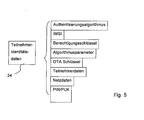
- exemplary subscriber identity data 24 are listed. These subscriber identity data 24 according to FIG. 5 include in particular an indication of the authentication algorithm (A3, A5) used by the operator of the network 34, the International Mobile Subscriber Identity (IMSI), the cryptographic authorization key Ki used for the authentication, the key generation algorithm A8, possibly the network operator-specific OTA key Kota, for a secure OTA -Communication to enable subscriber-specific identification secrets (PIN, PUK), subscriber data such as name, first name, ID number, date of birth, birthplace, etc .; Network operator data, for example, which services are enabled in the respective network 34 for the subscriber.
- This list is by no means exhaustive and may include less, more or other data in alternative examples.
- FIG. 6 Now an embodiment of the method according to the invention for the GSM network is shown in the form of a flow chart.
- the subscriber identity module 2 sends a request Loc_UPD_Req in step 5, including the property that it is equipped without subscriber identification data 24. This is done either by introducing a new message type according to Table 10.2 of the technical specification 3GPP TS 24.008. Alternatively, according to Table 9.2.17, the field "Mobile Identity" is used to indicate to the network 34 that an unpersonalized subscriber identity module 2 requests the system 3 for subscriber identity data 24.
- the system 3 recognizes this property of the subscriber identity module 2 in step 6 and, according to step 7, establishes a communication connection with a subscriber identity data management 4, to which this request of the subscriber identity module 2 is forwarded. Then, according to step 8, the subscriber identity data management 4 in the subscriber identity module 2 asks for the identification data 25. The subscriber identity module 2 then generates a response consisting of the chip ID and the chip ID encrypted with the cryptographic key Ksim. This answer is sent to the subscriber identity data management 4 in step 9. The management 4 decrypts the encrypted chip ID with the symmetric key Ksim and compares the decrypted chip ID with the chip ID sent from the subscriber identity module 2. If the chip IDs are identical, the identification data 25 are considered plausible.
- the subscriber identity management 4 sends in step 11 subscriber identity data 24 to the subscriber identity module 2 and initiates the activation of the data 24.
- the subscriber profile manager 26 installs the subscriber identity data 24 and activates it. All communication between terminal 1, system 3 and subscriber identity data management 4 is via mobile radio via OTA.
- the subscriber identity module sends a LUR 51 according to FIG. 1 to authenticate to the network according to step 52.
- a timer is activated with a predefined period of time. If the time span is exceeded without the subscriber identity module 2 logging on with a LUR 51 for authentication, the communication channel is released and the method is considered unsuccessful. Instead of the timer, the number of requests 5 can also be monitored by the communication system 3 in step 9, so that a module 2 with the same identifier data 25, which sends a predefined number of requests within a certain period of time, will also be rejected by the system 3. It can thus be ensured that a module 2 inquired in accordance with step 5 does not block a communication channel for too long and / or too often, which increases the ability to communicate system 3 would paralyze. This protects the process against manipulation.
- an address of a special subscriber identity management 4 is stored in the identification data 25.
- this address is also communicated in the LUR 5 of the module 2, so that in step 7 it is not diverted to an arbitrary subscriber identity management 4 but to the specific subscriber identity management 4.
- the chip ID is transmitted as an identification date without encryption with Ksim. It is assumed that all subscriber identity modules 2, which have the property of not having subscriber identity data 24, are automatically forwarded to a database instance in order to receive subscriber identity data 24 there.
- the subscriber identity module 2 communicates with the communication system - or with the database instance of the communication system - a session key using the Diffie-Hellman algorithm in order to send the identification data 25 to the communication system.
Landscapes
- Engineering & Computer Science (AREA)
- Computer Security & Cryptography (AREA)
- Computer Networks & Wireless Communication (AREA)
- Signal Processing (AREA)
- Computer Hardware Design (AREA)
- Computing Systems (AREA)
- General Engineering & Computer Science (AREA)
- Mobile Radio Communication Systems (AREA)
Abstract
Description
- Die Erfindung betrifft ein Verfahren zum Erhalten von Teilnehmeridentitätsdaten sowie ein Teilnehmeridentitätsmodul.
- Teilnehmeridentitätsdaten dienen dazu, einen Teilnehmer in einem Kommunikationsnetzwerk, beispielsweise einem digitalen Mobilfunknetzwerk, eindeutig zu identifizieren und/ oder zu authentisieren. Durch diese Teilnehmeridentitätsdaten ist es einem Betreiber eines Kommunikationsnetzwerks möglich, die Nutzung eines vom Netzbetreiber angebotenen Dienstes, beispielsweise eines Sprach- und/oder Datendienstes, jedem Teilnehmer in dem Kommunikationsnetzwerk eindeutig zuzuordnen. Weiterhin ist es dem Betreiber möglich, einen Netzzugang, also die Einbuchung in das Kommunikationsnetz, zu ermöglichen, sobald eine Authentisierung des Teilnehmers stattgefunden hat oder den Netzzugang zu verweigern, falls eine Authentisierung des Teilnehmers nicht möglich ist.
- Meldet sich ein Teilnehmer an einem Kommunikationsnetz an, so wird mittels der Teilnehmeridentitätsdaten im Kommunikationsnetz festgestellt, ob der Teilnehmer im Kommunikationsnetz bekannt ist und welche Dienste des Kommunikationsnetzes durch diesen Teilnehmer genutzt werden können und dürfen. Diese Teilnehmeridentitätsdaten befinden sich in einem Teilnehmeridentitätsmodul, auch als Subscriber Identity Modul (SIM) bezeichnet. Üblicherweise wird jedes Endgerät mit einem Teilnehmeridentitätsmodul ausgestattet. Ein nicht eindeutig identifizierbarer bzw. authentifizierbarer Teilnehmer am Kommunikationsnetz wird gemäß heutigem Standard vom Netzwerk abgewiesen, es ist daher keine Kommunikation, insbesondere kein Datenaustausch sowie die Nutzung von Diensten des Kommunikationsnetzes möglich. In
Figur 1 ist der gemäß GSM standardisierte Vorgang zum Einbuchen in ein GSM -Kommunikationsnetzwerk beispielhaft dargestellt. - Bislang werden die Teilnehmeridentitätsdaten in einer Personalisierungsphase während der Herstellung des Teilnehmeridentitätsmoduls eingebracht. Problematisch ist dabei, dass für einen Betreiber eines Kommunikationsnetzes Kosten für das Vorhalten und Handhaben dieser Teilnehmeridentitätsdaten entstehen, sodass es wünschenswert ist, dass im Moment des ersten Einsatzes on-the-fly generierte Teilnehmeridentitätsdaten auch im Kommunikationsnetzwerk zur Authentisierung/Identifizierung des jeweiligen Teilnehmers verwendet werden. Da die Teilnehmeridentitätsmodule aber vorrausichtlich erst zu einem späteren Zeitpunkt - insbesondere nach Abschluss eines Vertrages zwischen Netzbetreiber und Teilnehmer - tatsächlich in ein Endgerät eingebracht werden, entstehen unnötige Kosten für den Betreiber für die Zeit, in der die Teilnehmeridentitätsdaten ungenutzt sind.
- Ein weiteres Problem ist die zunehmende Miniaturisierung der Endgeräte. Bislang sind die Teilnehmeridentitätsdaten in Kartenform im Endgerät integriert, weshalb zum einen ein Lesegerät im Endgerät und zum anderen ein für die Funktionalität unnötig großvolumiges Teilnehmeridentitätsmodul in das Endgerät eingebracht wird. Zukünftig wird es in Endgeräten vermehrt zum Einsatz festverdrahteter Teilnehmeridentitätsmodule kommen, beispielsweise durch Verlötung des standardisierten Formfaktors MFF2 im Endgerät als SMD, wodurch enorme Platzeinsparungen im Endgerät erzielt werden können. Derartige Teilnehmeridentitätsmodule müssen gemäß heutigem Netzwerkstandards bereits mit Teilnehmeridentitätsdaten eines bestimmten Kommunikationsnetzwerkbetreibers personalisiert werden, bevor sie in das Endgerät eingebracht werden, um Dienste am Kommunikationsnetz nutzen zu können. Weiterhin müsste zu einem frühen Zeitpunkt der Herstellung der Endgeräte deren geografischer Einsatzort bekannt sein, um für die Authentisierung/ Identifizierung spezifischen Anforderungen des Netzwerkes zu entsprechen. Dies führt zu einer erheblichen Zeitverzögerung, einem Mehraufwand sowie ggf. zu Absatzschwierigkeiten für die Herstellung der Endgeräte. Daher wäre es wünschenswert, in die Endgeräte zum Zeitpunkt der Herstellung ein unpersonalisiertes Teilnehmeridentitätsmodul einzubringen.
- Derartige Geräte könnten nach heutigen Standards zur Netzeinbuchung und Nutzung von Diensten nicht verwendet werden, da die Teilnehmeridentitätsdaten zur Authentisierung und Identifizierung des Teilnehmers im Kommunikationsnetz nicht vorhanden sind.
- Dieses Problem ist auch auf die sogenannte Machine-To-Machine Kommunikation, kurz M2M, übertragbar, bei der zumeist ohne menschliche Interaktion Daten und Informationen über das Kommunikationsnetzwerk ausgetauscht werden sollen. Bei der stetig steigenden Anzahl von Endgeräten - man geht im Jahr 2020 von ca. 50 Milliarden mobilfunkfähigen Endgeräten aus, die irgendwo in der Welt produziert werden und weltweit eingesetzt werden könnten - ist es aus Kosteneffizienz- und Logistikgründen fraglich alle Endgeräte per se mit (initialen) Teilnehmeridentitätsdaten auszustatten, insbesondere, wenn ein (vorläufiger bzw. temporärer) Besitzer eines Endgeräts die Kommunikation des Endgeräts über ein bzw. das spezielle Kommunikationsnetzwerk nicht wünscht. Speziell durch die Forderung eines weltweiten Einsatzes der Endgeräte müsste ein Betreiber imense Kosten für Roaming-Vereinbarungen treffen.
- Es ist bereits bekannt, Teilnehmeridentitätsmodule über die Luftschnittstelle, OTA, oder einer Internetverbindung, OTI, zu verwalten und zu aktualisieren. Dazu werden standardisierte Protokolle unter Verwendung eines Short-Message-Service (SMS) bzw. eines Internet Protokolls (IP) angewendet. In der
WO 2010/093312 A1 ist ein Verfahren zur On Demand Activation, kurz ODA Aktivierung von SIMs beschrieben. Dabei werden die in die SIM eingebrachten Teilnehmeridentitätsdaten in einem netzwerkseitigen ODA-Server daraufhin überprüft, ob sie in einem PLMN bekannt sind und ggf. im PLMN bekannt gemacht. Bei diesem Verfahren können weitere Teilnehmeridentitätsdaten in die SIM eingebracht bzw. geändert werden. Auf eine Personalisierung der SIM und Wegfall des Einbringens von Teilnehmeridentitätsdaten kann allerdings nicht verzichtet werden, sodass die adressierten Probleme mit einem derartigen Verfahren nicht gelöst werden können. - In der am 08. Juni 2011 unter Anmeldenummer
11004668.7 - Der Erfindung liegt daher die Aufgabe zugrunde, ein flexibleres, kostengünstigeres und einfacheres Verfahren für das Ersteinbuchen in ein Kommunikationssystem zu beschreiben. Insbesondere soll das Verfahren auf Standardmechanismen des Mobilfunknetzwerks basieren.
- Die Aufgabe der Erfindung wird durch die in den nebengeordneten unabhängigen Patentansprüchen beschriebenen Maßnahmen gelöst. Vorteilhafte Ausgestaltungen sind in den jeweils abhängigen Ansprüchen beschrieben.
- Insbesondere wird die Aufgabe durch ein Verfahren zum Erhalten von Teilnehmeridentitätsdaten in einem Teilnehmeridentitätsmodul zur Nutzung von Diensten eines Kommunikationssystems durch ein dem Teilnehmeridentitätsmodul zugeordnetes Endgerät gelöst. Das Verfahren umfasst die Schritte: Senden einer Anfrage an das Kommunikationssystem zur Authentisierung des Teilnehmeridentitätsmoduls an dem Kommunikationssystem durch das, dem Teilnehmeridentitätsmodul zugeordnete Endgerät und Empfangen von Teilnehmeridentitätsdaten in dem Teilnehmeridentitätsmodul durch das Kommunikationssystem zur Nutzung von Diensten in dem Kommunikationssystem. Insbesondere beinhaltet die Anfrage eine Eigenschaft des Teilnehmeridentitätsmoduls, wobei diese Eigenschaft dem Kommunikationssystem anzeigt, dass das Teilnehmeridentitätsmodul ohne Teilnehmeridentitätsdaten zur Authentisierung am Kommunikationssystem ausgestattet ist.
- Der Grundgedanke der Erfindung beruht darauf, dass ein unpersonalisiertes Teilnehmeridentitätsmodul, also ein Teilnehmeridentitätsmodul ohne Teilnehmeridentitätsdaten, nicht prinzipiell vom Netzwerk abgewiesen wird, sondern während einer frühen Phase der netzwerkseitigen Authentisierungsanfrage bereits die Eigenschaft angibt, dass es unpersonalisiert ist und die Fähigkeit angibt, dass es fernpersonalisiert werden kann. In vorteilhafter Weise ist dadurch die Herstellung der Teilnehmeridentitätsmodule flexibler ausgestaltbar, eine Personalisierung kann erfolgen, sobald das Teilnehmeridentitätsmodul mit einem Endgerät erstmalig betriebsfähig gemacht wird. Zwar kann die Authentisierung/Identifizierung des Moduls durch das Kommunikationssystem nicht erfolgen, das Modul wird dennoch nicht abgewiesen und erhält zumindest einen in den Diensten beschränkten Zugang zum Kommunikationssystem und in Folgeschritten die Teilnehmeridentitätsdaten des Kommunikationssystems. Das Bereitstellen der Dienste durch das Kommunikationssystem und das Übertragen der Teilnehmeridentitätsdaten können vom Kommunikationssystem finanziell berechnet werden.
- Die erfindungsgemäße Anfrage ist insbesondere eine Standortaktualisierungsanfrage, beispielsweise ein Location Update Request, der verwendet wird, um Teilnehmeridentitätsdaten im Netzwerk bekannt zu machen und einen Teilnehmer in einem Netzwerk einzubuchen. Sobald ein Endgerät eine Kommunikation mit dem Kommunikationssystem aufbauen möchte und in diesem Rahmen eine Authentisierung mittels des Teilnehmeridentitätsmoduls vorzunehmen ist, wird diese Anfrage versendet. Die Anfrage ist erfindungsgemäß dergestalt, dass die Eigenschaft des Teilnehmeridentitätsmoduls während eines Einbuchungsversuchs dem Kommunikationssystem mitgeteilt wird. Bevorzugt ist die Anfrage des Teilnehmeridentitätsmoduls erstmalig am Kommunikationssystem erfolgt, das heißt, das Teilnehmeridentitätsmodul hat bislang keine Teilnehmeridentitätsdaten angefordert.
- Die Eigenschaft des Teilnehmeridentitätsmoduls gibt an, ob und in welcher Form Teilnehmeridentitätsdaten im Teilnehmeridentitätsmodul vorhanden sind. Eine Eigenschaft ist insbesondere, dass das Teilnehmeridentitätsmodul keine Teilnehmeridentitätsdaten enthält, also nicht auf einen Teilnehmer im Kommunikationssystem personalisiert ist. Das Teilnehmeridentitätsmodul kann für diese Eigenschaft trotzdem teilnehmeridentitätsmodulindividuelle Kennungsdaten aufweisen, die während der Herstellung des Teilnehmeridentitätsmoduls eingebracht worden sind. Erfindungsgemäß besteht ein wesentlicher Unterschied zwischen Kennungsdaten und Teilnehmeridentitätsdaten.
- Kennungsdaten sind erfindungsgemäß Daten, die teilnehmeridentitätsmodulindividuell sind. Die Kennung kann dabei eine für das gesamte Kommunikationsnetzwerk eindeutige Kennnummer des Teilnehmeridentitätsmoduls sein. Dies ist insbesondere eine Identifikationsnummer des Halbleiterchips, kurz Chip-ID. Eine alternative Bezeichnung ist die gemäß Standardisierung momentan diskutierte Bezeichnung embedded Integrated Chip Card Identification, kurz eICCID. Chip-ID und eICCID werden in dieser Anmeldung synonymial verwendet. Die Chip-ID unterscheidet sich von der ICCID dahingehend, dass die ICCID ein Teil der Teilnehmeridentitätsdaten ist und von einem Kommunikationsnetzanbieter zum nächsten varüert, während die Chip-ID ein Kennungsdatum der UICC ist und diese als Plattform eindeutig kennzeichnet Durch die Chip-ID wird jedes Modul unabhängig von den eingebrachten Teilnehmeridentitätsdaten eindeutig im Verfahren identifizierbar. Kennungsdaten im Sinn der Erfindung sind sowohl teilnehmerunabhängig, kommunikationssystemunabhängig, länderunabhängig als auch endgeräteunabhängig. Die Teilnehmeridentitätsmodule können zum Erhalten dieser Kennungsdaten vorpersonalisiert sein, allerdings enthält diese Vorpersonalisierung keine Teilnehmeridentitätsdaten sondern ausschließlich teilnehmeridentitätsmodulindividuelle Kennungsdaten. Alternativ ist die Chip-ID bereits während der Herstellung des Teilnehmeridentitätsmoduls eingebracht.
- Bei einem Endgerät im Sinn der Erfindung handelt es sich prinzipiell um ein Gerät oder eine Gerätekomponente, welches Mittel zur Kommunikation mit einem Kommunikationssystem aufweist, um Dienste des Kommunikationssystems nutzen zu können. Beispielsweise ist ein mobiles Endgerät wie ein Mobiltelefon, ein Smart-Phone, ein Tablet-PC, ein Notebook, ein PDA, unter dem Begriff zu fassen. Unter dem Endgerät können beispielsweise auch Multimediaendgeräte wie digitale Bilderrahmen, Audiogeräte, Fernsehgeräte, E-Book-Reader, Set-Top Boxen, Digitalkameras verstanden werden, die ebenfalls Mittel zur Kommunikation mit dem Kommunikationsnetzwerk aufweisen. Beispielsweise umfasst der Begriff Endgeräte auch jegliche Art von Maschinen, Automaten, Fahrzeuge, Einrichtungen welche Mittel, insbesondere Mobilfunkmodems, zur Kommunikation mit dem Kommunikationsnetzwerk aufweisen.
- Bei einem Teilnehmeridentitätsmodul im Sinne der Erfindung handelt es sich um ein in Baugröße und Ressourcenumfang reduziertes Modul, welches einen Mikrocontroller und mindestens eine Datenschnittstelle zur Kommunikation mit einem Endgerät aufweist. Dieses Teilnehmeridentitätsmodul weist einen Speicherbereich auf, indem die Teilnehmeridentitätsdaten sicher eingebracht sind, um Manipulations- und/oder Missbrauchsversuche bei der Identifizierung und/ oder Authentisierung am Netzwerk zu verhindern. Das Teilnehmeridentitätsmodul ist mittels des Endgeräts betriebsfähig.
- Bei dem Teilnehmeridentitätsmodul handelt es sich beispielsweise um eine Chipkarte, auch UICC oder umgangssprachlich SIM-Karte, in einem mobilen Kommunikationssystem mit, auf einem Chip gespeicherten maschinenlesbaren Teilnehmeridentitätsdaten des Teilnehmers. Derartige Teilnehmeridentitätsmodule werden mittels Kartenleseeinheiten in einem Endgerät betrieben und sind insbesondere dafür vorgesehen, aus dem Endgerät zum Zweck eines Austauschs oder der Verwendung in einem zweiten Endgerät entnommen werden zu können.
- Alternativ handelt es sich bei dem Teilnehmeridentitätsmodul um einen integralen Bestandteil innerhalb des Endgeräts, beispielsweise eines fest verdrahteten elektronischen Bausteins. Derartige Teilnehmeridentitätsmodule werden auch als embedded UICC (eUICC) bezeichnet. In dieser Bauform sind diese Teilnehmeridentitätsmodule nicht für eine Entnahme aus dem Endgerät vorgesehen und können prinzipiell nicht einfach ausgetauscht werden. Derartige Teilnehmeridentitätsmodule können auch als embedded Secure Elements, also als eine sichere Hardwarekomponente im Endgerät ausgestaltet sein.
- Alternativ kann ein Teilnehmeridentitätsmodul integraler Bestandteil eines Machine-to-Machine-, kurz M2M-, Moduls sein. Diese Module dienen der Fernüberwachung, -kontrolle und -wartung von Endgeräten wie Maschinen, Anlagen und Systemen mittels des Kommunikationssystems. Sie können alternativ auch für Zähleinheiten wie Stromzähler, Warmwasserzähler oä. verwendet werden.
- Alternativ ist das Teilnehmeridentitätsmodul als eine Kombination aus Hard-und Softwarekomponenten in einem vertrauenswürdigen Teil eines Betriebssystems, einer sogenannten Trusted Execution Environment (TEE) des Endgerätes ausgebildet. Das Teilnehmeridentitätsmodul ist dann beispielsweise innerhalb einer gesicherten Laufzeitumgebung in Form von darin ablaufenden Programmen, sogenannten Trustlets oder ähnlich ausgebildet.
- Teilnehmeridentitätsdaten im Sinn der Erfindung sind zum einen Daten, die einen Teilnehmer eindeutig im Kommunikationsnetz identifizieren, beispielsweise eine International Mobile Subscriber Identity (IMSI) und/ oder teilnehmerspezifische Daten. Die IMSI ist das in einem Mobilfunkkommunikationsnetzwerk eindeutige Teilnehmeridentitätsdatum. Sie setzt sich zusammen aus dem Landescode MCC (Mobile Country Code), dem Netzwerkcode MNC (Mobile Network Code) und einer laufenden Nummer, die vom Netzbetreiber vergeben wird.
- Darüber dienen Teilnehmeridentitätsdaten dazu, einen Teilnehmer eindeutig am Kommunikationsnetz zu authentisieren. Hierzu werden auf die UICC beispielsweise ein Authentisierungsalgorithmus, spezifische Algorithmusparameter, ein kryptografischer Authentisierungsschlüssel und/oder ein kryptografischer Over-The-Air (OTA) Schlüssel aufgebracht. Insbesondere sind die Teilnehmeridentitätsdaten initiale Teilnehmeridentitätsdaten, die dazu verwendet werden, um in ein spezielles Kommunikationsnetz umgeleitet zu werden, wobei in diesem Kommunikationsnetz die finalen Teilnehmeridentitätsdaten für das Teilnehmeridentitätsmodul erhalten werden.
- Die Anzahl der Teilnehmeridentitätsdaten auf dem Teilnehmeridentitätsmodul ist nicht beschränkt. Es ist angedacht, in Zukunft auf einem Teilnehmeridentitätsmodul dreißig oder mehr Teilnehmeridentitätsdaten vorzusehen.
- Ein Teilnehmer im Sinn der Erfindung ist beispielsweise eine Person, die mittels des Endgeräts auf Dienste des Kommunikationsnetzes zugreifen möchte. Als ein Teilnehmer ist auch ein Endgerät in einer M2M Umgebung zu verstehen.
- Ein Kommunikationssystem im Sinn der Erfindung ist eine technische Einrichtung, auf der die Übertragung von Signalen unter Identifizierung und/ oder Authentisierung des Kommunikationsteilnehmers stattfindet, wonach technische Dienste angeboten werden. Das Kommunikationssystem ist bevorzugt in Mobilfunkzellen aufgebaut, wobei die Größe einer Funkzelle abhängig von meteorologischen und geografischen Gegebenheiten sowie der verwendeten Funkantenne. Insbesondere wird in dieser Erfindung ein Mobilfunknetz beispielsweise das "Global System for Mobile Commurucations", kurz GSM als Vertreter der zweiten Generation oder das "General Packet Radio Service", kurz GPRS bzw. "Universal Mobile Telecommunications System", kurz UMTS als Vertreter der dritten Generation oder das "Long Term Evolution", kurz LTE, als Vertreter der vierten Generation als Mobilfunknetz verstanden. Prinzipiell sind auch alle Code Division Multiple Access basierten Funknetze, kurz CDMA-Netze, unter den Begriff des Kommunikationssystems zu fassen.
- Unter einem Dienst im Sinne der Erfindung ist insbesondere ein Sprachdienst oder ein Datendienst zu verstehen, mit dem Informationen und/oder Daten über das Kommunikationsnetzwerk übertragen werden.
- In einer Ausgestaltung der Erfindung werden vor dem Empfangen der Teilnehmeridentitätsdaten Kennungsdaten zum Identifizieren des Teilnehmeridentitätsmoduls von dem Teilnehmeridentitätsmodul an das Kommunikationssystem gesendet. Als Kennungsdaten kann eine teilnehmeridentitätsmodulweit eindeutige Kennung wie die Chip-ID verwendet werden, um das Teilnehmeridentitätsmodul am Kommunikationssystem eindeutig zu identifizieren.
- In einer Ausgestaltung der Erfindung wird ein kryptografischer Algorithmus angewendet, in dessen Verlauf eine sichere Übertragung der Kennung gewährleistet wird, beispielsweise durch die Aushandlung eines Sitzungsschlüssels. Als kryptografischer Algorithmus kann insbesondere das Diffie-Hellman-Verfahren angewendet werden.
- Insbesondere kann ein teilnehmeridentitätsmodulweit eindeutiger kryptografischer Schlüssel verwendet werden, um die Kennung wie die Chip-ID zu verschlüsseln. Die Kennungsdaten können dann die Kombination aus Chip-ID und mit dem kryptografischen Schlüssel verschlüsselten Chip-ID sein.
- Insbesondere ist eine Teilnehmeridentitätsverwaltung als eine Instanz des Kommunikationssystems vorgesehen, welches die Teilnehmeridentitätsdaten für das Teilnehmeridentitätsmodul bereitstellt. Diese Teilnehmeridentitätsverwaltung (des verantwotlichen; endgültig zuständigen PLMNs), führt eine Plausibilitätsprüfung der Kennungsdaten durch, indem sie diese Chip-ID wieder zu entschlüsseln versucht. Ist die entschlüsselte und im Klartext gesendete Chip-ID gleich, waren die Kennungsdaten plausibel. Anschließend werden die Teilnehmeridentitätsdaten über das Kommunikationssystem mit dem teilnehmeridentitätsmodulindividuellen kryptografischen Schlüssel verschlüsselt an das Teilnehmeridentitätsmodul gesendet.
- Der kryptografische Schlüssel ist insbesondere ein symmetrischer Schlüssel, der sowohl dem Teilnehmeridentitätsmodul als auch dem Kommunikationssystem bekannt ist. Alternativ ist der kryptografische Schlüssel ein asymmetrisches Schlüsselpaar. Der Schlüssel wird im Rahmen einer Vorpersonalisierung in das Teilnehmeridentitätsmodul eingebracht und ist teilnehmeridentitätsmodulindividuell. Dieser Schlüssel unterscheidet sich von dem Authentisierungsschlüssel Ki, welcher kommunikationsnetzindividuell ist.
- In einer bevorzugten Ausgestaltung sendet das Teilnehmeridentitätsmodul nach dem Empfangen der Teilnehmeridentitätsdaten erneut eine Anfrage unter Verwendung der empfangenen Teilnehmeridentitätsdaten an das Kommunikationssystem zur Authentisierung des Teilnehmeridentitätsmoduls an dem Kommunikationssystem. Ab diesem Zeitpunkt weist das Teilnehmeridentitätsmodul die Eigenschaft auf, dass es personalisiert ist.
- Die Kennungsdaten sind dabei während der Chipherstellung oder während einer Grundpersonalisierung in das Teilnehmeridentitätsmodul eingebracht. Diese Grundpersonalisierung beinhaltet insbesondere keine Teilnehmeridentitätsdaten wie Netzwerkauthentisierungsschlüssel oder IMSI, d.h. die Kennungsdaten sind generischer Form.
- Insbesondere wird die Eigenschaft in der Anfrage in Form eines speziell definierten Registrierungsnachrichtentyps gemäß dem Standard 3GPP TS 24.008 an das Kommunikationssystem gesendet. Somit muss zwar der Standard um diesen Registrierungsnachrichtentyp erweitert werden, allerdings würden weltweit alle Kommunikationssysteme mit Hilfe dieses Typs die Eigenschaft des Teilnehmeridentitätsmoduls erkennen und würden eine Abweisung durch das Kommunikationssystem verhindern.
- Alternativ wird die Eigenschaft in ein spezifisches Datenfeld eines der bereits gemäß Standard 3GPP TS 24.008 vorhandenen Registrierungsnachrichtentyp innerhalb der Location Update Request Nachricht eingebracht. Somit kann die bestehende Infrastruktur ohne große Adaption weiter verwendet werden, die Teilnehmeridentitätsmodule werden anhand gängiger Verfahren ausgewertet und mittels des spezifischen Datenfelds charakterisiert.
- Die Kennungsdaten können erfindungsgemäß in ein anderes Datenfeld gemäß 3GPP TS 24.008 eingetragen und gesendet werden.
- Bevorzugt leitet das Kommunikationsnetz die Kommunikation mit dem Teilnehmeridentitätsmodul nach einem Erkennen der vordefinierten Eigenschaft zu einer Teilnehmeridentitätsdatenverwaltung weiter. Somit ist die logische Kommunikation zwischen einem unpersonalisierten Teilnehmeridentitätsmodul und der Teilnehmeridentitätsdatenverwaltung hergestellt. Das Modul wurde insbesondere nicht abgewiesen, eine Fernpersonalisierung ist somit ermöglicht. In einem Kommunikationsnetzwerk kann die Kommunikation auf die Kommunikation zur Teilnehmerverwaltung beschränkt werden. Dass heisst, dass die Grundkommunikation nicht missbräuchlich verwendet werden kann. Dabei wird das beschriebene Verfahren bis zum Erhalt eindeutiger Teilnehmeridentitätsdaten auf Signalisierungskanälen des Kommunikationssystems durchgeführt. Eine Sprach- und/oder Nutzdatenkommunikation durch den endgeräteseitigen Nutzer ist dabei nicht möglich. Das erfindungsgemäße Verfahren ist bis zum Erhalten der Teilnehmeridentitätsdaten intransparent für den Benutzer.
- Zur Absicherung der Kommunikation befähigen die empfangenen Teilnehmeridentitätsdaten im Teilnehmeridentitätsmodul nur zu einer eingeschränkten Nutzung von Diensten durch das Endgerät im Kommunikationssystem. Diese Einschränkungen umfassen insbesondere nicht das Einbuchen in das Kommunikationssystem sowie das Weiterleiten zu einem bevorzugten Kommunikationsnetz in dem Kommunikationssystem. Diese Einschränkungen umfassen insbesondere das Nutzen von Sprachdiensten und Multimediadiensten.
- In einer bevorzugten Ausgestaltung wird das Teilnehmeridentitätsmodul vom Kommunikationssystem abgewiesen, falls das Teilnehmeridentitätsmodul nicht innerhalb einer vordefinierten Zeitspanne erneut eine Anfrage unter Verwendung von empfangenen Teilnehmeridentitätsdaten sendet. Dies hat den Vorteil, dass der Kommunikationskanal, den das Teilnehmeridentitätsmodul vom Kommunikationssystem zugewiesen bekommen hat, wieder frei wird und das Kommunikationssystem nicht aufgrund unpersonalisierter Teilnehmeridentitätsmodule blockiert. Ein weiterer Vorteil ist, dass das Teilnehmeridentitätsmodul nach dem Erhalt der Teilnehmeridentitätsdaten eine Anfrage an ein alternatives Kommunikationsnetz gesendet hat und somit die Kommunikation mit dem Kommunikationsnetz, über das die Teilnehmeridentitätsdaten erhalten wurden, beendet ist.
- In einer bevorzugten Ausgestaltung der Erfindung wird die Anzahl der gesendeten Anfragen in Kommunikationssystem protokolliert, um Manipulationen durch zu häufiges Versenden der Anfrage durch ein Teilnehmeridentitätsmodul unterbinden zu können. Dies wird auch als Denial-of-Service bezeichnet.
- In einer bevorzugten Ausgestaltung der Erfindung wird in den Kennungsdaten eine Adresse einer speziellen Teilnehmeridentitätsverwaltung hinterlegt. Dies führt dazu, dass das System die Adresse verwenden kann, um zu einer speziellen Teilnehmeridentitätsverwaltung umzuleiten.
- In einer bevorzugten Ausgestaltung besteht das Kommunikationssystem aus mehreren mobilen Kommunikationsnetzen. Somit erfolgt das Senden der Anfrage an ein erstes Kommunikationsnetz, welches in Kommunikationsreichweite mit dem Teilnehmeridentitätsmodul ist. Im Erfindungsgedanken ist enthalten, dass nach dem Erhalten der Teilnehmeridentitätsdaten ein alternatives Kommunikationsnetzwerk ausgewählt und zur weiteren Kommunikation verwendet werden kann. Somit ist eine Ersteinbuchung ohne Netzvorauswahl erzielt.
- In einer bevorzugten Ausgestaltung der Erfindung ist im Kommunikationsnetz eine Datenbankinstanz vorgesehen. Die Datenbankinstanz weist Einträge von Teilnehmeridentitätsmodulen, insbesondere deren Kennungsdaten und die erhaltenen Teilnehmeridentitätsdaten auf.
- In einer Weiterbildung weist die Datenbankinstanz teilnehmeridentitätsmodulindividuelle kryptografische Schlüssel auf, mit denen das Teilnehmeridentitätsmodul die Kennungsdaten kryptografisch sichert. Die Datenbankinstanz entschlüsselt die Kennungsdaten. Bei erfolgreicher Entschlüsselung durch die Datenbankinstanz sind die Kennungsdaten für das Kommurukationssystem plausibel.
- Die Datenbankinstanz ist bevorzugt eine zentrale Instanz aller Kommunikationsnetzbetreiber mit stark beschränkten Zugriffsrechten. Insbesondere können Instanzen der einzelnen Kommunikationsnetzbetreiber auf diese Datenbankinstanz zugreifen, um entweder weitere Chip-IDs einzutragen und/oder Chip-IDs mit kryptografischen Schlüsseln zu verknüpfen und/oder Informationen bezüglich der Teilnehmeridentitätsmodule aus der Datenbank abzurufen. Alternativ können Teilnehmeridentitätsverwaltungen und/oder Teilnehmeridentitätsmodulhersteller auch auf diese Datenbankinstanz zugreifen.
- Im Erfindungsgrundgedanken ist weiterhin ein Teilnehmeridentitätsmodul zur Verwendung in einem Kommunikationssystem, wobei das Teilnehmeridentitätsmodul eindeutige Kennungsdaten und einen Teilnehmeridentitätsmodulschlüssel aufweist, mit welchem die Kennungsdaten an dem Kommunikationssystem verifiziert werden kann.
- Bevorzugt übernimmt eine Teilnehmerprofilverwaltungsapplikation, kurz Sub-Man-Client, in dem Teilnehmeridentitätsmodul die Ausführung des erfindungsgemäßen Verfahrens, insbesondere das Senden der Anfrage an das Kommunikationssystem und das Einbringen der erhaltenen Teilnehmeridentitätsdaten in den dafür vorgesehenen Speicherbereich des Teilnehmeridentitätsmoduls.
- Nachfolgend wird anhand von Figuren die Erfindung bzw. weitere Ausführungsformen und Vorteile der Erfindung näher erläutert, wobei die Figuren lediglich Ausführungsbeispiele der Erfindung beschreiben. Gleiche Bestandteile in den Figuren werden mit gleichen Bezugszeichen versehen. Die Figuren sind nicht als maßstabsgetreu anzusehen, es können einzelne Elemente der Figuren übertrieben groß bzw. übertrieben vereinfacht dargestellt sein.
- Es zeigen:
- Figur 1
- Ein Einbuchen in ein Kommunikationsnetz unter Senden einer Anfrage gemäß dem GSM-Standard
- Figur 2
- Ein erfindungsgemäßes System zum Erhalten von Teilnehmeridentitätsdaten
- Figur 3
- Ein Blockschaltbild eines erfindungsgemäßen Teilnehmeridentitätsmoduls
- Figur 4
- Eine detaillierte Darstellung eines Teilnehmeridentitätsmoduls
- Figur 5
- Teilnehmeridentitätsdaten zum Erhalten in einem erfindungsgemäßen Teilnehmeridentitätsmodul
- Figur 6
- Ein beispielhaftes Ablaufdiagramm des erfindungsgemäßen Verfahrens
-
Figur 1 zeigt ein Einbuchen in ein Kommunikationssystem 3 unter Senden einer Anfrage durch das Endgerät 1 in Zusammenwirken mit einem Teilnehmeridentitätsmodul 2 gemäß dem bekannten Standard 3GPP TS 24.008. Wann immer ein Endgerät 1 Netzzugang einfordert sendet es zunächst einen Channel Request (CHAN_REQ) auf einem Steuerkanal, hier dem Random Access Channel (RACH). Das Kommunikationssystem 3, insbesondere das BTS des Kommunikationssystems 3, antwortet auf dies CHAN_REQ mit einer Kanalzuweisungsnachricht (IMM_ASS_CMD). Das Endgerät 1 schaltet daraufhin auf einen neuen Steuerkanal, beispielsweise dem Stand Alone Dedicated Control Channel (SDCCH) und antwortet dem Kommunikationssystem 3 mit einer Standortaktualisierungsanfrage 51, dem sogenannten Location Update Request (LUR). In diesem LUR 51 sind die Teilnehmeridentitätsdaten 24, insbesondere die IMSI bzw. eine temporäre IMSI. Im Folgeschritt 52 verifiziert das System 3 den Teilnehmer. Dabei wird der LUR von der BSS an das Mobile Switching Center MSC und das Visiting Location Register VLR gesendet. Das VLR leitet die Teilnehmeridentitätsdaten 24 zum Home Location Register HLR weiter, bei dem das Teilnehmeridentitätsmodul 2 anhand der Teilnehmeridentitätsdaten 24 beheimatet sein sollte, und fordert die Verifizierung des Teilnehmeridentitätsmoduls 2 und weitere Teilnehmeridentitätsdaten 24 insbesondere das Authentisierungstriplet oder -quintet vom HLR/AUC an. Daraufhin leitet das HLR die Anfrage des VLR an das Authentisierungscenter AUC weiter. Das AUC generiert ein Authentisierungstriplet bestehend aus einer Zufallszahl RAND, dem - auch in dem Teilnehmeridentitätsmodul 2 enthaltenen - Authentisierungschlüssel Ki sowie einer Challenge SRES und sendet es an das HLR. Das HLR überprüft die vom Teilnehmeridentitätsmodul 2 erhaltenen Teilnehmeridentitätsdaten 24 und sendet das vom AUC erhaltene Triplet an das MSC/VLR. Das MSC/ VLR sendet einen Authentisierungsanfrage AUTH_REQ zusammen mit der RAND des Triplets an das Endgerät 1, woraufhin SRES im Teilnehmeridentitätsmodul 2 errechnet wird. Das Endgerät 1 antwortet mit einer AUTH_RSP beinhaltend den errechneten SRES auf dem Kommunikationskanal SDCCH. Das Kommunikationssystem 3, vergleicht das SRES vom Teilnehmeridentitätsmodul 2 mit dem SRES vom AUC, bei Übereinstimmung gilt das Teilnehmeridentitätsmodul 2 am Kommunikationssystem 3 als authentisiert. - Anschließend erfolgt ein CIPHER_MOD_CMD an das Endgerät 1, woraufhin das Endgerät 1 in einen Verschlüsselungsmodus wechselt und dies dem System 3 mit CIPHER_MOD_COM anzeigt. Ab diesem Zeitpunkt erfolgt die Kommunikation zwischen Endgerät 1 und System 3 verschlüsselt. Das System 3 generiert ggf. eine neue temporäre IMSI und versendet eine Bestätigung des erfolgreichen Einbuchens LOC UPD ACC ggf. unter Bekanntgabe der neuen T_IMSI. Mittels einer nicht dargestellten Aufforderung CHAN_REL wird der Kommunikationskanal am SDCCH abgebaut und das Endgerät in einen Bereitschaftsmodus IDLE_MOD geschalten.
- Es ist einfach ersichtlich, dass ohne die Teilnehmeridentitätsdaten 24, insbesondere der IMSI (T_IMSI), des Ki sowie dem Algorithmusschlüssel SRES eine Authentisierung am System 3 nicht erfolgen würde.
- In
Figur 2 ist nunmehr ein erfindungsgemäßes System aufgezeigt. Das Endgerät 1 weist ein unpersonalisiertes Teilnehmeridentitätsmodul 2 auf. Mit unpersonalisiert wird hierin verstanden, dass keine Teilnehmeridentitätsdaten 24, die inFigur 5 näher beschrieben sind, im Teilnehmeridentitätsmodul 2 enthalten sind. Zur Kommunikation mit einem Kommunikationssystem 3 muss das Endgerät 1 sich mittels des Teilnehmeridentitätsmoduls 2 authentisieren und identifizieren. Das System 3, bevorzugt ein Mobilfunknetz, ist aus einer Vielzahl von Kommunikationszellen 31 aufgebaut. Die bereits vorgestellten Kommunikationsnetzwerkinstanzen MSC, VLR, HLR, AUC werden stellvertretend als Netzwerkinstanzen 32 bezeichnet. - Im erfindungsgemäßen Verfahren ist vorgesehen, dass das Teilnehmeridentitätsmodul 2 unter Verwendung des Endgeräts 1 eine Anfrage 51 gemäß Standard sendet. Diese Anfrage 51 beinhaltet erfindungsgemäß die Eigenschaft des Teilnehmeridentitätsmoduls 2, dass keine Teilnehmeridentitätsdaten 24 im Modul 2 vorhanden sind, aber das Modul 2 eingerichtet ist, Teilnehmeridentitätsdaten 24 über die Luftschnittstelle, OTA, zu erhalten. Daraufhin wird das Endgerät 1 nicht vom System 3 abgewiesen, sondern erhält Teilnehmeridentitätsdaten 24 von einer netzwerkseitigen Teilnehmeridentitätsdatenverwaltung 4, auch als Subscription Manager bezeichnet. Dies geschieht entweder über die herkömmlichen Instanzen 32 oder mittels einer Umleitverwaltung 33.
- Die Kommunikation zwischen dem Teilnehmeridentitätsmodul 2 und dem System 3 ist dabei in seinen Diensten eingeschränkt, beispielsweise im Modus SMS_ONLY, sodass das Teilnehmeridentitätsmodul 2 reguläre, initiale und/oder finale Teilnehmeridentitätsdaten 24 empfangen kann.
- Die Anfrage 51 an das System 3 wird dabei in der Form abgeändert, dass das gemäß Standard 3GPP TS 24.008 beschriebene Verfahren eine veränderte Einbuchungsabfolge erhält, wobei insbesondere die 'Location Updating Request' Anfrage angepasst wird, um ein in einer Kommunikationszelle 31 neu erkanntes Endgerät nicht sofort abzuweisen, wenn es sich nicht authentisiert, siehe auch
Figur 6 . - Dazu wird erfindungsgemäß vorgeschlagen, einen weiteren Typ von Registrierungsnachricht gemäß Tabelle 10.2 des Standards 3GPP TS 24.008 'Message types for Mobility Management' Registration Messages einzuführen. Dieser Typ von Nachricht enthält die Eigenschaft, dass das sendende Teilnehmeridentitätsmodul 2 keine Teilnehmeridentitätsdaten 24 zur Authentisierung aufweist, aber diese Teilnehmeridentitätsdaten 24 vom Netzwerk erhalten möchte.
- Alternativ wird gemäß Tabelle 9.2.17 des Standards 3GPP TS 24.008 die 'Location Updating Request' Anfrage 51 derart abgeändert, dass ein weiteres Datenfeld zur Identifizierung von Teilnehmeridentitätsmodulen 24 ohne Teilnehmeridentitätsdaten 24 definiert wird, welches versucht, sich an einem System 3 anzumelden.
- In
Figur 3 ist ein Blockschaltbild eines Teilnehmeridentitätsmoduls 2 dargestellt. Dabei weist das Teilnehmeridentitätsmodul 2 eine Datenschnittstelle 21 auf. Eine zentrale Recheneinheit 22 verbindet die Datenschnittstelle 21 mit einem Speicher 23, der flüchtig (RAM) oder nicht flüchtig (ROM, EEPROM, FLASH) ausgebildet ist. Im Speicherbereich 23 sind Kennungsdaten 25, eine Teilnehmerprofilverwaltung 26 in Form einer ausführbaren Softwareapplikation; das Dateisystem 27 und das Betriebssystem 28 abgelegt. Nach Erhalt der Teilnehmeridentitätsdaten 24 werden diese durch die Teilnehmerprofilverwaltung 26 im Speicherbereich 23 abgelegt. - In
Figur 4 ist eine beispielhafte Schichtendarstellung der Programm- und Datenhierarchie in einem erfindungsgemäßen Teilnehmeridentitätsmodul 2 dargestellt. Dabei ist im Speicherbereich 23 des Teilnehmeridentitätsmoduls 2 ein Betriebssystem 28 mit einem damit verknüpften allgemeinen Dateisystem 27 abgelegt, wobei das Dateisystem 27 über das Betriebssystem 28 administrierbar ist. Das Dateisystem 27 ist in ein allgemeines Dateisystem 27a sowie ein Teilnehmerspezifisches Dateisystem 27b unterteilt, beide Teile sind über das Betriebssystem 28 administrierbar. Die Teilnehmerprofilverwaltung 26 greift wiederum auf das Dateisystems 27 zu. In den Speicherbereich 23 sind weiterhin eindeutige Modulkennungsdaten 25 eingebracht, insbesondere eine teilnehmeridentitätsmodulspezifische Chip-ID sowie beispielsweise ein kryptografischer Schlüssel Ksim. Ksim ist bevorzugt ein symmetrischer Schlüssel, der in der Teilnehmeridentitätsdatenverwaltung 4 bekannt ist. Eine Zusammengehörigkeit zwischen Chip-ID und Ksim wird einer Teilnehmerprofilverwaltung 4 zur Verfügung gestellt, bzw. ist der Ksim für eine Gruppe von Teilnehmeridentitätsmodulen 2 gleich. - Die Modulkennungsdaten 25 werden im Rahmen einer Vorpersonalisierung des Moduls 2 in den Speicherbereich eingebracht und sind in einer Ausführungsvariante der Erfindung modulindividuell und im System 3 eindeutig. Die Chip-ID ist beispielsweise die Seriennummer des Halbleiterchips. Er kann auch bereits während der Herstellung des Chips eingebracht werden, wodurch die Vorpersonalisierung als Fertigungsschritt entfallen kann. Im Speicherbereich 23 ist ebenfalls vorgesehen, Teilnehmeridentitätsdaten 24 einzubringen. Diese sind über die Teilnehmerprofilverwaltung 26 administrierbar.
- Gemäß
Figur 4 handelt es sich um ein Teilnehmeridentitätsmodul 2, welches mit einem oder mit einer Mehrzahl von Teilnehmeridentitätsprofilen ausgestattet ist. Jedes Teilnehmeridentitätsprofil wird in einem reservierten und abgeschotteten Bereich (auch "Slot" genannt) abgelegt. Ein Slot ist in der Lage Teilnehmeridentitätsdaten 24a, 24b, 24c, 24n, die einen Teilnehmer an jeweils unterschiedlichen Kommunikationsnetzen 34 eindeutig identifizieren und/oder authentisieren, aufzunehmen. Die Profile sind dabei einzeln hinzufügbar, aktivierbar, nutzbar, deaktivierbar und auch löschbar. Eine Administration der Profile und der dafür notwendigen Daten, Authentisierungen und Verschlüsselung wird mittels der Teilnehmerprofilverwaltung 26 durchgeführt. Die jeweiligen Daten werden insbesondere über eine Luftschnittstelle, insbesondere Over-The-Air (OTA) in das jeweilige Teilnehmeridentitätsmodul 2 geladen. Eine Eigenschaft des Teilnehmeridentitätsmoduls 2 ist, dass das Teilnehmeridentitätsmodul ohne Teilnehmeridentitätsdaten 24 ausgestattet ist, was durch die gestrichelten Linien dargestellt ist. Während der Durchführung des erfindungsgemäßen Verfahrens werden in die Slots 1 bis n Teilnehmeridentitätsdaten 24 eingebracht, welche vom Kommunikationssystem 3 erhalten werden. - Mit derartigen Teilnehmeridentitätsmodulen 2 ist es nicht mehr zwingend notwendig, dass ein Betreiber eines Netzwerkes 34 für die Identifizierung und Authentisierung eines Teilnehmers an seinem Netzwerk 34 auf Basis eines geschlossenen Vertrags ein neues Teilnehmeridentitätsmodul 4 erzeugt und an den Teilnehmer in Form einer SIM Karte ausgibt. Stattdessen werden Teilnehmeridentitätsdaten 24a, b, c, n durch den Netzbetreiber auf Basis des geschlossenen Vertrages erstellt. Die Teilnehmeridentitätsdaten 24a, b, c, n werden dann in das bereits im Endgerät 1 eingebrachte Teilnehmeridentitätsmodul 4 hinzugefügt und können parallel zu anderen Teilnehmeridentitätsdaten 24a, b, c, n existieren. Dadurch ergibt sich, dass das Teilnehmeridentitätsmodul 4 nicht mehr mechanisch lösbar in einem Endgerät 1 eingebracht werden muss, stattdessen können fest verdrahtete Teilnehmeridentitätsmodule 4, kurz eUICCs, im Endgerät 1 eingebracht sein. Dies spart Platz im Endgerät, wodurch andere Funktionalitäten im Endgerät 1 realisiert werden können, ohne die Bauform des Endgeräts 1 vergrößern zu müssen und erhöht die Flexibilität.
- Gemäß
Figur 5 sind beispielhafte Teilnehmeridentitätsdaten 24 aufgelistet. Diese Teilnehmeridentitätsdaten 24 gemäßFigur 5 umfassen insbesondere eine Angabe über den beim Betreiber des Netzwerkes 34 verwendet Authentisierungsalgorithmus (A3, A5), die International Mobile Subscriber Identity (IMSI), die zur Authentisierung verwendeten kryptografischen Berechtigungsschlüssel Ki, den Schlüsselerzeugungsalgorithmus A8, ggf. netzbetreiberspezifische OTA-Schlüssel Kota, um eine sichere OTA-Kommunikation zu ermöglichen, teilnehmerspezifische Identifizierungsgeheimnisse (PIN, PUK), Teilnehmerdaten, wie Name, Vorname, ID-Nummer, Geburtsdatum, Gevurtsort etc; Netzbetreiberdaten, beispielsweise welche Dienste im jeweiligen Netz 34 für den Teilnehmer freigeschaltet sind. Diese Auflistung ist keinesfalls allumfassend und kann in alternativen Beispielen auch weniger, mehr oder andere Daten umfassen. - In
Figur 6 ist nun eine Ausführung des erfindungsgemäßen Verfahrens für das GSM Netz in Form eines Ablaufdiagramms dargestellt. Zunächst erfolgt die Zuweisung eines Kommunikationskanals über CHAN_Reg und IMM_ASS_CMD, wie bereits in der Beschreibung zuFigur 1 dargelegt. Erfindungsgemäß sendet das Teilnehmeridentitätsmodul 2 im Schritt 5 eine Anfrage Loc_UPD_Req, beinhaltend die Eigenschaft, dass es ohne Teilnehmeridentifizierungsdaten 24 ausgestattet ist. Dies geschieht entweder durch die Einführung eines neuen Nachrichtentyps gemäß Tabelle 10.2 der technischen Spezifikation 3GPP TS 24.008. Alternativ wird gemäß Tabelle 9.2.17 das Feld "Mobile Identity" verwendet, um dem Netzwerk 34 anzuzeigen, dass ein unpersonalisiertes Teilnehmeridentitätsmodul 2 am System 3 nach Teilnehmeridentitätsdaten 24 anfragt. Das System 3 erkennt im Schritt 6 diese Eigenschaft des Teilnehmeridentitätsmoduls 2 und baut gemäß Schritt 7 eine Kommunikationsverbindung mit einer Teilnehmeridentitätsdatenverwaltung 4 auf, an die diese Anfrage des Teilnehmeridentitätsmoduls 2 weitergeleitet wird. Gemäß Schritt 8 fragt daraufhin die Teilnehmeridentitätsdatenverwaltung 4 beim Teilnehmeridentitätsmodul 2 nach den Kennungsdaten 25. Das Teilnehmeridentitätsmodul 2 erstellt daraufhin eine Antwort, bestehend aus der Chip-ID und der Chip-ID verschlüsselt mit dem kryptografischen Schlüssel Ksim. Diese Antwort wird im Schritt 9 an die Teilnehmeridentitätsdatenverwaltung 4 gesendet. Die Verwaltung 4 entschlüsselt die verschlüsselte Chip-ID mit dem symmetrischen Schlüssel Ksim und vergleicht die entschlüsselte Chip-ID mit der vom Teilnehmeridentitätsmodul 2 gesendeten Chip-ID. Sind die Chip-IDs identisch, gelten die Kennungsdaten 25 als plausibel. Anschheßend sendet die Teilnehmeridentitätsverwaltung 4 im Schritt 11 Teilnehmeridentitätsdaten 24 an das Teilnehmeridentitätsmodul 2 und veranlasst die Aktivierung der Daten 24. Die Teilnehmerprofilverwaltung 26 installiert die Teilnehmeridentitätsdaten 24 und schaltet diese auf aktiviert. Die gesamte Kommunikation zwischen Endgerät 1, System 3 sowie Teilnehmeridentitätsdatenverwaltung 4 verläuft über Mobilfunk via OTA. Anschließend sendet das Teilnehmeridentitätsmodul eine LUR 51 gemäßFigur 1 , um sich am Netzwerk gemäß Schritt 52 zu authentisieren. - In einer speziellen Ausgestaltung des Verfahrens gemäß
Figur 6 wird im Schritt 7 eine Zeitschaltung (Timer) mit einer vordefinierten Zeitspanne aktiviert. Wird die Zeitspanne überschritten, ohne das sich das Teilnehmeridentitätsmodul 2 mit einem LUR 51 zur Authentisierung anmeldet, wird der Kommunikationskanal freigegeben, das Verfahren gilt als nicht erfolgreich abgeschlossen. Anstelle der Zeitschaltung kann auch die Anzahl von Anfragen 5 im Schritt 9 durch das Kommunikationssystem 3 überwacht werden, sodass ein Modul 2 mit den gleichen Kennungsdaten 25, welches innerhalb einer gewissen Zeitspanne eine vordefinierte Anzahl von Anfragen sendet, ebenfalls vom System 3 abgewiesen wird. Damit kann sichergestellt werden, dass ein gemäß Schritt 5 anfragendes Modul 2 nicht zu lange und/oder zu oft einen Kommunikationskanal blockiert, was die Kommunikationsfähigkeit des Systems 3 lähmen würde. Damit ist das Verfahren gegen Manipulationen abgesichert. - In einer Weiterbildung des erfindungsgemäßen Verfahrens wird in den Kennungsdaten 25 eine Adresse einer speziellen Teilnehmeridentitätsverwaltung 4 hinterlegt. In der LUR 5 des Moduls 2 wird zusätzlich zu der Eigenschaft auch noch diese Adresse mitgeteilt, sodass im Schritt 7 nicht zu einer willkürlichen Teilnehmeridentitätsverwaltung 4, sondern zu der speziellen Teilnehmeridentitätsverwaltung 4 umgeleitet wird.
- In einer nicht figürlich dargestellten Ausgestaltung des erfindungsgemäßen Verfahrens wird die Chip-ID als Kennungsdatum ohne Verschlüsselung mit Ksim übertragen. Dabei wird davon ausgegangen, dass alle Teilnehmeridentitätsmodule 2, die die Eigenschaft aufweisen, keine Teilnehmeridentitätsdaten 24 aufzuweisen, automatisch an eine Datenbankinstanz weitergeleitet werden, um dort Teilnehmeridentitätsdaten 24 zu erhalten.
- In einer nicht figürlich dargestellten Ausgestaltung des erfindungsgemäßen Verfahrens handelt das Teilnehmeridentitätsmodul 2 mit dem Kommunikationssystem - bzw. mit der Datenbankinstanz des Kommunikationssystems - einen Sitzungsschlüssel mit Hilfe des Diffie-Hellman-Algorithmus aus, um die Kennungsdaten 25 dem Kommunikationssystem zu senden.
-
- 1
- Endgerät
- 2
- Teilnehmeridentitätsmodul
- 21
- Schnittstelle
- 22
- Zentralrecheneinheit
- 23
- Speicherbereich
- 24a,b,c,n
- Teilnehmeridentitätsdaten, Teilnehmerprofile
- 25
- Eindeutige Modulkennungsdaten
- 26
- Teilnehmerprofilverwaltung
- 27
- Dateisystem
- 27a
- Allgemeines Dateisytem
- 27b
- Teilnehmerspezifisches Dateisystem
- 28
- Betriebssystem, Firmware
- 3
- Kommunikationssystem
- 31
- Kommunikationszelle
- 32
- Netzwerkinstanz, MSC, VLR, HLR, AUC
- 33
- Umleitungsverwaltung
- 34
- Spezielles Kommunikationsnetz
- 4
- Teilnehmeridentitätsdatenverwaltung, Subskriptionsmanager
- 5
- Senden einer Anfrage zur Authentisierung
- 51
- Anfrage zur Authentisierung mit Teilnehmeridentitätsdaten
- 52
- Verifizieren der Teilnehmeridentitätsdaten und SIM Authentisierung
- 6
- Erkennen der Eigenschaft
- 7
- Umleiten zu Teilnehmeridentitätsdatenverwaltung
- 8
- Kennungsdatenanfrage
- 9
- Kennungsdatenbereitstellung
- 10
- Plausibilitätsprüfung
- 11
- Empfangen von Teilnehmeridentitätsdaten
Claims (15)
- Verfahren zum Erhalten (11) von Teilnehmeridentitätsdaten (24) in einem Teilnehmeridentitätsmodul (2) zur Nutzung von Diensten eines Kommunikationssystems (3) durch ein dem Teilnehmeridentitätsmodul (2) zugeordnetes Endgerät (1) mit den Verfahrensschritten:- Senden einer Anfrage (5) an das Kommunikationssystem (3) zur Authentisierung des Teilnehmeridentitätsmoduls (2) an dem Kommunikationssystem (3) durch das dem Teilnehmeridentitätsmodul (2) zugeordnete Endgerät (1);- Empfangen (11) von Teilnehmeridentitätsdaten (24) in dem Teilnehmeridentitätsmodul (2) durch das Kommunikationssystem (3) zur Nutzung von Diensten in dem Kommunikationssystem (3);
dadurch gekennzeichnet, dass:- die Anfrage (5) eine Eigenschaft des Teilnehmeridentitätsmoduls (2) beinhaltet, wobei diese Eigenschaft dem Kommunikationssystem (3) anzeigt, dass das Teilnehmeridentitätsmodul (2) ohne Teilnehmeridentitätsdaten (24) zur Authentisierung am Kommunikationssystem (3) ausgestattet ist. - Verfahren nach Anspruch 1, wobei vor dem Empfangen (11) der Teilnehmeridentitätsdaten (24) Kennungsdaten (25) zum eindeutigen Identifizieren des Teilnehmeridentitätsmoduls (2) in dem Kommunikationssystem (3) von dem Teilnehmeridentitätsmodul (2) an das Kommunikationssystem (3) gesendet werden.
- Verfahren nach einem der vorhergehenden Ansprüche, wobei vor dem Empfangen (11) der Teilnehmeridentitätsdaten (24):- Kennungsdaten (25) zum eindeutigen Identifizieren des Teilnehmeridentitätsmoduls (2) in dem Kommunikationssystem (3) von dem Teilnehmeridentitätsmodul (2) an das Kommunikationssystem (3) gesendet werden; und- die Kennungsdaten (25) durch das Kommunikationssystem (3) auf Plausibilität geprüft (10) werden.
- Verfahren nach einem der vorhergehenden Ansprüche, wobei die Anfrage (5) des Teilnehmeridentitätsmoduls (2) erstmalig ist und die Teilnehmeridentitätsdaten (24) initiale Teilnehmeridentitätsdaten sind.
- Verfahren nach einem der vorhergehenden Ansprüche, wobei die Anfrage (5) mittels eines Location Update Requests erfolgt.
- Verfahren nach einem der vorhergehenden Ansprüche, wobei die Eigenschaft in Form eines definierten Registrierungsnachrichtentyps an das Kommunikationssystem (3) gesendet wird.
- Verfahren nach einem der vorhergehenden Ansprüche, wobei die Eigenschaft in ein Datenfeld eines Registrierungsnachrichtentyps innerhalb einer "Location Update Request"-Nachricht eingebracht wird.
- Verfahren nach einem der vorhergehenden Ansprüche, wobei im Kommunikationssystem (3) zumindest eine Teilnehmeridentitätsverwaltung (4) vorgesehen ist, welche die Teilnehmeridentitätsdaten (24) für das Teilnehmeridentitätsmodul (2) bereitstellt.
- Verfahren nach einem der vorhergehenden Ansprüche, wobei das Kommunikationssystem (3) die Kommunikation mit dem Teilnehmeridentitätsmodul (2) nach einem Erkennen (6) der Eigenschaft zu einer Teilnehmeridentitätsdatenverwaltung (4) weiterleitet.
- Verfahren nach einem der vorhergehenden Ansprüche, wobei die empfangenen Teilnehmeridentitätsdaten (24) im Teilnehmeridentitätsmodul (2) zur eingeschränkten Nutzung von Diensten durch das Endgerät (1) im Kommunikationssystem (3) befähigen.
- Verfahren nach einem der vorhergehenden Ansprüche, wobei das Teilnehmeridentitätsmodul (2) nach dem Empfangen (11) der Teilnehmeridentitätsdaten (24) erneut eine Anfrage (51) unter Verwendung der empfangenen Teilnehmeridentitätsdaten (24) an das Kommunikationssystem (3) zur Authentisierung des Teilnehmeridentitätsmoduls (2) an dem Kommunikationssystem (3) sendet.
- Verfahren nach einem der vorhergehenden Ansprüche, wobei das Teilnehmeridentitätsmodul (2) vom Kommunikationssystem (3) abgewiesen wird, falls das Teilnehmeridentitätsmodul (2) nicht innerhalb einer vordefinierten Zeitspanne erneut eine Anfrage (51) unter Verwendung von empfangenen Teilnehmeridentitätsdaten (24) sendet.
- Verfahren nach einem der vorhergehenden Ansprüche, wobei das Kommunikationssystem (3) mehrere mobile Kommunikationsnetze (34) aufweist.
- Teilnehmeridentitätsmodul (2) zur Verwendung in einem Kommunikationssystem (3) gemäß dem Verfahren nach einem der vorhergehenden Ansprüche.
- Teilnehmeridentitätsmodul (2) nach Anspruch 14 zum festverdrahteten Einbau in das Endgerät (1).
Applications Claiming Priority (1)
| Application Number | Priority Date | Filing Date | Title |
|---|---|---|---|
| DE102012016734.2A DE102012016734A1 (de) | 2012-08-22 | 2012-08-22 | Verfahren zum Erhalten von Teilnehmeridentitätsdaten |
Publications (2)
| Publication Number | Publication Date |
|---|---|
| EP2701359A1 true EP2701359A1 (de) | 2014-02-26 |
| EP2701359B1 EP2701359B1 (de) | 2018-10-03 |
Family
ID=48874755
Family Applications (1)
| Application Number | Title | Priority Date | Filing Date |
|---|---|---|---|
| EP13003654.4A Active EP2701359B1 (de) | 2012-08-22 | 2013-07-19 | Verfahren zum Erhalten von Teilnehmeridentitätsdaten |
Country Status (2)
| Country | Link |
|---|---|
| EP (1) | EP2701359B1 (de) |
| DE (1) | DE102012016734A1 (de) |
Cited By (1)
| Publication number | Priority date | Publication date | Assignee | Title |
|---|---|---|---|---|
| WO2016045786A1 (de) * | 2014-09-23 | 2016-03-31 | Giesecke & Devrient Gmbh | Verfahren und vorrichtungen zum bereitstellen eines subskriptionsprofils auf einem mobilen endgerät |
Citations (3)
| Publication number | Priority date | Publication date | Assignee | Title |
|---|---|---|---|---|
| US20060183500A1 (en) * | 2002-03-12 | 2006-08-17 | Schlumberger Systemes | Activating an identity module for a communication system |
| US20090253409A1 (en) * | 2008-04-07 | 2009-10-08 | Telefonaktiebolaget Lm Ericsson (Publ) | Method of Authenticating Home Operator for Over-the-Air Provisioning of a Wireless Device |
| WO2010093312A1 (en) | 2009-02-13 | 2010-08-19 | Smarttrust Ab | Method for activating sim cards |
Family Cites Families (8)
| Publication number | Priority date | Publication date | Assignee | Title |
|---|---|---|---|---|
| EP1875618A4 (de) * | 2005-04-29 | 2012-01-25 | Jasper Wireless Inc | Selbstprovisionierung drahtloser endgeräte in drahtlosen netzwerken |
| SE0702582L (sv) * | 2007-11-15 | 2009-05-16 | Klap Worldwide Corp Ltd | Nätverk för kommunikation |
| US8145212B2 (en) * | 2007-12-06 | 2012-03-27 | Evolving Systems, Inc. | Wireless device activation |
| US8886183B2 (en) * | 2009-11-13 | 2014-11-11 | Telefonaktiebolaget L M Ericsson (Publ) | Attaching to an access network |
| EP2561696B1 (de) * | 2010-04-20 | 2021-06-02 | Telefonaktiebolaget LM Ericsson (publ) | Verfahren und vorrichtung für maschinenkommunikation |
| WO2011153714A1 (zh) * | 2010-06-12 | 2011-12-15 | 华为终端有限公司 | 支持多imsi的方法、装置和系统 |
| EP2533485B1 (de) | 2011-06-08 | 2015-03-04 | Giesecke & Devrient GmbH | Verfahren und Vorrichtungen für OTA-Management von Teilnehmerkennungsmodulen |
| US8515488B2 (en) * | 2011-07-29 | 2013-08-20 | Mitel Networks Corporation | System for dynamic assignment of mobile subscriber identities and methods thereof |
-
2012
- 2012-08-22 DE DE102012016734.2A patent/DE102012016734A1/de not_active Withdrawn
-
2013
- 2013-07-19 EP EP13003654.4A patent/EP2701359B1/de active Active
Patent Citations (3)
| Publication number | Priority date | Publication date | Assignee | Title |
|---|---|---|---|---|
| US20060183500A1 (en) * | 2002-03-12 | 2006-08-17 | Schlumberger Systemes | Activating an identity module for a communication system |
| US20090253409A1 (en) * | 2008-04-07 | 2009-10-08 | Telefonaktiebolaget Lm Ericsson (Publ) | Method of Authenticating Home Operator for Over-the-Air Provisioning of a Wireless Device |
| WO2010093312A1 (en) | 2009-02-13 | 2010-08-19 | Smarttrust Ab | Method for activating sim cards |
Non-Patent Citations (1)
| Title |
|---|
| ERICSSON: "Architecture Modifications and Alternatives for Remote Management of USIM Application on M2M Equipment", 3GPP DRAFT; S3_080163_PCR_TR33812_FUNCARCH, 3RD GENERATION PARTNERSHIP PROJECT (3GPP), MOBILE COMPETENCE CENTRE ; 650, ROUTE DES LUCIOLES ; F-06921 SOPHIA-ANTIPOLIS CEDEX ; FRANCE, vol. SA WG3, no. Sanya; 20080218, 18 February 2008 (2008-02-18), XP050280533 * |
Cited By (6)
| Publication number | Priority date | Publication date | Assignee | Title |
|---|---|---|---|---|
| WO2016045786A1 (de) * | 2014-09-23 | 2016-03-31 | Giesecke & Devrient Gmbh | Verfahren und vorrichtungen zum bereitstellen eines subskriptionsprofils auf einem mobilen endgerät |
| KR20170039729A (ko) * | 2014-09-23 | 2017-04-11 | 기제케 운트 데브리엔트 게엠베하 | 이동 단말기 상에 가입자 정보를 제공하기 위한 방법 및 장치들 |
| CN106717042A (zh) * | 2014-09-23 | 2017-05-24 | 德国捷德有限公司 | 用于将订阅配置文件提供到移动终端设备上的方法和装置 |
| US9948641B2 (en) | 2014-09-23 | 2018-04-17 | Giesecke+Devrient Mobile Security Gmbh | Method and devices for providing a subscription profile on a mobile terminal |
| KR20180093132A (ko) * | 2014-09-23 | 2018-08-20 | 기제케 운트 데브리엔트 게엠베하 | 이동 단말기 상에 가입자 정보를 제공하기 위한 방법 및 장치들 |
| CN106717042B (zh) * | 2014-09-23 | 2020-11-03 | 捷德移动安全有限责任公司 | 用于将订阅配置文件提供到移动终端设备上的方法和装置 |
Also Published As
| Publication number | Publication date |
|---|---|
| DE102012016734A1 (de) | 2014-02-27 |
| EP2701359B1 (de) | 2018-10-03 |
Similar Documents
| Publication | Publication Date | Title |
|---|---|---|
| EP2835994B1 (de) | Verfahren und Vorrichtungen zur Durchführung einer mobilen Netzschaltung | |
| EP2453633B1 (de) | Teilnehmeridentifikationseinrichtung, mobilfunksystem und verfahren zur teilnehmerauthentisierung | |
| DE112016004598B4 (de) | INSTANZIIERUNG VON MEHREREN INSTANZEN EINES ELEKTRONISCHEN TEILNEHMERIDENTITÄTSMODULS (eSIM) | |
| EP2910039B1 (de) | Verfahren zum einbringen von teilnehmeridentitätsdaten in ein teilnehmeridentitätsmodul | |
| DE102019218394A1 (de) | Bereitstellung von elektronischen teilnehmeridentitätsmodulen für mobile drahtlose vorrichtungen | |
| EP3198903B1 (de) | Verfahren und vorrichtungen zum bereitstellen eines subskriptionsprofils auf einem mobilen endgerät | |
| DE102015209400A1 (de) | Handhabung von Anwendungsidentifikatoren elektronischer Teilnehmeridentitätsmodule | |
| DE102011076414A1 (de) | Wechsel von Subskriptionsdaten in einem Identifizierungsmodul | |
| EP3202174A1 (de) | Verfahren und system zum personalisieren eines sicherheitselements eines endgeräts | |
| EP2528363A2 (de) | Wechsel der Subskription in einem Identifizierungsmodul | |
| EP2698964B1 (de) | Betreiben eines Teilnehmeridentitätsmoduls | |
| EP2697989B1 (de) | Verfahren und System zur Datenübermittlung zu einem Identifizierungsmodul in einem Mobilfunkendgerät | |
| EP3314933B1 (de) | Kommunizieren eines teilnehmeridentitätsmoduls zu einem server, insbesondere bei profilwechsel | |
| EP2701359B1 (de) | Verfahren zum Erhalten von Teilnehmeridentitätsdaten | |
| EP2688327B1 (de) | Aktivieren von Teilnehmeridentitätsdaten | |
| WO2015018510A2 (de) | Verfahren und vorrichtungen zum wechseln eines mobilfunknetzes | |
| EP1519603A1 (de) | Verfahren zur Authentisierung eines Teilnehmers für einen über ein Kommunikationssystem angebotenen Dienst | |
| DE102021005869A1 (de) | Verfahren zum Ändern eines Zugriffsrechts in einer UICC | |
| EP2952029A1 (de) | Verfahren zum zugriff auf einen dienst eines servers über eine applikation eines endgeräts | |
| EP3085134B1 (de) | Verfahren und vorrichtungen zum verwalten von subskriptionen auf einem sicherheitselement | |
| US12160738B2 (en) | Wireless telecommunications network authentication | |
| DE102012025085A1 (de) | Teilnehmeridentitätsmodul und Verfahren zum Betreiben eines Teilnehmeridentitätsmoduls | |
| CN105072679B (zh) | 一种用户设备的注册方法、用户设备和系统 | |
| DE102011102489A1 (de) | Verfahren und Vorrichtung zum Bereitstellen einer Indentifikationskennung eines elektronischen Endgeräts | |
| DE102018005201A1 (de) | Verfahren zur authentifizierung eines benutzers, teilnehmer-identitäts modul, authentifizierungsserver und authentifizierungssystem |
Legal Events
| Date | Code | Title | Description |
|---|---|---|---|
| PUAI | Public reference made under article 153(3) epc to a published international application that has entered the european phase |
Free format text: ORIGINAL CODE: 0009012 |
|
| AK | Designated contracting states |
Kind code of ref document: A1 Designated state(s): AL AT BE BG CH CY CZ DE DK EE ES FI FR GB GR HR HU IE IS IT LI LT LU LV MC MK MT NL NO PL PT RO RS SE SI SK SM TR |
|
| AX | Request for extension of the european patent |
Extension state: BA ME |
|
| 17P | Request for examination filed |
Effective date: 20140826 |
|
| RBV | Designated contracting states (corrected) |
Designated state(s): AL AT BE BG CH CY CZ DE DK EE ES FI FR GB GR HR HU IE IS IT LI LT LU LV MC MK MT NL NO PL PT RO RS SE SI SK SM TR |
|
| RAP1 | Party data changed (applicant data changed or rights of an application transferred) |
Owner name: GIESECKE+DEVRIENT MOBILE SECURITY GMBH |
|
| GRAP | Despatch of communication of intention to grant a patent |
Free format text: ORIGINAL CODE: EPIDOSNIGR1 |
|
| STAA | Information on the status of an ep patent application or granted ep patent |
Free format text: STATUS: GRANT OF PATENT IS INTENDED |
|
| RIC1 | Information provided on ipc code assigned before grant |
Ipc: H04W 8/20 20090101ALI20180405BHEP Ipc: H04W 4/60 20180101ALI20180405BHEP Ipc: H04W 12/04 20090101ALI20180405BHEP Ipc: H04W 8/24 20090101ALI20180405BHEP Ipc: H04W 8/26 20090101ALI20180405BHEP Ipc: H04L 29/06 20060101AFI20180405BHEP Ipc: H04W 4/00 20090101ALI20180405BHEP |
|
| INTG | Intention to grant announced |
Effective date: 20180423 |
|
| GRAS | Grant fee paid |
Free format text: ORIGINAL CODE: EPIDOSNIGR3 |
|
| GRAA | (expected) grant |
Free format text: ORIGINAL CODE: 0009210 |
|
| STAA | Information on the status of an ep patent application or granted ep patent |
Free format text: STATUS: THE PATENT HAS BEEN GRANTED |
|
| AK | Designated contracting states |
Kind code of ref document: B1 Designated state(s): AL AT BE BG CH CY CZ DE DK EE ES FI FR GB GR HR HU IE IS IT LI LT LU LV MC MK MT NL NO PL PT RO RS SE SI SK SM TR |
|
| REG | Reference to a national code |
Ref country code: GB Ref legal event code: FG4D Free format text: NOT ENGLISH |
|
| REG | Reference to a national code |
Ref country code: CH Ref legal event code: EP Ref country code: AT Ref legal event code: REF Ref document number: 1049877 Country of ref document: AT Kind code of ref document: T Effective date: 20181015 |
|
| REG | Reference to a national code |
Ref country code: IE Ref legal event code: FG4D Free format text: LANGUAGE OF EP DOCUMENT: GERMAN Ref country code: DE Ref legal event code: R096 Ref document number: 502013011209 Country of ref document: DE |
|
| REG | Reference to a national code |
Ref country code: NL Ref legal event code: MP Effective date: 20181003 |
|
| REG | Reference to a national code |
Ref country code: LT Ref legal event code: MG4D |
|
| PG25 | Lapsed in a contracting state [announced via postgrant information from national office to epo] |
Ref country code: NL Free format text: LAPSE BECAUSE OF FAILURE TO SUBMIT A TRANSLATION OF THE DESCRIPTION OR TO PAY THE FEE WITHIN THE PRESCRIBED TIME-LIMIT Effective date: 20181003 |
|
| PG25 | Lapsed in a contracting state [announced via postgrant information from national office to epo] |
Ref country code: FI Free format text: LAPSE BECAUSE OF FAILURE TO SUBMIT A TRANSLATION OF THE DESCRIPTION OR TO PAY THE FEE WITHIN THE PRESCRIBED TIME-LIMIT Effective date: 20181003 Ref country code: HR Free format text: LAPSE BECAUSE OF FAILURE TO SUBMIT A TRANSLATION OF THE DESCRIPTION OR TO PAY THE FEE WITHIN THE PRESCRIBED TIME-LIMIT Effective date: 20181003 Ref country code: BG Free format text: LAPSE BECAUSE OF FAILURE TO SUBMIT A TRANSLATION OF THE DESCRIPTION OR TO PAY THE FEE WITHIN THE PRESCRIBED TIME-LIMIT Effective date: 20190103 Ref country code: PL Free format text: LAPSE BECAUSE OF FAILURE TO SUBMIT A TRANSLATION OF THE DESCRIPTION OR TO PAY THE FEE WITHIN THE PRESCRIBED TIME-LIMIT Effective date: 20181003 Ref country code: LV Free format text: LAPSE BECAUSE OF FAILURE TO SUBMIT A TRANSLATION OF THE DESCRIPTION OR TO PAY THE FEE WITHIN THE PRESCRIBED TIME-LIMIT Effective date: 20181003 Ref country code: ES Free format text: LAPSE BECAUSE OF FAILURE TO SUBMIT A TRANSLATION OF THE DESCRIPTION OR TO PAY THE FEE WITHIN THE PRESCRIBED TIME-LIMIT Effective date: 20181003 Ref country code: CZ Free format text: LAPSE BECAUSE OF FAILURE TO SUBMIT A TRANSLATION OF THE DESCRIPTION OR TO PAY THE FEE WITHIN THE PRESCRIBED TIME-LIMIT Effective date: 20181003 Ref country code: LT Free format text: LAPSE BECAUSE OF FAILURE TO SUBMIT A TRANSLATION OF THE DESCRIPTION OR TO PAY THE FEE WITHIN THE PRESCRIBED TIME-LIMIT Effective date: 20181003 Ref country code: NO Free format text: LAPSE BECAUSE OF FAILURE TO SUBMIT A TRANSLATION OF THE DESCRIPTION OR TO PAY THE FEE WITHIN THE PRESCRIBED TIME-LIMIT Effective date: 20190103 Ref country code: IS Free format text: LAPSE BECAUSE OF FAILURE TO SUBMIT A TRANSLATION OF THE DESCRIPTION OR TO PAY THE FEE WITHIN THE PRESCRIBED TIME-LIMIT Effective date: 20190203 |
|
| PG25 | Lapsed in a contracting state [announced via postgrant information from national office to epo] |
Ref country code: GR Free format text: LAPSE BECAUSE OF FAILURE TO SUBMIT A TRANSLATION OF THE DESCRIPTION OR TO PAY THE FEE WITHIN THE PRESCRIBED TIME-LIMIT Effective date: 20190104 Ref country code: PT Free format text: LAPSE BECAUSE OF FAILURE TO SUBMIT A TRANSLATION OF THE DESCRIPTION OR TO PAY THE FEE WITHIN THE PRESCRIBED TIME-LIMIT Effective date: 20190203 Ref country code: RS Free format text: LAPSE BECAUSE OF FAILURE TO SUBMIT A TRANSLATION OF THE DESCRIPTION OR TO PAY THE FEE WITHIN THE PRESCRIBED TIME-LIMIT Effective date: 20181003 Ref country code: SE Free format text: LAPSE BECAUSE OF FAILURE TO SUBMIT A TRANSLATION OF THE DESCRIPTION OR TO PAY THE FEE WITHIN THE PRESCRIBED TIME-LIMIT Effective date: 20181003 Ref country code: AL Free format text: LAPSE BECAUSE OF FAILURE TO SUBMIT A TRANSLATION OF THE DESCRIPTION OR TO PAY THE FEE WITHIN THE PRESCRIBED TIME-LIMIT Effective date: 20181003 |
|
| REG | Reference to a national code |
Ref country code: DE Ref legal event code: R097 Ref document number: 502013011209 Country of ref document: DE |
|
| PG25 | Lapsed in a contracting state [announced via postgrant information from national office to epo] |
Ref country code: IT Free format text: LAPSE BECAUSE OF FAILURE TO SUBMIT A TRANSLATION OF THE DESCRIPTION OR TO PAY THE FEE WITHIN THE PRESCRIBED TIME-LIMIT Effective date: 20181003 Ref country code: DK Free format text: LAPSE BECAUSE OF FAILURE TO SUBMIT A TRANSLATION OF THE DESCRIPTION OR TO PAY THE FEE WITHIN THE PRESCRIBED TIME-LIMIT Effective date: 20181003 |
|
| PLBE | No opposition filed within time limit |
Free format text: ORIGINAL CODE: 0009261 |
|
| STAA | Information on the status of an ep patent application or granted ep patent |
Free format text: STATUS: NO OPPOSITION FILED WITHIN TIME LIMIT |
|
| PG25 | Lapsed in a contracting state [announced via postgrant information from national office to epo] |
Ref country code: SK Free format text: LAPSE BECAUSE OF FAILURE TO SUBMIT A TRANSLATION OF THE DESCRIPTION OR TO PAY THE FEE WITHIN THE PRESCRIBED TIME-LIMIT Effective date: 20181003 Ref country code: RO Free format text: LAPSE BECAUSE OF FAILURE TO SUBMIT A TRANSLATION OF THE DESCRIPTION OR TO PAY THE FEE WITHIN THE PRESCRIBED TIME-LIMIT Effective date: 20181003 Ref country code: SM Free format text: LAPSE BECAUSE OF FAILURE TO SUBMIT A TRANSLATION OF THE DESCRIPTION OR TO PAY THE FEE WITHIN THE PRESCRIBED TIME-LIMIT Effective date: 20181003 Ref country code: EE Free format text: LAPSE BECAUSE OF FAILURE TO SUBMIT A TRANSLATION OF THE DESCRIPTION OR TO PAY THE FEE WITHIN THE PRESCRIBED TIME-LIMIT Effective date: 20181003 |
|
| 26N | No opposition filed |
Effective date: 20190704 |
|
| PG25 | Lapsed in a contracting state [announced via postgrant information from national office to epo] |
Ref country code: SI Free format text: LAPSE BECAUSE OF FAILURE TO SUBMIT A TRANSLATION OF THE DESCRIPTION OR TO PAY THE FEE WITHIN THE PRESCRIBED TIME-LIMIT Effective date: 20181003 |
|
| PG25 | Lapsed in a contracting state [announced via postgrant information from national office to epo] |
Ref country code: MC Free format text: LAPSE BECAUSE OF FAILURE TO SUBMIT A TRANSLATION OF THE DESCRIPTION OR TO PAY THE FEE WITHIN THE PRESCRIBED TIME-LIMIT Effective date: 20181003 |
|
| REG | Reference to a national code |
Ref country code: CH Ref legal event code: PL |
|
| PG25 | Lapsed in a contracting state [announced via postgrant information from national office to epo] |
Ref country code: TR Free format text: LAPSE BECAUSE OF FAILURE TO SUBMIT A TRANSLATION OF THE DESCRIPTION OR TO PAY THE FEE WITHIN THE PRESCRIBED TIME-LIMIT Effective date: 20181003 |
|
| REG | Reference to a national code |
Ref country code: BE Ref legal event code: MM Effective date: 20190731 |
|
| PG25 | Lapsed in a contracting state [announced via postgrant information from national office to epo] |
Ref country code: LU Free format text: LAPSE BECAUSE OF NON-PAYMENT OF DUE FEES Effective date: 20190719 Ref country code: CH Free format text: LAPSE BECAUSE OF NON-PAYMENT OF DUE FEES Effective date: 20190731 Ref country code: LI Free format text: LAPSE BECAUSE OF NON-PAYMENT OF DUE FEES Effective date: 20190731 Ref country code: BE Free format text: LAPSE BECAUSE OF NON-PAYMENT OF DUE FEES Effective date: 20190731 |
|
| PG25 | Lapsed in a contracting state [announced via postgrant information from national office to epo] |
Ref country code: IE Free format text: LAPSE BECAUSE OF NON-PAYMENT OF DUE FEES Effective date: 20190719 |
|
| REG | Reference to a national code |
Ref country code: AT Ref legal event code: MM01 Ref document number: 1049877 Country of ref document: AT Kind code of ref document: T Effective date: 20190719 |
|
| PG25 | Lapsed in a contracting state [announced via postgrant information from national office to epo] |
Ref country code: AT Free format text: LAPSE BECAUSE OF NON-PAYMENT OF DUE FEES Effective date: 20190719 |
|
| PG25 | Lapsed in a contracting state [announced via postgrant information from national office to epo] |
Ref country code: CY Free format text: LAPSE BECAUSE OF FAILURE TO SUBMIT A TRANSLATION OF THE DESCRIPTION OR TO PAY THE FEE WITHIN THE PRESCRIBED TIME-LIMIT Effective date: 20181003 |
|
| PG25 | Lapsed in a contracting state [announced via postgrant information from national office to epo] |
Ref country code: HU Free format text: LAPSE BECAUSE OF FAILURE TO SUBMIT A TRANSLATION OF THE DESCRIPTION OR TO PAY THE FEE WITHIN THE PRESCRIBED TIME-LIMIT; INVALID AB INITIO Effective date: 20130719 Ref country code: MT Free format text: LAPSE BECAUSE OF FAILURE TO SUBMIT A TRANSLATION OF THE DESCRIPTION OR TO PAY THE FEE WITHIN THE PRESCRIBED TIME-LIMIT Effective date: 20181003 |
|
| REG | Reference to a national code |
Ref country code: DE Ref legal event code: R079 Ref document number: 502013011209 Country of ref document: DE Free format text: PREVIOUS MAIN CLASS: H04L0029060000 Ipc: H04L0065000000 |
|
| PG25 | Lapsed in a contracting state [announced via postgrant information from national office to epo] |
Ref country code: MK Free format text: LAPSE BECAUSE OF FAILURE TO SUBMIT A TRANSLATION OF THE DESCRIPTION OR TO PAY THE FEE WITHIN THE PRESCRIBED TIME-LIMIT Effective date: 20181003 |
|
| P01 | Opt-out of the competence of the unified patent court (upc) registered |
Effective date: 20230520 |
|
| REG | Reference to a national code |
Ref country code: DE Ref legal event code: R081 Ref document number: 502013011209 Country of ref document: DE Owner name: GIESECKE+DEVRIENT EPAYMENTS GMBH, DE Free format text: FORMER OWNER: GIESECKE+DEVRIENT MOBILE SECURITY GMBH, 81677 MUENCHEN, DE |
|
| PGFP | Annual fee paid to national office [announced via postgrant information from national office to epo] |
Ref country code: DE Payment date: 20250722 Year of fee payment: 13 |
|
| PGFP | Annual fee paid to national office [announced via postgrant information from national office to epo] |
Ref country code: GB Payment date: 20250724 Year of fee payment: 13 |
|
| PGFP | Annual fee paid to national office [announced via postgrant information from national office to epo] |
Ref country code: FR Payment date: 20250723 Year of fee payment: 13 |