EP2701088A2 - Monitoring system and method for visually presenting health state of a subject - Google Patents
Monitoring system and method for visually presenting health state of a subject Download PDFInfo
- Publication number
- EP2701088A2 EP2701088A2 EP13179622.9A EP13179622A EP2701088A2 EP 2701088 A2 EP2701088 A2 EP 2701088A2 EP 13179622 A EP13179622 A EP 13179622A EP 2701088 A2 EP2701088 A2 EP 2701088A2
- Authority
- EP
- European Patent Office
- Prior art keywords
- gauge
- health
- subject
- health state
- reference line
- Prior art date
- Legal status (The legal status is an assumption and is not a legal conclusion. Google has not performed a legal analysis and makes no representation as to the accuracy of the status listed.)
- Withdrawn
Links
Images




Classifications
-
- A—HUMAN NECESSITIES
- A61—MEDICAL OR VETERINARY SCIENCE; HYGIENE
- A61B—DIAGNOSIS; SURGERY; IDENTIFICATION
- A61B5/00—Measuring for diagnostic purposes; Identification of persons
- A61B5/74—Details of notification to user or communication with user or patient; User input means
- A61B5/742—Details of notification to user or communication with user or patient; User input means using visual displays
-
- G—PHYSICS
- G16—INFORMATION AND COMMUNICATION TECHNOLOGY [ICT] SPECIALLY ADAPTED FOR SPECIFIC APPLICATION FIELDS
- G16Z—INFORMATION AND COMMUNICATION TECHNOLOGY [ICT] SPECIALLY ADAPTED FOR SPECIFIC APPLICATION FIELDS, NOT OTHERWISE PROVIDED FOR
- G16Z99/00—Subject matter not provided for in other main groups of this subclass
-
- G—PHYSICS
- G16—INFORMATION AND COMMUNICATION TECHNOLOGY [ICT] SPECIALLY ADAPTED FOR SPECIFIC APPLICATION FIELDS
- G16H—HEALTHCARE INFORMATICS, i.e. INFORMATION AND COMMUNICATION TECHNOLOGY [ICT] SPECIALLY ADAPTED FOR THE HANDLING OR PROCESSING OF MEDICAL OR HEALTHCARE DATA
- G16H40/00—ICT specially adapted for the management or administration of healthcare resources or facilities; ICT specially adapted for the management or operation of medical equipment or devices
- G16H40/60—ICT specially adapted for the management or administration of healthcare resources or facilities; ICT specially adapted for the management or operation of medical equipment or devices for the operation of medical equipment or devices
- G16H40/63—ICT specially adapted for the management or administration of healthcare resources or facilities; ICT specially adapted for the management or operation of medical equipment or devices for the operation of medical equipment or devices for local operation
-
- G—PHYSICS
- G16—INFORMATION AND COMMUNICATION TECHNOLOGY [ICT] SPECIALLY ADAPTED FOR SPECIFIC APPLICATION FIELDS
- G16H—HEALTHCARE INFORMATICS, i.e. INFORMATION AND COMMUNICATION TECHNOLOGY [ICT] SPECIALLY ADAPTED FOR THE HANDLING OR PROCESSING OF MEDICAL OR HEALTHCARE DATA
- G16H50/00—ICT specially adapted for medical diagnosis, medical simulation or medical data mining; ICT specially adapted for detecting, monitoring or modelling epidemics or pandemics
- G16H50/20—ICT specially adapted for medical diagnosis, medical simulation or medical data mining; ICT specially adapted for detecting, monitoring or modelling epidemics or pandemics for computer-aided diagnosis, e.g. based on medical expert systems
Definitions
- the subject matter disclosed herein relates to monitoring a health state of a subject. More specifically the subject matter relates to a monitoring system and method for visually presenting health state of the subject.
- liver is responsible for metabolizing toxic substances and maintain carbohydrate metabolism.
- kidneys are responsible for regulating blood water levels, re-absorption of substances into the blood, maintenance of salt and ion levels in the blood, regulation of blood pH, and excretion of urea and other wastes. So any imbalance in the homeostasis may lead to death or disease i.e., a condition known as homeostatic imbalance.
- Frequent monitoring of the health state is essential to determine any homeostatic imbalance of the human body.
- Multiple monitoring devices are available that are used to perform various analysis such as arterial blood gas (ABG) analysis to determine different ABG parameters associated with the subject's body, and fluid balance analysis to determine any imbalance in functioning of different body fluids in the subject's body.
- ABG analysis involves determining acid-base balance in the body and fluid balance analysis involves determining a balance between a fluid gain and fluid loss in the body.
- Different hormones such as, anti-diuretic hormone and aldosterone in the human body may play the role of maintaining the fluid balance.
- These monitoring devices may analyze various health parameters and present numerical values indicating the health parameter levels such as, acid-base balance and fluid balance.
- the numerical values need to be interpreted by a medical expert such as a nurse to determine a variation in the health state or homeostatic state of the subject. Interpretation of these numerical values to finalize the health state may be difficult at times leading to medical treatment errors for the subject.
- embodiments of the invention include a monitoring system for presenting health state of a subject.
- the monitoring system includes a processor for analyzing multiple health parameters associated with the subject. Based on this analysis a health state indicator including multiple gauges for visually presenting the health state of the subject. A gauge orients with respect to a gauge reference line based on the analyzed health parameters.
- an interface element for visually presenting the health state of a subject in a monitoring system is disclosed.
- the interface element includes a health state indicator.
- the health state indicator includes multiple gauges, wherein one or more gauges orient with respect to one or more gauge reference lines based on analysis of the multiple health parameters to visually represent the health state of the subject.
- the health parameters are analyzed by the monitoring system.
- a method of presenting health state of a subject in a monitoring system involves initially analyzing multiple health parameters associated with the subject.
- a health state indicator including multiple gauges is provided.
- One or more gauges are oriented with respect to one or more gauge reference line based on an analysis of the health parameters performed in the monitoring system to visually present the health state of the subject.
- the monitoring system including a processor for analyzing multiple health parameters associated with the subject is disclosed.
- This analysis may be used by a health state indicator including multiple gauges.
- a gauge orients with respect to a gauge reference line based on the analyzed health parameters to visually present the health state of the subject.
- the health parameters may vary based on a type of analysis that is needed or performed. Different types of analysis may be performed such as but not limited to arterial blood gas (ABG) analysis and fluid balance analysis.
- ABG analysis the health parameters that are monitored may include but not limited to pH value, pCO2 level, HCO3 level, pO2 level, 02 Sat level, anion gap, delta ratio and SaO2 level.
- health parameters that need to be monitored may include but not limited to sodium concentration in blood, water level in the body, glucose dialysate concentration, capillary refill time, blood pressure, skin elasticity, body weight, and urine output.
- other types of analysis may be performed and accordingly different health parameters may be analyzed to determine health state of the subject.
- FIG. 1 is a schematic illustration of a monitoring system 100 for presenting health state of a subject in accordance with an embodiment.
- the subject may be any person whose health may need to be checked.
- the subject may be a patient present in the hospital whose health needs to be monitored continuously.
- the health state of the subject may be determined by performing different test and analysis such as but not limited to, ABG analysis and fluid balance analysis.
- the monitoring system 100 may be used to conduct these tests and analysis on the subject. While performing the analysis, multiple health parameters of the subject may be examined.
- a processor 102 of the monitoring system 100 receives and analyzes these health parameters to present the health state of the subject.
- the health state may be presented by a health state indicator 104 of the monitoring system 100.
- the health state indicator 104 includes multiple gauges that may function to present the subject's health state.
- the health state indicator 104 may be an analog health state indicator.
- the health state indicator 104 may be a graphical interface element.
- each gauge may orient with respect to a gauge reference line to present the health state of the subject visually.
- the gauge reference line represents a stable state associated with the health of the subject. So any deviation with respect to the gauge reference line indicates a change in the health state.
- the gauges may deviate with respect to their gauge reference line in multiple axes such as X, Y and Z axes. This is explained in detail in conjunction with FIGs. 3-7 .
- the visual presentation provided by the health state indicator 104 as shown in FIG. 2 in accordance with an embodiment helps a medical expert such as, a doctor and a nurse to identify or interpret the health state of the subject accurately with less effort.
- a display 106 may be provided in the monitoring system 100 to present various analysis results.
- the analysis results may include for example but not limited to, different health parameter values and health parameter graphs.
- the monitoring system 100 may be operated by the medical expert using interface elements 108 provided.
- the interface elements 108 may include but are not limited to switches and graphical interface elements. In a scenario, the interface elements 108 may be part of a touch screen interface.
- the health state indicator 104 includes multiple gauges for example a first gauge 300 and a second gauge 302.
- first gauge 300 and the second gauge 302 orient with respect to a gauge reference line 304 and a gauge reference line 306 respectively.
- the gauge reference line 306 and the gauge reference line 304 may be associated with X and Y axes respectively.
- the first gauge 300 and the second gauge 302 may also be configured to orient with respect to a Z axis (not shown in FIG. 3 ) in a three dimensional space.
- the health state indicator 104 may have a three dimensional structure and thus the first gauge 300 may be a disc and the second gauge 302 may be a spherical element capable of rotating in the Z axis. Another gauge reference line may be present to represent the Z axis.
- the health state indicator 104 and their gauges are described capable of orienting with respect to X and Y axes for sake of convenience of description according to an embodiment. However it may be contemplated that in other embodiments the health state indicator 104 and their gauges may be configured in any other manner and that logical, mechanical, electrical and other changes may be made without departing from the scope of the embodiments described herein.
- the health state indicator 104 may present orientation of the first gauge 300 and the second gauge 302 with respect to the gauge reference line 304 and the gauge reference line 306 over a period of time or different instances in an embodiment.
- the health state indicator 104 shows the variation in orientation of these gauges in an animated configuration or a slow animated configuration presenting a change or trend in change of the health state of the subject.
- the trend in change of the health state may be deduced by the medical expert to determine if there are any alarming variations in the health state and therefore the subject requires immediate medical attention.
- the first gauge 300 may be an organ imbalance gauge that indicates a state associated with an organ of the subject.
- the second gauge 302 may be a health parameter gauge indicating the status of a health parameter.
- the first gauge 300 and the second gauge 302 may also present numerical values associated with the organ imbalance and the health parameters.
- the numerical values may be displayed as a meter on these gauges and one or more needles for indicating the numerical values in the meter may be provided.
- the meter and needles may be displayed on the health state indicator when a user (such as the medical expert) activates using any menu option or interface elements (for example the interface elements 108) present in the monitoring system.
- the meter and needles may be overlaid on the gauges and the user may activate or deactivate them based on their discretion.
- the health state indicator 104 may be selectively activated and deactivated by the user.
- the health state indicator 104 may be activated and deactivated using an interface element in a display such as the display 106 of the monitoring system 100. So when activated the health state indicator 104 may be displayed in the display.
- the health state indicator 104 may be overlaid on the analysis results such as the health parameter values and the graphs presented in the display. Now when deactivated the health state indicator 104 is removed from the display.
- the health state indicator 104 may be presented as a screen saver in the display.
- the medical expert or any care giver may be able to view the health state indicator 104 and deduce the health state of the subject at a glance even from a distance. Such a feature of the health state indicator 104 is less traumatic for the subject and care givers of the subject. It may be envisaged that the health state indicator 104 may be presented in the display in any other configuration convenient for deducing the health state of the subject without departing from the scope of this description.
- the health state indicator 104 is hereinafter explained in detail with respect to FIGs. 3 -7 considering the example of ABG analysis, however it may be contemplated that the health state indicator 104 may include multiple gauges that represent various other health parameters and health status of different organs of the subject based on a type of test and analysis performed on the subject.
- this gauge includes a first indicating element 308 and a second indicating element 310.
- These indicating elements may be associated with different organs of the subject.
- the first indicating element 308 may be associated with a respiratory system and the second indicating element 310 may be associated with a metabolic system.
- the first indicating element 308 and the second indicating element 310 may be assigned different color codes.
- the first indicating element 308 and the second indicating element 310 may be assigned a blue color and a brown color respectively. These color codes may be provided based on an organ to which the color is associated.
- the indicating elements in the first gauge 300 may be presented in any other forms in order to conveniently present the imbalance of the subject's organ even from a distance.
- the first gauge 300 rotates with respect to the gauge reference line 304 to indicate an imbalance in an organ of the subject. So if the first gauge 300 does not deviate from the gauge reference line 304 as illustrated in FIG. 3 then it indicates that the organs are functioning in a balanced manner.
- the second gauge 302 includes a first indicator 312 and a second indicator 314.
- the second gauge 302 may move with respect to the gauge reference line 306 to indicate a variation in a health parameter such as, pH level.
- the second gauge 302 may orient or move in other axes to represent variations in the health parameters.
- the first indicator 312 and the second indicator 314 may be assigned different color codes.
- the first indicator 312 and the second indicator 314 may be assigned a blue color and a brown color respectively. However these indicators may be differentiated in any other convenient form so that they are visible from a distance.
- first gauge 300 and the second gauge 302 may also include meter along with needles to indicate health parameter values associated with the imbalance of the organ and the health parameter. Nevertheless it may be envisaged that the health parameter values may be displayed on the second gauge 302 using any other techniques.
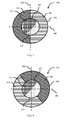
- FIG. 4 illustrates the health state indicator 104 having the first gauge 300 and the second gauge 302 changing their orientation to represent a health state such as uncompensated respiratory acidosis in accordance with an exemplary embodiment.
- the second gauge 302 rotates in a left direction with respect to the gauge reference line 306 then the first indicator 312 moves beyond the gauge reference line 306 to indicate an acidic pH.
- the first gauge 300 does not rotate with respect to the gauge reference line 304. Moreover the first indicating element 308 is positioned at the left side proximal to the first indicator 312 indicating imbalance in the respiratory system. As the second gauge 302 does not rotate or move in a horizontal axis it shows that there is no compensation by the metabolic system. More specifically the first gauge 300 does not move away from a coincident point of the gauge reference lines. The orientation of the first gauge 300 and the second gauge 302 enable the medical expert to identify the health state of the subject as uncompensated respiratory acidosis.
- first gauge 300 and the second gauge 302 may rotate with respect to the gauge reference line 304 and the gauge reference line 306 as schematically illustrated in FIG. 5 in accordance with an exemplary embodiment.
- the second gauge 302 rotates in a right direction
- the second indicator 314 moves beyond the gauge reference line 306.
- the first gauge 300 rotates in the right direction to move beyond the gauge reference line 304 so as to align the first indicating element 308 in an opposite position as opposed to its stable position as shown in FIG. 3 . This represents that the respiratory system is in an imbalance state.
- the medical expert can conveniently visualize based on the color and recognize that the imbalance is in the respiratory system. Now when the second gauge 302 does not rotate with respect to the horizontal axis, then the indication is that there is no attempt for compensation by the metabolic system. Viewing the orientations of the gauges the medical expert can conveniently identify the health state of the subject as uncompensated respiratory alkalosis. Moreover this visual presentation also enables the medical expert to reduce the time for determining the current health state of the subject. Thus proper medical treatment can be provided to the subject in a timely manner to bring the health state to a stable condition.
- FIG. 6 schematically illustrates the health state indicator 104 to indicate another health state of the subject in accordance with an exemplary embodiment.
- the second gauge 302 rotates in a right direction allowing the second indicator 314 to move beyond the gauge reference line 306.
- the orientation of the second gauge 302 represents shift towards an alkaline pH in the subject's blood.
- the first gauge 300 rotates in the right direction as compared to the stable position as shown in FIG. 3 . More specifically the first gauge 300 rotates to orient the first indicating element 308 at the right side of the gauge reference line 304 indicating that imbalance is associated with the respiratory system.
- the second gauge 302 may rotate with respect to the horizontal axis such that a center point of the gauge reference lines (i.e.
- the gauge reference line 304 and the gauge reference line 306) falls within the second indicator 314. This represents that the metabolic system provides compensation for the pH variation. However still the pH compensation is not enough as a result the pH level is indicated as abnormal by the orientation of the second indicator 314 due to the partial compensation provided by the metabolic system. Thus the orientation of the first gauge 300 and the second gauge 302 enables the medical expert to deduce the health state of the subject as partially compensated respiratory alkalosis.
- the health state of the subject may be indicated as partially compensated metabolic acidosis by the health state indicator 104.
- FIG. 7 schematically illustrates the health state indicator 104 wherein the second gauge 302 rotates in a left direction thereby allowing the first indicator 312 to move beyond the gauge reference line 306 in accordance with an exemplary embodiment. This represents a shift towards an acidic pH in the subject's blood.
- the first gauge 300 rotates to the right direction compared to the stable position as shown in FIG. 3 . More specifically the first gauge 300 rotates to orient the second indicating element 310 at the left side of the gauge reference line 304 showing that imbalance is associated with the metabolic system.
- the second gauge 302 moves with respect to the horizontal axis such that the center point of the gauge reference lines is aligned to the first indicator 312 indicating that the respiratory system is providing compensation for the acidic pH imbalance.
- this compensation may be partial in nature due to the imbalance in the acidic pH by the second gauge 302. After viewing these gauges the medical expert may deduce the health state of the subject as partially compensated metabolic acidosis.
- FIG. 8 schematically illustrates the health state indicator 104 including the first gauge 300 and the second gauge 302 capable of orienting with respect to the gauge reference line 304 and the gauge reference line 306 to indicate another imbalanced health state of the subject in accordance of an exemplary embodiment.
- the second gauge 302 rotates in the left direction whereby the first indicator 312 moves beyond by the gauge reference line 306 to indicate an acidic pH imbalance.
- the second gauge 302 does not rotate with respect to the horizontal axis.
- the first gauge 300 rotates with respect to the gauge reference line 304 in the left direction deviating from the stable position as shown in FIG. 3 .
- first gauge 300 rotates a portion of the first indicating element 308 and the second indicating element 310 moves beyond the gauge reference line 304.
- the orientation of the first indicating element 308 and the second indicating element 310 indicates that both the respiratory and the metabolic systems are in imbalance state.
- This mixed respiratory and metabolic acidosis state can be determined by the medical expert by viewing the health state indicator 104 conveniently. Such a state may be found commonly in critically ill patients present in the hospital and thus proper medication can be provided to the patients for regaining the balanced state.
- the health state of the subject may be a mixed respiratory and metabolic alkalosis indicated by the health state indicator 104 as shown in FIG. 9 in accordance with an embodiment.
- the second gauge 302 rotates in a right direction whereby the first indicator 312 moves beyond the gauge reference line 306 to indicate an alkaline pH imbalance.
- the second gauge 302 does not rotate with respect to the horizontal axis.
- the first gauge 300 rotates with respect to the gauge reference line 304 in the right direction deviating from the stable position as shown in FIG. 3 .
- a portion of the first indicating element 308 and the second indicating element 310 moves beyond the gauge reference line 304.
- the orientation of the first indicating element 308 and the second indicating element 310 indicates that both the respiratory and the metabolic systems are in imbalance state.
- This mixed respiratory and metabolic alkalosis state can be determined by the medical expert by viewing the health state indicator 104 conveniently. Such a state may be found commonly in critically ill patients present in the hospital and thus proper medication can be provided to the patients for regaining the balanced state.
- the health state indicator 104 and their gauges such as the first gauge 300 and the second gauge 302 may be configured to present the health state of the subject based on analysis results of various other tests such as but not limited to fluid balance analysis even though the health state indicator 104 is explained to show the health state based on the ABG analysis in FIGs. 1-9 .
- the health state indicator such as the health state indicator 104 may include more than two gauges and gauges having any other configurations based on the tests and analysis to be presented without deviating from the scope of this description.
- FIG. 10 is a flow chart of a method 1000 for presenting health state of a subject in a monitoring system in accordance with an embodiment.
- the subject may be any person whose health may need to be checked.
- the health state of the subject may be determined by performing different test and analysis such as but not limited to, ABG analysis and fluid balance analysis.
- the monitoring system may be used to conduct these tests and analysis on the subject. While performing the analysis, multiple health parameters of the subject may be examined. These health parameters may be received and analyzed at step 1002 to present the health state of the subject.
- the health state may be presented by a health state indicator provided in the monitoring system at step 1004.
- the health state indicator 104 of the monitoring system 100 may visually present the health state of the subject.
- the health state indicator includes multiple gauges that may function to present the subject's health state.
- the health state indicator may be an analog health state indicator.
- the health state indicator may be a graphical interface element.
- each gauge may orient with respect to a gauge reference line to visually present the health state of the subject at step 1006.
- the gauge reference line represents a stable state associated with the health of the subject. So any deviation with respect to the gauge reference line indicates a change in the health state.
- the gauges may orient with respect to their gauge reference line in multiple axes such as X, Y and Z axes.
- the visual presentation provided by the health state indicator helps a medical expert such as, a doctor and a nurse to identify or interpret the health state of the subject accurate manner with less effort.
- the gauges of the health state indicator may also be configured to orient with respect to a Z axis in a three dimensional space.
- the health state indicator may have a three dimensional structure and thus a first gauge may be a disc and the second gauge may be a sphere capable of rotating in the Z axis. Another gauge reference line may be present to represent the Z axis.
- the health state indicator and their gauges are described capable of orienting with respect to X and Y axes for sake of convenience of description according to an embodiment. However it may be contemplated that in other embodiments the health state indicator and their gauges may have other configurations and that logical, mechanical, electrical and other changes may be made without departing from the scope of the embodiments described herein.
- a health state indicator may include multiple gauges for example a first gauge and a second gauge. During operation the first gauge and the second gauge may orient with respect to a first gauge reference line and a second gauge reference line respectively.
- the first gauge may be an organ imbalance gauge that indicates a state associated with an organ of the subject.
- the first gauge may include a first indicating element and a second indicating element. These indicating elements may be associated with different organs of the subject.
- the first indicating element may be associated with a respiratory system and the second indicating element may be associated with a metabolic system.
- the first indicating element and the second indicating element may be assigned different color codes. These color codes may be provided based on an organ to which the color is associated.
- the first gauge may rotate with respect to the first gauge reference line to indicate an imbalance in an organ of the subject. So if the first gauge is oriented with respect to the first gauge reference line such as the gauge reference line 304 as illustrated in FIG. 3 then it indicates that the organs are functioning in a balanced manner.
- the second gauge may be a health parameter gauge indicating the status of a health parameter.
- the second gauge includes a first indicator and a second indicator.
- the second gauge rotates with respect to the second gauge reference line such as the gauge reference line 306 to indicate a variation in a health parameter such as, pH level.
- the second gauge may orient or move in other axes to represent variations in the health parameters.
- the first indicator and the second indicator may be assigned different color codes.
- the first gauge and the second gauge may also include meter values that indicates values associated with the imbalance of the organ and the health parameter. Based on the analyzed health parameters the first gauge and the second gauge may rotate with respect to their respective gauge reference lines to present the health state of the subject. The medical expert may view the orientation of these gauges to determine the health state of the subject with ease.
- the method 1000 can be performed using a processor or any other processing device.
- the method steps can be implemented using coded instructions (e.g., computer readable instructions) stored on a tangible computer readable medium.
- the tangible computer readable medium may be for example a flash memory, a read-only memory (ROM), a random access memory (RAM), any other computer readable storage medium and any storage media.
Landscapes
- Health & Medical Sciences (AREA)
- Engineering & Computer Science (AREA)
- Biomedical Technology (AREA)
- Life Sciences & Earth Sciences (AREA)
- General Health & Medical Sciences (AREA)
- Medical Informatics (AREA)
- Public Health (AREA)
- Business, Economics & Management (AREA)
- General Business, Economics & Management (AREA)
- Epidemiology (AREA)
- Primary Health Care (AREA)
- Physics & Mathematics (AREA)
- Biophysics (AREA)
- Pathology (AREA)
- Heart & Thoracic Surgery (AREA)
- Molecular Biology (AREA)
- Surgery (AREA)
- Animal Behavior & Ethology (AREA)
- Veterinary Medicine (AREA)
- Measuring And Recording Apparatus For Diagnosis (AREA)
Abstract

Description
- The subject matter disclosed herein relates to monitoring a health state of a subject. More specifically the subject matter relates to a monitoring system and method for visually presenting health state of the subject.
- Human body manages multitude of complex systems and their interactions to maintain balance of their health state. These interactions facilitate compensatory changes to support functioning of the physical and psychological activities of the human body. Several organs like kidney, liver and brain interact and function in a proper manner to maintain homeostasis. For example, liver is responsible for metabolizing toxic substances and maintain carbohydrate metabolism. Whereas kidneys are responsible for regulating blood water levels, re-absorption of substances into the blood, maintenance of salt and ion levels in the blood, regulation of blood pH, and excretion of urea and other wastes. So any imbalance in the homeostasis may lead to death or disease i.e., a condition known as homeostatic imbalance.
- Frequent monitoring of the health state is essential to determine any homeostatic imbalance of the human body. Multiple monitoring devices are available that are used to perform various analysis such as arterial blood gas (ABG) analysis to determine different ABG parameters associated with the subject's body, and fluid balance analysis to determine any imbalance in functioning of different body fluids in the subject's body. The ABG analysis involves determining acid-base balance in the body and fluid balance analysis involves determining a balance between a fluid gain and fluid loss in the body. Different hormones such as, anti-diuretic hormone and aldosterone in the human body may play the role of maintaining the fluid balance. These monitoring devices may analyze various health parameters and present numerical values indicating the health parameter levels such as, acid-base balance and fluid balance. Then the numerical values need to be interpreted by a medical expert such as a nurse to determine a variation in the health state or homeostatic state of the subject. Interpretation of these numerical values to finalize the health state may be difficult at times leading to medical treatment errors for the subject.
- Thus there is a need for a monitoring system that is capable of visually presenting a health state of the subject to facilitate interpretation of the health state convenient for the medical expert.
- The above-mentioned shortcomings, disadvantages and problems are addressed herein which will be understood by reading and understanding the following specification.
- As discussed in detail below, embodiments of the invention include a monitoring system for presenting health state of a subject. The monitoring system includes a processor for analyzing multiple health parameters associated with the subject. Based on this analysis a health state indicator including multiple gauges for visually presenting the health state of the subject. A gauge orients with respect to a gauge reference line based on the analyzed health parameters. In an embodiment an interface element for visually presenting the health state of a subject in a monitoring system is disclosed. The interface element includes a health state indicator. The health state indicator includes multiple gauges, wherein one or more gauges orient with respect to one or more gauge reference lines based on analysis of the multiple health parameters to visually represent the health state of the subject. The health parameters are analyzed by the monitoring system.
- In another embodiment a method of presenting health state of a subject in a monitoring system is disclosed. The method involves initially analyzing multiple health parameters associated with the subject. A health state indicator including multiple gauges is provided. One or more gauges are oriented with respect to one or more gauge reference line based on an analysis of the health parameters performed in the monitoring system to visually present the health state of the subject.
-
-
FIGURE 1 is a schematic illustration of a monitoring system for presenting health state of a subject in accordance with an embodiment; -
FIGURE 2 is a schematic illustration of the monitoring system for presenting health state of a subject; -
FIGURE 3 is a schematic illustration of a health state indicator in the monitoring system in accordance with an exemplary embodiment; -
FIGURE 4 is a schematic illustration of the health state indicator indicating a health state of the subject i.e., uncompensated respiratory acidosis in accordance with an exemplary embodiment; -
FIGURE 5 is a schematic illustration of the health state indicator indicating a health state of the subject i.e., uncompensated respiratory alkalosis in accordance with an exemplary embodiment; -
FIGURE 6 is a schematic illustration of the health state indicator indicating a health state of the subject i.e., compensated respiratory alkalosis in accordance with an exemplary embodiment; -
FIGURE 7 is a schematic illustration of the health state indicator indicating a health state of the subject i.e., compensated metabolic acidosis in accordance with an exemplary embodiment; -
FIGURE 8 is a schematic illustration of the health state indicator indicating a health state of the subject i.e., mixed respiratory and metabolic acidosis state in accordance with an exemplary embodiment; -
FIGURE 9 is a schematic illustration of the health state indicator indicating a health state of the subject i.e., mixed respiratory and metabolic alkalosis state in accordance with an exemplary embodiment; and -
FIGURE 10 is a flow chart of a method for presenting health state of a subject in a monitoring system in accordance with an embodiment. - In the following detailed description, reference is made to the accompanying drawings that form a part hereof, and in which is shown by way of illustration specific embodiments that may be practiced. These embodiments are described in sufficient detail to enable those skilled in the art to practice the embodiments, and it is to be understood that other embodiments may be utilized and that logical, mechanical, electrical and other changes may be made without departing from the scope of the embodiments. The following detailed description is, therefore, not to be taken as limiting the scope of the invention.
- The monitoring system including a processor for analyzing multiple health parameters associated with the subject is disclosed. This analysis may be used by a health state indicator including multiple gauges. A gauge orients with respect to a gauge reference line based on the analyzed health parameters to visually present the health state of the subject. The health parameters may vary based on a type of analysis that is needed or performed. Different types of analysis may be performed such as but not limited to arterial blood gas (ABG) analysis and fluid balance analysis. In ABG analysis, the health parameters that are monitored may include but not limited to pH value, pCO2 level, HCO3 level, pO2 level, 02 Sat level, anion gap, delta ratio and SaO2 level. Whereas in the case of the fluid balance analysis, health parameters that need to be monitored may include but not limited to sodium concentration in blood, water level in the body, glucose dialysate concentration, capillary refill time, blood pressure, skin elasticity, body weight, and urine output. Similarly it may be contemplated that other types of analysis may be performed and accordingly different health parameters may be analyzed to determine health state of the subject.
-
FIG. 1 is a schematic illustration of amonitoring system 100 for presenting health state of a subject in accordance with an embodiment. The subject may be any person whose health may need to be checked. In an embodiment the subject may be a patient present in the hospital whose health needs to be monitored continuously. The health state of the subject may be determined by performing different test and analysis such as but not limited to, ABG analysis and fluid balance analysis. Themonitoring system 100 may be used to conduct these tests and analysis on the subject. While performing the analysis, multiple health parameters of the subject may be examined. Aprocessor 102 of themonitoring system 100 receives and analyzes these health parameters to present the health state of the subject. The health state may be presented by ahealth state indicator 104 of themonitoring system 100. Thehealth state indicator 104 includes multiple gauges that may function to present the subject's health state. In an embodiment thehealth state indicator 104 may be an analog health state indicator. Alternatively thehealth state indicator 104 may be a graphical interface element. - Based on the analyzed health parameters, each gauge may orient with respect to a gauge reference line to present the health state of the subject visually. The gauge reference line represents a stable state associated with the health of the subject. So any deviation with respect to the gauge reference line indicates a change in the health state. The gauges may deviate with respect to their gauge reference line in multiple axes such as X, Y and Z axes. This is explained in detail in conjunction with
FIGs. 3-7 . The visual presentation provided by thehealth state indicator 104 as shown inFIG. 2 in accordance with an embodiment helps a medical expert such as, a doctor and a nurse to identify or interpret the health state of the subject accurately with less effort. In addition to thehealth state indicator 104, adisplay 106 may be provided in themonitoring system 100 to present various analysis results. The analysis results may include for example but not limited to, different health parameter values and health parameter graphs. Themonitoring system 100 may be operated by the medical expert usinginterface elements 108 provided. Theinterface elements 108 may include but are not limited to switches and graphical interface elements. In a scenario, theinterface elements 108 may be part of a touch screen interface. - Turning now to
FIG. 3 schematically illustrating thehealth state indicator 104 in accordance with an exemplary embodiment. Thehealth state indicator 104 includes multiple gauges for example afirst gauge 300 and asecond gauge 302. During operation thefirst gauge 300 and thesecond gauge 302 orient with respect to agauge reference line 304 and agauge reference line 306 respectively. Thegauge reference line 306 and thegauge reference line 304 may be associated with X and Y axes respectively. Further in another embodiment, thefirst gauge 300 and thesecond gauge 302 may also be configured to orient with respect to a Z axis (not shown inFIG. 3 ) in a three dimensional space. In this instance thehealth state indicator 104 may have a three dimensional structure and thus thefirst gauge 300 may be a disc and thesecond gauge 302 may be a spherical element capable of rotating in the Z axis. Another gauge reference line may be present to represent the Z axis. Thehealth state indicator 104 and their gauges are described capable of orienting with respect to X and Y axes for sake of convenience of description according to an embodiment. However it may be contemplated that in other embodiments thehealth state indicator 104 and their gauges may be configured in any other manner and that logical, mechanical, electrical and other changes may be made without departing from the scope of the embodiments described herein. - The
health state indicator 104 may present orientation of thefirst gauge 300 and thesecond gauge 302 with respect to thegauge reference line 304 and thegauge reference line 306 over a period of time or different instances in an embodiment. Thus thehealth state indicator 104 shows the variation in orientation of these gauges in an animated configuration or a slow animated configuration presenting a change or trend in change of the health state of the subject. The trend in change of the health state may be deduced by the medical expert to determine if there are any alarming variations in the health state and therefore the subject requires immediate medical attention. - Now considering an example of ABG analysis, the
first gauge 300 may be an organ imbalance gauge that indicates a state associated with an organ of the subject. Whereas thesecond gauge 302 may be a health parameter gauge indicating the status of a health parameter. In an embodiment thefirst gauge 300 and thesecond gauge 302 may also present numerical values associated with the organ imbalance and the health parameters. The numerical values may be displayed as a meter on these gauges and one or more needles for indicating the numerical values in the meter may be provided. In an embodiment the meter and needles may be displayed on the health state indicator when a user (such as the medical expert) activates using any menu option or interface elements (for example the interface elements 108) present in the monitoring system. The meter and needles may be overlaid on the gauges and the user may activate or deactivate them based on their discretion. In another embodiment thehealth state indicator 104 may be selectively activated and deactivated by the user. Thehealth state indicator 104 may be activated and deactivated using an interface element in a display such as thedisplay 106 of themonitoring system 100. So when activated thehealth state indicator 104 may be displayed in the display. Thehealth state indicator 104 may be overlaid on the analysis results such as the health parameter values and the graphs presented in the display. Now when deactivated thehealth state indicator 104 is removed from the display. In an exemplary embodiment thehealth state indicator 104 may be presented as a screen saver in the display. The medical expert or any care giver may be able to view thehealth state indicator 104 and deduce the health state of the subject at a glance even from a distance. Such a feature of thehealth state indicator 104 is less traumatic for the subject and care givers of the subject. It may be envisaged that thehealth state indicator 104 may be presented in the display in any other configuration convenient for deducing the health state of the subject without departing from the scope of this description. - The
health state indicator 104 is hereinafter explained in detail with respect toFIGs. 3 -7 considering the example of ABG analysis, however it may be contemplated that thehealth state indicator 104 may include multiple gauges that represent various other health parameters and health status of different organs of the subject based on a type of test and analysis performed on the subject. - Referring back to the
first gauge 300, this gauge includes a first indicatingelement 308 and a second indicatingelement 310. These indicating elements may be associated with different organs of the subject. For example the first indicatingelement 308 may be associated with a respiratory system and the second indicatingelement 310 may be associated with a metabolic system. In an embodiment the first indicatingelement 308 and the second indicatingelement 310 may be assigned different color codes. For example the first indicatingelement 308 and the second indicatingelement 310 may be assigned a blue color and a brown color respectively. These color codes may be provided based on an organ to which the color is associated. However it may be contemplated that the indicating elements in thefirst gauge 300 may be presented in any other forms in order to conveniently present the imbalance of the subject's organ even from a distance. Thefirst gauge 300 rotates with respect to thegauge reference line 304 to indicate an imbalance in an organ of the subject. So if thefirst gauge 300 does not deviate from thegauge reference line 304 as illustrated inFIG. 3 then it indicates that the organs are functioning in a balanced manner. - The
second gauge 302 includes afirst indicator 312 and asecond indicator 314. Thesecond gauge 302 may move with respect to thegauge reference line 306 to indicate a variation in a health parameter such as, pH level. Moreover in an embodiment thesecond gauge 302 may orient or move in other axes to represent variations in the health parameters. Thus if thesecond gauge 302 does not deviate from thegauge reference line 306 then it indicates that the health parameter for example pH level in the subject's blood is normal. In an embodiment thefirst indicator 312 and thesecond indicator 314 may be assigned different color codes. For example thefirst indicator 312 and thesecond indicator 314 may be assigned a blue color and a brown color respectively. However these indicators may be differentiated in any other convenient form so that they are visible from a distance. In an embodiment thefirst gauge 300 and thesecond gauge 302 may also include meter along with needles to indicate health parameter values associated with the imbalance of the organ and the health parameter. Nevertheless it may be envisaged that the health parameter values may be displayed on thesecond gauge 302 using any other techniques. - Based on the analyzed health parameters the
first gauge 300 and thesecond gauge 302 may rotate with respect to their respective gauge reference lines to present the health state of the subject.FIG. 4 illustrates thehealth state indicator 104 having thefirst gauge 300 and thesecond gauge 302 changing their orientation to represent a health state such as uncompensated respiratory acidosis in accordance with an exemplary embodiment. As shown inFIG. 4 thesecond gauge 302 rotates in a left direction with respect to thegauge reference line 306 then thefirst indicator 312 moves beyond thegauge reference line 306 to indicate an acidic pH. - Now as illustrated the
first gauge 300 does not rotate with respect to thegauge reference line 304. Moreover the first indicatingelement 308 is positioned at the left side proximal to thefirst indicator 312 indicating imbalance in the respiratory system. As thesecond gauge 302 does not rotate or move in a horizontal axis it shows that there is no compensation by the metabolic system. More specifically thefirst gauge 300 does not move away from a coincident point of the gauge reference lines. The orientation of thefirst gauge 300 and thesecond gauge 302 enable the medical expert to identify the health state of the subject as uncompensated respiratory acidosis. - In another instance the
first gauge 300 and thesecond gauge 302 may rotate with respect to thegauge reference line 304 and thegauge reference line 306 as schematically illustrated inFIG. 5 in accordance with an exemplary embodiment. As thesecond gauge 302 rotates in a right direction, thesecond indicator 314 moves beyond thegauge reference line 306. This represents a shift towards an alkaline pH in the subject's blood. Thefirst gauge 300 rotates in the right direction to move beyond thegauge reference line 304 so as to align the first indicatingelement 308 in an opposite position as opposed to its stable position as shown inFIG. 3 . This represents that the respiratory system is in an imbalance state. So in an embodiment wherein the first indicatingelement 308 is provided a blue color then the medical expert can conveniently visualize based on the color and recognize that the imbalance is in the respiratory system. Now when thesecond gauge 302 does not rotate with respect to the horizontal axis, then the indication is that there is no attempt for compensation by the metabolic system. Viewing the orientations of the gauges the medical expert can conveniently identify the health state of the subject as uncompensated respiratory alkalosis. Moreover this visual presentation also enables the medical expert to reduce the time for determining the current health state of the subject. Thus proper medical treatment can be provided to the subject in a timely manner to bring the health state to a stable condition. - Turning now to
FIG. 6 that schematically illustrates thehealth state indicator 104 to indicate another health state of the subject in accordance with an exemplary embodiment. In this scenario, thesecond gauge 302 rotates in a right direction allowing thesecond indicator 314 to move beyond thegauge reference line 306. The orientation of thesecond gauge 302 represents shift towards an alkaline pH in the subject's blood. Thefirst gauge 300 rotates in the right direction as compared to the stable position as shown inFIG. 3 . More specifically thefirst gauge 300 rotates to orient the first indicatingelement 308 at the right side of thegauge reference line 304 indicating that imbalance is associated with the respiratory system. Thesecond gauge 302 may rotate with respect to the horizontal axis such that a center point of the gauge reference lines (i.e. thegauge reference line 304 and the gauge reference line 306) falls within thesecond indicator 314. This represents that the metabolic system provides compensation for the pH variation. However still the pH compensation is not enough as a result the pH level is indicated as abnormal by the orientation of thesecond indicator 314 due to the partial compensation provided by the metabolic system. Thus the orientation of thefirst gauge 300 and thesecond gauge 302 enables the medical expert to deduce the health state of the subject as partially compensated respiratory alkalosis. - In another instance the health state of the subject may be indicated as partially compensated metabolic acidosis by the
health state indicator 104.FIG. 7 schematically illustrates thehealth state indicator 104 wherein thesecond gauge 302 rotates in a left direction thereby allowing thefirst indicator 312 to move beyond thegauge reference line 306 in accordance with an exemplary embodiment. This represents a shift towards an acidic pH in the subject's blood. As illustrated thefirst gauge 300 rotates to the right direction compared to the stable position as shown inFIG. 3 . More specifically thefirst gauge 300 rotates to orient the second indicatingelement 310 at the left side of thegauge reference line 304 showing that imbalance is associated with the metabolic system. Further thesecond gauge 302 moves with respect to the horizontal axis such that the center point of the gauge reference lines is aligned to thefirst indicator 312 indicating that the respiratory system is providing compensation for the acidic pH imbalance. However this compensation may be partial in nature due to the imbalance in the acidic pH by thesecond gauge 302. After viewing these gauges the medical expert may deduce the health state of the subject as partially compensated metabolic acidosis. - Referring now to
FIG. 8 that schematically illustrates thehealth state indicator 104 including thefirst gauge 300 and thesecond gauge 302 capable of orienting with respect to thegauge reference line 304 and thegauge reference line 306 to indicate another imbalanced health state of the subject in accordance of an exemplary embodiment. As shown in theFIG. 8 , thesecond gauge 302 rotates in the left direction whereby thefirst indicator 312 moves beyond by thegauge reference line 306 to indicate an acidic pH imbalance. Thesecond gauge 302 does not rotate with respect to the horizontal axis. Further thefirst gauge 300 rotates with respect to thegauge reference line 304 in the left direction deviating from the stable position as shown inFIG. 3 . When thefirst gauge 300 rotates a portion of the first indicatingelement 308 and the second indicatingelement 310 moves beyond thegauge reference line 304. The orientation of the first indicatingelement 308 and the second indicatingelement 310 indicates that both the respiratory and the metabolic systems are in imbalance state. This mixed respiratory and metabolic acidosis state can be determined by the medical expert by viewing thehealth state indicator 104 conveniently. Such a state may be found commonly in critically ill patients present in the hospital and thus proper medication can be provided to the patients for regaining the balanced state. - In another instance the health state of the subject may be a mixed respiratory and metabolic alkalosis indicated by the
health state indicator 104 as shown inFIG. 9 in accordance with an embodiment. In the health sateindicator 104, thesecond gauge 302 rotates in a right direction whereby thefirst indicator 312 moves beyond thegauge reference line 306 to indicate an alkaline pH imbalance. Thesecond gauge 302 does not rotate with respect to the horizontal axis. Further thefirst gauge 300 rotates with respect to thegauge reference line 304 in the right direction deviating from the stable position as shown inFIG. 3 . When thefirst gauge 300 rotates, a portion of the first indicatingelement 308 and the second indicatingelement 310 moves beyond thegauge reference line 304. The orientation of the first indicatingelement 308 and the second indicatingelement 310 indicates that both the respiratory and the metabolic systems are in imbalance state. This mixed respiratory and metabolic alkalosis state can be determined by the medical expert by viewing thehealth state indicator 104 conveniently. Such a state may be found commonly in critically ill patients present in the hospital and thus proper medication can be provided to the patients for regaining the balanced state. - Now it may be envisaged that the
health state indicator 104 and their gauges such as thefirst gauge 300 and thesecond gauge 302 may be configured to present the health state of the subject based on analysis results of various other tests such as but not limited to fluid balance analysis even though thehealth state indicator 104 is explained to show the health state based on the ABG analysis inFIGs. 1-9 . The health state indicator such as thehealth state indicator 104 may include more than two gauges and gauges having any other configurations based on the tests and analysis to be presented without deviating from the scope of this description. - Turning now to
FIG. 10 is a flow chart of amethod 1000 for presenting health state of a subject in a monitoring system in accordance with an embodiment. The subject may be any person whose health may need to be checked. The health state of the subject may be determined by performing different test and analysis such as but not limited to, ABG analysis and fluid balance analysis. In an embodiment the monitoring system may be used to conduct these tests and analysis on the subject. While performing the analysis, multiple health parameters of the subject may be examined. These health parameters may be received and analyzed atstep 1002 to present the health state of the subject. The health state may be presented by a health state indicator provided in the monitoring system at step 1004. For example thehealth state indicator 104 of themonitoring system 100 may visually present the health state of the subject. The health state indicator includes multiple gauges that may function to present the subject's health state. In an embodiment the health state indicator may be an analog health state indicator. Alternatively the health state indicator may be a graphical interface element. - Based on the analyzed health parameters, each gauge may orient with respect to a gauge reference line to visually present the health state of the subject at step 1006. The gauge reference line represents a stable state associated with the health of the subject. So any deviation with respect to the gauge reference line indicates a change in the health state. The gauges may orient with respect to their gauge reference line in multiple axes such as X, Y and Z axes. The visual presentation provided by the health state indicator helps a medical expert such as, a doctor and a nurse to identify or interpret the health state of the subject accurate manner with less effort. Further in another embodiment, the gauges of the health state indicator may also be configured to orient with respect to a Z axis in a three dimensional space. In this instance the health state indicator may have a three dimensional structure and thus a first gauge may be a disc and the second gauge may be a sphere capable of rotating in the Z axis. Another gauge reference line may be present to represent the Z axis. The health state indicator and their gauges are described capable of orienting with respect to X and Y axes for sake of convenience of description according to an embodiment. However it may be contemplated that in other embodiments the health state indicator and their gauges may have other configurations and that logical, mechanical, electrical and other changes may be made without departing from the scope of the embodiments described herein.
- For instance a health state indicator may include multiple gauges for example a first gauge and a second gauge. During operation the first gauge and the second gauge may orient with respect to a first gauge reference line and a second gauge reference line respectively. Now considering an example of ABG analysis, the first gauge may be an organ imbalance gauge that indicates a state associated with an organ of the subject. The first gauge may include a first indicating element and a second indicating element. These indicating elements may be associated with different organs of the subject. For example the first indicating element may be associated with a respiratory system and the second indicating element may be associated with a metabolic system. In an embodiment the first indicating element and the second indicating element may be assigned different color codes. These color codes may be provided based on an organ to which the color is associated. The first gauge may rotate with respect to the first gauge reference line to indicate an imbalance in an organ of the subject. So if the first gauge is oriented with respect to the first gauge reference line such as the
gauge reference line 304 as illustrated inFIG. 3 then it indicates that the organs are functioning in a balanced manner. - The second gauge may be a health parameter gauge indicating the status of a health parameter. The second gauge includes a first indicator and a second indicator. The second gauge rotates with respect to the second gauge reference line such as the
gauge reference line 306 to indicate a variation in a health parameter such as, pH level. Moreover in an embodiment the second gauge may orient or move in other axes to represent variations in the health parameters. In an embodiment the first indicator and the second indicator may be assigned different color codes. In an embodiment the first gauge and the second gauge may also include meter values that indicates values associated with the imbalance of the organ and the health parameter. Based on the analyzed health parameters the first gauge and the second gauge may rotate with respect to their respective gauge reference lines to present the health state of the subject. The medical expert may view the orientation of these gauges to determine the health state of the subject with ease. - The
method 1000 can be performed using a processor or any other processing device. The method steps can be implemented using coded instructions (e.g., computer readable instructions) stored on a tangible computer readable medium. The tangible computer readable medium may be for example a flash memory, a read-only memory (ROM), a random access memory (RAM), any other computer readable storage medium and any storage media. Although the method for presenting health state of a subject in a monitoring system is explained with reference to the flow chart ofFIG. 10 , other methods of implementing the method can be employed. For example, the order of execution of each method steps may be changed, and/or some of the method steps described may be changed, eliminated, divide or combined. Further the method steps may be sequentially or simultaneously executed for presenting health state of a subject in a monitoring system. - This written description uses examples to disclose the invention, including the best mode, and also to enable any person skilled in the art to practice the invention, including making and using any computing system or systems and performing any incorporated methods. The patentable scope of the invention is defined by the claims, and may include other examples that occur to those skilled in the art. Such other examples are intended to be within the scope of the claims if they have structural elements that do not differ from the literal language of the claims, or if they include equivalent structural elements with insubstantial differences from the literal language of the claims.
- Various aspects and embodiments of the present invention are defined by the following numbered clauses:
- 1. A monitoring system for presenting health state of a subject, the monitoring system comprises:
- a processor for analyzing a plurality of health parameters associated with the subject; and
- a health state indicator comprising a plurality of gauges, wherein at least one gauge orients with respect to at least one gauge reference line based on the analyzed plurality of health parameters to visually present the health state of the subject.
- 2. The monitoring system of clause 1, wherein the plurality of gauges comprises:
- an organ imbalance gauge configured to orient with respect to a gauge reference line to indicate an imbalance in an organ of the subject, wherein the gauge reference line is associated with a homeostatic state of the organ; and
- a health parameter gauge configured to orient with respect to a gauge reference line to indicate a variation in at least one health parameter of the plurality of health parameters, the gauge reference line is associated with a balanced health parameter, wherein the plurality of gauges changes their orientation with the at least one gauge reference line over a period of time.
- 3. The monitoring system of clause 1 or clause 2, wherein the organ imbalance gauge comprises at least one indicating element capable of deviating with respect to the gauge reference line, the deviation of an indicating element representing the imbalance in an organ of the subject, wherein the at least one indicating element is configured to deviate in at least one axis of a plurality of axes.
- 4. The monitoring system of any preceding clause, wherein each indicating element of the at least one indicating element is associated with a unique color code.
- 5. The monitoring system of any preceding clause, wherein the health parameter gauge comprises at least one indicator capable of deviating with respect to the gauge reference line to represent a type of health parameter imbalance, wherein the at least one indicator is configured to deviate in at least one axis of a plurality of axes.
- 6. The monitoring system of any preceding clause, wherein each indicator of the at least one indicator is associated with a unique color code.
- 7. The monitoring system of any preceding clause, wherein the health state indicator is one of an analog health state indicator and a digital health state indicator.
- 8. An interface element for visually presenting health state of a subject in a monitoring system, the interface element comprises:
- a health state indicator comprising a plurality of gauges, wherein at least one gauge orient with respect to at least one gauge reference line based on an analysis of a plurality of health parameters performed in the monitoring system to visually represent the health state of the subject.
- 9. The interface element of any preceding clause, wherein the plurality of gauges comprises:
- an organ imbalance gauge configured to orient with respect to a gauge reference line to indicate an imbalance in an organ of the subject, wherein the gauge reference line is associated with a homeostatic state of the organ; and
- a health parameter gauge configured to orient with respect to a gauge reference line to indicate a variation in at least one health parameter of the plurality of health parameters, the gauge reference line is associated with a balanced health parameter, wherein the plurality of gauges changes their orientation with the at least one gauge reference line over a period of time.
- 10. The interface element of any preceding clause, wherein the organ imbalance gauge comprises at least one indicating element capable of deviating with respect to the gauge reference line to represent the imbalance in an organ of the subject, wherein the at least one indicating element is configured to deviate in at least one axis of a plurality of axes.
- 11. The interface element of any preceding clause, wherein each indicating element of the at least one indicating element is associated with a unique color code.
- 12. The interface element of any preceding clause, wherein the health parameter gauge comprises at least one indicator capable of deviating with respect to the gauge reference line to represent a type of health parameter imbalance, wherein the at least one indicator is configured to deviate in at least one axis of a plurality of axes.
- 13. The interface element of any preceding clause, wherein each indicator of the at least one indicator is associated with a unique color code.
- 14. The interface element of any preceding clause, wherein the health state indicator is one of an analog health state indicator and a digital health state indicator.
- 15. A method of presenting health state of a subject in a monitoring system, the method comprises:
- analyzing a plurality of health parameters associated with the subject;
- providing a health state indicator comprising a plurality of gauges;
- orienting at least one gauge of the plurality of gauges with respect to at least one gauge reference line based on an analysis of a plurality of health parameters performed in the monitoring system to visually present the health state of the subject; and
- presenting changes in the orientation of the at least one gauge with respect to the at least one gauge reference line over a period of time.
- 16. The method of any preceding clause, wherein the plurality of gauges comprises organ imbalance gauge and a health parameter gauge, wherein orienting at least one gauge comprises:
- deviating at least one indicating element of the organ imbalance gauge with respect to the gauge reference line to represent the imbalance in an organ of the subject, the at least one indicating element is configured to deviate in at least one axis of a plurality of axes, wherein each indicating element of the at least one indicating element is associated with a unique color code.
- 17. The method of any preceding clause, wherein orienting the health parameter gauge comprises:
- deviating at least one indicator of the health parameter gauge with respect to the gauge reference line to represent a type of health parameter imbalance, the at least one indicator is configured to deviate in at least one axis of a plurality of axes, wherein each indicator of the at least one indicator is associated with a unique color code.
Claims (15)
- A monitoring (100) system for presenting health state of a subject, the monitoring system comprises:a processor (102) for analyzing a plurality of health parameters associated with the subject; anda health state indicator (104) comprising a plurality of gauges, wherein at least one gauge orients with respect to at least one gauge reference line based on the analyzed plurality of health parameters to visually present the health state of the subject.
- The monitoring system of claim 1, wherein the plurality of gauges comprises:an organ imbalance gauge configured to orient with respect to a gauge reference line to indicate an imbalance in an organ of the subject, wherein the gauge reference line is associated with a homeostatic state of the organ; anda health parameter gauge configured to orient with respect to a gauge reference line to indicate a variation in at least one health parameter of the plurality of health parameters, the gauge reference line is associated with a balanced health parameter, wherein the plurality of gauges changes their orientation with the at least one gauge reference line over a period of time.
- The monitoring system of claim 1 or claim 2, wherein the organ imbalance gauge comprises at least one indicating element capable of deviating with respect to the gauge reference line, the deviation of an indicating element representing the imbalance in an organ of the subject, wherein the at least one indicating element is configured to deviate in at least one axis of a plurality of axes.
- The monitoring system of any preceding claim, wherein each indicating element of the at least one indicating element is associated with a unique color code.
- The monitoring system of any preceding claim, wherein the health parameter gauge comprises at least one indicator capable of deviating with respect to the gauge reference line to represent a type of health parameter imbalance, wherein the at least one indicator is configured to deviate in at least one axis of a plurality of axes.
- The monitoring system of any preceding claim, wherein each indicator of the at least one indicator is associated with a unique color code.
- The monitoring system of any preceding claim, wherein the health state indicator is one of an analog health state indicator and a digital health state indicator.
- An interface element for visually presenting health state of a subject in a monitoring system, the interface element comprises:a health state indicator comprising a plurality of gauges, wherein at least one gauge orient with respect to at least one gauge reference line based on an analysis of a plurality of health parameters performed in the monitoring system to visually represent the health state of the subject.
- The interface element of claim 8, wherein the plurality of gauges comprises:an organ imbalance gauge configured to orient with respect to a gauge reference line to indicate an imbalance in an organ of the subject, wherein the gauge reference line is associated with a homeostatic state of the organ; anda health parameter gauge configured to orient with respect to a gauge reference line to indicate a variation in at least one health parameter of the plurality of health parameters, the gauge reference line is associated with a balanced health parameter, wherein the plurality of gauges changes their orientation with the at least one gauge reference line over a period of time.
- The interface element of claim 8 or claim 9, wherein the organ imbalance gauge comprises at least one indicating element capable of deviating with respect to the gauge reference line to represent the imbalance in an organ of the subject, wherein the at least one indicating element is configured to deviate in at least one axis of a plurality of axes.
- The interface element of any of claims 8 to 10, wherein each indicating element of the at least one indicating element is associated with a unique color code.
- The interface element of any of claims 8 to 11, wherein the health parameter gauge comprises at least one indicator capable of deviating with respect to the gauge reference line to represent a type of health parameter imbalance, wherein the at least one indicator is configured to deviate in at least one axis of a plurality of axes.
- The interface element of any of claims 8 to 12, wherein each indicator of the at least one indicator is associated with a unique color code.
- The interface element of any of claims 8 to 13, wherein the health state indicator is one of an analog health state indicator and a digital health state indicator.
- A method of presenting health state of a subject in a monitoring system, the method comprises:analyzing a plurality of health parameters associated with the subject;providing a health state indicator comprising a plurality of gauges;orienting at least one gauge of the plurality of gauges with respect to at least one gauge reference line based on an analysis of a plurality of health parameters performed in the monitoring system to visually present the health state of the subject; andpresenting changes in the orientation of the at least one gauge with respect to the at least one gauge reference line over a period of time.
Applications Claiming Priority (1)
| Application Number | Priority Date | Filing Date | Title |
|---|---|---|---|
| IN3491CH2012 | 2012-08-24 |
Publications (2)
| Publication Number | Publication Date |
|---|---|
| EP2701088A2 true EP2701088A2 (en) | 2014-02-26 |
| EP2701088A3 EP2701088A3 (en) | 2017-05-10 |
Family
ID=48985963
Family Applications (1)
| Application Number | Title | Priority Date | Filing Date |
|---|---|---|---|
| EP13179622.9A Withdrawn EP2701088A3 (en) | 2012-08-24 | 2013-08-07 | Monitoring system and method for visually presenting health state of a subject |
Country Status (3)
| Country | Link |
|---|---|
| US (1) | US9675299B2 (en) |
| EP (1) | EP2701088A3 (en) |
| CN (1) | CN103622670A (en) |
Families Citing this family (2)
| Publication number | Priority date | Publication date | Assignee | Title |
|---|---|---|---|---|
| US20150342511A1 (en) * | 2014-05-23 | 2015-12-03 | Neumitra Inc. | Operating system with color-based health state themes |
| AU2016269565A1 (en) * | 2016-12-09 | 2018-06-28 | Realifex Pty Ltd | A System and Method for Monitoring Personal Activity |
Family Cites Families (19)
| Publication number | Priority date | Publication date | Assignee | Title |
|---|---|---|---|---|
| US6126595A (en) * | 1995-05-12 | 2000-10-03 | Seiko Epson Corporation | Device for diagnosing physiological state and device for controlling the same |
| US5674190A (en) | 1995-08-28 | 1997-10-07 | Organetics, Ltd. | Extracorporeal whole body hyperthermia using alpha-stat regulation of blood pH and pCO2 |
| WO1998003847A2 (en) | 1996-07-19 | 1998-01-29 | Mills Alexander K | Device for noninvasive determination of blood parameters |
| US6010454A (en) * | 1997-05-29 | 2000-01-04 | Aquintel, Inc. | Fluid and electrolyte balance monitoring system for surgical and critically ill patients |
| EP1171178B1 (en) | 1999-04-23 | 2006-11-22 | RenaMed Biologics, Inc. | Extracorporeal circuit |
| US6567679B1 (en) | 1999-05-28 | 2003-05-20 | E-Monitors, Inc. | Method of using a pH tissue monitor |
| US20030040665A1 (en) | 1999-05-28 | 2003-02-27 | E-Monitors, Inc. | Systems and methods of pH tissue monitoring |
| US6656389B2 (en) | 2001-06-29 | 2003-12-02 | International Business Machines Corporation | Thermal paste for low temperature applications |
| GB2389290B (en) * | 2002-05-31 | 2005-11-23 | Qinetiq Ltd | Data analysis system |
| US7441491B2 (en) | 2005-11-14 | 2008-10-28 | Annatac Industries, Incorporated | Drum magazine for firearm |
| US20080250341A1 (en) | 2006-04-06 | 2008-10-09 | Ethicon Endo-Surgery, Inc. | Gui With Trend Analysis for an Implantable Restriction Device and a Data Logger |
| US8068104B2 (en) * | 2007-06-29 | 2011-11-29 | Carlyle Rampersad | Totally integrated intelligent dynamic systems display |
| NZ587769A (en) | 2008-03-04 | 2012-04-27 | 3M Innovative Properties Co | Monitoring of frying oil quality using measurements of optical reflectance |
| EP2448473A4 (en) * | 2009-06-30 | 2014-06-25 | Edwards Lifesciences Corp | SYSTEMS AND METHODS FOR MONITORING AND DISPLAYING A PATIENT STATUS |
| US20110230731A1 (en) | 2010-03-22 | 2011-09-22 | General Electric Company | Method, device and computer program product for determining an indicator of general clinical state |
| US20110237906A1 (en) * | 2010-03-26 | 2011-09-29 | General Electric Company | System and method for graphical display of medical information |
| EP2601605A1 (en) * | 2010-08-03 | 2013-06-12 | Koninklijke Philips Electronics N.V. | Method for display and navigation to clinical events |
| US20120130646A1 (en) * | 2010-11-19 | 2012-05-24 | Lifescan, Inc. | Analyte testing method and system with high and low analyte trends notification |
| US9480435B2 (en) * | 2012-02-09 | 2016-11-01 | Masimo Corporation | Configurable patient monitoring system |
-
2013
- 2013-08-07 EP EP13179622.9A patent/EP2701088A3/en not_active Withdrawn
- 2013-08-23 CN CN201310372680.5A patent/CN103622670A/en active Pending
- 2013-08-23 US US13/974,354 patent/US9675299B2/en active Active
Non-Patent Citations (1)
| Title |
|---|
| None |
Also Published As
| Publication number | Publication date |
|---|---|
| EP2701088A3 (en) | 2017-05-10 |
| US20140058216A1 (en) | 2014-02-27 |
| CN103622670A (en) | 2014-03-12 |
| US9675299B2 (en) | 2017-06-13 |
Similar Documents
| Publication | Publication Date | Title |
|---|---|---|
| ES2718644T3 (en) | Apparatus, procedure and infrastructure for monitoring a plurality of patients affected by renal failure | |
| EP1913383B1 (en) | Meter having multi-level user interface | |
| CN103025242B (en) | Guarantee about average before the meal with the mthods, systems and devices of the statistical power of GLPP difference Message Transmission | |
| GB2442312A (en) | Patient monitoring system includes monitoring of patients urinary output | |
| JP2011503561A (en) | Method and apparatus for determining at least one characteristic value related to glucose metabolism in a patient | |
| BRPI0806877A2 (en) | ANALYTIC TEST DEVICE | |
| US9675299B2 (en) | Monitoring system and method for visually presenting health state of a subject | |
| TW201621310A (en) | Blood glucose meter with low cost user interface having programmed graphic indicators | |
| ES2972580T3 (en) | Dialysate concentration measurement sensor diagnosis | |
| CN104602600A (en) | Apparatus | |
| EP3216396B1 (en) | Analyte meter with operational range configuration technique | |
| WO2011104710A1 (en) | Device, system and method for in-flow analyte concentration detection | |
| US10460840B2 (en) | Diagnostics-based human health evaluation | |
| CN114680932B (en) | Display methods for medical devices and medical devices | |
| CN118451515A (en) | System for assessing the status of vascular access | |
| JP3094821U (en) | Blood gas analyzer | |
| CN219695054U (en) | Dialysis machine check out test set | |
| CN110111871A (en) | A kind of dry weight appraisal procedure and system based on kinetic model | |
| Yıldız et al. | Is standard urine bag or urofix? Which is more usefully in surgical nursing care? | |
| Yildiz et al. | Is Standard Urine Bag or Urofix? Which is More Usefull in Surgical Nursing Care? Accuracy of Urine Output Monitoring | |
| Eiku | Medical drip monitoring and auto-control system. | |
| Finfer et al. | Clinical review: Consensus recommendations on measurement of blood glucose and reporting glycemic control in critically ill adults. | |
| Katherine Pereira | glucose monitoring | |
| Vukasović | Laboratory accreditation-Where is the real benefit for the patients? | |
| Lu | Stenosis surveillance for hemodialysis patients: A pre-post treatment analysis |
Legal Events
| Date | Code | Title | Description |
|---|---|---|---|
| PUAI | Public reference made under article 153(3) epc to a published international application that has entered the european phase |
Free format text: ORIGINAL CODE: 0009012 |
|
| AK | Designated contracting states |
Kind code of ref document: A2 Designated state(s): AL AT BE BG CH CY CZ DE DK EE ES FI FR GB GR HR HU IE IS IT LI LT LU LV MC MK MT NL NO PL PT RO RS SE SI SK SM TR |
|
| AX | Request for extension of the european patent |
Extension state: BA ME |
|
| PUAL | Search report despatched |
Free format text: ORIGINAL CODE: 0009013 |
|
| AK | Designated contracting states |
Kind code of ref document: A3 Designated state(s): AL AT BE BG CH CY CZ DE DK EE ES FI FR GB GR HR HU IE IS IT LI LT LU LV MC MK MT NL NO PL PT RO RS SE SI SK SM TR |
|
| AX | Request for extension of the european patent |
Extension state: BA ME |
|
| RIC1 | Information provided on ipc code assigned before grant |
Ipc: G06F 19/00 20110101AFI20170401BHEP |
|
| 17P | Request for examination filed |
Effective date: 20171110 |
|
| RBV | Designated contracting states (corrected) |
Designated state(s): AL AT BE BG CH CY CZ DE DK EE ES FI FR GB GR HR HU IE IS IT LI LT LU LV MC MK MT NL NO PL PT RO RS SE SI SK SM TR |
|
| 17Q | First examination report despatched |
Effective date: 20181022 |
|
| STAA | Information on the status of an ep patent application or granted ep patent |
Free format text: STATUS: THE APPLICATION IS DEEMED TO BE WITHDRAWN |
|
| 18D | Application deemed to be withdrawn |
Effective date: 20190702 |