EP2700514A2 - Tire pressure decrease detection apparatus and method, and computer readable medium therefor - Google Patents
Tire pressure decrease detection apparatus and method, and computer readable medium therefor Download PDFInfo
- Publication number
- EP2700514A2 EP2700514A2 EP13160200.5A EP13160200A EP2700514A2 EP 2700514 A2 EP2700514 A2 EP 2700514A2 EP 13160200 A EP13160200 A EP 13160200A EP 2700514 A2 EP2700514 A2 EP 2700514A2
- Authority
- EP
- European Patent Office
- Prior art keywords
- resonance frequency
- rotation speed
- rotation
- speed information
- tires
- Prior art date
- Legal status (The legal status is an assumption and is not a legal conclusion. Google has not performed a legal analysis and makes no representation as to the accuracy of the status listed.)
- Granted
Links
Images






Classifications
-
- B—PERFORMING OPERATIONS; TRANSPORTING
- B60—VEHICLES IN GENERAL
- B60C—VEHICLE TYRES; TYRE INFLATION; TYRE CHANGING; CONNECTING VALVES TO INFLATABLE ELASTIC BODIES IN GENERAL; DEVICES OR ARRANGEMENTS RELATED TO TYRES
- B60C23/00—Devices for measuring, signalling, controlling, or distributing tyre pressure or temperature, specially adapted for mounting on vehicles; Arrangement of tyre inflating devices on vehicles, e.g. of pumps or of tanks; Tyre cooling arrangements
- B60C23/06—Signalling devices actuated by deformation of the tyre, e.g. tyre mounted deformation sensors or indirect determination of tyre deformation based on wheel speed, wheel-centre to ground distance or inclination of wheel axle
- B60C23/061—Signalling devices actuated by deformation of the tyre, e.g. tyre mounted deformation sensors or indirect determination of tyre deformation based on wheel speed, wheel-centre to ground distance or inclination of wheel axle by monitoring wheel speed
-
- G—PHYSICS
- G01—MEASURING; TESTING
- G01L—MEASURING FORCE, STRESS, TORQUE, WORK, MECHANICAL POWER, MECHANICAL EFFICIENCY, OR FLUID PRESSURE
- G01L27/00—Testing or calibrating of apparatus for measuring fluid pressure
- G01L27/002—Calibrating, i.e. establishing true relation between transducer output value and value to be measured, zeroing, linearising or span error determination
- G01L27/005—Apparatus for calibrating pressure sensors
-
- B—PERFORMING OPERATIONS; TRANSPORTING
- B60—VEHICLES IN GENERAL
- B60C—VEHICLE TYRES; TYRE INFLATION; TYRE CHANGING; CONNECTING VALVES TO INFLATABLE ELASTIC BODIES IN GENERAL; DEVICES OR ARRANGEMENTS RELATED TO TYRES
- B60C23/00—Devices for measuring, signalling, controlling, or distributing tyre pressure or temperature, specially adapted for mounting on vehicles; Arrangement of tyre inflating devices on vehicles, e.g. of pumps or of tanks; Tyre cooling arrangements
- B60C23/02—Signalling devices actuated by tyre pressure
- B60C23/04—Signalling devices actuated by tyre pressure mounted on the wheel or tyre
- B60C23/0408—Signalling devices actuated by tyre pressure mounted on the wheel or tyre transmitting the signals by non-mechanical means from the wheel or tyre to a vehicle body mounted receiver
- B60C23/0422—Signalling devices actuated by tyre pressure mounted on the wheel or tyre transmitting the signals by non-mechanical means from the wheel or tyre to a vehicle body mounted receiver characterised by the type of signal transmission means
- B60C23/0427—Near field transmission with inductive or capacitive coupling means
-
- B—PERFORMING OPERATIONS; TRANSPORTING
- B60—VEHICLES IN GENERAL
- B60C—VEHICLE TYRES; TYRE INFLATION; TYRE CHANGING; CONNECTING VALVES TO INFLATABLE ELASTIC BODIES IN GENERAL; DEVICES OR ARRANGEMENTS RELATED TO TYRES
- B60C23/00—Devices for measuring, signalling, controlling, or distributing tyre pressure or temperature, specially adapted for mounting on vehicles; Arrangement of tyre inflating devices on vehicles, e.g. of pumps or of tanks; Tyre cooling arrangements
- B60C23/06—Signalling devices actuated by deformation of the tyre, e.g. tyre mounted deformation sensors or indirect determination of tyre deformation based on wheel speed, wheel-centre to ground distance or inclination of wheel axle
- B60C23/061—Signalling devices actuated by deformation of the tyre, e.g. tyre mounted deformation sensors or indirect determination of tyre deformation based on wheel speed, wheel-centre to ground distance or inclination of wheel axle by monitoring wheel speed
- B60C23/062—Frequency spectrum analysis of wheel speed signals, e.g. using Fourier transformation
-
- G—PHYSICS
- G01—MEASURING; TESTING
- G01L—MEASURING FORCE, STRESS, TORQUE, WORK, MECHANICAL POWER, MECHANICAL EFFICIENCY, OR FLUID PRESSURE
- G01L27/00—Testing or calibrating of apparatus for measuring fluid pressure
Definitions
- the present invention relates to a tire pressure decrease detection apparatus and method, and computer readable medium therefor. Further in detail, the present invention relates to a tire pressure decrease detection apparatus and method, and computer readable medium therefor for detecting a decrease in pressure of tires based on a torsional resonance frequency of the tires of a traveling vehicle.
- TPMS tire pressure monitoring system
- the conventional monitoring system can be classified into two types including a direct detection type and an indirect detection type.
- the direct detection type is to directly measure the pressure of the tire by incorporating pressure sensors inside a tire wheel. Although the decrease in the pressure can be detected with high precision, some disadvantages in terms of technique and cost remain including a need for a dedicated wheel and a problem in fault tolerance in an actual environment.
- the indirect detection type is a method for estimating the pressure from rotation information of the tire, and can further be classified into a DLR (Dynamic Loaded Radius) method and a RFM (Resonance Frequency Mechanism) method.
- the RFM method can solve problems in the DLR method (problems such as incapability of detecting four-tire simultaneous deflation because relative comparison of rotation speed of wheels is the basic principle), and various techniques are proposed (for example, refer to Patent Literatures 1 and 2).
- the RFM method in the inventions described in Patent Literatures 1 and 2 and the like utilizes a characteristic that a torsional resonance frequency of the tire is lowered by the deflation and time-series estimates the torsional resonance frequency of the tire from rotation speed information or rotation acceleration information of the tire so as to detect the decrease in the pressure of the tire.
- the present invention has been made in view of the above circumstances, and an objective thereof is to provide a tire pressure decrease detection apparatus and method, and computer readable medium therefor capable of removing or suppressing an influence of a periodic noise from a road surface so as to eliminate an erroneous alarm or non-alarm of a decrease in tire pressure.
- a tire pressure decrease detection apparatus (hereinafter, also simply referred to as the "detection apparatus") according to a first aspect of the present invention includes:
- the resonance frequency estimate means takes that the periodic noise from the road surface is generated in the vicinity of the torsional resonance frequency and stops estimating the torsional resonance frequency of the front and rear wheels of the side exceeding the threshold value.
- a detection apparatus includes:
- a detection apparatus includes:
- a detection apparatus includes:
- the detection device of (1) to (4) described above further includes a band-pass filter for letting only a frequency bandwidth in the vicinity of the torsional resonance frequency pass, wherein the correlation calculation means calculates a time series correlation of the rotation acceleration information passing through the band-pass filter.
- a tire pressure decrease detection method (hereinafter, also simply referred to as the "detection method") according to a fifth aspect of the present invention includes:
- the resonance frequency estimate step takes that the periodic noise from the road surface is generated in the vicinity of the torsional resonance frequency and stops estimating the torsional resonance frequency of the front and rear wheels of the side exceeding the threshold value.
- the influence of the periodic noise from the road surface can be removed or suppressed so as to eliminate the erroneous alarm or the non-alarm of the decrease in the tire pressure.
- a detection method includes:
- a detection method includes:
- a detection method includes:
- the correlation calculation step calculates a time series correlation of the rotation acceleration information passing through a band-pass filter for letting only a frequency bandwidth in the vicinity of the torsional resonance frequency pass.
- a non-transitory computer readable medium encoded with a computer program containing instructions stored therein causes a computer, for detecting a decrease in pressure of tires based on a resonance frequency of the tires of a traveling vehicle, to function as rotation acceleration information calculation means for calculating rotation acceleration information of the tires from rotation speed information obtained by rotation speed information detection means for regularly detecting the rotation speed information of the tires of wheels of the vehicle; resonance frequency estimate means for time-series estimating a torsional resonance frequency of the rotation speed information from the rotation speed information obtained by the rotation speed information detection means; correlation calculation means for, regarding front and rear right wheels and front and rear left wheels, respectively calculating time series correlations of the rotation acceleration information calculated by the rotation acceleration information calculation means; and judgment means for judging the decrease in the pressure of the tires based on the estimated torsional resonance frequency, wherein in a case where the correlations calculated by the correlation calculation means exceed predetermined threshold values, the resonance frequency estimate means takes that a periodic noise from a road surface is generated in the vicinity
- a non-transitory computer readable medium encoded with a computer program containing instructions stored therein causes a computer, for detecting a decrease in pressure of tires based on a resonance frequency of the tires of a traveling vehicle, to function as rotation acceleration information calculation means for calculating rotation acceleration information of the tires from rotation speed information obtained by rotation speed information detection means for regularly detecting the rotation speed information of the tires of wheels of the vehicle; resonance frequency estimate means for time-series estimating a torsional resonance frequency of the rotation speed information from the rotation speed information obtained by the rotation speed information detection means; correlation calculation means for, regarding front and rear wheels, respectively calculating wheel acceleration differences between left and right wheels based on the rotation acceleration information calculated by the rotation acceleration information calculation means, and calculating a time series correlation of the wheel acceleration differences of the front and rear wheels with using the calculated wheel acceleration differences between the left and right wheels; and judgment means for judging the decrease in the pressure of the tires based on the estimated torsional resonance frequency, wherein in a case where the correlation
- a non-transitory computer readable medium encoded with a computer program containing instructions stored therein causes a computer, for detecting a decrease in pressure of tires based on a resonance frequency of the tires of a traveling vehicle, to function as rotation acceleration information calculation means for calculating rotation acceleration information of the tires from rotation speed information obtained by rotation speed information detection means for regularly detecting the rotation speed information of the tires of wheels of the vehicle; resonance frequency estimate means for time-series estimating a torsional resonance frequency of the rotation acceleration information from the rotation acceleration information obtained by the rotation acceleration information detection means; correlation calculation means for, regarding front and rear right wheels and front and rear left wheels, respectively calculating time series correlations of the rotation acceleration information calculated by the rotation acceleration information calculation means; and judgment means for judging the decrease in the pressure of the tires based on the estimated torsional resonance frequency, wherein in a case where the correlations calculated by the correlation calculation means exceed predetermined threshold values, the resonance frequency estimate means takes that a periodic noise from a road surface is generated in the vicinity
- a non-transitory computer readable medium encoded with a computer program containing instructions stored therein according to a twelfth aspect of the present invention causes a computer, for detecting a decrease in pressure of tires based on a resonance frequency of the tires of a traveling vehicle, to function as rotation acceleration information calculation means for calculating rotation acceleration information of the tires from rotation speed information obtained by rotation speed information detection means for regularly detecting the rotation speed information of the tires of wheels of the vehicle; resonance frequency estimate means for time-series estimating a torsional resonance frequency of the rotation acceleration information from the rotation acceleration information obtained by the rotation acceleration information detection means; correlation calculation means for, regarding front and rear wheels, respectively calculating wheel acceleration differences between left and right wheels based on the rotation acceleration information calculated by the rotation acceleration information calculation means, and calculating a time series correlation of the wheel acceleration differences of the front and rear wheels with using the calculated wheel acceleration differences between the left and right wheels; and judgment means for judging the decrease in the pressure of the tires based on the estimated torsional resonance frequency, wherein in a case wherein
- the influence of the periodic noise from the road surface can be removed or suppressed so as to eliminate the erroneous alarm or the non-alarm of the decrease in the tire pressure.
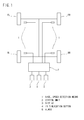
- the detection apparatus is provided with normal wheel speed detection means (rotation speed information detection means) 1 provided in relation to tires in order to detect rotation speed information of a left front wheel (FL), a right front wheel (FR), a left rear wheel (RL), and a right rear wheel (RR) of four tires provided in a four-wheeled vehicle.
- normal wheel speed detection means rotation speed information detection means
- the wheel speed detection means 1 there can be used a wheel speed sensor for generating a rotation pulse with using an electromagnetic pickup or the like so as to measure rotation angular velocity and wheel speed from the number of the pulse, an angular speed sensor including a sensor for generating electric power with utilizing rotation like a dynamo so as to measure the rotation angular velocity and the wheel speed from voltage thereof, or the like.
- An output of the wheel speed detection means 1 is given to a control unit 2 serving as a computer such as an ABS.
- a display 3 formed by a liquid crystal display element, a plasma display element, a CRT, or the like for displaying under-inflation of the tires for example, an initialization button 4 capable of being operated by a driver, and an alarm 5 for notifying the driver of the under-inflation of the tires.
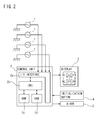
- the control unit 2 is formed by an I/O interface 2a required for sending and receiving signals to and from an external device, a CPU 2b functioning as a center of arithmetic processing, a ROM 2c in which a control operation program of the CPU 2b is stored, and a RAM 2d in which data and the like are temporarily written and the written data is read out when the CPU 2b performs control operation.
- a pulse signal corresponding to the rotation number of the tire (hereinafter, also referred to as the "wheel speed pulse”) is outputted.
- ⁇ T 0.005 seconds
- time series data of wheel speed signals can be obtained. Since a resonance frequency in the torsional direction of the focused tire appears in the vicinity of tens of Hz, there is a need for setting a sampling cycle in such a manner that the resonance frequency is included in the Nyquist frequency.
- the detection apparatus mainly includes the wheel speed detection means (rotation speed information detection means) 1, rotation acceleration information calculation means for calculating rotation acceleration information of the tires from the rotation speed information obtained by the wheel speed detection means 1, resonance frequency estimate means for time-series estimating a torsional resonance frequency of the rotation acceleration information from the rotation acceleration information obtained by the rotation acceleration information detection means, correlation calculation means for, regarding front and rear right wheels and front and rear left wheels, respectively calculating time series correlations of the rotation acceleration information calculated by the rotation acceleration information calculation means, and judgment means for judging a decrease in pressure of the tires based on the estimated torsional resonance frequency.
- the resonance frequency estimate means takes that a periodic noise from a road surface is generated in the vicinity of the torsional resonance frequency and stops estimating the torsional resonance frequency of the front and rear wheels of the side exceeding the threshold value.
- the computer program according to the present embodiment is installed in the control unit 2 and causes the control unit 2 to function as the rotation acceleration information calculation means, the resonance frequency estimate means, the correlation calculation means, and the judgment means.
- the torsional resonance frequency can be estimated by performing a time series analysis for example to the rotation acceleration information based on the secondary autoregressive (AR) model.
- AR secondary autoregressive
- the present invention at the time of judging the decrease in the tire pressure focusing on a change in the torsional resonance frequency, in consideration with the fact that the periodic noise is generated in the vicinity of the torsional resonance frequency of the tires due to periodic undulation of the road surface on which the vehicle travels and there is a fear that an erroneous alarm or non-alarm is caused because of this, estimate of the torsional resonance frequency is stopped in a case where the periodic noise is generated.
- FIG. 3 is a chart showing one example of a time series change in wheel acceleration of the front tire and the rear tire in a case of traveling on the random road surface
- FIG. 4 is a chart showing a correlation of the wheel acceleration of the front tire (front acc) and the wheel acceleration of the rear tire (rear acc) at the same time. From FIGS. 3 to 4 , it is found that in a case where the vehicle travels on the road surface which is randomly uneven or undulated, there is almost no correlation between the wheel acceleration of the front tire and the wheel acceleration of the rear tire. It should be noted that in FIG. 3 and FIG.
- l/v (sec) is a value obtained by dividing a wheelbase l (m) by vehicle speed v (m/s), showing a time from when the front wheel passes through a place to when the rear wheel passes through the same place.
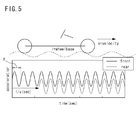
- FIG. 5 is a chart showing one example of the time series change in the wheel acceleration of the front tire and the rear tire in a case of traveling on the road surface which is periodically undulated along the forward direction
- FIG. 6 is a chart showing a correlation of the wheel acceleration of the front tire and the wheel acceleration of the rear tire at the same time.
- "f" indicates one cycle of the periodically-changed wheel acceleration of the front tire.
- the correlation coefficients R or the contributions R 2 of the time of generation of the periodic noise from the road surface and of the time of non-generation are determined by an experiment in advance, and the threshold value is set in the middle. For example, when the correlation coefficient or the contribution of the wheel acceleration of the front and rear wheels calculated by the above method A or B becomes more than the threshold value, the time-series estimate of the torsional resonance frequency is stopped. That is, data of the wheel acceleration obtained when the correlation coefficient or the contribution becomes more than the threshold value is rejected.
- the threshold value can take a value within a range from 0.05 to 0.3 for example.
- the number of the data for calculating the correlation when the number of data is too small, precision is lowered, and when the number of the data is too large, the precision is improved but determination of estimate stop is delayed.
- the number is desirably about 100 (for 400 ms in a case of sampling by 4 ms) to 500 (for 2 s in a case of sampling by 4 ms).
- the correlation may be calculated by the iterative least squares method setting a forgetting factor of proper magnitude corresponding to the data number.
- a band-pass filter of 30 to 50 Hz is applied to the wheel acceleration of the left and right wheels and then the correlation coefficient or the contribution is calculated. Without the band-pass filter, even in a case where there is the periodic noise in a frequency bandwidth not exerting a harmful influence on the estimate of the torsional resonance frequency, the calculated value of the correlation coefficient is increased. Thus, although the resonance frequency can be accurately estimated, the estimate is stopped.
- FIG. 7 shows one example of the time series change in the wheel acceleration of the front tire and the rear tire in a case of traveling on the road surface which is periodically undulated along the forward direction as well as FIG. 5 .
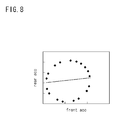
- FIG. 8 is a chart showing a correlation of the wheel acceleration of the front tire and the wheel acceleration of the rear tire at the same time.
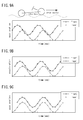
- FIGs. 9A to 9C show one example of the time series change in the wheel acceleration of the front tire and the rear tire in a case of traveling on the road surface which is periodically undulated along the forward direction.
- FIG. 9A is the same chart as FIG. 7 , and the wheel acceleration of the front tire and the rear tire at the same time is plotted.
- FIG. 8 even on the road surface which is periodically undulated along the forward direction, there is no correlation of the wheel acceleration of the front and rear wheels.
- FIG. 9B the wheel acceleration of the front tire of one cycle before the rear tire is plotted
- FIG. 9C the wheel acceleration of the front tire of two cycles before the rear tire is plotted.
- the detection method of the present invention was applied to front wheels of a FF vehicle. Wheel speed was sampled by a sampling cycle of 4 ms, and a torsional resonance frequency of wheel acceleration calculated based on data applied to the band-pass filter of 30 to 50 Hz was time-series estimated by the secondary AR model. A correlation (contribution) of a wheel acceleration difference between the left and right front wheels and a wheel acceleration difference between the left and right rear wheels was calculated. Regarding the contribution, 250 data (for 1 second) were calculated for each of the left and right wheels, and the data in a case where the contribution is more than 0.1 were rejected.
- Example 1 wheel speed was sampled and a torsional resonance frequency of wheel acceleration calculated based on the obtained wheel speed was time-series estimated. Unlike Example 1, a contribution was not calculated, and therefore, rejection of data by the contribution was not performed.
- the road surface inputs to the front and rear wheels at the same time are usually independent from each other.
- a vibration component with the correlation between the front and rear wheels appears in the wheel acceleration.
- this vibration component appears in the frequency close to the original torsional resonance frequency
- the time-series estimated value of the torsional resonance frequency is pulled by the vibration component, and the original torsional resonance frequency cannot be estimated.
- FIG. 11 shows a time series change in the estimated torsional resonance frequency in Example 1.
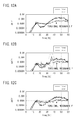
- FIGS. 12A to 12C are charts respectively showing wheel acceleration spectrum of the front wheel and the rear wheel in the vicinity of parts A to C in FIG. 11 .
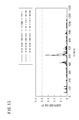
- FIG. 13 is a chart showing a time series change in a correlation (contribution) of the wheel acceleration of the front wheel and the wheel acceleration of the rear wheel.
- the peak does not emerge in the vicinity of the torsional resonance frequency.
- the peak (refer to the inside of an elongated circle) emerges in the vicinity of the torsional resonance frequency in the vicinity of 600 s after starting travel as shown in FIG. 12B . It is found that this peak is due to the periodic undulation of the road surface appearing in the vicinity of 600 s after starting travel from the time series change in the contribution shown in FIG. 13 .
- the torsional resonance frequency of the tires of the vehicle used in Example 1 and Comparative Example 1 is in the vicinity of 45 Hz.
- Example 1 when the contribution R 2 became more than 0.1, the estimate of the torsional resonance frequency was stopped. Thus, an influence by the periodic road surface can be reduced and an erroneous alarm was not caused.
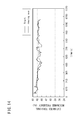
- FIG. 14 shows a time series change in the estimated torsional resonance frequency of the front wheel. It is found that no large change appears in the vicinity of 600 s after starting travel. Meanwhile, in a case of Comparative Example 1, the contribution was not calculated and therefore the rejection of the data by the contribution was not performed. Thus, at the time of passing through the periodic road surface, by being pulled by the vibration component from the road surface, the estimated torsional resonance frequency was lowered and it was judged that the tires were under-inflated. As a result, the erroneous alarm was issued.
- the torsional resonance frequency of the rotation acceleration information of the tires is time-series estimated.
- a torsional resonance frequency of rotation speed information of the tires can be time-series estimated and the decrease in the pressure of the tires can be judged based on the estimated torsional resonance frequency.
- a time series correlation of the rotation acceleration information of the front and rear wheels is calculated by the correlation calculation means. In a case where the correlation calculated by the correlation calculation means exceeds a predetermined threshold value, taking that the periodic noise from the road surface is generated in the vicinity of the torsional resonance frequency, the estimate of the torsional resonance frequency is stopped.
Landscapes
- Engineering & Computer Science (AREA)
- Mechanical Engineering (AREA)
- Physics & Mathematics (AREA)
- General Physics & Mathematics (AREA)
- Mathematical Physics (AREA)
- Chemical & Material Sciences (AREA)
- Analytical Chemistry (AREA)
- Measuring Fluid Pressure (AREA)
- Control Of Driving Devices And Active Controlling Of Vehicle (AREA)
Abstract
Description
- The present invention relates to a tire pressure decrease detection apparatus and method, and computer readable medium therefor. Further in detail, the present invention relates to a tire pressure decrease detection apparatus and method, and computer readable medium therefor for detecting a decrease in pressure of tires based on a torsional resonance frequency of the tires of a traveling vehicle.
- One of factors for letting an automobile safely travel includes pressure of a tire. When the pressure is decreased to less than a proper value, operating stability and fuel consumption are deteriorated, so that a tire burst may sometimes be caused. Therefore, a tire pressure monitoring system (TPMS) for detecting a decrease in tire pressure and issuing an alarm so as to urge a driver to take a proper action is an important technique from a view of protecting an environment and ensuring safety of the driver.
- The conventional monitoring system can be classified into two types including a direct detection type and an indirect detection type. The direct detection type is to directly measure the pressure of the tire by incorporating pressure sensors inside a tire wheel. Although the decrease in the pressure can be detected with high precision, some disadvantages in terms of technique and cost remain including a need for a dedicated wheel and a problem in fault tolerance in an actual environment.
- Meanwhile, the indirect detection type is a method for estimating the pressure from rotation information of the tire, and can further be classified into a DLR (Dynamic Loaded Radius) method and a RFM (Resonance Frequency Mechanism) method. Among them, the RFM method can solve problems in the DLR method (problems such as incapability of detecting four-tire simultaneous deflation because relative comparison of rotation speed of wheels is the basic principle), and various techniques are proposed (for example, refer to
Patent Literatures 1 and 2). - The RFM method in the inventions described in
Patent Literatures -
- Patent Literature 1: Japanese Unexamined Patent Publication No.
2010-023546 - Patent Literature 2: Japanese Unexamined Patent Publication No.
2010-023673 - However, in a case where the vehicle travels on a road surface which is periodically continuously undulated, there is sometimes a case where a periodic noise is generated in the vicinity of the torsional resonance frequency of the tire according to vehicle speed at the time. In this case, the resonance frequency time-series estimated by an AR model or the like is pulled by such a periodic noise and hence becomes a different value from the original torsional resonance frequency of the tire. As a result, there is a fear that an erroneous alarm or non-alarm is caused in the TPMS.
- The present invention has been made in view of the above circumstances, and an objective thereof is to provide a tire pressure decrease detection apparatus and method, and computer readable medium therefor capable of removing or suppressing an influence of a periodic noise from a road surface so as to eliminate an erroneous alarm or non-alarm of a decrease in tire pressure.
- (1) A tire pressure decrease detection apparatus (hereinafter, also simply referred to as the "detection apparatus") according to a first aspect of the present invention includes:
- rotation speed information detection means for regularly detecting rotation speed information of tires of wheels of a vehicle,
- rotation acceleration information calculation means for calculating rotation acceleration information of the tires from the rotation speed information obtained by the rotation speed information detection means,
- resonance frequency estimate means for time-series estimating a torsional resonance frequency of the rotation speed information from the rotation speed information obtained by the rotation speed information detection means,
- correlation calculation means for, regarding front and rear right wheels and front and rear left wheels, respectively calculating time series correlations of the rotation acceleration information calculated by the rotation acceleration information calculation means, and
- judgment means for judging a decrease in pressure of the tires based on the estimated torsional resonance frequency,
- wherein in a case where the correlations calculated by the correlation calculation means exceed predetermined threshold values, the resonance frequency estimate means takes that a periodic noise from a road surface is generated in the vicinity of the torsional resonance frequency and stops estimating the torsional resonance frequency of the front and rear wheels of the side exceeding the threshold value.
- In the detection apparatus of the present invention, in a case where the correlations calculated by the correlation calculation means exceed the predetermined threshold values, the resonance frequency estimate means takes that the periodic noise from the road surface is generated in the vicinity of the torsional resonance frequency and stops estimating the torsional resonance frequency of the front and rear wheels of the side exceeding the threshold value. Thus, an influence of the periodic noise from the road surface can be removed or suppressed so as to eliminate an erroneous alarm or non-alarm of the decrease in the tire pressure.
- (2) A detection apparatus according to a second aspect of the present invention includes:
- rotation speed information detection means for regularly detecting rotation speed information of tires of wheels of a vehicle,
- rotation acceleration information calculation means for calculating rotation acceleration information of the tires from the rotation speed information obtained by the rotation speed information detection means,
- resonance frequency estimate means for time-series estimating a torsional resonance frequency of the rotation speed information from the rotation speed information obtained by the rotation speed information detection means,
- correlation calculation means for, regarding front and rear wheels, respectively calculating wheel acceleration differences between left and right wheels based on the rotation acceleration information calculated by the rotation acceleration information calculation means, and calculating a time series correlation of the wheel acceleration differences of the front and rear wheels with using the calculated wheel acceleration differences between the left and right wheels, and
- judgment means for judging a decrease in pressure of the tires based on the estimated torsional resonance frequency,
- wherein in a case where the correlation calculated by the correlation calculation means exceeds a predetermined threshold value, the resonance frequency estimate means takes that a periodic noise from a road surface is generated in the vicinity of the torsional resonance frequency and stops
- (3) A detection apparatus according to a third aspect of the present invention includes:
- rotation speed information detection means for regularly detecting rotation speed information of tires of wheels of a vehicle,
- rotation acceleration information calculation means for calculating rotation acceleration information of the tires from the rotation speed information obtained by the rotation speed information detection means,
- resonance frequency estimate means for time-series estimating a torsional resonance frequency of the rotation acceleration information from the rotation acceleration information obtained by the rotation acceleration information detection means,
- correlation calculation means for, regarding front and rear right wheels and front and rear left wheels, respectively calculating time series correlations of the rotation acceleration information calculated by the rotation acceleration information calculation means, and
- judgment means for judging a decrease in pressure of the tires based on the estimated torsional resonance frequency,
- wherein in a case where the correlations calculated by the correlation calculation means exceed predetermined threshold values, the resonance frequency estimate means takes that a periodic noise from a road surface is generated in the vicinity of the torsional resonance frequency and stops estimating the torsional resonance frequency of the front and rear wheels of the side exceeding the threshold value.
- (4) A detection apparatus according to a fourth aspect of the present invention includes:
- rotation speed information detection means for regularly detecting rotation speed information of tires of wheels of a vehicle,
- rotation acceleration information calculation means for calculating rotation acceleration information of the tires from the rotation speed information obtained by the rotation speed information detection means,
- resonance frequency estimate means for time-series estimating a torsional resonance frequency of the rotation acceleration information from the rotation acceleration information obtained by the rotation acceleration information detection means,
- correlation calculation means for, regarding front and rear wheels, respectively calculating wheel acceleration differences between left and right wheels based on the rotation acceleration information calculated by the rotation acceleration information calculation means, and calculating a time series correlation of the wheel acceleration differences of the front and rear wheels with using the calculated wheel acceleration differences between the left and right wheels, and
- judgment means for judging a decrease in pressure of the tires based on the estimated torsional resonance frequency,
- wherein in a case where the correlation calculated by the correlation calculation means exceeds a predetermined threshold value, the resonance frequency estimate means takes that a periodic noise from a road surface is generated in the vicinity of the torsional resonance frequency and stops estimating the torsional resonance frequency.
- (5) Preferably, the detection device of (1) to (4) described above further includes a band-pass filter for letting only a frequency bandwidth in the vicinity of the torsional resonance frequency pass, wherein the correlation calculation means calculates a time series correlation of the rotation acceleration information passing through the band-pass filter.
- (6) A tire pressure decrease detection method (hereinafter, also simply referred to as the "detection method") according to a fifth aspect of the present invention includes:
- a rotation speed information detection step for regularly detecting rotation speed information of tires of wheels of a vehicle,
- a rotation acceleration information calculation step for calculating rotation acceleration information of the tires from the rotation speed information obtained in the rotation speed information detection step,
- a resonance frequency estimate step for time-series estimating a torsional resonance frequency of the rotation speed information from the rotation speed information obtained in the rotation speed information detection step,
- a correlation calculation step for, regarding front and rear right wheels and front and rear left wheels, respectively calculating time series correlations of the rotation acceleration information calculated in the rotation acceleration information calculation step, and
- a judgment step for judging a decrease in pressure of the tires based on the estimated torsional resonance frequency,
- wherein in a case where the correlations calculated in the correlation calculation step exceed predetermined threshold values, the resonance frequency estimate step takes that a periodic noise from a road surface is generated in the vicinity of the torsional resonance frequency and stops estimating the torsional resonance frequency of the front and rear wheels of the side exceeding the threshold value.
- In the detection method of the present invention, in a case where the correlations calculated in the correlation calculation step exceed the predetermined threshold values, the resonance frequency estimate step takes that the periodic noise from the road surface is generated in the vicinity of the torsional resonance frequency and stops estimating the torsional resonance frequency of the front and rear wheels of the side exceeding the threshold value. Thus, the influence of the periodic noise from the road surface can be removed or suppressed so as to eliminate the erroneous alarm or the non-alarm of the decrease in the tire pressure.
- (7) A detection method according to a sixth aspect of the present invention includes:
- a rotation speed information detection step for regularly detecting rotation speed information of tires of wheels of a vehicle,
- a rotation acceleration information calculation step for calculating rotation acceleration information of the tires from the rotation speed information obtained in the rotation speed information detection step,
- a resonance frequency estimate step for time-series estimating a torsional resonance frequency of the rotation speed information from the rotation speed information obtained in the rotation speed information detection step,
- a correlation calculation step for, regarding front and rear wheels, respectively calculating wheel acceleration differences between left and right wheels based on the rotation acceleration information calculated in the rotation acceleration information calculation step, and calculating a time series correlation of the wheel acceleration differences of the front and rear wheels with using the calculated wheel acceleration differences between the left and right wheels, and
- a judgment step for judging a decrease in pressure of the tires based on the estimated torsional resonance frequency,
- wherein in a case where the correlation calculated in the correlation calculation step exceeds a predetermined threshold value, the resonance frequency estimate step takes that a periodic noise from a road surface is generated in the vicinity of the torsional resonance frequency and stops estimating the torsional resonance frequency.
- (8) A detection method according to a seventh aspect of the present invention includes:
- a rotation speed information detection step for regularly detecting rotation speed information of tires of wheels of a vehicle,
- a rotation acceleration information calculation step for calculating rotation acceleration information of the tires from the rotation speed information obtained in the rotation speed information detection step,
- a resonance frequency estimate step for time-series estimating a torsional resonance frequency of the rotation acceleration information from the rotation acceleration information obtained in the rotation acceleration information calculation step,
- a correlation calculation step for, regarding front and rear right wheels and front and rear left wheels, respectively calculating time series correlations of the rotation acceleration information calculated in the rotation acceleration information calculation step, and
- a judgment step for judging a decrease in pressure of the tires based on the estimated torsional resonance frequency,
- wherein in a case where the correlations calculated in the correlation calculation step exceed predetermined threshold values, the resonance frequency estimate step takes that a periodic noise from a road surface is generated in the vicinity of the torsional resonance frequency and stops estimating the torsional resonance frequency of the front and rear wheels of the side exceeding the threshold value.
- (9) A detection method according to an eighth aspect of the present invention includes:
- a rotation speed information detection step for regularly detecting rotation speed information of tires of wheels of a vehicle,
- a rotation acceleration information calculation step for calculating rotation acceleration information of the tires from the rotation speed information obtained in the rotation speed information detection step,
- a resonance frequency estimate step for time-series estimating a torsional resonance frequency of the rotation acceleration information from the rotation acceleration information obtained in the rotation acceleration information calculation step,
- a correlation calculation step for, regarding front and rear wheels, respectively calculating wheel acceleration differences between left and right wheels based on the rotation acceleration information calculated in the rotation acceleration information calculation step, and calculating a time series correlation of the wheel acceleration differences of the front and rear wheels with using the calculated wheel acceleration differences between the left and right wheels, and
- a judgment step for judging a decrease in pressure of the tires based on the estimated torsional resonance frequency,
- wherein in a case where the correlation calculated in the correlation calculation step exceeds a predetermined threshold value, the resonance frequency estimate step takes that a periodic noise from a road surface is generated in the vicinity of the torsional resonance frequency and stops estimating the torsional resonance frequency.
- (10) Preferably, in the detection method of (6) to (9) described above, the correlation calculation step calculates a time series correlation of the rotation acceleration information passing through a band-pass filter for letting only a frequency bandwidth in the vicinity of the torsional resonance frequency pass.
- (11) A non-transitory computer readable medium encoded with a computer program containing instructions stored therein according to a ninth aspect of the present invention causes a computer, for detecting a decrease in pressure of tires based on a resonance frequency of the tires of a traveling vehicle, to function as rotation acceleration information calculation means for calculating rotation acceleration information of the tires from rotation speed information obtained by rotation speed information detection means for regularly detecting the rotation speed information of the tires of wheels of the vehicle; resonance frequency estimate means for time-series estimating a torsional resonance frequency of the rotation speed information from the rotation speed information obtained by the rotation speed information detection means; correlation calculation means for, regarding front and rear right wheels and front and rear left wheels, respectively calculating time series correlations of the rotation acceleration information calculated by the rotation acceleration information calculation means; and judgment means for judging the decrease in the pressure of the tires based on the estimated torsional resonance frequency, wherein in a case where the correlations calculated by the correlation calculation means exceed predetermined threshold values, the resonance frequency estimate means takes that a periodic noise from a road surface is generated in the vicinity of the torsional resonance frequency and stops estimating the torsional resonance frequency of the front and rear wheels of the side exceeding the threshold value.
- (12) A non-transitory computer readable medium encoded with a computer program containing instructions stored therein according to a tenth aspect of the present invention causes a computer, for detecting a decrease in pressure of tires based on a resonance frequency of the tires of a traveling vehicle, to function as rotation acceleration information calculation means for calculating rotation acceleration information of the tires from rotation speed information obtained by rotation speed information detection means for regularly detecting the rotation speed information of the tires of wheels of the vehicle; resonance frequency estimate means for time-series estimating a torsional resonance frequency of the rotation speed information from the rotation speed information obtained by the rotation speed information detection means; correlation calculation means for, regarding front and rear wheels, respectively calculating wheel acceleration differences between left and right wheels based on the rotation acceleration information calculated by the rotation acceleration information calculation means, and calculating a time series correlation of the wheel acceleration differences of the front and rear wheels with using the calculated wheel acceleration differences between the left and right wheels; and judgment means for judging the decrease in the pressure of the tires based on the estimated torsional resonance frequency, wherein in a case where the correlation calculated by the correlation calculation means exceeds a predetermined threshold value, the resonance frequency estimate means takes that a periodic noise from a road surface is generated in the vicinity of the torsional resonance frequency and stops estimating the torsional resonance frequency.
- (13) A non-transitory computer readable medium encoded with a computer program containing instructions stored therein according to an eleventh aspect of the present invention causes a computer, for detecting a decrease in pressure of tires based on a resonance frequency of the tires of a traveling vehicle, to function as rotation acceleration information calculation means for calculating rotation acceleration information of the tires from rotation speed information obtained by rotation speed information detection means for regularly detecting the rotation speed information of the tires of wheels of the vehicle; resonance frequency estimate means for time-series estimating a torsional resonance frequency of the rotation acceleration information from the rotation acceleration information obtained by the rotation acceleration information detection means; correlation calculation means for, regarding front and rear right wheels and front and rear left wheels, respectively calculating time series correlations of the rotation acceleration information calculated by the rotation acceleration information calculation means; and judgment means for judging the decrease in the pressure of the tires based on the estimated torsional resonance frequency, wherein in a case where the correlations calculated by the correlation calculation means exceed predetermined threshold values, the resonance frequency estimate means takes that a periodic noise from a road surface is generated in the vicinity of the torsional resonance frequency and stops estimating the torsional resonance frequency of the front and rear wheels of the side exceeding the threshold value.
- (14) A non-transitory computer readable medium encoded with a computer program containing instructions stored therein according to a twelfth aspect of the present invention causes a computer, for detecting a decrease in pressure of tires based on a resonance frequency of the tires of a traveling vehicle, to function as rotation acceleration information calculation means for calculating rotation acceleration information of the tires from rotation speed information obtained by rotation speed information detection means for regularly detecting the rotation speed information of the tires of wheels of the vehicle; resonance frequency estimate means for time-series estimating a torsional resonance frequency of the rotation acceleration information from the rotation acceleration information obtained by the rotation acceleration information detection means; correlation calculation means for, regarding front and rear wheels, respectively calculating wheel acceleration differences between left and right wheels based on the rotation acceleration information calculated by the rotation acceleration information calculation means, and calculating a time series correlation of the wheel acceleration differences of the front and rear wheels with using the calculated wheel acceleration differences between the left and right wheels; and judgment means for judging the decrease in the pressure of the tires based on the estimated torsional resonance frequency, wherein in a case where the correlation calculated by the correlation calculation means exceeds a predetermined threshold value, the resonance frequency estimate means takes that a periodic noise from a road surface is generated in the vicinity of the torsional resonance frequency and stops estimating the torsional resonance frequency.
- According to the detection apparatus and method, and computer readable medium therefor of the present invention, the influence of the periodic noise from the road surface can be removed or suppressed so as to eliminate the erroneous alarm or the non-alarm of the decrease in the tire pressure.
-
- [
FIG. 1] FIG. 1 is a block diagram showing one embodiment of a detection apparatus of the present invention. - [
FIG. 2] FIG. 2 is a block diagram showing an electric configuration of the detection apparatus shown inFIG. 1 . - [
FIG. 3] FIG. 3 is a chart showing one example of a time series change in wheel acceleration of a front tire and a rear tire in a case of traveling on a random road surface. - [
FIG. 4] FIG. 4 is a chart showing a correlation of the wheel acceleration of the front tire and the wheel acceleration of the rear tire at the same time. - [
FIG. 5] FIG. 5 is a chart showing one example of the time series change in the wheel acceleration of the front tire and the rear tire in a case of traveling on a road surface which is periodically undulated along the forward direction. - [
FIG. 6] FIG. 6 is a chart showing a correlation of the wheel acceleration of the front tire and the wheel acceleration of the rear tire at the same time. - [
FIG. 7] FIG. 7 is a chart showing another example of the time series change in the wheel acceleration of the front tire and the rear tire in a case of traveling on the road surface which is periodically undulated along the forward direction. - [
FIG. 8] FIG. 8 is a chart showing a correlation of the wheel acceleration of the front tire and the wheel acceleration of the rear tire at the same time. - [
FIG. 9A] FIG. 9A is a chart showing one example of the time series change in the wheel acceleration of the front tire and the rear tire in a case of traveling on the road surface which is periodically undulated along the forward direction. - [
FIG. 9B] FIG. 9B is a chart showing one example of the time series change in the wheel acceleration of the front tire and the rear tire in a case of traveling on the road surface which is periodically undulated along the forward direction. - [
FIG. 9C] FIG. 9C is a chart showing one example of the time series change in the wheel acceleration of the front tire and the rear tire in a case of traveling on the road surface which is periodically undulated along the forward direction. - [
FIG. 10A] FIG. 10A is a chart showing a correlation of wheel acceleration of a front wheel and wheel acceleration of a rear wheel. - [
FIG. 10B] FIG. 10B is a chart showing a correlation of wheel acceleration of a front wheel and wheel acceleration of a rear wheel. - [
FIG. 11] FIG. 11 is a chart showing a time series change in an estimated torsional resonance frequency in Example 1. - [
FIG. 12A] FIG. 12A is a chart showing wheel acceleration spectrum of the front wheel and the rear wheel in the vicinity of part A inFIG. 11 . - [
FIG. 12B] FIG. 12B is a chart showing wheel acceleration spectrum of the front wheel and the rear wheel in the vicinity of part B inFIG. 11 . - [
FIG. 12C] FIG. 12C is a chart showing wheel acceleration spectrum of the front wheel and the rear wheel in the vicinity of part C inFIG. 11 . - [
FIG. 13] FIG. 13 is a chart showing a time series change in a correlation (contribution) of the wheel acceleration of the front wheel and the wheel acceleration of the rear wheel. - [
FIG. 14] FIG. 14 is a chart showing a time series change in an estimated torsional resonance frequency of the front wheel in Example 1. - Hereinafter, with reference to the attached drawings, an embodiment of a tire pressure decrease detection apparatus and method, and computer readable medium therefor of the present invention will be described in detail.
As shown inFIG. 1 , the detection apparatus according to one embodiment of the present invention is provided with normal wheel speed detection means (rotation speed information detection means) 1 provided in relation to tires in order to detect rotation speed information of a left front wheel (FL), a right front wheel (FR), a left rear wheel (RL), and a right rear wheel (RR) of four tires provided in a four-wheeled vehicle. - As the wheel speed detection means 1, there can be used a wheel speed sensor for generating a rotation pulse with using an electromagnetic pickup or the like so as to measure rotation angular velocity and wheel speed from the number of the pulse, an angular speed sensor including a sensor for generating electric power with utilizing rotation like a dynamo so as to measure the rotation angular velocity and the wheel speed from voltage thereof, or the like. An output of the wheel speed detection means 1 is given to a
control unit 2 serving as a computer such as an ABS. Connected to thecontrol unit 2 are adisplay 3 formed by a liquid crystal display element, a plasma display element, a CRT, or the like for displaying under-inflation of the tires for example, aninitialization button 4 capable of being operated by a driver, and analarm 5 for notifying the driver of the under-inflation of the tires. - As shown in
FIG. 2 , thecontrol unit 2 is formed by an I/O interface 2a required for sending and receiving signals to and from an external device, aCPU 2b functioning as a center of arithmetic processing, aROM 2c in which a control operation program of theCPU 2b is stored, and aRAM 2d in which data and the like are temporarily written and the written data is read out when theCPU 2b performs control operation. - In the wheel speed detection means 1, a pulse signal corresponding to the rotation number of the tire (hereinafter, also referred to as the "wheel speed pulse") is outputted. By re-sampling the wheel speed pulse by a predetermined cycle ΔT (sec) such as ΔT = 0.005 seconds, time series data of wheel speed signals can be obtained. Since a resonance frequency in the torsional direction of the focused tire appears in the vicinity of tens of Hz, there is a need for setting a sampling cycle in such a manner that the resonance frequency is included in the Nyquist frequency.
- The detection apparatus according to the present embodiment mainly includes the wheel speed detection means (rotation speed information detection means) 1, rotation acceleration information calculation means for calculating rotation acceleration information of the tires from the rotation speed information obtained by the wheel speed detection means 1, resonance frequency estimate means for time-series estimating a torsional resonance frequency of the rotation acceleration information from the rotation acceleration information obtained by the rotation acceleration information detection means, correlation calculation means for, regarding front and rear right wheels and front and rear left wheels, respectively calculating time series correlations of the rotation acceleration information calculated by the rotation acceleration information calculation means, and judgment means for judging a decrease in pressure of the tires based on the estimated torsional resonance frequency. In a case where the correlations calculated by the correlation calculation means exceed predetermined threshold values, the resonance frequency estimate means takes that a periodic noise from a road surface is generated in the vicinity of the torsional resonance frequency and stops estimating the torsional resonance frequency of the front and rear wheels of the side exceeding the threshold value. The computer program according to the present embodiment is installed in the
control unit 2 and causes thecontrol unit 2 to function as the rotation acceleration information calculation means, the resonance frequency estimate means, the correlation calculation means, and the judgment means. - The torsional resonance frequency can be estimated by performing a time series analysis for example to the rotation acceleration information based on the secondary autoregressive (AR) model. When the obtained torsional resonance frequency exceeds the predetermined threshold value to be less than the torsional resonance frequency calculated at the time of initialization, it is judged that the tire is under-inflated and the
alarm 5 issues an alarm. - In the present invention, at the time of judging the decrease in the tire pressure focusing on a change in the torsional resonance frequency, in consideration with the fact that the periodic noise is generated in the vicinity of the torsional resonance frequency of the tires due to periodic undulation of the road surface on which the vehicle travels and there is a fear that an erroneous alarm or non-alarm is caused because of this, estimate of the torsional resonance frequency is stopped in a case where the periodic noise is generated.
- In a case where the vehicle travels on a road surface which is randomly uneven or undulated, an input from the road surface is random. Thus, there should be no correlation of a frequency component between the road surfaces on which the front tire and the rear tire are grounded "now," that is, at a certain moment. However, in a case where the vehicle travels on a road surface which is periodically changed at equal intervals along the forward direction of the vehicle for example, there is a possibility that a correlation of the frequency component is generated between the road surfaces on which the front tire and the rear tire are grounded "now". When this frequency component appears in the frequency close to the original torsional resonance frequency, the time-series estimated value of the resonance frequency is pulled by the frequency component, so that the original torsional resonance frequency cannot be estimated, thus leading to the erroneous alarm or the non-alarm of the tire pressure decrease detection device.
-
FIG. 3 is a chart showing one example of a time series change in wheel acceleration of the front tire and the rear tire in a case of traveling on the random road surface, andFIG. 4 is a chart showing a correlation of the wheel acceleration of the front tire (front acc) and the wheel acceleration of the rear tire (rear acc) at the same time. FromFIGS. 3 to 4 , it is found that in a case where the vehicle travels on the road surface which is randomly uneven or undulated, there is almost no correlation between the wheel acceleration of the front tire and the wheel acceleration of the rear tire. It should be noted that inFIG. 3 andFIG. 5 to be described later, "l/v (sec)" is a value obtained by dividing a wheelbase l (m) by vehicle speed v (m/s), showing a time from when the front wheel passes through a place to when the rear wheel passes through the same place. -
FIG. 5 is a chart showing one example of the time series change in the wheel acceleration of the front tire and the rear tire in a case of traveling on the road surface which is periodically undulated along the forward direction, andFIG. 6 is a chart showing a correlation of the wheel acceleration of the front tire and the wheel acceleration of the rear tire at the same time. InFIG. 5 , "f" indicates one cycle of the periodically-changed wheel acceleration of the front tire. FromFIGS. 5 to 6 , it is found that in a case where the vehicle travels on the road surface which is periodically undulated along the forward direction, there is a possibility that a correlation is generated between the wheel acceleration of the front tire and the wheel acceleration of the rear tire according to the cycle of the undulation. - From the above description, by determining the correlation between the wheel acceleration of the front wheel and the wheel acceleration of the rear wheel, it can be judged whether or not the road surface is periodically undulated.
As a specific method for determining the correlation between the wheel acceleration of the front and rear wheels, for example, the following methods can be exemplified. - (A) A method for respectively calculating time series correlations of the rotation acceleration information calculated by the rotation acceleration information calculation means regarding the front and rear right wheels and the front and rear left wheels (correlation coefficients R or contributions R2). In this case, the correlation calculated regarding the front and rear right wheels is compared with a predetermined threshold value preliminarily determined by experimental travel regarding the front and rear right wheels, and the correlation calculated regarding the front and rear left wheels is compared with a predetermined threshold value similarly preliminarily determined by experimental travel regarding the front and rear left wheels. The estimate of the torsional resonance frequency of the front and rear wheels of the side exceeding the threshold value is stopped. That is, in a case where the correlation calculated regarding the front and rear right wheels exceeds the predetermined threshold value, the estimate of the torsional resonance frequency regarding the front and rear right wheels is stopped. In a case where the correlation calculated regarding the front and rear left wheels exceeds the predetermined threshold value, the estimate of the torsional resonance frequency regarding the front and rear left wheels is also stopped.
- (B) A method for respectively calculating wheel acceleration differences between the left and right wheels regarding the front and rear wheels, and calculating a time series correlation of the wheel acceleration differences of the front and rear wheels with using the calculated wheel acceleration differences between the left and right wheels. That is, the time series correlation of the wheel acceleration difference between the left and right front wheels and the wheel acceleration difference between the left and right rear wheels is calculated. In a case where the calculated correlation exceeds a predetermined threshold value, taking that the periodic noise from road surface is generated in the vicinity of the torsional resonance frequency, the estimate of the torsional resonance frequency is stopped regarding all the four wheels.
- In the present embodiment, the correlation coefficients R or the contributions R2 of the time of generation of the periodic noise from the road surface and of the time of non-generation are determined by an experiment in advance, and the threshold value is set in the middle. For example, when the correlation coefficient or the contribution of the wheel acceleration of the front and rear wheels calculated by the above method A or B becomes more than the threshold value, the time-series estimate of the torsional resonance frequency is stopped. That is, data of the wheel acceleration obtained when the correlation coefficient or the contribution becomes more than the threshold value is rejected. In a case where the contribution R2 is adopted as the correlation, the threshold value can take a value within a range from 0.05 to 0.3 for example.
- Regarding the number of the data for calculating the correlation, when the number of data is too small, precision is lowered, and when the number of the data is too large, the precision is improved but determination of estimate stop is delayed. Thus, the number is desirably about 100 (for 400 ms in a case of sampling by 4 ms) to 500 (for 2 s in a case of sampling by 4 ms). The correlation may be calculated by the iterative least squares method setting a forgetting factor of proper magnitude corresponding to the data number.
- The closer the periodic noise from the road surface is to the torsional resonance frequency, the more an influence thereof is. Thus, in the tires in which the torsional resonance frequency is in a range from 30 to 50 Hz for example, desirably, a band-pass filter of 30 to 50 Hz is applied to the wheel acceleration of the left and right wheels and then the correlation coefficient or the contribution is calculated. Without the band-pass filter, even in a case where there is the periodic noise in a frequency bandwidth not exerting a harmful influence on the estimate of the torsional resonance frequency, the calculated value of the correlation coefficient is increased. Thus, although the resonance frequency can be accurately estimated, the estimate is stopped. However, when the band-pass filter is applied, the data in the frequency bandwidth not exerting a harmful influence on the estimate of the torsional resonance frequency is rejected, and the calculated value of the correlation coefficient is not increased. In this case, since the estimate of the resonance frequency is not stopped, an estimating opportunity is not wastefully reduced.
- Even on the road surface which is periodically undulated along the forward direction of the vehicle, depending on the size of the wheelbase, there may be no correlation of the front and rear wheels as shown in
FIGS. 7 to 8 .FIG. 7 shows one example of the time series change in the wheel acceleration of the front tire and the rear tire in a case of traveling on the road surface which is periodically undulated along the forward direction as well asFIG. 5 . However, when the front tire is on a top of a convex part and the rear tire is placed at a zero position (position where a phase is displaced by 90°), there is no correlation of the wheel acceleration of the front and rear wheels even on the road surface which is periodically undulated along the forward direction.FIG. 8 is a chart showing a correlation of the wheel acceleration of the front tire and the wheel acceleration of the rear tire at the same time. - Meanwhile, with not the correlation of the wheel acceleration of the front tire and the rear tire at the same time but a correlation of the current wheel acceleration of the rear tire and the past wheel acceleration of the front tire such as the wheel acceleration of the front tire of one or two cycles before, there is sometimes a correlation capable of judging that the road surface is periodically undulated along the forward direction.
-
FIGs. 9A to 9C show one example of the time series change in the wheel acceleration of the front tire and the rear tire in a case of traveling on the road surface which is periodically undulated along the forward direction.FIG. 9A is the same chart asFIG. 7 , and the wheel acceleration of the front tire and the rear tire at the same time is plotted. In this case, as shown inFIG. 8 , even on the road surface which is periodically undulated along the forward direction, there is no correlation of the wheel acceleration of the front and rear wheels. Meanwhile, inFIG. 9B , the wheel acceleration of the front tire of one cycle before the rear tire is plotted, and inFIG. 9C , the wheel acceleration of the front tire of two cycles before the rear tire is plotted. In this case, when the wheel acceleration of one cycle before is plotted, there is no remarkable correlation between the wheel acceleration of the front wheel and the wheel acceleration of the rear wheel as shown inFIG. 10A . However, when the wheel acceleration of two cycles before is plotted, there is a clear correlation between the wheel acceleration of the front wheel and the wheel acceleration of the rear wheel as shown inFIG. 10B . The horizontal axis ofFIG. 10A indicates the wheel acceleration of the front tire of one cycle before the rear tire, and the horizontal axis ofFIG. 10B indicates the wheel acceleration of the front tire of two cycles before the rear tire.
As described above, in a case of the above description, it is found that the vehicle is traveling on the road surface which is periodically undulated along the forward direction of the vehicle and there is a possibility that the periodic noise possibly influencing the estimate of the torsional resonance frequency is generated. - When the periodic noise from the road surface becomes the frequency close to the torsional resonance frequency, estimate precision of the torsional resonance frequency is deteriorated problematically. Specifically, when an input frequency generated from the road surface is 30 to 50 Hz, the estimate precision is deteriorated. One cycle of 30 to 50 Hz is 20 to 40 msec. In a case where the sampling cycle of the wheel speed is 4 msec, 5 to 10 data are sampled in one cycle. Thus, it is thought that by shifting one or two data of the front tire, there is a correlation between the wheel acceleration of the front wheel and the wheel acceleration of the rear wheel.
- Values of the wheel acceleration of the front tire up to two cycles before are stored, and correlations between the "current" vehicle acceleration of the rear tire, and the "current", "one-cycle-before", and "two-cycle-before" vehicle acceleration of the front tire are respectively determined. When any of the correlations becomes high, judging that the unevenness or the undulation of the road surface is periodic and the estimate of the torsional resonance frequency is harmfully influenced, the estimate of the torsional resonance frequency by the AR model is stopped.
- Next, an example of the detection method of the present invention will be described. The present invention is not limited only to this example.
- The detection method of the present invention was applied to front wheels of a FF vehicle. Wheel speed was sampled by a sampling cycle of 4 ms, and a torsional resonance frequency of wheel acceleration calculated based on data applied to the band-pass filter of 30 to 50 Hz was time-series estimated by the secondary AR model. A correlation (contribution) of a wheel acceleration difference between the left and right front wheels and a wheel acceleration difference between the left and right rear wheels was calculated. Regarding the contribution, 250 data (for 1 second) were calculated for each of the left and right wheels, and the data in a case where the contribution is more than 0.1 were rejected.
- As well as Example 1, wheel speed was sampled and a torsional resonance frequency of wheel acceleration calculated based on the obtained wheel speed was time-series estimated. Unlike Example 1, a contribution was not calculated, and therefore, rejection of data by the contribution was not performed.
- As described above, the road surface inputs to the front and rear wheels at the same time are usually independent from each other. Thus, normally, there is no correlation between left and right wheel acceleration. However, in a case where the vehicle travels on the road surface which is periodically changed, there is sometimes a case where a vibration component with the correlation between the front and rear wheels appears in the wheel acceleration. When this vibration component appears in the frequency close to the original torsional resonance frequency, the time-series estimated value of the torsional resonance frequency is pulled by the vibration component, and the original torsional resonance frequency cannot be estimated.
-
FIG. 11 shows a time series change in the estimated torsional resonance frequency in Example 1. As shown in the figure, when periodic (at about 70 cm intervals) undulation appears on the road surface in the vicinity of 600 s after starting travel and the vehicle travels in this part at speed of about 90 km/h, the inputs become periodic inputs for every 0.028 s = 0.7 m ÷ 25m/s. Since this corresponds to 1 / 0.028 = 35 Hz, a peak emerges in the vicinity of this frequency. -
FIGS. 12A to 12C are charts respectively showing wheel acceleration spectrum of the front wheel and the rear wheel in the vicinity of parts A to C inFIG. 11 .FIG. 13 is a chart showing a time series change in a correlation (contribution) of the wheel acceleration of the front wheel and the wheel acceleration of the rear wheel. In time periods shown inFIGS. 12A and 12C , the peak does not emerge in the vicinity of the torsional resonance frequency. However, the peak (refer to the inside of an elongated circle) emerges in the vicinity of the torsional resonance frequency in the vicinity of 600 s after starting travel as shown inFIG. 12B . It is found that this peak is due to the periodic undulation of the road surface appearing in the vicinity of 600 s after starting travel from the time series change in the contribution shown inFIG. 13 . - The torsional resonance frequency of the tires of the vehicle used in Example 1 and Comparative Example 1 is in the vicinity of 45 Hz. In a case of Example 1, when the contribution R2 became more than 0.1, the estimate of the torsional resonance frequency was stopped. Thus, an influence by the periodic road surface can be reduced and an erroneous alarm was not caused.
FIG. 14 shows a time series change in the estimated torsional resonance frequency of the front wheel. It is found that no large change appears in the vicinity of 600 s after starting travel.
Meanwhile, in a case of Comparative Example 1, the contribution was not calculated and therefore the rejection of the data by the contribution was not performed. Thus, at the time of passing through the periodic road surface, by being pulled by the vibration component from the road surface, the estimated torsional resonance frequency was lowered and it was judged that the tires were under-inflated. As a result, the erroneous alarm was issued. - It should be noted that the embodiment disclosed herein is thought to be not restriction but only an example in all aspects. The scope of the present invention is indicated not by the meaning described above but by the claims, and is intended to include equivalent meanings to the claims and all modifications within the scope.
- For example, in the above embodiment, the torsional resonance frequency of the rotation acceleration information of the tires is time-series estimated. However, a torsional resonance frequency of rotation speed information of the tires can be time-series estimated and the decrease in the pressure of the tires can be judged based on the estimated torsional resonance frequency. Even in this case, regarding the front and rear wheels, a time series correlation of the rotation acceleration information of the front and rear wheels is calculated by the correlation calculation means. In a case where the correlation calculated by the correlation calculation means exceeds a predetermined threshold value, taking that the periodic noise from the road surface is generated in the vicinity of the torsional resonance frequency, the estimate of the torsional resonance frequency is stopped.
-
1: WHEEL SPEED DETECTION MEANS 2: CONTROL UNIT 2a: INTERFACE 2b: CPU 2c: ROM 2d: RAM 3: DISPLAY 4: INITIALIZATION BUTTON 5: ALARM
Claims (14)
- A tire pressure decrease detection apparatus comprising:rotation speed information detection means for regularly detecting rotation speed information of tires of wheels of a vehicle,rotation acceleration information calculation means for calculating rotation acceleration information of the tires from the rotation speed information obtained by the rotation speed information detection means,resonance frequency estimate means for time-series estimating a torsional resonance frequency of the rotation speed information from the rotation speed information obtained by the rotation speed information detection means,correlation calculation means for, regarding front and rear right wheels and front and rear left wheels, respectively calculating time series correlations of the rotation acceleration information calculated by the rotation acceleration information calculation means, andjudgment means for judging a decrease in pressure of the tires based on the estimated torsional resonance frequency,wherein in a case where the correlations calculated by the correlation calculation means exceed predetermined threshold values, the resonance frequency estimate means takes that a periodic noise from a road surface is generated in the vicinity of the torsional resonance frequency and stops estimating the torsional resonance frequency of the front and rear wheels of the side exceeding the threshold value.
- A tire pressure decrease detection apparatus comprising:rotation speed information detection means for regularly detecting rotation speed information of tires of wheels of a vehicle,rotation acceleration information calculation means for calculating rotation acceleration information of the tires from the rotation speed information obtained by the rotation speed information detection means,resonance frequency estimate means for time-series estimating a torsional resonance frequency of the rotation speed information from the rotation speed information obtained by the rotation speed information detection means,correlation calculation means for, regarding front and rear wheels, respectively calculating wheel acceleration differences between left and right wheels based on the rotation acceleration information calculated by the rotation acceleration information calculation means, and calculating a time series correlation of the wheel acceleration differences of the front and rear wheels with using the calculated wheel acceleration differences between the left and right wheels, andjudgment means for judging a decrease in pressure of the tires based on the estimated torsional resonance frequency,wherein in a case where the correlation calculated by the correlation calculation means exceeds a predetermined threshold value, the resonance frequency estimate means takes that a periodic noise from a road surface is generated in the vicinity of the torsional resonance frequency and stops estimating the torsional resonance frequency.
- A tire pressure decrease detection apparatus comprising:rotation speed information detection means for regularly detecting rotation speed information of tires of wheels of a vehicle,rotation acceleration information calculation means for calculating rotation acceleration information of the tires from the rotation speed information obtained by the rotation speed information detection means,resonance frequency estimate means for time-series estimating a torsional resonance frequency of the rotation acceleration information from the rotation acceleration information obtained by the rotation acceleration information detection means,correlation calculation means for, regarding front and rear right wheels and front and rear left wheels, respectively calculating time series correlations of the rotation acceleration information calculated by the rotation acceleration information calculation means, andjudgment means for judging a decrease in pressure of the tires based on the estimated torsional resonance frequency,wherein in a case where the correlations calculated by the correlation calculation means exceed predetermined threshold values, the resonance frequency estimate means takes that a periodic noise from a road surface is generated in the vicinity of the torsional resonance frequency and stops estimating the torsional resonance frequency of the front and rear wheels of the side exceeding the threshold value.
- A tire pressure decrease detection apparatus comprising:rotation speed information detection means for regularly detecting rotation speed information of tires of wheels of a vehicle,rotation acceleration information calculation means for calculating rotation acceleration information of the tires from the rotation speed information obtained by the rotation speed information detection means,resonance frequency estimate means for time-series estimating a torsional resonance frequency of the rotation acceleration information from the rotation acceleration information obtained by the rotation acceleration information detection means,correlation calculation means for, regarding front and rear wheels, respectively calculating wheel acceleration differences between left and right wheels based on the rotation acceleration information calculated by the rotation acceleration information calculation means, and calculating a time series correlation of the wheel acceleration differences of the front and rear wheels with using the calculated wheel acceleration differences between the left and right wheels, andjudgment means for judging a decrease in pressure of the tires based on the estimated torsional resonance frequency,wherein in a case where the correlation calculated by the correlation calculation means exceeds a predetermined threshold value, the resonance frequency estimate means takes that a periodic noise from a road surface is generated in the vicinity of the torsional resonance frequency and stops estimating the torsional resonance frequency.
- The tire pressure decrease detection apparatus according to any one of claims 1 to 4, further comprising a band-pass filter for letting only a frequency bandwidth in the vicinity of the torsional resonance frequency pass, and wherein the correlation calculation means calculates a time series correlation of the rotation acceleration information passing through the band-pass filter.
- A tire pressure decrease detection method including:a rotation speed information detection step for regularly detecting rotation speed information of tires of wheels of a vehicle,a rotation acceleration information calculation step for calculating rotation acceleration information of the tires from the rotation speed information obtained in the rotation speed information detection step,a resonance frequency estimate step for time-series estimating a torsional resonance frequency of the rotation speed information from the rotation speed information obtained in the rotation speed information detection step,a correlation calculation step for, regarding front and rear right wheels and front and rear left wheels, respectively calculating time series correlations of the rotation acceleration information calculated in the rotation acceleration information calculation step, anda judgment step for judging a decrease in pressure of the tires based on the estimated torsional resonance frequency,wherein in a case where the correlations calculated in the correlation calculation step exceed predetermined threshold values, the resonance frequency estimate step takes that a periodic noise from a road surface is generated in the vicinity of the torsional resonance frequency and stops estimating the torsional resonance frequency of the front and rear wheels of the side exceeding the threshold value.
- A tire pressure decrease detection method including:a rotation speed information detection step for regularly detecting rotation speed information of tires of wheels of a vehicle,a rotation acceleration information calculation step for calculating rotation acceleration information of the tires from the rotation speed information obtained in the rotation speed information detection step,a resonance frequency estimate step for time-series estimating a torsional resonance frequency of the rotation speed information from the rotation speed information obtained in the rotation speed information detection step,a correlation calculation step for, regarding front and rear wheels, respectively calculating wheel acceleration differences between left and right wheels based on the rotation acceleration information calculated in the rotation acceleration information calculation step, and calculating a time series correlation of the wheel acceleration differences of the front and rear wheels with using the calculated wheel acceleration differences between the left and right wheels, anda judgment step for judging a decrease in pressure of the tires based on the estimated torsional resonance frequency,wherein in a case where the correlation calculated in the correlation calculation step exceeds a predetermined threshold value, the resonance frequency estimate step takes that a periodic noise from a road surface is generated in the vicinity of the torsional resonance frequency and stops estimating the torsional resonance frequency.
- A tire pressure decrease detection method including:a rotation speed information detection step for regularly detecting rotation speed information of tires of wheels of a vehicle,a rotation acceleration information calculation step for calculating rotation acceleration information of the tires from the rotation speed information obtained in the rotation speed information detection step,a resonance frequency estimate step for time-series estimating a torsional resonance frequency of the rotation acceleration information from the rotation acceleration information obtained in the rotation acceleration information calculation step,a correlation calculation step for, regarding front and rear right wheels and front and rear left wheels, respectively calculating time series correlations of the rotation acceleration information calculated in the rotation acceleration information calculation step, anda judgment step for judging a decrease in pressure of the tires based on the estimated torsional resonance frequency,wherein in a case where the correlations calculated in the correlation calculation step exceed predetermined threshold values, the resonance frequency estimate step takes that a periodic noise from a road surface is generated in the vicinity of the torsional resonance frequency and stops estimating the torsional resonance frequency of the front and rear wheels of the side exceeding the threshold value.
- A tire pressure decrease detection method including:a rotation speed information detection step for regularly detecting rotation speed information of tires of wheels of a vehicle,a rotation acceleration information calculation step for calculating rotation acceleration information of the tires from the rotation speed information obtained in the rotation speed information detection step,a resonance frequency estimate step for time-series estimating a torsional resonance frequency of the rotation acceleration information from the rotation acceleration information obtained in the rotation acceleration information calculation step,a correlation calculation step for, regarding front and rear wheels, respectively calculating wheel acceleration differences between left and right wheels based on the rotation acceleration information calculated in the rotation acceleration information calculation step, and calculating a time series correlation of the wheel acceleration differences of the front and rear wheels with using the calculated wheel acceleration differences between the left and right wheels, anda judgment step for judging a decrease in pressure of the tires based on the estimated torsional resonance frequency,wherein in a case where the correlation calculated in the correlation calculation step exceeds a predetermined threshold value, the resonance frequency estimate step takes that a periodic noise from a road surface is generated in the vicinity of the torsional resonance frequency and stops estimating the torsional resonance frequency.
- The tire pressure decrease detection method according to any one of claims 6 to 9, wherein the correlation calculation step calculates a time series correlation of the rotation acceleration information passing through a band-pass filter for letting only a frequency bandwidth in the vicinity of the torsional resonance frequency pass.
- A non-transitory computer readable medium encoded with a computer program containing instructions stored therein which causes a computer, for detecting a decrease in pressure of tires based on a resonance frequency of the tires of a traveling vehicle, to function as rotation acceleration information calculation means for calculating rotation acceleration information of the tires from rotation speed information obtained by rotation speed information detection means for regularly detecting the rotation speed information of the tires of wheels of the vehicle; resonance frequency estimate means for time-series estimating a torsional resonance frequency of the rotation speed information from the rotation speed information obtained by the rotation speed information detection means; correlation calculation means for, regarding front and rear right wheels and front and rear left wheels, respectively calculating time series correlations of the rotation acceleration information calculated by the rotation acceleration information calculation means; and judgment means for judging the decrease in the pressure of the tires based on the estimated torsional resonance frequency, wherein in a case where the correlations calculated by the correlation calculation means exceed predetermined threshold values, the resonance frequency estimate means takes that a periodic noise from a road surface is generated in the vicinity of the torsional resonance frequency and stops estimating the torsional resonance frequency of the front and rear wheels of the side exceeding the threshold value.
- A non-transitory computer readable medium encoded with a computer program containing instructions stored therein which causes a computer, for detecting a decrease in pressure of tires based on a resonance frequency of the tires of a traveling vehicle, to function as rotation acceleration information calculation means for calculating rotation acceleration information of the tires from rotation speed information obtained by rotation speed information detection means for regularly detecting the rotation speed information of the tires of wheels of the vehicle; resonance frequency estimate means for time-series estimating a torsional resonance frequency of the rotation speed information from the rotation speed information obtained by the rotation speed information detection means; correlation calculation means for, regarding front and rear wheels, respectively calculating wheel acceleration differences between left and right wheels based on the rotation acceleration information calculated by the rotation acceleration information calculation means, and calculating a time series correlation of the wheel acceleration differences of the front and rear wheels with using the calculated wheel acceleration differences between the left and right wheels; and judgment means for judging the decrease in the pressure of the tires based on the estimated torsional resonance frequency, wherein in a case where the correlation calculated by the correlation calculation means exceeds a predetermined threshold value, the resonance frequency estimate means takes that a periodic noise from a road surface is generated in the vicinity of the torsional resonance frequency and stops estimating the torsional resonance frequency.
- A non-transitory computer readable medium encoded with a computer program containing instructions stored therein which causes a computer, for detecting a decrease in pressure of tires based on a resonance frequency of the tires of a traveling vehicle, to function as rotation acceleration information calculation means for calculating rotation acceleration information of the tires from rotation speed information obtained by rotation speed information detection means for regularly detecting the rotation speed information of the tires of wheels of the vehicle; resonance frequency estimate means for time-series estimating a torsional resonance frequency of the rotation acceleration information from the rotation acceleration information obtained by the rotation acceleration information detection means; correlation calculation means for, regarding front and rear right wheels and front and rear left wheels, respectively calculating time series correlations of the rotation acceleration information calculated by the rotation acceleration information calculation means; and judgment means for judging the decrease in the pressure of the tires based on the estimated torsional resonance frequency, wherein in a case where the correlations calculated by the correlation calculation means exceed predetermined threshold values, the resonance frequency estimate means takes that a periodic noise from a road surface is generated in the vicinity of the torsional resonance frequency and stops estimating the torsional resonance frequency of the front and rear wheels of the side exceeding the threshold value.
- A non-transitory computer readable medium encoded with a computer program containing instructions stored therein which causes a computer, for detecting a decrease in pressure of tires based on a resonance frequency of the tires of a traveling vehicle, to function as rotation acceleration information calculation means for calculating rotation acceleration information of the tires from rotation speed information obtained by rotation speed information detection means for regularly detecting the rotation speed information of the tires of wheels of the vehicle; resonance frequency estimate means for time-series estimating a torsional resonance frequency of the rotation acceleration information from the rotation acceleration information obtained by the rotation acceleration information detection means; correlation calculation means for, regarding front and rear wheels, respectively calculating wheel acceleration differences between left and right wheels based on the rotation acceleration information calculated by the rotation acceleration information calculation means, and calculating a time series correlation of the wheel acceleration differences of the front and rear wheels with using the calculated wheel acceleration differences between the left and right wheels; and judgment means for judging the decrease in the pressure of the tires based on the estimated torsional resonance frequency, wherein in a case where the correlation calculated by the correlation calculation means exceeds a predetermined threshold value, the resonance frequency estimate means takes that a periodic noise from a road surface is generated in the vicinity of the torsional resonance frequency and stops estimating the torsional resonance frequency.
Applications Claiming Priority (1)
| Application Number | Priority Date | Filing Date | Title |
|---|---|---|---|
| JP2012184902A JP5606502B2 (en) | 2012-08-24 | 2012-08-24 | Tire pressure drop detection device, method and program |
Publications (3)
| Publication Number | Publication Date |
|---|---|
| EP2700514A2 true EP2700514A2 (en) | 2014-02-26 |
| EP2700514A3 EP2700514A3 (en) | 2017-03-15 |
| EP2700514B1 EP2700514B1 (en) | 2018-06-06 |
Family
ID=48044568
Family Applications (1)
| Application Number | Title | Priority Date | Filing Date |
|---|---|---|---|
| EP13160200.5A Active EP2700514B1 (en) | 2012-08-24 | 2013-03-20 | Tire pressure decrease detection apparatus and method, and computer readable medium therefor |
Country Status (3)
| Country | Link |
|---|---|
| US (2) | US9134194B2 (en) |
| EP (1) | EP2700514B1 (en) |
| JP (1) | JP5606502B2 (en) |
Cited By (1)
| Publication number | Priority date | Publication date | Assignee | Title |
|---|---|---|---|---|
| EP3020579A1 (en) * | 2014-11-11 | 2016-05-18 | Sumitomo Rubber Industries, Ltd. | Tire pressure decrease detection apparatus, method, and program |
Families Citing this family (5)
| Publication number | Priority date | Publication date | Assignee | Title |
|---|---|---|---|---|
| KR101704632B1 (en) * | 2015-07-14 | 2017-02-08 | 현대오트론 주식회사 | Apparatus and method for monitoring tire pressure considering low pressure situation |
| JP6639355B2 (en) * | 2016-08-08 | 2020-02-05 | トヨタ自動車株式会社 | Car |
| US10399395B2 (en) * | 2016-11-24 | 2019-09-03 | Hyundai Motor Company | Vehicle and method for controlling the same |
| US12115821B2 (en) | 2021-07-02 | 2024-10-15 | The Goodyear Tire & Rubber Company | Tire pressure monitoring system employing axle cross comparison |
| JP7786280B2 (en) * | 2022-03-29 | 2025-12-16 | 住友ゴム工業株式会社 | Wheel abnormality detection device |
Citations (2)
| Publication number | Priority date | Publication date | Assignee | Title |
|---|---|---|---|---|
| JP2010023673A (en) | 2008-07-18 | 2010-02-04 | Sumitomo Rubber Ind Ltd | Apparatus and method for detecting decrease in tire air pressure, and program for detecting decrease in tire air pressure |
| JP2010023546A (en) | 2008-07-15 | 2010-02-04 | Sumitomo Rubber Ind Ltd | Device and method for detecting decrease in tire air pressure, and program for detecting decrease in tire air pressure |
Family Cites Families (5)
| Publication number | Priority date | Publication date | Assignee | Title |
|---|---|---|---|---|
| JPH05270388A (en) * | 1992-03-27 | 1993-10-19 | Aisin Seiki Co Ltd | Device for suppressing yaw moment when braking a vehicle |
| JP3148104B2 (en) * | 1994-08-04 | 2001-03-19 | 株式会社日本自動車部品総合研究所 | Tire resonance frequency detection device |
| JP2001074579A (en) * | 1999-09-06 | 2001-03-23 | Aisin Seiki Co Ltd | Tire pressure detection method and pressure detection device |
| JP2005001540A (en) * | 2003-06-12 | 2005-01-06 | Advics:Kk | Tire air pressure detector |
| JP5649625B2 (en) * | 2012-08-07 | 2015-01-07 | 住友ゴム工業株式会社 | Tire pressure drop detection device, method and program |
-
2012
- 2012-08-24 JP JP2012184902A patent/JP5606502B2/en active Active
-
2013
- 2013-03-18 US US13/846,429 patent/US9134194B2/en active Active
- 2013-03-20 EP EP13160200.5A patent/EP2700514B1/en active Active
-
2015
- 2015-08-12 US US14/825,077 patent/US9528899B2/en active Active
Patent Citations (2)
| Publication number | Priority date | Publication date | Assignee | Title |
|---|---|---|---|---|
| JP2010023546A (en) | 2008-07-15 | 2010-02-04 | Sumitomo Rubber Ind Ltd | Device and method for detecting decrease in tire air pressure, and program for detecting decrease in tire air pressure |
| JP2010023673A (en) | 2008-07-18 | 2010-02-04 | Sumitomo Rubber Ind Ltd | Apparatus and method for detecting decrease in tire air pressure, and program for detecting decrease in tire air pressure |
Cited By (2)
| Publication number | Priority date | Publication date | Assignee | Title |
|---|---|---|---|---|
| EP3020579A1 (en) * | 2014-11-11 | 2016-05-18 | Sumitomo Rubber Industries, Ltd. | Tire pressure decrease detection apparatus, method, and program |
| US9970839B2 (en) | 2014-11-11 | 2018-05-15 | Sumitomo Rubber Industries, Ltd. | Tire pressure decrease detection apparatus, method, and program |
Also Published As
| Publication number | Publication date |
|---|---|
| JP5606502B2 (en) | 2014-10-15 |
| JP2014044053A (en) | 2014-03-13 |
| US9134194B2 (en) | 2015-09-15 |
| EP2700514A3 (en) | 2017-03-15 |
| US9528899B2 (en) | 2016-12-27 |
| EP2700514B1 (en) | 2018-06-06 |
| US20150346047A1 (en) | 2015-12-03 |
| US20140053625A1 (en) | 2014-02-27 |
Similar Documents
| Publication | Publication Date | Title |
|---|---|---|
| JP5642733B2 (en) | Misuse determination device, method and program for tire pressure warning system | |
| EP2695753B1 (en) | Tire pressure decrease detection apparatus and method, and computer readable medium therefor | |
| US9528899B2 (en) | Tire pressure decrease detection apparatus and method, and computer readable medium therefor | |
| US20110107828A1 (en) | Apparatus and method for detecting tire having decreased pressure, and program for detecting tire having decreased pressure | |
| JP4617371B2 (en) | Tire pressure drop detection device and method, and tire pressure drop detection program | |
| EP2730436B1 (en) | Tire pressure decrease detection apparatus, method, and computer readable medium therefor | |
| EP3100877B1 (en) | Device for detecting low-pressure state of tire | |
| EP3020579B1 (en) | Tire pressure decrease detection apparatus, method, and program | |
| JP3971720B2 (en) | Tire pressure drop detection method and apparatus, and tire decompression determination program | |
| JP4764913B2 (en) | Tire pressure drop detection device and method, and tire pressure drop detection program | |
| JP5530800B2 (en) | Tire pressure drop detecting device, method and program, and tire pressure drop wheel identifying device, method and program | |
| JP2013112093A (en) | Method for calculating load sensitivity of dynamic load radius of tire | |
| JP5464580B2 (en) | Tire resonance frequency decompression sensitivity estimation apparatus and method, and tire resonance frequency decompression sensitivity estimation program | |
| JP3605006B2 (en) | Tire pressure drop warning device and method | |
| JP2005205977A (en) | Tire pressure drop detection method and apparatus, and tire decompression determination program | |
| JP2013028315A (en) | Method and device for identifying tire type, and method, device and program for detecting decrease in tire pneumatic pressure | |
| JP2012126329A (en) | Tire air pressure decrease warning method and device, and tire air pressure decrease warning program |
Legal Events
| Date | Code | Title | Description |
|---|---|---|---|
| PUAI | Public reference made under article 153(3) epc to a published international application that has entered the european phase |
Free format text: ORIGINAL CODE: 0009012 |
|
| AK | Designated contracting states |
Kind code of ref document: A2 Designated state(s): AL AT BE BG CH CY CZ DE DK EE ES FI FR GB GR HR HU IE IS IT LI LT LU LV MC MK MT NL NO PL PT RO RS SE SI SK SM TR |
|
| AX | Request for extension of the european patent |
Extension state: BA ME |
|
| PUAL | Search report despatched |
Free format text: ORIGINAL CODE: 0009013 |
|
| AK | Designated contracting states |
Kind code of ref document: A3 Designated state(s): AL AT BE BG CH CY CZ DE DK EE ES FI FR GB GR HR HU IE IS IT LI LT LU LV MC MK MT NL NO PL PT RO RS SE SI SK SM TR |
|
| AX | Request for extension of the european patent |
Extension state: BA ME |
|
| RIC1 | Information provided on ipc code assigned before grant |
Ipc: B60C 23/06 20060101AFI20170206BHEP |
|
| STAA | Information on the status of an ep patent application or granted ep patent |
Free format text: STATUS: REQUEST FOR EXAMINATION WAS MADE |
|
| 17P | Request for examination filed |
Effective date: 20170627 |
|
| RBV | Designated contracting states (corrected) |
Designated state(s): AL AT BE BG CH CY CZ DE DK EE ES FI FR GB GR HR HU IE IS IT LI LT LU LV MC MK MT NL NO PL PT RO RS SE SI SK SM TR |
|
| REG | Reference to a national code |
Ref country code: DE Ref legal event code: R079 Ref document number: 602013038479 Country of ref document: DE Free format text: PREVIOUS MAIN CLASS: B60C0023040000 Ipc: B60C0023060000 |
|
| RIC1 | Information provided on ipc code assigned before grant |
Ipc: B60C 23/06 20060101AFI20180109BHEP |
|
| GRAP | Despatch of communication of intention to grant a patent |
Free format text: ORIGINAL CODE: EPIDOSNIGR1 |
|
| STAA | Information on the status of an ep patent application or granted ep patent |
Free format text: STATUS: GRANT OF PATENT IS INTENDED |
|
| INTG | Intention to grant announced |
Effective date: 20180226 |
|
| GRAS | Grant fee paid |
Free format text: ORIGINAL CODE: EPIDOSNIGR3 |
|
| GRAA | (expected) grant |
Free format text: ORIGINAL CODE: 0009210 |
|
| STAA | Information on the status of an ep patent application or granted ep patent |
Free format text: STATUS: THE PATENT HAS BEEN GRANTED |
|
| AK | Designated contracting states |
Kind code of ref document: B1 Designated state(s): AL AT BE BG CH CY CZ DE DK EE ES FI FR GB GR HR HU IE IS IT LI LT LU LV MC MK MT NL NO PL PT RO RS SE SI SK SM TR |
|
| REG | Reference to a national code |
Ref country code: GB Ref legal event code: FG4D |
|
| REG | Reference to a national code |
Ref country code: CH Ref legal event code: EP Ref country code: AT Ref legal event code: REF Ref document number: 1005665 Country of ref document: AT Kind code of ref document: T Effective date: 20180615 |
|
| REG | Reference to a national code |
Ref country code: IE Ref legal event code: FG4D |
|
| REG | Reference to a national code |
Ref country code: DE Ref legal event code: R096 Ref document number: 602013038479 Country of ref document: DE |
|
| REG | Reference to a national code |
Ref country code: NL Ref legal event code: MP Effective date: 20180606 |
|
| REG | Reference to a national code |
Ref country code: LT Ref legal event code: MG4D |
|
| PG25 | Lapsed in a contracting state [announced via postgrant information from national office to epo] |
Ref country code: CY Free format text: LAPSE BECAUSE OF FAILURE TO SUBMIT A TRANSLATION OF THE DESCRIPTION OR TO PAY THE FEE WITHIN THE PRESCRIBED TIME-LIMIT Effective date: 20180606 Ref country code: LT Free format text: LAPSE BECAUSE OF FAILURE TO SUBMIT A TRANSLATION OF THE DESCRIPTION OR TO PAY THE FEE WITHIN THE PRESCRIBED TIME-LIMIT Effective date: 20180606 Ref country code: SE Free format text: LAPSE BECAUSE OF FAILURE TO SUBMIT A TRANSLATION OF THE DESCRIPTION OR TO PAY THE FEE WITHIN THE PRESCRIBED TIME-LIMIT Effective date: 20180606 Ref country code: NO Free format text: LAPSE BECAUSE OF FAILURE TO SUBMIT A TRANSLATION OF THE DESCRIPTION OR TO PAY THE FEE WITHIN THE PRESCRIBED TIME-LIMIT Effective date: 20180906 Ref country code: ES Free format text: LAPSE BECAUSE OF FAILURE TO SUBMIT A TRANSLATION OF THE DESCRIPTION OR TO PAY THE FEE WITHIN THE PRESCRIBED TIME-LIMIT Effective date: 20180606 Ref country code: BG Free format text: LAPSE BECAUSE OF FAILURE TO SUBMIT A TRANSLATION OF THE DESCRIPTION OR TO PAY THE FEE WITHIN THE PRESCRIBED TIME-LIMIT Effective date: 20180906 Ref country code: FI Free format text: LAPSE BECAUSE OF FAILURE TO SUBMIT A TRANSLATION OF THE DESCRIPTION OR TO PAY THE FEE WITHIN THE PRESCRIBED TIME-LIMIT Effective date: 20180606 |
|
| PG25 | Lapsed in a contracting state [announced via postgrant information from national office to epo] |
Ref country code: LV Free format text: LAPSE BECAUSE OF FAILURE TO SUBMIT A TRANSLATION OF THE DESCRIPTION OR TO PAY THE FEE WITHIN THE PRESCRIBED TIME-LIMIT Effective date: 20180606 Ref country code: RS Free format text: LAPSE BECAUSE OF FAILURE TO SUBMIT A TRANSLATION OF THE DESCRIPTION OR TO PAY THE FEE WITHIN THE PRESCRIBED TIME-LIMIT Effective date: 20180606 Ref country code: HR Free format text: LAPSE BECAUSE OF FAILURE TO SUBMIT A TRANSLATION OF THE DESCRIPTION OR TO PAY THE FEE WITHIN THE PRESCRIBED TIME-LIMIT Effective date: 20180606 Ref country code: GR Free format text: LAPSE BECAUSE OF FAILURE TO SUBMIT A TRANSLATION OF THE DESCRIPTION OR TO PAY THE FEE WITHIN THE PRESCRIBED TIME-LIMIT Effective date: 20180907 |
|
| REG | Reference to a national code |
Ref country code: AT Ref legal event code: MK05 Ref document number: 1005665 Country of ref document: AT Kind code of ref document: T Effective date: 20180606 |
|
| PG25 | Lapsed in a contracting state [announced via postgrant information from national office to epo] |
Ref country code: NL Free format text: LAPSE BECAUSE OF FAILURE TO SUBMIT A TRANSLATION OF THE DESCRIPTION OR TO PAY THE FEE WITHIN THE PRESCRIBED TIME-LIMIT Effective date: 20180606 |
|
| PG25 | Lapsed in a contracting state [announced via postgrant information from national office to epo] |
Ref country code: AT Free format text: LAPSE BECAUSE OF FAILURE TO SUBMIT A TRANSLATION OF THE DESCRIPTION OR TO PAY THE FEE WITHIN THE PRESCRIBED TIME-LIMIT Effective date: 20180606 Ref country code: IS Free format text: LAPSE BECAUSE OF FAILURE TO SUBMIT A TRANSLATION OF THE DESCRIPTION OR TO PAY THE FEE WITHIN THE PRESCRIBED TIME-LIMIT Effective date: 20181006 Ref country code: PL Free format text: LAPSE BECAUSE OF FAILURE TO SUBMIT A TRANSLATION OF THE DESCRIPTION OR TO PAY THE FEE WITHIN THE PRESCRIBED TIME-LIMIT Effective date: 20180606 Ref country code: SK Free format text: LAPSE BECAUSE OF FAILURE TO SUBMIT A TRANSLATION OF THE DESCRIPTION OR TO PAY THE FEE WITHIN THE PRESCRIBED TIME-LIMIT Effective date: 20180606 Ref country code: EE Free format text: LAPSE BECAUSE OF FAILURE TO SUBMIT A TRANSLATION OF THE DESCRIPTION OR TO PAY THE FEE WITHIN THE PRESCRIBED TIME-LIMIT Effective date: 20180606 Ref country code: CZ Free format text: LAPSE BECAUSE OF FAILURE TO SUBMIT A TRANSLATION OF THE DESCRIPTION OR TO PAY THE FEE WITHIN THE PRESCRIBED TIME-LIMIT Effective date: 20180606 Ref country code: RO Free format text: LAPSE BECAUSE OF FAILURE TO SUBMIT A TRANSLATION OF THE DESCRIPTION OR TO PAY THE FEE WITHIN THE PRESCRIBED TIME-LIMIT Effective date: 20180606 |
|
| PG25 | Lapsed in a contracting state [announced via postgrant information from national office to epo] |
Ref country code: IT Free format text: LAPSE BECAUSE OF FAILURE TO SUBMIT A TRANSLATION OF THE DESCRIPTION OR TO PAY THE FEE WITHIN THE PRESCRIBED TIME-LIMIT Effective date: 20180606 Ref country code: SM Free format text: LAPSE BECAUSE OF FAILURE TO SUBMIT A TRANSLATION OF THE DESCRIPTION OR TO PAY THE FEE WITHIN THE PRESCRIBED TIME-LIMIT Effective date: 20180606 |
|
| REG | Reference to a national code |
Ref country code: DE Ref legal event code: R097 Ref document number: 602013038479 Country of ref document: DE |
|
| PLBE | No opposition filed within time limit |
Free format text: ORIGINAL CODE: 0009261 |
|
| STAA | Information on the status of an ep patent application or granted ep patent |
Free format text: STATUS: NO OPPOSITION FILED WITHIN TIME LIMIT |
|
| 26N | No opposition filed |
Effective date: 20190307 |
|
| PG25 | Lapsed in a contracting state [announced via postgrant information from national office to epo] |
Ref country code: SI Free format text: LAPSE BECAUSE OF FAILURE TO SUBMIT A TRANSLATION OF THE DESCRIPTION OR TO PAY THE FEE WITHIN THE PRESCRIBED TIME-LIMIT Effective date: 20180606 Ref country code: DK Free format text: LAPSE BECAUSE OF FAILURE TO SUBMIT A TRANSLATION OF THE DESCRIPTION OR TO PAY THE FEE WITHIN THE PRESCRIBED TIME-LIMIT Effective date: 20180606 |
|
| PG25 | Lapsed in a contracting state [announced via postgrant information from national office to epo] |
Ref country code: MC Free format text: LAPSE BECAUSE OF FAILURE TO SUBMIT A TRANSLATION OF THE DESCRIPTION OR TO PAY THE FEE WITHIN THE PRESCRIBED TIME-LIMIT Effective date: 20180606 |
|
| REG | Reference to a national code |
Ref country code: CH Ref legal event code: PL |
|
| GBPC | Gb: european patent ceased through non-payment of renewal fee |
Effective date: 20190320 |
|
| PG25 | Lapsed in a contracting state [announced via postgrant information from national office to epo] |
Ref country code: LU Free format text: LAPSE BECAUSE OF NON-PAYMENT OF DUE FEES Effective date: 20190320 Ref country code: AL Free format text: LAPSE BECAUSE OF FAILURE TO SUBMIT A TRANSLATION OF THE DESCRIPTION OR TO PAY THE FEE WITHIN THE PRESCRIBED TIME-LIMIT Effective date: 20180606 |
|
| REG | Reference to a national code |
Ref country code: BE Ref legal event code: MM Effective date: 20190331 |
|
| PG25 | Lapsed in a contracting state [announced via postgrant information from national office to epo] |
Ref country code: LI Free format text: LAPSE BECAUSE OF NON-PAYMENT OF DUE FEES Effective date: 20190331 Ref country code: CH Free format text: LAPSE BECAUSE OF NON-PAYMENT OF DUE FEES Effective date: 20190331 Ref country code: IE Free format text: LAPSE BECAUSE OF NON-PAYMENT OF DUE FEES Effective date: 20190320 Ref country code: GB Free format text: LAPSE BECAUSE OF NON-PAYMENT OF DUE FEES Effective date: 20190320 |
|
| PG25 | Lapsed in a contracting state [announced via postgrant information from national office to epo] |
Ref country code: BE Free format text: LAPSE BECAUSE OF NON-PAYMENT OF DUE FEES Effective date: 20190331 |
|
| PG25 | Lapsed in a contracting state [announced via postgrant information from national office to epo] |
Ref country code: TR Free format text: LAPSE BECAUSE OF FAILURE TO SUBMIT A TRANSLATION OF THE DESCRIPTION OR TO PAY THE FEE WITHIN THE PRESCRIBED TIME-LIMIT Effective date: 20180606 |
|
| PG25 | Lapsed in a contracting state [announced via postgrant information from national office to epo] |
Ref country code: PT Free format text: LAPSE BECAUSE OF FAILURE TO SUBMIT A TRANSLATION OF THE DESCRIPTION OR TO PAY THE FEE WITHIN THE PRESCRIBED TIME-LIMIT Effective date: 20181008 Ref country code: MT Free format text: LAPSE BECAUSE OF NON-PAYMENT OF DUE FEES Effective date: 20190320 |
|
| PG25 | Lapsed in a contracting state [announced via postgrant information from national office to epo] |
Ref country code: HU Free format text: LAPSE BECAUSE OF FAILURE TO SUBMIT A TRANSLATION OF THE DESCRIPTION OR TO PAY THE FEE WITHIN THE PRESCRIBED TIME-LIMIT; INVALID AB INITIO Effective date: 20130320 |
|
| PGFP | Annual fee paid to national office [announced via postgrant information from national office to epo] |
Ref country code: DE Payment date: 20220203 Year of fee payment: 10 |
|
| PG25 | Lapsed in a contracting state [announced via postgrant information from national office to epo] |
Ref country code: MK Free format text: LAPSE BECAUSE OF FAILURE TO SUBMIT A TRANSLATION OF THE DESCRIPTION OR TO PAY THE FEE WITHIN THE PRESCRIBED TIME-LIMIT Effective date: 20180606 |
|
| P01 | Opt-out of the competence of the unified patent court (upc) registered |
Effective date: 20230510 |
|
| REG | Reference to a national code |
Ref country code: DE Ref legal event code: R119 Ref document number: 602013038479 Country of ref document: DE |
|
| PG25 | Lapsed in a contracting state [announced via postgrant information from national office to epo] |
Ref country code: DE Free format text: LAPSE BECAUSE OF NON-PAYMENT OF DUE FEES Effective date: 20231003 |
|
| PGFP | Annual fee paid to national office [announced via postgrant information from national office to epo] |
Ref country code: FR Payment date: 20260209 Year of fee payment: 14 |