EP2699566B1 - Phenyl-isoxazol derivatives and preparation process thereof - Google Patents
Phenyl-isoxazol derivatives and preparation process thereof Download PDFInfo
- Publication number
- EP2699566B1 EP2699566B1 EP12774858.0A EP12774858A EP2699566B1 EP 2699566 B1 EP2699566 B1 EP 2699566B1 EP 12774858 A EP12774858 A EP 12774858A EP 2699566 B1 EP2699566 B1 EP 2699566B1
- Authority
- EP
- European Patent Office
- Prior art keywords
- brs
- isoxazol
- piperazine
- phenyl
- synthesis
- Prior art date
- Legal status (The legal status is an assumption and is not a legal conclusion. Google has not performed a legal analysis and makes no representation as to the accuracy of the status listed.)
- Not-in-force
Links
Classifications
-
- A—HUMAN NECESSITIES
- A61—MEDICAL OR VETERINARY SCIENCE; HYGIENE
- A61K—PREPARATIONS FOR MEDICAL, DENTAL OR TOILETRY PURPOSES
- A61K31/00—Medicinal preparations containing organic active ingredients
- A61K31/33—Heterocyclic compounds
- A61K31/395—Heterocyclic compounds having nitrogen as a ring hetero atom, e.g. guanethidine or rifamycins
- A61K31/495—Heterocyclic compounds having nitrogen as a ring hetero atom, e.g. guanethidine or rifamycins having six-membered rings with two or more nitrogen atoms as the only ring heteroatoms, e.g. piperazine or tetrazines
- A61K31/496—Non-condensed piperazines containing further heterocyclic rings, e.g. rifampin, thiothixene or sparfloxacin
-
- A—HUMAN NECESSITIES
- A61—MEDICAL OR VETERINARY SCIENCE; HYGIENE
- A61K—PREPARATIONS FOR MEDICAL, DENTAL OR TOILETRY PURPOSES
- A61K31/00—Medicinal preparations containing organic active ingredients
- A61K31/33—Heterocyclic compounds
- A61K31/395—Heterocyclic compounds having nitrogen as a ring hetero atom, e.g. guanethidine or rifamycins
- A61K31/41—Heterocyclic compounds having nitrogen as a ring hetero atom, e.g. guanethidine or rifamycins having five-membered rings with two or more ring hetero atoms, at least one of which being nitrogen, e.g. tetrazole
- A61K31/42—Oxazoles
-
- A—HUMAN NECESSITIES
- A61—MEDICAL OR VETERINARY SCIENCE; HYGIENE
- A61K—PREPARATIONS FOR MEDICAL, DENTAL OR TOILETRY PURPOSES
- A61K31/00—Medicinal preparations containing organic active ingredients
- A61K31/33—Heterocyclic compounds
- A61K31/395—Heterocyclic compounds having nitrogen as a ring hetero atom, e.g. guanethidine or rifamycins
- A61K31/435—Heterocyclic compounds having nitrogen as a ring hetero atom, e.g. guanethidine or rifamycins having six-membered rings with one nitrogen as the only ring hetero atom
- A61K31/44—Non condensed pyridines; Hydrogenated derivatives thereof
- A61K31/445—Non condensed piperidines, e.g. piperocaine
- A61K31/4523—Non condensed piperidines, e.g. piperocaine containing further heterocyclic ring systems
- A61K31/454—Non condensed piperidines, e.g. piperocaine containing further heterocyclic ring systems containing a five-membered ring with nitrogen as a ring hetero atom, e.g. pimozide, domperidone
-
- A—HUMAN NECESSITIES
- A61—MEDICAL OR VETERINARY SCIENCE; HYGIENE
- A61K—PREPARATIONS FOR MEDICAL, DENTAL OR TOILETRY PURPOSES
- A61K45/00—Medicinal preparations containing active ingredients not provided for in groups A61K31/00 - A61K41/00
- A61K45/06—Mixtures of active ingredients without chemical characterisation, e.g. antiphlogistics and cardiaca
-
- A—HUMAN NECESSITIES
- A61—MEDICAL OR VETERINARY SCIENCE; HYGIENE
- A61P—SPECIFIC THERAPEUTIC ACTIVITY OF CHEMICAL COMPOUNDS OR MEDICINAL PREPARATIONS
- A61P31/00—Antiinfectives, i.e. antibiotics, antiseptics, chemotherapeutics
- A61P31/12—Antivirals
-
- A—HUMAN NECESSITIES
- A61—MEDICAL OR VETERINARY SCIENCE; HYGIENE
- A61P—SPECIFIC THERAPEUTIC ACTIVITY OF CHEMICAL COMPOUNDS OR MEDICINAL PREPARATIONS
- A61P31/00—Antiinfectives, i.e. antibiotics, antiseptics, chemotherapeutics
- A61P31/12—Antivirals
- A61P31/14—Antivirals for RNA viruses
- A61P31/16—Antivirals for RNA viruses for influenza or rhinoviruses
-
- A—HUMAN NECESSITIES
- A61—MEDICAL OR VETERINARY SCIENCE; HYGIENE
- A61P—SPECIFIC THERAPEUTIC ACTIVITY OF CHEMICAL COMPOUNDS OR MEDICINAL PREPARATIONS
- A61P43/00—Drugs for specific purposes, not provided for in groups A61P1/00-A61P41/00
-
- C—CHEMISTRY; METALLURGY
- C07—ORGANIC CHEMISTRY
- C07D—HETEROCYCLIC COMPOUNDS
- C07D261/00—Heterocyclic compounds containing 1,2-oxazole or hydrogenated 1,2-oxazole rings
- C07D261/02—Heterocyclic compounds containing 1,2-oxazole or hydrogenated 1,2-oxazole rings not condensed with other rings
- C07D261/06—Heterocyclic compounds containing 1,2-oxazole or hydrogenated 1,2-oxazole rings not condensed with other rings having two or more double bonds between ring members or between ring members and non-ring members
- C07D261/08—Heterocyclic compounds containing 1,2-oxazole or hydrogenated 1,2-oxazole rings not condensed with other rings having two or more double bonds between ring members or between ring members and non-ring members with only hydrogen atoms, hydrocarbon or substituted hydrocarbon radicals, directly attached to ring carbon atoms
-
- C—CHEMISTRY; METALLURGY
- C07—ORGANIC CHEMISTRY
- C07D—HETEROCYCLIC COMPOUNDS
- C07D261/00—Heterocyclic compounds containing 1,2-oxazole or hydrogenated 1,2-oxazole rings
- C07D261/02—Heterocyclic compounds containing 1,2-oxazole or hydrogenated 1,2-oxazole rings not condensed with other rings
- C07D261/06—Heterocyclic compounds containing 1,2-oxazole or hydrogenated 1,2-oxazole rings not condensed with other rings having two or more double bonds between ring members or between ring members and non-ring members
- C07D261/10—Heterocyclic compounds containing 1,2-oxazole or hydrogenated 1,2-oxazole rings not condensed with other rings having two or more double bonds between ring members or between ring members and non-ring members with hetero atoms or with carbon atoms having three bonds to hetero atoms with at the most one bond to halogen, e.g. ester or nitrile radicals, directly attached to ring carbon atoms
- C07D261/18—Carbon atoms having three bonds to hetero atoms, with at the most one bond to halogen
-
- C—CHEMISTRY; METALLURGY
- C07—ORGANIC CHEMISTRY
- C07D—HETEROCYCLIC COMPOUNDS
- C07D413/00—Heterocyclic compounds containing two or more hetero rings, at least one ring having nitrogen and oxygen atoms as the only ring hetero atoms
- C07D413/02—Heterocyclic compounds containing two or more hetero rings, at least one ring having nitrogen and oxygen atoms as the only ring hetero atoms containing two hetero rings
- C07D413/06—Heterocyclic compounds containing two or more hetero rings, at least one ring having nitrogen and oxygen atoms as the only ring hetero atoms containing two hetero rings linked by a carbon chain containing only aliphatic carbon atoms
Definitions
- the present invention relates to novel phenyl-isoxazol derivatives having antiviral activity against an influenza virus and other similar viruses, which are useful in treatment and prevention of virus infection. Also, the present invention relates to compounds for treating or preventing infection of an influenza virus and other similar viruses, a composition including the compounds, a preparation method of the compounds; and a synthesis intermediate used for the preparation method is also disclosed.
- influenza virus causes infectious acute febrile respiratory illness in a host. When the influenza virus is epidemic, it can easily spread across borders due to its strong infectiousness. Also, it may be unpredictably variously mutated, thereby causing interspecific infection. Thus, it is necessary to provide worldwide common countermeasures and monitoring systems.
- An influenza virus is taxonomically defined as a member of Orthomyxovirus, and has three types of A, B, and C. Especially, A, and B types are epidemically spread.
- Type A influenza has a high mutatability, and zoonotically infects birds, pigs, and horses, as well as humans.
- the type A influenza includes various subtypes according to a combination of surface antigens (HA and NA).
- HA and NA surface antigens
- type B influenza causes relatively light symptoms, and infects humans and seals. Especially, in humans, it mainly causes an illness in children.
- Type C influenza can infect humans and pigs, but is known to have relatively low pathogenicity to humans.
- Hemagglutinin has a trimer structure including a head and a stem. The head region is related to most antigen mutations, which attaches the virus to a host cell by binding to a terminal sialic acid residue on the surface of the host cell, and sequentially allows the virus to penetrate the host cell.
- Neuraminidase is a mushroom-shaped tetramer with a head and a stem.
- an active region exists, which cleaves the alpha-ketosidic bond linking a terminal neuraminic acid residue to the oligosaccharide moiety on the cell surface. This cleavage performs an important role when a replicated and propagated virus within the infected cell comes out from the host cell and penetrates a respiratory organ mucous membrane cell. Surface antigens of a virus are mutated in the same subtype, and a new antigen mutant strain appears annually. Especially, from among influenza viruses, an avian influenza virus that has been problematic recently, infects various kinds of birds such as chickens, turkeys, ducks and wild birds through antigenic shift and quickly spreads.
- FIG. 1 Amantadine FIG. 2. Rimantadine FIG. 3. Oseltamivir Phosphate FIG. 4. Zanamivir
- Conventionally developed representative therapeutic agents for treating an influenza virus include 4 materials such as Amantadine, Rimantadine, Zanamivir, and Oseltamivir, which were approved by the US Food and Drug Administration (FDA) (see FIGs. 1 to 4).
- Amantadine or Rimantadine is an M2 ion channel blocker having activity only against a Hamagglutinin virus strain (an influenza virus), and interrupts replication of a virus particle introduced into a host cell.
- FDA US Food and Drug Administration
- Oseltamivir Korean Patent Publication No. 10-1998-0703600
- Zanamivir Zanamivir
- the two kinds of therapeutic agents intervene in one process of influenza virus infection and interrupt the process, thereby inhibiting of the propagation of a virus.
- Zanamivir has a high antiviral effect, but has disadvantages such as a low bioavailability and a quick release from a kidney.
- there have been reported some side effects such as generation of a resistant virus, and serious emesis symptoms.
- novel phenyl-isoxazol compounds having a high influenza virus inhibiting activity, and a high preventive effect of virus replication, which can treat or prevent an illness caused by an influenza virus.
- the present invention has been made to solve the above mentioned disadvantages.
- the inventors found several compounds, which have a different novel structure from a conventionally developed compound structure. Then, based on the finding, they completed this invention.
- phenyl-isoxazol derivative represented by Formula 1 below, or its pharmaceutically acceptable salt, hydrate, solvate, prodrug, or composite, and compositions, pharmaceutical compositions, combinations and uses thereof as describe below for the inventive compounds.
- composition including the inventive compound, or its pharmaceutically acceptable salt, hydrate or solvate, and a pharmaceutically acceptable carrier or excipient.
- compositions for treating or preventing virus infection includes the inventive compound, or its pharmaceutically acceptable salt, hydrate or solvate, and a pharmaceutically acceptable carrier or excipient.
- preventive compound or its pharmaceutically acceptable salt, hydrate or solvate, for preparing a pharmaceutical composition for treatment or prevention of virus infection.
- a method for preventing or treating virus infection including the step of administering a therapeutically effective amount of the inventive compound, or its pharmaceutically acceptable salt, hydrate or solvate, to mammals, including humans, requiring virus infection treatment or prevention.
- influenza virus infection caused by an influenza virus is an illness frequently lethal to humans and animals.
- the influenza virus causes an infectious acute febrile respiratory organ illness in a host.
- influenza virus When the influenza virus is epidemic, it can easily spread across borders due to its strong infectiousness. Also, it may be unpredictably variously mutated, thereby causing interspecific infection. Thus, it is necessary to provide worldwide common countermeasures and monitoring systems.
- Neuraminidase inhibitors include Oseltamivir and Zanamivir. These therapeutic agents perform a role of inhibiting the propagation of an influenza virus.
- Zanamivir has a high antiviral effect but has disadvantages such as a low bioavailability and a quick release from a kidney.
- Oseltamivir there have been reported some side effects such as generation of a resistant virus, and serious emesis symptoms.
- the inventors of the present invention found a compound represented by Formula 1 below, that is, a phenyl-isoxazol derivative, and the inventive compounds which have a higher antiviral activity against an influenza virus, and a higher susceptibility to a virus replication inhibitor inhibiting virus replication than its corresponding Oseltamivir phosphate.
- R 1 , R 2 , R 3 , R 9 and R 8 are the same as defined above.
- a compound represented by Formula 1 includes its hydrate, solvate, pharmaceutically acceptable salt, prodrug, composite, and pharmaceutically acceptable derivative including diastereomer or enantiomer.
- lower alkyl indicates a straight-chain or branched saturated aliphatic hydrocarbon radical that preferably includes 1 to 12 carbon atoms, alternatively 1 to 8 carbon atoms, or alternatively 1 to 6 carbon atoms.
- alkyl radical may include methyl, ethyl, n-propyl, isopropyl, n-butyl, isobutyl, secondary-butyl, tertiarybutyl, pentyl, isoamyl, n-hexyl, and the like, but the present invention is not limited thereto.
- an alkyl group may be optionally substituted.
- alkoxy indicates oxygen added with an alkyl substituent.
- an alkoxy group may be optionally substituted.
- lower halo alkyl indicates a straight-chain or branched saturated aliphatic radical that preferably includes 1 to 12 carbon atoms, alternatively 1 to 8 carbon atoms, or alternatively 1 to 6 carbon atoms, in which hydrogen is substituted with halogen.
- halogen indicates an atom of fluoro, chlorine, bromine or iodine, and preferably indicates fluoro or chlorine.
- a halogen group may be optionally substituted.
- the compound also includes a salt. It is understood that the compound, e.g., the compound represented by Formula 1, as long as not explicitly stated otherwise, includes its salt.
- salt indicates an acidic and/or basic salt formed from inorganic and/or organic acid and base.
- the salt of the compound may be, for example, formed by reacting the inventive compound with an acid or a base in the same amount as that of the compound in a medium or aqueous medium capable of precipitating the salt.
- Non-limiting examples of the salt may include the following salts.
- the compound may be reacted with acetic acid, adipic acid, benzenesulfonic acid, benzoic acid, camphoric acid, camphorsulfonic acid, citric acid, cyclamate, ethane-1,2-disulphonic acid, ethanesulfonic acid, 2-hydroxy ethanesulfonic acid, formic acid, fumaric acid, bromic acid, hydrochloric acid, sulfuric acid, nitric acid, phosphoric acid, malic acid, maleic acid, methanesulfonic acid, naphthalene-2-sulfonic acid, naphthalene-1,5-disulfonic acid, 1-hydroxy-2-naphthalate, nicotinic acid, trifluoroacetic acid, oxalic acid, p-toluene sulfonic acid, propionic acid, glycolic acid, succinic acid, tartaric acid
- the compound represented by Formula 1 has ethylester as a functional group, and thus may form a carboxyl group.
- ethylester of the compound represented by Formula 1 may be hydrolyzed.
- the hydrolyzed compound represented by Formula 1 includes a carboxyl group, thereby forming a cation and a salt. There is no specific limitation in the kind of such a salt, as long as it is pharmaceutically acceptable.
- Examples of such a salt may include an alkaline metal salt, such as sodium, potassium and lithium salt; an alkaline earth metal salt, such as calcium and magnesium salt; other metal salts, such as aluminum, iron, zinc, copper nickel, and cobalt salt; other inorganic salts, such as ammonium salt; an amine salt, such as t-octylamine, dibenzylamine, morpholin, glucosamine, phenylglycine alkyl ester, ethylenediamine, methylglucamine, guanidine, diethylamine, triethylamine, dicyclohexylamine, N,N-dibenzylethylenediamine, chloroprocaine, procaine, diethaneolamine, benzyl-phenethylamine, piperazine, tetraethylammonium and tris(hydroxymethyl)aminomethane salt.
- an alkaline metal salt such as sodium, potassium and lithium salt
- pharmaceutically acceptable derivative indicates the inventive compounds hydrate, solvate, pharmaceutically acceptable salt, prodrug, or composite, which maintains the required biological activity of the compound and does not show an unwanted toxicological effect.
- the present disclosure also includes a prodrug of the inventive compounds.
- the term "prodrug” indicates a compound covalently bonded to a carrier.
- the prodrug may release an active ingredient while being administered to a mammal subject.
- the release of the active ingredient may occur within a living body, and the prodrug may be prepared by technologies known to a person skilled in the art. In such technologies, in a certain compound, an appropriate functional group is modified. However, the modified functional group regenerates an original functional group through a general operation or within a living body.
- Non-limiting examples of the prodrug include ester (e.g., acetate, formate, and benzoate derivative) and the like.
- the inventive compounds have an inhibiting activity against a strain of an influenza virus, and are highly effective in the treatment and the prevention of infection of influenza having susceptibility to a virus replication inhibitor inhibiting virus replication, and other similar viruses.
- R 4 represents methyl, or amine, and from among R 5 , R 6 and R 7 , one or two each independently represents hydrogen, lower alkyl optionally substituted with halogen, hydroxy, lower alkoxy, or halogen; or R 1 represents halogen, preferably chlorine, R 4 represents methyl or amine, R 2 , R 3 , R 5 , and R 7 each represents hydrogen, and R 6 represents alkoxy, preferably methoxy.
- R 4 represents amine
- R9 represents lower alkyl.
- R 1 represents trifluoromethyl, fluoro, or trifluoromethoxy
- R 4 represents methyl or amine, from among R 5, R 6 and R 7 , one or two each independently represents hydrogen, methoxy, chlorine, fluoro, trifluoromethyl or hydroxy
- R 1 represents halogen, preferably chlorine
- R 4 represents methyl or amine
- R 2 , R 3 , R 5 , and R 7 each represents hydrogen
- R 6 represents alkoxy, preferably methoxy.
- R 4 represents amine
- two from among R 1 , R 2 and R 3 represent hydrogen, the remaining one represents trifluoromethyl, fluoro, or trifluoromethoxy
- R 9 represents methyl or ethyl.
- R 1 represents trifluoromethyl, or trifluoromethoxy
- R 2 and R 3 represent hydrogen
- R 4 represents methyl, and from among R 5 , R 6 and R 7 , one or two each independently represents hydrogen, hydroxy, methoxy, or chlorine
- R 1 represents chlorine
- R 4 represents methyl
- R 2 , R 3 , R 5 and R 7 represent hydrogen
- R 6 represents methoxy
- R 2 represents fluoro, trifluoromethyl, or trifluoromethoxy
- R 1 and R 3 represent hydrogen, R 4 represents methyl or amine, and from among R 5 , R 6 and R 7 , one or two each independently represents hydrogen, hydroxy, methoxy, trifluoromethyl or chlorine.
- R 1 represents trifluoromethoxy
- R 2 and R 3 represent hydrogen
- R 4 represents amine
- R 9 represents ethyl.
- the compound represented by Formula 1 may be prepared by the following synthesis process.
- the isomer and solvate (e.g., hydrate) of the compound represented by Formula 1 are also within the scope.
- the solvation method is generally known in the art. Accordingly, the compound may be used in the form of a pharmaceutically useful hydrate or salt, and obtained by the method described by Reaction Scheme below.
- the compound of Formula 1 is prepared by the steps of: reacting a compound represented by Formula 4 below preferably with hydroxylammoniumchloride in the presence of a base to produce a compound represented by Formula 5 below; chlorinating the compound represented by Formula 5 so as to produce a compound represented by Formula 6 below; cyclizing the compound represented by Formula 6 so as to produce a compound represented by Formula 7 below as an isoxazol compound; removing R 10 as a protecting group of Formula 7 so as to produce a compound represented by Formula 8; and reacting the compound represented by Formula 8 with a compound represented by Formula 2 or Formula 3 so as to produce a compound represented by Formula 9a or Formula 9b.
- R 1 to R 10 are the same as defined above.
- a phenylaldehyde compound (I) having R 1 , R 2 and R 3 substituted onto a benzene ring was commercially available.
- the phenylaldehyde compound (I) is reacted with hydroxylammoniumchloride or its equivalent in the presence of a base so as to synthesize a compound of benzaldehyde oxime (II).
- a benzimidoyl chloride compound (III) is produced.
- An isoxazol compound (V) in which R 4 is substituted with methyl or amine may be obtained through a generally used synthesis method (cyclization reaction) by using alkyl acetoacetate or alkyl cyanoacetate.
- a phenyl-isoxazol derivative compound (VIa or VIb) is produced by using 1-ethyl-3-(3'-dimethylaminopropyl)carbodiimidehydrochloride (EDCl) or hydroxybenzotriazol (HOBt) in the presence of a base.
- EDCl 1-ethyl-3-(3'-dimethylaminopropyl)carbodiimidehydrochloride
- HOBt hydroxybenzotriazol
- the preparation method may be carried out preferably in a solvent in the presence of a base or an acid.
- a solvent there is no specific limitation in a solvent, an acid, and a base as long as they have no adverse effect on the reaction.
- the solvent may be at least one kind selected from the group consisting of tetrahydrofuran, methylenechloride, ethanol, N,N-dimethylformamide, N,N-dimethylacetamide, ethylacetate, tert-butanol, toluene, and dioxane.
- the base may be at least one kind selected from the group consisting of pyridine, triethylamine, diethylamine, sodium carbonate, potassium carbonate, sodium hydroxide, potassium hydroxide, sodium hydride, sodium methoxide, sodium ethoxide, sodium tert-butoxide, potassium tert-butoxide, lithium aluminum hydride, lithium borohydride, and sodium nitrate, and cesium carbonate.
- the acid may be at least one kind selected from the group consisting of trifluoroacetic acid, hydrochloric acid, nitric acid, sulfuric acid, bromic acid, and acetic acid.
- reaction may be generally carried out under a cooling or heating condition.
- a final compound may be purified.
- the present invention is related to a pharmaceutical composition for treating or preventing virus infection, in which an inventive compound or its pharmaceutically acceptable derivative is administered in an effective amount to mammals, including humans. Also disclosed is a pharmaceutical composition for treating or preventing virus infection, in which the compound represented by Formula 1, or its pharmaceutically acceptable derivative is administered in an effective amount to mammals, including humans. Especially, the composition is effective in inhibiting influenza infection, and thus may be effectively used in the treatment of such an illness.
- a single dose or a multiple dose generally ranges from 0.01 to 750mg/kg per day, preferably ranges from 0.1 to 100mg, and most preferably ranges from 0.5 to 25mg.
- the specific dose for an individual patient may vary according to a specific compound, a patient's weight, sex, diet, a drug administration time, an administration method, a release ratio, a drug mixing ratio, a patient's state, age, etc.
- inventive compounds may be administered without being processed in the treatment.
- the active ingredient is preferably provided as a pharmaceutical formulation.
- the present invention provides a pharmaceutical formulation obtained by mixing a compound an inventive compound or its pharmaceutically acceptable derivative with a pharmaceutically acceptable carrier and/or excipient. Also disclosed is a pharmaceutical formulation obtained by mixing a compound represented by Formula 1 or its pharmaceutically acceptable derivative with a pharmaceutically acceptable carrier and/or excipient.
- inventive compounds may be administered via any suitable route.
- the compounds are administered by injection or in oral form.
- An injection preparation for example, a sterile injection aqueous or oily suspension, may be prepared by using an appropriate material such as a dispersant, a wetting agent or a suspension according to a known art.
- a solvent water, ringer's solution or isotonic NaCl solution may be used.
- sterile fixed oil is also generally used as a solvent or a suspension medium.
- any nonirritating fixed oil including monoglyceride or di-glyceride, may be used.
- fatty acid such as oleic acid may used in injection preparation.
- a solid administration form for oral administration may include capsule, tablet, pill, powder and granule forms. Especially, capsule and tablet forms are preferred. Preferably, tablet and pill forms are prepared as intestinal drugs.
- the solid administration form may be prepared by mixing an inventive active compound, or the compound represented by Formula 1, with at least one inert diluent (such as sucrose, lactose, starch), a lubricant (such as magnesium stearate), and a carrier (such as a disintegrating agent, a binding agent, etc.).
- the inventive compounds have an inhibiting activity against a strain of an influenza virus, and may be used to treat and prevent infection of influenza having susceptibility to a Neuraminidase inhibitor or a virus replication inhibitor inhibiting virus replication, and other similar viruses.
- they may be used in combination with a secondary therapeutic agent having an activity against the same virus.
- the compounds for example, may be used in combination with Zanamivir, Oseltamivir, Amantadine, Rimantadine or the like.
- the administration amount of each compound may be the same or different, compared to the administration amount of the compound alone.
- N-hydroxy-2-(trifluoromethyl)benzimidoylchloride (8.0g, 35.78mmol) and methylacetoacetate (8.30g, 71.56mmol) were dissolved in methanol (160mL). The resultant solution was stirred for 30 minutes while the reactor was cooled to -10°C. Then, sodium methoxide (5.80g, 107.34mmol) was slowly added thereto. The resultant product was warmed up to room temperature, stirred for 3 hours, and vacuum-evaporated to remove methanol. Then, ethylacetate (200mL) was added thereto.
- Example 126 In a similar manner as described in Example 126, by using acetone(10mL), 3-(2-chlorophenyl)-5-methylisoxazol-4-yl)(4-(3-methoxyphenyl)piperazine-1-yl)methanone(82mg, 0.20mmol) and hydrochloric ethanol(10%, 73mg, 0.20mmol), a white solid required compound(58mg, 0.13, 65%) was obtained.
- Example 126 In a similar manner as described in Example 126, by using acetone(10mL), ethyl-1-(5-methyl-3-(2-(trifluoromethoxy)phenyl)isoxazol-4-carbomyl)piperazine-4-carboxylate(85mg, 0.20mmol) and hydrochloric ethanol(10%, 73mg, 0.20mmol), a white solid required compound(64mg, 0.14mmol, 69%) was obtained.
- Example 126 In a similar manner as described in Example 126, by using acetone(10mL), (4-(2-methoxyphenyl)piperazine-1-yl)(5-methyl-3-(2-(trifluoromethyl)phenyl)isoxazol-4-yl)methanone(90mg, 0.20mmol) and hydrochloric ethanol(10%, 73mg, 0.20mmol), a white solid required compound(53mg, 0.11mmol, 55%) was obtained.
- Example 126 In a similar manner as described in Example 126, by using acetone(10mL), 3-(3-fluorophenyl)-5-methylisoxazol-4-yl)(4-(2-hydroxyphenyl)piperazine-1-yl)methanone(76mg, 0.20mmol) and hydrochloric ethanol(10%, 73mg, 0.20mmol), a white solid required compound(48mg, 0.12mmol, 57%) was obtained.
- Example 126 In a similar manner as described in Example 126, by using acetone(10mL), (5-amino-3-(2-chlorophenyl)isoxazol-4-yl)(4-(3-methoxyphenyl)piperazine-1-yl)methanone(83mg, 0.20mmol) and hydrochloric ethanol(10%, 73mg, 0.20mmol), a white solid required compound(63mg, 0.14mmol, 70%) was obtained.
- a cell (MDCK) was infected with an influenza virus (K09) expressing GFP (Green fluorescence protein) for 1 hour, and cultured in a medium added with a compound with different concentrations. After 24 to 72 hours, through a fluorescent microscope, a GFP signal was observed. Then, a cell not treated with a virus and a compound at all, and a cell only infected with an influenza virus were used as control groups. If the compound has an antiviral effect, it can be observed that the GFP signal is decreased according to an increase of the concentration of the compound.
- GFP Green fluorescence protein
- the virus is directly treated with a compound so as to determine if the compound has an effect on the inhibition of the intracellular penetration of the influenza virus.
- a compound with different concentrations was reacted with an influenza virus at room temperature for 1 hour.
- an MDCK cell was infected with the virus for 1 hour, washed with PBS, and cultured in a medium including 2% oxoid agar. After 72 hours, the cell was dyed with crystal violet. Then, it was observed if a plaque was formed.
- the number and size of plaques were compared to those in the control groups. Then, through analysis of antiviral activity, EC50 was determined.
- a cell was infected with a virus, and then the virus was directly treated with a compound so as to determine if the virus-infected cell has toxicity.
- a cell MDCK
- an influenza virus K09
- the compound with different concentrations for 24 hours.
- the cell was treated with a MTT reagent for 1 hour.
- a formazan crystal produced by the MTT reagent was dissolved in DMSO, and the absorbance was measured by an ELISA reader so as to determine CC50.
- the antiviral efficacy test of the inventive compound was carried out on compounds according to Examples of this specification through Experimental Example 1 to Experimental Example 3. As a result, it was found that the inventive compound has a Formula structure having antiviral activity.
- Example 4 Example 9 (reference), Example 11, Example 12, Example 16, Example 35, Example 60 and Example 124, were subjected to antiviral drug efficacy assay of novel influenza virus (K09 and B/Field), H1N1 influenza virus (solomon) and Oseltamivir resistant strain virus, according to the method of Experimental Examples 2 and 3. The results are noted in Table 2 below.
- Oseltamivir (tamiflu) and Zanamivir (relenza) used as an influenza virus therapeutic agent are drugs which inhibit Neuraminidase related to the release of an influenza virus, thereby inhibiting movement of the virus to non-infected cells.
- M2 ion channel inhibitors of an influenza virus such as Amantadine and Rimantadine are used.
- a mutant influenza virus resistant to Oseltamivir was discovered. This is because the influenza virus is an RNA virus that can be more easily mutated than DNA viruses. Accordingly, as advents and side effects of a virus resistant to Oseltamivir have increased, it is urgently required to develop an effective novel influenza virus therapeutic agent.
- compounds showing a high antiviral activity effect on a virus strain resistant to Oseltamivir from Example 3, Example 4, Example 9 (reference), Example 11, Example 12, Example 16, Example 35, Example 60, and Example 124, and their derivatives are very useful drugs in the development of an effective novel influenza virus therapeutic agent.
- the acute toxicity of the inventive compounds was determined through oral administration in a rat. Since the compounds are expected to be orally administered in a clinical situation, an oral administration route was selected.
- a male rat aged 6 weeks (SD-Rat, 220 ⁇ 30g) was subjected to quarantine, and acclimated for 1 week under a condition of lighting of 12 hours (08:00 ⁇ 20:00), and luminance of 150 ⁇ 300 Lux at 22 ⁇ 3°C, at a relative humidity of 50 ⁇ 20%, while being freely fed with feed and water.
- Each of a control group and an experimental group include 8 rats.
- the control group was orally administered with 0.5% HPMC
- the experimental group was orally administered with a material (different concentrations) suspended in 0.5% HPMC, by using a sonde in an amount in proportion to the measured weight of each individual.
- the concentration of the drug administered to the experimental group was set as 2000mg/kg (the highest concentration for a single dose administration in a non-clinical test), and 1000mg/kg, and 500mg/kg (with a common ratio).
- concentration of the drug administered to the experimental group was set as 2000mg/kg (the highest concentration for a single dose administration in a non-clinical test), and 1000mg/kg, and 500mg/kg (with a common ratio).
- Test animals that died during the test were subjected to autopsy, and abnormalities of main organs (heart, liver, lung, spleen, kidney, and large intestine) were observed and recorded.
- On the last day of the test on the 14 th day from the administration), all individuals were subjected to autopsy, and the changes of the organs caused by a test material were observed and compared to those in the control group. In the control group, no rats had died, and abnormalities were not observed through autopsy.
- Each group was orally administered in a concentration of 500mg/kg, 1000mg/kg, and 2000mg/kg.
- 14 days from the administration according to the test method, clinical symptoms were observed.
- changes of the organs were observed with a naked eye through autopsy.
- the control group, and experimental groups administered with 500mg/kg, 1000mg/kg, and 2000mg/kg did not show any premonitory symptoms right after administration.
- all administration groups showed a similar weight increase ratio irrespective of the amount of a drug during the observation period. Further, no abnormal responses were observed, and from the autopsy results, no peculiarities were observed.
Landscapes
- Health & Medical Sciences (AREA)
- Chemical & Material Sciences (AREA)
- Organic Chemistry (AREA)
- Life Sciences & Earth Sciences (AREA)
- Animal Behavior & Ethology (AREA)
- Veterinary Medicine (AREA)
- Public Health (AREA)
- Medicinal Chemistry (AREA)
- General Health & Medical Sciences (AREA)
- Pharmacology & Pharmacy (AREA)
- Epidemiology (AREA)
- Virology (AREA)
- Chemical Kinetics & Catalysis (AREA)
- Nuclear Medicine, Radiotherapy & Molecular Imaging (AREA)
- General Chemical & Material Sciences (AREA)
- Oncology (AREA)
- Communicable Diseases (AREA)
- Engineering & Computer Science (AREA)
- Bioinformatics & Cheminformatics (AREA)
- Pulmonology (AREA)
- Molecular Biology (AREA)
- Pharmaceuticals Containing Other Organic And Inorganic Compounds (AREA)
- Heterocyclic Carbon Compounds Containing A Hetero Ring Having Nitrogen And Oxygen As The Only Ring Hetero Atoms (AREA)
- Plural Heterocyclic Compounds (AREA)
- Acyclic And Carbocyclic Compounds In Medicinal Compositions (AREA)
Description
- The present invention relates to novel phenyl-isoxazol derivatives having antiviral activity against an influenza virus and other similar viruses, which are useful in treatment and prevention of virus infection. Also, the present invention relates to compounds for treating or preventing infection of an influenza virus and other similar viruses, a composition including the compounds, a preparation method of the compounds; and a synthesis intermediate used for the preparation method is also disclosed.
- An influenza virus causes infectious acute febrile respiratory illness in a host. When the influenza virus is epidemic, it can easily spread across borders due to its strong infectiousness. Also, it may be unpredictably variously mutated, thereby causing interspecific infection. Thus, it is necessary to provide worldwide common countermeasures and monitoring systems.
- An influenza virus is taxonomically defined as a member of Orthomyxovirus, and has three types of A, B, and C. Especially, A, and B types are epidemically spread. Type A influenza has a high mutatability, and zoonotically infects birds, pigs, and horses, as well as humans. Furthermore, the type A influenza includes various subtypes according to a combination of surface antigens (HA and NA). Unlike type A influenza, type B influenza causes relatively light symptoms, and infects humans and seals. Especially, in humans, it mainly causes an illness in children. Type C influenza can infect humans and pigs, but is known to have relatively low pathogenicity to humans. On the surface of these viruses, two kinds of surface antigens (that is, glycoproteins of Hemagglutinin (HA) and Neuraminidase (NA)) exist. Also, within the viruses, 8 fragmented RNAs exist. Hemagglutinin has a trimer structure including a head and a stem. The head region is related to most antigen mutations, which attaches the virus to a host cell by binding to a terminal sialic acid residue on the surface of the host cell, and sequentially allows the virus to penetrate the host cell. Neuraminidase is a mushroom-shaped tetramer with a head and a stem. On the surface of the head, an active region exists, which cleaves the alpha-ketosidic bond linking a terminal neuraminic acid residue to the oligosaccharide moiety on the cell surface. This cleavage performs an important role when a replicated and propagated virus within the infected cell comes out from the host cell and penetrates a respiratory organ mucous membrane cell. Surface antigens of a virus are mutated in the same subtype, and a new antigen mutant strain appears annually. Especially, from among influenza viruses, an avian influenza virus that has been problematic recently, infects various kinds of birds such as chickens, turkeys, ducks and wild birds through antigenic shift and quickly spreads. When chickens are infected with the virus, the morality rate is 80% or more. Thus, it is a virus causing serious damage and threatening the poultry farming industry worldwide. Further, it is reported that its ripple effect is not limited to the poultry farming industry. In other words, the virus may spread to humans by infecting a human body. Accordingly, research on the treatment of a virus may include inhibition of adsorption into an epithelial cell, inhibition of penetration into a cell, inhibition of transcription and replication of a gene, inhibition of protein synthesis, inhibition of release from a cell, and the like. Each of these is an objective of development of a novel antiviral drug.
[Table 0] FIG. 1. Amantadine FIG. 2. Rimantadine 

FIG. 3. Oseltamivir Phosphate FIG. 4. Zanamivir 

- Conventionally developed representative therapeutic agents for treating an influenza virus include 4 materials such as Amantadine, Rimantadine, Zanamivir, and Oseltamivir, which were approved by the US Food and Drug Administration (FDA) (see FIGs. 1 to 4). Amantadine or Rimantadine is an M2 ion channel blocker having activity only against a Hamagglutinin virus strain (an influenza virus), and interrupts replication of a virus particle introduced into a host cell. These drugs are effective in only type A influenza virus A. Also, since they have been used for 40 years, it is known that a virus resistant to the drugs has been generated, and the drugs cause serious side effects in a nervous system and a stomach. Meanwhile, Oseltamivir (Korean Patent Publication No.
10-1998-0703600 0169496 - Following these drugs used as antiviral therapeutic agents, mutant viruses having serious side effects, tolerance, and strong resistance have rapidly appeared recently. Thus, their application requires great care. Also, in the development of a vaccine, there is a problem in that when an epidemic virus type does not correspond to a virus of the vaccine, the effect is insignificant. Accordingly, it is highly required to develop an improved drug that has a high effect in treatment and prevention of influenza infection, and has a high stability.
Further art is disclosed inWO 2008/011453 A2 ,WO 2007/008541 A2 ,WO 2004/002965 A1 ,WO 2011/015037 A1 or Su et al., "High-throughput identification of compounds targeting influenza RNA-dependent RNA polymerase activity", PROCEEDINGS OF THE NATIONAL ACADEMY OF SCIENCES OF THE UNITED STATES OF AMERICA; vol. 107, no. 45, 2010, pages 19151-19156. - Through research, the inventors of the present invention invented, as better antiviral agents than a conventional agent, novel phenyl-isoxazol compounds having a high influenza virus inhibiting activity, and a high preventive effect of virus replication, which can treat or prevent an illness caused by an influenza virus.
- The present invention has been made to solve the above mentioned disadvantages. As a result, the inventors found several compounds, which have a different novel structure from a conventionally developed compound structure. Then, based on the finding, they completed this invention.
- In accordance with an aspect of the present invention, there is provided a compound selected from the group consisting of:
- (4-(3-methoxyphenyl)piperazine-1-yl)(5-methyl-3-(2-(trifluoromethyl)phenyl)isoxazol-4-yl)methanone,
- (4-(2-methoxyphenyl)piperazine-1-yl)(5-methyl-3-(2-trifluoromethyl)phenyl)isoxazol-4-yl)methanone,
- (4-(3,4-dichlorophenyl)piperazine-1-yl)(3-(3-fluorophenyl)-5-methylisoxazol-4-yl)methanone,
- (3-(3-fluorophenyl)-5-methylisoxazol-4-yl)(4-(3-methoxyphenyl)piperazine-1-yl)methanone,
- (3-(3-fluorophenyl)-5-methylisoxazol-4-yl)(4-(2-hydroxyphenyl)piperazine-1-yl)methanone,
- (4-(3,4-dichlorophenyl)piperazine-1-yl)(5-methyl-3-(2-(trifluoromethoxy)phenyl)isoxazol-4-yl)methanone,
- (5-amino-3-(2-chlorophenyl)isoxazol-4-yl)(4-(3-methoxyphenyl)piperazine-1-yl)methanone, and ethyl-1-(5-amino-3-(2-(trifluoromethoxy)phenyl)isoxazol-4-carbonyl)piperidine-4-carboxylate,
- or its pharmaceutically acceptable salt, hydrate or solvate.
- Disclosed is a phenyl-isoxazol derivative represented by Formula 1 below, or its pharmaceutically acceptable salt, hydrate, solvate, prodrug, or composite, and compositions, pharmaceutical compositions, combinations and uses thereof as describe below for the inventive compounds.
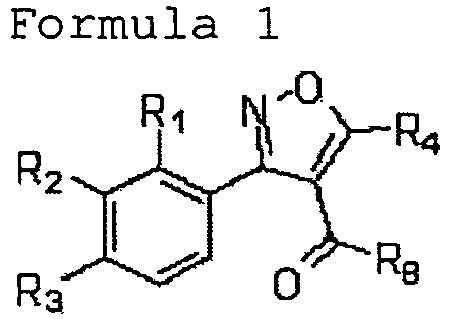
- In Formula above,
- R1, R2 and R3 each independently represents hydrogen, lower alkyl optionally substituted with halogen, lower alkoxy optionally substituted with halogen, or halogen,
- R4 represents methyl or amine, and
- R8 may be substituted with a radical of Formula 2 below, or substituted with a radical of Formula 3 below,


- R9 represents lower alkyl.
- In accordance with another aspect of the present invention, there is provided a composition including the inventive compound, or its pharmaceutically acceptable salt, hydrate or solvate, and a pharmaceutically acceptable carrier or excipient.
- In accordance with a further aspect of the present invention, there is provided a pharmaceutical composition for treating or preventing virus infection, the composition includes the inventive compound, or its pharmaceutically acceptable salt, hydrate or solvate, and a pharmaceutically acceptable carrier or excipient.
- In accordance with a still further aspect of the present invention, there is provided the use of the preventive compound, or its pharmaceutically acceptable salt, hydrate or solvate, for preparing a pharmaceutical composition for treatment or prevention of virus infection.
- In accordance with a still yet further aspect of the present invention, there is provided a method for preventing or treating virus infection, the method including the step of administering a therapeutically effective amount of the inventive compound, or its pharmaceutically acceptable salt, hydrate or solvate, to mammals, including humans, requiring virus infection treatment or prevention.
- Hereinafter, the present invention will be described in detail.
- An influenza virus infection caused by an influenza virus is an illness frequently lethal to humans and animals. The influenza virus causes an infectious acute febrile respiratory organ illness in a host. When the influenza virus is epidemic, it can easily spread across borders due to its strong infectiousness. Also, it may be unpredictably variously mutated, thereby causing interspecific infection. Thus, it is necessary to provide worldwide common countermeasures and monitoring systems.
- However, unlike an antifungal agent, etc. there exist only limited kinds of drugs applicable to influenza. For example, at present, representative therapeutic agents that have been recently used as Neuraminidase inhibitors include Oseltamivir and Zanamivir. These therapeutic agents perform a role of inhibiting the propagation of an influenza virus. However, Zanamivir has a high antiviral effect but has disadvantages such as a low bioavailability and a quick release from a kidney. Also, in Oseltamivir, there have been reported some side effects such as generation of a resistant virus, and serious emesis symptoms.
- The inventors of the present invention found a compound represented by Formula 1 below, that is, a phenyl-isoxazol derivative, and the inventive compounds which have a higher antiviral activity against an influenza virus, and a higher susceptibility to a virus replication inhibitor inhibiting virus replication than its corresponding Oseltamivir phosphate.
- Accordingly, disclosed is a compound represented by Formula 1 below, and its pharmaceutically acceptable derivative.

- In Formula 1, R1, R2, R3, R9 and R8 are the same as defined above.
- In the present invention, it is understood that "a compound represented by Formula 1", as long as not explicitly stated otherwise, includes its hydrate, solvate, pharmaceutically acceptable salt, prodrug, composite, and pharmaceutically acceptable derivative including diastereomer or enantiomer.
- In the present invention, the term "lower alkyl" indicates a straight-chain or branched saturated aliphatic hydrocarbon radical that preferably includes 1 to 12 carbon atoms, alternatively 1 to 8 carbon atoms, or alternatively 1 to 6 carbon atoms. Examples of the alkyl radical may include methyl, ethyl, n-propyl, isopropyl, n-butyl, isobutyl, secondary-butyl, tertiarybutyl, pentyl, isoamyl, n-hexyl, and the like, but the present invention is not limited thereto. In the present invention, an alkyl group may be optionally substituted.
- Also, the term "alkoxy" indicates oxygen added with an alkyl substituent. In the present invention, an alkoxy group may be optionally substituted.
- Also, the term "lower halo alkyl" indicates a straight-chain or branched saturated aliphatic radical that preferably includes 1 to 12 carbon atoms, alternatively 1 to 8 carbon atoms, or alternatively 1 to 6 carbon atoms, in which hydrogen is substituted with halogen.
- Also, the term "halogen" indicates an atom of fluoro, chlorine, bromine or iodine, and preferably indicates fluoro or chlorine. In the present invention, a halogen group may be optionally substituted.
- The compound also includes a salt. It is understood that the compound, e.g., the compound represented by Formula 1, as long as not explicitly stated otherwise, includes its salt.
- In this specification, the term "salt" indicates an acidic and/or basic salt formed from inorganic and/or organic acid and base. The salt of the compound may be, for example, formed by reacting the inventive compound with an acid or a base in the same amount as that of the compound in a medium or aqueous medium capable of precipitating the salt.
- Non-limiting examples of the salt may include the following salts. The compound may be reacted with acetic acid, adipic acid, benzenesulfonic acid, benzoic acid, camphoric acid, camphorsulfonic acid, citric acid, cyclamate, ethane-1,2-disulphonic acid, ethanesulfonic acid, 2-hydroxy ethanesulfonic acid, formic acid, fumaric acid, bromic acid, hydrochloric acid, sulfuric acid, nitric acid, phosphoric acid, malic acid, maleic acid, methanesulfonic acid, naphthalene-2-sulfonic acid, naphthalene-1,5-disulfonic acid, 1-hydroxy-2-naphthalate, nicotinic acid, trifluoroacetic acid, oxalic acid, p-toluene sulfonic acid, propionic acid, glycolic acid, succinic acid, tartaric acid, oxalic acid, amino acid (e.g., lysin), salicylic acid, 2,2-chloroacetic acid, L-aspartic acid, (+)-(1S)-camphor-10-sulfonic acid, 4-acetamido benzoic acid, caproic acid, cinnamic acid, gentistic acid, glutaric acid, malonic acid, mandelic acid, ortic acid, pamoate, aminosalicylic acid or the like to form an acid addition salt. When a lot of basic groups exist, a mono or poly acid addition salt may be formed.
- Also, the compound represented by Formula 1 has ethylester as a functional group, and thus may form a carboxyl group. Under an acidic or basic condition, for example, at pH 11-12 (with a base such as sodium hydroxide, potassium hydroxide, sodium carbonate, sodium hydrogen carbonate, or ammonium hydroxide) or at pH 2-3 (with an acid such as hydrochloric acid or sulfuric acid), ethylester of the compound represented by Formula 1 may be hydrolyzed. The hydrolyzed compound represented by Formula 1 includes a carboxyl group, thereby forming a cation and a salt. There is no specific limitation in the kind of such a salt, as long as it is pharmaceutically acceptable. Examples of such a salt may include an alkaline metal salt, such as sodium, potassium and lithium salt; an alkaline earth metal salt, such as calcium and magnesium salt; other metal salts, such as aluminum, iron, zinc, copper nickel, and cobalt salt; other inorganic salts, such as ammonium salt; an amine salt, such as t-octylamine, dibenzylamine, morpholin, glucosamine, phenylglycine alkyl ester, ethylenediamine, methylglucamine, guanidine, diethylamine, triethylamine, dicyclohexylamine, N,N-dibenzylethylenediamine, chloroprocaine, procaine, diethaneolamine, benzyl-phenethylamine, piperazine, tetraethylammonium and tris(hydroxymethyl)aminomethane salt.
- In this specification, the term "pharmaceutically acceptable derivative" indicates the inventive compounds hydrate, solvate, pharmaceutically acceptable salt, prodrug, or composite, which maintains the required biological activity of the compound and does not show an unwanted toxicological effect.
- The present disclosure also includes a prodrug of the inventive compounds. The term "prodrug" indicates a compound covalently bonded to a carrier. The prodrug may release an active ingredient while being administered to a mammal subject. The release of the active ingredient may occur within a living body, and the prodrug may be prepared by technologies known to a person skilled in the art. In such technologies, in a certain compound, an appropriate functional group is modified. However, the modified functional group regenerates an original functional group through a general operation or within a living body. Non-limiting examples of the prodrug include ester (e.g., acetate, formate, and benzoate derivative) and the like.
- The inventive compounds have an inhibiting activity against a strain of an influenza virus, and are highly effective in the treatment and the prevention of infection of influenza having susceptibility to a virus replication inhibitor inhibiting virus replication, and other similar viruses.
- In the compound represented by Formula 1, preferably, when the radical in Formula 2 is substituted for R8, two from among R1, R2 and R3 represent hydrogen, the remaining one represents lower alkyl optionally substituted with halogen, lower alkoxy optionally substituted with halogen, or halogen, preferably fluoro or chlorine. R4 represents methyl, or amine, and from among R5, R6 and R7, one or two each independently represents hydrogen, lower alkyl optionally substituted with halogen, hydroxy, lower alkoxy, or halogen; or R1 represents halogen, preferably chlorine, R4 represents methyl or amine, R2, R3, R5, and R7 each represents hydrogen, and R6 represents alkoxy, preferably methoxy. When the radical in Formula 3 is substituted for R8, two from among R1, R2 and R3 represent hydrogen, the remaining one represents lower alkyl optionally substituted with halogen, lower alkoxy optionally substituted with halogen, or halogen, R4 represents amine, and R9 represents lower alkyl.

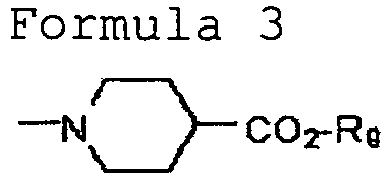
- In the compound represented by Formula 1, more preferably, when the radical of Formula 2 is substituted for R8, two from among R1, R2 and R3 represent hydrogen, the other one represents trifluoromethyl, fluoro, or trifluoromethoxy, R4 represents methyl or amine, from among R5, R6 and R7, one or two each independently represents hydrogen, methoxy, chlorine, fluoro, trifluoromethyl or hydroxy; or R1 represents halogen, preferably chlorine, R4 represents methyl or amine, R2, R3, R5, and R7 each represents hydrogen, and R6 represents alkoxy, preferably methoxy. When the radical of Formula 3 is substituted for R8, R4 represents amine, two from among R1, R2 and R3 represent hydrogen, the remaining one represents trifluoromethyl, fluoro, or trifluoromethoxy, and R9 represents methyl or ethyl. In view of inhibition of influenza virus, especially, when the radical of Formula 2 is substituted for R8, R1 represents trifluoromethyl, or trifluoromethoxy, R2 and R3 represent hydrogen, R4 represents methyl, and from among R5, R6 and R7, one or two each independently represents hydrogen, hydroxy, methoxy, or chlorine; R1 represents chlorine, R4 represents methyl, R2, R3, R5 and R7 represent hydrogen, and R6 represents methoxy; or R2 represents fluoro, trifluoromethyl, or trifluoromethoxy, R1 and R3 represent hydrogen, R4 represents methyl or amine, and from among R5, R6 and R7, one or two each independently represents hydrogen, hydroxy, methoxy, trifluoromethyl or chlorine. Meanwhile, when the radical of Formula 3 is substituted for R8, R1 represents trifluoromethoxy, R2 and R3 represent hydrogen, R4 represents amine, and R9 represents ethyl.
- The compound represented by Formula 1 may be prepared by the following synthesis process. The isomer and solvate (e.g., hydrate) of the compound represented by Formula 1 are also within the scope. The solvation method is generally known in the art. Accordingly, the compound may be used in the form of a pharmaceutically useful hydrate or salt, and obtained by the method described by Reaction Scheme below.
- The compound of Formula 1 is prepared by the steps of: reacting a compound represented by Formula 4 below preferably with hydroxylammoniumchloride in the presence of a base to produce a compound represented by Formula 5 below; chlorinating the compound represented by Formula 5 so as to produce a compound represented by Formula 6 below; cyclizing the compound represented by Formula 6 so as to produce a compound represented by Formula 7 below as an isoxazol compound; removing R10 as a protecting group of Formula 7 so as to produce a compound represented by Formula 8; and reacting the compound represented by Formula 8 with a compound represented by Formula 2 or Formula 3 so as to produce a compound represented by Formula 9a or Formula 9b.


- In Formulas above,
- R1 to R9 are the same as defined above, and
- R10 represents lower alkyl, preferably methyl, ethyl or isopropyl group.

- In Reaction scheme 1 above, R1 to R10 are the same as defined above.
- A phenylaldehyde compound (I) having R1, R2 and R3 substituted onto a benzene ring was commercially available. The phenylaldehyde compound (I) is reacted with hydroxylammoniumchloride or its equivalent in the presence of a base so as to synthesize a compound of benzaldehyde oxime (II). Then, through a chlorination reaction, a benzimidoyl chloride compound (III) is produced. An isoxazol compound (V) in which R4 is substituted with methyl or amine may be obtained through a generally used synthesis method (cyclization reaction) by using alkyl acetoacetate or alkyl cyanoacetate. From a phenyl-isoxazol derivative compound (V, R4=methyl) or a compound (V, R4=amine) including a carboxyl group and an amine group, a phenyl-isoxazol derivative compound (VIa or VIb) is produced by using 1-ethyl-3-(3'-dimethylaminopropyl)carbodiimidehydrochloride (EDCl) or hydroxybenzotriazol (HOBt) in the presence of a base.
- The preparation method may be carried out preferably in a solvent in the presence of a base or an acid. Herein, there is no specific limitation in a solvent, an acid, and a base as long as they have no adverse effect on the reaction. For example, the solvent may be at least one kind selected from the group consisting of tetrahydrofuran, methylenechloride, ethanol, N,N-dimethylformamide, N,N-dimethylacetamide, ethylacetate, tert-butanol, toluene, and dioxane. The base may be at least one kind selected from the group consisting of pyridine, triethylamine, diethylamine, sodium carbonate, potassium carbonate, sodium hydroxide, potassium hydroxide, sodium hydride, sodium methoxide, sodium ethoxide, sodium tert-butoxide, potassium tert-butoxide, lithium aluminum hydride, lithium borohydride, and sodium nitrate, and cesium carbonate. The acid may be at least one kind selected from the group consisting of trifluoroacetic acid, hydrochloric acid, nitric acid, sulfuric acid, bromic acid, and acetic acid.
- Starting materials used in the preparation of the compounds according to the method are commercially available, or can be easily bought. The reaction may be generally carried out under a cooling or heating condition. After the reaction, through a general aftertreatment process, such as column chromatography, recrystallization, etc. a final compound may be purified.
- Meanwhile, the present invention is related to a pharmaceutical composition for treating or preventing virus infection, in which an inventive compound or its pharmaceutically acceptable derivative is administered in an effective amount to mammals, including humans. Also disclosed is a pharmaceutical composition for treating or preventing virus infection, in which the compound represented by Formula 1, or its pharmaceutically acceptable derivative is administered in an effective amount to mammals, including humans. Especially, the composition is effective in inhibiting influenza infection, and thus may be effectively used in the treatment of such an illness.
- When the inventive compounds determined to be effective in inhibiting the illness is administered, a single dose or a multiple dose generally ranges from 0.01 to 750mg/kg per day, preferably ranges from 0.1 to 100mg, and most preferably ranges from 0.5 to 25mg. However, the specific dose for an individual patient may vary according to a specific compound, a patient's weight, sex, diet, a drug administration time, an administration method, a release ratio, a drug mixing ratio, a patient's state, age, etc.
- The inventive compounds may be administered without being processed in the treatment. However, the active ingredient is preferably provided as a pharmaceutical formulation.
- Accordingly, the present invention provides a pharmaceutical formulation obtained by mixing a compound an inventive compound or its pharmaceutically acceptable derivative with a pharmaceutically acceptable carrier and/or excipient. Also disclosed is a pharmaceutical formulation obtained by mixing a compound represented by Formula 1 or its pharmaceutically acceptable derivative with a pharmaceutically acceptable carrier and/or excipient.
- Also, the inventive compounds may be administered via any suitable route. However, preferably, the compounds are administered by injection or in oral form.
- An injection preparation, for example, a sterile injection aqueous or oily suspension, may be prepared by using an appropriate material such as a dispersant, a wetting agent or a suspension according to a known art. As a solvent, water, ringer's solution or isotonic NaCl solution may be used. Also, sterile fixed oil is also generally used as a solvent or a suspension medium. For this, any nonirritating fixed oil, including monoglyceride or di-glyceride, may be used. Also, fatty acid such as oleic acid may used in injection preparation.
- A solid administration form for oral administration may include capsule, tablet, pill, powder and granule forms. Especially, capsule and tablet forms are preferred. Preferably, tablet and pill forms are prepared as intestinal drugs. The solid administration form may be prepared by mixing an inventive active compound, or the compound represented by Formula 1, with at least one inert diluent (such as sucrose, lactose, starch), a lubricant (such as magnesium stearate), and a carrier (such as a disintegrating agent, a binding agent, etc.).
- The inventive compounds have an inhibiting activity against a strain of an influenza virus, and may be used to treat and prevent infection of influenza having susceptibility to a Neuraminidase inhibitor or a virus replication inhibitor inhibiting virus replication, and other similar viruses. Herein, they may be used in combination with a secondary therapeutic agent having an activity against the same virus. The compounds, for example, may be used in combination with Zanamivir, Oseltamivir, Amantadine, Rimantadine or the like. The administration amount of each compound may be the same or different, compared to the administration amount of the compound alone.
- Hereinafter, the present invention will be described in more detail with reference to Preparation Examples and Examples. However, Preparation Examples and Examples, as described below, are illustrative only, and do not limit the present invention.
- Compounds not falling under the present claims are regarded as reference examples only.
- 2-(trifluoromethyl)benzaldehyde (34.82g, 200.0mmol) was dissolved in ethanol (200mL), and added with sodium hydroxide (12.00g, 300.0mmol) dissolved in purified water (50mL). Hydrochloric acidhydroxylamine (16.68g, 240mmol) dissolved in purified water (50mL) was added thereto, followed by stirring for 3 hours. After the reaction was completed, the resultant product was added with ice. The produced solid was filtered, washed with purified water (600mL), and dried so as to provide a white solid required compound (32.15g, 171mmol, 85%).
1H-NMR (400MHz, CDCl3, δ) = 7.23 (dd, 1H), 7.59 (dd, 1H), 7.76 (m, 2H), 8.39 (s, 1H), 11.63 (s, 1H) - In a similar manner as described in Preparation Example 1, by using 2-chlorobenzaldehyde (29.14g, 200.0mmol), sodium hydroxide (12.00g, 300.0mmol) and hydrochloric acidhydroxylamine (16.68g, 240mmol), a white solid required compound (29.73g, 189mmol, 95%) was obtained.
1H-NMR(400MHz, CDCl3, δ) = 7.37 (m, 2H), 7.48 (dd, 1H), 7.82 (dd, 1H), 8.37 (s, 1H), 11.28 (s, 1H) - In a similar manner as described in Preparation Example 1, by using 3-fluorobenzaldehyde (24.82g, 200.0mmol), sodium hydroxide (12.00g, 300.0mmol) and hydrochloric acidhydroxylamine (16.68g, 240mmol), a white solid required compound (22.48g, 162mmol, 81%) was obtained.
1H-NMR(400MHz, CDCl3, δ) = 7.32 (m, 1H), 7.56 (m, 3H), 8.20 (s, 1H) - In a similar manner as described in Preparation Example 1, by using 2-fluorobenzaldehyde (24.82g, 200.0mmol), sodium hydroxide (12.00g, 300.0mmol) and hydrochloric acidhydroxylamine (16.68g, 240mmol), a white solid required compound(25.96g, 186mmol, 93%) was obtained.
1H-NMR(400MHz, CDCl3, δ) = 7.22 (m, 1H), 7.45 (m, 1H), 7.65 (m, 2H), 8.15 (s, 1H) - In a similar manner as described in Preparation Example 1, by using 4-(trifluoromethoxy)benzaldehyde (38.02g, 200.0mmol), sodium hydroxide (12.00g, 300.0mmol) and hydrochloric acidhydroxylamine (16.68g, 240mmol), a white solid required compound(38.68g, 188mmol, 94%) was obtained.
1H-NMR (400MHz, CDCl3, δ) = 7.38 (d, 2H), 7.72 (tt, 2H), 8.20 (s, 1H), 11.43 (s, 1H) - In a similar manner as described in Preparation Example 1, by using 2-(trifluoromethoxy)benzaldehyde (38.03g, 200.0mmol), sodium hydroxide (12.00g, 300.0mmol) and hydrochloric acidhydroxylamine (16.6g, 240mmol), a white solid required compound(38.67g, 188mmol, 94%) was obtained.
1H-NMR (400MHz, CDCl3, δ) = 7.43 (m, 2H), 7.54 (m, 1H), 7.89 (m, 1H), 8.24 (s, 1H), 11.76 (s, 1H) - In a similar manner as described in Preparation Example 1, by using 3-(trifluoromethyl)benzaldehyde (34.82g, 200.0mmol), sodium hydroxide (12.00g, 300.0mmol) and hydrochloric acidhydroxylamine (16.68g, 240mmol), a white solid required compound (35.33g, 187mmol, 93%) was obtained.
1H-NMR (400MHz, CDCl3, δ) = 7.33 (m, 1H), 7.72 (m, 3H), 8.44 (s, 1H), 11.62 (s, 1H) - In a similar manner as described in Preparation Example 1, by using 3-(trifluoromethoxy)benzaldehyde(38.03g, 200.0mmol), sodium hydroxide (12.00g, 300.0mmol) and hydrochloric acidhydroxylamine (16.6g, 240mmol), a white solid required compound (39.74g, 193mmol, 97%) was obtained.
1H-NMR(400MHz, CDCl3, δ) = 7.53 (m, 1H), 7.69 (m, 3H), 8.31 (s, 1H), 11.71 (s, 1H) - 2-(trifluoromethyl)benzaldehydeoxime (30.0g, 158.60mmol) was dissolved in dimethylformimide (300mL), and added with N-chlorosuccinimide (23.31g, 174.46mmol), followed by stirring for 15 hours. After the reaction was completed, the resultant solution was vacuum evaporated, added with ethylacetate (1,500mL), washed with saturated sodium chloride aqueous solution (1,000mL) and purified water (1,000mL), respectively, dried with anhydrous sodium sulfate, and vacuum-evaporated to provide a pale yellow solid required compound (32.81g, 146.70mmol, 93%).
1H-NMR (400MHz, CDCl3, δ) = 7.73 (m, 2H), 7.80 (t, 1H), 7.86 (d, 1H), 12.61 (s, 1H) - In a similar manner as described in Preparation Example 9, by using dimethylformamide (240mL), 2-chlorobenzaldehydeoxime (19.97g, 128.32mmol) and N-chlorosuccinimide(18.85g, 141.14mmol), a pale yellow solid required compound (20.04g, 105.21mmol, 82%) was obtained.
1H-NMR (400MHz, CDCl3, δ) = 7.46 (m, 1H), 7.54 (m. 1H), 7.58 (m, 2H), 12.54 (s, 1H) - In a similar manner as described in Preparation Example 9, by using dimethylformamide (240mL), 3-fluorobenzaldehydeoxime (20.0g, 143.77mmol) and N-chlorosuccinimide(21.12g, 158.12mmol), a pale yellow solid required compound (22.52g, 129.79mmol, 90%) was obtained.
1H-NMR (400MHz, CDCl3, δ) = 7.37 (m, 1H), 7.60 (m, 3H) - In a similar manner as described in Preparation Example 9, by using dimethylformamide (240mL), 2-fluorobenzaldehydeoxime (20.0g, 143.76mmol) and N-chlorosuccinimide (21.12g, 158.12mmol), a pale yellow solid required compound (23.32g, 134.40mmol, 94%) was obtained.
1H-NMR (400MHz, CDCl3, δ) = 7.29 (m, 1H), 7.47 (m, 1H), 7.62 (m, 2H) - In a similar manner as described in Preparation Example 9, by using dimethylformamide (240mL), 4-(trifluoromethoxy)benzaldehydeoxime (20.0g, 97.51mmol) and N-chlorosuccinimide (14.31g, 107.26mmol), a pale yellow solid required compound (21.10g, 88.04mmol, 90%) was obtained.
1H-NMR (400MHz, CDCl3, δ) = 7.47 (dd, 1H), 7.72 (tt, 2H), 12.60 (s, 1H) - In a similar manner as described in Preparation Example 9, by using dimethylformamide (240mL), 4-(trifluoromethoxy)benzaldehydeoxime (20.0g, 97.50mmol) and N-chlorosuccinimide (14.32g, 107.26mmol), a pale yellow solid required compound (19.48g, 81.30mmol, 83%) was obtained.
1H-NMR(400MHz, CDCl3, δ) = 7.49 (m, 1H), 7.62 (m, 1H), 7.68 (dd, 1H), 12.67 (s, 1H) - In a similar manner as described in Preparation Example 9, by using 3-(trifluoromethyl)benzaldehydeoxime (30.0g, 158.60mmol), dimethylformimide (300mL) and N-chlorosuccinimide (23.31g, 174.46mmol), a pale yellow solid required compound(33.81g, 151.22mmol, 95%) was obtained.
1H-NMR (400MHz, CDCl3, δ) = 7.79 (m, 3H), 7.83 (m, 1H), 12.64 (s, 1H) - In a similar manner as described in Preparation Example 9, by using dimethylformamide (240mL), 3-(trifluoromethoxy)benzaldehydeoxime (20.0g, 97.50mmol) and N-chlorosuccinimide (14.32g, 107.26mmol), a pale yellow solid required compound(19.43g, 81.10mmol, 82%) was obtained.
1H-NMR (400MHz, CDCl3, δ) = 7.56 (m, 1H), 7.64 (m, 3H), 12.61 (s, 1H) - N-hydroxy-2-(trifluoromethyl)benzimidoylchloride (8.0g, 35.78mmol) and methylacetoacetate (8.30g, 71.56mmol) were dissolved in methanol (160mL). The resultant solution was stirred for 30 minutes while the reactor was cooled to -10°C. Then, sodium methoxide (5.80g, 107.34mmol) was slowly added thereto. The resultant product was warmed up to room temperature, stirred for 3 hours, and vacuum-evaporated to remove methanol. Then, ethylacetate (200mL) was added thereto. The resultant product was washed with purified water (200mL) and saturated sodium chloride aqueous solution (200mL), respectively, dried with anhydrous sodium sulfate, and vacuum-evaporated. Through column chromatography, a purified white solid required compound (5.79g, 20.31mmol, 57%) was obtained.
1H-NMR(400MHz, CDCl3, δ) = 2.75 (s, 3H), 3.58 (s, 3H), 7.56 (m, 1H), 7.78 (m, 1H), 7.90 (m, 1H) - In a similar manner as described in Preparation Example 17, by using methanol (160mL), 2-chloro-N-hydroxybenzimidoylchloride (8.0g, 42.10mmol), methylacetoacetate (9.78g, 84.20mmol) and sodium methoxide (6.83g, 126.30mmol), a white solid required compound (6.32g, 25.11mmol, 60%) was obtained.
1H-NMR (400MHz, CDCl3, δ) = 2.59 (s, 3H), 3.86 (s, 3H), 7.62 (m, 3H) - In a similar manner as described in Preparation Example 17, by using methanol (160mL), 3-fluoro-N-hydroxybenzimidoyl chloride (8.00g, 46.09mmol), methylacetoacetate (10.07g, 92.18mmol) and sodium methoxide (7.47g, 138.27mmol), a white solid required compound (7.60g, 32.14mmol, 70%) was obtained.
1H-NMR (400MHz, CDCl3, δ) = 2.58 (s, 3H), 3.91 (s, 3H), 7.21 (m, 1H), 7.42 (m, 3H) - In a similar manner as described in Preparation Example 17, by using methanol (160mL), 2-fluoro-N-hydroxybenzimidoyl chloride (8.00g, 46.09mmol), methylacetoacetate (10.07g, 92.18mmol) and sodium methoxide (7.47g, 138.27mmol), a white solid required compound (7.84g, 33.33mmol, 72%) was obtained.
1H-NMR (400MHz, CDCl3, δ) = 2.59 (s, 3H), 3.92 (s, 3H), 7.22 (m, 1H), 7.43 (m, 1H), 7.55 (m, 2H) - In a similar manner as described in Preparation Example 17, by using methanol (160mL), N-hydroxy-4-(trifluoromethoxy)benzimidoylchloride (8.00g, 33.39mmol), methylacetoacetate (7.76g, 66.78mmol) and sodium methoxide (5.41g, 100.17mmol), a white solid required compound (6.74g, 22.36mmol, 67%) was obtained.
1H-NMR (400MHz, CDCl3, δ) = 2.71 (s, 3H), 3.73 (s, 3H), 7.48 (d, 2H), 7.76 (d, 2H) - In a similar manner as described in Preparation Example 17, by using methanol (160mL), N-hydroxy-4-(trifluoromethoxy)benzimidoylchloride (8.00g, 33.39mmol), methylacetoacetate (7.76g, 66.78mmol) and sodium methoxide (5.41g, 100.17mmol), a white solid required compound (7.04g, 23.37mmol, 70%) was obtained.
1H-NMR (400MHz, CDCl3, δ) = 2.73 (s, 3H), 3.64 (s, 3H), 7.53 (m, 1H), 7.61 (m, 1H), 7.69 (m, 1H) - In a similar manner as described in Preparation Example 17, by using methanol (160mL), N-hydroxy-3-(trifluoromethyl)benzimidoylchloride (8.0g, 35.78mmol), methylacetoacetate (8.30g, 71.56mmol) and sodium methoxide (5.80g, 107.34mmol), a white solid required compound (5.82g, 20.41mmol, 57%) was obtained.
1H-NMR (400MHz, CDCl3, δ) = 2.73 (s, 3H), 3.56 (s, 3H), 7.58 (m, 1H), 7.97 (m, 3H) - In a similar manner as described in Preparation Example 17, by using methanol (160mL), N-hydroxy-3-(trifluoromethoxy)benzimidoylchloride (8.00g, 33.39mmol), methylacetoacetate (7.76g, 66.78mmol) and sodium methoxide (5.41g, 100.17mmol), a white solid required compound (6.82g, 22.64mmol, 68%) was obtained.
1H-NMR (400MHz, CDCl3, δ) = 2.76 (s, 3H), 3.62 (s, 3H), 7.54 (m, 1H), 7.61 (m, 3H) - methyl 5-methyl-3-(2-(trifluoromethyl)phenyl)isoxazol-4-carboxylate (6.0g, 21.03mmol) was dissolved in methanol (60mL), added with 3% sodium hydroxide aqueous solution (60mL), stirred at 30°C for 7 hours, and vacuum-evaporated so as to remove methanol. The remaining solution was washed with ethyl acetate (20mL), and the aqueous layer was neutralized by a hydrochloric acid aqueous solution. Then, the produced crystal was filtered, washed with purified water (50mL), and dried so as to provide a white solid required compound (5.48g, 20.12mmol, 96%).
1H-NMR (400MHz, DMSO, δ) = 2.69 (s, 3H), 7.49 (m, 1H), 7.72 (m, 1H), 7.83 (m, 1H), 13.12 (brs, 1H) - In a similar manner as described in Preparation Example 25, by using methanol (60mL), methyl-3-(2-chlorophenyl)-5-methylisoxazol-4-carboxylate (6.0g, 23.84mmol) and 3% sodium hydroxide aqueous solution(60mL), a white solid required compound (5.10g, 21.44mmol, 90%) was obtained.
1H-NMR (400MHz, DMSO, δ) = 2.75 (s, 3H), 7.46 (m, 2H), 7.53(m, 1H), 7.59 (m, 1H), 13.00 (brs, 1H) - In a similar manner as described in Preparation Example 25, by using methanol (60mL), methyl-3-(3-fluorophenyl)-5-methylisoxazol-4-carboxylate (6.0g, 25.51mmol) and 3% sodium hydroxide aqueous solution (60mL), a white solid required compound(5.51g, 24.92mmol, 98%) was obtained.
1H-NMR (400MHz, DMSO, δ) = 2.58 (s, 3H), 7.21 (m, 1H), 7.42 (m, 3H), 13.04 (brs, 1H) - In a similar manner as described in Preparation Example 25, by using methanol (60mL), methyl-3-(3-fluorophenyl)-5-methylisoxazol-4-carboxylate (6.0g, 25.51mmol) and 3% sodium hydroxide aqueous solution(60mL), a white solid required compound (5.21g, 23.44mmol, 92%) was obtained.
1H-NMR (400MHz, DMSO, δ) = 2.60 (s, 3H), 7.21 (m, 1H), 7.43 (m, 1H), 7.54 (m, 2H) - In a similar manner as described in Preparation Example 25, by using methanol (60mL), methyl-5-methyl-3-(4-(trifluoromethoxy)phenyl)isoxazol-4-carboxylate (6.0g, 19.91mmol) and 3% sodium hydroxide aqueous solution(60mL), a white solid required compound (5.55g, 19.32mmol, 97%) was obtained.
1H-NMR (400MHz, DMSO, δ) = 2.71 (s, 3H), 7.48 (d, 2H), 7.76 (d, 2H), 13.15 (brs, 1H) - In a similar manner as described in Preparation Example 25, by using methanol (60mL), methyl-5-methyl-3-(2-(trifluoromethoxy)phenyl)isoxazol-4-carboxylate (6.0g, 19.91mmol) and 3% sodium hydroxide aqueous solution (60mL), a white solid required compound (5.34g, 18.59mmol, 93%) was obtained.
1H-NMR (400MHz, DMSO, δ) = 2.72 (s, 3H), 7.50 (m, 2H), 7.58 (m, 1H), 7.67 (m, 1H), 13.62 (brs, 1H) - In a similar manner as described in Preparation Example 25, by using methanol (60mL), methyl-5-methyl-3-(3-(trifluoromethyl)phenyl)isoxazol-4-carboxylate (6.0g, 21.03mmol) and 3% sodium hydroxide aqueous solution(60mL), a white solid required compound (5.37g, 19.80mmol, 94%) was obtained.
1H-NMR (400MHz, DMSO, δ) = 2.67 (s, 3H), 7.48 (m, 1H), 7.80 (m, 3H), 13.11 (brs, 1H) - In a similar manner as described in Preparation Example 25, by using methanol (60mL), methyl-5-methyl-3-(3-(trifluoromethoxy)phenyl)isoxazol-4-carboxylate (6.0g, 19.91mmol) and 3% sodium hydroxide aqueous solution (60mL), a white solid required compound (5.47g, 19.04mmol, 96%) was obtained.
1H-NMR(400MHz, DMSO, δ) = 2.71 (s, 3H), 7.48 (m, 2H), 7.64 (m, 2H), 13.57 (brs, 1H) - In a similar manner as described in Preparation Example 17, by using methanol (160mL), N-hydroxy-2-(trifluoromethyl)benzimidoyl chloride (8.00g, 33.39mmol), methylcyanoacetate (4.14g, 41.74mmol) and sodium methoxide (3.61g, 66.78mmol), a white solid required compound (8.13g, 28.42mmol, 85%) was obtained.
1H-NMR(400MHz, DMSO, δ) = 3.59 (s, 3H), 6.12 (brs, 2H), 7.36 (m, 1H), 7.57 (m, 2H), 7.69 (m, 1H) - In a similar manner as described in Preparation Example 17, by using methanol (160mL), 2-chloro-N-hydroxybenzimidoylchloride (8.00g, 42.10mmol), methylcyanoacetate (5.22g, 52.63mmol) and sodium methoxide (4.55g, 84.20mmol), a white solid required compound(9.40g, 37.21mmol, 88%) was obtained.
1H-NMR (400MHz, DMSO, δ) = 3.65 (s, 3H), 6.20 (brs, 2H), 7.41 (m, 4H) - In a similar manner as described in Preparation Example 17, by using methanol (160mL), 3-fluoro-N-hydroxybenzimidoyl chloride (8.00g, 46.09mmol), methylcyanoacetate (5.94g, 59.92mmol) and sodium methoxide (4.98g, 92.18mmol), a white solid required compound (8.42g, 35.64mmol, 77%) was obtained.
1H-NMR(400MHz, CDCl3, δ) = 3.92 (s, 3H), 6.30 (brs, 2H), 7.21 (m, 1H), 7.42 (m, 3H) - In a similar manner as described in Preparation Example 17, by using methanol (160mL), 2-fluoro-N-hydroxybenzimidoyl chloride (8.00g, 46.09mmol), methylcyanoacetate (5.94g, 59.92mmol) and sodium methoxide (4.98g, 92.18mmol), a white solid required compound(8.23g, 34.82mmol, 76%) was obtained.
1H-NMR (400MHz, CDCl3, δ) = 3.89 (s, 3H), 6.31 (brs, 2H), 7.22 (m, 1H), 7.41 (m, 1H), 7.55 (m, 2H) - In a similar manner as described in Preparation Example 17, by using methanol (160mL), N-hydroxy-4-(trifluoromethoxy)benzimidoylchloride (8.00g, 33.39mmol), methylcyanoacetate (4.31g, 43.41mmol) and sodium methoxide (3.61g, 66.78mmol), a white solid required compound (8.27g, 27.35mmol, 82%) was obtained.
1H-NMR (400MHz, DMSO, δ) = 3.51 (s, 3H), 6.21 (brs, 2H), 7.26 (d, 2H), 7.77 (d, 2H) - In a similar manner as described in Preparation Example 17, by using methanol (160mL), N-hydroxy-2-(trifluoromethoxy)benzimidoylchloride (8.00g, 33.39mmol), methylcyanoacetate (4.31g, 43.41mmol) and sodium methoxide (3.61g, 66.78mmol), a white solid required compound (9.07g, 30.02mmol, 90%) was obtained.
1H-NMR (400MHz, DMSO, δ) = 3.38 (s, 3H), 6.18 (brs, 2H), 7.41 (m, 2H), 7.42 (m, 1H), 7.47 (m, 1H) - In a similar manner as described in Preparation Example 17, by using methanol (160mL), N-hydroxy-3-(trifluoromethyl)benzimidoylchloride (8.00g, 33.39mmol), methylcyanoacetate (4.14g, 41.74mmol) and sodium methoxide (3.61g, 66.78mmol), a white solid required compound (7.46g, 26.06mmol, 78%) was obtained.
1H-NMR (400MHz, DMSO, δ) = 3.61 (s, 3H), 6.11 (brs, 2H), 7.32 (m, 1H), 7.62 (m, 3H) - In a similar manner as described in Preparation Example 17, by using methanol (160mL), N-hydroxy-3-(trifluoromethoxy)benzimidoylchloride (8.00g, 33.39mmol), methylcyanoacetate (4.31g, 43.41mmol) and sodium methoxide (3.61g, 66.78mmol), a white solid required compound (8.42g, 27.87mmol, 83%) was obtained.
1H-NMR (400MHz, DMSO, δ) = 3.42 (s, 3H), 6.22 (brs, 2H), 7.46 (m, 2H), 7.53 (m, 2H) - In a similar manner as described in Preparation Example 25, by using methanol (60mL), 5-amino-3-(2-(trifluoromethyl)phenyl)isoxazol-4-carboxylate (6.0g, 20.96mmol) and 3% sodium hydroxide aqueous solution (60mL), a white solid required compound (4.06g, 14.92mmol, 71%) was obtained.
1H-NMR (4000, DMSO, δ) = 7.40 (m, 1H), 7.70 (m, 2H), 7.76 (m, 1H), 7.81 (brs, 2H), 12.18 (brs, 1H) - In a similar manner as described in Preparation Example 25, by using methanol (60mL), methyl-5-amino-3-(2-chlorophenyl)isoxazol-4-carboxylate (6.0g, 23.75mmol) and 3% sodium hydroxide aqueous solution (60mL), a white solid required compound(3.66g, 15.33mmol, 65%) was obtained.
1H-NMR (400MHz, DMSO, δ) = 7.45 (m, 3H), 7.54 (m, 1H), 7.85 (brs, 2H), 12.04 (brs, 1H) - In a similar manner as described in Preparation Example 25, by using methanol (60mL), methyl-5-amino-3-(3-fluorophenyl)isoxazol-4-carboxylate (6.0g, 25.40mmol) and 3% sodium hydroxide aqueous solution (60mL), a white solid required compound (3.08g, 13.86mmol, 55%) was obtained.
1H-NMR (400 MHz, DMSO, δ) = 6.28 (brs, 2H), 7.20 (m, 1H), 7.44 (m, 3H) - In a similar manner as described in Preparation Example 25, by using methanol (60mL), methyl-5-amino-3-(2-fluorophenyl)isoxazol-4-carboxylate (6.0g, 25.40mmol) and 3% sodium hydroxide aqueous solution (60mL), a white solid required compound(3.18g, 14.33mmol, 56%) was obtained.
1H-NMR (400MHz, DMSO, δ) = 6.22 (brs, 2H), 7.25 (m, 1H), 7.45 (m, 1H), 7.59 (m, 2H), 12.13 (brs, 1H) - In a similar manner as described in Preparation Example 25, by using methanol (60mL), methyl-5-amino-3-(4-(trifluoromethoxy)phenyl)isoxazol-4-carboxylate (6.0g, 19.85mmol) and 3% sodium hydroxide aqueous solution (60mL), a white solid required compound (4.32g, 15.02mmol, 76%) was obtained.
1H-NMR (400MHz, DMSO, δ) = 7.31 (d, 2H), 7.83 (d, 2H), 7.85 (brs, 2H), 12.01 (brs, 1H) - In a similar manner as described in Preparation Example 25, by using methanol (60mL), methyl-5-amino-3-(2-(trifluoromethoxy)phenyl)isoxazol-4-carboxylate (6.0g, 19.85mmol) and 3% sodium hydroxide aqueous solution (60mL), a white solid required compound (4.00g, 13.89mmol, 70%) was obtained.
1H-NMR(400MHz, DMSO, δ) = 7.45 (m, 3H), 7.59 (m, 1H), 7.82 (brs, 2H), 12.04 (brs, 1H) - In a similar manner as described in Preparation Example 25, by using methanol (60mL), 5-amino-3-(3-(trifluoromethyl)phenyl)isoxazol-4-carboxylate (6.0g, 20.96mmol) and 3% sodium hydroxide aqueous solution(60mL), a white solid required compound(4.14g, 15.21mmol, 73%) was obtained.
1H-NMR (400MHz, DMSO, δ) = 7.34 (m, 1H), 7.68 (m, 3H), 7.87 (brs, 2H), 12.31 (brs, 1H) - In a similar manner as described in Preparation Example 25, by using methanol (60mL), methyl 5-amino-3-(3-(trifluoromethoxy)phenyl)isoxazol-4-carboxylate (6.0g, 19.85mmol) and 3% sodium hydroxide aqueous solution (60mL), a white solid required compound(4.16g, 14.43mmol, 73%) was obtained.
1H-NMR(400MHz, DMSO, δ) = 7.43 (m, 3H), 7.63 (m, 1H), 7.84 (brs, 2H), 12.04 (brs, 1H) - 5-methyl-3-(2-(trifluoromethyl)phenyl)isoxazol-4-carboxylic acid (500mg, 1.84mmol), 1-ethyl-3-(dimethylaminopropyl)carbodiimide hydrochloride(388mg, 2.02mmol) and 1-(2-fluorophenyl)piperazine(332mg, 1.84mmol) were dissolved in dichloromethane (30mL), and stirred at room temperature for 8 hours. The resultant solution was washed with saturated sodium carbonate aqueous solution (30mL), purified water (30mL) and saturated sodium chloride aqueous solution (30mL), respectively. Then, the organic layer was dried with anhydrous sodium sulfate, concentrated, and purified with column chromatography so as to provide a white solid required compound (528mg, 1.34mmol, 73%).
1H-NMR (400MHz, CDCl3, δ) = 2.56 (s, 3H), 2.73 (brs, 2H), 3.01 (brs, 2H), 3.41 (brs, 2H), 3.72 (brs, 2H), 6.04 (m, 3H), 6.81 (t, 1H), 7.49 (m, 1H), 7.72 (m, 1H), 7.83 (m, 1H) - In a similar manner as described in Example 1, by using dichloromethane (30mL), 5-methyl-3-(2-(trifluoromethyl)phenyl)isoxazol-4-carboxylic acid (500mg, 1.84mmol), 1-ethyl-3-(dimethylaminopropyl)carbodiimide hydrochloride (388mg, 2.02mmol) and 1-(3,4-dichlorophenyl)piperazine (425mg, 1.84mmol), a white solid required compound(644mg, 1.33mmol, 72%) was obtained.
1H-NMR (400MHz, CDCl3, δ) = 2.58 (s, 3H), 2.75 (brs, 2H), 3.03 (brs, 2H), 3.42 (brs, 2H), 3.74 (brs, 2H), 6.69 (dd, 1H), 6.89 (d, 1H), 7.28 (m, 1H), 7.55 (d, 1H), 7.64 (m, 2H), 7.82 (d, 2H) - In a similar manner as described in Example 1, by using dichloromethane (30mL), 5-methyl-3-(2-(trifluoromethyl)phenyl)isoxazol-4-carboxylic acid (500mg, 1.84mmol), 1-ethyl-3-(dimethylaminopropyl)carbodiimide hydrochloride (388mg, 2.02mmol) and 1-(3-methoxyphenyl)piperazine (354mg, 1.84mmol), a gel-like required compound (602mg, 1.35mmol, 73%) was obtained.
1H-NMR (400MHz, CDCl3, δ) = 2.64 (brs, 2H), 2.67 (s, 3H), 3.13 (brs, 2H), 3.38 (brs, 2H), 4.06 (brs, 2H), 6.43 (brs, 1H), 6.53 (m, 2H), 7.39 (dd, 1H), 7.49 (m, 1H), 7.70 (m, 1H), 7.80 (dd, 1H), 7.81 (m, 1H) - In a similar manner as described in Example 1, by using dichloromethane (30mL), 5-methyl-3-(2-(trifluoromethyl)phenyl)isoxazol-4-carboxylic acid (500mg, 1.84mmol), 1-ethyl-3-(dimethylaminopropyl)carbodiimide hydrochloride (388mg, 2.02mmol) and 1-(2-methoxyphenyl)piperazine (354mg, 1.84mmol), a white solid required compound (504mg, 1.13mmol, 62%) was obtained.
1H-NMR(400MHz, CDCl3, δ) = 2.59 (S, 3H), 2.75 (brs, 2H), 3.06 (brs, 2H), 3.42 (brs, 2H), 3.76 (brs, 2H), 3.82 (s, 3H), 6.49 (brs, 1H), 6.49 (m, 2H), 7.19 (t, 1H), 7.55 (d, 1H), 7.67 (m, 2H), 7.82 (d, 1H) - In a similar manner as described in Example 1, by using dichloromethane (30mL), 5-methyl-3-(2-(trifluoromethyl)phenyl)isoxazol-4-carboxylic acid (500mg, 1.84mmol), 1-ethyl-3-(dimethylaminopropyl)carbodiimide hydrochloride (388mg, 2.02mmol) and 1-(3-(trifluoromethyl)phenyl)piperazine(424mg, 1.84mmol), a gel-like required compound (593mg, 1.23mmol, 67%) was obtained.
1H-NMR (400MHz, CDCl3, δ) = 2.63 (brs, 2H), 2.69 (s, 3H), 3.15 (brs, 2H), 3.37 (brs, 2H), 3.39 (brs, 2H), 4.02 (brs, 2H), 6.91 (m, 2H), 7.03 (m, 1H), 7.26 (m, 1H), 7.51 (m, 1H), 7.70 (m, 2H), 7.82 (m, 1H) - In a similar manner as described in Example 1, by using dimethylformimide (15mL), 5-methyl-3-(2-(trifluoromethyl)phenyl)isoxazol-4-carboxylic acid (500mg, 1.84mmol), 1-ethyl-3-(dimethylaminopropyl)carbodiimide hydrochloride (388mg, 2.02mmol), hydroxybenzotriazole (299mg, 2.21mmol) and 4-(piperazine-1-yl)phenol (328mg, 1.84mmol), a white solid required compound (467mg, 1.08mmol, 59%) was obtained.
1H-NMR (400MHz, CDCl3, δ) = 2.64 (brs, H), 2.69 (s, 3H), 3.91 (brs, 4H), 6.78 (m, 4H), 7.49 (m, 2H), 7.72 (m, 1H), 7.83 (m, 1H) - In a similar manner as described in Example 1, by using dimethylformimide (15mL), 5-methyl-3-(2-(trifluoromethyl)phenyl)isoxazol-4-carboxylic acid (500mg, 1.84mmol), 1-ethyl-3-(dimethylaminopropyl)carbodiimide hydrochloride (388mg, 2.02mmol), hydroxybenzotriazole (299mg, 2.21mmol) and 2-(piperazine-1-yl)phenol (328mg, 1.84mmol), a white solid required compound(451mg, 1.05mmol, 57%) was obtained.
1H-NMR(400MHz, CDCl3, δ) = 2.49 (brs, 2H), 2.61 (s, 3H), 2.78 (brs, 2H), 3.50 (brs, 2H), 3.80 (brs, 2H), 6.93 (m, 3H), 7.13 (m, 1H), 7.58 (m, 1H), 7.70 (m, 2H), 7.86 (m, 1H) - In a similar manner as described in Example 1, by using dichloromethane (30mL), 5-methyl-3-(2-(trifluoromethyl)phenyl)isoxazol-4-carboxylic acid (500mg, 1.84mmol), 1-ethyl-3-(dimethylaminopropyl)carbodiimide hydrochloride (388mg, 2.02mmol) and 1-(4-fluorophenyl)piperazine (332mg, 1.84mmol), a white solid required compound (548mg, 1.26mmol, 69%) was obtained.
1H-NMR (400MHz, CDCl3, δ) = 2.68 (s, 3H), 2.91 (brs, 4H), 3.42 (brs, 4H), 6.91 (m, 2H), 7.05 (m, 2H), 7.45 (m, 1H), 7.71 (m, 1H), 7.82 (m, 1H) - In a similar manner as described in Example 1, by using dichloromethane (30mL), 3-(2-chlorophenyl)-5-methylisoxazol-4-carboxylic acid (437mg, 1.84mmol), 1-ethyl-3-(dimethylaminopropyl)carbodiimide hydrochloride (388mg, 2.02mmol) and 1-(3-methoxyphenyl)piperazine(354mg, 1.84mmol), a white solid required compound(576mg, 1.40mmol, 76%) was obtained.
1H-NMR (400MHz, CDCl3, δ) = 2.61 (s, 3H), 3.10 (brs, 2H), 3.33 (brs, 2H), 3.74 (brs, 4H), 3.79 (s, 3H), 6.36 (t, 1H), 6.46 (m, 2H), 7.18 (t, 1H), 7.41 (m, 2H), 7.50 (m, 1H), 7.56 (dd, 1H) - In a similar manner as described in Example 1, by using dichloromethane (30mL), 3-(3-fluorophenyl)-5-methylisoxazol-4-carboxylic acid (407mg, 1.84mmol), 1-ethyl-3-(dimethylaminopropyl)carbodiimide hydrochloride (388mg, 2.02mmol) and 1-(2-fluorophenyl)piperazine (332mg, 1.84mmol), a white solid required compound (562mg, 1.41mmol, 76%) was obtained.
1H-NMR (400MHz, CDCl3, δ) = 2.56 (s, 3H), 2.70 (brs, 2H), 3.14 (brs, 2H), 3.28 (brs, 2H), 3.96 (brs, 2H), 6.70 (m, 2H), 7.02 (m, 2H), 7.17 (m, 1H), 7.45 (m, 3H) - In a similar manner as described in Example 1, by using dichloromethane (30mL), 3-(3-fluorophenyl)-5-methylisoxazol-4-carboxylic acid (407mg, 1.84mmol), 1-ethyl-3-(dimethylaminopropyl)carbodiimide hydrochloride (388mg, 2.02mmol) and 1-(3,4-dichlorophenyl)piperazine (425mg, 1.84mmol), a white solid required compound (619mg, 1.43mmol, 78%) was obtained.
1H-NMR (CDCl3, 400MHz, δ) = 2.56 (s, 3H), 2.66 (brs, 2H), 3.16 (brs, 2H), 3.27 (brs, 2H), 3.91 (brs, 2H), 6.67 (dd, 1H), 6.88 (d, 1H), 7.19 (m, 1H), 7.29 (m, 1H), 7.44 (m, 3H) - In a similar manner as described in Example 1, by using dichloromethane (30mL), 3-(3-fluorophenyl)-5-methylisoxazol-4-carboxylic acid (407mg, 1.84mmol), 1-ethyl-3-(dimethylaminopropyl)carbodiimide hydrochloride (388mg, 2.02mmol) and 1-(3-methoxyphenyl)piperazine (354mg, 1.84mmol), a white solid required compound(612mg, 1.55mmol, 84%) was obtained.
1H-NMR (400MHz, CDCl3, δ) = 2.56 (s, 3H), 2.73 (brs, 2H), 3.19 (brs, 2H), 3.30 (brs, 2H), 3.80 (s, 3H), 3.93 (brs, 2H), 6.41(m, 1H), 6.49 (m, 2H), 7.18 (m, 2H), 7.46 (m, 3H) - In a similar manner as described in Example 1, by using dichloromethane (30mL), 3-(3-fluorophenyl)-5-methylisoxazol-4-carboxylic acid (407mg, 1.84mmol), 1-ethyl-3-(dimethylaminopropyl)carbodiimide hydrochloride (388mg, 2.02mmol) and 1-(2-methoxyphenyl)piperazine(354mg, 1.84mmol), a white solid required compound(586mg, 1.48mmol, 81%) was obtained.
1H-NMR (400MHz, CDCl3, δ) = 2.56 (s, 3H), 2.61 (brs, 2H), 3.07 (brs, 2H), 3.34 (brs, 2H), 3.86 (s, 3H), 3.97 (brs, 2H), 6.53 (m, 1H), 6.90 (m, 2H), 7.18 (m, 1H), 7.05 (m, 1H), 7.46 (m, 3H) - In a similar manner as described in Example 1, by using dichloromethane (30mL), 3-(3-fluorophenyl)-5-methylisoxazol-4-carboxylic acid (407mg, 1.84mmol), 1-ethyl-3-(dimethylaminopropyl)carbodiimide hydrochloride (388mg, 2.02mmol) and 1-(3-(trifluoromethyl)phenyl)piperazine (424mg, 1.84mmol), a white solid required compound (506mg, 1.17mmol, 64%) was obtained.
1H-NMR (400MHz, CDCl3, 5) = 2.56 (s, 3H), 2.59 (brs, 2H), 3.03 (brs, 2H), 3.32 (brs, 2H), 3.88 (brs, 2H), 6.99 (m, 1H), 7.21 (m, 4H), 7.42 (m, 3H) - In a similar manner as described in Example 1, by using dimethylformimide (15mL), 3-(3-fluorophenyl)-5-methylisoxazol-4-carboxylic acid (407mg, 1.84mmol), 1-ethyl-3-(dimethylaminopropyl)carbodiimide hydrochloride (388mg, 2.02mmol), hydroxybenzotriazole (299mg, 2.21mmol) and 4-(piperazine-1-yl)phenol (424mg, 1.84mmol), a white solid required compound(486mg, 1.27mmol, 69%) was obtained.
1H-NMR (400MHz, CDCl3, δ) = 2.56 (s, 3H), 2.61 (brs, 2H), 3.07 (brs, 2H), 3.32 (brs, 2H), 3.95 (brs, 2H), 6.78 (m, 4H), 7.19 (m, 1H), 7.45 (m, 3H) - In a similar manner as described in Example 1, by using dimethylformimide (15mL), 3-(3-fluorophenyl)-5-methylisoxazol-4-carboxylic acid (407mg, 1.84mmol), 1-ethyl-3-(dimethylaminopropyl)carbodiimide hydrochloride (388mg, 2.02mmol), hydroxybenzotriazole (299mg, 2.21mmol) and 2-(piperazine-1-yl)phenol (424mg, 1.84mmol), a white solid required compound (462mg, 1.21mmol, 66%) was obtained.
1H-NMR (400MHz, CDCl3, δ) = 2.58 (s, 3H), 2.63 (brs, 2H), 3.00 (brs, 2H), 3.39 (brs, 2H), 4.02 (brs, 2H), 6.89 (m, 1H), 7.01 (m, 2H), 7.17 (m, 1H), 7.24 (m, 1H), 7.45 (m, 1H), 7.51 (m, 2H) - In a similar manner as described in Example 1, by using dichloromethane (30mL), 3-(3-fluorophenyl)-5-methylisoxazol-4-carboxylic acid (407mg, 1.84mmol), 1-ethyl-3-(dimethylaminopropyl)carbodiimide hydrochloride (388mg, 2.02mmol) and 1-(4-fluorophenyl)piperazine (332mg, 1.84mmol), a white solid required compound (511mg, 1.33mmol, 72%) was obtained.
1H-NMR (400MHz, CDCl3, δ) = 2.55 (s, 3H), 2.66 (brs, 2H), 2.99 (brs, 2H), 3.44 (brs, 2H), 3.88 (brs, 2H), 6.74 (m, 2H), 7.03 (m, 2H), 7.17 (m, 1H), 7.45 (m, 3H) - In a similar manner as described in Example 1, by using dichloromethane (30mL), 3-(2-fluorophenyl)-5-methylisoxazol-4-carboxylic acid (407mg, 1.84mmol), 1-ethyl-3-(dimethylaminopropyl)carbodiimide hydrochloride (388mg, 2.02mmol) and 1-(2-fluorophenyl)piperazine (332mg, 1.84mmol), a white solid required compound (578mg, 1.51mmol, 82%) was obtained.
1H-NMR (400MHz, CDCl3, δ) = 2.56 (s, 3H), 2.71 (brs, 2H), 3.06 (brs, 2H), 3.38 (brs, 2H), 3.75 (brs, 2H), 6.10 (m, 3H), 6.79 (t, 1H), 7.19 (m, 1H), 7.40 (m, 1H), 7.57 (m, 2H) - In a similar manner as described in Example 1, by using dichloromethane (30mL), 3-(2-fluorophenyl)-5-methylisoxazol-4-carboxylic acid (407mg, 1.84mmol), 1-ethyl-3-(dimethylaminopropyl)carbodiimide hydrochloride (388mg, 2.02mmol) and 1-(3,4-dichlorophenyl)piperazine (425mg, 1.84mmol), a white solid required compound (587mg, 1.35mmol, 74%) was obtained.
1H-NMR (CDCl3, 400MHz, δ) = 2.57 (s, 3H), 2.79 (brs, 2H), 3.01 (brs, 2H), 3.40 (brs, 2H), 3.73 (brs, 2H), 6.65 (dd, 1H), 6.87 (d, 1H), 7.16 (m, 1H), 7.27 (m, 1H), 7.40 (m, 1H), 7.54 (m, 2H) - In a similar manner as described in Example 1, by using dichloromethane (30mL), 3-(2-fluorophenyl)-5-methylisoxazol-4-carboxylic acid (407mg, 1.84mmol), 1-ethyl-3-(dimethylaminopropyl)carbodiimide hydrochloride (388mg, 2.02mmol) and 1-(3-methoxyphenyl)piperazine (354mg, 1.84mmol), a white solid required compound (622mg, 1.57mmol, 86%) was obtained.
1H-NMR (400MHz, CDCl3, δ) = 2.57 (s, 3H), 2.63 (brs, 2H), 3.11 (brs, 2H), 3.32 (brs, 2H), 3.83 (brs, 2H), 3.82 (s, 3H), 6.43 (brs, 1H), 6.48 (m, 2H), 7.19 (m, 1H), 7.42 (m, 1H), 7.46 (dd, 1H), 7.54 (m, 1H), 7.78 (dd, 2H) - In a similar manner as described in Example 1, by using dichloromethane (30mL), 3-(2-fluorophenyl)-5-methylisoxazol-4-carboxylic acid (407mg, 1.84mmol), 1-ethyl-3-(dimethylaminopropyl)carbodiimide hydrochloride (388mg, 2.02mmol) and 1-(2-methoxyphenyl)piperazine (354mg, 1.84mmol), a white solid required compound (532mg, 1.35mmol, 73%) was obtained.
1H-NMR (400MHz, CDCl3, δ) = 2.56 (s, 3H), 2.61 (brs, 2H), 2.99 (brs, 2H), 3.31 (brs, 2H), 3.79 (brs, 2H), 3.83 (s, 3H), 6.78 (brs, 1H), 6.84 (t, 1H), 6.91 (t, 1H), 7.19 (m, 1H), 7.42 (m, 1H), 7.59 (m, 2H), 7.69 (dd, 1H) - In a similar manner as described in Example 1, by using dichloromethane (30mL), 3-(2-fluorophenyl)-5-methylisoxazol-4-carboxylic acid (407mg, 1.84mmol), 1-ethyl-3-(dimethylaminopropyl)carbodiimide hydrochloride (388mg, 2.02mmol) and 1-(3-(trifluoromethyl)phenyl)piperazine (424mg, 1.84mmol), a white solid required compound (501mg, 1.15mmol, 63%) was obtained.
1H-NMR (400MHz, CDCl3, δ) = 2.55 (s, 3H), 2.62 (brs, 2H), 3.03 (brs, 2H), 3.38 (brs, 2H), 7.02 (m, 2H), 7.19 (m, 1H), 7.23 (m, 1H), 7.42 (m, 1H), 7.54 (m, 2H) - In a similar manner as described in Example 1, by using dimethylformimide (15mL), 3-(2-fluorophenyl)-5-methylisoxazol-4-carboxylic acid (407mg, 1.84mmol), 1-ethyl-3-(dimethylaminopropyl)carbodiimide hydrochloride (388mg, 2.02mmol), hydroxybenzotriazole (299mg, 2.21mmol) and 4-(piperazine-1-yl)phenol (424mg, 1.84mmol), a white solid required compound (542mg, 1.42mmol, 77%) was obtained.
1H-NMR (400MHz, CDCl3, δ) = 2.56 (s, 3H), 2.61 (brs, 2H), 3.07 (brs, 2H), 3.32 (brs, 2H), 3.95 (brs, 2H), 6.78 (m, 4H), 7.19 (m, 1H), 7.40 (m, 1H), 7.57 (m, 2H) - In a similar manner as described in Example 1, by using dimethylformimide (15mL), 3-(2-fluorophenyl)-5-methylisoxazol-4-carboxylic acid (407mg, 1.84mmol), 1-ethyl-3-(dimethylaminopropyl)carbodiimide hydrochloride (388mg, 2.02mmol), hydroxybenzotriazole (299mg, 2.21mmol) and 2-(piperazine-1-yl)phenol (424mg, 1.84mmol), a white solid required compound (433mg, 1.13mmol, 62%) was obtained.
1H-NMR (400MHz, CDCl3, δ) = 2.57 (s, 3H), 2.61 (brs, 2H), 3.04 (brs, 2H), 3.35 (brs, 2H), 4.01 (brs, 2H), 6.91 (m, 1H), 7.03 (m, 2H), 7.17 (m, 1H), 7.20 (m, 1H), 7.43 (m, 1H), 7.58 (m, 2H) - In a similar manner as described in Example 1, by using dichloromethane (30mL), 3-(2-fluorophenyl)-5-methylisoxazol-4-carboxylic acid (407mg, 1.84mmol), 1-ethyl-3-(dimethylaminopropyl)carbodiimide hydrochloride (388mg, 2.02mmol) and 1-(4-fluorophenyl)piperazine (332mg, 1.84mmol), a white solid required compound (538mg, 1.40mmol, 76%) was obtained.
1H-NMR (400MHz, CDCl3, δ) = 2.55 (s, 3H), 2.87 (brs, 4H), 3.05 (brs, 4H), 6.91 (m, 2H), 7.04 (m, 2H), 7.19 (m, 1H), 7.43 (m, 1H), 7.59 (m, 2H) - In a similar manner as described in Example 1, by using dichloromethane (30mL), 5-methyl-3-(4-(trifluoromethoxy)isoxazol-4-carboxylic acid (500mg, 1.84mmol), 1-ethyl-3-(dimethylaminopropyl)carbodiimide hydrochloride (388mg, 2.02mmol) and 1-(2-fluorophenyl)piperazine (332mg, 1.84mmol), a white solid required compound(536mg, 1.20mmol, 65%) was obtained.
1H-NMR(400MHz, CDCl3, δ) = 2.56 (s, 3H), 2.63 (brs, 2H), 3.06 (brs, 2H), 3.33 (brs, 2H), 3.94 (brs, 2H), 6.80 (t, 1H), 6.04 (m, 3H), 7.32 (d, 2H), 7.76 (d, 2H) - In a similar manner as described in Example 1, by using dichloromethane (30mL), 5-methyl-3-(4-(trifluoromethoxy)isoxazol-4-carboxylic acid (500mg, 1.84mmol), 1-ethyl-3-(dimethylaminopropyl)carbodiimide hydrochloride (388mg, 2.02mmol) and 1-(3,4-dichlorophenyl)piperazine (425mg, 1.84mmol), a gel-like required compound(589mg, 1.17mmol, 64%) was obtained.
1H-NMR (400MHz, CDCl3, δ) = 2.55 (s, 3H), 2.68 (brs, 2H), 3.15 (brs, 2H), 3.28 (brs, 2H), 3.89 (brs, 2H), 6.65 (dd, 1H), 6.87 (d, 1H), 7.28 (t, 1H), 7.32 (dd, 2H), 7.74 (dd, 2H) - In a similar manner as described in Example 1, by using dichloromethane (30mL), 5-methyl-3-(4-(trifluoromethoxy)isoxazol-4-carboxylic acid (500mg, 1.84mmol), 1-ethyl-3-(dimethylaminopropyl)carbodiimide hydrochloride (388mg, 2.02mmol) and 1-(3-methoxyphenyl)piperazine (353mg, 1.84mmol), a white solid required compound (622mg, 1.35mmol, 73%) was obtained.
1H-NMR(400MHz, CDCl3, δ) = 2.59 (s, 3H), 2.64 (brs, 2H), 3.17 (brs, 2H), 3.29 (brs, 2H), 3.75 (brs, 2H), 3.80 (s, 3H), 6.42 (brs, 1H), 6.52 (m, 2H), 7.43 (dd, 1H), 7.47 (d, 2H), 7.75 (d, 2H), 7.78 (dd, 1H) - In a similar manner as described in Example 1, by using dichloromethane (30mL), 5-methyl-3-(4-(trifluoromethoxy)isoxazol-4-carboxylic acid (500mg, 1.84mmol), 1-ethyl-3-(dimethylaminopropyl)carbodiimide hydrochloride (388mg, 2.02mmol) and 1-(2-methoxyphenyl)piperazine (353mg, 1.84mmol), a white solid required compound(604mg, 1.33mmol, 72%) was obtained.
1H-NMR (400MHz, CDCl3, δ) = 2.60 (brs, 5H), 2.98 (brs, 2H), 3.31 (brs, 2H), 3.85 (s, 3H), 6.76 (s, 1H), 6.87 (t, 1H), 6.91 (t, 1H), 7.65 (dd, 1H), 7.43 (d, 2H), 7.73 (d, 2H), 7.78 (brs, 2H) - In a similar manner as described in Example 1, by using dichloromethane (30mL), 5-methyl-3-(4-(trifluoromethoxy)isoxazol-4-carboxylic acid (500mg, 1.84mmol), 1-ethyl-3-(dimethylaminopropyl)carbodiimide hydrochloride (388mg, 2.02mmol) and 1-(3-(trifluoromethyl)phenyl)piperazine (424mg, 1.84mmol), a gel-like required compound(574mg, 1.15mmol, 63%) was obtained.
1H-NMR(400MHz, CDCl3, δ) = 2.61 (s, 3H), 2.65 (brs, 2H), 3.13 (brs, 2H), 3.32 (brs, 2H), 7.10 (m, 2H), 7.14 (d, 1H), 7.41 (m, 1H), 7.46 (d, 2H), 7.77 (d, 2H) - In a similar manner as described in Example 1, by using dimethylformimide (15mL), 5-methyl-3-(4-(trifluoromethoxy)isoxazol-4-carboxylic acid (500mg, 1.84mmol), 1-ethyl-3-(dimethylaminopropyl)carbodiimide hydrochloride (388mg, 2.02mmol), hydroxybenzotriazole (299mg, 2.21mmol) and 4-(piperazine-1-yl)phenol (328mg, 1.84mmol), a white solid required compound (502mg, 1.12mmol, 61%) was obtained.
1H-NMR (400MHz, DMSO, δ) = 2.60 (brs, 2H), 2.62 (s, 3H), 3.08 (brs, 2H), 3.29 (brs, 2H), 3.91 (brs, 2H), 6.74 (m, 2H), 6.74 (m, 2H), 7.46 (d, 2H), 7.78 (d, 2H) - In a similar manner as described in Example 1, by using dimethylformimide (15mL), 5-methyl-3-(4-(trifluoromethoxy)isoxazol-4-carboxylic acid (500mg, 1.84mmol), 1-ethyl-3-(dimethylaminopropyl)carbodiimide hydrochloride (388mg, 2.02mmol), hydroxybenzotriazole (299mg, 2.21mmol) and 2-(piperazine-1-yl)phenol(328mg, 1.84mmol), a white solid required compound (538mg, 1.02mmol, 65%) was obtained.
1H-NMR (400MHz, DMSO, δ) = 2.62 (s, 3H), 2.63 (brs, 2H), 3.01 (brs, 2H), 3.38 (brs, 2H), 4.02 (brs, 2H), 6.87 (m, 1H), 7.08 (m, 2H), 7.25 (m, 1H), 7.43 (d, 2H), 7.73 (d, 2H) - In a similar manner as described in Example 1, by using dichloromethane (30mL), 5-methyl-3-(4-(trifluoromethoxy)isoxazol-4-carboxylic acid (500mg, 1.84mmol), 1-ethyl-3-(dimethylaminopropyl)carbodiimide hydrochloride (388mg, 2.02mmol) and 1-(4-fluorophenyl)piperazine (332mg, 1.84mmol), a white solid required compound(610mg, 1.35mmol, 74%) was obtained.
1H-NMR(400MHz, CDCl3, δ) = 2.62 (s, 3H), 2.91 (brs, 4H), 4.47 (brs, 4H), 6.96 (m, 2H), 7.07 (m, 2H), 7.44 (d, 2H), 7.75 (d, 2H) - In a similar manner as described in Example 1, by using dichloromethane (30mL), 5-methyl-3-(2-(trifluoromethoxy)isoxazol-4-carboxylic acid (500mg, 1.84mmol), 1-ethyl-3-(dimethylaminopropyl)carbodiimide hydrochloride (388mg, 2.02mmol) and 1-(2-fluorophenyl)piperazine (332mg, 1.84mmol), a white solid required compound(593mg, 1.32mmol, 72%) was obtained.
1H-NMR (4000, CDCl3, δ) = 2.56 (brs, 2H), 2.61 (s, 3H), 3.01 (brs, 2H), 3.31 (brs, 2H), 3.81 (brs, 2H), 6.80 (t, 1H), 6.99 (m, 2H), 7.05 (m, 1H), 7.40 (m, 1H), 7.44 (dd, 1H), 7.55 (m, 1H), 7.77 (dd, 1H) - In a similar manner as described in Example 1, by using dichloromethane (30mL), 5-methyl-3-(2-(trifluoromethoxy)isoxazol-4-carboxylic acid (500mg, 1.84mmol), 1-ethyl-3-(dimethylaminopropyl)carbodiimide hydrochloride (388mg, 2.02mmol) and 1-(3,4-dichlorophenyl)piperazine (381mg, 1.84mmol)., a white solid required compound(652mg, 1.30mmol, 71%) was obtained.
1H-NMR(400MHz, CDCl3, δ) = 2.60 (s, 3H), 2.61 (brs, 2H), 3.09 (brs, 2H), 3.27 (brs, 2H), 3.70 (brs, 2H), 6.66 (dd, 1H), 6.86 (d, 1H), 7.29 (t, 1H), 7.39 (d, 1H), 7.43 (t, 1H), 7.55 (t, 1H), 7.66 (dd, 1H) - In a similar manner as described in Example 1, by using dichloromethane (30mL), 5-methyl-3-(2-(trifluoromethoxy)isoxazol-4-carboxylic acid (500mg, 1.84mmol), 1-ethyl-3-(dimethylaminopropyl)carbodiimide hydrochloride (388mg, 2.02mmol) and 1-(3-methoxyphenyl)piperazine (354mg, 1.84mmol), a gel-like required compound(564mg, 1.22mmol, 66%) was obtained.
1H-NMR (400MHz, CDCl3, δ) = 2.60 (s, 3H), 2.65 (brs, 2H), 3.12 (brs, 2H), 3.31 (brs, 2H), 3.79 (brs, 2H), 3.81 (s, 3H), 6.40 (brs, 1H), 6.50 (m, 2H), 7.19 (t, 1H), 7.39 (m, 1H), 7.44 (dd, 1H), 7.54 (m, 1H), 7.77 (dd, 1H) - In a similar manner as described in Example 1, by using dichloromethane (30mL), 5-methyl-3-(2-(trifluoromethoxy)isoxazol-4-carboxylic acid (500mg, 1.84mmol), 1-ethyl-3-(dimethylaminopropyl)carbodiimide hydrochloride (388mg, 2.02mmol) and 1-(2-methoxyphenyl)piperazine (354mg, 1.84mmol), a white solid required compound (570mg, 1.24mmol, 67%) was obtained.
1H-NMR (400MHz, CDCl3, δ) = 2.60 (brs, 2H), 2.61 (S, 3H), 2.99 (brs, 2H), 3.33 (brs, 2H), 3.78 (brs, 2H), 3.85 (s, 3H), 6.77 (brs, 1H), 6.89 (t, 1H), 6.92 (t, 1H), 7.05 (t, 1H), 7.42 (m, 2H), 7.55 (t, 1H), 7.66 (dd, 1H) - In a similar manner as described in Example 1, by using dichloromethane (30mL), 5-methyl-3-(2-(trifluoromethoxy)isoxazol-4-carboxylic acid (500mg, 1.84mmol), 1-ethyl-3-(dimethylaminopropyl)carbodiimide hydrochloride (388mg, 2.02mmol) and 1-(3-(trifluoromethyl)phenyl)piperazine (424mg, 1.84mmol), a gel-like required compound(486mg, 0.97mmol, 53%) was obtained.
1H-NMR(400MHz, CDCl3, δ) = 2.61 (s, 3H), 2.69 (brs, 2H), 3.17 (brs, 2H), 3.32 (brs, 2H), 3.82 (brs, 2H), 7.01 (d, 1H), 7.02 (s, 1H), 7.16 (d, 1H), 7.40 (m, 2H), 7.45 (t, 1H), 7.55 (t, 1H), 7.68 (dd, 1H) - In a similar manner as described in Example 1, by using dimethylformimide (15mL), 5-methyl-3-(2-(trifluoromethoxy)isoxazol-4-carboxylic acid (500mg, 1.84mmol), 1-ethyl-3-(dimethylaminopropyl)carbodiimide hydrochloride (388mg, 2.02mmol), hydroxybenzotriazole (299mg, 2.21mmol) and 4-(piperazine-1-yl)phenol(328mg, 1.84mmol), a white solid required compound(502mg, 1.12mmol, 61%) was obtained.
1H-NMR(400MHz, DMSO, δ) = 2.61 (brs, 2H), 2.64 (s, 3H), 3.04 (brs, 2H), 3.29(brs, 2H), 3.91 (brs, 2H), 6.76 (m, 4H), 7.53 (m, 2H), 7.60 (m, 1H), 7.69 (m, 1H) - In a similar manner as described in Example 1, by using dimethylformimide (15mL), 5-methyl-3-(2-(trifluoromethoxy)isoxazol-4-carboxylic acid (500mg, 1.84mmol), 1-ethyl-3-(dimethylaminopropyl)carbodiimide hydrochloride (388mg, 2.02mmol), hydroxybenzotriazole (299mg, 2.21mmol) and 2-(piperazine-1-yl)phenol (328mg, 1.84mmol), a white solid required compound(536mg, 1.20mmol, 65%) was obtained.
1H-NMR ( 400MHz, CDCl3, δ) = 2.39 (brs, 2H), 2.63 (s, 3H), 2.89 (brs, 2H), 3.36 (brs, 2H), 3.86 (brs, 2H), 6.89 (m, 1H), 6.98 (m, 2H), 7.15 (m, 1H), 7.47 (m, 2H), 7.76 (m, 1H), 7.68 (dd, 1H) - In a similar manner as described in Example 1, by using dichloromethane (30mL), 5-methyl-3-(2-(trifluoromethoxy)isoxazol-4-carboxylic acid (500mg, 1.84mmol), 1-ethyl-3-(dimethylaminopropyl)carbodiimide hydrochloride (388mg, 2.02mmol) and 1-(4-fluorophenyl)piperazine (332mg, 1.84mmol), a white solid required compound(536mg, 1.20mmol, 65%) was obtained.
1H-NMR(400M, CDCl3, δ) = 2.63 (s, 3H), 2.91 (brs, 4H), 3.51 (brs, 4H), 6.94 (m, 2H), 7.07 (m, 2H), 7.53 (m, 2H), 7.63 (m, 1H), 7.74 (m, 1H) - In a similar manner as described in Example 1, by using dichloromethane (30mL), methyl-3-(3-(trifluoromethyl)phenyl)isoxazol-4-carboxylic acid (500mg, 1.84mmol), 1-ethyl-3-(dimethylaminopropyl)carbodiimide hydrochloride (388mg, 2.02mmol) and 1-(2-fluorophenyl)piperazine (332mg, 1.84mmol), a white solid required compound(536mg, 1.24mmol, 67%) was obtained.
1H-NMR (400MHz, CDCl3, δ) = 2.68 (s, 3H), 2.73 (brs, 2H), 3.01 (brs, 2H), 3.41 (brs, 2H), 3.72 (brs, 2H), 6.09 (m, 3H), 6.83 (t, 1H), 7.34 (m, 1H), 7.72 (m, 1H), 7.86 (m, 2H) - In a similar manner as described in Example 1, by using dichloromethane (30mL), 5-methyl-3-(3-(trifluoromethyl)phenyl)isoxazol-4-carboxylic acid (500mg, 1.84mmol), 1-ethyl-3-(dimethylaminopropyl)carbodiimide hydrochloride (388mg, 2.02mmol) and 1-(3,4-dichlorophenyl)piperazine (425mg, 1.84mmol), a white solid required compound(644mg, 1.24mmol, 68%) was obtained.
1H-NMR(400MHz, CDCl3, δ) = 2.62 (s, 3H), 2.73 (brs, 2H), 3.12 (brs, 2H), 3.48 (brs, 2H), 3.76 (brs, 2H), 6.70 (dd, 1H), 6.84 (d, 1H), 7.31 (m, 1H), 7.54 (d, 1H), 7.72 (m, 1H), 7.82 (m, 2H) - In a similar manner as described in Example 1, by using dichloromethane (30mL), 5-methyl-3-(3-(trifluoromethyl)phenyl)isoxazol-4-carboxylic acid (500mg, 1.84mmol), 1-ethyl-3-(dimethylaminopropyl)carbodiimide hydrochloride (388mg, 2.02mmol) and 1-(3-methoxyphenyl)piperazine (354mg, 1.84mmol), a gel-like required compound(602mg, 1.37mmol, 75%) was obtained.
1H-NMR(400MHz, CDCl3, δ) = 2.61 (brs, 2H), 2.69 (s, 3H), 3.15 (brs, 2H), 3.46 (brs, 2H), 4.12 (brs, 2H), 6.48 (brs, 1H), 6.6.50 (m, 2H), 7.31 (dd, 1H), 7.37 (m, 1H), 7.75 (m, 1H); 7.85 (m, 2H) - In a similar manner as described in Example 1, by using dichloromethane (30mL), 5-methyl-3-(3-(trifluoromethyl)phenyl)isoxazol-4-carboxylic acid (500mg, 1.84mmol), 1-ethyl-3-(dimethylaminopropyl)carbodiimide hydrochloride (388mg, 2.02mmol) and 1-(2-methoxyphenyl)piperazine (354mg, 1.84mmol), a white solid required compound(524mg, 1.18 mmol, 64%) was obtained.
1H-NMR(400MHz, CDCl3, δ) = 2.59 (S, 3H), 2.73 (brs, 2H), 2.08 (brs, 2H), 3.41 (brs, 2H), 3.73 (brs, 2H), 3.84 (s, 3H), 6.47 (brs, 1H), 6.52 (m, 2H), 7.13 (t, 1H), 7.32 (m, 1H), 7.76 (m, 1H), 7.83 (m, 2H) - In a similar manner as described in Example 1, by using dichloromethane (30mL), 5-methyl-3-(3-(trifluoromethyl)phenyl)isoxazol-4-carboxylic acid (500mg, 1.84mmol), 1-ethyl-3-(dimethylaminopropyl)carbodiimide hydrochloride (388mg, 2.02mmol) and 1-(3-(trifluoromethyl)phenyl)piperazine (424mg, 1.84mmol), a gel-like required compound(501mg, 1.04mmol, 56%) was obtained.
1H-NMR (400MHz, CDCl3, δ) = 2.60 (brs, 2H), 2.62 (s, 3H), 3.28 (brs, 2H), 3.42 (brs, 2H), 3.54 (brs, 2H), 4.03 (brs, 2H), 6.92 (m, 2H), 7.04 (m, 1H), 7.32 (m, 1H), 7.76 (m, 2H), 7.85 (m, 2H) - In a similar manner as described in Example 1, by using dimethylformimide (15mL), 5-methyl-3-(3-(trifluoromethyl)phenyl)isoxazol-4-carboxylic acid (500mg, 1.84mmol), 1-ethyl-3-(dimethylaminopropyl)carbodiimide hydrochloride (388mg, 2.02mmol), hydroxybenzotriazole(299mg, 2.21mmol) and 4-(piperazine-1-yl)phenol (328mg, 1.84mmol), a white solid required compound(438mg, 1.02mmol, 55%) was obtained.
1H-NMR (400MHz, CDCl3, δ) = 2.67 (s, 3H), 2.71 (brs, 4H), 3.89 (brs, 4H), 6.81 (m, 4H), 7.36 (m, 1H), 7.72 (m, 1H), 7.86 (m, 2H) - In a similar manner as described in Example 1, by using dimethylformimide (15mL), 5-methyl-3-(3-(trifluoromethyl)phenyl)isoxazol-4-carboxylic acid (500mg, 1.84mmol), 1-ethyl-3-(dimethylaminopropyl)carbodiimide hydrochloride (388mg, 2.02mmol), hydroxybenzotriazole (299mg, 2.21mmol) and 2-(piperazine-1-yl) phenol (328mg, 1.84mmol), a white solid required compound(466mg, 1.08mmol, 59%) was obtained.
1H-NMR(400MHz, CDCl3, δ) = 2.48 (brs, 2H), 2.64 (s, 3H), 2.77 (brs, 2H), 3.53 (brs, 2H), 3.87 (brs, 2H), 6.92 (m, 3H), 7.19 (m, 1H), 7.36 (m, 1H), 7.72 (m, 1H), 7.84 (m, 2H) - In a similar manner as described in Example 1, by using dichloromethane (30mL), 5-methyl-3-(3-(trifluoromethyl)phenyl)isoxazol-4-carboxylic acid (500mg, 1.84mmol), 1-ethyl-3-(dimethylaminopropyl)carbodiimide hydrochloride (388mg, 2.02mmol) and 1-(4-fluorophenyl)piperazine (332mg, 1.84mmol), a white solid required compound (566mg, 1.31mmol, 71%) was obtained.
1H-NMR(400MHz, CDCl3, δ) = 2.68 (s, 3H), 2.94 (brs, 4H), 3.38 (brs, 4H), 6.94 (m, 2H), 7.06 (m, 2H), 7.39 (m, 1H), 7.75 (m, 1H), 7.84 (m, 2H) - In a similar manner as described in Example 1, by using dichloromethane (30mL), 5-methyl-3-(3-(trifluoromethoxy)isoxazol-4-carboxylic acid (500mg, 1.84mmol), 1-ethyl-3-(dimethylaminopropyl)carbodiimide hydrochloride (388mg, 2.02mmol) and 1-(2-fluorophenyl)piperazine (332mg, 1.84mmol), a white solid required compound(542mg, 1.21mmol, 65%) was obtained.
1H-NMR(400MHz, CDCl3, δ) = 2.53 (brs, 2H), 2.41 (s, 3H), 3.03 (brs, 2H), 3.48 (brs, 2H), 3.79 (brs, 2H), 6.84 (t, 1H), 7.02 (m, 2H), 7.06 (m, 2H), 7.42 (m, 2H), 7.61 (m, 2H) - In a similar manner as described in Example 1, by using dichloromethane (30mL), 5-methyl-3-(3-(trifluoromethoxy)isoxazol-4-carboxylic acid (500mg, 1.84mmol), 1-ethyl-3-(dimethylaminopropyl)carbodiimide hydrochloride (388mg, 2.02mmol) and 1-(3,4-dichlorophenyl)piperazine (381mg, 1.84mmol), a white solid required compound (602mg, 1.20mmol, 65%) was obtained.
1H-NMR (400MHz, CDCl3, δ) = 2.59 (brs, 2H), 2.72 (s, 3H), 3.12 (brs, 2H), 3.28 (brs, 2H), 3.70 (brs, 2H), 6.69 (dd, 1H), 6.82 (d, 1H), 7.20 (t, 1H), 7.44 (m, 2H), 7.58 (m, 2H) - In a similar manner as described in Example 1, by using dichloromethane (30mL), 5-methyl-3-(3-(trifluoromethoxy)isoxazol-4-carboxylic acid (500mg, 1.84mmol), 1-ethyl-3-(dimethylaminopropyl)carbodiimide hydrochloride (388mg, 2.02mmol) and 1-(3-methoxyphenyl)piperazine (354mg, 1.84mmol), a gel-like required compound(564mg, 1.22mmol, 66%) was obtained.
1H-NMR(400MHz, CDCl3, δ) = 2.69 (s, 3H), 2.72 (brs, 2H), 3.16 (brs, 2H), 3.33 (brs, 2H), 3.82 (brs, 2H), 3.83 (s, 3H), 6.42 (brs, 1H), 6.58 (m, 2H), 7.22 (t, 1H), 7.44 (m, 2H), 7.59 (m, 2H) - In a similar manner as described in Example 1, by using dichloromethane (30mL), 5-methyl-3-(3-(trifluoromethoxy)isoxazol-4-carboxylic acid (500mg, 1.84mmol), 1-ethyl-3-(dimethylaminopropyl)carbodiimide hydrochloride (388mg, 2.02mmol) and 1-(2-methoxyphenyl)piperazine (354mg, 1.84mmol), a white solid required compound (633mg, 1.37mmol, 75%) was obtained.
1H-NMR(400MHz, CDCl3, δ) = 2.68 (brs, 2H), 2.70 (S, 3H), 2.98 (brs, 2H), 3.43 (brs, 2H), 3.87 (brs, 2H), 3.82 (s, 3H), 6.76 (brs, 1H), 6.91 (t, 1H), 6.96 (t, 1H), 7.04 (t, 1H), 7.41 (m, 2H), 7.65 (m, 2H) - In a similar manner as described in Example 1, by using dichloromethane (30mL), 5-methyl-3-(3-(trifluoromethoxy)isoxazol-4-carboxylic acid (500mg, 1.84mmol), 1-ethyl-3-(dimethylaminopropyl)carbodiimide hydrochloride (388mg, 2.02mmol) and 1-(3-(trifluoromethyl)phenyl)piperazine (424mg, 1.84mmol), a gel-like required compound (501mg, 1.00mmol, 55%) was obtained.
1H-NMR(400MHz, CDCl3, δ) = 2.64 (s, 3H), 2.70 (brs, 2H), 3.21 (brs, 2H), 3.30 (brs, 2H), 3.84 (brs, 2H), 7.02 (d, 1H), 7.08 (s, 1H), 7.18 (d, 1H), 7.40 (m, 1H), 7.43 (m, 2H), 7.68 (m, 2H) - In a similar manner as described in Example 1, by using dimethylformimide (15mL), 5-methyl-3-(3-(trifluoromethoxy)isoxazol-4-carboxylic acid (500mg, 1.84mmol), 1-ethyl-3-(dimethylaminopropyl)carbodiimide hydrochloride (388mg, 2.02mmol), hydroxybenzotriazole (299mg, 2.21mmol) and 4-(piperazine-1-yl)phenol(328mg, 1.84mmol), a white solid required compound(502mg, 1.12mmol, 61%) was obtained.
1H-NMR (400MHz, DMSO, δ) = 2.62 (brs, 4H), 2.69 (s, 3H), 3.49 (brs, 4H), 6.74 (m, 4H), 7.47 (m, 2H), 7.69 (m, 2H) - In a similar manner as described in Example 1, by using dimethylformimide (15mL), 5-methyl-3-(3-(trifluoromethoxy)isoxazol-4-carboxylic acid (500mg, 1.84mmol), 1-ethyl-3-(dimethylaminopropyl)carbodiimide hydrochloride (388mg, 2.02mmol), hydroxybenzotriazole (299mg, 2.21mmol) and 2-(piperazine-1-yl)phenol (328mg, 1.84mmol), a white solid required compound(536mg, 1.20mmol, 65%) was obtained.
1H-NMR(400MHz, CDCl3, δ) = 2.34 (brs, 2H), 2.63 (s, 3H), 2.85 (brs, 2H), 3.35 (brs, 2H), 3.84 (brs, 2H), 6.85 (m, 1H), 6.97 (m, 2H), 7.20 (m, 1H), 7.45 (m, 2H), 7.69 (m, 2H) - In a similar manner as described in Example 1, by using dichloromethane (30mL), 5-methyl-3-(3-(trifluoromethoxy)isoxazol-4-carboxylic acid (500mg, 1.84mmol), 1-ethyl-3-(dimethylaminopropyl)carbodiimide hydrochloride (388mg, 2.02mmol) and 1-(4-fluorophenyl)piperazine (332mg, 1.84mmol), a white solid required compound (536mg, 1.20mmol, 65%) was obtained.
1H-NMR(400MHz, CDCl3, δ) = 2.64 (s, 3H), 2.94 (brs, 4H), 3.58 (brs, 4H), 6.90 (m, 2H), 7.21 (m, 2H), 7.50 (m, 2H), 7.63 (m, H) - In a similar manner as described in Example 1, by using dichloromethane (30mL), 5-amino-3-(2-chlorophenyl)isoxazol-4-carboxylic acid (440 mg, 1.84mmol), 1-ethyl-3-(dimethylaminopropyl)carbodiimide hydrochloride (388mg, 2.02mmol) and 1-(2-fluorophenyl)piperazine (332mg, 1.84mmol), a white solid required compound(532mg, 1.33mmol, 72%) was obtained.
1H-NMR (400MHz, DMSO, δ) = 2.73 (brs, 2H), 3.04 (brs, 2H), 3.45 (brs, 2H), 3.73 (brs, 2H), 6.09 (m, 3H), 6.86 (m, 1H), 7.41 (s, 2H), 7.44 (m, 3H), 7.54 (m, 1H) - In a similar manner as described in Example 1, by using dichloromethane (30mL), 5-amino-3-(2-chlorophenyl)isoxazol-4-carboxylic acid (440mg, 1.84mmol), 1-ethyl-3-(dimethylaminopropyl)carbodiimide hydrochloride (388mg, 2.02mmol) and 1-(3,4-dichlorophenyl) piperazine (425mg, 1.84mmol), a white solid required compound (577mg, 1.35mmol, 73%) was obtained.
1H-NMR (400MHz, DMSO, δ) = 2.98 (brs, 4H), 3.43 (brs, 4H), 6.86 (t, 1H), 7.10 (d, 1H), 7.40 (s, 2H), 7.50 (m, 5H) - In a similar manner as described in Example 1, by using dichloromethane (30mL), 5-amino-3-(2-chlorophenyl)isoxazol-4-carboxylic acid (440mg, 1.84mmol), 1-ethyl-3-(dimethylaminopropyl)carbodiimide hydrochloride (388mg, 2.02mmol) and 1-(3-methoxyphenyl)piperazine (354mg, 1.84mmol), a white solid required compound (516mg, 1.25mmol, 68%) was obtained.
1H-NMR (400MHz, DMSO, δ) = 2.88 (brs, 4H), 3.43 (brs, 4H), 3.71 (s, 3H), 6.38 (m, 2H), 6.46 (dd, 1H), 7.10 (m, 1H), 7.38 (s, 2H), 7.51 (m, 4H) - In a similar manner as described in Example 1, by using dichloromethane (30mL), 5-amino-3-(2-chlorophenyl)isoxazol-4-carboxylic acid (440mg, 1.84mmol), 1-ethyl-3-(dimethylaminopropyl)carbodiimide hydrochloride (388mg, 2.02mmol) and 1-(2-methoxyphenyl)piperazine (354mg, 1.84mmol), a white solid required compound (523mg, 1.27mmol, 69%) was obtained.
1H-NMR (4000MHz, DMSO, δ) = 2.66 (brs, 4H), 3.40 (brs, 4H), 3.76 (s, 3H), 6.76 (d, 1H), 6.85 (t, 1H), 6.95 (m, 2H), 7.38 (s, 2H), 7.50 (m, 3H), 7.57 (m, 1H) - In a similar manner as described in Example 1, by using dichloromethane (30mL), 5-amino-3-(2-chlorophenyl)isoxazol-4-carboxylic acid (440mg, 1.84mmol), 1-ethyl-3-(dimethylaminopropyl)carbodiimide hydrochloride (388mg, 2.02mmol) and 1-(3-(trifluoromethyl)phenyl)piperazine (424mg, 1.84mmol), a white solid required compound (633mg, 1.40mmol, 76%) was obtained.
1H-NMR(400MHz, DMSO, δ) = 2.61 (brs, 2H), 3.14 (brs, 2H), 3.35 (brs, 2H), 7.15 (m, 2H), 7.17 (d, 1H), 7.46 (m, 1H), 7.39 (s, 2H), 7.54 (m, 3H), 7.59 (m, 1H) - In a similar manner as described in Example 1, by using dimethylformimide (15mL), 5-amino-3-(2-chlorophenyl)isoxazol-4-carboxylic acid (440mg, 1.84mmol), 1-ethyl-3-(dimethylaminopropyl)carbodiimide hydrochloride (388mg, 2.02mmol), hydroxybenzotriazole (299mg, 2.21mmol) and 4-(piperazine-1-yl)phenol(328mg, 1.84mmol), a white solid required compound(504mg, 1.26mmol, 69%) was obtained.
1H-NMR(400MHz, DMSO, δ) = 2.62 (brs, 2H), 3.09 (brs, 2H), 3.31 (brs, 2H), 3.95 (brs, 2H), 6.80 (m, 4H), 7.31 (s, 2H), 7.50 (m, 3H), 7.53 (m, 1H) - In a similar manner as described in Example 1, by using dimethylformimide (15mL), 5-amino-3-(2-chlorophenyl)isoxazol-4-carboxylic acid (440mg, 1.84mmol), 1-ethyl-3-(dimethylaminopropyl)carbodiimide hydrochloride (388mg, 2.02mmol), hydroxybenzotriazole (299mg, 2.21mmol) and 2-(piperazine-1-yl)phenol(328mg, 1.84mmol), a white solid required compound(518mg, 1.30mmol, 71%) was obtained.
1H-NMR(400MHz, DMSO, δ) = 2.60 (brs, 2H), 3.04 (brs, 2H), 3.32 (brs, 2H), 3.99 (brs, 2H), 6.87 (m, 1H), 7.00 (m, 2H), 7.19 (m, 1H), 7.41 (s, 2H), 7.54 (m, 3H), 7.56 (m, 1H) - In a similar manner as described in Example 1, by using dichloromethane (30mL), 5-amino-3-(2-chlorophenyl)isoxazol-4-carboxylic acid (440mg, 1.84mmol), 1-ethyl-3-(dimethylaminopropyl)carbodiimide hydrochloride(388mg, 2.02mmol) and 1-(4-fluorophenyl)piperazine(332mg, 1.84mmol), a white solid required compound(561mg, 1.40mmol, 76%) was obtained.
1H-NMR(400MHz, DMSO, δ) = 2.84 (brs, 4H), 3.45 (brs, 4H), 6.91 (m, 2H), 7.03(m, 2H), 7.36 (s, 2H), 7.52 (m, 3H), 7.59 (m, 1H) - In a similar manner as described in Example 1, by using dichloromethane (30mL), 5-amino-3-(3-fluorophenyl)isoxazol-4-carboxylic acid (409mg, 1.84mmol), 1-ethyl-3-(dimethylaminopropyl)carbodiimide hydrochloride (388mg, 2.02mmol) and 1-(2-fluorophenyl)piperazine (332mg, 1.84mmol), a white solid required compound(508mg, 1.32mmol, 72%) was obtained.
1H-NMR (400MHz, CDCl3, δ) = 2.72 (brs, 2H), 3.04 (brs, 2H), 3.39 (brs, 2H), 3.69 (brs, 2H), 6.05 (m, 3H), 6.83 (t, 1H), 7.26 (m, 1H), 7.35 (brs, 2H), 7.45 (m, 3H) - In a similar manner as described in Example 1, by using dichloromethane (30mL), 5-amino-3-(3-fluorophenyl)isoxazol-4-carboxylic acid (409mg, 1.84mmol), 1-ethyl-3-(dimethylaminopropyl)carbodiimide hydrochloride(388mg, 2.02mmol) and 1-(3,4-dichlorophenyl)piperazine(425mg, 1.84mmol), a white solid required compound (596mg, 1.37mmol, 74%) was obtained.
1H-NMR (400MHz, CDCl3, δ) = 2.73 (brs, 2H), 3.02 (brs, 2H), 3.39 (brs, 2H), 3.69 (brs, 2H), 6.65 (dd, 1H), 6.87 (d, 1H), 7.20 (m, 1H), 7.21 (m, 1H), 7.36 (brs, 2H), 7.43 (m, 3H) - In a similar manner as described in Example 1, by using dichloromethane(30mL), 5-amino-3-(3-fluorophenyl)isoxazol-4-carboxylic acid(409mg, 1.84mmol), 1-ethyl-3-(dimethylaminopropyl)carbodiimide hydrochloride(388mg, 2.02mmol) and 1-(3-methoxyphenyl)piperazine(354mg, 1.84mmol), a white solid required compound(601mg, 1.52mmol, 82%) was obtained.
1H-NMR (400MHz, CDCl3, δ) = 2.61 (brs, 2H), 3.14 (brs, 2H), 3.30 (brs, 2H), 3.78 (brs, 2H), 3.80 (s, 3H), 6.42 (brs, 1H), 6.53 (m, 2H), 7.19 (m, 1H), 7.37 (brs, 2H), 7.43 (m, 3H), 7.46 (dd, 1H), 7.76 (dd, 1H) - In a similar manner as described in Example 1, by using dichloromethane(30mL), 5-amino-3-(3-fluorophenyl)isoxazol-4-carboxylic acid(409mg, 1.84mmol), 1-ethyl-3-(dimethylaminopropyl)carbodiimide hydrochloride(388mg, 2.02mmol) and 1-(2-methoxyphenyl)piperazine(354mg, 1.84mmol), a white solid required compound(482mg, 1.21 mmol, 66%) was obtained.
1H-NMR (400MHz, CDCl3, δ) = 2.63 (brs, 2H), 3.02 (brs, 2H), 3.36 (brs, 2H), 3.76 (brs, 2H), 3.89 (brs, 2H), 6.75 (brs, 1H), 6.89 (m, 1H), 6.90 (m, 1H), 7.24 (m, 1H), 7.33 (brs, 2H), 7.45 (m, 3H), 7.65 (dd, 1H) - In a similar manner as described in Example 1, by using dichloromethane(30mL), 5-amino-3-(3-fluorophenyl)isoxazol-4-carboxylic acid(409mg, 1.84mmol), 1-ethyl-3-(dimethylaminopropyl)carbodiimide hydrochloride(388mg, 2.02mmol) and 1-(3-trifluoromethyl)phenyl)piperazine(424mg, 1.84mmol), a white solid required compound (639mg, 1.47mmol, 80%) was obtained.
1H-NMR (400MHz, CDCl3, δ) = 2.61 (brs, 2H), 3.17 (brs, 2H), 3.35 (brs, 2H), 7.01 (m, 2H), 7.15 (d, 1H), 7.21 (m, 1H), 7.39 (brs, 2H), 7.42 (m, 3H), 7.45 (m, 1H) - In a similar manner as described in Example 1, by using dimethylformimide(15mL), 5-amino-3-(3-fluorophenyl)isoxazol-4-carboxylic acid(409mg, 1.84mmol), 1-ethyl-3-(dimethylaminopropyl)carbodiimide hydrochloride(388mg, 2.02mmol), hydroxybenzotriazole(299mg, 2.21mmol) and 4-(piperazine-1-yl)phenol(328mg, 1.84mmol), a white solid required compound (483mg, 1.26mmol, 68%) was obtained.
1H-NMR (400MHz, CDCl3, δ) = 2.60 (brs, 2H), 3.14 (brs, 2H), 3.36 (brs, 2H), 3.99 (brs, 2H), 6.83 (m, 4H), 7.20 (m, 1H), 7.39 (brs, 2H), 7.45 (m, 3H) - In a similar manner as described in Example 1, by using dimethylformimide(15mL), 5-amino-3-(3-fluorophenyl)isoxazol-4-carboxylic acid(409mg, 1.84memo1), 1-ethyl-3-(dimethylaminopropyl)carbodiimide hydrochloride(388mg, 2.02mmol), hydroxybenzotriazole(299mg, 2.21mmol) and 2-(piperazine-1-yl)phenol(312mg, 1.84mmol), a white solid required compound (381mg, 0.81mmol, 44%) was obtained.
1H-NMR (400MHz, CDCl3, δ) = 2.61 (brs, 2H), 3.06 (brs, 2H), 3.42 (brs, 2H), 4.02 (brs, 2H), 6.89 (m, 1H), 7.06 (m, 1H), 7.24 (m, 2H), 7.41 (brs, 2H), 7.48 (m, 3H) - In a similar manner as described in Example 1, by using dichloromethane(30mL), 5-amino-3-(3-fluorophenyl)isoxazol-4-carboxylic acid(409mg, 1.84mmol), 1-ethyl-3-(dimethylaminopropyl)carbodiimide hydrochloride(388mg, 2.02mmol) and 1-(4-fluorophenyl) piperazine (332mg, 1.84mmol), a white solid required compound(576mg, 1.50mmol, 81%) was obtained.
1H-NMR (400MHz, DMSO, δ) = 2.91 (brs, 4H), 3.50 (brs, 4H), 6.97 (m, 2H), 7.10 (m, 2H), 7.28 (m, 1H), 7.37 (brs, 2H), 7.46 (m, 3H) - In a similar manner as described in Example 1, by using dichloromethane(30mL), 5-amino-3-(2-fluorophenyl)isoxazol-4-carboxylic acid(409mg, 1.84mmol), 1-ethyl-3-(dimethylaminopropyl)carbodiimide hydrochloride(388mg, 2.02mmol) and 1-(2-fluorophenyl)piperazine(332mg, 1.84mmol), a white solid required compound(533mg, 1.39mmol, 75%) was obtained.
1H-NMR (400MHz, CDCl3, δ) = 2.69 (brs, 2H), 2.92 (brs, 2H), 3.40 (brs, 2H), 3.85 (brs, 2H), 6.62 (m, 1H), 6.78 (m, 1H), 7.06 (m, 2H), 7.27 (m, 1H), 7.37 (brs, 2H), 7.47 (m, 1H), 7.56 (m, 2H) - In a similar manner as described in Example 1, by using dichloromethane(30mL), 5-amino-3-(2-fluorophenyl)isoxazol-4-carboxylic acid(409mg, 1.84mmol), 1-ethyl-3-(dimethylaminopropyl)carbodiimide hydrochloride(388mg, 2.02mmol) and 1-(3,4-dichlorophenyl)piperazine(425mg, 1.84mmol), a white solid required compound (613mg, 1.49mmol, 81%) was obtained.
1H-NMR (400MHz, CDCl3, δ) = 2.63 (brs, 2H), 3.09 (brs, 2H), 3.22 (brs, 2H), 3.87 (brs, 2H), 6.66 (dd, 1H), 6.87 (d, 1H), 7.28 (m, 1H), 7.36 (s, 2H), 7.37 (m, 1H), 7.48 (m, 1H), 7.57 (m, 2H) - In a similar manner as described in Example 1, by using dichloromethane(30mL), 5-amino-3-(2-fluorophenyl)isoxazol-4-carboxylic acid(409mg, 1.84mmol), 1-ethyl-3-(dimethylaminopropyl)carbodiimide hydrochloride(388mg, 2.02mmol) and 1-(3-methoxyphenyl)piperazine(354mg, 1.84mmol), a white solid required compound(558mg, 1.41mmol, 77%) was obtained.
1H-NMR (400MHz, CDCl3, δ) = 2.64 (brs, 2H), 3.19 (brs, 2H), 3.30 (brs, 2H), 3.80 (s, 3H), 3.93 (brs, 2H), 6.42 (m, 1H), 6.48 (m, 2H), 7.13 (m, 1H), 7.26 (m, 1H), 7.36 (brs, 2H), 7.47 (m, 1H), 7.61 (m, 2H) - In a similar manner as described in Example 1, by using dichloromethane(30mL), 5-amino-3-(2-fluorophenyl)isoxazol-4-carboxylic acid(409mg, 1.84mmol), 1-ethyl-3-(dimethylaminopropyl)carbodiimide hydrochloride(388mg, 2.02mmol) and 1-(2-methoxyphenyl)piperazine(354mg, 1.84mmol), a white solid required compound (464mg, 1.170.64mmol, 77%) was obtained.
1H-NMR (400MHz, CDCl3, δ) = 2.57 (brs, 2H), 3.03 (brs, 2H), 3.32 (brs, 2H), 3.83 (s, 3H), 3.95 (brs, 2H), 6.55 (m, 1H), 6.90 (m, 2H), 7.04 (m, 1H), 7.25 (m, 1H), 7.37 (brs, 2H), 7.45 (m, 1H), 7.59 (m, 2H) - In a similar manner as described in Example 1, by using dichloromethane(30mL), 5-amino-3-(2-fluorophenyl)isoxazol-4-carboxylic acid(409mg, 1.84mmol), 1-ethyl-3-(dimethylaminopropyl)carbodiimide hydrochloride(388mg, 2.02mmol) and 1-(3-trifluoromethyl)phenyl)piperazine(424mg, 1.84mmol), a white solid required compound(596mg, 1.37mmol, 75%) was obtained.
1H-NMR (400MHz, CDCl3, δ) = 2.62 (brs, 2H), 3.07 (brs, 2H), 3.33 (brs, 2H), 3.90 (brs, 2H), 7.00 (m, 1H), 7.24 (m, 4H), 7.32 (brs, 2H), 7.44 (m, 1H), 7.59 (m, 2H) - In a similar manner as described in Example 1, by using dimethylformimide(15mL), 5-amino-3-(2-fluorophenyl)isoxazol-4-carboxylic acid(409mg, 1.84mmol), 1-ethyl-3-(dimethylaminopropyl)carbodiimide hydrochloride(388mg, 2.02mmol), hydroxybenzotriazole(299mg, 2.21mmol) and 4-(piperazine-1-yl)phenol(328mg, 1.84mmol), a white solid required compound (412mg, 1.08mmol, 59%) was obtained.
1H-NMR (400MHz, CDCl3, δ) = 2.61 (brs, 2H), 3.07 (brs, 2H), 3.32 (brs, 2H), 3.95 (brs, 2H), 6.77 (m, 4H), 7.22 (m, 1H), 7.33 (brs, 2H), 7.50 (m, 1H), 7.63 (m, 2H) - In a similar manner as described in Example 1, by using dimethylformimide(15mL), 5-amino-3-(2-fluorophenyl)isoxazol-4-carboxylic acid(409mg, 1.84mmol), 1-ethyl-3-(dimethylaminopropyl)carbodiimide hydrochloride(388mg, 2.02mmol), hydroxybenzotriazole(299mg, 2.21mmol) and 2-(piperazine-1-yl)phenol(328mg, 1.84mmol), a white solid required compound (439mg, 1.15mmol, 62%) was obtained.
1H-NMR (400MHz, CDCl3, δ) = 2.62 (brs, 2H), 3.02 (brs, 2H), 3.38 (brs, 2H), 4.01 (brs, 2H), 6.60 (m, 1H), 6.83 (m, 3H), 7.25 (m, 1H), 7.33 (brs, 2H), 7.47 (m, 1H), 7.63 (m, 2H) - In a similar manner as described in Example 1, by using dichloromethane(30mL), 5-amino-3-(2-fluorophenyl)isoxazol-4-carboxylic acid(409mg, 1.84mmol), 1-ethyl-3-(dimethylaminopropyl)carbodiimide hydrochloride(388mg, 2.02mmol) and 1-(4-fluorophenyl) piperazine (332mg, 1.84mmol), a white solid required compound(538mg, 1.40mmol, 76%) was obtained.
1H-NMR (400MHz, DMSO, δ) = 2.89 (brs, 4H), 3.49 (brs, 4H), 6.92 (m, 2H), 7.06 (m, 2H), 7.31 (m, 2H), 7.33 (brs, 2H), 7.54 (m, 2H) - In a similar manner as described in Example 1, by using dichloromethane(30mL), 5-amino-3-(2-(trifluoromethoxy)phenyl)isoxazol-4-carboxylic acid(530mg, 1.84mmol), 1-ethyl-3-(dimethylaminopropyl)carbodiimide hydrochloride(388mg, 2.02mmol) and 1-(2-fluorophenyl)piperazine(332mg, 1.84mmol), a white solid required compound(576mg, 1.28mmol, 70%) was obtained.
1H-NMR(400MHz, DMSO, δ) = 2.71 (brs, 2H), 3.04 (brs, 2H), 3.43 (brs, 2H), 3.69 (brs, 2H), 6.07 (m, 3H), 6.79 (t, 1H), 7.31 (brs, 2H), 7.41 (m, 3H), 7.54 (m, 1H) - In a similar manner as described in Example 1, by using dichloromethane(30mL), 5-amino-3-(2-(trifluoromethoxy)phenyl)isoxazol-4-carboxylic acid(530mg, 1.84mmol), 1-ethyl-3-(dimethylaminopropyl)carbodiimide hydrochloride(388mg, 2.02mmol) and 1-(3,4-dichlorophenyl)piperazine(425mg, 1.84mmol), a white solid required compound(713mg, 1.42mmol, 77%) was obtained.
1H-NMR(40ONi, DMSO, δ) = 2.73 (brs, 2H), 3.03 (brs, 2H), 3.45 (brs, 2H), 3.71 (brs, 2H), 6.65 (dd, 1H), 6.87 (d, 1H), 7.29 (m, 1H), 7.31 (brs, 2H), 7.41 (m, 3H), 7.54 (m, 1H) - In a similar manner as described in Example 1, by using dichloromethane(30mL), 5-amino-3-(2-(trifluoromethoxy)phenyl)isoxazol-4-carboxylic acid(530mg, 1.84mmol), 1-ethyl-3-(dimethylaminopropyl)carbodiimide hydrochloride(388mg, 2.02mmol) and 1-(3-methoxyphenyl)piperazine(354mg, 1.84mmol), a white solid required compound(592mg, 1.28mmol, 70%) was obtained.
1H-NMR(400MHz, DMSO, δ) = 2.65 (brs, 2H), 3.12 (brs, 2H), 3.31 (brs, 2H), 3.79 (brs, 2H), 3.81 (s, 3H), 6.40 (brs, 1H), 6.50 (m, 2H), 7.32 (brs, 2H), 7.45 (m, 3H), 7.44 (dd, 1H), 7.59 (m, 1H), 7.77 (dd, 1H) - In a similar manner as described in Example 1, by using dichloromethane(30mL), 5-amino-3-(2-(trifluoromethoxy)phenyl)isoxazol-4-carboxylic acid(530mg, 1.84mmol), 1-ethyl-3-(dimethylaminopropyl)carbodiimide hydrochloride(388mg, 2.02mmol) and 1-(2-methoxyphenyl)piperazine(354mg, 1.84mmol), a white solid required compound(559mg, 1.21mmol, 66%) was obtained.
1H-NMR(400MHz, DMSO, δ) = 2.62 (brs, 2H), 2.95 (brs, 2H), 3.31 (brs, 2H), 3.75 (brs, 2H), 3.89 (s, 3H), 6.78 (brs, 1H), 6.86 (t, 1H), 6.91 (t, 1H), 7.32 (brs, 2H), 7.41 (m, 3H), 7.54 (m, 1H), 7.69 (dd, 1H) - In a similar manner as described in Example 1, by using dichloromethane (30mL), 5-amino-3-(2-(trifluoromethoxy)phenyl)isoxazol-4-carboxylic acid (530mg, 1.84mmol), 1-ethyl-3-(dimethylaminopropyl)carbodiimide hydrochloride (388mg, 2.02mmol) and 1-(3-(trifluoromethyl)phenyl)piperazine (424mg, 1.84mmol), a white solid required compound (633mg, 1.27mmol, 69%) was obtained.
1H-NMR(400MHz, DMSO, δ) = 2.61 (brs, 2H), 3.13 (brs, 2H), 3.35 (brs, 2H), 7.01 (m, 2H), 7.15 (d, 1H), 7.31 (brs, 2H), 7.45 (m, 4H), 7.58 (m, 1H) - In a similar manner as described in Example 1, by using dimethylformimide(15mL), 5-amino-3-(2-(trifluoromethoxy)phenyl)isoxazol-4-carboxylic acid(530mg, 1.84mmol), 1-ethyl-3-(dimethylaminopropyl)carbodiimide hydrochloride(388mg, 2.02mmol), hydroxybenzotriazole(299mg, 2.21mmol) and 4-(piperazine-1-yl) phenol (328mg, 1.84mmol), a white solid required compound(608mg, 1.36mmol, 73%) was obtained.
1H-NMR(400MHz, DMSO, δ) = 2.60 (brs, 2H), 3.34 (brs, 2H), 3.29 (brs, 2H), 3.98 (brs, 2H), 6.71 (m, 4H), 7.31 (brs, 2H), 7.45 (m, 3H), 7.55 (m, 1H) - In a similar manner as described in Example 1, by using dimethylformimide(15mL), 5-amino-3-(2-(trifluoromethoxy)phenyl)isoxazol-4-carboxylic acid(530mg, 1.84mmol), 1-ethyl-3-(dimethylaminopropyl)carbodiimide hydrochloride(388mg, 2.02mmol), hydroxybenzotriazole(299mg, 2.21mmol) and 2-(piperazine-1-yl) phenol (328mg, 1.84mmol), a white solid required compound(551mg, 1.23mmol, 67%) was obtained.
1H-NMR(400MHz, DMSO, δ) = 2.63 (brs, 2H), 3.04 (brs, 2H), 3.33 (brs, 2H), 4.03 (brs, 2H), 6.85 (m, 1H), 7.04 (m, 2H), 7.20 (m, 1H), 7.30 (brs, 2H), 7.47 (m, 3H), 7.61 (m, 1H) - In a similar manner as described in Example 1, by using dichloromethane(30mL), 5-amino-3-(2-(trifluoromethoxy)phenyl)isoxazol-4-carboxylic acid(530mg, 1.84mmol), 1-ethyl-3-(dimethylaminopropyl)carbodiimide hydrochloride(388mg, 2.02mmol) and 1-(4-fluorophenyl)piperazine(332mg, 1.84mmol), a white solid required compound(607mg, 1.35mmol, 73%) was obtained.
1H-NMR(400MHz, DMSO, δ) = 2.87 (brs, 4H), 3.47 (brs, 4H), 6.91 (m, 2H), 7.05 (m, 2H), 7.31 (brs, 2H), 7.44 (m, 3H), 7.62 (m, 1H) - In a similar manner as described in Example 1, by using dichloromethane(30mL), 5-amino-3-(2-trifluoromethyl)phenyl)isoxazol-4-carboxylic acid(501mg, 1.84mmol), 1-ethyl-3-(dimethylaminopropyl)carbodiimide hydrochloride(388mg, 2.02mmol) and 1-(2-fluorophenyl) piperazine (332mg, 1.84mmol), a white solid required compound(573mg, 1.32mmol, 72%) was obtained.
1H-NMR(400MHz, DMSO, δ) = 2.72 (brs, 2H), 3.06 (brs, 2H), 3.39 (brs, 2H), 3.69 (brs, 2H), 6.04 (m, 3H), 6.83 (m, 1H), 7.42 (brs, 2H), 7.40 (m, 1H), 7.75 (m, 2H), 7.79 (m, 1H) - In a similar manner as described in Example 1, by using dichloromethane(30mL), 5-amino-3-(2-trifluoromethyl)phenyl)isoxazol-4-carboxylic acid(501mg, 1.84mmol), 1-ethyl-3-(dimethylaminopropyl)carbodiimide hydrochloride(388mg, 2.02mmol) and 1-(3,4-dichlorophenyl)piperazine(425mg, 1.84mmol), a white solid required compound (633mg, 1.30mmol, 71%) was obtained.
1H-NMR(400MHz, DMSO, δ) = 2.72 (brs, 2H), 3.09 (brs (brs, 2H), 3.38 (brs, 2H), 3.76 (brs, 2H), 6.66 (dd, 1H), 6.84 (d, 1H), 7.28 (m, 1H), 7.41 (brs, 2H), 7.40 (m, 1H), 7.73 (m, 2H), 7.78 (m, 1H) - In a similar manner as described in Example 1, by using dichloromethane(30mL), 5-amino-3-(2-trifluoromethyl)phenyl)isoxazol-4-carboxylic acid(501mg, 1.84memol), 1-ethyl-3-(dimethylaminopropyl)carbodiimide hydrochloride(388mg, 2.02mmol) and 1-(3-methoxyphenyl)piperazine(354mg, 1.84mmol), a white solid required compound(549mg, 1.23mmol, 67%) was obtained.
1H-NMR(400MHz, DMSO, δ) = 2.62 (brs, 2H), 3.15 (brs, 2H), 3.33 (brs, 2H), 3.81 (brs, 2H), 3.87 (s, 3H), 6.43 (s, 1H), 6.51 (m, 2H), 7.40 (m, 1H), 7.43 (brs, 2H), 7.44 (dd, 1H), 7.73 (m, 2H), 7.79 (dd, 1H) - In a similar manner as described in Example 1, by using dichloromethane(30mL), 5-amino-3-(2-trifluoromethyl)phenyl)isoxazol-4-carboxylic acid(501mg, 1.84mmol), 1-ethyl-3-(dimethylaminopropyl)carbodiimide hydrochloride(388mg, 2.02mmol) and 1-(2-methoxyphenyl)piperazine(354mg, 1.84mmol), a white solid required compound(473mg, 1.06mmol, 58%) was obtained.
1H-NMR(400MHz, DMSO, δ) = 2.61 (brs, 2H), 3.02 (brs, 2H), 3.34 (brs, 2H), 3.75 (brs, 2H), 3.83 (s, 3H), 6.72 (brs, 1H), 6.89 (t, 1H), 6.92 (t, 1H), 7.43 (brs, 2H), 7.44 (m, 1H), 7.65 (dd, 1H), 7.72 (m, 2H), 7.75 (m, 1H) - In a similar manner as described in Example 1, by using dichloromethane(30mL), 5-amino-3-(2-trifluoromethyl)phenyl)isoxazol-4-carboxylic acid(501mg, 1.84mmol), 1-ethyl-3-(dimethylaminopropyl)carbodiimide hydrochloride(388mg, 2.02mmol) and 1-(3-(trifluoromethyl)phenyl)piperazine(424mg, 1.84mmol), a white solid required compound (631mg, 1.30mmol, 71%) was obtained.
1H-NMR(400MHz, DMSO, δ) = 2.65 (brs, 2H), 3.15 (brs, 4H), 3.37 (brs, 2H), 7.03 (m, 2H), 7.16 (d, 1H), 7.40 (m, 1H), 7.43 (brs, 2H), 7.44 (m, 1H), 7.70 (m, 2H), 7.76 (m, 1H) - In a similar manner as described in Example 1, by using dimethylformamide(15mL), 5-amino-3-(2-trifluoromethyl)phenyl)isoxazol-4-carboxylic acid(501mg, 1.84mmol), 1-ethyl-3-(dimethylaminopropyl)carbodiimide hydrochloride(388mg, 2.02mmol), hydroxybenzotriazole(299mg, 2.21mmol) and 4-(piperazine-1-yl)phenol(328mg, 1.84mmol), a white solid required compound (434mg, 1.00mmol, 55%) was obtained.
1H-NMR(400MHz, DMSO, δ) = 2.61 (brs, 2H), 3.04 (brs, 2H), 3.32 (brs, 2H), 3.89 (brs, 2H), 6.79 (m, 4H), 7.38 (m, 1H), 7.46 (brs, 2H), 7.70 (m, 2H), 7.76 (m, 1H) - In a similar manner as described in Example 1, by using dimethylformamide(15mL), 5-amino-3-(2-trifluoromethyl)phenyl)isoxazol-4-carboxylic acid(501mg, 1.84mmol), 1-ethyl-3-(dimethylaminopropyl)carbodiimide hydrochloride(388mg, 2.02mmol), hydroxybenzotriazole(299mg, 2.21mmol) and 2-(piperazine-1-yl)phenol(328mg, 1.84mmol), a white solid required compound (471mg, 1.09mmol, 59%) was obtained.
1H-NMR(400MHz, DMSO, δ) = 2.63 (brs, 2H), 3.01 (brs, 2H), 3.35 (brs, 2H), 4.09 (brs, 2H), 6.81 (m, 1H), 7.06 (m, 2H), 7.19 (m, 1H), 7.42 (brs, 2H), 7.48 (m, 1H), 7.73 (m, 2H), 7.78 (m, 1H) - In a similar manner as described in Example 1, by using dichloromethane(30mL), 5-amino-3-(2-trifluoromethyl)phenyl)isoxazol-4-carboxylic acid(501mg, 1.84mmol), 1-ethyl-3-(dimethylaminopropyl)carbodiimide hydrochloride(388mg, 2.02mmol) and 1-(4-fluorophenyl)piperazine(332mg, 1.84mmol), a white solid required compound(603mg, 1.39mmol, 75%) was obtained.
1H-NMR(400MHz, CDCl3, δ) = 2.86 (brs, 4H), 3.47 (brs, 4H), 6.90 (m, 2H), 7.04 (m, 2H), 7.43 (brs, 2H), 7.49 (m, 1H), 7.70 (m, 2H), 7.76 (m, 1H) - In a similar manner as described in Example 1, by using dichloromethane(30mL), 5-amino-3-(4-(trifluoromethoxy)phenyl)isoxazol-4-carboxylic acid(530mg, 1.84mmol), 1-ethyl-3-(dimethylaminopropyl)carbodiimide hydrochloride(388mg, 2.02mmol) and 1-(2-fluorophenyl)piperazine(332mg, 1.84mmol), a white solid required compound(533mg, 1.18mmol, 64%) was obtained.
1H-NMR (400MHz, DMSO, δ) = 2.72 (brs, 2H), 3.03 (brs, 2H), 3.43 (brs, 2H), 3.70 (brs, 2H), 6.08 (m, 3H), 6.79 (t, 1H), 7.31 (brs, 2H), 7.38 (d, 2H), 7.44 (d, 2H) - In a similar manner as described in Example 1, by using dichloromethane(30mL), 5-amino-3-(4-(trifluoromethoxy)phenyl)isoxazol-4-carboxylic acid(530mg, 1.84mmol), 1-ethyl-3-(dimethylaminopropyl)carbodiimide hydrochloride(388mg, 2.02mmol) and 1-(3,4-dichlorophenyl)piperazine(425mg, 1.84mmol), a white solid required compound(688mg, 1.37mmol, 75%) was obtained.
1H-NMR(400MHz, DMSO, δ) = 2.72 (brs, 2H), 3.03 (brs, 2H), 3.47 (brs, 2H), 3.71 (brs, 2H), 6.64 (dd, 1H), 6.86 (d, 1H), 7.32 (brs, 2H), 7.33 (d, 2H), 7.45 (d, 2H), 7.54 (m, 1H) - In a similar manner as described in Example 1, by using dichloromethane(30mL), 5-amino-3-(4-(trifluoromethoxy)phenyl)isoxazol-4-carboxylic acid(530mg, 1.84mmol), 1-ethyl-3-(dimethylaminopropyl)carbodiimide hydrochloride(388mg, 2.02mmol) and 1-(3-methoxyphenyl)piperazine(354mg, 1.84mmol), a white solid required compound(588mg, 1.27mmol, 69%) was obtained.
1H-NMR(400MHz, DMSO, δ) = 2.65 (brs, 2H), 3.12 (brs, 2H), 3.31 (brs, 2H), 3.79 (brs, 2H), 3.81 (s, 3H), 6.40 (brs, 1H), 6.50 (m, 2H), 7.30 (brs, 2H), 7.36 (d, 2H), 7.44 (dd, 1H), 7.49 (d, 2H), 7.77 (dd, 1H) - In a similar manner as described in Example 1, by using dichloromethane(30mL), 5-amino-3-(4-(trifluoromethoxy)phenyl)isoxazol-4-carboxylic acid(530mg, 1.84mmol), 1-ethyl-3-(dimethylaminopropyl)carbodiimide hydrochloride(388mg, 2.02mmol) and 1-(2-methoxyphenyl)piperazine(354mg, 1.84mmol), a white solid required compound(603mg, 1.30mmol, 71%) was obtained.
1H-NMR(400MHz, DMSO, δ) = 2.62 (brs, 2H), 2.95 (brs, 2H), 3.31 (brs, 2H), 3.75 (brs, 2H), 3.89 (s, 3H), 6.78 (brs, 1H), 6.86 (t, 1H), 6.91 (t, 1H), 7.32 (brs, 2H), 7.36 (d, 2H), 7.45 (d, 2H), 7.69 (dd, 1H) - In a similar manner as described in Example 1, by using dichloromethane(30mL), 5-amino-3-(4-(trifluoromethoxy)phenyl)isoxazol-4-carboxylic acid(530mg, 1.84mmol), 1-ethyl-3-(dimethylaminopropyl)carbodiimide hydrochloride(388mg, 2.02mmol) and 1-(3-(trifluoromethyl)phenyl)piperazine(424mg, 1.84mmol), a white solid required compound (597mg, 1.19mmol, 65%) was obtained.
1H-NMR (400MHz, DMSO, δ) = 2.63 (brs, 2H), 3.12 (brs, 2H), 3.33 (brs, 2H), 7.02 (m, 2H), 7.14 (d, 1H), 7.33 (brs, 2H), 7.38 (d, 2H), 7.45 (m, 1H), 7.46 (d, 2H), 7.58 (m, 1H) - In a similar manner as described in Example 1, by using dimethylformimide(15mL), 5-amino-3-(4-(trifluoromethoxy)phenyl)isoxazol-4-carboxylic acid(530mg, 1.84mmol), 1-ethyl-3-(dimethylaminopropyl)carbodiimide hydrochloride(388mg, 2.02mmol), hydroxybenzotriazole(299mg, 2.21mmol) and 4-(piperazine-1-yl) phenol (328mg, 1.84mmol), a white solid required compound(566mg, 1.26mmol, 69%) was obtained.
1H-NMR (400MHz, DMSO, δ) = 2.62 (brs, 2H), 3.29 (brs, 2H), 3.34 (brs, 2H), 3.94 (brs, 2H), 6.71 (m, 4H), 7.33 (brs, 2H), 7.37 (d, 2H), 7.42 (d, 2H) - In a similar manner as described in Example 1, by using dimethylformimide(15mL), 5-amino-3-(4-(trifluoromethoxy)phenyl)isoxazol-4-carboxylic acid(530mg, 1.84mmol), 1-ethyl-3-(dimethylaminopropyl)carbodiimide hydrochloride(388mg, 2.02mmol), hydroxybenzotriazole(299mg, 2.21mmol) and 2-(piperazine-1-yl)phenol(328mg, 1.84mmol), a white solid required compound(591mg, 1.32mmol, 72%) was obtained.
1H-NMR(400MHz, DMSO, δ) = 2.63 (brs, 2H), 3.04 (brs, 2H), 3.33 (brs, 2H), 4.03 (brs, 2H), 6.85 (m, 1H), 7.03 (m, 2H), 7.22 (m, 1H), 7.31 (brs, 2H), 7.38 (d, 2H), 7.46 (d, 2H) - In a similar manner as described in Example 1, by using dichloromethane(30mL), 5-amino-3-(4-(trifluoromethoxy)phenyl)isoxazol-4-carboxylic acid(530mg, 1.84mmol), 1-ethyl-3-(dimethylaminopropyl)carbodiimide hydrochloride(388mg, 2.02mmol) and 1-(4-fluorophenyl)piperazine(332mg, 1.84mmol), a white solid required compound(621mg, 1.38mmol, 75%) was obtained.
1H-NMR(400M, DMSO, δ) = 2.83 (brs, 4H), 3.47 (brs, 4H), 6.91 (m, 2H), 7.05 (m, 2H), 7.31 (brs, 2H), 7.36 (d, 2H), 7.46 (d, 2H) - In a similar manner as described in Example 1, by using dichloromethane(30mL), 5-amino-3-(3-trifluoromethyl)phenyl)isoxazol-4-carboxylic acid(501mg, 1.84mmol), 1-ethyl-3-(dimethylaminopropyl)carbodiimide hydrochloride(388mg, 2.02mmol) and 1-(2-fluorophenyl)piperazine(332mg, 1.84mmol), a white solid required compound(566mg, 1.31mmol, 71%) was obtained.
1H-NMR(400MHz, DMSO, δ) = 2.73 (brs, 2H), 3.02 (brs, 2H), 3.31 (brs, 2H), 3.72 (brs, 2H), 6.14 (m, 3H), 6.87 (m, 1H), 7.29 (m, 1H), 7.49 (brs, 2H), 7.63 (m, 1H), 7.71 (m, 2H) - In a similar manner as described in Example 1, by using dichloromethane(30mL), 5-amino-3-(3-trifluoromethyl)phenyl)isoxazol-4-carboxylic acid(501mg, 1.84mmol), 1-ethyl-3-(dimethylaminopropyl)carbodiimide hydrochloride(388mg, 2.02mmol) and 1-(3,4-dichlorophenyl) piperazine (425mg, 1.84mmol), a white solid required compound (633mg, 1.30mmol, 71%) was obtained.
1H-NMR(400MHz, DMSO, δ) = 2.73 (brs, 2H), 3.08 (brs (brs, 2H), 3.35 (brs, 2H), 3.72 (brs, 2H), 6.62 (dd, 1H), 6.84 (d, 1H), 7.24 (m, 1H), 7.31 (m, 1H), 7.44 (brs, 2H), 7.61 (m, 1H), 7.71 (m, 2H) - In a similar manner as described in Example 1, by using dichloromethane(30mL), 5-amino-3-(3-trifluoromethyl)phenyl)isoxazol-4-carboxylic acid(501mg, 1.84mmol), 1-ethyl-3-(dimethylaminopropyl)carbodiimide hydrochloride(388mg, 2.02mmol) and 1-(3-methoxyphenyl)piperazine(354mg, 1.84mmol), a white solid required compound(549mg, 1.23mmol, 67%) was obtained.
1H-NMR(400MHz, DMSO, δ) = 2.63 (brs, 2H), 3.18 (brs, 2H), 3.30 (brs, 2H), 3.82 (brs, 2H), 3.85 (s, 3H), 6.39 (s, 1H), 6.48 (m, 2H), 7.29 (m, 1H), 7.37 (m, 1H), 7.40 (brs, 2H), 7.60 (m, 1H), 7.69 (m, 2H) - In a similar manner as described in Example 1, by using dichloromethane(30mL), 5-amino-3-(3-trifluoromethyl)phenyl)isoxazol-4-carboxylic acid(501mg, 1.84mmol), 1-ethyl-3-(dimethylaminopropyl)carbodiimide hydrochloride(388mg, 2.02mmol) and 1-(2-methoxyphenyl) piperazine (354mg, 1.84mmol), a white solid required compound(473mg, 1.06mmol, 58%) was obtained.
1H-NMR(400MHz, DMSO, δ) = 2.63 (brs, 2H), 3.12 (brs, 2H), 3.37 (brs, 2H), 3.79 (brs, 2H), 3.81 (s, 3H), 6.74 (brs, 1H), 6.82 (t, 1H), 6.91 (t, 1H), 7.29 (m, 1H), 7.46 (m, 3H), 7.65 (m, 1H), 7.70 (m, 2H) - In a similar manner as described in Example 1, by using dichloromethane(30mL), 5-amino-3-(3-trifluoromethyl)phenyl)isoxazol-4-carboxylic acid(501mg, 1.84mmol), 1-ethyl-3-(dimethylaminopropyl)carbodiimide hydrochloride(388mg, 2.02mmol) and 1-(3-(trifluoromethyl)phenyl)piperazine(424mg, 1.84mmol), a white solid required compound (631mg, 1.30mmol, 71%) was obtained.
1H-NMR(400Mhz, DMSO, δ) = 2.69 (brs, 2H), 3.14 (brs, 4H), 3.35 (brs, 2H), 7.01 (m, 2H), 7.21 (d, 1H), 7.33 (m, 1H), 7.41 (m, 1H), 7.45 (brs, 2H), 7.63 (m, 1H), 7.70 (m, 2H) - In a similar manner as described in Example 1, by using dimethylformamide(15mL), 5-amino-3-(3-trifluoromethyl)phenyl)isoxazol-4-carboxylic acid(501mg, 1.84mmol), 1-ethyl-3-(dimethylaminopropyl)carbodiimide hydrochloride(388mg, 2.02mmol), hydroxybenzotriazole(299mg, 2.21mmol) and 4-(piperazine-1-yl) phenol (328mg, 1.84mmol), a white solid required compound (460mg, 106mmol, 58%) was obtained.
1H-NMR(400MHz, DMSO, δ) = 2.69 (brs, 4H), 3.82 (brs, 4H), 6.72 (m, 4H), 7.32 (m, 1H), 7.46 (brs, 2H), 7.64 (m, 1H), 7.73 (m, 1H) - In a similar manner as described in Example 1, by using dimethylformamide(15mL), 5-amino-3-(3-trifluoromethyl)phenyl)isoxazol-4-carboxylic acid(501mg, 1.84mmol), 1-ethyl-3-(dimethylaminopropyl)carbodiimide hydrochloride(388mg, 2.02mmol), hydroxybenzotriazole(299mg, 2.21mmol) and 2-(piperazine-1-yl) phenol (328mg, 1.84mmol), a white solid required compound(492mg, 1.14mmol, 62%) was obtained.
1H-NMR(400MHz, DMSO, δ) = 2.62 (brs, 2H), 3.02 (brs, 2H), 3.32 (brs, 2H), 4.09 (brs, 2H), 6.85 (m, 1H), 7.12 (m, 2H), 7.17 (m, 1H), 7.29 (m, 1H), 7.46 (brs, 2H), 7.63 (m, 1H), 7.71 (m, 2H) - In a similar manner as described in Example 1, by using dichloromethane(30mL), 5-amino-3-(3-trifluoromethyl)phenyl)isoxazol-4-carboxylic acid(501mg, 1.84mmol), 1-ethyl-3-(dimethylaminopropyl)carbodiimide hydrochloride(388mg, 2.02mmol) and 1-(4-fluorophenyl)piperazine(332mg, 1.84mmol), a white solid required compound(603mg, 1.39mmol, 75%) was obtained.
1H-NMR(400MHz, CDCl3, δ) = 2.89 (brs, 4H), 3.46 (brs, 4H), 6.91 (m, 2H), 7.05 (m, 2H), 7.31 (m, 1H), 7.47 (brs, 2H), 7.60 (m, 1H), 7.76 (m, 2H) - In a similar manner as described in Example 1, by using dichloromethane(30mL), 5-amino-3-(3-(trifluoromethoxy)phenyl)isoxazol-4-carboxylic acid(530mg, 1.84mmol), 1-ethyl-3-(dimethylaminopropyl)carbodiimide hydrochloride(388mg, 2.02mmol) and 1-(2-fluorophenyl)piperazine(332mg, 1.84mmol), a white solid required compound(538mg, 1.19mmol, 65%) was obtained.
1H-NMR (400MHz, DMSO, δ) = 2.74 (brs, 2H), 3.06 (brs, 2H), 3.41 (brs, 2H), 3.69 (brs, 2H), 6.12 (m, 3H), 6.78 (t, 1H), 7.33 (brs, 2H), 7.36 (m, 2H), 7.53 (m, 1H), 7.69 (m, 1H) - In a similar manner as described in Example 1, by using dichloromethane(30mL), 5-amino-3-(3-(trifluoromethoxy)phenyl)isoxazol-4-carboxylic acid(530mg, 1.84mmol), 1-ethyl-3-(dimethylaminopropyl)carbodiimide hydrochloride(388mg, 2.02mmol) and 1-(3,4-dichlorophenyl)piperazine(425mg, 1.84mmol), a white solid required compound(652mg, 1.31mmol, 71%) was obtained.
1H-NMR(400MHz, DMSO, δ) = 2.75 (brs, 2H), 3.09 (brs, 2H), 3.51 (brs, 2H), 3.78 (brs, 2H), 6.60 (dd, 1H), 6.89 (d, 1H), 7.36 (m, 1H), 7.37 (brs, 2H), 7.53 (m, 3H), 7.69 (m, 1H) - In a similar manner as described in Example 1, by using dichloromethane(30mL), 5-amino-3-(3-(trifluoromethoxy)phenyl)isoxazol-4-carboxylic acid(530mg, 1.84mmol), 1-ethyl-3-(dimethylaminopropyl)carbodiimide hydrochloride(388mg, 2.02mmol) and 1-(3-methoxyphenyl)piperazine(354mg, 1.84mmol), a white solid required compound(562mg, 1.22mmol, 66%) was obtained.
1H-NMR(400MHz, DMSO, δ) = 2.63 (brs, 2H), 3.15 (brs, 2H), 3.29 (brs, 2H), 3.82 (brs, 2H), 3.82 (s, 3H), 6.43 (brs, 1H), 6.52 (m, 2H), 7.31 (brs, 2H), 7.36 (m, 2H), 7.51(m, 1H), 7.70(m, 1H), 7.77 (dd, 1H) - In a similar manner as described in Example 1, by using dichloromethane(30mL), 5-amino-3-(3-(trifluoromethoxy)phenyl)isoxazol-4-carboxylic acid(530mg, 1.84mmol), 1-ethyl-3-(dimethylaminopropyl)carbodiimide hydrochloride(388mg, 2.02mmol) and 1-(2-methoxyphenyl)piperazine(354mg, 1.84mmol), a white solid required compound(622mg, 1.35mmol, 73%) was obtained.
1H-NMR(400MHz, DMSO, δ) = 2.60 (brs, 2H), 2.99 (brs, 2H), 3.29 (brs, 2H), 3.74 (brs, 2H), 3.85 (s, 3H), 6.71 (brs, 1H), 6.85 (t, 1H), 6.93 (t, 1H), 7.31 (brs, 2H), 7.36 (m, 2H), 7.53 (m, 1H), 7.65 (m, 1H), 7.69 (dd, 1H) - In a similar manner as described in Example 1, by using dichloromethane(30mL), 5-amino-3-(3-(trifluoromethoxy)phenyl)isoxazol-4-carboxylic acid(530mg, 1.84mmol), 1-ethyl-3-(dimethylaminopropyl)carbodiimide hydrochloride(388mg, 2.02mmol) and 1-(3-(trifluoromethyl)phenyl)piperazine(424mg, 1.84mmol), a white solid required compound (542mg, 1.19mmol, 59%) was obtained.
1H-NMR(400MHz, DMSO, δ) = 2.60 (brs, 2H), 3.10 (brs, 2H), 3.35 (brs, 2H), 7.01 (m, 2H), 7.15 (d, 1H), 7.31 (brs, 2H), 7.36 (m, 2H), 7.43 (m, 1H), 7.51 (m, 1H), 7.53 (m, 1H), 7.65 (m, 1H) - In a similar manner as described in Example 1, by using dimethylformimide(15mL), 5-amino-3-(3-(trifluoromethoxy)phenyl)isoxazol-4-carboxylic acid(530mg, 1.84mmol), 1-ethyl-3-(dimethylaminopropyl)carbodiimide hydrochloride(388mg, 2.02mmol), hydroxybenzotriazole(299mg, 2.21mmol) and 4-(piperazine-1-yl) phenol (328mg, 1.84mmol), a white solid required compound(601mg, 1.34mmol, 72%) was obtained.
1H-NMR(400MHz, DMSO, δ) = 2.61 (brs, 2H), 3.31 (brs, 2H), 3.32 (brs, 2H), 3.95 (brs, 2H), 6.69 (m, 4H), 7.31 (brs, 2H), 7.38 (m, 2H), 7.52 (m, 1H), 7.72 (m, 1H) - In a similar manner as described in Example 1, by using dimethylformimide(15mL), 5-amino-3-(3-(trifluoromethoxy)phenyl)isoxazol-4-carboxylic acid(530mg, 1.84mmol), 1-ethyl-3-(dimethylaminopropyl)carbodiimide hydrochloride(388mg, 2.02mmol), hydroxybenzotriazole(299mg, 2.21mmol) and 2-(piperazine-1-yl) phenol (328mg, 1.84mmol), a white solid required compound(588mg, 1.31mmol, 71%) was obtained.
1H-NMR(400MHz, DMSO, δ) = 2.61 (brs, 2H), 3.06 (brs, 2H), 3.31 (brs, 2H), 4.02 (brs, 2H), 6.84 (m, 1H), 7.01 (m, 2H), 7.23 (m, 1H), 7.31 (brs, 2H), 7.38 (m, 2H), 7.54 (m, 1H), 7.66 (m, 1H) - In a similar manner as described in Example 1, by using dichloromethane(30mL), 5-amino-3-(3-(trifluoromethoxy)phenyl)isoxazol-4-carboxylic acid(530mg, 1.84mmol), 1-ethyl-3-(dimethylaminopropyl)carbodiimide hydrochloride(388mg, 2.02mmol) and 1-(4-fluorophenyl)piperazine(332mg, 1.84mmol), a white solid required compound(609mg, 1.35mmol, 73%) was obtained.
1H-NMR(400MHz, DMSO, δ) = 2.81 (brs, 4H), 3.45 (brs, 4H), 6.92 (m, 2H), 7.09 (m, 2H), 7.34 (brs, 2H), 7.39 (m, 2H), 7.51 (m, 1H), 7.68 (m, 1H) - In a similar manner as described in Example 1, by using dichloromethane(30mL), 5-amino-3-(2-chlorophenyl)isoxazol-4-carboxylic acid(439mg, 1.84mmol), 1-ethyl-3-(dimethylaminopropyl)carbodiimide hydrochloride(388mg, 2.02mmol) and ethyl piperazine-4-carboxylate(289mg, 1.84mmol), a white solid required compound(422mg, 1.12mmol, 60%) was obtained.
1H-NMR(400MHz, CDCl3, δ) = 1.14 (m, 5H), 1.66 (m, 2H), 2.51 (m, 1H), 2.81 (q, 2H), 3.76 (d, 2H), 4.05 (q, 2H), 7.25 (s, 2H), 7.46 (m, 3H), 7.57 (m, 1H) - In a similar manner as described in Example 1, by using dichloromethane(30mL), 5-amino-3-(2-fluorophenyl)isoxazol-4-carboxylic acid(409mg, 1.84mmol), 1-ethyl-3-(dimethylaminopropyl)carbodiimide hydrochloride(388mg, 2.02mmol) and methyl piperazine-4-carboxylate (263mg, 1.84mmol), a white solid required compound(463mg, 1.33mmol, 72%) was obtained.
1H-NMR (400MHz, CDCl3, δ) = 1.58 (m, 2H), 1.81 (m, 2H), 2.03 (m, 2H), 2.29 (m, 1H), 7.76 (m, 2H), 3.71 (s, 3H), 7.26 (m, 1H), 7.45 (m, 1H), 7.64 (m, 2H) - In a similar manner as described in Example 1, by using dichloromethane(30mL), 5-amino-3-(2-(trifluoromethoxy)phenyl)isoxazol-4-carboxylic acid(530mg, 1.84mmol), 1-ethyl-3-(dimethylaminopropyl)carbodiimide hydrochloride(388mg, 2.02mmol) and ethyl piperazine-4-carboxylate(289mg, 1.84mmol), a white solid required compound(429mg, 1.00mmol, 55%) was obtained.
1H-NMR(400MHz, CDCl3, δ) = 1.16 (m, 5H), 1.65 (m, 2H), 2.54 (m, 1H), 2.83 (q, 2H), 3.74 (d, 2H), 4.06 (q, 2H), 7.41, (brs, 2H), 7.45 (m, 3H), 7.59 (m, 1H) - In a similar manner as described in Example 1, by using dichloromethane(30mL), 5-amino-3-(2-(trifluoromethyl)phenyl)isoxazol-4-carboxylic acid(501mg, 1.84mmol), 1-ethyl-3-(dimethylaminopropyl)carbodiimide hydrochloride(388mg, 2.02mmol) and ethyl piperazine-4-carboxylate(289mg, 1.84mmol), a white solid required compound(495mg, 1.20mmol, 65%) was obtained.
1H-NMR (400MHz, CDCl3, δ) = 1.13 (m, 5H), 1.62 (m, 2H), 2.49 (m, 1H), 2.76 (q, 2H), 3.74 (d, 2H), 4.09 (q, 2H), 7.41 (m, 1H), 7.43 (brs, 2H), 7.78 (m, 2H), 7.81 (m, 1H) - (4-(3,4-dichlorophenyl)piperazine-1-yl)(5-methyl-3-(2-(trifluoromethoxy)phenyl)isoxazol-4-yl)methanone (100mg, 0.20mmol) was dissolved in acetone (10mL), cooled to 0°C, and slowly added with hydrochloric ethanol (10%, 73mg, 0.20mmol). The resultant product was stirred at room temperature for 8 hours, filtered, and dried so as to provide a white solid required compound (84mg, 1.20mmol, 78%).
1H-NMR(400MHz, DMSO, δ) = 2.55 (s, 3H), 2.78 (brs, 2H), 3.14 (brs, 2H), 3.28 (brs, 2H), 3.58 (brs, 2H), 6.88 (dd, 1H), 7.10 (d, 1H), 7.40 (d, 1H), 7.56 (m, 2H), 7.68 (m, 2H) - In a similar manner as described in Example 126, by using acetone(10mL), 3-(2-chlorophenyl)-5-methylisoxazol-4-yl)(4-(3-methoxyphenyl)piperazine-1-yl)methanone(82mg, 0.20mmol) and hydrochloric ethanol(10%, 73mg, 0.20mmol), a white solid required compound(58mg, 0.13, 65%) was obtained.
1H-NMR(400MHz, DMSO, δ) = 2.56 (s, 3H), 2.74 (brs, 2H), 3.06 (brs, 2H), 3.53 (brs, 2H), 3.72 (brs, 2H), 3.74 (s, 3H), 6.66 (m, 1H), 7.12 (m, 2H), 7.52 (m, 4H), 7.66 (m, 1H) - In a similar manner as described in Example 126, by using acetone(10mL), ethyl-1-(5-methyl-3-(2-(trifluoromethoxy)phenyl)isoxazol-4-carbomyl)piperazine-4-carboxylate(85mg, 0.20mmol) and hydrochloric ethanol(10%, 73mg, 0.20mmol), a white solid required compound(64mg, 0.14mmol, 69%) was obtained.
1H-NMR(400MHz, DMSO, δ) = 1.18 (m, 5H), 1.70 (m, 2H), 2.53 (m, 1H), 2.82 (q, 2H), 3.70 (d, 2H), 4.18 (q, 2H), 7.42 (m, 3H), 7.63 (brs, 2H), 7.72 (m, 1H) - In a similar manner as described in Example 126, by using acetone(10mL), (4-(2-methoxyphenyl)piperazine-1-yl)(5-methyl-3-(2-(trifluoromethyl)phenyl)isoxazol-4-yl)methanone(90mg, 0.20mmol) and hydrochloric ethanol(10%, 73mg, 0.20mmol), a white solid required compound(53mg, 0.11mmol, 55%) was obtained.
1H-NMR(400MHz, DMSO, δ) = 2.36 (brs, 2H), 2.57 (s, 3H), 2.87 (brs, 2H), 3.31 (brs, 2H), 3.74 (brs, 2H), 3.82 (s, 3H), 6.39 (m, 2H), 7.12 (m, 2H), 7.71 (m, 2H), 7.87 (m, 1H) - In a similar manner as described in Example 126, by using acetone(10mL), 3-(3-fluorophenyl)-5-methylisoxazol-4-yl)(4-(2-hydroxyphenyl)piperazine-1-yl)methanone(76mg, 0.20mmol) and hydrochloric ethanol(10%, 73mg, 0.20mmol), a white solid required compound(48mg, 0.12mmol, 57%) was obtained.
1H-NMR(400MHz, DMSO, δ) = 2.48 (brs, 2H), 2.53 (s, 3H), 2.86 (brs, 2H), 3.17 (brs, 2H), 3.84 (brs, 2H), 7.24 (m, 3H), 7.42 (m, 3H), 7.56 (m, 2H) - In a similar manner as described in Example 126, by using acetone(10mL), (5-amino-3-(2-chlorophenyl)isoxazol-4-yl)(4-(3-methoxyphenyl)piperazine-1-yl)methanone(83mg, 0.20mmol) and hydrochloric ethanol(10%, 73mg, 0.20mmol), a white solid required compound(63mg, 0.14mmol, 70%) was obtained.
1H-NMR(400MHz, DMSO, δ) = 2.58 (brs, 4H), 3.29 (brs, 2H), 3.53 (brs, 2H), 3.66 (s, 3H), 6.49 (m, 2H), 6.58 (m, 1H), 7.24 (m, 1H), 7.62 (s, 2H), 7.66 (m, 4H) - A cell (MDCK) was infected with an influenza virus (K09) expressing GFP (Green fluorescence protein) for 1 hour, and cultured in a medium added with a compound with different concentrations. After 24 to 72 hours, through a fluorescent microscope, a GFP signal was observed. Then, a cell not treated with a virus and a compound at all, and a cell only infected with an influenza virus were used as control groups. If the compound has an antiviral effect, it can be observed that the GFP signal is decreased according to an increase of the concentration of the compound.
- In this experiment, before a cell is infected with a virus, the virus is directly treated with a compound so as to determine if the compound has an effect on the inhibition of the intracellular penetration of the influenza virus. For this, first, a compound with different concentrations was reacted with an influenza virus at room temperature for 1 hour. Then, an MDCK cell was infected with the virus for 1 hour, washed with PBS, and cultured in a medium including 2% oxoid agar. After 72 hours, the cell was dyed with crystal violet. Then, it was observed if a plaque was formed. At the positions added with the compound with different concentrations, the number and size of plaques were compared to those in the control groups. Then, through analysis of antiviral activity, EC50 was determined.
- In this experiment, a cell was infected with a virus, and then the virus was directly treated with a compound so as to determine if the virus-infected cell has toxicity. For this, a cell (MDCK) was infected with an influenza virus (K09) for 1 hour, and treated with the compound with different concentrations for 24 hours. Then, the cell was treated with a MTT reagent for 1 hour. After 1 hour, a formazan crystal produced by the MTT reagent was dissolved in DMSO, and the absorbance was measured by an ELISA reader so as to determine CC50.
- The antiviral efficacy test of the inventive compound was carried out on compounds according to Examples of this specification through Experimental Example 1 to Experimental Example 3. As a result, it was found that the inventive compound has a Formula structure having antiviral activity.
- From among compounds according to Examples of this specification, about 30 compounds were determined through reduction assay to show antiviral activity after intracellular infection of a virus.
- These compounds were subjected to MTT assay, and reduction assay, and EC50, CC50, and SI (Selective index) values were measured. The results are noted in Table 1 below.
1) EC50 (Effective Concentration 50%): - measured by reduction assay. A minimum concentration of the compound, at which the number of plaques is reduced to half or more compared to that of a control group
- measured by MTT assay. A maximum concentration of the compound, at which the number of cells is reduced to half or more compared to that of a control group
- From among the compounds according to Examples of this specification, some compounds showing a high antiviral activity effect, from Example 3, Example 4, Example 9 (reference), Example 11, Example 12, Example 16, Example 35, Example 60 and Example 124, were subjected to antiviral drug efficacy assay of novel influenza virus (K09 and B/Field), H1N1 influenza virus (solomon) and Oseltamivir resistant strain virus, according to the method of Experimental Examples 2 and 3. The results are noted in Table 2 below.
[Table 2] Oseltamivir EC50(µg/ml) CC50(µg/ml) SI value K09 0.3905 625 to 1250 1600.512 to 3201.024 B/Field 6.25 200 to 100 Solomon 3.125 to 6.25 100 to 400 Oseltamivir resistant strain 50 12.5 to 25 Example 3 EC50(µg/ml) CC50(µg/ml) SI value K09 0.33 to 0.65 308 to 628 473.84 to 1903.03 B/Field 50 < 6.16> or 12.56> Solomon 0.064 to 0.094 3276.59 to 9812.50 Oseltamivir resistant strain 0.064 to 0.094 3276.59 to 9812.50 Example 4 EC50(µg/ml) CC50(µg/ml) SI value K09 12.5 to 25 78.125 to 156.25 3.125 to 12.5 B/Field 50 < 1.563> Solomon 12.5 6.25 to 12.5 Oseltamivir resistant strain 50 1.563 to 3.125 Example 9 EC50(µg/ml) CC50(µg/ml) SI value K09 0.195 to 0.39 312.5 to 625 801.282 to 3205.128 B/Field 50 < 6.25> or 12.5> Solomon 0.048 to 0.097 3221.649 to 13020.833 Oseltamivir resistant strain 0.048 to 0.097 3221.649 to 13020.833 Example 11 EC50(µg/ml) CC50(µg/ml) SI value K09 <0.16 287 to 625 > 1793 or > 3906 B/Field 4.25 67.529 to 147.058 Solomon 0.087 to 0.199 1442.211 to 7183.908 Oseltamivir resistant strain 0.195 1471.794 to 3205.128 Example 12 EC50(µg/ml) CC50(µg/ml) SI value K09 3.125 78.125 to 156.25 25 to 50 B/Field 50 < 1.563> or 3.125> Solomon 0.781 100.032 to 200.064 Oseltamivir resistant strain 1.562 50.016 to 100.032 Example 16 EC50(µg/ml) CC50(µg/ml) SI value K09 0.39 78.125 200.321 B/Field 25 3.125 Solomon 0.097 to 0.195 400.641 to 805.412 Oseltamivir resistant strain 0.39 to 0.781 100.032 to 200.321 Example 35 EC50(µg/ml) CC50(µg/ml) SI value K09 0.395 to 0.781 312.5 to 625 400.128 to 1582.278 B/Field 6.25 50 to 100 Solomon 0.097 to 0.195 1602.564 to 6443.298 Oseltamivir resistant strain 0.195 1602.564 to 3205.128 Example 60 EC50 (pg/ml) CC50(µg/ml) SI value K09 0.1952 500 < 2560.82 < B/Field 6.25 80 < Solomon 0.053 to 0.094 5319.148 < or 9433.962 < Oseltamivir resistant strain 0.053 to 0.094 5319.148 < or 9433.962 < Example 124 EC50(µg/ml) CC50(µg/ml) SI value K09 3.125 to 6.25 312.5 50 to 100 B/Field 50 < 6.25> Solomon 6.25 50 Oseltamivir resistant strain 25 12.5 - As noted in Table 1, it can be seen from the results that the SI value obtained by EC50 and CC50 was the highest in the compounds from Example 11, Example 35 and Example 60. Especially, most of the compounds according to Examples of this specification showed a high effect in inhibition of propagation of an intracellular infected virus.
- At present, Oseltamivir (tamiflu) and Zanamivir (relenza) used as an influenza virus therapeutic agent are drugs which inhibit Neuraminidase related to the release of an influenza virus, thereby inhibiting movement of the virus to non-infected cells. Also, as other therapeutic agents, M2 ion channel inhibitors of an influenza virus such as Amantadine and Rimantadine are used. However, at present, from some research results, it has been reported that a mutant influenza virus resistant to Oseltamivir was discovered. This is because the influenza virus is an RNA virus that can be more easily mutated than DNA viruses. Accordingly, as advents and side effects of a virus resistant to Oseltamivir have increased, it is urgently required to develop an effective novel influenza virus therapeutic agent.
- Accordingly, compounds showing a high antiviral activity effect on a virus strain resistant to Oseltamivir (tamiflu), from Example 3, Example 4, Example 9 (reference), Example 11, Example 12, Example 16, Example 35, Example 60, and Example 124, and their derivatives are very useful drugs in the development of an effective novel influenza virus therapeutic agent.
- The acute toxicity of the inventive compounds was determined through oral administration in a rat. Since the compounds are expected to be orally administered in a clinical situation, an oral administration route was selected. A male rat aged 6 weeks (SD-Rat, 220±30g) was subjected to quarantine, and acclimated for 1 week under a condition of lighting of 12 hours (08:00∼20:00), and luminance of 150∼300 Lux at 22 ± 3°C, at a relative humidity of 50 ± 20%, while being freely fed with feed and water. Each of a control group and an experimental group include 8 rats. The control group was orally administered with 0.5% HPMC, and the experimental group was orally administered with a material (different concentrations) suspended in 0.5% HPMC, by using a sonde in an amount in proportion to the measured weight of each individual.
- The concentration of the drug administered to the experimental group was set as 2000mg/kg (the highest concentration for a single dose administration in a non-clinical test), and 1000mg/kg, and 500mg/kg (with a common ratio). For 14 days from drug administration, clinical symptoms were observed while the weight change was measured. Test animals that died during the test were subjected to autopsy, and abnormalities of main organs (heart, liver, lung, spleen, kidney, and large intestine) were observed and recorded. On the last day of the test (on the 14th day from the administration), all individuals were subjected to autopsy, and the changes of the organs caused by a test material were observed and compared to those in the control group. In the control group, no rats had died, and abnormalities were not observed through autopsy.
- Each group was orally administered in a concentration of 500mg/kg, 1000mg/kg, and 2000mg/kg. For 14 days from the administration, according to the test method, clinical symptoms were observed. On the last day of the test (on the 14th day from the administration), changes of the organs were observed with a naked eye through autopsy. The control group, and experimental groups administered with 500mg/kg, 1000mg/kg, and 2000mg/kg did not show any premonitory symptoms right after administration. Also, in the groups administered in various amounts, no individuals died. Also, all administration groups showed a similar weight increase ratio irrespective of the amount of a drug during the observation period. Further, no abnormal responses were observed, and from the autopsy results, no peculiarities were observed. The results of this experiment are noted in Table 3, from which it was found that the compounds of Examples have an LD50 value of 2000mg/kg or more in oral administration. From this result, it can be determined that the inventive compounds are safe materials in view of acute toxicity.
[Table 3] Example No. LD50 Control Oseltamivir 2,000 < 1 3 2,000 < 2 4 2,000 < 3 9* 2,000 < 4 11 2,000 < 5 12 2,000 < 6 16 2,000 < 7 27* 2,000 < 8 35 2,000 < 9 60 2,000 < 10 61* 2,000 < 11 83* 2,000 < 12 107* 2,000 < 13 109* 2,000 < 14 122* 2,000 < 15 124 2,000 < * = reference - Although several exemplary embodiments of the present invention have been described for illustrative purposes, those skilled in the art will appreciate that various modifications, additions and substitutions are possible, ¨within the scope of the invention as disclosed in the accompanying claims.
2) CC50 (Cytotoxicity concentration 50%):
3) SI (Selective Index): value indicated by CC50/EC50
| Reduction assay result | MTT assay (Experimental Example 3) | SI value | |||
| GFP reducti on (Experi mental Example 1) | Plaque reduction (Experimental Example 2) | ||||
| effect | EC50(µg/ml) | CC50(µg/ml) | K09 | ||
| Control | Oseltamivir | X | 0.3905 | 625 to 1250 | 1600.51 to 3201.024 |
| 1 | Example 3 | ○ | 0.33 to 0.65 | 308 to 628 | 473.84 to 1903.03 |
| 2 | Example 4 | ○ | 12.5 to 25 | 78.12 to 156.25 | 3.125 to 12.5 |
| 3 | Example 9 | ○ | 0.195 to 0.39 | 312.5 to 625 | 801.282 to 3205.128 |
| 4 | Example 11 | ○ | <0.16 | 287 to 625 | > 1793 or > 3906 |
| 5 | Example 12 | ○ | 3.125 | 78.125 to 156.25 | 25 to 50 |
| 6 | Example 16 | ○ | 0.39 | 78.12 | 200.321 |
| 7 | Example 27 | ○ | 2.4 to 3.9 | 9.77 to 19.53 | 2.5 to 8.13 |
| 8 | Example 35 | ○ | 0.395 to 0.781 | 312.5 to 625 | 400.128 to 1582.278 |
| 9 | Example 36 | ○ | 1.56 | 500 < | 320 < |
| 10 | Example 43 | X | X | 2500 | X |
| 11 | Example 51 | ○ | 2.4 to 3.9 | 15.25 to 25.92 | 3.91 to 10.80 |
| 12 | Example 53 | ○ | 3.12 | 500 < | 160 < |
| 13 | Example 60 | ○ | 0.1952 | 500 < | 2560.82 < |
| 14 | Example 61 | ○ | 0.39 | 62.5 to 125 | 159.94 to 319.89 |
| 15 | Example 67 | ○ | 2.4 to 3.9 | 10.12 to 21.25 | 2.59 to 8.85 |
| 16 | Example 68 | ○ | 17.5 to 29 | 88.12 to 136.75 | 3.03 to 7.81 |
| 17 | Example 72 | ○ | 25 to 50 | 15.62 to 31.25 | 0.31 to 1.25 |
| 18 | Example 75 | ○ | 50 < | 625 to 1250 | 12.5 to 25.0 |
| 19 | Example 83 | ○ | 0.65 to 1.5 | 150.3 to 189.64 | 100.2 to 291.75 |
| 20 | Example 91 | ○ | 12.45 to 25.80 | 18.35 to 29.87 | 0.71 to 2.39 |
| 21 | Example 92 | ○ | 21 to 45 | 14.62 to 33.52 | 0.32 to 1.59 |
| 22 | Example 99 | ○ | 21 to 45 | 14.62 to 33.52 | 0.32 to 1.59 |
| 23 | Example 100 | ○ | 29 to 37 | 18.45 to 46.53 | 0.49 to 12.57 |
| 24 | Example 107 | ○ | 2.72 to 3.9 | 122.25 to 170.50 | 31.34 to 62.68 |
| 25 | Example 109 | ○ | 1.52 to 3.5 | 147.25 to 190.64 | 42.07 to 125.4 |
| 26 | Example 112 | ○ | 25 to 50 | 16.5 to 34.27 | 0.33 to 1.37 |
| 27 | Example 115 | ○ | 21 to 45 | 15.5 to 35.75 | 0.34 to 1.70 |
| 28 | Example 116 | ○ | 15 to 32 | 13.65 to 25.64 | 0.42 to 1.70 |
| 29 | Example 122 | ○ | 4.5 to 8.5 | 160.59 to 320.75 | 18.89 to 71.27 |
| 30 | Example 124 | ○ | 3.125 to 6.25 | 312.5 | 50 to 100 |
| * O=effective, X=ineffective. |
Claims (6)
- A compound selected from the group consisting of:(4-(3-methoxyphenyl)piperazine-1-yl)(5-methyl-3-(2-(trifluoromethyl)phenyl)isoxazol-4-yl)methanone,(4-(2-methoxyphenyl)piperazine-1-yl)(5-methyl-3-(2-trifluoromethyl)phenyl)isoxazol-4-yl)methanone,(4-(3,4-dichlorophenyl)piperazine-1-yl)(3-(3-fluorophenyl)-5-methylisoxazol-4-yl)methanone,(3-(3-fluorophenyl)-5-methylisoxazol-4-yl)(4-(3-methoxyphenyl)piperazine-1-yl)methanone,(3-(3-fluorophenyl)-5-methylisoxazol-4-yl)(4-(2-hydroxyphenyl)piperazine-1-yl)methanone,(4-(3,4-dichlorophenyl)piperazine-1-yl)(5-methyl-3-(2-(trifluoromethoxy)phenyl)isoxazol-4-yl)methanone,(5-amino-3-(2-chlorophenyl)isoxazol-4-yl)(4-(3-methoxyphenyl)piperazine-1-yl)methanone, andethyl-1-(5-amino-3-(2-(trifluoromethoxy)phenyl)isoxazol-4-carbonyl)piperidine-4-carboxylate,or its pharmaceutically acceptable salt, hydrate or solvate.
- A composition comprising the compound as claimed in claim 1, or its pharmaceutically acceptable salt, hydrate or solvate, and its pharmaceutically acceptable carrier or excipient.
- A pharmaceutical composition for use in treatment or prevention of virus infection, the pharmaceutical composition comprising the compound as claimed in claim 1, or its pharmaceutically acceptable salt, hydrate or solvate, and its pharmaceutically acceptable carrier or excipient.
- A combination comprising the compound as claimed in claim 1, or its pharmaceutically acceptable salt, hydrate or solvate, together with another virus infection therapeutic or preventive agent.
- The combination as claimed in claim 4, wherein the other virus infection therapeutic or preventive agent is agent selected from the group consisting of Zanamivir, Oseltamivir, Amantadine and Rimantadine.
- Use of the compound as claimed in claim 1, or its pharmaceutical acceptable salt, hydrate or solvate, for preparing a pharmaceutical composition for treatment or prevention of virus infection.
Applications Claiming Priority (2)
| Application Number | Priority Date | Filing Date | Title |
|---|---|---|---|
| KR1020110036172A KR101369584B1 (en) | 2011-04-19 | 2011-04-19 | Phenyl-isoxazol derivatives and preparation process thereof |
| PCT/KR2012/002362 WO2012144752A1 (en) | 2011-04-19 | 2012-03-30 | Phenyl-isoxazol derivatives and preparation process thereof |
Publications (3)
| Publication Number | Publication Date |
|---|---|
| EP2699566A1 EP2699566A1 (en) | 2014-02-26 |
| EP2699566A4 EP2699566A4 (en) | 2014-09-03 |
| EP2699566B1 true EP2699566B1 (en) | 2017-02-22 |
Family
ID=46514985
Family Applications (1)
| Application Number | Title | Priority Date | Filing Date |
|---|---|---|---|
| EP12774858.0A Not-in-force EP2699566B1 (en) | 2011-04-19 | 2012-03-30 | Phenyl-isoxazol derivatives and preparation process thereof |
Country Status (21)
| Country | Link |
|---|---|
| US (1) | US9132126B2 (en) |
| EP (1) | EP2699566B1 (en) |
| JP (1) | JP5833143B2 (en) |
| KR (1) | KR101369584B1 (en) |
| CN (1) | CN103313982B (en) |
| AR (1) | AR086029A1 (en) |
| AU (1) | AU2012246914B2 (en) |
| CA (1) | CA2824757A1 (en) |
| CL (1) | CL2013001910A1 (en) |
| CO (1) | CO6771432A2 (en) |
| EA (1) | EA022336B1 (en) |
| IL (1) | IL227711A0 (en) |
| MX (1) | MX340098B (en) |
| PE (1) | PE20140629A1 (en) |
| PH (1) | PH12013501883A1 (en) |
| SA (1) | SA112330457B1 (en) |
| SG (1) | SG192134A1 (en) |
| TW (1) | TWI434836B (en) |
| UY (1) | UY34023A (en) |
| WO (1) | WO2012144752A1 (en) |
| ZA (1) | ZA201305277B (en) |
Families Citing this family (7)
| Publication number | Priority date | Publication date | Assignee | Title |
|---|---|---|---|---|
| WO2018141854A1 (en) | 2017-02-02 | 2018-08-09 | Janssen Vaccines & Prevention B.V. | Piperazine derivatives for influenza virus inhibition |
| JP2020506192A (en) | 2017-02-02 | 2020-02-27 | ヤンセン ファッシンズ アンド プリベンション ベーフェーJanssen Vaccines & Prevention B.V. | Piperazine derivatives for inhibiting influenza virus |
| AU2018218179B2 (en) * | 2017-02-08 | 2023-05-04 | Biotron Limited | Methods of treating influenza |
| TWI765323B (en) * | 2019-08-22 | 2022-05-21 | 大陸商四川海思科製藥有限公司 | Anti-influenza virus compound and preparation method and use thereof |
| CN111704587B (en) * | 2020-06-29 | 2023-04-07 | 遵义医科大学 | Synthetic method of trifluoromethyl 1, 3-oxazine compound |
| CN114349746A (en) * | 2020-11-19 | 2022-04-15 | 中国医学科学院医药生物技术研究所 | Pyridine compound containing 4-fluorophenyl fragment, preparation method and application thereof, and pharmaceutical composition |
| CN116761605A (en) * | 2021-02-04 | 2023-09-15 | 四川海思科制药有限公司 | Salts and crystal forms of HA inhibitor compounds |
Family Cites Families (24)
| Publication number | Priority date | Publication date | Assignee | Title |
|---|---|---|---|---|
| GB8427618D0 (en) * | 1984-11-01 | 1984-12-05 | Shell Int Research | Anticoccidial compositions |
| CZ288492B6 (en) | 1990-04-24 | 2001-06-13 | Biota Scient Management | Derivatives of alpha-D-neuraminic acid, process of their preparation, their use and pharmaceutical preparations based thereon |
| US5952375A (en) | 1995-02-27 | 1999-09-14 | Gilead Sciences, Inc. | Compounds and methods for synthesis and therapy |
| UA74912C2 (en) | 2001-07-06 | 2006-02-15 | Merck & Co Inc | Beta-aminotetrahydroimidazo-(1,2-a)-pyrazines and tetratriazolo-(4,3-a)-pyrazines as inhibitors of dipeptylpeptidase for the treatment or prevention of diabetes |
| ES2180456B1 (en) * | 2001-07-20 | 2004-05-01 | Laboratorios S.A.L.V.A.T., S.A. | SUBSTITUTED ISOXAZOLS AND ITS USE AS ANTIBIOTICS. |
| AU2002337843A1 (en) | 2001-10-12 | 2003-04-22 | Onconova Therapeutics, Inc. | Processes for the preparation of substituted isoxazoles and 2-isoxazolines |
| HRP20050092A2 (en) * | 2002-06-29 | 2005-02-28 | Zentaris Gmbh | Arylcarbonylpiperazines and heteroarylcarbonylpiperazines and the use thereof for treating benign and malignant tumour diseases |
| AU2003232650A1 (en) | 2003-05-06 | 2004-11-26 | Il Yang Pharm Co., Ltd. | N-phenyl-2-pyrimidine-amine derivatives and process for the preparation thereof |
| KR20050051729A (en) | 2003-11-28 | 2005-06-02 | 일양약품주식회사 | Process for preparing phenyl heterocycles as a cyclooxygenase-2 inhibitor |
| CN1687075A (en) * | 2005-03-24 | 2005-10-26 | 天津药物研究院 | 3-phenyl iso-oxazole-5-aminocarbonyl substituted beta-lactam derivative and application |
| WO2007008541A2 (en) | 2005-07-08 | 2007-01-18 | Kalypsys, Inc. | Cellular cholesterol absorption modifiers |
| KR100674813B1 (en) | 2005-08-05 | 2007-01-29 | 일양약품주식회사 | N-phenyl-2-pyrimidine-amine derivatives and preparation method thereof |
| AU2007275301A1 (en) * | 2006-07-20 | 2008-01-24 | Amgen Inc. | Substituted azole aromatic heterocycles as inhibitors of 11-beta-HSD-1 |
| US8334385B2 (en) | 2007-11-02 | 2012-12-18 | Glenmark Generics Limited | Process for the preparation of R-sitagliptin and its pharmaceutically acceptable salts thereof |
| US20090192326A1 (en) | 2007-11-13 | 2009-07-30 | Nurit Perlman | Preparation of sitagliptin intermediate |
| US8642660B2 (en) | 2007-12-21 | 2014-02-04 | The University Of Rochester | Method for altering the lifespan of eukaryotic organisms |
| KR101044880B1 (en) | 2008-06-12 | 2011-06-28 | 일양약품주식회사 | Method for preparing intermediates useful for the synthesis of antiulcer compounds |
| KR20100021321A (en) | 2008-08-14 | 2010-02-24 | 일양약품주식회사 | Process for the preparation of n-phenyl-2-pyrimidine-amine derivatives |
| TW201107342A (en) * | 2009-05-20 | 2011-03-01 | Chimerix Inc | Compounds, compositions and methods for treating viral infection |
| CN102596946B (en) * | 2009-08-05 | 2015-06-17 | 港大科桥有限公司 | Antiviral compounds and methods of making and using same |
| GB2474748B (en) | 2009-10-01 | 2011-10-12 | Amira Pharmaceuticals Inc | Polycyclic compounds as lysophosphatidic acid receptor antagonists |
| JP5902172B2 (en) | 2010-09-08 | 2016-04-13 | ブリストル−マイヤーズ スクイブ カンパニーBristol−Myers Squibb Company | Novel piperazine analogs as a broad spectrum of influenza antiviral drugs |
| CA2812935A1 (en) | 2010-09-28 | 2012-04-05 | Bristol-Myers Squibb Company | Novel piperazine analogs with substituted heteroaryl groups as broad-spectrum influenza antivirals |
| KR101956586B1 (en) | 2012-03-27 | 2019-03-11 | 일양약품주식회사 | Pharmaceutical composition and preparation method thereof |
-
2011
- 2011-04-19 KR KR1020110036172A patent/KR101369584B1/en not_active Expired - Fee Related
-
2012
- 2012-03-30 WO PCT/KR2012/002362 patent/WO2012144752A1/en not_active Ceased
- 2012-03-30 MX MX2013007661A patent/MX340098B/en active IP Right Grant
- 2012-03-30 CN CN201280005377.5A patent/CN103313982B/en not_active Expired - Fee Related
- 2012-03-30 AU AU2012246914A patent/AU2012246914B2/en not_active Ceased
- 2012-03-30 US US13/979,743 patent/US9132126B2/en not_active Expired - Fee Related
- 2012-03-30 PE PE2013002002A patent/PE20140629A1/en not_active Application Discontinuation
- 2012-03-30 JP JP2013551922A patent/JP5833143B2/en not_active Expired - Fee Related
- 2012-03-30 TW TW101111335A patent/TWI434836B/en not_active IP Right Cessation
- 2012-03-30 EP EP12774858.0A patent/EP2699566B1/en not_active Not-in-force
- 2012-03-30 SG SG2013056734A patent/SG192134A1/en unknown
- 2012-03-30 EA EA201300805A patent/EA022336B1/en not_active IP Right Cessation
- 2012-03-30 PH PH1/2013/501883A patent/PH12013501883A1/en unknown
- 2012-03-30 CA CA2824757A patent/CA2824757A1/en not_active Abandoned
- 2012-04-16 UY UY0001034023A patent/UY34023A/en not_active Application Discontinuation
- 2012-04-16 SA SA112330457A patent/SA112330457B1/en unknown
- 2012-04-17 AR ARP120101314A patent/AR086029A1/en unknown
-
2013
- 2013-06-27 CL CL2013001910A patent/CL2013001910A1/en unknown
- 2013-07-12 ZA ZA2013/05277A patent/ZA201305277B/en unknown
- 2013-07-29 IL IL227711A patent/IL227711A0/en unknown
- 2013-08-16 CO CO13196001A patent/CO6771432A2/en unknown
Non-Patent Citations (1)
| Title |
|---|
| None * |
Also Published As
| Publication number | Publication date |
|---|---|
| IL227711A0 (en) | 2013-09-30 |
| PH12013501883A1 (en) | 2019-06-03 |
| WO2012144752A1 (en) | 2012-10-26 |
| EA201300805A1 (en) | 2013-11-29 |
| MX2013007661A (en) | 2013-08-12 |
| US9132126B2 (en) | 2015-09-15 |
| JP2014503601A (en) | 2014-02-13 |
| CA2824757A1 (en) | 2012-10-26 |
| NZ613314A (en) | 2015-09-25 |
| SG192134A1 (en) | 2013-08-30 |
| KR101369584B1 (en) | 2014-03-06 |
| AU2012246914A1 (en) | 2013-08-15 |
| CL2013001910A1 (en) | 2014-04-21 |
| PE20140629A1 (en) | 2014-05-22 |
| MX340098B (en) | 2016-06-27 |
| US20140031364A1 (en) | 2014-01-30 |
| EA022336B1 (en) | 2015-12-30 |
| EP2699566A1 (en) | 2014-02-26 |
| HK1188998A1 (en) | 2014-05-23 |
| KR20120118665A (en) | 2012-10-29 |
| SA112330457B1 (en) | 2015-08-19 |
| AR086029A1 (en) | 2013-11-13 |
| CN103313982A (en) | 2013-09-18 |
| JP5833143B2 (en) | 2015-12-16 |
| CO6771432A2 (en) | 2013-10-15 |
| ZA201305277B (en) | 2014-09-25 |
| EP2699566A4 (en) | 2014-09-03 |
| TW201309658A (en) | 2013-03-01 |
| TWI434836B (en) | 2014-04-21 |
| UY34023A (en) | 2012-06-29 |
| CN103313982B (en) | 2016-02-03 |
| AU2012246914B2 (en) | 2015-09-24 |
Similar Documents
| Publication | Publication Date | Title |
|---|---|---|
| AU2012246914B2 (en) | Phenyl-isoxazol derivatives and preparation process thereof | |
| EP3445756B1 (en) | Compounds and compositions for treating conditions associated with nlrp activity | |
| TWI363625B (en) | Use of substituted quinoline derivatives for the treatment of drug resistant mycobacterial diseases | |
| US20200038350A1 (en) | Chemical modulators of signaling pathways and therapeutic use | |
| JP5925065B2 (en) | Pharmaceutical composition | |
| TW200410939A (en) | Novel mycobacterial inhibitors | |
| TWI592407B (en) | Ghrelin o-acyl transferase inhibitors | |
| AU2017201916B2 (en) | Salts, co-crystals, and polymorphs of an anxiolytic compound | |
| EP3638649A1 (en) | Anti-fungals compounds targeting the synthesis of fungal sphingolipids | |
| EA023879B1 (en) | 2-piperazin-1-yl-4h-1,3-benzothiazin-4-one derivatives and their use for the treatment of mammalian infections | |
| EP3328854A1 (en) | Analogs of adamantylureas as soluble epoxide hydrolase inhibitors | |
| US20180194725A1 (en) | Pyrrolomycins and methods of using the same | |
| EP3250205B1 (en) | Benzimidazole sulfide derivatives for the treatment or prevention of tuberculosis | |
| Hassan et al. | Repurposing of conformationally-restricted cyclopentane-based AKT–inhibitors leads to discovery of potential and more selective antileishmanial agents than miltefosine | |
| US20200255388A1 (en) | Epac antagonists | |
| HK1188998B (en) | Phenyl-isoxazol derivatives and preparation process thereof | |
| WO2014174457A1 (en) | Pyrazole carboxylic acid analogues as anti-mycobacterial drug candidates | |
| JP5105818B2 (en) | Pharmaceutical composition | |
| EP2829536A1 (en) | 4-Nitro-5-dichloromethylpyrazol derivatives for the treatment of infectious diseases | |
| NZ613314B2 (en) | Phenyl-isoxazol derivatives and preparation process thereof | |
| WO2013098393A1 (en) | Piperazinyl derivatives for the treatment of cancer |
Legal Events
| Date | Code | Title | Description |
|---|---|---|---|
| PUAI | Public reference made under article 153(3) epc to a published international application that has entered the european phase |
Free format text: ORIGINAL CODE: 0009012 |
|
| 17P | Request for examination filed |
Effective date: 20130711 |
|
| AK | Designated contracting states |
Kind code of ref document: A1 Designated state(s): AL AT BE BG CH CY CZ DE DK EE ES FI FR GB GR HR HU IE IS IT LI LT LU LV MC MK MT NL NO PL PT RO RS SE SI SK SM TR |
|
| DAX | Request for extension of the european patent (deleted) | ||
| REG | Reference to a national code |
Ref country code: DE Ref legal event code: R079 Ref document number: 602012028969 Country of ref document: DE Free format text: PREVIOUS MAIN CLASS: C07D0413060000 Ipc: C07D0261180000 |
|
| A4 | Supplementary search report drawn up and despatched |
Effective date: 20140805 |
|
| RIC1 | Information provided on ipc code assigned before grant |
Ipc: C07D 261/18 20060101AFI20140730BHEP Ipc: C07D 413/06 20060101ALI20140730BHEP Ipc: A61P 31/16 20060101ALI20140730BHEP Ipc: A61K 31/496 20060101ALI20140730BHEP |
|
| 17Q | First examination report despatched |
Effective date: 20151015 |
|
| GRAP | Despatch of communication of intention to grant a patent |
Free format text: ORIGINAL CODE: EPIDOSNIGR1 |
|
| STAA | Information on the status of an ep patent application or granted ep patent |
Free format text: STATUS: GRANT OF PATENT IS INTENDED |
|
| INTG | Intention to grant announced |
Effective date: 20161104 |
|
| GRAS | Grant fee paid |
Free format text: ORIGINAL CODE: EPIDOSNIGR3 |
|
| GRAA | (expected) grant |
Free format text: ORIGINAL CODE: 0009210 |
|
| STAA | Information on the status of an ep patent application or granted ep patent |
Free format text: STATUS: THE PATENT HAS BEEN GRANTED |
|
| AK | Designated contracting states |
Kind code of ref document: B1 Designated state(s): AL AT BE BG CH CY CZ DE DK EE ES FI FR GB GR HR HU IE IS IT LI LT LU LV MC MK MT NL NO PL PT RO RS SE SI SK SM TR |
|
| REG | Reference to a national code |
Ref country code: GB Ref legal event code: FG4D |
|
| REG | Reference to a national code |
Ref country code: CH Ref legal event code: EP |
|
| REG | Reference to a national code |
Ref country code: AT Ref legal event code: REF Ref document number: 869147 Country of ref document: AT Kind code of ref document: T Effective date: 20170315 |
|
| REG | Reference to a national code |
Ref country code: IE Ref legal event code: FG4D |
|
| REG | Reference to a national code |
Ref country code: DE Ref legal event code: R096 Ref document number: 602012028969 Country of ref document: DE |
|
| REG | Reference to a national code |
Ref country code: LT Ref legal event code: MG4D |
|
| REG | Reference to a national code |
Ref country code: NL Ref legal event code: MP Effective date: 20170222 |
|
| REG | Reference to a national code |
Ref country code: AT Ref legal event code: MK05 Ref document number: 869147 Country of ref document: AT Kind code of ref document: T Effective date: 20170222 |
|
| PG25 | Lapsed in a contracting state [announced via postgrant information from national office to epo] |
Ref country code: GR Free format text: LAPSE BECAUSE OF FAILURE TO SUBMIT A TRANSLATION OF THE DESCRIPTION OR TO PAY THE FEE WITHIN THE PRESCRIBED TIME-LIMIT Effective date: 20170523 Ref country code: HR Free format text: LAPSE BECAUSE OF FAILURE TO SUBMIT A TRANSLATION OF THE DESCRIPTION OR TO PAY THE FEE WITHIN THE PRESCRIBED TIME-LIMIT Effective date: 20170222 Ref country code: LT Free format text: LAPSE BECAUSE OF FAILURE TO SUBMIT A TRANSLATION OF THE DESCRIPTION OR TO PAY THE FEE WITHIN THE PRESCRIBED TIME-LIMIT Effective date: 20170222 Ref country code: NO Free format text: LAPSE BECAUSE OF FAILURE TO SUBMIT A TRANSLATION OF THE DESCRIPTION OR TO PAY THE FEE WITHIN THE PRESCRIBED TIME-LIMIT Effective date: 20170522 Ref country code: FI Free format text: LAPSE BECAUSE OF FAILURE TO SUBMIT A TRANSLATION OF THE DESCRIPTION OR TO PAY THE FEE WITHIN THE PRESCRIBED TIME-LIMIT Effective date: 20170222 |
|
| PG25 | Lapsed in a contracting state [announced via postgrant information from national office to epo] |
Ref country code: AT Free format text: LAPSE BECAUSE OF FAILURE TO SUBMIT A TRANSLATION OF THE DESCRIPTION OR TO PAY THE FEE WITHIN THE PRESCRIBED TIME-LIMIT Effective date: 20170222 Ref country code: NL Free format text: LAPSE BECAUSE OF FAILURE TO SUBMIT A TRANSLATION OF THE DESCRIPTION OR TO PAY THE FEE WITHIN THE PRESCRIBED TIME-LIMIT Effective date: 20170222 Ref country code: BG Free format text: LAPSE BECAUSE OF FAILURE TO SUBMIT A TRANSLATION OF THE DESCRIPTION OR TO PAY THE FEE WITHIN THE PRESCRIBED TIME-LIMIT Effective date: 20170522 Ref country code: PT Free format text: LAPSE BECAUSE OF FAILURE TO SUBMIT A TRANSLATION OF THE DESCRIPTION OR TO PAY THE FEE WITHIN THE PRESCRIBED TIME-LIMIT Effective date: 20170622 Ref country code: ES Free format text: LAPSE BECAUSE OF FAILURE TO SUBMIT A TRANSLATION OF THE DESCRIPTION OR TO PAY THE FEE WITHIN THE PRESCRIBED TIME-LIMIT Effective date: 20170222 Ref country code: SE Free format text: LAPSE BECAUSE OF FAILURE TO SUBMIT A TRANSLATION OF THE DESCRIPTION OR TO PAY THE FEE WITHIN THE PRESCRIBED TIME-LIMIT Effective date: 20170222 Ref country code: LV Free format text: LAPSE BECAUSE OF FAILURE TO SUBMIT A TRANSLATION OF THE DESCRIPTION OR TO PAY THE FEE WITHIN THE PRESCRIBED TIME-LIMIT Effective date: 20170222 Ref country code: RS Free format text: LAPSE BECAUSE OF FAILURE TO SUBMIT A TRANSLATION OF THE DESCRIPTION OR TO PAY THE FEE WITHIN THE PRESCRIBED TIME-LIMIT Effective date: 20170222 |
|
| REG | Reference to a national code |
Ref country code: DE Ref legal event code: R119 Ref document number: 602012028969 Country of ref document: DE |
|
| PG25 | Lapsed in a contracting state [announced via postgrant information from national office to epo] |
Ref country code: CZ Free format text: LAPSE BECAUSE OF FAILURE TO SUBMIT A TRANSLATION OF THE DESCRIPTION OR TO PAY THE FEE WITHIN THE PRESCRIBED TIME-LIMIT Effective date: 20170222 Ref country code: IT Free format text: LAPSE BECAUSE OF FAILURE TO SUBMIT A TRANSLATION OF THE DESCRIPTION OR TO PAY THE FEE WITHIN THE PRESCRIBED TIME-LIMIT Effective date: 20170222 Ref country code: SK Free format text: LAPSE BECAUSE OF FAILURE TO SUBMIT A TRANSLATION OF THE DESCRIPTION OR TO PAY THE FEE WITHIN THE PRESCRIBED TIME-LIMIT Effective date: 20170222 Ref country code: RO Free format text: LAPSE BECAUSE OF FAILURE TO SUBMIT A TRANSLATION OF THE DESCRIPTION OR TO PAY THE FEE WITHIN THE PRESCRIBED TIME-LIMIT Effective date: 20170222 Ref country code: EE Free format text: LAPSE BECAUSE OF FAILURE TO SUBMIT A TRANSLATION OF THE DESCRIPTION OR TO PAY THE FEE WITHIN THE PRESCRIBED TIME-LIMIT Effective date: 20170222 |
|
| REG | Reference to a national code |
Ref country code: CH Ref legal event code: PL |
|
| PG25 | Lapsed in a contracting state [announced via postgrant information from national office to epo] |
Ref country code: PL Free format text: LAPSE BECAUSE OF FAILURE TO SUBMIT A TRANSLATION OF THE DESCRIPTION OR TO PAY THE FEE WITHIN THE PRESCRIBED TIME-LIMIT Effective date: 20170222 Ref country code: DK Free format text: LAPSE BECAUSE OF FAILURE TO SUBMIT A TRANSLATION OF THE DESCRIPTION OR TO PAY THE FEE WITHIN THE PRESCRIBED TIME-LIMIT Effective date: 20170222 Ref country code: MC Free format text: LAPSE BECAUSE OF FAILURE TO SUBMIT A TRANSLATION OF THE DESCRIPTION OR TO PAY THE FEE WITHIN THE PRESCRIBED TIME-LIMIT Effective date: 20170222 Ref country code: SM Free format text: LAPSE BECAUSE OF FAILURE TO SUBMIT A TRANSLATION OF THE DESCRIPTION OR TO PAY THE FEE WITHIN THE PRESCRIBED TIME-LIMIT Effective date: 20170222 |
|
| REG | Reference to a national code |
Ref country code: IE Ref legal event code: MM4A |
|
| PLBE | No opposition filed within time limit |
Free format text: ORIGINAL CODE: 0009261 |
|
| REG | Reference to a national code |
Ref country code: FR Ref legal event code: ST Effective date: 20171130 |
|
| STAA | Information on the status of an ep patent application or granted ep patent |
Free format text: STATUS: NO OPPOSITION FILED WITHIN TIME LIMIT |
|
| GBPC | Gb: european patent ceased through non-payment of renewal fee |
Effective date: 20170522 |
|
| 26N | No opposition filed |
Effective date: 20171123 |
|
| PG25 | Lapsed in a contracting state [announced via postgrant information from national office to epo] |
Ref country code: LU Free format text: LAPSE BECAUSE OF NON-PAYMENT OF DUE FEES Effective date: 20170330 Ref country code: FR Free format text: LAPSE BECAUSE OF NON-PAYMENT OF DUE FEES Effective date: 20170424 Ref country code: DE Free format text: LAPSE BECAUSE OF NON-PAYMENT OF DUE FEES Effective date: 20171003 |
|
| PG25 | Lapsed in a contracting state [announced via postgrant information from national office to epo] |
Ref country code: CH Free format text: LAPSE BECAUSE OF NON-PAYMENT OF DUE FEES Effective date: 20170331 Ref country code: LI Free format text: LAPSE BECAUSE OF NON-PAYMENT OF DUE FEES Effective date: 20170331 Ref country code: SI Free format text: LAPSE BECAUSE OF FAILURE TO SUBMIT A TRANSLATION OF THE DESCRIPTION OR TO PAY THE FEE WITHIN THE PRESCRIBED TIME-LIMIT Effective date: 20170222 Ref country code: IE Free format text: LAPSE BECAUSE OF NON-PAYMENT OF DUE FEES Effective date: 20170330 |
|
| REG | Reference to a national code |
Ref country code: BE Ref legal event code: MM Effective date: 20170331 |
|
| PG25 | Lapsed in a contracting state [announced via postgrant information from national office to epo] |
Ref country code: GB Free format text: LAPSE BECAUSE OF NON-PAYMENT OF DUE FEES Effective date: 20170522 |
|
| PG25 | Lapsed in a contracting state [announced via postgrant information from national office to epo] |
Ref country code: BE Free format text: LAPSE BECAUSE OF NON-PAYMENT OF DUE FEES Effective date: 20170331 |
|
| PG25 | Lapsed in a contracting state [announced via postgrant information from national office to epo] |
Ref country code: MT Free format text: LAPSE BECAUSE OF NON-PAYMENT OF DUE FEES Effective date: 20170330 |
|
| PG25 | Lapsed in a contracting state [announced via postgrant information from national office to epo] |
Ref country code: HU Free format text: LAPSE BECAUSE OF FAILURE TO SUBMIT A TRANSLATION OF THE DESCRIPTION OR TO PAY THE FEE WITHIN THE PRESCRIBED TIME-LIMIT; INVALID AB INITIO Effective date: 20120330 |
|
| PG25 | Lapsed in a contracting state [announced via postgrant information from national office to epo] |
Ref country code: CY Free format text: LAPSE BECAUSE OF NON-PAYMENT OF DUE FEES Effective date: 20170222 |
|
| PG25 | Lapsed in a contracting state [announced via postgrant information from national office to epo] |
Ref country code: MK Free format text: LAPSE BECAUSE OF FAILURE TO SUBMIT A TRANSLATION OF THE DESCRIPTION OR TO PAY THE FEE WITHIN THE PRESCRIBED TIME-LIMIT Effective date: 20170222 |
|
| PG25 | Lapsed in a contracting state [announced via postgrant information from national office to epo] |
Ref country code: TR Free format text: LAPSE BECAUSE OF FAILURE TO SUBMIT A TRANSLATION OF THE DESCRIPTION OR TO PAY THE FEE WITHIN THE PRESCRIBED TIME-LIMIT Effective date: 20170222 |
|
| PG25 | Lapsed in a contracting state [announced via postgrant information from national office to epo] |
Ref country code: AL Free format text: LAPSE BECAUSE OF FAILURE TO SUBMIT A TRANSLATION OF THE DESCRIPTION OR TO PAY THE FEE WITHIN THE PRESCRIBED TIME-LIMIT Effective date: 20170222 Ref country code: IS Free format text: LAPSE BECAUSE OF FAILURE TO SUBMIT A TRANSLATION OF THE DESCRIPTION OR TO PAY THE FEE WITHIN THE PRESCRIBED TIME-LIMIT Effective date: 20170622 |