EP2698432A1 - Agrobacterium rhizogenes transformation and expression of rol genes in Kalanchoë - Google Patents
Agrobacterium rhizogenes transformation and expression of rol genes in Kalanchoë Download PDFInfo
- Publication number
- EP2698432A1 EP2698432A1 EP13180898.2A EP13180898A EP2698432A1 EP 2698432 A1 EP2698432 A1 EP 2698432A1 EP 13180898 A EP13180898 A EP 13180898A EP 2698432 A1 EP2698432 A1 EP 2698432A1
- Authority
- EP
- European Patent Office
- Prior art keywords
- plant
- kalanchoë
- transformed
- rol
- root
- Prior art date
- Legal status (The legal status is an assumption and is not a legal conclusion. Google has not performed a legal analysis and makes no representation as to the accuracy of the status listed.)
- Granted
Links
Images


Classifications
-
- C—CHEMISTRY; METALLURGY
- C12—BIOCHEMISTRY; BEER; SPIRITS; WINE; VINEGAR; MICROBIOLOGY; ENZYMOLOGY; MUTATION OR GENETIC ENGINEERING
- C12N—MICROORGANISMS OR ENZYMES; COMPOSITIONS THEREOF; PROPAGATING, PRESERVING, OR MAINTAINING MICROORGANISMS; MUTATION OR GENETIC ENGINEERING; CULTURE MEDIA
- C12N15/00—Mutation or genetic engineering; DNA or RNA concerning genetic engineering, vectors, e.g. plasmids, or their isolation, preparation or purification; Use of hosts therefor
- C12N15/09—Recombinant DNA-technology
- C12N15/63—Introduction of foreign genetic material using vectors; Vectors; Use of hosts therefor; Regulation of expression
- C12N15/79—Vectors or expression systems specially adapted for eukaryotic hosts
- C12N15/82—Vectors or expression systems specially adapted for eukaryotic hosts for plant cells, e.g. plant artificial chromosomes (PACs)
- C12N15/8201—Methods for introducing genetic material into plant cells, e.g. DNA, RNA, stable or transient incorporation, tissue culture methods adapted for transformation
- C12N15/8202—Methods for introducing genetic material into plant cells, e.g. DNA, RNA, stable or transient incorporation, tissue culture methods adapted for transformation by biological means, e.g. cell mediated or natural vector
- C12N15/8205—Agrobacterium mediated transformation
-
- A—HUMAN NECESSITIES
- A01—AGRICULTURE; FORESTRY; ANIMAL HUSBANDRY; HUNTING; TRAPPING; FISHING
- A01H—NEW PLANTS OR NON-TRANSGENIC PROCESSES FOR OBTAINING THEM; PLANT REPRODUCTION BY TISSUE CULTURE TECHNIQUES
- A01H3/00—Processes for modifying phenotypes, e.g. symbiosis with bacteria
-
- A—HUMAN NECESSITIES
- A01—AGRICULTURE; FORESTRY; ANIMAL HUSBANDRY; HUNTING; TRAPPING; FISHING
- A01H—NEW PLANTS OR NON-TRANSGENIC PROCESSES FOR OBTAINING THEM; PLANT REPRODUCTION BY TISSUE CULTURE TECHNIQUES
- A01H6/00—Angiosperms, i.e. flowering plants, characterised by their botanic taxonomy
- A01H6/32—Crassulaceae
-
- C—CHEMISTRY; METALLURGY
- C12—BIOCHEMISTRY; BEER; SPIRITS; WINE; VINEGAR; MICROBIOLOGY; ENZYMOLOGY; MUTATION OR GENETIC ENGINEERING
- C12N—MICROORGANISMS OR ENZYMES; COMPOSITIONS THEREOF; PROPAGATING, PRESERVING, OR MAINTAINING MICROORGANISMS; MUTATION OR GENETIC ENGINEERING; CULTURE MEDIA
- C12N15/00—Mutation or genetic engineering; DNA or RNA concerning genetic engineering, vectors, e.g. plasmids, or their isolation, preparation or purification; Use of hosts therefor
- C12N15/09—Recombinant DNA-technology
- C12N15/63—Introduction of foreign genetic material using vectors; Vectors; Use of hosts therefor; Regulation of expression
- C12N15/79—Vectors or expression systems specially adapted for eukaryotic hosts
- C12N15/82—Vectors or expression systems specially adapted for eukaryotic hosts for plant cells, e.g. plant artificial chromosomes (PACs)
- C12N15/8241—Phenotypically and genetically modified plants via recombinant DNA technology
- C12N15/8261—Phenotypically and genetically modified plants via recombinant DNA technology with agronomic (input) traits, e.g. crop yield
-
- Y—GENERAL TAGGING OF NEW TECHNOLOGICAL DEVELOPMENTS; GENERAL TAGGING OF CROSS-SECTIONAL TECHNOLOGIES SPANNING OVER SEVERAL SECTIONS OF THE IPC; TECHNICAL SUBJECTS COVERED BY FORMER USPC CROSS-REFERENCE ART COLLECTIONS [XRACs] AND DIGESTS
- Y02—TECHNOLOGIES OR APPLICATIONS FOR MITIGATION OR ADAPTATION AGAINST CLIMATE CHANGE
- Y02A—TECHNOLOGIES FOR ADAPTATION TO CLIMATE CHANGE
- Y02A40/00—Adaptation technologies in agriculture, forestry, livestock or agroalimentary production
- Y02A40/10—Adaptation technologies in agriculture, forestry, livestock or agroalimentary production in agriculture
- Y02A40/146—Genetically Modified [GMO] plants, e.g. transgenic plants
Definitions
- the present disclosure embraces Kalancho ⁇ interspecific hybrid plants, and considers rol transformation in Kalancho ⁇ species and hybrids.
- Kalancho ⁇ blossfeldiana is a horticulturally important plant due to its popularity as both an indoor and outdoor plant.
- the genus of Kalancho ⁇ belongs to the sedum family (Crassulaceae), and there are more than 100 different species of Kalancho ⁇ , most of which are found in Madagascar and South Africa, and a few in Asia and South America.
- Kalancho ⁇ are succulent plants, characterized by turgid leaves that enable the plants to survive drought conditions. Consequently, Kalancho ⁇ are useful ornamental plants because they can survive in less than optimal growing conditions.
- Kalancho ⁇ displays an elongated growth habit in nature, which is considered undesirable for the potted plant industry that favors more compact plant architecture for space and transportation purposes.
- the industry treats Kalancho ⁇ plants with chemical growth retardants to alter plant shape and size.
- a species-independent method for transforming a Kalancho ⁇ interspecific hybrid plant comprising: (a) co-cultivating wild-type A. rhizogenes with a Kalancho ⁇ interspecific hybrid plant, wherein A. rhizogenes transfers one or more rol genes into said plant; (b) selecting a putatively transformed root having a hairy root phenotype; (c) growing the root on a regeneration medium; (d) regenerating a shoot from the root, thereby generating a plantlet, and; (e) growing the plantlet into a mature plant.
- the method further comprises assaying the presence of one or more rol genes in the mature plant.
- a method for producing a Kalancho ⁇ interspecific hybrid plant having intermediate compactness comprising:(a) transforming Kalancho ⁇ plant tissue with A. rhizogenes, wherein A. rhizogenes delivers and integrates one or more rol genes into plant genome; (b) selecting a putatively transformed root having a hairy root phenotype; (c) growing the root on a regeneration medium; (d) regenerating a shoot from the root, thereby generating a plantlet; (e) growing said plantlet into a mature plant, and; (f) selecting a plant having intermediate compactness, wherein intermediate compactness is from about 5% to about 50% of a non-transformed control plant.
- a method for reducing the height of a Kalancho ⁇ interspecific hybrid plant by about 5% to about 60%, compared to a wild-type control plant comprising: (a) transforming Kalancho ⁇ plant tissue with A. rhizogenes, wherein A. rhizogenes delivers and integrates one or more rol genes into hybrid plant genome; (b) selecting a putatively transformed root having a hairy root phenotype; (c) growing said root on a regeneration medium; (d) regenerating a shoot from said root, thereby generating a plantlet; (e) growing said plantlet into a mature plant, and; (f) selecting a plant having reduced height compared to a non-transformed control plant.
- the disclosure provides a rol -transformed Kalancho ⁇ interspecific hybrid with intermediate height, wherein said intermediate height is about 5% to about 60% of a control, non-transformed Kalancho ⁇ interspecific hybrid plant.
- Kalancho ⁇ interspecific hybrid comprising one or more rol genes.
- the Kalancho ⁇ interspecific hybrid preferably has a hight which is about 5% to about 60% of a control, non-transformed Kalancho ⁇ interspecific hybrid plant.
- the invention relates to a Kalancho ⁇ interspecific hybrid which is obtainable by one of the methods according to the present invention.
- the interspecific hybrid plant is obtained by one of the methods according to the present invention.
- the present disclosure embodies methodology and means for transforming Kalancho ⁇ species and hybrids with Agrobacterium rhizogenes (A. rhizogenes), as well as employing A. rhizogenes for altering Kalancho ⁇ growth and plant architecture.
- the Ri-plasmid of naturally occurring soil bacterium A. rhizogenes agropine-type strains carry two T-DNA regions (T L -DNA and T R -DNA) on the Ri-plasmid for transfer into plant cells. Following infection of a plant cell, the bacterium transfers the entire T-DNA region (both T L -DNA and T R -DNA), thereby transferring rol ( ro ot loci) genes into the plant genome and causing hairy root growth at the site of infection. Tepfer (1984) Cell, 37, pp. 959-967 . Because A. rhizogenes naturally infects plants, the rol genes are naturally transferred into the plant and function as plant oncogenes and develop hairy roots in plant tissues.
- the T L -DNA contains four rol genes, ro /A , rol B , rol C , and rol D , whereas the T R -DNA contains several genes, including two auxin genes, aux1 and aux2.
- the present inventors provide species-independent methodology for transforming a Kalancho ⁇ interspecific hybrid with A. rhizogenes, as well as methodology for altering Kalancho ⁇ interspecific hybrid growth and plant architecture. As described below, the present inventors discovered novel phenotypes, such as intermediate plant height and compactness, that can be obtained through rol introduction.
- Applicants harnessed wild-type A. rhizogenes to transfer its native rol genes into a plant cell. While this is a "natural" system in that A. rhizogenes transfers its native rol genes to plant cells, it is extremely unlikely to occur in nature because interspecific hybrids rarely exist, let alone fertile interspecific hybrids.
- Kalancho ⁇ species does not favor the creation of interspecific hybrids, and in the rare instance of their existence, the interspecific hybrids have low fertility and low seed dispersal.
- compact plants like rol- transformed Kalancho ⁇ face obstacles such as increased risk of fungal infection due to compact leaves forming closed canopy structure, as well as competitiveness from neighboring plants.
- PCR-primer pairs can be derived from known sequences by known techniques such as using computer programs intended for that purpose, Primer, Version 0.5, 1991, Whitehead Institute for Biomedical Research, Cambridge, MA. Methods for chemical synthesis of nucleic acids are discussed, for example, in Beaucage and Caruthers, 1981, Tetra. Letts. 22: 1859-1862 , and Matteucci and Caruthers, 1981 J.
- Transformation refers to any methodology for introducing a rol gene(s) into a host plant cell. Importantly, and because A. rhizogenes naturally infects plants, transformation includes the natural transfer of wild-type rol genes from wild-type bacterium into a plant cell. Thus, and as used herein, transformation neither implies nor requires cloning a heterologous gene into a vector for transfer into a host plant cell. Furthermore, a host plant cell expressing a rol gene(s) may be characterized as "transformed.” Transformation may occur by any known method including, for example, natural infection, floral dip, infiltration, or particle bombardment. Transformation of a cell may be detected by any known means, including but not limited to Northern Blot, Southern blot, PCR, and/or RT-PCR.
- tissue culture refers to plant tissues propagated under sterile conditions, often for producing clones of a plant. Plant tissue culture relies on the fact that many plant cells have the ability to regenerate a whole plant. Single cells, plant cells without cell walls (protoplasts), pieces of leaves, or roots can often be used to generate a new plant on culture media given the required nutrients and plant hormones.
- Kalancho ⁇ interspecific hybrid embraces any Kalancho ⁇ plant with an interspecific cross in its background. That is, interspecific hybrids include both the first and subsequent generations of crosses between two Kalancho ⁇ species, as well as the progeny produced from either selfing an interspecific hybrid or crossing an interspecific hybrid with a Kalancho ⁇ of the same or different species.
- A. rhizogenes refers to Agrobacterium rhizogenes and its Ri-plasmid from an agropine strain.
- the T-DNA contains two segments, T L and T R , which are separated by a 15Kb sequence that is not integrated.
- the T L -DNA contains 18 open reading frames (ORFs) where the four ro ot l oci-genes reside.
- the T R -DNA contains several genes, including aux1 and aux2.
- Hairy root phenotype refers to a plant phenotype indicative of a putative transformed plant. That is, when A. rhizogenes infects a plant cell and transfer one or more rol genes, hairy root growth occurs at the infection site. In this way, a hairy root phenotype offers a marker-free method for indentifying putative transformants.
- Intermediate height refers to a quantitative reduction of plant height relative to a wild-type or control plant of the same species.
- the height of the transformed plant can be decreased from about 5% to about 60%, preferably from 10% to about 50%, even more preferably from 15% to about 50% of the height of a wild type plant.
- Intermediate compactness refers to a quantitative reduction of plant compactness relative to a wild-type or control plant of the same species.
- the compactness of the transformed plant can be increased from about 5% to about 50%, preferably from 10% to about 50%, even more preferably from 15% to about 50% of the height of a wild type plant.
- gene refers to a nucleic acid (e.g., DNA or RNA) sequence that comprises coding sequences necessary for the production of RNA or a polypeptide.
- a polypeptide can be encoded by a full-length coding sequence or by any part thereof.
- the term “parts thereof” when used in reference to a gene refers to fragments of that gene, particularly a fragment encoding at least a portion of a protein. The fragments may range in size from a few nucleotides to the entire gene sequence minus one nucleotide.
- a nucleic acid sequence comprising at least a part of a gene may comprise fragments of the gene or the entire gene.
- Gene also encompasses the coding regions of a structural gene and includes sequences located adjacent to the coding region on both the 5' and 3' ends for a distance of about 1 kb on either end such that the gene corresponds to the length of the full-length mRNA.
- the sequences which are located 5' of the coding region and which are present on the mRNA are referred to as 5' non-translated (or untranslated) sequences (5' UTR).
- sequences which are located 3' or downstream of the coding region and which are present on the mRNA are referred to as 3' non-translated (or untranslated) sequences (3' UTR).
- Nucleic acid refers to RNA or DNA that is linear or branched, single or double stranded, or a hybrid thereof. The term also encompasses RNA/DNA hybrids.
- Encoding and “coding” refer to the process by which a gene, through the mechanisms of transcription and translation, provides information to a cell from which a series of amino acids can be assembled into a specific amino acid sequence to produce an active enzyme. Because of the degeneracy of the genetic code, certain base changes in DNA sequence do not change the amino acid sequence of a protein. It is therefore understood that modifications in the DNA sequence encoding transcription factors which do not substantially affect the functional properties of the protein are contemplated.
- expression refers to the production of a functional end-product e.g., an mRNA or a protein.
- polypeptide peptide
- protein protein
- amino acid polymers in which one or more amino acid residue is an artificial chemical analog of a corresponding naturally occurring amino acid, as well as to naturally occurring amino acid polymers.
- Probe or primer refers to a short oligonucleotide sequence that could be designed and synthesized, or generated as a fragment of a larger sequence.
- a probe or primer can be any length, such as 6, 7, 8, 9, 10, 11, 12, 13, 14, 15, 16, 17, 18, 19, 20, 21, 22, 23, 24, 25, 26, 27, 28, 29, 30, 31, 32, 33, 34, 35, 36, 37, 38, 39, 40, 41, 42, 43, 44, 45, 46, 47, 48, 49, 50, 51, 52, 53, 54, 55, 56, 57, 58, 59, or 60 nucleotides in length.
- Illustrative rol sequences include but are not limited to the sequences set forth in SEQ ID NOs: 1-18, respectively, as well as nucleic acid molecules comprised of fragments or variants of SEQ ID NO: 1-18 with one or more bases deleted, substituted, inserted, or added, which variant codes for a polypeptide with rol activity.
- the present disclosure provides SEQ ID NO: 1, as well as various fragments of SEQ ID NO: 1, which could include, for example, rol A-D and aux 1-2.
- the rol A gene could represent a 700 bp portion or fragment of a larger sequence comprising rol A-D and aux 1-2.
- a “variant” is a nucleotide or amino acid sequence that deviates from the standard, or given, nucleotide or amino acid sequence of a particular gene or protein.
- the terms “isoform,” “isotype,” and “analog” also refer to “variant” forms of a nucleotide or an amino acid sequence.
- An amino acid sequence that is altered by the addition, removal, or substitution of one or more amino acids, or a change in nucleotide sequence, may be considered a “variant” sequence.
- the variant may have "conservative" changes, wherein a substituted amino acid has similar structural or chemical properties, e.g., replacement of leucine with isoleucine.
- a variant may have "nonconservative" changes, e.g., replacement of a glycine with a tryptophan.
- Analogous minor variations may also include amino acid deletions or insertions, or both.
- Guidance in determining which amino acid residues may be substituted, inserted, or deleted may be found using computer programs well known in the art such as Vector NTI Suite (InforMax, Md.) software. "Variant” may also refer to a "shuffled gene” such as those described in Maxygen-assigned patents.
- sequences that hybridize to a reference rol sequence include sequences that hybridize to a reference rol sequence. For example, two sequences hybridize when they form a double-stranded complex in a hybridization solution of 6x SSC, 0.5% SDS, 5x Denhardt's solution and 100 ⁇ g of non-specific carrier DNA. See Ausubel et al., supra, at section 2.9, supplement 27 (1994). Sequences may hybridize at "moderate stringency," which is defined as a temperature of 60.degree. C. in a hybridization solution of 6.times.SSC, 0.5% SDS, 5.times. Denhardt's solution and 100 .mu.g of non-specific carrier DNA.
- the temperature is increased to 68.degree. C.
- the nucleotides are washed in a solution of 2.times.SSC plus 0.05% SDS for five times at room temperature, with subsequent washes with 0.1.times.SSC plus 0.1 % SDS at 60.degree. C. for 1 hour.
- the wash temperature is increased to 68.degree. C.
- One with ordinary skill in the art can readily select such conditions by varying the temperature during the hybridization reaction and washing process, the salt concentration during the hybridization reaction and washing process, and so forth.
- hybridized nucleotides can be detected using 1 ng of a radiolabeled probe having a specific radioactivity of 10,000 cpm/ng, where the hybridized nucleotides are clearly visible following exposure to X-ray film at -70.degree. C. for no more than 72 hours.
- nucleic acid molecules that are at least 60%, 65%, 70%, 75%, 80%, 85%, 90%, 95%, 96%, 97%, 98%, 99% or 100% identical to a nucleic acid sequence described in any of SEQ ID NO: 1-18.
- nucleic acid molecules which are at least 95%, 96%, 97%, 98%, 99% or 100% identical to the nucleic acid sequence shown in any of SEQ ID NO: 1-18. Differences between two nucleic acid sequences may occur at the 5' or 3' terminal positions of the reference nucleotide
- nucleic acid molecule is at least 95%, 96%, 97%, 98% or 99% identical to a reference nucleotide sequence.
- algorithm known in the art and can be determined conventionally using publicly available computer programs such as the BLASTN algorithm. See Altschul et al., Nucleic Acids Res. 25: 3389-402 (1997 ).
- sequence identity and “sequence similarity” can be determined by alignment of two peptide or two nucleotide sequences using global or local alignment algorithms. Sequences may then be referred to as “substantially identical” or “essentially similar” when they share at least 70% of sequence identity over their entire length, respectively. Sequence alignments and scores for percentage sequence identity may be determined using computer programs, such as the GCG Wisconsin Package, Version 10.3, available from Accelrys Inc., 9685 Scranton Road, San Diego, Calif. 92121-3752 USA, or EmbossWin version 2.10.0 (using the program "needle”). Alternatively percent similarity or identity may be determined by searching against databases, using algorithm as FASTA, BLAST, etc.
- the present disclosure may contemplate nucleic acid molecules encoding functional proteins. As known in the art, it is understood that such proteins encompass amino acid substitutions, additions, and deletions that do not alter the function of any of the proteins.
- genes can be identified and functionally annotated by sequence comparison.
- a worker skilled in the art can identify a functionally related protein sequence with the aid of conventional methods such as screening cDNA libraries or genomic libraries with suitable hybridization probes.
- the skilled artisan knows that paralogous sequences can also be isolated with the aid of (degenerate) oligonucleotides and PCR-based methods.
- one or more rol sequences are transferred into a host plant cell.
- Such transfer can occur through natural means, such as natural infection of plant cell with A. rhizogenes carrying native rol genes.
- natural or native transfer avoids the need for constructs and selection markers.
- one or more rol sequences can be incorporated into a nucleic acid construct that is suitable for introduction into a plant cell.
- a nucleic acid construct can be used to express rol in a plant cell.
- Exemplary nucleic acid constructs may comprise a base sequence of a minimum length to generate a mRNA and consequently a polypeptide. There is no theoretical upper limit to the base sequence length. The preparation of such constructs is described in more detail below.
- a suitable cDNA or genomic DNA or synthetic polynucleotide may be used as a source of the nucleic acid sequence for transcription. Methods for the isolation of suitable rol sequences are described, supra. Sequences coding for the whole, or substantially the whole, of the sequence may thus be obtained. Suitable lengths of this DNA sequence may be cut out for use by means of restriction enzymes.
- genomic DNA As the source of a partial base sequence for transcription, it is possible to use either intron or exon regions or a combination of both.
- Recombinant nucleic acid constructs may be made using standard techniques.
- the nucleic acid sequence for transcription may be obtained by treating a vector containing said sequence with restriction enzymes to cut out the appropriate segment.
- the nucleic acid sequence for transcription may also be generated by annealing and ligating synthetic oligonucleotides or by using synthetic oligonucleotides in a polymerase chain reaction (PCR) to give suitable restriction sites at each end.
- PCR polymerase chain reaction
- the nucleic acid sequence then is cloned into a vector containing suitable regulatory elements, such as upstream promoter and downstream terminator sequences.
- Another aspect concerns a nucleic acid construct wherein a rol sequence is operably linked to one or more regulatory sequences, which drive expression of the rol sequence in certain cell types, organs, or tissues without unduly affecting normal development or plant physiology.
- Promoter connotes a region of DNA upstream from the start of transcription that is involved in recognition and binding of RNA polymerase and other proteins to initiate transcription.
- a "constitutive promoter” is one that is active throughout the life of the plant and under most environmental conditions. Tissue-specific, tissue-preferred, cell type-specific, and inducible promoters constitute the class of "non-constitutive promoters.”
- “Operably linked” refers to a functional linkage between a promoter and a second sequence, where the promoter sequence initiates and mediates transcription of the DNA sequence corresponding to the second sequence. In general, “operably linked” means that the nucleic acid sequences being linked are contiguous.
- Promoters useful for expression of a nucleic acid sequence introduced into a cell may include native or endogenous promoters for natural transformation systems, or constitutive promoters, such as the cauliflower mosaic virus (CaMV) 35S promoter, or tissue-specific, tissue-preferred, cell type-specific, and inducible promoters.
- constitutive promoters such as the cauliflower mosaic virus (CaMV) 35S promoter, or tissue-specific, tissue-preferred, cell type-specific, and inducible promoters.
- CaMV cauliflower mosaic virus
- tissue-specific, tissue-preferred, cell type-specific, and inducible promoters for example, by using vascular system-specific, xylem-specific, or xylem-preferred promoters, one can modify rol expression specifically in many tissues such as vascular tissues, especially xylem.
- the use of a constitutive promoter in general affects enzyme levels and functions in all parts of the plant, while use of a tissue-preferred promoter permits targeting of the modified gene expression
- a vector may also contain a termination sequence, positioned downstream of a rol sequence, such that transcription of mRNA is terminated, and polyA sequences added.
- a termination sequence positioned downstream of a rol sequence, such that transcription of mRNA is terminated, and polyA sequences added.
- exemplary of such terminators are native or endogenous terminator sequenes, cauliflower mosaic virus (CaMV) 35S terminator, or the nopaline synthase gene (Tnos) terminator.
- the expression vector also may contain enhancers, start codons, splicing signal sequences, and targeting sequences.
- Expression vectors may also contain a selection marker by which transformed cells can be identified in culture.
- the marker may be associated with the heterologous nucleic acid molecule, i.e., the gene operably linked to a promoter.
- the term "marker” refers to a gene encoding a trait or a phenotype that permits the selection of, or the screening for, a plant or cell containing the marker. In plants, for example, the marker gene will encode antibiotic or herbicide resistance. This allows for selection of transformed cells from among cells that are not transformed or transfected.
- Suitable selectable markers include adenosine deaminase, dihydrofolate reductase, hygromycin-B-phosphotransferase, thymidne kinase, xanthine-guanine phospho-ribosyltransferase, glyphosate and glufosinate resistance, and aminoglycoside 3'-O-phosphotranserase (kanamycin, neomycin and G418 resistance). These markers may include resistance to G418, hygromycin, bleomycin, kanamycin, and gentamicin.
- the construct may also contain the selectable marker gene Bar that confers resistance to herbicidal phosphinothricin analogs like ammonium gluphosinate. Thompson et al., EMBO J. 9: 2519-23 (1987 ). Other suitable selection markers are known as well.
- Visible markers such as green florescent protein (GFP) may be used.
- GFP green florescent protein
- Methods for identifying or selecting transformed plants based on the control of cell division have also been described. See WO 2000/052168 and WO 2001/059086 .
- the presence of a distinguishing phenotype, such as tumor or hairy root growth may also be used for identification and selection.
- a selection marker is not employed. Because infection provides its own distinct and natural phenotype, a transformed cell can be selected based on a post-infection phenotype, such as hairy root phenotype.
- Replication sequences may also be included to allow the vector to be cloned in a bacterial or phage host.
- a broad host range prokaryotic origin of replication is used.
- a selectable marker for bacteria may be included to allow selection of bacterial cells bearing the desired construct. Suitable prokaryotic selectable markers also include resistance to antibiotics such as kanamycin or tetracycline.
- nucleic acid sequences encoding additional functions may also be present in the vector, as is known in the art.
- T-DNA sequences may be included to facilitate the subsequent transfer to and incorporation into plant chromosomes.
- interspecific hybrid includes the progeny from the cross of two different species of Kalancho ⁇ and its cultivars, as well as progeny resulting from subsequent backcrossing to one of the parents. This backcrossing to one of the parents may be conducted one or more times with the goal of stably combining the double-type trait with desired characteristics.
- K. blossfeldiana can be crossed with numerous other Kalancho ⁇ species to combine advantageous characteristics into unique new cultivars.
- numerous interspecific hybrids that may be created are K. blossfeldiana X K. laciniata, K. blossfeldiana X K. rotundifolia, K. blossfeldiana X K. aromatica, K. blossfeldiana X K. pubescens, K. blossfeldiana X K. grandiflora, K. blossfeldiana X K. citrina, K. blossfeldiana X K. ambolensis, K. blossfeldiana X K. faustii, K.
- K. blossfeldiana X K. daigremontiana K. blossfeldiana X K. gracilipes
- K. blossfeldiana X K. campanulata K. blossfeldiana X K. latisepela
- K. blossfeldiana X K. coccinea K. blossfeldiana X K. fedtschenkoi
- K. blossfeldiana X K. tubiflora K. blossfeldiana X K. decumbens
- K. blossfeldiana X K. manginii K. blossfeldiana X K. orgyalis
- a single or double-type Kalancho ⁇ plant selection is crossed with a single-type Kalancho ⁇ selection from another species.
- Progeny are screened for fertile selections. Large numbers of progeny may have to be screened to identify fertile selections.
- the fertile selections may be screened for those exhibiting the double-type flower trait if one of the parents was a double-type selection.
- the single-type fertile interspecific hybrid is crossed, either as the male or female parent, with a double-type Kalancho ⁇ selection.
- a double-type hybrid progeny plant with desirable phenotypic characteristics is propagated asexually by conventional methods to determine if the phenotypic characteristics are stable.
- K. blossfeldiana (tetraploid) x K. laciniata (diploid) interspecific hybrid is by nature triploid and thus sterile.
- K. blossfeldiana times K. laciniata interspecific hybrid progeny plants were screened and 'Yellow African', described in U.S. Plant Patent No. 12,299 , was identified.
- This fertile K. blossfeldiana X K. laciniata interspecific hybrid has been used to breed a series of interspecific hybrid cultivars designated African TreasuresTM.
- One such cultivar was designated 'KJ 2000 0716' and is described in pending U.S. plant patent application Ser. No. 10/654,571 .
- 'KJ 2000 0716' was identified in the progeny originating from a cross between 'Yellow African' and a single-type K. blossfeldiana.
- Three new double-flowered Kalancho ⁇ interspecific hybrids originated from crosses between 'KJ 2000 0716' as the female parent, and 'Monroe' as male double-type K. blossfeldiana parent. 'Monroe' is described in U.S. Plant Pat. No. 14,714 .
- Recurrent selection is used to increase the number of petals per flower found in the instant Kalancho ⁇ interspecific hybrid plants.
- a double-type Kalancho ⁇ interspecific hybrid plant is selfed, or crossed to another double-type Kalancho ⁇ plant, and the progeny screened for plants with double-type flowers with an increased number of petals per flower compared to the double-type parents.
- Similar methods as employed for double-type Kalancho ⁇ selection are used for recurrent selection to optimize compactness found in the instant rol -transformed Kalancho ⁇ interspecific hybrid plants.
- a rol -transformed Kalancho ⁇ interspecific hybrid plant is selfed, or crossed to another Kalancho ⁇ plant, and the progeny screened for compactness compared to the rol -transformed parent.
- transformation refers to any methodology for introducing a rol gene(s) into a host plant or plant cell.
- transformation embraces transferring wild-type rol genes from wild-type bacterium into a plant cell.
- transformation does not require cloning a heterologous gene into a vector for transfer into a host plant cell, nor does transformation require genetically engineering the bacterium.
- Transformed plant refers to a plant that comprises a nucleic acid sequence that also is present per se in another organism or species, or that is optimized, relative to host codon usage, from another organism or species. Both monocotyledonous and dicotyledonous angiosperm or gymnosperm plant cells may be transformed in various ways known to the art. For example, see Klein et al., Biotechnology 4: 583-590 (1993 ); Bechtold et al., C. R. Acad. Sci. Paris 316: 1194-1199 (1993 ); Bent et al., Mol. Gen. Genet. 204: 383-396 (1986 ); Paszowski et al., EMBO J.
- Agrobacterium species such as A. tumefaciens and A. rhizogenes can be used, for example, in accordance with Nagel et al., Microbiol Lett 67: 325 (1990 ). Additionally, plants may be transformed by Rhizobium, Sinorhizobium or Mesorhizobium transformation. Broothaerts et al., Nature 433: 629-633 (2005 ).
- Agrobacterium may be transformed with a plant expression vector via, e.g., electroporation, after which the Agrobacterium is introduced to plant cells via, e.g., the well known leaf-disk method. Additional methods for accomplishing this include, but are not limited to, electroporation, particle gun bombardment, calcium phosphate precipitation, and polyethylene glycol fusion, transfer into germinating pollen grains, direct transformation, Lorz et al., Mol. Genet. 199: 179-182 (1985 ), and other methods known to the art. If a selection marker, such as kanamycin resistance, is employed, it makes it easier to determine which cells have been successfully transformed. Marker genes may be included within pairs of recombination sites recognized by specific recombinases such as cre or flp to facilitate removal of the marker after selection. See U.S. published application No. 2004/0143874 .
- Transgenic plants without marker genes may be produced using a second plasmid comprising a nucleic acid encoding the marker, distinct from a first plasmid that comprises a rol sequence.
- the first and second plasmids or portions thereof are introduced into the same plant cell, such that the selectable marker gene that is transiently expressed, transformed plant cells are identified, and transformed plants are obtained in which the rol sequence is stably integrated into the genome and the selectable marker gene is not stably integrated. See U.S. published application No. 2003/0221213 .
- Plant cells may be transformed with a nucleic acid or nucleic acid construct without the use of a selectable or visible marker, and transgenic organisms may be identified by detecting the presence of the introduced sequence or construct.
- the presence of a protein, polypeptide, or nucleic acid molecule in a particular cell can be measured to determine if, for example, a cell has been successfully transformed or transfected.
- the presence of the introduced construct can be detected by PCR or other suitable methods for detecting a specific nucleic acid or polypeptide sequence.
- transformed cells may be identified by recognizing differences in the growth rate or a morphological feature of a transformed cell compared to the growth rate or a morphological feature of a non-transformed cell that is cultured under similar conditions. See WO 2004/076625 .
- Methods of regenerating a plant from a transformed cell or culture vary according to the plant species but are based on known methodology. For example, methods for regenerating Kalancho ⁇ plants are well-known in the art can be found in Christensen, B., Sriskandarajah, S., Serek, M., Müller, R., 2008. Transformation of Kalanchoe blossfeldiana with rol-genes is useful in molecular breeding towards compact growth. Plant Cell Rep. 27, 1485-1495 .
- the instant Kalancho ⁇ plants described herein were grown in a greenhouse at 64.4 degree F. during the day and 68 degree F. during the night.
- the plants were produced in pots with a diameter of 10.5 cm or 13 cm.
- Cuttings were grown under long-day conditions (16 hours light, 8 hours night) during the first 3-8 weeks following planting, depending on cultivar and pot size.
- the plants were transferred to short-day conditions (10 hour light and 14 hour dark). The flowering is induced by short-day conditions.
- the plants were mature with flowers that were opening or about to open.
- the plants were grown under natural light conditions supplemented with 70 . ⁇ mol photons m -2 s -1 SON-T light when the natural light was less than 100 .mu.mol/m2/s. Plants were grown in a peat based soil mix and were watered with a solution containing 200 parts per million (ppm) nitrogen, 200 ppm potassium, 40 ppm phosphorous, 200 ppm calcium, 40 ppm magnesium, 60 ppm sulphate, 1 ppm iron, 0.6 ppm manganese, 0.1 ppm copper, 0.1 ppm zinc, 0.3 ppm borium, 0.03 ppm molybdenum.
- ppm parts per million
- the present rol -transformed plants are selected that contain and express one or more rol genes relative to a control, non-transformed plant of the same species. Additionally, the instant plants may have an altered phenotype relative to a non-transformed control plant. Such phenotype may include an intermediate height or intermediate compactness, wherein the transformed plant has a reduced height and/or compactness relative to the control plant.
- intermediate height refers to a quantitative reduction of plant height relative to a wild-type or control plant of the same species.
- the height of the transformed plant can be decreased from about 5% to about 60%, preferably from 10% to about 50%, even more preferably from 15% to about 50% of the height of a wild type plant.
- intermediate compactness refers to a quantitative reduction of plant compactness relative to a wild-type or control plant of the same species.
- the compactness of the transformed plant can be increased from about 5% to about 50%, preferably from 10% to about 40%, even more preferably from 15% to about 50% of the height of a wild type plant.
- leaf explants were used for transformation of K. blossfeldiana 'Molly', 2006-0199, 2009-0347 , K. grandiflora and K. grandiflora, respectively. 25 leaf explants for each species/hybrid were used for control experiment. Leaves derived from in vivo material were sterilised in 70% EtOH for 1 min. followed by 20 min. in 1% NaOCl (VWR, Copenhagen, Denmark) and 0,03% (v/v) Tween 20 (Merck, La Jolla, USA) and washed 3 times in sterile water and were stored until excision.
- Agrobacterium rhizogenes strain ATCC43057 (A4) (kindly provided by Dr. David Tepfer, Biologie de la Rhizosphère, INRA, York, France) was used for induction of hairy roots.
- the strain was cultured in liquid MYA medium ( Tepfer and Cassedelbart (1987) Microbiol Sci. 4, pp. 24-28 .
- 1mL of the bacterial glycerol stock was diluted in 10mL MYA in a 50mL Falcon tube and incubated for 8h at 27°C and shaken at 260 rpm.
- the solution was further diluted with 100mL MYA in a 250mL flask and shaken at 260 rpm for 24h in darkness at 27°C.
- the OD 600 0,4-0,6 was measured on Nanodrop 1000 (Thermo Scientific, Wilmington, DE, USA).
- Sterilized leaves or in vitro plant were excised to pieces of min 1 cm x 1 cm and stored in sterile water until all explants were ready. The water was discarded from the explants and A. rhizogenes-suspension was added to cover all explants for 30 min. After 30 min. the A. rhizogenes-suspension was discarded and the slices were transferred, with a thin layer of the A. rhizogenes suspension on the surface, to co-cultivation plates for 24 h in darkness without selection. The explants were cultivated in the lab at temperatures at 22°C in darkness.
- the explants were transferred to 0-media (selection media) by drying the explants with pieces of ripped sterile filter paper. The leaf surface was as dry as possible on both sides of the excised leaf. The explants stayed dark until roots were developed enough to be transferred to regeneration media.
- the material was transformed over three sessions. Firstly transformation was conducted with K. blossfeldiana 'Molly' and K. gracilipes, secondly; 0347 and K. grandiflora and finally with 0199. For each species/hybrid the controls and putative transformants was performed the same day.
- the basic medium used as background of all media used was 1 ⁇ 2 x MS (Sigma M0404) (consisting of Murashige and Skoog macro- and microelements) (Murashige and Skoog, 1962) at a concentration of 2,2 g L -1 , 30 g L -1 sucrose (table sugar), 7g L -1 bacto agar and 0,50 g L -1 2-(N-morpholino)-ethanesulphonic acid (MES) (Duchefa).
- MES 2-(N-morpholino)-ethanesulphonic acid
- the pH was adjusted to 6.3 by 1 M KOH and the media was autoclaved at 121°C and 103,5kPa.
- Co-cultivation medium used for co-cultivation between explant and A. rhizogenes consisted of basic medium with 30 ⁇ g mL -1 acetosyringone (Sigma-Aldrich, Steinheim, Germany).
- Selection medium was a hormone-free medium used for root formation of putatively transformed explants and controls. Filter-sterilized antibiotics were added after autoclaving to the selection media to the basic medium. Selection media consist of basic media 1 ⁇ 2 x MS medium with timentin (TIM) in the concentration of 100mg L -1 . Preferably, the selection medium contains arginine, preferably 0.5 mM arginine.
- Regeneration medium containing the hormone N-(2-chloro-4-pyridyl)-N-phenylurea (CPPU) was used for regeneration of nodules on the putatively transformed root clusters. Filter-sterilised hormones and antibiotics were added after autoclaving to the regeneration media.
- the CPPU-medium contained basic 1 ⁇ 2 x MS medium with 1.5 ⁇ g L -1 CPPU together with TIM in the concentration 100mg L -1 .
- the explants were co-cultivated for 24 hours. After co-cultivation, the explants were blotted onto sterile filter paper and thoroughly dried with ripped pieces of sterilised filter paper. Controls and putatively transformed explants were transferred to selection medium.
- the explants were transferred to 0-media (selection medium) with 8 explants on each Petri dish, with a number total number of Petri dishes of 5, 13, 21, 20 and 16 for 'Molly', 2006-0199, 2009-0347, K. grandiflora and K. gracilipes, respectively.
- the increasing number of roots and decreasing number of explants were monitored for the specific Petri dish in the treatment.
- Control plants were treated like transformants but inoculated in MYA medium without bacteria and with a lower number of explants-25 per cultivar.
- the control experiment plants were conducted in parallel with the transformants.
- DNA was isolated with DNeasy Plant Mini Kit (Qiagen, Hilden, Germany) from root clusters (and nodules) on regeneration medium. Half of a root cluster was harvested for DNA extraction from each of the five species/ hybrids. The concentration was measured on NanoDrop 1000 (Thermo Scientific, Wilmington, DE, USA). Concentrations was measured to 5.10 ng/ ⁇ l, 2.34 ng/ ⁇ l, 4.34 ng/ ⁇ l, 0.52 ng/ ⁇ l and 2.06 ng/ ⁇ l for 0199, 0347, K. grandiflora, K. gracilipes and K. blossfeldiana 'Molly', respectively. Since the concentration for K. gracilipes was too low this was not used for the PCR.
- PCR on DNA was preformed with a concentration of 15ng with the three specific primers (see Table 1 below) to amplify the rol B gene on the T L -DNA and KdActin and VirD2 as controls.
- Dimethyl sulfoxide (DMSO) was added to the PCR reaction to obtain a better unfolding of the DNA.
- the following temperature program was applied for amplification in the DNA thermal cycler (MyCycler, Biorad, Hercules, California, USA): 95°C for 10 min. (initial denaturation) followed by 40 cycles 95°C for 30 sec. (denaturation), 58°C for 30 sec. (annealing) and 72°C for 15 sec. (elongation), with a final 7 min.
- the amplified fragments sequences were mixed with orange G (Sigma-Aldrich, SteinHeim, Germany) (40% sucrose (w/v) and 1.5% Orange G (w/v) and Gelred (Biotium, Hayward, CA, USA) and fractionated in 1% TAE agarose gel.
- V max root development/days was modeled with a linear regression and using the slope. The calculations were performed in Excel. Standard deviations (SD) and students t -test ( t -test) were calculated for each observation to verify variation within the individual species/hybrids. SD and t-test was calculated in Excel. ANOVA test was performed with R.
- K. blossfeldiana 'Molly' was used as a control within the transformants since the cultivar formed background of the transformation system.
- Root induction and growth were monitored as a total number of roots per petri dish in each treatment. Since some explants were removed due to infection the total number of explants over time was also monitored. This was done to obtain a more unbiased assessment when calculating the number of roots per explant in each plant line.
- Roots from K. blossfeldiana 'Molly' and K. gracilipes had a later time to first transfer to regeneration medium (88 and 77 days, respectively) compared to 0199, 0347 and K. grandiflora (45, 38 and 38 days, respectively).
- putative transformants from 0199, K. grandiflora, K. gracilipes and K. blossfeldiana 'Molly' were significantly different from control. Only 0347 was not significantly different at the time of first transfer of root clusters, though data show that this changed after 45 days on selection medium (data not shown).
- K. gracilipes developed roots fastest (16 days from transfer from co-cultivation medium to selection medium) followed by K. grandiflora and 0199 (both 17 days after transfer) and K. blossfeldiana 'Molly' (18 days after transfer) and finally 0347 (24 days after transfer).
- K. blossfeldiana 'Molly' had the highest number of roots per explant (19.4 roots per explant in average), hereafter 0199 (8.5 roots per explant in average) and K. grandiflora (3.1 roots per explant in average) and finally 0347 and K. gracilipes (both 2.4 roots per explant in average).
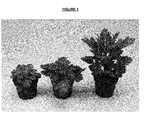
- Figure 1 displays double-type Kalancho ⁇ interspecific hybrid 2006-0199 plants in early generative stage after 6 weeks under short day conditions. Plants labeled from left to right: on the left is a rol transformed line (line 6a); in the middle is an intermediate line (line 3a), and on the right is an untransformed control plant.
- Figure 2 illustrates double-type Kalancho ⁇ interspecific hybrid 2006-0199 plants in generative stage after 12 weeks under short day conditions. Plants labeled from left to right: on the left is a rol transformed line (line 6a); in left middle position is an intermediate line (line 3a1), in the right middle position is an intermediate line (line 3a2) and on the right is an untransformed control plant.
- SEQ ID NO: 2 Agrobacterium rhizogenes trytophan oxygenase (aux1) and hydrolase (aux2) genes, complete cds: M61151.1
Landscapes
- Health & Medical Sciences (AREA)
- Life Sciences & Earth Sciences (AREA)
- Genetics & Genomics (AREA)
- Engineering & Computer Science (AREA)
- Biomedical Technology (AREA)
- Biotechnology (AREA)
- Molecular Biology (AREA)
- Organic Chemistry (AREA)
- Chemical & Material Sciences (AREA)
- Zoology (AREA)
- Wood Science & Technology (AREA)
- Bioinformatics & Cheminformatics (AREA)
- General Engineering & Computer Science (AREA)
- General Health & Medical Sciences (AREA)
- Physics & Mathematics (AREA)
- Biophysics (AREA)
- Microbiology (AREA)
- Biochemistry (AREA)
- Plant Pathology (AREA)
- Cell Biology (AREA)
- Developmental Biology & Embryology (AREA)
- Environmental Sciences (AREA)
- Botany (AREA)
- Physiology (AREA)
- Natural Medicines & Medicinal Plants (AREA)
- Micro-Organisms Or Cultivation Processes Thereof (AREA)
- Breeding Of Plants And Reproduction By Means Of Culturing (AREA)
Abstract
Description
- The present disclosure embraces Kalanchoë interspecific hybrid plants, and considers rol transformation in Kalanchoë species and hybrids.
- Kalanchoë blossfeldiana, and its cultivars, is a horticulturally important plant due to its popularity as both an indoor and outdoor plant. The genus of Kalanchoë belongs to the sedum family (Crassulaceae), and there are more than 100 different species of Kalanchoë, most of which are found in Madagascar and South Africa, and a few in Asia and South America. Kalanchoë are succulent plants, characterized by turgid leaves that enable the plants to survive drought conditions. Consequently, Kalanchoë are useful ornamental plants because they can survive in less than optimal growing conditions.
- Kalanchoë displays an elongated growth habit in nature, which is considered undesirable for the potted plant industry that favors more compact plant architecture for space and transportation purposes. Thus, the industry treats Kalanchoë plants with chemical growth retardants to alter plant shape and size.
- In one aspect, there is provided a species-independent method for transforming a Kalanchoë interspecific hybrid plant, comprising: (a) co-cultivating wild-type A. rhizogenes with a Kalanchoë interspecific hybrid plant, wherein A. rhizogenes transfers one or more rol genes into said plant; (b) selecting a putatively transformed root having a hairy root phenotype; (c) growing the root on a regeneration medium; (d) regenerating a shoot from the root, thereby generating a plantlet, and; (e) growing the plantlet into a mature plant. In one embodiment, the method further comprises assaying the presence of one or more rol genes in the mature plant.
- In another aspect, provided is a method for producing a Kalanchoë interspecific hybrid plant having intermediate compactness, comprising:(a) transforming Kalanchoë plant tissue with A. rhizogenes, wherein A. rhizogenes delivers and integrates one or more rol genes into plant genome; (b) selecting a putatively transformed root having a hairy root phenotype; (c) growing the root on a regeneration medium; (d) regenerating a shoot from the root, thereby generating a plantlet; (e) growing said plantlet into a mature plant, and; (f) selecting a plant having intermediate compactness, wherein intermediate compactness is from about 5% to about 50% of a non-transformed control plant.
- In another aspect, provided is a method for reducing the height of a Kalanchoë interspecific hybrid plant by about 5% to about 60%, compared to a wild-type control plant, comprising: (a) transforming Kalanchoë plant tissue with A. rhizogenes, wherein A. rhizogenes delivers and integrates one or more rol genes into hybrid plant genome; (b) selecting a putatively transformed root having a hairy root phenotype; (c) growing said root on a regeneration medium; (d) regenerating a shoot from said root, thereby generating a plantlet; (e) growing said plantlet into a mature plant, and; (f) selecting a plant having reduced height compared to a non-transformed control plant.
- In another aspect, the disclosure provides a rol-transformed Kalanchoë interspecific hybrid with intermediate height, wherein said intermediate height is about 5% to about 60% of a control, non-transformed Kalanchoë interspecific hybrid plant.
- In another aspect, provided herein is a Kalanchoë interspecific hybrid comprising one or more rol genes. The Kalanchoë interspecific hybrid preferably has a hight which is about 5% to about 60% of a control, non-transformed Kalanchoë interspecific hybrid plant.
- In an other aspect the invention relates to a Kalanchoë interspecific hybrid which is obtainable by one of the methods according to the present invention. Preferably, the interspecific hybrid plant is obtained by one of the methods according to the present invention.
-
-
FIGURE 1 illustrates double-type Kalanchoë interspecific hybrid 2006-0199 plants in early generative stage after 6 weeks under short day conditions. Plants labeled from left to right: on the left is a rol transformed line (line 6a); in the middle is an intermediate line (line 3a), and on the right is an untransformed control plant. -
FIGURE 2 illustrates double-type Kalanchoë interspecific hybrid 2006-0199 plants in generative stage after 12 weeks under short day conditions. Plants labeled from left to right: on the left is a rol transformed line (line 6a); in left middle position is an intermediate line (line 3a1), in the right middle position is an intermediate line (line 3a2) and on the right is an untransformed control plant. -
FIGURE 3 depicts an illustrative A. rhizogenes Ri-plasmid from an agropine strain. The T-DNA contains two segments, TL and TR, which are separated by a 15Kb sequence that is not integrated. The TL-DNA contains 18 open reading frames (ORFs) where the four root loci-genes reside. The TR-DNA contains several genes, including aux1 and aux2. - The present disclosure embodies methodology and means for transforming Kalanchoë species and hybrids with Agrobacterium rhizogenes (A. rhizogenes), as well as employing A. rhizogenes for altering Kalanchoë growth and plant architecture.
- The Ri-plasmid of naturally occurring soil bacterium A. rhizogenes agropine-type strains carry two T-DNA regions (TL-DNA and TR-DNA) on the Ri-plasmid for transfer into plant cells. Following infection of a plant cell, the bacterium transfers the entire T-DNA region (both TL-DNA and TR-DNA), thereby transferring rol (root loci) genes into the plant genome and causing hairy root growth at the site of infection. Tepfer (1984) Cell, 37, pp. 959-967. Because A. rhizogenes naturally infects plants, the rol genes are naturally transferred into the plant and function as plant oncogenes and develop hairy roots in plant tissues.
- The TL-DNA contains four rol genes, ro/A, rolB, rolC, and rolD, whereas the TR-DNA contains several genes, including two auxin genes, aux1 and aux2.
- Here, the present inventors provide species-independent methodology for transforming a Kalanchoë interspecific hybrid with A. rhizogenes, as well as methodology for altering Kalanchoë interspecific hybrid growth and plant architecture. As described below, the present inventors discovered novel phenotypes, such as intermediate plant height and compactness, that can be obtained through rol introduction.
- While any methodology can be used for producing rol-expressing Kalanchoë interspecific hybrids, the present disclosure provides both "natural" and "non-natural" methodology for generating rol-transformed Kalanchoë interspecific hybrids. For example, and as discussed below, Applicants harnessed wild-type A. rhizogenes to transfer its native rol genes into a plant cell. While this is a "natural" system in that A. rhizogenes transfers its native rol genes to plant cells, it is extremely unlikely to occur in nature because interspecific hybrids rarely exist, let alone fertile interspecific hybrids. That is, geographical distribution of Kalanchoë species does not favor the creation of interspecific hybrids, and in the rare instance of their existence, the interspecific hybrids have low fertility and low seed dispersal. Furthermore, compact plants like rol-transformed Kalanchoë face obstacles such as increased risk of fungal infection due to compact leaves forming closed canopy structure, as well as competitiveness from neighboring plants.
- All technical terms used herein are terms commonly used in biochemistry, molecular biology and agriculture, and can be understood by one of ordinary skill in the art. Technical terms can be found in: Molecular Cloning: A Laboratory Manual, 3rd ed., vol. 1-3, ed. Sambrook and Russell, Cold Spring Harbor Laboratory Press, Cold Spring Harbor, N.Y., 2001; Current Protocols in Molecular Biology, ed. Ausubel et al., Greene Publishing Associates and Wiley-Interscience, New York, 1988 (with periodic updates); Short Protocols in Molecular Biology: A Compendium of Methods from Current Protocols in Molecular Biology, 5th ed., vol. 1-2, ed. Ausubel et al., John Wiley & Sons, Inc., 2002; Genome Analysis: A Laboratory Manual, vol. 1-2, ed. Green et al., Cold Spring Harbor Laboratory Press, Cold Spring Harbor, N.Y., 1997. Methodology involving plant biology techniques is described herein and is described in detail in treatises such as Methods in Plant Molecular Biology: A Laboratory Course Manual, ed. Maliga et al., Cold Spring Harbor Laboratory Press, Cold Spring Harbor, N.Y., 1995. Various techniques using PCR are described in Innis et al., PCR Protocols: A Guide to Methods and Applications, Academic Press, San Diego, 1990 and in Dieffenbach and Dveksler, PCR Primer: A Laboratory Manual, 2nd ed., Cold Spring Harbor Laboratory Press, Cold Spring Harbor, N.Y., 2003. PCR-primer pairs can be derived from known sequences by known techniques such as using computer programs intended for that purpose, Primer, Version 0.5, 1991, Whitehead Institute for Biomedical Research, Cambridge, MA. Methods for chemical synthesis of nucleic acids are discussed, for example, in Beaucage and Caruthers, 1981, Tetra. Letts. 22: 1859-1862, and Matteucci and Caruthers, 1981 J. Am. Chem. Soc. 103: 3185. Restriction enzyme digestions, phosphorylations, ligations and transformations were done as described in Sambrook et al., Molecular Cloning: A Laboratory Manual, 2nd ed. (1989), Cold Spring Harbor Laboratory Press. All reagents and materials used for the growth and maintenance of bacterial cells were obtained from Aldrich Chemicals (Milwaukee, WI), DIFCO Laboratories (Detroit, MI), Invitrogen (Gaithersburg, MD), or Sigma Chemical Company (St. Louis, MO), unless otherwise specified.
- "Transformation" refers to any methodology for introducing a rol gene(s) into a host plant cell. Importantly, and because A. rhizogenes naturally infects plants, transformation includes the natural transfer of wild-type rol genes from wild-type bacterium into a plant cell. Thus, and as used herein, transformation neither implies nor requires cloning a heterologous gene into a vector for transfer into a host plant cell. Furthermore, a host plant cell expressing a rol gene(s) may be characterized as "transformed." Transformation may occur by any known method including, for example, natural infection, floral dip, infiltration, or particle bombardment. Transformation of a cell may be detected by any known means, including but not limited to Northern Blot, Southern blot, PCR, and/or RT-PCR.
- The term "tissue culture" refers to plant tissues propagated under sterile conditions, often for producing clones of a plant. Plant tissue culture relies on the fact that many plant cells have the ability to regenerate a whole plant. Single cells, plant cells without cell walls (protoplasts), pieces of leaves, or roots can often be used to generate a new plant on culture media given the required nutrients and plant hormones.
- "Kalanchoë interspecific hybrid" embraces any Kalanchoë plant with an interspecific cross in its background. That is, interspecific hybrids include both the first and subsequent generations of crosses between two Kalanchoë species, as well as the progeny produced from either selfing an interspecific hybrid or crossing an interspecific hybrid with a Kalanchoë of the same or different species.
- A. rhizogenes refers to Agrobacterium rhizogenes and its Ri-plasmid from an agropine strain. The T-DNA contains two segments, TL and TR, which are separated by a 15Kb sequence that is not integrated. The TL-DNA contains 18 open reading frames (ORFs) where the four root loci-genes reside. The TR-DNA contains several genes, including aux1 and aux2.
- "Hairy root phenotype" refers to a plant phenotype indicative of a putative transformed plant. That is, when A. rhizogenes infects a plant cell and transfer one or more rol genes, hairy root growth occurs at the infection site. In this way, a hairy root phenotype offers a marker-free method for indentifying putative transformants.
- "Intermediate height" refers to a quantitative reduction of plant height relative to a wild-type or control plant of the same species. The height of the transformed plant can be decreased from about 5% to about 60%, preferably from 10% to about 50%, even more preferably from 15% to about 50% of the height of a wild type plant.
- "Intermediate compactness" refers to a quantitative reduction of plant compactness relative to a wild-type or control plant of the same species. The compactness of the transformed plant can be increased from about 5% to about 50%, preferably from 10% to about 50%, even more preferably from 15% to about 50% of the height of a wild type plant.
- The term "gene" refers to a nucleic acid (e.g., DNA or RNA) sequence that comprises coding sequences necessary for the production of RNA or a polypeptide. A polypeptide can be encoded by a full-length coding sequence or by any part thereof. The term "parts thereof" when used in reference to a gene refers to fragments of that gene, particularly a fragment encoding at least a portion of a protein. The fragments may range in size from a few nucleotides to the entire gene sequence minus one nucleotide. Thus, "a nucleic acid sequence comprising at least a part of a gene" may comprise fragments of the gene or the entire gene.
- "Gene" also encompasses the coding regions of a structural gene and includes sequences located adjacent to the coding region on both the 5' and 3' ends for a distance of about 1 kb on either end such that the gene corresponds to the length of the full-length mRNA. The sequences which are located 5' of the coding region and which are present on the mRNA are referred to as 5' non-translated (or untranslated) sequences (5' UTR). The sequences which are located 3' or downstream of the coding region and which are present on the mRNA are referred to as 3' non-translated (or untranslated) sequences (3' UTR).
- "Nucleic acid" as used herein refers to RNA or DNA that is linear or branched, single or double stranded, or a hybrid thereof. The term also encompasses RNA/DNA hybrids.
- "Encoding" and "coding" refer to the process by which a gene, through the mechanisms of transcription and translation, provides information to a cell from which a series of amino acids can be assembled into a specific amino acid sequence to produce an active enzyme. Because of the degeneracy of the genetic code, certain base changes in DNA sequence do not change the amino acid sequence of a protein. It is therefore understood that modifications in the DNA sequence encoding transcription factors which do not substantially affect the functional properties of the protein are contemplated.
- The term "expression," as used herein, refers to the production of a functional end-product e.g., an mRNA or a protein.
- The terms "polypeptide," "peptide" and "protein" are used interchangeably herein to refer to a polymer of amino acid residues. The terms apply to amino acid polymers in which one or more amino acid residue is an artificial chemical analog of a corresponding naturally occurring amino acid, as well as to naturally occurring amino acid polymers.
- Probe or primer refers to a short oligonucleotide sequence that could be designed and synthesized, or generated as a fragment of a larger sequence. A probe or primer can be any length, such as 6, 7, 8, 9, 10, 11, 12, 13, 14, 15, 16, 17, 18, 19, 20, 21, 22, 23, 24, 25, 26, 27, 28, 29, 30, 31, 32, 33, 34, 35, 36, 37, 38, 39, 40, 41, 42, 43, 44, 45, 46, 47, 48, 49, 50, 51, 52, 53, 54, 55, 56, 57, 58, 59, or 60 nucleotides in length.
- Illustrative rol sequences include but are not limited to the sequences set forth in SEQ ID NOs: 1-18, respectively, as well as nucleic acid molecules comprised of fragments or variants of SEQ ID NO: 1-18 with one or more bases deleted, substituted, inserted, or added, which variant codes for a polypeptide with rol activity. For example, and in no way limiting, the present disclosure provides SEQ ID NO: 1, as well as various fragments of SEQ ID NO: 1, which could include, for example, rolA-D and aux1-2. For instance, and as readily apparent to one of ordinary skill in the art, the rolA gene could represent a 700 bp portion or fragment of a larger sequence comprising rolA-D and aux1-2.
- A "variant" is a nucleotide or amino acid sequence that deviates from the standard, or given, nucleotide or amino acid sequence of a particular gene or protein. The terms "isoform," "isotype," and "analog" also refer to "variant" forms of a nucleotide or an amino acid sequence. An amino acid sequence that is altered by the addition, removal, or substitution of one or more amino acids, or a change in nucleotide sequence, may be considered a "variant" sequence. The variant may have "conservative" changes, wherein a substituted amino acid has similar structural or chemical properties, e.g., replacement of leucine with isoleucine. A variant may have "nonconservative" changes, e.g., replacement of a glycine with a tryptophan. Analogous minor variations may also include amino acid deletions or insertions, or both. Guidance in determining which amino acid residues may be substituted, inserted, or deleted may be found using computer programs well known in the art such as Vector NTI Suite (InforMax, Md.) software. "Variant" may also refer to a "shuffled gene" such as those described in Maxygen-assigned patents.
- Included in the category of "variant" sequences are sequences that hybridize to a reference rol sequence. For example, two sequences hybridize when they form a double-stranded complex in a hybridization solution of 6x SSC, 0.5% SDS, 5x Denhardt's solution and 100 µg of non-specific carrier DNA. See Ausubel et al., supra, at section 2.9, supplement 27 (1994). Sequences may hybridize at "moderate stringency," which is defined as a temperature of 60.degree. C. in a hybridization solution of 6.times.SSC, 0.5% SDS, 5.times. Denhardt's solution and 100 .mu.g of non-specific carrier DNA. For "high stringency" hybridization, the temperature is increased to 68.degree. C. Following the moderate stringency hybridization reaction, the nucleotides are washed in a solution of 2.times.SSC plus 0.05% SDS for five times at room temperature, with subsequent washes with 0.1.times.SSC plus 0.1 % SDS at 60.degree. C. for 1 hour. For high stringency, the wash temperature is increased to 68.degree. C. One with ordinary skill in the art can readily select such conditions by varying the temperature during the hybridization reaction and washing process, the salt concentration during the hybridization reaction and washing process, and so forth. For present purposes, hybridized nucleotides can be detected using 1 ng of a radiolabeled probe having a specific radioactivity of 10,000 cpm/ng, where the hybridized nucleotides are clearly visible following exposure to X-ray film at -70.degree. C. for no more than 72 hours.
- The present application is directed to such nucleic acid molecules that are at least 60%, 65%, 70%, 75%, 80%, 85%, 90%, 95%, 96%, 97%, 98%, 99% or 100% identical to a nucleic acid sequence described in any of SEQ ID NO: 1-18. Preferred are nucleic acid molecules which are at least 95%, 96%, 97%, 98%, 99% or 100% identical to the nucleic acid sequence shown in any of SEQ ID NO: 1-18. Differences between two nucleic acid sequences may occur at the 5' or 3' terminal positions of the reference nucleotide
- As a practical matter, stating whether any particular nucleic acid molecule is at least 95%, 96%, 97%, 98% or 99% identical to a reference nucleotide sequence implicates a comparison made between two molecules, using algorithms known in the art and can be determined conventionally using publicly available computer programs such as the BLASTN algorithm. See Altschul et al., Nucleic Acids Res. 25: 3389-402 (1997).
- The terms "sequence identity" and "sequence similarity" can be determined by alignment of two peptide or two nucleotide sequences using global or local alignment algorithms. Sequences may then be referred to as "substantially identical" or "essentially similar" when they share at least 70% of sequence identity over their entire length, respectively. Sequence alignments and scores for percentage sequence identity may be determined using computer programs, such as the GCG Wisconsin Package, Version 10.3, available from Accelrys Inc., 9685 Scranton Road, San Diego, Calif. 92121-3752 USA, or EmbossWin version 2.10.0 (using the program "needle"). Alternatively percent similarity or identity may be determined by searching against databases, using algorithm as FASTA, BLAST, etc.
- The present disclosure may contemplate nucleic acid molecules encoding functional proteins. As known in the art, it is understood that such proteins encompass amino acid substitutions, additions, and deletions that do not alter the function of any of the proteins.
- Because many proteins are encoded by gene families, it is expected that other genes could encode proteins with similar functions as the instant polypeptides. These genes can be identified and functionally annotated by sequence comparison. A worker skilled in the art can identify a functionally related protein sequence with the aid of conventional methods such as screening cDNA libraries or genomic libraries with suitable hybridization probes. The skilled artisan knows that paralogous sequences can also be isolated with the aid of (degenerate) oligonucleotides and PCR-based methods.
- As explained above, one or more rol sequences are transferred into a host plant cell. Such transfer can occur through natural means, such as natural infection of plant cell with A. rhizogenes carrying native rol genes. Such natural or native transfer avoids the need for constructs and selection markers.
- However, in another aspect, one or more rol sequences can be incorporated into a nucleic acid construct that is suitable for introduction into a plant cell. Thus, in instance where a native system is not employed, a nucleic acid construct can be used to express rol in a plant cell.
- Exemplary nucleic acid constructs may comprise a base sequence of a minimum length to generate a mRNA and consequently a polypeptide. There is no theoretical upper limit to the base sequence length. The preparation of such constructs is described in more detail below.
- As a source of the nucleic acid sequence for transcription, a suitable cDNA or genomic DNA or synthetic polynucleotide may be used. Methods for the isolation of suitable rol sequences are described, supra. Sequences coding for the whole, or substantially the whole, of the sequence may thus be obtained. Suitable lengths of this DNA sequence may be cut out for use by means of restriction enzymes. When using genomic DNA as the source of a partial base sequence for transcription, it is possible to use either intron or exon regions or a combination of both.
- Recombinant nucleic acid constructs may be made using standard techniques. For example, the nucleic acid sequence for transcription may be obtained by treating a vector containing said sequence with restriction enzymes to cut out the appropriate segment. The nucleic acid sequence for transcription may also be generated by annealing and ligating synthetic oligonucleotides or by using synthetic oligonucleotides in a polymerase chain reaction (PCR) to give suitable restriction sites at each end. The nucleic acid sequence then is cloned into a vector containing suitable regulatory elements, such as upstream promoter and downstream terminator sequences.
- Another aspect concerns a nucleic acid construct wherein a rol sequence is operably linked to one or more regulatory sequences, which drive expression of the rol sequence in certain cell types, organs, or tissues without unduly affecting normal development or plant physiology.
- Of course, and in the context of a natural transformation or natural infection system, native or endogenous regulatory sequences are used, rather than heterologous sequences.
- "Promoter" connotes a region of DNA upstream from the start of transcription that is involved in recognition and binding of RNA polymerase and other proteins to initiate transcription. A "constitutive promoter" is one that is active throughout the life of the plant and under most environmental conditions. Tissue-specific, tissue-preferred, cell type-specific, and inducible promoters constitute the class of "non-constitutive promoters." "Operably linked" refers to a functional linkage between a promoter and a second sequence, where the promoter sequence initiates and mediates transcription of the DNA sequence corresponding to the second sequence. In general, "operably linked" means that the nucleic acid sequences being linked are contiguous.
- Promoters useful for expression of a nucleic acid sequence introduced into a cell may include native or endogenous promoters for natural transformation systems, or constitutive promoters, such as the cauliflower mosaic virus (CaMV) 35S promoter, or tissue-specific, tissue-preferred, cell type-specific, and inducible promoters. For example, by using vascular system-specific, xylem-specific, or xylem-preferred promoters, one can modify rol expression specifically in many tissues such as vascular tissues, especially xylem. The use of a constitutive promoter in general affects enzyme levels and functions in all parts of the plant, while use of a tissue-preferred promoter permits targeting of the modified gene expression to specific plant parts, leading to a more controllable phenotypes.
- A vector may also contain a termination sequence, positioned downstream of a rol sequence, such that transcription of mRNA is terminated, and polyA sequences added. Exemplary of such terminators are native or endogenous terminator sequenes, cauliflower mosaic virus (CaMV) 35S terminator, or the nopaline synthase gene (Tnos) terminator. The expression vector also may contain enhancers, start codons, splicing signal sequences, and targeting sequences.
- Expression vectors may also contain a selection marker by which transformed cells can be identified in culture. The marker may be associated with the heterologous nucleic acid molecule, i.e., the gene operably linked to a promoter. As used herein, the term "marker" refers to a gene encoding a trait or a phenotype that permits the selection of, or the screening for, a plant or cell containing the marker. In plants, for example, the marker gene will encode antibiotic or herbicide resistance. This allows for selection of transformed cells from among cells that are not transformed or transfected.
- Examples of suitable selectable markers include adenosine deaminase, dihydrofolate reductase, hygromycin-B-phosphotransferase, thymidne kinase, xanthine-guanine phospho-ribosyltransferase, glyphosate and glufosinate resistance, and aminoglycoside 3'-O-phosphotranserase (kanamycin, neomycin and G418 resistance). These markers may include resistance to G418, hygromycin, bleomycin, kanamycin, and gentamicin. The construct may also contain the selectable marker gene Bar that confers resistance to herbicidal phosphinothricin analogs like ammonium gluphosinate. Thompson et al., EMBO J. 9: 2519-23 (1987). Other suitable selection markers are known as well.
- Visible markers such as green florescent protein (GFP) may be used. Methods for identifying or selecting transformed plants based on the control of cell division have also been described. See
WO 2000/052168 andWO 2001/059086 . Likewise, the presence of a distinguishing phenotype, such as tumor or hairy root growth, may also be used for identification and selection. - In a natural transformation or natural infection system, a selection marker is not employed. Because infection provides its own distinct and natural phenotype, a transformed cell can be selected based on a post-infection phenotype, such as hairy root phenotype.
- Replication sequences, of bacterial or viral origin, may also be included to allow the vector to be cloned in a bacterial or phage host. Preferably, a broad host range prokaryotic origin of replication is used. A selectable marker for bacteria may be included to allow selection of bacterial cells bearing the desired construct. Suitable prokaryotic selectable markers also include resistance to antibiotics such as kanamycin or tetracycline.
- Other nucleic acid sequences encoding additional functions may also be present in the vector, as is known in the art. For instance, when Agrobacterium is the host, T-DNA sequences may be included to facilitate the subsequent transfer to and incorporation into plant chromosomes.
- As used herein, "interspecific hybrid" includes the progeny from the cross of two different species of Kalanchoë and its cultivars, as well as progeny resulting from subsequent backcrossing to one of the parents. This backcrossing to one of the parents may be conducted one or more times with the goal of stably combining the double-type trait with desired characteristics.
- K. blossfeldiana can be crossed with numerous other Kalanchoë species to combine advantageous characteristics into unique new cultivars. Among the numerous interspecific hybrids that may be created are K. blossfeldiana X K. laciniata, K. blossfeldiana X K. rotundifolia, K. blossfeldiana X K. aromatica, K. blossfeldiana X K. pubescens, K. blossfeldiana X K. grandiflora, K. blossfeldiana X K. citrina, K. blossfeldiana X K. ambolensis, K. blossfeldiana X K. faustii, K. blossfeldiana X K. schumacherii, K. blossfeldiana X K. pritwitzii, K. blossfeldiana X K. flammea, K. blossfeldiana X K. figueredoi, K. blossfeldiana X K. rauhii, K. blossfeldiana X K. obtusa, K. blossfeldiana X K. pumila, K. blossfeldiana X K. marmorata, K. blossfeldiana X K. porphyrocalux, K. blossfeldiana X K. jongmansii, K. blossfeldiana X K. pinnata, K. blossfeldiana X K. daigremontiana, K. blossfeldiana X K. gracilipes, K. blossfeldiana X K. campanulata, K. blossfeldiana X K. latisepela, K. blossfeldiana X K. coccinea, K. blossfeldiana X K. fedtschenkoi, K. blossfeldiana X K. tubiflora, K. blossfeldiana X K. decumbens, K. blossfeldiana X K. manginii, K. blossfeldiana X K. orgyalis, K. blossfeldiana X K. crenata and K. blossfeldiana X K. tomentosa.
- As a first step in making interspecific hybrids, a single or double-type Kalanchoë plant selection is crossed with a single-type Kalanchoë selection from another species. Progeny are screened for fertile selections. Large numbers of progeny may have to be screened to identify fertile selections. The fertile selections may be screened for those exhibiting the double-type flower trait if one of the parents was a double-type selection. Alternatively, the single-type fertile interspecific hybrid is crossed, either as the male or female parent, with a double-type Kalanchoë selection. A double-type hybrid progeny plant with desirable phenotypic characteristics is propagated asexually by conventional methods to determine if the phenotypic characteristics are stable.
- For example, a K. blossfeldiana (tetraploid) x K. laciniata (diploid) interspecific hybrid is by nature triploid and thus sterile. K. blossfeldiana times K. laciniata interspecific hybrid progeny plants were screened and 'Yellow African', described in
U.S. Plant Patent No. 12,299 , was identified. This fertile K. blossfeldiana X K. laciniata interspecific hybrid has been used to breed a series of interspecific hybrid cultivars designated African Treasures™. One such cultivar was designated 'KJ 2000 0716' and is described in pendingU.S. plant patent application Ser. No. 10/654,571 . - 'KJ 2000 0716' was identified in the progeny originating from a cross between 'Yellow African' and a single-type K. blossfeldiana. Three new double-flowered Kalanchoë interspecific hybrids originated from crosses between 'KJ 2000 0716' as the female parent, and 'Monroe' as male double-type K. blossfeldiana parent. 'Monroe' is described in
U.S. Plant Pat. No. 14,714 . - Recurrent selection is used to increase the number of petals per flower found in the instant Kalanchoë interspecific hybrid plants. A double-type Kalanchoë interspecific hybrid plant is selfed, or crossed to another double-type Kalanchoë plant, and the progeny screened for plants with double-type flowers with an increased number of petals per flower compared to the double-type parents.
- Similar methods as employed for double-type Kalanchoë selection are used for recurrent selection to optimize compactness found in the instant rol-transformed Kalanchoë interspecific hybrid plants. A rol-transformed Kalanchoë interspecific hybrid plant is selfed, or crossed to another Kalanchoë plant, and the progeny screened for compactness compared to the rol-transformed parent.
- As explained above, transformation" refers to any methodology for introducing a rol gene(s) into a host plant or plant cell. Importantly, and because A. rhizogenes naturally infects plants, transformation embraces transferring wild-type rol genes from wild-type bacterium into a plant cell. Thus, and as used herein, transformation does not require cloning a heterologous gene into a vector for transfer into a host plant cell, nor does transformation require genetically engineering the bacterium.
- "Transformed plant" refers to a plant that comprises a nucleic acid sequence that also is present per se in another organism or species, or that is optimized, relative to host codon usage, from another organism or species. Both monocotyledonous and dicotyledonous angiosperm or gymnosperm plant cells may be transformed in various ways known to the art. For example, see Klein et al., Biotechnology 4: 583-590 (1993); Bechtold et al., C. R. Acad. Sci. Paris 316: 1194-1199 (1993); Bent et al., Mol. Gen. Genet. 204: 383-396 (1986); Paszowski et al., EMBO J. 3: 2717-2722 (1984); Sagi et al., Plant Cell Rep. 13: 262-266 (1994). Agrobacterium species such as A. tumefaciens and A. rhizogenes can be used, for example, in accordance with Nagel et al., Microbiol Lett 67: 325 (1990). Additionally, plants may be transformed by Rhizobium, Sinorhizobium or Mesorhizobium transformation. Broothaerts et al., Nature 433: 629-633 (2005).
- For example, Agrobacterium may be transformed with a plant expression vector via, e.g., electroporation, after which the Agrobacterium is introduced to plant cells via, e.g., the well known leaf-disk method. Additional methods for accomplishing this include, but are not limited to, electroporation, particle gun bombardment, calcium phosphate precipitation, and polyethylene glycol fusion, transfer into germinating pollen grains, direct transformation, Lorz et al., Mol. Genet. 199: 179-182 (1985), and other methods known to the art. If a selection marker, such as kanamycin resistance, is employed, it makes it easier to determine which cells have been successfully transformed. Marker genes may be included within pairs of recombination sites recognized by specific recombinases such as cre or flp to facilitate removal of the marker after selection. See
U.S. published application No. 2004/0143874 . - Transgenic plants without marker genes may be produced using a second plasmid comprising a nucleic acid encoding the marker, distinct from a first plasmid that comprises a rol sequence. The first and second plasmids or portions thereof are introduced into the same plant cell, such that the selectable marker gene that is transiently expressed, transformed plant cells are identified, and transformed plants are obtained in which the rol sequence is stably integrated into the genome and the selectable marker gene is not stably integrated. See
U.S. published application No. 2003/0221213 . - The Agrobacterium transformation methods discussed above are known for transforming dicots. Additionally, de la Pena et al., Nature 325: 274-276 (1987), Rhodes et al., Science 240: 204-207 (1988), and Shimamato et al., Nature 328: 274-276 (1989) have transformed cereal monocots using Agrobacterium. Also see Bechtold et al., C.R. Acad. Sci. Paris 316 (1994), illustrating vacuum infiltration for Agrobacterium-mediated transformation.
- Plant cells may be transformed with a nucleic acid or nucleic acid construct without the use of a selectable or visible marker, and transgenic organisms may be identified by detecting the presence of the introduced sequence or construct. The presence of a protein, polypeptide, or nucleic acid molecule in a particular cell can be measured to determine if, for example, a cell has been successfully transformed or transfected. For example, and as routine in the art, the presence of the introduced construct can be detected by PCR or other suitable methods for detecting a specific nucleic acid or polypeptide sequence. Additionally, transformed cells may be identified by recognizing differences in the growth rate or a morphological feature of a transformed cell compared to the growth rate or a morphological feature of a non-transformed cell that is cultured under similar conditions. See
WO 2004/076625 . - Methods of regenerating a plant from a transformed cell or culture vary according to the plant species but are based on known methodology. For example, methods for regenerating Kalanchoë plants are well-known in the art can be found in Christensen, B., Sriskandarajah, S., Serek, M., Müller, R., 2008. Transformation of Kalanchoe blossfeldiana with rol-genes is useful in molecular breeding towards compact growth. Plant Cell Rep. 27, 1485-1495.
- The instant Kalanchoë plants described herein were grown in a greenhouse at 64.4 degree F. during the day and 68 degree F. during the night. The plants were produced in pots with a diameter of 10.5 cm or 13 cm. Cuttings were grown under long-day conditions (16 hours light, 8 hours night) during the first 3-8 weeks following planting, depending on cultivar and pot size. Between 4-9 weeks after planting, the plants were transferred to short-day conditions (10 hour light and 14 hour dark). The flowering is induced by short-day conditions. Between 13-19 weeks after planting, depending on cultivar, pot size, and time of year, the plants were mature with flowers that were opening or about to open.
- The plants were grown under natural light conditions supplemented with 70 . µmol photons m-2 s-1 SON-T light when the natural light was less than 100 .mu.mol/m2/s. Plants were grown in a peat based soil mix and were watered with a solution containing 200 parts per million (ppm) nitrogen, 200 ppm potassium, 40 ppm phosphorous, 200 ppm calcium, 40 ppm magnesium, 60 ppm sulphate, 1 ppm iron, 0.6 ppm manganese, 0.1 ppm copper, 0.1 ppm zinc, 0.3 ppm borium, 0.03 ppm molybdenum.
- The present rol-transformed plants are selected that contain and express one or more rol genes relative to a control, non-transformed plant of the same species. Additionally, the instant plants may have an altered phenotype relative to a non-transformed control plant. Such phenotype may include an intermediate height or intermediate compactness, wherein the transformed plant has a reduced height and/or compactness relative to the control plant.
- The phrase "intermediate height" refers to a quantitative reduction of plant height relative to a wild-type or control plant of the same species. The height of the transformed plant can be decreased from about 5% to about 60%, preferably from 10% to about 50%, even more preferably from 15% to about 50% of the height of a wild type plant.
- The phrase "intermediate compactness" refers to a quantitative reduction of plant compactness relative to a wild-type or control plant of the same species. The compactness of the transformed plant can be increased from about 5% to about 50%, preferably from 10% to about 40%, even more preferably from 15% to about 50% of the height of a wild type plant.
- The following examples are illustrative and do not limit the present application. Of course, it is understood that many variations and modifications can be made while remaining within the intended spirit and scope.
- In vivo plants of Kalanchoë grandiflora and the F1-hybrid 2009-0347 (referred to as 0347) and established in vitro culture plants of K. blossfeldiana 'Molly', and K. grandiflora, and the F1-hybrid 2006-0199 (referred to as 0199), (Knud Jepsen A/S, Hinnerup, Denmark and KU-LIFE, Crop Sciences, Tåstrup). In vivo plants were cultivated in a greenhouse with temperatures of 20°C at day and night, 16 hour day length and a light intensity of 260 µmol photons m-2 s-1. In vitro plants were cultivated in growth chamber with temperatures of 25°C at day and 22°C at night, 13 hour day length and a light intensity of 75 µmol photons m-2 s-1. The two F1-hybrids are closely related since 0199 is the paternal part of the crossing to produce 0347.
- 36, 104, 166, 158 and 128 leaf explants were used for transformation of K. blossfeldiana 'Molly', 2006-0199, 2009-0347, K. grandiflora and K. grandiflora, respectively. 25 leaf explants for each species/hybrid were used for control experiment. Leaves derived from in vivo material were sterilised in 70% EtOH for 1 min. followed by 20 min. in 1% NaOCl (VWR, Copenhagen, Denmark) and 0,03% (v/v) Tween 20 (Merck, La Jolla, USA) and washed 3 times in sterile water and were stored until excision.
- Agrobacterium rhizogenes strain ATCC43057 (A4) (kindly provided by Dr. David Tepfer, Biologie de la Rhizosphère, INRA, Versailles, France) was used for induction of hairy roots. The strain was cultured in liquid MYA medium (Tepfer and Cassedelbart (1987) Microbiol Sci. 4, pp. 24-28. 1mL of the bacterial glycerol stock (kept at -80°C) was diluted in 10mL MYA in a 50mL Falcon tube and incubated for 8h at 27°C and shaken at 260 rpm. The solution was further diluted with 100mL MYA in a 250mL flask and shaken at 260 rpm for 24h in darkness at 27°C. The OD600 = 0,4-0,6 was measured on Nanodrop 1000 (Thermo Scientific, Wilmington, DE, USA).
- Sterilized leaves or in vitro plant were excised to pieces of min 1 cm x 1 cm and stored in sterile water until all explants were ready. The water was discarded from the explants and A. rhizogenes-suspension was added to cover all explants for 30 min. After 30 min. the A. rhizogenes-suspension was discarded and the slices were transferred, with a thin layer of the A. rhizogenes suspension on the surface, to co-cultivation plates for 24 h in darkness without selection. The explants were cultivated in the lab at temperatures at 22°C in darkness. After co-cultivation the explants were transferred to 0-media (selection media) by drying the explants with pieces of ripped sterile filter paper. The leaf surface was as dry as possible on both sides of the excised leaf. The explants stayed dark until roots were developed enough to be transferred to regeneration media. The material was transformed over three sessions. Firstly transformation was conducted with K. blossfeldiana 'Molly' and K. gracilipes, secondly; 0347 and K. grandiflora and finally with 0199. For each species/hybrid the controls and putative transformants was performed the same day.
- The basic medium used as background of all media used was ½ x MS (Sigma M0404) (consisting of Murashige and Skoog macro- and microelements) (Murashige and Skoog, 1962) at a concentration of 2,2 g L-1, 30 g L-1 sucrose (table sugar), 7g L-1 bacto agar and 0,50 g L-1 2-(N-morpholino)-ethanesulphonic acid (MES) (Duchefa). The pH was adjusted to 6.3 by 1 M KOH and the media was autoclaved at 121°C and 103,5kPa.
- Co-cultivation medium used for co-cultivation between explant and A. rhizogenes consisted of basic medium with 30 µg mL-1 acetosyringone (Sigma-Aldrich, Steinheim, Germany).
- Selection medium was a hormone-free medium used for root formation of putatively transformed explants and controls. Filter-sterilized antibiotics were added after autoclaving to the selection media to the basic medium. Selection media consist of basic media ½ x MS medium with timentin (TIM) in the concentration of 100mg L-1. Preferably, the selection medium contains arginine, preferably 0.5 mM arginine.
- Regeneration medium containing the hormone N-(2-chloro-4-pyridyl)-N-phenylurea (CPPU) was used for regeneration of nodules on the putatively transformed root clusters. Filter-sterilised hormones and antibiotics were added after autoclaving to the regeneration media. The CPPU-medium contained basic ½ x MS medium with 1.5µg L-1 CPPU together with TIM in the concentration 100mg L-1.
- In all treatments the explants were co-cultivated for 24 hours. After co-cultivation, the explants were blotted onto sterile filter paper and thoroughly dried with ripped pieces of sterilised filter paper. Controls and putatively transformed explants were transferred to selection medium.
- After 24 hours of co-cultivation the explants were transferred to 0-media (selection medium) with 8 explants on each Petri dish, with a number total number of Petri dishes of 5, 13, 21, 20 and 16 for 'Molly', 2006-0199, 2009-0347, K. grandiflora and K. gracilipes, respectively. The increasing number of roots and decreasing number of explants (due to vitrification - the leaf sections became glass like or because of infections) were monitored for the specific Petri dish in the treatment.
- When the roots of putatively transformed explants had developed to a length of 1.5-2 cm they were transferred in clusters, with a part of the explant to CPPU-medium. The transferred root clusters were placed in a climate chamber (Celltherm, United Kingdom) on shelves with 11h daylight and day/night temperatures of 20/18°C and an intensity of 45-70µmol photons m-2s-1 (Philips, Amsterdam, The Netherlands). Only root clusters with A. rhizogenes treated explants was transferred. Here the number of root clusters was monitored as well as the number of nodules developing from the roots. Counting of nodule development was stopped when no positive development was observed after 30 days for any of the five species/hybrids. Nodules from K. gracilipes were observed losing colour and vigour. An attempt to stop this negative development was made by the addition of 0,1 µg/ml Auxin (NAA). Result is still unknown.
- Control plants were treated like transformants but inoculated in MYA medium without bacteria and with a lower number of explants-25 per cultivar. The control experiment plants were conducted in parallel with the transformants.
- DNA was isolated with DNeasy Plant Mini Kit (Qiagen, Hilden, Germany) from root clusters (and nodules) on regeneration medium. Half of a root cluster was harvested for DNA extraction from each of the five species/ hybrids. The concentration was measured on NanoDrop 1000 (Thermo Scientific, Wilmington, DE, USA). Concentrations was measured to 5.10 ng/µl, 2.34 ng/µl, 4.34 ng/µl, 0.52 ng/µl and 2.06 ng/µl for 0199, 0347, K. grandiflora, K. gracilipes and K. blossfeldiana 'Molly', respectively. Since the concentration for K. gracilipes was too low this was not used for the PCR. PCR on DNA was preformed with a concentration of 15ng with the three specific primers (see Table 1 below) to amplify the rolB gene on the TL-DNA and KdActin and VirD2 as controls. Dimethyl sulfoxide (DMSO) was added to the PCR reaction to obtain a better unfolding of the DNA. The following temperature program was applied for amplification in the DNA thermal cycler (MyCycler, Biorad, Hercules, California, USA): 95°C for 10 min. (initial denaturation) followed by 40 cycles 95°C for 30 sec. (denaturation), 58°C for 30 sec. (annealing) and 72°C for 15 sec. (elongation), with a final 7 min. elongation at 72°C. The amplified fragments sequences were mixed with orange G (Sigma-Aldrich, SteinHeim, Germany) (40% sucrose (w/v) and 1.5% Orange G (w/v) and Gelred (Biotium, Hayward, CA, USA) and fractionated in 1% TAE agarose gel.
Table 1: Primer Sequences SEQ ID NOS 9-18, respectively, in order of appearance (Lütken et al.,Euphytica DOI 10.1007/s10681-012-0701-5.) Gene Primer sequence Product size (bp) rolA 5'-CCAATCTGAGCACCACTCCT-3' 153 5'-AATCCCGTAGGTTTGTTTCG-3' rolB 5'-GATATCCCGAGGGCATTTTT-3' 182 5'-GAATGCTTCATCGCCATTTT-3' rolC 5'-CAATAGAGGGCTCAGGCAAG-3' 202 5'-CCTCACCAACTCACCAGGTT-3' rolD 5'-GCGAAGTGGATGTCTTTGG-3' 225 5'-TTGCGAGGTACACTGGACTGA-3' KdActin* 5'-GCAGGACGTGATCTGACTGA-3' 168 5'GACGGACGAGCTACTCTTGG-3' - K. blossfeldiana 'Molly', 0199, 0347, K. grandiflora and K. grandiflora, had a total number of petri dishes of 5, 13, 21, 20 and 16, and a total number of explants of 36, 104, 166, 158, respectively, K. blossfeldiana 'Molly' functioned as a reference of the transformation. Similarly, control explants had five replicates but 5 explants per species/hybrids with a total of 25 per species/hybrids. Since the explants may be taken out of the experiment because of infection, the number of explants changed over time. The total number of explants was therefore monitored to obtain a better ratio between number of explants and formation of roots. The number of roots was monitored as the number increased. The average of surviving explants per petri dish and the average of roots per petri dish were calculated. The two averages were used to calculate a ratio for each petri dish to describe the number of roots per explants.
- Vmax (root development/days) was modeled with a linear regression and using the slope. The calculations were performed in Excel. Standard deviations (SD) and students t-test (t-test) were calculated for each observation to verify variation within the individual species/hybrids. SD and t-test was calculated in Excel. ANOVA test was performed with R.
- The experiments involved a natural transformation with Agrobacterium rhizogenes to study the transformation efficiency for different species and hybrids and for plain material from in vivo and in vitro. Two species; K. gracilipes and K. grandiflora and two hybrids; 2006-0199 and 2009-0347 was transformed with the conditions that was found optimal for K. blossfeldiana 'Molly' by Christensen et al., (2008). K. blossfeldiana 'Molly' was used as a control within the transformants since the cultivar formed background of the transformation system.
- Root induction and growth were monitored as a total number of roots per petri dish in each treatment. Since some explants were removed due to infection the total number of explants over time was also monitored. This was done to obtain a more unbiased assessment when calculating the number of roots per explant in each plant line.
- Roots from K. blossfeldiana 'Molly' and K. gracilipes had a later time to first transfer to regeneration medium (88 and 77 days, respectively) compared to 0199, 0347 and K. grandiflora (45, 38 and 38 days, respectively). At the time of the first time of transfer to regeneration medium putative transformants from 0199, K. grandiflora, K. gracilipes and K. blossfeldiana 'Molly' were significantly different from control. Only 0347 was not significantly different at the time of first transfer of root clusters, though data show that this changed after 45 days on selection medium (data not shown).
- K. gracilipes developed roots fastest (16 days from transfer from co-cultivation medium to selection medium) followed by K. grandiflora and 0199 (both 17 days after transfer) and K. blossfeldiana 'Molly' (18 days after transfer) and finally 0347 (24 days after transfer).
- At the first day of transfer to regeneration medium, K. blossfeldiana 'Molly' had the highest number of roots per explant (19.4 roots per explant in average), hereafter 0199 (8.5 roots per explant in average) and K. grandiflora (3.1 roots per explant in average) and finally 0347 and K. gracilipes (both 2.4 roots per explant in average).
-
Figure 1 displays double-type Kalanchoë interspecific hybrid 2006-0199 plants in early generative stage after 6 weeks under short day conditions. Plants labeled from left to right: on the left is a rol transformed line (line 6a); in the middle is an intermediate line (line 3a), and on the right is an untransformed control plant. -
Figure 2 illustrates double-type Kalanchoë interspecific hybrid 2006-0199 plants in generative stage after 12 weeks under short day conditions. Plants labeled from left to right: on the left is a rol transformed line (line 6a); in left middle position is an intermediate line (line 3a1), in the right middle position is an intermediate line (line 3a2) and on the right is an untransformed control plant. - SEQ ID NO: 1 Integrated Ri plasmid agropine (A. rhizogenes strain A4) complete TL-DNA: Partial sequence of K03313.1 follow below




- SEQ ID NO: 2: Agrobacterium rhizogenes trytophan oxygenase (aux1) and hydrolase (aux2) genes, complete cds: M61151.1




Claims (8)
- A rol-transformed Kalanchoë interspecific hybrid with intermediate height, wherein said intermediate height is about 5% to about 60% of a control, non-transformed Kalanchoë interspecific hybrid plant.
- A Kalanchoë interspecific hybrid comprising one or more rol genes.
- The Kalanchoë interspecific hybrid according to claim 2 with intermediate height, wherein said intermediate height is about 5% to about 60% of a control, non-transformed Kalanchoë interspecific hybrid plant.
- A species-independent method for transforming a Kalanchoë interspecific hybrid plant, comprising:(a) co-cultivating wild-type A. rhizogenes with a Kalanchoë interspecific hybrid plant, wherein A. rhizogenes transfers one or more rol genes into said plant;(b) selecting a putatively transformed root having a hairy root phenotype;(c) growing said root on a regeneration medium;(d) regenerating a shoot from said root, thereby generating a plantlet, and;(e) growing said plantlet into a mature plant.
- The method of claim 4, further comprising assaying the presence of one or more rol genes in said mature plant.
- A method for producing a Kalanchoë interspecific hybrid plant having intermediate compactness, comprising:(a) transforming Kalanchoë plant tissue with A. rhizogenes, wherein A. rhizogenes delivers and integrates one or more rol genes into plant genome;(b) selecting a putatively transformed root having a hairy root phenotype;(c) growing said root on a regeneration medium;(d) regenerating a shoot from said root, thereby generating a plantlet; and(e) growing said plantlet into a mature plant, and;(f) selecting a plant having intermediate compactness, wherein said intermediate compactness is from about 5% to about 50% of a non-transformed control plant.
- A method for reducing the height of a Kalanchoë interspecific hybrid plant by about 5% to about 60%, compared to a wild-type control plant, comprising:(a) transforming Kalanchoë plant tissue with A. rhizogenes, wherein A. rhizogenes delivers and integrates one or more rol genes into hybrid plant genome;(b) selecting a putatively transformed root having a hairy root phenotype;(c) growing said root on a regeneration medium;(d) regenerating a shoot from said root, thereby generating a plantlet; and(e) growing said plantlet into a mature plant, and;(f) selecting a plant having reduced height compared to a non-transformed control plant.
- A Kalanchoë interspecific hybrid obtainable according to one of the methods according to 4-7.
Applications Claiming Priority (1)
| Application Number | Priority Date | Filing Date | Title |
|---|---|---|---|
| US13/588,668 US9253952B2 (en) | 2012-08-17 | 2012-08-17 | Agrobacterium rhizogenes transformation and expression of rol genes in Kalanchoë |
Publications (2)
| Publication Number | Publication Date |
|---|---|
| EP2698432A1 true EP2698432A1 (en) | 2014-02-19 |
| EP2698432B1 EP2698432B1 (en) | 2017-01-04 |
Family
ID=48986032
Family Applications (1)
| Application Number | Title | Priority Date | Filing Date |
|---|---|---|---|
| EP13180898.2A Active EP2698432B1 (en) | 2012-08-17 | 2013-08-19 | Agrobacterium rhizogenes transformation and expression of rol genes in Kalanchoë |
Country Status (3)
| Country | Link |
|---|---|
| US (2) | US9253952B2 (en) |
| EP (1) | EP2698432B1 (en) |
| DK (1) | DK2698432T3 (en) |
Cited By (5)
| Publication number | Priority date | Publication date | Assignee | Title |
|---|---|---|---|---|
| NL2012284C2 (en) * | 2014-02-18 | 2015-08-25 | Knud Jepsen As | Transformed plants. |
| CN105063086A (en) * | 2015-08-21 | 2015-11-18 | 中国科学院华南植物园 | Molecular breeding method fast obtaining large number of transgenosis sedum lineare new species |
| WO2017029214A1 (en) * | 2015-08-14 | 2017-02-23 | A/S Knud Jepsen | Plants comprising a low copy number of ri genes |
| NL2015312B1 (en) * | 2015-08-17 | 2017-03-07 | As Knud Jepsen | Plants comprising a low copy number of Ri genes. |
| WO2018001870A1 (en) | 2016-06-27 | 2018-01-04 | Dümmen Group B.V. | Ornamental plant displaying compacted plant growth |
Families Citing this family (1)
| Publication number | Priority date | Publication date | Assignee | Title |
|---|---|---|---|---|
| US9253952B2 (en) * | 2012-08-17 | 2016-02-09 | University Of Copenhagen | Agrobacterium rhizogenes transformation and expression of rol genes in Kalanchoë |
Citations (8)
| Publication number | Priority date | Publication date | Assignee | Title |
|---|---|---|---|---|
| WO2000052168A1 (en) | 1999-02-26 | 2000-09-08 | Cropdesign N.V. | Method of selecting transformed cells and tissues |
| WO2001059086A2 (en) | 2000-02-08 | 2001-08-16 | Sakata Seed Corporation | Methods and constructs for agrobacterium-mediated plant transformation |
| USPP12299P2 (en) | 2001-03-31 | 2001-12-25 | Knud Jepsen A/S | Kalanchoe plant named ‘Yellow African’ |
| US20030221213A1 (en) | 2002-02-20 | 2003-11-27 | J.R. Simplot Company | Precise breeding |
| USPP14714P2 (en) | 2003-04-23 | 2004-04-20 | Fides Goldstock Breeding B.V. | Kalanchoe plant named ‘Monroe’ |
| US20040143874A1 (en) | 1999-11-12 | 2004-07-22 | The Rockefeller University | Inducible site-specific recombination for the activation and removal of transgenes in transgenic plants |
| WO2004076625A2 (en) | 2003-02-21 | 2004-09-10 | Vector Tobacco Ltd. | Method of identifying plant cells transformed with a gene |
| EP1671536A1 (en) * | 2004-12-15 | 2006-06-21 | Knud Jepsen A/S | Double-type kalanchoe interspecific hybrids |
Family Cites Families (2)
| Publication number | Priority date | Publication date | Assignee | Title |
|---|---|---|---|---|
| USPP15509P2 (en) | 2003-09-02 | 2005-02-01 | Knud Jepsen, A.S. | Kalanchoe plant named ‘2000-0716’ |
| US9253952B2 (en) * | 2012-08-17 | 2016-02-09 | University Of Copenhagen | Agrobacterium rhizogenes transformation and expression of rol genes in Kalanchoë |
-
2012
- 2012-08-17 US US13/588,668 patent/US9253952B2/en active Active
-
2013
- 2013-08-19 DK DK13180898.2T patent/DK2698432T3/en active
- 2013-08-19 EP EP13180898.2A patent/EP2698432B1/en active Active
-
2015
- 2015-10-05 US US14/875,275 patent/US10329573B2/en active Active
Patent Citations (8)
| Publication number | Priority date | Publication date | Assignee | Title |
|---|---|---|---|---|
| WO2000052168A1 (en) | 1999-02-26 | 2000-09-08 | Cropdesign N.V. | Method of selecting transformed cells and tissues |
| US20040143874A1 (en) | 1999-11-12 | 2004-07-22 | The Rockefeller University | Inducible site-specific recombination for the activation and removal of transgenes in transgenic plants |
| WO2001059086A2 (en) | 2000-02-08 | 2001-08-16 | Sakata Seed Corporation | Methods and constructs for agrobacterium-mediated plant transformation |
| USPP12299P2 (en) | 2001-03-31 | 2001-12-25 | Knud Jepsen A/S | Kalanchoe plant named ‘Yellow African’ |
| US20030221213A1 (en) | 2002-02-20 | 2003-11-27 | J.R. Simplot Company | Precise breeding |
| WO2004076625A2 (en) | 2003-02-21 | 2004-09-10 | Vector Tobacco Ltd. | Method of identifying plant cells transformed with a gene |
| USPP14714P2 (en) | 2003-04-23 | 2004-04-20 | Fides Goldstock Breeding B.V. | Kalanchoe plant named ‘Monroe’ |
| EP1671536A1 (en) * | 2004-12-15 | 2006-06-21 | Knud Jepsen A/S | Double-type kalanchoe interspecific hybrids |
Non-Patent Citations (29)
| Title |
|---|
| ALTSCHUL ET AL., NUCLEIC ACIDS RES., vol. 25, 1997, pages 3389 - 402 |
| AUSUBEL ET AL.,: "Current Protocols in Molecular Biology", 1988, GREENE PUBLISHING ASSOCIATES AND WILEY-INTERSCIENCE |
| AUSUBEL ET AL.,: "Short Protocols in Molecular Biology: A Compendium of Methods from Current Protocols in Molecular Biology, 5th ed.,", vol. 1-2, 2002, JOHN WILEY & SONS, INC. |
| BEAUCAGE; CARUTHERS, TETRA. LETTS., vol. 22, 1981, pages 1859 - 1862 |
| BECHTOLD ET AL., C. R. ACAD. SCI. PARIS, vol. 316, 1993, pages 1194 - 1199 |
| BECHTOLD ET AL., C.R. ACAD. SCI. PARIS, 1994, pages 316 |
| BENT ET AL., MOL. GEN. GENET., vol. 204, 1986, pages 383 - 396 |
| BROOTHAERTS ET AL., NATURE, vol. 433, 2005, pages 629 - 633 |
| CHRISTENSEN AND R MÜLLER B: "The Use of Agrobacterium rhizogenes and its rol-Genes for Quality Improvement in Ornamentals", EUROPEAN JOURNAL OF HORTICULTURAL SCIENCE, VERLAG EUGEN ULMER, STUTTGART, DE, vol. 74, no. 6, 1 January 2009 (2009-01-01), pages 275 - 287, XP007922284, ISSN: 1611-4426 * |
| CHRISTENSEN, B.; SRISKANDARAJAH, S.; SEREK, M.; MUIIER, R.: "Transformation of Kalanchoe blossfeldiana with rol-genes is useful in molecular breeding towards compact growth", PLANT CELL REP., vol. 27, 2008, pages 1485 - 1495, XP019626152 |
| DE LA PENA ET AL., NATURE, vol. 325, 1987, pages 274 - 276 |
| DIEFFENBACH; DVEKSLER: "PCR Primer: A Laboratory Manual, 2nd ed.,", 2003, COLD SPRING HARBOR LABORATORY PRESS |
| GREEN ET AL.,: "Genome Analysis: A Laboratory Manual", vol. 1-2, 1997, COLD SPRING HARBOR LABORATORY PRESS |
| HENRIK LÜTKEN ET AL: "Inheritance of-genes fromthrough two generations in", EUPHYTICA, KLUWER ACADEMIC PUBLISHERS, DO, vol. 188, no. 3, 29 April 2012 (2012-04-29), pages 397 - 407, XP035140328, ISSN: 1573-5060, DOI: 10.1007/S10681-012-0701-5 * |
| INNIS ET AL.: "PCR Protocols: A Guide to Methods and Applications", 1990, ACADEMIC PRESS |
| KLEIN ET AL., BIOTECHNOLOGY, vol. 4, 1993, pages 583 - 590 |
| LORZ ET AL., MOL. GENET., vol. 199, 1985, pages 179 - 182 |
| MALIGA ET AL.,: "Methods in Plant Molecular Biology: A Laboratory Course Manual", 1995, COLD SPRING HARBOR LABORATORY PRESS |
| MATTEUCCI; CARUTHERS, J. AM. CHEM. SOC., vol. 103, 1981, pages 3185 |
| NAGEL ET AL., MICROBIOL LETT, vol. 67, 1990, pages 325 |
| PASZOWSKI ET AL., EMBO J., vol. 3, 1984, pages 2717 - 2722 |
| RHODES ET AL., SCIENCE, vol. 240, 1988, pages 204 - 207 |
| SAGI ET AL., PLANT CELL REP., vol. 13, 1994, pages 262 - 266 |
| SAMBROOK AND RUSSELL,: "Molecular Cloning: A Laboratory Manual, 3rd ed.,", vol. 1-3, 2001, COLD SPRING HARBOR LABORATORY PRESS |
| SAMBROOK ET AL.: "Molecular Cloning: A Laboratory Manual, 2nd ed.", 1989, COLD SPRING HARBOR LABORATORY PRESS |
| SHIMAMATO ET AL., NATURE, vol. 328, 1989, pages 274 - 276 |
| TEPFER, CELL, vol. 37, 1984, pages 959 - 967 |
| TEPFER; CASSEDELBART, MICROBIOL SCI., vol. 4, 1987, pages 24 - 28 |
| THOMPSON ET AL., EMBO J., vol. 9, 1987, pages 2519 - 23 |
Cited By (7)
| Publication number | Priority date | Publication date | Assignee | Title |
|---|---|---|---|---|
| NL2012284C2 (en) * | 2014-02-18 | 2015-08-25 | Knud Jepsen As | Transformed plants. |
| WO2015124640A1 (en) * | 2014-02-18 | 2015-08-27 | Knud Jepsen A/S | Method for obtaining plants with intermediate height |
| WO2017029214A1 (en) * | 2015-08-14 | 2017-02-23 | A/S Knud Jepsen | Plants comprising a low copy number of ri genes |
| NL2015312B1 (en) * | 2015-08-17 | 2017-03-07 | As Knud Jepsen | Plants comprising a low copy number of Ri genes. |
| CN105063086A (en) * | 2015-08-21 | 2015-11-18 | 中国科学院华南植物园 | Molecular breeding method fast obtaining large number of transgenosis sedum lineare new species |
| CN105063086B (en) * | 2015-08-21 | 2018-03-16 | 中国科学院华南植物园 | A kind of molecular breeding method for quickly obtaining a large amount of transgenosis sedum lineare new varieties |
| WO2018001870A1 (en) | 2016-06-27 | 2018-01-04 | Dümmen Group B.V. | Ornamental plant displaying compacted plant growth |
Also Published As
| Publication number | Publication date |
|---|---|
| DK2698432T3 (en) | 2017-04-10 |
| US20160032311A1 (en) | 2016-02-04 |
| EP2698432B1 (en) | 2017-01-04 |
| US20140053297A1 (en) | 2014-02-20 |
| US9253952B2 (en) | 2016-02-09 |
| US10329573B2 (en) | 2019-06-25 |
Similar Documents
| Publication | Publication Date | Title |
|---|---|---|
| US10329573B2 (en) | Agrobacterium rhizogenes transformation and expression of rol genes in kalanchoe | |
| JP2020171330A (en) | Methods and Compositions for Obtaining Marker-Free Transgenic Plants | |
| JP2022527766A (en) | Transformation of extraplant fragments | |
| CN106399323A (en) | Paddy rice leaf color regulation and control gene YL1 and use thereof | |
| CN105219773B (en) | Chimeric promoters and application thereof | |
| CN112813068A (en) | Soybean root tissue specific promoter Glyma12g02240 and application thereof | |
| CN110878303A (en) | Rice Os11g0681100 gene and function and application of coding protein thereof | |
| US12545919B2 (en) | Methods of sugarcane transformation using morphogenes | |
| Adachi et al. | Agrobacterium-mediated production of transgenic plants in Tricyrtis hirta (Liliaceae) | |
| JPWO2009072676A1 (en) | Transformed plants with accelerated growth | |
| KR102598907B1 (en) | HDA6 gene from Arabidopsis thaliana for regulating regeneration efficiency of plant and uses thereof | |
| KR102609708B1 (en) | ESR2 gene from Arabidopsis thaliana for regulating regeneration efficiency of plant and uses thereof | |
| CN104650204B (en) | The albumen related to rice ATP transports and Development of Chloroplasts and its encoding gene and application | |
| Liu et al. | Agrobacterium Tumefaciens-Mediated Genetic Transformation in Cucumber | |
| WO2011074553A1 (en) | Gene involved in plant growth promotion and increase in biomass amount and method for using same | |
| CN112646015A (en) | Gene and method for changing flowering period of corn | |
| US20260132410A1 (en) | Methods of sugarcane transformation using morphogenes | |
| KR101437606B1 (en) | Promoter from brassica and plant transformed with the same | |
| KR102081963B1 (en) | Promoter specific for plant seed embryo and uses thereof | |
| JP4505627B2 (en) | Promoter with green tissue specific expression activity | |
| KR100740694B1 (en) | Development of a vector to prevent secondary recombination of foreign genes inserted into the chromosomal genome | |
| CN106749573A (en) | A kind of cabbage type rape low-molecular-weight is rich in cysteine protein and its encoding gene | |
| AU2023201509A1 (en) | Methods of sugarcane transformation using morphogenes | |
| CN119265226A (en) | Application of TaCSP-H1 protein and its encoding gene in regulating drought resistance in wheat | |
| CN120399021A (en) | A wheat drought-tolerance-related protein TaWDR2, its encoding gene, and its application |
Legal Events
| Date | Code | Title | Description |
|---|---|---|---|
| AK | Designated contracting states |
Kind code of ref document: A1 Designated state(s): AL AT BE BG CH CY CZ DE DK EE ES FI FR GB GR HR HU IE IS IT LI LT LU LV MC MK MT NL NO PL PT RO RS SE SI SK SM TR |
|
| AX | Request for extension of the european patent |
Extension state: BA ME |
|
| PUAI | Public reference made under article 153(3) epc to a published international application that has entered the european phase |
Free format text: ORIGINAL CODE: 0009012 |
|
| 17P | Request for examination filed |
Effective date: 20140807 |
|
| RBV | Designated contracting states (corrected) |
Designated state(s): AL AT BE BG CH CY CZ DE DK EE ES FI FR GB GR HR HU IE IS IT LI LT LU LV MC MK MT NL NO PL PT RO RS SE SI SK SM TR |
|
| 17Q | First examination report despatched |
Effective date: 20150206 |
|
| GRAP | Despatch of communication of intention to grant a patent |
Free format text: ORIGINAL CODE: EPIDOSNIGR1 |
|
| INTG | Intention to grant announced |
Effective date: 20160721 |
|
| RIN1 | Information on inventor provided before grant (corrected) |
Inventor name: HEGELUND, JOSEFINE NYMARK Inventor name: CHRISTENSEN, ELLEN MARGRETHE SKOVSGAARD Inventor name: CHRISTENSEN, BRIAN Inventor name: JENSEN, ELSE BOLLERUP Inventor name: NIELSEN, KAI LONNE Inventor name: LUETKEN, HENRIK VLK Inventor name: JENSEN, LINE Inventor name: MUELLER, RENATE PETRA BRIGITTE |
|
| GRAS | Grant fee paid |
Free format text: ORIGINAL CODE: EPIDOSNIGR3 |
|
| GRAA | (expected) grant |
Free format text: ORIGINAL CODE: 0009210 |
|
| AK | Designated contracting states |
Kind code of ref document: B1 Designated state(s): AL AT BE BG CH CY CZ DE DK EE ES FI FR GB GR HR HU IE IS IT LI LT LU LV MC MK MT NL NO PL PT RO RS SE SI SK SM TR |
|
| REG | Reference to a national code |
Ref country code: GB Ref legal event code: FG4D |
|
| REG | Reference to a national code |
Ref country code: CH Ref legal event code: EP |
|
| REG | Reference to a national code |
Ref country code: AT Ref legal event code: REF Ref document number: 859292 Country of ref document: AT Kind code of ref document: T Effective date: 20170115 |
|
| REG | Reference to a national code |
Ref country code: IE Ref legal event code: FG4D |
|
| REG | Reference to a national code |
Ref country code: DE Ref legal event code: R096 Ref document number: 602013016086 Country of ref document: DE |
|
| REG | Reference to a national code |
Ref country code: NL Ref legal event code: FP |
|
| REG | Reference to a national code |
Ref country code: DK Ref legal event code: T3 Effective date: 20170404 |
|
| REG | Reference to a national code |
Ref country code: LT Ref legal event code: MG4D |
|
| REG | Reference to a national code |
Ref country code: AT Ref legal event code: MK05 Ref document number: 859292 Country of ref document: AT Kind code of ref document: T Effective date: 20170104 |
|
| PG25 | Lapsed in a contracting state [announced via postgrant information from national office to epo] |
Ref country code: IS Free format text: LAPSE BECAUSE OF FAILURE TO SUBMIT A TRANSLATION OF THE DESCRIPTION OR TO PAY THE FEE WITHIN THE PRESCRIBED TIME-LIMIT Effective date: 20170504 Ref country code: FI Free format text: LAPSE BECAUSE OF FAILURE TO SUBMIT A TRANSLATION OF THE DESCRIPTION OR TO PAY THE FEE WITHIN THE PRESCRIBED TIME-LIMIT Effective date: 20170104 Ref country code: HR Free format text: LAPSE BECAUSE OF FAILURE TO SUBMIT A TRANSLATION OF THE DESCRIPTION OR TO PAY THE FEE WITHIN THE PRESCRIBED TIME-LIMIT Effective date: 20170104 Ref country code: LT Free format text: LAPSE BECAUSE OF FAILURE TO SUBMIT A TRANSLATION OF THE DESCRIPTION OR TO PAY THE FEE WITHIN THE PRESCRIBED TIME-LIMIT Effective date: 20170104 Ref country code: GR Free format text: LAPSE BECAUSE OF FAILURE TO SUBMIT A TRANSLATION OF THE DESCRIPTION OR TO PAY THE FEE WITHIN THE PRESCRIBED TIME-LIMIT Effective date: 20170405 Ref country code: NO Free format text: LAPSE BECAUSE OF FAILURE TO SUBMIT A TRANSLATION OF THE DESCRIPTION OR TO PAY THE FEE WITHIN THE PRESCRIBED TIME-LIMIT Effective date: 20170404 |
|
| REG | Reference to a national code |
Ref country code: FR Ref legal event code: PLFP Year of fee payment: 5 |
|
| PG25 | Lapsed in a contracting state [announced via postgrant information from national office to epo] |
Ref country code: BG Free format text: LAPSE BECAUSE OF FAILURE TO SUBMIT A TRANSLATION OF THE DESCRIPTION OR TO PAY THE FEE WITHIN THE PRESCRIBED TIME-LIMIT Effective date: 20170404 Ref country code: LV Free format text: LAPSE BECAUSE OF FAILURE TO SUBMIT A TRANSLATION OF THE DESCRIPTION OR TO PAY THE FEE WITHIN THE PRESCRIBED TIME-LIMIT Effective date: 20170104 Ref country code: ES Free format text: LAPSE BECAUSE OF FAILURE TO SUBMIT A TRANSLATION OF THE DESCRIPTION OR TO PAY THE FEE WITHIN THE PRESCRIBED TIME-LIMIT Effective date: 20170104 Ref country code: PT Free format text: LAPSE BECAUSE OF FAILURE TO SUBMIT A TRANSLATION OF THE DESCRIPTION OR TO PAY THE FEE WITHIN THE PRESCRIBED TIME-LIMIT Effective date: 20170504 Ref country code: PL Free format text: LAPSE BECAUSE OF FAILURE TO SUBMIT A TRANSLATION OF THE DESCRIPTION OR TO PAY THE FEE WITHIN THE PRESCRIBED TIME-LIMIT Effective date: 20170104 Ref country code: SE Free format text: LAPSE BECAUSE OF FAILURE TO SUBMIT A TRANSLATION OF THE DESCRIPTION OR TO PAY THE FEE WITHIN THE PRESCRIBED TIME-LIMIT Effective date: 20170104 Ref country code: AT Free format text: LAPSE BECAUSE OF FAILURE TO SUBMIT A TRANSLATION OF THE DESCRIPTION OR TO PAY THE FEE WITHIN THE PRESCRIBED TIME-LIMIT Effective date: 20170104 Ref country code: RS Free format text: LAPSE BECAUSE OF FAILURE TO SUBMIT A TRANSLATION OF THE DESCRIPTION OR TO PAY THE FEE WITHIN THE PRESCRIBED TIME-LIMIT Effective date: 20170104 |
|
| REG | Reference to a national code |
Ref country code: DE Ref legal event code: R097 Ref document number: 602013016086 Country of ref document: DE |
|
| PG25 | Lapsed in a contracting state [announced via postgrant information from national office to epo] |
Ref country code: CZ Free format text: LAPSE BECAUSE OF FAILURE TO SUBMIT A TRANSLATION OF THE DESCRIPTION OR TO PAY THE FEE WITHIN THE PRESCRIBED TIME-LIMIT Effective date: 20170104 Ref country code: EE Free format text: LAPSE BECAUSE OF FAILURE TO SUBMIT A TRANSLATION OF THE DESCRIPTION OR TO PAY THE FEE WITHIN THE PRESCRIBED TIME-LIMIT Effective date: 20170104 Ref country code: SK Free format text: LAPSE BECAUSE OF FAILURE TO SUBMIT A TRANSLATION OF THE DESCRIPTION OR TO PAY THE FEE WITHIN THE PRESCRIBED TIME-LIMIT Effective date: 20170104 Ref country code: RO Free format text: LAPSE BECAUSE OF FAILURE TO SUBMIT A TRANSLATION OF THE DESCRIPTION OR TO PAY THE FEE WITHIN THE PRESCRIBED TIME-LIMIT Effective date: 20170104 Ref country code: IT Free format text: LAPSE BECAUSE OF FAILURE TO SUBMIT A TRANSLATION OF THE DESCRIPTION OR TO PAY THE FEE WITHIN THE PRESCRIBED TIME-LIMIT Effective date: 20170104 |
|
| PLBE | No opposition filed within time limit |
Free format text: ORIGINAL CODE: 0009261 |
|
| STAA | Information on the status of an ep patent application or granted ep patent |
Free format text: STATUS: NO OPPOSITION FILED WITHIN TIME LIMIT |
|
| PG25 | Lapsed in a contracting state [announced via postgrant information from national office to epo] |
Ref country code: SM Free format text: LAPSE BECAUSE OF FAILURE TO SUBMIT A TRANSLATION OF THE DESCRIPTION OR TO PAY THE FEE WITHIN THE PRESCRIBED TIME-LIMIT Effective date: 20170104 |
|
| 26N | No opposition filed |
Effective date: 20171005 |
|
| PG25 | Lapsed in a contracting state [announced via postgrant information from national office to epo] |
Ref country code: SI Free format text: LAPSE BECAUSE OF FAILURE TO SUBMIT A TRANSLATION OF THE DESCRIPTION OR TO PAY THE FEE WITHIN THE PRESCRIBED TIME-LIMIT Effective date: 20170104 |
|
| REG | Reference to a national code |
Ref country code: CH Ref legal event code: PL |
|
| PG25 | Lapsed in a contracting state [announced via postgrant information from national office to epo] |
Ref country code: MC Free format text: LAPSE BECAUSE OF FAILURE TO SUBMIT A TRANSLATION OF THE DESCRIPTION OR TO PAY THE FEE WITHIN THE PRESCRIBED TIME-LIMIT Effective date: 20170104 |
|
| PG25 | Lapsed in a contracting state [announced via postgrant information from national office to epo] |
Ref country code: CH Free format text: LAPSE BECAUSE OF NON-PAYMENT OF DUE FEES Effective date: 20170831 Ref country code: LI Free format text: LAPSE BECAUSE OF NON-PAYMENT OF DUE FEES Effective date: 20170831 |
|
| REG | Reference to a national code |
Ref country code: IE Ref legal event code: MM4A |
|
| REG | Reference to a national code |
Ref country code: BE Ref legal event code: MM Effective date: 20170831 |
|
| PG25 | Lapsed in a contracting state [announced via postgrant information from national office to epo] |
Ref country code: LU Free format text: LAPSE BECAUSE OF NON-PAYMENT OF DUE FEES Effective date: 20170819 |
|
| PG25 | Lapsed in a contracting state [announced via postgrant information from national office to epo] |
Ref country code: IE Free format text: LAPSE BECAUSE OF NON-PAYMENT OF DUE FEES Effective date: 20170819 |
|
| REG | Reference to a national code |
Ref country code: FR Ref legal event code: PLFP Year of fee payment: 6 |
|
| PG25 | Lapsed in a contracting state [announced via postgrant information from national office to epo] |
Ref country code: BE Free format text: LAPSE BECAUSE OF NON-PAYMENT OF DUE FEES Effective date: 20170831 |
|
| PG25 | Lapsed in a contracting state [announced via postgrant information from national office to epo] |
Ref country code: MT Free format text: LAPSE BECAUSE OF NON-PAYMENT OF DUE FEES Effective date: 20170819 |
|
| PG25 | Lapsed in a contracting state [announced via postgrant information from national office to epo] |
Ref country code: HU Free format text: LAPSE BECAUSE OF FAILURE TO SUBMIT A TRANSLATION OF THE DESCRIPTION OR TO PAY THE FEE WITHIN THE PRESCRIBED TIME-LIMIT; INVALID AB INITIO Effective date: 20130819 |
|
| PG25 | Lapsed in a contracting state [announced via postgrant information from national office to epo] |
Ref country code: CY Free format text: LAPSE BECAUSE OF NON-PAYMENT OF DUE FEES Effective date: 20170104 |
|
| PG25 | Lapsed in a contracting state [announced via postgrant information from national office to epo] |
Ref country code: MK Free format text: LAPSE BECAUSE OF FAILURE TO SUBMIT A TRANSLATION OF THE DESCRIPTION OR TO PAY THE FEE WITHIN THE PRESCRIBED TIME-LIMIT Effective date: 20170104 |
|
| PG25 | Lapsed in a contracting state [announced via postgrant information from national office to epo] |
Ref country code: AL Free format text: LAPSE BECAUSE OF FAILURE TO SUBMIT A TRANSLATION OF THE DESCRIPTION OR TO PAY THE FEE WITHIN THE PRESCRIBED TIME-LIMIT Effective date: 20170104 |
|
| PGFP | Annual fee paid to national office [announced via postgrant information from national office to epo] |
Ref country code: FR Payment date: 20200821 Year of fee payment: 8 Ref country code: GB Payment date: 20200826 Year of fee payment: 8 |
|
| GBPC | Gb: european patent ceased through non-payment of renewal fee |
Effective date: 20210819 |
|
| PG25 | Lapsed in a contracting state [announced via postgrant information from national office to epo] |
Ref country code: GB Free format text: LAPSE BECAUSE OF NON-PAYMENT OF DUE FEES Effective date: 20210819 Ref country code: FR Free format text: LAPSE BECAUSE OF NON-PAYMENT OF DUE FEES Effective date: 20210831 |
|
| P01 | Opt-out of the competence of the unified patent court (upc) registered |
Effective date: 20230516 |
|
| PGFP | Annual fee paid to national office [announced via postgrant information from national office to epo] |
Ref country code: DE Payment date: 20240826 Year of fee payment: 12 |
|
| PGFP | Annual fee paid to national office [announced via postgrant information from national office to epo] |
Ref country code: DK Payment date: 20240820 Year of fee payment: 12 |
|
| PGFP | Annual fee paid to national office [announced via postgrant information from national office to epo] |
Ref country code: TR Payment date: 20240716 Year of fee payment: 12 |
|
| PGFP | Annual fee paid to national office [announced via postgrant information from national office to epo] |
Ref country code: NL Payment date: 20250623 Year of fee payment: 13 |
|
| REG | Reference to a national code |
Ref country code: DE Ref legal event code: R119 Ref document number: 602013016086 Country of ref document: DE |
|
| REG | Reference to a national code |
Ref country code: DK Ref legal event code: EBP Effective date: 20250831 |