EP2693398A1 - Biometric authentication apparatus, biometric authentication system, and biometric authentication method - Google Patents
Biometric authentication apparatus, biometric authentication system, and biometric authentication method Download PDFInfo
- Publication number
- EP2693398A1 EP2693398A1 EP11861922.0A EP11861922A EP2693398A1 EP 2693398 A1 EP2693398 A1 EP 2693398A1 EP 11861922 A EP11861922 A EP 11861922A EP 2693398 A1 EP2693398 A1 EP 2693398A1
- Authority
- EP
- European Patent Office
- Prior art keywords
- information
- authentication
- registered
- biometric information
- time
- Prior art date
- Legal status (The legal status is an assumption and is not a legal conclusion. Google has not performed a legal analysis and makes no representation as to the accuracy of the status listed.)
- Withdrawn
Links
Images







Classifications
-
- G—PHYSICS
- G06—COMPUTING OR CALCULATING; COUNTING
- G06V—IMAGE OR VIDEO RECOGNITION OR UNDERSTANDING
- G06V40/00—Recognition of biometric, human-related or animal-related patterns in image or video data
- G06V40/10—Human or animal bodies, e.g. vehicle occupants or pedestrians; Body parts, e.g. hands
-
- G—PHYSICS
- G06—COMPUTING OR CALCULATING; COUNTING
- G06V—IMAGE OR VIDEO RECOGNITION OR UNDERSTANDING
- G06V40/00—Recognition of biometric, human-related or animal-related patterns in image or video data
- G06V40/50—Maintenance of biometric data or enrolment thereof
Definitions
- the embodiments discussed herein are related to a biometrics authentication apparatus, a biometrics authentication system, and a biometrics authentication method.
- a human body has pieces of biometric information by which an individual is identifiable, and several of them are used as information for specifying and authenticating an individual.
- biometric information For example, a fingerprint, a retina or an iris in an eye, a face, a blood vessel, or DNA (DeoxyriboNucleic Acid) is known as biometric information used for authentication.
- biometrics authentication With recent progress of a biometrics authentication technique, various apparatus for performing individual authentication by recognizing the characteristics of such a living body which is a part of a human body are provided.
- biometrics authentication authentication is performed by comparing biometric information (registered template) acquired at registration time and biometric information acquired at authentication time.
- biometric information In order to improve the accuracy of authentication by biometric information, it is desirable to acquire biometric information with constant accuracy every time authentication is performed. However, when authentication is performed, a user who is an object of authentication does not always assume a proper posture.
- biometric information changes with the lapse of time, so the use of some of biometric information registered once results in a decrease in the accuracy of authentication. Accordingly, the following identity specification apparatus is proposed.
- biometric information is acquired, reregistration is performed. By doing so, registered biometric information is updated (see, for example, PTL1)
- a biometrics authentication apparatus recovers a decrease in the accuracy of authentication by retrying to acquire biometric information from a person who is an object of authentication. In many cases, however, it is difficult to correct unconscious habitual operation of a person who is an object of authentication, for example, in the operation of spreading a palm over a sensor unit at the time of palm vein authentication.
- Such a decrease in the accuracy of authentication leads to an increase in the number of retries made to acquire biometric information.
- a biometrics authentication apparatus may be hard to use for a person who is an object of authentication.
- An object of the present invention is to provide a biometrics authentication apparatus, a biometrics authentication system, and a biometrics authentication method which improve the accuracy of authentication in an authentication process.
- a biometrics authentication apparatus includes a biometric information acquisition section, a registered information acquisition section, an authentication section, a comparison evaluation section, and a replacement section.
- the biometric information acquisition section acquires biometric information from a person who is an object of authentication.
- the registered information acquisition section acquires first registered information which is the biometric information registered in advance and second registered information which is the biometric information that is used till last authentication and that is registered.
- the authentication section generates a comparison score from at least one of the first registered information and the second registered information and the biometric information acquired by the biometric information acquisition section, and authenticates the person who is an object of authentication by comparing the comparison score and a determined threshold.
- the comparison evaluation section generates a comparison score for each of combinations of two of the biometric information used this time for authenticating the person who is an object of authentication, the first registered information, and the second registered information, and evaluates the comparison score generated for each of the combinations.
- the replacement section replaces the second registered information with the biometric information used this time on the basis of an evaluation by the comparison evaluation section.
- a biometrics authentication system includes a biometric information acquisition section, a registered information acquisition section, an authentication section, a comparison evaluation section, and a replacement section.
- a biometrics authentication method includes acquiring biometric information from a person who is an object of authentication, generating a comparison score from at least one of first registered information which is the biometric information registered in advance and second registered information which is the biometric information that is used till last authentication and that is registered and the biometric information acquired and authenticating the person who is an object of authentication by comparing the comparison score and a determined threshold, generating a comparison score for each of combinations of two of the biometric information used this time for authenticating the person who is an object of authentication, the first registered information, and the second registered information and evaluating the comparison score generated for each of the combinations, and replacing the second registered information with the biometric information used this time on the basis of an evaluation.
- biometrics authentication apparatus biometrics authentication system, and biometrics authentication method
- the accuracy of authentication is improved in an authentication process.
- FIG. 1 illustrates the structure of a biometrics authentication apparatus according to a first embodiment.
- a biometrics authentication apparatus 1 performs individual authentication by the use of biometric information 7 indicative of characteristics specific to a living body, and outputs an authentication result 12.
- the biometric information 7 used by the biometrics authentication apparatus 1 is a fingerprint, a face, an iris, or a vein pattern on a body surface, such as a palm or a finger.
- a part, such as a face, of the biometric information 7 changes with the lapse of time, so the accuracy of authentication may become unstable.
- the biometric information 7 changes slightly with the lapse of time, conditions under which the biometric information 7 is acquired are not constant. As a result, the accuracy of authentication may become unstable.
- the biometrics authentication apparatus 1 regularly or irregularly replaces registered information used for biometrics authentication, that is to say, registered information (registered template) for comparison registered as biometric information for a person himself/herself who is an object of authentication in order to stabilize the accuracy of authentication.
- the biometrics authentication apparatus 1 includes a biometric information acquisition section 2, a registered information acquisition section 3, an authentication section 4, a comparison evaluation section 5, and a replacement section 6.
- the biometric information acquisition section 2 acquires the biometric information 7 from the person who is an object of authentication.
- the registered information acquisition section 3 acquires first registered information (first registered template) 8 which is the biometric information 7 registered in advance and second registered information (second registered template) 9 which is the biometric information 7 that is used till the last authentication and that is registered.
- the first registered information 8 and the second registered information 9 which the registered information acquisition section 3 acquires may be recorded in a record section included in the biometrics authentication apparatus 1 or be recorded in an external device or an external record medium.
- the first registered information 8 is biometric information registered in advance as biometric information for the person himself/herself who is an object of authentication.
- the first registered information 8 is not to be replaced with the biometric information 7.
- the second registered information 9 is biometric information registered at successful authentication time under determined conditions as biometric information for the person himself/herself who is an object of authentication.
- the second registered information 9 is to be replaced with the biometric information 7.
- the first registered information 8 and the second registered information 9 need only be characteristic information by which the person himself/herself who is an object of authentication is identifiable, and may not be biometric information (image data, for example) acquired at registration time. That is to say, the first registered information 8 and the second registered information 9 may be processed information (processed data).
- the authentication section 4 generates a comparison score 10 from the first registered information 8 and the biometric information 7.
- the authentication section 4 calculates a degree of similarity between characteristic information included in the first registered information 8 and characteristic information included in the biometric information 7 as the comparison score 10 by a determined calculation method .
- the authentication section 4 compares the calculated comparison score 10 and a threshold 11 and outputs an authentication result 12.
- the authentication section 4 compares the comparison score 10 and the threshold 11. If authentication reference is met, then the authentication section 4 outputs the authentication result 12 of success in authentication. If the authentication reference is not met, then the authentication section 4 generates the comparison score 10 from the second registered information 9 and the biometric information 7. The authentication section 4 calculates a degree of similarity between characteristic information included in the second registered information 9 and the characteristic information included in the biometric information 7 as the comparison score 10 by the determined calculation method. The authentication section 4 compares the calculated comparison score 10 and the threshold 11 and outputs the authentication result 12. The authentication section 4 compares the comparison score 10 and the threshold 11. If the authentication reference is met, then the authentication section 4 outputs the authentication result 12 of success in authentication. If the authentication reference is not met, then the authentication section 4 outputs the authentication result 12 of failure in authentication.
- the authentication section 4 makes a comparison between the biometric information 7 and the first registered information 8 or the second registered information 9 in that order.
- the authentication section 4 may reverse that order.
- the comparison evaluation section 5 generates a comparison score 13 for each of combinations of two of the biometric information 7 which is used this time and by which success in authentication of the person that is an object of authentication is obtained, the first registered information 8, and the second registered information 9. That is to say, the comparison evaluation section 5 generates a first comparison score from the biometric information 7 used this time and the first registered information 8, generates a second comparison score from the biometric information 7 used this time and the second registered information 9, and generates a third comparison score from the first registered information 8 and the second registered information 9.
- the comparison scores 13 for the combinations include the first comparison score, the second comparison score, and the third comparison score.
- the comparison evaluation section 5 evaluates the generated comparison scores 13 for the combinations and generates an evaluation result 14.
- the calculation algorithm by which the authentication section 4 calculates the comparison score 10 and a generation algorithm by which the comparison evaluation section 5 generates the comparison scores 13 for the combinations may be the same or different from each other.
- the replacement section 6 determines on the basis of the evaluation result 14 that the replacement of the second registered information 9 by the biometric information 7 is proper, that is to say, if the biometric information 7 may become good second registered information 9, then the replacement section 6 treats the biometric information 7 used this time as new second registered information 9.
- the biometrics authentication apparatus 1 replaces the second registered information 9 with more proper biometric information 7.
- the accuracy of authentication is improved in an authentication process.
- the improvement of the accuracy of authentication reduces the number of retries made to acquire biometric information, and improves the convenience at authentication time of a person who is an object of authentication.
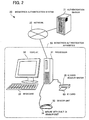
- FIG. 2 illustrates the structure of a biometrics authentication system according to a second embodiment.
- a biometrics authentication system 20 which performs authentication by the use of palm veins is taken as a second embodiment.
- a biometrics authentication system 20 is one of systems which recognize the characteristics of a living body, which specify an individual, and which perform authentication. For example, the biometrics authentication system 20 performs customer authentication in a banking system.
- the biometrics authentication system 20 includes a biometrics authentication apparatus 30, an authentication server 21, and a network 22.
- the biometrics authentication apparatus 30 is used in an information processing system, an ATM (Automated Teller Machine) in a financial institution, an access control system, or the like for confirming an identity.
- the biometrics authentication apparatus 30 compares a registered template registered in advance and biometric information acquired by the biometrics authentication apparatus 30, and performs authentication.
- the registered template is a first registered template registered in advance or a second registered template to be updated in an authentication process. If the biometrics authentication apparatus 30 succeeds in making a comparison by the use of one of them, then an identity is confirmed.
- the biometrics authentication apparatus 30 includes a processor 31, a display 32, and a mouse with a built-in sensor unit 34.
- the biometrics authentication apparatus 30 includes a keyboard 33, an IC (Integrated Circuit) card reader-writer 35, and the like at need.
- the mouse with a built-in sensor unit 34 functions as a mouse which accepts input operation, and contains a sensor unit 50 which captures an image of palm veins.
- the sensor unit 50 contains an imaging device, captures an image of veins in a user's palm, and outputs the captured image to the processor 31.
- the IC card reader-writer 35 reads information from or writes information to an IC card 60 of the user.
- the keyboard 33 and the mouse with a built-in sensor unit 34 accept input operation.
- a user who requests authentication inputs identification information (such as user ID) for identifying the user by the use of the keyboard 33, the mouse with a built-in sensor unit 34, or the IC card reader-writer 35.
- the biometrics authentication apparatus 30 informs the user of an authentication procedure by display on the display 32 and requests the user to input biometric information for authentication.
- the user inputs biometric information by spreading the user's hand over the mouse with a built-in sensor unit 34.
- the biometrics authentication apparatus 30 to which an image of palm veins is inputted as biometric information compares the inputted biometric information and a registered template.
- the registered template is acquired from a storage unit of the processor 31, a storage unit of the authentication server 21 connected thereto via the network, or a storage unit of the IC card 60 of the user.
- the biometrics authentication apparatus 30 may acquire the registered template from the storage unit of the processor 31 or the storage unit of the IC card 60 of the user.
- the authentication server 21 associates identification information for identifying an individual with comparison information (registered template) registered before biometrics authentication, and stores them.
- the identification information for identifying an individual is unique ID (IDentification) given directly (such as a user number) or indirectly (such as an account number) to the user.
- the comparison information registered in advance is characteristic information obtained by extracting a characteristic portion from image information in accordance with a determined characteristic extraction algorithm, the image information, coded information obtained by coding the characteristic information, or the like.
- FIG. 3 is an example of a hardware configuration of the biometrics authentication apparatus in the second embodiment.
- the biometrics authentication apparatus 30 includes the processor 31, the display 32, the keyboard 33, the mouse with a built-in sensor unit 34, the sensor unit 50, and the IC card reader-writer 35.
- the whole of the processor 31 is controlled by a CPU (Central Processing Unit) 41.
- a RAM (Random Access Memory) 42, an HDD (Hard Disk Drive) 43, a communication interface 44, a graphics processing unit 45, and an input-output interface 46 are connected to the CPU 41 via a bus 47.
- the RAM 42 temporarily stores at least a part of an OS (Operating System) or an application program executed by the CPU 41.
- the RAM 42 also stores various pieces of data which the CPU 41 needs to perform a process.
- the HDD 43 stores the OS and application programs.
- the display 32 is connected to the graphics processing unit 45.
- the graphics processing unit 45 displays an image on a screen of the display 32.
- the keyboard 33, the mouse with a built-in sensor unit 34, the sensor unit 50, and the IC card reader-writer 35 are connected to the input-output interface 46. Furthermore, the input-output interface 46 may be connected to a portable record medium interface which writes information to and reads out information from a portable record medium 36. The input-output interface 46 transmits a signal transmitted from the keyboard 33, the mouse with a built-in sensor unit 34, the sensor unit 50, the IC card reader-writer 35, or the portable record medium interface to the CPU 41 via the bus 47.
- the communication interface 44 is connected to the network 22.
- the communication interface 44 exchanges data with another computer (such as the authentication server 21).
- the authentication server 21 is also realized by the same hardware configuration.
- the processor 31 may include not the CPU 41, but a module including an FPGA (Field Programmable Gate Array), a module including a DSP (Digital Signal Processor), and the like.
- the processor 31 includes a nonvolatile memory (such as an EEPROM (Electrically Erasable and Programmable Read Only Memory), a flash memory, or a flash memory type memory card) to store firmware of each module.
- Firmware may be written to a nonvolatile memory via the portable record medium 36 or the communication interface 44.
- the processor 31 performs firmware update by rewriting firmware stored in a nonvolatile memory in this way.
- FIG. 4 illustrates the structure of the sensor unit in the second embodiment.
- the sensor unit 50 is attached in a portion of the mouse with a built-in sensor unit 34 over which a palm is put at the time of the operation of the mouse with a built-in sensor unit 34.
- the sensor unit 50 contactlessly photographs a palm spread over the mouse with a built-in sensor unit 34 to acquire an image of palm veins.
- the sensor unit 50 includes a control section 51, a photographing section 52, a distance measuring section 53, a storage section 54, and a communication section 55.
- the control section 51 controls each processing section.
- the photographing section 52 photographs a living body, which is a subject, to acquire image information.
- the photographing section 52 includes an image sensor (such as a CMOS (Complementary Metal Oxide Semiconductor) sensor or a CCD (Charge Coupled Device) sensor) for photographing a living body, a converging lens, and a plurality of near infrared light emitting devices (such as LEDs (Light Emitting Diodes)) for irradiating a subject with near infrared rays.
- the near infrared light emitting devices are arranged, for example, around the image sensor and emit near infrared rays in the direction of the subject (upward).
- the image sensor photographs the subject irradiated with near infrared rays.
- the photographing section 52 is able to continuously photograph the subject, and photographs the subject, for example, at a photographing speed of 15 frames per second. It may be possible to change a photographing speed by setting. In addition, photographing timing may depend not on time but on the distance to the subject based on an output from the distance measuring section 53.
- the structure of the photographing section 52 is suitable for photographing palm veins. If another living body, such as an iris, is to be photographed, a structure suitable for a subject is adopted.
- the distance measuring section 53 acquires information regarding the distance to a living body, which is a subject.
- the storage section 54 associates distance information acquired by the distance measuring section 53 with image information acquired by the photographing section 52, and stores them.
- the distance measuring section 53 is able to not only measure the distance to one portion of a subject but also measure the distances to a plurality of portions of the subject at the same time.
- the communication section 55 is connected to the processor 31 so that it will communicate with the processor 31.
- the communication section 55 receives instructions from the processor 31 or transmits image information or distance information to the processor 31.
- An image captured by the sensor unit 50 is acquired by irradiating a living body (palm), which is a subject, with near infrared rays and receiving reflected light.
- a living body which is a subject
- Hemoglobin in each red blood cell which runs through veins has lost oxygen, so this hemoglobin (deoxyhemoglobin) has the property of absorbing near infrared rays with a wavelength of about 700 to 1000 nm. Accordingly, when a palm is irradiated with near infrared rays, the intensity of light reflected from vein portions is low. As a result, the positions of veins are recognized on the basis of whether the intensity of light reflected is high or low. Characteristic information is easily extracted by the use of a specific light source, but a captured image is an image in achromatic color.
- FIG. 5 illustrates the structure of the IC card in the second embodiment.
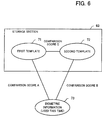
- FIG. 6 illustrates relationships among comparison scores in the second embodiment.
- the IC card 60 is possessed by a person who is an object of authentication. In order to confirm an identity, the IC card 60 is inserted into the IC card reader-writer 35 and is used.
- the IC card 60 includes a control section 61, a communication section 62, and a storage section 63.
- the control section 61 controls each processing section.
- the communication section 62 performs contactless communication with the IC card reader-writer 35. However, the communication section 62 may perform contact communication with the IC card reader-writer 35.
- the storage section 63 stores a first template 71 and a second template 72 acquired by the processor 31. If the first template 71 is registered once, it is not updated. However, the second template 72 is updated to biometric information by which success in authentication is achieved under determined conditions. If an available period is set for the IC card 60, then the first template 71 may be updated at the time of the renewal of the available period.
- control section 61 When the control section 61 reads out the first template 71 and the second template 72 stored in the storage section 63, the control section 61 may pass, in response to a request from the processor 31, them to the processor 31 after processing. Furthermore, the control section 61 may undertake a part of a comparison process to be performed by the processor 31.
- the description of the IC card 60 has been given. However, the same applies to a case where the authentication server 21 stores registered templates (first template 71 and the second template 72).
- the processor 31 succeeds in authentication by biometric information (used this time) 73, then the processor 31 generates comparison score A for the first template 71 and the biometric information (used this time) 73, comparison score B for the second template 72 and the biometric information (used this time) 73, and comparison score C for the first template 71 and the second template 72. If the comparison score A or B to which the biometric information (used this time) 73 relates is not the poorest, then the processor 31 replaces the second template 72 with the biometric information (used this time) 73. That is to say, the processor 31 updates the second template 72 to the biometric information (used this time) 73.
- the biometric information (used this time) 73 is acquired by the biometrics authentication apparatus 30 for performing authentication.
- the biometrics authentication apparatus 30 performs authentication by the second template 72. By doing so, an authentication rate is improved.
- the second template 72 is updated at any time. Accordingly, even if a determined inclination appears in acquired biometric information through repetition of authentication, the biometrics authentication apparatus 30 improves an authentication rate. For example, it is assumed that the operation of spreading a hand is performed in palm vein authentication by a person who is an object of authentication. When the first template 71 is registered, the five fingers are stretched. However, the person who is an object of authentication may have unconsciously acquired a habit at authentication time. This may lead to a decrease in authentication rate.
- the biometrics authentication apparatus 30 updates the second template 72 to follow the habit of the person who is an object of authentication and improve an authentication rate.
- the biometrics authentication apparatus 30 follows not only the habit of the person who is an object of authentication but also a secular change of living body to improve an authentication rate.
- FIG. 7 is a flow chart of a first template registration process in the second embodiment.
- a first template registration process is performed by the biometrics authentication apparatus 30 or a template registration apparatus (not illustrated).
- a first template registration process is performed before authentication for acquiring biometric information from a person himself/herself who is an object of authentication and registering it for comparison.
- the template registration apparatus is realized by the same structure that is adopted in the biometrics authentication apparatus 30.
- Step S11 The processor 31 requests the sensor unit 50 to provide a captured image of palm veins (biometric information) used for registering a first template.
- the sensor unit 50 passes a captured image of a palm to the processor 31.
- the processor 31 acquires the captured image of the palm from the sensor unit 50.
- the processor 31 acquires posture information corresponding to the acquired biometric information.
- the posture information is information which indicates a posture of a living body and which is usable for evaluating a deviation of the living body from a correct position at the time of acquiring the biometric information.
- the processor 31 extracts a palm region from the acquired image information (biometric information) by, for example, binarizing the image information and performing contour extraction based on morphology.
- the processor 31 calculates a distance value for each pixel from a brightness value of each pixel in the palm region of the captured image by the use of the relationship between brightness and distance.
- the processor 31 calculates palm posture information based on plane approximation. On the basis of a distance value for each pixel, the processor 31 calculates tilt angles in the horizontal and vertical directions of an approximate plane as posture information. By doing so, the processor 31 is able to acquire posture information corresponding to the acquired biometric information.
- Step S13 The processor 31 determines whether or not the tilt angles in the horizontal and vertical directions of the approximate plane, which are the acquired posture information, meet a determined quality standard. For example, if the tilt angles in the horizontal and vertical directions of the approximate plane are within the range of -15 to +15 degrees, then the processor 31 determines that the quality standard is met. If the tilt angles in the horizontal and vertical directions of the approximate plane are not within the range of -15 to +15 degrees, then the processor 31 determines that the posture information does not meet the quality standard.
- the determined quality standard may include distance and a condition of deformation (palm is not in a flat state, for example) in addition to tilt angles.
- step S14 the processor 31 determines that the acquired posture information meets the determined quality standard. If the processor 31 determines that the acquired posture information meets the determined quality standard, then the processor 31 proceeds to step S14. On the other hand, if the processor 31 determines that the acquired posture information does not meet the determined quality standard, then the processor 31 proceeds to step S11.
- Step S14 The processor 31 registers the acquired image information (biometric information) as the first template 71.
- Step S15 The processor 31 registers the calculated posture information as posture information corresponding to the first template 71, and ends the first template registration process.
- the first template 71 is registered in this way by the biometrics authentication apparatus 30 or the template registration apparatus (not illustrated). Furthermore, the first template 71 is stored in the storage section 63 of the IC card 60, the HDD 43 of the processor 31, or a storage section of the authentication server 21.
- FIG. 8 is a flow chart of an authentication process in the second embodiment.
- An authentication process is performed by the biometrics authentication apparatus 30.
- the biometrics authentication apparatus 30 acquires biometric information from a person who is an object of authentication, compares it with a registered template registered in advance, and performs a process according to a comparison result.
- Step S21 The processor 31 requests the sensor unit 50 to provide a captured image of palm veins (biometric information) used for authentication.
- the sensor unit 50 passes a captured image of a palm to the processor 31.
- the processor 31 acquires the captured image of the palm (biometric information (used this time) 73) from the sensor unit 50.
- Step S22 The processor 31 acquires posture information corresponding to the acquired biometric information (used this time) 73.
- the processor 31 acquires the posture information in the same way that is described in step S12.
- Step S23 The processor 31 acquires the first template 71 from the storage section 63 of the IC card 60.
- Step S24 The processor 31 calculates a comparison score from the first template 71 and the biometric information (used this time) 73.
- a comparison score is an index for evaluating a degree of similarity between the first template 71 and the biometric information (used this time) 73. A smaller comparison score indicates a greater similarity between them.
- a comparison score is derived by a determined method from a degree of similarity between the first template 71 and the biometric information (used this time) 73. Various known methods are used.
- Step S25 The processor 31 determines whether or not the comparison score calculated from the first template 71 and the biometric information (used this time) 73 meets a determined comparison standard. If the comparison score meets the determined comparison standard, then the processor 31 proceeds to step S30. If the comparison score does not meet the determined comparison standard, then the processor 31 proceeds to step S26.
- Step S26 The processor 31 acquires the second template 72 from the storage section 63 of the IC card 60.
- Step S27 The processor 31 calculates a comparison score from the second template 72 and the biometric information (used this time) 73.
- a comparison score is an index for evaluating a degree of similarity between the second template 72 and the biometric information (used this time) 73. A smaller comparison score indicates a greater similarity between them.
- a comparison score is derived by a determined method from a degree of similarity between the second template 72 and the biometric information (used this time) 73. Various known methods are used.
- Step S28 The processor 31 determines whether or not the comparison score calculated from the second template 72 and the biometric information (used this time) 73 meets the determined comparison standard. If the comparison score meets the determined comparison standard, then the processor 31 proceeds to step S30. If the comparison score does not meet the determined comparison standard, then the processor 31 proceeds to step S29.
- Step S29 On the basis of the result of comparison mismatch, the processor 31 determines that an identity is not confirmed, and performs a needed comparison failure process involved in failure in authentication. After that, the processor 31 ends the authentication process.
- Step S30 On the basis of the result of comparison match, the processor 31 determines that an identity is confirmed, and performs a needed comparison success process involved in success in authentication.
- Step S31 The processor 31 performs a replacement process for replacing the second template 72 with the biometric information (used this time) 73 by which the result of comparison match is obtained. After that, the processor 31 ends the authentication process. If it is not proper to replace the second template 72 with the biometric information (used this time) 73 by a replacement process, then the processor 31 does not perform a replacement process. A replacement process will be described later in detail with reference to FIGS. 9 and 10 .
- the biometrics authentication apparatus 30 makes a comparison between the biometric information (used this time) 73 and the first template 71 or a comparison between the biometric information (used this time) 73 and the second template 72 and determines whether or not a comparison score calculated meets the comparison standard. By doing so, the biometrics authentication apparatus 30 performs authentication. In addition, it is expected that each time authentication is performed, the second template 72 will be updated to a better second template 72 by replacing the second template 72 with the biometric information (used this time) 73. Accordingly, it is also expected that the accuracy of authentication will be improved.
- the biometrics authentication apparatus 30 makes a comparison between the first template 71 and the biometric information (used this time) 73 and a comparison between the second template 72 and the biometric information (used this time) 73 in that order.
- the biometrics authentication apparatus 30 may make a comparison in the reverse order. If the biometrics authentication apparatus 30 first makes a comparison between the first template 71 and the biometric information (used this time) 73, then the biometrics authentication apparatus 30 is able to evaluate the number of times it fails in making a comparison between the first template 71 and the biometric information (used this time) 73 or a failure rate of a comparison between the first template 71 and the biometric information (used this time) 73 every time it performs authentication. If an evaluation result is poor, then the biometrics authentication apparatus 30 may demand reregistration of the first template 71.
- the biometrics authentication apparatus 30 first makes a comparison between the second template 72 and the biometric information (used this time) 73, then it is expected that the second template 72 will be better at this point of time than the first template 71. Accordingly, it is expected that the probability of success in authentication being obtained by making a comparison once will increase.
- the first template 71 may be registered as an initial value of the second template 72 at first authentication time.
- the biometric information (used this time) 73 by which first success in authentication is obtained may be registered as an initial value of the second template 72.
- FIG. 9 is a flow chart of the replacement process in the second embodiment.
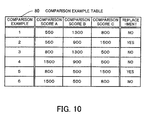
- FIG. 10 illustrates a comparison example table in the second embodiment.
- the replacement process is performed by the biometrics authentication apparatus 30. If it is proper to replace the second template 72 with the biometric information (used this time) 73, then the replacement of the second template 72 by the biometric information (used this time) 73 is performed by the replacement process.
- Step S41 The processor 31 performs a quality evaluation process for evaluating the quality of the biometric information (used this time) 73 by which the result of comparison match is obtained.
- the quality evaluation process will be described later in detail with reference to FIG. 11 .
- Step S42 The processor 31 determines whether or not a result obtained by evaluating the quality of the biometric information (used this time) 73 meets a determined quality standard. If a result obtained by evaluating the quality of the biometric information (used this time) 73 meets the determined quality standard, then the processor 31 proceeds to step S43. If a result obtained by evaluating the quality of the biometric information (used this time) 73 does not meet the determined quality standard, then the processor 31 ends the replacement process. As a result, the second template 72 is not replaced with the biometric information (used this time) 73 not having certain quality.
- Step S43 The processor 31 calculates the comparison score A for the first template 71 and the biometric information (used this time) 73.
- Step S44 The processor 31 determines whether or not the comparison score A meets a replacement permission standard. If the comparison score A meets the replacement permission standard, then the processor 31 proceeds to step S45. If the comparison score A does not meet the replacement permission standard, then the processor 31 ends the replacement process.
- the replacement permission standard is not a standard for determining whether or not a comparison between the biometric information (used this time) 73 and the first template 71 succeeds, but a standard on the basis of which the determination that a comparison between the biometric information (used this time) 73 and the first template 71 succeeds may be made.
- Step S45 The processor 31 calculates the comparison score B for the second template 72 and the biometric information (used this time) 73.
- Step S46 The processor 31 calculates the comparison score C for the first template 71 and the second template 72.
- the processor 31 generates in this way the comparison scores A, B, and C for the combinations of two of the biometric information (used this time) 73, the first template 71, and the second template 72.
- Step S47 The processor 31 compares the comparison scores A, B, and C and determines whether or not the comparison score C is the poorest. If the comparison score C is the poorest, then the processor 31 proceeds to step S48. If the comparison score C is not the poorest, then the processor 31 ends the replacement process.
- Step S48 The processor 31 registers the biometric information (used this time) 73 as the second template 72.
- Step S49 The processor 31 registers posture information (used this time) corresponding to the biometric information (used this time) 73 as posture information corresponding to the second template 72, and ends the replacement process.
- comparison example table 80 Six comparison examples are indicated in a comparison example table 80 (see FIG. 10 ). With comparison example “1”, the comparison score A is “550”, the comparison score B is "1300”, and the comparison score C is "800", and the comparison score B is the poorest. Therefore, the second template 72 is not replaced. That is to say, the biometric information (used this time) 73 relates to the generation of the comparison score B which is the poorest, so the processor 31 determines that it is not proper to register the biometric information (used this time) 73 as the second template 72.
- the comparison score A is "550”
- the comparison score B is "900”
- the comparison score C is "1500”
- the comparison score C is the poorest. Therefore, the second template 72 is replaced. That is to say, the biometric information (used this time) 73 does not relate to the generation of the comparison score C which is the poorest, so the processor 31 determines that it is proper to register the biometric information (used this time) 73 as the second template 72.
- the comparison score A is "800”
- the comparison score B is "1300”
- the comparison score C is "500”
- the comparison score B is the poorest. Therefore, the second template 72 is not replaced. That is to say, the biometric information (used this time) 73 relates to the generation of the comparison score B which is the poorest, so the processor 31 determines that it is not proper to register the biometric information (used this time) 73 as the second template 72.
- the comparison score A is "1500”
- the comparison score B is "900”
- the comparison score C is "500”
- the comparison score A is the poorest. Therefore, the second template 72 is not replaced. That is to say, the biometric information (used this time) 73 relates to the generation of the comparison score A which is the poorest, so the processor 31 determines that it is not proper to register the biometric information (used this time) 73 as the second template 72.
- the comparison score A is "800”
- the comparison score B is “500”
- the comparison score C is "1500”
- the comparison score C is the poorest. Therefore, the second template 72 is replaced. That is to say, the biometric information (used this time) 73 does not relate to the generation of the comparison score C which is the poorest, so the processor 31 determines that it is proper to register the biometric information (used this time) 73 as the second template 72.
- the comparison score A is "1500”
- the comparison score B is “500”
- the comparison score C is "800”
- the comparison score A is the poorest. Therefore, the second template 72 is not replaced. That is to say, the biometric information (used this time) 73 relates to the generation of the comparison score A which is the poorest, so the processor 31 determines that it is not proper to register the biometric information (used this time) 73 as the second template 72.
- a smaller comparison score is better and a larger comparison score is poorer. Whether a comparison score is good or poor depends on a comparison score generation algorithm, an evaluation method, or the like. Accordingly, if whether a comparison result is good or poor is determined, then it may be that a smaller comparison score will be poorer and that a larger comparison score will be better.
- the replacement permission standard for the comparison score A described in step S44 is, for example, the comparison score "1800". Then the determination that the biometric information (used this time) 73 meets a replacement standard is made if the comparison score A for the first template 71 and the biometric information (used this time) 73 is lower than 1800. The determination that the biometric information (used this time) 73 does not meet the replacement standard is made if the comparison score A for the first template 71 and the biometric information (used this time) 73 is higher than or equal to 1800.
- FIG. 11 is a flow chart of the quality evaluation process in the second embodiment.
- the quality evaluation process is performed by the biometrics authentication apparatus 30.
- the quality evaluation process is performed for evaluating the quality of the biometric information (used this time) 73 by which the result of comparison match is obtained.
- Quality is an index for evaluating the uniformity of an environment in which a living body image is acquired.
- the quality includes a posture of a living body which is a subject, an environment in which a living body image is captured, and the like.
- the biometrics authentication apparatus 30 acquires as posture information a posture of a living body which is a subject, and evaluates the uniformity of an environment in which a living body image is acquired.
- Step S51 The processor 31 calculates a posture error between the first template 71 and the biometric information (used this time) 73. More specifically, the processor 31 acquires from the storage section 63 stored posture information corresponding to the first template 71. Furthermore, the processor 31 compares acquired posture information corresponding to the biometric information (used this time) 73 with the posture information corresponding to the first template 71 and calculates an error between them. By doing so, the biometrics authentication apparatus 30 is able to calculate a living body posture error between the first template 71 and the biometric information (used this time) 73 at living body image capture time.
- Step S52 The processor 31 determines whether or not the calculated posture error is within permitted limits determined in advance. If the calculated posture error is within the permitted limits determined in advance, then the processor 31 proceeds to step S53. If the calculated posture error is not within the permitted limits determined in advance, then the processor 31 proceeds to step S56.
- the processor 31 determines that the calculated posture error is within the permitted limits.
- standards for determining whether or not a posture error is within permitted limits are not limited to one standard such as the tilt of a palm.
- a plurality of standards including forward, backward, leftward, and rightward positional deviations, distance, rotation, and deformation may be used.
- Step S53 The processor 31 calculates a posture error between the second template 72 and the biometric information (used this time) 73. More specifically, the processor 31 acquires from the storage section 63 stored posture information corresponding to the second template 72. Furthermore, the processor 31 compares acquired posture information corresponding to the biometric information (used this time) 73 with the posture information corresponding to the first template 71 and calculates an error between them. By doing so, the biometrics authentication apparatus 30 is able to calculate a living body posture error between the second template 72 and the biometric information (used this time) 73 at living body image capture time.
- Step S54 The processor 31 determines whether or not the calculated posture error is within permitted limits determined in advance. If the calculated posture error is within the permitted limits determined in advance, then the processor 31 proceeds to step S55. If the calculated posture error is not within the permitted limits determined in advance, then the processor 31 proceeds to step S56.
- the processor 31 determines that the calculated posture error is within the permitted limits.
- standards for determining whether or not a posture error is within permitted limits are not limited to one standard such as the tilt of a palm.
- a plurality of standards including forward, backward, leftward, and rightward positional deviations, distance, rotation, and deformation may be used.
- the permitted limits of the posture error between the second template 72 and the biometric information (used this time) 73 are narrower than the permitted limits of the posture error between the first template 71 and the biometric information (used this time) 73.
- the permitted limits of the posture error between the second template 72 and the biometric information (used this time) 73 may be wider than or equal to the permitted limits of the posture error between the first template 71 and the biometric information (used this time) 73.
- the biometrics authentication apparatus 30 makes the permitted limits of the posture error between the second template 72 and the biometric information (used this time) 73 narrower than the permitted limits of the posture error between the first template 71 and the biometric information (used this time) 73 to control accommodating a rapid change in biometric information for a person who is an object of authentication.
- Step S55 The posture error between the first template 71 and the biometric information (used this time) 73 is within the permitted limits determined in advance. In addition, the posture error between the second template 72 and the biometric information (used this time) 73 is within the permitted limits determined in advance. Therefore, the processor 31 determines that the quality of the biometric information (used this time) 73 is good, and ends the quality evaluation process.
- Step S56 At least one of the posture error between the first template 71 and the biometric information (used this time) 73 and the posture error between the second template 72 and the biometric information (used this time) 73 is not within the permitted limits determined in advance. Therefore, the processor 31 determines that the quality of the biometric information (used this time) 73 is poor, and ends the quality evaluation process.
- the biometrics authentication apparatus 30 evaluates the quality of the biometric information (used this time) 73.
- the biometrics authentication apparatus 30 evaluates the quality of the biometric information (used this time) 73 with respect to both of the first template 71 and the second template 72.
- the biometrics authentication apparatus 30 may evaluate the quality of the biometric information (used this time) 73 with respect to one of the first template 71 and the second template 72.
- the biometrics authentication apparatus 30 evaluates the quality of the biometric information (used this time) 73 on the basis of the posture error between the first template 71 or the second template 72 and the biometric information (used this time) 73.
- the biometrics authentication apparatus 30 may evaluate the quality of the biometric information (used this time) 73 on the basis of an error between the position of a living body at the time of acquiring biometric information and a correct position.
- FIG. 12 illustrates the structure of a biometrics authentication system according to a third embodiment. Description of components in FIG. 12 which are the same as those in the second embodiment will be omitted.
- a biometrics authentication system 100 using palm veins for performing authentication is taken as an example.
- the biometrics authentication system 100 is one of systems which recognize the characteristics of a living body, which specify an individual, and which perform authentication, and is used in, for example, a banking system for performing customer authentication.
- the biometrics authentication system 100 includes a plurality of automated teller machines 105, an authentication server 101, and a network 104.
- the authentication server 101 associates identification information for identifying an individual with a second template 72 registered before biometrics authentication, and stores them.
- Identification information for identifying an individual is a unique ID (IDentification) given directly (such as a user number) or indirectly (such as an account number) to a user.
- One or more automated teller machines 105 are installed in an ATM corner 103 or an ATM booth 102 in a financial institution.
- the automated teller machine 105 is one of authentication apparatus which perform biometrics authentication before financial transactions at user authentication time.
- the automated teller machine 105 includes an IC card reader-writer 106 and a sensor unit 107.
- the sensor unit 107 includes an image capture device, captures an image of veins in a user's palm, and acquires biometric information (used this time) 73.
- the automated teller machine 105 performs user authentication by a first template 71 which the IC card reader-writer 106 acquires from an IC card (such as a cash card with a built-in IC chip) of the user and the biometric information (used this time) 73 acquired by the sensor unit 107.
- IC card such as a cash card with a built-in IC chip
- the biometrics authentication system 100 stores the first template 71 and the second template 72 in the different storage sections and manages them.
- the automated teller machine 105 has the same processing functions that the biometrics authentication apparatus 30 described in the second embodiment has. By doing so, the automated teller machine 105 functions as a biometrics authentication apparatus.
- the automated teller machine 105 and the authentication server 101 included in the biometrics authentication system 100 may cooperate to realize the same processing functions that the biometrics authentication apparatus 30 described in the second embodiment has. This biometrics authentication system 100 improves the accuracy of authentication in an authentication process.
- the above processing functions may be realized with a computer.
- a program in which the contents of functions each apparatus should have are described is provided.
- the above processing functions are realized on the computer.
- This program may be recorded on a computer readable record medium (which may be a portable record medium).
- a computer readable record medium may be a magnetic recording device, an optical disk, a magneto-optical recording medium, a semiconductor memory, or the like.
- a magnetic recording device may be a hard disk drive (HDD), a flexible disk (FD), a magnetic tape, or the like.
- An optical disk may be a digital versatile disk (DVD), a DVD-RAM, a CD-ROM, a CD-R(Recordable)/RW(ReWritable), or the like.
- a magneto-optical recording medium may be a magneto-optical disk (MO) or the like.
- portable record media such as DVDs or CD-ROMs, on which it is recorded are sold.
- the program is stored in advance in a storage unit of a server computer and is transferred from the server computer to another computer via a network.
- the computer When the computer executes this program, it will store in its storage unit the program, for example, which is recorded on a portable record medium or which is transferred from the server computer. The computer then reads the program from its storage unit and performs processes in compliance with the program. The computer may also read the program directly from a portable record medium and perform processes in compliance with the program. Furthermore, each time the program is transferred from the server computer, the computer may perform processes in turn in compliance with the program it receives.
- a palm as an example of a part of a living body.
- any part of a living body may be used.
- a part of a living body may be the sole of a foot, a finger, a toe, the back of a hand, the instep of a foot, a wrist, an arm, or the like.
- veins are used for authentication, then a part of a living body in which the veins are observed is used.
- a part of a living body for which biometric information is acquired may be specified, this is favorable for authentication. If a part of a living body is a palm, a face, or the like, then the part may be specified from an acquired image.
- biometric information used for authentication is not limited to veins.
- a fingerprint, a palm print, or the like may be used.
Landscapes
- Engineering & Computer Science (AREA)
- Human Computer Interaction (AREA)
- Physics & Mathematics (AREA)
- General Physics & Mathematics (AREA)
- Multimedia (AREA)
- Theoretical Computer Science (AREA)
- Collating Specific Patterns (AREA)
- Measurement Of The Respiration, Hearing Ability, Form, And Blood Characteristics Of Living Organisms (AREA)
Abstract
There is provided a biometrics authentication apparatus which improves the accuracy of authentication in an authentication process.
A biometrics authentication apparatus (1) acquires biometric information (7) by a biometric information acquisition section (2) and acquires first registered information (8) and second registered information (9) by a registered information acquisition section (3). The biometrics authentication apparatus (1) generates a comparison score (10) from the first registered information (8) and the biometric information (7), compares the comparison score (10) and a threshold (11), and outputs an authentication result (12), by an authentication section (4). The biometrics authentication apparatus (1) generates a comparison score (13) for each of combinations of two of the biometric information (7) by which success in authentication is obtained, the first registered information (8), and the second registered information (9), evaluates the comparison score (13), and generates an evaluation result (14), by a comparison evaluation section (5). When the biometric information (7) may be good second registered information (9), the biometrics authentication apparatus (1) treats the biometric information (7) as new second registered information (9) by a replacement section (6) .
Description
- The embodiments discussed herein are related to a biometrics authentication apparatus, a biometrics authentication system, and a biometrics authentication method.
- A human body has pieces of biometric information by which an individual is identifiable, and several of them are used as information for specifying and authenticating an individual. For example, a fingerprint, a retina or an iris in an eye, a face, a blood vessel, or DNA (DeoxyriboNucleic Acid) is known as biometric information used for authentication.
- With recent progress of a biometrics authentication technique, various apparatus for performing individual authentication by recognizing the characteristics of such a living body which is a part of a human body are provided. With biometrics authentication, authentication is performed by comparing biometric information (registered template) acquired at registration time and biometric information acquired at authentication time.
- In order to improve the accuracy of authentication by biometric information, it is desirable to acquire biometric information with constant accuracy every time authentication is performed. However, when authentication is performed, a user who is an object of authentication does not always assume a proper posture.
- In addition, some biometric information changes with the lapse of time, so the use of some of biometric information registered once results in a decrease in the accuracy of authentication. Accordingly, the following identity specification apparatus is proposed. When biometric information is acquired, reregistration is performed. By doing so, registered biometric information is updated (see, for example, PTL1)
- PTL1: Japanese Laid-open Patent Publication No.
11-167632 - Usually the accuracy of authentication by a biometrics authentication apparatus decreases when proper biometric information fails to be acquired at biometrics authentication time or when the quality of a registered template is not good. A biometrics authentication apparatus recovers a decrease in the accuracy of authentication by retrying to acquire biometric information from a person who is an object of authentication. In many cases, however, it is difficult to correct unconscious habitual operation of a person who is an object of authentication, for example, in the operation of spreading a palm over a sensor unit at the time of palm vein authentication.
- Furthermore, when a registered template is acquired, a proper posture is not always assumed. If inadequate biometric information is registered, a biometrics authentication apparatus fails to realize sufficient authentication accuracy at the time of authentication performed later.
- Such a decrease in the accuracy of authentication leads to an increase in the number of retries made to acquire biometric information. As a result, such a biometrics authentication apparatus may be hard to use for a person who is an object of authentication.
- The present invention was made under the circumstances described above. An object of the present invention is to provide a biometrics authentication apparatus, a biometrics authentication system, and a biometrics authentication method which improve the accuracy of authentication in an authentication process.
- In order to solve the above problem, a biometrics authentication apparatus includes a biometric information acquisition section, a registered information acquisition section, an authentication section, a comparison evaluation section, and a replacement section. The biometric information acquisition section acquires biometric information from a person who is an object of authentication. The registered information acquisition section acquires first registered information which is the biometric information registered in advance and second registered information which is the biometric information that is used till last authentication and that is registered. The authentication section generates a comparison score from at least one of the first registered information and the second registered information and the biometric information acquired by the biometric information acquisition section, and authenticates the person who is an object of authentication by comparing the comparison score and a determined threshold. The comparison evaluation section generates a comparison score for each of combinations of two of the biometric information used this time for authenticating the person who is an object of authentication, the first registered information, and the second registered information, and evaluates the comparison score generated for each of the combinations. The replacement section replaces the second registered information with the biometric information used this time on the basis of an evaluation by the comparison evaluation section.
- Furthermore, in order to solve the above problem, a biometrics authentication system includes a biometric information acquisition section, a registered information acquisition section, an authentication section, a comparison evaluation section, and a replacement section.
- In addition, in order to solve the above problem, a biometrics authentication method includes acquiring biometric information from a person who is an object of authentication, generating a comparison score from at least one of first registered information which is the biometric information registered in advance and second registered information which is the biometric information that is used till last authentication and that is registered and the biometric information acquired and authenticating the person who is an object of authentication by comparing the comparison score and a determined threshold, generating a comparison score for each of combinations of two of the biometric information used this time for authenticating the person who is an object of authentication, the first registered information, and the second registered information and evaluating the comparison score generated for each of the combinations, and replacing the second registered information with the biometric information used this time on the basis of an evaluation.
- According to the above biometrics authentication apparatus, biometrics authentication system, and biometrics authentication method, the accuracy of authentication is improved in an authentication process.
- The above and other objects, features and advantages of the present invention will become apparent from the following description when taken in conjunction with the accompanying drawings which illustrate preferred embodiments of the present invention by way of example.
-
- [
FIG. 1] FIG. 1 illustrates the structure of a biometrics authentication apparatus according to a first embodiment. - [
FIG. 2] FIG. 2 illustrates the structure of a biometrics authentication system according to a second embodiment. - [
FIG. 3] FIG. 3 is an example of a hardware configuration of a biometrics authentication apparatus in the second embodiment. - [
FIG. 4] FIG. 4 illustrates the structure of a sensor unit in the second embodiment. - [
FIG. 5] FIG. 5 illustrates the structure of an IC card in the second embodiment. - [
FIG. 6] FIG. 6 illustrates relationships among comparison scores in the second embodiment. - [
FIG. 7] FIG. 7 is a flow chart of a first template registration process in the second embodiment. - [
FIG. 8] FIG. 8 is a flow chart of an authentication process in the second embodiment. - [
FIG. 9] FIG. 9 is a flow chart of a replacement process in the second embodiment. - [
FIG. 10] FIG. 10 illustrates a comparison example table in the second embodiment. - [
FIG. 11] FIG. 11 is a flow chart of a quality evaluation process in the second embodiment. - [
FIG. 12] FIG. 12 illustrates the structure of a biometrics authentication system according to a third embodiment. - Embodiments will now be described with reference to the drawings.
- First a biometrics authentication apparatus according to a first embodiment will be described with reference to
FIG. 1. FIG. 1 illustrates the structure of a biometrics authentication apparatus according to a first embodiment. - A
biometrics authentication apparatus 1 performs individual authentication by the use ofbiometric information 7 indicative of characteristics specific to a living body, and outputs anauthentication result 12. Thebiometric information 7 used by thebiometrics authentication apparatus 1 is a fingerprint, a face, an iris, or a vein pattern on a body surface, such as a palm or a finger. A part, such as a face, of thebiometric information 7 changes with the lapse of time, so the accuracy of authentication may become unstable. In addition, even if thebiometric information 7 changes slightly with the lapse of time, conditions under which thebiometric information 7 is acquired are not constant. As a result, the accuracy of authentication may become unstable. - The
biometrics authentication apparatus 1 regularly or irregularly replaces registered information used for biometrics authentication, that is to say, registered information (registered template) for comparison registered as biometric information for a person himself/herself who is an object of authentication in order to stabilize the accuracy of authentication. - The
biometrics authentication apparatus 1 includes a biometricinformation acquisition section 2, a registeredinformation acquisition section 3, anauthentication section 4, acomparison evaluation section 5, and areplacement section 6. The biometricinformation acquisition section 2 acquires thebiometric information 7 from the person who is an object of authentication. The registeredinformation acquisition section 3 acquires first registered information (first registered template) 8 which is thebiometric information 7 registered in advance and second registered information (second registered template) 9 which is thebiometric information 7 that is used till the last authentication and that is registered. - The first registered
information 8 and the second registeredinformation 9 which the registeredinformation acquisition section 3 acquires may be recorded in a record section included in thebiometrics authentication apparatus 1 or be recorded in an external device or an external record medium. - The first
registered information 8 is biometric information registered in advance as biometric information for the person himself/herself who is an object of authentication. The firstregistered information 8 is not to be replaced with thebiometric information 7. The secondregistered information 9 is biometric information registered at successful authentication time under determined conditions as biometric information for the person himself/herself who is an object of authentication. The secondregistered information 9 is to be replaced with thebiometric information 7. The firstregistered information 8 and the second registeredinformation 9 need only be characteristic information by which the person himself/herself who is an object of authentication is identifiable, and may not be biometric information (image data, for example) acquired at registration time. That is to say, the first registeredinformation 8 and the second registeredinformation 9 may be processed information (processed data). - The
authentication section 4 generates acomparison score 10 from the first registeredinformation 8 and thebiometric information 7. Theauthentication section 4 calculates a degree of similarity between characteristic information included in the first registeredinformation 8 and characteristic information included in thebiometric information 7 as thecomparison score 10 by a determined calculation method . Theauthentication section 4 compares thecalculated comparison score 10 and athreshold 11 and outputs anauthentication result 12. - The
authentication section 4 compares thecomparison score 10 and thethreshold 11. If authentication reference is met, then theauthentication section 4 outputs theauthentication result 12 of success in authentication. If the authentication reference is not met, then theauthentication section 4 generates the comparison score 10 from the second registeredinformation 9 and thebiometric information 7. Theauthentication section 4 calculates a degree of similarity between characteristic information included in the second registeredinformation 9 and the characteristic information included in thebiometric information 7 as thecomparison score 10 by the determined calculation method. Theauthentication section 4 compares thecalculated comparison score 10 and thethreshold 11 and outputs theauthentication result 12. Theauthentication section 4 compares thecomparison score 10 and thethreshold 11. If the authentication reference is met, then theauthentication section 4 outputs theauthentication result 12 of success in authentication. If the authentication reference is not met, then theauthentication section 4 outputs theauthentication result 12 of failure in authentication. - In the above description the
authentication section 4 makes a comparison between thebiometric information 7 and the first registeredinformation 8 or the second registeredinformation 9 in that order. However, theauthentication section 4 may reverse that order. - The
comparison evaluation section 5 generates acomparison score 13 for each of combinations of two of thebiometric information 7 which is used this time and by which success in authentication of the person that is an object of authentication is obtained, the first registeredinformation 8, and the second registeredinformation 9. That is to say, thecomparison evaluation section 5 generates a first comparison score from thebiometric information 7 used this time and the first registeredinformation 8, generates a second comparison score from thebiometric information 7 used this time and the second registeredinformation 9, and generates a third comparison score from the first registeredinformation 8 and the second registeredinformation 9. The comparison scores 13 for the combinations include the first comparison score, the second comparison score, and the third comparison score. - The
comparison evaluation section 5 evaluates the generatedcomparison scores 13 for the combinations and generates anevaluation result 14. The calculation algorithm by which theauthentication section 4 calculates thecomparison score 10 and a generation algorithm by which thecomparison evaluation section 5 generates the comparison scores 13 for the combinations may be the same or different from each other. - If the
replacement section 6 determines on the basis of theevaluation result 14 that the replacement of the second registeredinformation 9 by thebiometric information 7 is proper, that is to say, if thebiometric information 7 may become good secondregistered information 9, then thereplacement section 6 treats thebiometric information 7 used this time as new secondregistered information 9. - As has been described, the
biometrics authentication apparatus 1 replaces the second registeredinformation 9 with more properbiometric information 7. As a result, the accuracy of authentication is improved in an authentication process. Furthermore, the improvement of the accuracy of authentication reduces the number of retries made to acquire biometric information, and improves the convenience at authentication time of a person who is an object of authentication. - A more concrete description will now be given by the use of a second embodiment.
FIG. 2 illustrates the structure of a biometrics authentication system according to a second embodiment. Abiometrics authentication system 20 which performs authentication by the use of palm veins is taken as a second embodiment. However, the same applies to a system which performs authentication by detecting the characteristics of another part of a living body. - A
biometrics authentication system 20 is one of systems which recognize the characteristics of a living body, which specify an individual, and which perform authentication. For example, thebiometrics authentication system 20 performs customer authentication in a banking system. Thebiometrics authentication system 20 includes abiometrics authentication apparatus 30, anauthentication server 21, and anetwork 22. Thebiometrics authentication apparatus 30 is used in an information processing system, an ATM (Automated Teller Machine) in a financial institution, an access control system, or the like for confirming an identity. - The
biometrics authentication apparatus 30 compares a registered template registered in advance and biometric information acquired by thebiometrics authentication apparatus 30, and performs authentication. The registered template is a first registered template registered in advance or a second registered template to be updated in an authentication process. If thebiometrics authentication apparatus 30 succeeds in making a comparison by the use of one of them, then an identity is confirmed. - The
biometrics authentication apparatus 30 includes aprocessor 31, adisplay 32, and a mouse with a built-insensor unit 34. In addition, thebiometrics authentication apparatus 30 includes akeyboard 33, an IC (Integrated Circuit) card reader-writer 35, and the like at need. The mouse with a built-insensor unit 34 functions as a mouse which accepts input operation, and contains asensor unit 50 which captures an image of palm veins. Thesensor unit 50 contains an imaging device, captures an image of veins in a user's palm, and outputs the captured image to theprocessor 31. The IC card reader-writer 35 reads information from or writes information to anIC card 60 of the user. Thekeyboard 33 and the mouse with a built-insensor unit 34 accept input operation. - Comparison operation in palm vein authentication performed by the
biometrics authentication apparatus 30 will now be described. A user who requests authentication inputs identification information (such as user ID) for identifying the user by the use of thekeyboard 33, the mouse with a built-insensor unit 34, or the IC card reader-writer 35. Thebiometrics authentication apparatus 30 informs the user of an authentication procedure by display on thedisplay 32 and requests the user to input biometric information for authentication. The user inputs biometric information by spreading the user's hand over the mouse with a built-insensor unit 34. Thebiometrics authentication apparatus 30 to which an image of palm veins is inputted as biometric information compares the inputted biometric information and a registered template. The registered template is acquired from a storage unit of theprocessor 31, a storage unit of theauthentication server 21 connected thereto via the network, or a storage unit of theIC card 60 of the user. - For example, if the
biometrics authentication apparatus 30 is for personal use, then thebiometrics authentication apparatus 30 may acquire the registered template from the storage unit of theprocessor 31 or the storage unit of theIC card 60 of the user. - The
authentication server 21 associates identification information for identifying an individual with comparison information (registered template) registered before biometrics authentication, and stores them. The identification information for identifying an individual is unique ID (IDentification) given directly (such as a user number) or indirectly (such as an account number) to the user. The comparison information registered in advance is characteristic information obtained by extracting a characteristic portion from image information in accordance with a determined characteristic extraction algorithm, the image information, coded information obtained by coding the characteristic information, or the like. - An example of a hardware configuration of the
biometrics authentication apparatus 30 in the second embodiment will now be described with reference toFIG. 3. FIG. 3 is an example of a hardware configuration of the biometrics authentication apparatus in the second embodiment. - The
biometrics authentication apparatus 30 includes theprocessor 31, thedisplay 32, thekeyboard 33, the mouse with a built-insensor unit 34, thesensor unit 50, and the IC card reader-writer 35. - The whole of the
processor 31 is controlled by a CPU (Central Processing Unit) 41. A RAM (Random Access Memory) 42, an HDD (Hard Disk Drive) 43, acommunication interface 44, agraphics processing unit 45, and an input-output interface 46 are connected to theCPU 41 via abus 47. - The
RAM 42 temporarily stores at least a part of an OS (Operating System) or an application program executed by theCPU 41. TheRAM 42 also stores various pieces of data which theCPU 41 needs to perform a process. TheHDD 43 stores the OS and application programs. - The
display 32 is connected to thegraphics processing unit 45. In accordance with instructions from theCPU 41, thegraphics processing unit 45 displays an image on a screen of thedisplay 32. - The
keyboard 33, the mouse with a built-insensor unit 34, thesensor unit 50, and the IC card reader-writer 35 are connected to the input-output interface 46. Furthermore, the input-output interface 46 may be connected to a portable record medium interface which writes information to and reads out information from aportable record medium 36. The input-output interface 46 transmits a signal transmitted from thekeyboard 33, the mouse with a built-insensor unit 34, thesensor unit 50, the IC card reader-writer 35, or the portable record medium interface to theCPU 41 via thebus 47. - The
communication interface 44 is connected to thenetwork 22. Thecommunication interface 44 exchanges data with another computer (such as the authentication server 21). - By adopting the above-mentioned hardware configuration, processing functions in this embodiment are realized. The
authentication server 21 is also realized by the same hardware configuration. - The
processor 31 may include not theCPU 41, but a module including an FPGA (Field Programmable Gate Array), a module including a DSP (Digital Signal Processor), and the like. In that case, theprocessor 31 includes a nonvolatile memory (such as an EEPROM (Electrically Erasable and Programmable Read Only Memory), a flash memory, or a flash memory type memory card) to store firmware of each module. Firmware may be written to a nonvolatile memory via theportable record medium 36 or thecommunication interface 44. Theprocessor 31 performs firmware update by rewriting firmware stored in a nonvolatile memory in this way. - The
sensor unit 50 included in the mouse with a built-insensor unit 34 will now be described with reference toFIG. 4. FIG. 4 illustrates the structure of the sensor unit in the second embodiment. - The
sensor unit 50 is attached in a portion of the mouse with a built-insensor unit 34 over which a palm is put at the time of the operation of the mouse with a built-insensor unit 34. Thesensor unit 50 contactlessly photographs a palm spread over the mouse with a built-insensor unit 34 to acquire an image of palm veins. - The
sensor unit 50 includes acontrol section 51, a photographingsection 52, adistance measuring section 53, astorage section 54, and acommunication section 55. - The
control section 51 controls each processing section. The photographingsection 52 photographs a living body, which is a subject, to acquire image information. The photographingsection 52 includes an image sensor (such as a CMOS (Complementary Metal Oxide Semiconductor) sensor or a CCD (Charge Coupled Device) sensor) for photographing a living body, a converging lens, and a plurality of near infrared light emitting devices (such as LEDs (Light Emitting Diodes)) for irradiating a subject with near infrared rays. The near infrared light emitting devices are arranged, for example, around the image sensor and emit near infrared rays in the direction of the subject (upward). The image sensor photographs the subject irradiated with near infrared rays. The photographingsection 52 is able to continuously photograph the subject, and photographs the subject, for example, at a photographing speed of 15 frames per second. It may be possible to change a photographing speed by setting. In addition, photographing timing may depend not on time but on the distance to the subject based on an output from thedistance measuring section 53. The structure of the photographingsection 52 is suitable for photographing palm veins. If another living body, such as an iris, is to be photographed, a structure suitable for a subject is adopted. - The
distance measuring section 53 acquires information regarding the distance to a living body, which is a subject. Thestorage section 54 associates distance information acquired by thedistance measuring section 53 with image information acquired by the photographingsection 52, and stores them. Thedistance measuring section 53 is able to not only measure the distance to one portion of a subject but also measure the distances to a plurality of portions of the subject at the same time. Thecommunication section 55 is connected to theprocessor 31 so that it will communicate with theprocessor 31. Thecommunication section 55 receives instructions from theprocessor 31 or transmits image information or distance information to theprocessor 31. - An image captured by the
sensor unit 50 is acquired by irradiating a living body (palm), which is a subject, with near infrared rays and receiving reflected light. Hemoglobin in each red blood cell which runs through veins has lost oxygen, so this hemoglobin (deoxyhemoglobin) has the property of absorbing near infrared rays with a wavelength of about 700 to 1000 nm. Accordingly, when a palm is irradiated with near infrared rays, the intensity of light reflected from vein portions is low. As a result, the positions of veins are recognized on the basis of whether the intensity of light reflected is high or low. Characteristic information is easily extracted by the use of a specific light source, but a captured image is an image in achromatic color. - The
IC card 60 which stores a registered template will now be described with reference toFIGS. 5 and6 .FIG. 5 illustrates the structure of the IC card in the second embodiment.FIG. 6 illustrates relationships among comparison scores in the second embodiment. - The
IC card 60 is possessed by a person who is an object of authentication. In order to confirm an identity, theIC card 60 is inserted into the IC card reader-writer 35 and is used. TheIC card 60 includes acontrol section 61, acommunication section 62, and astorage section 63. Thecontrol section 61 controls each processing section. Thecommunication section 62 performs contactless communication with the IC card reader-writer 35. However, thecommunication section 62 may perform contact communication with the IC card reader-writer 35. - The
storage section 63 stores afirst template 71 and asecond template 72 acquired by theprocessor 31. If thefirst template 71 is registered once, it is not updated. However, thesecond template 72 is updated to biometric information by which success in authentication is achieved under determined conditions. If an available period is set for theIC card 60, then thefirst template 71 may be updated at the time of the renewal of the available period. - When the
control section 61 reads out thefirst template 71 and thesecond template 72 stored in thestorage section 63, thecontrol section 61 may pass, in response to a request from theprocessor 31, them to theprocessor 31 after processing. Furthermore, thecontrol section 61 may undertake a part of a comparison process to be performed by theprocessor 31. - The description of the
IC card 60 has been given. However, the same applies to a case where theauthentication server 21 stores registered templates (first template 71 and the second template 72). - Update of the
second template 72 will now be described briefly. If theprocessor 31 succeeds in authentication by biometric information (used this time) 73, then theprocessor 31 generates comparison score A for thefirst template 71 and the biometric information (used this time) 73, comparison score B for thesecond template 72 and the biometric information (used this time) 73, and comparison score C for thefirst template 71 and thesecond template 72. If the comparison score A or B to which the biometric information (used this time) 73 relates is not the poorest, then theprocessor 31 replaces thesecond template 72 with the biometric information (used this time) 73. That is to say, theprocessor 31 updates thesecond template 72 to the biometric information (used this time) 73. The biometric information (used this time) 73 is acquired by thebiometrics authentication apparatus 30 for performing authentication. - As a result, even if the
biometrics authentication apparatus 30 fails in authentication by thefirst template 71, thebiometrics authentication apparatus 30 performs authentication by thesecond template 72. By doing so, an authentication rate is improved. Thesecond template 72 is updated at any time. Accordingly, even if a determined inclination appears in acquired biometric information through repetition of authentication, thebiometrics authentication apparatus 30 improves an authentication rate. For example, it is assumed that the operation of spreading a hand is performed in palm vein authentication by a person who is an object of authentication. When thefirst template 71 is registered, the five fingers are stretched. However, the person who is an object of authentication may have unconsciously acquired a habit at authentication time. This may lead to a decrease in authentication rate. Even in such a case, thebiometrics authentication apparatus 30 updates thesecond template 72 to follow the habit of the person who is an object of authentication and improve an authentication rate. Thebiometrics authentication apparatus 30 follows not only the habit of the person who is an object of authentication but also a secular change of living body to improve an authentication rate. - A first template registration process in the second embodiment will now be described in detail with reference to
FIG. 7. FIG. 7 is a flow chart of a first template registration process in the second embodiment. - A first template registration process is performed by the
biometrics authentication apparatus 30 or a template registration apparatus (not illustrated). A first template registration process is performed before authentication for acquiring biometric information from a person himself/herself who is an object of authentication and registering it for comparison. The template registration apparatus is realized by the same structure that is adopted in thebiometrics authentication apparatus 30. - (Step S11) The
processor 31 requests thesensor unit 50 to provide a captured image of palm veins (biometric information) used for registering a first template. Thesensor unit 50 passes a captured image of a palm to theprocessor 31. Theprocessor 31 acquires the captured image of the palm from thesensor unit 50. - (Step S12) The
processor 31 acquires posture information corresponding to the acquired biometric information. The posture information is information which indicates a posture of a living body and which is usable for evaluating a deviation of the living body from a correct position at the time of acquiring the biometric information. - For example, the
processor 31 extracts a palm region from the acquired image information (biometric information) by, for example, binarizing the image information and performing contour extraction based on morphology. Theprocessor 31 calculates a distance value for each pixel from a brightness value of each pixel in the palm region of the captured image by the use of the relationship between brightness and distance. Theprocessor 31 calculates palm posture information based on plane approximation. On the basis of a distance value for each pixel, theprocessor 31 calculates tilt angles in the horizontal and vertical directions of an approximate plane as posture information. By doing so, theprocessor 31 is able to acquire posture information corresponding to the acquired biometric information. - (Step S13) The
processor 31 determines whether or not the tilt angles in the horizontal and vertical directions of the approximate plane, which are the acquired posture information, meet a determined quality standard. For example, if the tilt angles in the horizontal and vertical directions of the approximate plane are within the range of -15 to +15 degrees, then theprocessor 31 determines that the quality standard is met. If the tilt angles in the horizontal and vertical directions of the approximate plane are not within the range of -15 to +15 degrees, then theprocessor 31 determines that the posture information does not meet the quality standard. The determined quality standard may include distance and a condition of deformation (palm is not in a flat state, for example) in addition to tilt angles. - If the
processor 31 determines that the acquired posture information meets the determined quality standard, then theprocessor 31 proceeds to step S14. On the other hand, if theprocessor 31 determines that the acquired posture information does not meet the determined quality standard, then theprocessor 31 proceeds to step S11. - (Step S14) The
processor 31 registers the acquired image information (biometric information) as thefirst template 71. - (Step S15) The
processor 31 registers the calculated posture information as posture information corresponding to thefirst template 71, and ends the first template registration process. - The
first template 71 is registered in this way by thebiometrics authentication apparatus 30 or the template registration apparatus (not illustrated). Furthermore, thefirst template 71 is stored in thestorage section 63 of theIC card 60, theHDD 43 of theprocessor 31, or a storage section of theauthentication server 21. - An authentication process in the second embodiment will now be described in detail with reference to
FIG. 8. FIG. 8 is a flow chart of an authentication process in the second embodiment. - An authentication process is performed by the
biometrics authentication apparatus 30. In an authentication process, thebiometrics authentication apparatus 30 acquires biometric information from a person who is an object of authentication, compares it with a registered template registered in advance, and performs a process according to a comparison result. - (Step S21) The
processor 31 requests thesensor unit 50 to provide a captured image of palm veins (biometric information) used for authentication. Thesensor unit 50 passes a captured image of a palm to theprocessor 31. Theprocessor 31 acquires the captured image of the palm (biometric information (used this time) 73) from thesensor unit 50. - (Step S22) The
processor 31 acquires posture information corresponding to the acquired biometric information (used this time) 73. Theprocessor 31 acquires the posture information in the same way that is described in step S12. - (Step S23) The
processor 31 acquires thefirst template 71 from thestorage section 63 of theIC card 60. - (Step S24) The
processor 31 calculates a comparison score from thefirst template 71 and the biometric information (used this time) 73. A comparison score is an index for evaluating a degree of similarity between thefirst template 71 and the biometric information (used this time) 73. A smaller comparison score indicates a greater similarity between them. A comparison score is derived by a determined method from a degree of similarity between thefirst template 71 and the biometric information (used this time) 73. Various known methods are used. - (Step S25) The
processor 31 determines whether or not the comparison score calculated from thefirst template 71 and the biometric information (used this time) 73 meets a determined comparison standard. If the comparison score meets the determined comparison standard, then theprocessor 31 proceeds to step S30. If the comparison score does not meet the determined comparison standard, then theprocessor 31 proceeds to step S26. - (Step S26) The
processor 31 acquires thesecond template 72 from thestorage section 63 of theIC card 60. - (Step S27) The
processor 31 calculates a comparison score from thesecond template 72 and the biometric information (used this time) 73. A comparison score is an index for evaluating a degree of similarity between thesecond template 72 and the biometric information (used this time) 73. A smaller comparison score indicates a greater similarity between them. A comparison score is derived by a determined method from a degree of similarity between thesecond template 72 and the biometric information (used this time) 73. Various known methods are used. - (Step S28) The
processor 31 determines whether or not the comparison score calculated from thesecond template 72 and the biometric information (used this time) 73 meets the determined comparison standard. If the comparison score meets the determined comparison standard, then theprocessor 31 proceeds to step S30. If the comparison score does not meet the determined comparison standard, then theprocessor 31 proceeds to step S29. - (Step S29) On the basis of the result of comparison mismatch, the
processor 31 determines that an identity is not confirmed, and performs a needed comparison failure process involved in failure in authentication. After that, theprocessor 31 ends the authentication process. - (Step S30) On the basis of the result of comparison match, the
processor 31 determines that an identity is confirmed, and performs a needed comparison success process involved in success in authentication. - (Step S31) The
processor 31 performs a replacement process for replacing thesecond template 72 with the biometric information (used this time) 73 by which the result of comparison match is obtained. After that, theprocessor 31 ends the authentication process. If it is not proper to replace thesecond template 72 with the biometric information (used this time) 73 by a replacement process, then theprocessor 31 does not perform a replacement process. A replacement process will be described later in detail with reference toFIGS. 9 and10 . - As has been described, the
biometrics authentication apparatus 30 makes a comparison between the biometric information (used this time) 73 and thefirst template 71 or a comparison between the biometric information (used this time) 73 and thesecond template 72 and determines whether or not a comparison score calculated meets the comparison standard. By doing so, thebiometrics authentication apparatus 30 performs authentication. In addition, it is expected that each time authentication is performed, thesecond template 72 will be updated to a bettersecond template 72 by replacing thesecond template 72 with the biometric information (used this time) 73. Accordingly, it is also expected that the accuracy of authentication will be improved. - In the above description the
biometrics authentication apparatus 30 makes a comparison between thefirst template 71 and the biometric information (used this time) 73 and a comparison between thesecond template 72 and the biometric information (used this time) 73 in that order. However, thebiometrics authentication apparatus 30 may make a comparison in the reverse order. If thebiometrics authentication apparatus 30 first makes a comparison between thefirst template 71 and the biometric information (used this time) 73, then thebiometrics authentication apparatus 30 is able to evaluate the number of times it fails in making a comparison between thefirst template 71 and the biometric information (used this time) 73 or a failure rate of a comparison between thefirst template 71 and the biometric information (used this time) 73 every time it performs authentication. If an evaluation result is poor, then thebiometrics authentication apparatus 30 may demand reregistration of thefirst template 71. - Furthermore, if the
biometrics authentication apparatus 30 first makes a comparison between thesecond template 72 and the biometric information (used this time) 73, then it is expected that thesecond template 72 will be better at this point of time than thefirst template 71. Accordingly, it is expected that the probability of success in authentication being obtained by making a comparison once will increase. - The
first template 71 may be registered as an initial value of thesecond template 72 at first authentication time. The biometric information (used this time) 73 by which first success in authentication is obtained may be registered as an initial value of thesecond template 72. - The replacement process in the second embodiment will now be described in detail with reference to
FIGS. 9 and10 .FIG. 9 is a flow chart of the replacement process in the second embodiment.FIG. 10 illustrates a comparison example table in the second embodiment. - The replacement process is performed by the
biometrics authentication apparatus 30. If it is proper to replace thesecond template 72 with the biometric information (used this time) 73, then the replacement of thesecond template 72 by the biometric information (used this time) 73 is performed by the replacement process. - (Step S41) The
processor 31 performs a quality evaluation process for evaluating the quality of the biometric information (used this time) 73 by which the result of comparison match is obtained. The quality evaluation process will be described later in detail with reference toFIG. 11 . - (Step S42) The
processor 31 determines whether or not a result obtained by evaluating the quality of the biometric information (used this time) 73 meets a determined quality standard. If a result obtained by evaluating the quality of the biometric information (used this time) 73 meets the determined quality standard, then theprocessor 31 proceeds to step S43. If a result obtained by evaluating the quality of the biometric information (used this time) 73 does not meet the determined quality standard, then theprocessor 31 ends the replacement process. As a result, thesecond template 72 is not replaced with the biometric information (used this time) 73 not having certain quality. - (Step S43) The
processor 31 calculates the comparison score A for thefirst template 71 and the biometric information (used this time) 73. - (Step S44) The
processor 31 determines whether or not the comparison score A meets a replacement permission standard. If the comparison score A meets the replacement permission standard, then theprocessor 31 proceeds to step S45. If the comparison score A does not meet the replacement permission standard, then theprocessor 31 ends the replacement process. - If the
biometrics authentication apparatus 30 succeeds only in making a comparison between the biometric information (used this time) 73 and thesecond template 72, this prevents thebiometrics authentication apparatus 30 from updating thesecond template 72 with the biometric information (used this time) 73 which is quite different from thefirst template 71. That is to say, the replacement permission standard is not a standard for determining whether or not a comparison between the biometric information (used this time) 73 and thefirst template 71 succeeds, but a standard on the basis of which the determination that a comparison between the biometric information (used this time) 73 and thefirst template 71 succeeds may be made. - (Step S45) The
processor 31 calculates the comparison score B for thesecond template 72 and the biometric information (used this time) 73. - (Step S46) The
processor 31 calculates the comparison score C for thefirst template 71 and thesecond template 72. - The
processor 31 generates in this way the comparison scores A, B, and C for the combinations of two of the biometric information (used this time) 73, thefirst template 71, and thesecond template 72. - (Step S47) The
processor 31 compares the comparison scores A, B, and C and determines whether or not the comparison score C is the poorest. If the comparison score C is the poorest, then theprocessor 31 proceeds to step S48. If the comparison score C is not the poorest, then theprocessor 31 ends the replacement process. - (Step S48) The
processor 31 registers the biometric information (used this time) 73 as thesecond template 72. - (Step S49) The
processor 31 registers posture information (used this time) corresponding to the biometric information (used this time) 73 as posture information corresponding to thesecond template 72, and ends the replacement process. - Six comparison examples are indicated in a comparison example table 80 (see
FIG. 10 ). With comparison example "1", the comparison score A is "550", the comparison score B is "1300", and the comparison score C is "800", and the comparison score B is the poorest. Therefore, thesecond template 72 is not replaced. That is to say, the biometric information (used this time) 73 relates to the generation of the comparison score B which is the poorest, so theprocessor 31 determines that it is not proper to register the biometric information (used this time) 73 as thesecond template 72. - Furthermore, with comparison example "2", the comparison score A is "550", the comparison score B is "900", and the comparison score C is "1500", and the comparison score C is the poorest. Therefore, the
second template 72 is replaced. That is to say, the biometric information (used this time) 73 does not relate to the generation of the comparison score C which is the poorest, so theprocessor 31 determines that it is proper to register the biometric information (used this time) 73 as thesecond template 72. - In addition, with comparison example "3", the comparison score A is "800", the comparison score B is "1300", and the comparison score C is "500", and the comparison score B is the poorest. Therefore, the
second template 72 is not replaced. That is to say, the biometric information (used this time) 73 relates to the generation of the comparison score B which is the poorest, so theprocessor 31 determines that it is not proper to register the biometric information (used this time) 73 as thesecond template 72. - Moreover, with comparison example "4", the comparison score A is "1500", the comparison score B is "900", and the comparison score C is "500", and the comparison score A is the poorest. Therefore, the
second template 72 is not replaced. That is to say, the biometric information (used this time) 73 relates to the generation of the comparison score A which is the poorest, so theprocessor 31 determines that it is not proper to register the biometric information (used this time) 73 as thesecond template 72. - Furthermore, with comparison example "5", the comparison score A is "800", the comparison score B is "500", and the comparison score C is "1500", and the comparison score C is the poorest. Therefore, the
second template 72 is replaced. That is to say, the biometric information (used this time) 73 does not relate to the generation of the comparison score C which is the poorest, so theprocessor 31 determines that it is proper to register the biometric information (used this time) 73 as thesecond template 72. - In addition, with comparison example "6", the comparison score A is "1500", the comparison score B is "500", and the comparison score C is "800", and the comparison score A is the poorest. Therefore, the
second template 72 is not replaced. That is to say, the biometric information (used this time) 73 relates to the generation of the comparison score A which is the poorest, so theprocessor 31 determines that it is not proper to register the biometric information (used this time) 73 as thesecond template 72. - A smaller comparison score is better and a larger comparison score is poorer. Whether a comparison score is good or poor depends on a comparison score generation algorithm, an evaluation method, or the like. Accordingly, if whether a comparison result is good or poor is determined, then it may be that a smaller comparison score will be poorer and that a larger comparison score will be better.
- It is assumed that the replacement permission standard for the comparison score A described in step S44 is, for example, the comparison score "1800". Then the determination that the biometric information (used this time) 73 meets a replacement standard is made if the comparison score A for the
first template 71 and the biometric information (used this time) 73 is lower than 1800. The determination that the biometric information (used this time) 73 does not meet the replacement standard is made if the comparison score A for thefirst template 71 and the biometric information (used this time) 73 is higher than or equal to 1800. - The quality evaluation process in the second embodiment will now be described in detail with reference to
FIG. 11. FIG. 11 is a flow chart of the quality evaluation process in the second embodiment. - The quality evaluation process is performed by the
biometrics authentication apparatus 30. The quality evaluation process is performed for evaluating the quality of the biometric information (used this time) 73 by which the result of comparison match is obtained. Quality is an index for evaluating the uniformity of an environment in which a living body image is acquired. The quality includes a posture of a living body which is a subject, an environment in which a living body image is captured, and the like. Thebiometrics authentication apparatus 30 acquires as posture information a posture of a living body which is a subject, and evaluates the uniformity of an environment in which a living body image is acquired. - (Step S51) The
processor 31 calculates a posture error between thefirst template 71 and the biometric information (used this time) 73. More specifically, theprocessor 31 acquires from thestorage section 63 stored posture information corresponding to thefirst template 71. Furthermore, theprocessor 31 compares acquired posture information corresponding to the biometric information (used this time) 73 with the posture information corresponding to thefirst template 71 and calculates an error between them. By doing so, thebiometrics authentication apparatus 30 is able to calculate a living body posture error between thefirst template 71 and the biometric information (used this time) 73 at living body image capture time. - (Step S52) The
processor 31 determines whether or not the calculated posture error is within permitted limits determined in advance. If the calculated posture error is within the permitted limits determined in advance, then theprocessor 31 proceeds to step S53. If the calculated posture error is not within the permitted limits determined in advance, then theprocessor 31 proceeds to step S56. - If the difference in the tilt of a palm between the
first template 71 and the biometric information (used this time) 73 at living body image capture time is, for example, 15 degrees or less, then theprocessor 31 determines that the calculated posture error is within the permitted limits. However, standards for determining whether or not a posture error is within permitted limits are not limited to one standard such as the tilt of a palm. A plurality of standards including forward, backward, leftward, and rightward positional deviations, distance, rotation, and deformation may be used. - (Step S53) The
processor 31 calculates a posture error between thesecond template 72 and the biometric information (used this time) 73. More specifically, theprocessor 31 acquires from thestorage section 63 stored posture information corresponding to thesecond template 72. Furthermore, theprocessor 31 compares acquired posture information corresponding to the biometric information (used this time) 73 with the posture information corresponding to thefirst template 71 and calculates an error between them. By doing so, thebiometrics authentication apparatus 30 is able to calculate a living body posture error between thesecond template 72 and the biometric information (used this time) 73 at living body image capture time. - (Step S54) The
processor 31 determines whether or not the calculated posture error is within permitted limits determined in advance. If the calculated posture error is within the permitted limits determined in advance, then theprocessor 31 proceeds to step S55. If the calculated posture error is not within the permitted limits determined in advance, then theprocessor 31 proceeds to step S56. - If the difference in the tilt of a palm between the
second template 72 and the biometric information (used this time) 73 at living body image capture time is, for example, 10 degrees or less, then theprocessor 31 determines that the calculated posture error is within the permitted limits. However, standards for determining whether or not a posture error is within permitted limits are not limited to one standard such as the tilt of a palm. A plurality of standards including forward, backward, leftward, and rightward positional deviations, distance, rotation, and deformation may be used. - In addition, the permitted limits of the posture error between the
second template 72 and the biometric information (used this time) 73 are narrower than the permitted limits of the posture error between thefirst template 71 and the biometric information (used this time) 73. However, the permitted limits of the posture error between thesecond template 72 and the biometric information (used this time) 73 may be wider than or equal to the permitted limits of the posture error between thefirst template 71 and the biometric information (used this time) 73. Thebiometrics authentication apparatus 30 makes the permitted limits of the posture error between thesecond template 72 and the biometric information (used this time) 73 narrower than the permitted limits of the posture error between thefirst template 71 and the biometric information (used this time) 73 to control accommodating a rapid change in biometric information for a person who is an object of authentication. - (Step S55) The posture error between the
first template 71 and the biometric information (used this time) 73 is within the permitted limits determined in advance. In addition, the posture error between thesecond template 72 and the biometric information (used this time) 73 is within the permitted limits determined in advance. Therefore, theprocessor 31 determines that the quality of the biometric information (used this time) 73 is good, and ends the quality evaluation process. - (Step S56) At least one of the posture error between the
first template 71 and the biometric information (used this time) 73 and the posture error between thesecond template 72 and the biometric information (used this time) 73 is not within the permitted limits determined in advance. Therefore, theprocessor 31 determines that the quality of the biometric information (used this time) 73 is poor, and ends the quality evaluation process. - As has been described, the
biometrics authentication apparatus 30 evaluates the quality of the biometric information (used this time) 73. Thebiometrics authentication apparatus 30 evaluates the quality of the biometric information (used this time) 73 with respect to both of thefirst template 71 and thesecond template 72. However, thebiometrics authentication apparatus 30 may evaluate the quality of the biometric information (used this time) 73 with respect to one of thefirst template 71 and thesecond template 72. - In addition, the
biometrics authentication apparatus 30 evaluates the quality of the biometric information (used this time) 73 on the basis of the posture error between thefirst template 71 or thesecond template 72 and the biometric information (used this time) 73. However, thebiometrics authentication apparatus 30 may evaluate the quality of the biometric information (used this time) 73 on the basis of an error between the position of a living body at the time of acquiring biometric information and a correct position. - A biometrics authentication system in a financial institution will now be described by the use of a third embodiment.
FIG. 12 illustrates the structure of a biometrics authentication system according to a third embodiment. Description of components inFIG. 12 which are the same as those in the second embodiment will be omitted. - In a third embodiment a
biometrics authentication system 100 using palm veins for performing authentication is taken as an example. However, the same applies to a system which detects the characteristics of another part of a living body for performing authentication. - The
biometrics authentication system 100 is one of systems which recognize the characteristics of a living body, which specify an individual, and which perform authentication, and is used in, for example, a banking system for performing customer authentication. Thebiometrics authentication system 100 includes a plurality ofautomated teller machines 105, anauthentication server 101, and anetwork 104. - The
authentication server 101 associates identification information for identifying an individual with asecond template 72 registered before biometrics authentication, and stores them. Identification information for identifying an individual is a unique ID (IDentification) given directly (such as a user number) or indirectly (such as an account number) to a user. - One or more
automated teller machines 105 are installed in anATM corner 103 or anATM booth 102 in a financial institution. Theautomated teller machine 105 is one of authentication apparatus which perform biometrics authentication before financial transactions at user authentication time. Theautomated teller machine 105 includes an IC card reader-writer 106 and asensor unit 107. Thesensor unit 107 includes an image capture device, captures an image of veins in a user's palm, and acquires biometric information (used this time) 73. Theautomated teller machine 105 performs user authentication by afirst template 71 which the IC card reader-writer 106 acquires from an IC card (such as a cash card with a built-in IC chip) of the user and the biometric information (used this time) 73 acquired by thesensor unit 107. - As has been described, the
biometrics authentication system 100 stores thefirst template 71 and thesecond template 72 in the different storage sections and manages them. Theautomated teller machine 105 has the same processing functions that thebiometrics authentication apparatus 30 described in the second embodiment has. By doing so, theautomated teller machine 105 functions as a biometrics authentication apparatus. Furthermore, theautomated teller machine 105 and theauthentication server 101 included in thebiometrics authentication system 100 may cooperate to realize the same processing functions that thebiometrics authentication apparatus 30 described in the second embodiment has. Thisbiometrics authentication system 100 improves the accuracy of authentication in an authentication process. - The above processing functions may be realized with a computer. In that case, a program in which the contents of functions each apparatus should have are described is provided. By executing this program on the computer, the above processing functions are realized on the computer. This program may be recorded on a computer readable record medium (which may be a portable record medium). A computer readable record medium may be a magnetic recording device, an optical disk, a magneto-optical recording medium, a semiconductor memory, or the like. A magnetic recording device may be a hard disk drive (HDD), a flexible disk (FD), a magnetic tape, or the like. An optical disk may be a digital versatile disk (DVD), a DVD-RAM, a CD-ROM, a CD-R(Recordable)/RW(ReWritable), or the like. A magneto-optical recording medium may be a magneto-optical disk (MO) or the like.
- To place the program on the market, portable record media, such as DVDs or CD-ROMs, on which it is recorded are sold. Alternatively, the program is stored in advance in a storage unit of a server computer and is transferred from the server computer to another computer via a network.
- When the computer executes this program, it will store in its storage unit the program, for example, which is recorded on a portable record medium or which is transferred from the server computer. The computer then reads the program from its storage unit and performs processes in compliance with the program. The computer may also read the program directly from a portable record medium and perform processes in compliance with the program. Furthermore, each time the program is transferred from the server computer, the computer may perform processes in turn in compliance with the program it receives.
- In the above embodiments the descriptions are given with a palm as an example of a part of a living body. However, any part of a living body may be used. For example, a part of a living body may be the sole of a foot, a finger, a toe, the back of a hand, the instep of a foot, a wrist, an arm, or the like.
- Furthermore, if veins are used for authentication, then a part of a living body in which the veins are observed is used. In addition, if a part of a living body for which biometric information is acquired may be specified, this is favorable for authentication. If a part of a living body is a palm, a face, or the like, then the part may be specified from an acquired image.
- Furthermore, biometric information used for authentication is not limited to veins. A fingerprint, a palm print, or the like may be used.
- Various changes may be made in the above embodiments, unless they depart from the spirit of these embodiments.
- The foregoing is considered as illustrative only of the principles of the present invention. Further, since numerous modifications and changes will readily occur to those skilled in the art, it is not desired to limit the invention to the exact construction and applications shown and described, and accordingly, all suitable modifications and equivalents may be regarded as falling within the scope of the invention in the appended claims and their equivalents.
-
- 1
- biometrics authentication apparatus
- 2
- biometric information acquisition section
- 3
- registered information acquisition section
- 4
- authentication section
- 5
- comparison evaluation section
- 6
- replacement section
- 7
- biometric information
- 8
- first registered information
- 9
- second registered information
- 10, 13
- comparison score
- 11
- threshold
- 12
- authentication result
Claims (10)
- A biometrics authentication apparatus comprising:a biometric information acquisition section which acquires biometric information from a person who is an object of authentication;a registered information acquisition section which acquires first registered information which is the biometric information registered in advance and second registered information which is the biometric information that is used till last authentication and that is registered;an authentication section which generates a comparison score from at least one of the first registered information and the second registered information and the biometric information acquired by the biometric information acquisition section and which authenticates the person who is an object of authentication by comparing the comparison score and a determined threshold;a comparison evaluation section which generates a comparison score for each of combinations of two of the biometric information used this time for authenticating the person who is an object of authentication, the first registered information, and the second registered information and which evaluates the comparison score generated for said each of the combinations; anda replacement section which replaces the second registered information with the biometric information used this time on the basis of an evaluation by the comparison evaluation section.
- The biometrics authentication apparatus according to claim 1, wherein when a comparison score generated from the biometric information used this time and the first registered information meets a determined standard, the replacement section replaces the second registered information with the biometric information used this time.
- The biometrics authentication apparatus according to claim 1, wherein when both of a comparison score generated from the biometric information used this time and the first registered information and a comparison score generated from the biometric information used this time and the second registered information are better than a comparison score generated from the first registered information and the second registered information, the replacement section replaces the second registered information with the biometric information used this time.
- The biometrics authentication apparatus according to claim 1, wherein the comparison evaluation section:evaluates quality of the biometric information used this time; andevaluates, at the time of the quality meeting a determined standard, the comparison score for said each combination.
- The biometrics authentication apparatus according to claim 1, wherein:the registered information acquisition section acquires quality information for the biometric information registered as the first registered information at the time of acquiring the biometric information registered as the first registered information; andthe comparison evaluation section evaluates quality of the biometric information used this time by comparison with the quality information corresponding to the first registered information and evaluates, at the time of a comparison result being within a determined range, the comparison score for said each combination.
- The biometrics authentication apparatus according to claim 5, wherein:the registered information acquisition section acquires quality information for the biometric information registered as the second registered information at the time of acquiring the biometric information registered as the second registered information; andthe comparison evaluation section evaluates quality of the biometric information used this time by comparison with the quality information corresponding to the second registered information and evaluates, at the time of a comparison result being within a determined range, the comparison score for said each combination.
- The biometrics authentication apparatus according to claim 1, wherein when the authentication section fails in authentication by the second registered information, the authentication section performs authentication by the use of the first registered information.
- The biometrics authentication apparatus according to claim 1, wherein when the authentication section fails in authentication by the first registered information, the authentication section performs authentication by the use of the second registered information.
- A biometrics authentication system comprising:a biometric information acquisition section which acquires biometric information from a person who is an object of authentication;a registered information acquisition section which acquires first registered information which is the biometric information registered in advance and second registered information which is the biometric information that is used till last authentication and that is registered;an authentication section which generates a comparison score from at least one of the first registered information and the second registered information and the biometric information acquired by the biometric information acquisition section and which authenticates the person who is an object of authentication by comparing the comparison score and a determined threshold;a comparison evaluation section which generates a comparison score for each of combinations of two of the biometric information used this time for authenticating the person who is an object of authentication, the first registered information, and the second registered information and which evaluates the comparison score generated for said each of the combinations; anda replacement section which replaces the second registered information with the biometric information used this time on the basis of an evaluation by the comparison evaluation section.
- A biometrics authentication method comprising:acquiring biometric information from a person who is an object of authentication;generating a comparison score from at least one of first registered information which is the biometric information registered in advance and second registered information which is the biometric information that is used till last authentication and that is registered and the biometric information acquired and authenticating the person who is an object of authentication by comparing the comparison score and a determined threshold;generating a comparison score for each of combinations of two of the biometric information used this time for authenticating the person who is an object of authentication, the first registered information, and the second registered information and evaluating the comparison score generated for said each of the combinations; andreplacing the second registered information with the biometric information used this time on the basis of an evaluation.
Applications Claiming Priority (1)
| Application Number | Priority Date | Filing Date | Title |
|---|---|---|---|
| PCT/JP2011/057790 WO2012131899A1 (en) | 2011-03-29 | 2011-03-29 | Biometric authentication apparatus, biometric authentication system, and biometric authentication method |
Publications (2)
| Publication Number | Publication Date |
|---|---|
| EP2693398A1 true EP2693398A1 (en) | 2014-02-05 |
| EP2693398A4 EP2693398A4 (en) | 2015-04-29 |
Family
ID=46929732
Family Applications (1)
| Application Number | Title | Priority Date | Filing Date |
|---|---|---|---|
| EP20110861922 Withdrawn EP2693398A4 (en) | 2011-03-29 | 2011-03-29 | Biometric authentication apparatus, biometric authentication system, and biometric authentication method |
Country Status (6)
| Country | Link |
|---|---|
| US (1) | US9098755B2 (en) |
| EP (1) | EP2693398A4 (en) |
| JP (1) | JP5671607B2 (en) |
| CN (1) | CN103460244B (en) |
| BR (1) | BR112013024024A2 (en) |
| WO (1) | WO2012131899A1 (en) |
Cited By (1)
| Publication number | Priority date | Publication date | Assignee | Title |
|---|---|---|---|---|
| IT201700041158A1 (en) * | 2017-04-13 | 2018-10-13 | St Poligrafico E Zecca Dello Stato S P A | NEW IDENTIFICATION DOCUMENT |
Families Citing this family (25)
| Publication number | Priority date | Publication date | Assignee | Title |
|---|---|---|---|---|
| US8548207B2 (en) | 2011-08-15 | 2013-10-01 | Daon Holdings Limited | Method of host-directed illumination and system for conducting host-directed illumination |
| TWI539386B (en) * | 2011-11-21 | 2016-06-21 | Pixart Imaging Inc | The use of a variety of physiological information mixed identification of the identity of the system and methods |
| US9195900B2 (en) * | 2011-11-21 | 2015-11-24 | Pixart Imaging Inc. | System and method based on hybrid biometric detection |
| CN105264817B (en) * | 2013-03-13 | 2019-06-04 | 布科特有限公司 | Multi-factor authentication technology |
| JP5902661B2 (en) * | 2013-09-30 | 2016-04-13 | 株式会社東芝 | Authentication apparatus, authentication system, and authentication method |
| JP2015121874A (en) * | 2013-12-20 | 2015-07-02 | 富士通株式会社 | Biometric authentication apparatus, verification data verification method, and verification data verification computer program |
| CN104881667B (en) * | 2014-02-28 | 2019-08-09 | 阿里巴巴集团控股有限公司 | A method and device for extracting feature information |
| US9813906B2 (en) * | 2014-11-12 | 2017-11-07 | Qualcomm Incorporated | Mobile device to provide enhanced security based upon contextual sensor inputs |
| US20170332908A1 (en) * | 2014-11-25 | 2017-11-23 | Sony Corporation | Communication device, communication method, and program |
| JP6756087B2 (en) * | 2015-03-10 | 2020-09-16 | カシオ計算機株式会社 | Biometric authentication device and its drive control method |
| CN105550629A (en) * | 2015-08-03 | 2016-05-04 | 宇龙计算机通信科技(深圳)有限公司 | Identity identification method and apparatus |
| KR101736710B1 (en) * | 2015-08-07 | 2017-05-17 | 주식회사 슈프리마 | Method and apparatus for management of biometric data |
| US9749317B2 (en) | 2015-08-28 | 2017-08-29 | At&T Intellectual Property I, L.P. | Nullifying biometrics |
| US20180260816A1 (en) * | 2015-09-01 | 2018-09-13 | Huawei Technologies Co., Ltd. | Payment authentication method and apparatus for mobile terminal and mobile terminal |
| CN111279356A (en) * | 2017-12-12 | 2020-06-12 | 株式会社东海理化电机制作所 | Biometric information authentication device |
| JP7162466B2 (en) * | 2018-08-07 | 2022-10-28 | 株式会社東海理化電機製作所 | biometric authentication device |
| JP7154061B2 (en) * | 2018-08-07 | 2022-10-17 | 株式会社東海理化電機製作所 | biometric authentication device |
| JP7197312B2 (en) * | 2018-09-04 | 2022-12-27 | 株式会社東海理化電機製作所 | Authentication device, authentication method and authentication system |
| US11216541B2 (en) * | 2018-09-07 | 2022-01-04 | Qualcomm Incorporated | User adaptation for biometric authentication |
| WO2020070590A1 (en) * | 2018-10-05 | 2020-04-09 | 株式会社半導体エネルギー研究所 | Authentication system and method for recording unlock history using authentication system |
| CN111917693A (en) * | 2019-05-10 | 2020-11-10 | 董云鹏 | Network identity authentication system for dynamically identifying digital identity |
| CN110991454A (en) * | 2019-12-23 | 2020-04-10 | 云南大学 | A blade image recognition method, device, electronic device and storage medium |
| JP7439785B2 (en) * | 2021-03-19 | 2024-02-28 | 株式会社デンソー | Authentication and tracking system |
| US12587840B2 (en) * | 2021-04-02 | 2026-03-24 | Charter Communications Operating, Llc | Authentication management in a wireless network environment |
| CN114612941B (en) * | 2022-05-11 | 2022-08-30 | 四川圣点世纪科技有限公司 | Palm vein feature-based multi-mode identity authentication method, device and system |
Family Cites Families (18)
| Publication number | Priority date | Publication date | Assignee | Title |
|---|---|---|---|---|
| JP2886575B2 (en) | 1989-10-30 | 1999-04-26 | 株式会社アルファ | Fingerprint recognition method and device |
| IL122230A (en) | 1997-11-17 | 2003-12-10 | Milsys Ltd | Biometric system and techniques suitable therefor |
| JP3564984B2 (en) | 1997-12-02 | 2004-09-15 | オムロン株式会社 | Personal identification device and personal identification method |
| US7103200B2 (en) * | 2001-03-05 | 2006-09-05 | Robert Hillhouse | Method and system for adaptively varying templates to accommodate changes in biometric information |
| JP4314016B2 (en) * | 2002-11-01 | 2009-08-12 | 株式会社東芝 | Person recognition device and traffic control device |
| KR100622245B1 (en) * | 2004-06-04 | 2006-09-08 | 주식회사 팬택 | Apparatus and method for fingerprint authentication in a mobile communication terminal |
| JP4642478B2 (en) * | 2005-01-04 | 2011-03-02 | 株式会社日立製作所 | Biometric information update management system, biometric information update management method, and biometric information update management program |
| JP4685532B2 (en) * | 2005-07-14 | 2011-05-18 | 日立オムロンターミナルソリューションズ株式会社 | Biometric authentication system |
| JP4850609B2 (en) * | 2006-07-31 | 2012-01-11 | セコム株式会社 | Face image matching device |
| JP4923910B2 (en) * | 2006-09-22 | 2012-04-25 | 富士通株式会社 | Biometric authentication device, control method, and control program |
| JP4961965B2 (en) * | 2006-11-15 | 2012-06-27 | 株式会社ニコン | Subject tracking program, subject tracking device, and camera |
| JP5018071B2 (en) | 2006-12-20 | 2012-09-05 | ソニー株式会社 | Verification method, registration device, verification device, and program |
| JP4403426B2 (en) * | 2007-01-09 | 2010-01-27 | サイレックス・テクノロジー株式会社 | Biometric authentication device and biometric authentication program |
| JP2009104379A (en) * | 2007-10-23 | 2009-05-14 | Hitachi Omron Terminal Solutions Corp | Biometric information authentication apparatus and biometric information registration method |
| CN101499130B (en) * | 2008-01-30 | 2012-06-27 | 深圳市普罗巴克科技股份有限公司 | Fingerprint recognition method and fingerprint recognition system |
| JP5245971B2 (en) * | 2009-03-26 | 2013-07-24 | 富士通株式会社 | Biological information processing apparatus and method |
| JP2010244365A (en) * | 2009-04-07 | 2010-10-28 | Sony Corp | Service providing apparatus, service providing method, biometric information authentication server, biometric information authentication method, program, and service providing system |
| US8526682B2 (en) * | 2011-01-20 | 2013-09-03 | Daon Holdings Limited | Methods and systems of authentication |
-
2011
- 2011-03-29 JP JP2013506915A patent/JP5671607B2/en active Active
- 2011-03-29 CN CN201180069616.9A patent/CN103460244B/en active Active
- 2011-03-29 BR BR112013024024A patent/BR112013024024A2/en not_active IP Right Cessation
- 2011-03-29 WO PCT/JP2011/057790 patent/WO2012131899A1/en not_active Ceased
- 2011-03-29 EP EP20110861922 patent/EP2693398A4/en not_active Withdrawn
-
2013
- 2013-08-30 US US14/015,176 patent/US9098755B2/en active Active
Cited By (2)
| Publication number | Priority date | Publication date | Assignee | Title |
|---|---|---|---|---|
| IT201700041158A1 (en) * | 2017-04-13 | 2018-10-13 | St Poligrafico E Zecca Dello Stato S P A | NEW IDENTIFICATION DOCUMENT |
| EP3388974A1 (en) * | 2017-04-13 | 2018-10-17 | Istituto Poligrafico e Zecca dello Stato S.p.A. | New identification document |
Also Published As
| Publication number | Publication date |
|---|---|
| JP5671607B2 (en) | 2015-02-18 |
| US9098755B2 (en) | 2015-08-04 |
| EP2693398A4 (en) | 2015-04-29 |
| WO2012131899A1 (en) | 2012-10-04 |
| US20140016833A1 (en) | 2014-01-16 |
| BR112013024024A2 (en) | 2016-12-06 |
| CN103460244A (en) | 2013-12-18 |
| CN103460244B (en) | 2016-02-10 |
| JPWO2012131899A1 (en) | 2014-07-24 |
Similar Documents
| Publication | Publication Date | Title |
|---|---|---|
| US9098755B2 (en) | Biometrics authentication apparatus, biometrics authentication system, and biometrics authentication method | |
| US9197416B2 (en) | Verification apparatus, verification program, and verification method | |
| US8000503B2 (en) | Biometrics authentication system registration method, biometrics authentication system, and program for same | |
| US9245168B2 (en) | Authentication apparatus, authentication program, and authentication method | |
| US9111152B2 (en) | Verification object specifying apparatus, verification object specifying program, and verification object specifying method | |
| KR100918286B1 (en) | Living body guidance control method for a biometrics authentication device, and biometrics authentication device | |
| JP6751072B2 (en) | Biometric system | |
| CN104246824B (en) | Biometric authentication device and biometric authentication method | |
| US20130114863A1 (en) | Registration program, registration apparatus, and method of registration | |
| US20130170717A1 (en) | Authentication apparatus, authentication program, and method of authentication | |
| JP6160148B2 (en) | Biological information input device, biometric information input program, and biometric information input method | |
| JP2015129997A (en) | Biological information processing apparatus, biological information processing method, and computer program for biological information processing | |
| EP1612717B1 (en) | Biometric authentication system and registration method | |
| JP5685272B2 (en) | Authentication apparatus, authentication program, and authentication method | |
| JP2013148988A (en) | Bioinformation processing device, bioinformation processing program, and bioinformation processing method |
Legal Events
| Date | Code | Title | Description |
|---|---|---|---|
| PUAI | Public reference made under article 153(3) epc to a published international application that has entered the european phase |
Free format text: ORIGINAL CODE: 0009012 |
|
| 17P | Request for examination filed |
Effective date: 20130911 |
|
| AK | Designated contracting states |
Kind code of ref document: A1 Designated state(s): AL AT BE BG CH CY CZ DE DK EE ES FI FR GB GR HR HU IE IS IT LI LT LU LV MC MK MT NL NO PL PT RO RS SE SI SK SM TR |
|
| DAX | Request for extension of the european patent (deleted) | ||
| RA4 | Supplementary search report drawn up and despatched (corrected) |
Effective date: 20150401 |
|
| RIC1 | Information provided on ipc code assigned before grant |
Ipc: G06T 7/00 20060101AFI20150326BHEP |
|
| STAA | Information on the status of an ep patent application or granted ep patent |
Free format text: STATUS: THE APPLICATION HAS BEEN WITHDRAWN |
|
| 18W | Application withdrawn |
Effective date: 20160425 |