EP2692721A1 - Diamine compound containing sulfonic acid group, and method for producing same - Google Patents
Diamine compound containing sulfonic acid group, and method for producing same Download PDFInfo
- Publication number
- EP2692721A1 EP2692721A1 EP12764923.4A EP12764923A EP2692721A1 EP 2692721 A1 EP2692721 A1 EP 2692721A1 EP 12764923 A EP12764923 A EP 12764923A EP 2692721 A1 EP2692721 A1 EP 2692721A1
- Authority
- EP
- European Patent Office
- Prior art keywords
- group
- sulfonic acid
- formula
- represented
- compound
- Prior art date
- Legal status (The legal status is an assumption and is not a legal conclusion. Google has not performed a legal analysis and makes no representation as to the accuracy of the status listed.)
- Withdrawn
Links
- 125000000542 sulfonic acid group Chemical group 0.000 title claims abstract description 108
- -1 Diamine compound Chemical class 0.000 title claims abstract description 77
- 238000004519 manufacturing process Methods 0.000 title claims abstract description 16
- 150000001875 compounds Chemical class 0.000 claims abstract description 55
- 125000001424 substituent group Chemical group 0.000 claims abstract description 50
- 229910052799 carbon Inorganic materials 0.000 claims abstract description 47
- 150000001721 carbon Chemical group 0.000 claims abstract description 36
- 125000003983 fluorenyl group Chemical group C1(=CC=CC=2C3=CC=CC=C3CC12)* 0.000 claims abstract description 31
- 125000003118 aryl group Chemical group 0.000 claims abstract description 23
- 125000004432 carbon atom Chemical group C* 0.000 claims abstract description 19
- 125000001931 aliphatic group Chemical group 0.000 claims abstract description 16
- OKTJSMMVPCPJKN-UHFFFAOYSA-N Carbon Chemical compound [C] OKTJSMMVPCPJKN-UHFFFAOYSA-N 0.000 claims abstract description 12
- 125000002887 hydroxy group Chemical group [H]O* 0.000 claims description 16
- 125000000468 ketone group Chemical group 0.000 claims description 15
- 150000003839 salts Chemical class 0.000 claims description 13
- CWHPQXRTQSNTRR-UHFFFAOYSA-N 2,7-dihydroxyfluoren-9-one Chemical compound C1=C(O)C=C2C(=O)C3=CC(O)=CC=C3C2=C1 CWHPQXRTQSNTRR-UHFFFAOYSA-N 0.000 claims description 9
- 125000000449 nitro group Chemical group [O-][N+](*)=O 0.000 claims description 9
- 125000003668 acetyloxy group Chemical group [H]C([H])([H])C(=O)O[*] 0.000 claims description 7
- 150000002148 esters Chemical class 0.000 claims description 6
- 238000006277 sulfonation reaction Methods 0.000 claims description 6
- 238000006482 condensation reaction Methods 0.000 claims description 5
- 125000001033 ether group Chemical group 0.000 claims description 4
- 230000000397 acetylating effect Effects 0.000 claims description 3
- 125000000484 butyl group Chemical group [H]C([*])([H])C([H])([H])C([H])([H])C([H])([H])[H] 0.000 claims description 3
- 125000001495 ethyl group Chemical group [H]C([H])([H])C([H])([H])* 0.000 claims description 3
- 125000005843 halogen group Chemical group 0.000 claims description 3
- 125000002496 methyl group Chemical group [H]C([H])([H])* 0.000 claims description 3
- 125000000951 phenoxy group Chemical group [H]C1=C([H])C([H])=C(O*)C([H])=C1[H] 0.000 claims description 3
- 125000001997 phenyl group Chemical group [H]C1=C([H])C([H])=C(*)C([H])=C1[H] 0.000 claims description 3
- 125000003356 phenylsulfanyl group Chemical group [*]SC1=C([H])C([H])=C([H])C([H])=C1[H] 0.000 claims description 3
- 125000003170 phenylsulfonyl group Chemical group C1(=CC=CC=C1)S(=O)(=O)* 0.000 claims description 3
- 125000001436 propyl group Chemical group [H]C([*])([H])C([H])([H])C([H])([H])[H] 0.000 claims description 3
- 125000001174 sulfone group Chemical group 0.000 claims description 3
- 125000000101 thioether group Chemical group 0.000 claims description 3
- 125000002023 trifluoromethyl group Chemical group FC(F)(F)* 0.000 claims description 3
- 125000003277 amino group Chemical group 0.000 abstract description 12
- 238000006243 chemical reaction Methods 0.000 description 57
- 230000009467 reduction Effects 0.000 description 17
- WYURNTSHIVDZCO-UHFFFAOYSA-N Tetrahydrofuran Chemical compound C1CCOC1 WYURNTSHIVDZCO-UHFFFAOYSA-N 0.000 description 14
- 239000007810 chemical reaction solvent Substances 0.000 description 13
- 229910052751 metal Inorganic materials 0.000 description 13
- 239000002184 metal Substances 0.000 description 13
- IAZDPXIOMUYVGZ-WFGJKAKNSA-N Dimethyl sulfoxide Chemical compound [2H]C([2H])([2H])S(=O)C([2H])([2H])[2H] IAZDPXIOMUYVGZ-WFGJKAKNSA-N 0.000 description 12
- 125000001570 methylene group Chemical group [H]C([H])([*:1])[*:2] 0.000 description 12
- 239000003054 catalyst Substances 0.000 description 10
- YMWUJEATGCHHMB-UHFFFAOYSA-N Dichloromethane Chemical compound ClCCl YMWUJEATGCHHMB-UHFFFAOYSA-N 0.000 description 9
- ZMANZCXQSJIPKH-UHFFFAOYSA-N Triethylamine Chemical compound CCN(CC)CC ZMANZCXQSJIPKH-UHFFFAOYSA-N 0.000 description 9
- 239000013078 crystal Substances 0.000 description 9
- 229920000642 polymer Polymers 0.000 description 9
- 239000002904 solvent Substances 0.000 description 8
- 238000000034 method Methods 0.000 description 7
- 239000012265 solid product Substances 0.000 description 7
- YLQBMQCUIZJEEH-UHFFFAOYSA-N tetrahydrofuran Natural products C=1C=COC=1 YLQBMQCUIZJEEH-UHFFFAOYSA-N 0.000 description 7
- XLYOFNOQVPJJNP-UHFFFAOYSA-N water Substances O XLYOFNOQVPJJNP-UHFFFAOYSA-N 0.000 description 7
- IMNFDUFMRHMDMM-UHFFFAOYSA-N N-Heptane Chemical compound CCCCCCC IMNFDUFMRHMDMM-UHFFFAOYSA-N 0.000 description 6
- SECXISVLQFMRJM-UHFFFAOYSA-N N-Methylpyrrolidone Chemical compound CN1CCCC1=O SECXISVLQFMRJM-UHFFFAOYSA-N 0.000 description 6
- HEMHJVSKTPXQMS-UHFFFAOYSA-M Sodium hydroxide Chemical compound [OH-].[Na+] HEMHJVSKTPXQMS-UHFFFAOYSA-M 0.000 description 6
- 230000015572 biosynthetic process Effects 0.000 description 6
- XGGOTADXAWODPK-UHFFFAOYSA-N 2,7-bis(4-aminophenoxy)-9h-fluorene-3,6-disulfonic acid Chemical compound C1=CC(N)=CC=C1OC(C(=C1)S(O)(=O)=O)=CC2=C1C1=CC(S(O)(=O)=O)=C(OC=3C=CC(N)=CC=3)C=C1C2 XGGOTADXAWODPK-UHFFFAOYSA-N 0.000 description 5
- 239000003880 polar aprotic solvent Substances 0.000 description 5
- 238000006068 polycondensation reaction Methods 0.000 description 5
- AKEJUJNQAAGONA-UHFFFAOYSA-N sulfur trioxide Inorganic materials O=S(=O)=O AKEJUJNQAAGONA-UHFFFAOYSA-N 0.000 description 5
- 238000005160 1H NMR spectroscopy Methods 0.000 description 4
- 0 CNOc(cc1Cc2c3)ccc1-c2ccc3ON*N Chemical compound CNOc(cc1Cc2c3)ccc1-c2ccc3ON*N 0.000 description 4
- LFQSCWFLJHTTHZ-UHFFFAOYSA-N Ethanol Chemical compound CCO LFQSCWFLJHTTHZ-UHFFFAOYSA-N 0.000 description 4
- VYPSYNLAJGMNEJ-UHFFFAOYSA-N Silicium dioxide Chemical compound O=[Si]=O VYPSYNLAJGMNEJ-UHFFFAOYSA-N 0.000 description 4
- 239000003638 chemical reducing agent Substances 0.000 description 4
- 239000003431 cross linking reagent Substances 0.000 description 4
- NIHNNTQXNPWCJQ-UHFFFAOYSA-N fluorene Chemical compound C1=CC=C2CC3=CC=CC=C3C2=C1 NIHNNTQXNPWCJQ-UHFFFAOYSA-N 0.000 description 4
- 150000004678 hydrides Chemical class 0.000 description 4
- 239000000203 mixture Substances 0.000 description 4
- BWHMMNNQKKPAPP-UHFFFAOYSA-L potassium carbonate Chemical compound [K+].[K+].[O-]C([O-])=O BWHMMNNQKKPAPP-UHFFFAOYSA-L 0.000 description 4
- 239000002994 raw material Substances 0.000 description 4
- 239000007858 starting material Substances 0.000 description 4
- 238000000967 suction filtration Methods 0.000 description 4
- HIFJUMGIHIZEPX-UHFFFAOYSA-N sulfuric acid;sulfur trioxide Chemical compound O=S(=O)=O.OS(O)(=O)=O HIFJUMGIHIZEPX-UHFFFAOYSA-N 0.000 description 4
- 238000003786 synthesis reaction Methods 0.000 description 4
- 229920001187 thermosetting polymer Polymers 0.000 description 4
- 239000004634 thermosetting polymer Substances 0.000 description 4
- VHYFNPMBLIVWCW-UHFFFAOYSA-N 4-Dimethylaminopyridine Chemical compound CN(C)C1=CC=NC=C1 VHYFNPMBLIVWCW-UHFFFAOYSA-N 0.000 description 3
- WFDIJRYMOXRFFG-UHFFFAOYSA-N Acetic anhydride Chemical compound CC(=O)OC(C)=O WFDIJRYMOXRFFG-UHFFFAOYSA-N 0.000 description 3
- CSCPPACGZOOCGX-UHFFFAOYSA-N Acetone Chemical compound CC(C)=O CSCPPACGZOOCGX-UHFFFAOYSA-N 0.000 description 3
- WEVYAHXRMPXWCK-UHFFFAOYSA-N Acetonitrile Chemical compound CC#N WEVYAHXRMPXWCK-UHFFFAOYSA-N 0.000 description 3
- XEKOWRVHYACXOJ-UHFFFAOYSA-N Ethyl acetate Chemical compound CCOC(C)=O XEKOWRVHYACXOJ-UHFFFAOYSA-N 0.000 description 3
- WMFOQBRAJBCJND-UHFFFAOYSA-M Lithium hydroxide Chemical compound [Li+].[OH-] WMFOQBRAJBCJND-UHFFFAOYSA-M 0.000 description 3
- OKKJLVBELUTLKV-UHFFFAOYSA-N Methanol Chemical compound OC OKKJLVBELUTLKV-UHFFFAOYSA-N 0.000 description 3
- ZMXDDKWLCZADIW-UHFFFAOYSA-N N,N-Dimethylformamide Chemical compound CN(C)C=O ZMXDDKWLCZADIW-UHFFFAOYSA-N 0.000 description 3
- 238000005481 NMR spectroscopy Methods 0.000 description 3
- 239000004952 Polyamide Substances 0.000 description 3
- 239000004642 Polyimide Substances 0.000 description 3
- KWYUFKZDYYNOTN-UHFFFAOYSA-M Potassium hydroxide Chemical compound [OH-].[K+] KWYUFKZDYYNOTN-UHFFFAOYSA-M 0.000 description 3
- QAOWNCQODCNURD-UHFFFAOYSA-N Sulfuric acid Chemical compound OS(O)(=O)=O QAOWNCQODCNURD-UHFFFAOYSA-N 0.000 description 3
- 230000021736 acetylation Effects 0.000 description 3
- 238000006640 acetylation reaction Methods 0.000 description 3
- 229910052783 alkali metal Inorganic materials 0.000 description 3
- 150000001340 alkali metals Chemical group 0.000 description 3
- VSCWAEJMTAWNJL-UHFFFAOYSA-K aluminium trichloride Chemical compound Cl[Al](Cl)Cl VSCWAEJMTAWNJL-UHFFFAOYSA-K 0.000 description 3
- 125000004429 atom Chemical group 0.000 description 3
- 239000006227 byproduct Substances 0.000 description 3
- 239000003795 chemical substances by application Substances 0.000 description 3
- 229910052801 chlorine Inorganic materials 0.000 description 3
- 239000003822 epoxy resin Substances 0.000 description 3
- RTZKZFJDLAIYFH-UHFFFAOYSA-N ether Substances CCOCC RTZKZFJDLAIYFH-UHFFFAOYSA-N 0.000 description 3
- 125000000816 ethylene group Chemical group [H]C([H])([*:1])C([H])([H])[*:2] 0.000 description 3
- 238000001914 filtration Methods 0.000 description 3
- 229910052731 fluorine Inorganic materials 0.000 description 3
- 238000005984 hydrogenation reaction Methods 0.000 description 3
- 239000005457 ice water Substances 0.000 description 3
- 239000012299 nitrogen atmosphere Substances 0.000 description 3
- 125000000843 phenylene group Chemical group C1(=C(C=CC=C1)*)* 0.000 description 3
- 229920002647 polyamide Polymers 0.000 description 3
- 229920000647 polyepoxide Polymers 0.000 description 3
- 229920000570 polyether Polymers 0.000 description 3
- 229920001721 polyimide Polymers 0.000 description 3
- 239000004814 polyurethane Substances 0.000 description 3
- 229920002635 polyurethane Polymers 0.000 description 3
- 239000012279 sodium borohydride Substances 0.000 description 3
- 229910000033 sodium borohydride Inorganic materials 0.000 description 3
- 239000000243 solution Substances 0.000 description 3
- KEQGZUUPPQEDPF-UHFFFAOYSA-N 1,3-dichloro-5,5-dimethylimidazolidine-2,4-dione Chemical compound CC1(C)N(Cl)C(=O)N(Cl)C1=O KEQGZUUPPQEDPF-UHFFFAOYSA-N 0.000 description 2
- LXFQSRIDYRFTJW-UHFFFAOYSA-N 2,4,6-trimethylbenzenesulfonic acid Chemical compound CC1=CC(C)=C(S(O)(=O)=O)C(C)=C1 LXFQSRIDYRFTJW-UHFFFAOYSA-N 0.000 description 2
- IAZDPXIOMUYVGZ-UHFFFAOYSA-N Dimethylsulphoxide Chemical compound CS(C)=O IAZDPXIOMUYVGZ-UHFFFAOYSA-N 0.000 description 2
- VEXZGXHMUGYJMC-UHFFFAOYSA-N Hydrochloric acid Chemical compound Cl VEXZGXHMUGYJMC-UHFFFAOYSA-N 0.000 description 2
- ATHHXGZTWNVVOU-UHFFFAOYSA-N N-methylformamide Chemical compound CNC=O ATHHXGZTWNVVOU-UHFFFAOYSA-N 0.000 description 2
- PXHVJJICTQNCMI-UHFFFAOYSA-N Nickel Chemical compound [Ni] PXHVJJICTQNCMI-UHFFFAOYSA-N 0.000 description 2
- CDBYLPFSWZWCQE-UHFFFAOYSA-L Sodium Carbonate Chemical compound [Na+].[Na+].[O-]C([O-])=O CDBYLPFSWZWCQE-UHFFFAOYSA-L 0.000 description 2
- PMZURENOXWZQFD-UHFFFAOYSA-L Sodium Sulfate Chemical compound [Na+].[Na+].[O-]S([O-])(=O)=O PMZURENOXWZQFD-UHFFFAOYSA-L 0.000 description 2
- UIIMBOGNXHQVGW-UHFFFAOYSA-M Sodium bicarbonate Chemical compound [Na+].OC([O-])=O UIIMBOGNXHQVGW-UHFFFAOYSA-M 0.000 description 2
- WQDUMFSSJAZKTM-UHFFFAOYSA-N Sodium methoxide Chemical compound [Na+].[O-]C WQDUMFSSJAZKTM-UHFFFAOYSA-N 0.000 description 2
- WETWJCDKMRHUPV-UHFFFAOYSA-N acetyl chloride Chemical compound CC(Cl)=O WETWJCDKMRHUPV-UHFFFAOYSA-N 0.000 description 2
- 239000012346 acetyl chloride Substances 0.000 description 2
- 239000002253 acid Substances 0.000 description 2
- 229910052784 alkaline earth metal Inorganic materials 0.000 description 2
- 150000001342 alkaline earth metals Chemical group 0.000 description 2
- 125000000217 alkyl group Chemical group 0.000 description 2
- 239000007864 aqueous solution Substances 0.000 description 2
- 239000007795 chemical reaction product Substances 0.000 description 2
- XTHPWXDJESJLNJ-UHFFFAOYSA-N chlorosulfonic acid Substances OS(Cl)(=O)=O XTHPWXDJESJLNJ-UHFFFAOYSA-N 0.000 description 2
- 238000001816 cooling Methods 0.000 description 2
- 239000000706 filtrate Substances 0.000 description 2
- 125000004435 hydrogen atom Chemical group [H]* 0.000 description 2
- 238000005259 measurement Methods 0.000 description 2
- 125000004957 naphthylene group Chemical group 0.000 description 2
- QJGQUHMNIGDVPM-UHFFFAOYSA-N nitrogen group Chemical group [N] QJGQUHMNIGDVPM-UHFFFAOYSA-N 0.000 description 2
- BASFCYQUMIYNBI-UHFFFAOYSA-N platinum Chemical compound [Pt] BASFCYQUMIYNBI-UHFFFAOYSA-N 0.000 description 2
- 229910000027 potassium carbonate Inorganic materials 0.000 description 2
- 235000011181 potassium carbonates Nutrition 0.000 description 2
- 239000000843 powder Substances 0.000 description 2
- 230000009257 reactivity Effects 0.000 description 2
- 229910052938 sodium sulfate Inorganic materials 0.000 description 2
- 235000011152 sodium sulphate Nutrition 0.000 description 2
- 238000001228 spectrum Methods 0.000 description 2
- 238000003756 stirring Methods 0.000 description 2
- HHVIBTZHLRERCL-UHFFFAOYSA-N sulfonyldimethane Chemical compound CS(C)(=O)=O HHVIBTZHLRERCL-UHFFFAOYSA-N 0.000 description 2
- NAWXUBYGYWOOIX-SFHVURJKSA-N (2s)-2-[[4-[2-(2,4-diaminoquinazolin-6-yl)ethyl]benzoyl]amino]-4-methylidenepentanedioic acid Chemical compound C1=CC2=NC(N)=NC(N)=C2C=C1CCC1=CC=C(C(=O)N[C@@H](CC(=C)C(O)=O)C(O)=O)C=C1 NAWXUBYGYWOOIX-SFHVURJKSA-N 0.000 description 1
- AVQQQNCBBIEMEU-UHFFFAOYSA-N 1,1,3,3-tetramethylurea Chemical compound CN(C)C(=O)N(C)C AVQQQNCBBIEMEU-UHFFFAOYSA-N 0.000 description 1
- CYSGHNMQYZDMIA-UHFFFAOYSA-N 1,3-Dimethyl-2-imidazolidinon Chemical compound CN1CCN(C)C1=O CYSGHNMQYZDMIA-UHFFFAOYSA-N 0.000 description 1
- WFQDTOYDVUWQMS-UHFFFAOYSA-N 1-fluoro-4-nitrobenzene Chemical compound [O-][N+](=O)C1=CC=C(F)C=C1 WFQDTOYDVUWQMS-UHFFFAOYSA-N 0.000 description 1
- QJSRFGIVFRUUKG-UHFFFAOYSA-N 2,3,4,5,6-pentamethylbenzenesulfonic acid Chemical compound CC1=C(C)C(C)=C(S(O)(=O)=O)C(C)=C1C QJSRFGIVFRUUKG-UHFFFAOYSA-N 0.000 description 1
- KJJMOCUMRBSKTE-UHFFFAOYSA-N 2,3,5,6-tetramethylbenzenesulfonic acid Chemical compound CC1=CC(C)=C(C)C(S(O)(=O)=O)=C1C KJJMOCUMRBSKTE-UHFFFAOYSA-N 0.000 description 1
- LZPFUUCVFDCHIG-UHFFFAOYSA-N 2,7-bis(2-amino-2-phenoxyethoxy)-9h-fluorene-3,6-disulfonic acid Chemical compound C=1C=CC=CC=1OC(N)COC(C(=CC=1C2=CC=3S(O)(=O)=O)S(O)(=O)=O)=CC=1CC2=CC=3OCC(N)OC1=CC=CC=C1 LZPFUUCVFDCHIG-UHFFFAOYSA-N 0.000 description 1
- HOFQPKVZRFKBIG-UHFFFAOYSA-N 2,7-bis(2-amino-2-phenylethoxy)-9h-fluorene-3,6-disulfonic acid Chemical compound C=1C=CC=CC=1C(N)COC(C(=CC=1C2=CC=3S(O)(=O)=O)S(O)(=O)=O)=CC=1CC2=CC=3OCC(N)C1=CC=CC=C1 HOFQPKVZRFKBIG-UHFFFAOYSA-N 0.000 description 1
- KENCGDQTPYZKKP-UHFFFAOYSA-N 2,7-bis(2-amino-2-phenylsulfanylethoxy)-9h-fluorene-3,6-disulfonic acid Chemical compound C=1C=CC=CC=1SC(N)COC(C(=CC=1C2=CC=3S(O)(=O)=O)S(O)(=O)=O)=CC=1CC2=CC=3OCC(N)SC1=CC=CC=C1 KENCGDQTPYZKKP-UHFFFAOYSA-N 0.000 description 1
- SXTUMACCBOZPOO-UHFFFAOYSA-N 2,7-bis(2-aminobutoxy)-9h-fluorene-3,6-disulfonic acid Chemical compound C1C2=CC(OCC(N)CC)=C(S(O)(=O)=O)C=C2C2=C1C=C(OCC(N)CC)C(S(O)(=O)=O)=C2 SXTUMACCBOZPOO-UHFFFAOYSA-N 0.000 description 1
- IRSVEIWDEIPHDR-UHFFFAOYSA-N 2,7-bis(2-aminoethoxy)-9h-fluorene-3,6-disulfonic acid Chemical compound C1C2=CC(OCCN)=C(S(O)(=O)=O)C=C2C2=C1C=C(OCCN)C(S(O)(=O)=O)=C2 IRSVEIWDEIPHDR-UHFFFAOYSA-N 0.000 description 1
- XXEPOMQKYOGADI-UHFFFAOYSA-N 2,7-bis(2-aminohexoxy)-9h-fluorene-3,6-disulfonic acid Chemical compound C1C2=CC(OCC(N)CCCC)=C(S(O)(=O)=O)C=C2C2=C1C=C(OCC(N)CCCC)C(S(O)(=O)=O)=C2 XXEPOMQKYOGADI-UHFFFAOYSA-N 0.000 description 1
- NECHSGMPOXNWAX-UHFFFAOYSA-N 2,7-bis(2-aminopentoxy)-9h-fluorene-3,6-disulfonic acid Chemical compound C1C2=CC(OCC(N)CCC)=C(S(O)(=O)=O)C=C2C2=C1C=C(OCC(N)CCC)C(S(O)(=O)=O)=C2 NECHSGMPOXNWAX-UHFFFAOYSA-N 0.000 description 1
- ZRCJQIKPNJPUNJ-UHFFFAOYSA-N 2,7-bis(2-aminophenoxy)-9h-fluorene-3,6-disulfonic acid Chemical compound NC1=CC=CC=C1OC(C(=C1)S(O)(=O)=O)=CC2=C1C1=CC(S(O)(=O)=O)=C(OC=3C(=CC=CC=3)N)C=C1C2 ZRCJQIKPNJPUNJ-UHFFFAOYSA-N 0.000 description 1
- PLUZPNDQITXLMP-UHFFFAOYSA-N 2,7-bis(2-aminopropoxy)-9h-fluorene-3,6-disulfonic acid Chemical compound C1C2=CC(OCC(C)N)=C(S(O)(=O)=O)C=C2C2=C1C=C(OCC(N)C)C(S(O)(=O)=O)=C2 PLUZPNDQITXLMP-UHFFFAOYSA-N 0.000 description 1
- APQXUBFVMLFIPP-UHFFFAOYSA-N 2,7-bis(3-amino-2-phenoxypropoxy)-9h-fluorene-3,6-disulfonic acid Chemical compound C=1C=CC=CC=1OC(CN)COC(C(=CC=1C2=CC=3S(O)(=O)=O)S(O)(=O)=O)=CC=1CC2=CC=3OCC(CN)OC1=CC=CC=C1 APQXUBFVMLFIPP-UHFFFAOYSA-N 0.000 description 1
- PLFSXHPEPWVBIZ-UHFFFAOYSA-N 2,7-bis(3-amino-2-phenylpropoxy)-9h-fluorene-3,6-disulfonic acid Chemical compound C=1C=CC=CC=1C(CN)COC(C(=CC=1C2=CC=3S(O)(=O)=O)S(O)(=O)=O)=CC=1CC2=CC=3OCC(CN)C1=CC=CC=C1 PLFSXHPEPWVBIZ-UHFFFAOYSA-N 0.000 description 1
- SNUMIMSRJHWEFD-UHFFFAOYSA-N 2,7-bis(3-amino-2-phenylsulfanylpropoxy)-9h-fluorene-3,6-disulfonic acid Chemical compound C=1C=CC=CC=1SC(CN)COC(C(=CC=1C2=CC=3S(O)(=O)=O)S(O)(=O)=O)=CC=1CC2=CC=3OCC(CN)SC1=CC=CC=C1 SNUMIMSRJHWEFD-UHFFFAOYSA-N 0.000 description 1
- ALUCZNFMXWJAKT-UHFFFAOYSA-N 2,7-bis(3-aminobutoxy)-9h-fluorene-3,6-disulfonic acid Chemical compound C1C2=CC(OCCC(C)N)=C(S(O)(=O)=O)C=C2C2=C1C=C(OCCC(N)C)C(S(O)(=O)=O)=C2 ALUCZNFMXWJAKT-UHFFFAOYSA-N 0.000 description 1
- LKULRZYMYXWNIN-UHFFFAOYSA-N 2,7-bis(3-aminohexoxy)-9h-fluorene-3,6-disulfonic acid Chemical compound C1C2=CC(OCCC(N)CCC)=C(S(O)(=O)=O)C=C2C2=C1C=C(OCCC(N)CCC)C(S(O)(=O)=O)=C2 LKULRZYMYXWNIN-UHFFFAOYSA-N 0.000 description 1
- IKXQRYLRDPUZPO-UHFFFAOYSA-N 2,7-bis(3-aminopentoxy)-9h-fluorene-3,6-disulfonic acid Chemical compound C1C2=CC(OCCC(N)CC)=C(S(O)(=O)=O)C=C2C2=C1C=C(OCCC(N)CC)C(S(O)(=O)=O)=C2 IKXQRYLRDPUZPO-UHFFFAOYSA-N 0.000 description 1
- PTHRVXMGMFBUHM-UHFFFAOYSA-N 2,7-bis(3-aminophenoxy)-9h-fluorene-3,6-disulfonic acid Chemical compound NC1=CC=CC(OC=2C(=CC=3C4=CC(=C(OC=5C=C(N)C=CC=5)C=C4CC=3C=2)S(O)(=O)=O)S(O)(=O)=O)=C1 PTHRVXMGMFBUHM-UHFFFAOYSA-N 0.000 description 1
- BLLMVYYPUDKKQM-UHFFFAOYSA-N 2,7-bis(3-aminopropoxy)-9h-fluorene-3,6-disulfonic acid Chemical compound C1C2=CC(OCCCN)=C(S(O)(=O)=O)C=C2C2=C1C=C(OCCCN)C(S(O)(=O)=O)=C2 BLLMVYYPUDKKQM-UHFFFAOYSA-N 0.000 description 1
- SQYFNSZRPVDQQQ-UHFFFAOYSA-N 2,7-bis(4-amino-2-phenoxybutoxy)-9h-fluorene-3,6-disulfonic acid Chemical compound C=1C=CC=CC=1OC(CCN)COC(C(=CC=1C2=CC=3S(O)(=O)=O)S(O)(=O)=O)=CC=1CC2=CC=3OCC(CCN)OC1=CC=CC=C1 SQYFNSZRPVDQQQ-UHFFFAOYSA-N 0.000 description 1
- NVFILIIETZBFNO-UHFFFAOYSA-N 2,7-bis(4-amino-2-phenylbutoxy)-9h-fluorene-3,6-disulfonic acid Chemical compound C=1C=CC=CC=1C(CCN)COC(C(=CC=1C2=CC=3S(O)(=O)=O)S(O)(=O)=O)=CC=1CC2=CC=3OCC(CCN)C1=CC=CC=C1 NVFILIIETZBFNO-UHFFFAOYSA-N 0.000 description 1
- RRHQZNBMQJYRHA-UHFFFAOYSA-N 2,7-bis(4-amino-2-phenylsulfanylbutoxy)-9h-fluorene-3,6-disulfonic acid Chemical compound C=1C=CC=CC=1SC(CCN)COC(C(=CC=1C2=CC=3S(O)(=O)=O)S(O)(=O)=O)=CC=1CC2=CC=3OCC(CCN)SC1=CC=CC=C1 RRHQZNBMQJYRHA-UHFFFAOYSA-N 0.000 description 1
- RYEGRIMWNVZOKV-UHFFFAOYSA-N 2,7-bis(4-amino-3-phenoxybutoxy)-9h-fluorene-3,6-disulfonic acid Chemical compound C=1C=CC=CC=1OC(CN)CCOC(C(=CC=1C2=CC=3S(O)(=O)=O)S(O)(=O)=O)=CC=1CC2=CC=3OCCC(CN)OC1=CC=CC=C1 RYEGRIMWNVZOKV-UHFFFAOYSA-N 0.000 description 1
- CGXLJHXGELIUIW-UHFFFAOYSA-N 2,7-bis(4-amino-3-phenylbutoxy)-9h-fluorene-3,6-disulfonic acid Chemical compound C=1C=CC=CC=1C(CN)CCOC(C(=CC=1C2=CC=3S(O)(=O)=O)S(O)(=O)=O)=CC=1CC2=CC=3OCCC(CN)C1=CC=CC=C1 CGXLJHXGELIUIW-UHFFFAOYSA-N 0.000 description 1
- RYWYPLRQAMDLKX-UHFFFAOYSA-N 2,7-bis(4-amino-3-phenylsulfanylbutoxy)-9h-fluorene-3,6-disulfonic acid Chemical compound C=1C=CC=CC=1SC(CN)CCOC(C(=CC=1C2=CC=3S(O)(=O)=O)S(O)(=O)=O)=CC=1CC2=CC=3OCCC(CN)SC1=CC=CC=C1 RYWYPLRQAMDLKX-UHFFFAOYSA-N 0.000 description 1
- XDEYCWHCFHWAOF-UHFFFAOYSA-N 2,7-bis(4-aminobutoxy)-9h-fluorene-3,6-disulfonic acid Chemical compound C1C2=CC(OCCCCN)=C(S(O)(=O)=O)C=C2C2=C1C=C(OCCCCN)C(S(O)(=O)=O)=C2 XDEYCWHCFHWAOF-UHFFFAOYSA-N 0.000 description 1
- WYOMQYNROKYZSD-UHFFFAOYSA-N 2,7-bis(4-aminohexoxy)-9h-fluorene-3,6-disulfonic acid Chemical compound C1C2=CC(OCCCC(N)CC)=C(S(O)(=O)=O)C=C2C2=C1C=C(OCCCC(N)CC)C(S(O)(=O)=O)=C2 WYOMQYNROKYZSD-UHFFFAOYSA-N 0.000 description 1
- WMKUIANGQWLQSM-UHFFFAOYSA-N 2,7-bis(4-aminopentoxy)-9h-fluorene-3,6-disulfonic acid Chemical compound C1C2=CC(OCCCC(C)N)=C(S(O)(=O)=O)C=C2C2=C1C=C(OCCCC(N)C)C(S(O)(=O)=O)=C2 WMKUIANGQWLQSM-UHFFFAOYSA-N 0.000 description 1
- WSYSCEZRLROLOY-UHFFFAOYSA-N 2,7-bis(4-nitrophenoxy)-9h-fluoren-9-ol Chemical compound C=1C=C2C3=CC=C(OC=4C=CC(=CC=4)[N+]([O-])=O)C=C3C(O)C2=CC=1OC1=CC=C([N+]([O-])=O)C=C1 WSYSCEZRLROLOY-UHFFFAOYSA-N 0.000 description 1
- ZJNCHMCWEZTINH-UHFFFAOYSA-N 2,7-bis(4-nitrophenoxy)fluoren-9-one Chemical compound C1=CC([N+](=O)[O-])=CC=C1OC1=CC=C(C=2C(=CC(OC=3C=CC(=CC=3)[N+]([O-])=O)=CC=2)C2=O)C2=C1 ZJNCHMCWEZTINH-UHFFFAOYSA-N 0.000 description 1
- HEXHLPJLNDDJNU-UHFFFAOYSA-N 2,7-bis(5-amino-3-phenoxypentoxy)-9h-fluorene-3,6-disulfonic acid Chemical compound C=1C=CC=CC=1OC(CCN)CCOC(C(=CC=1C2=CC=3S(O)(=O)=O)S(O)(=O)=O)=CC=1CC2=CC=3OCCC(CCN)OC1=CC=CC=C1 HEXHLPJLNDDJNU-UHFFFAOYSA-N 0.000 description 1
- NZOKGPKKTQGEKU-UHFFFAOYSA-N 2,7-bis(5-amino-3-phenylsulfanylpentoxy)-9h-fluorene-3,6-disulfonic acid Chemical compound C=1C=CC=CC=1SC(CCN)CCOC(C(=CC=1C2=CC=3S(O)(=O)=O)S(O)(=O)=O)=CC=1CC2=CC=3OCCC(CCN)SC1=CC=CC=C1 NZOKGPKKTQGEKU-UHFFFAOYSA-N 0.000 description 1
- MTVUGNSMGWIIJT-UHFFFAOYSA-N 2,7-bis(5-aminohexoxy)-9h-fluorene-3,6-disulfonic acid Chemical compound C1C2=CC(OCCCCC(C)N)=C(S(O)(=O)=O)C=C2C2=C1C=C(OCCCCC(N)C)C(S(O)(=O)=O)=C2 MTVUGNSMGWIIJT-UHFFFAOYSA-N 0.000 description 1
- QKLOZHOUVWHKNO-UHFFFAOYSA-N 2,7-bis(5-aminopentoxy)-9h-fluorene-3,6-disulfonic acid Chemical compound C1C2=CC(OCCCCCN)=C(S(O)(=O)=O)C=C2C2=C1C=C(OCCCCCN)C(S(O)(=O)=O)=C2 QKLOZHOUVWHKNO-UHFFFAOYSA-N 0.000 description 1
- HVMMACBHIQLZSQ-UHFFFAOYSA-N 2,7-bis(6-aminohexoxy)-9h-fluorene-3,6-disulfonic acid Chemical compound C1C2=CC(OCCCCCCN)=C(S(O)(=O)=O)C=C2C2=C1C=C(OCCCCCCN)C(S(O)(=O)=O)=C2 HVMMACBHIQLZSQ-UHFFFAOYSA-N 0.000 description 1
- IMNXEIDBXHSVGI-UHFFFAOYSA-N 2,7-bis(aminomethoxy)-9h-fluorene-3,6-disulfonic acid Chemical compound C1C2=CC(OCN)=C(S(O)(=O)=O)C=C2C2=C1C=C(OCN)C(S(O)(=O)=O)=C2 IMNXEIDBXHSVGI-UHFFFAOYSA-N 0.000 description 1
- KHLPMAVFEMRULR-UHFFFAOYSA-N 2,7-bis[(10-aminophenanthren-9-yl)oxy]-9h-fluorene-3,6-disulfonic acid Chemical compound C12=CC=CC=C2C2=CC=CC=C2C(N)=C1OC(C(=C1)S(O)(=O)=O)=CC2=C1C1=CC(S(O)(=O)=O)=C(OC=3C4=CC=CC=C4C4=CC=CC=C4C=3N)C=C1C2 KHLPMAVFEMRULR-UHFFFAOYSA-N 0.000 description 1
- YZYMYYSXBMPVSE-UHFFFAOYSA-N 2,7-bis[(2-aminonaphthalen-1-yl)oxy]-9h-fluorene-3,6-disulfonic acid Chemical compound C1=CC=C2C(OC=3C=C4CC=5C=C(C(=CC=5C4=CC=3S(O)(=O)=O)S(O)(=O)=O)OC3=C4C=CC=CC4=CC=C3N)=C(N)C=CC2=C1 YZYMYYSXBMPVSE-UHFFFAOYSA-N 0.000 description 1
- ONFHILKMKZURPA-UHFFFAOYSA-N 2,7-bis[(2-aminophenyl)methoxy]-9h-fluorene-3,6-disulfonic acid Chemical compound NC1=CC=CC=C1COC(C(=C1)S(O)(=O)=O)=CC2=C1C1=CC(S(O)(=O)=O)=C(OCC=3C(=CC=CC=3)N)C=C1C2 ONFHILKMKZURPA-UHFFFAOYSA-N 0.000 description 1
- JWSHIYDAUYFXNI-UHFFFAOYSA-N 2,7-bis[(3-amino-6-phenylphenanthridin-8-yl)oxy]-9h-fluorene-3,6-disulfonic acid Chemical compound C=1C(N)=CC=C(C2=CC=C(OC=3C(=CC=4C5=CC(=C(OC=6C=C7C(C8=CC=C(N)C=C8N=C7C=7C=CC=CC=7)=CC=6)C=C5CC=4C=3)S(O)(=O)=O)S(O)(=O)=O)C=C22)C=1N=C2C1=CC=CC=C1 JWSHIYDAUYFXNI-UHFFFAOYSA-N 0.000 description 1
- BBTUIXFBUFHQIA-UHFFFAOYSA-N 2,7-bis[(3-aminonaphthalen-2-yl)oxy]-9h-fluorene-3,6-disulfonic acid Chemical compound C1=CC=C2C=C(N)C(OC=3C=C4CC=5C=C(C(=CC=5C4=CC=3S(O)(=O)=O)S(O)(=O)=O)OC3=CC4=CC=CC=C4C=C3N)=CC2=C1 BBTUIXFBUFHQIA-UHFFFAOYSA-N 0.000 description 1
- ICUTYSIFYXAMBD-UHFFFAOYSA-N 2,7-bis[(3-aminophenanthridin-8-yl)oxy]-9h-fluorene-3,6-disulfonic acid Chemical compound C1=C2C=NC3=CC(N)=CC=C3C2=CC=C1OC1=C(S(O)(=O)=O)C=C(C2=C(C=C(C(=C2)S(O)(=O)=O)OC=2C=C3C=NC=4C(C3=CC=2)=CC=C(C=4)N)C2)C2=C1 ICUTYSIFYXAMBD-UHFFFAOYSA-N 0.000 description 1
- ZRGPBUHWEPIDRB-UHFFFAOYSA-N 2,7-bis[(3-aminophenyl)methoxy]-9h-fluorene-3,6-disulfonic acid Chemical compound NC1=CC=CC(COC=2C(=CC=3C4=CC(=C(OCC=5C=C(N)C=CC=5)C=C4CC=3C=2)S(O)(=O)=O)S(O)(=O)=O)=C1 ZRGPBUHWEPIDRB-UHFFFAOYSA-N 0.000 description 1
- BDOYOVANOCDLHI-UHFFFAOYSA-N 2,7-bis[(3-aminopyren-1-yl)oxy]-9h-fluorene-3,6-disulfonic acid Chemical compound C1=C2C(N)=CC(OC=3C(=CC=4C5=CC(=C(OC=6C7=CC=C8C=CC=C9C=CC(C7=C98)=C(N)C=6)C=C5CC=4C=3)S(O)(=O)=O)S(O)(=O)=O)=C(C=C3)C2=C2C3=CC=CC2=C1 BDOYOVANOCDLHI-UHFFFAOYSA-N 0.000 description 1
- RAPGWWGSCTZZBX-UHFFFAOYSA-N 2,7-bis[(4-aminonaphthalen-1-yl)oxy]-9h-fluorene-3,6-disulfonic acid Chemical compound C12=CC=CC=C2C(N)=CC=C1OC(C(=C1)S(O)(=O)=O)=CC2=C1C1=CC(S(O)(=O)=O)=C(OC=3C4=CC=CC=C4C(N)=CC=3)C=C1C2 RAPGWWGSCTZZBX-UHFFFAOYSA-N 0.000 description 1
- XLSVTXBLGSDVSD-UHFFFAOYSA-N 2,7-bis[(4-aminophenyl)methoxy]-9h-fluorene-3,6-disulfonic acid Chemical compound C1=CC(N)=CC=C1COC(C(=C1)S(O)(=O)=O)=CC2=C1C1=CC(S(O)(=O)=O)=C(OCC=3C=CC(N)=CC=3)C=C1C2 XLSVTXBLGSDVSD-UHFFFAOYSA-N 0.000 description 1
- MNDYLKHEMSFNKV-UHFFFAOYSA-N 2,7-bis[(5-aminonaphthalen-1-yl)oxy]-9h-fluorene-3,6-disulfonic acid Chemical compound C1=CC=C2C(OC=3C=C4CC=5C=C(C(=CC=5C4=CC=3S(O)(=O)=O)S(O)(=O)=O)OC3=C4C=CC=C(C4=CC=C3)N)=CC=CC2=C1N MNDYLKHEMSFNKV-UHFFFAOYSA-N 0.000 description 1
- SKOLLFDXYIOJPM-UHFFFAOYSA-N 2,7-bis[(6-aminonaphthalen-2-yl)oxy]-9h-fluorene-3,6-disulfonic acid Chemical compound C1=C(N)C=CC2=CC(OC=3C=C4CC=5C=C(C(=CC=5C4=CC=3S(O)(=O)=O)S(O)(=O)=O)OC3=CC4=CC=C(C=C4C=C3)N)=CC=C21 SKOLLFDXYIOJPM-UHFFFAOYSA-N 0.000 description 1
- KGXWNMBJOHTXNN-UHFFFAOYSA-N 2,7-bis[(6-aminopyren-1-yl)oxy]-9h-fluorene-3,6-disulfonic acid Chemical compound C1=CC2=CC=C3C(N)=CC=C(C=C4)C3=C2C4=C1OC(C(=C1)S(O)(=O)=O)=CC2=C1C1=CC(S(O)(=O)=O)=C(OC=3C4=CC=C5C=CC(N)=C6C=CC(C4=C65)=CC=3)C=C1C2 KGXWNMBJOHTXNN-UHFFFAOYSA-N 0.000 description 1
- XDICPWXOIYGOJY-UHFFFAOYSA-N 2,7-bis[(7-amino-9h-fluoren-2-yl)oxy]-9h-fluorene-3,6-disulfonic acid Chemical compound C1=C2CC3=CC(N)=CC=C3C2=CC=C1OC1=C(S(O)(=O)=O)C=C(C2=C(C=C(C(=C2)S(O)(=O)=O)OC=2C=C3CC=4C(C3=CC=2)=CC=C(C=4)N)C2)C2=C1 XDICPWXOIYGOJY-UHFFFAOYSA-N 0.000 description 1
- SZXWAAZODKNMAW-UHFFFAOYSA-N 2,7-bis[(7-aminonaphthalen-2-yl)oxy]-9h-fluorene-3,6-disulfonic acid Chemical compound C1=CC(N)=CC2=CC(OC=3C=C4CC=5C=C(C(=CC=5C4=CC=3S(O)(=O)=O)S(O)(=O)=O)OC=3C=CC4=CC=C(C=C4C=3)N)=CC=C21 SZXWAAZODKNMAW-UHFFFAOYSA-N 0.000 description 1
- HZNQONWOZVORBF-UHFFFAOYSA-N 2,7-bis[(8-amino-6-phenylphenanthridin-3-yl)oxy]-9h-fluorene-3,6-disulfonic acid Chemical compound C=1C(N)=CC=C(C2=CC=3)C=1C(C=1C=CC=CC=1)=NC2=CC=3OC(C(=CC=1C2=CC=3S(O)(=O)=O)S(O)(=O)=O)=CC=1CC2=CC=3OC(C=1)=CC=C(C2=CC=C(N)C=C22)C=1N=C2C1=CC=CC=C1 HZNQONWOZVORBF-UHFFFAOYSA-N 0.000 description 1
- JAQVKUMTQQPEHT-UHFFFAOYSA-N 2,7-bis[(8-aminonaphthalen-1-yl)oxy]-9h-fluorene-3,6-disulfonic acid Chemical compound C1=CC(N)=C2C(OC=3C=C4CC=5C=C(C(=CC=5C4=CC=3S(O)(=O)=O)S(O)(=O)=O)OC=3C=CC=C4C=CC=C(C=34)N)=CC=CC2=C1 JAQVKUMTQQPEHT-UHFFFAOYSA-N 0.000 description 1
- XHYFKEJMUWPIQX-UHFFFAOYSA-N 2,7-bis[(8-aminonaphthalen-2-yl)oxy]-9h-fluorene-3,6-disulfonic acid Chemical compound C1=CC=C(N)C2=CC(OC=3C=C4CC=5C=C(C(=CC=5C4=CC=3S(O)(=O)=O)S(O)(=O)=O)OC3=CC=C4C=CC=C(C4=C3)N)=CC=C21 XHYFKEJMUWPIQX-UHFFFAOYSA-N 0.000 description 1
- NPQKQTKRJQHHSZ-UHFFFAOYSA-N 2,7-bis[(8-aminophenanthridin-3-yl)oxy]-9h-fluorene-3,6-disulfonic acid Chemical compound C1=C2N=CC3=CC(N)=CC=C3C2=CC=C1OC1=C(S(O)(=O)=O)C=C(C2=C(C=C(C(=C2)S(O)(=O)=O)OC=2C=C3N=CC=4C(C3=CC=2)=CC=C(C=4)N)C2)C2=C1 NPQKQTKRJQHHSZ-UHFFFAOYSA-N 0.000 description 1
- CVVYPEWJMUEHGO-UHFFFAOYSA-N 2,7-bis[(8-aminopyren-1-yl)oxy]-9h-fluorene-3,6-disulfonic acid Chemical compound C12=CC=C3C(N)=CC=C(C=C4)C3=C2C4=CC=C1OC(C(=C1)S(O)(=O)=O)=CC2=C1C1=CC(S(O)(=O)=O)=C(OC=3C4=CC=C5C(N)=CC=C6C=CC(C4=C65)=CC=3)C=C1C2 CVVYPEWJMUEHGO-UHFFFAOYSA-N 0.000 description 1
- NVKLNMWRUATUEZ-UHFFFAOYSA-N 2,7-bis[2-amino-2-(benzenesulfonyl)ethoxy]-9h-fluorene-3,6-disulfonic acid Chemical compound C=1C=CC=CC=1S(=O)(=O)C(N)COC(C(=CC=1C2=CC=3S(O)(=O)=O)S(O)(=O)=O)=CC=1CC2=CC=3OCC(N)S(=O)(=O)C1=CC=CC=C1 NVKLNMWRUATUEZ-UHFFFAOYSA-N 0.000 description 1
- XODKGLRPWWRHPO-UHFFFAOYSA-N 2,7-bis[3-amino-2-(benzenesulfonyl)propoxy]-9h-fluorene-3,6-disulfonic acid Chemical compound C=1C=CC=CC=1S(=O)(=O)C(CN)COC(C(=CC=1C2=CC=3S(O)(=O)=O)S(O)(=O)=O)=CC=1CC2=CC=3OCC(CN)S(=O)(=O)C1=CC=CC=C1 XODKGLRPWWRHPO-UHFFFAOYSA-N 0.000 description 1
- YKJGBHPUQVIFOV-UHFFFAOYSA-N 2,7-bis[4-(4-amino-3-methylphenyl)-2-methylphenoxy]-9h-fluorene-3,6-disulfonic acid Chemical compound C1=C(N)C(C)=CC(C=2C=C(C)C(OC=3C(=CC=4C5=CC(=C(OC=6C(=CC(=CC=6)C=6C=C(C)C(N)=CC=6)C)C=C5CC=4C=3)S(O)(=O)=O)S(O)(=O)=O)=CC=2)=C1 YKJGBHPUQVIFOV-UHFFFAOYSA-N 0.000 description 1
- BHCRTDUDQMZPLT-UHFFFAOYSA-N 2,7-bis[4-(4-aminophenoxy)phenoxy]-9h-fluorene-3,6-disulfonic acid Chemical compound C1=CC(N)=CC=C1OC(C=C1)=CC=C1OC(C(=C1)S(O)(=O)=O)=CC2=C1C1=CC(S(O)(=O)=O)=C(OC=3C=CC(OC=4C=CC(N)=CC=4)=CC=3)C=C1C2 BHCRTDUDQMZPLT-UHFFFAOYSA-N 0.000 description 1
- WNWOEEHWKVFKKG-UHFFFAOYSA-N 2,7-bis[4-(4-aminophenyl)phenoxy]-9h-fluorene-3,6-disulfonic acid Chemical compound C1=CC(N)=CC=C1C(C=C1)=CC=C1OC(C(=C1)S(O)(=O)=O)=CC2=C1C1=CC(S(O)(=O)=O)=C(OC=3C=CC(=CC=3)C=3C=CC(N)=CC=3)C=C1C2 WNWOEEHWKVFKKG-UHFFFAOYSA-N 0.000 description 1
- ILYUHLXYQONACO-UHFFFAOYSA-N 2,7-bis[4-(4-aminophenyl)sulfanylphenoxy]-9h-fluorene-3,6-disulfonic acid Chemical compound C1=CC(N)=CC=C1SC(C=C1)=CC=C1OC(C(=C1)S(O)(=O)=O)=CC2=C1C1=CC(S(O)(=O)=O)=C(OC=3C=CC(SC=4C=CC(N)=CC=4)=CC=3)C=C1C2 ILYUHLXYQONACO-UHFFFAOYSA-N 0.000 description 1
- XYQGNBKBZONVTN-UHFFFAOYSA-N 2,7-bis[4-(4-aminophenyl)sulfonylphenoxy]-9h-fluorene-3,6-disulfonic acid Chemical compound C1=CC(N)=CC=C1S(=O)(=O)C(C=C1)=CC=C1OC(C(=C1)S(O)(=O)=O)=CC2=C1C1=CC(S(O)(=O)=O)=C(OC=3C=CC(=CC=3)S(=O)(=O)C=3C=CC(N)=CC=3)C=C1C2 XYQGNBKBZONVTN-UHFFFAOYSA-N 0.000 description 1
- SZZZQNOQIPIAFU-UHFFFAOYSA-N 2,7-bis[4-[2-(4-aminophenyl)-1,1,1,3,3,3-hexafluoropropan-2-yl]phenoxy]-9h-fluorene-3,6-disulfonic acid Chemical compound C1=CC(N)=CC=C1C(C(F)(F)F)(C(F)(F)F)C(C=C1)=CC=C1OC(C(=C1)S(O)(=O)=O)=CC2=C1C1=CC(S(O)(=O)=O)=C(OC=3C=CC(=CC=3)C(C=3C=CC(N)=CC=3)(C(F)(F)F)C(F)(F)F)C=C1C2 SZZZQNOQIPIAFU-UHFFFAOYSA-N 0.000 description 1
- FXBNWJQBGHVMAP-UHFFFAOYSA-N 2,7-bis[4-amino-3-(benzenesulfonyl)butoxy]-9h-fluorene-3,6-disulfonic acid Chemical compound C=1C=CC=CC=1S(=O)(=O)C(CN)CCOC(C(=CC=1C2=CC=3S(O)(=O)=O)S(O)(=O)=O)=CC=1CC2=CC=3OCCC(CN)S(=O)(=O)C1=CC=CC=C1 FXBNWJQBGHVMAP-UHFFFAOYSA-N 0.000 description 1
- XBCDMJILYPUGTQ-UHFFFAOYSA-N 2,7-bis[5-amino-3-(benzenesulfonyl)pentoxy]-9h-fluorene-3,6-disulfonic acid Chemical compound C=1C=CC=CC=1S(=O)(=O)C(CCN)CCOC(C(=CC=1C2=CC=3S(O)(=O)=O)S(O)(=O)=O)=CC=1CC2=CC=3OCCC(CCN)S(=O)(=O)C1=CC=CC=C1 XBCDMJILYPUGTQ-UHFFFAOYSA-N 0.000 description 1
- NGLUFGSPSZPBJQ-UHFFFAOYSA-N 2,7-bis[amino(phenyl)methoxy]-9h-fluorene-3,6-disulfonic acid Chemical compound C=1C=CC=CC=1C(N)OC(C(=CC=1C2=CC=3S(O)(=O)=O)S(O)(=O)=O)=CC=1CC2=CC=3OC(N)C1=CC=CC=C1 NGLUFGSPSZPBJQ-UHFFFAOYSA-N 0.000 description 1
- VKTYIKAPHMCZBA-UHFFFAOYSA-N 4-[[7-(4-aminophenoxy)-9h-fluoren-2-yl]oxy]aniline Chemical compound C1=CC(N)=CC=C1OC1=CC=C2C3=CC=C(OC=4C=CC(N)=CC=4)C=C3CC2=C1 VKTYIKAPHMCZBA-UHFFFAOYSA-N 0.000 description 1
- 229960000549 4-dimethylaminophenol Drugs 0.000 description 1
- NCRBWPUSUWVQGX-UHFFFAOYSA-N 9,9-bis(4-amino-3,5-dimethylphenyl)fluorene-2,7-disulfonic acid Chemical compound CC1=C(N)C(C)=CC(C2(C3=CC(=CC=C3C3=CC=C(C=C32)S(O)(=O)=O)S(O)(=O)=O)C=2C=C(C)C(N)=C(C)C=2)=C1 NCRBWPUSUWVQGX-UHFFFAOYSA-N 0.000 description 1
- NSTZPHGNBXYVQJ-UHFFFAOYSA-N 9,9-bis(4-amino-3-fluorophenyl)fluorene-2,7-disulfonic acid Chemical compound C1=C(F)C(N)=CC=C1C1(C=2C=C(F)C(N)=CC=2)C2=CC(S(O)(=O)=O)=CC=C2C2=CC=C(S(O)(=O)=O)C=C21 NSTZPHGNBXYVQJ-UHFFFAOYSA-N 0.000 description 1
- JUXDFOMYMGTJMH-UHFFFAOYSA-N 9,9-bis(4-amino-3-methoxyphenyl)fluorene-2,7-disulfonic acid Chemical compound C1=C(N)C(OC)=CC(C2(C3=CC(=CC=C3C3=CC=C(C=C32)S(O)(=O)=O)S(O)(=O)=O)C=2C=C(OC)C(N)=CC=2)=C1 JUXDFOMYMGTJMH-UHFFFAOYSA-N 0.000 description 1
- RYGMFSIKBFXOCR-UHFFFAOYSA-N Copper Chemical compound [Cu] RYGMFSIKBFXOCR-UHFFFAOYSA-N 0.000 description 1
- UFHFLCQGNIYNRP-UHFFFAOYSA-N Hydrogen Chemical compound [H][H] UFHFLCQGNIYNRP-UHFFFAOYSA-N 0.000 description 1
- FXHOOIRPVKKKFG-UHFFFAOYSA-N N,N-Dimethylacetamide Chemical compound CN(C)C(C)=O FXHOOIRPVKKKFG-UHFFFAOYSA-N 0.000 description 1
- 229910019142 PO4 Inorganic materials 0.000 description 1
- 239000002202 Polyethylene glycol Substances 0.000 description 1
- KJTLSVCANCCWHF-UHFFFAOYSA-N Ruthenium Chemical compound [Ru] KJTLSVCANCCWHF-UHFFFAOYSA-N 0.000 description 1
- KEAYESYHFKHZAL-UHFFFAOYSA-N Sodium Chemical compound [Na] KEAYESYHFKHZAL-UHFFFAOYSA-N 0.000 description 1
- KEEMYXYOULXAQN-UHFFFAOYSA-N [2,7-bis(4-nitrophenoxy)-9h-fluoren-9-yl] acetate Chemical compound C=1C=C2C3=CC=C(OC=4C=CC(=CC=4)[N+]([O-])=O)C=C3C(OC(=O)C)C2=CC=1OC1=CC=C([N+]([O-])=O)C=C1 KEEMYXYOULXAQN-UHFFFAOYSA-N 0.000 description 1
- JEDZLBFUGJTJGQ-UHFFFAOYSA-N [Na].COCCO[AlH]OCCOC Chemical compound [Na].COCCO[AlH]OCCOC JEDZLBFUGJTJGQ-UHFFFAOYSA-N 0.000 description 1
- 230000002378 acidificating effect Effects 0.000 description 1
- 150000004703 alkoxides Chemical class 0.000 description 1
- 150000005215 alkyl ethers Chemical class 0.000 description 1
- PNEYBMLMFCGWSK-UHFFFAOYSA-N aluminium oxide Inorganic materials [O-2].[O-2].[O-2].[Al+3].[Al+3] PNEYBMLMFCGWSK-UHFFFAOYSA-N 0.000 description 1
- 239000012298 atmosphere Substances 0.000 description 1
- 239000002585 base Substances 0.000 description 1
- 238000005452 bending Methods 0.000 description 1
- SIPUZPBQZHNSDW-UHFFFAOYSA-N bis(2-methylpropyl)aluminum Chemical compound CC(C)C[Al]CC(C)C SIPUZPBQZHNSDW-UHFFFAOYSA-N 0.000 description 1
- 229910052794 bromium Inorganic materials 0.000 description 1
- 238000001460 carbon-13 nuclear magnetic resonance spectrum Methods 0.000 description 1
- BVKZGUZCCUSVTD-UHFFFAOYSA-N carbonic acid Chemical class OC(O)=O BVKZGUZCCUSVTD-UHFFFAOYSA-N 0.000 description 1
- 150000004649 carbonic acid derivatives Chemical class 0.000 description 1
- 125000002915 carbonyl group Chemical group [*:2]C([*:1])=O 0.000 description 1
- 238000004440 column chromatography Methods 0.000 description 1
- 238000009833 condensation Methods 0.000 description 1
- 230000005494 condensation Effects 0.000 description 1
- 238000007796 conventional method Methods 0.000 description 1
- 150000001879 copper Chemical class 0.000 description 1
- JGDFBJMWFLXCLJ-UHFFFAOYSA-N copper chromite Chemical compound [Cu]=O.[Cu]=O.O=[Cr]O[Cr]=O JGDFBJMWFLXCLJ-UHFFFAOYSA-N 0.000 description 1
- 150000003983 crown ethers Chemical class 0.000 description 1
- 239000002739 cryptand Substances 0.000 description 1
- 238000002425 crystallisation Methods 0.000 description 1
- 230000008025 crystallization Effects 0.000 description 1
- 238000006704 dehydrohalogenation reaction Methods 0.000 description 1
- 238000004090 dissolution Methods 0.000 description 1
- 239000012153 distilled water Substances 0.000 description 1
- GUVUOGQBMYCBQP-UHFFFAOYSA-N dmpu Chemical compound CN1CCCN(C)C1=O GUVUOGQBMYCBQP-UHFFFAOYSA-N 0.000 description 1
- 238000001035 drying Methods 0.000 description 1
- 230000000694 effects Effects 0.000 description 1
- 238000006266 etherification reaction Methods 0.000 description 1
- YLQWCDOCJODRMT-UHFFFAOYSA-N fluoren-9-one Chemical compound C1=CC=C2C(=O)C3=CC=CC=C3C2=C1 YLQWCDOCJODRMT-UHFFFAOYSA-N 0.000 description 1
- 229910052736 halogen Inorganic materials 0.000 description 1
- 150000002367 halogens Chemical class 0.000 description 1
- 125000001072 heteroaryl group Chemical group 0.000 description 1
- GNOIPBMMFNIUFM-UHFFFAOYSA-N hexamethylphosphoric triamide Chemical compound CN(C)P(=O)(N(C)C)N(C)C GNOIPBMMFNIUFM-UHFFFAOYSA-N 0.000 description 1
- 229910052739 hydrogen Inorganic materials 0.000 description 1
- 239000001257 hydrogen Substances 0.000 description 1
- 230000007062 hydrolysis Effects 0.000 description 1
- 238000006460 hydrolysis reaction Methods 0.000 description 1
- 150000004679 hydroxides Chemical class 0.000 description 1
- 239000012535 impurity Substances 0.000 description 1
- 238000005342 ion exchange Methods 0.000 description 1
- 239000012280 lithium aluminium hydride Substances 0.000 description 1
- FUJCRWPEOMXPAD-UHFFFAOYSA-N lithium oxide Chemical compound [Li+].[Li+].[O-2] FUJCRWPEOMXPAD-UHFFFAOYSA-N 0.000 description 1
- 229910001947 lithium oxide Inorganic materials 0.000 description 1
- 150000002739 metals Chemical class 0.000 description 1
- 229910052759 nickel Inorganic materials 0.000 description 1
- 229910052757 nitrogen Inorganic materials 0.000 description 1
- 150000002894 organic compounds Chemical class 0.000 description 1
- 229910052763 palladium Inorganic materials 0.000 description 1
- KDLHZDBZIXYQEI-UHFFFAOYSA-N palladium Substances [Pd] KDLHZDBZIXYQEI-UHFFFAOYSA-N 0.000 description 1
- 239000003444 phase transfer catalyst Substances 0.000 description 1
- 239000010452 phosphate Substances 0.000 description 1
- 125000002467 phosphate group Chemical group [H]OP(=O)(O[H])O[*] 0.000 description 1
- 229910052697 platinum Inorganic materials 0.000 description 1
- 229920001223 polyethylene glycol Polymers 0.000 description 1
- 239000011736 potassium bicarbonate Substances 0.000 description 1
- 229910000028 potassium bicarbonate Inorganic materials 0.000 description 1
- 235000015497 potassium bicarbonate Nutrition 0.000 description 1
- TYJJADVDDVDEDZ-UHFFFAOYSA-M potassium hydrogencarbonate Chemical compound [K+].OC([O-])=O TYJJADVDDVDEDZ-UHFFFAOYSA-M 0.000 description 1
- LPNYRYFBWFDTMA-UHFFFAOYSA-N potassium tert-butoxide Chemical compound [K+].CC(C)(C)[O-] LPNYRYFBWFDTMA-UHFFFAOYSA-N 0.000 description 1
- 239000000047 product Substances 0.000 description 1
- 125000004805 propylene group Chemical group [H]C([H])([H])C([H])([*:1])C([H])([H])[*:2] 0.000 description 1
- 238000000425 proton nuclear magnetic resonance spectrum Methods 0.000 description 1
- 238000000746 purification Methods 0.000 description 1
- 150000003242 quaternary ammonium salts Chemical class 0.000 description 1
- 238000010791 quenching Methods 0.000 description 1
- 230000000171 quenching effect Effects 0.000 description 1
- 239000000376 reactant Substances 0.000 description 1
- 230000035484 reaction time Effects 0.000 description 1
- 229910052703 rhodium Inorganic materials 0.000 description 1
- 239000010948 rhodium Substances 0.000 description 1
- MHOVAHRLVXNVSD-UHFFFAOYSA-N rhodium atom Chemical compound [Rh] MHOVAHRLVXNVSD-UHFFFAOYSA-N 0.000 description 1
- 229910052707 ruthenium Inorganic materials 0.000 description 1
- 239000000741 silica gel Substances 0.000 description 1
- 229910002027 silica gel Inorganic materials 0.000 description 1
- 229910000030 sodium bicarbonate Inorganic materials 0.000 description 1
- 235000017557 sodium bicarbonate Nutrition 0.000 description 1
- 239000012419 sodium bis(2-methoxyethoxy)aluminum hydride Substances 0.000 description 1
- 229910000029 sodium carbonate Inorganic materials 0.000 description 1
- 235000017550 sodium carbonate Nutrition 0.000 description 1
- BEOOHQFXGBMRKU-UHFFFAOYSA-N sodium cyanoborohydride Chemical compound [Na+].[B-]C#N BEOOHQFXGBMRKU-UHFFFAOYSA-N 0.000 description 1
- QDRKDTQENPPHOJ-UHFFFAOYSA-N sodium ethoxide Chemical compound [Na+].CC[O-] QDRKDTQENPPHOJ-UHFFFAOYSA-N 0.000 description 1
- 239000012312 sodium hydride Substances 0.000 description 1
- 229910000104 sodium hydride Inorganic materials 0.000 description 1
- KKCBUQHMOMHUOY-UHFFFAOYSA-N sodium oxide Chemical compound [O-2].[Na+].[Na+] KKCBUQHMOMHUOY-UHFFFAOYSA-N 0.000 description 1
- 229910001948 sodium oxide Inorganic materials 0.000 description 1
- HXJUTPCZVOIRIF-UHFFFAOYSA-N sulfolane Chemical compound O=S1(=O)CCCC1 HXJUTPCZVOIRIF-UHFFFAOYSA-N 0.000 description 1
- 125000002130 sulfonic acid ester group Chemical group 0.000 description 1
- DBGVGMSCBYYSLD-UHFFFAOYSA-N tributylstannane Chemical compound CCCC[SnH](CCCC)CCCC DBGVGMSCBYYSLD-UHFFFAOYSA-N 0.000 description 1
Images

Classifications
-
- C—CHEMISTRY; METALLURGY
- C07—ORGANIC CHEMISTRY
- C07C—ACYCLIC OR CARBOCYCLIC COMPOUNDS
- C07C309/00—Sulfonic acids; Halides, esters, or anhydrides thereof
- C07C309/01—Sulfonic acids
- C07C309/28—Sulfonic acids having sulfo groups bound to carbon atoms of six-membered aromatic rings of a carbon skeleton
- C07C309/45—Sulfonic acids having sulfo groups bound to carbon atoms of six-membered aromatic rings of a carbon skeleton containing nitrogen atoms, not being part of nitro or nitroso groups, bound to the carbon skeleton
- C07C309/49—Sulfonic acids having sulfo groups bound to carbon atoms of six-membered aromatic rings of a carbon skeleton containing nitrogen atoms, not being part of nitro or nitroso groups, bound to the carbon skeleton the carbon skeleton being further substituted by singly-bound oxygen atoms
- C07C309/50—Sulfonic acids having sulfo groups bound to carbon atoms of six-membered aromatic rings of a carbon skeleton containing nitrogen atoms, not being part of nitro or nitroso groups, bound to the carbon skeleton the carbon skeleton being further substituted by singly-bound oxygen atoms having at least one of the sulfo groups bound to a carbon atom of a six-membered aromatic ring being part of a condensed ring system
-
- C—CHEMISTRY; METALLURGY
- C07—ORGANIC CHEMISTRY
- C07C—ACYCLIC OR CARBOCYCLIC COMPOUNDS
- C07C309/00—Sulfonic acids; Halides, esters, or anhydrides thereof
- C07C309/01—Sulfonic acids
- C07C309/28—Sulfonic acids having sulfo groups bound to carbon atoms of six-membered aromatic rings of a carbon skeleton
- C07C309/41—Sulfonic acids having sulfo groups bound to carbon atoms of six-membered aromatic rings of a carbon skeleton containing singly-bound oxygen atoms bound to the carbon skeleton
- C07C309/43—Sulfonic acids having sulfo groups bound to carbon atoms of six-membered aromatic rings of a carbon skeleton containing singly-bound oxygen atoms bound to the carbon skeleton having at least one of the sulfo groups bound to a carbon atom of a six-membered aromatic ring being part of a condensed ring system
-
- C—CHEMISTRY; METALLURGY
- C07—ORGANIC CHEMISTRY
- C07C—ACYCLIC OR CARBOCYCLIC COMPOUNDS
- C07C303/00—Preparation of esters or amides of sulfuric acids; Preparation of sulfonic acids or of their esters, halides, anhydrides or amides
- C07C303/02—Preparation of esters or amides of sulfuric acids; Preparation of sulfonic acids or of their esters, halides, anhydrides or amides of sulfonic acids or halides thereof
- C07C303/20—Preparation of esters or amides of sulfuric acids; Preparation of sulfonic acids or of their esters, halides, anhydrides or amides of sulfonic acids or halides thereof by addition of sulfurous acid or salts thereof to compounds having carbon-to-carbon multiple bonds
-
- C—CHEMISTRY; METALLURGY
- C07—ORGANIC CHEMISTRY
- C07C—ACYCLIC OR CARBOCYCLIC COMPOUNDS
- C07C2603/00—Systems containing at least three condensed rings
- C07C2603/02—Ortho- or ortho- and peri-condensed systems
- C07C2603/04—Ortho- or ortho- and peri-condensed systems containing three rings
- C07C2603/06—Ortho- or ortho- and peri-condensed systems containing three rings containing at least one ring with less than six ring members
- C07C2603/10—Ortho- or ortho- and peri-condensed systems containing three rings containing at least one ring with less than six ring members containing five-membered rings
- C07C2603/12—Ortho- or ortho- and peri-condensed systems containing three rings containing at least one ring with less than six ring members containing five-membered rings only one five-membered ring
- C07C2603/18—Fluorenes; Hydrogenated fluorenes
Definitions
- the present invention relates to a novel sulfonic acid group-containing diamine compound having amino groups and a fluorene skeleton with sulfonic acid groups, and to a method for producing the compound.
- Diamine compounds having sulfonic acid groups or derivatives of sulfonic acid group are widely used as a crosslinking agent or a raw material for thermosetting polymers or polycondensation polymers such as polyamide, polyimide, epoxy resin, and polyurethane.
- Fluorene has a fused ring structure composed of three rings, and has a high planarity of the molecular structure.
- Polymers formed using a sulfonic acid group-containing diamine compound having a fluorene skeleton as a raw material or a crosslinking agent are expected to have properties derived from the high planarity of the fluorene skeleton.
- the carbon atom located at the 9-position in the fluorene skeleton is a carbon atom of methylene group, and it thus has a higher reactivity compared to other carbon atoms in the skeleton. Therefore, conventionally, a number of sulfonic acid group-containing diamine compounds (see Patent Literature 1) in which a substituent having an amino group is bonded to the carbon atom at the 9-position in the skeleton, such as 9,9-bis(3,5-dimethyl-4-aminophenyl)fluorene-2,7-disulfonic acid, 9,9-bis(3-methoxy-4-aminophenyl)fluorene-2,7-disulfonic acid, and 9,9-bis(3-fluoro-4-aminophenyl)fluorene-2,7-disulfonic acid, are synthesized and commercially available.
- the 1 to 9-positions in the fluorene skeleton may be abbreviated simply as "
- Patent Literature 1 JP 2003-68326 A
- the sulfonic acid group-containing diamine compound of the present invention is a compound represented by formula (1) below.
- the group represented by [-SO 3 M] is a sulfonic acid group, a salt of sulfonic acid group, or an ester of sulfonic acid group
- a in the partial structure represented by [-O-A-NH 2 ] is: a divalent aliphatic group R 1 which may have a substituent and has a carbon number of 1 to 10; a divalent aromatic group Ar 1 which has 1 to 4 ring structures and may have a substituent; a group represented by formula: [-Ar 2 -Z 1 -Ar 3 -] (where Ar 2 and Ar 3 , which may be the same as or different from each other, each are a divalent aromatic group which has 1 to 4 ring structures and may have a substituent, and Z 1 is a direct bond (-), an ether group (-O-), a thioether group (-S-), or a sulfone group (-SO 2 -)); a group represented by formula: [-R 2 -Ar
- the substituent which the aliphatic groups R 1 , R 2 , and R 3 , and the aromatic groups Ar 1 , Ar 2 , Ar 3 , Ar 4 , Ar 5 , and Ar 6 may have is at least one selected from a methyl group, an ethyl group, a propyl group, a butyl group, a trifluoromethyl group, a phenyl group, a phenoxy group, a phenylthio group, and a benzenesulfonyl group.
- the method for producing the sulfonic acid group-containing diamine compound of the present invention is a method for producing the above-mentioned sulfonic acid group-containing diamine compound of the present invention represented by formula (1).
- the method includes: a step of obtaining a compound ⁇ b> represented by formula (4) by a condensation reaction of 2,7-dihydroxy-9-fluorenone represented by formula (2) and a compound ⁇ a> represented by formula (3): a step of obtaining a compound ⁇ c> represented by formula (5) by reducing a ketone group at the 9-position in the fluorene skeleton of the compound ⁇ b> to a state where a hydroxy group is bonded to the carbon atom at the 9-position, and thereafter acetylating the hydroxy group: a step of obtaining a diamine compound ⁇ d> represented by formula (6) by reducing the carbon atom at the 9-position, to which the acetoxy group is bonded, in the fluorene skeleton of
- X in formula (3) is a halogen group.
- a in formulae (3) to (6) is as described above for A in formula (1), that is, the same group as A in the partial structure represented by [-O-A-NH 2 ] of the sulfonic acid group-containing diamine compound represented by the formula (1).
- a novel sulfonic acid group-containing diamine compound having a fluorene skeleton with sulfonic acid groups or derivatives thereof, in which a substituent having an amino group is bonded to each of the carbon atoms at the 2-position and the 7-position in the skeleton, with no substituent being bonded to the carbon atom at the 9-position in the skeleton is obtained.
- the sulfonic acid group-containing diamine compound of the present invention is a compound represented by formula (1) below.
- a in formula (1) is as described above.
- the group represented by [-SO 3 M] in formula (1) denotes a sulfonic acid group or a derivative thereof.
- the derivative of sulfonic acid group for example, is a salt of sulfonic acid group or an ester of sulfonic acid group (sulfonic acid ester group).
- M is a hydrogen atom (H).
- this group is a salt of sulfonic acid group
- M is a metal atom or a protonated amine compound.
- this group is a metal salt of sulfonic acid group.
- M is the above-mentioned amine compound
- this group is an amine salt of sulfonic acid group.
- the metal atom for example, is an alkali metal atom or an alkaline earth metal atom.
- M is an alkyl group, particularly, an alkyl group having a carbon number of 1 to 4.
- the sulfonic acid group-containing diamine compound, represented by formula (1), of the present invention has a fluorene skeleton with sulfonic acid groups or derivatives thereof, in which a substituent having an amino group is bonded to each of the carbon atoms at the 2-position and the 7-position in the skeleton. Further, no substituent is bonded to the carbon atom at the 9-position in the skeleton.
- polymers such as polycondensation polymers or thermosetting polymers having properties derived from the high planarity of the fluorene skeleton, for example, are expected to be formed.
- the sulfonic acid group-containing diamine compound of the present invention for example, is a compound represented by formulae (7), (8), (9), (10), or (11) below.
- R 1 , R 2 , and R 3 in formulae (7), (10), and (11) each are a divalent aliphatic group which may have a substituent and has a carbon number of 1 to 10.
- Ar 1 , Ar 2 , Ar 3 , Ar 4 , Ar 5 , and Ar 6 in formulae (8) to (11) each independently denote a divalent aromatic group which has 1 to 4 ring structures and may have a substituent.
- the substituent which the aliphatic groups R 1 , R 2 , and R 3 , and the aromatic groups Ar 1 , Ar 2 , Ar 3 , Ar 4 , Ar 5 , and Ar 6 may have is at least one selected from a methyl group, an ethyl group, a propyl group, a butyl group, a trifluoromethyl group, a phenyl group, a phenoxy group, a phenylthio group, and a benzenesulfonyl group.
- Z 1 in formula (9) is a direct bond (-), an ether group (-O-), a thioether group (-S-), or a sulfone group (-SO 2 -).
- the group represented by [-SO 3 M] in formulae (7) to (11) is the same as the group represented by [-SO 3 M] in formula (1), that is, a sulfonic acid group or a derivative thereof. Specifically, this group is a sulfonic acid group, a salt of sulfonic acid group, or an ester of sulfonic acid group.
- the salt of sulfonic acid group for example, is a metal salt of sulfonic acid group or an amine salt of sulfonic acid group.
- the metal in the metal salt of sulfonic acid group for example, is alkali metal or alkaline earth metal.
- the divalent aliphatic groups R 1 , R 2 , and R 3 in formulae (1), (7), (10), and (11) each are preferably a divalent saturated aliphatic group.
- the divalent saturated aliphatic group for example, is a methylene group, an ethylene group, or a propylene group, and is preferably a methylene group or an ethylene group.
- these divalent aliphatic groups R 1 , R 2 , and R 3 may have one or more substituents.
- the divalent aromatic groups Ar 1 , Ar 2 , Ar 3 , Ar 4 , Ar 5 , and Ar 6 in formulae (1) and (8) to (11) have a plurality (2 to 4) of ring structures
- the plurality of ring structures preferably form a fused ring.
- the divalent aromatic groups Ar 1 , Ar 2 , Ar 3 , Ar 4 , Ar 5 , and Ar 6 each, for example, are a phenylene group, a naphthylene group (naphthalenediyl group), a phenanthrenediyl group, a pyrenediyl group, or a fluorenediyl group, and are preferably a phenylene group or a naphthylene group.
- Such an aromatic group includes a heteroaromatic group.
- these divalent aromatic groups Ar 1 , Ar 2 , Ar 3 , Ar 4 , Ar 5 , and Ar 6 each may have one or more substituents.
- Z 1 in formulae (1) and (9) is preferably an ether group (-O-).
- a in formula (1) is preferably the aliphatic group R 1 or the aromatic group Ar 1 , more preferably the aromatic group Ar 1 .
- the sulfonic acid group-containing diamine compound represented by formula (7) is 2,7-bis(aminomethoxy)fluorene-3,6-disulfonic acid, 2,7-bis(aminoethoxy)fluorene-3,6-disulfonic acid, 2,7-bis(3-aminopropoxy)fluorene-3,6-disulfonic acid, 2,7-bis(2-aminopropoxy)fluorene-3,6-disulfonic acid, 2,7-bis(4-aminobutoxy)fluorene-3,6-disulfonic acid, 2,7-bis(3-aminobutoxy)fluorene-3,6-disulfonic acid, 2,7-bis(2-aminobutoxy)fluorene-3,6-disulfonic acid, 2,7-bis(5-aminopentoxy)fluorene-3,6-disulfonic acid, 2,7-bis(4-aminopentoxy)
- the sulfonic acid group-containing diamine compound represented by formula (8) is 2,7-bis(4-aminophenoxy)fluorene-3,6-disulfonic acid, 2,7-bis(3-aminophenoxy)fluorene-3,6-disulfonic acid, 2,7-bis(2-aminophenoxy)fluorene-3,6-disulfonic acid, 2,7-bis(5-amino-1-naphthoxy)fluorene-3,6-disulfonic acid, 2,7-bis(8-amino-1-naphthoxy)fluorene-3,6-disulfonic acid, 2,7-bis(3-amino-2-naphthoxy)fluorene-3,6-disulfonic acid, 2,7-bis(8-amino-2-naphthoxy)fluorene-3,6-disulfonic acid, 2,7-bis(4-amino-1-n
- the sulfonic acid group-containing diamine compound represented by formula (9), for example, is 2,7-bis(4'-amino-4-biphenyloxy)fluorene-3,6-disulfonic acid, 2,7-bis(4'-amino-3,3'-dimethyl-4-biphenyloxy)fluorene-3,6-disulfonic acid, 2,7-bis[4-(4-aminophenoxy)phenoxy]fluorene-3,6-disulfonic acid, 2,7-bis[4-(4-aminophenylsulfanyl)phenoxy]fluorene-3,6-disulfonic acid, or 2,7-bis[4-(4-aminobenzenesulfonyl)phenoxy]fluorene-3,6-disulfonic acid.
- the sulfonic acid group-containing diamine compound represented by formula (10), for example, is 2,7-bis[1-(4-aminophenyl)methoxy]fluorene-3,6-disulfonic acid, 2,7-bis[1-(3-aminophenyl)methoxy]fluorene-3,6-disulfonic acid, or 2,7-bis[1-(2-aminophenyl)methoxy]fluorene-3,6-disulfonic acid.
- the sulfonic acid group-containing diamine compound represented by formula (11), for example, is 2,7-bis ⁇ 4-[1-(4-aminophenyl)-2,2,2-trifluoro-1-trifluoromethylethyl]phenoxy ⁇ fluorene -3,6-disulfonic acid.
- a substituent having an amino group is bonded to each of the carbon atoms at the 2-position and the 7-position via an ether bond (-O-).
- the ether bond provides excellent rotatability for the molecular chains.
- the sulfonic acid group-containing diamine compound of the present invention can be used in the same applications as conventional diamine compounds.
- examples of such applications include a crosslinking agent or a raw material for polycondensation polymers or thermosetting polymers such as polyamide, polyimide, epoxy resin, and polyurethane.
- the handling can be facilitated by protecting the sulfonic acid group. It is possible to protect the sulfonic acid group, for example, by converting the sulfonic acid group into an ester of sulfonic acid group, a metal salt of sulfonic acid group, or an amine salt of sulfonic acid group.
- the protected sulfonic acid group can be converted again into a sulfonic acid group easily by hydrolysis, ion exchange, etc.
- the sulfonic acid group-containing diamine compound of the present invention for example, can be produced by the method for producing the sulfonic acid group-containing diamine compound of the present invention.
- the sulfonic acid group-containing diamine compound of the present invention can be produced also by another production method, but the production method of the present invention enables efficient production of such compound.
- the sulfonic acid group-containing diamine compound of the present invention no substituent is bonded to the carbon atom at the 9-position in the fluorene skeleton.
- a number of by-products in which a substituent is bonded to the carbon atom at the 9-position are generated because of the high reactivity of the carbon atom at the 9-position in the fluorene skeleton. Therefore, not only great efforts are required for purification of the desired sulfonic acid group-containing diamine compound, but also the yield rate of such compound is significantly reduced.
- the synthesis of the sulfonic acid group-containing diamine compound with no substituent bonded to the carbon atom at the 9-position is even impossible, depending on the method.
- the sulfonic acid group-containing diamine compound of the present invention can be produced efficiently by: using 2,7-dihydroxy-9-fluorenone having a fluorene skeleton as a starting material; introducing a nitro group-containing substituent to each of the carbon atoms at the 2-position and the 7-position by means of a condensation reaction of a hydroxy group; preventing binding of a substituent to the carbon atom at the 9-position during the introduction by protecting this carbon atom with a ketone group; changing the ketone group at the 9-position, through a state where a hydroxy group is bonded to the carbon atom, to a state where an acetoxy group is bonded to the carbon atom, so as to allow reduction to a methylene group in the subsequent step; reducing the nitro groups in the nitro group-containing substituents to amino groups as well as performing the above-mentioned reduction to
- X in the compound ⁇ a> represented by formula (3) is a halogen group.
- the type of halogen that forms such a group is F, Cl, Br, or I, preferably F, Cl, or Br, more preferably F or Cl.
- the types of A in the compounds ⁇ a> and ⁇ b> represented by formulae (3) and (4), and the types of A in the compounds represented by formulae (4) to (6) below each are as described above for A in the sulfonic acid group-containing diamine compound represented by formula (1).
- a in formula (3) is the same as A in formula (1), as long as the molecular structure does not change through the intermediate reactions.
- a in the compound ⁇ a> represented by formula (3) may be selected depending on the substituents having amino groups in the target diamine compound. For example, when the target diamine compound is expressed by formula (1), it may be the same as A in formula (1).
- Typical examples of A in formula (3) include a phenylene group, a naphthalenediyl group, a methylene group, and an ethylene group.
- Reaction 1 is a dehydrohalogenation condensation reaction and an etherification reaction between the hydroxy group in 2,7-dihydroxy-9-fluorenone and the compound ⁇ a>. Reaction 1 proceeds efficiently in the presence of a basic catalyst.
- the basic catalyst for example, is oxides, hydroxides, carbonates, hydrogencarbonates, hydrides, and alkoxides of alkali metals.
- Specific examples of the basic catalyst include sodium oxide, lithium oxide, potassium hydroxide, sodium hydroxide, lithium hydroxide, potassium carbonate, sodium carbonate, potassium bicarbonate, sodium hydrogencarbonate, sodium hydride, potassium t-butoxide, sodium methoxide, and sodium ethoxide.
- Two or more types of basic catalysts may be used.
- the use amount of basic catalyst for example, is an equivalent mole of 1.0 to 5.0, preferably an equivalent mole of 2.0 to 4.0, with respect to 2,7-dihydroxy-9-fluorenone.
- the reaction solvent is not specifically limited as long as Reaction 1 proceeds. However, it is preferably a polar aprotic solvent.
- the reaction solvent include N-methylformamide, N,N-dimethylformamide, N,N-dimethylacetamide, dimethylsulfoxide, dimethylsulfone, sulfolane, N-methyl-2-pyrrolidinone, N-methylpyrrolidone (NMP), 1,3-dimethyl-2-imidazolidinone, N,N,N',N'-tetramethylurea, hexamethylphosphotriamide, 1,3-dimethyl-3,4,5,6-tetrahydro-2(1H)-pyrimidinone, tetrahydrofuran, acetonitrile, and acetone.
- the use amount of reaction solvent is not specifically limited. However, it is 1 to 20 times by weight the total amount of reactant, for example.
- the polar aprotic solvent can be used continuously as a reaction solvent in Reactions
- quaternary ammonium salt, quaternary phosphate, macrocyclic polyethers such as crown ethers, nitrogen-containing macrocyclic polyethers such as cryptands, nitrogen-containing chain polyethers, phase transfer catalysts such as polyethylene glycol and alkyl ethers thereof, copper powder, copper salt, etc., may be used in combination as a reaction accelerator.
- Reaction 1 binding of a substituent to the carbon atom at the 9-position is suppressed due to the use of fluorenone having a ketone group at the 9-position in the fluorene skeleton as a starting material.
- the sulfonic acid group-containing diamine compound of the present invention can be efficiently produced through the subsequent Reactions 2 and 3. It was confirmed by the inventors that, when the same reaction as Reaction 1 was conducted using 2,7-dihydroxy-9-fluorene instead of 2,7-dihydroxy-9-fluorenone as a starting material, a substituent was bonded to the carbon atom at the 9-position.
- the ketone group at the 9-position of the compound ⁇ b> is required to be reduced to a methylene group.
- the reduction of the ketone group in the compound ⁇ b> does not proceed any further than the state where a hydroxy group is bonded to the carbon atom at the 9-position. Therefore, after the reduction has proceeded to a state where the hydroxy group is bonded to the carbon atom at the 9-position, the hydroxy group is once acetylated to a state where an acetoxy group (-OAc) is bonded thereto. It is not until this state (compound ⁇ c>) has been achieved that it becomes possible to reduce the ketone group at the 9-position in the fluorene skeleton to a methylene group.
- the reduction of the ketone group may be performed, for example, by techniques such as hydrogenation, hydride reduction, and metal reduction.
- Reductants and/or catalysts to be used in the respective techniques are not specifically limited.
- fine powder of metals such as nickel, copper-chromium oxide, ruthenium, rhodium, and platinum; a catalyst obtained by allowing such fine powder to be adsorbed on an insoluble carrier such as activated carbon, alumina, and diatomite; or a complex of an organic compound and a metal, for example, can be used.
- diborane sodium borohydride (NaBH 4 ), sodium cyanoborohydride, lithium triethylborohydride, lithium tri(sec-butyl)borohydride, potassium tri(sec-butyl)borohydride, diisobutylaluminum hydride, lithium aluminum hydride, sodium bis(2-methoxyethoxy)aluminum hydride, or tributyltin hydride, for example, can be used.
- sodium borohydride NaBH 4
- sodium cyanoborohydride lithium triethylborohydride
- lithium tri(sec-butyl)borohydride lithium tri(sec-butyl)borohydride
- potassium tri(sec-butyl)borohydride diisobutylaluminum hydride
- lithium aluminum hydride sodium bis(2-methoxyethoxy)aluminum hydride, or tributyltin hydride, for example
- reaction solvent to be used for the reduction of the ketone group an arbitrarily selected solvent can be used as long as the reduction proceeds.
- a polar aprotic solvent as a reaction solvent in Reaction 1, it also is possible to use the solvent continuously.
- the acetylation in Reaction 2 can be performed, for example, using acetic anhydride or acetyl chloride.
- reaction solvent to be used for the acetylation an arbitrarily selected solvent can be used as long as the acetylation proceeds.
- a polar aprotic solvent as a reaction solvent in Reaction 1, it also is possible to use the solvent continuously.
- the diamine compound ⁇ d> represented by formula (6) is obtained by reducing, to a methylene group, the carbon atom (carbon atom to which an acetoxy group is bonded) at the 9-position in the fluorene skeleton of the compound ⁇ c> obtained through Reaction 2 and reducing, to amino groups, the nitro groups that are included in substituents derived from the compound ⁇ a> and bonded to each of the carbon atoms at the 2-position and the 7-position (Reaction 3).
- reductions may be performed, for example, by techniques such as hydrogenation, hydride reduction, and metal reduction.
- Reductants and/or catalysts to be used in the respective techniques may be the same as those used for the reduction of the ketone group in Reaction 2.
- reaction solvent to be used for Reaction 3 an arbitrarily selected solvent can be used as long as Reaction 3 proceeds.
- a polar aprotic solvent as a reaction solvent in Reaction 1, it also is possible to use the solvent continuously.
- the reduction of the carbon atom at the 9-position and the reduction of the nitro groups may be performed simultaneously or separately.
- the diamine compound ⁇ d> obtained in Reaction 3 is subjected to a sulfonation reaction, so that a sulfonic acid group or a derivative thereof is introduced to each of the carbon atoms at the 3-position and the 6-position in the compound ⁇ d>.
- the sulfonic acid group-containing diamine compound of the present invention represented by formula (1) is obtained (Reaction 4).
- the sulfonating agent to be used for the sulfonation reaction in Reaction 4 is not particularly limited, as long as it allows sulfonic acid groups or derivatives thereof to be introduced to the aromatic rings in the fluorene skeleton of the compound ⁇ d>.
- Various sulfonating agents generally used can be used.
- Specific examples of the sulfonating agent include fuming sulfuric acid, sulfuric acid, sulfuric anhydride (sulfur trioxide), chlorosulfonic acid, 1,3,5-trimethylbenzene-2-sulfonic acid, 1,2,4,5-tetramethylbenzene-3-sulfonic acid, and 1,2,3,4,5-pentamethylbenzene-6-sulfonic acid.
- fuming sulfuric acid, chlorosulfonic acid, and 1,3,5-trimethylbenzene-2-sulfonic acid are preferred, and fuming sulfuric acid is more preferred.
- reaction conditions such as the reaction temperature and reaction time in Reactions 1 to 4 can be appropriately adjusted.
- an optional reaction and optional step other than Reactions 1, 2, 3, and 4 may be performed, as needed.
- a step of protecting the sulfonic acid group (-SO 3 H) may be added after Reaction 4 in order to facilitate the handling of the compound.
- the sulfonic acid group for example, is protected by converting the group into a salt (changing it into a salt of sulfonic acid group). Conversion into a salt can be performed, for example, by a reaction of the sulfonic acid group in formula (12) with a base.
- the crystallized crystal was further dissolved in a small amount of THF, which was crystallized using THF/ethanol.
- 101.1 g (yield rate: 83.3%) of the compound ⁇ d> shown on the right-hand side of formula (16) was obtained as a white crystal.
- the compound ⁇ d> shown on the right-hand side of formula (16) is 2,7-bis(4-aminophenoxy)fluorene (BAPF).
- the temperature of the contents in the flask was increased, and stirring at 50°C was continued for 2 hours.
- the reaction represented by the following formula (17) was allowed to proceed.
- the reaction solution was cooled to room temperature, which was poured into 500 mL of ice water.
- a precipitated solid product in the aqueous solution was separated by suction filtration.
- the separated solid product was dissolved in 1 L of a sodium hydroxide aqueous solution with a concentration of 1 N, and impurities were removed by Celite filtration. While the resultant filtrate was stirred, concentrated hydrochloric acid was gradually added dropwise thereto so as to make the liquidity of the solution weakly acidic. Thus, a white solid product was precipitated.
- BAPFDS 2,7-bis(4-aminophenoxy)fluorene-3,6-disulfonic acid
- the sulfonic acid group-containing diamine compound of the present invention can be used in the same applications as for conventional sulfonic acid group-containing diamine compounds.
- the applications for example, are a crosslinking agent or a raw material for thermosetting polymers or polycondensation polymers such as polyamide, polyimide, epoxy resin, and polyurethane.
Landscapes
- Chemical & Material Sciences (AREA)
- Organic Chemistry (AREA)
- Organic Low-Molecular-Weight Compounds And Preparation Thereof (AREA)
Abstract

Description
- The present invention relates to a novel sulfonic acid group-containing diamine compound having amino groups and a fluorene skeleton with sulfonic acid groups, and to a method for producing the compound.
- Diamine compounds having sulfonic acid groups or derivatives of sulfonic acid group (sulfonic acid group-containing diamine compounds) are widely used as a crosslinking agent or a raw material for thermosetting polymers or polycondensation polymers such as polyamide, polyimide, epoxy resin, and polyurethane. Fluorene has a fused ring structure composed of three rings, and has a high planarity of the molecular structure. Polymers formed using a sulfonic acid group-containing diamine compound having a fluorene skeleton as a raw material or a crosslinking agent are expected to have properties derived from the high planarity of the fluorene skeleton.
- The carbon atom located at the 9-position in the fluorene skeleton is a carbon atom of methylene group, and it thus has a higher reactivity compared to other carbon atoms in the skeleton. Therefore, conventionally, a number of sulfonic acid group-containing diamine compounds (see Patent Literature 1) in which a substituent having an amino group is bonded to the carbon atom at the 9-position in the skeleton, such as 9,9-bis(3,5-dimethyl-4-aminophenyl)fluorene-2,7-disulfonic acid, 9,9-bis(3-methoxy-4-aminophenyl)fluorene-2,7-disulfonic acid, and 9,9-bis(3-fluoro-4-aminophenyl)fluorene-2,7-disulfonic acid, are synthesized and commercially available. Hereinafter, the 1 to 9-positions in the fluorene skeleton may be abbreviated simply as "the 1-position" to "the 9-position", respectively, by omitting the phrase "in the fluorene skeleton".
- Patent Literature 1:
JP 2003-68326 A - It is an object of the present invention to provide a novel sulfonic acid group-containing diamine compound having a fluorene skeleton with sulfonic acid groups or derivatives thereof, in which a substituent having an amino group is bonded to each of the carbon atoms at the 2-position and the 7-position in the skeleton, with no substituent being bonded to the carbon atom at the 9-position in the skeleton.
- It is also an object of the present invention to provide a production method that allows efficient synthesis of such a novel sulfonic acid group-containing diamine compound.
- The sulfonic acid group-containing diamine compound of the present invention is a compound represented by formula (1) below.

- In formula (1), the group represented by [-SO3M] is a sulfonic acid group, a salt of sulfonic acid group, or an ester of sulfonic acid group, A in the partial structure represented by [-O-A-NH2] is: a divalent aliphatic group R1 which may have a substituent and has a carbon number of 1 to 10; a divalent aromatic group Ar1 which has 1 to 4 ring structures and may have a substituent; a group represented by formula: [-Ar2-Z1-Ar3-] (where Ar2 and Ar3, which may be the same as or different from each other, each are a divalent aromatic group which has 1 to 4 ring structures and may have a substituent, and Z1 is a direct bond (-), an ether group (-O-), a thioether group (-S-), or a sulfone group (-SO2-)); a group represented by formula: [-R2-Ar4-] (where R2 is a divalent aliphatic group which may have a substituent and has a carbon number of 1 to 10, and Ar4 is a divalent aromatic group which has 1 to 4 ring structures and may have a substituent); or a group represented by formula: [-Ar5-R3-Ar6-] (where Ar5 and Ar6, which may be the same as or different from each other, each are a divalent aromatic group which has 1 to 4 ring structures and may have a substituent, and R3 is a divalent aliphatic group which may have a substituent and has a carbon number of 1 to 10). The substituent which the aliphatic groups R1, R2, and R3, and the aromatic groups Ar1, Ar2, Ar3, Ar4, Ar5, and Ar6 may have is at least one selected from a methyl group, an ethyl group, a propyl group, a butyl group, a trifluoromethyl group, a phenyl group, a phenoxy group, a phenylthio group, and a benzenesulfonyl group.
- The method for producing the sulfonic acid group-containing diamine compound of the present invention is a method for producing the above-mentioned sulfonic acid group-containing diamine compound of the present invention represented by formula (1). The method includes: a step of obtaining a compound <b> represented by formula (4) by a condensation reaction of 2,7-dihydroxy-9-fluorenone represented by formula (2) and a compound <a> represented by formula (3):


- X in formula (3) is a halogen group. A in formulae (3) to (6) is as described above for A in formula (1), that is, the same group as A in the partial structure represented by [-O-A-NH2] of the sulfonic acid group-containing diamine compound represented by the formula (1).
- According to the present invention, a novel sulfonic acid group-containing diamine compound having a fluorene skeleton with sulfonic acid groups or derivatives thereof, in which a substituent having an amino group is bonded to each of the carbon atoms at the 2-position and the 7-position in the skeleton, with no substituent being bonded to the carbon atom at the 9-position in the skeleton is obtained.
- According to the present invention, it is also possible to synthesize such a novel sulfonic acid group-containing diamine compound efficiently.
-
-
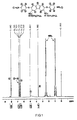
Fig. 1 is a graph showing a result of the proton nuclear magnetic resonance spectroscopy (1H-NMR) of 2,7-bis(4-aminophenoxy)fluorene-3,6-disulfonic acid synthesized in the example. -
Fig. 2 is a graph showing a result of the carbon nuclear magnetic resonance spectroscopy (13C-NMR) of 2,7-bis(4-aminophenoxy)fluorene-3,6-disulfonic acid synthesized in the example. - The sulfonic acid group-containing diamine compound of the present invention is a compound represented by formula (1) below.

- A in formula (1) is as described above. The group represented by [-SO3M] in formula (1) denotes a sulfonic acid group or a derivative thereof. The derivative of sulfonic acid group, for example, is a salt of sulfonic acid group or an ester of sulfonic acid group (sulfonic acid ester group). In the case where the group represented by [-SO3M] is a sulfonic acid group, M is a hydrogen atom (H). In the case where this group is a salt of sulfonic acid group, M is a metal atom or a protonated amine compound. When M is a metal atom, this group is a metal salt of sulfonic acid group. When M is the above-mentioned amine compound, this group is an amine salt of sulfonic acid group. The metal atom, for example, is an alkali metal atom or an alkaline earth metal atom. In the case where the group is an ester of sulfonic acid group, M is an alkyl group, particularly, an alkyl group having a carbon number of 1 to 4.
- It is difficult, for example, for a polycondensation polymer which has been obtained using a conventional sulfonic acid group-containing diamine compound that has a fluorene skeleton in which a substituent having an amino group is bonded to the carbon atom at the 9-position to exhibit properties derived from the high planarity of the skeleton because the fluorene skeleton is oriented perpendicular to the polymer main chain. Further, the planarity of the fluorene skeleton itself is lost when a substituent is bonded to the carbon atom at the 9-position. On the other hand, the sulfonic acid group-containing diamine compound, represented by formula (1), of the present invention has a fluorene skeleton with sulfonic acid groups or derivatives thereof, in which a substituent having an amino group is bonded to each of the carbon atoms at the 2-position and the 7-position in the skeleton. Further, no substituent is bonded to the carbon atom at the 9-position in the skeleton. According to the sulfonic acid group-containing diamine compound of the present invention with such a molecular structure, polymers (such as polycondensation polymers or thermosetting polymers) having properties derived from the high planarity of the fluorene skeleton, for example, are expected to be formed.
- The sulfonic acid group-containing diamine compound of the present invention, for example, is a compound represented by formulae (7), (8), (9), (10), or (11) below.


- R1, R2, and R3 in formulae (7), (10), and (11) each are a divalent aliphatic group which may have a substituent and has a carbon number of 1 to 10. Ar1, Ar2, Ar3, Ar4, Ar5, and Ar6 in formulae (8) to (11) each independently denote a divalent aromatic group which has 1 to 4 ring structures and may have a substituent. The substituent which the aliphatic groups R1, R2, and R3, and the aromatic groups Ar1, Ar2, Ar3, Ar4, Ar5, and Ar6 may have is at least one selected from a methyl group, an ethyl group, a propyl group, a butyl group, a trifluoromethyl group, a phenyl group, a phenoxy group, a phenylthio group, and a benzenesulfonyl group.
- Z1 in formula (9) is a direct bond (-), an ether group (-O-), a thioether group (-S-), or a sulfone group (-SO2-).
- The group represented by [-SO3M] in formulae (7) to (11) is the same as the group represented by [-SO3M] in formula (1), that is, a sulfonic acid group or a derivative thereof. Specifically, this group is a sulfonic acid group, a salt of sulfonic acid group, or an ester of sulfonic acid group. The salt of sulfonic acid group, for example, is a metal salt of sulfonic acid group or an amine salt of sulfonic acid group. The metal in the metal salt of sulfonic acid group, for example, is alkali metal or alkaline earth metal.
- The divalent aliphatic groups R1, R2, and R3 in formulae (1), (7), (10), and (11) each are preferably a divalent saturated aliphatic group. The divalent saturated aliphatic group, for example, is a methylene group, an ethylene group, or a propylene group, and is preferably a methylene group or an ethylene group. As mentioned above, these divalent aliphatic groups R1, R2, and R3 may have one or more substituents.
- In the case where the divalent aromatic groups Ar1, Ar2, Ar3, Ar4, Ar5, and Ar6 in formulae (1) and (8) to (11) have a plurality (2 to 4) of ring structures, the plurality of ring structures preferably form a fused ring. The divalent aromatic groups Ar1, Ar2, Ar3, Ar4, Ar5, and Ar6 each, for example, are a phenylene group, a naphthylene group (naphthalenediyl group), a phenanthrenediyl group, a pyrenediyl group, or a fluorenediyl group, and are preferably a phenylene group or a naphthylene group. Such an aromatic group includes a heteroaromatic group. As mentioned above, these divalent aromatic groups Ar1, Ar2, Ar3, Ar4, Ar5, and Ar6 each may have one or more substituents.
- Z1 in formulae (1) and (9) is preferably an ether group (-O-).
- In the sulfonic acid group-containing diamine compound of the present invention, A in formula (1) is preferably the aliphatic group R1 or the aromatic group Ar1, more preferably the aromatic group Ar1.
- The sulfonic acid group-containing diamine compound represented by formula (7), for example, is 2,7-bis(aminomethoxy)fluorene-3,6-disulfonic acid, 2,7-bis(aminoethoxy)fluorene-3,6-disulfonic acid,
2,7-bis(3-aminopropoxy)fluorene-3,6-disulfonic acid,
2,7-bis(2-aminopropoxy)fluorene-3,6-disulfonic acid,
2,7-bis(4-aminobutoxy)fluorene-3,6-disulfonic acid,
2,7-bis(3-aminobutoxy)fluorene-3,6-disulfonic acid,
2,7-bis(2-aminobutoxy)fluorene-3,6-disulfonic acid,
2,7-bis(5-aminopentoxy)fluorene-3,6-disulfonic acid,
2,7-bis(4-aminopentoxy)fluorene-3,6-disulfonic acid,
2,7-bis(3-aminopentoxy)fluorene-3,6-disulfonic acid,
2,7-bis(2-aminopentoxy)fluorene-3,6-disulfonic acid,
2,7-bis(6-aminohexyloxy)fluorene-3,6-disulfonic acid,
2,7-bis(5-aminohexyloxy)fluorene-3,6-disulfonic acid,
2,7-bis(4-aminohexyloxy)fluorene-3,6-disulfonic acid,
2,7-bis(3-aminohexyloxy)fluorene-3,6-disulfonic acid,
2,7-bis(2-aminohexyloxy)fluorene-3,6-disulfonic acid,
2,7-bis(1-amino-1-phenylmethoxy)fluorene-3,6-disulfonic acid,
2,7-bis(2-amino-2-phenyl-ethoxy)fluorene-3,6-disulfonic acid,
2,7-bis(2-amino-2-phenoxy-ethoxy)fluorene-3,6-disulfonic acid,
2,7-bis(2-amino-2-phenylsulfanyl-ethoxy)fluorene-3,6-disulfonic acid,
2,7-bis(2-amino-2-benzenesulfonyl-ethoxy)fluorene-3,6-disulfonic acid,
2,7-bis(3-amino-2-phenyl-propoxy)fluorene-3,6-disulfonic acid,
2,7-bis(3-amino-2-phenoxy-propoxy)fluorene-3,6-disulfonic acid,
2,7-bis(3-amino-2-phenylsulfanyl-propoxy)fluorene-3,6-disulfonic acid,
2,7-bis(3-amino-2-benzene sulfonyl-propoxy)fluorene-3,6-disulfonic acid,
2,7-bis(4-amino-2-phenyl-butoxy)fluorene-3,6-disulfonic acid,
2,7-bis(4-amino-2-phenoxy-butoxy)fluorene-3,6-disulfonic acid,
2,7-bis(4-amino-2-phenylsulfanyl-butoxy)fluorene-3,6-disulfonic acid,
2,7-bis(4-amino-2-benzenesulfonyl-butoxy)fluorene-3;6-disulfonic acid,
2,7-bis(4-amino-3-phenyl-butoxy)fluorene-3,6-disulfonic acid,
2,7-bis(4-amino-3-phenoxy-butoxy)fluorene-3,6-disulfonic acid,
2,7-bis(4-amino-3-phenylsulfanyl-butoxy)fluorene-3,6-disulfonic acid,
2,7-bis(4-amino-3-benzenesulfonyl-butoxy)fluorene-3,6-disulfonic acid,
2,7-bis(5-amino-3-phenyl-pentoxy)fluorene-3,6,disulfonic acid,
2,7-bis(5-amino-3-phenoxy-pentoxy)fluorene-3,6-disulfonic acid,
2,7-bis(5-amino-3-phenylsulfanyl-pentoxy)fluorene-3,6-disulfonic acid, or
2,7-bis(5-amino-3-benzenesulfonyl-pentoxy)fluorene-3,6-disulfonic acid. - The sulfonic acid group-containing diamine compound represented by formula (8), for example, is 2,7-bis(4-aminophenoxy)fluorene-3,6-disulfonic acid,
2,7-bis(3-aminophenoxy)fluorene-3,6-disulfonic acid,
2,7-bis(2-aminophenoxy)fluorene-3,6-disulfonic acid,
2,7-bis(5-amino-1-naphthoxy)fluorene-3,6-disulfonic acid,
2,7-bis(8-amino-1-naphthoxy)fluorene-3,6-disulfonic acid,
2,7-bis(3-amino-2-naphthoxy)fluorene-3,6-disulfonic acid,
2,7-bis(8-amino-2-naphthoxy)fluorene-3,6-disulfonic acid,
2,7-bis(4-amino-1-naphthoxy)fluorene-3,6-disulfonic acid,
2,7-bis(2-amino-1-naphthoxy)fluorene-3,6-disulfonic acid,
2,7-bis(6-amino-2-naphthoxy)fluorene-3,6-disulfonic acid,
2,7-bis(7-amino-2-naphthoxy)fluorene-3,6-disulfonic acid,
2,7-bis(6-amino-1-pyrenoxy)fluorene-3,6-disulfonic acid,
2,7-bis(8-amino-1-pyrenoxy)fluorene-3,6-disulfonic acid,
2,7-bis(3-amino-1-pyrenoxy)fluorene-3,6-disulfonic acid,
2,7-bis(10-amino-9-phenanthrenoxy)fluorene-3,6-disulfonic acid,
2,7-bis(7-amino-2-fluorenoxy)fluorene-3,6-disulfonic acid,
2,7-bis(8-amino-3-phenanthridineoxy)fluorene-3,6-disulfonic acid,
2,7-bis(3-amino-8-phenanthridineoxy)fluorene-3,6-disulfonic acid,
2,7-bis(8-amino-6-phenyl-3-phenanthridineoxy)fluorene-3,6-disulfonic acid, or
2,7-bis(3-amino-6-phenyl-8-phenanthridineoxy)fluorene-3,6-disulfonic acid. - The sulfonic acid group-containing diamine compound represented by formula (9), for example, is 2,7-bis(4'-amino-4-biphenyloxy)fluorene-3,6-disulfonic acid, 2,7-bis(4'-amino-3,3'-dimethyl-4-biphenyloxy)fluorene-3,6-disulfonic acid, 2,7-bis[4-(4-aminophenoxy)phenoxy]fluorene-3,6-disulfonic acid, 2,7-bis[4-(4-aminophenylsulfanyl)phenoxy]fluorene-3,6-disulfonic acid, or 2,7-bis[4-(4-aminobenzenesulfonyl)phenoxy]fluorene-3,6-disulfonic acid.
- The sulfonic acid group-containing diamine compound represented by formula (10), for example, is
2,7-bis[1-(4-aminophenyl)methoxy]fluorene-3,6-disulfonic acid,
2,7-bis[1-(3-aminophenyl)methoxy]fluorene-3,6-disulfonic acid, or
2,7-bis[1-(2-aminophenyl)methoxy]fluorene-3,6-disulfonic acid. - The sulfonic acid group-containing diamine compound represented by formula (11), for example, is
2,7-bis{4-[1-(4-aminophenyl)-2,2,2-trifluoro-1-trifluoromethylethyl]phenoxy}fluorene -3,6-disulfonic acid. - In the sulfonic acid group-containing diamine compound of the present invention, a substituent having an amino group is bonded to each of the carbon atoms at the 2-position and the 7-position via an ether bond (-O-). The ether bond provides excellent rotatability for the molecular chains. Thus, it is expected that the use of a polymer formed using the sulfonic acid group-containing diamine compound of the present invention allows a film, for example, having high bending properties and high flexibility to be produced.
- The sulfonic acid group-containing diamine compound of the present invention can be used in the same applications as conventional diamine compounds. Examples of such applications include a crosslinking agent or a raw material for polycondensation polymers or thermosetting polymers such as polyamide, polyimide, epoxy resin, and polyurethane.
- In the case where the group represented by [-SO3M] in the sulfonic acid group-containing diamine compound of the present invention is a sulfonic acid group, the handling can be facilitated by protecting the sulfonic acid group. It is possible to protect the sulfonic acid group, for example, by converting the sulfonic acid group into an ester of sulfonic acid group, a metal salt of sulfonic acid group, or an amine salt of sulfonic acid group. The protected sulfonic acid group can be converted again into a sulfonic acid group easily by hydrolysis, ion exchange, etc.
- The sulfonic acid group-containing diamine compound of the present invention, for example, can be produced by the method for producing the sulfonic acid group-containing diamine compound of the present invention. The sulfonic acid group-containing diamine compound of the present invention can be produced also by another production method, but the production method of the present invention enables efficient production of such compound.
- In the sulfonic acid group-containing diamine compound of the present invention, no substituent is bonded to the carbon atom at the 9-position in the fluorene skeleton. In conventional methods, however, a number of by-products in which a substituent is bonded to the carbon atom at the 9-position are generated because of the high reactivity of the carbon atom at the 9-position in the fluorene skeleton. Therefore, not only great efforts are required for purification of the desired sulfonic acid group-containing diamine compound, but also the yield rate of such compound is significantly reduced. In addition, the synthesis of the sulfonic acid group-containing diamine compound with no substituent bonded to the carbon atom at the 9-position is even impossible, depending on the method.
- As a result of studies on the production method of such a sulfonic acid group-containing diamine compound, the inventors have found that the formation of by-products in which a substituent is bonded to the carbon atom at the 9-position is suppressed and efficient synthesis of the sulfonic acid group-containing diamine compound of the present invention can be achieved by: [1] using, as a starting material, 2,7-dihydroxy-9-fluorenone in which the carbon atom at the 9-position in the fluorene skeleton forms a ketone group (>C=O) (that is, the 9-position in the fluorene skeleton is a ketone group) and a hydroxy group is bonded to each of the carbon atoms at the 2-position and the 7-position; [2] introducing a substituent having a nitro group to each of the 2-position and the 7-position through a condensation reaction with the hydroxy group, while preventing binding of a substituent to the carbon atom at the 9-position by protecting this carbon atom with the ketone group; [3] reducing the carbon atom at the 9-position to a state where a hydroxy group is bonded thereto and thereafter once acetylating the hydroxy group to form an acetoxy group (-OAc); [4] reducing, to amino groups, the nitro groups included in substituents that are bonded to the carbon atoms at the 2-position and the 7-position, as well as reducing, to a methylene group (-CH2-), the carbon atom at the 9-position to which the acetoxy group is bonded; and [5] introducing sulfonic acid groups or derivatives thereof to aromatic rings in the fluorene skeleton by a sulfonation reaction.
- That is, in the method for producing the sulfonic acid group-containing diamine compound of the present invention, the sulfonic acid group-containing diamine compound of the present invention can be produced efficiently by: using 2,7-dihydroxy-9-fluorenone having a fluorene skeleton as a starting material; introducing a nitro group-containing substituent to each of the carbon atoms at the 2-position and the 7-position by means of a condensation reaction of a hydroxy group; preventing binding of a substituent to the carbon atom at the 9-position during the introduction by protecting this carbon atom with a ketone group; changing the ketone group at the 9-position, through a state where a hydroxy group is bonded to the carbon atom, to a state where an acetoxy group is bonded to the carbon atom, so as to allow reduction to a methylene group in the subsequent step; reducing the nitro groups in the nitro group-containing substituents to amino groups as well as performing the above-mentioned reduction to a methylene group; and introducing sulfonic acid groups or derivatives thereof to aromatic rings in the fluorene skeleton by a sulfonation reaction.
- Hereinafter, each step is specifically described.
- In the method for producing the sulfonic acid group-containing diamine compound of the present invention, 2,7-dihydroxy-9-fluorenone represented by formula (2) and the compound <a> represented by formula (3) are subjected to condensation to allow the compound <b> represented by formula (4) to be obtained (Reaction 1).


- X in the compound <a> represented by formula (3) is a halogen group. The type of halogen that forms such a group is F, Cl, Br, or I, preferably F, Cl, or Br, more preferably F or Cl. The types of A in the compounds <a> and <b> represented by formulae (3) and (4), and the types of A in the compounds represented by formulae (4) to (6) below each are as described above for A in the sulfonic acid group-containing diamine compound represented by formula (1). A in formula (3) is the same as A in formula (1), as long as the molecular structure does not change through the intermediate reactions. A in the compound <a> represented by formula (3) may be selected depending on the substituents having amino groups in the target diamine compound. For example, when the target diamine compound is expressed by formula (1), it may be the same as A in formula (1).
- Typical examples of A in formula (3) include a phenylene group, a naphthalenediyl group, a methylene group, and an ethylene group.
-
Reaction 1 is a dehydrohalogenation condensation reaction and an etherification reaction between the hydroxy group in 2,7-dihydroxy-9-fluorenone and the compound <a>.Reaction 1 proceeds efficiently in the presence of a basic catalyst. - The basic catalyst, for example, is oxides, hydroxides, carbonates, hydrogencarbonates, hydrides, and alkoxides of alkali metals. Specific examples of the basic catalyst include sodium oxide, lithium oxide, potassium hydroxide, sodium hydroxide, lithium hydroxide, potassium carbonate, sodium carbonate, potassium bicarbonate, sodium hydrogencarbonate, sodium hydride, potassium t-butoxide, sodium methoxide, and sodium ethoxide. Two or more types of basic catalysts may be used. The use amount of basic catalyst, for example, is an equivalent mole of 1.0 to 5.0, preferably an equivalent mole of 2.0 to 4.0, with respect to 2,7-dihydroxy-9-fluorenone.
- In
Reaction 1, the reaction solvent is not specifically limited as long asReaction 1 proceeds. However, it is preferably a polar aprotic solvent. Specific examples of the reaction solvent include N-methylformamide, N,N-dimethylformamide, N,N-dimethylacetamide, dimethylsulfoxide, dimethylsulfone, sulfolane, N-methyl-2-pyrrolidinone, N-methylpyrrolidone (NMP), 1,3-dimethyl-2-imidazolidinone, N,N,N',N'-tetramethylurea, hexamethylphosphotriamide, 1,3-dimethyl-3,4,5,6-tetrahydro-2(1H)-pyrimidinone, tetrahydrofuran, acetonitrile, and acetone. The use amount of reaction solvent is not specifically limited. However, it is 1 to 20 times by weight the total amount of reactant, for example. The polar aprotic solvent can be used continuously as a reaction solvent inReactions Reaction 1. - In
Reaction 1, quaternary ammonium salt, quaternary phosphate, macrocyclic polyethers such as crown ethers, nitrogen-containing macrocyclic polyethers such as cryptands, nitrogen-containing chain polyethers, phase transfer catalysts such as polyethylene glycol and alkyl ethers thereof, copper powder, copper salt, etc., may be used in combination as a reaction accelerator. - In
Reaction 1, binding of a substituent to the carbon atom at the 9-position is suppressed due to the use of fluorenone having a ketone group at the 9-position in the fluorene skeleton as a starting material. Thus, the sulfonic acid group-containing diamine compound of the present invention can be efficiently produced through thesubsequent Reactions Reaction 1 was conducted using 2,7-dihydroxy-9-fluorene instead of 2,7-dihydroxy-9-fluorenone as a starting material, a substituent was bonded to the carbon atom at the 9-position. - Next, the ketone group at the 9-position of the compound <b> obtained after
Reaction 1 is reduced to a state where a hydroxy group is bonded to the carbon atom at the 9-position, and thereafter the hydroxy group is acetylated. Thus, the compound <c> represented by formula (5) is obtained (Reaction 2).
- In order to obtain the sulfonic acid group-containing diamine compound of the present invention, the ketone group at the 9-position of the compound <b> is required to be reduced to a methylene group. However, the reduction of the ketone group in the compound <b> does not proceed any further than the state where a hydroxy group is bonded to the carbon atom at the 9-position. Therefore, after the reduction has proceeded to a state where the hydroxy group is bonded to the carbon atom at the 9-position, the hydroxy group is once acetylated to a state where an acetoxy group (-OAc) is bonded thereto. It is not until this state (compound <c>) has been achieved that it becomes possible to reduce the ketone group at the 9-position in the fluorene skeleton to a methylene group.
- In
Reaction 2, the reduction of the ketone group may be performed, for example, by techniques such as hydrogenation, hydride reduction, and metal reduction. Reductants and/or catalysts to be used in the respective techniques are not specifically limited. For hydrogenation and metal reduction, fine powder of metals such as nickel, copper-chromium oxide, ruthenium, rhodium, and platinum; a catalyst obtained by allowing such fine powder to be adsorbed on an insoluble carrier such as activated carbon, alumina, and diatomite; or a complex of an organic compound and a metal, for example, can be used. For hydride reduction, diborane, sodium borohydride (NaBH4), sodium cyanoborohydride, lithium triethylborohydride, lithium tri(sec-butyl)borohydride, potassium tri(sec-butyl)borohydride, diisobutylaluminum hydride, lithium aluminum hydride, sodium bis(2-methoxyethoxy)aluminum hydride, or tributyltin hydride, for example, can be used. - As a reaction solvent to be used for the reduction of the ketone group, an arbitrarily selected solvent can be used as long as the reduction proceeds. In the case of using a polar aprotic solvent as a reaction solvent in
Reaction 1, it also is possible to use the solvent continuously. - The acetylation in
Reaction 2 can be performed, for example, using acetic anhydride or acetyl chloride. - As a reaction solvent to be used for the acetylation, an arbitrarily selected solvent can be used as long as the acetylation proceeds. In the case of using a polar aprotic solvent as a reaction solvent in
Reaction 1, it also is possible to use the solvent continuously. - Next, the diamine compound <d> represented by formula (6) is obtained by reducing, to a methylene group, the carbon atom (carbon atom to which an acetoxy group is bonded) at the 9-position in the fluorene skeleton of the compound <c> obtained through
Reaction 2 and reducing, to amino groups, the nitro groups that are included in substituents derived from the compound <a> and bonded to each of the carbon atoms at the 2-position and the 7-position (Reaction 3).
- In
Reaction 3, reductions may be performed, for example, by techniques such as hydrogenation, hydride reduction, and metal reduction. Reductants and/or catalysts to be used in the respective techniques may be the same as those used for the reduction of the ketone group inReaction 2. - As a reaction solvent to be used for
Reaction 3, an arbitrarily selected solvent can be used as long asReaction 3 proceeds. In the case of using a polar aprotic solvent as a reaction solvent inReaction 1, it also is possible to use the solvent continuously. - In
Reaction 3, the reduction of the carbon atom at the 9-position and the reduction of the nitro groups may be performed simultaneously or separately. - Next, the diamine compound <d> obtained in
Reaction 3 is subjected to a sulfonation reaction, so that a sulfonic acid group or a derivative thereof is introduced to each of the carbon atoms at the 3-position and the 6-position in the compound <d>. Thus, the sulfonic acid group-containing diamine compound of the present invention represented by formula (1) is obtained (Reaction 4).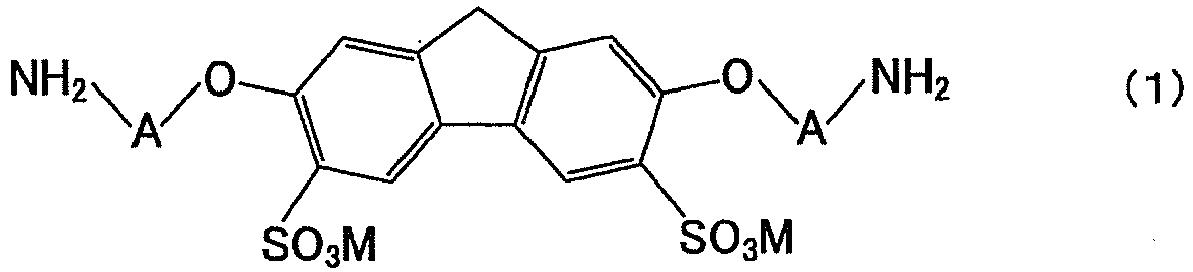
- The sulfonating agent to be used for the sulfonation reaction in
Reaction 4 is not particularly limited, as long as it allows sulfonic acid groups or derivatives thereof to be introduced to the aromatic rings in the fluorene skeleton of the compound <d>. Various sulfonating agents generally used can be used. Specific examples of the sulfonating agent include fuming sulfuric acid, sulfuric acid, sulfuric anhydride (sulfur trioxide), chlorosulfonic acid, 1,3,5-trimethylbenzene-2-sulfonic acid, 1,2,4,5-tetramethylbenzene-3-sulfonic acid, and 1,2,3,4,5-pentamethylbenzene-6-sulfonic acid. Particularly, fuming sulfuric acid, chlorosulfonic acid, and 1,3,5-trimethylbenzene-2-sulfonic acid are preferred, and fuming sulfuric acid is more preferred. - In
Reaction 4, almost all the product to be obtained are a sulfonic acid group-containing diamine compound represented by formula (1) in which a sulfonic acid group or a derivative thereof is introduced to each of the carbon atoms at the 3-position and the 6-position, because the carbon atoms at the 2-position and the 7-position in the fluorene skeleton of the compound <d> each have an ether bond, which is electron donating. - Specific reaction conditions such as the reaction temperature and reaction time in
Reactions 1 to 4 can be appropriately adjusted. - In the production method of the present invention, an optional reaction and optional step other than
Reactions Reaction 4 is a compound represented by formula (12) below, a step of protecting the sulfonic acid group (-SO3H) may be added afterReaction 4 in order to facilitate the handling of the compound. The sulfonic acid group, for example, is protected by converting the group into a salt (changing it into a salt of sulfonic acid group). Conversion into a salt can be performed, for example, by a reaction of the sulfonic acid group in formula (12) with a base.
- By the method described above, highly efficient synthesis of the sulfonic acid group-containing diamine compound of the present invention represented by formula (1) can be achieved, while the formation of by-products in which a substituent is bonded to the carbon atom at the 9-position is suppressed.
- Hereinafter, the present invention is described further in detail with reference to the example. The present invention is not limited to the following example.
- 100.0 g (471.3 mmol) of 2,7-dihydroxy-9-fluorenone, 146.3 g (1036.8 mmol) of 4-fluoronitrobenzene as the compound <a>, 260.5 g (1885.0 mmol) of potassium carbonate as a catalyst, and 1000 mL of N-methylpyrrolidone (NMP) as a reaction solvent were put in a four-necked separable flask with an internal volume of 2 L. Under stirring, the mixture in the flask was subjected to the reaction represented by formula (13) below in a nitrogen atmosphere at 90°C for 3 hours. After the completion of the reaction, the contents in the flask were cooled to room temperature. Thereafter, they were poured into 10 L of ice water and precipitated crystal was collected by filtration. The collected crystal was washed sequentially with water and ethanol, followed by drying under reduced pressure. Thus, 197.4 g (yield rate: 92.2%) of the compound <b> shown on the right-hand side of formula (13) was obtained as an ocherous crystal. The compound <b> shown on the right-hand side of formula (13) is 2,7-bis(4-nitrophenoxy)-9-fluorenone.

- 150.0 g (330.1 mmol) of the compound <b> obtained by
Reaction 1, 61.2 g (1617.6 mmol) of sodium borohydride and 123.3 g (924.3 mmol) of aluminum chloride (III) as a reductant, and 2.3 L of tetrahydrofuran (THF) as a reaction solvent were put into a four-necked separable flask with an internal volume of 3 L. The mixture in the flask was circulated in a nitrogen atmosphere for one night, so that the reaction represented by formula (14) below was allowed to proceed. Then, 1 L of water was added dropwise to the flask under cooling in an ice bath to cause quenching. Next, the reaction product was extracted with ethyl acetate and the extract was dried with sodium sulfate, which thereafter was concentrated under reduced pressure to undergo crystallization using heptane. Thus, 154.1 g (yield rate: 102.3%) of the compound shown on the right-hand side of formula (14) (2,7-bis(4-nitrophenoxy)-9-hydroxyfluorene) was obtained as a yellow crystal.
- Next, 150.0 g (328.7 mmol) of the resultant compound, 2 L of dichloromethane, 39.9 g (394.4 mmol) of triethylamine, and 4.0 g (32.9 mmol) of N,N-dimethyl-4-aminopyridine (DMAP) were put into a four-necked separable flask with an internal volume of 3 L. The whole was cooled with ice, while a nitrogen atmosphere was maintained inside the flask. Then, 31.0 g (394.4 mmol) of acetyl chloride was added dropwise thereto, which was stirred for 3 hours. Thereafter, the temperature of the mixture in the flask was returned to room temperature and it was stirred for one night continuously, so that the reaction represented by formula (15) below was allowed to proceed. After the contents of the flask was poured into 3 L of ice water, the reaction product was extracted with dichloromethane and the extract was dried with sodium sulfate, which thereafter was concentrated under reduced pressure. The obtained residue was purified by column chromatography (silica gel: 1000 g; developing solvent: dichloromethane). The crystal thus obtained was crystallized using THF/heptane. Thus, 159.7 g (yield rate: 97.5%) of the compound <c> shown on the right-hand side of formula (15) was obtained as a pale orange crystal. The compound <c> shown on the right-hand side of formula (15) is 2,7-bis(4-nitrophenoxy)-9-acetoxyfluorene.

- 159.0 g (319.0 mmol) of the compound <c> obtained by
Reaction 2, 15.9 g of a 10-wt% palladium-activated carbon ethylenediamine complex as a reductant, and 3 L of THF as a reaction solvent were put into a four-necked separable flask with an internal volume of 5 L. The contents of the flask were stirred continuously at room temperature for 2 days while a hydrogen atmosphere was maintained inside the flask, so that the reaction represented by formula (16) below was allowed to proceed. After the completion of the reaction, the catalyst was removed from the contents of the flask by Celite filtration. Thereafter, the filtrate was concentrated under reduced pressure, which was crystallized using heptane. The crystallized crystal was further dissolved in a small amount of THF, which was crystallized using THF/ethanol. Thus, 101.1 g (yield rate: 83.3%) of the compound <d> shown on the right-hand side of formula (16) was obtained as a white crystal. The compound <d> shown on the right-hand side of formula (16) is 2,7-bis(4-aminophenoxy)fluorene (BAPF).
- 47.6 g (125.0 mmol) of the compound <d> obtained in
Reaction 
- The obtained 2,7-bis(4-aminophenoxy)fluorene-3,6-disulfonic acid (BAPFDS) was identified by the 1H-NMR and 13C-NMR measurements (frequency: 300MHz; solvent for measurements: dimethylsulfoxide-d6 (DMSO-d6)) using a nuclear magnetic resonance spectrometer (AVANCE II 300, manufactured by Bruker BioSpin Corporation). Since the BAPFDS was insoluble as it is in DMSO-d6, a small amount of triethylamine (NEt3) was added thereto, thereby allowing a sulfonic acid group in the BAPFDS to change into triethyl ammonium salt of sulfonic acid group so as to be soluble in the DMSO-d6. The triethyl ammonium salt of BAPFDS thus obtained was subjected to various NMR measurements. The obtained 1H-NMR spectrum and 13C-NMR spectrum are respectively shown in
Figs. 1 and2 . Further, attribution of these spectra is shown below. As shown inFigs. 1 and2 , peaks in the spectra were attributed to 6 types of hydrogen atoms and 11 types of carbon atoms in the BAPFDS. - ·1H-NMR (300MHz, DMSO-d6, δ in ppm)
3.665 (2H, CH2), 4.883 (4H, NH2), 6.555-6.576 (4H, CH), 6.744-6.766 (6H, CH), 8.040 (2H, CH)
·13C-NMR (300MHz, DMSO-d6, δ in ppm)
36.219 (CH2), 113.986 (CH), 114.686 (CH), 118.816 (CH), 121.315 (CH), 133.476 (C-S), 136.462 (C=C), 144.871-144.969 (C-N, C=C), 147.102 (C-O), 155.276 (C-O) - The present invention may be embodied in other forms without departing from the spirit or essential characteristics thereof. The embodiments described in this specification are to be considered in all respects only as illustrative and not restrictive. The scope of the invention is, therefore, indicated by the appended claims rather than by the foregoing description. All changes which come within the meaning and range of equivalency of the claims are to be embraced within their scope.
- The sulfonic acid group-containing diamine compound of the present invention can be used in the same applications as for conventional sulfonic acid group-containing diamine compounds. The applications, for example, are a crosslinking agent or a raw material for thermosetting polymers or polycondensation polymers such as polyamide, polyimide, epoxy resin, and polyurethane.
Claims (2)
- A sulfonic acid group-containing diamine compound represented by formula (1) below:

a group represented by [-SO3M]is a sulfonic acid group, a salt of sulfonic acid group, or an ester of sulfonic acid group,
A in a partial structure represented by [-O-A-NH2] denotes:a divalent aliphatic group R1 which may have a substituent and has a carbon number of 1 to 10;a divalent aromatic group Ar1 which has 1 to 4 ring structures and may have a substituent;a group represented by formula: [-Ar2-Z1-Ar3-] (where Ar2 and Ar3, which may be the same as or different from each other, each are a divalent aromatic group which has 1 to 4 ring structures and may have a substituent, and Z1 is a direct bond (-), an ether group (-O-), a thioether group (-S-), or a sulfone group (-SO2-));a group represented by formula: [-R2-Ar4-] (where R2 is a divalent aliphatic group which may have a substituent and has a carbon number of 1 to 10, and Ar4 is a divalent aromatic group which has 1 to 4 ring structures and may have a substituent); ora group represented by formula: [-Ar5-R3-Ar6-] (where Ar5 and Ar6, which may be the same as or different from each other, each are a divalent aromatic group which has 1 to 4 ring structures and may have a substituent, and R3 is a divalent aliphatic group which may have a substituent and has a carbon number of 1 to 10), andthe substituent which the aliphatic groups R1, R2, and R3, and the aromatic groups Ar1 Ar2, Ar3, Ar4, Ar5, and Ar6 may have is at least one selected from a methyl group, an ethyl group, a propyl group, a butyl group, a trifluoromethyl group, a phenyl group, a phenoxy group, a phenylthio group, and a benzenesulfonyl group. - A method for producing the sulfonic acid group-containing diamine compound according to claim 1, comprising:a step of obtaining a compound <b> represented by formula (4) by a condensation reaction of 2,7-dihydroxy-9-fluorenone represented by formula (2) and a compound <a> represented by formula (3):


 a step of obtaining a diamine compound <d> represented by formula (6) by reducing the carbon atom at the 9-position, to which the acetoxy group is bonded, in the fluorene skeleton of the compound <c> and reducing nitro groups that are included in the substituents derived from the compound <a> and bonded to carbon atoms at the 2-position and the 7-position in the skeleton:
 a step of obtaining a sulfonic acid group-containing diamine compound represented by formula (1) in which a sulfonic acid group or a derivative of a sulfonic acid group is introduced to each of the carbon atoms at the 3-position and the 6-position in the fluorene skeleton by subjecting the compound <d> to a sulfonation reaction:
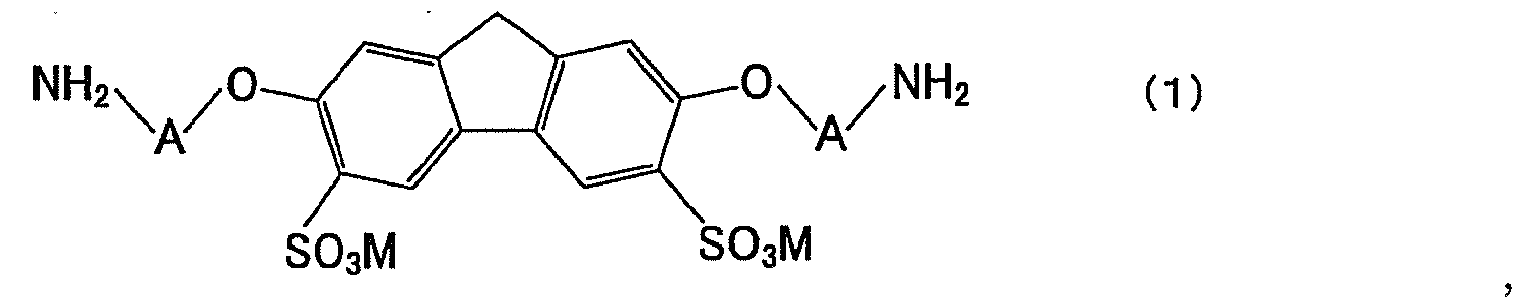 A in formulae (3) to (6) is the same group as A in the partial structure represented by [-O-A-NH2] of the sulfonic acid group-containing diamine compound represented by the formula (1).
Applications Claiming Priority (2)
| Application Number | Priority Date | Filing Date | Title |
|---|---|---|---|
| JP2011069685A JP5732292B2 (en) | 2011-03-28 | 2011-03-28 | Sulfonic acid group-containing diamine compound and process for producing the same |
| PCT/JP2012/001697 WO2012132269A1 (en) | 2011-03-28 | 2012-03-12 | Diamine compound containing sulfonic acid group, and method for producing same |
Publications (2)
| Publication Number | Publication Date |
|---|---|
| EP2692721A1 true EP2692721A1 (en) | 2014-02-05 |
| EP2692721A4 EP2692721A4 (en) | 2014-09-10 |
Family
ID=46930063
Family Applications (1)
| Application Number | Title | Priority Date | Filing Date |
|---|---|---|---|
| EP12764923.4A Withdrawn EP2692721A4 (en) | 2011-03-28 | 2012-03-12 | Diamine compound containing sulfonic acid group, and method for producing same |
Country Status (5)
| Country | Link |
|---|---|
| US (1) | US9156780B2 (en) |
| EP (1) | EP2692721A4 (en) |
| JP (1) | JP5732292B2 (en) |
| CN (1) | CN103476745B (en) |
| WO (1) | WO2012132269A1 (en) |
Cited By (1)
| Publication number | Priority date | Publication date | Assignee | Title |
|---|---|---|---|---|
| EP2692774A4 (en) * | 2011-03-30 | 2014-09-17 | Nitto Denko Corp | POLYIMIDE, POLYIMIDE POLYMER ELECTROLYTE MEMBRANE, MEMBRANE ELECTRODE ASSEMBLY, AND SOLID POLYMER FUEL CELL |
Families Citing this family (3)
| Publication number | Priority date | Publication date | Assignee | Title |
|---|---|---|---|---|
| CN103864648B (en) * | 2013-12-20 | 2016-01-20 | 中国海洋石油总公司 | A kind of sulfonated aromatic diamine compound and preparation method thereof and application |
| US11746274B1 (en) | 2022-02-25 | 2023-09-05 | Saudi Arabian Oil Company | Ionic liquid monomer for synthesis of friction reducer and methods thereof |
| CN119747097B (en) * | 2025-01-02 | 2025-10-17 | 中铝郑州有色金属研究院有限公司 | A reverse flotation collector and its preparation method and application |
Family Cites Families (14)
| Publication number | Priority date | Publication date | Assignee | Title |
|---|---|---|---|---|
| DE3713856A1 (en) | 1987-04-25 | 1988-11-17 | Bayer Ag | AROMATIC DIAMINE CONTAINING SULPHONIC ACID, A METHOD FOR THE PRODUCTION THEREOF AND THEIR USE IN THE PRODUCTION OF POLYURETHANE PLASTICS |
| DE3917602A1 (en) | 1989-05-31 | 1990-12-06 | Basf Ag | METHOD FOR PRODUCING TRIPHENDIOXAZINE |
| JP3910026B2 (en) * | 2001-08-24 | 2007-04-25 | 有限会社山口ティー・エル・オー | New polymer electrolyte membrane for fuel cells |
| JP3984806B2 (en) * | 2001-08-24 | 2007-10-03 | 有限会社山口ティー・エル・オー | Novel aromatic diamine compound and process for producing the same |
| DE10228763A1 (en) * | 2002-06-27 | 2004-01-29 | Infineon Technologies Ag | Monomers for insulating materials in aluminum and copper technologies |
| US20050171079A1 (en) | 2004-02-04 | 2005-08-04 | Schrimpf Michael R. | Amino-substituted tricyclic derivatives and methods of use |
| US7365193B2 (en) * | 2004-02-04 | 2008-04-29 | Abbott Laboratories | Amino-substituted tricyclic derivatives and methods of use |
| CN100344675C (en) * | 2004-10-19 | 2007-10-24 | 中山大学 | Sulfonated fluorine-containing poly-arylether (arone) and its preparing method and use |
| CN1253491C (en) * | 2004-11-05 | 2006-04-26 | 中国科学院长春应用化学研究所 | Process for synthesis of sulfonated polyimide proton transmission film |
| FR2888937B1 (en) | 2005-07-21 | 2012-10-26 | Biomerieux Sa | METHOD OF DETECTING FCPA USING FCPA AGGREGATION AGENT AND FORM AGGREGATE CAPTURING AGENT |
| JP5627198B2 (en) * | 2009-05-27 | 2014-11-19 | 日東電工株式会社 | Proton conducting polymer electrolyte membrane, membrane-electrode assembly and polymer electrolyte fuel cell using the same |
| WO2011072199A2 (en) * | 2009-12-10 | 2011-06-16 | Surmodics, Inc. | Water-soluble degradable photo-crosslinker |
| US8748664B2 (en) * | 2010-02-24 | 2014-06-10 | Nitto Denko Corporation | Diamine compound and production method thereof |
| US9088030B2 (en) * | 2011-03-30 | 2015-07-21 | Nitto Denko Corporation | Polyimide, polyimide-based polymer electrolyte membrane, membrane-electrode assembly, and polymer electrolyte fuel cell |
-
2011
- 2011-03-28 JP JP2011069685A patent/JP5732292B2/en not_active Expired - Fee Related
-
2012
- 2012-03-12 US US13/823,518 patent/US9156780B2/en not_active Expired - Fee Related
- 2012-03-12 WO PCT/JP2012/001697 patent/WO2012132269A1/en not_active Ceased
- 2012-03-12 CN CN201280015945.XA patent/CN103476745B/en not_active Expired - Fee Related
- 2012-03-12 EP EP12764923.4A patent/EP2692721A4/en not_active Withdrawn
Non-Patent Citations (2)
| Title |
|---|
| No further relevant documents disclosed * |
| See also references of WO2012132269A1 * |
Cited By (2)
| Publication number | Priority date | Publication date | Assignee | Title |
|---|---|---|---|---|
| EP2692774A4 (en) * | 2011-03-30 | 2014-09-17 | Nitto Denko Corp | POLYIMIDE, POLYIMIDE POLYMER ELECTROLYTE MEMBRANE, MEMBRANE ELECTRODE ASSEMBLY, AND SOLID POLYMER FUEL CELL |
| US9088030B2 (en) | 2011-03-30 | 2015-07-21 | Nitto Denko Corporation | Polyimide, polyimide-based polymer electrolyte membrane, membrane-electrode assembly, and polymer electrolyte fuel cell |
Also Published As
| Publication number | Publication date |
|---|---|
| CN103476745A (en) | 2013-12-25 |
| EP2692721A4 (en) | 2014-09-10 |
| JP5732292B2 (en) | 2015-06-10 |
| WO2012132269A1 (en) | 2012-10-04 |
| US20130178649A1 (en) | 2013-07-11 |
| US9156780B2 (en) | 2015-10-13 |
| JP2012201654A (en) | 2012-10-22 |
| CN103476745B (en) | 2015-09-30 |
Similar Documents
| Publication | Publication Date | Title |
|---|---|---|
| US20140235896A1 (en) | Novel diamine compound | |
| US9156780B2 (en) | Sulfonic acid group-containing diamine compound and method for producing the same | |
| Sipyagin et al. | New 4-pentafluorosulfanyl and 4-perfluoroalkylthio derivatives of 1-chloro-2-nitro-and 1-chloro-2, 6-dinitrobenzenes | |
| CN105130926A (en) | Preparation method of methylene blue | |
| CN101450916A (en) | Synthetic method of tigecycline | |
| CN102093292A (en) | Method for synthesizing DL-alpha-aminocaprolactam | |
| WO2012105263A1 (en) | Method for producing aminophenyl pyrimidinyl alcohol derivative, and synthesis intermediate thereof | |
| CN119080732A (en) | Industrial scale preparation method of urolithin compounds | |
| CN100376544C (en) | Insulation material monomer in aluminum and copper technology | |
| CN110790689A (en) | A kind of synthetic method of 1,1-difluoro-2-isonitrile-ethylphenyl sulfone compounds | |
| CN114605331A (en) | A kind of preparation method of nilutamide and intermediate thereof | |
| CN114539106A (en) | Synthetic method of stable isotope labeled tauryl amine hydrochloride | |
| JP3984806B2 (en) | Novel aromatic diamine compound and process for producing the same | |
| US7282610B2 (en) | Method of producing aromatic amine compound having alkylthio group | |
| CN101723841A (en) | Preparation method of 2-amino-5-alkoxy propiophenone | |
| WO2020212352A1 (en) | Process for the production of substituted 2-[2-(phenyl) ethylamino]alkaneamide derivatives | |
| ES2241303T3 (en) | DERIVATIVES OF DIFLUOROMETOXIBENCENO AND ITS USE AS INTERMEDIARIES. | |
| KR20170127495A (en) | Diamine compound and method for producing intermediate thereof | |
| JP2009256306A (en) | Adamantane derivative having polymerizable unsaturated group, and method for producing the same | |
| JP5248132B2 (en) | Method for producing calixarene derivative | |
| CN121108156A (en) | A green preparation method for chiral 10-camphor sulfonazine | |
| KR20190032253A (en) | Method of preparing diamine compound | |
| JP2005320325A (en) | Dinitrobiphenyl derivative and method for producing the derivative, dinitrobenzidine and diaminobenzidine | |
| CN103788008A (en) | Preparation method of diamine compound containing thiazole ring | |
| JP2008037772A (en) | Method for producing 2,2-bis (4-amino-3-hydroxyphenyl) propane compound |
Legal Events
| Date | Code | Title | Description |
|---|---|---|---|
| PUAI | Public reference made under article 153(3) epc to a published international application that has entered the european phase |
Free format text: ORIGINAL CODE: 0009012 |
|
| 17P | Request for examination filed |
Effective date: 20130701 |
|
| AK | Designated contracting states |
Kind code of ref document: A1 Designated state(s): AL AT BE BG CH CY CZ DE DK EE ES FI FR GB GR HR HU IE IS IT LI LT LU LV MC MK MT NL NO PL PT RO RS SE SI SK SM TR |
|
| DAX | Request for extension of the european patent (deleted) | ||
| A4 | Supplementary search report drawn up and despatched |
Effective date: 20140807 |
|
| RIC1 | Information provided on ipc code assigned before grant |
Ipc: C07C 303/06 20060101ALI20140801BHEP Ipc: C07C 309/43 20060101AFI20140801BHEP |
|
| GRAP | Despatch of communication of intention to grant a patent |
Free format text: ORIGINAL CODE: EPIDOSNIGR1 |
|
| INTG | Intention to grant announced |
Effective date: 20161028 |
|
| STAA | Information on the status of an ep patent application or granted ep patent |
Free format text: STATUS: THE APPLICATION IS DEEMED TO BE WITHDRAWN |
|
| 18D | Application deemed to be withdrawn |
Effective date: 20170308 |