EP2691516B1 - New process for the selective oxidation of bile acids, their salts or derivatives - Google Patents
New process for the selective oxidation of bile acids, their salts or derivatives Download PDFInfo
- Publication number
- EP2691516B1 EP2691516B1 EP12717864.8A EP12717864A EP2691516B1 EP 2691516 B1 EP2691516 B1 EP 2691516B1 EP 12717864 A EP12717864 A EP 12717864A EP 2691516 B1 EP2691516 B1 EP 2691516B1
- Authority
- EP
- European Patent Office
- Prior art keywords
- acid
- process according
- dependent
- keto
- hsdh
- Prior art date
- Legal status (The legal status is an assumption and is not a legal conclusion. Google has not performed a legal analysis and makes no representation as to the accuracy of the status listed.)
- Active
Links
Classifications
-
- C—CHEMISTRY; METALLURGY
- C12—BIOCHEMISTRY; BEER; SPIRITS; WINE; VINEGAR; MICROBIOLOGY; ENZYMOLOGY; MUTATION OR GENETIC ENGINEERING
- C12N—MICROORGANISMS OR ENZYMES; COMPOSITIONS THEREOF; PROPAGATING, PRESERVING, OR MAINTAINING MICROORGANISMS; MUTATION OR GENETIC ENGINEERING; CULTURE MEDIA
- C12N9/00—Enzymes; Proenzymes; Compositions thereof; Processes for preparing, activating, inhibiting, separating or purifying enzymes
- C12N9/0004—Oxidoreductases (1.)
-
- C—CHEMISTRY; METALLURGY
- C12—BIOCHEMISTRY; BEER; SPIRITS; WINE; VINEGAR; MICROBIOLOGY; ENZYMOLOGY; MUTATION OR GENETIC ENGINEERING
- C12P—FERMENTATION OR ENZYME-USING PROCESSES TO SYNTHESISE A DESIRED CHEMICAL COMPOUND OR COMPOSITION OR TO SEPARATE OPTICAL ISOMERS FROM A RACEMIC MIXTURE
- C12P33/00—Preparation of steroids
- C12P33/02—Dehydrogenating; Dehydroxylating
-
- C—CHEMISTRY; METALLURGY
- C12—BIOCHEMISTRY; BEER; SPIRITS; WINE; VINEGAR; MICROBIOLOGY; ENZYMOLOGY; MUTATION OR GENETIC ENGINEERING
- C12N—MICROORGANISMS OR ENZYMES; COMPOSITIONS THEREOF; PROPAGATING, PRESERVING, OR MAINTAINING MICROORGANISMS; MUTATION OR GENETIC ENGINEERING; CULTURE MEDIA
- C12N9/00—Enzymes; Proenzymes; Compositions thereof; Processes for preparing, activating, inhibiting, separating or purifying enzymes
- C12N9/0004—Oxidoreductases (1.)
- C12N9/0006—Oxidoreductases (1.) acting on CH-OH groups as donors (1.1)
-
- C—CHEMISTRY; METALLURGY
- C12—BIOCHEMISTRY; BEER; SPIRITS; WINE; VINEGAR; MICROBIOLOGY; ENZYMOLOGY; MUTATION OR GENETIC ENGINEERING
- C12P—FERMENTATION OR ENZYME-USING PROCESSES TO SYNTHESISE A DESIRED CHEMICAL COMPOUND OR COMPOSITION OR TO SEPARATE OPTICAL ISOMERS FROM A RACEMIC MIXTURE
- C12P33/00—Preparation of steroids
-
- C—CHEMISTRY; METALLURGY
- C12—BIOCHEMISTRY; BEER; SPIRITS; WINE; VINEGAR; MICROBIOLOGY; ENZYMOLOGY; MUTATION OR GENETIC ENGINEERING
- C12Y—ENZYMES
- C12Y101/00—Oxidoreductases acting on the CH-OH group of donors (1.1)
- C12Y101/01—Oxidoreductases acting on the CH-OH group of donors (1.1) with NAD+ or NADP+ as acceptor (1.1.1)
- C12Y101/01001—Alcohol dehydrogenase (1.1.1.1)
-
- C—CHEMISTRY; METALLURGY
- C12—BIOCHEMISTRY; BEER; SPIRITS; WINE; VINEGAR; MICROBIOLOGY; ENZYMOLOGY; MUTATION OR GENETIC ENGINEERING
- C12Y—ENZYMES
- C12Y101/00—Oxidoreductases acting on the CH-OH group of donors (1.1)
- C12Y101/01—Oxidoreductases acting on the CH-OH group of donors (1.1) with NAD+ or NADP+ as acceptor (1.1.1)
- C12Y101/01159—7-Alpha-hydroxysteroid dehydrogenase (1.1.1.159)
-
- C—CHEMISTRY; METALLURGY
- C12—BIOCHEMISTRY; BEER; SPIRITS; WINE; VINEGAR; MICROBIOLOGY; ENZYMOLOGY; MUTATION OR GENETIC ENGINEERING
- C12Y—ENZYMES
- C12Y101/00—Oxidoreductases acting on the CH-OH group of donors (1.1)
- C12Y101/01—Oxidoreductases acting on the CH-OH group of donors (1.1) with NAD+ or NADP+ as acceptor (1.1.1)
- C12Y101/01176—12-Alpha-hydroxysteroid dehydrogenase (1.1.1.176)
Definitions
- the present invention relates to a new process for the industrial production of ursodeoxycholic acid, starting from different bile acids, exemplified by the general formula reported in Scheme 1, salts or derivatives thereof, readily available on the market, such as for example cholic acid (3a,7a,12a-trihydroxy-5 ⁇ -cholanoic acid, (I)), cholic acid methyl ester (II) and chenodeoxycholic acid (3 ⁇ ,7 ⁇ -dihydroxy-5 ⁇ -cholanoic acid, (III)).
- Ursodeoxycholic acid that is 3 ⁇ ,7 ⁇ -dihydroxy-5 ⁇ -cholanoic acid (UDCA), which formula is reported in the following formula (IV) (Scheme 2), is a compound generally present in small amounts in human bile, where it increases the cholesterol solubilising ability of the bile.
- UDCA is known for its therapeutic properties: in fact, it is used for the treatment of malfunctions of the liver district, such as dissolution of cholesterol biliary stones, primary biliary cirrhosis and sclerosing cholangitis.
- Oxidized derivatives of cholic acid and chenodeoxycholic acid can be synthesized both by chemical syntheses, and enzymatic processes.
- Chemical processes generally include esterification of the bile acid, selective acetylation of the hydroxyl groups that do not require oxidation, and oxidation of the selected hydroxyl to ketone.
- yields and conversions that can be obtained through synthetic processes are not fully satisfactory from an industrial point of view.
- the oxidation of cholic acid can be carried out by an enzymatic route using NAD(P)H-dependent hydroxysteroid dehydrogenase enzymatic activities (HSDH) coupled with suitable cofactor regeneration systems, which then can be reacted in catalytic rather than stoichiometric amounts.
- HSDH NAD(P)H-dependent hydroxysteroid dehydrogenase enzymatic activities
- HSDH activities show an almost absolute regio- and stereo-selectivity and, therefore, differently from chemical oxidations, the reactions that they catalyze can be conducted without preventive protection of the hydroxyl groups that do not require oxidation.
- Quantitative conversions can be obtained coupling the oxidation reaction with the irreversible reduction reaction of a co-substrate catalyzed by a second dehydrogenase, like in the case of the reductive amination of ⁇ -ketoglutaric acid catalyzed by glutamate dehydrogenase in the presence of ammonia.
- oxidation reactions of bile acids coupled with glutamate dehydrogenase for the regeneration of the cofactor NAD(P) + are described for example in Riva S., Bovara R., Pasta P., Carrea G. J. Org.
- NAD(P) + -dependent hydroxysteroid dehydrogenases (HSDH) in the presence of an alcohol dehydrogenase (ADH) and methyl acetoacetate as a co-substrate for the regeneration of the cofactor NAD(P) +
- NAD(P) + -dependent HSDHs used in the process of the present invention preferably have an enzymatic activity ranging from 0.25 to 12 U, where enzymatic activity (U) means the amount of enzyme 7a-HSDH or 12 ⁇ -HSDH able to transform in one minute one micromole of cholic acid substrate to the corresponding product, oxidized at positions 7 or 12, respectively, in an assay solution containing 12.5mM cholic acid, 0.2mM NAD(P) + and 100mM potassium phosphate buffer, pH 9.0.
- U means the amount of enzyme 7a-HSDH or 12 ⁇ -HSDH able to transform in one minute one micromole of cholic acid substrate to the corresponding product, oxidized at positions 7 or 12, respectively, in an assay solution containing 12.5mM cholic acid, 0.2mM NAD(P) + and 100mM potassium phosphate buffer, pH 9.0.
- the compounds (I), (II) and (III), salts or derivatives thereof are preferably used at a concentration ranging from 0.5% to 4% (weight/volume), that is at a concentration ranging from 12.5mM to 100mM.
- the cofactor NAD(P) + + is preferably used in catalytic amounts, at a concentration ranging from 0.2 to 0.8mM.
- the co-substrate methyl acetoacetate is used in an amount equal to 2 equivalents referred to each of the compounds (I), (II) or (III).
- the co-substrate methyl acetoacetate is used in amounts ranging from 0.3% to 2.4% (volume/volume).
- the process of the present invention is preferably carried out at room temperature, that is at about 20°C, and is preferably carried out at pH 8.
- the cofactor regeneration system used in the process of the present invention is considerably more economic and efficient than previous ones, in that it uses an enzyme and a co-substrate, that is alcohol dehydrogenase and methyl acetoacetate respectively, which are not very expensive and allows the quantitative conversion, i.e. equal to or higher than 99.5%, of bile acids, salts or derivatives thereof such as cholic acid ((I), Scheme 3), cholic acid methyl ester ((II), Scheme 4) and chenodeoxycholic acid ((III), Scheme 5) to the respective selectively oxidized derivatives, depending on the specific HSDH used, that is 7 ⁇ -HSDH, 12 ⁇ -HSDH or combinations thereof, on a preparative scale.
- the oxidation reaction is conducted in a monophasic system by adding an NAD(P) + -dependent hydroxysteroid dehydrogenase (HSDH), such as for example the 12 ⁇ -HSDH and 7 ⁇ -HSDH described in Scheme 3 or the 7 ⁇ -HSDH described in Scheme 5, to an aqueous solution containing cholic acid (I) or chenodeoxycholic acid (III) sodium salts, with catalytic amounts of NAD(P) + , which regeneration from NAD(P)H to NAD(P) + is carried out through the conversion of methyl acetoacetate to methyl 3-hydroxybutyrate using an NAD(P)H-dependent alcohol dehydrogenase (ADH).
- HSDH NAD(P) + -dependent hydroxysteroid dehydrogenase
- the reactions (oxidations of (I) to the derivatives (V), (VI) and (VII) and of (VI) to the derivative (VII) (Scheme 3), and oxidation of (III) to the derivative (IX) (Scheme 5)) are carried out for a period of time ranging from 4 to 16 h
- the substrate bile acid sodium salt is normally used at a concentration ranging from 0.5% to 4% (weight/volume) (that is between 12.5 and 100mM), at pH 8.0 and 20°C
- NAD(P) + is used in catalytic amounts, at a concentration ranging from 0.2 to 0.8mM
- methyl acetoacetate is usually used in an amount equal to 2 equivalents referred to the bile acid salt, consequently in amounts ranging from 0.3 to 2.4% (volume/volume).
- the oxidation reaction of the hydroxyl at position 7 of cholic acid methyl ester (II) catalyzed by a 7 ⁇ -HSDH (Scheme 4) is carried out in a pH 8.0 potassium phosphate buffer/i-propyl acetate biphasic system at 20°C, using the same cofactor regeneration system.
- the substrate (II) is dissolved at a concentration equal to 4% (weight/volume) (that is 100mM) in i-propyl acetate and added to an equal volume of pH 8.0 potassium phosphate buffer, containing NAD(P) + at a concentration equal to 0.8mM and methyl acetoacetate in an amount equal to 2 equivalents referred to (II), consequently in an amount equal to 2.4% (volume/volume).
- the new process is simpler and economically advantageous, in that protection of the hydroxyl groups that do not require oxidation is not necessary, thanks to the almost absolute regioselectivity of HSDHs. Further, the process can be carried out in mild reaction conditions (for example at a temperature of 20°C, at atmospheric pressure and at a pH equal to 8.0), which brings both economical and environmental advantages.
- the new process is more efficient, in that it allows conversions equal to or higher than 99.5%, for thermodynamic reasons not reachable using common ketones, for example acetone, as a co-substrate.
- the regenerating system of the present invention is more versatile than previous ones, thanks to the availability of both NADH- and NADPH-dependent ADHs developed for applications on an industrial scale, which then can be suitably coupled with HSDH with the same specificity.
- the enzymes used in the processes described above can come from a microbial source, such as:
- oxidized derivatives obtained through the process of the present invention can be used in the synthesis of UDCA ((IV), Scheme 2) by a chemical route, as described in Giordano C., Perdoncin G., Castaldi G., Angew. Chem. Int.
- Example 1 Oxidation of the hydroxyl at position 7 of cholic acid (I) catalyzed by NADH-dependent 7 ⁇ -HSDH from Bacteroides fragilis in the presence of NADH-dependent ADH from horse liver (SIGMA-ALDRICH).
- the reaction was carried out at 20°C and pH 8.0 in a total volume of 0.5 ml containing: 0.5% (w/v) cholic acid sodium salt at pH 8.0 (12.5mM, obtained diluting a 0.2M cholic acid sodium salt aqueous solution at pH 8.0), 2 equivalents (0.3% (v/v)) of methyl acetoacetate, 12 U of NADH-dependent 7 ⁇ -HSDH from Bacteroides fragilis, recombinant from E.
- coli Rosetta 2(DE3)pLysS 0.1 U of NADH-dependent ADH from horse liver (SIGMA-ALDRICH), 0.8mM NAD + (40 ⁇ l of 10mM NAD + aqueous solution), 50mM potassium phosphate buffer, pH 8.0.
- Example 2 Oxidation of the hydroxyl at position 12 of cholic acid (I) catalyzed by NADH-dependent 12 ⁇ -HSDH (Genzyme) in the presence of NADH-dependent ADH from horse liver (SIGMA-ALDRICH).
- the reaction was carried out at 20°C and pH 8.0 in a total volume of 0.5 ml containing: 0.5% (w/v) cholic acid sodium salt at pH 8.0 (12.5mM, obtained diluting a 0.2M cholic acid sodium salt aqueous solution at pH 8.0), 2 equivalents (0.3% (v/v)) of methyl acetoacetate, 4 U of NADH-dependent 12 ⁇ -HSDH from a microbial source (Genzyme), 0.05 U of NADH-dependent ADH from horse liver (SIGMA-ALDRICH), 0.2mM NAD + (10 ⁇ l of a 10mM NAD + aqueous solution), 50mM potassium phosphate buffer, pH 8.0.
- Example 3 Oxidation of the hydroxyl at position 12 of cholic acid (I) catalyzed by NADPH-dependent 12 ⁇ -HSDH (ASA) in the presence of NADPH-dependent ADH from T. brockii (SIGMA-ALDRICH).
- the reaction was carried out at 20°C and pH 8.0 in a total volume of 0.5 ml containing: 0.5% (w/v) cholic acid sodium salt at pH 8.0 (12.5mM, obtained diluting a 0.2M cholic acid sodium salt aqueous solution at pH 8.0), 2 equivalents (0.3% (v/v)) of methyl acetoacetate, 4 U of NADPH-dependent 12 ⁇ -HSDH (ASA), 10 U of NADPH-dependent ADH from T. brockii (SIGMA-ALDRICH), 0.2mM NADP + (10 ⁇ l of a 10mM NADP + aqueous solution), 50mM potassium phosphate buffer, pH 8.0.
- Example 4 Oxidation of the hydroxyl at position 7 of cholic acid (I) catalyzed by NADPH-dependent 7 ⁇ -HSDH from C. absonum in the presence of NADPH-dependent ADH, recombinant from E. coli (SIGMA-ALDRICH).
- the reaction was carried out at 20°C and pH 8.0 in a total volume of 0.5 ml containing: 4% (w/v) cholic acid sodium salt at pH 8.0 (100mM, obtained diluting a 0.2M cholic acid sodium salt aqueous solution at pH 8.0), 2 equivalents (2.4% (v/v)) of methyl acetoacetate, 0.25 U of NADPH-dependent 7 ⁇ -HSDH from C . absonum, recombinant from E . coli, 4 U of NADPH-dependent ADH, recombinant from E. coli (SIGMA-ALDRICH), 0.8mM NADP + (40 ⁇ l of a 10mM NADP + aqueous solution), 50mM potassium phosphate buffer, pH 8.0.
- Example 5 Oxidation of the hydroxyl at position 7 of cholic acid (I) catalyzed by NADPH-dependent 7 ⁇ -HSDH from C. absonum in the presence of NADPH-dependent ADH from T. brockii (SIGMA-ALDRICH).
- the reaction was carried out at 20°C and pH 8.0 in a total volume of 0.5 ml containing: 0.5% (w/v) cholic acid sodium salt at pH 8.0 (12.5mM, obtained diluting a 0.2M cholic acid sodium salt aqueous solution at pH 8.0), 2 equivalents (0.3% (v/v)) of methyl acetoacetate, 4 U of NADPH-dependent 7 ⁇ -HSDH from C . absonum, recombinant from E. coli, 10 U of NADPH-dependent ADH from T. brockii (SIGMA-ALDRICH), 0.2mM NADP + (10 ⁇ l of a 10mM NADP + aqueous solution), 50mM potassium phosphate buffer, pH 8.0.
- Example 6 Oxidation of the hydroxyl at position 7 of 12-keto-chenodeoxycholic acid (VI) catalyzed by NADPH-dependent 7 ⁇ -HSDH from C. absonum in the presence of NADPH-dependent ADH, recombinant from E. coli (SIGMA-ALDRICH).
- the reaction was carried out at 20°C and pH 8.0 in a total volume of 0.5 ml containing: 4% (w/v) 12-keto-chenodeoxycholic acid sodium salt at pH 8.0 (100mM, obtained diluting a 0.2M 12-keto-chenodeoxycholic acid sodium salt aqueous solution at pH 8.0), 2 equivalents (2.4% (v/v)) of methyl acetoacetate, 4 U of NADPH-dependent 7 ⁇ -HSDH from C . absonum, recombinant from E . coli, 4 U of NADPH-dependent ADH, recombinant from E . coli (SIGMA-ALDRICH), 0.8mM NADP + (40 ⁇ l of a 10mM NADP + aqueous solution), 50mM potassium phosphate buffer, pH 8.0.
- Example 7 Oxidation of the hydroxyls at positions 7 and 12 of cholic acid (I) catalyzed by NADPH-dependent 7 ⁇ -HSDH from C. absonum and NADPH-dependent 12 ⁇ -HSDH (ASA) in the presence of NADPH-dependent ADH, recombinant from E. coli (SIGMA-ALDRICH).
- the reaction was carried out at 20°C and pH 8.0 in a total volume of 0.5 ml containing: 0.5% (w/v) cholic acid sodium salt at pH 8.0 (12.5mM, obtained diluting a 0.2M cholic acid sodium salt aqueous solution at pH 8.0), 2 equivalents (0.6% (v/v)) of methyl acetoacetate, 2 U of NADPH-dependent 7 ⁇ -HSDH from C. absonum recombinant from E . coli, 4 U of NADPH-dependent 12 ⁇ -HSDH (ASA), 4 U of NADPH-dependent ADH recombinant from E. coli (SIGMA-ALDRICH), 0.8mM NADP + (40 ⁇ l of a 10mM NADP + aqueous solution), 50mM potassium phosphate buffer, pH 8.0.
- Example 8 Oxidation of the hydroxyl at position 7 of chenodeoxycholic acid (III) catalyzed by NADPH-dependent 7 ⁇ -HSDH from C. absonum in the presence of NADPH-dependent ADH, recombinant from E. coli (SIGMA-ALDRICH).
- the reaction was carried out at 20°C and pH 8.0 in a total volume of 0.5 ml containing: 2% (w/v) chenodeoxycholic acid sodium salt at pH 8.0 (50mM, obtained diluting a 0.2M chenodeoxycholic acid sodium salt aqueous solution at pH 8.0), 2 equivalents (1.2% (v/v)) of methyl acetoacetate, 4 U of NADPH-dependent 7 ⁇ -HSDH from C . absonum, recombinant from E . coli, 3 U of NADPH-dependent ADH, recombinant from E . coli (SIGMA-ALDRICH), 0. 6mM NADP + (30 ⁇ l of a 10mM NADP + aqueous solution), 50mM potassium phosphate buffer, pH 8.0.
- Example 9 Oxidation in a biphasic system of the hydroxyl at position 7 of cholic acid methyl ester (II) catalyzed by NADPH-dependent 7 ⁇ -HSDH from C. absonum in the presence of NADPH-dependent ADH, recombinant from E. coli (SIGMA-ALDRICH).
- the reaction was carried out at 20°C, pH 8.0 and 1400 rpm in a total volume of 1 ml containing: a) 0.5 ml of a 4% i-propyl acetate solution (w/v) of cholic acid methyl ester (100mM, obtained dissolving 20 mg of cholic acid methyl ester in 0.5 ml of i-propyl acetate ); b) 0.5 ml of 50mM potassium phosphate buffer, pH 8.0, in turn containing 2 equivalents (2.4% (v/v)) of methyl acetoacetate, 5.5 U of NADPH-dependent 7 ⁇ -HSDH from C . absonum recombinant from E. coli, 4 U of NADPH-dependent ADH recombinant from E. coli (SIGMA-ALDRICH), 0.8mM NADP + (40 ⁇ l of a 10mM NADP + aqueous solution).
Landscapes
- Chemical & Material Sciences (AREA)
- Organic Chemistry (AREA)
- Life Sciences & Earth Sciences (AREA)
- Engineering & Computer Science (AREA)
- Zoology (AREA)
- Wood Science & Technology (AREA)
- Health & Medical Sciences (AREA)
- Genetics & Genomics (AREA)
- Bioinformatics & Cheminformatics (AREA)
- General Health & Medical Sciences (AREA)
- Biochemistry (AREA)
- General Engineering & Computer Science (AREA)
- Microbiology (AREA)
- Biotechnology (AREA)
- Chemical Kinetics & Catalysis (AREA)
- General Chemical & Material Sciences (AREA)
- Medicinal Chemistry (AREA)
- Molecular Biology (AREA)
- Biomedical Technology (AREA)
- Steroid Compounds (AREA)
- Preparation Of Compounds By Using Micro-Organisms (AREA)
- Measuring Or Testing Involving Enzymes Or Micro-Organisms (AREA)
Description
- The present invention relates to a new process for the industrial production of ursodeoxycholic acid, starting from different bile acids, exemplified by the general formula reported in Scheme 1, salts or derivatives thereof, readily available on the market, such as for example cholic acid (3a,7a,12a-trihydroxy-5β-cholanoic acid, (I)), cholic acid methyl ester (II) and chenodeoxycholic acid (3α,7α-dihydroxy-5β-cholanoic acid, (III)).

- Ursodeoxycholic acid, that is 3α,7β-dihydroxy-5β-cholanoic acid (UDCA), which formula is reported in the following formula (IV) (Scheme 2),

- It is therefore of great interest to have at disposal a method for the industrial production of UDCA.
- The production of UDCA is currently carried out by chemical synthesis starting from cholic acid extracted from bovine bile, through the formation of the intermediate 12-keto-chenodeoxycholic acid (Hoffmann A.F., Acta Chem. Scand., 1963, 17, 173-186; Sammuelson B., Acta Chem. Scand., 1960, 14, 17-20).
- Various synthetic strategies have been suggested, instead of the traditional chemical syntheses of ursodeoxycholic acid, such as for example the one described in Bovara R., Carrea G., Riva S. and Secundo F. Biotechnology letters 1996, 18, 305-308. These strategies use different oxidized derivatives of cholic acid or chenodeoxycholic acid (such as for example 3α,12α-dihydroxy-7-keto-5β-cholanoic acid, 12-keto-chenodeoxycholic acid and 7-keto-lithocholic acid) for the synthesis of UDCA.
- Oxidized derivatives of cholic acid and chenodeoxycholic acid can be synthesized both by chemical syntheses, and enzymatic processes.
- Chemical processes generally include esterification of the bile acid, selective acetylation of the hydroxyl groups that do not require oxidation, and oxidation of the selected hydroxyl to ketone. However, yields and conversions that can be obtained through synthetic processes are not fully satisfactory from an industrial point of view.
- As an alternative to chemical synthesis, the oxidation of cholic acid can be carried out by an enzymatic route using NAD(P)H-dependent hydroxysteroid dehydrogenase enzymatic activities (HSDH) coupled with suitable cofactor regeneration systems, which then can be reacted in catalytic rather than stoichiometric amounts.
- HSDH activities show an almost absolute regio- and stereo-selectivity and, therefore, differently from chemical oxidations, the reactions that they catalyze can be conducted without preventive protection of the hydroxyl groups that do not require oxidation.
- Since oxidoreduction reactions catalyzed by HSDHs are reversible, the cofactor regeneration system coupled with the oxidation reaction can be exploited not only to reduce the amounts of NAD(P)+ to be used, but also to push the reaction equilibrium towards high conversion percentages (Kroutil W., Mang H., Edegger K., Faber K. Adv. Synth. Catal., 2004, 346, 125-142).
- Quantitative conversions can be obtained coupling the oxidation reaction with the irreversible reduction reaction of a co-substrate catalyzed by a second dehydrogenase, like in the case of the reductive amination of α-ketoglutaric acid catalyzed by glutamate dehydrogenase in the presence of ammonia. Examples of oxidation reactions of bile acids coupled with glutamate dehydrogenase for the regeneration of the cofactor NAD(P)+ are described for example in Riva S., Bovara R., Pasta P., Carrea G. J. Org. Chem., 1986, 51, 2902-2906; Bovara R., Carrea G., Riva S., Secundo F. Biotechnology letters, 1996, 18, 305-308. Such reactions were achieved only with low concentrations of the substrate cholic acid (12.5mM) and cannot be applied on a large scale, due to the high cost of the co-substrate α-ketoglutaric acid and the commercial unavailability of glutamate dehydrogenase for industrial applications.
- In the cases where the oxidation reaction is coupled with reversible reduction reactions catalyzed by other dehydrogenases, instead, the use of an excess of co-substrate able to favourably shift the reaction equilibrium towards the desired product is required.
- For example, in the oxidation reaction of cholic acid performed with an NADH-dependent 12α-HSDH coupled with the reduction of pyruvic acid to lactic acid catalyzed by an NADH-dependent lactate dehydrogenase (LDH) (
Fossati E., Carrea G., Riva S., Polentini F., EP 1 731 618 ), the co-substrate was used in 100% excess in order to obtain quantitative conversions. Also in this case the high cost of the co-substrate pyruvic acid used for the recycling of the enzyme makes such a process not satisfactory for application on an industrial scale. Further, since NADPH-dependent LDHs are not available, such cofactor regeneration system can be coupled only with oxidations catalyzed by NADH-dependent HSDHs. - Coupling of the oxidation of cholic acid catalyzed by an NADPH-dependent 12α-HSDH with the reduction of acetone through an NADPH-dependent alcohol dehydrogenase (ADH) is described in Fossati E., Polentini F., Carrea G., Riva S., Biotechnol. Bioeng., 2006, 93, 1216-1220. This system is economically advantageous due to the high availability of both coupled enzymes, such as alcohol dehydrogenase, and co-substrate acetone. However, the thermodynamic equilibrium of the coupled process does not allow the quantitative conversion of cholic acid, even in the presence of a large excess of acetone, since both the enzymatic reactions are completely reversible. In optimized conditions, only a 92% conversion of cholic acid in 12-keto-chenodeoxycholic acid was obtained in a reaction mixture containing 25% (volume/volume) acetone.
- Recently, the quasi-irreversible biocatalyzed reduction of ketones bearing electron-attractive groups, such as α-halo-ketones or 1,3-diketones, by NAD(P) H-dependent alcohol dehydrogenases has been described (Bisogno F. R., Lavandera I., Kroutil W., Gotor V. J. Org. Chem., 2009, 74, 1730-1732; Lavandera I., Kern A., Resch V., Ferreira-Silva B., Glieder A., Fabian W.M.F., de Wildeman F., Kroutil W., Organic Letters, 2008, 10, 2155-2158). In these works, it is suggested that these reduction reactions can be coupled with the enzymatic resolution of secondary racemic alcohols, such as for example 2-octanol, to have an efficient cofactor regeneration system, used with amounts of co-substrate close to stoichiometric (about 1.5 equivalents).
- A new process for the regioselective enzymatic oxidation of bile acids, salts or derivatives thereof, such as cholic acid, chenodeoxycholic acid or cholic acid methyl ester, by NAD(P)+-dependent hydroxysteroid dehydrogenases (HSDH) in the presence of an alcohol dehydrogenase (ADH) and methyl acetoacetate as a co-substrate for the regeneration of the cofactor NAD(P)+ has now surprisingly been found.
- Differently from previously described works where one single ADH reacts both in the oxidation of the substrate of interest, for example 2-octanol, and in the reduction of the sacrificial co-substrate, for example chloroacetone, in this new process, coupling of two different enzymatic activities, HSDH and ADH, was achieved.
- This implied the need to identify the optimal reaction conditions for activity and stability of both the enzymes involved in the process, as well as the most suitable conditions to simultaneously ensure solubility and chemical stability of the substrates bile acids and of methyl acetoacetate. In this regard, it is important indeed to underline that bile acids are water soluble in the form of sodium or potassium salts at pHs higher than 7.5-8.0, while methyl acetoacetate is poorly stable at alkaline pHs, particularly at temperatures higher than 25-30°C. Then, the process presented herein was reached by experimentally verifying the influence of different parameters, such as amount of HSDH and ADH enzymes, concentration of the substrates bile acids and of the co-substrate methyl acetoacetate, temperature, and pH, on the degree of conversion of the oxidation reaction.
- In particular, NAD(P)+-dependent HSDHs used in the process of the present invention preferably have an enzymatic activity ranging from 0.25 to 12 U, where enzymatic activity (U) means the amount of enzyme 7a-HSDH or 12α-HSDH able to transform in one minute one micromole of cholic acid substrate to the corresponding product, oxidized at positions 7 or 12, respectively, in an assay solution containing 12.5mM cholic acid, 0.2mM NAD(P)+ and 100mM potassium phosphate buffer, pH 9.0.
- The compounds (I), (II) and (III), salts or derivatives thereof are preferably used at a concentration ranging from 0.5% to 4% (weight/volume), that is at a concentration ranging from 12.5mM to 100mM.
- The cofactor NAD(P)+ + is preferably used in catalytic amounts, at a concentration ranging from 0.2 to 0.8mM.
- The co-substrate methyl acetoacetate is used in an amount equal to 2 equivalents referred to each of the compounds (I), (II) or (III). In particular, the co-substrate methyl acetoacetate is used in amounts ranging from 0.3% to 2.4% (volume/volume).
- The process of the present invention is preferably carried out at room temperature, that is at about 20°C, and is preferably carried out at pH 8.
- Further, while examples from the literature describe reactions exclusively in an aqueous environment, this new process is applicable also to biphasic buffer/organic solvent reaction systems, which can also allow the use of bile acids esters as substrates, such as cholic acid methyl ester.
- The cofactor regeneration system used in the process of the present invention is considerably more economic and efficient than previous ones, in that it uses an enzyme and a co-substrate, that is alcohol dehydrogenase and methyl acetoacetate respectively, which are not very expensive and allows the quantitative conversion, i.e. equal to or higher than 99.5%, of bile acids, salts or derivatives thereof such as cholic acid ((I), Scheme 3), cholic acid methyl ester ((II), Scheme 4) and chenodeoxycholic acid ((III), Scheme 5) to the respective selectively oxidized derivatives, depending on the specific HSDH used, that is 7α-HSDH, 12α-HSDH or combinations thereof, on a preparative scale.
- In Schemes 3 to 5, the compound shown as (V) is 3α,12α-dihydroxy-7-keto-5β-cholanoic acid, the compound shown as (VI) is 3α,7α-dihydroxy-12-keto-5β-cholanoic acid, the compound shown as (VII) is 3α-hydroxy-7,12-keto-5β-cholanoic acid, the compound shown as (VIII) is 3α,12α-dihydroxy-7-keto-5β-cholanoic acid methyl ester and the compound shown as (IX) is 7-keto-lithocholic acid. Points b) of these schemes describe the reduction reaction of methyl acetoacetate by an NAD(P)H-dependent alcohol dehydrogenase, coupled with the oxidation reactions in the respective points a).

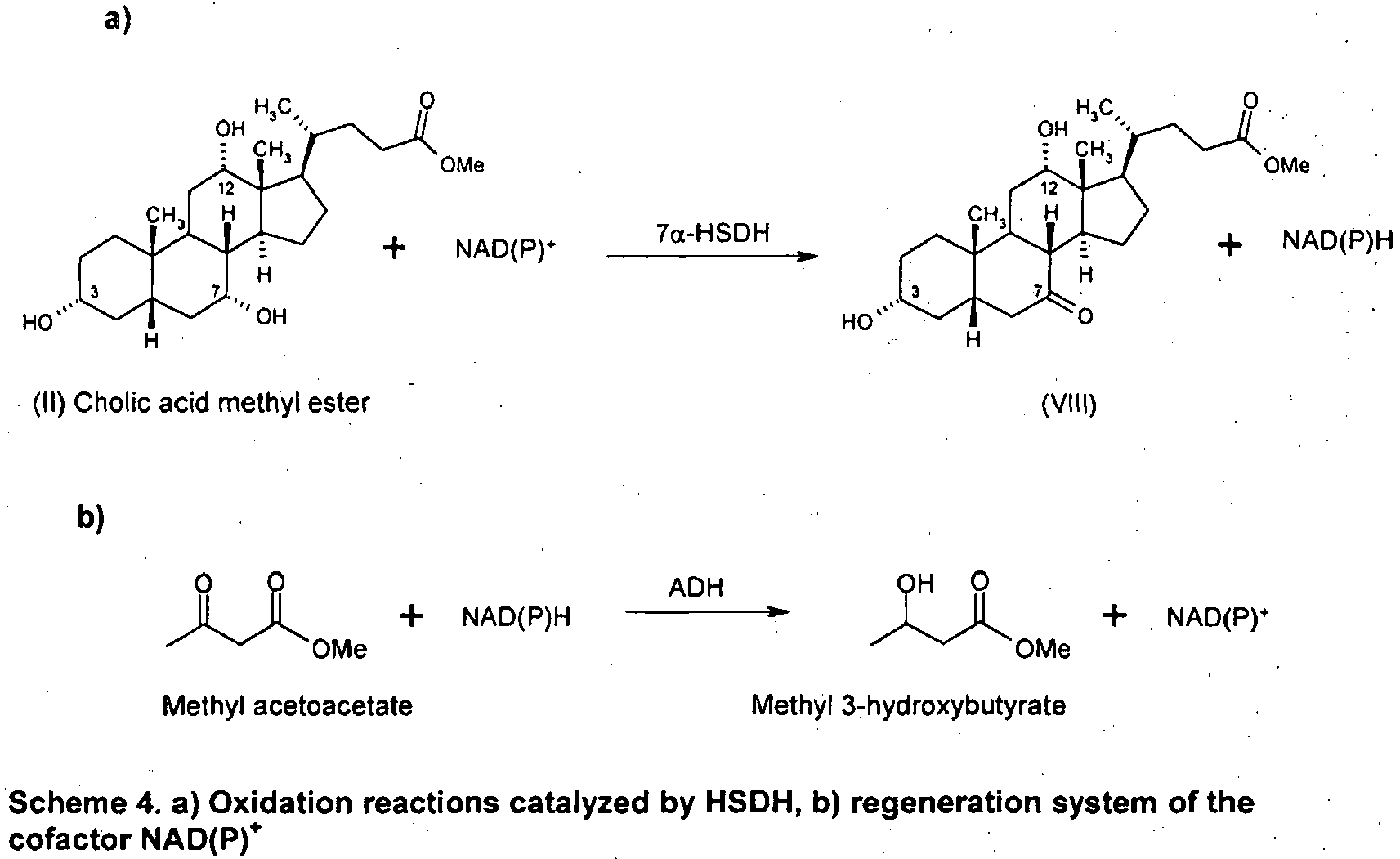

- According to an aspect of the process of the invention, the oxidation reaction is conducted in a monophasic system by adding an NAD(P)+-dependent hydroxysteroid dehydrogenase (HSDH), such as for example the 12α-HSDH and 7α-HSDH described in Scheme 3 or the 7α-HSDH described in Scheme 5, to an aqueous solution containing cholic acid (I) or chenodeoxycholic acid (III) sodium salts, with catalytic amounts of NAD(P)+, which regeneration from NAD(P)H to NAD(P)+ is carried out through the conversion of methyl acetoacetate to methyl 3-hydroxybutyrate using an NAD(P)H-dependent alcohol dehydrogenase (ADH).
- Depending on the substrate and on the enzymatic activities used, the reactions (oxidations of (I) to the derivatives (V), (VI) and (VII) and of (VI) to the derivative (VII) (Scheme 3), and oxidation of (III) to the derivative (IX) (Scheme 5)) are carried out for a period of time ranging from 4 to 16 h, the substrate bile acid sodium salt is normally used at a concentration ranging from 0.5% to 4% (weight/volume) (that is between 12.5 and 100mM), at pH 8.0 and 20°C, NAD(P)+ is used in catalytic amounts, at a concentration ranging from 0.2 to 0.8mM, methyl acetoacetate is usually used in an amount equal to 2 equivalents referred to the bile acid salt, consequently in amounts ranging from 0.3 to 2.4% (volume/volume). The oxidation reaction of the hydroxyl at position 7 of cholic acid methyl ester (II) catalyzed by a 7α-HSDH (Scheme 4) is carried out in a pH 8.0 potassium phosphate buffer/i-propyl acetate biphasic system at 20°C, using the same cofactor regeneration system. The substrate (II) is dissolved at a concentration equal to 4% (weight/volume) (that is 100mM) in i-propyl acetate and added to an equal volume of pH 8.0 potassium phosphate buffer, containing NAD(P)+ at a concentration equal to 0.8mM and methyl acetoacetate in an amount equal to 2 equivalents referred to (II), consequently in an amount equal to 2.4% (volume/volume).
- The new process described herein is advantageous compared to those previously described for different reasons.
- Compared to chemical processes, the new process is simpler and economically advantageous, in that protection of the hydroxyl groups that do not require oxidation is not necessary, thanks to the almost absolute regioselectivity of HSDHs. Further, the process can be carried out in mild reaction conditions (for example at a temperature of 20°C, at atmospheric pressure and at a pH equal to 8.0), which brings both economical and environmental advantages.
- Compared to previously described enzymatic processes, it is more economically advantageous due to the use of a reduced excess of co-substrate compared to that usually used with ADHs (for example 2.4% instead of 25% (volume/volume) co-substrate for the oxidation of a 4% (weight/volume) cholic acid solution as described in Fossati E., Polentini F., Carrea G., Riva S., Biotechnol. Bioeng., 2006, 93, 1216-1220). Simultaneously, the new process is more efficient, in that it allows conversions equal to or higher than 99.5%, for thermodynamic reasons not reachable using common ketones, for example acetone, as a co-substrate. Further, the regenerating system of the present invention is more versatile than previous ones, thanks to the availability of both NADH- and NADPH-dependent ADHs developed for applications on an industrial scale, which then can be suitably coupled with HSDH with the same specificity.
- The enzymes used in the processes described above can come from a microbial source, such as:
- The NADPH-dependent 7α-HSDH enzyme can come from Clostridium absonum, described for example in McDonald I.A., Hutchinson D.M., Forrest T.P., J. Lipid Res., 1981, 22, 458-466, which was cloned and overexpressed in E. coli (manuscript in progress).
- The NADH-dependent 7α-HSDH enzyme can be that from Bacteroides fragilis, recombinant from E. coli Rosetta 2(DE3)pLysS, which is described for example in Zhu D., Stearns J.E., Ramirez M., Hua L., Tetrahedron, 2006, 62, 4535-4539.
- The NADPH-dependent 12α-HSDH enzyme can come from Clostridium sp. marketed by ASA Spezialenzyme GmbH (Germany).
- The NADH-dependent 12α-HSDH enzyme from a microbial source can be that marketed by Genzyme Biochemicals Ltd. (England).
- The NADPH-dependent ADH enzyme can come from Thermoanaerobacter brockii, which is described in Peretz M., Bogin O., Tel-Or S., Cohen A., Li G., Chen J. -S., Burstein Y., Anaerobe, 1997, 3, 259-270, or that from a microbial source marketed by SIGMA-ALDRICH.
- The NADH-dependent ADH enzyme can be that from horse liver marketed by SIGMA-ALDRICH.
- The oxidized derivatives obtained through the process of the present invention can be used in the synthesis of UDCA ((IV), Scheme 2) by a chemical route, as described in Giordano C., Perdoncin G., Castaldi G., Angew. Chem. Int. Ed., 1985, 24, 499-500;
Magni A., Piccolo O., Ascheri A., US 4,834,919 ;Arosio R., Rossetti V., Beratto S., Talamona A., Crisafulli E., EP 0 424 232 A2 ;Hattori M., Mikami K., JP 06002184 - The following examples should be considered as non-limiting illustrations of the invention.
- Example 1 - Oxidation of the hydroxyl at position 7 of cholic acid (I) catalyzed by NADH-dependent 7α-HSDH from Bacteroides fragilis in the presence of NADH-dependent ADH from horse liver (SIGMA-ALDRICH).
- The reaction was carried out at 20°C and pH 8.0 in a total volume of 0.5 ml containing: 0.5% (w/v) cholic acid sodium salt at pH 8.0 (12.5mM, obtained diluting a 0.2M cholic acid sodium salt aqueous solution at pH 8.0), 2 equivalents (0.3% (v/v)) of methyl acetoacetate, 12 U of NADH-dependent 7α-HSDH from Bacteroides fragilis, recombinant from E. coli Rosetta 2(DE3)pLysS, 0.1 U of NADH-dependent ADH from horse liver (SIGMA-ALDRICH), 0.8mM NAD+ (40 µl of 10mM NAD+ aqueous solution), 50mM potassium phosphate buffer, pH 8.0.
- Complete conversion (≥ 99.5%) of cholic acid (I) to 3α,12α-dihydroxy-7-keto-5β-cholanoic acid (V) was obtained in a 16-h period. The degree of conversion was evaluated by TLC analysis using chloroform/methanol/acetic acid (10:1:0.5) as an eluting system.
- Example 2 - Oxidation of the hydroxyl at position 12 of cholic acid (I) catalyzed by NADH-dependent 12α-HSDH (Genzyme) in the presence of NADH-dependent ADH from horse liver (SIGMA-ALDRICH).
- The reaction was carried out at 20°C and pH 8.0 in a total volume of 0.5 ml containing: 0.5% (w/v) cholic acid sodium salt at pH 8.0 (12.5mM, obtained diluting a 0.2M cholic acid sodium salt aqueous solution at pH 8.0), 2 equivalents (0.3% (v/v)) of methyl acetoacetate, 4 U of NADH-dependent 12α-HSDH from a microbial source (Genzyme), 0.05 U of NADH-dependent ADH from horse liver (SIGMA-ALDRICH), 0.2mM NAD+ (10 µl of a 10mM NAD+ aqueous solution), 50mM potassium phosphate buffer, pH 8.0.
- Complete conversion (≥ 99.5%) of cholic acid (I) to 3α,7α-dihydroxy-12-keto-5β-cholanoic acid (VI) was obtained in a 16-h period. The degree of conversion was evaluated by TLC analysis using chloroform/methanol/acetic acid (10:1:0.5) as an eluting system.
- Example 3 - Oxidation of the hydroxyl at position 12 of cholic acid (I) catalyzed by NADPH-dependent 12α-HSDH (ASA) in the presence of NADPH-dependent ADH from T. brockii (SIGMA-ALDRICH).
- The reaction was carried out at 20°C and pH 8.0 in a total volume of 0.5 ml containing: 0.5% (w/v) cholic acid sodium salt at pH 8.0 (12.5mM, obtained diluting a 0.2M cholic acid sodium salt aqueous solution at pH 8.0), 2 equivalents (0.3% (v/v)) of methyl acetoacetate, 4 U of NADPH-dependent 12α-HSDH (ASA), 10 U of NADPH-dependent ADH from T. brockii (SIGMA-ALDRICH), 0.2mM NADP+ (10 µl of a 10mM NADP+ aqueous solution), 50mM potassium phosphate buffer, pH 8.0. Complete conversion (≥ 99.5%) of cholic acid (I) to 3α,7α-dihydroxy-12-keto-5β-cholanoic acid (VI) was obtained in a 16-h period. The degree of conversion was evaluated by TLC analysis using chloroform/methanol/acetic acid (10:1:0.5) as an eluting system.
- Example 4 - Oxidation of the hydroxyl at position 7 of cholic acid (I) catalyzed by NADPH-dependent 7α-HSDH from C. absonum in the presence of NADPH-dependent ADH, recombinant from E. coli (SIGMA-ALDRICH).
- The reaction was carried out at 20°C and pH 8.0 in a total volume of 0.5 ml containing: 4% (w/v) cholic acid sodium salt at pH 8.0 (100mM, obtained diluting a 0.2M cholic acid sodium salt aqueous solution at pH 8.0), 2 equivalents (2.4% (v/v)) of methyl acetoacetate, 0.25 U of NADPH-dependent 7α-HSDH from C. absonum, recombinant from E. coli, 4 U of NADPH-dependent ADH, recombinant from E. coli (SIGMA-ALDRICH), 0.8mM NADP+ (40 µl of a 10mM NADP+ aqueous solution), 50mM potassium phosphate buffer, pH 8.0.
- Complete conversion (≥ 99.5%) of cholic acid (I) to 3α,12α-dihydroxy-7-keto-5β-cholanoic acid (V) was obtained in a 16-h period. The degree of conversion was evaluated by TLC analysis using chloroform/methanol/acetic acid (10:1:0.5) as an eluting system.
- Example 5 - Oxidation of the hydroxyl at position 7 of cholic acid (I) catalyzed by NADPH-dependent 7α-HSDH from C. absonum in the presence of NADPH-dependent ADH from T. brockii (SIGMA-ALDRICH).
- The reaction was carried out at 20°C and pH 8.0 in a total volume of 0.5 ml containing: 0.5% (w/v) cholic acid sodium salt at pH 8.0 (12.5mM, obtained diluting a 0.2M cholic acid sodium salt aqueous solution at pH 8.0), 2 equivalents (0.3% (v/v)) of methyl acetoacetate, 4 U of NADPH-dependent 7α-HSDH from C. absonum, recombinant from E. coli, 10 U of NADPH-dependent ADH from T. brockii (SIGMA-ALDRICH), 0.2mM NADP+ (10 µl of a 10mM NADP+ aqueous solution), 50mM potassium phosphate buffer, pH 8.0.
- Complete conversion (≥ 99.5%) of cholic acid (I) to 3α,12α-dihydroxy-7-keto-5β-cholanoic acid (V) was obtained in a 4-h period. The degree of conversion was evaluated by TLC analysis using chloroform/methanol/acetic acid (10:1:0.5) as an eluting system.
- Example 6 - Oxidation of the hydroxyl at position 7 of 12-keto-chenodeoxycholic acid (VI) catalyzed by NADPH-dependent 7α-HSDH from C. absonum in the presence of NADPH-dependent ADH, recombinant from E. coli (SIGMA-ALDRICH).
- The reaction was carried out at 20°C and pH 8.0 in a total volume of 0.5 ml containing: 4% (w/v) 12-keto-chenodeoxycholic acid sodium salt at pH 8.0 (100mM, obtained diluting a 0.2M 12-keto-chenodeoxycholic acid sodium salt aqueous solution at pH 8.0), 2 equivalents (2.4% (v/v)) of methyl acetoacetate, 4 U of NADPH-dependent 7α-HSDH from C. absonum, recombinant from E. coli, 4 U of NADPH-dependent ADH, recombinant from E. coli (SIGMA-ALDRICH), 0.8mM NADP+ (40 µl of a 10mM NADP+ aqueous solution), 50mM potassium phosphate buffer, pH 8.0.
- Complete conversion (≥ 99.5%) of 12-keto-chenodeoxycholic acid (VI) to 3α-hydroxy-7,12-diketo-5β-cholanoic acid (VII) was obtained in a 16-h period. The degree of conversion was evaluated by TLC analysis using chloroform/methanol/acetic acid (10:1:0.5) as an eluting system.
- Example 7 - Oxidation of the hydroxyls at positions 7 and 12 of cholic acid (I) catalyzed by NADPH-dependent 7α-HSDH from C. absonum and NADPH-dependent 12α-HSDH (ASA) in the presence of NADPH-dependent ADH, recombinant from E. coli (SIGMA-ALDRICH).
- The reaction was carried out at 20°C and pH 8.0 in a total volume of 0.5 ml containing: 0.5% (w/v) cholic acid sodium salt at pH 8.0 (12.5mM, obtained diluting a 0.2M cholic acid sodium salt aqueous solution at pH 8.0), 2 equivalents (0.6% (v/v)) of methyl acetoacetate, 2 U of NADPH-dependent 7α-HSDH from C. absonum recombinant from E. coli, 4 U of NADPH-dependent 12α-HSDH (ASA), 4 U of NADPH-dependent ADH recombinant from E. coli (SIGMA-ALDRICH), 0.8mM NADP+ (40 µl of a 10mM NADP+ aqueous solution), 50mM potassium phosphate buffer, pH 8.0.
- Complete conversion (≥ 99.5%) of cholic acid (I) to 3a-hydroxy-7,12-diketo-5β-cholanoic acid (VII) was obtained in a 16-h period. The degree of conversion was evaluated by TLC analysis using chloroform/methanol/acetic acid (10:1:0.5) as an eluting system.
- Example 8 - Oxidation of the hydroxyl at position 7 of chenodeoxycholic acid (III) catalyzed by NADPH-dependent 7α-HSDH from C. absonum in the presence of NADPH-dependent ADH, recombinant from E. coli (SIGMA-ALDRICH).
- The reaction was carried out at 20°C and pH 8.0 in a total volume of 0.5 ml containing: 2% (w/v) chenodeoxycholic acid sodium salt at pH 8.0 (50mM, obtained diluting a 0.2M chenodeoxycholic acid sodium salt aqueous solution at pH 8.0), 2 equivalents (1.2% (v/v)) of methyl acetoacetate, 4 U of NADPH-dependent 7α-HSDH from C. absonum, recombinant from E. coli, 3 U of NADPH-dependent ADH, recombinant from E. coli (SIGMA-ALDRICH), 0. 6mM NADP+ (30 µl of a 10mM NADP+ aqueous solution), 50mM potassium phosphate buffer, pH 8.0.
- Complete conversion (≥ 99.5%) of chenodeoxycholic acid (III) to 7-keto-lithocholic acid (IX) was obtained in a 16-h period. The degree of conversion was evaluated by TLC analysis using chloroform/methanol/acetic acid (10:1:0.5) as an eluting system.
- Example 9 - Oxidation in a biphasic system of the hydroxyl at position 7 of cholic acid methyl ester (II) catalyzed by NADPH-dependent 7α-HSDH from C. absonum in the presence of NADPH-dependent ADH, recombinant from E. coli (SIGMA-ALDRICH).
- The reaction was carried out at 20°C, pH 8.0 and 1400 rpm in a total volume of 1 ml containing: a) 0.5 ml of a 4% i-propyl acetate solution (w/v) of cholic acid methyl ester (100mM, obtained dissolving 20 mg of cholic acid methyl ester in 0.5 ml of i-propyl acetate); b) 0.5 ml of 50mM potassium phosphate buffer, pH 8.0, in turn containing 2 equivalents (2.4% (v/v)) of methyl acetoacetate, 5.5 U of NADPH-dependent 7α-HSDH from C. absonum recombinant from E. coli, 4 U of NADPH-dependent ADH recombinant from E. coli (SIGMA-ALDRICH), 0.8mM NADP+ (40 µl of a 10mM NADP+ aqueous solution).
- Complete conversion (≥ 99.5%) of cholic acid methyl ester (II) to 3α,12α-dihydroxy-7-keto-5β-cholanoic acid methyl ester (VIII) was obtained in a 16-h period. The degree of conversion was evaluated by TLC analysis using chloroform/methanol/acetic acid (10:1:0.5) as an eluting system.
Claims (19)
- A process for the regioselective enzymatic oxidation at positions 7 and/or 12 of compounds of formula

- The process according to claim 1, wherein the NAD (P)+-dependent HSDH has an enzymatic activity ranging from 0.25 to 12 U.
- The process according to claim 1, wherein the compounds having formula (I), (II) or (III), salts or derivatives thereof have a concentration ranging from 0.5% to 4% (weight/volume).
- The process according to claim 1, wherein the compounds having formula (I), (II) or (III), salts or derivatives thereof have a concentration ranging from 12.5mM to 100mM.
- The process according to any one of preceding claims, wherein the cofactor NAD(P)+ is used in catalytic amounts, at a concentration ranging from 0.2mM to 0.8mM.
- The process according to any one of preceding claims, wherein the co-substrate methyl acetoacetate is used in an amount equal to 2 equivalents referred to each of compounds (I), (II) and (III).
- The process according to any one of preceding claims, wherein the co-substrate methyl acetoacetate is used in amounts ranging from 0.3% to 2.4% (volume/volume).
- The process according to any one of preceding claims, wherein the oxidation is quantitative, i.e. higher than or equal to 99.5%.
- The process according to any one of preceding claims, carried out at room temperature, i.e. at about 20°C.
- The process according to any one of preceding claims, carried out at a pH equal to 8.
- The process according to claim 10, further comprising a buffer system, preferably consisting of potassium phosphate buffer.
- The process according to claim 1, characterized in that it is carried out in an aqueous/organic biphasic system, wherein the organic solvent is preferably i-propyl acetate.
- The process according to claims 11 and 12, wherein the buffer system is potassium phosphate buffer and the organic solvent is i-propyl acetate.
- The process according to claim 1, wherein the cholic acid or chenodeoxycholic acid salt is sodium salt.
- A process for the preparation of ursodeoxycholic acid (IV), characterized in that it comprises a process for the synthesis of 3α,12α-dihydroxy-7-keto-5β-cholanoic acid (IV) according to any one of claims 1 to 14.
- A process for the preparation of ursodeoxycholic acid (IV), characterized in that it comprises a process for the synthesis of 3α,7α-dihydroxy-12-keto-5β-cholanoic acid (VI) according to any one of claims 1 to 14.
- A process for the preparation of ursodeoxycholic acid (IV), characterized in that it comprises a process for the synthesis of 3α-hydroxy-7,12-keto-5β-cholanoic acid (VII) according to any one of claims 1 to 14.
- A process for the preparation of ursodeoxycholic acid (IV), characterized in that it comprises a process for the synthesis of 7-keto-lithocholic acid (IX) according to any one of claims 1 to 14.
- A process for the preparation of ursodeoxycholic acid (IV), characterized in that it comprises a process for the synthesis of 3α,12α-dihydroxy-7-keto-5β-cholanoic acid methyl ester (VIII) according to any one of claims 1 to 13.
Applications Claiming Priority (2)
| Application Number | Priority Date | Filing Date | Title |
|---|---|---|---|
| IT000534A ITMI20110534A1 (en) | 2011-03-31 | 2011-03-31 | "NEW PROCESS FOR SELECTIVE OXIDATION OF BILE ACIDS, THEIR SALTS OR DERIVATIVES" |
| PCT/IB2012/051476 WO2012131591A1 (en) | 2011-03-31 | 2012-03-28 | New process for the selective oxidation of bile acids, their salts or derivatives |
Publications (2)
| Publication Number | Publication Date |
|---|---|
| EP2691516A1 EP2691516A1 (en) | 2014-02-05 |
| EP2691516B1 true EP2691516B1 (en) | 2016-05-11 |
Family
ID=43977196
Family Applications (1)
| Application Number | Title | Priority Date | Filing Date |
|---|---|---|---|
| EP12717864.8A Active EP2691516B1 (en) | 2011-03-31 | 2012-03-28 | New process for the selective oxidation of bile acids, their salts or derivatives |
Country Status (7)
| Country | Link |
|---|---|
| EP (1) | EP2691516B1 (en) |
| JP (1) | JP5872671B2 (en) |
| KR (1) | KR101948948B1 (en) |
| CN (1) | CN103517984B (en) |
| ES (1) | ES2586389T3 (en) |
| IT (1) | ITMI20110534A1 (en) |
| WO (1) | WO2012131591A1 (en) |
Families Citing this family (9)
| Publication number | Priority date | Publication date | Assignee | Title |
|---|---|---|---|---|
| ITMI20120918A1 (en) * | 2012-05-28 | 2013-11-29 | Prodotti Chimici Alimentari | PROCESS FOR SELECTIVE REDUCTION OF BILE ACIDS, THEIR SALTS OR DERIVATIVES, IN A BIPHASIC SYSTEM |
| CN102994604B (en) * | 2012-11-21 | 2015-01-07 | 上海凯宝药业股份有限公司 | Method for preparing binding-form ursodesoxycholic acid by two-step enzymatic method |
| MX380179B (en) | 2014-06-27 | 2025-03-12 | Medytox Inc | METHODS AND COMPOSITIONS OF BILE ACIDS AND SALTS FOR FAT REDUCTION. |
| CN107200763B (en) * | 2017-06-01 | 2019-05-03 | 江苏佳尔科药业集团有限公司 | A method of using chenodeoxycholic acid as Material synthesis lithocholic acid |
| CN113061637A (en) * | 2020-01-02 | 2021-07-02 | 四川百特芳华医药科技有限公司 | Preparation method of ursodeoxycholic acid |
| CN112759623A (en) * | 2021-03-12 | 2021-05-07 | 中山百灵生物技术股份有限公司 | Synthetic method of deoxycholic acid |
| CN115678865A (en) * | 2021-07-30 | 2023-02-03 | 弈柯莱生物科技(上海)股份有限公司 | Preparation method of ursodeoxycholic acid intermediate |
| CN117004678A (en) * | 2022-04-29 | 2023-11-07 | 华南理工大学 | Biological enzyme continuous catalytic preparation method and application of urscholic acid |
| CN115992085A (en) * | 2022-10-27 | 2023-04-21 | 聊城大学 | Method for synthesizing ursodeoxycholic acid by double-strain whole-cell catalysis one-step method |
Family Cites Families (8)
| Publication number | Priority date | Publication date | Assignee | Title |
|---|---|---|---|---|
| JPH062184B2 (en) | 1984-09-10 | 1994-01-12 | 株式会社三洋物産 | Holding structure of ball frame plate for pachinko machine |
| IT1204429B (en) | 1986-01-09 | 1989-03-01 | Blaschim Spa | STEREOSELECTIVE REDUCTION IN BILIARY ACIDS |
| DE69025449T2 (en) | 1989-10-17 | 1996-07-11 | Sanofi Sa | Process for the preparation of chenodeoxycholic acids |
| CA2070720A1 (en) * | 1991-06-12 | 1992-12-13 | Hiromi Kimura | Microorganisms having a conversion ability to bile acids and method for preparing bile acids |
| WO2000015831A1 (en) * | 1998-09-14 | 2000-03-23 | Kansai Paint Co., Ltd. | Process for producing ursodeoxycholate |
| EP1731618A1 (en) | 2005-06-07 | 2006-12-13 | Prodotti Chimici E Alimentari Spa | Process for the selective oxydation of colic acid |
| DE102006009744A1 (en) * | 2006-03-02 | 2007-09-06 | Wacker Chemie Ag | Preparation of (S) -2-butanol by oxidative resolution |
| EP2105500A1 (en) * | 2008-03-26 | 2009-09-30 | Pharmazell GmbH | New 12alpha-hydroxysteroiddehydrogenases, method for their manufacture and application thereof |
-
2011
- 2011-03-31 IT IT000534A patent/ITMI20110534A1/en unknown
-
2012
- 2012-03-28 JP JP2014501788A patent/JP5872671B2/en active Active
- 2012-03-28 ES ES12717864.8T patent/ES2586389T3/en active Active
- 2012-03-28 KR KR1020137028040A patent/KR101948948B1/en active Active
- 2012-03-28 CN CN201280015573.0A patent/CN103517984B/en active Active
- 2012-03-28 EP EP12717864.8A patent/EP2691516B1/en active Active
- 2012-03-28 WO PCT/IB2012/051476 patent/WO2012131591A1/en not_active Ceased
Also Published As
| Publication number | Publication date |
|---|---|
| ITMI20110534A1 (en) | 2012-10-01 |
| KR20140019811A (en) | 2014-02-17 |
| ES2586389T3 (en) | 2016-10-14 |
| JP5872671B2 (en) | 2016-03-01 |
| CN103517984B (en) | 2016-08-17 |
| WO2012131591A1 (en) | 2012-10-04 |
| CN103517984A (en) | 2014-01-15 |
| JP2014511683A (en) | 2014-05-19 |
| EP2691516A1 (en) | 2014-02-05 |
| KR101948948B1 (en) | 2019-02-15 |
Similar Documents
| Publication | Publication Date | Title |
|---|---|---|
| WO2012131591A1 (en) | New process for the selective oxidation of bile acids, their salts or derivatives | |
| US11339415B2 (en) | Process for the enzymatic regeneration of redox cofactors | |
| Eggert et al. | Enzymatic routes for the synthesis of ursodeoxycholic acid | |
| JP5113832B2 (en) | Process for the preparation of steroid derivatives by reduction of oxosteroid compounds or by oxidation of hydroxysteroid compounds using hydroxysteroid dehydrogenase | |
| CN102007210B (en) | Novel 12 alpha-hydroxysteroid dehydrogenases, production and use thereof | |
| US11306343B2 (en) | 3α-hydroxysteroid dehydrogenase mutants and process for the preparation of ursodeoxycholic acid | |
| EP2855693B1 (en) | Process for the selective reduction of bile acids, their salts or derivatives, in a biphasic system | |
| JP2016521544A (en) | Process for the preparation of dehydroepiandrosterone and its intermediates. | |
| Braun et al. | Novel whole-cell biocatalysts with recombinant hydroxysteroid dehydrogenases for the asymmetric reduction of dehydrocholic acid | |
| EP1731618A1 (en) | Process for the selective oxydation of colic acid | |
| Liu et al. | Challenges and recent progress in ursodeoxycholic acid production | |
| Ferrandi | New microbial hydroxysteroid dehydrogenases and their synthetic application for the selective modification of bile acids. | |
| KR20160013096A (en) | Processes for the preparation of dehydroepiandrosterone and its intermediates | |
| HK1204010B (en) | Method for enzymatic regeneration of redox cofactors |
Legal Events
| Date | Code | Title | Description |
|---|---|---|---|
| PUAI | Public reference made under article 153(3) epc to a published international application that has entered the european phase |
Free format text: ORIGINAL CODE: 0009012 |
|
| 17P | Request for examination filed |
Effective date: 20130913 |
|
| AK | Designated contracting states |
Kind code of ref document: A1 Designated state(s): AL AT BE BG CH CY CZ DE DK EE ES FI FR GB GR HR HU IE IS IT LI LT LU LV MC MK MT NL NO PL PT RO RS SE SI SK SM TR |
|
| DAX | Request for extension of the european patent (deleted) | ||
| REG | Reference to a national code |
Ref country code: DE Ref legal event code: R079 Ref document number: 602012018328 Country of ref document: DE Free format text: PREVIOUS MAIN CLASS: C12N0009020000 Ipc: C12P0033000000 |
|
| GRAP | Despatch of communication of intention to grant a patent |
Free format text: ORIGINAL CODE: EPIDOSNIGR1 |
|
| RIC1 | Information provided on ipc code assigned before grant |
Ipc: C12N 9/04 20060101ALI20151102BHEP Ipc: C12P 33/02 20060101ALI20151102BHEP Ipc: C12P 33/00 20060101AFI20151102BHEP |
|
| INTG | Intention to grant announced |
Effective date: 20151123 |
|
| GRAS | Grant fee paid |
Free format text: ORIGINAL CODE: EPIDOSNIGR3 |
|
| GRAA | (expected) grant |
Free format text: ORIGINAL CODE: 0009210 |
|
| AK | Designated contracting states |
Kind code of ref document: B1 Designated state(s): AL AT BE BG CH CY CZ DE DK EE ES FI FR GB GR HR HU IE IS IT LI LT LU LV MC MK MT NL NO PL PT RO RS SE SI SK SM TR |
|
| REG | Reference to a national code |
Ref country code: GB Ref legal event code: FG4D |
|
| REG | Reference to a national code |
Ref country code: CH Ref legal event code: EP |
|
| REG | Reference to a national code |
Ref country code: AT Ref legal event code: REF Ref document number: 798705 Country of ref document: AT Kind code of ref document: T Effective date: 20160515 |
|
| REG | Reference to a national code |
Ref country code: IE Ref legal event code: FG4D |
|
| REG | Reference to a national code |
Ref country code: DE Ref legal event code: R096 Ref document number: 602012018328 Country of ref document: DE |
|
| REG | Reference to a national code |
Ref country code: LT Ref legal event code: MG4D |
|
| REG | Reference to a national code |
Ref country code: NL Ref legal event code: MP Effective date: 20160511 |
|
| REG | Reference to a national code |
Ref country code: ES Ref legal event code: FG2A Ref document number: 2586389 Country of ref document: ES Kind code of ref document: T3 Effective date: 20161014 |
|
| PG25 | Lapsed in a contracting state [announced via postgrant information from national office to epo] |
Ref country code: FI Free format text: LAPSE BECAUSE OF FAILURE TO SUBMIT A TRANSLATION OF THE DESCRIPTION OR TO PAY THE FEE WITHIN THE PRESCRIBED TIME-LIMIT Effective date: 20160511 Ref country code: NO Free format text: LAPSE BECAUSE OF FAILURE TO SUBMIT A TRANSLATION OF THE DESCRIPTION OR TO PAY THE FEE WITHIN THE PRESCRIBED TIME-LIMIT Effective date: 20160811 Ref country code: NL Free format text: LAPSE BECAUSE OF FAILURE TO SUBMIT A TRANSLATION OF THE DESCRIPTION OR TO PAY THE FEE WITHIN THE PRESCRIBED TIME-LIMIT Effective date: 20160511 Ref country code: LT Free format text: LAPSE BECAUSE OF FAILURE TO SUBMIT A TRANSLATION OF THE DESCRIPTION OR TO PAY THE FEE WITHIN THE PRESCRIBED TIME-LIMIT Effective date: 20160511 |
|
| PG25 | Lapsed in a contracting state [announced via postgrant information from national office to epo] |
Ref country code: LV Free format text: LAPSE BECAUSE OF FAILURE TO SUBMIT A TRANSLATION OF THE DESCRIPTION OR TO PAY THE FEE WITHIN THE PRESCRIBED TIME-LIMIT Effective date: 20160511 Ref country code: GR Free format text: LAPSE BECAUSE OF FAILURE TO SUBMIT A TRANSLATION OF THE DESCRIPTION OR TO PAY THE FEE WITHIN THE PRESCRIBED TIME-LIMIT Effective date: 20160812 Ref country code: PT Free format text: LAPSE BECAUSE OF FAILURE TO SUBMIT A TRANSLATION OF THE DESCRIPTION OR TO PAY THE FEE WITHIN THE PRESCRIBED TIME-LIMIT Effective date: 20160912 Ref country code: SE Free format text: LAPSE BECAUSE OF FAILURE TO SUBMIT A TRANSLATION OF THE DESCRIPTION OR TO PAY THE FEE WITHIN THE PRESCRIBED TIME-LIMIT Effective date: 20160511 Ref country code: RS Free format text: LAPSE BECAUSE OF FAILURE TO SUBMIT A TRANSLATION OF THE DESCRIPTION OR TO PAY THE FEE WITHIN THE PRESCRIBED TIME-LIMIT Effective date: 20160511 Ref country code: HR Free format text: LAPSE BECAUSE OF FAILURE TO SUBMIT A TRANSLATION OF THE DESCRIPTION OR TO PAY THE FEE WITHIN THE PRESCRIBED TIME-LIMIT Effective date: 20160511 |
|
| PG25 | Lapsed in a contracting state [announced via postgrant information from national office to epo] |
Ref country code: RO Free format text: LAPSE BECAUSE OF FAILURE TO SUBMIT A TRANSLATION OF THE DESCRIPTION OR TO PAY THE FEE WITHIN THE PRESCRIBED TIME-LIMIT Effective date: 20160511 Ref country code: CZ Free format text: LAPSE BECAUSE OF FAILURE TO SUBMIT A TRANSLATION OF THE DESCRIPTION OR TO PAY THE FEE WITHIN THE PRESCRIBED TIME-LIMIT Effective date: 20160511 Ref country code: DK Free format text: LAPSE BECAUSE OF FAILURE TO SUBMIT A TRANSLATION OF THE DESCRIPTION OR TO PAY THE FEE WITHIN THE PRESCRIBED TIME-LIMIT Effective date: 20160511 Ref country code: SK Free format text: LAPSE BECAUSE OF FAILURE TO SUBMIT A TRANSLATION OF THE DESCRIPTION OR TO PAY THE FEE WITHIN THE PRESCRIBED TIME-LIMIT Effective date: 20160511 Ref country code: EE Free format text: LAPSE BECAUSE OF FAILURE TO SUBMIT A TRANSLATION OF THE DESCRIPTION OR TO PAY THE FEE WITHIN THE PRESCRIBED TIME-LIMIT Effective date: 20160511 |
|
| REG | Reference to a national code |
Ref country code: DE Ref legal event code: R097 Ref document number: 602012018328 Country of ref document: DE |
|
| PG25 | Lapsed in a contracting state [announced via postgrant information from national office to epo] |
Ref country code: PL Free format text: LAPSE BECAUSE OF FAILURE TO SUBMIT A TRANSLATION OF THE DESCRIPTION OR TO PAY THE FEE WITHIN THE PRESCRIBED TIME-LIMIT Effective date: 20160511 Ref country code: SM Free format text: LAPSE BECAUSE OF FAILURE TO SUBMIT A TRANSLATION OF THE DESCRIPTION OR TO PAY THE FEE WITHIN THE PRESCRIBED TIME-LIMIT Effective date: 20160511 Ref country code: BE Free format text: LAPSE BECAUSE OF FAILURE TO SUBMIT A TRANSLATION OF THE DESCRIPTION OR TO PAY THE FEE WITHIN THE PRESCRIBED TIME-LIMIT Effective date: 20160511 |
|
| REG | Reference to a national code |
Ref country code: FR Ref legal event code: PLFP Year of fee payment: 6 |
|
| PLBE | No opposition filed within time limit |
Free format text: ORIGINAL CODE: 0009261 |
|
| STAA | Information on the status of an ep patent application or granted ep patent |
Free format text: STATUS: NO OPPOSITION FILED WITHIN TIME LIMIT |
|
| 26N | No opposition filed |
Effective date: 20170214 |
|
| PG25 | Lapsed in a contracting state [announced via postgrant information from national office to epo] |
Ref country code: SI Free format text: LAPSE BECAUSE OF FAILURE TO SUBMIT A TRANSLATION OF THE DESCRIPTION OR TO PAY THE FEE WITHIN THE PRESCRIBED TIME-LIMIT Effective date: 20160511 |
|
| PG25 | Lapsed in a contracting state [announced via postgrant information from national office to epo] |
Ref country code: MC Free format text: LAPSE BECAUSE OF FAILURE TO SUBMIT A TRANSLATION OF THE DESCRIPTION OR TO PAY THE FEE WITHIN THE PRESCRIBED TIME-LIMIT Effective date: 20160511 |
|
| REG | Reference to a national code |
Ref country code: IE Ref legal event code: MM4A |
|
| PG25 | Lapsed in a contracting state [announced via postgrant information from national office to epo] |
Ref country code: LU Free format text: LAPSE BECAUSE OF NON-PAYMENT OF DUE FEES Effective date: 20170328 |
|
| REG | Reference to a national code |
Ref country code: FR Ref legal event code: PLFP Year of fee payment: 7 |
|
| PG25 | Lapsed in a contracting state [announced via postgrant information from national office to epo] |
Ref country code: IE Free format text: LAPSE BECAUSE OF NON-PAYMENT OF DUE FEES Effective date: 20170328 |
|
| PG25 | Lapsed in a contracting state [announced via postgrant information from national office to epo] |
Ref country code: MT Free format text: LAPSE BECAUSE OF NON-PAYMENT OF DUE FEES Effective date: 20170328 |
|
| PG25 | Lapsed in a contracting state [announced via postgrant information from national office to epo] |
Ref country code: AL Free format text: LAPSE BECAUSE OF FAILURE TO SUBMIT A TRANSLATION OF THE DESCRIPTION OR TO PAY THE FEE WITHIN THE PRESCRIBED TIME-LIMIT Effective date: 20160511 |
|
| REG | Reference to a national code |
Ref country code: AT Ref legal event code: UEP Ref document number: 798705 Country of ref document: AT Kind code of ref document: T Effective date: 20160511 |
|
| PG25 | Lapsed in a contracting state [announced via postgrant information from national office to epo] |
Ref country code: HU Free format text: LAPSE BECAUSE OF FAILURE TO SUBMIT A TRANSLATION OF THE DESCRIPTION OR TO PAY THE FEE WITHIN THE PRESCRIBED TIME-LIMIT; INVALID AB INITIO Effective date: 20120328 |
|
| PG25 | Lapsed in a contracting state [announced via postgrant information from national office to epo] |
Ref country code: BG Free format text: LAPSE BECAUSE OF FAILURE TO SUBMIT A TRANSLATION OF THE DESCRIPTION OR TO PAY THE FEE WITHIN THE PRESCRIBED TIME-LIMIT Effective date: 20160511 |
|
| PG25 | Lapsed in a contracting state [announced via postgrant information from national office to epo] |
Ref country code: CY Free format text: LAPSE BECAUSE OF NON-PAYMENT OF DUE FEES Effective date: 20160511 |
|
| PG25 | Lapsed in a contracting state [announced via postgrant information from national office to epo] |
Ref country code: MK Free format text: LAPSE BECAUSE OF FAILURE TO SUBMIT A TRANSLATION OF THE DESCRIPTION OR TO PAY THE FEE WITHIN THE PRESCRIBED TIME-LIMIT Effective date: 20160511 |
|
| PG25 | Lapsed in a contracting state [announced via postgrant information from national office to epo] |
Ref country code: TR Free format text: LAPSE BECAUSE OF FAILURE TO SUBMIT A TRANSLATION OF THE DESCRIPTION OR TO PAY THE FEE WITHIN THE PRESCRIBED TIME-LIMIT Effective date: 20160511 |
|
| REG | Reference to a national code |
Ref country code: CH Ref legal event code: PFUS Owner name: ICE S.P.A., IT Free format text: FORMER OWNER: PRODOTTI CHIMICI E ALIMENTARI SPA, IT |
|
| REG | Reference to a national code |
Ref country code: ES Ref legal event code: PC2A Owner name: ICE S.P.A. Effective date: 20200514 |
|
| REG | Reference to a national code |
Ref country code: DE Ref legal event code: R081 Ref document number: 602012018328 Country of ref document: DE Owner name: ICE S.P.A., IT Free format text: FORMER OWNER: PRODOTTI CHIMICI E ALIMENTARI SPA, BASALUZZO, IT |
|
| REG | Reference to a national code |
Ref country code: GB Ref legal event code: 732E Free format text: REGISTERED BETWEEN 20200528 AND 20200603 |
|
| PG25 | Lapsed in a contracting state [announced via postgrant information from national office to epo] |
Ref country code: IS Free format text: LAPSE BECAUSE OF FAILURE TO SUBMIT A TRANSLATION OF THE DESCRIPTION OR TO PAY THE FEE WITHIN THE PRESCRIBED TIME-LIMIT Effective date: 20160911 |
|
| REG | Reference to a national code |
Ref country code: AT Ref legal event code: PC Ref document number: 798705 Country of ref document: AT Kind code of ref document: T Owner name: ICE S.P.A., IT Effective date: 20200721 |
|
| PGFP | Annual fee paid to national office [announced via postgrant information from national office to epo] |
Ref country code: ES Payment date: 20250410 Year of fee payment: 14 |
|
| PGFP | Annual fee paid to national office [announced via postgrant information from national office to epo] |
Ref country code: CH Payment date: 20250401 Year of fee payment: 14 |
|
| PGFP | Annual fee paid to national office [announced via postgrant information from national office to epo] |
Ref country code: FR Payment date: 20251231 Year of fee payment: 15 |
|
| REG | Reference to a national code |
Ref country code: CH Ref legal event code: U11 Free format text: ST27 STATUS EVENT CODE: U-0-0-U10-U11 (AS PROVIDED BY THE NATIONAL OFFICE) Effective date: 20260401 |
|
| PGFP | Annual fee paid to national office [announced via postgrant information from national office to epo] |
Ref country code: GB Payment date: 20260106 Year of fee payment: 15 |
|
| PGFP | Annual fee paid to national office [announced via postgrant information from national office to epo] |
Ref country code: DE Payment date: 20260102 Year of fee payment: 15 |
|
| PGFP | Annual fee paid to national office [announced via postgrant information from national office to epo] |
Ref country code: AT Payment date: 20260225 Year of fee payment: 15 |
|
| PGFP | Annual fee paid to national office [announced via postgrant information from national office to epo] |
Ref country code: IT Payment date: 20260220 Year of fee payment: 15 |