EP2690149A1 - Re-Peelable Water Dispersion Type Acryl-Based Pressure-Sensitive Adhesive Composition, Pressure-Sensitive Adhesive Sheet, and Optical Member - Google Patents
Re-Peelable Water Dispersion Type Acryl-Based Pressure-Sensitive Adhesive Composition, Pressure-Sensitive Adhesive Sheet, and Optical Member Download PDFInfo
- Publication number
- EP2690149A1 EP2690149A1 EP13177925.8A EP13177925A EP2690149A1 EP 2690149 A1 EP2690149 A1 EP 2690149A1 EP 13177925 A EP13177925 A EP 13177925A EP 2690149 A1 EP2690149 A1 EP 2690149A1
- Authority
- EP
- European Patent Office
- Prior art keywords
- sensitive adhesive
- pressure
- hydrocarbon group
- adhesive composition
- weight
- Prior art date
- Legal status (The legal status is an assumption and is not a legal conclusion. Google has not performed a legal analysis and makes no representation as to the accuracy of the status listed.)
- Granted
Links
- 239000004820 Pressure-sensitive adhesive Substances 0.000 title claims abstract description 248
- 239000000203 mixture Substances 0.000 title claims abstract description 120
- XLYOFNOQVPJJNP-UHFFFAOYSA-N water Substances O XLYOFNOQVPJJNP-UHFFFAOYSA-N 0.000 title claims abstract description 105
- 239000006185 dispersion Substances 0.000 title claims abstract description 71
- 230000003287 optical effect Effects 0.000 title claims description 26
- -1 acryl Chemical group 0.000 claims abstract description 324
- 239000000839 emulsion Substances 0.000 claims abstract description 115
- NIXOWILDQLNWCW-UHFFFAOYSA-N acrylic acid group Chemical group C(C=C)(=O)O NIXOWILDQLNWCW-UHFFFAOYSA-N 0.000 claims abstract description 102
- 229920000642 polymer Polymers 0.000 claims abstract description 100
- 239000010410 layer Substances 0.000 claims abstract description 96
- 239000000178 monomer Substances 0.000 claims abstract description 91
- 239000003431 cross linking reagent Substances 0.000 claims abstract description 64
- 125000003178 carboxy group Chemical group [H]OC(*)=O 0.000 claims abstract description 43
- 239000002245 particle Substances 0.000 claims abstract description 37
- 150000008040 ionic compounds Chemical class 0.000 claims abstract description 34
- 239000002994 raw material Substances 0.000 claims abstract description 33
- 125000004432 carbon atom Chemical group C* 0.000 claims description 65
- 125000000524 functional group Chemical group 0.000 claims description 51
- 239000003995 emulsifying agent Substances 0.000 claims description 44
- 239000001257 hydrogen Substances 0.000 claims description 38
- 229910052739 hydrogen Inorganic materials 0.000 claims description 38
- 150000001768 cations Chemical class 0.000 claims description 37
- 150000003839 salts Chemical class 0.000 claims description 34
- 239000000758 substrate Substances 0.000 claims description 34
- 239000002608 ionic liquid Substances 0.000 claims description 29
- 229920001296 polysiloxane Polymers 0.000 claims description 28
- 238000006116 polymerization reaction Methods 0.000 claims description 27
- 125000005842 heteroatom Chemical group 0.000 claims description 25
- 125000004435 hydrogen atom Chemical group [H]* 0.000 claims description 24
- RTZKZFJDLAIYFH-UHFFFAOYSA-N Diethyl ether Chemical compound CCOCC RTZKZFJDLAIYFH-UHFFFAOYSA-N 0.000 claims description 23
- 239000003505 polymerization initiator Substances 0.000 claims description 19
- UFHFLCQGNIYNRP-UHFFFAOYSA-N Hydrogen Chemical compound [H][H] UFHFLCQGNIYNRP-UHFFFAOYSA-N 0.000 claims description 14
- 229910052783 alkali metal Inorganic materials 0.000 claims description 13
- 238000003756 stirring Methods 0.000 claims description 13
- 229910052757 nitrogen Inorganic materials 0.000 claims description 11
- 239000007787 solid Substances 0.000 claims description 10
- IJGRMHOSHXDMSA-UHFFFAOYSA-N Atomic nitrogen Chemical compound N#N IJGRMHOSHXDMSA-UHFFFAOYSA-N 0.000 claims description 9
- 150000001450 anions Chemical class 0.000 claims description 9
- 238000004519 manufacturing process Methods 0.000 claims description 8
- 239000012986 chain transfer agent Substances 0.000 claims description 7
- 229910052717 sulfur Inorganic materials 0.000 claims description 7
- 238000002156 mixing Methods 0.000 claims description 5
- QGZKDVFQNNGYKY-UHFFFAOYSA-O Ammonium Chemical compound [NH4+] QGZKDVFQNNGYKY-UHFFFAOYSA-O 0.000 claims description 4
- RAXXELZNTBOGNW-UHFFFAOYSA-O Imidazolium Chemical compound C1=C[NH+]=CN1 RAXXELZNTBOGNW-UHFFFAOYSA-O 0.000 claims description 4
- NQRYJNQNLNOLGT-UHFFFAOYSA-O Piperidinium(1+) Chemical compound C1CC[NH2+]CC1 NQRYJNQNLNOLGT-UHFFFAOYSA-O 0.000 claims description 4
- NINIDFKCEFEMDL-UHFFFAOYSA-N Sulfur Chemical compound [S] NINIDFKCEFEMDL-UHFFFAOYSA-N 0.000 claims description 4
- 125000003709 fluoroalkyl group Chemical group 0.000 claims description 4
- 150000003949 imides Chemical class 0.000 claims description 4
- 229910052698 phosphorus Inorganic materials 0.000 claims description 4
- JUJWROOIHBZHMG-UHFFFAOYSA-O pyridinium Chemical compound C1=CC=[NH+]C=C1 JUJWROOIHBZHMG-UHFFFAOYSA-O 0.000 claims description 4
- 125000000472 sulfonyl group Chemical group *S(*)(=O)=O 0.000 claims description 4
- 239000011593 sulfur Substances 0.000 claims description 4
- RWRDLPDLKQPQOW-UHFFFAOYSA-O Pyrrolidinium ion Chemical compound C1CC[NH2+]C1 RWRDLPDLKQPQOW-UHFFFAOYSA-O 0.000 claims description 3
- 229910003002 lithium salt Inorganic materials 0.000 claims description 3
- 159000000002 lithium salts Chemical group 0.000 claims description 3
- YNAVUWVOSKDBBP-UHFFFAOYSA-O morpholinium Chemical compound [H+].C1COCCN1 YNAVUWVOSKDBBP-UHFFFAOYSA-O 0.000 claims description 3
- 125000004433 nitrogen atom Chemical group N* 0.000 claims description 3
- XYFCBTPGUUZFHI-UHFFFAOYSA-O phosphonium Chemical compound [PH4+] XYFCBTPGUUZFHI-UHFFFAOYSA-O 0.000 claims description 3
- 125000004437 phosphorous atom Chemical group 0.000 claims description 3
- 229910052702 rhenium Inorganic materials 0.000 claims description 3
- RWSOTUBLDIXVET-UHFFFAOYSA-O sulfonium Chemical compound [SH3+] RWSOTUBLDIXVET-UHFFFAOYSA-O 0.000 claims description 3
- 125000004434 sulfur atom Chemical group 0.000 claims description 3
- 125000001183 hydrocarbyl group Chemical group 0.000 claims 24
- 230000002265 prevention Effects 0.000 abstract description 5
- 238000000034 method Methods 0.000 description 63
- 150000002430 hydrocarbons Chemical group 0.000 description 62
- 239000010408 film Substances 0.000 description 53
- 238000006243 chemical reaction Methods 0.000 description 40
- 239000002216 antistatic agent Substances 0.000 description 24
- 125000000129 anionic group Chemical group 0.000 description 23
- 238000010186 staining Methods 0.000 description 22
- 238000011282 treatment Methods 0.000 description 22
- 239000004593 Epoxy Substances 0.000 description 18
- XEKOWRVHYACXOJ-UHFFFAOYSA-N Ethyl acetate Chemical compound CCOC(C)=O XEKOWRVHYACXOJ-UHFFFAOYSA-N 0.000 description 18
- 150000002148 esters Chemical class 0.000 description 18
- 239000000853 adhesive Substances 0.000 description 16
- 230000001070 adhesive effect Effects 0.000 description 16
- 150000001875 compounds Chemical class 0.000 description 14
- 238000004132 cross linking Methods 0.000 description 14
- SMZOUWXMTYCWNB-UHFFFAOYSA-N 2-(2-methoxy-5-methylphenyl)ethanamine Chemical compound COC1=CC=C(C)C=C1CCN SMZOUWXMTYCWNB-UHFFFAOYSA-N 0.000 description 13
- 239000002253 acid Substances 0.000 description 13
- 229920005989 resin Polymers 0.000 description 13
- 239000011347 resin Substances 0.000 description 13
- 239000000126 substance Substances 0.000 description 13
- 238000001035 drying Methods 0.000 description 12
- 238000005259 measurement Methods 0.000 description 12
- GOXQRTZXKQZDDN-UHFFFAOYSA-N 2-Ethylhexyl acrylate Chemical compound CCCCC(CC)COC(=O)C=C GOXQRTZXKQZDDN-UHFFFAOYSA-N 0.000 description 11
- 125000002887 hydroxy group Chemical group [H]O* 0.000 description 11
- 125000000217 alkyl group Chemical group 0.000 description 10
- 239000011248 coating agent Substances 0.000 description 10
- 238000000576 coating method Methods 0.000 description 10
- 150000003254 radicals Chemical class 0.000 description 10
- 229920003171 Poly (ethylene oxide) Polymers 0.000 description 9
- 239000012874 anionic emulsifier Substances 0.000 description 9
- KFZMGEQAYNKOFK-UHFFFAOYSA-N Isopropanol Chemical compound CC(C)O KFZMGEQAYNKOFK-UHFFFAOYSA-N 0.000 description 8
- 239000000654 additive Substances 0.000 description 8
- 230000000052 comparative effect Effects 0.000 description 8
- 230000003247 decreasing effect Effects 0.000 description 8
- 230000000694 effects Effects 0.000 description 8
- 238000007720 emulsion polymerization reaction Methods 0.000 description 8
- 125000003700 epoxy group Chemical group 0.000 description 8
- 238000000691 measurement method Methods 0.000 description 8
- 229920003023 plastic Polymers 0.000 description 8
- 239000004033 plastic Substances 0.000 description 8
- OKKJLVBELUTLKV-UHFFFAOYSA-N Methanol Chemical compound OC OKKJLVBELUTLKV-UHFFFAOYSA-N 0.000 description 7
- VVQNEPGJFQJSBK-UHFFFAOYSA-N Methyl methacrylate Chemical compound COC(=O)C(C)=C VVQNEPGJFQJSBK-UHFFFAOYSA-N 0.000 description 7
- 125000002947 alkylene group Chemical group 0.000 description 7
- 239000000460 chlorine Substances 0.000 description 7
- 235000014113 dietary fatty acids Nutrition 0.000 description 7
- 239000000194 fatty acid Substances 0.000 description 7
- 229930195729 fatty acid Natural products 0.000 description 7
- KRHYYFGTRYWZRS-UHFFFAOYSA-N hydrofluoric acid Substances F KRHYYFGTRYWZRS-UHFFFAOYSA-N 0.000 description 7
- 238000004898 kneading Methods 0.000 description 7
- 238000011068 loading method Methods 0.000 description 7
- 238000002360 preparation method Methods 0.000 description 7
- 229910052708 sodium Inorganic materials 0.000 description 7
- 239000011734 sodium Substances 0.000 description 7
- IAYPIBMASNFSPL-UHFFFAOYSA-N Ethylene oxide Chemical compound C1CO1 IAYPIBMASNFSPL-UHFFFAOYSA-N 0.000 description 6
- MHAJPDPJQMAIIY-UHFFFAOYSA-N Hydrogen peroxide Chemical compound OO MHAJPDPJQMAIIY-UHFFFAOYSA-N 0.000 description 6
- 239000004698 Polyethylene Substances 0.000 description 6
- 239000004743 Polypropylene Substances 0.000 description 6
- VYPSYNLAJGMNEJ-UHFFFAOYSA-N Silicium dioxide Chemical compound O=[Si]=O VYPSYNLAJGMNEJ-UHFFFAOYSA-N 0.000 description 6
- WYURNTSHIVDZCO-UHFFFAOYSA-N Tetrahydrofuran Chemical compound C1CCOC1 WYURNTSHIVDZCO-UHFFFAOYSA-N 0.000 description 6
- 125000002091 cationic group Chemical group 0.000 description 6
- 229920001577 copolymer Polymers 0.000 description 6
- 229910052731 fluorine Inorganic materials 0.000 description 6
- 238000007654 immersion Methods 0.000 description 6
- 230000000873 masking effect Effects 0.000 description 6
- 125000002496 methyl group Chemical group [H]C([H])([H])* 0.000 description 6
- 239000002985 plastic film Substances 0.000 description 6
- 229920000573 polyethylene Polymers 0.000 description 6
- 229920001155 polypropylene Polymers 0.000 description 6
- 125000001453 quaternary ammonium group Chemical group 0.000 description 6
- 230000003068 static effect Effects 0.000 description 6
- 230000002087 whitening effect Effects 0.000 description 6
- 239000004721 Polyphenylene oxide Substances 0.000 description 5
- 230000032683 aging Effects 0.000 description 5
- ROOXNKNUYICQNP-UHFFFAOYSA-N ammonium peroxydisulfate Substances [NH4+].[NH4+].[O-]S(=O)(=O)OOS([O-])(=O)=O ROOXNKNUYICQNP-UHFFFAOYSA-N 0.000 description 5
- VAZSKTXWXKYQJF-UHFFFAOYSA-N ammonium persulfate Chemical compound [NH4+].[NH4+].[O-]S(=O)OOS([O-])=O VAZSKTXWXKYQJF-UHFFFAOYSA-N 0.000 description 5
- 229910001870 ammonium persulfate Inorganic materials 0.000 description 5
- 229910052794 bromium Inorganic materials 0.000 description 5
- 229910052801 chlorine Inorganic materials 0.000 description 5
- 229920001940 conductive polymer Polymers 0.000 description 5
- 230000005611 electricity Effects 0.000 description 5
- 238000005227 gel permeation chromatography Methods 0.000 description 5
- 229910052740 iodine Inorganic materials 0.000 description 5
- 150000002500 ions Chemical class 0.000 description 5
- 239000000693 micelle Substances 0.000 description 5
- QPJSUIGXIBEQAC-UHFFFAOYSA-N n-(2,4-dichloro-5-propan-2-yloxyphenyl)acetamide Chemical compound CC(C)OC1=CC(NC(C)=O)=C(Cl)C=C1Cl QPJSUIGXIBEQAC-UHFFFAOYSA-N 0.000 description 5
- 229920006255 plastic film Polymers 0.000 description 5
- 229920000570 polyether Polymers 0.000 description 5
- 229920000139 polyethylene terephthalate Polymers 0.000 description 5
- 239000005020 polyethylene terephthalate Substances 0.000 description 5
- 239000000047 product Substances 0.000 description 5
- 239000000243 solution Substances 0.000 description 5
- 239000002904 solvent Substances 0.000 description 5
- QTBSBXVTEAMEQO-UHFFFAOYSA-N Acetic acid Chemical compound CC(O)=O QTBSBXVTEAMEQO-UHFFFAOYSA-N 0.000 description 4
- QGZKDVFQNNGYKY-UHFFFAOYSA-N Ammonia Chemical compound N QGZKDVFQNNGYKY-UHFFFAOYSA-N 0.000 description 4
- CIWBSHSKHKDKBQ-JLAZNSOCSA-N Ascorbic acid Chemical compound OC[C@H](O)[C@H]1OC(=O)C(O)=C1O CIWBSHSKHKDKBQ-JLAZNSOCSA-N 0.000 description 4
- LFQSCWFLJHTTHZ-UHFFFAOYSA-N Ethanol Chemical compound CCO LFQSCWFLJHTTHZ-UHFFFAOYSA-N 0.000 description 4
- YCKRFDGAMUMZLT-UHFFFAOYSA-N Fluorine atom Chemical compound [F] YCKRFDGAMUMZLT-UHFFFAOYSA-N 0.000 description 4
- 229910000552 LiCF3SO3 Inorganic materials 0.000 description 4
- GOOHAUXETOMSMM-UHFFFAOYSA-N Propylene oxide Chemical compound CC1CO1 GOOHAUXETOMSMM-UHFFFAOYSA-N 0.000 description 4
- PPBRXRYQALVLMV-UHFFFAOYSA-N Styrene Chemical compound C=CC1=CC=CC=C1 PPBRXRYQALVLMV-UHFFFAOYSA-N 0.000 description 4
- 235000011114 ammonium hydroxide Nutrition 0.000 description 4
- 239000012736 aqueous medium Substances 0.000 description 4
- 230000015572 biosynthetic process Effects 0.000 description 4
- 229910052799 carbon Inorganic materials 0.000 description 4
- 239000003795 chemical substances by application Substances 0.000 description 4
- YIOJGTBNHQAVBO-UHFFFAOYSA-N dimethyl-bis(prop-2-enyl)azanium Chemical compound C=CC[N+](C)(C)CC=C YIOJGTBNHQAVBO-UHFFFAOYSA-N 0.000 description 4
- 238000011156 evaluation Methods 0.000 description 4
- 239000011737 fluorine Substances 0.000 description 4
- 230000026030 halogenation Effects 0.000 description 4
- 238000005658 halogenation reaction Methods 0.000 description 4
- 239000012535 impurity Substances 0.000 description 4
- 229910052744 lithium Inorganic materials 0.000 description 4
- 239000000463 material Substances 0.000 description 4
- 229910052751 metal Inorganic materials 0.000 description 4
- 239000002184 metal Substances 0.000 description 4
- 239000012788 optical film Substances 0.000 description 4
- 125000000962 organic group Chemical group 0.000 description 4
- 239000003960 organic solvent Substances 0.000 description 4
- 239000006174 pH buffer Substances 0.000 description 4
- 150000002978 peroxides Chemical class 0.000 description 4
- 238000007747 plating Methods 0.000 description 4
- 229920000728 polyester Polymers 0.000 description 4
- 229910052700 potassium Inorganic materials 0.000 description 4
- BDERNNFJNOPAEC-UHFFFAOYSA-N propan-1-ol Chemical compound CCCO BDERNNFJNOPAEC-UHFFFAOYSA-N 0.000 description 4
- 230000009257 reactivity Effects 0.000 description 4
- 229910052709 silver Inorganic materials 0.000 description 4
- BFKJFAAPBSQJPD-UHFFFAOYSA-N tetrafluoroethene Chemical group FC(F)=C(F)F BFKJFAAPBSQJPD-UHFFFAOYSA-N 0.000 description 4
- ZXMGHDIOOHOAAE-UHFFFAOYSA-N 1,1,1-trifluoro-n-(trifluoromethylsulfonyl)methanesulfonamide Chemical compound FC(F)(F)S(=O)(=O)NS(=O)(=O)C(F)(F)F ZXMGHDIOOHOAAE-UHFFFAOYSA-N 0.000 description 3
- NWUYHJFMYQTDRP-UHFFFAOYSA-N 1,2-bis(ethenyl)benzene;1-ethenyl-2-ethylbenzene;styrene Chemical compound C=CC1=CC=CC=C1.CCC1=CC=CC=C1C=C.C=CC1=CC=CC=C1C=C NWUYHJFMYQTDRP-UHFFFAOYSA-N 0.000 description 3
- HASUCEDGKYJBDC-UHFFFAOYSA-N 1-[3-[[bis(oxiran-2-ylmethyl)amino]methyl]cyclohexyl]-n,n-bis(oxiran-2-ylmethyl)methanamine Chemical compound C1OC1CN(CC1CC(CN(CC2OC2)CC2OC2)CCC1)CC1CO1 HASUCEDGKYJBDC-UHFFFAOYSA-N 0.000 description 3
- ZWEHNKRNPOVVGH-UHFFFAOYSA-N 2-Butanone Chemical compound CCC(C)=O ZWEHNKRNPOVVGH-UHFFFAOYSA-N 0.000 description 3
- CSCPPACGZOOCGX-UHFFFAOYSA-N Acetone Chemical compound CC(C)=O CSCPPACGZOOCGX-UHFFFAOYSA-N 0.000 description 3
- NIXOWILDQLNWCW-UHFFFAOYSA-M Acrylate Chemical compound [O-]C(=O)C=C NIXOWILDQLNWCW-UHFFFAOYSA-M 0.000 description 3
- VHUUQVKOLVNVRT-UHFFFAOYSA-N Ammonium hydroxide Chemical compound [NH4+].[OH-] VHUUQVKOLVNVRT-UHFFFAOYSA-N 0.000 description 3
- 229910021630 Antimony pentafluoride Inorganic materials 0.000 description 3
- 229910016855 F9SO2 Inorganic materials 0.000 description 3
- 229910016861 F9SO3 Inorganic materials 0.000 description 3
- PEDCQBHIVMGVHV-UHFFFAOYSA-N Glycerine Chemical compound OCC(O)CO PEDCQBHIVMGVHV-UHFFFAOYSA-N 0.000 description 3
- DGAQECJNVWCQMB-PUAWFVPOSA-M Ilexoside XXIX Chemical compound C[C@@H]1CC[C@@]2(CC[C@@]3(C(=CC[C@H]4[C@]3(CC[C@@H]5[C@@]4(CC[C@@H](C5(C)C)OS(=O)(=O)[O-])C)C)[C@@H]2[C@]1(C)O)C)C(=O)O[C@H]6[C@@H]([C@H]([C@@H]([C@H](O6)CO)O)O)O.[Na+] DGAQECJNVWCQMB-PUAWFVPOSA-M 0.000 description 3
- AFCARXCZXQIEQB-UHFFFAOYSA-N N-[3-oxo-3-(2,4,6,7-tetrahydrotriazolo[4,5-c]pyridin-5-yl)propyl]-2-[[3-(trifluoromethoxy)phenyl]methylamino]pyrimidine-5-carboxamide Chemical compound O=C(CCNC(=O)C=1C=NC(=NC=1)NCC1=CC(=CC=C1)OC(F)(F)F)N1CC2=C(CC1)NN=N2 AFCARXCZXQIEQB-UHFFFAOYSA-N 0.000 description 3
- 229910003202 NH4 Inorganic materials 0.000 description 3
- QAOWNCQODCNURD-UHFFFAOYSA-N Sulfuric acid Chemical compound OS(O)(=O)=O QAOWNCQODCNURD-UHFFFAOYSA-N 0.000 description 3
- DKGAVHZHDRPRBM-UHFFFAOYSA-N Tert-Butanol Chemical compound CC(C)(C)O DKGAVHZHDRPRBM-UHFFFAOYSA-N 0.000 description 3
- YXFVVABEGXRONW-UHFFFAOYSA-N Toluene Chemical compound CC1=CC=CC=C1 YXFVVABEGXRONW-UHFFFAOYSA-N 0.000 description 3
- 229910052782 aluminium Inorganic materials 0.000 description 3
- XAGFODPZIPBFFR-UHFFFAOYSA-N aluminium Chemical compound [Al] XAGFODPZIPBFFR-UHFFFAOYSA-N 0.000 description 3
- VBVBHWZYQGJZLR-UHFFFAOYSA-I antimony pentafluoride Chemical compound F[Sb](F)(F)(F)F VBVBHWZYQGJZLR-UHFFFAOYSA-I 0.000 description 3
- 230000006866 deterioration Effects 0.000 description 3
- 229910001873 dinitrogen Inorganic materials 0.000 description 3
- 239000002270 dispersing agent Substances 0.000 description 3
- 238000010494 dissociation reaction Methods 0.000 description 3
- 230000005593 dissociations Effects 0.000 description 3
- 239000000428 dust Substances 0.000 description 3
- 125000001495 ethyl group Chemical group [H]C([H])([H])C([H])([H])* 0.000 description 3
- LYCAIKOWRPUZTN-UHFFFAOYSA-N ethylene glycol Natural products OCCO LYCAIKOWRPUZTN-UHFFFAOYSA-N 0.000 description 3
- 150000004665 fatty acids Chemical class 0.000 description 3
- 239000007789 gas Substances 0.000 description 3
- 150000004820 halides Chemical class 0.000 description 3
- 230000033444 hydroxylation Effects 0.000 description 3
- 238000005805 hydroxylation reaction Methods 0.000 description 3
- 230000006872 improvement Effects 0.000 description 3
- 239000003456 ion exchange resin Substances 0.000 description 3
- 229920003303 ion-exchange polymer Polymers 0.000 description 3
- 239000004973 liquid crystal related substance Substances 0.000 description 3
- 238000006386 neutralization reaction Methods 0.000 description 3
- 150000007524 organic acids Chemical class 0.000 description 3
- 229920001225 polyester resin Polymers 0.000 description 3
- 125000001436 propyl group Chemical group [H]C([*])([H])C([H])([H])C([H])([H])[H] 0.000 description 3
- 239000011342 resin composition Substances 0.000 description 3
- 239000001488 sodium phosphate Substances 0.000 description 3
- 125000001424 substituent group Chemical group 0.000 description 3
- 239000004094 surface-active agent Substances 0.000 description 3
- 150000003512 tertiary amines Chemical class 0.000 description 3
- 238000007740 vapor deposition Methods 0.000 description 3
- GRWFGVWFFZKLTI-IUCAKERBSA-N (-)-α-pinene Chemical compound CC1=CC[C@@H]2C(C)(C)[C@H]1C2 GRWFGVWFFZKLTI-IUCAKERBSA-N 0.000 description 2
- MYRTYDVEIRVNKP-UHFFFAOYSA-N 1,2-Divinylbenzene Chemical compound C=CC1=CC=CC=C1C=C MYRTYDVEIRVNKP-UHFFFAOYSA-N 0.000 description 2
- NJMWOUFKYKNWDW-UHFFFAOYSA-N 1-ethyl-3-methylimidazolium Chemical compound CCN1C=C[N+](C)=C1 NJMWOUFKYKNWDW-UHFFFAOYSA-N 0.000 description 2
- OZAIFHULBGXAKX-UHFFFAOYSA-N 2-(2-cyanopropan-2-yldiazenyl)-2-methylpropanenitrile Chemical compound N#CC(C)(C)N=NC(C)(C)C#N OZAIFHULBGXAKX-UHFFFAOYSA-N 0.000 description 2
- ATVJXMYDOSMEPO-UHFFFAOYSA-N 3-prop-2-enoxyprop-1-ene Chemical group C=CCOCC=C ATVJXMYDOSMEPO-UHFFFAOYSA-N 0.000 description 2
- ZCYVEMRRCGMTRW-UHFFFAOYSA-N 7553-56-2 Chemical compound [I] ZCYVEMRRCGMTRW-UHFFFAOYSA-N 0.000 description 2
- KLZUFWVZNOTSEM-UHFFFAOYSA-K Aluminium flouride Chemical compound F[Al](F)F KLZUFWVZNOTSEM-UHFFFAOYSA-K 0.000 description 2
- 229910017048 AsF6 Inorganic materials 0.000 description 2
- 229920002799 BoPET Polymers 0.000 description 2
- WKBOTKDWSSQWDR-UHFFFAOYSA-N Bromine atom Chemical compound [Br] WKBOTKDWSSQWDR-UHFFFAOYSA-N 0.000 description 2
- SOGAXMICEFXMKE-UHFFFAOYSA-N Butylmethacrylate Chemical compound CCCCOC(=O)C(C)=C SOGAXMICEFXMKE-UHFFFAOYSA-N 0.000 description 2
- 229920002284 Cellulose triacetate Polymers 0.000 description 2
- ZAMOUSCENKQFHK-UHFFFAOYSA-N Chlorine atom Chemical compound [Cl] ZAMOUSCENKQFHK-UHFFFAOYSA-N 0.000 description 2
- 229910005143 FSO2 Inorganic materials 0.000 description 2
- VZCYOOQTPOCHFL-OWOJBTEDSA-N Fumaric acid Chemical compound OC(=O)\C=C\C(O)=O VZCYOOQTPOCHFL-OWOJBTEDSA-N 0.000 description 2
- 229910004039 HBF4 Inorganic materials 0.000 description 2
- 229910004713 HPF6 Inorganic materials 0.000 description 2
- XEEYBQQBJWHFJM-UHFFFAOYSA-N Iron Chemical compound [Fe] XEEYBQQBJWHFJM-UHFFFAOYSA-N 0.000 description 2
- 229910007003 Li(C2F5SO2)2 Inorganic materials 0.000 description 2
- 229910001560 Li(CF3SO2)2N Inorganic materials 0.000 description 2
- 229910007042 Li(CF3SO2)3 Inorganic materials 0.000 description 2
- 229910005140 Li(FSO2)2N Inorganic materials 0.000 description 2
- 229920000877 Melamine resin Polymers 0.000 description 2
- AFVFQIVMOAPDHO-UHFFFAOYSA-N Methanesulfonic acid Chemical compound CS(O)(=O)=O AFVFQIVMOAPDHO-UHFFFAOYSA-N 0.000 description 2
- 229910019787 NbF5 Inorganic materials 0.000 description 2
- PXHVJJICTQNCMI-UHFFFAOYSA-N Nickel Chemical compound [Ni] PXHVJJICTQNCMI-UHFFFAOYSA-N 0.000 description 2
- 229910019142 PO4 Inorganic materials 0.000 description 2
- NBIIXXVUZAFLBC-UHFFFAOYSA-N Phosphoric acid Chemical compound OP(O)(O)=O NBIIXXVUZAFLBC-UHFFFAOYSA-N 0.000 description 2
- 239000002202 Polyethylene glycol Substances 0.000 description 2
- 239000004793 Polystyrene Substances 0.000 description 2
- UIIMBOGNXHQVGW-UHFFFAOYSA-M Sodium bicarbonate Chemical compound [Na+].OC([O-])=O UIIMBOGNXHQVGW-UHFFFAOYSA-M 0.000 description 2
- 229910004546 TaF5 Inorganic materials 0.000 description 2
- 229910004516 TaF6 Inorganic materials 0.000 description 2
- MOYAFQVGZZPNRA-UHFFFAOYSA-N Terpinolene Chemical compound CC(C)=C1CCC(C)=CC1 MOYAFQVGZZPNRA-UHFFFAOYSA-N 0.000 description 2
- XSQUKJJJFZCRTK-UHFFFAOYSA-N Urea Chemical compound NC(N)=O XSQUKJJJFZCRTK-UHFFFAOYSA-N 0.000 description 2
- XLOMVQKBTHCTTD-UHFFFAOYSA-N Zinc monoxide Chemical compound [Zn]=O XLOMVQKBTHCTTD-UHFFFAOYSA-N 0.000 description 2
- NNLVGZFZQQXQNW-ADJNRHBOSA-N [(2r,3r,4s,5r,6s)-4,5-diacetyloxy-3-[(2s,3r,4s,5r,6r)-3,4,5-triacetyloxy-6-(acetyloxymethyl)oxan-2-yl]oxy-6-[(2r,3r,4s,5r,6s)-4,5,6-triacetyloxy-2-(acetyloxymethyl)oxan-3-yl]oxyoxan-2-yl]methyl acetate Chemical compound O([C@@H]1O[C@@H]([C@H]([C@H](OC(C)=O)[C@H]1OC(C)=O)O[C@H]1[C@@H]([C@@H](OC(C)=O)[C@H](OC(C)=O)[C@@H](COC(C)=O)O1)OC(C)=O)COC(=O)C)[C@@H]1[C@@H](COC(C)=O)O[C@@H](OC(C)=O)[C@H](OC(C)=O)[C@H]1OC(C)=O NNLVGZFZQQXQNW-ADJNRHBOSA-N 0.000 description 2
- 238000007754 air knife coating Methods 0.000 description 2
- 150000003973 alkyl amines Chemical class 0.000 description 2
- 125000005037 alkyl phenyl group Chemical group 0.000 description 2
- LDDQLRUQCUTJBB-UHFFFAOYSA-N ammonium fluoride Chemical compound [NH4+].[F-] LDDQLRUQCUTJBB-UHFFFAOYSA-N 0.000 description 2
- 238000004873 anchoring Methods 0.000 description 2
- 235000010323 ascorbic acid Nutrition 0.000 description 2
- 229960005070 ascorbic acid Drugs 0.000 description 2
- 239000011668 ascorbic acid Substances 0.000 description 2
- 229920005601 base polymer Polymers 0.000 description 2
- GDTBXPJZTBHREO-UHFFFAOYSA-N bromine Substances BrBr GDTBXPJZTBHREO-UHFFFAOYSA-N 0.000 description 2
- 229910001914 chlorine tetroxide Inorganic materials 0.000 description 2
- 239000000470 constituent Substances 0.000 description 2
- 238000003851 corona treatment Methods 0.000 description 2
- 238000007766 curtain coating Methods 0.000 description 2
- JHIVVAPYMSGYDF-UHFFFAOYSA-N cyclohexanone Chemical compound O=C1CCCCC1 JHIVVAPYMSGYDF-UHFFFAOYSA-N 0.000 description 2
- 230000007547 defect Effects 0.000 description 2
- 238000000151 deposition Methods 0.000 description 2
- BXHHZLMBMOBPEH-UHFFFAOYSA-N diethyl-(2-methoxyethyl)-methylazanium Chemical compound CC[N+](C)(CC)CCOC BXHHZLMBMOBPEH-UHFFFAOYSA-N 0.000 description 2
- 238000009826 distribution Methods 0.000 description 2
- WNAHIZMDSQCWRP-UHFFFAOYSA-N dodecane-1-thiol Chemical compound CCCCCCCCCCCCS WNAHIZMDSQCWRP-UHFFFAOYSA-N 0.000 description 2
- 238000004945 emulsification Methods 0.000 description 2
- 230000032050 esterification Effects 0.000 description 2
- 238000005886 esterification reaction Methods 0.000 description 2
- 125000001033 ether group Chemical group 0.000 description 2
- 230000001747 exhibiting effect Effects 0.000 description 2
- 125000001153 fluoro group Chemical group F* 0.000 description 2
- 235000011187 glycerol Nutrition 0.000 description 2
- LEQAOMBKQFMDFZ-UHFFFAOYSA-N glyoxal Chemical compound O=CC=O LEQAOMBKQFMDFZ-UHFFFAOYSA-N 0.000 description 2
- 238000007756 gravure coating Methods 0.000 description 2
- 229910052736 halogen Inorganic materials 0.000 description 2
- 150000002367 halogens Chemical class 0.000 description 2
- 238000010438 heat treatment Methods 0.000 description 2
- 229920001903 high density polyethylene Polymers 0.000 description 2
- 239000004700 high-density polyethylene Substances 0.000 description 2
- XLYOFNOQVPJJNP-UHFFFAOYSA-M hydroxide Chemical compound [OH-] XLYOFNOQVPJJNP-UHFFFAOYSA-M 0.000 description 2
- WGCNASOHLSPBMP-UHFFFAOYSA-N hydroxyacetaldehyde Natural products OCC=O WGCNASOHLSPBMP-UHFFFAOYSA-N 0.000 description 2
- 230000003993 interaction Effects 0.000 description 2
- 239000011630 iodine Substances 0.000 description 2
- BAUYGSIQEAFULO-UHFFFAOYSA-L iron(2+) sulfate (anhydrous) Chemical compound [Fe+2].[O-]S([O-])(=O)=O BAUYGSIQEAFULO-UHFFFAOYSA-L 0.000 description 2
- XMGQYMWWDOXHJM-UHFFFAOYSA-N limonene Chemical compound CC(=C)C1CCC(C)=CC1 XMGQYMWWDOXHJM-UHFFFAOYSA-N 0.000 description 2
- 229920000092 linear low density polyethylene Polymers 0.000 description 2
- 239000004707 linear low-density polyethylene Substances 0.000 description 2
- AMXOYNBUYSYVKV-UHFFFAOYSA-M lithium bromide Chemical compound [Li+].[Br-] AMXOYNBUYSYVKV-UHFFFAOYSA-M 0.000 description 2
- 229920001684 low density polyethylene Polymers 0.000 description 2
- 239000004702 low-density polyethylene Substances 0.000 description 2
- 239000002609 medium Substances 0.000 description 2
- JDSHMPZPIAZGSV-UHFFFAOYSA-N melamine Chemical compound NC1=NC(N)=NC(N)=N1 JDSHMPZPIAZGSV-UHFFFAOYSA-N 0.000 description 2
- 238000002844 melting Methods 0.000 description 2
- 230000008018 melting Effects 0.000 description 2
- BDAGIHXWWSANSR-UHFFFAOYSA-N methanoic acid Natural products OC=O BDAGIHXWWSANSR-UHFFFAOYSA-N 0.000 description 2
- VLKZOEOYAKHREP-UHFFFAOYSA-N n-Hexane Chemical compound CCCCCC VLKZOEOYAKHREP-UHFFFAOYSA-N 0.000 description 2
- 239000005304 optical glass Substances 0.000 description 2
- AOLPZAHRYHXPLR-UHFFFAOYSA-I pentafluoroniobium Chemical compound F[Nb](F)(F)(F)F AOLPZAHRYHXPLR-UHFFFAOYSA-I 0.000 description 2
- VLTRZXGMWDSKGL-UHFFFAOYSA-M perchlorate Chemical compound [O-]Cl(=O)(=O)=O VLTRZXGMWDSKGL-UHFFFAOYSA-M 0.000 description 2
- 229920001223 polyethylene glycol Polymers 0.000 description 2
- 229920000098 polyolefin Polymers 0.000 description 2
- 229920005672 polyolefin resin Polymers 0.000 description 2
- 229920002223 polystyrene Polymers 0.000 description 2
- 229920000915 polyvinyl chloride Polymers 0.000 description 2
- 239000011148 porous material Substances 0.000 description 2
- 239000000843 powder Substances 0.000 description 2
- 125000004368 propenyl group Chemical group C(=CC)* 0.000 description 2
- 125000004805 propylene group Chemical group [H]C([H])([H])C([H])([*:1])C([H])([H])[*:2] 0.000 description 2
- 230000002829 reductive effect Effects 0.000 description 2
- 230000002441 reversible effect Effects 0.000 description 2
- 239000004065 semiconductor Substances 0.000 description 2
- 238000000926 separation method Methods 0.000 description 2
- 239000000377 silicon dioxide Substances 0.000 description 2
- 238000001179 sorption measurement Methods 0.000 description 2
- 238000005507 spraying Methods 0.000 description 2
- 239000002335 surface treatment layer Substances 0.000 description 2
- YRGLXIVYESZPLQ-UHFFFAOYSA-I tantalum pentafluoride Chemical compound F[Ta](F)(F)(F)F YRGLXIVYESZPLQ-UHFFFAOYSA-I 0.000 description 2
- CIHOLLKRGTVIJN-UHFFFAOYSA-N tert‐butyl hydroperoxide Chemical compound CC(C)(C)OO CIHOLLKRGTVIJN-UHFFFAOYSA-N 0.000 description 2
- 125000003396 thiol group Chemical group [H]S* 0.000 description 2
- VZCYOOQTPOCHFL-UHFFFAOYSA-N trans-butenedioic acid Natural products OC(=O)C=CC(O)=O VZCYOOQTPOCHFL-UHFFFAOYSA-N 0.000 description 2
- 238000012546 transfer Methods 0.000 description 2
- 239000004711 α-olefin Substances 0.000 description 2
- WTARULDDTDQWMU-RKDXNWHRSA-N (+)-β-pinene Chemical compound C1[C@H]2C(C)(C)[C@@H]1CCC2=C WTARULDDTDQWMU-RKDXNWHRSA-N 0.000 description 1
- WTARULDDTDQWMU-IUCAKERBSA-N (-)-Nopinene Natural products C1[C@@H]2C(C)(C)[C@H]1CCC2=C WTARULDDTDQWMU-IUCAKERBSA-N 0.000 description 1
- IAXXETNIOYFMLW-UHFFFAOYSA-N (4,7,7-trimethyl-3-bicyclo[2.2.1]heptanyl) 2-methylprop-2-enoate Chemical compound C1CC2(C)C(OC(=O)C(=C)C)CC1C2(C)C IAXXETNIOYFMLW-UHFFFAOYSA-N 0.000 description 1
- DOYSIZKQWJYULQ-UHFFFAOYSA-N 1,1,2,2,2-pentafluoro-n-(1,1,2,2,2-pentafluoroethylsulfonyl)ethanesulfonamide Chemical compound FC(F)(F)C(F)(F)S(=O)(=O)NS(=O)(=O)C(F)(F)C(F)(F)F DOYSIZKQWJYULQ-UHFFFAOYSA-N 0.000 description 1
- JGTNAGYHADQMCM-UHFFFAOYSA-M 1,1,2,2,3,3,4,4,4-nonafluorobutane-1-sulfonate Chemical compound [O-]S(=O)(=O)C(F)(F)C(F)(F)C(F)(F)C(F)(F)F JGTNAGYHADQMCM-UHFFFAOYSA-M 0.000 description 1
- QLAJNZSPVITUCQ-UHFFFAOYSA-N 1,3,2-dioxathietane 2,2-dioxide Chemical compound O=S1(=O)OCO1 QLAJNZSPVITUCQ-UHFFFAOYSA-N 0.000 description 1
- OUPZKGBUJRBPGC-UHFFFAOYSA-N 1,3,5-tris(oxiran-2-ylmethyl)-1,3,5-triazinane-2,4,6-trione Chemical compound O=C1N(CC2OC2)C(=O)N(CC2OC2)C(=O)N1CC1CO1 OUPZKGBUJRBPGC-UHFFFAOYSA-N 0.000 description 1
- RYHBNJHYFVUHQT-UHFFFAOYSA-N 1,4-Dioxane Chemical compound C1COCCO1 RYHBNJHYFVUHQT-UHFFFAOYSA-N 0.000 description 1
- FWVCSXWHVOOTFJ-UHFFFAOYSA-N 1-(2-chloroethylsulfanyl)-2-[2-(2-chloroethylsulfanyl)ethoxy]ethane Chemical compound ClCCSCCOCCSCCCl FWVCSXWHVOOTFJ-UHFFFAOYSA-N 0.000 description 1
- CXDYSALBRRVKME-UHFFFAOYSA-N 1-butyl-2,3,5-trimethylpyrazol-2-ium;2,2,2-trifluoro-n,n-bis(trifluoromethylsulfonyl)acetamide Chemical compound CCCCN1C(C)=CC(C)=[N+]1C.FC(F)(F)C(=O)N(S(=O)(=O)C(F)(F)F)S(=O)(=O)C(F)(F)F CXDYSALBRRVKME-UHFFFAOYSA-N 0.000 description 1
- QPDGLRRWSBZCHP-UHFFFAOYSA-M 1-butyl-3-methylimidazol-3-ium;2,2,2-trifluoroacetate Chemical compound [O-]C(=O)C(F)(F)F.CCCC[N+]=1C=CN(C)C=1 QPDGLRRWSBZCHP-UHFFFAOYSA-M 0.000 description 1
- MDJAMFZRTDMREK-UHFFFAOYSA-M 1-butyl-3-methylimidazol-3-ium;2,2,3,3,4,4,4-heptafluorobutanoate Chemical compound CCCC[N+]=1C=CN(C)C=1.[O-]C(=O)C(F)(F)C(F)(F)C(F)(F)F MDJAMFZRTDMREK-UHFFFAOYSA-M 0.000 description 1
- SIXHYMZEOJSYQH-UHFFFAOYSA-M 1-butyl-3-methylimidazol-3-ium;thiocyanate Chemical compound [S-]C#N.CCCCN1C=C[N+](C)=C1 SIXHYMZEOJSYQH-UHFFFAOYSA-M 0.000 description 1
- FRZPYEHDSAQGAS-UHFFFAOYSA-M 1-butyl-3-methylimidazol-3-ium;trifluoromethanesulfonate Chemical compound [O-]S(=O)(=O)C(F)(F)F.CCCC[N+]=1C=CN(C)C=1 FRZPYEHDSAQGAS-UHFFFAOYSA-M 0.000 description 1
- IQQRAVYLUAZUGX-UHFFFAOYSA-N 1-butyl-3-methylimidazolium Chemical compound CCCCN1C=C[N+](C)=C1 IQQRAVYLUAZUGX-UHFFFAOYSA-N 0.000 description 1
- VWRPMASNDUMPEH-UHFFFAOYSA-N 1-butyl-3-methylpyridin-1-ium;2,2,2-trifluoro-n-(trifluoromethylsulfonyl)acetamide Chemical compound CCCC[N+]1=CC=CC(C)=C1.FC(F)(F)C(=O)NS(=O)(=O)C(F)(F)F VWRPMASNDUMPEH-UHFFFAOYSA-N 0.000 description 1
- SZBRISJDXSIRRE-UHFFFAOYSA-M 1-butyl-3-methylpyridin-1-ium;trifluoromethanesulfonate Chemical compound [O-]S(=O)(=O)C(F)(F)F.CCCC[N+]1=CC=CC(C)=C1 SZBRISJDXSIRRE-UHFFFAOYSA-M 0.000 description 1
- MPBIAPOZWUJSMA-UHFFFAOYSA-N 1-butylpyridin-1-ium;2,2,2-trifluoro-n-(trifluoromethylsulfonyl)acetamide Chemical compound CCCC[N+]1=CC=CC=C1.FC(F)(F)C(=O)NS(=O)(=O)C(F)(F)F MPBIAPOZWUJSMA-UHFFFAOYSA-N 0.000 description 1
- XLYHLIBDBTXBJK-UHFFFAOYSA-N 1-ethyl-2,3,5-trimethylpyrazol-2-ium;2,2,2-trifluoro-n,n-bis(trifluoromethylsulfonyl)acetamide Chemical compound CCN1C(C)=CC(C)=[N+]1C.FC(F)(F)C(=O)N(S(=O)(=O)C(F)(F)F)S(=O)(=O)C(F)(F)F XLYHLIBDBTXBJK-UHFFFAOYSA-N 0.000 description 1
- LMAUULKNZLEMGN-UHFFFAOYSA-N 1-ethyl-3,5-dimethylbenzene Chemical compound CCC1=CC(C)=CC(C)=C1 LMAUULKNZLEMGN-UHFFFAOYSA-N 0.000 description 1
- XHBAYEHFQOIRLI-UHFFFAOYSA-N 1-ethyl-3-methylimidazol-3-ium;2,2,2-trifluoro-n-(trifluoromethylsulfonyl)acetamide Chemical compound CC[N+]=1C=CN(C)C=1.FC(F)(F)C(=O)NS(=O)(=O)C(F)(F)F XHBAYEHFQOIRLI-UHFFFAOYSA-N 0.000 description 1
- JOKVYNJKBRLDAT-UHFFFAOYSA-M 1-ethyl-3-methylimidazol-3-ium;2,2,2-trifluoroacetate Chemical compound [O-]C(=O)C(F)(F)F.CC[N+]=1C=CN(C)C=1 JOKVYNJKBRLDAT-UHFFFAOYSA-M 0.000 description 1
- YKHTWJWRBYUTAO-UHFFFAOYSA-M 1-ethyl-3-methylimidazol-3-ium;2,2,3,3,4,4,4-heptafluorobutanoate Chemical compound CCN1C=C[N+](C)=C1.[O-]C(=O)C(F)(F)C(F)(F)C(F)(F)F YKHTWJWRBYUTAO-UHFFFAOYSA-M 0.000 description 1
- XIYUIMLQTKODPS-UHFFFAOYSA-M 1-ethyl-3-methylimidazol-3-ium;acetate Chemical compound CC([O-])=O.CC[N+]=1C=CN(C)C=1 XIYUIMLQTKODPS-UHFFFAOYSA-M 0.000 description 1
- VASPYXGQVWPGAB-UHFFFAOYSA-M 1-ethyl-3-methylimidazol-3-ium;thiocyanate Chemical compound [S-]C#N.CCN1C=C[N+](C)=C1 VASPYXGQVWPGAB-UHFFFAOYSA-M 0.000 description 1
- ZPTRYWVRCNOTAS-UHFFFAOYSA-M 1-ethyl-3-methylimidazol-3-ium;trifluoromethanesulfonate Chemical compound CC[N+]=1C=CN(C)C=1.[O-]S(=O)(=O)C(F)(F)F ZPTRYWVRCNOTAS-UHFFFAOYSA-M 0.000 description 1
- BGSUDDILQRFOKZ-UHFFFAOYSA-M 1-hexyl-3-methylimidazol-3-ium;bromide Chemical compound [Br-].CCCCCCN1C=C[N+](C)=C1 BGSUDDILQRFOKZ-UHFFFAOYSA-M 0.000 description 1
- RABFGPMWVQNDHI-UHFFFAOYSA-M 1-hexyl-3-methylimidazol-3-ium;trifluoromethanesulfonate Chemical compound [O-]S(=O)(=O)C(F)(F)F.CCCCCC[N+]=1C=CN(C)C=1 RABFGPMWVQNDHI-UHFFFAOYSA-M 0.000 description 1
- NKRASMXHSQKLHA-UHFFFAOYSA-M 1-hexyl-3-methylimidazolium chloride Chemical compound [Cl-].CCCCCCN1C=C[N+](C)=C1 NKRASMXHSQKLHA-UHFFFAOYSA-M 0.000 description 1
- UUFQTNFCRMXOAE-UHFFFAOYSA-N 1-methylmethylene Chemical compound C[CH] UUFQTNFCRMXOAE-UHFFFAOYSA-N 0.000 description 1
- XMSOAMBZYMHDLN-UHFFFAOYSA-N 2,2,2-trifluoro-n,n-bis(trifluoromethylsulfonyl)acetamide;1,3,5-trimethyl-2-propyl-3h-pyrazole Chemical compound CCCN1C(C)C=C(C)N1C.FC(F)(F)C(=O)N(S(=O)(=O)C(F)(F)F)S(=O)(=O)C(F)(F)F XMSOAMBZYMHDLN-UHFFFAOYSA-N 0.000 description 1
- ZSRKFJQCTIZQQA-UHFFFAOYSA-N 2,2,2-trifluoro-n,n-bis(trifluoromethylsulfonyl)acetamide;1,3,5-trimethyl-2-propylpyrazol-1-ium Chemical compound CCCN1C(C)=CC(C)=[N+]1C.FC(F)(F)C(=O)N(S(=O)(=O)C(F)(F)F)S(=O)(=O)C(F)(F)F ZSRKFJQCTIZQQA-UHFFFAOYSA-N 0.000 description 1
- JAHNSTQSQJOJLO-UHFFFAOYSA-N 2-(3-fluorophenyl)-1h-imidazole Chemical compound FC1=CC=CC(C=2NC=CN=2)=C1 JAHNSTQSQJOJLO-UHFFFAOYSA-N 0.000 description 1
- GAMXOFKSAQTGLL-UHFFFAOYSA-N 2-[(1-amino-1-imino-2-methylpropan-2-yl)diazenyl]-2-methylpropanimidamide;sulfo hydrogen sulfate Chemical compound OS(=O)(=O)OS(O)(=O)=O.NC(=N)C(C)(C)N=NC(C)(C)C(N)=N GAMXOFKSAQTGLL-UHFFFAOYSA-N 0.000 description 1
- ASNUMYIUEOOHQV-UHFFFAOYSA-N 2-ethyl-1,3,5-trimethyl-3h-pyrazole;2,2,2-trifluoro-n,n-bis(trifluoromethylsulfonyl)acetamide Chemical compound CCN1C(C)C=C(C)N1C.FC(F)(F)C(=O)N(S(=O)(=O)C(F)(F)F)S(=O)(=O)C(F)(F)F ASNUMYIUEOOHQV-UHFFFAOYSA-N 0.000 description 1
- 125000000954 2-hydroxyethyl group Chemical group [H]C([*])([H])C([H])([H])O[H] 0.000 description 1
- OMIGHNLMNHATMP-UHFFFAOYSA-N 2-hydroxyethyl prop-2-enoate Chemical compound OCCOC(=O)C=C OMIGHNLMNHATMP-UHFFFAOYSA-N 0.000 description 1
- 239000001763 2-hydroxyethyl(trimethyl)azanium Substances 0.000 description 1
- GWZMWHWAWHPNHN-UHFFFAOYSA-N 2-hydroxypropyl prop-2-enoate Chemical compound CC(O)COC(=O)C=C GWZMWHWAWHPNHN-UHFFFAOYSA-N 0.000 description 1
- RUMACXVDVNRZJZ-UHFFFAOYSA-N 2-methylpropyl 2-methylprop-2-enoate Chemical compound CC(C)COC(=O)C(C)=C RUMACXVDVNRZJZ-UHFFFAOYSA-N 0.000 description 1
- CFVWNXQPGQOHRJ-UHFFFAOYSA-N 2-methylpropyl prop-2-enoate Chemical compound CC(C)COC(=O)C=C CFVWNXQPGQOHRJ-UHFFFAOYSA-N 0.000 description 1
- 125000000094 2-phenylethyl group Chemical group [H]C1=C([H])C([H])=C(C([H])=C1[H])C([H])([H])C([H])([H])* 0.000 description 1
- 125000003903 2-propenyl group Chemical group [H]C([*])([H])C([H])=C([H])[H] 0.000 description 1
- UVRCNEIYXSRHNT-UHFFFAOYSA-N 3-ethylpent-2-enamide Chemical compound CCC(CC)=CC(N)=O UVRCNEIYXSRHNT-UHFFFAOYSA-N 0.000 description 1
- ZVYGIPWYVVJFRW-UHFFFAOYSA-N 3-methylbutyl prop-2-enoate Chemical compound CC(C)CCOC(=O)C=C ZVYGIPWYVVJFRW-UHFFFAOYSA-N 0.000 description 1
- OFNISBHGPNMTMS-UHFFFAOYSA-N 3-methylideneoxolane-2,5-dione Chemical compound C=C1CC(=O)OC1=O OFNISBHGPNMTMS-UHFFFAOYSA-N 0.000 description 1
- CYUZOYPRAQASLN-UHFFFAOYSA-N 3-prop-2-enoyloxypropanoic acid Chemical compound OC(=O)CCOC(=O)C=C CYUZOYPRAQASLN-UHFFFAOYSA-N 0.000 description 1
- OSWFIVFLDKOXQC-UHFFFAOYSA-N 4-(3-methoxyphenyl)aniline Chemical compound COC1=CC=CC(C=2C=CC(N)=CC=2)=C1 OSWFIVFLDKOXQC-UHFFFAOYSA-N 0.000 description 1
- JWKQGIUVWAJWAE-UHFFFAOYSA-M 4-ethyl-4-methylmorpholin-4-ium;methyl carbonate Chemical compound COC([O-])=O.CC[N+]1(C)CCOCC1 JWKQGIUVWAJWAE-UHFFFAOYSA-M 0.000 description 1
- FBTZWGVWQJHEBX-UHFFFAOYSA-M 4-ethyl-4-methylmorpholin-4-ium;thiocyanate Chemical compound [S-]C#N.CC[N+]1(C)CCOCC1 FBTZWGVWQJHEBX-UHFFFAOYSA-M 0.000 description 1
- VIQGKXOVPDLASV-UHFFFAOYSA-N 4-methoxybutyl 2-sulfanylpropanoate Chemical compound COCCCCOC(=O)C(C)S VIQGKXOVPDLASV-UHFFFAOYSA-N 0.000 description 1
- DDFHBQSCUXNBSA-UHFFFAOYSA-N 5-(5-carboxythiophen-2-yl)thiophene-2-carboxylic acid Chemical compound S1C(C(=O)O)=CC=C1C1=CC=C(C(O)=O)S1 DDFHBQSCUXNBSA-UHFFFAOYSA-N 0.000 description 1
- DXPPIEDUBFUSEZ-UHFFFAOYSA-N 6-methylheptyl prop-2-enoate Chemical compound CC(C)CCCCCOC(=O)C=C DXPPIEDUBFUSEZ-UHFFFAOYSA-N 0.000 description 1
- JSZCJJRQCFZXCI-UHFFFAOYSA-N 6-prop-2-enoyloxyhexanoic acid Chemical compound OC(=O)CCCCCOC(=O)C=C JSZCJJRQCFZXCI-UHFFFAOYSA-N 0.000 description 1
- CUXGDKOCSSIRKK-UHFFFAOYSA-N 7-methyloctyl prop-2-enoate Chemical compound CC(C)CCCCCCOC(=O)C=C CUXGDKOCSSIRKK-UHFFFAOYSA-N 0.000 description 1
- HRPVXLWXLXDGHG-UHFFFAOYSA-N Acrylamide Chemical compound NC(=O)C=C HRPVXLWXLXDGHG-UHFFFAOYSA-N 0.000 description 1
- 229920000178 Acrylic resin Polymers 0.000 description 1
- 229920006353 Acrylite® Polymers 0.000 description 1
- USFZMSVCRYTOJT-UHFFFAOYSA-N Ammonium acetate Chemical compound N.CC(O)=O USFZMSVCRYTOJT-UHFFFAOYSA-N 0.000 description 1
- 239000005695 Ammonium acetate Substances 0.000 description 1
- 239000004342 Benzoyl peroxide Substances 0.000 description 1
- OMPJBNCRMGITSC-UHFFFAOYSA-N Benzoylperoxide Chemical compound C=1C=CC=CC=1C(=O)OOC(=O)C1=CC=CC=C1 OMPJBNCRMGITSC-UHFFFAOYSA-N 0.000 description 1
- LSNNMFCWUKXFEE-UHFFFAOYSA-M Bisulfite Chemical compound OS([O-])=O LSNNMFCWUKXFEE-UHFFFAOYSA-M 0.000 description 1
- BVKLGDDHDCWUOO-UHFFFAOYSA-N CCCCCN1CCCCC1.O=S(C(C(F)(F)F)(F)F)(NS(C(C(F)(F)F)(F)F)(=O)=O)=O Chemical compound CCCCCN1CCCCC1.O=S(C(C(F)(F)F)(F)F)(NS(C(C(F)(F)F)(F)F)(=O)=O)=O BVKLGDDHDCWUOO-UHFFFAOYSA-N 0.000 description 1
- VCLYLUJEBRSVRX-UHFFFAOYSA-N CCCCCN1CCCCC1.O=S(C(F)(F)F)(NS(C(F)(F)F)(=O)=O)=O Chemical compound CCCCCN1CCCCC1.O=S(C(F)(F)F)(NS(C(F)(F)F)(=O)=O)=O VCLYLUJEBRSVRX-UHFFFAOYSA-N 0.000 description 1
- CKYMLBWHGSLQQB-UHFFFAOYSA-N CCCCN1C(C)C=C(C)N1C.FC(F)(F)C(=O)N(S(=O)(=O)C(F)(F)F)S(=O)(=O)C(F)(F)F Chemical compound CCCCN1C(C)C=C(C)N1C.FC(F)(F)C(=O)N(S(=O)(=O)C(F)(F)F)S(=O)(=O)C(F)(F)F CKYMLBWHGSLQQB-UHFFFAOYSA-N 0.000 description 1
- AMYMPPGLKNDLCG-UHFFFAOYSA-N CCCCN1N(C)C(C)=CC1C.O=S(C(C(F)(F)F)(F)F)(NS(C(C(F)(F)F)(F)F)(=O)=O)=O Chemical compound CCCCN1N(C)C(C)=CC1C.O=S(C(C(F)(F)F)(F)F)(NS(C(C(F)(F)F)(F)F)(=O)=O)=O AMYMPPGLKNDLCG-UHFFFAOYSA-N 0.000 description 1
- SHMYXANNQWUUPR-UHFFFAOYSA-N CCCCN1N(C)C(C)=CC1C.O=S(C(F)(F)F)(NS(C(F)(F)F)(=O)=O)=O Chemical compound CCCCN1N(C)C(C)=CC1C.O=S(C(F)(F)F)(NS(C(F)(F)F)(=O)=O)=O SHMYXANNQWUUPR-UHFFFAOYSA-N 0.000 description 1
- RVNQJSZARHCESR-UHFFFAOYSA-N CCCN1CCCCC1.O=S(C(C(F)(F)F)(F)F)(NS(C(C(F)(F)F)(F)F)(=O)=O)=O Chemical compound CCCN1CCCCC1.O=S(C(C(F)(F)F)(F)F)(NS(C(C(F)(F)F)(F)F)(=O)=O)=O RVNQJSZARHCESR-UHFFFAOYSA-N 0.000 description 1
- GBHTUZMELHJUSG-UHFFFAOYSA-N CCCN1CCCCC1.O=S(C(F)(F)F)(NS(C(F)(F)F)(=O)=O)=O Chemical compound CCCN1CCCCC1.O=S(C(F)(F)F)(NS(C(F)(F)F)(=O)=O)=O GBHTUZMELHJUSG-UHFFFAOYSA-N 0.000 description 1
- ZASRDOVELYGYNM-UHFFFAOYSA-N CCCN1N(C)C(C)=CC1C.O=S(C(C(F)(F)F)(F)F)(NS(C(C(F)(F)F)(F)F)(=O)=O)=O Chemical compound CCCN1N(C)C(C)=CC1C.O=S(C(C(F)(F)F)(F)F)(NS(C(C(F)(F)F)(F)F)(=O)=O)=O ZASRDOVELYGYNM-UHFFFAOYSA-N 0.000 description 1
- JAXSMYOCDAOOFP-UHFFFAOYSA-N CCCN1N(C)C(C)=CC1C.O=S(C(F)(F)F)(NS(C(F)(F)F)(=O)=O)=O Chemical compound CCCN1N(C)C(C)=CC1C.O=S(C(F)(F)F)(NS(C(F)(F)F)(=O)=O)=O JAXSMYOCDAOOFP-UHFFFAOYSA-N 0.000 description 1
- TVMSHFBSCDVBGH-UHFFFAOYSA-N CCC[N+](CC)(CC)CC.FC(F)(F)S(=O)(=O)[N-]S(=O)(=O)C(F)(F)F Chemical compound CCC[N+](CC)(CC)CC.FC(F)(F)S(=O)(=O)[N-]S(=O)(=O)C(F)(F)F TVMSHFBSCDVBGH-UHFFFAOYSA-N 0.000 description 1
- AHFWWSFMAYZDSM-UHFFFAOYSA-N CCN1N(C)C(C)=CC1C.O=S(C(C(F)(F)F)(F)F)(NS(C(C(F)(F)F)(F)F)(=O)=O)=O Chemical compound CCN1N(C)C(C)=CC1C.O=S(C(C(F)(F)F)(F)F)(NS(C(C(F)(F)F)(F)F)(=O)=O)=O AHFWWSFMAYZDSM-UHFFFAOYSA-N 0.000 description 1
- RVAURFIMDGDNKB-UHFFFAOYSA-N CCN1N(C)C(C)=CC1C.O=S(C(F)(F)F)(NS(C(F)(F)F)(=O)=O)=O Chemical compound CCN1N(C)C(C)=CC1C.O=S(C(F)(F)F)(NS(C(F)(F)F)(=O)=O)=O RVAURFIMDGDNKB-UHFFFAOYSA-N 0.000 description 1
- VEXZGXHMUGYJMC-UHFFFAOYSA-M Chloride anion Chemical compound [Cl-] VEXZGXHMUGYJMC-UHFFFAOYSA-M 0.000 description 1
- 235000019743 Choline chloride Nutrition 0.000 description 1
- VYZAMTAEIAYCRO-UHFFFAOYSA-N Chromium Chemical compound [Cr] VYZAMTAEIAYCRO-UHFFFAOYSA-N 0.000 description 1
- RYGMFSIKBFXOCR-UHFFFAOYSA-N Copper Chemical compound [Cu] RYGMFSIKBFXOCR-UHFFFAOYSA-N 0.000 description 1
- RWSOTUBLDIXVET-UHFFFAOYSA-N Dihydrogen sulfide Chemical class S RWSOTUBLDIXVET-UHFFFAOYSA-N 0.000 description 1
- VGGSQFUCUMXWEO-UHFFFAOYSA-N Ethene Chemical compound C=C VGGSQFUCUMXWEO-UHFFFAOYSA-N 0.000 description 1
- JOYRKODLDBILNP-UHFFFAOYSA-N Ethyl urethane Chemical compound CCOC(N)=O JOYRKODLDBILNP-UHFFFAOYSA-N 0.000 description 1
- 239000005977 Ethylene Substances 0.000 description 1
- KRHYYFGTRYWZRS-UHFFFAOYSA-M Fluoride anion Chemical compound [F-] KRHYYFGTRYWZRS-UHFFFAOYSA-M 0.000 description 1
- AVXURJPOCDRRFD-UHFFFAOYSA-N Hydroxylamine Chemical compound ON AVXURJPOCDRRFD-UHFFFAOYSA-N 0.000 description 1
- QNAYBMKLOCPYGJ-REOHCLBHSA-N L-alanine Chemical compound C[C@H](N)C(O)=O QNAYBMKLOCPYGJ-REOHCLBHSA-N 0.000 description 1
- 229910001290 LiPF6 Inorganic materials 0.000 description 1
- WHXSMMKQMYFTQS-UHFFFAOYSA-N Lithium Chemical compound [Li] WHXSMMKQMYFTQS-UHFFFAOYSA-N 0.000 description 1
- CERQOIWHTDAKMF-UHFFFAOYSA-M Methacrylate Chemical compound CC(=C)C([O-])=O CERQOIWHTDAKMF-UHFFFAOYSA-M 0.000 description 1
- CERQOIWHTDAKMF-UHFFFAOYSA-N Methacrylic acid Chemical compound CC(=C)C(O)=O CERQOIWHTDAKMF-UHFFFAOYSA-N 0.000 description 1
- CTQNGGLPUBDAKN-UHFFFAOYSA-N O-Xylene Chemical compound CC1=CC=CC=C1C CTQNGGLPUBDAKN-UHFFFAOYSA-N 0.000 description 1
- OAICVXFJPJFONN-UHFFFAOYSA-N Phosphorus Chemical compound [P] OAICVXFJPJFONN-UHFFFAOYSA-N 0.000 description 1
- 239000004952 Polyamide Substances 0.000 description 1
- 239000005062 Polybutadiene Substances 0.000 description 1
- 239000004642 Polyimide Substances 0.000 description 1
- ZLMJMSJWJFRBEC-UHFFFAOYSA-N Potassium Chemical compound [K] ZLMJMSJWJFRBEC-UHFFFAOYSA-N 0.000 description 1
- OFOBLEOULBTSOW-UHFFFAOYSA-N Propanedioic acid Natural products OC(=O)CC(O)=O OFOBLEOULBTSOW-UHFFFAOYSA-N 0.000 description 1
- WTARULDDTDQWMU-UHFFFAOYSA-N Pseudopinene Natural products C1C2C(C)(C)C1CCC2=C WTARULDDTDQWMU-UHFFFAOYSA-N 0.000 description 1
- JUJWROOIHBZHMG-UHFFFAOYSA-N Pyridine Chemical class C1=CC=NC=C1 JUJWROOIHBZHMG-UHFFFAOYSA-N 0.000 description 1
- 229920000297 Rayon Polymers 0.000 description 1
- BQCADISMDOOEFD-UHFFFAOYSA-N Silver Chemical compound [Ag] BQCADISMDOOEFD-UHFFFAOYSA-N 0.000 description 1
- VMHLLURERBWHNL-UHFFFAOYSA-M Sodium acetate Chemical compound [Na+].CC([O-])=O VMHLLURERBWHNL-UHFFFAOYSA-M 0.000 description 1
- DWAQJAXMDSEUJJ-UHFFFAOYSA-M Sodium bisulfite Chemical compound [Na+].OS([O-])=O DWAQJAXMDSEUJJ-UHFFFAOYSA-M 0.000 description 1
- 239000004280 Sodium formate Substances 0.000 description 1
- DBMJMQXJHONAFJ-UHFFFAOYSA-M Sodium laurylsulphate Chemical compound [Na+].CCCCCCCCCCCCOS([O-])(=O)=O DBMJMQXJHONAFJ-UHFFFAOYSA-M 0.000 description 1
- QAOWNCQODCNURD-UHFFFAOYSA-L Sulfate Chemical compound [O-]S([O-])(=O)=O QAOWNCQODCNURD-UHFFFAOYSA-L 0.000 description 1
- LSNNMFCWUKXFEE-UHFFFAOYSA-N Sulfurous acid Chemical compound OS(O)=O LSNNMFCWUKXFEE-UHFFFAOYSA-N 0.000 description 1
- ATJFFYVFTNAWJD-UHFFFAOYSA-N Tin Chemical compound [Sn] ATJFFYVFTNAWJD-UHFFFAOYSA-N 0.000 description 1
- GWEVSGVZZGPLCZ-UHFFFAOYSA-N Titan oxide Chemical compound O=[Ti]=O GWEVSGVZZGPLCZ-UHFFFAOYSA-N 0.000 description 1
- RTAQQCXQSZGOHL-UHFFFAOYSA-N Titanium Chemical compound [Ti] RTAQQCXQSZGOHL-UHFFFAOYSA-N 0.000 description 1
- DTQVDTLACAAQTR-UHFFFAOYSA-N Trifluoroacetic acid Chemical compound OC(=O)C(F)(F)F DTQVDTLACAAQTR-UHFFFAOYSA-N 0.000 description 1
- ZJCCRDAZUWHFQH-UHFFFAOYSA-N Trimethylolpropane Chemical compound CCC(CO)(CO)CO ZJCCRDAZUWHFQH-UHFFFAOYSA-N 0.000 description 1
- 239000007983 Tris buffer Substances 0.000 description 1
- XTXRWKRVRITETP-UHFFFAOYSA-N Vinyl acetate Chemical compound CC(=O)OC=C XTXRWKRVRITETP-UHFFFAOYSA-N 0.000 description 1
- QYKIQEUNHZKYBP-UHFFFAOYSA-N Vinyl ether Chemical group C=COC=C QYKIQEUNHZKYBP-UHFFFAOYSA-N 0.000 description 1
- IAXXETNIOYFMLW-COPLHBTASA-N [(1s,3s,4s)-4,7,7-trimethyl-3-bicyclo[2.2.1]heptanyl] 2-methylprop-2-enoate Chemical compound C1C[C@]2(C)[C@@H](OC(=O)C(=C)C)C[C@H]1C2(C)C IAXXETNIOYFMLW-COPLHBTASA-N 0.000 description 1
- LXEKPEMOWBOYRF-UHFFFAOYSA-N [2-[(1-azaniumyl-1-imino-2-methylpropan-2-yl)diazenyl]-2-methylpropanimidoyl]azanium;dichloride Chemical compound Cl.Cl.NC(=N)C(C)(C)N=NC(C)(C)C(N)=N LXEKPEMOWBOYRF-UHFFFAOYSA-N 0.000 description 1
- IIDBECUYFVCBTO-UHFFFAOYSA-N [C-](S(=O)(=O)C(F)(F)F)(S(=O)(=O)C(F)(F)F)S(=O)(=O)C(F)(F)F.C(C)[N+]1=CN(C=C1)C Chemical compound [C-](S(=O)(=O)C(F)(F)F)(S(=O)(=O)C(F)(F)F)S(=O)(=O)C(F)(F)F.C(C)[N+]1=CN(C=C1)C IIDBECUYFVCBTO-UHFFFAOYSA-N 0.000 description 1
- WIFFLLZHRWZZEP-UHFFFAOYSA-N [N-](S(=O)(=O)C(F)(F)C(F)(F)F)S(=O)(=O)C(F)(F)C(F)(F)F.C(C)[N+](CCOC)(C)CC Chemical compound [N-](S(=O)(=O)C(F)(F)C(F)(F)F)S(=O)(=O)C(F)(F)C(F)(F)F.C(C)[N+](CCOC)(C)CC WIFFLLZHRWZZEP-UHFFFAOYSA-N 0.000 description 1
- IILQNUZKFVHZNR-UHFFFAOYSA-N [N-](S(=O)(=O)C(F)(F)C(F)(F)F)S(=O)(=O)C(F)(F)C(F)(F)F.C(C1CO1)[N+](C)(C)C Chemical compound [N-](S(=O)(=O)C(F)(F)C(F)(F)F)S(=O)(=O)C(F)(F)C(F)(F)F.C(C1CO1)[N+](C)(C)C IILQNUZKFVHZNR-UHFFFAOYSA-N 0.000 description 1
- JPYGPVWESYPLLF-UHFFFAOYSA-N [N-](S(=O)(=O)C(F)(F)F)S(=O)(=O)C(F)(F)F.C(C)[N+](CCCCC)(C)CC Chemical compound [N-](S(=O)(=O)C(F)(F)F)S(=O)(=O)C(F)(F)F.C(C)[N+](CCCCC)(C)CC JPYGPVWESYPLLF-UHFFFAOYSA-N 0.000 description 1
- PKKOEJOCBCTZAN-UHFFFAOYSA-N [N-](S(=O)(=O)C(F)(F)F)S(=O)(=O)C(F)(F)F.C(C)[N+](CCCCC)(CCC)CC Chemical compound [N-](S(=O)(=O)C(F)(F)F)S(=O)(=O)C(F)(F)F.C(C)[N+](CCCCC)(CCC)CC PKKOEJOCBCTZAN-UHFFFAOYSA-N 0.000 description 1
- MIJBHZQUMRZQKB-UHFFFAOYSA-N [N-](S(=O)(=O)C(F)(F)F)S(=O)(=O)C(F)(F)F.C(C)[N+](CCCCCCC)(C)CC Chemical compound [N-](S(=O)(=O)C(F)(F)F)S(=O)(=O)C(F)(F)F.C(C)[N+](CCCCCCC)(C)CC MIJBHZQUMRZQKB-UHFFFAOYSA-N 0.000 description 1
- JPWJTKTUGOHZKC-UHFFFAOYSA-N [N-](S(=O)(=O)C(F)(F)F)S(=O)(=O)C(F)(F)F.C(C1CO1)[N+](C)(C)C Chemical compound [N-](S(=O)(=O)C(F)(F)F)S(=O)(=O)C(F)(F)F.C(C1CO1)[N+](C)(C)C JPWJTKTUGOHZKC-UHFFFAOYSA-N 0.000 description 1
- PTPTWEJOKUCHDW-UHFFFAOYSA-N [N-](S(=O)(=O)C(F)(F)F)S(=O)(=O)C(F)(F)F.C(CC)[N+](CC)(C)CCC Chemical compound [N-](S(=O)(=O)C(F)(F)F)S(=O)(=O)C(F)(F)F.C(CC)[N+](CC)(C)CCC PTPTWEJOKUCHDW-UHFFFAOYSA-N 0.000 description 1
- AVGIXFKJPNONHD-UHFFFAOYSA-N [N-](S(=O)(=O)C(F)(F)F)S(=O)(=O)C(F)(F)F.C(CC)[N+](CCCCC)(C)CCC Chemical compound [N-](S(=O)(=O)C(F)(F)F)S(=O)(=O)C(F)(F)F.C(CC)[N+](CCCCC)(C)CCC AVGIXFKJPNONHD-UHFFFAOYSA-N 0.000 description 1
- HCQCZHFXSZTOIN-UHFFFAOYSA-N [N-](S(=O)(=O)C(F)(F)F)S(=O)(=O)C(F)(F)F.C(CC)[N+](CCCCCC)(CCCC)CCC Chemical compound [N-](S(=O)(=O)C(F)(F)F)S(=O)(=O)C(F)(F)F.C(CC)[N+](CCCCCC)(CCCC)CCC HCQCZHFXSZTOIN-UHFFFAOYSA-N 0.000 description 1
- GPYGNQZFNUPCAO-UHFFFAOYSA-N [N-](S(=O)(=O)C(F)(F)F)S(=O)(=O)C(F)(F)F.C(CC)[N+](CCCCCC)(CCCCCC)CCC Chemical compound [N-](S(=O)(=O)C(F)(F)F)S(=O)(=O)C(F)(F)F.C(CC)[N+](CCCCCC)(CCCCCC)CCC GPYGNQZFNUPCAO-UHFFFAOYSA-N 0.000 description 1
- GKPFUOJNNWOEPD-UHFFFAOYSA-N [N-](S(=O)(=O)C(F)(F)F)S(=O)(=O)C(F)(F)F.C(CC)[N+]1(CCCC1)CCC Chemical compound [N-](S(=O)(=O)C(F)(F)F)S(=O)(=O)C(F)(F)F.C(CC)[N+]1(CCCC1)CCC GKPFUOJNNWOEPD-UHFFFAOYSA-N 0.000 description 1
- FZDXRKWWXWDGSA-UHFFFAOYSA-N [N-](S(=O)(=O)C(F)(F)F)S(=O)(=O)C(F)(F)F.C(CCC)[N+](CCCCC)(C)CCCC Chemical compound [N-](S(=O)(=O)C(F)(F)F)S(=O)(=O)C(F)(F)F.C(CCC)[N+](CCCCC)(C)CCCC FZDXRKWWXWDGSA-UHFFFAOYSA-N 0.000 description 1
- ZARYABVCECLDGC-UHFFFAOYSA-N [N-](S(=O)(=O)C(F)(F)F)S(=O)(=O)C(F)(F)F.C(CCC)[N+](CCCCCC)(C)CCCC Chemical compound [N-](S(=O)(=O)C(F)(F)F)S(=O)(=O)C(F)(F)F.C(CCC)[N+](CCCCCC)(C)CCCC ZARYABVCECLDGC-UHFFFAOYSA-N 0.000 description 1
- AJJZNCLUNNLTAN-UHFFFAOYSA-N [N-](S(=O)(=O)C(F)(F)F)S(=O)(=O)C(F)(F)F.C(CCC)[N+]1(CCCC1)CCCC Chemical compound [N-](S(=O)(=O)C(F)(F)F)S(=O)(=O)C(F)(F)F.C(CCC)[N+]1(CCCC1)CCCC AJJZNCLUNNLTAN-UHFFFAOYSA-N 0.000 description 1
- KLUCMGYXHRBTBZ-UHFFFAOYSA-N [N-](S(=O)(=O)C(F)(F)F)S(=O)(=O)C(F)(F)F.C[N+](CCC)(CCC)C Chemical compound [N-](S(=O)(=O)C(F)(F)F)S(=O)(=O)C(F)(F)F.C[N+](CCC)(CCC)C KLUCMGYXHRBTBZ-UHFFFAOYSA-N 0.000 description 1
- IXZILXBNJBRBBP-UHFFFAOYSA-N [N-](S(=O)(=O)C(F)(F)F)S(=O)(=O)C(F)(F)F.C[N+](CCCCC)(CC)C Chemical compound [N-](S(=O)(=O)C(F)(F)F)S(=O)(=O)C(F)(F)F.C[N+](CCCCC)(CC)C IXZILXBNJBRBBP-UHFFFAOYSA-N 0.000 description 1
- YDWGMIAKLLXZSA-UHFFFAOYSA-N [N-](S(=O)(=O)C(F)(F)F)S(=O)(=O)C(F)(F)F.C[N+](CCCCC)(CCC)C Chemical compound [N-](S(=O)(=O)C(F)(F)F)S(=O)(=O)C(F)(F)F.C[N+](CCCCC)(CCC)C YDWGMIAKLLXZSA-UHFFFAOYSA-N 0.000 description 1
- NTMZYGHLZSPCAE-UHFFFAOYSA-N [N-](S(=O)(=O)C(F)(F)F)S(=O)(=O)C(F)(F)F.C[N+](CCCCC)(CCC)CC Chemical compound [N-](S(=O)(=O)C(F)(F)F)S(=O)(=O)C(F)(F)F.C[N+](CCCCC)(CCC)CC NTMZYGHLZSPCAE-UHFFFAOYSA-N 0.000 description 1
- NSVUMJHOZATOPA-UHFFFAOYSA-N [N-](S(=O)(=O)C(F)(F)F)S(=O)(=O)C(F)(F)F.C[N+](CCCCCC)(CC)C Chemical compound [N-](S(=O)(=O)C(F)(F)F)S(=O)(=O)C(F)(F)F.C[N+](CCCCCC)(CC)C NSVUMJHOZATOPA-UHFFFAOYSA-N 0.000 description 1
- ZCAFWLSTVIHAED-UHFFFAOYSA-N [N-](S(=O)(=O)C(F)(F)F)S(=O)(=O)C(F)(F)F.C[N+](CCCCCC)(CCC)C Chemical compound [N-](S(=O)(=O)C(F)(F)F)S(=O)(=O)C(F)(F)F.C[N+](CCCCCC)(CCC)C ZCAFWLSTVIHAED-UHFFFAOYSA-N 0.000 description 1
- FCAPAKWQLYQGQV-UHFFFAOYSA-N [N-](S(=O)(=O)C(F)(F)F)S(=O)(=O)C(F)(F)F.C[N+](CCCCCC)(CCCC)C Chemical compound [N-](S(=O)(=O)C(F)(F)F)S(=O)(=O)C(F)(F)F.C[N+](CCCCCC)(CCCC)C FCAPAKWQLYQGQV-UHFFFAOYSA-N 0.000 description 1
- CZWXYEUPFIFWDH-UHFFFAOYSA-N [N-](S(=O)(=O)C(F)(F)F)S(=O)(=O)C(F)(F)F.C[N+](CCCCCC)(CCCCC)C Chemical compound [N-](S(=O)(=O)C(F)(F)F)S(=O)(=O)C(F)(F)F.C[N+](CCCCCC)(CCCCC)C CZWXYEUPFIFWDH-UHFFFAOYSA-N 0.000 description 1
- YVBIUFLACATMEL-UHFFFAOYSA-N [N-](S(=O)(=O)C(F)(F)F)S(=O)(=O)C(F)(F)F.C[N+](CCCCCCC)(CC)C Chemical compound [N-](S(=O)(=O)C(F)(F)F)S(=O)(=O)C(F)(F)F.C[N+](CCCCCCC)(CC)C YVBIUFLACATMEL-UHFFFAOYSA-N 0.000 description 1
- QBZFMLPIONYGAO-UHFFFAOYSA-N [N-](S(=O)(=O)C(F)(F)F)S(=O)(=O)C(F)(F)F.C[N+](CCCCCCC)(CCC)C Chemical compound [N-](S(=O)(=O)C(F)(F)F)S(=O)(=O)C(F)(F)F.C[N+](CCCCCCC)(CCC)C QBZFMLPIONYGAO-UHFFFAOYSA-N 0.000 description 1
- DYXHBLZKOMJULN-UHFFFAOYSA-N [N-](S(=O)(=O)C(F)(F)F)S(=O)(=O)C(F)(F)F.C[N+](CCCCCCC)(CCCC)C Chemical compound [N-](S(=O)(=O)C(F)(F)F)S(=O)(=O)C(F)(F)F.C[N+](CCCCCCC)(CCCC)C DYXHBLZKOMJULN-UHFFFAOYSA-N 0.000 description 1
- SLHIRHYEMGAURL-UHFFFAOYSA-N [N-](S(=O)(=O)C(F)(F)F)S(=O)(=O)C(F)(F)F.C[N+](CCCCCCCCC)(CC)C Chemical compound [N-](S(=O)(=O)C(F)(F)F)S(=O)(=O)C(F)(F)F.C[N+](CCCCCCCCC)(CC)C SLHIRHYEMGAURL-UHFFFAOYSA-N 0.000 description 1
- 150000001242 acetic acid derivatives Chemical class 0.000 description 1
- 125000002777 acetyl group Chemical group [H]C([H])([H])C(*)=O 0.000 description 1
- 150000008065 acid anhydrides Chemical class 0.000 description 1
- 238000010306 acid treatment Methods 0.000 description 1
- 150000001253 acrylic acids Chemical class 0.000 description 1
- 125000003647 acryloyl group Chemical group O=C([*])C([H])=C([H])[H] 0.000 description 1
- 230000009471 action Effects 0.000 description 1
- 125000002252 acyl group Chemical group 0.000 description 1
- 239000012790 adhesive layer Substances 0.000 description 1
- 230000002411 adverse Effects 0.000 description 1
- 235000004279 alanine Nutrition 0.000 description 1
- 150000001298 alcohols Chemical class 0.000 description 1
- 239000003513 alkali Substances 0.000 description 1
- 125000003342 alkenyl group Chemical group 0.000 description 1
- 125000003545 alkoxy group Chemical group 0.000 description 1
- 150000005215 alkyl ethers Chemical class 0.000 description 1
- 125000005211 alkyl trimethyl ammonium group Chemical group 0.000 description 1
- 239000000956 alloy Substances 0.000 description 1
- 229910045601 alloy Inorganic materials 0.000 description 1
- 125000005336 allyloxy group Chemical group 0.000 description 1
- XCPQUQHBVVXMRQ-UHFFFAOYSA-N alpha-Fenchene Natural products C1CC2C(=C)CC1C2(C)C XCPQUQHBVVXMRQ-UHFFFAOYSA-N 0.000 description 1
- MVNCAPSFBDBCGF-UHFFFAOYSA-N alpha-pinene Natural products CC1=CCC23C1CC2C3(C)C MVNCAPSFBDBCGF-UHFFFAOYSA-N 0.000 description 1
- 229910000147 aluminium phosphate Inorganic materials 0.000 description 1
- 235000019257 ammonium acetate Nutrition 0.000 description 1
- 229940043376 ammonium acetate Drugs 0.000 description 1
- VZTDIZULWFCMLS-UHFFFAOYSA-N ammonium formate Chemical compound [NH4+].[O-]C=O VZTDIZULWFCMLS-UHFFFAOYSA-N 0.000 description 1
- 239000000908 ammonium hydroxide Substances 0.000 description 1
- BTBJBAZGXNKLQC-UHFFFAOYSA-N ammonium lauryl sulfate Chemical compound [NH4+].CCCCCCCCCCCCOS([O-])(=O)=O BTBJBAZGXNKLQC-UHFFFAOYSA-N 0.000 description 1
- 229940063953 ammonium lauryl sulfate Drugs 0.000 description 1
- 150000003863 ammonium salts Chemical class 0.000 description 1
- BFNBIHQBYMNNAN-UHFFFAOYSA-N ammonium sulfate Chemical compound N.N.OS(O)(=O)=O BFNBIHQBYMNNAN-UHFFFAOYSA-N 0.000 description 1
- 229910052921 ammonium sulfate Inorganic materials 0.000 description 1
- 235000011130 ammonium sulphate Nutrition 0.000 description 1
- 239000002518 antifoaming agent Substances 0.000 description 1
- 229910052787 antimony Inorganic materials 0.000 description 1
- WATWJIUSRGPENY-UHFFFAOYSA-N antimony atom Chemical compound [Sb] WATWJIUSRGPENY-UHFFFAOYSA-N 0.000 description 1
- 229910000410 antimony oxide Inorganic materials 0.000 description 1
- 239000003963 antioxidant agent Substances 0.000 description 1
- 230000003078 antioxidant effect Effects 0.000 description 1
- 235000006708 antioxidants Nutrition 0.000 description 1
- 239000007864 aqueous solution Substances 0.000 description 1
- 125000003710 aryl alkyl group Chemical group 0.000 description 1
- 125000003118 aryl group Chemical group 0.000 description 1
- 239000012298 atmosphere Substances 0.000 description 1
- 239000002585 base Substances 0.000 description 1
- 235000019400 benzoyl peroxide Nutrition 0.000 description 1
- 125000001797 benzyl group Chemical group [H]C1=C([H])C([H])=C(C([H])=C1[H])C([H])([H])* 0.000 description 1
- 229930006722 beta-pinene Natural products 0.000 description 1
- DMMBNXMVTWMWHR-UHFFFAOYSA-N bis(1,1,2,2,2-pentafluoroethylsulfonyl)azanide 1,1-dibutylpiperidin-1-ium Chemical compound [N-](S(=O)(=O)C(F)(F)C(F)(F)F)S(=O)(=O)C(F)(F)C(F)(F)F.C(CCC)[N+]1(CCCCC1)CCCC DMMBNXMVTWMWHR-UHFFFAOYSA-N 0.000 description 1
- YNZCWOFEAYFSPH-UHFFFAOYSA-N bis(1,1,2,2,2-pentafluoroethylsulfonyl)azanide 1,1-dibutylpyrrolidin-1-ium Chemical compound [N-](S(=O)(=O)C(F)(F)C(F)(F)F)S(=O)(=O)C(F)(F)C(F)(F)F.C(CCC)[N+]1(CCCC1)CCCC YNZCWOFEAYFSPH-UHFFFAOYSA-N 0.000 description 1
- JYMDRLFZZVJYEG-UHFFFAOYSA-N bis(1,1,2,2,2-pentafluoroethylsulfonyl)azanide 1,1-dimethylpiperidin-1-ium Chemical compound [N-](S(=O)(=O)C(F)(F)C(F)(F)F)S(=O)(=O)C(F)(F)C(F)(F)F.C[N+]1(CCCCC1)C JYMDRLFZZVJYEG-UHFFFAOYSA-N 0.000 description 1
- GVNODNZEOBANDO-UHFFFAOYSA-N bis(1,1,2,2,2-pentafluoroethylsulfonyl)azanide 1,1-dimethylpyrrolidin-1-ium Chemical compound [N-](S(=O)(=O)C(F)(F)C(F)(F)F)S(=O)(=O)C(F)(F)C(F)(F)F.C[N+]1(CCCC1)C GVNODNZEOBANDO-UHFFFAOYSA-N 0.000 description 1
- NBOSYYHQYLAESU-UHFFFAOYSA-N bis(1,1,2,2,2-pentafluoroethylsulfonyl)azanide 1,1-dipropylpiperidin-1-ium Chemical compound [N-](S(=O)(=O)C(F)(F)C(F)(F)F)S(=O)(=O)C(F)(F)C(F)(F)F.C(CC)[N+]1(CCCCC1)CCC NBOSYYHQYLAESU-UHFFFAOYSA-N 0.000 description 1
- BXWQACWQPNWURL-UHFFFAOYSA-N bis(1,1,2,2,2-pentafluoroethylsulfonyl)azanide 1,1-dipropylpyrrolidin-1-ium Chemical compound [N-](S(=O)(=O)C(F)(F)C(F)(F)F)S(=O)(=O)C(F)(F)C(F)(F)F.C(CC)[N+]1(CCCC1)CCC BXWQACWQPNWURL-UHFFFAOYSA-N 0.000 description 1
- WWJJAVIKYWUHJI-UHFFFAOYSA-N bis(1,1,2,2,2-pentafluoroethylsulfonyl)azanide 1,3,5-trimethyl-2-propylpyrazol-1-ium Chemical compound [N-](S(=O)(=O)C(F)(F)C(F)(F)F)S(=O)(=O)C(F)(F)C(F)(F)F.C(CC)[N+]=1N(C(=CC1C)C)C WWJJAVIKYWUHJI-UHFFFAOYSA-N 0.000 description 1
- WLBLHLYBSUGDQH-UHFFFAOYSA-N bis(1,1,2,2,2-pentafluoroethylsulfonyl)azanide 1-butyl-1-ethylpiperidin-1-ium Chemical compound [N-](S(=O)(=O)C(F)(F)C(F)(F)F)S(=O)(=O)C(F)(F)C(F)(F)F.C(C)[N+]1(CCCCC1)CCCC WLBLHLYBSUGDQH-UHFFFAOYSA-N 0.000 description 1
- JQPHXMMIGFNXOR-UHFFFAOYSA-N bis(1,1,2,2,2-pentafluoroethylsulfonyl)azanide 1-butyl-1-ethylpyrrolidin-1-ium Chemical compound [N-](S(=O)(=O)C(F)(F)C(F)(F)F)S(=O)(=O)C(F)(F)C(F)(F)F.C(C)[N+]1(CCCC1)CCCC JQPHXMMIGFNXOR-UHFFFAOYSA-N 0.000 description 1
- UNFRKNRXWUTWNN-UHFFFAOYSA-N bis(1,1,2,2,2-pentafluoroethylsulfonyl)azanide 1-butyl-1-methylpiperidin-1-ium Chemical compound FC(C(F)(F)F)(S(=O)(=O)[N-]S(=O)(=O)C(C(F)(F)F)(F)F)F.C(CCC)[N+]1(CCCCC1)C UNFRKNRXWUTWNN-UHFFFAOYSA-N 0.000 description 1
- BDCGJBVMNAASTF-UHFFFAOYSA-N bis(1,1,2,2,2-pentafluoroethylsulfonyl)azanide 1-butyl-1-methylpyrrolidin-1-ium Chemical compound FC(C(F)(F)F)(S(=O)(=O)[N-]S(=O)(=O)C(C(F)(F)F)(F)F)F.C(CCC)[N+]1(CCCC1)C BDCGJBVMNAASTF-UHFFFAOYSA-N 0.000 description 1
- FSYSEHHXSXKLQI-UHFFFAOYSA-N bis(1,1,2,2,2-pentafluoroethylsulfonyl)azanide 1-butyl-1-propylpiperidin-1-ium Chemical compound [N-](S(=O)(=O)C(F)(F)C(F)(F)F)S(=O)(=O)C(F)(F)C(F)(F)F.C(CC)[N+]1(CCCCC1)CCCC FSYSEHHXSXKLQI-UHFFFAOYSA-N 0.000 description 1
- QAOXDBKRRQKUSH-UHFFFAOYSA-N bis(1,1,2,2,2-pentafluoroethylsulfonyl)azanide 1-butyl-1-propylpyrrolidin-1-ium Chemical compound [N-](S(=O)(=O)C(F)(F)C(F)(F)F)S(=O)(=O)C(F)(F)C(F)(F)F.C(CC)[N+]1(CCCC1)CCCC QAOXDBKRRQKUSH-UHFFFAOYSA-N 0.000 description 1
- NYPDSAGUMFFHPN-UHFFFAOYSA-N bis(1,1,2,2,2-pentafluoroethylsulfonyl)azanide 1-butyl-2,3,5-trimethylpyrazol-2-ium Chemical compound [N-](S(=O)(=O)C(F)(F)C(F)(F)F)S(=O)(=O)C(F)(F)C(F)(F)F.C(CCC)[N+]=1N(C(=CC1C)C)C NYPDSAGUMFFHPN-UHFFFAOYSA-N 0.000 description 1
- OEPKLWHTHCQEOQ-UHFFFAOYSA-N bis(1,1,2,2,2-pentafluoroethylsulfonyl)azanide 1-butyl-3-methylpyridin-1-ium Chemical compound [N-](S(=O)(=O)C(F)(F)C(F)(F)F)S(=O)(=O)C(F)(F)C(F)(F)F.C(CCC)[N+]1=CC(=CC=C1)C OEPKLWHTHCQEOQ-UHFFFAOYSA-N 0.000 description 1
- BAHWAYHYPRCQIX-UHFFFAOYSA-N bis(1,1,2,2,2-pentafluoroethylsulfonyl)azanide 1-ethyl-1-heptylpiperidin-1-ium Chemical compound [N-](S(=O)(=O)C(F)(F)C(F)(F)F)S(=O)(=O)C(F)(F)C(F)(F)F.C(C)[N+]1(CCCCC1)CCCCCCC BAHWAYHYPRCQIX-UHFFFAOYSA-N 0.000 description 1
- JABRYSZGMPPGPV-UHFFFAOYSA-N bis(1,1,2,2,2-pentafluoroethylsulfonyl)azanide 1-ethyl-1-heptylpyrrolidin-1-ium Chemical compound [N-](S(=O)(=O)C(F)(F)C(F)(F)F)S(=O)(=O)C(F)(F)C(F)(F)F.C(C)[N+]1(CCCC1)CCCCCCC JABRYSZGMPPGPV-UHFFFAOYSA-N 0.000 description 1
- JAUBOXYSOWJBSV-UHFFFAOYSA-N bis(1,1,2,2,2-pentafluoroethylsulfonyl)azanide 1-ethyl-1-hexylpiperidin-1-ium Chemical compound [N-](S(=O)(=O)C(F)(F)C(F)(F)F)S(=O)(=O)C(F)(F)C(F)(F)F.C(C)[N+]1(CCCCC1)CCCCCC JAUBOXYSOWJBSV-UHFFFAOYSA-N 0.000 description 1
- UYUSNIJHIWDICQ-UHFFFAOYSA-N bis(1,1,2,2,2-pentafluoroethylsulfonyl)azanide 1-ethyl-1-hexylpyrrolidin-1-ium Chemical compound [N-](S(=O)(=O)C(F)(F)C(F)(F)F)S(=O)(=O)C(F)(F)C(F)(F)F.C(C)[N+]1(CCCC1)CCCCCC UYUSNIJHIWDICQ-UHFFFAOYSA-N 0.000 description 1
- PRKJZNJGJQDMFD-UHFFFAOYSA-N bis(1,1,2,2,2-pentafluoroethylsulfonyl)azanide 1-ethyl-1-methylpiperidin-1-ium Chemical compound [N-](S(=O)(=O)C(F)(F)C(F)(F)F)S(=O)(=O)C(F)(F)C(F)(F)F.C[N+]1(CCCCC1)CC PRKJZNJGJQDMFD-UHFFFAOYSA-N 0.000 description 1
- XRDGXYKWCQYRCW-UHFFFAOYSA-N bis(1,1,2,2,2-pentafluoroethylsulfonyl)azanide 1-ethyl-1-methylpyrrolidin-1-ium Chemical compound [N-](S(=O)(=O)C(F)(F)C(F)(F)F)S(=O)(=O)C(F)(F)C(F)(F)F.C[N+]1(CCCC1)CC XRDGXYKWCQYRCW-UHFFFAOYSA-N 0.000 description 1
- AFAWSUZVEJUMCY-UHFFFAOYSA-N bis(1,1,2,2,2-pentafluoroethylsulfonyl)azanide 1-ethyl-1-pentylpiperidin-1-ium Chemical compound [N-](S(=O)(=O)C(F)(F)C(F)(F)F)S(=O)(=O)C(F)(F)C(F)(F)F.C(C)[N+]1(CCCCC1)CCCCC AFAWSUZVEJUMCY-UHFFFAOYSA-N 0.000 description 1
- BMALBZYLUCRJNG-UHFFFAOYSA-N bis(1,1,2,2,2-pentafluoroethylsulfonyl)azanide 1-ethyl-1-pentylpyrrolidin-1-ium Chemical compound [N-](S(=O)(=O)C(F)(F)C(F)(F)F)S(=O)(=O)C(F)(F)C(F)(F)F.C(C)[N+]1(CCCC1)CCCCC BMALBZYLUCRJNG-UHFFFAOYSA-N 0.000 description 1
- SBVIMCUFGRWXDN-UHFFFAOYSA-N bis(1,1,2,2,2-pentafluoroethylsulfonyl)azanide 1-ethyl-1-propylpiperidin-1-ium Chemical compound [N-](S(=O)(=O)C(F)(F)C(F)(F)F)S(=O)(=O)C(F)(F)C(F)(F)F.C(C)[N+]1(CCCCC1)CCC SBVIMCUFGRWXDN-UHFFFAOYSA-N 0.000 description 1
- RBGVILCITMDHFC-UHFFFAOYSA-N bis(1,1,2,2,2-pentafluoroethylsulfonyl)azanide 1-ethyl-1-propylpyrrolidin-1-ium Chemical compound [N-](S(=O)(=O)C(F)(F)C(F)(F)F)S(=O)(=O)C(F)(F)C(F)(F)F.C(C)[N+]1(CCCC1)CCC RBGVILCITMDHFC-UHFFFAOYSA-N 0.000 description 1
- KYHNGUHTIYJLSL-UHFFFAOYSA-N bis(1,1,2,2,2-pentafluoroethylsulfonyl)azanide 1-ethyl-2,3,5-trimethylpyrazol-2-ium Chemical compound [N-](S(=O)(=O)C(F)(F)C(F)(F)F)S(=O)(=O)C(F)(F)C(F)(F)F.C(C)[N+]=1N(C(=CC1C)C)C KYHNGUHTIYJLSL-UHFFFAOYSA-N 0.000 description 1
- XLGVPYQMERYSCI-UHFFFAOYSA-N bis(1,1,2,2,2-pentafluoroethylsulfonyl)azanide 1-heptyl-1-methylpiperidin-1-ium Chemical compound [N-](S(=O)(=O)C(F)(F)C(F)(F)F)S(=O)(=O)C(F)(F)C(F)(F)F.C[N+]1(CCCCC1)CCCCCCC XLGVPYQMERYSCI-UHFFFAOYSA-N 0.000 description 1
- DCVWLGFPOJXHJR-UHFFFAOYSA-N bis(1,1,2,2,2-pentafluoroethylsulfonyl)azanide 1-heptyl-1-methylpyrrolidin-1-ium Chemical compound CCCCCCC[N+]1(C)CCCC1.FC(F)(F)C(F)(F)S(=O)(=O)[N-]S(=O)(=O)C(F)(F)C(F)(F)F DCVWLGFPOJXHJR-UHFFFAOYSA-N 0.000 description 1
- HVCYSMDYRMBECZ-UHFFFAOYSA-N bis(1,1,2,2,2-pentafluoroethylsulfonyl)azanide 1-hexyl-1-methylpiperidin-1-ium Chemical compound [N-](S(=O)(=O)C(F)(F)C(F)(F)F)S(=O)(=O)C(F)(F)C(F)(F)F.C[N+]1(CCCCC1)CCCCCC HVCYSMDYRMBECZ-UHFFFAOYSA-N 0.000 description 1
- DVMURULVSPYGNI-UHFFFAOYSA-N bis(1,1,2,2,2-pentafluoroethylsulfonyl)azanide 1-hexyl-1-methylpyrrolidin-1-ium Chemical compound [N-](S(=O)(=O)C(F)(F)C(F)(F)F)S(=O)(=O)C(F)(F)C(F)(F)F.C[N+]1(CCCC1)CCCCCC DVMURULVSPYGNI-UHFFFAOYSA-N 0.000 description 1
- ZYGBBUKNIYIZPN-UHFFFAOYSA-N bis(1,1,2,2,2-pentafluoroethylsulfonyl)azanide 1-methyl-1-pentylpiperidin-1-ium Chemical compound [N-](S(=O)(=O)C(F)(F)C(F)(F)F)S(=O)(=O)C(F)(F)C(F)(F)F.C[N+]1(CCCCC1)CCCCC ZYGBBUKNIYIZPN-UHFFFAOYSA-N 0.000 description 1
- FILGUDWURZSXDF-UHFFFAOYSA-N bis(1,1,2,2,2-pentafluoroethylsulfonyl)azanide 1-methyl-1-pentylpyrrolidin-1-ium Chemical compound [N-](S(=O)(=O)C(F)(F)C(F)(F)F)S(=O)(=O)C(F)(F)C(F)(F)F.C[N+]1(CCCC1)CCCCC FILGUDWURZSXDF-UHFFFAOYSA-N 0.000 description 1
- SMJLSSIQMLKORL-UHFFFAOYSA-N bis(1,1,2,2,2-pentafluoroethylsulfonyl)azanide 1-methyl-1-propylpiperidin-1-ium Chemical compound FC(C(F)(F)F)(S(=O)(=O)[N-]S(=O)(=O)C(C(F)(F)F)(F)F)F.C[N+]1(CCCCC1)CCC SMJLSSIQMLKORL-UHFFFAOYSA-N 0.000 description 1
- NHEFXOYCFYQRMU-UHFFFAOYSA-N bis(1,1,2,2,2-pentafluoroethylsulfonyl)azanide 1-methyl-1-propylpyrrolidin-1-ium Chemical compound FC(C(F)(F)F)(S(=O)(=O)[N-]S(=O)(=O)C(C(F)(F)F)(F)F)F.C[N+]1(CCCC1)CCC NHEFXOYCFYQRMU-UHFFFAOYSA-N 0.000 description 1
- SUDHVXIPIDQEIT-UHFFFAOYSA-N bis(1,1,2,2,2-pentafluoroethylsulfonyl)azanide;1-ethyl-3-methylimidazol-3-ium Chemical compound CCN1C=C[N+](C)=C1.FC(F)(F)C(F)(F)S(=O)(=O)[N-]S(=O)(=O)C(F)(F)C(F)(F)F SUDHVXIPIDQEIT-UHFFFAOYSA-N 0.000 description 1
- ANFWGAAJBJPAHX-UHFFFAOYSA-N bis(fluorosulfonyl)azanide;1-ethyl-3-methylimidazol-3-ium Chemical compound CC[N+]=1C=CN(C)C=1.FS(=O)(=O)[N-]S(F)(=O)=O ANFWGAAJBJPAHX-UHFFFAOYSA-N 0.000 description 1
- VUYJVTSTLVXKME-UHFFFAOYSA-N bis(trifluoromethylsulfonyl)azanide 1,1-dibutylpiperidin-1-ium Chemical compound [N-](S(=O)(=O)C(F)(F)F)S(=O)(=O)C(F)(F)F.C(CCC)[N+]1(CCCCC1)CCCC VUYJVTSTLVXKME-UHFFFAOYSA-N 0.000 description 1
- LUBJBYDPZDTMSW-UHFFFAOYSA-N bis(trifluoromethylsulfonyl)azanide 1,1-dimethylpiperidin-1-ium Chemical compound [N-](S(=O)(=O)C(F)(F)F)S(=O)(=O)C(F)(F)F.C[N+]1(CCCCC1)C LUBJBYDPZDTMSW-UHFFFAOYSA-N 0.000 description 1
- BBBSSFZSOUYKLW-UHFFFAOYSA-N bis(trifluoromethylsulfonyl)azanide 1,1-dimethylpyrrolidin-1-ium Chemical compound [N-](S(=O)(=O)C(F)(F)F)S(=O)(=O)C(F)(F)F.C[N+]1(CCCC1)C BBBSSFZSOUYKLW-UHFFFAOYSA-N 0.000 description 1
- IKEAGXVBOUDJFR-UHFFFAOYSA-N bis(trifluoromethylsulfonyl)azanide 1,1-dipropylpiperidin-1-ium Chemical compound [N-](S(=O)(=O)C(F)(F)F)S(=O)(=O)C(F)(F)F.C(CC)[N+]1(CCCCC1)CCC IKEAGXVBOUDJFR-UHFFFAOYSA-N 0.000 description 1
- KMSRWGDORCNXDU-UHFFFAOYSA-N bis(trifluoromethylsulfonyl)azanide 1,3,5-trimethyl-2-propylpyrazol-1-ium Chemical compound CCCn1c(C)cc(C)[n+]1C.FC(F)(F)S(=O)(=O)[N-]S(=O)(=O)C(F)(F)F KMSRWGDORCNXDU-UHFFFAOYSA-N 0.000 description 1
- IPXBQSNRSJELPQ-UHFFFAOYSA-N bis(trifluoromethylsulfonyl)azanide 1-butyl-1-ethylpiperidin-1-ium Chemical compound [N-](S(=O)(=O)C(F)(F)F)S(=O)(=O)C(F)(F)F.C(C)[N+]1(CCCCC1)CCCC IPXBQSNRSJELPQ-UHFFFAOYSA-N 0.000 description 1
- YTMCSIDUTXBCIY-UHFFFAOYSA-N bis(trifluoromethylsulfonyl)azanide 1-butyl-1-ethylpyrrolidin-1-ium Chemical compound CCCC[N+]1(CC)CCCC1.FC(F)(F)S(=O)(=O)[N-]S(=O)(=O)C(F)(F)F YTMCSIDUTXBCIY-UHFFFAOYSA-N 0.000 description 1
- PPKUMFDDWHHJTF-UHFFFAOYSA-N bis(trifluoromethylsulfonyl)azanide 1-butyl-1-propylpiperidin-1-ium Chemical compound [N-](S(=O)(=O)C(F)(F)F)S(=O)(=O)C(F)(F)F.C(CC)[N+]1(CCCCC1)CCCC PPKUMFDDWHHJTF-UHFFFAOYSA-N 0.000 description 1
- VHZSHRGRRNEBNE-UHFFFAOYSA-N bis(trifluoromethylsulfonyl)azanide 1-butyl-1-propylpyrrolidin-1-ium Chemical compound [N-](S(=O)(=O)C(F)(F)F)S(=O)(=O)C(F)(F)F.C(CC)[N+]1(CCCC1)CCCC VHZSHRGRRNEBNE-UHFFFAOYSA-N 0.000 description 1
- HEMGVLITGNVIJU-UHFFFAOYSA-N bis(trifluoromethylsulfonyl)azanide 1-butyl-2,3,5-trimethylpyrazol-2-ium Chemical compound CCCCn1c(C)cc(C)[n+]1C.FC(F)(F)S(=O)(=O)[N-]S(=O)(=O)C(F)(F)F HEMGVLITGNVIJU-UHFFFAOYSA-N 0.000 description 1
- HSHMLCJASFMPKQ-UHFFFAOYSA-N bis(trifluoromethylsulfonyl)azanide 1-ethyl-1-heptylpiperidin-1-ium Chemical compound [N-](S(=O)(=O)C(F)(F)F)S(=O)(=O)C(F)(F)F.C(C)[N+]1(CCCCC1)CCCCCCC HSHMLCJASFMPKQ-UHFFFAOYSA-N 0.000 description 1
- FSKPRGIQFAGNEW-UHFFFAOYSA-N bis(trifluoromethylsulfonyl)azanide 1-ethyl-1-heptylpyrrolidin-1-ium Chemical compound [N-](S(=O)(=O)C(F)(F)F)S(=O)(=O)C(F)(F)F.C(C)[N+]1(CCCC1)CCCCCCC FSKPRGIQFAGNEW-UHFFFAOYSA-N 0.000 description 1
- AIJIKABWPSHWIK-UHFFFAOYSA-N bis(trifluoromethylsulfonyl)azanide 1-ethyl-1-hexylpiperidin-1-ium Chemical compound [N-](S(=O)(=O)C(F)(F)F)S(=O)(=O)C(F)(F)F.C(C)[N+]1(CCCCC1)CCCCCC AIJIKABWPSHWIK-UHFFFAOYSA-N 0.000 description 1
- XOAVVPOJVAKDHG-UHFFFAOYSA-N bis(trifluoromethylsulfonyl)azanide 1-ethyl-1-hexylpyrrolidin-1-ium Chemical compound [N-](S(=O)(=O)C(F)(F)F)S(=O)(=O)C(F)(F)F.C(C)[N+]1(CCCC1)CCCCCC XOAVVPOJVAKDHG-UHFFFAOYSA-N 0.000 description 1
- QOKPKNJNALHOIV-UHFFFAOYSA-N bis(trifluoromethylsulfonyl)azanide 1-ethyl-1-methylpiperidin-1-ium Chemical compound CC[N+]1(C)CCCCC1.FC(F)(F)S(=O)(=O)[N-]S(=O)(=O)C(F)(F)F QOKPKNJNALHOIV-UHFFFAOYSA-N 0.000 description 1
- VNWKBGRKJOLUQM-UHFFFAOYSA-N bis(trifluoromethylsulfonyl)azanide 1-ethyl-1-pentylpiperidin-1-ium Chemical compound CCCCC[N+]1(CC)CCCCC1.FC(F)(F)S(=O)(=O)[N-]S(=O)(=O)C(F)(F)F VNWKBGRKJOLUQM-UHFFFAOYSA-N 0.000 description 1
- ZSWZSZHYKVYSKQ-UHFFFAOYSA-N bis(trifluoromethylsulfonyl)azanide 1-ethyl-1-pentylpyrrolidin-1-ium Chemical compound [N-](S(=O)(=O)C(F)(F)F)S(=O)(=O)C(F)(F)F.C(C)[N+]1(CCCC1)CCCCC ZSWZSZHYKVYSKQ-UHFFFAOYSA-N 0.000 description 1
- NMNLYUFWHMVXCD-UHFFFAOYSA-N bis(trifluoromethylsulfonyl)azanide 1-ethyl-1-propylpiperidin-1-ium Chemical compound [N-](S(=O)(=O)C(F)(F)F)S(=O)(=O)C(F)(F)F.C(C)[N+]1(CCCCC1)CCC NMNLYUFWHMVXCD-UHFFFAOYSA-N 0.000 description 1
- MAOXHLGXRMSEAB-UHFFFAOYSA-N bis(trifluoromethylsulfonyl)azanide 1-ethyl-1-propylpyrrolidin-1-ium Chemical compound CCC[N+]1(CC)CCCC1.FC(F)(F)S(=O)(=O)[N-]S(=O)(=O)C(F)(F)F MAOXHLGXRMSEAB-UHFFFAOYSA-N 0.000 description 1
- ZZPLNVWWKYCCEV-UHFFFAOYSA-N bis(trifluoromethylsulfonyl)azanide 1-ethyl-2,3,5-trimethylpyrazol-2-ium Chemical compound CCn1c(C)cc(C)[n+]1C.FC(F)(F)S(=O)(=O)[N-]S(=O)(=O)C(F)(F)F ZZPLNVWWKYCCEV-UHFFFAOYSA-N 0.000 description 1
- FKPDFXCJVPEDCB-UHFFFAOYSA-N bis(trifluoromethylsulfonyl)azanide 1-heptyl-1-methylpiperidin-1-ium Chemical compound [N-](S(=O)(=O)C(F)(F)F)S(=O)(=O)C(F)(F)F.C[N+]1(CCCCC1)CCCCCCC FKPDFXCJVPEDCB-UHFFFAOYSA-N 0.000 description 1
- KWLJMZUEKPMLQI-UHFFFAOYSA-N bis(trifluoromethylsulfonyl)azanide 1-heptyl-1-methylpyrrolidin-1-ium Chemical compound [N-](S(=O)(=O)C(F)(F)F)S(=O)(=O)C(F)(F)F.C(CCCCCC)[N+]1(CCCC1)C KWLJMZUEKPMLQI-UHFFFAOYSA-N 0.000 description 1
- AKAWCHRYTTZVHZ-UHFFFAOYSA-N bis(trifluoromethylsulfonyl)azanide 1-hexyl-1-methylpiperidin-1-ium Chemical compound CCCCCC[N+]1(C)CCCCC1.FC(F)(F)S(=O)(=O)[N-]S(=O)(=O)C(F)(F)F AKAWCHRYTTZVHZ-UHFFFAOYSA-N 0.000 description 1
- VAYVIEMGFGCACR-UHFFFAOYSA-N bis(trifluoromethylsulfonyl)azanide 1-methyl-1-pentylpiperidin-1-ium Chemical compound [N-](S(=O)(=O)C(F)(F)F)S(=O)(=O)C(F)(F)F.C[N+]1(CCCCC1)CCCCC VAYVIEMGFGCACR-UHFFFAOYSA-N 0.000 description 1
- UODQEMVTULZGKO-UHFFFAOYSA-N bis(trifluoromethylsulfonyl)azanide 1-methyl-1-pentylpyrrolidin-1-ium Chemical compound CCCCC[N+]1(C)CCCC1.FC(F)(F)S(=O)(=O)[N-]S(=O)(=O)C(F)(F)F UODQEMVTULZGKO-UHFFFAOYSA-N 0.000 description 1
- WILZNSMPKQZDIC-UHFFFAOYSA-N bis(trifluoromethylsulfonyl)azanide butyl-dimethyl-propylazanium Chemical compound CCCC[N+](C)(C)CCC.FC(F)(F)S(=O)(=O)[N-]S(=O)(=O)C(F)(F)F WILZNSMPKQZDIC-UHFFFAOYSA-N 0.000 description 1
- FNWIBMVZSHPBBS-UHFFFAOYSA-N bis(trifluoromethylsulfonyl)azanide butyl-ethyl-dimethylazanium Chemical compound CCCC[N+](C)(C)CC.FC(F)(F)S(=O)(=O)[N-]S(=O)(=O)C(F)(F)F FNWIBMVZSHPBBS-UHFFFAOYSA-N 0.000 description 1
- AFLMTOMXFUOVQB-UHFFFAOYSA-N bis(trifluoromethylsulfonyl)azanide diethyl-methyl-propylazanium Chemical compound CCC[N+](C)(CC)CC.FC(F)(F)S(=O)(=O)[N-]S(=O)(=O)C(F)(F)F AFLMTOMXFUOVQB-UHFFFAOYSA-N 0.000 description 1
- DTHXTVSDPFCGJU-UHFFFAOYSA-N bis(trifluoromethylsulfonyl)azanide tetraheptylazanium Chemical compound [N-](S(=O)(=O)C(F)(F)F)S(=O)(=O)C(F)(F)F.C(CCCCCC)[N+](CCCCCCC)(CCCCCCC)CCCCCCC DTHXTVSDPFCGJU-UHFFFAOYSA-N 0.000 description 1
- ZZLWQNTYFGDEGJ-UHFFFAOYSA-N bis(trifluoromethylsulfonyl)azanide tetrahexylazanium Chemical compound FC(F)(F)S(=O)(=O)[N-]S(=O)(=O)C(F)(F)F.CCCCCC[N+](CCCCCC)(CCCCCC)CCCCCC ZZLWQNTYFGDEGJ-UHFFFAOYSA-N 0.000 description 1
- VRTBGAYKIUPPSH-UHFFFAOYSA-N bis(trifluoromethylsulfonyl)azanide tetraoctylphosphanium Chemical compound [N-](S(=O)(=O)C(F)(F)F)S(=O)(=O)C(F)(F)F.C(CCCCCCC)[P+](CCCCCCCC)(CCCCCCCC)CCCCCCCC VRTBGAYKIUPPSH-UHFFFAOYSA-N 0.000 description 1
- AXBQPRDJZAPGQC-UHFFFAOYSA-N bis(trifluoromethylsulfonyl)azanide tetrapentylazanium Chemical compound FC(F)(F)S(=O)(=O)[N-]S(=O)(=O)C(F)(F)F.CCCCC[N+](CCCCC)(CCCCC)CCCCC AXBQPRDJZAPGQC-UHFFFAOYSA-N 0.000 description 1
- ANSHILIXFKZOOH-UHFFFAOYSA-N bis(trifluoromethylsulfonyl)azanide triethyl(heptyl)azanium Chemical compound CCCCCCC[N+](CC)(CC)CC.FC(F)(F)S(=O)(=O)[N-]S(=O)(=O)C(F)(F)F ANSHILIXFKZOOH-UHFFFAOYSA-N 0.000 description 1
- XOZHIVUWCICHSQ-UHFFFAOYSA-N bis(trifluoromethylsulfonyl)azanide;1,2-dimethyl-3-propylimidazol-1-ium Chemical compound CCCN1C=C[N+](C)=C1C.FC(F)(F)S(=O)(=O)[N-]S(=O)(=O)C(F)(F)F XOZHIVUWCICHSQ-UHFFFAOYSA-N 0.000 description 1
- ZDMWZUAOSLBMEY-UHFFFAOYSA-N bis(trifluoromethylsulfonyl)azanide;1-butyl-1-methylpiperidin-1-ium Chemical compound CCCC[N+]1(C)CCCCC1.FC(F)(F)S(=O)(=O)[N-]S(=O)(=O)C(F)(F)F ZDMWZUAOSLBMEY-UHFFFAOYSA-N 0.000 description 1
- HSLXOARVFIWOQF-UHFFFAOYSA-N bis(trifluoromethylsulfonyl)azanide;1-butyl-1-methylpyrrolidin-1-ium Chemical compound CCCC[N+]1(C)CCCC1.FC(F)(F)S(=O)(=O)[N-]S(=O)(=O)C(F)(F)F HSLXOARVFIWOQF-UHFFFAOYSA-N 0.000 description 1
- INDFXCHYORWHLQ-UHFFFAOYSA-N bis(trifluoromethylsulfonyl)azanide;1-butyl-3-methylimidazol-3-ium Chemical compound CCCCN1C=C[N+](C)=C1.FC(F)(F)S(=O)(=O)[N-]S(=O)(=O)C(F)(F)F INDFXCHYORWHLQ-UHFFFAOYSA-N 0.000 description 1
- NOFBAVDIGCEKOQ-UHFFFAOYSA-N bis(trifluoromethylsulfonyl)azanide;1-butyl-3-methylpyridin-1-ium Chemical compound CCCC[N+]1=CC=CC(C)=C1.FC(F)(F)S(=O)(=O)[N-]S(=O)(=O)C(F)(F)F NOFBAVDIGCEKOQ-UHFFFAOYSA-N 0.000 description 1
- BRVHCCPVIILNPA-UHFFFAOYSA-N bis(trifluoromethylsulfonyl)azanide;1-ethyl-1-methylpyrrolidin-1-ium Chemical compound CC[N+]1(C)CCCC1.FC(F)(F)S(=O)(=O)[N-]S(=O)(=O)C(F)(F)F BRVHCCPVIILNPA-UHFFFAOYSA-N 0.000 description 1
- LRESCJAINPKJTO-UHFFFAOYSA-N bis(trifluoromethylsulfonyl)azanide;1-ethyl-3-methylimidazol-3-ium Chemical compound CCN1C=C[N+](C)=C1.FC(F)(F)S(=O)(=O)[N-]S(=O)(=O)C(F)(F)F LRESCJAINPKJTO-UHFFFAOYSA-N 0.000 description 1
- WHLFUNXODNBHOT-UHFFFAOYSA-N bis(trifluoromethylsulfonyl)azanide;1-hexyl-1-methylpyrrolidin-1-ium Chemical compound CCCCCC[N+]1(C)CCCC1.FC(F)(F)S(=O)(=O)[N-]S(=O)(=O)C(F)(F)F WHLFUNXODNBHOT-UHFFFAOYSA-N 0.000 description 1
- IEFUHGXOQSVRDQ-UHFFFAOYSA-N bis(trifluoromethylsulfonyl)azanide;1-methyl-1-propylpiperidin-1-ium Chemical compound CCC[N+]1(C)CCCCC1.FC(F)(F)S(=O)(=O)[N-]S(=O)(=O)C(F)(F)F IEFUHGXOQSVRDQ-UHFFFAOYSA-N 0.000 description 1
- DKNRELLLVOYIIB-UHFFFAOYSA-N bis(trifluoromethylsulfonyl)azanide;1-methyl-1-propylpyrrolidin-1-ium Chemical compound CCC[N+]1(C)CCCC1.FC(F)(F)S(=O)(=O)[N-]S(=O)(=O)C(F)(F)F DKNRELLLVOYIIB-UHFFFAOYSA-N 0.000 description 1
- WUFQNPMBKMKEHN-UHFFFAOYSA-N bis(trifluoromethylsulfonyl)azanide;diethyl-(2-methoxyethyl)-methylazanium Chemical compound CC[N+](C)(CC)CCOC.FC(F)(F)S(=O)(=O)[N-]S(=O)(=O)C(F)(F)F WUFQNPMBKMKEHN-UHFFFAOYSA-N 0.000 description 1
- YSLQEHAYDWVPLT-UHFFFAOYSA-N bis(trifluoromethylsulfonyl)azanide;dihexyl(dimethyl)azanium Chemical compound CCCCCC[N+](C)(C)CCCCCC.FC(F)(F)S(=O)(=O)[N-]S(=O)(=O)C(F)(F)F YSLQEHAYDWVPLT-UHFFFAOYSA-N 0.000 description 1
- FKXJTTMLNYZAOH-UHFFFAOYSA-N bis(trifluoromethylsulfonyl)azanide;ethyl-dimethyl-propylazanium Chemical compound CCC[N+](C)(C)CC.FC(F)(F)S(=O)(=O)[N-]S(=O)(=O)C(F)(F)F FKXJTTMLNYZAOH-UHFFFAOYSA-N 0.000 description 1
- JTQJWPZFCWZEPS-UHFFFAOYSA-N bis(trifluoromethylsulfonyl)azanide;heptyl(trimethyl)azanium Chemical compound CCCCCCC[N+](C)(C)C.FC(F)(F)S(=O)(=O)[N-]S(=O)(=O)C(F)(F)F JTQJWPZFCWZEPS-UHFFFAOYSA-N 0.000 description 1
- ALYCOCULEAWWJO-UHFFFAOYSA-N bis(trifluoromethylsulfonyl)azanide;triethyl(pentyl)azanium Chemical compound CCCCC[N+](CC)(CC)CC.FC(F)(F)S(=O)(=O)[N-]S(=O)(=O)C(F)(F)F ALYCOCULEAWWJO-UHFFFAOYSA-N 0.000 description 1
- BLODSRKENWXTLO-UHFFFAOYSA-N bis(trifluoromethylsulfonyl)azanide;triethylsulfanium Chemical compound CC[S+](CC)CC.FC(F)(F)S(=O)(=O)[N-]S(=O)(=O)C(F)(F)F BLODSRKENWXTLO-UHFFFAOYSA-N 0.000 description 1
- PZXSLFQJOZPCJG-UHFFFAOYSA-N bis[2-(5-methyl-4,5-dihydro-1h-imidazol-2-yl)propan-2-yl]diazene;dihydrochloride Chemical compound Cl.Cl.N1C(C)CN=C1C(C)(C)N=NC(C)(C)C1=NCC(C)N1 PZXSLFQJOZPCJG-UHFFFAOYSA-N 0.000 description 1
- 229920001400 block copolymer Polymers 0.000 description 1
- 238000000861 blow drying Methods 0.000 description 1
- XOCSLJFIGMLQLF-UHFFFAOYSA-N butyl 2-sulfanylpropanoate Chemical compound CCCCOC(=O)C(C)S XOCSLJFIGMLQLF-UHFFFAOYSA-N 0.000 description 1
- CQEYYJKEWSMYFG-UHFFFAOYSA-N butyl acrylate Chemical compound CCCCOC(=O)C=C CQEYYJKEWSMYFG-UHFFFAOYSA-N 0.000 description 1
- 125000000484 butyl group Chemical group [H]C([*])([H])C([H])([H])C([H])([H])C([H])([H])[H] 0.000 description 1
- IKWKJIWDLVYZIY-UHFFFAOYSA-M butyl(triphenyl)phosphanium;bromide Chemical compound [Br-].C=1C=CC=CC=1[P+](C=1C=CC=CC=1)(CCCC)C1=CC=CC=C1 IKWKJIWDLVYZIY-UHFFFAOYSA-M 0.000 description 1
- CXKCTMHTOKXKQT-UHFFFAOYSA-N cadmium oxide Inorganic materials [Cd]=O CXKCTMHTOKXKQT-UHFFFAOYSA-N 0.000 description 1
- CFEAAQFZALKQPA-UHFFFAOYSA-N cadmium(2+);oxygen(2-) Chemical compound [O-2].[Cd+2] CFEAAQFZALKQPA-UHFFFAOYSA-N 0.000 description 1
- 239000004202 carbamide Substances 0.000 description 1
- VPKDCDLSJZCGKE-UHFFFAOYSA-N carbodiimide group Chemical group N=C=N VPKDCDLSJZCGKE-UHFFFAOYSA-N 0.000 description 1
- BVKZGUZCCUSVTD-UHFFFAOYSA-N carbonic acid Chemical compound OC(O)=O BVKZGUZCCUSVTD-UHFFFAOYSA-N 0.000 description 1
- 239000003054 catalyst Substances 0.000 description 1
- 230000003197 catalytic effect Effects 0.000 description 1
- 239000007795 chemical reaction product Substances 0.000 description 1
- 239000003638 chemical reducing agent Substances 0.000 description 1
- 238000005229 chemical vapour deposition Methods 0.000 description 1
- OEYIOHPDSNJKLS-UHFFFAOYSA-N choline Chemical compound C[N+](C)(C)CCO OEYIOHPDSNJKLS-UHFFFAOYSA-N 0.000 description 1
- 229960003178 choline chloride Drugs 0.000 description 1
- 229910052804 chromium Inorganic materials 0.000 description 1
- 239000011651 chromium Substances 0.000 description 1
- 238000004140 cleaning Methods 0.000 description 1
- 229910017052 cobalt Inorganic materials 0.000 description 1
- 239000010941 cobalt Substances 0.000 description 1
- GUTLYIVDDKVIGB-UHFFFAOYSA-N cobalt atom Chemical compound [Co] GUTLYIVDDKVIGB-UHFFFAOYSA-N 0.000 description 1
- 238000010276 construction Methods 0.000 description 1
- 238000011109 contamination Methods 0.000 description 1
- 238000007796 conventional method Methods 0.000 description 1
- 238000007334 copolymerization reaction Methods 0.000 description 1
- 229910052802 copper Inorganic materials 0.000 description 1
- 239000010949 copper Substances 0.000 description 1
- GBRBMTNGQBKBQE-UHFFFAOYSA-L copper;diiodide Chemical compound I[Cu]I GBRBMTNGQBKBQE-UHFFFAOYSA-L 0.000 description 1
- LDHQCZJRKDOVOX-NSCUHMNNSA-N crotonic acid Chemical compound C\C=C\C(O)=O LDHQCZJRKDOVOX-NSCUHMNNSA-N 0.000 description 1
- 238000005520 cutting process Methods 0.000 description 1
- 125000004093 cyano group Chemical group *C#N 0.000 description 1
- MKHFCTXNDRMIDR-UHFFFAOYSA-N cyanoiminomethylideneazanide;1-ethyl-3-methylimidazol-3-ium Chemical compound [N-]=C=NC#N.CCN1C=C[N+](C)=C1 MKHFCTXNDRMIDR-UHFFFAOYSA-N 0.000 description 1
- 125000006165 cyclic alkyl group Chemical group 0.000 description 1
- OIWOHHBRDFKZNC-UHFFFAOYSA-N cyclohexyl 2-methylprop-2-enoate Chemical compound CC(=C)C(=O)OC1CCCCC1 OIWOHHBRDFKZNC-UHFFFAOYSA-N 0.000 description 1
- 238000000354 decomposition reaction Methods 0.000 description 1
- 125000002704 decyl group Chemical group [H]C([H])([H])C([H])([H])C([H])([H])C([H])([H])C([H])([H])C([H])([H])C([H])([H])C([H])([H])C([H])([H])C([H])([H])* 0.000 description 1
- 230000002950 deficient Effects 0.000 description 1
- 230000018044 dehydration Effects 0.000 description 1
- 238000006297 dehydration reaction Methods 0.000 description 1
- 150000004985 diamines Chemical class 0.000 description 1
- QAZLNBLXZLXTJC-UHFFFAOYSA-M diethyl-(2-methoxyethyl)-methylazanium;trifluoromethanesulfonate Chemical compound [O-]S(=O)(=O)C(F)(F)F.CC[N+](C)(CC)CCOC QAZLNBLXZLXTJC-UHFFFAOYSA-M 0.000 description 1
- 238000007865 diluting Methods 0.000 description 1
- 238000010017 direct printing Methods 0.000 description 1
- BNIILDVGGAEEIG-UHFFFAOYSA-L disodium hydrogen phosphate Chemical compound [Na+].[Na+].OP([O-])([O-])=O BNIILDVGGAEEIG-UHFFFAOYSA-L 0.000 description 1
- 229910000397 disodium phosphate Inorganic materials 0.000 description 1
- 235000019800 disodium phosphate Nutrition 0.000 description 1
- IIRVGTWONXBBAW-UHFFFAOYSA-M disodium;dioxido(oxo)phosphanium Chemical compound [Na+].[Na+].[O-][P+]([O-])=O IIRVGTWONXBBAW-UHFFFAOYSA-M 0.000 description 1
- 239000012153 distilled water Substances 0.000 description 1
- IRFXVXBSIAKRJM-UHFFFAOYSA-N dodecane-1-thiol Chemical compound CCCCCCCCCCCCS.CCCCCCCCCCCCS IRFXVXBSIAKRJM-UHFFFAOYSA-N 0.000 description 1
- 125000003438 dodecyl group Chemical group [H]C([H])([H])C([H])([H])C([H])([H])C([H])([H])C([H])([H])C([H])([H])C([H])([H])C([H])([H])C([H])([H])C([H])([H])C([H])([H])C([H])([H])* 0.000 description 1
- 238000005401 electroluminescence Methods 0.000 description 1
- 238000005868 electrolysis reaction Methods 0.000 description 1
- 238000009713 electroplating Methods 0.000 description 1
- 230000008030 elimination Effects 0.000 description 1
- 238000003379 elimination reaction Methods 0.000 description 1
- 239000003480 eluent Substances 0.000 description 1
- 230000001804 emulsifying effect Effects 0.000 description 1
- 238000010556 emulsion polymerization method Methods 0.000 description 1
- 239000003344 environmental pollutant Substances 0.000 description 1
- 239000003822 epoxy resin Substances 0.000 description 1
- SUPCQIBBMFXVTL-UHFFFAOYSA-N ethyl 2-methylprop-2-enoate Chemical compound CCOC(=O)C(C)=C SUPCQIBBMFXVTL-UHFFFAOYSA-N 0.000 description 1
- FKIRSCKRJJUCNI-UHFFFAOYSA-N ethyl 7-bromo-1h-indole-2-carboxylate Chemical compound C1=CC(Br)=C2NC(C(=O)OCC)=CC2=C1 FKIRSCKRJJUCNI-UHFFFAOYSA-N 0.000 description 1
- 125000000816 ethylene group Chemical group [H]C([H])([*:1])C([H])([H])[*:2] 0.000 description 1
- 239000005038 ethylene vinyl acetate Substances 0.000 description 1
- 238000007765 extrusion coating Methods 0.000 description 1
- 239000004744 fabric Substances 0.000 description 1
- 239000000945 filler Substances 0.000 description 1
- 238000001914 filtration Methods 0.000 description 1
- 239000011888 foil Substances 0.000 description 1
- 235000019253 formic acid Nutrition 0.000 description 1
- 239000001530 fumaric acid Substances 0.000 description 1
- LCWMKIHBLJLORW-UHFFFAOYSA-N gamma-carene Natural products C1CC(=C)CC2C(C)(C)C21 LCWMKIHBLJLORW-UHFFFAOYSA-N 0.000 description 1
- 238000001879 gelation Methods 0.000 description 1
- 125000003055 glycidyl group Chemical group C(C1CO1)* 0.000 description 1
- KWIUHFFTVRNATP-UHFFFAOYSA-N glycine betaine Chemical compound C[N+](C)(C)CC([O-])=O KWIUHFFTVRNATP-UHFFFAOYSA-N 0.000 description 1
- 229940015043 glyoxal Drugs 0.000 description 1
- PCHJSUWPFVWCPO-UHFFFAOYSA-N gold Chemical compound [Au] PCHJSUWPFVWCPO-UHFFFAOYSA-N 0.000 description 1
- 229910052737 gold Inorganic materials 0.000 description 1
- 239000010931 gold Substances 0.000 description 1
- 229920000578 graft copolymer Polymers 0.000 description 1
- 125000001188 haloalkyl group Chemical group 0.000 description 1
- LNEPOXFFQSENCJ-UHFFFAOYSA-N haloperidol Chemical compound C1CC(O)(C=2C=CC(Cl)=CC=2)CCN1CCCC(=O)C1=CC=C(F)C=C1 LNEPOXFFQSENCJ-UHFFFAOYSA-N 0.000 description 1
- XLYOFNOQVPJJNP-ZSJDYOACSA-N heavy water Substances [2H]O[2H] XLYOFNOQVPJJNP-ZSJDYOACSA-N 0.000 description 1
- SCFQUKBBGYTJNC-UHFFFAOYSA-N heptyl prop-2-enoate Chemical compound CCCCCCCOC(=O)C=C SCFQUKBBGYTJNC-UHFFFAOYSA-N 0.000 description 1
- 125000004051 hexyl group Chemical group [H]C([H])([H])C([H])([H])C([H])([H])C([H])([H])C([H])([H])C([H])([H])* 0.000 description 1
- LNMQRPPRQDGUDR-UHFFFAOYSA-N hexyl prop-2-enoate Chemical compound CCCCCCOC(=O)C=C LNMQRPPRQDGUDR-UHFFFAOYSA-N 0.000 description 1
- 229920001519 homopolymer Polymers 0.000 description 1
- 230000002209 hydrophobic effect Effects 0.000 description 1
- MTNDZQHUAFNZQY-UHFFFAOYSA-N imidazoline Chemical compound C1CN=CN1 MTNDZQHUAFNZQY-UHFFFAOYSA-N 0.000 description 1
- 229910052738 indium Inorganic materials 0.000 description 1
- APFVFJFRJDLVQX-UHFFFAOYSA-N indium atom Chemical compound [In] APFVFJFRJDLVQX-UHFFFAOYSA-N 0.000 description 1
- 229910003437 indium oxide Inorganic materials 0.000 description 1
- PJXISJQVUVHSOJ-UHFFFAOYSA-N indium(iii) oxide Chemical compound [O-2].[O-2].[O-2].[In+3].[In+3] PJXISJQVUVHSOJ-UHFFFAOYSA-N 0.000 description 1
- 239000003999 initiator Substances 0.000 description 1
- 238000002347 injection Methods 0.000 description 1
- 239000007924 injection Substances 0.000 description 1
- 238000011835 investigation Methods 0.000 description 1
- 239000003014 ion exchange membrane Substances 0.000 description 1
- 238000007733 ion plating Methods 0.000 description 1
- 229910052742 iron Inorganic materials 0.000 description 1
- 229940119545 isobornyl methacrylate Drugs 0.000 description 1
- 239000012948 isocyanate Substances 0.000 description 1
- IQPQWNKOIGAROB-UHFFFAOYSA-N isocyanate group Chemical group [N-]=C=O IQPQWNKOIGAROB-UHFFFAOYSA-N 0.000 description 1
- 150000002513 isocyanates Chemical class 0.000 description 1
- 125000001261 isocyanato group Chemical group *N=C=O 0.000 description 1
- 235000001510 limonene Nutrition 0.000 description 1
- 229940087305 limonene Drugs 0.000 description 1
- 239000007788 liquid Substances 0.000 description 1
- HSZCZNFXUDYRKD-UHFFFAOYSA-M lithium iodide Inorganic materials [Li+].[I-] HSZCZNFXUDYRKD-UHFFFAOYSA-M 0.000 description 1
- MHCFAGZWMAWTNR-UHFFFAOYSA-M lithium perchlorate Chemical compound [Li+].[O-]Cl(=O)(=O)=O MHCFAGZWMAWTNR-UHFFFAOYSA-M 0.000 description 1
- 229910001486 lithium perchlorate Inorganic materials 0.000 description 1
- 229910001496 lithium tetrafluoroborate Inorganic materials 0.000 description 1
- MCVFFRWZNYZUIJ-UHFFFAOYSA-M lithium;trifluoromethanesulfonate Chemical compound [Li+].[O-]S(=O)(=O)C(F)(F)F MCVFFRWZNYZUIJ-UHFFFAOYSA-M 0.000 description 1
- VZCYOOQTPOCHFL-UPHRSURJSA-N maleic acid Chemical compound OC(=O)\C=C/C(O)=O VZCYOOQTPOCHFL-UPHRSURJSA-N 0.000 description 1
- 239000011976 maleic acid Substances 0.000 description 1
- FPYJFEHAWHCUMM-UHFFFAOYSA-N maleic anhydride Chemical compound O=C1OC(=O)C=C1 FPYJFEHAWHCUMM-UHFFFAOYSA-N 0.000 description 1
- 230000007246 mechanism Effects 0.000 description 1
- 239000012528 membrane Substances 0.000 description 1
- 125000005641 methacryl group Chemical group 0.000 description 1
- 229940098779 methanesulfonic acid Drugs 0.000 description 1
- VMVNZNXAVJHNDJ-UHFFFAOYSA-N methyl 2,2,2-trifluoroacetate Chemical compound COC(=O)C(F)(F)F VMVNZNXAVJHNDJ-UHFFFAOYSA-N 0.000 description 1
- GVXHSMAJJFVLGD-UHFFFAOYSA-N methyl 5-chloro-7-(trifluoromethyl)thieno[3,2-b]pyridine-3-carboxylate Chemical compound C1=C(Cl)N=C2C(C(=O)OC)=CSC2=C1C(F)(F)F GVXHSMAJJFVLGD-UHFFFAOYSA-N 0.000 description 1
- OIRDBPQYVWXNSJ-UHFFFAOYSA-N methyl trifluoromethansulfonate Chemical compound COS(=O)(=O)C(F)(F)F OIRDBPQYVWXNSJ-UHFFFAOYSA-N 0.000 description 1
- 125000001570 methylene group Chemical group [H]C([H])([*:1])[*:2] 0.000 description 1
- LVHBHZANLOWSRM-UHFFFAOYSA-N methylenebutanedioic acid Natural products OC(=O)CC(=C)C(O)=O LVHBHZANLOWSRM-UHFFFAOYSA-N 0.000 description 1
- GRVDJDISBSALJP-UHFFFAOYSA-N methyloxidanyl Chemical compound [O]C GRVDJDISBSALJP-UHFFFAOYSA-N 0.000 description 1
- YACKEPLHDIMKIO-UHFFFAOYSA-N methylphosphonic acid Chemical compound CP(O)(O)=O YACKEPLHDIMKIO-UHFFFAOYSA-N 0.000 description 1
- ZUZLIXGTXQBUDC-UHFFFAOYSA-N methyltrioctylammonium Chemical compound CCCCCCCC[N+](C)(CCCCCCCC)CCCCCCCC ZUZLIXGTXQBUDC-UHFFFAOYSA-N 0.000 description 1
- 150000007522 mineralic acids Chemical class 0.000 description 1
- 229910000402 monopotassium phosphate Inorganic materials 0.000 description 1
- 235000019796 monopotassium phosphate Nutrition 0.000 description 1
- 229910000403 monosodium phosphate Inorganic materials 0.000 description 1
- 235000019799 monosodium phosphate Nutrition 0.000 description 1
- 125000001421 myristyl group Chemical group [H]C([*])([H])C([H])([H])C([H])([H])C([H])([H])C([H])([H])C([H])([H])C([H])([H])C([H])([H])C([H])([H])C([H])([H])C([H])([H])C([H])([H])C([H])([H])C([H])([H])[H] 0.000 description 1
- QYZFTMMPKCOTAN-UHFFFAOYSA-N n-[2-(2-hydroxyethylamino)ethyl]-2-[[1-[2-(2-hydroxyethylamino)ethylamino]-2-methyl-1-oxopropan-2-yl]diazenyl]-2-methylpropanamide Chemical compound OCCNCCNC(=O)C(C)(C)N=NC(C)(C)C(=O)NCCNCCO QYZFTMMPKCOTAN-UHFFFAOYSA-N 0.000 description 1
- SJPFBRJHYRBAGV-UHFFFAOYSA-N n-[[3-[[bis(oxiran-2-ylmethyl)amino]methyl]phenyl]methyl]-1-(oxiran-2-yl)-n-(oxiran-2-ylmethyl)methanamine Chemical compound C1OC1CN(CC=1C=C(CN(CC2OC2)CC2OC2)C=CC=1)CC1CO1 SJPFBRJHYRBAGV-UHFFFAOYSA-N 0.000 description 1
- 230000003472 neutralizing effect Effects 0.000 description 1
- 229910052759 nickel Inorganic materials 0.000 description 1
- QJGQUHMNIGDVPM-UHFFFAOYSA-N nitrogen group Chemical group [N] QJGQUHMNIGDVPM-UHFFFAOYSA-N 0.000 description 1
- 229910000069 nitrogen hydride Inorganic materials 0.000 description 1
- 239000004745 nonwoven fabric Substances 0.000 description 1
- 125000001400 nonyl group Chemical group [H]C([*])([H])C([H])([H])C([H])([H])C([H])([H])C([H])([H])C([H])([H])C([H])([H])C([H])([H])C([H])([H])[H] 0.000 description 1
- MDYPDLBFDATSCF-UHFFFAOYSA-N nonyl prop-2-enoate Chemical compound CCCCCCCCCOC(=O)C=C MDYPDLBFDATSCF-UHFFFAOYSA-N 0.000 description 1
- SFHANYOFMGEJCT-UHFFFAOYSA-N octyl 2-sulfanylpropanoate Chemical compound CCCCCCCCOC(=O)C(C)S SFHANYOFMGEJCT-UHFFFAOYSA-N 0.000 description 1
- 229940065472 octyl acrylate Drugs 0.000 description 1
- 125000002347 octyl group Chemical group [H]C([*])([H])C([H])([H])C([H])([H])C([H])([H])C([H])([H])C([H])([H])C([H])([H])C([H])([H])[H] 0.000 description 1
- ANISOHQJBAQUQP-UHFFFAOYSA-N octyl prop-2-enoate Chemical compound CCCCCCCCOC(=O)C=C ANISOHQJBAQUQP-UHFFFAOYSA-N 0.000 description 1
- VTRUBDSFZJNXHI-UHFFFAOYSA-N oxoantimony Chemical compound [Sb]=O VTRUBDSFZJNXHI-UHFFFAOYSA-N 0.000 description 1
- 239000000123 paper Substances 0.000 description 1
- 239000013500 performance material Substances 0.000 description 1
- JRKICGRDRMAZLK-UHFFFAOYSA-L peroxydisulfate Chemical compound [O-]S(=O)(=O)OOS([O-])(=O)=O JRKICGRDRMAZLK-UHFFFAOYSA-L 0.000 description 1
- 125000001997 phenyl group Chemical group [H]C1=C([H])C([H])=C(*)C([H])=C1[H] 0.000 description 1
- WVDDGKGOMKODPV-ZQBYOMGUSA-N phenyl(114C)methanol Chemical compound O[14CH2]C1=CC=CC=C1 WVDDGKGOMKODPV-ZQBYOMGUSA-N 0.000 description 1
- 150000003014 phosphoric acid esters Chemical class 0.000 description 1
- 239000011574 phosphorus Substances 0.000 description 1
- 239000000049 pigment Substances 0.000 description 1
- 238000009832 plasma treatment Methods 0.000 description 1
- 231100000719 pollutant Toxicity 0.000 description 1
- 229920000371 poly(diallyldimethylammonium chloride) polymer Polymers 0.000 description 1
- 229920001200 poly(ethylene-vinyl acetate) Polymers 0.000 description 1
- 229920002647 polyamide Polymers 0.000 description 1
- 229920000767 polyaniline Polymers 0.000 description 1
- 229920002857 polybutadiene Polymers 0.000 description 1
- 229920001083 polybutene Polymers 0.000 description 1
- 229920001707 polybutylene terephthalate Polymers 0.000 description 1
- 239000004417 polycarbonate Substances 0.000 description 1
- 229920000515 polycarbonate Polymers 0.000 description 1
- 229920000647 polyepoxide Polymers 0.000 description 1
- 229920006393 polyether sulfone Polymers 0.000 description 1
- 229920001721 polyimide Polymers 0.000 description 1
- 239000004926 polymethyl methacrylate Substances 0.000 description 1
- 229920000306 polymethylpentene Polymers 0.000 description 1
- 239000011116 polymethylpentene Substances 0.000 description 1
- 229920000128 polypyrrole Polymers 0.000 description 1
- 229920000123 polythiophene Polymers 0.000 description 1
- 229920006264 polyurethane film Polymers 0.000 description 1
- 239000004800 polyvinyl chloride Substances 0.000 description 1
- 239000011591 potassium Substances 0.000 description 1
- 229960003975 potassium Drugs 0.000 description 1
- 239000011736 potassium bicarbonate Substances 0.000 description 1
- 229910000028 potassium bicarbonate Inorganic materials 0.000 description 1
- 235000015497 potassium bicarbonate Nutrition 0.000 description 1
- GNSKLFRGEWLPPA-UHFFFAOYSA-M potassium dihydrogen phosphate Chemical compound [K+].OP(O)([O-])=O GNSKLFRGEWLPPA-UHFFFAOYSA-M 0.000 description 1
- TYJJADVDDVDEDZ-UHFFFAOYSA-M potassium hydrogencarbonate Chemical compound [K+].OC([O-])=O TYJJADVDDVDEDZ-UHFFFAOYSA-M 0.000 description 1
- 229940086066 potassium hydrogencarbonate Drugs 0.000 description 1
- USHAGKDGDHPEEY-UHFFFAOYSA-L potassium persulfate Chemical compound [K+].[K+].[O-]S(=O)(=O)OOS([O-])(=O)=O USHAGKDGDHPEEY-UHFFFAOYSA-L 0.000 description 1
- LWIHDJKSTIGBAC-UHFFFAOYSA-K potassium phosphate Substances [K+].[K+].[K+].[O-]P([O-])([O-])=O LWIHDJKSTIGBAC-UHFFFAOYSA-K 0.000 description 1
- 238000001556 precipitation Methods 0.000 description 1
- 125000002924 primary amino group Chemical group [H]N([H])* 0.000 description 1
- 230000008569 process Effects 0.000 description 1
- 238000012545 processing Methods 0.000 description 1
- BOQSSGDQNWEFSX-UHFFFAOYSA-N propan-2-yl 2-methylprop-2-enoate Chemical compound CC(C)OC(=O)C(C)=C BOQSSGDQNWEFSX-UHFFFAOYSA-N 0.000 description 1
- NHARPDSAXCBDDR-UHFFFAOYSA-N propyl 2-methylprop-2-enoate Chemical compound CCCOC(=O)C(C)=C NHARPDSAXCBDDR-UHFFFAOYSA-N 0.000 description 1
- 125000001422 pyrrolinyl group Chemical group 0.000 description 1
- 125000000168 pyrrolyl group Chemical group 0.000 description 1
- 150000003856 quaternary ammonium compounds Chemical class 0.000 description 1
- 150000003242 quaternary ammonium salts Chemical class 0.000 description 1
- GRWFGVWFFZKLTI-UHFFFAOYSA-N rac-alpha-Pinene Natural products CC1=CCC2C(C)(C)C1C2 GRWFGVWFFZKLTI-UHFFFAOYSA-N 0.000 description 1
- 229920005604 random copolymer Polymers 0.000 description 1
- 239000004576 sand Substances 0.000 description 1
- 238000006748 scratching Methods 0.000 description 1
- 230000002393 scratching effect Effects 0.000 description 1
- 125000000467 secondary amino group Chemical group [H]N([*:1])[*:2] 0.000 description 1
- 239000004332 silver Substances 0.000 description 1
- VFWRGKJLLYDFBY-UHFFFAOYSA-N silver;hydrate Chemical compound O.[Ag].[Ag] VFWRGKJLLYDFBY-UHFFFAOYSA-N 0.000 description 1
- 239000001632 sodium acetate Substances 0.000 description 1
- 235000017281 sodium acetate Nutrition 0.000 description 1
- 229910000030 sodium bicarbonate Inorganic materials 0.000 description 1
- 235000017557 sodium bicarbonate Nutrition 0.000 description 1
- AJPJDKMHJJGVTQ-UHFFFAOYSA-M sodium dihydrogen phosphate Chemical compound [Na+].OP(O)([O-])=O AJPJDKMHJJGVTQ-UHFFFAOYSA-M 0.000 description 1
- HLBBKKJFGFRGMU-UHFFFAOYSA-M sodium formate Chemical compound [Na+].[O-]C=O HLBBKKJFGFRGMU-UHFFFAOYSA-M 0.000 description 1
- 235000019254 sodium formate Nutrition 0.000 description 1
- 229940079827 sodium hydrogen sulfite Drugs 0.000 description 1
- 235000010267 sodium hydrogen sulphite Nutrition 0.000 description 1
- 235000019333 sodium laurylsulphate Nutrition 0.000 description 1
- 239000007921 spray Substances 0.000 description 1
- 238000003892 spreading Methods 0.000 description 1
- 230000007480 spreading Effects 0.000 description 1
- 238000004544 sputter deposition Methods 0.000 description 1
- 239000003381 stabilizer Substances 0.000 description 1
- 125000004079 stearyl group Chemical group [H]C([*])([H])C([H])([H])C([H])([H])C([H])([H])C([H])([H])C([H])([H])C([H])([H])C([H])([H])C([H])([H])C([H])([H])C([H])([H])C([H])([H])C([H])([H])C([H])([H])C([H])([H])C([H])([H])C([H])([H])C([H])([H])[H] 0.000 description 1
- 150000003460 sulfonic acids Chemical class 0.000 description 1
- 238000001308 synthesis method Methods 0.000 description 1
- 230000002194 synthesizing effect Effects 0.000 description 1
- 238000010345 tape casting Methods 0.000 description 1
- 150000003505 terpenes Chemical class 0.000 description 1
- 235000007586 terpenes Nutrition 0.000 description 1
- ISIJQEHRDSCQIU-UHFFFAOYSA-N tert-butyl 2,7-diazaspiro[4.5]decane-7-carboxylate Chemical compound C1N(C(=O)OC(C)(C)C)CCCC11CNCC1 ISIJQEHRDSCQIU-UHFFFAOYSA-N 0.000 description 1
- SJMYWORNLPSJQO-UHFFFAOYSA-N tert-butyl 2-methylprop-2-enoate Chemical compound CC(=C)C(=O)OC(C)(C)C SJMYWORNLPSJQO-UHFFFAOYSA-N 0.000 description 1
- 125000001302 tertiary amino group Chemical group 0.000 description 1
- DZLFLBLQUQXARW-UHFFFAOYSA-N tetrabutylammonium Chemical compound CCCC[N+](CCCC)(CCCC)CCCC DZLFLBLQUQXARW-UHFFFAOYSA-N 0.000 description 1
- YNJQKNVVBBIPBA-UHFFFAOYSA-M tetrabutylazanium;trifluoromethanesulfonate Chemical compound [O-]S(=O)(=O)C(F)(F)F.CCCC[N+](CCCC)(CCCC)CCCC YNJQKNVVBBIPBA-UHFFFAOYSA-M 0.000 description 1
- BJQWBACJIAKDTJ-UHFFFAOYSA-N tetrabutylphosphanium Chemical compound CCCC[P+](CCCC)(CCCC)CCCC BJQWBACJIAKDTJ-UHFFFAOYSA-N 0.000 description 1
- CBXCPBUEXACCNR-UHFFFAOYSA-N tetraethylammonium Chemical compound CC[N+](CC)(CC)CC CBXCPBUEXACCNR-UHFFFAOYSA-N 0.000 description 1
- PNESFMJNYMLTRZ-UHFFFAOYSA-M tetrahexylazanium;trifluoromethanesulfonate Chemical compound [O-]S(=O)(=O)C(F)(F)F.CCCCCC[N+](CCCCCC)(CCCCCC)CCCCCC PNESFMJNYMLTRZ-UHFFFAOYSA-M 0.000 description 1
- YLQBMQCUIZJEEH-UHFFFAOYSA-N tetrahydrofuran Natural products C=1C=COC=1 YLQBMQCUIZJEEH-UHFFFAOYSA-N 0.000 description 1
- QEMXHQIAXOOASZ-UHFFFAOYSA-N tetramethylammonium Chemical compound C[N+](C)(C)C QEMXHQIAXOOASZ-UHFFFAOYSA-N 0.000 description 1
- SJHQBSVHWPFMTC-UHFFFAOYSA-M tetraoctylphosphanium;trifluoromethanesulfonate Chemical compound [O-]S(=O)(=O)C(F)(F)F.CCCCCCCC[P+](CCCCCCCC)(CCCCCCCC)CCCCCCCC SJHQBSVHWPFMTC-UHFFFAOYSA-M 0.000 description 1
- GJSGYPDDPQRWPK-UHFFFAOYSA-N tetrapentylammonium Chemical compound CCCCC[N+](CCCCC)(CCCCC)CCCCC GJSGYPDDPQRWPK-UHFFFAOYSA-N 0.000 description 1
- OALBNLALZFTITE-UHFFFAOYSA-M tetrapentylazanium;trifluoromethanesulfonate Chemical compound [O-]S(=O)(=O)C(F)(F)F.CCCCC[N+](CCCCC)(CCCCC)CCCCC OALBNLALZFTITE-UHFFFAOYSA-M 0.000 description 1
- 229920002803 thermoplastic polyurethane Polymers 0.000 description 1
- NJRXVEJTAYWCQJ-UHFFFAOYSA-N thiomalic acid Chemical compound OC(=O)CC(S)C(O)=O NJRXVEJTAYWCQJ-UHFFFAOYSA-N 0.000 description 1
- 229910052718 tin Inorganic materials 0.000 description 1
- XOLBLPGZBRYERU-UHFFFAOYSA-N tin dioxide Chemical compound O=[Sn]=O XOLBLPGZBRYERU-UHFFFAOYSA-N 0.000 description 1
- 229910001887 tin oxide Inorganic materials 0.000 description 1
- 229910052719 titanium Inorganic materials 0.000 description 1
- 239000010936 titanium Substances 0.000 description 1
- OGIDPMRJRNCKJF-UHFFFAOYSA-N titanium oxide Inorganic materials [Ti]=O OGIDPMRJRNCKJF-UHFFFAOYSA-N 0.000 description 1
- 125000003944 tolyl group Chemical group 0.000 description 1
- LDHQCZJRKDOVOX-UHFFFAOYSA-N trans-crotonic acid Natural products CC=CC(O)=O LDHQCZJRKDOVOX-UHFFFAOYSA-N 0.000 description 1
- 125000002889 tridecyl group Chemical group [H]C([*])([H])C([H])([H])C([H])([H])C([H])([H])C([H])([H])C([H])([H])C([H])([H])C([H])([H])C([H])([H])C([H])([H])C([H])([H])C([H])([H])C([H])([H])[H] 0.000 description 1
- ITMCEJHCFYSIIV-UHFFFAOYSA-M triflate Chemical compound [O-]S(=O)(=O)C(F)(F)F ITMCEJHCFYSIIV-UHFFFAOYSA-M 0.000 description 1
- ITMCEJHCFYSIIV-UHFFFAOYSA-N triflic acid Chemical compound OS(=O)(=O)C(F)(F)F ITMCEJHCFYSIIV-UHFFFAOYSA-N 0.000 description 1
- JFZKOODUSFUFIZ-UHFFFAOYSA-N trifluoro phosphate Chemical compound FOP(=O)(OF)OF JFZKOODUSFUFIZ-UHFFFAOYSA-N 0.000 description 1
- IQZRBOPLVCXUST-UHFFFAOYSA-M trifluoromethanesulfonate;trimethyl(oxiran-2-ylmethyl)azanium Chemical compound C[N+](C)(C)CC1CO1.[O-]S(=O)(=O)C(F)(F)F IQZRBOPLVCXUST-UHFFFAOYSA-M 0.000 description 1
- GETQZCLCWQTVFV-UHFFFAOYSA-N trimethylamine Chemical compound CN(C)C GETQZCLCWQTVFV-UHFFFAOYSA-N 0.000 description 1
- NRZWQKGABZFFKE-UHFFFAOYSA-N trimethylsulfonium Chemical compound C[S+](C)C NRZWQKGABZFFKE-UHFFFAOYSA-N 0.000 description 1
- LAGQNGWYNLUQRI-UHFFFAOYSA-N trioctylmethylammonium bis(trifluoromethylsulfonyl)imide Chemical compound FC(F)(F)S(=O)(=O)[N-]S(=O)(=O)C(F)(F)F.CCCCCCCC[N+](C)(CCCCCCCC)CCCCCCCC LAGQNGWYNLUQRI-UHFFFAOYSA-N 0.000 description 1
- RYFMWSXOAZQYPI-UHFFFAOYSA-K trisodium phosphate Chemical compound [Na+].[Na+].[Na+].[O-]P([O-])([O-])=O RYFMWSXOAZQYPI-UHFFFAOYSA-K 0.000 description 1
- 229910000406 trisodium phosphate Inorganic materials 0.000 description 1
- 235000019801 trisodium phosphate Nutrition 0.000 description 1
- 239000006097 ultraviolet radiation absorber Substances 0.000 description 1
- 239000000326 ultraviolet stabilizing agent Substances 0.000 description 1
- 125000000391 vinyl group Chemical group [H]C([*])=C([H])[H] 0.000 description 1
- 239000002699 waste material Substances 0.000 description 1
- 230000004580 weight loss Effects 0.000 description 1
- 239000008096 xylene Substances 0.000 description 1
- 239000011787 zinc oxide Substances 0.000 description 1
- DGVVWUTYPXICAM-UHFFFAOYSA-N β‐Mercaptoethanol Chemical compound OCCS DGVVWUTYPXICAM-UHFFFAOYSA-N 0.000 description 1
Images

Classifications
-
- C—CHEMISTRY; METALLURGY
- C09—DYES; PAINTS; POLISHES; NATURAL RESINS; ADHESIVES; COMPOSITIONS NOT OTHERWISE PROVIDED FOR; APPLICATIONS OF MATERIALS NOT OTHERWISE PROVIDED FOR
- C09J—ADHESIVES; NON-MECHANICAL ASPECTS OF ADHESIVE PROCESSES IN GENERAL; ADHESIVE PROCESSES NOT PROVIDED FOR ELSEWHERE; USE OF MATERIALS AS ADHESIVES
- C09J11/00—Features of adhesives not provided for in group C09J9/00, e.g. additives
- C09J11/02—Non-macromolecular additives
- C09J11/06—Non-macromolecular additives organic
-
- C—CHEMISTRY; METALLURGY
- C09—DYES; PAINTS; POLISHES; NATURAL RESINS; ADHESIVES; COMPOSITIONS NOT OTHERWISE PROVIDED FOR; APPLICATIONS OF MATERIALS NOT OTHERWISE PROVIDED FOR
- C09J—ADHESIVES; NON-MECHANICAL ASPECTS OF ADHESIVE PROCESSES IN GENERAL; ADHESIVE PROCESSES NOT PROVIDED FOR ELSEWHERE; USE OF MATERIALS AS ADHESIVES
- C09J133/00—Adhesives based on homopolymers or copolymers of compounds having one or more unsaturated aliphatic radicals, each having only one carbon-to-carbon double bond, and at least one being terminated by only one carboxyl radical, or of salts, anhydrides, esters, amides, imides, or nitriles thereof; Adhesives based on derivatives of such polymers
- C09J133/04—Homopolymers or copolymers of esters
-
- C—CHEMISTRY; METALLURGY
- C09—DYES; PAINTS; POLISHES; NATURAL RESINS; ADHESIVES; COMPOSITIONS NOT OTHERWISE PROVIDED FOR; APPLICATIONS OF MATERIALS NOT OTHERWISE PROVIDED FOR
- C09J—ADHESIVES; NON-MECHANICAL ASPECTS OF ADHESIVE PROCESSES IN GENERAL; ADHESIVE PROCESSES NOT PROVIDED FOR ELSEWHERE; USE OF MATERIALS AS ADHESIVES
- C09J133/00—Adhesives based on homopolymers or copolymers of compounds having one or more unsaturated aliphatic radicals, each having only one carbon-to-carbon double bond, and at least one being terminated by only one carboxyl radical, or of salts, anhydrides, esters, amides, imides, or nitriles thereof; Adhesives based on derivatives of such polymers
- C09J133/04—Homopolymers or copolymers of esters
- C09J133/06—Homopolymers or copolymers of esters of esters containing only carbon, hydrogen and oxygen, the oxygen atom being present only as part of the carboxyl radical
- C09J133/08—Homopolymers or copolymers of acrylic acid esters
-
- C—CHEMISTRY; METALLURGY
- C09—DYES; PAINTS; POLISHES; NATURAL RESINS; ADHESIVES; COMPOSITIONS NOT OTHERWISE PROVIDED FOR; APPLICATIONS OF MATERIALS NOT OTHERWISE PROVIDED FOR
- C09J—ADHESIVES; NON-MECHANICAL ASPECTS OF ADHESIVE PROCESSES IN GENERAL; ADHESIVE PROCESSES NOT PROVIDED FOR ELSEWHERE; USE OF MATERIALS AS ADHESIVES
- C09J7/00—Adhesives in the form of films or foils
- C09J7/20—Adhesives in the form of films or foils characterised by their carriers
- C09J7/22—Plastics; Metallised plastics
-
- C—CHEMISTRY; METALLURGY
- C09—DYES; PAINTS; POLISHES; NATURAL RESINS; ADHESIVES; COMPOSITIONS NOT OTHERWISE PROVIDED FOR; APPLICATIONS OF MATERIALS NOT OTHERWISE PROVIDED FOR
- C09J—ADHESIVES; NON-MECHANICAL ASPECTS OF ADHESIVE PROCESSES IN GENERAL; ADHESIVE PROCESSES NOT PROVIDED FOR ELSEWHERE; USE OF MATERIALS AS ADHESIVES
- C09J7/00—Adhesives in the form of films or foils
- C09J7/30—Adhesives in the form of films or foils characterised by the adhesive composition
- C09J7/38—Pressure-sensitive adhesives [PSA]
-
- C—CHEMISTRY; METALLURGY
- C09—DYES; PAINTS; POLISHES; NATURAL RESINS; ADHESIVES; COMPOSITIONS NOT OTHERWISE PROVIDED FOR; APPLICATIONS OF MATERIALS NOT OTHERWISE PROVIDED FOR
- C09J—ADHESIVES; NON-MECHANICAL ASPECTS OF ADHESIVE PROCESSES IN GENERAL; ADHESIVE PROCESSES NOT PROVIDED FOR ELSEWHERE; USE OF MATERIALS AS ADHESIVES
- C09J7/00—Adhesives in the form of films or foils
- C09J7/30—Adhesives in the form of films or foils characterised by the adhesive composition
- C09J7/38—Pressure-sensitive adhesives [PSA]
- C09J7/381—Pressure-sensitive adhesives [PSA] based on macromolecular compounds obtained by reactions involving only carbon-to-carbon unsaturated bonds
- C09J7/385—Acrylic polymers
-
- C—CHEMISTRY; METALLURGY
- C09—DYES; PAINTS; POLISHES; NATURAL RESINS; ADHESIVES; COMPOSITIONS NOT OTHERWISE PROVIDED FOR; APPLICATIONS OF MATERIALS NOT OTHERWISE PROVIDED FOR
- C09J—ADHESIVES; NON-MECHANICAL ASPECTS OF ADHESIVE PROCESSES IN GENERAL; ADHESIVE PROCESSES NOT PROVIDED FOR ELSEWHERE; USE OF MATERIALS AS ADHESIVES
- C09J7/00—Adhesives in the form of films or foils
- C09J7/40—Adhesives in the form of films or foils characterised by release liners
-
- G—PHYSICS
- G02—OPTICS
- G02B—OPTICAL ELEMENTS, SYSTEMS OR APPARATUS
- G02B5/00—Optical elements other than lenses
-
- G—PHYSICS
- G02—OPTICS
- G02B—OPTICAL ELEMENTS, SYSTEMS OR APPARATUS
- G02B5/00—Optical elements other than lenses
- G02B5/005—Diaphragms
-
- C—CHEMISTRY; METALLURGY
- C08—ORGANIC MACROMOLECULAR COMPOUNDS; THEIR PREPARATION OR CHEMICAL WORKING-UP; COMPOSITIONS BASED THEREON
- C08K—Use of inorganic or non-macromolecular organic substances as compounding ingredients
- C08K5/00—Use of organic ingredients
- C08K5/04—Oxygen-containing compounds
- C08K5/15—Heterocyclic compounds having oxygen in the ring
- C08K5/151—Heterocyclic compounds having oxygen in the ring having one oxygen atom in the ring
- C08K5/1515—Three-membered rings
-
- C—CHEMISTRY; METALLURGY
- C08—ORGANIC MACROMOLECULAR COMPOUNDS; THEIR PREPARATION OR CHEMICAL WORKING-UP; COMPOSITIONS BASED THEREON
- C08K—Use of inorganic or non-macromolecular organic substances as compounding ingredients
- C08K5/00—Use of organic ingredients
- C08K5/16—Nitrogen-containing compounds
- C08K5/34—Heterocyclic compounds having nitrogen in the ring
- C08K5/3442—Heterocyclic compounds having nitrogen in the ring having two nitrogen atoms in the ring
- C08K5/3445—Five-membered rings
-
- C—CHEMISTRY; METALLURGY
- C08—ORGANIC MACROMOLECULAR COMPOUNDS; THEIR PREPARATION OR CHEMICAL WORKING-UP; COMPOSITIONS BASED THEREON
- C08L—COMPOSITIONS OF MACROMOLECULAR COMPOUNDS
- C08L2201/00—Properties
- C08L2201/54—Aqueous solutions or dispersions
-
- C—CHEMISTRY; METALLURGY
- C09—DYES; PAINTS; POLISHES; NATURAL RESINS; ADHESIVES; COMPOSITIONS NOT OTHERWISE PROVIDED FOR; APPLICATIONS OF MATERIALS NOT OTHERWISE PROVIDED FOR
- C09J—ADHESIVES; NON-MECHANICAL ASPECTS OF ADHESIVE PROCESSES IN GENERAL; ADHESIVE PROCESSES NOT PROVIDED FOR ELSEWHERE; USE OF MATERIALS AS ADHESIVES
- C09J2203/00—Applications of adhesives in processes or use of adhesives in the form of films or foils
- C09J2203/318—Applications of adhesives in processes or use of adhesives in the form of films or foils for the production of liquid crystal displays
-
- C—CHEMISTRY; METALLURGY
- C09—DYES; PAINTS; POLISHES; NATURAL RESINS; ADHESIVES; COMPOSITIONS NOT OTHERWISE PROVIDED FOR; APPLICATIONS OF MATERIALS NOT OTHERWISE PROVIDED FOR
- C09J—ADHESIVES; NON-MECHANICAL ASPECTS OF ADHESIVE PROCESSES IN GENERAL; ADHESIVE PROCESSES NOT PROVIDED FOR ELSEWHERE; USE OF MATERIALS AS ADHESIVES
- C09J2301/00—Additional features of adhesives in the form of films or foils
- C09J2301/30—Additional features of adhesives in the form of films or foils characterized by the chemical, physicochemical or physical properties of the adhesive or the carrier
- C09J2301/302—Additional features of adhesives in the form of films or foils characterized by the chemical, physicochemical or physical properties of the adhesive or the carrier the adhesive being pressure-sensitive, i.e. tacky at temperatures inferior to 30°C
-
- C—CHEMISTRY; METALLURGY
- C09—DYES; PAINTS; POLISHES; NATURAL RESINS; ADHESIVES; COMPOSITIONS NOT OTHERWISE PROVIDED FOR; APPLICATIONS OF MATERIALS NOT OTHERWISE PROVIDED FOR
- C09J—ADHESIVES; NON-MECHANICAL ASPECTS OF ADHESIVE PROCESSES IN GENERAL; ADHESIVE PROCESSES NOT PROVIDED FOR ELSEWHERE; USE OF MATERIALS AS ADHESIVES
- C09J2301/00—Additional features of adhesives in the form of films or foils
- C09J2301/40—Additional features of adhesives in the form of films or foils characterized by the presence of essential components
-
- C—CHEMISTRY; METALLURGY
- C09—DYES; PAINTS; POLISHES; NATURAL RESINS; ADHESIVES; COMPOSITIONS NOT OTHERWISE PROVIDED FOR; APPLICATIONS OF MATERIALS NOT OTHERWISE PROVIDED FOR
- C09J—ADHESIVES; NON-MECHANICAL ASPECTS OF ADHESIVE PROCESSES IN GENERAL; ADHESIVE PROCESSES NOT PROVIDED FOR ELSEWHERE; USE OF MATERIALS AS ADHESIVES
- C09J2301/00—Additional features of adhesives in the form of films or foils
- C09J2301/40—Additional features of adhesives in the form of films or foils characterized by the presence of essential components
- C09J2301/408—Additional features of adhesives in the form of films or foils characterized by the presence of essential components additives as essential feature of the adhesive layer
-
- Y—GENERAL TAGGING OF NEW TECHNOLOGICAL DEVELOPMENTS; GENERAL TAGGING OF CROSS-SECTIONAL TECHNOLOGIES SPANNING OVER SEVERAL SECTIONS OF THE IPC; TECHNICAL SUBJECTS COVERED BY FORMER USPC CROSS-REFERENCE ART COLLECTIONS [XRACs] AND DIGESTS
- Y10—TECHNICAL SUBJECTS COVERED BY FORMER USPC
- Y10T—TECHNICAL SUBJECTS COVERED BY FORMER US CLASSIFICATION
- Y10T428/00—Stock material or miscellaneous articles
- Y10T428/28—Web or sheet containing structurally defined element or component and having an adhesive outermost layer
- Y10T428/2848—Three or more layers
-
- Y—GENERAL TAGGING OF NEW TECHNOLOGICAL DEVELOPMENTS; GENERAL TAGGING OF CROSS-SECTIONAL TECHNOLOGIES SPANNING OVER SEVERAL SECTIONS OF THE IPC; TECHNICAL SUBJECTS COVERED BY FORMER USPC CROSS-REFERENCE ART COLLECTIONS [XRACs] AND DIGESTS
- Y10—TECHNICAL SUBJECTS COVERED BY FORMER USPC
- Y10T—TECHNICAL SUBJECTS COVERED BY FORMER US CLASSIFICATION
- Y10T428/00—Stock material or miscellaneous articles
- Y10T428/28—Web or sheet containing structurally defined element or component and having an adhesive outermost layer
- Y10T428/2852—Adhesive compositions
- Y10T428/2861—Adhesive compositions having readily strippable combined with readily readhearable properties [e.g., stick-ons, etc.]
Definitions
- a surface protecting film is used while being stuck to the surface of the optical member (see Patent Documents 1 and 2).
- a re-peelable pressure-sensitive adhesive sheet obtained by forming a re-peelable pressure-sensitive adhesive layer on the surface of a plastic film substrate has been usually used.
- solvent type acryl-based pressure-sensitive adhesives have been used as a pressure-sensitive adhesive for surface protecting films (see Patent Documents 1 and 2) ; however since these solvent type acryl-based pressure-sensitive adhesives contain an organic solvent, it has been tried to replace these solvent type acryl-based pressure-sensitive adhesives with water dispersion type acryl-based pressure-sensitive adhesives from the viewpoint of working environments at the time of application (see Patent Documents 3 to 5).
- These surface protecting films are required to have sufficient adherability (tackiness) during the time the surface protecting films are stuck to optical members. Further, these surface protecting films are required to have excellent peelable (re-peelable) properties since the surface protecting films are peeled off after used in the production process for optical members.
- surface protecting films or optical members are made of a plastic material, and thus have high electrical insulating properties and generate static electricity at the time of friction or peeling off. Accordingly, when a surface protecting film is peeled off from an optical member such as a polarizing plate, static electricity is generated and when a voltage is applied to a liquid crystal in the state where the static electricity generated at that time remains as it is, it leads to problems such that orientation of liquid crystal molecules is lost or a defect occurs in a panel.
- a surfactant with a low molecular weight easily bleeds to the pressure-sensitive adhesive surface and in the case where the method is employed for a surface protecting film, there is a concern of staining of an adherend (an object to be protected) .
- residue residue of apressure-sensitive adhesive on the surface of an adherend (optical member, etc.) at the time of peeling a pressure-sensitive adhesive sheet leads a problem, e.g., an adverse effect on optical properties of an optical member and therefore, a pressure-sensitive adhesive and a pressure-sensitive adhesive layer are required to be excellent in easy peeling properties (re-peelable properties).
- the electrification voltage is increased depending on the surface state of the adherend as compared with that under normal humidity environments, and it may possibly result in occurrence of the above-mentioned problems.
- an aim of the prevention invention is to provide a water dispersion type acryl-based pressure-sensitive adhesive composition for re-peeling, which can prevent electrification of an adherend at the time of peeling off under low humidity environments (an antistatic property) and which can form a pressure-sensitive adhesive layer excellent in adherability and re-peelable properties, and also to provide a pressure-sensitive adhesive sheet having a pressure-sensitive adhesive layer including the pressure-sensitive adhesive composition.
- the inventors of the present invention have made various investigations to achieve the above-mentioned aim and found it possible to obtain a re-peelable water dispersion type acryl-based pressure-sensitive adhesive composition which contains an acrylic emulsion-based polymer having a specified average particle diameter and produced from raw material monomers with specified compositions, a cross linking agent, and an ionic compound as constituent components, which can prevent electrification at the time of peeling off under low humidity environments (an antistatic property for peeling off in low humidity) independently of an adherend and which can form a pressure-sensitive adhesive layer excellent in adherability and re-peelable properties, and thus have completed the present invention.
- the ionic compound contains an imide-containing anion.
- the ionic compound contains a sulfonyl-containing anion.
- the ionic compound is an ionic liquid and contains at least one kind cation selected from the group consisting of cations represented by the following formulas (A) to (E) :
- R a represents a hydrocarbon group with 4 to 20 carbon atoms or is optionally a functional group formed by partially substituting the hydrocarbon group with a heteroatom
- R b and R c are the same or different, and each represent hydrogen or a hydrocarbon group with 1 to 16 carbon atoms or are each optionally a functional group formed by partially substituting the hydrocarbon group with a heteroatom; provided that the nitrogen atom contains a double bond, there is no R c ]
- R d represents a hydrocarbon group with 2 to 20 carbon atoms or is optionally a functional group formed by partially substituting the hydrocarbon group with a heteroatom
- R e
- the cation of the ionic liquid is at least one kind cation selected from the group consisting of cations of imidazolium-containing salt type, pyridinium-containing salt type, morpholinium-containing salt type, pyrrolidinium-containing salt type, piperidinium-containing salt type, ammonium-containing salt type, phosphonium-containing salt type, and sulfonium-containing salt type.
- the ionic liquid contains at least one kind cation selected from the group consisting of cations represented by the following formulas (a) to (d): [in the formula (a), R 1 represents hydrogen or a hydrocarbon group with 1 to 3 carbon atoms; and R 2 represents hydrogen or a hydrocarbon group with 1 to 7 carbon atoms]; [in the formula (b), R 3 represents hydrogen or a hydrocarbon group with 1 to 3 carbon atoms; and R 4 represents hydrogen or a hydrocarbon group with 1 to 7 carbon atoms]; [in the formula (c), R 5 represents hydrogen or a hydrocarbon group with 1 to 3 carbon atoms; and R 6 represents hydrogen or a hydrocarbon group with 1 to 7 carbon atoms]; and [in the formula (d), R 7 represents hydrogen or a hydrocarbon group with 1 to 3 carbon atoms; and R 8 represents hydrogen or a hydrocarbon group with 1 to 7 carbon atoms;
- the ionic compound is an alkali metal salt.
- the alkali metal salt is a lithium salt.
- the re-peelable water dispersion type acryl-based pressure-sensitive adhesive composition of the present invention contains 0.1 to 3 parts by weight of the ionic compound per 100 parts by weight of the acrylic emulsion-based polymer (solid matter).
- the re-peelable water dispersion type acryl-based pressure-sensitive adhesive composition of the present invention contains 0.2 to 1 part by weight of an ether-containing polysiloxane per 100 parts by weight of the acrylic emulsion-based polymer (solid matter).
- the acrylic emulsion-based polymer is a polymer obtained by polymerization using a reactive emulsifier containing a radical polymerizable functional group in the molecule.
- the acrylic emulsion-based polymer is a polymer obtained by polymerization of the entire amount of a monomer emulsion formed of the raw material monomers by dropping.
- the re-peelable water dispersion type acryl-based pressure-sensitive adhesive composition of the present invention further contains a water-insoluble crosslinking agent having two or more functional groups which can be reacted with a carboxyl group in the molecule.
- the acrylic emulsion-based polymer is a polymer obtained by polymerization using 0.01 to 1 part by weight of a polymerization initiator per 100 parts by weight in total of the raw material monomers.
- the acrylic emulsion-based polymer is a polymer obtained by polymerization using a chain transfer agent.
- a pressure-sensitive adhesive sheet according to the present invention has a substrate and a pressure-sensitive adhesive layer formed of the re-peelable water dispersion type acryl-based pressure-sensitive adhesive composition on at least one surface of the substrate.
- a method for producing a pressure-sensitive adhesive sheet according to the present invention preferably includes steps of preparing a monomer emulsion by stirring and mixing the raw material monomers and preparing the acrylic emulsion-based polymer by dropping the entire amount of the monomer emulsion and carrying out polymerization reaction.
- the aqueous medium is a medium (dispersant) containing water as an indispensable component and may be water alone or a mixture of water and a water-soluble organic solvent.
- the pressure-sensitive adhesive composition of the present invention may be a dispersion using the aqueous medium or the like.
- the acrylic emulsion-based polymer is a polymer composed of a (meth)acrylic acidalkyl ester (i) and a carboxyl-containing unsaturated monomer (ii) as raw material monomers.
- the acrylic emulsion-based polymers may be used alone or in combination of two or more thereof.
- “(meth)acryl” refers to "acryl” and/or "methacryl”.
- the (meth) acrylic acid alkyl ester (i) is used as a main monomer component and plays a role as a pressure-sensitive adhesive (or pressure-sensitive adhesive layer) for exhibiting mainly basic characteristics such as tackiness and peeling properties.
- a pressure-sensitive adhesive or pressure-sensitive adhesive layer
- an acrylic acid alkyl ester tends to give flexibility to a polymer which forms a pressure-sensitive adhesive layer and to exert an effect of allowing the pressure-sensitive adhesive layer to exhibit adhesion and adherability
- a methacrylic acid alkyl ester tends to give hardness to a polymer which forms a pressure-sensitive adhesive layer and to exert an effect of adjusting the re-peelable properties of the pressure-sensitive adhesive layer.
- Examples of the (meth)acrylic acid alkyl ester (i) include, but are not particularly limited to, (meth) acrylic acid alkyl esters having a straight chain, branched chain, or cyclic alkyl group with 2 to 16 (more preferably 2 to 10 and furthermore preferably 4 to 8) carbon atoms, and the like.
- the acrylic acid alkyl ester is preferably, for example, an acrylic acid alkyl ester having an alkyl group with 2 to 14 (more preferably 4 to 9) carbon atoms, and examples thereof include acrylic acid alkyl esters having a straight chain or branched chain alkyl group such as n-butyl acrylate, isobutyl acrylate, sec-butyl acrylate, isoamyl acrylate, hexyl acrylate, heptyl acrylate, octyl acrylate, 2-ethylhexyl acrylate, isooctyl acrylate, nonyl acrylate, and isononyl acrylate; and the like. Particularly, 2-ethylhexyl acrylate is preferable.
- the (meth)acrylic acid alkyl esters (i) may be selected properly in accordance with adherability of interest and the like, and used alone or in combination of two or more thereof.
- the content of the (meth) acrylic acid alkyl ester (i) is 70 to 99.5% by weight, preferably 85 to 98% by weight, and more preferably 87 to 96% by weight in total (100% by weight) of the raw material monomers (entire raw material monomers) constituting the acrylic emulsion-based polymer of the present invention. If the content is 70% by weight or more, the tackiness and re-peelable properties of the pressure-sensitive adhesive layer are improved and therefore, it is preferable. On the other hand, if the content exceeds 99.5% by weight, the content of the carboxyl-containing unsaturated monomer (ii) is decreased so that the appearance of the pressure-sensitive adhesive layer formed of the pressure-sensitive adhesive composition may be worsened. In the case where two or more kind of the (meth) acrylic acid alkyl esters (i) are used, the sum (total) of all the (meth)acrylic acid alkyl esters (i) should be within the above-mentioned range.
- carboxyl-containing unsaturated monomer (ii) examples include (meth) acrylic acids (acrylic acid and methacrylic acid), itaconic acid, maleic acid, fumaric acid, crotonic acid, carboxyethyl acrylate, carboxypentyl acrylate, and the like.
- the carboxyl-containing unsaturated monomer (ii) may also contain acid anhydride-containing unsaturated monomers such as maleic anhydride and itaconic anhydride.
- acrylic acid is preferable since acrylic acid exists in a relatively high concentration on the surfaces of the particles and easily forms a protecting layer with a higher density.
- the content of the carboxyl-containing unsaturated monomer (ii) is 0.5 to 10% by weight, preferably 1 to 5% by weight, and more preferably 2 to 4% by weight in total (100% by weight) of the raw material monomers (entire raw material monomers) constituting the acrylic emulsion-based polymer of the present invention. Adjustment of the content to 10% by weight or lower can suppress, after formation of the pressure-sensitive adhesive layer, an increase in interaction of the pressure-sensitive adhesive layer with a functional group existing on the surface of an adherend (an object to be protected) such as a polarizing plate to suppress an increase in peeling power (adhesive power) with the lapse of time, and thus to improve the peeling properties and therefore, it is preferable.
- the raw material monomers constituting the acrylic emulsion-based polymer of the present invention may include other monomer components in combination other than the above indispensable components [(meth)acrylic acid alkyl ester (i) and carboxyl-containing unsaturated monomer (ii)].
- the monomer components for the purpose of decreasing appearance defects, methyl methacrylate, vinyl acetate, diethylacrylamide, and the like can be used as the monomer components.
- the monomer may be added (used) in an amount of about 0.01 to 10% by weight.
- the acrylic emulsion-based polymer of the present invention can be obtained by the emulsion polymerization of the raw material monomers (monomer mixture) with an emulsifier and a polymerization initiator.
- reactive emulsifiers having radical polymerizable functional groups introduced into the molecules reactive emulsifiers including radical polymerizable functional groups
- reactive emulsifiers including radical polymerizable functional groups reactive emulsifiers having radical polymerizable functional groups introduced into the molecules
- reactive emulsifiers including radical polymerizable functional groups reactive emulsifiers including radical polymerizable functional groups
- These emulsifiers may be used alone or in combination of two or more thereof.
- the reactive emulsifier having a radical polymerizable functional group is an emulsifier having at least one radical polymerizable functional group in the molecule (one molecule).
- the reactive emulsifier is not particularly limited, and one or more kinds of various reactive emulsifiers having radical polymerizable functional groups such as a vinyl group, a propenyl group, anisopropenyl group, a vinyl ether group (vinyloxy group), and an allyl ether group (allyloxy group) may be selected and used.
- Use of the reactive emulsifier allows the emulsifier to be incorporated into the polymer, and staining derived from the emulsifier is reduced and therefore, it is preferable.
- the reactive emulsifier examples include reactive emulsifiers having a configuration (or equivalent configuration) formed by introducing a radical polymerizable functional group (radical reactive group) such as a propenyl group or an allyl ether group into a nonionic anionic emulsifier (anionic emulsifier having a nonionic hydrophilic group) such as sodium polyoxyethylene alkyl ether sulfate, polyoxyethylene alkylphenyl ether ammonium sulfate, sodium polyoxyethylene alkylphenyl ether sulfate, and sodium polyoxyethylene alkylsulfosuccinate.
- a radical polymerizable functional group such as a propenyl group or an allyl ether group
- anionic emulsifier having a nonionic hydrophilic group such as sodium polyoxyethylene alkyl ether sulfate, polyoxyethylene alkylphenyl ether ammonium sulfate, sodium polyoxyethylene alky
- anionic reactive emulsifier a reactive emulsifier having a configuration formed by introducing a radical polymerizable functional group into an anionic emulsifier
- nonionic anionic reactive emulsifier a reactive emulsifier having a configuration formed by introducing a radical polymerizable functional group into a nonionic anionic emulsifier
- nonionic anionic reactive emulsifier a reactive emulsifier having a configuration formed by introducing a radical polymerizable functional group into a nonionic anionic emulsifier
- the low staining properties can be improved since the emulsifier is incorporated into the polymer.
- the water-insoluble crosslinking agent of the present invention is a polyfunctional epoxy-based crosslinking agent having an epoxy group
- the reactivity of the crosslinking agent can be improved due to its catalytic action.
- the crosslinking reaction is not finished through aging, and it may result in a problem such that the peeling power (adhesive power) of the pressure-sensitive adhesive layer changes with the lapse of time.
- the anionic reactive emulsifier is incorporated into the polymer, unlike a quaternary ammonium compound which is used generally as a catalyst for an epoxy-based crosslinking agent (e.g., see JP-A 2007-031585 ), the anionic reactive emulsifier is not deposited on the surface of an adherend, the emulsifier cannot be a cause of whitening staining and therefore, it is preferable.
- anionic reactive emulsifier commercialized products such as trade name "Adeka Reasoap SE-10N” (manufactured by ADEKA CORPORATION), trade name “Aqualon HS-10” (manufactured by DAI-ICHI KOGYO SEIYAKU CO. , LTD.), trade name “Aqualon HS-05” (manufactured by DAI-ICHI KOGYO SEIYAKU CO., LTD.), and trade name "Aqualon HS-1025” (manufactured by DAI-ICHI KOGYO SEIYAKU CO., LTD.).
- an emulsifier from which impurity ions are removed and which has a SO 4 2- ion concentration of 100 ⁇ g/g or lower.
- an anionic emulsifier it is desirable to use an ammonium salt emulsifier.
- proper methods such as an ion exchange resin method, a membrane separation method, an impurity precipitation filtration method using an alcohol, and the like may be used.
- the blend amount (use amount) of the reactive emulsifier is preferably 0.1 to 10 parts by weight, more preferably 0.5 to 6 parts by weight, and furthermore preferably 1 to 4 parts by weight per 100 parts by weight in total of the raw material monomers (entire rawmaterial monomers) constituting the acrylic emulsion-based polymer of the present invention. Adjustment of the blend amount to 0.1 parts by weight or more makes it possible to maintains table emulsification and therefore, it is preferable. On the other hand, adjustment of the blend amount to 10 parts by weight or lower makes it possible to improve the cohesive strength of the pressure-sensitive adhesive (pressure-sensitive adhesive layer), to suppress staining of an adherend, and to suppress staining with the emulsifier and therefore, it is preferable.
- a pH buffer may be used in combination if necessary in order to adjust pH, if necessary in order to adjust pH,.
- the pH buffer is not particularly limited as long as it has a pH buffer action, and examples thereof include sodium hydrogen carbonate, potassium hydrogen carbonate, monosodium phosphate, monopotassium phosphate, disodium phosphate, trisodium phosphate, sodium acetate, ammonium acetate, sodium formate, ammonium formate, and the like.
- the blend amount (use amount) of the polymerization initiator is not particularly limited and can be properly determined depending the kinds of the initiator or raw material monomers, but is preferably 0.01 to 1 part by weight and more preferably 0.02 to 0.5 parts by weight per 100 parts by weight in total of the raw material monomers (entire raw material monomers) constituting the acrylic emulsion-based polymer of the present invention.
- the blend (dropping) of the polymerization initiator there are entire dropping polymerization in which all amount is dropped at a time and two-step polymerization in which dropping is carried out separately two times, and the former is a preferable aspect since it is easy to control the particle diameter of the emulsion and it provides an advantageous effect on the antistatic property.
- the acrylic emulsion-based polymer is a polymer obtained by polymerization using a chain transfer agent.
- a chain transfer agent for example, terpene-based compounds such as ⁇ -pinene, ⁇ -pinene, limonene, terpinolene, and the like can be preferably used. Further, compounds having a thiol group or a hydroxyl group are also commonly known.
- the use amount of the chain transfer agent is preferably 0 to 1 part by weight per 100 parts by weight in total of the monomer mixture to be used for the emulsion polymerization. Adjustment of the use amount to 1 part by weight or lower can prevent deterioration of water-proofness, heat resistance and the like due to a decrease in molecular weight and can prevent occurrence of a problem of guide roll staining and therefore, it is preferable.
- the separate dropping refers to dropping in which the dropping speed or the dropping amount is changed such that the primary dropping is slow and the secondary dropping is fast to separate the polymerization process) is selected properly; however, a particularly preferable method is continuous dropping (entire dropping). Employment of the continuous dropping (entire dropping) can adjust the average particle diameter of the acrylic emulsion-based polymer to be used for the present invention within a desired range and it is thus a preferable aspect.
- polymerization by two-step dropping may be referred to as two-step (dropping) polymerization.
- an emulsifier in a sufficient amount for forming micelle does not exist in the reaction system (an aqueous solution mixed with a polymerization initiator) at the initial period of dropping, no reaction is thus caused (reaction of emulsion droppingpolymerization is caused in the inside of the emulsifier micelle), and when the monomer emulsion is dropped to a certain extent and the concentration thereof becomes enough for forming micelle (critical micelle concentration), a large quantity of monomers exist in the reaction system and therefore, the particle diameter becomes large when the reaction is caused.
- the average particle diameter of the emulsion particles can be controlled in accordance with the kind and concentration of an emulsifier to be added at the time of polymerization, the polymerization initiator concentration, and the like.
- the average particle diameter of the emulsion particles is based on the numeral value of the median diameter on the basis of volume obtained by measurement with a laser diffraction/scattering grain size distribution measuring apparatus.
- the solvent-insoluble matter is lower than 70% by weight, since a large quantity of monomer is contained in the acrylic emulsion-based polymer and the low molecular weight components in the pressure-sensitive adhesive layer cannot be sufficiently reduced merely by crosslinking effect, the adherend staining derived from the low molecular weight components ore the like may be caused or the peeling power (adhesive power) may become too high.
- the solvent-insoluble matter may be controlled based on the polymerization initiator, the reaction temperature, the kinds of the emulsifier and raw material monomers, and the like.
- the upper limit of the solvent-insoluble matter is not particularly limited; however, it is for example 99% by weight.
- the solvent-insoluble matter of the acrylic emulsion-based polymer is a value calculated by the following "measurement method for solvent-insoluble matter".
- an acrylic emulsion-based polymer is sampled and wrapped with a porous tetrafluoroethylene sheet with an average pore diameter of 0.2 ⁇ m (trade name: "NTF1122", manufactured by NITTO DENKO CORPORATION)
- the wrapped body was tied with a kite string and the weight thereof is measured as a weight before immersion.
- the weight before immersion is the total weight of the acrylic emulsion-based polymer (sampled in the above), the tetrafluoroethylene sheet, and the kite string.
- the total weight of the tetrafluoroethylene sheet and the kite string is also measured as a wrapping weight.
- the weight average molecular weight (Mw) of a solvent-soluble matter (may be referred to as "sol matter") in the acrylic emulsion-based polymer of the present invention is preferably 40000 to 200000, more preferably 50000 to 150000, and furthermore preferably 60000 to 100000. If the weight average molecular weight of the solvent-soluble matter in the acrylic emulsion-basedpolymer is 40000 ormore, the wet tability of the pressure-sensitive adhesive composition to an adherend is improved and the tackiness to the adherend is improved.
- the weight average molecular weight of the solvent-soluble matter in the acrylic emulsion-based polymer can be measured by subjecting a sample (solvent-soluble matter of the acrylic emulsion-based polymer) obtained by air blow drying, under normal temperature, of the treated solution (ethyl acetate solution) after the ethyl acetate treatment, the solution being obtained in the measurement of the solvent-insoluble matter of the acrylic emulsion-based polymer, to GPC (gel permeation chromatography). Examples of the specific measurement method include the following methods.
- the GPC measurement is carried out using a GPC apparatus "HLC-8220 GPC" manufactured by TOSOH CORPORATION and the molecular weight is measured in terms of polystyrene.
- the measurement conditions are as follows. Sample concentration: 0.2% by weight (THF solution) Sample injection amount: 10 ⁇ l Eluent: THF Flow speed: 0.6 ml/minute Measurement temperature: 40°C Column:
- a crosslinking agent may be blended and preferably, it is a water-insoluble compound, which is a crosslinking agent (water-insoluble crosslinking agent) having two or more functional groups (e.g., 2 to 6) which can be reacted with a carboxyl group in the molecule (in one molecule), and more preferably the number of the functional groups which can be reacted with a carboxyl group in one molecule is 3 to 5.
- the pressure-sensitive adhesive composition is more densely crosslinked (that is, the crosslinked structure of a polymer constituting the pressure-sensitive adhesive layer becomes dense).
- the wet spreading of the pressure-sensitive adhesive layer after the formation of the pressure-sensitive adhesive layer can be prevented.
- the polymer forming the pressure-sensitive adhesive layer is bounded so that the functional groups (carboxyl groups) in the pressure-sensitive adhesive layer exist unevenly on the adherend surface, and thus an increase in peeling power (adhesive power) between the pressure-sensitive adhesive layer and the adherend with the lapse of time can be prevented.
- a gelling product may be formed.
- Examples of the functional group of the water-insoluble crosslinking agent which can be reacted with a carboxyl group include, but are not particularly limited to, an epoxy group, an isocyanate group, a carbodiimide group, and the like. Among them, from the viewpoint of reactivity, an epoxy group is preferable. Further, from the viewpoint of advantages in less remaining of unreacted products and low staining at the time of crosslinking reaction owing to high reactivity and from the viewpoint of capability of preventing an increase in peeling power (adhesive power) with the lapse of time between an adherend and the pressure-sensitive adhesive layer owing to an unreacted carboxyl group in the pressure-sensitive adhesive layer, a glycidylamino group is preferable.
- an epoxy-based crosslinking agent with epoxy group is preferable and particularly, a crosslinking agent with glycidylamino group (glycidylamino-based crosslinking agent) is preferable.
- the water-insoluble crosslinking agent of the present invention is an epoxy-based crosslinking agent (particularly, glycidylamino-based crosslinking agent)
- the number of epoxy (particularly, glycidylamino) group in one molecule is 2 or more (e.g., 2 to 6) and preferably 3 to 5.
- the water-insoluble crosslinking agent is a water-insoluble compound.
- water-insoluble refers to the solubility of 5 parts by weight or lower, preferably 3 parts by weight or lower, and more preferably 2 parts by weight or lower at 25°C in 100 parts by weight of water.
- Use of the water-insoluble crosslinking agent improves the low staining properties since the crosslinking agent remaining without crosslinking hardly causes whitening staining to be generated on an adherend under high humidity environments. In the case of a water-soluble crosslinking agent, the remaining crosslinking agent is dissolved in water and tends to be transferred easily to an adherend under high humidity environments and therefore, it easily causes whitening staining.
- the water-insoluble crosslinking agent highly contributes to crosslinking reaction (reaction with carboxyl group) and highly effectively prevents an increase in peeling power (adhesive power) with the lapse of time. Further, due to high reactivity to crosslinking reaction, the water-insoluble crosslinking agent quickly promotes crosslinking reaction by aging and thus prevents an increase in peeling power (pressure-sensitive adhesive power) with the lapse of time between an adherend and the pressure-sensitive adhesive layer owing to an unreacted carboxyl group in the pressure-sensitive adhesive layer. In the case where the blend amount of the crosslinking agent is high, the peeling itself may becomes difficult and it is not preferable.
- the solubility of the crosslinking agent in water can be measured, for example, as follows.
- Water (25°C) and a crosslinking in the same weight are mixed by a stirrer at a rotation rate of 300 rpm for 10 minutes and a water phase and an oil phase are separated by centrifugal separation.
- the water phase is sampled and dried at 120°C for 1 hour, and the non-volatile matter in the water phase is measured based on the drying weight loss (parts by weight of non-volatile matter per 100 parts by weight of water).
- examples of the water-insoluble crosslinking agent of the present invention include glycidylamino-based crosslinking agents such as 1,3-bis(N,N-diglycidylaminomethyl)cyclohexane (e.g., trade name "TETRAD-C” etc., manufactured by MITSUBISHI GAS CHEMICAL COMPANY, INC.) [solubility of 2 parts by weight or lower in 100 parts by weight of water at 25°C] and 1,3-bis(N,N-diglycidylaminomethyl)benzene (trade name "TETRAD-X”etc.,manufactured by MITSUBISHIGAS CHEMICAL COMPANY, INC.) [solubility of 2 parts by weight or lower in 100 parts by weight of water at 25°C] ; other epoxy-based crosslinking agents such as tris(2,3-epoxypropyl)isocyanurate (e.g., trade name: "TEPIC-G", manufactured by NISSAN
- the blend amount of thewater-insoluble crosslinking agent of the present invention (content thereof in the pressure-sensitive adhesive composition of the present invention) is preferably adjusted such that the number of moles of the functional group of the water-insoluble crosslinking agent of the present invention which can be reacted with a carboxyl group is 0.3 to 1.3 mol per 1 mol of the carboxyl group of the carboxyl-containing unsaturated monomer (ii) used as a raw material monomer for the acrylic emulsion-based polymer of the present invention.
- the ratio [functional group which can be reacted with carboxyl group/carboxyl group] (mole ratio) of "total number of moles of functional group of water-insoluble crosslinking agent of present invention which can be reacted with carboxyl group” to "total number of moles of carboxyl groups of carboxyl-containing unsaturated monomer (ii) used as raw material monomer for acrylic emulsion-based polymer of present invention” is preferably 0.3 to 1.3, more preferably 0.3 to 1.1, and furthermore preferably 0.3 to 1.0.
- Adjustment of the [functional group which can be reacted with carboxyl group /carboxyl] to 0.3 or higher makes it possible to decrease unreacted carboxyl groups in the pressure-sensitive adhesive layer and to prevent an increase in peeling power (adhesive power) with the lapse of time attributed to the interaction between a carboxyl group and an adherend and therefore, it is preferable. Further, adjustment thereof to 1.3 or lower makes it possible to decrease the unreacted water-insoluble crosslinking agent in the pressure-sensitive adhesive layer, to suppress appearance deterioration due to the water-insoluble crosslinking agent, and to improve the appearance characteristics and therefore, it is preferable.
- [epoxy group/carboxyl group] (mole ratio) is preferably 0.3 to 1.3, more preferably 0.3 to 1.1, and furthermore preferably 0.3 to 1.0.
- [glycidylamino group/carboxyl group] (mole ratio) preferably satisfies the above-mentioned range.
- the re-peelable water dispersion type acryl-based pressure-sensitive adhesive composition of the present invention contains an ionic compound as an indispensable component.
- an ionic compound any ionic compound can be used without limitation as long as the compound can provide antistatic properties, and more preferable examples thereof include ionic liquids, alkali metal salts and the like . Addition of these ionic compounds can give excellent antistatic properties. These compounds may be used alone or in combination of two or more thereof (e.g., a combination of an ionic liquid and an alkali metal salt).
- R a represents a hydrocarbon group with 4 to 20 carbon atoms or a portion of the hydrocarbon group is optionally substituted with a heteroatom
- R b and R c are the same or different, and each represent hydrogen or a hydrocarbon group with 1 to 16 carbon atoms, or a portion of the hydrocarbon group is optionally substituted with a heteroatom; provided that the nitrogen atom contains a double bond, there is no R c .
- Z represents a nitrogen, sulfur or phosphorus atom
- R l , R m , , R n , and R o are the same or different, and each represent a hydrocarbon group with 1 to 20 carbon atoms or a portion of the hydrocarbon group is optionally substituted with a heteroatom; provided that Z is a sulfur atom, there is no R o .
- Examples of the cation represented by the formula (A) include a pyridinium cation, a piperidinium cation, a pyrrolidinium cation, a cation having a pyrroline skeleton, a cation having a pyrrole skeleton, a morpholinium cation, and the like.
- Examples of the cation represented by the formula (B) include an imidazolium cation, a tetrahydropyrimidinium cation, a dihydropyrimidinium cation, and the like.
- Examples of the cation represented by the formula (C) include a pyrazolium cation, a pyrazolinium cation, and the like.
- Specific examples thereof include 1-methylpyrazolium cation, 3-methylpyrazolium cation, 1-ethyl-2-methylpyrazolinium cation, 1-ethyl-2,3,5-trimethylpyrazolium cation, 1-propyl-2,3,5-trimethylpyrazolium cation, 1-butyl-2,3,5-trimethylpyrazolium cation, 1-ethyl-2,3,5-trimethylpyrazolinium cation, 1-propyl-2,3,5-trimethylpyrazolinium cation, 1-butyl-2,3,5-trimethylpyrazolinium cation, and the like.
- Specific examples thereof include tetramethylammonium cation, tetraethylammonium cation, tetrabutylammonium cation, tetrapentylammonium cation, tetrahexylammonium cation, tetraheptylammonium cation, triethylmethylammonium cation, tributylethylammonium cation, trimethyldecylammonium cation, N,N-diethyl-N-methyl-N-(2-methoxyethyl)ammonium cation, glycidyltrimethylammonium cation, trimethylsulfonium cation, triethylsulfonium cation, tributylsulfonium cation, trihexylsulfonium cation, diethylmethylsulfonium cation, dibutylethylsulf
- tetraalkylammonium cation preferably used are an asymmetric tetraalkylammonium cation, a trialkylsulfonium cation, and a tetraalkylphosphonium cation such as triethylmethylammonium cation, tributylethylammonium cation, trimethyldecylammonium cation, diethylmethylsulfonium cation, dibutylethylsulfonium cation, dimethyldecylsulfonium cation, triethylmethylphosphonium cation, tributylethylphosphonium cation, and trimethyldecylphosphonium cation, as well as N,N-diethyl-N-methyl-N-(2-methoxyethyl)ammonium cation, glycidyltrimethylammonium cation, diallyldimethylammonium
- Examples of the cation represented by the formula (E) include a sulfonium cation and the like.
- R p in the formula (E) include a methyl group, an ethyl group, a propyl group, a butyl group, a hexyl group, an octyl group, a nonyl group, a decyl group, a dodecyl group, a tridecyl group, a tetradecyl group, an octadecyl group, and the like.
- the cation of the ionic liquid is at least one kind cation selected from the group consisting of imidazolium-containing salt type, pyridinium-containing salt type, morpholinium-containing salt type, pyrrolidinium-containing salt type, piperidinium-containing salt type, ammonium-containing salt type, phosphonium-containing salt type, and sulfonium-containing salt type.
- the ionic liquid falls under those containing cations represented by the above formulas (A), (B), and (D).
- R 1 represents hydrogen or a hydrocarbon group with 1 to 3 carbon atoms, preferably hydrogen or a hydrocarbon group with 1 carbon atom; and R 2 represents hydrogen or a hydrocarbon group with 1 to 7 carbon atoms, preferably a hydrocarbon group with 1 to 6 carbon atoms, and more preferably a hydrocarbon group with 1 to 4 carbon atoms.
- R 5 represents hydrogen or a hydrocarbon group with 1 to 3 carbon atoms, preferably hydrogen or a hydrocarbon group with 1 carbon atom; and R 6 represents hydrogen or a hydrocarbon group with 1 to 7 carbon atoms, preferably a hydrocarbon group with 1 to 6 carbon atoms, and more preferably a hydrocarbon group with 1 to 4 carbon atoms.
- R 7 represents hydrogen or a hydrocarbon group with 1 to 3 carbon atoms, preferably hydrogen or a hydrocarbon group with 1 carbon atom; and R 8 represents hydrogen or a hydrocarbon group with 1 to 7 carbon atoms, preferably a hydrocarbon group with 1 to 6 carbon atoms, and more preferably a hydrocarbon group with 1 to 4 carbon atoms.
- the anionic component is not particularly limited as long as it can be an ionic liquid, and examples thereof include Cl - , Br - , I - , AlCl 4 - , Al 2 Cl 7 - , BF 4 - , PF 6 - , ClO 4 - , NO 3 - , CH 3 COO - , CF 3 COO - , CH 3 SO 3 - , CF 3 SO 3 - , (CF 3 SO 2 ) 2 N - , (CF 3 SO 2 ) 3 C - , AsF 6 - , SbF 6 - , NbF 6 - , TaF 6 - , F(HF) n - , (CN) 2 N - , C 4 F 9 SO 3 - , (C 2 F 5 SO 2 ) 2 N - , C 3 F 7 COO - , (CF 3 SO 2 ) (CF 3 CO)N - , SCN - , C
- imide-containing anionic components provide hydrophobicity, cause no dissociation even if added to a water dispersion type pressure-sensitive adhesive, generate no agglomerate and the like and therefore, they are preferably used.
- a sulfonyl-containing anionic component is excellent in stability in water, electric conductivity, heat stability or the like and therefore, it is preferably used.
- a fluoroalkyl-containing anionic component containing a fluorine atom provides an ionic compound with a low melting point and therefore, it is preferably used.
- An anion def inedby the following formula (F) is also usable as the anionic component.
- the ionic liquid used in the present invention is properly selected from combinations of the above cationic components and anionic components, and specific examples thereof include 1-butylpyridinium tetrafluoroborate, 1-butylpyridinium hexafluorophosphate, 1-butyl-3-methylpyridinium tetrafluoroborate, 1-butyl-3-methylpyridinium trifluoromethanesulfonate, 1-butyl-3-methylpyridinium bis(trifluoromethanesulfonyl)imide, 1-butyl-3-methylpyridinium bis(pentafluoroethanesulfonyl)imide, 1-hexylpyridinium tetrafluoroborate, 1,1-dimethylpyrrolidinium bis(trifluoromethanesulfonyl)imide, 1-methyl-1-ethylpyrrolidinium bis(trifluoromethanesulfonyl)imide, 1-methyl-1-prop
- a method for synthesizing an ionic liquid is not particularly limited as long as the method gives an aimed ionic liquid, and in general, a halogenation method, a hydroxylation method, an acid esterification method, a complex forming method, a neutralization method, and the like as described in a document, "Ionic liquids-Front line and future for developments-" [published by CMC Co., Ltd.] may be employed.
- halogenation method hydroxylation method, complex forming method, and neutralization method will be described with reference to a synthesis method for a nitrogen-containing onium salt, and other ionic liquids such as a sulfur-containing onium salt and a phosphorus-containing onium salt can be also obtained by similar techniques.
- the halogenation method is a method carried out by reaction as shown in the following formulas (1) to (3).
- a halide is obtained by reaction of a tertiary amine and a haloalkyl (reaction formula (1), a halogen to be used is chlorine, bromine, or iodine).
- An aimed ionic liquid (R 4 NA) is obtained by allowing the obtained halide to react with an acid (HA) having an anionic structure (A - ) of the aimed ionic liquid or a salt (MA, M is a cation forming a salt with the aimed anion, such as ammonium, lithium, sodium, or potassium).
- the hydroxylation method is a method carried out by reaction as shown in (4) to (8).
- a hydroxide R 4 NOH
- a halide R 4 NX
- reaction formula (4) an ion-exchange membrane electrolysis method
- reaction formula (5) an OH-type ion-exchange resin method
- reaction formula (6) reaction with silver oxide (Ag 2 O)
- a halogen to be used is chlorine, bromine, or iodine.
- R 4 NA An aimed ionic liquid (R 4 NA) is obtained by subjecting the obtained hydroxide to reaction of reaction formulas (7) and (8) similarly to those in the halogenation method.
- R 4 NX + P-OH ⁇ R 4 NOH + P-X (P-OH: OH type ion exchange resin) (6)
- R 4 NOH + MA ⁇ R 4 NA+ MOH (M: NH 4 , Li, Na, K, Ag or the like)
- R 4 NA An aimed ionic liquid (R 4 NA) is obtained by subjecting the obtained acid ester to reaction of reaction formulas (10) and (11) similarly to those in the halogenationmethod. Further, it is possible to directly obtain an ionic liquid by using methyl trifluoromethanesulfonate, methyl trifluoroacetate, or the like as the acid ester.
- the complex forming method is a method carried out by reaction as shown in (12) to (15).
- a quaternary ammonium fluoride salt is obtained by allowing a quaternary ammonium halide (R 4 NX), a quaternary ammonium hydroxide (R 4 NOH), or a quaternary ammonium carbonic acid ester (R 4 NOCO 2 CH 3 ) to react with hydrofluoric acid (HF) or ammonium fluoride (NH 4 F) (reaction formulas (12) to (14)).
- HF hydrofluoric acid
- NH 4 F ammonium fluoride
- the neutralization method is a method carried out by reaction as shown in (16).
- a tertiary amine can be allowed to react with an organic acid such as HBF 4 , HPF 6 , CH 3 COOH, CF 3 COOH, CF 3 SO 3 H, (CF 3 SO 2 ) 2 NH, (CF 3 SO 2 ) 3 CH, or(C 2 F 5 SO 2 ) 2 NH to give an ionic liquid.
- R 3 N + HZ ⁇ R 3 HN + Z - Organic acid such as HBF 4 , HPF 6 , CH 3 COOH, C 3 COOH, CF 3 SO 3 , (CF 3 SO 2 ) 2 NH, (CF 3 SO 2 ) 3 CH, or (C 2 F 5 SO 2 ) 2 NH]
- R described in the formulas (1) to (16) represents hydrogen or a hydrocarbon group with 1 to 20 carbon atoms or is optionally a functional group a functional group formed by partially substituting the hydrocarbon group with a heteroatom.
- the alkali metal salts are preferable in terms of exhibition of excellent antistatic capability even with a very small amount of addition.
- the alkali metal salts preferably used include metal salts composed of cations such as Li + , Na + , and K + and anions such as Cl - , Br - , I - , AlCl 4 - , Al 2 Cl 7 - , BF 4 - , PF 6 - , SCN - , ClO 4 - , NO 3 - , CH 3 COO - , C 9 H 19 COO - , CF 3 COO - , C 3 F 7 COO - , CH 3 SO 3 - , CF 3 SO 3 - C 4 F 9 SO 3 - , C 2 H 5 OSO 3 - , C 6 H 13 OSO 3 - , C 8 H 17 OSO 3 - , (CF 3 SO 2 ) 2 N - , (C 2 F 5
- lithium salts such as LiBr, LiI, LiBF 4 , LiPF 6 , LiSCN, LiClO 4 , LiCF 3 SO 3 , Li(CF 3 SO 2 ) 2 N, Li(C 2 F 5 SO 2 ) 2 N, Li(FSO 2 ) 2 N, Li(CF 3 SO 2 ) 3 C, and further preferably used LiCF 3 SO 3 , Li(CF 3 SO 2 ) 2 N, Li(C 2 F 5 SO 2 ) 2 N, Li(C 3 F 7 SO 2 ) 2 N, Li(C 4 F 9 SO 2 ) 2 N, Li(FSO 2 ) 2 N, and Li(CF 3 SO 2 ) 3 C.
- These alkali metal salts may be used alone or in combination of two or more thereof.
- imide-containing anionic components provide hydrophobicity, cause no dissociation even if added to an aqueous pressure-sensitive adhesive, cause no generation of agglomerates, and the like and therefore, they are particularly preferably used.
- a sulfonyl-containing anionic component is excellent in stability in water, electric conductivity, heat stability, and the like and therefore, it is preferably used.
- a fluoroalkyl-containing anionic component containing a fluorine atom provides an ionic compound with a low melting point and therefore, it is preferably used.
- the blend amount of the ionic compound cannot be defined indiscriminately since it changes depending on the compatibility of the ionic compound and a polymer to be used; however, for example, it is preferably 0.1 to 3.0 parts by weight, more preferably 0.2 to 2. 5 parts by weight, and furthermore preferably 0.3 to 2.0 parts by weight or lower per 100 parts by weight (solid matter) of the base polymer (acrylic emulsion-based polymer). If it is lower than 0.1 parts by weight, no antistatic property is obtained and if it exceeds 3.0 parts by weight, staining to an adherend may possibly be increased.
- the re-peelable water dispersion type acryl-based pressure-sensitive adhesive composition of the prevent invention contains the acrylic emulsion-based polymer, the crosslinking agent, and the ionic compound as indispensable components and, if necessary, may further contain various kinds of other additives.
- the re-peelable water dispersion type acryl-based pressure-sensitive adhesive composition may further contain an ether-containing polysiloxane (alkylene oxide-containing polysiloxane).
- an ether-containing polysiloxane alkylene oxide-containing polysiloxane
- Addition of the ether-containing polysiloxane (alkylene oxide-containing polysiloxane) can exhibit a more excellent antistatic property.
- the mechanism for exhibiting the antistatic property is not made clear in detail; however, an ether group has high affinity with water in the air and therefore, the electric charge is easily transferred to the air and further, an ether group is highly flexible in the molecular motion, and the electric charge generated at the time of peeling off can be efficiently transferred to the air and therefore, it is supposed that the excellent antistatic property is exhibited.
- a silicone (polysiloxane) skeleton has a high interfacial adsorption property even for a small amount owing to the low surface tension, a trace amount can be transferred evenly to the surface of an adherend (an object to be protected) at the time when the pressure-sensitive adhesive sheet is peeled off from the adherend and the electric charge generated at the surface of the adherend can be efficiently transferred to the air and therefore, the excellent antistatic property can be exhibited.
- the ether-containing polysiloxane is preferably composed of (contains) an ethylene oxide (EO) group. It is also possible to contain a propylene oxide (PO) group as the alkylene oxide group other than the EO group and in this case, the content by mole of the PO is preferably 50% or lower per 100% by mole of the EO and the PO in total. If the polysiloxane is composed of the EO group (contains the EO group as a constituent component), a more excellent antistatic property for peeling off can be provided and therefore, it is a preferable aspect.
- EO ethylene oxide
- PO propylene oxide
- the ether-containing polysiloxane (simply may be referred to as polysiloxane) has an HLB (Hydrophile-Lipophile-Balance) value of preferably 4 to 12, more preferably 5 to 11, and particularly preferably 6 to 10. If the HLB value is within the above range, not only the antistatic property can be provided but also the staining property for an adherend is made better and therefore, it is a preferable aspect.
- HLB Hydrophile-Balance
- polysiloxanes particularly those represented by the following formula are preferable aspects since they easily exhibit an antistatic property in terms of trapping of the ionic compound in the side chain and adsorption in the interface.
- R 1 represents a monovalent organic group
- R 2 , R 3 , and R 4 represents an alkylene group
- R 5 represents a hydroxyl or organic group
- m and n represent an integer of 0 to 1000; provided that m and n do not simultaneously represent 0
- a and b represent an integer of 0 to 100; provided that a and b do not simultaneously represent 0).
- the terminal of the polyoxyalkylene (polyether) side chain is a hydroxyl group.
- Use of the polysiloxane can exhibit the antistatic property for an adherend (an object to be protected) and is therefore effective.
- R 1 in the formula may be a monovalent organic group, e.g., an alkyl group such as a methyl group, an ethyl group, or a propyl group; an aryl group such as a phenyl group or a tolyl group; or an aralkyl group such as a benzyl group or a phenethyl group, and may have a substituent group such as a hydroxyl group.
- R 2 , R 3 , and R 4 may be an alkylene group with 1 to 8 carbon atoms such as a methylene group, an ethylene group, or a propylene group.
- R 3 and R 4 independently represent a different alkylene group and R 2 may be the same as or different from R 3 or R 4 .
- One of R 3 and R 4 is preferably an ethylene or propylene group in order to increase the concentration of an antistatic agent soluble in its polyoxyalkylene (polyether) side chain.
- R 5 may be a monovalent organic group, e.g., an alkyl group such as a methyl group, an ethyl group, or a propyl group; or an acyl group such as an acetyl group andapropionyl group, and may have a substituent group such as a hydroxyl group. These compounds may be used alone or in combination of two or more thereof.
- the polysiloxane may also have a reactive substituent group such as a (meth)acryloyl group, an allyl group, or a hydroxyl group in the molecule.
- a reactive substituent group such as a (meth)acryloyl group, an allyl group, or a hydroxyl group in the molecule.
- the polysiloxanes having a polyoxyalkylene (polyether) side chain the polysiloxanes havingapolyoxyalkylene (polyether) sidechainhavingahydroxyl terminal are preferable since they are supposed to make it easy to give good balance of compatibility.
- the blend amount of the polysiloxane is preferably 0.2 to 1 part by weight, more preferably 0.25 to 0.8 parts by weight, and furthermore preferably 0.3 to 0.6 parts by weight per 100 parts by weight of the acrylic emulsion-based polymer (solid matter). If it is lower than 0.2 parts by weight, it is hard to obtain the antistatic property and if it exceeds 1 part by weight, staining of an adherend may possibly be increased.
- the pressure-sensitive adhesive composition of the present invention preferably does not contain substantially a so-called nonreactive (nonpolymerizable) component (excluding component such as water which is volatilized by drying and does not remain in pressure-sensitive adhesive layer) other than a reactive (polymerizable) component incorporated into the polymer forming the pressure-sensitive adhesive layer by reaction (polymerization) with the raw material monomers or the like of the acrylic emulsion-based polymer. If a nonreactive component remains in the pressure-sensitive adhesive layer, this component is transferred to an adherend and may cause whitening staining.
- nonreactive (nonpolymerizable) component excluding component such as water which is volatilized by drying and does not remain in pressure-sensitive adhesive layer
- a reactive (polymerizable) component incorporated into the polymer forming the pressure-sensitive adhesive layer by reaction (polymerization) with the raw material monomers or the like of the acrylic emulsion-based polymer.
- nonreactive component examples include components such as a phosphoric acid ester-based compound used in JP-A 2006-045412 , which bleed in the pressure-sensitive adhesive layer surface to provide peeling properties; and the like, and also include nonreactive emulsifiers such as sodium laurylsulfate and ammonium lauryl sulfate.
- the pressure-sensitive adhesive composition of the present invention may contain various kinds of additives other than those described above to the extent that the additives do not cause an effect on the staining properties.
- additives include a pigment, a filler, a leveling agent, a dispersant, aplasticizer, a stabilizer, an antioxidant, an ultraviolet absorber, an ultraviolet stabilizer, a defoaming agent, an aging prevention agent, a preserver, and the like.
- the pressure-sensitive adhesive composition of the present invention can be produced by blending the acrylic emulsion-based polymer, the water-insoluble crosslinking agent, and the ionic compound. If necessary, various kinds of other additives may be mixed.
- the mixing method to be employed may be a conventionally-known emulsion mixing method, and for example, without any particular limitation, stirring using a stirrer is preferable.
- the stirring condition is not particularly limited; however, for example, the stirring temperature is preferably 10 to 50°C and more preferably 20 to 35°C.
- the stirring time is preferably 5 to 30 minutes and more preferably 10 to 20 minutes.
- the stirring rotation rate is preferably 10 to 3000 rpm and more preferably 30 to 1000 rpm.
- the pressure-sensitive adhesive layer (pressure-sensitive adhesive sheet) of the present invention is formed of the re-peelable water dispersion type acryl-based pressure-sensitive adhesive composition.
- a method of forming the pressure-sensitive adhesive layer is not particularly limited and a conventionally-known method of forming a pressure-sensitive adhesive layer can be employed.
- the pressure-sensitive adhesive layer can be formed by applying the pressure-sensitive adhesive composition onto a substrate or a peeling film (peeling liner) and thereafter drying the pressure-sensitive adhesive composition. If the pressure-sensitive adhesive layer is formed on a peeling (release) film, the pressure-sensitive adhesive layer is stuck to a substrate and then transferred.
- the solvent-insoluble matter (gel ratio) of the pressure-sensitive adhesive layer (after crosslinked) in the pressure-sensitive adhesive sheet of the present invention is preferably 90 (% by weight) or more, and more preferably 95% by weight or more. If the solvent-insoluble matter is less than 90% by weight, pollutant transfer to an adherend may be increased so that whitening staining is caused, and the re-peeling properties may become insufficient (heavy peeling properties).
- the solvent-insoluble matter of the pressure-sensitive adhesive layer (after crosslinked) can be measured in the same manner as in the above-mentioned measurement method for the solvent-insolublematter of the acrylic emulsion-based polymer. Specifically, the measurement can be carried out, in the above "measurement method for solvent-insoluble matter", by interpreting "acrylic emulsion-based polymer" as "pressure-sensitive adhesive layer (after crosslinked)".
- Various kinds of methods are employed for the step of applying the pressure-sensitive adhesive composition.
- Specific examples of the methods include roll coating, kiss roll coating, gravure coating, reverse coating, roll brush, spray coating, dip roll coating, bar coating, knife coating, air knife coating, curtain coating, lip coating, extrusion coating by a die coater, and the like.
- the application amount thereof is controlled such that a pressure-sensitive adhesive layer to be formedhas a prescribed thickness (thickness after drying) in the application step.
- the thickness of the pressure-sensitive adhesive layer (thickness after drying) is usually set in a range of about 1 to 100 ⁇ m, preferably 5 to 50 ⁇ m, and more preferably 10 to 40 ⁇ m.
- Examples of a material constituting the peeling film include plastic films such as films of polyethylene, polypropylene, polyethylene terephthalate, and polyester; porous materials such as paper, cloth, and nonwoven fabric; nets, foamed sheets, metal foils, and proper thin sheet bodies such as their laminates. In terms of excellent surface smoothness, plastic films are used preferably.
- the plastic films are not particularly limited as long as they are films capable of protecting the pressure-sensitive adhesivelayer, and examples thereof include a polyethylene film, a polypropylene film, a polybutene film, a polybutadiene film, a polymethylpentene film, a polyvinyl chloride film, a vinyl chloride copolymer film, a polyethylene terephthalate film, a polybutylene terephthalate film, a polyurethane film, an ethylene-vinyl acetate copolymer film, and the like.
- the thickness of the peeling film is usually 5 to 200 ⁇ m and preferably about 5 to 100 ⁇ m.
- the peeling film may be subjected to release and stain-resistant treatment by a silicone-based, fluorine-based, long chain alkyl-based, or fatty acid amide-based release agent, a silica powder and the like, and to antistatic treatment by application type, kneading type, and vapor deposition type treatment.
- the peeling properties from the pressure-sensitive adhesive layer can be more improved by properly carrying out peeling (release) treatment suchas silicone treatment, long chain alkyl treatment, and fluorine treatment for the surface of the peeling film.
- Formation of the pressure-sensitive adhesive layer (pressure-sensitive adhesive layer formed of the pressure-sensitive adhesive composition of the present invention) on at least one surface of a substrate can give a pressure-sensitive adhesive sheet (pressure-sensitive adhesive sheet stuck to a substrate; pressure-sensitive adhesive sheet having the pressure-sensitive adhesive layer on at least one surface side of a substrate).
- the pressure-sensitive adhesive layer can be used as it is as a pressure-sensitive adhesive sheet without a substrate.
- the pressure-sensitive adhesive sheet stuck to a substrate may be referred to as "pressure-sensitive adhesive sheet of the present invention”.
- the pressure-sensitive adhesive sheet (the pressure-sensitive adhesive sheet stuck to a substrate) of the present invention is obtained by, for example, applying the pressure-sensitive adhesive composition of the present invention onto at least one surface side of a substrate, and if necessary, drying the pressure-sensitive adhesive composition to form a pressure-sensitive adhesive layer on at least one surface side of the substrate (direct printingmethod) .
- Crosslinking may be carried out by dehydration in the drying step, heating the pressure-sensitive adhesive sheet after drying, or the like.
- the pressure-sensitive adhesive sheet can be also obtained by forming a pressure-sensitive adhesive layer on a peeling film once and transferring the pressure-sensitive adhesive layer onto the substrate (transfer method).
- the pressure-sensitive adhesive layer is preferably formed by so-called direct printing method of directly applying the pressure-sensitive adhesive composition onto the substrate surface.
- polyester-based resins and polyolefin-based resins are preferably used and PET, polypropylene, and polyethylene are more preferably used in terms of productivity and formability. That is, as the substrate, polyester-based films and polyolefin-based films are preferable and a PET film, a polypropylene film, and a polyethylene film are more preferable.
- polypropylene examples include, but are not particularly limited to, a homo-type, which is a homopolymer; a random type, which is an ⁇ -olefin random copolymer; and a block type, which is an ⁇ -olefin block copolymer.
- polyethylene examples include low density polyethylene (LDPE), high density polyethylene (HDPE), and linear low density polyethylene (L-LDPE). These plastics may be used alone or in combination of two or more thereof.
- the thickness of the substrate is not particularly limited, but is preferably 10 to 150 ⁇ m and more preferably 30 to 100 ⁇ m.
- the surface of the substrate on the side where the pressure-sensitive adhesive layer is to be formed is preferably subjected to easy adhesion treatment such as acid treatment, alkali treatment, primer treatment, corona treatment, plasma treatment, or ultraviolet treatment.
- An intermediate layer may be formed between the substrate and the pressure-sensitive adhesive layer.
- the thickness of the intermediate layer is preferably, for example, 0. 05 to 1 ⁇ m and more preferably 0.1 to 1 ⁇ m.
- the pressure-sensitive adhesive sheet of the present invention may be formed into a rolled body, and may be wound into a roll in the state where the pressure-sensitive adhesive layer is protected by a peeling film (separator). Further, the rear surface of the pressure-sensitive adhesive sheet (surface on the side opposite to the side where the pressure-sensitive adhesive layer is formed) may be subjected to release treatment and/or stain-resistant treatment with a silicone-based, fluorine-based, long chain alkyl-based or fatty acid amide-based release agent, a silica powder or the like to form a rear surface treatment layer (release treatment layer, stain-resistant treatment layer, etc.).
- the pressure-sensitive adhesive sheet of the present invention is especially preferable to have a configuration of pressure-sensitive adhesive layer/substrate/rear surface treatment layer.
- Examples of a method for forming an antistatic layer include a method of applying an antistatic agent, or an antistatic resin containing an antistatic agent and a resin component, or a conductive resin composition or conductive polymer containing a conductive substance and a resin component; a method for depositing a conductive substance or plating with a conductive substance; and the like.
- the antistatic agent examples include cationic antistatic agents having a cationic functional group such as a quaternary ammonium salt and a pyridinium salt (e.g., primary amino group, secondary amino group, and tertiary amino group) ; anionic antistatic agents having an anionic functional group such as a sulfonic acid salt, a sulfuric acid ester salt, a phosphonic acid salt, and a phosphoric acid ester salt; amphoteric ionic antistatic agent such as alkylbetain and its derivatives, imidazoline and its derivatives, and alanine and its derivatives; nonionic antistatic agents such as aminoalcohol and its derivatives, glycerin and its derivatives, and polyethylene glycol and its derivatives; and further ion conductive polymers obtained by polymerization or copolymerization of monomers having ion conductive groups shown in the cationic antistatic agents, anionic antistatic agents, and amphoteric antistatic agents.
- Examples of the conductive polymer include polyaniline, polypyrrole, polythiophene, and the like.
- the resin component examples include popular resins such as polyester, acrylic, polyvinyl, urethane, melamine, and epoxy resins.
- the antistatic agent is a polymer type antistatic agent
- the antistatic resin may not contain the above-mentioned resin component.
- the antistatic resin may also contain, as a crosslinking agent, a methylolated or alkylolated melamine-based, urea-based, glyoxal-based, and acrylamide-based compound, an epoxy-based compound, and an isocyanate-based compound.
- An example of the method for forming the antistatic layer by application includes a method for diluting the above antistatic resin, conductive polymer, and conductive resin composition with a medium or dispersant such as an organic solvent or water and applying the obtained coating solution to a substrate, followed by drying.
- a medium or dispersant such as an organic solvent or water
- the organic solvent include methyl ethyl ketone, acetone, ethyl acetate, tetrahydrofuran, dioxane, cyclohexanone, n-hexane, toluene, xylene, methanol, ethanol, n-propanol, isopropanol, and the like. These solvents may be used alone or in combination of two or more thereof.
- conventionally known application methods are employed and specific examples thereof include roll coating, gravure coating, reverse coating, roll brush, spray coating, air knife coating, immersion and curtain coating methods.
- Examples of a method for vapor depositing the conductive substance or plating with the conductive substance include vacuum vapor deposition, sputtering, ion plating, chemical vapor deposition, spray heat decomposition, chemical plating, electroplating methods, and the like.
- the thickness of the antistatic layer (conductive substance layer) formed by the vapor deposition or plating is preferably 20 to 10000 angstroms (0.002 to 1 ⁇ m) and more preferably 50 to 5000 angstroms (0.005 to 0.5 ⁇ m).
- the antistatic agents may be used properly.
- the blend amount of the kneading type antistatic agent is preferably 20% by weight or lower, and more preferably 0.05 to 10% by weight per total weight (100% by weight) of the substrate.
- a kneading method is not particularly limited as long as the method can evenly mix the kneading type antistatic agent with a resin to be used for, for example, a plastic substrate and generally, examples thereof include methods using a heating roll, a Banbury mixer, a pressure kneader, a biaxial kneader, and the like.
- the re-peelable water dispersion type acryl-based pressure-sensitive adhesive composition of the present invention is a pressure-sensitive adhesive composition excellent in antistatic properties, adherability, and re-peelable properties (easy peelable properties) and capable of forming a re-peelable pressure-sensitive adhesive layer, and the composition is used for forming a pressure-sensitive adhesive layer (re-peelable) used for re-peeling.
- the pressure-sensitive adhesive sheet having the pressure-sensitive adhesive layer are preferably used for re-peeling [e.g., masking tapes such as a masking tape for construction aging, a masking tape for automotive coating, a masking tape for electronic parts (lead frame, printed board, etc.), and a masking tape for sand blast; surface protecting films such as a surface protecting film for aluminum sashes, a surface protecting film for optical plastics, a surface protecting film for optical glass, a surface protecting film for automotive protection, and a surface protecting film for metal plates; pressure-sensitive adhesive tapes for semiconductor/electronic part production processes such as a background tape, a tape for pellicle fixation, a tape for dicing, a tape for lead frame fixation, a cleaning tape, a dust removal tape, a carrier tape, and a cover tape; wrapping tapes for electronic appliances and electronic parts; temporary fixation tapes for transportation, bundling tapes; and labels], and the like.
- masking tapes such as
- the pressure-sensitive adhesive sheet of the present invention is also preferably used for surface protection (surface protecting films for optical members, etc.) of optical members (optical plastics, optical glass, optical films, etc.) such as polarizing plates, retardation plates, anti-reflection plates, wave plates, optical compensation films, and brightness improvement films constituting panels such as liquid crystal displays, organic electroluminescence (organic EL), and field emission displays.
- surface protection surface protecting films for optical members, etc.
- optical members optical plastics, optical glass, optical films, etc.
- polarizing plates, retardation plates, anti-reflection plates, wave plates, optical compensation films, and brightness improvement films constituting panels such as liquid crystal displays, organic electroluminescence (organic EL), and field emission displays.
- use of the pressure-sensitive adhesive sheet is not limited thereto and the sheet may be used for surface protection and breakage prevention at the time of producing finely processed parts such as semiconductors, circuits, various kinds of printed circuit boards, various kinds of masks, and lead frames, or for removing foreign matters, etc
- the pressure-sensitive adhesive sheet of the present invention is a surface protecting film for an optical member.
- An optical member according to the present invention is preferably an optical member obtained by stacking the pressure-sensitive adhesive sheet.
- a container was loaded with 90 parts by weight of water and, as shown in Table 1, 92 parts by weight of 2-ethylhexyl acrylate (2EHA), 4 parts by weight of acrylic acid (AA), 4 parts by weight of methyl methacrylate (MMA), and 2 parts by weight of a reactive nonionic anionic emulsifier (trade name; "Aqualon HS-1025", manufactured by DAI-ICHI KOGYO SEIYAKU CO., LTD.), and thereafter the components were stirred and mixed by a homomixer to obtain a monomer emulsion.
- 2EHA 2-ethylhexyl acrylate
- acrylic acid AA
- MMA methyl methacrylate
- a reactive nonionic anionic emulsifier trade name; "Aqualon HS-1025", manufactured by DAI-ICHI KOGYO SEIYAKU CO., LTD.
- a reaction container equipped with a condenser, a nitrogen gas introduction tube, a thermometer, and a stirrer was then added with 50 parts by weight of water and 0. 07 parts by weight of a polymerizationinitiator (ammonium persulfate), and heated to 75°C, and thereafter the above monomer emulsion was added over 3 hours under stirring conditions and further reaction was carried out at 75°C for 3 hours.
- the reaction system was cooled to 30°C and added with ammonia water with 10% by weight concentration to adjust pH to 8 to prepare a water dispersion of an acrylic emulsion-based polymer (concentration of acrylic emulsion-based polymer: 40% by weight, average particle diameter: 531 nm).
- the water dispersion of the acrylic emulsion-basedpolymer was mixed with 1. 8 parts by weight of an epoxy-based crosslinking agent, which is awater-insoluble crosslinking agent [tradename: "TETRAD-C”; manufactured by MITSUBISHI GAS CHEMICAL COMPANY, INC., 1,3-bis(N,N-diglycidylaminomethyl)cyclohexane; epoxy equivalent: 110; and number of functional groups: 4], 1 part by weight of an ionic liquid, which is an antistatic agent [trade name "Elexcel AS-110, manufactured by DAI-ICHI KOGYO SEIYAKU CO., LTD., 1-ethyl-3-methylimidazolium bisfluorosulfonylimide; efficacious component 100% by weight), and 0.32 parts by weight of an ether-containing polysiloxane [trade name "KF-353", manufactured by Shin-Etsu Chemical Co., Ltd. ; efficacious component 100% by weight), while stirring with a
- the re-peelable water dispersion type acryl-based pressure-sensitive adhesive composition was applied (coated) onto a surface of a PET film (trade name: "T100M38", manufactured by Mitsubishi Plastics Inc.; thickness: 38 ⁇ m), which was subjected to corona treatment, using an applicator manufactured by TESTER SANGYO CO., LTD. so as to have a thickness of 15 ⁇ m after drying, and then dried at 120°C for 2 minutes in a hot air circulation type oven and successively aged at room temperature for 1 week to obtain a pressure-sensitive adhesive sheet.
- a PET film trade name: "T100M38", manufactured by Mitsubishi Plastics Inc.; thickness: 38 ⁇ m
- re-peelable water dispersion type acryl-based pressure-sensitive adhesive compositions were prepared in the same manner as in Example 1 by changing the blend contents, the blend amounts and the like. Additives not described in the Table were added in the same amounts as those in Example 1. Pressure-sensitive adhesive sheets were produced in the same manner as in Example 1 using the re-peelable water dispersion type acryl-based pressure-sensitive adhesive compositions.
- a container was loaded with 90 parts by weight of water and, as shown in Table 1, 92 parts by weight of 2-ethylhexyl acrylate (2EHA), 4 parts by weight of acrylic acid (AA), 4 parts by weight of methyl methacrylate (MMA), and 2 parts by weight of a reactive nonionic anionic emulsifier (trade name; "Aqualon HS-1025", manufactured by DAI-ICHI KOGYO SEIYAKU CO., LTD.), and thereafter the components were stirred and mixed by a homomixer to prepare a monomer emulsion.
- 2EHA 2-ethylhexyl acrylate
- acrylic acid AA
- MMA methyl methacrylate
- a reactive nonionic anionic emulsifier trade name; "Aqualon HS-1025", manufactured by DAI-ICHI KOGYO SEIYAKU CO., LTD.
- a reaction container equipped with a condenser, a nitrogen gas introduction tube, a thermometer, and a stirrer was then added with 50 parts by weight of water, 0.01 parts by weight of a polymerization initiator (ammonium persulfate), and the monomer emulsion in an amount equivalent to 10% by weight and, under stirring conditions, emulsion polymerization was performed at 65°C for 1 hour. Thereafter, 0.05 parts by weight of the polymerization initiator (ammonium persulfate) was further added and successively, under stirring conditions, the remaining of the monomer emulsion (amount equivalent to 90% by weight) was added over 3 hours and then allowed to react at 75°C for 3 hours.
- a polymerization initiator ammonium persulfate
- reaction product was cooled to 30°C and added with ammonia water with 10% by weight concentration to adjust pH to 8 to obtain a water dispersion of an acrylic emulsion-based polymer (concentration of acrylic emulsion-based polymer: 42% by weight).
- a monomer emulsion was prepared in the same manner as in Example 4 except that the rawmaterial monomers, the blend amounts and the like were changed as shown in Table 1, and the amount of the polymerization initiator was changed to 0.15 pats by weight. Additives not described in the Tablewere added in the same amounts as those in Example 1.
- a water dispersion type acryl-based pressure-sensitive adhesive composition (pressure-sensitive adhesive composition) and a pressure-sensitive adhesive sheet were obtained in the same manner as in Example 1 using the monomer emulsion.
- a container was loaded with 90 parts by weight of water and, as shown in Table 1, 92 parts by weight of 2-ethylhexyl acrylate (2EHA), 4 parts by weight of acrylic acid (AA), 4 parts by weight of methyl methacrylate (MMA), 2 parts by weight of a reactive nonionic anionic emulsifier (trade name; "Aqualon HS-1025", manufactured by DAI-ICHI KOGYO SEIYAKU CO., LTD.), and 0.05 parts by weight of a chain transfer agent (n-lauryl mercaptan) and thereafter the components were stirred and mixed by a homomixer to prepare a monomer emulsion.
- 2EHA 2-ethylhexyl acrylate
- acrylic acid acrylic acid
- MMA methyl methacrylate
- a reactive nonionic anionic emulsifier trade name; "Aqualon HS-1025", manufactured by DAI-ICHI KOGYO SEIYAKU CO., LTD.
- a reaction container equipped with a condenser, a nitrogen gas introduction tube, a thermometer, and a stirrer was then added with 50 parts by weight of water and 0.7 parts by weight of a polymerization initiator (ammonium persulfate), and heated to 75°C, and thereafter the above monomer emulsion was added over 3 hours under stirring conditions and further reaction was carried out at 75°C for 3 hours.
- the reaction system was cooled to 30°C and added with ammonia water with 10% by weight concentration to adjust pH to 8 to prepare a water dispersion of an acrylic emulsion-based polymer (concentration of acrylic emulsion-based polymer: 42% by weight, average particle diameter: 300 nm).
- a water dispersion type acryl-based pressure-sensitive adhesive composition(pressure-sensitive adhesive composition) and a pressure-sensitive adhesive sheet were produced in the same manner as in Example 1 by changing the blend amounts and the like as for the other respects as shown in Table 1. Additives not described in the Table were added in the same amounts as those in Example 1.
- Each water dispersion type acryl-based pressure-sensitive adhesive composition and each pressure-sensitive adhesive sheet obtained in the Examples and the Comparative Examples were evaluated by the following measurement methods. Regarding the evaluation results, the average particle diameter of each acrylic emulsion-based polymer was shown in Table 1 and the antistatic property for peeling off in low humidity was shown in Table 3.
- emulsion particles bear electric charge on the particle surface and therefore, an ionic compound tends to be trapped on the surface.
- the ionic compound to be transferred to an adherend is decreased at the time of peeling off the pressure-sensitive adhesive from the adherend and therefore, it is supposed that the antistatic property is hard to be exhibited at the time of peeling off.
- the average particle diameter of the emulsion is made large, the surface area of the respective particles is increased; however, the number of particles contained in the same solid matter concentration and in the same volume is lessened and therefore, the total surface area of the particles is decreased.
- the particle diameter is preferably 130 to 600 nm, more preferably 200 to 550 nm, and furthermore preferably 250 to 450 nm.
- the resulting sample was set at a prescribed position as shown in Fig. 1 .
- the one rim part extruded by 30 mm was fixed in an automatic winder, and the pressure-sensitive adhesive sheet was peeled off at a peeling angle of 150° and a peeling speed of 30 m/minute (high speedpeeling) .
- the potential generated in the polarizingplate surface at that time was measured by a potentiometer (KSD-0103, manufactured by KASUGA ELECTRIC WORKS LTD.) fixed at a prescribed position. The distance between the sample and the potentiometer was 100 mm at the time of measuring the potential in the polarizing plate surface.
- the "highly polar adherend” means an adherend having an adhesive surface such as triacetyl cellulose surface with 30 to 50° of an angle (water contact angle) formed between the adhesive surface and a tangent line of the end part of a droplet which is formed by dropping about 1.9 ⁇ L of distilled water in an atmosphere of 23°C ⁇ 50%RH at a time of 1 second after the dropping of the droplet; and the low polar adherend means an adherend having an adhesive surface such as hard coat surface containing silica particles or a polymer with 55 to 80° of a water contact angle measured in the above-mentioned conditions.
- the peeling electrification voltage in low humidity (absolute value) of the pressure-sensitive adhesive sheet of the present invention is preferably lower than 0.5 kV and more preferably 0.4 kV or lower. If the peeling electrification voltage 0.5 kV or higher, dust is easily adsorbed at the time of peeling off the pressure-sensitive adhesive sheet and the polarizer arrangement in the polarizing plate is disordered and therefore, it is not preferable.
- Comparative Example 1 since an acrylic emulsion-basedpolymer with an average particle diameter out of a desired range was used, the obtained pressure-sensitive adhesive sheet was inferior in the antistatic property for peeling off in low humidity in both cases of smooth and rough surfaces of the adherend when the pressure-sensitive adhesive sheet was stuck to the adherend and then peeled off: and in Comparative Example 2, since two-step (dropping) polymerization was carried out in the stage of preparing the monomer emulsion, no acrylic emulsion-based polymer with a desired average particle diameter was obtained and also in this case, the antistatic property for peeling off in low humidity was found to be inferior.
Landscapes
- Chemical & Material Sciences (AREA)
- Organic Chemistry (AREA)
- Physics & Mathematics (AREA)
- Chemical Kinetics & Catalysis (AREA)
- General Physics & Mathematics (AREA)
- Optics & Photonics (AREA)
- Adhesives Or Adhesive Processes (AREA)
- Adhesive Tapes (AREA)
- Laminated Bodies (AREA)
- Polymerisation Methods In General (AREA)
Abstract
Description
- The present invention relates to a water dispersion type acryl-based pressure-sensitive adhesive composition which can form a pressure-sensitive adhesive layer having an antistatic property at low humidity. More specifically, the present invention relates to a re-peelable water dispersion type acryl-based pressure-sensitive adhesive composition, which can prevent electrification at the time of peeling off under low humidity environments (an antistatic property for peeling off in low humidity) independently of an adherend and which can form a pressure-sensitive adhesive layer excellent in adherability and re-peelable properties. The present invention also relates to a pressure-sensitive adhesive sheet having a pressure-sensitive adhesive layer including the above-mentioned pressure-sensitive adhesive composition.
- In the production and processing processes of an optical members (optical material) represented by an optical film to be used for a polarizing plate, a retardation plate, a reflection prevention plate, etc., for the purpose of preventing scratching and staining on the surface, improving the cutting processibility, suppressing cracks, and the like, a surface protecting film is used while being stuck to the surface of the optical member (see
Patent Documents 1 and 2). As the surface protecting film, a re-peelable pressure-sensitive adhesive sheet obtained by forming a re-peelable pressure-sensitive adhesive layer on the surface of a plastic film substrate has been usually used. - Previously, solvent type acryl-based pressure-sensitive adhesives have been used as a pressure-sensitive adhesive for surface protecting films (see
Patent Documents 1 and 2) ; however since these solvent type acryl-based pressure-sensitive adhesives contain an organic solvent, it has been tried to replace these solvent type acryl-based pressure-sensitive adhesives with water dispersion type acryl-based pressure-sensitive adhesives from the viewpoint of working environments at the time of application (seePatent Documents 3 to 5). - These surface protecting films are required to have sufficient adherability (tackiness) during the time the surface protecting films are stuck to optical members. Further, these surface protecting films are required to have excellent peelable (re-peelable) properties since the surface protecting films are peeled off after used in the production process for optical members.
- In general, surface protecting films or optical members are made of a plastic material, and thus have high electrical insulating properties and generate static electricity at the time of friction or peeling off. Accordingly, when a surface protecting film is peeled off from an optical member such as a polarizing plate, static electricity is generated and when a voltage is applied to a liquid crystal in the state where the static electricity generated at that time remains as it is, it leads to problems such that orientation of liquid crystal molecules is lost or a defect occurs in a panel.
- Further, existence of static electricity may possibly cause other problems of attraction of dust and waste or deterioration of workability. Accordingly, in order to solve the above-mentioned problems, surface protecting films are subjected to various kinds of antistatic treatments.
- Disclosed, as a trial for suppressing electrification of static electricity, is a method for performing antistatic treatment by adding a surfactant with a low molecular weight to a pressure-sensitive adhesive and transferring the surfactant to an object to be protected from the pressure-sensitive adhesive (e.g., see Patent Document 6). However, in this method, the added surfactant with a low molecular weight easily bleeds to the pressure-sensitive adhesive surface and in the case where the method is employed for a surface protecting film, there is a concern of staining of an adherend (an object to be protected) .
- Further, in use as a surface protecting film (particularly, use as a surface protecting film for an optical member), residue (so-called "adhesive residue") of apressure-sensitive adhesive on the surface of an adherend (optical member, etc.) at the time of peeling a pressure-sensitive adhesive sheet leads a problem, e.g., an adverse effect on optical properties of an optical member and therefore, a pressure-sensitive adhesive and a pressure-sensitive adhesive layer are required to be excellent in easy peeling properties (re-peelable properties).
- In the case of sticking a surface protecting film to an optical member serving as an adherend or the like, and thereafter peeling off the surface protecting film under low humidity environments, the electrification voltage is increased depending on the surface state of the adherend as compared with that under normal humidity environments, and it may possibly result in occurrence of the above-mentioned problems.
-
- Patent Document 1:
JP-A H11-000961 - Patent Document 2:
JP-A 2001-064607 - Patent Document 3:
JP-A 2001-131512 - Patent Document 4:
JP-A 2003-027026 - Patent Document 5:
JP 3810490 - Patent Document 6:
JP-A H09-165460 - However, as described above, the foregoing problems have not been solved yet in good balance by any of the above means, and in a technical field relevant to electronic appliances where electrification becomes a particularly serious problem, it is difficult to satisfy further demands for improvement of a surface protecting film having antistatic properties or the like, and presently, a water dispersion type acryl-based pressure-sensitive adhesive having excellent re-peelable properties have not been obtained.
- Accordingly, an aim of the prevention invention is to provide a water dispersion type acryl-based pressure-sensitive adhesive composition for re-peeling, which can prevent electrification of an adherend at the time of peeling off under low humidity environments (an antistatic property) and which can form a pressure-sensitive adhesive layer excellent in adherability and re-peelable properties, and also to provide a pressure-sensitive adhesive sheet having a pressure-sensitive adhesive layer including the pressure-sensitive adhesive composition.
- The inventors of the present invention have made various investigations to achieve the above-mentioned aim and found it possible to obtain a re-peelable water dispersion type acryl-based pressure-sensitive adhesive composition which contains an acrylic emulsion-based polymer having a specified average particle diameter and produced from raw material monomers with specified compositions, a cross linking agent, and an ionic compound as constituent components, which can prevent electrification at the time of peeling off under low humidity environments (an antistatic property for peeling off in low humidity) independently of an adherend and which can form a pressure-sensitive adhesive layer excellent in adherability and re-peelable properties, and thus have completed the present invention.
- That is, a re-peelable water dispersion type acryl-based pressure-sensitive adhesive composition according to the present invention contains an acrylic emulsion-based polymer composed of a (meth)acrylic acid alkyl ester in an amount of 70 to 99.5% by weight and a carboxyl-containing unsaturated monomer in an amount of 0.5 to 10% by weight as raw material monomers, a crosslinking agent, and an ionic compound, wherein the acrylic emulsion-based polymer has an average particle diameter of 130 to 550 nm.
- It is preferable that in the re-peelable water dispersion type acryl-based pressure-sensitive adhesive composition of the present invention, the ionic compound contains an imide-containing anion.
- It is preferable that in the re-peelable water dispersion type acryl-based pressure-sensitive adhesive composition of the present invention, the ionic compound contains a sulfonyl-containing anion.
- It is preferable that in the re-peelable water dispersion type acryl-based pressure-sensitive adhesive composition of the present invention, the ionic compound contains a fluoroalkyl-containing anion.
- It is preferable that in the re-peelable water dispersion type acryl-based pressure-sensitive adhesive composition of the present invention, the ionic compound is an ionic liquid and contains at least one kind cation selected from the group consisting of cations represented by the following formulas (A) to (E) :

[in the formula (B), Rd represents a hydrocarbon group with 2 to 20 carbon atoms or is optionally a functional group formed by partially substituting the hydrocarbon group with a heteroatom; and Re, Rf, and Rg are the same or different, and each represent hydrogen or a hydrocarbon group with 1 to 16 carbon atoms or are each optionally a functional group formed by partially substituting the hydrocarbon group with a heteroatom];
[in the formula (C), Rh represents a hydrocarbon group with 2 to 20 carbon atoms or is optionally a functional group formed by partially substituting the hydrocarbon group with a heteroatom; and Ri, Rj, and Rk are the same or different, and each represent hydrogen or a hydrocarbon group with 1 to 16 carbon atoms or are each optionally a functional group formed by partially substituting the hydrocarbon group with a heteroatom];
[in the formula (D), Z represents a nitrogen, sulfur or phosphorus atom; Rl, Rm, Rn, and Ro are the same or different, and each represent a hydrocarbon group with 1 to 20 carbon atoms or are each optionally a functional group formed by partially substituting the hydrocarbon group with a heteroatom; provided that Z is a sulfur atom, there is no Ro]; and
[in the formula (E), Rp represents a hydrocarbon group with 1 to 18 carbon atoms or is optionally a functional group formed by partially substituting the hydrocarbon group with a heteroatom]. - It is preferable that in the re-peelable water dispersion type acryl-based pressure-sensitive adhesive composition of the present invention, the cation of the ionic liquid is at least one kind cation selected from the group consisting of cations of imidazolium-containing salt type, pyridinium-containing salt type, morpholinium-containing salt type, pyrrolidinium-containing salt type, piperidinium-containing salt type, ammonium-containing salt type, phosphonium-containing salt type, and sulfonium-containing salt type.
- It is preferable that in the re-peelable water dispersion type acryl-based pressure-sensitive adhesive composition of the present invention, the ionic liquid contains at least one kind cation selected from the group consisting of cations represented by the following formulas (a) to (d):

[in the formula (b), R3 represents hydrogen or a hydrocarbon group with 1 to 3 carbon atoms; and R4 represents hydrogen or a hydrocarbon group with 1 to 7 carbon atoms];
[in the formula (c), R5 represents hydrogen or a hydrocarbon group with 1 to 3 carbon atoms; and R6 represents hydrogen or a hydrocarbon group with 1 to 7 carbon atoms]; and
[in the formula (d), R7 represents hydrogen or a hydrocarbon group with 1 to 3 carbon atoms; and R8 represents hydrogen or a hydrocarbon group with 1 to 7 carbon atoms]. - It is preferable that in the re-peelable water dispersion type acryl-based pressure-sensitive adhesive composition of the present invention, the ionic compound is an alkali metal salt.
- It is preferable that in the re-peelable water dispersion type acryl-basedpressure-sensitive adhesive composition of the present invention, the alkali metal salt is a lithium salt.
- It is preferable that the re-peelable water dispersion type acryl-based pressure-sensitive adhesive composition of the present invention contains 0.1 to 3 parts by weight of the ionic compound per 100 parts by weight of the acrylic emulsion-based polymer (solid matter).
- It is preferable that the re-peelable water dispersion type acryl-based pressure-sensitive adhesive composition of the present invention contains 0.2 to 1 part by weight of an ether-containing polysiloxane per 100 parts by weight of the acrylic emulsion-based polymer (solid matter).
- It is preferable that in the re-peelable water dispersion type acryl-based pressure-sensitive adhesive composition of the present invention, the acrylic emulsion-based polymer is a polymer obtained by polymerization using a reactive emulsifier containing a radical polymerizable functional group in the molecule.
- It is preferable that in the re-peelable water dispersion type acryl-based pressure-sensitive adhesive composition of the present invention, the acrylic emulsion-based polymer is a polymer obtained by polymerization of the entire amount of a monomer emulsion formed of the raw material monomers by dropping.
- It is preferable that the re-peelable water dispersion type acryl-based pressure-sensitive adhesive composition of the present invention further contains a water-insoluble crosslinking agent having two or more functional groups which can be reacted with a carboxyl group in the molecule.
- It is preferable that in the re-peelable water dispersion type acryl-based pressure-sensitive adhesive composition of the present invention, the acrylic emulsion-based polymer is a polymer obtained by polymerization using 0.01 to 1 part by weight of a polymerization initiator per 100 parts by weight in total of the raw material monomers.
- It is preferable that in the re-peelable water dispersion type acryl-based pressure-sensitive adhesive composition of the present invention, the acrylic emulsion-based polymer is a polymer obtained by polymerization using a chain transfer agent.
- It is preferable that a pressure-sensitive adhesive sheet according to the present invention has a substrate and a pressure-sensitive adhesive layer formed of the re-peelable water dispersion type acryl-based pressure-sensitive adhesive composition on at least one surface of the substrate.
- It is preferable that the pressure-sensitive adhesive sheet of the present invention is a surface protecting film for an optical member.
- A method for producing a pressure-sensitive adhesive sheet according to the present invention preferably includes steps of preparing a monomer emulsion by stirring and mixing the raw material monomers and preparing the acrylic emulsion-based polymer by dropping the entire amount of the monomer emulsion and carrying out polymerization reaction.
- The pressure-sensitive adhesive sheet of the present invention is preferably obtained by the above-mentioned production method.
- An optical member according to the present invention is preferably an optical member obtained by stacking the pressure-sensitive adhesive sheet.
- A pressure-sensitive adhesive layer (pressure-sensitive adhesive sheet) formed of the water dispersion type acryl-based pressure-sensitive adhesive composition of the present invention has excellent antistatic properties at low humidity (an antistatic property for peeling off in low humidity), adherability, and re-peelable properties. Accordingly, the water dispersion type acryl-based pressure-sensitive adhesive composition of the prevent invention is useful for protecting the surface of an optical film or the like.
-
-
Fig. 1 is a schematic view of a potential measurement part. - A re-peelable water dispersion type acryl-based pressure-sensitive adhesive composition according to the present invention (may be referred to as "pressure-sensitive adhesive composition") contains an acrylic emulsion-based polymer composed of a (meth)acrylic acid alkyl ester (i) and a carboxyl-containing unsaturated monomer (ii) as raw material monomers, a crosslinking agent, and an ionic compound. Herein, in the pressure-sensitive adhesive composition of the present invention, "water dispersion type" refers to dispersible in an aqueous medium, that is, a pressure-sensitive adhesive composition dispersible in an aqueous medium. The aqueous medium is a medium (dispersant) containing water as an indispensable component and may be water alone or a mixture of water and a water-soluble organic solvent. The pressure-sensitive adhesive composition of the present invention may be a dispersion using the aqueous medium or the like.
- The acrylic emulsion-based polymer is a polymer composed of a (meth)acrylic acidalkyl ester (i) and a carboxyl-containing unsaturated monomer (ii) as raw material monomers. The acrylic emulsion-based polymers may be used alone or in combination of two or more thereof. In the present invention, "(meth)acryl" refers to "acryl" and/or "methacryl".
- The (meth) acrylic acid alkyl ester (i) is used as a main monomer component and plays a role as a pressure-sensitive adhesive (or pressure-sensitive adhesive layer) for exhibiting mainly basic characteristics such as tackiness and peeling properties. Particularly, an acrylic acid alkyl ester tends to give flexibility to a polymer which forms a pressure-sensitive adhesive layer and to exert an effect of allowing the pressure-sensitive adhesive layer to exhibit adhesion and adherability, and a methacrylic acid alkyl ester tends to give hardness to a polymer which forms a pressure-sensitive adhesive layer and to exert an effect of adjusting the re-peelable properties of the pressure-sensitive adhesive layer. Examples of the (meth)acrylic acid alkyl ester (i) include, but are not particularly limited to, (meth) acrylic acid alkyl esters having a straight chain, branched chain, or cyclic alkyl group with 2 to 16 (more preferably 2 to 10 and furthermore preferably 4 to 8) carbon atoms, and the like.
- Among them, the acrylic acid alkyl ester is preferably, for example, an acrylic acid alkyl ester having an alkyl group with 2 to 14 (more preferably 4 to 9) carbon atoms, and examples thereof include acrylic acid alkyl esters having a straight chain or branched chain alkyl group such as n-butyl acrylate, isobutyl acrylate, sec-butyl acrylate, isoamyl acrylate, hexyl acrylate, heptyl acrylate, octyl acrylate, 2-ethylhexyl acrylate, isooctyl acrylate, nonyl acrylate, and isononyl acrylate; and the like. Particularly, 2-ethylhexyl acrylate is preferable.
- Themethacrylic acidalkyl ester is preferably, for example, a methacrylic acid alkyl ester having an alkyl group with 2 to 16 (more preferably 2 to 10) carbon atoms, and examples thereof include methacrylic acid alkyl esters having a straight chain or branched chain alkyl group such as ethyl methacrylate, propyl methacrylate, isopropyl methacrylate, n-butyl methacrylate, isobutyl methacrylate, sec-butyl methacrylate, and tert-butyl methacrylate; alicyclic methacrylic acid alkyl esters such as cyclohexyl methacrylate, bornyl methacrylate, and isobornyl methacrylate; and the like.
- The (meth)acrylic acid alkyl esters (i) may be selected properly in accordance with adherability of interest and the like, and used alone or in combination of two or more thereof.
- The content of the (meth) acrylic acid alkyl ester (i) is 70 to 99.5% by weight, preferably 85 to 98% by weight, and more preferably 87 to 96% by weight in total (100% by weight) of the raw material monomers (entire raw material monomers) constituting the acrylic emulsion-based polymer of the present invention. If the content is 70% by weight or more, the tackiness and re-peelable properties of the pressure-sensitive adhesive layer are improved and therefore, it is preferable. On the other hand, if the content exceeds 99.5% by weight, the content of the carboxyl-containing unsaturated monomer (ii) is decreased so that the appearance of the pressure-sensitive adhesive layer formed of the pressure-sensitive adhesive composition may be worsened. In the case where two or more kind of the (meth) acrylic acid alkyl esters (i) are used, the sum (total) of all the (meth)acrylic acid alkyl esters (i) should be within the above-mentioned range.
- The carboxyl-containing unsaturated monomer (ii) exerts a function of forming a protecting layer on the surfaces of emulsion particles composed of the acrylic emulsion-based polymer of the present invention to prevent shear fracture of the particles. The effect can be improved further by neutralizing the carboxyl group with a base. The stability against the shear fracture of the particles is more generally referred to as mechanical stability. Use of one or more kinds of the water-insoluble crosslinking agents of the present invention in combination, which react with a carboxyl group, can provide crosslinking points at the stage of forming a pressure-sensitive adhesive layer by water removal. Further, the adhesion (anchoring properties) to a substrate can be improved through the water-insoluble crosslinking agent. Examples of the carboxyl-containing unsaturated monomer (ii) include (meth) acrylic acids (acrylic acid and methacrylic acid), itaconic acid, maleic acid, fumaric acid, crotonic acid, carboxyethyl acrylate, carboxypentyl acrylate, and the like. The carboxyl-containing unsaturated monomer (ii) may also contain acid anhydride-containing unsaturated monomers such as maleic anhydride and itaconic anhydride. Among them, acrylic acid is preferable since acrylic acid exists in a relatively high concentration on the surfaces of the particles and easily forms a protecting layer with a higher density.
- The content of the carboxyl-containing unsaturated monomer (ii) is 0.5 to 10% by weight, preferably 1 to 5% by weight, and more preferably 2 to 4% by weight in total (100% by weight) of the raw material monomers (entire raw material monomers) constituting the acrylic emulsion-based polymer of the present invention. Adjustment of the content to 10% by weight or lower can suppress, after formation of the pressure-sensitive adhesive layer, an increase in interaction of the pressure-sensitive adhesive layer with a functional group existing on the surface of an adherend (an object to be protected) such as a polarizing plate to suppress an increase in peeling power (adhesive power) with the lapse of time, and thus to improve the peeling properties and therefore, it is preferable. If the content exceeds 10% by weight, since the carboxyl-containing unsaturated monomer (ii) (e.g., acrylic acid) is generally water-soluble, it may possibly be polymerized in water to cause an increase in viscosity (viscosity increasing). Further, if a large number of carboxyl groups exist in the skeleton of the acrylic emulsion-based polymer, it is supposed that the pressure-sensitive adhesive layer interacts with an ionic compound blended as an antistatic agent to hinder ion conductivity, and no antistatic performance to an adherend can be obtained and therefore, it is not preferable. On the other hand, adjustment of the content to 0.5% by weight or more improves the mechanical stability of the emulsion particles and therefore, it is preferable. The adhesion (anchoring properties) between the pressure-sensitive adhesive layer and the substrate can be improved to suppress the adhesive residue and therefore, it is preferable.
- For the purpose of providing a specified function, the raw material monomers constituting the acrylic emulsion-based polymer of the present invention may include other monomer components in combination other than the above indispensable components [(meth)acrylic acid alkyl ester (i) and carboxyl-containing unsaturated monomer (ii)]. For example, for the purpose of decreasing appearance defects, methyl methacrylate, vinyl acetate, diethylacrylamide, and the like can be used as the monomer components. In the case of using these monomers, the stability of the emulsion particles is increased, gelling matters (agglomerates) can be decreased, the affinity with a hydrophobic water-insoluble crosslinking agent is increased, dispersibility of the emulsion particles is improved ,and dents in the pressure-sensitive adhesive layer due to defective dispersion can be decreased. For the purpose of improving crosslinking among the emulsion particles and cohesive strength, epoxy-containing monomers such as glycidyl (meth)acrylate and polyfunctional monomers such as trimethylolpropane tri(meth)acrylate and divinylbenzene are also usable. It is preferable to blend (add) these monomers at a ratio of lower than 5% by weight, respectively. The blend amount (use amount) is a content in total (100% by weight) of the raw material monomers (entire raw material monomers) constituting the acrylic emulsion-based polymer of the present invention.
- It is preferable that the blend amount (use amount) of a hydroxyl-containing unsaturated monomer, as the other monomer components, such as 2-hydroxyethyl acrylate or 2-hydroxypropyl acrylate is small from the viewpoint of a decrease in whitening staining. Specifically, the blend amount of the hydroxyl-containing unsaturated monomer (the content in total (100% by weight) of the rawmaterial monomers (entire rawmaterial monomers) constituting the acrylic emulsion-based polymer of the present invention) is preferably lower than 1% by weight, more preferably lower than 0.1% by weight, and furthermore preferablysubstantiallynull (e.g., lower than 0.05% by weight). However, in the case where crosslinking points for crosslinking of a hydroxyl group and an isocyanato group, metal crosslinking, and the like are intended to be introduced, the monomer may be added (used) in an amount of about 0.01 to 10% by weight.
- The acrylic emulsion-based polymer of the present invention can be obtained by the emulsion polymerization of the raw material monomers (monomer mixture) with an emulsifier and a polymerization initiator.
- It is preferable to use reactive emulsifiers having radical polymerizable functional groups introduced into the molecules (reactive emulsifiers including radical polymerizable functional groups) as the emulsifier to be used for the emulsion polymerization of the acrylic emulsion-based polymer of the present invention. These emulsifiers may be used alone or in combination of two or more thereof.
- The reactive emulsifier having a radical polymerizable functional group (hereinafter, referred to as "reactive emulsifier") is an emulsifier having at least one radical polymerizable functional group in the molecule (one molecule). The reactive emulsifier is not particularly limited, and one or more kinds of various reactive emulsifiers having radical polymerizable functional groups such as a vinyl group, a propenyl group, anisopropenyl group, a vinyl ether group (vinyloxy group), and an allyl ether group (allyloxy group) may be selected and used. Use of the reactive emulsifier allows the emulsifier to be incorporated into the polymer, and staining derived from the emulsifier is reduced and therefore, it is preferable.
- Examples of the reactive emulsifier include reactive emulsifiers having a configuration (or equivalent configuration) formed by introducing a radical polymerizable functional group (radical reactive group) such as a propenyl group or an allyl ether group into a nonionic anionic emulsifier (anionic emulsifier having a nonionic hydrophilic group) such as sodium polyoxyethylene alkyl ether sulfate, polyoxyethylene alkylphenyl ether ammonium sulfate, sodium polyoxyethylene alkylphenyl ether sulfate, and sodium polyoxyethylene alkylsulfosuccinate. Hereinafter, a reactive emulsifier having a configuration formed by introducing a radical polymerizable functional group into an anionic emulsifier will be referred to as "anionic reactive emulsifier". A reactive emulsifier having a configuration formed by introducing a radical polymerizable functional group into a nonionic anionic emulsifier will be referred to as "nonionic anionic reactive emulsifier".
- In the case where an anionic reactive emulsifier (especially, nonionic anionic reactive emulsifier) is particularly used, the low staining properties can be improved since the emulsifier is incorporated into the polymer. Further, in the case where the water-insoluble crosslinking agent of the present invention is a polyfunctional epoxy-based crosslinking agent having an epoxy group, the reactivity of the crosslinking agent can be improved due to its catalytic action. In the case where an anionic reactive emulsifier is not used, the crosslinking reaction is not finished through aging, and it may result in a problem such that the peeling power (adhesive power) of the pressure-sensitive adhesive layer changes with the lapse of time. Further, since the anionic reactive emulsifier is incorporated into the polymer, unlike a quaternary ammonium compound which is used generally as a catalyst for an epoxy-based crosslinking agent (e.g., see
JP-A 2007-031585 - It is possible to use, as the anionic reactive emulsifier, commercialized products such as trade name "Adeka Reasoap SE-10N" (manufactured by ADEKA CORPORATION), trade name "Aqualon HS-10" (manufactured by DAI-ICHI KOGYO SEIYAKU CO. , LTD.), trade name "Aqualon HS-05" (manufactured by DAI-ICHI KOGYO SEIYAKU CO., LTD.), and trade name "Aqualon HS-1025" (manufactured by DAI-ICHI KOGYO SEIYAKU CO., LTD.).
- Particularly, since impurity ions may be problematic, it is desirable to use an emulsifier from which impurity ions are removed and which has a SO4 2- ion concentration of 100 µg/g or lower. In the case of an anionic emulsifier, it is desirable to use an ammonium salt emulsifier. As a method for removing impurities from an emulsifier, proper methods such as an ion exchange resin method, a membrane separation method, an impurity precipitation filtration method using an alcohol, and the like may be used.
- The blend amount (use amount) of the reactive emulsifier is preferably 0.1 to 10 parts by weight, more preferably 0.5 to 6 parts by weight, and furthermore preferably 1 to 4 parts by weight per 100 parts by weight in total of the raw material monomers (entire rawmaterial monomers) constituting the acrylic emulsion-based polymer of the present invention. Adjustment of the blend amount to 0.1 parts by weight or more makes it possible to maintains table emulsification and therefore, it is preferable. On the other hand, adjustment of the blend amount to 10 parts by weight or lower makes it possible to improve the cohesive strength of the pressure-sensitive adhesive (pressure-sensitive adhesive layer), to suppress staining of an adherend, and to suppress staining with the emulsifier and therefore, it is preferable.
- In the case of emulsification polymerization of a monomer mixture by using a reactive emulsifier, a pH buffer may be used in combination if necessary in order to adjust pH,. The pH buffer is not particularly limited as long as it has a pH buffer action, and examples thereof include sodium hydrogen carbonate, potassium hydrogen carbonate, monosodium phosphate, monopotassium phosphate, disodium phosphate, trisodium phosphate, sodium acetate, ammonium acetate, sodium formate, ammonium formate, and the like.
- It is preferable that in the pressure-sensitive adhesive sheet of the present invention, the acrylic emulsion-based polymer is a polymer obtained by polymerization using a polymerization initiator. The polymerization initiator to be used for emulsion polymerization of the acrylic emulsion-based polymer of the present invention is not particularly limited, and examples thereof include azo-based polymerization initiators such as 2,2'-azobisisobutyronitrile, 2,2'-azobis(2-amidinopropane) dihydrochloride, 2,2'-azobis[2-(5-methyl-2-imidazolin-2-yl)propane] dihydrochloride, 2,2'-azobis(2-methylpropionamidine) disulfate, and 2,2'-azobis(N,N'-dimethyleneisobutylamidine); persulfuric acid salts such as potassium persulfate and ammonium persulfate; peroxide-based polymerization initiators such as benzoyl peroxide, tert-butyl hydroperoxide, and hydrogen peroxide; redox-based polymerization initiators obtained by using peroxides and reducing agents in combination such as a combination of a peroxide and ascorbic acid (combination of hydrogen peroxide and ascorbic acid, etc.), a combination of a peroxide and a ferrous salt (combination of hydrogen peroxide and a ferrous salt), and a combination of a persulfate and sodium hydrogen sulfite.
- The blend amount (use amount) of the polymerization initiator is not particularly limited and can be properly determined depending the kinds of the initiator or raw material monomers, but is preferably 0.01 to 1 part by weight and more preferably 0.02 to 0.5 parts by weight per 100 parts by weight in total of the raw material monomers (entire raw material monomers) constituting the acrylic emulsion-based polymer of the present invention. Regarding the blend (dropping) of the polymerization initiator, there are entire dropping polymerization in which all amount is dropped at a time and two-step polymerization in which dropping is carried out separately two times, and the former is a preferable aspect since it is easy to control the particle diameter of the emulsion and it provides an advantageous effect on the antistatic property.
- It is preferable that in the pressure-sensitive adhesive sheet of the present invention, the acrylic emulsion-based polymer is a polymer obtained by polymerization using a chain transfer agent. As the chain transfer agent, for example, terpene-based compounds such as α-pinene, β-pinene, limonene, terpinolene, and the like can be preferably used. Further, compounds having a thiol group or a hydroxyl group are also commonly known.
- Examples of the compounds having a thiol group include mercaptans such as lauryl mercaptan, 2-mercaptoethyl alcohol, dodecyl mercaptan (1-dodecanethiol), mercaptosuccinic acid, and the like; alkyl mercaptopropionates such as n-butyl mercaptopropionate, octyl mercaptopropionate, and the like; and alkoxyalkyl mercaptopropionates such as methoxybutyl mercaptopropionate. Examples of the compounds having a hydroxyl group include alcohols such as methyl alcohol, n-propyl alcohol, isopropyl alcohol (IPA), tert-butylalcohol, and benzyl alcohol, and the like.
- The use amount of the chain transfer agent is preferably 0 to 1 part by weight per 100 parts by weight in total of the monomer mixture to be used for the emulsion polymerization. Adjustment of the use amount to 1 part by weight or lower can prevent deterioration of water-proofness, heat resistance and the like due to a decrease in molecular weight and can prevent occurrence of a problem of guide roll staining and therefore, it is preferable.
- The emulsion polymerization of the acrylic emulsion-based polymer of present invention is carried out by emulsifying monomer components in water by a conventional method and thereafter carrying out emulsion polymerization. Accordingly, a water dispersion (polymer emulsion) containing the acrylic emulsion-based polymer as a base polymer can be prepared. A method for the emulsion polymerization is not particularly limited, and examples thereof include known emulsion polymerization methods such as a batch loading method (batch polymerizationmethod), a monomer dropping method, and a monomer emulsion dropping method. In the monomer dropping method and the monomer emulsion dropping method, continuous dropping (entire dropping) or separate dropping (including two-step dropping. Additionally, the separate dropping refers to dropping in which the dropping speed or the dropping amount is changed such that the primary dropping is slow and the secondary dropping is fast to separate the polymerization process) is selected properly; however, a particularly preferable method is continuous dropping (entire dropping). Employment of the continuous dropping (entire dropping) can adjust the average particle diameter of the acrylic emulsion-based polymer to be used for the present invention within a desired range and it is thus a preferable aspect. In addition, polymerization by two-step dropping may be referred to as two-step (dropping) polymerization.
- To specifically explain the entire dropping polymerization, in the case of employing the entire dropping polymerization, an emulsifier in a sufficient amount for forming micelle does not exist in the reaction system (an aqueous solution mixed with a polymerization initiator) at the initial period of dropping, no reaction is thus caused (reaction of emulsion droppingpolymerization is caused in the inside of the emulsifier micelle), and when the monomer emulsion is dropped to a certain extent and the concentration thereof becomes enough for forming micelle (critical micelle concentration), a large quantity of monomers exist in the reaction system and therefore, the particle diameter becomes large when the reaction is caused. Accordingly, taking into consideration the critical micelle concentration of the emulsifier, the average particle diameter can be adjusted within a desired range by controlling the amount of the emulsifier to be loaded at the initial period. These methods can be combined properly. The reaction conditions may be selected properly and the polymerization temperature is preferably, for example, about 40 to 95°C and the polymerization time is preferably about 30 minutes to 24 hours. Further, the average particle diameter of the acrylic emulsion-based polymer can be adjusted by fastening the dropping speed of the monomer emulsion or increasing the polymerization temperature.
- The average particle diameter of the emulsion particles can be controlled in accordance with the kind and concentration of an emulsifier to be added at the time of polymerization, the polymerization initiator concentration, and the like. Herein, the average particle diameter of the emulsion particles is based on the numeral value of the median diameter on the basis of volume obtained by measurement with a laser diffraction/scattering grain size distribution measuring apparatus.
- A solvent-insoluble matter (the ratio of solvent-insoluble components, may be referred to as "gelation ratio") of the acrylic emulsion-based polymer of the present invention is preferably 70% (by weight) or more, more preferably 75% by weight or more, and furthermore preferably 80% by weight or more from the viewpoint of low staining properties and a proper peeling power (adhesive power). If the solvent-insoluble matter is lower than 70% by weight, since a large quantity of monomer is contained in the acrylic emulsion-based polymer and the low molecular weight components in the pressure-sensitive adhesive layer cannot be sufficiently reduced merely by crosslinking effect, the adherend staining derived from the low molecular weight components ore the like may be caused or the peeling power (adhesive power) may become too high. The solvent-insoluble matter may be controlled based on the polymerization initiator, the reaction temperature, the kinds of the emulsifier and raw material monomers, and the like. The upper limit of the solvent-insoluble matter is not particularly limited; however, it is for example 99% by weight. In the present invention, the solvent-insoluble matter of the acrylic emulsion-based polymer is a value calculated by the following "measurement method for solvent-insoluble matter".
- After about 0.1 g of an acrylic emulsion-based polymer is sampled and wrapped with a porous tetrafluoroethylene sheet with an average pore diameter of 0.2 µm (trade name: "NTF1122", manufactured by NITTO DENKO CORPORATION), the wrapped body was tied with a kite string and the weight thereof is measured as a weight before immersion. The weight before immersion is the total weight of the acrylic emulsion-based polymer (sampled in the above), the tetrafluoroethylene sheet, and the kite string. The total weight of the tetrafluoroethylene sheet and the kite string is also measured as a wrapping weight.
Next, the acrylic emulsion-based polymer wrapped with the tetrafluoroethylene sheet and tied with the kite string (referred to as "sample") is put in a 50 ml container filled with ethyl acetate and allowed to stand still at 23°C for 7 days. Thereafter (after ethyl acetate treatment), the sample is taken out of the container and transferred to an aluminum cup and dried at 130°C for 2 hours in a drier to remove ethyl acetate. Successively, the weight is as a weight after immersion. The solvent-insoluble matter is calculated according to the following equation:
wherein, a is weight after immersion; b is wrapping weight; and c is weight before immersion. - The weight average molecular weight (Mw) of a solvent-soluble matter (may be referred to as "sol matter") in the acrylic emulsion-based polymer of the present invention is preferably 40000 to 200000, more preferably 50000 to 150000, and furthermore preferably 60000 to 100000. If the weight average molecular weight of the solvent-soluble matter in the acrylic emulsion-basedpolymer is 40000 ormore, the wet tability of the pressure-sensitive adhesive composition to an adherend is improved and the tackiness to the adherend is improved. If the weight average molecular weight of the solvent-soluble matter in the acrylic emulsion-based polymer is 200000 or lower, the remaining amount of the pressure-sensitive adhesive composition on an adherend is decreased and the low staining properties for the adherend is improved. The weight average molecular weight of the solvent-soluble matter in the acrylic emulsion-based polymer can be measured by subjecting a sample (solvent-soluble matter of the acrylic emulsion-based polymer) obtained by air blow drying, under normal temperature, of the treated solution (ethyl acetate solution) after the ethyl acetate treatment, the solution being obtained in the measurement of the solvent-insoluble matter of the acrylic emulsion-based polymer, to GPC (gel permeation chromatography). Examples of the specific measurement method include the following methods.
- The GPC measurement is carried out using a GPC apparatus "HLC-8220 GPC" manufactured by TOSOH CORPORATION and the molecular weight is measured in terms of polystyrene. The measurement conditions are as follows.
Sample concentration: 0.2% by weight (THF solution)
Sample injection amount: 10 µl
Eluent: THF
Flow speed: 0.6 ml/minute
Measurement temperature: 40°C
Column: - Sample column: one TSK guard column Super HZ-H + two TSK gel Super HZM-H
- Reference column: one TSK gel Super H-RC
- Detector: differential refractometer
- In the present invention, a crosslinking agent may be blended and preferably, it is a water-insoluble compound, which is a crosslinking agent (water-insoluble crosslinking agent) having two or more functional groups (e.g., 2 to 6) which can be reacted with a carboxyl group in the molecule (in one molecule), and more preferably the number of the functional groups which can be reacted with a carboxyl group in one molecule is 3 to 5. As the number of the functional groups which can be reacted with a carboxyl group in one molecule is higher, the pressure-sensitive adhesive composition is more densely crosslinked (that is, the crosslinked structure of a polymer constituting the pressure-sensitive adhesive layer becomes dense). Therefore, the wet spreading of the pressure-sensitive adhesive layer after the formation of the pressure-sensitive adhesive layer can be prevented. Further, the polymer forming the pressure-sensitive adhesive layer is bounded so that the functional groups (carboxyl groups) in the pressure-sensitive adhesive layer exist unevenly on the adherend surface, and thus an increase in peeling power (adhesive power) between the pressure-sensitive adhesive layer and the adherend with the lapse of time can be prevented. On the other hand, in the case where the number of the functional groups which can be reacted with a carboxyl group in one molecule is too high beyond 6, a gelling product may be formed.
- Examples of the functional group of the water-insoluble crosslinking agent which can be reacted with a carboxyl group include, but are not particularly limited to, an epoxy group, an isocyanate group, a carbodiimide group, and the like. Among them, from the viewpoint of reactivity, an epoxy group is preferable. Further, from the viewpoint of advantages in less remaining of unreacted products and low staining at the time of crosslinking reaction owing to high reactivity and from the viewpoint of capability of preventing an increase in peeling power (adhesive power) with the lapse of time between an adherend and the pressure-sensitive adhesive layer owing to an unreacted carboxyl group in the pressure-sensitive adhesive layer, a glycidylamino group is preferable. That is, as the water-insoluble crosslinking agent of the present invention, an epoxy-based crosslinking agent with epoxy group is preferable and particularly, a crosslinking agent with glycidylamino group (glycidylamino-based crosslinking agent) is preferable. In the case where the water-insoluble crosslinking agent of the present invention is an epoxy-based crosslinking agent (particularly, glycidylamino-based crosslinking agent), the number of epoxy (particularly, glycidylamino) group in one molecule is 2 or more (e.g., 2 to 6) and preferably 3 to 5.
- The water-insoluble crosslinking agent is a water-insoluble compound. Herein, "water-insoluble" refers to the solubility of 5 parts by weight or lower, preferably 3 parts by weight or lower, and more preferably 2 parts by weight or lower at 25°C in 100 parts by weight of water. Use of the water-insoluble crosslinking agent improves the low staining properties since the crosslinking agent remaining without crosslinking hardly causes whitening staining to be generated on an adherend under high humidity environments. In the case of a water-soluble crosslinking agent, the remaining crosslinking agent is dissolved in water and tends to be transferred easily to an adherend under high humidity environments and therefore, it easily causes whitening staining. Further, as compared with the water-soluble crosslinking agent, the water-insoluble crosslinking agent highly contributes to crosslinking reaction (reaction with carboxyl group) and highly effectively prevents an increase in peeling power (adhesive power) with the lapse of time. Further, due to high reactivity to crosslinking reaction, the water-insoluble crosslinking agent quickly promotes crosslinking reaction by aging and thus prevents an increase in peeling power (pressure-sensitive adhesive power) with the lapse of time between an adherend and the pressure-sensitive adhesive layer owing to an unreacted carboxyl group in the pressure-sensitive adhesive layer. In the case where the blend amount of the crosslinking agent is high, the peeling itself may becomes difficult and it is not preferable. The solubility of the crosslinking agent in water can be measured, for example, as follows.
- Water (25°C) and a crosslinking in the same weight are mixed by a stirrer at a rotation rate of 300 rpm for 10 minutes and a water phase and an oil phase are separated by centrifugal separation. Next, the water phase is sampled and dried at 120°C for 1 hour, and the non-volatile matter in the water phase is measured based on the drying weight loss (parts by weight of non-volatile matter per 100 parts by weight of water).
- Specifically, examples of the water-insoluble crosslinking agent of the present invention include glycidylamino-based crosslinking agents such as 1,3-bis(N,N-diglycidylaminomethyl)cyclohexane (e.g., trade name "TETRAD-C" etc., manufactured by MITSUBISHI GAS CHEMICAL COMPANY, INC.) [solubility of 2 parts by weight or lower in 100 parts by weight of water at 25°C] and 1,3-bis(N,N-diglycidylaminomethyl)benzene (trade name "TETRAD-X"etc.,manufactured by MITSUBISHIGAS CHEMICAL COMPANY, INC.) [solubility of 2 parts by weight or lower in 100 parts by weight of water at 25°C] ; other epoxy-based crosslinking agents such as tris(2,3-epoxypropyl)isocyanurate (e.g., trade name: "TEPIC-G", manufactured by NISSAN CHEMICAL INDUSTRIES, LTD.) [solubility of 2 parts by weight or lower in 100 parts by weight of water at 25°C]; and the like.
- The blend amount of thewater-insoluble crosslinking agent of the present invention (content thereof in the pressure-sensitive adhesive composition of the present invention) is preferably adjusted such that the number of moles of the functional group of the water-insoluble crosslinking agent of the present invention which can be reacted with a carboxyl group is 0.3 to 1.3 mol per 1 mol of the carboxyl group of the carboxyl-containing unsaturated monomer (ii) used as a raw material monomer for the acrylic emulsion-based polymer of the present invention. That is, the ratio [functional group which can be reacted with carboxyl group/carboxyl group] (mole ratio) of "total number of moles of functional group of water-insoluble crosslinking agent of present invention which can be reacted with carboxyl group" to "total number of moles of carboxyl groups of carboxyl-containing unsaturated monomer (ii) used as raw material monomer for acrylic emulsion-based polymer of present invention" is preferably 0.3 to 1.3, more preferably 0.3 to 1.1, and furthermore preferably 0.3 to 1.0. Adjustment of the [functional group which can be reacted with carboxyl group /carboxyl] to 0.3 or higher makes it possible to decrease unreacted carboxyl groups in the pressure-sensitive adhesive layer and to prevent an increase in peeling power (adhesive power) with the lapse of time attributed to the interaction between a carboxyl group and an adherend and therefore, it is preferable. Further, adjustment thereof to 1.3 or lower makes it possible to decrease the unreacted water-insoluble crosslinking agent in the pressure-sensitive adhesive layer, to suppress appearance deterioration due to the water-insoluble crosslinking agent, and to improve the appearance characteristics and therefore, it is preferable.
- Particularly, in the case where the water-insoluble crosslinking agent of the present invention is an epoxy-based crosslinking agent, [epoxy group/carboxyl group] (mole ratio) is preferably 0.3 to 1.3, more preferably 0.3 to 1.1, and furthermore preferably 0.3 to 1.0. In the case where the water-insoluble crosslinking agent of the present invention is a glycidylamino-based crosslinking agent, [glycidylamino group/carboxyl group] (mole ratio) preferably satisfies the above-mentioned range.
- For example, in the case where 4 g of a water-insoluble crosslinking agent with a functional group equivalent of 110 (g/eq) of the functional group which can be reacted with a carboxyl group is added (blended) in the pressure-sensitive adhesive composition, the number of moles of the functional group of the water-insoluble crosslinking agent which can be reacted with a carboxyl group can be calculated as follows.

For example, in the case where 4 g of an epoxy-based crosslinking agent with an epoxy equivalent of 110 (g/eq) is added (blended) as a water-insoluble crosslinking agent, the number of moles of an epoxy group of the epoxy-based crosslinking agent is calculated, for example, as follows.
- The re-peelable water dispersion type acryl-based pressure-sensitive adhesive composition of the present invention contains an ionic compound as an indispensable component. As the ionic compound, any ionic compound can be used without limitation as long as the compound can provide antistatic properties, and more preferable examples thereof include ionic liquids, alkali metal salts and the like . Addition of these ionic compounds can give excellent antistatic properties. These compounds may be used alone or in combination of two or more thereof (e.g., a combination of an ionic liquid and an alkali metal salt).
- An ionic liquid in the present invention refers to a molten salt (ionic compound) in a liquid state at 25°C and it is not particularly limited, but those which are composed of an organic cationic component represented by the following formulas (A) to (E) and an anionic component are preferably used due to the reason that excellent antistatic capability can be obtained.

- In the formula (A), Ra represents a hydrocarbon group with 4 to 20 carbon atoms or a portion of the hydrocarbon group is optionally substituted with a heteroatom; and Rb and Rc are the same or different, and each represent hydrogen or a hydrocarbon group with 1 to 16 carbon atoms, or a portion of the hydrocarbon group is optionally substituted with a heteroatom; provided that the nitrogen atom contains a double bond, there is no Rc.
- In the formula (B), Rd represents a hydrocarbon group with 2 to 20 carbon atoms or a portion of the hydrocarbon group is optionally substituted with a heteroatom; and Re, Rf, and Rg are the same or different, and each represent hydrogen or a hydrocarbon group with 1 to 16 carbon atoms, or a portion of the hydrocarbon group is optionally substituted with a heteroatom.
- In the formula (C), Rh represents a hydrocarbon group with 2 to 20 carbon atoms or a portion of the hydrocarbon group is optionally substituted with a heteroatom; and Ri, Rj, and Rk are the same or different, and each represent hydrogen or a hydrocarbon group with 1 to 16 carbon atoms, or a portion of the hydrocarbon group is optionally substituted with a heteroatom.
- In the formula (D), Z represents a nitrogen, sulfur or phosphorus atom; Rl, Rm, , Rn, and Ro are the same or different, and each represent a hydrocarbon group with 1 to 20 carbon atoms or a portion of the hydrocarbon group is optionally substituted with a heteroatom; provided that Z is a sulfur atom, there is no Ro.
- In the formula (E), Rp represents a hydrocarbon group with 1 to 18 carbon atoms or is optionally a functional group formed by partially substituting the hydrocarbon group with a heteroatom.
- Examples of the cation represented by the formula (A) include a pyridinium cation, a piperidinium cation, a pyrrolidinium cation, a cation having a pyrroline skeleton, a cation having a pyrrole skeleton, a morpholinium cation, and the like.
- Specific examples thereof include 1-ethylpyridinium cation, 1-butylpyridinium cation, 1-hexylpyridinium cation, 1-butyl-3-methylpyridinium cation, 1-butyl-4-methylpyridinium cation, 1-hexyl-3-methylpyridinium cation, 1-butyl-3,4-dimethylpyridinium cation, 1-ethyl-3-hydroxymethylpyridinium cation, 1,1-dimethylpyrrolidinium cation, 1-ethyl-1-methylpyrrolidinium cation, 1-methyl-1-propylpyrrolidinium cation, 1-methyl-1-butylpyrrolidinium cation, 1-methyl-1-pentylpyrrolidinium cation, 1-methyl-1-hexylpyrrolidinium cation, 1-methyl-1-heptylpyrrolidinium cation, 1-ethyl-1-propylpyrrolidinium cation, 1-ethyl-1-butylpyrrolidinium cation, 1-ethyl-1-pentylpyrrolidinium cation, 1-ethyl-1-hexylpyrrolidinium cation, 1-ethyl-1-heptylpyrrolidinium cation, 1,1-dipropylpyrrolidinium cation, 1-propyl-1-butylpyrrolidinium cation, 1,1-dibutylpyrrolidinium cation, 1-propylpiperidinium cation, 1-pentylpiperidinium cation, 1,1-dimethylpiperidinium cation, 1-methyl-1-ethylpiperidinium cation, 1-methyl-1-propylpiperidinium cation, 1-methyl-1-butylpiperidinium cation, 1-methyl-1-pentylpiperidinium cation, 1-methyl-1-hexylpiperidinium cation, 1-methyl-1-heptylpiperidinium cation, 1-ethyl-1-propylpiperidinium cation, 1-ethyl-1-butylpiperidinium cation, 1-ethyl-1-pentylpiperidinium cation, 1-ethyl-1-hexylpiperidinium cation, 1-ethyl-1-heptylpiperidinium cation, 1,1-dipropylpiperidinium cation, 1-propyl-1-butylpiperidinium cation, 1,1-dibutylpiperidinium cation, 2-methyl-1-pyrroline cation, 1-ethyl-2-phenylindole cation, 1,2-dimethylindole cation, 1-ethylcarbazole cation, and N-ethyl-N-methylmorpholinium cation.
- Examples of the cation represented by the formula (B) include an imidazolium cation, a tetrahydropyrimidinium cation, a dihydropyrimidinium cation, and the like.
- Specific examples thereof include 1,3-dimethylimidazolium cation, 1,3-diethylimidazolium cation, 1-ethyl-3-methylimidazolium cation, 1-butyl-3-methylimidazolium cation, 1-hexyl-3-methylimidazolium cation, 1-octyl-3-methylimidazolium cation, 1-decyl-3-methylimidazolium cation, 1-dodecyl-3-methylimidazolium cation, 1-tetradecyl-3-methylimidazolium cation, 1,2-dimethyl-3-propylimidazolium cation, 1-ethyl-2,3-dimethylimidazolium cation, 1-butyl-2,3-dimethylimidazolium cation, 1-hexyl-2,3-dimethylimidazolium cation, 1-(2-hydroxyethyl)-3-methylimidazolium cation, 1-allyl-3-methylimidazolium cation, 1,3-dimethyl-1,4,5,6-tetrahydropyrimidinium cation, 1,2,3-trimethyl-1,4,5,6-tetrahydropyrimidinium cation, 1,2,3,4-tetramethyl-1,4,5,6-tetrahydropyrimidinium cation, 1,2,3,5-tetramethyl-1,4,5,6-tetrahydropyrimidinium cation, 1,3-dimethyl-1,4-dihydropyrimidinium cation, 1,3-dimethyl-1,6-dihydropyrimidinium cation, 1,2,3-trimethyl-1,4-dihydropyrimidinium cation, 1,2,3-trimethyl-1,6-dihydropyrimidinium cation, 1,2,3,4-tetramethyl-1,4-dihydropyrimidinium cation, 1,2,3,4-tetramethyl-1,6-dihydropyrimidinium cation, and the like.
- Examples of the cation represented by the formula (C) include a pyrazolium cation, a pyrazolinium cation, and the like.
- Specific examples thereof include 1-methylpyrazolium cation, 3-methylpyrazolium cation, 1-ethyl-2-methylpyrazolinium cation, 1-ethyl-2,3,5-trimethylpyrazolium cation, 1-propyl-2,3,5-trimethylpyrazolium cation, 1-butyl-2,3,5-trimethylpyrazolium cation, 1-ethyl-2,3,5-trimethylpyrazolinium cation, 1-propyl-2,3,5-trimethylpyrazolinium cation, 1-butyl-2,3,5-trimethylpyrazolinium cation, and the like.
- Examples of the cation represented by the formula (D) include a tetraalkylammonium cation, a trialkylsulfonium cation, a tetraalkylphosphonium cation and those which can be obtained by substituting a portion of the alkyl group with an alkenyl group, an alkoxyl group, a hydroxyl group, a cyano group and also an epoxy group.
- Specific examples thereof include tetramethylammonium cation, tetraethylammonium cation, tetrabutylammonium cation, tetrapentylammonium cation, tetrahexylammonium cation, tetraheptylammonium cation, triethylmethylammonium cation, tributylethylammonium cation, trimethyldecylammonium cation, N,N-diethyl-N-methyl-N-(2-methoxyethyl)ammonium cation, glycidyltrimethylammonium cation, trimethylsulfonium cation, triethylsulfonium cation, tributylsulfonium cation, trihexylsulfonium cation, diethylmethylsulfonium cation, dibutylethylsulfonium cation, dimethyldecylsulfonium cation, tetramethylphosphonium cation, tetraethylphosphonium cation, tetrabutylphosphonium cation, tetrahexylphosphonium cation, tetraoctylphosphonium cation, triethylmethylphosphonium cation, tributylethylphosphonium cation, trimethyldecylphosphonium cation, diallyldimethylammonium cation, and the like. Among them, preferably used are an asymmetric tetraalkylammonium cation, a trialkylsulfonium cation, and a tetraalkylphosphonium cation such as triethylmethylammonium cation, tributylethylammonium cation, trimethyldecylammonium cation, diethylmethylsulfonium cation, dibutylethylsulfonium cation, dimethyldecylsulfonium cation, triethylmethylphosphonium cation, tributylethylphosphonium cation, and trimethyldecylphosphonium cation, as well as N,N-diethyl-N-methyl-N-(2-methoxyethyl)ammonium cation, glycidyltrimethylammonium cation, diallyldimethylammonium cation, N,N-dimethyl-N-ethyl-N-propylammonium cation, N,N-dimethyl-N-ethyl-N-butylammonium cation, N,N-dimethyl-N-ethyl-N-pentylammonium cation, N,N-dimethyl-N-ethyl-N-hexylammonium cation, N,N-dimethyl-N-ethyl-N-heptylammonium cation, N,N-dimethyl-N-ethyl-N-nonylammonium cation, N,N-dimethyl-N,N-dipropylammonium cation, N,N-diethyl-N-propyl-N-butylammonium cation, N,N-dimethyl-N-propyl-N-pentylammonium cation, N,N-dimethyl-N-propyl-N-hexylammonium cation, N,N-dimethyl-N-propyl-N-heptylammonium cation, N,N-dimethyl-N-butyl-N-hexylammonium cation, N,N-diethyl-N-butyl-N-heptylammonium cation, N,N-dimethyl-N-pentyl-N-hexylammonium cation, N,N-dimethyl-N,N-dihexylammonium cation, trimethylheptylammonium cation, N,N-diethyl-N-methyl-N-propylammonium cation, N,N-diethyl-N-methyl-N-pentylammonium cation, N,N-diethyl-N-methyl-N-heptylammonium cation, N,N-diethyl-N-propyl-N-pentylammonium cation, triethylpropylammonium cation,triethylpentylammonium cation, triethylheptylammonium cation, N,N-dipropyl-N-methyl-N-ethylammonium cation, N,N-dipropyl-N-methyl-N-pentylammonium cation, N,N-dipropyl-N-butyl-N-hexylammonium cation, N,N-dipropyl-N,N-dihexylammonium cation, N,N-dibutyl-N-methyl-N-pentylammonium cation, N,N-dibutyl-N-methyl-N-hexylammonium cation, trioctylmethylammonium cation, N-methyl-N-ethyl-N-propyl-N-pentylammonium cation, and choline cation.
- Examples of the cation represented by the formula (E) include a sulfonium cation and the like. Specific examples of Rp in the formula (E) include a methyl group, an ethyl group, a propyl group, a butyl group, a hexyl group, an octyl group, a nonyl group, a decyl group, a dodecyl group, a tridecyl group, a tetradecyl group, an octadecyl group, and the like.
- It is preferable that in the water dispersion type acryl-based pressure-sensitive adhesive composition of the present invention, the cation of the ionic liquid is at least one kind cation selected from the group consisting of imidazolium-containing salt type, pyridinium-containing salt type, morpholinium-containing salt type, pyrrolidinium-containing salt type, piperidinium-containing salt type, ammonium-containing salt type, phosphonium-containing salt type, and sulfonium-containing salt type. The ionic liquid falls under those containing cations represented by the above formulas (A), (B), and (D).
- It is preferable that in the water dispersion type acryl-based pressure-sensitive adhesive composition of the present invention, the ionic liquid contains at least one kind cation selected from the group consisting of cations represented by the following formulas (a) to (d). These cations are those represented by the above formulas (A) and (B):

- In the formula (a), R1 represents hydrogen or a hydrocarbon group with 1 to 3 carbon atoms, preferably hydrogen or a hydrocarbon group with 1 carbon atom; and R2 represents hydrogen or a hydrocarbon group with 1 to 7 carbon atoms, preferably a hydrocarbon group with 1 to 6 carbon atoms, and more preferably a hydrocarbon group with 1 to 4 carbon atoms.
- In the formula (b), R3 represents hydrogen or a hydrocarbon group with 1 to 3 carbon atoms, preferably hydrogen or a hydrocarbon group with 1 carbon atom; and R4 represents hydrogen or a hydrocarbon group with 1 to 7 carbon atoms, preferably a hydrocarbon group with 1 to 6 carbon atoms, and more preferably a hydrocarbon group with 1 to 4 carbon atoms.
- In the formula (c), R5 represents hydrogen or a hydrocarbon group with 1 to 3 carbon atoms, preferably hydrogen or a hydrocarbon group with 1 carbon atom; and R6 represents hydrogen or a hydrocarbon group with 1 to 7 carbon atoms, preferably a hydrocarbon group with 1 to 6 carbon atoms, and more preferably a hydrocarbon group with 1 to 4 carbon atoms.
- In the formula (d), R7 represents hydrogen or a hydrocarbon group with 1 to 3 carbon atoms, preferably hydrogen or a hydrocarbon group with 1 carbon atom; and R8 represents hydrogen or a hydrocarbon group with 1 to 7 carbon atoms, preferably a hydrocarbon group with 1 to 6 carbon atoms, and more preferably a hydrocarbon group with 1 to 4 carbon atoms.
- On the other hand, the anionic component is not particularly limited as long as it can be an ionic liquid, and examples thereof include Cl-, Br-, I-, AlCl4 -, Al2Cl7 -, BF4 -, PF6 -, ClO4 -, NO3 -, CH3COO-, CF3COO-, CH3SO3 -, CF3SO3 -, (CF3SO2)2N-, (CF3SO2)3C-, AsF6 -, SbF6 -, NbF6 -, TaF6 -, F(HF)n -, (CN)2N-, C4F9SO3 -, (C2F5SO2)2N-, C3F7COO-, (CF3SO2) (CF3CO)N-, SCN-, C2F5SO3 -, C3F7SO3 -, C4F9SO3 -, (FSO2)2N-, (C3F7SO2)2N-, (C4F9SO2)2N-, (CH3O)2PO2 -, (C2H5O)2PO2 -, (CN)2N-, (CN)3C-, CH3OSO3 -, C4H9OSO3 -, C2H5OSO3 -, n-C6H13OSO3 -, n-C8H17OSO3 -, CH3(OC2H4)2OSO3 -, (C2F5)3PF3 -, CH3C6H4SO3 -, and the like. Among them, particularly, many imide-containing anionic components provide hydrophobicity, cause no dissociation even if added to a water dispersion type pressure-sensitive adhesive, generate no agglomerate and the like and therefore, they are preferably used. Further, a sulfonyl-containing anionic component is excellent in stability in water, electric conductivity, heat stability or the like and therefore, it is preferably used. Further, a fluoroalkyl-containing anionic component containing a fluorine atom provides an ionic compound with a low melting point and therefore, it is preferably used.
- An anion def inedby the following formula (F) is also usable as the anionic component.

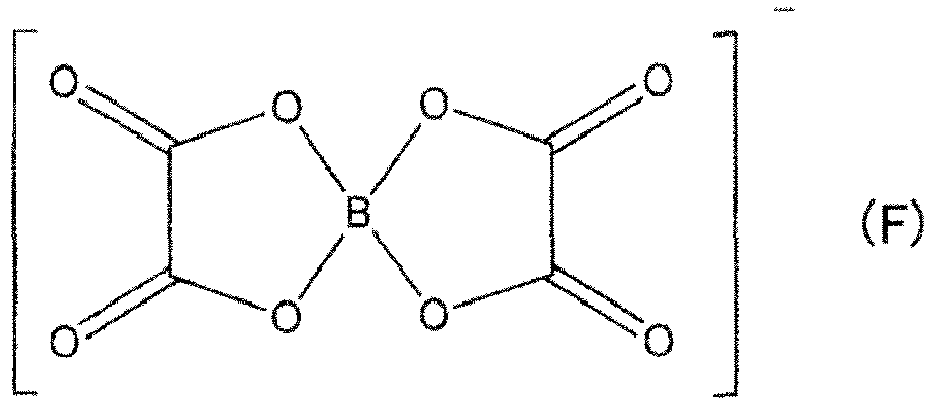
- The ionic liquid used in the present invention is properly selected from combinations of the above cationic components and anionic components, and specific examples thereof include 1-butylpyridinium tetrafluoroborate, 1-butylpyridinium hexafluorophosphate, 1-butyl-3-methylpyridinium tetrafluoroborate, 1-butyl-3-methylpyridinium trifluoromethanesulfonate, 1-butyl-3-methylpyridinium bis(trifluoromethanesulfonyl)imide, 1-butyl-3-methylpyridinium bis(pentafluoroethanesulfonyl)imide, 1-hexylpyridinium tetrafluoroborate, 1,1-dimethylpyrrolidinium bis(trifluoromethanesulfonyl)imide, 1-methyl-1-ethylpyrrolidinium bis(trifluoromethanesulfonyl)imide, 1-methyl-1-propylpyrrolidinium bis(trifluoromethanesulfonyl)imide, 1-methyl-1-butylpyrrolidinium bis(trifluoromethanesulfonyl)imide, 1-methyl-1-pentylpyrrolidinium bis(trifluoromethanesulfonyl)imide, 1-methyl-1-hexylpyrrolidinium bis(trifluoromethanesulfonyl)imide, 1-methyl-1-heptylpyrrolidinium bis(trifluoromethanesulfonyl)imide, 1-ethyl-1-propylpyrrolidinium bis(trifluoromethanesulfonyl)imide, 1-ethyl-1-butylpyrrolidinium bis(trifluoromethanesulfonyl)imide, 1-ethyl-1-pentylpyrrolidinium bis(trifluoromethanesulfonyl)imide, 1-ethyl-1-hexylpyrrolidinium bis(trifluoromethanesulfonyl)imide, 1-ethyl-1-heptylpyrrolidinium bis(trifluoromethanesulfonyl)imide, 1,1-dipropylpyrrolidinium bis(trifluoromethanesulfonyl)imide, 1-propyl-1-butylpyrrolidinium bis(trifluoromethanesulfonyl)imide, 1,1-dibutylpyrrolidinium bis(trifluoromethanesulfonyl)imide, 1-propylpiperidinium bis(trifluoromethanesulfonyl)imide, 1-pentylpiperidinium bis(trifluoromethanesulfonyl)imide, 1, 1-dimethylpiperidinium bis(trifluoromethanesulfonyl)imide, 1-methyl-1-ethylpiperidinium bis(trifluoromethanesulfonyl)imide, 1-methyl-1-propylpiperidinium bis(trifluoromethanesulfonyl)imide, 1-methyl-1-butylpiperidinium bis(trifluoromethanesulfonyl)imide, 1-methyl-1-pentylpiperidinium bis(trifluoromethanesulfonyl)imide, 1-methyl-1-hexylpiperidinium bis(trifluoromethanesulfonyl)imide, 1-methyl-1-heptylpiperidinium bis(trifluoromethanesulfonyl)imide, 1-ethyl-1-propylpiperidinium bis(trifluoromethanesulfonyl)imide, 1-ethyl-1-butylpiperidinium bis(trifluoromethanesulfonyl)imide, 1-ethyl-1-pentylpiperidinium bis(trifluoromethanesulfonyl)imide, 1-ethyl-1-hexylpiperidinium bis(trifluoromethanesulfonyl)imide, 1-ethyl-1-heptylpiperidinium bis(trifluoromethanesulfonyl)imide, 1,1-dipropylpiperidinium bis(trifluoromethanesulfonyl)imide, 1-propyl-1-butylpiperidinium bis(trifluoromethanesulfonyl)imide, 1,1-dibutylpiperidinium bis(trifluoromethanesulfonyl)imide, 1,1-dimethylpyrrolidinium bis(pentafluoroethanesulfonyl)imide, 1-methyl-1-ethylpyrrolidinium bis(pentafluoroethanesulfonyl)imide, 1-methyl-1-propylpyrrolidinium bis(pentafluoroethanesulfonyl)imide, 1-methyl-1-butylpyrrolidinium bis(pentafluoroethanesulfonyl)imide, 1-methyl-1-pentylpyrrolidinium bis(pentafluoroethanesulfonyl)imide, 1-methyl-1-hexylpyrrolidinium bis(pentafluoroethanesulfonyl)imide, 1-methyl-1-heptylpyrrolidinium bis(pentafluoroethanesulfonyl)imide, 1-ethyl-1-propylpyrrolidinium bis(pentafluoroethanesulfonyl)imide, 1-ethyl-1-butylpyrrolidinium bis(pentafluoroethanesulfonyl)imide, 1-ethyl-1-pentylpyrrolidinium bis(pentafluoroethanesulfonyl)imide, 1-ethyl-1-hexylpyrrolidinium bis(pentafluoroethanesulfonyl)imide, 1-ethyl-1-heptylpyrrolidinium bis(pentafluoroethanesulfonyl)imide, 1,1-dipropylpyrrolidinium bis(pentafluoroethanesulfonyl)imide, 1-propyl-1-butylpyrrolidinium bis(pentafluoroethanesulfonyl)imide, 1,1-dibutylpyrrolidinium bis(pentafluoroethanesulfonyl)imide, 1-propylpiperidinium bis(pentafluoroethanesulfonyl)imide, 1-pentylpiperidinium bis(pentafluoroethanesulfonyl)imide, 1,1-dimethylpiperidinium bis(pentafluoroethanesulfonyl)imide, 1-methyl-1-ethylpiperidinium bis(pentafluoroethanesulfonyl)imide, 1-methyl-1-propylpiperidinium bis(pentafluoroethanesulfonyl)imide, 1-methyl-1-butylpiperidinium bis(pentafluoroethanesulfonyl)imide, 1-methyl-1-pentylpiperidinium bis(pentafluoroethanesulfonyl)imide, 1-methyl-1-hexylpiperidinium bis(pentafluoroethanesulfonyl)imide, 1-methyl-1-heptylpiperidinium bis(pentafluoroethanesulfonyl)imide, 1-ethyl-1-propylpiperidinium bis(pentafluoroethanesulfonyl)imide, 1-ethyl-1-butylpiperidinium bis(pentafluoroethanesulfonyl)imide, 1-ethyl-1-pentylpiperidinium bis(pentafluoroethanesulfonyl)imide, 1-ethyl-1-hexylpiperidinium bis(pentafluoroethanesulfonyl)imide, 1-ethyl-1-heptylpiperidinium bis(pentafluoroethanesulfonyl)imide, 1,1-dipropylpiperidinium bis(pentafluoroethanesulfonyl)imide, 1-propyl-1-butylpiperidinium bis(pentafluoroethanesulfonyl)imide, 1,1-dibutylpiperidinium bis(pentafluoroethanesulfonyl)imide, 2-methyl-1-pyrroline tetrafluoroborate, 1-ethyl-2-phenylindole tetrafluoroborate, 1,2-dimethylindole tetrafluoroborate, 1-ethylcarbazole tetrafluoroborate, 1-ethyl-3-methylimidazolium tetrafluoroborate, 1-ethyl-3-methylimidazolium acetate, 1-ethyl-3-methylimidazolium trifluoroacetate, 1-ethyl-3-methylimidazolium heptafluorobutyrate, 1-ethyl-3-methylimidazolium trifluoromethanesulfonate, 1-ethyl-3-methylimidazolium perfluorobutanesulfonate, 1-ethyl-3-methylimidazolium dicyanamide, 1-ethyl-3-methylimidazolium bis(trifluoromethanesulfonyl)imide, 1-ethyl-3-methylimidazolium bis(pentafluoroethanesulfonyl)imide, 1-ethyl-3-methylimidazolium tris(trifluoromethanesulfonyl)methide, 1-butyl-3-methylimidazolium tetrafluoroborate, 1-butyl-3-methylimidazolium hexafluorophosphate, 1-butyl-3-methylimidazolium trifluoroacetate, 1-butyl-3-methylimidazolium heptafluorobutyrate, 1-butyl-3-methylimidazolium trifluoromethanesulfonate, 1-butyl-3-methylimidazolium perfluorobutanesulfonate, 1-butyl-3-methylimidazolium bis(trifluoromethanesulfonyl)imide, 1-hexyl-3-methylimidazolium bromide, 1-hexyl-3-methylimidazolium chloride, 1-hexyl-3-methylimidazolium tetrafluoroborate, 1-hexyl-3-methylimidazolium hexafluorophosphate, 1-hexyl-3-methylimidazolium trifluoromethanesulfonate, 1-octyl-3-methylimidazolium tetrafluoroborate, 1-octyl-3-methylimidazolium hexafluorophosphate, 1-hexyl-2,3-dimethylimidazolium tetrafluoroborate, 1,2-dimethyl-3-propylimidazolium bis(trifluoromethanesulfonyl)imide, 1-methylpyrazolium tetrafluoroborate, 2-methylpyrazolium tetrafluoroborate, 1-ethyl-2,3,5-trimethylpyrazolium bis(trifluoromethanesulfonyl)imide, 1-propyl-2,3,5-trimethylpyrazolium bis(trifluoromethanesulfonyl)imide, 1-butyl-2,3,5-trimethylpyrazolium bis(trifluoromethanesulfonyl)imide, 1-ethyl-2,3,5-trimethylpyrazolium bis(pentafluoroethanesulfonyl)imide, 1-propyl-2,3,5-trimethylpyrazolium bis(pentafluoroethanesulfonyl)imide, 1-butyl-2,3,5-trimethylpyrazolium bis(pentafluoroethanesulfonyl)imide, 1-ethyl-2,3,5-trimethylpyrazolium bis(trifluoromethanesulfonyl)trifluoroacetamide, 1-propyl-2,3,5-trimethylpyrazolium bis(trifluoromethanesulfonyl)trifluoroacetamide, 1-butyl-2,3,5-trimethylpyrazolium bis(trifluoromethanesulfonyl)trifluoroacetamide, 1-ethyl-2,3,5-trimethylpyrazolinium bis(trifluoromethanesulfonyl)imide, 1-propyl-2,3,5-trimethylpyrazolinium bis(trifluoromethanesulfonyl)imide, 1-butyl-2,3,5-trimethylpyrazolinium bis(trifluoromethanesulfonyl)imide, 1-ethyl-2,3,5-trimethylpyrazolinium bis(pentafluoroethanesulfonyl)imide, 1-propyl-2,3,5-trimethylpyrazolinium bis(pentafluoroethanesulfonyl)imide, 1-butyl-2,3,5-trimethylpyrazolinium bis(pentafluoroethanesulfonyl)imide, 1-ethyl-2,3,5-trimethylpyrazolinium bis(trifluoromethanesulfonyl)trifluoroacetamide, 1-propyl-2,3,5-trimethylpyrazolinium bis(trifluoromethanesulfonyl)trifluoroacetamide, 1-butyl-2,3,5-trimethylpyrazolinium bis(trifluoromethanesulfonyl)trifluoroacetamide, tetrapentylammonium trifluoromethanesulfonate, tetrapentylammonium bis(trifluoromethanesulfonyl)imide, tetrahexylammonium trifluoromethanesulfonate, tetrahexylammonium bis(trifluoromethanesulfonyl)imide, tetrabutylammonium trifluoromethanesulfonate, tetraheptylammonium bis(trifluoromethanesulfonyl)imide, diallyldimethylammonium tetrafluoroborate, diallyldimethylammonium trifluoromethanesulfonate, diallyldimethylammonium bis(trifluoromethanesulfonyl)imide, diallyldimethylammonium bis(pentafluoroethanesulfonyl)imide, N,N-diethyl-N-methyl-N-(2-methoxyethyl)ammonium tetrafluoroborate, N,N-diethyl-N-methyl-N-(2-methoxyethyl)ammonium trifluoromethanesulfonate, N,N-diethyl-N-methyl-N-(2-methoxyethyl)ammonium bis(trifluoromethanesulfonyl)imide, N,N-diethyl-N-methyl-N-(2-methoxyethyl)ammonium bis(pentafluoroethanesulfonyl)imide, glycidyltrimethylammonium trifluoromethanesulfonate, glycidyltrimethylammonium bis(trifluoromethanesulfonyl)imide, glycidyltrimethylammonium bis(pentafluoroethanesulfonyl)imide, tetraoctylphosphonium trifluoromethanesulfonate, tetraoctylphosphonium bis(trifluoromethanesulfonyl)imide, N,N-dimethyl-N-ethyl-N-propylammonium bis(trifluoromethanesulfonyl)imide, N,N-dimethyl-N-ethyl-N-butylammonium bis(trifluoromethanesulfonyl)imide, N,N-dimethyl-N-ethyl-N-pentylammonium bis(trifluoromethanesulfonyl)imide, N,N-dimethyl-N-ethyl-N-hexylammonium bis(trifluoromethanesulfonyl)imide, N,N-dimethyl-N-ethyl-N-heptylammonium bis(trifluoromethanesulfonyl)imide, N,N-dimethyl-N-ethyl-N-nonylammonium bis(trifluoromethanesulfonyl)imide, N,N-dimethyl-N,N-dipropylammonium bis(trifluoromethanesulfonyl)imide, N,N-dimethyl-N-propyl-N-butylammonium bis(trifluoromethanesulfonyl)imide, N,N-dimethyl-N-propyl-N-pentylammonium bis(trifluoromethanesulfonyl)imide, N,N-dimethyl-N-propyl-N-hexylammonium bis(trifluoromethanesulfonyl)imide, N,N-dimethyl-N-propyl-N-heptylammonium bis(trifluoromethanesulfonyl)imide, N,N-dimethyl-N-butyl-N-hexylammonium bis(trifluoromethanesulfonyl)imide, N,N-dimethyl-N-butyl-N-heptylammonium bis(trifluoromethanesulfonyl)imide, N,N-dimethyl-N-pentyl-N-hexylammonium bis(trifluoromethanesulfonyl)imide, N,N-dimethyl-N,N-dihexylammonium bis(trifluoromethanesulfonyl)imide, trimethylheptylammonium bis(trifluoromethanesulfonyl)imide, N,N-diethyl-N-methyl-N-propylammonium bis(trifluoromethanesulfonyl)imide, N,N-diethyl-N-methyl-N-pentylammonium bis(trifluoromethanesulfonyl)imide, N,N-diethyl-N-methyl-N-heptylammonium bis(trifluoromethanesulfonyl)imide, N,N-diethyl-N-propyl-N-pentylammonium bis(trifluoromethanesulfonyl)imide, triethylpropylammonium bis(trifluoromethanesulfonyl)imide, triethylpentylammonium bis(trifluoromethanesulfonyl)imide, triethylheptylammonium bis(trifluoromethanesulfonyl)imide, N,N-dipropyl-N-methyl-N-ethylammonium bis(trifluoromethanesulfonyl)imide, N,N-dipropyl-N-methyl-N-pentylammonium bis(trifluoromethanesulfonyl)imide, N,N-dipropyl-N-butyl-N-hexylammonium bis(trifluoromethanesulfonyl)imide, N,N-dipropyl-N,N-dihexylammonium bis(trifluoromethanesulfonyl)imide, N,N-dibutyl-N-methyl-N-pentylammonium bis(trifluoromethanesulfonyl)imide, N,N-dibutyl-N-methyl-N-hexylammonium bis(trifluoromethanesulfonyl)imide, trioctylmethylammonium bis(trifluoromethanesulfonyl)imide, N-methyl-N-ethyl-N-propyl-N-pentylammonium bis(trifluoromethanesulfonyl)imide, 1-butylpyridinium (trifluoromethanesulfonyl)trifluoroacetamide, 1-butyl-3-methylpyridinium (trifluoromethanesulfonyl)trifluoroacetamide, 1-ethyl-3-methylimidazolium (trifluoromethanesulfonyl)trifluoroacetamide, N-ethyl-N-methylmorpholinium thiocyanate, 4-ethyl-4-methylmorpholinium methylcarbonate, 1-ethyl-3-methylimidazolium thiocyanate, 1-butyl-3-methylimidazolium thiocyanate, 1-ethyl-3-methylimidazolium tetracyanoborate, 1-ethyl-3-methylimidazolium tris(pentafluoroethyl)trifluorophosphate, 1-ethyl-3-methylimidazolium bis(fluorosulfonyl)imide, triethylsulfonium bis(trifluoromethylsulfonyl)imide, and the like.
- Commercialized products may be used as the above-mentioned ionic liquid and those which are synthesized as follows are also usable. A method for synthesizing an ionic liquid is not particularly limited as long as the method gives an aimed ionic liquid, and in general, a halogenation method, a hydroxylation method, an acid esterification method, a complex forming method, a neutralization method, and the like as described in a document, "Ionic liquids-Front line and future for developments-" [published by CMC Co., Ltd.] may be employed.
- The halogenation method, hydroxylation method, complex forming method, and neutralization method will be described with reference to a synthesis method for a nitrogen-containing onium salt, and other ionic liquids such as a sulfur-containing onium salt and a phosphorus-containing onium salt can be also obtained by similar techniques.
- The halogenation method is a method carried out by reaction as shown in the following formulas (1) to (3). First, a halide is obtained by reaction of a tertiary amine and a haloalkyl (reaction formula (1), a halogen to be used is chlorine, bromine, or iodine).
- An aimed ionic liquid (R4NA) is obtained by allowing the obtained halide to react with an acid (HA) having an anionic structure (A-) of the aimed ionic liquid or a salt (MA, M is a cation forming a salt with the aimed anion, such as ammonium, lithium, sodium, or potassium).
[Formula 6]
(1) R3N + RX → R4NX (X: Cl, Br, I)
(2) R4NX + HA → R4NA + HX
(3) R4NX + MA → R4NA + MX (M: NH4, Li, Na, K, Ag or the like)
- The hydroxylation method is a method carried out by reaction as shown in (4) to (8). First, a hydroxide (R4NOH) is obtained by subjecting a halide (R4NX) to an ion-exchange membrane electrolysis method (reaction formula (4)), an OH-type ion-exchange resin method (reaction formula (5)), or reaction with silver oxide (Ag2O) (reaction formula (6)) (a halogen to be used is chlorine, bromine, or iodine).
- An aimed ionic liquid (R4NA) is obtained by subjecting the obtained hydroxide to reaction of reaction formulas (7) and (8) similarly to those in the halogenation method.
[Formula 7]
(4) R4NX + H2O → R4NOH + 1/2H2 + 1/2X2 (X: Cl, Br, I)
(5) R4NX + P-OH → R4NOH + P-X (P-OH: OH type ion exchange resin)
(6) R4NX + 1/2Ag2O + 1/2H2O → R4NOH+ AgX
(7) R4NOH + HA → R4NA+ H2O
(8) R4NOH + MA → R4NA+ MOH (M: NH4, Li, Na, K, Ag or the like)
- The acid esterification method is a method carried out by reaction as shown in (9) to (11). First, an acid ester is obtained by allowing a tertiary amine (R3N) to react with an acid ester (reaction formula (9), an acid ester to be used is an ester of an inorganic acid such as sulfuric acid, sulfurous acid, phosphoric acid, phosphorous acid, or carbonic acid; or an ester of an organic acid such as methanesulfonic acid, methylphosphonic acid, or formic acid).
- An aimed ionic liquid (R4NA) is obtained by subjecting the obtained acid ester to reaction of reaction formulas (10) and (11) similarly to those in the halogenationmethod. Further, it is possible to directly obtain an ionic liquid by using methyl trifluoromethanesulfonate, methyl trifluoroacetate, or the like as the acid ester.
[Formula 8]
(9) R3N + ROY → R4NOY

(10) R4NOY + HA → R4NA + HOY

(11) R4NOY + MA → R4NA + MOY (M: NH4, Li, Na, K, Ag or the like)
- The complex forming method is a method carried out by reaction as shown in (12) to (15). First, a quaternary ammonium fluoride salt is obtained by allowing a quaternary ammonium halide (R4NX), a quaternary ammonium hydroxide (R4NOH), or a quaternary ammonium carbonic acid ester (R4NOCO2CH3) to react with hydrofluoric acid (HF) or ammonium fluoride (NH4F) (reaction formulas (12) to (14)).
- An ionic liquid can be obtained by subjecting the obtained quaternary ammonium fluoride salt to complex forming reaction with a fluoride such as BF3, AlF3, PF5, ASF5, SbF5, NbF5, or TaF5, (reaction formula (15)).
- [Formula 9]
(12) R4NX + HF → R4NF + HX (X: Cl, Br, I)
(13) R4NY + HF → R4NF + HY (Y: OH, OCO2CH3)
(14) R4NY + NH4F → R4NF + NH3 + HY (Y: OH, OCO2CH3
(15) R4NF + MFn-1 → R4NMFn (MFn-1: BF3, Alf3, PF5, ASF5, SbF5, SbF5, NbF5, TaF5 or the like
- The neutralization method is a method carried out by reaction as shown in (16). A tertiary amine can be allowed to react with an organic acid such as HBF4, HPF6, CH3COOH, CF3COOH, CF3SO3H, (CF3SO2)2NH, (CF3SO2)3CH, or(C2F5SO2)2NH to give an ionic liquid.
[Formula 9]
(16) R3N + HZ → R3HN+Z- [HZ: Organic acid such as HBF4, HPF6, CH3COOH, C3COOH, CF3SO3, (CF3SO2)2NH, (CF3SO2)3CH, or (C2F5SO2)2NH]
- R described in the formulas (1) to (16) represents hydrogen or a hydrocarbon group with 1 to 20 carbon atoms or is optionally a functional group a functional group formed by partially substituting the hydrocarbon group with a heteroatom.
- Due to high ionic dissociation, the alkali metal salts are preferable in terms of exhibition of excellent antistatic capability even with a very small amount of addition. Examples of the alkali metal salts preferably used include metal salts composed of cations such as Li+, Na+, and K+ and anions such as Cl-, Br-, I-, AlCl4 -, Al2Cl7 -, BF4 -, PF6 -, SCN-, ClO4 -, NO3 -, CH3COO-, C9H19COO-, CF3COO-, C3F7COO-, CH3SO3 -, CF3SO3 - C4F9SO3 -, C2H5OSO3 -, C6H13OSO3 -, C8H17OSO3 -, (CF3SO2)2N-, (C2F5SO2)2N-, (C3F7SO2)2N-, (C4F9SO2)2N-, (CF3SO2)3C-, AsF6 -, SbF6 -, NbF6 -, TaF6 -, F(HF)n -, (CN)2N-, (CF3SO2) (CF3CO)N-, (CH3)2PO4 -, (C2H5)2PO4 -, CH3(OC2H4)2OSO3 -, C6H4(CH3)SO3 -, (C2F5)3PF3 -, CH3CH(OH)COO-, and (FSO2)2N-. More preferably used are lithium salts such as LiBr, LiI, LiBF4, LiPF6, LiSCN, LiClO4, LiCF3SO3, Li(CF3SO2)2N, Li(C2F5SO2)2N, Li(FSO2)2N, Li(CF3SO2)3C, and further preferably used LiCF3SO3, Li(CF3SO2)2N, Li(C2F5SO2)2N, Li(C3F7SO2)2N, Li(C4F9SO2)2N, Li(FSO2)2N, and Li(CF3SO2)3C. These alkali metal salts may be used alone or in combination of two or more thereof.
- Regarding the alkali metal salt, above all, many imide-containing anionic components provide hydrophobicity, cause no dissociation even if added to an aqueous pressure-sensitive adhesive, cause no generation of agglomerates, and the like and therefore, they are particularly preferably used. A sulfonyl-containing anionic component is excellent in stability in water, electric conductivity, heat stability, and the like and therefore, it is preferably used. Further, a fluoroalkyl-containing anionic component containing a fluorine atom provides an ionic compound with a low melting point and therefore, it is preferably used.
- The blend amount of the ionic compound cannot be defined indiscriminately since it changes depending on the compatibility of the ionic compound and a polymer to be used; however, for example, it is preferably 0.1 to 3.0 parts by weight, more preferably 0.2 to 2. 5 parts by weight, and furthermore preferably 0.3 to 2.0 parts by weight or lower per 100 parts by weight (solid matter) of the base polymer (acrylic emulsion-based polymer). If it is lower than 0.1 parts by weight, no antistatic property is obtained and if it exceeds 3.0 parts by weight, staining to an adherend may possibly be increased.
- As described above, the re-peelable water dispersion type acryl-based pressure-sensitive adhesive composition of the prevent invention contains the acrylic emulsion-based polymer, the crosslinking agent, and the ionic compound as indispensable components and, if necessary, may further contain various kinds of other additives.
- The re-peelable water dispersion type acryl-based pressure-sensitive adhesive composition may further contain an ether-containing polysiloxane (alkylene oxide-containing polysiloxane). Addition of the ether-containing polysiloxane (alkylene oxide-containing polysiloxane) can exhibit a more excellent antistatic property. The mechanism for exhibiting the antistatic property is not made clear in detail; however, an ether group has high affinity with water in the air and therefore, the electric charge is easily transferred to the air and further, an ether group is highly flexible in the molecular motion, and the electric charge generated at the time of peeling off can be efficiently transferred to the air and therefore, it is supposed that the excellent antistatic property is exhibited. In addition, since a silicone (polysiloxane) skeleton has a high interfacial adsorption property even for a small amount owing to the low surface tension, a trace amount can be transferred evenly to the surface of an adherend (an object to be protected) at the time when the pressure-sensitive adhesive sheet is peeled off from the adherend and the electric charge generated at the surface of the adherend can be efficiently transferred to the air and therefore, the excellent antistatic property can be exhibited.
- The ether-containing polysiloxane (alkylene oxide-containing polysiloxane) is preferably composed of (contains) an ethylene oxide (EO) group. It is also possible to contain a propylene oxide (PO) group as the alkylene oxide group other than the EO group and in this case, the content by mole of the PO is preferably 50% or lower per 100% by mole of the EO and the PO in total. If the polysiloxane is composed of the EO group (contains the EO group as a constituent component), a more excellent antistatic property for peeling off can be provided and therefore, it is a preferable aspect.
- The ether-containing polysiloxane (simply may be referred to as polysiloxane) has an HLB (Hydrophile-Lipophile-Balance) value of preferably 4 to 12, more preferably 5 to 11, and particularly preferably 6 to 10. If the HLB value is within the above range, not only the antistatic property can be provided but also the staining property for an adherend is made better and therefore, it is a preferable aspect.
- Examples of specifically commercialized products as the polysiloxane include KF-352A, KF-353, KF-615, KF-6012, KF-351A, KF-353, KF-945, KF-6011, KF-889, and KF-6004 (all manufactured by Shin-Etsu Chemical Co., Ltd.), FZ-2122, FZ-2164, FZ-7001, SH8400, SH8700, SF8410, SF8422 (all manufactured by Dow Corning Toray Co., Ltd.), TSF-4440, TSF-4445, TSF-4452, TSF-4460 (manufactured by Momentive Performance Materials Inc.), BYK-333, BYK-377, BYK-UV3500, andBYK-UV3570 (manufactured by BYK Japan K.K.), and the like. These compounds may be used alone or in combination of two or more thereof.
- Among the polysiloxanes, particularly those represented by the following formula are preferable aspects since they easily exhibit an antistatic property in terms of trapping of the ionic compound in the side chain and adsorption in the interface.

- It is more preferable that in the polysiloxane, the terminal of the polyoxyalkylene (polyether) side chain is a hydroxyl group. Use of the polysiloxane can exhibit the antistatic property for an adherend (an object to be protected) and is therefore effective.
- Regarding the above polysiloxane, specifically, R1 in the formula may be a monovalent organic group, e.g., an alkyl group such as a methyl group, an ethyl group, or a propyl group; an aryl group such as a phenyl group or a tolyl group; or an aralkyl group such as a benzyl group or a phenethyl group, and may have a substituent group such as a hydroxyl group. Each of R2, R3, and R4 may be an alkylene group with 1 to 8 carbon atoms such as a methylene group, an ethylene group, or a propylene group. Herein, R3 and R4 independently represent a different alkylene group and R2 may be the same as or different from R3 or R4. One of R3 and R4 is preferably an ethylene or propylene group in order to increase the concentration of an antistatic agent soluble in its polyoxyalkylene (polyether) side chain. R5 may be a monovalent organic group, e.g., an alkyl group such as a methyl group, an ethyl group, or a propyl group; or an acyl group such as an acetyl group andapropionyl group, and may have a substituent group such as a hydroxyl group. These compounds may be used alone or in combination of two or more thereof. The polysiloxane may also have a reactive substituent group such as a (meth)acryloyl group, an allyl group, or a hydroxyl group in the molecule. Among the polysiloxanes having a polyoxyalkylene (polyether) side chain, the polysiloxanes havingapolyoxyalkylene (polyether) sidechainhavingahydroxyl terminal are preferable since they are supposed to make it easy to give good balance of compatibility.
- The blend amount of the polysiloxane is preferably 0.2 to 1 part by weight, more preferably 0.25 to 0.8 parts by weight, and furthermore preferably 0.3 to 0.6 parts by weight per 100 parts by weight of the acrylic emulsion-based polymer (solid matter). If it is lower than 0.2 parts by weight, it is hard to obtain the antistatic property and if it exceeds 1 part by weight, staining of an adherend may possibly be increased.
- The pressure-sensitive adhesive composition of the present invention preferably does not contain substantially a so-called nonreactive (nonpolymerizable) component (excluding component such as water which is volatilized by drying and does not remain in pressure-sensitive adhesive layer) other than a reactive (polymerizable) component incorporated into the polymer forming the pressure-sensitive adhesive layer by reaction (polymerization) with the raw material monomers or the like of the acrylic emulsion-based polymer. If a nonreactive component remains in the pressure-sensitive adhesive layer, this component is transferred to an adherend and may cause whitening staining. Herein, "does not contain substantially" refers to the case of no positive addition except inevitable contamination, and specifically, the content of the nonreactive component in the pressure-sensitive adhesive composition (non-volatile components) is preferably lower than 1% by weight, more preferably lower than 0.1% by weight, and furthermore preferably lower than 0.005% by weight.
- Examples of the nonreactive component include components such as a phosphoric acid ester-based compound used in
JP-A 2006-045412 - The pressure-sensitive adhesive composition of the present invention may contain various kinds of additives other than those described above to the extent that the additives do not cause an effect on the staining properties. Examples of the various kinds of additives include a pigment, a filler, a leveling agent, a dispersant, aplasticizer, a stabilizer, an antioxidant, an ultraviolet absorber, an ultraviolet stabilizer, a defoaming agent, an aging prevention agent, a preserver, and the like.
- The pressure-sensitive adhesive composition of the present invention can be produced by blending the acrylic emulsion-based polymer, the water-insoluble crosslinking agent, and the ionic compound. If necessary, various kinds of other additives may be mixed. The mixing method to be employed may be a conventionally-known emulsion mixing method, and for example, without any particular limitation, stirring using a stirrer is preferable. The stirring condition is not particularly limited; however, for example, the stirring temperature is preferably 10 to 50°C and more preferably 20 to 35°C. The stirring time is preferably 5 to 30 minutes and more preferably 10 to 20 minutes. The stirring rotation rate is preferably 10 to 3000 rpm and more preferably 30 to 1000 rpm.
- The pressure-sensitive adhesive layer (pressure-sensitive adhesive sheet) of the present invention is formed of the re-peelable water dispersion type acryl-based pressure-sensitive adhesive composition. A method of forming the pressure-sensitive adhesive layer is not particularly limited and a conventionally-known method of forming a pressure-sensitive adhesive layer can be employed. The pressure-sensitive adhesive layer can be formed by applying the pressure-sensitive adhesive composition onto a substrate or a peeling film (peeling liner) and thereafter drying the pressure-sensitive adhesive composition. If the pressure-sensitive adhesive layer is formed on a peeling (release) film, the pressure-sensitive adhesive layer is stuck to a substrate and then transferred.
- The solvent-insoluble matter (gel ratio) of the pressure-sensitive adhesive layer (after crosslinked) in the pressure-sensitive adhesive sheet of the present invention is preferably 90 (% by weight) or more, and more preferably 95% by weight or more. If the solvent-insoluble matter is less than 90% by weight, pollutant transfer to an adherend may be increased so that whitening staining is caused, and the re-peeling properties may become insufficient (heavy peeling properties). The solvent-insoluble matter of the pressure-sensitive adhesive layer (after crosslinked) can be measured in the same manner as in the above-mentioned measurement method for the solvent-insolublematter of the acrylic emulsion-based polymer. Specifically, the measurement can be carried out, in the above "measurement method for solvent-insoluble matter", by interpreting "acrylic emulsion-based polymer" as "pressure-sensitive adhesive layer (after crosslinked)".
- In the case of forming the pressure-sensitive adhesive layer (pressure-sensitive adhesive sheet), the temperature at the time of drying is usually about 80 to 170°C and preferably 80 to 160°C, and the drying time is about 0.5 to 30 minutes and preferably 1 to 10 minutes. Further, aging is carried out at room temperature to about 50°C for 1 day to 1 weak to produce the pressure-sensitive adhesive layer (pressure-sensitive adhesive sheet).
- Various kinds of methods are employed for the step of applying the pressure-sensitive adhesive composition. Specific examples of the methods include roll coating, kiss roll coating, gravure coating, reverse coating, roll brush, spray coating, dip roll coating, bar coating, knife coating, air knife coating, curtain coating, lip coating, extrusion coating by a die coater, and the like.
- The application amount thereof is controlled such that a pressure-sensitive adhesive layer to be formedhas a prescribed thickness (thickness after drying) in the application step. The thickness of the pressure-sensitive adhesive layer (thickness after drying) is usually set in a range of about 1 to 100 µm, preferably 5 to 50 µm, and more preferably 10 to 40 µm.
- Examples of a material constituting the peeling film include plastic films such as films of polyethylene, polypropylene, polyethylene terephthalate, and polyester; porous materials such as paper, cloth, and nonwoven fabric; nets, foamed sheets, metal foils, and proper thin sheet bodies such as their laminates. In terms of excellent surface smoothness, plastic films are used preferably.
- The plastic films are not particularly limited as long as they are films capable of protecting the pressure-sensitive adhesivelayer, and examples thereof include a polyethylene film, a polypropylene film, a polybutene film, a polybutadiene film, a polymethylpentene film, a polyvinyl chloride film, a vinyl chloride copolymer film, a polyethylene terephthalate film, a polybutylene terephthalate film, a polyurethane film, an ethylene-vinyl acetate copolymer film, and the like.
- The thickness of the peeling film is usually 5 to 200 µm and preferably about 5 to 100 µm.
- If necessary, the peeling film may be subjected to release and stain-resistant treatment by a silicone-based, fluorine-based, long chain alkyl-based, or fatty acid amide-based release agent, a silica powder and the like, and to antistatic treatment by application type, kneading type, and vapor deposition type treatment. Particularly, the peeling properties from the pressure-sensitive adhesive layer can be more improved by properly carrying out peeling (release) treatment suchas silicone treatment, long chain alkyl treatment, and fluorine treatment for the surface of the peeling film.
- In the case where the pressure-sensitive adhesive layer is exposed, the pressure-sensitive adhesive layer may be protected with a peeling film until it is practically used. The peeling film may be used as it is as a separator for a pressure-sensitive adhesive type optical film, and simplification in the steps can be achieved.
- Formation of the pressure-sensitive adhesive layer (pressure-sensitive adhesive layer formed of the pressure-sensitive adhesive composition of the present invention) on at least one surface of a substrate (referred to as "support" or "supporting substrate") can give a pressure-sensitive adhesive sheet (pressure-sensitive adhesive sheet stuck to a substrate; pressure-sensitive adhesive sheet having the pressure-sensitive adhesive layer on at least one surface side of a substrate). The pressure-sensitive adhesive layer can be used as it is as a pressure-sensitive adhesive sheet without a substrate. Hereinafter, the pressure-sensitive adhesive sheet stuck to a substrate may be referred to as "pressure-sensitive adhesive sheet of the present invention".
- The pressure-sensitive adhesive sheet (the pressure-sensitive adhesive sheet stuck to a substrate) of the present invention is obtained by, for example, applying the pressure-sensitive adhesive composition of the present invention onto at least one surface side of a substrate, and if necessary, drying the pressure-sensitive adhesive composition to form a pressure-sensitive adhesive layer on at least one surface side of the substrate (direct printingmethod) . Crosslinking may be carried out by dehydration in the drying step, heating the pressure-sensitive adhesive sheet after drying, or the like. The pressure-sensitive adhesive sheet can be also obtained by forming a pressure-sensitive adhesive layer on a peeling film once and transferring the pressure-sensitive adhesive layer onto the substrate (transfer method). Although the method is not particularly limited, the pressure-sensitive adhesive layer is preferably formed by so-called direct printing method of directly applying the pressure-sensitive adhesive composition onto the substrate surface.
- The substrate for the pressure-sensitive adhesive sheet of the present invention is preferably a plastic substrate (e.g., a plastic film or a plastic sheet) from the viewpoint of obtaining a pressure-sensitive adhesive sheet with high transparency. Examples of a material for the plastic substrate include, but are not particularly limited to, transparent resins, e.g., polyolefins (polyolefin-based resins) such as polypropylene and polyethylene; polyesters (polyester-based resins) such as polyethylene terephthalate (PET); polycarbonates, polyamides, polyimides, acryl, polystyrenes, acetates, polyethersulfones, triacetyl cellulose, and the like. These resins may be used alone or in combination of two or more thereof. Among these substrates, although not particularly limited to, polyester-based resins and polyolefin-based resins are preferably used and PET, polypropylene, and polyethylene are more preferably used in terms of productivity and formability. That is, as the substrate, polyester-based films and polyolefin-based films are preferable and a PET film, a polypropylene film, and a polyethylene film are more preferable. Examples of the polypropylene include, but are not particularly limited to, a homo-type, which is a homopolymer; a random type, which is an α-olefin random copolymer; and a block type, which is an α-olefin block copolymer. Examples of the polyethylene include low density polyethylene (LDPE), high density polyethylene (HDPE), and linear low density polyethylene (L-LDPE). These plastics may be used alone or in combination of two or more thereof.
- The thickness of the substrate is not particularly limited, but is preferably 10 to 150 µm and more preferably 30 to 100 µm.
- For the purpose of improving the adhesive strength to the pressure-sensitive adhesive layer, the surface of the substrate on the side where the pressure-sensitive adhesive layer is to be formed is preferably subjected to easy adhesion treatment such as acid treatment, alkali treatment, primer treatment, corona treatment, plasma treatment, or ultraviolet treatment. An intermediate layer may be formed between the substrate and the pressure-sensitive adhesive layer. The thickness of the intermediate layer is preferably, for example, 0. 05 to 1 µm and more preferably 0.1 to 1 µm.
- The pressure-sensitive adhesive sheet of the present invention may be formed into a rolled body, and may be wound into a roll in the state where the pressure-sensitive adhesive layer is protected by a peeling film (separator). Further, the rear surface of the pressure-sensitive adhesive sheet (surface on the side opposite to the side where the pressure-sensitive adhesive layer is formed) may be subjected to release treatment and/or stain-resistant treatment with a silicone-based, fluorine-based, long chain alkyl-based or fatty acid amide-based release agent, a silica powder or the like to form a rear surface treatment layer (release treatment layer, stain-resistant treatment layer, etc.). The pressure-sensitive adhesive sheet of the present invention is especially preferable to have a configuration of pressure-sensitive adhesive layer/substrate/rear surface treatment layer.
- The pressure-sensitive adhesive sheet of the present invention is more preferably subj ected to antistatic treatment. The antistatic treatment may be a common antistatic treatment method, and examples thereof include, but are not particularly limited to, a method for forming an antistatic layer on the substrate rear surface (surface on the side opposite to the side where the pressure-sensitive adhesive layer is formed) and a method for kneading a kneading type antistatic agent in the substrate.
- Examples of a method for forming an antistatic layer include a method of applying an antistatic agent, or an antistatic resin containing an antistatic agent and a resin component, or a conductive resin composition or conductive polymer containing a conductive substance and a resin component; a method for depositing a conductive substance or plating with a conductive substance; and the like.
- Examples of the antistatic agent include cationic antistatic agents having a cationic functional group such as a quaternary ammonium salt and a pyridinium salt (e.g., primary amino group, secondary amino group, and tertiary amino group) ; anionic antistatic agents having an anionic functional group such as a sulfonic acid salt, a sulfuric acid ester salt, a phosphonic acid salt, and a phosphoric acid ester salt; amphoteric ionic antistatic agent such as alkylbetain and its derivatives, imidazoline and its derivatives, and alanine and its derivatives; nonionic antistatic agents such as aminoalcohol and its derivatives, glycerin and its derivatives, and polyethylene glycol and its derivatives; and further ion conductive polymers obtained by polymerization or copolymerization of monomers having ion conductive groups shown in the cationic antistatic agents, anionic antistatic agents, and amphoteric antistatic agents.
- Specifically, examples of the cationic antistatic agents include (meth)acrylate copolymers having a quaternary ammonium group such as an alkyltrimethylammonium salt, acyloyl amidopropyl trimethylammonium methosulfate, an alkylbenzylmethylammonium salt, acyl choline chloride, and polydimethylaminoethyl methacrylate; styrene-based copolymers having a quaternary ammonium group such as polyvinylbenzyltrimethylammonium chloride; diallylamine copolymers having a quaternary ammonium group such as polydiallyldimethylammonium chloride; and the like. Examples of the anionic antistatic agents include an alkylsulfonic acid salt, an alkylbenzenesulfonic acid salt, an alkylsulfuric acid ester salt, an alkylethoxysulfuric acid ester salt, an alkylphosphoric acid ester salt, a sulfonic acid-containing styrene-based copolymer, and the like. Examples of the amphoteric ionic antistatic agents include an alkylbetain, an alkylimidazolium betain, a carbobetain graft copolymer, and the like. Examples of the nonionic antistatic agents include fatty acid alkylolamide, di-(2-hydroxyethyl)alkylamine, polyoxyethylene alkylamine, a fatty acid glycerin ester, a polyoxyethylene glycol fatty acid ester, a sorbitan fatty acid ester, a polyoxysorbitan fatty acid ester, polyoxyethylene alkylphenyl ether, polyoxyethylene alkyl ether, polyethylene glycol, polyoxyethylene diamine, a copolymer composed of a polyether and a polyester, methoxypolyethylene glycol (meth)acrylate, and the like.
- Examples of the conductive polymer include polyaniline, polypyrrole, polythiophene, and the like.
- Examples of the conductive substance include tin oxide, antimony oxide, indium oxide, cadmium oxide, titanium oxide, zinc oxide, indium, tin, antimony, gold, silver, copper, aluminum, nickel, chromium, titanium, iron, cobalt, copper iodide, and alloys and mixtures thereof, and the like.
- Examples of the resin component include popular resins such as polyester, acrylic, polyvinyl, urethane, melamine, and epoxy resins. In the case where the antistatic agent is a polymer type antistatic agent, the antistatic resin may not contain the above-mentioned resin component. The antistatic resin may also contain, as a crosslinking agent, a methylolated or alkylolated melamine-based, urea-based, glyoxal-based, and acrylamide-based compound, an epoxy-based compound, and an isocyanate-based compound.
- An example of the method for forming the antistatic layer by application includes a method for diluting the above antistatic resin, conductive polymer, and conductive resin composition with a medium or dispersant such as an organic solvent or water and applying the obtained coating solution to a substrate, followed by drying. Examples of the organic solvent include methyl ethyl ketone, acetone, ethyl acetate, tetrahydrofuran, dioxane, cyclohexanone, n-hexane, toluene, xylene, methanol, ethanol, n-propanol, isopropanol, and the like. These solvents may be used alone or in combination of two or more thereof. As the application method, conventionally known application methods are employed and specific examples thereof include roll coating, gravure coating, reverse coating, roll brush, spray coating, air knife coating, immersion and curtain coating methods.
- The thickness of the antistatic layer (antistatic resin layer, conductive polymer layer, and conductive resin composition layer) formed by application is preferably 0.001 to 5 µm and more preferably 0.005 to 1 µm.
- Examples of a method for vapor depositing the conductive substance or plating with the conductive substance include vacuum vapor deposition, sputtering, ion plating, chemical vapor deposition, spray heat decomposition, chemical plating, electroplating methods, and the like.
- The thickness of the antistatic layer (conductive substance layer) formed by the vapor deposition or plating is preferably 20 to 10000 angstroms (0.002 to 1 µm) and more preferably 50 to 5000 angstroms (0.005 to 0.5 µm).
- As the kneading type antistatic agent, the antistatic agents may be used properly. The blend amount of the kneading type antistatic agent is preferably 20% by weight or lower, and more preferably 0.05 to 10% by weight per total weight (100% by weight) of the substrate. A kneading method is not particularly limited as long as the method can evenly mix the kneading type antistatic agent with a resin to be used for, for example, a plastic substrate and generally, examples thereof include methods using a heating roll, a Banbury mixer, a pressure kneader, a biaxial kneader, and the like.
- The re-peelable water dispersion type acryl-based pressure-sensitive adhesive composition of the present invention is a pressure-sensitive adhesive composition excellent in antistatic properties, adherability, and re-peelable properties (easy peelable properties) and capable of forming a re-peelable pressure-sensitive adhesive layer, and the composition is used for forming a pressure-sensitive adhesive layer (re-peelable) used for re-peeling. That is, the pressure-sensitive adhesive sheet having the pressure-sensitive adhesive layer are preferably used for re-peeling [e.g., masking tapes such as a masking tape for construction aging, a masking tape for automotive coating, a masking tape for electronic parts (lead frame, printed board, etc.), and a masking tape for sand blast; surface protecting films such as a surface protecting film for aluminum sashes, a surface protecting film for optical plastics, a surface protecting film for optical glass, a surface protecting film for automotive protection, and a surface protecting film for metal plates; pressure-sensitive adhesive tapes for semiconductor/electronic part production processes such as a background tape, a tape for pellicle fixation, a tape for dicing, a tape for lead frame fixation, a cleaning tape, a dust removal tape, a carrier tape, and a cover tape; wrapping tapes for electronic appliances and electronic parts; temporary fixation tapes for transportation, bundling tapes; and labels], and the like.
- The pressure-sensitive adhesive sheet of the present invention is also preferably used for surface protection (surface protecting films for optical members, etc.) of optical members (optical plastics, optical glass, optical films, etc.) such as polarizing plates, retardation plates, anti-reflection plates, wave plates, optical compensation films, and brightness improvement films constituting panels such as liquid crystal displays, organic electroluminescence (organic EL), and field emission displays. However, use of the pressure-sensitive adhesive sheet is not limited thereto and the sheet may be used for surface protection and breakage prevention at the time of producing finely processed parts such as semiconductors, circuits, various kinds of printed circuit boards, various kinds of masks, and lead frames, or for removing foreign matters, etc., or masking, or the like.
- It is preferable that the pressure-sensitive adhesive sheet of the present invention is a surface protecting film for an optical member.
- An optical member according to the present invention is preferably an optical member obtained by stacking the pressure-sensitive adhesive sheet.
- Hereinafter, the present invention will be described in detail based on Examples; however, the invention should not be limited to these Examples. In the following description, "part(s)" and "%" are on the basis of weight unless otherwise specified.
- A container was loaded with 90 parts by weight of water and, as shown in Table 1, 92 parts by weight of 2-ethylhexyl acrylate (2EHA), 4 parts by weight of acrylic acid (AA), 4 parts by weight of methyl methacrylate (MMA), and 2 parts by weight of a reactive nonionic anionic emulsifier (trade name; "Aqualon HS-1025", manufactured by DAI-ICHI KOGYO SEIYAKU CO., LTD.), and thereafter the components were stirred and mixed by a homomixer to obtain a monomer emulsion.
- A reaction container equipped with a condenser, a nitrogen gas introduction tube, a thermometer, and a stirrer was then added with 50 parts by weight of water and 0. 07 parts by weight of a polymerizationinitiator (ammonium persulfate), and heated to 75°C, and thereafter the above monomer emulsion was added over 3 hours under stirring conditions and further reaction was carried out at 75°C for 3 hours. Next, the reaction system was cooled to 30°C and added with ammonia water with 10% by weight concentration to adjust pH to 8 to prepare a water dispersion of an acrylic emulsion-based polymer (concentration of acrylic emulsion-based polymer: 40% by weight, average particle diameter: 531 nm).
- The water dispersion of the acrylic emulsion-basedpolymer was mixed with 1. 8 parts by weight of an epoxy-based crosslinking agent, which is awater-insoluble crosslinking agent [tradename: "TETRAD-C"; manufactured by MITSUBISHI GAS CHEMICAL COMPANY, INC., 1,3-bis(N,N-diglycidylaminomethyl)cyclohexane; epoxy equivalent: 110; and number of functional groups: 4], 1 part by weight of an ionic liquid, which is an antistatic agent [trade name "Elexcel AS-110, manufactured by DAI-ICHI KOGYO SEIYAKU CO., LTD., 1-ethyl-3-methylimidazolium bisfluorosulfonylimide; efficacious component 100% by weight), and 0.32 parts by weight of an ether-containing polysiloxane [trade name "KF-353", manufactured by Shin-Etsu Chemical Co., Ltd. ; efficacious component 100% by weight), while stirring with a stirrer under stirring conditions of 23°C and 300 rpm for 10 minutes, to prepare a re-peelable water dispersion type acryl-based pressure-sensitive adhesive composition.
- The re-peelable water dispersion type acryl-based pressure-sensitive adhesive composition was applied (coated) onto a surface of a PET film (trade name: "T100M38", manufactured by Mitsubishi Plastics Inc.; thickness: 38 µm), which was subjected to corona treatment, using an applicator manufactured by TESTER SANGYO CO., LTD. so as to have a thickness of 15 µm after drying, and then dried at 120°C for 2 minutes in a hot air circulation type oven and successively aged at room temperature for 1 week to obtain a pressure-sensitive adhesive sheet.
- As shown in Tables 1 and 2, re-peelable water dispersion type acryl-based pressure-sensitive adhesive compositions were prepared in the same manner as in Example 1 by changing the blend contents, the blend amounts and the like. Additives not described in the Table were added in the same amounts as those in Example 1. Pressure-sensitive adhesive sheets were produced in the same manner as in Example 1 using the re-peelable water dispersion type acryl-based pressure-sensitive adhesive compositions.
- A container was loaded with 90 parts by weight of water and, as shown in Table 1, 92 parts by weight of 2-ethylhexyl acrylate (2EHA), 4 parts by weight of acrylic acid (AA), 4 parts by weight of methyl methacrylate (MMA), and 2 parts by weight of a reactive nonionic anionic emulsifier (trade name; "Aqualon HS-1025", manufactured by DAI-ICHI KOGYO SEIYAKU CO., LTD.), and thereafter the components were stirred and mixed by a homomixer to prepare a monomer emulsion.
- A reaction container equipped with a condenser, a nitrogen gas introduction tube, a thermometer, and a stirrer was then added with 50 parts by weight of water, 0.01 parts by weight of a polymerization initiator (ammonium persulfate), and the monomer emulsion in an amount equivalent to 10% by weight and, under stirring conditions, emulsion polymerization was performed at 65°C for 1 hour. Thereafter, 0.05 parts by weight of the polymerization initiator (ammonium persulfate) was further added and successively, under stirring conditions, the remaining of the monomer emulsion (amount equivalent to 90% by weight) was added over 3 hours and then allowed to react at 75°C for 3 hours. Next, the reaction product was cooled to 30°C and added with ammonia water with 10% by weight concentration to adjust pH to 8 to obtain a water dispersion of an acrylic emulsion-based polymer (concentration of acrylic emulsion-based polymer: 42% by weight).
- A monomer emulsion was prepared in the same manner as in Example 4 except that the rawmaterial monomers, the blend amounts and the like were changed as shown in Table 1, and the amount of the polymerization initiator was changed to 0.15 pats by weight. Additives not described in the Tablewere added in the same amounts as those in Example 1. A water dispersion type acryl-based pressure-sensitive adhesive composition (pressure-sensitive adhesive composition) and a pressure-sensitive adhesive sheet were obtained in the same manner as in Example 1 using the monomer emulsion.
- A container was loaded with 90 parts by weight of water and, as shown in Table 1, 92 parts by weight of 2-ethylhexyl acrylate (2EHA), 4 parts by weight of acrylic acid (AA), 4 parts by weight of methyl methacrylate (MMA), 2 parts by weight of a reactive nonionic anionic emulsifier (trade name; "Aqualon HS-1025", manufactured by DAI-ICHI KOGYO SEIYAKU CO., LTD.), and 0.05 parts by weight of a chain transfer agent (n-lauryl mercaptan) and thereafter the components were stirred and mixed by a homomixer to prepare a monomer emulsion.
- A reaction container equipped with a condenser, a nitrogen gas introduction tube, a thermometer, and a stirrer was then added with 50 parts by weight of water and 0.7 parts by weight of a polymerization initiator (ammonium persulfate), and heated to 75°C, and thereafter the above monomer emulsion was added over 3 hours under stirring conditions and further reaction was carried out at 75°C for 3 hours. Next, the reaction system was cooled to 30°C and added with ammonia water with 10% by weight concentration to adjust pH to 8 to prepare a water dispersion of an acrylic emulsion-based polymer (concentration of acrylic emulsion-based polymer: 42% by weight, average particle diameter: 300 nm).
- A water dispersion type acryl-based pressure-sensitive adhesive composition(pressure-sensitive adhesive composition) and a pressure-sensitive adhesive sheet were produced in the same manner as in Example 1 by changing the blend amounts and the like as for the other respects as shown in Table 1. Additives not described in the Table were added in the same amounts as those in Example 1.
- Each water dispersion type acryl-based pressure-sensitive adhesive composition and each pressure-sensitive adhesive sheet obtained in the Examples and the Comparative Examples were evaluated by the following measurement methods. Regarding the evaluation results, the average particle diameter of each acrylic emulsion-based polymer was shown in Table 1 and the antistatic property for peeling off in low humidity was shown in Table 3.
- A laser diffraction/scattering grain size distribution measuring apparatus LS1332 manufactured by BECKMAN COULTER was used for measuring the average particle diameter of each emulsion. The measurement was carried out at a pump speed of 30% for a measurement time of 90 seconds. The measurement was carried out by setting each emulsion type pressure-sensitive adhesive diluted 10 times.
- Generally, emulsion particles bear electric charge on the particle surface and therefore, an ionic compound tends to be trapped on the surface. As a result, the ionic compound to be transferred to an adherend is decreased at the time of peeling off the pressure-sensitive adhesive from the adherend and therefore, it is supposed that the antistatic property is hard to be exhibited at the time of peeling off. Herein, if the average particle diameter of the emulsion is made large, the surface area of the respective particles is increased; however, the number of particles contained in the same solid matter concentration and in the same volume is lessened and therefore, the total surface area of the particles is decreased. As a result, it is supposed that the ionic compound trapped on the particle surface can be decreased to result in improvement of the antistatic property. The particle diameter is preferably 130 to 600 nm, more preferably 200 to 550 nm, and furthermore preferably 250 to 450 nm.
- Each produced pressure-sensitive adhesive sheet was cut into a size of 70 mm in width and 130 mm in length, and after the separator was peeled off, the pressure-sensitive adhesive sheet was pressure-bonded to the surface of a polarizing plate (trade name: "SEG 1425DU" (DU in Table 3, Ra=12) manufactured by NITTO DENKO CORPORATION, a highly polar and smooth adherend, and trade name: "SEG 1425 AGS2B ("S2B" in Table 3, Ra=356", a low polar and rough adherend) stuck to an acrylic plate (Acrylite, manufactured by MITSUBISHI RAYON CO., LTD., thickness: 1 mm; width: 70 mm; length: 100 mm), which was previously treated for static elimination, by a hand roller such that one rim part was extruded out by 30 mm. Successively, after allowed to stand in conditions of 20°C × 25 ± 2% RH for 1 day, the resulting sample was set at a prescribed position as shown in
Fig. 1 . The one rim part extruded by 30 mm was fixed in an automatic winder, and the pressure-sensitive adhesive sheet was peeled off at a peeling angle of 150° and a peeling speed of 30 m/minute (high speedpeeling) . The potential generated in the polarizingplate surface at that time was measured by a potentiometer (KSD-0103, manufactured by KASUGA ELECTRIC WORKS LTD.) fixed at a prescribed position. The distance between the sample and the potentiometer was 100 mm at the time of measuring the potential in the polarizing plate surface. The measurement was carried out in conditions of 20°C × 25 ± 2% RH. Herein, the "highly polar adherend" means an adherend having an adhesive surface such as triacetyl cellulose surface with 30 to 50° of an angle (water contact angle) formed between the adhesive surface and a tangent line of the end part of a droplet which is formed by dropping about 1.9 µL of distilled water in an atmosphere of 23°C × 50%RH at a time of 1 second after the dropping of the droplet; and the low polar adherend means an adherend having an adhesive surface such as hard coat surface containing silica particles or a polymer with 55 to 80° of a water contact angle measured in the above-mentioned conditions. - The peeling electrification voltage in low humidity (absolute value) of the pressure-sensitive adhesive sheet of the present invention is preferably lower than 0.5 kV and more preferably 0.4 kV or lower. If the peeling electrification voltage 0.5 kV or higher, dust is easily adsorbed at the time of peeling off the pressure-sensitive adhesive sheet and the polarizer arrangement in the polarizing plate is disordered and therefore, it is not preferable.
[Table 1] Blend contents for acrylic emulsion-based polymer preparation (parts by weight: solid matter) Example Comparative Example 1 2 3 4 5 6 7 8 9 10 1 2 Raw material monomer 2EHA 92 92 92 92 92 92 92 92 92 92 92 96 AA 4 4 4 4 4 4 4 4 4 4 4 4 MMA 4 4 4 4 4 4 4 4 4 4 4 Monomer emulsion Entire dropping ○ ○ ○ ○ ○ ○ ○ ○ ○ ○ ○ Two-step dropping ○ Emulsifier HS-1025 EM loading 2.00 2.00 2.00 2.00 2.00 2.00 2.00 2.00 2.00 2.00 2.00 1.35 Initial loading 0.001 0.005 0.0075 0.010 0.050 0.100 0.200 1.650 Average particle diameter of acrylic emulsion-based polymer (nm) 531 390 309 215 226 166 143 531 337 337 126 120 [Table 2] Blend contents for acryl-based pressure-sensitive adhesive composition preparation (parts by weight: solid matter) Example Comparative Example 1 2 3 4 5 6 7 8 9 10 1 2 Acrylic pressure-sen sitive adhesive composition Acrylic emulsion-based polymer 100 100 100 100 100 100 100 100 100 100 100 100 Water-insoluble crosslinking agent T/C 1.8 1.8 1.8 1.8 1.8 1.8 1.8 1.8 1.8 1.8 1.8 1.8 Ionic liquid AS-110 1 1 1 1 1 1 1 1 1 1 1 Alkali metal salt LiCF3SO3 0.5 Polysiloxane KF-353 0.32 0.32 0.32 0.32 0.32 0.32 0.32 0.32 0.32 0.32 0.32 0.32 [Table 3] Evaluation result of antistatic property for peeling off in low humidity (unit: kV, absolute value) Example Comparative Example 1 2 3 4 5 6 7 8 9 10 1 2 Peeling speed 30 m/minute Object: DU 0 0 0 0 0 0.2 0.2 0 0 0 0.5 0.8 Peeling speed 30 m/minute Object: S2B 0 0 0 0 0 0 0.1 0 0 0 0.3 0.5 - The weight of solid matter was shown in the blend contents in Table 1. The abbreviations used in Table 1 are as follows:
- 2EHA: 2-ethylhexyl acrylate,
- AA: acrylic acid,
- MMA: methyl methacrylate,
- HS-1025: trade name: "Aqualon HS-1025", manufactured by DAI-ICHI KOGYO SEIYAKU CO., LTD., (reactive nonionic anionic emulsifier),
- T/C: trade name: "TETRAD-C", manufactured by MITSUBISHI GAS CHEMICAL COMPANY, INC., (1,3-bis(N,N-diglycidylaminomethyl)cyclohexane, epoxy equivalent: 110, number of functional groups:4) (water-insoluble crosslinking agent),
- AS-110: trade name "Elexcel AS-110", manufactured by DAI-ICHI KOGYO SEIYAKU CO., LTD., 1-ethyl-3-methylidazolium bisfluorosulfonylimide (ionic liquid),
- LiCF3SO3: lithium trifluoromethanesulfonate, efficacious component 50% by weight (fluorine-containing alkali metal salt)
- KF-353: trade name "KF-353", manufactured by Shin-Etsu Chemical Co., Ltd., (ether-containing polysiloxane, efficacious component 100% by weight)
- According to the evaluation results shown in Table 3, it was confirmed that in all Examples, it was possible to obtain an pressure-sensitive adhesive layer (a pressure-sensitive adhesive sheet) which was excellent in the antistatic property for peeling off in low humidity and which was independent on the surface state of an adherend not only in the case where the adherend had a smooth surface but also in the case where the adherend had a rough surface.
- On the other hand, in Comparative Example 1, since an acrylic emulsion-basedpolymer with an average particle diameter out of a desired range was used, the obtained pressure-sensitive adhesive sheet was inferior in the antistatic property for peeling off in low humidity in both cases of smooth and rough surfaces of the adherend when the pressure-sensitive adhesive sheet was stuck to the adherend and then peeled off: and in Comparative Example 2, since two-step (dropping) polymerization was carried out in the stage of preparing the monomer emulsion, no acrylic emulsion-based polymer with a desired average particle diameter was obtained and also in this case, the antistatic property for peeling off in low humidity was found to be inferior.
-
- 1: potentiometer
- 2: pressure-sensitive adhesive sheet
- 3: polarizing plate
- 4: acrylic plate
- 5: sample fixed stand
Claims (21)
- A re-peelable water dispersion type acryl-based pressure-sensitive adhesive composition comprising an acrylic emulsion-based polymer composed of a (meth)acrylic acid alkyl ester in an amount of 70 to 99.5% by weight and a carboxyl-containing unsaturated monomer in an amount of 0.5 to 10% by weight as raw material monomers, a crosslinking agent, and an ionic compound, wherein
the acrylic emulsion-based polymer has an average particle diameter of 130 to 600 nm. - The re-peelable water dispersion type acryl-based pressure-sensitive adhesive composition according to claim 1, wherein the ionic compound contains an imide-containing anion.
- The re-peelable water dispersion type acryl-based pressure-sensitive adhesive composition according to claim 1 or 2, wherein the ionic compound contains a sulfonyl-containing anion.
- The re-peelable water dispersion type acryl-based pressure-sensitive adhesive composition according to any one of claims 1 to 3, wherein the ionic compound contains a fluoroalkyl-containing anion.
- The re-peelable water dispersion type acryl-based pressure-sensitive adhesive composition according to any one of claims 1 to 4, wherein the ionic compound is an ionic liquid and contains at least one kind cation selected from the group consisting of cations represented by the following formulas (A) to (E):

[in the formula (B), Rd represents a hydrocarbon group with 2 to 20 carbon atoms or is optionally a functional group formed by partially substituting the hydrocarbon group with a heteroatom; and Re, Rf, and Rg are the same or different, and each represent hydrogen or a hydrocarbon group with 1 to 16 carbon atoms or are each optionally a functional group formed by partially substituting the hydrocarbon group with a heteroatom];
[in the formula (C), Rh represents a hydrocarbon group with 2 to 20 carbon atoms or is optionally a functional group formed by partially substituting the hydrocarbon group with a heteroatom; and Ri, Rj, and Rk are the same or different, and each represent hydrogen or a hydrocarbon group with 1 to 16 carbon atoms or are each optionally a functional group formed by partially substituting the hydrocarbon group with a heteroatom];
[in the formula (D), Z represents a nitrogen, sulfur or phosphorus atom; Rl, Rm, Rn, and Ro are the same or different, and each represent a hydrocarbon group with 1 to 20 carbon atoms or are each optionally a functional group formed by partially substituting the hydrocarbon group with a heteroatom; provided that z is a sulfur atom, there is no Ro]; and
[in the formula (E), Rp represents a hydrocarbon group with 1 to 18 carbon atoms or is optionally a functional group formed by partially substituting the hydrocarbon group with a heteroatom]. - The re-peelable water dispersion type acryl-based pressure-sensitive adhesive composition according to claim 5, wherein the cation of the ionic liquid is at least one kind cation selected from the group consisting of cations of imidazolium-containing salt type, pyridinium-containing salt type, morpholinium-containing salt type, pyrrolidinium-containing salt type, piperidinium-containing salt type, ammonium-containing salt type, phosphonium-containing salt type, and sulfonium-containing salt type.
- The re-peelable water dispersion type acryl-based pressure-sensitive adhesive composition according to claim 5 or 6, wherein the ionic liquid contains at least one kind cation selected from the group consisting of cations represented by the following formulas (a) to (d):

[in the formula (b), R3 represents hydrogen or a hydrocarbon group with 1 to 3 carbon atoms; and R4 represents hydrogen or a hydrocarbon group with 1 to 7 carbon atoms];
[in the formula (c), R5 represents hydrogen or a hydrocarbon group with 1 to 3 carbon atoms; and R6 represents hydrogen or a hydrocarbon group with 1 to 7 carbon atoms]; and
[in the formula (d), R7 represents hydrogen or a hydrocarbon group with 1 to 3 carbon atoms; and R8 represents hydrogen or a hydrocarbon group with 1 to 7 carbon atoms]. - The re-peelable water dispersion type acryl-based pressure-sensitive adhesive composition according to any one of claims 1 to 4, wherein the ionic compound is an alkali metal salt.
- The re-peelable water dispersion type acryl-based pressure-sensitive adhesive composition according to claim 8, wherein the alkali metal salt is a lithium salt.
- The re-peelable water dispersion type acryl-based pressure-sensitive adhesive composition according to any one of claims 1 to 9, which comprises 0.1 to 3 parts by weight of the ionic compound per 100 parts by weight of the acrylic emulsion-based polymer (solid matter).
- The re-peelable water dispersion type acryl-based pressure-sensitive adhesive composition according to any one of claims 1 to 10, which comprises 0.2 to 1 part by weight of an ether-containing polysiloxane per 100 parts by weight of the acrylic emulsion-based polymer (solid matter).
- The re-peelable water dispersion type acryl-based pressure-sensitive adhesive composition according to any one of claims 1 to 11, wherein the acrylic emulsion-based polymer is a polymer obtained by polymerization using a reactive emulsifier containing a radical polymerizable functional group in the molecule.
- The re-peelable water dispersion type acryl-based pressure-sensitive adhesive composition according to any one of claims 1 to 12, wherein the acrylic emulsion-based polymer is a polymer obtained by polymerization of the entire amount of a monomer emulsion formed of the raw material monomers by dropping.
- The re-peelable water dispersion type acryl-based pressure-sensitive adhesive composition according to any one of claims 1 to 13, further comprising a water-insoluble crosslinking agent having two or more functional groups which can be reacted with a carboxyl group in the molecule.
- The re-peelable water dispersion type acryl-based pressure-sensitive adhesive composition according to any one of claims 1 to 14, wherein the acrylic emulsion-based polymer is a polymer obtained by polymerization using 0.01 to 1 part by weight of a polymerization initiator per 100 parts by weight in total of the raw material monomers.
- The re-peelable water dispersion type acryl-based pressure-sensitive adhesive composition according to any one of claims 1 to 15, wherein the acrylic emulsion-based polymer is a polymer obtained by polymerization using a chain transfer agent.
- A pressure-sensitive adhesive sheet comprising a substrate and a pressure-sensitive adhesive layer formed of the re-peelable water dispersion type acryl-based pressure-sensitive adhesive composition according to any one of claims 1 to 16 on at least one surface of the substrate.
- The pressure-sensitive adhesive sheet according to claim 17 , which is a surf ace protecting film for an optical member.
- A method for producing the pressure-sensitive adhesive sheet according to claim 17 or 18, comprising steps of:preparing a monomer emulsion by stirring and mixing the raw material monomers; andpreparing the acrylic emulsion-based polymer by dropping the entire amount of the monomer emulsion and carrying out polymerization reaction.
- A pressure-sensitive adhesive sheet obtained by the method for producing pressure-sensitive adhesive sheet according to claim 19.
- An optical member obtained by stacking the pressure-sensitive adhesive sheet according to any one of claims 17, 18 and 20.
Applications Claiming Priority (1)
| Application Number | Priority Date | Filing Date | Title |
|---|---|---|---|
| JP2012167434A JP6017217B2 (en) | 2012-07-27 | 2012-07-27 | Re-peeling water-dispersed acrylic pressure-sensitive adhesive composition, pressure-sensitive adhesive sheet, and optical member |
Publications (2)
| Publication Number | Publication Date |
|---|---|
| EP2690149A1 true EP2690149A1 (en) | 2014-01-29 |
| EP2690149B1 EP2690149B1 (en) | 2015-02-18 |
Family
ID=48948220
Family Applications (1)
| Application Number | Title | Priority Date | Filing Date |
|---|---|---|---|
| EP13177925.8A Revoked EP2690149B1 (en) | 2012-07-27 | 2013-07-25 | Re-Peelable Water Dispersion Type Acryl-Based Pressure-Sensitive Adhesive Composition, Pressure-Sensitive Adhesive Sheet, and Optical Member |
Country Status (6)
| Country | Link |
|---|---|
| US (1) | US20140030515A1 (en) |
| EP (1) | EP2690149B1 (en) |
| JP (1) | JP6017217B2 (en) |
| KR (1) | KR102105211B1 (en) |
| CN (1) | CN103571402B (en) |
| TW (1) | TWI599631B (en) |
Cited By (5)
| Publication number | Priority date | Publication date | Assignee | Title |
|---|---|---|---|---|
| WO2018161025A1 (en) * | 2017-03-02 | 2018-09-07 | Nitto Denko Corporation | Ionic compositions and related uses thereof |
| EP3505584A1 (en) * | 2017-12-28 | 2019-07-03 | Nitto Denko Corporation | Method for producing glass unit and pressure-sensitive adhesive sheet |
| EP3505582A1 (en) * | 2017-12-28 | 2019-07-03 | Nitto Denko Corporation | Method for producing glass unit and pressure-sensitive adhesive sheet |
| WO2023218118A1 (en) * | 2022-05-10 | 2023-11-16 | Upm Raflatac Oy | Linerless label |
| WO2025224456A1 (en) * | 2024-04-24 | 2025-10-30 | University Of Newcastle Upon Tyne | Conductive adhesive |
Families Citing this family (6)
| Publication number | Priority date | Publication date | Assignee | Title |
|---|---|---|---|---|
| CN103952105B (en) * | 2014-03-28 | 2016-05-11 | 广东顺德容晨新材料科技有限公司 | A kind of fluorinated silicone modified water-borne pressure sensitive adhesive and preparation method thereof for polyethylene protective film |
| JP2018135438A (en) * | 2017-02-21 | 2018-08-30 | 日東電工株式会社 | Adhesive composition, adhesive layer, and optical film with adhesive layer |
| JP2020003675A (en) * | 2018-06-28 | 2020-01-09 | 日東電工株式会社 | Adhesive composition, surface protection film, and optical film |
| WO2021259594A1 (en) * | 2020-06-22 | 2021-12-30 | Henkel Ag & Co. Kgaa | Electrochemically debondable adhesive composition |
| KR102457454B1 (en) * | 2021-09-07 | 2022-10-21 | 도레이첨단소재 주식회사 | Release coating composition |
| KR20250091257A (en) * | 2022-10-19 | 2025-06-20 | 유니버시티 오브 뉴캐슬 어폰 타인 | Water-based adhesive |
Citations (10)
| Publication number | Priority date | Publication date | Assignee | Title |
|---|---|---|---|---|
| JPH09165460A (en) | 1995-12-14 | 1997-06-24 | Hitachi Chem Co Ltd | Antistatic treatment method |
| JPH11961A (en) | 1997-06-11 | 1999-01-06 | Nitto Denko Corp | Surface protection film or sheet |
| JP2001064607A (en) | 1999-09-01 | 2001-03-13 | Nitto Denko Corp | Surface protection film |
| JP2001131512A (en) | 1999-11-02 | 2001-05-15 | Nitto Denko Corp | Water-dispersible removable pressure-sensitive adhesives and their adhesive sheets |
| JP2003027026A (en) | 2001-07-17 | 2003-01-29 | Saiden Chemical Industry Co Ltd | Re-releasable water-dispersed pressure-sensitive adhesive |
| JP2006045412A (en) | 2004-08-06 | 2006-02-16 | Nippon Synthetic Chem Ind Co Ltd:The | Re-peelable water-based adhesive composition |
| JP3810490B2 (en) | 1996-10-14 | 2006-08-16 | 日東電工株式会社 | Re-peelable pressure-sensitive adhesive and its adhesive sheets |
| JP2007031585A (en) | 2005-07-27 | 2007-02-08 | Jsr Corp | Adhesive resin composition and method for producing the same, adhesive article, and adhesive sheet |
| WO2011132567A1 (en) * | 2010-04-20 | 2011-10-27 | 日東電工株式会社 | Water-dispersing acrylic adhesive composition and adhesive sheet |
| JP2011225764A (en) * | 2010-04-22 | 2011-11-10 | Sumitomo Chemical Co Ltd | Resin film with adhesive and optical laminate using the same |
Family Cites Families (12)
| Publication number | Priority date | Publication date | Assignee | Title |
|---|---|---|---|---|
| US5885708A (en) * | 1997-02-14 | 1999-03-23 | Minnesota Mining And Manufacturing Company | Antistatic latex adhesives |
| JP4547145B2 (en) * | 2003-02-07 | 2010-09-22 | 日本合成化学工業株式会社 | Re-peelable water-based adhesive composition |
| JP4707983B2 (en) * | 2004-08-06 | 2011-06-22 | 日本合成化学工業株式会社 | Re-peelable water-based adhesive composition |
| US20060188714A1 (en) * | 2005-02-24 | 2006-08-24 | Lintec Corporation | Adhesive sheet |
| US8404344B2 (en) * | 2005-05-20 | 2013-03-26 | Nitto Denko Corporation | Pressure sensitive adhesive composition, pressure sensitive adhesive sheet and surface protective film |
| JP5242020B2 (en) * | 2005-05-20 | 2013-07-24 | 日東電工株式会社 | Adhesive composition, adhesive sheet and surface protective film |
| KR100838973B1 (en) * | 2005-06-08 | 2008-06-17 | 주식회사 엘지화학 | Acrylic pressure-sensitive adhesive composition |
| JP2009091406A (en) * | 2007-10-04 | 2009-04-30 | Nippon Carbide Ind Co Inc | Pressure sensitive adhesive composition and surface protective film |
| KR101181336B1 (en) * | 2008-03-28 | 2012-09-11 | 디아이씨 가부시끼가이샤 | Aqueous dispersion type acrylic pressure-sensitive adhesive composition and pressure-sensitive adhesive tape |
| JP5623020B2 (en) * | 2009-02-27 | 2014-11-12 | 日東電工株式会社 | Adhesive composition, adhesive layer, and adhesive sheet |
| JP2011236267A (en) * | 2010-05-06 | 2011-11-24 | Nippon Carbide Ind Co Inc | Adhesive composition for surface protective film, and surface protective film using this |
| JP2012087290A (en) * | 2010-09-21 | 2012-05-10 | Nitto Denko Corp | Self-adhesive layer for optical film and method for producing the same, optical film with self-adhesive layer, and image display |
-
2012
- 2012-07-27 JP JP2012167434A patent/JP6017217B2/en active Active
-
2013
- 2013-07-25 KR KR1020130088093A patent/KR102105211B1/en active Active
- 2013-07-25 EP EP13177925.8A patent/EP2690149B1/en not_active Revoked
- 2013-07-25 TW TW102126745A patent/TWI599631B/en active
- 2013-07-26 CN CN201310321050.5A patent/CN103571402B/en active Active
- 2013-07-26 US US13/951,968 patent/US20140030515A1/en not_active Abandoned
Patent Citations (10)
| Publication number | Priority date | Publication date | Assignee | Title |
|---|---|---|---|---|
| JPH09165460A (en) | 1995-12-14 | 1997-06-24 | Hitachi Chem Co Ltd | Antistatic treatment method |
| JP3810490B2 (en) | 1996-10-14 | 2006-08-16 | 日東電工株式会社 | Re-peelable pressure-sensitive adhesive and its adhesive sheets |
| JPH11961A (en) | 1997-06-11 | 1999-01-06 | Nitto Denko Corp | Surface protection film or sheet |
| JP2001064607A (en) | 1999-09-01 | 2001-03-13 | Nitto Denko Corp | Surface protection film |
| JP2001131512A (en) | 1999-11-02 | 2001-05-15 | Nitto Denko Corp | Water-dispersible removable pressure-sensitive adhesives and their adhesive sheets |
| JP2003027026A (en) | 2001-07-17 | 2003-01-29 | Saiden Chemical Industry Co Ltd | Re-releasable water-dispersed pressure-sensitive adhesive |
| JP2006045412A (en) | 2004-08-06 | 2006-02-16 | Nippon Synthetic Chem Ind Co Ltd:The | Re-peelable water-based adhesive composition |
| JP2007031585A (en) | 2005-07-27 | 2007-02-08 | Jsr Corp | Adhesive resin composition and method for producing the same, adhesive article, and adhesive sheet |
| WO2011132567A1 (en) * | 2010-04-20 | 2011-10-27 | 日東電工株式会社 | Water-dispersing acrylic adhesive composition and adhesive sheet |
| JP2011225764A (en) * | 2010-04-22 | 2011-11-10 | Sumitomo Chemical Co Ltd | Resin film with adhesive and optical laminate using the same |
Non-Patent Citations (1)
| Title |
|---|
| "Ionic liquids-Front line and future for developments", CMC CO., LTD. |
Cited By (15)
| Publication number | Priority date | Publication date | Assignee | Title |
|---|---|---|---|---|
| KR20190126104A (en) * | 2017-03-02 | 2019-11-08 | 닛토덴코 가부시키가이샤 | Ionic Compositions and Their Uses |
| US11970641B2 (en) | 2017-03-02 | 2024-04-30 | Nitto Denko Corporation | Ionic compositions and related uses thereof |
| WO2018161025A1 (en) * | 2017-03-02 | 2018-09-07 | Nitto Denko Corporation | Ionic compositions and related uses thereof |
| US10603871B2 (en) | 2017-12-28 | 2020-03-31 | Nitto Denko Corporation | Method for producing glass unit and pressure-sensitive adhesive sheet |
| WO2019130611A1 (en) * | 2017-12-28 | 2019-07-04 | Nitto Denko Corporation | Method for producing glass unit and pressure-sensitive adhesive sheet |
| WO2019130612A1 (en) * | 2017-12-28 | 2019-07-04 | Nitto Denko Corporation | Method for producing glass unit and pressure-sensitive adhesive sheet |
| EP3505582A1 (en) * | 2017-12-28 | 2019-07-03 | Nitto Denko Corporation | Method for producing glass unit and pressure-sensitive adhesive sheet |
| CN111527168A (en) * | 2017-12-28 | 2020-08-11 | 日东电工株式会社 | Manufacturing method of glass unit and pressure-sensitive adhesive sheet |
| US10954414B2 (en) | 2017-12-28 | 2021-03-23 | Nitto Denko Corporation | Method for producing glass unit and pressure-sensitive adhesive sheet |
| CN111527168B (en) * | 2017-12-28 | 2022-06-14 | 日东电工株式会社 | Method for producing glass unit and pressure-sensitive adhesive sheet |
| US11945200B2 (en) | 2017-12-28 | 2024-04-02 | Nitto Denko Corporation | Method for producing glass unit and pressure-sensitive adhesive sheet |
| EP3505584A1 (en) * | 2017-12-28 | 2019-07-03 | Nitto Denko Corporation | Method for producing glass unit and pressure-sensitive adhesive sheet |
| US11999138B2 (en) | 2017-12-28 | 2024-06-04 | Nitto Denko Corporation | Method for producing glass unit and pressure-sensitive adhesive sheet |
| WO2023218118A1 (en) * | 2022-05-10 | 2023-11-16 | Upm Raflatac Oy | Linerless label |
| WO2025224456A1 (en) * | 2024-04-24 | 2025-10-30 | University Of Newcastle Upon Tyne | Conductive adhesive |
Also Published As
| Publication number | Publication date |
|---|---|
| TWI599631B (en) | 2017-09-21 |
| CN103571402B (en) | 2017-08-25 |
| JP6017217B2 (en) | 2016-10-26 |
| US20140030515A1 (en) | 2014-01-30 |
| CN103571402A (en) | 2014-02-12 |
| KR20140014004A (en) | 2014-02-05 |
| JP2014024994A (en) | 2014-02-06 |
| EP2690149B1 (en) | 2015-02-18 |
| TW201406897A (en) | 2014-02-16 |
| KR102105211B1 (en) | 2020-04-27 |
Similar Documents
| Publication | Publication Date | Title |
|---|---|---|
| EP2690148A1 (en) | Pressure-sensitive adhesive sheet | |
| EP2690149B1 (en) | Re-Peelable Water Dispersion Type Acryl-Based Pressure-Sensitive Adhesive Composition, Pressure-Sensitive Adhesive Sheet, and Optical Member | |
| US9096781B2 (en) | Re-peelable water dispersion type acryl-based pressure-sensitive adhesive composition, and pressure-sensitive adhesive sheet | |
| KR102244165B1 (en) | Adhesive composition and adhesive sheet | |
| JP6227237B2 (en) | Re-peeling water-dispersed acrylic pressure-sensitive adhesive composition and pressure-sensitive adhesive sheet | |
| JP6012385B2 (en) | Water-dispersed acrylic pressure-sensitive adhesive composition, pressure-sensitive adhesive layer, and pressure-sensitive adhesive sheet | |
| JP5965814B2 (en) | Water-dispersed acrylic pressure-sensitive adhesive composition for re-peeling, and pressure-sensitive adhesive sheet | |
| JP6034123B2 (en) | Water-dispersed acrylic pressure-sensitive adhesive composition for re-peeling, and pressure-sensitive adhesive sheet | |
| JP6343364B2 (en) | Adhesive composition and adhesive sheet | |
| JP6153645B2 (en) | Water-dispersed acrylic pressure-sensitive adhesive composition for re-peeling, and pressure-sensitive adhesive sheet | |
| JP2017031424A (en) | Re-peeling water-dispersed acrylic pressure-sensitive adhesive composition, pressure-sensitive adhesive sheet, and optical member |
Legal Events
| Date | Code | Title | Description |
|---|---|---|---|
| PUAI | Public reference made under article 153(3) epc to a published international application that has entered the european phase |
Free format text: ORIGINAL CODE: 0009012 |
|
| AK | Designated contracting states |
Kind code of ref document: A1 Designated state(s): AL AT BE BG CH CY CZ DE DK EE ES FI FR GB GR HR HU IE IS IT LI LT LU LV MC MK MT NL NO PL PT RO RS SE SI SK SM TR |
|
| AX | Request for extension of the european patent |
Extension state: BA ME |
|
| 17P | Request for examination filed |
Effective date: 20140717 |
|
| RBV | Designated contracting states (corrected) |
Designated state(s): AL AT BE BG CH CY CZ DE DK EE ES FI FR GB GR HR HU IE IS IT LI LT LU LV MC MK MT NL NO PL PT RO RS SE SI SK SM TR |
|
| GRAP | Despatch of communication of intention to grant a patent |
Free format text: ORIGINAL CODE: EPIDOSNIGR1 |
|
| INTG | Intention to grant announced |
Effective date: 20140922 |
|
| GRAS | Grant fee paid |
Free format text: ORIGINAL CODE: EPIDOSNIGR3 |
|
| GRAA | (expected) grant |
Free format text: ORIGINAL CODE: 0009210 |
|
| AK | Designated contracting states |
Kind code of ref document: B1 Designated state(s): AL AT BE BG CH CY CZ DE DK EE ES FI FR GB GR HR HU IE IS IT LI LT LU LV MC MK MT NL NO PL PT RO RS SE SI SK SM TR |
|
| REG | Reference to a national code |
Ref country code: GB Ref legal event code: FG4D |
|
| REG | Reference to a national code |
Ref country code: CH Ref legal event code: EP |
|
| REG | Reference to a national code |
Ref country code: AT Ref legal event code: REF Ref document number: 710670 Country of ref document: AT Kind code of ref document: T Effective date: 20150315 |
|
| REG | Reference to a national code |
Ref country code: IE Ref legal event code: FG4D |
|
| REG | Reference to a national code |
Ref country code: DE Ref legal event code: R096 Ref document number: 602013000985 Country of ref document: DE Effective date: 20150402 |
|
| REG | Reference to a national code |
Ref country code: NL Ref legal event code: VDEP Effective date: 20150218 |
|
| REG | Reference to a national code |
Ref country code: AT Ref legal event code: MK05 Ref document number: 710670 Country of ref document: AT Kind code of ref document: T Effective date: 20150218 |
|
| REG | Reference to a national code |
Ref country code: LT Ref legal event code: MG4D |
|
| PG25 | Lapsed in a contracting state [announced via postgrant information from national office to epo] |
Ref country code: HR Free format text: LAPSE BECAUSE OF FAILURE TO SUBMIT A TRANSLATION OF THE DESCRIPTION OR TO PAY THE FEE WITHIN THE PRESCRIBED TIME-LIMIT Effective date: 20150218 Ref country code: FI Free format text: LAPSE BECAUSE OF FAILURE TO SUBMIT A TRANSLATION OF THE DESCRIPTION OR TO PAY THE FEE WITHIN THE PRESCRIBED TIME-LIMIT Effective date: 20150218 Ref country code: LT Free format text: LAPSE BECAUSE OF FAILURE TO SUBMIT A TRANSLATION OF THE DESCRIPTION OR TO PAY THE FEE WITHIN THE PRESCRIBED TIME-LIMIT Effective date: 20150218 Ref country code: ES Free format text: LAPSE BECAUSE OF FAILURE TO SUBMIT A TRANSLATION OF THE DESCRIPTION OR TO PAY THE FEE WITHIN THE PRESCRIBED TIME-LIMIT Effective date: 20150218 Ref country code: NO Free format text: LAPSE BECAUSE OF FAILURE TO SUBMIT A TRANSLATION OF THE DESCRIPTION OR TO PAY THE FEE WITHIN THE PRESCRIBED TIME-LIMIT Effective date: 20150518 Ref country code: SE Free format text: LAPSE BECAUSE OF FAILURE TO SUBMIT A TRANSLATION OF THE DESCRIPTION OR TO PAY THE FEE WITHIN THE PRESCRIBED TIME-LIMIT Effective date: 20150218 |
|
| PG25 | Lapsed in a contracting state [announced via postgrant information from national office to epo] |
Ref country code: RS Free format text: LAPSE BECAUSE OF FAILURE TO SUBMIT A TRANSLATION OF THE DESCRIPTION OR TO PAY THE FEE WITHIN THE PRESCRIBED TIME-LIMIT Effective date: 20150218 Ref country code: GR Free format text: LAPSE BECAUSE OF FAILURE TO SUBMIT A TRANSLATION OF THE DESCRIPTION OR TO PAY THE FEE WITHIN THE PRESCRIBED TIME-LIMIT Effective date: 20150519 Ref country code: NL Free format text: LAPSE BECAUSE OF FAILURE TO SUBMIT A TRANSLATION OF THE DESCRIPTION OR TO PAY THE FEE WITHIN THE PRESCRIBED TIME-LIMIT Effective date: 20150218 Ref country code: LV Free format text: LAPSE BECAUSE OF FAILURE TO SUBMIT A TRANSLATION OF THE DESCRIPTION OR TO PAY THE FEE WITHIN THE PRESCRIBED TIME-LIMIT Effective date: 20150218 Ref country code: AT Free format text: LAPSE BECAUSE OF FAILURE TO SUBMIT A TRANSLATION OF THE DESCRIPTION OR TO PAY THE FEE WITHIN THE PRESCRIBED TIME-LIMIT Effective date: 20150218 Ref country code: IS Free format text: LAPSE BECAUSE OF FAILURE TO SUBMIT A TRANSLATION OF THE DESCRIPTION OR TO PAY THE FEE WITHIN THE PRESCRIBED TIME-LIMIT Effective date: 20150618 |
|
| PG25 | Lapsed in a contracting state [announced via postgrant information from national office to epo] |
Ref country code: EE Free format text: LAPSE BECAUSE OF FAILURE TO SUBMIT A TRANSLATION OF THE DESCRIPTION OR TO PAY THE FEE WITHIN THE PRESCRIBED TIME-LIMIT Effective date: 20150218 Ref country code: CZ Free format text: LAPSE BECAUSE OF FAILURE TO SUBMIT A TRANSLATION OF THE DESCRIPTION OR TO PAY THE FEE WITHIN THE PRESCRIBED TIME-LIMIT Effective date: 20150218 Ref country code: SK Free format text: LAPSE BECAUSE OF FAILURE TO SUBMIT A TRANSLATION OF THE DESCRIPTION OR TO PAY THE FEE WITHIN THE PRESCRIBED TIME-LIMIT Effective date: 20150218 Ref country code: DK Free format text: LAPSE BECAUSE OF FAILURE TO SUBMIT A TRANSLATION OF THE DESCRIPTION OR TO PAY THE FEE WITHIN THE PRESCRIBED TIME-LIMIT Effective date: 20150218 Ref country code: RO Free format text: LAPSE BECAUSE OF FAILURE TO SUBMIT A TRANSLATION OF THE DESCRIPTION OR TO PAY THE FEE WITHIN THE PRESCRIBED TIME-LIMIT Effective date: 20150218 |
|
| PGFP | Annual fee paid to national office [announced via postgrant information from national office to epo] |
Ref country code: DE Payment date: 20150722 Year of fee payment: 3 |
|
| REG | Reference to a national code |
Ref country code: DE Ref legal event code: R026 Ref document number: 602013000985 Country of ref document: DE |
|
| PLBI | Opposition filed |
Free format text: ORIGINAL CODE: 0009260 |
|
| PG25 | Lapsed in a contracting state [announced via postgrant information from national office to epo] |
Ref country code: PL Free format text: LAPSE BECAUSE OF FAILURE TO SUBMIT A TRANSLATION OF THE DESCRIPTION OR TO PAY THE FEE WITHIN THE PRESCRIBED TIME-LIMIT Effective date: 20150218 |
|
| 26 | Opposition filed |
Opponent name: KRAUS & WEISERT PATENTANWAELTE PARTGMBB Effective date: 20151111 |
|
| PG25 | Lapsed in a contracting state [announced via postgrant information from national office to epo] |
Ref country code: IT Free format text: LAPSE BECAUSE OF FAILURE TO SUBMIT A TRANSLATION OF THE DESCRIPTION OR TO PAY THE FEE WITHIN THE PRESCRIBED TIME-LIMIT Effective date: 20150218 |
|
| PLAX | Notice of opposition and request to file observation + time limit sent |
Free format text: ORIGINAL CODE: EPIDOSNOBS2 |
|
| PG25 | Lapsed in a contracting state [announced via postgrant information from national office to epo] |
Ref country code: MC Free format text: LAPSE BECAUSE OF FAILURE TO SUBMIT A TRANSLATION OF THE DESCRIPTION OR TO PAY THE FEE WITHIN THE PRESCRIBED TIME-LIMIT Effective date: 20150218 Ref country code: SI Free format text: LAPSE BECAUSE OF FAILURE TO SUBMIT A TRANSLATION OF THE DESCRIPTION OR TO PAY THE FEE WITHIN THE PRESCRIBED TIME-LIMIT Effective date: 20150218 |
|
| PG25 | Lapsed in a contracting state [announced via postgrant information from national office to epo] |
Ref country code: LU Free format text: LAPSE BECAUSE OF FAILURE TO SUBMIT A TRANSLATION OF THE DESCRIPTION OR TO PAY THE FEE WITHIN THE PRESCRIBED TIME-LIMIT Effective date: 20150725 |
|
| REG | Reference to a national code |
Ref country code: IE Ref legal event code: MM4A |
|
| REG | Reference to a national code |
Ref country code: FR Ref legal event code: ST Effective date: 20160331 |
|
| PLAF | Information modified related to communication of a notice of opposition and request to file observations + time limit |
Free format text: ORIGINAL CODE: EPIDOSCOBS2 |
|
| PG25 | Lapsed in a contracting state [announced via postgrant information from national office to epo] |
Ref country code: FR Free format text: LAPSE BECAUSE OF NON-PAYMENT OF DUE FEES Effective date: 20150731 Ref country code: BE Free format text: LAPSE BECAUSE OF FAILURE TO SUBMIT A TRANSLATION OF THE DESCRIPTION OR TO PAY THE FEE WITHIN THE PRESCRIBED TIME-LIMIT Effective date: 20150218 |
|
| PLBB | Reply of patent proprietor to notice(s) of opposition received |
Free format text: ORIGINAL CODE: EPIDOSNOBS3 |
|
| PG25 | Lapsed in a contracting state [announced via postgrant information from national office to epo] |
Ref country code: IE Free format text: LAPSE BECAUSE OF NON-PAYMENT OF DUE FEES Effective date: 20150725 |
|
| REG | Reference to a national code |
Ref country code: DE Ref legal event code: R119 Ref document number: 602013000985 Country of ref document: DE |
|
| REG | Reference to a national code |
Ref country code: CH Ref legal event code: PL |
|
| PG25 | Lapsed in a contracting state [announced via postgrant information from national office to epo] |
Ref country code: MT Free format text: LAPSE BECAUSE OF FAILURE TO SUBMIT A TRANSLATION OF THE DESCRIPTION OR TO PAY THE FEE WITHIN THE PRESCRIBED TIME-LIMIT Effective date: 20150218 |
|
| PG25 | Lapsed in a contracting state [announced via postgrant information from national office to epo] |
Ref country code: DE Free format text: LAPSE BECAUSE OF NON-PAYMENT OF DUE FEES Effective date: 20170201 Ref country code: CH Free format text: LAPSE BECAUSE OF NON-PAYMENT OF DUE FEES Effective date: 20160731 Ref country code: LI Free format text: LAPSE BECAUSE OF NON-PAYMENT OF DUE FEES Effective date: 20160731 |
|
| PG25 | Lapsed in a contracting state [announced via postgrant information from national office to epo] |
Ref country code: HU Free format text: LAPSE BECAUSE OF FAILURE TO SUBMIT A TRANSLATION OF THE DESCRIPTION OR TO PAY THE FEE WITHIN THE PRESCRIBED TIME-LIMIT; INVALID AB INITIO Effective date: 20130725 Ref country code: BG Free format text: LAPSE BECAUSE OF FAILURE TO SUBMIT A TRANSLATION OF THE DESCRIPTION OR TO PAY THE FEE WITHIN THE PRESCRIBED TIME-LIMIT Effective date: 20150218 |
|
| PG25 | Lapsed in a contracting state [announced via postgrant information from national office to epo] |
Ref country code: CY Free format text: LAPSE BECAUSE OF FAILURE TO SUBMIT A TRANSLATION OF THE DESCRIPTION OR TO PAY THE FEE WITHIN THE PRESCRIBED TIME-LIMIT Effective date: 20150218 |
|
| REG | Reference to a national code |
Ref country code: DE Ref legal event code: R064 Ref document number: 602013000985 Country of ref document: DE Ref country code: DE Ref legal event code: R103 Ref document number: 602013000985 Country of ref document: DE |
|
| RDAF | Communication despatched that patent is revoked |
Free format text: ORIGINAL CODE: EPIDOSNREV1 |
|
| STAA | Information on the status of an ep patent application or granted ep patent |
Free format text: STATUS: THE PATENT HAS BEEN GRANTED |
|
| RDAG | Patent revoked |
Free format text: ORIGINAL CODE: 0009271 |
|
| STAA | Information on the status of an ep patent application or granted ep patent |
Free format text: STATUS: PATENT REVOKED |
|
| 27W | Patent revoked |
Effective date: 20170929 |
|
| GBPR | Gb: patent revoked under art. 102 of the ep convention designating the uk as contracting state |
Effective date: 20170929 |
|
| PG25 | Lapsed in a contracting state [announced via postgrant information from national office to epo] |
Ref country code: AL Free format text: LAPSE BECAUSE OF FAILURE TO SUBMIT A TRANSLATION OF THE DESCRIPTION OR TO PAY THE FEE WITHIN THE PRESCRIBED TIME-LIMIT Effective date: 20150218 |
|
| PG25 | Lapsed in a contracting state [announced via postgrant information from national office to epo] |
Ref country code: PT Free format text: LAPSE BECAUSE OF FAILURE TO SUBMIT A TRANSLATION OF THE DESCRIPTION OR TO PAY THE FEE WITHIN THE PRESCRIBED TIME-LIMIT Effective date: 20150218 |
|
| PG25 | Lapsed in a contracting state [announced via postgrant information from national office to epo] |
Ref country code: TR Free format text: LAPSE BECAUSE OF FAILURE TO SUBMIT A TRANSLATION OF THE DESCRIPTION OR TO PAY THE FEE WITHIN THE PRESCRIBED TIME-LIMIT Effective date: 20150218 |