-
The present invention relates to the synthesis of GPI-related surface antigens of the parasite Toxoplasma gondii (T. gondii) and the resulting products obtained. These synthetic compounds are suitable for diagnosis of toxoplasmosis as well as a vaccine against toxoplasmosis, a diseases caused by infection with T. gondii.
-
Glycosylphosphatidylinositols (GPls) are complex glycolipids that are found in eukaryotic cells either attached to the C-terminus of proteins or in free form. These complex glycolipids feature a phosphoethanolamine unit connecting the C-terminus of the protein to the glycan, a conserved pseudopentasaccharide core of H2N(CH2)2OPO3H6Manα1→2Manα1→6Manα1→4GlcNα1→6myo-Ino1-OPO3H and a lipid attached to the core glycan via a phosphodiester linkage. The conserved GPI structure can be further decorated by various substituents including additional phosphoethanolamine units, an additional fatty acid ester at C2 position of myo-inositol and oligosaccharide branch at C3 or C4 of ManI. The constitutive identity of the lipid subunit is variable and may include diacylglycerol, alkylacylglycerol or a ceramide, with chains of different length and varying degrees of unsaturation. When GPls are isolated from natural sources they are often obtained as heterogeneous mixtures especially in respect to the glycan and lipid subunit. GPIs isolated from different species and, in some cases, from different tissues of the same organism, feature significant structural differences. The primary biological role of GPls is to localize the attached protein to the outer surface of the plasma membrane bilayer. It is suggested that GPIs are responsible for the association of anchored proteins with lipid rafts and are, thereby, involved in diverse processes such as regulation of innate immunity, protein trafficking, and antigen presentation. Due to heterogeneity of GPIs isolated from biological samples and their amphiphilic character, which renders purification of GPI structures challenging; homogeneous samples of these glycolipids are only accessible via chemical synthesis.
-
Toxoplasmosis is a parasitic disease caused by the protozoa T. gondii. T. gondii is ubiquitous in birds and mammals but the primary host is the family of Felidae (like domestic cats). A third to a half of the human population will have a toxoplasmosis infection at some point in their lives but very few have symptoms. During the first few weeks after exposure, the infection typically causes no symptoms or a mild, flu-like illness: swollen lymph nodes, high temperature or muscle aches. However in most immunocompetent patients, the infection enters a latent phase, during which only bradyzoites are present, forming cysts in nervous and muscle tissues. Thereafter, the parasite rarely causes any symptoms in otherwise healthy adults. Along with immunosuppression reactivation of a latent infection may occur and manifests primarily as toxoplasmic encephalitis. Therefore, anyone with a compromised immune system is at risk for serious problems from toxoplasmosis. These individuals include those undergoing chemotherapy, people suffering from HIV/AIDS or other immune disorders and organ-transplant recipients. The parasite can cause encephalitis (inflammation of the brain) and neurologic diseases, and can affect the heart, liver, inner ears, and eyes. Congenital toxoplasmosis is also more serious and occurs when a woman becomes infected during pregnancy and passes the infection on to her fetus. Women infected before conception normally do not transmit toxoplasmosis to the fetus unless the infection is reactivated during pregnancy by immunosuppression. Disease in neonates may be severe, particularly if acquired early in pregnancy. Even spontaneous abortion and stillbirth may occur. Other symptoms that may occur are: low birth weight, fever, jaundice, abnormalities of the retina, mental retardation, abnormal head size, convulsions, and brain calcification.
-
Universal screening of pregnant women for example is cost saving at an expected cost of $390 per child screened compared to an expected societal cost of congenital toxoplasmosis of $1010 per birth under the "no maternal screening" Countries such as France that have a high prevalence of toxoplasmosis already established an universal maternal screening program. With an estimated 4 million births per year in the U.S. nearly $2.5 billion could be saved annually compared to no maternal screening (Stillwaggon et al. PLoS Negl Trop Dis. 2011; 5(9), e1333). The diagnosis of toxoplasmosis can be done using a variety of methods. The difficulty lies in the length of time which is needed and in determining whether the infection is acute or chronic (latent). Acute infection can best be verified by isolating T. gondii parasite or T. gondii DNA from the patient's blood or finding tachyzoites in tissue or bodily fluids. Congenital infection of fetuses can be identified by the presence of cysts in the placenta or fetus. Of particular interest is determining acute infection in pregnant women, due to the risk of congenital toxoplasmosis. This is complicated by the fact that many women have existing IgG and IgM antibodies to T. gondii from infection in the past. There are effective diagnostic techniques that monitor changes in the mother's antibody expression over time, but quick diagnosis is greatly preferred because fetuses often rapidly become infected. The Robert-Koch-Institute recommends a serological diagnosis using three subsequently steps:
- 1. Toxoplasma-antibody screening test: The most commonly used serologic tests detect the presence of anti-T gondii IgG antibodies. IgG antibodies can be detected with the Sabin-Feldman dye test (considered the gold standard), indirect fluorescent antibody (IFA) or agglutination. If tests applied to specific total antibodies against T. gondii as well as to IgG antibodies are negative, then there is neither an infection nor immunity. If the test for total antibodies is negative an infection can be ruled out. Because screening tests based on IgG used in the early phase of infection can still be negative, they must be supplemented especially in pregnant women with an IgM test.
- 2. Toxoplasma IgM antibody test: If such test results are negative (but positive IgG-Ab test) it can be assumed that an inactive (latent) toxoplasma infection exists. Further studies are not required. If the test is positive further evaluation must be done, especially during pregnancy or if differentiated clinical symptoms exists.
- 3. Toxoplasma fact-finding process: This includes in particular the determination of the avidity of IgG antibodies, the IgA antibody detection, immunoblot and quantitative research methods. Such a further determination using PCR and histological tests is very expensive.
-
Hence the diagnosis of T. gondii infection, especially of acute toxoplasmosis during pregnancy, is still difficult and time consuming. Therefore there is still need for an effective diagnostic test which allows a fast and reliable diagnosis.
From epidemiological view the prevention of infection is the most important. It is essential to prevent a primary infection during pregnancy. For this it is necessary to know whether there is immunity or not. So far the only possibility for prevention is to avoid acquisition of T. gondii infection. These persons should avoid contact with materials that may be contaminated with cat feces and the contact with raw meat. The development of a vaccine based on a defined antigen against T. gondii, which produces a sterile immunity is therefore of highest interest.
-
The cell membrane of T. gondii contains two GPIs that differ only by the presence of an additional α-glucose in the side chain. While one GPI is used as a membrane anchor for proteins and surface antigens of the parasite, the other GPI is a free glycolipid on the plasma membrane and is also known as the low molecular weight antigen of T. gondii that elicits a specific IgM immune response in humans and during an acute toxoplasmosis. Both GPls of T. gondii stimulate the production of the cytokine TNF-α in macrophages. Hence the GPIs of T. gondii seem to be promising candidates for the development of a vaccine and a diagnostic test.
-
Such uses rely on the availability of a diverse set of homogeneous GPI structures from T. gondii. Due to heterogeneity of GPIs isolated from biological samples and their amphiphilic character, which renders purification of GPI structures challenging, homogeneous samples of these glycolipids are only accessible via chemical synthesis. Further literature shows that isolated GPI structures contain also other glycolipids which could cause false positive results. (Dao et al. 2003 Eur. J. Clin. Microbiol. Infect. Dis., 22, 418-421). With this in mind, the inventors initiated a synthetic program to address the need for a diverse set of homogeneous GPls and their analogues as a basis for vaccines and diagnostic devices.
-
Therefore the objective of the present invention is to provide a synthesis of compounds derived from GPls of T. gondii where the resulting products are suitable for use in a diagnostic test of toxoplasmosis and for use as a vaccine for humans and animals against diseases caused by infection with T. gondii.
-
Further preferred embodiments of the present invention are disclosed in the dependent claims, the description and the examples.
Description of the invention
-
Thus, the present invention relates to compounds of general formula (I)
wherein
- R represents -H, -CH3, -C2H5, -C3H7, -CH(CH3)2, -C4H9, -CH2-CH(CH3)2, -CH(CH3)-C2H5, -C(CH3)3, -C5H11, -CH(CH3)-C3H7, -CH2-CH(CH3)-C2H5, -CH(CH3)-CH(CH3)2, -C(CH3)2-C2H5, -CH2-C(CH3)3, -CH(C2H5)2, -C2H4-CH(CH3)2, -C6H13, -C3H6-CH(CH3)2, -C2H4-CH(CH3)-C2H5, -CH(CH3)-C4H9, -Ph, -CH2-Ph, or
- R1 and R4 represent independently of each other -OH, or -OP(O)(OH)-O-X-NH2;
- X represents -CH2-, -C2H4-, -C3H6-, -C4H8-, -C5H10-, -C6H12-,
- R2 represents -SO2(R5), -OSO2(R5), -OSO2(OR5), or -OP(O)(OR5)(OR6);
- R3 represents -H, -OH, -NH2, -SH, -NHCOCH3, -NHCOCH2CH3, -NHCOCH2CH2CH3 or -N3;
- R5 and R6 represent independently of each other -H, -L-SH, -(C2H4O)r-CH2-SH or -(C2H4O)r-C2H4-SH;
- L represents a linker;
- and r is an integer from 1 to 40.
-
Preferably one of R5 and R6 is hydrogen or R6 is hydrogen and R5 is different from hydrogen.
-
In above formula (I) L represents any suitable linker. Preferably L represents a linker containing up to 50 carbon atoms. Further preferred is that this linker L is linked through a carbon atom of the linker to the SH group and through the same or preferably another carbon atom of the linker to the -SO2-, -OSO2-, -OSO2-O-or the phosphate group -OP(O)(O-)(O-) in the residues -SO2-L-SH, -OSO2-L- SH, -OSO2-O-L-SH, -OP(O)(OH)(O-L-SH) or -OP(O)(O-L-SH)(O-L-SH). This carbon atom linked linker contains up to 50 carbon atoms and preferably up to 40 carbon atoms and more preferably between 3 and 35 carbon atoms and most preferably between 5 and 30 carbon atoms.
-
More preferably L represents -L1-L2-L3-, -L1-L3-, -L1-, or -L1-L2- L4-L5-L3-, wherein
- L1 and L4 represent independently of each other -(CH2)n-, -(CH2)m-, -(CH2)n-CHR7-(CH2)m-, -(CH2)n-CR7R8-(CH2)m-, -o-C6H4-, -m-C6H4-, -p-C6H4-;
- L2 and L5 represent independently of each other -(CH2)p-, -(CH2)q-, -CHR9-, -CR9R10-, -O-, -S-, -CO-, -COO-, -O-CO-, -NH-CO-, -CO-NH-, -NH-CO-NH-, -o-C6H4-, -m-C6H4-, -p-C6H4-, -NR11-, -CH=CH-;
- L3 represents -(CH2)r-, -(CH2)r-CR13R14-(CH2)s-, -o-C6H4-, -m-C6H4-, -p-C6H4-;
- R7 to R10, R13 and R14 represent independently of each other -H, -NH2, -OH, -OCH3, -OC2H5, -OC3H7, cyclo-C3H5, cyclo-C4H7, cyclo-C5H9, cyclo-C6H11, cyclo-C7H13, cyclo-C8H15, -Ph, -CH2-Ph, -CPh3, -CH3, -C2H5, -C3H7, -CH(CH3)2, -C4H9, -CH2-CH(CH3)2, -CH(CH3)-C2H5, -C(CH3)3, -C5H11, -CH(CH3)-C3H7, -CH2-CH(CH3)-C2H5, -CH(CH3)-CH(CH3)2, -C(CH3)2-C2H5, -CH2-C(CH3)3, -CH(C2H5)2, -C2H4-CH(CH3)2, -C6H13, -C3H6-CH(CH3)2, -C2H4-CH(CH3)-C2H5, -CH(CH3)-C4H9, -CH2-CH(CH3)-C3H7, -CH(CH3)-CH2-CH(CH3)2, -CH(CH3)-CH(CH3)-C2H5, -CH2-CH(CH3)-CH(CH3)2, -CH2-C(CH3)2-C2H5, -C(CH3)2-C3H7, -C(CH3)2-CH(CH3)2, -C2H4-C(CH3)3, -CH(CH3)-C(CH3)3, -CH=CH2, -CH2-CH=CH2, -C(CH3)=CH2, -CH=CH-CH3, -C2H4-CH=CH2, -C7H15, -C8H17, -CH2-CH=CH-CH3, -CH=CH-C2H5, -CH2-C(CH3)=CH2, -CH(CH3)-CH=CH, -H=C(CH3)2, -C(CH3)=CH-CH3, -CH=CH-CH=CH2, -C3H6-CH=CH2, -C2H4-CH=CH-CH3, -CH2-CH=CH-C2H5, -CH=CH-C3H7, -CH2-CH=CH-CH=CH2, -CH=CH-CH=CH-CH3, -CH2NH2, -CH2OH, -CH2SH, -CH2-CH2NH2, -CH2-CH2SH, -C6H4-OCH3, -C6H4-OH, -CH2-CH2-OCH3, -CH2-CH2OH, -CH2-OCH3, -CH2-C6H4-OCH3, -CH2-C6H4-OH,
- R11 and R12 represent independently of each other cyclo-C3H5, cyclo-C4H7, cyclo-C5H9, cyclo-C6H11, cyclo-C7H13, cyclo-C8H15, -Ph, -CH2-Ph, -CPh3, -CH3, -C2H5, -C3H7, -CH(CH3)2, -C4H9, -CH2-CH(CH3)2, -CH(CH3)-C2H5, -C(CH3)3, -C5H11, -CH(CH3)-C3H7, -CH2-CH(CH3)-C2H5, -CH(CH3)-CH(CH3)2, -C(CH3)2-C2H5, -CH2-C(CH3)3, -CH(C2H5)2, -C2H4-CH(CH3)2, -C6H13, -C3H6-CH(CH3)2, -C2H4-CH(CH3)-C2H5, -CH(CH3)-C4H9, -CH2-CH(CH3)-C3H7, -CH(CH3)-CH2-CH(CH3)2, -CH(CH3)-CH(CH3)-C2H5, -CH2-CH(CH3)-CH(CH3)2, -CH2-C(CH3)2-C2H5, -C(CH3)2-C3H7, -C(CH3)2-CH(CH3)2, -C2H4-C(CH3)3, -CH(CH3)-C(CH3)3, -CH=CH2, -CH2-CH=CH2, -C(CH3)=CH2, -CH=CH-CH3, -C2H4-CH=CH2, -C7H15, -C8H17, -CH2-CH=CH-CH3, -CH=CH-C2H5, -CH2-C(CH3)=CH2, -CH(CH3)-CH=CH, -CH=C(CH3)2, -C(CH3)=CH-CH3, -CH=CH-CH=CH2, -C3H6-CH=CH2, -C2H4-CH=CH-CH3, -CH2-CH=CH-C2H5, -CH=CH-C3H7, -CH2-CH=CH-CH=CH2, -CH=CH-CH=CH-CH3, -CH2NH2, -CH2OH, -CH2SH, -CH2-CH2NH2, -CH2-CH2SH, -C6H4-OCH3, -C6H4-OH, -CH2-CH2-OCH3, -CH2-CH2OH, -CH2-OCH3, -CH2-C6H4-OCH3, -CH2-C6H4-OH,
- n, m, r and s represent independently of each other an integer from 1 to 20;
- p and q represent independently of each other an integer from 0 to 5.
-
The compounds of the general formula (I) are capable of evoking a very specific immune response in such a way that antibodies are produced in a host which do not show any significant cross activities to other related compounds.
-
Further, the compounds of the general formula (I) are particular useful since these compounds are designed of being capable of binding to an adjuvant useful in vaccination.
-
Preferred substituents for R are: -H and
-
Preferred substituents R3 are: -NH2, -SH, -OH, and -NHCOCH3.
-
Preferred substituents for R5 and R6 are: -CH2-SH, -C2H4-SH, -C3H6-SH, -C4H8-SH, -C5H10-SH, -C6H12-SH, -C7H14-SH, -C8H16-SH, -C9H18-SH, -C10H20-SH, -CH=CH-SH, -C(=O)-(CH2)n-SH, more preferred -C5H10-SH, -C6H12-SH, and -C7H14-SH, and most preferred -C6H12-SH.
-
Further, in a preferred embodiment of the compounds of formula (I) according to the present invention R represents -H.
In another preferred embodiment of the compounds of formula (I) according to the present invention R1 represents -OH.
-
In a particularly preferred embodiment of the compounds of formula (I) according to the present invention R2 represents -OP(O)(OR5)(OR6), wherein R5 represents -H, and R6 represents -C6H12-SH.
-
Thus, especially preferred are compounds of the formula (II) and (III):
and
wherein the substituents R
1, R
3 and R
4 in (II) and R
1 and R
3 in (III) have the meanings as defined herein.
-
In these formula (II) and (III) -H or R represents preferably
-
The compounds falling under general formula (I) - (III) enantiomers, stereoisomeric forms, mixtures of enantiomers, anomers, diastereomers, mixtures of diastereomers, tautomers, hydrates, solvates and racemates and pharmaceutically acceptable salts of these compounds.
-
In yet another preferred embodiment of the present invention, the compound according to the general formula (I) is selected from the group comprising or consisting of:
- 6-O-(aminoethyl phosphono)-α-D-mannopyranosyl-(1→2)-α-D-mannopyranosyl-(1→6)-4-O-(α-D-glucopyranosyl-(1→4)-2-deoxy-2-acetamido-β-D-galactopyranosyl)-α-D-manno-pyranosyl-(1→4)-2-amino-2-deoxy-α-D-glucopyranosyl-(1→6)-1-O-(thiohexyl phosphono)-D-myo-inositol
- 6-O-(aminoethyl phosphono)-α-D-mannopyranosyl-(1→2)-α-D-mannopyranosyl-(1→6)-(2-O-(aminoethyl phosphono)-α-D-glucopyranosyl-(1→4)-2-deoxy-2-acetamido-β-D-galactopyranosyl)-(1→4)-2-amino-2-deoxy-α-D-glucopyranosyl-(1→6)-1-O-(thiohexyl phosphono)-D-myo-inositol
- 6-O-(aminoethyl phosphono)-α-D-mannopyranosyl-(1→2)-α-D-mannopyranosyl-(1 →6)-(α-D-glucopyranosyl-(1→4)-2-deoxy-2-acetamido-β-D-galactopyranosyl)-(1 →4)-2-amino-2-deoxy-α-D-glucopyranosyl-(1→6)-1-O-(thiohexyl phosphono)-D-myo-inositol
-
Another aspect of the present invention relates to a method for synthesis of a compound of formula (I) according to the following procedures:
- a) providing a compound of the general formula (IV)
wherein
- R represents -H, -CH3, -C2H5, -C3H7, -CH(CH3)2, -C4H9, -CH2-CH(CH3)2, -CH(CH3)-C2H5, -C(CH3)3, -C5H11, -CH(CH3)-C3H7, -CH2-CH(CH3)-C2H5, -CH(CH3)-CH(CH3)2, -C(CH3)2-C2H5, -CH2-C(CH3)3, -CH(C2H5)2, -C2H4-CH(CH3)2, -C6H13, -C3H6-CH(CH3)2, C2H4-CH(CH3)-C2H5, -CH(CH3)-C4H9, -Ph, -CH2-Ph, or
- R3 represents -N3, and
- PG3 to PG5 represent suitable protecting groups for hydroxyl functional groups;
- b) introducing the substituent R2 by reacting a compound of step a) with an acid selected from H-SO2(OR5') or H-P(O)(OR5')(OR6') or a salt thereof,
wherein R5' and R6' represent independently of each other -H, -CH2-S-PG6, -C2H4-S-PG6, -C3H6-S-PG6, -C4H8-S-PG6, -C5H10-S-PG6, -C6H12-S-PG6, -C7H14-S-PG6, -C8H16-S-PG6, -C9H18-S-PG6, -C10H20-S-PG6, -CH=CH-S-PG6, -C(=O)-(CH2)n-S-PG6, wherein PG6 is a suitable protecting group for a thiol, - c) introducing the substituent R4 by removing PG5 or by removing PG5 and subsequent conversion with an acid of the formula H-P(O)(OH)-O-C2H4-NH(PG7) or a salt thereof, wherein PG7 is a suitable protecting group for an amine;
- d) introducing the substituent R1 by removing PG3 or by removing PG3 and subsequent conversion with an acid of the formula H-P(O)(OH)-O-C2H4-NH(PG7) or a salt thereof, wherein PG7 is a suitable protecting group for an amine;
- e) deprotecting the compound of step d) by removing the protection groups PG4, PG6 and PG7 resulting in a compound of formula (I)
wherein R, R1 - R4 have the meanings as defined herein,
and wherein the steps c) and d) can be performed consecutively in the row c) and then d) or d) first and then c) thereafter or simultaneously.
-
The protection groups PG3, PG4, PG5, PG6 and PG7 are commonly used protection groups in organic synthesis, preferably for amines, hydroxyl groups, thiols, imines, carbonyls or other common functional groups.
-
More specifically, PG3, PG4 and PG5 preferably are suitable protection groups for hydroxyl groups, more preferably different suitable protection groups for hydroxyl groups capable of being removed subsequently one after another by a suitable sequence of deprotection reactions. Preferred protection groups for hydroxyl groups are benzyl, benzoyl, 4-O-p-methoxybenzyl, allyl, acetyl, methylsulfonylethoxycarbonyl, levulinyl, dimethoxytrityl, 2-naphthylmethyl, triisopropylsilyl, tert-butyldimethylsilyl, tert-butyldiphenylsilyl, 2-trimethylsilylethoxymethyl. More specifically, in a preferred embodiment of the present invention PG3 may be levulinyl, PG4 may be benzyl and PG5 may be triisopropylsilyl. Preferred protection groups for amines form carbamates such as tert-butyloxy carbonyl, 9-fluorenylmethyl carbonyl, allyl carbonyl, trichloroethyl carbonyl, benzylcarboxy carbonyl; or form amides such as acetyl or trichloro acetyl. In a preferred embodiment of the present invention PG7 is a benzylcarboxy carbonyl group.
-
Also, protection group for hydroxyl groups may as well serve as protection groups for thiols as well. Therefore, preferred protection groups for thiol functionalities are benzyl, benzoyl, 4-O-p-methoxybenzyl, allyl, acetyl, methylsulfonylethoxycarbonyl, levulinyl, dimethoxytrityl, 2-naphthylmethyl, triisopropylsilyl, tert-butyldimethylsilyl, tert-butyldiphenylsilyl, 2-trimethylsilylethoxymethyl. Specifically, in a preferred embodiment of the present invention PG6 is a benzyl group.
-
According to the present invention steps c) and d) are not supposed of being strictly performed in the order that step c) is accomplished before step d) is performed. Therefore, in one embodiment of the present invention step c) is performed before step d). In another embodiment of the present invention step d) is first performed and afterwards step c) is conducted. Thus, step c) is performed after step d). Therefore, these are two options wherein steps c) and step d) are performed consecutively. However in another preferred embodiment of the present invention step c) and step d) are performed simultaneously. In such embodiment protection groups PG3 and PG5 are removed together and then optionally, substituents R1 and R4 being H-P(O)(OH)-O-C2H4-NH(PG7) or a salt thereof with PG7 having the meaning as defined herein, are introduced at the same time.
-
In case the compounds of the present invention bear basic and/or acidic substituents, they may form salts with organic or inorganic acids or bases. Examples of suitable acids for such acid addition salt formation are hydrochloric acid, hydrobromic acid, sulfuric acid, phosphoric acid, acetic acid, citric acid, oxalic acid, malonic acid, salicylic acid, p-aminosalicylic acid, malic acid, fumaric acid, succinic acid, ascorbic acid, maleic acid, sulfonic acid, phosphonic acid, perchloric acid, nitric acid, formic acid, propionic acid, gluconic acid, lactic acid, tartaric acid, hydroxymaleic acid, pyruvic acid, phenylacetic acid, benzoic acid, p-aminobenzoic acid, p-hydroxybenzoic acid, methanesulfonic acid, ethanesulfonic acid, nitrous acid, hydroxyethanesulfonic acid, ethylenesulfonic acid, p-toluenesulfonic acid, naphthylsulfonic acid, sulfanilic acid, camphorsulfonic acid, china acid, mandelic acid, o-methylmandelic acid, hydrogen-benzenesulfonic acid, picric acid, adipic acid, d-o-tolyltartaric acid, tartronic acid, (o, m, p)-toluic acid, naphthylamine sulfonic acid, and other mineral or carboxylic acids well known to those skilled in the art. The salts are prepared by contacting the free base form with a sufficient amount of the desired acid to produce a salt in the conventional manner.
-
Examples for suitable inorganic or organic bases are, for example, NaOH, KOH, NH4OH, tetraalkylammonium hydroxide, lysine or arginine and the like. Salts may be prepared in a conventional manner using methods well known in the art, for example by treatment of a solution of the compound of the general formula (I) with a solution of an acid, selected out of the group mentioned above.
-
Further, it is also possible that the compounds of the present invention bear simultaneously basic and acid groups. Further, it may also occur that these basic and acid groups appear to be in close vicinity to one another enabling an intramolecular proton transfer from the acidic group the basic group. Therefore, in a preferred embodiment of the present invention the compound of the formula (I) may be zwitterionic, bearing at least e.g. one -O- and one -NH3 + group.
-
Some of the compounds of the present invention may be crystallised or recrystallised from solvents such as aqueous and organic solvents. In such cases solvates may be formed. This invention includes within its scope stoichiometric solvates including hydrates as well as compounds containing variable amounts of water that may be produced by processes such as lyophilisation.
-
The possibility of a synthesis of the compounds according to formula (I) enables production of sufficient and clean amounts of the desired GPI structure which may support research towards understanding of the pathomechanism of T. gondii infection and enables designing a vaccine against T. gondii.
-
Surprisingly it was found that the compounds of general formula (I) are also suitable to raise an immune response in an animal and are suitable for vaccination against infectious diseases. Therefore another aspect of the present invention relates to the use of a compound of general formula (I) for vaccination against toxoplasmosis. One embodiment of the invention is further a compound of the general formula (I) for vaccination against an infection with T. gondii. The invention relates also to the use of a compound of general formula (I) for the manufacture of a vaccine against toxoplasmosis.
-
The examples of the present invention show that there are nearly no cross-reactivities between antibodies of an immune response to one specific compound of general formula (I) to another structure which differs only slightly in the carbohydrate backbone or in their phosphorylation state (cf. figure 3). This result is very important because one structure that was tested (compound 5) was derived from human GPls. It is important that the compounds of general formula (I) does not induce cross-reactivities to human structures because this could trigger an autoimmune disease.
-
Further was found that extraordinary potent and stable vaccine can be derived when a compound of general formula (I) is bound to an adjuvant through the thiol functionality, preferably as thio ether or thio ester. The present invention relates therefore to a compound of general formula (I) covalently linked to an adjuvant. Particularly preferred is that said adjuvant is a peptidic compound and even more preferred a bacterial peptide or a compound derived from a bacterial peptide.
-
It is particularly preferred that the adjuvant a compound of general formula (I) is covalently linked to is selected from the group comprising or consisting of: a diphtheria toxoid, a mutated diphtheria toxoid, a modified diphtheria toxoid, a mutated and modified diphtheria toxoid, a tetanus toxoid, a modified tetanus toxoid or a mutated tetanus toxoid. The term "toxoid" as used herein refers to a bacterial toxin (usually an exotoxin) whose toxicity has been inactivated or suppressed either by chemical (formalin) or heat treatment, while other properties, typically immunogenicity, are maintained. A mutated toxoid as used herein is a recombinant bacterial toxin which has been amended to be less toxic or even non-toxic by amending the wild-type amino acid sequence. Such a mutation could be a substitution of one or more amino acids. A modified toxoid as used herein is an activated bacterial toxoid a functional group has been introduced or which has been coupled to a linker for binding of any antigen. It is especially preferred that the compound of general formula (I) is covalently linked to the non-toxic mutated diphtheria toxin CRM197 which is modified by maleimide. CRM197 like wild-type diphtheria toxin is a single polypeptide chain of 535 amino acids (58 kD) consisting of two subunits linked by disulfide bridges having a single amino acid substitution of glutamic acid for glycine. It is utilized as a carrier protein in a number of approved conjugate vaccines for diseases such as meningitis and pneumococcal bacterial infections.
-
In one aspect of the present invention the compounds of the formula (I) are attached to an adjuvant for the use in a vaccine. The binding to the adjuvant can be accomplished by first providing a suitable adjuvant capable of stimulating the immune system's response to a target antigen, but does not in itself confer immunity as defined above. In a preferred embodiment of the present invention such suitable adjuvant may be CRM197. The adjuvant is then functionalized with a chemical substituent which is prone of reacting with a suitable functional group such as hydroxyls, amines or thiols, preferably by formation of a covalent bond. In a preferred embodiment of the present invention the functional group introduced to the adjuvant is prone of reacting with a thiol group. In a preferred embodiment of the present invention the adjuvant is modified by at least functionality of the group comprising or consisting of maleimide; α-iodoacetyl; α-bromoacetyl; N-hydroxysuccinimide ester (NHS), 2-pyridyldithiols, thiol and vinyl (see also Figure 5). The introduction of such functionality to the adjuvant in preferably accomplished by reaction of a suitable adjuvant with a bifunctional linker that bears on one side a functional group prone of reacting with a protein and on the other side one of the above functionalities. In a preferred embodiment of the present invention such a bifunctional linker bears on the on side a vinyl functionality and on the other side a N-hydroxysuccinimide ester that is prone of reacting with lysine side amino group. In another preferred embodiment of the present invention such a bifunctional linker bears on the on side a maleimide functionality and on the other side a N-hydroxysuccinimide ester that is prone of reacting with lysine side amino group.
-
For the preferred embodiment wherein a vinyl group is attached to the adjuvant a compound of the formula (I) can be covalently bound to the vinyl group by an thio-en reaction by means of irradiation with UV light and/or in the presence of an initiator upon the formation of a stable thioether bond (see also Figure 5). For the preferred embodiment wherein a maleimide is attached to the adjuvant the thiol functional group of a compound of the formula (I) ads the double bond of maleimide moiety.
-
Further, these functionalization reactions are performed in such a way that more than one functional group is bound to the adjuvant. However, it is also possible that just one functional group is put on the adjuvant. In a preferred embodiment of the present invention the number of functional groups bound to the adjuvant after the functionalization reaction ranges preferably from 5 to 100, more preferably from 10 to 50, and most preferably from 10 to 40. After the activation of the adjuvant by one said functionalization reactions the compounds of the present invention are added in order to bind with the thiol functionalization, e.g. to the maleimide double bond by an addition-like reaction. Therein, it is possible to adjust the number of molecule of the formula (I) being added to the adjuvant. The number of added molecules of the formulas (I) can range preferably from 1 to 100, more preferably from 3 to 50, and most preferably from 5 to 15.
-
Another aspect of the present invention relates to the use of the compound of general formula (I) covalently linked to an adjuvant for vaccination against toxoplasmosis. One embodiment of the invention is further a compound of the general formula (I) covalently linked to an adjuvant for vaccination against an infection with T. gondii. The invention relates also to the use of a compound of general formula (I) covalently linked to an adjuvant for the manufacture of a vaccine against toxoplasmosis.
-
An adjuvant is a pharmacological or immunological agent that modifies the effect of other agents, such as an active agent or vaccine. The term "adjuvant" as used herein refers to a compound used as a carrier protein a compound of general formula (I) is linked to which enhances the recipient's immune response to the compound of general formula (I).
-
Another aspect of the present invention relates to pharmaceutical formulations and pharmaceutical compositions for vaccination containing a compound of general formula (I) optionally covalently linked to an adjuvant as an active ingredient, together with at least one pharmaceutically acceptable carrier, excipient, solvent and/or diluents.
-
Further preferred, the pharmaceutical composition is formulated in the form of a lyophilisate or liquid buffer solution.
-
The compound of general formula (I) optionally covalently linked to an adjuvant can also be administered in form of its pharmaceutically active salt optionally using substantially nontoxic pharmaceutically acceptable carrier, excipients, adjuvants or diluents. The pharmaceutical composition which is used as a vaccine is prepared in a conventional solid or liquid carrier or diluents and may comprise a conventional pharmaceutically-made adjuvant at suitable dosage level in a known way. The inventive pharmaceutical composition may be administered by any appropriate means, including but not limited to inhalation, injection (intravenous, intraperitoneal, intramuscular, subcutaneous) by absorption through epithelial or mucocutaneous linings (oral mucosa, rectal and vaginal epithelial linings, nasopharyngial mucosa, intestinal mucosa); orally, rectally, transdermally, topically, intradermally, intragastrically, intracutaneously, intravaginally, intravasally, intranasally, intrabuccally, percutaneously, sublingually, or any other means available within the pharmaceutical arts. The compounds of the invention of the general formula (I) are present in said vaccine formulation in the range of 10 to 1000 µg/g.
-
It could be shown that the GPI of T. gondii having the additional glucose in the side chain is identical with the known "low molecular weight antigen" of this parasite and IgM antibodies against this structure could be detected in sera from patients with toxoplasmosis (Tomavo et al., 1992, J. Biol Chem 267, 11721-11728). The current ELISA-based diagnostic techniques in order to identify acute toxoplasmosis have a high rate of false-positive results because high IgM responses can be detected even more than a year after a primary infection. Moreover, so far isolates of the parasite are used as antigens for the test, and therefore their quality of production can vary extremely. In literature it has been shown that other glycolipids are included in these isolates which are the reason for the false-positive results (Dao et al. In 2003, J. Clin. Microbiol. Infect. Dis., 22, 418-421). Disadvantages of overtreatment of healthy and infected patients, especially pregnant women, who would require a stressful diagnosis and need medical treatment including pyrimethamine, sulfadiazine, and folinic acid (PSF) after 18 weeks of gestation, which are partially inhibitors of the enzyme dihydrofolate reductase and cause severe side effects such as cardiac arrhythmias and leukopenia, are obvious. Furthermore infhibition of the dihydrofolate reductase can lead to congenital malformations, including neural tube defects, which are of course not very compatible with pregnancy (Stillwaggon et al. PLoS Negl Trop Dis. 2011; 5(9), e1333). A test based on a single synthetic antigen is therefore a clear advantage over the commercially available diagnostic tools.
-
Moreover the inventors could show that the compounds according to formula (I) can be used in immunological assays for diagnosis of diseases caused by T. gondii. Such assays comprise, for instance, microarray and ELISA useful for diagnosis of diseases caused by T. gondii. Therefore another aspect of the present invention refers to the use of a compound of formula (I) for diagnosis of toxoplasmosis. Thus especially preferred embodiments of the present invention relate to pure synthetic compounds of formula (I) for diagnosis of toxoplasmosis.
-
It is preferred that the compound of formula (I) is used for diagnosis of acute toxoplasmosis. Acute toxoplasmosis is characterized by a high-titer of IgM in the serum of the patients and the fact that IgG is not present or only with a low-titer. It is preferred that the compound of formula (I) is used for the differential diagnosis of acute toxoplasmosis, that means that the compound of formula (I) is used in a diagnostic test which allows not only to determine if a patient is infected with T. gondii but also to differentiate between an acute infection and a latent or chronic infection.
-
Thus one especially preferred embodiment of the present invention relates to the use of only one specific defined compound of formula (I) for diagnosis of toxoplasmosis. It is further preferred that the compound of formula (I) used for diagnosis of toxoplasmosis is substantially pure, having a purity of ≥ 95%, preferably ≥ 96%, more preferably ≥ 97%, still more preferably ≥ 98%, and most preferably ≥ 99%. In addition the chemically synthesized compound of formula (I) does not have any microheterogenicity as the oligosaccharides from biological sources do. Nevertheless, the use of a mixture of different compounds of formula (I) for diagnosis of toxoplasmosis is possible but is less preferred.
-
There are different possibilities for the choice of an assay system in which a compound of formula (I) is used for diagnosis of toxoplasmosis. An assay conducted for diagnostic purposes according to the invention may be an immune assay like a solid-phase enzyme immunoassay (EIA), an enzyme linked immunosorbent assay (ELISA), especially an "indirect" ELISA or a radioimmune assay (RIA). For the use of a compound of formula (I) in such assays it could be necessary to immobilize the compound of formula (I) on a carrier, preferably a solid carrier.
-
Therefore a compound of formula (I) may be immobilized on a carrier, particularly for diagnostic applications. One preferred embodiment of the present invention is a compound of general formula (I) immobilized on a carrier by covalent bonding. One particularly preferred embodiment of the present invention is a compound of general formula (I) immobilized on a carrier by direct or indirect covalent bonding. Thereby direct covalent bonding is especially preferred.
-
There are also carriers commercially available made from polymers with reactive functional introduced for covalent bonding. One example are microplates named CovaLink™ NH by Thermo scientific which allow covalent binding through a secondary amine group.
-
Further preferred the solid carrier is selected from the group comprising or consisting of: a glass slide, a microtitre plate, test tubes, microspheres, nanoparticle or beads.
-
It is particularly preferred that the carrier is a glass slide or a microtitre plate. A microtitre plate or microplate or microwell plate, is a flat plate with multiple "wells" used as small test tubes. Typically a microtitre plate having 6, 24, 96, 384 or even 1536 sample wells can be used. Microplates are produced from many different materials, like polycarbonate for microtitre plate used for PCR. The most common is polystyrene as used for most optical detection microplates. It can be colored white by the addition of titanium dioxide for optical absorbance or luminescence detection or black by the addition of carbon for fluorescent biological assays.
-
"Direct covalent bonding" as used herein refers to immobilization of a compound of general formula (I) by reacting a functional group of the compound of general formula (I) with a functional group of the material the carrier is made from. It is preferred that the functional group of the compound of general formula (I) is R2 as defined above. Possible reactive, functional groups of the carrier may be: phenyl, amino groups, hydroxyl groups, thiols, carbonyls, carboxyls, vinyls, halides such as fluorides, chlorides, bromides and iodides, maleimides; succinimide esters.
-
"Indirect covalent bonding" as used herein refers to immobilization of a compound of general formula (I) on a carrier wherein the compound of general formula (I) is covalently linked to a second compound which mediates the immobilization to the carrier. It is preferred that this second compound is a protein which does not cause an immune reaction. It is important that the second compound itself is most probably not bound by any antibody present in the blood or serum of a patient to avoid false positive results. Further the second compound should be able to be immobilized on the carrier, by covalent or non-covalent bonding. It is preferred that this second compound is selected from the group comprising or consisting of bovine serum albumin (BSA), human serum albumin (HAS), gelatin or casein. The immobilization using indirect covalent bonding therefore refers preferably to covalent bonding of a compound of general formula (I) to a protein as a second compound (eg using the free amino groups of a protein) and subsequently binding of the protein to the carrier by covalent bonding or non covalent interaction between the carrier and the protein. Possible non-covalent interactions are: hydrogen bonds, ionic bonds, van der Waals forces, and hydrophobic interactions. Many polymers, such as polystyrene and polypropylene are hydrophobic in nature. Nevertheless there are also manufacturers which supply carrier having specialized surfaces optimized for different adhesion conditions.
-
However, immobilization, especially using indirect covalent bonding, may also occur by strong adhesion. Thus, an effective immobilization according to the present invention may be realized not only by chemical bonding, but also unbound by immobilization related to physisorption. As key feature for physisorption acts the phenomenon that the force for adhesion is caused by van der Waals force. The term "unbonded" refers to a bonding other than covalent bonding.
-
Chemisorption as immobilization form according to the present invention uses chemical bonds between carrier and a compound of formula (I). Such bond may be covalent, but may also be ionic.
-
In a preferred embodiment of the present invention immobilization of a compound of the formula (I) on a carrier is realized by direct covalent bonding namely a chemical reaction between these two reactants, preferably by a substitution reaction. In a more preferred embodiment of the present invention the carrier is modified with a functional group which is capable of leaving the carrier upon reaction with the compound of the present invention. Such functional group may be bound directly to a composing molecule of the carrier or may be bound to a linker which is directly bound to the composing molecule of the carrier. Thus, in a more preferred embodiment of the present invention the carrier is modified to bearing a suitable leaving group. Suitable leaving groups may be halides such as chlorides, bromides and iodides; hydroxides, oximes, maleimides, succinimide, alcohols and esters. Such leaving group may be or may be incorporated in maleimide; α-iodoacetyl; α-bromoacetyl; N-hydroxysuccinimide ester (NHS) and 2-pyridyldithiols. In yet more preferred embodiment the leaving group on the carrier is capable of reacting with amines, alcohols and thiols, preferably upon proton exchange. In a most preferred embodiment of the present invention the carrier is functionalized with a succinimidyl hydroxide functional group, more preferably N-succinimidyl hydroxide, which will leave the carrier upon reaction with a compound of the present invention as N-hydroxysuccinimide.
-
Modification of the carrier by introduction of a suitable leaving group is preferably carried out by reaction of an unmodified carrier with a reactive bifunctional molecule, preferably a bifunctional molecule with a molecular bridge or spacer arm between the two functional groups. In a preferred embodiment of the present invention functional groups willingly reacting with the carrier comprise sulfosuccinimide esters and succinimides. One further preferred aspect of the bifunctional linking molecules is the ability of providing the functional group meant to bind with a compound of the formula (I) is an appropriate distance to the carrier. Such an appropriate distance is provided by a molecular bridge or spacer arm of suitable length. Such a molecular bridge or spacer arm may have a length preferably from 3 A (10-10 m) to 10 nm, more preferably from 5 A to 50 A, and most preferably from 6 A to 30 A.
Suitable reactive bifunctional molecules for modification of the carrier comprise N-(γ-maleimidobutyryloxy) sulfosuccinimide ester (sulfo-GMBO), succinimidyl (4-iodoacetyl) aminobenzoate (sulfo-SIAN), succinimidyl-3-(bromoacetamido)propionate (SBAP), disuccinimidyl glutarat (DSG), 2-pyridyldithiol-tetraoxatetradecane-N-hydroxysuccinimide (PEG-4-SPDP).
-
Another aspect of the present invention is the use of a compound of general formula (I) immobilized on a carrier by covalent bonding for diagnosis of toxoplasmosis. The diagnosis of acute toxoplasmosis is preferred.
-
One embodiment of the present invention relates to a kit comprising at least one compound of general formula (I) immobilized on a carrier by covalent bonding or the compound of general formula (I) for immobilization on a carrier.
-
A kit in molecular biology or in medical diagnostics is a package which includes all necessary ingredients for performing a certain method or singular step. Standard chemicals as present in any standard molecular biology or medical laboratory are normally not included. Nevertheless some of these standard chemicals may be indispensable to carry out the diagnosis or the immobilization properly. It is understood that all ingredients are provided in quantities that allow for a proper execution of the desired reactions for the majority of scientific, diagnostic and industrial applications.
-
Often, but not always, these ingredients are provided in already prepared solutions ready- or close to ready-for-use. There may be also combinations of different ingredients already added together. A further advantage is that such kits use to be verified. Therefore the operator doesn't have to prove again the viability of the diagnostic method and can save on at least some control experiments. Therefore kits are a very popular tool in laboratories in research, diagnostics and industry.
-
Such a kit according to the invention shall include at least the following components:
- A) compound of general formula (I) immobilized on a carrier by covalent bonding
- B) at least one antibody, like detection antibody
- C) a standard solution
-
The following components may also be included in such kits:
- D) blocking solution
- E) wash solution
- F) sample buffer
-
An antibody in the kit may be a specific antibody which can be used as a capture antibody. But preferably it is at least an enzyme-linked secondary antibody used as detection antibody that binds specifically to antibody's Fc region. For quantitative determinations, the optical density (OD) or fluorescence of the sample is compared to a standard curve, which is typically a serial dilution of a known-concentration solution of the target molecule (a standard solution). A blocking solution may be a solution of a non-reacting protein, such as bovine serum albumin or casein, which is added to block any plastic surface in the well that remains uncoated by the antigen. Washing solutions are used to remove unbound components. A sample buffer may be used to dilute the sample of the patient (blood, serum, urine) so that the concentration of the target molecule is in the range which can normally be detected by the test system used.
-
If the kit shall be allow for the immobilization of a compound of general formula (I) on a solid carrier the kit should include at least:
- A) A compound of general formula (I)
- B) A carrier, like a microtiter plate
-
Thereby the carrier may be modified, for example the carrier may be functionalized with a linker molecule as described above.
-
The following components may also be included in such kits:
- C) blocking solution
- D) wash solution
- E) reaction buffer
Description of the Figures
-
- Figure 1:
- Reaction scheme for the preparation of glycans 3, 4 and 5 as examples for a phosphate linked GPI.
- Figure 2:
- Reaction scheme for the preparation of glycan 22 as example for a sulfone linked GPI.
- Figure 3:
- Analysis of mouse serum produced as described in example 12; all compounds were printed in a 3x3 pattern and in a concentration of 1 mM; left, upper corner: compound 5; left lower corner: compound 3; right, upper corner: compound 4; right lower corner: (α-D-Mannopyranosyl)-(1→2)-(α-D-mannopyranosyl)-(1→2)-(α-D-mannopyranosyl)-(1→6)-(α-D-mannopyranosyl)-(1→4)-(2-amino-2-deoxy-α-D-glucopyranosyl)-(1→6)-1-O-(6-thiohexyl phosphono)-D-myo-inositol (Kwon et al. Chem. Eur. J. 2005, 11, 2493-2504) From the fluorescence pattern it can be seen that such specific antibodies were produced by the mouse that these antibodies specifically evoke a binding to compound 3, and not to the structurally very related compounds 4, 5 and (α-D-Mannopyranosyl)-(1→2)-(α-D-mannopyranosyl)-(1→2)-(α-D-mannopyranosyl)-(1→6)-(α-D-mannopyranosyl)-(1→4)-(2-amino-2-deoxy-α-D-glucopyranosyl)-(1→6)-1-O-(6-thiohexyl phosphono)-D-myo-inositol.
- Figure 4:
- Fluorescence microscopic image of tachyzoiten stained with mouse serum as described in example 13; blue: cell nucleus, DAPI; green: fluorescent secondary antibody The fluorescence image shows that the mouse serum which was derived from an mouse immunisized with a compound of the formula (I) effectively binds to tachyzoites of T. gondii.
- Figure 5:
- Possible functional groups being attached to a suitable adjuvant and one possible reaction pathway of attaching a compound of the general formula (I) to a modified adjuvant by an thio-en reaction upon activation by irradiation of light and/or by a radical starter.
- Figure 6:
- Image of conjugates of GPI 3 or 4 covalently linked to the adjuvant CRM197 wherein a maleimide is used as a linker. Further the coupling reaction is shown: PBS; pH = 7.4, N-(γ-maleimidobutyryloxy) sulfosuccinimide ester; 4°C, 2 h b) PBS, pH = 7.4, 4°C, 24h.
- Figure 7:
- Selection of compounds suitable for modifying a carrier for subsequent introduction of a compound of the formula (I) to the carrier by direct bonding.
Experimental Part
Part A1 : Preparation of phosphate linked thiol functionalized GPI
Example 1: Triethylammonium 2,3,4-Tri-O-benzyl-6-O-triisopropylsilyl-α-D-mannopyranosyl-(1→-2)-3,4,6-tri-O-benzyl-α-D-mannopyranosyl-(1→-6)-4-O-(3,4,6-tri-O-benzyl-2-deoxy-2-acetamido-β-D-galactopyranosyl)-3-O-benzyl-2-O-levulinyl-α-D-mannopyranosyl-(1→4)-2-azido-3,6-di-O-benzyl-2-deoxy-α-D-glucopyranosyl-(1→6)-1-O-(6-(S-benzyl)thiohexyl phosphono)-2,3,4,5-tetra-O-benzyl-D-myo-inositol (compound 12)
-
-
2,3,4-Tri-O-benzyl-6-O-triisopropylsilyl-α-D-mannopyranosyl-(1→2)-3,4,6-tri-O-benzyl-α-D-mannopyranosyl-(1→6)-4-O-(3,4,6-tri-O-benzyl-2-deoxy-2-acetamido-β-D-galactopyranosyl)-3-O-benzyl-2-O-levulinyl-α-D-mannopyranosyl-(1→4)-2-azido-3,6-di-O-benzyl-2-deoxy-α-D-glucopyranosyl-(1→6)-1-O-allyl-2,3,4,5-tetra-O-benzyl-D-myo-inositol (compound 9) (20mg, 7.26µmol, 1equ.) and triethylammonium 6-(benzylthio)hexyl phosphonate (compound 10) (12.7mg, 33µmol, 4.5equ.) are co evaporated 3 times with 2mL dry pyridine. The residue is dissolved in 2mL dry pyridine and PivCl (6.70µL, 54µmol, 7.5equ.) is added. The solution is stirred for 2h at r.t. before water (10µL, 0.56mmol, 76equ.) and iodine (10.1 mg, 40µmol, 5.5 equ.) are added. The red solution is stirred for 1 h and is quenched with sat. Na2S3O3. The reaction mixture is diluted with 10mL chloroform and dried over Na2SO4. The solvents are removed in vacuo and the residue is purified through flash column chromatography (starting from chloroform/MeOH 0%->5% MeOH) to yield yellow oil (18mg, 5.9µmol, 82%).
[α]D 20 = + 32.6 (c =1.00 in CHCl3); νmax (neat) 2926, 2864, 2107, 1742, 1720, 1677, 1454, 1098, 1059, 1028cm-1; 1H NMR (600 MHz, CDCl3) δ 7.35 (d, J = 7.4 Hz, 2H), 7.31 - 7.04 (m, 81H), 6.99 (dd, J = 6.6, 2.8 Hz, 2H), 5.94 (d, J = 8.8 Hz, 1H, NH), 5.86 (d, J = 3.7 Hz, 1H, GlcNH2-1), 5.27 - 5.24 (m, 2H, Manl-2), 5.09 (d, J = 1.2 Hz, 1H), 4.96 (d, J = 12.0 Hz, 1H, CH2 of Bn), 4.92 - 4.81 (m, 3H, CH2 of Bn), 4.81 - 4.57 (m, 11H), 4.57 - 4.48 (m, 4H), 4.48 - 4.38 (m, 4H), 4.38 - 4.19 (m, 12H), 4.11 - 3.72 (m, 17H), 3.69 (dd, J = 9.7, 7.0 Hz, 1H), 3.63 - 3.54 (m, 8H), 3.52 (t, J = 6.4 Hz, 1H), 3.50 - 3.30 (m, 8H), 3.25 (dd, J = 7.8, 3.9 Hz, 2H), 3.05 (dd, J = 10.2, 3.7 Hz, 1H, GlcNH2-2), 2.86 (q, J = 7.3 Hz, 6H, NCH2CH3), 2.28 (t, 2H, -S-CH2-CH2-CH2-CH2-CH2-CH2-O), 2.23 - 2.08 (m, 4H, CH2 of Lev), 1.83 (s, 3H, NHAc), 1.56 - 1.48 (m, 5H, CH3 of Lev, -S-CH2-CH2-CH2-CH2-CH2-CH2-O), 1.42 (mcentered, 2H, -S-CH2-CH2-CH2-CH2-CH2-CH2-O), 1.26 - 1.14 (m, 13H, NCH2CH3, -S-CH2-CH2-CH2-CH2-CH2-CH2-O), 1.00 - 0.93 (m, 21H, TIPS); 13C NMR (151 MHz, CDCl3) δ 205.92 (ketone of Lev), 171.77 (CO of Lev), 170.35 (CONH), 140.05, 139.05, 138.95, 138.88, 138.83, 138.75, 138.68, 138.58, 138.57, 138.40, 138.33, 138.24, 138.05, 137.99, 137.71, 128.92, 128.64, 128.62, 128.59, 128.57, 128.54, 128.46, 128.42, 128.40, 128.36, 128.32, 128.28, 128.26, 128.21, 128.14, 128.11, 128.09, 128.08, 128.00, 127.96, 127.84, 127.77, 127.72, 127.68, 127.67, 127.61, 127.56, 127.51, 127.49, 127.44, 127.28, 127.14, 126.97, 126.94, 100.58, 99.48, 98.79, 98.66, 96.51 (GlcNH2-1), 81.99, 81.75, 81.23, 80.89, 80.52, 79.77, 79.24, 76.01, 75.76, 75.73, 75.57, 75.44, 75.34, 75.13, 74.76, 74.57, 74.40, 74.37, 74.26, 74.24, 74.20, 73.93, 73.85, 73.62, 73.27, 73.15, 72.96, 72.68, 72.40, 72.37, 72.32, 72.28, 72.09, 71.57, 71.49, 71.07, 70.77, 69.95 (Manl-2), 69.76, 68.98, 68.74, 66.74, 65.73, 65.69, 63.71 (GlcNH2-2), 62.94, 53.25, 45.58, 37.90, 36.38, 31.46, 31.07, 31.02, 29.69, 29.30, 28.82, 28.06, 25.55, 23.22, 18.24, 18.18, 12.17, 8.74; 31P NMR (162 MHz, CDCl3) δ -0.30; m/z (ESI) Found: [M+Na]+, 3062.3573 C177H205N4O35PSSi requires [M+Na]+, 3062.3577.
Example 2: Triethylammonium 2,3,4-Tri-O-benzyl-α-D-mannopyranosyl-(1→2)-3,4,6-tri-O-benzyl-α-D-mannopyranosyl-(1→6)-4-O-(3,4,6-tri-O-benzyl-2-deoxy-2-acetamido-β-D-galactopyranosyl)-3-O-benzyl-2-O-levulinyl-α-D-mannopyranosyl-(1→4)-2-azido-3,6-di-O-benzyl-2-deoxy-α-D-glucopyranosyl-(1→6)-1-O-(6-(S-benzyl)thiohexyl phosphono)-2,3,4,5-tetra-O-benzyl-D-myo-inositol (compound 18)
-
-
Triethylammonium 2,3,4-Tri-O-benzyl-6-O-triisopropylsilyl-α-D-mannopyranosyl-(1→2)-3,4,6-tri-O-benzyl-α-D-mannopyranosyl-(1→6)-4-O-(3,4,6-tri-O-benzyl-2-deoxy-2-acetamido-β-D-galactopyranosyl)-3-O-benzyl-2-O-levulinyl-α-D-mannopyranosyl-(1→4)-2-azido-3,6-di-O-benzyl-2-deoxy-α-D-glucopyranosyl-(1→6)-1-O-(6-(S-benzyl)thiohexyl phosphono)-2,3,4,5-tetra-O-benzyl-D-myo-inositol (compound 12) (59mg, 19µmol, 1 equ.) is dissolved in 2mL MeCN. Water (13.5µL, 0.75mmol, 40equ.) and Sc(TfO)3 (18.5mg, 38µmol, 2equ.) are added and the solution is heated up to 50°C for 5h. The reaction is quenched with pyridine (7.6µL, 94µmol, 5 equ.) and the solvents are removed in vacuo. The residue is purified through flash column chromatography (starting from chloroform/MeOH 0%->5% MeOH) to yield colorless oil (52mg, 18µmol, 93%).
[α]D 20 = + 31.3 (c =1.10 in CHCl3); νmax (neat) 3346, 2925, 2107, 1742, 1719, 1669, 1497, 1454, 1362, 1048, 912cm-1; 1H NMR (600 MHz, CDCl3) δ 7.43 - 6.88 (m, 85H), 6.01 (d, J = 8.2 Hz, 1H, NH), 5.88 (d, J = 3.7 Hz, 1H, GlcNH2-1), 5.27 - 5.14 (m, 2H, Manl-2), 4.94 (m, 1H), 4.90 - 4.63 (m, 13H), 4.59 (d, J = 10.7 Hz, 1H), 4.55 - 4.28 (m, 18H), 4.25 - 4.20 (m, 1H), 4.17 (dd, J = 11.8, 5.3 Hz, 2H), 4.13 - 3.97 (m, 3H), 3.95 (t, J = 2.2Hz, 1H), 3.90 (t, J = 9.6Hz, 1H), 3.87 - 3.50 (m, 23H), 3.49 - 3.38 (m, 7H), 3.16 (dd, J = 6.9, 3.1 Hz, 1H), 3.06 (dd, J = 10.2, 3.7 Hz, 1H, GlcNH2-2), 2.76 (q, J = 7.2 Hz, 6H, NCH2CH3), 2.34 - 2.08 (m, 6H, CH2 of Lev, -S-CH2-CH2-CH2-CH2-CH2-CH2-O), 1.85 (s, 3H, CH3 of Lev), 1.64 (s, 3H, NHAc), 1.54 - 1.47 (m, 2H, -S-CH2-CH2-CH2-CH2-CH2-CH2-O), 1.45 - 1.37 (m, 2H, -S-CH2-CH2-CH2-CH2-CH2-CH2-O), 1.25 - 1.16 (m, 4H, -S-CH2-CH2-CH2-CH2-CH2-CH2-O), 1.13 (t, J = 7.3 Hz, 9H, NCH2CH3); 13C NMR (151 MHz, CDCl3) δ 206.17 (ketone of Lev), 171.72, 170.70, 140.03, 139.03, 138.87, 138.74, 138.69, 138.65, 138.62, 138.52, 138.48, 138.44, 138.41, 138.35, 138.19, 138.10, 138.00, 128.91, 128.63, 128.54, 128.53, 128.47, 128.45, 128.39, 128.36, 128.34, 128.33, 128.30, 128.28, 128.25, 128.11, 128.09, 128.08, 128.02, 128.00, 127.96, 127.81, 127.81, 127.77, 127.73, 127.67, 127.60, 127.56, 127.52, 127.47, 127.45, 127.43, 127.34, 127.24, 127.12, 126.93, 100.75, 99.86, 99.32, 98.90, 96.39 (GlcNH2-1), 81.92, 81.79, 81.18, 80.09, 80.05, 79.55, 79.07, 76.08, 75.92, 75.72, 75.41, 75.26, 75.14, 75.10, 75.05, 74.94, 74.73, 74.55, 74.10, 73.95, 73.52, 73.48, 73.43, 73.09, 73.03, 72.42, 72.36, 72.29, 72.23, 72.18, 71.72, 71.28, 69.97, 69.67, 69.46 (Manl-2), 68.90, 68.67, 67.15, 65.71, 65.67, 63.39 (Glc-NH2-2), 62.37, 54.27, 45.89 (NCH2CH3), 37.88, 36.36, 31.45 (-S-CH2-CH2-CH2-CH2-CH2-CH2-O), 31.06, 31.01, 29.70, 29.29, 28.81, 28.01, 25.54, 23.44, 9.62 (NCH2BCH3); 31P NMR (243 MHz, CDCl3) δ -1.08; m/z (ESI) Found: [M+Na]+, 2922.2032 C168H185N4O35PSSi requires [M+Na]+, 2922.1969.
Example 3: Bistriethylammonium 2,3,4-Tri-O-benzyl-6-O-(2-(N-benzyloxy carbonyl) aminoethyl phosphono)-α-D-mannopyranosyl-(1→2)-3,4,6-tri-O-benzyl-α-D-mannopyranosyl-(1→6)-4-O-(3,4,6-tri-O-benzyl-2-deoxy-2-acetamido-β-D-galactopyranosyl)-3-O-benzyl-α-D-mannopyranosyl-(1→4)-2-azido-3,6-di-O-benzyl-2-deoxy-α-D-glucopyranosyl-(1→6)-1-O-(6-(S-benzyl)thiohexyl phosphono)-2,3,4,5-tetra-O-benzyl-D-myo-inositol (compound 15)
-
-
Triethylammonium 2,3,4-Tri-O-benzyl-α-D-mannopyranosyl-(1→2)-3,4,6-tri-O-benzyl-α-D-mannopyranosyl-(1→6)-4-O-(3,4,6-tri-O-benzyl-2-deoxy-2-acetamido-β-D-galactopyranosyl)-3-O-benzyl-2-O-levulinyl-α-D-mannopyranosyl-(1→4)-2-azido-3,6-di-O-benzyl-2-deoxy-α-D-glucopyranosyl-(1→6)-1-O-(6-(S-benzyl)thiohexyl phosphono)-2,3,4,5-tetra-O-benzyl-D-myo-inositol (compound 18) (28.3mg, 78µmol, 4.5equ.) and triethylammonium 2-(((benzyloxy)carbonyl)amino)ethyl phosphonate (compound 13) (28.3mg, 78µmol, 4.5equ.) are co evaporated 3 times with 2mL dry pyridine. The residue is dissolved in 2mL dry pyridine and PivCl (16.1µL, 131µmol, 7.5equ.) is added. The solution is stirred for 2h at r.t. before water (15.6µL, 0.87mmol, 50equ.) and iodine (24.3 mg, 96µmol, 5.5 equ.) are added. The red solution is stirred for 1h and is quenched with hydrazine (1M in THF; 300µL, 0.3mmol, 17equ.).The reaction mixture is stirred for 18h. The solvents are removed in vacuo and the residue is purified through flash column chromatography (starting from chloroform/MeOH 3%→10% MeOH) to yield yellow oil (49.5mg, 15µmol, 88%). [α]D 20 = + 32.5 (c =1.00 in CHCl3); vmax (neat) 3387, 3063, 2929, 2108, 1672, 1497, 1057, 1029, 839cm-1; 1H NMR (400 MHz, CDCl3) δ 7.37 - 6.90 (m, 90H), 6.28 (s, 1H, NHAc), 5.89 (d, J = 3.5 Hz, 1H, GlcNH2-1), 5.19 (d, J = 1.6 Hz, 1H), 5.05 - 4.15 (m, 40H), 4.14 - 4.02 (m, 3H), 3.98 - 3.35 (m, 36H), 3.28 - 3.20 (m, 1H), 3.14 (dd, J = 9.2, 4.5 Hz, 1H), 3.05 (dd, J = 10.2, 3.5 Hz, 1H, GlcNH2-2), 2.61 (q, J = 7.3 Hz, 12H, NCH2CH3), 2.28 (t, J = 7.4 Hz , 2H, -S-CH2-CH2-CH2-CH2-CH2-CH2-O), 1.92 - 1.76 (m, 3H, COCH3), 1.58 - 1.37 (m, 4H, -S-CH2-CH 2-CH2-CH2-CH 2-CH2-O), 1.26 - 1.13 (m, 4H, -S-CH2-CH2-CH2-CH2-CH2-CH2-O), 0.97 (t, J = 7.3 Hz, 18H, NCH2CH 3); 13C NMR (151 MHz, CDCl3) δ 170.84 (COCH3), 156.58 (O(CO)NH), 138.71, 128.87, 128.50, 128.44, 128.36, 128.30, 128.21, 128.03, 127.94, 127.86, 127.76, 127.50, 126.91, 102.05, 101.15, 100.26, 98.71, 96.19, 82.02, 81.79, 81.06, 80.17, 80.03, 79.66, 77.37, 77.16, 76.95, 76.36, 75.93, 75.58, 75.19, 74.84, 74.80, 74.65, 74.03, 73.49, 72.79, 72.29, 71.62, 71.56, 71.49, 71.41, 70.08, 69.75, 69.64, 68.97, 66.34, 65.70, 65.04, 64.09, 63.49, 58.17, 45.70, 38.76, 36.34, 32.00, 31.44, 29.78, 29.59, 29.44, 29.27, 28.80, 27.54, 25.50, 22.77, 14.21, 8.71; 31P NMR (243 MHz, CDCl3) δ - 0.03, -1.67; m/z (ESI) Found: [M-H]-, 3041.2393 C173H191N5O38P2S requires [M-H]-, 3041.2353.
Example 4: 6-O-(aminoethyl phosphono)-α-D-mannopyranosyl-(1→2)-α-D-mannopyranosyl-(1→6)-4-O-(2-deoxy-2-acetamido-β-D-galactopyranosyl)-α-D-mannopyranosyl-(1→4)-2-amino-2-deoxy-α-D-glucopyranosyl-(1-6)-1-O-(thiohexyl phosphono)-D-myo-inositol (compound 3)
-
Bistriethylammonium 2,3,4-Tri-
O-benzyl-6-
O-(2-(
N-benzyloxycarbonyl) aminoethyl phosphono)-α-D-mannopyranosyl-(1→2)-3,4,6-tri-
O-benzyl-α-D-mannopyranosyl-(1→6)-4-
O-(3,4,6-tri-
O-benzyl-2-deoxy-2-acetamido-β-D-galactopyranosyl)-3-
O-benzyl-α-D-mannopyranosyl-(1→4)-2-azido-3,6-di-
O-benzyl-2-deoxy-α-D-glucopyranosyl-(1→6)-1-
O-(6-(
S-benzyl)thiohexyl phosphono)-2,3,4,5-tetra-
O-benzyl-D-
myo-inositol
(compound 15) (15mg, 4.6µmol, 1equ.) was dissolved in dry THF (15mL) and dry
tert-BuOH (0.1mL). The solution is cooled down to -78°C and approximately 20mL ammonia are condensed in the flask. Afterwards small pieces of sodium are added. The solution is warmed to about -40°C till a dark blue colour is established. Then the solution is cooled down to -78°C and the reaction is stirred for 1h at this temperature. The reaction is quenched with 2mL dry MeOH and the ammonia is blown off of using a stream of nitrogen. Solvents are afterwards evaporated and the residue is dissolved in 5mL water. The pH of the solution is adjusted with concentrated acetic acid to 4-7. Water is removed by freeze drying and the residue is purified using a small G25 column (1cmx20cm) to yield a white solid (2.2 mg, 1.6µmol, 35%).
1H NMR (600 MHz, D
2O) δ 5.26 - 5.22 (m, 1H, GlcNH
2-1), 5.21 - 5.16 (m, 2H), 5.05 - 5.02 (m, 1H), 4.51 (d,
J = 8.3 Hz, 1H, GaINAc-1), 4.31 - 4.20 (m, 1H), 4.19 - 4.07 (m, 7H), 4.06 - 3.98 (m, 3H), 3.98 - 3.54 (m, 29H), 3.23 - 3.20 (m, 2H), 2.99 - 2.87 (m, 1H), 2.79 (t,
J = 7.3 Hz, 2H), 2.12 (d,
J = 5.1 Hz, 3H, NHCOCH
3), 1.80 - 1.64 (m, 4H, -S-CH
2-CH
2-CH
2-CH
2-CH
2-CH
2-O), 1.54 - 1.38 (m, 4H, -S-CH
2-CH
2-CH
2-CH
2-CH
2-CH
2-O)
; 31P NMR (243 MHz, D
2O) δ 0.53, -0.13;
m/
z (MALDI) Found: [M+H]
+, 2697.7394 C
92H
168N
6O
72P
4S
2 requires [M+H]
+, 2697.8139.
Example 5: Tristriethylammonium 2,3,4-Tri-O-benzyl-6-O-(2-(N-benzyloxycarbonyl) aminoethyl phosphono)-α-D-mannopyranosyl-(1→2)-3,4,6-tri-O-benzyl-α-D-mannopyranosyl-(1→6)-4-O-(3,4,6-tri-O-benzyl-2-deoxy-2-acetamido-β-D-galactopyranosyl)-2-(2-(N-benzyloxycarbonyl) aminoethyl phosphono)-3-O-benzyl-α-D-mannopyranosyl-(1→4)-2-azido-3,6-di-O-benzyl-2-deoxy-α-D-glucopyranosyl-(1→6)-1-O-(6-(S-benzyl)thiohexyl phosphono)-2,3,4,5-tetra-O-benzyl-D-myo-inositol (compound 16)
-
-
Bistriethylammonium 2,3,4-Tri-O-benzyl-6-O-(2-(N-benzyloxycarbonyl) aminoethyl phosphono)-α-D-mannopyranosyl-(1→2)-3,4,6-tri-O-benzyl-α-D-mannopyranosyl-(1→6)-4-O-(3,4,6-tri-O-benzyl-2-deoxy-2-acetamido-β-D-galactopyranosyl)-3-O-benzyl-α-D-mannopyranosyl-(1→4)-2-azido-3,6-di-O-benzyl-2-deoxy-α-D-glucopyranosyl-(1→6)-1-O-(6-(S-benzyl)thiohexyl phosphono)-2,3,4,5-tetra-O-benzyl-D-myo-inositol (compound 15) (15mg, 4.6µmol, 1equ.) (16mg, 4.9µmol, 1equ.) and triethylammonium 2-(((benzyloxy)carbonyl)amino)ethyl phosphonate (compound 13) (8.1mg, 22.5µmol, 4.5equ.) are co evaporated 3 times with 2mL dry pyridine. The residue is dissolved in 2mL dry pyridine and PivCl (4.6µL, 36.8µmol, 7.5equ.) is added. The solution is stirred for 2h at r.t. before water (10µL, 0.56mmol, 76equ.) and iodine (6.8, 27µmol, 5.5 equ.) are added. The red solution is stirred for 1h and is quenched with sat. Na2S3O3. The reaction mixture is diluted with 10mL chloroform and dried over Na2SO4. The solvents are removed in vacuo and the residue is purified through flash column chromatography (starting from chloroform/MeOH 0%->20% MeOH) to yield yellow oil (13.5mg, 3.8µmol, 76%). [α]D 20 = + 22.0 (c =1.00 in CHCl3); νmax (neat) 3358, 2927, 2108, 1641, 1454, 1398, 1054, 7028, 838, 804cm-1; 1H NMR (600 MHz, CDCl3) δ 7.56 - 6.77 (m, 90H), 6.44 (s, 2H, CbzNH), 6.22 (s, 1H, NHCOCH3), 5.87 (s, 1H, GlcNH2-1), 5.49 (s, 1H), 5.09 - 3.35 (m, 83H), 3.30 (dd, J = 14.2, 7.1 Hz, 1H), 3.26 - 3.17 (m, 2H), 3.17 - 3.08 (m, 2H), 3.07 - 2.79 (m, 1H), 2.58 (q, J = 7.2 Hz, 18H, NCH 2CH3), 2.27 (t, J = 7.4Hz, 2H, -S-CH2-CH2-CH2-CH2-CH2-CH2-O), 2.05 - 1.98 (m, 2H), 1.90 - 1.83 (m, 3H, NHCOCH3), 1.59 - 1.36 (m, 4H, -S-CH2-CH2-CH2-CH2-CH2-CH2-O), 1.27 - 1.12 (m, 4H, -S-CH2-CH2-CH2-CH2-CH2-CH2-O), 0.99 (t, J = 7.2 Hz, 27H, NCH2CH3); 13C NMR (151 MHz, CDCl3) δ 156.57 (OCONH), 140.07, 139.03, 138.78, 138.73, 138.67, 138.32, 137.23, 128.93, 128.54, 128.49, 128.44, 128.39, 128.36, 128.31, 128.28, 128.25, 128.23, 128.18, 128.03, 128.01, 127.97, 127.93, 127.82, 127.71, 127.60, 127.57, 127.54, 127.51, 127.41, 127.38, 127.30, 127.15, 127.06, 126.94, 126.84, 100.59, 98.53, 96.54 (GlcNH2-1), 81.89, 81.20, 75.58, 75.04, 74.83, 74.67, 73.28, 72.84, 72.30, 66.39, 66.23, 65.70, 63.97, 45.85 (NCH2CH3), 42.97, 42.52, 40.10, 36.39, 34.58, 33.94, 32.05, 31.56, 31.50 (S-CH2-CH2-CH2-CH2-CH2-CH2-O), 31.08, 31.03, 30.33, 29.82, 29.79, 29.74, 29.63, 29.48, 29.32, 29.28, 29.08, 28.84, 25.55, 22.81, 21.56, 14.99, 14.30, 14.24, 13.23, 9.91 (NCH2CH3); 31P NMR (243 MHz, CDCl3) δ 0.17, -0.02, -1.15; m/z (ESI) Found: [M+5Na-3H]2+, 1705.6285 C183H203N6O43P3S requires [M+5Na-3H]2+, 1705.6062.
Example 6: 6-O-(aminoethyl phosphono)-α-D-mannopyranosyl-(1→2)-α-D-mannopyranosyl-(1→6)-2-O--(aminoethyl phosphono)-4-O-(2-deoxy-2-acetamido-β-D-galactopyranosyl)-α-D-mannopyranosyl-(1→4)-2-amino-2-deoxy-α-D-glucopyranosyl-(1→6)-1-O-(thiohexyl phosphono)-D-myo-inositol (compound 5)
-
-
Tristriethylammonium 2,3,4-Tri-O-benzyl-6-O-(2-(N-benzyloxycarbonyl) aminoethyl phosphono)-α-D-mannopyranosyl-(1→2)-3,4,6-tri-O-benzyl-α-D-mannopyranosyl-(1→6)-4-O-(3,4,6-tri-O-benzyl-2-deoxy-2-acetamido-β-D-galactopyranosyl)-2-(2-(N-benzyloxycarbonyl) aminoethyl phosphono)-3-O-benzyl-α-D-mannopyranosyl-(1→4)-2-azido-3,6-di-O-benzyl-2-deoxy-α-D-glucopyranosyl-(1→6)-1-O-(6-(S-benzyl)thiohexyl phosphono)-2,3,4,5-tetra-O-benzyl-D-myo-inositol (compound 16) (22mg, 6.1µmol, 1 equ.) was dissolved in dry THF (15mL) and dry tert-BuOH (0.1 mL). The solution is cooled down to -78°C and approximately 20mL ammonia is condensed in the flask. Afterwards small pieces of sodium are added. The solution is warmed to about -40°C till a dark blue colour is established. Then the solution is cooled down to -78°C and the reaction is stirred for 1h at this temperature. The reaction is quenched with 2mL dry MeOH and the ammonia is blown off of using a stream of nitrogen. Solvents are afterwards evaporated and the residue is dissolved in 5mL water. The pH of the solution is adjusted with concentrated acetic acid to 4-7. Water is removed by freeze drying and the residue is purified using a small G25 column (1cmx20cm) to yield a white solid (2.6 mg, 1.8µmol, 29%).
1H NMR (600 MHz, D2O) δ 5.77 - 5.54 (m, 1H), 5.51 - 5.43 (m, 1H), 5.26 - 5.13 (m, 1H), 5.10 - 5.01 (m, 1H), 4.53 (d, J = 8.7 Hz, 1H, GalNAc-1), 4.26 - 3.35 (m, 43H), 3.31 (dd, J = 10.6, 5.2 Hz, 4H), 2.96 - 2.90 (m, 1H), 2.80 (t, J = 7.1 Hz, 1H), 2.11 (s, 3H, NHCOCH3), 1.85 - 1.57 (m, 4H, -S-CH2-CH2-CH2-CH2-CH2-CH2-O), 1.54 - 1.25 (m, 4H, -S-CH2-CH2-CH2-CH2-CH2-CH2-O); 31P NMR (243 MHz, D2O) δ 0.41, 0.19, - 0.76. ; m/z (ESI) Found: [M-3H]-3, 979.96 C96H180N8O78P6S2 requires [M-3H]-3, 979.93.
Example 7: Triethylammonium 2,3,4-Tri-O-benzyl-6-O-triisopropylsilyi-α-D-mannopyranosyl-(1→2)-3,4,6-tri-O-benzyl-α-D- mannopyranosyl-(1→6)-3-O-benzyl-4-O-(2,3,4,6-tetra-O-benzyl-α-D-glucopyranosyl-(1→4)-3,6-di-O-benzyl-2-deoxy-2-acetamido-β-D-galactopyranosyl)-2-O-levulinyl-α-D-manno-pyranosyl-(1→4)-2-azido-3,6-di-O-benzyl-2-deoxy-α-D-glucopyranosyl-(1→6)-1-O-(6-(S-benzyl)thiohexyl phosphono)-2,3,4,5-tetra-O-benzyl-D-myo-inositol (compound 11)
-
-
2,3,4-Tri-O-benzyl-6-O-triisopropylsilyl-α-D-mannopyranosyl-(1→2)-3,4,6-tri-O-benzyl-α-D- mannopyranosyl-(1→6)-3-O-benzyl-4-O-(2,3,4,6-tetra-O-benzyl-α-D-glucopyranosyl-(1→4)-3,6-di-O-benzyl-2-deoxy-2-acetamido-β-D-galactopyranosyl)-2-O-levulinyl-α-D-manno-pyranosyl-(1→4)-2-azido-3,6-di-O-benzyl-2-deoxy-α-D-glucopyranosyl-(1→6)-2,3,4,5-tetra-O-benzyl-D-myo-inositol (compound 8) (50mg, 16µmol, 1equ.) and triethylammonium 6-(benzylthio)hexyl phosphonate (compound 10) (39mg, 100µmol, 6.4equ.) are co evaporated 3 times with 2mL dry pyridine. The residue is dissolved in 2mL dry pyridine and PivCl (14.5µL, 118µmol, 7.5equ.) is added. The solution is stirred for 2h at r.t. before water (14µL, 0.79mmol, 50equ.) and iodine (29.9mg, 118µmol, 7.5 equ.) are added. The red solution is stirred for 1 hand is quenched with sat. Na2S3O3. The reaction mixture is diluted with 10mL chloroform and dried over Na2SO4. The solvents are removed in vacuo and the residue is purified through flash column chromatography (starting from chloroform/MeOH 0%->5% MeOH) to yield yellow oil (49mg, 14µmol, 87%).
-
[α]D 20 = + 42.3 (c =1.00 in CHCl3); νmax (neat) 3064, 3032, 2926, 2865, 2107, 1742, 1720, 1678, 1497, 1454, 1362, 1054, 1028, 913cm-1; 1H NMR (600 MHz, CDCl3) δ 7.49 - 6.87 (m, 100H), 6.07 (d, J = 9.0 Hz, 1H, NH), 5.78 (s, 1H), 5.25 (s, 2H, Manl-2), 5.07 (s, 1H), 4.94 (d, J = 11.9 Hz, 1H, CH2 of Bn), 4.89 - 3.89 (m, 49H), 3.86 -3.74 (m, 11H), 3.73 - 3.66 (m, 2H), 3.63 (dd, J = 8.9, 2.9 Hz, 1H), 3.60 - 3.45 (m, 11H), 3.44 - 3.36 (m, 4H), 3.34 - 3.22 (m, 5H), 3.03 (dd, J = 10.1, 3.6 Hz, 1H), 2.85 (q, J = 7.3 Hz, 6H, NCH2CH3), 2.78 (d, J = 9.4 Hz, 1H), 2.27 (t, J = 7.4 Hz, 2H, BnS-CH2), 2.24 - 2.04 (m, 4H, CH2 of Lev), 1.80 (s, 3H, CH3 of Lev), 1.70 (s, 3H, NHCOCH3), 1.55 - 1.34 (m, 4H, -S-CH2-CH2-CH2-CH2-CH2-CH2-O), 1.23 - 1.16 (m, 4H, -S-CH2-CH2-CH2-CH2-CH2-CH2-O), 1.12 (t, J = 7.6 Hz, 9H, NCH2CH3), 1.00 - 0.94 (m, 21H, TIPS); 13C NMR (151 MHz, CDCl3) δ 205.92 (ketone of Lev), 171.76 (CO of Lev), 170.21 (NHCOCH3), 140.02, 139.09, 139.03, 138.94, 138.91, 138.84, 138.76, 138.74, 138.69, 138.60, 138.57, 138.30, 138.15, 138.10, 138.01, 137.54, 128.92, 128.77, 128.72, 128.65, 128.62, 128.57, 128.54, 128.46, 128.44, 128.39, 128.36, 128.33, 128.31, 128.28, 128.27, 128.25, 128.24, 128.22, 128.16, 128.12, 128.10, 128.07, 127.98, 127.87, 127.84, 127.82, 127.77, 127.71, 127.67, 127.65, 127.63, 127.57, 127.55, 127.52, 127.48, 127.44, 127.29, 127.27, 127.18, 127.14, 126.94, 126.45, 101.71, 100.84, 99.65, 98.84, 98.65, 96.71, 82.20, 81.99, 81.51, 81.19, 81.03, 80.51, 80.12, 79.80, 79.13, 77.95, 77.53, 76.81, 75.93, 75.74, 75.43, 75.35, 75.26, 75.15, 74.75, 74.69, 74.54, 74.43, 74.03, 73.86, 73.63, 73.48, 73.23, 73.20, 73.00, 72.85, 72.39, 72.36, 72.07, 71.53, 71.37, 70.88, 70.79, 70.06 (Manl-2), 69.67, 68.77, 68.59, 67.74, 66.87, 65.80, 63.72, 62.90, 52.87, 45.42 (NCH2CH3), 38.57, 37.83, 36.38, 31.46, 31.00, 30.95, 29.82, 29.66, 29.30 (CH3 of Lev), 28.81, 28.04, 27.69, 27.41, 25.52, 23.31 (NHCOCH3), 18.24, 18.18, 14.25, 12.18, 8.55 (NCH2CH3); 31P NMR (243 MHz, CDCl3) δ -1.45; m/z (ESI) Found: [M-2H]2-, 1734.7564 C204H233N4O40PSSi requires [M-2H]2-, 1734.7730.
Example 8: Triethylammonium 2,3,4-Tri-O-benzyl-α-D-mannopyranosyl-(1→2)-3,4,6-tri-O-benzyl-α-D- mannopyranosyl-(1→6)-3-O-benzyl-4-O-(2,3,4,6-tetra-O-benzyl-α-D-glu copyranosyl-(1→4)-3,6-di-O-benzyl-2-deoxy-2-acetamido-β-D-galactopyranosyl)-2-O-levulinyl-α-D-manno-pyranosyl-(1→4)-2-azido-3,6-di-O-benzyl-2-deoxy-α-D-glucopyranosyl-(1→6)-1-O-(6-(S-benzyl)thiohexyl phosphono)-2,3,4,5-tetra-O-benzyl-D-myo-inositol (compound 17)
-
-
Triethylammonium 2,3,4-Tri-O-benzyl-6-O-triisopropylsilyl-α-D-mannopyranosyl-(1→2)-3,4,6-tri-O-benzyl-α-D- mannopyranosyl-(1→6)-3-O-benzyl-4-O-(2,3,4,6-tetra-O-benzyl-α-D-glucopyranosyl-(1→4)-3,6-di-O-benzyl-2-deoxy-2-acetamido-β-D-galactopyranosyl)-2-O-levulinyl-α-D-manno-pyranosyl-(1→4)-2-azido-3,6-di-O-benzyl-2-deoxy-α-D-glucopyranosyl-(1→6)-1-O-(6-(S-benzyl)thiohexyl phosphono)-2,3,4,5-tetra-O-benzyl-D-myo-inositol (compound 11) (43mg, 12µmol, 1 equ.) is dissolved in 2mL MeCN. Water (8.7µL, 0.48mmol, 40equ.) and Sc(TfO)3 (11.8mg, 24µmol, 2equ.) are added and the solution is heated up to 50°C for 5h. The reaction is quenched with pyridine (4.8µL, 60µmol, 5 equ.) and the solvents are removed in vacuo. The residue is purified through flash column chromatography (starting from chloroform/MeOH 0%->5% MeOH) to yield colorless oil (32mg, 9.4µmol, 78%).
-
[a]D 20 = + 47.4 (c =1.00 in CHCl3); νmax (neat) 3363, 3031, 2926, 2862, 2107, 1742, 1719, 1671, 1497, 1454, 1362, 1068, 1049, 1028, 697cm-1; 1H NMR (600 MHz, CDCl3) δ 7.55 - 6.71 (m, 100H), 6.19 (s, 1H, NH), 5.87 (s, 1H), 5.20 (s, 1H), 5.17 (s, 1H), 5.03 - 4.16 (m, 40H), 4.15 - 3.33 (m, 43H), 3.28 (d, J = 10.6 Hz, 1H), 3.21 - 3.11 (m, 1H), 3.02 (d, J = 7.7 Hz, 1H), 2.87 (d, J = 10.1 Hz, 1H), 2.80 (q, J = 7.0 Hz, 6H, NCH2CH3), 2.35 - 2.13 (m, 6H, BnS-CH2, CH2 of Lev), 1.85 (s, 3H, CH3 of Lev), 1.75 (s, 3H, NHCOCH3), 1.59 - 1.35 (m, 4H, -S-CH2-CH2-CH2-CH2-CH2-CH2-O), 1.28 - 1.13 (m, 4H, -S-CH2-CH2-CH2-CH2-CH2-CH2-O), 1.10 (t, J = 7.3 Hz, 1H, NCH2CH3); 13C NMR (151 MHz, CDCl3) δ 206.20 (ketone of Lev), 171.68 (CO of Lev), 170.78 (NHCO), 149.97, 140.04, 139.04, 138.99, 138.87, 138.78, 138.68, 138.64, 138.54, 138.49, 138.30, 138.20, 138.10, 128.93, 128.82, 128.55, 128.49, 128.48, 128.43, 128.39, 128.37, 128.33, 128.30, 128.17, 128.08, 128.03, 127.96, 127.90, 127.80, 127.75, 127.66, 127.62, 127.59, 127.55, 127.53, 127.45, 127.35, 127.12, 126.95, 126.82, 101.45, 100.42, 100.04, 99.52, 99.19, 96.41, 82.15, 81.91, 81.21, 80.37, 79.99, 79.65, 77.96, 76.20, 75.86, 75.70, 75.36, 75.29, 75.13, 75.04, 74.93, 74.74, 74.10, 73.60, 73.53, 73.36, 73.29, 73.00, 72.56, 72.37, 72.31, 72.26, 72.17, 71.69, 71.20, 70.79, 69.84, 69.48, 69.26 (Manl-2), 69.00 67.98, 67.79, 65.75, 65.71, 63.32, 62.50, 54.82, 45.44 (NCH2CH3), 37.88, 36.39, 32.06, 31.47, 31.06, 29.91, 29.83, 29.72, 29.45, 29.39, 29.31, 28.84, 28.03, 27.71, 27.36, 25.55, 23.59, 22.83, 17.85, 14.26, 12.43, 8.60 (NCH2CH3); 31P NMR (243 MHz, CDCl3) δ -1.12; m/z (ESI) Found: [M+Cl-H]2-, 1673.6842 C195H213N4O40PS requires [M+Cl-H]2-, 1673.6918.
Example 9: Bistriethylammonium 2,3,4-Tri-O-benzyl-6-O-(2-(N-benzyloxycarbonyl) aminoethyl phosphono)-α-D-mannopyranosyl-(1→2)-3,4,6-tri-O-benzyl-α-D- mannopyranosyl-(1→6)-3-O-benzyl-4-O-(2,3,4,6-tetra-O-benzyl-α-D-glucopyranosyl-(1→4)-3,6-di-O-benzyl-2-deoxy-2-acetamido-β-D-galactopyranosyl)-α-D-manno-pyranosyl-(1→4)-2-azido-3,6-di-O-benzyl-2-deoxy-α-D-glucopyranosyl-(1→6)-1-O-(6-(S-benzyl)thiohexyl phosphono)-2,3,4,5-tetra-O-benzyl-D-myo-inositol (compound 14)
-
-
Triethylammonium 2,3,4-Tri-O-benzyl-α-D-mannopyranosyl-(1→2)-3,4,6-tri-O-benzyl-α-D- mannopyranosyl-(1→6)-3-O-benzyl-4-O-(2,3,4,6-tetra-O-benzyl-α-D-glucopyranosyl-(1→4)-3,6-di-O-benzyl-2-deoxy-2-acetamido-β-D-galactopyranosyl)-2-O-levulinyl-α-D-manno-pyranosyl-(1→4)-2-azido-3,6-di-O-benzyl-2-deoxy-α-D-glucopyranosyl-(1→6)-1-O-(6-(S-benzyl)thiohexyl phosphono)-2,3,4,5-tetra-O-benzyl-D-myo-inositol (compound 17) (31 mg, 9.1µmol, 1 equ.) and triethylammonium 2-(((benzyloxy)carbonyl)amino)ethyl phosphonate (compound 13) (14.7mg, 41µmol, 4.5equ.) are co evaporated 3 times with 2mL dry pyridine. The residue is dissolved in 2mL dry pyridine and PivCl (8.4µL, 68µmol, 7.5equ.) is added. The solution is stirred for 2h at r.t. before water (8.2µL, 0.45mmol, 50equ.) and iodine (12.7mg, 50µmol, 5.5 equ.) are added. The red solution is stirred for 1h and is quenched with hydrazine (1M in THF; 227µL, 0.28mmol, 25equ.).The reaction mixture is stirred for 18h. The solvents are removed in vacuo and the residue is purified through flash column chromatography (starting from chloroform/MeOH 0%->10% MeOH) to yield yellow oil (25.3mg, 6.9µmol, 76%).
-
[a]D 20 = + 46.0 (c =1.00 in CHCl3); νmax (neat) 3344, 2926, 2864, 2108, 1683, 1497, 1454, 1363, 1093, 1071, 1028, 863cm-1; 1H NMR (600 MHz, CDCl3) δ7.38 - 6.79 (m, 105H), 6.23 (s, 1H, NHCOCH3), 5.87 (d, J = 3.4 Hz, 1H), 5.15 (s, 1H), 5.00 - 3.30 (m, 90H), 3.24 (d, J = 10.3 Hz, 1H), 3.11 (d, J = 4.6 Hz, 1H), 3.03 (d, J = 8.0 Hz, 1H), 2.80 (d, J = 10.2 Hz, 1H), 2.69 (q, J = 7.2 Hz, 12H, NCH2CH3), 2.28 (t, J = 7.4 Hz, 2H, BnS-CH2), 1.86 (s, 1H, NHCOCH3), 1.59 - 1.36 (m, 4H, -S-CH2-CH2-CH2-CH2-CH2-CH2-O), 1.26 - 1.11 (m, 4H, -S-CH2-CH2-CH2-CH2-CH2-CH2-O), 1.02 (t, J = 7.3 Hz, 18H, NCH2CH3); 13C NMR (151 MHz, CDCl3) δ 169.72 (NHCOCH3), 155.80 (O-CO-NH), 139.25, 138.46, 138.30, 138.23, 137.98, 137.70, 137.48, 137.27, 137.00, 136.33, 128.69, 128.25, 128.19, 128.13, 127.85, 127.79, 127.62, 127.27, 127.13, 127.07, 126.80, 126.74, 126.54, 126.26, 125.68, 101.37, 100.31, 99.20, 98.96, 98.52, 94.76, 81.97, 81.82, 81.78, 81.51, 80.99, 80.93, 80.86, 80.84, 80.52, 80.17, 79.87, 79.48, 79.22, 78.90, 78.51, 77.79, 77.30, 75.92, 75.62, 74.89, 74.68, 74.57, 74.19, 73.94, 73.35, 72.99, 72.41, 72.11, 71.48, 71.20, 71.01, 70.46, 69.50, 69.23, 68.93, 67.83, 67.04, 66.60, 66.06, 65.93, 65.65, 64.95, 64.68, 64.19, 64.01, 63.31, 63.23, 62.40, 62.26, 52.47, 51.52, 45.62, 44.66, 43.74, 36.52, 35.62, 34.73, 31.66, 31.10, 30.71, 30.29 (BnS-CH2), 29.89, 29.82, 29.40, 29.06, 28.55, 28.23, 28.08, 27.72, 27.25, 26.36, 25.59, 24.80, 23.96, 23.12, 22.28 (NHCOCH3), 9.11, 8.26, 7.41, 6.56; 31P NMR (243 MHz, CDCl3) δ 0.00, -1.32; m/z (ESI) Found: [M-2H]2-, 1735.2054 C200H219N5O43P2S requires [M-2H]2-, 1735.2077.
Example 10: 6-O-(aminoethyl phosphono)-α-D-mannopyranosyl-(1→2)- α-D-mannopyranosyl-(1→6)-4-O-(α-D-glucopyranosyl-(1→4)-2-deoxy-2-acetamido-β-D-galactopyranosyl)-α-D-manno-pyranosyl-(1→4)-2-amino-2-deoxy-α-D-glucopyranosyl-(1→6)-1-O-(thiohexyl phosphono)-D-myo-inositol (compound 4)
-
-
Bistriethylammonium 2,3,4-Tri-O-benzyl-6-O-(2-(N-benzyloxycarbonyl) aminoethyl phosphono)-α-D-mannopyranosyl-(1→2)-3,4,6-tri-O-benzyl-α-D- mannopyranosyl-(1→6)-3-O-benzyl-4-O-(2,3,4,6-tetra-O-benzyl-α-D-glucopyranosyl-(→4)-3,6-di-O-benzyl-2-deoxy-2-acetamido-β-D-galactopyranosyl)-α-D-manno-pyranosyl-(1→4)-2-azido-3,6-di-O-benzyl-2-deoxy-α-D-glucopyranosyl-(1→6)-1-O-(6-(S-benzyl)thiohexyl phosphono)-2,3,4,5-tetra-O-benzyl-D-myo-inositol (compound 14) (20mg, 5.4µmol, 1equ.) was dissolved in dry THF (3mL) and dry tBuOH (2 drops). The solution is cooled down to -78°C and approximately 10mL ammonia is condensed in the flask. Afterwards small pieces of sodium are added till a dark blue colour is established. Then the solution is stirred for 35 min at this temperature. The reaction is quenched with 2mL dry MeOH and the ammonia is blown off of using a stream of nitrogen. Solvents are afterwards evaporated and the residue is dissolved in 5mL water. The pH of the solution is adjusted with concentrated acetic acid to 7. Water is removed by freeze drying and the residue is purified using a small G25 column (1cmx20cm) to yield a white solid (4.5mg, 3.0µmol, 55%).
-
νmax (neat) 3350, 2918, 1646, 1025 cm-1; 1H NMR (400 MHz, D2O) δ 5.59 (d, J = 3.6 Hz, 1H, GlcNH2-1), 5.27 (s, 1H), 5.23 (s, 1H), 5.07 (s, 1H), 4.99 (d, J = 3.8 Hz, 1H, Glc-1), 4.60 (d, J = 8.2 Hz, 1H, GalNAc-1), 4.31 - 3.67 (m, 39H), 3.60 (dd, J = 10.1, 3.6 Hz, 2H), 3.55 - 3.39 (m, 3H), 3.35 (t, 2H), 2.83 (t, J = 7.2 Hz, 1H), 2.61 (t, J = 7.1 Hz, 1H), 2.14 (s, 3H), 1.82 - 1.58 (m, 4H), 1.54 - 1.38 (m, 4H); 13C NMR (151 MHz, D2O) δ 177.28 (amide), 105.01, 104.76 (GalNAc-1), 103.91, 102.82 (Glc-1), 101.11, 99.97 (GlcNH2-1), 81.64, 79.91, 79.30, 79.25, 79.15, 78.84, 78.04, 75.70, 75.69, 75.39, 75.36, 75.29, 74.84, 74.61, 74.55, 74.40, 74.32, 74.08, 73.94, 73.62, 73.16, 72.86, 72.83, 72.66, 72.58, 72.55, 72.50, 72.27, 72.18, 72.12, 72.06, 71.82, 71.62, 69.60, 69.22, 68.87, 67.29, 64.51, 64.48, 63.77, 62.98, 62.82, 62.52, 56.58, 55.08, 42.72, 42.67, 40.75, 35.52, 32.28, 30.88, 29.80, 29.67, 27.30, 27.18, 26.99, 26.52, 26.29, 25.84, 24.96; 31P NMR (162 MHz, D2O) δ 0.40, 0.22; m/z (ESI) Found: [M-H]-, 1510.4612 C52H93N3O41P2S requires [M-H]-, 1510.4564.
Part A2 : Preparation of sulfone linked thiol functionalized GPI
-
Formation of the mesilate ester with mesityl chloride and triethylamine followed by a SN2 reaction leads to bromide 19a that is substituted by the thiol linker under inversion of stereochemistry to generate 19. Oxidation with hydrogen peroxide yields the sulfon 20, which is deprotected under acidic conditions. Introduction of a protected phosphoethanolamine and cleavage of the levulinic ester using hydrazine produces oligosaccharide 21. Final hydrogenolysis yields glycan 22 ready for conjugation. The reaction scheme is shown under Figure 2.
B Experimental data for Vaccination
Example 11: Conjugation on adjuvant
-
1 mg (17nmol) CRM197 was dissolved in 500µL PBS to yield a 40µM CRM197 solution. 3mg Sulfo-GMBS (Pierce) was dissolved in 500µL PBS (1.6mM, 40equiv.) and added to the protein solution. The solution was incubated for 2h at 4°C, before it was concentrated and washed with water (4x500µL) in an Amicon Ultra-0.5 mL centrifugal filter (Millipore™). Afterwards 250µg (170nmol) of GPI 3 or 4 were incubated with an equimolar amount of TCEP for 1 h in 500µL PBS. The GPI solution was added to the concentrated maleimide-activated CRM197 and the solution was incubated for 12 h at 4°C. The conjugate was purified using a G25 column (10mmx140mm, eluent 5%EtOH in water) and the fractions containing the protein were identified using Bradford solution. The fractions containing the conjugate were pooled and the protein concentration was determined by BCA Protein Assay (Pierce). Finally the solution was lyophilized to yield the conjugate as a white solid. Purity and loading were determined via SDS-page and MALDI mass analysis.
Example 12: Immunizations
-
Three female BALB/c mice were immunized s.c. with 35µg protein conjugate in Freund's complete adjuvants. All mice were boosted two times with 35µg protein conjugate in Freund's incomplete adjuvants in two-week intervals. After the second immunization, serum was collected and along with pre-immune serum the antibodies titers (total IgM and IgG) were determined by microarray. The results are shown in Figure 3.
Example 13: Detection of T. gondii GPIs by indirect immunofluorescence
-
Extracellular tachyzoites collected from cell culture supernatants were fixed with 4% (w/v) paraformaldehyde in PBS for 30 min. Cells were washed three times with PBS, and incubated for 1 h with mice sera raised against the GPI 14 diluted to 100 in PBS, 10% BSA. Cells were washed three times with PBS before incubated for 1 h with secondary FITC-conjugated anti-mouse immunoglobulin antibody (DakoCytomation, Glostrup) containing 10% BSA and washed finally three times with PBS. After three final washes with PBS, aliquot were spotted on microscope slides followed by a glass cover slides, mounted in Fluoroprep (Dako) and recorded by using a 100x Plan-NeoFluar oil objective lens with NA 1.30 using an Axiophot microscop (Zeiss). The results are shown in Figure 4.
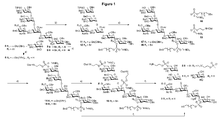


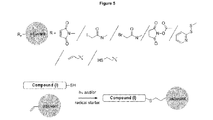


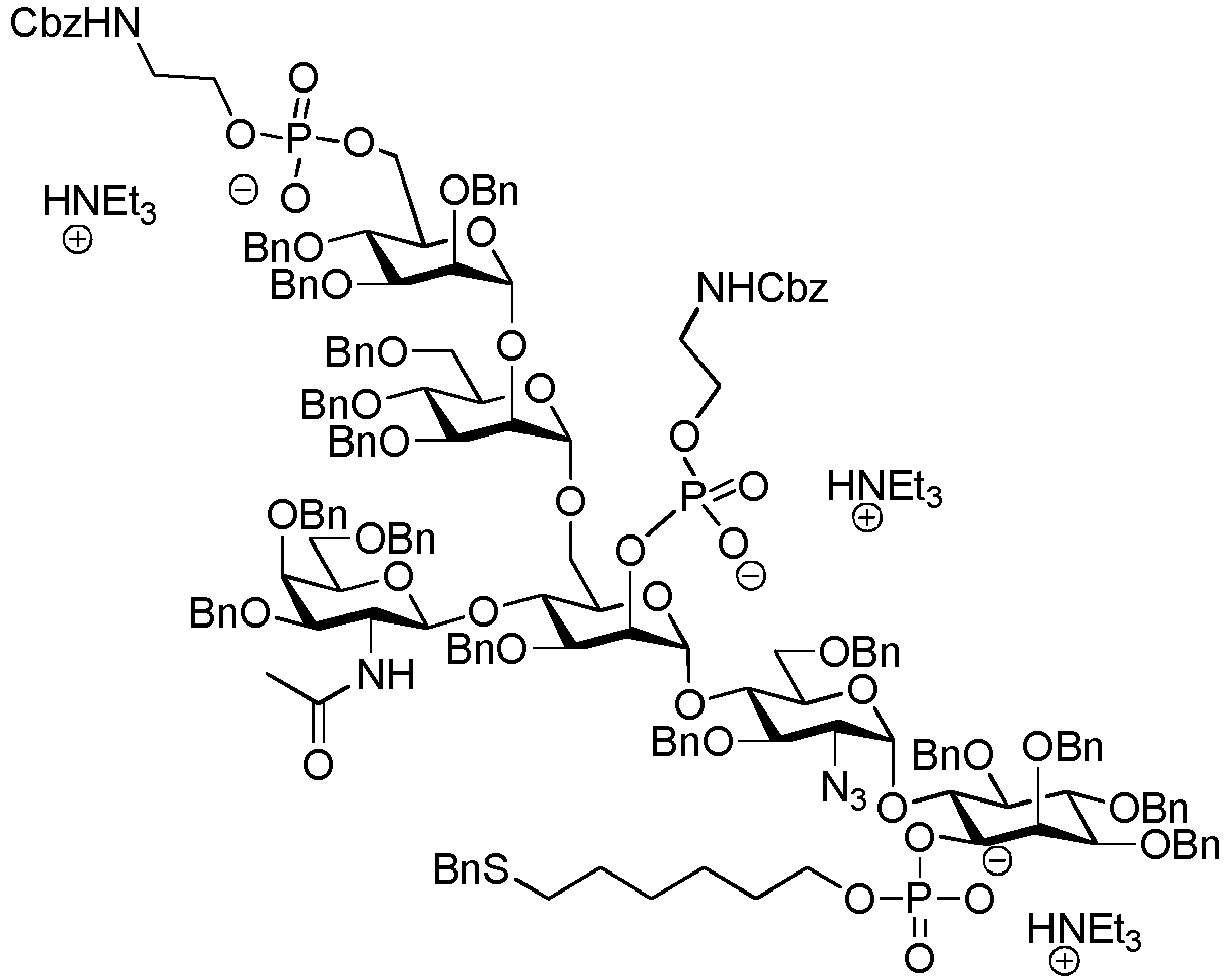


 R represents -H, -CH3, -C2H5, -C3H7, -CH(CH3)2, -C4H9, -CH2-CH(CH3)2, -CH(CH3)-C2H5, -C(CH3)3, -C5H11, -CH(CH3)-C3H7, -CH2-CH(CH3)-C2H5, -CH(CH3)-CH(CH3)2, -C(CH3)2-C2H5, -CH2-C(CH3)3, -CH(C2H5)2, -C2H4-CH(CH3)2, -C6H13, -C3H6-CH(CH3)2, -C2H4-CH(CH3)-C2H5, -CH(CH3)-C4H9, -Ph, -CH2-Ph, or
 R1 and R4 represent independently of each other -OH or -OP(O)(OH)-OX-NH2;X represents -CH2-, -C2H4-, -C3H6-, -C4H8-, -C5H10-, or -C6H12-,R2 represents -SO2(R5), -OSO2(R5), -OSO2(OR5), or -OP(O)(OR5)(OR6);R3 represents -H, -OH, -NH2, -SH, -NHCOCH3, -NHCOCH2CH3, -NHCOCH2CH2CH3, or -N3;R5 and R6 represent independently of each other -H, -L-SH, -(C2H4O)r-CH2-SH or -(C2H4O)r-C2H4-SH;L represents a linker;and r is an integer from 1 to 40.
 R represents -H, -CH3, -C2H5, -C3H7, -CH(CH3)2, -C4H9, -CH2-CH(CH3)2, -CH(CH3)-C2H5, -C(CH3)3, -C5H11, -CH(CH3)-C3H7, -CH2-CH(CH3)-C2H5, -CH(CH3)-CH(CH3)2, -C(CH3)2-C2H5, -CH2-C(CH3)3, -CH(C2H5)2, -C2H4-CH(CH3)2, -C6H13, -C3H6-CH(CH3)2, -C2H4-CH(CH3)-C2H5, -CH(CH3)-C4H9, -Ph, -CH2-Ph, or
 R3 represents -N3, andPG3 to PG5 represent suitable protecting groups for hydroxyl functional groups;b) introducing the substituent R2 by reacting a compound of step a) with an acid selected from H-SO2(OR5') or H-P(O)(OR5')(OR6') or a salt thereof,