EP2690080A1 - Fertilisers enriched with a humic-enzimatic solution rich in phosphatase enzymes and their manufacturing process - Google Patents
Fertilisers enriched with a humic-enzimatic solution rich in phosphatase enzymes and their manufacturing process Download PDFInfo
- Publication number
- EP2690080A1 EP2690080A1 EP12382306.4A EP12382306A EP2690080A1 EP 2690080 A1 EP2690080 A1 EP 2690080A1 EP 12382306 A EP12382306 A EP 12382306A EP 2690080 A1 EP2690080 A1 EP 2690080A1
- Authority
- EP
- European Patent Office
- Prior art keywords
- fertiliser
- fertilisers
- accordance
- humic
- soil
- Prior art date
- Legal status (The legal status is an assumption and is not a legal conclusion. Google has not performed a legal analysis and makes no representation as to the accuracy of the status listed.)
- Granted
Links
Images


Classifications
-
- C—CHEMISTRY; METALLURGY
- C05—FERTILISERS; MANUFACTURE THEREOF
- C05F—ORGANIC FERTILISERS NOT COVERED BY SUBCLASSES C05B, C05C, e.g. FERTILISERS FROM WASTE OR REFUSE
- C05F11/00—Other organic fertilisers
- C05F11/02—Other organic fertilisers from peat, brown coal, and similar vegetable deposits
-
- C—CHEMISTRY; METALLURGY
- C05—FERTILISERS; MANUFACTURE THEREOF
- C05F—ORGANIC FERTILISERS NOT COVERED BY SUBCLASSES C05B, C05C, e.g. FERTILISERS FROM WASTE OR REFUSE
- C05F11/00—Other organic fertilisers
- C05F11/10—Fertilisers containing plant vitamins or hormones
-
- C—CHEMISTRY; METALLURGY
- C05—FERTILISERS; MANUFACTURE THEREOF
- C05G—MIXTURES OF FERTILISERS COVERED INDIVIDUALLY BY DIFFERENT SUBCLASSES OF CLASS C05; MIXTURES OF ONE OR MORE FERTILISERS WITH MATERIALS NOT HAVING A SPECIFIC FERTILISING ACTIVITY, e.g. PESTICIDES, SOIL-CONDITIONERS, WETTING AGENTS; FERTILISERS CHARACTERISED BY THEIR FORM
- C05G5/00—Fertilisers characterised by their form
- C05G5/30—Layered or coated, e.g. dust-preventing coatings
Definitions
- This invention is included within the field of mineral, organic or organo-mineral fertilisers, albeit nitrogenated or phosphated, NP compound fertilisers, PK compound fertilisers or NPK compound fertilisers enriched with humic-enzymatic complexes, rich in immobile phosphates which, in addition to providing nutrients for a plant, transform organic phosphorous in the soil into inorganic phosphorous available for plants. It also describes the manufacturing process of the aforementioned fertilisers.
- inorganic phosphorous which is added as a fertiliser, is rapidly rendered unusable by plants due to insolubilisation and /or immobilisation processes.
- phosphomonoesterases to form inorganic phosphorous which plants can use.
- Phosphatases are adaptive enzymes (phosphomonoesterases of the hydrolase group) the activity of which is increased when plants are deficient in phosphorous. As a result, an increase in phosphatase activity may reflect a high demand for phosphorous by the plant.
- document FR 2396 730 describes an agricultural fertiliser designed for fertilising soils to which a mixture of insoluble phosphates may be optionally added, along with enzymatic products rich in phosphatases and other fertilising products such as oligoelements potassium, magnesium and calcium.
- the purpose of this invention is to provide a fertiliser which, in addition to providing nutrients for the plant, provides humic complexes of phosphatase enzymes which are less likely to denaturalise than those described in the previous art, and therefore they are able to exhibit their beneficial effect in the soil, by increasing availability of inorganic phosphorous to the plants, in a more prolonged manner over time than was possible in the previous state of the art.
- the solution is based on the fact that inventors have identified that by applying a mineral, organic or organo-mineral fertiliser, albeit phosphated or nitrogenated, a humic-enzymatic solution rich in phosphatase enzymes, the resulting fertiliser will be enriched with enzymatic complexes mainly containing phosphatase enzymes in which the phosphatases are substantially immobilised by the humic substances, as a result of which, the phosphatases of said fertiliser have less tendency to degrade, permitting greater transformation of the organic phosphorous from the soil into inorganic phosphorous available to the plant, and in addition this effect is deployed over a longer period.
- new mineral, organic or organomineral fertilisers albeit nitrogenated or phosphated, NP compound fertilisers, PK compound fertilisers, NK compound fertilisers or NPK compound fertilisers, which are enriched with humic-enzymatic complexes rich in phosphatases immobilised by the former.
- a second aspect of the invention refers to a process for manufacture of a mineral, organic or organomineral fertiliser which includes pulverising said complex on the mineral , organic or organomineral fertiliser at a point situated between the mix of raw materials and the final point in the production line such as prior to the cooler or the coating outlet.
- the humic -enzymatic complexes may also be integrated in the fertiliser by means of a granulation process mixing together with the raw materials of the fertilisers.
- the enzymes added to the fertiliser contribute to the mineralization of organic phosphorous in the soil transforming it into phosphorous available to plants.
- These phosphatase enzymes are substantially immobilised in humic substances such that they are immobilised by them as a result of the extraction or immobilisation process.
- the enzyme obtained is immobilised and has increased protection against inhospitable environments, and its tendency to denaturalisation is reduced.
- the efficiency of the product is observed through a series of factors which are described below and which entail additional advantages:
- humic-enzymatic complex rich in phosphatases shall be considered to be an enzymatic complex which contains mainly phosphatase enzymes and humic substances, such as humic acids and/or fulvic acids in which the enzymes are substantially immobilised by complexing with the aforementioned humic and/or fulvic acids.
- humic-enzymatic solution rich in phosphatases is considered to be a solution containing one or more complexes of this type.
- fertilisers in the invention are part of the scope of a new concept of fertilisation resulting from the incorporation of humic-enzymatic complexes in fertilisers.
- Organic phosphorous may be present in the soil in a very variable proportion based on the content of organic material contained therein.
- Organic phosphorous represents a significant reserve of potentially available phosphorous. It is estimated that an important fraction thereof is associated with fulvic and humic acids.
- the proportions will vary between 0.01 and 30 % of organic humic-enzymatic solution rich in phosphatases (hereinafter referred to simply as the solution (or the complex) of phosphatase enzymes provided in the fertilizer, preferably between 0.01 % and 20% although ideally it would be between 0.01% and 5%.
- the proportions in applications of humic-enzymatic solution using covering, the proportions will vary between 0.01 -5% whereas in applications of the solution through integration, the proportions will vary between 0.01 and 30%.
- Basic chemical fertilisers used in the preparation of fertilisers in accordance with the invention are preferably selected from the following types:
- a second object or aspect of this invention is a process for manufacture of fertilisers adding to them an enzymatic solution of phosphatases which are obtained by mixing raw materials appropriate for the base fertiliser (among others: urea, ammonium sulphate, ammonia, ammonium nitrate, rock phosphate, superphosphates, phosphoric acid, diamonnium phosphate, monoammonium phosphate, potassium chloride, potassium sulphate, sulphuric acid, organic materials, magnesite, microelements ) followed by granulation, drying, sieving and covering.
- the organic solution of phosphatase enzymes may be pulverised at some point situated between the mix of raw materials and the completion of the production line.
- the enzymatic solution of phosphatases could be pulverised prior to cooling.
- the main purpose of this section is to illustrate some examples of agronomic evaluation tests of fertilisers developed in accordance with the invention.
- Example 1 Study of the hydrolytic capacity of the fertilisers used in the soil
- the purpose of the test was to assess the transformation of organic phosphorous in the soil by applying a fertiliser with an enzymatic solution of phosphatases in accordance with the invention.
- NK fertiliser 8-0-6 granulated
- SEF 8-0-6 granulated enriched by 0.5% with the solution of phosphatase enzymes in accordance with the invention.
- Figure 1 shows the concentrations of available phosphorous detected in the soils at 25 and 45 days from incorporation in the soil of the different treatments.
- the SEF treatment showed at 25 days from the start of the test, concentrations of inorganic phosphorous (phosphorous available for the plant) greater than those of the control soil and the concentrations of NK fertiliser demonstrating the efficacy of the enzyme solution incorporated by hydrolisation of the organic phosphorous in the soil.
- the SEF treatment showed a phosphorous content greater than those of the control soil or the soil with NK fertiliser.
- Figure 2 shows the increase or reduction of inorganic phosphorous in the soil (in percentage) for each treatment with respect to NK.
- concentration of phosphorous available in the soil was reduced with respect to NK both at 25 and at 45 days, however in the case of the SEF treatment, this concentration increased by 24% to 25 days with respect to the levels of phosphorous available considered in the NK treatment (represented in the abscissa axis).
- the increase considered in the SEF treatment compared to the fertiliser is 10%.
- Example 2 Monitoring over time of available phosphorous and phosphomonoesterase in soil modified with fertiliser
- Example 3 Test in a climatic chamber of application of barley growth in soil treated with different fertilisers.
- the treatments applied were as follows: a control treatment (unfertilised soil) a fertilising treatment (NK) and an SEF treatment with a solution of phosphatase enzymes (the same units of N and K: 8 and 6 respectively, as the fertiliser treatment with solution of phosphatase enzymes in accordance with the invention).
- the products were well mixed with the soil and subsequently every pot was wetted and 20 barley seeds were sown, covering seeds with soil from the corresponding treatment.
- the pots were arranged in a growth chamber in controlled conditions of humidity and ambient temperature, establishing day and night periods.
- the soils were watered regularly with distilled water.
- the plant material was weighed when fresh and dry at 65°C.
- the soil samples were sieved, removing any remains of roots, and the inorganic phosphorous content was determined in order to establish the effects of the different treatments on the hydrolysis of organic phosphorous of the soil.
- the duration of the barley test was 2 months.
- Figure 5 shows the available phosphorous (ppm) in the soil for each treatment. This figure demonstrates how the SEF treatment transforms a greater quantity of organic phosphorous in the soil in a significant manner.
- Figure 6 shows the increase or reduction of available phosphorous in the soil (in percentage) for each treatment with respect to NK fertiliser. As may be seen from these figures, the SEF treatment obtained over 9% increase in available phosphorous in the soil with respect to fertiliser treatment (represented in the abscissa axis).
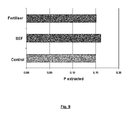
- Figure 7 shows the phosphorous extracted per plant for each treatment. As may be seen from this figure, the SEF treatment achieves greater extraction of phosphorous by the plant.
- Example 4 Test in climatic chamber of the application of SEF in corn crop
- the treatments applied were as follows: a control treatment (unfertilised soil) a fertilising treatment (NK) and an SEF treatment with a solution of phosphatase enzymes (the same NK with phosphatase enzymes).
- a control treatment unfertilised soil
- a fertilising treatment NK
- an SEF treatment with a solution of phosphatase enzymes the same NK with phosphatase enzymes.
- the dose is usually 1000 kg ha -1 of 8-15-15 therefore, a measurement of 8-0-15 was prepared.
- the performance of the aerial part of the plant was determined in fresh and dry weight at 65° along with the extractable phosphorous from the soil.
- Figure 8 shows the increase or reduction of inorganic phosphorous in the soil (in percentage) for each treatment with respect to (NK) fertiliser.
- the SEF treatment obtained an increase in available phosphorous in the soil of up to 40% with respect to fertiliser treatment (represented in the axis).
- Figure 9 shows the total phosphorous extracted (mg) per plant for each treatment. As may be seen from this figure, the SEF treatment ensures that the plant extracts a greater quantity of phosphorous.
Landscapes
- Chemical & Material Sciences (AREA)
- Organic Chemistry (AREA)
- Life Sciences & Earth Sciences (AREA)
- Pest Control & Pesticides (AREA)
- Botany (AREA)
- Fertilizers (AREA)
- Immobilizing And Processing Of Enzymes And Microorganisms (AREA)
- Compounds Of Unknown Constitution (AREA)
- Enzymes And Modification Thereof (AREA)
Abstract
Description
- This invention is included within the field of mineral, organic or organo-mineral fertilisers, albeit nitrogenated or phosphated, NP compound fertilisers, PK compound fertilisers or NPK compound fertilisers enriched with humic-enzymatic complexes, rich in immobile phosphates which, in addition to providing nutrients for a plant, transform organic phosphorous in the soil into inorganic phosphorous available for plants. It also describes the manufacturing process of the aforementioned fertilisers.
- In the majority of soils, inorganic phosphorous, which is added as a fertiliser, is rapidly rendered unusable by plants due to insolubilisation and /or immobilisation processes. However, in these soils a considerable part of the total phosphorous is organic and may be hydrolysed by the action of phosphomonoesterases to form inorganic phosphorous which plants can use.
- Phosphatases are adaptive enzymes (phosphomonoesterases of the hydrolase group) the activity of which is increased when plants are deficient in phosphorous. As a result, an increase in phosphatase activity may reflect a high demand for phosphorous by the plant.
- In the prior art, some attempts are referred to which were aimed at obtaining an increase in the availability of inorganic phosphorus or other essential nutrients for plants. Thus for example, the document
US 2011/0209510 A1 describes fertilisers which induce increased enzymatic activities in the soil, including phosphatase. However, the fertiliser does not contain added phosphatase but what it does is cause an increase in enzymes which are already present in the soil by adding a group of salts and organic and inorganic elements to the soil. - The document
US 2009/0162923 A1 also discloses the addition of enzymes (including among a number of others, phosphatase) to a compost which, through a digestion process, obtains mineral nutrients from the compost which are useful for the plant. - Furthermore, the document
US2003/0145639 A1 describes a manufacturing process of a fertiliser based on compost, a process by which a magnesium rich compound is added to compost along with specific enzymes, such as phosphatase and urease in order to increase production of ammonium-magnesium phosphate. - Finally, document
FR 2396 730 - However, even the closest documents in the prior art do not address the problem that since phosphatases are added freely to the fertiliser, they are exposed to a more or less rapid degradation or denaturalisation, so that in effect, the addition of the phosphatase to soil is limited over time.
- Therefore, the purpose of this invention is to provide a fertiliser which, in addition to providing nutrients for the plant, provides humic complexes of phosphatase enzymes which are less likely to denaturalise than those described in the previous art, and therefore they are able to exhibit their beneficial effect in the soil, by increasing availability of inorganic phosphorous to the plants, in a more prolonged manner over time than was possible in the previous state of the art.
- The solution is based on the fact that inventors have identified that by applying a mineral, organic or organo-mineral fertiliser, albeit phosphated or nitrogenated, a humic-enzymatic solution rich in phosphatase enzymes, the resulting fertiliser will be enriched with enzymatic complexes mainly containing phosphatase enzymes in which the phosphatases are substantially immobilised by the humic substances, as a result of which, the phosphatases of said fertiliser have less tendency to degrade, permitting greater transformation of the organic phosphorous from the soil into inorganic phosphorous available to the plant, and in addition this effect is deployed over a longer period.
- As a result, in a first aspect of the invention, reference is made to new mineral, organic or organomineral fertilisers, albeit nitrogenated or phosphated, NP compound fertilisers, PK compound fertilisers, NK compound fertilisers or NPK compound fertilisers, which are enriched with humic-enzymatic complexes rich in phosphatases immobilised by the former.
- A second aspect of the invention refers to a process for manufacture of a mineral, organic or organomineral fertiliser which includes pulverising said complex on the mineral , organic or organomineral fertiliser at a point situated between the mix of raw materials and the final point in the production line such as prior to the cooler or the coating outlet. As an alternative to covering it, the humic -enzymatic complexes may also be integrated in the fertiliser by means of a granulation process mixing together with the raw materials of the fertilisers.
- The enzymes added to the fertiliser contribute to the mineralization of organic phosphorous in the soil transforming it into phosphorous available to plants. These phosphatase enzymes are substantially immobilised in humic substances such that they are immobilised by them as a result of the extraction or immobilisation process. Thus, the enzyme obtained is immobilised and has increased protection against inhospitable environments, and its tendency to denaturalisation is reduced. The efficiency of the product is observed through a series of factors which are described below and which entail additional advantages:
- the functional capacity in the soil of the enzyme applied with the fertiliser has been observed, in a process by which phosphorous is hydrolysed from organic to inorganic phosphorous available to plants;
- Due to its enzymatic nature it may stimulate microbial activity of the soil.
- From an environmental point of view its application to the soil is totally innocuous as the product is biodegradable.
- Throughout this descriptive report, "humic-enzymatic complex rich in phosphatases" shall be considered to be an enzymatic complex which contains mainly phosphatase enzymes and humic substances, such as humic acids and/or fulvic acids in which the enzymes are substantially immobilised by complexing with the aforementioned humic and/or fulvic acids. Similarly, "humic-enzymatic solution rich in phosphatases" is considered to be a solution containing one or more complexes of this type.
-
-
Figure 1 : Example 1: Concentration of phosphorous available (ppm) in the soil at 25 and 45 days from the addition of different treatments to the soil. -
Figure 2 : Example 1: Variation of the percentage of phosphorous available with respect to phosphorous available in the fertiliser (NK) -
Figure 3 : Example 2: Development of the content of available phosphorous (ppm) over time (days) in a soil treated with SEF fertiliser at a commercial dose. -
Figure 4 : Example 2: Development over time of the phosphatase alkaline activity (pg pNP g-1h-1) in a soil treated with fertiliser at a commercial dose. -
Figure 5 : Example 3: Available phosphorous (ppm) (extractable through the Olsen method) in soil after 2 months of barley growth -
Figure 6 : Example 3: Variation of inorganic phosphorous in the soil (in percentage) with respect to fertiliser. -
Figure 7 : Example 3: Phosphorous extracted (mg) per plant -
Figure 8 : Example 4: Variation of inorganic phosphorous in the soil (in percentage) with respect to fertiliser (NK). -
Figure 9 : Example 4: Phosphorous extracted per plant (mg) for each treatment - The fertilisers in the invention are part of the scope of a new concept of fertilisation resulting from the incorporation of humic-enzymatic complexes in fertilisers.
- Organic phosphorous may be present in the soil in a very variable proportion based on the content of organic material contained therein. Organic phosphorous represents a significant reserve of potentially available phosphorous. It is estimated that an important fraction thereof is associated with fulvic and humic acids.
- During the tests carried out, the inventors in this research project have ascertained the most effective proportion of the solution of humic substances and mainly phosphatase enzymes required with respect to the fertiliser. Based on the type of application (transformable organic phosphorous, levels of organic material, application in integrated form or as covering) and humidity conditions of the final product, the proportions will vary between 0.01 and 30 % of organic humic-enzymatic solution rich in phosphatases (hereinafter referred to simply as the solution (or the complex) of phosphatase enzymes provided in the fertilizer, preferably between 0.01 % and 20% although ideally it would be between 0.01% and 5%. In particularly preferred embodiments of the invention, in applications of humic-enzymatic solution using covering, the proportions will vary between 0.01 -5% whereas in applications of the solution through integration, the proportions will vary between 0.01 and 30%.
- Basic chemical fertilisers used in the preparation of fertilisers in accordance with the invention are preferably selected from the following types:
- 1. Nitrogenated chemical fertilisers with a theoretical content of N between 10 and 46%
- 2. NP compound chemical fertilisers with a theoretical content of N between 3 and 30% and P2O5 between 5 and 48 %;
- 3. NPK compound chemical fertilisers with a theoretical content of N between 3 and 30% and P2O5 between 5 and 50 % and a theoretical content of K2O between 5 and 50 %;
- 4. Phosphated chemical fertilisers with a theoretical content of P2O5 between 5 and 48 %
- 5. NP compound chemical fertilisers with a theoretical content of N between 5 and 48% and P2O5 between 5 and 50 %;
- 6. NK compound chemical fertilisers with a theoretical content of N between 3 and 30% and K2O between 5 and 50 %;
- A second object or aspect of this invention is a process for manufacture of fertilisers adding to them an enzymatic solution of phosphatases which are obtained by mixing raw materials appropriate for the base fertiliser (among others: urea, ammonium sulphate, ammonia, ammonium nitrate, rock phosphate, superphosphates, phosphoric acid, diamonnium phosphate, monoammonium phosphate, potassium chloride, potassium sulphate, sulphuric acid, organic materials, magnesite, microelements ) followed by granulation, drying, sieving and covering. In this process, the organic solution of phosphatase enzymes may be pulverised at some point situated between the mix of raw materials and the completion of the production line. For example, the enzymatic solution of phosphatases could be pulverised prior to cooling.
- The main purpose of this section is to illustrate some examples of agronomic evaluation tests of fertilisers developed in accordance with the invention.
- The purpose of the test was to assess the transformation of organic phosphorous in the soil by applying a fertiliser with an enzymatic solution of phosphatases in accordance with the invention.
- 17 mg of the granulated fertiliser treatments were added to Petri dishes which contained 50 g of soil. They were mixed well with the soil and wetted with distilled water. The dishes were covered, wrapped in aluminium foil and left in the laboratory at ambient temperature. After 25 days, the soils were well homogenised and 10 g were taken in order to extract the available P (Olsen method) determining the concentration of P in the extract by means of ICP. The extraction was made in a solid/liquid proportion of 1/10. The remainder of the soil was left on the dish again and the P was extracted after 45 days.
- The treatments in triplicate were: control (without fertilisation), NK fertiliser (8-0-6 granulated) and SEF (8-0-6 granulated enriched by 0.5% with the solution of phosphatase enzymes in accordance with the invention).
-
Figure 1 shows the concentrations of available phosphorous detected in the soils at 25 and 45 days from incorporation in the soil of the different treatments. The SEF treatment showed at 25 days from the start of the test, concentrations of inorganic phosphorous (phosphorous available for the plant) greater than those of the control soil and the concentrations of NK fertiliser demonstrating the efficacy of the enzyme solution incorporated by hydrolisation of the organic phosphorous in the soil. - In addition, in soils analysed at 45 days of incorporation of the fertilisers, the SEF treatment showed a phosphorous content greater than those of the control soil or the soil with NK fertiliser.
-
Figure 2 shows the increase or reduction of inorganic phosphorous in the soil (in percentage) for each treatment with respect to NK. As may be seen in this figure, while in the control treatment the concentration of phosphorous available in the soil was reduced with respect to NK both at 25 and at 45 days, however in the case of the SEF treatment, this concentration increased by 24% to 25 days with respect to the levels of phosphorous available considered in the NK treatment (represented in the abscissa axis). At 45 days the increase considered in the SEF treatment compared to the fertiliser is 10%. - The purpose of this test was to establish the variation over time of the characteristics of the SEF fertiliser which contained a solution of phosphatase enzymes in accordance with the invention (with respect to its phosphatase activity and the amount of available phosphorous released into the soil. This study was carried out with SEF fertiliser and a control treatment (soil without fertiliser). The SEF was added to a soil at the recommended commercial dose for corn crop without phosphorous (1000 kg of 8-0-15 /ha)-
- At 3, 10, 20, 45 and 60 days both the concentration of available phosphorous (Olsen phosphorous) and the phosphatase activity in the soil were determined, thus establishing the activity/time curves and the corresponding available phosphorous/time. The treatments were arranged in triplicate and were as follows: control treatment without fertilisation and SEF (NK 8-0-15) enriched with phosphatase enzymes at 0.5% in accordance with the invention.
- Development over time of the content of available phosphorous in the soils treated and the control are shown in
Figure 3 whereas the development of the phosphomonoestarase activity in these soils is shown inFigure 4 . - As may be seen in
Figure 3 , the incorporation in the soil of the SEF fertiliser increases as much the amount of available phosphorous in the soil. With respect to the phosphomonoesterase activity, the treated soil shows slightly higher values than the control at 3 days of incorporation of the granulates (Figure 4 ) - This data shows that the SEF fertiliser increases the concentration of available phosphorous in the soil by its enzymatic activity.
- To pots containing 900 grams of soil five times as much quantity of different fertilising formulations were added at a dose of 700 kg ha-1 (210 mg 900 g-1 of soil) for barley crop.
- The treatments applied were as follows: a control treatment (unfertilised soil) a fertilising treatment (NK) and an SEF treatment with a solution of phosphatase enzymes (the same units of N and K: 8 and 6 respectively, as the fertiliser treatment with solution of phosphatase enzymes in accordance with the invention).
- The products were well mixed with the soil and subsequently every pot was wetted and 20 barley seeds were sown, covering seeds with soil from the corresponding treatment. The pots were arranged in a growth chamber in controlled conditions of humidity and ambient temperature, establishing day and night periods. The soils were watered regularly with distilled water. At the end of the test, the plant material was weighed when fresh and dry at 65°C. The soil samples were sieved, removing any remains of roots, and the inorganic phosphorous content was determined in order to establish the effects of the different treatments on the hydrolysis of organic phosphorous of the soil. The duration of the barley test was 2 months.
-
Figure 5 shows the available phosphorous (ppm) in the soil for each treatment. This figure demonstrates how the SEF treatment transforms a greater quantity of organic phosphorous in the soil in a significant manner.Figure 6 shows the increase or reduction of available phosphorous in the soil (in percentage) for each treatment with respect to NK fertiliser. As may be seen from these figures, the SEF treatment obtained over 9% increase in available phosphorous in the soil with respect to fertiliser treatment (represented in the abscissa axis). - Furthermore,
Figure 7 shows the phosphorous extracted per plant for each treatment. As may be seen from this figure, the SEF treatment achieves greater extraction of phosphorous by the plant. - To pots filled with 2 kg of soil five times the different treatments were applied and 20 corn seeds were sown and cultivated for 1 month. The pots were arranged in a growth chamber in controlled conditions of humidity and ambient temperature, establishing day and night periods. The soils were regularly watered with distilled water.
- The treatments applied were as follows: a control treatment (unfertilised soil) a fertilising treatment (NK) and an SEF treatment with a solution of phosphatase enzymes (the same NK with phosphatase enzymes). For corn the dose is usually 1000 kg ha -1 of 8-15-15 therefore, a measurement of 8-0-15 was prepared.
- The performance of the aerial part of the plant was determined in fresh and dry weight at 65° along with the extractable phosphorous from the soil.
- In determining the phosphorous in the soil (Table 1) it was found that the SEF treatment obtains a greater concentration of available phosphorous in the soil. The increase in phosphorous is due to the phosphatase activity provided in the SEF treatment.
Table 1. Available phosphorous in soil by the end of the test Treatments Available phosphorous Control 3.17 Fertiliser 4.36 SEF 6.04 -
Figure 8 shows the increase or reduction of inorganic phosphorous in the soil (in percentage) for each treatment with respect to (NK) fertiliser. As may be seen from these figures, the SEF treatment obtained an increase in available phosphorous in the soil of up to 40% with respect to fertiliser treatment (represented in the axis). - Furthermore,
Figure 9 shows the total phosphorous extracted (mg) per plant for each treatment. As may be seen from this figure, the SEF treatment ensures that the plant extracts a greater quantity of phosphorous. - From the results obtained the following conclusions were established:
- The fertiliser in accordance with the invention (SEF) produces a transformation of organic phosphorous in the soil, therefore increasing the available inorganic phosphorous for the plant.
- The plants fertilised with developed fertiliser (SEF) extracted more phosphorous from the soil in the majority of cases than the sample treatment.
Claims (13)
- A fertiliser or agricultural fertilising product characterised in that it comprises a mineral, organic or organomineral fertiliser which has integrated in it or is covered by at least one humic-enzymatic complex wherein the enzymes are mainly phosphatases which are substantially immobilised to the humic substances of the complex.
- A fertiliser in accordance with claim 1, wherein the fertiliser is selected from the group consisting of nitrogenated fertilisers, phosphated fertilisers, NP compound fertilisers, PK compound fertilisers, NK compound fertilisers or NPK compound fertilisers.
- A fertiliser in accordance with claims 1 or 2, wherein the fertiliser is a chemical nitrogenated fertiliser with a theoretical content of N between 10 and 46%.
- A fertiliser in accordance with claims 1 or 2, wherein the fertiliser is an NP chemical compound fertiliser with a theoretical content of N between 3 and 30 % and P2O5 between 5 and 48 %.
- A fertiliser in accordance with claims 1 or 2, wherein the fertiliser is an NPK chemical compound fertiliser with a theoretical content of N between 3 and 30 % and P2O5 between 5 and 50 % and a theoretical content of K2O between 5 and 50%.
- A fertiliser in accordance with claims 1 or 2 wherein the fertiliser is a phosphated chemical fertiliser with a P2O5 content between 5 and 48 %.
- A fertiliser in accordance with claims 1 or 2 wherein the fertiliser is a PK chemical compound fertiliser with a theoretical content of P2O5 between 5 and 48 % and K2O between 5 and 50%.
- A fertiliser in accordance with claims 1 or 2 wherein the fertiliser is an NK chemical compound fertiliser with a theoretical content of N between 3 and 30 % and K2O between 5 and 50%.
- A fertiliser in accordance with any of the previous claims wherein, when the humic-enzymatic complexes are covering the fertiliser, the proportion of said complexes in the fertiliser ranges between 0.01 and 5% of its weight.
- A fertiliser in accordance with any of previous claims 1 to 8 wherein, when the humic-enzymatic complexes are integrated in the fertiliser, the proportion of said complexes in the fertiliser ranges between 0.01 and 30% of its weight.
- Manufacturing process of a fertiliser in accordance with any of the previous claims 1 to 10 characterised in that a solution of humic-enzymatic complex of phosphates is pulverised over the mineral, organic or organomineral fertiliser at a point between the mixing of raw materials and the end of the manufacturing line.
- Manufacturing process in accordance with claim 11, wherein the solution of humic-enzymatic complexes of phosphatases is pulverised either prior to the cooler or at the outlet of the same in the covering section.
- Manufacturing process of a fertiliser in accordance with any one of claims 1 to 10 above wherein the humic-enzymatic complexes are integrated in the fertiliser by incorporating them in the granulation process together with the raw materials of the fertilisers.
Priority Applications (11)
| Application Number | Priority Date | Filing Date | Title |
|---|---|---|---|
| PT123823064T PT2690080T (en) | 2012-07-27 | 2012-07-27 | Fertilisers enriched with a humic-enzimatic solution rich in phosphatase enzymes and their manufacturing process |
| PL12382306T PL2690080T3 (en) | 2012-07-27 | 2012-07-27 | Fertilisers enriched with a humic-enzimatic solution rich in phosphatase enzymes and their manufacturing process |
| EP12382306.4A EP2690080B1 (en) | 2012-07-27 | 2012-07-27 | Fertilisers enriched with a humic-enzimatic solution rich in phosphatase enzymes and their manufacturing process |
| LTEP12382306.4T LT2690080T (en) | 2012-07-27 | 2012-07-27 | Fertilisers enriched with a humic-enzimatic solution rich in phosphatase enzymes and their manufacturing process |
| SI201231770T SI2690080T1 (en) | 2012-07-27 | 2012-07-27 | Fertilisers enriched with a humic-enzimatic solution rich in phosphatase enzymes and their manufacturing process |
| RS20200433A RS60276B1 (en) | 2012-07-27 | 2012-07-27 | Fertilisers enriched with a humic-enzimatic solution rich in phosphatase enzymes and their manufacturing process |
| HUE12382306A HUE049084T2 (en) | 2012-07-27 | 2012-07-27 | Fertilisers enriched with a humic-enzimatic solution rich in phosphatase enzymes and their manufacturing process |
| DK12382306.4T DK2690080T3 (en) | 2012-07-27 | 2012-07-27 | Fertilizers enriched with a humus-enzymatic solution rich in phosphatase enzymes and processes for their preparation |
| ES12382306T ES2786034T3 (en) | 2012-07-27 | 2012-07-27 | Fertilizers enriched with a humic-enzymatic solution rich in phosphatase enzymes and its manufacturing process |
| CY20201100349T CY1122969T1 (en) | 2012-07-27 | 2020-04-14 | FERTILIZERS ENRICHED WITH A HUMIC-ENZYMATIC SOLUTION RICH IN PHOSPHATASE ENZYMES AND THEIR MANUFACTURING PROCESS |
| HRP20200677TT HRP20200677T1 (en) | 2012-07-27 | 2020-04-28 | Fertilisers enriched with a humic-enzimatic solution rich in phosphatase enzymes and their manufacturing process |
Applications Claiming Priority (1)
| Application Number | Priority Date | Filing Date | Title |
|---|---|---|---|
| EP12382306.4A EP2690080B1 (en) | 2012-07-27 | 2012-07-27 | Fertilisers enriched with a humic-enzimatic solution rich in phosphatase enzymes and their manufacturing process |
Publications (2)
| Publication Number | Publication Date |
|---|---|
| EP2690080A1 true EP2690080A1 (en) | 2014-01-29 |
| EP2690080B1 EP2690080B1 (en) | 2020-02-26 |
Family
ID=46826401
Family Applications (1)
| Application Number | Title | Priority Date | Filing Date |
|---|---|---|---|
| EP12382306.4A Active EP2690080B1 (en) | 2012-07-27 | 2012-07-27 | Fertilisers enriched with a humic-enzimatic solution rich in phosphatase enzymes and their manufacturing process |
Country Status (11)
| Country | Link |
|---|---|
| EP (1) | EP2690080B1 (en) |
| CY (1) | CY1122969T1 (en) |
| DK (1) | DK2690080T3 (en) |
| ES (1) | ES2786034T3 (en) |
| HR (1) | HRP20200677T1 (en) |
| HU (1) | HUE049084T2 (en) |
| LT (1) | LT2690080T (en) |
| PL (1) | PL2690080T3 (en) |
| PT (1) | PT2690080T (en) |
| RS (1) | RS60276B1 (en) |
| SI (1) | SI2690080T1 (en) |
Cited By (1)
| Publication number | Priority date | Publication date | Assignee | Title |
|---|---|---|---|---|
| US12630484B2 (en) | 2016-03-16 | 2026-05-19 | Spogen Biotech Inc. | Methods for promoting plant health using free enzymes and microorganisms that overexpress enzymes |
Citations (8)
| Publication number | Priority date | Publication date | Assignee | Title |
|---|---|---|---|---|
| FR2234245A1 (en) * | 1973-06-25 | 1975-01-17 | Rodrigues Correia Zulmdra | Humic acid fertilisers - prepd. by oxidn. of organic material and treatment with alkali and phosphate |
| FR2383146A1 (en) * | 1977-03-09 | 1978-10-06 | Rodrigues Correia Zulmira | Fertilisers rich in soluble humic acid - prepd. by treating lignite with alkali and a bio-catalyst contg. excrement |
| FR2396730A1 (en) | 1977-07-07 | 1979-02-02 | Samm A Sarl | Slow release phosphorus fertiliser - comprises insoluble bi:calcium phosphate and phosphatase enzyme source |
| CN1276361A (en) * | 1999-06-08 | 2000-12-13 | 深圳市众合达农业高新技术开发有限公司 | Long-acting compound organic fertilizer and its preparing process |
| US20030145639A1 (en) | 2001-04-12 | 2003-08-07 | Secretary Of Army | Efficient fertilizer and enzyme-assisted method of production |
| US20090162923A1 (en) | 2007-12-20 | 2009-06-25 | Young Jeffrey W | Methods and Compositions for Digestion of Organic Waste |
| CN101905981A (en) * | 2009-06-03 | 2010-12-08 | 马文灿 | Method for preparing fertilizer raw material by carrying out spray drying treatment on aminoacetic acid waste liquid |
| US20110209510A1 (en) | 2008-07-28 | 2011-09-01 | P. R. P. Holding | Use of a solid mineral composition for increasing the fertility of a crop soil or that of a prairie soil |
-
2012
- 2012-07-27 PT PT123823064T patent/PT2690080T/en unknown
- 2012-07-27 HU HUE12382306A patent/HUE049084T2/en unknown
- 2012-07-27 DK DK12382306.4T patent/DK2690080T3/en active
- 2012-07-27 PL PL12382306T patent/PL2690080T3/en unknown
- 2012-07-27 ES ES12382306T patent/ES2786034T3/en active Active
- 2012-07-27 RS RS20200433A patent/RS60276B1/en unknown
- 2012-07-27 LT LTEP12382306.4T patent/LT2690080T/en unknown
- 2012-07-27 SI SI201231770T patent/SI2690080T1/en unknown
- 2012-07-27 EP EP12382306.4A patent/EP2690080B1/en active Active
-
2020
- 2020-04-14 CY CY20201100349T patent/CY1122969T1/en unknown
- 2020-04-28 HR HRP20200677TT patent/HRP20200677T1/en unknown
Patent Citations (8)
| Publication number | Priority date | Publication date | Assignee | Title |
|---|---|---|---|---|
| FR2234245A1 (en) * | 1973-06-25 | 1975-01-17 | Rodrigues Correia Zulmdra | Humic acid fertilisers - prepd. by oxidn. of organic material and treatment with alkali and phosphate |
| FR2383146A1 (en) * | 1977-03-09 | 1978-10-06 | Rodrigues Correia Zulmira | Fertilisers rich in soluble humic acid - prepd. by treating lignite with alkali and a bio-catalyst contg. excrement |
| FR2396730A1 (en) | 1977-07-07 | 1979-02-02 | Samm A Sarl | Slow release phosphorus fertiliser - comprises insoluble bi:calcium phosphate and phosphatase enzyme source |
| CN1276361A (en) * | 1999-06-08 | 2000-12-13 | 深圳市众合达农业高新技术开发有限公司 | Long-acting compound organic fertilizer and its preparing process |
| US20030145639A1 (en) | 2001-04-12 | 2003-08-07 | Secretary Of Army | Efficient fertilizer and enzyme-assisted method of production |
| US20090162923A1 (en) | 2007-12-20 | 2009-06-25 | Young Jeffrey W | Methods and Compositions for Digestion of Organic Waste |
| US20110209510A1 (en) | 2008-07-28 | 2011-09-01 | P. R. P. Holding | Use of a solid mineral composition for increasing the fertility of a crop soil or that of a prairie soil |
| CN101905981A (en) * | 2009-06-03 | 2010-12-08 | 马文灿 | Method for preparing fertilizer raw material by carrying out spray drying treatment on aminoacetic acid waste liquid |
Non-Patent Citations (2)
| Title |
|---|
| DATABASE WPI Week 200122, Derwent World Patents Index; AN 2001-211975, XP002686795 * |
| DATABASE WPI Week 201124, Derwent World Patents Index; AN 2011-A43619, XP002686794 * |
Cited By (1)
| Publication number | Priority date | Publication date | Assignee | Title |
|---|---|---|---|---|
| US12630484B2 (en) | 2016-03-16 | 2026-05-19 | Spogen Biotech Inc. | Methods for promoting plant health using free enzymes and microorganisms that overexpress enzymes |
Also Published As
| Publication number | Publication date |
|---|---|
| RS60276B1 (en) | 2020-06-30 |
| PL2690080T3 (en) | 2020-08-10 |
| HUE049084T2 (en) | 2020-08-28 |
| ES2786034T3 (en) | 2020-10-08 |
| PT2690080T (en) | 2020-05-06 |
| EP2690080B1 (en) | 2020-02-26 |
| HRP20200677T1 (en) | 2020-09-18 |
| DK2690080T3 (en) | 2020-04-20 |
| SI2690080T1 (en) | 2020-10-30 |
| LT2690080T (en) | 2020-05-25 |
| CY1122969T1 (en) | 2021-10-29 |
Similar Documents
| Publication | Publication Date | Title |
|---|---|---|
| Maqsood et al. | Nitrogen management in calcareous soils: problems and solutions. | |
| Rezig et al. | Effect of incorporation of some wastes on a wheat-guar rotation system on soil physical and chemical properties | |
| CN107759328A (en) | Poor rainfed land special peanut film-coating Controlled Release Fertilizer and preparation method thereof | |
| Ahmed et al. | Urease inhibitor N-(n-butyl) thiophosphoric triamide (NBPT) application as a mitigating strategy of ammonia volatilization from different loess soils of China | |
| CN106588281A (en) | Composite ecological fertilizer and production method thereof | |
| CN104003809B (en) | Synergia compound fertilizer material | |
| EP2690080B1 (en) | Fertilisers enriched with a humic-enzimatic solution rich in phosphatase enzymes and their manufacturing process | |
| CN101774865A (en) | Sustained/controlled release urea | |
| Liu et al. | Research, production and use of stabilized fertilizers in China: pathways for green transition and sustainable development strategies | |
| KR102206193B1 (en) | Fertilizer composition comprising bone meal coated with humic acid as effective component and uses thereof | |
| CN103274799A (en) | Organic and inorganic compound fertilizer and preparation method thereof | |
| Shakeel et al. | Vegetable plant canopy inhibits soil urease activity and reduces NH3 losses under p-phenylenediamine (PPD)-coated urea application | |
| Shivhare et al. | Thirteen year long term fertilization effect on soil phosphorus fractions of an acid Inceptisol and their contribution to phosphorus uptake by a double crop of Rice under sub-tropical climate | |
| Asghar et al. | Current trends in the use of controlled-release fertilizers for sustainable agriculture. | |
| Stroia et al. | Phosphorus dynamics on acidic grassland soil. | |
| Tolescu et al. | Microencapsulated fertilizers for improvement of plant nutrition. | |
| CN106748543A (en) | A kind of mixture for having soil improvement action and organic fertilizer function concurrently | |
| Nzwinda | Effects of urea and urea treated with nitrogen stabilizers on the growth, yield, and quality of field crops cultivated on Podzols in the boreal climate | |
| Mahmood et al. | Fate of 15N-labelled urea under cotton and maize as affected by urease and nitrification inhibitors, and application method | |
| Aziz et al. | Slow Release Nitrogen Fertilizer for Better Crop Yield: A Tool of Food Security | |
| Hassan et al. | Effect of some soil amendments and irrigation treatments on wheat crop productivity in middle Egypt | |
| McClallen | Wheat, rice and corn response to the urease inhibitor N-(n-butyl thiophosphoric triamide) in a dimethyl sulfoxide/propylene glycol solution | |
| CN111117633A (en) | Soil conditioner | |
| Mekha | Biological indicators of soil health as influenced by plant nutrient sources | |
| CHILEKEZI et al. | ORGANIC MANURES INCUBATION: ENHANCING NUTRIENT AVAILABILITY FOR OPTIMUM CROP PRODUCTION |
Legal Events
| Date | Code | Title | Description |
|---|---|---|---|
| PUAI | Public reference made under article 153(3) epc to a published international application that has entered the european phase |
Free format text: ORIGINAL CODE: 0009012 |
|
| AK | Designated contracting states |
Kind code of ref document: A1 Designated state(s): AL AT BE BG CH CY CZ DE DK EE ES FI FR GB GR HR HU IE IS IT LI LT LU LV MC MK MT NL NO PL PT RO RS SE SI SK SM TR |
|
| AX | Request for extension of the european patent |
Extension state: BA ME |
|
| 17P | Request for examination filed |
Effective date: 20140710 |
|
| RBV | Designated contracting states (corrected) |
Designated state(s): AL AT BE BG CH CY CZ DE DK EE ES FI FR GB GR HR HU IE IS IT LI LT LU LV MC MK MT NL NO PL PT RO RS SE SI SK SM TR |
|
| STAA | Information on the status of an ep patent application or granted ep patent |
Free format text: STATUS: EXAMINATION IS IN PROGRESS |
|
| 17Q | First examination report despatched |
Effective date: 20180115 |
|
| GRAP | Despatch of communication of intention to grant a patent |
Free format text: ORIGINAL CODE: EPIDOSNIGR1 |
|
| STAA | Information on the status of an ep patent application or granted ep patent |
Free format text: STATUS: GRANT OF PATENT IS INTENDED |
|
| INTG | Intention to grant announced |
Effective date: 20190823 |
|
| GRAJ | Information related to disapproval of communication of intention to grant by the applicant or resumption of examination proceedings by the epo deleted |
Free format text: ORIGINAL CODE: EPIDOSDIGR1 |
|
| STAA | Information on the status of an ep patent application or granted ep patent |
Free format text: STATUS: EXAMINATION IS IN PROGRESS |
|
| GRAR | Information related to intention to grant a patent recorded |
Free format text: ORIGINAL CODE: EPIDOSNIGR71 |
|
| GRAS | Grant fee paid |
Free format text: ORIGINAL CODE: EPIDOSNIGR3 |
|
| STAA | Information on the status of an ep patent application or granted ep patent |
Free format text: STATUS: GRANT OF PATENT IS INTENDED |
|
| INTC | Intention to grant announced (deleted) | ||
| GRAA | (expected) grant |
Free format text: ORIGINAL CODE: 0009210 |
|
| STAA | Information on the status of an ep patent application or granted ep patent |
Free format text: STATUS: THE PATENT HAS BEEN GRANTED |
|
| AK | Designated contracting states |
Kind code of ref document: B1 Designated state(s): AL AT BE BG CH CY CZ DE DK EE ES FI FR GB GR HR HU IE IS IT LI LT LU LV MC MK MT NL NO PL PT RO RS SE SI SK SM TR |
|
| INTG | Intention to grant announced |
Effective date: 20200121 |
|
| REG | Reference to a national code |
Ref country code: GB Ref legal event code: FG4D |
|
| REG | Reference to a national code |
Ref country code: CH Ref legal event code: EP |
|
| REG | Reference to a national code |
Ref country code: DE Ref legal event code: R096 Ref document number: 602012068037 Country of ref document: DE |
|
| REG | Reference to a national code |
Ref country code: AT Ref legal event code: REF Ref document number: 1237453 Country of ref document: AT Kind code of ref document: T Effective date: 20200315 |
|
| REG | Reference to a national code |
Ref country code: IE Ref legal event code: FG4D |
|
| REG | Reference to a national code |
Ref country code: DK Ref legal event code: T3 Effective date: 20200417 |
|
| REG | Reference to a national code |
Ref country code: FI Ref legal event code: FGE |
|
| REG | Reference to a national code |
Ref country code: HR Ref legal event code: TUEP Ref document number: P20200677T Country of ref document: HR |
|
| REG | Reference to a national code |
Ref country code: SE Ref legal event code: TRGR |
|
| REG | Reference to a national code |
Ref country code: PT Ref legal event code: SC4A Ref document number: 2690080 Country of ref document: PT Date of ref document: 20200506 Kind code of ref document: T Free format text: AVAILABILITY OF NATIONAL TRANSLATION Effective date: 20200428 Ref country code: NL Ref legal event code: FP |
|
| REG | Reference to a national code |
Ref country code: NO Ref legal event code: T2 Effective date: 20200226 |
|
| REG | Reference to a national code |
Ref country code: GR Ref legal event code: EP Ref document number: 20200401130 Country of ref document: GR Effective date: 20200615 |
|
| REG | Reference to a national code |
Ref country code: EE Ref legal event code: FG4A Ref document number: E019125 Country of ref document: EE Effective date: 20200428 |
|
| REG | Reference to a national code |
Ref country code: SK Ref legal event code: T3 Ref document number: E 34161 Country of ref document: SK |
|
| REG | Reference to a national code |
Ref country code: HR Ref legal event code: ODRP Ref document number: P20200677T Country of ref document: HR Payment date: 20200721 Year of fee payment: 9 |
|
| REG | Reference to a national code |
Ref country code: HU Ref legal event code: AG4A Ref document number: E049084 Country of ref document: HU |
|
| PG25 | Lapsed in a contracting state [announced via postgrant information from national office to epo] |
Ref country code: IS Free format text: LAPSE BECAUSE OF FAILURE TO SUBMIT A TRANSLATION OF THE DESCRIPTION OR TO PAY THE FEE WITHIN THE PRESCRIBED TIME-LIMIT Effective date: 20200626 |
|
| REG | Reference to a national code |
Ref country code: HR Ref legal event code: T1PR Ref document number: P20200677 Country of ref document: HR |
|
| REG | Reference to a national code |
Ref country code: ES Ref legal event code: FG2A Ref document number: 2786034 Country of ref document: ES Kind code of ref document: T3 Effective date: 20201008 |
|
| PG25 | Lapsed in a contracting state [announced via postgrant information from national office to epo] |
Ref country code: SM Free format text: LAPSE BECAUSE OF FAILURE TO SUBMIT A TRANSLATION OF THE DESCRIPTION OR TO PAY THE FEE WITHIN THE PRESCRIBED TIME-LIMIT Effective date: 20200226 |
|
| REG | Reference to a national code |
Ref country code: DE Ref legal event code: R097 Ref document number: 602012068037 Country of ref document: DE |
|
| PLBE | No opposition filed within time limit |
Free format text: ORIGINAL CODE: 0009261 |
|
| STAA | Information on the status of an ep patent application or granted ep patent |
Free format text: STATUS: NO OPPOSITION FILED WITHIN TIME LIMIT |
|
| 26N | No opposition filed |
Effective date: 20201127 |
|
| PG25 | Lapsed in a contracting state [announced via postgrant information from national office to epo] |
Ref country code: MC Free format text: LAPSE BECAUSE OF FAILURE TO SUBMIT A TRANSLATION OF THE DESCRIPTION OR TO PAY THE FEE WITHIN THE PRESCRIBED TIME-LIMIT Effective date: 20200226 |
|
| REG | Reference to a national code |
Ref country code: HR Ref legal event code: ODRP Ref document number: P20200677 Country of ref document: HR Payment date: 20210721 Year of fee payment: 10 |
|
| REG | Reference to a national code |
Ref country code: HR Ref legal event code: ODRP Ref document number: P20200677 Country of ref document: HR Payment date: 20220721 Year of fee payment: 11 |
|
| PGFP | Annual fee paid to national office [announced via postgrant information from national office to epo] |
Ref country code: SK Payment date: 20220718 Year of fee payment: 11 Ref country code: CZ Payment date: 20220718 Year of fee payment: 11 |
|
| PGFP | Annual fee paid to national office [announced via postgrant information from national office to epo] |
Ref country code: HU Payment date: 20220720 Year of fee payment: 11 |
|
| REG | Reference to a national code |
Ref country code: AT Ref legal event code: UEP Ref document number: 1237453 Country of ref document: AT Kind code of ref document: T Effective date: 20200226 |
|
| P01 | Opt-out of the competence of the unified patent court (upc) registered |
Effective date: 20230512 |
|
| REG | Reference to a national code |
Ref country code: HR Ref legal event code: ODRP Ref document number: P20200677 Country of ref document: HR Payment date: 20230720 Year of fee payment: 12 |
|
| PGFP | Annual fee paid to national office [announced via postgrant information from national office to epo] |
Ref country code: LU Payment date: 20230719 Year of fee payment: 12 |
|
| PGFP | Annual fee paid to national office [announced via postgrant information from national office to epo] |
Ref country code: RO Payment date: 20230718 Year of fee payment: 12 Ref country code: IT Payment date: 20230724 Year of fee payment: 12 Ref country code: FI Payment date: 20230719 Year of fee payment: 12 Ref country code: EE Payment date: 20230717 Year of fee payment: 12 Ref country code: CY Payment date: 20230712 Year of fee payment: 12 Ref country code: CH Payment date: 20230801 Year of fee payment: 12 Ref country code: AT Payment date: 20230720 Year of fee payment: 12 |
|
| PGFP | Annual fee paid to national office [announced via postgrant information from national office to epo] |
Ref country code: SI Payment date: 20230713 Year of fee payment: 12 Ref country code: RS Payment date: 20230714 Year of fee payment: 12 Ref country code: PL Payment date: 20230714 Year of fee payment: 12 Ref country code: HR Payment date: 20230720 Year of fee payment: 12 Ref country code: DK Payment date: 20230721 Year of fee payment: 12 |
|
| PGFP | Annual fee paid to national office [announced via postgrant information from national office to epo] |
Ref country code: MT Payment date: 20230712 Year of fee payment: 12 Ref country code: LV Payment date: 20230719 Year of fee payment: 12 Ref country code: LT Payment date: 20230714 Year of fee payment: 12 |
|
| PGFP | Annual fee paid to national office [announced via postgrant information from national office to epo] |
Ref country code: AL Payment date: 20230719 Year of fee payment: 12 |
|
| REG | Reference to a national code |
Ref country code: SK Ref legal event code: MM4A Ref document number: E 34161 Country of ref document: SK Effective date: 20230727 |
|
| PGFP | Annual fee paid to national office [announced via postgrant information from national office to epo] |
Ref country code: MK Payment date: 20230712 Year of fee payment: 12 |
|
| PG25 | Lapsed in a contracting state [announced via postgrant information from national office to epo] |
Ref country code: HU Free format text: LAPSE BECAUSE OF NON-PAYMENT OF DUE FEES Effective date: 20230728 Ref country code: CZ Free format text: LAPSE BECAUSE OF NON-PAYMENT OF DUE FEES Effective date: 20230727 Ref country code: SK Free format text: LAPSE BECAUSE OF NON-PAYMENT OF DUE FEES Effective date: 20230727 |
|
| REG | Reference to a national code |
Ref country code: HR Ref legal event code: PBON Ref document number: P20200677 Country of ref document: HR Effective date: 20240727 |
|
| REG | Reference to a national code |
Ref country code: EE Ref legal event code: MM4A Ref document number: E019125 Country of ref document: EE Effective date: 20240731 Ref country code: DK Ref legal event code: EBP Effective date: 20240731 |
|
| REG | Reference to a national code |
Ref country code: LT Ref legal event code: MM4D Effective date: 20240727 |
|
| REG | Reference to a national code |
Ref country code: CH Ref legal event code: PL |
|
| REG | Reference to a national code |
Ref country code: AT Ref legal event code: MM01 Ref document number: 1237453 Country of ref document: AT Kind code of ref document: T Effective date: 20240727 |
|
| PG25 | Lapsed in a contracting state [announced via postgrant information from national office to epo] |
Ref country code: LU Free format text: LAPSE BECAUSE OF NON-PAYMENT OF DUE FEES Effective date: 20240727 |
|
| PG25 | Lapsed in a contracting state [announced via postgrant information from national office to epo] |
Ref country code: LU Free format text: LAPSE BECAUSE OF NON-PAYMENT OF DUE FEES Effective date: 20240727 |
|
| PG25 | Lapsed in a contracting state [announced via postgrant information from national office to epo] |
Ref country code: HR Free format text: LAPSE BECAUSE OF NON-PAYMENT OF DUE FEES Effective date: 20240727 |
|
| PG25 | Lapsed in a contracting state [announced via postgrant information from national office to epo] |
Ref country code: RO Free format text: LAPSE BECAUSE OF NON-PAYMENT OF DUE FEES Effective date: 20240727 Ref country code: LT Free format text: LAPSE BECAUSE OF NON-PAYMENT OF DUE FEES Effective date: 20240727 Ref country code: FI Free format text: LAPSE BECAUSE OF NON-PAYMENT OF DUE FEES Effective date: 20240727 |
|
| PG25 | Lapsed in a contracting state [announced via postgrant information from national office to epo] |
Ref country code: AT Free format text: LAPSE BECAUSE OF NON-PAYMENT OF DUE FEES Effective date: 20240727 Ref country code: LV Free format text: LAPSE BECAUSE OF NON-PAYMENT OF DUE FEES Effective date: 20240727 Ref country code: CH Free format text: LAPSE BECAUSE OF NON-PAYMENT OF DUE FEES Effective date: 20240731 Ref country code: EE Free format text: LAPSE BECAUSE OF NON-PAYMENT OF DUE FEES Effective date: 20240731 |
|
| PG25 | Lapsed in a contracting state [announced via postgrant information from national office to epo] |
Ref country code: CY Free format text: LAPSE BECAUSE OF NON-PAYMENT OF DUE FEES Effective date: 20240727 |
|
| PG25 | Lapsed in a contracting state [announced via postgrant information from national office to epo] |
Ref country code: RS Free format text: LAPSE BECAUSE OF NON-PAYMENT OF DUE FEES Effective date: 20240727 |
|
| PG25 | Lapsed in a contracting state [announced via postgrant information from national office to epo] |
Ref country code: DK Free format text: LAPSE BECAUSE OF NON-PAYMENT OF DUE FEES Effective date: 20240731 |
|
| PG25 | Lapsed in a contracting state [announced via postgrant information from national office to epo] |
Ref country code: IT Free format text: LAPSE BECAUSE OF NON-PAYMENT OF DUE FEES Effective date: 20240727 |
|
| PGFP | Annual fee paid to national office [announced via postgrant information from national office to epo] |
Ref country code: NL Payment date: 20250721 Year of fee payment: 14 |
|
| REG | Reference to a national code |
Ref country code: SI Ref legal event code: KO00 Effective date: 20240728 |
|
| PGFP | Annual fee paid to national office [announced via postgrant information from national office to epo] |
Ref country code: ES Payment date: 20250807 Year of fee payment: 14 Ref country code: PT Payment date: 20250717 Year of fee payment: 14 |
|
| PGFP | Annual fee paid to national office [announced via postgrant information from national office to epo] |
Ref country code: DE Payment date: 20250722 Year of fee payment: 14 |
|
| PGFP | Annual fee paid to national office [announced via postgrant information from national office to epo] |
Ref country code: NO Payment date: 20250725 Year of fee payment: 14 Ref country code: GR Payment date: 20250721 Year of fee payment: 14 |
|
| PGFP | Annual fee paid to national office [announced via postgrant information from national office to epo] |
Ref country code: TR Payment date: 20250721 Year of fee payment: 14 |
|
| PGFP | Annual fee paid to national office [announced via postgrant information from national office to epo] |
Ref country code: BG Payment date: 20250722 Year of fee payment: 14 Ref country code: BE Payment date: 20250721 Year of fee payment: 14 Ref country code: GB Payment date: 20250722 Year of fee payment: 14 |
|
| PGFP | Annual fee paid to national office [announced via postgrant information from national office to epo] |
Ref country code: FR Payment date: 20250725 Year of fee payment: 14 |
|
| PGFP | Annual fee paid to national office [announced via postgrant information from national office to epo] |
Ref country code: SE Payment date: 20250722 Year of fee payment: 14 |
|
| PGFP | Annual fee paid to national office [announced via postgrant information from national office to epo] |
Ref country code: IE Payment date: 20250723 Year of fee payment: 14 |
|
| PG25 | Lapsed in a contracting state [announced via postgrant information from national office to epo] |
Ref country code: PL Free format text: LAPSE BECAUSE OF NON-PAYMENT OF DUE FEES Effective date: 20240727 |
|
| PG25 | Lapsed in a contracting state [announced via postgrant information from national office to epo] |
Ref country code: SI Free format text: LAPSE BECAUSE OF NON-PAYMENT OF DUE FEES Effective date: 20240728 |