EP2689847A1 - Methods for catalytic alkylation of nucleic acids - Google Patents
Methods for catalytic alkylation of nucleic acids Download PDFInfo
- Publication number
- EP2689847A1 EP2689847A1 EP12177407.9A EP12177407A EP2689847A1 EP 2689847 A1 EP2689847 A1 EP 2689847A1 EP 12177407 A EP12177407 A EP 12177407A EP 2689847 A1 EP2689847 A1 EP 2689847A1
- Authority
- EP
- European Patent Office
- Prior art keywords
- nucleic acid
- catalyst
- biological
- substrate
- composition
- Prior art date
- Legal status (The legal status is an assumption and is not a legal conclusion. Google has not performed a legal analysis and makes no representation as to the accuracy of the status listed.)
- Withdrawn
Links
- 150000007523 nucleic acids Chemical class 0.000 title claims abstract description 229
- 102000039446 nucleic acids Human genes 0.000 title claims abstract description 208
- 108020004707 nucleic acids Proteins 0.000 title claims abstract description 208
- 238000000034 method Methods 0.000 title claims abstract description 126
- 238000003442 catalytic alkylation reaction Methods 0.000 title abstract description 5
- 239000003054 catalyst Substances 0.000 claims abstract description 102
- 239000000203 mixture Substances 0.000 claims abstract description 91
- 239000000758 substrate Substances 0.000 claims abstract description 76
- 239000010948 rhodium Substances 0.000 claims abstract description 47
- 229910052703 rhodium Inorganic materials 0.000 claims abstract description 42
- MHOVAHRLVXNVSD-UHFFFAOYSA-N rhodium atom Chemical compound [Rh] MHOVAHRLVXNVSD-UHFFFAOYSA-N 0.000 claims abstract description 42
- 108091034117 Oligonucleotide Proteins 0.000 claims description 62
- 239000003446 ligand Substances 0.000 claims description 42
- 125000000664 diazo group Chemical group [N-]=[N+]=[*] 0.000 claims description 36
- 230000000295 complement effect Effects 0.000 claims description 25
- 239000000523 sample Substances 0.000 claims description 22
- 108091028043 Nucleic acid sequence Proteins 0.000 claims description 15
- 239000000126 substance Substances 0.000 claims description 15
- 230000005856 abnormality Effects 0.000 claims description 14
- 230000002068 genetic effect Effects 0.000 claims description 14
- 230000003278 mimic effect Effects 0.000 claims description 13
- 238000003199 nucleic acid amplification method Methods 0.000 claims description 10
- 238000012228 RNA interference-mediated gene silencing Methods 0.000 claims description 9
- 230000009368 gene silencing by RNA Effects 0.000 claims description 9
- 238000009396 hybridization Methods 0.000 claims description 8
- 208000037265 diseases, disorders, signs and symptoms Diseases 0.000 claims description 7
- 230000000415 inactivating effect Effects 0.000 claims description 6
- 238000004393 prognosis Methods 0.000 claims description 6
- 238000012544 monitoring process Methods 0.000 claims description 5
- 238000003745 diagnosis Methods 0.000 claims description 4
- 201000010099 disease Diseases 0.000 claims description 4
- 230000001413 cellular effect Effects 0.000 claims description 3
- 230000002062 proliferating effect Effects 0.000 claims description 3
- 239000012472 biological sample Substances 0.000 claims 2
- OKKJLVBELUTLKV-UHFFFAOYSA-N Methanol Chemical compound OC OKKJLVBELUTLKV-UHFFFAOYSA-N 0.000 description 75
- WEVYAHXRMPXWCK-UHFFFAOYSA-N Acetonitrile Chemical compound CC#N WEVYAHXRMPXWCK-UHFFFAOYSA-N 0.000 description 69
- 238000004128 high performance liquid chromatography Methods 0.000 description 49
- 238000005804 alkylation reaction Methods 0.000 description 35
- 238000006243 chemical reaction Methods 0.000 description 35
- 230000029936 alkylation Effects 0.000 description 33
- 108091032973 (ribonucleotides)n+m Proteins 0.000 description 30
- IJGRMHOSHXDMSA-UHFFFAOYSA-N Atomic nitrogen Chemical compound N#N IJGRMHOSHXDMSA-UHFFFAOYSA-N 0.000 description 28
- HEDRZPFGACZZDS-MICDWDOJSA-N Trichloro(2H)methane Chemical compound [2H]C(Cl)(Cl)Cl HEDRZPFGACZZDS-MICDWDOJSA-N 0.000 description 24
- 239000000047 product Substances 0.000 description 24
- XEKOWRVHYACXOJ-UHFFFAOYSA-N Ethyl acetate Chemical compound CCOC(C)=O XEKOWRVHYACXOJ-UHFFFAOYSA-N 0.000 description 23
- 108020004414 DNA Proteins 0.000 description 21
- 230000004048 modification Effects 0.000 description 20
- 238000012986 modification Methods 0.000 description 20
- 238000006011 modification reaction Methods 0.000 description 19
- 238000002330 electrospray ionisation mass spectrometry Methods 0.000 description 16
- 239000000243 solution Substances 0.000 description 16
- 125000000524 functional group Chemical group 0.000 description 14
- 229910052757 nitrogen Inorganic materials 0.000 description 14
- 238000003752 polymerase chain reaction Methods 0.000 description 14
- 239000007787 solid Substances 0.000 description 14
- 238000003756 stirring Methods 0.000 description 14
- 230000015572 biosynthetic process Effects 0.000 description 13
- 238000001460 carbon-13 nuclear magnetic resonance spectrum Methods 0.000 description 12
- 238000002474 experimental method Methods 0.000 description 12
- 238000000425 proton nuclear magnetic resonance spectrum Methods 0.000 description 12
- 238000004885 tandem mass spectrometry Methods 0.000 description 12
- 102000040650 (ribonucleotides)n+m Human genes 0.000 description 11
- 238000001644 13C nuclear magnetic resonance spectroscopy Methods 0.000 description 11
- 238000005160 1H NMR spectroscopy Methods 0.000 description 11
- 239000007987 MES buffer Substances 0.000 description 11
- -1 Rhodamine B azide Chemical class 0.000 description 11
- ZMANZCXQSJIPKH-UHFFFAOYSA-N Triethylamine Chemical compound CCN(CC)CC ZMANZCXQSJIPKH-UHFFFAOYSA-N 0.000 description 11
- 150000008049 diazo compounds Chemical class 0.000 description 11
- 238000000119 electrospray ionisation mass spectrum Methods 0.000 description 11
- 235000019439 ethyl acetate Nutrition 0.000 description 11
- 238000013467 fragmentation Methods 0.000 description 11
- 238000006062 fragmentation reaction Methods 0.000 description 11
- 238000002372 labelling Methods 0.000 description 11
- 229940043267 rhodamine b Drugs 0.000 description 11
- 238000004809 thin layer chromatography Methods 0.000 description 11
- VYPSYNLAJGMNEJ-UHFFFAOYSA-N Silicium dioxide Chemical compound O=[Si]=O VYPSYNLAJGMNEJ-UHFFFAOYSA-N 0.000 description 10
- 238000001514 detection method Methods 0.000 description 10
- 238000003780 insertion Methods 0.000 description 10
- 230000037431 insertion Effects 0.000 description 10
- 150000002576 ketones Chemical class 0.000 description 10
- 239000011541 reaction mixture Substances 0.000 description 10
- 108091027967 Small hairpin RNA Proteins 0.000 description 9
- WEVYAHXRMPXWCK-FIBGUPNXSA-N acetonitrile-d3 Chemical compound [2H]C([2H])([2H])C#N WEVYAHXRMPXWCK-FIBGUPNXSA-N 0.000 description 9
- 229960000643 adenine Drugs 0.000 description 9
- 238000004458 analytical method Methods 0.000 description 9
- 150000001875 compounds Chemical class 0.000 description 9
- 238000003818 flash chromatography Methods 0.000 description 9
- LFQSCWFLJHTTHZ-UHFFFAOYSA-N Ethanol Chemical compound CCO LFQSCWFLJHTTHZ-UHFFFAOYSA-N 0.000 description 8
- JLTDJTHDQAWBAV-UHFFFAOYSA-N N,N-dimethylaniline Chemical class CN(C)C1=CC=CC=C1 JLTDJTHDQAWBAV-UHFFFAOYSA-N 0.000 description 8
- GLUUGHFHXGJENI-UHFFFAOYSA-N Piperazine Chemical compound C1CNCCN1 GLUUGHFHXGJENI-UHFFFAOYSA-N 0.000 description 8
- 239000012230 colorless oil Substances 0.000 description 8
- BWHMMNNQKKPAPP-UHFFFAOYSA-L potassium carbonate Chemical compound [K+].[K+].[O-]C([O-])=O BWHMMNNQKKPAPP-UHFFFAOYSA-L 0.000 description 8
- 239000011734 sodium Substances 0.000 description 8
- XLYOFNOQVPJJNP-UHFFFAOYSA-N water Substances O XLYOFNOQVPJJNP-UHFFFAOYSA-N 0.000 description 8
- CSCPPACGZOOCGX-UHFFFAOYSA-N Acetone Chemical class CC(C)=O CSCPPACGZOOCGX-UHFFFAOYSA-N 0.000 description 7
- 150000001345 alkine derivatives Chemical group 0.000 description 7
- 150000001540 azides Chemical class 0.000 description 7
- 239000012634 fragment Substances 0.000 description 7
- 238000003786 synthesis reaction Methods 0.000 description 7
- YXFVVABEGXRONW-UHFFFAOYSA-N Toluene Chemical compound CC1=CC=CC=C1 YXFVVABEGXRONW-UHFFFAOYSA-N 0.000 description 6
- JLCPHMBAVCMARE-UHFFFAOYSA-N [3-[[3-[[3-[[3-[[3-[[3-[[3-[[3-[[3-[[3-[[3-[[5-(2-amino-6-oxo-1H-purin-9-yl)-3-[[3-[[3-[[3-[[3-[[3-[[5-(2-amino-6-oxo-1H-purin-9-yl)-3-[[5-(2-amino-6-oxo-1H-purin-9-yl)-3-hydroxyoxolan-2-yl]methoxy-hydroxyphosphoryl]oxyoxolan-2-yl]methoxy-hydroxyphosphoryl]oxy-5-(5-methyl-2,4-dioxopyrimidin-1-yl)oxolan-2-yl]methoxy-hydroxyphosphoryl]oxy-5-(6-aminopurin-9-yl)oxolan-2-yl]methoxy-hydroxyphosphoryl]oxy-5-(6-aminopurin-9-yl)oxolan-2-yl]methoxy-hydroxyphosphoryl]oxy-5-(6-aminopurin-9-yl)oxolan-2-yl]methoxy-hydroxyphosphoryl]oxy-5-(6-aminopurin-9-yl)oxolan-2-yl]methoxy-hydroxyphosphoryl]oxyoxolan-2-yl]methoxy-hydroxyphosphoryl]oxy-5-(5-methyl-2,4-dioxopyrimidin-1-yl)oxolan-2-yl]methoxy-hydroxyphosphoryl]oxy-5-(4-amino-2-oxopyrimidin-1-yl)oxolan-2-yl]methoxy-hydroxyphosphoryl]oxy-5-(5-methyl-2,4-dioxopyrimidin-1-yl)oxolan-2-yl]methoxy-hydroxyphosphoryl]oxy-5-(5-methyl-2,4-dioxopyrimidin-1-yl)oxolan-2-yl]methoxy-hydroxyphosphoryl]oxy-5-(6-aminopurin-9-yl)oxolan-2-yl]methoxy-hydroxyphosphoryl]oxy-5-(6-aminopurin-9-yl)oxolan-2-yl]methoxy-hydroxyphosphoryl]oxy-5-(4-amino-2-oxopyrimidin-1-yl)oxolan-2-yl]methoxy-hydroxyphosphoryl]oxy-5-(4-amino-2-oxopyrimidin-1-yl)oxolan-2-yl]methoxy-hydroxyphosphoryl]oxy-5-(4-amino-2-oxopyrimidin-1-yl)oxolan-2-yl]methoxy-hydroxyphosphoryl]oxy-5-(6-aminopurin-9-yl)oxolan-2-yl]methoxy-hydroxyphosphoryl]oxy-5-(4-amino-2-oxopyrimidin-1-yl)oxolan-2-yl]methyl [5-(6-aminopurin-9-yl)-2-(hydroxymethyl)oxolan-3-yl] hydrogen phosphate Polymers Cc1cn(C2CC(OP(O)(=O)OCC3OC(CC3OP(O)(=O)OCC3OC(CC3O)n3cnc4c3nc(N)[nH]c4=O)n3cnc4c3nc(N)[nH]c4=O)C(COP(O)(=O)OC3CC(OC3COP(O)(=O)OC3CC(OC3COP(O)(=O)OC3CC(OC3COP(O)(=O)OC3CC(OC3COP(O)(=O)OC3CC(OC3COP(O)(=O)OC3CC(OC3COP(O)(=O)OC3CC(OC3COP(O)(=O)OC3CC(OC3COP(O)(=O)OC3CC(OC3COP(O)(=O)OC3CC(OC3COP(O)(=O)OC3CC(OC3COP(O)(=O)OC3CC(OC3COP(O)(=O)OC3CC(OC3COP(O)(=O)OC3CC(OC3COP(O)(=O)OC3CC(OC3COP(O)(=O)OC3CC(OC3COP(O)(=O)OC3CC(OC3CO)n3cnc4c(N)ncnc34)n3ccc(N)nc3=O)n3cnc4c(N)ncnc34)n3ccc(N)nc3=O)n3ccc(N)nc3=O)n3ccc(N)nc3=O)n3cnc4c(N)ncnc34)n3cnc4c(N)ncnc34)n3cc(C)c(=O)[nH]c3=O)n3cc(C)c(=O)[nH]c3=O)n3ccc(N)nc3=O)n3cc(C)c(=O)[nH]c3=O)n3cnc4c3nc(N)[nH]c4=O)n3cnc4c(N)ncnc34)n3cnc4c(N)ncnc34)n3cnc4c(N)ncnc34)n3cnc4c(N)ncnc34)O2)c(=O)[nH]c1=O JLCPHMBAVCMARE-UHFFFAOYSA-N 0.000 description 6
- 230000003321 amplification Effects 0.000 description 6
- ZMMJGEGLRURXTF-UHFFFAOYSA-N ethidium bromide Chemical compound [Br-].C12=CC(N)=CC=C2C2=CC=C(N)C=C2[N+](CC)=C1C1=CC=CC=C1 ZMMJGEGLRURXTF-UHFFFAOYSA-N 0.000 description 6
- 229960005542 ethidium bromide Drugs 0.000 description 6
- 239000003921 oil Substances 0.000 description 6
- SYBXSZMNKDOUCA-UHFFFAOYSA-J rhodium(2+);tetraacetate Chemical compound [Rh+2].[Rh+2].CC([O-])=O.CC([O-])=O.CC([O-])=O.CC([O-])=O SYBXSZMNKDOUCA-UHFFFAOYSA-J 0.000 description 6
- 108700011259 MicroRNAs Proteins 0.000 description 5
- 238000010461 azide-alkyne cycloaddition reaction Methods 0.000 description 5
- 239000010949 copper Substances 0.000 description 5
- 238000001840 matrix-assisted laser desorption--ionisation time-of-flight mass spectrometry Methods 0.000 description 5
- 230000008569 process Effects 0.000 description 5
- 239000000377 silicon dioxide Substances 0.000 description 5
- 239000004055 small Interfering RNA Substances 0.000 description 5
- 239000002904 solvent Substances 0.000 description 5
- KDCGOANMDULRCW-UHFFFAOYSA-N 7H-purine Chemical compound N1=CNC2=NC=NC2=C1 KDCGOANMDULRCW-UHFFFAOYSA-N 0.000 description 4
- 229930024421 Adenine Natural products 0.000 description 4
- GFFGJBXGBJISGV-UHFFFAOYSA-N Adenine Chemical compound NC1=NC=NC2=C1N=CN2 GFFGJBXGBJISGV-UHFFFAOYSA-N 0.000 description 4
- IAZDPXIOMUYVGZ-WFGJKAKNSA-N Dimethyl sulfoxide Chemical compound [2H]C([2H])([2H])S(=O)C([2H])([2H])[2H] IAZDPXIOMUYVGZ-WFGJKAKNSA-N 0.000 description 4
- ROSDSFDQCJNGOL-UHFFFAOYSA-N Dimethylamine Chemical compound CNC ROSDSFDQCJNGOL-UHFFFAOYSA-N 0.000 description 4
- OAKJQQAXSVQMHS-UHFFFAOYSA-N Hydrazine Chemical compound NN OAKJQQAXSVQMHS-UHFFFAOYSA-N 0.000 description 4
- CSNNHWWHGAXBCP-UHFFFAOYSA-L Magnesium sulfate Chemical compound [Mg+2].[O-][S+2]([O-])([O-])[O-] CSNNHWWHGAXBCP-UHFFFAOYSA-L 0.000 description 4
- 239000002202 Polyethylene glycol Substances 0.000 description 4
- MEFKEPWMEQBLKI-AIRLBKTGSA-N S-adenosyl-L-methioninate Chemical compound O[C@@H]1[C@H](O)[C@@H](C[S+](CC[C@H](N)C([O-])=O)C)O[C@H]1N1C2=NC=NC(N)=C2N=C1 MEFKEPWMEQBLKI-AIRLBKTGSA-N 0.000 description 4
- 150000001299 aldehydes Chemical class 0.000 description 4
- 150000001412 amines Chemical class 0.000 description 4
- 239000000872 buffer Substances 0.000 description 4
- 238000006555 catalytic reaction Methods 0.000 description 4
- 239000000706 filtrate Substances 0.000 description 4
- 239000000499 gel Substances 0.000 description 4
- UYTPUPDQBNUYGX-UHFFFAOYSA-N guanine Chemical compound O=C1NC(N)=NC2=C1N=CN2 UYTPUPDQBNUYGX-UHFFFAOYSA-N 0.000 description 4
- 125000002887 hydroxy group Chemical group [H]O* 0.000 description 4
- HZVOZRGWRWCICA-UHFFFAOYSA-N methanediyl Chemical compound [CH2] HZVOZRGWRWCICA-UHFFFAOYSA-N 0.000 description 4
- VLKZOEOYAKHREP-UHFFFAOYSA-N n-Hexane Chemical class CCCCCC VLKZOEOYAKHREP-UHFFFAOYSA-N 0.000 description 4
- 239000012074 organic phase Substances 0.000 description 4
- 150000008300 phosphoramidites Chemical class 0.000 description 4
- 229920001223 polyethylene glycol Polymers 0.000 description 4
- 229910000027 potassium carbonate Inorganic materials 0.000 description 4
- 238000002360 preparation method Methods 0.000 description 4
- PYWVYCXTNDRMGF-UHFFFAOYSA-N rhodamine B Chemical compound [Cl-].C=12C=CC(=[N+](CC)CC)C=C2OC2=CC(N(CC)CC)=CC=C2C=1C1=CC=CC=C1C(O)=O PYWVYCXTNDRMGF-UHFFFAOYSA-N 0.000 description 4
- 238000010532 solid phase synthesis reaction Methods 0.000 description 4
- 238000006467 substitution reaction Methods 0.000 description 4
- 230000008685 targeting Effects 0.000 description 4
- 238000012546 transfer Methods 0.000 description 4
- 238000005406 washing Methods 0.000 description 4
- OISVCGZHLKNMSJ-UHFFFAOYSA-N 2,6-dimethylpyridine Chemical compound CC1=CC=CC(C)=N1 OISVCGZHLKNMSJ-UHFFFAOYSA-N 0.000 description 3
- 125000001494 2-propynyl group Chemical group [H]C#CC([H])([H])* 0.000 description 3
- VHYFNPMBLIVWCW-UHFFFAOYSA-N 4-Dimethylaminopyridine Chemical compound CN(C)C1=CC=NC=C1 VHYFNPMBLIVWCW-UHFFFAOYSA-N 0.000 description 3
- BUVSBIKCBLHNCG-UFLZEWODSA-N 5-[(3as,4s,6ar)-2-oxo-1,3,3a,4,6,6a-hexahydrothieno[3,4-d]imidazol-4-yl]pentanoic acid;azide Chemical compound [N-]=[N+]=[N-].N1C(=O)N[C@@H]2[C@H](CCCCC(=O)O)SC[C@@H]21 BUVSBIKCBLHNCG-UFLZEWODSA-N 0.000 description 3
- UHOVQNZJYSORNB-UHFFFAOYSA-N Benzene Chemical compound C1=CC=CC=C1 UHOVQNZJYSORNB-UHFFFAOYSA-N 0.000 description 3
- 0 CCCC*C1C(C2)C2(C*C*=NC)C1 Chemical compound CCCC*C1C(C2)C2(C*C*=NC)C1 0.000 description 3
- LYCAIKOWRPUZTN-UHFFFAOYSA-N Ethylene glycol Chemical compound OCCO LYCAIKOWRPUZTN-UHFFFAOYSA-N 0.000 description 3
- 102000016397 Methyltransferase Human genes 0.000 description 3
- 108060004795 Methyltransferase Proteins 0.000 description 3
- 238000007792 addition Methods 0.000 description 3
- 229960001570 ademetionine Drugs 0.000 description 3
- 230000002152 alkylating effect Effects 0.000 description 3
- 125000003118 aryl group Chemical group 0.000 description 3
- 239000003153 chemical reaction reagent Substances 0.000 description 3
- 238000004440 column chromatography Methods 0.000 description 3
- 238000010168 coupling process Methods 0.000 description 3
- 238000001727 in vivo Methods 0.000 description 3
- APXOMRFLJBRHNX-UHFFFAOYSA-N methyl 2-[4-(bromomethyl)phenyl]acetate Chemical compound COC(=O)CC1=CC=C(CBr)C=C1 APXOMRFLJBRHNX-UHFFFAOYSA-N 0.000 description 3
- 125000002496 methyl group Chemical group [H]C([H])([H])* 0.000 description 3
- 238000002715 modification method Methods 0.000 description 3
- 230000037361 pathway Effects 0.000 description 3
- 239000013612 plasmid Substances 0.000 description 3
- 108090000623 proteins and genes Proteins 0.000 description 3
- 239000007790 solid phase Substances 0.000 description 3
- UPIKUBJFLIFMAC-UHFFFAOYSA-N tert-butyl 4-[2-[2-[2-(2-piperazin-1-ylethoxy)ethoxy]ethoxy]ethyl]piperazine-1-carboxylate Chemical compound C1CN(C(=O)OC(C)(C)C)CCN1CCOCCOCCOCCN1CCNCC1 UPIKUBJFLIFMAC-UHFFFAOYSA-N 0.000 description 3
- YBJHBAHKTGYVGT-ZKWXMUAHSA-N (+)-Biotin Chemical compound N1C(=O)N[C@@H]2[C@H](CCCCC(=O)O)SC[C@@H]21 YBJHBAHKTGYVGT-ZKWXMUAHSA-N 0.000 description 2
- AZTXXMIRHGYUQH-UHFFFAOYSA-N 2-azido-1-piperazin-1-ylethanone Chemical compound [N-]=[N+]=NCC(=O)N1CCNCC1 AZTXXMIRHGYUQH-UHFFFAOYSA-N 0.000 description 2
- BRARRAHGNDUELT-UHFFFAOYSA-N 3-hydroxypicolinic acid Chemical compound OC(=O)C1=NC=CC=C1O BRARRAHGNDUELT-UHFFFAOYSA-N 0.000 description 2
- YYROPELSRYBVMQ-UHFFFAOYSA-N 4-toluenesulfonyl chloride Chemical compound CC1=CC=C(S(Cl)(=O)=O)C=C1 YYROPELSRYBVMQ-UHFFFAOYSA-N 0.000 description 2
- RYVNIFSIEDRLSJ-UHFFFAOYSA-N 5-(hydroxymethyl)cytosine Chemical compound NC=1NC(=O)N=CC=1CO RYVNIFSIEDRLSJ-UHFFFAOYSA-N 0.000 description 2
- VHUUQVKOLVNVRT-UHFFFAOYSA-N Ammonium hydroxide Chemical compound [NH4+].[OH-] VHUUQVKOLVNVRT-UHFFFAOYSA-N 0.000 description 2
- 108091093088 Amplicon Proteins 0.000 description 2
- HEDRZPFGACZZDS-UHFFFAOYSA-N Chloroform Chemical compound ClC(Cl)Cl HEDRZPFGACZZDS-UHFFFAOYSA-N 0.000 description 2
- RYGMFSIKBFXOCR-UHFFFAOYSA-N Copper Chemical compound [Cu] RYGMFSIKBFXOCR-UHFFFAOYSA-N 0.000 description 2
- QOSSAOTZNIDXMA-UHFFFAOYSA-N Dicylcohexylcarbodiimide Chemical compound C1CCCCC1N=C=NC1CCCCC1 QOSSAOTZNIDXMA-UHFFFAOYSA-N 0.000 description 2
- 208000030453 Drug-Related Side Effects and Adverse reaction Diseases 0.000 description 2
- 238000006736 Huisgen cycloaddition reaction Methods 0.000 description 2
- LRHPLDYGYMQRHN-UHFFFAOYSA-N N-Butanol Chemical compound CCCCO LRHPLDYGYMQRHN-UHFFFAOYSA-N 0.000 description 2
- 238000012408 PCR amplification Methods 0.000 description 2
- 108091093037 Peptide nucleic acid Proteins 0.000 description 2
- PMZURENOXWZQFD-UHFFFAOYSA-L Sodium Sulfate Chemical compound [Na+].[Na+].[O-]S([O-])(=O)=O PMZURENOXWZQFD-UHFFFAOYSA-L 0.000 description 2
- 239000008049 TAE buffer Substances 0.000 description 2
- HGEVZDLYZYVYHD-UHFFFAOYSA-N acetic acid;2-amino-2-(hydroxymethyl)propane-1,3-diol;2-[2-[bis(carboxymethyl)amino]ethyl-(carboxymethyl)amino]acetic acid Chemical compound CC(O)=O.OCC(N)(CO)CO.OC(=O)CN(CC(O)=O)CCN(CC(O)=O)CC(O)=O HGEVZDLYZYVYHD-UHFFFAOYSA-N 0.000 description 2
- DZBUGLKDJFMEHC-UHFFFAOYSA-N acridine Chemical compound C1=CC=CC2=CC3=CC=CC=C3N=C21 DZBUGLKDJFMEHC-UHFFFAOYSA-N 0.000 description 2
- 230000004913 activation Effects 0.000 description 2
- QGZKDVFQNNGYKY-UHFFFAOYSA-N ammonia Natural products N QGZKDVFQNNGYKY-UHFFFAOYSA-N 0.000 description 2
- 239000012062 aqueous buffer Substances 0.000 description 2
- 229910052799 carbon Inorganic materials 0.000 description 2
- 150000001732 carboxylic acid derivatives Chemical class 0.000 description 2
- 230000003197 catalytic effect Effects 0.000 description 2
- 238000004113 cell culture Methods 0.000 description 2
- 230000008859 change Effects 0.000 description 2
- 239000007795 chemical reaction product Substances 0.000 description 2
- 238000012650 click reaction Methods 0.000 description 2
- 238000001816 cooling Methods 0.000 description 2
- 229910052802 copper Inorganic materials 0.000 description 2
- ZYGHJZDHTFUPRJ-UHFFFAOYSA-N coumarin Chemical compound C1=CC=C2OC(=O)C=CC2=C1 ZYGHJZDHTFUPRJ-UHFFFAOYSA-N 0.000 description 2
- 230000008878 coupling Effects 0.000 description 2
- 238000005859 coupling reaction Methods 0.000 description 2
- OPTASPLRGRRNAP-UHFFFAOYSA-N cytosine Chemical compound NC=1C=CNC(=O)N=1 OPTASPLRGRRNAP-UHFFFAOYSA-N 0.000 description 2
- IJKVHSBPTUYDLN-UHFFFAOYSA-N dihydroxy(oxo)silane Chemical compound O[Si](O)=O IJKVHSBPTUYDLN-UHFFFAOYSA-N 0.000 description 2
- 230000000694 effects Effects 0.000 description 2
- 150000002148 esters Chemical class 0.000 description 2
- 238000010438 heat treatment Methods 0.000 description 2
- 230000003993 interaction Effects 0.000 description 2
- AMXOYNBUYSYVKV-UHFFFAOYSA-M lithium bromide Chemical compound [Li+].[Br-] AMXOYNBUYSYVKV-UHFFFAOYSA-M 0.000 description 2
- 229910052943 magnesium sulfate Inorganic materials 0.000 description 2
- 238000004519 manufacturing process Methods 0.000 description 2
- 238000001254 matrix assisted laser desorption--ionisation time-of-flight mass spectrum Methods 0.000 description 2
- PHUKBTKCYZCWON-UHFFFAOYSA-N methyl 2-diazo-2-[4-[(dimethylamino)methyl]phenyl]acetate Chemical compound COC(=O)C(=[N+]=[N-])c1ccc(CN(C)C)cc1 PHUKBTKCYZCWON-UHFFFAOYSA-N 0.000 description 2
- FDWODLWQJPTTDV-UHFFFAOYSA-N methyl 2-diazo-2-[4-[[4-[2-[2-[2-[2-(4-prop-2-ynylpiperazin-1-yl)ethoxy]ethoxy]ethoxy]ethyl]piperazin-1-yl]methyl]phenyl]acetate Chemical compound COC(=O)C(=[N+]=[N-])c1ccc(CN2CCN(CCOCCOCCOCCN3CCN(CC#C)CC3)CC2)cc1 FDWODLWQJPTTDV-UHFFFAOYSA-N 0.000 description 2
- NTMHWRHEGDRTPD-UHFFFAOYSA-N n-(4-azidosulfonylphenyl)acetamide Chemical compound CC(=O)NC1=CC=C(S(=O)(=O)N=[N+]=[N-])C=C1 NTMHWRHEGDRTPD-UHFFFAOYSA-N 0.000 description 2
- 238000002515 oligonucleotide synthesis Methods 0.000 description 2
- 150000002923 oximes Chemical class 0.000 description 2
- 239000012071 phase Substances 0.000 description 2
- BASFCYQUMIYNBI-UHFFFAOYSA-N platinum Chemical compound [Pt] BASFCYQUMIYNBI-UHFFFAOYSA-N 0.000 description 2
- 239000008057 potassium phosphate buffer Substances 0.000 description 2
- 239000002244 precipitate Substances 0.000 description 2
- 108090000765 processed proteins & peptides Proteins 0.000 description 2
- 102000004169 proteins and genes Human genes 0.000 description 2
- 238000000746 purification Methods 0.000 description 2
- 238000003753 real-time PCR Methods 0.000 description 2
- 238000010992 reflux Methods 0.000 description 2
- 238000011160 research Methods 0.000 description 2
- 238000007086 side reaction Methods 0.000 description 2
- 230000011664 signaling Effects 0.000 description 2
- 241000894007 species Species 0.000 description 2
- 238000001228 spectrum Methods 0.000 description 2
- 230000002194 synthesizing effect Effects 0.000 description 2
- BZLOACVUYGNFPS-UHFFFAOYSA-N tert-butyl 4-[2-[2-[2-(2-bromoethoxy)ethoxy]ethoxy]ethyl]piperazine-1-carboxylate Chemical compound CC(C)(C)OC(=O)N1CCN(CCOCCOCCOCCBr)CC1 BZLOACVUYGNFPS-UHFFFAOYSA-N 0.000 description 2
- QRRWREXGRZIAKY-UHFFFAOYSA-N tert-butyl 4-[2-[2-[2-(2-hydroxyethoxy)ethoxy]ethoxy]ethyl]piperazine-1-carboxylate Chemical compound CC(C)(C)OC(=O)N1CCN(CCOCCOCCOCCO)CC1 QRRWREXGRZIAKY-UHFFFAOYSA-N 0.000 description 2
- HZMHTLSTZXVDBS-UHFFFAOYSA-N tert-butyl 4-[2-[2-[2-[2-(4-methylphenyl)sulfonyloxyethoxy]ethoxy]ethoxy]ethyl]piperazine-1-carboxylate Chemical compound C1=CC(C)=CC=C1S(=O)(=O)OCCOCCOCCOCCN1CCN(C(=O)OC(C)(C)C)CC1 HZMHTLSTZXVDBS-UHFFFAOYSA-N 0.000 description 2
- 125000001981 tert-butyldimethylsilyl group Chemical group [H]C([H])([H])[Si]([H])(C([H])([H])[H])[*]C(C([H])([H])[H])(C([H])([H])[H])C([H])([H])[H] 0.000 description 2
- 238000012360 testing method Methods 0.000 description 2
- 230000014616 translation Effects 0.000 description 2
- YWYZEGXAUVWDED-UHFFFAOYSA-N triammonium citrate Chemical compound [NH4+].[NH4+].[NH4+].[O-]C(=O)CC(O)(CC([O-])=O)C([O-])=O YWYZEGXAUVWDED-UHFFFAOYSA-N 0.000 description 2
- ONDSBJMLAHVLMI-UHFFFAOYSA-N trimethylsilyldiazomethane Chemical compound C[Si](C)(C)[CH-][N+]#N ONDSBJMLAHVLMI-UHFFFAOYSA-N 0.000 description 2
- GHYOCDFICYLMRF-UTIIJYGPSA-N (2S,3R)-N-[(2S)-3-(cyclopenten-1-yl)-1-[(2R)-2-methyloxiran-2-yl]-1-oxopropan-2-yl]-3-hydroxy-3-(4-methoxyphenyl)-2-[[(2S)-2-[(2-morpholin-4-ylacetyl)amino]propanoyl]amino]propanamide Chemical compound C1(=CCCC1)C[C@@H](C(=O)[C@@]1(OC1)C)NC([C@H]([C@@H](C1=CC=C(C=C1)OC)O)NC([C@H](C)NC(CN1CCOCC1)=O)=O)=O GHYOCDFICYLMRF-UTIIJYGPSA-N 0.000 description 1
- MVKNZEYQYVUPAO-HUBLWGQQSA-N (3as,4s,6ar)-4-[5-[4-(2-azidoacetyl)piperazin-1-yl]-5-oxopentyl]-1,3,3a,4,6,6a-hexahydrothieno[3,4-d]imidazol-2-one Chemical compound C1CN(C(=O)CN=[N+]=[N-])CCN1C(=O)CCCC[C@H]1[C@H]2NC(=O)N[C@H]2CS1 MVKNZEYQYVUPAO-HUBLWGQQSA-N 0.000 description 1
- YUDNXDTXQPYKCA-YDHLFZDLSA-N (4-nitrophenyl) 5-[(3as,4s,6ar)-2-oxo-1,3,3a,4,6,6a-hexahydrothieno[3,4-d]imidazol-4-yl]pentanoate Chemical compound C1=CC([N+](=O)[O-])=CC=C1OC(=O)CCCC[C@H]1[C@H]2NC(=O)N[C@H]2CS1 YUDNXDTXQPYKCA-YDHLFZDLSA-N 0.000 description 1
- PNHBRYIAJCYNDA-VQCQRNETSA-N (4r)-6-[2-[2-ethyl-4-(4-fluorophenyl)-6-phenylpyridin-3-yl]ethyl]-4-hydroxyoxan-2-one Chemical compound C([C@H](O)C1)C(=O)OC1CCC=1C(CC)=NC(C=2C=CC=CC=2)=CC=1C1=CC=C(F)C=C1 PNHBRYIAJCYNDA-VQCQRNETSA-N 0.000 description 1
- VIMMECPCYZXUCI-MIMFYIINSA-N (4s,6r)-6-[(1e)-4,4-bis(4-fluorophenyl)-3-(1-methyltetrazol-5-yl)buta-1,3-dienyl]-4-hydroxyoxan-2-one Chemical compound CN1N=NN=C1C(\C=C\[C@@H]1OC(=O)C[C@@H](O)C1)=C(C=1C=CC(F)=CC=1)C1=CC=C(F)C=C1 VIMMECPCYZXUCI-MIMFYIINSA-N 0.000 description 1
- WSLDOOZREJYCGB-UHFFFAOYSA-N 1,2-Dichloroethane Chemical compound ClCCCl WSLDOOZREJYCGB-UHFFFAOYSA-N 0.000 description 1
- AVFZOVWCLRSYKC-UHFFFAOYSA-N 1-methylpyrrolidine Chemical compound CN1CCCC1 AVFZOVWCLRSYKC-UHFFFAOYSA-N 0.000 description 1
- 238000004293 19F NMR spectroscopy Methods 0.000 description 1
- QWENRTYMTSOGBR-UHFFFAOYSA-N 1H-1,2,3-Triazole Chemical class C=1C=NNN=1 QWENRTYMTSOGBR-UHFFFAOYSA-N 0.000 description 1
- XLEYFDVVXLMULC-UHFFFAOYSA-N 2',4',6'-trihydroxyacetophenone Chemical compound CC(=O)C1=C(O)C=C(O)C=C1O XLEYFDVVXLMULC-UHFFFAOYSA-N 0.000 description 1
- XBNGYFFABRKICK-UHFFFAOYSA-N 2,3,4,5,6-pentafluorophenol Chemical compound OC1=C(F)C(F)=C(F)C(F)=C1F XBNGYFFABRKICK-UHFFFAOYSA-N 0.000 description 1
- SXGZJKUKBWWHRA-UHFFFAOYSA-N 2-(N-morpholiniumyl)ethanesulfonate Chemical compound [O-]S(=O)(=O)CC[NH+]1CCOCC1 SXGZJKUKBWWHRA-UHFFFAOYSA-N 0.000 description 1
- XNWFRZJHXBZDAG-UHFFFAOYSA-N 2-METHOXYETHANOL Chemical group COCCO XNWFRZJHXBZDAG-UHFFFAOYSA-N 0.000 description 1
- WCOCCXZFEJGHTC-UHFFFAOYSA-N 2-[4-(bromomethyl)phenyl]acetic acid Chemical compound OC(=O)CC1=CC=C(CBr)C=C1 WCOCCXZFEJGHTC-UHFFFAOYSA-N 0.000 description 1
- VKIGAWAEXPTIOL-UHFFFAOYSA-N 2-hydroxyhexanenitrile Chemical compound CCCCC(O)C#N VKIGAWAEXPTIOL-UHFFFAOYSA-N 0.000 description 1
- XWKFPIODWVPXLX-UHFFFAOYSA-N 2-methyl-5-methylpyridine Natural products CC1=CC=C(C)N=C1 XWKFPIODWVPXLX-UHFFFAOYSA-N 0.000 description 1
- YLLRPQWLASQXSI-UHFFFAOYSA-N 3-(4b,8a,9,9a-tetrahydro-4aH-pyrido[2,3-b]indol-4-ylamino)phenol Chemical compound Oc1cccc(NC2=CC=NC3NC4C=CC=CC4C23)c1 YLLRPQWLASQXSI-UHFFFAOYSA-N 0.000 description 1
- VAKXPQHQQNOUEZ-UHFFFAOYSA-N 3-[4-[[bis[[1-(3-hydroxypropyl)triazol-4-yl]methyl]amino]methyl]triazol-1-yl]propan-1-ol Chemical compound N1=NN(CCCO)C=C1CN(CC=1N=NN(CCCO)C=1)CC1=CN(CCCO)N=N1 VAKXPQHQQNOUEZ-UHFFFAOYSA-N 0.000 description 1
- GXGKKIPUFAHZIZ-UHFFFAOYSA-N 5-benzylsulfanyl-2h-tetrazole Chemical compound C=1C=CC=CC=1CSC=1N=NNN=1 GXGKKIPUFAHZIZ-UHFFFAOYSA-N 0.000 description 1
- QTBSBXVTEAMEQO-UHFFFAOYSA-M Acetate Chemical compound CC([O-])=O QTBSBXVTEAMEQO-UHFFFAOYSA-M 0.000 description 1
- 229920000936 Agarose Polymers 0.000 description 1
- OKTJSMMVPCPJKN-UHFFFAOYSA-N Carbon Chemical compound [C] OKTJSMMVPCPJKN-UHFFFAOYSA-N 0.000 description 1
- 102000020313 Cell-Penetrating Peptides Human genes 0.000 description 1
- 108010051109 Cell-Penetrating Peptides Proteins 0.000 description 1
- 108010077544 Chromatin Proteins 0.000 description 1
- XDTMQSROBMDMFD-UHFFFAOYSA-N Cyclohexane Chemical compound C1CCCCC1 XDTMQSROBMDMFD-UHFFFAOYSA-N 0.000 description 1
- 102000053602 DNA Human genes 0.000 description 1
- RTZKZFJDLAIYFH-UHFFFAOYSA-N Diethyl ether Chemical compound CCOCC RTZKZFJDLAIYFH-UHFFFAOYSA-N 0.000 description 1
- 238000002965 ELISA Methods 0.000 description 1
- 108090000790 Enzymes Proteins 0.000 description 1
- 102000004190 Enzymes Human genes 0.000 description 1
- 108091093094 Glycol nucleic acid Proteins 0.000 description 1
- 108010033040 Histones Proteins 0.000 description 1
- 102000006947 Histones Human genes 0.000 description 1
- YNAVUWVOSKDBBP-UHFFFAOYSA-N Morpholine Natural products C1COCCN1 YNAVUWVOSKDBBP-UHFFFAOYSA-N 0.000 description 1
- AHVYPIQETPWLSZ-UHFFFAOYSA-N N-methyl-pyrrolidine Natural products CN1CC=CC1 AHVYPIQETPWLSZ-UHFFFAOYSA-N 0.000 description 1
- 238000005481 NMR spectroscopy Methods 0.000 description 1
- 239000007832 Na2SO4 Substances 0.000 description 1
- 206010028980 Neoplasm Diseases 0.000 description 1
- 102000004389 Ribonucleoproteins Human genes 0.000 description 1
- 108010081734 Ribonucleoproteins Proteins 0.000 description 1
- 229940125907 SJ995973 Drugs 0.000 description 1
- 108020004682 Single-Stranded DNA Proteins 0.000 description 1
- 108020004459 Small interfering RNA Proteins 0.000 description 1
- VMHLLURERBWHNL-UHFFFAOYSA-M Sodium acetate Chemical compound [Na+].CC([O-])=O VMHLLURERBWHNL-UHFFFAOYSA-M 0.000 description 1
- UIIMBOGNXHQVGW-UHFFFAOYSA-M Sodium bicarbonate Chemical class [Na+].OC([O-])=O UIIMBOGNXHQVGW-UHFFFAOYSA-M 0.000 description 1
- 108091046915 Threose nucleic acid Proteins 0.000 description 1
- 230000002159 abnormal effect Effects 0.000 description 1
- 238000002835 absorbance Methods 0.000 description 1
- IPBVNPXQWQGGJP-UHFFFAOYSA-N acetic acid phenyl ester Natural products CC(=O)OC1=CC=CC=C1 IPBVNPXQWQGGJP-UHFFFAOYSA-N 0.000 description 1
- 239000003377 acid catalyst Substances 0.000 description 1
- 239000012190 activator Substances 0.000 description 1
- 125000000217 alkyl group Chemical group 0.000 description 1
- 238000005905 alkynylation reaction Methods 0.000 description 1
- 239000004411 aluminium Substances 0.000 description 1
- 229910052782 aluminium Inorganic materials 0.000 description 1
- XAGFODPZIPBFFR-UHFFFAOYSA-N aluminium Chemical compound [Al] XAGFODPZIPBFFR-UHFFFAOYSA-N 0.000 description 1
- 125000003368 amide group Chemical group 0.000 description 1
- 150000001408 amides Chemical class 0.000 description 1
- 230000000692 anti-sense effect Effects 0.000 description 1
- 238000013459 approach Methods 0.000 description 1
- 238000003556 assay Methods 0.000 description 1
- QVGXLLKOCUKJST-UHFFFAOYSA-N atomic oxygen Chemical compound [O] QVGXLLKOCUKJST-UHFFFAOYSA-N 0.000 description 1
- 230000008901 benefit Effects 0.000 description 1
- 230000027455 binding Effects 0.000 description 1
- 235000020958 biotin Nutrition 0.000 description 1
- 239000011616 biotin Substances 0.000 description 1
- 229960002685 biotin Drugs 0.000 description 1
- 150000001615 biotins Chemical class 0.000 description 1
- 210000004369 blood Anatomy 0.000 description 1
- 239000008280 blood Substances 0.000 description 1
- 239000012503 blood component Substances 0.000 description 1
- 239000012267 brine Substances 0.000 description 1
- GDTBXPJZTBHREO-UHFFFAOYSA-N bromine Substances BrBr GDTBXPJZTBHREO-UHFFFAOYSA-N 0.000 description 1
- 229910052794 bromium Inorganic materials 0.000 description 1
- 125000001246 bromo group Chemical group Br* 0.000 description 1
- 201000011510 cancer Diseases 0.000 description 1
- 125000002091 cationic group Chemical group 0.000 description 1
- 210000004027 cell Anatomy 0.000 description 1
- 230000024245 cell differentiation Effects 0.000 description 1
- 239000013592 cell lysate Substances 0.000 description 1
- 210000003850 cellular structure Anatomy 0.000 description 1
- 238000005119 centrifugation Methods 0.000 description 1
- 210000003483 chromatin Anatomy 0.000 description 1
- 238000003776 cleavage reaction Methods 0.000 description 1
- 238000004891 communication Methods 0.000 description 1
- 239000002299 complementary DNA Substances 0.000 description 1
- 239000000306 component Substances 0.000 description 1
- 229940125797 compound 12 Drugs 0.000 description 1
- 229940125782 compound 2 Drugs 0.000 description 1
- 229940125872 compound 4d Drugs 0.000 description 1
- 229940126115 compound 4f Drugs 0.000 description 1
- 229940125898 compound 5 Drugs 0.000 description 1
- 230000021615 conjugation Effects 0.000 description 1
- ARUVKPQLZAKDPS-UHFFFAOYSA-L copper(II) sulfate Chemical compound [Cu+2].[O-][S+2]([O-])([O-])[O-] ARUVKPQLZAKDPS-UHFFFAOYSA-L 0.000 description 1
- 229910000366 copper(II) sulfate Inorganic materials 0.000 description 1
- 239000006184 cosolvent Substances 0.000 description 1
- 229960000956 coumarin Drugs 0.000 description 1
- 235000001671 coumarin Nutrition 0.000 description 1
- 238000004132 cross linking Methods 0.000 description 1
- 229940104302 cytosine Drugs 0.000 description 1
- 238000010511 deprotection reaction Methods 0.000 description 1
- 230000027832 depurination Effects 0.000 description 1
- 108010045501 diazocan Proteins 0.000 description 1
- 238000001425 electrospray ionisation time-of-flight mass spectrometry Methods 0.000 description 1
- 238000010828 elution Methods 0.000 description 1
- 230000009144 enzymatic modification Effects 0.000 description 1
- 238000006911 enzymatic reaction Methods 0.000 description 1
- 238000001952 enzyme assay Methods 0.000 description 1
- JKMBMIMLVFMXRW-LYYFRFARSA-N epicocconone Chemical compound C1=C2C[C@@H](CO)OC=C2C(=O)[C@]2(C)C1=C(C(/O)=C/C(=O)/C=C/C=C/C=C/C)C(=O)O2 JKMBMIMLVFMXRW-LYYFRFARSA-N 0.000 description 1
- 125000001495 ethyl group Chemical group [H]C([H])([H])C([H])([H])* 0.000 description 1
- 125000002534 ethynyl group Chemical group [H]C#C* 0.000 description 1
- 238000011156 evaluation Methods 0.000 description 1
- 238000001914 filtration Methods 0.000 description 1
- 239000012467 final product Substances 0.000 description 1
- 239000007850 fluorescent dye Substances 0.000 description 1
- 238000001215 fluorescent labelling Methods 0.000 description 1
- 230000006870 function Effects 0.000 description 1
- 239000007789 gas Substances 0.000 description 1
- 238000001502 gel electrophoresis Methods 0.000 description 1
- 238000000589 high-performance liquid chromatography-mass spectrometry Methods 0.000 description 1
- IKGLACJFEHSFNN-UHFFFAOYSA-N hydron;triethylazanium;trifluoride Chemical compound F.F.F.CCN(CC)CC IKGLACJFEHSFNN-UHFFFAOYSA-N 0.000 description 1
- AVXURJPOCDRRFD-UHFFFAOYSA-N hydroxylamine group Chemical group NO AVXURJPOCDRRFD-UHFFFAOYSA-N 0.000 description 1
- 239000005457 ice water Substances 0.000 description 1
- 238000000338 in vitro Methods 0.000 description 1
- 238000010348 incorporation Methods 0.000 description 1
- 239000003112 inhibitor Substances 0.000 description 1
- 238000002347 injection Methods 0.000 description 1
- 239000007924 injection Substances 0.000 description 1
- 238000011835 investigation Methods 0.000 description 1
- 238000005040 ion trap Methods 0.000 description 1
- 150000002500 ions Chemical class 0.000 description 1
- 238000002955 isolation Methods 0.000 description 1
- 210000004962 mammalian cell Anatomy 0.000 description 1
- 238000004949 mass spectrometry Methods 0.000 description 1
- 239000000463 material Substances 0.000 description 1
- 108020004999 messenger RNA Proteins 0.000 description 1
- 125000001160 methoxycarbonyl group Chemical group [H]C([H])([H])OC(*)=O 0.000 description 1
- QAWPSUQAQZZYGU-UHFFFAOYSA-N methyl 2-[4-[[4-[2-[2-[2-[2-(4-prop-2-ynylpiperazin-1-yl)ethoxy]ethoxy]ethoxy]ethyl]piperazin-1-yl]methyl]phenyl]acetate Chemical compound C1=CC(CC(=O)OC)=CC=C1CN1CCN(CCOCCOCCOCCN2CCN(CC#C)CC2)CC1 QAWPSUQAQZZYGU-UHFFFAOYSA-N 0.000 description 1
- 150000004702 methyl esters Chemical class 0.000 description 1
- 238000002156 mixing Methods 0.000 description 1
- 238000010369 molecular cloning Methods 0.000 description 1
- COCAUCFPFHUGAA-MGNBDDOMSA-N n-[3-[(1s,7s)-5-amino-4-thia-6-azabicyclo[5.1.0]oct-5-en-7-yl]-4-fluorophenyl]-5-chloropyridine-2-carboxamide Chemical compound C=1C=C(F)C([C@@]23N=C(SCC[C@@H]2C3)N)=CC=1NC(=O)C1=CC=C(Cl)C=N1 COCAUCFPFHUGAA-MGNBDDOMSA-N 0.000 description 1
- XZMHJYWMCRQSSI-UHFFFAOYSA-N n-[5-[2-(3-acetylanilino)-1,3-thiazol-4-yl]-4-methyl-1,3-thiazol-2-yl]benzamide Chemical compound CC(=O)C1=CC=CC(NC=2SC=C(N=2)C2=C(N=C(NC(=O)C=3C=CC=CC=3)S2)C)=C1 XZMHJYWMCRQSSI-UHFFFAOYSA-N 0.000 description 1
- 150000002825 nitriles Chemical class 0.000 description 1
- 238000001668 nucleic acid synthesis Methods 0.000 description 1
- 230000000269 nucleophilic effect Effects 0.000 description 1
- 125000003729 nucleotide group Chemical group 0.000 description 1
- 108010038765 octaarginine Proteins 0.000 description 1
- 229940046166 oligodeoxynucleotide Drugs 0.000 description 1
- 238000005457 optimization Methods 0.000 description 1
- 239000010502 orange oil Substances 0.000 description 1
- 239000012044 organic layer Substances 0.000 description 1
- 230000001590 oxidative effect Effects 0.000 description 1
- 239000001301 oxygen Substances 0.000 description 1
- 229910052760 oxygen Inorganic materials 0.000 description 1
- 239000008188 pellet Substances 0.000 description 1
- 150000002989 phenols Chemical class 0.000 description 1
- 125000001997 phenyl group Chemical group [H]C1=C([H])C([H])=C(*)C([H])=C1[H] 0.000 description 1
- WLJVXDMOQOGPHL-UHFFFAOYSA-M phenylacetate Chemical compound [O-]C(=O)CC1=CC=CC=C1 WLJVXDMOQOGPHL-UHFFFAOYSA-M 0.000 description 1
- 229940049953 phenylacetate Drugs 0.000 description 1
- 150000003003 phosphines Chemical class 0.000 description 1
- 210000002381 plasma Anatomy 0.000 description 1
- 229910052697 platinum Inorganic materials 0.000 description 1
- 229920000642 polymer Polymers 0.000 description 1
- 238000001556 precipitation Methods 0.000 description 1
- 239000002243 precursor Substances 0.000 description 1
- 102000004196 processed proteins & peptides Human genes 0.000 description 1
- 210000001236 prokaryotic cell Anatomy 0.000 description 1
- YORCIIVHUBAYBQ-UHFFFAOYSA-N propargyl bromide Chemical compound BrCC#C YORCIIVHUBAYBQ-UHFFFAOYSA-N 0.000 description 1
- 125000004219 purine nucleobase group Chemical group 0.000 description 1
- 230000009257 reactivity Effects 0.000 description 1
- RWWYLEGWBNMMLJ-YSOARWBDSA-N remdesivir Chemical compound NC1=NC=NN2C1=CC=C2[C@]1([C@@H]([C@@H]([C@H](O1)CO[P@](=O)(OC1=CC=CC=C1)N[C@H](C(=O)OCC(CC)CC)C)O)O)C#N RWWYLEGWBNMMLJ-YSOARWBDSA-N 0.000 description 1
- 108091008146 restriction endonucleases Proteins 0.000 description 1
- 230000002441 reversible effect Effects 0.000 description 1
- 238000012552 review Methods 0.000 description 1
- 150000003284 rhodium compounds Chemical class 0.000 description 1
- 238000007363 ring formation reaction Methods 0.000 description 1
- 150000003839 salts Chemical class 0.000 description 1
- 230000007017 scission Effects 0.000 description 1
- 238000000926 separation method Methods 0.000 description 1
- 210000002966 serum Anatomy 0.000 description 1
- 235000010378 sodium ascorbate Nutrition 0.000 description 1
- PPASLZSBLFJQEF-RKJRWTFHSA-M sodium ascorbate Substances [Na+].OC[C@@H](O)[C@H]1OC(=O)C(O)=C1[O-] PPASLZSBLFJQEF-RKJRWTFHSA-M 0.000 description 1
- 229960005055 sodium ascorbate Drugs 0.000 description 1
- 229910052938 sodium sulfate Inorganic materials 0.000 description 1
- PPASLZSBLFJQEF-RXSVEWSESA-M sodium-L-ascorbate Chemical compound [Na+].OC[C@H](O)[C@H]1OC(=O)C(O)=C1[O-] PPASLZSBLFJQEF-RXSVEWSESA-M 0.000 description 1
- HPALAKNZSZLMCH-UHFFFAOYSA-M sodium;chloride;hydrate Chemical compound O.[Na+].[Cl-] HPALAKNZSZLMCH-UHFFFAOYSA-M 0.000 description 1
- 238000000527 sonication Methods 0.000 description 1
- 230000009870 specific binding Effects 0.000 description 1
- 238000010561 standard procedure Methods 0.000 description 1
- 239000007858 starting material Substances 0.000 description 1
- 125000001424 substituent group Chemical group 0.000 description 1
- 150000003462 sulfoxides Chemical class 0.000 description 1
- 239000006228 supernatant Substances 0.000 description 1
- 239000000725 suspension Substances 0.000 description 1
- 230000009897 systematic effect Effects 0.000 description 1
- CWXPZXBSDSIRCS-UHFFFAOYSA-N tert-butyl piperazine-1-carboxylate Chemical compound CC(C)(C)OC(=O)N1CCNCC1 CWXPZXBSDSIRCS-UHFFFAOYSA-N 0.000 description 1
- UWHCKJMYHZGTIT-UHFFFAOYSA-N tetraethylene glycol Chemical group OCCOCCOCCOCCO UWHCKJMYHZGTIT-UHFFFAOYSA-N 0.000 description 1
- 238000002560 therapeutic procedure Methods 0.000 description 1
- 125000003396 thiol group Chemical group [H]S* 0.000 description 1
- 210000001519 tissue Anatomy 0.000 description 1
- 230000009466 transformation Effects 0.000 description 1
- 230000001960 triggered effect Effects 0.000 description 1
- FTVLMFQEYACZNP-UHFFFAOYSA-N trimethylsilyl trifluoromethanesulfonate Chemical compound C[Si](C)(C)OS(=O)(=O)C(F)(F)F FTVLMFQEYACZNP-UHFFFAOYSA-N 0.000 description 1
- 230000007306 turnover Effects 0.000 description 1
- 239000010981 turquoise Substances 0.000 description 1
- 229910021642 ultra pure water Inorganic materials 0.000 description 1
- 239000012498 ultrapure water Substances 0.000 description 1
- 238000012800 visualization Methods 0.000 description 1
- 239000003039 volatile agent Substances 0.000 description 1
Images


Classifications
-
- C—CHEMISTRY; METALLURGY
- C07—ORGANIC CHEMISTRY
- C07H—SUGARS; DERIVATIVES THEREOF; NUCLEOSIDES; NUCLEOTIDES; NUCLEIC ACIDS
- C07H21/00—Compounds containing two or more mononucleotide units having separate phosphate or polyphosphate groups linked by saccharide radicals of nucleoside groups, e.g. nucleic acids
- C07H21/02—Compounds containing two or more mononucleotide units having separate phosphate or polyphosphate groups linked by saccharide radicals of nucleoside groups, e.g. nucleic acids with ribosyl as saccharide radical
-
- C—CHEMISTRY; METALLURGY
- C07—ORGANIC CHEMISTRY
- C07H—SUGARS; DERIVATIVES THEREOF; NUCLEOSIDES; NUCLEOTIDES; NUCLEIC ACIDS
- C07H21/00—Compounds containing two or more mononucleotide units having separate phosphate or polyphosphate groups linked by saccharide radicals of nucleoside groups, e.g. nucleic acids
- C07H21/04—Compounds containing two or more mononucleotide units having separate phosphate or polyphosphate groups linked by saccharide radicals of nucleoside groups, e.g. nucleic acids with deoxyribosyl as saccharide radical
-
- B—PERFORMING OPERATIONS; TRANSPORTING
- B01—PHYSICAL OR CHEMICAL PROCESSES OR APPARATUS IN GENERAL
- B01J—CHEMICAL OR PHYSICAL PROCESSES, e.g. CATALYSIS OR COLLOID CHEMISTRY; THEIR RELEVANT APPARATUS
- B01J23/00—Catalysts comprising metals or metal oxides or hydroxides, not provided for in group B01J21/00
- B01J23/38—Catalysts comprising metals or metal oxides or hydroxides, not provided for in group B01J21/00 of noble metals
- B01J23/40—Catalysts comprising metals or metal oxides or hydroxides, not provided for in group B01J21/00 of noble metals of the platinum group metals
- B01J23/46—Ruthenium, rhodium, osmium or iridium
- B01J23/464—Rhodium
Definitions
- the present invention relates to novel methods and kits for catalytic alkylation of nucleic acids, and more particularly to novel methods and kits for selectively modifying nucleic acids by a rhodium catalyst and a substrate in a biological or an artificial composition. Further, the present invention relates to the modified nucleic acids in a biological or an artificial composition. In addition, the present invention relates to use of the said methods, nucleic acids, and/or kits.
- the Cu-catalyzed azide-alkyne cycloaddition is used which allows a high degree of modularity from a single phosphoramidite ( Rostovtsev, V. V., Green, L. G., Fokin, V. V. & Sharpless, K. B.
- a Stepwise Huisgen Cycloaddition Process Copper(I)-Catalyzed Regioselective "Ligation" of Azides and Terminal Alkynes, Angewandte Chemie International Edition 41, 2596-2599, (2002 ); and Tom ⁇ e, C. W., Christensen, C. & Meldal, M.
- the specificity of the method for unpaired nucleic acids sequences offers a new strategic tool for post-synthetic nucleic acid modification and may prove practical for chemical tailoring of DNA architectures in the burgeoning field of DNA nanotechnology ( F. A. Aldaye, A. L. Palmer, H. F. Sleiman, Science 2008, 321, 1795-1799 ).
- the greatest drawbacks of current techniques employing a guiding strand to direct specificity are: the need for stoichiometric amounts, the time-consuming synthesis, and the covalent attachment of the guiding strand to the target nucleic acid.
- the present invention provides such methods to modify a nucleic acid in a biological or an artificial composition.
- the present invention provides a method of selectively modifying a nucleic acid in a biological or an artificial composition, said method comprising the step of treating the composition with a rhodium catalyst and a substrate.
- the present invention provides a method of selectively modifying a nucleic acid in a biological or an artificial composition, said method comprising the step of treating the composition with a rhodium catalyst comprising a labile ligand set or a bidentate ligand set and a substrate.
- a rhodium catalyst comprising a labile ligand set or a bidentate ligand set and a substrate.
- said substrate is a diazo substrate.
- the present invention provides a method of selectively modifying a nucleic acid in a biological or an artificial composition, said method comprising the step of treating the composition with a rhodium-carbenoid.
- the present invention provides a method of selectively modifying a nucleic acid in a biological or an artificial composition, said method comprising the step of treating the composition with a rhodium catalyst and a substrate, wherein said method comprising linking the rhodium catalyst to a guiding motif and wherein the guiding motif is identical, is complementary, or hybridizes under stringent or highly stringent conditions to all or portion of the nucleic acid.
- said guiding motif comprising a functional group for association with the catalyst.
- said ligand comprising a functional group for association to said guiding motif.
- the present invention provides a method of selectively modifying a nucleic acid in a biological or an artificial composition, said method comprising the step of treating the composition with a rhodium catalyst and a substrate, wherein the method further comprising the steps of (a) embedding the catalyst in a nucleic acid sequence or a nucleic acid mimic sequence, wherein the nucleic acid or the nucleic acid mimic is a stem-loop sequence, (b) inactivating the catalyst by a deactivating ligand at the opposite end of the said stem-loop sequence, (c) contacting the inactivated and embedded catalyst with the nucleic acid in a biological or an artificial composition, wherein the nucleic acid is identical, is complementary, or hybridizes under stringent conditions to all or portion of the stem-loop sequence;.
- the present invention provides a method of detecting a nucleic acid in a biological or an artificial composition, comprising (a) treating the composition comprising the nucleic acid with a rhodium catalyst and a substrate according to any of the above embodiments; (b) contacting the treated nucleic acid in (a) with a probe specific for said treated nucleic acid to form a complex comprising said treated nucleic acid and said probe hybridized to said treated nucleic acid, and (c) detecting hybridization of said probe to said nucleic acid.
- the present invention provides a method of detecting a nucleic acid in a biological or an artificial composition, further to the above embodiment comprising (a) embedding the catalyst in a nucleic acid sequence or a nucleic acid mimic sequence, wherein the nucleic acid is a stem-loop sequence, (b) inactivating the catalyst by a deactivating ligand at the opposite end of the said stem-loop sequence, (c) contacting the inactivated and embedded catalyst with the nucleic acid in a biological or an artificial composition, wherein the nucleic acid is identical, is complementary, or hybridizes under stringent or highly stringent conditions to all or portion of the stem-loop sequence, (d) contacting the modified nucleic acid in (c) with a probe specific for said modified nucleic acid to form a complex comprising said modified nucleic acid and said probe hybridized to said modified nucleic acid, and (e) detecting hybridization of said probe to said nucleic acid.
- the present invention relates to an oligonucleotide for amplifying a nucleic acid modified according to any of the proceeding embodiments, which is identical, is complementary, or hybridizes under stringent or highly stringent conditions to a nucleic acid.
- the present invention relates to an oligonucleotide set for amplifying a nucleic acid, wherein the oligonucleotide set comprises a pair of oligonucleotides, and at least one of the pair of oligonucleotide is an oligonucleotide according to above the above-mentioned embodiment.
- the present invention provides a method according to any of the proceeding embodiments further comprising amplifying a nucleic acid sequence contained in a biological or an artificial composition, comprising (a) adding an oligonucleotide according to the above embodiments to the biological or an artificial composition, (b) amplifying the nucleic acid contained in the biological or an artificial sample using the oligonucleotide according to the above oligonucleotide embodiments.
- said nucleic acid detection and amplification of the present invention is carried out in the presence of a mismatched and/or unpaired nucleobase and/or series of mismatched and/or unpaired nucleobases.
- the present invention provides a method of determining the presence or absence of a genetic abnormality in a nucleic acid contained in a biological or an artificial composition, comprising (a) amplifying the nucleic acid contained in a biological or an artificial composition by a nucleic acid amplification method according to the above embodiments, (b) measuring a fluorescence intensity before and after amplifying the target nucleic acid sequence in (a), and, (c) detecting the presence or absence of a genetic abnormality by comparing the fluorescence intensities measured in (b).
- the present invention provides a method of determining the presence or absence of a genetic abnormality in a nucleic acid contained in a biological or an artificial composition, wherein the genetic abnormality comprises a mismatched nucleobase, series of a mismatched nucleobases, an unpaired nucleobase, a series of unpaired nucleobases, or a series of repeated nucleobases expansions.
- the present invention provides a nucleic acid modified according to any of the proceeding embodiments, and sequences complementary thereto.
- a nucleic acid modified according to the proceeding embodiments is Short-hairpin RNA, double-stranded RNA, or microRNAs with 3'-overhangs.
- the present invention provides a kit for selectively modifying a nucleic acid in a biological or an artificial composition, wherein the kit comprises (a) a rhodium catalyst (b) a substrate (c) containers suitable for containing the said rhodium catalyst, a substrate, and the biological or the artificial composition.
- the present invention provides a kit wherein said catalyst further comprising a guiding motif, wherein the guiding motif is identical, is complementary, or hybridizes under stringent or highly stringent conditions to all or portion of the nucleic acid.
- said guiding motif comprising a functional group for association with the catalyst.
- the catalyst comprising a ligand that contains a functional group that facilitates association to said guiding motif.
- the present invention provides a kit for detecting and/or amplifying a nucleic acid in a biological or an artificial composition, wherein the kit comprising (a) a rhodium catalyst (b) a substrate (c) an oligonucleotide, or an oligonucleotide set.
- Additional embodiments provide use of the methods, nucleic acids, oligonucleotides and/or kits for modifying, amplifying and detecting a nucleic acid in a biological or an artificial composition, for alkylating a RNA in vivo to alter protein production, RNA interference, and/or signaling between one or series of RNA, for generating chemical libraries of modified RNA for use in controlling or modulating RNA interference, or diseases of RNA misregulation, for detecting genetic abnormality in a nucleic acid, for diagnosis, prognosis, monitoring and/or classification of cellular proliferative disorders, and for prognosis of unwanted drug side effects.
- a method for modifying a nucleic acid in a biological or an artificial composition comprises treating the composition with a rhodium catalyst and a substrate.
- the method according to the invention can be performed in vivo and in vitro.
- compositions according to the invention are preferably selected from mammalian blood, purified or partially purified blood components, blood plasma, serum, mammalian cell culture, nucleic acid sample, cell lysates, reconstituted cell components, prokaryotic cell cultures, or self-assembled nucleic acid structures.
- the nucleic acid according to the present invention comprises an unpaired nucleobase, series of unpaired nucleobases, a mismatched nucleobase or series of mismatched nucleobases.
- the nucleic acid according to the invention is preferably present within a DNA fragment, for example, genomic DNA, cDNA, and synthetic DNA fragment; within a RNA fragment, for example, whole RNA, mRNA, rRNA, siRNA, hnRNA, synthetic RNA, spliced RNA, and unspliced RNA fragment; and present in complexes with other proteins and/or with histones in chromatin.
- the nucleic acid is Short-hairpin RNA, double-stranded RNA, or microRNAs with 3'-overhangs.
- a method for modifying a nucleic acid in a biological or an artificial composition comprising a rhodium catalyst and a substrate wherein the catalyst comprising a labile ligand set.
- a preferred labile ligand set is a bidentate ligand.
- a bidentate ligand preferably selected from any of the structural formulas as depicted in Figure 45 wherein R and R' can be the same or different and preferably selected, independently, from acridine, carboxlylate, alkyne, azide, ketone, aldehyde, and amide groups.
- An oxygen can be attached to either R or R'.
- the molar ratio between the said ligand and the catalyst preferably is 1 or 2.
- the method for modifying a nucleic acid in a biological or an artificial composition comprises a rhodium catalyst and a substrate wherein the catalyst comprising a labile ligand set is pretreated with nucleic acid leading to substitution of the ligands with substituents on the nucleic acid.
- This nucleic acid-catalyst construct can then be used to alkylate itself, or a complementary strand with a diazo substrate.
- the rhodium catalysts the rhodium catalysts comprising a labile ligands
- the substrates the diazo substrates, and their method of manufacturing are known in the art (for example, see Bonar-Law, J. Chem. Soc., Dalton Trans., 2000, 4343-4347 , and J. Am. Chem. Soc., 2004, 126 (47), pp 15378-15379 ).
- said substrate is a diazo substrate.
- a preferred diazo substrate is selected from structural formula as described in Table 4 and depicted in figure 44 wherein R and R' preferably selected from a group consisting of alkyl chains of varying length, Fluorescent molecules, Biotin tag, digoxygenin, polyethylene glycol polymers of varying length, cationic peptides such as octa-arginine and related cell-penetrating peptides, nucleic acids or nucleic acid mimics.
- Preferred R groups are methyl, ethyl, ethylene glycol monomethyl ether and higher polyethyleneglycol (PEG) homologues.
- the substrate preferably, the diazo substrate according to the present invention can be tailored without limitations except that the substrate, preferably, the diazo functional group is present to react with the catalyst.
- the present invention provides a guiding motif that is incorporated into the diazo substrate.
- the diazo substrates as shown in tables 3 and 4, for example, which incorporate an alkyne functional group provide a handle for further modification after the nucleic acid labeling.
- the substrate, preferably, the diazo substrate according to the present invention can be labeled.
- the composition is treated with a rhodium-carbenoid.
- the rhodium-carbenoid preferably generated from reacting a dirhodium tetracetate with a diazo substrate.
- a method of directly and modifying a nucleic acid in a biological or an artificial composition comprises treating the composition directly with a rhodium catalyst and a substrate.
- Direct modification or treating the composition directly according to the invention shall mean that the catalyst contacts a native nucleic acid structure which has not been chemically treated pre- or post-synthetically to facilitate the modification.
- the catalyst according to this embodiment of the invention is not linked to a guiding motif.
- the term guiding motif generally refers to a molecular motif that is capable of binding to a nucleic acid target in a sequence-specific way.
- a method of selectively modifying a nucleic acid comprises linking a rhodium catalyst to a guiding motif, wherein the guiding motif is identical, is complementary, or hybridizes under stringent or highly stringent conditions to all or portion of the nucleic acid.
- Stringent hybridization conditions involve hybridizing at 68°C in 5x SSC/5x Denhardt's solution/1.0% SDS, and washing in 0.2x SSC/0.1% SDS at room temperature, or involve the art-recognized equivalent thereof (e.g., conditions in which a hybridization is carried out at 60°C in 2.5 x SSC buffer, followed by several washing steps at 37°C in a low buffer concentration, and remains stable).
- Moderately stringent conditions as defined herein, involve including washing in 3x SSC at 42°C, or the art-recognized equivalent thereof.
- the parameters of salt concentration and temperature can be varied to achieve the optimal level of identity between the probe and the target nucleic acid.
- the catalyst is linked to a guiding motif that is a nucleic acid or any other molecule capable of sequence-specific binding to nucleic acids.
- the guided catalyst binds to the target nucleic acid and only then the diazo molecule is activated and the target nucleic acid is modified.
- the rhodium catalyst can be linked to a guiding motif by any means standard in the art. It is preferred that alkylhydroxylamine/ketone coupling be used as the linking strategy.
- the guiding motif can be made of a nucleic acid, a locked nucleic acid, a peptide nucleic acid, or a polycationic peptide that binds to a nucleic acid according to the standard methods in art.
- the guiding motif comprises a functional group for association with the catalyst.
- the functional groups for linking catalyst and guiding motif preferably are: (a) alkyl hydroxyl amine on the ligand of the catalyst and a ketone or aldehyde incorporated within the guiding motif, (b) alkylhydroxlamine on one of the ends of the guiding motif and a ketone or aldehyde on one the ligands of the catalyst, (c) a sulfhydryl on both the catalyst and the guiding motif that can be linked together via disulfide bond, (d) an azide on the guiding motif and an alkyne on one of the ligands of the catalyst, these can then be linked by copper-catalyzed azide alkyne Cycloaddition, (e) an alkyne on the guiding motif and an azide on one of the ligands of the catalyst, these can then be linked by copper-catalyzed azide alkyne Cycloaddition, (
- the method of selectively modifying a nucleic acid further comprising the steps of: (a) embedding the catalyst in a nucleic acid sequence or a nucleic acid mimic sequence, wherein the nucleic acid or the nucleic acid mimic is a stem-loop sequence, (b) inactivating the catalyst by a deactivating ligand at the opposite end of the said stem-loop sequence, (c) contacting the inactivated and embedded catalyst with the nucleic acid in a biological or an artificial composition, wherein the nucleic acid is identical, is complementary, or hybridizes under stringent conditions to all or portion of the stem-loop sequence.
- the preferred guiding nucleic acid or nucleic acid mimic is peptide nucleic acid, morpholine nucleic acid, glycerol nucleic acid, and threose nucleic acid. It is preferred that said deactivating ligands for rhodium compounds are nitriles, dimethylanilines, sulfoxides, phosphines which are effective and reversible. It is further preferred that the guiding nucleic acid or nucleic acid mimic is identical, is complementary, or hybridizes under stringent conditions to all or portion of desired target nucleic acid sequence. More preferably, the guiding nucleic acid or nucleic acid mimic embodies a functional group that allows and facilitates association with the catalyst in solution.
- the rhodium catalyst of this embodiment preferably contains ligands with a functional group that facilitates association to said guiding motif.
- this method comprises (a) a catalyst embedded in a stem-loop nucleic acid sequence or nucleic acid mimic sequence according to the previous embodiments which is held in an inactive state by a deactivating ligand at the opposite end of the said stem-loop sequence, (b) a biological or an artificial sample containing a target nucleic acid complementary to all or a portion of the stem-loop sequence binds and force open the loop creating a double-strand, thus removing the deactivating ligand from the catalyst, (c) the catalyst is then in an active state and reacts with added diazo substrate.
- the method of selectively modifying a nucleic acid further comprises detecting a nucleic acid in a biological or an artificial composition, comprising (a) treating the composition comprising the nucleic acid with a rhodium catalyst and a substrate, (b) contacting the treated nucleic acid in (a) with a probe specific for said treated nucleic acid to form a complex comprising said treated nucleic acid and said probe hybridized to said treated nucleic acid, and (c) detecting hybridization of said probe to said nucleic acid.
- said detection further comprises (a) embedding the catalyst in a nucleic acid sequence or a nucleic acid mimic sequence, wherein the nucleic acid is a stem-loop sequence, (b) inactivating the catalyst by a deactivating ligand at the opposite end of the said stem-loop sequence, (c) contacting the inactivated and embedded catalyst with the nucleic acid in a biological or an artificial composition, wherein the nucleic acid is identical, is complementary, or hybridizes under stringent or highly stringent conditions to all or portion of the stem-loop sequence, (d) contacting the modified nucleic acid in (c) with a probe specific for said modified nucleic acid to form a complex comprising said modified nucleic acid and said probe hybridized to said modified nucleic acid, and (e) detecting hybridization of said probe to said nucleic acid.
- step (b) substantially eliminates the ability of the catalyst to react with the substrate. Contacting the inactivated and embedded catalyst with the target nucleic acid forces the deactivating ligand to be removed from the catalyst.
- the detection method comprises sequence-specific activation of the catalyst via a guiding motif, which then alkylates a nucleic acid according to a method of the previous embodiments.
- this method comprises (a) a catalyst embedded in a stem-loop nucleic acid sequence or nucleic acid mimic sequence according to the previous embodiments which is held in an inactive state by a deactivating ligand at the opposite end of the said stem-loop sequence, (b) a biological or an artificial sample containing a target nucleic acid complementary to all or a portion of the stem-loop sequence binds and force open the loop creating a double-strand, thus removing the deactivating ligand from the catalyst, (c) the catalyst is then in an active state and reacts with added diazo compounds to generate a fluorescent signal, or to generate a molecule that can be detected enzymatically or immunohistochemically.
- the detection step or method according to the above embodiments of the invention is performed by any means standard in the art.
- detection is performed by fluorescence, radioactivity, coupled enzyme assay, or antibody detection (ELISA).
- an oligonucleotide for amplifying a nucleic acid is provided.
- the oligonucleotide is modified according to any of the proceeding embodiments and is identical, is complementary, or hybridizes under stringent or highly stringent conditions to a nucleic acid.
- an oligonucleotide set for amplifying a nucleic acid is provided, wherein the oligonucleotide set comprises a pair of oligonucleotides, and at least one of the pair of oligonucleotide is an oligonucleotide that is modified according to any of the proceeding embodiments.
- the modified oligonucleotide for amplifying a nucleic acid according to the present invention is labeled.
- the labeled modified oligonucleotide is identical, is complementary, or hybridizes under stringent or highly stringent conditions to a nucleic acid containing unpaired nucleobase, series of unpaired nucleobases, a mismatched nucleobase or series of mismatched nucleobases.
- the modified oligonucleotide is identical, is complementary, or hybridizes under stringent or highly stringent conditions to a genetically abnormal nucleic acid.
- the present invention provides a method according to any of the proceeding embodiments for amplifying a nucleic acid sequence contained in a biological or an artificial composition.
- This method comprises (a) adding a modified oligonucleotide according to the above embodiments to the biological or an artificial composition, (b) amplifying the nucleic acid contained in the biological or an artificial composition using the modified oligonucleotide according to the above oligonucleotide embodiments.
- the amplification method according to the invention is performed by any means in the art. It is preferred that the nucleic acid amplification method in (b) is performed via polymerase chain reaction (PCR), realtime PCR, quantitative PCR.
- PCR polymerase chain reaction
- realtime PCR realtime PCR
- quantitative PCR quantitative PCR
- said nucleic acid detection and amplification of the present invention is carried out in the presence of a mismatched and/or unpaired nucleobase and/or series of mismatched and/or unpaired nucleobases.
- the present invention provides a method of determining the presence or absence of a genetic abnormality in a nucleic acid contained in a biological or an artificial composition, comprising (a) amplifying the nucleic acid contained in a biological or an artificial composition by a nucleic acid amplification method according to the above embodiments, (b) measuring a fluorescence intensity before and after amplifying the target nucleic acid sequence in (a), and, (c) detecting the presence or absence of a genetic abnormality by comparing the fluorescence intensities measured in (b).
- the present invention provides a method of determining the presence or absence of a genetic abnormality in a nucleic acid contained in a biological or an artificial composition, wherein the genetic abnormality comprises a mismatched nucleobase, series of a mismatched nucleobases, an unpaired nucleobase, a series of unpaired nucleobases, or a series of repeated nucleobases expansions.
- the present invention provides a nucleic acid modified according to any of the proceeding embodiments, and sequences complementary thereto.
- a nucleic acid modified according to the proceeding embodiments is Short-hairpin RNA, double-stranded RNA, or microRNAs with 3'-overhangs.
- a kit for selectively modifying a nucleic acid in a biological composition comprises (a) a rhodium catalyst (b) a substrate (c) containers suitable for containing the said rhodium catalyst, a substrate, and the biological composition.
- the kit comprises the catalyst according to the proceeding embodiments, wherein said catalyst further comprises a guiding motif, wherein the guiding motif is identical, is complementary, or hybridizes under stringent or highly stringent conditions to all or portion of the nucleic acid.
- said guiding motif comprising a functional group for association with the catalyst.
- the catalyst comprises a ligand that contains a functional group that facilitates association to said guiding motif.
- kits for nucleic acid detection and amplification comprising (a) a rhodium catalyst (b) a substrate (c) an oligonucleotide, or an oligonucleotide set.
- the present invention provides novel uses of a rhodium catalyst and a substrate for modifying, amplifying and detecting a nucleic acid in a biological or an artificial composition.
- the present invention provides novel uses of a method and/or a kit according to any of the proceeding embodiments in alkylating RNA in vivo to alter protein production, RNA interference, and/or signaling between one or series of RNA.
- a nucleic acid modified according to the proceeding embodiments, wherein nucleic acid is Short-hairpin RNA, double-stranded RNA, or microRNAs with 3'-overhangs modified according to the preceding claims are used in RNA interference or antisense therapy.
- the present invention provides novel uses of a method, an oligonucleotide and/or a kit according to any of the proceeding embodiments in generating chemical libraries of modified RNA for use in controlling or modulating RNA interference, or diseases of RNA misregulation.
- the method preferably involves generating short hairpin RNAs or microRNAs or double-stranded RNAs according to established recombinant or synthetic techniques. These RNAs always have a 3'-overhang that would be freely available for reaction as described for example in Table 1, entry 5.
- Libraries of diazo compounds are generated through diazo transfer with a variety of commercially available ester or ketone substrates that contain an enolizable alpha-proton. Other established methods for diazo synthesis could also be used to create libraries in one step from commercial compounds. Examples include condensing a hydrazine or protected hydrazine with a ketone and then oxidizing to obtain the diazo compound.
- the present invention provides novel uses of a method, an oligonucleotide and/or a kit according to any of the proceeding embodiments in detecting genetic abnormality in a nucleic acid, in the diagnosis, prognosis, monitoring and/or classification of cellular proliferative disorders.
- Short hairpin RNAs and short dsRNAs are molecules of high current interest because of their central role in the RNA interference (RNAi) pathway ( J. Kurreck, Angew. Chem. Int. Ed. 2009, 48, 1378-1398 ). RNAs that participate in this pathway always contain 3'-overhangs, which are essential to trigger the assembly of the active ribonucleoprotein complex. The successful 3'-alkylation of a short hairpin RNA (entry 5, Table 1) is therefore especially significant as it establishes the method as a convergent approach to the synthesis of base-modified RNAs. Such molecules have been employed to study and modulate RNAi ( H. Peacock, A. Kannan, P. A. Beal, C. J.
- the first step in the catalytic cycle for rhodium carbene formation is generally accepted to be the interaction of the negatively polarized carbon of the diazo molecule with the empty d z 2 orbital in the axial position of the rhodium complex ( M. C. Pirrung, H. Liu, A. T. Morehead, J. Am. Chem. Soc. 2002, 124, 1014-1023 ).
- M. C. Pirrung, H. Liu, A. T. Morehead, J. Am. Chem. Soc. 2002, 124, 1014-1023 M. C. Pirrung, H. Liu, A. T. Morehead, J. Am. Chem. Soc. 2002, 124, 1014-1023 .
- the propargyl-containing molecules Dz-4 and Dz-5 should prove particularly versatile because they allow the Cu-catalyzed azide-alkyne cycloaddition to be employed to generate diverse structures from a single diazo precursor-a feature demonstrated by the 'click' reaction of both a rhodamine fluorophore and a biotin derivative (see bottom-right of Figure 2 ).
- a modified T7 promoter primer ( Figure 2 ) was first alkylated with Dz-5 and then used in a PCR reaction.
- the experiment in lane 5 is particularly important as it highlights the potential of the technique for generating labeled genes; here the propargyl group is linked through a 'click' reaction to a rhodamine derivative prior to the PCR.
- the amplification product of this plasmid PCR is clearly visible with a standard UV lamp before the addition of ethidium bromide, indicating that labeled amplicons are accessible through this simple technique.
- Figure 2 depicts the following: top: The T7 promoter primer, which contains a short 5' extension, is alkylated under standard conditions with the propargyl-containing diazo substrate Dz-5.
- Lane 1 100 bp DNA ladder.
- Lane 2 Control reaction with unmodified T7 promoter primer and plasmid DNA.
- Lane 3 T7 promoter primer is alkylated with Dz-5 and this entire crude mixture is then employed in a PCR reaction with plasmid DNA.
- Lane 4 Same as lane 3 except the alkylated T7 promoter primer is purified before carrying out the PCR.
- Lane 5 The alkylated primer is subjected to a click reaction with the rhodamine B azide substrate and then employed in the PCR.
- Bottom-right Both biotin- and rhodamine B-azide derivatives are viable substrates for the click reaction.
- the methods according to the invention as disclosed above establish the feasibility of employing rhodium catalysis to achieve the direct alkylation of native NA structures. Moreover its predictable selectivity profile allows the strategic targeting of unpaired nucleobases such as those present in single strands, bulge regions, and overhangs.
- One of the key features of the present methods of the invention are their simplicity and directness: the catalyst is commercially available, the diazo compounds are readily prepared, and native NAs are viable substrates.
- the preference for N-H insertion observed here, as well as by others in the protein labeling field ( J. M. Antos, J. M. McFarland, A. T. Iavarone, M. B. Francis, J. Am. Chem. Soc.
- Method A 0-16 % acetonitrile in 12 min, 16-80 % acetonitrile in 3 min, 80 % acetonitrile in 2 min
- method B 0-16 % acetonitrile in 12 min, 16-80 % acetonitrile in 15 min, 80 % acetonitrile in 2 min. Detection was carried out by monitoring the absorbance of the column effluent at 254 nm. Nucleic acids were obtained by any means standard in the art.
- Both key ⁇ -diazo carbonyl compounds Dz-1 and Dz-2 were synthesized from a common precursor, methyl 4-(2-bromomethyl)phenylacetate.
- the preparation of Dz-2 included the introduction of an acetylene function for the subsequent 'click' chemistry reactions and a tetra(ethylene glycol) motif to improve the water solubility of the target diazo substrate ( Figure 33B ).
- Methyl 2-diazo-2-(4-((dimethylamino)methyl)phenyl)acetate (3, Dz-1).
- Compound 2 (0.2 g, 0.82 mmol) was dissolved in 2 ml of absolute ethanol, dimethylamine in absolute ethanol (2 ml, 5.6 mol/l) was added and the mixture was stirred at room temperature for 30 min. The volatiles were then removed under vacuum and the residue was partitioned between ethyl acetate and saturated sodium bicarbonate solution. The organic phase was washed with brine, dried with anhydrous sodium sulfate and evaporated under vacuum.
- Methyl 4-(bromomethyl)phenylacetate 2 (0.056 g, 0.23 mmol) as a solution in 5 ml of acetonitrile was added with continuous stirring. The mixture was stirred at room temperature until the reaction was complete as judged by TLC (2 h). The solids were then filtered off, the filtrate was evaporated to dryness under vacuum and the remaining colorless oil was dissolved in 5 ml of dry DCM. 2,6-Lutidine (0.093 g, 0.87 mmol) was added and the mixture was cooled in an ice-water bath under nitrogen. TMSOTf (0.111 g, 0.5 mmol) was introduced drop-wise with continuous stirring.
- Compound 4f (0.090 g, 0.17 mmol) was mixed with p-acetamidobenzensulfonyl azide (0.062 g, 0.26 mmol) in 5 ml of dry acetonitrile under nitrogen.
- DBU (0.103 g, 0.68 mmol) was introduced drop-wise with continuous stirring.
- Rhodamine B 2,3,4,5,6-pentafluorophenyl ester (5).
- Rhodamine B (0.600 g, 1.35 mmol), 2,3,4,5,6-pentafluorophenol (0.250 g, 1.36 mmol) and 4-(N,N-dimethylamino)pyridine (0.021 g, 0.17 mmol) were dissolved in 20 ml of dry DCM under nitrogen and N,N'-dicyclohexylcarbodiimide (0.327 g, 1.59 mmol) as a solution in 2 ml of DCM was added with continuous stirring. The mixture was stirred at room temperature until complete as judged by TLC (1.5 h).
- Solid-phase oligonucleotide synthesis was carried out on 1- ⁇ mol CPG columns using standard phosphoramidite chemistry with 0.3 M 5-benzylthio-1-H-tetrazole as activator.
- the DNA oligonucleotides were cleaved from the support with 32 % (v/v) aqueous ammonia for 2 h at room temperature and deprotected for 18 h at 55 °C, then freeze-dried and purified by micropreparative HPLC using method A.
- the RNA oligonucleotides were synthesized using TBDMS protection strategy for the 2'-OH group.
- the pellets were washed with 70 % (v/v) ethanol and dried under high vacuum.
- the samples were further purified by micropreparative HPLC using method A.
- the identity of all synthesized oligonucleotides was confirmed by ESI or MALDI TOF MS.
- Rh 2 (OAc) 4 catalyzed oligonucleotide modification using a-diazocarbonyl compounds.
- 10 or 20 ml reaction mixtures containing 5 mM oligonucleotide, 500 mM Rh 2 (OAc) 4 and 50 mM a-diazocarbonyl compound in 100 mM MES buffer, pH 6.0 were kept at 20 °C for 24-72 h.
- Analysis of the reaction products was carried out by micropreparative HPLC-separation of 5-ml aliquots of the reaction mixtures using method A. The collected peak fractions were further assessed by ESI-MS or MALDI TOF.
- the hairpin-forming oligonucleotide d(ACG GAA TTC CGT TTT TCG GAA TTC CG) containing a restriction site for EcoRI and a 5'-adenine overhang was alkylated using diazo compound Dz-1 according to the general procedure.
- the reaction mixture (10 ml) was separated by micropreparative HPLC using method A and the isolated peak fractions were analyzed by MALDI TOF and freeze-dried.
- the two singly-modified fractions obtained, M1 and M2 were digested with EcoRI (Roche, 30 units per mg oligonucleotide) in 1 ⁇ SuRE/Cut Buffer H for restriction enzymes (Roche) for 4 h at 20°C.
- ESI MS and MS/MS of the obtained fragments confirmed that the alkylation takes place at the 5'-adenine overhang in both cases.
- Oligonucleotide labeling by Rh 2 (OAc) 4 -catalyzed acetylene-tagging followed by Cu(I)-catalyzed click chemistry was alkylated using diazo compound Dz-2 according to the general procedure.
- the reaction mixture (20 ml) was separated by micropreparative HPLC using method A and the isolated peak fractions were freeze-dried.
- the main fraction of modified oligonucleotide was further tagged with the Rhodamine B azide or Biotin-azide (see Fig. 2 ) via Cu(I)-catalyzed click chemistry according to the general protocol of Hong et al.
- the reaction mixtures contained 250 mM acetylene-tagged oligonucleotide, 10 mM azide, 500 mM THPTA ligand, 100 mM CuSO 4 and 10 mM sodium ascorbate in 100 mM potassium phosphate buffer, pH 7.0.
- the reactions were carried out at 20 °C.
- the reaction progress was checked by analytical HPLC using method B. Upon completion of the reaction (typically 1.5-2 h) 10-ml aliquots were separated by micropreparative HPLC and the components of the peak fractions were identified by MALDI TOF.
- PCR test experiment The PCR amplification of the 213-488 region of the pET-19b vector with a 170-bp sequence cloned between the NdeI and XhoI sites was tested with unmodified, acetylene-tagged, and fluorescently-labeled primer. The final concentration of the unmodified and the acetylene-tagged primers in the PCR mixtures was 2 mM, and 10 mM for the fluorescently-labeled one.
- the amplification products were analyzed by gel electrophoresis in 2% agarose in TAE buffer without ethidium bromide. The gels were visualized by transillumination with UV-light. In the absence of ethidium bromide only the band corresponding to the fluorescently labeled primer was visible. The gels were then soaked in TAE buffer containing ethidium bromide to visualize all nucleic acid containing species.
- Example of methods of manufacturing the catalyst comprising a labile ligand Example of methods of manufacturing the catalyst comprising a labile ligand.
- Rh 2 (OAc) 4 and the triacid were combined in a 25 mL round bottomed flask equipped with a stir bar. N,N-Dimethylaniline (5 mL) was added, a vigreux was attached and the reaction mixture was heated to 145 °C for 3 h, whereupon the mixture turned black. After 3.5 h a TLC (DCM/EtOAc 20:1) indicated 3 new spots.
- the reaction mixture was poured into DCM/HCl 2M (15 mL each) and the organic phase was separated. The organic layer was extracted with 2M HCl (2 x 15 mL) and the combined organics were then washed with water (2 x 20 mL).
- the non purified Rh2-complex from first ligand substitution (35 mg) was transferred into a 4 mL microwave vial equipped with a stirring bar and 1.5 mL of 1,2-dichloroethane were added (sonication). To this solution was added a portion of diacid (7 mg) and the vial was closed with the suited cap and heated up in an oil bath (130°C). After 35 min the vial was removed from the oil bath and cooled down to rt (5 min, waterbath). Another portion of diacid (7 mg) was added and the vial was sealed and heating at 130°C was resumed. After another 35 min the vial was again removed from the oil bath, cooled down and another portion of diacid (5 mg) was added.
- ESI-MS (neg mode) indicated the desired product with some other masses.
- TLC analysis (4:1 cyhex/EtOAc) of the solid indicated 3 different products.
- the crude (26 mg) was dissolved in MeOH (dry load) and subjected to a 5 g silica prepacked column equilibrated in (4:1 cyhex/EtOAc).
- the mixture was eluted with 100 mL (4:1 cyhex/EtOAc), 50 mL (2:1), 50 mL (1:1), 50 mL (1:2) and 50 mL pure EtOAc.
- the remaining colored material was eluted with pure MeOH.
- Synthesizing a short nucleic acid complementary to a 9-base pair region of the target sequence and then coupling the last base at the 5'-end has a 5'-amine, a-hydroxylamine acetic acid to the amine before cleaving from the solid support.
- the catalyst self-assembles through oxime formation between catalyst ketone and the 5'-hydroxylamine of the guiding strand.
- the catalyst dissociates from the target strand and binds with a different molecule of the target strand for further alkylation.
- the stem-loop is therefore unfolded to allow the double-helix to form between the loop and the added nucleic acid, consequently the deactivating ligand is dissociated from the catalyst and the catalyst can now react with the diazo substrate to generate a fluorescent product.
- the diazo substrate is a substituted phenol derivative which undergoes cyclization to a fluorescent coumarin product upon rhodium carbene formation. The appearance of the fluorescent signal therefore confirms the presence of the target nucleic acid.
Landscapes
- Chemical & Material Sciences (AREA)
- Health & Medical Sciences (AREA)
- Life Sciences & Earth Sciences (AREA)
- Biochemistry (AREA)
- Molecular Biology (AREA)
- Organic Chemistry (AREA)
- Engineering & Computer Science (AREA)
- Biotechnology (AREA)
- General Health & Medical Sciences (AREA)
- Genetics & Genomics (AREA)
- Measuring Or Testing Involving Enzymes Or Micro-Organisms (AREA)
Abstract
The present invention relates to methods and kits for catalytic alkylation of nucleic acids, and more particularly to methods and kits for selectively modifying nucleic acids by a rhodium catalyst and a substrate in a biological or an artificial composition.
Description
- The present invention relates to novel methods and kits for catalytic alkylation of nucleic acids, and more particularly to novel methods and kits for selectively modifying nucleic acids by a rhodium catalyst and a substrate in a biological or an artificial composition. Further, the present invention relates to the modified nucleic acids in a biological or an artificial composition. In addition, the present invention relates to use of the said methods, nucleic acids, and/or kits.
- Deciphering the complex puzzle of nucleic acid chemistry and biology has proven incredibly difficult and continues unabated after more than a century. Chemists have begun to recognize that the extraordinary informational and structural properties that have made nucleic acids so fundamental in biology could be exploited in other contexts. Therefore, chemical strategies to modify nucleic acids would have a significant impact on studying their varied functions as well as repurposing their special abilities.
- Although there are various chemical methods to modify nucleic acids researchers typically resort to the effort of building a new phosphoramidite for solid-phase synthesis whenever an unnatural nucleic acid is required (for review see, e.g., Browne, K. A. Metal Ion-Catalyzed Nucleic Acid Alkylation and Fragmentation. Journal of the American Chemical Society 124, 7950-7962, (2002); Heetebrij, R. J. et al. Platinum (II)-Based Coordination Compounds as Nucleic Acid Labeling Reagents: Synthesis, Reactivity, and Applications in Hybridization Assays. ChemBioChem 4, 573-583, (2003); and Weisbrod, S. H. & Marx, A. Novel strategies for the site-specific covalent labeling of nucleic acids, Chemical Communications, 5675-5685 (2008).
- In another method, the Cu-catalyzed azide-alkyne cycloaddition is used which allows a high degree of modularity from a single phosphoramidite (Rostovtsev, V. V., Green, L. G., Fokin, V. V. & Sharpless, K. B. A Stepwise Huisgen Cycloaddition Process: Copper(I)-Catalyzed Regioselective "Ligation" of Azides and Terminal Alkynes, Angewandte Chemie International Edition 41, 2596-2599, (2002); and Tomøe, C. W., Christensen, C. & Meldal, M. Peptidotriazoles on Solid Phase: [1,2,3]-Triazoles by Regiospecific Copper(I)-Catalyzed 1,3-Dipolar Cycloadditions of Terminal Alkynes to Azides. The Journal of Organic Chemistry 67, 3057-3064,(2002).
- Other chemical methods to achieve selective internal alkylation employ a reactive molecule linked to a guiding motif to direct specificity (see for example, Zhou, Q. & Rokita, S. E. A general strategy for target-promoted alkylation in biological systems. Proceedings of the National Academy of Sciences 100, 15452-15457, (2003); Onizuka, K., Taniguchi, Y. & Sasaki, S. Site-Specific Covalent Modification of RNA Guided by Functionality-Transfer Oligodeoxynucleotides. Bioconjugate Chemistry 20, (2009); and Song, C.-X. & He, C. Bioorthogonal Labeling of 5-Hydroxymethylcytosine in Genomic DNA and Diazirine-Based DNA Photo-Cross-Linking Probes, Accounts of Chemical Research, null-null, (2011).
- Further, an enzymatic method has been developed for NA modification which co-opts the natural S-adenosylmethionine (SAM)/methyltransferase system by employing SAM analogues bearing functional groups that can undergo subsequent chemoselective transformation (see, Dalhoff, C., Lukinavicius, G., Klimasauskas, S. & Weinhold, E. Direct transfer of extended groups from synthetic cofactors by DNA methyltransferases. Nat Chem Biol 2, 31-32, (2006); and Motorin, Y. et al. Expanding the chemical scope of RNA: methyltransferases to site-specific alkynylation of RNA for click labeling, Nucleic Acids Research 39, 1943-1952, (2011).
- The major drawbacks the above-mentioned modification methods face is that they are unselective and/or labor-intensive. In addition, access to unnatural nucleic acids beyond the size limit of solid-phase synthesis is especially difficult. Furthermore, they require chemical manipulation of both the labeling group and the nucleic acid, in particular, the modification of nucleic acids occurs only after they have been altered chemically through solid-phase synthesis. Other modification methods involving a reactive molecule linked to a guiding motif to direct specificity are time-consuming, stoichiometric, and the guiding strand typically remains attached to the target after conjugation thus drastically changes nucleic acid properties. The enzymatic modification method is also complicated to establish. It can only accept one specialized structural motif (s-adenosylmethionine derivatives) and it is limited to those nucleic acid sequences and secondary structures that are naturally targeted by the enzyme. Therefore, it would be desirable to create alternative methods to achieve controlled modification of variety of nucleic acids in which modification occurs directly without the need of prior manipulation of the nucleic acid and without the need to synthesize complicated stoichiometric reagents for each new nucleic acid alkylation; are simple and user-friendly; avoid preparation of custom phosphoramidite; do not affect the ribophosphate backbone; are selective for exocyclic amine-containing nucleobases, in particular, are selective for unpaired nucleobases such as those present in single strands, mismatches, and bulge regions. The specificity of the method for unpaired nucleic acids sequences offers a new strategic tool for post-synthetic nucleic acid modification and may prove practical for chemical tailoring of DNA architectures in the burgeoning field of DNA nanotechnology (F. A. Aldaye, A. L. Palmer, H. F. Sleiman, Science 2008, 321, 1795-1799). In addition, it would be desirable to create alternative methods to achieve sequence specific alkylation that are simple and use the guiding motif in catalytic amounts. The greatest drawbacks of current techniques employing a guiding strand to direct specificity are: the need for stoichiometric amounts, the time-consuming synthesis, and the covalent attachment of the guiding strand to the target nucleic acid. Using a simple tethering technique to attach the guiding strand to a catalyst capable of alkylating nucleic acids would solve all of these problems. Ultimately, it is desirable to improve diagnosis, prognosis, and monitoring of cancer or other diseases associated with genetic abnormality in nucleic acids and to improve prognosis of unwanted drug side effects, for differentiating of cell types, tissue, or for examination of cell differentiation.
- To solve the problems mentioned above, the present invention provides such methods to modify a nucleic acid in a biological or an artificial composition.
- Other features and advantages of the invention will be apparent from the following description and from the claims.
- The present invention provides a method of selectively modifying a nucleic acid in a biological or an artificial composition, said method comprising the step of treating the composition with a rhodium catalyst and a substrate.
- In further embodiment, the present invention provides a method of selectively modifying a nucleic acid in a biological or an artificial composition, said method comprising the step of treating the composition with a rhodium catalyst comprising a labile ligand set or a bidentate ligand set and a substrate. In further embodiment said substrate is a diazo substrate.
- In further embodiment, the present invention provides a method of selectively modifying a nucleic acid in a biological or an artificial composition, said method comprising the step of treating the composition with a rhodium-carbenoid.
- In another embodiment, the present invention provides a method of selectively modifying a nucleic acid in a biological or an artificial composition, said method comprising the step of treating the composition with a rhodium catalyst and a substrate, wherein said method comprising linking the rhodium catalyst to a guiding motif and wherein the guiding motif is identical, is complementary, or hybridizes under stringent or highly stringent conditions to all or portion of the nucleic acid. In further embodiment, said guiding motif comprising a functional group for association with the catalyst. In further embodiment, said ligand comprising a functional group for association to said guiding motif.
- In another embodiment, the present invention provides a method of selectively modifying a nucleic acid in a biological or an artificial composition, said method comprising the step of treating the composition with a rhodium catalyst and a substrate, wherein the method further comprising the steps of (a) embedding the catalyst in a nucleic acid sequence or a nucleic acid mimic sequence, wherein the nucleic acid or the nucleic acid mimic is a stem-loop sequence, (b) inactivating the catalyst by a deactivating ligand at the opposite end of the said stem-loop sequence, (c) contacting the inactivated and embedded catalyst with the nucleic acid in a biological or an artificial composition, wherein the nucleic acid is identical, is complementary, or hybridizes under stringent conditions to all or portion of the stem-loop sequence;.
- In another embodiment, the present invention provides a method of detecting a nucleic acid in a biological or an artificial composition, comprising (a) treating the composition comprising the nucleic acid with a rhodium catalyst and a substrate according to any of the above embodiments; (b) contacting the treated nucleic acid in (a) with a probe specific for said treated nucleic acid to form a complex comprising said treated nucleic acid and said probe hybridized to said treated nucleic acid, and (c) detecting hybridization of said probe to said nucleic acid.
- In another embodiment, the present invention provides a method of detecting a nucleic acid in a biological or an artificial composition, further to the above embodiment comprising (a) embedding the catalyst in a nucleic acid sequence or a nucleic acid mimic sequence, wherein the nucleic acid is a stem-loop sequence, (b) inactivating the catalyst by a deactivating ligand at the opposite end of the said stem-loop sequence, (c) contacting the inactivated and embedded catalyst with the nucleic acid in a biological or an artificial composition, wherein the nucleic acid is identical, is complementary, or hybridizes under stringent or highly stringent conditions to all or portion of the stem-loop sequence, (d) contacting the modified nucleic acid in (c) with a probe specific for said modified nucleic acid to form a complex comprising said modified nucleic acid and said probe hybridized to said modified nucleic acid, and (e) detecting hybridization of said probe to said nucleic acid.
- In another embodiment, the present invention relates to an oligonucleotide for amplifying a nucleic acid modified according to any of the proceeding embodiments, which is identical, is complementary, or hybridizes under stringent or highly stringent conditions to a nucleic acid. In further embodiment, the present invention relates to an oligonucleotide set for amplifying a nucleic acid, wherein the oligonucleotide set comprises a pair of oligonucleotides, and at least one of the pair of oligonucleotide is an oligonucleotide according to above the above-mentioned embodiment.
- In another embodiment, the present invention provides a method according to any of the proceeding embodiments further comprising amplifying a nucleic acid sequence contained in a biological or an artificial composition, comprising (a) adding an oligonucleotide according to the above embodiments to the biological or an artificial composition, (b) amplifying the nucleic acid contained in the biological or an artificial sample using the oligonucleotide according to the above oligonucleotide embodiments. In further embodiment, said nucleic acid detection and amplification of the present invention is carried out in the presence of a mismatched and/or unpaired nucleobase and/or series of mismatched and/or unpaired nucleobases.
- In another embodiment, the present invention provides a method of determining the presence or absence of a genetic abnormality in a nucleic acid contained in a biological or an artificial composition, comprising (a) amplifying the nucleic acid contained in a biological or an artificial composition by a nucleic acid amplification method according to the above embodiments, (b) measuring a fluorescence intensity before and after amplifying the target nucleic acid sequence in (a), and, (c) detecting the presence or absence of a genetic abnormality by comparing the fluorescence intensities measured in (b). In further embodiment, the present invention provides a method of determining the presence or absence of a genetic abnormality in a nucleic acid contained in a biological or an artificial composition, wherein the genetic abnormality comprises a mismatched nucleobase, series of a mismatched nucleobases, an unpaired nucleobase, a series of unpaired nucleobases, or a series of repeated nucleobases expansions.
- In another embodiment, the present invention provides a nucleic acid modified according to any of the proceeding embodiments, and sequences complementary thereto. In further embodiment a nucleic acid modified according to the proceeding embodiments is Short-hairpin RNA, double-stranded RNA, or microRNAs with 3'-overhangs.
- In another embodiment, the present invention provides a kit for selectively modifying a nucleic acid in a biological or an artificial composition, wherein the kit comprises (a) a rhodium catalyst (b) a substrate (c) containers suitable for containing the said rhodium catalyst, a substrate, and the biological or the artificial composition. In further embodiment, the present invention provides a kit wherein said catalyst further comprising a guiding motif, wherein the guiding motif is identical, is complementary, or hybridizes under stringent or highly stringent conditions to all or portion of the nucleic acid. In further embodiment, said guiding motif comprising a functional group for association with the catalyst. In further embodiment, the catalyst comprising a ligand that contains a functional group that facilitates association to said guiding motif. In another embodiment, the present invention provides a kit for detecting and/or amplifying a nucleic acid in a biological or an artificial composition, wherein the kit comprising (a) a rhodium catalyst (b) a substrate (c) an oligonucleotide, or an oligonucleotide set.
- Additional embodiments provide use of the methods, nucleic acids, oligonucleotides and/or kits for modifying, amplifying and detecting a nucleic acid in a biological or an artificial composition, for alkylating a RNA in vivo to alter protein production, RNA interference, and/or signaling between one or series of RNA, for generating chemical libraries of modified RNA for use in controlling or modulating RNA interference, or diseases of RNA misregulation, for detecting genetic abnormality in a nucleic acid, for diagnosis, prognosis, monitoring and/or classification of cellular proliferative disorders, and for prognosis of unwanted drug side effects.
- Those of skill in the art will understand that the drawings, described below, are for illustrative purposes only. The drawings are not intended to limit the scope of the present teachings in any way.
-
Figure 1A . Illustrates proof of concept for rhodium-catalyzed NA alkylation. -
Figure 1B . Illustrates proof of concept for rhodium-catalyzed NA alkylation targeting unpaired bases. A variety of nucleic acids can be catalytically alkylated with rhodium-carbenoids generated from diazo compounds in aqueous buffer through an N-H insertion process. The method specifically targets unpaired bases such as those present in single strands, turn regions, and overhangs while leaving double-stranded sequences untouched. -
Figure 2 . Depicts application of the catalytic alkylation in PCR labeling. -
Figure 3 . Illustrates a catalyst linked to a guiding motif for modifying a nucleic acid. -
Figure 4 . depicts HPLC-MS/MS analysis of the modification reaction of d(ATGC) with Dz-1 (HPLC analysis by method A). -
Figure 5 . HPLC trace of the modification reaction of d(A4) with Dz-1 (HPLC analysis by method A) -
Figure 6 . HPLC trace of the modification reaction of d(C4) with Dz-1 (HPLC analysis by method A) -
Figure 7 . HPLC trace of the modification reaction of a mixture of d(A4), d(G4), d(C4) and d(T4) with Dz-1 (HPLC analysis by method A) -
Figure 8 . HPLC trace of the modification reaction of a mixture of d(TAT) with Dz-1 (HPLC analysis by method A) -
Figure 9 . MS/MS Fragmentation of the singly modified d(TAT) with Dz-1 -
Figure 10 . MS3 Fragmentation of the singly modified d(TAT) with Dz-1 - MS/MS fragmentation of the modified base (adenine) -
Figure 11 . HPLC trace of the modification reaction of a mixture of d(TCT) with Dz-1 (HPLC analysis by method A) -
Figure 12 . MS/MS Fragmentation of the singly modified d(TCT) with Dz-1 -
Figure 13 . MS3 Fragmentation of the singly modified d(TCT) with Dz-1 - MS/MS fragmentation of the modified base (cytosine) -
Figure 14 . MS/MS Fragmentation of the singly modified d(TGT) with Dz-1 -
Figure 15 . MS3 Fragmentation of the singly modified d(TGT) with Dz-1 - MS/MS fragmentation of the modified base (guanine) -
Figure 16 . HPLC trace of the modification reaction of a mixture of r(ACU GCU) with Dz-1 (HPLC analysis by method A) -
Figure 17 . HPLC trace of the modification reaction of d(ACT GCT) with Dz-1 (HPLC analysis by method A) -
Figure 18 . HPLC trace of the modification reaction of d(CTC TCT) with Dz-1 (HPLC analysis by method A) -
Figure 19 . HPLC trace of the modification reaction of d(CTG GCT) with Dz-1 (HPLC analysis by method A) -
Figure 20 . HPLC trace of the modification reaction of d(TTT ATT TGT TTC TTT) with Dz-1 (HPLC analysis by method A) -
Figure 21 . HPLC trace of the modification reaction of d(CGA ACG TTT TTC GTT CGA) (hairpin DNA oligonucleotide with a 3'-adenine overhang) with Dz-1 (HPLC analysis by method A) -
Figure 22 . HPLC trace of the modification reaction of d(CGA ACG TTA TTC GTT CG) (hairpin DNA oligonucleotide with an adenine in the turn region) with Dz-1 (HPLC analysis by method A) -
Figure 23 . HPLC trace of the modification reaction of r(CUA GCA UUU UUU GCU AGA) (hairpin RNA oligonucleotide with a 3'-adenine overhang) with Dz-1 (HPLC analysis by method A) -
Figure 24 . HPLC trace of the modification reaction of d(ACG GAA TTC CGT TTT TCG GAA TTC CG) with Dz-1 (HPLC analysis by method A) -
Figure 25 . MS/MS of the d(A*CG G) restriction fragment from singly-modified fraction M1 -
Figure 26 . HPLC trace of the modification reaction of d(TTT ATT TGT TTC TTT) with Dz-2 (HPLC analysis by method A). The indicated main peak fraction of singly-modified oligonucleotide was used for the 'click' chemistry tagging experiments -
Figure 27 . MALDI TOF MS spectrum of the main peak fraction of the modification reaction of d(TTT ATT TGT TTC TTT) with Dz-2 -
Figure 28 . HPLC traces of the 'click' reaction of the main fraction of monopropargylated d(TTT ATT TGT TTC TTT) with (a) Rhodamine B azide and (b) biotin azide (HPLC analysis by method B) -
Figure 29 . MALDI TOF MS spectrum of the 'click' products of the propargylated d(TTT ATT TGT TTC TTT) with (a) Rhodamine B azide and (b) biotin azide. -
Figure 30 . HPLC trace of the modification reaction of d(C4)-T7 promoter primer with Dz-2 (HPLC analysis by method A) -
Figure 31 . HPLC trace of the 'click' reaction of the propargylated d(C4)-T7 promoter primer with Rhodamine B azide (HPLC analysis by method B) -
Figure 32 . MALDI TOF MS of the singly (a) and doubly (b) propargylated d(C4)-T7 promoter primer and the 'click' reaction products of the total propargylated fraction with Rhodamine B azide (c) -
Figure 33A . Illustrates synthetic sequence for preparation of Dz-1 (3). -
Figure 33B . Illustrates synthetic sequence for preparation of Dz-2 (4). -
Figure 33 . Shows analytical TLC, 1H and 13C NMR spectra, EI MS spectra of Methyl 2-(4-(bromomethyl)phenyl)acetate (2). -
Figure 34 . Shows analytical TLC, 1H and 13C NMR spectra, ESI MS spectra of Methyl 2-diazo-2-(4-((dimethylamino)methyl)phenyl)acetate (3, Dz-1). -
Figure 35 . Shows analytical TLC, 1H and 13C NMR spectra, ESI MS spectra of tert-Butyl 4-(2-(2-(2-(2-hydroxyethoxy)ethoxy)ethoxy)ethyl)piperazine-1-carboxylate (4b). -
Figure 36 . Shows analytical TLC, 1H and 13C NMR spectra, ESI MS spectra of tert-Butyl4-(2-(2-(2-(2-(tosyloxy)ethoxy)ethoxy)ethoxy)ethyl)piperazine-1-carboxylate (4c). -
Figure 37 . Shows analytical TLC, 1H and 13C NMR spectra, ESI MS spectra of tert-butyl 4-(2-(2-(2-(2-bromoethoxy)ethoxy)ethoxy)ethyl)piperazine-1-carboxylate (4d). -
Figure 38 . Shows analytical TLC, 1H and 13C NMR spectra, ESI MS spectra of tert-Butyl4-(2-(2-(2-(2-(piperazin-1-yl)ethoxy)ethoxy)ethoxy)ethyl)piperazine-1 carboxylate (4e). -
Figure 39 . Shows analytical TLC, 1H and 13C NMR spectra, ESI MS spectra of Methyl 2-(4-((4-(2-(2-(2-(2-(4-(prop-2-yn-1-yl)piperazin-1-yl)ethoxy)ethoxy)ethoxy)ethyl)piperazin-1-yl)methyl)phenyl)acetate (4f). -
Figure 40 . Shows analytical TLC, 1H and 13C NMR spectra, ESI MS spectra of Methyl 2-diazo-2-(4-((4-(2-(2-(2-(2-(4-(prop-2-yn-1-yl)piperazin-1-yl)ethoxy)ethoxy)ethoxy) ethyl)piperazin-1-yl)methyl)phenyl)acetate (4, Dz-2). -
Figure 41 . Shows analytical TLC, 1H and 13C NMR spectra, ESI MS spectra ofRhodamine B -
Figure 42 . Shows analytical TLC, 1H and 13C NMR spectra, ESI MS spectra of 1-(2-Azidoacetyl)-4-rhodamine B piperazine (6). -
Figure 43 . Shows analytical TLC, 1H and 13C NMR spectra, ESI MS spectra of1-(2-Azidoacetyl)-4-(D-biotinyl)piperazine (7). -
Figure 44 . Shows structural formulas of preferred diazo substrates. -
Figure 45 . Shows structural formulas of preferred bidentate catalyst. - In one preferred aspect of the invention, a method for modifying a nucleic acid in a biological or an artificial composition is provided. This method comprises treating the composition with a rhodium catalyst and a substrate. The method according to the invention can be performed in vivo and in vitro.
- The biological or the artificial composition of the present invention is treated with the catalyst and the substrate by any means standard in the art. The compositions according to the invention are preferably selected from mammalian blood, purified or partially purified blood components, blood plasma, serum, mammalian cell culture, nucleic acid sample, cell lysates, reconstituted cell components, prokaryotic cell cultures, or self-assembled nucleic acid structures.
- The nucleic acid according to the present invention comprises an unpaired nucleobase, series of unpaired nucleobases, a mismatched nucleobase or series of mismatched nucleobases. Further, the nucleic acid according to the invention is preferably present within a DNA fragment, for example, genomic DNA, cDNA, and synthetic DNA fragment; within a RNA fragment, for example, whole RNA, mRNA, rRNA, siRNA, hnRNA, synthetic RNA, spliced RNA, and unspliced RNA fragment; and present in complexes with other proteins and/or with histones in chromatin. In further embodiment, the nucleic acid is Short-hairpin RNA, double-stranded RNA, or microRNAs with 3'-overhangs.
- In further embodiment of the invention, a method for modifying a nucleic acid in a biological or an artificial composition is provided wherein the method comprises a rhodium catalyst and a substrate wherein the catalyst comprising a labile ligand set. A preferred labile ligand set is a bidentate ligand. A bidentate ligand preferably selected from any of the structural formulas as depicted in
Figure 45 wherein R and R' can be the same or different and preferably selected, independently, from acridine, carboxlylate, alkyne, azide, ketone, aldehyde, and amide groups. An oxygen can be attached to either R or R'. The molar ratio between the said ligand and the catalyst preferably is 1 or 2. - In further embodiment of the invention, the method for modifying a nucleic acid in a biological or an artificial composition comprises a rhodium catalyst and a substrate wherein the catalyst comprising a labile ligand set is pretreated with nucleic acid leading to substitution of the ligands with substituents on the nucleic acid. This nucleic acid-catalyst construct can then be used to alkylate itself, or a complementary strand with a diazo substrate.
- In the present invention, the rhodium catalysts, the rhodium catalysts comprising a labile ligands, the substrates, the diazo substrates, and their method of manufacturing are known in the art (for example, see Bonar-Law, J. Chem. Soc., Dalton Trans., 2000, 4343-4347, and J. Am. Chem. Soc., 2004, 126 (47), pp 15378-15379).
- In a further preferred embodiment of the invention said substrate is a diazo substrate. A preferred diazo substrate is selected from structural formula as described in Table 4 and depicted in
figure 44 wherein R and R' preferably selected from a group consisting of alkyl chains of varying length, Fluorescent molecules, Biotin tag, digoxygenin, polyethylene glycol polymers of varying length, cationic peptides such as octa-arginine and related cell-penetrating peptides, nucleic acids or nucleic acid mimics. Preferred R groups are methyl, ethyl, ethylene glycol monomethyl ether and higher polyethyleneglycol (PEG) homologues. Preferred R' groups are dialkylbenzylamines, methylketones, aromatic rings, alkylhydroxylamines, alkylhydrazines, alkylazides, and (PEG)n where n = 1, 2, 3. - The substrate, preferably, the diazo substrate according to the present invention can be tailored without limitations except that the substrate, preferably, the diazo functional group is present to react with the catalyst. In one embodiment, the present invention provides a guiding motif that is incorporated into the diazo substrate. In addition, the diazo substrates as shown in tables 3 and 4, for example, which incorporate an alkyne functional group provide a handle for further modification after the nucleic acid labeling. The substrate, preferably, the diazo substrate according to the present invention can be labeled.
- In another embodiment of the invention, the composition is treated with a rhodium-carbenoid. The rhodium-carbenoid preferably generated from reacting a dirhodium tetracetate with a diazo substrate.
- In one embodiment of the invention, a method of directly and modifying a nucleic acid in a biological or an artificial composition is provided. The method comprises treating the composition directly with a rhodium catalyst and a substrate. Direct modification or treating the composition directly according to the invention shall mean that the catalyst contacts a native nucleic acid structure which has not been chemically treated pre- or post-synthetically to facilitate the modification. For instance, the catalyst according to this embodiment of the invention is not linked to a guiding motif. The term guiding motif generally refers to a molecular motif that is capable of binding to a nucleic acid target in a sequence-specific way.
- In another embodiment of the invention, a method of selectively modifying a nucleic acid according to any of the proceeding embodiments is provided, wherein said method comprises linking a rhodium catalyst to a guiding motif, wherein the guiding motif is identical, is complementary, or hybridizes under stringent or highly stringent conditions to all or portion of the nucleic acid.
- Stringent hybridization conditionsinvolve hybridizing at 68°C in 5x SSC/5x Denhardt's solution/1.0% SDS, and washing in 0.2x SSC/0.1% SDS at room temperature, or involve the art-recognized equivalent thereof (e.g., conditions in which a hybridization is carried out at 60°C in 2.5 x SSC buffer, followed by several washing steps at 37°C in a low buffer concentration, and remains stable). Moderately stringent conditions, as defined herein, involve including washing in 3x SSC at 42°C, or the art-recognized equivalent thereof. The parameters of salt concentration and temperature can be varied to achieve the optimal level of identity between the probe and the target nucleic acid. Guidance regarding such conditions is available in the art, for example, by Sambrook et al., 1989, Molecular Cloning, A Laboratory Manual, Cold Spring Harbor Press, N.Y.; and Ausubel et al. (eds.), 1995, Current Protocols in Molecular Biology, (John Wiley & Sons, N.Y.) at Unit 2.10.
- As depicted in
Figure 3 ., for sequence specific alkylation the catalyst is linked to a guiding motif that is a nucleic acid or any other molecule capable of sequence-specific binding to nucleic acids. The guided catalyst binds to the target nucleic acid and only then the diazo molecule is activated and the target nucleic acid is modified. The rhodium catalyst can be linked to a guiding motif by any means standard in the art. It is preferred that alkylhydroxylamine/ketone coupling be used as the linking strategy. The guiding motif can be made of a nucleic acid, a locked nucleic acid, a peptide nucleic acid, or a polycationic peptide that binds to a nucleic acid according to the standard methods in art. In further embodiment of the invention, the guiding motif comprises a functional group for association with the catalyst. The functional groups for linking catalyst and guiding motif preferably are: (a) alkyl hydroxyl amine on the ligand of the catalyst and a ketone or aldehyde incorporated within the guiding motif, (b) alkylhydroxlamine on one of the ends of the guiding motif and a ketone or aldehyde on one the ligands of the catalyst, (c) a sulfhydryl on both the catalyst and the guiding motif that can be linked together via disulfide bond, (d) an azide on the guiding motif and an alkyne on one of the ligands of the catalyst, these can then be linked by copper-catalyzed azide alkyne Cycloaddition, (e) an alkyne on the guiding motif and an azide on one of the ligands of the catalyst, these can then be linked by copper-catalyzed azide alkyne Cycloaddition, and (f) a carboxylic acid on one or both ligands of the catalyst can be linked with amide coupling techniques to a free amine incorporated within the guiding motif. It is further preferred that the ligand comprises a functional group for association to the guiding motif which are selected from alkylhydroxylamine, aldehyde, carboxylic acid, alkyne, azide and more preferably ketone. - In another preferred method of the present invention the method of selectively modifying a nucleic acid further comprising the steps of: (a) embedding the catalyst in a nucleic acid sequence or a nucleic acid mimic sequence, wherein the nucleic acid or the nucleic acid mimic is a stem-loop sequence, (b) inactivating the catalyst by a deactivating ligand at the opposite end of the said stem-loop sequence, (c) contacting the inactivated and embedded catalyst with the nucleic acid in a biological or an artificial composition, wherein the nucleic acid is identical, is complementary, or hybridizes under stringent conditions to all or portion of the stem-loop sequence. The preferred guiding nucleic acid or nucleic acid mimic is peptide nucleic acid, morpholine nucleic acid, glycerol nucleic acid, and threose nucleic acid. It is preferred that said deactivating ligands for rhodium compounds are nitriles, dimethylanilines, sulfoxides, phosphines which are effective and reversible. It is further preferred that the guiding nucleic acid or nucleic acid mimic is identical, is complementary, or hybridizes under stringent conditions to all or portion of desired target nucleic acid sequence. More preferably, the guiding nucleic acid or nucleic acid mimic embodies a functional group that allows and facilitates association with the catalyst in solution. The rhodium catalyst of this embodiment preferably contains ligands with a functional group that facilitates association to said guiding motif. Preferably, this method comprises (a) a catalyst embedded in a stem-loop nucleic acid sequence or nucleic acid mimic sequence according to the previous embodiments which is held in an inactive state by a deactivating ligand at the opposite end of the said stem-loop sequence, (b) a biological or an artificial sample containing a target nucleic acid complementary to all or a portion of the stem-loop sequence binds and force open the loop creating a double-strand, thus removing the deactivating ligand from the catalyst, (c) the catalyst is then in an active state and reacts with added diazo substrate.
- In another aspect of the invention, the method of selectively modifying a nucleic acid according to any embodiments of the present invention, further comprises detecting a nucleic acid in a biological or an artificial composition, comprising (a) treating the composition comprising the nucleic acid with a rhodium catalyst and a substrate, (b) contacting the treated nucleic acid in (a) with a probe specific for said treated nucleic acid to form a complex comprising said treated nucleic acid and said probe hybridized to said treated nucleic acid, and (c) detecting hybridization of said probe to said nucleic acid.
- In a preferred embodiment, said detection further comprises (a) embedding the catalyst in a nucleic acid sequence or a nucleic acid mimic sequence, wherein the nucleic acid is a stem-loop sequence, (b) inactivating the catalyst by a deactivating ligand at the opposite end of the said stem-loop sequence, (c) contacting the inactivated and embedded catalyst with the nucleic acid in a biological or an artificial composition, wherein the nucleic acid is identical, is complementary, or hybridizes under stringent or highly stringent conditions to all or portion of the stem-loop sequence, (d) contacting the modified nucleic acid in (c) with a probe specific for said modified nucleic acid to form a complex comprising said modified nucleic acid and said probe hybridized to said modified nucleic acid, and (e) detecting hybridization of said probe to said nucleic acid.
- Inactivating the catalyst in step (b) substantially eliminates the ability of the catalyst to react with the substrate. Contacting the inactivated and embedded catalyst with the target nucleic acid forces the deactivating ligand to be removed from the catalyst.
- In further embodiment of the invention, the detection method comprises sequence-specific activation of the catalyst via a guiding motif, which then alkylates a nucleic acid according to a method of the previous embodiments. Preferably, this method comprises (a) a catalyst embedded in a stem-loop nucleic acid sequence or nucleic acid mimic sequence according to the previous embodiments which is held in an inactive state by a deactivating ligand at the opposite end of the said stem-loop sequence, (b) a biological or an artificial sample containing a target nucleic acid complementary to all or a portion of the stem-loop sequence binds and force open the loop creating a double-strand, thus removing the deactivating ligand from the catalyst, (c) the catalyst is then in an active state and reacts with added diazo compounds to generate a fluorescent signal, or to generate a molecule that can be detected enzymatically or immunohistochemically.
- The detection step or method according to the above embodiments of the invention is performed by any means standard in the art. Preferably, detection is performed by fluorescence, radioactivity, coupled enzyme assay, or antibody detection (ELISA).
- In another aspect of the invention, an oligonucleotide for amplifying a nucleic acid is provided. The oligonucleotide is modified according to any of the proceeding embodiments and is identical, is complementary, or hybridizes under stringent or highly stringent conditions to a nucleic acid. In another embodiment, an oligonucleotide set for amplifying a nucleic acid is provided, wherein the oligonucleotide set comprises a pair of oligonucleotides, and at least one of the pair of oligonucleotide is an oligonucleotide that is modified according to any of the proceeding embodiments.
- It is preferable that the modified oligonucleotide for amplifying a nucleic acid according to the present invention is labeled. In further embodiment, the labeled modified oligonucleotide is identical, is complementary, or hybridizes under stringent or highly stringent conditions to a nucleic acid containing unpaired nucleobase, series of unpaired nucleobases, a mismatched nucleobase or series of mismatched nucleobases. In further embodiment, the modified oligonucleotide is identical, is complementary, or hybridizes under stringent or highly stringent conditions to a genetically abnormal nucleic acid.
- In further embodiment, the present invention provides a method according to any of the proceeding embodiments for amplifying a nucleic acid sequence contained in a biological or an artificial composition. This method comprises (a) adding a modified oligonucleotide according to the above embodiments to the biological or an artificial composition, (b) amplifying the nucleic acid contained in the biological or an artificial composition using the modified oligonucleotide according to the above oligonucleotide embodiments.
- The amplification method according to the invention is performed by any means in the art. It is preferred that the nucleic acid amplification method in (b) is performed via polymerase chain reaction (PCR), realtime PCR, quantitative PCR.
- In further embodiment, said nucleic acid detection and amplification of the present invention is carried out in the presence of a mismatched and/or unpaired nucleobase and/or series of mismatched and/or unpaired nucleobases.
- In another embodiment, the present invention provides a method of determining the presence or absence of a genetic abnormality in a nucleic acid contained in a biological or an artificial composition, comprising (a) amplifying the nucleic acid contained in a biological or an artificial composition by a nucleic acid amplification method according to the above embodiments, (b) measuring a fluorescence intensity before and after amplifying the target nucleic acid sequence in (a), and, (c) detecting the presence or absence of a genetic abnormality by comparing the fluorescence intensities measured in (b). In further embodiment, the present invention provides a method of determining the presence or absence of a genetic abnormality in a nucleic acid contained in a biological or an artificial composition, wherein the genetic abnormality comprises a mismatched nucleobase, series of a mismatched nucleobases, an unpaired nucleobase, a series of unpaired nucleobases, or a series of repeated nucleobases expansions.
- In another embodiment, the present invention provides a nucleic acid modified according to any of the proceeding embodiments, and sequences complementary thereto. In further embodiment a nucleic acid modified according to the proceeding embodiments is Short-hairpin RNA, double-stranded RNA, or microRNAs with 3'-overhangs.
- In another aspect of the invention a kit for selectively modifying a nucleic acid in a biological composition is provided. The kit comprises (a) a rhodium catalyst (b) a substrate (c) containers suitable for containing the said rhodium catalyst, a substrate, and the biological composition. In further embodiment, the kit comprises the catalyst according to the proceeding embodiments, wherein said catalyst further comprises a guiding motif, wherein the guiding motif is identical, is complementary, or hybridizes under stringent or highly stringent conditions to all or portion of the nucleic acid. In further embodiment of the kit, said guiding motif comprising a functional group for association with the catalyst. In further embodiment of the kit, the catalyst comprises a ligand that contains a functional group that facilitates association to said guiding motif. In further embodiment of the invention, a kit for nucleic acid detection and amplification according is provided wherein the kit comprises (a) a rhodium catalyst (b) a substrate (c) an oligonucleotide, or an oligonucleotide set.
- The present invention provides novel uses of a rhodium catalyst and a substrate for modifying, amplifying and detecting a nucleic acid in a biological or an artificial composition.
- Further, the present invention provides novel uses of a method and/or a kit according to any of the proceeding embodiments in alkylating RNA in vivo to alter protein production, RNA interference, and/or signaling between one or series of RNA. A nucleic acid modified according to the proceeding embodiments, wherein nucleic acid is Short-hairpin RNA, double-stranded RNA, or microRNAs with 3'-overhangs modified according to the preceding claims are used in RNA interference or antisense therapy.
- In another embodiment, the present invention provides novel uses of a method, an oligonucleotide and/or a kit according to any of the proceeding embodiments in generating chemical libraries of modified RNA for use in controlling or modulating RNA interference, or diseases of RNA misregulation. The method preferably involves generating short hairpin RNAs or microRNAs or double-stranded RNAs according to established recombinant or synthetic techniques. These RNAs always have a 3'-overhang that would be freely available for reaction as described for example in Table 1,
entry 5. Libraries of diazo compounds are generated through diazo transfer with a variety of commercially available ester or ketone substrates that contain an enolizable alpha-proton. Other established methods for diazo synthesis could also be used to create libraries in one step from commercial compounds. Examples include condensing a hydrazine or protected hydrazine with a ketone and then oxidizing to obtain the diazo compound. - In another embodiment, the present invention provides novel uses of a method, an oligonucleotide and/or a kit according to any of the proceeding embodiments in detecting genetic abnormality in a nucleic acid, in the diagnosis, prognosis, monitoring and/or classification of cellular proliferative disorders.
- In an initial proof-of-invention experiment the simple tetradeoxynucleotide d(ATGC) was treated with 10 mol% Rh2(OAc), and the diazo substrate Dz-1 in aqueous buffer (
Figure 1A ). Under these conditions the Dz-1 substrate was completely consumed after 24 h and a number of new products were observed whose masses corresponded to singly- and doubly-modified d(ATGC). Tandem MS analysis of the monoalkylation products allowed unambiguous assignment of the purine bases as the sites of modification (see,Figure 4 ). - With the established feasibility of targeting NAs through rhodium-carbenoid catalysis, a more comprehensive investigation of the reaction with a series of hairpin sequences was performed (Table 1). Hairpins were chosen because they contain a number of common nucleic acid (NA) structural elements in a single molecule. The first hairpin we tested contained thymidines (Ts) in its turn region and was otherwise double-stranded (
entry 1, Table 1). It was established that Ts were unreactive from the experiment with d(ATGC) so this molecule allows an assessment of the susceptibility of double-stranded stretches to the alkylation. Interestingly this hairpin was completely unreactive, revealing the prospect of exploiting double strands as a type of shielding motif to enable the targeting of specific unpaired bases in a given NA. To test this possibility hairpins containing adenine as an overhang base (entries entries - Short hairpin RNAs and short dsRNAs are molecules of high current interest because of their central role in the RNA interference (RNAi) pathway (J. Kurreck, Angew. Chem. Int. Ed. 2009, 48, 1378-1398). RNAs that participate in this pathway always contain 3'-overhangs, which are essential to trigger the assembly of the active ribonucleoprotein complex. The successful 3'-alkylation of a short hairpin RNA (
entry 5, Table 1) is therefore especially significant as it establishes the method as a convergent approach to the synthesis of base-modified RNAs. Such molecules have been employed to study and modulate RNAi (H. Peacock, A. Kannan, P. A. Beal, C. J. Burrows, J. Org. Chem. 2011, 76, 7295-7300; b) A. R. Hernández, L. W. Peterson, E. T. Kool, ACS Chem. Biol. 2012), but thus far the diversity of the modified RNA pool has been limited due to the laborious linearity of solid-phase synthesis methods. The method according to the present invention alleviates many of the current problems. The preference for purine nucleobases observed for the alkylation of d(ATGC) (figure 1A ) warranted a systematic evaluation of which features in the oligonucleotide primary structure were important in the modification. Homotetramers were analysed to probe the relative propensity of each base towards alkylation (entries 1-4, Table 2). Consistent with the results from the hairpin series homotetramers d(T)4 and r(U)4 were completely unmodified, indicating that neither the ribophosphate backbone nor T and U nucleobases are the site of reaction (The possibility that d(T)4 is simply an inhibitor of the catalyst was excluded by a control experiment where d(T)4 was added to the reaction of d(A)4 and no change was observed in its alkylation profile (see,Figure 6 ). Additionally, MS/MS experiments confirm that trinucleotides containing C or A nested between Ts (entries 5-6, Table 2) were alkylated only at the C or A sites and never at the Ts (see,Figures 8-13 ). In contrast to the result with d(ATGC), where C was untouched, alkylation of d(C)4 proceeded efficiently (entry 4, Table 2), suggesting that purine bases are alkylated preferentially but that Cs can also be targeted. The remainder of the RNAs and DNAs shown in Table 2 provide further evidence of the generality of the alkylation process. - Diazo substrate that did not lead to NA alkylation was instead predominately converted to the corresponding hydroxyl insertion product (see header in Table 2). Despite this side-reaction a significant percentage of catalyst turnovers were directed to the oligonucleotide. Considering the enormous excess of water this indicates that N-H insertion is significantly faster than hydroxyl insertion (see Selectivity Factor, Table 2). It is tenable that this preference is simply a consequence of the increased nucleophilicity of the amine towards the intermediate rhodium carbenoid, but two observations speak to a more intimate role of the NA: First, while the alkylation of d(TGT) was slow and often led to the formation of a precipitate, a mixture of d(TAT) and d(TGT) led to smooth alkylation of both NAs. Second, while Dz-1 only slowly delivered hydroxyl insertion under the standard reaction conditions (<10% conv. in 24 h), when d(TAT) was present not only is the NA alkylated but the rate of the hydroxyl insertion side-reaction also increases significantly. The first step in the catalytic cycle for rhodium carbene formation is generally accepted to be the interaction of the negatively polarized carbon of the diazo molecule with the empty dz 2 orbital in the axial position of the rhodium complex (M. C. Pirrung, H. Liu, A. T. Morehead, J. Am. Chem. Soc. 2002, 124, 1014-1023). With this in mind it seems unlikely that a direct nitrogen coordination from the ON substrate to the catalyst is responsible for the selectivity observed as this would likely inhibit carbene formation (M. C. Pirrung, H. Liu, A. T. Morehead, J. Am. Chem. Soc. 2002, 124, 1014-1023 ). These results clearly demonstrate that certain NAs can affect the catalytic reaction and this augurs well for the potential of controlling the site of alkylation through the incorporation of particular NA sequences.
- Given the unreactivity of Ts and Us, it was determined that the site of alkylation with the remaining nucleobases was the exocyclic N-H (C. J. Moody, Angew. Chem. Int. Ed. 2007, 46, 9148-9150). Alkylation of N3 of adenine and N7 of guanine were deemed unlikely based on analogy to the classic experiments of Maxam and Gilbert (A. M. Maxam, W. Gilbert, Proc. Natl. Acad. Sci. USA 1977, 74, 560-564). They established that alkylations at these positions-and not the exocyclic nitrogens-render the resulting modified bases highly susceptible to depurination: it was observed no such change in stability (Alkylated nucleotides were monitored at
pH 5 and pH 8.5 for 24 h and their HPLC profiles were unchanged). More direct evidence for N-H insertion is garnered from MS3 experiments for the three trinucleotides d(TAT), d(TGT), and d(TCT). The ions observed after the fragmentation of these alkylated trinucleotides are in full agreement with those expected for exocyclic N-H insertion products, and are difficult to reconcile with any other potential reaction pathway (see,Figures 8-13 ) (S. S. Jensen, X. Ariza, P. Nielsen, J. Vilarrasa, F. Kirpekar, J. Mass Spectrom. 2007, 42, 49-57). - As the results collected in Table 3 indicate the process showed little dependence on the structure of the diazo substrate or reaction conditions. In terms of substrate scope maintaining water solubility at the concentrations 25-50 mM typically needed to achieve efficient alkylation. Efficient alkylation according to the invention means >20% conversion. If the nucleic acid concentration is low (<mM) then an increase in diazo concentration or multiple additions of diazo can still deliver efficient conversion. Although the substrate could be customized for any specific application, the propargyl-containing molecules Dz-4 and Dz-5 (entries 8-9, Table 3) should prove particularly versatile because they allow the Cu-catalyzed azide-alkyne cycloaddition to be employed to generate diverse structures from a single diazo precursor-a feature demonstrated by the 'click' reaction of both a rhodamine fluorophore and a biotin derivative (see bottom-right of
Figure 2 ). - The practical potential of the process was highlighted through the generation of fluorescently labeled PCR amplicons. A modified T7 promoter primer (
Figure 2 ) was first alkylated with Dz-5 and then used in a PCR reaction. We expected a PCR to be successful despite the unspecific alkylation profile with single-stranded NAs since double-helix formation and polymerase extension should only occur with those primers that get alkylated near their 5'-end. Indeed this seems to be the case as robust PCR amplification is seen in all samples that employ alkylated T7 promoter primers (Fig. 2 , Lanes 3-5). The experiment inlane 5 is particularly important as it highlights the potential of the technique for generating labeled genes; here the propargyl group is linked through a 'click' reaction to a rhodamine derivative prior to the PCR. The amplification product of this plasmid PCR is clearly visible with a standard UV lamp before the addition of ethidium bromide, indicating that labeled amplicons are accessible through this simple technique.Figure 2 depicts the following: top: The T7 promoter primer, which contains a short 5' extension, is alkylated under standard conditions with the propargyl-containing diazo substrate Dz-5. Gel: The gel is run without ethidium bromide to allow visualization of fluorescently labeled products (Lanes 1a-5a) and then soaked with ethidium bromide to visualize all NA species (Lanes 1b-5b). Lane 1: 100 bp DNA ladder. Lane 2: Control reaction with unmodified T7 promoter primer and plasmid DNA. Lane 3: T7 promoter primer is alkylated with Dz-5 and this entire crude mixture is then employed in a PCR reaction with plasmid DNA. Lane 4: Same aslane 3 except the alkylated T7 promoter primer is purified before carrying out the PCR. Lane 5: The alkylated primer is subjected to a click reaction with the rhodamine B azide substrate and then employed in the PCR. Bottom-right: Both biotin- and rhodamine B-azide derivatives are viable substrates for the click reaction. - The methods according to the invention as disclosed above establish the feasibility of employing rhodium catalysis to achieve the direct alkylation of native NA structures. Moreover its predictable selectivity profile allows the strategic targeting of unpaired nucleobases such as those present in single strands, bulge regions, and overhangs. One of the key features of the present methods of the invention are their simplicity and directness: the catalyst is commercially available, the diazo compounds are readily prepared, and native NAs are viable substrates. The preference for N-H insertion observed here, as well as by others in the protein labeling field (J. M. Antos, J. M. McFarland, A. T. Iavarone, M. B. Francis, J. Am. Chem. Soc. 2009,131, 6301-6308) is intriguing. Particularly considering the myriad of other functional groups available and the enormous excess of water present in these reactions. The new catalytic alkylation methods according to the disclosed embodiments of the invention offer a powerful strategy in the labeling and modification of NA derivatives which can be applied toward tailoring of DNA architectures and in the labeling of NAs for biological study.
- All reagents and solvents used were of analytical grade. Buffers were prepared with ultrapure water. All chemicals were purchased from Sigma-Aldrich, Fluka or Acros and used as received. Analytical TLC was performed on Silica gel 60 F254 pre-coated aluminium sheets. Flash chromatography was performed on
Silica gel 60 40-63 mm (230-400 mesh) (SiliCycle, Quebec). Solid-phase oligonucleotide synthesis was carried out on an Expedite 8909 nucleic acid synthesis system (PerCeptive Biosystems). 1H and 13C NMR spectra were acquired on a Bruker AvanceIII+ (500 MHz) spectrometer at 298 K. Chemical shifts relative to TMS were referenced to the solvent's residual peak and are reported in ppm. Proton-decoupled 19F spectra were acquired on a Bruker AvanceIII+ (400 MHz) at 298 K. EI MS were obtained on a Finnigan MAT 95 device. ESI MS spectra were obtained on a Bruker Esquire3000plus spectrometer by direct injection in positive polarity of the ion trap detector. MALDI TOF analyses were carried out on a Bruker Microflex mass-spectrometer in linear negative mode using 3 hydroxypicolinic acid/ammonium citrate, pH 6.0 or 2,4,6 trihydroxyacetophenone/ ammonium citrate, pH 6.0 matrices. All HPLC procedures were carried out on anAgilent 1100 LC system equipped with a Chromolith Performance RP18e 4.6 x 100 mm column (Merck) using 100 mM triethylammonium acetate (pH 7.1)/acetonitrile gradients as a mobile phase. Elution was carried out at a flow rate of 1 ml/min using one of the following methods. Method A: 0-16 % acetonitrile in 12 min, 16-80 % acetonitrile in 3 min, 80 % acetonitrile in 2 min, or method B: 0-16 % acetonitrile in 12 min, 16-80 % acetonitrile in 15 min, 80 % acetonitrile in 2 min. Detection was carried out by monitoring the absorbance of the column effluent at 254 nm. Nucleic acids were obtained by any means standard in the art. - Both key α-diazo carbonyl compounds Dz-1 and Dz-2 were synthesized from a common precursor, methyl 4-(2-bromomethyl)phenylacetate. In the case of Dz-1 substitution of the bromine with dimethylamine and introduction of the α-diazo carbonyl function via nucleophilic diazo transfer afforded the target compound (
Figure 33A ). The preparation of Dz-2 included the introduction of an acetylene function for the subsequent 'click' chemistry reactions and a tetra(ethylene glycol) motif to improve the water solubility of the target diazo substrate (Figure 33B ). - Methyl 2-(4-(bromomethyl)phenyl)acetate (2). 4-(Bromomethyl)phenylacetic acid (0.2 g, 0.87 mmol) was mixed with dry methanol (2 ml) and dry benzene (2 ml) under nitrogen. Trimethylsilyldiazomethane (2 mol/l in hexanes) was added drop-wise at continuous stirring until stable yellow color of the solution was obtained (the reaction vessel should be vented as gas evolution takes place). The mixture was stirred for 15 min at room temperature, then evaporated and dried under high vacuum to yield the pure compound as a colorless oil (0.21 g, 0.86 mmol, quant.). TLC (n-hexane:Et2O 4:1 v/v) Rf =0.36. 1H NMR (500.1 MHz, CDCl3) d, ppm: 7.36 (d, J = 8.1 Hz, 2H), 7.26 (d, J = 8.2 Hz, 2H), 4.48 (s, 2H), 3.69 (s, 3H), 3.62 (s, 2H). 13C NMR (125.8 MHz, CDCl3) d, ppm: 171.73, 136.68, 134.28, 129.75, 129.31, 52.16, 40.86, 33.21. EI MS: 104.1 [M-Br-COOMe]+, 163.1 [M-Br]+, 183.0, 185.0 [M-COOMe]+, 242.0, 244.0 [M]+ (see
Figure 33 ). - Methyl 2-diazo-2-(4-((dimethylamino)methyl)phenyl)acetate (3, Dz-1). Compound 2 (0.2 g, 0.82 mmol) was dissolved in 2 ml of absolute ethanol, dimethylamine in absolute ethanol (2 ml, 5.6 mol/l) was added and the mixture was stirred at room temperature for 30 min. The volatiles were then removed under vacuum and the residue was partitioned between ethyl acetate and saturated sodium bicarbonate solution. The organic phase was washed with brine, dried with anhydrous sodium sulfate and evaporated under vacuum. The remaining yellow oil was dried under high vacuum, and then mixed with p-acetamidobenzenesulfonyl azide (pABSA, 0.216 g, 0.90 mmol) in 5 ml of dry acetonitrile under nitrogen. DBU (0.187 g, 1.23 mmol) was added to the solution with continuous stirring and the mixture was stirred for 24 h at room temperature. The mixture was then evaporated under vacuum and the residue purified by flash chromatography on Si60 in DCM/methanol to afford a yellow-orange oil (0.082 g, 0.35 mmol, 43 %). TLC (DCM:methanol 10:1 v/v) Rf-0.33. 1H NMR (500.1 MHz, CDCl3) d, ppm: 7.43 (d, J = 8.5 Hz, 2H), 7.33 (d, J = 8.5 Hz, 2H), 3.86 (s, 3H), 3.41 (s, 2H), 2.23 (s, 6H). 13C NMR (125.8 MHz, CDCl3) d, ppm: 165.76, 136.63, 129.74, 124.07, 123.94, 63.87, 52.01, 45.33. ESI MS: Calcd for C12H16N3O2 + [M+H]+ 234.1, found 234.1(see
Figure 34 ). - tert-Butyl4-(2-(2-(2-(2-hydroxyethoxy)ethoxy)ethoxy)ethyl)piperazine-1-carboxylate (4b). 1-Boc-piperazine (0.362 g, 1.9 mmol) was dissolved in 15 ml of dry acetonitrile under nitrogen. K2CO3 (1.0 g, 7.0 mmol) was added, the mixture was heated up to reflux and
compound 4a (prepared as previously described1) (0.5 g, 1.9 mmol) as a solution in 5 ml of dry acetonitrile was introduced with continuous stirring. The mixture was refluxed for 18 h, then filtered and the filtrate evaporated under vacuum. The residue was purified by flash chromatography on Si60 in DCM/methanol to afford the target product as a colorless oil (0.551 g, 1.5 mmol, 80 %). TLC (DCM:methanol 20:1 v/v) Rf=0.14. 1H NMR (500.1 MHz, CDCl3) d, ppm: 3.68 (ddd, J = 4.5 Hz, J = 3.5 Hz, J = 2.0 Hz, 2H), 3.55-3.64 (m, 12H), 3.39-3.41 (m, 4H), 2.55 (dd, J = 5.7 Hz, J = 5.7 Hz, 2H), 2.40-2.42 (m, 4H), 1.41 (s, 9H). 13C NMR (125.8 MHz, CDCl3) d, ppm: 154.69, 79.55, 72.70, 70.58, 70.24, 70.22, 68.64, 61.59, 57.85, 53.32, 43.96, 42.93, 28.40. ESI MS: Calcd for C17H34NzNaO6 + [M+Na]+ 385.2, found 385.3(seeFigure 35 ). - tert-Butyl4-(2-(2-(2-(2-(tosyloxy)ethoxy)ethoxy)ethoxy)ethyl)piperazine-1-carboxylate (4c).
Compound 4b (0.550 g, 1.5 mmol) was mixed with triethylamine (0.307 g, 3.0 mmol) and 4-dimethylaminopyridine (0.019 g, 0.16 mmol) in 30 ml of dry acetonitrile under nitrogen. p-Toluenesulfonyl chloride (0.318 g, 1.7 mmol) as a solution in 10 ml of dry acetonitrile was introduced at continuous stirring. The mixture was stirred at room temperature for 48 h, then evaporated under vacuum and residue was purified by flash chromatography on Si60 in DCM/methanol to yield the target product as a colorless oil (0.517, 1.0 mmol, 66 %). TLC (DCM:methanol 20:1 v/v) Rf =0.28. 1H NMR (500.1 MHz, CDCl3) d, ppm: 7.78 (d, J = 8.3 Hz, 2H), 7.33 (d, J = 8.5 Hz, 2H), 4.14 (ddd, J = 4.5 Hz, J = 4.0 Hz, J = 3.0 Hz, 2H), 3.67 (ddd, J = 5.0 Hz, J = 4.0 Hz, J = 3.5 Hz, 2H), 3.57-3.61 (m, 10H), 3.40-3.42 (m, 4H), 2.58 (dd, J = 6.0 Hz, J = 6.0 Hz, 2H), 2.41-2.43 (m, 7H), 1.44 (s, 9H). 13C NMR (125.8 MHz, CDCl3) d, ppm: 154.75, 144.81, 132.99, 129.84, 127.99, 79.58, 70.77, 70.63, 70.52, 70.37, 69.23, 68.86, 68.70, 57.81, 53.37, 44.02, 43.00, 28.43, 21.67. ESI MS: Calcd for C24H41N2O8S+ [M+H]+ 517.3, found 517.2(seeFigure 36 ). - tert-butyl4-(2-(2-(2-(2-bromoethoxy)ethoxy)ethoxy)ethyl)piperazine-1-carboxylate (4d). LiBr (0.695 g, 8.0 mmol) was mixed with dry acetone (12 ml) and heated up to reflux under nitrogen.
Compound 4c (0.517 g, 1.0 mmol) as a solution in 3 ml of dry acetone was added with continuous stirring and the mixture was refluxed until the reaction was complete as judged by TLC (2 h). The solution was then cooled to room temperature and evaporated under vacuum. The residue was mixed with 30 ml of DCM and the white precipitate that formed was removed by filtration. The filtrate was taken up to dryness and the residue was purified by flash chromatography on Si60 in DCM/methanol to afford the target product as a colorless oil (0.419 g, 1.0 mmol, 98 %). TLC (DCM:methanol 20:1 v/v) Rf =0.28. 1H NMR (500.1 MHz, CDCl3) d, ppm: 3.81 (dd, J = 6.3 Hz, J = 6.3 Hz, 2H), 3.61-3.69 (m, 10H), 3.47 (dd, J = 6.3 Hz, J = 6.3 Hz, 2H), 3.42-3.44 (m, 4H), 2.60 (dd, J = 5.9 Hz, J = 5.9 Hz, 2H), 2.43-2.45 (m, 4H), 1.45 (s, 9H). 13C NMR (125.8 MHz, CDCl3) d, ppm: 154.77, 79.59, 71.23, 70.70, 70.62, 70.58, 70.42, 68.91, 57.84, 53.38, 40.25, 30.31, 28.44. ESI MS: 425.2, 427.1 [M+H]+, 447.1, 449.1 [M+Na]+. ESI MS: Calcd for C17H34BrN2O5 + [M+H]+ 425.2, 427.2, found 425.2, 427.1; Calcd for C17H33BrN2NaO5 + [M+Na]+ 447.2, 449.2, found 447.1, 449.1(seeFigure 37 ). - tert-Butyl4-(2-(2-(2-(2-(piperazin-1-yl)ethoxy)ethoxy)ethoxy)ethyl)piperazine-1-carboxylate (4e).
Compound 4d (0.400 g, 0.93 mmol) was dissolved in 5 ml of dry acetonitrile and added to a stirring mixture of piperazine (0.404 g, 4.7 mmol) and K2CO3 (0.650 g, 4.7 mmol) in 15 ml of dry acetonitrile. The mixture was refluxed for 18 h under nitrogen. After cooling to room temperature the solids were filtered off, the filtrate was evaporated under vacuum and the residue was purified by flash chromatography on Si60 in DCM/methanol containing 0.5 % triethylamine. The final product was evaporated two times from toluene and dried under high vacuum to give a colorless oil (0.285 g, 0.66 mmol, 71 %). TLC (DCM:methanol 5:1 v/v containing 0.5 % Et3N) Rf =0.22. 1H NMR (500.1 MHz, CDCl3) d, ppm: 3.56-3.62 (m, 12H), 3.39-3.41 (m, 4H), 2.87 (dd, J = 5.0 Hz, J = 5.0 Hz, 4H), 2.55 (ddd, J = 11.0 Hz, J = 5.5 Hz, J = 5.0 Hz, 4H), 2.38-2.46 (m, 9H), 1.42 (s, 9H). 13C NMR (125.8 MHz, CDCl3) d, ppm: 154.72, 79.55, 70.58, 70.39, 70.38, 68.69, 68.82, 58.33, 57.81, 54.71, 53.36, 45.88, 44.00, 43.10. ESI MS: Calcd for C21H43N4O5 + [M+H]+ 431.3, found 431.3; Calcd for C21H42N4NaO5 + [M+Na]+ 453.3, found 453.2; Calcd for C21H42KN4O5 + [M+K]+ 469.3, found 469.2(seeFigure 38 ). - Methyl2-(4-((4-(2-(2-(2-(2-(4-(prop-2-yn-1-yl)piperazin-1-yl)ethoxy)ethoxy) ethoxy)ethyl)pi-perazin-1-yl)methyl)phenyl)acetate (4f). tert-Butyl 4-(2-(2-(2-(2-(piperazin-1-yl)ethoxy)-ethoxy)ethoxy)ethyl)piperazine-1-
carboxylate 4e (0.10 g, 0.23 mmol) was mixed with K2CO3 (0.20 g) in dry acetonitrile (5 ml) under nitrogen. Methyl 4-(bromomethyl)phenylacetate 2 (0.056 g, 0.23 mmol) as a solution in 5 ml of acetonitrile was added with continuous stirring. The mixture was stirred at room temperature until the reaction was complete as judged by TLC (2 h). The solids were then filtered off, the filtrate was evaporated to dryness under vacuum and the remaining colorless oil was dissolved in 5 ml of dry DCM. 2,6-Lutidine (0.093 g, 0.87 mmol) was added and the mixture was cooled in an ice-water bath under nitrogen. TMSOTf (0.111 g, 0.5 mmol) was introduced drop-wise with continuous stirring. The ice bath was removed and the mixture was stirred at ambient temperature until complete as judged by TLC (1 h). The solvent was removed under vacuum and the remaining oil was dissolved in dry acetonitrile (5 ml), K2CO3 (0.26 g) was added and the mixture was stirred for 10 min under nitrogen. Propargyl bromide (0.056 g, 0.36 mmol) as a solution in toluene was then added and the mixture was stirred at room temperature until complete as judged by TLC (1 h). The solvent was taken up to dryness under vacuum and the residue was purified by flash chromatography on Si60 in DCM/methanol to afford the desired product as a colorless oil (0.098 g, 0.18 mmol, 80 %). TLC (DCM:methanol 10:1 v/v) Rf=0.10. 1H NMR (500.1 MHz, CD3CN) d, ppm: 7.27 (d, J = 8.2 Hz, 2H), 7.23 (d, J = 8.2 Hz, 2H), 4.53 (br s, 1H), 3.63 (s, 3H), 3.53-3.62 (m, 16H), 3.27 (d, J = 2.5 Hz, 2H), 2.50-2.76 (m, 21 H). 13C NMR (125.8 MHz, CD3CN) d, ppm: 172.89, 137.38, 134.53, 130.23, 130.08, 79.79, 74.39, 70.78, 70.74, 70.69, 68.15, 67.59, 62.47, 58.08, 57.89, 53.96, 53.89, 52.53, 52.38, 51.63, 46.88, 40.90. ESI MS: Calcd for C29H47N4O5 + [M+H]+ 531.4, found 531.3; Calcd for C29H46N4NaO5 + [M+Na]+ 553.3, found 553.3; Calcd for C29H46KN4O5 + [M+K]+ 569.3, found 569.3(seeFigure 39 ). - Methyl2-diazo-2-(4-((4-(2-(2-(2-(2-(4-(prop-2-yn-1-yl)piperazin-1-yl)ethoxy) ethoxy) ethoxy) ethyl)piperazin-1-yl)methyl)phenyl)acetate (4, Dz-2).
Compound 4f (0.090 g, 0.17 mmol) was mixed with p-acetamidobenzensulfonyl azide (0.062 g, 0.26 mmol) in 5 ml of dry acetonitrile under nitrogen. DBU (0.103 g, 0.68 mmol) was introduced drop-wise with continuous stirring. The mixture was stirred for 48 h at room temperature, then evaporated to dryness under vacuum. Purification of the residue by flash chromatography on Si60 in DCM/methanol yielded the target product as an orange-yellow oil (0.028 g, 0.05 mmol, 30 %). TLC (DCM:methanol 10:1 v/v) Rf=0.22. 1H NMR (500.1 MHz, CD3CN) d, ppm: 7.44 (d, J = 8.5 Hz, 2H), 7.33 (d, J = 8.5 Hz, 2H), 3.81 (s, 3H), 3.49-3.54 (m, 12H), 3.44 (s, 2H), 3.22 (d, J = 2.5 Hz, 2H), 2.39-2.49 (m, 21H). 13C NMR (125.8 MHz, CD3CN) d, ppm: 166.48, 137.53, 130.49, 125.19, 124.83, 80.19, 74.15, 71.11, 71.01, 69.53, 69.47, 62.90, 58.57, 58.51, 54.42, 54.24, 53.92, 52.61, 52.52, 47.12. ESI MS: Calcd for C29H45N6O5 + [M+H]+ 557.3, found 557.4; Calcd for C29H44N6NaO5 + [M+Na]+ 579.3, found 579.3; Calcd for C29H44KN6O5 + [M+K]+ 595.3, found 595.3(seeFigure 40 ). -
Rhodamine B Figure 41 ). - 1-(2-Azidoacetyl)-4-rhodamine B piperazine (6). Compound 5 (0.035 g, 0.06 mmol) was dissolved in 5 ml of dry acetonitrile and N-(2-azidoacetyl)piperazine2 (0.014 g, 0.08 mmol) as a solution in 1 ml of acetonitrile was added with continuous stirring under nitrogen. The mixture was stirred for 24 h at room temperature, then evaporated under vacuum and the residue purified by column chromatography on Si60 in DCM/methanol to afford a deep purplish-violet waxy solid (0.016 g, 0.03 mmol, 48 %). TLC (DCM:methanol 5:1 v/v) R f =0.32. 1H NMR (500.1 MHz, DMSO-d6 ) d, ppm: 7.71-7.78 (m, 3H), 7.52-7.53 (m, 1H), 7.10-7.16 (m, 4H), 6.95 (d, J = 2.3 Hz), 4.11-4.13 (m, 3H), 3.66 (q, J = 7.2 Hz, 8H), 3.39-3.41 (m, 3H), 3.22-3.24 (m, 1H), 2.65-2.69 (m, 3H), 1.20 (t, J = 7.2 Hz, 12H). 13C NMR (125.8 MHz, DMSO-d6 ) d, ppm: 166.07, 165.77, 157.05, 155.54, 155.11, 135.13, 131.77, 130.82, 130.74, 130.71, 130.45, 129.82, 127.54, 114.30, 113.02, 95.90, 49.67, 45.40, 45.36, 45.15, 45.08, 42.31, 12.47. ESI MS: Calcd for C34H40N7O3 + [M]+ 594.3, found 594.4(see
Figure 42 ). - 1-(2-Azidoacetyl)-4-(D-biotinyl)piperazine (7). D-Biotin 4-nitrophenyl ester (0.068 g, 0.19 mmol) was suspended in 5 ml of dry acetonitrile and N-(2-azidoacetyl)piperazine2 (0.042 g, 0.25 mmol) as a solution in 1 ml of acetonitrile was added with continuous stirring under nitrogen. The mixture was stirred for 24 h at room temperature, then evaporated under vacuum and the residue purified by column chromatography on Si60 in DCM/methanol to afford a colorless oil which was crystallized from chloroform (0.062 g, 0.16 mmol, 84 %). TLC (DCM:methanol 10:1 v/v) R f =0.23. 1H NMR (500.1 MHz, CD3CN) d, ppm: 5.42 (br s, 1H), 5.15 (br s, 1H), 4.41 (dddd, J = 6.5 Hz, J = 5.0 Hz, J = 2.5 Hz, J = 1.0 Hz, 1H), 4.24 (ddd, J = 8.0 Hz, J = 4.5 Hz, J = 2.0 Hz, 1H), 3.99 (s, 2H), 3.47-3.56 (m, 6H), 3.28-3.34 (m, 2H), 3.17 (ddd, J = 7.9 Hz, J = 6.9 Hz, J = 4.5 Hz, 1H), 2.88 (dd, J = 12.7 Hz, J = 5.0 Hz, 1H), 2.63 (d, J = 12.7 Hz, 1H), 2.35 (dd, J = 8.1 Hz, J = 7.0 Hz, 2H), 1.65-1.72 (m, 1H), 1.53-1.63 (m, 3H), 1.38-1.44 (m, 2H). 13C NMR (125.8 MHz, CD3CN) d, ppm: 172.37, 167.13, 163.83, 62.30, 60.71, 56.30, 50.99, 45.75, 45.40, 45.11, 42.63, 42.32, 41.74, 41.66, 41.12, 33.19, 29.10, 29.04, 25.75. ESI MS: 418.2 [M+Na]+. ESI MS: Calcd for C16H25N7NaO3S+ [M+Na]+ 418.2, found 418.2(see
Figure 43 ). - Solid-phase oligonucleotide synthesis was carried out on 1-µmol CPG columns using standard phosphoramidite chemistry with 0.3 M 5-benzylthio-1-H-tetrazole as activator. The DNA oligonucleotides were cleaved from the support with 32 % (v/v) aqueous ammonia for 2 h at room temperature and deprotected for 18 h at 55 °C, then freeze-dried and purified by micropreparative HPLC using method A. The RNA oligonucleotides were synthesized using TBDMS protection strategy for the 2'-OH group. Cleavage from the support was done in 32 % aqueous ammonia/ethanol 3:1 (v/v) for 2 h at room temperature followed by deprotection for 12 h at 55 °C. The samples were freeze-dried and the TBDMS groups were cleaved with triethylamine/triethylamine trihydrofluoride/N-methylpyrrolidine 1.5:2:3 (v/v/v) for 2 h at 65 °C. The crude oligoribonucleotides were isolated by precipitation with 3 M NaOAc (1/10 volume) and n-butanol (4 volumes) for 2 h at -78 °C followed by centrifugation (15,000 x g, 10 min). The pellets were washed with 70 % (v/v) ethanol and dried under high vacuum. The samples were further purified by micropreparative HPLC using method A. The identity of all synthesized oligonucleotides was confirmed by ESI or MALDI TOF MS.
- A number of a-diazocarbonyl substrates were screened as potential candidates for the target reaction of oligonucleotide modification (Table 4). Compounds 1-6 all proved to be efficient in modifying various oligonucleotide substrates. Water solubility, however, posed an issue as only entries 1 (Dz-1), 2 and 5 (Dz-2) were sufficiently water-soluble under the conditions of the analysis. Increasing the bulkiness of the ester moiety appeared to have a negative effect on the yields of modified oligonucleotide as for
entry 2 the efficacy of modification was reduced twice in comparison to the methyl ester counterpart (entry 1) and with the compound fromentry 7 only trace amounts of modified oligonucleotide were isolated. - General procedure for Rh2(OAc)4-catalyzed oligonucleotide modification using a-diazocarbonyl compounds. Typically 10 or 20 ml reaction mixtures containing 5 mM oligonucleotide, 500 mM Rh2(OAc)4 and 50 mM a-diazocarbonyl compound in 100 mM MES buffer, pH 6.0 were kept at 20 °C for 24-72 h. Analysis of the reaction products was carried out by micropreparative HPLC-separation of 5-ml aliquots of the reaction mixtures using method A. The collected peak fractions were further assessed by ESI-MS or MALDI TOF.
- Modification of DNA hairpin with a 5'-adenine overhang. The hairpin-forming oligonucleotide d(ACG GAA TTC CGT TTT TCG GAA TTC CG) containing a restriction site for EcoRI and a 5'-adenine overhang was alkylated using diazo compound Dz-1 according to the general procedure. The reaction mixture (10 ml) was separated by micropreparative HPLC using method A and the isolated peak fractions were analyzed by MALDI TOF and freeze-dried. The two singly-modified fractions obtained, M1 and M2, were digested with EcoRI (Roche, 30 units per mg oligonucleotide) in 1×SuRE/Cut Buffer H for restriction enzymes (Roche) for 4 h at 20°C. ESI MS and MS/MS of the obtained fragments confirmed that the alkylation takes place at the 5'-adenine overhang in both cases.
- Oligonucleotide labeling by Rh2(OAc)4-catalyzed acetylene-tagging followed by Cu(I)-catalyzed click chemistry. The oligonucleotide d(TTT ATT TGT TTC TTT) was alkylated using diazo compound Dz-2 according to the general procedure. The reaction mixture (20 ml) was separated by micropreparative HPLC using method A and the isolated peak fractions were freeze-dried. The main fraction of modified oligonucleotide was further tagged with the Rhodamine B azide or Biotin-azide (see
Fig. 2 ) via Cu(I)-catalyzed click chemistry according to the general protocol of Hong et al. (Hong, V., Presolski, S. I., Ma, C. & Finn, M. G. Analysis and Optimization of Copper-Catalyzed Azide-Alkyne Cycloaddition for Bioconjugation. Angewandte Chemie International Edition 48, 9879-9883, doi:10.1002/anie.200905087 (2009). The reaction mixtures contained 250 mM acetylene-tagged oligonucleotide, 10 mM azide, 500 mM THPTA ligand, 100 mM CuSO4 and 10 mM sodium ascorbate in 100 mM potassium phosphate buffer, pH 7.0. The reactions were carried out at 20 °C. The reaction progress was checked by analytical HPLC using method B. Upon completion of the reaction (typically 1.5-2 h) 10-ml aliquots were separated by micropreparative HPLC and the components of the peak fractions were identified by MALDI TOF. - Fluorescent labeling of PCR primers by Rh2(OAc)4-catalyzed acetylene-tagging followed by Cu(I)-catalyzed click chemistry. The 5'-extended T7 promoter primer d(CCC CTA ATA CGA CTC ACT ATA GGG) was alkylated using Dz-2 according to the general procedure. The reaction mixture (20 ml) was separated by micropreparative HPLC using method A and the isolated peak fractions were freeze-dried. The total fraction of modified oligonucleotide was further tagged with
compound 12 as described previously for oligonucleotide d(TTT ATT TGT TTC TTT). Upon completion of the reaction (2 h) 10-ml aliquots were separated by micropreparative HPLC and the total fraction of fluorescently-labeled primer was freeze-dried. - PCR test experiment. The PCR amplification of the 213-488 region of the pET-19b vector with a 170-bp sequence cloned between the NdeI and XhoI sites was tested with unmodified, acetylene-tagged, and fluorescently-labeled primer. The final concentration of the unmodified and the acetylene-tagged primers in the PCR mixtures was 2 mM, and 10 mM for the fluorescently-labeled one. The amplification products were analyzed by gel electrophoresis in 2% agarose in TAE buffer without ethidium bromide. The gels were visualized by transillumination with UV-light. In the absence of ethidium bromide only the band corresponding to the fluorescently labeled primer was visible. The gels were then soaked in TAE buffer containing ethidium bromide to visualize all nucleic acid containing species.
-

- Rh2(OAc)4 and the triacid were combined in a 25 mL round bottomed flask equipped with a stir bar. N,N-Dimethylaniline (5 mL) was added, a vigreux was attached and the reaction mixture was heated to 145 °C for 3 h, whereupon the mixture turned black. After 3.5 h a TLC (DCM/EtOAc 20:1) indicated 3 new spots. The reaction mixture was poured into DCM/HCl 2M (15 mL each) and the organic phase was separated. The organic layer was extracted with 2M HCl (2 x 15 mL) and the combined organics were then washed with water (2 x 20 mL). The combined organics were dried over MgSO4, filtered and concentrated to give 20 mg of a green semisolid. Since the amount was too low, the still greenish water phase was extracted with DCM/MeCN (4:1, 40 mL) whereupon the color of the organic phase changed to purple (Rh-MeCN interaction). The organics were dried over MgSO4, filtered and concentrated to give 131 mg of a green semisolid. Both portions showed the same 3 spots on the TLC so they were combined to give 151 mg of a crude green semisolid. Purified by flash chromatography: dry loaded on Silica in DCM. 15/1 cyclohexane/EtOAc, then 7/1, then 1/1, then pure EtOAc. Some green residue stayed on top of silica column. Back isolation by washing it out from the top with EtOAc. Silica was then washed with EtOAc and filtered. Washed with pure MeCN (purple), later MeOH. Solvent evaporated to give 32 mg of a crude purple solid, 55 mg of a green solid obtained after MeOH wash of the silica. Both analyzed by ESI (product inside with dimethylaniline as Ligand). Therefore all combined and MeCN added, extracted with 2 M HCl (see Reference), organic phase separated, dried over Na2SO4 and concentrated to give 38 mg of a dark green solid consistent with desired product according to NMR and Mass-spectroscopy.
- Second ligand substitution:

- The non purified Rh2-complex from first ligand substitution (35 mg) was transferred into a 4 mL microwave vial equipped with a stirring bar and 1.5 mL of 1,2-dichloroethane were added (sonication). To this solution was added a portion of diacid (7 mg) and the vial was closed with the suited cap and heated up in an oil bath (130°C). After 35 min the vial was removed from the oil bath and cooled down to rt (5 min, waterbath). Another portion of diacid (7 mg) was added and the vial was sealed and heating at 130°C was resumed. After another 35 min the vial was again removed from the oil bath, cooled down and another portion of diacid (5 mg) was added. The vial was sealed again and heating at 130°C was resumed for 35 min. After cooling down the vial to rt in a water bath, a TLC (1:1 Cyhex/EtOAc) indicated new spots and remaining keto-diacid. The reaction was cooled to rt (let it stand) whereupon a green solid setteled. The supernatant was separated and evaporated to give 30 mg of a green solid. ESI-MS (neg mode) indicated only non reacted keto-diacid, Rh2(OAc)4+N,N-Dimethylaniline and Starting Material. The remaining suspension was evaporated to dryness and resulted in 26 mg of a dark green solid. ESI-MS (neg mode) indicated the desired product with some other masses. TLC analysis (4:1 cyhex/EtOAc) of the solid indicated 3 different products. The crude (26 mg) was dissolved in MeOH (dry load) and subjected to a 5 g silica prepacked column equilibrated in (4:1 cyhex/EtOAc). The mixture was eluted with 100 mL (4:1 cyhex/EtOAc), 50 mL (2:1), 50 mL (1:1), 50 mL (1:2) and 50 mL pure EtOAc. The remaining colored material was eluted with pure MeOH.
- Synthesizing a short nucleic acid complementary to a 9-base pair region of the target sequence and then coupling the last base at the 5'-end has a 5'-amine, a-hydroxylamine acetic acid to the amine before cleaving from the solid support. Mixing a target nucleic acid sequence with the guiding strand in a 5:1 ratio to allow duplex formation. Adding the rhodium complex containing a ketone on one of the aromatic rings of the bidentate ligand followed by the diazo substrate. The catalyst self-assembles through oxime formation between catalyst ketone and the 5'-hydroxylamine of the guiding strand. Adding the diazo which alkylates the target strand after forming a carbene with the catalyst. The catalyst dissociates from the target strand and binds with a different molecule of the target strand for further alkylation.
- Synthesizing a nucleic acid incorporating a stem-loop structure with an a-hydroxylamine acetic acid at the 5'-end and a dimethylaniline at the 3'-end. Adding the rhodium complex containing a ketone on one of the aromatic rings of the bidentate ligand and a complex forms through oxime formation with the 5'-terminal hydroxylamine. The dimethylaniline coordinates to the vacant axial orbital of the rhodium complex thereby deactivating the catalyst. Adding the Diazo substrate but no reaction occurs due to the deactivating effect of the tethered ligand. Adding a nucleic acid which is complementary to the loop region of the stem-loop sequence. The stem-loop is therefore unfolded to allow the double-helix to form between the loop and the added nucleic acid, consequently the deactivating ligand is dissociated from the catalyst and the catalyst can now react with the diazo substrate to generate a fluorescent product. The diazo substrate is a substituted phenol derivative which undergoes cyclization to a fluorescent coumarin product upon rhodium carbene formation. The appearance of the fluorescent signal therefore confirms the presence of the target nucleic acid.
- The detailed description set-forth above is provided to aid those skilled in the art in practicing the present invention. However, the invention described and claimed herein is not to be limited in scope by the specific embodiments herein disclosed because these embodiments are intended as illustration of several aspects of the invention. The embodiments set-forth above can be performed and combined with other disclosed embodiments according to the invention. Any equivalent embodiments are intended to be within the scope of this invention. Indeed, various modifications of the invention in addition to those shown and described herein will become apparent to those skilled in the art from the foregoing description which do not depart from the spirit or scope of the present inventive discovery.
- Such modifications are also intended to fall within the scope of the appended claims.
Table 1. Structure-specific alkylation of hairpin DNA and RNA 
Entry[a] Sequence Structure Conv [%][b] Product Significance 1 

0 no reaction double-stranded sequences are unreactive 2 

21 
3' overhang regions can be targeted 3[c] 

19 
5° overhang regions can be targeted 4 

5 
turn regions/bulges can be targeted 5 

19 
short hairpin RNAs can be targeted [a] Conditions: [NA] = 5 mM, [Dz-1] = 50 mM, [Rh2(OAc)4] = 0.5 mM, [MES] = 100 mM.
[b] Conversions can be improved by adding a second bolus of Dz-1, shown are the results of a single addition. [c] Site of alkylation confirmed by tandem MS analysis of the fragments resulting from a restriction digest.Table 2. Scope of rhodium catalyzed alkylation with single-stranded DNAs and RNAs 
Entry Substrate Total Alkylation Products Conv. [%][a] Conv. Dz-1 [%][a] Selectivity Factor (N-H/O-H)[b] monoalkylation dialkylation 1 d(T)4 0 0 0 20 ∼0 2 r(U)4 0 0 0 30 ∼0 3 d(A)4 4 2 39 40 — 4[c] d(C)4 6 6 45 >98 — 5[d] D(TAT) 2 0 20 >98 282 6[c][d] d(TCT) 2 0 16 >98 210 7[d] 4(ATGC) 4 2 56 >98 — 8 r(ACUGCU) 3 0 68 >98 9970 9 d(CTCTCT) 5 1 56 >98 — 10 d(CTC TCT) 2 0 32 >98 1550 11 4(CTG GCT) 6 0 42 >98 1050 12 D(TTT ATT TGT TTC TTT) 4 2 37 >98 — [a] Conversion determined by HPLC. [b] Approximated from the ratio of products multiplied by the effective concentration of N-H vs. O-H insertion sites. Only calculated for reactions that do not give dialkylation. [c] Dz-1 is completely consumed after 3 h. [d] Site of alkylation determined by MS/MS analysis. Table 3. Scope of diazo substrates and reaction conditions in nucleic acid alkylation 
Entry Diazo substrate [Diazo] (mM)[s] Buffer Conv [%][b] 1 Dz-1 
50 pH mM MES 56 2 Dz-1 50 pH 6, 75 MM t-BuNHOH[c]52 3 Dz-1 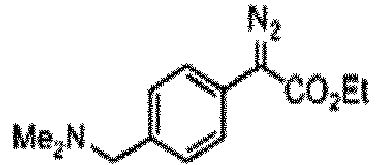
50 pH 52 4 Dz-2 50 pH 24 5 Dz-3 
50 pH 48 6 Dz-3 50 PH 6.5, 100 mM KP, 51 7 Dz-3 50 pH 7 5. 100 mM KP,50 8 Dz-4 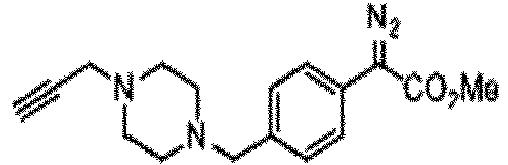
25 pH mM MES 30 9[d] Dz-5 
50 pH 51 10 Dz-6 
25 pH mM MES 40 11 Dz-7 
pH <5 [a] Concentrations below 50 mM indicate substrates of low solubility. [b] Conversion determined by HPLC analysis. [c] t-BuNHOH has previously been shown to impact aqueous rhodium catalyzed reactions.[9] [d] d(TTT ATT TGT TTC TTT) was used instead of d(ATGC). MES = 2-(N-morpholino)ethanesulfonic acid. KP t = potassium phosphate buffer. Table 4. α-Diazocarbonyl substrates - potential substrates for the oligonucleotide modification reaction Entry Diazo substrate Effective concentration in the reaction mixturea, mM Oligonucleotide substrate Yield of alkylated oligonucleotide, % 1 
50 d(ATG C) 56 2 
50 d(ATG C) 24 3 
50 d(ATG C) 48 4 
25b d(ATG C) 30 5 
50 d(TTT ATT TGT TTC TTT) 51 6 
25 d(ATG C) 40 7 
12.5b d(ATG C) < 5 a Reaction conditions 5 mM oligonucleotide, 10 mol% Rh2(OAc)4 with respect to the oligonucleotide, 100 mM MES, pH 6.0, 24 h at room temperature. The reaction mixture contained 50 % (v/v) ethylene glycol as a co-solvent.


Claims (16)
- A method of selectively modifying a nucleic acid in a biological or an artificial composition, said method comprising the step of treating the composition with a rhodium catalyst and a substrate.
- A method of selectively modifying a nucleic acid according to claim 1, wherein said catalyst further comprising a labile ligand set.
- A method of selectively modifying a nucleic acid according to any of the proceeding claims, wherein said method comprising linking a rhodium catalyst to a guiding motif, wherein the guiding motif is identical, is complementary, or hybridizes under stringent or highly stringent conditions to all or portion of the nucleic acid.
- A method of selectively modifying a nucleic acid according to any of the proceeding claims, further comprising the steps of:a. embedding the catalyst in a nucleic acid sequence or a nucleic acid mimic sequence, wherein the nucleic acid or the nucleic acid mimic is a stem-loop sequence;b. inactivating the catalyst by a deactivating ligand at the opposite end of the said stem-loop sequence; andc. contacting the inactivated and embedded catalyst with the nucleic acid in the biological or an artificial composition, wherein the nucleic acid is identical, is complementary, or hybridizes under stringent conditions to all or portion of the stem-loop sequence.
- A method of selectively modifying a nucleic acid according to claim 1, wherein said substrate is a diazo substrate.
- A method of selectively modifying a nucleic acid according to claim 1, wherein the composition is treated with a rhodium-carbenoid.
- A method of selectively modifying a nucleic acid according to any of the proceeding claims, further comprises detecting a nucleic acid in a biological or an artificial composition, comprising:a. treating the composition comprising the nucleic acid with a rhodium catalyst and a substrate;b. contacting the treated nucleic acid in (a) with a probe specific for said treated nucleic acid to form a complex comprising said treated nucleic acid and said probe hybridized to said treated nucleic acid; andc. detecting hybridization of said probe to said nucleic acid.
- An oligonucleotide for amplifying a nucleic acid modified according to any of claims 1-6, which is identical, is complementary, or hybridizes under stringent or highly stringent conditions to the nucleic acid.
- A method according to claim 7, further comprises amplifying a nucleic acid sequence contained in a biological or an artificial composition, comprising:a. adding an oligonucleotide according to claim 8 to the biological composition; andb. amplifying the nucleic acid contained in the biological sample using the oligonucleotide according to claim 8.
- A method according to claim 9, further comprises determining the presence or absence of a genetic abnormality in a nucleic acid contained in a biological sample, comprising:a. amplifying the nucleic acid contained in a biological or an artificial composition by a nucleic acid amplification method according to claim 9;b. Measuring a fluorescence intensity before and after amplifying the target nucleic acid sequence in (a); andc. Detecting the presence or absence of a genetic abnormality by comparing the fluorescence intensities measured in (b).
- The method according to any of the proceeding claims, wherein said nucleic acid comprises an unpaired and/or mismatched nucleobase or series of unpaired and/or mismatched nucleobases.
- A modified nucleic acid according to claim 1, and sequences complementary thereto.
- A kit for selectively modifying a nucleic acid in a biological or an artificial composition, wherein the kit comprises (a) a rhodium catalyst (b) a substrate (c) containers suitable for containing the said rhodium catalyst, a substrate, and the composition.
- A kit according to claim 13, wherein said catalyst further comprising a guiding motif, wherein the guiding motif is identical, is complementary, or hybridizes under stringent or highly stringent conditions to all or portion of the nucleic acid.
- Use of a rhodium catalyst and a substrate according to any of the proceeding claims for modifying, amplifying and detecting a nucleic acid in a biological or an artificial composition.
- A rhodium catalyst and a substrate according to any of the proceeding claims for use in generating chemical libraries of modified RNA for controlling or modulating RNA interference, or diseases of RNA misregulation, in detecting genetic abnormality in a nucleic acid, in the diagnosis, prognosis, monitoring and/or classification of cellular proliferative disorders.
Priority Applications (2)
| Application Number | Priority Date | Filing Date | Title |
|---|---|---|---|
| EP12177407.9A EP2689847A1 (en) | 2012-07-22 | 2012-07-22 | Methods for catalytic alkylation of nucleic acids |
| PCT/EP2013/065226 WO2014016202A1 (en) | 2012-07-22 | 2013-07-18 | Methods for catalytic alkylation of nucleic acids |
Applications Claiming Priority (1)
| Application Number | Priority Date | Filing Date | Title |
|---|---|---|---|
| EP12177407.9A EP2689847A1 (en) | 2012-07-22 | 2012-07-22 | Methods for catalytic alkylation of nucleic acids |
Publications (1)
| Publication Number | Publication Date |
|---|---|
| EP2689847A1 true EP2689847A1 (en) | 2014-01-29 |
Family
ID=47010422
Family Applications (1)
| Application Number | Title | Priority Date | Filing Date |
|---|---|---|---|
| EP12177407.9A Withdrawn EP2689847A1 (en) | 2012-07-22 | 2012-07-22 | Methods for catalytic alkylation of nucleic acids |
Country Status (1)
| Country | Link |
|---|---|
| EP (1) | EP2689847A1 (en) |
Citations (2)
| Publication number | Priority date | Publication date | Assignee | Title |
|---|---|---|---|---|
| US5906918A (en) * | 1997-02-07 | 1999-05-25 | Health Research Inc. | Compositions and methods for measurement of oxidative DNA damage |
| US20110263816A1 (en) * | 2009-11-23 | 2011-10-27 | Rice University | Metallopeptide catalysts |
-
2012
- 2012-07-22 EP EP12177407.9A patent/EP2689847A1/en not_active Withdrawn
Patent Citations (2)
| Publication number | Priority date | Publication date | Assignee | Title |
|---|---|---|---|---|
| US5906918A (en) * | 1997-02-07 | 1999-05-25 | Health Research Inc. | Compositions and methods for measurement of oxidative DNA damage |
| US20110263816A1 (en) * | 2009-11-23 | 2011-10-27 | Rice University | Metallopeptide catalysts |
Non-Patent Citations (5)
| Title |
|---|
| CHRISTINE G. ESPINO ET AL: "Expanding the Scope of C-H Amination through Catalyst Design", JOURNAL OF THE AMERICAN CHEMICAL SOCIETY, vol. 126, no. 47, 1 December 2004 (2004-12-01), pages 15378 - 15379, XP055049078, ISSN: 0002-7863, DOI: 10.1021/ja0446294 * |
| KAZUMITSU ONIZUKA ET AL: "Site-Specific Covalent Modification of RNA Guided by Functionality-Transfer Oligodeoxynucleotides", BIOCONJUGATE CHEMISTRY, vol. 20, no. 4, 15 April 2009 (2009-04-15), pages 799 - 803, XP055049077, ISSN: 1043-1802, DOI: 10.1021/bc900009p * |
| KIRIL TISHINOV ET AL: "Structure-Selective Catalytic Alkylation of DNA and RNA", ANGEWANDTE CHEMIE INTERNATIONAL EDITION, vol. 51, no. 48, 22 October 2012 (2012-10-22), pages 12000 - 12004, XP055048795, ISSN: 1433-7851, DOI: 10.1002/anie.201205201 * |
| Q. ZHOU: "A general strategy for target-promoted alkylation in biological systems", PROCEEDINGS OF THE NATIONAL ACADEMY OF SCIENCES, vol. 100, no. 26, 1 January 2003 (2003-01-01), pages 15452 - 15457, XP055049075, ISSN: 0027-8424, DOI: 10.1073/pnas.2533112100 * |
| SCHATZSCHNEIDER U ET AL: "Bifunctional rhodium intercalator conjugates as mismatch-directing DNA alkylating agents", JOURNAL OF THE AMERICAN CHEMICAL SOCIETY, ACS PUBLICATIONS, US, vol. 126, no. 28, 21 July 2004 (2004-07-21), pages 8630 - 8631, XP002472998, ISSN: 0002-7863, DOI: 10.1021/JA048543M * |
Similar Documents
| Publication | Publication Date | Title |
|---|---|---|
| JP4079875B2 (en) | Method for forming oligonucleotides | |
| Büttner et al. | Synthesis of spin-labeled riboswitch RNAs using convertible nucleosides and DNA-catalyzed RNA ligation | |
| Pourceau et al. | Azide solid support for 3′-conjugation of oligonucleotides and their circularization by click chemistry | |
| US20150211008A1 (en) | Post-synthetic chemical modification of rna at the 2'-position of the ribose ring via "click" chemistry | |
| US10344047B2 (en) | Oligonucleotide ligation | |
| US20180265911A1 (en) | Triptycene derivatives for nucleic acid junction stabilization | |
| Kumar et al. | High-affinity RNA targeting by oligonucleotides displaying aromatic stacking and amino groups in the major groove. Comparison of triazoles and phenyl substituents | |
| Santorelli et al. | Conjugation of chemical handles and functional moieties to DNA during solid phase synthesis with sulfonyl azides | |
| Abdelhady et al. | Rapid alkene–alkene photo-cross-linking on the base-flipping-out field in duplex DNA | |
| Ben Gaied et al. | Potent triple helix stabilization by 5′, 3′‐modified triplex‐forming oligonucleotides | |
| CN112322620B (en) | Dual-wavelength light-activated nucleic acid system based on phosphorothioate post-modification reaction and its application | |
| WO2014016202A1 (en) | Methods for catalytic alkylation of nucleic acids | |
| Morihiro et al. | Light-triggered strand exchange reaction using the change in the hydrogen bonding pattern of a nucleobase analogue | |
| Van Daele et al. | Triplex Formation by Pyrene‐Labelled Probes for Nucleic Acid Detection in Fluorescence Assays | |
| Novgorodtseva et al. | Synthesis and physicochemical properties of new phosphoramide oligodeoxyribonucleotides. I. N-caffeine derivatives | |
| Wawrzyniak-Turek et al. | Deoxyribozyme-mediated ligation for incorporating EPR spin labels and reporter groups into RNA | |
| Chandra et al. | New branched DNA constructs | |
| Meyer et al. | Phthalimide–Oxy Derivatives for 3′‐or 5′‐Conjugation of Oligonucleotides by Oxime Ligation and Circularization of DNA by “Bis‐or Tris‐Click” Oxime Ligation | |
| Räuchle et al. | Synthesis of peptido RNAs from unprotected peptides and oligoribonucleotides via coupling in aqueous solution | |
| Lyu et al. | Synthesis of long and functionally active RNAs facilitated by acetal levulinic ester chemistry | |
| Gissberg et al. | Fast and efficient synthesis of Zorro-LNA type 3′-5′-5′-3′ oligonucleotide conjugates via parallel in situ stepwise conjugation | |
| WO2011090968A1 (en) | Post-synthetic chemical modification of rna at the 2'-position of the ribose ring via "click" chemistry | |
| Karmakar et al. | Recognition of mixed-sequence DNA using double-stranded probes with interstrand zipper arrangements of O2′-triphenylene-and coronene-functionalized RNA monomers | |
| JP5424236B2 (en) | Oligonucleotide derivative, oligonucleotide construct using oligonucleotide derivative, compound for synthesizing oligonucleotide derivative, and method for producing oligonucleotide derivative | |
| Bui | Designing a DNA-Encoded Library of Aptamer-Like Oligomers that Target an Antibody Drug |
Legal Events
| Date | Code | Title | Description |
|---|---|---|---|
| PUAI | Public reference made under article 153(3) epc to a published international application that has entered the european phase |
Free format text: ORIGINAL CODE: 0009012 |
|
| AK | Designated contracting states |
Kind code of ref document: A1 Designated state(s): AL AT BE BG CH CY CZ DE DK EE ES FI FR GB GR HR HU IE IS IT LI LT LU LV MC MK MT NL NO PL PT RO RS SE SI SK SM TR |
|
| AX | Request for extension of the european patent |
Extension state: BA ME |
|
| STAA | Information on the status of an ep patent application or granted ep patent |
Free format text: STATUS: THE APPLICATION IS DEEMED TO BE WITHDRAWN |
|
| 18D | Application deemed to be withdrawn |
Effective date: 20140730 |