EP2688938B1 - Organomodified carbosiloxane monomers containing compositions and uses thereof - Google Patents
Organomodified carbosiloxane monomers containing compositions and uses thereof Download PDFInfo
- Publication number
- EP2688938B1 EP2688938B1 EP11713113.6A EP11713113A EP2688938B1 EP 2688938 B1 EP2688938 B1 EP 2688938B1 EP 11713113 A EP11713113 A EP 11713113A EP 2688938 B1 EP2688938 B1 EP 2688938B1
- Authority
- EP
- European Patent Office
- Prior art keywords
- group
- hair
- agents
- products
- skin
- Prior art date
- Legal status (The legal status is an assumption and is not a legal conclusion. Google has not performed a legal analysis and makes no representation as to the accuracy of the status listed.)
- Active
Links
- 0 CNC(NC*NC(OC)=O)=O Chemical compound CNC(NC*NC(OC)=O)=O 0.000 description 2
- RWHXSWBYHBGMQO-UHFFFAOYSA-N CC(C[N-](C)(C)O[N-](C)(C)CC[N-](C)(C)C)COC(C)(C)CCOC(C)(C)C(C(C)=C)=O Chemical compound CC(C[N-](C)(C)O[N-](C)(C)CC[N-](C)(C)C)COC(C)(C)CCOC(C)(C)C(C(C)=C)=O RWHXSWBYHBGMQO-UHFFFAOYSA-N 0.000 description 1
Classifications
-
- C—CHEMISTRY; METALLURGY
- C08—ORGANIC MACROMOLECULAR COMPOUNDS; THEIR PREPARATION OR CHEMICAL WORKING-UP; COMPOSITIONS BASED THEREON
- C08G—MACROMOLECULAR COMPOUNDS OBTAINED OTHERWISE THAN BY REACTIONS ONLY INVOLVING UNSATURATED CARBON-TO-CARBON BONDS
- C08G77/00—Macromolecular compounds obtained by reactions forming a linkage containing silicon with or without sulfur, nitrogen, oxygen or carbon in the main chain of the macromolecule
- C08G77/48—Macromolecular compounds obtained by reactions forming a linkage containing silicon with or without sulfur, nitrogen, oxygen or carbon in the main chain of the macromolecule in which at least two but not all the silicon atoms are connected by linkages other than oxygen atoms
- C08G77/50—Macromolecular compounds obtained by reactions forming a linkage containing silicon with or without sulfur, nitrogen, oxygen or carbon in the main chain of the macromolecule in which at least two but not all the silicon atoms are connected by linkages other than oxygen atoms by carbon linkages
-
- A—HUMAN NECESSITIES
- A01—AGRICULTURE; FORESTRY; ANIMAL HUSBANDRY; HUNTING; TRAPPING; FISHING
- A01N—PRESERVATION OF BODIES OF HUMANS OR ANIMALS OR PLANTS OR PARTS THEREOF; BIOCIDES, e.g. AS DISINFECTANTS, AS PESTICIDES OR AS HERBICIDES; PEST REPELLANTS OR ATTRACTANTS; PLANT GROWTH REGULATORS
- A01N25/00—Biocides, pest repellants or attractants, or plant growth regulators, characterised by their forms, or by their non-active ingredients or by their methods of application, e.g. seed treatment or sequential application; Substances for reducing the noxious effect of the active ingredients to organisms other than pests
- A01N25/08—Biocides, pest repellants or attractants, or plant growth regulators, characterised by their forms, or by their non-active ingredients or by their methods of application, e.g. seed treatment or sequential application; Substances for reducing the noxious effect of the active ingredients to organisms other than pests containing solids as carriers or diluents
- A01N25/10—Macromolecular compounds
-
- A—HUMAN NECESSITIES
- A01—AGRICULTURE; FORESTRY; ANIMAL HUSBANDRY; HUNTING; TRAPPING; FISHING
- A01N—PRESERVATION OF BODIES OF HUMANS OR ANIMALS OR PLANTS OR PARTS THEREOF; BIOCIDES, e.g. AS DISINFECTANTS, AS PESTICIDES OR AS HERBICIDES; PEST REPELLANTS OR ATTRACTANTS; PLANT GROWTH REGULATORS
- A01N25/00—Biocides, pest repellants or attractants, or plant growth regulators, characterised by their forms, or by their non-active ingredients or by their methods of application, e.g. seed treatment or sequential application; Substances for reducing the noxious effect of the active ingredients to organisms other than pests
- A01N25/30—Biocides, pest repellants or attractants, or plant growth regulators, characterised by their forms, or by their non-active ingredients or by their methods of application, e.g. seed treatment or sequential application; Substances for reducing the noxious effect of the active ingredients to organisms other than pests characterised by the surfactants
-
- A—HUMAN NECESSITIES
- A61—MEDICAL OR VETERINARY SCIENCE; HYGIENE
- A61K—PREPARATIONS FOR MEDICAL, DENTAL OR TOILETRY PURPOSES
- A61K8/00—Cosmetics or similar toiletry preparations
- A61K8/18—Cosmetics or similar toiletry preparations characterised by the composition
- A61K8/72—Cosmetics or similar toiletry preparations characterised by the composition containing organic macromolecular compounds
- A61K8/81—Cosmetics or similar toiletry preparations characterised by the composition containing organic macromolecular compounds obtained by reactions involving only carbon-to-carbon unsaturated bonds
-
- A—HUMAN NECESSITIES
- A61—MEDICAL OR VETERINARY SCIENCE; HYGIENE
- A61K—PREPARATIONS FOR MEDICAL, DENTAL OR TOILETRY PURPOSES
- A61K8/00—Cosmetics or similar toiletry preparations
- A61K8/18—Cosmetics or similar toiletry preparations characterised by the composition
- A61K8/72—Cosmetics or similar toiletry preparations characterised by the composition containing organic macromolecular compounds
- A61K8/81—Cosmetics or similar toiletry preparations characterised by the composition containing organic macromolecular compounds obtained by reactions involving only carbon-to-carbon unsaturated bonds
- A61K8/8141—Compositions of homopolymers or copolymers of compounds having one or more unsaturated aliphatic radicals, each having only one carbon-to-carbon double bond, and at least one being terminated by only one carboxyl radical, or of salts, anhydrides, esters, amides, imides or nitriles thereof; Compositions of derivatives of such polymers
- A61K8/8152—Homopolymers or copolymers of esters, e.g. (meth)acrylic acid esters; Compositions of derivatives of such polymers
-
- A—HUMAN NECESSITIES
- A61—MEDICAL OR VETERINARY SCIENCE; HYGIENE
- A61K—PREPARATIONS FOR MEDICAL, DENTAL OR TOILETRY PURPOSES
- A61K8/00—Cosmetics or similar toiletry preparations
- A61K8/18—Cosmetics or similar toiletry preparations characterised by the composition
- A61K8/72—Cosmetics or similar toiletry preparations characterised by the composition containing organic macromolecular compounds
- A61K8/84—Cosmetics or similar toiletry preparations characterised by the composition containing organic macromolecular compounds obtained by reactions otherwise than those involving only carbon-carbon unsaturated bonds
- A61K8/89—Polysiloxanes
- A61K8/895—Polysiloxanes containing silicon bound to unsaturated aliphatic groups, e.g. vinyl dimethicone
-
- A—HUMAN NECESSITIES
- A61—MEDICAL OR VETERINARY SCIENCE; HYGIENE
- A61P—SPECIFIC THERAPEUTIC ACTIVITY OF CHEMICAL COMPOUNDS OR MEDICINAL PREPARATIONS
- A61P17/00—Drugs for dermatological disorders
-
- A—HUMAN NECESSITIES
- A61—MEDICAL OR VETERINARY SCIENCE; HYGIENE
- A61Q—SPECIFIC USE OF COSMETICS OR SIMILAR TOILETRY PREPARATIONS
- A61Q19/00—Preparations for care of the skin
-
- C—CHEMISTRY; METALLURGY
- C05—FERTILISERS; MANUFACTURE THEREOF
- C05G—MIXTURES OF FERTILISERS COVERED INDIVIDUALLY BY DIFFERENT SUBCLASSES OF CLASS C05; MIXTURES OF ONE OR MORE FERTILISERS WITH MATERIALS NOT HAVING A SPECIFIC FERTILISING ACTIVITY, e.g. PESTICIDES, SOIL-CONDITIONERS, WETTING AGENTS; FERTILISERS CHARACTERISED BY THEIR FORM
- C05G3/00—Mixtures of one or more fertilisers with additives not having a specially fertilising activity
-
- C—CHEMISTRY; METALLURGY
- C05—FERTILISERS; MANUFACTURE THEREOF
- C05G—MIXTURES OF FERTILISERS COVERED INDIVIDUALLY BY DIFFERENT SUBCLASSES OF CLASS C05; MIXTURES OF ONE OR MORE FERTILISERS WITH MATERIALS NOT HAVING A SPECIFIC FERTILISING ACTIVITY, e.g. PESTICIDES, SOIL-CONDITIONERS, WETTING AGENTS; FERTILISERS CHARACTERISED BY THEIR FORM
- C05G3/00—Mixtures of one or more fertilisers with additives not having a specially fertilising activity
- C05G3/50—Surfactants; Emulsifiers
-
- C—CHEMISTRY; METALLURGY
- C05—FERTILISERS; MANUFACTURE THEREOF
- C05G—MIXTURES OF FERTILISERS COVERED INDIVIDUALLY BY DIFFERENT SUBCLASSES OF CLASS C05; MIXTURES OF ONE OR MORE FERTILISERS WITH MATERIALS NOT HAVING A SPECIFIC FERTILISING ACTIVITY, e.g. PESTICIDES, SOIL-CONDITIONERS, WETTING AGENTS; FERTILISERS CHARACTERISED BY THEIR FORM
- C05G3/00—Mixtures of one or more fertilisers with additives not having a specially fertilising activity
- C05G3/70—Mixtures of one or more fertilisers with additives not having a specially fertilising activity for affecting wettability, e.g. drying agents
-
- C—CHEMISTRY; METALLURGY
- C05—FERTILISERS; MANUFACTURE THEREOF
- C05G—MIXTURES OF FERTILISERS COVERED INDIVIDUALLY BY DIFFERENT SUBCLASSES OF CLASS C05; MIXTURES OF ONE OR MORE FERTILISERS WITH MATERIALS NOT HAVING A SPECIFIC FERTILISING ACTIVITY, e.g. PESTICIDES, SOIL-CONDITIONERS, WETTING AGENTS; FERTILISERS CHARACTERISED BY THEIR FORM
- C05G5/00—Fertilisers characterised by their form
- C05G5/20—Liquid fertilisers
-
- C—CHEMISTRY; METALLURGY
- C05—FERTILISERS; MANUFACTURE THEREOF
- C05G—MIXTURES OF FERTILISERS COVERED INDIVIDUALLY BY DIFFERENT SUBCLASSES OF CLASS C05; MIXTURES OF ONE OR MORE FERTILISERS WITH MATERIALS NOT HAVING A SPECIFIC FERTILISING ACTIVITY, e.g. PESTICIDES, SOIL-CONDITIONERS, WETTING AGENTS; FERTILISERS CHARACTERISED BY THEIR FORM
- C05G5/00—Fertilisers characterised by their form
- C05G5/30—Layered or coated, e.g. dust-preventing coatings
-
- C—CHEMISTRY; METALLURGY
- C07—ORGANIC CHEMISTRY
- C07F—ACYCLIC, CARBOCYCLIC OR HETEROCYCLIC COMPOUNDS CONTAINING ELEMENTS OTHER THAN CARBON, HYDROGEN, HALOGEN, OXYGEN, NITROGEN, SULFUR, SELENIUM OR TELLURIUM
- C07F7/00—Compounds containing elements of Groups 4 or 14 of the Periodic Table
- C07F7/02—Silicon compounds
- C07F7/08—Compounds having one or more C—Si linkages
- C07F7/0834—Compounds having one or more O-Si linkage
- C07F7/0838—Compounds with one or more Si-O-Si sequences
-
- C—CHEMISTRY; METALLURGY
- C08—ORGANIC MACROMOLECULAR COMPOUNDS; THEIR PREPARATION OR CHEMICAL WORKING-UP; COMPOSITIONS BASED THEREON
- C08F—MACROMOLECULAR COMPOUNDS OBTAINED BY REACTIONS ONLY INVOLVING CARBON-TO-CARBON UNSATURATED BONDS
- C08F220/00—Copolymers of compounds having one or more unsaturated aliphatic radicals, each having only one carbon-to-carbon double bond, and only one being terminated by only one carboxyl radical or a salt, anhydride ester, amide, imide or nitrile thereof
- C08F220/02—Monocarboxylic acids having less than ten carbon atoms; Derivatives thereof
- C08F220/10—Esters
- C08F220/20—Esters of polyhydric alcohols or phenols, e.g. 2-hydroxyethyl (meth)acrylate or glycerol mono-(meth)acrylate
-
- C—CHEMISTRY; METALLURGY
- C08—ORGANIC MACROMOLECULAR COMPOUNDS; THEIR PREPARATION OR CHEMICAL WORKING-UP; COMPOSITIONS BASED THEREON
- C08F—MACROMOLECULAR COMPOUNDS OBTAINED BY REACTIONS ONLY INVOLVING CARBON-TO-CARBON UNSATURATED BONDS
- C08F220/00—Copolymers of compounds having one or more unsaturated aliphatic radicals, each having only one carbon-to-carbon double bond, and only one being terminated by only one carboxyl radical or a salt, anhydride ester, amide, imide or nitrile thereof
- C08F220/02—Monocarboxylic acids having less than ten carbon atoms; Derivatives thereof
- C08F220/10—Esters
- C08F220/26—Esters containing oxygen in addition to the carboxy oxygen
- C08F220/28—Esters containing oxygen in addition to the carboxy oxygen containing no aromatic rings in the alcohol moiety
-
- C—CHEMISTRY; METALLURGY
- C08—ORGANIC MACROMOLECULAR COMPOUNDS; THEIR PREPARATION OR CHEMICAL WORKING-UP; COMPOSITIONS BASED THEREON
- C08F—MACROMOLECULAR COMPOUNDS OBTAINED BY REACTIONS ONLY INVOLVING CARBON-TO-CARBON UNSATURATED BONDS
- C08F220/00—Copolymers of compounds having one or more unsaturated aliphatic radicals, each having only one carbon-to-carbon double bond, and only one being terminated by only one carboxyl radical or a salt, anhydride ester, amide, imide or nitrile thereof
- C08F220/02—Monocarboxylic acids having less than ten carbon atoms; Derivatives thereof
- C08F220/52—Amides or imides
- C08F220/54—Amides, e.g. N,N-dimethylacrylamide or N-isopropylacrylamide
- C08F220/56—Acrylamide; Methacrylamide
-
- C—CHEMISTRY; METALLURGY
- C08—ORGANIC MACROMOLECULAR COMPOUNDS; THEIR PREPARATION OR CHEMICAL WORKING-UP; COMPOSITIONS BASED THEREON
- C08F—MACROMOLECULAR COMPOUNDS OBTAINED BY REACTIONS ONLY INVOLVING CARBON-TO-CARBON UNSATURATED BONDS
- C08F230/00—Copolymers of compounds having one or more unsaturated aliphatic radicals, each having only one carbon-to-carbon double bond, and containing phosphorus, selenium, tellurium or a metal
- C08F230/04—Copolymers of compounds having one or more unsaturated aliphatic radicals, each having only one carbon-to-carbon double bond, and containing phosphorus, selenium, tellurium or a metal containing a metal
- C08F230/08—Copolymers of compounds having one or more unsaturated aliphatic radicals, each having only one carbon-to-carbon double bond, and containing phosphorus, selenium, tellurium or a metal containing a metal containing silicon
-
- C—CHEMISTRY; METALLURGY
- C08—ORGANIC MACROMOLECULAR COMPOUNDS; THEIR PREPARATION OR CHEMICAL WORKING-UP; COMPOSITIONS BASED THEREON
- C08G—MACROMOLECULAR COMPOUNDS OBTAINED OTHERWISE THAN BY REACTIONS ONLY INVOLVING UNSATURATED CARBON-TO-CARBON BONDS
- C08G77/00—Macromolecular compounds obtained by reactions forming a linkage containing silicon with or without sulfur, nitrogen, oxygen or carbon in the main chain of the macromolecule
- C08G77/48—Macromolecular compounds obtained by reactions forming a linkage containing silicon with or without sulfur, nitrogen, oxygen or carbon in the main chain of the macromolecule in which at least two but not all the silicon atoms are connected by linkages other than oxygen atoms
- C08G77/485—Macromolecular compounds obtained by reactions forming a linkage containing silicon with or without sulfur, nitrogen, oxygen or carbon in the main chain of the macromolecule in which at least two but not all the silicon atoms are connected by linkages other than oxygen atoms containing less than 25 silicon atoms
-
- C—CHEMISTRY; METALLURGY
- C08—ORGANIC MACROMOLECULAR COMPOUNDS; THEIR PREPARATION OR CHEMICAL WORKING-UP; COMPOSITIONS BASED THEREON
- C08G—MACROMOLECULAR COMPOUNDS OBTAINED OTHERWISE THAN BY REACTIONS ONLY INVOLVING UNSATURATED CARBON-TO-CARBON BONDS
- C08G77/00—Macromolecular compounds obtained by reactions forming a linkage containing silicon with or without sulfur, nitrogen, oxygen or carbon in the main chain of the macromolecule
- C08G77/60—Macromolecular compounds obtained by reactions forming a linkage containing silicon with or without sulfur, nitrogen, oxygen or carbon in the main chain of the macromolecule in which all the silicon atoms are connected by linkages other than oxygen atoms
-
- C—CHEMISTRY; METALLURGY
- C08—ORGANIC MACROMOLECULAR COMPOUNDS; THEIR PREPARATION OR CHEMICAL WORKING-UP; COMPOSITIONS BASED THEREON
- C08L—COMPOSITIONS OF MACROMOLECULAR COMPOUNDS
- C08L83/00—Compositions of macromolecular compounds obtained by reactions forming in the main chain of the macromolecule a linkage containing silicon with or without sulfur, nitrogen, oxygen or carbon only; Compositions of derivatives of such polymers
-
- C—CHEMISTRY; METALLURGY
- C09—DYES; PAINTS; POLISHES; NATURAL RESINS; ADHESIVES; COMPOSITIONS NOT OTHERWISE PROVIDED FOR; APPLICATIONS OF MATERIALS NOT OTHERWISE PROVIDED FOR
- C09D—COATING COMPOSITIONS, e.g. PAINTS, VARNISHES OR LACQUERS; FILLING PASTES; CHEMICAL PAINT OR INK REMOVERS; INKS; CORRECTING FLUIDS; WOODSTAINS; PASTES OR SOLIDS FOR COLOURING OR PRINTING; USE OF MATERIALS THEREFOR
- C09D133/00—Coating compositions based on homopolymers or copolymers of compounds having one or more unsaturated aliphatic radicals, each having only one carbon-to-carbon double bond, and at least one being terminated by only one carboxyl radical, or of salts, anhydrides, esters, amides, imides, or nitriles thereof; Coating compositions based on derivatives of such polymers
- C09D133/04—Homopolymers or copolymers of esters
- C09D133/14—Homopolymers or copolymers of esters of esters containing halogen, nitrogen, sulfur or oxygen atoms in addition to the carboxy oxygen
-
- C—CHEMISTRY; METALLURGY
- C09—DYES; PAINTS; POLISHES; NATURAL RESINS; ADHESIVES; COMPOSITIONS NOT OTHERWISE PROVIDED FOR; APPLICATIONS OF MATERIALS NOT OTHERWISE PROVIDED FOR
- C09D—COATING COMPOSITIONS, e.g. PAINTS, VARNISHES OR LACQUERS; FILLING PASTES; CHEMICAL PAINT OR INK REMOVERS; INKS; CORRECTING FLUIDS; WOODSTAINS; PASTES OR SOLIDS FOR COLOURING OR PRINTING; USE OF MATERIALS THEREFOR
- C09D183/00—Coating compositions based on macromolecular compounds obtained by reactions forming in the main chain of the macromolecule a linkage containing silicon, with or without sulfur, nitrogen, oxygen, or carbon only; Coating compositions based on derivatives of such polymers
-
- A—HUMAN NECESSITIES
- A61—MEDICAL OR VETERINARY SCIENCE; HYGIENE
- A61K—PREPARATIONS FOR MEDICAL, DENTAL OR TOILETRY PURPOSES
- A61K2800/00—Properties of cosmetic compositions or active ingredients thereof or formulation aids used therein and process related aspects
- A61K2800/10—General cosmetic use
Definitions
- the present invention relates to a composition comprising novel polymerizable organo modified carbosiloxane monomer that exhibits improved hydrolytic stability under acidic, basic and neutral pH conditions in comparison to the corresponding conventional siloxane monomer. More particularly the present invention relates to improved compositions comprising hydrolytic stability at the pH of 6.5, 7.0 and 7.5.
- Siloxane based hydrogels are used for variety of applications in the area of health care, personal care, agriculture, coatings and home care because of their water absorbing and high oxygen permeable nature.
- WO 2010/038242 A2 is directed at mono-functional hydrophilic silicone-containing monomers having a polyether with a branched linking group, which can be applied in the provision of homo-polymers and copolymers and which are useful in making water-absorbing silicone-hydrogel films for contact lens applications.
- the document is also directed at the production of such monomers and polymers.
- the monomers disclosed therein do not incorporate the polyether group as a part of the monomer backbone, but as a branch-like substituent.
- the monomers applicable in the formation of polymers and hydrogels disclosed in WO 2010/038242 A2 do not have carbosilane units of the general structure Si-alkylene-Si, but only siloxane units.
- these silicone hydrogels show poor hydrolytic stability under acidic or basic pH conditions. This effect is predominant when the siloxane chain length is too small.
- the trisiloxane-based compounds are well known to undergo rapid hydrolytic cleavage under acidic or basic pH conditions.
- the instant invention discloses siloxane compositions that are hydrolytically more stable and can be used to form hydrolytically stable silicone hydrogel copolymer that can be potentially used for various applications, including those cited above.
- Carbomer is a generic name for synthetic high molecular weight polymers of acrylic acid used as thickening, dispersing, suspending and emulsifying agents in pharmaceuticals and cosmetics. They may be homopolymers of acrylic acid, as well as copolymers with methacrylic acid and other acrylates.
- An object of the present invention is to provide a polymerizable organo-modified carbosiloxane composition
- a silicone monomer having the following general formulae (I): (R 1 R 2 R 3 )Si-Y 1 -[Si(R 4 R 5 )(Y 2 )] a -Si(R 6 R 7 )-Z (I)
- Another object of the present invention is to provide a silicone composition comprising homo and copolymers derived from the monomers described herein.
- Another object of the present invention is to provide a carbomer-containing composition exhibiting a high level of dispersion of its carbomer component, useful in the preparation of various personal care products and cosmetics.
- the inventive composition and formulations made there from are efficiently and effectively realized employing conventional equipment and standard manufacturing practices.
- Another embodiment of the present invention is directed to a process for producing the described silicone monomers comprising chemically reacting a silicone-containing compound having the general formula shown below (R 1 R 2 R 3 )Si-Y 1 -[Si(R 4 R 5 )(Y 2 )] a -Si(R 6 R 7 )-H (IV)
- the reaction products are called carbosiloxanes.
- G is selected from the group consisting of a halogen, hydroxyl and alkyloxy having 1 to about 10 carbon atoms
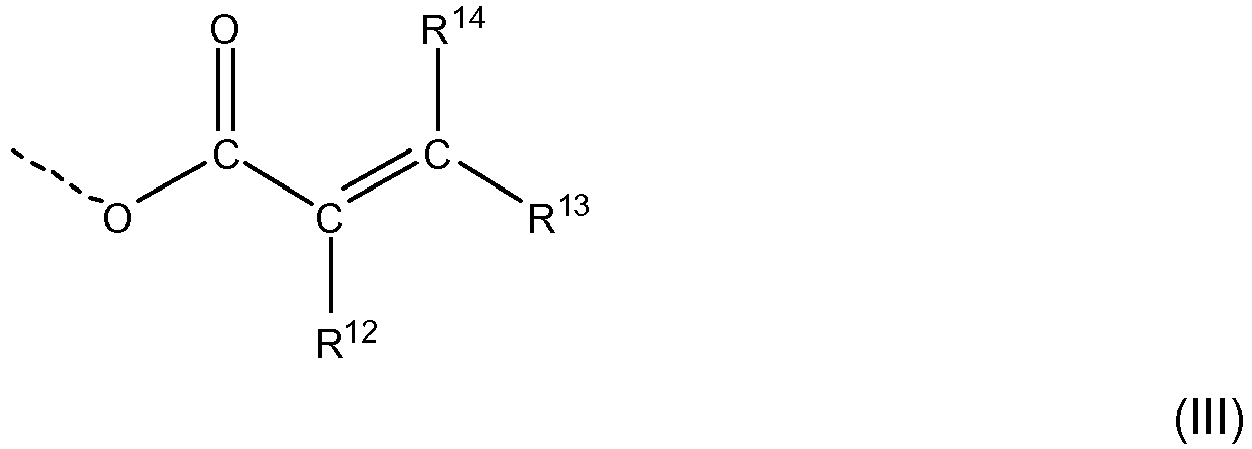
- R 12 , R 13 and R 14 is independently selected from the group consisting of hydrogen, substituted saturated monovalent hydrocarbons having 1 to about 20 carbons and unsubstituted saturated monovalent hydrocarbons having 1 to about 20 carbonsto produce said silicone monomer having the general formulae (I).
- the reaction of the functionalized carbosiloxane with alkylacryloyl compound having the general formula (VI) can be carried out in the presence of a tertiary amine base or basic ion-exchange resin (IER) or azeotrope-forming solvent or reactant.
- IER basic ion-exchange resin
- the azeotrope-forming solvent can be selected from hexane, heptane and toluene and the reactant such as methylmethacrylate under the inert reaction conditions.
- compositions comprising polymerizable group selected from the group consisting of substituted or unsubstituted unsaturated aliphatic or aromatic hydrocarbons, acrylates and methacrylates functionalized carbosiloxane monomers that are non-bulky and show improved hydrolysis resistance are provided.
- Carbosiloxane monomers of the present invention showed improved hydrolysis resistance under acidic and basic pH conditions in comparison to the corresponding conventional siloxane monomers. Cured compositions produced from these monomers showed better oxygen permeability, and surface wettability and lower modulus in comparison to compositions/films of the corresponding conventional siloxane monomers.
- homopolymers are polymers made from the same repeating monomer and 'copolymers" are polymers wherein the polymer contains at least two structurally different monomers.
- Notations such as (meth)acrylate denote monomer with either acrylate or methacrylate functionality.
- compositions comprising (meth)acrylate functionalized silicone monomers/polymers of the present invention, products made from these compositions as well as their preparation are further described in the sections below.
- the monomers disclosed have a carbosilane linkage, -Si-(CH 2 ) n -Si-, which makes it possible to produce compositions having hydrolytically stable (hydrolysis resistance) monomers and polymers.
- the present invention is directed to compositions comprising linear mono-acrylate functional organo-modified carbosiloxane compounds useful as a hydrolytically stable silicone monomer.
- the mono-acrylate functional carbosiloxane monomers of the present invention have the general structure shown in formula (I): (R 1 R 2 R 3 )Si-Y 1 -[Si(R 4 R 5 )(Y 2 )] a -Si(R 6 R 7 )-Z (I).
- One of the preferred variants of the formula (I) of the present invention is the mono acrylate functional monomer having the general formula as shown below. wherein a is 0 to 100; Y 1 is a substituted or unsubstituted divalent alkyl linking group of 1 to 10 carbon atoms, is oxygen. R 1 to R 7 is independently selected from the group consisting of monovalent aliphatic, cycloaliphatic or aromatic hydrocarbon groups of 1 to about 10 carbons and halogenated hydrocarbon groups of 1 to about 10 carbons.
- X is a polymerizable group having the general formula (III) wherein R 12 to R 14 is hydrogen or a substituted or unsubstituted saturated monovalent hydrocarbon group of 1 to about 20 carbons.
- the present invention is also directed to compositions comprising polymers formed by the reaction products of the carbosiloxane monomers provided herein.
- These polymers may be homopolymers of one of the monomers of the present invention or copolymers of two structurally different silicone monomers of the present invention, and/or copolymers of one or more silicone monomers of the present invention and at least one other hydrophilic unsaturated organic monomers suitable for use in silicone hydrogels, with preferred non-limiting examples of such being N,N-dimethylacrylamide, 2-hydroxy-ethylmethacrylate (HEMA), 2-hydroxy ethylacrylate (HEA), N-vinylpyrrolidone, and methacrylic acid.
- HEMA 2-hydroxy-ethylmethacrylate
- HAA 2-hydroxy ethylacrylate
- methacrylic acid ethacrylic acid
- the ratio of the silicone monomers of the present invention to the other hydrophilic unsaturated organic monomers is from about 1:100 to about 100:1 and preferably from about 20:80 to about 90:10 and more preferably from about 30:70 to about 80:20.
- the unsaturated organic monomers and the carbosiloxane monomers of this invention are mutually miscible and form homogeneous mixtures.
- the use of compatibilizing solvents is not necessary.
- the carbosiloxane monomers of this invention are also either water-soluble or water-dispersible. Water-soluble carbosiloxane monomers are miscible with water in all proportions to yield homogeneous solutions. Water-dispersible carbosiloxane monomers do not dissolve completely in water. Cloudiness, haze, colloid formation and similar visible signs of heterogeneity in the aqueous mixture are indicative of dispersion rather than solution. Both water solubility and water dispersibility are desirable features of the carbosiloxane monomers of the instant invention.
- carbosiloxane monomers contain a methacrylated ethoxylated polyether segment
- water dispersibility is observed when the polyether content is less than about 60 weight percent of the total molecular weight, and water solubility when the polyether segment is greater than about 60 weight percent.
- the polymers Prior to forming compositions comprising polymers, the polymers are formed by mixing the desired monomers and the resulting mixture is polymerized and cured to form transparent thin films by known thermal techniques using free radical or cationic or anionic initiators and UV cure techniques using photoinitiators in the presence of crosslinking agents.
- the monomers added to the reaction mixture to form the polymers may be monomers or prepolymers.
- a "prepolymer” is a reaction intermediate polymer of medium molecular weight having polymerizable groups.
- silicon-containing monomers “carbosiloxane monomers” and “hydrophilic monomers” include prepolymers.
- carbosiloxane monomer from structure (I) of the present invention has the following formula wherein B is a divalent polyether as shown in the representative example with p being up to about 100, preferably 2 to about 15, more preferably about 8, and q and r equal to 0; Y 1 is a divalent alkyl-linking group of about 1 to 10 carbons, preferably 1 to about 5 carbons, more preferably about 2 carbons. Y 2 is oxygen and X is polymerizable methacrylate group, a is 0 to about 100, more preferably 0 to 20 inclusive, and even more preferably 1.
- Each of the R groups in the general monomer structure (I) is a monovalent alkyl-linking group of 1 to 10 carbons, preferably a methyl group.
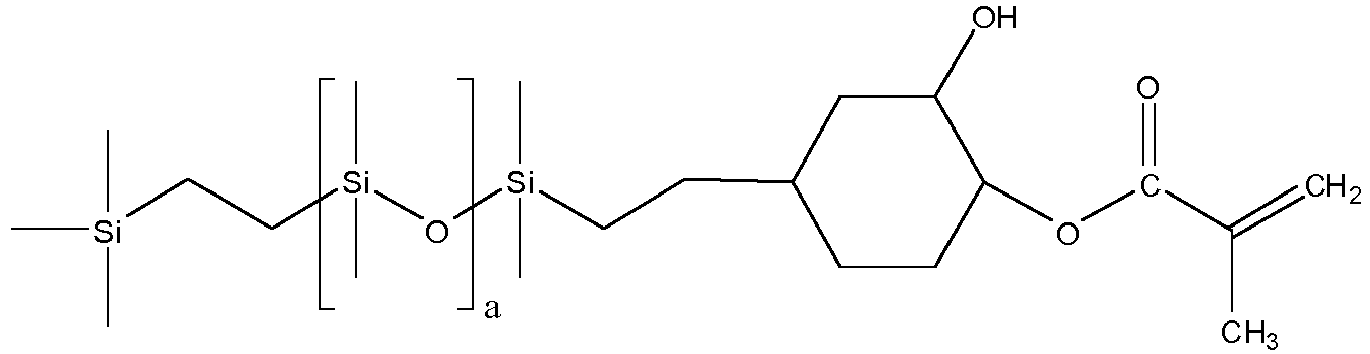
- carbosiloxane monomer from structure (I) of the present invention has the following formula wherein B is a divalent hydroxyl containing cycloaliphatic ring; X is polymerizable methacrylate group, a is up to about 100, more preferably up to about 20 inclusive, and even more preferably 1.
- Y 1 is a divalent alkyl-linking group of about 1 to 10 carbons, preferably 1 to about 5 carbons, more preferably about 2 carbons.
- Y 2 is oxygen.
- Each of the R groups in the general monomer structure (I) is a monovalent alkyl-linking group, preferably a methyl group.
- Another embodiment of the present invention is directed to a process for producing the described carbosiloxane monomers comprising chemically reacting a carbosiloxane compound with SiH functionality having the general formula shown below (R 1 R 2 R 3 )Si-Y 1 -[Si(R 4 R 5 )(Y 2 )] a -Si(R 6 R 7 )-H (IV) wherein a is 0 to 100; Y 1 is a substituted or unsubstituted divalent alkyl linking group of 1 to 10 carbon atoms, and Y 2 is oxygen.
- R 1 to R 7 is independently selected from the group consisting of monovalent aliphatic, cycloaliphatic or aromatic hydrocarbon groups of 1 to about 10 carbons and halogenated hydrocarbon groups of 1 to about 10 carbons.
- a compound of general formula (IV) is reacted with a terminally unsaturated compound having the general formula as shown below (V) R 15 -B-M (V) wherein R 15 is a branched unsaturated alkyl group having up to about 20 carbon atoms, B is a divalent hydrophilic functional moiety consisting of aliphatic, cycloaliphatic or aromatic hydrocarbons and substituted or unsubstituted, saturated and unsaturated aliphatic, cycloaliphatic or aromatic hydrocarbons containing hetero atoms; B comprises functionalities such as alcohols, ethers, esters, amides, amines, acids and its salts, cyano, thio, urethane, urea, sulfonates, sulphon
- the functionalized carbosiloxane is produced, it is reacted with an alkylacryloyl compound having the general formula (VI).
- G is selected from the group consisting of a halogen or hydroxyl or alkyloxy having 1 to 10 carbon atoms.
- R 12 to R 14 are selected from hydrogen or a substituted or unsubstituted saturated monovalent hydrocarbon group of 1 to about 20 carbons to produce said silicone monomer.
- the reaction of the functionalized carbosiloxane with alkylacryloyl compound having the general formula (VI) can be carried out in the presence of a tertiary amine base or basic ion-exchange resin (IER) or azeotrope forming solvent or reactant.
- the azeotrope forming solvent can be selected from hexane, heptane, toluene and the reactant such as methylmethacrylate under the inert reaction conditions.
- compositions of the present invention can be mixed with other monomers or polymers that are the same or different to produce the compositions of the present invention. These compositions have been found to have properties that are favorable for use in the cosmetic and medical industries. Some examples and discussions of the different uses for the compositions are provided herein below.
- the silicone hydrogel copolymers are gaining importance in the health care industry for various applications such as contact lens, wound management and drug delivery applications because of their improved oxygen permeability compared to conventional hydrogels.
- One of the key challenges in health care is that the material used for these applications should be dimensionally and chemically stable and should not undergo hydrolytic degradation and leach out degradation products under the conditions of use, such as sterilization and storage in aqueous media containing buffers.
- the carbosiloxane monomer of the instant invention shows improved hydrolytic stability over the conventional siloxane monomer, which enables it to produce silicone hydrogel copolymers with improved hydrolytic stability for health-care related applications, further details of which are shown in the following paragraphs.
- its mono-functional polymerizable group affords better control to produce silicone hydrogel copolymers with desired modulus depending upon the end applications.
- A. Contact lens A. A. Contact lens:
- the advantages of using the mono-functional carbosiloxane monomer of the instant invention for contact lens application are numerous.
- the presence of carbosiloxane linkage, -Si-(CH 2 ) n -Si-, in the siloxane monomer composition of the present invention can help to produce soft hydrogel contact lens materials with improved hydrolytic stability. That means the silicone hydrogel contact lenses produced are hydrolytically stable and will not change in their chemical composition and physical dimensions when they are subjected to usage conditions, for e.g., in the eye or in the disinfecting solution or during sterilization.
- the contact lens material of the instant invention is also resilient. When the term resilient is used herein it is meant that after the lenses have been deformed the lenses will return quickly to their original shape.
- the monomers of the instant invention are compatible with hydrogel co-monomers in the entire range of compositions without employing any solvent or compatibilizing agents.
- the copolymer films obtained with various hydrogel comonomers and the mixtures thereof are transparent, water absorbing with inherently wettable surface.
- the human cornea requires about 2 ⁇ 10 -6 cm 3 /(sec. cm 2 atm.) of oxygen through the contact lens for better eye health as reported by Hill and Fatt (American Journal of Optometry and Archives of the American Academy of Optometry, Vol. 47, p. 50, 1970 ).
- the silicone-hydrogel contact lens materials made from the monomer of the instant invention allows better transmission of oxygen through itself to supply the necessary oxygen requirements of the human cornea.
- the monomer of the instant invention can be used to produce hydrogel copolymer with the desired lower modulus to improve the comfort of the lens wearers.
- the contact lens material can be produced with the monomer of the present instant invention employing the cure techniques (for eg. thermal and actinic radiation cure methods) known in the art with out employing solvent or compatibilizing agents.
- Hydrogels with high water content and oxygen permeability are needed to produce the wound-management devices (for eg. transdermal patches, wound healing patches, wound dressing patches).
- the water present in the wound-dressing material helps to provide a moist environment for better comfort and painless wound management.
- Oxygen also plays an important role in wound healing and the lack of oxygen transport in the wound dressing material has been identified as one of the most common issues affecting the wound healing process ( Bok Y. Lee "The Wound Management Manual", McGraw-Hill, New York,2005, p.44 ). Oxygen transport to the wound through hemoglobin is an important process for wound healing. However, the damaged tissue in the wound can act as a barrier to hemoglobin leading to localized hypoxia at the wound site.
- Damaged tissue is generally hypoxic due to the large consumption of oxygen by cells.
- Leukocytes consume oxygen to produce infection-fighting oxidants.
- fibroblasts and endothelial cells also require oxygen for wound healing. Therefore, the only way of oxygen transport to the exterior part of the wound is from the atmosphere and this requires the wound dressing to have good oxygen permeability for better healing of the wounds.
- the monomer of the instant invention having hydrophilic moieties such as polyethers or other hydrophilic moieties can provide silicone hydrogels that are not only hydrolytically stable, but also water absorbing and highly oxygen permeable making them a suitable wound dressing material for various wound management applications.
- Hydrophilic silicone compositions of the present invention can also provide an excellent moist environment for better comfort and painless wound management.
- the silicone composition of current invention can be used as a potential carrier or device for various active ingredients and controlled release of those actives under different conditions (for example, pH, pressure, temperature, chemical reaction).
- biocompatible hydrogels are used as colon-specific drug delivery systems for the treatment of helicobacter pylori infection in peptic ulcer disease. These biocompatible hydrogels are designed to be highly swollen and to degrade in the presence of colonic enzymes or micro flora, providing colon-specific drug delivery. Additionally, biocompatible hydrogels protect insulin in the harsh, acidic environment of the stomach before releasing the drug in the small intestine.
- the hydrophilic silicone compositions of the present invention can be used to produce biocompatible silicone hydrogel-based drug delivery devices to release the drug locally to specific sites in the GI tract.
- the hydrophilic silicone compositions of this invention can also be used for other biocompatible drug delivery applications such as puncta plugs, ophtha coils, retinal implants, transdermal patches, wound healing patches and transdermal iontophoresis.
- the silicone compositions of the present invention can be used for the transdermal drug delivery applications.
- Drug delivery to the skin has been generally used to treat skin diseases or for disinfections of the skin.
- transdermal route for the delivery of drugs has been investigated. Swollen soft hydrogels are explored to deliver the drugs for long period of duration and these hydrogels can be easily removed from the skin without pain and improves comfort for the patients.
- Current research in this field is now focused on iontophoresis and electroporation.
- Hydrogel-based formulations are being explored for electrically assisted delivery using transdermal iontophoresis for enhanced permeation of products such as, hormones and nicotine.
- the silicone compositions of the present invention can be used for the subcutaneous drug delivery applications also.
- the most substantial application is implantable therapeutic devices.
- hydrogels can be used for delivery of proteins and peptides.
- implantable hydrogels are leading towards the development of biodegradable systems, which do not require surgical removal of the drug-loaded implants.
- Other health care applications include scaffolds for tissue engineering, anti-microbial devices, anti-bacterial devices, antifouling coatings, and anti-fungal devices.
- adjuvants are provided either as a tank-side additive or used as a component in pesticide formulations.
- Typical uses for pesticides include agricultural, horticultural, turf, ornamental, home and garden, veterinary and forestry applications.
- the silicone compositions of the present invention and its polymer can be used as a hydrolytically stable surfactant in pesticidal compositions at an amount sufficient to deliver between 0.005% and 2% to the final use concentration, either as a concentrate or diluted in a tank mix.
- the pesticidal composition may include excipients, cosurfactants, solvents, foam control agents, deposition aids, drift retardants, biologicals, micronutrients and fertilizers.
- pesticide means any compound used to destroy pests, e.g., rodenticides, insecticides, miticides, fungicides, and herbicides.
- pesticides that can be employed include, but are not limited to, growth regulators, photosynthesis inhibitors, pigment inhibitors, mitotic disrupters, lipid biosynthesis inhibitors, cell wall inhibitors, and cell membrane disrupters.
- the amount of pesticide employed in compositions of the invention varies with the type of pesticide employed.
- Fungicide compositions that can be used with the present invention include, but are not limited to, aldimorph, tridemorph, dodemorph, dimethomorph; flusilazol, azaconazole, cyproconazole, epoxiconazole, furconazole, propiconazole and tebuconazole; imazalil, thiophanate, benomyl carbendazim, chlorothialonil, dicloran, trifloxystrobin, fluoxystrobin, dimoxystrobin, azoxystrobin, furcaranil, prochloraz, flusulfamide, famoxadone, captan, maneb, mancozeb, dodicin, dodine, and metalaxyl.
- Insecticide, larvacide, miticide and ovacide compounds that can be used with the composition of the present invention, but not limited to, Bacillus thuringiensis, spinosad, abamectin, doramectin, lepimectin, pyrethrins, carbaryl, primicarb, aldicarb, methomyl, amitraz, boric acid, chlordimeform, novaluron, bistrifluron, triflumuron, diflubenzuron, imidacloprid, diazinon, acephate, endosulfan, kelevan, dimethoate, azinphos-ethyl, azinphos-methyl, izoxathion, chlorpyrifos, clofentezine, lambda-cyhalothrin, permethrin, bifenthrin and cypermethrin.
- Fertilizers and micronutrients include, but not limited to, zinc sulfate, ferrous sulfate, ammonium sulfate, urea, urea ammonium nitrogen, ammonium thiosulfate, potassium sulfate, monoammonium phosphate, urea phosphate, calcium nitrate, boric acid, potassium and sodium salts of boric acid, phosphoric acid, magnesium hydroxide, manganese carbonate, calcium polysulfide, copper sulfate, manganese sulfate, iron sulfate, calcium sulfate, sodium molybdate, calcium chloride,
- the pesticide or fertilizer may be a liquid or a solid. If a solid, it is preferable that it is soluble in a solvent, or the organomodified siloxanes of the present invention, prior to application, and the silicone may act as a solvent, or surfactant for such solubility or additional surfactants may perform this function.
- coatings formulations will require a wetting agent or surfactant for the purpose of emulsification, compatibilization of components, leveling, flow and reduction of surface defects. Additionally, these additives may provide improvements in the cured or dry film, such as improved abrasion resistance, antiblocking, hydrophilic, and hydrophobic properties. Coatings formulations may exist as, foul-resistant coatings, biological coatings, seed coatings, solvent-borne coatings, water-borne coatings and powder coatings.
- the coatings components may be employed as: architecture coatings; OEM product coatings such as automotive coatings and coil coatings; Special Purpose coatings such as industrial maintenance coatings and marine coatings;
- Typical resin types include: Polyesters, alkyds, acrylics, epoxies and combinations thereof.
- the organomodified siloxane compositions of the present invention may be utilized in personal care emulsions, such as lotions, and creams.
- emulsions comprise at least two immiscible phases one of which is continuous and the other is discontinuous.
- emulsions may be liquids with varying viscosities or solids.
- the particle size of the emulsions may render them microemulsions or miniemulsions and, when the particle sizes are sufficiently small, these emulsions may be transparent. Further, it is also possible to prepare emulsions of emulsions and these are generally known as multiple emulsions.
- emulsions may be: 1) Aqueous emulsions, where the discontinuous phase comprises water and the continuous phase comprises the organomodified siloxane composition of the present invention. 2) Aqueous emulsions, where the discontinuous phase comprises the organomodified siloxane composition of the present invention and the continuous phase comprises water. 3) Non-aqueous emulsions, where the discontinuous phase comprises a non-aqueous hydroxylic solvent and the continuous phase comprises the organomodified siloxane composition of the present invention and 4) Non-aqueous emulsions, where the continuous phase comprises a non-aqueous hydroxylic organic solvent and the discontinuous phase comprises the organomodified siloxane composition of the present invention.
- the monomer of the instant invention can be polymerized using emulsion polymerization and the copolymer of these monomer obtained with acrylic comonomers forms excellent films which can be used for various skin care and hair care applications (for eg, mascara, styling gels and sun protection films).
- Suitable personal care compositions are made by combining, in a manner known in the art, for example, by mixing one or more of the above components with the organomodified siloxane composition of the present invention.
- Suitable personal care compositions may be in the form of a single phase or in the form of an emulsion, including oil-in-water, water-in-oil and anhydrous emulsions where the silicone phase may be either the discontinuous phase or the continuous phase, as well as multiple emulsions, such as, for example, oil-in water-in-oil emulsions and water-in-oil-in water-emulsions.
- the organomodified siloxane composition of the present invention and its polymers can be used as surfactants in home care applications, such as, laundry detergent and fabric softener, dishwashing liquids, wood and furniture polish, floor polish, tub and tile cleaners, toilet bowl cleaners, hard surface cleaners, window cleaners, antifog agents, drain cleaners, auto-dish washing detergents and sheeting agents, carpet cleaners, prewash spotters, rust cleaners and scale removers.
- home care applications such as, laundry detergent and fabric softener, dishwashing liquids, wood and furniture polish, floor polish, tub and tile cleaners, toilet bowl cleaners, hard surface cleaners, window cleaners, antifog agents, drain cleaners, auto-dish washing detergents and sheeting agents, carpet cleaners, prewash spotters, rust cleaners and scale removers.
- This monomer was prepared using two-step process. In the first step, a hydrosilylation reaction occurs between hydroxyl terminated methallyl polyether and mono-hydride functional carbosiloxane. In the second step, the hydroxyl group is converted into polymerizable methacrylate group through a methacrylation reaction.
- the mono-hydride functional carbosiloxane was prepared using the process disclosed in US 7,259,220 B1 .
- 1-(2-trimethylsilylethyl)-1,1,3,3-tetramethyldisiloxane (25 g), a hydride functional carbosiloxane, and a methallyl-terminated polyethylene glycol (46 g), having an average of 8 ethylene oxide (EO) units in the chain, were introduced into 250 mL three-neck round bottom (RB) flask equipped with a reflux condenser, mechanical stirrer, temperature controller with thermocouple and a nitrogen inlet.
- RB three-neck round bottom
- solvents include toluene, isopropyl alcohol or methyl ethyl ketone.
- This monomer was prepared was also prepared using two-step process.
- a hydrosilylation reaction occurs between hydride functional carbosiloxane and vinyl functional cyclohexene epoxide.
- the epoxide group is reacted with unsaturated acids to introduce polymerizable group in it.
- the final product, epoxy functional carbosiloxane was obtained as colorless, transparent liquid in quantitative yield without any undesired side products.
- the resultant pure product was well characterized by proton NMR spectroscopy.
- the epoxy functional carbosiloxane of the present invention can occur with or without solvent. If solvents are used, preferred ones include toluene, isopropylalcohol or methyl ethyl ketone.
- Example 2 The compound obtained in Example 1 (49 parts by weight), 2-hydroxy ethyl methacrylate (49 parts by weight), ethylene glycol dimethacrylate (EGDMA) (1 part by weight), and benzoyl peroxide (1 part by weight) were mixed and stirred.
- the resulting clear, homogeneous and transparent reaction mixture was purged with nitrogen gas and poured into a stainless steel mould.
- the thin film of the reaction mixture was thermally cured at 85°C for 8 hours using hot air oven.
- the silicone hydrogel film thus produced was transparent and water absorbing.
- a silicone-hydrogel film was obtained in the same way as in Example 3 except that the compound obtained in Example 2 was used instead of compound obtained in Example 1.
- the silicone hydrogel film thus produced was transparent and water absorbing.
- the monomer was prepared in the same way as in Example 1 except that 1,1,1,3,5,5,5-heptamethyltrisiloxane was used instead of 1-(2-trimethylsilylethyl)-1,1,3,3-tetramethyldisiloxane.
- the mono-acrylated siloxane monomer produced was well characterized by infrared spectroscopy, multinuclear NMR spectroscopy.
- Hydrolytic stability of the monomer of the present invention was measured using HPLC ( US Pub. Pat Appl. 20100069279 ).
- 0.5wt% of the monomers obtained in Example 1 (Ex.1) is introduced into three different vials containing 6.5, 7 and 7.5 pH solutions.
- the vials were sealed with leak proof seal and heated to 85 deg C.
- the heat accelerated hydrolytic degradation composition changes were monitored using HPLC as a function of time.
- the monomer of the current invention (Ex.1) showed improved hydrolytic stability under acidic, basic and neutral conditions in comparison to the conventional siloxane monomer (CEx.1) over the acidic, neutral and basic pH conditions.
- Figure 1 show a hydrolytic stability data obtained for monomers produced in Ex.1 and CEx.2 at 85°C under different pH conditions; (A) pH 6.5, (B) pH 7.0 and (C) pH 7.5.
- the monomer of the current invention (Ex.1) showed improved hydrolytic stability under acidic, basic and neutral conditions in comparison to the conventional siloxane monomer (CEx.2) over the acidic, neutral and basic pH conditions ( Figure 1).
Landscapes
- Chemical & Material Sciences (AREA)
- Health & Medical Sciences (AREA)
- Life Sciences & Earth Sciences (AREA)
- Organic Chemistry (AREA)
- Chemical Kinetics & Catalysis (AREA)
- Medicinal Chemistry (AREA)
- Polymers & Plastics (AREA)
- Pest Control & Pesticides (AREA)
- General Health & Medical Sciences (AREA)
- Public Health (AREA)
- Animal Behavior & Ethology (AREA)
- Veterinary Medicine (AREA)
- Engineering & Computer Science (AREA)
- Wood Science & Technology (AREA)
- Epidemiology (AREA)
- Birds (AREA)
- Dermatology (AREA)
- Materials Engineering (AREA)
- Zoology (AREA)
- Environmental Sciences (AREA)
- Agronomy & Crop Science (AREA)
- Plant Pathology (AREA)
- Toxicology (AREA)
- Dentistry (AREA)
- Nuclear Medicine, Radiotherapy & Molecular Imaging (AREA)
- Pharmacology & Pharmacy (AREA)
- General Chemical & Material Sciences (AREA)
- Bioinformatics & Cheminformatics (AREA)
- Cosmetics (AREA)
- Silicon Polymers (AREA)
- Medicinal Preparation (AREA)
- Medicines That Contain Protein Lipid Enzymes And Other Medicines (AREA)
- Macromonomer-Based Addition Polymer (AREA)
- Addition Polymer Or Copolymer, Post-Treatments, Or Chemical Modifications (AREA)
Description
- The present invention relates to a composition comprising novel polymerizable organo modified carbosiloxane monomer that exhibits improved hydrolytic stability under acidic, basic and neutral pH conditions in comparison to the corresponding conventional siloxane monomer. More particularly the present invention relates to improved compositions comprising hydrolytic stability at the pH of 6.5, 7.0 and 7.5.
- Any publications or references discussed herein are presented to describe the background of the invention and to provide additional detail regarding its practice. Nothing herein is to be construed as an admission that the inventors are not entitled to antedate such disclosure by virtue of prior invention.
- Siloxane based hydrogels are used for variety of applications in the area of health care, personal care, agriculture, coatings and home care because of their water absorbing and high oxygen permeable nature.
WO 2010/038242 A2 is directed at mono-functional hydrophilic silicone-containing monomers having a polyether with a branched linking group, which can be applied in the provision of homo-polymers and copolymers and which are useful in making water-absorbing silicone-hydrogel films for contact lens applications. The document is also directed at the production of such monomers and polymers. In contrast to the monomers according to the present invention containing a polyether group, the monomers disclosed therein do not incorporate the polyether group as a part of the monomer backbone, but as a branch-like substituent. Further, the monomers applicable in the formation of polymers and hydrogels disclosed inWO 2010/038242 A2 do not have carbosilane units of the general structure Si-alkylene-Si, but only siloxane units. However these silicone hydrogels show poor hydrolytic stability under acidic or basic pH conditions. This effect is predominant when the siloxane chain length is too small. Especially, the trisiloxane-based compounds are well known to undergo rapid hydrolytic cleavage under acidic or basic pH conditions. The instant invention discloses siloxane compositions that are hydrolytically more stable and can be used to form hydrolytically stable silicone hydrogel copolymer that can be potentially used for various applications, including those cited above. - Carbomer is a generic name for synthetic high molecular weight polymers of acrylic acid used as thickening, dispersing, suspending and emulsifying agents in pharmaceuticals and cosmetics. They may be homopolymers of acrylic acid, as well as copolymers with methacrylic acid and other acrylates.
- An object of the present invention is to provide a polymerizable organo-modified carbosiloxane composition comprising a silicone monomer having the following general formulae (I):
(R1R2R3)Si-Y1-[Si(R4R5)(Y2)]a-Si(R6R7)-Z (I)
- wherein a is 0 to about 100; Y1 is a substituted or unsubstituted divalent alkyl linking group of 1 to about 10 carbon atoms;
- Y2 is oxygen;
- R1, R2, R3, R4, R5, R6, and R7 is independently selected from the group consisting of monovalent aliphatic, cycloaliphatic or aromatic hydrocarbon groups of 1 to about 10 carbons and halogenated hydrocarbon groups of 1 to about 10 carbons Z has the following general formula (II)
-R11-B-X (II)
- wherein R11 is a branched, divalent alkyl linking group having up to about 20 carbon atoms or a fluorinated hydrocarbon, a aralkyl or arylalkyl group, and B is a divalent hydrophilic functional moiety consisting of aliphatic, cycloaliphatic or aromatic hydrocarbons containing hetero atoms
- and X a polymerizable group
- selected from the group consisting of substituted or unsubstituted unsaturated aliphatic or aromatic hydrocarbons, acrylates and methacrylates, or
- wherein R11 is a linear, divalent alkyl linking group having up to about 20 carbon atoms or a fluorinated hydrocarbon, an aralkyl or arylalkyl group, B is a divalent hydrophilic or hydrophobic functional moiety selected from the group of the following divalent moieties
-O-(C2H4O)p-(C3H6O)q-(C4H8O)r-
wherein p and q are independently 0 to about 100; r is 0 to about 50 and (p +q + r) is greater than 0,


- Another object of the present invention is to provide a silicone composition comprising homo and copolymers derived from the monomers described herein.
- Another object of the present invention is to provide a carbomer-containing composition exhibiting a high level of dispersion of its carbomer component, useful in the preparation of various personal care products and cosmetics. The inventive composition and formulations made there from are efficiently and effectively realized employing conventional equipment and standard manufacturing practices.
- Another embodiment of the present invention is directed to a process for producing the described silicone monomers comprising chemically reacting a silicone-containing compound having the general formula shown below
(R1R2R3)Si-Y1-[Si(R4R5)(Y2)]a-Si(R6R7)-H (IV)
- wherein a is up to 100;
- Y1 is a substituted or unsubstituted divalent alkyl linking group of 1 to 10 carbon atoms; Y2 is oxygen. R1 to R7 is independently selected from the group consisting of monovalent aliphatic, cycloaliphatic or aromatic or halogenated hydrocarbon groups of 1 to about 10 carbons; with terminally unsaturated group having the general formula as shown below (V)
R15-B-M (V)
wherein R15 is abranched unsaturated alkyl group having up to about 20 carbon atoms, B is a divalent hydrophilic functional moiety consisting of aliphatic, cycloaliphatic or aromatic hydrocarbons and substituted or unsubstituted, saturated and unsaturated aliphatic, cycloaliphatic or aromatic hydrocarbons containing hetero atoms, wherein B comprises functionalities selected from the group consisting of alkyl, alcohol, ether, ester, amide, amine, acid and its salts, cyano, thio, urethane, urea, carbonate, carbamate, sulfonate, sulphonamide, phosphate and combinations thereof; M is selected from the group consisting of hydroxyl, halogen, epoxy and carboxylic acid group. - The reaction products are called carbosiloxanes. Once the functionalized carbosiloxane is produced it is reacted with an alkylacryloyl compound having the general formula (VI).

- In accordance with the present invention, compositions comprising polymerizable group selected from the group consisting of substituted or unsubstituted unsaturated aliphatic or aromatic hydrocarbons, acrylates and methacrylates functionalized carbosiloxane monomers that are non-bulky and show improved hydrolysis resistance are provided. Carbosiloxane monomers of the present invention showed improved hydrolysis resistance under acidic and basic pH conditions in comparison to the corresponding conventional siloxane monomers. Cured compositions produced from these monomers showed better oxygen permeability, and surface wettability and lower modulus in comparison to compositions/films of the corresponding conventional siloxane monomers.
- As used herein, "homopolymers" are polymers made from the same repeating monomer and 'copolymers" are polymers wherein the polymer contains at least two structurally different monomers. Notations such as (meth)acrylate denote monomer with either acrylate or methacrylate functionality.
- Also, as used in the specification and including the appended claims, the singular forms "a," "an," and "the" include the plural, and reference to a particular numerical value includes at least that particular value, unless the context clearly dictates otherwise.
- All methods described herein may be performed in any suitable order unless otherwise indicated herein or otherwise clearly contradicted by context. The use of any and all examples, or exemplary language (e.g., "such as") provided herein, is intended merely to better illuminate the invention and does not pose a limitation on the scope of the invention unless otherwise claimed. No language in the specification should be construed as indicating any non-claimed element as essential to the practice of the invention.
- As used herein, "comprising," "including," "containing," "characterized by," and grammatical equivalents thereof are inclusive or openended terms that do not exclude additional, unrecited elements or method steps, but will also be understood to include the more restrictive terms "consisting of" and "consisting essentially of."
- Compositions comprising (meth)acrylate functionalized silicone monomers/polymers of the present invention, products made from these compositions as well as their preparation are further described in the sections below.
- In the present invention, the monomers disclosed have a carbosilane linkage, -Si-(CH2)n-Si-, which makes it possible to produce compositions having hydrolytically stable (hydrolysis resistance) monomers and polymers. In particular, the present invention is directed to compositions comprising linear mono-acrylate functional organo-modified carbosiloxane compounds useful as a hydrolytically stable silicone monomer. The mono-acrylate functional carbosiloxane monomers of the present invention have the general structure shown in formula (I):
(R1R2R3)Si-Y1-[Si(R4R5)(Y2)]a-Si(R6R7)-Z (I).
- One of the preferred variants of the formula (I) of the present invention is the mono acrylate functional monomer having the general formula as shown below.

- Z in the above structure has the general formula (II) shown below
-R11-B-X (II)
- wherein R11 is a linear or branched, divalent alkyl linking group having about 0 to about 20 carbon atoms.
- B in general formula (II) is a divalent hydrophilic functional moiety selected from the group consisting of aliphatic, cycloaliphatic or aromatic hydrocarbons containing hetero atoms in case R11 is branched, or a divalent hydrophilic or hydrophobic functional moiety selected from the group of the following divalent moieties
- In particular, some of the representative functionalities for B are shown below.
-O-(C2H4O)p-(C3H6O)q-(C4H8O)r-
Polyether
wherein p and q are independently 0 to about 100; r is 0 to about 50 and (p +q + r) is greater than 0.


- The present invention is also directed to compositions comprising polymers formed by the reaction products of the carbosiloxane monomers provided herein. These polymers may be homopolymers of one of the monomers of the present invention or copolymers of two structurally different silicone monomers of the present invention, and/or copolymers of one or more silicone monomers of the present invention and at least one other hydrophilic unsaturated organic monomers suitable for use in silicone hydrogels, with preferred non-limiting examples of such being N,N-dimethylacrylamide, 2-hydroxy-ethylmethacrylate (HEMA), 2-hydroxy ethylacrylate (HEA), N-vinylpyrrolidone, and methacrylic acid. In such copolymers, the ratio of the silicone monomers of the present invention to the other hydrophilic unsaturated organic monomers is from about 1:100 to about 100:1 and preferably from about 20:80 to about 90:10 and more preferably from about 30:70 to about 80:20.
- The unsaturated organic monomers and the carbosiloxane monomers of this invention are mutually miscible and form homogeneous mixtures. The use of compatibilizing solvents is not necessary. The carbosiloxane monomers of this invention are also either water-soluble or water-dispersible. Water-soluble carbosiloxane monomers are miscible with water in all proportions to yield homogeneous solutions. Water-dispersible carbosiloxane monomers do not dissolve completely in water. Cloudiness, haze, colloid formation and similar visible signs of heterogeneity in the aqueous mixture are indicative of dispersion rather than solution. Both water solubility and water dispersibility are desirable features of the carbosiloxane monomers of the instant invention. When the carbosiloxane monomers contain a methacrylated ethoxylated polyether segment, water dispersibility is observed when the polyether content is less than about 60 weight percent of the total molecular weight, and water solubility when the polyether segment is greater than about 60 weight percent.
- Prior to forming compositions comprising polymers, the polymers are formed by mixing the desired monomers and the resulting mixture is polymerized and cured to form transparent thin films by known thermal techniques using free radical or cationic or anionic initiators and UV cure techniques using photoinitiators in the presence of crosslinking agents. The monomers added to the reaction mixture to form the polymers may be monomers or prepolymers. A "prepolymer" is a reaction intermediate polymer of medium molecular weight having polymerizable groups. Thus, it is understood that the terms "silicone-containing monomers", "carbosiloxane monomers" and "hydrophilic monomers" include prepolymers.
- One preferred variant of carbosiloxane monomer from structure (I) of the present invention has the following formula

- Another preferred variant of carbosiloxane monomer from structure (I) of the present invention has the following formula
- Another embodiment of the present invention is directed to a process for producing the described carbosiloxane monomers comprising chemically reacting a carbosiloxane compound with SiH functionality having the general formula shown below
(R1R2R3)Si-Y1-[Si(R4R5)(Y2)]a-Si(R6R7)-H (IV)
wherein a is 0 to 100; Y1 is a substituted or unsubstituted divalent alkyl linking group of 1 to 10 carbon atoms, and Y2 is oxygen. R1 to R7 is independently selected from the group consisting of monovalent aliphatic, cycloaliphatic or aromatic hydrocarbon groups of 1 to about 10 carbons and halogenated hydrocarbon groups of 1 to about 10 carbons. Once produced, a compound of general formula (IV) is reacted with a terminally unsaturated compound having the general formula as shown below (V)
R15-B-M (V)
wherein R15 is a branched unsaturated alkyl group having up to about 20 carbon atoms, B is a divalent hydrophilic functional moiety consisting of aliphatic, cycloaliphatic or aromatic hydrocarbons and substituted or unsubstituted, saturated and unsaturated aliphatic, cycloaliphatic or aromatic hydrocarbons containing hetero atoms; B comprises functionalities such as alcohols, ethers, esters, amides, amines, acids and its salts, cyano, thio, urethane, urea, sulfonates, sulphonamides, phosphates and their combinations. M is selected from hydroxyl or halogen or epoxy or carboxylic acid group. - Once the functionalized carbosiloxane is produced, it is reacted with an alkylacryloyl compound having the general formula (VI).

- Once the monomers and polymers are produced as discussed above, they can be mixed with other monomers or polymers that are the same or different to produce the compositions of the present invention. These compositions have been found to have properties that are favorable for use in the cosmetic and medical industries. Some examples and discussions of the different uses for the compositions are provided herein below.
- The silicone hydrogel copolymers are gaining importance in the health care industry for various applications such as contact lens, wound management and drug delivery applications because of their improved oxygen permeability compared to conventional hydrogels. One of the key challenges in health care is that the material used for these applications should be dimensionally and chemically stable and should not undergo hydrolytic degradation and leach out degradation products under the conditions of use, such as sterilization and storage in aqueous media containing buffers. The carbosiloxane monomer of the instant invention shows improved hydrolytic stability over the conventional siloxane monomer, which enables it to produce silicone hydrogel copolymers with improved hydrolytic stability for health-care related applications, further details of which are shown in the following paragraphs. Also, its mono-functional polymerizable group (mono-acrylate or mono-methacrylate functionality) affords better control to produce silicone hydrogel copolymers with desired modulus depending upon the end applications.
- The advantages of using the mono-functional carbosiloxane monomer of the instant invention for contact lens application are numerous. For example, (1) the presence of carbosiloxane linkage, -Si-(CH2)n-Si-, in the siloxane monomer composition of the present invention can help to produce soft hydrogel contact lens materials with improved hydrolytic stability. That means the silicone hydrogel contact lenses produced are hydrolytically stable and will not change in their chemical composition and physical dimensions when they are subjected to usage conditions, for e.g., in the eye or in the disinfecting solution or during sterilization. The contact lens material of the instant invention is also resilient. When the term resilient is used herein it is meant that after the lenses have been deformed the lenses will return quickly to their original shape. (2) The monomers of the instant invention, containing hydrophilic side chains, are compatible with hydrogel co-monomers in the entire range of compositions without employing any solvent or compatibilizing agents. The copolymer films obtained with various hydrogel comonomers and the mixtures thereof are transparent, water absorbing with inherently wettable surface. (3) Furthermore, the human cornea requires about 2×10⁻⁶ cm3/(sec. cm2 atm.) of oxygen through the contact lens for better eye health as reported by Hill and Fatt (American Journal of Optometry and Archives of the American Academy of Optometry, Vol. 47, p. 50, 1970). The silicone-hydrogel contact lens materials made from the monomer of the instant invention allows better transmission of oxygen through itself to supply the necessary oxygen requirements of the human cornea. (4) The monomer of the instant invention can be used to produce hydrogel copolymer with the desired lower modulus to improve the comfort of the lens wearers. (5) The contact lens material can be produced with the monomer of the present instant invention employing the cure techniques (for eg. thermal and actinic radiation cure methods) known in the art with out employing solvent or compatibilizing agents.
- Hydrogels with high water content and oxygen permeability are needed to produce the wound-management devices (for eg. transdermal patches, wound healing patches, wound dressing patches). The water present in the wound-dressing material helps to provide a moist environment for better comfort and painless wound management. Oxygen also plays an important role in wound healing and the lack of oxygen transport in the wound dressing material has been identified as one of the most common issues affecting the wound healing process (Bok Y. Lee "The Wound Management Manual", McGraw-Hill, New York,2005, p.44). Oxygen transport to the wound through hemoglobin is an important process for wound healing. However, the damaged tissue in the wound can act as a barrier to hemoglobin leading to localized hypoxia at the wound site. Damaged tissue is generally hypoxic due to the large consumption of oxygen by cells. Leukocytes consume oxygen to produce infection-fighting oxidants. In addition, fibroblasts and endothelial cells also require oxygen for wound healing. Therefore, the only way of oxygen transport to the exterior part of the wound is from the atmosphere and this requires the wound dressing to have good oxygen permeability for better healing of the wounds. The monomer of the instant invention having hydrophilic moieties such as polyethers or other hydrophilic moieties can provide silicone hydrogels that are not only hydrolytically stable, but also water absorbing and highly oxygen permeable making them a suitable wound dressing material for various wound management applications. Hydrophilic silicone compositions of the present invention can also provide an excellent moist environment for better comfort and painless wound management. The silicone composition of current invention can be used as a potential carrier or device for various active ingredients and controlled release of those actives under different conditions (for example, pH, pressure, temperature, chemical reaction).
- The ease of administration of drugs and the large surface area for absorption makes the gastro intestinal (GI) tract as the most popular route for drug delivery. Currently, several hydrogels are being investigated as potential devices for site-specific drug delivery for effective therapy. For example, biocompatible hydrogels are used as colon-specific drug delivery systems for the treatment of helicobacter pylori infection in peptic ulcer disease. These biocompatible hydrogels are designed to be highly swollen and to degrade in the presence of colonic enzymes or micro flora, providing colon-specific drug delivery. Additionally, biocompatible hydrogels protect insulin in the harsh, acidic environment of the stomach before releasing the drug in the small intestine. The hydrophilic silicone compositions of the present invention can be used to produce biocompatible silicone hydrogel-based drug delivery devices to release the drug locally to specific sites in the GI tract. The hydrophilic silicone compositions of this invention can also be used for other biocompatible drug delivery applications such as puncta plugs, ophtha coils, retinal implants, transdermal patches, wound healing patches and transdermal iontophoresis.
- The silicone compositions of the present invention can be used for the transdermal drug delivery applications. Drug delivery to the skin has been generally used to treat skin diseases or for disinfections of the skin. In recent years, transdermal route for the delivery of drugs has been investigated. Swollen soft hydrogels are explored to deliver the drugs for long period of duration and these hydrogels can be easily removed from the skin without pain and improves comfort for the patients. Current research in this field is now focused on iontophoresis and electroporation. Hydrogel-based formulations are being explored for electrically assisted delivery using transdermal iontophoresis for enhanced permeation of products such as, hormones and nicotine.
- The silicone compositions of the present invention can be used for the subcutaneous drug delivery applications also. Among the various possible therapeutic applications of hydrogels, the most substantial application is implantable therapeutic devices. Hydrogel formulations having high water content, environmentally similar to biological tissue, make them relatively biocompatible and proposed for subcutaneous delivery of drugs. For example, hydrogels can be used for delivery of proteins and peptides. Currently, implantable hydrogels are leading towards the development of biodegradable systems, which do not require surgical removal of the drug-loaded implants.
- Other health care applications include scaffolds for tissue engineering, anti-microbial devices, anti-bacterial devices, antifouling coatings, and anti-fungal devices.
- Many pesticide applications require the addition of an adjuvant to the spray mixture to provide wetting and spreading on foliar surfaces. Often that adjuvant is a surfactant, which can perform a variety of functions, such as increasing spray droplet retention on difficult to wet leaf surfaces, enhanced spreading to improve spray coverage, or to provide penetration of the herbicide into the plant cuticle. These adjuvants are provided either as a tank-side additive or used as a component in pesticide formulations. Typical uses for pesticides include agricultural, horticultural, turf, ornamental, home and garden, veterinary and forestry applications.
- The silicone compositions of the present invention and its polymer can be used as a hydrolytically stable surfactant in pesticidal compositions at an amount sufficient to deliver between 0.005% and 2% to the final use concentration, either as a concentrate or diluted in a tank mix. Optionally the pesticidal composition may include excipients, cosurfactants, solvents, foam control agents, deposition aids, drift retardants, biologicals, micronutrients and fertilizers. The term pesticide means any compound used to destroy pests, e.g., rodenticides, insecticides, miticides, fungicides, and herbicides. Illustrative examples of pesticides that can be employed include, but are not limited to, growth regulators, photosynthesis inhibitors, pigment inhibitors, mitotic disrupters, lipid biosynthesis inhibitors, cell wall inhibitors, and cell membrane disrupters. The amount of pesticide employed in compositions of the invention varies with the type of pesticide employed. More specific examples of pesticide compounds that can be used with the compositions of the invention are, but not limited to, herbicides and growth regulators, such as: phenoxy acetic acids, phenoxy propionic acids, phenoxy butyric acids, benzoic acids, triazines and s-triazines, substituted ureas, uracils, bentazon, desmedipham, methazole, phenmedipham, pyridate, amitrole, clomazone, fluridone, norflurazone, dinitroanilines, isopropalin, oryzalin, pendimethalin, prodiamnine, trifluralin, glyphosate, sulfonylureas, imidazolinones, clethodim, diclofop-methyl, fenoxaprop-ethyl, fluazifop-p-butyl, haloxyfop-methyl, quizalofop, sethoxydim, dichlobenil, isoxaben, and bipyridylium compounds.
- Fungicide compositions that can be used with the present invention include, but are not limited to, aldimorph, tridemorph, dodemorph, dimethomorph; flusilazol, azaconazole, cyproconazole, epoxiconazole, furconazole, propiconazole and tebuconazole; imazalil, thiophanate, benomyl carbendazim, chlorothialonil, dicloran, trifloxystrobin, fluoxystrobin, dimoxystrobin, azoxystrobin, furcaranil, prochloraz, flusulfamide, famoxadone, captan, maneb, mancozeb, dodicin, dodine, and metalaxyl.
- Insecticide, larvacide, miticide and ovacide compounds that can be used with the composition of the present invention, but not limited to, Bacillus thuringiensis, spinosad, abamectin, doramectin, lepimectin, pyrethrins, carbaryl, primicarb, aldicarb, methomyl, amitraz, boric acid, chlordimeform, novaluron, bistrifluron, triflumuron, diflubenzuron, imidacloprid, diazinon, acephate, endosulfan, kelevan, dimethoate, azinphos-ethyl, azinphos-methyl, izoxathion, chlorpyrifos, clofentezine, lambda-cyhalothrin, permethrin, bifenthrin and cypermethrin.
- Fertilizers and micronutrients include, but not limited to, zinc sulfate, ferrous sulfate, ammonium sulfate, urea, urea ammonium nitrogen, ammonium thiosulfate, potassium sulfate, monoammonium phosphate, urea phosphate, calcium nitrate, boric acid, potassium and sodium salts of boric acid, phosphoric acid, magnesium hydroxide, manganese carbonate, calcium polysulfide, copper sulfate, manganese sulfate, iron sulfate, calcium sulfate, sodium molybdate, calcium chloride,
- The pesticide or fertilizer may be a liquid or a solid. If a solid, it is preferable that it is soluble in a solvent, or the organomodified siloxanes of the present invention, prior to application, and the silicone may act as a solvent, or surfactant for such solubility or additional surfactants may perform this function.
- Typically coatings formulations will require a wetting agent or surfactant for the purpose of emulsification, compatibilization of components, leveling, flow and reduction of surface defects. Additionally, these additives may provide improvements in the cured or dry film, such as improved abrasion resistance, antiblocking, hydrophilic, and hydrophobic properties. Coatings formulations may exist as, foul-resistant coatings, biological coatings, seed coatings, solvent-borne coatings, water-borne coatings and powder coatings.
- The coatings components may be employed as: architecture coatings; OEM product coatings such as automotive coatings and coil coatings; Special Purpose coatings such as industrial maintenance coatings and marine coatings;
- Typical resin types include: Polyesters, alkyds, acrylics, epoxies and combinations thereof.
- The organomodified siloxane compositions of the present invention may be utilized in personal care emulsions, such as lotions, and creams. As is generally known, emulsions comprise at least two immiscible phases one of which is continuous and the other is discontinuous. Furthermore, emulsions may be liquids with varying viscosities or solids. Additionally, the particle size of the emulsions may render them microemulsions or miniemulsions and, when the particle sizes are sufficiently small, these emulsions may be transparent. Further, it is also possible to prepare emulsions of emulsions and these are generally known as multiple emulsions. These emulsions may be: 1) Aqueous emulsions, where the discontinuous phase comprises water and the continuous phase comprises the organomodified siloxane composition of the present invention. 2) Aqueous emulsions, where the discontinuous phase comprises the organomodified siloxane composition of the present invention and the continuous phase comprises water. 3) Non-aqueous emulsions, where the discontinuous phase comprises a non-aqueous hydroxylic solvent and the continuous phase comprises the organomodified siloxane composition of the present invention and 4) Non-aqueous emulsions, where the continuous phase comprises a non-aqueous hydroxylic organic solvent and the discontinuous phase comprises the organomodified siloxane composition of the present invention.
- The monomer of the instant invention can be polymerized using emulsion polymerization and the copolymer of these monomer obtained with acrylic comonomers forms excellent films which can be used for various skin care and hair care applications (for eg, mascara, styling gels and sun protection films). Suitable personal care compositions are made by combining, in a manner known in the art, for example, by mixing one or more of the above components with the organomodified siloxane composition of the present invention. Suitable personal care compositions may be in the form of a single phase or in the form of an emulsion, including oil-in-water, water-in-oil and anhydrous emulsions where the silicone phase may be either the discontinuous phase or the continuous phase, as well as multiple emulsions, such as, for example, oil-in water-in-oil emulsions and water-in-oil-in water-emulsions.
- The organomodified siloxane composition of the present invention and its polymers can be used as surfactants in home care applications, such as, laundry detergent and fabric softener, dishwashing liquids, wood and furniture polish, floor polish, tub and tile cleaners, toilet bowl cleaners, hard surface cleaners, window cleaners, antifog agents, drain cleaners, auto-dish washing detergents and sheeting agents, carpet cleaners, prewash spotters, rust cleaners and scale removers.
- The following examples are illustrative only and should not be construed as limiting the invention, which is properly delineated in the appended claims. Mono-methacrylated carbosiloxane monomers having different functionality were produced as shown below.
-

- This monomer was prepared using two-step process. In the first step, a hydrosilylation reaction occurs between hydroxyl terminated methallyl polyether and mono-hydride functional carbosiloxane. In the second step, the hydroxyl group is converted into polymerizable methacrylate group through a methacrylation reaction. The mono-hydride functional carbosiloxane was prepared using the process disclosed in
US 7,259,220 B1 . - In a specific process, 1-(2-trimethylsilylethyl)-1,1,3,3-tetramethyldisiloxane (25 g), a hydride functional carbosiloxane, and a methallyl-terminated polyethylene glycol (46 g), having an average of 8 ethylene oxide (EO) units in the chain, were introduced into 250 mL three-neck round bottom (RB) flask equipped with a reflux condenser, mechanical stirrer, temperature controller with thermocouple and a nitrogen inlet. The contents were heated to 80°C to 90°C in presence of Karstedt's catalyst (50 to 100 ppm of Pt with respect to total reactant charge) and buffer (
US 5,986,122 ) to prevent side reactions like dehydrocoupling reaction from taking place. After completion of the hydrosilylation, volatile compounds were removed from the reaction product under reduced pressure. The final product, hydroxyl terminated carbosiloxane polyether, was obtained as a colorless, transparent liquid in quantitative yield without any undesired side products. The resultant pure product was well characterized by multinuclear NMR spectroscopy. Synthesis of the silicone polyethers of the present invention can occur with or without solvent. If solvents are used, preferred ones include toluene, isopropyl alcohol or methyl ethyl ketone.
H-NMR (ppm): 0.02 (Si(CH3), 0.3 & 0.6 (SiCH2CH), 0.4 (SiCH2CH2Si), 1.0 (Si(CH3), 1.9 (-CH<), 3.2 & 3.3 (>CH-CH2-O-), 3.6 (-CH2CH2O-).
Si-NMR (ppm): 3.4 (Si(CH3)3CH2), 7.2 (O-Si(CH3)2(CH2)), 8.5 (O-Si(CH3)2(CH2CH2). - Next, the carbosiloxane polyether that was synthesized in the step above, triethylamine (11.3 g) and methylethylketone (100 ml) were introduced into three-neck one liter RB flask equipped with dropping funnel and a stirring blade. The flask was immersed in an ice bath and methacryloyl chloride (11.2 g) was added drop wise using dropping funnel over a period of approximately 1 hour with constant stirring. After completion of the addition the stirring was continued for another 3 hours at room temperature. The triethylamine hydrochloride salt that precipitated out during the reaction was filtered off. The solvent was removed with a rotary vacuum evaporator and the final monomer was obtained as colorless to pale yellow, transparent liquid. The low boiling point of the solvent used enables the solvent to be removed completely at a temperature of about 30°C to 40°C under vacuum (i.e. less than about 13333.22 Pa/10 mm Hg). The resulting monomer was well characterized by infrared spectroscopy, multinuclear NMR spectroscopy.
H-NMR (ppm): 0.02 (Si(CH3), 0.3 & 0.6 (SiCH2CH), 0.4 (SiCH2CH2Si), 0.98 (Si(CH3), 1.98 (CH3), 3.1 & 3.3 (>CH-CH2-O-), 3.64 (-CH2CH2O-), 4.2 (CH2COO), 5.6 & 6.15 (CH2=).
Si-NMR (ppm): 3.5 (Si(CH3)3CH2), 7.2 (O-Si(CH3)2(CH2)), 8.4 (O-Si(CH3)2(CH2CH2). -

- This monomer was prepared was also prepared using two-step process. In the first step, a hydrosilylation reaction occurs between hydride functional carbosiloxane and vinyl functional cyclohexene epoxide. In the second step, the epoxide group is reacted with unsaturated acids to introduce polymerizable group in it.
- In a specific process, 1-(2-trimethylsilylethyl)-1,1,3,3-tetramethyldisiloxane (25 g) and vinyl cyclohexene epoxide (13.2 g) were introduced into 250 mL three-neck round bottom (RB) flask equipped with a reflux condenser, mechanical stirrer, temperature controller with thermocouple and a nitrogen inlet. The contents were heated to 80°C to 90°C in presence of Karstedt's catalyst (10 to 50 ppm Pt with respect to total reactant charge) and buffer (
US 5,986,122 ) to prevent side reactions like dehydrocoupling reaction from taking place. After completion of the hydrosilylation, distilling out unwanted volatile compounds under reduced pressure purified the reaction product. The final product, epoxy functional carbosiloxane, was obtained as colorless, transparent liquid in quantitative yield without any undesired side products. The resultant pure product was well characterized by proton NMR spectroscopy. The epoxy functional carbosiloxane of the present invention can occur with or without solvent. If solvents are used, preferred ones include toluene, isopropylalcohol or methyl ethyl ketone.
H-NMR (ppm): 0.02 (Si(CH3), 0.4 (SiCH2CH2Si), 0.5 (SiCH2), 1.2 to 2 (CH2). - Next, the epoxy functional carbosiloxane synthesized above, titanium isopropoxide (0.4 wt% with respect to carbosiloxane) and hydroquinone (0.0025 wt% with respect to carbosiloxane) were introduced into three-neck one liter RB flask equipped with dropping funnel and a stirring blade. The flask was heated to 90 deg C in an oil bath and then acrylic acid (7.68 g) was added in a drop wise manner into the RB with constant stirring. After completion of the addition the stirring was continued for another 5 hours at 90 deg C. The solvent (toluene) and other volatile impurities were removed with a rotary vacuum evaporator and the final monomer was obtained as colorless, transparent liquid. The resulting mono-acrylated carbosiloxane monomer was well characterized by infrared spectroscopy, proton NMR spectroscopy.
H-NMR (ppm): 0.02 (Si(CH3), 0.4 (SiCH2CH2Si), 0.5 (SiCH2), 1.2 to 2 (CH2), 3.8 & 4.8 (CH2), 5.8, 6.2 & 6.4 (CH2=CH-). - The compound obtained in Example 1 (49 parts by weight), 2-hydroxy ethyl methacrylate (49 parts by weight), ethylene glycol dimethacrylate (EGDMA) (1 part by weight), and benzoyl peroxide (1 part by weight) were mixed and stirred. The resulting clear, homogeneous and transparent reaction mixture was purged with nitrogen gas and poured into a stainless steel mould. The thin film of the reaction mixture was thermally cured at 85°C for 8 hours using hot air oven. The silicone hydrogel film thus produced was transparent and water absorbing.
- A silicone-hydrogel film was obtained in the same way as in Example 3 except that the compound obtained in Example 2 was used instead of compound obtained in Example 1. The silicone hydrogel film thus produced was transparent and water absorbing.
-

- The monomer was prepared in the same way as in Example 1 except that 1,1,1,3,5,5,5-heptamethyltrisiloxane was used instead of 1-(2-trimethylsilylethyl)-1,1,3,3-tetramethyldisiloxane. The mono-acrylated siloxane monomer produced was well characterized by infrared spectroscopy, multinuclear NMR spectroscopy.
H-NMR (ppm): 0.02 (Si(CH3), 0.3 & 0.6 (SiCH2CH), 0.98 (Si(CH3), 1.98 (CH3), 3.1 & 3.3 (>CH-CH2-O-), 3.64 (-CH2CH2O-), 4.3 (CH2COO), 5.6 & 6.15 (CH2=).
Si-NMR (ppm): 8 (-Si(CH3)3), -22 (O-Si(CH3)2-). - Hydrolytic stability of the monomer of the present invention was measured using HPLC (
US Pub. Pat Appl. 20100069279 ). 0.5wt% of the monomers obtained in Example 1 (Ex.1) is introduced into three different vials containing 6.5, 7 and 7.5 pH solutions. The vials were sealed with leak proof seal and heated to 85 deg C. The heat accelerated hydrolytic degradation composition changes were monitored using HPLC as a function of time. The monomer of the current invention (Ex.1) showed improved hydrolytic stability under acidic, basic and neutral conditions in comparison to the conventional siloxane monomer (CEx.1) over the acidic, neutral and basic pH conditions. - Figure 1 show a hydrolytic stability data obtained for monomers produced in Ex.1 and CEx.2 at 85°C under different pH conditions; (A) pH 6.5, (B) pH 7.0 and (C) pH 7.5. As can be seen from the graphs in Figure 1, the monomer of the current invention (Ex.1) showed improved hydrolytic stability under acidic, basic and neutral conditions in comparison to the conventional siloxane monomer (CEx.2) over the acidic, neutral and basic pH conditions (Figure 1).
- In the following the present invention will be described in preferred items:
- 1. A silicone composition comprising of a monomer having at least one carbosiloxane linkage having the general formulae (I):
(R1R2R3)Si-Y1-[Si(R4R5)(Y2)]a-Si(R6R7)- Z (I)
- wherein a is up to about 100;
- Y1 is a substituted or unsubstituted divalent alkyl linking group of 1 to about 10 carbon atoms;
- Y2 is oxygen;
- R1, R2, R3, R4, R5, R6, and R7 is independently selected from the group consisting of monovalent aliphatic, cycloaliphatic or aromatic or halogenated hydrocarbon groups of 1 to about 10 carbons;
- Z has the following general formulae (II)
-R11-B-X (II)
- wherein R11 is a branched, divalent alkyl linking group having up to about 20 carbon atoms, B is a divalent hydrophilic functional moiety consisting of aliphatic, cycloaliphatic or aromatic hydrocarbons containing hetero atoms and X a polymerizable group selected from the group consisting of substituted or unsubstituted unsaturated aliphatic or aromatic hydrocarbons, acrylates and methacrylates, or
- wherein R11 is a linear, divalent alkyl linking group having up to about 20 carbon atoms or a fluorinated hydrocarbon, an aralkyl or arylalkyl group, B is a divalent hydrophilic or hydrophobic functional moiety selected from the group of the following divalent moieties
-O-(C2H4O)p-(C3H6O)q-(C4H8O)r-
wherein p and q are independently 0 to about 100; r is 0 to about 50 and (p +q + r) is greater than 0,


- 2. The silicone composition of item 1, wherein R1, R2, R3, R4, R5, R6, R7, independently comprises a saturated monovalent hydrocarbon group of 1 to about 9 carbon atoms, a fluorinated hydrocarbon, a aralkyl or arylalkyl group..
- 3. The silicone composition of item 1, wherein B comprises at least one functional group consisting of alkyl, alcohol, ether, ester, amide, amine, acid and its salts, cyano, thio, urethane, urea, carbonate, carbamate, sulfonate, sulphonamide, and phosphate.
- 4. The silicone composition of item 1, wherein B is one of the following divalent moieties
-O-(C2H4O)p-(C3H6O)q-(C4H8O)r-
Polyether
wherein p and q are independently 0 to about 100; r is 0 to about 50 and (p +q + r) is greater than 0;


- 5. The silicone composition of item 1 wherein X is a polymerizable moiety having the general formula (III)

- 6. The water-soluble and water-dispersible carbosiloxane compositions of item 1 comprising a hydrophilic polyethylene glycol and having the general formulae shown below:

- 7. A carbosiloxane composition of item 1 with formula

- 8. The silicone composition of item 1 wherein one of R1-R7 comprises a fluorinated hydrocarbon.
- 9. The silicone composition of item 1 wherein B comprises at least one functional group consisting of alcohols, ethers, esters, amides, amines, acids and its salts, cyano, thio, urethane, urea, carbonate, carbamate, sulfonates, sulphonamides, and phosphates.
- 10. A health care composition comprising the silicone composition of Item 1 wherein the health care formulation comprises bioactives, anti-acne agents, anti-ageing agents, anti-caries agents, anti-fungal agents, anti-microbial agents, anti-oxidants, anti-cancer, anti-viral, anti-inflammatory, anti-coagulants, hemostatic agents, exfoliants, hormones, enzymes, medicinal compounds, biocides, external analgesics, oral care agents, oral care drugs, oxidizing agents, reducing agents, skin protectants, essential oils, insect repellents, UV light absorbing agents, solar filters, pigments, hydrating agents, vitamins and their combinations thereof.
- 11. A health care composition of item 10 comprising the silicone composition of item 1, can be used for health care application comprises hydrogels, drug delivery systems, transdermal patches, wound healing patches, wound dressing patches, puncta plugs, ophtha coils, retinal implants, transdermal iontophoresis, scaffold for tissue engineering, anti-microbial devices, anti-bacterial devices, biofilm resistant coatings, anti-fungal devices, wound management devices, ophthalmic devices, bioinserts, prostheses and body implants.
- 12. The personal care composition comprising the silicone composition of Item 1, wherein personal care formulation comprises surfactants, emulsifiers, solvents, emollients, moisturizers, humectants, pigments, colorants, fragrances, biocides, preservatives, chelating agents, antioxidants, anti-microbial agents, anti-fungal agents, antiperspirant agents, exfoliants, hormones, enzymes, medicinal compounds, vitamins, alpha-hydroxy acids, beta-hydroxy acids, retinols, niacinamide, skin lightening agents, salts, electrolytes, alcohols, polyols, absorbing agents for ultraviolet radiation, botanical extracts, organic oils, waxes, thickening agents, particulate fillers, silicones, clays, plasticizers, occlusives, sensory enhancers, esters, resins, film formers, film forming emulsifiers, high refractive index materials and their combinations thereof.
- 13. A personal care composition of item 12 comprising the silicone composition of item 1, which can be used for personal care application comprises antiperspirant/deodorants, including sprays, sticks and roll-on products, shaving products, skin lotions, moisturizers, toners, bath products, cleansing products, shampoos, conditioners, combined shampoo/conditioners, mousses, styling gels, hair sprays, hair dyes, hair color products, hair bleaches, waving products, hair straighteners, nail polish, nail polish remover, nail creams and lotions, cuticle softeners, sunscreen, insect repellent, anti-aging products, lipsticks, foundations, face powders, eye liners, eye shadows, blushes, makeup, mascaras, moisturizing preparations, foundations, body and hand preparations, skin care preparations, face and neck preparations, tonics, dressings, hair grooming aids, aerosol fixatives, fragrance preparations, aftershaves, make-up preparations, soft focus applications, night and day skin care preparations, non-coloring hair preparations, tanning preparations, synthetic and non-synthetic soap bars, hand liquids, nose strips, non-woven applications for personal care, baby lotions, baby baths and shampoos, baby conditioners, shaving preparations, cucumber slices, skin pads, make-up removers, facial cleansing products, cold creams, sunscreen products, mousses, spritzes, paste masks and muds, face masks, colognes and toilet waters, hair cuticle coats, shower gels, face and body washes, personal care rinse-off products, gels, foam baths, scrubbing cleansers, astringents, nail conditioners, eye shadow sticks, powders for face or eye, lip balms, lip glosses, hair care pump sprays and other non-aerosol sprays, hair-frizz-control gels, hair leave-in conditioners, hair pomades, hair de-tangling products, hair fixatives, hair bleach products, skin lotions, pre-shaves and pre-electric shaves, anhydrous creams and lotions, oil/water, water/oil, multiple and macro and micro emulsions, water-resistant creams and lotions, anti-acne preparations, mouth-washes, massage oils, toothpastes, clear gels and sticks, ointment bases, topical wound-healing products, aerosol talcs, barrier sprays, vitamin and anti-aging preparations, herbal-extract preparations, bath salts, bath and body milks, hair styling aids, hair-, eye-, nail-and skin-soft solid applications, controlled-release personal care products, hair conditioning mists, skin care moisturizing mists, skin wipes, pore skin wipes, pore cleaners, blemish reducers, skin exfoliators, skin desquamation enhancers, skin towelettes and cloths, depilatory preparations, personal care lubricants, nail coloring preparations, sunscreens, cosmetics, hair care products, skin care products, toothpastes, drug delivery systems for topical application of medicinal compositions that are to be applied to the skin and combinations comprises at least one of the foregoing applications.
- 14. A pesticide formulation comprises the silicone composition of item 1.
- 15. A fertilizer formulation comprises the silicone composition of item 1.
- 16. A fertilizer coating, seed coating, anti-fouling coating, waterborne coating formulation comprising of the silicone composition of item 1.
- 17. A process of making the silicone composition of item 1 comprising reacting a silicone-containing compound having the general formulae (IV):
(R1R2R3)Si-Y1-[Si(R4R5)(Y2)]a-Si(R6R7)-H (IV)
- wherein a is 0 to 100;
- Y1 is a substituted or unsubstituted divalent alkyl linking group of 1 to 10 carbon atoms;
- Y2 is oxygen;
- R1, R2, R3, R4, R5, R6, and R7 is independently selected from the group consisting of monovalent aliphatic, cycloaliphatic or aromatic or halogenated hydrocarbon groups of 1 to about 10 carbons;
- with terminally unsaturated group having the general formulae (V):
R15-B-M (V)
- wherein R15 is branched unsaturated alkyl groups having up to about 20 carbon atoms, B is a divalent hydrophilic functional moiety consisting of aliphatic, cycloaliphatic or aromatic hydrocarbons containing hetero atoms,
- wherein B comprises functionalities selected from the group consisting of alkyl, alcohol, ether, ester, amide, amine, acid and its salts, cyano, this, urethane, urea, carbonate, carbamate, sulfonate, sulphonamide, phosphate and combinations thereof;
- M is selected from the group consisting of hydroxyl, halogen, epoxy and carboxylic acid group to produce functionalized carbosiloxane;
- and reacting the functionalized carbosiloxane with an alkylacryloyl compound having the following formula (VI):

- 18. The process of item 17, wherein said reaction of said functionalized carbosiloxane with said alkylacryloyl compound is carried out in the presence of at least one tertiary base or at least one ionic exchange resin (IER) and a low boiling polar solvent. The process of Item 17 wherein the amount of carbosiloxane reacted is present in an amount that ranges from about 5 to about 90 weight percent of the total composition, and the amount of alkyacryloyl is present in an amount that ranges from about 5 to about 80 weight percent of the total composition.
- 19. A health care composition comprising the silicone composition prepared from the process of item 17, wherein the health care formulation comprises bioactives, anti-acne agents, anti-ageing agents, anti-caries agents, anti-fungal agents, anti-microbial agents, anti-oxidants, anti-cancer, anti-viral, anti-inflammatory, anti-coagulants, hemostatic agents, exfoliants, hormones, enzymes, medicinal compounds, biocides, external analgesics, oral care agents, oral care drugs, oxidizing agents, reducing agents, skin protectants, essential oils, insect repellents, UV light absorbing agents, solar filters, pigments, hydrating agents, vitamins and their combinations thereof.
- 20. A health care composition of item 19 comprising the silicone composition prepared from the process of item 17, can be used for health care application comprises hydrogels, drug delivery systems, transdermal patches, wound healing patches, wound dressing patches, puncta plugs, ophtha coils, retinal implants, transdermal iontophoresis, scaffold for tissue engineering, anti-microbial devices, anti-bacterial devices, biofilm resistant coatings, anti-fungal devices, wound management devices, ophthalmic devices, bioinserts, prostheses and body implants.
- 21. The personal care composition comprising the silicone composition prepared from the process of item 17, wherein personal care formulation comprises surfactants, emulsifiers, solvents, emollients, moisturizers, humectants, pigments, colorants, fragrances, biocides, preservatives, chelating agents, antioxidants, anti-microbial agents, anti-fungal agents, antiperspirant agents, exfoliants, hormones, enzymes, medicinal compounds, vitamins, alpha-hydroxy acids, beta-hydroxy acids, retinols, niacinamide, skin lightening agents, salts, electrolytes, alcohols, polyols, absorbing agents for ultraviolet radiation, botanical extracts, organic oils, waxes, thickening agents, particulate fillers, silicones, clays, plasticizers, occlusives, sensory enhancers, esters, resins, film formers, film forming emulsifiers, high refractive index materials and their combinations thereof.
- 22. A personal care composition of item 21 comprising the silicone composition prepared from the process of item 17, can be used for personal care application comprises antiperspirant/deodorants, including sprays, sticks and roll-on products, shaving products, skin lotions, moisturizers, toners, bath products, cleansing products, shampoos, conditioners, combined shampoo/conditioners, mousses, styling gels, hair sprays, hair dyes, hair color products, hair bleaches, waving products, hair straighteners, nail polish, nail polish remover, nail creams and lotions, cuticle softeners, sunscreen, insect repellent, anti-aging products, lipsticks, foundations, face powders, eye liners, eye shadows, blushes, makeup, mascaras, moisturizing preparations, foundations, body and hand preparations, skin care preparations, face and neck preparations, tonics, dressings, hair grooming aids, aerosol fixatives, fragrance preparations, aftershaves, make-up preparations, soft focus applications, night and day skin care preparations, non-coloring hair preparations, tanning preparations, synthetic and non-synthetic soap bars, hand liquids, nose strips, non-woven applications for personal care, baby lotions, baby baths and shampoos, baby conditioners, shaving preparations, cucumber slices, skin pads, make-up removers, facial cleansing products, cold creams, sunscreen products, mousses, spritzes, paste masks and muds, face masks, colognes and toilet waters, hair cuticle coats, shower gels, face and body washes, personal care rinse-off products, gels, foam baths, scrubbing cleansers, astringents, nail conditioners, eye shadow sticks, powders for face or eye, lip balms, lip glosses, hair care pump sprays and other non-aerosol sprays, hair-frizz-control gels, hair leave-in conditioners, hair pomades, hair de-tangling products, hair fixatives, hair bleach products, skin lotions, pre-shaves and pre-electric shaves, anhydrous creams and lotions, oil/water, water/oil, multiple and macro and micro emulsions, water-resistant creams and lotions, anti-acne preparations, mouth-washes, massage oils, toothpastes, clear gels and sticks, ointment bases, topical wound-healing products, aerosol talcs, barrier sprays, vitamin and anti-aging preparations, herbal-extract preparations, bath salts, bath and body milks, hair styling aids, hair-, eye-, nail-and skin-soft solid applications, controlled-release personal care products, hair conditioning mists, skin care moisturizing mists, skin wipes, pore skin wipes, pore cleaners, blemish reducers, skin exfoliators, skin desquamation enhancers, skin towelettes and cloths, depilatory preparations, personal care lubricants, nail coloring preparations, sunscreens, cosmetics, hair care products, skin care products, toothpastes, drug delivery systems for topical application of medicinal compositions that are to be applied to the skin and combinations comprises at least one of the foregoing applications.
- 23. A pesticide formulation comprises the silicone composition prepared from the process of item 17.
- 24. A fertilizer formulation comprises the silicone composition prepared from the process of item 17.
- 25. A fertilizer coating, seed coating, anti-fouling coating, waterborne coating formulation comprising the silicone composition prepared from the process of item 17.
-O-(C2H4O)p-(C3H6O)q-(C4H8O)r-
wherein p and q are independently 0 to about 100; r is 0 to about 50 and (p +q + r) is greater than 0,



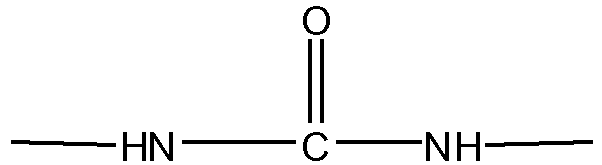

Claims (14)
- A silicone composition comprising of a monomer having at least one carbosiloxane linkage having the general formulae (1):
(R1R2R3)Si-Y1-[Si(R4R5)(Y2)]a-Si(R6R7)-Z (1)
wherein a is up to about 100;Y1 is a substituted or unsubstituted divalent alkyl linking group of 1 to about 10 carbon atoms;Y2 is oxygen;R1, R2, R3, R4, R5, R6, and R7 is independently selected from the group consisting of monovalent aliphatic, cycloaliphatic or aromatic or halogenated hydrocarbon groups of 1 to about 10 carbons;Z has the following general formulae (II)
-R11-B-X (II)
wherein R11 is a branched, divalent alkyl linking group having up to about 20 carbon atoms or a fluorinated hydrocarbon, a aralkyl or arylalkyl group, and B is a divalent hydrophilic functional moiety consisting of aliphatic, cycloaliphatic or aromatic hydrocarbons containing hetero atoms andX is a polymerizable group selected from the group consisting of substituted or unsubstituted unsaturated aliphatic or aromatic hydrocarbons, acrylates and methacrylates, or wherein R11 is a linear, divalent alkyl linking group having up to about 20 carbon atoms or a fluorinated hydrocarbon, an aralkyl or arylalkyl group, B is a divalent hydrophilic or hydrophobic functional moiety selected from the group of the following divalent moieties
-O-(C2H4O)p-(C3H6O)q-(C4H8O)r-
wherein p and q are independently 0 to about 100; r is 0 to about 50 and (p +q + r) is greater than 0,


- The silicone composition of claim 1, wherein each of R1, R2, R3, R4, R5, R6, R7, independently comprises a saturated monovalent hydrocarbon group of 1 to about 9 carbon atoms, a fluorinated hydrocarbon, an aralkyl or arylalkyl group, and R11 independently comprises a saturated divalent hydrocarbon group of up to about 9 carbon atoms.
- The silicone composition of claim 1, wherein B is selected from the group consisting of one of the following divalent moieties: -O-(C2H4O)p-(C3H6O)q-(C4H8O)r -wherein p and q are independently 0 to about 100; r is 0 to about 50 and (p +q + r) is greater than 0,


- The silicone composition of claim 1 wherein X is a polymerizable moiety having the general formula (III)

- The composition of claim 1 comprising a hydrophilic polyethylene glycol and having the general formulae shown below:

- A composition of claim 1 with formula

- The silicone composition of claim 1 wherein one of R1-R14 comprises a fluorinated hydrocarbon or
wherein each of R1-R14 independently comprises at least one moiety selected from the group consisting of saturated monovalent aliphatic or aromatic hydrocarbon having from 1 to about 9 carbon atoms, or
wherein B comprises at least one functional group consisting of alcohols, ethers, esters, amides, amines, acids and its salts, cyano, thio, urethane, urea, carbonate, carbamate, sulfonates, sulphonamides and phosphates. - A process of making the monomer having the formula (I) of claim 1 comprising reacting a silicone-containing compound having the general formulae (IV):
(R1R2R3)Si-Y1-[Si(R4R5)(Y2)]a-Si(R6R7)-H (IV)
wherein a is up to 100;Y1 is a substituted or unsubstituted divalent alkyl linking group of 1 to 10 carbon atoms;Y2 is oxygen;R1, R2, R3, R4, R5, R6, and R7 is independently selected from the group consisting of monovalent aliphatic, cycloaliphatic or aromatic or halogenated hydrocarbon groups of 1 to about 10 carbons;with terminally unsaturated group having the general formulae (V):
R15-B-M (V)
wherein R15 is branched unsaturated alkyl groups having up to about 20 carbon atoms, B is a divalent hydrophilic functional moiety consisting of aliphatic, cycloaliphatic or aromatic hydrocarbons and substituted or unsubstituted, saturated and unsaturated aliphatic, cycloaliphatic or aromatic hydrocarbons containing hetero atoms,wherein B comprise functionalities selected from the group consisting of alkyl, alcohol, ether, ester, amide, amine, acid and its salts, cyano, thio, urethane, urea, carbonate, carbamate, sulfonate, sulphonamide, phosphate and combinations thereof;M is selected from the group consisting of hydroxyl, halogen, epoxy and carboxylic acid group to produce functionalized carbosiloxane;and reacting the functionalized carbosiloxane with an alkylacryloyl compound having the following formula (VI):
- The process of claim 8, wherein said reaction of said functionalized carbosiloxane in an amount that ranges from about 5 to about 90 weight percent of the total composition with said alkylacryloyl compound in an amount that ranges from about 5 to about 80 weight percent of the total composition is carried out in the presence of at least one tertiary base or at least one ionic exchange resin (IER) and a low boiling polar solvent.
- A health care composition comprising the silicone composition of claim 1 or the monomer obtainable by the process of claim 8, which further comprises bioactives, anti-acne agents, anti-ageing agents, anti-caries agents, anti-fungal agents, anti-microbial agents, anti-oxidants, anti-cancer, anti-viral, anti-inflammatory, anti-coagulants, hemostatic agents, exfoliants, hormones, enzymes, medicinal compounds, biocides, external analgesics, oral care agents, oral care drugs, oxidizing agents, reducing agents, skin protectants, essential oils, insect repellents, UV light absorbing agents, solar filters, pigments, hydrating agents, vitamins and their combinations thereof.
- A health care product comprising the silicone composition of claim 1 or the monomer obtainable by the process of claim 8 wherein hydrogels, drug delivery systems, transdermal patches, wound healing patches, wound dressing patches, puncta plugs, ophtha coils, retinal implants, transdermal iontophoresis, scaffold for tissue engineering, anti-microbial devices, anti-bacterial devices, biofilm resistant coatings, anti-fungal devices, wound management devices, ophthalmic devices, bioinserts, prostheses and body implants are comprised.
- The personal care composition comprising the silicone composition of claim 1 or the monomer obtainable by the process of claim 8, which further comprises surfactants, emulsifiers, solvents, emollients, moisturizers, humectants, pigments, colorants, fragrances, biocides, preservatives, chelating agents, antioxidants, anti-microbial agents, anti-fungal agents, antiperspirant agents, exfoliants, hormones, enzymes, medicinal compounds, vitamins, alpha-hydroxy acids, beta-hydroxy acids, retinols, niacinamide, skin lightening agents, salts, electrolytes, alcohols, polyols, absorbing agents for ultraviolet radiation, botanical extracts, organic oils, waxes, thickening agents, particulate fillers, silicones, clays, plasticizers, occlusives, sensory enhancers, esters, resins, film formers, film forming emulsifiers, high refractive index materials and their combinations thereof.
- A personal care product comprising the silicone composition of claim 1 or the monomer obtainable by the process of claim 8 wherein antiperspirant/deodorants, including sprays, sticks and roll-on products, shaving products, skin lotions, moisturizers, toners, bath products, cleansing products, shampoos, conditioners, combined shampoo/conditioners, mousses, styling gels, hair sprays, hair dyes, hair color products, hair bleaches, waving products, hair straighteners, nail polish, nail polish remover, nail creams and lotions, cuticle softeners, sunscreen, insect repellent, anti-aging products, lipsticks, foundations, face powders, eye liners, eye shadows, blushes, makeup, mascaras, moisturizing preparations, foundations, body and hand preparations, skin care preparations, face and neck preparations, tonics, dressings, hair grooming aids, aerosol fixatives, fragrance preparations, aftershaves, make-up preparations, soft focus applications, night and day skin care preparations, non-coloring hair preparations, tanning preparations, synthetic and non-synthetic soap bars, hand liquids, nose strips, non-woven applications for personal care, baby lotions, baby baths and shampoos, baby conditioners, shaving preparations, cucumber slices, skin pads, make-up removers, facial cleansing products, cold creams, sunscreen products, mousses, spritzes, paste masks and muds, face masks, colognes and toilet waters, hair cuticle coats, shower gels, face and body washes, personal care rinse-off products, gels, foam baths, scrubbing cleansers, astringents, nail conditioners, eye shadow sticks, powders for face or eye, lip balms, lip glosses, hair care pump sprays and other non-aerosol sprays, hair-frizz-control gels, hair leave-in conditioners, hair pomades, hair de-tangling products, hair fixatives, hair bleach products, skin lotions, pre-shaves and pre-electric shaves, anhydrous creams and lotions, oil/water, water/oil, multiple and macro and micro emulsions, water-resistant creams and lotions, anti-acne preparations, mouth-washes, massage oils, toothpastes, clear gels and sticks, ointment bases, topical wound-healing products, aerosol talcs, barrier sprays, vitamin and anti-aging preparations, herbal-extract preparations, bath salts, bath and body milks, hair styling aids, hair-, eye-, nail-and skin-soft solid applications, controlled-release personal care products, hair conditioning mists, skin care moisturizing mists, skin wipes, pore skin wipes, pore cleaners, blemish reducers, skin exfoliators, skin desquamation enhancers, skin towelettes and cloths, depilatory preparations, personal care lubricants, nail coloring preparations, sunscreens, cosmetics, hair care products, skin care products, toothpastes, drug delivery systems for topical application of medicinal compositions that are to be applied to the skin are comprised.
- A pesticide formulation, a fertilizer formulation, a fertilizer coating, seed coating, anti-fouling coating or waterborne coating formulation comprising the silicone composition of claim 1 or the monomer obtainable by the process of claim 8.
Applications Claiming Priority (1)
| Application Number | Priority Date | Filing Date | Title |
|---|---|---|---|
| PCT/US2011/029164 WO2012128751A1 (en) | 2011-03-21 | 2011-03-21 | Organomodified carbosiloxane monomers containing compositions and uses thereof |
Publications (2)
| Publication Number | Publication Date |
|---|---|
| EP2688938A1 EP2688938A1 (en) | 2014-01-29 |
| EP2688938B1 true EP2688938B1 (en) | 2019-10-16 |
Family
ID=44625721
Family Applications (1)
| Application Number | Title | Priority Date | Filing Date |
|---|---|---|---|
| EP11713113.6A Active EP2688938B1 (en) | 2011-03-21 | 2011-03-21 | Organomodified carbosiloxane monomers containing compositions and uses thereof |
Country Status (8)
| Country | Link |
|---|---|
| EP (1) | EP2688938B1 (en) |
| JP (1) | JP5947874B2 (en) |
| KR (1) | KR20130139347A (en) |
| CN (1) | CN103547614A (en) |
| AU (1) | AU2011363043B2 (en) |
| BR (1) | BR112013024116A2 (en) |
| CA (1) | CA2829340C (en) |
| WO (1) | WO2012128751A1 (en) |
Families Citing this family (18)
| Publication number | Priority date | Publication date | Assignee | Title |
|---|---|---|---|---|
| US9039174B2 (en) | 2009-07-09 | 2015-05-26 | Bausch & Lomb Incorporated | Ethylenically unsaturated polymerizable groups comprising polycarbosiloxane monomers |
| CA2817229A1 (en) | 2010-11-08 | 2012-05-18 | Naihong Li | Gels and hydrogels |
| AU2011363044A1 (en) * | 2011-03-21 | 2013-09-26 | Momentive Performance Materials Inc. | Siloxane monomers containing hydrolysis resistance carbosiloxane linkage, process for their preparation and thin films containing the same for contact lens application |
| CN103210906B (en) * | 2013-02-26 | 2015-03-11 | 中国中化股份有限公司 | Application of organosilicon-modified high-molecular compound as seed coating film-forming agent |
| WO2014143926A1 (en) * | 2013-03-15 | 2014-09-18 | Bausch & Lomb Incorporated | Ethylenically unsaturated polymerizable groups comprising polycarbosiloxane monomers |
| WO2015039253A1 (en) * | 2013-09-19 | 2015-03-26 | Moasis Inc. | Cross-linked hydrophilic polymer coated seeds and methods of preparation thereof |
| US8877882B1 (en) * | 2013-10-04 | 2014-11-04 | Rochal Industries Llp | Non-self-adherent coating materials |
| EP3134461B1 (en) * | 2014-04-25 | 2018-02-14 | Novartis AG | Hydrophilized carbosiloxane vinylic monomers |
| CN104288064A (en) * | 2014-07-31 | 2015-01-21 | 广州市洁宝日用品有限公司 | Silky moisture-retaining hydrating mask and preparation method thereof |
| BR112018070253B1 (en) * | 2016-03-31 | 2022-07-19 | Momentive Performance Materials Inc | ADJUVANT COMPOSITION, AGROCHEMICAL FORMULATION, AGROCHEMICAL COMPOSITION, METHODS FOR INHIBITING THE DRIVE OF AN AGROCHEMICAL FORMULATION APPLIED TO A TARGET AREA, TO REINFORCE OR INCREASE DEPOSITION AND/OR RETENTION, PENETRATION AND/OR CAPTURE OF SPRAYED DROPLETS FROM THE AGROCHEMICAL FORMULATION AND FOR CONDITIONING WATER |
| CN106177874A (en) * | 2016-08-30 | 2016-12-07 | 郑州市久久不忘生物技术有限公司 | A kind of patche treating cough with asthma and preparation method thereof |
| SG11201906534XA (en) * | 2017-01-19 | 2019-08-27 | Jotun As | Antifouling composition |
| US11884779B2 (en) * | 2017-02-16 | 2024-01-30 | Momentive Performance Materials Inc. | Ionically modified silicones, compositions, and medical devices formed therefrom |
| CN108546336B (en) * | 2018-04-25 | 2020-11-10 | 上海交通大学 | Method for preparing reworkable cross-linked elastomer by utilizing transamination |
| CN109294242B (en) * | 2018-08-23 | 2021-05-04 | 润生药业有限公司 | Material for infant aerosol inhaler and preparation method thereof |
| CN109894990B (en) * | 2019-03-22 | 2020-12-18 | 湖南科技大学 | A flexible abrasive tool with dilatation characteristics and polishing method thereof |
| CN112480335A (en) * | 2020-11-18 | 2021-03-12 | 广州科莱瑞迪医疗器材股份有限公司 | Tissue compensation glue for radiotherapy and preparation method thereof |
| CN116218197B (en) * | 2022-12-14 | 2025-02-28 | 山东一诺威聚氨酯股份有限公司 | Antifouling and antibacterial thermoplastic polyurethane elastomer and preparation method thereof |
Family Cites Families (16)
| Publication number | Priority date | Publication date | Assignee | Title |
|---|---|---|---|---|
| JPS59185310A (en) * | 1983-04-06 | 1984-10-20 | Toyo Contact Lens Co Ltd | Soft contact lens composition permeable to oxygen |
| GB8819567D0 (en) * | 1988-08-17 | 1988-09-21 | Dow Corning Ltd | Carbosilane surfactants |
| US5298589A (en) * | 1992-07-16 | 1994-03-29 | Temple University-Of The Commonwealth System Of Higher Education | Highly functionalized polycyclosiloxanes and their polymerization into thermally reversible living rubbers |
| CA2221389C (en) | 1996-11-18 | 2009-01-27 | Kenrick M. Lewis | Treatment of polyethers prior to hydrosilylation |
| US6391999B1 (en) * | 1998-02-06 | 2002-05-21 | Rensselaer Polytechnic Institute | Epoxy alkoxy siloxane oligomers |
| US6822016B2 (en) * | 2001-09-10 | 2004-11-23 | Johnson & Johnson Vision Care, Inc. | Biomedical devices containing internal wetting agents |
| DE19934407A1 (en) * | 1999-07-22 | 2001-01-25 | Espe Dental Ag | Novel hydrolyzable and polymerizable silanes are useful in dental applications for the production of filler, cement, crown- and bridging material, blending agents, lacquer, sealers and primers |
| EP1302475A4 (en) * | 2000-06-30 | 2003-09-03 | Japan Science & Tech Corp | CARBOSILANDENDRIMERS CONTAINING SUGAR CHAINS, METHOD FOR THE PRODUCTION THEREOF, MEANS FOR NEUTRALIZING VEROTOXIN AND ANTIVIRAL AGENTS |
| US7645720B2 (en) | 2005-12-13 | 2010-01-12 | Momentive Performance Materials Inc. | Extreme environment surfactant compositions comprising hydrolysis resistant organomodified disiloxane surfactants |
| US7259220B1 (en) | 2006-07-13 | 2007-08-21 | General Electric Company | Selective hydrosilylation method |
| US20090173913A1 (en) * | 2007-12-26 | 2009-07-09 | Momentive Performance Materials Inc. | Hydrolysis resistant organomodified disiloxane ionic surfactants |
| US20090171108A1 (en) * | 2007-12-26 | 2009-07-02 | Momentive Performance Materials Inc. | Mixtures comprising hydrolysis resistant organomodified disiloxane ionic surfactants |
| KR101617831B1 (en) * | 2008-10-03 | 2016-05-03 | 모멘티브 퍼포먼스 머티리얼즈 인크. | Hydrophilic silicone monomers, process for their preparation and thin films containing the same |
| US7994356B2 (en) * | 2009-07-09 | 2011-08-09 | Bausch & Lomb Incorporated | Mono ethylenically unsaturated polycarbosiloxane monomers |
| CN102483467B (en) * | 2009-07-09 | 2014-01-08 | 博士伦公司 | Mono ethylenically unsaturated polymerizable group containing polycarbosiloxane monomers |
| AU2011363044A1 (en) * | 2011-03-21 | 2013-09-26 | Momentive Performance Materials Inc. | Siloxane monomers containing hydrolysis resistance carbosiloxane linkage, process for their preparation and thin films containing the same for contact lens application |
-
2011
- 2011-03-21 BR BR112013024116A patent/BR112013024116A2/en not_active Application Discontinuation
- 2011-03-21 AU AU2011363043A patent/AU2011363043B2/en not_active Expired - Fee Related
- 2011-03-21 EP EP11713113.6A patent/EP2688938B1/en active Active
- 2011-03-21 WO PCT/US2011/029164 patent/WO2012128751A1/en not_active Ceased
- 2011-03-21 CA CA2829340A patent/CA2829340C/en not_active Expired - Fee Related
- 2011-03-21 KR KR1020137027384A patent/KR20130139347A/en not_active Abandoned
- 2011-03-21 CN CN201180071089.5A patent/CN103547614A/en active Pending
- 2011-03-21 JP JP2014501045A patent/JP5947874B2/en active Active
Non-Patent Citations (1)
| Title |
|---|
| None * |
Also Published As
| Publication number | Publication date |
|---|---|
| BR112013024116A2 (en) | 2016-12-13 |
| EP2688938A1 (en) | 2014-01-29 |
| JP2014509612A (en) | 2014-04-21 |
| AU2011363043B2 (en) | 2015-05-14 |
| AU2011363043A1 (en) | 2013-09-26 |
| CA2829340A1 (en) | 2012-09-27 |
| KR20130139347A (en) | 2013-12-20 |
| CA2829340C (en) | 2017-10-03 |
| CN103547614A (en) | 2014-01-29 |
| WO2012128751A1 (en) | 2012-09-27 |
| JP5947874B2 (en) | 2016-07-06 |
Similar Documents
| Publication | Publication Date | Title |
|---|---|---|
| US10391179B2 (en) | Organomodified carbosiloxane monomers containing compositions and uses thereof | |
| CA2829340C (en) | Organomodified carbosiloxane monomers containing compositions and uses thereof | |
| US10131794B2 (en) | Network copolymer crosslinked compositions and products comprising the same | |
| US9200119B2 (en) | Silicon-containing zwitterionic linear copolymer composition | |
| EP3805328B1 (en) | Silicone ionomer composition | |
| AU2007348959B2 (en) | Hydrolysis resistant organomodified trisiloxane surfactants | |
| US8470894B2 (en) | Hydrolysis resistant organomodified trisiloxane ionic surfactants | |
| US20110028569A1 (en) | Mixtures of hydrolysis resistant organomodified trisiloxane ionic surfactants | |
| BRPI0711766B1 (en) | Agricultural composition, cosmetic composition, household care composition, aqueous and non-aqueous emulsions thereof, and coating composition | |
| WO2007044691A1 (en) | Hydrolysis resistant organomodified disiloxane surfactants | |
| EP2016083A1 (en) | Hydrolysis resistant organomodified silylated surfactants | |
| EP1426398B1 (en) | Method of making emulsion containing quaternary ammonium functional silanes and siloxanes | |
| US20110201505A1 (en) | Mixtures comprising hydrolysis resistant organomodified disiloxane ionic surfactants | |
| US8367740B2 (en) | Hydrolysis resistant organomodified disiloxane ionic surfactants |
Legal Events
| Date | Code | Title | Description |
|---|---|---|---|
| PUAI | Public reference made under article 153(3) epc to a published international application that has entered the european phase |
Free format text: ORIGINAL CODE: 0009012 |
|
| 17P | Request for examination filed |
Effective date: 20130918 |
|
| AK | Designated contracting states |
Kind code of ref document: A1 Designated state(s): AL AT BE BG CH CY CZ DE DK EE ES FI FR GB GR HR HU IE IS IT LI LT LU LV MC MK MT NL NO PL PT RO RS SE SI SK SM TR |
|
| DAX | Request for extension of the european patent (deleted) | ||
| RAP1 | Party data changed (applicant data changed or rights of an application transferred) |
Owner name: MOMENTIVE PERFORMANCE MATERIALS INC. |
|
| 17Q | First examination report despatched |
Effective date: 20160610 |
|
| STAA | Information on the status of an ep patent application or granted ep patent |
Free format text: STATUS: EXAMINATION IS IN PROGRESS |
|
| GRAP | Despatch of communication of intention to grant a patent |
Free format text: ORIGINAL CODE: EPIDOSNIGR1 |
|
| STAA | Information on the status of an ep patent application or granted ep patent |
Free format text: STATUS: GRANT OF PATENT IS INTENDED |
|
| INTG | Intention to grant announced |
Effective date: 20190326 |
|
| GRAS | Grant fee paid |
Free format text: ORIGINAL CODE: EPIDOSNIGR3 |
|
| RIN1 | Information on inventor provided before grant (corrected) |
Inventor name: SAXENA, ANUBHAV Inventor name: LEWIS, KENRICK, M. Inventor name: SENTHILKUMAR, UMAPATHY |
|
| GRAA | (expected) grant |
Free format text: ORIGINAL CODE: 0009210 |
|
| STAA | Information on the status of an ep patent application or granted ep patent |
Free format text: STATUS: THE PATENT HAS BEEN GRANTED |
|
| AK | Designated contracting states |
Kind code of ref document: B1 Designated state(s): AL AT BE BG CH CY CZ DE DK EE ES FI FR GB GR HR HU IE IS IT LI LT LU LV MC MK MT NL NO PL PT RO RS SE SI SK SM TR |
|
| REG | Reference to a national code |
Ref country code: GB Ref legal event code: FG4D |
|
| REG | Reference to a national code |
Ref country code: CH Ref legal event code: EP |
|
| REG | Reference to a national code |
Ref country code: DE Ref legal event code: R096 Ref document number: 602011062743 Country of ref document: DE |
|
| REG | Reference to a national code |
Ref country code: IE Ref legal event code: FG4D |
|
| REG | Reference to a national code |
Ref country code: AT Ref legal event code: REF Ref document number: 1191198 Country of ref document: AT Kind code of ref document: T Effective date: 20191115 |
|
| REG | Reference to a national code |
Ref country code: NL Ref legal event code: MP Effective date: 20191016 |
|
| REG | Reference to a national code |
Ref country code: LT Ref legal event code: MG4D |
|
| REG | Reference to a national code |
Ref country code: AT Ref legal event code: MK05 Ref document number: 1191198 Country of ref document: AT Kind code of ref document: T Effective date: 20191016 |
|
| PG25 | Lapsed in a contracting state [announced via postgrant information from national office to epo] |
Ref country code: BG Free format text: LAPSE BECAUSE OF FAILURE TO SUBMIT A TRANSLATION OF THE DESCRIPTION OR TO PAY THE FEE WITHIN THE PRESCRIBED TIME-LIMIT Effective date: 20200116 Ref country code: PT Free format text: LAPSE BECAUSE OF FAILURE TO SUBMIT A TRANSLATION OF THE DESCRIPTION OR TO PAY THE FEE WITHIN THE PRESCRIBED TIME-LIMIT Effective date: 20200217 Ref country code: FI Free format text: LAPSE BECAUSE OF FAILURE TO SUBMIT A TRANSLATION OF THE DESCRIPTION OR TO PAY THE FEE WITHIN THE PRESCRIBED TIME-LIMIT Effective date: 20191016 Ref country code: NO Free format text: LAPSE BECAUSE OF FAILURE TO SUBMIT A TRANSLATION OF THE DESCRIPTION OR TO PAY THE FEE WITHIN THE PRESCRIBED TIME-LIMIT Effective date: 20200116 Ref country code: GR Free format text: LAPSE BECAUSE OF FAILURE TO SUBMIT A TRANSLATION OF THE DESCRIPTION OR TO PAY THE FEE WITHIN THE PRESCRIBED TIME-LIMIT Effective date: 20200117 Ref country code: PL Free format text: LAPSE BECAUSE OF FAILURE TO SUBMIT A TRANSLATION OF THE DESCRIPTION OR TO PAY THE FEE WITHIN THE PRESCRIBED TIME-LIMIT Effective date: 20191016 Ref country code: SE Free format text: LAPSE BECAUSE OF FAILURE TO SUBMIT A TRANSLATION OF THE DESCRIPTION OR TO PAY THE FEE WITHIN THE PRESCRIBED TIME-LIMIT Effective date: 20191016 Ref country code: NL Free format text: LAPSE BECAUSE OF FAILURE TO SUBMIT A TRANSLATION OF THE DESCRIPTION OR TO PAY THE FEE WITHIN THE PRESCRIBED TIME-LIMIT Effective date: 20191016 Ref country code: LV Free format text: LAPSE BECAUSE OF FAILURE TO SUBMIT A TRANSLATION OF THE DESCRIPTION OR TO PAY THE FEE WITHIN THE PRESCRIBED TIME-LIMIT Effective date: 20191016 Ref country code: LT Free format text: LAPSE BECAUSE OF FAILURE TO SUBMIT A TRANSLATION OF THE DESCRIPTION OR TO PAY THE FEE WITHIN THE PRESCRIBED TIME-LIMIT Effective date: 20191016 Ref country code: ES Free format text: LAPSE BECAUSE OF FAILURE TO SUBMIT A TRANSLATION OF THE DESCRIPTION OR TO PAY THE FEE WITHIN THE PRESCRIBED TIME-LIMIT Effective date: 20191016 Ref country code: AT Free format text: LAPSE BECAUSE OF FAILURE TO SUBMIT A TRANSLATION OF THE DESCRIPTION OR TO PAY THE FEE WITHIN THE PRESCRIBED TIME-LIMIT Effective date: 20191016 |
|
| PG25 | Lapsed in a contracting state [announced via postgrant information from national office to epo] |
Ref country code: IS Free format text: LAPSE BECAUSE OF FAILURE TO SUBMIT A TRANSLATION OF THE DESCRIPTION OR TO PAY THE FEE WITHIN THE PRESCRIBED TIME-LIMIT Effective date: 20200224 Ref country code: HR Free format text: LAPSE BECAUSE OF FAILURE TO SUBMIT A TRANSLATION OF THE DESCRIPTION OR TO PAY THE FEE WITHIN THE PRESCRIBED TIME-LIMIT Effective date: 20191016 Ref country code: RS Free format text: LAPSE BECAUSE OF FAILURE TO SUBMIT A TRANSLATION OF THE DESCRIPTION OR TO PAY THE FEE WITHIN THE PRESCRIBED TIME-LIMIT Effective date: 20191016 |
|
| PG25 | Lapsed in a contracting state [announced via postgrant information from national office to epo] |
Ref country code: AL Free format text: LAPSE BECAUSE OF FAILURE TO SUBMIT A TRANSLATION OF THE DESCRIPTION OR TO PAY THE FEE WITHIN THE PRESCRIBED TIME-LIMIT Effective date: 20191016 |
|
| REG | Reference to a national code |
Ref country code: DE Ref legal event code: R097 Ref document number: 602011062743 Country of ref document: DE |
|
| PG2D | Information on lapse in contracting state deleted |
Ref country code: IS |
|
| PG25 | Lapsed in a contracting state [announced via postgrant information from national office to epo] |
Ref country code: DK Free format text: LAPSE BECAUSE OF FAILURE TO SUBMIT A TRANSLATION OF THE DESCRIPTION OR TO PAY THE FEE WITHIN THE PRESCRIBED TIME-LIMIT Effective date: 20191016 Ref country code: EE Free format text: LAPSE BECAUSE OF FAILURE TO SUBMIT A TRANSLATION OF THE DESCRIPTION OR TO PAY THE FEE WITHIN THE PRESCRIBED TIME-LIMIT Effective date: 20191016 Ref country code: CZ Free format text: LAPSE BECAUSE OF FAILURE TO SUBMIT A TRANSLATION OF THE DESCRIPTION OR TO PAY THE FEE WITHIN THE PRESCRIBED TIME-LIMIT Effective date: 20191016 Ref country code: RO Free format text: LAPSE BECAUSE OF FAILURE TO SUBMIT A TRANSLATION OF THE DESCRIPTION OR TO PAY THE FEE WITHIN THE PRESCRIBED TIME-LIMIT Effective date: 20191016 Ref country code: IS Free format text: LAPSE BECAUSE OF FAILURE TO SUBMIT A TRANSLATION OF THE DESCRIPTION OR TO PAY THE FEE WITHIN THE PRESCRIBED TIME-LIMIT Effective date: 20200216 |
|
| PLBE | No opposition filed within time limit |
Free format text: ORIGINAL CODE: 0009261 |
|
| STAA | Information on the status of an ep patent application or granted ep patent |
Free format text: STATUS: NO OPPOSITION FILED WITHIN TIME LIMIT |
|
| PG25 | Lapsed in a contracting state [announced via postgrant information from national office to epo] |
Ref country code: SM Free format text: LAPSE BECAUSE OF FAILURE TO SUBMIT A TRANSLATION OF THE DESCRIPTION OR TO PAY THE FEE WITHIN THE PRESCRIBED TIME-LIMIT Effective date: 20191016 Ref country code: IT Free format text: LAPSE BECAUSE OF FAILURE TO SUBMIT A TRANSLATION OF THE DESCRIPTION OR TO PAY THE FEE WITHIN THE PRESCRIBED TIME-LIMIT Effective date: 20191016 Ref country code: SK Free format text: LAPSE BECAUSE OF FAILURE TO SUBMIT A TRANSLATION OF THE DESCRIPTION OR TO PAY THE FEE WITHIN THE PRESCRIBED TIME-LIMIT Effective date: 20191016 |
|
| 26N | No opposition filed |
Effective date: 20200717 |
|
| PG25 | Lapsed in a contracting state [announced via postgrant information from national office to epo] |
Ref country code: MC Free format text: LAPSE BECAUSE OF FAILURE TO SUBMIT A TRANSLATION OF THE DESCRIPTION OR TO PAY THE FEE WITHIN THE PRESCRIBED TIME-LIMIT Effective date: 20191016 |
|
| REG | Reference to a national code |
Ref country code: CH Ref legal event code: PL |
|
| PG25 | Lapsed in a contracting state [announced via postgrant information from national office to epo] |
Ref country code: SI Free format text: LAPSE BECAUSE OF FAILURE TO SUBMIT A TRANSLATION OF THE DESCRIPTION OR TO PAY THE FEE WITHIN THE PRESCRIBED TIME-LIMIT Effective date: 20191016 |
|
| REG | Reference to a national code |
Ref country code: BE Ref legal event code: MM Effective date: 20200331 |
|
| PG25 | Lapsed in a contracting state [announced via postgrant information from national office to epo] |
Ref country code: LU Free format text: LAPSE BECAUSE OF NON-PAYMENT OF DUE FEES Effective date: 20200321 |
|
| PG25 | Lapsed in a contracting state [announced via postgrant information from national office to epo] |
Ref country code: IE Free format text: LAPSE BECAUSE OF NON-PAYMENT OF DUE FEES Effective date: 20200321 Ref country code: LI Free format text: LAPSE BECAUSE OF NON-PAYMENT OF DUE FEES Effective date: 20200331 Ref country code: CH Free format text: LAPSE BECAUSE OF NON-PAYMENT OF DUE FEES Effective date: 20200331 |
|
| PG25 | Lapsed in a contracting state [announced via postgrant information from national office to epo] |
Ref country code: BE Free format text: LAPSE BECAUSE OF NON-PAYMENT OF DUE FEES Effective date: 20200331 |
|
| PG25 | Lapsed in a contracting state [announced via postgrant information from national office to epo] |
Ref country code: TR Free format text: LAPSE BECAUSE OF FAILURE TO SUBMIT A TRANSLATION OF THE DESCRIPTION OR TO PAY THE FEE WITHIN THE PRESCRIBED TIME-LIMIT Effective date: 20191016 Ref country code: MT Free format text: LAPSE BECAUSE OF FAILURE TO SUBMIT A TRANSLATION OF THE DESCRIPTION OR TO PAY THE FEE WITHIN THE PRESCRIBED TIME-LIMIT Effective date: 20191016 Ref country code: CY Free format text: LAPSE BECAUSE OF FAILURE TO SUBMIT A TRANSLATION OF THE DESCRIPTION OR TO PAY THE FEE WITHIN THE PRESCRIBED TIME-LIMIT Effective date: 20191016 |
|
| PG25 | Lapsed in a contracting state [announced via postgrant information from national office to epo] |
Ref country code: MK Free format text: LAPSE BECAUSE OF FAILURE TO SUBMIT A TRANSLATION OF THE DESCRIPTION OR TO PAY THE FEE WITHIN THE PRESCRIBED TIME-LIMIT Effective date: 20191016 |
|
| P01 | Opt-out of the competence of the unified patent court (upc) registered |
Effective date: 20230513 |
|
| PGFP | Annual fee paid to national office [announced via postgrant information from national office to epo] |
Ref country code: GB Payment date: 20260319 Year of fee payment: 16 |
|
| PGFP | Annual fee paid to national office [announced via postgrant information from national office to epo] |
Ref country code: DE Payment date: 20260320 Year of fee payment: 16 |
|
| PGFP | Annual fee paid to national office [announced via postgrant information from national office to epo] |
Ref country code: FR Payment date: 20260323 Year of fee payment: 16 |