EP2686329B1 - Ruthenium complexes comprising paracyclophane and carbonyl ligands, and their use as catalyst - Google Patents
Ruthenium complexes comprising paracyclophane and carbonyl ligands, and their use as catalyst Download PDFInfo
- Publication number
- EP2686329B1 EP2686329B1 EP12712345.3A EP12712345A EP2686329B1 EP 2686329 B1 EP2686329 B1 EP 2686329B1 EP 12712345 A EP12712345 A EP 12712345A EP 2686329 B1 EP2686329 B1 EP 2686329B1
- Authority
- EP
- European Patent Office
- Prior art keywords
- formula
- solvent
- hal
- complex
- ruthenium complex
- Prior art date
- Legal status (The legal status is an assumption and is not a legal conclusion. Google has not performed a legal analysis and makes no representation as to the accuracy of the status listed.)
- Active
Links
Classifications
-
- C—CHEMISTRY; METALLURGY
- C07—ORGANIC CHEMISTRY
- C07F—ACYCLIC, CARBOCYCLIC OR HETEROCYCLIC COMPOUNDS CONTAINING ELEMENTS OTHER THAN CARBON, HYDROGEN, HALOGEN, OXYGEN, NITROGEN, SULFUR, SELENIUM OR TELLURIUM
- C07F15/00—Compounds containing elements of Groups 8, 9, 10 or 18 of the Periodic Table
- C07F15/0006—Compounds containing elements of Groups 8, 9, 10 or 18 of the Periodic Table compounds of the platinum group
- C07F15/0046—Ruthenium compounds
- C07F15/0053—Ruthenium compounds without a metal-carbon linkage
-
- B—PERFORMING OPERATIONS; TRANSPORTING
- B01—PHYSICAL OR CHEMICAL PROCESSES OR APPARATUS IN GENERAL
- B01J—CHEMICAL OR PHYSICAL PROCESSES, e.g. CATALYSIS OR COLLOID CHEMISTRY; THEIR RELEVANT APPARATUS
- B01J31/00—Catalysts comprising hydrides, coordination complexes or organic compounds
- B01J31/16—Catalysts comprising hydrides, coordination complexes or organic compounds containing coordination complexes
- B01J31/24—Phosphines, i.e. phosphorus bonded to only carbon atoms, or to both carbon and hydrogen atoms, including e.g. sp2-hybridised phosphorus compounds such as phosphabenzene, phosphole or anionic phospholide ligands
- B01J31/2404—Cyclic ligands, including e.g. non-condensed polycyclic ligands, the phosphine-P atom being a ring member or a substituent on the ring
- B01J31/2409—Cyclic ligands, including e.g. non-condensed polycyclic ligands, the phosphine-P atom being a ring member or a substituent on the ring with more than one complexing phosphine-P atom
-
- C—CHEMISTRY; METALLURGY
- C07—ORGANIC CHEMISTRY
- C07F—ACYCLIC, CARBOCYCLIC OR HETEROCYCLIC COMPOUNDS CONTAINING ELEMENTS OTHER THAN CARBON, HYDROGEN, HALOGEN, OXYGEN, NITROGEN, SULFUR, SELENIUM OR TELLURIUM
- C07F15/00—Compounds containing elements of Groups 8, 9, 10 or 18 of the Periodic Table
- C07F15/0006—Compounds containing elements of Groups 8, 9, 10 or 18 of the Periodic Table compounds of the platinum group
- C07F15/0046—Ruthenium compounds
-
- B—PERFORMING OPERATIONS; TRANSPORTING
- B01—PHYSICAL OR CHEMICAL PROCESSES OR APPARATUS IN GENERAL
- B01J—CHEMICAL OR PHYSICAL PROCESSES, e.g. CATALYSIS OR COLLOID CHEMISTRY; THEIR RELEVANT APPARATUS
- B01J2231/00—Catalytic reactions performed with catalysts classified in B01J31/00
- B01J2231/30—Addition reactions at carbon centres, i.e. to either C-C or C-X multiple bonds
- B01J2231/32—Addition reactions to C=C or C-C triple bonds
- B01J2231/321—Hydroformylation, metalformylation, carbonylation or hydroaminomethylation
-
- B—PERFORMING OPERATIONS; TRANSPORTING
- B01—PHYSICAL OR CHEMICAL PROCESSES OR APPARATUS IN GENERAL
- B01J—CHEMICAL OR PHYSICAL PROCESSES, e.g. CATALYSIS OR COLLOID CHEMISTRY; THEIR RELEVANT APPARATUS
- B01J2231/00—Catalytic reactions performed with catalysts classified in B01J31/00
- B01J2231/50—Redistribution or isomerisation reactions of C-C, C=C or C-C triple bonds
- B01J2231/52—Isomerisation reactions
-
- B—PERFORMING OPERATIONS; TRANSPORTING
- B01—PHYSICAL OR CHEMICAL PROCESSES OR APPARATUS IN GENERAL
- B01J—CHEMICAL OR PHYSICAL PROCESSES, e.g. CATALYSIS OR COLLOID CHEMISTRY; THEIR RELEVANT APPARATUS
- B01J2231/00—Catalytic reactions performed with catalysts classified in B01J31/00
- B01J2231/60—Reduction reactions, e.g. hydrogenation
-
- B—PERFORMING OPERATIONS; TRANSPORTING
- B01—PHYSICAL OR CHEMICAL PROCESSES OR APPARATUS IN GENERAL
- B01J—CHEMICAL OR PHYSICAL PROCESSES, e.g. CATALYSIS OR COLLOID CHEMISTRY; THEIR RELEVANT APPARATUS
- B01J2531/00—Additional information regarding catalytic systems classified in B01J31/00
- B01J2531/02—Compositional aspects of complexes used, e.g. polynuclearity
- B01J2531/0261—Complexes comprising ligands with non-tetrahedral chirality
- B01J2531/0263—Planar chiral ligands, e.g. derived from donor-substituted paracyclophanes and metallocenes or from substituted arenes
-
- B—PERFORMING OPERATIONS; TRANSPORTING
- B01—PHYSICAL OR CHEMICAL PROCESSES OR APPARATUS IN GENERAL
- B01J—CHEMICAL OR PHYSICAL PROCESSES, e.g. CATALYSIS OR COLLOID CHEMISTRY; THEIR RELEVANT APPARATUS
- B01J2531/00—Additional information regarding catalytic systems classified in B01J31/00
- B01J2531/80—Complexes comprising metals of Group VIII as the central metal
- B01J2531/82—Metals of the platinum group
- B01J2531/821—Ruthenium
Definitions
- the present invention relates to ruthenium complexes and, in particular, ruthenium complexes comprising paracyclophane and carbonyl ligands.
- Paracyclophanes and in particular [2.2]-paracyclophane derivatives are established ligands for transition metal-catalysed asymmetric reactions (see for example, S. E. Gibson and J. D. Knight, Org. Biomol. Chem., 2003, 1, 1256-1269 ).
- paracyclophane bis(phosphines) have attracted considerable attention because catalysts derived from them show high levels of activity and selectivity in a number of useful asymmetric transformations.
- WO 97/47632 describes paracyclophane bis(phosphine) ligands and rhodium (Rh), ruthenium (Ru), iridium (Ir) or palladium (Pd) catalysts derived therefrom for asymmetric hydrogenation, isomerization, hydroboration, cyclization, arylation, alkylation and amination reactions.
- the ligands described have the formula depicted below; Where both X groups are identical, these ligands possess C 2 symmetry, that is they are chiral and have a C 2 axis of symmetry.
- the present invention provides a ruthenium complex of formula (1), (1b), (1c) or (1d): [Ru Hal 2 L CO S] (1a) [Ru 2 Hal 4 L 2 (CO) 2 ] (1b) [Ru 2 Hal 4 L 2 CO] (1c) [Ru Hal 2 L (CO) 2 ] (1d) wherein:
- Hal is a halogen and may be selected from the group consisting of chlorine, bromine and iodine. In one embodiment, Hal is preferably chlorine.
- L is a substituted or unsubstituted paracyclophane ligand of formula (2).
- Linking groups X 1 and X 2 provide links between the benzene rings of the paracyclophane structure that comprise between 2 and 4 carbon atoms.
- X 1 and X 2 may be linear, branched or cyclic structures where the link is formed via 2, 3 or 4 carbon atoms.
- the links may, in addition to the carbon atoms, contain heteroatoms such as O, N or S (where the N atom may in turn be bonded to an alkyl group such as CH 3 , C 2 H 5 , C 3 H 7 or C 4 H 9 or an aryl group, and the S atom may be bonded to an alkyl or aryl group or be part of an SO or SO 2 moiety) and/or the carbon atoms in the linking group may be substituted with a halide, e.g. one or more fluorine atoms.
- a halide e.g. one or more fluorine atoms.
- linking groups X 1 and X 2 may independently be for example -(CH 2 ) 2-4 -, -CH 2 OCH 2 -, -CH 2 N(CH 3 )CH 2 -, -CH 2 SO 2 CH 2 -, -C 2 F 4 - or ortho, meta or para-C 6 H 4 .
- Such modification of the linking group may be useful for adapting the substituted paracyclophane to different reaction conditions, e.g. solvents.
- the linking groups comprise -(C 2 H 4 )-, -(C 3 H 6 )- or -(C 4 H 8 )-. More preferably X 1 and X 2 are the same and most preferably X 1 and X 2 are both -(C 2 H 4 )-.
- the paracyclophane is a bis(phosphine) where each Y 1 , Y 2 , Y 3 and Y 4 may independently be straight chain or branched alkyl groups (e.g. C 1 -C 20 ) such as methyl, ethyl, propyl, iso-propyl, butyl, iso-butyl, sec-butyl, tert-butyl, pentyl, hexyl, heptyl, octyl, nonyl, decyl, dodecyl, and stearyl, cycloalkyl groups (e.g.
- C 3 -C 10 such as cyclopropyl, cyclobutyl, cyclopentyl, cyclohexyl or adamantyl, or aryl groups (e.g. C 6 -C 20 aryl) such as phenyl, naphthyl or anthracyl.
- the alkyl groups may be optionally substituted with one or more substituents such as halide (Cl, Br, F or I) or alkoxy groups, e.g. methoxy, ethoxy or propoxy groups.
- the aryl groups may be optionally substituted with one or more substituents such as halide (Cl, Br, F or I), methyl, propyl (n- or i-), butyl (n-, i- or t-), trifluoromethyl, methoxy or dimethylamino groups.
- substituents such as halide (Cl, Br, F or I), methyl, propyl (n- or i-), butyl (n-, i- or t-), trifluoromethyl, methoxy or dimethylamino groups.
- Suitable substituted aryl groups include 4-methylphenyl, 3,5-dimethylphenyl, 4-methoxyphenyl, 4-methoxy-3,5-dimethylphenyl, 4-methoxy-3,5-diisopropylphenyl, 4-methoxy-3,5-ditertbutylphenyl, 3,5-diisopropylphenyl, 3,5-ditertbutylphenyl, 4-dimethylamino-3,5-dimethylphenyl, 4-dimethylamino-3,5-diisopropylphenyl, 4-dimethylamino-3,5-ditertbutylphenyl and fluorenyl.
- Substituted or unsubstituted heteroaryl groups such as pyridyl or furanyl may also be used.
- Y 1 and Y 2 and/or Y 3 and Y 4 on each phosphorus atom may be linked so as to form a ring structure incorporating the phosphorus atom.
- preferably Y 1 and Y 2 and/or Y 3 and Y 4 are linked so as to provide each phosphorus atom in a 4- to 7-membered ring.
- Y 1 and Y 2 and/or Y 3 and Y 4 are the same and are phenyl or substituted phenyl groups (e.g. dimethylphenyl groups, such as 3,5-dimethylphenyl or ditertbutylphenyl groups such as 3,5-ditertbutylphenyl).
- phenyl or substituted phenyl groups e.g. dimethylphenyl groups, such as 3,5-dimethylphenyl or ditertbutylphenyl groups such as 3,5-ditertbutylphenyl.
- substituting groups Z 1 , Z 2 and Z 3 depending upon their number and position replace hydrogen atoms on one or both benzene rings of the paracyclophane (2).
- Z 1 , Z 2 or Z 3 may independently be non-functional group-containing substituting groups such as branched or linear alkyl (e.g. C 1 -C 30 , preferably C 1 -C 20 , more preferably C 1 -C 10 as described above for Y 1 , Y 2 , Y 3 and Y 4 ) or aryl (e.g.
- C 6 -C 20 -aryl such as phenyl, naphthyl or anthracyl
- aralkyl or alkaryl e.g. benzyl, -CH 2 C 6 H 5
- substituting groups may be effective in altering the physical, electronic and/or steric properties of the paracyclophane for example where the paracyclophane is used as part of a transition metal catalyst complex.
- Z 1 , Z 2 or Z 3 may be substituting groups that comprise one or more functional groups that may, if desired, be used to alter the electronic properties of the ligand, facilitate chiral resolution of the paracyclophane ligand or an intermediate thereof and/or covalently bond the paracyclophane ligand (or an intermediate thereof) and hence a catalyst derived therefrom, to a suitably reactive solid support.
- substituting groups Z 1 , Z 2 and Z 3 may independently optionally comprise one or more functional groups.
- Suitable functional groups include halide (Cl, Br, F or I), hydroxyl, alkoxy (i.e. -OR where e.g.
- aralkyloxy i.
- These functional groups may, where appropriate, be directly bonded to the benzene ring in the paracyclophane ligand or may be present in alkyl (e.g. C 1 -C 30 as described above for Y 1 , Y 2 , Y 3 and Y 4 ), aryl or alkyl-aryl groups bonded to the benzene ring.
- Z 1 , Z 2 or Z 3 on one benzene ring in the paracyclophane structure may be the same or different from Z 1 , Z 2 or Z 3 on the other benzene ring, i.e. (Z 1 ) a , (Z 2 ) b and (Z 3 ) c may be the same or different from (Z 1 )d, (Z 2 ) e , and (Z 3 ) f .
- the substituting group on each benzene ring in the paracyclophane structure may be in an ortho (Z 3 ), meta (Z 2 ) and/or para (Z 1 ) position to the P(Y 1 Y 2 ) and P(Y 3 Y 4 ) groups.
- the substituent When the substituent is at the para-position of the benzene ring it may enhance the electronic effects on the P(Y 1 Y 2 ) and P(Y 3 Y 4 ) groups and permits, by choice of suitable Z 1 substituents the possibility of electronic fine-tuning of the ligand to enhance its effect when part of a catalyst for different reactions and substrates.
- the steric properties of the ligand may be altered to effect changes in catalyst selectivity.
- the substituting groups may also be used to alter the physical properties of the paracyclophane e.g. its stability in air, towards water, or its solubility in different solvents.
- the substituting group on each benzene ring in the paracyclophane is in the para (Z 1 ) position to the P(Y 1 Y 2 ) or P(Y 3 Y 4 ) groups.
- a + b + c + d + e + f 0.
- the paracyclophane (2) is unsubstituted and is known as a Phanephos ligand.
- the paracyclophane (2) may be Phanephos or Xyl-Phanephos.
- Paracyclophanes suitable for use as ligands, include but are not restricted to the following:
- S is a solvent ligand and may be selected from the group consisting of amides (such as dimethylformamide or dimethylacetamide), N-heterocyles (e.g. pyridine), ketones (such as acetone, methylethyl ketone), alcohols (e.g. methanol, ethanol, 1-propanol or 2-propanol), esters (such as ethylformate or ethylacetate), aromatic solvents (e.g. benzene, toluene or a xylene), chlorinated alkanes (such as dichloromethane or chloroform), formic acid, dimethylsulfoxide and acetonitrile.
- the solvent ligand S is dimethylformamide (DMF).
- the ligands form an octahedral or substantially octahedral molecular geometry around the ruthenium ions in the complexes of formulae (1a), (1b), (1c) and (1d). All isomers of the complexes therefore are included within the scope of the invention, such as those illustrated below.
- the paracyclophane ligand L is represented as [Ru Hal 2 L CO S] (1a): [Ru 2 Hal 4 L 2 (CO) 2 ] (1b): [Ru 2 Hal 4 L 2 CO] (1c): [Ru Hal 2 L (CO )2 ] (1d):
- complexes of formulae (1b) and (1c) are dimeric i.e. two ruthenium species, which may be the same or different, are linked together.
- the complex appears to have two bridging halogen atoms, whereas (1c) has three bridging halogen atoms.
- Complex (1c) also comprises a single CO ligand.
- the ruthenium complex is a complex of formula (1a).
- the complex of formula (1a) is a solid further comprising a co-crystallised solvent.
- the ruthenium complex is preferably of the formula [Ru Hal 2 L CO S].S', wherein S is a solvent ligand, S' is the co-crystallised solvent, and S and S' are independently the same or different. S' may be selected from the group defined above with regard to the solvent ligand S. In one preferred embodiment, S and S' are the same. In one particularly preferred embodiment, S and S' are dimethylformamide (DMF).
- DMF dimethylformamide
- the ruthenium complex is a complex of formula (1b).
- the ruthenium complex is a complex of formula (1c).
- the ruthenium complex is a complex of formula (1d).
- the present invention provides a method for the preparation of the ruthenium complex of formula (1a) as defined above, comprising the step of:
- the polymeric [Ru Hal 2 (CO) 2 ] n is polymeric [Ru Cl 2 (C0) 2 ] n .
- the [Ru Hal 2 (CO) 3 ] 2 is [Ru Cl 2 (CO) 3 ] 2 .
- Polymeric [Ru Cl 2 (CO) 2 ] n and [Ru Cl 2 (CO) 3 ] 2 may be prepared according to Colton R., Farthing R., Aust, J. Chem., 1971, 24, 903 , which is incorporated herein by reference in its entirety for all purposes.
- any suitable molar ratio of polymeric [Ru Hal 2 (CO) 2 ] n or [Ru Hal 2 (CO) 3 ] 2 : paracyclophane ligand (2) may be used, for example the molar ratio may be from about 2.5:1 to about 1: 2.5, although it is generally preferred that the molar ratio is about 1:1. In this instance, as the number of moles of polymeric [Ru Hal 2 (CO) 2 ] n cannot be easily determined, the molar ratio is calculated as if the polymer consisted solely of monomeric species.
- the molar quantity of paracyclophane ligand (2) may be in slight excess to the molar quantity of polymeric [Ru Hal 2 (CO) 2 ] n or [Ru Hal 2 (CO) 3 ] 2 .
- the amount of paracyclophane ligand (2) in the reaction mixture may be calculated to provide a molar excess of up to about 10% over the amount required for the stoichiometric reaction.
- the polymeric [Ru Hal 2 (CO) 2 ] n or [Ru Hal 2 (CO) 3 ] 2 , paracyclophane ligand (2) and solvent S may be combined in any suitable order.
- the [Ru Hal 2 (CO) 2 ] n or [Ru Hal 2 (CO) 3 ] 2 is combined with the paracyclophane (2) and the solvent S added.
- the paracyclophane (2) is dissolved in the solvent S and the [Ru Hal 2 (CO) 2 ] n or [Ru Hal 2 (CO) 3 ] 2 added to the paracyclophane-containing solution.
- Any suitable quantity of the solvent S may be used, and the solvent S may be selected from the group defined above with regard to the solvent ligand S.
- the complex of formula (1a) may be prepared by heating the complex of formula (1b) in the solvent S. Any suitable quantity of the solvent S may be utilised. In this instance, the dimeric complex (1b) dissociates and the vacant coordination site is occupied by a molecule of solvent S.
- the complex of formula (1a) may be prepared by reacting [Ru (arene) Hal 2 ] 2 with the paracyclophane (2) in a solvent S, wherein at least a portion of the solvent S decarbonylates to form CO.
- the solvent S therefore, acts as the source of the CO ligand.
- the solvent S may be selected from the group consisting of formic acid, formic acid esters (such as ethyl formate) and formic acid amides (such as dimethylformamide).
- the solvent S is dimethylformamide.
- the reaction may be heated at a temperature such that at least a portion of the solvent S decarbonylates to generate CO in situ.
- the temperature may be selected from the range of about 110°C to about ⁇ 153°C (i.e. the boiling point of the solvent). In one embodiment, the temperature may be selected from the range of about 110°C to about 130°C, for example, about 110°C to about 120°C.
- the time for which the reaction is conducted is not significant provided the reaction is conducted for a period of time sufficient for the solvent S to decarbonylate and to allow least some of the generated CO to coordinate to the ruthenium ion.
- the molar ratio of the ruthenium starting material : paracyclophane (2) is generally similar to step (a) above and the [Ru (arene) Hal 2 ] 2 , paracyclophane ligand (2) and solvent S may be combined in any suitable order.
- the [Ru (arene) Hal 2 ] 2 may be [Ru (benzene) Hal 2 ] 2 or [Ru (toluene) Hal 2 ] 2 , preferably Ru (benzene) Cl 2 ] 2 .
- the reaction mixture is preferably heated (as necessary) and optionally stirred for a suitable period of time at a temperature less than the boiling point of the solvent S.
- the reaction mixture may be heated (as necessary) and optionally stirred for a suitable period of time at a temperature less than the boiling point of the solvent S.
- small quantities of the solvent S and released carbon monoxide may be stripped from the reaction mixture.
- the progress of the reaction may be monitored by assaying samples of the reaction mixture by NMR.
- the solution of the complex (1a) in the solvent S may be used directly, if the application requires or tolerates such a solvent.
- the solvent S may be evaporated under reduced pressure and/or elevated temperature, and the complex (1a) dried. Drying may be performed using known methods, for example, at temperatures in the range of about 10-80°C and preferably about 20-70°C under about 1-30 mbar vacuum for about 30 minutes to about 5 days.
- the complex of formula (1a) may be crystallized/recrystallized one or more times (e.g. 1, 2 or 3 times) from a suitable combination of solvents.
- the complex (1a) may be dissolved in one or more solvents comprising a chlorinated alkane (such as dichloromethane (DCM)), an ether (for example, methyl tert-butyl ether (MTBE)) or an aromatic solvent (such as toluene) and precipitated using an anti-solvent comprising an alkane (such as hexane).
- a chlorinated alkane such as dichloromethane (DCM)
- an ether for example, methyl tert-butyl ether (MTBE)
- an aromatic solvent such as toluene
- anti-solvent refers to a solvent in which the desired product (i.e., the product being crystallized or recrystallized) is insoluble or essentially insoluble; the function of an anti-solvent thus is to reduce the solubility of the product in the solvent mixture and enhance the yield of precipitated crystals thereby recovered.
- the amount of anti-solvent employed preferably is sufficient to effect precipitation of at least the majority of the complex (1a) present in the reaction mixture.
- Suitable solvent/anti-solvent combinations include but are not limited to DCM/hexane, MTBE/hexane, MTBE/DCM/hexane.
- the complex (1a) may be crystallized/recrystallized from a combination of solvents in which the complex is soluble.
- suitable solvents include aromatic solvents (such as toluene) and esters (for example ethyl acetate).
- a suitable combination of solvents includes toluene/ethyl acetate.
- the present invention provides a method for the preparation of the ruthenium complex of formula (1b) as defined above, comprising the step of reacting polymeric [Ru (Hal) 2 CO (H 2 O)] n with the paracylophane ligand of formula (2) in a solvent mixture comprising at least one alcohol and chlorinated alkane to form the complex of formula (1b).
- the polymeric [Ru (Hal) 2 CO (H 2 O)] n may be prepared according the procedure provided in Colton R., Farthing R., Aust, J. Chem., 1971, 24, 903 .
- the polymeric [Ru (Hal) 2 CO (H 2 O)] n is polymeric [Ru Cl 2 CO (H 2 O)] n .
- the solvent is selected from at least one alcohol and chlorinated alkane.
- suitable alcohols and chlorinated alkanes are given above in respect of solvent S.
- a preferred alcohol is methanol.
- a preferred chlorinated alkane is DCM.
- the polymeric [Ru (Hal) 2 CO (H 2 O)] n , paracyclophane (2) and solvents may be combined in any suitable order.
- the polymeric [Ru (Hal) 2 CO (H 2 O)] n may be dissolved in the alcohol and the paracyclophane (2) may be dissolved in the chlorinated alkane. The two solutions may then be combined and reacted to form the complex (1b). Any suitable quantities of solvent may be used provided the polymeric [Ru (Hal) 2 CO (H 2 O)] n and paracyclophane (2) are sufficiently dissolved.
- the molar ratio of the ruthenium starting material : paracyclophane ligand (2) is generally similar to that given above in respect of complex (1a). As the number of moles of [Ru (Hal) 2 CO (H 2 O)] n cannot be easily determined, the molar ratio is calculated as if the polymer consisted solely of monomeric species.
- the direct use of the complex (1b) in the solvent mixture and/or the method for evaporating and drying the complex (1b) are generally similar to that given above in respect of complex (1a).
- the present invention provides a method for the preparation of the ruthenium complex of formula (1c) as defined above, comprising the steps of:
- the complex (1c) is prepared via a two-step reaction.
- the [Ru (arene) Hal 2 ] 2 may be [Ru (benzene) Hal 2 ] 2 or [Ru (toluene) Hal 2 ] 2 , preferably Ru (benzene) Cl 2 ] 2 .
- the solvent S is preferably dimethylformamide.
- the molar ratio of the [Ru (arene) Hal 2 ] 2 : paracyclophane (2), the order in which the [Ru (arene) Hal 2 ] 2 , paracyclophane (2) and solvent S are combined and/or the method for heating are generally similar to that discussed above with regard to the complex of formula (1a).
- a complex of formula (1a) is added to the reaction mixture and the reaction stirred and heated further.
- the solution of complex (1c) in the solvent S may then be used directly or the solvent S may be evaporated and the complex (1c) dried and, if desired, crystallised/recrystallised in the manner described above in respect of complex (1a).
- the solvent/anti-solvent combination comprises DCM/hexane.
- the present invention provides a process for the preparation of the ruthenium complex of formula (1d) as defined above, comprising the step of reacting polymeric [Ru Hal 2 (CO) 2 ] n with the paracyclophane ligand of formula (2) in the solvent S to form the complex of formula (1d).
- the preferred polymeric [Ru Hal 2 (CO) 2 ] n molar ratio of the ruthenium starting material : paracyclophane (2), the order in which the ruthenium starting material, paracyclophane (2) and solvent S are combined, the method for heating, the method for evaporating and/or drying the complex (1d) are generally similar to that discussed above with regard to the complex of formula (1a).
- the ruthenium complexes of formula (1a), (1b), (1c) or (1d) are useful in a variety of chemical transformations, such as isomerisation, hydrogenation, transfer hydrogenation, hydroformylation or carbonylation reactions.
- Example 1 175 mg of the black crystalline solid containing polymeric [RuCl 2 CO (H 2 O)] n of Example 1 was dissolved in 3 ml of MeOH. To the solution was added 345 mg of (R)-Xyl-Phanephos (0.5 mmol) in 15 ml of dichloromethane. The initially green mixture turned quickly yellow. The solvents were evaporated and the yellow residue dried at 5 mbar, 40oC for 1 hour. By 31 P ⁇ 1 H ⁇ NMR (in CDCl 3 ) [Ru Cl 2 (R)-Xyl-Phanephos CO] dimers were observed: 38.9 ppm (d), 7.5 ppm (d) and 32.3 ppm (d), 21.0 ppm (d).
- the assay of this sample gave a mixture containing [Ru Cl 2 (S)-Phanephos CO] dimers with 31 P ⁇ 1 H ⁇ NMR resonances at 38.6 ppm (d), 8.0 ppm (d) and 32.5 ppm (d), 21.2 ppm (d) and one [RuCl 2 (S)-Phanephos CO DMF] complex isomer with 31 P ⁇ 1 H ⁇ NMR resonances at 39.8 ppm (d) and 36.7 ppm (d).
- Example 6 was repeated starting from 2.89 g (4 mmol) of (R)-Xyl-Phanephos and 1.0 g (2 mmol) of [Ru(benzene)Cl 2 ] 2 in a 250 ml Schlenk flask using 40 mL of dimethylformamide (DMF).
- the product obtained after crystallisation from MTBE / DCM / hexane was analysed by 31 P ⁇ 1 H ⁇ NMR analysis in CDCl 3 .
Landscapes
- Chemical & Material Sciences (AREA)
- Organic Chemistry (AREA)
- Inorganic Chemistry (AREA)
- Engineering & Computer Science (AREA)
- Materials Engineering (AREA)
- Chemical Kinetics & Catalysis (AREA)
- Catalysts (AREA)
- Organic Low-Molecular-Weight Compounds And Preparation Thereof (AREA)
Description
- The present invention relates to ruthenium complexes and, in particular, ruthenium complexes comprising paracyclophane and carbonyl ligands.
Paracyclophanes and in particular [2.2]-paracyclophane derivatives are established ligands for transition metal-catalysed asymmetric reactions (see for example, S. E. Gibson and J. D. Knight, Org. Biomol. Chem., 2003, 1, 1256-1269). Of these, paracyclophane bis(phosphines) have attracted considerable attention because catalysts derived from them show high levels of activity and selectivity in a number of useful asymmetric transformations. - For example,
WO 97/47632 
WO 01/74829 - Whereas the complexes described above are effective for many transformations there is still a need to improve the activity and selectivity of catalysts derived from them over a broader range of reactions and substrates.
- Accordingly, the present invention provides a ruthenium complex of formula (1), (1b), (1c) or (1d):
[Ru Hal2 L CO S] (1a)
[Ru2 Hal4 L2 (CO)2] (1b)
[Ru2 Hal4 L2 CO] (1c)
[Ru Hal2 L (CO)2] (1d)
wherein: - Hal is a halogen ligand,
- L is a substituted or unsubstituted paracyclophane ligand of formula (2):
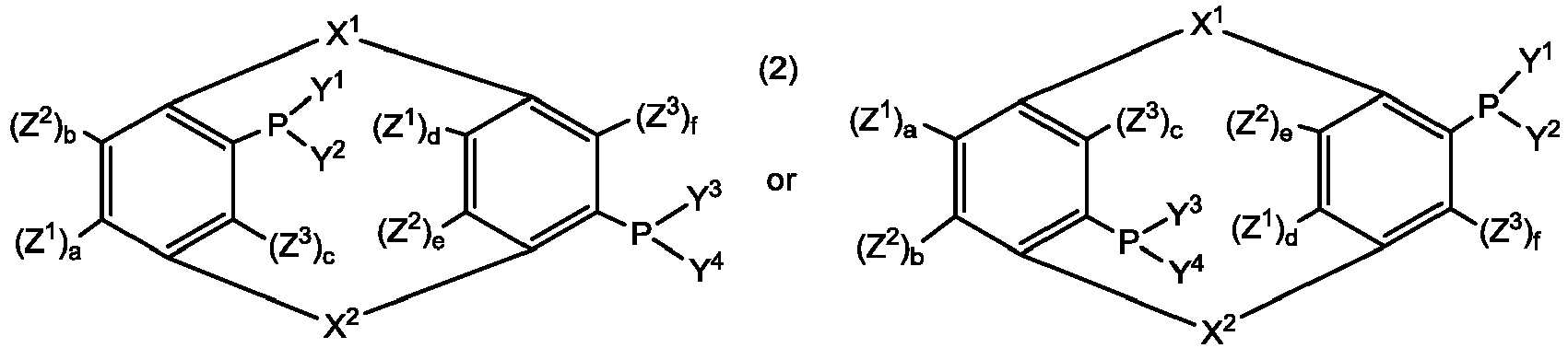
- wherein X1 and X2 are linking groups comprising between 2 to 4 carbon atoms,
- each Y1, Y2, Y3 and Y4 are independently selected from the group consisting of substituted or unsubstituted alkyl, substituted or unsubstituted cycloalkyl, substituted or unsubstituted aryl and substituted or unsubstituted heteroaryl,
- each Z1, Z2 and Z3 are the same or different and are substituting groups that optionally contain functional groups,
- a, b, c, d, e and f are the integers 0 or 1 and a + b + c + d + e + f = 0 to 6;
- CO is a carbonyl ligand; and
- S is a solvent ligand.
- Hal is a halogen and may be selected from the group consisting of chlorine, bromine and iodine. In one embodiment, Hal is preferably chlorine.
- L is a substituted or unsubstituted paracyclophane ligand of formula (2). Linking groups X1 and X2 provide links between the benzene rings of the paracyclophane structure that comprise between 2 and 4 carbon atoms. Hence X1 and X2 may be linear, branched or cyclic structures where the link is formed via 2, 3 or 4 carbon atoms. The links may, in addition to the carbon atoms, contain heteroatoms such as O, N or S (where the N atom may in turn be bonded to an alkyl group such as CH3, C2H5, C3H7 or C4H9 or an aryl group, and the S atom may be bonded to an alkyl or aryl group or be part of an SO or SO2 moiety) and/or the carbon atoms in the linking group may be substituted with a halide, e.g. one or more fluorine atoms. Hence linking groups X1 and X2 may independently be for example -(CH2)2-4-, -CH2OCH2-, -CH2N(CH3)CH2-, -CH2SO2CH2-, -C2F4- or ortho, meta or para-C6H4. Such modification of the linking group may be useful for adapting the substituted paracyclophane to different reaction conditions, e.g. solvents. Preferably the linking groups comprise -(C2H4)-, -(C3H6)- or -(C4H8)-. More preferably X1 and X2 are the same and most preferably X1 and X2 are both -(C2H4)-.
- In one embodiment, the paracyclophane is a bis(phosphine) where each Y1, Y2, Y3 and Y4 may independently be straight chain or branched alkyl groups (e.g. C1-C20) such as methyl, ethyl, propyl, iso-propyl, butyl, iso-butyl, sec-butyl, tert-butyl, pentyl, hexyl, heptyl, octyl, nonyl, decyl, dodecyl, and stearyl, cycloalkyl groups (e.g. C3-C10) such as cyclopropyl, cyclobutyl, cyclopentyl, cyclohexyl or adamantyl, or aryl groups (e.g. C6-C20 aryl) such as phenyl, naphthyl or anthracyl. The alkyl groups may be optionally substituted with one or more substituents such as halide (Cl, Br, F or I) or alkoxy groups, e.g. methoxy, ethoxy or propoxy groups. The aryl groups may be optionally substituted with one or more substituents such as halide (Cl, Br, F or I), methyl, propyl (n- or i-), butyl (n-, i- or t-), trifluoromethyl, methoxy or dimethylamino groups. Suitable substituted aryl groups include 4-methylphenyl, 3,5-dimethylphenyl, 4-methoxyphenyl, 4-methoxy-3,5-dimethylphenyl, 4-methoxy-3,5-diisopropylphenyl, 4-methoxy-3,5-ditertbutylphenyl, 3,5-diisopropylphenyl, 3,5-ditertbutylphenyl, 4-dimethylamino-3,5-dimethylphenyl, 4-dimethylamino-3,5-diisopropylphenyl, 4-dimethylamino-3,5-ditertbutylphenyl and fluorenyl. Substituted or unsubstituted heteroaryl groups (e.g. substituted or unsubstituted C5-C20 heteroaryl groups) such as pyridyl or furanyl may also be used. In an alternative embodiment, Y1 and Y2 and/or Y3 and Y4 on each phosphorus atom may be linked so as to form a ring structure incorporating the phosphorus atom. In such an embodiment, preferably Y1 and Y2 and/or Y3 and Y4 are linked so as to provide each phosphorus atom in a 4- to 7-membered ring. Preferably, Y1 and Y2 and/or Y3 and Y4 are the same and are phenyl or substituted phenyl groups (e.g. dimethylphenyl groups, such as 3,5-dimethylphenyl or ditertbutylphenyl groups such as 3,5-ditertbutylphenyl).
- When one or more of a, b, c, d, e and f are 1, substituting groups Z1, Z2 and Z3 depending upon their number and position replace hydrogen atoms on one or both benzene rings of the paracyclophane (2). Z1, Z2 or Z3 may independently be non-functional group-containing substituting groups such as branched or linear alkyl (e.g. C1-C30, preferably C1-C20, more preferably C1-C10 as described above for Y1, Y2, Y3 and Y4) or aryl (e.g. C6-C20-aryl, such as phenyl, naphthyl or anthracyl) or aralkyl or alkaryl, (e.g. benzyl, -CH2C6H5). Such substituting groups may be effective in altering the physical, electronic and/or steric properties of the paracyclophane for example where the paracyclophane is used as part of a transition metal catalyst complex. Additionally or alternatively Z1, Z2 or Z3 may be substituting groups that comprise one or more functional groups that may, if desired, be used to alter the electronic properties of the ligand, facilitate chiral resolution of the paracyclophane ligand or an intermediate thereof and/or covalently bond the paracyclophane ligand (or an intermediate thereof) and hence a catalyst derived therefrom, to a suitably reactive solid support. Hence substituting groups Z1, Z2 and Z3 may independently optionally comprise one or more functional groups. Suitable functional groups include halide (Cl, Br, F or I), hydroxyl, alkoxy (i.e. -OR where e.g. R = alkyl C1-C30 as described above for Y1, Y2, Y3 and Y4), silyloxy (i.e. -OSiR3 where e.g. R = alkyl C1-C30 as described above for Y1, Y2, Y3 and Y4), aralkyloxy (i.e. -O-alkyl-aryl e.g. -OCH2Ph), carbonyl, carboxyl, anhydride, methacryl, epoxide, vinyl, nitrile, nitro, sulphate, sulphonyl, mercapto, sulphide amino, amine, imine, amide and imide. These functional groups may, where appropriate, be directly bonded to the benzene ring in the paracyclophane ligand or may be present in alkyl (e.g. C1-C30 as described above for Y1, Y2, Y3 and Y4), aryl or alkyl-aryl groups bonded to the benzene ring. In addition Z1, Z2 or Z3 on one benzene ring in the paracyclophane structure may be the same or different from Z1, Z2 or Z3 on the other benzene ring, i.e. (Z1)a, (Z2)b and (Z3)c may be the same or different from (Z1)d, (Z2)e, and (Z3)f.
- Particularly preferred substituting groups are alkyl groups such as -CH3 (Me), -C(CH3)3 (tBu),-CH(CH3)2 (iPr), aryl groups such as -C6H5 (Ph); fluoroalkyl groups e.g. of formula -CxHyFz (in which x is 1 to 10, preferably 1 to 3; y is less than 2x, including 0; and z = 1 to 2x+1), vinyl -CH=CH2, iodide -I, nitrate -NO2, imino e.g. -N=CPh2, alkoxymethylene or alkoxy groups R'OCH2- or R'O- (e.g. where R' = H, alkyl C1-C30, aryl, alkaryl or silyl, especially CH2Ph, CH3, tBu, iPr, Si(tBu)Me2 or Si(iPr)3); carbonyl XC(O)- (e.g. where X = H, halide, especially Cl, alkyl C1-C30, preferably C1-C10), carboxyl R"O2C- (e.g. where R" = H, alkyl C1-C30, aryl or alkaryl such as CH3, Ph-CH2, tBu, iPr, preferably H); and amino R'R"N-, R'R"NCH2- or R'R"NCO- (e.g. where R' and/or R" = H, alkyl, or alkaryl such as CH3, CH2Ph).
- The substituting group on each benzene ring in the paracyclophane structure may be in an ortho (Z3), meta (Z2) and/or para (Z1) position to the P(Y1Y2) and P(Y3Y4) groups. When the substituent is at the para-position of the benzene ring it may enhance the electronic effects on the P(Y1Y2) and P(Y3Y4) groups and permits, by choice of suitable Z1 substituents the possibility of electronic fine-tuning of the ligand to enhance its effect when part of a catalyst for different reactions and substrates. By careful choice of the Z2 or particularly the Z3 substituent in the ortho-position, the steric properties of the ligand may be altered to effect changes in catalyst selectivity. The substituting groups may also be used to alter the physical properties of the paracyclophane e.g. its stability in air, towards water, or its solubility in different solvents. Preferably the substituting group on each benzene ring in the paracyclophane is in the para (Z1) position to the P(Y1Y2) or P(Y3Y4) groups.
- At least one and up to six substituting groups may be present on the substituted paracyclophane (2). While each benzene ring in the paracyclophane structure may comprise three substituting groups, in one embodiment, each benzene ring comprises one or two substituting groups such that a + b+ c +d + e + f = 1 to 4, more preferably a + b+ c + d + e + f = 1 or 2. Most preferably each benzene ring comprises only one substituting group, i.e. a + b + c = 1 and / or d + e + f = 1 and particularly a and/or d=1.
- In an alternative embodiment, a + b + c + d + e + f = 0. In this instance, the paracyclophane (2) is unsubstituted and is known as a Phanephos ligand. In one embodiment, the paracyclophane (2) may be Phanephos or Xyl-Phanephos.
- It will be understood by those skilled in the art that where one enantiomer of a paracyclophane of formula (2) is depicted, the other is included within the scope of the invention. Racemic mixtures are also included within the scope of the invention.
- Paracyclophanes, suitable for use as ligands, include but are not restricted to the following:


- Methods for preparing the paracyclophane of formula (2) are described in
EP906322 EP1633762 and Brown J, Rossen K, Knochel P, Synthesis, 2007, 24, 3877, which are incorporated herein by reference in their entirety for all purposes. The methods include electrophilic substitution (including Friedel Crafts alkylation and acylation reactions), nucleophilic substitution, and metallation-substitution reactions on a suitable paracyclophane intermediate. Alternatively the substituted paracyclophane may be constructed by coupling or dimerisation of suitably substituted and functional benzene ring units by e.g. thermal or photochemical means. - S is a solvent ligand and may be selected from the group consisting of amides (such as dimethylformamide or dimethylacetamide), N-heterocyles (e.g. pyridine), ketones (such as acetone, methylethyl ketone), alcohols (e.g. methanol, ethanol, 1-propanol or 2-propanol), esters (such as ethylformate or ethylacetate), aromatic solvents (e.g. benzene, toluene or a xylene), chlorinated alkanes (such as dichloromethane or chloroform), formic acid, dimethylsulfoxide and acetonitrile. In one preferred embodiment, the solvent ligand S is dimethylformamide (DMF).
- Without wishing to be bound by theory, it is believed that the ligands form an octahedral or substantially octahedral molecular geometry around the ruthenium ions in the complexes of formulae (1a), (1b), (1c) and (1d). All isomers of the complexes therefore are included within the scope of the invention, such as those illustrated below. For clarity, the paracyclophane ligand L is represented as


- Without wishing to be bound by theory, it is believed that the complexes of formulae (1b) and (1c) are dimeric i.e. two ruthenium species, which may be the same or different, are linked together. In respect of (1b), the complex appears to have two bridging halogen atoms, whereas (1c) has three bridging halogen atoms. Complex (1c) also comprises a single CO ligand.
- In one embodiment, the ruthenium complex is a complex of formula (1a). In a preferred embodiment, the complex of formula (1a) is a solid further comprising a co-crystallised solvent. In this embodiment, the ruthenium complex is preferably of the formula [Ru Hal2 L CO S].S', wherein S is a solvent ligand, S' is the co-crystallised solvent, and S and S' are independently the same or different. S' may be selected from the group defined above with regard to the solvent ligand S. In one preferred embodiment, S and S' are the same. In one particularly preferred embodiment, S and S' are dimethylformamide (DMF).
- In another embodiment, the ruthenium complex is a complex of formula (1b).
- In yet another embodiment, the ruthenium complex is a complex of formula (1c).
- In another embodiment, the ruthenium complex is a complex of formula (1d).
- In one aspect, the present invention provides a method for the preparation of the ruthenium complex of formula (1a) as defined above, comprising the step of:
- (a) reacting polymeric [Ru Hal2 (CO)2]n or [Ru Hal2 (CO)3]2 with a paracyclophane ligand of formula (2) in a solvent S to form the complex of formula (1a); or
- (b) heating the complex of formula (1b) in a solvent S to form the complex of formula (1a); or
- (c) reacting [Ru (arene) Hal2]2 with a paracyclophane ligand of formula (2) in a solvent S to form the complex of formula (1a), wherein at least a portion of the solvent S decarbonylates to form CO.
- In one embodiment, the polymeric [Ru Hal2 (CO)2]n is polymeric [Ru Cl2 (C0)2]n. In another embodiment, the [Ru Hal2 (CO)3]2 is [Ru Cl2 (CO)3]2. Polymeric [Ru Cl2 (CO)2]n and [Ru Cl2 (CO)3]2 may be prepared according to Colton R., Farthing R., Aust, J. Chem., 1971, 24, 903, which is incorporated herein by reference in its entirety for all purposes.
- Any suitable molar ratio of polymeric [Ru Hal2 (CO)2]n or [Ru Hal2 (CO)3]2 : paracyclophane ligand (2) may be used, for example the molar ratio may be from about 2.5:1 to about 1: 2.5, although it is generally preferred that the molar ratio is about 1:1. In this instance, as the number of moles of polymeric [Ru Hal2 (CO)2]n cannot be easily determined, the molar ratio is calculated as if the polymer consisted solely of monomeric species. If desired, the molar quantity of paracyclophane ligand (2) may be in slight excess to the molar quantity of polymeric [Ru Hal2 (CO)2]n or [Ru Hal2 (CO)3]2. For example, the amount of paracyclophane ligand (2) in the reaction mixture may be calculated to provide a molar excess of up to about 10% over the amount required for the stoichiometric reaction.
- The polymeric [Ru Hal2 (CO)2]n or [Ru Hal2 (CO)3]2, paracyclophane ligand (2) and solvent S may be combined in any suitable order. In one embodiment, the [Ru Hal2 (CO)2]n or [Ru Hal2 (CO)3]2 is combined with the paracyclophane (2) and the solvent S added. In another embodiment, the paracyclophane (2) is dissolved in the solvent S and the [Ru Hal2 (CO)2]n or [Ru Hal2 (CO)3]2 added to the paracyclophane-containing solution. Any suitable quantity of the solvent S may be used, and the solvent S may be selected from the group defined above with regard to the solvent ligand S.
- Alternatively, the complex of formula (1a) may be prepared by heating the complex of formula (1b) in the solvent S. Any suitable quantity of the solvent S may be utilised. In this instance, the dimeric complex (1b) dissociates and the vacant coordination site is occupied by a molecule of solvent S.
- Alternatively, the complex of formula (1a) may be prepared by reacting [Ru (arene) Hal2]2 with the paracyclophane (2) in a solvent S, wherein at least a portion of the solvent S decarbonylates to form CO. The solvent S, therefore, acts as the source of the CO ligand. The solvent S may be selected from the group consisting of formic acid, formic acid esters (such as ethyl formate) and formic acid amides (such as dimethylformamide). Preferably, the solvent S is dimethylformamide.
- In respect of preparing the complex (1a) by the method of step (c), the reaction may be heated at a temperature such that at least a portion of the solvent S decarbonylates to generate CO in situ. When the solvent S is DMF, the temperature may be selected from the range of about 110°C to about ≤ 153°C (i.e. the boiling point of the solvent). In one embodiment, the temperature may be selected from the range of about 110°C to about 130°C, for example, about 110°C to about 120°C. The time for which the reaction is conducted is not significant provided the reaction is conducted for a period of time sufficient for the solvent S to decarbonylate and to allow least some of the generated CO to coordinate to the ruthenium ion.
- The molar ratio of the ruthenium starting material : paracyclophane (2) is generally similar to step (a) above and the [Ru (arene) Hal2]2, paracyclophane ligand (2) and solvent S may be combined in any suitable order. The [Ru (arene) Hal2]2 may be [Ru (benzene) Hal2]2 or [Ru (toluene) Hal2]2, preferably Ru (benzene) Cl2]2.
- Regardless of whether the complex of formula (1a) is prepared by the method of step (a), step (b) or step (c), the reaction mixture is preferably heated (as necessary) and optionally stirred for a suitable period of time at a temperature less than the boiling point of the solvent S. Optionally, during the course of the reaction, small quantities of the solvent S and released carbon monoxide may be stripped from the reaction mixture. If desired, the progress of the reaction may be monitored by assaying samples of the reaction mixture by NMR.
- On completion of the reaction, the solution of the complex (1a) in the solvent S may be used directly, if the application requires or tolerates such a solvent. Alternatively, the solvent S may be evaporated under reduced pressure and/or elevated temperature, and the complex (1a) dried. Drying may be performed using known methods, for example, at temperatures in the range of about 10-80°C and preferably about 20-70°C under about 1-30 mbar vacuum for about 30 minutes to about 5 days.
- If desired, the complex of formula (1a) may be crystallized/recrystallized one or more times (e.g. 1, 2 or 3 times) from a suitable combination of solvents. For example, the complex (1a) may be dissolved in one or more solvents comprising a chlorinated alkane (such as dichloromethane (DCM)), an ether (for example, methyl tert-butyl ether (MTBE)) or an aromatic solvent (such as toluene) and precipitated using an anti-solvent comprising an alkane (such as hexane). As used herein, the term anti-solvent refers to a solvent in which the desired product (i.e., the product being crystallized or recrystallized) is insoluble or essentially insoluble; the function of an anti-solvent thus is to reduce the solubility of the product in the solvent mixture and enhance the yield of precipitated crystals thereby recovered. The amount of anti-solvent employed preferably is sufficient to effect precipitation of at least the majority of the complex (1a) present in the reaction mixture. Suitable solvent/anti-solvent combinations include but are not limited to DCM/hexane, MTBE/hexane, MTBE/DCM/hexane. Alternatively or in addition, the complex (1a) may be crystallized/recrystallized from a combination of solvents in which the complex is soluble. Suitable solvents include aromatic solvents (such as toluene) and esters (for example ethyl acetate). A suitable combination of solvents includes toluene/ethyl acetate.
- In yet another aspect, the present invention provides a method for the preparation of the ruthenium complex of formula (1b) as defined above, comprising the step of reacting polymeric [Ru (Hal)2 CO (H2O)]n with the paracylophane ligand of formula (2) in a solvent mixture comprising at least one alcohol and chlorinated alkane to form the complex of formula (1b).
- The polymeric [Ru (Hal)2 CO (H2O)]n may be prepared according the procedure provided in Colton R., Farthing R., Aust, J. Chem., 1971, 24, 903. Preferably, the polymeric [Ru (Hal)2 CO (H2O)]n is polymeric [Ru Cl2 CO (H2O)]n.
- The solvent is selected from at least one alcohol and chlorinated alkane. Examples of suitable alcohols and chlorinated alkanes are given above in respect of solvent S. In one embodiment, a preferred alcohol is methanol. In another embodiment, a preferred chlorinated alkane is DCM.
- The polymeric [Ru (Hal)2 CO (H2O)]n, paracyclophane (2) and solvents may be combined in any suitable order. In one embodiment, the polymeric [Ru (Hal)2 CO (H2O)]n may be dissolved in the alcohol and the paracyclophane (2) may be dissolved in the chlorinated alkane. The two solutions may then be combined and reacted to form the complex (1b). Any suitable quantities of solvent may be used provided the polymeric [Ru (Hal)2 CO (H2O)]n and paracyclophane (2) are sufficiently dissolved.
- The molar ratio of the ruthenium starting material : paracyclophane ligand (2) is generally similar to that given above in respect of complex (1a). As the number of moles of [Ru (Hal)2 CO (H2O)]n cannot be easily determined, the molar ratio is calculated as if the polymer consisted solely of monomeric species. The direct use of the complex (1b) in the solvent mixture and/or the method for evaporating and drying the complex (1b) are generally similar to that given above in respect of complex (1a).
- In yet another aspect, the present invention provides a method for the preparation of the ruthenium complex of formula (1c) as defined above, comprising the steps of:
- (a) reacting [Ru (arene) Hal2]2 with the paracyclophane ligand of formula (2) in a solvent S; and
- (b) reacting the product of step (a) with a ruthenium complex of formula (1a) in a solvent S to form the ruthenium complex of formula (1c).
- The complex (1c) is prepared via a two-step reaction. Insofar as step (a) is concerned, the [Ru (arene) Hal2]2 may be [Ru (benzene) Hal2]2 or [Ru (toluene) Hal2]2, preferably Ru (benzene) Cl2]2. In one embodiment, the solvent S is preferably dimethylformamide.
- The molar ratio of the [Ru (arene) Hal2]2 : paracyclophane (2), the order in which the [Ru (arene) Hal2]2, paracyclophane (2) and solvent S are combined and/or the method for heating are generally similar to that discussed above with regard to the complex of formula (1a).
- After a suitable time, a complex of formula (1a) is added to the reaction mixture and the reaction stirred and heated further. The solution of complex (1c) in the solvent S may then be used directly or the solvent S may be evaporated and the complex (1c) dried and, if desired, crystallised/recrystallised in the manner described above in respect of complex (1a). In one embodiment, the solvent/anti-solvent combination comprises DCM/hexane.
- In another aspect, the present invention provides a process for the preparation of the ruthenium complex of formula (1d) as defined above, comprising the step of reacting polymeric [Ru Hal2 (CO)2]n with the paracyclophane ligand of formula (2) in the solvent S to form the complex of formula (1d).
- The preferred polymeric [Ru Hal2 (CO)2]n, molar ratio of the ruthenium starting material : paracyclophane (2), the order in which the ruthenium starting material, paracyclophane (2) and solvent S are combined, the method for heating, the method for evaporating and/or drying the complex (1d) are generally similar to that discussed above with regard to the complex of formula (1a).
- It is preferred that all steps in the preparation and isolation of the complexes of formulae (1 a), (1b), (1c) and (1d) are conducted under an inert atmosphere (e.g. nitrogen or argon).
- The ruthenium complexes of formula (1a), (1b), (1c) or (1d) are useful in a variety of chemical transformations, such as isomerisation, hydrogenation, transfer hydrogenation, hydroformylation or carbonylation reactions.
- The invention will be further illustrated by reference to the following non-limiting examples.
- All preparations in the presence of the paracyclophane ligand (2) were carried out under inert conditions using high purity nitrogen or argon.
- Polymeric [RuCl2 CO (H2O)]n was prepared according to Colton R., Farthing R, Aust. J. Chem. 1971, 24, 903:
To 1.62 ml of an hydrochloric solution of RuCl3 (Ru metal assay 19.23 wgt %, 5 mmol RuCl3) was added 20 ml of 37 % hydrochloric acid and 20 ml of > 98% formic acid and the dark red solution heated to reflux (oil bath at 135ºC) until the colour changed to green. This solution was evaporated at 10 mbar and heated to 60 - 70 ºC. A black crystalline solid containing polymeric [RuCl2 CO (H2O)]n was obtained. - 350 mg of the black crystalline solid was dissolved in 5 ml of MeOH. To the solution was added 577 mg of (S)-Phanephos (1 mmol) in 15 ml of dichloromethane. The initially green mixture turned quickly yellow and the solvents were evaporated and the yellow residue dried at 5 mbar, 40ºC for 1 hour. By 31P{1H} NMR (in CDCl3) [Ru Cl2 (S)-Phanephos CO] dimers were observed: 38.6 ppm (d), 8.0 ppm (d), and 32.5 ppm (d), 21.2 ppm (d).
- 175 mg of the black crystalline solid containing polymeric [RuCl2 CO (H2O)]n of Example 1 was dissolved in 3 ml of MeOH. To the solution was added 345 mg of (R)-Xyl-Phanephos (0.5 mmol) in 15 ml of dichloromethane. The initially green mixture turned quickly yellow. The solvents were evaporated and the yellow residue dried at 5 mbar, 40ºC for 1 hour. By 31P{1H} NMR (in CDCl3) [Ru Cl2 (R)-Xyl-Phanephos CO] dimers were observed: 38.9 ppm (d), 7.5 ppm (d) and 32.3 ppm (d), 21.0 ppm (d).
- Polymeric [RuCl2 (CO)2)]n was prepared according to Colton R., Farthing R, Aust. J. Chem. 1971, 24, 903:
- To 1.62 ml of an hydrochloric solution of RuCl3 (Ru metal assay 19.23 wgt %, 5 mmol RuCl3) was added 20 ml of 37 % hydrochloric acid and 20 ml of > 98% formic acid and the dark red solution heated to reflux (oil bath at 135ºC) until the colour changed to green and then orange. This solution was evaporated at 10 mbar and heated to 60 - 70 ºC. Polymeric [RuCl2 (CO)2)]n was obtained as a bright orange crystalline solid.
- 114 mg of [RuCl2 (CO)2)]n was combined with 345 mg of (R)-Xyl-Phanephos (0.5 mmol) and 15 ml of DMF. The mixture was heated in an oil bath at 116ºC for 120 minutes and small quantities of DMF stripped every 20 minutes. The DMF was then evaporated at 116ºC and 40 mbar and the residue dried. In addition to the [RuCl2 (R)-Xyl-Phanephos CO DMF] complex with 31P{1H} NMR resonances at 39.0 ppm (d) and 36.25 ppm (d), another isomer of [RuCl2 CO (R)-Xyl-Phanephos DMF] with 31P{1H} NMR resonances at 43.1 ppm (d), 38.0 ppm (d) was obtained.
- [RuCl2 (CO)3]2 was prepared according to Colton R., Farthing R, Aust. J. Chem. 1971, 24, 903: To 1.62 ml of an hydrochloric solution of RuCl3 (Ru metal assay 19.23 wgt %, 5 mmol RuCl3) was added 20 ml of 37 % hydrochloric acid and 20 ml of > 98% formic acid and the dark red solution heated to reflux (oil bath at 135ºC) until the colour changed to green, then orange and finally pale yellow. This solution was evaporated at 10 mbar and heating to 60 - 70 ºC. Pale yellow [RuCl2 (CO)3)]2 was obtained as a crystalline solid.
- 256 mg of [RuCl2 (CO)3]2 as obtained above was added as a solid to a solution of 577 mg of (S)-Phanephos (1 mmol) in 15 ml of DMF. The mixture was heated in an oil bath at 116ºC for 120 minutes. Then approximately 1 ml of DMF was stripped and a small sample of the solution added to CDCl3 in an NMR tube. The assay of this sample gave a mixture containing [Ru Cl2 (S)-Phanephos CO] dimers with 31P{1H} NMR resonances at 38.6 ppm (d), 8.0 ppm (d) and 32.5 ppm (d), 21.2 ppm (d) and one [RuCl2 (S)-Phanephos CO DMF] complex isomer with 31P{1H} NMR resonances at 39.8 ppm (d) and 36.7 ppm (d).
- The solution in DMF is further heated for seven hours, with approx 1 ml of DMF stripped every 2 hours. The solution was then cooled to room temperature and the DMF evaporated at 5 mbar, 60ºC and the yellow residue dried for 1 hour. The product was analysed by 31P{1H} NMR in CDCl3 and shown to be the [RuCl2 (S)-Phanephos CO DMF] complex isomer with 31P{1H} NMR resonances at 39.8 ppm (d) and 36.7 ppm (d).
- The same product was obtained when 228 mg of [RuCl2 (CO)2)]n was heated with 577 mg of (S)-Phanephos (1 mmol) in 15 ml of DMF in an oil bath at 116ºC for two hours and then stripped. During the initial 30 minutes of the reaction, a compound consistent with a [RuCl2 (S)-Phanephos (CO)2] isomer {31P{1H} NMR in CDCl3 13.5 ppm (s)} was observed.
- 1.154 g of (S)-Phanephos (2 mmol) and 0.5 g (1 mmol) of [Ru(benzene)Cl2]2 were combined in a 80 mL Schlenk flask and mixed with 20 ml of dimethylformamide (DMF). The mixture was vigorously stirred and heated to 120°C (oil bath). After 19 hours the reaction mixture was cooled and the clear red solution was concentrated by distillation using a rotary evaporator (60°C, 20-30 mbar). The brown residue was dried (60°C, 5 mbar) for 30 minutes. A 31P{1H} NMR analysis of the dry product in CDCl3 gave 80 % of a [RuCl2 (S)-Phanephos CO DMF] complex with resonances of 39.8 ppm (d) and 36.7 ppm (d) and a 20 % of a second compound with resonances of 41.1 ppm (d), 29.4 ppm (d).
- Upon recrystallisation from dichloromethane and hexane a mixture of isomers of [RuCl2 CO (S)-Phanephos DMF] with 31P{1H} NMR resonances at 42.1 ppm (d), 37.5 ppm (d), 41.8 ppm (d), 36.0 ppm (d), 39.8 ppm (d), 36.7 ppm (d) were obtained and the second compound with shifts of 41.1 ppm (d), 29.4 ppm (d) disappeared.
- 660 mg (0.958 mmol) of (R)-Xyl-Phanephos and 228 mg (0.456 mmol) of [Ru(benzene)Cl2]2 were combined in a 50 ml Schlenk flask and mixed with 10 ml of dimethylformamide (DMF). The mixture was vigorously stirred and heated to 110°C (oil bath). After 17 hours the reaction mixture was cooled and the clear red solution concentrated by distillation using a rotary evaporator (70°C, 20-30 mbar). The brown residue was dried (70°C, 5 mbar) for 30 minutes. 31P{1H} NMR analysis of the dry product in CDCl3 showed the formation of [RuCl2 (R)-Xyl-Phanephos CO DMF] with 31P{1H} NMR (in CDCl3) shifts of 39.0 ppm (d) and 36.25 ppm (d).
- Addition of 15 ml of methyl tert-butyl ether (MTBE) and 30 ml of hexane to a solution of the crude product in 5 ml of dichloromethane (DCM) at 0ºC yielded a precipitate that was isolated by filtration and dried. The purified product showed 31P{1H} NMR (in CDCl3 shifts) of 39.0 ppm (d) and 36.25 ppm (d) and had IR absorptions at 1947 cm-1 (CO) and 1674 (CHO, coordinated DMF).
- Example 6 was repeated starting from 2.89 g (4 mmol) of (R)-Xyl-Phanephos and 1.0 g (2 mmol) of [Ru(benzene)Cl2]2 in a 250 ml Schlenk flask using 40 mL of dimethylformamide (DMF). The product obtained after crystallisation from MTBE / DCM / hexane was analysed by 31P{1H} NMR analysis in CDCl3. A mixture containing 90 % of the [RuCl2 (R)-Xyl-Phanephos CO DMF] complex with shifts of 39.0 ppm (d) and 36.25 ppm (d) and 10 % of a second isomer with shifts of 42.7 ppm (d), 29.8 ppm (d) were obtained.
- Single crystal X-Ray diffraction of a crystal species obtained from a toluene / ethyl acetate solution showed that the main compound had the structure shown.

- The retained crystals were dissolved in CDCl3 and analysed by 31P{1H} NMR and shown to have the resonances of the major [RuCl2 (R)-Xyl-Phanephos CO DMF] complex with shifts of 39.0 ppm (d) and 36.25 ppm. In addition, there was 10 % of another isomer of [RuCl2 CO (R)-Xyl-Phanephos DMF] with 31P{1H} NMR resonances at 43.1 ppm (d), 38.0 ppm (d).
- 577 mg of (S)-Phanephos (1 mmol) and 250 mg (0.5 mmol) of [Ru(benzene)Cl2]2 were combined in a 80 ml Schlenk flask and mixed with 20 ml of dimethylformamide (DMF). The mixture was vigorously stirred and heated to 100°C (oil bath) for 4 hours. To this solution was added 920 mg of the product mixture obtained in Example 5. The solution was stirred for further 10 minutes 100°C (oil bath) and then the DMF was evaporated at 5 mbar, 60ºC. A beige solid was obtained, which was recrystallised twice from dichloromethane / hexane.
- Different from the [RuCl2 (S)-Phanephos CO DMF] complexes obtained in Example 5, the 31P{1H} NMR in CDCl3 of the products was unchanged with resonances at 39.9 ppm (d), 36.9 ppm (d) and 39.0 ppm (d), 36.4 ppm (d). The stripped dichloromethane / hexane mother liquors contained the same compound. Solutions of the product in dichloromethane and CDCl3 were heated for 15 hours at 40 °C without change. The monocarbonyl dimer [Ru (S)-Phanephos CO] µ Cl3 [RuCl (S)-Phanephos] was obtained.
Claims (15)
- A ruthenium complex of formula (1a), (1b), (1c) or (1d):
[Ru Hal2 L CO S] (1a)
[Ru2 Hal4 L2 (CO)2] (1b)
[Ru2 Hal4 L2 CO] (1c)
[Ru Hal2 L (CO)2] (1d)
wherein:Hal is a halogen ligand,L is a substituted or unsubstituted paracyclophane ligand of formula (2): wherein X1 and X2 are linking groups comprising between 2 to 4 carbon atoms,each Y1, Y2, Y3 and Y4 are independently selected from the group consisting of substituted or unsubstituted alkyl, substituted or unsubstituted cycloalkyl, substituted or unsubstituted aryl and substituted or unsubstituted heteroaryl,each Z1, Z2 and Z3 are the same or different and are substituting groups that optionally contain functional groups,a, b, c, d, e and f are the integers 0 or 1 and a + b + c + d + e + f = 0 to 6;CO is a carbonyl ligand; andS is a solvent ligand.
 - A ruthenium complex according to claim 1 wherein X1 and X2 are both -C2H4-.
- A ruthenium complex according to claim 1 or claim 2, wherein each Y1, Y2, Y3 and Y4 are independently selected from the group consisting of methyl, ethyl, propyl, iso-propyl, butyl, iso-butyl, sec-butyl, tert-butyl, phenyl, naphthyl, anthracyl, 4-methylphenyl, 3,5-dimethylphenyl, 4-methoxyphenyl, 4-methoxy-3,5-dimethylphenyl, 4-methoxy-3,5-diisopropylphenyl, 4-methoxy-3,5-ditertbutylphenyl, 3,5-diisopropylphenyl, 3,5-ditertbutylphenyl, 4-dimethylamino-3,5-dimethylphenyl, 4-dimethylamino-3,5-diisopropylphenyl, 4-dimethylamino-3,5-ditertbutylphenyl and fluorenyl.
- A ruthenium complex according to any one of claims 1 to 3, wherein Z1, Z2 and Z3 are independently substituting groups selected from C1-C30 branched or linear alkyl or phenyl, naphthyl or anthracyl groups.
- A ruthenium complex according any one of claims 1 to 4 wherein Z1, Z2 or Z3 are independently substituting groups comprising one or more functional groups selected from halide, hydroxyl, alkoxy, silyloxy, aralkyloxy, carbonyl, carboxyl, anhydride, methacryl, epoxide, vinyl, nitrile, nitro, sulphate, sulphonyl, mercapto, sulphide, amino, amine, imine, amide and imide.
- A ruthenium complex according to any one of claims 1 to 5, wherein a + b + c + d + e + f = 1 or 2.
- A ruthenium complex according to any one of claims 1 to 6, wherein a + b + c = 1 and / or d + e + f = 1.
- A ruthenium complex according to any one of claims 1 to 3, wherein a + b + c + d + e + f = 0.
- A ruthenium complex according to any one of claims 1 to 8, wherein S is a solvent ligand selected from the group consisting of amides, N-heterocyles, ketones, alcohols, esters, aromatic solvents, chlorinated alkanes, formic acid, dimethylsulfoxide and acetonitrile.
- A ruthenium complex according to any one of claims 1 to 9, wherein the complex of formula (1a) is a solid and further comprises a co-crystallised solvent.
- A method for the preparation of a ruthenium complex of formula (1a) according to any one of claims 1 to 10, comprising the step of:(a) reacting polymeric [Ru Hal2 (CO)2]n or [Ru Hal2 (CO)3]2 with a paracyclophane ligand of formula (2) in a solvent S to form the complex of formula (1a); or(b) heating a complex of formula (1b) in a solvent S to form the complex of formula (1a); or(c) reacting [Ru (arene) Hal2]2 with a paracyclophane ligand of formula (2) in a solvent S to form the complex of formula (1a), wherein at least a portion of the solvent S decarbonylates to form CO.
- A method for the preparation of the ruthenium complex of formula (1b) according to any one of claims 1 to 9, comprising the step of reacting polymeric [Ru (Hal)2 CO (H2O)]n with a paracylophane ligand of formula (2) in a solvent mixture comprising at least one alcohol and chlorinated alkane to form the complex of formula (1b).
- A method for the preparation of the ruthenium complex of formula (1c) according to any one of claims 1 to 9, comprising the steps of:(a) reacting [Ru (arene) Hal2]2 with a paracyclophane ligand of formula (2) in a solvent S; and(b) reacting the product of step (a) with a ruthenium complex of formula (1a) in a solvent S to form the ruthenium complex of formula (1c).
- A method for the preparation of the ruthenium complex of formula (1d) according to any one of claims 1 to 9, comprising the step of reacting polymeric [Ru Hal2 (CO)2]n with a paracyclophane ligand of formula (2) in a solvent S to form the complex of formula (1d).
- The use of the ruthenium complex of formula (1a), (1b), (1c) or (1d) in isomerisation, hydrogenation, transfer hydrogenation, hydroformylation or carbonylation reactions.
Applications Claiming Priority (2)
| Application Number | Priority Date | Filing Date | Title |
|---|---|---|---|
| GBGB1104522.6A GB201104522D0 (en) | 2011-03-17 | 2011-03-17 | Complexes |
| PCT/GB2012/050587 WO2012123761A1 (en) | 2011-03-17 | 2012-03-16 | Ruthenium complexes comprising paracyclophane and carbonyl ligands, and their use as catalyst |
Publications (2)
| Publication Number | Publication Date |
|---|---|
| EP2686329A1 EP2686329A1 (en) | 2014-01-22 |
| EP2686329B1 true EP2686329B1 (en) | 2017-11-15 |
Family
ID=44012735
Family Applications (1)
| Application Number | Title | Priority Date | Filing Date |
|---|---|---|---|
| EP12712345.3A Active EP2686329B1 (en) | 2011-03-17 | 2012-03-16 | Ruthenium complexes comprising paracyclophane and carbonyl ligands, and their use as catalyst |
Country Status (7)
| Country | Link |
|---|---|
| US (1) | US8940917B2 (en) |
| EP (1) | EP2686329B1 (en) |
| CN (1) | CN103492400A (en) |
| ES (1) | ES2659939T3 (en) |
| GB (1) | GB201104522D0 (en) |
| RU (1) | RU2614415C2 (en) |
| WO (1) | WO2012123761A1 (en) |
Families Citing this family (3)
| Publication number | Priority date | Publication date | Assignee | Title |
|---|---|---|---|---|
| ITUB20160229A1 (en) | 2016-02-05 | 2017-08-05 | Univ Degli Studi Udine | MONOCARBONYL RUTHENIUM AND OSMIUM CATALYSTS |
| CN114685475B (en) * | 2022-04-29 | 2023-12-08 | 中国科学院大连化学物理研究所 | A class of planar chiral oxazopyridine ligand compounds based on cyclophane skeleton and their synthesis methods and applications |
| US12208378B1 (en) | 2023-11-13 | 2025-01-28 | King Faisal University | 1,4-divinylphenylene-bridged diruthenium complex bearing two Ru(CO) (PiPr3)2 moieties with 8-mercaptoquinolato co-ligand as an organic catalyst |
Family Cites Families (5)
| Publication number | Priority date | Publication date | Assignee | Title |
|---|---|---|---|---|
| KR960005497B1 (en) * | 1993-05-22 | 1996-04-25 | 재단법인한국화학연구소 | Inorganic supported catalyst for conversion reaction of methane or purified natural gas, preparation method thereof and preparation method of ethylene using the same |
| US5874629A (en) | 1996-06-12 | 1999-02-23 | Merck & Co., Inc. | Chiral bisphosphines |
| JP2000103797A (en) * | 1998-09-29 | 2000-04-11 | Mitsubishi Chemicals Corp | Rhodium- (bidentate chelating ligand) binuclear complex |
| WO2001074829A1 (en) | 2000-03-30 | 2001-10-11 | Chirotech Technology Limited | Ruthenium-diphosphine complexes and their use as catalysts |
| JP2006527246A (en) | 2003-06-13 | 2006-11-30 | ジョンソン、マッセイ、パブリック、リミテッド、カンパニー | Ligand |
-
2011
- 2011-03-17 GB GBGB1104522.6A patent/GB201104522D0/en not_active Ceased
-
2012
- 2012-03-16 RU RU2013146334A patent/RU2614415C2/en not_active IP Right Cessation
- 2012-03-16 ES ES12712345.3T patent/ES2659939T3/en active Active
- 2012-03-16 US US14/005,436 patent/US8940917B2/en active Active
- 2012-03-16 CN CN201280020014.9A patent/CN103492400A/en active Pending
- 2012-03-16 EP EP12712345.3A patent/EP2686329B1/en active Active
- 2012-03-16 WO PCT/GB2012/050587 patent/WO2012123761A1/en not_active Ceased
Non-Patent Citations (1)
| Title |
|---|
| None * |
Also Published As
| Publication number | Publication date |
|---|---|
| EP2686329A1 (en) | 2014-01-22 |
| US20140155642A1 (en) | 2014-06-05 |
| GB201104522D0 (en) | 2011-05-04 |
| US8940917B2 (en) | 2015-01-27 |
| RU2614415C2 (en) | 2017-03-28 |
| RU2013146334A (en) | 2015-04-27 |
| CN103492400A (en) | 2014-01-01 |
| WO2012123761A1 (en) | 2012-09-20 |
| ES2659939T3 (en) | 2018-03-20 |
Similar Documents
| Publication | Publication Date | Title |
|---|---|---|
| JP2008546693A (en) | Stable cyclic (alkyl) (amino) carbenes as ligands for transition metal catalysts | |
| JP4264418B2 (en) | Ruthenium complexes as (preliminary) catalysts for metathesis reactions | |
| JP2010503713A (en) | New metathesis catalyst | |
| CN105175327B (en) | A kind of synthetic method of quinoline | |
| WO1995032934A1 (en) | Process of synthesizing binaphthyl derivatives | |
| US8940917B2 (en) | Ruthenium complexes comprising paracyclophane and carbonyl ligands, and their use as catalyst | |
| JPH09249677A (en) | Chiral ruthenium complex, process for its preparation, and enantioselective transfer hydrogenation of prochiral ketones | |
| ES2283850T3 (en) | NEW CARBEN-NICKEL COMPLEXES, -PALADIO AND -PLATINO, ITS PRODUCTION AND USE IN CATALYTIC REACTIONS. | |
| Mbaye et al. | α-Diimines as nitrogen ligands for ruthenium-catalyzed allylation reactions and related (pentamethylcyclopentadienyl) ruthenium complexes | |
| EP3438115B1 (en) | Ruthenium based complexes | |
| HU210940B (en) | Process for amidation of pyridines | |
| EP0732337B1 (en) | Optically active asymmetric diphosphine and process for producing optically active substance in its presence | |
| CN111423351B (en) | Chiral copper compound and preparation method and application thereof | |
| WO2017193288A1 (en) | Synthesis of phosphine ligands bearing tunable linkage: methods of their use in catalysis | |
| JP3338243B2 (en) | Optically active asymmetric diphosphine compound and method for producing the same | |
| CN115572239B (en) | Method for preparing alpha-ketoamide compound | |
| JP2004513951A (en) | Chiral diphosphine and its metal complex | |
| CN101918346B (en) | Optically active 2,2'-biphenol derivative and its production method | |
| JP2002510699A (en) | Preparation of phosphine ligand | |
| JP5544756B2 (en) | Phosphine compound and catalyst comprising the phosphine compound and a transition metal compound | |
| JP4928798B2 (en) | Catalyst for asymmetric synthesis, ligand used therein, and method for producing optically active compound by asymmetric synthesis reaction using them | |
| JP3750011B2 (en) | Method for producing metal complex and amino acid modified metal complex | |
| JP6357691B2 (en) | Phosphorus compounds and their transition metal complexes | |
| WO2010013239A2 (en) | SYNTHESIS OF STABLE C-(sup3)-CARBOMETALATED TRANSITION METAL COMPLEXES | |
| RU2239639C1 (en) | Achiral bidentate p,n-ligands and method for their preparing |
Legal Events
| Date | Code | Title | Description |
|---|---|---|---|
| PUAI | Public reference made under article 153(3) epc to a published international application that has entered the european phase |
Free format text: ORIGINAL CODE: 0009012 |
|
| 17P | Request for examination filed |
Effective date: 20130910 |
|
| AK | Designated contracting states |
Kind code of ref document: A1 Designated state(s): AL AT BE BG CH CY CZ DE DK EE ES FI FR GB GR HR HU IE IS IT LI LT LU LV MC MK MT NL NO PL PT RO RS SE SI SK SM TR |
|
| DAX | Request for extension of the european patent (deleted) | ||
| GRAP | Despatch of communication of intention to grant a patent |
Free format text: ORIGINAL CODE: EPIDOSNIGR1 |
|
| RIC1 | Information provided on ipc code assigned before grant |
Ipc: C07F 15/00 20060101AFI20170222BHEP Ipc: B01J 31/24 20060101ALI20170222BHEP |
|
| INTG | Intention to grant announced |
Effective date: 20170309 |
|
| RIN1 | Information on inventor provided before grant (corrected) |
Inventor name: GRAINGER, DAMIAN MARK Inventor name: NEDDEN, HANS GUENTER Inventor name: ROSEBLADE, STEPHEN JAMES |
|
| GRAJ | Information related to disapproval of communication of intention to grant by the applicant or resumption of examination proceedings by the epo deleted |
Free format text: ORIGINAL CODE: EPIDOSDIGR1 |
|
| INTC | Intention to grant announced (deleted) | ||
| GRAP | Despatch of communication of intention to grant a patent |
Free format text: ORIGINAL CODE: EPIDOSNIGR1 |
|
| INTG | Intention to grant announced |
Effective date: 20170811 |
|
| GRAS | Grant fee paid |
Free format text: ORIGINAL CODE: EPIDOSNIGR3 |
|
| GRAA | (expected) grant |
Free format text: ORIGINAL CODE: 0009210 |
|
| AK | Designated contracting states |
Kind code of ref document: B1 Designated state(s): AL AT BE BG CH CY CZ DE DK EE ES FI FR GB GR HR HU IE IS IT LI LT LU LV MC MK MT NL NO PL PT RO RS SE SI SK SM TR |
|
| REG | Reference to a national code |
Ref country code: CH Ref legal event code: EP Ref country code: GB Ref legal event code: FG4D Ref country code: AT Ref legal event code: REF Ref document number: 946170 Country of ref document: AT Kind code of ref document: T Effective date: 20171115 |
|
| REG | Reference to a national code |
Ref country code: IE Ref legal event code: FG4D |
|
| REG | Reference to a national code |
Ref country code: DE Ref legal event code: R096 Ref document number: 602012039772 Country of ref document: DE |
|
| REG | Reference to a national code |
Ref country code: NL Ref legal event code: FP Ref country code: CH Ref legal event code: NV Representative=s name: BOVARD AG PATENT- UND MARKENANWAELTE, CH |
|
| REG | Reference to a national code |
Ref country code: FR Ref legal event code: PLFP Year of fee payment: 7 |
|
| REG | Reference to a national code |
Ref country code: ES Ref legal event code: FG2A Ref document number: 2659939 Country of ref document: ES Kind code of ref document: T3 Effective date: 20180320 |
|
| REG | Reference to a national code |
Ref country code: LT Ref legal event code: MG4D |
|
| REG | Reference to a national code |
Ref country code: AT Ref legal event code: MK05 Ref document number: 946170 Country of ref document: AT Kind code of ref document: T Effective date: 20171115 |
|
| PG25 | Lapsed in a contracting state [announced via postgrant information from national office to epo] |
Ref country code: LT Free format text: LAPSE BECAUSE OF FAILURE TO SUBMIT A TRANSLATION OF THE DESCRIPTION OR TO PAY THE FEE WITHIN THE PRESCRIBED TIME-LIMIT Effective date: 20171115 Ref country code: FI Free format text: LAPSE BECAUSE OF FAILURE TO SUBMIT A TRANSLATION OF THE DESCRIPTION OR TO PAY THE FEE WITHIN THE PRESCRIBED TIME-LIMIT Effective date: 20171115 Ref country code: NO Free format text: LAPSE BECAUSE OF FAILURE TO SUBMIT A TRANSLATION OF THE DESCRIPTION OR TO PAY THE FEE WITHIN THE PRESCRIBED TIME-LIMIT Effective date: 20180215 Ref country code: SE Free format text: LAPSE BECAUSE OF FAILURE TO SUBMIT A TRANSLATION OF THE DESCRIPTION OR TO PAY THE FEE WITHIN THE PRESCRIBED TIME-LIMIT Effective date: 20171115 |
|
| PG25 | Lapsed in a contracting state [announced via postgrant information from national office to epo] |
Ref country code: GR Free format text: LAPSE BECAUSE OF FAILURE TO SUBMIT A TRANSLATION OF THE DESCRIPTION OR TO PAY THE FEE WITHIN THE PRESCRIBED TIME-LIMIT Effective date: 20180216 Ref country code: BG Free format text: LAPSE BECAUSE OF FAILURE TO SUBMIT A TRANSLATION OF THE DESCRIPTION OR TO PAY THE FEE WITHIN THE PRESCRIBED TIME-LIMIT Effective date: 20180215 Ref country code: LV Free format text: LAPSE BECAUSE OF FAILURE TO SUBMIT A TRANSLATION OF THE DESCRIPTION OR TO PAY THE FEE WITHIN THE PRESCRIBED TIME-LIMIT Effective date: 20171115 Ref country code: HR Free format text: LAPSE BECAUSE OF FAILURE TO SUBMIT A TRANSLATION OF THE DESCRIPTION OR TO PAY THE FEE WITHIN THE PRESCRIBED TIME-LIMIT Effective date: 20171115 Ref country code: RS Free format text: LAPSE BECAUSE OF FAILURE TO SUBMIT A TRANSLATION OF THE DESCRIPTION OR TO PAY THE FEE WITHIN THE PRESCRIBED TIME-LIMIT Effective date: 20171115 Ref country code: AT Free format text: LAPSE BECAUSE OF FAILURE TO SUBMIT A TRANSLATION OF THE DESCRIPTION OR TO PAY THE FEE WITHIN THE PRESCRIBED TIME-LIMIT Effective date: 20171115 |
|
| PG25 | Lapsed in a contracting state [announced via postgrant information from national office to epo] |
Ref country code: DK Free format text: LAPSE BECAUSE OF FAILURE TO SUBMIT A TRANSLATION OF THE DESCRIPTION OR TO PAY THE FEE WITHIN THE PRESCRIBED TIME-LIMIT Effective date: 20171115 Ref country code: CZ Free format text: LAPSE BECAUSE OF FAILURE TO SUBMIT A TRANSLATION OF THE DESCRIPTION OR TO PAY THE FEE WITHIN THE PRESCRIBED TIME-LIMIT Effective date: 20171115 Ref country code: CY Free format text: LAPSE BECAUSE OF FAILURE TO SUBMIT A TRANSLATION OF THE DESCRIPTION OR TO PAY THE FEE WITHIN THE PRESCRIBED TIME-LIMIT Effective date: 20171115 Ref country code: EE Free format text: LAPSE BECAUSE OF FAILURE TO SUBMIT A TRANSLATION OF THE DESCRIPTION OR TO PAY THE FEE WITHIN THE PRESCRIBED TIME-LIMIT Effective date: 20171115 Ref country code: SK Free format text: LAPSE BECAUSE OF FAILURE TO SUBMIT A TRANSLATION OF THE DESCRIPTION OR TO PAY THE FEE WITHIN THE PRESCRIBED TIME-LIMIT Effective date: 20171115 |
|
| REG | Reference to a national code |
Ref country code: DE Ref legal event code: R097 Ref document number: 602012039772 Country of ref document: DE |
|
| PG25 | Lapsed in a contracting state [announced via postgrant information from national office to epo] |
Ref country code: RO Free format text: LAPSE BECAUSE OF FAILURE TO SUBMIT A TRANSLATION OF THE DESCRIPTION OR TO PAY THE FEE WITHIN THE PRESCRIBED TIME-LIMIT Effective date: 20171115 Ref country code: PL Free format text: LAPSE BECAUSE OF FAILURE TO SUBMIT A TRANSLATION OF THE DESCRIPTION OR TO PAY THE FEE WITHIN THE PRESCRIBED TIME-LIMIT Effective date: 20171115 Ref country code: SM Free format text: LAPSE BECAUSE OF FAILURE TO SUBMIT A TRANSLATION OF THE DESCRIPTION OR TO PAY THE FEE WITHIN THE PRESCRIBED TIME-LIMIT Effective date: 20171115 |
|
| PLBE | No opposition filed within time limit |
Free format text: ORIGINAL CODE: 0009261 |
|
| STAA | Information on the status of an ep patent application or granted ep patent |
Free format text: STATUS: NO OPPOSITION FILED WITHIN TIME LIMIT |
|
| 26N | No opposition filed |
Effective date: 20180817 |
|
| PG25 | Lapsed in a contracting state [announced via postgrant information from national office to epo] |
Ref country code: MC Free format text: LAPSE BECAUSE OF FAILURE TO SUBMIT A TRANSLATION OF THE DESCRIPTION OR TO PAY THE FEE WITHIN THE PRESCRIBED TIME-LIMIT Effective date: 20171115 Ref country code: SI Free format text: LAPSE BECAUSE OF FAILURE TO SUBMIT A TRANSLATION OF THE DESCRIPTION OR TO PAY THE FEE WITHIN THE PRESCRIBED TIME-LIMIT Effective date: 20171115 |
|
| REG | Reference to a national code |
Ref country code: BE Ref legal event code: MM Effective date: 20180331 |
|
| REG | Reference to a national code |
Ref country code: IE Ref legal event code: MM4A |
|
| PG25 | Lapsed in a contracting state [announced via postgrant information from national office to epo] |
Ref country code: LU Free format text: LAPSE BECAUSE OF NON-PAYMENT OF DUE FEES Effective date: 20180316 |
|
| PG25 | Lapsed in a contracting state [announced via postgrant information from national office to epo] |
Ref country code: IE Free format text: LAPSE BECAUSE OF NON-PAYMENT OF DUE FEES Effective date: 20180316 |
|
| PG25 | Lapsed in a contracting state [announced via postgrant information from national office to epo] |
Ref country code: BE Free format text: LAPSE BECAUSE OF NON-PAYMENT OF DUE FEES Effective date: 20180331 |
|
| REG | Reference to a national code |
Ref country code: DE Ref legal event code: R082 Ref document number: 602012039772 Country of ref document: DE Representative=s name: BARDEHLE PAGENBERG PARTNERSCHAFT MBB PATENTANW, DE |
|
| PG25 | Lapsed in a contracting state [announced via postgrant information from national office to epo] |
Ref country code: MT Free format text: LAPSE BECAUSE OF NON-PAYMENT OF DUE FEES Effective date: 20180316 |
|
| PG25 | Lapsed in a contracting state [announced via postgrant information from national office to epo] |
Ref country code: TR Free format text: LAPSE BECAUSE OF FAILURE TO SUBMIT A TRANSLATION OF THE DESCRIPTION OR TO PAY THE FEE WITHIN THE PRESCRIBED TIME-LIMIT Effective date: 20171115 |
|
| PG25 | Lapsed in a contracting state [announced via postgrant information from national office to epo] |
Ref country code: PT Free format text: LAPSE BECAUSE OF FAILURE TO SUBMIT A TRANSLATION OF THE DESCRIPTION OR TO PAY THE FEE WITHIN THE PRESCRIBED TIME-LIMIT Effective date: 20171115 Ref country code: HU Free format text: LAPSE BECAUSE OF FAILURE TO SUBMIT A TRANSLATION OF THE DESCRIPTION OR TO PAY THE FEE WITHIN THE PRESCRIBED TIME-LIMIT; INVALID AB INITIO Effective date: 20120316 |
|
| PG25 | Lapsed in a contracting state [announced via postgrant information from national office to epo] |
Ref country code: MK Free format text: LAPSE BECAUSE OF NON-PAYMENT OF DUE FEES Effective date: 20171115 |
|
| PG25 | Lapsed in a contracting state [announced via postgrant information from national office to epo] |
Ref country code: AL Free format text: LAPSE BECAUSE OF FAILURE TO SUBMIT A TRANSLATION OF THE DESCRIPTION OR TO PAY THE FEE WITHIN THE PRESCRIBED TIME-LIMIT Effective date: 20171115 Ref country code: IS Free format text: LAPSE BECAUSE OF FAILURE TO SUBMIT A TRANSLATION OF THE DESCRIPTION OR TO PAY THE FEE WITHIN THE PRESCRIBED TIME-LIMIT Effective date: 20180315 |
|
| PGFP | Annual fee paid to national office [announced via postgrant information from national office to epo] |
Ref country code: NL Payment date: 20230221 Year of fee payment: 12 |
|
| PGFP | Annual fee paid to national office [announced via postgrant information from national office to epo] |
Ref country code: FR Payment date: 20230222 Year of fee payment: 12 |
|
| PGFP | Annual fee paid to national office [announced via postgrant information from national office to epo] |
Ref country code: IT Payment date: 20230221 Year of fee payment: 12 Ref country code: GB Payment date: 20230221 Year of fee payment: 12 Ref country code: DE Payment date: 20230221 Year of fee payment: 12 |
|
| P01 | Opt-out of the competence of the unified patent court (upc) registered |
Effective date: 20230526 |
|
| PGFP | Annual fee paid to national office [announced via postgrant information from national office to epo] |
Ref country code: ES Payment date: 20230403 Year of fee payment: 12 Ref country code: CH Payment date: 20230402 Year of fee payment: 12 |
|
| REG | Reference to a national code |
Ref country code: DE Ref legal event code: R119 Ref document number: 602012039772 Country of ref document: DE |
|
| REG | Reference to a national code |
Ref country code: CH Ref legal event code: PL |
|
| REG | Reference to a national code |
Ref country code: NL Ref legal event code: MM Effective date: 20240401 |
|
| GBPC | Gb: european patent ceased through non-payment of renewal fee |
Effective date: 20240316 |
|
| PG25 | Lapsed in a contracting state [announced via postgrant information from national office to epo] |
Ref country code: NL Free format text: LAPSE BECAUSE OF NON-PAYMENT OF DUE FEES Effective date: 20240401 |
|
| PG25 | Lapsed in a contracting state [announced via postgrant information from national office to epo] |
Ref country code: NL Free format text: LAPSE BECAUSE OF NON-PAYMENT OF DUE FEES Effective date: 20240401 |
|
| PG25 | Lapsed in a contracting state [announced via postgrant information from national office to epo] |
Ref country code: DE Free format text: LAPSE BECAUSE OF NON-PAYMENT OF DUE FEES Effective date: 20241001 |
|
| PG25 | Lapsed in a contracting state [announced via postgrant information from national office to epo] |
Ref country code: GB Free format text: LAPSE BECAUSE OF NON-PAYMENT OF DUE FEES Effective date: 20240316 |
|
| PG25 | Lapsed in a contracting state [announced via postgrant information from national office to epo] |
Ref country code: FR Free format text: LAPSE BECAUSE OF NON-PAYMENT OF DUE FEES Effective date: 20240331 |
|
| PG25 | Lapsed in a contracting state [announced via postgrant information from national office to epo] |
Ref country code: GB Free format text: LAPSE BECAUSE OF NON-PAYMENT OF DUE FEES Effective date: 20240316 Ref country code: FR Free format text: LAPSE BECAUSE OF NON-PAYMENT OF DUE FEES Effective date: 20240331 Ref country code: DE Free format text: LAPSE BECAUSE OF NON-PAYMENT OF DUE FEES Effective date: 20241001 Ref country code: CH Free format text: LAPSE BECAUSE OF NON-PAYMENT OF DUE FEES Effective date: 20240331 |
|
| PG25 | Lapsed in a contracting state [announced via postgrant information from national office to epo] |
Ref country code: IT Free format text: LAPSE BECAUSE OF NON-PAYMENT OF DUE FEES Effective date: 20240316 |
|
| PG25 | Lapsed in a contracting state [announced via postgrant information from national office to epo] |
Ref country code: ES Free format text: LAPSE BECAUSE OF NON-PAYMENT OF DUE FEES Effective date: 20240317 |