EP2684993A1 - Household appliance comprising a fire protection means - Google Patents
Household appliance comprising a fire protection means Download PDFInfo
- Publication number
- EP2684993A1 EP2684993A1 EP12176008.6A EP12176008A EP2684993A1 EP 2684993 A1 EP2684993 A1 EP 2684993A1 EP 12176008 A EP12176008 A EP 12176008A EP 2684993 A1 EP2684993 A1 EP 2684993A1
- Authority
- EP
- European Patent Office
- Prior art keywords
- household appliance
- fire protection
- protection means
- container
- heat absorbing
- Prior art date
- Legal status (The legal status is an assumption and is not a legal conclusion. Google has not performed a legal analysis and makes no representation as to the accuracy of the status listed.)
- Withdrawn
Links
- 239000012530 fluid Substances 0.000 claims abstract description 23
- 239000000463 material Substances 0.000 claims abstract description 10
- 239000004033 plastic Substances 0.000 claims abstract description 10
- 229920003023 plastic Polymers 0.000 claims abstract description 10
- 238000007710 freezing Methods 0.000 claims description 7
- 230000008014 freezing Effects 0.000 claims description 7
- 238000009835 boiling Methods 0.000 claims description 5
- 229920002545 silicone oil Polymers 0.000 claims description 5
- 229940057995 liquid paraffin Drugs 0.000 claims description 4
- 238000001035 drying Methods 0.000 claims description 2
- 238000004519 manufacturing process Methods 0.000 description 6
- 229920000139 polyethylene terephthalate Polymers 0.000 description 5
- 239000005020 polyethylene terephthalate Substances 0.000 description 5
- 230000002265 prevention Effects 0.000 description 4
- 238000006243 chemical reaction Methods 0.000 description 3
- 238000010438 heat treatment Methods 0.000 description 3
- 239000000126 substance Substances 0.000 description 3
- 238000005406 washing Methods 0.000 description 3
- XLYOFNOQVPJJNP-UHFFFAOYSA-N water Substances O XLYOFNOQVPJJNP-UHFFFAOYSA-N 0.000 description 3
- RNFJDJUURJAICM-UHFFFAOYSA-N 2,2,4,4,6,6-hexaphenoxy-1,3,5-triaza-2$l^{5},4$l^{5},6$l^{5}-triphosphacyclohexa-1,3,5-triene Chemical compound N=1P(OC=2C=CC=CC=2)(OC=2C=CC=CC=2)=NP(OC=2C=CC=CC=2)(OC=2C=CC=CC=2)=NP=1(OC=1C=CC=CC=1)OC1=CC=CC=C1 RNFJDJUURJAICM-UHFFFAOYSA-N 0.000 description 2
- IJGRMHOSHXDMSA-UHFFFAOYSA-N Atomic nitrogen Chemical compound N#N IJGRMHOSHXDMSA-UHFFFAOYSA-N 0.000 description 2
- CURLTUGMZLYLDI-UHFFFAOYSA-N Carbon dioxide Chemical compound O=C=O CURLTUGMZLYLDI-UHFFFAOYSA-N 0.000 description 2
- 239000004698 Polyethylene Substances 0.000 description 2
- 238000010521 absorption reaction Methods 0.000 description 2
- 239000013543 active substance Substances 0.000 description 2
- 239000003063 flame retardant Substances 0.000 description 2
- 239000002985 plastic film Substances 0.000 description 2
- 229920000573 polyethylene Polymers 0.000 description 2
- -1 polyethylene terephthalate Polymers 0.000 description 2
- 238000003825 pressing Methods 0.000 description 2
- 229910002092 carbon dioxide Inorganic materials 0.000 description 1
- 239000001569 carbon dioxide Substances 0.000 description 1
- 239000012876 carrier material Substances 0.000 description 1
- 238000000354 decomposition reaction Methods 0.000 description 1
- 230000001419 dependent effect Effects 0.000 description 1
- 230000001066 destructive effect Effects 0.000 description 1
- 230000000694 effects Effects 0.000 description 1
- 239000003517 fume Substances 0.000 description 1
- 239000000383 hazardous chemical Substances 0.000 description 1
- 231100000206 health hazard Toxicity 0.000 description 1
- 239000011796 hollow space material Substances 0.000 description 1
- 239000000203 mixture Substances 0.000 description 1
- 229910052757 nitrogen Inorganic materials 0.000 description 1
- 231100000252 nontoxic Toxicity 0.000 description 1
- 230000003000 nontoxic effect Effects 0.000 description 1
- 239000002952 polymeric resin Substances 0.000 description 1
- 238000003892 spreading Methods 0.000 description 1
- 238000003860 storage Methods 0.000 description 1
- 229920001169 thermoplastic Polymers 0.000 description 1
- 229920005992 thermoplastic resin Polymers 0.000 description 1
- 239000002918 waste heat Substances 0.000 description 1
Images


Classifications
-
- D—TEXTILES; PAPER
- D06—TREATMENT OF TEXTILES OR THE LIKE; LAUNDERING; FLEXIBLE MATERIALS NOT OTHERWISE PROVIDED FOR
- D06F—LAUNDERING, DRYING, IRONING, PRESSING OR FOLDING TEXTILE ARTICLES
- D06F37/00—Details specific to washing machines covered by groups D06F21/00 - D06F25/00
- D06F37/42—Safety arrangements, e.g. for stopping rotation of the receptacle upon opening of the casing door
-
- D—TEXTILES; PAPER
- D06—TREATMENT OF TEXTILES OR THE LIKE; LAUNDERING; FLEXIBLE MATERIALS NOT OTHERWISE PROVIDED FOR
- D06F—LAUNDERING, DRYING, IRONING, PRESSING OR FOLDING TEXTILE ARTICLES
- D06F58/00—Domestic laundry dryers
- D06F58/20—General details of domestic laundry dryers
Definitions
- the invention relates to an electric household appliance comprising a fire protection means, the fire protection means comprising a container enclosing at least one cavity.
- An electric household appliance may be a potential source of a fire.
- Typical causes for a fire may e.g. comprise a loose electrical contact or an excess of waste heat produced by the household appliance.
- Appliance specific properties may raise a potential danger of a fire. This is particularly true for electric household appliances that heat up significantly during their use like ovens, clothes dryer, and washing machines.
- the potential causes may be seen under the additional aspect that plastic materials are increasingly used in household appliance. Plastic materials may, in principle, be adapted to be flame retardant. However, the necessary substances are seldom used in household appliances due to their potential or actual health hazards.
- WO 2011/138383 A1 discloses a domestic appliance having a fire prevention medium, which comprises an active substance which releases water, carbon dioxide and/or nitrogen under the effect of heat at temperatures below 100°C, wherein the fire prevention medium comprises a core and a shell, wherein the core contains the active substance and the fire prevention medium comprises a carrier material which is arranged in a core surrounded by a shell.
- the fire prevention medium is relatively costly to manufacture and may have a limited useful operating life.
- it may be an object to provide an electric household appliance having an improved fire protection.
- It may be another object to provide an electric household appliance having particularly simple and easy to manufacture fire protection means.
- It may be another object to provide a fire protection means having a long operating life and enhanced storability. It may even be an object to provide a particularly robust and easy to handle fire protection means.
- an electric household appliance comprising at least one fire protection means, wherein at least one fire protection means comprises a container or shell enclosing at least one cavity or hollow space, wherein the container is made of a, preferably thin, plastic material (plastics) and at least one cavity is filled with a heat absorbing fluid.
- at least one fire protection means comprises a container or shell enclosing at least one cavity or hollow space, wherein the container is made of a, preferably thin, plastic material (plastics) and at least one cavity is filled with a heat absorbing fluid.
- the fire protection is thus not based on a chemical reaction of different reaction partners or on a decomposition of a chemical substance but on heat absorption by the heat absorbing fluid.
- the fluid may thus be chosen from a wide range of materials or substances and may in particular be practically inert, non-toxic and/or environmentally friendly. Since there is no intended chemical reaction of the fluid, it may also be chosen to be highly durable and storable for a long time. It is another advantage that the fire protection means may be simple and easy to manufacture.
- the container can be designed to be highly durable and robust.
- the fire protection means may particularly be adapted to prevent or inhibit an outbreak of a fire by absorbing heat that otherwise may help to start or spread a fire.
- the fire protection means may also be adapted to prevent spreading of an existing fire to an area of the household appliance that is covered or otherwise separated by the fire protection means.
- the number of cavities may comprise exactly one cavity which facilitates manufacturing of the fire protection means.
- the at least one cavity may in particular comprise a hermetically sealed cavity.
- the heat absorbing fluid has a specific heat capacity of at least 2 kJ / (kg ⁇ K). This enables particularly effective heat absorption such that an area protected by the fire protection means may remain at a sufficiently low temperature for a long time and allows for a fire to be detected and/or extinguished before the temperature in the protected area gets critical.
- the fire protection means may have a small volume, in particular a small height which facilitates its use and placement in a confined space of the household appliance.
- the heat absorbing fluid has a boiling or ignition temperature of at least 200°C, preferably of at least 250°C. This prevents early boiling or ignition and thus a change of volume and/or pressure within the cavity. Also, this allows for a high specific heat over a temperature range that exceeds the temperature of typical small fires like smouldering fires or cable fires.
- the heat absorbing fluid has a freezing temperature of no more than 10°C. This prevents freezing of the fluid and thus a potential significant volume change of the fluid for typical temperatures within a house. It is also preferred that the heat absorbing fluid has a freezing temperature of no more than 0°C which e.g. allows a typical year-round outdoor use in a warmer climate. It is also preferred that that the heat absorbing fluid has a freezing temperature of no more than -10°C which allows a typical outdoor use in a cooler climate. It is also preferred that the heat absorbing fluid has a freezing temperature of no more than -40°C which allows a typical year-round outdoor use even in a cold climate.
- the fluid comprises silicone oil, e.g. Turmsilon K1000.
- Turmsilon K1000 has a freezing temperature below -40°C that allows extreme storage conditions for the appliance. It also has a high ignition temperature above 250°C, a low fumes pressure, a relatively high specific heat of more than 2 kJ / (kg ⁇ K), and is environmentally friendly.
- An alternative fluid comprises liquid paraffin.
- Liquid paraffin has high a specific heat capacity of at least 2 kJ / (kg ⁇ K), is environmentally friendly, practically non-flammable within a household appliance, readily available, storable for a practically unlimited time, easy to handle, and also inexpensive.
- a wall of the container or shell has a thickness of no more than 0.5 millimetres, preferably of no more than 0.2 to 0.3 millimetres. This enables non-destructible deformation of the container. Also, such a thin wall has a very low thermal resistance such that heat can effectively be transferred through the wall into the fluid.
- the container may be made from or of a plastic sheet.
- the plastic material of the container or shell may be a thermoplastic resin, which allows for easy manufacture.
- the plastic material may be a thermoplastic polymer resin. It is preferred that the plastic material of the container or shell is slow-burning or flame retardant.
- the plastic material of the container may comprise polyethylene terephthalate (PET or PETE), polyethylene (PE) or a mixture thereof.
- PET polyethylene terephthalate
- PE polyethylene
- a container made of a PET sheet of a thickness between 0.2 and 0.3 millimetres and filled with water as the heat absorbing fluid was able to withstand an open flame, e.g. as produced by a burning cheesecloth laying on top of the container. In fact, it was possible to heat up the water to its boiling point by an open flame without damaging the container.
- the fire protection means is a deformable layer.
- This can by achieved e.g. by the wall of the container being flexible.
- the wall of the container or shell may e.g. have a thickness of no more than 0.5 millimetres, preferably of no more than 0.2 to 0.3 millimetres.
- the embodiment as a deformable layer allows a conformal covering of an area to be protected by the fire protection means without pre-forming of the fire protection means.
- a cushion-shaped or layer-shaped fire protection means is easy to manufacture and to store. For example, such a fire protection means is stackable.
- the fire protection means covers a bottom module of the household appliance.
- a bottom module may e.g. comprise a floor board of the household appliance on which one or more functional elements or units are placed or fixed, e.g. a fan, a motor, a heat exchanger etc.
- the fire protection means conformally covers the bottom module. This allows for a small space placing the fire protection means without a redesign of the household appliance. If, for example, the fire protection means is a deformable layer, it can simply be put on top of the bottom module or a part of it and self-deforms to conformally cover the bottom module. Maybe a simple (tool-less) pressing of the fire protection means onto the bottom module may be performed to reduce the number and/or size of potential or actual gaps between the fire protection means and the bottom module.
- the fire protection means is not restricted to be used to protect the bottom module and may be placed at any position within the household appliance, e.g. for filling of hollow spaces not yet used or as or with a cover for a heating unit or for a motor.
- the household appliance is a household appliance comprising a heater or heating unit, e.g. a washing machine, a clothes dryer, an oven, a coffee maker, a toaster, a fan heater etc.
- a heater or heating unit e.g. a washing machine, a clothes dryer, an oven, a coffee maker, a toaster, a fan heater etc.
- the fire protection means may be particularly used to protect against a fire caused by a malfunctioning heater.
- the household appliance may in particular be a clothes treatment appliance and may comprise a clothes drying function, respectively, like a washing machine, a clothes dryer or a combination thereof.
- the fire protection means is advantageously positioned between a drum of the appliance and at least one functional unit below the drum, in particular the bottom module.
- Fig.1 shows a fire protection means 11 for an electric household appliance 12 as shown e.g. in fig.2 and 3 .
- the fire protection means 11 comprises a container 13 or shell made out of a thin (thickness of 0.2 to 0.3 millimetres) sheet of PET that hermetically surrounds a cavity 14 completely filled by silicone oil 15, e.g. Turmsilon K1000.
- the silicone oil 15 has a specific heat capacity of more than 2 kJ / (kg ⁇ K), e.g. approximately 2.4 kJ / (kg ⁇ K), and can thus act as an effective heat absorbing fluid.
- the liquid paraffin 15 has a boiling and ignition temperature above 250°C, is environmentally friendly and non-flammable within the household appliance 12.
- the fire protection means 11 is preferably cushion-shaped or layer-shaped with a height that is significantly lower compared to its planar dimensions. Since the container 13 is made of the thin plastic sheet, it is elastically deformable. Subsequently, the fire protection means 11 is deformable, too, in a non destructive manner.
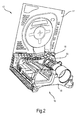
- Fig.2 shows parts of an electric household appliance in form of a clothes dryer 12 including a bottom module 16 and a rear panel 17. Other units like e.g. a drum, a front shield, a door, and a heating unit are not shown.
- the clothes dryer 12 may e.g. comprises features as disclosed in WO 2011/138383 , e.g. fig.1 .
- the bottom module 16 comprises a floor board 18 on which there are placed e.g. a fan 19 and a motor 20.
- Fig.3 shows a perspective view of the parts 16 to 20 of the clothes dryer 12 of fig.2 wherein the bottom module 16 is now conformally covered by the fire protection means 11. Since the fire protection means 11 is deformable, it will at least approximately conform to the shape of the top of the bottom module 16 caused by gravitational pull. The fire protection means 11 thus does not need to be pre-formed, as indicated by the dotted form. The shape of the bottom module 16 may be conformed even closer by pressing the fire protection means 11 onto the bottom module 16. By this fire protection means 11 the bottom module 16 is protected against excessive heat and/or fire in a region of the electric household appliance 12, and vice versa.
Landscapes
- Engineering & Computer Science (AREA)
- Textile Engineering (AREA)
- Professional, Industrial, Or Sporting Protective Garments (AREA)
Abstract
An electric household appliance (12) comprises a fire protection means (11), the fire protection means (11) comprising a container (13) enclosing at least one cavity (14), wherein the container (13) is made of a thin plastic material and at least one cavity (14) is filled with a heat absorbing fluid (15).
Description
- The invention relates to an electric household appliance comprising a fire protection means, the fire protection means comprising a container enclosing at least one cavity.
- An electric household appliance may be a potential source of a fire. Typical causes for a fire may e.g. comprise a loose electrical contact or an excess of waste heat produced by the household appliance. Appliance specific properties may raise a potential danger of a fire. This is particularly true for electric household appliances that heat up significantly during their use like ovens, clothes dryer, and washing machines. The potential causes may be seen under the additional aspect that plastic materials are increasingly used in household appliance. Plastic materials may, in principle, be adapted to be flame retardant. However, the necessary substances are seldom used in household appliances due to their potential or actual health hazards.
-
WO 2011/138383 A1 discloses a domestic appliance having a fire prevention medium, which comprises an active substance which releases water, carbon dioxide and/or nitrogen under the effect of heat at temperatures below 100°C, wherein the fire prevention medium comprises a core and a shell, wherein the core contains the active substance and the fire prevention medium comprises a carrier material which is arranged in a core surrounded by a shell. However, the fire prevention medium is relatively costly to manufacture and may have a limited useful operating life. - It is the object of the present invention to overcome at least some of the disadvantages of the state of the art. In particular, it may be an object to provide an electric household appliance having an improved fire protection. It may be another object to provide an electric household appliance having particularly simple and easy to manufacture fire protection means. It may be another object to provide a fire protection means having a long operating life and enhanced storability. It may even be an object to provide a particularly robust and easy to handle fire protection means.
- This object is achieved by an electric household appliance according to the attached independent claim. Preferred and advantageous embodiments of the invention are subjects of dependent claims, the subsequent description and the attached drawing.
- Accordingly, this object is achieved by an electric household appliance comprising at least one fire protection means, wherein at least one fire protection means comprises a container or shell enclosing at least one cavity or hollow space, wherein the container is made of a, preferably thin, plastic material (plastics) and at least one cavity is filled with a heat absorbing fluid.
- According to the invention the fire protection is thus not based on a chemical reaction of different reaction partners or on a decomposition of a chemical substance but on heat absorption by the heat absorbing fluid. The fluid may thus be chosen from a wide range of materials or substances and may in particular be practically inert, non-toxic and/or environmentally friendly. Since there is no intended chemical reaction of the fluid, it may also be chosen to be highly durable and storable for a long time. It is another advantage that the fire protection means may be simple and easy to manufacture. The container can be designed to be highly durable and robust.
- The fire protection means may particularly be adapted to prevent or inhibit an outbreak of a fire by absorbing heat that otherwise may help to start or spread a fire. The fire protection means may also be adapted to prevent spreading of an existing fire to an area of the household appliance that is covered or otherwise separated by the fire protection means.
- The number of cavities may comprise exactly one cavity which facilitates manufacturing of the fire protection means. The at least one cavity may in particular comprise a hermetically sealed cavity.
- It is one preferred embodiment that the heat absorbing fluid has a specific heat capacity of at least 2 kJ / (kg · K). This enables particularly effective heat absorption such that an area protected by the fire protection means may remain at a sufficiently low temperature for a long time and allows for a fire to be detected and/or extinguished before the temperature in the protected area gets critical. Also, the fire protection means may have a small volume, in particular a small height which facilitates its use and placement in a confined space of the household appliance.
- It is another preferred embodiment that the heat absorbing fluid has a boiling or ignition temperature of at least 200°C, preferably of at least 250°C. This prevents early boiling or ignition and thus a change of volume and/or pressure within the cavity. Also, this allows for a high specific heat over a temperature range that exceeds the temperature of typical small fires like smouldering fires or cable fires.
- It is even another preferred embodiment that the heat absorbing fluid has a freezing temperature of no more than 10°C. This prevents freezing of the fluid and thus a potential significant volume change of the fluid for typical temperatures within a house. It is also preferred that the heat absorbing fluid has a freezing temperature of no more than 0°C which e.g. allows a typical year-round outdoor use in a warmer climate. It is also preferred that that the heat absorbing fluid has a freezing temperature of no more than -10°C which allows a typical outdoor use in a cooler climate. It is also preferred that the heat absorbing fluid has a freezing temperature of no more than -40°C which allows a typical year-round outdoor use even in a cold climate.
- It is yet a preferred embodiment that the fluid comprises silicone oil, e.g. Turmsilon K1000. For example Turmsilon K1000 has a freezing temperature below -40°C that allows extreme storage conditions for the appliance. It also has a high ignition temperature above 250°C, a low fumes pressure, a relatively high specific heat of more than 2 kJ / (kg · K), and is environmentally friendly.
- An alternative fluid comprises liquid paraffin. Liquid paraffin has high a specific heat capacity of at least 2 kJ / (kg · K), is environmentally friendly, practically non-flammable within a household appliance, readily available, storable for a practically unlimited time, easy to handle, and also inexpensive.
- It is still another preferred embodiment that a wall of the container or shell has a thickness of no more than 0.5 millimetres, preferably of no more than 0.2 to 0.3 millimetres. This enables non-destructible deformation of the container. Also, such a thin wall has a very low thermal resistance such that heat can effectively be transferred through the wall into the fluid.
- In particular, the container may be made from or of a plastic sheet.
- In particular, the plastic material of the container or shell may be a thermoplastic resin, which allows for easy manufacture. In particular, the plastic material may be a thermoplastic polymer resin. It is preferred that the plastic material of the container or shell is slow-burning or flame retardant.
- In particular, the plastic material of the container may comprise polyethylene terephthalate (PET or PETE), polyethylene (PE) or a mixture thereof. It could be shown that a container made of a PET sheet of a thickness between 0.2 and 0.3 millimetres and filled with water as the heat absorbing fluid was able to withstand an open flame, e.g. as produced by a burning cheesecloth laying on top of the container. In fact, it was possible to heat up the water to its boiling point by an open flame without damaging the container.
- It is yet another preferred embodiment that the fire protection means is a deformable layer. This can by achieved e.g. by the wall of the container being flexible. For this, the wall of the container or shell may e.g. have a thickness of no more than 0.5 millimetres, preferably of no more than 0.2 to 0.3 millimetres. The embodiment as a deformable layer allows a conformal covering of an area to be protected by the fire protection means without pre-forming of the fire protection means. Additionally, a cushion-shaped or layer-shaped fire protection means is easy to manufacture and to store. For example, such a fire protection means is stackable.
- In even another preferred embodiment, the fire protection means covers a bottom module of the household appliance. A bottom module may e.g. comprise a floor board of the household appliance on which one or more functional elements or units are placed or fixed, e.g. a fan, a motor, a heat exchanger etc.
- It is also a preferred embodiment that the fire protection means conformally covers the bottom module. This allows for a small space placing the fire protection means without a redesign of the household appliance. If, for example, the fire protection means is a deformable layer, it can simply be put on top of the bottom module or a part of it and self-deforms to conformally cover the bottom module. Maybe a simple (tool-less) pressing of the fire protection means onto the bottom module may be performed to reduce the number and/or size of potential or actual gaps between the fire protection means and the bottom module.
- However, the fire protection means is not restricted to be used to protect the bottom module and may be placed at any position within the household appliance, e.g. for filling of hollow spaces not yet used or as or with a cover for a heating unit or for a motor.
- In another preferred embodiment, the household appliance is a household appliance comprising a heater or heating unit, e.g. a washing machine, a clothes dryer, an oven, a coffee maker, a toaster, a fan heater etc. In these kinds of household appliances the fire protection means may be particularly used to protect against a fire caused by a malfunctioning heater.
- The household appliance may in particular be a clothes treatment appliance and may comprise a clothes drying function, respectively, like a washing machine, a clothes dryer or a combination thereof. In this case, the fire protection means is advantageously positioned between a drum of the appliance and at least one functional unit below the drum, in particular the bottom module.
- The following drawings schematically show one possible example of an embodiment of the electric household appliance.
- Fig.1
- shows a vertical sectional view through a fire protection means;
- Fig.2
- a perspective view of parts of a clothes dryer including a bottom module, and
- Fig.3
- shows a perspective view of the parts of the clothes dryer of
fig.2 wherein the bottom module is covered by the fire protection means offig.1 . -
Fig.1 shows a fire protection means 11 for anelectric household appliance 12 as shown e.g. infig.2 and3 . Here, the fire protection means 11 comprises acontainer 13 or shell made out of a thin (thickness of 0.2 to 0.3 millimetres) sheet of PET that hermetically surrounds acavity 14 completely filled bysilicone oil 15, e.g. Turmsilon K1000. Thesilicone oil 15 has a specific heat capacity of more than 2 kJ / (kg · K), e.g. approximately 2.4 kJ / (kg · K), and can thus act as an effective heat absorbing fluid. Theliquid paraffin 15 has a boiling and ignition temperature above 250°C, is environmentally friendly and non-flammable within thehousehold appliance 12. - The fire protection means 11 is preferably cushion-shaped or layer-shaped with a height that is significantly lower compared to its planar dimensions. Since the
container 13 is made of the thin plastic sheet, it is elastically deformable. Subsequently, the fire protection means 11 is deformable, too, in a non destructive manner. -
Fig.2 shows parts of an electric household appliance in form of aclothes dryer 12 including abottom module 16 and arear panel 17. Other units like e.g. a drum, a front shield, a door, and a heating unit are not shown. Theclothes dryer 12 may e.g. comprises features as disclosed inWO 2011/138383 , e.g.fig.1 . Thebottom module 16 comprises afloor board 18 on which there are placed e.g. afan 19 and amotor 20. -
Fig.3 shows a perspective view of theparts 16 to 20 of theclothes dryer 12 offig.2 wherein thebottom module 16 is now conformally covered by the fire protection means 11. Since the fire protection means 11 is deformable, it will at least approximately conform to the shape of the top of thebottom module 16 caused by gravitational pull. The fire protection means 11 thus does not need to be pre-formed, as indicated by the dotted form. The shape of thebottom module 16 may be conformed even closer by pressing the fire protection means 11 onto thebottom module 16. By this fire protection means 11 thebottom module 16 is protected against excessive heat and/or fire in a region of theelectric household appliance 12, and vice versa. - Of course, the present invention is not limited to the shown or described embodiments.
-
- 11
- fire protection means
- 12
- clothes dryer
- 13
- container
- 14
- cavity
- 15
- silicone oil
- 16
- bottom module
- 17
- rear panel
- 18
- floor board
- 19
- fan
- 20
- motor
Claims (10)
- An electric household appliance (12) comprising at least one fire protection means (11), at least one fire protection means (11) comprising a container (13) enclosing at least one cavity (14), wherein- the container (13) is made of a thin plastic material and- at least one cavity (14) is filled with a heat absorbing fluid (15).
- The household appliance (12) according to claim 1, wherein the heat absorbing fluid (15) has a specific heat capacity of at least 2 kJ / (kg · K).
- The household appliance (12) according to any of the preceding claims, wherein the heat absorbing fluid (15) has a boiling temperature of at least 200°C, preferably of at least 250°C.
- The household appliance (12) according to any of the preceding claims, wherein the heat absorbing fluid (15) has a freezing temperature of no more than 10°C, preferably of no more than 0°C, preferably of no more than -10°C, preferably of no more than -40°C.
- The household appliance (12) according to any of the preceding claims, wherein the heat absorbing fluid (15) comprises silicone oil or liquid paraffin.
- The household appliance (12) according to any of the preceding claims, wherein a wall of the container (13) has a thickness of no more than 0.5 millimetres, preferably of no more than 0.2 to 0.3 millimetres.
- The household appliance (12) according to any of the preceding claims, wherein the fire protection means (11) is a deformable layer.
- The household appliance (12) according to any of the preceding claims, wherein the fire protection means (11) covers a bottom module (16).
- The household appliance (12) according to claim 8, wherein the fire protection means (11) conformally covers the bottom module (16).
- The household appliance (12) according to any of the preceding claims, wherein the household appliance (12) is a clothes treatment appliance, in particular clothes drying appliance.
Priority Applications (1)
| Application Number | Priority Date | Filing Date | Title |
|---|---|---|---|
| EP12176008.6A EP2684993A1 (en) | 2012-07-11 | 2012-07-11 | Household appliance comprising a fire protection means |
Applications Claiming Priority (1)
| Application Number | Priority Date | Filing Date | Title |
|---|---|---|---|
| EP12176008.6A EP2684993A1 (en) | 2012-07-11 | 2012-07-11 | Household appliance comprising a fire protection means |
Publications (1)
| Publication Number | Publication Date |
|---|---|
| EP2684993A1 true EP2684993A1 (en) | 2014-01-15 |
Family
ID=46506260
Family Applications (1)
| Application Number | Title | Priority Date | Filing Date |
|---|---|---|---|
| EP12176008.6A Withdrawn EP2684993A1 (en) | 2012-07-11 | 2012-07-11 | Household appliance comprising a fire protection means |
Country Status (1)
| Country | Link |
|---|---|
| EP (1) | EP2684993A1 (en) |
Citations (2)
| Publication number | Priority date | Publication date | Assignee | Title |
|---|---|---|---|---|
| JP2001212396A (en) * | 2000-02-07 | 2001-08-07 | Sharp Corp | Drum type washing machine |
| WO2011138383A1 (en) | 2010-05-07 | 2011-11-10 | BSH Bosch und Siemens Hausgeräte GmbH | Domestic appliance having a fire prevention medium |
-
2012
- 2012-07-11 EP EP12176008.6A patent/EP2684993A1/en not_active Withdrawn
Patent Citations (2)
| Publication number | Priority date | Publication date | Assignee | Title |
|---|---|---|---|---|
| JP2001212396A (en) * | 2000-02-07 | 2001-08-07 | Sharp Corp | Drum type washing machine |
| WO2011138383A1 (en) | 2010-05-07 | 2011-11-10 | BSH Bosch und Siemens Hausgeräte GmbH | Domestic appliance having a fire prevention medium |
Similar Documents
| Publication | Publication Date | Title |
|---|---|---|
| US8308356B2 (en) | Enclosure and method for temperature-sensitive components | |
| RU2019138058A (en) | CARTRIDGE FOR USE WITH A DEVICE FOR HEATING SMOKING MATERIAL | |
| BR112020002075B1 (en) | THERMAL PRESS | |
| KR20170043192A (en) | A disposable stove package | |
| RU2016140480A (en) | DEVICE FOR PREPARING FOOD WITH AN INCREASED HEAT PROTECTION | |
| NZ333641A (en) | Electric room heater, oil-filled radiator within grilled casing, radiator has expansion chamber | |
| KR200483922Y1 (en) | Portable Electric Hot Water Heater | |
| CN205017605U (en) | Thermistor's watertight fittings | |
| EP3009057A1 (en) | High thermal efficiency towel heater construction | |
| KR101200555B1 (en) | Warming | |
| CN202532591U (en) | Novel heater | |
| CN103604155A (en) | Oil-filled radiator | |
| CN106618260B (en) | Heat preservation structure for oven | |
| CN108361989A (en) | Water tank and water heater with same | |
| CN209031982U (en) | The baking tray component and baking machine of baking machine | |
| DE602006003507D1 (en) | Cooking devices with heat storage | |
| CN109780618A (en) | Cooling component and oil heater | |
| CN206131131U (en) | Heater | |
| CN205499814U (en) | Sealed capsule bucket | |
| KR101483375B1 (en) | Portable wet heat | |
| CA2954817A1 (en) | Volatile substance evaporator device | |
| CN210114424U (en) | Shoe drying box | |
| JP2007061126A (en) | Electric water heater | |
| CN214514685U (en) | Flask heating device | |
| KR20100113016A (en) | Insulating hot-water tank |
Legal Events
| Date | Code | Title | Description |
|---|---|---|---|
| PUAI | Public reference made under article 153(3) epc to a published international application that has entered the european phase |
Free format text: ORIGINAL CODE: 0009012 |
|
| AK | Designated contracting states |
Kind code of ref document: A1 Designated state(s): AL AT BE BG CH CY CZ DE DK EE ES FI FR GB GR HR HU IE IS IT LI LT LU LV MC MK MT NL NO PL PT RO RS SE SI SK SM TR |
|
| AX | Request for extension of the european patent |
Extension state: BA ME |
|
| STAA | Information on the status of an ep patent application or granted ep patent |
Free format text: STATUS: THE APPLICATION IS DEEMED TO BE WITHDRAWN |
|
| 18D | Application deemed to be withdrawn |
Effective date: 20140716 |