EP2684043B1 - A portable sampling device and method for sampling drug substances from exhaled breath - Google Patents
A portable sampling device and method for sampling drug substances from exhaled breath Download PDFInfo
- Publication number
- EP2684043B1 EP2684043B1 EP12709832.5A EP12709832A EP2684043B1 EP 2684043 B1 EP2684043 B1 EP 2684043B1 EP 12709832 A EP12709832 A EP 12709832A EP 2684043 B1 EP2684043 B1 EP 2684043B1
- Authority
- EP
- European Patent Office
- Prior art keywords
- exhaled breath
- sampling
- volume
- membrane
- aerosols
- Prior art date
- Legal status (The legal status is an assumption and is not a legal conclusion. Google has not performed a legal analysis and makes no representation as to the accuracy of the status listed.)
- Active
Links
- 238000005070 sampling Methods 0.000 title claims description 108
- 238000000034 method Methods 0.000 title claims description 45
- 229940088679 drug related substance Drugs 0.000 title claims description 26
- 239000012528 membrane Substances 0.000 claims description 111
- 239000000443 aerosol Substances 0.000 claims description 36
- 150000001875 compounds Chemical class 0.000 claims description 27
- 239000000090 biomarker Substances 0.000 claims description 22
- 229940079593 drug Drugs 0.000 claims description 22
- 239000003814 drug Substances 0.000 claims description 22
- 238000004458 analytical method Methods 0.000 claims description 16
- 239000008186 active pharmaceutical agent Substances 0.000 claims description 11
- USSIQXCVUWKGNF-UHFFFAOYSA-N 6-(dimethylamino)-4,4-diphenylheptan-3-one Chemical compound C=1C=CC=CC=1C(CC(C)N(C)C)(C(=O)CC)C1=CC=CC=C1 USSIQXCVUWKGNF-UHFFFAOYSA-N 0.000 claims description 10
- 229960001797 methadone Drugs 0.000 claims description 10
- 239000000835 fiber Substances 0.000 claims description 9
- -1 polypropylene Polymers 0.000 claims description 9
- 239000004743 Polypropylene Substances 0.000 claims description 7
- 229920001155 polypropylene Polymers 0.000 claims description 7
- 229920002972 Acrylic fiber Polymers 0.000 claims description 5
- 238000004891 communication Methods 0.000 claims description 5
- 238000001914 filtration Methods 0.000 claims description 5
- 239000012530 fluid Substances 0.000 claims description 5
- 239000000203 mixture Substances 0.000 claims description 5
- BQJCRHHNABKAKU-KBQPJGBKSA-N morphine Chemical compound O([C@H]1[C@H](C=C[C@H]23)O)C4=C5[C@@]12CCN(C)[C@@H]3CC5=CC=C4O BQJCRHHNABKAKU-KBQPJGBKSA-N 0.000 claims description 4
- 238000011144 upstream manufacturing Methods 0.000 claims description 4
- 229940049706 benzodiazepine Drugs 0.000 claims description 3
- 150000001557 benzodiazepines Chemical class 0.000 claims description 3
- 229940127240 opiate Drugs 0.000 claims description 3
- 238000012216 screening Methods 0.000 claims description 3
- 238000007789 sealing Methods 0.000 claims description 3
- TVYLLZQTGLZFBW-ZBFHGGJFSA-N (R,R)-tramadol Chemical compound COC1=CC=CC([C@]2(O)[C@H](CCCC2)CN(C)C)=C1 TVYLLZQTGLZFBW-ZBFHGGJFSA-N 0.000 claims description 2
- KWTSXDURSIMDCE-QMMMGPOBSA-N (S)-amphetamine Chemical compound C[C@H](N)CC1=CC=CC=C1 KWTSXDURSIMDCE-QMMMGPOBSA-N 0.000 claims description 2
- SHXWCVYOXRDMCX-UHFFFAOYSA-N 3,4-methylenedioxymethamphetamine Chemical compound CNC(C)CC1=CC=C2OCOC2=C1 SHXWCVYOXRDMCX-UHFFFAOYSA-N 0.000 claims description 2
- 241000218236 Cannabis Species 0.000 claims description 2
- GVGLGOZIDCSQPN-PVHGPHFFSA-N Heroin Chemical compound O([C@H]1[C@H](C=C[C@H]23)OC(C)=O)C4=C5[C@@]12CCN(C)[C@@H]3CC5=CC=C4OC(C)=O GVGLGOZIDCSQPN-PVHGPHFFSA-N 0.000 claims description 2
- VAYOSLLFUXYJDT-RDTXWAMCSA-N Lysergic acid diethylamide Chemical compound C1=CC(C=2[C@H](N(C)C[C@@H](C=2)C(=O)N(CC)CC)C2)=C3C2=CNC3=C1 VAYOSLLFUXYJDT-RDTXWAMCSA-N 0.000 claims description 2
- NPPQSCRMBWNHMW-UHFFFAOYSA-N Meprobamate Chemical compound NC(=O)OCC(C)(CCC)COC(N)=O NPPQSCRMBWNHMW-UHFFFAOYSA-N 0.000 claims description 2
- 229940025084 amphetamine Drugs 0.000 claims description 2
- 239000003263 anabolic agent Substances 0.000 claims description 2
- 229940070021 anabolic steroids Drugs 0.000 claims description 2
- KZOKOEQTKWBKOK-XHQKLZHNSA-N azidomorphine Chemical compound O([C@H]1[C@@H](CC[C@H]23)N=[N+]=[N-])C4=C5[C@@]12CCN(C)[C@@H]3CC5=CC=C4O KZOKOEQTKWBKOK-XHQKLZHNSA-N 0.000 claims description 2
- RMRJXGBAOAMLHD-IHFGGWKQSA-N buprenorphine Chemical compound C([C@]12[C@H]3OC=4C(O)=CC=C(C2=4)C[C@@H]2[C@]11CC[C@]3([C@H](C1)[C@](C)(O)C(C)(C)C)OC)CN2CC1CC1 RMRJXGBAOAMLHD-IHFGGWKQSA-N 0.000 claims description 2
- 229960001736 buprenorphine Drugs 0.000 claims description 2
- 229930003827 cannabinoid Natural products 0.000 claims description 2
- 239000003557 cannabinoid Substances 0.000 claims description 2
- 229940065144 cannabinoids Drugs 0.000 claims description 2
- XLMALTXPSGQGBX-GCJKJVERSA-N dextropropoxyphene Chemical compound C([C@](OC(=O)CC)([C@H](C)CN(C)C)C=1C=CC=CC=1)C1=CC=CC=C1 XLMALTXPSGQGBX-GCJKJVERSA-N 0.000 claims description 2
- 229960004193 dextropropoxyphene Drugs 0.000 claims description 2
- 229960002069 diamorphine Drugs 0.000 claims description 2
- 229960004242 dronabinol Drugs 0.000 claims description 2
- 229950002454 lysergide Drugs 0.000 claims description 2
- 229960004815 meprobamate Drugs 0.000 claims description 2
- 229960005181 morphine Drugs 0.000 claims description 2
- 229960004380 tramadol Drugs 0.000 claims description 2
- TVYLLZQTGLZFBW-GOEBONIOSA-N tramadol Natural products COC1=CC=CC([C@@]2(O)[C@@H](CCCC2)CN(C)C)=C1 TVYLLZQTGLZFBW-GOEBONIOSA-N 0.000 claims description 2
- ZPUCINDJVBIVPJ-LJISPDSOSA-N cocaine Chemical compound O([C@H]1C[C@@H]2CC[C@@H](N2C)[C@H]1C(=O)OC)C(=O)C1=CC=CC=C1 ZPUCINDJVBIVPJ-LJISPDSOSA-N 0.000 claims 2
- 229960003920 cocaine Drugs 0.000 claims 1
- 239000000523 sample Substances 0.000 description 18
- 238000012360 testing method Methods 0.000 description 16
- 239000002117 illicit drug Substances 0.000 description 14
- 239000002245 particle Substances 0.000 description 12
- 238000004611 spectroscopical analysis Methods 0.000 description 9
- 238000004949 mass spectrometry Methods 0.000 description 8
- 239000008280 blood Substances 0.000 description 7
- 210000004369 blood Anatomy 0.000 description 7
- 238000003745 diagnosis Methods 0.000 description 7
- 238000003255 drug test Methods 0.000 description 7
- 210000002700 urine Anatomy 0.000 description 7
- 201000010099 disease Diseases 0.000 description 6
- 208000037265 diseases, disorders, signs and symptoms Diseases 0.000 description 6
- 239000000463 material Substances 0.000 description 5
- 239000004033 plastic Substances 0.000 description 5
- 210000003296 saliva Anatomy 0.000 description 5
- 239000000126 substance Substances 0.000 description 5
- 210000004072 lung Anatomy 0.000 description 4
- 238000012544 monitoring process Methods 0.000 description 4
- 210000003097 mucus Anatomy 0.000 description 4
- 206010061818 Disease progression Diseases 0.000 description 3
- 238000010241 blood sampling Methods 0.000 description 3
- 238000001514 detection method Methods 0.000 description 3
- 230000005750 disease progression Effects 0.000 description 3
- 150000002632 lipids Chemical class 0.000 description 3
- 239000002904 solvent Substances 0.000 description 3
- 238000002560 therapeutic procedure Methods 0.000 description 3
- 206010061218 Inflammation Diseases 0.000 description 2
- 206010058467 Lung neoplasm malignant Diseases 0.000 description 2
- 206010028980 Neoplasm Diseases 0.000 description 2
- 230000003444 anaesthetic effect Effects 0.000 description 2
- 208000006673 asthma Diseases 0.000 description 2
- 201000011510 cancer Diseases 0.000 description 2
- 239000000969 carrier Substances 0.000 description 2
- 238000011109 contamination Methods 0.000 description 2
- 238000005516 engineering process Methods 0.000 description 2
- 239000011521 glass Substances 0.000 description 2
- 208000015181 infectious disease Diseases 0.000 description 2
- 230000004054 inflammatory process Effects 0.000 description 2
- 238000004811 liquid chromatography Methods 0.000 description 2
- 201000005202 lung cancer Diseases 0.000 description 2
- 208000020816 lung neoplasm Diseases 0.000 description 2
- 239000002184 metal Substances 0.000 description 2
- 239000002773 nucleotide Substances 0.000 description 2
- 125000003729 nucleotide group Chemical group 0.000 description 2
- 230000036542 oxidative stress Effects 0.000 description 2
- 238000011045 prefiltration Methods 0.000 description 2
- 102000004196 processed proteins & peptides Human genes 0.000 description 2
- 108090000765 processed proteins & peptides Proteins 0.000 description 2
- 229940127293 prostanoid Drugs 0.000 description 2
- 150000003814 prostanoids Chemical class 0.000 description 2
- 102000004169 proteins and genes Human genes 0.000 description 2
- 108090000623 proteins and genes Proteins 0.000 description 2
- 230000029058 respiratory gaseous exchange Effects 0.000 description 2
- 238000004416 surface enhanced Raman spectroscopy Methods 0.000 description 2
- 238000012549 training Methods 0.000 description 2
- 201000008827 tuberculosis Diseases 0.000 description 2
- 239000003039 volatile agent Substances 0.000 description 2
- XLYOFNOQVPJJNP-UHFFFAOYSA-N water Chemical compound O XLYOFNOQVPJJNP-UHFFFAOYSA-N 0.000 description 2
- 206010013654 Drug abuse Diseases 0.000 description 1
- LFQSCWFLJHTTHZ-UHFFFAOYSA-N Ethanol Chemical compound CCO LFQSCWFLJHTTHZ-UHFFFAOYSA-N 0.000 description 1
- 238000004566 IR spectroscopy Methods 0.000 description 1
- 206010040047 Sepsis Diseases 0.000 description 1
- 238000011953 bioanalysis Methods 0.000 description 1
- 239000012472 biological sample Substances 0.000 description 1
- 238000007664 blowing Methods 0.000 description 1
- 239000000919 ceramic Substances 0.000 description 1
- 238000004587 chromatography analysis Methods 0.000 description 1
- 230000000295 complement effect Effects 0.000 description 1
- 239000000470 constituent Substances 0.000 description 1
- 230000007423 decrease Effects 0.000 description 1
- 230000007812 deficiency Effects 0.000 description 1
- 230000001419 dependent effect Effects 0.000 description 1
- 238000000151 deposition Methods 0.000 description 1
- 238000010790 dilution Methods 0.000 description 1
- 239000012895 dilution Substances 0.000 description 1
- 230000000694 effects Effects 0.000 description 1
- 238000001704 evaporation Methods 0.000 description 1
- 238000000605 extraction Methods 0.000 description 1
- 239000003193 general anesthetic agent Substances 0.000 description 1
- 239000003292 glue Substances 0.000 description 1
- 238000010438 heat treatment Methods 0.000 description 1
- 230000002209 hydrophobic effect Effects 0.000 description 1
- 239000007788 liquid Substances 0.000 description 1
- 239000003589 local anesthetic agent Substances 0.000 description 1
- 229960005015 local anesthetics Drugs 0.000 description 1
- 238000004519 manufacturing process Methods 0.000 description 1
- 238000002483 medication Methods 0.000 description 1
- 238000002844 melting Methods 0.000 description 1
- 230000008018 melting Effects 0.000 description 1
- 230000006996 mental state Effects 0.000 description 1
- 210000000214 mouth Anatomy 0.000 description 1
- 230000003533 narcotic effect Effects 0.000 description 1
- 230000002093 peripheral effect Effects 0.000 description 1
- 230000000704 physical effect Effects 0.000 description 1
- 230000002265 prevention Effects 0.000 description 1
- 210000002345 respiratory system Anatomy 0.000 description 1
- 241000894007 species Species 0.000 description 1
- 208000011117 substance-related disease Diseases 0.000 description 1
- 239000000758 substrate Substances 0.000 description 1
- 210000004243 sweat Anatomy 0.000 description 1
- 229920002994 synthetic fiber Polymers 0.000 description 1
- 239000012209 synthetic fiber Substances 0.000 description 1
Images



Classifications
-
- G—PHYSICS
- G01—MEASURING; TESTING
- G01N—INVESTIGATING OR ANALYSING MATERIALS BY DETERMINING THEIR CHEMICAL OR PHYSICAL PROPERTIES
- G01N33/00—Investigating or analysing materials by specific methods not covered by groups G01N1/00 - G01N31/00
- G01N33/48—Biological material, e.g. blood, urine; Haemocytometers
- G01N33/483—Physical analysis of biological material
- G01N33/497—Physical analysis of biological material of gaseous biological material, e.g. breath
-
- A—HUMAN NECESSITIES
- A61—MEDICAL OR VETERINARY SCIENCE; HYGIENE
- A61B—DIAGNOSIS; SURGERY; IDENTIFICATION
- A61B5/00—Measuring for diagnostic purposes; Identification of persons
- A61B5/08—Measuring devices for evaluating the respiratory organs
- A61B5/082—Evaluation by breath analysis, e.g. determination of the chemical composition of exhaled breath
-
- A—HUMAN NECESSITIES
- A61—MEDICAL OR VETERINARY SCIENCE; HYGIENE
- A61B—DIAGNOSIS; SURGERY; IDENTIFICATION
- A61B5/00—Measuring for diagnostic purposes; Identification of persons
- A61B5/08—Measuring devices for evaluating the respiratory organs
- A61B5/091—Measuring volume of inspired or expired gases, e.g. to determine lung capacity
-
- A—HUMAN NECESSITIES
- A61—MEDICAL OR VETERINARY SCIENCE; HYGIENE
- A61B—DIAGNOSIS; SURGERY; IDENTIFICATION
- A61B5/00—Measuring for diagnostic purposes; Identification of persons
- A61B5/08—Measuring devices for evaluating the respiratory organs
- A61B5/097—Devices for facilitating collection of breath or for directing breath into or through measuring devices
-
- A—HUMAN NECESSITIES
- A61—MEDICAL OR VETERINARY SCIENCE; HYGIENE
- A61B—DIAGNOSIS; SURGERY; IDENTIFICATION
- A61B5/00—Measuring for diagnostic purposes; Identification of persons
- A61B5/48—Other medical applications
- A61B5/4845—Toxicology, e.g. by detection of alcohol, drug or toxic products
-
- B—PERFORMING OPERATIONS; TRANSPORTING
- B29—WORKING OF PLASTICS; WORKING OF SUBSTANCES IN A PLASTIC STATE IN GENERAL
- B29C—SHAPING OR JOINING OF PLASTICS; SHAPING OF MATERIAL IN A PLASTIC STATE, NOT OTHERWISE PROVIDED FOR; AFTER-TREATMENT OF THE SHAPED PRODUCTS, e.g. REPAIRING
- B29C65/00—Joining or sealing of preformed parts, e.g. welding of plastics materials; Apparatus therefor
- B29C65/02—Joining or sealing of preformed parts, e.g. welding of plastics materials; Apparatus therefor by heating, with or without pressure
- B29C65/44—Joining a heated non plastics element to a plastics element
- B29C65/46—Joining a heated non plastics element to a plastics element heated by induction
-
- B—PERFORMING OPERATIONS; TRANSPORTING
- B29—WORKING OF PLASTICS; WORKING OF SUBSTANCES IN A PLASTIC STATE IN GENERAL
- B29C—SHAPING OR JOINING OF PLASTICS; SHAPING OF MATERIAL IN A PLASTIC STATE, NOT OTHERWISE PROVIDED FOR; AFTER-TREATMENT OF THE SHAPED PRODUCTS, e.g. REPAIRING
- B29C65/00—Joining or sealing of preformed parts, e.g. welding of plastics materials; Apparatus therefor
- B29C65/66—Joining or sealing of preformed parts, e.g. welding of plastics materials; Apparatus therefor by liberation of internal stresses, e.g. shrinking of one of the parts to be joined
- B29C65/665—Joining or sealing of preformed parts, e.g. welding of plastics materials; Apparatus therefor by liberation of internal stresses, e.g. shrinking of one of the parts to be joined using shrinking during cooling
-
- G—PHYSICS
- G01—MEASURING; TESTING
- G01N—INVESTIGATING OR ANALYSING MATERIALS BY DETERMINING THEIR CHEMICAL OR PHYSICAL PROPERTIES
- G01N33/00—Investigating or analysing materials by specific methods not covered by groups G01N1/00 - G01N31/00
- G01N33/48—Biological material, e.g. blood, urine; Haemocytometers
- G01N33/483—Physical analysis of biological material
- G01N33/497—Physical analysis of biological material of gaseous biological material, e.g. breath
- G01N33/4975—Physical analysis of biological material of gaseous biological material, e.g. breath other than oxygen, carbon dioxide or alcohol, e.g. organic vapours
-
- B—PERFORMING OPERATIONS; TRANSPORTING
- B29—WORKING OF PLASTICS; WORKING OF SUBSTANCES IN A PLASTIC STATE IN GENERAL
- B29K—INDEXING SCHEME ASSOCIATED WITH SUBCLASSES B29B, B29C OR B29D, RELATING TO MOULDING MATERIALS OR TO MATERIALS FOR MOULDS, REINFORCEMENTS, FILLERS OR PREFORMED PARTS, e.g. INSERTS
- B29K2023/00—Use of polyalkenes or derivatives thereof as moulding material
- B29K2023/10—Polymers of propylene
-
- B—PERFORMING OPERATIONS; TRANSPORTING
- B29—WORKING OF PLASTICS; WORKING OF SUBSTANCES IN A PLASTIC STATE IN GENERAL
- B29K—INDEXING SCHEME ASSOCIATED WITH SUBCLASSES B29B, B29C OR B29D, RELATING TO MOULDING MATERIALS OR TO MATERIALS FOR MOULDS, REINFORCEMENTS, FILLERS OR PREFORMED PARTS, e.g. INSERTS
- B29K2033/00—Use of polymers of unsaturated acids or derivatives thereof as moulding material
- B29K2033/04—Polymers of esters
-
- B—PERFORMING OPERATIONS; TRANSPORTING
- B29—WORKING OF PLASTICS; WORKING OF SUBSTANCES IN A PLASTIC STATE IN GENERAL
- B29K—INDEXING SCHEME ASSOCIATED WITH SUBCLASSES B29B, B29C OR B29D, RELATING TO MOULDING MATERIALS OR TO MATERIALS FOR MOULDS, REINFORCEMENTS, FILLERS OR PREFORMED PARTS, e.g. INSERTS
- B29K2105/00—Condition, form or state of moulded material or of the material to be shaped
- B29K2105/25—Solid
- B29K2105/253—Preform
- B29K2105/256—Sheets, plates, blanks or films
-
- B—PERFORMING OPERATIONS; TRANSPORTING
- B29—WORKING OF PLASTICS; WORKING OF SUBSTANCES IN A PLASTIC STATE IN GENERAL
- B29K—INDEXING SCHEME ASSOCIATED WITH SUBCLASSES B29B, B29C OR B29D, RELATING TO MOULDING MATERIALS OR TO MATERIALS FOR MOULDS, REINFORCEMENTS, FILLERS OR PREFORMED PARTS, e.g. INSERTS
- B29K2105/00—Condition, form or state of moulded material or of the material to be shaped
- B29K2105/25—Solid
- B29K2105/253—Preform
- B29K2105/258—Tubular
Definitions
- This invention pertains in general to the field of portable handheld devices, sampling systems and methods for collecting a sample from exhaled breath of a subject, and for detecting the presence (i.e. qualitative) or determining the quantitative amount of at least one illicit drug substance or compound in exhaled breath. More particularly the invention relates to such portable handheld devices.
- exhaled breath is commonly used in alcohol testing and today's technology makes it possible to perform on-site breath testing with legally defensible results using infrared spectroscopy.
- Testing for other illicit drugs of abuse traditionally requires blood or urine samples. Alternatively specimens comprising hair, sweat or oral fluid could be used. Blood sampling is invasive and requires medically trained personnel, whereby test subject often have to be transported to a hospital for sampling. These procedures are time and effort consuming. With long lead times the test result will be too old. Urine sampling may also be considered intruding on personal integrity. Even other issues related to samples and specimens taken from a subject to be tested arise. For instance, blood samples, and especially urine samples are at risk of the subject exchanging the samples or using clean samples from another subject to avoid being discovered with traces of illicit drugs.
- an improved apparatus, system and/or method for at site/on site sampling of a subject for drug substances are desired.
- Such a device, system and/or method for sampling the subject for illicit drugs of abuse and/or medical drugs would be desired.
- the apparatus, system and/or method should be efficient, non-bulky, user friendly both for operators and the subject. It should further be not intruding and not invasive.
- Another application would be to take samples from exhaled breath for sampling aerosols which may transport biomarkers. The samples could then be analyzed and detected biomarkers may be used for diagnosis of medical conditions of the tested subject. Measuring biomarkers in exhaled air would be non-invasive and enables repeated sampling which can be useful for early detection of disease as well as monitoring of disease progression and therapy response.
- EBC Exhaled Breath Condensate
- EBC Exhaled Breath Condensate
- Both volatile and non-volatile compounds have been identified using EBC.
- the non-volatiles found in EBC are believed to originate from particles formed within the airways.
- the collection of exhaled breath condensate (EBC) is connected with a number of serious methodological difficulties such as dilution with water resulting in very low concentrations of the substances of interest, high contamination with substances originating from the oral cavity, high intraindividual coefficient of variation and a very inefficient way to sample, especially, non-volatiles compounds.
- a method for easy monitoring of the airways that also allows frequent sampling would be advantageous. Particularly if the method may be performed risk free.
- a non-invasive based apparatus, system and/or method for detecting the presence (i.e. qualitative) or determining the quantitative amount of at least one biomarker for medical diagnosis of a subject Particularly, a device and method being easy to use with no or little training, especially a device and method to be used directly, at the site/on-site, for sampling and/or testing a subject for a medical diseases or illnesses would be advantageous.
- the device and method should be sensitive enough to obtain results of a standard that could be used for diagnosis of medical conditions.
- an improved apparatus, system and/or method for at site/on site sampling of biomarkers from a subject is desired.
- the apparatus, system and/or method should be efficient, non-bulky, user friendly both for operators and the subject.
- a portable drug substance sampling device for collecting a sample from exhaled breath of a subject for further sensor based analysis, comprising a housing comprising at least one inlet and at least one outlet for the exhaled breath to exit through and a sampling membrane arranged in the housing, and further comprising a tubular element having a mouthpiece section for the subject to exhale into.
- the sampling membrane is arranged to collect the aerosols from the exhaled breath. Furthermore, the device comprises a port arranged downstream of the mouthpiece and upstream of the sampling membrane, this port being adapted to extract a defined portion of the exhaled breath into a volume measure unit for determining that a pre-defined volume of the exhaled breath has passed through the sampling membrane.
- the exhaled breath volume is not stored in a volume for analysis of the chemical contents of the entire breath volume. Rather, traces of the drug substance are attached to a sampling membrane. Analysis is not made online of the breath volume, but of the traces in the sampling membrane.
- the portable drug testing device may be sealed and sent further for the analysis, such as in a laboratory. Collection of the traces is made quickly, by exhaling a predetermined volume of breath through the sampling membrane. The obtain results when using the device are reliable and have a proven.robustness. Using the invented drug testing device is far more convenient, quicker and cheaper than any previous breath sample collection methods.
- Non-volatile compounds are transferred from the lungs carried by an aerosol.
- the non-volatile are drug substances or compounds and could be either medical drugs or legal or illegal narcotic substances or markers thereof.
- the drug substances are collected on-site using a portable system comprising a sampling membrane.
- the collected samples are to be sent to a laboratory for further analysis.
- compact on-site analysis equipment may be used to perform the analysis.
- the analysis is performed using a suitable analyzing method like spectroscopy or preferably mass-spectroscopy or Surface enhanced Raman spectroscopy (SERS). Other similar sensitive methods known to the skilled person may be used.
- the portable drug testing device is small and designed to be easy to handle it may be used by any personnel anywhere on-site.
- the drug testing device is adapted to be used instead of more intrusive tests, like tests based on the much common urine or blood samples.
- the housing could be made of any material like, plastic, metal or glass as long as it is possibly to either clean or preferable be aseptic but could also be used sterile.
- the housing could alternatively or in addition be made of a disposable material. In this way the housing may, after being used for sampling and after the analysis of the collected compounds has been performed, be discarded.
- the tubular section is used to improve the quality of the test by preventing big particles and/or aggregates and/or saliva to be collected by the sampling membrane. This may be done by having a selective trap section in the tubular section which has baffles to force the exhaled breath to pass a non-straight gas flow path.
- the tubular element is detachable from the housing or the tubular element is an integrated part of the housing.
- the volume measure unit is configured to measure a volume proportional to the pre-defined volume of the exhaled breath.
- the volume measure unit comprising a gas volume collecting element, such as a bag, having a volume and wherein a port is arranged downstream the mouthpiece and upstream the sampling membrane and wherein the port is adapted to extract a defined portion of the exhaled breath into the volume measure unit.
- a gas volume collecting element such as a bag
- the bag is blown up by utilizing the back pressure due to air flow resistance of the sampling membrane:
- the volume of the gas volume collecting element is proportional to the pre-defined volume of the exhaled breath.
- the volume collecting element is a non-elastic bag with a predetermined volume and/or size.
- An elastic bag could be used but a non-elastic bag with a specific volume is easier to blow up and can only hold that specific volume.
- the sampling membrane is a filter membrane, preferably an electrostatic filter membrane.
- the filter membrane comprising at least one layer of non-woven filtration media with a specific weight in the range of 23 g/m3 to 500g/m3, preferably in the range of 150 up to 300 g/m3, and even more preferably in the range of 200 up to 280 g/m 3 .
- the filter membrane comprising at least on further layer being a spunbonded carrier with a scrim weight of 10 to 20 g/m3.
- a sampling device that is fulfillled by using a filter membrane made of fibers
- the flow rate of a subject's exhalation depends on some parameters for example the subject's age, mental state (MR, Alzheimer's), medical condition (sepsis, Parkinson's) or other medications like benzodiazepines, opiates, neuroleptics, local anesthetics or intoxicants etc. Many people with a history of drug abuse have a very low flow rate.
- the filter membrane has a filter surface to be passed by exhaled gas of approximately 800mm2 and a pressure drop of 36 Pa at 9,5 m/min media velocity.
- the filter membrane is made of a blend of acrylic fibers and polypropylene fibers.
- the acrylic fibers have electrostatic properties while the polypropylene fibers will make the filter structure stronger, for example may the polypropylene fibers give the filter membrane enough support so that requires sizes and shapes can be punched out from the material.
- the housing may have at least two outlets.
- Two outlet will help to prevent a subject to be tested from stopping the air from flowing out of the outlet and thereby preventing enough exhaled breath from passing through the sampling element.
- the tubular element further comprises an inlet, an outlet in connection with a lumen, at least two baffles, each having a height of at least a length of a radius of the lumen.
- the baffles are arranged on different sides of the lumen,to deny an exhaled breath a straight path through the lumen of the conduit, thereby creating the selective trap section, which primarily the aerosols in the exhaled breath are permitted to pass though.
- each baffle may comprise orifices with a size that only permit the aerosols to pass through.
- the aerosols comprise non-volatile compounds of at least one drug substance in the exhaled breath.
- the drug substance is comprised in the list comprising Amphetamine, ecstasy, Cannabis, THC and cannabinoids, Opiates, heroin, morphine, 6-AM, Coca ⁇ ne, Benzodiazepines, Propoxyphene, Methadone, Buprenorphine, Tramadol, LSD, Designer/Internet drugs, Kathinon, GHB, Meprobamat, Z-drugs, Tryptamines, or Anabolic steroids but are not limited to these since other illicit drugs (drugs of abuse) not included in the list may also be detectable due to similar interchanges with the human body as the above mentioned illicit drug substances.
- compositions of the exhaled particles are believed to reflect the airway's mucus layer and/or respiratory tract lining fluid, which probably reflects the blood content of the drug.
- the drug substances or compounds are believed by the inventors to most likely to come from the central part of the airway system.
- the non-volatile drug substances or compounds are carried by liquid droplets (aerosol) that are formed during normal breathing, for example, by the turbulent airflow causing the airway-lining fluid to nebulize.
- the aerosols are possible to collect as exhaled breath condensates.
- the theory comes from Anesthetic studies that have showed that Anesthetic potency correlates with lipid solubility. Holds true across species and implies when a specific hydrophobic region is occupied the more soluble the anesthetic agent is in blood the faster the drug goes into the body,
- a system for detecting the presence and/or determining the quantitative amount of at least one drug compound in said exhaled breath.
- the system comprises the portable drug testing device as described above and a sensor unit for analyzing a sample collected from exhaled breath of a subject by means of said device.
- the mass-spectroscopy or SERS are the preferred analyzing methods, since this technology has a very high selectivity and sensibility of bioanalysis especially with regards to trace analytes in biological samples.
- the preferable interface for the mass spectroscopy is liquid chromatography.
- the sampling membrane may be emptied from collected particles and analyzed by dissolving the collected particles from the exhaled breath in a solvent.
- the solvent could then be analyzed by the sensor unit.
- Another method could be to evaporate the content of the sampling membrane onto a SERS surface.
- a method of screening a person for drugs and/or biomarkers comprising collecting a sample from exhaled breath of a subject, by using the herein disclosed device for sampling, and sensor based analysis of the sample.
- the method comprises the subject exhaling into the device, collecting aerosols from the exhaled breath in a sampling membrane of the device, measuring a pre-defined fraction of the exhaled breath volume for determining a specific total volume of the exhaled breath passing through the sampling membrane. When the specific total volume is determined as having passed through the sampling membrane terminating the exhalation and sealing the device off.
- the method further comprises extracting content from the sampling membrane.
- the device When used for collecting aerosols comprising biomarkers from exhaled breath of a subject for further sensor based analysis, the device may help providing vital information for early detection and/or diagnosis of diseases or illnesses as well as monitoring of disease progression and/or therapy response.
- Some known non-volatile biomarker that may be transported by aerosols in exhaled breath is comprised in the list comprising lipids, peptides, nucleotides, prostanoids, proteins, DNA or RNA.
- biomarkers may be used for diagnosis of diseases or illnesses, such as cancer (such as lung cancer), asthma, inflammation, infection (such as tuberculosis) and/or oxidative stress or other medical conditions.
- a tubular element with a mouthpiece section and a selective trap section is depicted.
- the selective trap section of the tubular element is designed to permit primarily aerosols to pass through. Hence denying saliva and/or mucus and/or larger particles and/or aggregated to enter the housing and thereby avoiding the sampling membrane to be clogged.
- the tubular element is a conduit with a coaxial lumen having transversal baffles.
- the cross-section of the lumen could have any shape but is preferably circular or oval.
- Fig. 1A two complementary cross-section views 10, 11 along the length of a tubular element with a mouthpiece section are shown. The shape of the two parts are close to two half-pipes, wherein both parts comprising open ends 101, 102 which will form an inlet, being a mouthpiece section, and an outlet, when put together.
- the section between the inlet 101 and outlet 102 is a selective trap section 111 (see Fig 1 B) .
- part 10 comprises two transversal baffles 103 and part 11 one.
- the total number of baffles 103 seated in the lumen 104 in the illustrated embodiment of the tubular element is three. In reality any suitable number of baffles needed to obtain the needed effect could be seated in the lumen of the tubular element.
- the section of the tubular element with the baffles 103 forms the selective trap section 111
- the transversal baffles 103 may be perpendicular to the inner wall 105 of the lumen 104 (as depicted in Fig. 1A ). Alternatively and/or additionally, in some embodiments the transversal baffles 103 may have any suitable angle relative the inner wall 105 of the lumen 104.
- a cross-section of the tubular element is depicted from a different view, showing the height of the transversal baffles and the path the exhaled breath must travel from the inlet 101 to the outlet 102.
- the height 106 of the baffles 103 are shown related to the radius 107 of the lumen.
- the baffles 103 protrude into the lumen 104 at least a distance being the same as the radius 107.
- the height 106 of the baffles 103 should be taller than the length of the radius 107 of the lumen 104.
- the baffles 103 are in Fig. 2B depicted as perpendicular to the inner wall 105 of the lumen 104. In reality each baffle 103 could have any suitable angle relative the inner wall 105 of the lumen 104 as long as they extend into the lumen the same distance as the radius 107 or longer.
- the baffles 103 in the selective trap section 111 should be spaced to optimizing passing of aerosols and at the same time minimizing the amount of saliva and/or mucus and/or particles and/or aggregates 108 permitted through the tubular element to the outlet 102.
- the spacing is depending on the height and/or the angle of the baffles 103.
- the arrows in the lower cross-section show the non-straight travel of exhaled breath and of the aerosols through selective trap section 111 of the tubular element.
- the aerosols will easily travel from the inlet 101 to the outlet 102 while the heavier or larger in size particles or aggregates 108 that may clog a sampling membrane will be denied by the baffles 103.
- the selective trap section 111 of tubular element may therefore act as a pre-filter.
- the baffles 103 include orifices sized to mainly permit aerosols to pass through the orifices.
- Fig. 1C the mouthpiece section 12 is depict.
- the inlet 109 could have any shape but one that has shown to be particularly suitable and comfortable is an oval shape.
- 110 depict the contours of the tubular section previously described in Fig. 4A and B .
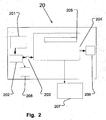
- Fig. 2 is a schematic illustration showing an embodiment of a portable system configured to collect a sample from exhaled breath of a subject.
- Sampling system 20 is configured to collect a sample from exhaled breath of a subject 201.
- the subject will exhale through a mouthpiece and a tubular element 202 being in flow communication with a housing 204 via at least one inlet 203.
- the mouthpiece and tubular element 202 may be of same size or type as a conventional used for alcohol-test.
- the mouthpiece and tubular element 202 is configured to mainly permit aerosols to pass through. Even more preferably, it is configured in accordance with Fig. 1 .
- the housing 204 could be made of any suitably material or combinations thereof such as, metal, plastic, glass or ceramics.
- the housing 204 comprises a sampling membrane 205 for collecting the non-volatile drug substances from the exhaled breath.
- the exhaled breath exits the housing through at least one outlet 206.
- the portable system is sealed after being used and sentto a laboratory 207 to be analyzed. Analysis of the amount of illicit drugs could be performed using a range of methods but preferably methods are Surface enhanced Raman spectroscopy (SERS) or mass-spectroscopy, for example Liquid-chromatography mass-spectroscopy (LCMS).
- SERS Surface enhanced Raman spectroscopy
- mass-spectroscopy for example Liquid-chromatography mass-spectroscopy (LCMS).
- the portable sampling system is made to be a disposable product.
- the housing as well as the mouthpiece is preferably made of a plastic material.
- sampling system and elements for collecting drug substances should be kept clean and preferable be aseptic but could also be used sterile.
- a volume measure unit 208 is used for detecting the amount of exhaled breath from the tested subject, the volume measure unit 208 comprising a port arranged downstream the mouthpiece section and upstream the sampling membrane 205.
- the port is attached to the tubular element.
- a pre-defined fraction or portion of the exhaled breath will be extracted through the port and used for calculating the amount of exhaled breath passed through the sampling membrane 205.
- the volume measure unit 208 is further comprising a gas volume collecting element, preferably a bag, in communication with the port.
- the gas volume collecting element has a predefined volume when expanded.
- the volume of exhaled breath through passed through the sampling membrane 205 may be proportional to the volume of the bag when full.
- a flow meter could be used with an indicator, such as indicators changing colour, may be used to indicate when a pre-determined volume has passed through the sampling membrane.
- Fig. 3 is an embodiment of a portable sampling system 30 is depicted comprising a housing 301, with a sampling membrane 302, a tubular element 303 with a mouthpiece section 308 and a selective trap section, and a volume measure unit comprising a port 307 and a gas volume collecting element 304.
- the volume measure unit is used for calculating the volume of exhaled breath passing through the sampling membrane 302.
- the sampling membrane could be placed anywhere in the housing 301.
- the sampling membrane is fastened to the inner walls of the housing 301.
- the housing 301 is preferably constructed out of two or more parts, a first part with an inlet 305 and one part with at least one outlet 306.
- the mouthpiece section 308 and tubular element 303 is detachable and in fluid communication with the housing 301 via the inlet 305.
- the tubular element 303 is acting as a pre-filter for filtering out saliva and/or mucus and/or large particles and/or aggregates from the exhaled breath, according to what has previously been described.
- a cleaner sampling membrane, such as a filter membrane, to be analyzed is obtained which may result in better and more accurate analysis.
- Other advantages with using a tubular element 303 is the prevention of contamination between subjects and sample
- the mouthpiece section 308 and tubular element 303 is not detachable but integrated with the first part of the housing 301.
- a port 307 for extracting a portion or fraction of the exhaled breath from the subject.
- the extracted exhaled breath is used to blow up a gas volume measuring element 304, such as non-elastic bag or an elastic balloon.
- a non-elastic bag made of plastic is used since it requires less force to be blown up and will automatically stop when full.
- the exhaled breath passing through the sampling membrane can be calculated since it will be proportional to volume of the bag. For example, by extracting a tenth of the volume exhaled by the subject, a full two liter bag means that 18 liter has passed through the sampling membrane (20 liter exhaled in total).
- the port may comprise a one-way valve so that the extracted breath will only enter the bag but not leave.
- the port utilizes the back pressure created by the sampling membrane to extract the exhaled breathe through the port 307.
- a flow meter could be used with an indicator, such as indicators changing colour, may be used to indicate when a pre-determined volume has passed through the sampling membrane.
- the extracted portion or fraction of the exhaled breath being measured is proportional to the predefined volume of exhaled breath passing through the sampling membrane.
- the total amount of exhaled breath passing through the sampling membrane may be determined.
- the exhaled breath will, after flowing through the tubular element 303, travel into the housing 301 and be brought into contact with the sampling membrane, preferably a filter membrane.
- the drug substances being non-volatile compounds conveyed by aerosols in the exhaled breath is collected by the sampling membrane, such as preferably a filter membrane, as the exhaled breath is permeated through the sampling membrane.
- the sampling membrane such as preferably a filter membrane
- sampling membrane 302 which being a filter membrane is not to be confused with an electronic or chemical sampling units and/or traps.
- the sampling element 302 is a physical entity on which the drug substance is collected. Collection may in different embodiments be based on various principles, singly or in combination, comprising depositing, catching, fastening, condensing of non-volatile constituents on the sampling element 302.
- Using a filter membrane allows for a low pressure drop through the portable system 30 making it easy and comfortable to exhale through it. This is important since many drug addicts experience problems with their lungs.
- the filter membrane is placed to block the path for the exhaled breath through the portable system 30.
- the filter membrane is fastened direct onto the inside walls of the housing 301, either by glue or by heat and thereby melting a small part of the edge of the filter membrane.
- the second part of the housing is either screwed or slid onto the first part of the housing.
- the second part comprises at least one outlet 306.
- the housing 301 comprises at least two outlets 306. This will aid to avoid a subject being tested to block the outlet and thereby blowing up the measuring element 304 with minimum exhaled breath being permeated through the filter membrane
- the sampling element 302 is a filter membrane made of synthetic and/or half-synthetic fibers for the exhaled breath to diffuse through.
- the filter membrane will have a structure that catches the aerosols and thereby collects the drug substances being exhaled while letting gas pass through.
- the aerosol particles comprise the non-volatile drug compounds.
- the filter membrane is operable to collect the aerosols from the air with a high volumetric capacity while maintaining a low pressure drop across the filter substrate.
- the filter membrane may be an electrostatic filter made of fibers.
- the filter membrane may be of a non-woven polymeric fibrous that may be an electret.
- the filter membrane is an electrostatic filter being preferably a non-woven filter membrane comprising a blend of acrylic fibers and polypropylene fibers.
- the filter membrane could have a density (sometimes called grade or weight) in the range 23 up to 500 g/m2. But it has been shown that the range 130 up to 300 g/m2 is preferred. Even more preferably is the range 200 up to 280 g/m2.
- the non-woven layer could be attached to at least further layer.
- Further layers could be used to enhance a filter membrane's physical properties or improve filtration performance.
- the extra layer could be a carrier, preferably a polypropylene spunbonded carrier.
- the spunbond carrier may have a scrim weight in the range 10 up to 20 g/m2, preferably 15 g/m2.
- a three layered filter membrane comprising one non-woven layer with a density of 250 g/m2 and two layers being carriers each with a scrim weight of 15 g/m2 will have a air flow resistance of about 36 Pa at 9.5 m/min media velocity.
- the filter membrane may be corrugated to enhance the filtering area within a given housing volume.
- the portable system is configured and adapted to have a sensitive for illicit drugs high enough to obtain results of a standard that could be used as prof in court.
- Other advantages are that the test may be performed anywhere at a low cost and short lead time before obtaining a result. Since no specially trained personnel are needed and the test is does not need to be performed at, for example, a hospital.
- the invented portable sampling system is neither invasive, e.g. blood sampling, nor intruding on personal integrity, e.g. urine sampling.
- Even known issues with methods used today related to samples and specimens taken from a subject to be tested are avoided. For instance for blood samples, and especially for urine samples are a risk of the subject exchanging the samples or using clean samples from another subject to avoid being discovered with traces of illicit drugs.
- the suspected subject can also be tested immediately and does not need to be transported to have the test done later. Hence a more accurate result of the level of an illicit drug at the time of for example an arrest can be obtained.
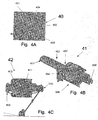
- FIG. 4A-C one embodiment of the invention is illustrated at different stages.
- Fig. 4A depicts a tubular element 40 before being assembled and mounted.
- 401 shows the mouthpiece section with an inlet
- 402 shows the selective trap section of the tubular element
- 403 shows the outlet
- 404 the port for extracting a portion of the exhaled breath
- 405 shows the baffles used to obtain the non-straight gas flow path.
- Fig. 4B illustrates the device 41 when being ready to be used: 401 shows the mouthpiece section; 402 the tubular section comprising the baffles; 407 is the inlet to the housing 406; 408 shows the outlet from the housing 406; 404 is the port for extracting a portion of the exhaled breath for determining the volume of exhaled breath passing the sampling membrane.
- the illustration does not show the volume measure unit (i.e. the bag) attached to the extraction port 404.
- Fig. 4C is illustrating a used sampling device 42.
- the mouthpiece section and tubular element is detached and plugs 409, 410 are mounted to the inlet 407 and the outlet 408 of the housing 406. This will seal off the housing 406 and the sampling membrane comprised inside.
- the portable sampling device 42 is ready to be sent to a laboratory, for example by post.
- the housing 406 is made of two parts 411 and 412 mounted together,
- a first part, for example, 412 of a housing is heated and thereby enlarging the circumference of the first part 412.
- a filter membrane in close proximity to the large opening being approximately the middle of the device, at least one compound in the filter membrane will melt at the edge of the filter membrane. This will stick or fastening the filter membrane to the inner wall of the first part 412.
- the first part of the housing 412 could then be slid or screwed or snapped onto the second part 411. Thus a tight fit may be obtained when the first part 412 cools off and its circumference decreases.
- Fig. 5 is a flow-chart illustrating a method 50 for using a portable system configured to collecting a sample 502 from exhaled breath from a subject.
- Fig. 5 illustrates detecting the presence and/or determining the quantitative amount 503 of at least one illicit drug substance or compound in a collected sample.
- the illicit drug compounds will be collected as aerosols, being non-volatile particles and/or compounds, from the exhaled breath.
- the method comprising of: A subject exhaling 501 into the invented portable system; a sampling unit will collect a sample 502 comprises drug substances or compounds; the collected sample will be extracted from the sampling membrane and analyzed 503 using mass-spectroscopy or SERS.
- a subject will exhale 501 in and out; preferably the subject will exhale into the portable system until a specific volume of exhaled breath has been passed through the sampling membrane, such as preferably a filter membrane.
- the sampling membrane such as preferably a filter membrane.
- the subject has to exhale either for a certain time or for a fixed number of times such as 1 to 10 times into a portable system.
- a fixed number of times such as 1 to 10 times into a portable system.
- each exhale could be set to last for a fixed time.
- a portion of the exhaled breath will be extracted 504 through the port and blow up an element such as a non-elastic bag.
- an element such as a non-elastic bag.
- the volume of said bag will be proportional to the volume passed through the sampling membrane.
- a bag with elastic properties can be used.
- a deep breath is preferred to reach exhaled breath from deep lying lung portions such as the central or the peripheral lung regions.
- the exhaled breath will then be collected 502 by the sampling element, i.e. an easy to breathe through filter membrane, suitably for collecting drug substances before it exits the system.
- the filter membrane is preferably made of synthetics and/or half synthetics fibers; preferably the filter membrane has electrostatic-properties.
- Using a filter membrane will create a small, light weighted and easy to use method that can be used everywhere by anyone to detect if a subject is under influence of an illicit drug.
- the sampling method is of such high quality that the obtained results are of a court approved standard. These results are obtain using a method that is neither invasive, e.g. Blood sampling, nor intruding on personal integrity, e.g. urine sampling. Hence the known drawbacks with these methods are prevented.
- the housing of the sampling system After being used, the housing of the sampling system will sealed off by sealing the inlet and the outlet and be sent to a laboratory, whereby the collected compounds in the filter are removed and analyzed 503 using an appropriate analyzing method such as mass-spectroscopy or SERS.
- an appropriate analyzing method such as mass-spectroscopy or SERS.
- Fig. 6 illustrates a system 60 for detecting the presence or determining the quantitative amount of at least one drug compound in exhaled breath.
- the system comprising a portable drug testing device 602 for handheldly collecting a sample from exhaled breathe from a subject 601.
- the device 602 could be according to any embodiment described herein.
- the system 60 comprises a sensor unit 603 for analyzing the collected compounds in the testing device 602.
- the sensor could be any know type of sensor but preferably mass spectroscopy or SERS.
- To be able to analyze the collected sample the content of the filter membrane in the device 602 is extracted. This could be done for example by using a solvent to be analyzed using the sensor unit 603. Another method is heating the filter and thereby evaporating the content of the filter for example onto a SERS surface.
- Table 1 shows sampling of methadone from exhaled breath using a filter membrane comprising one layer being a non-woven electrostatic filter with a blend of acrylic fibers and polypropylene fibers with a density of 250 g/m2 and two carriers each with a scrim weight of 15 g/m2. The tests where performed at 4 different occasions.
- the first column shows the diameter of the used filter, the second the sampling time the third the amount of methadone collected per minute the fourth the obtained range of methadone among the tested subjects and the fifth column the number of subjects tested.
- Table 2 shows sampling of methadone in breath from a pre-study when using variable densities of the electrostatic filter membrane.
- Type is the density of the non-woven layer at each test, the other headlines are the same as for table 1.
- Table 2 Type (g/m2) Methadone pg/min mean ⁇ SD Range n 150 74.4 ⁇ 80.4 24-216 5 250 71.0 ⁇ 90.1 19-231 5 300 91.8 ⁇ 110 20-287 5
- Table 3 shows sampling of methadone in exhaled breath using two different thicknesses of the electrostatic filter membrane inserted in a sampling device.
- the subject exhales through the tubular section comprising baffles to trapping large particles and saliva.
- the tables show that the aerosols will not be trapped by the baffles in the tubular element.
- Table 3 Filter thickness Constructed sampler Methadone pg/min mean ⁇ SD Range n 1 40 ⁇ 27 12-85 5 2 42 ⁇ 28 17-90 5
- the invention can be used for collecting aerosols comprising biomarkers from exhaled breath of a subject for further sensor based analysis.
- the device may help providing vital information for early detection and/or diagnosis of diseases or illnesses as well as monitoring of disease progression and/or therapy response.
- Some known non-volatile biomarker that may be transported by aerosols in exhaled breath is comprised in the list comprising lipids, peptides, nucleotides, prostanoids, proteins, DNA or RNA. These biomarkers may be used for diagnosis of diseases or illnesses, such as cancer (such as lung cancer), asthma, inflammation, infection (such as tuberculosis) and/or oxidative stress or other medical conditions.
Landscapes
- Health & Medical Sciences (AREA)
- Life Sciences & Earth Sciences (AREA)
- Engineering & Computer Science (AREA)
- Physics & Mathematics (AREA)
- Biomedical Technology (AREA)
- Molecular Biology (AREA)
- Pathology (AREA)
- Biophysics (AREA)
- General Health & Medical Sciences (AREA)
- Public Health (AREA)
- Veterinary Medicine (AREA)
- Animal Behavior & Ethology (AREA)
- Pulmonology (AREA)
- Surgery (AREA)
- Medical Informatics (AREA)
- Heart & Thoracic Surgery (AREA)
- Physiology (AREA)
- Chemical & Material Sciences (AREA)
- Urology & Nephrology (AREA)
- Analytical Chemistry (AREA)
- Hematology (AREA)
- Food Science & Technology (AREA)
- Immunology (AREA)
- General Physics & Mathematics (AREA)
- Biochemistry (AREA)
- Medicinal Chemistry (AREA)
- Pharmacology & Pharmacy (AREA)
- Bioinformatics & Cheminformatics (AREA)
- Toxicology (AREA)
- Mechanical Engineering (AREA)
- Sampling And Sample Adjustment (AREA)
- Investigating Or Analysing Biological Materials (AREA)
Description
- This invention pertains in general to the field of portable handheld devices, sampling systems and methods for collecting a sample from exhaled breath of a subject, and for detecting the presence (i.e. qualitative) or determining the quantitative amount of at least one illicit drug substance or compound in exhaled breath. More particularly the invention relates to such portable handheld devices.
- It is known that exhaled breath is commonly used in alcohol testing and today's technology makes it possible to perform on-site breath testing with legally defensible results using infrared spectroscopy.
- Testing for other illicit drugs of abuse traditionally requires blood or urine samples. Alternatively specimens comprising hair, sweat or oral fluid could be used. Blood sampling is invasive and requires medically trained personnel, whereby test subject often have to be transported to a hospital for sampling. These procedures are time and effort consuming. With long lead times the test result will be too old. Urine sampling may also be considered intruding on personal integrity. Even other issues related to samples and specimens taken from a subject to be tested arise. For instance, blood samples, and especially urine samples are at risk of the subject exchanging the samples or using clean samples from another subject to avoid being discovered with traces of illicit drugs.
- Thus, there is a need to provide a non-invasive, not-specimen based apparatus, system and/or method for detecting the presence (i.e. qualitative) or determining the quantitative amount of at least one drug substance in a subject. Particularly a device and method which should be easy to use with no or little training, especially a device and method for directly, at the site/on-site, screening a person for illicit drugs and obtaining results that could be approved by court.
- Beck et al. (J. Chromatography B, vol. 878 (2010), pages 2255-2259) describe the use of a sampling device comprising a membrane for collecting breath aerosols containing a drug substance.
- Hence, an improved apparatus, system and/or method for at site/on site sampling of a subject for drug substances are desired. Such a device, system and/or method for sampling the subject for illicit drugs of abuse and/or medical drugs would be desired. The apparatus, system and/or method should be efficient, non-bulky, user friendly both for operators and the subject. It should further be not intruding and not invasive.
- Another application would be to take samples from exhaled breath for sampling aerosols which may transport biomarkers. The samples could then be analyzed and detected biomarkers may be used for diagnosis of medical conditions of the tested subject. Measuring biomarkers in exhaled air would be non-invasive and enables repeated sampling which can be useful for early detection of disease as well as monitoring of disease progression and therapy response.
- A known method for sampling biomarkers is Exhaled Breath Condensate (EBC) i.e. exhaled water vapor that is condensed by the means of low temperature. Both volatile and non-volatile compounds have been identified using EBC. The non-volatiles found in EBC are believed to originate from particles formed within the airways. The collection of exhaled breath condensate (EBC) is connected with a number of serious methodological difficulties such as dilution with water resulting in very low concentrations of the substances of interest, high contamination with substances originating from the oral cavity, high intraindividual coefficient of variation and a very inefficient way to sample, especially, non-volatiles compounds.
- Another known method is described in
DE 197 18 924 . wherein breath aerosols containing biomarkers are collected on a membrane in a portable device. - Hence, a method for easy monitoring of the airways that also allows frequent sampling would be advantageous. Particularly if the method may be performed risk free. Thus, there is a need to provide a non-invasive based apparatus, system and/or method for detecting the presence (i.e. qualitative) or determining the quantitative amount of at least one biomarker for medical diagnosis of a subject. Particularly, a device and method being easy to use with no or little training, especially a device and method to be used directly, at the site/on-site, for sampling and/or testing a subject for a medical diseases or illnesses would be advantageous. The device and method should be sensitive enough to obtain results of a standard that could be used for diagnosis of medical conditions.
- Hence, an improved apparatus, system and/or method for at site/on site sampling of biomarkers from a subject is desired. The apparatus, system and/or method should be efficient, non-bulky, user friendly both for operators and the subject.
- Accordingly, embodiments of the present invention preferably seek to mitigate, alleviate or eliminate one or more deficiencies, disadvantages or issues in the art, such as the above-identified, singly or in any combination by providing a system and a method, according to the appended patent claims, wherein
a portable drug substance sampling device is provided for collecting a sample from exhaled breath of a subject for further sensor based analysis, comprising a housing comprising at least one inlet and at least one outlet for the exhaled breath to exit through and a sampling membrane arranged in the housing, and
further comprising a tubular element having a mouthpiece section for the subject to exhale into. - The sampling membrane is arranged to collect the aerosols from the exhaled breath. Furthermore, the device comprises a port arranged downstream of the mouthpiece and upstream of the sampling membrane, this port being adapted to extract a defined portion of the exhaled breath into a volume measure unit for determining that a pre-defined volume of the exhaled breath has passed through the sampling membrane.
- The exhaled breath volume is not stored in a volume for analysis of the chemical contents of the entire breath volume. Rather, traces of the drug substance are attached to a sampling membrane. Analysis is not made online of the breath volume, but of the traces in the sampling membrane. The portable drug testing device may be sealed and sent further for the analysis, such as in a laboratory. Collection of the traces is made quickly, by exhaling a predetermined volume of breath through the sampling membrane. The obtain results when using the device are reliable and have a proven.robustness. Using the invented drug testing device is far more convenient, quicker and cheaper than any previous breath sample collection methods.
- Compounds exhaled in expired air may originate from blood by a mechanism of producing a gas phase in the alveoli. Alternatively, compounds may originate from other parts of the airways. Non-volatile compounds are transferred from the lungs carried by an aerosol. Here the non-volatile are drug substances or compounds and could be either medical drugs or legal or illegal narcotic substances or markers thereof. The drug substances are collected on-site using a portable system comprising a sampling membrane. The collected samples are to be sent to a laboratory for further analysis. Alternatively, compact on-site analysis equipment may be used to perform the analysis. The analysis is performed using a suitable analyzing method like spectroscopy or preferably mass-spectroscopy or Surface enhanced Raman spectroscopy (SERS). Other similar sensitive methods known to the skilled person may be used.
- Since the portable drug testing device is small and designed to be easy to handle it may be used by any personnel anywhere on-site. Thus the drug testing device is adapted to be used instead of more intrusive tests, like tests based on the much common urine or blood samples.
- The housing could be made of any material like, plastic, metal or glass as long as it is possibly to either clean or preferable be aseptic but could also be used sterile. The housing could alternatively or in addition be made of a disposable material. In this way the housing may, after being used for sampling and after the analysis of the collected compounds has been performed, be discarded.
- The tubular section is used to improve the quality of the test by preventing big particles and/or aggregates and/or saliva to be collected by the sampling membrane. This may be done by having a selective trap section in the tubular section which has baffles to force the exhaled breath to pass a non-straight gas flow path.
- In some embodiments of the invention, the tubular element is detachable from the housing or the tubular element is an integrated part of the housing.
- In some embodiments of the invention, the volume measure unit is configured to measure a volume proportional to the pre-defined volume of the exhaled breath.
- In some embodiments of the invention, the volume measure unit comprising a gas volume collecting element, such as a bag, having a volume and wherein a port is arranged downstream the mouthpiece and upstream the sampling membrane and wherein the port is adapted to extract a defined portion of the exhaled breath into the volume measure unit.
- This is an easy and effective way of determining when a pre-defined volume of exhaled breath has passed through the sampling membrane. The bag is blown up by utilizing the back pressure due to air flow resistance of the sampling membrane: The volume of the gas volume collecting element is proportional to the pre-defined volume of the exhaled breath.
- In some embodiments of the invention, the volume collecting element is a non-elastic bag with a predetermined volume and/or size.
- An elastic bag could be used but a non-elastic bag with a specific volume is easier to blow up and can only hold that specific volume.
- In some embodiments of the invention, the sampling membrane is a filter membrane, preferably an electrostatic filter membrane.
- In some embodiments of the invention, The filter membrane comprising at least one layer of non-woven filtration media with a specific weight in the range of 23 g/m3 to 500g/m3, preferably in the range of 150 up to 300 g/m3, and even more preferably in the range of 200 up to 280 g/m3.
- In some embodiments of the invention, the filter membrane comprising at least on further layer being a spunbonded carrier with a scrim weight of 10 to 20 g/m3.
- One important parameter of a sampling device that is fulfillled by using a filter membrane made of fibers is the low pressure drop. To be able to collect exhaled breath samples from most subjects the pressure drop through the system has to be as low as possible. The flow rate of a subject's exhalation depends on some parameters for example the subject's age, mental state (MR, Alzheimer's), medical condition (sepsis, Parkinson's) or other medications like benzodiazepines, opiates, neuroleptics, local anesthetics or intoxicants etc. Many people with a history of drug abuse have a very low flow rate.
- In some embodiments of the invention, the filter membrane has a filter surface to be passed by exhaled gas of approximately 800mm2 and a pressure drop of 36 Pa at 9,5 m/min media velocity.
- In some embodiments of the invention, the filter membrane is made of a blend of acrylic fibers and polypropylene fibers.
- The acrylic fibers have electrostatic properties while the polypropylene fibers will make the filter structure stronger, for example may the polypropylene fibers give the filter membrane enough support so that requires sizes and shapes can be punched out from the material.
- In some embodiments of the invention, the housing may have at least two outlets.
- Two outlet will help to prevent a subject to be tested from stopping the air from flowing out of the outlet and thereby preventing enough exhaled breath from passing through the sampling element.
- In some embodiments of the invention, the tubular element further comprises an inlet, an outlet in connection with a lumen, at least two baffles, each having a height of at least a length of a radius of the lumen. The baffles are arranged on different sides of the lumen,to deny an exhaled breath a straight path through the lumen of the conduit, thereby creating the selective trap section, which primarily the aerosols in the exhaled breath are permitted to pass though..
- In some embodiments of the invention, each baffle may comprise orifices with a size that only permit the aerosols to pass through.
- In some embodiments of the invention, the aerosols comprise non-volatile compounds of at least one drug substance in the exhaled breath. The drug substance is comprised in the list comprising Amphetamine, ecstasy, Cannabis, THC and cannabinoids, Opiates, heroin, morphine, 6-AM, Cocaïne, Benzodiazepines, Propoxyphene, Methadone, Buprenorphine, Tramadol, LSD, Designer/Internet drugs, Kathinon, GHB, Meprobamat, Z-drugs, Tryptamines, or Anabolic steroids but are not limited to these since other illicit drugs (drugs of abuse) not included in the list may also be detectable due to similar interchanges with the human body as the above mentioned illicit drug substances.
- The compositions of the exhaled particles are believed to reflect the airway's mucus layer and/or respiratory tract lining fluid, which probably reflects the blood content of the drug. The drug substances or compounds are believed by the inventors to most likely to come from the central part of the airway system. The non-volatile drug substances or compounds are carried by liquid droplets (aerosol) that are formed during normal breathing, for example, by the turbulent airflow causing the airway-lining fluid to nebulize. The aerosols are possible to collect as exhaled breath condensates. The theory comes from Anesthetic studies that have showed that Anesthetic potency correlates with lipid solubility. Holds true across species and implies when a specific hydrophobic region is occupied the more soluble the anesthetic agent is in blood the faster the drug goes into the body,
- According to another aspect of the invention, a system is provided for detecting the presence and/or determining the quantitative amount of at least one drug compound in said exhaled breath. The system comprises the portable drug testing device as described above and a sensor unit for analyzing a sample collected from exhaled breath of a subject by means of said device.
- The mass-spectroscopy or SERS are the preferred analyzing methods, since this technology has a very high selectivity and sensibility of bioanalysis especially with regards to trace analytes in biological samples. The preferable interface for the mass spectroscopy is liquid chromatography.
- The sampling membrane may be emptied from collected particles and analyzed by dissolving the collected particles from the exhaled breath in a solvent. The solvent could then be analyzed by the sensor unit. Another method could be to evaporate the content of the sampling membrane onto a SERS surface.
- In yet another aspect of the invention, a method of screening a person for drugs and/or biomarkers is provided, comprising collecting a sample from exhaled breath of a subject, by using the herein disclosed device for sampling, and sensor based analysis of the sample. The method comprises the subject exhaling into the device, collecting aerosols from the exhaled breath in a sampling membrane of the device, measuring a pre-defined fraction of the exhaled breath volume for determining a specific total volume of the exhaled breath passing through the sampling membrane. When the specific total volume is determined as having passed through the sampling membrane terminating the exhalation and sealing the device off. The method further comprises extracting content from the sampling membrane. Employing a sensor unit for detecting traces of the drugs and/or biomarkers in the content, and analyzing a presence of the drugs and/or biomarkers based on a result obtained from the sensor unit.
- Further embodiments of the invention are defined in the dependent claims.
- When used for collecting aerosols comprising biomarkers from exhaled breath of a subject for further sensor based analysis, the device may help providing vital information for early detection and/or diagnosis of diseases or illnesses as well as monitoring of disease progression and/or therapy response.
- Some known non-volatile biomarker that may be transported by aerosols in exhaled breath is comprised in the list comprising lipids, peptides, nucleotides, prostanoids, proteins, DNA or RNA.
- These biomarkers may be used for diagnosis of diseases or illnesses, such as cancer (such as lung cancer), asthma, inflammation, infection (such as tuberculosis) and/or oxidative stress or other medical conditions.
- It should be emphasized that the term "comprises/comprising" when used in this specification is taken to specify the presence of stated features, integers, steps or components but does not preclude the presence or addition of one or more other features, integers, steps, components or groups thereof.
- These and other aspects, features and advantages of which embodiments of the invention are capable of will be apparent and elucidated from the following description of embodiments of the present invention, reference being made to the accompanying drawings, in which
-
Fig. 1A-C are schematic illustrations showing a tubular element with a mouthpiece section, and a selective trap section designed to mainly permit aerosols from exhaled breath from a subject to pass through; -
Fig. 2 is a schematic illustration illustrating an embodiment of a portable device configured to collect a sample from exhaled breath of a subject; -
Fig. 3 is an embodiment of a portable sampling device showing a housing with a sampling element being a filter membrane; -
Fig. 4A is depicting a tubular section; -
Fig 4B and C are depicting a portable sampling device at different stages of use; -
Fig. 5 is showing a flow-chart illustrating a method for using a portable device configured to collect a sample from exhaled breath of a subject; and -
Fig. 6 illustrates a system for detecting the presence or determining the quantitative amount of at least one drug compound in exhaled breath. - Specific embodiments of the invention will now be described with reference to the accompanying drawings. This invention may, however, be embodied in many different forms and should not be construed as limited to the embodiments set forth herein; rather, these embodiments are provided so that this disclosure will be thorough and complete, and will fully convey the scope of the invention to those skilled in the art. The terminology used in the detailed description of the embodiments illustrated in the accompanying drawings is not intended to be limiting of the invention. In the drawings, like numbers refer to like elements.
- In
Fig. 1A-C a tubular element with a mouthpiece section and a selective trap section is depicted. The selective trap section of the tubular element is designed to permit primarily aerosols to pass through. Hence denying saliva and/or mucus and/or larger particles and/or aggregated to enter the housing and thereby avoiding the sampling membrane to be clogged. - The tubular element is a conduit with a coaxial lumen having transversal baffles. The cross-section of the lumen could have any shape but is preferably circular or oval. In
Fig. 1A two complementary cross-section views 10, 11 along the length of a tubular element with a mouthpiece section are shown. The shape of the two parts are close to two half-pipes, wherein both parts comprising open ends 101, 102 which will form an inlet, being a mouthpiece section, and an outlet, when put together. The section between theinlet 101 andoutlet 102 is a selective trap section 111 (seeFig 1 B) . InFig. 1A ,part 10 comprises twotransversal baffles 103 andpart 11 one. Hence the total number ofbaffles 103 seated in thelumen 104 in the illustrated embodiment of the tubular element is three. In reality any suitable number of baffles needed to obtain the needed effect could be seated in the lumen of the tubular element. The section of the tubular element with thebaffles 103 forms theselective trap section 111 - The transversal baffles 103 may be perpendicular to the
inner wall 105 of the lumen 104 (as depicted inFig. 1A ). Alternatively and/or additionally, in some embodiments the transversal baffles 103 may have any suitable angle relative theinner wall 105 of thelumen 104. - In
Fig. 1B a cross-section of the tubular element is depicted from a different view, showing the height of the transversal baffles and the path the exhaled breath must travel from theinlet 101 to theoutlet 102. In the upper cross-section view theheight 106 of thebaffles 103 are shown related to theradius 107 of the lumen. Thebaffles 103 protrude into thelumen 104 at least a distance being the same as theradius 107. Preferably theheight 106 of thebaffles 103 should be taller than the length of theradius 107 of thelumen 104. Thebaffles 103 are inFig. 2B depicted as perpendicular to theinner wall 105 of thelumen 104. In reality eachbaffle 103 could have any suitable angle relative theinner wall 105 of thelumen 104 as long as they extend into the lumen the same distance as theradius 107 or longer. - The
baffles 103 in theselective trap section 111 should be spaced to optimizing passing of aerosols and at the same time minimizing the amount of saliva and/or mucus and/or particles and/or aggregates 108 permitted through the tubular element to theoutlet 102. Alternatively and/or additionally, in some embodiments the spacing is depending on the height and/or the angle of thebaffles 103. - Further in
Fig. 1B , the arrows in the lower cross-section show the non-straight travel of exhaled breath and of the aerosols throughselective trap section 111 of the tubular element. The aerosols will easily travel from theinlet 101 to theoutlet 102 while the heavier or larger in size particles or aggregates 108 that may clog a sampling membrane will be denied by thebaffles 103. Theselective trap section 111 of tubular element may therefore act as a pre-filter. - Alternatively and/or additionally, the
baffles 103 include orifices sized to mainly permit aerosols to pass through the orifices. - In
Fig. 1C themouthpiece section 12 is depict. Theinlet 109 could have any shape but one that has shown to be particularly suitable and confortable is an oval shape. 110 depict the contours of the tubular section previously described inFig. 4A and B . - In
Fig. 2 is a schematic illustration showing an embodiment of a portable system configured to collect a sample from exhaled breath of a subject.Sampling system 20 is configured to collect a sample from exhaled breath of a subject 201. The subject will exhale through a mouthpiece and atubular element 202 being in flow communication with ahousing 204 via at least oneinlet 203. The mouthpiece andtubular element 202 may be of same size or type as a conventional used for alcohol-test. Preferably the mouthpiece andtubular element 202 is configured to mainly permit aerosols to pass through. Even more preferably, it is configured in accordance withFig. 1 . - The
housing 204 could be made of any suitably material or combinations thereof such as, metal, plastic, glass or ceramics. - The
housing 204 comprises asampling membrane 205 for collecting the non-volatile drug substances from the exhaled breath. The exhaled breath exits the housing through at least oneoutlet 206. The portable system is sealed after being used and sentto alaboratory 207 to be analyzed. Analysis of the amount of illicit drugs could be performed using a range of methods but preferably methods are Surface enhanced Raman spectroscopy (SERS) or mass-spectroscopy, for example Liquid-chromatography mass-spectroscopy (LCMS). - Alternatively and/or additionally, in some embodiments the portable sampling system is made to be a disposable product. When designed to be a disposable product the housing as well as the mouthpiece is preferably made of a plastic material.
- The sampling system and elements for collecting drug substances should be kept clean and preferable be aseptic but could also be used sterile.
- In accordance with the invention, a
volume measure unit 208 is used for detecting the amount of exhaled breath from the tested subject, thevolume measure unit 208 comprising a port arranged downstream the mouthpiece section and upstream thesampling membrane 205. Preferably the port is attached to the tubular element. A pre-defined fraction or portion of the exhaled breath will be extracted through the port and used for calculating the amount of exhaled breath passed through thesampling membrane 205. Preferably thevolume measure unit 208 is further comprising a gas volume collecting element, preferably a bag, in communication with the port. The gas volume collecting element has a predefined volume when expanded. The volume of exhaled breath through passed through thesampling membrane 205 may be proportional to the volume of the bag when full. - Alternatively to a gas volume collecting element, such as a bag, a flow meter could be used with an indicator, such as indicators changing colour, may be used to indicate when a pre-determined volume has passed through the sampling membrane.
- In
Fig. 3 is an embodiment of aportable sampling system 30 is depicted comprising ahousing 301, with asampling membrane 302, atubular element 303 with amouthpiece section 308 and a selective trap section, and a volume measure unit comprising aport 307 and a gasvolume collecting element 304. The volume measure unit is used for calculating the volume of exhaled breath passing through thesampling membrane 302. - The sampling membrane could be placed anywhere in the
housing 301. Preferably the sampling membrane is fastened to the inner walls of thehousing 301. Thehousing 301 is preferably constructed out of two or more parts, a first part with aninlet 305 and one part with at least oneoutlet 306. - The
mouthpiece section 308 andtubular element 303 is detachable and in fluid communication with thehousing 301 via theinlet 305. Thetubular element 303 is acting as a pre-filter for filtering out saliva and/or mucus and/or large particles and/or aggregates from the exhaled breath, according to what has previously been described. Thus a cleaner sampling membrane, such as a filter membrane, to be analyzed is obtained which may result in better and more accurate analysis. Other advantages with using atubular element 303 is the prevention of contamination between subjects and sample - Alternatively and/or additionally, in some embodiments the
mouthpiece section 308 andtubular element 303 is not detachable but integrated with the first part of thehousing 301. - Connected either to the
tubular element 303 or between themouthpiece section 308 and theinlet 305 is aport 307 for extracting a portion or fraction of the exhaled breath from the subject. The extracted exhaled breath is used to blow up a gasvolume measuring element 304, such as non-elastic bag or an elastic balloon. In this embodiment a non-elastic bag made of plastic is used since it requires less force to be blown up and will automatically stop when full. - When the bag is full the exhaled breath passing through the sampling membrane can be calculated since it will be proportional to volume of the bag. For example, by extracting a tenth of the volume exhaled by the subject, a full two liter bag means that 18 liter has passed through the sampling membrane (20 liter exhaled in total).
- Additionally, in some embodiments the port may comprise a one-way valve so that the extracted breath will only enter the bag but not leave.
- Alternatively and/or additionally, in some embodiments the port utilizes the back pressure created by the sampling membrane to extract the exhaled breathe through the
port 307. - Alternatively, in some embodiments, a flow meter could be used with an indicator, such as indicators changing colour, may be used to indicate when a pre-determined volume has passed through the sampling membrane.
- The extracted portion or fraction of the exhaled breath being measured is proportional to the predefined volume of exhaled breath passing through the sampling membrane. Thus by measuring this fraction or portion and by knowing the ratio of air being extracted and air passing through the sampling membrane the total amount of exhaled breath passing through the sampling membrane may be determined.
- The exhaled breath will, after flowing through the
tubular element 303, travel into thehousing 301 and be brought into contact with the sampling membrane, preferably a filter membrane. - The drug substances being non-volatile compounds conveyed by aerosols in the exhaled breath is collected by the sampling membrane, such as preferably a filter membrane, as the exhaled breath is permeated through the sampling membrane.
- It should be noted that the
sampling membrane 302 which being a filter membrane is not to be confused with an electronic or chemical sampling units and/or traps. Thesampling element 302 is a physical entity on which the drug substance is collected. Collection may in different embodiments be based on various principles, singly or in combination, comprising depositing, catching, fastening, condensing of non-volatile constituents on thesampling element 302. - Using a filter membrane allows for a low pressure drop through the
portable system 30 making it easy and confortable to exhale through it. This is important since many drug addicts experience problems with their lungs. - In accordance with the invention, the filter membrane is placed to block the path for the exhaled breath through the
portable system 30. - There are many possibilities for fastening the filter membrane as needed, either by using a separate support structure retaining the filter, which may be an element that is either fastened to the inside walls of the
housing 301 or a segment being slide onto a first part of the housing during the assembly before the second part of the housing is mounted. - Alternatively and/or additionally, in some embodiments the filter membrane is fastened direct onto the inside walls of the
housing 301, either by glue or by heat and thereby melting a small part of the edge of the filter membrane. - The second part of the housing is either screwed or slid onto the first part of the housing. The second part comprises at least one
outlet 306. Alternatively, in some embodiment thehousing 301 comprises at least twooutlets 306. This will aid to avoid a subject being tested to block the outlet and thereby blowing up the measuringelement 304 with minimum exhaled breath being permeated through the filter membrane - In an embodiment of the
portable device 30 thesampling element 302 is a filter membrane made of synthetic and/or half-synthetic fibers for the exhaled breath to diffuse through. - The filter membrane will have a structure that catches the aerosols and thereby collects the drug substances being exhaled while letting gas pass through. The aerosol particles comprise the non-volatile drug compounds. Preferably the filter membrane is operable to collect the aerosols from the air with a high volumetric capacity while maintaining a low pressure drop across the filter substrate.
- Alternatively and/or additionally, in some embodiments the filter membrane may be an electrostatic filter made of fibers.
- Alternatively and/or additionally, in some embodiments the filter membrane may be of a non-woven polymeric fibrous that may be an electret.
- Alternatively and/or additionally, in some embodiments the filter membrane is an electrostatic filter being preferably a non-woven filter membrane comprising a blend of acrylic fibers and polypropylene fibers. The filter membrane could have a density (sometimes called grade or weight) in the range 23 up to 500 g/m2. But it has been shown that the range 130 up to 300 g/m2 is preferred. Even more preferably is the range 200 up to 280 g/m2.
- Alternatively and/or additionally, in some embodiments the non-woven layer could be attached to at least further layer. Further layers could be used to enhance a filter membrane's physical properties or improve filtration performance. The extra layer could be a carrier, preferably a polypropylene spunbonded carrier. The spunbond carrier may have a scrim weight in the
range 10 up to 20 g/m2, preferably 15 g/m2. - For example a three layered filter membrane comprising one non-woven layer with a density of 250 g/m2 and two layers being carriers each with a scrim weight of 15 g/m2 will have a air flow resistance of about 36 Pa at 9.5 m/min media velocity.
- Alternatively and/or additionally, in some embodiments, the filter membrane may be corrugated to enhance the filtering area within a given housing volume.
- The portable system is configured and adapted to have a sensitive for illicit drugs high enough to obtain results of a standard that could be used as prof in court. Other advantages are that the test may be performed anywhere at a low cost and short lead time before obtaining a result. Since no specially trained personnel are needed and the test is does not need to be performed at, for example, a hospital.
- Other advantages are that the invented portable sampling system is neither invasive, e.g. blood sampling, nor intruding on personal integrity, e.g. urine sampling. Even known issues with methods used today, related to samples and specimens taken from a subject to be tested are avoided. For instance for blood samples, and especially for urine samples are a risk of the subject exchanging the samples or using clean samples from another subject to avoid being discovered with traces of illicit drugs. The suspected subject can also be tested immediately and does not need to be transported to have the test done later. Hence a more accurate result of the level of an illicit drug at the time of for example an arrest can be obtained.
- In
Fig. 4A-C one embodiment of the invention is illustrated at different stages.Fig. 4A depicts atubular element 40 before being assembled and mounted. 401 shows the mouthpiece section with an inlet, 402 shows the selective trap section of the tubular element, 403 shows the outlet, 404 the port for extracting a portion of the exhaled breath and 405 shows the baffles used to obtain the non-straight gas flow path. -
Fig. 4B illustrates thedevice 41 when being ready to be used: 401 shows the mouthpiece section; 402 the tubular section comprising the baffles; 407 is the inlet to thehousing 406; 408 shows the outlet from thehousing 406; 404 is the port for extracting a portion of the exhaled breath for determining the volume of exhaled breath passing the sampling membrane. The illustration does not show the volume measure unit (i.e. the bag) attached to theextraction port 404. -
Fig. 4C is illustrating a usedsampling device 42. The mouthpiece section and tubular element is detached and plugs 409, 410 are mounted to theinlet 407 and theoutlet 408 of thehousing 406. This will seal off thehousing 406 and the sampling membrane comprised inside. At this stage theportable sampling device 42 is ready to be sent to a laboratory, for example by post. InFig. 4C it is shown that thehousing 406 is made of twoparts - The process of manufacturing a portable device according to the embodiments described herewithin when the housing is made in plastic could be formed the following way (reference to the parts shown in
Fig. 4A-C ): a first part, for example, 412 of a housing is heated and thereby enlarging the circumference of thefirst part 412. When seating a filter membrane in close proximity to the large opening being approximately the middle of the device, at least one compound in the filter membrane will melt at the edge of the filter membrane. This will stick or fastening the filter membrane to the inner wall of thefirst part 412. The first part of thehousing 412 could then be slid or screwed or snapped onto thesecond part 411. Thus a tight fit may be obtained when thefirst part 412 cools off and its circumference decreases. -
Fig. 5 is a flow-chart illustrating amethod 50 for using a portable system configured to collecting asample 502 from exhaled breath from a subject. Briefly,Fig. 5 illustrates detecting the presence and/or determining thequantitative amount 503 of at least one illicit drug substance or compound in a collected sample. The illicit drug compounds will be collected as aerosols, being non-volatile particles and/or compounds, from the exhaled breath. The method comprising of: A subject exhaling 501 into the invented portable system; a sampling unit will collect asample 502 comprises drug substances or compounds; the collected sample will be extracted from the sampling membrane and analyzed 503 using mass-spectroscopy or SERS. - With reference to
Fig. 5 , a subject will exhale 501 in and out; preferably the subject will exhale into the portable system until a specific volume of exhaled breath has been passed through the sampling membrane, such as preferably a filter membrane. - Alternatively and/or additionally, in some embodiments the subject has to exhale either for a certain time or for a fixed number of times such as 1 to 10 times into a portable system. When breathing a fixed number of times each exhale could be set to last for a fixed time.
- To measure a specific volume, a portion of the exhaled breath will be extracted 504 through the port and blow up an element such as a non-elastic bag. Hence when the bag is full, the volume of said bag will be proportional to the volume passed through the sampling membrane.
- Alternatively and/or additionally, in some embodiments a bag with elastic properties can be used.
- A deep breath is preferred to reach exhaled breath from deep lying lung portions such as the central or the peripheral lung regions.
- The exhaled breath will then be collected 502 by the sampling element, i.e. an easy to breathe through filter membrane, suitably for collecting drug substances before it exits the system. The filter membrane is preferably made of synthetics and/or half synthetics fibers; preferably the filter membrane has electrostatic-properties. Using a filter membrane will create a small, light weighted and easy to use method that can be used everywhere by anyone to detect if a subject is under influence of an illicit drug. The sampling method is of such high quality that the obtained results are of a court approved standard. These results are obtain using a method that is neither invasive, e.g. Blood sampling, nor intruding on personal integrity, e.g. urine sampling. Hence the known drawbacks with these methods are prevented.
- After being used, the housing of the sampling system will sealed off by sealing the inlet and the outlet and be sent to a laboratory, whereby the collected compounds in the filter are removed and analyzed 503 using an appropriate analyzing method such as mass-spectroscopy or SERS.
-
Fig. 6 illustrates a system 60 for detecting the presence or determining the quantitative amount of at least one drug compound in exhaled breath. The system comprising a portabledrug testing device 602 for handheldly collecting a sample from exhaled breathe from a subject 601. Thedevice 602 could be according to any embodiment described herein. Further, the system 60 comprises asensor unit 603 for analyzing the collected compounds in thetesting device 602. The sensor could be any know type of sensor but preferably mass spectroscopy or SERS. To be able to analyze the collected sample the content of the filter membrane in thedevice 602 is extracted. This could be done for example by using a solvent to be analyzed using thesensor unit 603. Another method is heating the filter and thereby evaporating the content of the filter for example onto a SERS surface. - In the following further examples of implementations of the invention and how an analysis may be performed is demonstrated. These original observations demonstrate drug testing based on sampling of expired air.
- Table 1 shows sampling of methadone from exhaled breath using a filter membrane comprising one layer being a non-woven electrostatic filter with a blend of acrylic fibers and polypropylene fibers with a density of 250 g/m2 and two carriers each with a scrim weight of 15 g/m2. The tests where performed at 4 different occasions. The first column shows the diameter of the used filter, the second the sampling time the third the amount of methadone collected per minute the fourth the obtained range of methadone among the tested subjects and the fifth column the number of subjects tested.
Table 1 Diameter of filter mm Sampling time min Methadone pg/min mean±SD Range n 47 3 86±52 18-168 6 32 3 112±89 47-266 5 32 3 92±62 28-199 6 32 1 204±116 21-326 6 - Table 2 shows sampling of methadone in breath from a pre-study when using variable densities of the electrostatic filter membrane. Type is the density of the non-woven layer at each test, the other headlines are the same as for table 1.
Table 2 Type (g/m2) Methadone pg/min mean±SD Range n 150 74.4±80.4 24-216 5 250 71.0±90.1 19-231 5 300 91.8±110 20-287 5 - Table 3 shows sampling of methadone in exhaled breath using two different thicknesses of the electrostatic filter membrane inserted in a sampling device. The subject exhales through the tubular section comprising baffles to trapping large particles and saliva. The tables show that the aerosols will not be trapped by the baffles in the tubular element.
Table 3 Filter thickness Constructed sampler Methadone pg/min mean±SD Range n 1 40±27 12-85 5 2 42±28 17-90 5 - Additionally and/or alternatively, the invention can be used for collecting aerosols comprising biomarkers from exhaled breath of a subject for further sensor based analysis. By sampling biomarkers from exhaled breath the device may help providing vital information for early detection and/or diagnosis of diseases or illnesses as well as monitoring of disease progression and/or therapy response.
- Some known non-volatile biomarker that may be transported by aerosols in exhaled breath is comprised in the list comprising lipids, peptides, nucleotides, prostanoids, proteins, DNA or RNA.
These biomarkers may be used for diagnosis of diseases or illnesses, such as cancer (such as lung cancer), asthma, inflammation, infection (such as tuberculosis) and/or oxidative stress or other medical conditions. - The present invention has been described above with reference to specific embodiments. However, other alternatively and/or additionally embodiments than the above described are equally possible within the scope of the invention. Different method steps than those described above, performing the method by hardware or software, may be provided within the scope of the invention. The different features and steps of the invention may be combined in other combinations than those described. The scope of the invention is only limited by the appended patent claims.
Claims (14)
- A portable sampling device for collecting a sample from exhaled breath of a subject for further sensor based analysis, comprising:a housing (204, 301) comprising at least one inlet and at least one outlet for said exhaled breath to exit through, and a sampling membrane (205,302) arranged in said housing;a mouthpiece and a tubular element (202, 303) in flow communication with said housing (204,301) via said at least one inlet;wherein said sampling membrane is arranged to block a path of a flow of exhaled breath to collect aerosols from said exhaled breath that pass through said sampling membrane when in use; and characterised bya volume measure unit (208, 307) for determining that a pre-defined volume of said exhaled breath has passed through said sampling membrane, and wherein a port is arranged downstream said mouthpiece and upstream said sampling membrane and wherein said port is adapted to extract a defined portion of said exhaled breath into said volume measure unit.
- The device according to claim 1, wherein said tubular element comprises a selective trap section in fluid communication with said mouthpiece and said inlet of said housing, said selective trap section having a non-straight gas flow path for letting aerosols pass through said tubular element.
- The device according to claim 1 or 2, wherein said volume measure unit is configured to measure a volume proportional to said pre-defined volume of said exhaled breath.
- The device according to claim 1 or 2, said volume measure unit comprising a gas volume collecting element, such as a bag, having a volume; and
wherein said volume of said gas volume collecting element is proportional to said pre-defined volume of said exhaled breath. - The device according to claim 4, wherein said volume collecting element is a non-elastic bag with a predetermined volume.
- The device according to any of the preceding claims, wherein said sampling membrane is a filter membrane, preferably an electrostatic filter membrane; or wherein said sampling membrane is a filter membrane and said filter membrane comprising at least one layer of non-woven filtration media with a specific weight in the range of 23 g/m3 to 500g/m3, preferably in the range of 150 up to 300 g/m3, and even more preferably in the range of 200 up to 280 g/m3.
- The device according to claim 6, wherein said filter membrane comprising at least on further layer being a spunbonded carrier with a scrim weight of 10 to 20 g/m3; or wherein said filter membrane has a filter surface to be passed by exhaled gas of approximately 800mm2 and a pressure drop of 36 Pa at 9,5 m/min media velocity.
- The device according to any of claims 6 to 7, wherein said filter membrane is made of a blend of acrylic fibers and polypropylene fibers.
- The device according to any of claims 2 to 8, wherein said tubular element further comprising:an inlet, an outlet in connection with a lumen;at least two baffles, each having a height of at least a length of a radius of the lumen;and wherein said baffles are arranged on different sides of the lumen to deny an exhaled breath a straight path through said lumen of said conduit, thereby creating said selective trap section, which primarily said aerosols in said exhaled breath are permitted to pass though..
- The device according to claim 9, wherein each baffle comprising orifices with a size that only permit said aerosols to pass through.
- The device according to any of the preceding claims, wherein said aerosols comprise non-volatile compounds of at least one drug substance in said exhaled breath; and/or wherein said aerosols comprise non-volatile compounds of at least one bio-marker in said exhaled breath; and/or wherein said aerosols comprise non-volatile compounds of at least one drug substance in said exhaled breath and wherein said drug substance is comprised in the list comprising Amphetamine, ecstasy, Cannabis, THC and cannabinoids, Opiates, heroin, morphine, 6-AM, Cocaine, Benzodiazepines, Propoxyphene, Methadone, Buprenorphine, Tramadol, LSD, Designer/Internet drugs, Kathinon, GHB, Meprobamat, Z-drugs, Tryptamines, or Anabolic steroids.
- A system for detecting the presence and/or determining the quantitative amount of at least one compound in said exhaled breath, said system comprising a device of any of claims 1-11, and a sensor unit for analyzing a sample collected from exhaled breath of a subject by means of said device.
- A method of collecting a sample from exhaled breath of a subject for screening said subject for drugs and/or biomarkers, comprising:exhaling into a device according to any of claims 1 to 12 for collecting aerosols from said exhaled breath in a sampling membrane of said device;measuring a pre-defined fraction of said exhaled breath volume for determining a specific total volume of said exhaled breath passing through said sampling membrane; and when said specific total volume is determined as having passed through said sampling membrane terminating said exhalation and sealing said device off;extracting a content from said sampling membrane; andemploying a sensor unit for detecting traces of said drugs and/or biomarkers in said content, and analyzing a presence of said drugs and/or biomarkers based on a result obtained from said sensor unit.
- The method according to claim 13, comprising providing a portable drug substance sampling device of any of claims 1-11, for collecting said sample from exhaled breath of a subject.
Priority Applications (2)
| Application Number | Priority Date | Filing Date | Title |
|---|---|---|---|
| PL12709832T PL2684043T3 (en) | 2011-03-09 | 2012-03-09 | A portable sampling device and method for sampling drug substances from exhaled breath |
| EP12709832.5A EP2684043B1 (en) | 2011-03-09 | 2012-03-09 | A portable sampling device and method for sampling drug substances from exhaled breath |
Applications Claiming Priority (4)
| Application Number | Priority Date | Filing Date | Title |
|---|---|---|---|
| US201161450993P | 2011-03-09 | 2011-03-09 | |
| EP11157564.3A EP2518499B1 (en) | 2011-03-09 | 2011-03-09 | A portable sampling device and method for drug detection from exhaled breath |
| EP12709832.5A EP2684043B1 (en) | 2011-03-09 | 2012-03-09 | A portable sampling device and method for sampling drug substances from exhaled breath |
| PCT/EP2012/054180 WO2012120140A1 (en) | 2011-03-09 | 2012-03-09 | A portable sampling device and method for sampling drug substances from exhaled breath |
Publications (2)
| Publication Number | Publication Date |
|---|---|
| EP2684043A1 EP2684043A1 (en) | 2014-01-15 |
| EP2684043B1 true EP2684043B1 (en) | 2016-11-02 |
Family
ID=43875688
Family Applications (2)
| Application Number | Title | Priority Date | Filing Date |
|---|---|---|---|
| EP11157564.3A Not-in-force EP2518499B1 (en) | 2011-03-09 | 2011-03-09 | A portable sampling device and method for drug detection from exhaled breath |
| EP12709832.5A Active EP2684043B1 (en) | 2011-03-09 | 2012-03-09 | A portable sampling device and method for sampling drug substances from exhaled breath |
Family Applications Before (1)
| Application Number | Title | Priority Date | Filing Date |
|---|---|---|---|
| EP11157564.3A Not-in-force EP2518499B1 (en) | 2011-03-09 | 2011-03-09 | A portable sampling device and method for drug detection from exhaled breath |
Country Status (12)
| Country | Link |
|---|---|
| US (2) | US9977011B2 (en) |
| EP (2) | EP2518499B1 (en) |
| JP (2) | JP6332597B2 (en) |
| CN (2) | CN105929145B (en) |
| BR (1) | BR112013022982B1 (en) |
| CO (1) | CO6870013A2 (en) |
| EA (1) | EA028862B1 (en) |
| ES (1) | ES2613088T3 (en) |
| MX (1) | MX2013010242A (en) |
| PL (1) | PL2684043T3 (en) |
| PT (1) | PT2684043T (en) |
| WO (1) | WO2012120140A1 (en) |
Families Citing this family (88)
| Publication number | Priority date | Publication date | Assignee | Title |
|---|---|---|---|---|
| CA2771830C (en) | 2009-09-09 | 2019-02-26 | Sensa Bues Ab | Drug detection in exhaled breath |
| EP2518499B1 (en) | 2011-03-09 | 2015-06-10 | Sensa Bues AB | A portable sampling device and method for drug detection from exhaled breath |
| US10359417B2 (en) | 2012-03-08 | 2019-07-23 | Sensa Bues Ab | Portable sampling device and method for detection of biomarkers in exhaled breath |
| EP2706355A1 (en) | 2012-09-11 | 2014-03-12 | Sensa Bues AB | System and method for eluting and testing substance from exhaled aerosol sample |
| JP2016512431A (en) * | 2013-03-12 | 2016-04-28 | デトン コーポレイション | System for collecting and analyzing respiratory samples |
| EP2781917A1 (en) * | 2013-03-18 | 2014-09-24 | Simone Cristoni | Apparatus and method for sampling and analyzing breath |
| US9970950B1 (en) | 2014-03-09 | 2018-05-15 | Hound Labs, Inc. | Method and apparatus for detecting acute use of target substance(s) |
| CA2850998A1 (en) * | 2014-04-18 | 2015-10-18 | Thc Breathalyzer, Inc. | Cannabis drug detection device |
| US9546930B2 (en) | 2014-06-27 | 2017-01-17 | Pulse Heath Llc | Analysis cartridge |
| US11262354B2 (en) | 2014-10-20 | 2022-03-01 | Boston Scientific Scimed, Inc. | Disposable sensor elements, systems, and related methods |
| US9726684B1 (en) | 2015-01-18 | 2017-08-08 | Hound Labs, Inc. | Compositions for target substance detection and measurement |
| US10765821B2 (en) * | 2015-03-19 | 2020-09-08 | Altria Client Services Llc | Vaporizer for vaporizing a constituent of a plant material |
| US10179215B2 (en) | 2015-03-19 | 2019-01-15 | Altria Client Services Llc | Vaporizer for vaporizing a constituent of a plant material |
| WO2016166623A1 (en) * | 2015-04-17 | 2016-10-20 | Cannabix Technologies Inc. | Cannabis drug detection device |
| SE540830C2 (en) * | 2015-07-01 | 2018-11-27 | Munkplast Ab | Device for collecting aerosol particles in an exhaled airflow |
| SE541088C2 (en) | 2015-11-24 | 2019-04-02 | Munkplast Ab | Portable sampling device for collecting particles from exhaled breath |
| US20170191910A1 (en) * | 2015-12-31 | 2017-07-06 | The Cleveland Clinic Foundation | Method, computing device and system for collecting exhaled breath |
| US10413216B2 (en) * | 2016-02-03 | 2019-09-17 | Quintron Instrument Company, Inc. | Breath testing apparatus |
| US20190307396A1 (en) * | 2016-03-04 | 2019-10-10 | Cannabix Technologies Inc. | Device and method for detection of cannabis and other controlled substances using faims |
| US9933445B1 (en) | 2016-05-16 | 2018-04-03 | Hound Labs, Inc. | System and method for target substance identification |
| US20170336389A1 (en) * | 2016-05-23 | 2017-11-23 | Zansors Llc | Sensor assemblies and methods of use |
| EP3439544B1 (en) | 2016-06-15 | 2024-05-15 | Regents of the University of Minnesota | Gas sampling catheters |
| US9921234B1 (en) | 2016-06-17 | 2018-03-20 | Hound Labs, Inc. | Compositions and methods for detection of target constituent in exhaled breath |
| WO2018075731A1 (en) | 2016-10-21 | 2018-04-26 | Boston Scientific Scimed, Inc. | Gas sampling device |
| US20190099576A1 (en) * | 2016-12-05 | 2019-04-04 | Medipines Corporation | Breathing tube assembly for respiratory gas measurement for steady-state breathing |
| WO2018126119A1 (en) * | 2016-12-30 | 2018-07-05 | Lee Luke P | Aerosol capture and processing device |
| GB201704367D0 (en) * | 2017-03-20 | 2017-05-03 | Exhalation Tech Ltd | A breath condensate analyser |
| JP6967198B2 (en) * | 2017-05-18 | 2021-11-17 | 東海光学株式会社 | Breath mist collection device, breath mist analysis system, breath mist collection method and breath mist analysis method |
| US11026596B1 (en) | 2017-05-19 | 2021-06-08 | Hound Labs, Inc. | Detection and measurement of target substance in exhaled breath |
| US10852264B2 (en) | 2017-07-18 | 2020-12-01 | Boston Scientific Scimed, Inc. | Systems and methods for analyte sensing in physiological gas samples |
| US11187711B1 (en) | 2017-09-11 | 2021-11-30 | Hound Labs, Inc. | Analyte detection from breath samples |
| GB2566453B (en) * | 2017-09-12 | 2021-01-13 | Univ Of Northumbria At Newcastle | Impactor for aerosol component collection |
| WO2019084092A1 (en) * | 2017-10-24 | 2019-05-02 | Csp Technologies, Inc. | Portable fluid sampling device, system for using same, and method of making and using same |
| PL236448B1 (en) | 2017-12-18 | 2021-01-11 | Akademia Gorniczo Hutnicza Im Stanislawa Staszica W Krakowie | Individual portable device for monitoring of inhaled air composition |
| US11841359B1 (en) | 2018-07-31 | 2023-12-12 | Inspectir Systems, Llc | Techniques for portable rapid detection and quantitation of volatile organic compounds (VOCS) using breath samples |
| US11662340B1 (en) | 2018-07-31 | 2023-05-30 | InspectIR Systems, Inc. | Techniques for rapid detection and quantitation of volatile organic compounds (VOCS) using breath samples |
| US11841372B1 (en) | 2018-07-31 | 2023-12-12 | Inspectir Systems, Llc | Techniques for rapid detection and quantitation of volatile organic compounds (VOCs) using breath samples |
| US11721533B1 (en) | 2018-07-31 | 2023-08-08 | Inspectir Systems, Llc | Techniques for rapid detection and quantitation of volatile organic compounds (VOCS) using breath samples |
| US11874270B1 (en) | 2018-07-31 | 2024-01-16 | Inspectir Systems, Llc | Techniques for rapid detection and quantitation of volatile organic compounds (VOCs) using breath samples |
| US11879890B1 (en) | 2018-07-31 | 2024-01-23 | Inspectir Systems, Llc | Techniques for rapid detection and quantitation of volatile organic compounds (VOCS) using breath samples |
| CN108918208A (en) * | 2018-08-24 | 2018-11-30 | 广东电网有限责任公司 | A kind of air sampling pump sampling volume scaler |
| US11426097B1 (en) * | 2018-10-17 | 2022-08-30 | Hound Labs, Inc. | Rotary valve assemblies and methods of use for breath sample cartridge systems |
| CN113167758A (en) | 2018-11-27 | 2021-07-23 | 波士顿科学国际有限公司 | System and method for detecting health conditions |
| US11662325B2 (en) | 2018-12-18 | 2023-05-30 | Regents Of The University Of Minnesota | Systems and methods for measuring kinetic response of chemical sensor elements |
| WO2020145896A1 (en) * | 2019-01-11 | 2020-07-16 | National University Of Singapore | Sample collection device |
| US20200245899A1 (en) * | 2019-01-31 | 2020-08-06 | Hound Labs, Inc. | Mechanical Breath Collection Device |
| WO2020167828A1 (en) | 2019-02-11 | 2020-08-20 | Giner, Inc. | Method and system for detection and/or quantification of delta-9-tetrahydrocannabinol in exhaled breath |
| US11977086B2 (en) | 2019-03-21 | 2024-05-07 | Hound Labs, Inc. | Biomarker detection from breath samples |
| US11458262B2 (en) | 2019-06-25 | 2022-10-04 | Altria Client Services Llc | Capsules, heat-not-burn (HNB) aerosol-generating devices, and methods of generating an aerosol |
| USD916361S1 (en) | 2019-06-25 | 2021-04-13 | Altria Client Services Llc | Aerosol-generating capsule |
| CN110926887B (en) * | 2019-11-25 | 2022-03-18 | 山东海慧环境科技有限公司 | Portable sampling device for detecting atmospheric pollution degree |
| EP4142608A1 (en) * | 2020-04-30 | 2023-03-08 | Vitalograph (Ireland) Ltd. | A sampling device |
| US12613212B2 (en) | 2020-05-01 | 2026-04-28 | Regents Of The University Of Minnesota | Non-invasive bladder cancer detection system via liquid and gaseous phase analysis |
| US12196672B2 (en) | 2020-05-07 | 2025-01-14 | Hand Held Products, Inc. | Apparatuses, systems, and methods for sample testing |
| US12553885B2 (en) | 2020-05-07 | 2026-02-17 | Hand Held Products, Inc. | Apparatuses, systems, and methods for sample testing |
| US12498328B2 (en) | 2020-05-07 | 2025-12-16 | Hand Held Products, Inc. | Apparatuses, systems, and methods for sample testing |
| US11933731B1 (en) | 2020-05-13 | 2024-03-19 | Hound Labs, Inc. | Systems and methods using Surface-Enhanced Raman Spectroscopy for detecting tetrahydrocannabinol |
| KR20220005671A (en) * | 2020-07-06 | 2022-01-14 | 현대자동차주식회사 | Apparatus and method for measuring achohol content |
| IL276367B (en) * | 2020-07-29 | 2022-08-01 | Yair Tal | A device for sampling a stream and a method of using it |
| US20230320623A1 (en) * | 2020-08-25 | 2023-10-12 | University Of Tennessee Research Foundation | Breath collector and method for diagnosis and/or monitoring |
| CN116583316A (en) | 2020-10-15 | 2023-08-11 | 普罗沃锐斯科学有限公司 | Systems and methods for inhaler testing |
| US11846574B2 (en) | 2020-10-29 | 2023-12-19 | Hand Held Products, Inc. | Apparatuses, systems, and methods for sample capture and extraction |
| US12193502B2 (en) | 2020-12-30 | 2025-01-14 | Altria Client Services Llc | Capsules including embedded corrugated heater, heat-not-burn (HNB) aerosol-generating devices, and methods of generating an aerosol |
| US12053022B2 (en) | 2021-01-04 | 2024-08-06 | Altria Client Services Llc | Capsules with integrated mouthpieces, heat-not-burn (HNB) aerosol-generating devices, and methods of generating an aerosol |
| US12392769B1 (en) | 2021-01-12 | 2025-08-19 | Hound Labs, Inc. | Ambient contamination in breath analyte detection and measurement |
| USD1095794S1 (en) | 2021-01-18 | 2025-09-30 | Altria Client Services Llc | Aerosol-generating capsule |
| US12569008B2 (en) | 2021-01-18 | 2026-03-10 | Altria Client Services Llc | Heat-not-burn (HNB) aerosol generating devices and capsules |
| US12011034B2 (en) | 2021-01-18 | 2024-06-18 | Altria Client Services Llc | Capsules including embedded heaters and heat-not-burn (HNB) aerosol-generating devices |
| US12201148B2 (en) | 2021-01-18 | 2025-01-21 | Altria Client Services Llc | Closed system capsule with airflow, heat-not-burn (HNB) aerosol-generating devices, and methods of generating an aerosol |
| US12274295B2 (en) | 2021-01-18 | 2025-04-15 | Altria Client Services Llc | Heat-not-burn (HNB) aerosol-generating devices and capsules |
| US12520880B2 (en) | 2021-01-18 | 2026-01-13 | Altria Client Services Llc | Heat-not-burn (HNB) aerosol-generating devices including energy based heater control, and methods of controlling a heater |
| US11789476B2 (en) | 2021-01-18 | 2023-10-17 | Altria Client Services Llc | Heat-not-burn (HNB) aerosol-generating devices including intra-draw heater control, and methods of controlling a heater |
| US11910826B2 (en) | 2021-01-18 | 2024-02-27 | Altria Client Services Llc | Heat-not-burn (HNB) aerosol-generating devices and capsules |
| CN112946106B (en) * | 2021-01-26 | 2023-03-21 | 中国科学院西双版纳热带植物园 | Low-disturbance building block type odor stimulation modulator |
| CN112841069B (en) * | 2021-02-26 | 2022-11-15 | 公安部南昌警犬基地 | Auxiliary device is distinguished to lung cancer based on people's expired gas |
| EP4323745A4 (en) * | 2021-04-12 | 2024-12-25 | Proveris Scientific Corporation | AEROSOL SAMPLE COLLECTION DEVICE |
| CN112940927B (en) * | 2021-04-12 | 2025-01-28 | 天津大学 | A system for detecting airborne tuberculosis bacilli |
| US12480907B2 (en) | 2021-04-16 | 2025-11-25 | Regents Of The University Of Minnesota | Systems utilizing graphene varactor hysteresis effects for sample characterization |
| US20240215961A1 (en) * | 2021-05-05 | 2024-07-04 | Avelo Ag | Device, system and method for collecting and eluting aerosol particles from human breaths for analysis |
| WO2022243753A1 (en) * | 2021-05-21 | 2022-11-24 | 3M Innovative Properties Company | Sample collection device and system |
| US12127592B2 (en) | 2021-09-20 | 2024-10-29 | Altria Client Services Llc | Capsule validation for heat-not-burn (HNB) aerosol-generating devices |
| CN114878214B (en) * | 2022-05-16 | 2025-01-24 | 菏泽学院 | Automatic sampling equipment for fine particle detection samples |
| CN115227230B (en) * | 2022-06-22 | 2026-03-31 | 芯视界(北京)科技有限公司 | Gas collection devices and applications |
| CN115844466A (en) * | 2023-01-06 | 2023-03-28 | 江苏易测医疗电子科技有限公司 | Card-shaped pluggable human body expiration sampling device |
| CN116223387A (en) * | 2023-03-09 | 2023-06-06 | 芯视界(北京)科技有限公司 | gas reaction chamber |
| TWI874010B (en) * | 2023-11-29 | 2025-02-21 | 光大科技股份有限公司 | Test device |
| TWI882635B (en) * | 2024-01-05 | 2025-05-01 | 光大科技股份有限公司 | Test device |
| CN118680545B (en) * | 2024-08-29 | 2024-11-19 | 湖南欧讯医疗科技有限公司 | Tidal volume detecting system and device |
Citations (1)
| Publication number | Priority date | Publication date | Assignee | Title |
|---|---|---|---|---|
| WO2011029889A1 (en) * | 2009-09-09 | 2011-03-17 | Sensa Bues Ab | Drug detection in exhaled breath |
Family Cites Families (76)
| Publication number | Priority date | Publication date | Assignee | Title |
|---|---|---|---|---|
| US2896743A (en) * | 1956-03-26 | 1959-07-28 | Bradshaw & Company | Apparatus for separating liquid from gases |
| US3316904A (en) * | 1961-07-31 | 1967-05-02 | Minnesota Mining & Mfg | Filtering web for face masks and face masks made therefrom |
| US3747347A (en) * | 1971-04-12 | 1973-07-24 | S Ciraolo | Pollution preventing exhaust device |
| US4327741A (en) | 1979-11-02 | 1982-05-04 | Respitrace Corporation | Device for measuring respiration volume |
| US4292978A (en) * | 1979-12-26 | 1981-10-06 | Guth Richard U | Breath test mouthpiece |
| US4803977A (en) * | 1982-03-25 | 1989-02-14 | Mallinckrodt, Inc. | Method and apparatus for the diagnosis of respiratory diseases and allergies |
| US4809810A (en) | 1986-05-01 | 1989-03-07 | Autosense Corporation | Breath alcohol analyzer |
| US4900514A (en) | 1987-05-01 | 1990-02-13 | Guardian Technologies, Inc. | Breath analyzer mouthpiece system |
| GB8911627D0 (en) | 1989-05-19 | 1989-07-05 | Intersurgical Guernsey Ltd | Improvements in filters |
| US5042501A (en) | 1990-05-01 | 1991-08-27 | Battelle Memorial Institute | Apparatus and method for analysis of expired breath |
| JPH0670932A (en) * | 1992-06-30 | 1994-03-15 | Hideo Ueda | Exhalation sampling method and exhalation sampling pipe |
| US5369977A (en) | 1992-09-30 | 1994-12-06 | Lundahl Instruments, Inc. | Gaseous detection system |
| US5467776A (en) | 1993-07-28 | 1995-11-21 | The Brewer Company | Air sampling device and method for sampling exhaled air |
| US5518002A (en) | 1993-10-22 | 1996-05-21 | Medtrac Technologies, Inc. | Portable electronic spirometric device |
| JP3154078B2 (en) * | 1993-10-27 | 2001-04-09 | 日本光電工業株式会社 | Gas-liquid separator for respiratory gas analyzer |
| US5465728A (en) * | 1994-01-11 | 1995-11-14 | Phillips; Michael | Breath collection |
| US5478377A (en) | 1994-07-22 | 1995-12-26 | The United States Of America As Represented By The Secretary Of The Army | Filter for a respiratory device |
| DE69610095T2 (en) | 1995-06-19 | 2001-01-11 | Btg International Ltd., London | Animal exhalation monitoring |
| US5814516A (en) | 1995-10-13 | 1998-09-29 | Lockheed Martin Energy Systems, Inc. | Surface enhanced Raman gene probe and methods thereof |
| US5792242A (en) * | 1996-02-26 | 1998-08-11 | Minnesota Mining And Manufacturing Co. | Electrostatic fibrous filter web |
| US20100036272A1 (en) | 1996-07-15 | 2010-02-11 | Koninklijke Philips Electronics N.V. | Metabolic measure system including a multiple function airway adapter |
| US5859362A (en) | 1996-10-22 | 1999-01-12 | Revenue Canada | Trace vapor detection |
| US5834626A (en) * | 1996-11-29 | 1998-11-10 | De Castro; Emory S. | Colorimetric indicators for breath, air, gas and vapor analyses and method of manufacture |
| DE19718924A1 (en) | 1997-04-28 | 1998-10-29 | Medium Sensor Gmbh | Apparatus to recover component fractions from exhaled air |
| US6097480A (en) | 1998-01-27 | 2000-08-01 | Kaplan; Milton | Vehicle interlock system |
| US6209541B1 (en) | 1998-02-25 | 2001-04-03 | Sims Portex Inc. | Hydrophobic electrostatic breathing filters, and methods of manufacturing the same |
| SE9801532D0 (en) * | 1998-04-30 | 1998-04-30 | Aerocrine Ab | Device for the collection of exhaled air samples |
| US7057168B2 (en) | 1999-07-21 | 2006-06-06 | Sionex Corporation | Systems for differential ion mobility analysis |
| US6468222B1 (en) | 1999-08-02 | 2002-10-22 | Healthetech, Inc. | Metabolic calorimeter employing respiratory gas analysis |
| US20050233459A1 (en) | 2003-11-26 | 2005-10-20 | Melker Richard J | Marker detection method and apparatus to monitor drug compliance |
| US6609068B2 (en) * | 2000-02-22 | 2003-08-19 | Dow Global Technologies Inc. | Personal computer breath analyzer for health-related behavior modification and method |
| AU2001261091A1 (en) * | 2000-05-01 | 2001-11-12 | Respiratory Research, Inc. | Method and device for collecting and analyzing exhaled breath |
| US6553241B2 (en) | 2000-08-31 | 2003-04-22 | Mallinckrodt Inc. | Oximeter sensor with digital memory encoding sensor expiration data |
| EP1718971A2 (en) | 2000-11-08 | 2006-11-08 | University Of Florida Research Foundation, Inc. | System and method for real-time diagnosis, treatment, and therapeutic drug monitoring |
| US20050054942A1 (en) | 2002-01-22 | 2005-03-10 | Melker Richard J. | System and method for therapeutic drug monitoring |
| US20070258894A1 (en) | 2000-11-08 | 2007-11-08 | Melker Richard J | System and Method for Real-Time Diagnosis, Treatment, and Therapeutic Drug Monitoring |
| US6623997B2 (en) | 2000-12-15 | 2003-09-23 | Agilent Technologies, Inc. | Method for burn-in processing of optical transmitter arrays using a submount substrate |
| WO2002095359A2 (en) | 2001-05-23 | 2002-11-28 | University Of Florida | Method and apparatus for detecting illicit substances |
| DE10137161C5 (en) | 2001-07-30 | 2009-04-09 | Mann+Hummel Innenraumfilter Gmbh & Co. Kg | filter element |
| US7364551B2 (en) | 2001-11-09 | 2008-04-29 | Kamata, Llc | Hand-held medical apparatus |
| WO2003057521A1 (en) | 2001-12-21 | 2003-07-17 | Crespo Pierre M | Substance testing devices with photo identification |
| US7153272B2 (en) * | 2002-01-29 | 2006-12-26 | Nanotherapeutics, Inc. | Methods of collecting and analyzing human breath |
| EP1396713A1 (en) * | 2002-09-09 | 2004-03-10 | Kore Technology Limited | Method and Apparatus for concentrating a gaseous substance |
| US6936086B2 (en) * | 2002-09-11 | 2005-08-30 | Planar Systems, Inc. | High conductivity particle filter |
| US20060160134A1 (en) | 2002-10-21 | 2006-07-20 | Melker Richard J | Novel application of biosensors for diagnosis and treatment of disease |
| US7364553B2 (en) * | 2002-12-20 | 2008-04-29 | Amidex, Inc. | Breath aerosol management and collection system |
| GB2425836B (en) | 2003-02-10 | 2008-05-21 | Waters Investments Ltd | Adsorption, detection, and identification of components of ambient air with desorption/ionization on silicon mass spectrometry (dios-ms) |
| JP3800422B2 (en) | 2003-03-31 | 2006-07-26 | 株式会社日立製作所 | Method and apparatus for detecting a specific drug |
| US7285246B1 (en) * | 2003-08-19 | 2007-10-23 | Akers Acquisition Sub, Inc. | Hand-held fluid analyzer |
| US20050048660A1 (en) | 2003-09-02 | 2005-03-03 | Case Western Reserve University | Biomarker of maternal alcohol use during pregnancy |
| US7857767B2 (en) | 2004-04-19 | 2010-12-28 | Invention Science Fund I, Llc | Lumen-traveling device |
| US20060021302A1 (en) * | 2004-07-30 | 2006-02-02 | Bernard Bobby L | Anti-microbial air filter |
| US7713849B2 (en) | 2004-08-20 | 2010-05-11 | Illuminex Corporation | Metallic nanowire arrays and methods for making and using same |
| US7450227B2 (en) | 2004-09-22 | 2008-11-11 | The Penn State Research Foundation | Surface enhanced Raman spectroscopy (SERS) substrates exhibiting uniform high enhancement and stability |
| DE102004049064B3 (en) | 2004-10-08 | 2006-05-18 | Dräger Safety AG & Co. KGaA | Method for distinguishing wet and dry gas with a breath alcohol meter |
| US7393692B2 (en) | 2004-10-18 | 2008-07-01 | Real-Time Analyzers, Inc. | SERS method for rapid pharmacokinetic analysis of drugs in saliva |
| GB2419940B (en) | 2004-11-04 | 2007-03-07 | Mesophotonics Ltd | Metal nano-void photonic crystal for enhanced raman spectroscopy |
| US7279132B2 (en) | 2005-01-12 | 2007-10-09 | Delphi Technologies, Inc. | Chemical vapor sensor having an active and a passive measurement mode |
| JP4564406B2 (en) | 2005-05-25 | 2010-10-20 | 株式会社日立製作所 | Exhalation collection filter, exhalation collection device, exhalation analysis system, and exhalation analysis method |
| US8348853B2 (en) | 2006-02-06 | 2013-01-08 | Deka Products Limited Partnership | System, method and device for aiding in the diagnosis of respiratory dysfunction |
| WO2007103474A2 (en) | 2006-03-07 | 2007-09-13 | University Of Florida Research Foundation, Inc. | Drug adherence monitoring system |
| US7414239B2 (en) | 2006-04-27 | 2008-08-19 | Ricoh Company, Ltd. | Optical-scanning apparatus and image forming apparatus |
| JP4856514B2 (en) * | 2006-10-20 | 2012-01-18 | 株式会社日立製作所 | Exhalation component collector, exhalation component collection device, exhalation component collector manufacturing method, exhalation component analysis device, and exhalation component analysis method |
| US8078334B2 (en) | 2007-01-23 | 2011-12-13 | Alan Goodrich | Unobtrusive system and method for monitoring the physiological condition of a target user of a vehicle |
| CN101652167B (en) | 2007-03-29 | 2012-10-31 | 东丽株式会社 | Filter medium and filter unit |
| JP5011026B2 (en) | 2007-08-21 | 2012-08-29 | シャープ株式会社 | SPECIFIC GAS COMPONENT CONCENTRATION DEVICE USING POROUS STRUCTURE AND SPECIFIC GAS COMPONENT DETECTION DEVICE |
| GB0717433D0 (en) * | 2007-09-07 | 2007-10-17 | Bedfont Scient Ltd | Apparatus and method |
| EP2194867B1 (en) | 2007-10-02 | 2021-06-02 | Anna-Carin Olin | Collection and measurement of exhaled particles |
| GB0721179D0 (en) | 2007-10-30 | 2007-12-05 | Anaxsys Technology Ltd | A method of monitoring gas composition |
| US20110053173A1 (en) | 2009-08-28 | 2011-03-03 | Searete Llc, A Limited Liability Corporation Of The State Of Delaware | Game with detection capability |
| US20110098590A1 (en) * | 2009-10-26 | 2011-04-28 | Pulse Health Llc | Methods and apparatuses for detecting analytes |
| EP2498091A1 (en) | 2011-03-09 | 2012-09-12 | Sensa Bues AB | A vehicle interlocking system and method based on detection of analytes in exhaled breath |
| EP2518499B1 (en) | 2011-03-09 | 2015-06-10 | Sensa Bues AB | A portable sampling device and method for drug detection from exhaled breath |
| US10359417B2 (en) | 2012-03-08 | 2019-07-23 | Sensa Bues Ab | Portable sampling device and method for detection of biomarkers in exhaled breath |
| US9617582B2 (en) | 2012-09-04 | 2017-04-11 | University Of Maryland College Park | Human exhaled aerosol droplet biomarker system and method |
| US10504020B2 (en) | 2014-06-10 | 2019-12-10 | Sightline Innovation Inc. | System and method for applying a deep learning neural network to data obtained from one or more sensors |
-
2011
- 2011-03-09 EP EP11157564.3A patent/EP2518499B1/en not_active Not-in-force
-
2012
- 2012-03-09 BR BR112013022982-9A patent/BR112013022982B1/en not_active IP Right Cessation
- 2012-03-09 PL PL12709832T patent/PL2684043T3/en unknown
- 2012-03-09 EA EA201391293A patent/EA028862B1/en not_active IP Right Cessation
- 2012-03-09 EP EP12709832.5A patent/EP2684043B1/en active Active
- 2012-03-09 CN CN201610190335.3A patent/CN105929145B/en not_active Expired - Fee Related
- 2012-03-09 CN CN201280022314.0A patent/CN103814294B/en not_active Expired - Fee Related
- 2012-03-09 US US14/003,915 patent/US9977011B2/en active Active
- 2012-03-09 WO PCT/EP2012/054180 patent/WO2012120140A1/en not_active Ceased
- 2012-03-09 MX MX2013010242A patent/MX2013010242A/en unknown
- 2012-03-09 PT PT127098325T patent/PT2684043T/en unknown
- 2012-03-09 JP JP2013557129A patent/JP6332597B2/en not_active Expired - Fee Related
- 2012-03-09 ES ES12709832.5T patent/ES2613088T3/en active Active
-
2013
- 2013-10-08 CO CO13239171A patent/CO6870013A2/en unknown
-
2018
- 2018-01-30 JP JP2018014209A patent/JP2018105874A/en active Pending
- 2018-04-18 US US15/956,368 patent/US20180306775A1/en not_active Abandoned
Patent Citations (1)
| Publication number | Priority date | Publication date | Assignee | Title |
|---|---|---|---|---|
| WO2011029889A1 (en) * | 2009-09-09 | 2011-03-17 | Sensa Bues Ab | Drug detection in exhaled breath |
Non-Patent Citations (1)
| Title |
|---|
| FABIAN PATRICIA ET AL: "Influenza Virus in Human Exhaled Breath: An Observational Study", PLOS ONE, PUBLIC LIBRARY OF SCIENCE, US, vol. 3, no. 7, E2691, 18 July 2008 (2008-07-18), pages 1 - 6, XP007921865, ISSN: 1932-6203, DOI: 10.1371/JOURNAL.PONE.0002691 * |
Also Published As
| Publication number | Publication date |
|---|---|
| EP2684043A1 (en) | 2014-01-15 |
| ES2613088T3 (en) | 2017-05-22 |
| EA201391293A1 (en) | 2014-11-28 |
| EA028862B1 (en) | 2018-01-31 |
| CN105929145A (en) | 2016-09-07 |
| CO6870013A2 (en) | 2014-02-20 |
| US20180306775A1 (en) | 2018-10-25 |
| JP6332597B2 (en) | 2018-05-30 |
| JP2014510914A (en) | 2014-05-01 |
| US20140366609A1 (en) | 2014-12-18 |
| CN105929145B (en) | 2019-04-02 |
| US9977011B2 (en) | 2018-05-22 |
| BR112013022982B1 (en) | 2022-02-15 |
| PT2684043T (en) | 2017-02-10 |
| CN103814294B (en) | 2016-04-27 |
| MX2013010242A (en) | 2014-05-01 |
| PL2684043T3 (en) | 2017-07-31 |
| EP2518499B1 (en) | 2015-06-10 |
| JP2018105874A (en) | 2018-07-05 |
| WO2012120140A1 (en) | 2012-09-13 |
| BR112013022982A2 (en) | 2018-07-24 |
| CN103814294A (en) | 2014-05-21 |
| EP2518499A1 (en) | 2012-10-31 |
Similar Documents
| Publication | Publication Date | Title |
|---|---|---|
| US9977011B2 (en) | Portable sampling device and method for sampling drug substances from exhaled breath | |
| US10359417B2 (en) | Portable sampling device and method for detection of biomarkers in exhaled breath | |
| EP2361387B1 (en) | Drug detection in exhaled breath | |
| US20210085213A1 (en) | Cannabis drug detection device | |
| US9429564B2 (en) | System and method for eluting and testing substance from exhaled aerosol sample | |
| JP2014510914A5 (en) | ||
| JP2018105874A5 (en) | ||
| JP2013504074A5 (en) | ||
| WO2016166623A1 (en) | Cannabis drug detection device |
Legal Events
| Date | Code | Title | Description |
|---|---|---|---|
| PUAI | Public reference made under article 153(3) epc to a published international application that has entered the european phase |
Free format text: ORIGINAL CODE: 0009012 |
|
| 17P | Request for examination filed |
Effective date: 20131007 |
|
| AK | Designated contracting states |
Kind code of ref document: A1 Designated state(s): AL AT BE BG CH CY CZ DE DK EE ES FI FR GB GR HR HU IE IS IT LI LT LU LV MC MK MT NL NO PL PT RO RS SE SI SK SM TR |
|
| DAX | Request for extension of the european patent (deleted) | ||
| 17Q | First examination report despatched |
Effective date: 20140630 |
|
| GRAP | Despatch of communication of intention to grant a patent |
Free format text: ORIGINAL CODE: EPIDOSNIGR1 |
|
| INTG | Intention to grant announced |
Effective date: 20160509 |
|
| GRAS | Grant fee paid |
Free format text: ORIGINAL CODE: EPIDOSNIGR3 |
|
| GRAJ | Information related to disapproval of communication of intention to grant by the applicant or resumption of examination proceedings by the epo deleted |
Free format text: ORIGINAL CODE: EPIDOSDIGR1 |
|
| GRAL | Information related to payment of fee for publishing/printing deleted |
Free format text: ORIGINAL CODE: EPIDOSDIGR3 |
|
| GRAR | Information related to intention to grant a patent recorded |
Free format text: ORIGINAL CODE: EPIDOSNIGR71 |
|
| GRAA | (expected) grant |
Free format text: ORIGINAL CODE: 0009210 |
|
| INTC | Intention to grant announced (deleted) | ||
| AK | Designated contracting states |
Kind code of ref document: B1 Designated state(s): AL AT BE BG CH CY CZ DE DK EE ES FI FR GB GR HR HU IE IS IT LI LT LU LV MC MK MT NL NO PL PT RO RS SE SI SK SM TR |
|
| INTG | Intention to grant announced |
Effective date: 20160928 |
|
| REG | Reference to a national code |
Ref country code: GB Ref legal event code: FG4D |
|
| REG | Reference to a national code |
Ref country code: AT Ref legal event code: REF Ref document number: 842356 Country of ref document: AT Kind code of ref document: T Effective date: 20161115 Ref country code: CH Ref legal event code: EP |
|
| REG | Reference to a national code |
Ref country code: IE Ref legal event code: FG4D |
|
| REG | Reference to a national code |
Ref country code: DE Ref legal event code: R096 Ref document number: 602012024809 Country of ref document: DE |
|
| REG | Reference to a national code |
Ref country code: RO Ref legal event code: EPE |
|
| REG | Reference to a national code |
Ref country code: PT Ref legal event code: SC4A Ref document number: 2684043 Country of ref document: PT Date of ref document: 20170210 Kind code of ref document: T Free format text: AVAILABILITY OF NATIONAL TRANSLATION Effective date: 20170131 |
|
| REG | Reference to a national code |
Ref country code: NL Ref legal event code: FP |
|
| PG25 | Lapsed in a contracting state [announced via postgrant information from national office to epo] |
Ref country code: LV Free format text: LAPSE BECAUSE OF FAILURE TO SUBMIT A TRANSLATION OF THE DESCRIPTION OR TO PAY THE FEE WITHIN THE PRESCRIBED TIME-LIMIT Effective date: 20161102 |
|
| REG | Reference to a national code |
Ref country code: SE Ref legal event code: TRGR |
|
| REG | Reference to a national code |
Ref country code: LT Ref legal event code: MG4D |
|
| REG | Reference to a national code |
Ref country code: FR Ref legal event code: PLFP Year of fee payment: 6 |
|
| REG | Reference to a national code |
Ref country code: NO Ref legal event code: T2 Effective date: 20161102 |
|
| PG25 | Lapsed in a contracting state [announced via postgrant information from national office to epo] |
Ref country code: LT Free format text: LAPSE BECAUSE OF FAILURE TO SUBMIT A TRANSLATION OF THE DESCRIPTION OR TO PAY THE FEE WITHIN THE PRESCRIBED TIME-LIMIT Effective date: 20161102 |
|
| REG | Reference to a national code |
Ref country code: ES Ref legal event code: FG2A Ref document number: 2613088 Country of ref document: ES Kind code of ref document: T3 Effective date: 20170522 |
|
| PG25 | Lapsed in a contracting state [announced via postgrant information from national office to epo] |
Ref country code: HR Free format text: LAPSE BECAUSE OF FAILURE TO SUBMIT A TRANSLATION OF THE DESCRIPTION OR TO PAY THE FEE WITHIN THE PRESCRIBED TIME-LIMIT Effective date: 20161102 Ref country code: IS Free format text: LAPSE BECAUSE OF FAILURE TO SUBMIT A TRANSLATION OF THE DESCRIPTION OR TO PAY THE FEE WITHIN THE PRESCRIBED TIME-LIMIT Effective date: 20170302 Ref country code: RS Free format text: LAPSE BECAUSE OF FAILURE TO SUBMIT A TRANSLATION OF THE DESCRIPTION OR TO PAY THE FEE WITHIN THE PRESCRIBED TIME-LIMIT Effective date: 20161102 |
|
| PG25 | Lapsed in a contracting state [announced via postgrant information from national office to epo] |
Ref country code: SK Free format text: LAPSE BECAUSE OF FAILURE TO SUBMIT A TRANSLATION OF THE DESCRIPTION OR TO PAY THE FEE WITHIN THE PRESCRIBED TIME-LIMIT Effective date: 20161102 Ref country code: DK Free format text: LAPSE BECAUSE OF FAILURE TO SUBMIT A TRANSLATION OF THE DESCRIPTION OR TO PAY THE FEE WITHIN THE PRESCRIBED TIME-LIMIT Effective date: 20161102 Ref country code: CZ Free format text: LAPSE BECAUSE OF FAILURE TO SUBMIT A TRANSLATION OF THE DESCRIPTION OR TO PAY THE FEE WITHIN THE PRESCRIBED TIME-LIMIT Effective date: 20161102 Ref country code: EE Free format text: LAPSE BECAUSE OF FAILURE TO SUBMIT A TRANSLATION OF THE DESCRIPTION OR TO PAY THE FEE WITHIN THE PRESCRIBED TIME-LIMIT Effective date: 20161102 |
|
| REG | Reference to a national code |
Ref country code: DE Ref legal event code: R097 Ref document number: 602012024809 Country of ref document: DE |
|
| PG25 | Lapsed in a contracting state [announced via postgrant information from national office to epo] |
Ref country code: SM Free format text: LAPSE BECAUSE OF FAILURE TO SUBMIT A TRANSLATION OF THE DESCRIPTION OR TO PAY THE FEE WITHIN THE PRESCRIBED TIME-LIMIT Effective date: 20161102 Ref country code: BG Free format text: LAPSE BECAUSE OF FAILURE TO SUBMIT A TRANSLATION OF THE DESCRIPTION OR TO PAY THE FEE WITHIN THE PRESCRIBED TIME-LIMIT Effective date: 20170202 |
|
| PLBE | No opposition filed within time limit |
Free format text: ORIGINAL CODE: 0009261 |
|
| STAA | Information on the status of an ep patent application or granted ep patent |
Free format text: STATUS: NO OPPOSITION FILED WITHIN TIME LIMIT |
|
| 26N | No opposition filed |
Effective date: 20170803 |
|
| PG25 | Lapsed in a contracting state [announced via postgrant information from national office to epo] |
Ref country code: SI Free format text: LAPSE BECAUSE OF FAILURE TO SUBMIT A TRANSLATION OF THE DESCRIPTION OR TO PAY THE FEE WITHIN THE PRESCRIBED TIME-LIMIT Effective date: 20161102 Ref country code: MC Free format text: LAPSE BECAUSE OF FAILURE TO SUBMIT A TRANSLATION OF THE DESCRIPTION OR TO PAY THE FEE WITHIN THE PRESCRIBED TIME-LIMIT Effective date: 20161102 |
|
| REG | Reference to a national code |
Ref country code: IE Ref legal event code: MM4A |
|
| PG25 | Lapsed in a contracting state [announced via postgrant information from national office to epo] |
Ref country code: LU Free format text: LAPSE BECAUSE OF NON-PAYMENT OF DUE FEES Effective date: 20170309 |
|
| PG25 | Lapsed in a contracting state [announced via postgrant information from national office to epo] |
Ref country code: IE Free format text: LAPSE BECAUSE OF NON-PAYMENT OF DUE FEES Effective date: 20170309 |
|
| REG | Reference to a national code |
Ref country code: FR Ref legal event code: PLFP Year of fee payment: 7 |
|
| PG25 | Lapsed in a contracting state [announced via postgrant information from national office to epo] |
Ref country code: MT Free format text: LAPSE BECAUSE OF NON-PAYMENT OF DUE FEES Effective date: 20170309 |
|
| REG | Reference to a national code |
Ref country code: AT Ref legal event code: UEP Ref document number: 842356 Country of ref document: AT Kind code of ref document: T Effective date: 20161102 |
|
| PG25 | Lapsed in a contracting state [announced via postgrant information from national office to epo] |
Ref country code: HU Free format text: LAPSE BECAUSE OF FAILURE TO SUBMIT A TRANSLATION OF THE DESCRIPTION OR TO PAY THE FEE WITHIN THE PRESCRIBED TIME-LIMIT; INVALID AB INITIO Effective date: 20120309 |
|
| PG25 | Lapsed in a contracting state [announced via postgrant information from national office to epo] |
Ref country code: CY Free format text: LAPSE BECAUSE OF NON-PAYMENT OF DUE FEES Effective date: 20161102 |
|
| PG25 | Lapsed in a contracting state [announced via postgrant information from national office to epo] |
Ref country code: MK Free format text: LAPSE BECAUSE OF FAILURE TO SUBMIT A TRANSLATION OF THE DESCRIPTION OR TO PAY THE FEE WITHIN THE PRESCRIBED TIME-LIMIT Effective date: 20161102 |
|
| PG25 | Lapsed in a contracting state [announced via postgrant information from national office to epo] |
Ref country code: AL Free format text: LAPSE BECAUSE OF FAILURE TO SUBMIT A TRANSLATION OF THE DESCRIPTION OR TO PAY THE FEE WITHIN THE PRESCRIBED TIME-LIMIT Effective date: 20161102 |
|
| PGFP | Annual fee paid to national office [announced via postgrant information from national office to epo] |
Ref country code: GB Payment date: 20220307 Year of fee payment: 11 Ref country code: FI Payment date: 20220321 Year of fee payment: 11 Ref country code: DE Payment date: 20220321 Year of fee payment: 11 Ref country code: CH Payment date: 20220322 Year of fee payment: 11 Ref country code: AT Payment date: 20220321 Year of fee payment: 11 |
|
| PGFP | Annual fee paid to national office [announced via postgrant information from national office to epo] |
Ref country code: TR Payment date: 20220222 Year of fee payment: 11 Ref country code: SE Payment date: 20220302 Year of fee payment: 11 Ref country code: RO Payment date: 20220228 Year of fee payment: 11 Ref country code: PT Payment date: 20220223 Year of fee payment: 11 Ref country code: PL Payment date: 20220307 Year of fee payment: 11 Ref country code: NO Payment date: 20220322 Year of fee payment: 11 Ref country code: NL Payment date: 20220321 Year of fee payment: 11 Ref country code: GR Payment date: 20220303 Year of fee payment: 11 Ref country code: FR Payment date: 20220307 Year of fee payment: 11 Ref country code: BE Payment date: 20220321 Year of fee payment: 11 |
|
| PGFP | Annual fee paid to national office [announced via postgrant information from national office to epo] |
Ref country code: IT Payment date: 20220321 Year of fee payment: 11 Ref country code: ES Payment date: 20220429 Year of fee payment: 11 |
|
| REG | Reference to a national code |
Ref country code: DE Ref legal event code: R119 Ref document number: 602012024809 Country of ref document: DE |
|
| REG | Reference to a national code |
Ref country code: NO Ref legal event code: MMEP |
|
| PG25 | Lapsed in a contracting state [announced via postgrant information from national office to epo] |
Ref country code: RO Free format text: LAPSE BECAUSE OF NON-PAYMENT OF DUE FEES Effective date: 20230309 Ref country code: PT Free format text: LAPSE BECAUSE OF NON-PAYMENT OF DUE FEES Effective date: 20230911 Ref country code: FI Free format text: LAPSE BECAUSE OF NON-PAYMENT OF DUE FEES Effective date: 20230309 |
|
| REG | Reference to a national code |
Ref country code: SE Ref legal event code: EUG Ref country code: CH Ref legal event code: PL |
|
| REG | Reference to a national code |
Ref country code: NL Ref legal event code: MM Effective date: 20230401 |
|
| REG | Reference to a national code |
Ref country code: AT Ref legal event code: MM01 Ref document number: 842356 Country of ref document: AT Kind code of ref document: T Effective date: 20230309 |
|
| GBPC | Gb: european patent ceased through non-payment of renewal fee |
Effective date: 20230309 |
|
| REG | Reference to a national code |
Ref country code: BE Ref legal event code: MM Effective date: 20230331 |
|
| PG25 | Lapsed in a contracting state [announced via postgrant information from national office to epo] |
Ref country code: NL Free format text: LAPSE BECAUSE OF NON-PAYMENT OF DUE FEES Effective date: 20230401 |
|
| PG25 | Lapsed in a contracting state [announced via postgrant information from national office to epo] |
Ref country code: GR Free format text: LAPSE BECAUSE OF NON-PAYMENT OF DUE FEES Effective date: 20231009 Ref country code: GB Free format text: LAPSE BECAUSE OF NON-PAYMENT OF DUE FEES Effective date: 20230309 |
|
| PG25 | Lapsed in a contracting state [announced via postgrant information from national office to epo] |
Ref country code: SE Free format text: LAPSE BECAUSE OF NON-PAYMENT OF DUE FEES Effective date: 20230310 Ref country code: NO Free format text: LAPSE BECAUSE OF NON-PAYMENT OF DUE FEES Effective date: 20230331 Ref country code: LI Free format text: LAPSE BECAUSE OF NON-PAYMENT OF DUE FEES Effective date: 20230331 Ref country code: GR Free format text: LAPSE BECAUSE OF NON-PAYMENT OF DUE FEES Effective date: 20231009 Ref country code: GB Free format text: LAPSE BECAUSE OF NON-PAYMENT OF DUE FEES Effective date: 20230309 Ref country code: FR Free format text: LAPSE BECAUSE OF NON-PAYMENT OF DUE FEES Effective date: 20230331 Ref country code: DE Free format text: LAPSE BECAUSE OF NON-PAYMENT OF DUE FEES Effective date: 20231003 Ref country code: CH Free format text: LAPSE BECAUSE OF NON-PAYMENT OF DUE FEES Effective date: 20230331 Ref country code: AT Free format text: LAPSE BECAUSE OF NON-PAYMENT OF DUE FEES Effective date: 20230309 |
|
| PG25 | Lapsed in a contracting state [announced via postgrant information from national office to epo] |
Ref country code: BE Free format text: LAPSE BECAUSE OF NON-PAYMENT OF DUE FEES Effective date: 20230331 |
|
| PG25 | Lapsed in a contracting state [announced via postgrant information from national office to epo] |
Ref country code: IT Free format text: LAPSE BECAUSE OF NON-PAYMENT OF DUE FEES Effective date: 20230309 |
|
| REG | Reference to a national code |
Ref country code: ES Ref legal event code: FD2A Effective date: 20240503 |
|
| PG25 | Lapsed in a contracting state [announced via postgrant information from national office to epo] |
Ref country code: ES Free format text: LAPSE BECAUSE OF NON-PAYMENT OF DUE FEES Effective date: 20230310 |
|
| PG25 | Lapsed in a contracting state [announced via postgrant information from national office to epo] |
Ref country code: ES Free format text: LAPSE BECAUSE OF NON-PAYMENT OF DUE FEES Effective date: 20230310 |
|
| PG25 | Lapsed in a contracting state [announced via postgrant information from national office to epo] |
Ref country code: PL Free format text: LAPSE BECAUSE OF NON-PAYMENT OF DUE FEES Effective date: 20230309 |
|
| PG25 | Lapsed in a contracting state [announced via postgrant information from national office to epo] |
Ref country code: PL Free format text: LAPSE BECAUSE OF NON-PAYMENT OF DUE FEES Effective date: 20230309 |