EP2682119A1 - Aromatic N-heterocycle derivatives for use as medicine - Google Patents
Aromatic N-heterocycle derivatives for use as medicine Download PDFInfo
- Publication number
- EP2682119A1 EP2682119A1 EP12174723.2A EP12174723A EP2682119A1 EP 2682119 A1 EP2682119 A1 EP 2682119A1 EP 12174723 A EP12174723 A EP 12174723A EP 2682119 A1 EP2682119 A1 EP 2682119A1
- Authority
- EP
- European Patent Office
- Prior art keywords
- substituted
- hydrogen
- group
- alkyl
- substituent selected
- Prior art date
- Legal status (The legal status is an assumption and is not a legal conclusion. Google has not performed a legal analysis and makes no representation as to the accuracy of the status listed.)
- Withdrawn
Links
- 125000003118 aryl group Chemical group 0.000 title claims abstract description 56
- 239000003814 drug Substances 0.000 title claims description 18
- 150000001875 compounds Chemical class 0.000 claims abstract description 161
- 229910052739 hydrogen Inorganic materials 0.000 claims abstract description 93
- -1 azido, azo Chemical group 0.000 claims abstract description 92
- 239000001257 hydrogen Substances 0.000 claims abstract description 92
- RTZKZFJDLAIYFH-UHFFFAOYSA-N Diethyl ether Chemical compound CCOCC RTZKZFJDLAIYFH-UHFFFAOYSA-N 0.000 claims abstract description 80
- 125000001424 substituent group Chemical group 0.000 claims abstract description 72
- 125000000008 (C1-C10) alkyl group Chemical group 0.000 claims abstract description 56
- 238000000034 method Methods 0.000 claims abstract description 56
- 125000000623 heterocyclic group Chemical group 0.000 claims abstract description 41
- 102000007330 LDL Lipoproteins Human genes 0.000 claims abstract description 40
- 108010007622 LDL Lipoproteins Proteins 0.000 claims abstract description 40
- 208000037265 diseases, disorders, signs and symptoms Diseases 0.000 claims abstract description 38
- 102000003896 Myeloperoxidases Human genes 0.000 claims abstract description 37
- 108090000235 Myeloperoxidases Proteins 0.000 claims abstract description 37
- 125000000753 cycloalkyl group Chemical group 0.000 claims abstract description 33
- ZMZDMBWJUHKJPS-UHFFFAOYSA-M Thiocyanate anion Chemical compound [S-]C#N ZMZDMBWJUHKJPS-UHFFFAOYSA-M 0.000 claims abstract description 32
- ZMZDMBWJUHKJPS-UHFFFAOYSA-N hydrogen thiocyanate Natural products SC#N ZMZDMBWJUHKJPS-UHFFFAOYSA-N 0.000 claims abstract description 32
- 238000011282 treatment Methods 0.000 claims abstract description 30
- 125000003368 amide group Chemical group 0.000 claims abstract description 29
- AVXURJPOCDRRFD-UHFFFAOYSA-N Hydroxylamine Chemical compound ON AVXURJPOCDRRFD-UHFFFAOYSA-N 0.000 claims abstract description 28
- NVBFHJWHLNUMCV-UHFFFAOYSA-N sulfamide Chemical class NS(N)(=O)=O NVBFHJWHLNUMCV-UHFFFAOYSA-N 0.000 claims abstract description 27
- 150000003839 salts Chemical class 0.000 claims abstract description 26
- 230000003647 oxidation Effects 0.000 claims abstract description 24
- 238000007254 oxidation reaction Methods 0.000 claims abstract description 24
- 208000035475 disorder Diseases 0.000 claims abstract description 23
- 208000027866 inflammatory disease Diseases 0.000 claims abstract description 22
- 239000013078 crystal Substances 0.000 claims abstract description 21
- 208000012902 Nervous system disease Diseases 0.000 claims abstract description 20
- 229910052736 halogen Inorganic materials 0.000 claims abstract description 19
- 150000002367 halogens Chemical class 0.000 claims abstract description 19
- 230000002401 inhibitory effect Effects 0.000 claims abstract description 18
- 125000001820 oxy group Chemical group [*:1]O[*:2] 0.000 claims abstract description 18
- 125000002924 primary amino group Chemical group [H]N([H])* 0.000 claims abstract description 18
- 125000006374 C2-C10 alkenyl group Chemical group 0.000 claims abstract description 17
- 125000005865 C2-C10alkynyl group Chemical group 0.000 claims abstract description 17
- 238000011321 prophylaxis Methods 0.000 claims abstract description 17
- 239000008194 pharmaceutical composition Substances 0.000 claims abstract description 16
- 239000012453 solvate Substances 0.000 claims abstract description 16
- 125000004435 hydrogen atom Chemical group [H]* 0.000 claims abstract description 14
- 125000000446 sulfanediyl group Chemical group *S* 0.000 claims abstract description 14
- 229910052757 nitrogen Inorganic materials 0.000 claims abstract description 13
- 125000004433 nitrogen atom Chemical group N* 0.000 claims abstract description 13
- 125000004103 aminoalkyl group Chemical group 0.000 claims abstract description 12
- 125000002252 acyl group Chemical group 0.000 claims abstract description 11
- 150000002148 esters Chemical class 0.000 claims abstract description 11
- 125000000475 sulfinyl group Chemical group [*:2]S([*:1])=O 0.000 claims abstract description 11
- 229940124530 sulfonamide Drugs 0.000 claims abstract description 11
- 150000003456 sulfonamides Chemical class 0.000 claims abstract description 11
- 150000007970 thio esters Chemical class 0.000 claims abstract description 11
- 150000003568 thioethers Chemical class 0.000 claims abstract description 11
- 125000003282 alkyl amino group Chemical group 0.000 claims abstract description 10
- ODFFPRGJZRXNHZ-UHFFFAOYSA-N 5-fluoroindole Chemical compound FC1=CC=C2NC=CC2=C1 ODFFPRGJZRXNHZ-UHFFFAOYSA-N 0.000 claims abstract description 9
- GNVMUORYQLCPJZ-UHFFFAOYSA-M Thiocarbamate Chemical compound NC([S-])=O GNVMUORYQLCPJZ-UHFFFAOYSA-M 0.000 claims abstract description 9
- 229910019142 PO4 Inorganic materials 0.000 claims abstract description 8
- 125000003545 alkoxy group Chemical group 0.000 claims abstract description 8
- 238000000338 in vitro Methods 0.000 claims abstract description 8
- FFQKYPRQEYGKAF-UHFFFAOYSA-N carbamoyl phosphate Chemical compound NC(=O)OP(O)(O)=O FFQKYPRQEYGKAF-UHFFFAOYSA-N 0.000 claims abstract description 7
- 125000000717 hydrazino group Chemical group [H]N([*])N([H])[H] 0.000 claims abstract description 7
- 125000005646 oximino group Chemical group 0.000 claims abstract description 7
- NBIIXXVUZAFLBC-UHFFFAOYSA-K phosphate Chemical compound [O-]P([O-])([O-])=O NBIIXXVUZAFLBC-UHFFFAOYSA-K 0.000 claims abstract description 7
- 239000010452 phosphate Substances 0.000 claims abstract description 7
- UEZVMMHDMIWARA-UHFFFAOYSA-M phosphonate Chemical compound [O-]P(=O)=O UEZVMMHDMIWARA-UHFFFAOYSA-M 0.000 claims abstract description 7
- 125000000472 sulfonyl group Chemical group *S(*)(=O)=O 0.000 claims abstract description 7
- OYKORPRAVAFQGZ-UHFFFAOYSA-N cyano N-nitro-N-nitrooxycarbamate Chemical compound C(#N)OC(N(O[N+](=O)[O-])[N+](=O)[O-])=O OYKORPRAVAFQGZ-UHFFFAOYSA-N 0.000 claims abstract description 6
- 150000002431 hydrogen Chemical group 0.000 claims description 50
- UFHFLCQGNIYNRP-UHFFFAOYSA-N Hydrogen Chemical compound [H][H] UFHFLCQGNIYNRP-UHFFFAOYSA-N 0.000 claims description 28
- 125000004001 thioalkyl group Chemical group 0.000 claims description 25
- 230000000694 effects Effects 0.000 claims description 21
- 125000000027 (C1-C10) alkoxy group Chemical group 0.000 claims description 20
- 125000003178 carboxy group Chemical group [H]OC(*)=O 0.000 claims description 18
- 125000000217 alkyl group Chemical group 0.000 claims description 16
- 229910052794 bromium Inorganic materials 0.000 claims description 16
- 229910052801 chlorine Inorganic materials 0.000 claims description 16
- 229910052731 fluorine Inorganic materials 0.000 claims description 15
- 125000004169 (C1-C6) alkyl group Chemical group 0.000 claims description 12
- SIKJAQJRHWYJAI-UHFFFAOYSA-N Indole Chemical compound C1=CC=C2NC=CC2=C1 SIKJAQJRHWYJAI-UHFFFAOYSA-N 0.000 claims description 11
- 102000004190 Enzymes Human genes 0.000 claims description 10
- 108090000790 Enzymes Proteins 0.000 claims description 10
- NQRYJNQNLNOLGT-UHFFFAOYSA-N Piperidine Chemical compound C1CCNCC1 NQRYJNQNLNOLGT-UHFFFAOYSA-N 0.000 claims description 10
- JUJWROOIHBZHMG-UHFFFAOYSA-N Pyridine Chemical compound C1=CC=NC=C1 JUJWROOIHBZHMG-UHFFFAOYSA-N 0.000 claims description 10
- KAESVJOAVNADME-UHFFFAOYSA-N Pyrrole Chemical compound C=1C=CNC=1 KAESVJOAVNADME-UHFFFAOYSA-N 0.000 claims description 6
- SMWDFEZZVXVKRB-UHFFFAOYSA-N Quinoline Chemical compound N1=CC=CC2=CC=CC=C21 SMWDFEZZVXVKRB-UHFFFAOYSA-N 0.000 claims description 6
- 125000004093 cyano group Chemical group *C#N 0.000 claims description 6
- RAXXELZNTBOGNW-UHFFFAOYSA-N imidazole Natural products C1=CNC=N1 RAXXELZNTBOGNW-UHFFFAOYSA-N 0.000 claims description 6
- AWJUIBRHMBBTKR-UHFFFAOYSA-N isoquinoline Chemical compound C1=NC=CC2=CC=CC=C21 AWJUIBRHMBBTKR-UHFFFAOYSA-N 0.000 claims description 6
- BAXOFTOLAUCFNW-UHFFFAOYSA-N 1H-indazole Chemical compound C1=CC=C2C=NNC2=C1 BAXOFTOLAUCFNW-UHFFFAOYSA-N 0.000 claims description 5
- UMJSCPRVCHMLSP-UHFFFAOYSA-N pyridine Natural products COC1=CC=CN=C1 UMJSCPRVCHMLSP-UHFFFAOYSA-N 0.000 claims description 5
- VHMICKWLTGFITH-UHFFFAOYSA-N 2H-isoindole Chemical compound C1=CC=CC2=CNC=C21 VHMICKWLTGFITH-UHFFFAOYSA-N 0.000 claims description 4
- KDCGOANMDULRCW-UHFFFAOYSA-N 7H-purine Chemical compound N1=CNC2=NC=NC2=C1 KDCGOANMDULRCW-UHFFFAOYSA-N 0.000 claims description 4
- UJOBWOGCFQCDNV-UHFFFAOYSA-N 9H-carbazole Chemical compound C1=CC=C2C3=CC=CC=C3NC2=C1 UJOBWOGCFQCDNV-UHFFFAOYSA-N 0.000 claims description 4
- KYQCOXFCLRTKLS-UHFFFAOYSA-N Pyrazine Chemical compound C1=CN=CC=N1 KYQCOXFCLRTKLS-UHFFFAOYSA-N 0.000 claims description 4
- DZBUGLKDJFMEHC-UHFFFAOYSA-N acridine Chemical compound C1=CC=CC2=CC3=CC=CC=C3N=C21 DZBUGLKDJFMEHC-UHFFFAOYSA-N 0.000 claims description 4
- PZOUSPYUWWUPPK-UHFFFAOYSA-N indole Natural products CC1=CC=CC2=C1C=CN2 PZOUSPYUWWUPPK-UHFFFAOYSA-N 0.000 claims description 4
- RKJUIXBNRJVNHR-UHFFFAOYSA-N indolenine Natural products C1=CC=C2CC=NC2=C1 RKJUIXBNRJVNHR-UHFFFAOYSA-N 0.000 claims description 4
- XSCHRSMBECNVNS-UHFFFAOYSA-N quinoxaline Chemical compound N1=CC=NC2=CC=CC=C21 XSCHRSMBECNVNS-UHFFFAOYSA-N 0.000 claims description 4
- JYEUMXHLPRZUAT-UHFFFAOYSA-N 1,2,3-triazine Chemical compound C1=CN=NN=C1 JYEUMXHLPRZUAT-UHFFFAOYSA-N 0.000 claims description 3
- HYZJCKYKOHLVJF-UHFFFAOYSA-N 1H-benzimidazole Chemical compound C1=CC=C2NC=NC2=C1 HYZJCKYKOHLVJF-UHFFFAOYSA-N 0.000 claims description 3
- 239000002671 adjuvant Substances 0.000 claims description 3
- 239000003085 diluting agent Substances 0.000 claims description 3
- ROPLCSFPUPWHGJ-UHFFFAOYSA-N hydroxycyanamide Chemical compound ONC#N ROPLCSFPUPWHGJ-UHFFFAOYSA-N 0.000 claims description 3
- XYMVZPOXZCDCNP-UHFFFAOYSA-N sulfamoyl cyanide Chemical group NS(=O)(=O)C#N XYMVZPOXZCDCNP-UHFFFAOYSA-N 0.000 claims description 3
- CPELXLSAUQHCOX-UHFFFAOYSA-M Bromide Chemical compound [Br-] CPELXLSAUQHCOX-UHFFFAOYSA-M 0.000 claims description 2
- VEXZGXHMUGYJMC-UHFFFAOYSA-M Chloride anion Chemical compound [Cl-] VEXZGXHMUGYJMC-UHFFFAOYSA-M 0.000 claims description 2
- KRHYYFGTRYWZRS-UHFFFAOYSA-N Fluorane Chemical compound F KRHYYFGTRYWZRS-UHFFFAOYSA-N 0.000 claims description 2
- PCNDJXKNXGMECE-UHFFFAOYSA-N Phenazine Natural products C1=CC=CC2=NC3=CC=CC=C3N=C21 PCNDJXKNXGMECE-UHFFFAOYSA-N 0.000 claims description 2
- WTKZEGDFNFYCGP-UHFFFAOYSA-N Pyrazole Chemical compound C=1C=NNC=1 WTKZEGDFNFYCGP-UHFFFAOYSA-N 0.000 claims description 2
- CZPWVGJYEJSRLH-UHFFFAOYSA-N Pyrimidine Chemical compound C1=CN=CN=C1 CZPWVGJYEJSRLH-UHFFFAOYSA-N 0.000 claims description 2
- WCZVZNOTHYJIEI-UHFFFAOYSA-N cinnoline Chemical compound N1=NC=CC2=CC=CC=C21 WCZVZNOTHYJIEI-UHFFFAOYSA-N 0.000 claims description 2
- HOBCFUWDNJPFHB-UHFFFAOYSA-N indolizine Chemical compound C1=CC=CN2C=CC=C21 HOBCFUWDNJPFHB-UHFFFAOYSA-N 0.000 claims description 2
- PBMFSQRYOILNGV-UHFFFAOYSA-N pyridazine Chemical compound C1=CC=NN=C1 PBMFSQRYOILNGV-UHFFFAOYSA-N 0.000 claims description 2
- JWVCLYRUEFBMGU-UHFFFAOYSA-N quinazoline Chemical compound N1=CN=CC2=CC=CC=C21 JWVCLYRUEFBMGU-UHFFFAOYSA-N 0.000 claims description 2
- HEDRZPFGACZZDS-MICDWDOJSA-N Trichloro(2H)methane Chemical compound [2H]C(Cl)(Cl)Cl HEDRZPFGACZZDS-MICDWDOJSA-N 0.000 description 74
- 239000000243 solution Substances 0.000 description 70
- YMWUJEATGCHHMB-UHFFFAOYSA-N Dichloromethane Chemical compound ClCCl YMWUJEATGCHHMB-UHFFFAOYSA-N 0.000 description 68
- XEKOWRVHYACXOJ-UHFFFAOYSA-N Ethyl acetate Chemical compound CCOC(C)=O XEKOWRVHYACXOJ-UHFFFAOYSA-N 0.000 description 67
- 238000005160 1H NMR spectroscopy Methods 0.000 description 40
- 230000015572 biosynthetic process Effects 0.000 description 40
- 238000003786 synthesis reaction Methods 0.000 description 38
- 238000001644 13C nuclear magnetic resonance spectroscopy Methods 0.000 description 37
- XLYOFNOQVPJJNP-UHFFFAOYSA-N water Substances O XLYOFNOQVPJJNP-UHFFFAOYSA-N 0.000 description 35
- 235000019439 ethyl acetate Nutrition 0.000 description 33
- 230000005764 inhibitory process Effects 0.000 description 29
- OKKJLVBELUTLKV-MZCSYVLQSA-N Deuterated methanol Chemical compound [2H]OC([2H])([2H])[2H] OKKJLVBELUTLKV-MZCSYVLQSA-N 0.000 description 28
- 239000007787 solid Substances 0.000 description 24
- OKKJLVBELUTLKV-UHFFFAOYSA-N Methanol Chemical compound OC OKKJLVBELUTLKV-UHFFFAOYSA-N 0.000 description 22
- 239000007832 Na2SO4 Substances 0.000 description 22
- PMZURENOXWZQFD-UHFFFAOYSA-L Sodium Sulfate Chemical compound [Na+].[Na+].[O-]S([O-])(=O)=O PMZURENOXWZQFD-UHFFFAOYSA-L 0.000 description 22
- 229910052938 sodium sulfate Inorganic materials 0.000 description 22
- IAZDPXIOMUYVGZ-WFGJKAKNSA-N Dimethyl sulfoxide Chemical compound [2H]C([2H])([2H])S(=O)C([2H])([2H])[2H] IAZDPXIOMUYVGZ-WFGJKAKNSA-N 0.000 description 20
- 239000012044 organic layer Substances 0.000 description 18
- 201000010099 disease Diseases 0.000 description 15
- 102000040125 5-hydroxytryptamine receptor family Human genes 0.000 description 14
- 108091032151 5-hydroxytryptamine receptor family Proteins 0.000 description 14
- 238000003818 flash chromatography Methods 0.000 description 14
- 239000000203 mixture Substances 0.000 description 14
- MUBZPKHOEPUJKR-UHFFFAOYSA-N Oxalic acid Chemical compound OC(=O)C(O)=O MUBZPKHOEPUJKR-UHFFFAOYSA-N 0.000 description 13
- 238000006243 chemical reaction Methods 0.000 description 13
- HEMHJVSKTPXQMS-UHFFFAOYSA-M Sodium hydroxide Chemical compound [OH-].[Na+] HEMHJVSKTPXQMS-UHFFFAOYSA-M 0.000 description 12
- 239000002904 solvent Substances 0.000 description 12
- DBNJDAUHZLUUEN-UHFFFAOYSA-N OC(=O)C(O)=O.NCCSCCc1c[nH]c2ccc(F)cc12 Chemical compound OC(=O)C(O)=O.NCCSCCc1c[nH]c2ccc(F)cc12 DBNJDAUHZLUUEN-UHFFFAOYSA-N 0.000 description 11
- 230000002829 reductive effect Effects 0.000 description 11
- 239000000872 buffer Substances 0.000 description 10
- 229960004132 diethyl ether Drugs 0.000 description 10
- 239000012047 saturated solution Substances 0.000 description 10
- IAZDPXIOMUYVGZ-UHFFFAOYSA-N Dimethylsulphoxide Chemical compound CS(C)=O IAZDPXIOMUYVGZ-UHFFFAOYSA-N 0.000 description 9
- LFQSCWFLJHTTHZ-UHFFFAOYSA-N Ethanol Chemical compound CCO LFQSCWFLJHTTHZ-UHFFFAOYSA-N 0.000 description 9
- 125000003342 alkenyl group Chemical group 0.000 description 9
- 125000000304 alkynyl group Chemical group 0.000 description 9
- 125000004432 carbon atom Chemical group C* 0.000 description 9
- 125000001041 indolyl group Chemical group 0.000 description 9
- RYHBNJHYFVUHQT-UHFFFAOYSA-N 1,4-Dioxane Chemical compound C1COCCO1 RYHBNJHYFVUHQT-UHFFFAOYSA-N 0.000 description 8
- RFMREMDUTRKPMG-UHFFFAOYSA-N 3-(5-fluoro-1h-indol-3-yl)propan-1-ol;methanesulfonic acid Chemical compound CS(O)(=O)=O.C1=C(F)C=C2C(CCCO)=CNC2=C1 RFMREMDUTRKPMG-UHFFFAOYSA-N 0.000 description 8
- 201000001320 Atherosclerosis Diseases 0.000 description 8
- VEXZGXHMUGYJMC-UHFFFAOYSA-N Hydrochloric acid Chemical compound Cl VEXZGXHMUGYJMC-UHFFFAOYSA-N 0.000 description 8
- PXIPVTKHYLBLMZ-UHFFFAOYSA-N Sodium azide Chemical compound [Na+].[N-]=[N+]=[N-] PXIPVTKHYLBLMZ-UHFFFAOYSA-N 0.000 description 8
- 125000002496 methyl group Chemical group [H]C([H])([H])* 0.000 description 8
- 125000000896 monocarboxylic acid group Chemical group 0.000 description 8
- 239000011541 reaction mixture Substances 0.000 description 8
- QZAYGJVTTNCVMB-UHFFFAOYSA-N serotonin Chemical compound C1=C(O)C=C2C(CCN)=CNC2=C1 QZAYGJVTTNCVMB-UHFFFAOYSA-N 0.000 description 8
- GRCOAXHDRQZTOA-UHFFFAOYSA-N CS(=O)(=O)O.FC=1C=CC=C2C(=CNC=12)CCCO Chemical compound CS(=O)(=O)O.FC=1C=CC=C2C(=CNC=12)CCCO GRCOAXHDRQZTOA-UHFFFAOYSA-N 0.000 description 7
- AFVFQIVMOAPDHO-UHFFFAOYSA-N Methanesulfonic acid Chemical class CS(O)(=O)=O AFVFQIVMOAPDHO-UHFFFAOYSA-N 0.000 description 7
- 208000025747 Rheumatic disease Diseases 0.000 description 7
- QAOWNCQODCNURD-UHFFFAOYSA-N Sulfuric acid Chemical compound OS(O)(=O)=O QAOWNCQODCNURD-UHFFFAOYSA-N 0.000 description 7
- 125000000524 functional group Chemical group 0.000 description 7
- 238000003756 stirring Methods 0.000 description 7
- UCNNUBWUJMUISB-UHFFFAOYSA-N CS(=O)(=O)O.FC=1C=C2C(=CNC2=CC=1)CCO Chemical compound CS(=O)(=O)O.FC=1C=C2C(=CNC2=CC=1)CCO UCNNUBWUJMUISB-UHFFFAOYSA-N 0.000 description 6
- YCKRFDGAMUMZLT-UHFFFAOYSA-N Fluorine atom Chemical group [F] YCKRFDGAMUMZLT-UHFFFAOYSA-N 0.000 description 6
- MHAJPDPJQMAIIY-UHFFFAOYSA-N Hydrogen peroxide Chemical compound OO MHAJPDPJQMAIIY-UHFFFAOYSA-N 0.000 description 6
- ZMANZCXQSJIPKH-UHFFFAOYSA-N N,N-Diethylethanamine Substances CCN(CC)CC ZMANZCXQSJIPKH-UHFFFAOYSA-N 0.000 description 6
- VYPSYNLAJGMNEJ-UHFFFAOYSA-N Silicium dioxide Chemical compound O=[Si]=O VYPSYNLAJGMNEJ-UHFFFAOYSA-N 0.000 description 6
- UIIMBOGNXHQVGW-UHFFFAOYSA-M Sodium bicarbonate Chemical compound [Na+].OC([O-])=O UIIMBOGNXHQVGW-UHFFFAOYSA-M 0.000 description 6
- FAPWRFPIFSIZLT-UHFFFAOYSA-M Sodium chloride Chemical compound [Na+].[Cl-] FAPWRFPIFSIZLT-UHFFFAOYSA-M 0.000 description 6
- DKGAVHZHDRPRBM-UHFFFAOYSA-N Tert-Butanol Chemical compound CC(C)(C)O DKGAVHZHDRPRBM-UHFFFAOYSA-N 0.000 description 6
- 230000001684 chronic effect Effects 0.000 description 6
- 239000013058 crude material Substances 0.000 description 6
- 239000010410 layer Substances 0.000 description 6
- LERCUALDAIZRGS-UHFFFAOYSA-N 3-(3-azidopropyl)-7-fluoro-1H-indole Chemical compound Fc1cccc2c(CCCN=[N+]=[N-])c[nH]c12 LERCUALDAIZRGS-UHFFFAOYSA-N 0.000 description 5
- SNGISBKARPBWJX-UHFFFAOYSA-N 3-(4-azidobutyl)-1h-indole-5-carboxylic acid Chemical compound OC(=O)C1=CC=C2NC=C(CCCCN=[N+]=[N-])C2=C1 SNGISBKARPBWJX-UHFFFAOYSA-N 0.000 description 5
- 239000012359 Methanesulfonyl chloride Substances 0.000 description 5
- 229910003827 NRaRb Inorganic materials 0.000 description 5
- 208000018737 Parkinson disease Diseases 0.000 description 5
- 239000002253 acid Substances 0.000 description 5
- 125000000852 azido group Chemical group *N=[N+]=[N-] 0.000 description 5
- 210000004027 cell Anatomy 0.000 description 5
- 238000004440 column chromatography Methods 0.000 description 5
- 239000002609 medium Substances 0.000 description 5
- QARBMVPHQWIHKH-UHFFFAOYSA-N methanesulfonyl chloride Chemical compound CS(Cl)(=O)=O QARBMVPHQWIHKH-UHFFFAOYSA-N 0.000 description 5
- 201000006417 multiple sclerosis Diseases 0.000 description 5
- 239000000725 suspension Substances 0.000 description 5
- XOAAWQZATWQOTB-UHFFFAOYSA-N taurine Chemical compound NCCS(O)(=O)=O XOAAWQZATWQOTB-UHFFFAOYSA-N 0.000 description 5
- FNTXDVRHKISIMG-UHFFFAOYSA-N 3-(3-hydroxypropyl)-1h-indole-5-carboxylic acid Chemical compound C1=C(C(O)=O)C=C2C(CCCO)=CNC2=C1 FNTXDVRHKISIMG-UHFFFAOYSA-N 0.000 description 4
- FPFTWHJPEMPAGE-UHFFFAOYSA-N 6-hydroxy caproaldehyde Chemical compound OCCCCCC=O FPFTWHJPEMPAGE-UHFFFAOYSA-N 0.000 description 4
- 208000024827 Alzheimer disease Diseases 0.000 description 4
- CHOHMGDMDKUSDW-UHFFFAOYSA-N OC(=O)C(O)=O.NCCCc1c[nH]c2c(F)cccc12 Chemical compound OC(=O)C(O)=O.NCCCc1c[nH]c2c(F)cccc12 CHOHMGDMDKUSDW-UHFFFAOYSA-N 0.000 description 4
- GZUXJHMPEANEGY-UHFFFAOYSA-N bromomethane Chemical compound BrC GZUXJHMPEANEGY-UHFFFAOYSA-N 0.000 description 4
- 239000003153 chemical reaction reagent Substances 0.000 description 4
- 238000001816 cooling Methods 0.000 description 4
- 239000012043 crude product Substances 0.000 description 4
- 238000010908 decantation Methods 0.000 description 4
- 238000001914 filtration Methods 0.000 description 4
- 150000002632 lipids Chemical class 0.000 description 4
- 238000012986 modification Methods 0.000 description 4
- 230000004048 modification Effects 0.000 description 4
- 230000001590 oxidative effect Effects 0.000 description 4
- 230000001225 therapeutic effect Effects 0.000 description 4
- 125000006732 (C1-C15) alkyl group Chemical group 0.000 description 3
- WZZBNLYBHUDSHF-DHLKQENFSA-N 1-[(3s,4s)-4-[8-(2-chloro-4-pyrimidin-2-yloxyphenyl)-7-fluoro-2-methylimidazo[4,5-c]quinolin-1-yl]-3-fluoropiperidin-1-yl]-2-hydroxyethanone Chemical compound CC1=NC2=CN=C3C=C(F)C(C=4C(=CC(OC=5N=CC=CN=5)=CC=4)Cl)=CC3=C2N1[C@H]1CCN(C(=O)CO)C[C@@H]1F WZZBNLYBHUDSHF-DHLKQENFSA-N 0.000 description 3
- ORRWAVKARFQHGQ-UHFFFAOYSA-N 2-[2-(7-fluoro-1H-indol-3-yl)ethylsulfanyl]ethanamine oxalic acid Chemical compound OC(=O)C(O)=O.NCCSCCc1c[nH]c2c(F)cccc12 ORRWAVKARFQHGQ-UHFFFAOYSA-N 0.000 description 3
- UNKNSMRYLRVXMN-UHFFFAOYSA-N 2-[3-(7-fluoro-1H-indol-3-yl)propylsulfanyl]ethanamine oxalic acid Chemical compound OC(=O)C(O)=O.NCCSCCCc1c[nH]c2c(F)cccc12 UNKNSMRYLRVXMN-UHFFFAOYSA-N 0.000 description 3
- AHDLRVWMMOJGTJ-UHFFFAOYSA-N 3-(3-azidopropyl)-1H-indole-5-carboxylic acid Chemical compound OC(=O)c1ccc2[nH]cc(CCCN=[N+]=[N-])c2c1 AHDLRVWMMOJGTJ-UHFFFAOYSA-N 0.000 description 3
- IQMUJCAODNDQFV-UHFFFAOYSA-N 3-(3-ethylsulfanylpropyl)-5-fluoro-1h-indole Chemical compound C1=C(F)C=C2C(CCCSCC)=CNC2=C1 IQMUJCAODNDQFV-UHFFFAOYSA-N 0.000 description 3
- JUZXRZOIPQLZCL-UHFFFAOYSA-N 3-(4-aminobutyl)-1h-indole-5-carboxylic acid Chemical compound C1=C(C(O)=O)C=C2C(CCCCN)=CNC2=C1 JUZXRZOIPQLZCL-UHFFFAOYSA-N 0.000 description 3
- PCNFLKVWBDNNOW-UHFFFAOYSA-N 4-hydrazinylbenzoic acid Chemical compound NNC1=CC=C(C(O)=O)C=C1 PCNFLKVWBDNNOW-UHFFFAOYSA-N 0.000 description 3
- XDTMQSROBMDMFD-UHFFFAOYSA-N Cyclohexane Chemical compound C1CCCCC1 XDTMQSROBMDMFD-UHFFFAOYSA-N 0.000 description 3
- BUDQDWGNQVEFAC-UHFFFAOYSA-N Dihydropyran Chemical compound C1COC=CC1 BUDQDWGNQVEFAC-UHFFFAOYSA-N 0.000 description 3
- KDLHZDBZIXYQEI-UHFFFAOYSA-N Palladium Chemical compound [Pd] KDLHZDBZIXYQEI-UHFFFAOYSA-N 0.000 description 3
- RWRDLPDLKQPQOW-UHFFFAOYSA-N Pyrrolidine Chemical compound C1CCNC1 RWRDLPDLKQPQOW-UHFFFAOYSA-N 0.000 description 3
- YXFVVABEGXRONW-UHFFFAOYSA-N Toluene Chemical compound CC1=CC=CC=C1 YXFVVABEGXRONW-UHFFFAOYSA-N 0.000 description 3
- 238000002835 absorbance Methods 0.000 description 3
- 238000003556 assay Methods 0.000 description 3
- 150000001540 azides Chemical class 0.000 description 3
- 230000009286 beneficial effect Effects 0.000 description 3
- 125000002619 bicyclic group Chemical group 0.000 description 3
- 125000002837 carbocyclic group Chemical group 0.000 description 3
- 229910052799 carbon Inorganic materials 0.000 description 3
- 125000001495 ethyl group Chemical group [H]C([H])([H])C([H])([H])* 0.000 description 3
- 125000002485 formyl group Chemical group [H]C(*)=O 0.000 description 3
- DMEGYFMYUHOHGS-UHFFFAOYSA-N heptamethylene Natural products C1CCCCCC1 DMEGYFMYUHOHGS-UHFFFAOYSA-N 0.000 description 3
- 125000001183 hydrocarbyl group Chemical group 0.000 description 3
- 230000002757 inflammatory effect Effects 0.000 description 3
- 239000003112 inhibitor Substances 0.000 description 3
- 230000003993 interaction Effects 0.000 description 3
- 238000004519 manufacturing process Methods 0.000 description 3
- BOLJQGHNCUZNHI-UHFFFAOYSA-N n-ethyl-n-[2-(5-fluoro-1h-indol-3-yl)ethyl]methanesulfonamide Chemical compound C1=C(F)C=C2C(CCN(CC)S(C)(=O)=O)=CNC2=C1 BOLJQGHNCUZNHI-UHFFFAOYSA-N 0.000 description 3
- 150000002825 nitriles Chemical class 0.000 description 3
- 125000000449 nitro group Chemical group [O-][N+](*)=O 0.000 description 3
- 229910052760 oxygen Inorganic materials 0.000 description 3
- 239000012071 phase Substances 0.000 description 3
- 238000002360 preparation method Methods 0.000 description 3
- 239000000047 product Substances 0.000 description 3
- 102000004169 proteins and genes Human genes 0.000 description 3
- 108090000623 proteins and genes Proteins 0.000 description 3
- 239000012429 reaction media Substances 0.000 description 3
- 238000010992 reflux Methods 0.000 description 3
- 229910000030 sodium bicarbonate Inorganic materials 0.000 description 3
- 239000011780 sodium chloride Substances 0.000 description 3
- 239000011877 solvent mixture Substances 0.000 description 3
- 208000011580 syndromic disease Diseases 0.000 description 3
- 229960003080 taurine Drugs 0.000 description 3
- 150000003573 thiols Chemical class 0.000 description 3
- QSLPNSWXUQHVLP-UHFFFAOYSA-N $l^{1}-sulfanylmethane Chemical compound [S]C QSLPNSWXUQHVLP-UHFFFAOYSA-N 0.000 description 2
- ABJSOROVZZKJGI-OCYUSGCXSA-N (1r,2r,4r)-2-(4-bromophenyl)-n-[(4-chlorophenyl)-(2-fluoropyridin-4-yl)methyl]-4-morpholin-4-ylcyclohexane-1-carboxamide Chemical compound C1=NC(F)=CC(C(NC(=O)[C@H]2[C@@H](C[C@@H](CC2)N2CCOCC2)C=2C=CC(Br)=CC=2)C=2C=CC(Cl)=CC=2)=C1 ABJSOROVZZKJGI-OCYUSGCXSA-N 0.000 description 2
- FEKUXLUOKFSMRO-UHFFFAOYSA-N (4-fluorophenyl)hydrazine;hydron;chloride Chemical compound Cl.NNC1=CC=C(F)C=C1 FEKUXLUOKFSMRO-UHFFFAOYSA-N 0.000 description 2
- MXTYSYXDDDVPBQ-UHFFFAOYSA-N 2-(5-fluoro-1h-indol-3-yl)ethanol Chemical compound C1=C(F)C=C2C(CCO)=CNC2=C1 MXTYSYXDDDVPBQ-UHFFFAOYSA-N 0.000 description 2
- SIMRWPJXWGIZLC-UHFFFAOYSA-N 2-(7-fluoro-1h-indol-3-yl)ethanamine;oxalic acid Chemical compound OC(=O)C(O)=O.C1=CC=C2C(CCN)=CNC2=C1F SIMRWPJXWGIZLC-UHFFFAOYSA-N 0.000 description 2
- HSJQNMQFKIOIRD-UHFFFAOYSA-N 2-[3-(5-fluoro-1H-indol-3-yl)propylsulfanyl]ethanamine oxalic acid Chemical compound OC(=O)C(O)=O.NCCSCCCc1c[nH]c2ccc(F)cc12 HSJQNMQFKIOIRD-UHFFFAOYSA-N 0.000 description 2
- 125000003903 2-propenyl group Chemical group [H]C([*])([H])C([H])=C([H])[H] 0.000 description 2
- 125000001494 2-propynyl group Chemical group [H]C#CC([H])([H])* 0.000 description 2
- GZSYPKDFDMPOMR-UHFFFAOYSA-N 3-(2-ethylsulfanylethyl)-5-fluoro-1h-indole Chemical compound C1=C(F)C=C2C(CCSCC)=CNC2=C1 GZSYPKDFDMPOMR-UHFFFAOYSA-N 0.000 description 2
- FHSPXDHQEJBPHW-UHFFFAOYSA-N 3-(3,4-diazidobutyl)-5-fluoro-1H-indole Chemical compound Fc1ccc2[nH]cc(CCC(CN=[N+]=[N-])N=[N+]=[N-])c2c1 FHSPXDHQEJBPHW-UHFFFAOYSA-N 0.000 description 2
- XMQBYLQVQLOHKH-UHFFFAOYSA-N 3-(3-aminopropyl)-1h-indole-5-carboxylic acid Chemical compound C1=C(C(O)=O)C=C2C(CCCN)=CNC2=C1 XMQBYLQVQLOHKH-UHFFFAOYSA-N 0.000 description 2
- KKIQQSIWXUPMSP-UHFFFAOYSA-N 3-(4-hydroxybutyl)-1h-indole-5-carboxylic acid Chemical compound C1=C(C(O)=O)C=C2C(CCCCO)=CNC2=C1 KKIQQSIWXUPMSP-UHFFFAOYSA-N 0.000 description 2
- JXNVVCPTZHQWFO-UHFFFAOYSA-N 3-(5-fluoro-1h-indol-3-yl)propan-1-ol Chemical compound C1=C(F)C=C2C(CCCO)=CNC2=C1 JXNVVCPTZHQWFO-UHFFFAOYSA-N 0.000 description 2
- ZBQKBFQDMGBNRL-UHFFFAOYSA-N 5-fluoro-3-propyl-1h-indole Chemical compound C1=C(F)C=C2C(CCC)=CNC2=C1 ZBQKBFQDMGBNRL-UHFFFAOYSA-N 0.000 description 2
- XONKJZDHGCMRRF-UHFFFAOYSA-N 7-fluoro-1h-indole Chemical class FC1=CC=CC2=C1NC=C2 XONKJZDHGCMRRF-UHFFFAOYSA-N 0.000 description 2
- 102000006991 Apolipoprotein B-100 Human genes 0.000 description 2
- 108010008150 Apolipoprotein B-100 Proteins 0.000 description 2
- IJGRMHOSHXDMSA-UHFFFAOYSA-N Atomic nitrogen Chemical compound N#N IJGRMHOSHXDMSA-UHFFFAOYSA-N 0.000 description 2
- OKTJSMMVPCPJKN-UHFFFAOYSA-N Carbon Chemical group [C] OKTJSMMVPCPJKN-UHFFFAOYSA-N 0.000 description 2
- 208000024172 Cardiovascular disease Diseases 0.000 description 2
- RGSFGYAAUTVSQA-UHFFFAOYSA-N Cyclopentane Chemical compound C1CCCC1 RGSFGYAAUTVSQA-UHFFFAOYSA-N 0.000 description 2
- KCXVZYZYPLLWCC-UHFFFAOYSA-N EDTA Chemical compound OC(=O)CN(CC(O)=O)CCN(CC(O)=O)CC(O)=O KCXVZYZYPLLWCC-UHFFFAOYSA-N 0.000 description 2
- QUSNBJAOOMFDIB-UHFFFAOYSA-N Ethylamine Chemical compound CCN QUSNBJAOOMFDIB-UHFFFAOYSA-N 0.000 description 2
- 229910010084 LiAlH4 Inorganic materials 0.000 description 2
- YNAVUWVOSKDBBP-UHFFFAOYSA-N Morpholine Chemical compound C1COCCN1 YNAVUWVOSKDBBP-UHFFFAOYSA-N 0.000 description 2
- GLUUGHFHXGJENI-UHFFFAOYSA-N Piperazine Chemical compound C1CNCCN1 GLUUGHFHXGJENI-UHFFFAOYSA-N 0.000 description 2
- 229910006095 SO2F Inorganic materials 0.000 description 2
- 101100054666 Streptomyces halstedii sch3 gene Proteins 0.000 description 2
- 230000002378 acidificating effect Effects 0.000 description 2
- 150000007513 acids Chemical class 0.000 description 2
- 150000001408 amides Chemical class 0.000 description 2
- 150000001412 amines Chemical class 0.000 description 2
- 239000008346 aqueous phase Substances 0.000 description 2
- 125000004429 atom Chemical group 0.000 description 2
- QVGXLLKOCUKJST-UHFFFAOYSA-N atomic oxygen Chemical compound [O] QVGXLLKOCUKJST-UHFFFAOYSA-N 0.000 description 2
- 150000001721 carbon Chemical group 0.000 description 2
- 238000006388 chemical passivation reaction Methods 0.000 description 2
- 230000003247 decreasing effect Effects 0.000 description 2
- 229940079593 drug Drugs 0.000 description 2
- 210000002889 endothelial cell Anatomy 0.000 description 2
- 150000002222 fluorine compounds Chemical group 0.000 description 2
- 125000002541 furyl group Chemical group 0.000 description 2
- BRZYSWJRSDMWLG-CAXSIQPQSA-N geneticin Chemical compound O1C[C@@](O)(C)[C@H](NC)[C@@H](O)[C@H]1O[C@@H]1[C@@H](O)[C@H](O[C@@H]2[C@@H]([C@@H](O)[C@H](O)[C@@H](C(C)O)O2)N)[C@@H](N)C[C@H]1N BRZYSWJRSDMWLG-CAXSIQPQSA-N 0.000 description 2
- 239000008187 granular material Substances 0.000 description 2
- 238000005984 hydrogenation reaction Methods 0.000 description 2
- 125000002887 hydroxy group Chemical group [H]O* 0.000 description 2
- 150000002475 indoles Chemical group 0.000 description 2
- 125000000959 isobutyl group Chemical group [H]C([H])([H])C([H])(C([H])([H])[H])C([H])([H])* 0.000 description 2
- 238000002955 isolation Methods 0.000 description 2
- 125000001449 isopropyl group Chemical group [H]C([H])([H])C([H])(*)C([H])([H])[H] 0.000 description 2
- 230000000670 limiting effect Effects 0.000 description 2
- 239000012280 lithium aluminium hydride Substances 0.000 description 2
- 239000000463 material Substances 0.000 description 2
- 238000005259 measurement Methods 0.000 description 2
- 229940102396 methyl bromide Drugs 0.000 description 2
- 125000002950 monocyclic group Chemical group 0.000 description 2
- 125000004108 n-butyl group Chemical group [H]C([H])([H])C([H])([H])C([H])([H])C([H])([H])* 0.000 description 2
- VHEPMJPGDONDIR-UHFFFAOYSA-N n-ethyl-n-[3-(5-fluoro-1h-indol-3-yl)propyl]methanesulfonamide Chemical compound C1=C(F)C=C2C(CCCN(CC)S(C)(=O)=O)=CNC2=C1 VHEPMJPGDONDIR-UHFFFAOYSA-N 0.000 description 2
- 125000001280 n-hexyl group Chemical group C(CCCCC)* 0.000 description 2
- 125000000740 n-pentyl group Chemical group [H]C([H])([H])C([H])([H])C([H])([H])C([H])([H])C([H])([H])* 0.000 description 2
- 125000004123 n-propyl group Chemical group [H]C([H])([H])C([H])([H])C([H])([H])* 0.000 description 2
- 125000001624 naphthyl group Chemical group 0.000 description 2
- 125000001971 neopentyl group Chemical group [H]C([*])([H])C(C([H])([H])[H])(C([H])([H])[H])C([H])([H])[H] 0.000 description 2
- 108010071584 oxidized low density lipoprotein Proteins 0.000 description 2
- 239000001301 oxygen Substances 0.000 description 2
- 125000004430 oxygen atom Chemical group O* 0.000 description 2
- 125000003538 pentan-3-yl group Chemical group [H]C([H])([H])C([H])([H])C([H])(*)C([H])([H])C([H])([H])[H] 0.000 description 2
- 230000000144 pharmacologic effect Effects 0.000 description 2
- 125000001997 phenyl group Chemical group [H]C1=C([H])C([H])=C(*)C([H])=C1[H] 0.000 description 2
- 229940038531 phenylhydrazine hydrochloride Drugs 0.000 description 2
- 239000008363 phosphate buffer Substances 0.000 description 2
- 229910052698 phosphorus Inorganic materials 0.000 description 2
- 239000002244 precipitate Substances 0.000 description 2
- 230000008569 process Effects 0.000 description 2
- 238000000746 purification Methods 0.000 description 2
- 150000003254 radicals Chemical class 0.000 description 2
- 206010039073 rheumatoid arthritis Diseases 0.000 description 2
- 229920006395 saturated elastomer Polymers 0.000 description 2
- 125000002914 sec-butyl group Chemical group [H]C([H])([H])C([H])([H])C([H])(*)C([H])([H])[H] 0.000 description 2
- 230000000697 serotonin reuptake Effects 0.000 description 2
- MNWBNISUBARLIT-UHFFFAOYSA-N sodium cyanide Chemical compound [Na+].N#[C-] MNWBNISUBARLIT-UHFFFAOYSA-N 0.000 description 2
- UCSJYZPVAKXKNQ-HZYVHMACSA-N streptomycin Chemical compound CN[C@H]1[C@H](O)[C@@H](O)[C@H](CO)O[C@H]1O[C@@H]1[C@](C=O)(O)[C@H](C)O[C@H]1O[C@@H]1[C@@H](NC(N)=N)[C@H](O)[C@@H](NC(N)=N)[C@H](O)[C@H]1O UCSJYZPVAKXKNQ-HZYVHMACSA-N 0.000 description 2
- 229910052717 sulfur Inorganic materials 0.000 description 2
- 125000004434 sulfur atom Chemical group 0.000 description 2
- 125000000999 tert-butyl group Chemical group [H]C([H])([H])C(*)(C([H])([H])[H])C([H])([H])[H] 0.000 description 2
- 125000001973 tert-pentyl group Chemical group [H]C([H])([H])C([H])([H])C(*)(C([H])([H])[H])C([H])([H])[H] 0.000 description 2
- 238000012360 testing method Methods 0.000 description 2
- 230000000451 tissue damage Effects 0.000 description 2
- 231100000827 tissue damage Toxicity 0.000 description 2
- 125000000391 vinyl group Chemical group [H]C([*])=C([H])[H] 0.000 description 2
- UAOUIVVJBYDFKD-XKCDOFEDSA-N (1R,9R,10S,11R,12R,15S,18S,21R)-10,11,21-trihydroxy-8,8-dimethyl-14-methylidene-4-(prop-2-enylamino)-20-oxa-5-thia-3-azahexacyclo[9.7.2.112,15.01,9.02,6.012,18]henicosa-2(6),3-dien-13-one Chemical compound C([C@@H]1[C@@H](O)[C@@]23C(C1=C)=O)C[C@H]2[C@]12C(N=C(NCC=C)S4)=C4CC(C)(C)[C@H]1[C@H](O)[C@]3(O)OC2 UAOUIVVJBYDFKD-XKCDOFEDSA-N 0.000 description 1
- VFZYLSYYMHFPSY-UHFFFAOYSA-N (2-fluoroanilino)azanium;chloride Chemical compound Cl.NNC1=CC=CC=C1F VFZYLSYYMHFPSY-UHFFFAOYSA-N 0.000 description 1
- GHYOCDFICYLMRF-UTIIJYGPSA-N (2S,3R)-N-[(2S)-3-(cyclopenten-1-yl)-1-[(2R)-2-methyloxiran-2-yl]-1-oxopropan-2-yl]-3-hydroxy-3-(4-methoxyphenyl)-2-[[(2S)-2-[(2-morpholin-4-ylacetyl)amino]propanoyl]amino]propanamide Chemical compound C1(=CCCC1)C[C@@H](C(=O)[C@@]1(OC1)C)NC([C@H]([C@@H](C1=CC=C(C=C1)OC)O)NC([C@H](C)NC(CN1CCOCC1)=O)=O)=O GHYOCDFICYLMRF-UTIIJYGPSA-N 0.000 description 1
- 125000004178 (C1-C4) alkyl group Chemical group 0.000 description 1
- 125000004890 (C1-C6) alkylamino group Chemical group 0.000 description 1
- OYWRDHBGMCXGFY-UHFFFAOYSA-N 1,2,3-triazinane Chemical compound C1CNNNC1 OYWRDHBGMCXGFY-UHFFFAOYSA-N 0.000 description 1
- 125000004514 1,2,4-thiadiazolyl group Chemical group 0.000 description 1
- ONBQEOIKXPHGMB-VBSBHUPXSA-N 1-[2-[(2s,3r,4s,5r)-3,4-dihydroxy-5-(hydroxymethyl)oxolan-2-yl]oxy-4,6-dihydroxyphenyl]-3-(4-hydroxyphenyl)propan-1-one Chemical compound O[C@@H]1[C@H](O)[C@@H](CO)O[C@H]1OC1=CC(O)=CC(O)=C1C(=O)CCC1=CC=C(O)C=C1 ONBQEOIKXPHGMB-VBSBHUPXSA-N 0.000 description 1
- 125000004973 1-butenyl group Chemical group C(=CCC)* 0.000 description 1
- 125000006039 1-hexenyl group Chemical group 0.000 description 1
- 125000006055 1-methyl-4-pentenyl group Chemical group 0.000 description 1
- UUFQTNFCRMXOAE-UHFFFAOYSA-N 1-methylmethylene Chemical compound C[CH] UUFQTNFCRMXOAE-UHFFFAOYSA-N 0.000 description 1
- PAMIQIKDUOTOBW-UHFFFAOYSA-N 1-methylpiperidine Chemical compound CN1CCCCC1 PAMIQIKDUOTOBW-UHFFFAOYSA-N 0.000 description 1
- 125000006017 1-propenyl group Chemical group 0.000 description 1
- YBYIRNPNPLQARY-UHFFFAOYSA-N 1H-indene Natural products C1=CC=C2CC=CC2=C1 YBYIRNPNPLQARY-UHFFFAOYSA-N 0.000 description 1
- JKTCBAGSMQIFNL-UHFFFAOYSA-N 2,3-dihydrofuran Chemical compound C1CC=CO1 JKTCBAGSMQIFNL-UHFFFAOYSA-N 0.000 description 1
- FQMZXMVHHKXGTM-UHFFFAOYSA-N 2-(1-adamantyl)-n-[2-[2-(2-hydroxyethylamino)ethylamino]quinolin-5-yl]acetamide Chemical compound C1C(C2)CC(C3)CC2CC13CC(=O)NC1=CC=CC2=NC(NCCNCCO)=CC=C21 FQMZXMVHHKXGTM-UHFFFAOYSA-N 0.000 description 1
- YSUIQYOGTINQIN-UZFYAQMZSA-N 2-amino-9-[(1S,6R,8R,9S,10R,15R,17R,18R)-8-(6-aminopurin-9-yl)-9,18-difluoro-3,12-dihydroxy-3,12-bis(sulfanylidene)-2,4,7,11,13,16-hexaoxa-3lambda5,12lambda5-diphosphatricyclo[13.2.1.06,10]octadecan-17-yl]-1H-purin-6-one Chemical compound NC1=NC2=C(N=CN2[C@@H]2O[C@@H]3COP(S)(=O)O[C@@H]4[C@@H](COP(S)(=O)O[C@@H]2[C@@H]3F)O[C@H]([C@H]4F)N2C=NC3=C2N=CN=C3N)C(=O)N1 YSUIQYOGTINQIN-UZFYAQMZSA-N 0.000 description 1
- OGMADIBCHLQMIP-UHFFFAOYSA-N 2-aminoethanethiol;hydron;chloride Chemical compound Cl.NCCS OGMADIBCHLQMIP-UHFFFAOYSA-N 0.000 description 1
- 125000004974 2-butenyl group Chemical group C(C=CC)* 0.000 description 1
- 125000006040 2-hexenyl group Chemical group 0.000 description 1
- BCHZICNRHXRCHY-UHFFFAOYSA-N 2h-oxazine Chemical compound N1OC=CC=C1 BCHZICNRHXRCHY-UHFFFAOYSA-N 0.000 description 1
- AGIJRRREJXSQJR-UHFFFAOYSA-N 2h-thiazine Chemical compound N1SC=CC=C1 AGIJRRREJXSQJR-UHFFFAOYSA-N 0.000 description 1
- QZAYGJVTTNCVMB-PZFLKRBQSA-N 3-(2-amino-1,2-ditritioethyl)-1h-indol-5-ol Chemical compound C1=C(O)C=C2C(C([3H])C(N)[3H])=CNC2=C1 QZAYGJVTTNCVMB-PZFLKRBQSA-N 0.000 description 1
- KVKJKAPAQMTLMG-UHFFFAOYSA-N 3-(7-fluoro-1h-indol-3-yl)propan-1-ol Chemical compound C1=CC=C2C(CCCO)=CNC2=C1F KVKJKAPAQMTLMG-UHFFFAOYSA-N 0.000 description 1
- QBWKPGNFQQJGFY-QLFBSQMISA-N 3-[(1r)-1-[(2r,6s)-2,6-dimethylmorpholin-4-yl]ethyl]-n-[6-methyl-3-(1h-pyrazol-4-yl)imidazo[1,2-a]pyrazin-8-yl]-1,2-thiazol-5-amine Chemical compound N1([C@H](C)C2=NSC(NC=3C4=NC=C(N4C=C(C)N=3)C3=CNN=C3)=C2)C[C@H](C)O[C@H](C)C1 QBWKPGNFQQJGFY-QLFBSQMISA-N 0.000 description 1
- 125000004975 3-butenyl group Chemical group C(CC=C)* 0.000 description 1
- WDBQJSCPCGTAFG-QHCPKHFHSA-N 4,4-difluoro-N-[(1S)-3-[4-(3-methyl-5-propan-2-yl-1,2,4-triazol-4-yl)piperidin-1-yl]-1-pyridin-3-ylpropyl]cyclohexane-1-carboxamide Chemical compound FC1(CCC(CC1)C(=O)N[C@@H](CCN1CCC(CC1)N1C(=NN=C1C)C(C)C)C=1C=NC=CC=1)F WDBQJSCPCGTAFG-QHCPKHFHSA-N 0.000 description 1
- LXEHWDXWAQGWRH-UHFFFAOYSA-N 4-(7-fluoro-1H-indol-3-yl)butan-1-amine oxalic acid Chemical compound OC(=O)C(O)=O.NCCCCc1c[nH]c2c(F)cccc12 LXEHWDXWAQGWRH-UHFFFAOYSA-N 0.000 description 1
- BGNGWHSBYQYVRX-UHFFFAOYSA-N 4-(dimethylamino)benzaldehyde Chemical compound CN(C)C1=CC=C(C=O)C=C1 BGNGWHSBYQYVRX-UHFFFAOYSA-N 0.000 description 1
- XZKIHKMTEMTJQX-UHFFFAOYSA-N 4-Nitrophenyl Phosphate Chemical compound OP(O)(=O)OC1=CC=C([N+]([O-])=O)C=C1 XZKIHKMTEMTJQX-UHFFFAOYSA-N 0.000 description 1
- 125000004070 6 membered heterocyclic group Chemical group 0.000 description 1
- 206010001052 Acute respiratory distress syndrome Diseases 0.000 description 1
- 102000002260 Alkaline Phosphatase Human genes 0.000 description 1
- 108020004774 Alkaline Phosphatase Proteins 0.000 description 1
- 102000007592 Apolipoproteins Human genes 0.000 description 1
- 108010071619 Apolipoproteins Proteins 0.000 description 1
- 208000037260 Atherosclerotic Plaque Diseases 0.000 description 1
- 108091003079 Bovine Serum Albumin Proteins 0.000 description 1
- KXDHJXZQYSOELW-UHFFFAOYSA-M Carbamate Chemical compound NC([O-])=O KXDHJXZQYSOELW-UHFFFAOYSA-M 0.000 description 1
- 239000004215 Carbon black (E152) Substances 0.000 description 1
- 102100035882 Catalase Human genes 0.000 description 1
- 108010053835 Catalase Proteins 0.000 description 1
- 102000019034 Chemokines Human genes 0.000 description 1
- 108010012236 Chemokines Proteins 0.000 description 1
- QDHHCQZDFGDHMP-UHFFFAOYSA-N Chloramine Chemical compound ClN QDHHCQZDFGDHMP-UHFFFAOYSA-N 0.000 description 1
- 208000006545 Chronic Obstructive Pulmonary Disease Diseases 0.000 description 1
- 101100007328 Cocos nucifera COS-1 gene Proteins 0.000 description 1
- PMPVIKIVABFJJI-UHFFFAOYSA-N Cyclobutane Chemical compound C1CCC1 PMPVIKIVABFJJI-UHFFFAOYSA-N 0.000 description 1
- LVZWSLJZHVFIQJ-UHFFFAOYSA-N Cyclopropane Chemical compound C1CC1 LVZWSLJZHVFIQJ-UHFFFAOYSA-N 0.000 description 1
- 201000003883 Cystic fibrosis Diseases 0.000 description 1
- 102000004127 Cytokines Human genes 0.000 description 1
- 108090000695 Cytokines Proteins 0.000 description 1
- HMFHBZSHGGEWLO-SOOFDHNKSA-N D-ribofuranose Chemical compound OC[C@H]1OC(O)[C@H](O)[C@@H]1O HMFHBZSHGGEWLO-SOOFDHNKSA-N 0.000 description 1
- 201000004624 Dermatitis Diseases 0.000 description 1
- 239000006144 Dulbecco’s modified Eagle's medium Substances 0.000 description 1
- KRHYYFGTRYWZRS-UHFFFAOYSA-M Fluoride anion Chemical compound [F-] KRHYYFGTRYWZRS-UHFFFAOYSA-M 0.000 description 1
- BDAGIHXWWSANSR-UHFFFAOYSA-N Formic acid Chemical compound OC=O BDAGIHXWWSANSR-UHFFFAOYSA-N 0.000 description 1
- 229930091371 Fructose Natural products 0.000 description 1
- RFSUNEUAIZKAJO-ARQDHWQXSA-N Fructose Chemical compound OC[C@H]1O[C@](O)(CO)[C@@H](O)[C@@H]1O RFSUNEUAIZKAJO-ARQDHWQXSA-N 0.000 description 1
- 239000005715 Fructose Substances 0.000 description 1
- WQZGKKKJIJFFOK-GASJEMHNSA-N Glucose Natural products OC[C@H]1OC(O)[C@H](O)[C@@H](O)[C@@H]1O WQZGKKKJIJFFOK-GASJEMHNSA-N 0.000 description 1
- 102000015779 HDL Lipoproteins Human genes 0.000 description 1
- 108010010234 HDL Lipoproteins Proteins 0.000 description 1
- 101000631929 Homo sapiens Sodium-dependent serotonin transporter Proteins 0.000 description 1
- 206010020772 Hypertension Diseases 0.000 description 1
- 208000001953 Hypotension Diseases 0.000 description 1
- 201000009794 Idiopathic Pulmonary Fibrosis Diseases 0.000 description 1
- 206010061218 Inflammation Diseases 0.000 description 1
- 208000022559 Inflammatory bowel disease Diseases 0.000 description 1
- 229910021578 Iron(III) chloride Inorganic materials 0.000 description 1
- 238000003231 Lowry assay Methods 0.000 description 1
- 238000009013 Lowry's assay Methods 0.000 description 1
- 206010058467 Lung neoplasm malignant Diseases 0.000 description 1
- 241000124008 Mammalia Species 0.000 description 1
- 229940122159 Myeloperoxidase inhibitor Drugs 0.000 description 1
- OPFJDXRVMFKJJO-ZHHKINOHSA-N N-{[3-(2-benzamido-4-methyl-1,3-thiazol-5-yl)-pyrazol-5-yl]carbonyl}-G-dR-G-dD-dD-dD-NH2 Chemical compound S1C(C=2NN=C(C=2)C(=O)NCC(=O)N[C@H](CCCN=C(N)N)C(=O)NCC(=O)N[C@H](CC(O)=O)C(=O)N[C@H](CC(O)=O)C(=O)N[C@H](CC(O)=O)C(N)=O)=C(C)N=C1NC(=O)C1=CC=CC=C1 OPFJDXRVMFKJJO-ZHHKINOHSA-N 0.000 description 1
- 229910004679 ONO2 Inorganic materials 0.000 description 1
- 229930182555 Penicillin Natural products 0.000 description 1
- JGSARLDLIJGVTE-MBNYWOFBSA-N Penicillin G Chemical compound N([C@H]1[C@H]2SC([C@@H](N2C1=O)C(O)=O)(C)C)C(=O)CC1=CC=CC=C1 JGSARLDLIJGVTE-MBNYWOFBSA-N 0.000 description 1
- 206010057249 Phagocytosis Diseases 0.000 description 1
- OAICVXFJPJFONN-UHFFFAOYSA-N Phosphorus Chemical compound [P] OAICVXFJPJFONN-UHFFFAOYSA-N 0.000 description 1
- 229920001213 Polysorbate 20 Polymers 0.000 description 1
- 206010036774 Proctitis Diseases 0.000 description 1
- 201000004681 Psoriasis Diseases 0.000 description 1
- 206010063837 Reperfusion injury Diseases 0.000 description 1
- 208000013616 Respiratory Distress Syndrome Diseases 0.000 description 1
- PYMYPHUHKUWMLA-LMVFSUKVSA-N Ribose Natural products OC[C@@H](O)[C@@H](O)[C@@H](O)C=O PYMYPHUHKUWMLA-LMVFSUKVSA-N 0.000 description 1
- 206010040047 Sepsis Diseases 0.000 description 1
- 101710114597 Sodium-dependent serotonin transporter Proteins 0.000 description 1
- 208000006011 Stroke Diseases 0.000 description 1
- NINIDFKCEFEMDL-UHFFFAOYSA-N Sulfur Chemical compound [S] NINIDFKCEFEMDL-UHFFFAOYSA-N 0.000 description 1
- 102000004142 Trypsin Human genes 0.000 description 1
- 108090000631 Trypsin Proteins 0.000 description 1
- 206010046851 Uveitis Diseases 0.000 description 1
- 206010047139 Vasoconstriction Diseases 0.000 description 1
- 206010047141 Vasodilatation Diseases 0.000 description 1
- PSLUFJFHTBIXMW-WYEYVKMPSA-N [(3r,4ar,5s,6s,6as,10s,10ar,10bs)-3-ethenyl-10,10b-dihydroxy-3,4a,7,7,10a-pentamethyl-1-oxo-6-(2-pyridin-2-ylethylcarbamoyloxy)-5,6,6a,8,9,10-hexahydro-2h-benzo[f]chromen-5-yl] acetate Chemical compound O([C@@H]1[C@@H]([C@]2(O[C@](C)(CC(=O)[C@]2(O)[C@@]2(C)[C@@H](O)CCC(C)(C)[C@@H]21)C=C)C)OC(=O)C)C(=O)NCCC1=CC=CC=N1 PSLUFJFHTBIXMW-WYEYVKMPSA-N 0.000 description 1
- SMNRFWMNPDABKZ-WVALLCKVSA-N [[(2R,3S,4R,5S)-5-(2,6-dioxo-3H-pyridin-3-yl)-3,4-dihydroxyoxolan-2-yl]methoxy-hydroxyphosphoryl] [[[(2R,3S,4S,5R,6R)-4-fluoro-3,5-dihydroxy-6-(hydroxymethyl)oxan-2-yl]oxy-hydroxyphosphoryl]oxy-hydroxyphosphoryl] hydrogen phosphate Chemical compound OC[C@H]1O[C@H](OP(O)(=O)OP(O)(=O)OP(O)(=O)OP(O)(=O)OC[C@H]2O[C@H]([C@H](O)[C@@H]2O)C2C=CC(=O)NC2=O)[C@H](O)[C@@H](F)[C@@H]1O SMNRFWMNPDABKZ-WVALLCKVSA-N 0.000 description 1
- 125000002777 acetyl group Chemical group [H]C([H])([H])C(*)=O 0.000 description 1
- 125000000641 acridinyl group Chemical group C1(=CC=CC2=NC3=CC=CC=C3C=C12)* 0.000 description 1
- 125000003647 acryloyl group Chemical group O=C([*])C([H])=C([H])[H] 0.000 description 1
- 125000004423 acyloxy group Chemical group 0.000 description 1
- 201000000028 adult respiratory distress syndrome Diseases 0.000 description 1
- 230000002411 adverse Effects 0.000 description 1
- 150000001298 alcohols Chemical class 0.000 description 1
- 125000003302 alkenyloxy group Chemical group 0.000 description 1
- 125000005136 alkenylsulfinyl group Chemical group 0.000 description 1
- 125000005137 alkenylsulfonyl group Chemical group 0.000 description 1
- 125000004644 alkyl sulfinyl group Chemical group 0.000 description 1
- 125000004390 alkyl sulfonyl group Chemical group 0.000 description 1
- 125000002947 alkylene group Chemical group 0.000 description 1
- 125000005133 alkynyloxy group Chemical group 0.000 description 1
- 125000005134 alkynylsulfinyl group Chemical group 0.000 description 1
- 125000005139 alkynylsulfonyl group Chemical group 0.000 description 1
- 125000005336 allyloxy group Chemical group 0.000 description 1
- HMFHBZSHGGEWLO-UHFFFAOYSA-N alpha-D-Furanose-Ribose Natural products OCC1OC(O)C(O)C1O HMFHBZSHGGEWLO-UHFFFAOYSA-N 0.000 description 1
- HSFWRNGVRCDJHI-UHFFFAOYSA-N alpha-acetylene Natural products C#C HSFWRNGVRCDJHI-UHFFFAOYSA-N 0.000 description 1
- 125000003277 amino group Chemical group 0.000 description 1
- 206010002026 amyotrophic lateral sclerosis Diseases 0.000 description 1
- 238000004458 analytical method Methods 0.000 description 1
- 230000000845 anti-microbial effect Effects 0.000 description 1
- 230000000840 anti-viral effect Effects 0.000 description 1
- 229940054051 antipsychotic indole derivative Drugs 0.000 description 1
- 239000007864 aqueous solution Substances 0.000 description 1
- 125000005135 aryl sulfinyl group Chemical group 0.000 description 1
- 125000004391 aryl sulfonyl group Chemical group 0.000 description 1
- 125000004104 aryloxy group Chemical group 0.000 description 1
- 208000006673 asthma Diseases 0.000 description 1
- FAKKOTXPHDKJRH-UHFFFAOYSA-N azaphosphinane Chemical compound C1CCPNC1 FAKKOTXPHDKJRH-UHFFFAOYSA-N 0.000 description 1
- YQMDBOZKFVFKPJ-UHFFFAOYSA-N azaphosphinine Chemical compound C1=CC=PN=C1 YQMDBOZKFVFKPJ-UHFFFAOYSA-N 0.000 description 1
- ZSIQJIWKELUFRJ-UHFFFAOYSA-N azepane Chemical compound C1CCCNCC1 ZSIQJIWKELUFRJ-UHFFFAOYSA-N 0.000 description 1
- HONIICLYMWZJFZ-UHFFFAOYSA-N azetidine Chemical compound C1CNC1 HONIICLYMWZJFZ-UHFFFAOYSA-N 0.000 description 1
- QXNDZONIWRINJR-UHFFFAOYSA-N azocane Chemical compound C1CCCNCCC1 QXNDZONIWRINJR-UHFFFAOYSA-N 0.000 description 1
- XXRGLCKZBCIEKO-DLMDZQPMSA-N azocine Chemical compound C/1=C/C=C\N=C/C=C\1 XXRGLCKZBCIEKO-DLMDZQPMSA-N 0.000 description 1
- 125000003828 azulenyl group Chemical group 0.000 description 1
- 238000003705 background correction Methods 0.000 description 1
- 150000008107 benzenesulfonic acids Chemical class 0.000 description 1
- 125000003785 benzimidazolyl group Chemical group N1=C(NC2=C1C=CC=C2)* 0.000 description 1
- 125000000499 benzofuranyl group Chemical group O1C(=CC2=C1C=CC=C2)* 0.000 description 1
- 125000001164 benzothiazolyl group Chemical group S1C(=NC2=C1C=CC=C2)* 0.000 description 1
- 125000004196 benzothienyl group Chemical group S1C(=CC2=C1C=CC=C2)* 0.000 description 1
- 125000004541 benzoxazolyl group Chemical group O1C(=NC2=C1C=CC=C2)* 0.000 description 1
- 125000003236 benzoyl group Chemical group [H]C1=C([H])C([H])=C(C([H])=C1[H])C(*)=O 0.000 description 1
- KGNDCEVUMONOKF-UGPLYTSKSA-N benzyl n-[(2r)-1-[(2s,4r)-2-[[(2s)-6-amino-1-(1,3-benzoxazol-2-yl)-1,1-dihydroxyhexan-2-yl]carbamoyl]-4-[(4-methylphenyl)methoxy]pyrrolidin-1-yl]-1-oxo-4-phenylbutan-2-yl]carbamate Chemical compound C1=CC(C)=CC=C1CO[C@H]1CN(C(=O)[C@@H](CCC=2C=CC=CC=2)NC(=O)OCC=2C=CC=CC=2)[C@H](C(=O)N[C@@H](CCCCN)C(O)(O)C=2OC3=CC=CC=C3N=2)C1 KGNDCEVUMONOKF-UGPLYTSKSA-N 0.000 description 1
- WQZGKKKJIJFFOK-VFUOTHLCSA-N beta-D-glucose Chemical compound OC[C@H]1O[C@@H](O)[C@H](O)[C@@H](O)[C@@H]1O WQZGKKKJIJFFOK-VFUOTHLCSA-N 0.000 description 1
- 125000002529 biphenylenyl group Chemical group C1(=CC=CC=2C3=CC=CC=C3C12)* 0.000 description 1
- AZWXAPCAJCYGIA-UHFFFAOYSA-N bis(2-methylpropyl)alumane Chemical compound CC(C)C[AlH]CC(C)C AZWXAPCAJCYGIA-UHFFFAOYSA-N 0.000 description 1
- 210000005013 brain tissue Anatomy 0.000 description 1
- RDHPKYGYEGBMSE-UHFFFAOYSA-N bromoethane Chemical compound CCBr RDHPKYGYEGBMSE-UHFFFAOYSA-N 0.000 description 1
- 125000001951 carbamoylamino group Chemical group C(N)(=O)N* 0.000 description 1
- 125000000609 carbazolyl group Chemical group C1(=CC=CC=2C3=CC=CC=C3NC12)* 0.000 description 1
- 239000011203 carbon fibre reinforced carbon Substances 0.000 description 1
- 238000001460 carbon-13 nuclear magnetic resonance spectrum Methods 0.000 description 1
- 125000002915 carbonyl group Chemical group [*:2]C([*:1])=O 0.000 description 1
- 150000001732 carboxylic acid derivatives Chemical class 0.000 description 1
- 210000000748 cardiovascular system Anatomy 0.000 description 1
- 210000003169 central nervous system Anatomy 0.000 description 1
- 239000003795 chemical substances by application Substances 0.000 description 1
- 238000005660 chlorination reaction Methods 0.000 description 1
- 238000004587 chromatography analysis Methods 0.000 description 1
- 208000037976 chronic inflammation Diseases 0.000 description 1
- 208000037893 chronic inflammatory disorder Diseases 0.000 description 1
- 125000000259 cinnolinyl group Chemical group N1=NC(=CC2=CC=CC=C12)* 0.000 description 1
- 208000019425 cirrhosis of liver Diseases 0.000 description 1
- 239000002299 complementary DNA Substances 0.000 description 1
- 229940125797 compound 12 Drugs 0.000 description 1
- 229940126142 compound 16 Drugs 0.000 description 1
- 229940126086 compound 21 Drugs 0.000 description 1
- 229940125833 compound 23 Drugs 0.000 description 1
- 229940125846 compound 25 Drugs 0.000 description 1
- 208000029078 coronary artery disease Diseases 0.000 description 1
- 230000008878 coupling Effects 0.000 description 1
- 238000010168 coupling process Methods 0.000 description 1
- 238000005859 coupling reaction Methods 0.000 description 1
- UUEUWVBBNGKUEZ-UHFFFAOYSA-N cyano N-nitrooxycarbamate Chemical compound C(#N)OC(NO[N+](=O)[O-])=O UUEUWVBBNGKUEZ-UHFFFAOYSA-N 0.000 description 1
- 125000006165 cyclic alkyl group Chemical group 0.000 description 1
- 125000004122 cyclic group Chemical group 0.000 description 1
- LMGZGXSXHCMSAA-UHFFFAOYSA-N cyclodecane Chemical compound C1CCCCCCCCC1 LMGZGXSXHCMSAA-UHFFFAOYSA-N 0.000 description 1
- 125000000596 cyclohexenyl group Chemical group C1(=CCCCC1)* 0.000 description 1
- 125000000113 cyclohexyl group Chemical group [H]C1([H])C([H])([H])C([H])([H])C([H])(*)C([H])([H])C1([H])[H] 0.000 description 1
- NKLCHDQGUHMCGL-UHFFFAOYSA-N cyclohexylidenemethanone Chemical group O=C=C1CCCCC1 NKLCHDQGUHMCGL-UHFFFAOYSA-N 0.000 description 1
- GPTJTTCOVDDHER-UHFFFAOYSA-N cyclononane Chemical compound C1CCCCCCCC1 GPTJTTCOVDDHER-UHFFFAOYSA-N 0.000 description 1
- WJTCGQSWYFHTAC-UHFFFAOYSA-N cyclooctane Chemical compound C1CCCCCCC1 WJTCGQSWYFHTAC-UHFFFAOYSA-N 0.000 description 1
- 239000004914 cyclooctane Substances 0.000 description 1
- 125000002433 cyclopentenyl group Chemical group C1(=CCCC1)* 0.000 description 1
- 125000001511 cyclopentyl group Chemical group [H]C1([H])C([H])([H])C([H])([H])C([H])(*)C1([H])[H] 0.000 description 1
- UFULAYFCSOUIOV-UHFFFAOYSA-N cysteamine Chemical compound NCCS UFULAYFCSOUIOV-UHFFFAOYSA-N 0.000 description 1
- 229940097265 cysteamine hydrochloride Drugs 0.000 description 1
- 125000000151 cysteine group Chemical group N[C@@H](CS)C(=O)* 0.000 description 1
- 230000006378 damage Effects 0.000 description 1
- ZBCBWPMODOFKDW-UHFFFAOYSA-N diethanolamine Chemical compound OCCNCCO ZBCBWPMODOFKDW-UHFFFAOYSA-N 0.000 description 1
- 125000001664 diethylamino group Chemical group [H]C([H])([H])C([H])([H])N(*)C([H])([H])C([H])([H])[H] 0.000 description 1
- 238000009792 diffusion process Methods 0.000 description 1
- IJKVHSBPTUYDLN-UHFFFAOYSA-N dihydroxy(oxo)silane Chemical compound O[Si](O)=O IJKVHSBPTUYDLN-UHFFFAOYSA-N 0.000 description 1
- SIPUZPBQZHNSDW-UHFFFAOYSA-N diisobutylaluminium hydride Substances CC(C)C[Al]CC(C)C SIPUZPBQZHNSDW-UHFFFAOYSA-N 0.000 description 1
- 125000002147 dimethylamino group Chemical group [H]C([H])([H])N(*)C([H])([H])[H] 0.000 description 1
- 239000002552 dosage form Substances 0.000 description 1
- 239000003480 eluent Substances 0.000 description 1
- 150000002084 enol ethers Chemical class 0.000 description 1
- 125000000031 ethylamino group Chemical group [H]C([H])([H])C([H])([H])N([H])[*] 0.000 description 1
- 125000002534 ethynyl group Chemical group [H]C#C* 0.000 description 1
- 238000002474 experimental method Methods 0.000 description 1
- 239000013613 expression plasmid Substances 0.000 description 1
- 239000012894 fetal calf serum Substances 0.000 description 1
- 125000001153 fluoro group Chemical group F* 0.000 description 1
- 210000000497 foam cell Anatomy 0.000 description 1
- 239000011888 foil Substances 0.000 description 1
- 235000019253 formic acid Nutrition 0.000 description 1
- 238000009472 formulation Methods 0.000 description 1
- 238000013467 fragmentation Methods 0.000 description 1
- 238000006062 fragmentation reaction Methods 0.000 description 1
- 125000004031 fumaroyl group Chemical group C(\C=C\C(=O)*)(=O)* 0.000 description 1
- 125000003838 furazanyl group Chemical group 0.000 description 1
- 238000002523 gelfiltration Methods 0.000 description 1
- 230000002068 genetic effect Effects 0.000 description 1
- 208000007565 gingivitis Diseases 0.000 description 1
- 230000001434 glomerular Effects 0.000 description 1
- 210000000585 glomerular basement membrane Anatomy 0.000 description 1
- 239000008103 glucose Substances 0.000 description 1
- 150000003278 haem Chemical class 0.000 description 1
- 125000005843 halogen group Chemical group 0.000 description 1
- 238000010438 heat treatment Methods 0.000 description 1
- 125000005842 heteroatom Chemical group 0.000 description 1
- 125000004470 heterocyclooxy group Chemical group 0.000 description 1
- 150000002402 hexoses Chemical class 0.000 description 1
- 229930195733 hydrocarbon Natural products 0.000 description 1
- 230000036543 hypotension Effects 0.000 description 1
- 125000002632 imidazolidinyl group Chemical group 0.000 description 1
- 125000002883 imidazolyl group Chemical group 0.000 description 1
- 125000001841 imino group Chemical group [H]N=* 0.000 description 1
- 238000011534 incubation Methods 0.000 description 1
- 125000003392 indanyl group Chemical group C1(CCC2=CC=CC=C12)* 0.000 description 1
- 125000003454 indenyl group Chemical group C1(C=CC2=CC=CC=C12)* 0.000 description 1
- 125000003387 indolinyl group Chemical group N1(CCC2=CC=CC=C12)* 0.000 description 1
- 125000003406 indolizinyl group Chemical group C=1(C=CN2C=CC=CC12)* 0.000 description 1
- 230000004054 inflammatory process Effects 0.000 description 1
- 208000036971 interstitial lung disease 2 Diseases 0.000 description 1
- 238000001990 intravenous administration Methods 0.000 description 1
- RBTARNINKXHZNM-UHFFFAOYSA-K iron trichloride Chemical compound Cl[Fe](Cl)Cl RBTARNINKXHZNM-UHFFFAOYSA-K 0.000 description 1
- 125000001977 isobenzofuranyl group Chemical group C=1(OC=C2C=CC=CC12)* 0.000 description 1
- 125000003384 isochromanyl group Chemical group C1(OCCC2=CC=CC=C12)* 0.000 description 1
- 125000000904 isoindolyl group Chemical group C=1(NC=C2C=CC=CC12)* 0.000 description 1
- 125000005956 isoquinolyl group Chemical group 0.000 description 1
- 125000001786 isothiazolyl group Chemical group 0.000 description 1
- 150000002596 lactones Chemical class 0.000 description 1
- 125000000400 lauroyl group Chemical group O=C([*])C([H])([H])C([H])([H])C([H])([H])C([H])([H])C([H])([H])C([H])([H])C([H])([H])C([H])([H])C([H])([H])C([H])([H])C([H])([H])[H] 0.000 description 1
- 230000003902 lesion Effects 0.000 description 1
- 239000007788 liquid Substances 0.000 description 1
- 208000019423 liver disease Diseases 0.000 description 1
- 230000008752 local inflammatory process Effects 0.000 description 1
- 201000005202 lung cancer Diseases 0.000 description 1
- 208000020816 lung neoplasm Diseases 0.000 description 1
- 208000024714 major depressive disease Diseases 0.000 description 1
- 230000001404 mediated effect Effects 0.000 description 1
- 201000008350 membranous glomerulonephritis Diseases 0.000 description 1
- 229960003151 mercaptamine Drugs 0.000 description 1
- 239000002207 metabolite Substances 0.000 description 1
- 125000000250 methylamino group Chemical group [H]N(*)C([H])([H])[H] 0.000 description 1
- 230000003641 microbiacidal effect Effects 0.000 description 1
- 150000007522 mineralic acids Chemical class 0.000 description 1
- 239000003607 modifier Substances 0.000 description 1
- 125000002911 monocyclic heterocycle group Chemical group 0.000 description 1
- 210000001616 monocyte Anatomy 0.000 description 1
- GSMPSKWDIFSIAR-UHFFFAOYSA-N n-cyclohexyl-1-(4-nitrophenyl)methanimine Chemical compound C1=CC([N+](=O)[O-])=CC=C1C=NC1CCCCC1 GSMPSKWDIFSIAR-UHFFFAOYSA-N 0.000 description 1
- 125000001038 naphthoyl group Chemical group C1(=CC=CC2=CC=CC=C12)C(=O)* 0.000 description 1
- 125000004593 naphthyridinyl group Chemical group N1=C(C=CC2=CC=CN=C12)* 0.000 description 1
- 210000000440 neutrophil Anatomy 0.000 description 1
- XSCALXFKINAYIS-UHFFFAOYSA-N nitro(nitrooxy)carbamic acid Chemical compound C(=O)(N([N+](=O)[O-])O[N+](=O)[O-])O XSCALXFKINAYIS-UHFFFAOYSA-N 0.000 description 1
- 125000001893 nitrooxy group Chemical group [O-][N+](=O)O* 0.000 description 1
- 238000010899 nucleation Methods 0.000 description 1
- ZQPPMHVWECSIRJ-KTKRTIGZSA-N oleic acid group Chemical group C(CCCCCCC\C=C/CCCCCCCC)(=O)O ZQPPMHVWECSIRJ-KTKRTIGZSA-N 0.000 description 1
- 150000007524 organic acids Chemical class 0.000 description 1
- 235000006408 oxalic acid Nutrition 0.000 description 1
- 125000003431 oxalo group Chemical group 0.000 description 1
- 125000003355 oxamoyl group Chemical group C(C(=O)N)(=O)* 0.000 description 1
- ROTONRWJLXYJBD-UHFFFAOYSA-N oxan-2-ylmethanol Chemical compound OCC1CCCCO1 ROTONRWJLXYJBD-UHFFFAOYSA-N 0.000 description 1
- OZQGLZFAWYKKLQ-UHFFFAOYSA-N oxazinane Chemical compound C1CCONC1 OZQGLZFAWYKKLQ-UHFFFAOYSA-N 0.000 description 1
- 125000002971 oxazolyl group Chemical group 0.000 description 1
- 125000005476 oxopyrrolidinyl group Chemical group 0.000 description 1
- 244000052769 pathogen Species 0.000 description 1
- 230000008506 pathogenesis Effects 0.000 description 1
- 230000001717 pathogenic effect Effects 0.000 description 1
- 230000007170 pathology Effects 0.000 description 1
- 229940049954 penicillin Drugs 0.000 description 1
- 150000002972 pentoses Chemical class 0.000 description 1
- 125000004115 pentoxy group Chemical group [*]OC([H])([H])C([H])([H])C([H])([H])C(C([H])([H])[H])([H])[H] 0.000 description 1
- 125000005327 perimidinyl group Chemical group N1C(=NC2=CC=CC3=CC=CC1=C23)* 0.000 description 1
- 210000001539 phagocyte Anatomy 0.000 description 1
- 230000008782 phagocytosis Effects 0.000 description 1
- 210000000680 phagosome Anatomy 0.000 description 1
- 125000004934 phenanthridinyl group Chemical group C1(=CC=CC2=NC=C3C=CC=CC3=C12)* 0.000 description 1
- 125000004625 phenanthrolinyl group Chemical group N1=C(C=CC2=CC=C3C=CC=NC3=C12)* 0.000 description 1
- 125000005561 phenanthryl group Chemical group 0.000 description 1
- 125000001484 phenothiazinyl group Chemical group C1(=CC=CC=2SC3=CC=CC=C3NC12)* 0.000 description 1
- 125000004437 phosphorous atom Chemical group 0.000 description 1
- 239000011574 phosphorus Substances 0.000 description 1
- 125000004592 phthalazinyl group Chemical group C1(=NN=CC2=CC=CC=C12)* 0.000 description 1
- 125000004193 piperazinyl group Chemical group 0.000 description 1
- 125000003386 piperidinyl group Chemical group 0.000 description 1
- 125000005936 piperidyl group Chemical group 0.000 description 1
- 230000036470 plasma concentration Effects 0.000 description 1
- 239000000256 polyoxyethylene sorbitan monolaurate Substances 0.000 description 1
- 235000010486 polyoxyethylene sorbitan monolaurate Nutrition 0.000 description 1
- 229940068977 polysorbate 20 Drugs 0.000 description 1
- 230000000207 pro-atherogenic effect Effects 0.000 description 1
- 230000000770 proinflammatory effect Effects 0.000 description 1
- 125000001501 propionyl group Chemical group O=C([*])C([H])([H])C([H])([H])[H] 0.000 description 1
- 238000000425 proton nuclear magnetic resonance spectrum Methods 0.000 description 1
- 125000002577 pseudohalo group Chemical group 0.000 description 1
- 125000001042 pteridinyl group Chemical group N1=C(N=CC2=NC=CN=C12)* 0.000 description 1
- 125000000561 purinyl group Chemical group N1=C(N=C2N=CNC2=C1)* 0.000 description 1
- 125000003373 pyrazinyl group Chemical group 0.000 description 1
- 125000003226 pyrazolyl group Chemical group 0.000 description 1
- 125000001725 pyrenyl group Chemical group 0.000 description 1
- 125000002098 pyridazinyl group Chemical group 0.000 description 1
- 125000004076 pyridyl group Chemical group 0.000 description 1
- 125000000714 pyrimidinyl group Chemical group 0.000 description 1
- 125000000719 pyrrolidinyl group Chemical group 0.000 description 1
- 125000000168 pyrrolyl group Chemical group 0.000 description 1
- 125000002294 quinazolinyl group Chemical group N1=C(N=CC2=CC=CC=C12)* 0.000 description 1
- 125000005493 quinolyl group Chemical group 0.000 description 1
- 125000001567 quinoxalinyl group Chemical group N1=C(C=NC2=CC=CC=C12)* 0.000 description 1
- 125000004621 quinuclidinyl group Chemical group N12C(CC(CC1)CC2)* 0.000 description 1
- 102000005962 receptors Human genes 0.000 description 1
- 108020003175 receptors Proteins 0.000 description 1
- 230000004044 response Effects 0.000 description 1
- 206010039083 rhinitis Diseases 0.000 description 1
- 229930195734 saturated hydrocarbon Natural products 0.000 description 1
- 230000037390 scarring Effects 0.000 description 1
- 230000002000 scavenging effect Effects 0.000 description 1
- 238000012216 screening Methods 0.000 description 1
- 229940076279 serotonin Drugs 0.000 description 1
- 201000009890 sinusitis Diseases 0.000 description 1
- 208000019116 sleep disease Diseases 0.000 description 1
- 208000020685 sleep-wake disease Diseases 0.000 description 1
- 210000000329 smooth muscle myocyte Anatomy 0.000 description 1
- 235000017557 sodium bicarbonate Nutrition 0.000 description 1
- 241000894007 species Species 0.000 description 1
- 208000020431 spinal cord injury Diseases 0.000 description 1
- 125000003003 spiro group Chemical group 0.000 description 1
- 238000005507 spraying Methods 0.000 description 1
- 238000010561 standard procedure Methods 0.000 description 1
- 229960005322 streptomycin Drugs 0.000 description 1
- 238000006467 substitution reaction Methods 0.000 description 1
- BDHFUVZGWQCTTF-UHFFFAOYSA-M sulfonate Chemical compound [O-]S(=O)=O BDHFUVZGWQCTTF-UHFFFAOYSA-M 0.000 description 1
- 239000011593 sulfur Substances 0.000 description 1
- 210000001179 synovial fluid Anatomy 0.000 description 1
- 230000002123 temporal effect Effects 0.000 description 1
- 125000003718 tetrahydrofuranyl group Chemical group 0.000 description 1
- 125000001412 tetrahydropyranyl group Chemical group 0.000 description 1
- 125000005329 tetralinyl group Chemical group C1(CCCC2=CC=CC=C12)* 0.000 description 1
- 125000003831 tetrazolyl group Chemical group 0.000 description 1
- 229940124597 therapeutic agent Drugs 0.000 description 1
- 125000004627 thianthrenyl group Chemical group C1(=CC=CC=2SC3=CC=CC=C3SC12)* 0.000 description 1
- AJZGFFKDLABHDD-UHFFFAOYSA-N thiazinane Chemical compound C1CCSNC1 AJZGFFKDLABHDD-UHFFFAOYSA-N 0.000 description 1
- 125000000335 thiazolyl group Chemical group 0.000 description 1
- 125000001544 thienyl group Chemical group 0.000 description 1
- BRNULMACUQOKMR-UHFFFAOYSA-N thiomorpholine Chemical compound C1CSCCN1 BRNULMACUQOKMR-UHFFFAOYSA-N 0.000 description 1
- 230000000699 topical effect Effects 0.000 description 1
- 238000001890 transfection Methods 0.000 description 1
- 239000012588 trypsin Substances 0.000 description 1
- 238000005199 ultracentrifugation Methods 0.000 description 1
- 229930195735 unsaturated hydrocarbon Natural products 0.000 description 1
- 125000003774 valeryl group Chemical group O=C([*])C([H])([H])C([H])([H])C([H])([H])C([H])([H])[H] 0.000 description 1
- 210000005167 vascular cell Anatomy 0.000 description 1
- 230000025033 vasoconstriction Effects 0.000 description 1
- 230000024883 vasodilation Effects 0.000 description 1
- 229920002554 vinyl polymer Polymers 0.000 description 1
- 238000005406 washing Methods 0.000 description 1
- 125000001834 xanthenyl group Chemical group C1=CC=CC=2OC3=CC=CC=C3C(C12)* 0.000 description 1
- PAPBSGBWRJIAAV-UHFFFAOYSA-N ε-Caprolactone Chemical compound O=C1CCCCCO1 PAPBSGBWRJIAAV-UHFFFAOYSA-N 0.000 description 1
Classifications
-
- A—HUMAN NECESSITIES
- A61—MEDICAL OR VETERINARY SCIENCE; HYGIENE
- A61K—PREPARATIONS FOR MEDICAL, DENTAL OR TOILETRY PURPOSES
- A61K31/00—Medicinal preparations containing organic active ingredients
- A61K31/33—Heterocyclic compounds
- A61K31/395—Heterocyclic compounds having nitrogen as a ring hetero atom, e.g. guanethidine or rifamycins
- A61K31/40—Heterocyclic compounds having nitrogen as a ring hetero atom, e.g. guanethidine or rifamycins having five-membered rings with one nitrogen as the only ring hetero atom, e.g. sulpiride, succinimide, tolmetin, buflomedil
- A61K31/403—Heterocyclic compounds having nitrogen as a ring hetero atom, e.g. guanethidine or rifamycins having five-membered rings with one nitrogen as the only ring hetero atom, e.g. sulpiride, succinimide, tolmetin, buflomedil condensed with carbocyclic rings, e.g. carbazole
- A61K31/404—Indoles, e.g. pindolol
-
- A—HUMAN NECESSITIES
- A61—MEDICAL OR VETERINARY SCIENCE; HYGIENE
- A61K—PREPARATIONS FOR MEDICAL, DENTAL OR TOILETRY PURPOSES
- A61K31/00—Medicinal preparations containing organic active ingredients
- A61K31/33—Heterocyclic compounds
- A61K31/395—Heterocyclic compounds having nitrogen as a ring hetero atom, e.g. guanethidine or rifamycins
- A61K31/40—Heterocyclic compounds having nitrogen as a ring hetero atom, e.g. guanethidine or rifamycins having five-membered rings with one nitrogen as the only ring hetero atom, e.g. sulpiride, succinimide, tolmetin, buflomedil
- A61K31/403—Heterocyclic compounds having nitrogen as a ring hetero atom, e.g. guanethidine or rifamycins having five-membered rings with one nitrogen as the only ring hetero atom, e.g. sulpiride, succinimide, tolmetin, buflomedil condensed with carbocyclic rings, e.g. carbazole
- A61K31/404—Indoles, e.g. pindolol
- A61K31/4045—Indole-alkylamines; Amides thereof, e.g. serotonin, melatonin
-
- A—HUMAN NECESSITIES
- A61—MEDICAL OR VETERINARY SCIENCE; HYGIENE
- A61K—PREPARATIONS FOR MEDICAL, DENTAL OR TOILETRY PURPOSES
- A61K31/00—Medicinal preparations containing organic active ingredients
- A61K31/33—Heterocyclic compounds
- A61K31/395—Heterocyclic compounds having nitrogen as a ring hetero atom, e.g. guanethidine or rifamycins
- A61K31/40—Heterocyclic compounds having nitrogen as a ring hetero atom, e.g. guanethidine or rifamycins having five-membered rings with one nitrogen as the only ring hetero atom, e.g. sulpiride, succinimide, tolmetin, buflomedil
- A61K31/403—Heterocyclic compounds having nitrogen as a ring hetero atom, e.g. guanethidine or rifamycins having five-membered rings with one nitrogen as the only ring hetero atom, e.g. sulpiride, succinimide, tolmetin, buflomedil condensed with carbocyclic rings, e.g. carbazole
- A61K31/404—Indoles, e.g. pindolol
- A61K31/405—Indole-alkanecarboxylic acids; Derivatives thereof, e.g. tryptophan, indomethacin
-
- A—HUMAN NECESSITIES
- A61—MEDICAL OR VETERINARY SCIENCE; HYGIENE
- A61K—PREPARATIONS FOR MEDICAL, DENTAL OR TOILETRY PURPOSES
- A61K31/00—Medicinal preparations containing organic active ingredients
- A61K31/33—Heterocyclic compounds
- A61K31/395—Heterocyclic compounds having nitrogen as a ring hetero atom, e.g. guanethidine or rifamycins
- A61K31/41—Heterocyclic compounds having nitrogen as a ring hetero atom, e.g. guanethidine or rifamycins having five-membered rings with two or more ring hetero atoms, at least one of which being nitrogen, e.g. tetrazole
- A61K31/415—1,2-Diazoles
- A61K31/416—1,2-Diazoles condensed with carbocyclic ring systems, e.g. indazole
-
- A—HUMAN NECESSITIES
- A61—MEDICAL OR VETERINARY SCIENCE; HYGIENE
- A61K—PREPARATIONS FOR MEDICAL, DENTAL OR TOILETRY PURPOSES
- A61K31/00—Medicinal preparations containing organic active ingredients
- A61K31/33—Heterocyclic compounds
- A61K31/395—Heterocyclic compounds having nitrogen as a ring hetero atom, e.g. guanethidine or rifamycins
- A61K31/41—Heterocyclic compounds having nitrogen as a ring hetero atom, e.g. guanethidine or rifamycins having five-membered rings with two or more ring hetero atoms, at least one of which being nitrogen, e.g. tetrazole
- A61K31/4164—1,3-Diazoles
- A61K31/4184—1,3-Diazoles condensed with carbocyclic rings, e.g. benzimidazoles
-
- A—HUMAN NECESSITIES
- A61—MEDICAL OR VETERINARY SCIENCE; HYGIENE
- A61K—PREPARATIONS FOR MEDICAL, DENTAL OR TOILETRY PURPOSES
- A61K31/00—Medicinal preparations containing organic active ingredients
- A61K31/33—Heterocyclic compounds
- A61K31/395—Heterocyclic compounds having nitrogen as a ring hetero atom, e.g. guanethidine or rifamycins
- A61K31/435—Heterocyclic compounds having nitrogen as a ring hetero atom, e.g. guanethidine or rifamycins having six-membered rings with one nitrogen as the only ring hetero atom
- A61K31/47—Quinolines; Isoquinolines
-
- A—HUMAN NECESSITIES
- A61—MEDICAL OR VETERINARY SCIENCE; HYGIENE
- A61P—SPECIFIC THERAPEUTIC ACTIVITY OF CHEMICAL COMPOUNDS OR MEDICINAL PREPARATIONS
- A61P25/00—Drugs for disorders of the nervous system
-
- A—HUMAN NECESSITIES
- A61—MEDICAL OR VETERINARY SCIENCE; HYGIENE
- A61P—SPECIFIC THERAPEUTIC ACTIVITY OF CHEMICAL COMPOUNDS OR MEDICINAL PREPARATIONS
- A61P29/00—Non-central analgesic, antipyretic or antiinflammatory agents, e.g. antirheumatic agents; Non-steroidal antiinflammatory drugs [NSAID]
Definitions
- the invention relates to aromatic N-heterocycle derivatives for use as medicine.
- the invention refers to aromatic N-heterocycle derivatives for use in the treatment or the prophylaxis of neurologic and/or inflammatory diseases or disorders.
- Myeloperoxidase (EC 1.11.2.2), MPO, is a heme-containing enzyme found in mammalian neutrophils and stored in a large amount in azurophilic granules of these cells. It plays a fundamental role in antimicrobial and antiviral system. Upon phagocytosis of pathogen, azurophilic granules discharge their content into the forming phagosomes, where MPO is activated. The microbicidal activity of MPO is due to its ability to oxidation of halide ions and pseudohalide by H 2 O 2 to produce their respective hypohalous acids.
- MPO can be released in the outside of phagocytes, and the reactive species produced by MPO also contribute to tissue damage by oxidizing many types of biomolecules (lipids, proteins, DNA, etc.).
- Active MPO was detected in arteriosclerotic plaques, in brain tissue showing Alzheimer-type pathology or Parkinson's disease, in multiple sclerosis lesions, in synovial fluids of patients with rheumatoid arthritis, in glomerular basement membrane in membranous glomerulonephritis, and in PMN-mediated liver diseases.
- Enhanced plasma levels of MPO are regarded as a risk factor of coronary artery disease. These finding make MPO implicated in many chronic inflammatory diseases.
- Lipids have a central role in the pathogenesis of plaques. Observational data support a strong association between plasma lipid levels and the risk of cardiovascular diseases.
- the role of lipids, especially low-density lipoproteins LDL, in formation and evolution of atheromatous plaque has been largely documented showing that the oxidative modification of LDL is an important step in the process. It has been demonstrated that the oxidized LDL can induce the formation of foam cells and of a number of potentially pro-atherogenic metabolites such as pro-inflammatory cytokines and chemokines in monocytes, endothelial cells, and smooth muscle cells. As a consequence, oxidized LDL accumulates in the vascular cell wall and promotes a local inflammatory process.
- MPO The key role of MPO in this process has been documented and the enzyme has been involved in the oxidative modification of apolipoprotein B-100 in the intima and at the surface of endothelial cells. Furthermore, high-density lipoprotein HDL, which is the major carrier of lipid hydroperoxides in circulating plasma, can be a target of oxidative species produced by MPO. It has been also reported that MPO selectively binds to apolipoprotein B-100 which is the major apolipoprotein in LDL. MPO therefore appears as a crucial pharmacological target. Its inhibition is mainly focused on either the scavenging of the oxygen species produced by MPO or on a direct inhibition of the synthesis of HOCI.
- WO 2010/136546 discloses 3-alkyl-5-fluoroindole derivatives as myeloperoxidase inhibitors, having middle inhibiting character varying in function of the carbon chain length. These compounds, however, showed strong affinity with serotonine receptors. Such strong affinity between 3-alkyl-5-fluoroindole derivatives and serotonine receptors 5-HT receptors may cause adverse effects at the level of the central nervous system or the cardiovascular system. For example, disrupting serotonin receptor activity can lead to major depressive disorder, drownsiness, somnipathy, sleep disorder, vaso-dilatation or vaso-constriction leading to hypotension or hypertension.
- the present invention addresses at least partly drawbacks of the prior art.
- the compounds of the present invention may show lower interaction or affinity with serotonin receptors.
- the present invention provides compounds, or a pharmaceutically acceptable salt, solvate, hydrate, polymorph, co-crystal thereof, wherein said compound is of formula A-B (I) wherein A is substitued or not aromatic N-heterocycle; and B is -[C(R 1 )(R 2 ) n -R 3 wherein n is an integer between 1 and 10, R 1 and R 2 represent independently in each of the n units a substituent selected from the group consisting of hydrogen, substituted or not C 1 -C 10 alkyl, halogen, oxy derivatives, thio derivatives, substituted or not C 3 -C 10 cycloalkyl, substituted or not C 6 -C 18 aryl, subtituted or not C 2 -C 10 alkenyl, and subtituted or not C 2 -C 10 alkynyl; R 3 represents a substituent selected from the group consisting of hydrogen, substituted or not C 1 -C 10 alkyl
- a pharmaceutical composition comprising a therapeutically effective amount of a compound according to the present invention, or a pharmaceutically acceptable salt thereof, in admixture with a pharmaceutically acceptable adjuvant, diluent or carrier.
- Said pharmaceutical composition may be used for the treatment or prophylaxis of neurologic and/or inflammatory diseases or disorders.
- the present invention provides a method for the treatment of atherosclerosis or rheumatic diseases.
- the present invention provides an in vitro method for inhibiting oxidation of low density lipoproteins carried out by myeloperoxidase enzyme.
- compounds of the present invention may be used as medicine.
- substituted is meant to indicate that one or more hydrogen on the atom indicated in the expression using “substituted” is replaced with a selection from the indicated group, provided that the indicated atom's normal valence is not exceeded, and that the substitution results in a chemically stable compound, i.e. a compound that is sufficiently robust to survive isolation to a useful degree of purity from a reaction mixture, and formulation into a therapeutic agent.
- Substituents may be selected from, but not limited to, the group comprising alkyl, cycloalkyl, aryl, halogen, hydroxyl, amino, heterocycle, thiocyanate, thio derivative, hydroxylamine, amido, sulfonamide, amino sulfone derivatives, ether, thioether, ester, thioester, thiol, azido, cyano, nitro, nitrooxy, carbamate, thiocarbamate, sulfinyl derivative, sulfonyl derivative, alkenyl, alkynyl, acyl derivative, oxy derivative, ureido, thioureido, imino, oximino, hydrazino, thioamido, carboxylic, phosphate, phosphonate, carbamoyl phosphate.
- alkyl by itself or as part of another substituent refers to a hydrocarbyl radical of formula C n H 2n+1 wherein n is a number greater than or equal to 1.
- alkyl groups of the present invention comprise from 1 to 10 carbon atoms, preferably from 1 to 6 carbon atoms, more preferably from 1 to 4 carbon atoms.
- alkyl encompasses linear or branched alkyl.
- alkyl may encompass alkyl groups substituted or not by one or more substituents as defined above. When a subscript is used herein following a carbon atom, the subscript refers to the number of carbon atoms that the named group may contain.
- C 1-4 alkyl means an alkyl of one to four carbon atoms.
- the "C 1 -C 10 alkyl” refers but is not limited to methyl, ethyl, n-propyl, i-propyl, n-butyl, i-butyl, s-butyl, t-butyl, 1-pentyl, 2-pentyl, 3-pentyl, i-pentyl, neo-pentyl, t-pentyl, 1-hexyl, 2-hexyl, 3-hexyl, 1-methyl-1-ethyl-n-pentyl, 1,1,2-tri-methyl-n-propyl, 1,2,2-trimethyl-n-propyl, 3,3-dimethyl-n-butyl, 1-heptyl, 2-heptyl, 1-ethyl-1,2-dimethyl-n-propyl, 1-ethyl-2,2-dimethyl
- C 1 -C 6 alkyl refers to, but is not limited to, methyl, ethyl, n-propyl, i-propyl, n-butyl, i-butyl, s-butyl, t-butyl, 1-pentyl, 2-pentyl, 3-pentyl, i-pentyl, neo-pentyl, t-pentyl, 1-hexyl, 2-hexyl, 3-hexyl, 1-methyl-1-ethyl-n-pentyl, 1,1,2-tri-methyl-n-propyl, 1,2,2-trimethyl-n-propyl, 3,3-dimethyl-n-butyl.
- four to ten-membered heterocycle refers to a four to ten-membered carbocyclic ring structure interrupted by at least one nitrogen atom.
- said heterocycle is four to eight-membered heterocycle, more preferably five to six-membered heterocycle.
- the "four to ten-membered heterocycle” may optionally be substituted by one or more substituent(s) as defined above, may further comprise another heteroatom such as sulfur, oxygen, phosphorus or nitrogen, or may be aromatic.
- Non-limiting examples of "four to ten-membered heterocycle” may be azetidine, pyrrolidine, piperidine, piperazine, azepane, azocane, methylpiperidine, pyrrole, indole, isoindole, pyridine, triazinane, triazine, azocine, azaphosphinane, morpholine, thiomorpholine, oxazinane, thiazinane, azaphosphinine, thiazine, or oxazine.
- aryl refers to a polyunsaturated, aromatic hydrocarbyl group having a single ring (i.e. phenyl) or multiple aromatic rings fused together (e.g. naphtyl) or linked covalently, typically containing 6 to 18 carbon atoms, wherein at least one ring is aromatic.
- Non-limiting examples of aryl comprise phenyl, biphenylyl, biphenylenyl, tetralinyl, azulenyl, naphthalenyl, indenyl, acenaphtenyl, phenanthryl, indanyl, pyrenyl.
- aryl encompasses aryl substituted by one or more substituent(s) as defined above.
- halogen refers to F, Cl, Br, or I.
- cycloalkyl as used herein is a cyclic alkyl group, that is to say, a monovalent, saturated, or unsaturated hydrocarbyl group having 1 or 2 cyclic structure. Cycloalkyl includes all saturated hydrocarbon groups containing 1 to 2 rings, including monocyclic or bicyclic groups. Cycloalkyl groups may comprise 3 or more carbon atoms in the ring and generally, according to this invention comprise from 3 to 10 carbon atoms.
- C 3 -C 10 cycloalkyl refers to a cycloalkyl groups comprising from 3 to 10 carbon atoms and encompasses substitued cycloalkyl groups bearing a substituent as defined above.
- the term may include cyclopropane, cyclobutane, cyclopentane, cyclohexane, cycloheptane, cyclooctane, cyclononane, or cyclodecane.
- heterocycle as used herein as a substituent is defined as including an aromatic or non aromatic cyclic alkyl, alkenyl, aryl or alkynyl moiety as defined above, having at least one O, S, P and/or N atom interrupting the carbocyclic ring structure and optionally, one of the carbon of the carbocyclic ring structure may be replaced by a carbonyl.
- Non-limiting examples of aromatic heterocycles are pyridyl, furyl, pyrrolyl, thienyl, isothiazolyl, imidazolyl, benzimidazolyl, tetrazolyl, quinazolinyl, quinolizinyl, naphthyridinyl, pyridazinyl, pyrimidinyl, pyrazinyl, quinolyl, isoquinolyl, isobenzofuranyl, benzothienyl, pyrazolyl, indolyl, indolizinyl, purinyl, isoindolyl, carbazolyl, thiazolyl, 1, 2, 4-thiadiazolyl, thieno (2,3-b) furanyl, furopyranyl, benzofuranyl, benzoxepinyl, isooxazolyl, oxazolyl, thianthrenyl, benzothiazolyl, or benzoxazo
- Non-limiting examples of non aromatic heterocycles are tetrahydrofuranyl, tetrahydropyranyl, piperidinyl, piperidyl, piperazinyl, imidazolidinyl, morpholino, morpholinyl, 1-oxaspiro(4,5)dec-2-yl, pyrrolidinyl, 2-oxo-pyrrolidinyl, sugar moieties (i.e. glucose, pentose, hexose, ribose, fructose, which may also be substituted) or the same which can optionally be substituted with any suitable group.
- sugar moieties i.e. glucose, pentose, hexose, ribose, fructose, which may also be substituted
- heterocycle also includes bicyclic, tricyclic and tetracyclic, spiro groups in which any of the above heterocyclic rings is fused to one or two rings independently selected from an aryl ring, a cyclohexane ring, a cyclohexene ring, a cyclopentane ring, a cyclopentene ring or another monocyclic heterocyclic ring or where a monocyclic heterocyclic group is bridged by an alkylene group, such as quinuclidinyl, 7-azabicyclo (2,2,1) heptanyl, 7-oxabicyclo (2,2,1) heptanyl, 8-azabicyclo (3,2,1) octanyl.
- heterocycle also encompasses substituted heterocycle as defined above, bearing one or more substituent as defined above.
- nitro refers to the group -NO 2 .
- cyano refers to the group -CN.
- hydroxyl refers to the group -OH.
- thiol refers to the group -SH.
- carboxylic refers to the group -CO 2 H.
- R a and R b independently represents hydrogen, substituted or not C 3 -C 10 cycloalkyl, substituted or not C 6 -C 18 aryl, substituted or not C 1 -C 15 alkyl, substituted or not C 3 -C 10 heterocycle, substituted or not C 2 -C 15 alkenyl, substituted or not C 2 -C 15 alkynyl, or R a and R b are taken together with the nitrogen atom to which they are attached to form a four to ten membered heterocycle.
- esters refers to the group -C(O)-O-R c or -O-C(O)-R c wherein R c represents a moiety selected from the group consisting of hydrogen, substituted or not C 3 -C 10 cycloalkyl, substituted or not C 6 -C 18 aryl, substituted or not C 1 -C 15 alkyl, substituted or not C 3 -C 10 heterocycle, substituted or not C 2 -C 15 alkenyl, substituted or not C 2 -C 15 alkynyl.
- thioester refers to the group -C(S)-O-R c , -C(O)-S-R c , -S-C(O)-R c or -O-C(S)-R c wherein R c is as defined above.
- oxy derivative as used herein is defined as including -O-R c groups wherein R c is as defined above.
- Non-limiting examples are alkoxy, alkenyloxy, alkynyloxy, acyloxy, aryloxy, aralkoxy or heterocyclooxy such as pentyloxy, allyloxy, methoxy, ethoxy,-phenoxy, benzyloxy, 2-naphthyloxy, 2-pyridyloxy, methylenedioxy.
- alkoxy is a oxy derivative wherein R c is substituted or not C 1 -C 10 alkyl.
- Alkylamino by itself or as part of another substituent refers to a group of formula -N(R a )(R b ) wherein R a and R b are as defined above.
- Alkylamino include mono-lower alkyl amino group (e.g. mono C 1-6 alkylamino group such as methylamino and ethylamino), di-lower alkylamino group (e.g. di-C 1-6 alkylamino group such as dimethylamino and diethylamino).
- Non-limiting examples of suitable alkylamino groups also include n-propylamino, isopropylamino, n-butylamino, isobutylamino, sec-butylamino, tert-butylamino, pentylamino, n-hexylamino, di-n-propylamino, diisopropylamino, ethylmethylamino, methyl-n-propylamino, methyl-i-propylamino, n-butylmethylamino, i-butylmethylamino, t-butylmethylamino, ethyl-n-propylamino, ethyl-i-propylamino, n-butylethylamino, i-butylethylamino, t-butylethylamino, di-n-butylamino, di-i-butylamino, methylp
- thio derivative as used herein is defined as including -S-R c groups wherein R c is as defined above.
- thioalkyl refers to a thio derivative wherein R c is substituted or not C 1 -C 10 alkyl.
- thioalkyl encompasses -S-(CH 2 ) 2 -NH 2 .
- nitrooxy represents a group of the formula-ONO 2 .
- azido represents a group of the formula -N 3 .
- sulfonamide represents a group of the formula -SO 2 NR a R b wherein R a and R b are as defined above.
- ether is defined as including a group selected from C 1 -C 50 straight or branched alkyl, or C 2 -C 50 straight or branched alkenyl or alkynyl groups or a combination of the same, interrupted by one or more oxygen atoms.
- thioether is defined as including a group selected from C 1 -C 50 straight or branched alkyl, or C 2 -C 50 straight or branched alkenyl or alkynyl groups or a combination of the same, interrupted by one or more sulfur atoms.
- sulfonyl derivative as used herein, is defined as including a group of the formula -SO 2 -R c , wherein R c is as defined above.
- R c is as defined above.
- Non limiting examples are alkylsulfonyl, alkenylsulfonyl, alkynylsulfonyl and arylsulfonyl.
- sulfinyl derivative as used herein, is defined as including a group of the formula -SO-R c , wherein R c is as defined above.
- R c is as defined above.
- Non limiting examples are alkylsulfinyl, alkenylsulfinyl, alkynylsulfinyl and arylsulfinyl.
- acyl derivative represents a radical of the formula -CO-R c wherein R c is as defined above and may also be hydrogen.
- Non-limiting examples are formyl, acetyl, propionyl, isobutyryl, valeryl, lauroyl, heptanedioyl, cyclohexanecarbonyl, crotonoyl, fumaroyl, acryloyl, benzoyl, naphthoyl, furoyl, nicotinoyl, 4-carboxybutanoyl, oxalyl, ethoxalyl, cysteinyl, oxamoyl.
- ureido refers to a group of formula -N(R c )-C(O)-NR a R b wherein R c , R a , R b are as defined above.
- thioureido refers to a group of formula-N(R c )-C(S)-NR a R b wherein R c , R a , R b are as defined above.
- hydrazino refers to a group of formula-N(R c )-NR b R a wherein R a , R b , R c are as defined above.
- thioamido refers to a group of formula -C(S)-NR a R b wherein R a and R b are as defined above.
- phosphate refers to a group of formula -OP(O)-OR c OR d wherein R c and R d are as defined above.
- phosphonate refers to a group of formula-P(O)-OR d OR c wherein R c and R d are as defined above.
- carbamoyl phosphate refers to a group of formula -N(R c )-C(O)-O-P(O)(OR d ) (OR e ) wherein R c , R d are as defined above and R e represents a moiety selected from the group consisting of hydrogen, C 3 -C 10 cycloalkyl, C 6 -C 18 aryl, C 1 -C 10 alkyl, C 3 -C 10 heterocycle, C 2 -C 10 alkenyl, C 2 -C 10 alkynyl.
- thiocyanate refers to a group of formula-SCN.
- hydroxylamine refers to a group of formula-N(OH)R c wherein R c is as defined above.
- amino sulfone derivatives refers to a group of formula -N(R c )SO 2 -R d wherein R d and R c are as defined above.
- carboxylate refers to a group of formula - N(R c )-C(O)-OR d wherein R d and R c are as defined above.
- thiocarbamate refers to a group of formula-N(R c )-C(S)-OR d wherein R d and R c are as defined above.
- IC 50 refers to the half maximal inhibitory concentration. IC 50 represents the concentration of a compound that is required for 50% inhibition of an enzyme in vitro. In the context of the present invention, IC 50 values were determined against myeloperoxidase enzyme.
- n unit refers to the group -(CR 1 R 2 )-.
- R 1 and R 2 represents independently in each of the n units a substituent" as used herein means that in each "n unit", i.e. in each -(C(R 1 )(R 2 )) - group, R 1 and R 2 may be one of the cited substituents, independently of the other or adjacent "n unit" contained in said compound.
- the present invention relates to compounds, or a pharmaceutically acceptable salt, solvate, hydrate, polymorph, co-crystal thereof, wherein said compound is of formula A-B (I) wherein A is substitued or not aromatic N-heterocycle; and B is -[C(R 1 )(R 2 )] n -R 3 wherein n is an integer between 1 and 10, R 1 and R 2 represent independently in each of the n units a substituent selected from the group consisting of hydrogen, substituted or not C 1 -C 10 alkyl, halogen, oxy derivatives, thio derivatives, substituted or not C 3 -C 10 cycloalkyl, substituted or not C 6 -C 18 aryl, subtituted or not C 2 -C 10 alkenyl, and subtituted or not C 2 -C 10 alkynyl; R 3 represents a substituent selected from the group consisting of hydrogen, substituted or not C 1 -C 10
- n may be an integer between 2 and 10.
- n can be 2, 3, 4, 5, 6, 7, 8, 9 or 10, or a value in the range between any two of the aforementioned values.
- n may be an integer between 2 and 6.
- n may be an integer between 2 and 5.
- the moiety A may be an aromatic N-heterocycle which is substituted or not.
- the aromatic N-heterocycle is selected from the group consisting of indole, imidazole, quinoline, isoquinoline, pyridine, triazine, pyrazine, pyrimidine, pyridazine, isoindole, pyrrole, benzimidazole, purine, pyrazole, benzopyrazole, indazole, quinoxaline, acridine, quinazoline, indolizine, carbazole and cinnoline.
- the aromatic N-heterocycle may be bicyclic moiety in which the N-heterocycle may be fused with an aryl ring.
- the aromatic N-heterocycle is selected from the group consisting of indole, benzimidazole, quinoline, isoquinoline, isoindole, benzopyrazole.
- the aromatic N-heterocycle may influence or enhance the inhibition of myeloperoxidase enzyme or LDL oxidation.
- the affinity to serotonin receptor may also be decreased in function of the aromatic N-heterocycle selected.
- the aromatic N-heterocycle may be substituted by halogen atom, preferably fluor atom.
- the aromatic N-heterocycle may also be substituted by -CO 2 H or C 1 -C 10 alkoxy.
- the aromatic N-heterocycle may also be substituted by one or more as the substituents as defined above.
- the present compound may have the general formula (IIa), (IIb), (IIc), (IId), (IId), (IIe), (IIf), or (IIg) wherein R 6 , R 7 , R 8 and R 9 independently represent a substituent selected from the group consisting of hydrogen, F, Cl, Br, CO 2 H CN and C 1 -C 10 alkoxy.
- R 6 , R 7 , R 8 and R 9 independently represent a substituent selected from the group consisting of hydrogen, F, Cl, Br, CO 2 H CN and C 1 -C 10 alkoxy.
- B is as defined above.
- A may be a substituted indole moiety of formula (IIa) wherein R 6 , R 7 , R 8 and R 9 independently represent a substituent selected from the group consisting of hydrogen, F, Cl, Br, CO 2 H, CN, C 1 -C 10 alkoxy; preferably R 6 , R 7 , R 8 and R 9 independently represent hydrogen or fluoride.
- B is as defined above.
- the substituents R 6 , R 7 , R 8 or R 9 may influence the inhibition properties of the resulting compounds towards MPO or LDL oxidation.
- the position of the moiety B on the indole ring may also influence the inhibitions properties.
- the moiety B is preferably bonded to the carbon atom at position 3 of the indole ring as represented on formula (IIa).
- the compounds of the present invention may have general formula (IIIa), (IIIb), (IIIc), (IIId), (IIIe), (IIIf), or (IIIg) wherein n is an integer between 1 and 10, R 6 , R 7 , R 8 and R 9 independently represent hydrogen, fluoride, chloride, bromide,-CO 2 H CN, C 1 -C 10 alkoxy; preferably R 6 and R 7 independently represent hydrogen, F, Br, Cl, CN, CO 2 H, C 1 -C 10 alkoxy and R 8 and R 9 are hydrogen; more preferably R 6 and R 7 independently represent hydrogen or F and R 8 and R 9 are hydrogen; R 1 and R 2 represent independently in each of the n units a substituent selected from the group consisting of hydrogen, substituted or not C 1 -C 10 alkyl, halogen, oxy derivatives, thio derivatives, substituted or not C 3 -C 10 cycloalkyl, substituted or not C 6 -C 18 aryl, subtituted or
- compounds of the present invention may have general formula (IIIa) wherein n is an integer between 1 and 10, R 6 and R 7 independently represent hydrogen, F, Br, Cl, CN, CO 2 H, C 1 -C 10 alkoxy; preferably hydrogen or F; R 8 and R 9 are hydrogen; R 1 and R 2 represent independently in each of the n units a substituent selected from the group consisting of hydrogen, substituted or not C 1 -C 10 alkyl, halogen, oxy derivative, thio derivative, substituted or not C 3 -C 10 cycloalkyl, substituted or not C 6 -C 18 aryl, C 2 -C 10 alkenyl, C 2 -C 10 alkynyl; R 3 represents a substituent selected from the group consisting of substituted or not C 1 -C 10 alkyl, substituted or not C 3 -C 10 cycloalkyl, substituted or not C 6 -C 18 aryl, amino, heterocycle, thiocyanate, thio derivative
- R 3 may represent a substituent selected from the group consisting of substituted or not C 1 -C 10 alkyl, substituted or not C 3 -C 10 cycloalkyl, substituted or not C 6 -C 18 aryl, amino, heterocycle, substituted or not thioalkyl, thiocyanate, cyano, hydroxylamine, amido, sulfonamide, amino sulfone derivatives, ether, thioether, thioester, ester, carboxylic, sulfinyl derivative, acyl derivative, oxy derivatives.
- R 3 may represent a substituent selected from the group consisting of substituted or not C 1 -C 10 alkyl, substituted or not C 1 -C 10 alkoxy, substituted or not C 3 -C 10 cycloalkyl, substituted or not C 6 -C 18 aryl, amino, heterocycle, substituted or not thioalkyl, thiocyanate, cyano, hydroxylamine, amido, amino sulfone derivatives.
- R 3 represents a substituent selected from the group consisting of substituted or not C 1 -C 10 alkyl, amino, substituted or not thioalkyl, thiocyanate, cyano, amino sulfone derivatives, substituted or not piperidine, hydroxylamine, amido.
- R 3 represents a substituent selected from the group consisting of substituted or not C 1 -C 10 alkyl, amino, substituted or not thioalkyl, thiocyanate, amino sulfone derivatives, substituted or not piperidine, hydroxylamine, amido.
- R 3 represents a substituent selected from the group consisting of substituted or not C 1 -C 10 alkyl, cyano, substituted or not thioalkyl, thiocyanate, amino sulfone derivatives, substituted or not piperidine, hydroxylamine, amido; preferably substituted or not thioalkyl, thiocyanate, amino sulfone derivatives, hydroxylamine, amido.
- R 3 may be thioamido.
- Substituents R 1 and R 2 may be the same in each n unit. Substituents R 1 and R 2 may not bear amino functional group.
- the present invention relates to compounds, or a pharmaceutically acceptable salt, solvate, hydrate, polymorph, co-crystal thereof, having general formula (IV) wherein n is an integer between 1 and 10, preferably between 2 and 10, more preferably between 2 and 6; R 6 and R 7 independently represent hydrogen, F, Br, Cl, CN, CO 2 H, C 1 -C 10 alkoxy; preferably hydrogen or F; R 1 and R 2 represent independently in each of the n units a substituent selected from the group consisting of hydrogen, substituted or not C 1 -C 10 alkyl; preferably hydrogen and substituted or not C 1 -C 6 alkyl, more preferably hydrogen or non-substituted C 1 -C 6 alkyl; R 3 represents a substituent selected from the group consisting of thiocyanate, amino sulfone derivatives, amido, cyano, substituted or not thioalkyl, hydroxylamine, and non-substituted C 1 -C 10
- the present invention relates to compounds, or a pharmaceutically acceptable salt, solvate, hydrate, polymorph, co-crystal thereof, having general formula (IV) wherein n is an integer between 1 and 10, preferably between 2 and 10, more preferably between 2 and 6; R 6 represents hydrogen, Br, Cl, CN, CO 2 H, C 1 -C 10 alkoxy; preferably hydrogen; R 7 represents hydrogen, F, Br, Cl, CN, CO 2 H, C 1 -C 10 alkoxy; preferably F; R 1 and R 2 represent independently in each of the n units a substituent selected from the group consisting of hydrogen, substituted or not C 1 -C 10 alkyl; preferably hydrogen and substituted or not C 1 -C 6 alkyl, more preferably hydrogen and substituted or not C 1 -C 2 alkyl; R 3 is amino; for us as medicine or for the treatment or the prophylaxis of neurologic and/or inflammatory diseases or disorders.
- R 6 represents hydrogen, Br, Cl, CN, CO 2 H,
- the present invention relates to compounds having general formula (V) wherein n is an integer between 1 and 10, preferably between 2 and 10, more preferably between 2 and 6; R 6 and R 7 independently represent hydrogen, F, Br, Cl, CO 2 H, CN, C 1 -C 10 alkoxy, preferably hydrogen or F; R 1 and R 2 represent independently in each of the n units a substituent selected from the group consisting of hydrogen and substituted or not C 1 -C 10 alkyl, preferably hydrogen and substituted or not C 1 -C 6 alkyl, more preferably hydrogen or non-substituted C 1 -C 6 alkyl; R 10 and R 11 independently represent a substituent selected from the group consisting of hydrogen, substituted or not C 1 -C 10 alkyl, C 2 -C 10 alkenyl, C 2 -C 10 alkynyl, C 6 -C 18 aryl, heterocycle, or R 10 and R 11 taken together with the nitrogen atom to which they are attached form a
- said compound according to the present invention may have an IC 50 value equal or less than 0.1 ⁇ M, preferably less than 0.05 ⁇ M, and more preferably less than 30 nM against myeloperoxidase enzyme.
- said compound according to the present invention may have an IC 50 lower than 25 nM against myeloperoxidase enzyme, preferably lower than 10nM, more preferably less than 5 nM.
- IC 50 values obtained are lower than values observed in the prior art. Compounds of the present invention may thus exhibited improved inhibition properties against myeloperoxidase enzyme.
- the compounds of the present invention may be in the form of salt, in particular acid addition salt.
- Suitable salts include those formed with both organic and inorganic acids.
- Such acid addition salts will normally be pharmaceutically acceptable salts although salts of non-pharmaceutically acceptable acids may be of utility in the preparation and purification of the compound of the present invention.
- preferred salts include those formed from hydrochloric, hydrobromic, trifluoroacetic, sulphuric, oxalic, phosphoric, citric, tartaric, lactic, pyruvic, acetic, succinic, fumaric, maleic, methanesulphonic, p-toluenesulfonic, formic, adipic, glycolic, aspartic, malic, oleic, nicotinic, saccharinic and benzenesulphonic acids.
- the compounds of the present invention may be in the form of hydrate, i.e. it contains water.
- the compounds of the present invention may be in the form of solvates, i.e. it interacts with solvent.
- the compounds of the present invention may be in the form of co-crystals, i.e. it crystallizes with a co-crystallizing agent.
- the compounds of the present invention may exist in one or more crystal structure, all encompassed herein.
- the compounds of the present invention may be amorphous.
- the compounds according to the invention compounds of formual (I), (IIa-g), (IIIa-g), (IV) or (V), or pharmaceutically acceptable salts thereof, are indicated for use in the treatment or prophylaxis of diseases or disorders in which modulation of the activity of the enzyme myeloperoxidase is beneficial.
- myeloperoxidase activity to disease has been demonstrated in neurologic and/or inflammatory diseases. Therefore, the compound of the present invention is particularly indicated for use in the treatment of neurologic and/or inflammatory disorders or diseases in mammals including human. Such diseases or disorders will be readily apparent to the man skilled in the art.
- disorders or diseases that may be specifically mentioned include multiple sclerosis, Alzheimer's disease, Parkinson's disease, amyotrophic lateral sclerosis and stroke, as well as other inflammatory diseases or disorders such as rheumatic diseases, asthma, chronic obstructive pulmonary disease, cystic fibrosis, idiopathic pulmonary fibrosis, acute respiratory distress syndrome, sinusitis, rhinitis, psoriasis, dermatitis, uveitis, gingivitis, atherosclerosis, inflammatory bowel disease, renal glomerular damage, liver fibrosis, sepsis, proctitis, rheumatoid arthritis, and inflammation associated with reperfusion injury, spinal cord injury and tissue damage/scarring/adhesion/rejection.
- Lung cancer has also been suggested to be associated with high MPO levels. The compounds are also expected to be useful in the treatment of pain.
- Prophylaxis is expected to be particularly relevant to the treatment of persons who have suffered a previous episode of, or are otherwise considered to be at increased risk of, the disease or condition in question.
- Persons at risk of developing a particular disease or condition generally include those having a family history of the disease or condition, or those who have been identified by genetic testing or screening to be particularly susceptible to developing the diseases or disorders.
- compounds of the present invention are suitable for the use in the treatment of multiple sclerosis, atherosclerosis, rheumatic diseases, Alzheimer's disease, chronic pulmonar disease, chronic inflammatory syndromes linked to joints or Parkinson's disease. Therefore, the present invention relates to the use of a compound or pharmaceutically acceptable salts thereof according to the present invention for use in the manufacture of a medicament for the treatment of multiple sclerosis, atherosclerosis, rheumatic diseases, Alzheimer's disease, chronic pulmonar disease, chronic inflammatory syndromes linked to joints or Parkinson's disease.
- compounds of the present invention may be useful for one or more of the above-mentioned diseases or disorders.
- said compounds may be suitable for the treatment of cardiovascular diseases such as atherosclerosis or rheumatic diseases.
- Said compounds may be used for the manufacture of a medicament for use in the treatment of atherosclerosis or rheumatic diseases.
- the dosage administered will, of course, vary with the compound employed, the mode of administration and the treatment desired. However, in general, satisfactory results may be obtained when the compounds are administered at a dosage of the solid form of between 0.1 mg and 2000 mg per day.
- a pharmaceutical composition in a second aspect of the present invention, comprises a therapeutically effective amount of a compound according to the present invention, e.g. a compound of formula (I), (IIa-g), (IIIa-g), (IV) or (V), or a pharmaceutically acceptable salt, solvate, hydrate, polymorph, co-crystal thereof, in admixture with a pharmaceutically acceptable adjuvant, diluent or carrier.
- Said pharmaceutical composition may be used for the treatment or prophylaxis of neurologic and/or inflammatory diseases or disorders.
- said neurologic and/or inflammatory diseases or disorders may be selected from the group consisting of multiple sclerosis, atherosclerosis, Alzheimer's disease, chronic pulmonar disease, chronic inflammatory syndromes linked to joints and Parkinson's disease.
- therapeutically effective amount refers to dosage that provides the specific pharmacological response for which the drug is administered in a significant number of subjects in need of such treatment.
- the “therapeutically effective amount” may vary according, for example, the physical condition of the patient, the age of the patient and the severity of the disease.
- the pharmaceutical composition may comprise less than 80% and more preferably less than 50% of a compound of formula (I), (IIa-g), (IIIa-g), (IV) or (V), or a pharmaceutically acceptable salt, solvate, hydrate, polymorph, co-crystal thereof.
- Administration of such pharmaceutical composition may be by, but is not limited to, enteral (including oral, sublingual or rectal), intranasal, inhalation, intravenous, topical or other parenteral routes. Conventional procedures for the selection and preparation of suitable pharmaceutical formulations are described in, for example, " Pharmaceuticals - The science of dosage form designs", M.E. Aulton, Churchill Livingstone, 1988 .
- in vitro method for inhibiting myeloperoxidase enzyme activity or for inhibiting low density lipoproteins (LDL) oxidation comprises the step of adding a compound according to the present invention to a medium containing said enzyme, said compound being added in a concentration effective to inhibit the activity of said enzyme.
- Said medium containing said myeloperoxidase enzyme may be a phosphate buffer.
- the pH of said medium may be between 7 and 8, preferably between 7.2 and 7.6.
- the pH of said medium may be approximately 7.4.
- the concentration of the compound according to the present invention effective to inhibit the activity of the enzyme myeloperoxidase may be below 0.1 ⁇ M, preferably below 50 nM.
- a concentration of a compound is considered as effective to inhibit the activity of an enzyme when such concentration inhibit 50% of the enzyme activity.
- the in vitro method for inhibiting low density lipoproteins (LDL) oxidation may comprise the step of contacting a compound according to the present invention in a medium containing said low density lipoproteins and myeloperoxidase enzyme. Said compound may be added in a concentration effective to inhibit the oxidation of said low density lipoproteins.
- the concentration effective to inhibit the oxidation of said low density lipoproteins may be lower than 200nM, preferably lower than 100 nM, more preferably lower than 50 nM, most preferably lower than 30 nM.
- Compounds according to the present invention of general formula (I), (IIa-g), (IIIa-g), (IV) or (V) for inhibiting myeloperoxidase enzyme activity are also provided.
- Compounds according to the present invention of formula (I), (Ila-g), (IIIa-g), (IV) or (V) for inhibiting low density lipoproteins oxidation are also provided.
- said compounds may further not interact or have limited interaction with serotonine transporter SERT.
- Pharmaceutical composition according to the present invention may be useful for inhibiting myeloperoxidase enzyme activity or for inhibiting low density lipoproteins oxidation.
- n is an integer between 1 and 10, preferably between 2 and 10, more preferably between 2 and 6;
- R 6 and R 7 independently represents hydrogen, F, Br, Cl, CO 2 H CN, C 1 -C 10 alkoxy; preferably hydrogen or F;
- R 1 and R 2 represent independently in each of the n units a substituent selected from the group consisting of hydrogen, substituted or not C 1 -C 10 alkyl; preferably hydrogen and substituted or not C 1 -C 6 alkyl, more preferably hydrogen or non-substituted C 1 -C 6 alkyl,
- R 3 represents a substituent selected from the group consisting of thiocyanate, amino sulfone derivatives, amido, cyano, substituted or not thioalkyl, hydroxylamine, and non-substituted C 1 -C 10 alkyl; more preferably thiocyanate, amino sulfone derivatives, amido, substituted or not thi
- n is an integer between 1 and 10; preferably between 2 and 10, more preferably between 2 and 6; R 6 and R 7 independently represents hydrogen, F, Br, Cl, CO 2 H, CN, C 1 -C 10 alkoxy; preferably hydrogen or F; R 1 and R 2 represent independently in each of the n units a substituent selected from the group consisting of hydrogen and substituted or not C 1 -C 10 alkyl, preferably hydrogen and substituted or not C 1 -C 6 alkyl, more preferably hydrogen or non-substituted C 1 -C 6 alkyl; R 10 and R 11 independently represent a substituent selected from the group consisting of hydrogen, substituted or not C 1 -C 10 alkyl, C 2 -C 10 alkenyl, C 2 -C 10 alkynyl, C 6 -C 18 aryl, heterocycle, or R 10 and R 11 taken together with the nitrogen atom to which they are attached form a four to
- the present invention also provides a method for the treatment of atherosclerosis or rheumatic diseases characterised in that said method comprises the step of administering an therapeutically effective amount of a compound according to the present invention or a therapeutcially effective amount of a pharmaceutical composition according to the present invention to a patient in need thereof.
- reaction was heated at 175 °C (temperature ramp from room temperature to 100 °C over 8 min, then addition of the reagent, heating to 175 °C over 8 min and maintaining this temperature for 30 min, 1000 W).
- the reaction mixture was cooled to room temperature and extracted two times with EtOAc (25 mL), and the organic layer was washed with water and evaporated.
- the crude material was purified by column chromatography (eluent CH 2 Cl 2 /EtOAc 4:1).
- the Mesylate derivative 3- (4-Methanesulfonatobutyl)- 1H -indole-5-carboxylic acid 19 has been synthesized according to the procedure for the synthesis of 13 to afford yellowish oil (800 mg, 61% yield); this compound was used directly without further purification.
- the azido derivative 24 (1.4 g, 6.4 mmol), which was synthesized according to the procedure of compound 21 , was dissolved in dioxane (50 mL) and LiAlH 4 (1.0 M solution in dioxane, 25 mL, 25 mmol) was added. The suspension was refluxed for 2 h and the reaction was quenched with ice and 15% KOH (10 mL). The mixture was filtered through celite and extracted with EtOAc (10 mL). The organic layer was extracted with 0.1 M HCl (10 mL) and, after decantation; the aqueous phase was washed by EtOAc.
- N-ethyl-3-(5-fluoroindol-3-yl)ethan-1-amine was thynsesied according to 32 and using ethylamine (40 wt% solution in water).
- This compound was purefied by Flash-Chromatography (BÜCHI) with cyclohexan and CH 2 Cl 2 as mobile phase.
- the pure compound (0.5 g) was dissolved in CH 2 Cl 2 (20 ml) and cooled with an ice bath.
- TEA (0.44 mL, 5.8 mmol
- methanesulfonyl chloride (0.77 mL, 5.5 mmol
- a nitrile derivative 47 3-(3-Propanenitrile)-7-fluoro- 1H -indole, was synthesised starting from 11 according to synthesis procedure of 50.
- 3-(3-Propanenitrile)-7-fluoro- 1H -indole was dissolved in (40 mL) of t -BuOH, to this solution finely powdered KOH (5 g, 89 mmol) was added. The solvent was refluxed for 2 h with stirring. Then a saturated solution of NaCl (50 mL) was added and the resulting mixture was extracted 3 times with CH 2 Cl 2 . Flash chromatography was performed (CH 2 Cl 2 /EtOAc 4:1 then CH 2 Cl 2 /methanol 1:1).
- MPO Myeloperoxidase inhibition
- the assay was based on the production of taurine chloramine produced by the MPO/H 2 O 2 /Cl- system in the presence of a selected inhibitor at defined concentration.
- the reaction mixture contained the following reagents in a final volume of 200 ⁇ L: pH 7.4 phosphate buffer (10 mM PO 4 3- /300 mM NaCl), taurine (15 mM), the compound to be tested (up to 20 ⁇ M), and the fixed amount of the recombinant MPO (6.6 ⁇ L of MPO batch solution diluted 2.5 times, 40 nM). When necessary, the volume was adjusted with water. This mixture was incubated at 37 °C and the reaction initiated with 10.0 ⁇ L of H 2 O 2 (100 ⁇ M).
- Recombinant MPO was prepared as previously described. Each batch solution is characterized by its protein concentration (mg/mL), its activity (U/mL), and its specific activity (U/mg). The chlorination activity was determined according to Hewson and Hager. Human plasma served for the isolation of LDL by ultracentrifugation according to Havel et al. Before oxidation, the LDL fraction (1.019 ⁇ d ⁇ 1.067 g/mL) was desalted by two consecutive passages through PD10 gel-filtration columns (Amersham Biosciences, The Netherlands) using PBS buffer. The different steps were carried out in the dark, and the protein concentration was measured by the Lowry assay for both MPO and LDL.
- LDL oxidation was carried out at 37 °C in a final volume of 500 ⁇ L.
- the reaction mixture contained the following reagents at the final concentrations indicated between brackets: pH 7.2, PBS buffer, MPO (1 ⁇ g/mL), LDL (1000 ⁇ g/mL), 2 ⁇ L 1 N HCl (4 mM), one of the drugs at different concentrations, and H 2 O 2 (100 ⁇ M).
- the reaction was stopped after 5 min by cooling the tubes in ice.
- the assay was performed as described by Moguilevsky et al.
- the plate was washed four times with the TBS 80 buffer and a 3000 times diluted solution of IgG antimouse alkaline phosphatase (Promega, Leiden, The Netherlands) in the same buffer was added (100 ⁇ L/well).
- the wells were washed again four times and a revelation solution (150 ⁇ L/well) containing 5 mg of para-nitrophenyl phosphate in 5 mL of diethanolamine buffer was added for 30 min at room temperature. The reaction was stopped with 60 ⁇ L/well of 3 N NaOH solution.
- HEK-293 MSR cells were cultured as monolayers in Dulbecco's modified Eagle's medium (BioWhitaker) supplemented with 10% fetal calf serum (Invitrogen), 100 units/mL penicillin, 100 ⁇ g/mL streptomycin (BioWhitaker) and 6 ⁇ g/mL Geneticin (Invitrogen) at 95% humidity, 5% p(CO 2 ) and 37°C.
- Compound 30 exhibits excellent inhibition of myeloperoxidase enzyme. Compared to the prior art, compound 30 differs in the position of fluor atom on indole ring, i.e. fluor being at position 7 instead of 5 on indole ring. This modification of the backbone leads to enhanced properties with respect to the inhibition of myeloperoxidase enzyme. Indeed, the prior art ( WO 2010/136546 , noted “Prior art” in table 1 above) mentions that compounds, with F atom at position 5 on the indole ring and wherein n is 2, 3 or 4, has an IC 50 of 200, 50 and 15 nM respectively.
- the compounds of the present invention allow decreasing the value of IC 50 by changing the position of the fluor atom on the indole ring. This behavior is confirmed with other compounds having similar formula.
- compounds 26 and 27 having the same formula than compound 30, except that n is 2 and 3 respectively show enhanced inhibition properties against myeloperoxidase enzyme than their corresponding compound wherein the fluor atom is at position 5 on the indole ring.
- the inhibition of myeloperoxidase enzyme is also further enhanced when the side chain R 3 is an amido.
- compound 56 has IC 50 value of 18 nM while the corresponding compound with an amino group has a value of 50nM ( WO 2010/136546 , table 2).
- the serotonin reuptake inhibition was evaluated in presence of various compounds according to the present invention. Results are reported in table 1 above.
- the serotonin reuptake inhibition was also evaluated for compounds of the prior art.
- Compounds of the prior art exhibit Ki values between 10 to 20 nM which means that these compounds have better affinity to serotonin receptor than myeloperoxidase enzyme. This could lead to severe secondary indications to patient.
- compounds of the present invention shows better affinity for MPO inhibition than affinity for serotonin receptor.
- compositions comprising compounds according to the present invention have excellent therapeutic effect for use as medicine, and in particular for treating neurologic and/or inflammatory diseases or disorders.
- Compound 56 inhibits myeloperoxidase enzyme and oxidation of LDL as showed above in table 1 and table 2.
- Various 3-amidoindole analogues were prepared and most of them have the same properties with respect to the inhibition of myeloperoxidase enzyme (MPO IC 50 ) and/or of oxidation of LDL (Mox LDL). Results are listed in table 3 below.
- the compounds prepared in this example show similar performance with regard to serotonin receptor.
- 3-amidoindole analogues of formula (V) according to the present invention are excellent candidates for use as medicine and in particular for use in the treatment of neurologic and/or inflammatory diseases or disorders.
Landscapes
- Health & Medical Sciences (AREA)
- Life Sciences & Earth Sciences (AREA)
- Veterinary Medicine (AREA)
- Chemical & Material Sciences (AREA)
- Public Health (AREA)
- Medicinal Chemistry (AREA)
- General Health & Medical Sciences (AREA)
- Animal Behavior & Ethology (AREA)
- Pharmacology & Pharmacy (AREA)
- Epidemiology (AREA)
- General Chemical & Material Sciences (AREA)
- Organic Chemistry (AREA)
- Nuclear Medicine, Radiotherapy & Molecular Imaging (AREA)
- Chemical Kinetics & Catalysis (AREA)
- Rheumatology (AREA)
- Engineering & Computer Science (AREA)
- Bioinformatics & Cheminformatics (AREA)
- Biomedical Technology (AREA)
- Neurology (AREA)
- Neurosurgery (AREA)
- Pain & Pain Management (AREA)
- Pharmaceuticals Containing Other Organic And Inorganic Compounds (AREA)
Abstract
The invention relates to compounds, or a pharmaceutically acceptable salt, solvate, hydrate, polymorph, co-crystal thereof, wherein said compound is of formula A-B (I) wherein A is substitued or not aromatic N-heterocycle; and B is -[C(R1)(R2)]n-R3 wherein n is an integer between 1 and 10, R1 and R2 represent independently in each of the n units a substituent selected from the group consisting of hydrogen, substituted or not C1-C10 alkyl, halogen, oxy derivatives, thioderivatives, substituted or not C3-C10 cycloalkyl, substituted or not C6-C18 aryl, substituted or not C2-C10 alkenyl, substituted or not C2-C10 alkynyl, R3 represents a substituent selected from the group consisting of hydrogen, substituted or not C1-C10 alkyl, halogen, substituted or not C3-C10 cycloalkyl, substituted or not C6-C18 aryl, substituted or not C2-C10 alkenyl, substituted or not C2-C10 alkynyl, amino, heterocycle, thiocyanate, thio derivatives, hydroxylamine, amido, sulfonamide, amino sulfone derivatives, ether, thioether, ester, thioester, azido, azo, cyano, nitro, nitrooxy, carbamate, thiocarbamate, sulfinyl derivative, sulfonyl derivatives, acyl derivatives, oxy derivatives, ureido, thioureido, imino, oximino, hydrazino, thioamido, carboxylic, phosphate, phosphonate, carbamoyl phosphate; with the proviso that when A is 5-fluoroindole, B is bonded at position 3 of the 5-fluoroindole moiety, R1 is hydrogen and n is between 2 and 10, R3 is not -NR4R5 wherein R4 and R5 independently represent a substituent selected from the group consisting of hydrogen, C1-C10 alkyl, C3-C10 cycloalkyl, aminoalkyl, or R4 and R5 taken together with the nitrogen atom to which they are attached to form a four to ten-membered heterocycle, and R2 is not independently in each of the n units a substituent selected from the group consisting of hydrogen, C1-C10 alkyl, halogen, alkoxy, aminoalkyl, and alkylamino; for the treatment or the prophylaxis of neurologic and/or inflammatory diseases or disorders. The present invention also provides pharmaceutical composition and in vitro method for inhibiting myeloperoxidase enzyme activity or low density lipoproteins oxidation.
Description
- The invention relates to aromatic N-heterocycle derivatives for use as medicine. In particular, the invention refers to aromatic N-heterocycle derivatives for use in the treatment or the prophylaxis of neurologic and/or inflammatory diseases or disorders.
- Myeloperoxidase (EC 1.11.2.2), MPO, is a heme-containing enzyme found in mammalian neutrophils and stored in a large amount in azurophilic granules of these cells. It plays a fundamental role in antimicrobial and antiviral system. Upon phagocytosis of pathogen, azurophilic granules discharge their content into the forming phagosomes, where MPO is activated. The microbicidal activity of MPO is due to its ability to oxidation of halide ions and pseudohalide by H2O2 to produce their respective hypohalous acids. However, MPO can be released in the outside of phagocytes, and the reactive species produced by MPO also contribute to tissue damage by oxidizing many types of biomolecules (lipids, proteins, DNA, etc.). Active MPO was detected in arteriosclerotic plaques, in brain tissue showing Alzheimer-type pathology or Parkinson's disease, in multiple sclerosis lesions, in synovial fluids of patients with rheumatoid arthritis, in glomerular basement membrane in membranous glomerulonephritis, and in PMN-mediated liver diseases. Enhanced plasma levels of MPO are regarded as a risk factor of coronary artery disease. These finding make MPO implicated in many chronic inflammatory diseases.
- Lipids have a central role in the pathogenesis of plaques. Observational data support a strong association between plasma lipid levels and the risk of cardiovascular diseases. The role of lipids, especially low-density lipoproteins LDL, in formation and evolution of atheromatous plaque has been largely documented showing that the oxidative modification of LDL is an important step in the process. It has been demonstrated that the oxidized LDL can induce the formation of foam cells and of a number of potentially pro-atherogenic metabolites such as pro-inflammatory cytokines and chemokines in monocytes, endothelial cells, and smooth muscle cells. As a consequence, oxidized LDL accumulates in the vascular cell wall and promotes a local inflammatory process. The key role of MPO in this process has been documented and the enzyme has been involved in the oxidative modification of apolipoprotein B-100 in the intima and at the surface of endothelial cells. Furthermore, high-density lipoprotein HDL, which is the major carrier of lipid hydroperoxides in circulating plasma, can be a target of oxidative species produced by MPO. It has been also reported that MPO selectively binds to apolipoprotein B-100 which is the major apolipoprotein in LDL. MPO therefore appears as a crucial pharmacological target. Its inhibition is mainly focused on either the scavenging of the oxygen species produced by MPO or on a direct inhibition of the synthesis of HOCI.
-
WO 2010/136546 discloses 3-alkyl-5-fluoroindole derivatives as myeloperoxidase inhibitors, having middle inhibiting character varying in function of the carbon chain length. These compounds, however, showed strong affinity with serotonine receptors. Such strong affinity between 3-alkyl-5-fluoroindole derivatives and serotonine receptors 5-HT receptors may cause adverse effects at the level of the central nervous system or the cardiovascular system. For example, disrupting serotonin receptor activity can lead to major depressive disorder, drownsiness, somnipathy, sleep disorder, vaso-dilatation or vaso-constriction leading to hypotension or hypertension. - There is a need for new compounds having enhanced inhibiting character. In particular, there is a need for new compounds showing lower affinity to serotonin receptors.
- The present invention addresses at least partly drawbacks of the prior art. The applicant surprisingly found new aromatic N-heterocycle derivatives showing excellent inhibition properties towards myeloperoxidase enzyme. Such derivatives may also exhibit excellent inhition properties towards LDL oxidation carried out by MPO. The compounds of the present invention may show lower interaction or affinity with serotonin receptors.
- In a first aspect, the present invention provides compounds, or a pharmaceutically acceptable salt, solvate, hydrate, polymorph, co-crystal thereof, wherein said compound is of formula A-B (I) wherein
A is substitued or not aromatic N-heterocycle; and
B is -[C(R1)(R2)n-R3 wherein
n is an integer between 1 and 10,
R1 and R2 represent independently in each of the n units a substituent selected from the group consisting of hydrogen, substituted or not C1-C10 alkyl, halogen, oxy derivatives, thio derivatives, substituted or not C3-C10 cycloalkyl, substituted or not C6-C18 aryl, subtituted or not C2-C10 alkenyl, and subtituted or not C2-C10 alkynyl;
R3 represents a substituent selected from the group consisting of hydrogen, substituted or not C1-C10 alkyl, halogen, substituted or not C3-C10 cycloalkyl, substituted or not C6-C18 aryl, subtituted or not C2-C10 alkenyl, and subtituted or not C2-C10 alkynyl, amino, heterocycle, thiocyanate, thio derivatives, hydroxylamine, amido, sulfonamide, amino sulfone derivatives, ether, thioether, ester, thioester, azido, azo, cyano, nitro, nitrooxy, carbamate, thiocarbamate, sulfinyl derivative, sulfonyl derivatives, acyl derivatives, oxy derivatives, ureido, thioureido, imino, oximino, hydrazino, thioamido, carboxylic, phosphate, phosphonate, carbamoyl phosphate;
with the proviso that when A is 5-fluoroindole, B is bonded at position 3 of the 5-fluoroindole moiety, R1 is hydrogen and n is between 2 and 10, R3 is not -NR4R5 wherein R4 and R5 independently represent a substituent selected from the group consisting of hydrogen, C1-C10 alkyl, C3-C10 cycloalkyl, aminoalkyl, or R4 and R5 taken together with the nitrogen atom to which they are attached to form a four to ten-membered heterocycle, and R2 is not independently in each of the n units a substituent selected from the group consisting of hydrogen, C1-C10 alkyl, halogen, alkoxy, aminoalkyl and alkylamino;
for the treatment or the prophylaxis of neurologic and/or inflammatory diseases or disorders. - The applicant showed that compounds, such as in particular 3-substituted-5-fluoroindole or 7-fluoroindole derivatives according to the present invention, strongly inhibit myeloperoxidase enzyme. Similar effect may also be obtained with other compounds wherein the aromatic N-heterocyle is different from 5-fluoroindole or 7-fluoroindole derivatives. The low IC50 values observed against myeloperoxidase enzyme (MPO) for said compounds of the present invention allow their therapeutic use in diseases in which a decrease of MPO activity is beneficial. Compounds of the present invention may also inhibit LDL oxidation. Furthermore, compounds of the present invention may have limited interaction with serotonin receptor which may be beneficial for therapeutic treatment.
- In a further aspect of the present invention, a pharmaceutical composition is provided. In particular, said pharmaceutical composition comprises a therapeutically effective amount of a compound according to the present invention, or a pharmaceutically acceptable salt thereof, in admixture with a pharmaceutically acceptable adjuvant, diluent or carrier. Said pharmaceutical composition may be used for the treatment or prophylaxis of neurologic and/or inflammatory diseases or disorders.
- In another aspect, the present invention provides a method for the treatment of atherosclerosis or rheumatic diseases. In yet another aspect, the present invention provides an in vitro method for inhibiting oxidation of low density lipoproteins carried out by myeloperoxidase enzyme.
- In another aspect, compounds of the present invention may be used as medicine.
- Unless defined otherwise, all technical and scientific terms used herein have the same meaning as commonly understood by one of ordinary skill in the art to which this invention belongs. Although any methods and materials similar or equivalent to those described herein may be used in the practice or testing of the present invention, the preferred methods and materials are now described.
- As used herein, the singular forms "a", "an", and "the" include both singular and plural referents unless the context clearly dictates otherwise. The terms "comprising", "comprises" and "comprised of" as used herein are synonymous with "including", "includes" or "containing", "contains", and are inclusive or open-ended and do not exclude additional, non-recited members, elements or method steps. The terms "comprising", "comprises" and "comprised of" also include the term "consisting of". The recitation of numerical ranges by endpoints includes all numbers and fractions subsumed within the respective ranges, as well as the recited endpoints. The term "about" as used herein when referring to a measurable value such as a parameter, an amount, a temporal duration, and the like, is meant to encompass variations of +/-10% or less, preferably +/-5% or less, more preferably or less, and still more preferably +/-0.1 % or less of and from the specified value, insofar such variations are appropriate to perform in the disclosed invention. It is to be understood that the value to which the modifier "about" refers is itself also specifically, and preferably, disclosed. All documents cited in the present specification are hereby incorporated by reference in their entirety.
- Reference throughout this specification to "one embodiment" or "an embodiment" means that a particular feature, structure or characteristic described in connection with the embodiment is included in at least one embodiment of the present invention. Thus, appearances of the phrases "in one embodiment" or "in an embodiment" in various places throughout this specification are not necessarily all referring to the same embodiment, but may. Furthermore, the particular features, structures or characteristics may be combined in any suitable manner, as would be apparent to a person skilled in the art from this disclosure, in one or more embodiments. Furthermore, while some embodiments described herein include some but not other features included in other embodiments, combinations of features of different embodiments are meant to be within the scope of the invention, and form different embodiments, as would be understood by those in the art. For example, in the following claims, any of the claimed embodiments can be used in any combination.
- Whenever the term "substituted" is used in the present invention, it is meant to indicate that one or more hydrogen on the atom indicated in the expression using "substituted" is replaced with a selection from the indicated group, provided that the indicated atom's normal valence is not exceeded, and that the substitution results in a chemically stable compound, i.e. a compound that is sufficiently robust to survive isolation to a useful degree of purity from a reaction mixture, and formulation into a therapeutic agent. Substituents may be selected from, but not limited to, the group comprising alkyl, cycloalkyl, aryl, halogen, hydroxyl, amino, heterocycle, thiocyanate, thio derivative, hydroxylamine, amido, sulfonamide, amino sulfone derivatives, ether, thioether, ester, thioester, thiol, azido, cyano, nitro, nitrooxy, carbamate, thiocarbamate, sulfinyl derivative, sulfonyl derivative, alkenyl, alkynyl, acyl derivative, oxy derivative, ureido, thioureido, imino, oximino, hydrazino, thioamido, carboxylic, phosphate, phosphonate, carbamoyl phosphate.
- The term "alkyl" by itself or as part of another substituent refers to a hydrocarbyl radical of formula CnH2n+1 wherein n is a number greater than or equal to 1. Generally, alkyl groups of the present invention comprise from 1 to 10 carbon atoms, preferably from 1 to 6 carbon atoms, more preferably from 1 to 4 carbon atoms. The term "alkyl" encompasses linear or branched alkyl. The term "alkyl" may encompass alkyl groups substituted or not by one or more substituents as defined above. When a subscript is used herein following a carbon atom, the subscript refers to the number of carbon atoms that the named group may contain. Thus, for example, C1-4alkyl means an alkyl of one to four carbon atoms. For example, the "C1-C10 alkyl" refers but is not limited to methyl, ethyl, n-propyl, i-propyl, n-butyl, i-butyl, s-butyl, t-butyl, 1-pentyl, 2-pentyl, 3-pentyl, i-pentyl, neo-pentyl, t-pentyl, 1-hexyl, 2-hexyl, 3-hexyl, 1-methyl-1-ethyl-n-pentyl, 1,1,2-tri-methyl-n-propyl, 1,2,2-trimethyl-n-propyl, 3,3-dimethyl-n-butyl, 1-heptyl, 2-heptyl, 1-ethyl-1,2-dimethyl-n-propyl, 1-ethyl-2,2-dimethyl-n-propyl, 1-octyl, 3-octyl, 4-methyl-3-n-heptyl, 6-methyl-2-n-heptyl, 2-propyl-1-n-heptyl, 2,4,4-trimethyl-1-n-pentyl, 1-nonyl, 2-nonyl, 2,6-dimethyl-4-n-heptyl, 3-ethyl-2,2-dimethyl-3-n-pentyl, 3,5,5-trimethyl-1-n-hexyl, 1-decyl, 2-decyl, 4-decyl, 3,7-dimethyl-1-n-octyl, 3,7-dimethyl-3-n-octyl. For example, the term "C1-C6 alkyl" refers to, but is not limited to, methyl, ethyl, n-propyl, i-propyl, n-butyl, i-butyl, s-butyl, t-butyl, 1-pentyl, 2-pentyl, 3-pentyl, i-pentyl, neo-pentyl, t-pentyl, 1-hexyl, 2-hexyl, 3-hexyl, 1-methyl-1-ethyl-n-pentyl, 1,1,2-tri-methyl-n-propyl, 1,2,2-trimethyl-n-propyl, 3,3-dimethyl-n-butyl.
- The term "four to ten-membered heterocycle" as used herein refers to a four to ten-membered carbocyclic ring structure interrupted by at least one nitrogen atom. Preferably, said heterocycle is four to eight-membered heterocycle, more preferably five to six-membered heterocycle. The "four to ten-membered heterocycle" may optionally be substituted by one or more substituent(s) as defined above, may further comprise another heteroatom such as sulfur, oxygen, phosphorus or nitrogen, or may be aromatic. Non-limiting examples of "four to ten-membered heterocycle" may be azetidine, pyrrolidine, piperidine, piperazine, azepane, azocane, methylpiperidine, pyrrole, indole, isoindole, pyridine, triazinane, triazine, azocine, azaphosphinane, morpholine, thiomorpholine, oxazinane, thiazinane, azaphosphinine, thiazine, or oxazine.
- The term "aryl" as used herein refers to a polyunsaturated, aromatic hydrocarbyl group having a single ring (i.e. phenyl) or multiple aromatic rings fused together (e.g. naphtyl) or linked covalently, typically containing 6 to 18 carbon atoms, wherein at least one ring is aromatic. Non-limiting examples of aryl comprise phenyl, biphenylyl, biphenylenyl, tetralinyl, azulenyl, naphthalenyl, indenyl, acenaphtenyl, phenanthryl, indanyl, pyrenyl. The term "aryl" encompasses aryl substituted by one or more substituent(s) as defined above.
- The term "halogen" as used herein refers to F, Cl, Br, or I.
- The term "cycloalkyl" as used herein is a cyclic alkyl group, that is to say, a monovalent, saturated, or unsaturated hydrocarbyl group having 1 or 2 cyclic structure. Cycloalkyl includes all saturated hydrocarbon groups containing 1 to 2 rings, including monocyclic or bicyclic groups. Cycloalkyl groups may comprise 3 or more carbon atoms in the ring and generally, according to this invention comprise from 3 to 10 carbon atoms. The term "C3-C10 cycloalkyl" as used herein refers to a cycloalkyl groups comprising from 3 to 10 carbon atoms and encompasses substitued cycloalkyl groups bearing a substituent as defined above. For example, the term may include cyclopropane, cyclobutane, cyclopentane, cyclohexane, cycloheptane, cyclooctane, cyclononane, or cyclodecane.
- The term "heterocycle", as used herein as a substituent is defined as including an aromatic or non aromatic cyclic alkyl, alkenyl, aryl or alkynyl moiety as defined above, having at least one O, S, P and/or N atom interrupting the carbocyclic ring structure and optionally, one of the carbon of the carbocyclic ring structure may be replaced by a carbonyl. Non-limiting examples of aromatic heterocycles are pyridyl, furyl, pyrrolyl, thienyl, isothiazolyl, imidazolyl, benzimidazolyl, tetrazolyl, quinazolinyl, quinolizinyl, naphthyridinyl, pyridazinyl, pyrimidinyl, pyrazinyl, quinolyl, isoquinolyl, isobenzofuranyl, benzothienyl, pyrazolyl, indolyl, indolizinyl, purinyl, isoindolyl, carbazolyl, thiazolyl, 1, 2, 4-thiadiazolyl, thieno (2,3-b) furanyl, furopyranyl, benzofuranyl, benzoxepinyl, isooxazolyl, oxazolyl, thianthrenyl, benzothiazolyl, or benzoxazolyl, cinnolinyl, phthalazinyl, quinoxalinyl, phenanthridinyl, acridinyl, perimidinyl, phenanthrolinyl, phenothiazinyl, furazanyl, isochromanyl, indolinyl, xanthenyl, hypoxanthinyl, pteridinyl, 5-azacytidinyl, 5-azauracilyl, triazolopyridinyl, imidazolopyridinyl, pyrrolopyrimidinyl, and pyrazolopyrimidinyl optionally substituted by alkyl or as described above for the alkyl groups. Non-limiting examples of non aromatic heterocycles are tetrahydrofuranyl, tetrahydropyranyl, piperidinyl, piperidyl, piperazinyl, imidazolidinyl, morpholino, morpholinyl, 1-oxaspiro(4,5)dec-2-yl, pyrrolidinyl, 2-oxo-pyrrolidinyl, sugar moieties (i.e. glucose, pentose, hexose, ribose, fructose, which may also be substituted) or the same which can optionally be substituted with any suitable group. The term "heterocycle" also includes bicyclic, tricyclic and tetracyclic, spiro groups in which any of the above heterocyclic rings is fused to one or two rings independently selected from an aryl ring, a cyclohexane ring, a cyclohexene ring, a cyclopentane ring, a cyclopentene ring or another monocyclic heterocyclic ring or where a monocyclic heterocyclic group is bridged by an alkylene group, such as quinuclidinyl, 7-azabicyclo (2,2,1) heptanyl, 7-oxabicyclo (2,2,1) heptanyl, 8-azabicyclo (3,2,1) octanyl. The term "heterocycle" also encompasses substituted heterocycle as defined above, bearing one or more substituent as defined above.
- The term "nitro" as used herein refers to the group -NO2.
- The term "cyano" as used herein refers to the group -CN.
- The term "hydroxyl" as used herein refers to the group -OH.
- The term "thiol" as used herein refers to the group -SH.
- The term "carboxylic" as used herein refers to the group -CO2H.
- The term "amido" as used herein refers to the group -C(O)-NRaRb wherein Ra and Rb independently represents hydrogen, substituted or not C3-C10 cycloalkyl, substituted or not C6-C18 aryl, substituted or not C1-C15 alkyl, substituted or not C3-C10 heterocycle, substituted or not C2-C15 alkenyl, substituted or not C2-C15 alkynyl, or Ra and Rb are taken together with the nitrogen atom to which they are attached to form a four to ten membered heterocycle.
- The term "ester" refers to the group -C(O)-O-Rc or -O-C(O)-Rc wherein Rc represents a moiety selected from the group consisting of hydrogen, substituted or not C3-C10 cycloalkyl, substituted or not C6-C18 aryl, substituted or not C1-C15 alkyl, substituted or not C3-C10 heterocycle, substituted or not C2-C15 alkenyl, substituted or not C2-C15 alkynyl.
- The term "thioester" refers to the group -C(S)-O-Rc, -C(O)-S-Rc, -S-C(O)-Rc or -O-C(S)-Rc wherein Rc is as defined above.
- The term "oxy derivative", as used herein is defined as including -O-Rc groups wherein Rc is as defined above. Non-limiting examples are alkoxy, alkenyloxy, alkynyloxy, acyloxy, aryloxy, aralkoxy or heterocyclooxy such as pentyloxy, allyloxy, methoxy, ethoxy,-phenoxy, benzyloxy, 2-naphthyloxy, 2-pyridyloxy, methylenedioxy. In particular, the term "alkoxy" is a oxy derivative wherein Rc is substituted or not C1-C10 alkyl.
- The term "amino" by itself or as part of another substituent refers to a group of formula -N(Ra)(Rb) wherein Ra and Rb are as defined above. Alkylamino include mono-lower alkyl amino group (e.g. mono C1-6alkylamino group such as methylamino and ethylamino), di-lower alkylamino group (e.g. di-C1-6alkylamino group such as dimethylamino and diethylamino). Non-limiting examples of suitable alkylamino groups also include n-propylamino, isopropylamino, n-butylamino, isobutylamino, sec-butylamino, tert-butylamino, pentylamino, n-hexylamino, di-n-propylamino, diisopropylamino, ethylmethylamino, methyl-n-propylamino, methyl-i-propylamino, n-butylmethylamino, i-butylmethylamino, t-butylmethylamino, ethyl-n-propylamino, ethyl-i-propylamino, n-butylethylamino, i-butylethylamino, t-butylethylamino, di-n-butylamino, di-i-butylamino, methylpentylamino, methylhexylamino, ethylpentylamino, ethylhexylamino, propylpentylamino, propylhexylamino, and the like.
- The term "thio derivative", as used herein is defined as including -S-Rc groups wherein Rc is as defined above. In particular, the term "thioalkyl" refers to a thio derivative wherein Rc is substituted or not C1-C10 alkyl. For example, "thioalkyl" encompasses -S-(CH2)2-NH2.
- The term "nitrooxy", as used herein, represents a group of the formula-ONO2.
- The term "azido", as used herein, represents a group of the formula -N3.
- The term "sulfonamide", as used herein, represents a group of the formula -SO2NRaRb wherein Ra and Rb are as defined above.
- The term "ether" is defined as including a group selected from C1-C50 straight or branched alkyl, or C2-C50 straight or branched alkenyl or alkynyl groups or a combination of the same, interrupted by one or more oxygen atoms.
- The term "thioether" is defined as including a group selected from C1-C50 straight or branched alkyl, or C2-C50 straight or branched alkenyl or alkynyl groups or a combination of the same, interrupted by one or more sulfur atoms.
- The term "sulfonyl derivative" as used herein, is defined as including a group of the formula -SO2-Rc, wherein Rc is as defined above. Non limiting examples are alkylsulfonyl, alkenylsulfonyl, alkynylsulfonyl and arylsulfonyl.
- The term "sulfinyl derivative" as used herein, is defined as including a group of the formula -SO-Rc, wherein Rc is as defined above. Non limiting examples are alkylsulfinyl, alkenylsulfinyl, alkynylsulfinyl and arylsulfinyl.
- The term "alkenyl" as used herein, is defined as including both branched and unbranched, unsaturated hydrocarbon radicals having at least one double bond such as ethenyl (= vinyl), 1methyl-1-ethenyl, 2, 2-dimethyl-1-ethenyl, 1-propenyl, 2-propenyl (= allyl), 1-butenyl, 2-butenyl, 3-butenyl, 4-pentenyl, 1-methyl-4-pentenyl, 3-methyl-l-pentenyl, 1-hexenyl, 2-hexenyl, and the like and being optionally substituted by at least one substituent as defined above.
- The term "alkynyl" as used herein, is defined as including a monovalent branched or unbranched hydrocarbon radical containing at least one carbon-carbon triple bond, for example ethynyl, 2-propynyl (= propargyl), and the like and being optionally substituted by at least one substituent as defined above.
- The term "acyl derivative" as used herein, represents a radical of the formula -CO-Rc wherein Rc is as defined above and may also be hydrogen. Non-limiting examples are formyl, acetyl, propionyl, isobutyryl, valeryl, lauroyl, heptanedioyl, cyclohexanecarbonyl, crotonoyl, fumaroyl, acryloyl, benzoyl, naphthoyl, furoyl, nicotinoyl, 4-carboxybutanoyl, oxalyl, ethoxalyl, cysteinyl, oxamoyl.
- The term "ureido" as used herein refers to a group of formula -N(Rc)-C(O)-NRaRb wherein Rc, Ra, Rb are as defined above.
- The term "thioureido" as used herein refers to a group of formula-N(Rc)-C(S)-NRaRb wherein Rc, Ra, Rb are as defined above.
- The term "imino" as used herein refers to a group of formula -C(Rc)=N-Rd or -N=C(Ra)(Rb) wherein Ra, Rb, Rc are as defined above and Rd represents a moiety selected from the group consisting of hydrogen, C3-C10 cycloalkyl, C6-C18 aryl, C1-C15 alkyl, C3-C10 heterocycle, C2-C15 alkenyl, C2-C15 alkynyl.
- The term "oximino" as used herein refers to a group of formula-C(Rc)=N-OH wherein Rc is as defined above.
- The term "hydrazino" as used herein refers to a group of formula-N(Rc)-NRbRa wherein Ra, Rb, Rc are as defined above.
- The term "thioamido" as used herein refers to a group of formula -C(S)-NRaRb wherein Ra and Rb are as defined above.
- The term "phosphate" as used herein refers to a group of formula -OP(O)-ORcORd wherein Rc and Rd are as defined above.
- The term "phosphonate" as used herein refers to a group of formula-P(O)-ORdORc wherein Rc and Rd are as defined above.
- The term "carbamoyl phosphate" as used herein refers to a group of formula -N(Rc)-C(O)-O-P(O)(ORd) (ORe) wherein Rc, Rd are as defined above and Re represents a moiety selected from the group consisting of hydrogen, C3-C10 cycloalkyl, C6-C18 aryl, C1-C10 alkyl, C3-C10 heterocycle, C2-C10 alkenyl, C2-C10 alkynyl.
- The term "thiocyanate" as used herein refers to a group of formula-SCN.
- The term "hydroxylamine" as used herein refers to a group of formula-N(OH)Rc wherein Rc is as defined above.
- The term "amino sulfone derivatives" as used herein refers to a group of formula -N(Rc)SO2-Rd wherein Rd and Rc are as defined above.
- The term "carbamate" as used herein refers to a group of formula - N(Rc)-C(O)-ORd wherein Rd and Rc are as defined above.
- The term "thiocarbamate" as used herein refers to a group of formula-N(Rc)-C(S)-ORd wherein Rd and Rc are as defined above.
- The term "IC50" as used herein refers to the half maximal inhibitory concentration. IC50 represents the concentration of a compound that is required for 50% inhibition of an enzyme in vitro. In the context of the present invention, IC50 values were determined against myeloperoxidase enzyme.
- The term "n unit" as used herein refers to the group -(CR1R2)-. Hence, the term "R1 and R2 represents independently in each of the n units a substituent" as used herein means that in each "n unit", i.e. in each -(C(R1)(R2)) - group, R1 and R2 may be one of the cited substituents, independently of the other or adjacent "n unit" contained in said compound.
- In a first aspect, the present invention relates to compounds, or a pharmaceutically acceptable salt, solvate, hydrate, polymorph, co-crystal thereof, wherein said compound is of formula A-B (I) wherein
A is substitued or not aromatic N-heterocycle; and
B is -[C(R1)(R2)]n-R3 wherein
n is an integer between 1 and 10,
R1 and R2 represent independently in each of the n units a substituent selected from the group consisting of hydrogen, substituted or not C1-C10 alkyl, halogen, oxy derivatives, thio derivatives, substituted or not C3-C10 cycloalkyl, substituted or not C6-C18 aryl, subtituted or not C2-C10 alkenyl, and subtituted or not C2-C10 alkynyl;
R3 represents a substituent selected from the group consisting of hydrogen, substituted or not C1-C10 alkyl, halogen, substituted or not C3-C10 cycloalkyl, substituted or not C6-C18 aryl, subtituted or not C2-C10 alkenyl, and subtituted or not C2-C10 alkynyl, amino, heterocycle, thiocyanate, thio derivatives, hydroxylamine, amido, sulfonamide, amino sulfone derivatives, ether, thioether, ester, thioester, azido, azo, cyano, nitro, nitrooxy, carbamate, thiocarbamate, sulfinyl derivative, sulfonyl derivatives, acyl derivatives, oxy derivatives, ureido, thioureido, imino, oximino, hydrazino, thioamido, carboxylic, phosphate, phosphonate, carbamoyl phosphate;
with the proviso that when A is 5-fluoroindole and B is bonded at position 3 of the 5-fluoroindole moiety, R1 is hydrogen and n is between 2 and 10, R3 is not -NR4R5 wherein R4 and R5 independently represent a substituent selected from the group consisting of hydrogen, C1-C10 alkyl, C3-C10 cycloalkyl, aminoalkyl, or R4 and R5 taken together with the nitrogen atom to which they are attached to form a four to ten-membered heterocycle, and R2 is not independently in each of the n units a substituent selected from the group consisting of hydrogen, C1-C10 alkyl, halogen, alkoxy, aminoalkyl and alkylamino;
for the treatment or the prophylaxis of neurologic and/or inflammatory diseases or disorders. - In particular, n may be an integer between 2 and 10. Hence, n can be 2, 3, 4, 5, 6, 7, 8, 9 or 10, or a value in the range between any two of the aforementioned values. Preferably, n may be an integer between 2 and 6. Alternatively, n may be an integer between 2 and 5.
- The moiety A may be an aromatic N-heterocycle which is substituted or not. Preferably, the aromatic N-heterocycle is selected from the group consisting of indole, imidazole, quinoline, isoquinoline, pyridine, triazine, pyrazine, pyrimidine, pyridazine, isoindole, pyrrole, benzimidazole, purine, pyrazole, benzopyrazole, indazole, quinoxaline, acridine, quinazoline, indolizine, carbazole and cinnoline. The aromatic N-heterocycle may be bicyclic moiety in which the N-heterocycle may be fused with an aryl ring. Preferably, the aromatic N-heterocycle is selected from the group consisting of indole, benzimidazole, quinoline, isoquinoline, isoindole, benzopyrazole. The aromatic N-heterocycle may influence or enhance the inhibition of myeloperoxidase enzyme or LDL oxidation. The affinity to serotonin receptor may also be decreased in function of the aromatic N-heterocycle selected. The aromatic N-heterocycle may be substituted by halogen atom, preferably fluor atom. The aromatic N-heterocycle may also be substituted by -CO2H or C1-C10 alkoxy. The aromatic N-heterocycle may also be substituted by one or more as the substituents as defined above.
- In a preferred embodiment, the present compound may have the general formula (IIa), (IIb), (IIc), (IId), (IId), (IIe), (IIf), or (IIg)


- In a preferred embodiment, A may be a substituted indole moiety of formula (IIa)

- Hence, the compounds of the present invention may have general formula (IIIa), (IIIb), (IIIc), (IIId), (IIIe), (IIIf), or (IIIg)
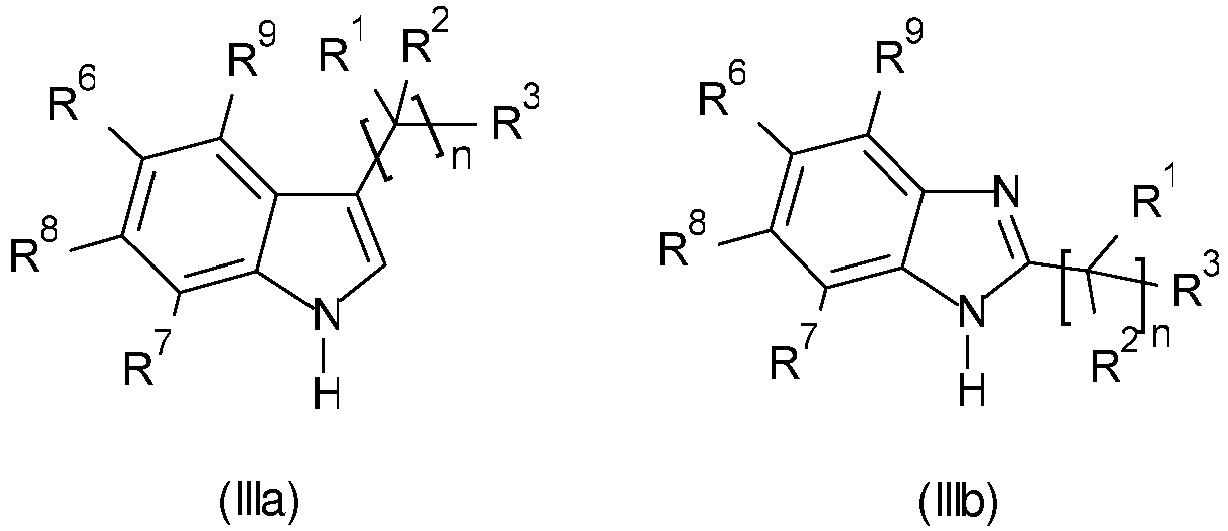


R6, R7, R8 and R9 independently represent hydrogen, fluoride, chloride, bromide,-CO2H CN, C1-C10 alkoxy; preferably R6 and R7 independently represent hydrogen, F, Br, Cl, CN, CO2H, C1-C10 alkoxy and R8 and R9 are hydrogen; more preferably R6 and R7 independently represent hydrogen or F and R8 and R9 are hydrogen;
R1 and R2 represent independently in each of the n units a substituent selected from the group consisting of hydrogen, substituted or not C1-C10 alkyl, halogen, oxy derivatives, thio derivatives, substituted or not C3-C10 cycloalkyl, substituted or not C6-C18 aryl, subtituted or not C2-C10 alkenyl, and subtituted or not C2-C10 alkynyl; preferably R1 and R2 represent independently in each of the n units a substituent selected from the group consisting of hydrogen, substituted or not C1-C10 alkyl;
R3 represents a substituent selected from the group consisting of hydrogen, substituted or not C1-C10 alkyl, halogen, substituted or not C3-C10 cycloalkyl, substituted or not C6-C18 aryl, subtituted or not C2-C10 alkenyl, and subtituted or not C2-C10 alkynyl, amino, heterocycle, thiocyanate, thio derivatives, hydroxylamine, amido, sulfonamide, amino sulfone derivatives, ether, thioether, ester, thioester, azido, azo, cyano, nitro, nitrooxy, carbamate, thiocarbamate, sulfinyl derivative, sulfonyl derivatives, acyl derivatives, oxy derivatives, ureido, thioureido, imino, oximino, hydrazino, thioamido, carboxylic, phosphate, phosphonate, carbamoyl phosphate; preferably R3 represents a substituent selected from the group consisting of substituted or not C1-C10 alkyl, substituted or not C1-C10 alkoxy, substituted or not C3-C10 cycloalkyl, substituted or not C6-C18 aryl, amino, heterocycle, substituted or not thioalkyl, thiocyanate, thio derivatives, hydroxylamine, amido, sulfonamide, amino sulfone derivatives, ether, thioether, ester, thioester, azido, nitro, cyano, nitrooxy, carbamate, thiocarbamate, sulfinyl derivative, alkenyl, alkynyl, acyl derivative, oxy derivatives;
with the proviso that for compounds of formula (IIIa) when R6 is fluoride, R1, R7, R8 and R9 are hydrogen, n is between 2 and 10, then R3 is not -NR4R5 wherein R4 and R5 are independently represent a substituent selected from the group consisting of hydrogen, C1-C10 alkyl, C3-C10 cycloalkyl, aminoalkyl, or R4 and R5 taken together with the nitrogen atom to which they are attached to form a four to ten-membered heterocycle, R2 is not independently in each of the n units a substituent selected from the group consisting of hydrogen, C1-C10 alkyl, halogen, alkoxy, aminoalkyl, and alkylamino. - In particular, compounds of the present invention may have general formula (IIIa)

R6 and R7 independently represent hydrogen, F, Br, Cl, CN, CO2H, C1-C10 alkoxy; preferably hydrogen or F; R8 and R9 are hydrogen;
R1 and R2 represent independently in each of the n units a substituent selected from the group consisting of hydrogen, substituted or not C1-C10 alkyl, halogen, oxy derivative, thio derivative, substituted or not C3-C10 cycloalkyl, substituted or not C6-C18 aryl, C2-C10 alkenyl, C2-C10 alkynyl;
R3 represents a substituent selected from the group consisting of substituted or not C1-C10 alkyl, substituted or not C3-C10 cycloalkyl, substituted or not C6-C18 aryl, amino, heterocycle, thiocyanate, thio derivatives, hydroxylamine, amido, sulfonamide, amino sulfone derivatives, ether, thioether, ester, thioester, azido, nitro, nitrooxy, carbamate, thiocarbamate, sulfinyl derivative, C2-C10 alkenyl, C2-C10 alkynyl, acyl derivative, oxy derivative;
with the proviso that when R6 is fluoride, R7, R8, R9 and R1 are hydrogen and n is between 2 and 10, then R3 is not -NR4R5 wherein R4 and R5 are independently represent a substituent selected from the group consisting of hydrogen, C1-C10 alkyl, C3-C10 cycloalkyl, aminoalkyl, or R4 and R5 taken together with the nitrogen atom to which they are attached to form a four to ten-membered heterocycle, R2 is not independently in each of the n units a substituent selected from the group consisting of hydrogen, C1-C10 alkyl, halogen, alkoxy, aminoalkyl, and alkylamino. - Such compounds (IIIa)-(IIIg) are useful as medicine or for the treatment or the prophylaxis of neurologic and/or inflammatory diseases or disorders. Preferably, in compounds of formula (IIIa)-(IIIg) R3 may represent a substituent selected from the group consisting of substituted or not C1-C10 alkyl, substituted or not C3-C10 cycloalkyl, substituted or not C6-C18 aryl, amino, heterocycle, substituted or not thioalkyl, thiocyanate, cyano, hydroxylamine, amido, sulfonamide, amino sulfone derivatives, ether, thioether, thioester, ester, carboxylic, sulfinyl derivative, acyl derivative, oxy derivatives. Alternatively, R3 may represent a substituent selected from the group consisting of substituted or not C1-C10 alkyl, substituted or not C1-C10 alkoxy, substituted or not C3-C10 cycloalkyl, substituted or not C6-C18 aryl, amino, heterocycle, substituted or not thioalkyl, thiocyanate, cyano, hydroxylamine, amido, amino sulfone derivatives. Alternatively, R3 represents a substituent selected from the group consisting of substituted or not C1-C10 alkyl, amino, substituted or not thioalkyl, thiocyanate, cyano, amino sulfone derivatives, substituted or not piperidine, hydroxylamine, amido. Alternatively, R3 represents a substituent selected from the group consisting of substituted or not C1-C10 alkyl, amino, substituted or not thioalkyl, thiocyanate, amino sulfone derivatives, substituted or not piperidine, hydroxylamine, amido. Alternatively, R3 represents a substituent selected from the group consisting of substituted or not C1-C10 alkyl, cyano, substituted or not thioalkyl, thiocyanate, amino sulfone derivatives, substituted or not piperidine, hydroxylamine, amido; preferably substituted or not thioalkyl, thiocyanate, amino sulfone derivatives, hydroxylamine, amido. Alternatively, R3 may be thioamido. Substituents R1 and R2 may be the same in each n unit. Substituents R1 and R2 may not bear amino functional group.
- In a particular embodiment, the present invention relates to compounds, or a pharmaceutically acceptable salt, solvate, hydrate, polymorph, co-crystal thereof, having general formula (IV)

R6 and R7 independently represent hydrogen, F, Br, Cl, CN, CO2H, C1-C10 alkoxy; preferably hydrogen or F;
R1 and R2 represent independently in each of the n units a substituent selected from the group consisting of hydrogen, substituted or not C1-C10 alkyl; preferably hydrogen and substituted or not C1-C6 alkyl, more preferably hydrogen or non-substituted C1-C6 alkyl;
R3 represents a substituent selected from the group consisting of thiocyanate, amino sulfone derivatives, amido, cyano, substituted or not thioalkyl, hydroxylamine, and non-substituted C1-C10 alkyl; more preferably thiocyanate, amino sulfone derivatives, amido, substituted or not thioalkyl, hydroxylamine, and non-substituted C1-C10 alkyl; most preferably thiocyanate, amino sulfone derivatives, amido, substituted or not thioalkyl, hydroxylamine; in particular thiocyanate, amino sulfone derivatives, substituted or not thioalkyl, hydroxylamine; more particular thiocyanate, amino sulfone derivatives, substituted or not thioalkyl.
for the treatment or the prophylaxis of neurologic and/or inflammatory diseases or disorders. - In another particular embodiment, the present invention relates to compounds, or a pharmaceutically acceptable salt, solvate, hydrate, polymorph, co-crystal thereof, having general formula (IV)

R6 represents hydrogen, Br, Cl, CN, CO2H, C1-C10 alkoxy; preferably hydrogen;
R7 represents hydrogen, F, Br, Cl, CN, CO2H, C1-C10 alkoxy; preferably F;
R1 and R2 represent independently in each of the n units a substituent selected from the group consisting of hydrogen, substituted or not C1-C10 alkyl; preferably hydrogen and substituted or not C1-C6 alkyl, more preferably hydrogen and substituted or not C1-C2 alkyl; R3 is amino;
for us as medicine or for the treatment or the prophylaxis of neurologic and/or inflammatory diseases or disorders. - In a more particular embodiment, the present invention relates to compounds having general formula (V)

R6 and R7 independently represent hydrogen, F, Br, Cl, CO2H, CN, C1-C10 alkoxy, preferably hydrogen or F;
R1 and R2 represent independently in each of the n units a substituent selected from the group consisting of hydrogen and substituted or not C1-C10 alkyl, preferably hydrogen and substituted or not C1-C6 alkyl, more preferably hydrogen or non-substituted C1-C6 alkyl;
R10 and R11 independently represent a substituent selected from the group consisting of hydrogen, substituted or not C1-C10 alkyl, C2-C10 alkenyl, C2-C10 alkynyl, C6-C18 aryl, heterocycle, or R10 and R11 taken together with the nitrogen atom to which they are attached form a four to ten membered heterocycle;
or a pharmaceutically acceptable salt, solvate, hydrate, polymorph, co-crystal thereof, for the treatment or the prophylaxis of neurologic and/or inflammatory diseases or disorders. - In a preferred embodiment, said compound according to the present invention may have an IC50 value equal or less than 0.1 µM, preferably less than 0.05 µM, and more preferably less than 30 nM against myeloperoxidase enzyme. In particular, said compound according to the present invention may have an IC50 lower than 25 nM against myeloperoxidase enzyme, preferably lower than 10nM, more preferably less than 5 nM. IC50 values obtained are lower than values observed in the prior art. Compounds of the present invention may thus exhibited improved inhibition properties against myeloperoxidase enzyme.
- The compounds of the present invention may be in the form of salt, in particular acid addition salt. Suitable salts include those formed with both organic and inorganic acids. Such acid addition salts will normally be pharmaceutically acceptable salts although salts of non-pharmaceutically acceptable acids may be of utility in the preparation and purification of the compound of the present invention. Hence, preferred salts include those formed from hydrochloric, hydrobromic, trifluoroacetic, sulphuric, oxalic, phosphoric, citric, tartaric, lactic, pyruvic, acetic, succinic, fumaric, maleic, methanesulphonic, p-toluenesulfonic, formic, adipic, glycolic, aspartic, malic, oleic, nicotinic, saccharinic and benzenesulphonic acids. The compounds of the present invention may be in the form of hydrate, i.e. it contains water. The compounds of the present invention may be in the form of solvates, i.e. it interacts with solvent. The compounds of the present invention may be in the form of co-crystals, i.e. it crystallizes with a co-crystallizing agent. The compounds of the present invention may exist in one or more crystal structure, all encompassed herein. The compounds of the present invention may be amorphous.
- The compounds according to the invention, compounds of formual (I), (IIa-g), (IIIa-g), (IV) or (V), or pharmaceutically acceptable salts thereof, are indicated for use in the treatment or prophylaxis of diseases or disorders in which modulation of the activity of the enzyme myeloperoxidase is beneficial. In particular, linkage of myeloperoxidase activity to disease has been demonstrated in neurologic and/or inflammatory diseases. Therefore, the compound of the present invention is particularly indicated for use in the treatment of neurologic and/or inflammatory disorders or diseases in mammals including human. Such diseases or disorders will be readily apparent to the man skilled in the art.
- Disorders or diseases that may be specifically mentioned include multiple sclerosis, Alzheimer's disease, Parkinson's disease, amyotrophic lateral sclerosis and stroke, as well as other inflammatory diseases or disorders such as rheumatic diseases, asthma, chronic obstructive pulmonary disease, cystic fibrosis, idiopathic pulmonary fibrosis, acute respiratory distress syndrome, sinusitis, rhinitis, psoriasis, dermatitis, uveitis, gingivitis, atherosclerosis, inflammatory bowel disease, renal glomerular damage, liver fibrosis, sepsis, proctitis, rheumatoid arthritis, and inflammation associated with reperfusion injury, spinal cord injury and tissue damage/scarring/adhesion/rejection. Lung cancer has also been suggested to be associated with high MPO levels. The compounds are also expected to be useful in the treatment of pain.
- Prophylaxis is expected to be particularly relevant to the treatment of persons who have suffered a previous episode of, or are otherwise considered to be at increased risk of, the disease or condition in question. Persons at risk of developing a particular disease or condition generally include those having a family history of the disease or condition, or those who have been identified by genetic testing or screening to be particularly susceptible to developing the diseases or disorders.
- In particular, compounds of the present invention are suitable for the use in the treatment of multiple sclerosis, atherosclerosis, rheumatic diseases, Alzheimer's disease, chronic pulmonar disease, chronic inflammatory syndromes linked to joints or Parkinson's disease. Therefore, the present invention relates to the use of a compound or pharmaceutically acceptable salts thereof according to the present invention for use in the manufacture of a medicament for the treatment of multiple sclerosis, atherosclerosis, rheumatic diseases, Alzheimer's disease, chronic pulmonar disease, chronic inflammatory syndromes linked to joints or Parkinson's disease. Hence, compounds of the present invention may be useful for one or more of the above-mentioned diseases or disorders. In particular, said compounds may be suitable for the treatment of cardiovascular diseases such as atherosclerosis or rheumatic diseases. Said compounds may be used for the manufacture of a medicament for use in the treatment of atherosclerosis or rheumatic diseases.
- For the above mentioned therapeutic indications, the dosage administered will, of course, vary with the compound employed, the mode of administration and the treatment desired. However, in general, satisfactory results may be obtained when the compounds are administered at a dosage of the solid form of between 0.1 mg and 2000 mg per day.
- In a second aspect of the present invention, a pharmaceutical composition is provided. Said pharmaceutical composition comprises a therapeutically effective amount of a compound according to the present invention, e.g. a compound of formula (I), (IIa-g), (IIIa-g), (IV) or (V), or a pharmaceutically acceptable salt, solvate, hydrate, polymorph, co-crystal thereof, in admixture with a pharmaceutically acceptable adjuvant, diluent or carrier. Said pharmaceutical composition may be used for the treatment or prophylaxis of neurologic and/or inflammatory diseases or disorders. In particular, said neurologic and/or inflammatory diseases or disorders may be selected from the group consisting of multiple sclerosis, atherosclerosis, Alzheimer's disease, chronic pulmonar disease, chronic inflammatory syndromes linked to joints and Parkinson's disease. The term "therapeutically effective amount" refers to dosage that provides the specific pharmacological response for which the drug is administered in a significant number of subjects in need of such treatment. The "therapeutically effective amount" may vary according, for example, the physical condition of the patient, the age of the patient and the severity of the disease. The pharmaceutical composition may comprise less than 80% and more preferably less than 50% of a compound of formula (I), (IIa-g), (IIIa-g), (IV) or (V), or a pharmaceutically acceptable salt, solvate, hydrate, polymorph, co-crystal thereof. Administration of such pharmaceutical composition may be by, but is not limited to, enteral (including oral, sublingual or rectal), intranasal, inhalation, intravenous, topical or other parenteral routes. Conventional procedures for the selection and preparation of suitable pharmaceutical formulations are described in, for example, "Pharmaceuticals - The science of dosage form designs", M.E. Aulton, Churchill Livingstone, 1988.
- In another aspect of the present invention in vitro method for inhibiting myeloperoxidase enzyme activity or for inhibiting low density lipoproteins (LDL) oxidation are provided. Said in vitro method for inhibiting myeloperoxidase enzyme activity comprises the step of adding a compound according to the present invention to a medium containing said enzyme, said compound being added in a concentration effective to inhibit the activity of said enzyme. Said medium containing said myeloperoxidase enzyme may be a phosphate buffer. The pH of said medium may be between 7 and 8, preferably between 7.2 and 7.6. Preferably, the pH of said medium may be approximately 7.4. The concentration of the compound according to the present invention effective to inhibit the activity of the enzyme myeloperoxidase may be below 0.1 µM, preferably below 50 nM. A concentration of a compound is considered as effective to inhibit the activity of an enzyme when such concentration inhibit 50% of the enzyme activity. The in vitro method for inhibiting low density lipoproteins (LDL) oxidation may comprise the step of contacting a compound according to the present invention in a medium containing said low density lipoproteins and myeloperoxidase enzyme. Said compound may be added in a concentration effective to inhibit the oxidation of said low density lipoproteins. The concentration effective to inhibit the oxidation of said low density lipoproteins may be lower than 200nM, preferably lower than 100 nM, more preferably lower than 50 nM, most preferably lower than 30 nM.
- Compounds according to the present invention of general formula (I), (IIa-g), (IIIa-g), (IV) or (V) for inhibiting myeloperoxidase enzyme activity are also provided. Compounds according to the present invention of formula (I), (Ila-g), (IIIa-g), (IV) or (V) for inhibiting low density lipoproteins oxidation are also provided. In particular, said compounds may further not interact or have limited interaction with serotonine transporter SERT. Pharmaceutical composition according to the present invention may be useful for inhibiting myeloperoxidase enzyme activity or for inhibiting low density lipoproteins oxidation.
- Compounds according to the present invention of general formula (I), (IIa-IIg), (IIIa-IIIg), (IV) or (V), or a pharmaceutically acceptable salt, solvate, hydrate, polymorph, co-crystal thereof, may be used as medicine. In particular, compounds having general formula (IV) may be used as medicine

R6 and R7 independently represents hydrogen, F, Br, Cl, CO2H CN, C1-C10 alkoxy; preferably hydrogen or F;
R1 and R2 represent independently in each of the n units a substituent selected from the group consisting of hydrogen, substituted or not C1-C10 alkyl; preferably hydrogen and substituted or not C1-C6 alkyl, more preferably hydrogen or non-substituted C1-C6 alkyl,
R3 represents a substituent selected from the group consisting of thiocyanate, amino sulfone derivatives, amido, cyano, substituted or not thioalkyl, hydroxylamine, and non-substituted C1-C10 alkyl; more preferably thiocyanate, amino sulfone derivatives, amido, substituted or not thioalkyl, hydroxylamine, and non-substituted C1-C10 alkyl; most preferably thiocyanate, amino sulfone derivatives, amido, substituted or not thioalkyl, hydroxylamine; in particular thiocyanate, amino sulfone derivatives, substituted or not thioalkyl, hydroxylamine. - In particular, compounds having general formula (V) may also be used as medicine,

R6 and R7 independently represents hydrogen, F, Br, Cl, CO2H, CN, C1-C10 alkoxy; preferably hydrogen or F;
R1 and R2 represent independently in each of the n units a substituent selected from the group consisting of hydrogen and substituted or not C1-C10 alkyl, preferably hydrogen and substituted or not C1-C6 alkyl, more preferably hydrogen or non-substituted C1-C6 alkyl;
R10 and R11 independently represent a substituent selected from the group consisting of hydrogen, substituted or not C1-C10 alkyl, C2-C10 alkenyl, C2-C10 alkynyl, C6-C18 aryl, heterocycle, or R10 and R11 taken together with the nitrogen atom to which they are attached form a four to ten membered heterocycle. - The present invention also provides a method for the treatment of atherosclerosis or rheumatic diseases characterised in that said method comprises the step of administering an therapeutically effective amount of a compound according to the present invention or a therapeutcially effective amount of a pharmaceutical composition according to the present invention to a patient in need thereof.
- The invention is illustrated, but in no way limited, by the following examples.
- Experimental procedure
- 1H- and 13C-NMR spectrums were taken on a Bruker Avance 300M Hz spectrometer at 293K. δ are given in ppm relative to TMS and the coupling constants are expressed in Hz. IR analysis was performed with a Shimadzu IR-470 spectrophotometer and the peaks data are given in cm-1. MS were obtained on QTOF 6520 (Agilent, Palo Alto, CA, USA), positive mode, ESI, mode TOF, by diffusion of 0.5 mL/min, by mobile phase HCOOH 0.1 M: CH3OH (50:50), (VCAP 3500, Source t: 350 °C, fragmentation: 110 v, Shimer: 65 v). All reactions were followed by TLC carried out on Fluka PET-foils silica gel 60 Ⓡ, and compounds were visualized by UV and by spraying Van Urk reagent (0.125 g of p-dimethylaminobenzaldehyde is dissolved in 100 mL of 65% sulfuric acid and 0.1 mL of 5% ferric chloride is added).. Column chromatographies were performed with EchoChrom MP silica 63-200 from MP Biomedicals. Organic solutions were dried over Na2SO4 and concentrated with a Buchi rotary evaporator. 4-phenylhydrazine hydrochloride, 7-phenylhydrazine hydrochloride, 4-hydrazinobenzoic acid, dihydrofuran, and dihydropyran were available from Sigma-Aldrich. Microwave-promoted reactions were performed with a Start S microwave oven from Milestone.
- General Procedures for the Synthesis of 3-(hydroxyalkyl) indole derivatives (compounds 1, 2, 3, 4, 5, 6 and 27). A solution of 4-fluorophenylhydrazine hydrochloride, 7-fluorophenylhydrazine hydrochloride or 4-hydrazinobenzoic acid (6.9 mmol) in 4 wt % aqueous H2SO4 (10 mL) (in the case of 4-hydrazinobenzoic H2SO4 must be 20 wt %) and DMA (10 mL) was heated at 100 °C under microwave. To this solution was added the corresponding enol ether, or hydroxyaldehyde (6.9 mmol) dropwise over 2 min. Then the reaction was heated at 175 °C (temperature ramp from room temperature to 100 °C over 8 min, then addition of the reagent, heating to 175 °C over 8 min and maintaining this temperature for 30 min, 1000 W). The reaction mixture was cooled to room temperature and extracted two times with EtOAc (25 mL), and the organic layer was washed with water and evaporated. The crude material was purified by column chromatography (eluent CH2Cl2/EtOAc 4:1).
- General Procedures for the Synthesis of Mesylate derivatives (compounds 7-12 and 28). A solution of alcohol (5.5 mmol) in CH2Cl2 (25 mL) was cooled with an ice bath. To this solution TEA (0.44 mL, 5.8 mmol) and methanesulfonyl chloride (0.77 mL, 5.5 mmol) were added (the carboxylic acid-containing alcohol derivatives were dissolved in pyridine and no TEA was added). The solution was stirred at room temperature for 2 h. Then it was washed with H2O and then dried over Na2SO4 and filtered. The solvent was evaporated under reduced pressure. The crude material was purified by flash chromatography (CH2Cl2/EtOAc 4:1).
- General Procedures for the Synthesis of Azide derivatives (compounds 13, 14, 15, 16 and 29). To a solution of sulfonate (3.6 mmol) in DMSO (20 mL), NaN3 (3.6 mmol) was added, and the solution was stirred at room temperature for 1 h at 100 °C. Then H2O (30 mL) and CH2Cl2 (or EtOAc for compounds 15 and 29) (30 mL) were added. After decantation, the organic layer was washed with water, dried with Na2SO4, filtered, and evaporated under reduced pressure. The residue was purified by column chromatography (CH2Cl2).
- General Procedures for the Synthesis of Amine derivatives (compounds 17, 18, 19, 20 and 30. Palladium on charcoal 10% (50 mg) was added to a solution of azide derivative (4.6 mmol) in EtOH (20 mL). The suspension was stirred under H2 (4.1 bar) overnight. After filtration on Celite, the solvent was evaporated under reduced pressure. (For the compounds 20 and 30, after filtration H2O (30 mL) and EtOAc (30 mL) were added, the aqueous layer was collected and evaporated to give the pure compounds). The residue was dissolved in ether, extracted with 0.1 M HCl, and the resulting solution was washed with ether. A solution of 1 M NaOH was added (pH ≈ 10), and the mixture was extracted with diethylether. The organic layer was washed with water, dried over Na2SO4 and evaporated under reduced pressure. A saturated solution of anhydrous oxalic acid in ether was added to the ethereal solution and the resulting solid was filtered, washed with ether, and dried under vacuum.
- General Procedures for the Synthesis of nitrile derivatives (compounds 21 and 22). To a solution of NaCN (2 g, 41 mmol) in H2O (10 mL), DMA (10 mL) was added and heated at 100 °C. Then, a solution of the mesylate (7.4 mmol) in DMA (10 mL) was added dropwise. The reaction was stirred at this temperature for 2 h and then cooled to room temperature and extracted with EtOAc. The organic layer was washed with water, dried on Na2SO4, and evaporated. The residue was purified by flash chromatography (CH2Cl2/EtOAc 4:1).
- General Procedures for the Synthesis of Amide derivatives (compounds 23, 24). To a solution of nitrile (11 mmol) in t-BuOH (40 mL) was added finely powdered KOH (5 g, 89 mmol). The solvent was refluxed for 2 h with stirring. Then a saturated solution of NaCl (50 mL) was added and the resulting mixture was extracted three times with CH2Cl2. Flash chromatography was performed (CH2Cl2/EtOAc 4:1 then CH2Cl2/methanol 1:1). The fractions obtained with the second solvent mixture were evaporated.
- Synthesis of Compound 25. The amide compound 23 (1.4 g, 6.4 mmol) was dissolved in dioxane (50 mL) and LiAlH4 (1.0 M solution in dioxane, 25 mL) was added. The suspension was refluxed for 3 h; the reaction was quenched with ice and a 15 wt % KOH aqueous solution (10 mL). The mixture was filtered through Celite and extracted with EtOAc (30 mL). The organic layer was extracted with 0.1 M HCl and, after decantation, the aqueous phase was washed with diethylether. A 1 M KOH solution was added to the acidic layer (pH ≈ 10) and this was extracted with diethylether. The solvent was dried on Na2SO4 and evaporated. The residue was dissolved in diethylether, and a saturated solution of anhydrous oxalic acid in diethylether was added drops wise. The precipitate was filtered, washed with ether, and dried at 40 °C under reduced pressure.
- Synthesis of Compound 26. A 1 M DIBAL-H solution in CH2Cl2 (7.8 mL, 7.38 mmol) was added slowly to a solution of the lactone (6.6 mmol) in dry CH2Cl2 at -78 °C. After stirring at the same temperature for 1 h, methanol (8.9 mL) was added dropwise and the mixture poured into 0.5 M HCl (200 mL). After stirring for additional 1 h at room temperature, the organic layer was separated. The aqueous layer was extracted with CH2Cl2 (3 ×20 mL), and the combined organic layers were dried with Na2SO4 and evaporated. The residue was purified by flash chromatography (first CH2Cl2, then CH2Cl2:EtOAc (60:40)). The second fraction was evaporated to give the desired product.
- General Procedure for the Synthesis of Compounds 32-36 and 41-46. A solution of mesylate 7, 8, 11 or 12 (3.6 mmol) in dioxane (5 mL) was added slowly through an addition funnel to a refluxing solution of the amine or thiol (0.26 mol) in dioxane (15 mL) at 100 °C (for some compounds see special conditions summarized in table 1). After the addition was completed, the reaction medium was stirred at this temperature for 4 h. After cooling, the mixture was treated with water (20 mL) and extracted with EtOAc (30 mL). The organic layer was dried over Na2SO4 and evaporated to dryness to afford a crude product. The residue was dissolved in 0.1 M HCl. This solution was washed with diethylether and rendered alkaline (pH ≈ 10) with a solution of 1 M NaOH. The mixture was extracted with ether. The organic layer was washed with water, dried over Na2SO4, and evaporated to afford the pure compounds. Some compounds were transformed (31, 32, 42, 43 and 44) into oxalic salts, by adding saturated solution of anhydrous oxalic acid in ether to their ethereal solution, and then the resulting solid was filtered, washed with ether, and dried under vacuum.
- A solution of 2-fluorophenylhydrazine hydrochloride (1.1 g, 6.9 mmol) in 4% aqueous H2SO4 (10 mL) and DMAc (10 mL) was heated at 100 °C. To this solution was added dihydropyran (630 µL, 6.9 mmol) dropwise over 2 min. The reaction was heated at 100 °C for 2 h, then the reaction mixture was cooled to room temperature, and extracted with EtOAc. The organic layer was washed with water, dried over anhydrous Na2SO4, filtered and evaporated. The crude material was purified by flash chromatography using CH2Cl2: EtOAc (80:20) to afford a yellow oil (1.25 g, 95% yield). 1H NMR (CDCl3) δ 8.25 (br s, 1H), 7.27 (d, 1H, J = 7.8 Hz), 6.92 (dt, 1H, J=7.8Hz, 4.8Hz), 6.83 (d, 1H, J= 0.6 Hz),6.81 (dd, 1H, J=11.1Hz, 7.5Hz), 3.62 (t, 2H, J = 6.3 Hz,), 2.75 (t, 2H, J = 7.5 Hz), 1.89 (m, 2H); 13C NMR (CDCl3) δ 149.6 (d, J = 242 Hz), 131.1 (d, J = 5 Hz), 124.5 (d, J = 13 Hz), 121.9 (s), 119.2 (d, J = 6 Hz), 116.7 (d, J = 2 Hz), 114.5 (d, J = 3 Hz), 106.6 (d, J = 16 Hz), 62.4 (s), 32.8 (s), 21.3 (s); IR (film) 3395, 2920, 1711, 1620, 1576, 1495, 1443, 1336, 1250, 1220, 1182, 1040, 963, 923, 861, 780, 747 cm-1.
- A solution of 4-hydrazinobenzoic acid (1 g, 6.6 mmol) in 20% aqueous H2SO4 (10 mL) and DMAc (10 mL) was heated at 100 °C. To this solution was added dihydropyran (1000 µL, 11 mmol) dropwise over 2 minutes. Then the reaction was refluxed at 100 °C for 4 hours. The reaction mixture was cooled to room temperature and extracted with EtOAc and the organic layer was washed with water and evaporated. The crude material was purified by flash chromatography by using CH2Cl2: EtOAc (80:20) (solution 1), then by CH2Cl2: EtOAc (50:50) (solution 2). The solution 2 was evaporated to afford a white solid (600 mg, 42 % yield). 1H NMR (DMSO-d6 ) δ 12.37 (br s, 1H, COOH), 11.14 (br s, 1H), 8.20 (s, 1H), 7.70 (dd, 1H, J = 8.4, 1.5 Hz), 7.38 (d, 1H, J = 8.4 Hz), 7.21 (d, 1H, J = 1.5 Hz), 3.50 (t, 2H, J = 6.3 Hz,), 2.77 (t, 2H, J = 7.8 Hz), 1.83 (m, 2H); 13C NMR (DMSO-d6 ) δ 168.5 (COOH), 138.8 (s), 126.7 (s), 123.7 (C-3), 122.1 (s), 121.1 (s), 120.6 (s), 116.0 (s), 111.0 (s), 60.4 (s), 33.3 (s), 20.9 (s); IR (KBr) 3250, 2930, 2625, 1660, 1600, 1518, 1413, 1302, 1255, 1179, 1116, 1084, 844, 770 cm-1 .
- The title compound has been synthesized according to the procedure for the synthesis of 2 but with using (tetrahydropyran-2-yl)methanol to afford yellowish solid (200 mg, 23 % yield). 1H NMR (CDCl3) δ 8.49 (br s, 1H), 7.23 (dd, 1H, J= 8.7, 4.5 Hz), 7.25 (d, 1H, J = 2.1 Hz), 7.18 (dd, 1H, J= 9.7, 2.7 Hz), 6.89 (dt, 1H, J = 9, 2.1 Hz), 3.81 (dq, 1H, J=6.8, 3.2 Hz), 3.68(dd, 1H, J=11.2, 3.2 Hz), 3.50 (dd, 1H, J=11.2, 7.2 Hz), 2.94 (sept, 1H, J=7.2 Hz), 2.90 (sept, 1H, J=7.2 Hz), 1.88 (m, 2H).
- The title compound has been synthesized according to the procedure for the synthesis of 2 starting from 4-fluorophenylhydrazine hydrochloride to afford yellow oil (1.1 g, 95% yield). 1H NMR (CDCl3) δ 8.33 (br s, 1H), 7.30 (m, 2H), 7.11 (d, J= 2.1 Hz, 1H), 6.98 (dt, 1H, J= 9.2, 2.4 Hz), 3.93 (t, 2H, J= 6.4 Hz), 3.01 (t, 2H, J= 6.6 Hz), 2.03 (br s, 1H, OH); 13C NMR (CDCl3) δ 157.9 (d, J= 232 Hz), 133.1 (s), 127.8 (d, J= 10 Hz), 124.5 (s), 122.5 (d, J= 5 Hz), 111.9 (d, J= 10 Hz), 110.5 (d, J= 25 Hz), 103.7 (d, J= 24 Hz), 62.6 (s), 28.8 (s); IR (film) 3423, 2922, 2880, 1581, 1485, 1230, 1171, 1055 cm-1.
- Synthesized using the same procedure as for the synthesis of compound 5 to afford (yellow oil, 1.25 g, 95% yield). 1H NMR (CDCl3) δ 8.22 (br s, 1H), 7.30 (m, 2H), 6.99 (d, J= 2.1 Hz, 1H), 6.82 (dt, 1H, J= 9.2, 2.4 Hz), 3.72 (t, 2H, J= 6.4 Hz), 2.80 (t, J= 7.6, 0.8 Hz, 2H), 1.90 (m, 2H, H-2'); IR (film) 3423, 2922, 2880, 1581, 1485, 1230, 1171, 1055 cm-1.
- A solution of 1 M diisobutylaluminium hydride (7.8 mL, 7.38 mmol) was added slowly to a solution of ε-caprolactone (0.75 g, 6.6 mmol) in dry CH2Cl2 at -78 °C. After stirring at the same temperature for 1 h, MeOH (8.9 mL) was added dropwise and the mixture poured into 0.5 M HCl (200 mL). After stirring for additional 1 h to room temperature, the organic layer was separated. The aqueous layer was extracted, dried and evaporated. The residue purified by flash chromatography with two steps. The first was by CH2Cl2, and the second was by CH2Cl2: EtOAc( 60:40). The second solution was evaporated to give 0.66 g of 16 (87 %) colorless liquid. 1H NMR (CDCl3) δ 9.71 (d, J = 1.7 Hz, 1H, CHO), 3.69 (t, J =6.53 Hz, 2H), 3.41 (bs, 1H, OH), 2.62 (m, 2H), 1.51 (m, 2H), 1.30 (m, 4H); 13C NMR (CDCl3) δ 202.4 (CHO), 62.7 (s), 43.9 (s), 32.0 (s), 22.5 (s), 21.6 (s); IR (film) 3385, 2915, 1719, 1458, 1395, 1370, 1121, 1047 cm-1.
- The title compound has been synthesized according to the procedure for the synthesis of 3 by using 6-Hydroxyhexanal to afford yellowish oil (550 mg, 41% yield). 1H NMR (DMSO-d 6) δ 11.12 (br s, 1H), 8.18 (s, 1H), 7.69 (dd, 1H, J = 8.4, 1.5 Hz), 7.37 (d, 1H, J = 8.7 Hz), 7.21 (d, 1H, J = 2.1 Hz), 3.43 (t, 2H, J = 6.3 Hz), 2.71 (t, 2H, J = 7.8 Hz), 1.67 (m, 2H), 1.52 (m, 2H); 13C NMR (DMSO-d 6) δ 168.5 (COOH), 138.8 (s), 126.8 (s), 123.8 (s), 122.1 (s), 121.0 (s), 120.7 (s), 116.3 (s), 111.0 (s), 60.6 (s), 32.5 (s), 26.5 (s), 24.4 (s); IR (KBr) 3250, 2930, 2625, 1660, 1600, 1518, 1413, 1302, 1255, 1179, 1116, 1084, 844, 770 cm-1.
- A solution of 2 (1 g, 5.2 mmol) in CH2Cl2 (25 mL) was cooled with an ice bath. To this solution TEA (0.7 mL, 3.2 mmol) and methanesulfonyl chloride (0.4 mL, 5.5 mmol) were added. The solution was stirred at room temperature for 2 h. Then, it was washed with a saturated solution of NaHCO3 and H2O, dried over Na2SO4 and filtered. The solvent was evaporated under reduced pressure. The crude material was purified by flash chromatography CH2Cl2:EtOAc (4:1) to afford compound 7 as a brown oil (1.3 g, 90% yield). 1H NMR (CDCl3) δ (br s, 1H), 7.34 (d, 1H, J = 7.8 Hz), 7.07 (d, 1H, J= 2.1Hz), 7.03 (dt, 1H, J=7.8Hz, 4.8Hz), 6.91 (dd, 1H, J= 11.1Hz, 7.5Hz), 4.25 (t, 2H, J= 6.3 Hz), 2.98 (s, 3H), 2.88 (t, 2H, J = 7.5 H), 2.13 (m, 2H); 13C NMR (CDCl3) δ 149.6 (d, J= 242 Hz), 131.1 (d, J= 5 Hz), 124.5 (d, J= 16 Hz), 122.5 (s), 119.5 (d, J= 6 Hz), 115(d, J = 2 Hz), 114.3 (d, J=3 Hz), 106.8 (d, J = 16 Hz), 69.3 (s), 37.2 (SCH3) 29.3 (s), 20.8 (s); IR (film) 3395, 2920, 1711, 1620, 1576, 1495, 1443, 1336, 1250, 1220, 1182, 1040, 963, 923, 861, 780, 747 cm-1.
- A solution of 3 (1 g, 4.6 mmol) in pyridine (10 mL) was cooled in ice bath. To this solution methanesulfonyl chloride (0.77 mL, 10 mmol) was added. The solution was stirred at room temperature for 4 h. Then 0.5 M H2SO4 (50 mL) was added (pH ≈ 2) and the solution was extracted with EtOAc (20 mL) two times, washed with water, dried by Na2SO4 and evaporated. The crude product was purified by column chromatography CH2Cl2:EtOAc (80:20) to afford a brown oil (800 mg, 61% yield) 1H NMR (CDCl3) δ 8.42 (s, 1H), 8.29 (br s, 1H, NH), 7.95 (dd, 1H, J = 8.4, 1.5 Hz), 7.37 (d, 1H, 1H, J = 8.7 Hz), 7.10 (s, 1H), 4.26 (t, 2H, J = 6.3 Hz), 3.00 (s, 3H), 2.94 (t, 2H, J = 7.5 Hz), 2.15 (m, 2H); 13C NMR (CDCl3) δ 172.5 (COOH), 139.5 (s), 126.9 (s), 124.0 (s), 123.3 (s), 122.6 (s), 120.5 (s), 116.1 (s), 111.0 (s), 69.1 (s), 37.4 (SCH3), 29.4 (s), 20.7 (s); IR (film) 3295, 2930, 2530, 1755, 1682, 1600, 1519, 1420, 1337, 1259, 1218, 1180, 1028, 969, 837, 760, 523 cm-1.
- The title compound has been synthesized according to the procedure for the synthesis of 12 but by adding 4 equivalents of TEA and methanesulfonyl chloride to afford yellowish solid (200 mg, 23 % yield). 1H NMR (CDCl3) δ 8.49 (br s, 1H), 7.26 (dd, 1H, J= 9, 4.5 Hz), 7.18 (dd, 1H, J= 9.6, 2.4 Hz), 7.07(d, 1H, J= 2.1 Hz), 6.90 (dt, 1H, J= 9.0, 2.1 H), 4.91 (m, 1H), 4.36 (dd, 1H, J= 11.7, 2.7 Hz), 4.23 (dd, 1H, J= 11.4, 6.0 Hz), 3.05 (s, 3H, SCH3), 2.99 (s, 3H, SCH3), 2.81 (m, 2H), 2.01 (m,2H); 13C NMR (CDCl3) δ 157.5 (d, J= 229 Hz), 133 (s), 127 (d, J= 10 Hz), 124.2 (s), 113.7 (d, J= 5 Hz), 112.1 (d, J= 10 Hz), 110.3 (d, J= 26 Hz), 103.4 (d, J= 23 Hz), 78.7 (s), 69.9 (s), 38.7(SCH3), 37.5(SCH3), 31.2 (s), 20 (s).
- Synthesized using the same procedure as for the synthesis of compound 12 to afford a brown oil (1.3 g, 90% yield). 1H NMR (CDCl3) δ 8.27 (br s, 1H), 7.27 (dd, 1H, J= 8.7, 4.5 Hz), 7.24 (dd, 1H, J= 9.7, 2.7 Hz), 7.13 (s, 1H), 6.92 (dt, 1H, J= 9.2, 2.4 Hz), 4.44 (t, 2H, J= 6.9 Hz), 3.16 (t, 2H, J= 6.9 Hz), 2.87 (s, 3H, -CH3); 13C NMR (CDCl3) δ 157.9 (d, J= 232 Hz), 132.4 (ds), 127.2 (d, J= 10 Hz), 124.2 (s), 111.7 (d, J= 10 Hz), 110.5 (d, J= 25 Hz), 110.2 (d, J= 5 Hz), 103.7 (d, J= 24 Hz), 69.4 (s), 37.1 (CH3), 25.2 (s); IR (film) 3423, 2880, 1581, 1485, 1350, 1230, 1171, 1055 cm-1.
- The title compound has been synthesized according to the procedure for the synthesis of 12 to afford brown oil (1.26g, 90% yield). 1H NMR (CDCl3) δ 8.15 (br s, 1H), 7.25 (dd, 1 H, J= 9.0, 4.2 Hz), 7.21 (dd, 1H, J= 7.6, 0.9 Hz), 7.02 (d, 1H, J= 1.1 Hz), 6.92 (dt, 1H, J= 9.2, 2.4 Hz), 4.22 (t, 2H, J= 7.5 Hz), 2.96 (s, H, -CH3), 2.82 (t, 2H, J= 7.8 Hz), 2.09 (m, 2H); IR(film) 3423, 2880, 1581, 1485, 1350, 1230, 1171, 1055 cm-1.
- To a solution of 12 (1 g, 3.7 mmol) in DMSO (20 mL), NaN3 (700mg, 11.7 mmol) was added and the solution was stirred at room temperature for 4 h. Then H2O (30 mL) and toluene (30 mL) were added. After decantation, the organic layer was washed with water, dried with Na2SO4, filtered and evaporated under reduced pressure. The residue was purified by column chromatography (CH2Cl2) to afford yellow oil (588 mg, 80% yield). 1H NMR (CDCl3) δ 8.78 (br s, 1H), 7.32 (dd, 1H, J = 7.8, 0.6 Hz), 6.98 (dt, 1H, J= 7.8Hz, 4.8Hz), 6.95 (d, 1H, J= 1.8 Hz), 6.87 (dd, 1H, J= 11.4Hz, 7.5Hz), 3.27 (t, 2H, J = 6.6 Hz) 2.80 (t, 2H, J = 7.5 Hz), 1.94 (m, 2H); 13C NMR (CDCl3) δ 149.6 (d, J= 242 Hz), 131.0 (d, J = 5 Hz), 124.5 (d, J = 13 Hz), 122.2 (s), 119.1 (d, J = 6 Hz), 115.4 (s), 114.3 (d, J = 3 Hz), 106.4 (d, J = 16 Hz), 50.6 (s), 29.0 (s), 21.9 (s); IR (film) 3410, 2920, 2095, 1713, 1633, 1575, 1497, 1442, 1364, 1218, 1180, 1083, 1041, 1010, 960, 781, 742, 669, 336, 502 cm-1.
- To a solution of 13 (1 g, 3.4 mmol) in DMSO, NaN3 (700 mg, 12 mmol) was added. The solution was stirred at 100 °C for 4 h. Then the reaction mixture was extracted with EtOAc and washed three times with water, dried with Na2SO4, evaporated and purified by flash chromatography CH2Cl2: EtOAc (8:2) to give 800 mg of 39 yellow oil (96 % yield) 1H NMR (CDCl3) δ 10.19 (br s, 1H, NH), 7.95 (s, 1H), 7.45 (dd, 1H, J = 8.4, 1.5 Hz), 7.01 (d, 1H, J = 8.7 Hz), 6.71 (d, 1H, J = 2.1 Hz), 2.96 (t, 2H, J = 6.9 Hz), 2.49 (t, 2H, J = 7.2 Hz), 1.61 (m, 2H); 13C NMR (CDCl3) δ 168.7 (COOH), 138.3 (s), 125.9 (s), 122.6 (s), 121.9 (s), 120.7 (s), 120.2 (s), 114.3 (s), 110.1 (s), 49.8 (s), 28.4 (s), 21.1 (s); IR (film) 3410, 2930, 2700, 2170, 1665, 1574, 1427, 1263, 762 cm-1.
- The title compound has been synthesized according to the procedure for the synthesis of 14 but by adding 4 equivalents of NaN3 to afford yellowish solid (200 mg, 23 % yield). 1H NMR (CDCl3) δ 8.19 (br s, 1H), 7.26 (dd, 1H, J= 9.3, 4.2 Hz), 7.20 (dd, 1H, J= 9.6, 2.4 Hz), 7.05 (d, 1H, J= 2.4 Hz), 6.94 (dt, 1H, J= 9.0, 2.4 Hz), 3.39 (m, 3H), 2.83 (m, 2H), 1.87 (m, 2H); 13C NMR (CDCl3) δ 157.5 (d, J= 229 Hz), 133 (s), 127.8 (d, J= 10 Hz), 123.9 (s), 115.0 (d, J= 5 Hz), 112.3 (d, J= 10 Hz), 110.9 (d, J= 26 Hz), 103.9 (d, J= 23 Hz), , 61.7 (s), 55.4 (s), 32.4 (s), 21.9(s).
- The Mesylate derivative 3- (4-Methanesulfonatobutyl)-1H-indole-5-carboxylic acid 19 has been synthesized according to the procedure for the synthesis of 13 to afford yellowish oil (800 mg, 61% yield); this compound was used directly without further purification. Then 3-(4-Azidobutyl)-1H-indole-5-carboxylic acid 25 has been synthesized according to the procedure for the synthesis of 21 to afford yellowish oil (800 mg, 96 % yield) 1H NMR (CDCl3) δ 8.51 (br s, 1H, NH), 8.44 (s, 1H), 7.96 (dd, 1H, J = 8.4, 1.5 Hz), 7.83 (d, 1H, J = 8.7 Hz), 6.06 (d, 1H, J = 2.1 Hz), 3.31 (t, 2H, J = 6.0 Hz), 2.83 (t, 2H, J = 9.0 Hz), 1.79 (m, 2H), 1.72 (m, 2H); 13C NMR (CDCl3) δ 171.9 (COOH), 139.5 (s), 127.3 (s), 123.9 (s), 122.8 (2 s), 120.2 (s), 117.8 (s), 111.1 (s), 51.5 (s), 28.9 (s), 27.4 (s), 24.7 (s); IR (film) 3245, 2930, 2090, 1693, 1574, 1427, 1263, 1012 cm-1.
- Palladium on charcoal 10% (50 mg) was added to a solution of 21 (1 g, 4.9 mmol) in ethanol (20 mL). The suspension was stirred under H2 (60 psi) overnight in a Parr hydrogenation apparatus. After filtration on celite, the solvent was evaporated under reduced pressure. The product was dissolved in ether (20 mL), washed with water, and dried over Na2SO4. To this solution, a saturated solution of anhydrous oxalic acid in ether was added and the resulting solid was filtered, washed with ether, and dried to afford yellowish crystals (0.9 g, 70% yield). 1H NMR (DMSO-d6 ) δ 11.35 (br s, 1H), 7.32 (d, 1H, J = 7.8Hz), 7.21 (s, 1H), 6.92 (dt, 1H, J= 7.5 Hz, 5.1 Hz) 6.87 (dd, 1H, J= 11.4Hz, 7.5Hz, 0.3Hz), 2.75 (m, 4H), 1.90 (m, 2H); 13C NMR (DMSO-d6 ) δ 166.6 (COO), 149.6 (d, J = 242 Hz), 131.0 (d, J = 5 Hz), 123.9 (d, J = 13 Hz), 123.6 (s), 118.3 (d, J = 6 Hz), 114.5 (d, J= 2 Hz),114.5 (d, J = 2 Hz), 105.6 (d, J = 17 Hz), 40.1 (s), 28.1 (s), 21.6 (s); IR (film) 3395, 3050, 2915, 1710, 1605, 1575, 1511, 1441, 1217, 721, 123 cm-1; HRMS (ESI) calculated for C11H14N2F (M+H): 193.1136, found: 193.1198, error 1.30 ppm.
- The title compound has been synthesized according to the procedure for the synthesis of 27 starting from azide derivative which was obtained according to the procedure for the synthesis of 21 to afford yellowish crystals (0.9 g, 70% yield). 1H NMR (DMSO-d6 ) δ 11.48 (br s, 1H), 7.37 (d, 1H, J = 7.8Hz), 7.30 (s, 1H), 6.95 (dt, 1H, J= 7.5 Hz, 4.8Hz), 6.90 (dd, 1H, J= 11.1 Hz, 0.3Hz), 3.05 (m, 4H); 13C NMR (DMSO-d6 ) δ 164.5 (COO), 148.6 (d, J = 242 Hz), 130.8 (d, J = 5 Hz), 124.5 (s), 123.9 (d, J = 13 Hz), 118.7 (d, J = 6 Hz), 114.2 (d, J = 3 Hz), 110.7 (d, J = 2 Hz), 105.8 (d, J = 17 Hz), 39.2 (s), 23.0 (s); IR (film) 3395, 3050, 2915, 1710, 1605, 1575, 1511, 1441, 1217, 721, 123 cm-1; HRMS (ESI) calculated for C10H11N2F (M+): 178.0904, found: 178,0906, error: 1.12 ppm.
- Palladium on charcoal 10% (50 mg) was added to a solution of 22 (1 g, 4.1 mmol) in ethanol (20 mL). The suspension was stirred under H2 (60 psi) overnight in a Parr hydrogenation apparatus. After filtration on celite, the solvent was evaporated under reduced pressure. The product was dissolved in EtOAc (20 mL) and water (20 mL). The aqueous layer was washed two times with EtOAc and evaporated to afford 200 mg of compound 28 white solid (23 % yield) 1H NMR (DMSO-d6 ) δ 8.08 (s, 1H), 7.63 (dd, 1H, J = 8.4, 1.5 Hz), 7.26 (d, 1H, J = 8.7 Hz), 7.09 (s, 1H), 2.84 (t, 2H, J = 7.5 Hz), 2.75 (t, 2H, J = 7.5 Hz), 1.91 (m, 2H); 13C NMR (DMSO-d6 ) δ 174.4 (COOH), 138.5 (s), 129.2 (s), 127.3 (s), 124.2 (s), 124.0 (s), 121.3 (s), 115.5 (s), 111.5 (s), 39.9 (s), 28.7 (s), 22.6 (s); IR (KBr) 3285, 3105, 2985, 2840, 2105, 1614, 1540, 1513 1362, 1248, 1214, 1125, 1091, 1125, 780, 644, 534 cm-1; HRMS (ESI) calculated for C12H14N2O2 (M+): 218,105, found: 218,1055, error: 2.29 ppm.
- The azido derivative 24 (1.4 g, 6.4 mmol), which was synthesized according to the procedure of compound 21, was dissolved in dioxane (50 mL) and LiAlH4 (1.0 M solution in dioxane, 25 mL, 25 mmol) was added. The suspension was refluxed for 2 h and the reaction was quenched with ice and 15% KOH (10 mL). The mixture was filtered through celite and extracted with EtOAc (10 mL). The organic layer was extracted with 0.1 M HCl (10 mL) and, after decantation; the aqueous phase was washed by EtOAc. To the acidic layer, 1 M KOH was added (pH ≈ 10) and this was extracted with diethylether. The solvent was dried on Na2SO4 and evaporated. The residue was dissolved in diethylether and a saturated solution of anhydrous oxalic acid in diethylether was added dropwise. The precipitate was filtered, washed with ether and dried at 40 °C under reduced pressure to give a white solid (0.6 g, 26% yield). 1H NMR (DMSO-d6 ) δ 11.31 (br s, 1H), 7.34 (d, 1H, J= 7.8 Hz), 7.19 (d, J= 1.8 Hz, 1H), 6.93 (dt, 1H, J= 7.8Hz, 5.1 Hz), 6.89 (dd, J= 10.8Hz, 7.5Hz), 2.8 (t, 2H, J = 7.5 Hz), 2.67 (t, 2H, J = 6.9 Hz), 1.62 (m, 4H); 13C NMR (DMSO-d6 ) δ 164.6 (COO), 149.6 (d, J = 242 Hz), 131.1 (d, J = 5 Hz), 123.9 (d, J = 13 Hz), 123.5 (s), 118.2 (d, J = 6 Hz), 115.1 (s), 114.5 (d, J = 3 Hz), 105.5 (d, J= 17 Hz), 38.6 (s), 26.8 (s), 26.6 (s), 24.1 (s); IR (film) 3395, 3050, 2915, 1710, 1605, 1575, 1511, 1441, 1217, 721, 123 cm-1; HRMS (ESI) calculated for C12H15N2F (M+): 206.1219, found: 206.1219, error: 0.00 ppm
- The title compound has been synthesized according to the procedure for the synthesis of 27 to afford yellowish solid (200 mg, 23 % yield). 1H NMR (D2O) δ 8.06 (s, 1H), 7.62 (dd, 1H, J = 8.4, 1.5 Hz), 7.30 (d, 1H, J = 8.7 Hz), 6.92 (s, 1H), 2.74 (m, 2H), 2.52 (m, 2H), 1.46 (m, 4H); 13C NMR (D2O) δ 176.9 (COOH), 138.3 (s), 127.1 (s), 126.7 (s), 123.9 (s), 123.1 (s), 120.8 (s), 116.3 (s), 111.3 (s), 39.9 (s), 26.9 (s), 26.7 (s), 23.9 (s); IR (KBr) 3285, 3105, 2985, 2840, 2105, 1614, 1540, 1513 1362, 1248, 1214, 1125, 1091, 1125, 780, 644, 534 cm-1; HRMS (ESI) calculated for C13H16N2O2 (M+): 232.12091, found: 232.12115, error: 1.03 ppm.
- A solution of mesylate derivative 15 (1 g, 3.6 mmol) in dioxane (5 mL) was added slowly through an addition funnel to a refluxing solution of cysteamine hydrochloride and finely powdered KOH in methanol 15 ml at 100 °C. After the addition was completed, the reaction medium was stirred at this temperature for 4 h. After cooling, the mixture was treated with KOH 1 M (20 mL) and extracted with EtOAc (30 mL). The organic layer was washed three times by KOH 1 M and dried over Na2SO4 and evaporated to dryness to afford a crude product. The residue was dissolved in 0.1 M HCl. This solution was washed with diethylether and rendered alkaline (pH ≈ 10) with a solution of 1 M NaOH. The mixture was extracted with EtOAc. The organic layer was washed with water, dried over Na2SO4 and evaporated and dissolved in ether, to this solution a saturated solution of oxalic acid in ether was added and the pracipitates were collected and dried at 45 °C to give yellow solid. 1H NMR (DMSO-d 6) δ 11.03 (br s, 1H),7.33 (dd, 1H, 9, 4.5 Hz) 7.28 (m, 2H), 6.89 (dt, 1H, J= 9.3, 2.4 Hz), 2.99 (t, 2H, J= 6.9 Hz),2.88-2.78 (m, 4H), 2.77 (t, 2H, J= 6.9 Hz); 13C NMR (DMSO-d 6) δ 164.9 (COO), 157.7 (d, J= 233 Hz), 132.8 (s), 127.1 (d, J= 10Hz), 125.1 (s), 113.1 (d, J= 10Hz), 112.3 (d, J= 5 Hz), 108.9 (d, J= 25 Hz), 102.9 (d, J= 24 Hz), 38.5 (s), 31.6 (s), 28.4(s), 25.1 (s); IR(KBr) 3055, 2916, 2850, 2472, 1581, 1454, 1211, 1180, 1045, 933, 794, 706, 597 cm-1; HRMS (ESI) calculated for C12H15N2FS (M+): 238.0943, found: 238.094, error: 1.31 ppm
- The title compound has been synthesized according to the procedure for the synthesis of 32 starting from compound 16 to afford yellowish solid. 1H NMR (DMSO-d 6) δ 10.97 (br s, 1H), 7.32 (dd, 1H, J= 8.7, 4.5 Hz), 7.26 (dd, 1H, J= 9.4, 2.4 Hz), 7.21 (d, 1H, J= 2.1 Hz), 6.88 (dt, 1H, J= 9.2, 2.4 Hz), 2.97 (t, 2H, J= 6 Hz), 2.73 (m, 4H), 2.58 (t, 2H, J= 7 Hz), 1.87 (m, 2H) ; 13C NMR (DMSO-d 6) δ 165.6 (COO), 157.9 (d, J= 233 Hz), 133.8 (s), 128.2 (d, J=10Hz), 125.4 (s), 114.7 (d, J=10Hz), 113.2 (d, J= 5 Hz), 109.5 (d, J= 25 Hz), 103.6 (d, J= 24 Hz), 39.4 (s), 31.3 (s), 30.5 (s), 29.1 (s), 24.4 (s); IR(KBr) 3051, 2920, 2864, 2472, 1716, 1581, 1454, 1211, 1180, 1045, 933, 794, 706, 597 cm-1; HRMS (ESI) calculated for C13H17N2FS (M+): 252.1099, found: 252.1096, error: 0.84 ppm
- The title compound has been synthesized according to the procedure for the synthesis of 32 starting from 16 to afford yellowish solid. 1H NMR (CDCl3) δ 8.15 (br s, 1H), 7.25 (dd, 1H, J= 8.7, 4.5 Hz), 7.22 (dd, 1H, J= 10.2, 2.4 Hz), 7.03 (d, 1H, J= 2.1 Hz), 6.95 (dt, 1H, J= 9.0, 2.1 Hz), 2.92 (t, 2H, J= 7.1 Hz), 2.87 (t, 2H, J= 7.3 Hz), 2.18 (m, 2H); 13C NMR (CDCl3) δ 157.9 (d, J= 233 Hz), 133.0 (s), 127.6 (d, J= 9.5 Hz), 123.8 (s), 114.1 (d, J= 5 Hz), 112.6 (SCN), 112.1 (d, J= 9.5 Hz), 110.6 (d, J= 26 Hz), 103.7 (d, J= 23 Hz), 33.5 (s), 30.0 (s), 27.1 (s) ; IR (KBr) 3421, 2924, 2152, 1716, 1485, 1288, 1230, 1172, 1091, 1049, 933, 848, 794, 744, 597 cm-1; HRMS (ESI) calculated for C12H11N2FS (M+): 234.0627, found: 234.0627, error: 0.17 ppm.
- Starting from mesylate derivative 15, N-ethyl-3-(5-fluoroindol-3-yl)ethan-1-amine was thynsesied according to 32 and using ethylamine (40 wt% solution in water). This compound was purefied by Flash-Chromatography (BÜCHI) with cyclohexan and CH2Cl2 as mobile phase. The pure compound (0.5 g) was dissolved in CH2Cl2 (20 ml) and cooled with an ice bath. To this solution TEA (0.44 mL, 5.8 mmol) and methanesulfonyl chloride (0.77 mL, 5.5 mmol) were added. The solution was stirred at room temperature for 1/2 h. Then, it was washed with a saturated solution of NaHCO3 and H2O, then dried over Na2SO4 and filtered. The solvent was evaporated under reduced pressure. The crude material was purified by flash chromatography (BÜCHI) (Cyclohexan/ CH2Cl2 4:1) to afford compound 35 as a yellow solide(yield). 1H NMR (CDCl3) δ 8.09 (br s, 1H), 7.25 (dd, 1H, J= 8.7, 4.5 Hz), 7.21 (dd, 1H, J= 10.2, 2.4 Hz), 7.03 (d, 1H, J= 2.1 Hz), 6.95 (dt, 1H, J= 9.0, 2.1 Hz), 3.42 (t, 2H, J= 7.5 Hz), 3.30 (q, 2H, J= 6.6 Hz), 2.81 (S, 3H, CH 3S), 2.75 (t, 2H, J= 7.5 Hz), 1.19 (t, 2H, J= 6 Hz); 13C NMR (CDCl3) δ 157.0 (d, J= 229 Hz), 133 (ds), 127 (d, J= 10 Hz), 124.1 (s), 115.0 (d, J= 5 Hz), 112.0 (d, J= 10 Hz), 108.6 (d, J= 26 Hz), 103.6 (d, J= 23 Hz), 47.7 (s), 42.7 (s), 38.6 (CH3S), 25.4 (s), 14.4 (s) ; IR (KBr) 3352, 2847, 1485, 1458, 1296, 1141, 775, 613 cm-1; HRMS (ESI) calculated for C13H17N2SO2F (M+): 284.0996, found: 284.09945, error: 0.53 ppm.
- The title compound has been synthesized according to the procedure for the synthesis of 35 to afford brown solid. 1H NMR (CDCl3) δ 8.08 (br s, 1H, H-1), 7.25 (dd, 1H, J= 8.7, 4.5 Hz), 7.21 (dd, 1H, J= 10.2, 2.4 Hz), 7.03 (d, 1H, J= 2.1 Hz), 6.95 (dt, 1H, J= 9.0, 2.1 Hz), 3.27 (m, 4H), 2.81 (s, 3H, CH 3S), 2.75 (t, 2H, J= 7.5 Hz), 1.99 (m, 2H), 1.19 (t, 2H, J= 6 Hz); 13C NMR (CDCl3) δ 157.0 (d, J= 229 Hz), 133 (s), 127 (d, J= 10 Hz), 124.1 (s), 115.0 (d, J= 5 Hz), 112.0 (d, J= 10 Hz), 110.5 (d, J= 26 Hz), 103.7 (d, J= 23 Hz), 47.1 (s), 42.7 (s), 38.6 (CH3S), 29.0 (s), 22.3 (s), 14.4 (s) ; IR (KBr) 3352, 2847, 1485, 1458, 1296, 1141, 775, 613 cm-1; HRMS (ESI) calculated for C14H19N2SO2F (M+): 298.1156, found: 298.1151, error: 1.68 ppm.
- The title compound has been synthesized according to the procedure for the synthesis of 32 starting from 15 to afford brown oil. 1H NMR (CDCl3) δ 8.07 (br s, 1H), 7.30 (dd, 1H, J= 9.9, 2.4 Hz), 7.25(dd, 1H, J= 9, 4.5 Hz), 6.96 (d, 1H, J= 2 Hz), 6.93 (dt, 1H, J= 9.0, 2.1 Hz), 2.86 (t, 2H, J= 7.5 Hz), 2.60 (m, 4H), 1.30 (t, 3H, J= 3 Hz); 13C NMR (CDCl3) δ 157.9 (d, J= 229 Hz), 132.9 (s), 127.7 (d, J= 10 Hz), 123.7 (s), 115.3 (d, J= 5 Hz), 111.9 (d, J= 10 Hz), 110.5 (d, J= 26 Hz), 103.7 (d, J= 23 Hz), 32.3 (s), 26.3 (s), 25.9 (s), 15.0 (s) ; IR (KBr) 3421, 3309, 2924, 2850, 1481, 1454, 1172, 1026, 933, 848, 794, 748, 594 cm-1; HRMS (ESI) calculated for C12H14NFS (M+): 223.0833, found: 223.08307, error: 1.03 ppm
- The title compound has been synthesized according to the procedure for the synthesis of 32 starting from 16 to afford brown oil. 1H NMR (CDCl3) δ 8.07 (br s, 1H, H-1), 7.30 (dd, 1H, J= 9.9, 2.4 Hz), 7.25(dd, 1H, J= 9, 4.5 Hz), 7.02 (d, 1H, J= 2 Hz), 6.97 (dt, 1H, J= 9.0, 2.1 Hz), 2.79 (t, 2H, J= 7.5 Hz), 2.55 (q, 2H, J= 7.2 Hz), 2.51 (t, 2H, J= 7.2 Hz), 1.95 (m, 2H), 1.23 (t, 3H, J= 7.4 Hz); 13C NMR (CDCl3) δ 157.0 (d, J= 229 Hz), 133.2 (s), 128.0 (d, J= 10 Hz), 123.9 (s), 115.6 (d, J= 5 Hz), 112.2 (d, J= 10 Hz), 110.7 (d, J= 26 Hz), 103.9 (d, J= 23 Hz), 31.7 (s), 30.2 (s), 26.4 (s), 24.5 (s), 15.3 (s) ; IR (KBr) 3421, 3309, 2924, 2850, 1481, 1454, 1172, 1026, 933, 848, 794, 748, 594 cm-1; HRMS (ESI) calculated for C13H16NFS (M+): 237.0991, found: 237.0987, error: 1.69 ppm.
- The title compound has been synthesized according to the procedure for the synthesis of 32 starting from 11 to afford brown solid. 1H NMR (DMSO-d 6) δ 11.32 (br s, 1H), 7.34 (d, 1H, J = 7.2Hz), 7.21 (d, 1H, J= 1.8 Hz), 6.94 (dt, 1H, J= 7.8, 5.1 Hz), 6.88 (dd, 1H, J= 11.4, 7.5 Hz), 2.99 (t, 2H, J= 7.2 Hz), 2.95- 2.80 (m, 4H), 2.77 (t, 2H, J= 7.9 Hz); 13C NMR (DMSO-d 6) δ 163.7 (COO), 149.3 (d, J = 241 Hz), 132.0 (d, J = 5 Hz), 124.8 (d, J = 13 Hz), 124.4 (s), 119.3 (d, J = 6 Hz), 115.6 (d, J= 1.9 Hz),115.3 (d, J = 3 Hz), 106.5 (d, J = 17 Hz), 39.4 (s), 31.6 (s), 28.5 (s), 25.2(s); IR (film) 3059, 2924, 2850, 1716, 1581, 1485, 1545, 1311, 1215, 1172, 1145, 768, 748, 698 cm-1; HRMS (ESI) calculated for C12H15N2FS (M+): 238.0943, found: 238.094, error: 0.7 ppm
- The title compound has been synthesized according to the procedure for the synthesis of 32 starting from 12 to afford brown solid. 1H NMR (DMSO-d 6) δ 11.32 (br s, 1H), 7.34 (d, 1H, J = 7.2Hz), 7.21 (d, 1H, J=1.8 Hz), 6.98-6.84 (m, 2H), 2.97 (t, 2H, J= 6.9 Hz), 2.81-2.70 (m, 2H), 2.58 (t, 2H, J= 7.2 Hz), 1.89 (m, 2H) ; 13C NMR (DMSO-d 6) δ 163.7 (COO), 149.3 (d, J = 241 Hz), 131.2 (d, J =5.9 Hz), 124.0 (d, J = 13 Hz), 123.6 (s), 118.5 (d, J = 6.1 Hz), 114.8 (d, J= 1.9 Hz), 114.5 (d, J = 3.1 Hz), 105.7 (d, J = 16.1 Hz), 38.6 (s), 30.5 (s), 29.7 (s), 28.1 (s), 23.6 (s) ; IR (film) 3059, 2924, 2850, 1716, 1581, 1485, 1545, 1311, 1215, 1172, 1145, 768, 748, 698 cm-1; HRMS (ESI) calculated for C13H17N2FS (M+): 252.1099, found: 252.1096, error: 1.29 ppm
- The title compound has been synthesized according to the procedure for the synthesis of 32 starting from 16 and using hydroxylamine instead of cysteamine to afford yellow solid. 1H NMR (DMSO-d 6) δ 10.9 (br s, 1H), 7.33 (m, 3H), 6.98 (dt, 1 H, J= 7.4, 0.8 Hz), 3.10 (t, 2H, J= 9 Hz), 2.71 (m, 2H), 1.93 (m, 2H); 13C NMR (DMSO-d 6) δ 164.9 (C-oxalate), 157.9 (d, J= 232 Hz), 133.8 (s), 128.1 (d, J= 10 Hz), 125.5 (s), 114.0 (d, J= 5 Hz), 113.1 (d, J= 10 Hz), 109.2 (d, J= 25 Hz), 103.8 (d, J= 23 Hz), 51.1 (s), 25.0 (s), 22.4 (s); IR (KBr) 3421, 3055, 2924, 2854, 1716, 1627, 1485, 1454, 1168, 1091, 933, 790, 698, 597 cm-1; HRMS (ESI) calculated for C11H13N2F (M+): 208.1018, found: 208.1012, error: 2.88 ppm.
- To a solution of mesylate derivative 16 (1 g, 3.6 mmol) in dioxane (5 mL) finely powdered KOH in methanol (15 ml) was added. The reaction medium was refluxing for 4 h. After cooling, the mixture was extracted with EtOAc (30 mL). The organic layer was washed three times by H2O, dried over Na2SO4 and evaporated to dryness to afford a crude product. The compound was purified by colomn chromatography using CH2Cl2 as mobile phase to afford yellow oil. 1H NMR (CDCl3) δ 7.88 (br s, 1H), 7.24 (dd, 1H, J= 8.7, 2.1 Hz), 7.21 (dd, 1H, J= 8.7, 4.8 Hz), 6.97 (d, 1H, J= 2.1 Hz), 6.95 (dt, 1H, J= 9.0, 2.7 Hz), 2.66 (t, 2H, J= 7.5 Hz), 1.71 (m, 2H), 0.98 (t, 3H, J= 7.4 Hz); 13C NMR (CDCl3) δ 158.0 (d, J= 229 Hz), 133.2 (s), 128.4 (d, J= 10 Hz), 123.4 (s), 117.4 (d, J= 5 Hz), 111.9 (d, J= 10 Hz), 110.4 (d, J= 26 Hz), 104.3 (d, J= 23 Hz), 27.4 (s), 23.4 (s), 14.3 (s) ; IR (KBr) 3421, 2924, 2152, 1716, 1485, 1288, 1230, 1172, 1091, 1049, 933, 848, 794, 744, 597 cm-1; HRMS (ESI) calculated for C11H12NF (M+): 177.0961, found: 177.09535, error: 4.24 ppm.
- To a solution of NaCN (2 g, 41 mmol) in H2O (10 mL), DMAc (10 mL) was added and heated at 100 °C. Then, a solution of 16 (2 g, 7.4 mmol) in DMAc (10 mL) was added dropwise. The reaction was stirred at this temperature for 2 h, then cooled to room temperature and extracted with EtOAc. The organic layer was washed with water, dried on Na2SO4 and evaporated. The residue was purified by flash chromatography and yielded brown oil (1 g, 75% yield). IR (film) 3380, 3125, 2930, 2240, 1716, 1634, 1575, 1496, 1448, 1357, 1237, 1090, 1044, 964, 782, 726 cm-1.
- A nitrile derivative 47, 3-(3-Propanenitrile)-7-fluoro-1H-indole, was synthesised starting from 11 according to synthesis procedure of 50. 3-(3-Propanenitrile)-7-fluoro-1H-indole was dissolved in (40 mL) of t-BuOH, to this solution finely powdered KOH (5 g, 89 mmol) was added. The solvent was refluxed for 2 h with stirring. Then a saturated solution of NaCl (50 mL) was added and the resulting mixture was extracted 3 times with CH2Cl2. Flash chromatography was performed (CH2Cl2/EtOAc 4:1 then CH2Cl2/methanol 1:1). The fractions obtained with the second solvent mixture were evaporated and title compound was obtained brown solid. 1H NMR (CD3OD) δ 7.33 (d, 1H, J= 8.1 Hz), 7.08 (s), 6.92 (dt, 1H, J= 7.8, 4.8 Hz), 6.80 (dd, 1H, J= 11.1, 7.8 Hz), 3.04 (t, 2 H J= 7.2 Hz), 2.57 (t, 2 H, J=8.1 Hz); 13C NMR (CD3OD) δ 178.9 (CO), 151.2 (d, J= 241 Hz), 132.6 (d, J = 5.7 Hz), 126.1 (d, J = 13 Hz), 124.1 (s), 119.8 (d, J = 6 Hz), 116.7 (d, J = 2 Hz), 115.4 (d, J = 3 Hz), 106.9 (d, J = 16 Hz), 37.6 (s), 22.5 (s); IR (KBr) 3423, 2880, 1640, 1581, 1485, 1230, 1171, 775, 613 cm-1;
- The title compound has been synthesized according to the procedure for the synthesis of 53 to afford brown solid. 1H NMR (CD3OD) δ 7.31 (d, 1H, J= 8.1 Hz), 7.06 (s), 6.92 (dt, 1 H, J= 7.8, 4.8 Hz), 6.80 (dd, 1 H, J= 11.1, 7.8 Hz), 2.76 (t, 2 H J= 7.5 Hz), 2.26 (t, 2 H, J= 7.8 Hz), 1.99 (m, 2 H); 13C NMR (CD3OD) δ 179.3 (CO), 151.3 (d, J= 241 Hz), 132.9 (d, J = 5.7 Hz), 126.1 (d, J = 13 Hz), 124.1 (s), 119.8 (d, J = 6 Hz), 116.7 (d, J = 2 Hz), 115.5 (d, J = 3 Hz), 106.9 (d, J = 16 Hz), 36.3 (s), 27.7 (s), 25.8 (s); IR (KBr) 3423, 2880, 1640, 1581, 1485, 1230, 1171, 775, 613 cm-1;
- The title compound has been synthesized according to the procedure for the synthesis of 53 to afford brown solid (1.7 g, 70% yield). 1H NMR (CD3OD) δ 7.27 (dd, 1H, J= 9.0, 4.5 Hz), 7.17 (dd, 1 H, J= 9.9, 2.1 Hz), 7.07 (s, 1 H), 6.83 (dt, 1 H, J= 9.3, 2.4 Hz), 3.04 (t, 2 H J= 7.2 Hz), 2.57 (t, 2 H, J= 8.1 Hz); 13C NMR (CD3OD) δ 179.5 (CO), 158.8 (d, J= 230 Hz), 134.9 (s), 129.1 (d, J= 10 Hz), 124.9 (s), 116.6 (d, J= 5 Hz), 112.8 (d, J= 10 Hz), 110.3 (d, J= 25 Hz), 103.9 (d, J= 23 Hz), 37.6 (s), 22.5 (s); IR (KBr) 3423, 2880, 1640, 1581, 1485, 1230, 1171, 775, 613 cm-1;
- The title compound has been synthesized according to the procedure for the synthesis of 53 to afford white crystals. 1H NMR (DMSO-d 6) δ 10.88 (br s, 1H), 7.30 (dd, 1H, J= 8.7, 4.5 Hz), 7.27 (dd, 1 H, J= 9.1, 2.4 Hz), 7.21 (d, J= 1.2 Hz, 1 H), 6.91 (dt, 1 H, J= 7.4, 0.8 Hz), 2.65 (t, 2 H J= 7.6 Hz), 2.13 (t, 2 H, J= 7.8 Hz), 1.85 (m, 2 H); 13C NMR (DMSO-d 6) δ 174.9 (CO), 157.9 (d, J= 232 Hz), 133.1 (s), 127.8 (d, J= 10 Hz), 124.9 (s), 115.1 (d, J= 5 Hz), 112.7 (d, J= 10 Hz), 110.5 (d, J= 25 Hz), 103.7 (d, J= 23 Hz), 35.4 (s), 26.4 (s), 24.8 (s); IR (film) 3423, 2880, 1640, 1581, 1485, 1230, 1171, 1055 cm-1; HRMS (ESI) calculated for C12H13N2FO (M+): 220.1012, found: 220.10117, error: 0.14 ppm.
- The title compound has been synthesized according to the procedure for the synthesis of 35 to afford brown solid. 1H NMR (CD3OD) δ 7.31 (d, 1H, J= 8.1 Hz), 7.05 (s), 6.92 (dt, 1 H, J= 7.8, 4.8 Hz), 6.80 (dd, 1 H, J= 11.1, 7.8 Hz), 2.77 (t, 2 H J= 6.6 Hz), 2.24 (t, 2 H, J= 7.2 Hz), 1.72 (m, 4 H); 13C NMR (CD3OD) δ 179.4 (CO), 151.3 (d, J= 241 Hz), 132.9 (d, J = 5.7 Hz), 126.1 (d, J = 13 Hz), 123.9 (s), 119.6 (d, J = 6 Hz), 116.7 (d, J = 2 Hz), 115.5 (d, J = 3 Hz), 106.8 (d, J = 16 Hz), 36.5 (s), 31.1 (s), 26.9 (s), 26.0 (s); IR (KBr) 3423, 2880, 1640, 1581, 1485, 1230, 1171, 775, 613 cm-1;
- The title compound has been synthesized according to the procedure for the synthesis of 53 to afford brown solid. 1H NMR (CD3OD) δ 7.27 (dd, 1H, J= 9.0, 4.5 Hz), 7.17 (dd, 1 H, J= 9.9, 2.1 Hz), 7.07 (s, 1 H), 6.83 (dt, 1 H, J= 9.3, 2.4 Hz), 2.73 (t, 2 H J= 6.6 Hz), 2.25 (t, 2 H, J= 6.9 Hz), 1.71 (m, 4H); 13C NMR (CD3OD) δ 179.5 (CO), 158.8 (d, J= 230 Hz), 134.9 (s), 129.1 (d, J= 10 Hz), 124.9 (s), 116.6 (d, J= 5 Hz), 112.8 (d, J= 10 Hz), 110.3 (d, J= 25 Hz), 103.9 (d, J= 23 Hz), 36.6 (s), 31.1 (s), 26.9 (s), 25.9 (s); IR (film) 3423, 2880, 1640 , 1581, 1485, 1230, 1171, 1055 cm-1.
- To a solution of 50 (2 g, 9.9 mmol) in t-BuOH (40 mL) was added finely powdered KOH (5 g, 89 mmol). The solvent was refluxed for 2 h with stirring. Then methyl bromide (20 mL) was added to the reaction mixture and stirred for 1 hour. The compound was extracted three times with ethyl acetate, dried with Na2SO4 and evaporated. Flash chromatography was performed CH2Cl2:EtOAc (4:1) then CH2Cl2:methanol (1:1). The fractions obtained with the second solvent mixture were evaporated and title compound was obtained as green crystals. 1H NMR (CD3OD) δ 7.27 (dd, 1H, J= 9.0, 4.8 Hz), 7.20 (dd, 1 H, J= 9.6, 2.7 Hz), 7.09 (s, 1 H), 6.89 (dt, 1 H, J= 9.3, 2.4 Hz), 3.02 (s, 3H, CH3), 2.74 (t, 2 H J= 7.5 Hz), 2.27 (t, 2 H, J= 7.5 Hz), 1.98 (m, 2H); 13C NMR (CD3OD) δ 179.3 (CO), 158.8 (d, J= 230 Hz), 134.4 (s), 129.8 (d, J= 10 Hz), 124.9 (s), 115.6 (d, J= 5 Hz), 111.1 (d, J= 10 Hz), 110.3 (d, J= 25 Hz), 104.5 (d, J= 23 Hz), 40.32 (CH3), 37.5 (s), 27.8 (s), 25.7 (s); IR (KBr) 3423, 2880, 1640, 1581, 1485, 1230, 1171, 775, 613 cm-1;
- The title compound has been synthesized according to the procedure for the synthesis of 59 by using ethyl bromide instead of methyl bromide to afford brown solid. 1H NMR (CD3OD) δ 7.29 (dd, 1H, J= 9.0, 4.8 Hz), 7.19 (dd, 1 H, J= 9.6, 2.7 Hz), 7.09 (s, 1 H), 6.89 (dt, 1 H, J= 9.3, 2.4 Hz), 4.14 (q, 2H, CH3CH 2), 2.74 (t, 2 H J= 7.5 Hz), 2.27 (t, 2 H, J= 7.5 Hz), 1.98 (m, 2H), 1.40 (t, 3H, J= 7.2 Hz, CH 3CH2); 13C NMR (CD3OD) δ 179.3 (CO), 158.8 (d, J= 230 Hz), 134.3 (s), 129.9 (d, J= 10 Hz), 124.9 (s), 115.6 (d, J= 5 Hz), 111.1 (d, J= 10 Hz), 110.4 (d, J= 25 Hz), 104.5 (d, J= 23 Hz), 41.9 (CH3 CH2), 36.3 (s), 27.8 (s), 25.7 (s), 16.0 (CH3CH2); IR (KBr) 3423, 2880, 1640, 1581, 1485, 1230, 1171, 775, 613 cm-1;
- Myeloperoxidase inhibition (MPO) assay procedure
- The assay was based on the production of taurine chloramine produced by the MPO/H2O2/Cl- system in the presence of a selected inhibitor at defined concentration. The reaction mixture contained the following reagents in a final volume of 200 µL: pH 7.4 phosphate buffer (10 mM PO4 3-/300 mM NaCl), taurine (15 mM), the compound to be tested (up to 20 µM), and the fixed amount of the recombinant MPO (6.6 µL of MPO batch solution diluted 2.5 times, 40 nM). When necessary, the volume was adjusted with water. This mixture was incubated at 37 °C and the reaction initiated with 10.0 µL of H2O2 (100 µM). After 5 min, the reaction was stopped by the addition of 10 µL of catalase (8 U/µL). To determine the amount of taurine chloramines produced, 50 µL of 1.35 mM solution of thionitrobenzoic acid were added and the volume adjusted to 300 µL with water. Then, the absorbance of the solutions was measured at 412 nm with a microplate reader and the curve of the absorbance as a function of the inhibitor concentration was plotted. IC50 values were then determined using standard procedures taking into account the absence of hydrogen peroxide as 100% of inhibition and the absence of inhibitors as 0% of inhibition.
- Preparation of the Recombinant Enzyme and of LDL
- Recombinant MPO was prepared as previously described. Each batch solution is characterized by its protein concentration (mg/mL), its activity (U/mL), and its specific activity (U/mg). The chlorination activity was determined according to Hewson and Hager. Human plasma served for the isolation of LDL by ultracentrifugation according to Havel et al. Before oxidation, the LDL fraction (1.019 < d < 1.067 g/mL) was desalted by two consecutive passages through PD10 gel-filtration columns (Amersham Biosciences, The Netherlands) using PBS buffer. The different steps were carried out in the dark, and the protein concentration was measured by the Lowry assay for both MPO and LDL.
- Inhibition of LDL Oxidation
- LDL oxidation was carried out at 37 °C in a final volume of 500 µL. The reaction mixture contained the following reagents at the final concentrations indicated between brackets: pH 7.2, PBS buffer, MPO (1 µg/mL), LDL (1000 µg/mL), 2 µL 1 N HCl (4 mM), one of the drugs at different concentrations, and H2O2 (100 µM). The reaction was stopped after 5 min by cooling the tubes in ice. The assay was performed as described by Moguilevsky et al. in a NUNC maxisorp plate (VWR, Zaventem, Belgium): 200 ng/well of LDL was coated overnight at 4 °C in a sodium bicarbonate pH 9.8 buffer (100 µL) [47] Afterward, the plate was washed with TBS 80 buffer and then saturated during 1 h at 37 °C with the PBS buffer containing 1% BSA (150 µL/well). After washing the wells twice with the TBS 80 buffer, the monoclonal antibody Mab AG9 (200 ng/well) obtained according to a standard protocol and as previously described was added as a diluted solution in PBS buffer with 0.5% BSA and 0.1% of Polysorbate 20. After incubation for 1 h at 37 °C, the plate was washed four times with the TBS 80 buffer and a 3000 times diluted solution of IgG antimouse alkaline phosphatase (Promega, Leiden, The Netherlands) in the same buffer was added (100 µL/well). The wells were washed again four times and a revelation solution (150 µL/well) containing 5 mg of para-nitrophenyl phosphate in 5 mL of diethanolamine buffer was added for 30 min at room temperature. The reaction was stopped with 60 µL/well of 3 N NaOH solution. The measurement of the absorbance was performed at 405 nm with a background correction at 655 nm with a Bio-Rad photometer for a 96-well plate (Bio-Rad laboratories, CA, USA). Results were expressed as IC50.
- Inhibition assessment of 5-HT reuptake was performed as follows. The mammalian expression plasmid pcDNA3.1 containing human 5-HT transporter (hSERT) cDNA has been described previously. HEK-293 MSR cells (Invitrogen) were cultured as monolayers in Dulbecco's modified Eagle's medium (BioWhitaker) supplemented with 10% fetal calf serum (Invitrogen), 100 units/mL penicillin, 100 µg/mL streptomycin (BioWhitaker) and 6 µg/mL Geneticin (Invitrogen) at 95% humidity, 5% p(CO2) and 37°C. Cells were detached from the culture flasks by Versene (Invitrogen) and trypsin/EDTA (BioWhitaker) treatment for subculturing or seeding into white TC-microtiter plates (Nunc). Transfection and measurement of [3H]5-HT (PerkinElmer Life Sciences) uptake was performed as described by Larsen et al. (2004) except that HEK-293 MSR cells (Invitrogen) were used instead of COS-1 cells.
- The inhibition of myeloperoxidase enzyme was evaluated in presence of various compounds. The lower is the IC50 value, the better is the inhibition of myeloperoxidase enzyme. Results are reported in table 1.
Table 1 Comp. Form. n R1 R2 R3 R6 R7 R8 R9 R10 R11 IC50 (nM) Serotonin Ki (nM) Prior art (IIIa) 2 H H -NH2 F H H H - - 200 10-20 Prior art (IIIa) 3 H H -NH2 F H H H - - 50 10-20 Prior art (IIIa) 4 H H -NH2 F H H H - - 15 10-20 30 (IIIa) 4 H H -NH2 H F H H - - 6 - 32 (IV) 2 H H -S-(CH2)2-NH2 F H - - - - 4 - 43 (IV) 2 H H -S-(CH2)2-NH2 H F - - - - 3 25 34 (IV) 3 H H -SCN F H - - - - 5 212 35 (IV) 2 H H 
F H - - - - 14 174 45 (IV) 3 H H -NHOH F H - - - - 11 20 56 (V) 3 H H - F H - - H H 18 631 - Compound 30 exhibits excellent inhibition of myeloperoxidase enzyme. Compared to the prior art, compound 30 differs in the position of fluor atom on indole ring, i.e. fluor being at position 7 instead of 5 on indole ring. This modification of the backbone leads to enhanced properties with respect to the inhibition of myeloperoxidase enzyme. Indeed, the prior art (
WO 2010/136546 , noted "Prior art" in table 1 above) mentions that compounds, with F atom at position 5 on the indole ring and wherein n is 2, 3 or 4, has an IC50 of 200, 50 and 15 nM respectively. The compounds of the present invention allow decreasing the value of IC50 by changing the position of the fluor atom on the indole ring. This behavior is confirmed with other compounds having similar formula. For example, compounds 26 and 27 having the same formula than compound 30, except that n is 2 and 3 respectively, show enhanced inhibition properties against myeloperoxidase enzyme than their corresponding compound wherein the fluor atom is at position 5 on the indole ring. - Results disclosed in table 1, further highlight that by changing the functional group of the lateral alkyl chain, the inhibition of myeloperoxidase enzyme can be improved. Indeed, introducing functional groups such as thiocyanate, substituted thioalkyl, hydroxylamine or amino sulfone derivatives, IC50 values lower than 15 nM can be achieved, which is a breakthrough compared to the prior art. In particular, IC50 values lower than 5 nM can be obtained for compounds 32 and 34 bearing -S-(CH2)2-NH2 or thiocyanate moiety respectively.
- The inhibition of myeloperoxidase enzyme is also further enhanced when the side chain R3 is an amido. For example, compound 56 has IC50 value of 18 nM while the corresponding compound with an amino group has a value of 50nM (
WO 2010/136546 , table 2). - The serotonin reuptake inhibition was evaluated in presence of various compounds according to the present invention. Results are reported in table 1 above. The serotonin reuptake inhibition was also evaluated for compounds of the prior art. Compounds of the prior art exhibit Ki values between 10 to 20 nM which means that these compounds have better affinity to serotonin receptor than myeloperoxidase enzyme. This could lead to severe secondary indications to patient. In contrast compounds of the present invention shows better affinity for MPO inhibition than affinity for serotonin receptor. In particular, compounds 56 bearing an amido functional group exhibit excellent diffentiated affinity between MPO and serotonin receptor (Ki = 631 nM). This behavior was totally unexpected in view of the prior art. The same behavior was also observed for other compounds bearing functional group such as thiocyanate (compound 34, Ki = 212 nM), amino sulfone derivatives (compound 35, Ki = 174nM), or thioalkyl derivatives (compound 43, Ki = 25 nM). Compounds bearing hydroxylamine functional group show also better affinity for MPO than serotonin receptor (compound 45, Ki = 20 nM compared to IC50 of 11 nM) Hence, compounds according to the present invention shows improved and/or novel properties compared to compounds known in the prior art, in order to improve inhibition of myeloperoxidase enzyme and/or lowering serotonin receptor affinty. Pharmaceutical compositions comprising compounds according to the present invention have excellent therapeutic effect for use as medicine, and in particular for treating neurologic and/or inflammatory diseases or disorders.
- The inhibition of LDL oxidation was evaluated in presence of various compounds. Results are reported in table 2.
Table 2 Compound Formula n R1 R2 R3 R6 R7 R8 R9 R10 R11 IC50 (nM) 30 (IIIa) 4 H H -NH2 H F H H - - 21 32 (IV) 2 H H -S-(CH2)2-NH2 F H - - - - 8 33 (IV) 3 H H -S-(CH2)2-NH2 F H - - - - 21 34 (IV) 3 H H -SCN F H - - - - 23 35 (IV) 2 H H 
F H - - - - 27 36 (IV) 3 H H 
F H - - - - 27 43 (IV) 2 H H -S-(CH2)2-NH2 H F - - - - 6 45 (IV) 3 H H -NHOH F H - - - - 21 54 (V) 3 H H - H F - - H H 24 56 (V) 3 H H - F H - - H H 18 - Compounds of the present invention show also excellent activity towards inhibition of LDL oxidation. IC50 values lower than 30nM and even lower than 10 nM were observed (see table 2, compounds 32 et 43). Inhibition of LDL oxidation can therefore be further improved compared to the prior art. Introducing new functional groups such as thiocyanate, substituted thioalkyl, hydroxylamine, amido or amino sulfone derivatives, or changing the position of the fluor atom on the indole ring can positively influence the LDL oxidation inhibition. It is further noted that compound 56 bearing amido functional group has both excellent properties for inhibiting myeloperoxidase enzyme and LDL oxidation. Indeed, in both cases IC50 values observed was 18 nM and, in addition compound 56 shows low affinty for serotonin receptor (Ki = 631 nM).
- Compound 56 inhibits myeloperoxidase enzyme and oxidation of LDL as showed above in table 1 and table 2. Various 3-amidoindole analogues were prepared and most of them have the same properties with respect to the inhibition of myeloperoxidase enzyme (MPO IC50) and/or of oxidation of LDL (Mox LDL). Results are listed in table 3 below.
Table 3 Compound Formula n R1 R2 R6 R7 R10 R11 MPO IC50 (nM) Mox LDL IC50 (nM) 54 (V) 3 H H H F H H 26 24 56 (V) 3 H H F H H H 18 18 57 (V) 4 H H F H H H 39 43 58 (V) 4 H H H F H H 35 44 59 (V) 3 H H F H CH3 H 40 95 - Compound 56 has low affinity with serotonin receptor (table 1, Ki = 631nM). The compounds prepared in this example show similar performance with regard to serotonin receptor. Hence, 3-amidoindole analogues of formula (V) according to the present invention are excellent candidates for use as medicine and in particular for use in the treatment of neurologic and/or inflammatory diseases or disorders.
- It is to be understood that while the invention has been described in conjunction with the detailed description thereof, the foregoing description is intended to illustrate and not limit the scope of the invention, which is defined by the scope of the appended claims. Other aspects, advantages, and modifications are within the scope of the following claims.
Claims (15)
- Compounds, or a pharmaceutically acceptable salt, solvate, hydrate, polymorph, co-crystal thereof, wherein said compound is of formula A-B (I) wherein
A is substitued or not aromatic N-heterocycle; and
B is -[C(R1)(R2)]n-R3 wherein
n is an integer between 1 and 10,
R1 and R2 represent independently in each of the n units a substituent selected from the group consisting of hydrogen, substituted or not C1-C10 alkyl, halogen, oxy derivatives, thioderivatives, substituted or not C3-C10 cycloalkyl, substituted or not C6-C18 aryl, substituted or not C2-C10 alkenyl, substituted or not C2-C10 alkynyl, R3 represents a substituent selected from the group consisting of hydrogen, substituted or not C1-C10 alkyl, halogen, substituted or not C3-C10 cycloalkyl, substituted or not C6-C18 aryl, substituted or not C2-C10 alkenyl, substituted or not C2-C10 alkynyl, amino, heterocycle, thiocyanate, thio derivative, hydroxylamine, amido, sulfonamide, amino sulfone derivatives, ether, thioether, ester, thioester, azido, azo, cyano, nitro, nitrooxy, carbamate, thiocarbamate, sulfinyl derivative, sulfonyl derivatives, acyl derivative, oxy derivative, ureido, thioureido, imino, oximino, hydrazino, thioamido, carboxylic, phosphate, phosphonate, carbamoyl phosphate;
with the proviso that when A is 5-fluoroindole, B is bonded at position 3 of the 5-fluoroindole moiety, R1 is hydrogen and n is between 2 and 10, R3 is not -NR4R5 wherein R4 and R5 independently represent a substituent selected from the group consisting of hydrogen, C1-C10 alkyl, C3-C10 cycloalkyl, aminoalkyl, or R4 and R5 taken together with the nitrogen atom to which they are attached to form a four to ten-membered heterocycle, and R2 is not independently in each of the n units a substituent selected from the group consisting of hydrogen, C1-C10 alkyl, halogen, alkoxy, aminoalkyl, and alkylamino;
for the treatment or the prophylaxis of neurologic and/or inflammatory diseases or disorders. - Compounds according to claim 1 wherein aromatic N-heterocycle is selected from the group consisting of indole, imidazole, quinoline, isoquinoline, pyridine, triazine, pyrazine, pyrimidine, pyridazine, isoindole, pyrrole, benzimidazole, purine, pyrazole, indazole, quinoxaline, acridine, quinazoline, benzopyrazole, indolizine, carbazole and cinnoline.
- Compounds according to claim 1 or 2 wherein A is of general formula (IIa), (IIb), (IIc), (IId), (IId), (IIe), (IIf), or (IIg)


- Compounds according to any of the previous claims wherein said compounds have general formula (IIIa)

R6, R7, R8 and R9 independently represent hydrogen, fluoride, chloride, bromide, - CO2H, CN, C1-C10 alkoxy;
R1 and R2 represent independently in each of the n units a substituent selected from the group consisting of hydrogen, substituted or not C1-C10 alkyl;
R3 represents a substituent selected from the group consisting of substituted or not C1-C10 alkyl, substituted or not C3-C10 cycloalkyl, substituted or not C6-C18 aryl, amino, heterocycle, substituted or not thioalkyl, thiocyanate, cyano, hydroxylamine, amido, sulfonamide, amino sulfone derivatives, ether, thioether, thioester, ester, carboxylic, sulfinyl derivative, acyl derivative, oxy derivative. - Compounds according to any of the previous claim wherein R3 represents a substituent selected from the group consisting of substituted or not C1-C10 alkyl, amino, substituted or not thioalkyl, thiocyanate, amino sulfone derivatives, substituted or not piperidine, hydroxylamine, amido, cyano.
- Compounds according to any of the previous claim having general formula (IV)
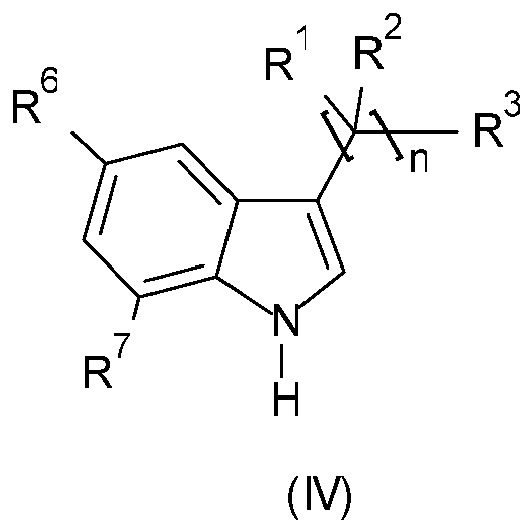
R6 and R7 independently represent hydrogen, F, Br, Cl, CO2H, CN, C1-C10 alkoxy;
R1 and R2 represent independently in each of the n units a substituent selected from the group consisting of hydrogen, substituted or not C1-C10 alkyl;
R3 represents a substituent selected from the group consisting of thiocyanate, cyano, amino sulfone derivatives, amido, substituted or not thioalkyl, hydroxylamine;
or a pharmaceutically acceptable salt, solvate, hydrate, polymorph, co-crystal thereof, for the treatment or the prophylaxis of neurologic and/or inflammatory diseases or disorders. - Compounds according to any of the previous claim having general formula (V)

R6 and R7 independently represent hydrogen, F, Br, Cl, CO2H, CN, C1-C10 alkoxy;
R1 and R2 represent independently in each of the n units a substituent selected from the group consisting of hydrogen and substituted or not C1-C10 alkyl, preferably hydrogen and substituted or not C1-C6 alkyl, more preferably hydrogen and substituted or not C1-C2 alkyl;
R10 and R11 independently represent a substituent selected from the group consisting of hydrogen, substituted or not C1-C10 alkyl, C2-C10 alkenyl, C2-C10 alkynyl, C6-C18 aryl, heterocycle, or R10 and R11 taken together with the nitrogen atom to which they are attached form a four to ten membered heterocycle;
or a pharmaceutically acceptable salt, solvate, hydrate, polymorph, co-crystal thereof, for the treatment or the prophylaxis of neurologic and/or inflammatory diseases or disorders. - Compounds according to any of claims 1 to 5 having general formula (IV)

R6 represents hydrogen; R7 represents F;
R1 and R2 represent independently in each of the n units a substituent selected from the group consisting of hydrogen, substituted or not C1-C10 alkyl; preferably hydrogen and substituted or not C1-C6 alkyl, more preferably hydrogen and substituted or not C1-C2 alkyl; R3 is amino;
for the treatment or the prophylaxis of neurologic and/or inflammatory diseases or disorders. - Pharmaceutical composition comprising a therapeutically effective amount of a compound according to any one of the claims 1 to 8, or a pharmaceutically acceptable salt, solvate, hydrate, polymorph, co-crystal thereof, in admixture with a pharmaceutically acceptable adjuvant, diluent or carrier.
- Pharmaceutical composition according to claim 9, for the treatment or prophylaxis of neurologic and/or inflammatory diseases or disorders.
- An in vitro method for inhibiting myeloperoxidase enzyme activity characterised in that said method comprises the step of adding a compound according to any one of claims 1 to 8 to a medium containing said enzyme, said compound being added in a concentration effective to inhibit the activity of said enzyme.
- Compound according to any one of claims 1 to 8 or pharmaceutical composition according to claims 9 or 10 for inhibiting myeloperoxidase enzyme activity, for inhibiting low density lipoproteins oxidation.
- An in vitro method for inhibiting low density lipoproteins (LDL) oxidation characterised in that said method comprises the step of contacting a compound according to any one of claims 1 to 8 in a medium containing said low density lipoproteins and myeloperoxidase enzyme.
- Compounds having general formula (IV)

R6 and R7 independently represent hydrogen, F, Br, Cl, CO2H, CN, C1-C10 alkoxy; R1 and R2 represent independently in each of the n units a substituent selected from the group consisting of hydrogen and C1-C10 alkyl;
R3 represents a substituent selected from the group consisting of thiocyanate, cyano, amino sulfone derivatives, amido, substituted or not thioalkyl, hydroxylamine;
or a pharmaceutically acceptable salt, solvate, hydrate, polymorph, co-crystal thereof, for use as medicine. - Compounds according to claim 14 having general formula (V)

R6 and R7 independently represent hydrogen, F, Br, Cl, CO2H, CN, C1-C10 alkoxy; R1 and R2 represent independently in each of the n units a substituent selected from the group consisting of hydrogen and C1-C10 alkyl,
R10 and R11 independently represent a substituent selected from the group consisting of hydrogen, substituted or not C1-C10 alkyl, C2-C10 alkenyl, C2-C10 alkynyl, C6-C18 aryl, heterocycle, or R10 and R11 taken together with the nitrogen atom to which they are attached form a four to ten membered heterocycle;
or a pharmaceutically acceptable salt, solvate, hydrate, polymorph, co-crystal thereof, for use as medicine.
Priority Applications (1)
| Application Number | Priority Date | Filing Date | Title |
|---|---|---|---|
| EP12174723.2A EP2682119A1 (en) | 2012-07-03 | 2012-07-03 | Aromatic N-heterocycle derivatives for use as medicine |
Applications Claiming Priority (1)
| Application Number | Priority Date | Filing Date | Title |
|---|---|---|---|
| EP12174723.2A EP2682119A1 (en) | 2012-07-03 | 2012-07-03 | Aromatic N-heterocycle derivatives for use as medicine |
Publications (1)
| Publication Number | Publication Date |
|---|---|
| EP2682119A1 true EP2682119A1 (en) | 2014-01-08 |
Family
ID=46384256
Family Applications (1)
| Application Number | Title | Priority Date | Filing Date |
|---|---|---|---|
| EP12174723.2A Withdrawn EP2682119A1 (en) | 2012-07-03 | 2012-07-03 | Aromatic N-heterocycle derivatives for use as medicine |
Country Status (1)
| Country | Link |
|---|---|
| EP (1) | EP2682119A1 (en) |
Cited By (6)
| Publication number | Priority date | Publication date | Assignee | Title |
|---|---|---|---|---|
| CN109384791A (en) * | 2017-08-09 | 2019-02-26 | 江苏恒瑞医药股份有限公司 | A kind of crystal form and preparation method thereof of imidazo isoindoles derivative free alkali |
| US10966963B2 (en) | 2014-12-18 | 2021-04-06 | Genentech, Inc. | Tetrahydro-pyrido[3,4-b]indole estrogen receptor modulators and uses thereof |
| JP2022525036A (en) * | 2019-03-07 | 2022-05-11 | アーバーメンティス・エルエルシー | Compositions and methods of use containing substances having neuroplastic activity administered in non-psychedelic / psychotic abnormal doses and formulations. |
| US11331256B2 (en) * | 2017-10-18 | 2022-05-17 | Lg Household & Health Care Ltd. | Cosmetic composition for blocking fine dust |
| US11780834B2 (en) | 2018-06-21 | 2023-10-10 | Genentech, Inc. | Solid forms of 3-((1R,3R)-1-(2,6-difluoro-4-((1-(3-fluoropropyl)azetidin-3- yl)amino)phenyl)-3-methyl-1,3,4,9-tetrahydro-2H-pyrido[3,4-b]indol-2-yl)-2,2-difluoropropan-1-ol and processes for preparing fused tricyclic compounds comprising a substituted phenyl or pyridinyl moiety, including methods of their use |
| US12239632B2 (en) | 2021-09-03 | 2025-03-04 | Alexander Shulgin Research Institute, Inc. | Asymmetric allyl tryptamines |
Citations (12)
| Publication number | Priority date | Publication date | Assignee | Title |
|---|---|---|---|---|
| US5500431A (en) * | 1993-04-14 | 1996-03-19 | Eli Lilly And Company | Tetrahydro-β-carbolines |
| WO2001066111A1 (en) * | 2000-03-09 | 2001-09-13 | Eli Lilly And Company | Compositions containing potential spla2 inhibitors for the treatment of pain |
| WO2001085146A1 (en) * | 2000-05-12 | 2001-11-15 | Astrazeneca Ab | Pharmaceutical compounds for treating copd |
| WO2004019935A1 (en) * | 2002-08-29 | 2004-03-11 | Boehringer Ingelheim Pharmaceuticals, Inc. | -3 (sulfonamidoethyl) -indole derivaties for use as glucocorticoid mimetics in the treatment of inflammatory, allergic and proliferative diseases |
| WO2005062851A2 (en) * | 2003-12-22 | 2005-07-14 | Pappolla Miguel A | Indole-3-propionamide and derivatives thereof |
| US20060063823A1 (en) * | 2004-09-23 | 2006-03-23 | Natesan Murugesan | Inhibitors of 15-lipoxygenase |
| WO2006116814A1 (en) * | 2005-05-02 | 2006-11-09 | Vanadis Bioscience Ltd | Composition and uses thereof |
| WO2007125109A1 (en) * | 2006-04-28 | 2007-11-08 | Noscira, S.A. | N- (2-thiazolyl) -amide derivatives as gsk-3 inhibitors |
| WO2009018368A1 (en) * | 2007-07-30 | 2009-02-05 | Los Angeles Biomedical Research Institute At Harbor-Ucla Medical Center | Combination treatment of nmda (n-methyl-d-aspartate)-enhancer, glycine transporter inhibitor, d-amino acid oxidase inhibitor (daaoi) for neuropsychiatric disorders |
| WO2009073620A2 (en) * | 2007-11-30 | 2009-06-11 | Newlink Genetics | Ido inhibitors |
| US20100197708A1 (en) * | 2006-08-07 | 2010-08-05 | John Jeffrey Talley | Indole compounds |
| WO2010136546A1 (en) | 2009-05-27 | 2010-12-02 | Université Libre de Bruxelles | 3-alkyl-5-fluoroindole derivatives as myeloperoxidase inhibitors |
-
2012
- 2012-07-03 EP EP12174723.2A patent/EP2682119A1/en not_active Withdrawn
Patent Citations (12)
| Publication number | Priority date | Publication date | Assignee | Title |
|---|---|---|---|---|
| US5500431A (en) * | 1993-04-14 | 1996-03-19 | Eli Lilly And Company | Tetrahydro-β-carbolines |
| WO2001066111A1 (en) * | 2000-03-09 | 2001-09-13 | Eli Lilly And Company | Compositions containing potential spla2 inhibitors for the treatment of pain |
| WO2001085146A1 (en) * | 2000-05-12 | 2001-11-15 | Astrazeneca Ab | Pharmaceutical compounds for treating copd |
| WO2004019935A1 (en) * | 2002-08-29 | 2004-03-11 | Boehringer Ingelheim Pharmaceuticals, Inc. | -3 (sulfonamidoethyl) -indole derivaties for use as glucocorticoid mimetics in the treatment of inflammatory, allergic and proliferative diseases |
| WO2005062851A2 (en) * | 2003-12-22 | 2005-07-14 | Pappolla Miguel A | Indole-3-propionamide and derivatives thereof |
| US20060063823A1 (en) * | 2004-09-23 | 2006-03-23 | Natesan Murugesan | Inhibitors of 15-lipoxygenase |
| WO2006116814A1 (en) * | 2005-05-02 | 2006-11-09 | Vanadis Bioscience Ltd | Composition and uses thereof |
| WO2007125109A1 (en) * | 2006-04-28 | 2007-11-08 | Noscira, S.A. | N- (2-thiazolyl) -amide derivatives as gsk-3 inhibitors |
| US20100197708A1 (en) * | 2006-08-07 | 2010-08-05 | John Jeffrey Talley | Indole compounds |
| WO2009018368A1 (en) * | 2007-07-30 | 2009-02-05 | Los Angeles Biomedical Research Institute At Harbor-Ucla Medical Center | Combination treatment of nmda (n-methyl-d-aspartate)-enhancer, glycine transporter inhibitor, d-amino acid oxidase inhibitor (daaoi) for neuropsychiatric disorders |
| WO2009073620A2 (en) * | 2007-11-30 | 2009-06-11 | Newlink Genetics | Ido inhibitors |
| WO2010136546A1 (en) | 2009-05-27 | 2010-12-02 | Université Libre de Bruxelles | 3-alkyl-5-fluoroindole derivatives as myeloperoxidase inhibitors |
Non-Patent Citations (3)
| Title |
|---|
| EDUARD DOLUSIC ET AL: "Tryptophan 2,3-Dioxygenase (TDO) Inhibitors. 3-(2-(Pyridyl)ethenyl)indoles as Potential Anticancer Immunomodulators", JOURNAL OF MEDICINAL CHEMISTRY, vol. 54, no. 15, 11 August 2011 (2011-08-11), pages 5320 - 5334, XP055048345, ISSN: 0022-2623, DOI: 10.1021/jm2006782 * |
| J. HOSOKAWA-MUTO ET AL: "Variety of Antiprion Compounds Discovered through an In Silico Screen Based on Cellular-Form Prion Protein Structure: Correlation between Antiprion Activity and Binding Affinity", ANTIMICROBIAL AGENTS AND CHEMOTHERAPY, vol. 53, no. 2, 17 November 2008 (2008-11-17), pages 765 - 771, XP055048377, ISSN: 0066-4804, DOI: 10.1128/AAC.01112-08 * |
| JANTSCHKO W ET AL: "Exploitation of the unusual thermodynamic properties of human myeloperoxidase in inhibitor design", BIOCHEMICAL PHARMACOLOGY, PERGAMON, OXFORD, GB, vol. 69, no. 8, 15 April 2005 (2005-04-15), pages 1149 - 1157, XP027715770, ISSN: 0006-2952, [retrieved on 20050415] * |
Cited By (10)
| Publication number | Priority date | Publication date | Assignee | Title |
|---|---|---|---|---|
| US10966963B2 (en) | 2014-12-18 | 2021-04-06 | Genentech, Inc. | Tetrahydro-pyrido[3,4-b]indole estrogen receptor modulators and uses thereof |
| US12233052B2 (en) | 2014-12-18 | 2025-02-25 | Genentech, Inc. | Tetrahydro-pyrido[3,4-b]indole estrogen receptor modulators and uses thereof |
| CN109384791A (en) * | 2017-08-09 | 2019-02-26 | 江苏恒瑞医药股份有限公司 | A kind of crystal form and preparation method thereof of imidazo isoindoles derivative free alkali |
| US11331256B2 (en) * | 2017-10-18 | 2022-05-17 | Lg Household & Health Care Ltd. | Cosmetic composition for blocking fine dust |
| US11780834B2 (en) | 2018-06-21 | 2023-10-10 | Genentech, Inc. | Solid forms of 3-((1R,3R)-1-(2,6-difluoro-4-((1-(3-fluoropropyl)azetidin-3- yl)amino)phenyl)-3-methyl-1,3,4,9-tetrahydro-2H-pyrido[3,4-b]indol-2-yl)-2,2-difluoropropan-1-ol and processes for preparing fused tricyclic compounds comprising a substituted phenyl or pyridinyl moiety, including methods of their use |
| JP2022525036A (en) * | 2019-03-07 | 2022-05-11 | アーバーメンティス・エルエルシー | Compositions and methods of use containing substances having neuroplastic activity administered in non-psychedelic / psychotic abnormal doses and formulations. |
| EP3934633A4 (en) * | 2019-03-07 | 2023-03-29 | Arbormentis LLC | COMPOSITIONS AND METHODS OF USE INCLUDING SUBSTANCES HAVING NEURAL PLASTICITY ACTIONS ADMINISTERED IN NON-PSYCHEDELIC/PSYCHOTOMIMETIC DOSES AND FORMULATIONS |
| JP2025061665A (en) * | 2019-03-07 | 2025-04-11 | アーバーメンティス・エルエルシー | Compositions containing neuroplastic substances administered in non-psychedelic/psychotometic doses and formulations and methods of use |
| US12616706B2 (en) | 2019-03-07 | 2026-05-05 | Arbormentis LLC | Compositions and methods of use comprising substances with neural plasticity actions administered at non-psychedelic/psychotomimetic dosages and formulations |
| US12239632B2 (en) | 2021-09-03 | 2025-03-04 | Alexander Shulgin Research Institute, Inc. | Asymmetric allyl tryptamines |
Similar Documents
| Publication | Publication Date | Title |
|---|---|---|
| US7897776B2 (en) | Sulfonamide containing compounds for treatment of inflammatory disorders | |
| EP3691638B1 (en) | Compounds, compositions and methods for increasing cftr activity | |
| EP3440057B1 (en) | Silicone atoms containing ivacaftor analogues | |
| EA017530B1 (en) | Derivatives of 1-phenyl-2-pyridinyl alkyl alcohols as phosphodiesterase inhibitors | |
| KR100765028B1 (en) | Indolin-2-one derivatives, methods of preparation and use as oxytocin receptor ligands | |
| CN103796992B (en) | Guanidinobenzoic acid compound | |
| WO2004046104A2 (en) | Treatment of lung cells with histone deacetylase inhibitors | |
| US20080085893A1 (en) | Matrix metalloprotease inhibitors | |
| AU2010251930A1 (en) | 3-alkyl-5-fluoroindole derivatives as myeloperoxidase inhibitors | |
| JP2011509991A (en) | Compound having CRTH2 antagonist activity | |
| JP2011509990A (en) | Compound having CRTH2 antagonist activity | |
| CN105518000B (en) | compound for treating cystic fibrosis | |
| JPWO2005095327A1 (en) | Aniline derivative | |
| US20250361218A1 (en) | Agents and methods for treating dysproliferative diseases | |
| JPH1160557A (en) | Apo B secretion / MTP inhibitor hydrochloride | |
| US6790846B2 (en) | Isoxazolone compounds useful in treating diseases associated with unwanted cytokine activity | |
| TW200303745A (en) | Novel compounds | |
| CN102470132A (en) | Disubstituted [4-(5-aminomethyl-phenyl)-piperidin-1-yl]-1h-indol-3-yl]-methanones | |
| WO2005100341A1 (en) | 2-aminopyridine derivative | |
| JP2004520346A (en) | Arylpiperidine derivatives as inducers of LDL receptor expression | |
| WO2005073183A1 (en) | Aryl sulfide derivative | |
| CN111344284A (en) | Compounds useful as inhibitors of isoprene cysteine carboxymethyltransferase | |
| JPH05502235A (en) | imidazoles | |
| CN101903352A (en) | Substituted 3-hydroxypyridine compound and pharmaceutical composition thereof | |
| WO2000068231A1 (en) | Purine derivative dihydrate, drugs containing the same as the active ingredient and intermediate in the production thereof |
Legal Events
| Date | Code | Title | Description |
|---|---|---|---|
| PUAI | Public reference made under article 153(3) epc to a published international application that has entered the european phase |
Free format text: ORIGINAL CODE: 0009012 |
|
| AK | Designated contracting states |
Kind code of ref document: A1 Designated state(s): AL AT BE BG CH CY CZ DE DK EE ES FI FR GB GR HR HU IE IS IT LI LT LU LV MC MK MT NL NO PL PT RO RS SE SI SK SM TR |
|
| AX | Request for extension of the european patent |
Extension state: BA ME |
|
| STAA | Information on the status of an ep patent application or granted ep patent |
Free format text: STATUS: THE APPLICATION IS DEEMED TO BE WITHDRAWN |
|
| 18D | Application deemed to be withdrawn |
Effective date: 20140709 |